Article

Multi-Scale Anthropogenic Control on Sandy Shoreline Evolution: A 30-Year Remote Sensing Analysis of Western Liaodong Bay (1995–2024)


1
Operational Oceanography Institution, Dalian Ocean University, Dalian 116023, China
2
College of Marine Science Technology and Environment, Dalian Ocean University, Dalian 116023, China
3
Liaoning Key Laboratory of Marine Real-Time Warning, Dalian 116023, China
4
Dalian Xinghai Bay Laboratory, Dalian 116023, China
*
Authors to whom correspondence should be addressed.
Sustainability 2026, 18(12), 6285; https://doi.org/10.3390/su18126285 (registering DOI)
Submission received: 23 May 2026 / Revised: 16 June 2026 / Accepted: 16 June 2026 / Published: 18 June 2026

Abstract

Sandy coastlines are dynamic geomorphological units supporting dense human populations and intensive economic activities. However, their evolution is increasingly dominated by anthropogenic modification rather than natural processes. This study investigates shoreline evolution along the western Liaodong Bay coast, China, where extensive anthropogenic engineering has potentially altered natural dynamics. A 30-year satellite-derived shoreline (SDS) analysis of 23 sandy beaches (Xingcheng–Suizhong, 1995–2024) was conducted using the CoastSeg framework and DSAS statistical methods across three sub-periods (1995–2005, 2005–2015, 2015–2024). Shoreline change rates ranged from −1.35 to +2.12 m/yr; 11 beaches (47.8%) exhibited net erosion and 12 (52.2%) net accretion or stability, with marked spatial heterogeneity within individual beaches. This complex spatio-temporal pattern shows the strongest spatial correspondence with the non-uniform distribution of anthropogenic structures—including ports, breakwaters, and land reclamation—which generate an “engineering proximity effect” that may fragment natural beach continuity and contribute to a regional alternating erosion–accretion mosaic pattern, though direct mechanistic verification awaits future hydrodynamic modeling. Shoreline evolution along the western Liaodong Bay coast has entered a stage of “multi-layered anthropogenic control,” requiring frameworks that integrate multi-scale, multi-process coupling mechanisms and transcend traditional regional-averaging approaches. These findings provide critical insights for spatially differentiated management of engineering-intensive sandy coasts.

1. Introduction

Sandy coastlines represent one of the most dynamic geomorphological units globally and host the densest human populations and most intensive economic activities. Approximately 24% of the world’s sandy coasts are experiencing erosion, with average retreat rates reaching 0.5 m/yr, threatening coastal settlements, infrastructure, and ecosystems [1]. However, sandy coast erosion is not driven solely by natural processes such as waves, tides, and sea-level rise [2,3]. Morphologically, open sandy beaches operate as highly non-linear, scale-dependent geomorphic systems governed by complex nearshore hydrodynamic forcing and sediment budget balances [4]. Sandy shoreline change has been documented across multiple scales: regionally, change rates exhibit pronounced spatial heterogeneity reflecting wave climate, sediment supply, and coastal engineering [3,5]; and at event scales, storm-driven retreat and recovery trajectories vary markedly with beach morphodynamic state [6]. Under the intensifying pressures of global climate change, these dynamic systems face severe systemic erosion risks driven by accelerated sea-level rise and shifting wave climates. Historically, tracking these multi-scale morphological adjustments was heavily constrained by sparse geographic coverage and fragmented temporal resolution of conventional in situ surveys. To circumvent these observational barriers, the modern paradigm of coastal science has increasingly embraced satellite-derived shoreline (SDS) tracking. By deploying robust sub-pixel edge detection techniques on open-access Landsat and Sentinel-2 imagery, this remote sensing approach successfully resolves continuous shoreline variances across seasonal, inter-annual, and multi-decadal timescales [7,8,9], enabling systematic analysis of long-term shoreline dynamics at unprecedented spatial and temporal coverage. Rather, anthropogenic disturbance has emerged as a key factor increasingly associated with shoreline change over recent decades. Large-scale infrastructure, including port construction, breakwaters [10], land reclamation [11], nuclear power plants [12], and water management projects, alters nearshore hydrodynamic conditions, interrupts alongshore sediment transport, and compresses natural beach space, thereby profoundly reshaping shoreline evolution [13]. While natural factors, including climate change, sea-level rise, and reduced fluvial sediment supply, provide the background coastal environment, the spatial differentiation of shoreline responses within a single region shows increasingly strong correspondence with anthropogenic modification. The interaction of these natural and anthropogenic factors renders sandy coast evolution highly complex [5], exhibiting pronounced spatial heterogeneity and temporal non-stationarity [2,6].
Despite decades of shoreline change research, significant knowledge gaps persist. First, most studies employ regional-scale averaging or single metrics (e.g., Linear Regression Rate, LRR) to characterize shoreline change, an approach that readily obscures local spatial heterogeneity [14]. Adjacent beaches may exhibit contrasting erosion or accretion trends that become “smoothed out” at regional scales [15]. Systematic multi-scale frameworks linking engineering proximity effects to beach-scale and cluster-scale processes remain underdeveloped [16,17]. Second, while numerous studies qualitatively acknowledge that engineering structures influence shoreline change, a mechanistic understanding of how engineering alters sediment dynamics, generates localized reorganization effects, and cumulatively produces regional patterns remains limited [18]. Particularly, adjacent beaches on opposite sides of the same engineering structure frequently exhibit divergent responses; the underlying causes of this “spatial selectivity” have not been systematically elucidated. Most importantly, the spatial correspondence between observed shoreline heterogeneity and anthropogenic structure distribution remains poorly quantified, limiting our ability to identify which shoreline changes are most consistently associated with anthropogenic modification versus those reflecting natural coastal variability. Third, most studies rely on 10–20 year observation periods, insufficient to capture long-term trends and phase-dependent transitions in shoreline dynamics. High-precision, high-frequency monitoring datasets spanning 30+ years remain scarce, particularly in Chinese coastal regions. Finally, the effectiveness of soft-engineering interventions such as ecological restoration and beach nourishment within pre-existing hard-engineering contexts, and how such measures further complicate shoreline evolution, remains understudied [19].
The western Liaodong Bay coast (Xingcheng–Suizhong) represents an ideal study region, exhibiting multiple dimensions of typicality. This region serves as a pivotal hub for Liaoning Province’s tourism and energy industries, concentrating diverse large-scale infrastructure, including Xingcheng Port, Suizhong Power Plant terminal, Xudabao Nuclear Power Station, aquaculture enclosures, and extensive land reclamation [20]. These engineering structures exhibit spatially uneven distribution and variable intensity, providing a natural “comparative experiment” for investigating engineering–shoreline coupling and identifying the spatial selectivity of anthropogenic impacts. The study coast features a characteristic headland-bay geomorphology composed of sandy pocket beaches separated by rocky headlands, exhibiting inherent spatial heterogeneity under natural conditions [21]. Superimposed anthropogenic engineering generates a characteristic “mosaic” shoreline evolution pattern [22], making this an ideal setting for investigating multi-scale shoreline control mechanisms [16,23]. With intensifying coastal development, the region faces the management challenge of coexisting erosion and accretion driven by complex engineering impacts, necessitating a scientifically grounded multi-scale understanding to guide refined management [24]. Consequently, the empirical insights and multi-scale diagnostic framework derived from this hyper-anthropogenically modified setting offer a scalable paradigm applicable to other global micro-tidal and pocket-beach systems experiencing cumulative coastal development pressures.
This study aims to systematically characterize 30-year spatio-temporal shoreline change patterns and elucidate their spatial heterogeneity and temporal non-stationarity. By establishing a multi-scale analytical framework linking engineering proximity effects to beach-scale and cluster-scale processes and ultimately to regional mosaic patterns, we systematically examine how anthropogenic engineering reshapes shoreline evolution through multi-scale mechanisms. Simultaneously, we quantitatively examine the spatial association of different engineering types (ports, breakwaters, nuclear facilities, land reclamation) on shoreline change, revealing their differential intensities and spatial selectivity. This research not only deepens understanding of sandy coast evolution under anthropogenic disturbance but also provides scientific foundations for refined management of engineering-intensive sandy coasts, emphasizing the necessity of multi-scale, spatially differentiated management strategies.

2. Study Area and Data

2.1. Study Area

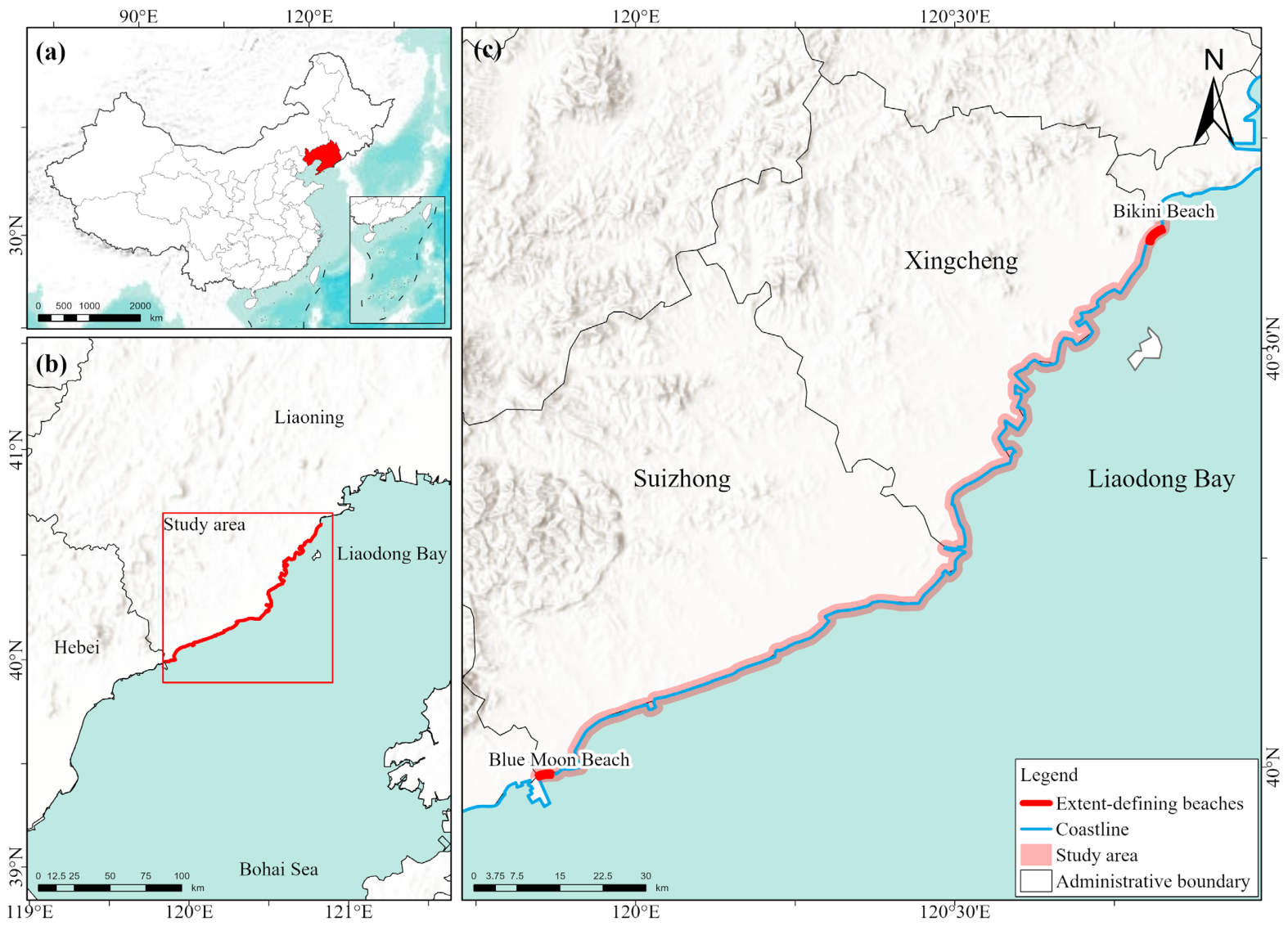
The study area, located on the western coast of Liaodong Bay and extending from Bijini Beach (Xingcheng) to Blue Moon Beach (Suizhong), is shown in Figure 1, comprising a total coastline length of approximately 140 km. Its geographical range is approximately 39°59′–40°39′ N, 119°50′–120°49′ E. This region is classified as a temperate continental monsoon climate with pronounced seasonality [25], exhibiting a long-term (1960–2020) average annual precipitation of 755.85 mm with a historical climate declining trend of −12.38 mm/10 a [26]. The seabed topography along this coastline is generally gentle, with water depths ranging from 4 to 22 m (averaging ~15 m) and dropping to less than 5 m within the immediate nearshore zone [27].
Tectonically, the coastal zone is situated at the northern margin of the North China Platform and the eastern section of the Yanshan fold belt. The underlying Quaternary sedimentary sequence reaches a thickness of 300–500 m, primarily characterized by marine-continental transitional facies shaped by historical sea-level fluctuations [27]. Within this geological context, the coastal zone features a typical headland-bay coastal system, where sandy pocket beaches are separated by rocky headlands [21]. Coastal waters are characterized by irregular semi-diurnal tides with rectilinear tidal currents primarily oriented along the NE–SW axis. The tidal range varies between 0.8 and 2.8 m, while the maximum current velocity ranges from 0.7 to 2.0 m·s−1 [28]. Driven by the intensive socio-economic activities of a combined regional resident population of approximately 0.97 million (comprising 463,000 in Xingcheng and 503,000 in Suizhong as of 2024) [29,30], intensive human modification has occurred in recent decades. As pivotal nodes for the tourism and energy industries in Liaoning Province, large-scale infrastructure—such as Xingcheng Port, the Suizhong Power Plant terminal, and coastal reclamation—has significantly altered the natural coastline [31]. Consequently, the sandy shores in this region have become highly fragmented. Rather than forming a single continuous strip, the natural beaches are now divided into distinct, discontinuous segments separated by artificial structures and natural headlands. These modifications have reshaped the local geomorphology and potentially disrupted longshore sediment transport, leading to complex erosion-accretion patterns. Therefore, identifying these individual sandy segments and examining their spatio-temporal dynamics in relation to engineering intensity, type, and spatial arrangement provides the critical spatial foundation for understanding anthropogenic shoreline differentiation and for supporting sustainable coastal management.

2.2. Data Source and Acquisition

To frame the analysis within the most recent coastal management context, up to 512 valid multi-source satellite images acquired between 1 January 1995 and 31 December 2024 were employed to reconstruct the spatio-temporal dynamics of the Xingcheng-Suizhong shoreline. The primary data sources consist of optical imagery from the Landsat series (Landsat 5 TM, Landsat 7 ETM+, Landsat 8 OLI, and Landsat 9 OLI-2) and Sentinel-2 MSI imagery. The main characteristics of these datasets are summarized in Table 1. The combination of Landsat and Sentinel-2 imagery provides the longest feasible observation window while also increasing image availability and temporal density in the later part of the study period. The harmonization of multi-sensor imagery with differing spatial resolutions is addressed in Section 3.1.
To ensure high spectral fidelity and minimize cloud interference on shoreline detection, a stringent cloud cover threshold of <10% was applied during the data acquisition. Furthermore, the temporal window for image selection was constrained to April through October of each year. This seasonal filtering is critical for the Liaodong Bay region to eliminate the influence of coastal sea ice and seasonal snow cover, thereby ensuring that the extracted shorelines accurately represent the underlying sandy beach morphology rather than transient ice features. After screening and quality control, the dataset provided the basis for constructing high-density multi-decadal shoreline time series for all 23 beaches.

3. Methods

The methodological framework comprised three main stages: (1) satellite-derived shoreline extraction with image screening and quality control; (2) tidal correction to normalize instantaneous shorelines to a common vertical reference; (3) transect-based shoreline change analysis using DSAS v6.1. Together, these procedures were designed to generate a temporally consistent shoreline dataset for long-term change analysis. The overall workflow is illustrated in Figure 2.

3.1. Shoreline Extraction

Shoreline extraction was performed using the CoastSeg framework [32], which re-implements and enhances the well-validated CoastSat toolkit [33]. CoastSeg provides an interactive environment for defining the region of interest and conducting visual quality control. During image retrieval through the GEE API [34], cloud masking and a bad-pixel ratio threshold of 0.25 were applied to maximize image quality, particularly for Landsat 7 SLC-off scenes. Additional geometric constraints, including a minimum beach area and a minimum shoreline length of 500 m, were used to reduce fragmented spectral noise.
Shoreline detection followed the standard CoastSat-based workflow. The Modified Normalized Difference Water Index (MNDWI) was calculated from atmospherically corrected surface reflectance imagery to enhance land-water contrast [35]:
M N D W I = G r e e n S W I R 1 G r e e n + S W I R 1
Otsu’s automatic thresholding method was then applied to derive a binary land-water mask [36], and the Marching Squares algorithm was subsequently used to vectorize the shoreline at a sub-pixel scale [33]. To harmonize the multi-sensor data, Landsat 7/8 images were pansharpened to 15 m, and Landsat 5 images were resampled to 15 m via bilinear interpolation, while Sentinel-2 SWIR1 band was upsampled to 10 m; the sub-pixel extraction approach ensures consistent shoreline accuracy (~10–15 m) regardless of sensor resolution [32,33]. To validate extraction accuracy, a reference shoreline was manually digitized from Google Earth high-resolution imagery (0.46 m resolution, October 2024) and compared against CoastSeg-derived positions along 18 transects at a representative beach, yielding an RMSE of 14.5 m. This uncertainty is substantially smaller than the cumulative shoreline displacements observed over the 30-year study period, confirming the reliability of the long-term trend analysis. All extracted shorelines were visually inspected, and evidently anomalous detections were excluded from subsequent analysis.

3.2. Tidal Correction

To reduce cross-shore offsets caused by varying tidal stages at the time of image acquisition, all instantaneous satellite-derived shorelines were tidally corrected [37,38]. For each shoreline, tidal elevation relative to a common datum (Mean High Water, MHW) was estimated using the FES2022 global tide model through the pyTMD framework [39,40]. Horizontal shoreline correction was then calculated as:
x = Z t i d e Z r e f t a n ( β )
where Δx represents the cross-shore horizontal shift, Ztide is the instantaneous tidal elevation simulated at the exact UTC timestamp of each individual satellite overpass, Zref is the vertical elevation of the local MHW reference datum, and tan(β) is the local beachface slope. Beachface slope values were obtained from the global beachface slope database integrated within CoastSeg [41], which provides pre-computed slope estimates for shore-normal transects worldwide. Default slope values were applied without site-specific modification and used consistently in the tidal normalization procedure [32]. While localized slope variability may introduce minor uncertainties in the tidal correction, the use of a globally consistent dataset ensures methodological uniformity across all study beaches. Furthermore, historical multi-decadal validation studies have robustly demonstrated that high-frequency temporal variations in beachface slope have a negligible statistical impact on long-term erosion/accretion trend assessments, as these short-term morphological fluctuations are effectively averaged out over 30-year observation periods [7]. This procedure normalized shorelines to a common vertical reference and improved inter-temporal comparability for long-term change analysis.

3.3. Shoreline Change Statistics

Shoreline change analysis was performed using the Digital Shoreline Analysis System (DSAS v6.1) [42]. Only sandy beaches with a continuous alongshore length exceeding 500 m were selected as independent study segments. This threshold ensures a minimum of 10 shore-normal transects per beach unit (at 50 m spacing) for statistically robust change rate estimates, and excludes short embayed beaches whose morphodynamics are dominated by headland boundary effects rather than regional wave forcing [43,44]. Beach boundaries were delineated based on sandy shoreline segments identified in the 2021 official coastal survey of China, using natural or artificial coastal features such as headlands, jetties, and river mouths as objective boundary endpoints. The geographic coordinates of the start and end points of each study beach are provided in Table A1 (Appendix A). For each segment, a reference baseline was established offshore, and orthogonal transects were cast at 50 m intervals to intersect the multi-decadal shoreline vectors (1995–2024). This 50 m spacing was chosen to provide high-resolution spatial coverage while minimizing alongshore spatial autocorrelation [14,45].
For each transect, three shoreline change metrics were calculated: the Shoreline Change Envelope (SCE), the End Point Rate (EPR), and the Linear Regression Rate (LRR). The LRR, determined by fitting a least-squares regression line to all available temporal shoreline positions, was adopted as the primary indicator for long-term shoreline evolution. LRR values were evaluated at the 95% confidence level, and only statistically significant trends (p ≤ 0.05) were used when classifying long-term shoreline behavior at the transect scale.
For transects where natural sandy beaches were permanently replaced by artificial coastal structures (e.g., ports or seawalls) during the study period, these “anthropogenic conversion” segments were treated separately and excluded from post-construction natural shoreline trend estimation [46,47].
To scientifically assess the severity of shoreline dynamics, shoreline positional uncertainty was evaluated by combining the sub-pixel extraction accuracy of CoastSeg (~10–15 m) and cumulative residuals over the 30-year study period. Based on this error propagation (i.e., ~15 m maximum error divided by 30 years), an evidence-based uncertainty threshold of ±0.5 m/yr was established to distinguish actual shoreline movement from methodological noise, which aligns with robust global-scale assessment practices [1]. Accordingly, transects with LRR values between −0.5 and 0.5 m/yr were classified as stable, values above 0.5 m/yr as accreting, and values below −0.5 m/yr as erosional [1,48]. Within the erosional category, values between −1.0 and −3.0 m/yr were further designated as indicating intense erosion to highlight regional hotspots, strictly following the established geomorphological classification scheme [1].

3.4. Spatial Stratification and Clustering Criteria

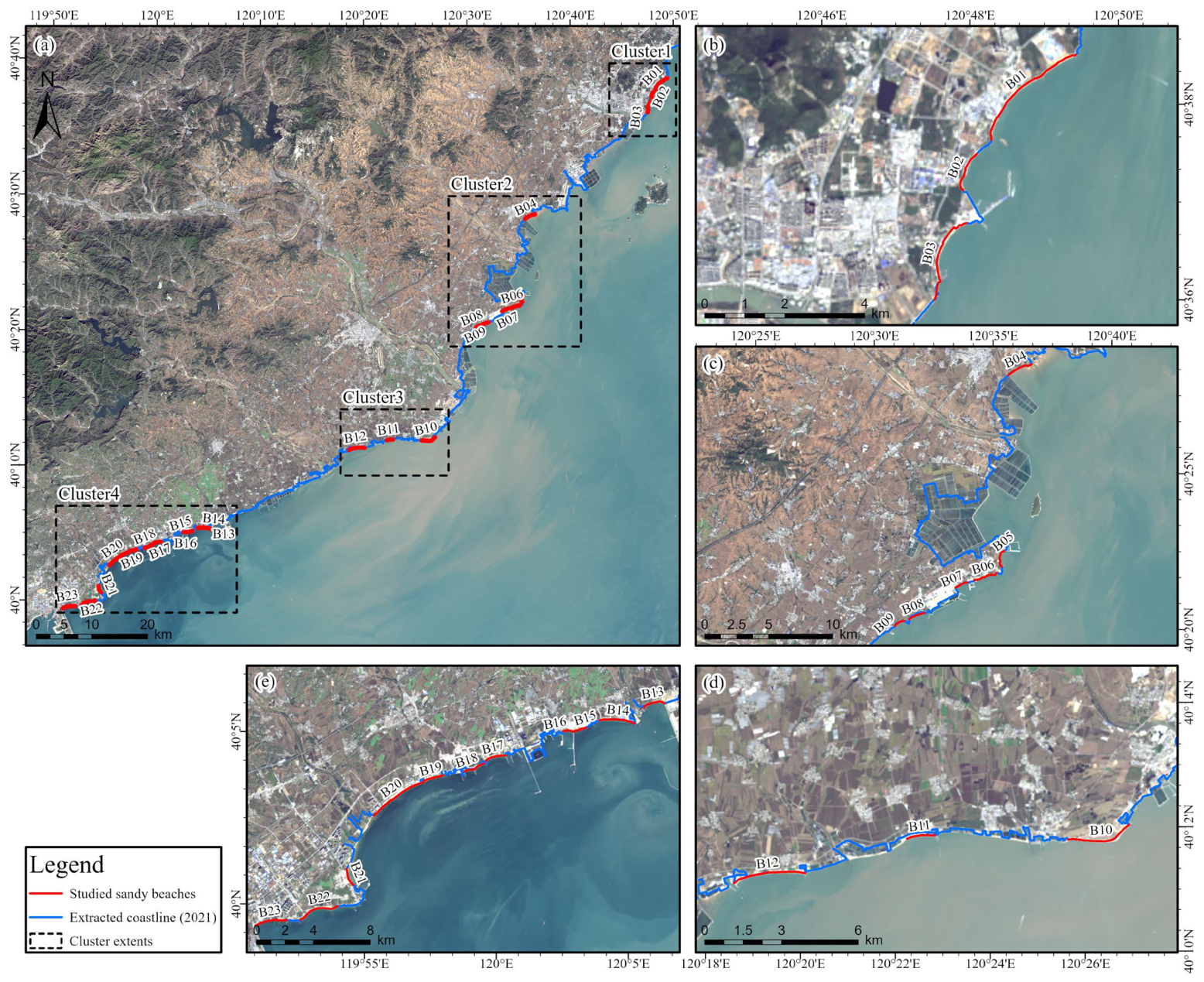
To systematically analyze long-term multi-scale shoreline behavior, the 23 isolated sandy beaches were stratified into four distinct geographic clusters (Xingcheng, Xudabao, Dongdaihe, and Suizhong clusters). This spatial stratification was established based on three complementary criteria applied prior to trend analysis: (1) Regional coastal setting, capturing shared background hydrodynamics within macroscopic bays; (2) Spatial association, grouping beaches with adjacent relative geographic proximity; and (3) Boundary segmentation, where clusters are objectively separated by intervening non-sandy headlands or permanently modified artificial structures (such as major ports or extended dikes) that disrupt longshore sediment transport continuity. This structured stratification provides the spatial framework for assessing fine-scale anthropogenic impacts against regional baselines.

4. Results

4.1. Overall Shoreline Change Rates Across the Study Area

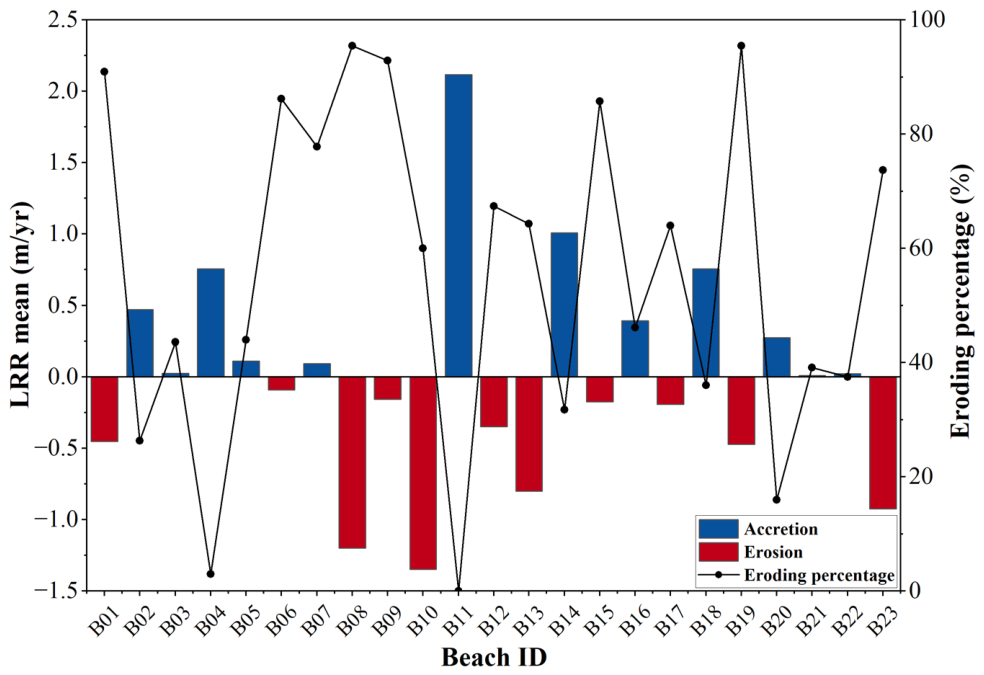
A total of 23 distinct sandy beach segments were identified along the western coast of Liaodong Bay for detailed shoreline evolution analysis based on present-day coastal morphology. Following rigorous data extraction and visual screening procedures, high-density shoreline time series were successfully constructed, with the number of valid shorelines ranging from 29 to 447 per beach. DSAS-derived change statistics revealed substantial heterogeneity in shoreline dynamics across the 23 sandy beaches of the western Liaodong Bay coast. Eleven of the 23 beaches (47.8%) exhibited net erosional long-term trends (mean LRR < 0 m/yr), while the remaining 12 (52.2%) were accreting or near-stable (mean LRR ≥ 0 m/yr) (Table 2). However, transect-level erosion ratios indicate that erosion is more pervasive than beach-averaged rates suggest. Specifically, 12 beaches recorded eroding transect proportions exceeding 50%, indicating substantial within-beach spatial heterogeneity, even where mean LRR values were positive (see Section 4.2). Overall mean LRR values ranged from −1.35 m/yr (B10, Gujiazi Beach) to +2.12 m/yr (B11, Tianlongsi Beach).
The most intensely eroding beach was Gujiazi Beach (B10, LRR = −1.35 m/yr), which also recorded the highest mean Shoreline Change Envelope (SCE = 178.9 m) in the entire study area—more than twice the study-area median (101.9 m)—indicating extreme morphological instability. Other strongly eroding beaches included Bihaitan Beach (B08, −1.20 m/yr, SCE = 125.4 m, eroding transect ratio 95.5%), Lanyue Beach (B23, −0.93 m/yr), and Suizhong Harbor Beach (B13, −0.80 m/yr). At the opposite end, Tianlongsi Beach (B11) was the most strongly accreting unit in the study area (LRR = +2.12 m/yr, erosion ratio 0%, NSM mean = +60.9 m), with all transects showing unidirectional seaward progradation throughout the 30-year record. Longwangmiao Beach (B14, +1.01 m/yr, NSM = +43.9 m) and Binhai Boulevard Beach (B04, +0.76 m/yr) also exhibited notable long-term accretion. Study-area SCE values ranged from 78.3 m (B21, Zhimaowan) to 178.9 m (B10), reflecting broad contrasts in beach morphological stability across the study coast.
Comparison of LRR and EPR values confirms broadly consistent directional trends across most beaches, validating the long-term erosion/accretion classification. However, five beaches exhibited a sign discrepancy between LRR and EPR (denoted by a single asterisk ‘*’ in Table 2): B12, B15, B17, and B19 all showed negative mean LRR (long-term erosion) but positive EPR (endpoint accretion), suggesting a possible recent reversal toward accretion at the terminal endpoint dates relative to the long-term trajectory. Beach B03 showed the converse pattern (LRR = +0.02 m/yr, EPR = −0.62 m/yr), indicating near-stability over 30 years but a negative shift in the most recent endpoint position. Notably, an analogous anomaly is observed when comparing LRR with NSM: B23 (Lanyue Beach) recorded a negative mean LRR (−0.93 m/yr) but a positive mean NSM (+22.8 m), implying that while the long-term regression trend is erosional, the most recent shoreline position is seaward of the 1995 baseline—a pattern consistent with initial accretion followed by accelerating erosion in the later portion of the record, which will be examined in Section 4.3. Given its statistical robustness in utilizing all available shoreline observations [42,49], LRR is adopted as the primary classification metric throughout this study, consistent with established practice [1].

4.2. Spatial Variability of Shoreline Change

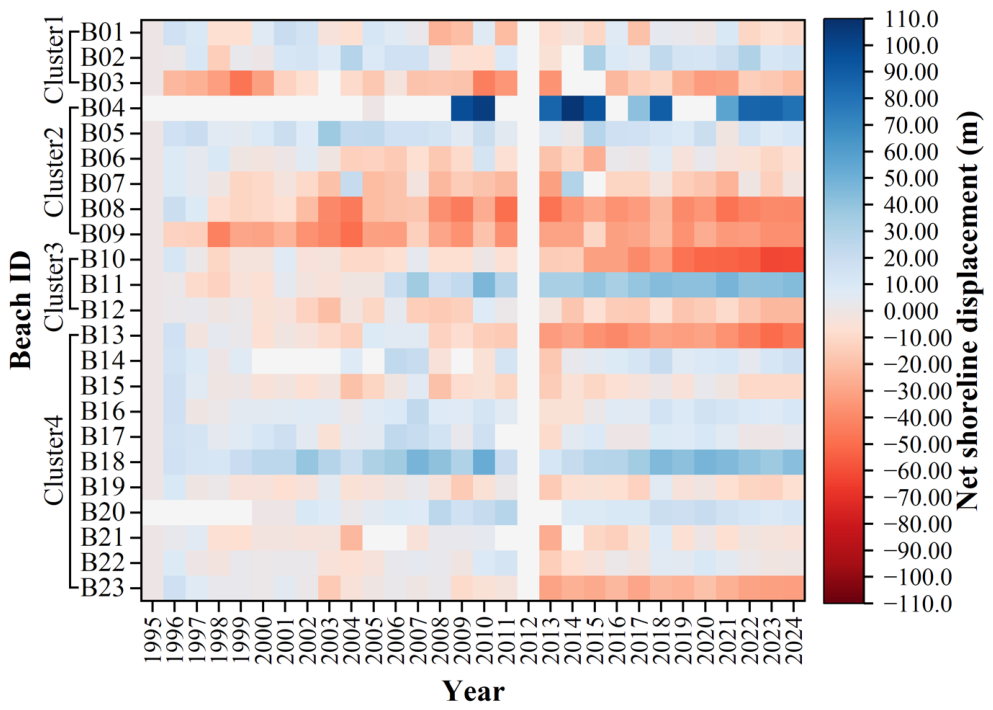
Spatially, the 23 sandy beaches are distributed along a northeast-to-southwest-trending coastline. Following the spatial stratification and clustering criteria defined in Section 3.4, these beaches are organized into four distinct geographic clusters (Figure 3; Table 3). Marked contrasts in shoreline behavior were evident both among and within these clusters. In the Xingcheng cluster (B01–B03), three closely spaced urban beaches exhibited divergent trends, with B01 eroding while B02 and B03 remained near-stable to weakly accreting. The Xudabao cluster (B04–B09) showed substantial internal variability, with strong accretion at B04 and intense erosion at B08 representing the most extreme values within this cluster. The Dongdaihe cluster (B10–B12) displayed marked contrasts in shoreline behavior among its three beaches, with the strongly eroding B10 and the most accreting beach in the study area, B11, representing contrasting trajectories within the same cluster. In the Suizhong cluster (B13–B23), a dense sequence of beaches displayed a recurring erosion–accretion alternation alongshore. Overall, these patterns indicate that shoreline change along the western Liaodong Bay coast is spatially segmented rather than organized as a simple regional gradient.
Cluster-level differences in shoreline behavior were also evident in both the direction and internal consistency of change (Figure 3 and Figure 4; Table 2). The Xingcheng cluster (B01–B03) showed moderate but clear internal divergence, with one predominantly erosional beach (B01; LRR = −0.45 m/yr, 90.9% eroding transects) contrasting with two near-stable to weakly accreting beaches (B02–B03; LRR = +0.47 and +0.02 m/yr). The Xudabao cluster (B04–B09) exhibited the greatest internal variability among all four clusters, spanning from strong accretion at B04 (+0.76 m/yr; 2.9% eroding transects) to intense erosion at B08 (−1.20 m/yr; 95.5%) and high erosion dominance at B09 (−0.16 m/yr; 92.9%). By contrast, the Dongdaihe cluster (B10–B12), although composed of only three beaches, displayed the widest contrast in mean shoreline change rates, ranging from the most erosional beach in the study area (B10; −1.35 m/yr) to the most accreting one (B11; +2.12 m/yr), while B12 remained moderately erosional (−0.35 m/yr; 67.4%). The Suizhong cluster (B13–B23) contained the largest number of beaches and was characterized not by uniform behavior, but by repeated alternation between erosional and accreting units. Within this southern cluster, distinctly erosional beaches such as B13 (−0.80 m/yr), B19 (−0.47 m/yr; 95.5%), and B23 (−0.93 m/yr) were interspersed with strongly accreting beaches including B14 (+1.01 m/yr) and B18 (+0.76 m/yr), whereas B20–B22 remained near-stable to weakly accreting. These cluster-specific differences indicate that the degree of shoreline coherence varies markedly across the study coast, with some clusters showing localized consistency and others displaying strong internal fragmentation.
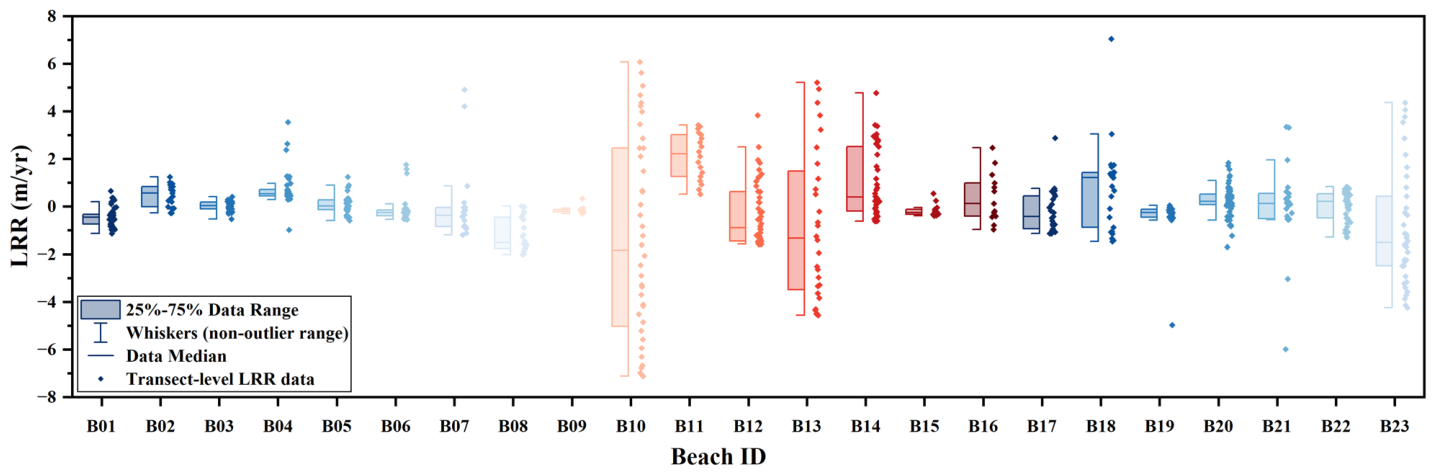
A particularly striking feature is the pronounced spatial heterogeneity within individual clusters (Figure 4). The most extreme example occurs in the Dongdaihe cluster, where B10 (LRR = −1.35 m/yr, intense erosion) and B11 (LRR = +2.12 m/yr, strongest accretion in the study area) represent contrasting trajectories separated by only ~5 km of coastline. This juxtaposition of extreme erosion and accretion within the same geographic cluster indicates that shoreline response is controlled by localized factors (such as proximity to ports, breakwaters, nuclear facilities, and land reclamation, as well as natural headland boundaries) rather than regional-scale forcing. The specific configurations of these localized drivers and their corresponding morphodynamic mechanisms are systematically examined in Section 4.4 and Section 5.2. A similarly contrasting pattern is evident in the Suizhong sector, where erosional beaches and accreting beaches alternate repeatedly along the coastline. Between B13 and B20, erosion-dominated units such as B13, B15, B17, and B19 are interspersed with accreting beaches including B14, B16, B18, and B20, producing a fine-scale erosion–accretion mosaic rather than a spatially coherent trend. Even where mean LRR values are close to zero, erosion proportions often remain substantial, indicating that near-stable average behavior does not necessarily imply alongshore uniformity. These marked contrasts in shoreline behavior, whether among beaches within the same cluster or within individual beach compartments, are inconsistent with a smoothly varying regional forcing and instead point to localized controls on sediment redistribution and shoreline response, which are further examined in Section 4.4.
Transect-based statistics further demonstrate that substantial spatial heterogeneity exists within individual beaches (Figure 5). In many cases, mean beach-level LRR values obscure pronounced alongshore variability, as erosional and accreting transects coexist within the same sandy unit. This is particularly evident for beaches such as B10, B13, and B23, where the transect-level LRR distributions span a wide range and include strongly negative values, indicating the presence of localized erosion hotspots rather than uniform retreat along the entire beach. By contrast, B11 shows a consistently positive distribution with no eroding transects, confirming its exceptionally coherent progradational behavior. Several beaches with near-stable or weakly positive mean LRR values, including B03, B05, B20, B21, and B22, nevertheless contain both erosional and accreting transects, demonstrating that beach-averaged rates may mask substantial internal variability. Overall, the transect-scale results indicate that shoreline change along the western Liaodong Bay coast is heterogeneous not only among beaches within clusters but also within individual beach compartments, implying that local shoreline controls operate at multiple spatial scales.

4.3. Temporal Variability of Shoreline Change

Temporal variability in shoreline change was pronounced across the 23 sandy beaches, with diverse annual displacement patterns including persistent retreat, sustained advance, and repeated fluctuations (Figure 6). Rather than following a uniform regional trajectory, shoreline evolution was strongly spatially differentiated through time, with temporal heterogeneity evident both among clusters and within individual beaches. Although no shoreline data were available for 2012 due to satellite imagery gaps, the remaining annual records (1995–2024) captured the long-term temporal structure of shoreline variability.
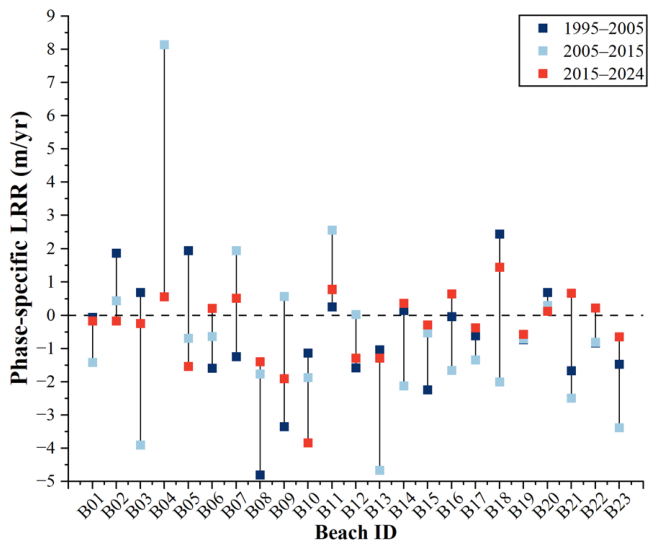
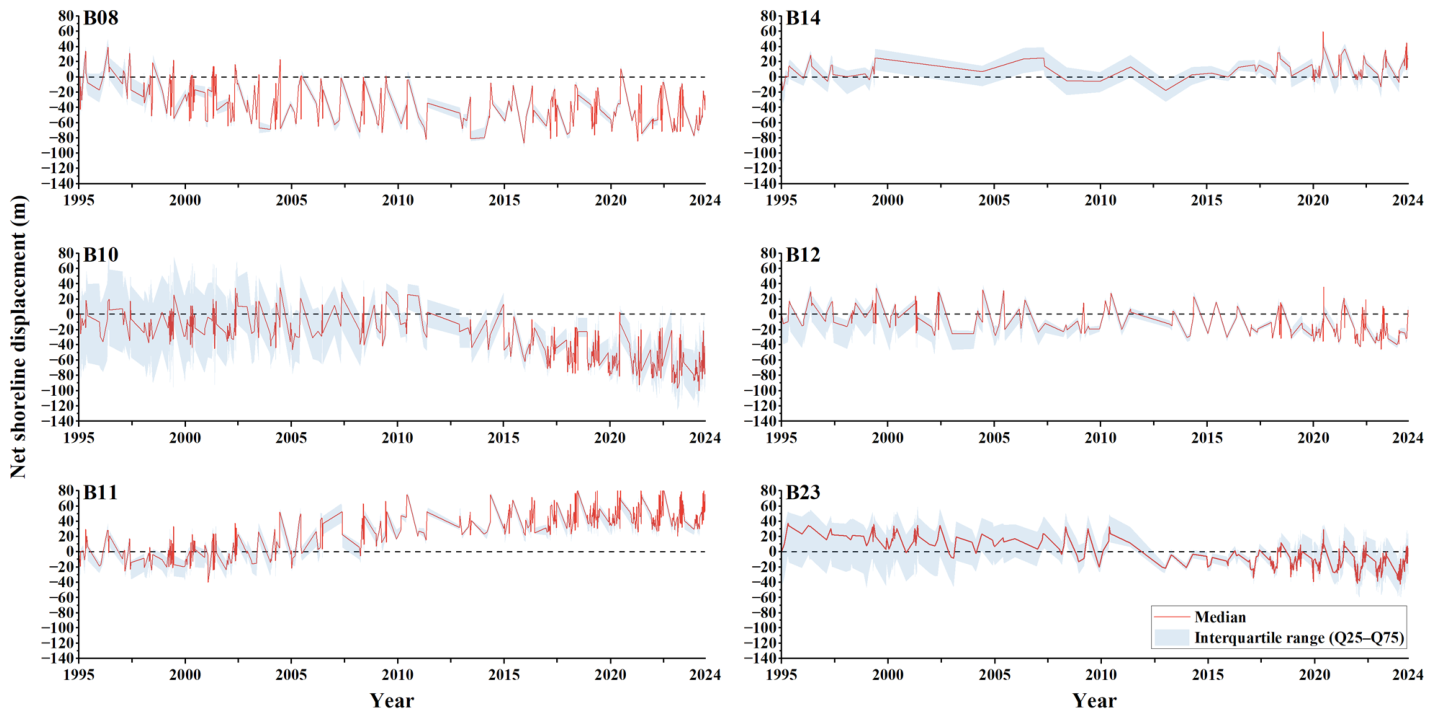
At the regional scale, two broad temporal behaviors could be identified. Some beaches displayed relatively persistent long-term tendencies, with annual displacement values remaining consistently on one side of the zero line for extended periods. For example, B08 and B10 were characterized by sustained negative displacement during much of the record, indicating prolonged shoreline retreat, whereas B11 and, to a lesser extent, B14, showed predominantly positive displacement during the later years of the study period, reflecting continuing shoreline advance (Figure 6; Figure 7). In contrast, several beaches exhibited phase-dependent behavior, with contrasting rates among the three analysis periods (Figure 8). These beaches crossed the ±0.5 m/yr stability threshold between phases, suggesting temporal reversals or marked shifts in shoreline behavior category rather than monotonic long-term change.
The representative beach trajectories further illustrate the diversity of temporal responses (Figure 7). B08 showed a persistent erosion-dominated pattern, with median shoreline displacement remaining mostly negative after the late 1990s. B10 exhibited the strongest erosional tendency combined with a broad interquartile range, indicating both substantial retreat and high along-beach variability. In contrast, B11 displayed a clear transition toward sustained positive displacement after the mid-2000s, representing the most pronounced accretionary trajectory in the dataset, while B14 also showed a generally positive but more moderate and fluctuating advancing trend. The trajectories of B12 and B23 were more complex, with substantial interannual oscillations and shifts in direction, highlighting non-linear shoreline evolution and the mismatch that can arise between long-term regression-based trends and shorter-term endpoint behavior.
Phase-specific shoreline change rates (Figure 8) reveal that many beaches did not maintain constant rates throughout the study period. Specifically, a beach was classified as exhibiting a marked change only if its phase-specific LRR crossed the ±0.5 m/yr stability threshold between consecutive phases, indicating a definitive shift in behavior category. Note that B04 was excluded from this comparison due to insufficient data in the 1995–2005 phase. Under this criterion, 17 of 22 beaches with complete three-phase records (77.3%) exhibited marked behavioral changes among the three phases (1995–2005, 2005–2015, 2015–2024), indicating dynamic transitions among erosional, stable, and accreting states. This temporal non-stationarity indicates that shoreline evolution along the Xingcheng–Suizhong coast cannot be adequately described by a single uniform trend. Instead, the combination of persistent tendencies, episodic reversals, and beach-specific fluctuations reflects a highly dynamic coastal system in which shoreline response varies both spatially and temporally.

4.4. Shoreline Change in Relation to Human Activities

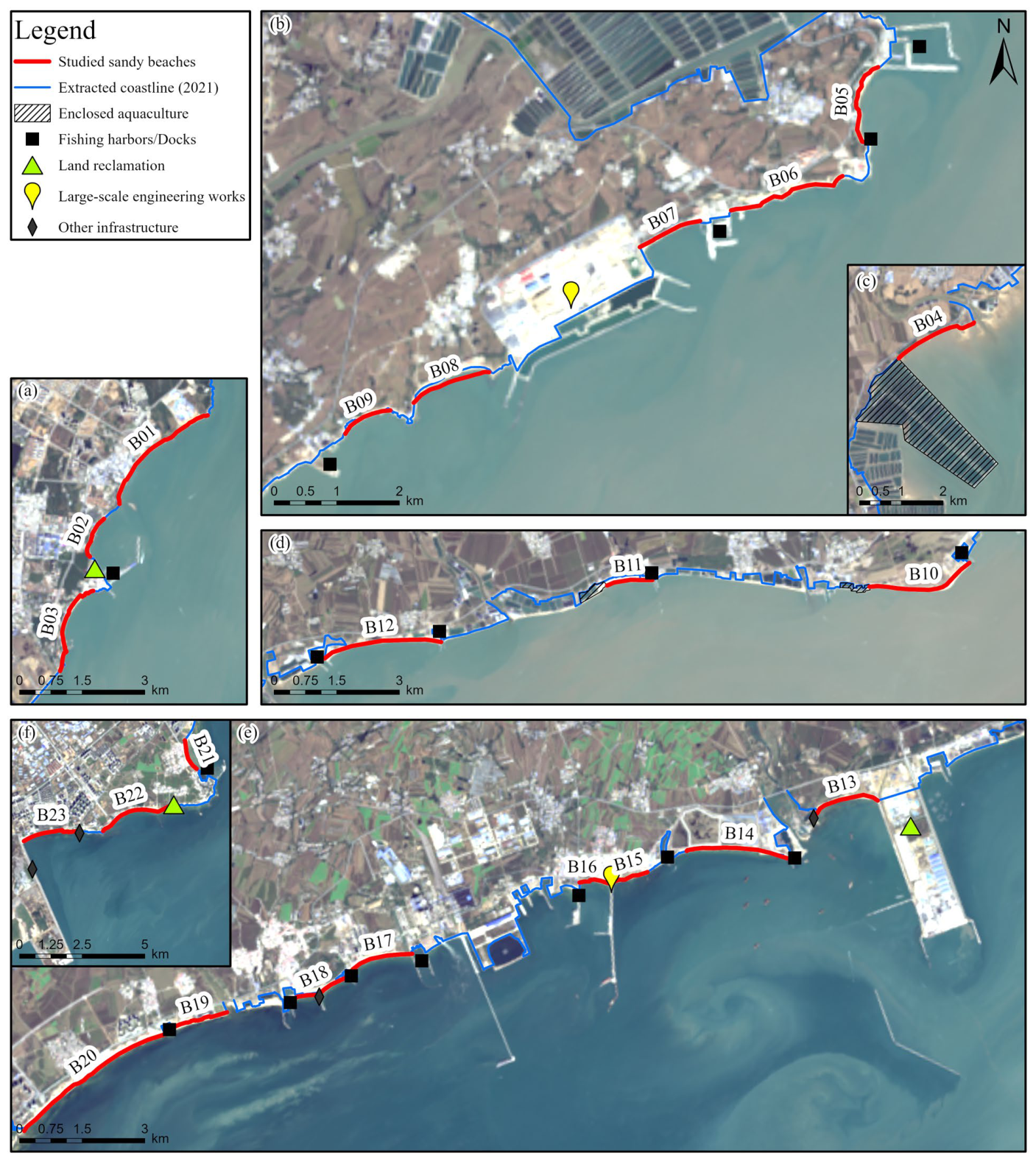
The spatial and temporal heterogeneity documented in Section 4.2 and Section 4.3 showed a pronounced correspondence with the distribution of anthropogenic structures across the study area, indicating that anthropogenic modification is the most consistent spatial indicator of the observed differentiation. Sandy beaches along the Xingcheng–Suizhong coast occurred within coastal settings that differed markedly in the intensity and type of human modification, including harbors, breakwaters, seawalls, aquaculture enclosures, and large construction sites. The strongest spatial correspondence between shoreline variability and human intervention was observed in the more intensively modified sectors (Xudabao and Suizhong clusters), whereas in less engineered settings (Xingcheng cluster) the correspondence was more attenuated, suggesting that natural coastal processes provide the background hydrodynamic setting while anthropogenic modification closely parallels the spatial selectivity of shoreline response.
This correspondence was most evident in the Xudabao and Suizhong sectors (Figure 9). In Cluster 2, the continuous beach sequence from B05 to B09 was affected by multiple engineered elements, including harbor facilities and the Xudabao Nuclear Power Station between B07 and B08. Within this short coastal sector, shoreline behavior differed markedly, with B07 remaining close to stable overall, whereas B08 showed intense long-term erosion and B09 was also erosion-dominated. In Cluster 4, where fishing harbors, small ports, breakwaters, road embankments, and other coastal structures were densely distributed, the shoreline displayed a pronounced alternating erosion–accretion mosaic. The repeated juxtaposition of erosional and accreting beaches in this southern sector indicates that dense anthropogenic structures fragmented alongshore sediment redistribution and contributed to highly localized shoreline responses.
Detailed pre- and post-construction comparisons for representative engineering-adjacent beaches are provided in Appendix A, Table A2; these data offer empirical evidence of temporal association between construction events and shoreline behavioral shifts, although they should be interpreted with caution as the pre- and post-design cannot fully exclude the influence of concurrent natural forcing or rule out alternative explanations. These comparisons reveal distinct temporal transitions in shoreline behavior associated with engineering construction timing.
By contrast, the Xingcheng sector showed more limited engineering intensity and relatively more coherent shoreline behavior. The Dongdaihe sector also exhibited marked variability among beaches within the same cluster, although the three beaches were separated by intervening shoreline segments and the correspondence with hard-engineering structures was less direct than in Clusters 2 and 4. This suggests that anthropogenic drivers in the study area were not limited to large coastal structures alone, but may also include fishing-harbor activities, coastal use, tourism-related development, and localized management practices. Possible restoration-related interventions may also have influenced individual sites, although such effects were not consistently identifiable at the regional scale and are therefore discussed further in Section 5. In particular, Beach B21 demonstrates that ecological restoration can further modify shoreline trajectories previously altered by hard engineering, with distinct pre- and post-restoration transitions evident in shoreline behavior. Overall, these results indicate that shoreline change along the western Liaodong Bay coast exhibited a pronounced spatial alignment with anthropogenic modification, with the spatial selectivity and magnitude of shoreline response varying substantially among coastal sectors depending on engineering type, intensity, and local beach characteristics.

5. Discussion

5.1. Implications of Shoreline Non-Stationarity and Spatial Fragmentation

In this study area, shoreline evolution is governed by a complex interplay of natural and anthropogenic factors. However, consistent with emerging global paradigms, human activities appear to exert a more direct and profound impact than natural forces in driving localized morphological changes. While natural drivers, such as sea-level rise and regional hydrodynamics, establish gradual, multi-decadal coastal baselines, anthropogenic interventions (e.g., coastal engineering and land reclamation) operate on much shorter temporal scales, frequently generating localized, high-magnitude responses. This humandriven dynamic is not unique to the Xingcheng–Suizhong coast. Global-scale syntheses reveal that severe coastal morphological changes and spatial fragmentation are increasingly governed by anthropogenic interventions rather than natural processes alone [50,51]. Decades of intense human modifications, including sediment trapping by upstream reservoirs and extensive coastal engineering, have been shown to fundamentally overwhelm natural accretion processes, leaving many of the world’s major populated coastal systems highly vulnerable to accelerated erosion and inundation [52]. Furthermore, comparative international case studies, such as the Mekong River delta, demonstrate that intense human activities can rapidly outpace natural drivers, triggering abrupt shoreline deformations and severe morphological reversals [53]. In our study, the frequent phase reversals and extreme spatial fragmentation observed among adjacent transects (e.g., juxtaposed severe erosion and strong accretion) serve as typical signatures of such heavily human-modified coastal systems.
Despite these similarities, the Xingcheng–Suizhong coast differs from many previously reported anthropogenically modified shorelines in that multiple types of human interventions, including ports, seawalls, aquaculture facilities, and energy infrastructure, coexist within a relatively short coastal reach. This combination generates an exceptionally fine-scale mosaic of alternating erosion and accretion patterns, emphasizing that cumulative and interacting human disturbances may produce more complex shoreline responses than those associated with single dominant engineering controls.
The pronounced spatial fragmentation and temporal non-stationarity documented in the results indicate that shoreline change along this coast cannot be adequately described by a single uniform trend or beach-averaged metric. The coexistence of persistent erosion, sustained accretion, and phase-dependent reversals within the same coastal region demonstrates that shoreline evolution is fundamentally a multi-scale, non-linear process. This complexity reflects the interaction between natural coastal dynamics and anthropogenic modifications, which are distributed non-uniformly across the study area. Understanding shoreline change in such fragmented coastal systems requires moving beyond traditional approaches that assume spatial coherence or temporal stationarity, and instead recognizing the localized and time-dependent nature of coastal response.

5.2. Anthropogenic Drivers and Shoreline Response

Long-term shoreline changes in the sandy coast of the study area do not manifest as uniform regional erosion or accretion, but rather display pronounced local differentiation. This spatial variability is most consistently associated with the uneven distribution of anthropogenic structures, including ports, breakwaters, nuclear power plant construction, aquaculture enclosures, and land reclamation. Different types of anthropogenic structures reshape shoreline change patterns through segmenting the coastline, interrupting nearshore sediment exchange, compressing natural beach space, and altering coastal land use patterns, thereby generating the observed significant spatial heterogeneity in shoreline change across the study region. While natural coastal processes (e.g., wave-driven sediment transport, tidal currents) provide the background hydrodynamic setting, the spatial selectivity and magnitude of shoreline responses closely mirror the distribution of anthropogenic modification.
It is essential to explicitly acknowledge that anthropogenic drivers do not act in isolation; rather, they interact continuously with underlying natural processes to shape coastal evolution. The Xingcheng–Suizhong coast is subject to continuous regional natural forcings. As documented along the broader Chinese coast, including the Bohai Sea region, relative sea-level rise and frequent extratropical storm surges provide the persistent hydrodynamic energy for shoreline retreat [54]. Furthermore, the extensive construction of upstream river dams in recent decades has significantly reduced the natural fluvial sediment supply to the regional coastal ocean [55], exacerbating the overall systemic vulnerability to erosion.
Crucially, from a spatial scale perspective, while these natural processes—wave climate, sea-level rise, and sediment supply decline—establish the broad-scale erosional baseline, they operate somewhat uniformly across the spatial scale of the study area (~tens of kilometers). If these regional-scale natural processes acted alone, one would expect spatially coherent erosion or accretion trends, or at a minimum a systematic gradient consistent with alongshore variation in hydrodynamic exposure. Instead, the results reveal sharply discontinuous, alternating erosion–accretion patterns at sub-kilometer to kilometer scales, with adjacent beaches frequently exhibiting diametrically opposed long-term trajectories. This pronounced spatial heterogeneity is essentially generated by the interaction between natural forces and human interventions: artificial hard structures abruptly interrupt the natural wave-driven alongshore sediment transport, trapping sediment on their updrift sides while starving downdrift beaches [56]. Therefore, while natural processes supply the necessary hydrodynamic energy and material constraints, the spatial distribution of anthropogenic modification appears to function as the dominant spatial template most consistent with the observed localized morphological outcomes and extreme spatial differentiation of the shoreline.
Ports and breakwaters represent the most direct engineering types affecting sandy shoreline changes in this area. These hard structures extending into the sea disrupt the alongshore continuity of natural beaches, causing asymmetric sediment and erosion responses in local shoreline segments. On the updrift side of engineering structures, sediment tends to accumulate and form localized accretion, while the downdrift side may experience shoreline retreat due to sediment deficit. This pattern is consistent with classical sediment transport theory and has been documented in numerous coastal engineering studies. Importantly, ports and breakwaters segment the originally continuous natural beach into several controlled shoreline sections, resulting in divergent responses among different beaches within the same cluster. This segmentation effect is proposed as a plausible mechanism that may contribute to the local and discontinuous nature of shoreline change, consistent with the adjacent beaches with contrasting trends and spatial mosaic patterns identified in this study.
The Xudabao nuclear power plant represents a higher intensity of anthropogenic intervention involving extensive land reclamation (27.82 hectares), protective structures, and support infrastructure. Such large-scale engineering projects extend their influence well beyond their immediate footprint by altering local boundary conditions and amplifying shoreline differentiation in surrounding beaches (e.g., B07 and B08). The Xudabao case demonstrates that strategic engineering can reorganize coastal space structure at cluster scales, thereby amplifying long-term changes at individual beach scales.
Aquaculture enclosures and land reclamation further intensify coastal modification by directly occupying intertidal space and disrupting natural beach continuity. These activities cause beach segmentation and reduced accessibility, as demonstrated by “aquaculture retreat and restoration” measures. Large-scale reclamation (e.g., along Lanyue Beach) exemplifies permanent coastal alteration, requiring sustained artificial intervention to maintain stability. This reflects the enduring spillover effects of development on the coastal system.
Beyond hard engineering structures and reclamation, ecological restoration also represents an important form of anthropogenic intervention in the study area. Beach B21 provides a representative sequential case. Following the construction of a breakwater on its southern side in 2000, shoreline behavior shifted from pronounced pre-construction erosion to post-construction accretion, indicating that the hard structure had already reorganized local shoreline evolution conditions. On this basis, the ecological restoration implemented in 2020 further enhanced shoreline advance, showing that measures such as beach nourishment and beach-face rehabilitation can substantially reinforce accretion over relatively short timescales. Notably, the rate of shoreline advance accelerated substantially following the 2020 ecological restoration, with the beach advancing 38.93 m in just 4 years compared to 12.04 m over the preceding 20 years, demonstrating the effectiveness of restoration measures in accelerating recovery. Importantly, this accretion should not be interpreted as a simple return to a natural state, but rather as a renewed adjustment occurring under the constraint of pre-existing artificial boundaries. In this sense, ecological restoration in the study area was not an isolated soft intervention independent of engineering context, but should instead be understood as a subsequent response to, and reshaping of, earlier engineering disturbance.
To provide robust statistical validation of the spatial correspondence between anthropogenic modification and shoreline heterogeneity, the 23 beaches were stratified into three groups based on their proximity to and intensity of engineering structures: low-impact (n = 4: B01, B02, B03, B22), moderate-impact (n = 8: B04, B05, B12, B14, B17, B19, B20, B21), and high-impact (n = 11: B06, B07, B08, B09, B10, B11, B13, B15, B16, B18, B23). Comparative statistical analysis reveals a consistent gradient of increasing coastal vulnerability with engineering intensity (Table 4).
High-impact beaches exhibited markedly elevated shoreline variability compared to less-impacted sites. The mean LRR standard deviation for high-impact beaches (±0.995 m/yr) was 2.65 times that of low-impact beaches (±0.376 m/yr) and 1.91 times greater than moderate-impact beaches (±0.521 m/yr), reflecting the spatial polarization effect of engineering structures. This elevated internal heterogeneity is exemplified by the extreme juxtaposition of B10 (LRR = −1.35 m/yr, most erosional) and B11 (LRR = +2.12 m/yr, most accretional) within a 5 km coastal reach.
High-impact beaches also showed higher erosion incidence: 63.6% experienced net erosion, compared to 25% of low-impact and 37.5% of moderate-impact beaches. Mean Shoreline Change Envelope (SCE) values further demonstrated this gradient, with high-impact beaches showing a mean SCE of 119.2 m versus 100.3 m for low-impact and 94.1 m for moderate-impact beaches, indicating intensified morphological instability in engineered reaches. These quantitative findings establish that anthropogenic modification, rather than regionally uniform natural processes, functions as the primary driver of fine-scale spatial heterogeneity, validating the spatial correspondence between the observed distribution of engineering structures and documented shoreline fragmentation.

5.3. Multi-Scale Controls on Coastal Evolution

Engineering construction does not produce uniform shoreline responses across its influence zone; instead, it generates differentiated evolutionary trends in adjacent beaches due to variations in their geographic location, geometric characteristics, and local conditions. Following the completion of the Xudabao nuclear power plant, the shoreline behavior of both adjacent beaches (B07 and B08) underwent measurable adjustment, yet their responses diverged markedly. B07 shifted toward a near-stable long-term trajectory (LRR = +0.09 m/yr), whereas B08 continued to experience intense net erosion (LRR = −1.20 m/yr, eroding transect ratio 95.5%)—representing one of the most erosion-dominated beaches in the entire study area. This divergence, between beaches separated by only a few kilometers and subject to the same regional engineering event, most directly demonstrates that engineering impacts are spatially selective rather than uniformly distributed. This non-uniform response indicates that engineering impacts are not simply regional in nature, but rather interact with local beach characteristics to produce differentiated outcomes. Similar patterns are evident at the Suizhong 361 treatment facility, where B15 showed minimal change in erosion rate before and after construction, while B16 exhibited pronounced erosion reduction. These cases demonstrate that the differential responses of adjacent beaches to the same engineering structure fundamentally reflect the spatial selectivity of engineering impacts—engineering does not act uniformly across the entire region, but preferentially modifies beaches whose geographic position, geometric configuration, or sediment supply conditions are more susceptible to disturbance.
The most direct and intense manifestations of engineering impacts are typically concentrated in shoreline segments adjacent to artificial boundaries. Beach B13, situated between the Suizhong Harbor breakwater and reclaimed land, exemplifies this pattern. Although overall erosion at B13 was reduced following construction, the shoreline segments adjacent to artificial boundaries experienced the most pronounced adjustments, indicating that engineering modification of the shoreline first manifests as rapid reorganization of boundary-adjacent segments, and only subsequently appears as an overall trend change at the beach scale. Beach B23 west of Lanyue Beach provides an even more extreme case, where the shoreline segment adjacent to the road embankment exhibited anomalously intense accretion following construction, while other parts of the beach experienced relatively modest changes. This localized concentrated response demonstrates that artificial boundaries (breakwaters, reclamation edges, embankments, etc.) generate intense sediment redistribution and shoreline reorganization in their adjacent segments. This localized effect represents the most direct manifestation of engineering impacts and is key to understanding how engineering structures shape shoreline heterogeneity.
The spatial heterogeneity of shoreline change in the study area does not stem from a single regional-scale process, but rather from the cumulative effects of numerous localized engineering impacts that form a mosaic structure superimposed on a natural coastal background. Engineering facilities are distributed discretely and unevenly along the coast, with each structure generating localized responses in its adjacent segments. These localized responses may be independent, mutually reinforcing, or partially offsetting. When multiple engineering structures are spatially adjacent or interact with one another, their localized effects further amplify differences between adjacent beaches, ultimately producing the observed “alternating mosaic” pattern. The systematic differences among the four geographic clusters provide further corroboration of this multi-scale framework. The Xingcheng cluster, characterized by the lowest engineering intensity in the study area, exhibited the most spatially coherent shoreline behavior, suggesting that natural hydrodynamic processes may retain greater relative influence where anthropogenic modification remains limited. In contrast, the Xudabao cluster—subject to overlapping influences from port facilities and the Xudabao Nuclear Power Station—displayed the greatest internal variability among all four clusters, consistent with the amplified local perturbations expected under high-intensity, compound engineering interventions. Within the Dongdaihe cluster, the extreme juxtaposition of B10 (LRR = −1.35 m/yr) and B11 (LRR = +2.12 m/yr), separated by only ~5 km, represents the most striking beach-scale expression of engineering-associated spatial selectivity: contrasting positions relative to a shared engineering structure are consistent with diametrically opposed long-term shoreline trajectories. Finally, the Suizhong cluster, densely punctuated by fishing harbors, breakwaters, and road embankments, provides the clearest illustration of a cumulative-extension pattern—each structure is associated with a localized response in its immediate vicinity, and these responses appear to aggregate progressively into the pronounced alternating erosion–accretion mosaic observed in the southern sector. Collectively, the four clusters represent four distinct modes of anthropogenic intervention intensity and spatial configuration, each producing a recognizable shoreline response signature, and together constituting the regional-scale expression of multi-layered anthropogenic control. This process reveals that regional-scale spatial heterogeneity is most consistently interpreted as the hierarchical expression of engineering timing, engineering position, and differential local responses across different spatial scales, with anthropogenic modification representing the strongest spatial correlate of differentiation identified in this observational study. Therefore, understanding the spatial heterogeneity of shoreline change along the western Liaodong Bay coast requires moving beyond the phenomenological level of describing “where erosion and accretion occur” to recognize the multi-scale engineering-associated patterns and their plausible underlying mechanisms. This multi-scale framework is further complicated by later-stage restorative interventions, as ecological restoration may partially redirect shoreline trajectories previously shaped by hard engineering, adding an additional temporal dimension to the multi-scale control mechanisms.

6. Conclusions

6.1. Main Findings and Sustainable Coastal Management Implications

This study reveals that long-term shoreline evolution along the western Liaodong Bay coast (1995–2024) exhibits pronounced spatial heterogeneity and temporal non-stationarity, with mean LRR values ranging from −1.35 m/yr (B10, Gujiazi Beach) to +2.12 m/yr (B11, Tianlongsi Beach) across the 23 study beaches, and 77.3% of beaches exhibiting marked behavioral shifts across the three analysis phases (1995–2005, 2005–2015, 2015–2024), manifesting as an alternating mosaic pattern composed of localized erosion, sustained accretion, and phase-dependent reversals. This indicates that shoreline change in the study region is not governed by a single regional trend, but rather shaped by the continuous and spatially non-uniform distribution of anthropogenic interventions.
Ports, breakwaters, nuclear power plant construction, aquaculture enclosures, land reclamation, and subsequent ecological restoration activities have collectively altered the continuity of natural shorelines, nearshore sediment exchange conditions, and local boundary environments. Consequently, adjacent beaches exhibit markedly different evolutionary responses, as most strikingly illustrated by B10 (LRR = −1.35 m/yr, SCE = 178.9 m, the highest in the study area) and B11 (LRR = +2.12 m/yr, with an eroding transect ratio of 0%), two beaches separated by only ~5 km yet exhibiting diametrically opposed long-term trajectories, highlighting the extreme fine-scale spatial heterogeneity of shoreline change in the study area. Furthermore, ecological restoration at B21 accelerated shoreline advance by 38.93 m over just 4 years following the 2020 intervention, compared to an advance of only 12.04 m over the preceding 20 years, suggesting that soft interventions may substantially reshape shoreline trajectories within pre-existing hard-engineering contexts, further illustrating the layered nature of anthropogenic influence on shoreline evolution. Notably, engineering impacts typically manifest first in shoreline segments adjacent to artificial boundaries, subsequently accumulating and extending to the beach and cluster scales, ultimately generating the observed regional alternating change pattern.
These findings underscore the importance of accounting for spatial heterogeneity and multi-scale response characteristics in coastal management. While regional-scale average trends provide insight into overall direction, they are insufficient to identify locally sensitive shoreline segments and associated risks of abrupt change. Therefore, coastal management practice should prioritize intensive monitoring of shoreline segments adjacent to engineering structures, advance differentiated and refined management strategies across spatial zones, and integrate consideration of pre-existing engineering contexts and their sustained impacts into shoreline restoration, ecological rehabilitation, and coastal land-use planning.

6.2. Limitations and Future Research

This study systematically characterizes long-term spatio-temporal shoreline changes and their spatial correspondence with anthropogenic activities based on multi-temporal remote sensing data spanning 1995–2024. However, several limitations warrant acknowledgment. First, this work primarily identifies anthropogenic influences through observed shoreline change outcomes and spatial correspondence analysis; direct validation of response mechanisms to wave, tidal, and nearshore sediment transport processes remains limited. This approach focuses on identifying which shoreline changes are most consistently associated with anthropogenic modification, rather than providing a complete mechanistic partitioning of all natural and human drivers. Second, the effects of different engineering types often overlap, making it difficult to precisely quantify the relative contributions of individual engineering structures. Third, while this study emphasizes anthropogenic drivers, natural coastal processes (e.g., wave-driven sediment transport, tidal currents, and background morphodynamics) provide the fundamental hydrodynamic setting within which anthropogenic structures operate; the interaction between these natural processes and engineering modification deserves further investigation. Finally, this study focuses on the western Liaodong Bay coast, a typical engineering-intensive sandy shoreline; the applicability of conclusions to other coastal settings requires further comparative investigation.
Future research should integrate hydrodynamic process modeling, sediment transport analysis, and higher spatio-temporal resolution data to further quantify the impact pathways and intensities of different engineering types on shoreline evolution. Comparative studies across broader geographic scales would enhance understanding of sandy shoreline evolution patterns under anthropogenic disturbance and improve the generalizability of findings.

Author Contributions

Conceptualization, J.G.; methodology, Y.Z.; software, P.L.; validation, X.W.; formal analysis, J.B.; investigation, M.L.; resources, T.Z.; data curation, P.L.; writing—original draft preparation, Y.Z.; writing—review and editing, Y.Z.; visualization, Y.Z. All authors have read and agreed to the published version of the manuscript.

Funding

Science and Technology Plan of Liaoning Province (2024JH2/102400061); Dalian Science and Technology Innovation Fund (2024JJ11PT007, 2025JJ12GX014); Dalian Science and Technology Program for Innovation Talents of Dalian (2022RJ06); Liaoning Province Education Department Scientific research platform construction project (LJ232410158056); and Basic scientific research funds of Dalian Ocean University (2024JBPTZ001), Liaoning Province Data Center Project (2025JH27/10100005).

Institutional Review Board Statement

Not applicable.

Informed Consent Statement

Not applicable.

Data Availability Statement

The original contributions presented in this study are included in the article. The satellite imagery used in this study are publicly available from the U.S. Geological Survey (USGS) and the European Commission’s Copernicus program. Further inquiries can be directed to the corresponding authors.

Acknowledgments

We thank the Data Support from National Marine Scientific Data Center (Dalian), National Science & Technology Infrastructure, Liaoning Marine and Polar Science Data Center, Dalian Marine Science Data Center for providing valuable data and information. We also thank the reviewers for carefully reviewing the manuscript and providing valuable comments to help improve this paper.

Conflicts of Interest

The authors declare no conflicts of interest.

Appendix A

Table A1. Geographic coordinates of the start and end points and bounding features of the 23 study beaches along the western coast of Liaodong Bay.
Beach IDStart CoordinatesEnd CoordinatesBounding Features
B0140°37′38″ N, 120°48′17″ E40°38′30″ N, 120°49′25″ ENatural headland/Natural headland
B0240°37′07″ N, 120°47′54″ E40°37′29″ N, 120°48′05″ ENatural headland/Reclaimed land & Coastal structure
B0340°35′59″ N, 120°47′31″ E40°36′47″ N, 120°47′56″ EPort facility/Natural headland
B0440°28′09″ N, 120°35′39″ E40°28′30″ N, 120°36′37″ ERiver mouth/Aquaculture facility
B0540°22′01″ N, 120°35′22″ E40°22′31″ N, 120°35′27″ EPort facility/Port facility
B0640°21′35″ N, 120°34′11″ E40°21′48″ N, 120°35′09″ EPort facility/Port facility
B0740°21′20″ N, 120°33′24″ E40°21′30″ N, 120°33′55″ EPort facility/Reclaimed land
B0840°20′19″ N, 120°31′28″ E40°20′31″ N, 120°32′06″ EReclaimed land/Natural headland
B0940°20′16″ N, 120°31′16″ E40°20′07″ N, 120°30′52″ ENatural headland/Port facility
B1040°11′47″ N, 120°25′38″ E40°12′01″ N, 120°26′55″ EPort facility/Aquaculture facility
B1140°11′51″ N, 120°22′49″ E40°11′48″ N, 120°22′14″ EPort facility/Aquaculture facility
B1240°11′05″ N, 120°18′36″ E40°11′15″ N, 120°20′06″ ECoastal structure/Coastal structure
B1340°05′48″ N, 120°06′22″ E40°05′41″ N, 120°05′35″ EReclaimed land/Coastal structure
B1440°05′14″ N, 120°05′14″ E40°05′19″ N, 120°03′54″ EPort facility/Port facility
B1540°05′06″ N, 120°03′24″ E40°05′00″ N, 120°02′57″ EPort facility/Port facility
B1640°04′59″ N, 120°02′55″ E40°05′00″ N, 120°02′31″ EPort facility/Port facility
B1740°04′18″ N, 120°00′21″ E40°04′08″ N, 119°59′35″ ECoastal structure/Port facility
B1840°04′04″ N, 119°59′32″ E40°03′50″ N, 119°58′47″ EPort facility/Port facility
B1940°03′43″ N, 119°57′58″ E40°03′34″ N, 119°57′15″ ERiver mouth/Port facility
B2040°03′31″ N, 119°57′14″ E40°02′33″ N, 119°55′21″ EPort facility/River mouth
B2140°01′01″ N, 119°54′19″ E40°00′33″ N, 119°54′34″ ENatural shoreline terminus/Coastal structure
B2239°59′52″ N, 119°53′16″ E39°59′52″ N, 119°53′16″ ENatural headland/Natural headland
B2339°59′21″ N, 119°50′51″ E39°59′31″ N, 119°52′04″ ECoastal structure/Coastal structure
Note: Coordinates are given in degrees, minutes, and seconds (WGS84). Bounding features are listed as Start boundary/End boundary.
Table A2. Pre- and post-construction shoreline change metrics for representative engineering-adjacent beaches. Data highlight engineering proximity effects (hard structures) and subsequent ecological restoration impacts (B21).
Engineering StructureAdjacent Beach(es)Construction PeriodPre-Construction Post-Construction Primary Response Pattern
Mean LRR
(m/yr)
Mean NSM
(m)
Mean LRR
(m/yr)
Mean NSM
(m)
Xudabao Nuclear Power StationB072005−0.79−7.100.7760.52Transition from erosion to accretion
B082005−2.55−28.000.1323.28Erosion reduction
Suizhong HarborB132010−1.65−10.71−0.7513.59Localized boundary adjustment
Suizhong 361 Treatment FacilityB152015−0.0113.65−0.0329.38Stable with minor variation
B162015−0.62−0.620.2118.13Erosion reduction
BreakwaterB212000−3.47−2.450.4412.94Transition from erosion to accretion
Ecological Restoration B2120200.4412.940.3038.93Accelerated accretion
Lanyue Beach Road EmbankmentB232012−0.8512.43−0.7211.44Localized boundary adjustment

References

  1. Luijendijk, A.; Hagenaars, G.; Ranasinghe, R.; Baart, F.; Donchyts, G.; Aarninkhof, S. The State of the World’s Beaches. Sci. Rep. 2018, 8, 6641. [Google Scholar] [CrossRef] [PubMed]
  2. Mentaschi, L.; Vousdoukas, M.I.; Pekel, J.-F.; Voukouvalas, E.; Feyen, L. Global Long-Term Observations of Coastal Erosion and Accretion. Sci. Rep. 2018, 8, 12876. [Google Scholar] [CrossRef] [PubMed]
  3. Ranasinghe, R. Assessing Climate Change Impacts on Open Sandy Coasts: A Review. Earth Sci. Rev. 2016, 160, 320–332. [Google Scholar] [CrossRef]
  4. Wright, L.D.; Short, A.D. Morphodynamic Variability of Surf Zones and Beaches: A Synthesis. Mar. Geol. 1984, 56, 93–118. [Google Scholar] [CrossRef]
  5. Bozzeda, F.; Ortega, L.; Costa, L.L.; Fanini, L.; Barboza, C.A.M.; McLachlan, A.; Defeo, O. Global Patterns in Sandy Beach Erosion: Unraveling the Roles of Anthropogenic, Climatic and Morphodynamic Factors. Front. Mar. Sci. 2023, 10, 1270490. [Google Scholar] [CrossRef]
  6. Coco, G.; Senechal, N.; Rejas, A.; Bryan, K.R.; Capo, S.; Parisot, J.P.; Brown, J.A.; MacMahan, J.H.M. Beach Response to a Sequence of Extreme Storms. Geomorphology 2014, 204, 493–501. [Google Scholar] [CrossRef]
  7. Vos, K.; Harley, M.D.; Splinter, K.D.; Simmons, J.A.; Turner, I.L. Sub-Annual to Multi-Decadal Shoreline Variability from Publicly Available Satellite Imagery. Coast. Eng. 2019, 150, 160–174. [Google Scholar] [CrossRef]
  8. Turner, I.L.; Harley, M.D.; Almar, R.; Bergsma, E.W.J. Satellite Optical Imagery in Coastal Engineering. Coast. Eng. 2021, 167, 103919. [Google Scholar] [CrossRef]
  9. Boak, E.H.; Turner, I.L. Shoreline Definition and Detection: A Review. J. Coast. Res. 2005, 2005, 688–703. [Google Scholar] [CrossRef]
  10. Hu, R.; Fan, Y.; Zhang, X. Satellite-Derived Shoreline Changes of an Urban Beach and Their Relationship to Coastal Engineering. Remote Sens. 2024, 16, 2469. [Google Scholar] [CrossRef]
  11. Lim, C.; Lim, T.M.; Lee, J.-L. Severe Beach Erosion Induced by Shoreline Deformation after a Large-Scale Reclamation Project for the Samcheok Liquefied Natural Gas (LNG) Terminal in South Korea. Nat. Hazards Earth Syst. Sci. 2025, 25, 3239–3255. [Google Scholar] [CrossRef]
  12. Szmytkiewicz, P.; Szmytkiewicz, M.; Uścinowicz, G. Lithodynamic Processes along the Seashore in the Area of Planned Nuclear Power Plant Construction: A Case Study on Lubiatowo at Poland. Energies 2021, 14, 1636. [Google Scholar] [CrossRef]
  13. Ranasinghe, R.; Turner, I.L. Shoreline Response to Submerged Structures: A Review. Coast. Eng. 2006, 53, 65–79. [Google Scholar] [CrossRef]
  14. Burningham, H.; French, J. Understanding Coastal Change Using Shoreline Trend Analysis Supported by Cluster-Based Segmentation. Geomorphology 2017, 282, 131–149. [Google Scholar] [CrossRef]
  15. Ludka, B.C.; Guza, R.T.; O’Reilly, W.C. Nourishment Evolution and Impacts at Four Southern California Beaches: A Sand Volume Analysis. Coast. Eng. 2018, 136, 96–105. [Google Scholar] [CrossRef]
  16. French, J.; Payo, A.; Murray, B.; Orford, J.; Eliot, M.; Cowell, P. Appropriate Complexity for the Prediction of Coastal and Estuarine Geomorphic Behaviour at Decadal to Centennial Scales. Geomorphology 2016, 256, 3–16. [Google Scholar] [CrossRef]
  17. Roelvink, D.; Huisman, B.; Elghandour, A.; Ghonim, M.; Reyns, J. Efficient Modeling of Complex Sandy Coastal Evolution at Monthly to Century Time Scales. Front. Mar. Sci. 2020, 7, 535. [Google Scholar] [CrossRef]
  18. Slott, J.M.; Murray, A.B.; Ashton, A.D. Large-Scale Responses of Complex-Shaped Coastlines to Local Shoreline Stabilization and Climate Change. J. Geophys. Res. Earth Surf. 2010, 115, F03033. [Google Scholar] [CrossRef]
  19. de Schipper, M.A.; Ludka, B.C.; Raubenheimer, B.; Luijendijk, A.P.; Schlacher, T.A. Beach Nourishment Has Complex Implications for the Future of Sandy Shores. Nat. Rev. Earth Environ. 2021, 2, 70–84. [Google Scholar] [CrossRef]
  20. Wang, Y.; Liao, J.; Ye, Y.; Fan, J. Long-Term Human Expansion and the Environmental Impacts on the Coastal Zone of China. Front. Mar. Sci. 2022, 9, 1033466. [Google Scholar] [CrossRef]
  21. Liu, S.; Feng, A.; Xia, D.; Du, J.; Hu, W.; Li, P.; Zhang, Z. Grain-Size Distribution of Surface Sediments of Two Typical Headland-Bay Beaches on Western Liaodong Bay, Bohai Sea and Simply Analysis of Hydrodynamic Conditions. Acta Sedimentol. Sin. 2014, 32, 700–709. [Google Scholar] [CrossRef]
  22. Rangel-Buitrago, N.; Williams, A.T.; Anfuso, G. Hard Protection Structures as a Principal Coastal Erosion Management Strategy along the Caribbean Coast of Colombia. A Chronicle of Pitfalls. Ocean Coast. Manag. 2018, 156, 58–75. [Google Scholar] [CrossRef]
  23. Lazarus, E.D.; Ellis, M.A.; Brad Murray, A.; Hall, D.M. An Evolving Research Agenda for Human–Coastal Systems. Geomorphology 2016, 256, 81–90. [Google Scholar] [CrossRef]
  24. Toimil, A.; Losada, I.J.; Camus, P.; Díaz-Simal, P. Managing Coastal Erosion under Climate Change at the Regional Scale. Coast. Eng. 2017, 128, 106–122. [Google Scholar] [CrossRef]
  25. Du, Y.; Wen, R.; Jia, Q.; Liu, L.; Hu, Y.; Li, J.; Pan, J.; Yuan, X.; Peng, J.; Zakari, S.; et al. Ocean Air Masses from the East Asian Monsoon Dominate the Land-Surface Atmospheric Water Cycles in the Coastal Areas of Liaodong Bay, Northeast China. Hydrol. Process. 2024, 38, e15070. [Google Scholar] [CrossRef]
  26. Zhang, R. Analysis of temporal and spatial variation characteristics of precipitation in Huludao City from 1960 to 2020. Hydro Sci. Cold Zone Eng. 2023, 6, 65–67. [Google Scholar] [CrossRef]
  27. Zhang, J.; Song, Y.; Luan, Z.; Yang, L.; Gan, Y.; Yan, J. Analysis of the Characteristics of Submarine Topography and Distribution of Sediments near Juehua Island, Liaodong Bay. Mar. Sci. 2021, 45, 40–47. [Google Scholar] [CrossRef]
  28. Yuan, Z.; Chen, L.; Li, J. (Eds.) Marine Climate and Resources of Liaoning Province; China Meteorological Press: Guangzhou, China, 2015; ISBN 978-7-5029-5780-3. [Google Scholar]
  29. Suizhong County People’s Government Overview of Population Status in Suizhong County. Available online: https://www.szx.gov.cn/mlsz_root/rkqk_leaf/ (accessed on 11 June 2026).
  30. Xingcheng Municipal People’s Government Statistical Data and Economic Information of Xingcheng City. Available online: https://www.zg-xc.gov.cn/xxgk/zfxxgk/fdzdgknr/tjxx/tjxx_tjsj/202504/t20250418_1205043.html (accessed on 11 June 2026).
  31. Bao, C.; Wen, S.; Xu, L.; Wu, T.; Zhao, D.; Huang, F.; Xu, X. Suizhong Coastal Erosion Risk Assessment Based on Sea Level Rise. J. Catastrophol. 2015, 30, 205–210. [Google Scholar] [CrossRef]
  32. Fitzpatrick, S.; Buscombe, D.; Warrick, J.A.; Lundine, M.A.; Vos, K. CoastSeg: An Accessible and Extendable Hub for Satellite-Derived-Shoreline (SDS) Detection and Mapping. J. Open Source Softw. 2024, 9, 6683. [Google Scholar] [CrossRef]
  33. Vos, K.; Splinter, K.D.; Harley, M.D.; Simmons, J.A.; Turner, I.L. CoastSat: A Google Earth Engine-Enabled Python Toolkit to Extract Shorelines from Publicly Available Satellite Imagery. Environ. Modell. Softw. 2019, 122, 104528. [Google Scholar] [CrossRef]
  34. Sayre, R.; Noble, S.; Hamann, S.; Smith, R.; Wright, D.; Breyer, S.; Butler, K.; Van Graafeiland, K.; Frye, C.; Karagulle, D.; et al. A New 30 Meter Resolution Global Shoreline Vector and Associated Global Islands Database for the Development of Standardized Ecological Coastal Units. J. Oper. Oceanogr. 2019, 12, S47–S56. [Google Scholar] [CrossRef]
  35. Xu, H. Modification of Normalised Difference Water Index (NDWI) to Enhance Open Water Features in Remotely Sensed Imagery. Int. J. Remote Sens. 2006, 27, 3025–3033. [Google Scholar] [CrossRef]
  36. Otsu, N. A Threshold Selection Method from Gray-Level Histograms. IEEE Trans. Syst. Man. Cybern. 1979, SMC-9, 62–66. [Google Scholar] [CrossRef]
  37. Bishop-Taylor, R.; Nanson, R.; Sagar, S.; Lymburner, L. Mapping Australia’s Dynamic Coastline at Mean Sea Level Using Three Decades of Landsat Imagery. Remote Sens. Environ. 2021, 267, 112734. [Google Scholar] [CrossRef]
  38. Castelle, B.; Masselink, G.; Scott, T.; Stokes, C.; Konstantinou, A.; Marieu, V.; Bujan, S. Satellite-Derived Shoreline Detection at a High-Energy Meso-Macrotidal Beach. Geomorphology 2021, 383, 107707. [Google Scholar] [CrossRef]
  39. Lionel, T.M.; Florent, L.; Loren, C.; Mathilde, C.; Damien, A.; Ergane, F.; Mei-ling, D.; Ramiro, F.; Yannice, F.; Gerald, D.; et al. The New FES2022 Tidal Atlas. In EGU General Assembly Conference Abstracts; Copernicus Meetings: Vienna, Austria, 2023; p. EGU23-9008. [Google Scholar]
  40. Sutterley, T. Tsutterley/pyTMD: V2.1.1 (2.1.1). Zenodo 2024. [Google Scholar] [CrossRef]
  41. Buscombe, D.; Fitzpatrick, S. CoastSeg: Beach Transects and Beachface Slope Database v2.0. Zenodo 2024. [Google Scholar] [CrossRef]
  42. Himmelstoss, E.A.; Henderson, R.E.; Kratzmann, M.G.; Farris, A.S. Digital Shoreline Analysis System (DSAS) Version 5.0 User Guide; U.S. Geological Survey: Reston, VA, USA, 2018.
  43. Castelle, B.; Coco, G. The Morphodynamics of Rip Channels on Embayed Beaches. Cont. Shelf Res. 2012, 43, 10–23. [Google Scholar] [CrossRef]
  44. Short, A.; Masselink, G. Embayed and Structurally Controlled Beaches. In Handbook of Beach and Shoreface Morphodynamics; John Wiley: Chichester, UK, 1999; pp. 230–250. [Google Scholar]
  45. Frazer, L.N.; Genz, A.S.; Fletcher, C.H. Toward Parsimony in Shoreline Change Prediction (I): Basis Function Methods. J. Coast. Res. 2009, 25, 366–379. [Google Scholar] [CrossRef]
  46. Alvarez-Cuesta, M.; Toimil, A.; Losada, I.J. Modelling Long-Term Shoreline Evolution in Highly Anthropized Coastal Areas. Part 1: Model Description and Validation. Coast. Eng. 2021, 169, 103960. [Google Scholar] [CrossRef]
  47. Ibaceta, R.; Splinter, K.D.; Harley, M.D.; Turner, I.L. Improving Multi-Decadal Coastal Shoreline Change Predictions by Including Model Parameter Non-Stationarity. Front. Mar. Sci. 2022, 9, 1012041. [Google Scholar] [CrossRef]
  48. Esteves, L.S.; Finkl, C.W. The Problem of Critically Eroded Areas (CEA): An Evaluation of Florida Beaches. J. Coast. Res. 1998, SI 26, 11–18. [Google Scholar]
  49. Dolan, R.; Michael, S.F.; Stuart, J.H. Spatial Analysis of Shoreline Recession and Accretion. J. Coast. Res. 1992, 8, 263–285. Available online: http://www.jstor.org/stable/4297973 (accessed on 2 April 2026).
  50. Nienhuis, J.H.; Ashton, A.D.; Edmonds, D.A.; Hoitink, A.J.F.; Kettner, A.J.; Rowland, J.C.; Törnqvist, T.E. Global-Scale Human Impact on Delta Morphology Has Led to Net Land Area Gain. Nature 2020, 577, 514–518. [Google Scholar] [CrossRef] [PubMed]
  51. Cooper, J.a.G.; Masselink, G.; Coco, G.; Short, A.D.; Castelle, B.; Rogers, K.; Anthony, E.; Green, A.N.; Kelley, J.T.; Pilkey, O.H.; et al. Sandy Beaches Can Survive Sea-Level Rise. Nat. Clim. Change 2020, 10, 993–995. [Google Scholar] [CrossRef]
  52. Syvitski, J.P.M.; Kettner, A.J.; Overeem, I.; Hutton, E.W.H.; Hannon, M.T.; Brakenridge, G.R.; Day, J.; Vörösmarty, C.; Saito, Y.; Giosan, L.; et al. Sinking Deltas Due to Human Activities. Nat. Geosci. 2009, 2, 681–686. [Google Scholar] [CrossRef]
  53. Anthony, E.J.; Brunier, G.; Besset, M.; Goichot, M.; Dussouillez, P.; Nguyen, V.L. Linking Rapid Erosion of the Mekong River Delta to Human Activities. Sci. Rep. 2015, 5, 14745. [Google Scholar] [CrossRef] [PubMed]
  54. Cai, F.; Su, X.; Liu, J.; Li, B.; Lei, G. Coastal Erosion in China under the Condition of Global Climate Change and Measures for Its Prevention. Prog. Nat. Sci. 2009, 19, 415–426. [Google Scholar] [CrossRef]
  55. Wang, H.; Saito, Y.; Zhang, Y.; Bi, N.; Sun, X.; Yang, Z. Recent Changes of Sediment Flux to the Western Pacific Ocean from Major Rivers in East and Southeast Asia. Earth-Sci. Rev. 2011, 108, 80–100. [Google Scholar] [CrossRef]
  56. Wang, Y.-H.; Wang, Y.-H.; Deng, A.-J.; Feng, H.-C.; Wang, D.-W.; Guo, C.-S. Emerging Downdrift Erosion by Twin Long-Range Jetties on an Open Mesotidal Muddy Coast, China. J. Mar. Sci. Eng. 2022, 10, 570. [Google Scholar] [CrossRef]
Figure 1. (a) Location of the study area in China; (b) Study area along Liaodong Bay; (c) Extent-defining beaches and coastline within the study area (note that the detailed spatial distribution and boundaries of the 23 individual sandy beaches are comprehensively presented in a subsequent figure) (The base map of China is obtained from the Standard Map Service website of the Ministry of Natural Resources of the People’s Republic of China, approval number: GS(2024)0650, with no modification to the national boundaries).
Sustainability 18 06285 g001
Figure 2. Methodological workflow for shoreline extraction, tidal correction, and shoreline change analysis.
Sustainability 18 06285 g002
Figure 3. Spatial distribution of the 23 sandy beaches along the western coast of Liaodong Bay, grouped into four geographic clusters. (a) Overview map showing the locations of the four clusters; (b) Cluster 1: Xingcheng, comprising beaches B01–B03; (c) Cluster 2: Xudabao, comprising beaches B04–B09; (d) Cluster 3: Dongdaihe, comprising beaches B10–B12; (e) Cluster 4: Suizhong, comprising beaches B13–B23.
Sustainability 18 06285 g003
Figure 4. Alongshore variation in mean shoreline change rates and erosion proportions across the 23 beaches (1995–2024).
Sustainability 18 06285 g004
Figure 5. Within-beach spatial heterogeneity of shoreline change derived from transect-based statistics.
Sustainability 18 06285 g005
Figure 6. Spatio-temporal patterns of net shoreline displacement across the 23 sandy beaches from 1995 to 2024.
Sustainability 18 06285 g006
Figure 7. Representative temporal trajectories of annual net shoreline displacement for six selected beaches.
Sustainability 18 06285 g007
Figure 8. Comparison of phase-specific shoreline change rates among the 23 sandy beaches during 1995–2005, 2005–2015, and 2015–2024. Each point represents the phase-specific linear regression rate (LRR) calculated from annual median shoreline displacement for an individual beach, and gray vertical lines connect the three phases for the same beach.
Sustainability 18 06285 g008
Figure 9. Spatial distribution of anthropogenic structures and coastal engineering facilities across the four geographic clusters along the western Liaodong Bay coast. (a) Cluster 1: Xingcheng; (b) Cluster 2: Xudabao (main panel); (c) Cluster 2: Xudabao (inset showing beach B04 and adjacent enclosed aquaculture); (d) Cluster 3: Dongdaihe; (e) Cluster 4: Suizhong (main panel); (f) Cluster 4: Suizhong (inset showing beaches B21–B23).
Sustainability 18 06285 g009
Table 1. Summary of satellite datasets used for shoreline extraction in this study.
Satellite/SensorObservation PeriodSpatial Resolution (m)Number of Valid Images
Landsat 5 TM1995–201130140
Landsat 7 ETM+1999–20243042
Landsat 8 OLI2013–20243077
Landsat 9 OLI-22021–20243013
Sentinel-2 MSI2015–202410240
Total1995–2024-512
Table 2. DSAS shoreline change statistics for 23 sandy beaches along the western coast of Liaodong Bay (1995–2024). Beaches are ordered from north (B01) to south (B23).
IDBeach NameTransects (N)LRR Mean (m/yr)LRR Max (m/yr)LRR Min (m/yr)EPR Mean (m/yr)SCE Mean (m)NSM Mean (m)Eroding (%)
B01Bijini Beach55−0.450.65−1.13−0.92122.1−27.290.9%
B02Fengqiwan Beach190.471.25−0.281.20108.535.226.3%
B03First Seaside Beach390.020.41−0.53−0.62 *87.8−17.943.6%
B04Binhai Boulevard Beach340.763.54−0.980.82102.120.62.9%
B05Jinsha Peninsula250.111.25−0.591.06106.631.244.0%
B06Xudabao Jinshawan29−0.091.76−0.55−0.20119.6−6.086.2%
B07East Xudabao Beach180.094.91−1.190.62125.119.777.8%
B08Bihaitan Beach22−1.200.01−2.02−0.57125.4−16.995.5%
B09Longquan Resort14−0.160.33−0.30−1.06106.9−31.392.9%
B10Gujiazi Beach40−1.356.08−7.12−0.88178.9 **−29.260.0%
B11Tianlongsi Beach182.123.420.512.07126.860.90.0%
B12Dongdaihe Baohai Resort46−0.353.84−1.580.72 *98.621.167.4%
B13Suizhong Harbor Beach28−0.805.21−4.56−0.08121.9−5.464.3%
B14Longwangmiao Beach411.014.78−0.621.68100.243.931.7%
B15East of Maritime Office14−0.170.55−0.400.96 *86.428.185.7%
B16West of Maritime Office130.392.47−0.971.9491.056.946.2%
B17Suizhong Power Plant25−0.192.88−1.141.03 *91.330.364.0%
B18Dongdaihe Beach250.767.04−1.472.47120.072.436.0%
B19Hongyue Dijing Beach22−0.470.04−4.970.62 *87.718.295.5%
B20Yintai Shuixing Beach690.271.84−1.691.5187.936.215.9%
B21Zhimaowan Beach230.013.35−5.990.3078.317.639.1%
B22Jinsha Bay480.020.84−1.291.2482.936.437.5%
B23Lanyue Beach38−0.934.36−4.240.78109.222.873.7%
Notes: N = number of valid transects used in DSAS analysis. LRR = Linear Regression Rate; EPR = End Point Rate; SCE = Shoreline Change Envelope; NSM = Net Shoreline Movement. Bold LRR Mean values denote the two beaches with most extreme erosion (B08, B10) and two with strongest accretion (B11, B14); Bold NSM Mean values denote the two beaches with the largest net shoreline accretion (B11, B14); Bold Eroding (%) values denote beaches with erosion ratio ≥ 90%. * LRR Mean and EPR Mean have opposite signs, indicating a possible reversal between long-term trend and recent endpoint position. ** SCE Mean exceeds 140 m, indicating exceptionally high morphological variability (study-area median = 101.9 m).
Table 3. Cluster-level shoreline change statistics (1995–2024).
ClusterBeachesMean LRRStd DevRangeEroding BeachesAccreting Beaches
(N)(m/yr)(m/yr)(m/yr)
XingchengB01–B03+0.010.46−0.45 ~ +0.471/32/3
XudabaoB04–B09−0.010.54−1.20 ~ +0.764/62/6
DongdaiheB10–B12+0.191.74−1.35 ~ +2.121/32/3
SuizhongB13–B23−0.070.62−0.93 ~ +1.016/115/11
Study AreaB01–B23−0.040.78−1.35 ~ +2.1211/2312/23
Table 4. Quantitative Comparison of Shoreline Dynamics Across Engineering Impact Intensity Levels (1995–2024).
Low-ImpactModerate-ImpactHigh-Impact
n4811
Mean LRR (m/yr)0.0150.144−0.122
Std Dev LRR±0.376±0.521±0.995
LRR Range (m/yr)−0.45 ~ +0.47−0.47 ~ +1.01−1.35 ~ +2.12
Mean Eroding (%)49.60%45.10%65.30%
Mean SCE (m)100.394.1119.2
Eroding Beaches (%)25.0%37.5%63.6%
Disclaimer/Publisher’s Note: The statements, opinions and data contained in all publications are solely those of the individual author(s) and contributor(s) and not of MDPI and/or the editor(s). MDPI and/or the editor(s) disclaim responsibility for any injury to people or property resulting from any ideas, methods, instructions or products referred to in the content.