Incremental BIM-Based Collaborative Design Using IPFS and Blockchain



Abstract
1. Introduction
2. Literature Review
2.1. BIM-Based Collaborative Design
2.2. Incremental Collaborative Design
2.3. Blockchain and IPFS in Design
3. Materials and Methods
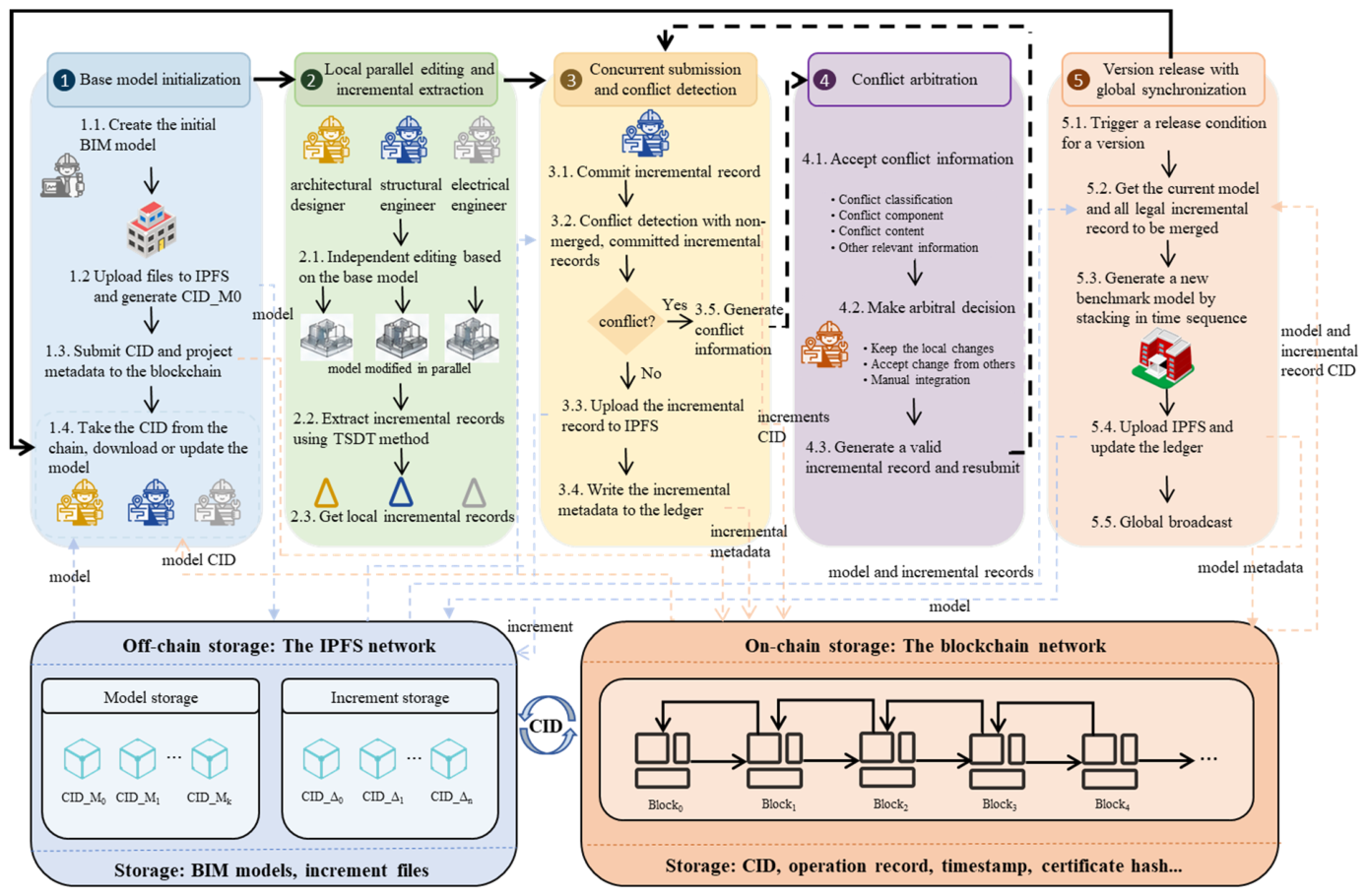
3.1. Overview of the Framework
3.2. Improved TSDT for Distributed Collaboration
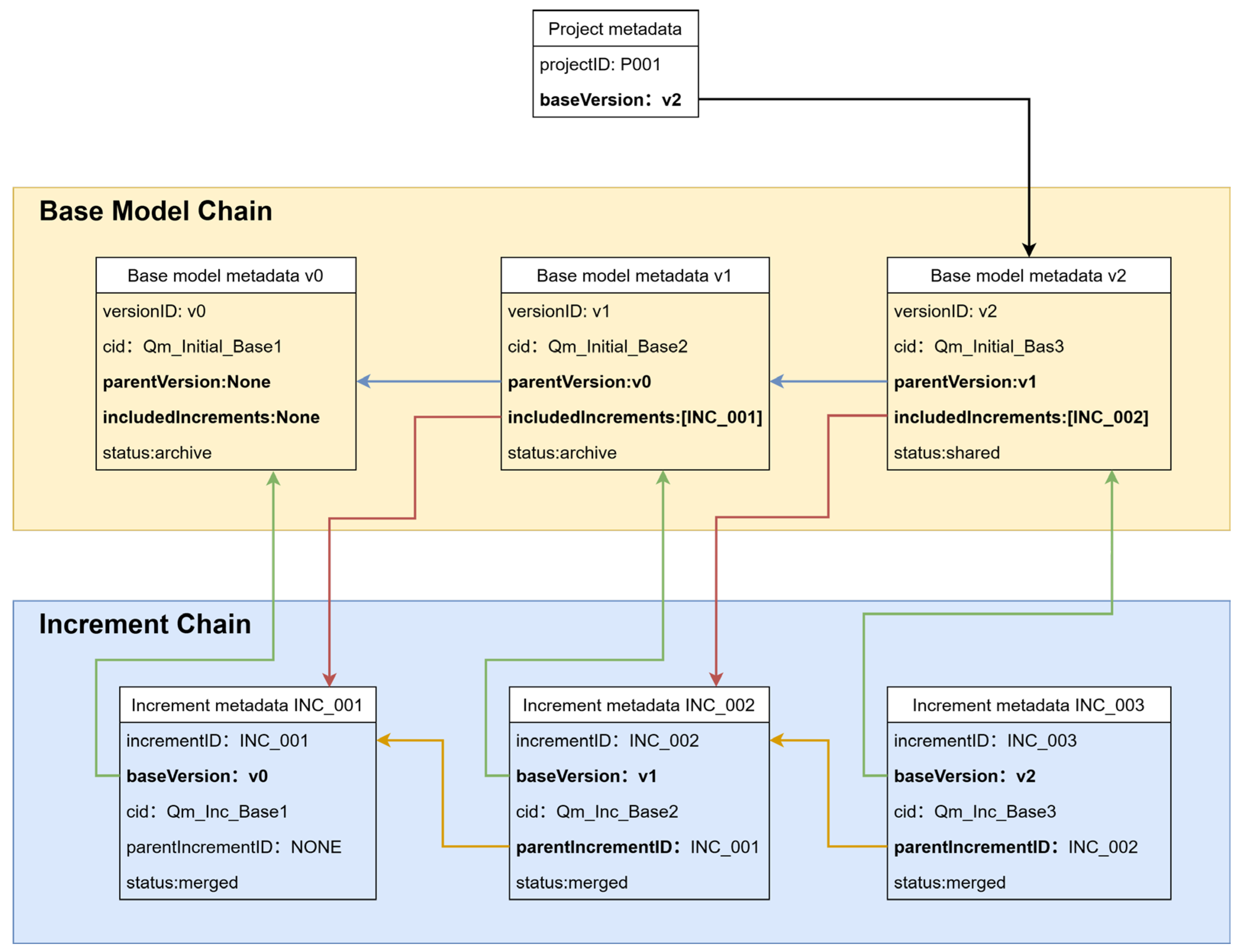
3.3. Dual-Layer Collaborative Storage Model
4. Prototype Demonstration and Evaluation
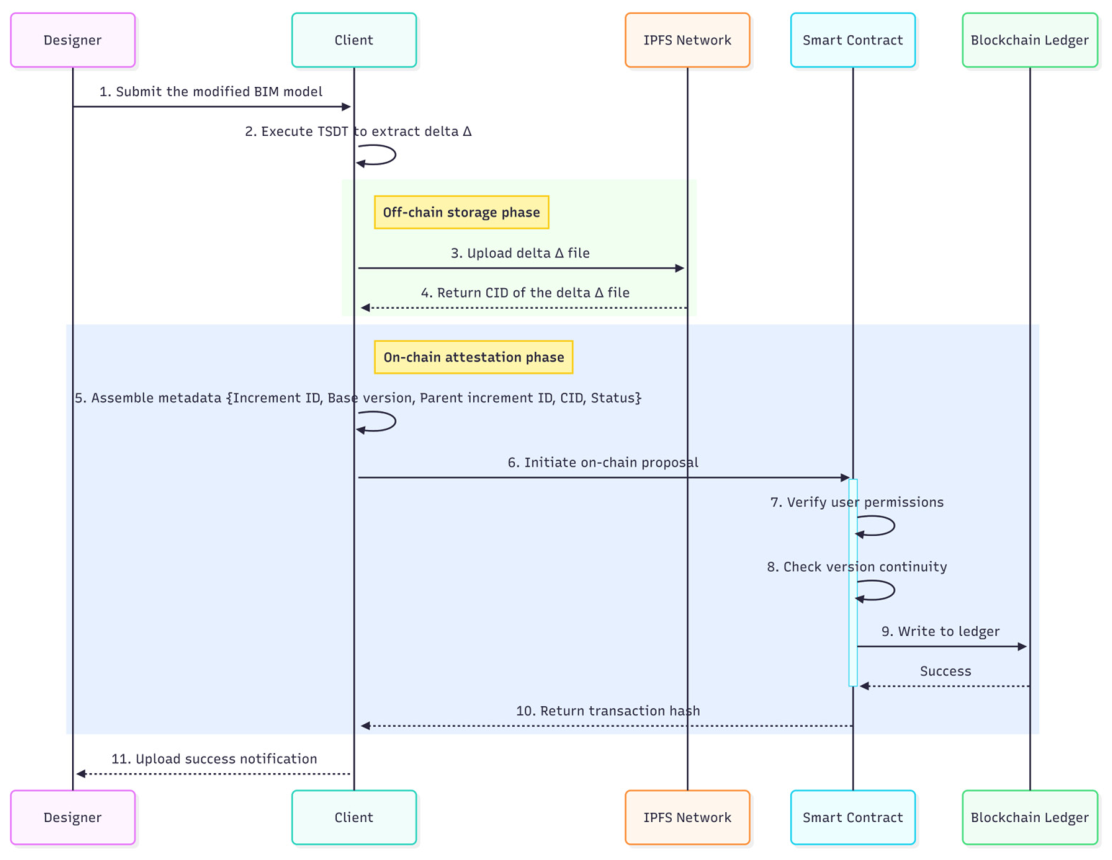
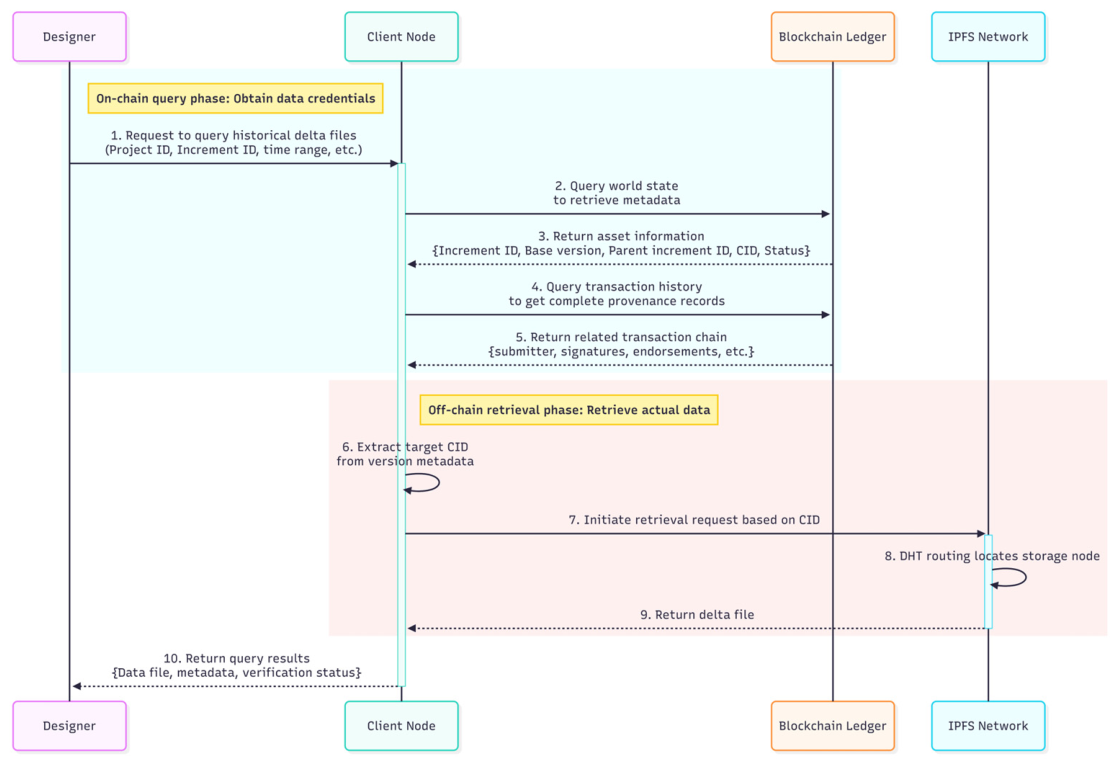
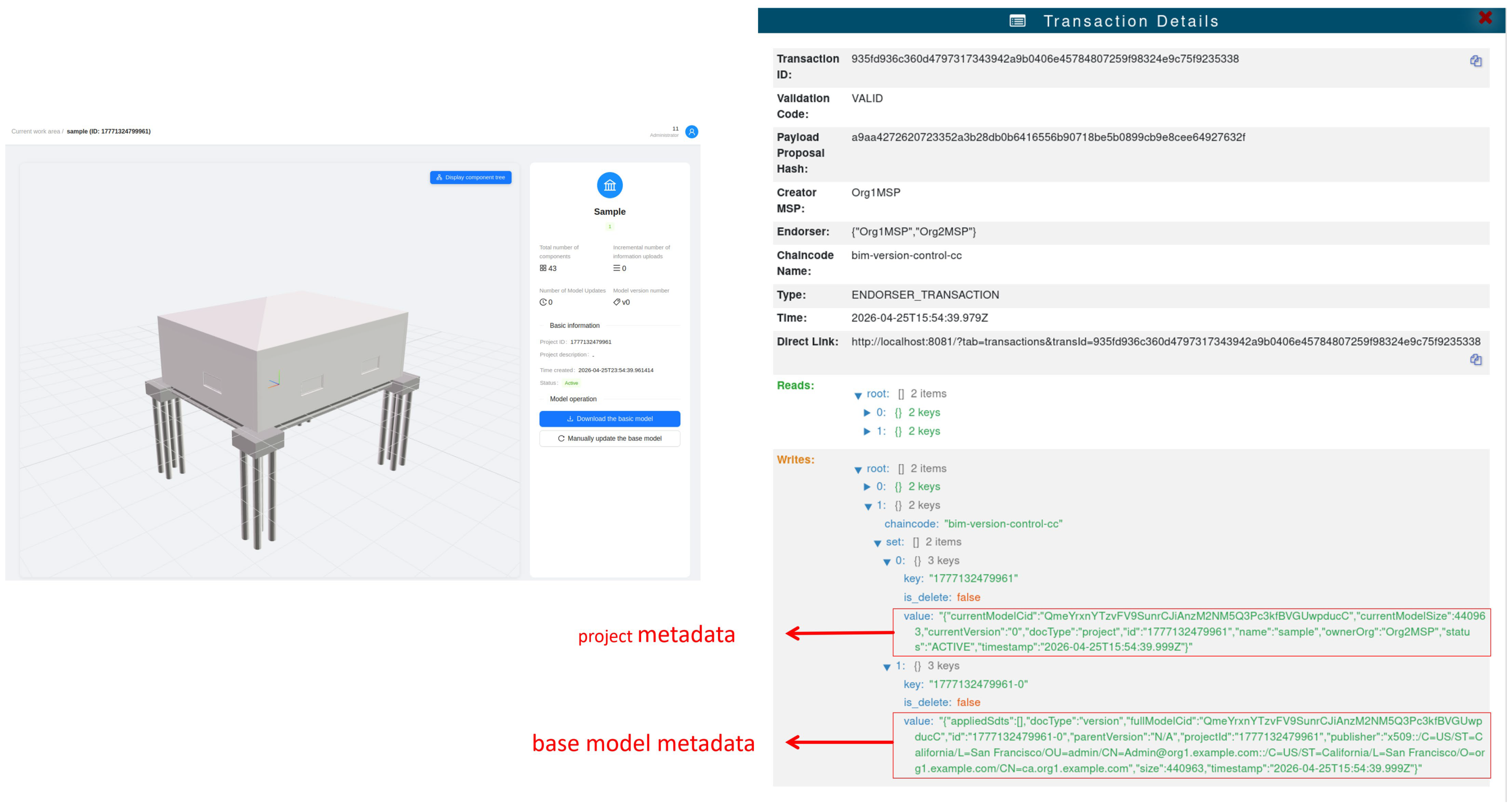
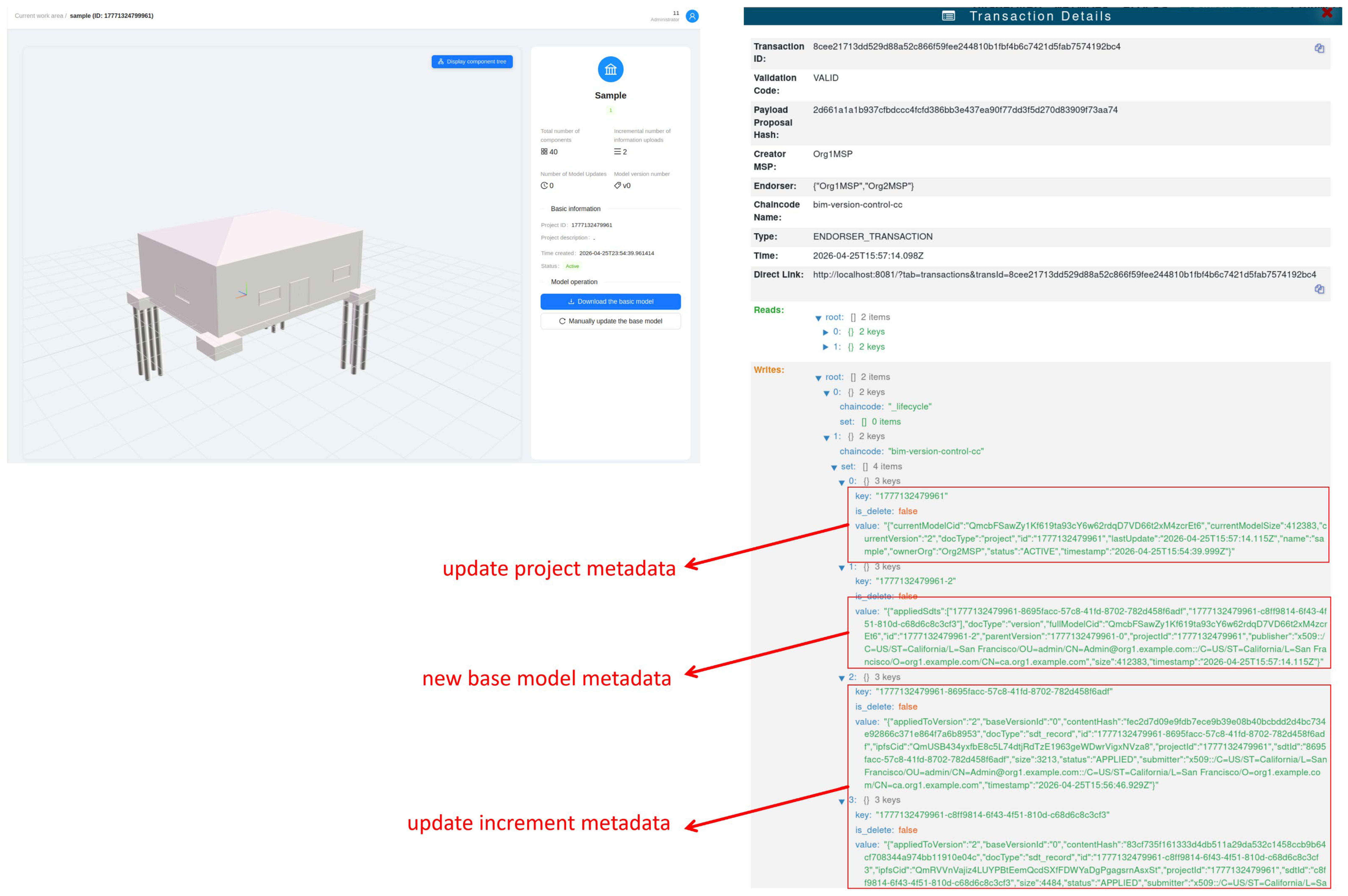
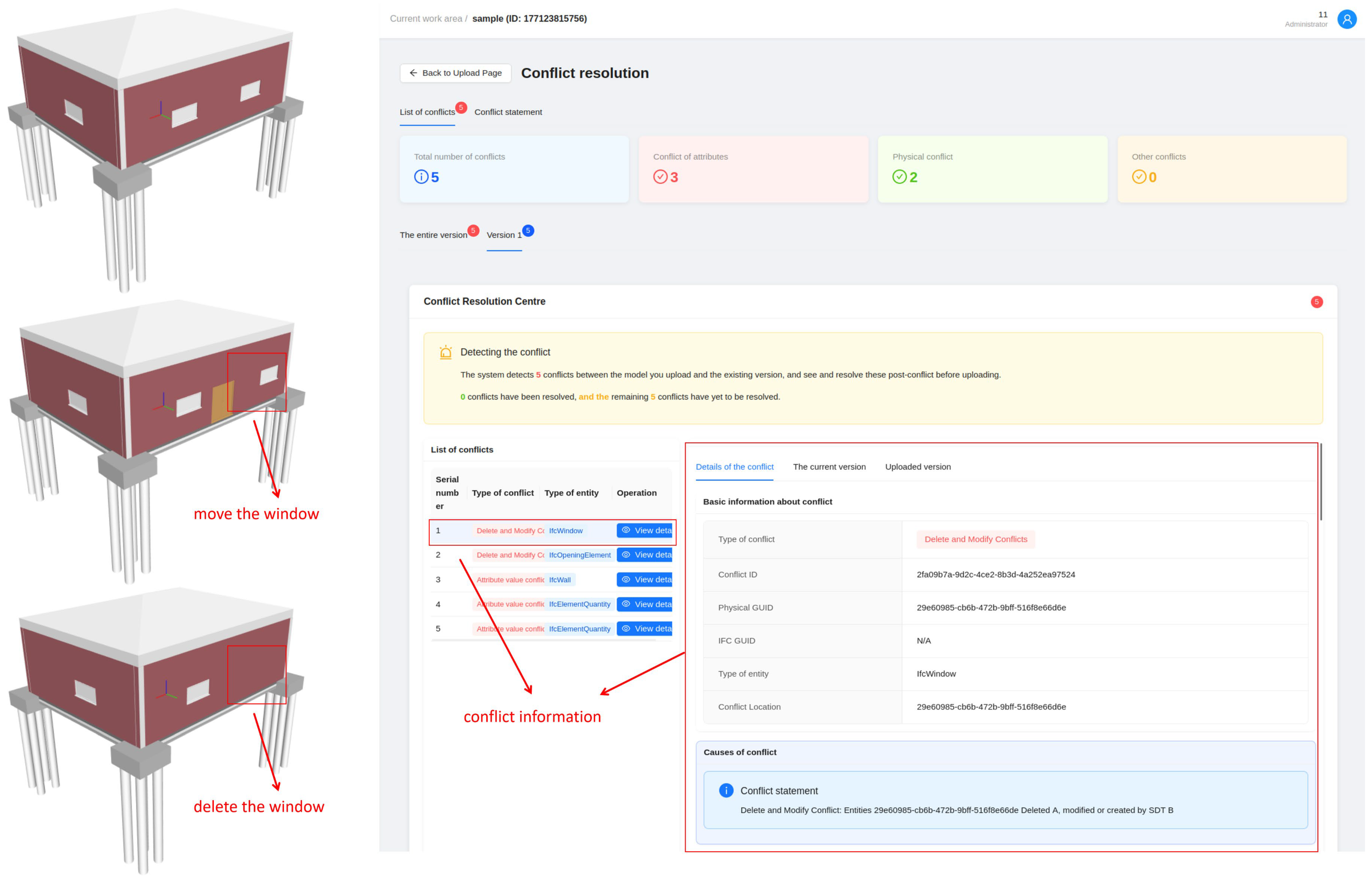
4.1. Experimental Setup and Workflow Demonstration
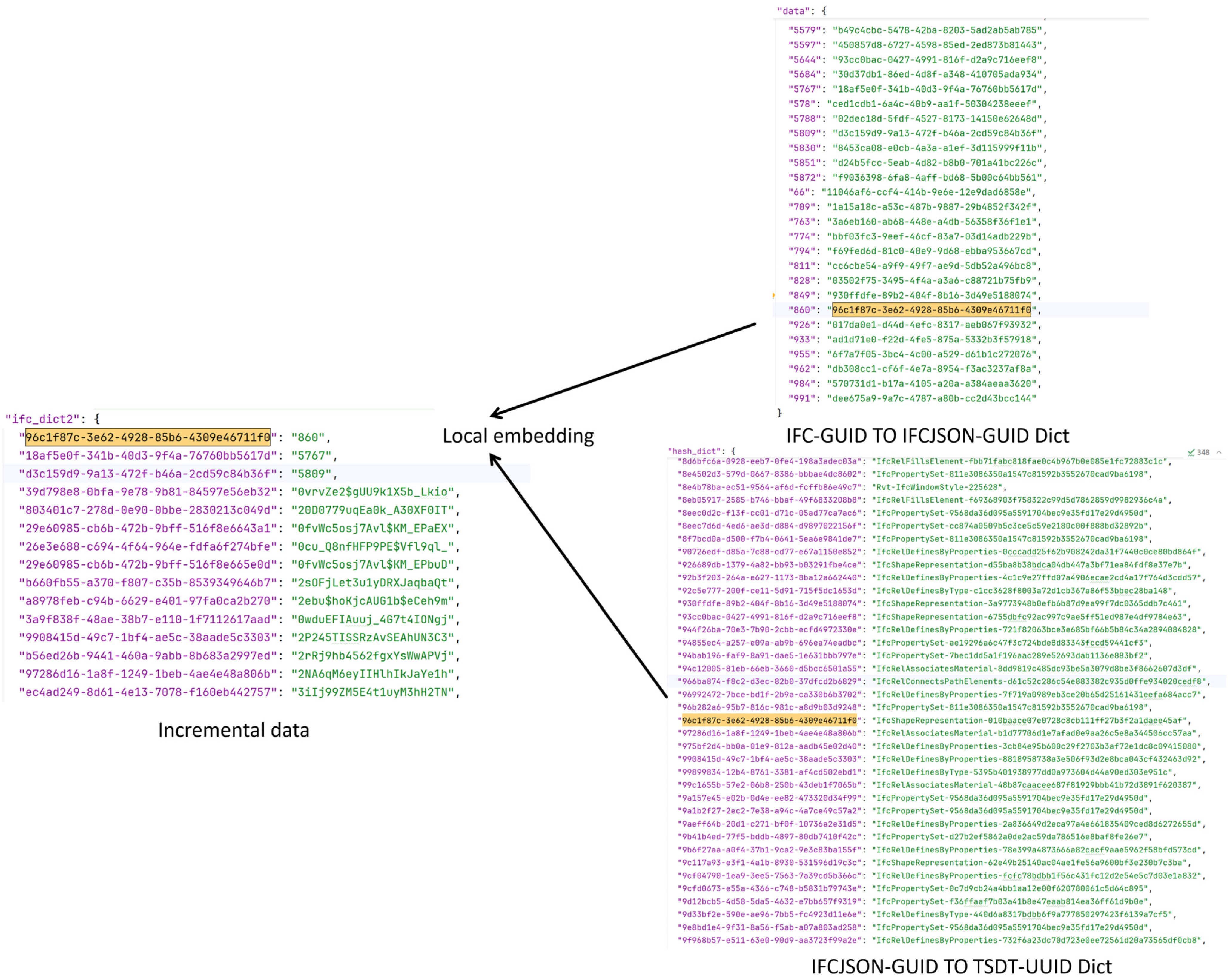
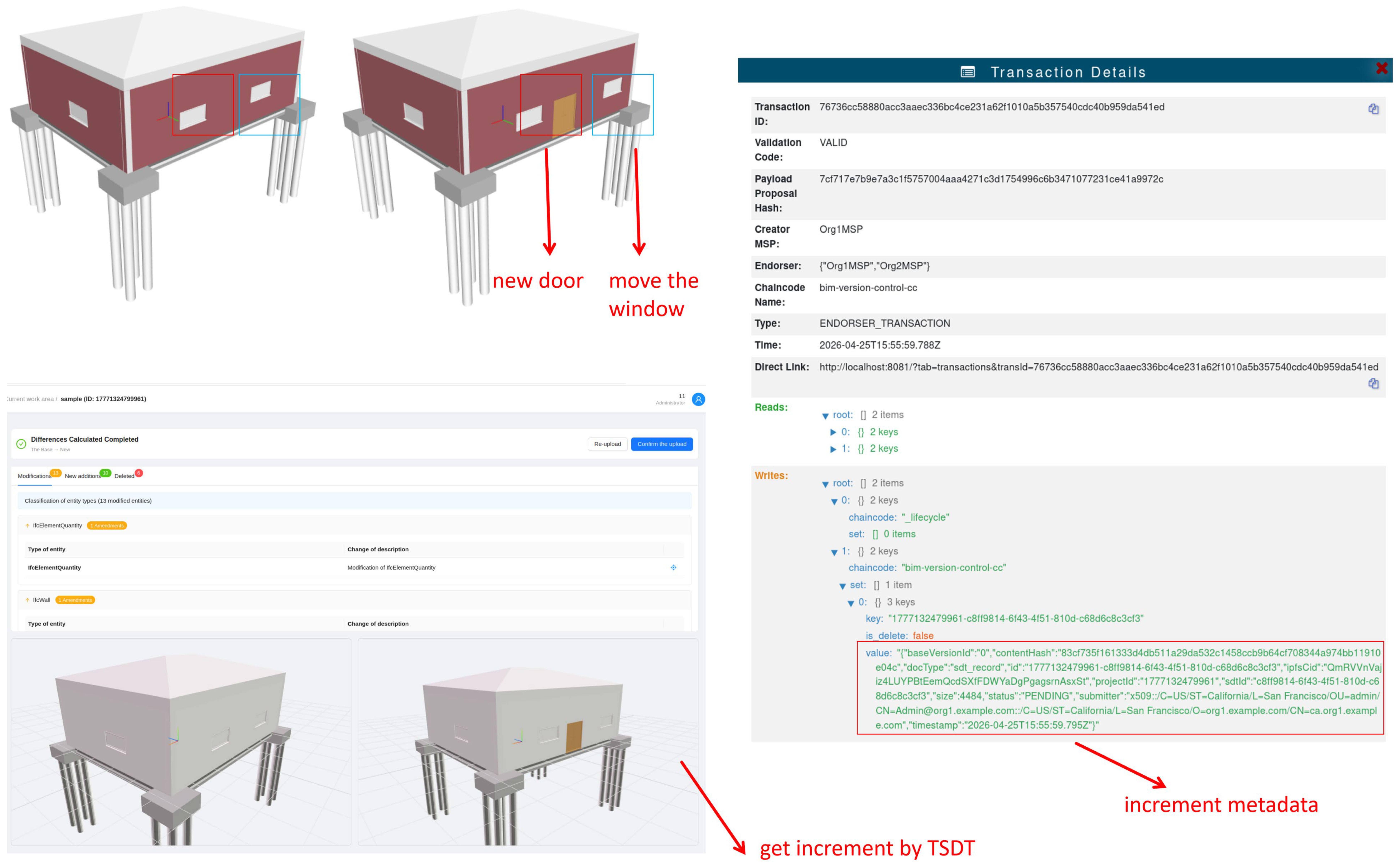
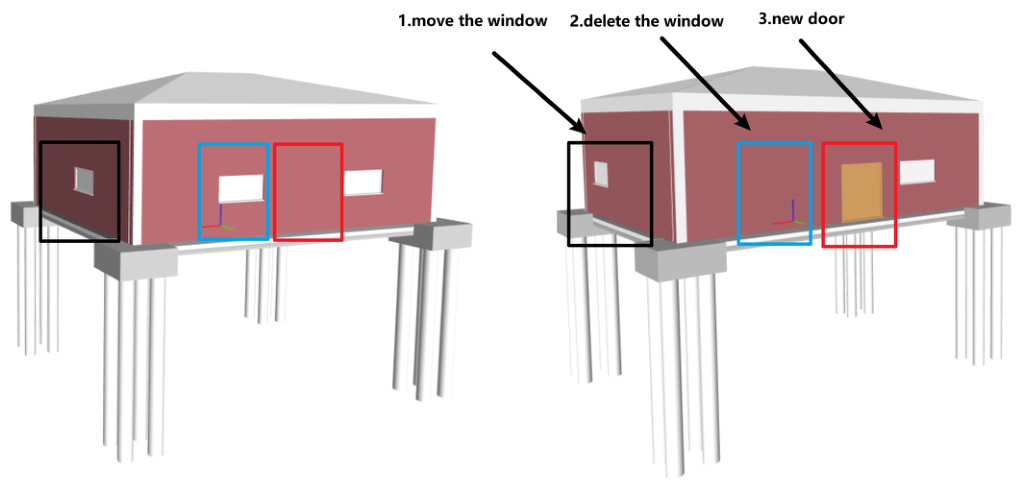
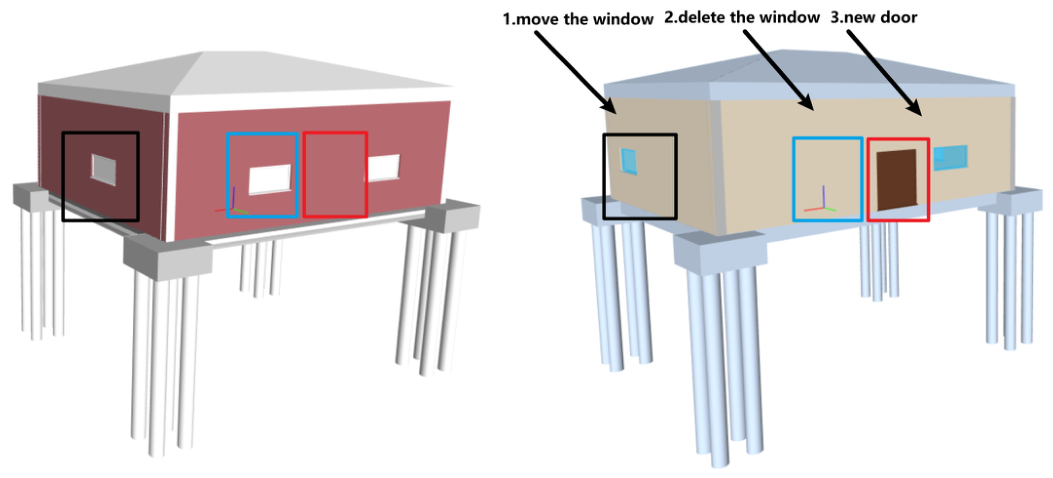
4.2. Example of Incremental Extraction and Reconstruction
4.3. Performance Evaluation
4.4. Comparative Test of Incremental Transmission Efficiency
5. Discussion
6. Conclusions
Author Contributions
Funding
Institutional Review Board Statement
Informed Consent Statement
Data Availability Statement
Conflicts of Interest
References
- Sacks, R.; Wang, Z.; Ouyang, B.; Utkucu, D.; Chen, S. Toward Artificially Intelligent Cloud-Based Building Information Modelling for Collaborative Multidisciplinary Design. Adv. Eng. Inform. 2022, 53, 101711. [Google Scholar] [CrossRef]
- Chen, H.-M.; Hou, C.-C. Asynchronous Online Collaboration in BIM Generation Using Hybrid Client-Server and P2P Network. Autom. Constr. 2014, 45, 72–85. [Google Scholar] [CrossRef]
- de Lima, P.R.B.; Rodrigues, C.d.S.; Post, J.M. Integration of BIM and Design for Deconstruction to Improve Circular Economy of Buildings. J. Build. Eng. 2023, 80, 108015. [Google Scholar] [CrossRef]
- Xu, Z.; Wang, J.; Zhu, H. A Semantic-Based Methodology to Deliver Model Views of Forward Design for Prefabricated Buildings. Buildings 2022, 12, 1158. [Google Scholar] [CrossRef]
- Das, M.; Cheng, J.C.; Kumar, S.S. Social BIMCloud: A Distributed Cloud-Based BIM Platform for Object-Based Lifecycle Information Exchange. Vis. Eng. 2015, 3, 8. [Google Scholar] [CrossRef]
- Esser, S.; Vilgertshofer, S.; Borrmann, A. A Reference Framework Enabling Temporal Scalability of Object-Based Synchronization in BIM Level 3 Systems. In Proceedings of the European Conference on Computing in Construction 2023, Heraklion, Greece, 10–12 July 2023; pp. 101–108. [Google Scholar] [CrossRef]
- Das, M.; Tao, X.; Cheng, J.C.P. BIM Security: A Critical Review and Recommendations Using Encryption Strategy and Blockchain. Autom. Constr. 2021, 126, 103682. [Google Scholar] [CrossRef]
- Tichy, W.F. Rcs—A System for Version Control. Softw. Pract. Exp. 1985, 15, 637–654. [Google Scholar] [CrossRef]
- Esser, S.; Borrmann, A. Enhancing Design Coordination Across Disciplines Through Incremental Model Updates and Inter-Discipline Conjunction Graphs. In Proceedings of the Advances in Information Technology in Civil and Building Engineering; Francis, A., Miresco, E., Melhado, S., Eds.; Springer Nature: Cham, Switzerland, 2025; pp. 77–90. [Google Scholar]
- Tao, X.; Wong, P.K.-Y.; Xu, Y.; Liu, Y.; Gong, X.; Zheng, C.; Das, M.; Cheng, J.C.P. Smart Contract Swarm and Multi-Branch Structure for Secure and Efficient BIM Versioning in Blockchain-Aided Common Data Environment. Comput. Ind. 2023, 149, 103922. [Google Scholar] [CrossRef]
- Li, J.; Greenwood, D.; Kassem, M. Blockchain in the Built Environment and Construction Industry: A Systematic Review, Conceptual Models and Practical Use Cases. Autom. Constr. 2019, 102, 288–307. [Google Scholar] [CrossRef]
- Nawari, N.O.; Ravindran, S. Blockchain Technology and BIM Process: Review and Potential Applications. J. Inf. Technol. Constr. 2019, 24, 209–238. [Google Scholar]
- Jaskula, K.; Kifokeris, D.; Papadonikolaki, E.; Rovas, D. Blockchain-Based Decentralized Common Data Environment: User Requirements and Conceptual Framework. J. Constr. Eng. Manag. 2025, 151, 04025112. [Google Scholar] [CrossRef]
- Bai, H.; Li, Z.; Chen, K.; Li, X. Blockchain-Based Responsibility Management Framework for Smart City Building Information Modeling Projects Using Non-Fungible Tokens. Buildings 2024, 14, 3647. [Google Scholar] [CrossRef]
- Singh, V.; Gu, N.; Wang, X. A Theoretical Framework of a BIM-Based Multi-Disciplinary Collaboration Platform. Autom. Constr. 2011, 20, 134–144. [Google Scholar] [CrossRef]
- Oh, M.; Lee, J.; Hong, S.W.; Jeong, Y. Integrated System for BIM-Based Collaborative Design. Autom. Constr. 2015, 58, 196–206. [Google Scholar] [CrossRef]
- ISO 19650-1:2018; Organization and Digitization of Information About Buildings and Civil Engineering Works, Including Building Information Modelling (BIM)—Information Management Using Building Information Modelling—Part 1: Concepts and Principles. International Organization for Standardization: Geneva, Switzerland, 2018.
- Brelih, A.; Klinc, R. Building Digital Trust in CDE-Based BIM Workflows: Key Strategies. J. Inf. Technol. Constr. 2025, 30, 524–543. [Google Scholar] [CrossRef]
- Zanni, M.; Ruikar, K.; Soetanto, R. Systematising Multidisciplinary Sustainable Building Design Processes Utilising BIM. Built Environ. Proj. Asset Manag. 2020, 10, 637–655. [Google Scholar] [CrossRef]
- Kurwi, S.; Demian, P.; Hassan, T.M.; Blay, K.B. A Process Model for Collaboration at the Design Stage of Rail Project Delivery. J. Constr. Eng. Manag. 2022, 148, 04022105. [Google Scholar] [CrossRef]
- Lee, G.; Won, J.; Ham, S.; Shin, Y. Metrics for Quantifying the Similarities and Differences between IFC Files. J. Comput. Civ. Eng. 2011, 25, 172–181. [Google Scholar] [CrossRef]
- Oraskari, J.; Törmä, S. RDF-Based Signature Algorithms for Computing Differences of IFC Models. Autom. Constr. 2015, 57, 213–221. [Google Scholar] [CrossRef]
- Zhao, Q.; Li, Y.; Hei, X.; Yang, M. A Graph-Based Method for IFC Data Merging. Adv. Civ. Eng. 2020, 2020, 8782740. [Google Scholar] [CrossRef]
- Shi, X.; Liu, Y.-S.; Gao, G.; Gu, M.; Li, H. IFCdiff: A Content-Based Automatic Comparison Approach for IFC Files. Autom. Constr. 2018, 86, 53–68. [Google Scholar] [CrossRef]
- Lin, J.-R.; Zhou, Y.-C. Semantic Classification and Hash Code Accelerated Detection of Design Changes in BIM Models. Autom. Constr. 2020, 115, 103212. [Google Scholar] [CrossRef]
- Shafiq, M.T.; Lockley, S.R. Application of Signature-Based Matching for IFC Model Comparison. Int. J. Constr. Manag. 2022, 22, 1765–1774. [Google Scholar] [CrossRef]
- Poinet, P.; Stefanescu, D.; Papadonikolaki, E. Collaborative Workflows and Version Control Through Open-Source and Distributed Common Data Environment. In Proceedings of the 18th International Conference on Computing in Civil and Building Engineering; Toledo Santos, E., Scheer, S., Eds.; Springer International Publishing: Cham, Switzerland, 2021; pp. 228–247. [Google Scholar]
- Dietmair, K.; Esser, S.; Harder, B. Incremental Model Updates in BIM: A Critical Analysis of the Collaboration Platform Speckle. In Proceedings of the 35th Forum Bauinformatik 2024, Hamburg, Germany, 18–20 September 2024. [Google Scholar] [CrossRef]
- Esser, S.; Vilgertshofer, S.; Borrmann, A. Graph-Based Version Control for Asynchronous BIM Collaboration. Adv. Eng. Inform. 2022, 53, 101664. [Google Scholar] [CrossRef]
- Esser, S.; Vilgertshofer, S.; Borrmann, A. Version Control for Asynchronous BIM Collaboration: Model Merging through Graph Analysis and Transformation. Autom. Constr. 2023, 155, 105063. [Google Scholar] [CrossRef]
- Xue, F.; Lu, W. A Semantic Differential Transaction Approach to Minimizing Information Redundancy for BIM and Blockchain Integration. Autom. Constr. 2020, 118, 103270. [Google Scholar] [CrossRef]
- Kong, L.; Zhao, R.; Anumba, C.J.; Lu, W.; Xue, F. Open BIM Exchange on Blockchain 3.0 Virtual Disk: A Traceable Semantic Differential Transaction Approach. Front. Eng. Manag. 2025, 12, 510–528. [Google Scholar] [CrossRef]
- Pradeep, A.S.E.; Yiu, T.W.; Zou, Y.; Amor, R. Blockchain-Aided Information Exchange Records for Design Liability Control and Improved Security. Autom. Constr. 2021, 126, 103667. [Google Scholar] [CrossRef]
- Dounas, T.; Lombardi, D.; Jabi, W. Framework for Decentralised Architectural Design BIM and Blockchain Integration. Int. J. Archit. Comput. 2021, 19, 157–173. [Google Scholar] [CrossRef]
- Tao, X.; Liu, Y.; Wong, P.K.-Y.; Chen, K.; Das, M.; Cheng, J.C.P. Confidentiality-Minded Framework for Blockchain-Based BIM Design Collaboration. Autom. Constr. 2022, 136, 104172. [Google Scholar] [CrossRef]
- Hsu, C.-L.; Wang, J.-T.; Hou, H.-Y. A Blockchain-Based Parametric Model Library for Knowledge Sharing in Building Information Modeling Collaboration. J. Constr. Eng. Manag. 2023, 149, 04023107. [Google Scholar] [CrossRef]
- Chen, K.; Li, Z.; You, B.; Tao, X. Lightweight Blockchain Facilitated BIM Data Management for Smart City Operation and Maintenance. PLoS ONE 2026, 21, e0346900. [Google Scholar] [CrossRef] [PubMed]
- Celik, Y.; Petri, I.; Barati, M. Blockchain Supported BIM Data Provenance for Construction Projects. Comput. Ind. 2023, 144, 103768. [Google Scholar] [CrossRef]
- Wang, J.; Shen, Y.; Xiong, X.; Wang, X.; Fang, X. Research on Multi-Person Collaborative Design of BIM Drawing Based on Blockchain. Sci. Rep. 2022, 12, 16312. [Google Scholar] [CrossRef] [PubMed]
- Tao, X.; Das, M.; Liu, Y.; Cheng, J.C.P. Distributed Common Data Environment Using Blockchain and Interplanetary File System for Secure BIM-Based Collaborative Design. Autom. Constr. 2021, 130, 103851. [Google Scholar] [CrossRef]
- Antinozzi, S.; Cecere, L.; Colace, F.; Lorusso, A.; Santaniello, D.; Valentino, C. Decentralized BIM Workflows with Smart Contract Execution. Appl. Sci. 2026, 16, 302. [Google Scholar] [CrossRef]



| Study | Incremental Mechanism | Conflict/Version Support | Storage Model and Distinguishing Scope |
|---|---|---|---|
| Xue et al. [31] | SDT with content-based semantic identifiers | Semantic difference representation | BIM–blockchain integration centered on differential transactions |
| Kong et al. [32] | TSDT with mapping dictionary and semantic tracing | Traceable incremental sequence | Blockchain virtual disk; external mapping dependence and concurrent conflicts remain |
| Tao et al. [40] | Design-file and change management in a CDE | Smart-contract workflow and access control | Blockchain-IPFS distributed CDE without self-contained TSDT packets |
| This study | Self-contained improved TSDT packet | Explicit hierarchical detection with manual arbitration | Integrated packet, conflict rules, permissioned acceptance, and linked metadata workflow |
| Primary Category | Secondary Category | Description |
|---|---|---|
| Object-level conflict | Existence exclusion conflict | One engineer modifies the attributes of an object, while another engineer logically deletes the same object, causing the modification operation to lose its target. |
| Topological consistency conflict | One engineer adds or modifies a relationship object, while another engineer deletes the endpoint object on which the relationship depends, thereby violating referential integrity. | |
| Unique identifier conflict | Two engineers independently add new objects but assign them the same GUID. | |
| Attribute-level conflict | Attribute value conflict | Two engineers modify the same attribute of the same object, but the resulting values are inconsistent. |
| Attribute existence conflict | One engineer modifies the value of an attribute, while another engineer deletes the corresponding attribute key. | |
| Duplicate attribute addition conflict | Two engineers add the same attribute but assign different values to it. | |
| Attribute hierarchy conflict | One engineer modifies a child node, while another engineer deletes its parent node, thereby disrupting the attribute tree structure. |
| Metadata Type | Key Field | Description |
|---|---|---|
| Project metadata | Project ID | A unique on-chain identifier used to distinguish one project from another. |
| Project name | A descriptive project name. | |
| Base version | The version tag pointing to the latest released base model of the project. | |
| Base CID | The content identifier of the latest base model stored in IPFS, used for off-chain file location and integrity verification. | |
| Base model metadata | Model ID | A unique on-chain identifier of a specific reference model version. |
| Version ID | The version tag of the base model, representing a milestone in the model evolution process. | |
| Parent version | The preceding reference model version on which the current version is based, used to trace the evolution chain of the base model. | |
| Included increment | A set of identifiers for the incremental records merged from the parent version into the current version. | |
| CID | The content identifier of this model version stored in IPFS. | |
| Status | The state of the current model version, categorized as either “shared” or “archived”. | |
| Incremental metadata | Increment ID | A unique on-chain identifier of an incremental submission. |
| Base version | The base model version on which the incremental record is generated, used to verify version continuity. | |
| Parent increment ID | The identifier of the preceding incremental commit under the same base version, used to construct the incremental commit sequence. | |
| CID | The content identifier of the incremental record stored in IPFS. | |
| Status | The state of the current incremental record, categorized as either “pending merge” or “merged”. |
| Operation Type | Affected Element | Count | Packet Representation | Reconstruction Outcome |
|---|---|---|---|---|
| Attribute modification | Window relocation | 1 | attributeOps + mappingFragment | Reproduced |
| Object deletion | Adjacent window | 1 | objectOps.delete + mappingFragment | Reproduced |
| Object addition | Door | 1 | objectOps.add + mappingFragment | Reproduced |
| Scenario | Business Logic | Load Type | Test Volume |
|---|---|---|---|
| Project creation | Invoke the project creation contract to create a new BIM project and initialize its basic information. | Fixed-load test simulating baseline data writing during system initialization. | 200 |
| Incremental record submission | Invoke the incremental record submission contract to upload BIM model incremental data. | Fixed-rate test with a sending rate of 100 TPS, simulating high-concurrency submissions during parallel model modification. | 500 |
| Model version release | Invoke the model version release contract to verify the status of multiple incremental records and generate a new model version asset. | Fixed-rate test with a sending rate of 50 TPS, simulating peak load during version iteration. | 100 |
| Asset query | Invoke the asset query contract to retrieve project or version details. | Linear-rate test in which the request rate increases from 100 TPS to 300 TPS to evaluate the read-performance limit of the system. | 1000 |
| Scenario | Suc. | Fail | Send Rate (TPS) | Max Latency (s) | Min Latency (s) | Avg Latency (s) | Throughput (TPS) |
|---|---|---|---|---|---|---|---|
| Project creation | 195 | 0 | 33.8 | 2.12 | 0.03 | 0.14 | 33.6 |
| Incremental record submission | 495 | 0 | 102.1 | 2.03 | 0.03 | 0.08 | 72.2 |
| Model version release | 109 | 0 | 61.2 | 0.34 | 0.03 | 0.10 | 59.5 |
| Asset query | 990 | 0 | 150.3 | 0.02 | 0.00 | 0.00 | 150.2 |
| Tier | File Count | Avg. Throughput (MB/s) | Avg. Upload Time (s) |
|---|---|---|---|
| Tiny (<100 KB) | 13 | 12.4 | 0.008 |
| Small (100 KB–1 MB) | 14 | 37.1 | 0.019 |
| Medium (1–50 MB) | 9 | 91.5 | 0.159 |
| Large (50–150 MB) | 3 | 161.9 | 0.660 |
| Extra-large (>150 MB) | 11 | 314.8 | 0.676 |
| Tier | Org1 | Org2 | Org3 | Org4 |
|---|---|---|---|---|
| Tiny (<100 KB) | 24.12 | 7.89 | 9.7 | 10.13 |
| Small (100 KB–1 MB) | 43.52 | 34.46 | 46.3 | 50.54 |
| Medium (1–50 MB) | 127.21 | 118.58 | 130.4 | 129.82 |
| Large (50–150 MB) | 261.16 | 180.67 | 214.33 | 218.03 |
| Extra-large (>150 MB) | 48.44 | 94.54 | 90.96 | 83.41 |
| Tier | Org1 | Org2 | Org3 | Org4 |
|---|---|---|---|---|
| Tiny (<100 KB) | 0.002 | 0.011 | 0.009 | 0.006 |
| Small (100 KB–1 MB) | 0.016 | 0.015 | 0.011 | 0.009 |
| Medium (1–50 MB) | 0.297 | 0.174 | 0.125 | 0.127 |
| Large (50–150 MB) | 1.790 | 2.064 | 1.467 | 1.361 |
| Extra-large (>150 MB) | 6.005 | 3.130 | 5.628 | 6.001 |
| Scenario | Full Model (MB) | Modified Model (MB) | Difference Rate | TSDT (KB) | Reduction Ratio | Improved TSDT (KB) | Reduction Ratio (Improved) |
|---|---|---|---|---|---|---|---|
| 1 | 0.30 | 0.50 | 17.41% | 52.22 | 89.56% | 53.25 | 89.35% |
| 2 | 5.87 | 5.86 | 0.14% | 8.19 | 99.86% | 17.41 | 99.70% |
| 3 | 6.70 | 6.72 | 0.046% | 3.07 | 99.95% | 10.24 | 99.85% |
| 4 | 0.02 | 0.03 | 20.48% | 4.10 | 86.33% | 5.12 | 82.93% |
| 5 | 0.30 | 0.30 | 0.68% | 2.05 | 99.32% | 3.07 | 98.98% |
| 6 | 0.30 | 5.86 | 294.91% | 884.74 | 84.90% | 2081.79 | 64.47% |
| 7 | 0.04 | 0.08 | 40.96% | 16.38 | 79.53% | 23.55 | 70.56% |
Disclaimer/Publisher’s Note: The statements, opinions and data contained in all publications are solely those of the individual author(s) and contributor(s) and not of MDPI and/or the editor(s). MDPI and/or the editor(s) disclaim responsibility for any injury to people or property resulting from any ideas, methods, instructions or products referred to in the content. |
© 2026 by the authors. Licensee MDPI, Basel, Switzerland. This article is an open access article distributed under the terms and conditions of the Creative Commons Attribution (CC BY) license.
Share and Cite
Chen, K.; Liu, Y.; Shi, X.; Ren, G. Incremental BIM-Based Collaborative Design Using IPFS and Blockchain. Sustainability 2026, 18, 6283. https://doi.org/10.3390/su18126283
Chen K, Liu Y, Shi X, Ren G. Incremental BIM-Based Collaborative Design Using IPFS and Blockchain. Sustainability. 2026; 18(12):6283. https://doi.org/10.3390/su18126283
Chicago/Turabian StyleChen, Ke, Yihong Liu, Xuechen Shi, and Gang Ren. 2026. "Incremental BIM-Based Collaborative Design Using IPFS and Blockchain" Sustainability 18, no. 12: 6283. https://doi.org/10.3390/su18126283
APA StyleChen, K., Liu, Y., Shi, X., & Ren, G. (2026). Incremental BIM-Based Collaborative Design Using IPFS and Blockchain. Sustainability, 18(12), 6283. https://doi.org/10.3390/su18126283