1. Introduction
Sustainability strategies have become increasingly important as firms face growing environmental, social, and governance-related expectations from customers, regulators, suppliers, investors, and other stakeholders. These expectations affect how firms define strategic priorities, allocate resources, and coordinate activities across departments. The scale of this shift is considerable: according to KPMG’s 2022 Survey of Sustainability Reporting, 96% of the world’s largest 250 companies now publish sustainability reports [
1]. Sustainability is therefore no longer limited to reporting, compliance, or corporate social responsibility programs. It has become a broader strategic implementation issue that requires firms to translate sustainability priorities into operational practices, managerial decisions, and cross-functional coordination processes [
2,
3,
4].
Much of the sustainability literature emphasizes the benefits of integrating sustainability into business strategy, operations, supply chains, innovation processes, and performance management systems [
2,
5,
6,
7]. Prior research has examined sustainability strategy implementation through leadership, resources, processes, management control systems, stakeholder pressures, and organizational practices [
4,
8,
9,
10]. These studies suggest that sustainability-oriented practices can help firms respond to external expectations and strengthen long-term adaptability. Importantly, however, this body of research has focused primarily on the conditions that enable successful sustainability implementation rather than on the implementation consequences of expanding sustainability agendas. Engert and Baumgartner [
3] explicitly note that the mechanisms linking sustainability strategy formulation to implementation outcomes remain insufficiently understood. Hahn et al. [
11] similarly call for empirical examination of how sustainability tensions shape coordination within organizations. Van der Byl and Slawinski [
12] further highlight that the practical consequences of managing multiple simultaneous sustainability demands remain unclear. Roche and Baumgartner [
13] more recently identify the effect of sustainability priority breadth on implementation consistency as a direction warranting further investigation.
These observations point to a shared gap in the literature: while prior research has established how sustainability strategies are formulated and what conditions support their success, it has not systematically examined what happens to implementation consistency when sustainability agendas expand beyond a firm’s attentional and coordination capacity. This question is particularly pressing given that firms are increasingly expected to pursue multiple simultaneous environmental, social, ethical, and governance-related priorities. This study addresses this gap directly. We ask: does an expanding sustainability agenda—one that exceeds managers’ attentional and coordination capacity—reduce sustainability execution consistency, and if so, through what organizational mechanisms? We argue that sustainability overload first increases managerial attention strain, which in turn increases interunit priority divergence, ultimately weakening the coherence of sustainability strategy implementation across departments. By tracing this sequential mechanism, the study responds to calls in the sustainability implementation literature for a more precise understanding of how priority structure shapes organizational execution.
This study focuses on sustainability priority proliferation, defined as the expansion of simultaneous environmental, social, ethical, and governance-related priorities within a firm’s sustainability agenda. Such proliferation can emerge when firms respond to stakeholder expectations, regulatory pressures, reporting requirements, and competitive demands at the same time [
9,
13]. We use the term sustainability overload to describe a related but analytically distinct condition: the point at which the combined scope of the sustainability agenda exceeds managers’ attentional and coordination capacity. Priority proliferation is therefore a structural characteristic of the agenda, whereas sustainability overload is a capacity-related condition. This distinction matters because the presence of multiple sustainability priorities does not necessarily create overload; overload is defined not by the number of priorities alone, but by the relationship between the breadth of the agenda and the firm’s ability to process, prioritize, and coordinate those priorities.
We argue that sustainability overload can weaken sustainability execution consistency through a sequential mechanism. First, a broad and simultaneous set of sustainability priorities may create managerial attention strain by requiring managers to divide their attention across multiple issues. This argument is consistent with the attention-based view, which emphasizes the role of managerial attention in shaping organizational action [
14]. Second, this attention strain may increase interunit priority divergence, because departments are likely to interpret and translate sustainability priorities through their own functional responsibilities. This logic is also consistent with the corporate sustainability tensions perspective, which suggests that economic, environmental, and social goals may create competing but interrelated demands in practice [
11,
12]. As a result, sustainability strategy implementation may become less coherent across the organization. In this view, implementation problems arise not from sustainability priorities themselves, but from the way an expanding sustainability agenda is organized and coordinated.
To examine this mechanism, this study uses a randomized scenario-based experiment with 300 middle- and senior-level managers from sustainability-exposed sectors. Participants were assigned to one of two experimental conditions: a focused sustainability strategy condition, in which the firm pursued a limited number of clearly defined priorities, and an overloaded sustainability strategy condition, in which the firm pursued a broader set of simultaneous environmental, social, ethical, and governance-related priorities. This design allows the study to assess how the scope and simultaneity of sustainability priorities shape managers’ perceptions of sustainability implementation conditions.
This study makes three contributions. First, it introduces sustainability overload as a useful lens for examining the implementation risks associated with expanding sustainability agendas. Second, it applies the attention-based perspective to sustainability strategy implementation by examining how multiple simultaneous priorities may create managerial attention strain. Third, it explains sustainability execution consistency as a cross-functional implementation outcome shaped by interunit priority divergence. Together, these contributions suggest that firms need not only ambitious sustainability goals, but also a manageable priority architecture that supports attention, coordination, and coherent implementation.
3. Hypothesis Development
3.1. Sustainability Overload and Managerial Attention Strain
Sustainability overload increases the attentional demands placed on managers. When a firm pursues a limited number of sustainability priorities, managers can more easily identify which issues require monitoring, which actions need coordination, and which resources should be allocated. In contrast, an overloaded sustainability agenda requires managers to follow several priorities that differ in scope, time horizon, and functional relevance. This makes attention allocation more demanding.
Drawing on the attention-based view, managers are expected to allocate limited attention across issues and action alternatives within specific organizational contexts [
14]. In sustainability strategy implementation, this means that managers must selectively attend to specific sustainability issues while also maintaining coherence across the broader agenda. When sustainability priorities become too numerous and diverse, managers may find it harder to maintain focus, compare priorities, and determine which issues deserve immediate attention. Therefore, sustainability overload is expected to increase managerial attention strain.
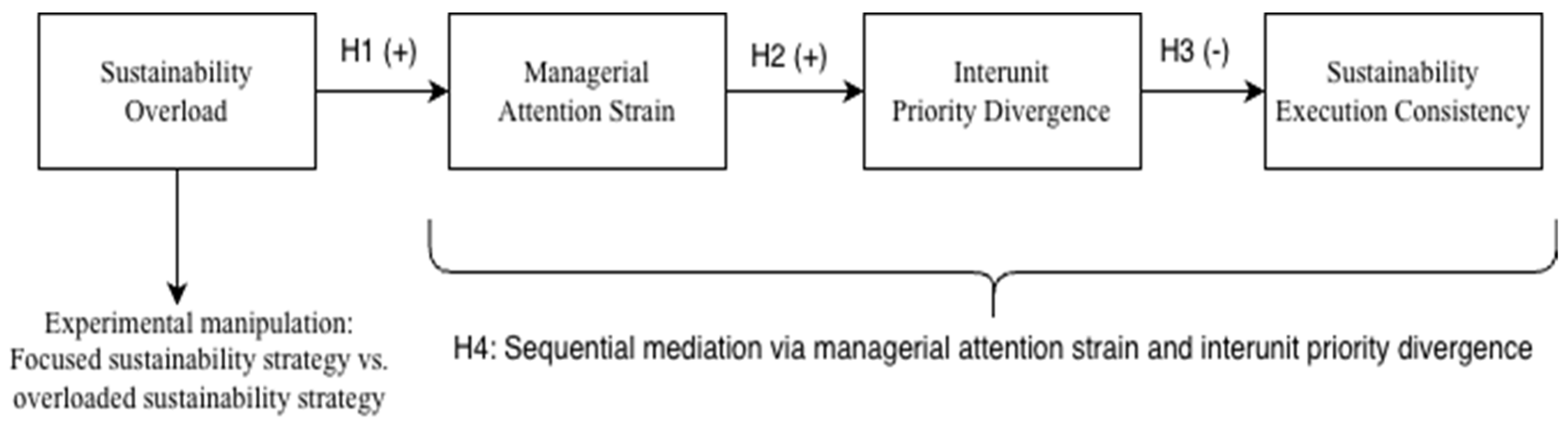
H1. Sustainability overload increases managerial attention strain.
3.2. Managerial Attention Strain and Interunit Priority Divergence
Managerial attention strain can increase interunit priority divergence by limiting managers’ capacity to develop a shared interpretation of sustainability priorities. When attention demands are moderate, managers may have greater capacity to compare priorities across departments and clarify how these priorities should guide coordinated action. When attention strain increases, however, managers may rely more strongly on familiar functional routines and department-specific concerns.
This matters because sustainability priorities often carry different meanings for different functions. The corporate sustainability tensions perspective suggests that economic, environmental, and social goals may create competing but interrelated demands in practice [
11,
12]. Production units may interpret sustainability through process efficiency and waste reduction, while purchasing units may focus on supplier responsibility and cost implications. Human resource departments may emphasize employee well-being, whereas finance and compliance units may focus on reporting and ESG requirements. Under attention strain, these functional interpretations may become more pronounced. As a result, departments are more likely to emphasize different priorities, translate the same sustainability agenda into different actions, and develop weaker shared understanding.
H2. Managerial attention strain increases interunit priority divergence.
3.3. Interunit Priority Divergence and Sustainability Execution Consistency
Interunit priority divergence can weaken sustainability execution consistency because departments may translate the same sustainability agenda into different implementation priorities. Prior research suggests that sustainability strategy implementation depends on alignment between sustainability objectives, operational processes, management systems, and organizational responsibilities [
3,
4,
8]. When departments share a similar understanding of sustainability priorities, they are more likely to align their activities, coordinate implementation efforts, and support coherent execution across the organization. In contrast, when departments emphasize different priorities, sustainability implementation may become fragmented.
This divergence can affect execution consistency in several ways. Departments may allocate attention and resources to different sustainability issues. They may also define success differently, follow different implementation timelines, or develop actions that are not fully aligned with one another. As these differences increase, the firm may find it harder to maintain a coherent sustainability strategy across departments. Therefore, interunit priority divergence is expected to reduce sustainability execution consistency.
H3. Interunit priority divergence decreases sustainability execution consistency.
3.4. Sequential Mediation Mechanism
The preceding arguments suggest a sequential mechanism linking sustainability overload to sustainability execution consistency. Sustainability overload first increases managerial attention strain because managers must allocate attention across a broader and more diverse set of simultaneous priorities. This attention strain then increases interunit priority divergence by encouraging departments to interpret and translate sustainability priorities through their own functional responsibilities. As interunit priority divergence increases, sustainability implementation becomes less coherent across departments.
This mechanism implies that sustainability overload may reduce execution consistency not only through the direct complexity of having many priorities, but also through the way these priorities are processed and translated inside the organization. The first stage concerns managerial attention allocation. The second stage concerns cross-functional interpretation and prioritization. Together, these stages help explain why an expanding sustainability agenda may weaken coherent implementation when it exceeds the firm’s attentional and coordination capacity.
H4. Managerial attention strain and interunit priority divergence sequentially mediate the relationship between sustainability overload and sustainability execution consistency.
Figure 1 summarizes the proposed conceptual model and the sequential mediation mechanism tested in this study.
4. Materials and Methods
4.1. Research Design
This study used experimental vignette methodology with a randomized between-subjects design to examine how sustainability overload affects perceived sustainability execution consistency. Experimental vignette methodology is appropriate for studying managerial judgments because it allows researchers to manipulate a specific organizational condition while presenting participants with a realistic and controlled decision context [
32]. In this study, the manipulated condition was the structure of the firm’s sustainability agenda.
Participants were randomly assigned to one of two experimental conditions. In the focused sustainability strategy condition, the firm pursued a limited number of clearly defined sustainability priorities. In the overloaded sustainability strategy condition, the firm pursued a broader and more diverse set of simultaneous sustainability priorities. After reading the assigned vignette, participants evaluated managerial attention strain, interunit priority divergence, and sustainability execution consistency. The design also included manipulation-check and scenario-realism items, consistent with the need to verify whether participants interpreted the vignette as intended. This design enabled us to test the proposed mechanism under controlled but managerially realistic conditions.
4.2. Participants and Sampling Criteria
The study targeted 300 middle- and senior-level managers working in Türkiye-based firms operating in sustainability-exposed sectors. Participants were eligible if they currently held a managerial position and were involved in, or familiar with, at least one of the following organizational processes: strategy implementation, resource allocation, sustainability-related initiatives, or cross-functional coordination. This criterion was used because the study examines managerial judgments about sustainability implementation rather than general environmental attitudes.
Participants were also required to have at least two years of managerial experience. This requirement was included to ensure that respondents had sufficient exposure to organizational implementation processes, departmental coordination, and managerial decision-making.
Firms were required to have at least 50 employees. This threshold was used to ensure that participants worked in organizational contexts where differentiated functions, managerial layers, and cross-functional coordination demands were likely to be present. Firms below this threshold may have less formalized departmental structures, making interunit priority divergence and execution consistency less observable.
The sample was drawn from sectors where sustainability-related expectations are relatively salient, including manufacturing, textile/apparel, automotive and automotive supply, food and beverage, energy, logistics/transportation, and retail. These sectors were selected because firms operating in these contexts are more likely to face environmental, social, supply-chain, regulatory, and ESG-related pressures. Research on sustainability and corporate responsibility practices in Turkish firms suggests that companies face increasing stakeholder and regulatory pressures to develop sustainability strategies, particularly among larger firms and business groups operating in industry-exposed sectors [
33,
34].
4.3. Experimental Procedure
Following the experimental vignette design described above, the survey was administered online using Google Forms (Google LLC, Mountain View, CA, USA). At the beginning of the survey, participants answered screening questions regarding their managerial position, managerial experience, firm size, sector, sustainability exposure, and role relevance.
Eligible participants were then randomly assigned to one of two vignette conditions. Each participant read only one vignette. The first condition described a firm with a focused sustainability strategy, while the second condition described a firm with an overloaded sustainability strategy. The broader organizational context was held constant across the two vignettes. The only substantive difference between the conditions was the number, diversity, and simultaneity of sustainability priorities.
After reading the assigned vignette, participants completed the post-vignette measures. These measures assessed manipulation checks, managerial attention strain, interunit priority divergence, sustainability execution consistency, and scenario realism. All post-vignette items were measured on a seven-point Likert-type scale ranging from 1 = strongly disagree to 7 = strongly agree.
4.4. Experimental Scenarios
Two vignettes were developed to manipulate the structure of the firm’s sustainability agenda. Both vignettes described a medium-sized manufacturing firm operating in a competitive sector where customers, regulators, and business partners increasingly expected improvements in environmental and social practices. The organizational context was kept identical across the two conditions to isolate the effect of sustainability priority structure. The full vignette texts are provided in
Appendix A.
In the focused sustainability strategy condition, the firm pursued three clearly defined priorities: improving energy efficiency in production processes, reducing carbon emissions from operations, and strengthening sustainability criteria in supplier selection. These priorities represented a limited and coherent sustainability agenda.
In the overloaded sustainability strategy condition, the firm pursued a broader set of simultaneous priorities, including energy efficiency, carbon reduction, water consumption, waste management, circular economy practices, green product development, supplier sustainability criteria, employee well-being, diversity and inclusion, community contribution, sustainability reporting, and ESG compliance. This vignette was designed to represent a more diverse and simultaneous sustainability agenda.
In both conditions, participants were told that the priorities were communicated to the main departments and that managers were expected to consider them when preparing departmental plans and coordinating sustainability-related activities. Thus, the two vignettes differed in the number, diversity, and simultaneity of sustainability priorities, while the broader organizational context and implementation setting were held constant.
4.5. Measures
All post-vignette constructs were measured using seven-point Likert-type items ranging from 1 = strongly disagree to 7 = strongly agree. The items were developed to capture vignette-specific perceptions rather than stable individual traits. They were written to reflect the proposed mechanism linking sustainability overload to managerial attention strain, interunit priority divergence, and sustainability execution consistency. The full list of measurement items is provided in
Appendix B.
Manipulation check. Four items assessed whether participants perceived the assigned vignette as reflecting a broad and simultaneous sustainability agenda. Example items include “The firm in the scenario is pursuing a large number of sustainability priorities at the same time” and “The firm’s sustainability strategy appears broad rather than focused.” One item was reverse-coded.
Managerial attention strain. Five items measured the extent to which the sustainability strategy placed pressure on managers’ attention and decision-making capacity. Example items include “The sustainability strategy would require managers to divide their attention across many different issues” and “Managers would find it difficult to determine which sustainability priorities should receive the most attention.”
Interunit priority divergence. Five items assessed the extent to which departments were likely to interpret, emphasize, and translate sustainability priorities differently. Example items include “Different departments would likely emphasize different sustainability priorities” and “Departments may translate the sustainability strategy into different implementation actions.”
Sustainability execution consistency. Five items measured the perceived consistency and coherence of sustainability strategy implementation across departments. Example items include “The firm would be able to implement its sustainability strategy consistently across departments” and “The firm’s sustainability efforts would remain coherent across departments.”
Scenario realism. Four items assessed whether participants perceived the vignette as realistic, understandable, and suitable for managerial judgment. Example items include “The scenario describes a realistic organizational situation” and “Managers could make meaningful judgments based on the information provided in the scenario”.
4.6. Pilot Test
Before the main data collection, a pilot test was conducted with 20 managers to assess the clarity, realism, and functioning of the vignettes and post-vignette measures. Ten participants evaluated the focused sustainability strategy vignette, and ten participants evaluated the overloaded sustainability strategy vignette.
The pilot results suggested that the manipulation operated in the expected direction. Participants in the overloaded condition perceived the firm’s sustainability agenda as broader and more simultaneous than participants in the focused condition. The pilot responses also followed the expected pattern for the mechanism variables: the overloaded condition was associated with higher perceived managerial attention strain and interunit priority divergence, whereas the focused condition was associated with higher perceived sustainability execution consistency. Scenario realism ratings were high in both conditions, suggesting that the vignettes were understandable and managerially plausible.
Based on the pilot results, no substantive changes were made to the vignettes or measurement items before the main data collection.
4.7. Data Analysis
The data analysis proceeded in several steps. First, the screening criteria were checked to ensure that all participants met the required managerial experience, firm size, sector, and role relevance conditions. Second, descriptive statistics and internal consistency estimates were calculated for the multi-item constructs using IBM SPSS Statistics (Version 25; IBM Corp., Armonk, NY, USA). Reliability was assessed using Cronbach’s alpha.
Third, the manipulation check was examined by comparing the focused and overloaded conditions on perceived sustainability priority proliferation. This step assessed whether participants interpreted the experimental manipulation as intended. Fourth, independent-samples t-tests were used to examine whether the two conditions differed in managerial attention strain, interunit priority divergence, sustainability execution consistency, and scenario realism.
Finally, the hypothesized sequential mediation model was tested using PROCESS macro (Version 4.2; Model 6) for SPSS with 5000 bootstrap samples [
35]. The experimental condition was coded as 0 = focused sustainability strategy and 1 = overloaded sustainability strategy. Managerial attention strain was entered as the first mediator, interunit priority divergence as the second mediator, and sustainability execution consistency as the outcome. The bootstrap confidence interval for the sequential indirect effect was used to assess whether sustainability overload reduced execution consistency through the proposed sequential mechanism.
5. Results
5.1. Sample Characteristics
The final sample consisted of 300 managers working in Türkiye-based firms operating in sustainability-exposed sectors. The two experimental conditions were evenly represented: 150 participants evaluated the focused sustainability strategy vignette, and 150 participants evaluated the overloaded sustainability strategy vignette. The sample included managers from different functional profiles, managerial levels, experience groups, and sectors.
Table 1 presents the sample characteristics.
The sample was not concentrated in a single managerial role, experience group, or sector. Functional and middle-level managers formed the largest share of the sample, which is consistent with the study’s focus on the translation of strategic priorities into departmental practices. The sectoral distribution also reflects the intended focus on sustainability-exposed sectors. Participants reported relatively high sustainability exposure among their firms (M = 5.69, SD = 0.92, range = 4–7).
5.2. Descriptive Statistics and Reliability
Table 2 reports the descriptive statistics, and reliability estimates for the study variables. Internal consistency was high for the manipulation check, managerial attention strain, interunit priority divergence, and sustainability execution consistency measures. The scenario-realism items showed acceptable reliability for a procedural check measure.
The reliability estimates indicate that the main post-vignette measures were internally consistent. The lower alpha value for scenario realism was not considered problematic because this measure was used only as a procedural check rather than as a focal theoretical construct. Overall, these results suggest that the measures were suitable for the subsequent group comparisons and mediation analysis.
5.3. Manipulation Check and Scenario Realism
The manipulation check supported the effectiveness of the experimental manipulation. Participants in the overloaded sustainability strategy condition perceived the firm’s sustainability agenda as substantially broader and more simultaneous than participants in the focused sustainability strategy condition. The mean manipulation-check score was significantly higher in the overloaded condition (M = 6.65, SD = 0.38) than in the focused condition (M = 2.26, SD = 0.47), t(298) = −88.92, p < 0.001.
Scenario realism was high in both conditions. Participants rated both vignettes as realistic and understandable, with mean realism scores of 6.84 in the focused condition and 6.92 in the overloaded condition. Although this difference was statistically significant, t(298) = −3.40, p = 0.001, the absolute difference was small. Therefore, both vignettes were perceived as realistic and suitable for managerial judgment.
5.4. Experimental Condition Differences
Independent-samples t-tests were conducted to examine whether the two experimental conditions differed in the manipulation check, main mechanism variables, and scenario realism. As shown in
Table 3, participants in the overloaded sustainability strategy condition reported significantly higher managerial attention strain and interunit priority divergence than participants in the focused sustainability strategy condition. In contrast, sustainability execution consistency was significantly lower in the overloaded condition than in the focused condition. These results are consistent with the expected direction of the proposed mechanism.
The pattern of group differences supports the expected experimental contrast. The overloaded sustainability strategy condition was associated with higher perceived attention strain and interunit priority divergence, and lower perceived execution consistency. These results provide preliminary support for H1–H3 and justify testing the full sequential mediation model.
5.5. Hypothesis Testing
The hypotheses were tested using PROCESS Model 6 with 5000 bootstrap samples. The experimental condition was coded as 0 = focused sustainability strategy and 1 = overloaded sustainability strategy. Managerial attention strain was entered as the first mediator, interunit priority divergence as the second mediator, and sustainability execution consistency as the outcome.
As shown in
Table 4, the overloaded sustainability strategy condition was positively associated with managerial attention strain (b = 4.0187,
p < 0.001), supporting H1. Managerial attention strain was positively associated with interunit priority divergence (b = 1.0203,
p < 0.001), supporting H2. Interunit priority divergence was negatively associated with sustainability execution consistency (b = −0.6822,
p < 0.001), supporting H3.
The hypothesized sequential indirect effect was also significant. The indirect effect of experimental condition on sustainability execution consistency through managerial attention strain and interunit priority divergence was negative and significant (indirect effect = −2.7973, BootSE = 0.2098, 95% bootstrap CI [−3.1673, −2.3281]). Because the 95% bootstrap confidence interval did not include zero, the sequential indirect effect was statistically significant, supporting H4.
The total effect of experimental condition on sustainability execution consistency was negative and significant (b = −3.6507, p < 0.001), indicating that the overloaded sustainability strategy condition was associated with lower perceived execution consistency than the focused condition. After the mediators were included, the remaining direct effect was positive and significant (b = 0.2821, p = 0.0328). This pattern suggests that the negative relationship between sustainability overload and execution consistency operated primarily through the proposed sequential mechanism.
The effect sizes observed in this study are notably large, particularly for the relationship between the experimental condition and managerial attention strain. Several features of the study design help explain this pattern. First, the experimental manipulation created a deliberately clear contrast between the focused and overloaded sustainability strategy conditions—three priorities versus twelve simultaneous priorities—in order to provide an unambiguous test of the sustainability overload construct. As noted by Aguinis and Bradley [
32], increasing the similarity between the experimental stimulus and natural settings increases observed effects. The present vignettes were designed to be realistic and contextually relevant for the target sample of managers in sustainability-exposed sectors, which likely contributed to strong and consistent responses. Second, experimental vignette designs differ from field studies in that confounding variables are controlled by design rather than statistically, which reduces noise and tends to produce larger effect sizes than those typically observed in cross-sectional survey research. These features of the design should be taken into account when interpreting the magnitude of the observed effects.
6. Discussion
6.1. Main Findings
This study examined whether an overloaded sustainability strategy can weaken perceived sustainability execution consistency through managerial attention strain and interunit priority divergence. The findings support the proposed mechanism. Compared with the focused sustainability strategy condition, the overloaded condition was associated with higher managerial attention strain, higher interunit priority divergence, and lower sustainability execution consistency.
These results suggest that the structure of a firm’s sustainability agenda matters for implementation. A broader set of simultaneous sustainability priorities may not only increase the number of issues that managers need to consider but also make it more difficult to maintain a shared implementation focus across departments. In this study, the negative effect of sustainability overload on execution consistency operated primarily through the sequential pathway from managerial attention strain to interunit priority divergence.
The findings should not be interpreted as suggesting that firms should reduce their sustainability ambitions. Rather, they indicate that sustainability ambitions need to be organized in a way that managers and departments can process, prioritize, and coordinate. The issue is therefore not the presence of multiple sustainability priorities, but the extent to which these priorities exceed the firm’s attentional and coordination capacity.
These findings are consistent with prior research that views sustainability implementation as an organizational process requiring alignment, coordination, and managerial support rather than only formal goal adoption [
3,
4]. They also extend this literature by showing that the expansion of sustainability priorities may create implementation risks when attention and coordination capacity are constrained. In this respect, the findings complement the corporate sustainability tensions literature, which emphasizes that sustainability goals may involve competing yet interrelated demands across organizational domains [
11,
12]. At the same time, the findings stand in an interesting relationship with the ambidexterity literature, which generally argues that pursuing diverse and seemingly contradictory organizational goals can enhance adaptability and knowledge integration [
36,
37]. From an ambidexterity perspective, managing multiple simultaneous priorities might be expected to strengthen organizational capability rather than weaken implementation coherence. The present findings suggest, however, that this relationship is conditional on organizational capacity. When the number and diversity of simultaneous priorities exceed managers’ attentional and coordination capacity, the potential benefits of a broad agenda may be undermined by the implementation costs it generates. This distinction aligns with Ivory and Brooks [
38], who argue that managing sustainability-related contradictions requires not only strategic intent but also organizational conditions that support paradox navigation. Similarly, the paradoxical leadership literature suggests that effectively managing competing demands requires deliberate cognitive and relational mechanisms [
39]—mechanisms that may be difficult to sustain when sustainability overload increases attention strain and interunit divergence simultaneously. Thus, rather than contradicting the ambidexterity perspective, the present findings qualify it: diversity of priorities may support integration when capacity is sufficient but may fragment implementation when capacity is exceeded.
6.2. Theoretical Implications
This study offers three theoretical implications. First, it develops sustainability overload as a lens for examining implementation risks associated with expanding sustainability agendas. Prior research has often emphasized the integration of sustainability into strategy, operations, supply chains, and management systems [
2,
3,
4]. This study does not challenge that view. Instead, it adds a capacity-based qualification: sustainability priorities may become difficult to implement coherently when their number, diversity, and simultaneity exceed managers’ attentional and coordination capacity. This distinction helps separate sustainability ambition from sustainability overload.
Second, the findings extend the attention-based view to sustainability strategy implementation. The attention-based view emphasizes that organizational action depends partly on how decision makers allocate attention to issues and action alternatives [
14]. The results suggest that sustainability overload can create managerial attention strain by increasing the number of issues that managers need to monitor, compare, and prioritize. This implication is relevant because sustainability implementation often requires managers to deal with priorities that differ in time horizon, functional relevance, and resource requirements. The study therefore positions managerial attention as an important mechanism through which sustainability agendas are translated into implementation conditions.
Third, the study highlights interunit priority divergence as a cross-functional mechanism in sustainability implementation. Sustainability priorities are not interpreted in a neutral organizational space. Departments may translate the same sustainability agenda through their own responsibilities, performance criteria, and local concerns. This argument is consistent with the corporate sustainability tensions literature, which suggests that sustainability goals may involve competing but interrelated demands across organizational domains [
11,
12,
13]. The results suggest that attention strain can strengthen this divergence, which in turn may reduce execution consistency. This implication connects sustainability implementation with the broader problem of maintaining coherence across differentiated organizational units.
6.3. Practical Implications
The findings also have practical implications for managers involved in sustainability strategy implementation. The results suggest that firms should not evaluate sustainability agendas only by the number of goals they include. A broad sustainability agenda may appear comprehensive, but it can become difficult to implement if managers are expected to address too many simultaneous priorities. Managers may therefore need to consider whether sustainability priorities are organized in a way that supports attention, prioritization, and cross-functional coordination.
One practical implication is the need for a manageable sustainability priority architecture. Firms may benefit from distinguishing between core priorities, supporting priorities, and longer-term priorities. This does not require abandoning sustainability goals. Rather, it requires sequencing and clarifying them so that departments understand which issues require immediate attention and how different priorities relate to one another.
A second implication concerns cross-functional coordination. Sustainability implementation should not be treated only as the responsibility of an ESG, sustainability, or compliance unit. Production, purchasing, human resources, finance, marketing, logistics, and other departments may each interpret sustainability priorities through their own functional responsibilities. Coordination mechanisms can help departments develop a shared understanding of sustainability priorities before implementation begins.
A third implication concerns managerial attention. Firms need to recognize that attention is a limited implementation resource. When new sustainability priorities are added, managers may need clearer guidance, fewer competing signals, and more explicit decision rules. Without such guidance, a growing sustainability agenda may increase local interpretations and reduce consistency across departments.
6.4. Limitations and Future Research
This study has several limitations that should be considered when interpreting the findings. First, the study used experimental vignette methodology. As noted by Aguinis and Bradley [
32], experimental vignette designs allow researchers to exercise control over independent variables while excluding confounding factors, thereby supporting causal inference under controlled conditions. However, because EVM requires participants to respond to hypothetical scenarios, findings are based on managers’ evaluations of hypothetical organizational situations rather than observed behavior in natural settings [
32]. Future research could examine whether similar mechanisms appear in field settings where firms are implementing real sustainability initiatives. In particular, longitudinal case studies of firms that have undergone significant expansions in their sustainability agendas could provide rich contextual evidence on how attention strain and interunit divergence develop over time, and how firms with different organizational capacities respond to sustainability priority proliferation in practice.
Second, the study relied on perceived implementation outcomes rather than observed organizational behavior. The outcome variable captured managers’ judgments about sustainability execution consistency after reading the vignette. This is appropriate for the experimental design, but it does not show how actual departments behave over time. Future studies could use longitudinal data, project-level implementation records, or interviews with managers from different departments to examine how sustainability overload develops during real implementation processes.
Third, the sample consisted of managers working in Türkiye-based firms operating in sustainability-exposed sectors. This context is appropriate for the study’s research question, but the findings should be interpreted with caution when considering other institutional or national settings. Future research could test the model in different countries or compare contexts with different regulatory pressures, ESG reporting requirements, and sustainability maturity levels.
Fourth, this study examined sustainability overload through a two-condition vignette design. This design provides a clear contrast between focused and overloaded sustainability strategies, but it does not identify the precise threshold at which priority proliferation becomes overload. Future research could use multi-condition experimental designs with different numbers and combinations of sustainability priorities to examine whether overload effects increase gradually or appear after a certain point.
Fifth, although the experimental design reduces common method bias concerns related to the independent variable—which was assigned through vignette condition rather than self-report—the mediator and outcome variables were measured from the same participants at the same point in time. As noted by Podsakoff et al. [
40], this remains a potential source of method bias in experimental studies examining mediated effects. Future research could address this limitation by temporally or methodologically separating the measurement of mediator and outcome variables.
Sixth, as with any scenario-based experiment involving sustainability topics, the possibility of social desirability bias should be acknowledged. Participants may have responded in ways that appear more favorable toward sustainability priorities, potentially underestimating the negative effects of overload to avoid appearing unsupportive of sustainability initiatives. Future research could use behavioral or observational measures to reduce this potential source of bias.
7. Conclusions
This study examined how sustainability overload may affect sustainability strategy implementation. Using a randomized vignette experiment with 300 middle- and senior-level managers, the findings indicate that an overloaded sustainability agenda can reduce perceived execution consistency through a sequential mechanism linking managerial attention strain to interunit priority divergence. Together, these results suggest that implementation coherence is not simply a function of how ambitious a sustainability agenda is, but of whether that agenda is organized in ways that managers and departments can process, prioritize, and coordinate.
This finding has implications beyond the sustainability domain. It suggests that organizational capacity—particularly attentional and coordination capacity—is a boundary condition for whether a broad strategic agenda produces coherent execution or implementation fragmentation. In this sense, the present study contributes to a growing body of research that treats strategy execution as an organizational process shaped by cognitive and cross-functional dynamics, rather than simply a matter of goal clarity or resource availability.
The main practical implication is that sustainability strategy requires a manageable priority architecture. Firms may pursue multiple sustainability goals, but these goals need to be organized in ways that support managerial attention allocation and shared understanding across functional units. Adding new sustainability priorities without considering their collective effect on attentional and coordination capacity may undermine the very implementation processes through which sustainability ambitions are realized. Coherent sustainability implementation therefore depends on both strategic ambition and organizational capacity—and on the deliberate alignment between the two.