2.2. Hypothesis Development
The digital capabilities can be understood as higher-order organizational capabilities that enable firms to collect, process, integrate, and apply digital information across business functions. From the perspective of the resource-based view and dynamic capabilities theory, such capabilities are valuable because they allow firms to sense environmental changes, seize emerging opportunities, and reconfigure internal resources in response to market and regulatory pressures [
13,
14]. In the context of the twin transition, digital capabilities are particularly important because green innovation requires firms to identify environmental inefficiencies, redesign products and processes, and coordinate sustainability-oriented changes across organizational boundaries.
The relationship between digital capabilities and green innovation can be explained through several mechanisms. First, digital technologies strengthen environmental sensing. IoT systems and connected devices allow firms to monitor energy consumption, material flows, emissions, waste generation, and equipment performance in real time. This improves the visibility of environmental problems that may otherwise remain hidden in conventional production and management systems [
17]. Second, big data analytics and AI improve interpretation and decision-making by transforming large volumes of operational and environmental data into actionable insights. These insights help firms identify where resource use can be reduced, where processes can be redesigned, and where cleaner technologies can be introduced.
Third, digital capabilities accelerate experimentation and innovation. AI-based modelling, simulation tools, and advanced analytics allow firms to test alternative product designs, production processes, and resource configurations before committing to costly physical investments [
2]. This reduces uncertainty and lowers the cost of green innovation. Fourth, cloud and platform technologies facilitate cross-functional and inter-organizational collaboration, enabling firms to coordinate sustainability-related knowledge among suppliers, customers, managers, and technical teams [
1,
2]. Therefore, digital capabilities do not merely support isolated technological improvements; they create an integrated information and coordination infrastructure that enables firms to develop green products, green processes, and green management practices.
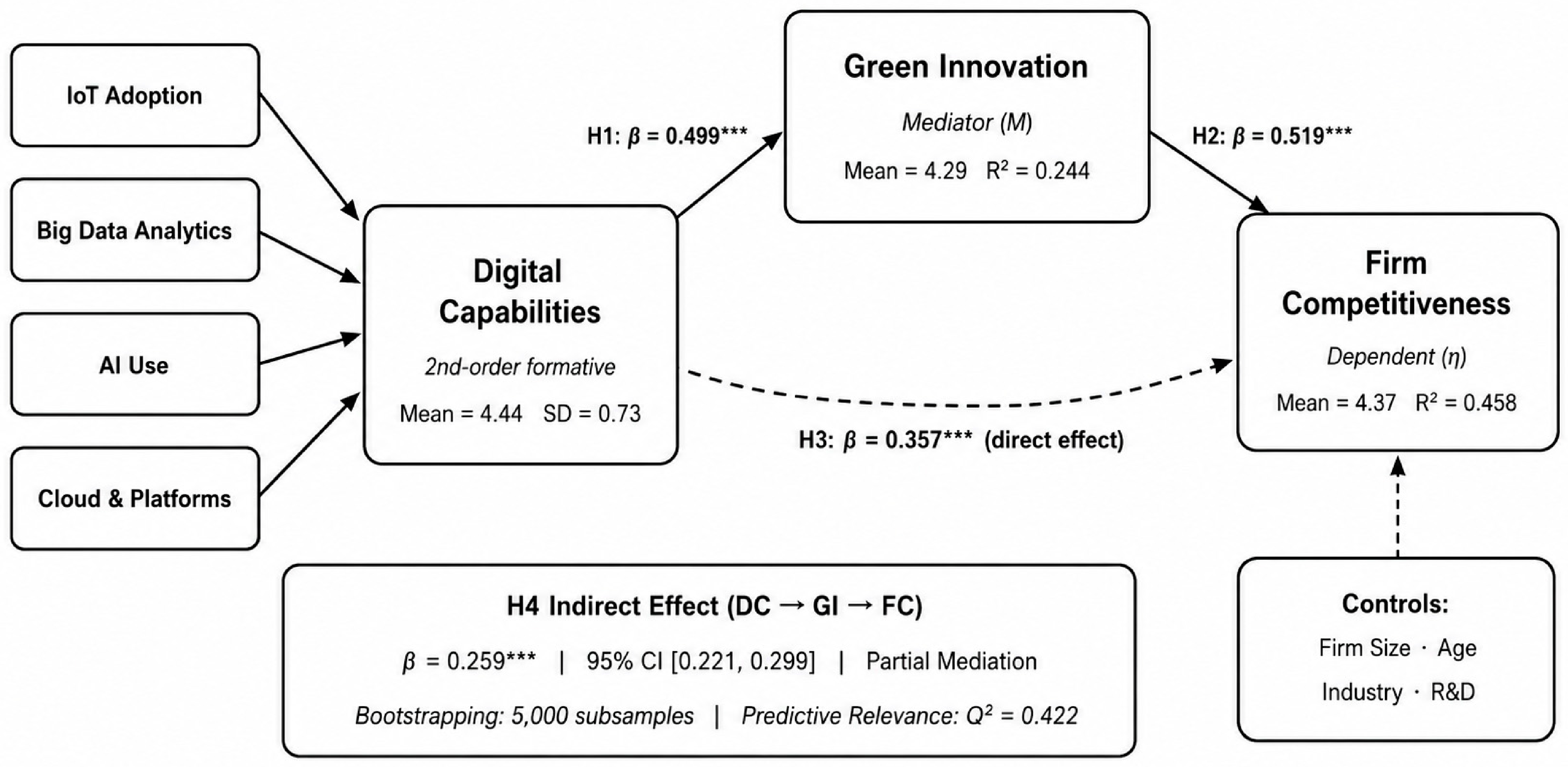
H1. Digital Capabilities Predict Green Innovation.
Moreover, recent empirical studies using PLS-SEM in Chinese [
18], South Asian [
19], and European contexts [
20] and Alnor et al. [
21] have found positive and significant effects of digital technologies on various dimensions of green innovation.
Accordingly, firms with stronger portfolios of digital capabilities are more likely to detect environmental opportunities, reduce innovation uncertainty, and implement sustainability-oriented changes effectively. Therefore, the following hypothesis is proposed:
H1. Digital capabilities positively and significantly predict green innovation (beta > 0, p < 0.001).
H2. Green Innovation Predicts Firm Competitiveness.
Green innovation contributes to firm competitiveness by enabling firms to respond simultaneously to environmental pressures, market expectations, and efficiency demands. Green innovation includes product, process, and management innovations that reduce environmental burden while improving resource and energy efficiency [
15,
16]. Such innovations can create competitive advantage through both cost-based and differentiation-based mechanisms.
Green innovation also has a regulatory and institutional value. Under the European Green Deal, CSRD, EU Taxonomy, and CBAM, firms face growing pressure to demonstrate environmental responsibility and measurable sustainability performance [
3,
4,
5]. Firms that develop stronger green innovation capabilities are better positioned to comply with these requirements, reduce regulatory risk, and maintain legitimacy in European markets. In addition, green innovation may improve access to ESG-linked capital, public procurement opportunities, and sustainability-oriented supply chains [
22].
Thus, green innovation strengthens competitiveness not only by improving environmental performance but also by supporting market differentiation, cost efficiency, regulatory readiness, and strategic legitimacy. Therefore, the following hypothesis is proposed: markets [
22].
H2. Green innovation positively and significantly predicts firm competitiveness (beta > 0, p < 0.001).
H3. Direct Effect of Digital Capabilities on Competitiveness.
Although digital capabilities can enhance competitiveness indirectly through green innovation, they may also produce direct competitive effects. Digital capabilities improve how firms collect information, coordinate resources, automate processes, and respond to customer and market changes. From the dynamic capabilities perspective, firms that can use digital technologies to sense, seize, and reconfigure opportunities are more likely to develop superior competitive positions [
14].
Digital capabilities directly enhance competitiveness in several ways. First, they improve operational efficiency by enabling automation, predictive maintenance, real-time monitoring, and data-driven process optimization. These improvements can reduce costs, improve productivity, and increase reliability. Second, digital capabilities strengthen market responsiveness. Big data analytics and AI allow firms to analyze customer behavior, forecast demand, personalize offerings, and respond more quickly to changing market conditions [
1,
2]. Third, cloud and platform technologies enable scalable business models, digital collaboration, and faster innovation cycles. These capabilities allow firms to enter new markets, improve service delivery, and build more flexible organizational structures.
Importantly, these benefits are not limited to environmental innovation. Even when green innovation is considered separately, digital capabilities may still improve competitiveness through productivity gains, customer responsiveness, innovation speed, and business model renewal. Therefore, digital capabilities are expected to exert a direct effect on firm competitiveness in addition to their indirect effect through green innovation.
Accordingly, the following hypothesis is proposed:
H3. Digital capabilities positively and significantly predict firm competitiveness directly, net of green innovation.
H4. Mediation by Green Innovation.
The relationship between digital capabilities and firm competitiveness is also likely to operate through green innovation. Digital capabilities provide the informational, analytical, and coordination foundations required for sustainability-oriented innovation, but these capabilities do not automatically translate into competitive advantage. To generate competitive value, digital resources must be transformed into concrete organizational outcomes, such as greener products, cleaner processes, and improved environmental management practices.
Drawing on the knowledge-based view, digital capabilities generate sustainability-relevant knowledge by capturing environmental data, identifying inefficiencies, and supporting evidence-based decision-making [
23]. However, this knowledge becomes strategically valuable only when it is embedded in innovation activities that improve products, processes, or management systems. Green innovation, therefore, serves as a conversion mechanism that transforms digital capabilities into competitive outcomes.
For example, IoT and analytics may reveal excessive energy consumption, but competitiveness improves only when the firm redesigns production processes to reduce energy use. Similarly, AI may identify opportunities for eco-design, but competitive advantage emerges when those insights are converted into marketable green products. In this way, green innovation translates digital capabilities into performance-relevant outcomes, such as cost savings, differentiation, compliance-readiness, and stronger market legitimacy.
At the same time, green innovation is unlikely to fully absorb the effect of digital capabilities, because digitalization can also influence competitiveness through other channels, such as operational efficiency, customer analytics, and platform-based business model innovation [
1,
2]. Therefore, green innovation is expected to partially mediate the relationship between digital capabilities and firm competitiveness.
Based on this reasoning, the following hypothesis is proposed:
H4. Green innovation partially mediates the relationship between digital capabilities and firm competitiveness (indirect beta > 0, 95% CI excludes zero).




 ,
,