Article

Hybrid CEEMDAN-MSCNN Approach for Vibration-Based Fault Diagnosis of Wind Turbine Gearboxes †

by
Nejad Alagha
1,*,
Anis Salwa Mohd Khairuddin
2,
Obada Al-Khatib
3 and
Abigail Copiaco
1
1
College of Engineering and Information Technology, University of Dubai, Dubai 14143, United Arab Emirates
2
Department of Electrical Engineering, Faculty of Engineering, University Malaya, Kuala Lumpur 50603, Malaysia
3
School of Engineering, University of Wollongong in Dubai, Dubai Knowledge Park, Dubai 20183, United Arab Emirates
*
Author to whom correspondence should be addressed.
This manuscript is an extended version of a previously published conference paper by the same authors, entitled “CEEMDAN-Based Multiscale CNN for Wind Turbine Gearbox Fault Detection,” presented at the IEEE PES Innovative Smart Grid Technologies Middle East (ISGT Middle East), Dubai, United Arab Emirates, on 23 November 2025.
Sustainability 2026, 18(12), 6196; https://doi.org/10.3390/su18126196
Submission received: 14 April 2026 / Revised: 5 June 2026 / Accepted: 10 June 2026 / Published: 16 June 2026
(This article belongs to the Special Issue Wind Energy Resource Development and the Sustainable Environment)

Abstract

The rapid expansion of wind energy as a key pillar of sustainable electricity generation has intensified the need for reliable and efficient wind turbine operation, particularly in minimizing failures of critical components such as gearboxes, which significantly impact maintenance costs, downtime, and overall lifecycle sustainability. This study proposes a vibration-based fault diagnosis framework integrating Complete Ensemble Empirical Mode Decomposition with Adaptive Noise (CEEMDAN) and a Multiscale Convolutional Neural Network (MSCNN) for wind turbine gearbox condition monitoring. The approach decomposes non-stationary vibration signals into Intrinsic Mode Functions (IMFs) to capture meaningful oscillatory characteristics, which are then processed through parallel multiscale convolutional branches to learn both transient and long-term signal patterns. Experimental validation using the NREL Gearbox Reliability Collaborative dataset demonstrates that the proposed CEEMDAN-MSCNN model demonstrates strong performance compared to conventional machine learning methods and single-scale CNN architectures, achieving 99.50% accuracy on an unseen holdout dataset. The proposed framework supports predictive maintenance strategies by enabling reliable fault diagnosis, reducing unplanned downtime, and improving the operational efficiency and long-term sustainability of wind energy systems.

1. Introduction

The rapid global transition toward renewable energy, driven by the urgent need to mitigate climate change and meet the increasing electricity demands, has led to an unprecedented expansion of wind power generation [1]. Over the past two decades, global wind capacity has increased nearly seventy-five-fold, positioning wind energy as one of the most significant contributors to sustainable electricity production. However, as wind farms expand in scale and complexity, particularly offshore installations, the reliability and maintainability of wind turbine systems have become critical economic and operational concerns. Operation and maintenance (O&M) costs can account for up to 35% of the total levelised cost of energy [2], with unexpected component failures significantly increasing downtime and financial losses [3].
Among the various subsystems of a wind turbine, the gearbox is widely recognised as one of the most failure-prone and economically critical components. Serving as the mechanical interface between the low-speed rotor shaft and the high-speed generator shaft, as shown in Figure 1 [4], the gearbox amplifies rotational speed to enable efficient electricity generation [5]. Despite being designed for long-term operation under variable loading conditions, gearbox-related faults contribute the most to turbine downtime, with downtime durations comprising 40–50% of total failure time [6] in certain wind farms, and common faults including gear tooth breakage, pitting, surface wear, scuffing, cracks, as well as bearing defects such as spalling, fretting corrosion, and overheating [5].
Gearbox degradation is primarily driven by harsh and highly dynamic operating conditions, including fluctuating wind speeds, cyclic mechanical loading, temperature variations, grid demand irregularities, and environmental disturbances [3]. These conditions generate complex vibration signals that are inherently non-linear, non-stationary, and often contaminated with significant noise. In early or incipient fault stages, diagnostic signatures are typically weak and may be masked by background mechanical interactions or environmental interference [7,8]. This complexity poses substantial challenges for traditional signal analysis methods, which often rely on handcrafted features extracted in the time, frequency, or time–frequency domains and require expert knowledge and careful parameter tuning.
Recent advances in machine learning and deep learning have demonstrated promising capabilities for automated fault diagnosis. Deep neural networks have been successfully applied to gearbox condition monitoring due to their ability to learn hierarchical representations directly from raw or preprocessed vibration data [7]. However, conventional deep learning models may struggle to effectively capture multi-scale temporal characteristics embedded within decomposed vibration signals. Moreover, although adaptive signal decomposition techniques such as Complete Ensemble Empirical Mode Decomposition with Adaptive Noise (CEEMDAN) have been widely employed to enhance feature extraction from non-stationary signals [8], existing studies often rely on standard convolutional neural networks or heuristic intrinsic mode function (IMF) selection strategies [9]. A systematic integration of CEEMDAN with a true multiscale convolutional architecture capable of exploiting hierarchical temporal representations is limited in current literature.
To address these challenges associated with non-stationary vibration signals, mode mixing, and the limitations of conventional single-scale learning architectures, this study proposes a robust hybrid diagnostic framework that integrates adaptive signal decomposition with multiscale deep feature extraction. Unlike conventional approaches that treat decomposed signals as a unified input or rely on heuristic feature selection, the proposed framework introduces a structured multiscale learning strategy and a data-driven component selection mechanism. The main contributions of this work are summarized as follows:
  • A structured CEEMDAN-MSCNN framework is proposed, in which each intrinsic mode function (IMF) is treated as an independent frequency-scale representation and processed through dedicated convolutional branches. This design enables explicit multiscale feature learning, unlike conventional single-stream CNN approaches.
  • A correlation-based IMF selection strategy is introduced using the Pearson Correlation Coefficient (PCC), providing a systematic and data-driven method to retain the most informative signal components while reducing noise and redundancy.
  • A leakage-aware data preprocessing pipeline is designed by performing dataset partitioning at the recording level prior to segmentation, ensuring unbiased evaluation and preventing information leakage between training and testing samples.
  • A lightweight yet highly regularized MSCNN architecture is developed, tailored for multibranch learning on limited datasets, improving generalization while maintaining computational efficiency.
  • A comprehensive evaluation is conducted on the NREL Gearbox Reliability Collaborative dataset, demonstrating strong and competitive performance compared to traditional machine learning models and conventional single-scale CNN architectures.

2. Related Work

Wind turbine gearbox fault diagnosis has been extensively studied using a wide range of signal processing and machine learning techniques. Existing research can generally be categorized into three main directions: traditional and adaptive signal processing methods, hybrid frameworks that combine signal decomposition with machine learning classifiers, and deep learning-based architectures designed for automated feature extraction. The following subsections review these approaches and highlight their key characteristics and limitations.

2.1. Traditional and Adaptive Signal Processing Methods

Early studies on wind turbine (WT) gearbox fault diagnosis primarily relied on frequency-domain spectral analysis and fault-tree approaches to identify mechanical anomalies [10]. Although these classical techniques established the foundation for condition monitoring, they are inherently limited when applied to vibration signals generated under varying wind speeds and loads, which are typically non-linear and non-stationary [11,12]. Vives [10] highlighted that modern monitoring strategies are increasingly shifting from manual inspection methods toward automated machine learning (ML) based diagnostics to reduce human error and improve response time.
To address the limitations of traditional signal processing, adaptive decomposition methods such as Empirical Mode Decomposition (EMD) were introduced to extract IMFs without predefined basis functions [13]. However, EMD is frequently hindered by mode mixing and endpoint effects, which distort the physical interpretation of the resulting IMFs [14,15]. While Ensemble Empirical Mode Decomposition (EEMD) was developed to mitigate mode mixing via white noise injection, it often introduces noise residuals and reconstruction inaccuracies [16]. Consequently, this study utilizes CEEMDAN, which provides superior spectral separation and exact reconstruction [17,18]. To further mitigate potential endpoint effects associated with cubic spline interpolation in CEEMDAN, we adopt insights from the improved SW-CEEMDAN framework [14].

2.2. Hybrid Decomposition–Machine Learning Approaches

To enhance diagnostic performance, numerous studies have combined adaptive signal decomposition techniques with shallow machine learning classifiers such as Support Vector Machines (SVM), K-Nearest Neighbors (KNN), and Extreme Learning Machines (ELM) [4,15,19]. These hybrid frameworks typically extract statistical features from decomposed IMFs and then use machine learning models for classification or prediction. For instance, CEEMDAN has been combined with Kernel Principal Component Analysis (KPCA) to denoise vibration signals before using ELM for remaining useful life prediction [18]. Liu et al. [17] proposed a CEEMDAN-GWO-KELM model in which fuzzy entropy features extracted from IMFs are used as inputs to an optimized kernel extreme learning machine classifier. Similarly, Dhiman et al. [1] developed anomaly detection strategies based on adaptive thresholds derived from Chebyshev’s inequality applied to SCADA time-series data.
Although these hybrid approaches have demonstrated promising results, they are generally constrained by their reliance on handcrafted feature extraction techniques [15]. The performance of these models is therefore heavily dependent on expert knowledge and feature engineering strategies. Moreover, classifiers such as SVM and ELM exhibit high parameter sensitivity, where model performance can vary significantly depending on the selection of kernel functions, regularization parameters, or hidden node configurations. These challenges may limit the robustness and scalability of hybrid machine learning frameworks when applied to complex vibration signals generated in real wind turbine operating environments.

2.3. Deep Learning and Multiscale Architectures

Recent advances in deep learning (DL) have enabled end-to-end fault diagnosis frameworks that automatically learn discriminative features directly from raw vibration data, reducing reliance on manual feature engineering. Convolutional Neural Networks (CNNs) have been widely adopted for this purpose due to their ability to capture local patterns and hierarchical features in time-series signals. However, conventional CNN architectures typically perform feature extraction at a single temporal scale, which may limit their ability to capture the complex oscillatory behavior produced by coupled gearbox components operating at different frequencies.
To address single-scale limitations, Jiang et al. [20] introduced Multiscale Convolutional Neural Networks (MSCNN) that extract features across multiple temporal resolutions via parallel pathways. However, many MSCNN implementations rely on coarse-graining through downsampling, which Huang et al. [6] noted can shorten signal length and lead to the loss of critical high-frequency fault information. While alternatives like Dilated Convolutional Neural Networks (DCNN) [21] and Deep Transfer Learning (DTL) [22] attempt to capture multiscale structures or leverage domain knowledge, they often struggle with full signal representation or negative transfer. This study bridges these gaps by using CEEMDAN-generated IMFs as natural scales, preserving high-frequency resolution without the information loss typical of downsampling operations.
In addition to multiscale architectures, recent research has focused on enhancing robustness under complex real-world conditions. For instance, knowledge distillation frameworks have been introduced to improve diagnosis under imbalanced datasets [23], while hybrid CNN-GRU models with attention mechanisms have enhanced the prediction of remaining useful life in rotating components [24]. Furthermore, interpretable dynamic recalibration mechanisms in multi-scale residual networks have shown promise in anti-noise performance even with limited samples [25]. Other scholars have focused on high-precision signal separation, utilizing adaptive periodized singular spectrum analysis and Rényi entropy to isolate compound faults in rolling bearings [26]. While these studies significantly advance intelligent fault diagnosis, there remains a need for frameworks that combine adaptive decomposition with independent frequency-scale learning to prevent information loss during the feature extraction process.
Though progress has been made in vibration-based gearbox diagnosis, existing frameworks often rely on empirical IMF selection strategies that risk introducing redundancy or discarding critical fault signatures. Additionally, many hybrid models depend on handcrafted features and parameter-sensitive classifiers, which lack robustness against non-stationary signals. While deep learning has improved automated feature extraction, standard architectures frequently operate on single-scale representations or utilize preprocessing techniques such as downsampling that result in significant information loss. These gaps necessitate a framework that integrates adaptive signal decomposition with robust multiscale learning to enhance diagnostic reliability under complex, real-world operating conditions.

3. Methodology

3.1. Dataset Description

This study utilizes vibration data from the Gearbox Reliability Collaborative (GRC) project conducted by the National Renewable Energy Laboratory (NREL) [27]. The test article is a 750 kW wind turbine gearbox with an overall gear ratio of 1:81.49, consisting of a low-speed planetary stage and two parallel stages. The dataset comprises signals collected from two wind turbine gearboxes operating under healthy and faulty conditions. The faulty gearbox exhibited degradation mechanisms including scuffing, overheating, fretting corrosion, and assembly damage resulting primarily from oil-loss events. The gearbox under investigation is a three-stage system consisting of a planetary stage, an intermediate-speed stage, and a high-speed stage. During the experiments, the main shaft operated at 22.09 rpm, resulting in a nominal high-speed shaft (HSS) speed of 1800 rpm. Based on the gear tooth counts (88/22 for the high-speed stage and 82/23 for the intermediate stage), the calculated meshing frequencies ( f m ) are approximately 2640 Hz and 535.5 Hz, respectively.
Vibration signals were recorded using eight accelerometers (AN3–AN10) mounted at strategic locations on the gearbox housing. In this study, sensor AN8 was excluded because its recordings were not available for all healthy and damaged operating conditions and contained inconsistencies in recording length and acquisition settings. Including this sensor would have resulted in unequal sample sizes and inconsistent input dimensions across conditions. Therefore, AN8 was removed to maintain dataset uniformity and ensure fair model training and evaluation. The remaining sensors capture vibration responses from critical drivetrain components.
Signals were sampled at 40 kHz to capture high-frequency characteristics associated with early-stage faults. For each operating condition (healthy and damaged), ten one-minute recordings were collected and labeled as H1–H10 and D1–D10, respectively. The raw acceleration signals (in m/s2) were used as input without additional scaling or feature engineering.
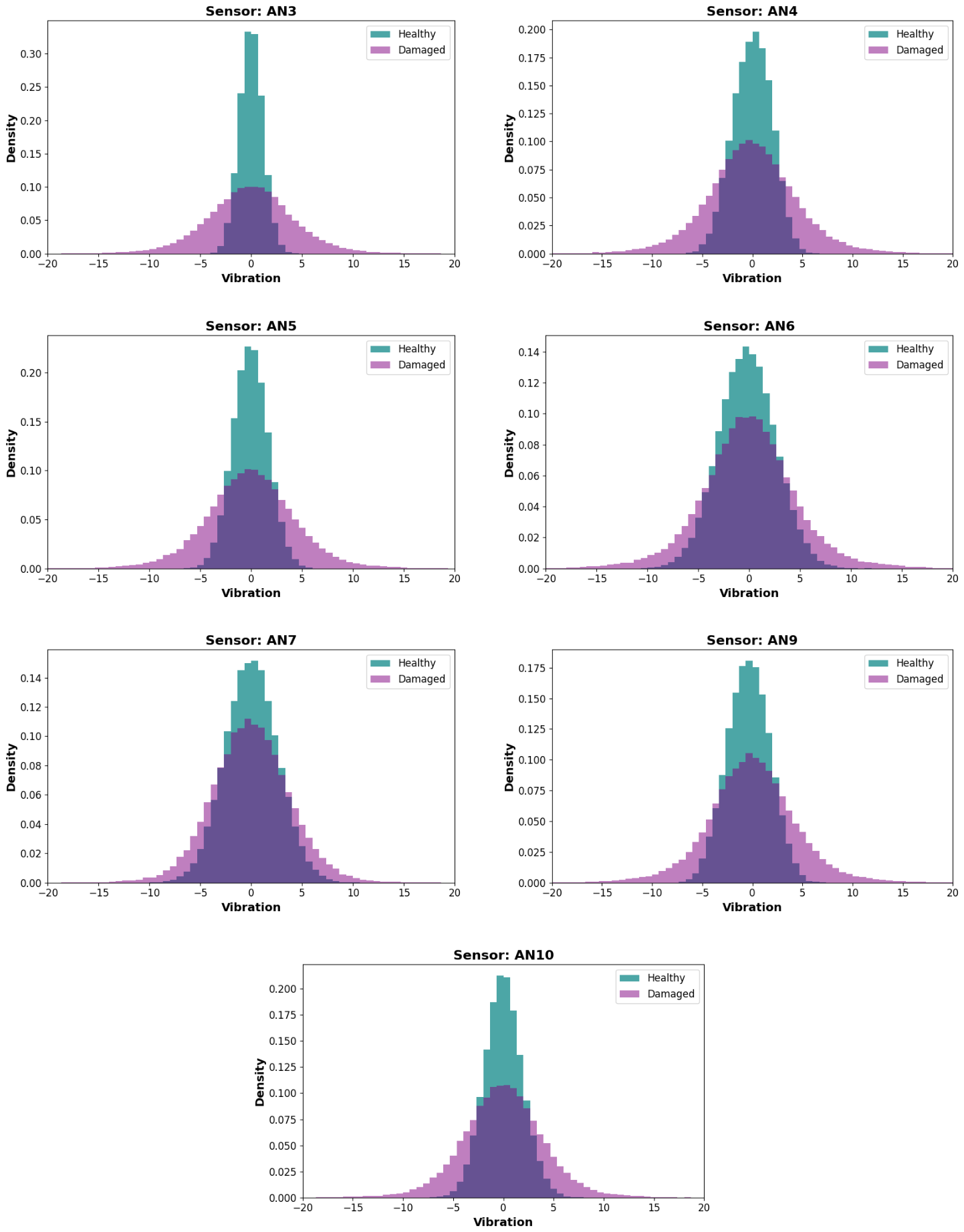
The statistical characteristics of the vibration signals are visualized through histograms in Figure 2. The healthy and damaged signals exhibit distinct variations in amplitude distribution, with damaged states generally showing higher variance and irregular peaks. These fault-induced deviations validate the discriminative potential of the raw signal signatures and justify their use as the foundational input for the proposed decomposition and deep learning pipeline.

3.2. Signal Segmentation and Preprocessing

In the preprocessing stage of this study, the raw vibration signals from seven sensors (AN3–AN7 and AN9–AN10) were prepared using a fixed-length windowing approach to generate a balanced and sufficiently large dataset suitable for deep learning. Each sensor recorded one-minute vibration signals at a sampling rate of 40,000 Hz.
To avoid unintended information overlap arising from window-level correlation, dataset partitioning was performed at the recording level prior to any preprocessing or window segmentation. Specifically, three healthy recordings (H8–H10) and three damaged recordings (D8–D10), corresponding to approximately 30% of the available data, were reserved as a completely unseen holdout test set. These recordings were not used at any stage of training, validation, model selection, or hyperparameter tuning. The remaining recordings were used exclusively for training and validation.
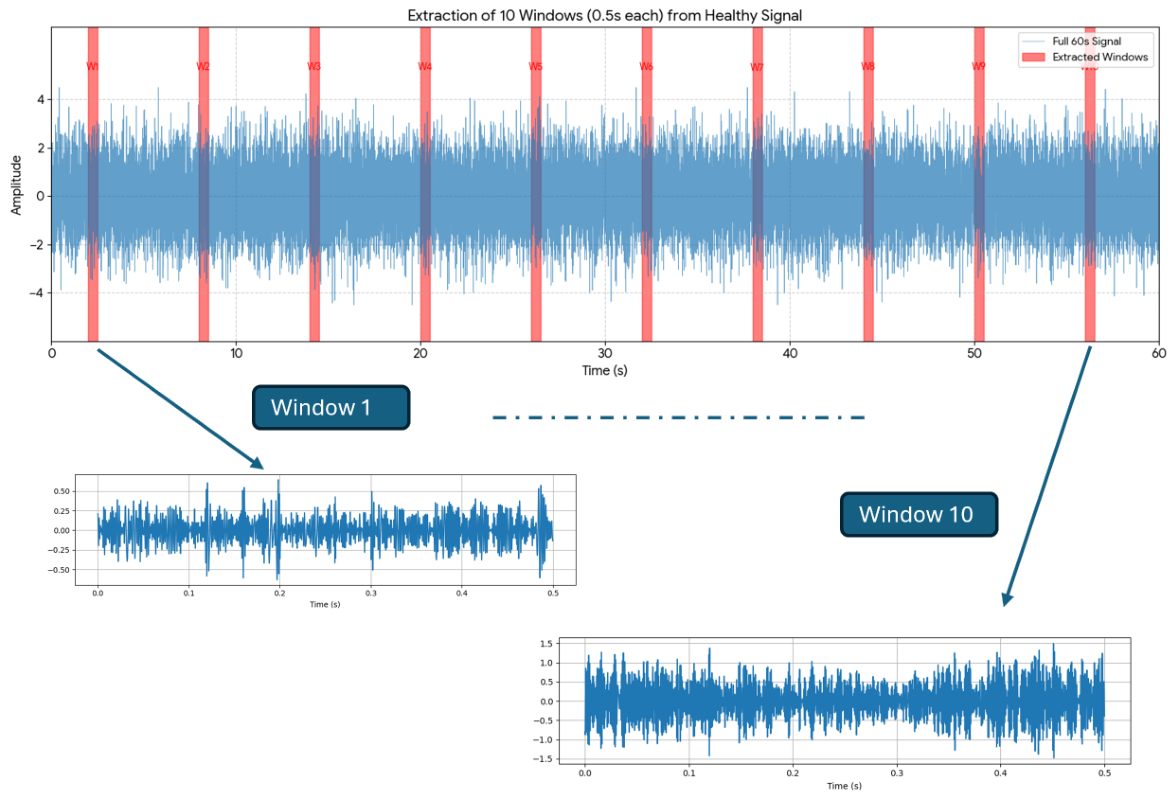
Following this recording-level split, each one-minute vibration recording was divided into ten fixed-length, non-overlapping windows, with each window containing 20,000 samples, corresponding to 0.5 s of data. The 0.5 s window length was selected based on the drivetrain kinematics. At the nominal operating speed of 1800 RPM (30 Hz), each window captures approximately 15 complete revolutions of the high-speed shaft, providing sufficient temporal depth to capture repetitive fault-related impacts across multiple meshing cycles. The windows were extracted at regular intervals across the full duration of each signal to ensure balanced temporal coverage. This uniform window extraction strategy ensures that fault signatures distributed throughout the one-minute signal are adequately represented, rather than concentrating the analysis on a single localized segment. The window segmentation process is illustrated in Figure 3.
This windowing process was applied consistently across seven healthy recordings and seven damaged recordings for each sensor in the training and validation sets, resulting in a total of 490 windows per class. Overall, 980 labeled windows were obtained, with healthy windows assigned label 0 and damaged windows assigned label 1. By performing dataset partitioning at the recording level prior to window segmentation, this study avoids such leakage scenarios and ensures that no windows originating from the same recording appear across different subsets.
Finally, after segmentation and labeling, shuffling was applied within each subset to remove ordering bias prior to subsequent signal decomposition and learning stages. This preprocessing pipeline preserves the essential temporal characteristics of the vibration signals while providing a structured, scalable, and leakage-aware input representation for the proposed CEEMDAN-MSCNN framework.

3.3. CEEMDAN-MSCNN Approach

The combination of CEEMDAN and MSCNN offers a powerful framework for wind turbine fault diagnosis, especially when applied to non-stationary and noisy vibration signals like those in our dataset. CEEMDAN decomposes each signal into IMFs, each capturing a specific frequency band, which effectively reveals fault-related patterns that might be obscured in the raw signal [28]. MSCNN complements this by learning hierarchical and scale-specific features from each IMF independently through parallel convolutional branches. This pairing ensures that both localized transient faults (captured in high-frequency IMFs) and long-term structural variations (represented in low-frequency IMFs) are learned simultaneously.

3.3.1. CEEMDAN-Based Signal Decomposition

CEEMDAN is applied to decompose non-linear and non-stationary vibration signals into intrinsic mode functions (IMFs) for fault diagnosis. Compared to EMD and EEMD [29], CEEMDAN improves mode separation and reconstruction accuracy through adaptive noise-assisted decomposition, effectively mitigating the common issue of mode mixing [30] and eliminating residual noise in the reconstruction process [31]. This algorithm was selected specifically for its ability to provide a physically meaningful and stable decomposition of the transient impulses typical of gearbox faults.
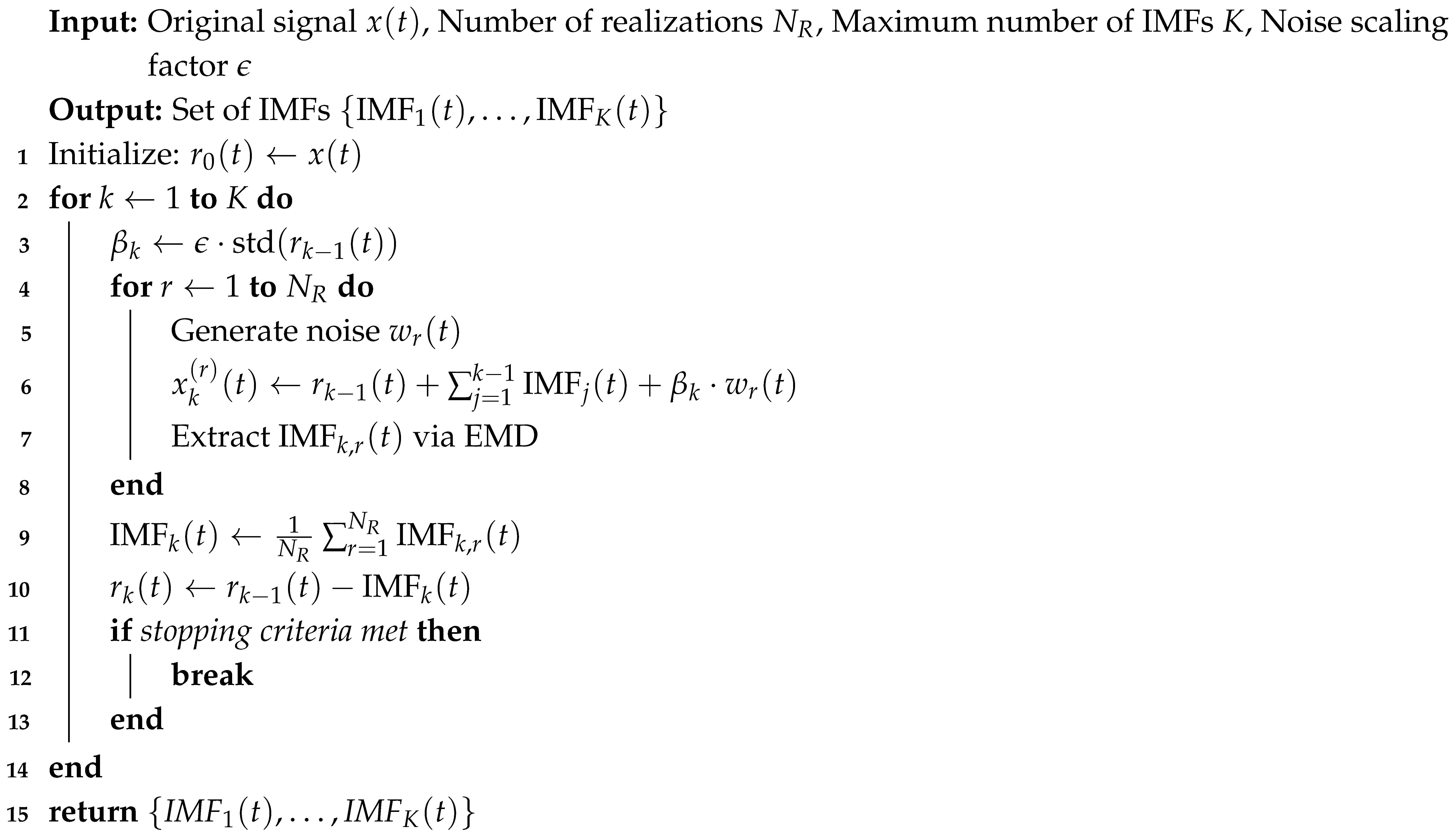
The decomposition process iteratively extracts IMFs by adding zero-mean Gaussian noise across multiple realizations to ensure spectral separation, as detailed in Algorithm 1. The procedure terminates when predefined conditions are met, including reaching the maximum number of IMFs, low residual amplitude, or a trend-like residual. In this study, the number of trials was set to 50 and the maximum number of IMFs to 10, while other parameters followed the [32] implementation (given in Table 1).
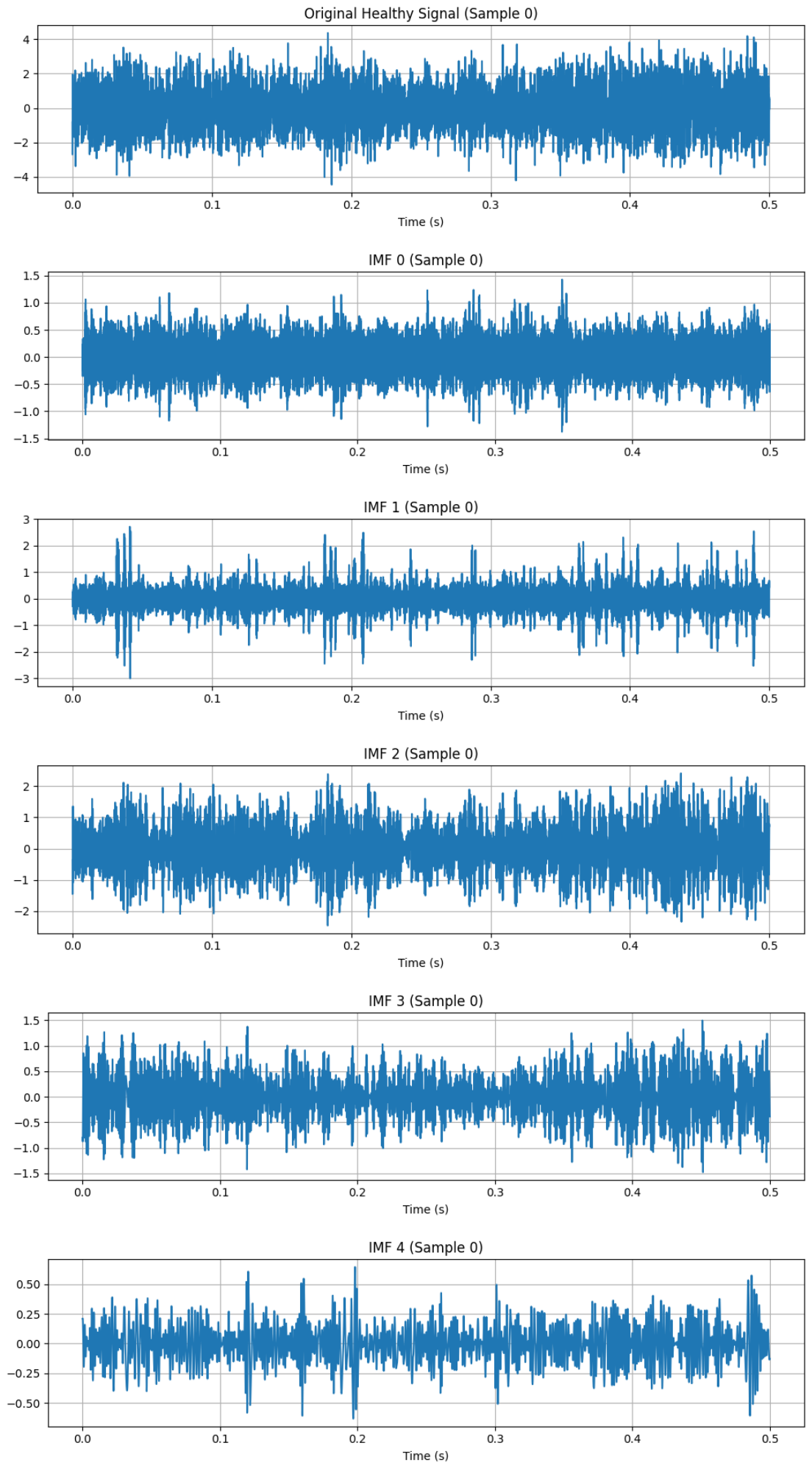
After decomposition, a correlation-based selection strategy was applied to identify the most informative IMFs. The Pearson Correlation Coefficient (PCC), as used in [33], was computed between each IMF and the original signal across all samples. This selection method ensures that only IMFs maintaining high structural similarity to the original raw signal are retained, effectively filtering out noise-dominant modes or artifacts that do not contribute to fault signature identification. The average correlation values, shown in Table 2, were used to rank IMFs, and the top five were selected: IMF 2, IMF 1, IMF 0, IMF 3, and IMF 4. An example is shown in Figure 4.
The selected IMFs were used to construct a reduced dataset of shape (490, 5, 20000) for both healthy and damaged cases. These were concatenated and labeled (0 for healthy, 1 for damaged), forming the final input to the MSCNN model.
Algorithm 1: CEEMDAN Based Signal decomposition
Sustainability 18 06196 i001

3.3.2. MSCNN Architecture

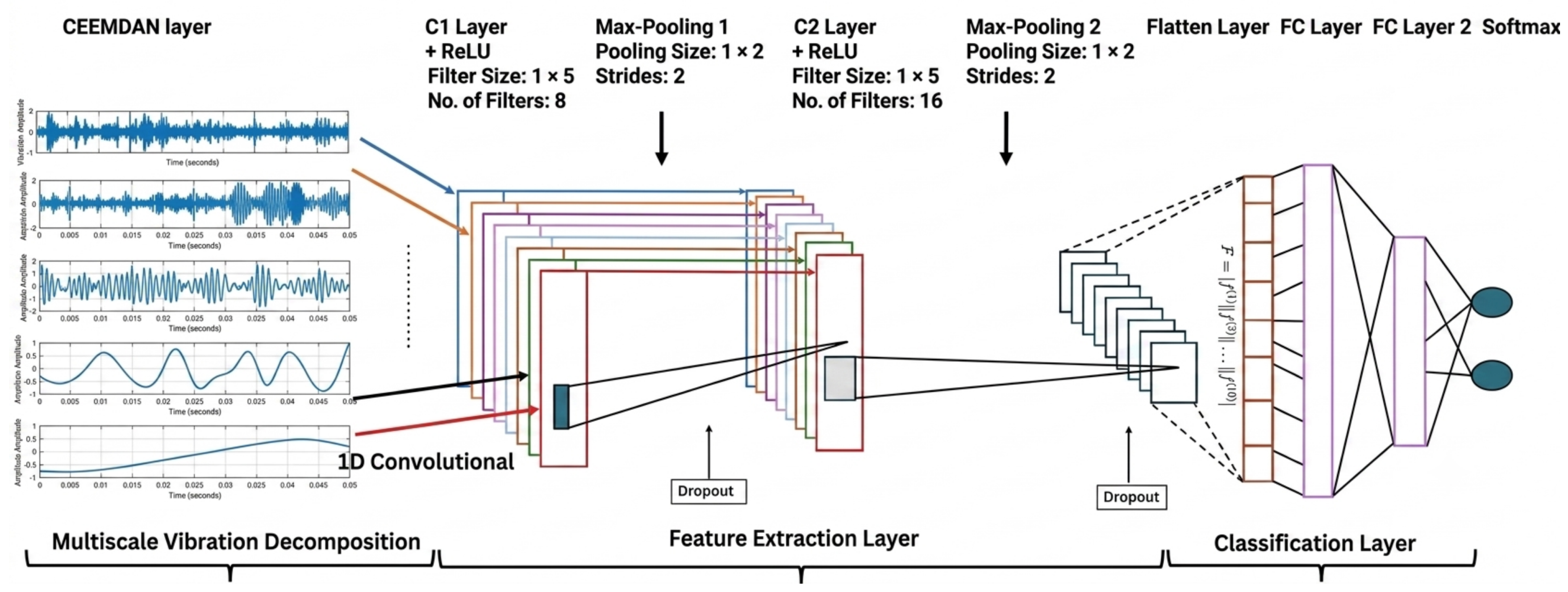
The proposed MSCNN is designed to leverage the multiscale frequency characteristics of vibration signals by utilizing the IMFs extracted through CEEMDAN decomposition. Rather than stacking all IMFs into a single matrix and feeding them into one CNN stream, the architecture treats each IMF as an independent representation of the signal at a distinct frequency band and processes them using parallel convolutional branches, as shown in Figure 5. This design ensures that the model learns discriminative features specific to each scale, since high-frequency IMFs typically capture impulsive fault-related transients, while lower-frequency IMFs represent slower structural or modulation-related patterns. By learning features independently from each IMF before feature fusion, the network avoids scale interference and preserves fault information that may be dominant at different frequency ranges.
The MSCNN architecture comprises three main components: (1) multiscale input from CEEMDAN, (2) a parallel feature extraction block consisting of multiple CNN branches, and (3) a shared classification head.
Multiscale Input via CEEMDAN—For each raw vibration signal, the CEEMDAN algorithm is applied to decompose it into K = 5 IMFs, denoted as
{ I M F 0 , I M F 1 , , I M F 4 } .
Each IMF corresponds to a unique time-frequency scale, capturing either high-frequency transients or low-frequency patterns. Although CEEMDAN decomposes each signal into up to 10 IMFs, only the top 5 IMFs selected using the correlation-based PCC criterion are used as input to the MSCNN model. These IMFs serve as separate inputs to the CNN, preserving the multiscale nature of the signal without the need for artificial resampling.
Parallel Feature Extraction—Each IMF is passed through a dedicated CNN branch. All branches share an identical architecture but operate on their respective IMFs independently. Each branch consists of:
  • A first 1D convolutional layer with 8 filters of size 1 × 5 , followed by ReLU activation.
  • A max-pooling layer of size 1 × 2 , reducing the temporal resolution.
  • A dropout layer with a dropout rate of 60% to regularize the branch.
  • A second 1D convolutional layer with 16 filters of size 1 × 5 , also followed by ReLU.
  • Another max-pooling layer ( 1 × 2 ), and a second 60% dropout.
  • A flatten layer that transforms the feature maps into a 1D feature vector f ( k ) .
This process is repeated for each IMF ( I M F k ), resulting in 5 feature vectors:
f ( 0 ) , f ( 1 ) , , f ( 4 )
Feature Fusion and Classification—the feature vectors from all branches are concatenated into a single global feature vector:
F = f ( 0 ) f ( 1 ) f ( 4 )
The concatenated vector F is passed through a fully connected layer (32 neurons, ReLU activation) and a 70% dropout layer to prevent overfitting, followed by a 2-node softmax output layer for final classification.
Training and Optimization—The proposed CEEMDAN-MSCNN model was trained using a supervised learning framework. Training was performed using the Adam optimizer, which was selected for its adaptive learning rate and robustness in handling the high-dimensional parameter space created by the parallel multibranch architecture. The initial learning rate was set to 1 × 10 5 , and the network was trained for a maximum of 100 epochs. The selection of architectural hyperparameters was guided by empirical validation; specifically, 1 × 5 convolutional kernels were chosen to capture localized transient impulses characteristic of early-stage gearbox faults, while the filter depths were optimized to provide sufficient feature abstraction without excessive computational cost.
A mini-batch size of 16 was used during training. Binary cross-entropy loss was employed as the objective function, consistent with the binary classification task of distinguishing between healthy and damaged gearbox conditions. To mitigate overfitting and improve generalization, regularization was applied through dropout layers within both the convolutional branches (dropout rate of 60%) and the classification head (dropout rate of 70%). A relatively high dropout rate was selected due to the limited dataset size and the multibranch MSCNN architecture, which increases the number of trainable parameters and the risk of overfitting [34]. Studies like [35] prove that using a a high dropout with limited dataset increases its performance. This high regularization threshold was found to be necessary to ensure the model learns robust physical patterns rather than noise-driven artifacts from the decomposed IMFs.
Early stopping was applied based on validation loss, with training terminated if no improvement was observed for 15 consecutive epochs. Model selection was performed by retaining the network parameters corresponding to the epoch that achieved the best validation performance. The final trained model was evaluated exclusively on a held-out test set, which was not used during training, validation, or hyperparameter tuning. Algorithm 2 provide an overview of the MSCNN flow.
Algorithm 2: MSCNN for Fault Diagnosis
Sustainability 18 06196 i002
This MSCNN architecture allows each frequency component of the signal to be analyzed independently and learned optimally. The multibranch design ensures that both transient and persistent fault features are captured, leading to improved generalization and diagnostic performance compared to conventional single-stream CNNs.

4. Results

All experiments were conducted using a Python 3.10-based environment running on a workstation equipped with an Intel Core i9-14900HX processor, 32 GB RAM, and an NVIDIA GeForce RTX 4060 GPU. The implementation utilized key scientific libraries including NumPy 1.24.3, SciPy 1.10.1, Matplotlib 3.7.1, and TensorFlow 2.11.
To ensure unbiased evaluation, only 7 out of the 10 available files per class were used (H1 to H7 and D1 to D7) during the training and validation phase. The remaining 3 files per class were completely held out and used later for testing on unseen data to further verify the model’s generalization capability. Each sample in the final dataset was represented as a 3D array of shape ( 20000 , 5 ) corresponding to 20,000 time points and 5 selected IMFs. The training dataset contained 980 samples (490 healthy and 490 damaged). A 5-fold stratified cross-validation was employed, in which the dataset was split in each fold into 80% training and 20% testing. For each fold, a new instance of the MSCNN model was initialized, trained, and evaluated independently.
Model training used the Adam optimizer with a learning rate of 1 × 10 5 , binary cross-entropy loss, and a mini-batch size of 8. The number of epochs was set to 20 but in order to prevent overfitting, early stopping was applied with a patience of 10 epochs, and the learning rate was reduced on plateau with a factor of 0.5. Additionally, the best model from each fold was saved based on validation performance. After training, predictions were generated for the test set of each fold, and performance was assessed using classification accuracy, precision, recall, and F1-score. Finally, average accuracy and standard deviation across the five folds were reported.

4.1. Performance Evaluation of CEEMDAN-MSCNN

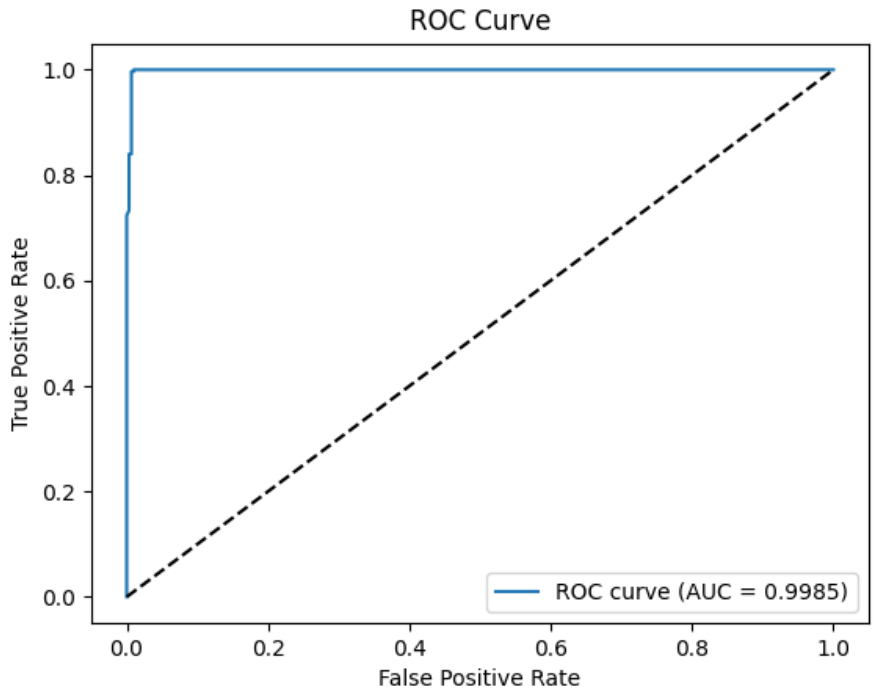
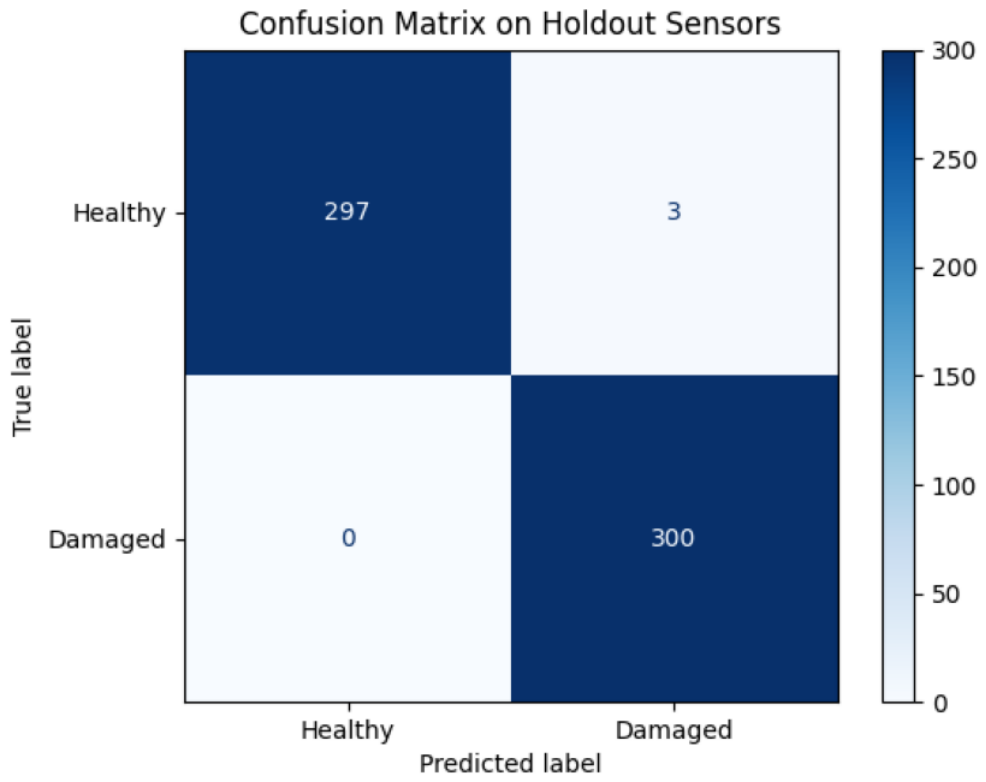
The performance of the proposed CEEMDAN-MSCNN model was evaluated on an unseen holdout dataset to assess its generalization capability. This holdout set was extracted from the original dataset before training and was excluded from both the training and validation processes, ensuring an unbiased performance assessment. The holdout dataset consisted of 600 vibration signal samples (300 healthy and 300 damaged), each representing 0.5 s of data. The evaluation metrics were derived from the confusion matrix and the Receiver Operating Characteristic (ROC) curve, as illustrated in Figure 6 and Figure 7, respectively.
The confusion matrix in Figure 6 shows that the model correctly classified all damaged samples (Recall = 1.0000) without any missed faults (FN = 0). This ensures that no actual faults go undetected, a critical requirement for condition monitoring applications. Only three healthy samples were misclassified as damaged (FP = 3), corresponding to a False Positive Rate of 1%, which indicates strong robustness against unnecessary fault alarms. Although the overall classification performance is very high, a small number of healthy samples were misclassified as damaged. This can be attributed to the presence of transient noise, load fluctuations, or minor vibration anomalies in some healthy signals that produce time–frequency characteristics similar to early-stage fault signatures after CEEMDAN decomposition. Since the proposed model is designed to be highly sensitive to fault-related features, it may classify borderline or ambiguous signal patterns as damaged. From a practical condition monitoring perspective, false positives are generally more acceptable than false negatives, as missing a real fault could lead to severe gearbox damage, whereas a false alarm only results in additional inspection.
The overall accuracy reached 99.50%, with a precision of 0.9900 for the damaged class, reflecting a very low rate of false alarms (Table 3). However, it is important to note that while windowing provides a large number of training samples, these are derived from a limited set of independent long-duration recordings from the NREL GRC dataset. The high accuracy achieved likely reflects the model’s effectiveness within this specific benchmarking environment rather than a definitive measure of global robustness. The ROC curve in Figure 7 confirms the high separability between healthy and damaged states, with an AUC of 0.9985, which is extremely close to the perfect score of 1.0. This indicates that the model retains excellent classification performance even when the decision threshold is adjusted. These results confirm that the CEEMDAN-MSCNN model offers both high sensitivity to actual faults and strong resistance to false positives, indicating its potential suitability for deployment as a proof of concept in real-world wind turbine gearbox fault detection systems, subject to further validation across more diverse datasets and varying operating conditions.

4.2. Comparison with Traditional Models

In this section, the term traditional models refers to conventional machine learning classifiers applied to CEEMDAN-processed vibration data, namely LR, SVM, RF, and Naive Bayes (NB). In addition, a single-branch 1DCNN was included to provide a fair comparison against the proposed MSCNN architecture using the same CEEMDAN-derived IMF inputs while preserving the temporal structure of the vibration signals. To ensure a consistent and fair evaluation, the same preprocessed dataset used for the MSCNN model, comprising the top five selected IMFs per sample, was used for all benchmark models in this comparison. To assess the stability of the models and ensure the results are statistically meaningful, a 5-fold cross-validation approach was employed, and the mean performance metrics along with their corresponding standard deviations are reported.
By keeping the CEEMDAN-based signal decomposition fixed and varying only the classification model, this comparative analysis isolates the impact of the learning architecture itself. Furthermore, the inclusion of the single-branch 1DCNN allows the study to distinguish the benefit of preserving temporal signal structure from the additional advantage introduced by the proposed multiscale learning architecture. This design choice allows the study to objectively evaluate whether conventional classifiers are capable of effectively exploiting CEEMDAN-derived features, and to demonstrate the performance limitations of traditional machine learning approaches when compared to the proposed CEEMDAN-MSCNN framework. As such, any observed performance differences can be attributed to the model’s feature learning capacity rather than disparities in signal preprocessing.
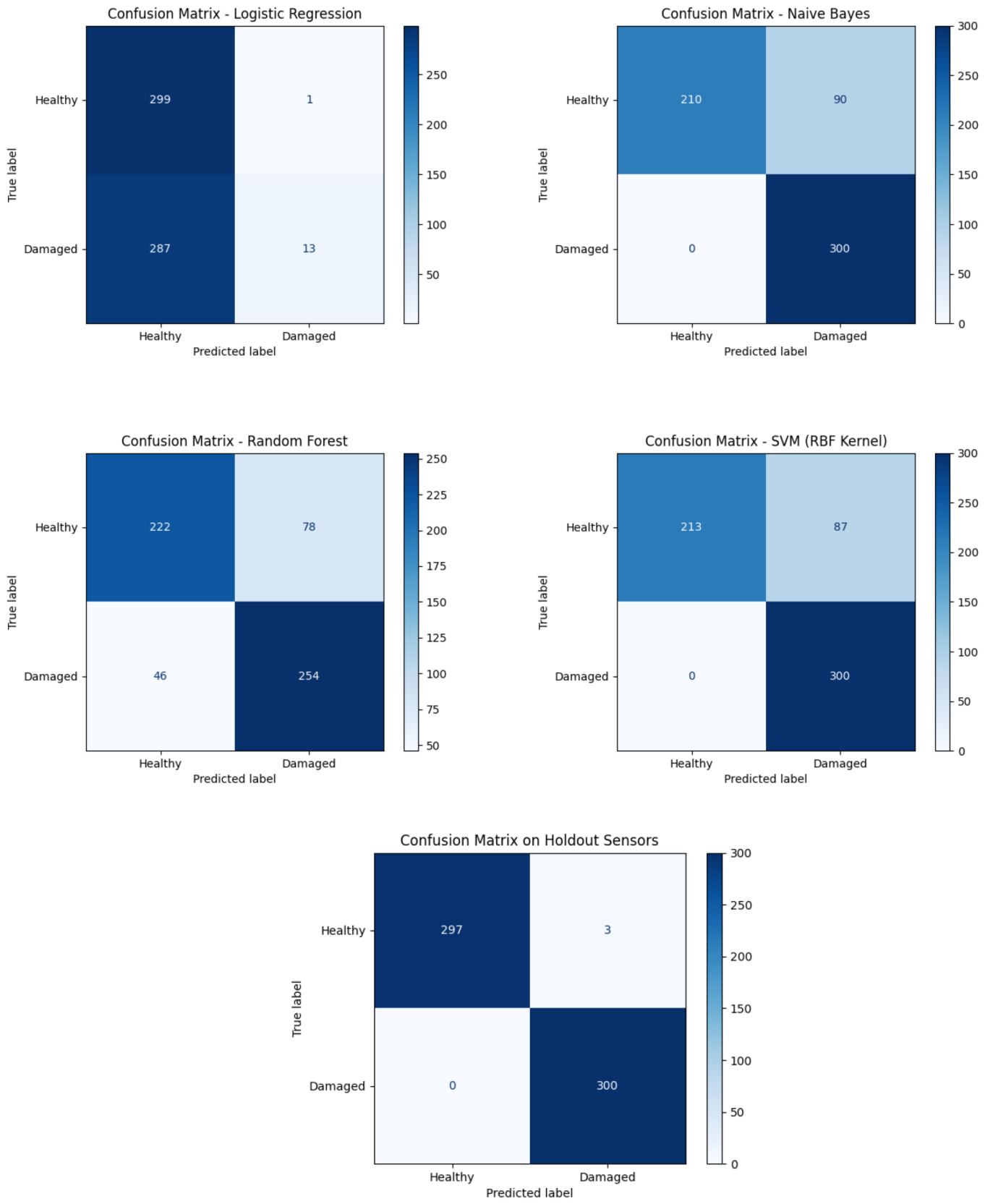
Table 4 and Figure 8 presents the comparative metrics and confusion matrices for all models based on the 5-fold cross-validation results. It is evident that while traditional models struggle with generalizing over the complex vibration data, the deep learning-based approaches demonstrate substantially stronger and more reliable fault classification performance with lower variance across folds.
The comparative evaluation of traditional machine learning models and the proposed MSCNN reveals clear differences in both diagnostic capability and inference efficiency. The results show that LR produced a high number of false negatives, correctly identifying only a very small fraction of damaged samples. As reflected by its performance metrics, LR resulted in an extremely low mean recall ( 0.043 ± 0.053 ). Although LR achieved a very low inference time (0.08 ms/sample), its poor fault detection capability and high relative variance make it unsuitable for safety-critical applications where missed detections must be minimized.
On the other hand, SVM with an RBF kernel demonstrated improved fault detection capability, achieving a mean recall of 0.794 ± 0.044 . However, this diagnostic performance came at a substantial computational cost, with the highest inference time among all models (157.33 ms/sample). This significantly limits its practicality for real-time or near-real-time condition monitoring applications despite its mean accuracy of 0.855 ± 0.072 .
Out of all traditional machine learning models, RF achieved a balanced performance, with a mean F1-score of 0.804 ± 0.126 . It maintained reasonable recall ( 0.847 ± 0.063 ) while achieving fast inference (0.22 ms/sample), making it computationally efficient. Nevertheless, the presence of missed detections and the higher standard deviation in accuracy compared to the deep learning approaches indicates limited robustness when compared to the proposed architecture.
Lastly, despite NB’s simplifying independence assumptions, it achieved the highest recall among traditional machine learning models ( 1.000 ± 0.077 ), successfully detecting faulty samples. However, it exhibited a high standard deviation in precision ( 0.769 ± 0.157 ), indicating that it over-predicted the fault class, leading to inconsistent false positives across folds. Its inference time (1.45 ms/sample) remains low, though its overall discriminative capability is lower than that of the deep learning models.
To further investigate the impact of temporal feature learning, a single-branch CEEMDAN-1DCNN model was evaluated using the same structured IMF tensor representation as the proposed MSCNN. The CEEMDAN-1DCNN achieved strong classification performance, with a mean accuracy of 0.921 ± 0.047 , precision of 0.899 ± 0.063 , recall of 0.953 ± 0.065 , and F1-score of 0.924 ± 0.046 . These results confirm that preserving the temporal structure of the decomposed vibration signals substantially improves fault diagnosis performance compared to conventional machine learning approaches applied to flattened features. However, despite the strong performance of the single-scale CNN architecture, the proposed MSCNN consistently achieved superior results across all evaluation metrics, demonstrating the additional advantage provided by multiscale feature extraction.
The proposed CEEMDAN-MSCNN model achieved near-perfect classification performance, with minimal misclassifications across both classes. The model attained the highest mean accuracy ( 0.995 ± 0.022 ), precision ( 0.990 ± 0.015 ), recall ( 1.000 ± 0.051 ), and F1-score ( 0.995 ± 0.021 ). The low standard deviations across the 5-fold cross-validation highlight the superior stability and statistical reliability of the proposed multiscale architecture. Importantly, this strong diagnostic performance is achieved with a low inference time of 0.28 ms/sample, indicating that the deep learning model remains computationally efficient at inference despite its architectural complexity.
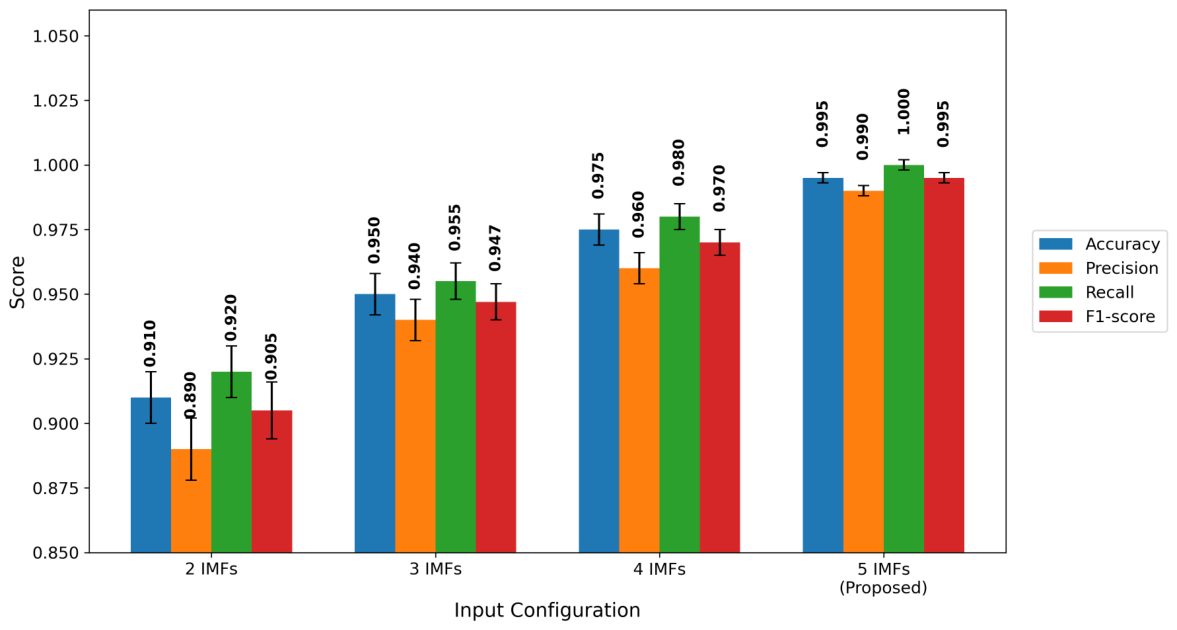
To further investigate the contribution of the selected IMF inputs, an ablation study was conducted by progressively reducing the number of IMF channels provided to the MSCNN architecture. Figure 9 summarizes the obtained results. The full configuration using five selected IMFs achieved the highest classification performance, while progressively removing IMF inputs resulted in a noticeable degradation in accuracy, precision, recall, and F1-score. These results indicate that combining multiple CEEMDAN-derived IMFs enables the model to capture complementary fault-related information across different signal scales, thereby improving diagnostic performance.
Overall, the comparison between CEEMDAN-1DCNN and CEEMDAN-MSCNN demonstrates that both temporal feature preservation and multiscale learning contribute to the observed performance improvements. While the single-scale 1DCNN already provides a substantial enhancement over traditional machine learning methods, the proposed MSCNN further improves feature representation capability by capturing vibration characteristics at multiple receptive field scales simultaneously.
In summary, while traditional machine learning models exhibit varying trade-offs between classification performance and computational efficiency, none achieve a similar combination of accuracy, robustness, and fast inference under the evaluated settings. The results confirm that the proposed model is well-suited for real-world wind turbine gearbox fault detection, where both high diagnostic reliability and low inference latency are essential.

4.3. Comparison with State-of-the-Art

To further evaluate the effectiveness of the proposed CEEMDAN-MSCNN approach, a comparison was conducted against representative fault detection methods from recent literature. These works employ a variety of signal processing techniques and learning models ranging from classical machine learning to advanced deep learning architectures. Table 5 summarizes selected studies and their reported performance metrics, including accuracy, F1-score, training time, and testing time. It should be noted that not all studies report all evaluation metrics.
Compared with previous works, the proposed model demonstrates strong performance in terms of accuracy and F1-score. However, direct comparison is limited due to differences in datasets and experimental settings. The integration of CEEMDAN enables effective decomposition of non-stationary vibration signals by isolating fault-related frequency components. Meanwhile, the MSCNN architecture utilizes multiscale receptive fields to capture hierarchical features across different temporal resolutions, improving classification robustness. Unlike traditional machine learning methods that rely heavily on handcrafted features, or deep learning approaches that operate on raw or single-scale inputs, the CEEMDAN-MSCNN pipeline benefits from both signal enhancement and deep representation learning, which contributes to improved diagnostic performance within the evaluated framework.

5. Discussion

The results presented in Table 5 indicate that the proposed CEEMDAN-MSCNN framework achieves strong overall classification performance compared to the reported methods. Specifically, the proposed model achieved an accuracy and F1-score of 99.50%, while maintaining a relatively short training time of 2.26 s per epoch and an inference time of 0.28 ms per sample. These results indicate that the proposed approach not only achieves excellent diagnostic accuracy but also maintains computational efficiency suitable for practical deployment. Additionally, two of the compared studies utilized the same NREL Gearbox Reliability Collaborative (GRC) dataset framework as the proposed work, enabling a more consistent comparison under similar data conditions.
Deep learning models such as MSCNN [20] and WPD-MSCNN [6] also demonstrate strong performance, reporting F1-scores of 98.53% and 99.43%, respectively. However, these models exhibit higher training times, particularly MSCNN, which requires 14.54 s per epoch. The reduced training time achieved by the proposed model suggests improved computational efficiency while maintaining competitive diagnostic performance.
Traditional machine learning methods generally exhibit a weaker classification performance compared to deep learning approaches. For instance, the Supervised SAE-KNN method [36] achieved an accuracy of 92.60%, highlighting the limitations of shallow classifiers when applied to complex and highly non-stationary vibration signals. Similarly, the Weighted k-NN approach [40] reported an F1-score of 95.93%, but such distance-based classifiers often struggle to capture non-linear relationships present in vibration data. Hybrid approaches such as the Hybrid Ensemble method [37] achieved moderate performance (92%) but suffer from higher testing times, which may limit scalability in real-time monitoring systems.
Although some studies such as IVMD-TSMSE-SSA-SVM [39] report very high accuracy values, the absence of additional evaluation metrics such as F1-score or computational time makes it difficult to assess their practical applicability. Notably, the Extra Tree Classifier [42] and the CBA-KELM with Multisensor Data Fusion approach [43] utilized the same NREL Gearbox Reliability Collaborative (GRC) dataset framework as the proposed work, enabling a more consistent comparison under similar data conditions. The Extra Tree Classifier achieved an accuracy of 96.64%, while the CBA-KELM approach reported an accuracy of 96.25%. In comparison, the proposed CEEMDAN-MSCNN framework achieved a higher accuracy and F1-score of 99.50%, indicating improved diagnostic capability. This performance improvement can be attributed to the integration of adaptive CEEMDAN-based signal decomposition with multiscale deep feature extraction, which enables more effective learning of complex fault-related temporal patterns compared to conventional machine learning approaches based on handcrafted statistical features. Other methods, including EMD-1DCNN [41], also demonstrate strong performance with accuracies exceeding 96%, but still fall short of the proposed method in both classification performance and computational efficiency.
Several limitations can also be observed in existing methods. Distance-based classifiers such as SAE-KNN are sensitive to feature dimensionality and often require extensive feature engineering. Multiscale CNN architectures such as MSCNN provide effective multiscale representation learning but may incur higher computational costs. Similarly, WPD-MSCNN introduces additional preprocessing complexity due to wavelet-based decomposition, which can increase implementation overhead. Other hybrid approaches, such as CEEMDAN-BT-CNN [38], rely on empirically defined IMF selection strategies that may require manual tuning.
By integrating CEEMDAN-based signal decomposition with a multiscale CNN architecture, the proposed framework effectively addresses these challenges. The adaptive decomposition stage enhances noise suppression and separates intrinsic oscillatory components, while the MSCNN architecture enables robust multiscale feature extraction. This combination allows the proposed model to achieve superior diagnostic accuracy while maintaining efficient training and inference performance, making it suitable for real-world wind turbine gearbox condition monitoring applications.
Despite the promising results, several limitations should be acknowledged. The proposed framework was evaluated using a specific benchmark dataset, and further validation on additional datasets collected under diverse operating conditions would strengthen the generalizability of the approach. Additionally, while the current study utilizes binary classification (healthy vs. damaged) to prioritize high-sensitivity early fault detection, real-world maintenance often requires distinguishing between specific failure modes. Binary classification was chosen here to establish a robust baseline for identifying the onset of failures. However, the MSCNN architecture is inherently scalable. By adapting the output layer and training on datasets with granular fault labels (such as gear tooth breakage or bearing wear), the framework can be extended toward a multi-class diagnostic system.
Moreover, although the computational efficiency of the proposed model is favorable compared to several existing methods, it should be noted that the reported computational times in most related studies, including methods operating directly on raw vibration signals, generally focus on the model training and inference stages rather than the complete preprocessing pipeline. To provide a more comprehensive assessment of the proposed framework, the average CEEMDAN decomposition time was measured on the hardware platform described in Section 4. The decomposition of a single 0.5 s vibration sample (20,000 points) required approximately 4.66 s, whereas the MSCNN inference stage required only 0.28 ms/sample. In practice, preprocessing operations such as normalization, segmentation, filtering, feature preparation, or signal decomposition also contribute to the overall computational overhead, yet these costs are rarely reported separately in the literature. Evaluating the total end-to-end pipeline latency represents an important consideration for fair benchmarking and practical deployment, and we believe this remains a broader limitation across many intelligent fault diagnosis studies. Future work could therefore investigate standardized reporting of complete preprocessing-to-inference computational performance, in addition to exploring lightweight architectures or model compression techniques to further reduce computational overhead for edge-based monitoring systems.

6. Quantitative Impact on Sustainability and Operational Efficiency

To substantiate the sustainability claims of the proposed CEEMDAN-MSCNN framework, a quantitative assessment was conducted based on industry benchmarks for a representative 2 MW wind turbine. Gearbox failures are among the most significant contributors to wind energy operational expenses, accounting for approximately 20–25% of total turbine downtime [44,45]. From an economic perspective, the cost of a complete gearbox replacement for a 2 MW wind turbine typically ranges from $300,000 to $500,000, including heavy-lift crane hire, specialized labor, and field logistics [46,47]. The proposed framework achieved a recall of 100% on the holdout dataset during experimental validation. Although the cross-validation results reported in Table 4 exhibited some variability across folds (Recall = 1.000 ± 0.051), the holdout results demonstrate the model’s strong fault detection capability within the evaluated benchmark dataset. While these results were obtained under controlled benchmarking conditions and require further validation across diverse operating environments, they demonstrate the potential of the proposed approach for supporting predictive maintenance strategies. By detecting bearing or gear teeth defects at an incipient stage (e.g., early sub-surface spalling), operators can transition from a reactive “run-to-failure” mode to an optimized “run-to-repair” strategy. If comparable detection performance can be maintained under field operating conditions, such early fault identification could enable localized, up-tower repairs costing approximately $20,000 to $40,000, potentially reducing maintenance expenditure relative to complete gearbox replacement.
Beyond direct asset replacement costs, the framework may also contribute to improved energy production and operational efficiency by curbing prolonged maintenance outages. Assuming a standard 2 MW onshore turbine operating at a 35% capacity factor, the daily revenue lost during unplanned maintenance shutdowns is approximately $2500 to $3000 (benchmarked at an electricity rate of $0.10/kWh). Traditional reactive maintenance models often incur component lead times of 2 to 4 weeks for full gearbox procurement and deployment logistics. If similar diagnostic performance is maintained in operational wind farms, the proposed framework could allow operators to schedule targeted maintenance actions during low-wind or seasonal calm periods. Under such conditions, unplanned downtime could potentially be reduced by 10 to 14 days per failure event, resulting in estimated savings of $25,000 to $42,000 annually per turbine in avoided energy generation losses.
Furthermore, these operational improvements may translate into long-term environmental sustainability and circular economy benefits. From a lifecycle assessment (LCA) perspective, the manufacturing and processing of multi-megawatt wind turbine gearboxes are highly carbon-intensive, demanding substantial volumes of specialized structural steel, casting alloys, and manufacturing energy [48]. If reliable fault detection performance can be sustained throughout long-term deployment, precise condition monitoring may contribute to extending drivetrain service life, thereby reducing demand for replacement materials and lowering the lifecycle environmental footprint [49]. Consequently, the proposed framework has the potential to support circular economy objectives within the renewable energy sector by promoting asset remediation, component reuse, and extended structural longevity over premature material disposal.

7. Conclusions

This paper presented a hybrid diagnostic framework for wind turbine gearbox fault detection by integrating Complete Ensemble Empirical Mode Decomposition with Adaptive Noise (CEEMDAN) and a Multiscale Convolutional Neural Network (MSCNN). The proposed framework addresses the challenges associated with non-stationary vibration signals commonly observed in wind turbine gearboxes. CEEMDAN was used to decompose raw vibration signals into intrinsic mode functions (IMFs), enabling effective separation of signal components across different frequency bands. A correlation-based IMF selection strategy was then applied to retain the most informative components, which were subsequently processed using a multiscale CNN architecture capable of capturing hierarchical fault-related features across multiple temporal scales.
Experimental evaluation using the Gearbox Reliability Collaborative (GRC) dataset demonstrated the effectiveness of the proposed approach. The CEEMDAN-MSCNN model achieved an accuracy and F1-score of 99.50% on an unseen holdout dataset while maintaining efficient training and inference times. Comparative analysis with traditional machine learning models such as Logistic Regression, Support Vector Machines, Random Forest, and Naïve Bayes showed that the proposed method significantly improves diagnostic performance within the evaluated dataset. Furthermore, comparison with representative state-of-the-art methods from recent literature indicated that the proposed framework achieves competitive performance under the evaluated experimental settings while maintaining favorable computational efficiency. Although CEEMDAN introduces a higher computational cost compared to traditional signal processing methods due to its iterative noise-assisted decomposition process, vibration data in practical predictive maintenance systems are typically processed in batches at scheduled intervals rather than continuously in real time. Therefore, the additional computational cost represents an acceptable trade-off for the significant improvement in diagnostic accuracy and reliability achieved by the proposed framework.
From an operational perspective, the proposed framework contributes to improving the reliability and efficiency of wind turbine systems by enabling accurate early fault detection and supporting predictive maintenance strategies that reduce unexpected turbine downtime and maintenance costs. Future work will focus on validating the proposed approach on larger and more diverse datasets collected from multiple turbines operating under varying environmental and operational conditions, as well as exploring the integration of additional monitoring sources such as SCADA data to further enhance the robustness and practical applicability of intelligent wind turbine condition monitoring systems.

Author Contributions

Conceptualization, N.A.; methodology, N.A.; software, N.A.; validation, N.A., A.S.M.K., O.A.-K. and A.C.; formal analysis, N.A.; investigation, N.A.; resources, A.S.M.K., O.A.-K. and A.C.; data curation, N.A.; writing—original draft preparation, N.A.; writing—review and editing, A.S.M.K., O.A.-K. and A.C.; visualization, N.A.; supervision, A.S.M.K., O.A.-K. and A.C.; project administration, A.S.M.K., O.A.-K. and A.C. All authors have read and agreed to the published version of the manuscript.

Funding

This research received no external funding.

Institutional Review Board Statement

Not applicable.

Informed Consent Statement

Not applicable.

Data Availability Statement

Dataset available on request from the authors.

Acknowledgments

This article is a revised and expanded version of a paper entitled Ceemdan-Based Multiscale CNN for Wind Turbine Gearbox Fault Detection [9], which was presented at 2025 IEEE PES Conference on Innovative Smart Grid Technologies—Middle East (ISGT Middle East) in Dubai, United Arab Emirates on 23 November 2025.

Conflicts of Interest

The authors declare no conflicts of interest.

References

  1. Dhiman, H.S.; Deb, D.; Muyeen, S.M.; Kamwa, I. Wind Turbine Gearbox Anomaly Detection Based on Adaptive Threshold and Twin Support Vector Machines. IEEE Trans. Energy Convers. 2021, 36, 3462–3469. [Google Scholar] [CrossRef]
  2. McMillan, D.; Ault, G.W. Quantification of Condition Monitoring Benefit for Offshore Wind Turbines. Wind Eng. 2007, 31, 267–285. [Google Scholar] [CrossRef]
  3. Makarova, I.; Mukhametdinov, E.M.; Gabsalikhova, L.M.; Shepelev, V.D.; Galiev, S.I.; Buyvol, P.; Drakaki, M. Ensuring Reliability of the Gearbox during Operation Stage. In Proceedings of the 7th International Conference on Vehicle Technology and Intelligent Transport Systems (VEHITS 2021), Online, 28–30 April 2021; pp. 768–774. [Google Scholar]
  4. Alagha, N.; Khairuddin, A.S.M.; Haitaamar, Z.N.; Al-Khatib, O.; Kanesan, J. Artificial Intelligence in Wind Turbine Fault Detection and Diagnosis: Advances and Perspectives. Energies 2025, 18, 1680. [Google Scholar] [CrossRef]
  5. Wu, Z.; Wang, X.; Jiang, B. Fault Diagnosis for Wind Turbines Based on ReliefF and eXtreme Gradient Boosting. Appl. Sci. 2020, 10, 3258. [Google Scholar] [CrossRef]
  6. Huang, D.; Zhang, W.A.; Guo, F.; Liu, W.; Shi, X. Wavelet Packet Decomposition-Based Multiscale CNN for Fault Diagnosis of Wind Turbine Gearbox. IEEE Trans. Cybern. 2023, 53, 443–453. [Google Scholar] [CrossRef] [PubMed]
  7. Lei, W.; Jiang, Y.; Zhou, X.; Tang, H.; Zhang, J. Vibration fatigue analysis of structures under non-stationary and non-Gaussian random excitation. Probabilistic Eng. Mech. 2025, 79, 103744. [Google Scholar] [CrossRef]
  8. Shan, M.; Xiong, X.; Wang, J.; Dang, M.; Zhou, X.; Liang, L.; Zhong, Z.; Liu, B.; Liu, L.; Yu, L. A noise-robust vibration signal extraction method utilizing intensity optical flow. Measurement 2024, 235, 114889. [Google Scholar] [CrossRef]
  9. Alagha, N.; Khairuddin, A.S.M.; Al-Khatib, O.; Copiaco, A. Ceemdan-Based Multiscale Cnn for Wind Turbine Gearbox Fault Detection. In Proceedings of the 2025 IEEE PES Conference on Innovative Smart Grid Technologies—Middle East (ISGT Middle East); IEEE: New York, NY, USA, 2025; pp. 1–5. [Google Scholar] [CrossRef]
  10. Vives, J. Incorporating Machine Learning into Vibration Detection for Wind Turbines. Model. Simul. Eng. 2022, 2022, 6572298. [Google Scholar] [CrossRef]
  11. Chen, J.; Hu, W.; Cao, D.; Zhang, B.; Huang, Q.; Chen, Z.; Blaabjerg, F. An Imbalance Fault Detection Algorithm for Variable-Speed Wind Turbines: A Deep Learning Approach. Energies 2019, 12, 2764. [Google Scholar] [CrossRef]
  12. Irfan Ishaq, M.; Adnan, M.; Akbar, M.A.; Bermak, A.; Saeed, N.; Ansar, M. A Hybrid AI Approach for Fault Detection in Induction Motors Under Dynamic Speed and Load Operations. IEEE Access 2025, 13, 102869–102898. [Google Scholar] [CrossRef]
  13. Huang, N.; Shen, Z.; Long, S.; Wu, M.; Shih, H.; Zheng, Q.; Yen, N.C.; Tung, C.C.; Liu, H. The empirical mode decomposition and the Hilbert spectrum for nonlinear and non-stationary time series analysis. Proc. R. Soc. Lond. Ser. A Math. Phys. Eng. Sci. 1998, 454, 903–995. [Google Scholar] [CrossRef]
  14. Shi, F.; Yu, J.; Gu, M.; Lei, K.; He, J. Research on Wind Turbine Gearbox Fault Diagnosis Based on CEEMDAN and CVFDT. In Proceedings of the 2021 11th International Conference on Power and Energy Systems (ICPES); IEEE: New York, NY, USA, 2021; pp. 713–717. [Google Scholar]
  15. Shi, L.; Liu, W.; You, D.; Yang, S. Rolling Bearing Fault Diagnosis Based on CEEMDAN and CNN-SVM. Appl. Sci. 2024, 14, 5847. [Google Scholar] [CrossRef]
  16. Ng, E.Y.K.; Lim, J.T. Machine Learning on Fault Diagnosis in Wind Turbines. Fluids 2022, 7, 371. [Google Scholar] [CrossRef]
  17. Liu, L.; Wei, Y.; Song, X.; Zhang, L. Fault Diagnosis of Wind Turbine Bearings Based on CEEMDAN-GWO-KELM. Energies 2023, 16, 48. [Google Scholar] [CrossRef]
  18. Pan, Y.; Hong, R.; Chen, J.; Singh, J.; Jia, X. Performance degradation assessment of a wind turbine gearbox based on multi-sensor data fusion. Mech. Mach. Theory 2019, 137, 509–526. [Google Scholar] [CrossRef]
  19. Zhang, X.; Liang, Y.; Zhou, J.; Zang, Y. A novel bearing fault diagnosis model integrated permutation entropy, ensemble empirical mode decomposition and optimized SVM. Measurement 2015, 69, 164–179. [Google Scholar] [CrossRef]
  20. Jiang, G.; He, H.; Yan, J.; Xie, P. Multiscale Convolutional Neural Networks for Fault Diagnosis of Wind Turbine Gearbox. IEEE Trans. Ind. Electron. 2019, 66, 3196–3207. [Google Scholar] [CrossRef]
  21. He, J.; Wu, P.; Gao, J.; Zhang, X.; Lou, S. Wind Turbine Gearbox Fault Detection based on Dilated Convolutional Neural Networks. In Proceedings of the 2020 7th International Conference on Information, Cybernetics, and Computational Social Systems (ICCSS); IEEE: New York, NY, USA, 2020; pp. 517–521. [Google Scholar] [CrossRef]
  22. Jamil, F.; Verstraeten, T.; Nowé, A.; Peeters, C.; Helsen, J. A deep boosted transfer learning method for wind turbine gearbox fault detection. Renew. Energy 2022, 197, 331–341. [Google Scholar] [CrossRef]
  23. Cheng, Y.; Liu, L.; Liao, Z.; Chen, B.; Yan, J.; Chen, Z. A novel knowledge distillation framework for bearing fault diagnosis under imbalanced samples. Struct. Health Monit. 2026. [Google Scholar] [CrossRef]
  24. Miao, Y.; Xia, Y.; Liu, J. Remaining Useful Life Prediction via a Double Convolutional Attention-Based CNN-GRU Model. IEEE Trans. Instrum. Meas. 2025, 74, 3544313. [Google Scholar] [CrossRef]
  25. Liu, B.; Yan, C.; Liu, Y.; Wang, Z.; Huang, Y.; Wu, L. Multiscale Residual Antinoise Network via Interpretable Dynamic Recalibration Mechanism for Rolling Bearing Fault Diagnosis with Few Samples. IEEE Sens. J. 2023, 23, 31425–31439. [Google Scholar] [CrossRef]
  26. Li, S.; Yan, C.; Hou, Y.; Meng, J.; Wen, T. Isolation and identification of rolling bearing compound faults based on adaptive periodized singular spectrum analysis and Rényi entropy. Meas. Sci. Technol. 2024, 35, 066102. [Google Scholar] [CrossRef]
  27. Sheng, S. Wind Turbine Gearbox Condition Monitoring Vibration Analysis Benchmarking Datasets; Open Energy Data Initiative (OEDI), National Renewable Energy Laboratory: Golden, CO, USA, 2014. [Google Scholar] [CrossRef]
  28. Quan, P.; Shi, W. Application of CEEMDAN and LSTM for Futures Price Forecasting. In Proceedings of the MIDA ’24, 2024 International Conference on Machine Intelligence and Digital Applications, Ningbo, China, 30–31 May 2024; pp. 249–255. [Google Scholar] [CrossRef]
  29. Bennia, F.; Moussaoui, S.; Boutalbi, M.C.; Messaoudi, N. Comparative study between EMD, EEMD, and CEEMDAN based on De-Noising Bioelectric Signals. In Proceedings of the 2024 8th International Conference on Image and Signal Processing and Their Applications (ISPA); IEEE: New York, NY, USA, 2024; pp. 1–6. [Google Scholar] [CrossRef]
  30. Xu, B.; Sheng, Y.; Li, P.; Cheng, Q.; Wu, J. Causes and classification of EMD mode mixing. Vibroeng. Procedia 2019, 22, 158–164. [Google Scholar] [CrossRef]
  31. Zhao, S.; Ma, L.; Xu, L.; Liu, M.; Chen, X. A Study of Fault Signal Noise Reduction Based on Improved CEEMDAN-SVD. Appl. Sci. 2023, 13, 10713. [Google Scholar] [CrossRef]
  32. Laszuk, D. Python Implementation of Empirical Mode Decomposition Algorithm. 2017. Available online: https://github.com/laszukdawid/PyEMD (accessed on 7 April 2026).
  33. Felix, L.O.; de Sá Só Martins, D.H.C.; Monteiro, U.A.B.V.; Silva, J.C.C.; Seixas, A.G.; Filho, J.V.B. A Feature Selection Committee Method Using Empirical Mode Decomposition for Multiple Fault Classification in a Wind Turbine Gearbox. J. Nondestruct. Eval. 2023, 42, 85. [Google Scholar] [CrossRef]
  34. Poernomo, A.; Kang, D.K. Biased Dropout and Crossmap Dropout: Learning towards effective Dropout regularization in convolutional neural network. Neural Netw. 2018, 104, 60–67. [Google Scholar] [CrossRef] [PubMed]
  35. Brigato, L.; Iocchi, L. A Close Look at Deep Learning with Small Data. In Proceedings of the 2020 25th International Conference on Pattern Recognition (ICPR); IEEE: New York, NY, USA, 2021; pp. 2490–2497. [Google Scholar] [CrossRef]
  36. Yang, S.; Wang, Y.; Li, C. Wind turbine gearbox fault diagnosis based on an improved supervised autoencoder using vibration and motor current signals. Meas. Sci. Technol. 2021, 32, 114003. [Google Scholar] [CrossRef]
  37. Pichika, S.V.V.S.N.; Meganaa, G.; Geetha Rajasekharan, S.; Malapati, A. Multi-component fault classification of a wind turbine gearbox using integrated condition monitoring and hybrid ensemble method approach. Appl. Acoust. 2022, 195, 108814. [Google Scholar] [CrossRef]
  38. Andrews, A.; Manisekar, K. A Smart CEEMDAN, Bessel Transform and CNN-Based Scheme for Compound Gear-Bearing Fault Diagnosis. J. Vib. Eng. Technol. 2024, 12, 393–412. [Google Scholar] [CrossRef]
  39. Zhang, F.; Sun, W.; Wang, H.; Xu, T. Fault Diagnosis of a Wind Turbine Gearbox Based on Improved Variational Mode Algorithm and Information Entropy. Entropy 2021, 23, 794. [Google Scholar] [CrossRef] [PubMed]
  40. Gbashi, S.M.; Adedeji, P.A.; Olatunji, O.O.; Madushele, N. Optimal feature selection for a weighted k-nearest neighbors for compound fault classification in wind turbine gearbox. Results Eng. 2025, 25, 103791. [Google Scholar] [CrossRef]
  41. Zhang, L.; Fan, Q.; Lin, J.J.; Zhang, Z.; Yan, X.; Li, C. A nearly end-to-end deep learning approach to fault diagnosis of wind turbine gearboxes under nonstationary conditions. Eng. Appl. Artif. Intell. 2023, 119, 105735. [Google Scholar] [CrossRef]
  42. Asy’ari, M.Z.; Nugroho, H.A.; Kusumoputro, B. Failure Mode Classification of Wind Turbine Gearbox Utilizing Machine Learning Algorithms. In Proceedings of the TENCON 2024—2024 IEEE Region 10 Conference (TENCON); IEEE: New York, NY, USA, 2024; pp. 527–530. [Google Scholar] [CrossRef]
  43. Long, X.; Yang, P.; Guo, H.; Zhao, Z.; Wu, X. A CBA-KELM-Based Recognition Method for Fault Diagnosis of Wind Turbines with Time-Domain Analysis and Multisensor Data Fusion. Shock Vib. 2019, 2019, 7490750. [Google Scholar] [CrossRef]
  44. Carroll, J.; McDonald, A.; McMillan, D. Failure rate, repair time and unscheduled O&M cost analysis of offshore wind turbines. Wind. Energy 2016, 19, 1107–1119. [Google Scholar] [CrossRef]
  45. Igba, J.; Alemzadeh, K.; Durugbo, C.; Henningsen, K. Performance assessment of wind turbine gearboxes using in-service data: Current approaches and future trends. Renew. Sustain. Energy Rev. 2015, 50, 144–159. [Google Scholar] [CrossRef]
  46. Shafiee, M.; Brennan, F.; Espinosa, I. A parametric whole life cost model for offshore wind farms. Int. J. Life Cycle Assess. 2016, 21, 961–975. [Google Scholar] [CrossRef]
  47. Latiffianti, E.; Sheng, S.; Ding, Y. Wind Turbine Gearbox Failure Detection Through Cumulative Sum of Multivariate Time Series Data. Front. Energy Res. 2022, 10, 904622. [Google Scholar] [CrossRef]
  48. Haapala, K.R.; Prempreeda, P. Comparative life cycle assessment of 2.0 MW wind turbines. Int. J. Sustain. Manuf. 2014, 3, 170. [Google Scholar] [CrossRef]
  49. Peng, H.; Li, S.; Shangguan, L.; Fan, Y.; Zhang, H. Analysis of Wind Turbine Equipment Failure and Intelligent Operation and Maintenance Research. Sustainability 2023, 15, 8333. [Google Scholar] [CrossRef]
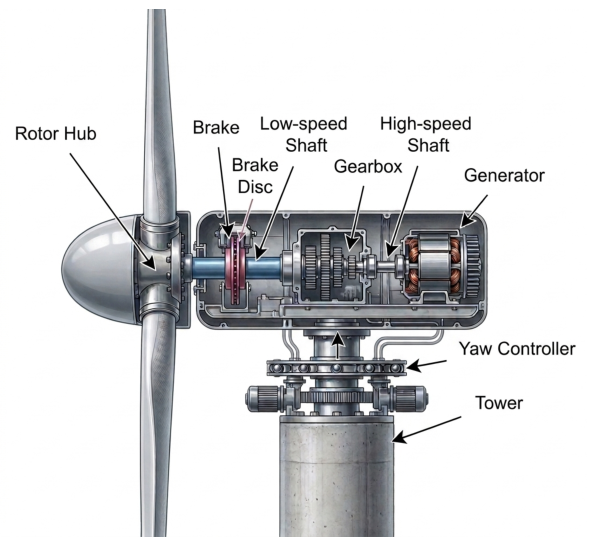
Figure 1. Main components of a wind turbine drivetrain highlighting the gearbox position.
Sustainability 18 06196 g001
Figure 2. Histograms of healthy versus damaged vibration signals for all seven sensors (AN3–AN10) using the first 1000 points, zoomed into the amplitude range of −20 to 20.
Sustainability 18 06196 g002
Figure 3. Illustration of the uniform window segmentation process applied to a one-minute vibration signal. Ten fixed-length, non-overlapping windows (0.5 s each) are extracted at regular intervals across the full signal duration.
Sustainability 18 06196 g003
Figure 4. The original healthy signal and its selected IMFs.
Sustainability 18 06196 g004
Figure 5. The architecture of the proposed CEEMDAN-based Multiscale CNN model for wind turbine gearbox fault detection.
Sustainability 18 06196 g005
Figure 6. Confusion Matrix of the Proposed Model on the Holdout Dataset.
Sustainability 18 06196 g006
Figure 7. ROC Curve for the Proposed Model on the Holdout Dataset.
Sustainability 18 06196 g007
Figure 8. Confusion matrices of different models on the holdout test set.
Sustainability 18 06196 g008
Figure 9. Ablation study evaluating the effect of the number of selected CEEMDAN-derived IMFs on the performance of the proposed MSCNN framework. The results demonstrate that increasing the number of selected IMFs improves the classification performance across all evaluation metrics, with the full five-IMF configuration achieving the highest accuracy, precision, recall, and F1-score. Error bars represent the standard deviation obtained from the 5-fold cross-validation results.
Sustainability 18 06196 g009
Table 1. CEEMDAN parameter descriptions.
ParameterDefaultDescription
trials50Number of noise-assisted realizations ( N R ). Higher values improve robustness and reduce noise artifacts.
epsilon0.005Scaling factor for adaptive noise. Noise amplitude at each step is given by ϵ · std ( r k 1 ) .
noise_scale1.0Controls absolute amplitude of the added noise.
noise_kind“normal”Type of noise distribution; either “normal” (Gaussian) or “uniform”.
range_thr0.01Amplitude range threshold for stopping decomposition.
total_power_thr0.05Threshold for stopping based on total power of residual.
max_imf10Maximum number of IMFs to extract.
parallelFalseEnables parallel computation.
processesNoneNumber of CPU processes if parallelization is used.
Table 2. Average Correlation of Each IMF with the Original Signal.
IMF IndexIMF 0IMF 1IMF 2IMF 3IMF 4
Correlation0.38800.56130.60790.32860.1593
IMF IndexIMF 5IMF 6IMF 7IMF 8IMF 9
Correlation0.10790.04470.05310.04070.0049
Table 3. Performance Metrics of the CEEMDAN-MSCNN Model on the Unseen Holdout Dataset.
MetricValue
True Positives (TP)300
True Negatives (TN)297
False Positives (FP)3
False Negatives (FN)0
Accuracy99.50%
Precision0.9900
Recall1.0000
F1-score0.9950
Specificity0.9900
False Positive Rate (FPR)0.0100
Area Under ROC Curve (AUC)0.9985
Table 4. Performance of Different Models on Holdout Test Set.
ModelAccuracyPrecisionRecallF1-ScoreTest Time (ms/Sample)
CEEMDAN-Logistic Regression0.520 ± 0.1230.929 ± 0.0770.043 ± 0.0530.083 ± 0.1290.08
CEEMDAN-SVM (RBF Kernel)0.855 ± 0.0720.775 ± 0.1310.794 ± 0.0440.873 ± 0.127157.33
CEEMDAN-Random Forest0.793 ± 0.1450.765 ± 0.0200.847 ± 0.0630.804 ± 0.1260.22
CEEMDAN-Naive Bayes0.850 ± 0.0960.769 ± 0.1571.000 ± 0.0770.870 ± 0.1641.45
CEEMDAN-1DCNN0.921 ± 0.0470.899 ± 0.0630.953 ± 0.0650.924 ± 0.0460.94
CEEMDAN-MSCNN0.995 ± 0.0220.990 ± 0.0151.000 ± 0.0510.995 ± 0.0210.28
Table 5. Performance Comparison of the Proposed Method with Recent Works.
ReferenceMethodologyAccuracy (%)F1-Score (%)Training Time (s/Epoch)Testing Time (ms/Sample)
[36]Supervised SAE-KNN92.60-2.59-
[20]MSCNN-98.5314.540.18
[6]WPD–MSCNN-99.433.630.17
[37]Hybrid Ensemble9292-19.5
[38]CEEMDAN-BT-CNN97.50---
[39]IVMD-TSMSE-SSA-SVM100---
[40]Weighted k-NN95.9795.93--
[41]EMD-1DCNN96.9396.98--
[42]Extra Tree Classifier96.64---
[43]CBA-KELM96.25---
Proposed WorkCEEMDAN-MSCNN99.5099.502.260.28
Disclaimer/Publisher’s Note: The statements, opinions and data contained in all publications are solely those of the individual author(s) and contributor(s) and not of MDPI and/or the editor(s). MDPI and/or the editor(s) disclaim responsibility for any injury to people or property resulting from any ideas, methods, instructions or products referred to in the content.