Article

From Olive Waste to Bioelectricity: Integrated Substrate Recovery and Biochar Cathode Engineering for Advanced Microbial Fuel Cells


1
Soil and Water Department, Faculty of Environmental Agricultural Sciences, Arish University, North Sinai, Al-Arish 45516, Egypt
2
Chemical Engineering Department, Engineering Research and Renewable Energy Institute, National Research Centre, 33 El Buhouth St., Dokki, Cairo 12622, Egypt
3
Yokogawa Corporation of America, Sugar Land, TX 77478, USA
4
Agricultural Research Department, Ministry of Municipality, Doha 200022, Qatar
*
Authors to whom correspondence should be addressed.
Sustainability 2026, 18(12), 6125; https://doi.org/10.3390/su18126125 (registering DOI)
Submission received: 15 May 2026 / Revised: 4 June 2026 / Accepted: 9 June 2026 / Published: 15 June 2026
(This article belongs to the Section Energy Sustainability)

Abstract

The increasing demand for sustainable energy and efficient wastewater treatment has driven interest in single-chamber microbial fuel cells (SCMFCs) as integrated systems for bioelectricity generation and waste remediation. This study evaluates untreated agro-industrial byproduct olive mill wastewater (OMW) as a substrate in SCMFCs. It investigates the performance of activated biochar derived from olive pomace coated on stainless-steel mesh (ACB/SSM) as a low-cost cathode material. A synthetic media was used as a control. Electrochemical performance was assessed using voltage profiles, polarization analysis, power density, chemical oxygen demand (COD%) removal, and coulombic efficiency (CE%). The synthetic media achieved higher peak voltage (0.647 ± 0.026 V) and power density (46.05 mW m−2), whereas OMW showed more stable voltage output and lower internal resistance. OMW exhibited superior initial COD removal (74%) and a gradual increase in CE% up to 63% over successive cycles. In contrast, synthetic media exhibited a consistent COD% of 64%; its CE% removal improved to 61%. These results demonstrate that, despite lower peak power, OMW provides a more stable and sustainable substrate for long-term SCMFC operation. The use of waste-derived biochar cathodes further enhances system feasibility by reducing cost and supporting circular economy principles. This study highlights the potential of OMW-based SCMFCs as a practical approach for simultaneous wastewater treatment and renewable energy recovery.

1. Introduction

Environmental sustainability and the search for alternative renewable energy sources have become global priorities, particularly in light of accelerating climate change and the continuous depletion of conventional fossil fuel resources [1]. This growing urgency has prompted the scientific community to develop innovative technologies capable of transforming environmental challenges, such as industrial waste, into economic opportunities and clean energy resources [2]. In this context, olive mill waste (OMW) represents one of the most critical environmental challenges facing Mediterranean countries. It is generated as a result of olive oil production, alongside the generation of substantial quantities of solid residues known as olive pomace [3]. The environmental risk posed by these wastes arises from their complex chemical composition, characterized by high acidity and an extremely high organic load, with chemical oxygen demand (COD) values that can exceed 220 g L−1, upon discharge into soil or water bodies without adequate treatment [4]. The adverse impacts of OMW extend beyond the depletion of dissolved oxygen and the subsequent mortality of aquatic life. Moreover, OMW contains high concentrations of polyphenols, tannins, and aromatic compounds that are resistant to natural biodegradation. Such compounds inhibit plant and microbial growth in soil and can lead to long-term groundwater contamination, making conventional wastewater treatment processes economically and technically ineffective [5].
In response to these challenges, microbial fuel cell (MFC) technology has emerged as one of the most promising bioelectrochemical solutions for OMW bioremediation. MFCs function not only as wastewater treatment systems that reduce organic load, but also as bioelectrochemical reactors that convert the chemical energy stored in organic matter directly into electrical energy. This process is facilitated by specialized microorganisms, known as exoelectrogenic bacteria, that catalyze electron transfer to the anode during their metabolic activity [6,7,8]. The operational mechanism of MFCs relies on integrating biological and electrochemical processes. In the anaerobic anode chamber, microorganisms degrade complex organic compounds present in OMW into simpler molecules, releasing electrons, protons, and carbon dioxide [9]. The electrons flow through an external circuit to generate electricity, while protons migrate through a proton-exchange membrane or an electrolyte solution toward the cathode. There, they combine with electrons and an electron acceptor, most commonly atmospheric oxygen, to form water as a clean byproduct [10]. Despite their considerable potential, the large-scale industrial application of MFCs remains limited. The principal obstacle is the high cost of key components, particularly platinum electrodes and advanced carbon materials such as graphite and carbon fabrics. These components can account for more than 50% of the total system cost [11], underscoring the urgent need for sustainable and low-cost alternative electrode materials. In this context, biochar is a porous carbonaceous material with a large surface area and favorable electrical conductivity, derived from the pyrolysis of olive pomace (solid OMW), and represents a strategic solution for cost-effective electrode materials aligned with circular economy principles [12,13,14].
While previous studies have explored the use of OMW as a substrate for bioelectricity generation and the application of agricultural waste-derived biochar as electrode materials independently, their simultaneous integration remains underexplored. Moreover, limited attention has been given to single-chamber MFCs (SCMFCs) operating under complex, real-world conditions, particularly regarding microbial–substrate interactions and long-term electrochemical stability. Most existing research relies on diluted OMW or co-substrates to mitigate phenolic toxicity [15,16], or tests biochar cathodes using synthetic media rather than complex industrial effluents [17]. The true novelty of the present study lies in the development of a ‘closed-loop’, fully waste-integrated SCMFC that simultaneously valorizes both the liquid and solid fractions of OMW without relying on external chemical pre-treatments or dilution for the liquid fraction. Specifically, undiluted raw liquid OMW is directly employed as a complex bioelectrolyte, while the solid olive pomace is converted into activated biochar, integrated onto a stainless-steel mesh, and utilized as a low-cost, highly efficient cathodic material. This dual-valorization approach represents a significant departure from conventional and fragmented MFC designs, directly addressing the critical barriers of high material costs and operational scalability. By evaluating the polarization behavior, and microbial–electrode interactions under these complex, real-waste conditions, this work demonstrates the technical feasibility of a fully autonomous waste-to-energy system aligned strictly with circular economy principles.

2. Materials and Methods

2.1. Sourcing and Physicochemical Characterization of OMW Feedstock

Olive mill wastes (OMWs) were collected from the Extra Virgin Olive Oil Production Unit at the Faculty of Environmental Agricultural Sciences, Arish University, Arish City, Egypt. At the disposal site, the raw waste was centrifuged to separate it into two phases: a liquid fraction used as the primary organic substrate for SCMFCs, and a solid fraction later converted into activated biochar for electrode development. The liquid OMW was transported under chilled conditions in insulated containers and subsequently stored at 4 °C in the laboratory to preserve its chemical stability throughout the experimental period [18]. The intrinsic physicochemical characteristics of the OMW were determined in triplicate according to the APHA standard methods [19]. The biochemical oxygen demand (BOD) and chemical oxygen demand (COD) were 14,400 ± 400 and 41,374 ± 1125 mg L−1, respectively. Total suspended solids (TSS) and volatile suspended solids (VSS) were measured as 620 and 498 mg L−1, respectively, while the fat and oil content reached 1333 ± 470 mg L−1.

2.2. Synthesis of Activated OMW-Derived Biochar

The activated biochar-based OMW (pomace) was first sun-dried at the extraction facility for approximately 3 months, then crushed with a jaw crusher and sieved to obtain particles between 1 and 3 mm. A measured quantity of the dried pomace was transferred into a perforated ceramic crucible fitted with a tight lid. To ensure oxygen-limited pyrolysis, the lid-crucible interface was sealed using a heat-resistant clay slurry to prevent air ingress during thermal decomposition [20]. The sealed crucibles were placed in a muffle furnace and heated at 400 °C for 1.5 h. Then, the biochar was washed repeatedly with distilled water until the wash filtrate reached pH 6.8–7.0, then dried at 105 °C. Chemical activation of the resulting dried carbonaceous material was performed by mixing with 8.0 M nitric acid (HNO3) and 8.0 M sulfuric acid (H2SO4) at a 1:4 (w/v) solid–liquid ratio to activate the surface and remove inorganic impurities. The suspension was sonicated for 4 h to enhance oxidative activation, then filtered and thoroughly washed with distilled water until the filtrate pH reached 6.8–7.0, ensuring complete removal of acid residues. The activated biochar was subsequently dried at 80 °C for 6 h [21]. The final activated biochar was used to modify the cathode.

2.3. Integration of OMW Biochar-On SSM for Cathodic Electrodes

The cathodic diffusion layer was prepared by mixing OMW activated biochar at a loading of 25 mg cm−2 with a 60% polytetrafluoroethylene (PTFE) dispersion (loading: 37.5 mg cm−2) serving as a hydrophobic binder. The mixture was dispersed in 5 mL of ethanol and homogenized in an 80 °C water bath using an ultrasonicator for 20 min to obtain a uniform catalytic paste. The paste was applied onto a stainless-steel mesh current collector (TIMESETL304, 60 mesh, Shenzhen, China), providing a projected active surface area of 19.6 cm2. The electrode was consolidated by hot pressing at 80 °C and 40 MPa for three to four cycles. The fabricated cathodes were subsequently air-dried at room temperature for 48 h to ensure mechanical stability [22].

2.4. Configuration of the SCMFCs

Two identical single-chamber microbial fuel cells (SCMFCs) were constructed using transparent Perspex, each with an effective working volume of 250 mL. Carbon felt (5.0 × 5.0 cm; thickness: 0.8 cm; total surface area: 51.8 cm2; Tianwang graphite products, Dongguan, Guangdong, China) was employed as the anodic electrode. Before use, the carbon felt underwent a multi-step pretreatment process to enhance surface cleanliness and electrochemical performance. The felt was first immersed in 0.1 M nitric acid for 4 h and then soaked overnight in acetone to remove organic contaminants. Subsequently, it was treated with 95% ethanol for 3 h and finally rinsed three times with double-distilled water to ensure chemical neutrality [23]. Both SCMFCs were equipped with air cathodes integrated with activated OMW biochar on SSM (ACB/SSM), each with a 5 cm diameter and a projected surface area of 19.6 cm2. The air-cathode was partially exposed to the atmosphere, allowing oxygen to act as the terminal electron acceptor. The electrodes were positioned opposite each other inside the reactor chamber. The distance between the anode (carbon felt) and cathode (ACB/SSM) was maintained at approximately 6 cm to minimize internal resistance while preventing short-circuiting and ensuring sufficient space for microbial activity. This arrangement promotes efficient oxygen reduction without requiring external aeration. Titanium wires (TEMCo Industrial, Fremont, CA, USA) were used as high-conductivity current collectors. To prevent oxygen leakage into the anode region and maintain anaerobic conditions, the reactor was sealed using silicone gaskets and airtight fittings. All joints and interfaces were carefully secured to minimize gas exchange and maintain stable operating conditions throughout the experiments.

2.5. SCMFC Operational Procedures

The SCMFCs were inoculated with aerobic activated sludge collected from a municipal wastewater treatment plant in Mit-Ghamr, Dakahlya, Egypt. Before inoculation, the sludge was filtered to remove coarse particulates. The SCMFC was fed exclusively with undiluted OMW. For comparison, another SCMFC was supplied exclusively with a synthetic growth medium prepared (per liter of double-distilled water) using: 1.0 g CH3COONa, 0.2 g NH4Cl, 0.15 g CaCl2·2H2O, 0.33 g KCl, 0.3 g NaCl, 3.15 g MgCl2, 6.8 g KH2PO4, 8.7 g K2HPO4, and 1.0 g yeast extract [24]. A total of 12 mL of mineral medium was added, and the pH was adjusted to 7.0 with a calibrated pH meter (HANNA Instruments, Padova, Italy). Both reactors were operated in fed-batch mode at room temperature (25 ± 2 °C). The feeding solution was refreshed when the cell voltage dropped below 50 mV. Error bars were added where applicable, and cases with minimal variation were clarified in the Figure captions (data are presented as mean ± standard error (n = 3)).

2.6. SCMFCs Monitoring and Computational Analysis

Electrochemical performance was continuously monitored using a precision data-acquisition system (LabJack Corporation, Lakewood, CO, USA), with voltage data recorded at 5 min intervals. After stabilization of the open-circuit voltage, the SCMFCs were operated under closed-circuit conditions using an external resistance of 10 kΩ. Polarization and power density curves were obtained by varying the external resistance from 100 kΩ to 500 Ω using a resistor box (Conrad Electronic, Hong Kong, China). Each resistance was maintained for 30 min to allow the voltage to stabilize before recording the corresponding current and power output.
COD removal efficiency was calculated using Equation (1):
C O D   r e m o v a l % = ( C O D   i n i t i a l C O D   f i n a l ) C O D   i n i t i a l × 100
where COD initial and COD final are the influent and effluent concentrations (mg L−1), respectively [25].
Coulombic efficiency (CE) was determined by integrating the generated current with the theoretical current as follows:
C E = C P C T × 100 = M × I × t F × b × V × C O D
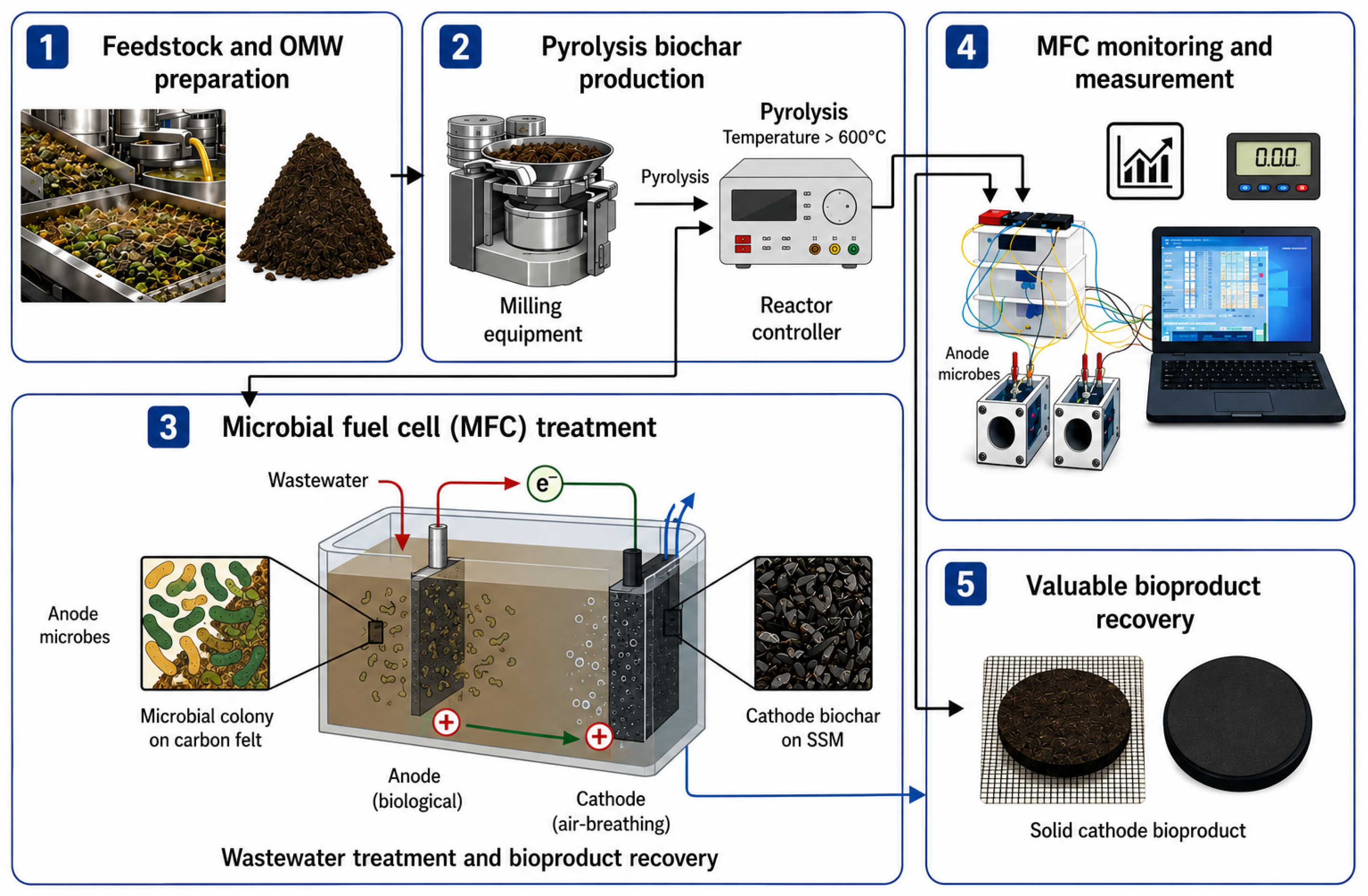
where M is the molecular weight of oxygen (32 g mol−1), I is the current (A), t is the time (s), F is Faraday’s constant (96,485 C mol−1), b is the number of electrons exchanged per mole of oxygen (4), ΔCOD is the change in COD (g L−1), and V is the electrolyte volume (L) [26]. Figure 1 displays a photograph of the SCMEC reactor and the schematic representation of the steps involved in this study, respectively.

2.7. Field-Emission Scanning Electron Microscopy (FE-SEM) Analysis of Electrode Surfaces

The development and surface morphology of the anodic and cathodic biofilms were investigated using a JEOL JSM-7000 benchtop FE-SEM, JEOL Ltd., Akishima, Tokyo, Japan; instrument located in China. At the end of the SCMFCs’ operation period, both the anode and cathode electrodes were carefully removed from the reactors under aseptic conditions to minimize physical disturbance to the attached microbial biofilm. Representative sections (approximately 5 × 5 mm) were excised from the anode surface using sterile scissors for microscopic examination. The samples were then fixed in a 2.5% (v/v) glutaraldehyde solution at 4 °C for 12 h to stabilize microbial cells and extracellular polymeric substances (EPS). Following fixation, the samples were rinsed three times with phosphate-buffered saline (PBS) and dehydrated through a graded ethanol series (30%, 50%, 70%, 90%, and 100%), with each step lasting 10 min. After complete dehydration, the samples were dried in a desiccator under ambient air to prevent biofilm collapse. To enhance electrical conductivity and avoid charging effects during imaging, the samples were sputter-coated with a thin gold (Au) layer (~5–10 nm thick) using a vacuum sputter coater. The dried specimens were mounted on aluminum SEM stubs using conductive carbon adhesive tape.

3. Results and Discussion

3.1. Electrochemical Performance in MFCs

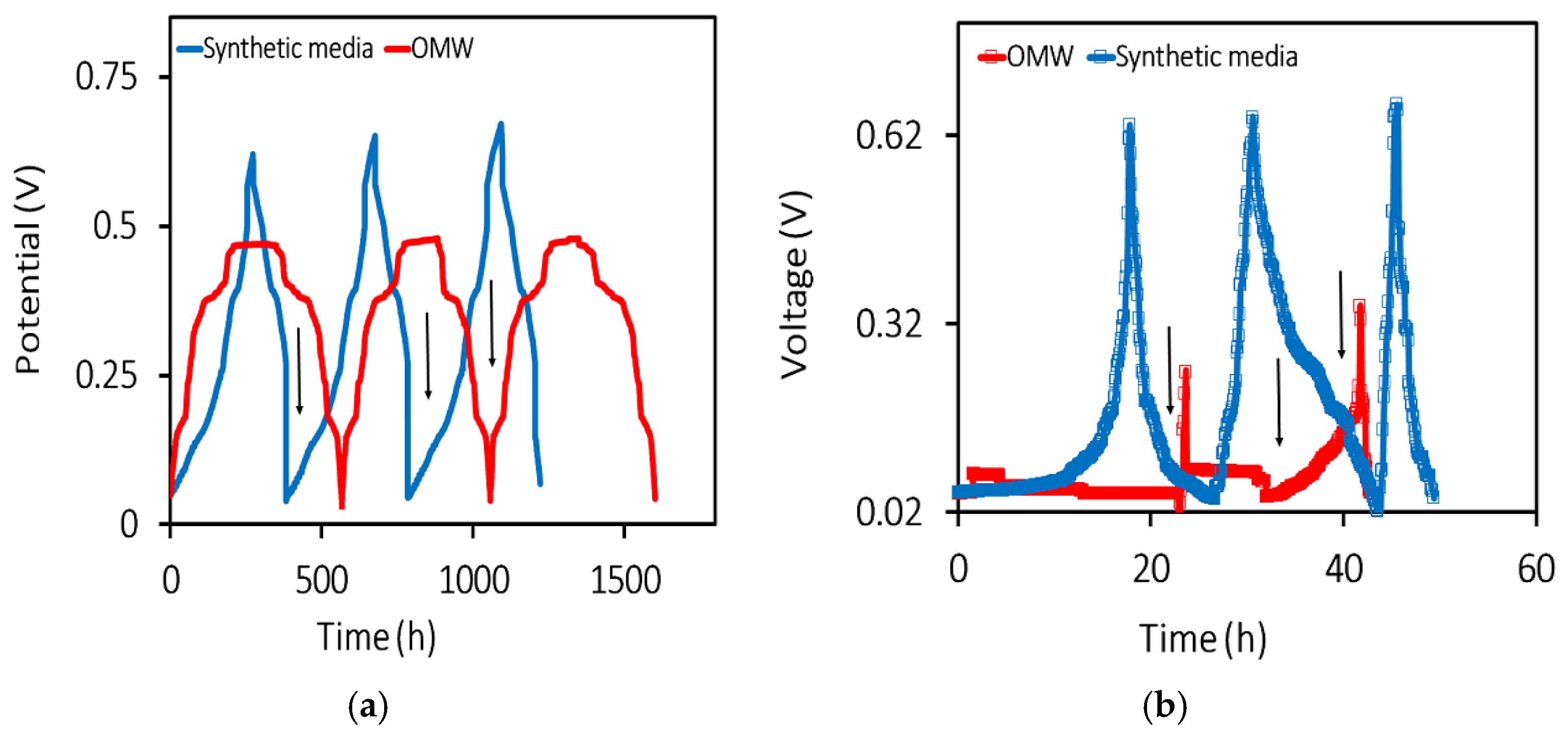
Figure 2a illustrates the open circuit voltage (OCV) performance of OMW and synthetic media in an SCMFC over time, showing three distinct cycles for both substrates. OMW displayed lower peak voltages (0.475 ± 0.0046 V) compared to synthetic media (0.647 ± 0.026 V). It demonstrated more stable, prolonged voltage curves with fewer sudden spikes and declines. In contrast, synthetic media showed rapid spikes and declines in voltage, indicating a quick but less stable voltage output. The voltage peaks were sharper and more pronounced, suggesting a more reactive microbial community or substrate utilization. The OMW voltage output was more consistent over time, indicating a potentially more sustainable energy generation process. The duration of each operational cycle varied between OMW and synthetic media, reflecting differences in substrate utilization kinetics and microbial activity. Cycles were defined based on voltage decline and were terminated when the output dropped below 50 mV, indicating substrate depletion.
Figure 2b depicts the closed-circuit voltage (CCV) over time (h) for OMW and synthetic media in SCMFC. The voltage output was monitored across three distinct cycles, providing insights into the performance and stability of each substrate under closed circuit conditions. As shown, OMW achieved a lower peak voltage (0.348 ± 0.067 V) and a broader curve, indicating a slower response than synthetic media (0.617 ± 0.016 V). The voltage profiles presented in Figure 2 reflect the dynamic interplay between substrate availability, microbial activity, and electrochemical processes within the SCMFCs. The initial increase in voltage corresponds to the establishment of electroactive biofilms on the anode, during which microorganisms begin oxidizing organic substrates and transferring electrons to the electrode. The higher peak voltages observed in synthetic media can be attributed to the presence of readily biodegradable substrates, such as acetate, which were rapidly metabolized, resulting in accelerated electron release and higher instantaneous current generation. In contrast, the OMW system exhibits broader and smoother voltage curves, which can be explained by its complex composition [27]. OMW contains a mixture of organic compounds, including polyphenols and long-chain molecules, which require sequential biodegradation pathways. This leads to a slower but more sustained release of electrons, resulting in a more stable and prolonged voltage output. Additionally, the gradual adaptation of the microbial community to these complex substrates contributes to improved electron transfer efficiency over time. The decline in voltage at the end of each cycle is primarily associated with substrate depletion, reducing the availability of electron donors for microbial metabolism. Differences in cycle duration and voltage decay rates between the two systems further reflect variations in substrate biodegradability and metabolic kinetics.
These results suggest that, while synthetic media were advantageous for maximizing power output under controlled conditions, OMW provides more consistent and sustained electrochemical performance. This difference is attributed to the gradual degradation of complex substrates in OMW, which leads to a steady electron supply, whereas readily biodegradable substrates in synthetic media can result in rapid consumption and transient performance peaks [15]. Previous studies have shown that microbial fuel cell systems fed with real, complex substrates often exhibit more flexible and adaptable microbial activity, contributing to more reliable long-term operation compared to synthetic media [28,29]. Overall, these observations highlight that voltage behavior in SCMFCs is governed not only by substrate type but also by biofilm development and the balance between electron generation and transport processes. The performance of OMW in SCMFCs demonstrated its potential as a sustainable and stable substrate for bioelectrochemical systems. While it may not reach the high peak voltages of synthetic media, its consistent, sustained voltage output makes it a promising candidate for long-term applications. Future research could focus on optimizing OMW-based MFCs to enhance peak voltage output while maintaining stability, potentially through microbial community engineering or system design improvements.
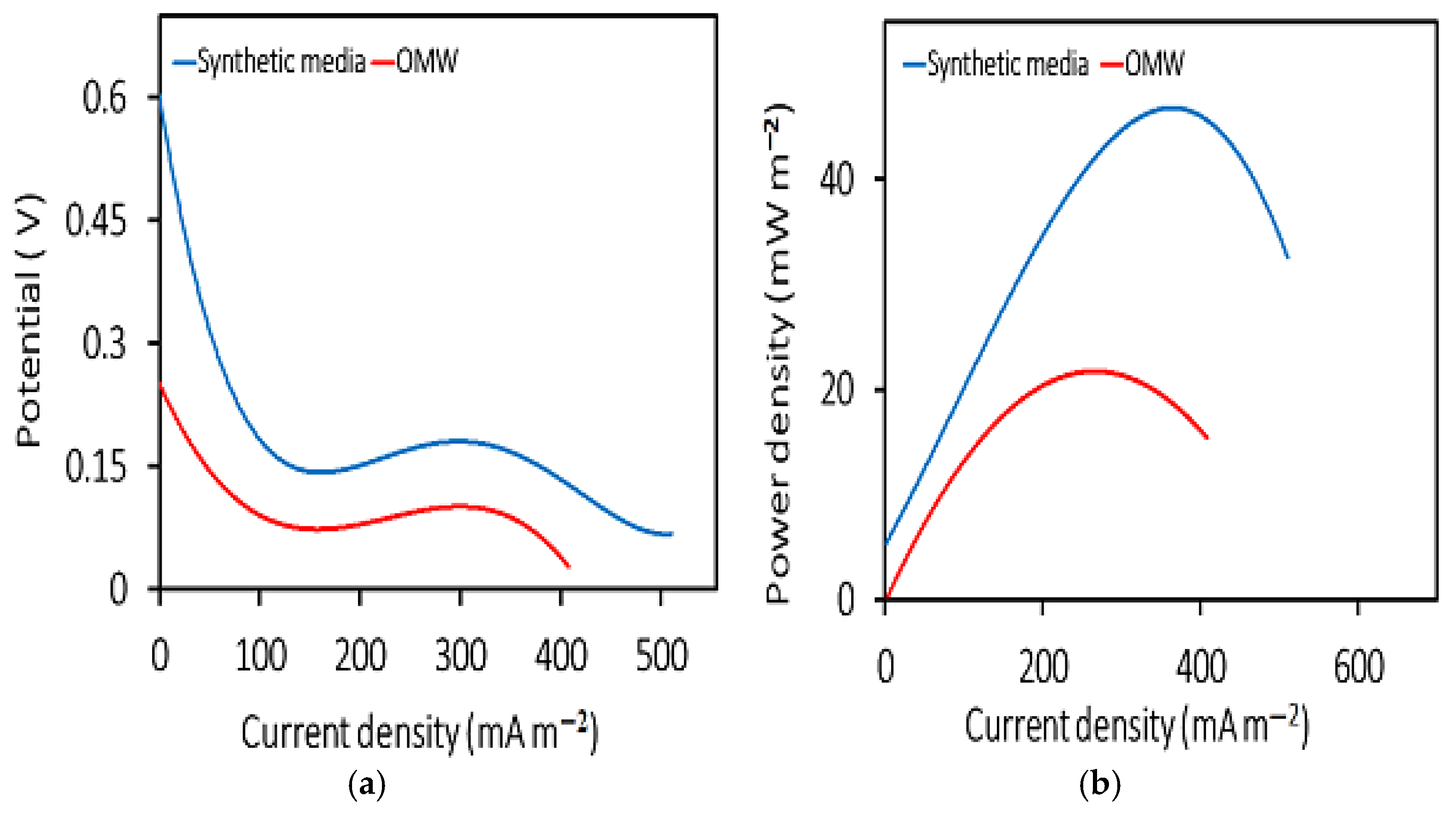
To understand the electrochemical performance, internal resistance, and efficiency of MFCs, polarization and power measurements were conducted with different substrates. Figure 3a demonstrates the relationship between potential (V) and current density (mA m−2) for OMW and synthetic media in SCMFCs. OMW exhibited a more gradual decline in potential with increasing current density, indicating lower activation losses and potentially better internal resistance management. The curve remains relatively stable at higher current densities, suggesting better sustainability of potential under load, although the overall potential is lower than that of synthetic media. The more gradual decline suggests lower activation losses, which could be due to the nature of the organic compounds in OMW, which facilitate easier initiation of microbial electrochemical activity. Both curves displayed a linear region in which the potential decreased almost linearly with increasing current density, indicative of ohmic losses due to the electrolyte and electrode resistances. This behavior may be attributed to improved mass transport of substrates and ions, enhanced biofilm conductivity, and more efficient electron transfer under load conditions. Such effects can temporarily offset resistive losses, leading to a partial recovery in voltage. The OMW SCMFC implied lower internal resistance (770 Ω) than synthetic media (2700 Ω), which is beneficial for maintaining higher potentials at moderate current densities.
Internal resistance in MFCs is a composite parameter governed by multiple factors, including ohmic resistance, charge transfer limitations, and mass transport processes. The higher ionic strength of OMW may enhance electrolyte conductivity and reduce ohmic losses, while improved biofilm formation can facilitate electron transfer [30,31]. Additionally, electrode spacing and reactor configuration remain constant in this study; therefore, variations in internal resistance were predominantly associated with changes in electrolyte properties and biofilm characteristics. Mass transport effects, particularly substrate diffusion and proton transfer within the biofilm matrix, may also play a role in shaping polarization behavior. Accordingly, polarization analysis alone is insufficient to fully resolve the individual components of internal resistance. Complementary techniques such as electrochemical impedance spectroscopy (EIS) would be required for detailed quantitative separation of resistance contributions [32]. Nevertheless, the polarization results provide useful comparative insight into the overall electrochemical performance of the system under different substrates. This interpretation provides a more comprehensive understanding of the factors governing internal resistance and highlights the complexity of MFC operation under real wastewater conditions.
Figure 3b illustrates the power density (mW m−2) as a function of current density (mA m−2) for both the OMW and the synthetic media. The OMW exhibited a lower peak power density (23.28 mW m−2 at 408.16 mA m−2) compared to the synthetic media (46.05 mW m−2 at 510.21 mA m−2). Therefore, while synthetic media offer high initial energy production, OMW represents a more sustainable substrate that supports consistent and stable performance. This distinction highlights the importance of considering both maximum energy density and operational stability when evaluating the performance of microbial fuel cells for practical, long-term applications. To further elucidate the contribution of the cathode, the performance of the ACB/SSM was compared with previously reported cathode materials. High-performance cathodes such as Pt/C and carbon black-based catalysts exhibit excellent oxygen reduction reaction (ORR) kinetics and can achieve higher power densities; however, their application is limited by high cost, catalyst poisoning, and poor long-term stability in real wastewater systems [33].
Recent studies have focused on biomass-derived carbon materials as sustainable alternatives. For example, biochar- and waste-derived electrodes have demonstrated promising catalytic activity, improved durability, and cost-effectiveness in MFC applications [34,35]. These materials offer tunable surface chemistry, high porosity, and enhanced microbial-electrode interactions, making them particularly suitable for complex substrates. In this context, the ACB/SSM cathode developed in this study provides a synergistic combination of biochar catalytic functionality and stainless-steel mesh conductivity. The porous activated biochar promotes oxygen diffusion and provides active sites for ORR, while the metallic current collector enhances electron transfer and structural integrity. Moreover, under real OMW conditions, the ACB/SSM cathode exhibited lower internal resistance and greater operational stability, highlighting its suitability for long-term MFC applications. These findings confirm that, beyond substrate effects, cathode design plays a decisive role in governing SCMFC efficiency, and the developed waste-derived cathode represents a practical and scalable alternative for sustainable bioelectrochemical systems.

3.2. Wastewater Treatment Efficiency

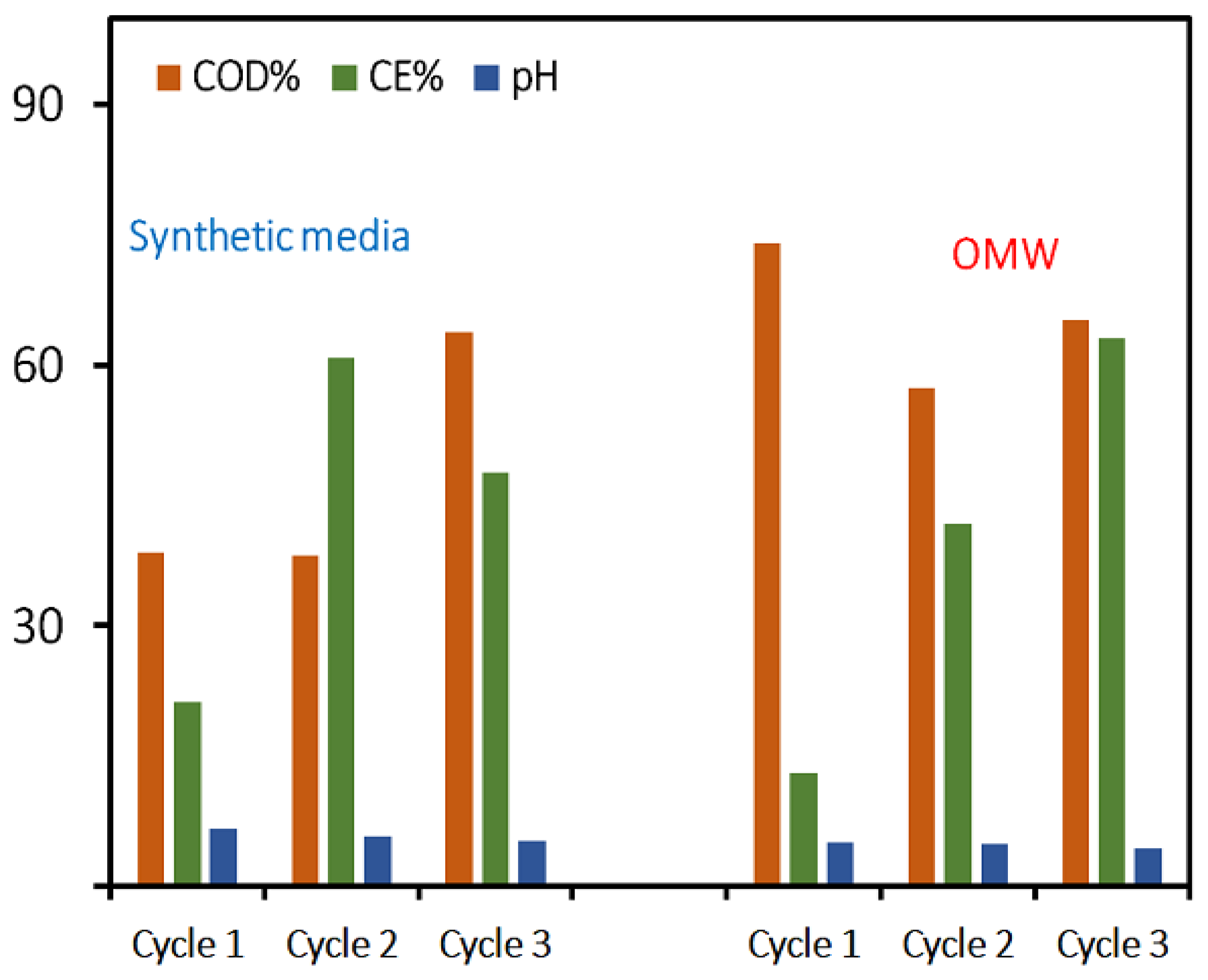
Figure 4 compares the performance of two different wastewater treatment processes, undiluted OMW and synthetic media (control), using SCMFC across three treatment cycles based on three key parameters: COD%, CE%, and pH. OMW demonstrated a remarkably high COD% removal in Cycle 1 (74%), significantly outperforming synthetic media (38%). This suggests that OMW may have a stronger initial capacity to degrade organic pollutants, likely due to its complex organic composition, which could enhance microbial activity or provide additional substrates for biodegradation. However, in Cycles 2 and 3, the COD% removal for OMW stabilized at 58–65%, similar to the performance of synthetic media in later cycles. This indicates that while OMW may have a superior initial performance, its long-term efficiency aligns closely with that of synthetic media. One of the most notable differences between OMW and synthetic media was observed in CE%. OMW exhibited a low initial CE% (13%) in Cycle 1, which could be attributed to the presence of recalcitrant compounds in OMW that resist microbial degradation during the early treatment stages [36]. However, OMW showed a significant improvement in CE% in Cycles 2 (42%) and 3 (63%), eventually surpassing synthetic media. This suggests that OMW may require an adaptation period for microbial communities or chemical processes to degrade it effectively. The initially low CE% observed in OMW-fed SCMFCs may be related to the presence of recalcitrant and potentially inhibitory compounds, such as polyphenols, which can limit microbial activity and electron transfer in early operation stages [37]. The gradual increase in CE% over successive cycles indicates improved system performance; however, this enhancement cannot be conclusively attributed to microbial community adaptation in the absence of direct microbiological analysis [38]. In parallel, biofilm maturation can enhance extracellular electron transfer efficiency, as the development of structured electroactive biofilms is known to improve electron transport and overall system performance [39]. Therefore, the increase in CE% was interpreted as a result of coupled physicochemical and biological processes, rather than solely microbial growth, and should be considered with caution.
In contrast, synthetic media achieved a higher CE% in Cycle 2 (61%), but its performance slightly declined in Cycle 3 (48%). This could indicate that synthetic media was more effective in the short term but may face limitations in sustaining high efficiency over multiple cycles, in agreement with previous reports [40,41]. Further, both OMW and synthetic media maintained consistent pH levels (~5) across all Cycles. This stability is crucial for ensuring that the treatment process does not adversely affect downstream applications or environmental discharge standards. The consistent pH levels suggest that neither medium significantly alters wastewater acidity, which is beneficial for maintaining optimal conditions for microbial activity and the chemical reactions involved in the treatment process. In conclusion, OMW-based SCMFC demonstrates its potential as an effective and adaptable treatment medium, particularly for the removal of organic pollutants. While it may require an initial adaptation period for optimal removal, its long-term performance rivals or exceeds that of synthetic media. The stability in pH levels for both media further supports their reliability in wastewater treatment applications. Future research could optimize initial treatment conditions for OMW to enhance early-stage CE% or investigate hybrid systems combining the strengths of OMW and synthetic media for comprehensive wastewater treatment. It is important to note that OMW and synthetic media differ significantly in their physicochemical characteristics, including COD concentration, pH, conductivity, and substrate complexity (Table 1). OMW represents a high-strength, complex wastewater containing inhibitory compounds such as polyphenols, whereas synthetic media consists of readily biodegradable substrates under controlled conditions. Therefore, the comparison presented in this study does not imply equivalency but rather aims to evaluate SCMFC performance under realistic versus idealized conditions. The observed differences in electrochemical and treatment performance should be interpreted within this context.
Table 2 shows a comparative overview of published MFC studies utilizing OMW, relative to the present study. Many studies reporting higher power densities and efficiencies have been conducted under highly controlled laboratory conditions using synthetic substrates, diluted wastewater, or optimized operational parameters. Therefore, the moderate power density achieved in this study reflects the complexity and realistic nature of the substrate rather than a limitation of the system design. Furthermore, beyond absolute performance values, this study demonstrates key advantages, including lower internal resistance, stable long-term operation, significant COD removal efficiency, and the use of low-cost, waste-derived electrode materials. These factors were critical for practical scalability and real-world applications, where robustness and sustainability are often more important than achieving maximum power output under idealized conditions. Accordingly, the findings of this work contribute to bridging the gap between laboratory-scale optimization and realistic wastewater treatment applications in microbial fuel cells.

3.3. Surface Morphology Evaluation

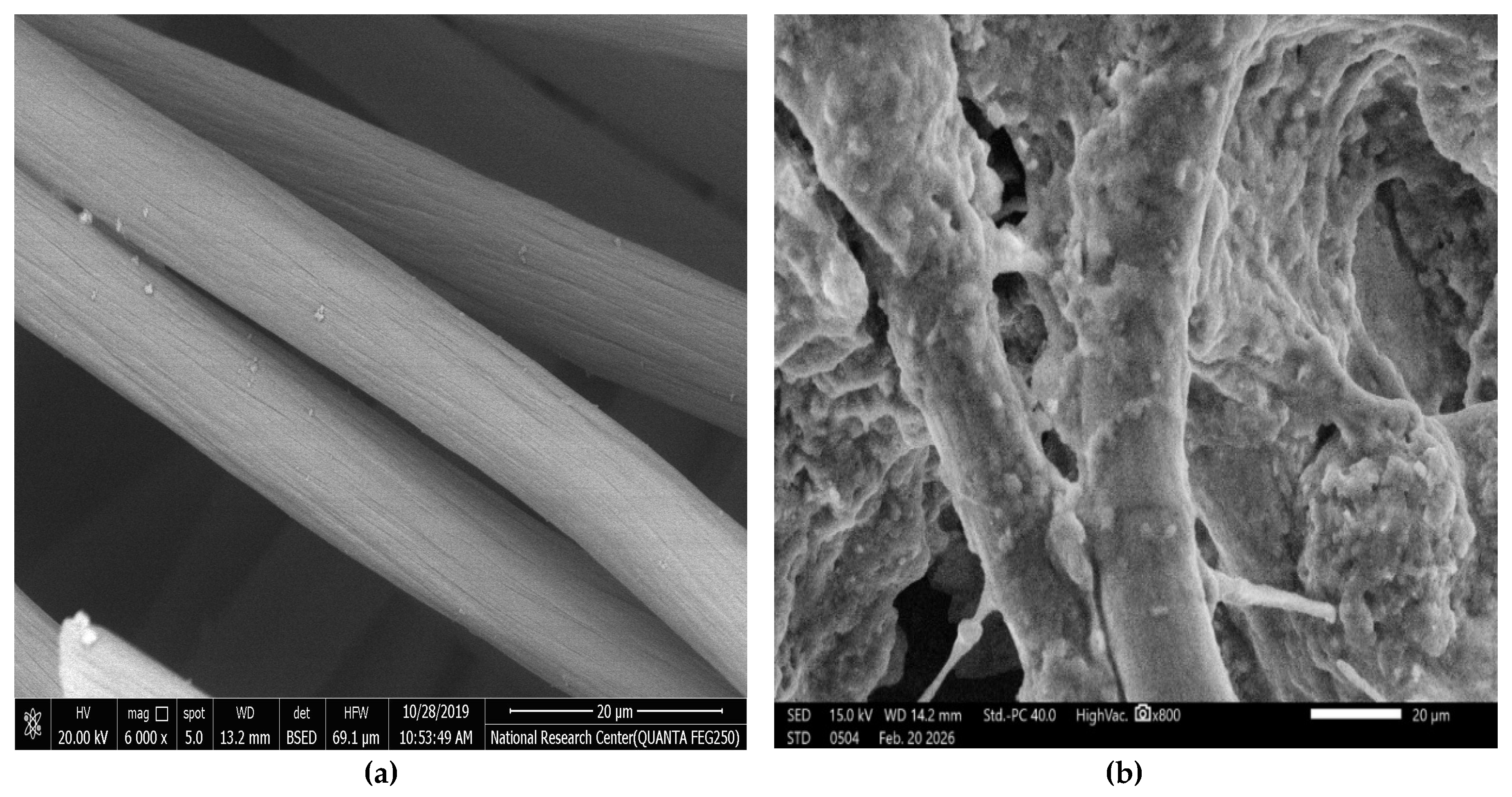
The provided SEM images demonstrated the surface morphology of the carbon felt anode before and after inoculation with a microbial community in an OMW SCMFC. These images offer valuable insights into the structural changes and microbial colonization that occur on the electrode surface, which were critical for the performance of SCMFCs. As observed in Figure 5a, the image shows a smooth, fibrous structure characteristic of pristine carbon felt. The fibers appear clean and uniform, with no visible microbial biofilm or deposits. The high surface area of the carbon felt was evident, which was advantageous for microbial attachment and electron transfer. After inoculation, the image reveals that the carbon felt surface was covered with a dense microbial biofilm. The biofilm appears as a complex, three-dimensional network of microbial cells and extracellular polymeric substances (EPS). The microbial community forms aggregates and clusters on the fibers, indicating successful colonization (Figure 5b). The development of a robust biofilm on the electrode surface underscores the potential of OMW-based SCMFCs for sustainable wastewater treatment and bioenergy generation [43].
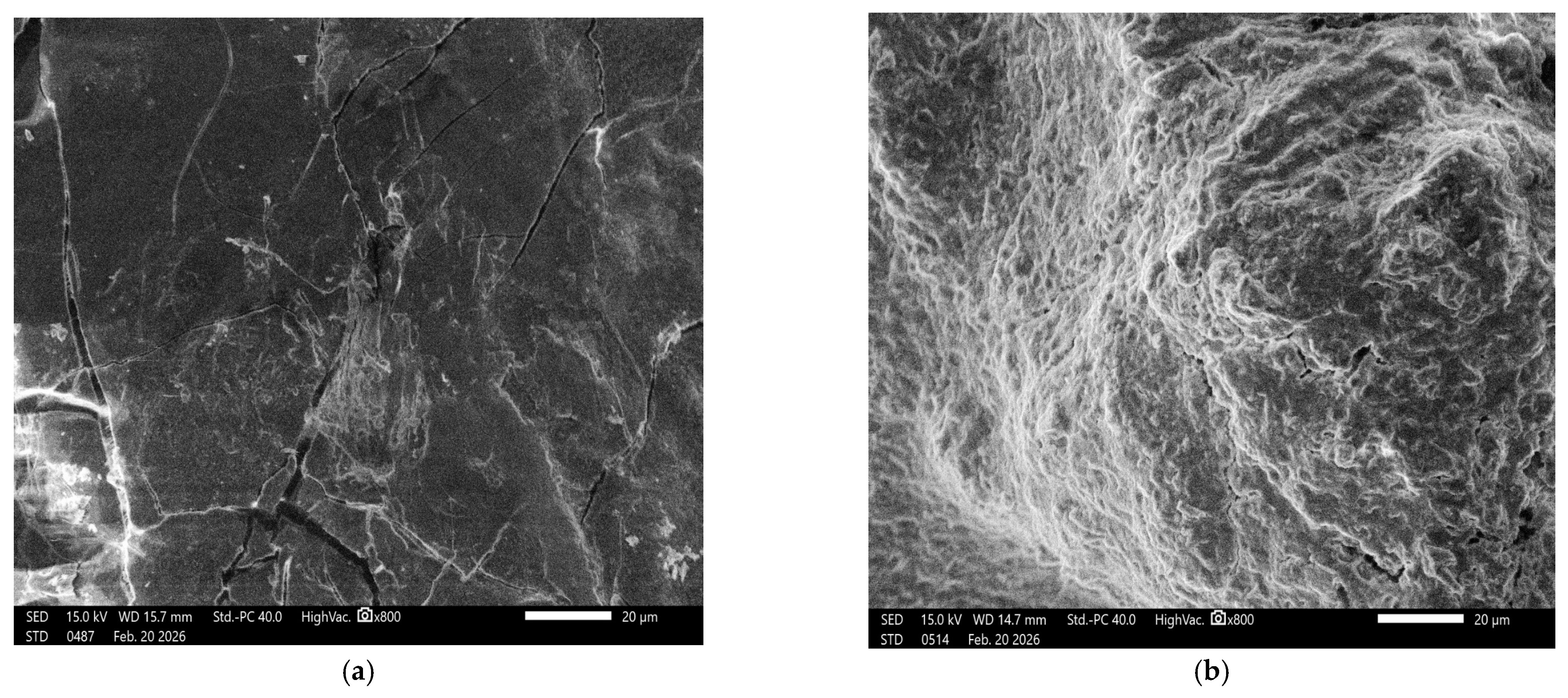
The provided SEM images showed the surface morphology of OMW-activated biochar integrated onto the SSM as cathodic electrodes before and after operation of an OMW-fed SCMFC (Figure 6). Figure 6a shows a porous, irregular surface characteristic of biochar-integrated cathodes. The surface appears rough and heterogeneous, with visible cracks and irregular pores, reflecting the structural characteristics formed during thermal decomposition and subsequent acid activation that provide a high surface area for catalytic reactions [44]. The porous structure of biochar was beneficial for facilitating oxygen diffusion and enhancing the oxygen reduction reaction (ORR) at the cathode [45]. Figure 6b reveals a markedly altered surface covered by a dense, compact layer composed of interlaced fibrous structures. These filaments, absent in the pristine electrode, indicate the accumulation of electrochemical reaction byproducts, organic matter, and mineral residues formed during prolonged oxygen-reduction processes. The significant surface coverage preserved the original biochar pores and led to the disappearance of characteristic carbon microstructural features, confirming that cathode exposure was a physicochemical modification during operation. The formation of this layer reflects the intense cathodic activity in both reactors; however, the magnitude and tight packing of the accumulated material were consistent with the high organic load, acidity, and complex phenolic compounds present in OMW, which promote the formation of denser, more polymeric surface layers.

3.4. Net Energy Ratio

The net energy ratio (NER) was estimated to provide a preliminary evaluation of the energy recovery potential of the SCMFC system, using OMW ACB/SSM as a low-cost cathodic material. In this study, the system boundary was defined under simplified laboratory-scale conditions. The energy output includes only the electrical energy generated by the SCMFC during operation. The energy input (≈0.1 kWh m−2 yr−1) was assumed to be negligible under passive conditions and did not include external energy requirements (Table 3). Based on a measured power density of 23.28 mW m−2 under continuous operation, the annual energy output was to be 0.204 kWh m−2 yr−1, resulting in an NER of 2.04 and indicating a clear net energy gain. Specifically, energy-consuming processes commonly associated with wastewater treatment systems, such as mechanical mixing, pumping, aeration, temperature regulation, and sludge handling, were excluded from the energy balance. Additionally, energy associated with material preparation (e.g., electrode fabrication, biochar production) and system construction was not considered. This performance represents a substantial improvement over conventionally mixed MFC systems, which typically exhibit net energy losses [46,47]. The favorable energy balance was attributed to superior COD% removal (74%), though CE% improved progressively to 63%, and to the use of low-cost OMW ACB/SSM cathodes, which collectively enhance electrochemical efficiency. This net energy gain highlights the system’s potential as an energy-efficient and environmentally sustainable solution for OMW treatment and sustainable energy generation.

3.5. Economic Feasibility and Novel Contributions

This study confirmed both the economic feasibility and the methodological novelty of combining OMW treatment with the development of low-cost electrode materials for SCMFCs. OMW is an agro-industrial effluent characterized by a high organic load and an elevated COD, posing significant environmental challenges for safe disposal. From an economic perspective, advances in renewable energy technology and the development of affordable, long-lasting, and multipurpose materials to replace high-cost noble metals such as platinum, ruthenium, and iridium have been explored as supports for large-scale MFC. Among these materials, biomass-derived activated carbon becomes a particularly appealing option for both energy storage applications and MFC electrocatalysis, due to its high porosity, large surface area, good electrical conductivity, natural abundance, robustness, affordability, and environmental friendliness [48]. Furthermore, the use of stainless-steel mesh as a current collector provides robust mechanical support and good electrical conductivity [49], contributing to enhanced durability, extended system lifespan, and improved economic viability compared to conventional carbon—or platinum-based electrodes.
Biochar offers a substantial economic advantage over conventional MFC electrode materials (Table 4). Commercial carbon cloth and graphite felt typically cost USD 100–500 m−2, while noble-metal catalysts, such as Pt-based cathodes, can increase electrode costs to USD 1000–3000 m−2, depending on metal loading and substrate. In contrast, biochar derived from agricultural or agro-industrial residues can be produced at an estimated cost of USD 1–10 kg−1, corresponding to electrode material costs of USD 5–30 m−2, depending on thickness and activation method. When combined with low-cost current collectors such as stainless-steel mesh (≈USD 10–20 m−2), the total cathode cost of biochar-based electrodes can be reduced by one to two orders of magnitude compared to Pt-based systems. This significant cost reduction is a key factor enabling the scalability and economic feasibility of MFCs for wastewater treatment applications. The measured power density for OMW biochar-based SCMFCs was 23.28 mW m−2; these values were comparable to those obtained with graphite or carbon cloth electrodes, which generally exhibit power densities of 30–300 mW m−2 under similar operating conditions. In terms of OMW treatment efficiency, biochar-based MFCs commonly achieve COD removal of 74%, similar to systems employing commercial carbon electrodes. Coulombic efficiencies reported for biochar electrodes (63%) were also within the range observed for conventional MFC materials, indicating effective electron recovery from OMW. Consequently, this cost advantage, combined with stability and sustainability performance, was particularly advantageous under continuous operation. In addition, its lower internal resistance and gradual potential decline highlight its promise as an economically viable cathode material for future OMW MFC scale-up, where consistent energy output is prioritized over high peak power. The payback time (PBT) was estimated to evaluate the preliminary economic feasibility of the SCMFC system. The PBT was calculated using the following equation: PBT = Total capital cost of the system (USD m−2)/Annual economic benefit (USD m−2 yr−1) benefit derived from both electricity generation and wastewater treatment. It should be noted that this economic assessment is a simplified estimation intended to provide a preliminary indication of system feasibility. It does not account for additional factors such as maintenance costs, system degradation, scaling effects, or infrastructure expenses. Therefore, the calculated PBT should be interpreted as an indicative metric rather than a definitive economic evaluation.
It is important to note that the economic analysis presented in this study was based on laboratory-scale data and simplified assumptions, and therefore does not constitute a comprehensive evaluation of economic sustainability. The estimation does not include detailed cost components such as energy consumption, labor, equipment depreciation, or chemical usage, which are essential factors in real-world applications. In particular, the production of activated biochar cathodes involves multiple processing steps, including drying, crushing, sieving, thermal treatment, chemical activation, washing, and drying. These processes may incur significant costs associated with energy input, chemical reagents (e.g., acids for activation), labor, and waste management (e.g., disposal of acidic effluents). Therefore, the assumption that biochar-based cathodes are inherently low-cost should be considered cautiously without a detailed cost analysis. Furthermore, conclusions regarding economic sustainability cannot be reliably drawn from small-scale experimental systems. While the use of waste-derived materials such as olive pomace provides a promising pathway toward resource recovery and circular economy integration, a full techno-economic assessment, including pilot-scale validation, life cycle analysis, and cost–benefit evaluation, is required to determine the actual economic feasibility. Accordingly, the findings of this study should be interpreted as a preliminary indication of potential sustainability rather than a definitive economic advantage.

4. Conclusions

The present study investigated the performance of undiluted Olive Mill Wastewater (OMW) as a carbon source in single-chamber microbial fuel cells (SCMFCs) and compared it with synthetic media as a control. The tested SCMFCs used an integrated OMW activated biochar derived from olive pomace on the surface of stainless-steel mesh (ACB/SSM) as a low-cost cathodic material and carbon felt as an anodic material. While synthetic media remains a benchmark for high performance, OMW offers lower internal resistance, greater and gradual stability under load, and environmental sustainability. In conclusion, this study highlights the feasibility and advantages of using OMW in MFCs for simultaneous wastewater treatment and energy generation. The use of OMW in MFCs not only provides a cost-effective and eco-friendly solution for wastewater treatment but also contributes to renewable energy generation, aligning with global efforts toward sustainable development. By addressing the challenges and optimizing the performance of OMW-based MFCs, we can pave the way for scalable and efficient bioelectrochemical systems that contribute to both environmental sustainability and renewable energy production. The integration of OMW- MFC technology represents a promising step toward circular economic practices, where waste is transformed into a valuable resource for clean energy and sustainable development.

Author Contributions

G.E.N.: Conceptualization, Investigation, Methodology, Formal analysis, Data curation, Visualization, Validation, Writing—original draft. D.Z.K.: Conceptualization, Investigation, Methodology, Formal analysis, Data curation, Visualization, Validation, Writing—review and editing. A.H.: Conceptualization, Investigation, Methodology, Visualization, Validation, Writing—review and editing. Y.I.A.: Conceptualization, Investigation, Methodology, Formal analysis, Data curation, Visualization, Validation, Resources, Writing—review and editing. E.R.M.: Conceptualization, Investigation, Methodology, Formal analysis, Data curation, Visualization, Validation, Resources, Writing—review and editing, Supervision. K.M.E.-K.: Conceptualization, Investigation, Methodology, Formal analysis, Data curation, Visualization, Validation, Funding acquisition, Writing—review and editing, Supervision. All authors have read and agreed to the published version of the manuscript.

Funding

This research received no external funding.

Institutional Review Board Statement

Not applicable.

Informed Consent Statement

Not applicable.

Data Availability Statement

The data presented in this study are available on request from the corresponding authors.

Acknowledgments

The authors gratefully acknowledge the National Research Centre and Arish University, Egypt, for providing facilities to advance our research.

Conflicts of Interest

Amro Hassanein is employed by an external corporation. His contribution to this manuscript was related to his academic and advisory role as a member of the PhD supervisory/graduate committee of the first author, Gehad E. Nagi. In this capacity, he provided scientific guidance, technical input, and scholarly feedback relevant to the development of the research work and manuscript. The authors declare that they have no known financial, professional, or personal competing interests that could have influenced the work reported in this research article.

References

  1. Brunner, P.H.; Morf, L.S. Waste to Energy, Indispensable Cornerstone for Circular Economy: A Mini-Review. Waste Manag. Res. 2025, 43, 26–38. [Google Scholar] [CrossRef]
  2. Atstaja, D.; Cudecka-Purina, N.; Koval, V.; Kuzmina, J.; Butkevics, J.; Hrinchenko, H. Waste-to-Energy in the Circular Economy Transition and Development of Resource-Efficient Business Models. Energies 2024, 17, 4188. [Google Scholar] [CrossRef]
  3. Niaounakis, M.; Halvadakis, C.P. Olive Processing Waste Management: Literature Review and Patent Survey; Elsevier: Amsterdam, The Netherlands, 2006. [Google Scholar]
  4. Paraskeva, P.; Diamadopoulos, E. Technologies for Olive Mill Wastewater (OMW) Treatment: A Review. J. Chem. Technol. Biotechnol. Int. Res. Process Environ. Clean Technol. 2006, 81, 1475–1485. [Google Scholar] [CrossRef]
  5. Piscitelli, L.; Rasse, D.P.; Malerba, A.D.; Miano, T.; Mondelli, D. Slow Pyrolysis of Olive Mill Solid Residues as a Sustainable Valorization Strategy for Waste Biomass. J. Mater. Cycles Waste Manag. 2023, 25, 1688–1698. [Google Scholar] [CrossRef]
  6. Musa, Y.; Wee, B.S.; Chung, H.H.; Chin, S.F.; Lai, S.H. Microbial Fuel Cells as a Sustainable Nexus of Wastewater Treatment and Bioelectricity Generation: Advances, Challenges, and Future Directions in a Circular Bioeconomy. Renew. Sustain. Energy Rev. 2026, 232, 116799. [Google Scholar] [CrossRef]
  7. Logan, B.E.; Hamelers, B.; Rozendal, R.; Schröder, U.; Keller, J.; Freguia, S.; Aelterman, P.; Verstraete, W.; Rabaey, K. Microbial Fuel Cells: Methodology and Technology. Environ. Sci. Technol. 2006, 40, 5181–5192. [Google Scholar] [CrossRef]
  8. Santoro, C.; Arbizzani, C.; Erable, B.; Ieropoulos, I. Microbial Fuel Cells: From Fundamentals to Applications. A Review. J. Power Sources 2017, 356, 225–244. [Google Scholar] [CrossRef]
  9. Güneş, S.; Ayol, A.; Tezer, O. Biodegradation and Power Generation from Olive Oil Mill Wastewater Using Soil-Based Microbial Fuel Cells. Int. J. Hydrogen Energy 2025, 116, 410–419. [Google Scholar] [CrossRef]
  10. Du, Z.; Li, H.; Gu, T. A State of the Art Review on Microbial Fuel Cells: A Promising Technology for Wastewater Treatment and Bioenergy. Biotechnol. Adv. 2007, 25, 464–482. [Google Scholar] [CrossRef] [PubMed]
  11. Kaur, K.; Patyal, M.; Gupta, N. A Review on the Use of Carbon Matrix Incorporated with Macrocyclic Metal Complexes as Counter Electrodes for Platinum Free Dye Sensitized Solar Cells. J. Coord. Chem. 2021, 74, 543–562. [Google Scholar] [CrossRef]
  12. Rushimisha, I.E.; Li, X.; Han, T.; Chen, X.; Abdoul Magid, A.S.I.; Sun, Y.; Li, Y. Application of Biochar on Soil Bioelectrochemical Remediation: Behind Roles, Progress, and Potential. Crit. Rev. Biotechnol. 2024, 44, 120–138. [Google Scholar] [CrossRef]
  13. Gunes, S.; Ayol, A. From Agricultural Waste to Renewable Energy: Integration of Soil-Based Microbial Fuel Cells in Biobed Systems for Sustainable Treatment of Olive Oil Mill Wastewater. Int. J. Hydrogen Energy 2026, 206, 153324. [Google Scholar] [CrossRef]
  14. Fatima, M.; Ahmad, F.; Noor, S.; Shafique, S.; Ibrahim, A.B.M.; Habib, M.A.; Khan, M.I.; Shanableh, A. Application of Carbon-Based Electrocatalysts Derived from Waste Materials in Fuel Cells and Electrolyzers. Sustain. Energy Fuels 2025, 9, 3523–3549. [Google Scholar] [CrossRef]
  15. Pepé Sciarria, T.; Tenca, A.; D’Epifanio, A.; Mecheri, B.; Merlino, G.; Barbato, M.; Borin, S.; Licoccia, S.; Garavaglia, V.; Adani, F. Using Olive Mill Wastewater to Improve Performance in Producing Electricity from Domestic Wastewater by Using Single-Chamber Microbial Fuel Cell. Bioresour. Technol. 2013, 147, 246–253. [Google Scholar] [CrossRef]
  16. Antonopoulou, G.; Bampos, G.; Ntaikou, I.; Alexandropoulou, M.; Dailianis, S.; Bebelis, S.; Lyberatos, G. The Biochemical and Electrochemical Characteristics of a Microbial Fuel Cell Used to Produce Electricity from Olive Mill Wastewater. Energy 2023, 282, 128804. [Google Scholar] [CrossRef]
  17. Pepè Sciarria, T.; Costa de Oliveira, M.A.; Mecheri, B.; D’Epifanio, A.; Goldfarb, J.L.; Adani, F. Metal-Free Activated Biochar as an Oxygen Reduction Reaction Catalyst in Single Chamber Microbial Fuel Cells. J. Power Sources 2020, 462, 228183. [Google Scholar] [CrossRef]
  18. Bermek, H.; Catal, T.; Akan, S.S.; Ulutaş, M.S.; Kumru, M.; Özgüven, M.; Liu, H.; Özçelik, B.; Akarsubaşı, A.T. Olive Mill Wastewater Treatment in Single-Chamber Air-Cathode Microbial Fuel Cells. World J. Microbiol. Biotechnol. 2014, 30, 1177–1185. [Google Scholar] [CrossRef] [PubMed]
  19. APHA/AWWA/WEF. Standard Methods for the Examination of Water and Wastewater, 23rd ed.; American Public Health Association: Washington, DC, USA, 2017; Volume 3. [Google Scholar]
  20. Eidarous, M.; Hassanein, A.; Mady, M.A.; Marzouk, E.R. Improving Sandy Soil Properties by Using Fertilizer Pellets Made from Agriculture Wastes. Sinai J. Appl. Sci. 2022, 11, 63–84. [Google Scholar] [CrossRef]
  21. Khater, D.Z.; Amin, R.S.; Mahmoud, M.; El-Khatib, K.M. Evaluation of Mixed Transition Metal (Co, Mn, and Cu) Oxide Electrocatalysts Anchored on Different Carbon Supports for Robust Oxygen Reduction Reaction in Neutral Media. RSC Adv. 2022, 12, 2207–2218. [Google Scholar] [CrossRef]
  22. Jung, S.P.; Kim, E.; Koo, B. Effects of Wire-Type and Mesh-Type Anode Current Collectors on Performance and Electrochemistry of Microbial Fuel Cells. Chemosphere 2018, 209, 542–550. [Google Scholar] [PubMed]
  23. Tang, W.; Li, Y.; Li, W.; Chen, X.; Zeng, X. Preparation of a Coated Ti Anode for Producing Acidic Electrolyzed Oxidizing Water. LWT-Food Sci. Technol. 2016, 66, 606–614. [Google Scholar] [CrossRef]
  24. Khater, D.; El-Khatib, K.M.; Hazaa, M.; Hassan, R.Y.A. Activated Sludge-Based Microbial Fuel Cell for Bio-Electricity Generation. J. Basic Environ. Sci. 2015, 2, 63–73. [Google Scholar] [CrossRef]
  25. Victoria, O.; Oyindamola, A.; Adebamke, O.O. Nanostructured Sodium Molybdate Anodes for Enhanced Bioelectricity Generation and Sustainable Wastewater Treatment in Microbial Fuel Cells. J. Green Chem. Environ. Eng. 2025, 1, 155–168. [Google Scholar] [CrossRef]
  26. Bhattacharya, A.; Chatterjee, P. Enhancing the Coulombic Efficiency and Power Output during Anodic Heterotrophic Denitrification Using Dual Electrode Assembly in a Three Chambered Microbial Fuel Cell. J. Water Process Eng. 2025, 79, 108853. [Google Scholar] [CrossRef]
  27. Askari, A.; Taherkhani, M.; Vahabzadeh, F. Bioelectrochemical Treatment of Olive Oil Mill Wastewater Using an Optimized Microbial Electrolysis Cell to Produce Hydrogen. Korean J. Chem. Eng. 2022, 39, 2148–2155. [Google Scholar] [CrossRef]
  28. Bird, H.; Velasquez-Orta, S.; Heidrich, E. Understanding the Limitations of Substrate Degradation in Bioelectrochemical Systems. Front. Microbiol. 2025, 15, 1511142. [Google Scholar] [CrossRef] [PubMed]
  29. Ishii, S.; Suzuki, S.; Norden-krichmar, T.M.; Nealson, K.H.; Sekiguchi, Y.; Gorby, Y.A.; Bretschger, O. Functionally Stable and Phylogenetically Diverse Microbial Enrichments from Microbial Fuel Cells during Wastewater Treatment. PLoS ONE 2012, 7, e30495. [Google Scholar] [CrossRef]
  30. Aaron, D.; Tsouris, C.; Hamilton, C.Y.; Borole, A.P. Assessment of the Effects of Flow Rate and Ionic Strength on the Performance of an Air-Cathode Microbial Fuel Cell Using Electrochemical Impedance Spectroscopy. Energies 2010, 3, 592–606. [Google Scholar] [CrossRef]
  31. Fátima Borja-Maldonado, M.Á.L.Z. Contribution of Configurations, Electrode and Membrane Materials, Electron Transfer Mechanisms, and Cost of Components on the Current and Future Development of Microbial Fuel Cells. Heliyon 2022, 8, e09849. [Google Scholar] [CrossRef]
  32. Yang, Z.; Yonghui, S.; Liang, D. Technical Research Progress of Reducing Activation Internal Resistance and Ohmic Internal Resistance in Microbial Fuel Cells. J. Environ. Eng. Technol. 2021, 11, 343–353. [Google Scholar] [CrossRef]
  33. Jiang, N.; Huang, M.; Li, J.; Song, J.; Zheng, S.; Gao, Y.; Shao, M.; Li, Y. Enhanced Bioelectricity Output of Microbial Fuel Cells via Electrospinning Zeolitic Imidazolate Framework-67/Polyacrylonitrile Carbon Nanofiber Cathode. Bioresour. Technol. 2021, 337, 125358. [Google Scholar] [CrossRef] [PubMed]
  34. Liao, H.-X.; Ou, D.-N.; Zhou, X.-F.; Ouyang, Y.-Q.; Jiang, H.-H.; Li, N.; Liu, Z.-Q. Static Magnetic Field-Enhanced Cathodic Electrocatalysis of Fe3O4-Based Nitrogen-Doped Carbon for Improving the Performance of Microbial Fuel Cells. Bioresour. Technol. 2025, 426, 132345. [Google Scholar] [CrossRef]
  35. Liu, H.; Yang, Q.; Wang, C.; Wu, Y.; Liu, L.; Shen, G.; Chen, Q. Single-Atom Fe-Decorated N-Doped Porous Carbon from Waste Biomass as a High-Performance Air-Cathode for Wastewater Treatment in Microbial Fuel Cells. Water Res. 2025, 280, 123518. [Google Scholar] [CrossRef]
  36. Zine, M.; Allali, F.; El Mazouzi, S.; Touach, N.; Tajounte, L.; Kara, K.; Taidi, B.; Lotfi, E.M. From Effluent to Energy: Maximizing Olive Mill Wastewater Bioconversion and Bioelectricity Generation in Microbial Fuel Cells. J. Ecol. Eng. 2026, 27. [Google Scholar]
  37. De Rossi, L.; Rocchetti, G.; Lucini, L.; Rebecchi, A. Antimicrobial Potential of Polyphenols: Mechanisms of Action and Microbial Responses-A Narrative Review. Antioxidants 2025, 14, 200. [Google Scholar] [CrossRef]
  38. Yaqoob, A.A.; Al-Zaqri, N.; Alamzeb, M.; Hussain, F.; Oh, S.-E.; Umar, K. Bioenergy Generation and Phenol Degradation through Microbial Fuel Cells Energized by Domestic Organic Waste. Molecules 2023, 28, 4349. [Google Scholar] [CrossRef]
  39. Greenman, J.; Gajda, I.; You, J.; Mendis, B.A.; Obata, O.; Pasternak, G. Ioannis Ieropoulos Microbial Fuel Cells and Their Electrified Biofilms. Biofilm 2021, 3, 100057. [Google Scholar] [CrossRef]
  40. Khanaum, M.M.; Rahman, S.; Borhan, M.S. Optimizing the Performance of Microbial Fuel Cells: Linking Laboratory Analysis and Multivariate Machine Learning Approach to Enhance Bioelectricity Generation from Wastewater. Fuels 2026, 7, 6. [Google Scholar] [CrossRef]
  41. Hachicha, R.; Elleuch, J.; Dubessay, P.; Hachicha, R.; Abdelkafi, S.; Michaud, P.; Fendri, I. Integrated Processes for Olive Mill Wastewater Treatment and Its Revalorization for Microalgae Culture. Int. Microbiol. 2025, 28, 1071–1085. [Google Scholar] [CrossRef] [PubMed]
  42. Pugazhendi, A.; Jamal, M.T. Application of Halophiles in UMFC (Upflow Microbial Fuel Cell) for the Treatment of Saline Olive Oil Industrial Wastewater Coupled with Eco-Energy Yield. 3 Biotech. 2023, 13, 351. [Google Scholar] [CrossRef] [PubMed]
  43. Ghanam, A.; Cecillon, S.; Sabac, A.; Mohammadi, H.; Amine, A.; Buret, F.; Haddour, N. Untreated vs. Treated Carbon Felt Anodes: Impacts on Power Generation in Microbial Fuel Cells. Micromachines 2023, 14, 2142. [Google Scholar] [CrossRef]
  44. Ganjoo, R.; Sharma, S.; Kumar, A.; Daouda, M.M. Activated Carbon: Fundamentals, Classification, and Properties; RSC Publisher: Cambridge, UK, 2023. [Google Scholar]
  45. Giannakopoulos, S.; Vakros, J.; Manariotis, I.D.; Mantzavinos, D.; Lianos, P. Study of the Functionalities of a Biochar Electrode Combined with a Photoelectrochemical Cell. Materials 2022, 16, 43. [Google Scholar] [CrossRef] [PubMed]
  46. Guo, Y.; Wang, J.; Shinde, S.; Wang, X.; Li, Y.; Dai, Y. Simultaneous Wastewater Treatment and Energy Harvesting in Microbial Fuel Cells: An Update on the Biocatalysts. RSC Adv. 2020, 10, 25874–25887. [Google Scholar] [CrossRef] [PubMed]
  47. Martinucci, E.; Pizza, F.; Perrino, D.; Colombo, A.; Trasatti, S.P.M.; Barnabei, A.L.; Liberale, A.; Cristiani, P. Energy Balance and Microbial Fuel Cells Experimentation at Wastewater Treatment Plant Milano-Nosedo. Int. J. Hydrogen Energy 2015, 40, 14683–14689. [Google Scholar] [CrossRef]
  48. Huggins, T.M.; Latorre, A.; Biffinger, J.C.; Ren, Z.J. Biochar Based Microbial Fuel Cell for Enhanced Wastewater Treatment and Nutrient Recovery. Sustainability 2016, 8, 169. [Google Scholar] [CrossRef]
  49. Zhang, Y.; Sun, J.; Hu, Y.; Li, S.; Xu, Q. Bio-Cathode Materials Evaluation in Microbial Fuel Cells: A Comparison of Graphite Felt, Carbon Paper and Stainless Steel Mesh Materials. Int. J. Hydrogen Energy 2012, 37, 16935–16942. [Google Scholar] [CrossRef]
Figure 1. Lab-scale experimental set-up of single-chambered membrane-free MFC photograph and schematic diagram of the system illustration.
Sustainability 18 06125 g001
Figure 2. Performance of SCMFCs fed with OMW and synthetic media: (a) open-circuit voltage (OCV) profiles and (b) closed-circuit voltage (CCV) profiles over three operational cycles. Data are presented as mean ± standard error (n = 3). Vertical arrows indicate the boundaries between successive operational cycles (Cycle 1–Cycle 3).
Sustainability 18 06125 g002
Figure 3. Electrochemical characterization of SCMFCs using OMW and synthetic media: (a) polarization curves showing the relationship between cell voltage and current density, and (b) corresponding power density curves as a function of current density.
Sustainability 18 06125 g003
Figure 4. Comparison of wastewater treatment efficiency between OMW and synthetic media across three treatment cycles. The bar chart illustrates the COD removal percentages and CE%, as well as pH stability, for both media. Data are presented as mean ± standard error (n = 3).
Sustainability 18 06125 g004
Figure 5. FE-SEM images of anodic carbon felt electrode, (a) before and (b) after the modification of the surface after inoculation with a microbial community in an OMW SCMFC.
Sustainability 18 06125 g005
Figure 6. FE-SEM images of integrated OMW activated biochar on SSM as an electrode, (a) before and (b) after the modification of the surface after operation of SCMFC.
Sustainability 18 06125 g006
Table 1. Physicochemical characteristics of OMW and synthetic media.
ParameterOMWSynthetic Media
COD (mg L−1)41,374 ± 1125~1000–2000
BOD (mg L−1)14,400 ± 400Not applicable/low
pH~4.5–5.5~7.0
Conductivity (mS cm−1)High (due to salts/organics)Moderate
Substrate typeComplex (phenols, lipids)Simple (acetate-based)
BiodegradabilityLow–moderateHigh
Toxic/inhibitory compoundsPresent (polyphenols)Absent
Table 2. Comparative summary of previously reported MFC studies employing OMW.
OCV
mV
CCV
mV
PD
mW m−2
CD
mA m−2
COD
%
CE
%
AnodeSubstrateRef.
475380–45023.28408.1658–741.25–63.16Carbon feltRaw undiluted OMWThis study
--102–120-52–76-Carbon-basedRaw OMW[36]
784 43956091-Carbon feltSaline OMW[42]
381 --65-Carbon feltRaw OMW[18]
380-124.6-60–6929Carbon feltOMW + Domestic wastewater (14:1)[15]
--52–498-98.13-Soil-based anodeOMW[9]
Table 3. NER analysis of the energy input and the energy obtained by OMW based SCMFCs.
PowerFormulasValueResult
Power input (Pin)Operating power required for operation (without pumping, without mechanical stirring)0.1 kWh m−2yr−1
Power output (Pout)Power density = PD (23.28 mW m−2)
Duration/year(t) = 365 × 24 = 8760 h yr−1
Pout = PD × t
0.00002328 kW.m−2 × 8760 h yr−10.204 kWh m−2 yr−1
NER N E R = P o u t P i n 0.204/0.12.04
Net energy (gain/loss) P o u t P i n 0.104 kWh m−2yr−1Net energy gain
Table 4. Techno-economic details of tested OMW-based SCMFCs.
ParameterOMW-ACB Cathode ElectrodesConventional Anodic Carbon Electrodes (Carbon Cloth/Felt)
Estimated electrode costUSD 15–50 m−2
(biochar + SS mesh)
USD 100–500 m−2
Typical operational lifetime2–5 years1–3 years
Annualized electrode costUSD 3–20 m−2 yr−1USD 40–200 m−2 yr−1
Annualized reactor cost USD 15–40 m−2 yr−1USD 20–50 m−2 yr−1
Typical power density23.28 mW m−230–300 mW m−2
Annual energy recovery0.204 kWh m−2 yr−10.10–0.25 kWh m−2 yr−1
Energy input demand≈0.1 kWh m−2 yr−10.2–0.6 kWh m−2 yr−1
NER2.04 ~0.5–1.0
Estimated life-cycle cost (10-yr)USD 30–150 m−2USD 400–1500 m−2
Estimated payback time (PBT) *1–3 years5–10 years
Suitability for scale-upHighModerate
* Payback time estimated based on avoided wastewater treatment costs, reduced energy input, and electrode replacement savings rather than electricity revenue alone.
Disclaimer/Publisher’s Note: The statements, opinions and data contained in all publications are solely those of the individual author(s) and contributor(s) and not of MDPI and/or the editor(s). MDPI and/or the editor(s) disclaim responsibility for any injury to people or property resulting from any ideas, methods, instructions or products referred to in the content.