An AI-Driven Framework for Energy Efficiency and Security Policy in Emerging Economies Beyond Regulatory Compliance


Abstract
1. Introduction
2. Related Works
3. Materials and Methods
3.1. Data Source
3.2. Feature Engineering
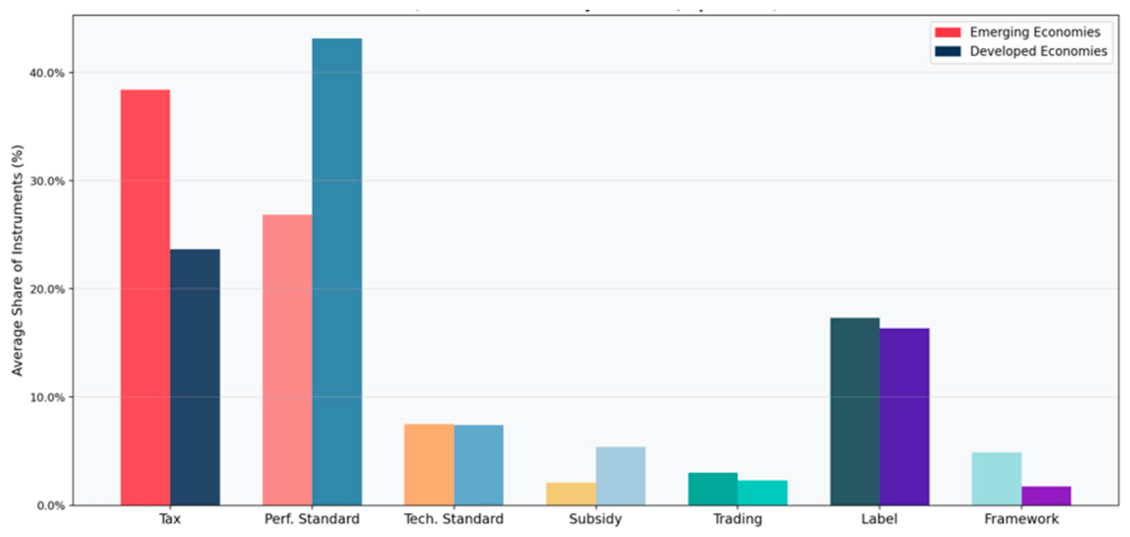
- Tax instrument ratio: Share of tax group instruments in total portfolio.
- Performance standard ratio: Share of MEPS, fuel economy, building standards, and related performance instruments.
- Technology standard ratio: Share of technology mandate instruments.
- Subsidy ratio: Share of subsidy and feed-in tariff instruments.
- Trading scheme ratio: Share of emissions trading and tradable credit instruments.
- Energy efficiency label ratio: Share of comparative energy efficiency label instruments.
- Framework regulation ratio: Share of framework regulation instruments.
- Energy efficiency objective ratio: Proportion of instruments with “Increase energy efficiency” as declared objective.
- Energy security objective ratio: Proportion of in-force instruments for which the declared policy objective includes either “Reduce the use of fossil fuels” or “Promote renewable energy,” following the IFCMA database’s structured objective taxonomy. This operationalization reflects the supply-side dimension of energy security and is consistent with the IEA’s four-A framework (Availability, Accessibility, Affordability, Acceptability). Demand-side security dimensions (e.g., energy import dependence ratios, strategic reserve levels) are beyond the scope of the IFCMA instrument-level database and are acknowledged as a limitation in Section 5.4.
3.3. Artificial Intelligence Models
3.3.1. K-Means Clustering
3.3.2. Principal Component Analysis
3.3.3. Random Forest Classification
4. Results
4.1. Descriptive Policy Instrument Profiles
4.2. Policy Instrument Mix: Emerging vs. Developed Economies
4.3. K-Means Clustering: Policy Regime Archetypes
4.4. Random Forest Classification and Feature Importance
4.5. Sector–Instrument Heatmap Analysis
5. Discussion
5.1. Structural Gaps in the Efficiency–Security Nexus
5.2. AI as a Policy Intelligence Tool
5.3. Implications for Policy Design
5.4. Limitations
6. Conclusions
Author Contributions
Funding
Institutional Review Board Statement
Informed Consent Statement
Data Availability Statement
Acknowledgments
Conflicts of Interest
References
- Wang, Q.; Li, Y.; Li, R. Integrating artificial intelligence in energy transition: A comprehensive review. Energy Strategy Rev. 2025, 57, 101600. [Google Scholar] [CrossRef]
- Qudrat-Ullah, H. A Thematic Review of AI and ML in Sustainable Energy Policies for Developing Nations. Energies 2025, 18, 2239. [Google Scholar] [CrossRef]
- Danish, M.; Senjyu, T. AI-Enabled Energy Policy for a Sustainable Future. Sustainability 2023, 15, 7643. [Google Scholar] [CrossRef]
- Ding, T.; Li, H.; Liu, L.; Feng, K. An inquiry into the nexus between artificial intelligence and energy poverty in the light of global evidence. Energy Econ. 2024, 136, 107748. [Google Scholar] [CrossRef]
- Tao, W.; Weng, S.; Chen, X.; Al Hussan, F.B.; Song, M. Artificial intelligence-driven transformations in low-carbon energy structure: Evidence from China. Energy Econ. 2024, 136, 107719. [Google Scholar] [CrossRef]
- Behera, B.; Behera, P.; Pata, U.K.; Sethi, L.; Sethi, N. Artificial intelligence-driven green innovation for sustainable development: Empirical insights from India’s renewable energy transition. J. Environ. Manag. 2025, 389, 126258. [Google Scholar] [CrossRef]
- Park, C. Addressing Challenges for the Effective Adoption of Artificial Intelligence in the Energy Sector. Sustainability 2025, 17, 5764. [Google Scholar] [CrossRef]
- Ahmad, T.; Zhang, D.; Huang, C.; Zhang, H.; Dai, N.; Song, Y.; Chen, H. Artificial intelligence in sustainable energy industry: Status Quo, challenges and opportunities. J. Clean. Prod. 2021, 289, 125834. [Google Scholar] [CrossRef]
- Raman, R.; Gunasekar, S.; Kaliyaperumal, D.; Nedungadi, P. Navigating the Nexus of Artificial Intelligence and Renewable Energy for the Advancement of Sustainable Development Goals. Sustainability 2024, 16, 9144. [Google Scholar] [CrossRef]
- Effoduh, J.O. Africa’s Energy Poverty in An Artificial Intelligence (AI) World: Struggle for Sustainable Development Goal 7. J. Sustain. Dev. Law Policy 2024, 15, 32–63. [Google Scholar] [CrossRef]
- Lin, Y.; Tang, J.; Guo, J.; Wu, S.; Li, Z. Advancing AI-Enabled Techniques in Energy System Modeling: A Review of Data-Driven, Mechanism-Driven, and Hybrid Modeling Approaches. Energies 2025, 18, 845. [Google Scholar] [CrossRef]
- Ali, D.; Motuzienė, V.; Džiugaitė-Tumėnienė, R. AI-Driven Innovations in Building Energy Management Systems: A Review of Potential Applications and Energy Savings. Energies 2024, 17, 4277. [Google Scholar] [CrossRef]
- Chen, D.; Lin, X.; Qiao, Y. Perspectives for artificial intelligence in sustainable energy systems. Energy 2025, 318, 134711. [Google Scholar] [CrossRef]
- Lin, B.; Yang, Y. Building efficiency: How the national AI innovation pilot zones enhance green energy utilization? Evidence from China. J. Environ. Manag. 2025, 387, 125945. [Google Scholar] [CrossRef]
- Hossin, M.A.; Alemzero, D.; Wang, R.; Kamruzzaman, M.; Mhlanga, M. Examining artificial intelligence and energy efficiency in the MENA region: The dual approach of DEA and SFA. Energy Rep. 2023, 9, 4984–4994. [Google Scholar] [CrossRef]
- Li, X.; Wang, Q.; Tang, Y. The Impact of Artificial Intelligence Development on Urban Energy Efficiency: Based on the Perspective of Smart City Policy. Sustainability 2024, 16, 3200. [Google Scholar] [CrossRef]
- Zeng, J.; Wang, T. The impact of China’s artificial intelligence development on urban energy efficiency. Sci. Rep. 2025, 15, 24129. [Google Scholar] [CrossRef]
- Wang, Q.; Sun, T.; Li, R. Artificial Intelligence for Alleviating Energy Poverty: Pathways Toward Sustainable and Renewable Energy Transitions. Sustain. Dev. 2025, 34, 1324–1347. [Google Scholar] [CrossRef]
- Ghadami, N.; Gheibi, M.; Kian, Z.; Faramarz, M.G.; Naghedi, R.; Eftekhari, M.; Fathollahi-Fard, A.M.; Dulebenets, M.A.; Tian, G. Implementation of solar energy in smart cities using an integration of artificial neural network, photovoltaic system, and classical Delphi methods. Sustain. Cities Soc. 2021, 74, 103149. [Google Scholar] [CrossRef]
- Peng, X.; Guan, X.; Zeng, Y.; Zhang, J. Artificial Intelligence-Driven Multi-Energy Optimization: Promoting Green Transition of Rural Energy Planning and Sustainable Energy Economy. Sustainability 2024, 16, 4111. [Google Scholar] [CrossRef]
- Wang, X.; Wang, K.; Safi, A.; Umar, M. How is artificial intelligence technology transforming energy security? New evidence from global supply chains. Oecon. Copernic. 2025, 16, 15–38. [Google Scholar] [CrossRef]
- Islam, F.; Islam, M.N. Artificial Intelligence-Driven Hybrid Renewable and Waste-to-Energy Systems for Climate-Resilient and Equitable Urban Infrastructure in the Global South. J. Eng. Res. Rep. 2025, 27, 130–165. [Google Scholar] [CrossRef]
- Jørgensen, B.; Ma, Z. Regulating AI in the Energy Sector: A Scoping Review of EU Laws, Challenges, and Global Perspectives. Energies 2025, 18, 2359. [Google Scholar] [CrossRef]
- Pimenow, S.; Pimenowa, O.; Prus, P. Challenges of Artificial Intelligence Development in the Context of Energy Consumption and Impact on Climate Change. Energies 2024, 17, 5965. [Google Scholar] [CrossRef]
- Danish, M.S.S.; Senjyu, T. Shaping the future of sustainable energy through AI-enabled circular economy policies. Circ. Econ. 2023, 2, 100040. [Google Scholar] [CrossRef]
- Lee, C.C.; Fang, Y.; Quan, S.; Li, X. Leveraging the power of artificial intelligence toward the energy transition: The key role of the digital economy. Energy Econ. 2024, 135, 107654. [Google Scholar] [CrossRef]
- Farghali, M.; Osman, A.I.; Mohamed, I.M.A.; Chen, Z.; Chen, L.; Ihara, I.; Yap, P.S.; Rooney, D.W. Strategies to save energy in the context of the energy crisis: A review. Environ. Chem. Lett. 2023, 21, 2003–2039. [Google Scholar] [CrossRef]
- Majnoon, A.; Saifoddin, A. AI-Driven Energy Optimization Enhancing Efficiency in Urban Environments with Hybrid Machine Learning Models. Clean. Eng. Technol. 2025, 28, 101072. [Google Scholar] [CrossRef]
- Zhou, W.; Zhang, Y.; Li, X. Artificial intelligence, green technological progress, energy conservation, and carbon emission reduction in China. J. Clean. Prod. 2024, 446, 141142. [Google Scholar] [CrossRef]
- Chen, C.; Hu, Y.; Karuppiah, M.; Kumar, P.M. Artificial intelligence on economic evaluation of energy efficiency and renewable energy technologies. Sustain. Energy Technol. Assess. 2021, 47, 101358. [Google Scholar] [CrossRef]
- Usman, Y.; Ihejirika, C.J.; Offor, S.N.; Akl, R.; Chataut, R. Green Cybersecurity: Leveraging AI, ML, and LLMs to Optimize Energy, Threat Detection, and Sustainability Frameworks. IEEE Access 2025, 13, 159345–159379. [Google Scholar] [CrossRef]
- Kearns, S.; Maksimov, V. Leveraging Artificial Intelligence in Africa’s Energy Transition: A Collaborative Governance Perspective. AIB Insights 2025, 26. [Google Scholar] [CrossRef]
- Zhou, Y.; Liu, J. Advances in emerging digital technologies for energy efficiency and energy integration in smart cities. Energy Build. 2024, 315, 114289. [Google Scholar] [CrossRef]
- Fan, Z.; Yan, Z.; Wen, S. Deep Learning and Artificial Intelligence in Sustainability: A Review of SDGs, Renewable Energy, and Environmental Health. Sustainability 2023, 15, 13493. [Google Scholar] [CrossRef]
- Wang, B.; Wang, J.; Dong, K.; Nepal, R. How does artificial intelligence affect high-quality energy development? Achieving a clean energy transition society. Energy Policy 2024, 186, 114010. [Google Scholar] [CrossRef]
- Stecuła, K.; Wolniak, R.; Grebski, W. AI-Driven Urban Energy Solutions: From Individuals to Society: A Review. Energies 2023, 16, 7988. [Google Scholar] [CrossRef]
- Saheb, T.; Dehghani, M.; Saheb, T. Artificial intelligence for sustainable energy: A contextual topic modeling and content analysis. Sustain. Comput. Inform. Syst. 2022, 35, 100699. [Google Scholar] [CrossRef]
- Adewoyin, M.A.; Adediwin, O.; Audu, A. Artificial Intelligence and Sustainable Energy Development: A Review of Applications, Challenges, and Future Directions. Int. J. Multidiscip. Res. Growth Eval. 2025, 6, 196–203. [Google Scholar] [CrossRef]
- Li, X.; Li, S.; Cao, J.; Spulbar, A.C. Does artificial intelligence improve energy efficiency? Evidence from provincial data in China. Energy Econ. 2024, 142, 108149. [Google Scholar] [CrossRef]
- SaberiKamarposhti, M.; Kamyab, H.; Krishnan, S.; Yusuf, M.; Rezania, S.; Chelliapan, S.; Khorami, M. A comprehensive review of AI-enhanced smart grid integration for hydrogen energy. Int. J. Hydrogen Energy 2024, 67, 1009–1025. [Google Scholar] [CrossRef]
- Zhao, Z.; Zhao, Q.; Li, S.; Yan, J. Artificial Intelligence-Driven Regional Energy Transition: Evidence from China. Econ. Anal. Policy 2024, 85, 48–60. [Google Scholar] [CrossRef]
- Biswas, P.; Rashid, A.; Al Masum, A.; Al Nasim, M.A.; Ferdous, A.S.M.A.; Gupta, K.; Biswas, A. An Extensive and Methodical Review of Smart Grids for Sustainable Energy Management. IEEE Access 2025, 14, 44798–44815. [Google Scholar] [CrossRef]
- Aliyev, R. Artificial Intelligence as a Key Driver of Energy Security Transformation. Post-Sov. Issues 2025, 12, 30–48. [Google Scholar] [CrossRef]
- Tajjour, S.; Chandel, S.S. A comprehensive review on sustainable energy management systems for optimal operation of future-generation solar microgrids. Sustain. Energy Technol. Assess. 2023, 58, 103377. [Google Scholar] [CrossRef]
- Alhares, A. Governance, Energy Policy, and Sustainability in the Age of AI: Cross-Country Evidence for Achieving the Sustainable Development Goals. Sustain. Dev. 2025, 34, 1436–1450. [Google Scholar] [CrossRef]
- Raihan, A. A comprehensive review of artificial intelligence and machine learning applications in energy consumption and production. J. Technol. Innov. Energy 2023, 2, 1–26. [Google Scholar] [CrossRef]
- Nepal, R.; Zhao, X.; Dong, K.; Wang, J.; Sharif, A. Can innovation in artificial intelligence boost energy resilience? The role of green finance. Energy Econ. 2024, 142, 108159. [Google Scholar] [CrossRef]
- Saxena, S.; Saxena, S.; Tahilramani, N.; Patel, U.; Talreja, V.P.; Patel, A. Enhancing Cybersecurity in Sustainable Energy: Regulatory Compliance, Challenges, and Policy Innovations. In Proceedings of the 2025 International Conference on Sustainable Energy Technologies and Computational Intelligence (SETCOM), Gandhinagar, India, 21–23 February 2025. [Google Scholar] [CrossRef]
- Essed, A.; Iyiola, K.; Alzubi, A. Unpacking Artificial Intelligence’s Role in the Energy Transition: The Mediating and Moderating Roles of Knowledge Production and Financial Development. Energies 2025, 18, 4512. [Google Scholar] [CrossRef]
- Jiao, Z.; Zhang, C.; Li, W. Artificial Intelligence in Energy Economics Research: A Bibliometric Review. Energies 2025, 18, 434. [Google Scholar] [CrossRef]
- World Bank Blogs. Available online: https://blogs.worldbank.org/en/home (accessed on 6 June 2026).



| Parameter | Value | Detail | Source |
|---|---|---|---|
| Total Records | 5496 | All status categories | IFCMA DB |
| Active Instruments (In Force) | 4627 | Validated by member states | IFCMA DB |
| Countries Covered | 42 | OECD + non-OECD members | IFCMA DB |
| Emerging Economies | 9 | World Bank classification | World Bank |
| Policy Instrument Groups | 7 groups | Tax, Perf. Std., Tech. Std., Subsidy, Trading, Label, Framework | IFCMA DB |
| Policy Approaches | 43 | Across 3 categories | IFCMA DB |
| Variables (Raw) | 63 columns | Instrument-level attributes | IFCMA DB |
| ML Features Engineered | 9 features | Ratio-based, country-level | Authors’ computation |
| Temporal Coverage | Up to April 2026 | Adoption and revision dates | IFCMA DB |
| Country | N | Tax Ratio | Perf. Standard | Trading Scheme | Effic. Objective | Security Objective |
|---|---|---|---|---|---|---|
| Argentina | 76 | 40.8% | 18.4% | 0.0% | 18.4% | 32.9% |
| Chile | 71 | 12.7% | 29.6% | 2.8% | 22.5% | 36.6% |
| Costa Rica | 53 | 28.3% | 15.1% | 0.0% | 18.9% | 28.3% |
| Kazakhstan | 18 | 22.2% | 44.4% | 22.2% | 0.0% | 22.2% |
| Mauritius | 38 | 73.7% | 10.5% | 0.0% | 10.5% | 73.7% |
| Paraguay | 19 | 63.2% | 0.0% | 0.0% | 0.0% | 89.5% |
| Peru | 36 | 38.9% | 41.7% | 0.0% | 0.0% | 38.9% |
| South Africa | 71 | 49.3% | 28.2% | 0.0% | 30.9% | 26.8% |
| Türkiye | 54 | 16.7% | 53.7% | 1.9% | 61.1% | 27.8% |
| Emerging Avg. | 48 | 38.5% | 29.5% | 3.0% | 18.0% | 41.9% |
| Developed Avg. | 136 | 25.4% | 41.1% | 2.6% | 29.1% | 21.6% |
| Cluster | Policy Profile | Avg. Tax Ratio | Avg. Perf. Standard | Emerging/Total | Representative Countries |
|---|---|---|---|---|---|
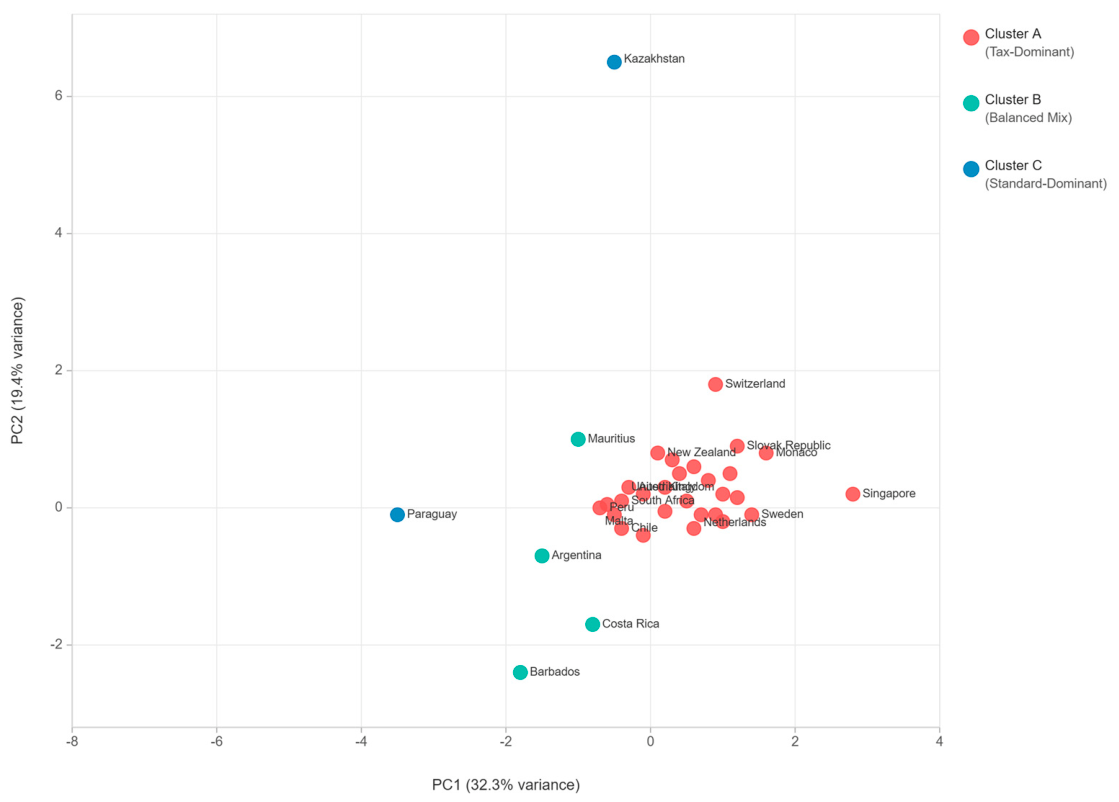
| A | Standard-Dominant Mixed | 25.4% | 41.1% | 4/35 | France, Germany, UK, Korea, Türkiye, Chile |
| B | Tax & Label-Dominant | 44.6% | 9.1% | 4/5 | Argentina, Mauritius, Costa Rica, Paraguay, Barbados |
| C | Trading-Intensive Transition | 22.2% | 44.4% | 1/1 | Kazakhstan (sole member) |
| Model | CV Accuracy (5-Fold) | Precision | Recall | F1 Score | Note |
|---|---|---|---|---|---|
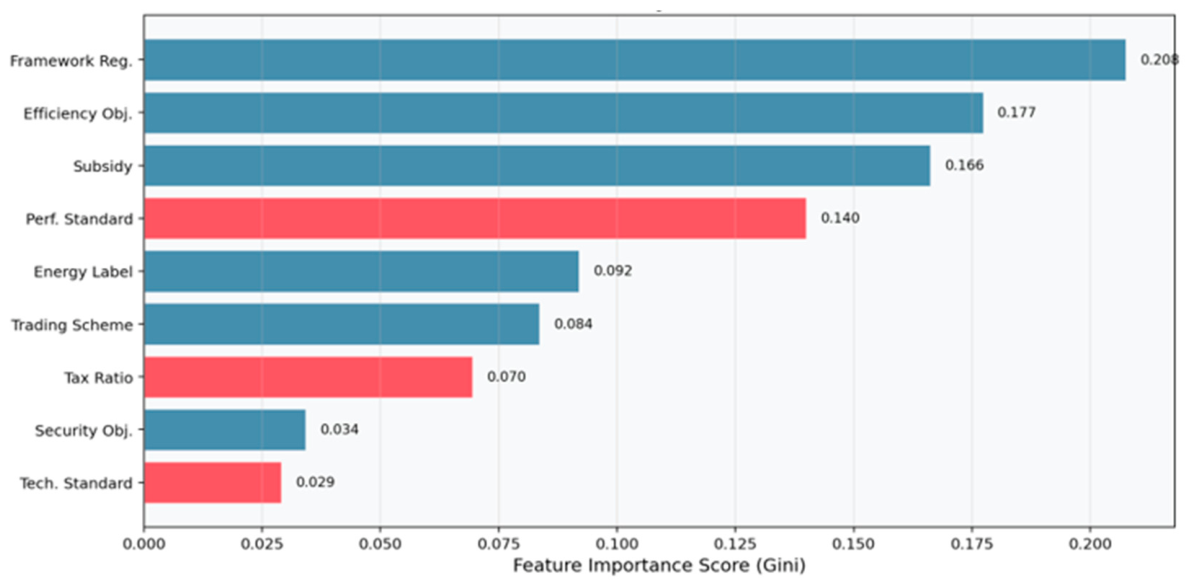
| Random Forest (main) | 83.1% ± 9.2% | 0.82 | 0.81 | 0.81 | n_estimators = 200; balanced class weights |
| K-Means Clustering (k = 3) | Unsupervised | — | — | — | Elbow + silhouette selection |
| PCA (2 components) | 78.9% var. expl. | — | — | — | Visualization + dimensionality reduction |
| Majority Class Baseline | 78.1% | 0.61 | 0.50 | 0.55 | Predicts the majority class always |
Disclaimer/Publisher’s Note: The statements, opinions and data contained in all publications are solely those of the individual author(s) and contributor(s) and not of MDPI and/or the editor(s). MDPI and/or the editor(s) disclaim responsibility for any injury to people or property resulting from any ideas, methods, instructions or products referred to in the content. |
© 2026 by the authors. Licensee MDPI, Basel, Switzerland. This article is an open access article distributed under the terms and conditions of the Creative Commons Attribution (CC BY) license.
Share and Cite
Korkut, G.; Emeç, M.; Ertürk, M. An AI-Driven Framework for Energy Efficiency and Security Policy in Emerging Economies Beyond Regulatory Compliance. Sustainability 2026, 18, 6124. https://doi.org/10.3390/su18126124
Korkut G, Emeç M, Ertürk M. An AI-Driven Framework for Energy Efficiency and Security Policy in Emerging Economies Beyond Regulatory Compliance. Sustainability. 2026; 18(12):6124. https://doi.org/10.3390/su18126124
Chicago/Turabian StyleKorkut, Güven, Murat Emeç, and Muzaffer Ertürk. 2026. "An AI-Driven Framework for Energy Efficiency and Security Policy in Emerging Economies Beyond Regulatory Compliance" Sustainability 18, no. 12: 6124. https://doi.org/10.3390/su18126124
APA StyleKorkut, G., Emeç, M., & Ertürk, M. (2026). An AI-Driven Framework for Energy Efficiency and Security Policy in Emerging Economies Beyond Regulatory Compliance. Sustainability, 18(12), 6124. https://doi.org/10.3390/su18126124