1. Introduction
Global climate governance has placed carbon emission control at the center of international attention. China is the world’s largest carbon emitter. While its economy grows rapidly, the country also faces tightening resource constraints and increasing ecological and environmental pressures. Following its ratification of the Paris Agreement, China has consistently taken on its responsibilities as a major country and advanced climate action. In March 2026, the government issued the climate targets for the 15th Five-Year Plan, which include a 17% reduction in carbon intensity and an increase in the share of non-fossil energy consumption to roughly 25%. Before that, in September 2025, China further updated its Nationally Determined Contribution (NDC) targets. The updated targets propose reducing net greenhouse gas emissions by 7% to 10% below the peak level by 2035. Achieving the above goals requires the coordinated use of multiple tools, including policies, technologies, and finance.
Green finance represents a further development of conventional financial models, primarily designed to supply investment, financing, and related services for environmental protection initiatives, with ecological preservation as its central objective. Since the issuance of the Guidelines for Establishing a Green Financial System in 2016, China’s green finance policy framework has continuously improved and its market scale has steadily expanded. The key role of green finance is to shift capital away from high-energy and high-emission industries. Instead, it directs capital toward low-carbon technologies and green industries. Therefore, it affects regional carbon emission levels. However, the specific transmission paths through which green finance affects carbon emissions—for example, whether it can stimulate green technology innovation or promote the low-carbon transition of industrial structure—still await systematic empirical testing.
It is worth noting that some scholars have extended the research perspective to the urban agglomeration scale. Using panel data from 41 cities in the Yangtze River Delta region for the period 2010–2021 and employing the system GMM model, the mediation model, and the threshold model, Zheng et al. [
1] empirically examined the impact of green finance development on carbon emissions. They found that green finance development helps to reduce carbon emissions, and this effect is more pronounced in large and larger-scale cities, as well as in cities with stronger innovation capabilities. In addition, based on data from the Yangtze River Delta urban agglomeration, Guo and Fang [
2] explored the synergistic effect of green finance and the digital economy on industrial carbon emission reduction. These studies provide a direct literature foundation for this paper.
However, the above studies still have room for improvement in terms of methodological depth and systematic mechanism analysis. First, Zheng et al. [
1] mainly relied on the traditional stepwise regression method to test mediation effects and paid insufficient attention to potential endogeneity bias and the problem of low testing power. Second, the analysis of transmission pathways is relatively fragmented. Few studies have incorporated green technology innovation and industrial structure upgrading into a unified framework to systematically compare their relative contributions. Third, the moderating effects and heterogeneities of the emission reduction effect of green finance remain underexplored, yet these are exactly the empirical evidence urgently needed for the refined design of green finance policies.
Based on this, building on existing research, this paper makes marginal contributions in the following three aspects. First, it adopts the bias-corrected nonparametric percentile Bootstrap method to conduct a more rigorous robustness test of the mediation effect, thereby overcoming the potential problem of low testing power associated with the traditional stepwise regression method. Second, it incorporates green technology innovation and industrial structure upgrading into a unified mediation analysis framework, systematically comparing the relative contributions of these two pathways. Third, it simultaneously examines the moderating role of industrial pollution level and the heterogeneities of income level and urbanization level, providing more systematic empirical evidence for the differentiated design of green finance policies.
Among China’s regions, the Yangtze River Delta stands out for its economic vitality, openness, and innovation. Green finance practices started early in this region, and policy coordination is relatively high. But at the same time, the Yangtze River Delta is also a concentrated area of high-carbon-emitting provinces. It has high historical emission stocks and a large share of heavy chemical industries. Hence, the pressure to reduce carbon emissions remains very prominent. In 2023, General Secretary Xi Jinping clearly stated at the Yangtze River Delta Integrated Development Symposium that it is necessary to “promote energy conservation, carbon reduction, and efficiency improvement in key areas and industries” and “actively and steadily promote carbon peaking and carbon neutrality”. This coexistence of “leading in practice” and “prominent pressure” makes the Yangtze River Delta an ideal “touchstone” for testing the actual carbon reduction effects of green finance.
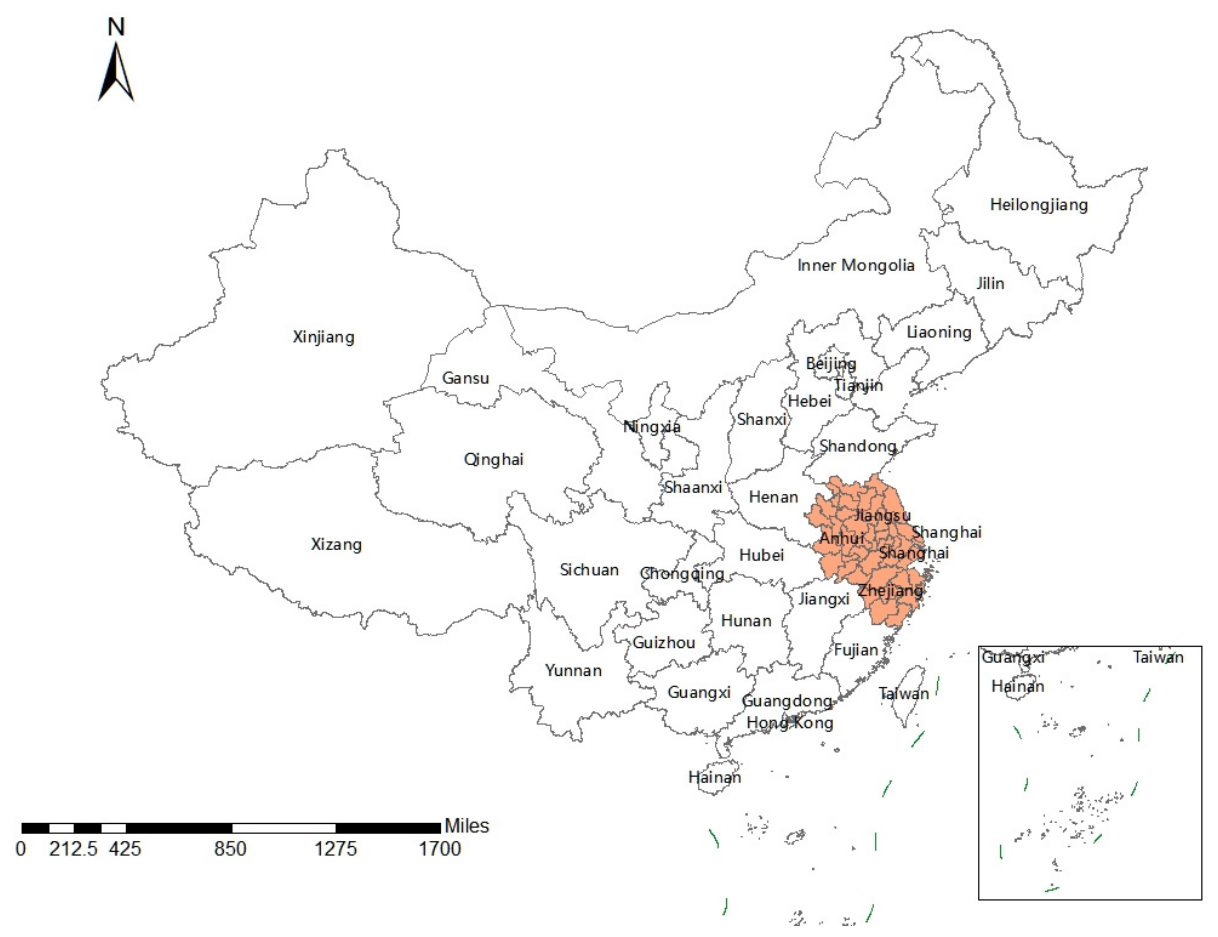
Figure 1 illustrates the spatial distribution of the 41 prefecture-level cities in the Yangtze River Delta.
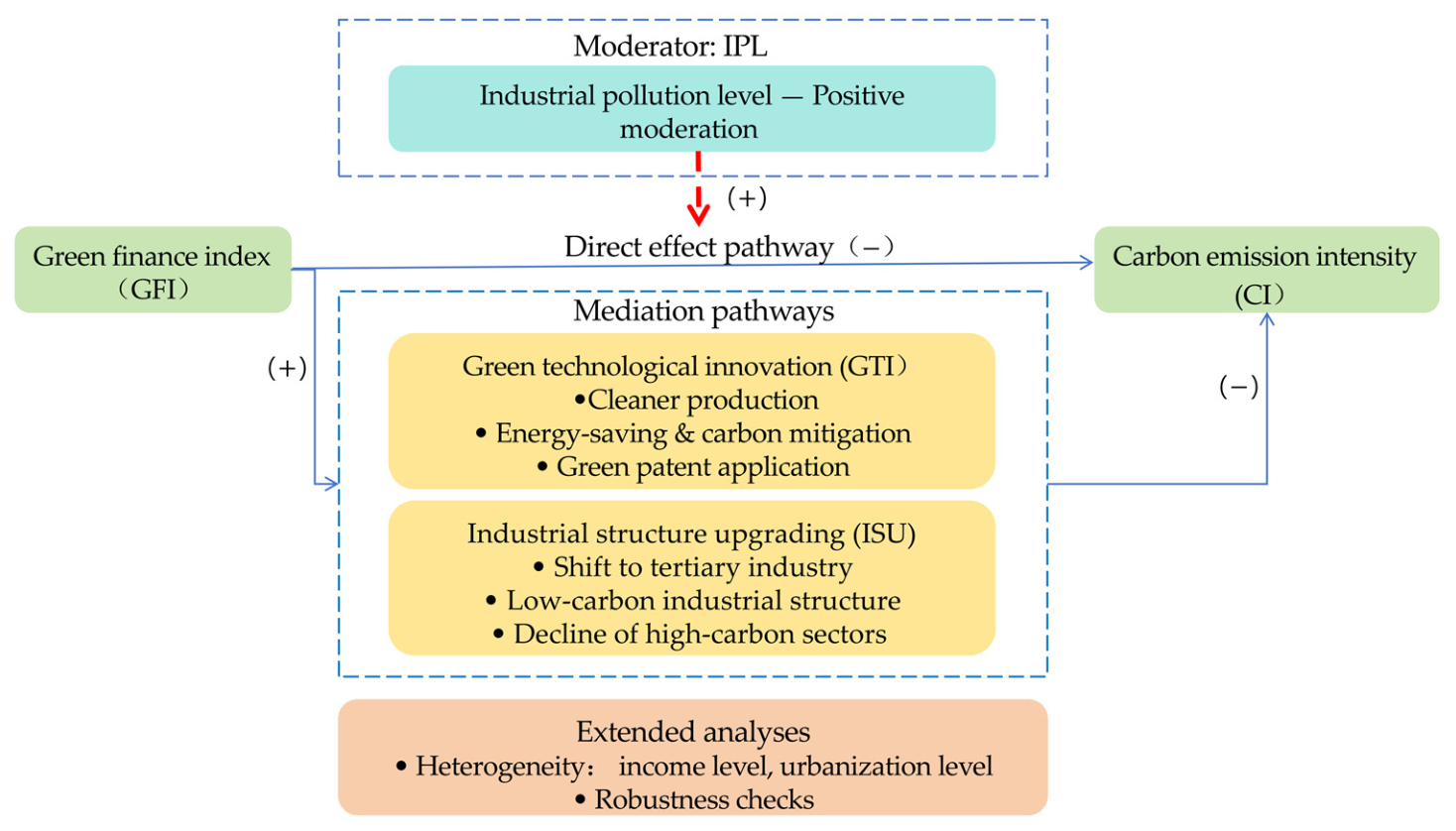
Therefore, this study focuses on 41 prefecture-level cities in the Yangtze River Delta. It then empirically examines how green finance affects carbon emissions around three core research questions: (1) Can green finance significantly reduce carbon emission intensity? (2) Through which mechanisms does green finance affect carbon emissions, do green technology innovation and industrial structure upgrading constitute two mediating pathways, and what are their relative contributions? (3) Is there heterogeneity in the emission reduction effect of green finance? Does industrial pollution level play a moderating role, and do income level and urbanization level lead to differences in the effect? The overall research framework of this paper is shown in
Figure 2.
2. Literature Review
Green finance is an extension of traditional finance in the environmental dimension and aims to embed environmental objectives into financial decision-making [
3]. Bhatnagar and Sharma [
4] explored its academic evolution through bibliometric analysis, while Wang [
5] defined it as the “green” expression of financial institutions’ concern for environmental protection in their business activities. In general, studies on green finance have covered its concept, how it works, and its development paths. Such research is relatively abundant in both China and other countries. However, most studies have focused on bank risk regulation, environmental governance schemes, and national transition experiences [
6]. At the same time, how to scientifically measure the progress of green finance has also become a concern for scholars [
7].
At the level of policy effects, macroeconomic studies remain controversial. Fan and Zhang [
8] found that green finance has both growth and crowding-out effects. Yang et al. [
9] argued that it improves economic quality and efficiency by optimizing resource allocation. Alharbi et al. [
10] provided global evidence that green finance promotes renewable energy development, and Hafner et al. [
11] also found that green finance contributes to GDP growth. However, some domestic scholars hold reservations. For example, Hu Bing [
12] showed that while environmental governance funds increased, economic growth slowed down. Liu Sha and Liu Ming [
13] using data from five northwestern provinces. They found that green finance can drive economic growth. However, the strength of this effect is not the same in every region.
At the micro level, most studies confirm that green credit policies can promote corporate green technology innovation, especially exerting a forcing effect on heavily polluting firms [
14,
15,
16]. Han Kezhen [
17] showed that green finance encourages green technology innovation, and that a significant spatial spillover effect exists between them. Zhao Na [
18], Wang Xin and Wang Ying [
19] concluded that green credit at both the firm and regional levels significantly promotes technological innovation. Nevertheless, some scholars remain skeptical. Lin et al. [
20] found that the effect varies depending on firm ownership and the intensity of regional environmental regulation. Wang Fengrong and Wang Kangshi [
21] pointed out that the current system suffers from low efficiency of capital allocation and a decline in corporate profitability after green transformation, which affects firms’ willingness to transition.
The influencing factors of carbon emissions have received widespread attention. Acheampong et al. [
22], from the perspective of heterogeneous financial economies, found that different financial structures have significantly different impacts on carbon emissions. These studies offer theoretical foundations and variable control references for our exploration of how green finance affects carbon emissions. Early studies presented two competing views: one argues that financial development helps reduce carbon emissions [
23], while the other suggests that it increases carbon emissions [
24]. In recent years, research has gradually focused on the specific form of green finance. Most studies have found that green finance can significantly reduce carbon emissions. For example, Wang et al. [
25], based on OECD country data, confirmed that green finance and clean tax strategies contribute to carbon emission reduction. Chen and Chen [
26], using data from 30 Chinese provinces, found that the effect is more pronounced in the eastern region. Sun and Zeng [
27], from the perspective of heavily polluting enterprises, confirmed that green credit policies effectively reduce corporate carbon emissions. Xiong et al. [
28] constructed a theoretical framework showing that green finance indirectly curbs carbon emissions by promoting green technology innovation. However, a small number of studies have reached different conclusions. Hammoudeh et al. [
29] examined green bonds. They found that these bonds do not significantly affect carbon emissions. Wan and Sheng [
30] found that green investment encourages a greener energy consumption structure. However, it does little to reduce carbon emissions. These inconsistent findings suggest that the green finance’s ability to cut emissions may be condition-dependent, moderated by factors such as regional characteristics, policy design, and industrial structure.
To sum up, the current literature suffers from several limitations. Firstly, the research perspective is mostly concentrated at the national, provincial, or firm micro level, with few in-depth discussions from a regional perspective. Secondly, the examination of transmission mechanisms is rather fragmented. Previous studies have not incorporated variables such as industrial structure upgrading [
31,
32] and green technology innovation [
33,
34] into a unified framework for empirical comparison. Thirdly, sample selection mostly stays at the provincial level, with little attention paid to city-level heterogeneity or the linkages among different green finance tools. Therefore, we select 41 cities in the Yangtze River Delta as our research sample. Using a panel data model and based on a constructed green finance development evaluation index, it empirically examines the effect of green finance on carbon emissions. At the same time, it investigates the two mediating paths of green technology innovation and industrial structure upgrading.
3. Theoretical Analysis and Research Hypotheses
3.1. Direct Impact of Green Finance on Carbon Emissions
Green finance extends traditional finance. It directs capital toward low-carbon industries and restricts financing for highly polluting sectors. In doing so, it internalizes environmental externalities [
3]. According to the Pigouvian tax principle and the environmental Kuznets curve hypothesis, market-based environmental instruments help correct market failures. They make polluters bear the social costs of carbon emissions. In the Chinese context, green finance reduces carbon emissions mainly through three channels.
First, the capital allocation mechanism. Green finance channels funds into energy-saving and emission-reduction projects through preferential loan rates, green bonds, and carbon credit financing, thereby reducing energy consumption and pollutant emissions at the macro level. Second, the information disclosure mechanism. Financial institutions require borrowing entities to disclose environmental information before, during, and after lending. This reduces information asymmetry, guides investors toward more environmentally friendly decisions, and helps curb the polluting production behaviors of borrowing entities. Third, the policy incentive mechanism. Driven by policies, green financial institutions can rely on government interest subsidies, preferential interest rates, and green listing fast-track channels to support enterprises or projects that comply with environmental regulations. These measures encourage companies to use cleaner production methods. They also push them to adopt better management practices, thereby promoting their sustainable development. Based on the above analysis, this paper proposes research Hypothesis 1:
Hypothesis 1 (H1). In the Yangtze River Delta region, green finance significantly reduces carbon emissions.
3.2. Indirect Impact of Green Finance on Carbon Emissions
3.2.1. The Role of Green Technology Innovation
According to the Porter hypothesis, well-designed environmental regulations can force firms to innovate technologically. This offsets compliance costs and enhances competitiveness. Green finance, as a market-based environmental tool, promotes green technology innovation through two pathways: capital provision and risk diversification. On the one hand, green finance provides substantial financial support for corporate green technology innovation through green credit and green funds. Therefore, green enterprises encounter looser financing constraints [
15]. On the other hand, financial instruments such as green bonds and carbon derivatives help diversify the long-cycle and high-risk uncertainties of innovation activities [
35].
Feng et al. [
33] pointed out, from the perspectives of environmental decentralization and digital finance, that green technology innovation cannot develop without the financial support and risk-sharing provided by green finance. Cheng et al. [
34] emphasized that international technology spillovers and regional innovation capacity play important mediating roles in how green finance promotes green technology innovation. Therefore, this paper proposes research Hypothesis 2:
Hypothesis 2 (H2). In the Yangtze River Delta region, green finance indirectly curbs carbon emissions by promoting green technology innovation.
3.2.2. The Role of Industrial Structure Upgrading
Upgrading the industrial structure means replacing energy-intensive manufacturing with service-based and tech-intensive industries. This transition plays a major role in cutting carbon emissions. Green finance promotes this transition mainly through two mechanisms. First, differentiated credit policies. Green finance lowers loan rates for energy-saving and environmental protection enterprises. This promotes the growth of green industries. At the same time, it raises loan rates for polluting industries. Second, optimizing resource allocation. Green finance helps move capital and labor into sectors where production efficiency is higher and lower carbon intensity. Yang et al. [
31] provided empirical evidence. They showed that industrial structure upgrading reduces carbon emissions effectively. It does so by improving green total factor productivity. Fu [
32] pointed out that industrial structure adjustment directly affects the energy consumption structure. Industrialization consumes large amounts of energy. Based on the above analysis, this paper proposes Hypothesis 3:
Hypothesis 3 (H3). In the Yangtze River Delta region, green finance indirectly curbs carbon emissions by promoting industrial structure upgrading.
4. Methodology and Data
4.1. Sample Selection and Data Sources
The Yangtze River Delta region has both advanced green finance practices and high carbon reduction pressure. This makes it a typical sample area for examining the emission-reduction effect of green finance. We select 41 cities from the Yangtze River Delta as our research subjects. We use panel data from 2010 to 2024 for empirical analysis. The starting year is set as 2010 because green finance-related data became available around this year, and this time window covers key policy nodes such as the Guidelines for Establishing a Green Financial System (2016), the “dual carbon” goals (2020), and the climate target updates of 2025–2026.
Carbon emission data were obtained from the China Carbon Emission Accounts and Datasets (CEADS). Green finance indicators and socio-economic control variables were sourced from the China Statistical Yearbook on Science and Technology, the China Energy Statistical Yearbook, the China Financial Statistical Yearbook, and various provincial statistical yearbooks. Missing values for a small number of observations were supplemented using linear interpolation. It should be noted that interpolation may smooth short-term fluctuations and underestimate actual inter-annual variation. Readers should keep this limitation in mind when interpreting the results. To mitigate the influence of extreme values, all continuous variables were winsorized at the 1st and 99th percentiles. And due to missing data for the year 2010 in three cities, the final panel is unbalanced and contains 612 observations.
4.2. Variable Definitions
4.2.1. Dependent Variable
Compared with total carbon emissions, carbon emission intensity excludes the effect of economic scale. Therefore, it better reflects the quality of regional low-carbon development. This paper uses the ratio of total carbon dioxide emissions to gross regional product as the measure of carbon emission intensity (CI).
4.2.2. Independent Variable
The core independent variable is the Green Finance Development Index (GFI). Following Liu and He [
36], we construct an evaluation system from seven dimensions: green credit, green investment, green insurance, green bonds, green support, green funds, and green equity.
Table 1 reports the measurement methods of the tertiary indicators.
Table 2 presents the descriptive statistics of the seven dimensions. As can be seen, there are notable differences across cities in each dimension. The mean values of green credit and green funds are relatively high, while those of green bonds and green support are low. Regarding the standard deviations, the coefficients of variation for green funds and green equity are relatively large, indicating uneven development across cities in these areas.
After standardizing the indicators for each dimension, we constructed the composite GFI index for each city using the equal-weighted arithmetic mean method. This approach is transparent, facilitates cross-city comparisons, and is consistent with common practices in constructing city-level green finance indices.
4.2.3. Mediating Variables, Moderating Variables, and Control Variables
We select two mediating variables: industrial structure upgrading (ISU) and green technology innovation (GTI). Specifically, we measure ISU as the ratio of tertiary industry value added to GDP. This indicator is the most common proxy for the service-oriented transformation of the economic structure. There are three reasons for choosing the total number of green patent applications rather than invention patents alone. First, green patents directly reflect regional innovation output and have a long time series, making them suitable for panel analysis. Second, although utility model patents are often regarded as “low-quality” innovations due to their lower inventiveness requirements, in the context of China’s green technology development, they capture a large number of incremental improvements and adaptive innovations that also contribute practically to carbon emission reduction. Du et al. [
37], in their study on the impact of low-carbon city construction on ecological efficiency, also pointed out that green technology innovation should not be limited to breakthrough inventions but should encompass a wide range of applied and improved technologies; ignoring utility model patents would underestimate the real emission-reduction potential of regional green innovation. Therefore, it is reasonable and robust to use the total number of green patent applications as the baseline indicator.
Table 3 summarizes the definitions and measurement methods of all variables.
The moderating variable is the industrial pollution level (IPL). Since a single pollutant indicator provides limited representation, we selected three types of emissions–industrial wastewater, industrial sulfur dioxide, and industrial soot—and applied the entropy method to construct a composite index.
Referring to the literature on factors influencing carbon emissions, we select four control variables: population density (PD), urbanization level (UL), energy structure (ES), and green benefit (GLCD). PD and UL reflect city size and population agglomeration, respectively. ES, measured as total energy consumption divided by GDP, indicates the economy’s reliance on energy. GLCD, measured by the harmless treatment rate of household waste, represents environmental governance performance.
Table 4 reports the descriptive statistics for all variables.
The cross-city variation in carbon emission intensity (CI) is relatively large, while the variation in the green finance development index (GFI) is comparatively small. This is consistent with the fact that the Yangtze River Delta region started its green finance development early and has achieved a relatively balanced level of progress.
4.3. Model Construction
4.3.1. Fixed-Effects Model
Given the high homogeneity of the 41 Yangtze River Delta cities in terms of economic development stage, industrial structure, and resource endowments, and the fact that the variation in the core explanatory variable GFI mainly stems from the time dimension and policy shocks, this paper adopts a panel model that controls only for year fixed effects:
In this setup, represents the city and t the year; is the green finance development index; is a vector of control variables that may affect carbon emissions; is the year fixed effect; is the intercept term; measures the effect of green finance development on carbon emissions; is the vector of coefficients for the control variables; is the random error term, which follows a normal distribution.
4.3.2. Mediation Effect Model
To explore the specific mechanism through which green finance affects carbon emissions, we construct a mediation effect model and test it using a combination of stepwise regression and the Bootstrap method:
represents the mediating variable. Equation (2) tests the effect of green finance on the mediator (path a). Equation (3) introduces the mediator while controlling for green finance. It tests both the effect of the mediator on carbon emissions (path b) and the direct effect of green finance (path ). If both and are significant, and the absolute value of is smaller than in Equation (1) (or its significance decreases), then a partial mediation effect exists.
4.3.3. Moderation Effect Model
To examine the moderating role of IPL in the process through which green finance affects carbon emissions, this paper adds an interaction term between green finance and industrial pollution level to the baseline model and constructs the following moderation effect model:
is the comprehensive index of industrial pollution level; is the core parameter of interest. If is significant, it indicates that industrial pollution level moderates the emission reduction effect of green finance. To avoid multicollinearity, we center and before constructing the interaction term.
4.3.4. Heterogeneity Analysis Model
To statistically test whether the effect of green finance on carbon emissions differs significantly across cities with different income levels and urbanization levels, we introduce interaction terms based on the baseline model and specify the following model:
where
is a dummy variable indicating whether a city belongs to the high-income group or the high-urbanization group, respectively. Specifically, the classification is based on the sample median: cities above the median are assigned a value of 1, and those below the median are assigned 0. To reduce multicollinearity,
and
are centered before constructing the interaction term. The coefficient
captures the marginal effect of green finance on carbon emissions in the low-group (low-income or low-urbanization cities). The coefficient
measures the difference in the effect between the high-group and the low-group. If
is statistically significant, it indicates that the difference between the two groups is statistically significant.
5. Empirical Analysis
5.1. Correlation and Multicollinearity
From
Table 5, we see the correlation coefficients. The correlation between GFI and CI is negative. This provides initial evidence of a negative relationship. GFI also correlates positively with GTI and ISU. This aligns with the hypothesized mediation paths of this paper.
The variance inflation factor (VIF) test in
Table 6 shows that the VIF values of all variables are far below the critical value of 10 (the highest is 3.56 for UL, and the mean is 2.02), indicating that the model does not suffer from serious multicollinearity issues and that the regression results are highly reliable.
5.2. Benchmark Regression Analysis
Table 7 reports the results of the benchmark regression. Model (1) includes only the core independent variable GFI. Model (2) further adds control variables. The results show that, regardless of whether control variables are included, the coefficient of GFI is significantly negative. This indicates that green finance development suppresses carbon emissions. Thus, Hypothesis 1 receives empirical support.
Taking Model (2) as an example, the coefficient of GFI is −35.88. The standard deviation of GFI is 0.0093; therefore, a one-standard-deviation increase in GFI reduces CI by approximately 0.334 units. Relative to the sample mean of CI (1.4165), this reduction corresponds to 23.6%. In other words, if the green finance development level in Yangtze River Delta cities increases by one standard deviation from the mean, their carbon emission intensity would fall by nearly one-quarter. This effect is economically substantial, indicating that green finance is not only a statistically significant emission reduction tool but also has practical policy relevance.
Among the control variables, the coefficient of ES is 18.23. A one-standard-deviation increase in ES raises CI by approximately 0.589, which is equivalent to 41.6% of the mean CI. This confirms that traditional energy dependence remains the dominant driver of regional carbon emissions. The PD, UL, and GLCD do not pass the 10% significance test. A possible explanation is that the urbanization process in the Yangtze River Delta has entered a relatively stable stage, where the marginal emission reduction effects of population density and urbanization level are no longer significant. Meanwhile, the green benefit measured by the harmless treatment rate of household waste has not yet exerted an effective constraint on carbon emissions. The goodness-of-fit () of Model (2) is 0.309, which is considerably higher than that of Model (1) ( = 0.145), indicating that the inclusion of control variables helps explain regional differences in carbon emissions more comprehensively.
5.3. Robustness Tests
To verify the robustness of the benchmark results, we conduct three types of tests. First, we replace the core explanatory variable. We substitute the green finance index with its sub-component: green credit. Column (1) of
Table 8 shows the result. The coefficient of green credit is −14.81 and remains significantly negative (
p = 0.0120). Economically, this coefficient is smaller than that of GFI but has the same sign, indicating that green credit is a core component of the emission reduction effect of green finance. Second, we adjust the winsorization ratio. We change the winsorization of continuous variables from the 1st/99th percentiles to the stricter 5th/95th percentiles. Column (2) reports the coefficient of GFI, which is −28.64 (
p = 0.0241) and still significantly negative. Third, we exclude the special-year sample. The COVID-19 pandemic in 2020 might have caused abnormal shocks to carbon emissions. Therefore, we drop the 2020 sample and re-run the regression. Column (3) shows that the GFI coefficient is −37.48 (
p = 0.0111) and remains significantly negative. All three robustness checks support the benchmark conclusion H1. That is, green finance has a robust inhibitory effect on carbon emission intensity in the Yangtze River Delta region. Hence, the research findings are highly reliable.
5.4. Mediation Effect Tests
5.4.1. Green Technology Innovation
Table 9 reports the stepwise regression results with GTI as the mediator. Column (1) shows the total effect model. The coefficient of GFI is −35.88, which is consistent with the benchmark regression. Column (2) tests path a (GFI → GTI). The coefficient of GFI is 16.23. This indicates that green finance development significantly promotes green technology innovation. Column (3) includes both GFI and GTI. The coefficient of GTI is −0.6584 (
p < 0.05). Moreover, the absolute value of the GFI coefficient decreases from 35.88 to 25.19. This suggests a partial mediation effect.
The Bootstrap test results show that the estimated indirect effect a × b is −10.6852. The 95% confidence interval is [−16.14498, −5.22538], which does not contain zero. Therefore, the mediation effect is significant at the 5% level. In summary, green finance indirectly reduces carbon emission intensity by promoting green technology innovation. Thus, Hypothesis 2 is supported.
5.4.2. Industrial Structure Upgrading
Table 10 reports the test results with ISU as the mediator. Column (1) presents the total effect, which is consistent with the previous analysis. Column (2) tests path a (GFI → ISU). The coefficient of GFI is 0.7128, which is positive but does not pass the 10% significance test. This indicates that the promoting effect of green finance on industrial structure upgrading in the Yangtze River Delta is not yet significant. Column (3) includes both GFI and ISU. The coefficient of ISU is −3.6720 and is significantly negative. This shows that industrial structure upgrading itself plays a significant role in reducing carbon emission intensity. The direct effect of GFI (c′) is −33.26 and remains significantly negative.
The Bootstrap test results show that the estimated indirect effect a × b is −2.6175. The 95% confidence interval is [−4.99894, −0.23604]. Therefore, the indirect effect is significantly negative at the 5% level. This indicates that green finance development indirectly suppresses carbon emission intensity through the channel of industrial structure upgrading. Thus, Hypothesis 3 receives empirical support. Taken together, although the coefficient of path a does not reach statistical significance, both the Bootstrap test and the significance of path b support the existence of the mediation pathway. Therefore, Hypothesis 3 is empirically supported.
5.4.3. Bootstrap Mediation Effect Summary
Table 11 summarizes the Bootstrap test results for the two mediating paths. The confidence intervals for the indirect effects of both paths do not contain zero. This further confirms that green finance reduces carbon emissions per unit of GDP through two channels: promoting green technology innovation and driving industrial structure upgrading. Thus, a synergistic transmission chain forms in the Yangtze River Delta: “green finance → green technology innovation & industrial structure upgrading → reduction in carbon emission intensity.”
5.5. Moderation Effect Analysis
The regression results in
Table 12 show that, after centering, the coefficient of GFI is −46.25 and remains significantly negative. This confirms the baseline conclusion. The coefficient of IPL is 0.4844 and is not significant. This indicates that, after controlling for other factors, industrial pollution level itself has no independent effect on carbon emission intensity.
The coefficient of the interaction term GFI × IPL is −156.31 and is significantly negative at the 5% level. This result has important economic implications. Specifically, the higher the industrial pollution level in a city, the stronger the inhibitory effect of green finance on carbon emission intensity. The underlying logic is as follows. Heavily polluted regions have larger emission reduction potential and higher marginal benefits from applying low-carbon technologies. Therefore, the marginal effect of green finance in promoting low-carbon transition through capital guidance is also more pronounced. In contrast, for cities with lower pollution levels, the elasticity of further reducing carbon emissions per unit of GDP is smaller, and the additional marginal utility of green finance is relatively limited. This finding suggests that green finance policies can achieve greater effectiveness in heavily polluted areas. It thus provides empirical evidence for a differentiated regional allocation strategy of green finance.
5.6. Heterogeneity Analysis
Column (1) of
Table 13 shows that the coefficient of GFI_c in the low-income group is −50.16 (
p < 0.05), and the coefficient of the interaction term GFI × HighIncome is 25.68 (
p < 0.05). Thus, the actual emission reduction effect in the high-income group is −24.48. The emission reduction elasticity of the low-income group is 2.05 times that of the high-income group. In absolute terms, a one-standard-deviation increase in GFI reduces CI by 0.466 in low-income cities and by 0.228 in high-income cities. This means that the same amount of green finance investment produces more than twice the emission reduction effect in low-income cities compared to high-income cities. This finding is consistent with the law of diminishing marginal abatement costs: less developed regions have higher levels of industrialization and carbon emission intensity, so the leveraging effect of green finance is stronger. Therefore, green finance resources should be directed towards relatively less developed areas, such as those in central and western China.
In column (2) of
Table 13, the coefficient of GFI_c in the low-urbanization group is −21.77 (
p > 0.1), and the interaction term coefficient is −20.39 (
p > 0.1); neither is statistically significant. Although the coefficients are negative, the null hypothesis that they equal zero cannot be rejected. In numerical terms, the effect in the high-urbanization group is approximately twice that in the low-urbanization group, but due to the large standard errors, no reliable conclusion can be drawn. Possible reasons include: urbanization levels in the Yangtze River Delta are generally high, leaving limited between-group variation; there may be an inverted U-shaped relationship between urbanization and carbon emissions, with the sample lying on the flat part of the curve; and the simple population urbanization rate may not capture the quality of urbanization. Therefore, urbanization level should not be used as a primary basis for differentiated green finance policy design in the Yangtze River Delta.
6. Discussion
The empirical results show that green finance has a significant emission reduction effect in the Yangtze River Delta region, but this effect is not uniformly distributed. Instead, it is moderated by income level, industrial pollution level, and transmission pathways.
First, the emission reduction effect of green finance is significantly stronger in low-income cities than in high-income cities. This difference reflects the economic law of diminishing marginal abatement costs. Low-income cities are mostly in the middle stage of industrialization, with more energy-intensive industrial structures and higher carbon intensity. They offer many low-cost abatement opportunities, and green finance can quickly generate “catch-up” emission reductions. In contrast, high-income cities already have relatively clean industrial structures. Further emission reductions would require expensive end-of-pipe technologies or disruptive innovations, where marginal costs rise and marginal returns fall. This implies that directing more green finance resources to less developed regions may yield higher environmental returns.
Second, urbanization level does not exhibit a significant moderating effect. This should not be interpreted as “urbanization is unimportant”, but rather understood in the context of the Yangtze River Delta. The average urbanization rate of the 41 cities exceeds 62%, and most cities have entered a mature stage. If an inverted U-shaped relationship exists between urbanization and carbon emissions, these cities have likely passed the inflection point and lie on the flat part of the curve. Moreover, the between-city variation in urbanization is relatively small, making it statistically difficult to detect significant differences. In addition, the simple population-based urbanization ratio captures only the “quantitative” dimension and fails to reflect the “qualitative” aspects such as infrastructure efficiency and land use intensity. Therefore, in highly urbanized regions like the Yangtze River Delta, urbanization level should not be used as a primary basis for differentiated green finance policies.
Third, the two mediation pathways differ markedly in their contributions. The indirect contribution of green technology innovation is much larger than that of industrial structure upgrading. This reflects the reality of the Yangtze River Delta: the tertiary industry share is already close to 50%, the share of high-tech manufacturing is relatively high, and the room for further structural upgrading is limited. In contrast, green technology innovation remains dynamic. This implies that, in the Yangtze River Delta, supporting green R&D, patent commercialisation, and technology application through green finance is more effective in reducing carbon emissions than promoting industrial restructuring.
Fourth, industrial pollution level positively moderates the emission reduction effect of green finance: the more polluted a city is, the stronger the marginal abatement effect. This is consistent with the “low-hanging fruit” logic—heavily polluted areas offer many low-cost abatement opportunities, and green finance can deliver quick results. However, this also implies a risk: some firms may use green finance for superficial “greenwashing” retrofits to obtain low-cost financing without achieving real emission reductions. Local governments should strengthen environmental information disclosure using big data to prevent such behaviour.
Finally, this study has several limitations. Reverse causality cannot be completely ruled out (low-carbon cities may attract more green finance). The green finance index is constructed using an equal-weighted arithmetic mean, which may be subjective. Linear interpolation for missing data may smooth short-term fluctuations. Moreover, the generalisability of the findings to other urban agglomerations requires further testing. Future research could use policy shocks such as green finance reform pilot zones as instrumental variables to address endogeneity and try alternative weighting schemes to construct the green finance index.
7. Conclusions and Policy Recommendations
7.1. Main Findings and Discussion
Based on panel data of 41 prefecture-level cities in the Yangtze River Delta from 2010 to 2024, this study draws the following main conclusions.
First, green finance significantly reduces carbon emission intensity in the Yangtze River Delta region. This conclusion remains robust after a series of tests, including substituting the core variable, adjusting the winsorization ratio, and excluding the sample from abnormal years.
Second, green finance curbs carbon emissions through two mediating pathways: green technology innovation and industrial structure upgrading. The indirect contribution of green technology innovation is much larger than that of industrial structure upgrading, making it the dominant transmission channel.
Third, industrial pollution level positively moderates the emission reduction effect of green finance. The more polluted a city is, the stronger the marginal abatement effect of green finance.
Fourth, the emission reduction effect of green finance exhibits heterogeneity across income levels but not across urbanization levels within the Yangtze River Delta. Low-income cities benefit more from green finance, while the moderating role of urbanization level is not significant, which is related to the relatively high average urbanization rate and limited between-city variation in the region.
7.2. Policy Recommendations
Based on the above analysis, this study proposes the following policy recommendations.
First, strengthen the green finance infrastructure to enhance the direct emission reduction effect. Local authorities can rely on existing platforms such as the Yangtze River Delta Green Finance Alliance and the Shanghai Carbon Market. These platforms can help expand green credit and green bond issuance. Financial institutions should also be required to regularly disclose the environmental benefits of their green finance products. This will reduce information asymmetry and lower the cost of green financing.
Second, give priority to green technology innovation while also considering industrial structure optimisation. Green technology innovation contributes much more to emission reduction than industrial upgrading does. Therefore, policies should allocate more resources to low-carbon R&D, patent commercialisation, and the application of technologies such as CCUS. A special fund for green technology innovation in the Yangtze River Delta could be established. Green innovative enterprises could benefit from differentiated low-interest credit. At the same time, financing constraints on heavily polluting industries should be maintained.
Third, channel more green finance resources to heavily polluted areas to obtain higher marginal abatement returns. Cities in northern Jiangsu and northern Anhui, which suffer from severe industrial pollution, should be given priority in green finance allocation. A risk compensation fund could be set up for green projects in these highly polluted areas. Moreover, local governments should use big data to strengthen environmental information disclosure. This will ensure that funds flow to projects with real emission reductions and prevent greenwashing.
Fourth, adopt a differentiation strategy based on income level rather than on urbanisation level. In low-income cities, green finance should focus on helping traditional industries transform towards low-carbon models and on increasing investment in energy-saving technologies. In high-income cities, green finance should shift from scale-oriented allocation to quality-oriented emission reduction. It should support cutting-edge low-carbon technologies and green industrial clusters.