Article

A Closing Window: Satellite-Observed River-Ice Loss and Peak Water Risks for Sustainable Small-Hydropower Planning in the Tien Shan

1
Geodesy Laboratory, Civil & Architectural and Environmental System Engineering, Sungkyunkwan University (SKKU), Suwon 16419, Republic of Korea
2
Global Development Cooperation Center, School of Geography, Sungkyunkwan University (SKKU), Suwon 16419, Republic of Korea
3
School of Geography, Faculty of Environment, University of Leeds, Woodhouse Lane, Leeds LS2 9JT, UK
*
Authors to whom correspondence should be addressed.
Sustainability 2026, 18(12), 6110; https://doi.org/10.3390/su18126110 (registering DOI)
Submission received: 18 May 2026 / Revised: 11 June 2026 / Accepted: 12 June 2026 / Published: 14 June 2026

Abstract

Sustainable small hydropower (SHP) is central to the clean-energy transition of mountainous Central Asia, yet its long-term reliability depends on a rapidly changing cryosphere. Winter river-ice dynamics—an underappreciated control on run-of-river generation—remain poorly characterized owing to the collapse of in situ hydrometeorological networks since 1991. We use a 112-month Sentinel-1 C-band SAR time series (February 2017–May 2026) over a 5320 km2 headwater catchment of the Chu River basin, northern Tien Shan, Kyrgyzstan, to quantify river-ice phenology at 20 m resolution using a per-pixel summer-baseline anomaly approach. Mid-winter (December–February) ice cover declined significantly at −0.51%·yr−1 (p = 0.013; Mann–Kendall p = 0.029), with the 2026 winter recording an unprecedented 2.6–2.8 σ departure from the 2017–2025 climatology. Contrasting the cold 2022 and warm 2026 winters revealed bidirectional climate sensitivity—early breakup versus persistent thin ice—posing distinct SHP hazards. ERA5-Land reanalysis (1992–2026) showed significant winter warming with no precipitation or snowfall trend, indicating thermally forced ice decline. Interpreted within a conceptual Peak Water scenario, this signals a closing window of opportunity for SHP generation, with direct relevance to sustainable water–energy management and the UN Sustainable Development Goals (SDG 7; SDG 13). Our results provide the first decadal, satellite-based evidence of river-ice loss for Central Asian mountain rivers and a transferable monitoring framework to support climate-resilient, sustainable hydropower planning in ungauged basins.

1. Introduction

Achieving the clean-energy and climate-adaptation goals of the UN 2030 Agenda in Central Asia depends critically on the sustainable development of small hydropower (SHP), whose long-term reliability is in turn governed by a rapidly changing mountain cryosphere. Mountain rivers draining the Tien Shan and Pamir ranges supply the majority of Central Asia’s freshwater resources and host a substantial portion of Kyrgyzstan’s installed small hydropower (SHP) capacity. In high-altitude run-of-river systems, winter river ice formation constitutes a critical but underappreciated operational constraint. Frazil and anchor ice can rapidly clog trash racks, block intakes, and force shutdowns, while breakup and ice jams downstream of hydropower operations can cause hanging dams, sharp water-level changes, and ice-run hazards that complicate shutdown/restart strategies [1,2,3,4]. In small, often steep run-of-river plants, ice problems can exceed flood damages, with reduced production capacity due to frazil accumulation at trash racks and ice runs blocking intakes constituting dominant operational issues [5].
The cryosphere of the Tien Shan is undergoing rapid transformation. Glaciers in the northern and central Tien Shan have shrunk by 15–20% in many sectors since the 1960s–1970s [6,7,8], with a broader assessment reporting a 27% glacier mass loss across the entire Tien Shan from 1961–2012, attributed primarily to increased summer melt [9]. Snow-covered days have decreased significantly in central and eastern Tianshan sectors (e.g., −11.9% and −8.0% over 2001–2015), with changes strongly linked to rising air temperatures [10,11]. For Central Asian lakes, including Issyk-Kul, MODIS-based phenology analyses (2002–2020) reveal regional contrasts in freeze-up and breakup patterns, although many lakes do not uniformly follow the canonical “later freeze, earlier breakup” trend [12]. More broadly, Eurasian and Tibetan Plateau lakes exhibit widespread shortening of ice seasons, driven primarily by air temperature and solar radiation [13,14].
Despite this rapid cryospheric change and the strategic importance of SHP for Central Asia’s energy transition, systematic long-term observations of river ice phenology in Kyrgyz mountain basins remain virtually absent due to the post-Soviet collapse of the hydrometeorological network. This data gap is particularly acute for high-mountain rivers, where complex winter ice processes, such as anchor ice dams, water–ice flows, and aufeis, develop under conditions of sharp cooling (air < −20 °C; up to 10 °C·day−1) and rapid subsequent warming [15]. In the northern Tien Shan of southeastern Kazakhstan, anchor ice dams can raise water levels by 1.5–2 m before catastrophic failure, producing destructive water–ice flows with depths up to 5 m, speeds > 10 m·s−1, and discharges up to 300 m3·s−1 [15]. In Ladakh, aufeis fields form layered ice bodies through repeated overflow and freezing, with distinct accumulation (November–April) and melt (May–July) phases and strong interannual variability [16].
Spaceborne C-band synthetic aperture radar (SAR), with its all-weather and day–night acquisition capability, has emerged as the principal tool for river ice monitoring in data-scarce regions. Sentinel-1 (5.405 GHz, 20 m IW mode, 6–12-day revisit) has been successfully used for river ice classification and breakup mapping, with supervised and threshold-based methods achieving overall accuracies of 77–96% across diverse rivers [17,18,19,20]. On the Nemunas and Neris rivers in Lithuania (80–300 m wide), simple VV backscatter threshold models detected ice extent over 525 km with a median VV difference of ~13 dB between sheet ice and open water [17]. However, applications to alpine headwater rivers face significant challenges: narrow channel widths, terrain-induced layover and shadow, and complex geometry require dual-pol data and multi-orbit strategies to retrieve usable information [21,22,23,24]. Dual-polarized C-band SAR has nonetheless shown potential for ice thickness inversion in high-order rivers on the Tibetan Plateau, with RMSEs of 0.11–0.26 m [25], and Random Forest classification of Landsat and Sentinel-2 imagery has successfully mapped 27 recurrent aufeis fields in Ladakh, demonstrating transferability to other high-mountain regions [16].
Beyond ice presence/absence, recent work emphasizes that ice thickness may serve as a leading indicator of climate-driven ice loss. A global synthesis shows that Northern Hemisphere lake ice duration has shortened by 28 days on average over 150 years, with recent decades exhibiting accelerated loss in both duration and thickness [26]. Large-ensemble modeling projects future lake ice loss as reduced maximum thickness and shorter duration, with maximum thickness decreasing by ~0.23 m by 2100 over the Tibetan Plateau and Canadian Arctic [27]. Projections of “safe ice” for transport and recreation indicate dramatic declines in days meeting thicker-ice thresholds, highlighting that thickness is often more sensitive than simple presence/absence [28].
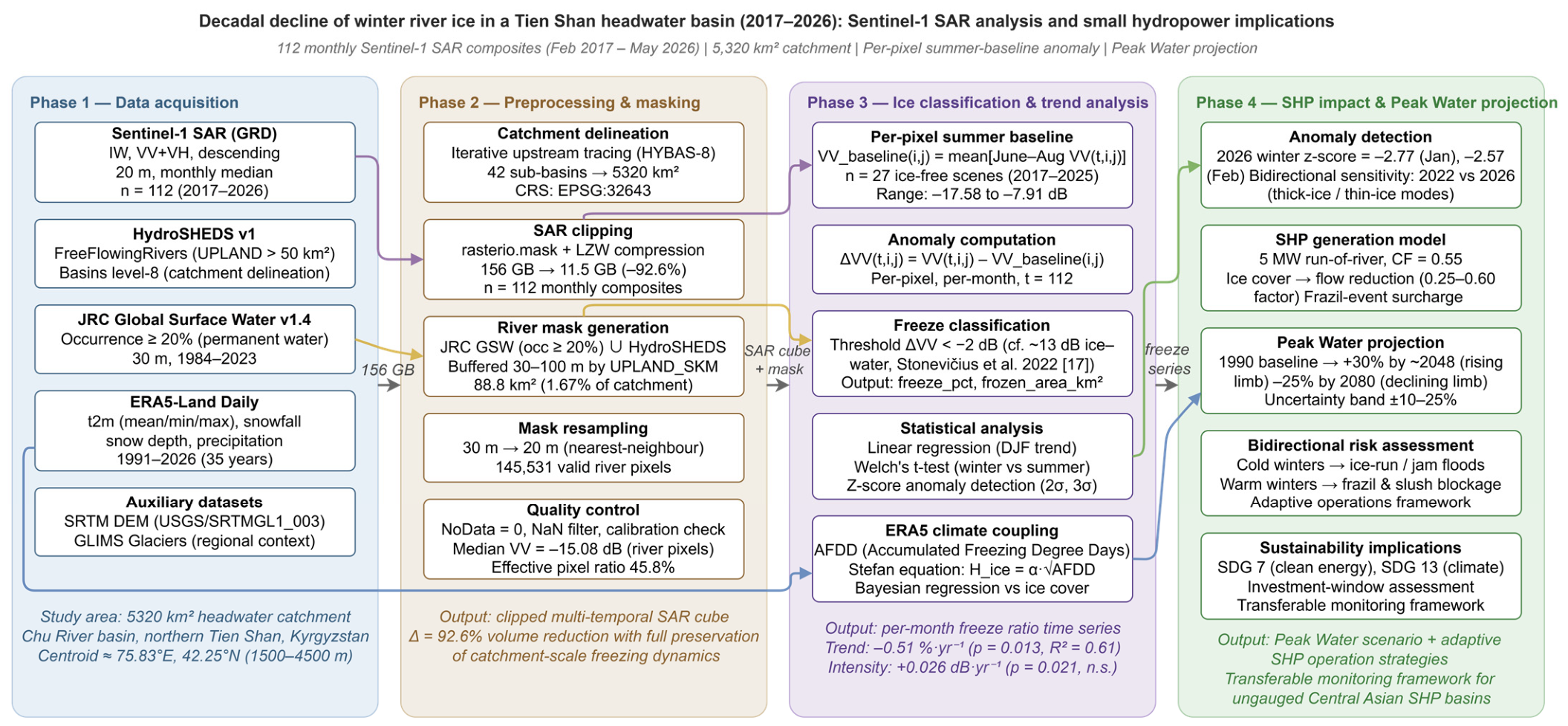
In this study, we present the first decadal-scale satellite SAR record of river ice for a Tien Shan headwater catchment. Our specific objectives are (i) to develop a per-pixel summer-baseline anomaly approach robust to terrain-induced heterogeneity in narrow alpine rivers, (ii) to quantify decadal trends in mid-winter ice cover and intensity over 2017–2026, and (iii) to assess implications of the observed ice loss for SHP operations under the Peak Water hypothesis. The overall four-phase workflow of data acquisition, preprocessing, ice classification, and SHP impact assessment is summarized in Figure 1.

2. Materials and Methods

2.1. Study Area

The study catchment is a 5320 km2 headwater basin of the Chu River system, draining the northern slopes of the Kyrgyz Ala-Too range in the northern Tien Shan (centroid ≈ 75.83° E, 42.25° N; elevation 1500–4500 m). The basin is snow-dominated, with negligible direct glacier contribution within a 50 km radius of the proposed SHP site, although the broader area of interest (AOI) contains 515 glaciers totaling 2188 km2. The river network spans 106 major segments (HydroSHEDS UPLAND_SKM > 100), with main-stem discharge of 15–20 m3·s−1. The site is representative of mid-elevation Kyrgyz SHP development zones, where post-Soviet hydrometeorological monitoring has been particularly sparse (Figure 2). We note that no in situ discharge or water-level gauging has been maintained in the catchment since the collapse of the Soviet hydrometeorological network in 1991; consequently, our analysis relies on satellite observations and reanalysis, and modeled runoff is used only as a qualitative proxy for streamflow seasonality (Appendix A, Figure A3).

2.2. Sentinel-1 SAR Data

Sentinel-1 C-band Synthetic Aperture Radar (SAR) Ground Range Detected (GRD) imagery was acquired from the European Space Agency (ESA) Copernicus Programme (https://scihub.copernicus.eu; accessed in 1 May 2026) through the Google Earth Engine (GEE) cloud computing platform. We selected all scenes acquired in Interferometric Wide (IW) swath mode with dual-polarization (VV+VH) on descending orbits over the study catchment from February 2017 to May 2026. GEE’s standard Sentinel-1 preprocessing pipeline—comprising GRD border noise removal, thermal noise removal, radiometric calibration to sigma-naught (σ0), and terrain correction using the SRTM 30 m DEM—was applied to all scenes. For each calendar month, the per-pixel median backscatter across all available scenes was computed within GEE at 20 m resolution to suppress speckle while preserving the mean radiometric response, yielding 112 monthly composites.
The 112 monthly composites were exported from GEE as GeoTIFF files (EPSG:32643) and subsequently clipped to the 5320 km2 catchment boundary on a local workstation using the rasterio (v1.3) and geopandas (v0.14) libraries in Python 3.11. Clipped rasters were stored as LZW-compressed, internally tiled (256 × 256) GeoTIFFs with NoData = 0. This two-stage processing chain (cloud-based compositing followed by local clipping) reduced the raw data volume from 156.1 GB to 11.5 GB (a 92.6% reduction), enabling efficient pixel-wise time-series analysis on local hardware.

2.3. River Mask Generation

A combined river mask was created by merging the JRC Global Surface Water occurrence layer (occurrence ≥ 20%) with HydroSHEDS Free-Flowing Rivers (UPLAND_SKM > 50 km2) buffered by 30–100 m depending on upstream area. The resulting mask covered 88.8 km2 (1.67% of the catchment), consistent with the expected 1–2% river coverage in mountain catchments. After resampling to the 20 m SAR grid, 145,531 valid river pixels were retained for analysis.

2.4. Per-Pixel Summer-Baseline Anomaly Approach

To overcome the confounding effects of static terrain backscatter and inter-pixel heterogeneity in mountainous SAR imagery, we adopted a per-pixel summer-baseline anomaly approach rather than a basin-uniform threshold. For each pixel, the mean VV during ice-free months (June–August, n = 27 scenes) was computed as a local reference state representing open-water and adjacent wet-soil conditions, and monthly anomalies were derived as deviations from this baseline. A pixel was classified as frozen when its anomaly fell below −2 dB.
This pixel-wise normalization is conceptually similar to per-pixel change-detection frameworks widely used in flood mapping, soil-moisture retrieval, and permafrost monitoring [29,30,31]. The Percentile-based Freeze–Thaw Identification (PFTI) approach, for instance, uses per-pixel temporal percentiles (e.g., 5th/95th) of VV/VH backscatter to classify frozen, thawed, and transition states rather than applying global thresholds [29]. The −2 dB anomaly threshold matches the order of magnitude of C-band backscatter shifts between water and ice reported in the literature: median VV differences of ~13 dB between sheet ice and open water on temperate rivers [17], and ratio thresholds of 1–2 dB between ice types and water in sea-ice studies [32,33]. Our threshold therefore represents a conservative, literature-consistent empirical choice rather than a universal physical constant and is specifically tuned to suppress slope, vegetation, and roughness contributions while preserving the temporal climate signal in heterogeneous alpine catchments.
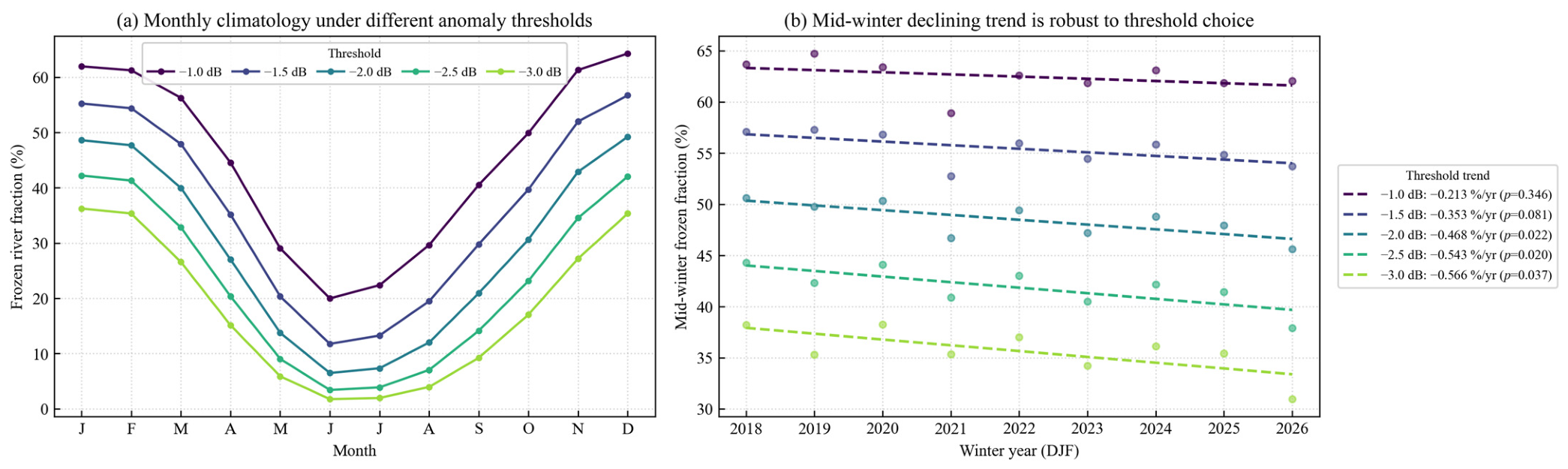
To verify that our results are not artifacts of this particular threshold, we performed a sensitivity test in which the frozen-pixel classification was repeated across thresholds ranging from −1.0 to −3.0 dB, using the same river mask and summer baseline throughout. The decadal sign and significance of the mid-winter ice-cover trend were robust across the −1.5 to −3.0 dB range (all p < 0.085), with only the most permissive −1.0 dB threshold yielding a non-significant result; the −2 dB choice falls within the stable central range (Appendix A, Figure A4, and Table A3).

2.5. Statistical Analysis

Decadal trends in mid-winter (December–February) ice cover and backscatter anomaly were assessed using ordinary least-squares (OLS) linear regression, with significance tested at α = 0.05. To address the sensitivity of short time series to individual extreme years, we additionally applied the non-parametric Mann–Kendall trend test and Sen’s slope estimator to all key time series; these results are reported alongside the OLS estimates in Appendix A, Table A2. Anomaly detection for individual winters was based on z-scores against the 2017–2025 climatology. Welch’s t-tests were applied where appropriate. For z-score-based anomaly tests, one-tailed p-values were derived from the standard normal distribution, reflecting the directional hypothesis that mid-winter ice cover decreases under regional climate warming. Throughout the paper, regression results are reported uniformly as slope, coefficient of determination (R2), and p-value.

2.6. SHP Generation Projection

To project long-term SHP generation under the Peak Water hypothesis, we adopted a purely conceptual trajectory model rather than a calibrated hydrological simulation, because no in situ discharge records exist for the catchment. The model assumes that mountain catchments with glacier/snow contribution exhibit increasing runoff until “Peak Water” before declining; for Tien Shan headwaters, Peak Water is expected between 2040 and 2055 based on regional glacier-runoff modeling [9]. We modeled annual generation for a representative 5 MW run-of-river plant with an assumed capacity factor of 0.55—values typical of mid-elevation Kyrgyz SHP installations—under a rising limb (1990–2048, +30% vs. 1990 baseline) and a declining limb (2048–2080, −25% vs. baseline), with uncertainty bands of ±10–25% expanding post-peak. We emphasize that these parameters are illustrative and intended to bound the qualitative shape of the trajectory; absolute generation values should not be interpreted as site-calibrated forecasts.

3. Results

3.1. Seasonal Ice Climatology

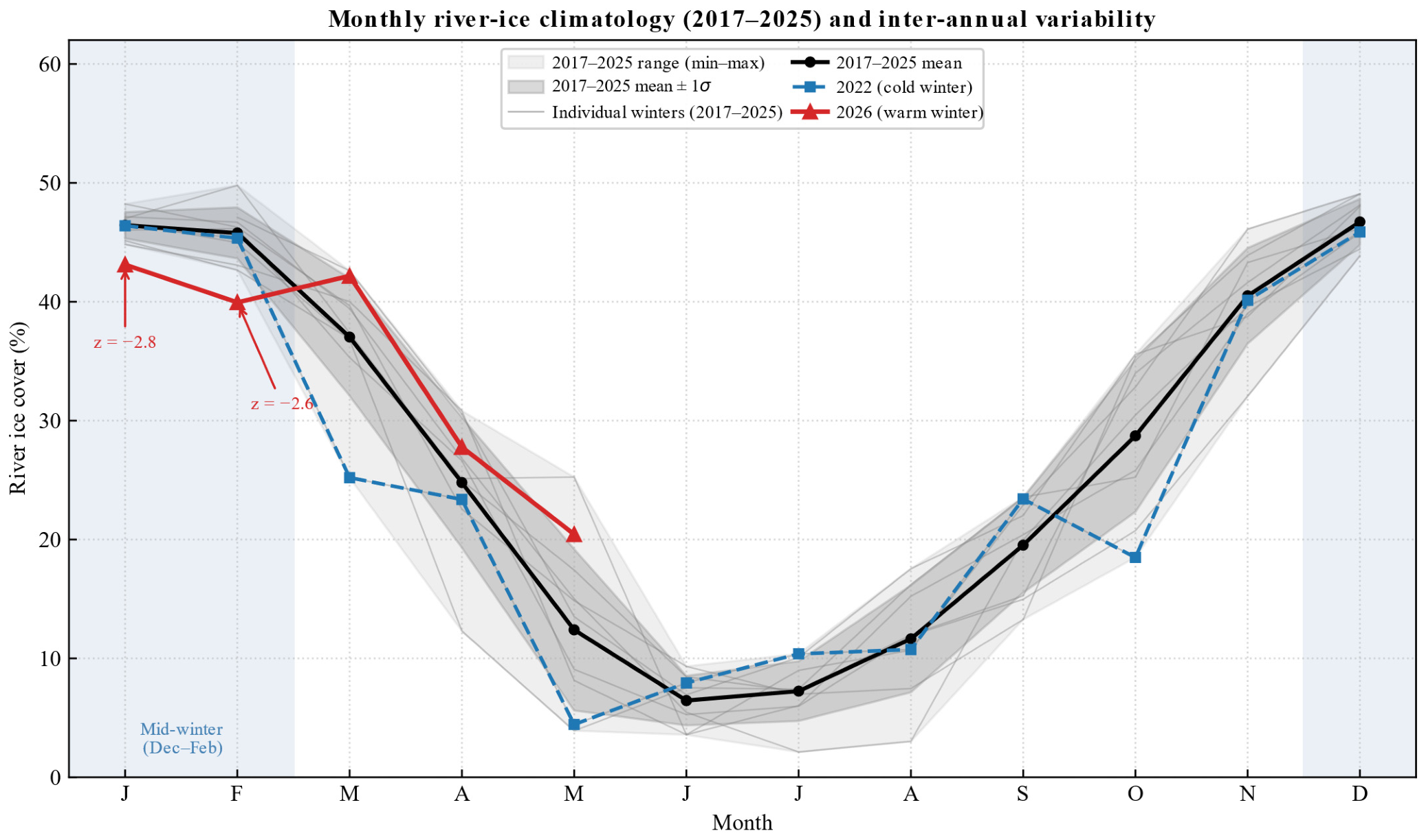
The 2017–2025 climatology revealed a clear annual ice cycle with peak frozen-pixel ratios of 46.7 ± 1.9% in December and 46.4 ± 1.5% in January, declining through spring to a summer minimum of 6.5 ± 2.1% in June (Figure 3). Mid-winter (December–February) values exhibited remarkably low interannual variability (CV < 5%), indicating a stable freezing regime over the first nine winters of the record. The seasonal amplitude (≈40 percentage points) provided a strong basis for trend detection. Mid-winter ice covered an average area of 26.8 km2, approximately fivefold higher than the summer-baseline noise (5.5 km2). To allow a full assessment of interannual variability, Figure 3 displays the individual seasonal course of every monitored year (2017–2025) overlaid on the climatological mean ± 1 σ envelope and the 2026 anomaly.

3.2. Decadal Trend in Mid-Winter Ice Cover and Intensity

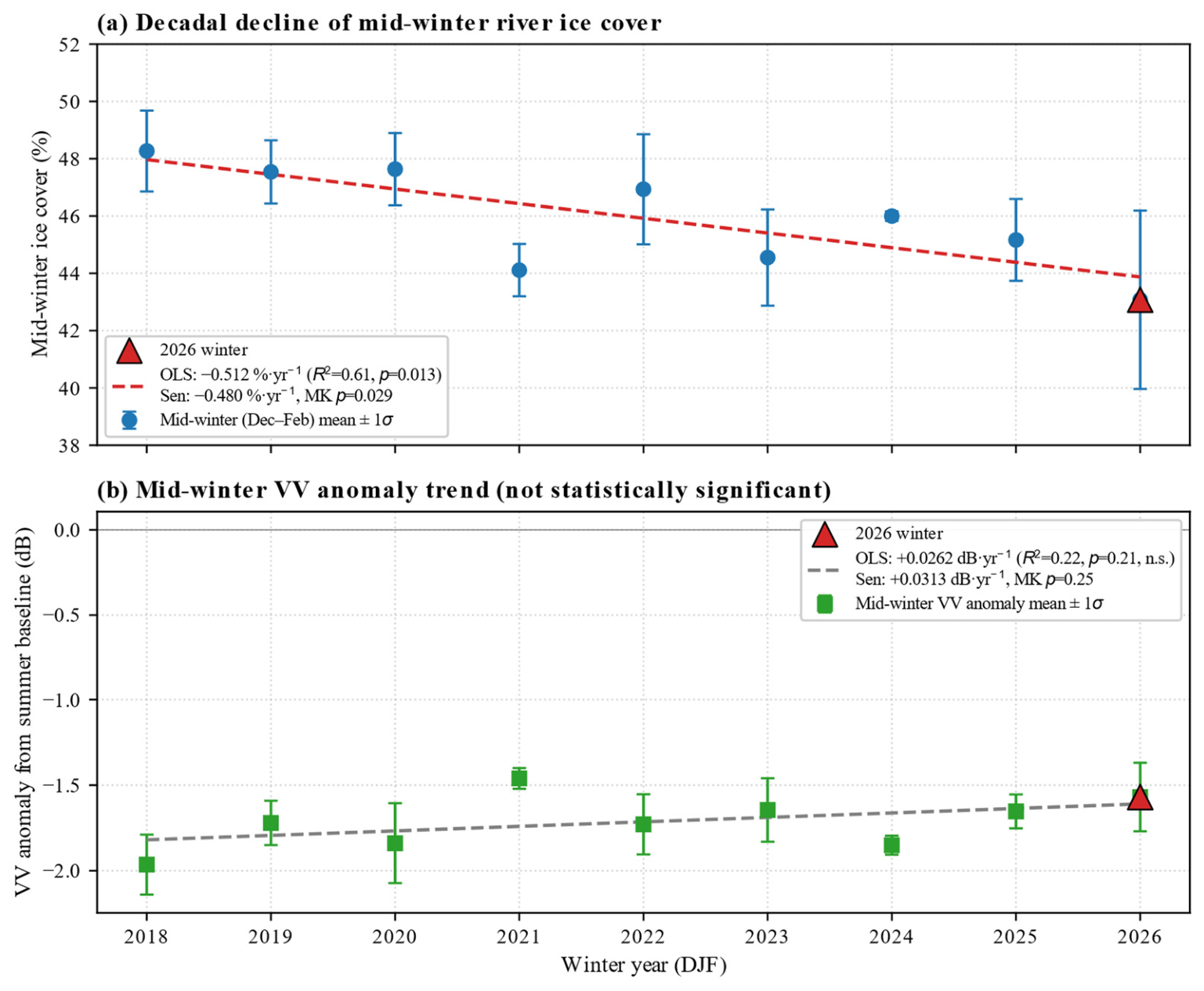
Mid-winter ice cover declined significantly at −0.51%·yr−1 (R2 = 0.61, p = 0.013) over 2017–2026, equivalent to a cumulative reduction of approximately 4.6 percentage points (47.6% → 43.1%) over the decade (Figure 4a). This decline was confirmed by the non-parametric Mann–Kendall test (Sen’s slope −0.48%·yr−1, p = 0.029), indicating that the trend is not an artifact of individual extreme years. The endpoint contrast is illustrated quantitatively in Appendix A, Table A1, which compares monthly VV backscatter, anomaly, and frozen area between the coldest year of the record (2018; DJF ice cover 48.3%) and the warmest year (2026; DJF 41.5%). Concurrently, the mean winter VV anomaly exhibited a weakening tendency (+0.026 dB·yr−1, R2 = 0.22, p = 0.21; Mann–Kendall p = 0.25), suggesting that the ice signal became progressively closer to that of open water; however, this backscatter trend is not statistically significant over the nine-winter record and should be regarded as a qualitative indication rather than conclusive evidence (Figure 4b). Because SAR backscatter responds to a combination of surface roughness, ice structure, and snow loading, it serves as a relative indicator of ice condition rather than a direct measurement of thickness.
By contrast, ice phenology metrics (freeze-up month, breakup month, season length) showed no significant trends (all p > 0.27; Mann–Kendall p > 0.46), with the freeze-up and breakup months remaining at October–November and March–April, respectively. Only peak winter ice cover exhibited a marginal declining trend (−0.40%·yr−1, p = 0.074). This decoupling of stable phenological timing from declining mid-winter ice cover is consistent with the early stage of a “thinning-before-shortening” regime documented for Northern Hemisphere lake ice [26,27,28].
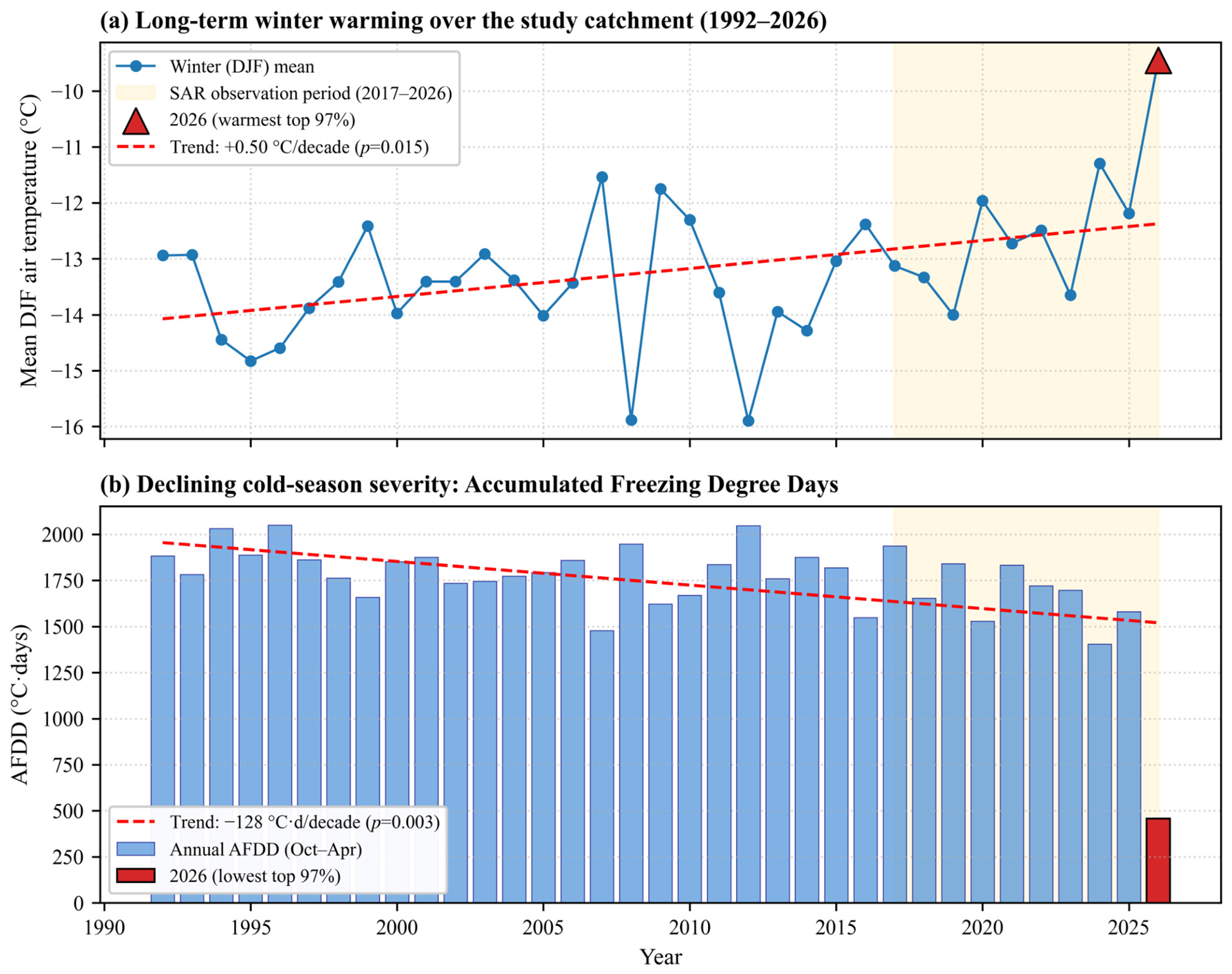
The corresponding long-term climate context, derived from 35 years of ERA5-Land reanalysis (1992–2026), is presented in Figure 5. Mean winter air temperature warmed significantly (+0.50 °C·decade−1, p = 0.015), and cold-season severity, measured by Accumulated Freezing Degree Days (AFDD), declined concomitantly (−128 °C·d·decade−1, p = 0.003). The 2026 winter appears as a significant outlier in both datasets.

3.3. Long-Term Precipitation and Snow Context

Because precipitation and snow cover are significant controls on the formation and disappearance of river ice in mountain basins, we examined their long-term winter trends using the same ERA5-Land record (1992–2026; Appendix A, Table A4). Over the 34 complete winters, neither winter total precipitation nor snowfall exhibited a statistically significant trend (OLS +1.0 mm·decade−1, R2 ≈ 0.00, p ≈ 0.72; Mann–Kendall p ≈ 0.70). Winter mean snow depth and snow water equivalent (SWE) showed weak, non-significant declines (Sen’s slope −2.0 cm·decade−1 and −2.6 mm·decade−1, respectively; Mann–Kendall p ≈ 0.46). The absence of significant precipitation or snowpack trends, contrasted with the significant winter warming and AFDD decline reported above (Figure 5), indicates that the observed river-ice decline is driven primarily by thermal forcing rather than by changes in precipitation supply or snow loading.

3.4. The 2026 Anomaly

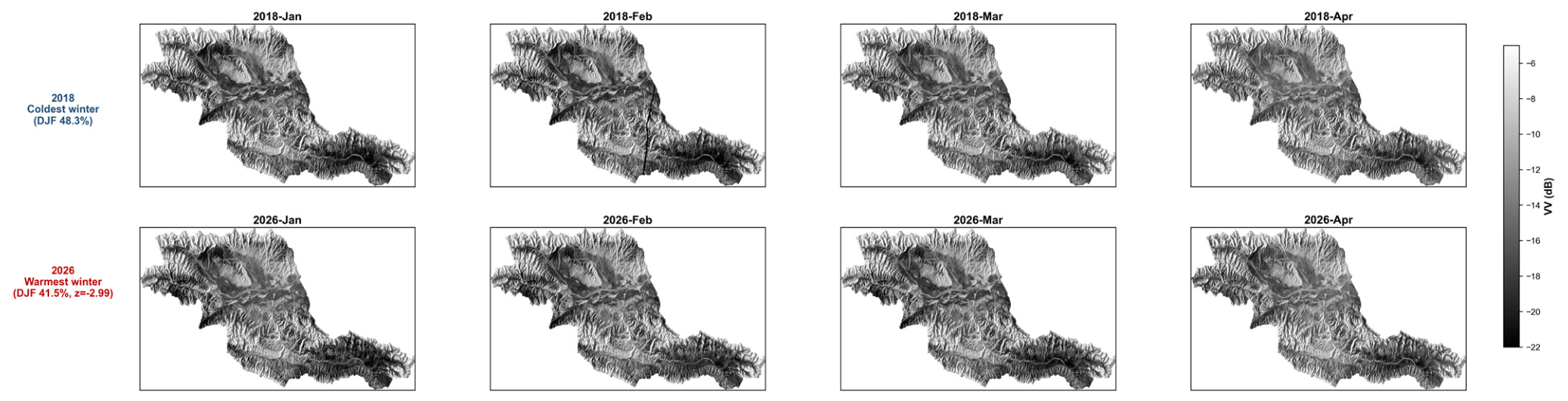
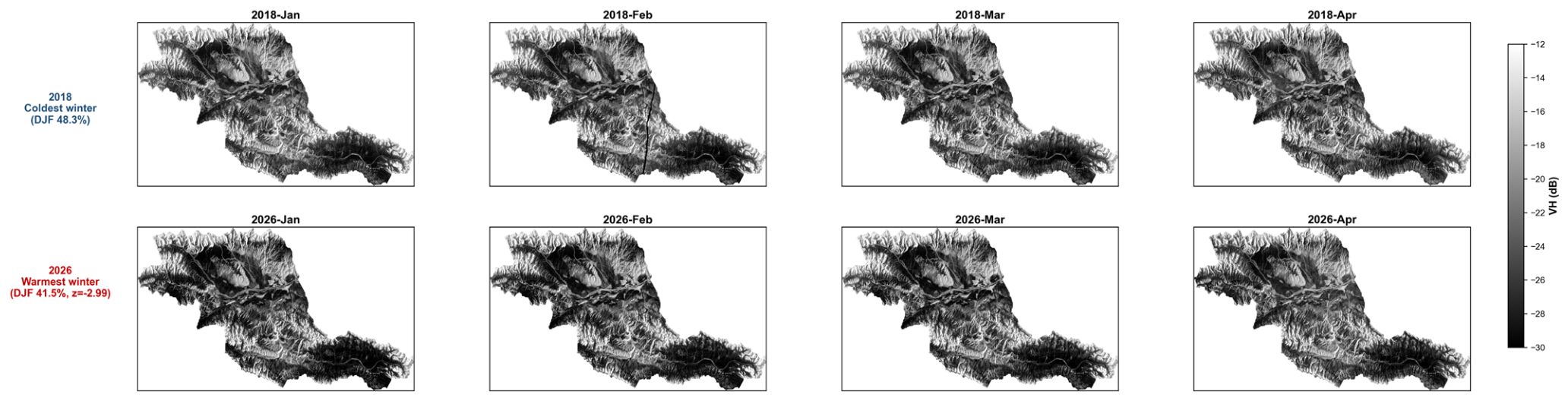
The 2026 winter recorded an unprecedented departure from climatology (Figure 3). The spatial extent of this anomaly is shown in Appendix A, Figure A1 (VV polarization) and Appendix A, Figure A2 (VH polarization), which display SAR backscatter mosaics for January–April of the warmest winter (2026) alongside the coldest winter on record (2018) as a reference for maximum-ice conditions. January and February ice cover dropped to 43.1% and 39.9%, corresponding to z-scores of −2.77 and −2.57 (one-tailed p ≈ 0.003 and 0.005, respectively), more than 2.5 σ below the 2017–2025 climatological mean, which had itself remained within a coefficient of variation of 5%. Mean winter VV anomaly in 2026 (−1.46 dB) was the highest (least frozen) in the record, compared to a 2017 value of −1.91 dB. Conversely, March and May 2026 exhibited above-average ice cover (z = +1.04 and +1.18), suggesting that thinner mid-winter ice persisted later into spring due to the delayed onset of strong warming.

3.5. Bidirectional Climate Sensitivity: 2022 vs. 2026

To characterize the modes of climate impact on river ice in this catchment, we compared the two most diagnostic anomalous winters of the 2017–2026 record (Table 1). We emphasize that the 2022 and 2026 winters were not selected as the absolute temperature extremes of the record—that role is held by 2018, the coldest winter in terms of ice extent (DJF ice cover 48.3%), which is retained as the maximum-ice reference in Appendix A, Figure A1 and Table A1. Rather, 2022 and 2026 were selected because they represent two fundamentally different modes of departure from the climatological norm, each carrying distinct implications for small hydropower (SHP) operations.
The 2022 winter exemplifies the “thick-ice, early-breakup” cold mode. Mid-winter ice cover remained near the 2017–2025 baseline (z ≈ 0 in both January and February; Table 1), yet the winter mean VV anomaly was the most negative in the record (−1.71 dB), consistent with unusually thick and/or hydraulically rough ice. This anomalously robust ice cover collapsed abruptly the following spring: ice cover fell from 45.3% in February to 25.2% in March 2022, a record-breaking departure of z = −5.69 from the March climatology (38.5 ± 2.3%).
The 2026 winter exemplifies the opposite “thin-ice, persistent-melt” warm mode. Mid-winter ice cover dropped to record-low values of 43.1% in January and 39.9% in February (z = −2.77 and −2.57, respectively; Table 1), accompanied by a markedly less negative winter mean VV anomaly (−1.46 dB)—the highest (least frozen) value in the record. Unlike the 2022 case, however, the thinner mid-winter ice in 2026 did not trigger an early breakup; instead, March and April ice cover remained above the climatological mean (z = +1.57 and +1.04, respectively), indicating a delayed and prolonged melt-out. Appendix A, Table A1 quantifies this asymmetry: the VV − VH co/cross-polarization difference increased from 7.89–8.94 dB in 2018 to 9.09–9.70 dB in 2026, which is consistent with smoother and thinner ice rather than reduced ice extent alone.
These two contrasting modes—a cold-but-fragile regime (thick ice followed by abrupt breakup, exemplified by 2022) and a warm-but-persistent regime (thin discontinuous ice with delayed melt, exemplified by 2026)—correspond to fundamentally different SHP operational hazards. The cold-mode pathway generates ice-run and ice-jam risks consistent with documented water–ice flow events in the northern Tien Shan, where rapid warming following sharp cooling produces destructive discharges [15]. The warm-mode pathway, by contrast, promotes frazil and slush formation, which is responsible for the majority of trash-rack clogging events at high-altitude SHP plants [4,5]. Importantly, the existence of both modes within a single ten-year record demonstrates that climate-driven SHP risk cannot be reduced to a unidirectional “warmer = safer” or “colder = safer” framing, a point developed further in Section 4.3.

3.6. Implications for Hydropower Generation Under the Peak Water Hypothesis

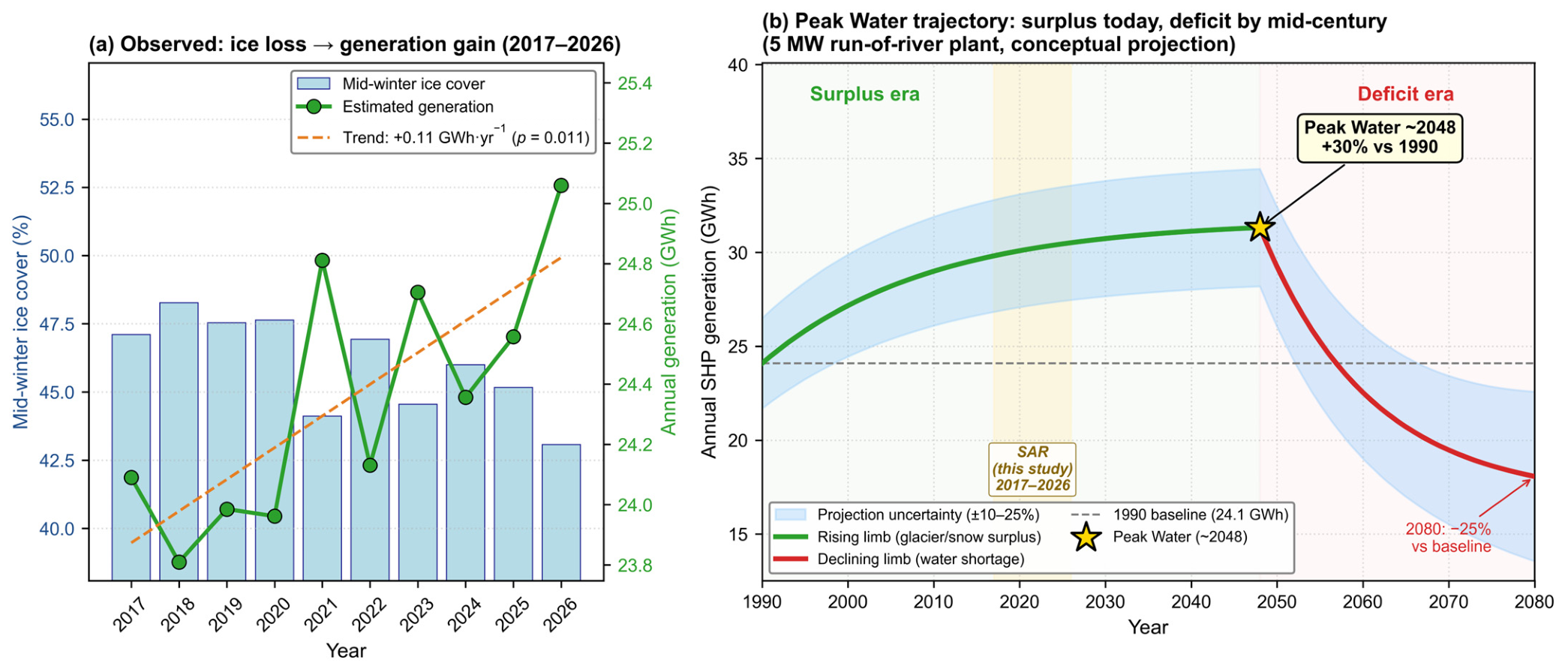
Translating the observed ice loss into hydropower terms within the conceptual framework described in Section 2.6, our 2017–2026 trend is consistent with the early rising limb of the Peak Water trajectory (Figure 6a). We caution that, in the absence of in situ discharge records, this translation is illustrative rather than a calibrated generation estimate; the modeled runoff proxy derived from ERA5-Land (Appendix A, Figure A3) captures the expected snowmelt-dominated seasonality but cannot substitute for gauged streamflow. Extrapolation to mid-century under the Peak Water framework projects a transient generation surplus reaching approximately +30% above the 1990 baseline by ~2048, followed by a decline toward −25% by 2080 as glacier and snow reserves are progressively exhausted (Figure 6b). These projections should be read as a conceptual scenario bounding the plausible trajectory shape rather than as a site-specific forecast.

4. Discussion

4.1. Thermodynamic Regime Shift and Its Detection by SAR

The significant decline of mid-winter ice cover (−0.51%·yr−1), together with a weakening tendency in the VV backscatter anomaly, in the absence of a statistically significant phenological shift (freeze-up, breakup, and season length all p > 0.27; Section 3.2), is directionally consistent with the “thinning-before-shortening” framework documented for Northern Hemisphere lake ice [26,27,28]. Under this framework, warming winters first erode ice thickness and surface quality before substantially altering the freeze/thaw calendar. We stress, however, that the backscatter weakening is not statistically significant over our nine-winter record and that SAR intensity is a relative indicator; the thinning interpretation is therefore advanced as a hypothesis consistent with our observations rather than as a directly measured result. Large-ensemble climate projections support this sequencing: future lake ice loss is expected to manifest as both reduced maximum thickness and shorter duration, with maximum thickness projected to decrease by ~0.23 m by 2100 over the Tibetan Plateau [27].
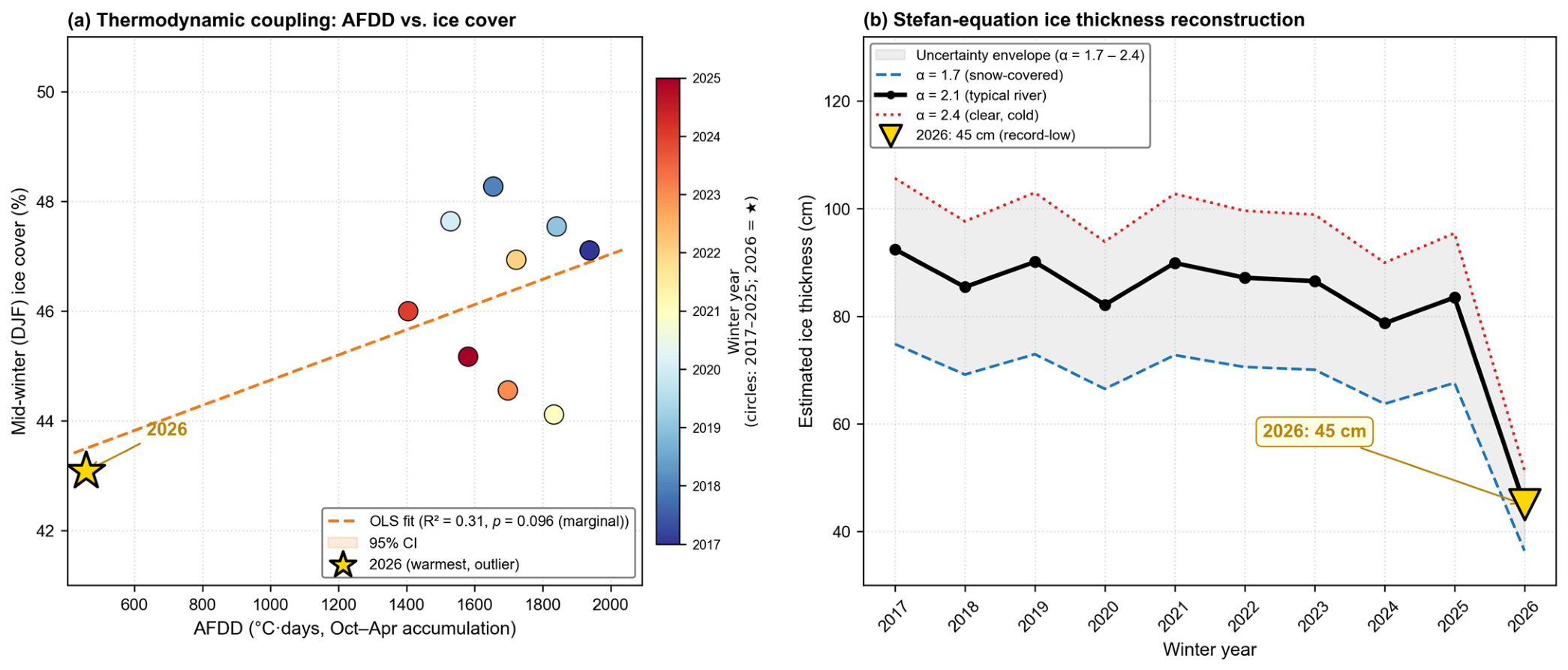
Two independent but suggestive lines of evidence in our data point toward a thickness-related change. First, direct coupling of SAR-derived mid-winter ice cover with cumulative cold (AFDD) reveals an inverse relationship (Figure 7a; R2 = 0.31, p = 0.096, marginal at α = 0.05), and the Stefan-equation reconstruction (Figure 7b) yields a tentative thinning trajectory across the observation period, with the 2026 winter producing the thinnest estimated ice in the record (≈45 cm). Because no in situ ice-thickness measurements exist for the catchment, this reconstruction is presented with an explicit parametric uncertainty band rather than as a validated thickness retrieval. Second, the polarization geometry of the SAR signal is consistent with a thickness- rather than extent-driven change: the VV − VH co/cross-polarization difference increased from 7.89–8.94 dB in 2018 to 9.09–9.70 dB in 2026. Because VH is more sensitive to volume scattering from rough or layered ice while VV is dominated by specular returns from smooth surfaces, this widening contrast is suggestive of ice that is both smoother and thinner rather than simply less extensive. We emphasize that, in the absence of field validation, these signatures are interpreted qualitatively, and confirmation would require ground-based ice-thickness measurements.
This regime shift is consistent with the broader pattern of cryospheric retreat in the region. Tien Shan glaciers have lost 15–20% of their area since the 1960s–1970s [6,7,8,9], and snow-covered days have decreased by 8–14 days per decade in several Tianshan sectors [10,11]. Although the study catchment is snow-dominated with negligible direct glacier input near the SHP site, the river-ice signal we observe is part of an interconnected cryospheric response in which glacier ablation, snowpack evolution, and river-ice thinning are driven by the same warming forcing. Regionally, accelerating glacier mass loss and earlier snowmelt advance the timing and increase the volume of spring runoff [9], which in turn modulates the thermal and hydraulic regime governing river-ice growth and decay; conversely, thinner and shorter-lived river ice feeds back on channel heat exchange. Although a full attribution of these synergistic linkages is beyond the scope of our SAR record, our results indicate that river ice responds sensitively to the same climatic forcing as glaciers and snow and can therefore serve as a complementary indicator within an integrated cryospheric monitoring framework.
Finally, the successful detection of these trends in narrow, steep mountain rivers addresses a methodological challenge highlighted in the SAR literature: monitoring high-order, narrow rivers with SAR is difficult due to complex topography and small channel width [25], with terrain-induced layover and shadow being major limitations [21,22,23]. Our per-pixel summer-baseline anomaly approach explicitly addresses these challenges by normalizing static terrain effects and isolating the temporal climate signal, building on established per-pixel change-detection methods in flood mapping and permafrost monitoring [29,30,31].

4.2. The 2026 Anomaly: Tipping Point or Interannual Variability?

The 2026 winter’s ~2.7–2.8 σ deviation in January–February ice cover is the largest single-winter departure in the nine-year record. Mid-winter ice cover in 2017–2025 exhibited remarkably low variability (CV < 5%), making a departure of this magnitude (|z| > 2.5) a priori improbable (one-tailed p ≈ 0.003 for January). The contrast between 2022 (cold, thick ice) and 2026 (warm, thin ice) further demonstrates bidirectional sensitivity, in which both cold and warm extremes can produce hazardous SHP conditions through different mechanisms.
Nonetheless, a nine-year observational record is insufficient to conclusively distinguish a regime shift from interannual variability. To partially address this short-record limitation, we placed the SAR observations within the longer 1992–2026 ERA5-Land reanalysis context (Figure 5 and Appendix A, Figure A3), which confirms that 2026 ranks among the warmest and least severe winters of the 35-year record. Continued monitoring through the late 2020s, combined with longer climate reanalyses and CMIP6-informed projections, will be necessary to establish whether 2026 marks the onset of more frequent warm-winter anomalies or a transient extreme.

4.3. SHP Operations: Beyond Linear Risk Reduction

The bidirectional climate sensitivity revealed in our analysis carries direct implications for SHP operational planning. A central finding in the broader hydropower literature is that climate-driven changes in ice regimes do not translate into proportional reductions in operational problems: shortened ice seasons are offset by more mid-winter thaws and breakups, expanding the time window for frazil and jam events [5,34,35,36]. For small, often steep run-of-river plants in Alpine and Norwegian settings, ice problems exceed flood damages, with frazil accumulation and ice-run intake blockages constituting dominant issues [5].
Frazil and drifting ice can rapidly clog trash racks, block intakes, and force shutdowns; frazil is identified as a major and frequent cause of immediate blockage at hydropower intakes [3,37,38]. Breakup and ice jams can cause hanging dams, sharp water-level changes, and ice-run hazards that complicate shutdown/restart strategies [3,39,40].
These considerations argue against a simplistic interpretation of declining ice as uniformly beneficial for SHP. Instead, our results suggest that the Kyrgyz SHP sector may currently be experiencing a transient productivity gain from meltwater surge, but with rising operational variability that may erode net benefits. For the specific conditions of high-altitude Tien Shan run-of-river plants, we recommend a set of concrete adaptive measures: (i) installing heated or sloped trash racks and air-bubbler or warm-water diffuser systems at intakes to mitigate frazil and anchor-ice blockage during cold-mode winters [37,38]; (ii) adopting flexible winter operating rules—including controlled discharge to encourage a stable continuous ice cover where hydraulically beneficial, and pre-emptive drawdown ahead of forecast warm spells to limit ice-jam surge risk during warm-mode breakups [3,39]; (iii) integrating near-real-time satellite ice monitoring of the type demonstrated here into operational decision support, providing early warning of both early-breakup (cold-mode) and persistent-thin-ice (warm-mode) conditions [36,41,42,43]; and (iv) scheduling maintenance and inspection windows around the October–November freeze-up and March–April breakup periods identified as phenologically stable in this record. Because the dominant hazard differs between cold and warm winters, these measures should be deployed as a flexible portfolio rather than a fixed seasonal protocol.

4.4. The Peak Water Hypothesis and Long-Term SHP Planning

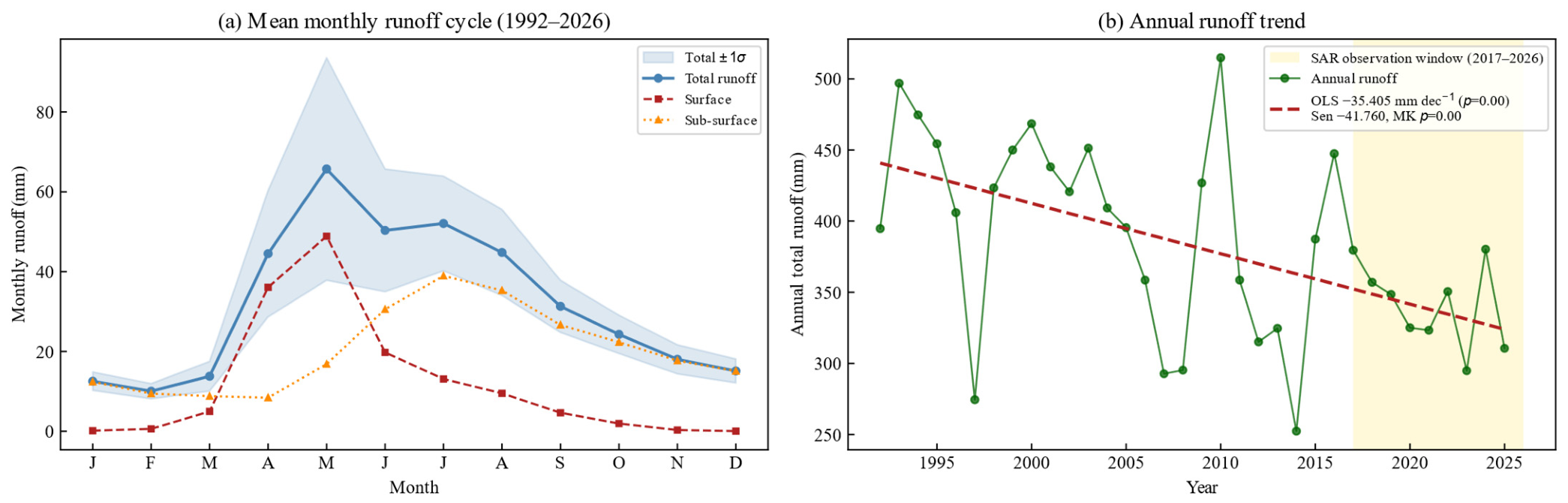
Our observed ice loss is consistent with the rising limb of the Peak Water trajectory, in which deglaciating mountain catchments experience temporarily increased runoff before reserves are exhausted [9]. For Tien Shan SHP planning, this implies a window of opportunity—likely closing by 2040–2055—during which winter generation may benefit from reduced ice blockage and earlier meltwater pulses. We note, however, that the ERA5-Land modeled runoff for our catchment does not itself show a rising trend over 1992–2026 (Appendix A, Figure A3); given the known limitations of reanalysis runoff in complex mountainous terrain and the snow-dominated character of this specific basin, we interpret this cautiously and emphasize that catchment-scale runoff projections require dedicated, calibrated hydrological modeling. Beyond Peak Water, generation is generally projected to decline as glacier and snow contributions diminish.
This framing has policy implications. Current SHP investment decisions in Kyrgyzstan, often based on recent (post-2000) hydrological records, may overestimate long-term plant productivity by capturing the rising limb without accounting for the subsequent decline. Incorporating Peak Water projections into project financing, water-rights allocation, and grid-integration planning could improve the long-term resilience and sustainability of Central Asian SHP development, ensuring that the region’s clean-energy transition remains robust to cryospheric change and aligned with the water–energy–climate objectives of the UN Sustainable Development Goals.

4.5. Method Transferability and Limitations

The per-pixel summer-baseline anomaly approach developed here is transferable to other data-scarce mountain regions. The combination of Sentinel-1 SAR with HydroSHEDS-based river masks and JRC permanent-water layers requires only freely available global datasets, and the entire workflow can be executed within Google Earth Engine.
Several limitations warrant acknowledgment. First, the −2 dB anomaly threshold is empirically derived; although our sensitivity test (Section 2.4, Appendix A, Figure A4) shows that the decadal trend is robust across −1.5 to −3.0 dB, recalibration may be required for catchments with different ice types or terrain. Second, monthly median composites smooth over sub-monthly events such as freeze-up and breakup transitions, limiting temporal resolution for ice-jam forecasting. Third, the absence of in situ ice-thickness and discharge validation in our basin means that the SAR-derived intensity weakening and the Stefan-equation thickness reconstruction can only be interpreted as relative indicators, not absolute measurements; field campaigns and gauged streamflow would be required for quantitative validation. Fourth, in narrow mountain channels where the river width approaches or falls below the 20 m SAR pixel size, mixed pixels combining river ice with adjacent bank, vegetation, or wet-soil returns introduce classification uncertainty that may bias the absolute frozen-fraction estimates, although the per-pixel anomaly normalization mitigates this effect for relative temporal comparisons. Fifth, our nine-year record, while one of the longest continuous SAR-based river-ice records published for Central Asian mountain rivers, remains short for detecting regime shifts, and continued monitoring together with CMIP6-informed projections will be essential.
To support reproducibility, Appendix A, Figure A1 and Figure A2 provide the spatial SAR backscatter mosaics underlying the catchment-aggregated trends, and Appendix A, Table A1 reports the underlying monthly pixel-level statistics, allowing readers to independently inspect the 2018 (maximum-ice) and 2026 (minimum-ice) endpoints of our ten-year record.

5. Conclusions

This study presents the first decadal-scale Sentinel-1 SAR record of river ice for a Tien Shan headwater catchment (5320 km2, 2017–2026, n = 112 monthly composites). Using a per-pixel summer-baseline anomaly approach, we documented a significant decline in mid-winter ice cover at −0.51%·yr−1 (p = 0.013; Mann–Kendall p = 0.029), accompanied by a weakening tendency in backscatter anomalies (+0.026 dB·yr−1, p = 0.21) that, while not statistically significant over the nine-winter record, is directionally consistent with a thermodynamically driven “thinning-before-shortening” regime shift. A threshold-sensitivity test confirmed that the ice-cover trend is robust to the choice of anomaly threshold, and non-parametric tests corroborated the parametric results. Long-term ERA5-Land reanalysis showed significant winter warming with no significant change in precipitation or snowfall, indicating that the decline is primarily thermally forced. The 2026 winter recorded an unprecedented 2.6–2.8 σ deviation from the 2017–2025 climatology. Bidirectional climate sensitivity—with cold winters (2022) producing rapid breakups and warm winters (2026) producing thin persistent ice—argues against a simplistic view of declining ice as uniformly beneficial for SHP operations.
Under the Peak Water hypothesis, interpreted here as a conceptual scenario in the absence of calibrated hydrological data, observed ice loss is associated with a transient SHP generation surplus that may peak around 2045–2050 before declining. Adaptive operational strategies—including frazil mitigation at intakes, flexible winter operating rules, and satellite-based real-time monitoring—will be required to maintain SHP reliability across this transition. Our results provide the first decadal, satellite-based evidence of river-ice loss for Central Asian mountain rivers and offer a transferable monitoring framework for ungauged SHP basins worldwide—supporting evidence-based, climate-resilient planning that advances the sustainable development of mountain hydropower (SDG 7) under accelerating climate change (SDG 13).


Author Contributions

Conceptualization, S.-J.L., M.-S.K., J.K. and H.-S.Y.; Methodology, S.-J.L., M.-S.K., J.K. and H.-S.Y.; Software, S.-J.L., J.K. and H.-S.Y.; Validation, S.-J.L., J.K. and H.-S.Y.; Formal Analysis, S.-J.L., J.K. and H.-S.Y.; Investigation, S.-J.L., J.K. and H.-S.Y.; Resources, S.-J.L., J.K. and H.-S.Y.; Data Curation, S.-J.L., M.-S.K., J.K. and H.-S.Y.; Writing—Original Draft Preparation, S.-J.L., M.-S.K., J.K. and H.-S.Y.; Writing—Review and Editing, S.-J.L., J.K. and H.-S.Y.; Visualization, S.-J.L., J.K. and H.-S.Y.; Supervision, S.-J.L., J.K. and H.-S.Y.; Project Administration, S.-J.L., J.K. and H.-S.Y.; Funding Acquisition, S.-J.L., M.-S.K., J.K. and H.-S.Y. All authors have read and agreed to the published version of the manuscript.

Funding

This work was supported by a National Research Foundation of Korea (NRF) grant funded by the Korean government (MSIT) (RS–2026–25488422).

Institutional Review Board Statement

Not applicable.

Informed Consent Statement

Not applicable.

Data Availability Statement

The Sentinel-1 SAR Ground Range Detected (GRD) data used in this study are publicly available through the Copernicus Open Access Hub (https://scihub.copernicus.eu; accessed on 1 May 2026) and were accessed and processed via the Google Earth Engine (GEE) cloud computing platform (https://earthengine.google.com; accessed on 1 May 2026). ERA5-Land reanalysis data are available from the Copernicus Climate Data Store (https://cds.climate.copernicus.eu; accessed on 1 May 2026) and were also accessed through GEE. Processed datasets and Google Earth Engine scripts supporting the findings of this study are available from the corresponding author upon reasonable request.

Conflicts of Interest

The authors declare no conflicts of interest.

Abbreviations

The following abbreviations are used in this manuscript:
AFDDAccumulated Freezing Degree Days
AOIArea of Interest
CMIP6Coupled Model Intercomparison Project Phase 6
CVCoefficient of Variation
dBDecibel
DEMDigital Elevation Model
DJFDecember–January–February (boreal winter)
ECMWFEuropean Centre for Medium-Range Weather Forecasts
EPSGEuropean Petroleum Survey Group (Coordinate Reference Codes)
ERA5ECMWF Reanalysis v5
GEEGoogle Earth Engine
GRDGround Range Detected
GWhGigawatt-Hour
IWInterferometric Wide swath (Sentinel-1 Acquisition Mode)
JRCJoint Research Centre (European Commission)
LZWLempel–Ziv–Welch (Lossless Compression)
MODISModerate Resolution Imaging Spectroradiometer
MWMegawatt
NoDataNo Data Value (Raster NoData Flag)
OLSOrdinary Least Squares
PFTIPercentile-based Freeze–Thaw Identification
RMSERoot Mean Square Error
SARSynthetic Aperture Radar
SDGSustainable Development Goal
SHPSmall Hydropower
SRTMShuttle Radar Topography Mission
SWESnow Water Equivalent
VHVertical transmit, Horizontal Receive (Cross-polarization)
VVVertical transmit, Vertical Receive (Co-polarization)

Appendix A

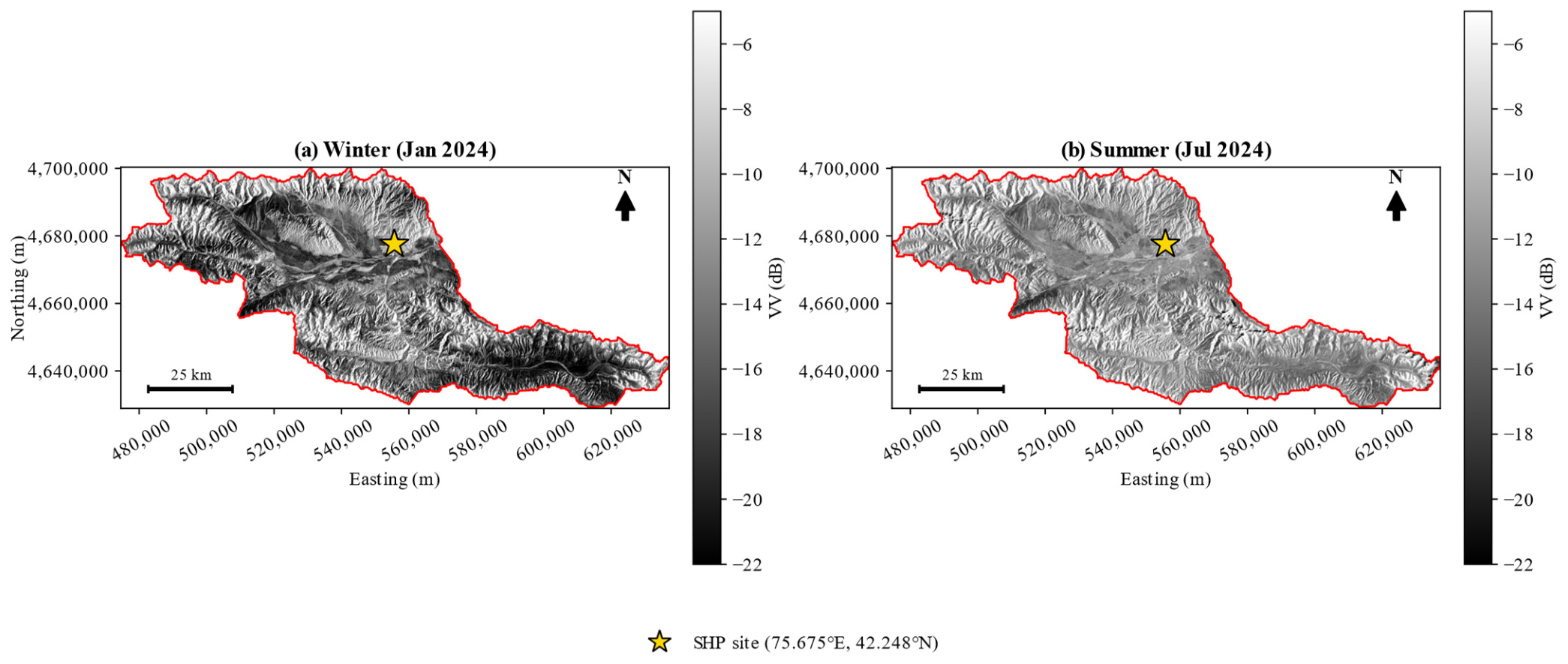
Appendix A provides supplementary spatial and tabular evidence supporting the catchment-aggregated trends reported in Section 3.2 and the regime-shift interpretation in Section 4.1. Specifically, Appendix A, Figure A1 and Figure A2 show monthly SAR backscatter mosaics (VV and VH polarizations, respectively) for January–April of the coldest (2018) and warmest (2026) winters of the 2017–2026 record, while Appendix A, Table A1 tabulates the corresponding pixel-level statistics. These endpoint comparisons complement the bidirectional 2022 vs. 2026 climate-sensitivity analysis presented in Section 3.4 (Table 1).
Figure A1. Sentinel-1 SAR VV backscatter mosaic for January–April of the coldest winter on record (2018, DJF ice cover 48.3%) and the warmest winter on record (2026, DJF ice cover 41.5%, z = −2.77 in January). Each panel shows a monthly median composite (20 m resolution, descending orbit, IW mode) clipped to the 5320 km2 study catchment (red outline). Gray scale: VV backscatter from −22 dB (black, strong ice/low scattering) to −5 dB (white, open water or wet surfaces). The visual contrast between rows illustrates the progressive weakening of the winter ice signal: 2026 panels are systematically brighter (less negative VV) than the 2018 equivalents, consistent with the decadal trends quantified in Figure 4 and the values tabulated in Appendix A, Table A1.
Sustainability 18 06110 g0a1
Figure A2. As in Appendix A, Figure A1, but for cross-polarized VH backscatter (range −30 to −12 dB). VH is more sensitive to volume scattering from rough or layered ice and is generally less affected by specular returns from smooth surfaces. The smaller cold–warm winter contrast in VH compared with VV (Appendix A, Table A1: VV−VH increased from 7.89–8.94 dB in 2018 to 9.09–9.70 dB in 2026) suggests that 2026 ice was both smoother (reduced VV contrast loss) and thinner (reduced VH volume scattering), supporting the “thinning-before-shortening” interpretation in Section 4.1.
Sustainability 18 06110 g0a2
Figure A3. ERA5-Land modeled runoff over the study catchment (Site A) as a qualitative proxy for absent in situ discharge (1992–2026). (a) Mean monthly runoff cycle. The solid blue line shows total runoff (mean ± 1 σ envelope, light-blue band); the red dashed line shows the surface-runoff component and the orange dotted line the sub-surface component. Runoff is low in winter (≈10–15 mm·month−1, predominantly sub-surface) and peaks sharply in May (≈66 mm·month−1) as snowmelt-driven surface runoff dominates, confirming the snowmelt-controlled seasonality expected for this basin. (b) Annual total runoff trend. The green line shows annual runoff; the red dashed line is the ordinary least-squares (OLS) trend (−35.4 mm·decade−1, p < 0.01; Sen’s slope −41.8 mm·decade−1, Mann–Kendall p < 0.01). The SAR observation window (2017–2026) is highlighted in yellow. Because reanalysis runoff is known to have limited reliability in complex mountainous terrain, this modeled series is used only as a qualitative indicator of streamflow seasonality and is not interpreted as a calibrated discharge record.
Sustainability 18 06110 g0a3
Figure A4. Sensitivity of river-ice detection to the SAR backscatter-anomaly threshold. (a) Monthly climatology of the frozen river fraction (%) computed under five anomaly thresholds (−1.0, −1.5, −2.0, −2.5, and −3.0 dB), using a common river mask and summer (June–August) baseline throughout. More negative thresholds yield systematically lower absolute frozen fractions, but all curves preserve the same seasonal cycle. (b) Mid-winter (December–February) frozen-fraction trend by winter year (2018–2026) for each threshold; dashed lines are OLS fits. Although the magnitude of the absolute slope increases at stricter thresholds (because the baseline frozen fraction is correspondingly smaller), the sign and statistical significance of the declining trend are stable across the −1.5 to −3.0 dB range (p = 0.081, 0.022, 0.020, and 0.037, respectively); only the most permissive −1.0 dB threshold yields a non-significant trend (p = 0.346). The −2 dB threshold adopted in this study therefore falls within the stable central range, confirming the robustness of the reported decline. Absolute slopes in this sensitivity test are computed on the full river mask and differ marginally from the main-analysis value (−0.512%·yr−1; Figure 4, Appendix A, Table A2), which uses the valid-pixel subset; the relative robustness across thresholds is unaffected.
Sustainability 18 06110 g0a4
Table A1. Monthly Sentinel-1 SAR backscatter statistics and derived ice metrics for January–April of the coldest (2018) and warmest (2026) winters in the 2017–2026 record. VV values are mean ± standard deviation over n = 145,531 river pixels (20 m resolution); VH standard deviation and pixel count are omitted for brevity (VH σ ≈ 4.5–5.0 dB throughout). VV − VH denotes the co/cross-polarization difference. Anomaly = monthly VV—per-pixel summer baseline (June–August mean, n = 27 scenes); more negative values indicate a stronger ice signal. Freeze (%) is the fraction of river pixels with anomaly < −2 dB; Area is the corresponding frozen river surface in km2. Values for the warmest winter (2026) systematically exceed (i.e., are less negative than) those of the coldest winter (2018), with the largest contrast occurring in February (z = −2.57 vs. climatology).
YearMonthVV (dB)VH (dB)VV − VH (dB)Anomaly (dB)Freeze (%)Area (km2)
2018Jan−14.33 ± 4.31−22.237.89−1.764727.36
2018Feb−14.61 ± 4.91−22.638.02−2.0449.828.98
2018Mar−13.90 ± 3.89−22.438.52−1.3337.421.74
2018Apr−13.35 ± 3.59−22.298.94−0.792514.53
2026Jan−14.10 ± 4.07−23.799.7−1.5343.125.1
2026Feb−13.96 ± 4.29−23.169.19−1.3939.923.25
2026Mar−14.15 ± 4.18−23.529.36−1.5942.224.55
2026Apr−13.41 ± 3.90−22.509.09−0.8427.816.17
Notes. VV values are mean ± standard deviation over n = 145,531 river pixels (20 m resolution). VH std and pixel count omitted for brevity (VH std ≈ 4.5–5.0 dB throughout). Anomaly = VV—summer baseline (Jun–Aug mean, 27 scenes); more negative values indicate stronger ice signal. Freeze (%) = fraction of river pixels with anomaly < −2 dB. Area = corresponding frozen river surface (km2).
Table A2. Parametric (OLS) and non-parametric (Mann–Kendall, Sen’s slope) trend tests for key cryospheric variables, Site A (2018–2026, n = 9 complete winters). Slopes are reported with explicit sign; p-values < 0.05 indicate statistical significance.
VariableOLS SlopeR2p (OLS)Sen’s SlopeMK Zp (MK)n
Mid-winter ice cover (% yr−1)−0.5120.6070.013−0.480−2.1890.0299
Mid-winter VV anomaly (dB yr−1)+0.0260.2160.207+0.031+1.1470.2519
Peak-winter ice cover (% yr−1)−0.3970.3870.074−0.429−0.9380.3489
Mean winter freeze (% yr−1)−0.5120.6070.013−0.480−2.1890.0299
Freeze-up timing (month yr−1)+0.0670.1710.268+0.000+0.7300.4669
Break-up index (yr−1)+0.0830.1040.397+0.000+0.7300.4669
Ice-season length (month yr−1)+0.0170.0040.872+0.000+0.4170.6779
Table A3. Sensitivity of the mid-winter (DJF) river-ice cover trend to the SAR backscatter-anomaly threshold (−1.0 to −3.0 dB), using a common river mask and summer baseline. The absolute slope increases in magnitude at stricter thresholds because the baseline frozen fraction is correspondingly smaller; however, the sign and statistical significance of the declining trend are stable across the −1.5 to −3.0 dB range, confirming that the decline is not an artifact of the −2 dB choice. Absolute slopes here are computed on the full river mask and differ marginally from the main-analysis value (−0.512%·yr−1; Figure 4, Appendix A, Table A2), which uses the valid-pixel subset; the relative robustness across thresholds is unaffected. * p < 0.05; marginal 0.05 ≤ p < 0.09; n.s., not significant.
Threshold (dB)OLS Slope (% yr−1)R2pSignificanceMean Cover (%)
−1−0.2130.1270.346n.s.62.5
−1.5−0.3530.3730.081marginal55.4
−2−0.4680.5510.022*48.5
−2.5−0.5430.5630.02*41.8
−3−0.5660.4850.037*35.6
Table A4. Long-term winter (DJF) precipitation and snow trends over Site A (ERA5–Land, 1992–2026; n = 34 winters). No variable shows a statistically significant trend (all p > 0.4).
VariableOLS Slope (per Decade)R2p (OLS)Sen’s Slope (per Decade)p (MK)
Winter total precipitation (mm)100.720.80.7
Winter total snowfall (mm w.e.)100.730.90.7
Winter mean snow depth (cm)−0.900.71−20.46
Winter mean SWE (mm)−1.400.77−2.60.46
Table A5. ERA5-Land monthly variables used in this study (ECMWF/ERA5_LAND/MONTHLY_AGGR, native resolution ≈ 11,132 m ≈ 0.1°).
ERA5-Land BandVariableUnit (Conversion)Aggregation
total_precipitation_sumTotal precipitationm → mm (×1000)Monthly accumulated
snowfall_sumSnowfall (water equivalent)m w.e. → mmMonthly accumulated
snow_depthSnow depthm → cm (×100)Monthly mean
snow_depth_water_equivalentSnow water equivalent (SWE)m → mm (×1000)Monthly mean
snowmelt_sumSnowmeltm w.e. → mmMonthly accumulated
snow_coverSnow cover fraction% (0–100)Monthly mean
temperature_2m2 m air temperatureK → °C (−273.15)Monthly mean
runoff_sumTotal runoffm → mm (×1000)Monthly accumulated
surface_runoff_sumSurface runoffm → mmMonthly accumulated
sub_surface_runoff_sumSub-surface runoffm → mmMonthly accumulated

References

  1. Kolerski, T.; Radan, P. The Application of the Thermal Stabilization Prompted by the Ice Cover Expansion Considering the Energy Production Optimization in the Dam-Reservoir Coupled Systems on the Vistula River. Energies 2022, 15, 823. [Google Scholar] [CrossRef]
  2. Walczak, N.; Walczak, Z.; Nieć, J. Assessment of the Resistance Value of Trash Racks at a Small Hydropower Plant Operating at Low Temperature. Energies 2020, 13, 1775. [Google Scholar] [CrossRef]
  3. Barrette, P. Understanding frazil ice: The contribution of laboratory studies. Cold Reg. Sci. Technol. 2021, 189, 103334. [Google Scholar] [CrossRef]
  4. Ettema, R.; Kirkil, G.; Daly, S. Frazil ice concerns for channels, pump-lines, penstocks, siphons, and tunnels in mountainous regions. Cold Reg. Sci. Technol. 2009, 55, 202–211. [Google Scholar] [CrossRef]
  5. Tobias, W.; Manfred, S.; Klaus, J.; Massimiliano, Z.; Bettina, S. The future of Alpine Run-of-River hydropower production: Climate change, environmental flow requirements, and technical production potential. Sci. Total Environ. 2023, 890, 163934. [Google Scholar] [CrossRef]
  6. Narama, C.; Kääb, A.; Duishonakunov, M.; Abdrakhmatov, K. Spatial variability of recent glacier area changes in the Tien Shan Mountains, Central Asia, using Corona (~1970), Landsat (~2000), and ALOS (~2007) satellite data. Glob. Planet. Change 2010, 71, 42–54. [Google Scholar] [CrossRef]
  7. Pieczonka, T.; Bolch, T. Region-wide glacier mass budgets and area changes for the Central Tien Shan between ~1975 and 1999 using Hexagon KH-9 imagery. Glob. Planet. Change 2015, 128, 1–13. [Google Scholar] [CrossRef]
  8. Zhang, Q.; Chen, Y.; Li, Z.; Xiang, Y.; Li, Y.; Sun, C. Recent Changes in Glaciers in the Northern Tien Shan, Central Asia. Remote Sens. 2022, 14, 2878. [Google Scholar] [CrossRef]
  9. Farinotti, D.; Longuevergne, L.; Moholdt, G.; Duethmann, D.; Mölg, T.; Bolch, T.; Vorogushyn, S.; Güntner, A. Substantial glacier mass loss in the Tien Shan over the past 50 years. Nat. Geosci. 2015, 8, 716–722. [Google Scholar] [CrossRef]
  10. Tang, Z.; Wang, X.; Wang, J.; Wang, X.; Li, H.; Jiang, Z. Spatiotemporal Variation of Snow Cover in Tianshan Mountains, Central Asia, Based on Cloud-Free MODIS Fractional Snow Cover Product, 2001–2015. Remote Sens. 2017, 9, 1045. [Google Scholar] [CrossRef]
  11. Li, Q.; Yang, T.; Zhou, H.; Li, L. Patterns in snow depth maximum and snow cover days during 1961–2015 period in the Tianshan Mountains, Central Asia. Atmos. Res. 2019, 228, 14–22. [Google Scholar] [CrossRef]
  12. Hou, G.; Yuan, X.; Wu, S.; Zhang, Z.; Cao, X.; Xie, C.; Ling, Q.; Long, W.; Luo, G. Phenological Changes and Driving Forces of Lake Ice in Central Asia from 2002 to 2020. Remote Sens. 2022, 14, 4992. [Google Scholar] [CrossRef]
  13. Leppäranta, M.; Wen, L. Ice Phenology in Eurasian Lakes over Spatial Location and Altitude. Water 2022, 14, 1037. [Google Scholar] [CrossRef]
  14. Zhang, S.; Pavelsky, T.; Arp, C.; Yang, X. Remote sensing of lake ice phenology in Alaska. Environ. Res. Lett. 2021, 16, 064007. [Google Scholar] [CrossRef]
  15. Zhdanov, V.; Blagovechshenskiy, V.; Medeu, A.; Aldabergen, U.; Kamalbekova, A.; Ranova, S. Anchor Ice Dams and Water–Ice Flows on the Rivers of the Mountains of Southeastern Kazakhstan. Water 2025, 17, 81. [Google Scholar] [CrossRef]
  16. Brombierstäudl, D.; Schmidt, S.; Nüsser, M. Spatial and temporal dynamics of aufeis in the Tso Moriri basin, eastern Ladakh, India. Permafr. Periglac. Process. 2022, 34, 81–93. [Google Scholar] [CrossRef]
  17. Stonevičius, E.; Uselis, G.; Grendaitė, D. Ice Detection with Sentinel-1 SAR Backscatter Threshold in Long Sections of Temperate Climate Rivers. Remote Sens. 2022, 14, 1627. [Google Scholar] [CrossRef]
  18. Palomaki, R.; Sproles, E. Quantifying the Effect of River Ice Surface Roughness on Sentinel-1 SAR Backscatter. Remote Sens. 2022, 14, 5644. [Google Scholar] [CrossRef]
  19. Wu, L.; Wang, H.; Li, Y.; Guo, Z.; Li, N. A Novel Method for Layover Detection in Mountainous Areas with SAR Images. Remote Sens. 2021, 13, 4882. [Google Scholar] [CrossRef]
  20. Ren, T.; Gong, W.; Bowa, V.; Tang, H.; Chen, J.; Zhao, F. An Improved R-Index Model for Terrain Visibility Analysis for Landslide Monitoring with InSAR. Remote Sens. 2021, 13, 1938. [Google Scholar] [CrossRef]
  21. Shi, C.; Zuo, X.; Zhang, J.; Zhu, D.; Li, Y.; Bu, J. Accuracy Assessment of Geometric-Distortion Identification Methods for Sentinel-1 Synthetic Aperture Radar Imagery in Highland Mountainous Regions. Sensors 2024, 24, 2834. [Google Scholar] [CrossRef]
  22. Grebby, S.; Sowter, A.; Gee, D.; Athab, A.; De La Barreda-Bautista, B.; Girindran, R.; Marsh, S. Remote Monitoring of Ground Motion Hazards in High Mountain Terrain Using InSAR: A Case Study of the Lake Sarez Area, Tajikistan. Appl. Sci. 2021, 11, 8738. [Google Scholar] [CrossRef]
  23. Sanden, J.; Drouin, H.; Geldsetzer, T. An automated procedure to map breaking river ice with C-band HH SAR data. Remote Sens. Environ. 2020, 252, 112119. [Google Scholar] [CrossRef]
  24. Strozzi, T.; Antonova, S.; Günther, F.; Mätzler, C.; Vieira, G.; Wegmüller, U.; Westermann, S.; Bartsch, A. Sentinel-1 SAR Interferometry for Surface Deformation Monitoring in Low-Land Permafrost Areas. Remote Sens. 2018, 10, 1360. [Google Scholar] [CrossRef]
  25. Zhang, H.; Li, H.; Li, H. Monitoring the Ice Thickness in High-Order Rivers on the Tibetan Plateau with Dual-Polarized C-Band Synthetic Aperture Radar. Remote Sens. 2022, 14, 2591. [Google Scholar] [CrossRef]
  26. Woolway, R.; Kraemer, B.; Lenters, J.; Merchant, C.; O’Reilly, C.; Sharma, S. Global lake responses to climate change. Nat. Rev. Earth Environ. 2020, 1, 388–403. [Google Scholar] [CrossRef]
  27. Huang, L.; Timmermann, A.; Lee, S.; Rodgers, K.; Yamaguchi, R.; Chung, E. Emerging unprecedented lake ice loss in climate change projections. Nat. Commun. 2022, 13, 5798. [Google Scholar] [CrossRef]
  28. Woolway, R.; Huang, L.; Sharma, S.; Lee, S.; Rodgers, K.; Timmermann, A. Lake Ice Will Be Less Safe for Recreation and Transportation Under Future Warming. Earth’s Future 2022, 10, e2022EF002907. [Google Scholar] [CrossRef]
  29. Taghavi-Bayat, A.; Ullmann, T.; Riedel, B.; Gerke, M. Detecting soil freeze-thaw dynamics with C-band SAR over permafrost in Northern Sweden and seasonally frozen grounds in the Tibetan Plateau, China. Int. J. Remote Sens. 2024, 45, 5317–5358. [Google Scholar] [CrossRef]
  30. Bioresita, F.; Puissant, A.; Stumpf, A.; Malet, J. A Method for Automatic and Rapid Mapping of Water Surfaces from Sentinel-1 Imagery. Remote Sens. 2018, 10, 217. [Google Scholar] [CrossRef]
  31. Lang, F.; Zhu, Y.; Zhao, J.; Hu, X.; Shi, H.; Zheng, N.; Zha, J. Flood Mapping of Synthetic Aperture Radar (SAR) Imagery Based on Semi-Automatic Thresholding and Change Detection. Remote Sens. 2024, 16, 2763. [Google Scholar] [CrossRef]
  32. Geldsetzer, T.; Yackel, J. Sea ice type and open water discrimination using dual co-polarized C-band SAR. Can. J. Remote Sens. 2009, 35, 73–84. [Google Scholar] [CrossRef]
  33. Aldenhoff, W.; Heuzé, C.; Eriksson, L. Comparison of ice/water classification in Fram Strait from C- and L-band SAR imagery. Ann. Glaciol. 2018, 59, 112–123. [Google Scholar] [CrossRef]
  34. Barrette, P.; Lindenschmidt, K. Frazil ice events: Assessing what to expect in the future. Hydrol. Res. 2023, 54, 770–781. [Google Scholar] [CrossRef]
  35. Adumene, S.; Ikue-John, H. Offshore systems’ safety and operational challenges in harsh Arctic operations. J. Saf. Sci. Resil. 2022, 3, 153–168. [Google Scholar] [CrossRef]
  36. Wasti, A.; Ray, P.; Wi, S.; Folch, C.; Ubierna, M.; Karki, P. Climate change and the hydropower sector: A global review. WIREs Clim. Change 2022, 13, e757. [Google Scholar] [CrossRef]
  37. Halilovič, M.; Urevc, J.; Koc, P. Prediction of recirculation flow rate for icing prevention in water intake supply systems of nuclear power plants. Cold Reg. Sci. Technol. 2019, 161, 63–70. [Google Scholar] [CrossRef]
  38. Brisco, B.; Schmitt, A.; Murnaghan, K.; Kaya, S.; Roth, A. SAR polarimetric change detection for flooded vegetation. Int. J. Digit. Earth 2013, 6, 103–114. [Google Scholar] [CrossRef]
  39. Gebre, S.; Timalsina, N.; Alfredsen, K. Some Aspects of Ice-Hydropower Interaction in a Changing Climate. Energies 2014, 7, 1641–1655. [Google Scholar] [CrossRef]
  40. Sukhbaatar, C.; Sodnom, T.; Hauer, C. Challenges for hydropeaking mitigation in an ice-covered river: A case study of the Eg hydropower plant, Mongolia. River Res. Appl. 2020, 36, 1416–1429. [Google Scholar] [CrossRef]
  41. Amitrano, D.; Martino, G.; Simone, A.; Imperatore, P. Flood Detection with SAR: A Review of Techniques and Datasets. Remote Sens. 2024, 16, 656. [Google Scholar] [CrossRef]
  42. Zakharova, E.; Agafonova, S.; Duguay, C.; Frolova, N.; Kouraev, A. River ice phenology and thickness from satellite altimetry: Potential for ice bridge road operation and climate studies. Cryosphere 2021, 15, 5387–5407. [Google Scholar] [CrossRef]
  43. Yang, Q.; Song, K.; Hao, X.; Wen, Z.; Tan, Y.; Li, W. Investigation of spatial and temporal variability of river ice phenology and thickness across Songhua River Basin, northeast China. Cryosphere 2020, 14, 3581–3593. [Google Scholar] [CrossRef]
Figure 1. Overall four-phase workflow of the study. Phase 1—data acquisition of 112 monthly Sentinel-1 C-band SAR composites (February 2017–May 2026, IW mode, dual-polarization VV+VH, descending orbit) via Google Earth Engine. Phase 2—preprocessing including median compositing for speckle suppression, reprojection to EPSG:32643, catchment clipping, and generation of a combined river mask from JRC Global Surface Water (occurrence ≥ 20%) and HydroSHEDS Free-Flowing Rivers (UPLAND_SKM > 50 km2). Phase 3—per-pixel summer-baseline (June–August, n = 27 scenes) anomaly computation and ice classification using a −2 dB threshold. Phase 4—trend analysis, anomaly detection, and translation of ice loss into small hydropower (SHP) generation projections under the Peak Water hypothesis.
Sustainability 18 06110 g001
Figure 2. Study area. The 5320 km2 headwater catchment of the Chu River system on the northern slopes of the Kyrgyz Ala-Too range, northern Tien Shan, Kyrgyzstan (centroid ≈ 75.83° E, 42.25° N; elevation 1500–4500 m). Inset shows the location within Central Asia. The river network comprises 106 major segments (HydroSHEDS UPLAND_SKM > 100 km2) with main-stem discharge of 15–20 m3·s−1. The broader Area of Interest (AOI) contains 515 glaciers totaling 2188 km2, although direct glacier contribution within a 50 km radius of the proposed SHP site is negligible. The combined river mask covers 88.8 km2 (1.67% of the catchment), yielding 145,531 valid 20 m river pixels for SAR analysis.
Sustainability 18 06110 g002
Figure 3. Monthly climatology of river ice cover (2017–2025) and inter-annual variability. Gray lines show the seasonal course of each individual winter (2017–2025); the colored band shows the mean ± 1 σ envelope of the frozen-pixel fraction across the nine baseline winters; the red line denotes the 2026 observations. Peak ice cover of 46.7 ± 1.9% in December and 46.4 ± 1.5% in January declines through spring to a summer minimum of 6.5 ± 2.1% in June. Mid-winter (December–February) interannual variability remained below CV < 5% during 2017–2025. January and February 2026 ice cover (43.1% and 39.9%) fell 2.6–2.8 σ below the climatology (one-tailed p ≈ 0.003 and 0.005), marking the largest negative departure in the record.
Sustainability 18 06110 g003
Figure 4. Decadal trends in mid-winter river ice over the Tien Shan headwater catchment, 2017–2026. (a) Mid-winter (December–February) ice cover declined at −0.51%·yr−1 (R2 = 0.61, p = 0.013; Mann–Kendall p = 0.029, Sen’s slope −0.48%·yr−1), a cumulative reduction of ~4.6 percentage points. (b) Mean winter VV anomaly relative to the summer (June–August) baseline showed a weakening tendency (+0.026 dB·yr−1, R2 = 0.22, p = 0.21; Mann–Kendall p = 0.25) that is not statistically significant over the nine-winter record. Open circles denote individual winters; solid lines show ordinary least-squares fits with 95% confidence intervals; in panel (b), the trend line is shown in gray to indicate non-significance. The directional consistency of declining extent and weakening backscatter contrast is suggestive of, but does not by itself confirm, a “thinning-before-shortening” thermodynamic regime shift.
Sustainability 18 06110 g004
Figure 5. Long-term winter climate trends over the study catchment (1992–2026) derived from ERA5-Land reanalysis. (a) Mean winter (DJF) air temperature trend showing significant warming (+0.50 °C·decade−1, p = 0.015). (b) Declining cold-season severity indicated by annual Accumulated Freezing Degree Days (AFDD) (October–April; −128 °C·d·decade−1, p = 0.003). The SAR observation period (2017–2026) is highlighted in yellow. The 2026 winter (red markers) represents an unprecedented anomaly, ranking in the warmest and least-severe top 3% of the 35-year record.
Sustainability 18 06110 g005
Figure 6. Conceptual small hydropower (SHP) generation under the Peak Water hypothesis for the study catchment. (a) Observed coupling between mid-winter ice cover and a linearized first-order generation index for a representative 5 MW run-of-river plant (assumed capacity factor 0.55) over the 2017–2026 SAR observation window. Light-blue bars (left axis): catchment-mean mid-winter ice cover (%); green line with markers (right axis): generation index reconstructed from the observed ice anomaly. (b) Conceptual long-term Peak Water trajectory (1990–2080). The green curve (rising limb) represents the transient generation surplus reaching +30% above the 1990 baseline at the projected peak (~2048, yellow star); the red curve (declining limb) represents the subsequent decline to −25% below baseline by 2080. The light-blue envelope shows projection uncertainty (±10% on the rising limb, expanding to ±25% post-peak). Background tints denote the “surplus era” (1990–2048) and “deficit era” (2048–2080); the vertical yellow band marks the SAR observational window (2017–2026). All values are illustrative parameters of a conceptual scenario, not calibrated forecasts.
Sustainability 18 06110 g006
Figure 7. Thermodynamic coupling of river ice and winter climate over the 2017–2026 SAR record (n = 10 winters). (a) Relationship between Accumulated Freezing Degree Days (AFDD, °C·days, accumulated October–April from ERA5-Land daily 2-m air temperature) and catchment-mean mid-winter (DJF) ice cover. Circles are color-coded by winter year (2017–2025), as indicated by the color bar; in the color-bar label, the star symbol (★) denotes the 2026 winter, which is highlighted separately to emphasize its position as the warmest and least-frozen outlier. The orange dashed line denotes the OLS regression (R2 = 0.31, p = 0.096; marginal at α = 0.05), with the shaded band indicating the 95% confidence interval. The marginal significance reflects the short ten-year record. (b) River ice thickness reconstructed via the Stefan equation, h = α·√AFDD, parameterized with three empirical growth coefficients drawn from the river-ice literature: α = 1.7 for heavily snow-covered ice (insulated growth, blue dashed), α = 2.1 for typical river conditions (black solid, central estimate), and α = 2.4 for clear, snow-free ice under intense cooling (red dotted). The gray envelope spans the α = 1.7–2.4 range as a parametric uncertainty bound. The gold inverted triangle (▽) marks the 2026 winter as the record-low thickness (~45 cm) under the central α = 2.1 reconstruction. Because no in situ thickness data are available for calibration, these estimates represent a literature-parameterized reconstruction rather than a validated retrieval, and the coefficient range is intended to bracket the associated uncertainty.
Sustainability 18 06110 g007
Table 1. Comparison of the cold (2022) and warm (2026) winter anomalies relative to the 2017–2025 climatology. Ice cover values are percent of river pixels with anomaly < −2 dB; z-scores computed against the nine-winter baseline. Winter VV anomaly (DJF) is in dB relative to the per-pixel summer (June–August) baseline. Season length is the number of months with ice cover ≥ 20%.
Variable2022 (Cold)2026 (Warm)Climatology
Jan ice cover (%)46.4 (z = −0.04)43.1 (z = −2.77)46.4 ± 1.2
Feb ice cover (%)45.3 (z = −0.21)39.9 (z = −2.57)45.8 ± 2.3
Mar ice cover (%)25.2 (z = −5.69)42.2 (z = +1.57)38.5 ± 2.3
Winter VV anomaly (dB)−1.71−1.46−1.74 ± 0.13
Season length (≥20%)7 months5 months (incomplete)7.3 ± 0.7
Disclaimer/Publisher’s Note: The statements, opinions and data contained in all publications are solely those of the individual author(s) and contributor(s) and not of MDPI and/or the editor(s). MDPI and/or the editor(s) disclaim responsibility for any injury to people or property resulting from any ideas, methods, instructions or products referred to in the content.