Article

Stage-Wise Regulation of Urban Industrial Land and Rural Settlements in a Historical City: intPLUS Analysis and 2035 Scenarios for Jingzhou, China

School of Urban Construction, Yangtze University, Jingzhou 434023, China
*
Author to whom correspondence should be addressed.
Sustainability 2026, 18(12), 6088; https://doi.org/10.3390/su18126088 (registering DOI)
Submission received: 4 May 2026 / Revised: 27 May 2026 / Accepted: 6 June 2026 / Published: 13 June 2026

Abstract

Sustainable land-use regulation in historical and cultural cities requires balancing heritage conservation, development demand, cropland retention, and urban–rural spatial restructuring. However, the stage-wise reorganization of urban–rural construction land under these coupled pressures remains insufficiently understood. Taking Jingzhou District, China, as a case study, this study uses land-use data from 2000, 2005, 2010, 2015, and 2020 and integrates stage-wise random-forest analysis, consistency-based interaction-network mining, and multi-scenario simulation within the intPLUS framework. Population, GDP, and areal-water distance layers were matched to the corresponding stage-terminal snapshots where applicable, whereas 2020 POI data were used as contemporary spatial-context proxies. From 2000 to 2020, urban industrial land (UIL) expanded from 16.63 to 46.42 km2, increasing by approximately 179.1%, whereas rural settlements (RS) increased more moderately from 56.59 to 60.27 km2, increasing by approximately 6.5%. The stage-wise RF and interaction-network results show that UIL and RS followed different spatial association structures, with stronger UIL self-reinforcement and stronger RS self-continuity in the later stage. Historical validation showed overall accuracy values of approximately 91% and Kappa values around 0.80, but FoM values remained relatively low, ranging from 0.098 to 0.176. Class-specific mapping accuracy was higher for RS (81.90–82.37%) than for UIL (55.20–66.93%), indicating a weaker performance in locating UIL change. Therefore, the 2035 simulations should be interpreted as parameter-conditioned regulatory comparisons rather than deterministic pixel-level forecasts. The scenario results indicate that the conservation-oriented limited growth was associated with the restricted UIL expansion and better cropland retention under the prescribed demand and constraint settings, while the RS reduction occurred only under explicit village-consolidation and construction-land quota reallocation assumptions. By distinguishing UIL and RS, this study provides differentiated regulation-oriented evidence for sustainable land-use governance in historical and cultural cities.

1. Introduction

Historical and cultural cities are not only spaces of heritage conservation, but also arenas in which redevelopment, infrastructure investment, and land-use adjustment continue to unfold. Since UNESCO proposed the Historic Urban Landscape (HUL) approach, urban conservation has increasingly been understood as a matter of landscape management, governance coordination, and development control rather than the preservation of isolated monuments alone [1,2,3,4,5]. Within this perspective, construction land becomes a critical analytical entry point because the tension between historical continuity and contemporary growth is ultimately expressed through where new development is permitted, restricted, redirected, or absorbed [1,2,3,4,5,6].
This tension is particularly evident in China. Existing studies show that Chinese urban conservation practice has gradually moved beyond the protection of individual relics and traditional blocks toward broader concerns with historic urban landscape, spatial morphology, multi-level governance, and coordinated renewal [5,6,7,8,9,10]. At the same time, research on land development and land institutions demonstrates that construction-land expansion in China is deeply shaped by the dual urban–rural land system, ongoing rural land reform, land-use transitions, and the allocation of development rights under rapid urbanization [11,12,13,14,15,16,17]. Construction land in this context cannot be understood as a purely market-driven outcome. It is also conditioned by ownership structure, conversion rules, policy intervention, and differentiated regulatory control [11,12,13,14,15,16,17].
Recent advances in land-use simulation have improved the capacity to examine such processes. The PLUS model provides a patch-generating framework for identifying expansion rules and simulating future land-use allocation, while the intPLUS model further introduces consistency-based interaction networks that characterize promoting and inhibiting relationships among land-use types [18,19]. Related studies have increasingly combined multi-scenario simulation with ecological constraints, carbon storage assessment, optimization models, and regional planning objectives, thereby expanding the analytical scope of land-use forecasting from a simple area prediction to comparative evaluation of alternative regulatory pathways [20,21,22,23,24]. These developments make it possible to move beyond a descriptive area change and ask whether different components of construction land undergo a stage-wise reorganization under shifting regulatory and spatial conditions. This question is especially important in the present study because urban industrial land (UIL) and rural settlements (RS) are embedded in different institutional logics, land-supply channels, and locational preferences. To avoid a methodological overstatement, this study does not interpret variable importance as a direct reconstruction of exact historical processes. Instead, it compares stage-wise differences in the spatial association patterns of UIL and RS under a consistent explanatory-variable framework that combines relatively stable environmental and locational variables, stage-matched population and GDP layers for 2010 and 2020, and 2020 POI-based variables used as contemporary spatial-context proxies.
The research on historic urban conservation has expanded rapidly in recent years. Existing studies have examined heritage-led renewal, HUL governance in World Heritage contexts, multi-level coordination in urban conservation, and the role of heritage systems in sustainable urban development [2,3,4,5,25,26,27,28,29,30]. Recent studies in China have further extended this literature toward historical layering, corridor identification, spatial narrative, and renewal prioritization in historic urban communities [31,32,33,34]. These studies have greatly enriched the understanding of how heritage values, governance tools, and urban space interact under conditions of rapid change. Nevertheless, a common limitation remains: construction land is usually treated as a contextual backdrop to conservation governance rather than as an internally differentiated analytical object. As a result, the distinction between different forms of construction land, especially between UIL and RS, remains insufficiently examined in historic urban contexts [25,26,27,28,29,30,31,32,33,34].
A parallel body of research has focused on rural settlements and urban–rural restructuring. This literature shows that rural settlements are not static residual spaces. Their morphology, land-use structure, functional organization, and spatial orientation may change substantially under tourism development, institutional transition, land requisition, mixed land use, and new-type urbanization [35,36,37,38,39,40,41]. Research on rural restructuring, land consolidation, and land-use transition has further demonstrated that settlement evolution is strongly conditioned by the interaction between demographic change, policy intervention, local accessibility, and regional development trajectories [14,15,16,17,38,39,40,41]. In addition, PLUS-based scenario studies have been increasingly used to evaluate future land allocation under alternative policy settings, often with an emphasis on ecosystem services, ecological security, spatial optimization, and planning trade-offs [20,21,22,23,24]. These studies provide valuable methodological references, but they rarely ask whether different components of urban–rural construction land in historical and cultural cities undergo stage-wise reorganization under the same explanatory-variable system. In this sense, the gap is not only empirical but also analytical. Existing studies seldom connect the governance context of historical and cultural cities with the internal differentiation of construction land and its stage-dependent spatial associations.
Jingzhou District provides an appropriate case for addressing this gap. Jingzhou is one of China’s first batch of national historical and cultural cities, and recent official work has continued to advance the Protection Plan for the Historical and Cultural City of Jingzhou (2021–2035) together with the Plan for the Protection and Development of Jingzhou Ancient City [42,43,44]. At the same time, Jingzhou Economic and Technological Development Zone was upgraded to a national-level development zone in 2011, indicating intensified development pressure in the surrounding urban space [45]. This juxtaposition of conservation planning and development-platform expansion means that Jingzhou District is shaped simultaneously by protection constraints and growth pressure. The year 2010 is therefore used here as an approximate dividing point for a stage-wise comparison because it closely precedes the 2011 upgrading of the development zone and marks a policy-relevant moment at which the spatial association structure of construction-land expansion may have changed. In this study, 2010 is treated as an analytically defined breakpoint anchored to the pre/post-2011 planning and development reconfiguration in Jingzhou, rather than as a claim of a perfectly discrete historical rupture.
From a sustainability perspective, the regulation of urban–rural construction land in historical and cultural cities is not only a land-allocation problem, but also a coordination problem involving cultural heritage conservation, cropland retention, settlement restructuring, and long-term spatial governance [1,2,3,4,5,6,11,12,13,14,15,16,17,25,26,27,28,29,30,31,32,33,34]. If urban industrial land and rural settlements are treated as a single undifferentiated construction-land category, the sustainability trade-offs between conservation, development, and rural restructuring may be obscured [11,12,13,14,15,16,17,35,36,37,38,39,40,41]. Therefore, distinguishing the stage-wise spatial association patterns of UIL and RS can provide more targeted evidence for sustainable land-use regulation in historical and cultural cities.
Methodologically, this study adopts a consistent explanatory-variable framework and uses the stage-matched population, GDP, and distance-to-areal-water layers to improve the temporal consistency in socioeconomic and hydrological-context variables. Specifically, the 2010 layers were used for the 2000–2010 RF models, whereas the 2020 layers were used for the 2010–2020 RF models. Because historical POI data were difficult to obtain consistently, POI-based variables were prepared from the 2020 POI dataset and used as contemporary spatial-context proxies rather than as time-matched historical variables.
Compared with previous studies that mainly treated construction land as a single category or focused on general land-use simulation, this study makes three revised contributions. First, it distinguishes UIL and RS as two internally different components of urban–rural construction land and compares their stage-wise spatial association patterns before and after 2010 under a consistent explanatory-variable framework. This combined design avoids the aggregation bias caused by treating construction land as a homogeneous category and reveals how urban-industrial expansion and rural settlement reorganization follow different spatial association structures in a historical and cultural city [11,12,13,14,15,16,17,25,26,27,28,29,30,31,32,33,34,35,36,37,38,39,40,41]. Second, it integrates the stage-wise random-forest analysis, consistency-based interaction-network mining, and 2035 scenario simulation within the intPLUS framework, thereby linking the variable-level association comparison with land-use interaction structures and scenario-based regulatory evaluation [18,19,20,21,22,23,24]. Third, it translates the differentiated UIL-RS analysis into a policy-oriented lesson: sustainable construction-land regulation in historical and cultural cities should not rely only on aggregate construction-land control, but should distinguish the development-boundary control for UIL from village-space consolidation and construction-land quota reallocation for RS [1,2,3,4,5,6,42,43,44,45].
Against this background, this study takes Jingzhou District as the study area and uses five land-use snapshots for 2000, 2005, 2010, 2015, and 2020 to address three questions. First, what were the stage-specific characteristics of urban–rural construction land evolution in Jingzhou District from 2000 to 2020? Second, did the spatial association patterns of UIL and RS change around 2010 under a consistent explanatory-variable framework with the stage-matched population, GDP, and distance-to-areal-water layers as well as 2020 POI-based spatial-context proxies, and, if so, how did those changes differ between UIL and RS? Third, how would relative land-use outcomes, especially UIL growth, RS change, and cropland retention, vary under alternative regulatory scenarios in 2035? By doing so, this study provides a differentiated analytical framework for understanding construction-land reorganization in historical and cultural cities and offers regulation-oriented evidence for coordinating heritage conservation, cropland retention, and urban–rural spatial restructuring.

2. Materials and Methods

2.1. Study Area

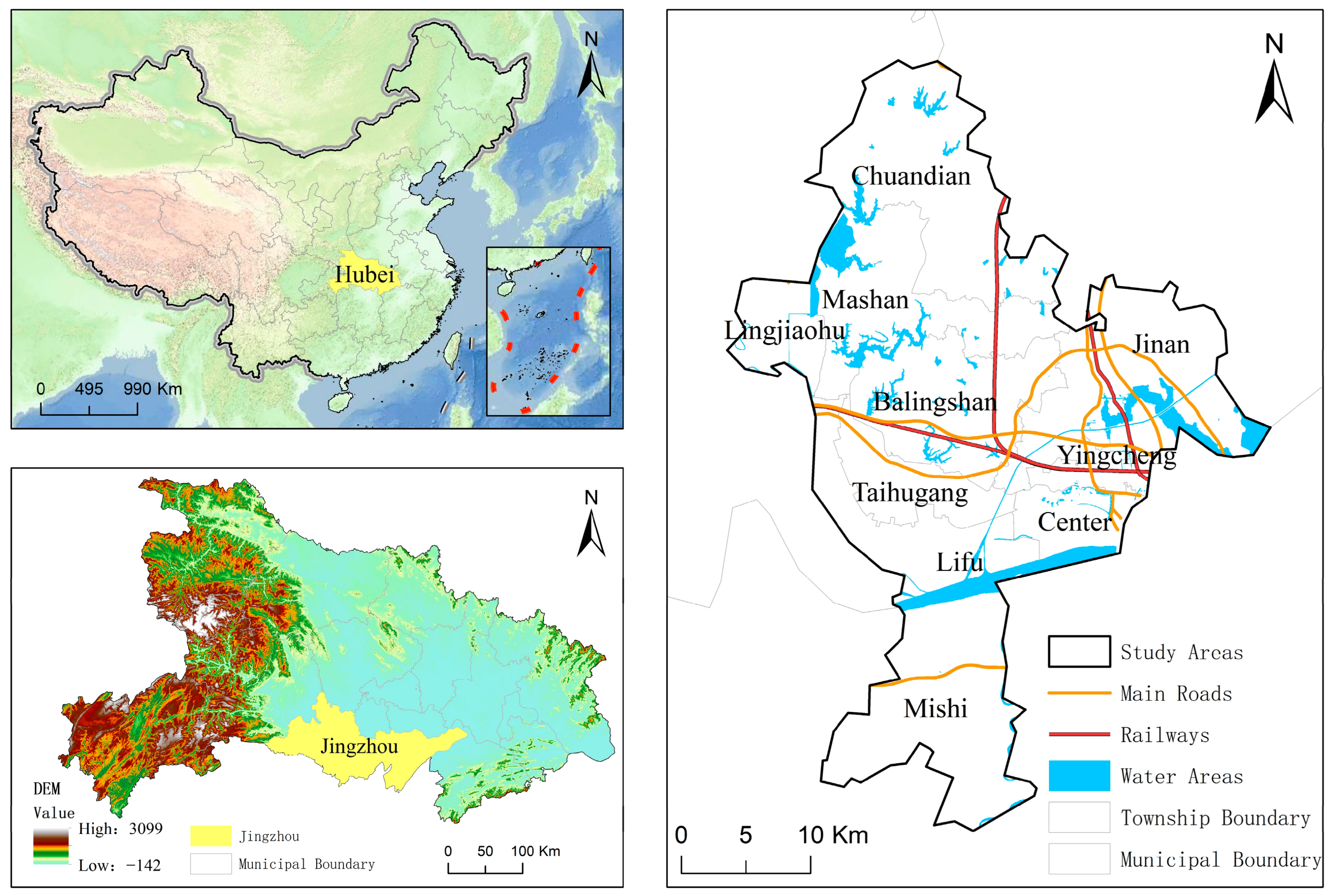
Jingzhou District is located in central-southern Hubei Province, in the hinterland of the Jianghan Plain and on the northern bank of the middle reaches of the Yangtze River. The administrative area is approximately 1045.8 km2 [46]. The district is characterized by a low-relief plain landscape and a dense river-lake network, and its spatial pattern is strongly shaped by hydrological conditions. Jingzhou has long been recognized as an important historical and cultural city, while the district has also experienced continuing urban growth and industrial expansion in recent decades [42,43,44,45]. In particular, the upgrading of Jingzhou Economic and Technological Development Zone to a national-level economic and technological development zone in 2011 further intensified development pressure in the surrounding urban space [45]. The coexistence of historical conservation constraints and development pressure makes Jingzhou District a suitable case for examining the stage-wise evolution of urban–rural construction land in a historical and cultural city. The location of the study area is shown in Figure 1.

2.2. Data Sources and Preprocessing

This study used land-use data, natural environmental data, locational accessibility data, socioeconomic data, and policy-related proxy data. The land-use data were obtained from the Resource and Environmental Science Data Center (RESDC) of the Chinese Academy of Sciences. Five land-use snapshots (2000, 2005, 2010, 2015, and 2020) were used, all at a spatial resolution of 30 m. Referring to the land-use classification system of the Chinese Academy of Sciences and the objective of this study, the original land-use classes were reclassified into six categories: cropland, woodland, grassland, water area, urban industrial land (UIL), and rural settlements (RS). The UIL and RS categories were treated as the focal construction-land categories in the stage-wise comparison and scenario simulation [46].
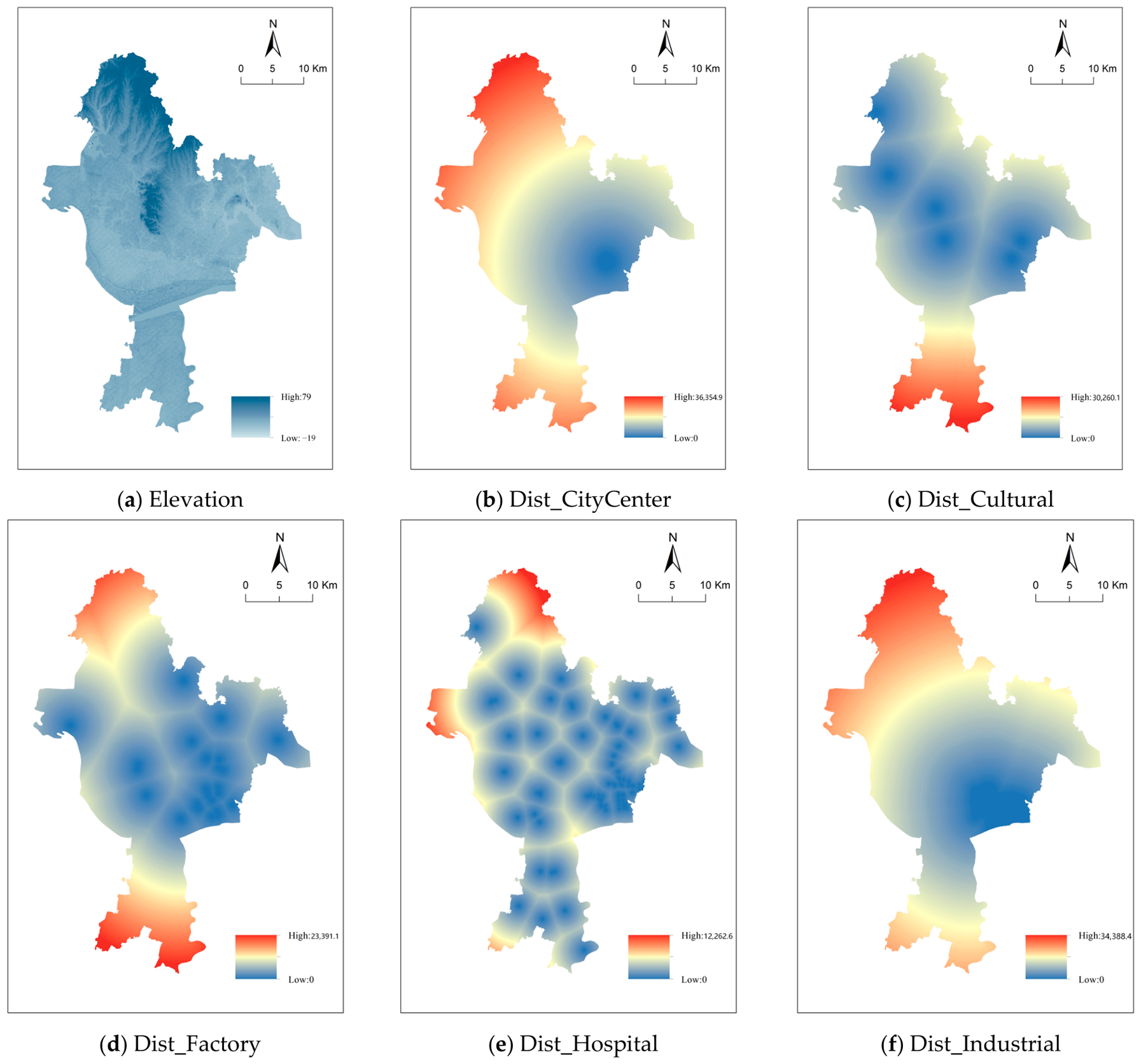
The explanatory variables included four groups: natural environmental variables, locational accessibility variables, socioeconomic variables, and policy-related proxy variables. Natural environmental variables included elevation, distance to linear waterways, and distance to areal water bodies. Locational accessibility variables included distances to roads, railways, the district center, and township seats. Socioeconomic variables included population density, GDP density, and distances to hospitals, schools, and residential areas [47]. Policy-related proxy variables included distances to the old-city conservation area, nationally protected cultural heritage sites, Chengnan Subdistrict, factory POIs, and national A-level scenic spots.
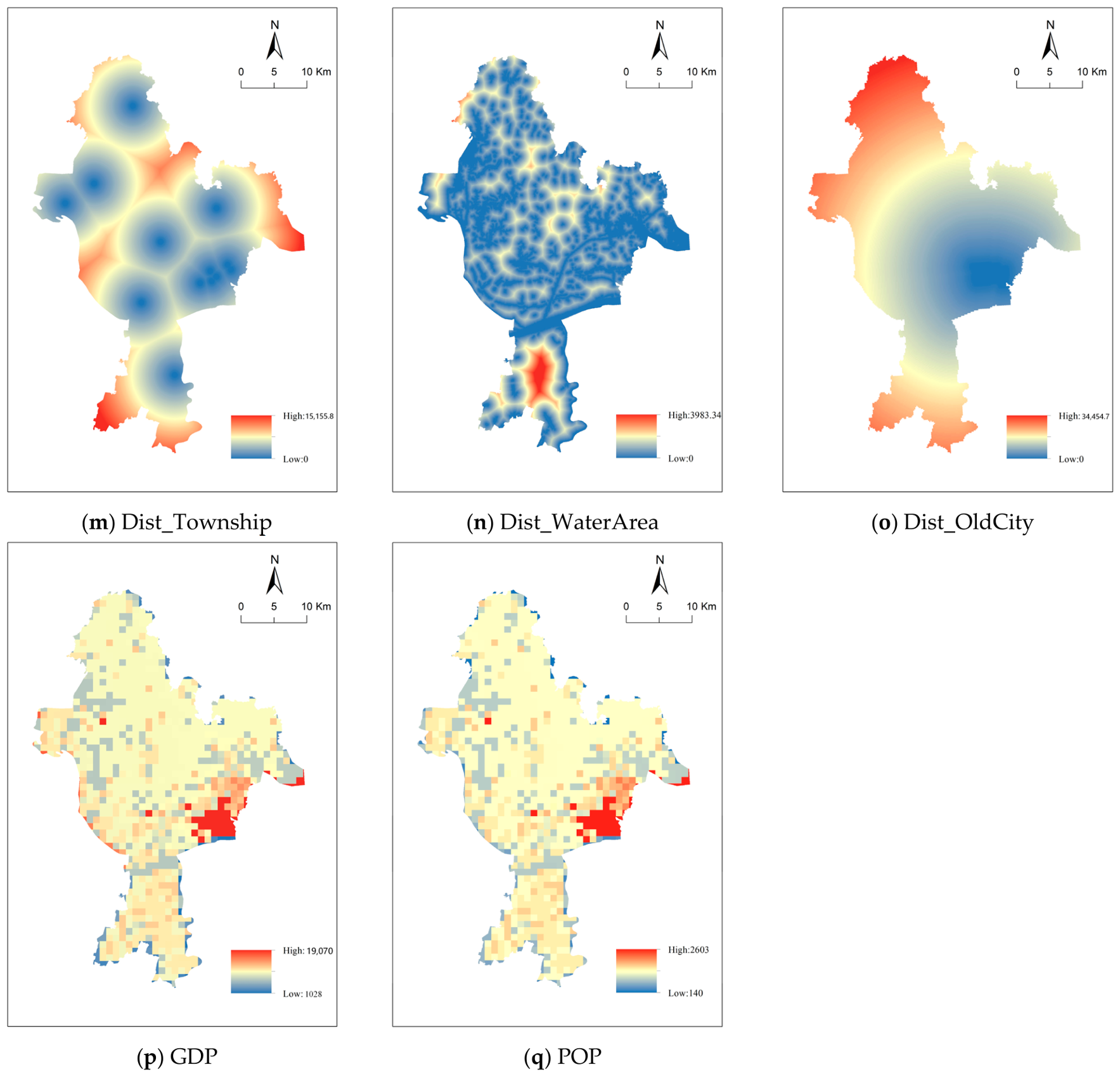
Road, railway, and hydrological vector data were mainly derived from OpenStreetMap [48]. Elevation data were obtained from the Geospatial Data Cloud platform [49]. Population and GDP data were prepared as gridded layers for 2010 and 2020 and were used to support stage-wise comparison. Population mapping and gridded demographic data provide useful spatial proxies for socioeconomic distribution, but their effective spatial precision is constrained by the resolution and modelling assumptions of the original data products [47]. Therefore, these socioeconomic layers were resampled to 30 m only for raster alignment with the land-use data, and the resampling procedure did not increase their original effective spatial precision [47]. POI data, including hospitals, schools, residential areas, factory POIs, and national A-level scenic spots, were collected from the Amap Open Platform and were available for 2020 [50]. The old-city conservation area, nationally protected cultural heritage sites, and Chengnan Subdistrict were digitized or extracted from official planning, heritage, and administrative boundary data [42,43,44,45].
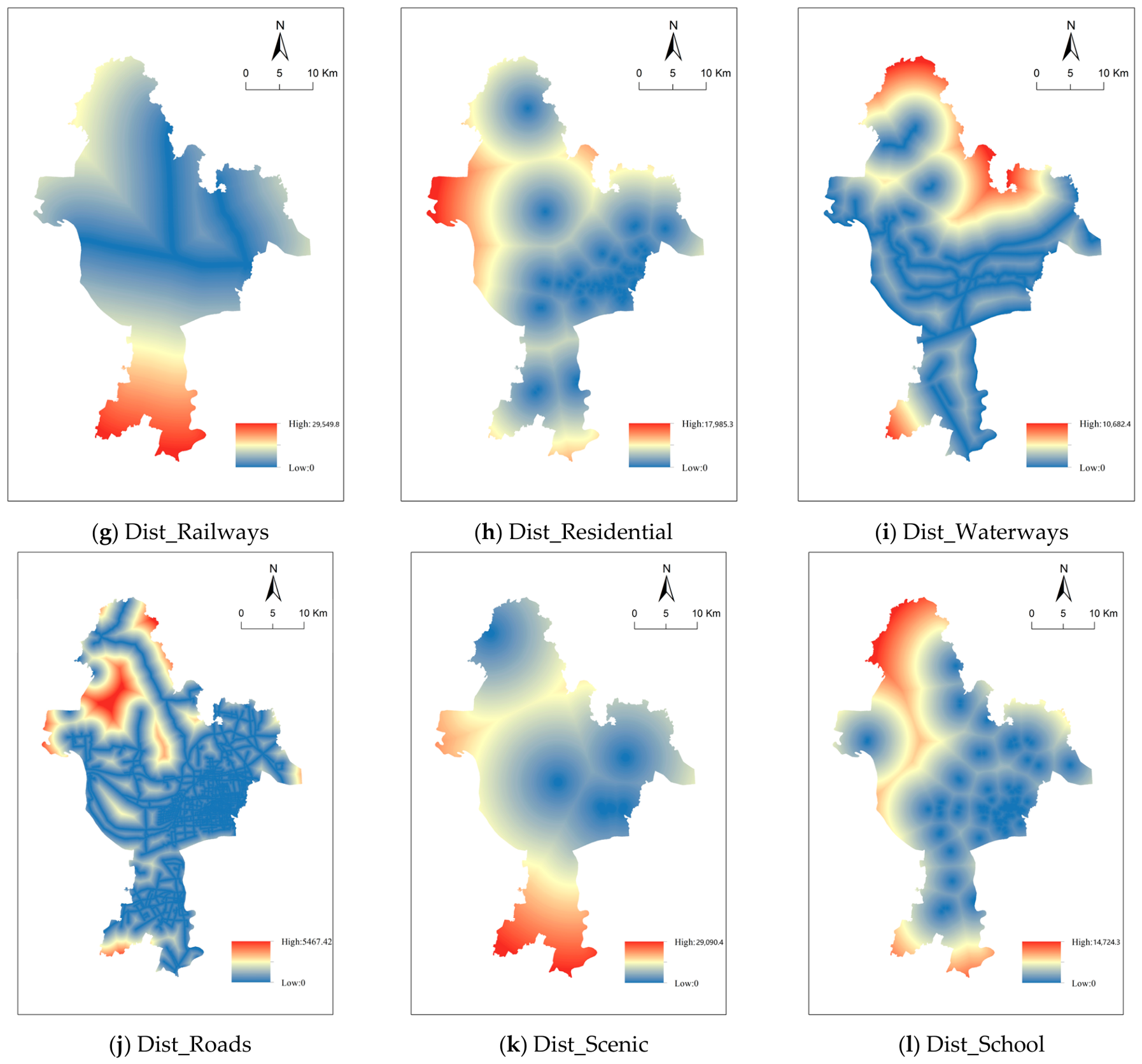
All spatial data were preprocessed in ArcGIS Pro 3.4. Vector layers were converted into distance rasters using the Euclidean Distance tool. All raster layers were projected to WGS_1984_UTM_Zone_49N, clipped to the administrative boundary of Jingzhou District, and aligned to a 30 m grid to match the land-use raster. Euclidean distance was used for all distance-based variables to maintain a consistent raster-based explanatory-variable framework across environmental, locational, socioeconomic, and policy-related factors. Although network distance may better represent travel behavior for specific facilities such as hospitals or schools, complete and time-matched historical road-network data were not consistently available for all stages. Therefore, Euclidean distance was adopted as a spatial-proximity indicator rather than as a behavioral accessibility measure.
For the distance to areal water bodies (Dist_WaterArea), water-area cells were extracted from the LUCC data and converted into Euclidean-distance rasters. To avoid temporal leakage in the stage-wise RF comparison, this variable was prepared in a stage-matched manner. Specifically, the 2010 LUCC-derived water-area layer was used for the 2000–2010 RF models, whereas the 2020 LUCC-derived water-area layer was used for the 2010–2020 RF models. For the 2035 scenario simulation, the 2020 water-area layer was used as the base-year hydrological constraint and spatial-context layer. Therefore, Dist_WaterArea should be distinguished from POI-based variables: it was not treated as a single 2020 contemporary proxy in the stage-wise RF analysis.
All explanatory variables were normalized to the 0–1 range using Min–Max normalization. This operation was used to meet the input requirements of the raster-based modelling framework and to make variables comparable within the RF and suitability-mapping procedure. Because some distance variables may have skewed distributions, the normalized values were used for relative ranking and suitability modelling rather than for interpreting linear marginal effects.
The final data sources and preprocessing procedures are summarized in Table 1.

2.3. Analytical Framework

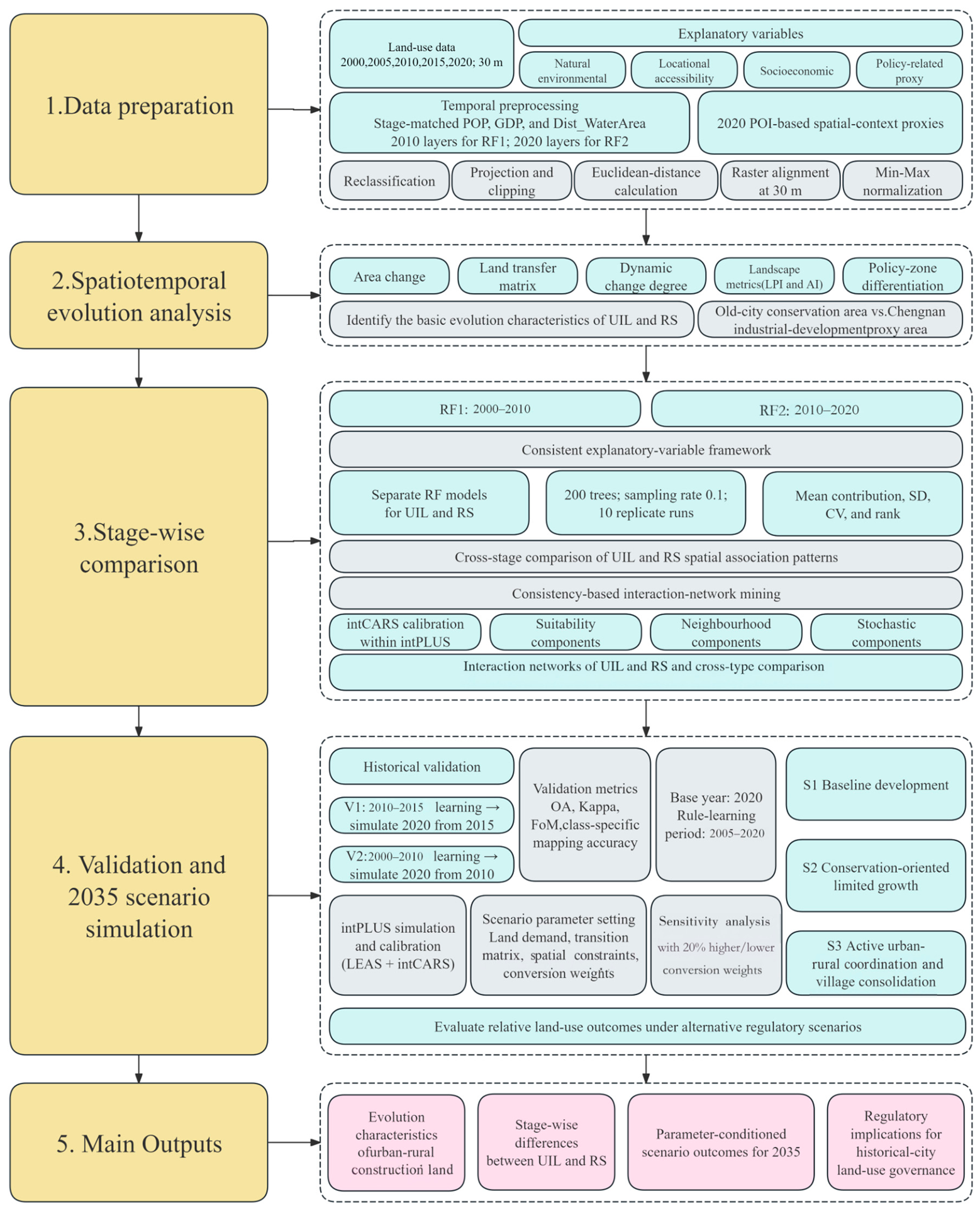
This study followed a three-step analytical framework, including change identification, stage-wise comparison, and scenario simulation. First, using five land-use snapshots for 2000, 2005, 2010, 2015, and 2020, the spatiotemporal evolution of urban–rural construction land in Jingzhou District was identified from three aspects: area change, land transfer characteristics, and policy-zone differentiation. This step was used to establish the basic facts of land-use change from 2000 to 2020.
Second, under a consistent explanatory-variable framework, stage-wise random forest analyses were conducted for 2000–2010 and 2010–2020 to compare whether the spatial association patterns of UIL and RS changed across the two periods. Population, GDP, and Dist_WaterArea layers were matched to the corresponding stage-terminal snapshots, with the 2010 layers used for RF1 and the 2020 layers used for RF2. Other variables were used according to the available spatial data and their roles in the analytical framework. The interaction-network outputs derived from intPLUS were further used as auxiliary evidence to interpret changes in inter-land-use relationships between stages.
Third, using 2020 as the base year, three regulatory scenarios were established to simulate land-use patterns in 2035. The scenario results were then compared to reveal the relative differences in future land-use allocation under alternative regulatory settings. The overall workflow is shown in Figure 2.
In addition, the dynamic change degree of UIL and RS was used as a descriptive indicator to compare the intensity of bidirectional land conversion across sub-periods. This index and related intensity-analysis approaches have been widely used in land-change studies to characterize land-use transition intensity and compare the strength of land-use conversions across time periods [51]. It was calculated as follows:
Di = [Σji(Aij + Aji)/Ai,t0] × 100%,
where Di is the dynamic change degree of land-use type i during a given period; Aij is the area converted from land-use type i to type j; Aji is the area converted from type j to type i; and Ai,t0 is the area of land-use type i at the beginning of the period. A higher value indicates more intensive two-way land conversion of the focal land-use type during that period. In this study, this index was used only for descriptive comparison of transfer intensity and was not involved in model training or scenario simulation.
To describe changes in patch structure, two landscape metrics, namely, the largest patch index (LPI) and aggregation index (AI), were calculated for UIL and RS in each study year using FRAGSTATS v4 [52]. These two indicators were selected because they correspond directly to the two landscape-pattern characteristics most relevant to this study. LPI reflects the dominance of the largest patch and is therefore useful for identifying whether UIL or RS became increasingly concentrated around a dominant spatial core. AI reflects the degree of spatial aggregation among patches of the same land-use type and is therefore suitable for assessing whether expansion occurred through compact clustering or more dispersed fragmentation. Compared with a broad set of landscape metrics, LPI and AI provide a concise and interpretable description of dominance and aggregation, which matches the study’s focus on construction-land consolidation, dispersion, and stage-wise reorganization [52,53,54,55,56,57,58]. These indicators were employed only for descriptive comparison of landscape-pattern change and were not involved in RF training or scenario simulation.

2.4. Stage-Wise Random-Forest Design and Configuration

To identify stage-wise spatial association patterns of urban industrial land (UIL) and rural settlements (RS), the LEAS module of intPLUS was used to estimate land-use-specific development potential and explanatory-variable contributions. The LEAS module follows the expansion-rule mining logic of the PLUS family of models, while intPLUS further integrates these suitability outputs with interaction-network-based CA simulation [18,19]. Two rule-learning periods were defined: 2000–2010 and 2010–2020.
For stage-sensitive variables, including population density, GDP density, and Dist_WaterArea, the input layers were matched to the terminal year of each learning period. Accordingly, the 2010 layers were used for RF1, and the 2020 layers were used for RF2. POI-derived variables were available only for 2020 and were therefore interpreted as contemporary spatial-context proxies rather than time-matched historical variables. For each period, separate RF models were fitted for UIL and RS using the same explanatory-variable system. No explanatory variable was selectively removed between RF1 and RF2, except in the supplementary POI-exclusion sensitivity test.
To improve the stability of RF-based variable-importance rankings, the LEAS random-forest configuration was set to 200 trees and a sampling rate of 0.1. Each stage-specific RF model was repeated ten times under identical input settings. For each explanatory variable, the mean contribution, standard deviation (SD), coefficient of variation (CV), and mean rank were calculated across the ten replicate runs. The averaged contribution values were used for interpretation, while variables with high rank or contribution variability were interpreted more cautiously.
The contribution value reported by the LEAS module was treated as a permutation-style relative importance indicator because it was derived from the difference between the original prediction error and the error after perturbing each explanatory variable, as reported in the LEAS output. Therefore, it was used to compare relative associations among variables within the same modelling framework rather than as a causal effect size or as a coefficient directly comparable across different software environments.
Expansion samples were extracted from cells that converted into the target land-use type during the corresponding period, whereas non-expansion samples were drawn from cells that did not convert into that target type. Because non-expansion cells greatly outnumbered expansion cells, the sampled datasets were not forced to be class-balanced. Therefore, the RF outputs were interpreted as relative variable-importance rankings rather than calibrated conversion probabilities. Model performance was evaluated using the out-of-bag root mean square error (OOB RMSE) reported by the LEAS module. The final sample design, including positive and negative sample sizes, is reported in Appendix A Table A1.

2.5. Consistency-Based Interaction-Network Mining

The interaction networks were derived from the intCARS calibration module of intPLUS. In contrast to the RF variable-contribution analysis, which evaluates the relative importance of explanatory variables in the LEAS module, the interaction-network coefficients were extracted through consistency-based mining during the CA calibration process. This logic follows the intPLUS framework, which uses simulation-observation consistency to mine promoting and inhibiting relationships among land-use types [19]. The LEAS development-potential maps generated with 200 trees and a sampling rate of 0.1 were used as suitability inputs for intCARS calibration.
The procedure was implemented as follows. First, land-expansion maps were extracted for 2000–2010 and 2010–2020. Second, the LEAS module generated land-use-specific development-potential maps for all six land-use classes. Third, the initial land-use map, observed terminal land-use map, development-potential maps, transition matrix, neighborhood weights, and spatial constraint layer were entered into the intCARS calibration module. Fourth, the first-step simulated map was compared with the observed terminal map, and correctly simulated cells were identified as the consistency map. Fifth, intPLUS mined the contributions of CA-related components from the consistent cells. These mined components include land-use suitability, neighborhood effects, and stochastic effects. Finally, the signed coefficients were organized into interaction networks to describe promoting and inhibiting associations among land-use types [19].
For cell i and land-use type k, the simulated transition tendency can be conceptually expressed as follows:
Pi,k = f(Si,k, Ni,k, Ri)
where Pi,k denotes the transition tendency toward land-use type k; Si,k denotes the LEAS-derived suitability component; Ni,k denotes the neighborhood component; and Ri denotes the stochastic component.
The consistency condition was defined as follows:
Ci = 1 if Li(sim) = Li(obs); otherwise, Ci = 0
where Li(sim) is the simulated land-use type and Li(obs) is the observed land-use type. Only the consistent cells were used for mining the interaction coefficients.
In the resulting interaction network, positive coefficients indicate promoting associations with the growth of the target land-use type, whereas negative coefficients indicate inhibiting or competitive associations. Specifically, SuitabilityMap_k represents the suitability surface of land-use type k, NeighborhoodEffect_k represents its neighborhood aggregation effect, and StochasticEffect represents the stochastic seed-generation component. These coefficients are relative and model-specific indicators; therefore, they are used for within-study comparison across stages and land-use types rather than as universal causal effect sizes [19].

2.6. Scenario Design, Validation Setup, and Sensitivity Analysis

The 2035 scenario simulation was conducted using 2020 as the base year. The 2005–2020 period was used as the rule-learning period for the formal prediction chain, because it provides a 15-year historical interval corresponding to the 2020–2035 simulation horizon. The LEAS-derived development-potential maps and the intCARS calibration outputs were used to simulate alternative 2035 land-use allocations. Scenario-based land-use simulation has been widely used to compare alternative planning, ecological, and regulatory pathways rather than to generate deterministic forecasts [20,21,22,23,24]. Recent studies have further coupled PLUS with multi-objective programming, genetic algorithms, GMOP, and ecosystem-service valuation to evaluate land-use allocation under different planning and ecological constraints [20,21,22,23,24].
The land-demand settings were established using a baseline-plus-policy-adjustment logic. For S1, the baseline development scenario, the demand structure was derived from the 2005–2020 historical transition tendency and used to represent the continuation of recent development pressure. For S2, the conservation-oriented limited-growth scenario, UIL demand was reduced and cropland demand was increased relative to S1 to represent strengthened old-city conservation, stricter construction-land control, and cropland-retention priority. This setting is consistent with the broader policy concern that Chinese land-use governance must coordinate construction-land expansion, land-use transition, and cultivated-land protection. The RS category was kept close to its 2020 stock because this scenario assumes limited rural settlement restructuring rather than active village consolidation. For S3, the active urban–rural coordination and village-consolidation scenario, UIL was allowed to grow under construction-land quota reallocation, while RS demand was explicitly reduced to represent village-space consolidation, rural settlement transition, and construction-land quota reallocation. These assumptions are consistent with studies showing that rural settlement transition, land transfer, and development-right arrangements can substantially affect the spatial reorganization of rural construction land. Therefore, the three scenarios should be understood as policy-assumption-based regulatory pathways rather than independent forecasts of future land demand [20,21,22,23,24]. These conversion weights are scenario parameters used to express relative regulatory permissiveness under different policy assumptions; they should not be interpreted as statistically estimated coefficients.
Woodland, grassland, and water area were held at their 2020 quantities across all scenarios. This setting was adopted because water-area cells were treated as non-convertible spatial constraints, and the main focus of the scenario comparison was the allocation trade-off among cropland, UIL, and RS. Scenario differences were therefore expressed primarily through the land-demand settings of cropland, UIL, and RS.
The transition matrix was kept consistent across scenarios. Conversions among non-water land-use types were allowed, whereas water area was treated as non-convertible. The spatial constraint layer differed by scenario: S1 and S3 constrained water-area cells only, whereas S2 additionally constrained the Jingzhou old-city conservation area. This setting reflects the conservation-oriented spatial filtering logic of historical and cultural city regulation [1,2,3,4,5,6,42,43,44,45].
Two validation experiments were designed to evaluate the applicability of the simulation framework before the 2035 scenario comparison. In each validation experiment, the LEAS rule-learning process and intCARS calibration were re-fitted using the corresponding historical learning period rather than directly reusing the formal 2005–2020 prediction chain. V1 used the 2010–2015 rule-learning period to simulate 2020 from the 2015 land-use map, whereas V2 used the 2000–2010 rule-learning period to simulate 2020 from the 2010 land-use map. The two validation experiments therefore represent a near-term validation and a cross-stage transfer validation, respectively.
To examine the robustness of spatial allocation outcomes to parameter uncertainty, a ±20% sensitivity analysis was conducted for conversion weights. Land demand, transition constraints, suitability maps, and the initial land-use map were kept unchanged, while conversion weights were multiplied by 0.8 or 1.2. Values exceeding 1.0 were capped at 1.0. Because land demand was fixed in this test, the sensitivity analysis does not evaluate uncertainty in total land demand. Instead, it evaluates whether local spatial allocation changes substantially when conversion weights are perturbed under the same prescribed demand targets. Aggregate quantities were reported only to confirm that the prescribed demand targets were satisfied. The scenario land-demand settings and conversion weights used for the 2035 simulation are summarized in Table 2.

3. Results

3.1. Spatiotemporal Evolution of Urban–Rural Construction Land

3.1.1. Overall Area Change

From 2000 to 2020, urban–rural construction land in Jingzhou District showed a clear internal differentiation. UIL expanded continuously, whereas RS changed within a much narrower range. During the same period, cropland declined, while the water area increased slightly.
As shown in Table 3, UIL increased from 16.63 km2 in 2000 to 46.42 km2 in 2020, with a net gain of 29.79 km2 and a growth rate of 179.1%. Its share of the total district area rose from 1.59% to 4.44%. By contrast, RS increased from 56.59 km2 to 60.27 km2, with a net gain of 3.68 km2 and a growth rate of 6.5%. Its share increased only slightly, from 5.41% to 5.76%. Over the same period, cropland decreased from 801.31 km2 to 762.27 km2, with a net loss of 39.04 km2, whereas the water area increased from 146.82 km2 to 153.46 km2, with a net gain of 6.64 km2. Woodland and grassland occupied relatively small areas and changed only slightly. Detailed statistics for all five years are provided in Appendix A Table A2.
Overall, the expansion of construction land in Jingzhou District during 2000–2020 was mainly driven by UIL growth, while RS remained comparatively stable in total area.

3.1.2. Land Transfer Characteristics

The land-use transfer results show that newly added UIL mainly originated from cropland throughout the study period (Table 4). In all four sub-periods, cropland was the dominant source of UIL expansion. This pattern was most pronounced during 2005–2010, when UIL recorded its largest net increase of 16.2153 km2, including 13.0482 km2 converted from cropland. During 2010–2015, UIL continued to expand substantially, with a net increase of 11.4903 km2. During 2015–2020, although 12.4353 km2 of cropland was still converted to UIL, the net increase of UIL declined to only 0.4914 km2 because of the stronger two-way exchanges with cropland, the water area, and RS.
The transfer relationship between RS and cropland changed more noticeably across stages. During 2000–2005 and 2005–2010, the cropland-to-RS conversion exceeded the reverse flow, leading to net RS increases of 0.5526 km2 and 4.3884 km2, respectively. During 2010–2015, the RS–cropland transfer relationship was nearly balanced, and RS decreased slightly by 0.0765 km2. During 2015–2020, the direction reversed, with RS-to-cropland conversion exceeding the cropland-to-RS conversion, resulting in a net RS decline of 1.1844 km2.
The dynamic change degree further indicates that UIL experienced a stronger transfer intensity than RS, especially during 2005–2010 and 2015–2020. The cumulative 2000–2020 transfer pattern shows that UIL expansion remained strongly cropland-oriented, whereas the net transfer relationship between RS and cropland shifted from an RS increase in the earlier periods to an RS reduction after 2015. These results show that UIL and RS followed different transfer trajectories and should not be interpreted as a single homogeneous construction-land category [11,12,13,14,15,16,17,35,36,37,38,39,40,41].

3.1.3. Landscape Pattern Change

The landscape pattern of UIL changed more strongly than that of RS during the study period (Table 5). The LPI of UIL increased from 0.0852 in 2000 to 0.5004 in 2010 and further to 0.5558 in 2015, before declining to 0.3732 in 2020. This indicates that UIL first became increasingly dominated by larger patches and then experienced a relative weakening of patch dominance after 2015. The AI of UIL rose from 93.8472 in 2000 to 95.6943 in 2010, and then declined to 92.5779 in 2020, suggesting a shift from increasing aggregation to relative fragmentation or dispersion in the later period.
The decline in UIL LPI after 2015 should be interpreted together with the transfer results and policy-zone differentiation. It does not necessarily indicate a reduction in UIL area; rather, it suggests that the dominance of the largest UIL patch weakened while UIL expansion became more dispersed or redistributed across multiple development-related spaces. This may reflect the combination of the continued cropland-to-UIL conversion, the stronger two-way land exchange after 2015, and the redistribution of industrial land beyond the largest contiguous patch. Because patch metrics are sensitive to classification boundaries and patch-contiguity rules, this result is used as descriptive evidence of a landscape-pattern change rather than as an independent causal explanation [55,56,57,58].
RS displayed a much narrower range of fluctuation. Its LPI remained below 0.05 in all study years, ranging from 0.0364 to 0.0472. Its AI also remained stable, ranging from 87.6659 to 88.0055. Compared with UIL, RS therefore maintained a more stable patch structure, with limited changes in patch dominance and aggregation. These results indicate that UIL expansion was accompanied by more pronounced changes in the landscape structure, whereas RS retained a relatively stable spatial configuration [55,56,57,58].

3.1.4. Policy-Zone Differentiation

UIL growth was unevenly distributed across different policy-related spaces in Jingzhou District (Table 6). Within the old-city conservation area, UIL increased from 1.45 km2 in 2000 to 1.83 km2 in 2020, with a net gain of 0.38 km2 and a growth rate of 26.4%. This was far below the district-wide UIL growth rate of 179.1%.
The Chengnan industrial-development proxy area showed a different pattern. UIL increased from 3.21 km2 in 2000 to 10.22 km2 in 2020, with a net gain of 7.01 km2 and a growth rate of 218.4%, exceeding the district average. This contrast indicates that the newly added UIL was much more concentrated in the development-oriented space represented by Chengnan than in the old-city conservation area.
The policy-zone comparison therefore shows that UIL expansion was not evenly distributed across the district. Instead, it was relatively constrained within the old-city conservation area and more strongly concentrated in the Chengnan industrial-development proxy area [59,60].

3.2. Stage-Wise Changes in Spatial Association Patterns

Because the population, GDP, and Dist_WaterArea variables were matched to the corresponding stage-terminal snapshots, whereas POI-based variables were available only for 2020 and used as contemporary spatial-context proxies, the ranking comparison in this section should be interpreted as stage-wise differences in spatial associations under a consistent variable-category framework. In particular, Dist_WaterArea was not a single 2020 proxy variable in the RF comparison; the 2010 water-area distance layer was used for RF1 and the 2020 layer was used for RF2. The RF results should therefore be interpreted as relative spatial associations rather than direct reconstructions of historical causal mechanisms.

3.2.1. UIL Expansion: 2000–2010 vs. 2010–2020

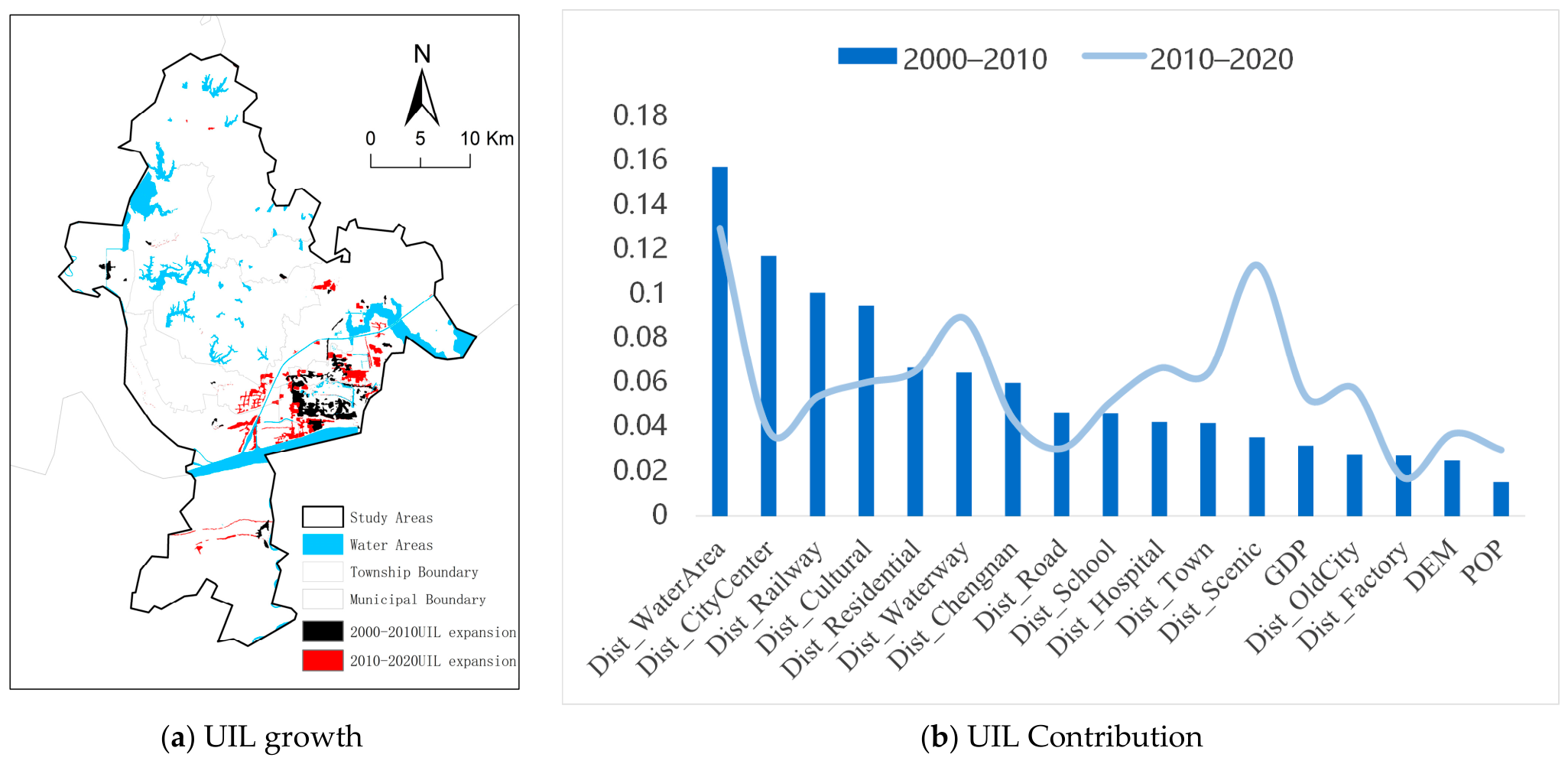
The ten-replicate RF results show that UIL expansion was associated with different combinations of water-related, accessibility, cultural, and development-oriented variables across the two stages. During 2000–2010, Dist_WaterArea ranked first, with a mean contribution of 0.1573 and a low CV of 4.2%, indicating a stable association with areal water bodies. Dist_CityCenter ranked second, followed by Dist_Railways and Dist_Cultural. Dist_Residential, Dist_Waterways, and Dist_Industrial also entered the upper part of the ranking.
During 2010–2020, Dist_WaterArea remained the highest-ranked variable, with a mean contribution of 0.1296 and a CV of 4.7%. Dist_Scenic ranked second, followed by Dist_Waterways. Dist_Hospital, Dist_Residential, Dist_Township, Dist_Cultural, Dist_OldCity, GDP, and Dist_Railways were also included in the top ten. Compared with the earlier period, the later-stage UIL ranking showed a stronger combination of water-related, scenic, residential-service, and township-related spatial associations, while the Chengnan-related industrial-development proxy no longer dominated the top ranks.
These results indicate that the stage-wise change in UIL should not be interpreted as a single-variable shift. Rather, UIL expansion was consistently associated with water-related spatial conditions, while the secondary association structure changed between stages. Variables with high CV values were interpreted more cautiously because their ranks were less stable across repeated runs. The full ranking and stability statistics are provided in Appendix A Table A4 and Table A5. The spatial distribution and RF contribution results for UIL expansion are shown in Figure 3. The corresponding top RF variables for UIL expansion are summarized in Table 7.

3.2.2. RS Expansion: 2000–2010 vs. 2010–2020

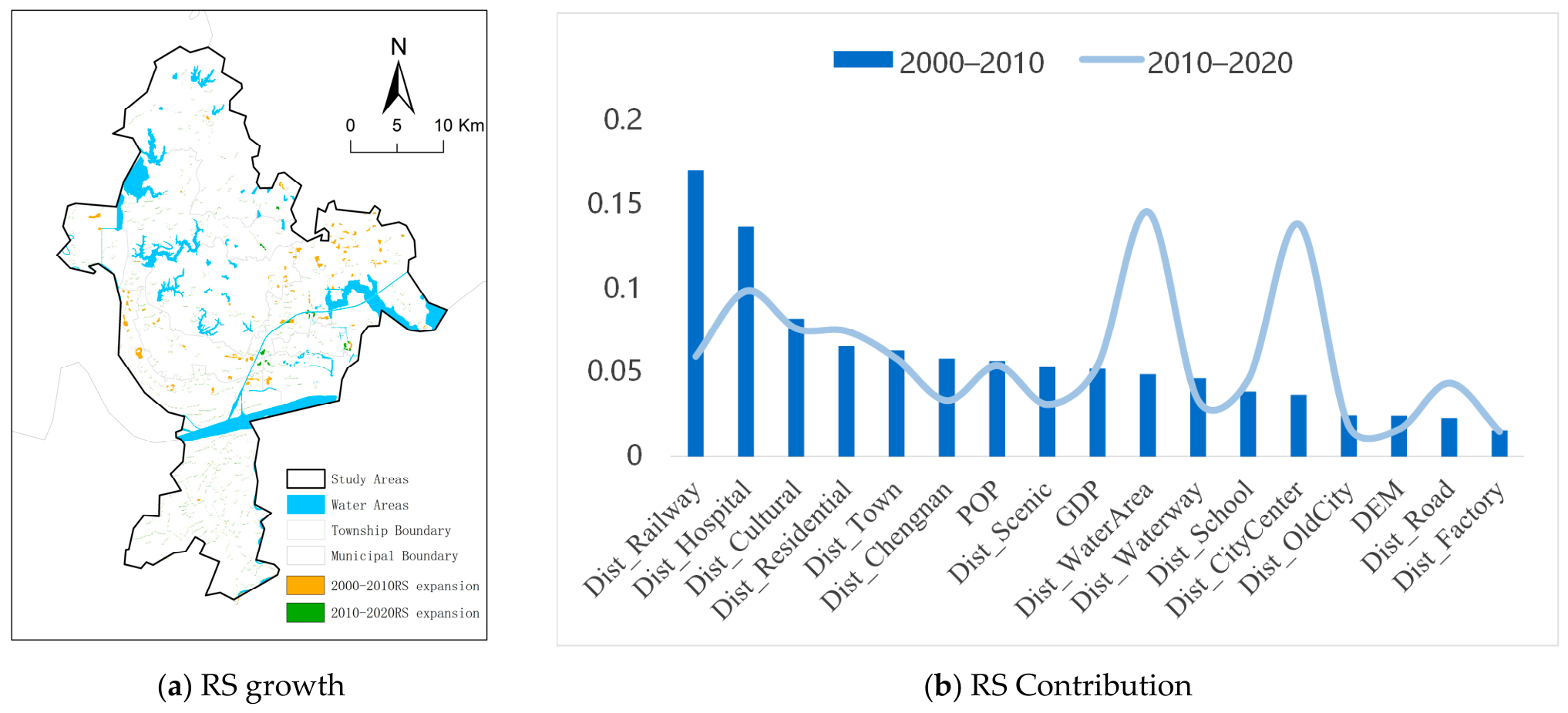
The RF results for RS show a different ranking structure from UIL. During 2000–2010, Dist_Railways ranked first, with a mean contribution of 0.1706 and a CV of 6.0%, indicating a stable association with railway-related accessibility. Dist_Hospital ranked second, followed by Dist_Cultural. Dist_Residential, Dist_Township, Dist_Industrial, POP, Dist_Scenic, GDP, and Dist_WaterArea were also included in the top ten. Some socioeconomic and scenic variables showed a relatively high variability and were therefore interpreted cautiously.
During 2010–2020, the RS ranking became more strongly associated with areal water bodies and district-center linkage. Dist_WaterArea ranked first, with a mean contribution of 0.1461 and a CV of 2.3%, followed by Dist_CityCenter with a mean contribution of 0.1388 and a CV of 3.2%. Dist_Hospital ranked third, while Dist_Cultural, Dist_Residential, Dist_Railways, Dist_Township, GDP, POP, and Dist_School also remained in the top ten.
Compared with UIL, RS displayed a more service- and settlement-continuity-oriented association structure. The later-stage RS ranking showed a stronger spatial association with water-related space, district-center linkage, hospitals, cultural sites, residential proximity, and township nodes. These variables should be interpreted as relative spatial-context associations under the adopted explanatory-variable framework, rather than as direct historical causal drivers. Therefore, the RS results indicate that rural settlement reorganization was spatially aligned with service accessibility, local settlement continuity, and landscape conditions, but should not be interpreted as being directly caused by the 2020 POI distributions. The full ranking and stability statistics are provided in Appendix A Table A6 and Table A7. The spatial distribution and RF contribution results for RS expansion are shown in Figure 4. The corresponding top RF variables for RS expansion are summarized in Table 8.

3.2.3. Cross-Type Summary

The ten-replicate RF results indicate that UIL and RS followed different spatial association structures, although both were associated with water-related and accessibility-related conditions. For UIL, Dist_WaterArea remained the most stable and highest-ranked variable in both stages, with its mean contribution changing from 0.1573 in 2000–2010 to 0.1296 in 2010–2020. The secondary ranking structure changed from city-center, railway, cultural, residential, and Chengnan-related variables in 2000–2010 to scenic, waterway, hospital, residential, township, and cultural variables in 2010–2020. This indicates that UIL expansion maintained a stable association with the water-related spatial setting of Jingzhou District, while its surrounding locational and functional association structure changed across stages.
For RS, the early-stage ranking was more closely associated with railway accessibility, hospitals, cultural sites, residential proximity, and township seats, whereas the later-stage ranking was dominated by Dist_WaterArea, Dist_CityCenter, and Dist_Hospital. The increase in the contribution of Dist_WaterArea from 0.0493 to 0.1461 indicates a marked strengthening of water-related spatial association in the later stage, while the contribution of Dist_Railways decreased from 0.1706 to 0.0597. These results suggest that RS did not simply follow the Chengnan-related industrial-development trajectory, but showed a different association pattern linked to water-related space, district-center linkage, and service-related spatial context.
Overall, the RF results support the analytical separation of UIL and RS. The two construction-land components differed not only in area-change trajectories, but also in their stage-wise spatial association structures. Because several POI-related variables were available only for 2020, their rankings should be interpreted as contemporary spatial-context associations rather than as direct historical causal drivers. Representative cross-stage contribution changes are summarized in Table 9.

3.3. Interaction-Network Response, Validation, and Scenario Results

3.3.1. Consistency-Mined Interaction Networks of UIL and RS

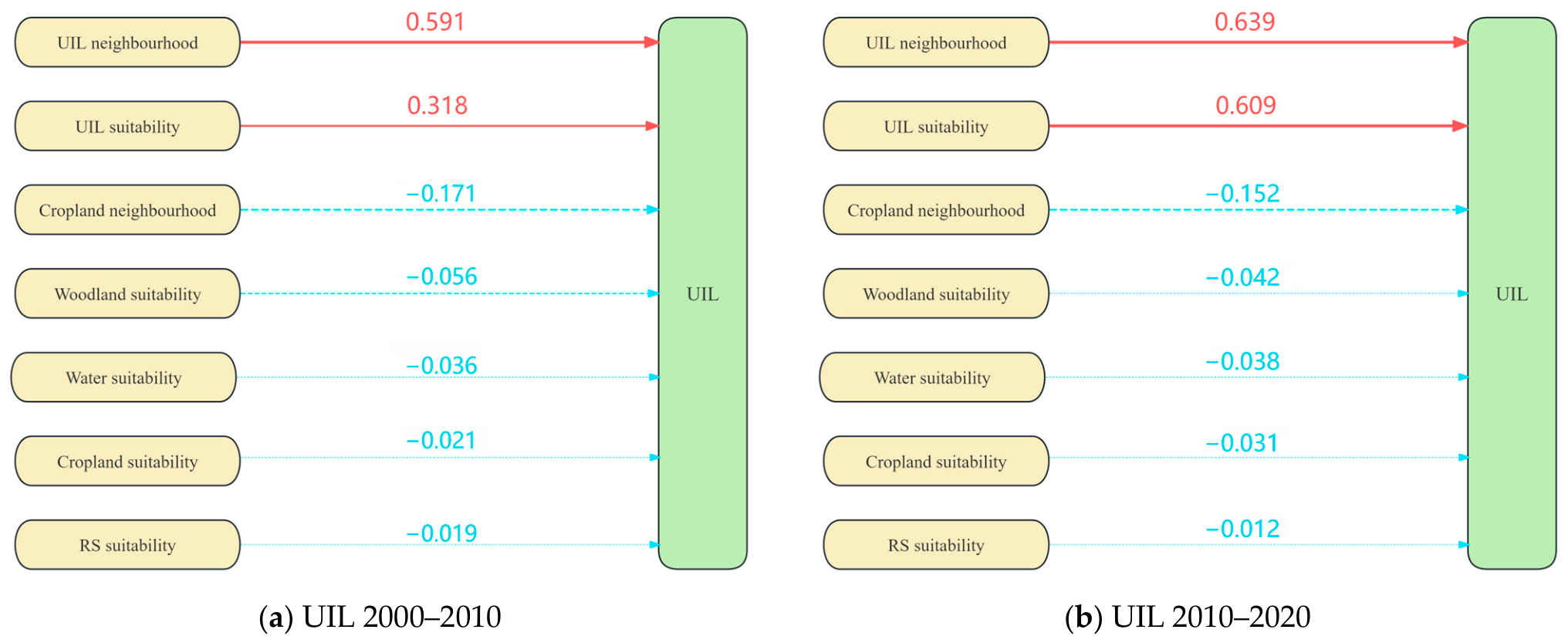
The consistency-mined interaction networks further revealed the stage-wise reorganization of UIL and RS. For UIL, the positive self-related components increased markedly from 2000–2010 to 2010–2020. SuitabilityMap_5 increased from 0.318 to 0.609, while NeighborhoodEffect_5 increased from 0.591 to 0.639. This indicates that UIL became more self-reinforcing in the later stage, with a stronger dependence on both its own development-potential surface and the neighborhood aggregation of existing UIL patches.
The inhibiting components associated with cropland remained evident in both stages. For UIL, NeighborhoodEffect_1 was −0.171 in 2000–2010 and −0.152 in 2010–2020, suggesting that the cropland-dominated landscape matrix continued to constrain UIL expansion. However, the strengthened self-suitability and self-neighborhood effects of UIL in the later stage indicate a more consolidated expansion structure, which is consistent with the development-oriented spatial reconfiguration around 2010.
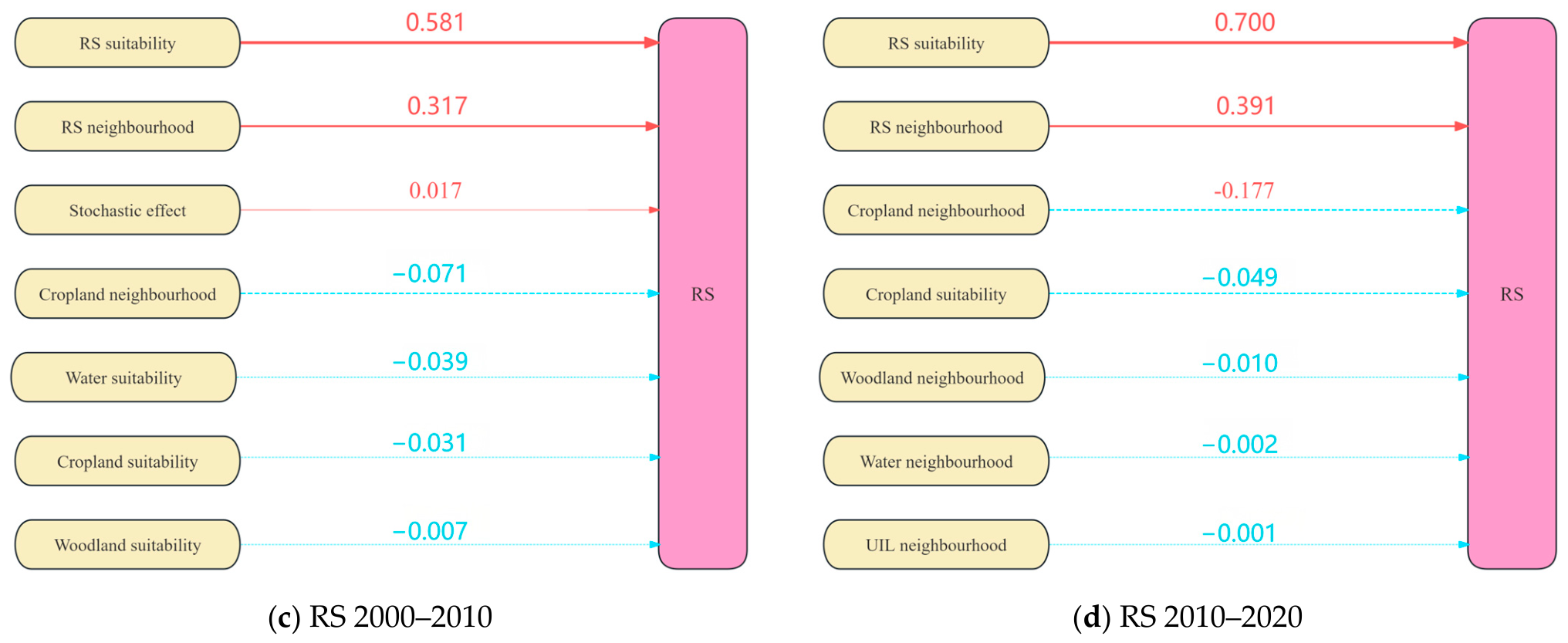
For RS, self-related components also increased between the two stages. SuitabilityMap_6 increased from 0.581 to 0.700, and NeighborhoodEffect_6 increased from 0.317 to 0.391. These results suggest that RS retained a strong spatial continuity and path dependence, rather than being fully absorbed into urban-industrial expansion. Meanwhile, the negative neighborhood effect of cropland on RS became stronger, changing from −0.071 in 2000–2010 to −0.177 in 2010–2020. This indicates that RS reorganization was increasingly constrained by the cropland-dominated rural landscape and land-consolidation pressures.
The magnitude of these coefficients was interpreted comparatively within this study rather than against a universal external threshold. Components above approximately 0.5 were treated as dominant self-related components in the corresponding stage because they clearly exceeded the remaining positive or negative components in the same interaction network. For example, the increase in UIL SuitabilityMap_5 from 0.318 to 0.609 and NeighborhoodEffect_5 from 0.591 to 0.639 indicates a stronger dominance of UIL-related suitability and neighborhood aggregation in the later stage. Similarly, the increase in RS SuitabilityMap_6 from 0.581 to 0.700 indicates a stronger settlement-continuity dependence. These comparisons follow the relative interpretation logic of intPLUS consistency-based mining and should not be read as universal effect-size thresholds [19].
Overall, the interaction-network results support the need to distinguish between UIL and RS. UIL exhibited stronger self-reinforcing urban-industrial aggregation in the later stage, whereas RS showed a stronger settlement continuity under cropland-related constraints. These coefficients should be interpreted as model-conditioned promoting or inhibiting associations derived from the intPLUS consistency-mining procedure, rather than as direct causal effects or universally comparable coefficients [19]. The corresponding interaction-network structures are shown in Figure 5. The mined interaction coefficients are summarized in Table 10.

3.3.2. Validation of the Simulation Framework

Two validation experiments were conducted to evaluate the applicability of the simulation framework. In each validation experiment, the LEAS rule-learning process and intCARS calibration were re-fitted using the corresponding historical learning period rather than directly reusing the formal 2005–2020 prediction chain. V1 used the 2010–2015 rule-learning period to simulate 2020 from the 2015 land-use map, whereas V2 used the 2000–2010 rule-learning period to simulate 2020 from the 2010 land-use map. The two validation experiments therefore represent a near-term validation and a cross-stage transfer validation, respectively.
The validation results showed a high overall agreement. V1 achieved an OA of 0.9119 and a Kappa value of 0.8008, while V2 achieved an OA of 0.9116 and a Kappa value of 0.7998. These values indicate that the model reproduced the overall land-use structure reasonably well. However, Kappa and OA can be strongly influenced by the dominance of unchanged cells, whereas FoM is more informative for evaluating the model’s ability to locate actual change areas [53,54]. In this study, the FoM values were considerably lower, with 0.0975 for V1 and 0.1763 for V2. This confirms that the model performed better in reproducing the overall land-use pattern than in precisely locating changed pixels. The class-specific results further show that the RS category was more consistently reproduced than UIL.
The RS mapping accuracy reached 81.90% in V1 and 82.37% in V2, whereas the UIL mapping accuracy was 66.93% in V1 and 55.20% in V2. The lower UIL accuracy in V2 indicates that the 2000–2010 rule set could not fully reproduce the post-2010 UIL reorganization. The similar OA and Kappa values of V1 and V2 should not be interpreted as identical predictive performance. Because unchanged cells dominated the raster, the OA and Kappa were relatively insensitive to differences in change-location performance. The lower UIL mapping accuracy in V2 and the FoM difference between V1 and V2 indicate that the longer cross-stage transfer validation remained less reliable for locating UIL changes than for reproducing the overall land-use structure [53,54].
These validation results support the use of the model for a comparative scenario evaluation, while also indicating that the 2035 simulations should be interpreted as parameter-conditioned regulatory comparisons rather than deterministic pixel-level forecasts. The validation metrics are summarized in Table 11.

3.3.3. Scenario Simulation Results for 2035

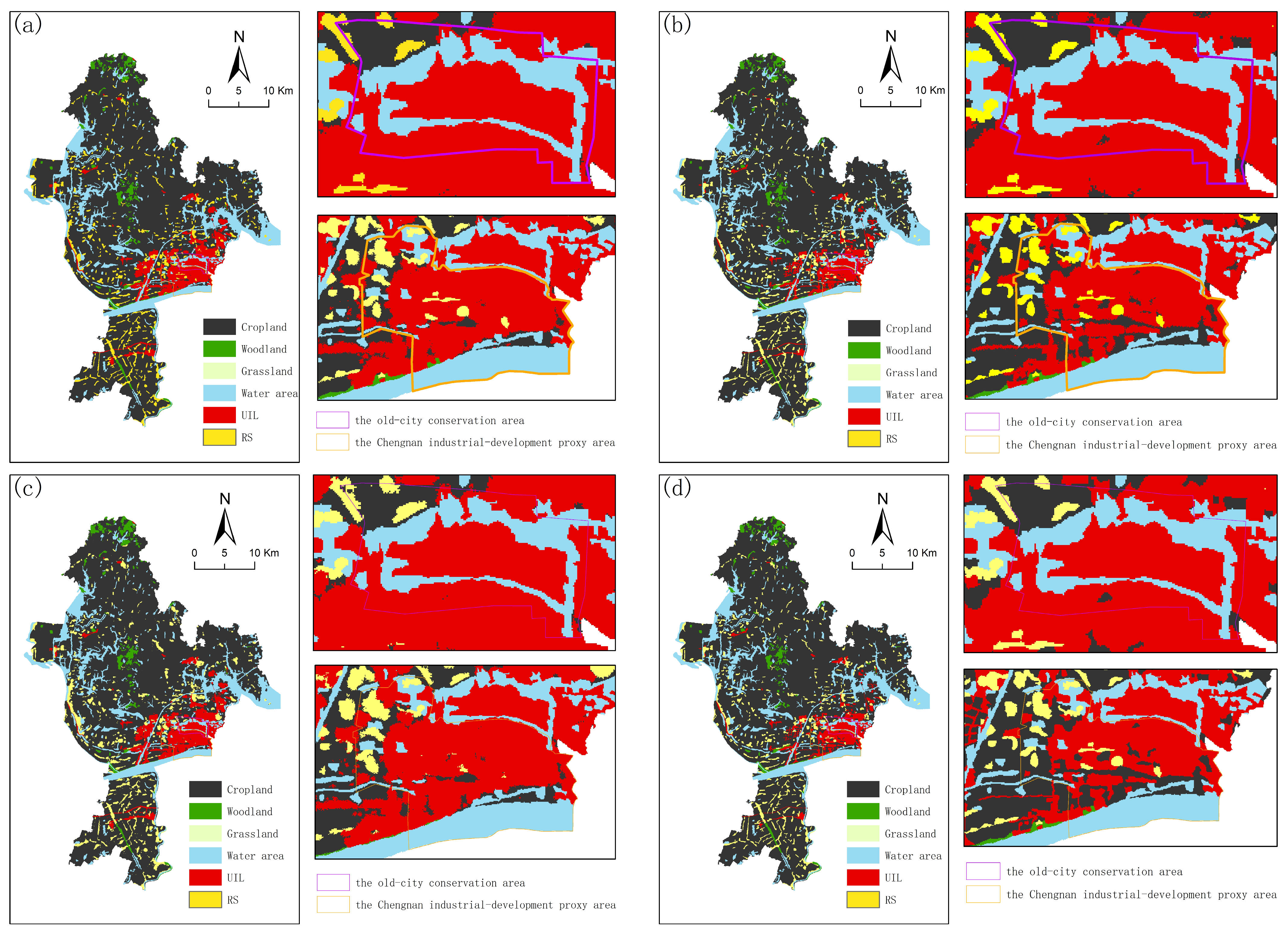
The 2035 scenario simulations produced measurably different land-allocation outcomes under the specified regulatory assumptions. Because woodland, grassland, and the water area were held at their 2020 quantities, the main differences among scenarios were expressed through cropland, UIL, and RS. This comparative interpretation follows the logic of scenario-based land-use simulation, in which alternative parameter settings are used to evaluate relative regulatory pathways rather than to predict a single deterministic future [20,21,22,23,24].
Under the baseline development scenario (S1), UIL increased to 72.50 km2 and RS increased slightly to 62.84 km2, while cropland decreased to 733.10 km2. This indicates that the continuation of recent development tendencies would place stronger pressure on cropland retention, mainly through UIL expansion.
Under the conservation-oriented limited-growth scenario (S2), UIL was restricted to 54.00 km2 and RS remained close to its 2020 stock, reaching 60.24 km2. Cropland reached 754.21 km2, the highest among the three scenarios. This suggests that strengthened conservation-oriented regulation can reduce the intensity of UIL expansion and improve cropland retention, especially when the old-city conservation constraint is embedded in the spatial constraint layer [1,2,3,4,5,6,42,43,44,45].
Under the active urban–rural coordination and village-consolidation scenario (S3), UIL increased to 70.70 km2, while RS decreased to 44.84 km2. Cropland reached 752.90 km2, only slightly lower than in S2 and substantially higher than in S1. The magnitude of RS reduction in S3 should be interpreted as an intervention-based scenario outcome rather than a spontaneous trend. Compared with the 2020 raster-count baseline, RS decrease from approximately 60.24 km2 to 44.84 km2, corresponding to a reduction of about 25.6% over the 2020–2035 horizon. This magnitude is physically meaningful only under strong village-consolidation, rural construction-land reduction, and construction-land quota reallocation assumptions. Therefore, S3 represents an active policy-intervention pathway rather than a business-as-usual urban–rural coordination pathway [14,15,16,17,35,36,37,38,39,40,41].
The ±20% conversion-weight sensitivity analysis showed that all scenarios reached their prescribed aggregate land-demand targets under the original, −20%, and +20% weight settings because the land demand was fixed by design. Therefore, the sensitivity analysis should not be interpreted as testing uncertainty in total land demand. Instead, it evaluates whether local spatial allocation changes substantially when conversion weights are perturbed under the same prescribed demand targets. A pixel-level comparison showed spatial allocation differences of approximately 3.63–8.72 km2, accounting for about 0.35–0.83% of the valid simulation area, indicating that local spatial allocation remained moderately sensitive to parameter settings. The simulated 2035 land-use outcomes are summarized in Table 12.

3.3.4. Scenario Sensitivity Analysis

The conversion-weight sensitivity test further showed that the scenario comparison was stable at the aggregate quantity level. In all three scenarios, the original, −20%, and +20% simulations reached the same prescribed land-demand targets. Nevertheless, pixel-level comparisons showed that weight perturbations changed the local spatial allocation. The total differing area ranged from approximately 3.63 to 8.72 km2, equivalent to about 0.35–0.83% of the valid simulation area. Therefore, the scenario results are robust for comparing broad regulatory tendencies, while local allocation details remain parameter-sensitive.

4. Discussion

4.1. Stage-Wise Differentiation of UIL and RS in a Historical and Cultural City

The results show that the evolution of urban–rural construction land in Jingzhou District cannot be adequately explained by treating construction land as a single category. UIL expanded rapidly from 2000 to 2020, whereas RS changed within a much narrower range. This internal differentiation is important for historical and cultural cities because conservation pressure, development demand, cropland retention, and rural settlement restructuring are not distributed evenly across space [1,2,3,4,5,6,11,12,13,14,15,16,17,25,26,27,28,29,30,31,32,33,34]. Recent heritage and HUL studies have increasingly emphasized participatory planning, multi-hazard risk, assemblage-based urban heritage, and people-centered heritage practices, all of which indicate that heritage-city governance requires coordination between spatial development and cultural-landscape protection rather than monument-based protection alone [61,62,63,64].
The historical and cultural city context was incorporated into the analysis in three ways. First, the old-city conservation area and nationally protected cultural heritage sites were represented as policy-related spatial proxy variables, allowing the RF analysis to examine whether UIL and RS expansion were associated with conservation-sensitive spaces. Second, the old-city conservation area was used as an additional spatial constraint in S2, so that the conservation-oriented scenario was not only an abstract demand adjustment but also a spatially explicit regulatory setting. Third, the comparison between the old-city conservation area and the Chengnan industrial-development proxy area was used to examine how conservation pressure and development-platform expansion jointly structured construction-land change. In this sense, the historical and cultural city context was not treated only as a descriptive background, but was embedded in the explanatory-variable system, policy-zone comparison, and scenario-constraint design [1,2,3,4,5,6,42,43,44,45,59,60,61,62,63,64].
For UIL, the stage-wise RF results indicate that water-related spatial conditions remained important in both stages, while the secondary association structure changed across the two periods. Read together with the policy-zone results in Table 6, this suggests that UIL expansion was not simply a linear outward extension of old urban space, but was reorganized within a broader set of hydrological, locational, service-related, and development-platform conditions. The policy-zone results further show that UIL growth was relatively constrained within the old-city conservation area but more concentrated in the Chengnan industrial-development proxy area [42,43,44,45,59,60].
The strengthening of UIL self-suitability and self-neighborhood components after 2010 can be further understood through the spatial mechanism of development-platform consolidation. The 2011 upgrading of Jingzhou Economic and Technological Development Zone did not merely indicate an administrative status change; it also implied a stronger tendency toward the concentrated infrastructure provision, planned industrial clustering, and continuous land supply around existing development platforms [45]. Under a cellular-automata allocation logic, such development-platform consolidation is likely to increase the probability that new UIL patches emerge adjacent to or near existing UIL patches, because existing industrial land, transport access, serviced land, and development-oriented planning boundaries jointly reinforce local suitability and neighborhood effects. Therefore, the higher self-suitability and self-neighborhood weights of UIL in the 2010–2020 interaction network should be interpreted as model-based evidence of a more spatially consolidated UIL expansion pattern after 2010. This does not mean that the 2011 policy event alone caused the change, but it provides a plausible local planning mechanism through which development-zone upgrading and related infrastructure and land-supply concentration may have strengthened UIL self-reinforcement.
This interpretation should also be read with caution because some policy-related variables, including Dist_OldCity and heritage-related proximity variables, were represented using available planning or contemporary spatial-proxy layers. Therefore, the apparent weakening or strengthening of their RF rankings should be understood as a change in relative spatial association under the adopted variable framework, rather than as a direct historical measurement of old-city policy effects. Because Dist_WaterArea was derived from stage-matched LUCC water-area layers, its high ranking should be distinguished from POI-related variables and interpreted as a stage-specific association with the district’s hydrological spatial structure rather than as an artefact of using a single 2020 water-area layer across both periods.
For RS, the results indicate a different spatial logic. RS remained more closely related to settlement continuity, service accessibility, township nodes, and rural landscape conditions. The later-stage rise in Dist_Township, Dist_Scenic, and Dist_CityCenter suggests that RS reorganization was embedded in township-level service linkage, tourism-related spaces, and district-level spatial connections, rather than being primarily organized by the Chengnan industrial-development proxy variable. This pattern is consistent with studies showing that rural settlement evolution is shaped by farmland-housing land transition, land consolidation, rural out-migration, tourism development, and multifunctional village transformation rather than by urban expansion alone [65,66,67,68,69].
Therefore, separating UIL and RS is not only a classification refinement but also a necessary analytical step for historical and cultural cities. UIL was more strongly associated with development-platform consolidation, boundary-controlled growth, and later-stage self-reinforcement, whereas the RS category was more closely associated with settlement continuity, township-level linkage, and rural restructuring. If the two categories were merged into a single construction-land class, these divergent spatial association patterns would be obscured. The Jingzhou case therefore suggests a differentiated, rather than uniform, reorganization of urban–rural construction land under the combined pressures of heritage conservation, development-platform expansion, cropland retention, and rural settlement transition [70,71,72,73,74,75,76].

4.2. Value and Limits of the Stage-Wise Analytical Design

A single 2000–2020 model would have obscured several stage-specific findings. For example, UIL would have been summarized as continuously associated with water-related and accessibility conditions, but the shift in its secondary association structure from district-center, railway, cultural, residential, and Chengnan-related variables in 2000–2010 to scenic, waterway, hospital, residential, township, and cultural variables in 2010–2020 would have been compressed into an averaged ranking. Similarly, RS would have been interpreted as generally service- and accessibility-related, while the later-stage rise of Dist_WaterArea and Dist_CityCenter would have been less visible. The stage-wise design therefore improves the interpretive resolution by separating early- and later-stage association structures.
The contribution of the stage-wise comparison therefore lies not in claiming a stronger reconstruction of exact historical processes, but in making temporal variation analytically tractable under a consistent variable-category framework. In this study, population, GDP, and Dist_WaterArea were prepared in a stage-matched manner, whereas POI-based variables were used as 2020 spatial-context proxies because consistent historical POI data were not available. Within this design, the comparison identifies the changes in stage-wise spatial association patterns, not the direct causal effects of individual variables. A similar value has been reported in studies of rural restructuring and land-use transition, where a stage comparison helps reveal the reorganization that would be obscured in long-period averages [73,74,75,76].
The interaction-network results shown in Figure 5 and Table 10 reinforce this interpretation. The change in variable rankings is accompanied by a corresponding change in inter-class relations. In the later period, UIL shows stronger self-reinforcement and a restructured configuration of cropland- and water-related constraints. RS show stronger self-continuity, tighter cropland neighborhood constraint, and weak negative repulsion from UIL. These two lines of evidence do not duplicate the same information. One identifies changes in the ranked associations among explanatory variables, whereas the other identifies changes in the relational structure among land-use classes [19]. Taken together, they indicate that the shift around 2010 was not limited to a few individual variables, but was reflected in a broader change in the spatial association structure of urban–rural construction land.
At the same time, the contribution of the stage-wise design should not be overstated. It does not prove that 2010 was a complete historical break in all dimensions of land-use change. What it shows is that the relative ranking structure and interaction structure of UIL and RS differed before and after that point under the analytical conditions adopted in this study. For this reason, the stage-wise comparison adds an interpretive resolution to the study, but it should still be read within the limits of the research design.

4.3. Interpretation Boundaries

The conclusions of this study should be interpreted within the boundaries imposed by the research design. First, the validation results show that the model reproduced the overall land-use pattern with acceptable agreement, but the FoM values remained relatively low and the mapping accuracy of UIL was lower than that of RS. This means that the model captured broad spatial allocation patterns more successfully than the exact locations of all changed patches. Therefore, the 2035 simulation results should be interpreted as parameter-conditioned comparisons among alternative regulatory pathways rather than as deterministic pixel-level forecasts [20,21,22,23,24,53,54].
Second, the temporal limitation mainly concerns POI-derived variables rather than all explanatory variables. Population, GDP, and Dist_WaterArea were prepared in a stage-matched manner, whereas POI-derived variables were only available for 2020. In particular, Dist_WaterArea was generated from LUCC-derived water-area layers, with the 2010 layer used for RF1 and the 2020 layer used for RF2. Therefore, Dist_WaterArea should be distinguished from POI-based variables and should not be interpreted as a single 2020 contemporary proxy.
The use of 2020 POI-derived variables may still raise a potential look-ahead bias concern, especially for the 2000–2010 RF models. This concern is more relevant for variables representing service facilities and functional activities than for relatively stable physical, administrative, or planning-related variables. In Jingzhou District, the old-city area, the district center, major township seats, and water-related spatial structure provided relatively persistent spatial anchors during 2000–2020. However, the distribution and density of commercial, medical, educational, factory, scenic, and residential POIs may have changed with urban expansion, infrastructure improvement, and the strengthening of development-oriented spaces after 2010. Therefore, 2020 POI-derived variables should not be interpreted as historical facility distributions for the 2000–2010 stage.
To further quantify the potential influence of POI-derived variables, an additional POI-exclusion validation sensitivity test was conducted for the 2000–2010 learning period. In this test, Dist_Hospital, Dist_School, Dist_Residential, Dist_Factory, and Dist_Scenic were removed, while the remaining explanatory variables were retained. Compared with the full-variable V2 validation, OA changed from 91.16% to 90.99%, Kappa changed from 0.7998 to 0.7953, and FoM changed from 0.1763 to 0.1737. The UIL mapping accuracy changed from 55.20% to 53.35%, whereas the RS mapping accuracy changed from 82.37% to 82.57% (Appendix A Table A14). These results indicate that removing POI-derived variables led to only a slight decline in the overall validation performance, although the UIL mapping accuracy decreased modestly. Therefore, POI-derived variables introduce non-negligible interpretive uncertainty, especially for variable-ranking interpretation, but the overall validation performance remained generally stable after POI removal. Accordingly, POI-related rankings are treated as supplementary contemporary spatial-context evidence rather than as direct historical causal mechanisms.
Third, the stage-wise comparison depends on the selected temporal division. The year 2010 was used as an analytically defined breakpoint because it closely precedes the 2011 upgrading of Jingzhou Economic and Technological Development Zone and corresponds to a policy-relevant moment in the reconfiguration of development pressure [45]. However, the observed reorganization should not be attributed to one single event alone. The alternative-breakpoint test using 2015 further indicates that the broad contrast between UIL and RS was not solely dependent on the 2010 split, although some contribution magnitudes and variable ranks changed. The stage-wise comparison should therefore be understood as a way to improve the interpretive resolution under a consistent explanatory-variable framework, rather than as proof of a perfectly discrete historical rupture [42,43,44,45].
Fourth, the treatment of socioeconomic and distance variables also imposes interpretive boundaries. Although the 2010 and 2020 gridded population and GDP layers were used to improve temporal consistency, these data were originally available at a coarser spatial resolution than the land-use raster and were resampled to 30 m for model input. This procedure improved raster alignment, but it did not generate a 30 m effective socioeconomic precision [47,77]. Euclidean distance was adopted to maintain a consistent raster-based explanatory-variable system, but it should be interpreted as a spatial-proximity indicator rather than as a behavioral accessibility measure. In addition, all explanatory variables were normalized using Min–Max normalization to meet the input requirements of the raster-based modelling framework. Because some distance variables may have skewed distributions, the normalized values were used for relative RF ranking and suitability modelling rather than for interpreting linear marginal effects.
Fifth, the interaction-network results shown in Figure 5 and Table 10 provide structural evidence for changes in promoting and inhibiting relations among land-use types within the intPLUS framework, but they should not be interpreted as a direct causal map of land competition. Their main value lies in supporting the comparison of relational structures between stages rather than in proving that one land-use type directly caused the observed expansion or contraction of another. This boundary is important because consistency-based mining can reveal relative interaction tendencies within a simulation framework, but it does not by itself identify full institutional or behavioral causality [19]. These interpretation boundaries are also consistent with studies on scenario-based land-use optimization, cultivated-land protection, rural settlement restructuring, and land development rights [78,79,80,81,82,83,84,85,86,87,88,89]. Finally, future research could further incorporate emerging fine-resolution datasets, such as SinoLC-1, the first 1 m national-scale land-cover map of China, and SinoBF-1, a national building-function mapping product for urban China [90,91]. These datasets could help refine construction-land subdivision, distinguish industrial, residential, commercial, and public-service functions at a finer scale, and reduce uncertainty in UIL-RS boundary identification. However, their temporal coverage, classification consistency, and suitability for historical time-series reconstruction should be carefully evaluated before their direct integration into stage-wise land-use simulation.

4.4. Regulatory Implications for Historical and Cultural Cities

The scenario results provide comparative evidence for the differentiated regulation of urban–rural construction land in historical and cultural cities. Because the simulations were conducted under prescribed demand, transition, and constraint settings, the results should be interpreted as parameter-conditioned regulatory comparisons rather than deterministic forecasts of exact future land-use locations. This interpretation is consistent with scenario-based land-use simulation studies that use alternative planning, ecological, and regulatory assumptions to compare relative pathways rather than to predict a single fixed future [20,21,22,23,24,78,79,80,81].
For UIL, the contrast between S1 and S2 indicates that conservation-oriented control was associated with restricted UIL expansion and better cropland retention under the prescribed demand and constraint settings. This is particularly relevant for historical and cultural cities, where development demand cannot be evaluated only by the quantity of construction land, but must also be assessed in relation to conservation boundaries, cropland-retention pressure, and spatial development platforms [1,2,3,4,5,6,42,43,44,45,61,62,63,64]. At the same time, China’s land-use policy context requires coordination between urban expansion, cultivated-land protection, and spatial development rights, which means that UIL regulation should be linked to both conservation constraints and cropland-retention objectives [82,83,84,89].
For RS, the contrast between S2 and S3 shows that rural settlement reduction does not occur automatically through general urban–rural coordination. In this study, RS decrease substantially only when explicit village-consolidation and construction-land quota reallocation assumptions are embedded in the scenario design. Therefore, RS regulation requires separate policy instruments from UIL regulation, including village-space consolidation, rural construction-land redevelopment, homestead withdrawal, township service-node coordination, land-transfer coordination, and construction-land quota reallocation [14,15,16,17,35,36,37,38,39,40,41,65,66,67,68,69,70,71,72,73,74,75,76,85,86,87,88,89].
These findings suggest that aggregate construction-land control is insufficient for historical and cultural cities. UIL and RS should be regulated through differentiated instruments: UIL through development-boundary control, conservation constraints, development-platform guidance, and cropland-retention coordination; RS through village-space governance, consolidation potential assessment, service-node coordination, and quota-reallocation mechanisms. However, given the relatively low FoM values in validation, these implications should be understood as regulation-oriented comparative evidence rather than precise pixel-level planning prescriptions [53,54].
Table 13 summarizes the regulation-oriented implications derived from the differentiated UIL–RS analysis. The simulated spatial patterns under the three regulatory scenarios are shown in Figure 6.

5. Conclusions

This study examined the stage-wise spatial association patterns and 2035 regulatory scenarios of urban–rural construction land in Jingzhou District, a historical and cultural city in China. By distinguishing between urban industrial land (UIL) and rural settlements (RS), the study shows that construction land should not be treated as a homogeneous category in historical and cultural cities. From 2000 to 2020, UIL expanded from 16.63 to 46.42 km2, increasing by approximately 179.1%, whereas RS increased only moderately from 56.59 to 60.27 km2, increasing by approximately 6.5%. This contrast indicates that UIL growth was the main source of construction-land expansion, while RS remained comparatively stable in total area.
The stage-wise RF results show that UIL and RS followed different spatial association structures. UIL was consistently associated with water-related spatial conditions, but its secondary association structure changed between 2000–2010 and 2010–2020. RS showed a more service-, accessibility-, and settlement-continuity-oriented association structure, with a marked strengthening of water-related and district-center associations in the later stage. These results confirm the need to distinguish UIL and RS when analyzing urban–rural construction land in historical and cultural cities [11,12,13,14,15,16,17,35,36,37,38,39,40,41,65,66,67,68,69,70,71,72,73,74,75,76,82,83,84,85,86,87,88,89].
The consistency-mined interaction networks further indicate that UIL and RS had different relational structures. UIL exhibited stronger self-suitability and self-neighborhood reinforcement in the later period, suggesting a more consolidated urban-industrial expansion structure. RS showed stronger self-continuity and stronger cropland-related neighborhood constraints, indicating that rural settlement reorganization remained embedded in the cropland-dominated rural landscape. These findings demonstrate that the stage-wise reorganization of construction land involved not only changes in explanatory-variable rankings, but also changes in inter-land-use interaction structures [19].
The 2035 scenario simulations provide comparative evidence for differentiated regulation under the prescribed land-demand, transition-matrix, conversion-weight, and spatial-constraint settings. The baseline development scenario was associated with stronger UIL expansion and greater cropland loss, whereas the conservation-oriented limited-growth scenario was associated with restricted UIL growth and better cropland retention. The active urban–rural coordination and village-consolidation scenario reduced RS only because explicit village-consolidation and construction-land quota reallocation assumptions were embedded in the scenario design. Therefore, an RS reduction should not be interpreted as an automatic result of urban–rural coordination. These results are consistent with the broader scenario-simulation literature and with studies emphasizing that land-use transition, cropland protection, rural settlement restructuring, and land development rights are strongly conditioned by policy assumptions, regulatory constraints, and allocation rules [20,21,22,23,24,78,79,80,81,82,83,84,85,86,87,88,89].
These conclusions should be interpreted within the methodological boundaries of the study. The stage-wise comparison reflects the differences in spatial association patterns under a consistent variable-category framework, with the population, GDP, and Dist_WaterArea prepared in a stage-matched manner and POI-based variables used as 2020 spatial-context proxies. Validation results showed a high overall agreement, with OA values of approximately 91% and Kappa values around 0.80, but FoM values remained relatively low, ranging from 0.098 to 0.176. Therefore, the scenario outputs are more suitable for the comparative assessment of regulatory pathways than for the precise pixel-level prediction of future land-use configurations [53,54].

Author Contributions

Conceptualization, Y.L. and X.C.; methodology, Y.L.; software, Y.L.; validation, Y.L.; formal analysis, Y.L.; investigation, Y.L.; resources, X.C.; data curation, Y.L.; writing—original draft preparation, Y.L.; writing—review and editing, Y.L. and X.C.; visualization, Y.L.; supervision, X.C.; project administration, X.C. All authors have read and agreed to the published version of the manuscript.

Funding

This research was funded by the 2024 Philosophy and Social Science Research Project of the Hubei Provincial Department of Education, grant number 24Y100.

Institutional Review Board Statement

Not applicable.

Informed Consent Statement

Not applicable.

Data Availability Statement

Publicly available datasets were analyzed in this study. The land-use data were obtained from the Resource and Environmental Science Data Center (RESDC) of the Chinese Academy of Sciences; population data were obtained from WorldPop; road, railway, and part of the hydrological data were derived from OpenStreetMap; elevation data were obtained from the Geospatial Data Cloud platform; and point-of-interest data were collected from the Amap Open Platform. The processed datasets and model parameter files generated during the current study are available from the corresponding author upon reasonable request.

Conflicts of Interest

The authors declare no conflicts of interest. The funders had no role in the design of the study; in the collection, analyses, or interpretation of the data; in the writing of the manuscript; or in the decision to publish the results.

Appendix A

Table A1. Sample design of the stage-wise random forest models.
ModelStageLand TypePositive SamplesNegative SamplesTotal SamplesRF SettingOOB RMSE
RF12000–2010UIL178052457025200 trees, sampling rate = 0.10.099294
RF12000–2010RS89361327025200 trees, sampling rate = 0.10.132751
RF22010–2020UIL219377879980200 trees, sampling rate = 0.10.147331
RF22010–2020RS91390679980200 trees, sampling rate = 0.10.194014
Note: Positive samples indicate cells converted into the target land-use type during the corresponding period, whereas negative samples indicate non-expansion cells. OOB RMSE was reported by the LEAS random-forest module of intPLUS.
Table A2. Area and proportion of land-use types in Jingzhou District from 2000 to 2020.
Land-Use Type2000 Area
(km2)
2000%2005 Area
(km2)
2005%2010 Area
(km2)
2010%2015 Area
(km2)
2015%2020 Area
(km2)
2020%
Cropland801.3176.65794.0875.95764.8673.16755.9672.31762.2772.91
Woodland24.062.324.132.3127.942.6727.462.6322.992.2
Grassland0.060.010.060.010.060.010.060.010.070.01
Water area146.8214.04151.8414.52156.6614.98154.6114.79153.4614.68
UIL16.631.5918.221.7434.443.2945.934.3946.424.44
RS56.595.4157.145.4761.535.8961.465.8860.275.76
Table A3. Transfer characteristics and dynamic change degree of UIL and RS from 2000 to 2020.
PeriodUIL Net Change
(km2)
Dynamic Change Degree of UIL (%)Dominant Inflow to UILRS Net Change
(km2)
Dynamic Change Degree of RS
(%)
Net Transfer Relationship Between RS and Cropland
2000–20051.596611.9Mainly from cropland (1.0368 km2)0.55264.78Cropland → RS dominated
2005–201016.215393.91Mainly from cropland (13.0482 km2)4.388423.1Cropland → RS dominated
2010–201511.490334.76Mainly from cropland (9.2529 km2)−0.07654.63Nearly balanced; slight RS loss
2015–20200.491465.01Mainly from cropland (12.4353 km2), with strong two-way exchange−1.184434.13RS → cropland dominated
Note: The arrow symbol (→) indicates the dominant transfer direction between land-use types.
Table A4. Full RF ranking and stability statistics for UIL, 2000–2010.
RankVariableMean ContributionSDCVMean RankRank SDStability Flag
1Dist_WaterArea0.15725860.0065577510.04170042910Stable
2Dist_CityCenter0.117271640.0184846990.1576229242.40.699205899Moderate
3Dist_Railways0.100636120.0276680170.274931284.22.699794231Moderate
4Dist_Cultural0.094846160.0160722910.1694564213.90.737864787Moderate
5Dist_Residential0.06676560.0097792440.1464712965.51.08012345Stable
6Dist_Waterways0.064440910.0409150010.63492277384.027681991High variability
7Dist_Industrial0.059862760.0048270840.0806358486.10.737864787Stable
8Dist_Roads0.046340690.0064480380.1391441869.12.024845673Stable
9Dist_School0.046092580.0089960960.1951744859.31.946506843Moderate
10Dist_Hospital0.042307780.0094881370.224264610.42.221110833Moderate
11Dist_Township0.041817250.0045370360.10849675510.21.932183566Stable
12Dist_Scenic0.035367750.0130374620.36862571612.33.164033993High variability
13GDP0.031603880.013115080.41498323112.33.465704995High variability
14Dist_OldCity0.027635540.0117504570.42519369313.72.945806813High variability
15Dist_Factory0.027309960.0100484110.36793944413.52.321398046High variability
16DEM0.025084560.0058799830.23440647214.31.494434118Moderate
17POP0.0153580.0030345430.19758713916.80.421637021Moderate
Note: Variable abbreviations are consistent with Table 1. Dist_Industrial refers to the Chengnan industrial-development proxy variable. CV denotes coefficient of variation. Variables with high CV values or unstable mean ranks were interpreted cautiously.
Table A5. Full RF ranking and stability statistics for UIL, 2010–2020.
RankVariableMean ContributionSDCVMean RankRank SDStability Flag
1Dist_WaterArea0.12959160.0061138280.0471776591.20.421637021Stable
2Dist_Scenic0.113187440.0160168530.14150733520.666666667Stable
3Dist_Waterways0.089323740.0123217810.1379451933.51.178511302Stable
4Dist_Hospital0.066462170.0078490080.1180973796.11.728840331Stable
5Dist_Residential0.065147440.0126433010.1940721086.41.95505044Moderate
6Dist_Township0.064263010.0058598110.0911848215.71.33749351Stable
7Dist_Cultural0.060080280.0142862390.2377858347.62.716206505Moderate
8Dist_OldCity0.057259750.0121490730.2121747538.52.798809271Moderate
9GDP0.05364210.0240312580.4479924979.54.836206043High variability
10Dist_Railways0.053622810.0079821380.14885713292.260776661Stable
11Dist_School0.051251920.0081817140.1596372159.32.213594362Moderate
12Dist_Industrial0.043638370.0088716670.20329968410.92.233582076Moderate
13Dist_CityCenter0.038221090.006653130.17406960113.11.91195072Moderate
14DEM0.037001950.0063390310.17131613113.51.354006401Moderate
15 Dist_Roads0.03033450.003538030.11663387714.90.994428926Stable
16POP0.029709810.010821250.364231542151.825741858High variability
17Dist_Factory0.017261940.0031191110.1806929516.80.632455532Moderate
Note: Variable abbreviations are consistent with Table 1. Dist_Industrial refers to the Chengnan industrial-development proxy variable. CV denotes coefficient of variation. Variables with high CV values or unstable mean ranks were interpreted cautiously.
Table A6. Full RF ranking and stability statistics for RS, 2000–2010.
RankVariableMean ContributionSDCVMean RankRank SDStability Flag
1Dist_Railways0.17056950.0102500920.06009334810Stable
2Dist_Hospital0.137195880.021669540.1579459992.10.316227766Moderate
3Dist_Cultural0.082446390.0142570460.1729250541.333333333Moderate
4Dist_Residential0.065798950.0092162710.1400671385.91.91195072Stable
5Dist_Township0.06341330.0108430080.17098948661.56347192Moderate
6Dist_Industrial0.058254080.0206140460.3538644173.496029494High variability
7POP0.056846920.0281201690.494664788.64.273952113High variability
8Dist_Scenic0.053619140.0166945050.3113534617.93.0713732High variability
9GDP0.052555610.0167955980.319577648.43.204163958High variability
10Dist_WaterArea0.049312390.008205070.1663896258.71.766981104Moderate
11Dist_Waterways0.046697570.0089367570.1913752129.52.068278941Moderate
12Dist_School0.03882890.0082456290.21235803311.51.900292375Moderate
13Dist_CityCenter0.036801120.0147387630.40049767812.22.97396107High variability
14Dist_OldCity0.024610510.0082422230.33490664314.51.509230856High variability
15DEM0.024358680.0092006150.37771400814.42.633122354High variability
16 Dist_Roads0.02294530.0069245110.30178343214.81.316561177High variability
17Dist_Factory0.0157456670.0039606650.25154001716.50.971825316Moderate
Note: Variable abbreviations are consistent with Table 1. Dist_Industrial refers to the Chengnan industrial-development proxy variable. CV denotes coefficient of variation. Variables with high CV values or unstable mean ranks were interpreted cautiously.
Table A7. Full RF ranking and stability statistics for RS, 2010–2020.
RankVariableMean ContributionSDCVMean RankRank SDStability Flag
1Dist_WaterArea0.14607720.0033267450.02277388110Stable
2Dist_CityCenter0.13882820.0044600830.03212663420Stable
3Dist_Hospital0.099060330.0055726010.05625462230Stable
4Dist_Cultural0.076546380.0084966760.1110003574.70.948683298Stable
5Dist_Residential0.075023590.006067490.080874434.60.699205899Stable
6Dist_Railways0.059702650.0072844380.1220119727.41.505545305Stable
7Dist_Township0.058283380.0114995370.1973038827.92.078995484Moderate
8GDP0.054425130.00545350.1002018777.80.918936583Stable
9POP0.054392760.0073391960.1349296567.91.969207398Stable
10Dist_School0.046134610.0042814730.092803924100.666666667Stable
11 Dist_Roads0.043941810.0087709210.199603083102Moderate
12Dist_Waterways0.033497570.0046264410.13811272912.81.032795559Stable
13Dist_Industrial0.033408420.0033867860.10137522812.90.737864787Stable
14Dist_Scenic0.031105460.0032689870.10509366313.41.0749677Stable
15Dist_OldCity0.018088610.0019691760.1088627415.30.483045892Stable
16DEM0.01637790.0075796840.46279952215.91.91195072High variability
17Dist_Factory0.015106060.002027380.13420972616.40.516397779Stable
Note: Variable abbreviations are consistent with Table 1. Dist_Industrial refers to the Chengnan industrial-development proxy variable. CV denotes coefficient of variation. Variables with high CV values or unstable mean ranks were interpreted cautiously.
Table A8. POI-exclusion sensitivity results.
VariableMean ContributionSDCVMinMaxMean RankRank SDStability
(a) UIL 2000–2010, POI-exclusion sensitivity
Dist_WaterArea0.18895930.0141746980.0750145550.1704990.2145491.10.316227766Stable
Dist_CityCenter0.17399980.009329680.0536189140.159770.1859621.90.316227766Stable
Dist_Railways0.13352280.0192546460.1442049270.1023640.1576963.20.421637021Stable
Dist_Township0.108702960.0103386330.0951090270.08783480.1224684.40.699205899Stable
Dist_Waterways0.098955330.0247331290.2499423640.06862870.1431014.81.135292424Moderate
Dist_Industrial0.07890280.0127117590.1611065590.06180820.0985386.41.173787791Moderate
GDP0.069770020.015153490.2171920030.04613640.09428416.71.059349905Moderate
Dist_Roads0.057588750.0121170380.2104063320.04500340.07547798.21.135292424Moderate
DEM0.046106840.0060532230.1312868850.03469030.053832390.471404521Stable
POP0.043491410.0139167840.3199892570.02670840.07315559.31.251665557High variability
(b) UIL 2010–2020, POI-exclusion sensitivity
Dist_WaterArea0.16962610.0059810230.0352600390.1592520.17673710Stable
Dist_Township0.14147710.0141508920.1000224880.1207910.1675412.20.421637021Stable
Dist_CityCenter0.12067610.0109260090.0905399610.0987330.1380183.60.843274043Stable
Dist_Railways0.113346950.0175301710.1546593930.09460860.1429574.91.449137675Moderate
Dist_Waterways0.109433740.0133966820.1224182030.07668340.124164.50.849836586Stable
Dist_Industrial0.096492270.0100697220.1043578120.08280810.1194166.30.823272602Stable
GDP0.091854210.028599990.3113628630.05568370.1395595.82.097617696High variability
DEM0.064189330.0160216780.2496003330.04009440.096510481.054092553Moderate
Dist_Roads0.048681660.002663180.0547060170.04485660.05196139.20.421637021Stable
POP0.044222590.0069624150.1574402360.03475780.0563319.50.849836586Moderate
(c) RS 2000–2010, POI-exclusion sensitivity
Dist_Railways0.21879870.0149393130.0682788010.1967860.24963310Stable
Dist_Industrial0.1573540.0216182930.1373863590.1235090.1834862.40.699205899Stable
Dist_Township0.105321470.0164682390.1563616470.07241170.1349484.21.475729575Moderate
Dist_CityCenter0.104242770.0185356980.1778127880.07329670.13954441.699673171Moderate
Dist_WaterArea0.088751860.0123888360.1395895880.07379530.1130725.31.418136492Stable
POP0.085848370.0283071590.3297343760.06554880.1397596.32.162817093High variability
GDP0.083895690.0115824390.1380576170.06453660.09871115.81.316561177Stable
Dist_Waterways0.069454580.0097596720.1405187670.05172710.08345197.41.0749677Stable
DEM0.049409860.0183967250.3723290340.02331220.07784398.91.197219High variability
Dist_Roads0.036922730.0066571380.1802991720.02626920.0474879.70.483045892Moderate
(d) RS 2010–2020, POI-exclusion sensitivity
Dist_CityCenter0.17886940.0054138880.0302672660.1701230.1882871.20.421637021Stable
Dist_WaterArea0.17289660.0041603390.0240625870.1634570.1774141.80.421637021Stable
Dist_Railways0.13105030.0051769230.0395033260.1235720.13894630Stable
Dist_Township0.104829640.0080416930.0767120190.09187470.1144344.20.421637021Stable
Dist_Waterways0.090096840.0068667820.0762155670.08203990.1036985.30.948683298Stable
Dist_Industrial0.083424270.0064495770.0773105590.07678290.09727326.11.100504935Stable
GDP0.077879160.0063786360.0819042740.06726920.08767766.90.875595036Stable
POP0.07623150.0047535560.0623568430.06905310.08728567.50.707106781Stable
Dist_Roads0.062238560.004088080.0656840370.05506660.067318690Stable
DEM0.022483710.0026631540.1184481410.01762160.0264184100Stable
Note: Variable abbreviations are consistent with Table 1. Dist_Industrial refers to the Chengnan industrial-development proxy variable. CV denotes coefficient of variation. Variables with high CV values or unstable mean ranks were interpreted cautiously.
Table A9. Alternative-breakpoint sensitivity results using 2015 as the stage boundary.
RankVariableMean ContributionSDCVMean RankRank SDStability Note
(a) UIL 2000–2015
1Dist_Industrial0.128462450.0149053370.1160287451.20.421637021Stable
2Dist_CityCenter0.117028260.0196275790.1677165792.10.737864787Moderate variability
3Dist_Cultural0.079262750.0060117510.0758458554.61.712697677Stable
4Dist_WaterArea0.072813930.0062865980.0863378445.51.178511302Stable
5Dist_Scenic0.072476430.0307479760.4242479427.14.483302354High variability
6Dist_Hospital0.068646060.0090227940.13143935361.632993162Stable
7Dist_Township0.068562920.0079208420.115526616.11.969207398Stable
8Dist_Residential0.063116480.025873520.4099328737.83.583914682High variability
9Dist_Waterways0.062342280.0074744380.1198935567.81.398411798Stable
10Dist_School0.052324650.010491250.2005030149.71.159501809Moderate variability
11 Dist_Roads0.050351440.0042358640.08412596610.21.032795559Stable
12Dist_OldCity0.042046380.0206946960.49218735311.43.977715704High variability
13Dist_Railways0.034131320.0086118670.25231567813.11.663329993Moderate variability
14Dist_Factory0.027568620.0068396570.24809573213.91.370320319Moderate variability
15POP0.02512940.0067880160.27012249414.11.370320319Moderate variability
16GDP0.020083280.0065998920.32862618915.81.032795559High variability
17DEM0.0156534460.0039706450.25365950816.60.699205899Moderate variability
(b) UIL 2015–2020
1Dist_WaterArea0.14438360.0031232110.0216313410Stable
2Dist_CityCenter0.12582350.0119317490.09482925320Stable
3GDP0.068935620.0119736380.1736930435.12.024845673Moderate variability
4Dist_Hospital0.066512860.0077268940.11617143351.763834207Stable
5Dist_Residential0.064671930.0104816880.1620747655.62.913569784Moderate variability
6Dist_Cultural0.063145860.0077043230.1220083635.82.1499354Stable
7POP0.059152630.0119876040.2026554637.53.503966007Moderate variability
8Dist_Industrial0.057474620.0103193230.1795457438.22.485513584Moderate variability
9Dist_Township0.053368620.0040671390.0762084448.51.433720878Stable
10Dist_School0.050052310.0061202920.12227792102.357022604Stable
11 Dist_Roads0.048873930.0036148440.07396261510.51.840893503Stable
12Dist_Railways0.04663540.0111349120.23876523611.42.951459149Moderate variability
13Dist_Scenic0.044470460.0089623720.20153540212.12.601281735Moderate variability
14Dist_Waterways0.042255610.0042975250.10170306512.41.505545305Stable
15Dist_OldCity0.026412810.0045419920.17196171215.10.316227766Moderate variability
16Dist_Factory0.022200010.0044477930.20035093315.90.737864787Moderate variability
17DEM0.015630250.003109110.19891620216.90.316227766Moderate variability
(c) RS 2000–2015
1Dist_WaterArea0.12994980.00672530.0517530631.30.483045892Stable
2Dist_Waterways0.12894640.0093493860.072505991.70.483045892Stable
3Dist_Cultural0.08994140.0212717180.2365064164.62.412928143Moderate variability
4Dist_Railways0.089592020.0109702780.1224470394.10.875595036Stable
5Dist_CityCenter0.088290370.022385640.2535456574.92.378141198Moderate variability
6Dist_School0.070090160.0051225520.0730851746.50.849836586Stable
7Dist_Hospital0.066293060.0098190840.14811631371.699673171Stable
8Dist_Residential0.062272990.0116428480.1869646497.62.065591118Moderate variability
9Dist_Township0.056787420.0061318570.1079791478.40.966091783Stable
10Dist_Scenic0.041503650.0135304520.32600630910.42.065591118High variability
11Dist_Industrial0.037914560.0059100710.15587867511.41.173787791Moderate variability
12 Dist_Roads0.032065570.0055020890.17158867811.81.316561177Moderate variability
13GDP0.031465610.0168837770.53657871512.72.668749187High variability
14POP0.023616580.0066442410.28133796813.81.229272594Moderate variability
15Dist_OldCity0.0187404610.006543010.34913817815.31.251665557High variability
16DEM0.017841210.0062676340.35130092915.31.418136492High variability
17Dist_Factory0.0146886760.0047307810.3220699116.21.549193338High variability
(d) RS 2015–2020
1Dist_WaterArea0.13070560.0092017050.0704002351.10.316227766Stable
2Dist_Scenic0.10208020.0075863150.07431722.20.632455532Stable
3Dist_Waterways0.088624740.0061166870.0690178283.10.316227766Stable
4Dist_Township0.070237430.0126592590.1802352225.91.91195072Moderate variability
5Dist_OldCity0.067698950.0144399640.213296726.13.142893218Moderate variability
6Dist_Cultural0.066519240.0111441880.1675333046.51.58113883Moderate variability
7Dist_Hospital0.060673630.0052749110.0869391037.21.398411798Stable
8Dist_School0.059220770.0085854410.1449734777.92.183269719Stable
9Dist_Residential0.058339820.0114625510.1964790328.32.213594362Moderate variability
10DEM0.051553880.02822910.54756500110.74.37289632High variability
11Dist_Railways0.049672230.008990140.1809892569.92.183269719Moderate variability
12Dist_Industrial0.044726010.0054416660.12166669711.81.229272594Stable
13 Dist_Roads0.038082060.0068875170.18085988113.11.523883927Moderate variability
14Dist_CityCenter0.036856630.0087639880.23778592813.12.424412873Moderate variability
15GDP0.036702370.0095872530.26121618713.22.394437999Moderate variability
16POP0.019398170.0047982980.24735829516.40.699205899Moderate variability
17Dist_Factory0.01890820.0027849670.14728883716.50.527046277Stable
Note: Variable abbreviations are consistent with Table 1. Dist_Industrial refers to the Chengnan industrial-development proxy variable. CV denotes coefficient of variation. Variables with high CV values or unstable mean ranks were interpreted cautiously.
Table A10. Full consistency-mined interaction coefficient matrix.
ComponentCropland (1)Woodland (2)Grassland (3)Water Area (4)UIL (5)RS (6)
(a) 2000–2010
SuitabilityMap_10.657864−0.138871−0.5−0.5−0.0208447−0.0311211
SuitabilityMap_2−0.01529520.562409−0.5−0.5−0.0558044−0.00665887
SuitabilityMap_3000.5−0.500
SuitabilityMap_4−0.0382051−0.00266588−0.50.5−0.036002−0.0394991
SuitabilityMap_5−0.00656073−0.00516588−0.5−0.50.318120
SuitabilityMap_6−0.166412−0.0420246−0.5−0.5−0.01920330.580569
NeighborhoodEffect_10.0815255−0.0365652−0.5−0.5−0.171067−0.0711486
NeighborhoodEffect_2−0.001700730.708931−0.5−0.50−0.00252579
NeighborhoodEffect_3000.5−0.500
NeighborhoodEffect_4−0.04424160−0.50.5−0.0349532−0.00311437
NeighborhoodEffect_5−0.000467584−0.000276524−0.5−0.50.590865−0.00290074
NeighborhoodEffect_6−0.005425990−0.5−0.5−0.002469970.317042
StochasticEffect0.0003259510.006067420.50.500.0168019
(b) 2010–2020
SuitabilityMap_10.564101−0.0379499−0.5−0.5−0.0415855−0.0489484
SuitabilityMap_200.43076−0.5−0.5−0.004531560
SuitabilityMap_3000.5−0.500
SuitabilityMap_4−0.003879640−0.50.5−0.0310256−0.000306291
SuitabilityMap_5−0.017402−0.005181−0.5−0.50.6089750
SuitabilityMap_6−0.0218192−0.0342568−0.5−0.5−0.03822340.700393
NeighborhoodEffect_10.17074−0.000643463−0.5−0.5−0.152222−0.177339
NeighborhoodEffect_2−0.01940630.584003−0.5−0.50−0.00978949
NeighborhoodEffect_3000.5−0.500
NeighborhoodEffect_4−0.0658701−0.030135−0.50.5−0.0117716−0.00207597
NeighborhoodEffect_5−0.0280153−0.000418399−0.5−0.50.63891−0.00104599
NeighborhoodEffect_6−0.00951584−0.00681623−0.5−0.5−0.0005586220.390759
StochasticEffect0.0009017450.002615910.50.500
Table A11. Scenario demand settings and conversion weights.
ScenarioLand TypeDemand PixelsArea (km2)Weight −20%Weight OriginalWeight +20%
S1Cropland814,555733.1000.80001.00001.0000
S1Woodland25,54222.9880.02850.03560.0427
S1Grassland760.0680.00000.00000.0000
S1Water area170,448153.4030.04060.05070.0608
S1UIL80,56072.5040.70930.88661.0000
S1RS69,82262.8400.07850.09810.1177
S2Cropland838,007754.2060.04000.05000.0600
S2Woodland25,54222.9880.00800.01000.0120
S2Grassland760.0680.00000.00000.0000
S2Water area170,448153.4030.00800.01000.0120
S2UIL60,00054.0000.16000.20000.2400
S2RS66,93060.2370.00000.00000.0000
S3Cropland836,555752.9000.32000.40000.4800
S3Woodland25,54222.9880.02850.03560.0427
S3Grassland760.0680.00000.00000.0000
S3Water area170,448153.4030.04060.05070.0608
S3UIL78,56070.7040.68000.85001.0000
S3RS49,82244.8400.00000.00000.0000
Table A12. Transition matrix and spatial constraints.
(a) Transition Matrix
From/ToCroplandWoodlandGrasslandWater AreaUILRS
Cropland111011
Woodland111011
Grassland111011
Water area000100
UIL111011
RS111011
(b) Scenario-specific spatial constraints
ScenarioTransition matrixSpatial constraint layerScenario implication
S1Non-water conversions allowed; water-related conversion disabledWater area onlyBaseline development with water-area protection
S2Same transition matrixWater area + Jingzhou old-city conservation areaConservation-oriented limited growth
S3Same transition matrixWater area onlyActive urban–rural coordination and village consolidation
Table A13. Scenario sensitivity results.
(a)Aggregate Scenario Outcomes
ScenarioCropland (km2)Woodland (km2)Grassland (km2)Water Area (km2)UIL (km2)RS (km2)Deviation
S1733.122.9880.068153.40372.50462.840
S2754.20622.9880.068153.4035460.2370
S3752.922.9880.068153.40370.70444.840
(b) Pixel-level spatial allocation differences against original simulation
ScenarioPerturbationTotal different pixelsDifference area
(km2)
Difference share
(%)
Cropland different pixelsUIL different pixelsRS different pixels
S1−20% vs. original95498.5940.822954860523498
S1+20% vs. original95238.5710.82952260303494
S2−20% vs. original40383.6340.348403840380
S2+20% vs. original40403.6360.348404040400
S3−20% vs. original95148.5630.819859061324306
S3+20% vs. original96868.7170.834881662524304
Table A14. Validation metrics and POI-exclusion sensitivity test for the V1 and V2 simulation experiments.
Model SettingRule-Learning PeriodPrediction IntervalInitial Map for FoMOAKappaFoMUIL Mapping AccuracyRS Mapping AccuracyInterpretation
V1 full-variable model2010–20152015–202020150.91190.80080.097566.93%81.90%Near-term validation
V2 full-variable model2000–20102010–202020100.91160.79980.176355.20%82.37%Cross-stage transfer validation
V2 POI-excluded model2000–20102010–202020100.90990.79530.173753.35%82.57%Validation after removing POI-derived variables
Change between V2 POI-excluded and V2 full-variable models−0.17−0.0045−0.0026−1.85+0.20Accuracy change after excluding POI-derived variables
Note: The POI-excluded V2 model removed Dist_Hospital, Dist_School, Dist_Residential, Dist_Factory, and Dist_Scenic while retaining the remaining explanatory variables. Dist_Cultural was retained because it was primarily derived from official heritage-site records rather than ordinary facility POI data. The mapping accuracy of UIL and RS refers to the producer’s accuracy of the corresponding land-use type.
Figure A1. Spatial patterns of the 17 explanatory variables used in the stage-wise comparison, validation experiments, and scenario simulation.
Sustainability 18 06088 g0a1aSustainability 18 06088 g0a1bSustainability 18 06088 g0a1c

References

  1. UNESCO. Recommendation on the Historic Urban Landscape; UNESCO: Paris, France, 2011. [Google Scholar]
  2. Veldpaus, L.; Pereira Roders, A.R.; Colenbrander, B.J.F. Urban heritage: Putting the past into the future. Hist. Environ. Policy Pract. 2013, 4, 3–18. [Google Scholar] [CrossRef]
  3. Rey-Pérez, J.; Pereira Roders, A. Historic urban landscape: A systematic review, eight years after the adoption of the HUL approach. J. Cult. Herit. Manag. Sustain. Dev. 2020, 10, 233–258. [Google Scholar] [CrossRef]
  4. Erkan, Y. The way forward with Historic Urban Landscape approach towards sustainable urban development. Built Herit. 2018, 2, 82–89. [Google Scholar] [CrossRef]
  5. Wang, S.; Gu, K. Pingyao: The historic urban landscape and planning for heritage-led urban changes. Cities 2020, 97, 102489. [Google Scholar] [CrossRef]
  6. Xie, S.; Gu, K.; Zhang, X. Urban conservation in China in an international context: Retrospect and prospects. Habitat Int. 2020, 95, 102098. [Google Scholar] [CrossRef]
  7. Lei, H.; Zhou, Y. Conducting heritage tourism-led urban renewal in Chinese historical and cultural urban spaces: A case study of Datong. Land 2022, 11, 2122. [Google Scholar] [CrossRef]
  8. Jiang, J.; Zhou, T.; Han, Y.; Ikebe, K. Urban heritage conservation and modern urban development from the perspective of the Historic Urban Landscape approach: A case study of Suzhou. Land 2022, 11, 1251. [Google Scholar] [CrossRef]
  9. Zhang, X.; Edelenbos, J.; Gianoli, A. Urban conservation in multi-level governance: Comparing the interaction patterns in conserving different types of cultural heritage in the mainland of China. Urban Gov. 2024, 4, 25–36. [Google Scholar] [CrossRef]
  10. Wang, Y.; Jin, C.; Xu, D.; Wang, T.; Wang, B. Analysis of Multi-Dimensional Layers in Historic Districts Based on Theory of the Historic Urban Landscape: Taking Shenyang Fangcheng as an Example. Land 2024, 13, 1736. [Google Scholar] [CrossRef]
  11. Tong, D.; Yuan, Y.; Wang, X. The coupled relationships between land development and land ownership at China’s urban fringe: A structural equation modeling approach. Land Use Policy 2021, 100, 104925. [Google Scholar] [CrossRef]
  12. Gao, J.; Liu, Y.; Chen, J. China’s initiatives towards rural land system reform. Land Use Policy 2020, 94, 104567. [Google Scholar] [CrossRef]
  13. Zhou, Y.; Li, X.; Liu, Y. Rural land system reforms in China: History, issues, measures and prospects. Land Use Policy 2020, 91, 104330. [Google Scholar] [CrossRef]
  14. Chen, K.; Long, H.; Liao, L.; Tu, S.; Li, T. Land use transitions and urban–rural integrated development: Theoretical framework and China’s evidence. Land Use Policy 2020, 92, 104465. [Google Scholar] [CrossRef]
  15. Wang, J.; Chen, Y.; Shao, X.; Zhang, Y.; Cao, Y. Land-use changes and policy dimension driving forces in China: Present, trend and future. Land Use Policy 2012, 29, 737–749. [Google Scholar] [CrossRef]
  16. Long, H.; Tu, S.; Ge, D.; Li, T.; Liu, Y. The allocation and management of critical resources in rural China under restructuring: Problems and prospects. J. Rural Stud. 2016, 47, 392–412. [Google Scholar] [CrossRef]
  17. Long, H.; Qu, Y. Land use transitions and land management: A mutual feedback perspective. Land Use Policy 2018, 74, 111–120. [Google Scholar] [CrossRef]
  18. Liang, X.; Guan, Q.; Clarke, K.C.; Liu, S.; Wang, B.; Yao, Y. Understanding the drivers of sustainable land expansion using a patch-generating land use simulation (PLUS) model: A case study in Wuhan, China. Comput. Environ. Urban Syst. 2021, 85, 101569. [Google Scholar] [CrossRef]
  19. Liang, X.; Huang, J.-L.; Guan, Q. Unveiling land competition through interaction networks: A consistency-based mining and simulation model that integrates inhibiting effects of land uses. Landsc. Urban Plan. 2025, 263, 105458. [Google Scholar] [CrossRef]
  20. Liu, J.; Liu, B.; Wu, L.; Miao, H.; Liu, J.; Jiang, K.; Ding, H.; Gao, W.; Liu, T. Prediction of land use for the next 30 years using the PLUS model’s multi-scenario simulation in Guizhou Province, China. Sci. Rep. 2024, 14, 13143. [Google Scholar] [CrossRef]
  21. Gao, L.; Tao, F.; Liu, R.; Wang, Z.; Leng, H.; Zhou, T. Multi-scenario simulation and ecological risk analysis of land use based on the PLUS model: A case study of Nanjing. Sustain. Cities Soc. 2022, 85, 104055. [Google Scholar] [CrossRef]
  22. Shi, Q.; Gu, C.-J.; Xiao, C. Multiple scenarios analysis on land use simulation by coupling socioeconomic and ecological sustainability in Shanghai, China. Sustain. Cities Soc. 2023, 95, 104578. [Google Scholar] [CrossRef]
  23. Liu, Y.; Jing, Y.; Han, S. Multi-scenario simulation of land use/land cover change and water yield evaluation coupled with the GMOP-PLUS-InVEST model: A case study of the Nansi Lake Basin in China. Ecol. Indic. 2023, 155, 110926. [Google Scholar] [CrossRef]
  24. Wang, L.; Liu, D.; Wu, X.; Zhang, X.; Liu, Q.; Kong, W.; Luo, P.; Yang, S. Simulation Analysis of Land Use Change via the PLUS-GMOP Coupling Model. Land 2025, 14, 802. [Google Scholar] [CrossRef]
  25. Ginzarly, M.; Houbart, C.; Teller, J. The Historic Urban Landscape approach to urban management: A systematic review. Int. J. Herit. Stud. 2019, 25, 999–1019. [Google Scholar] [CrossRef]
  26. Cunha Ferreira, T.; Rey-Pérez, J.; Pereira Roders, A.; Tarrafa Silva, A.; Coimbra, I.; Breda Vázquez, I. The Historic Urban Landscape approach and the governance of World Heritage in urban contexts: Reflections from three European cities. Land 2023, 12, 1020. [Google Scholar] [CrossRef]
  27. Ripp, M.; Gustafsson, C.; Jones, Z.; Majumdar, S.; Ginzarly, M. Historic Urban Landscapes and heritage systems as the basis for sustainable urban development. Land 2025, 14, 1783. [Google Scholar] [CrossRef]
  28. Zhao, L.; Li, Y.; Zhang, N.; Zhang, Z. Public policies and conservation plans of historic urban landscapes under the sustainable heritage tourism milieu: Discussions on the equilibrium model on Kulangsu Island, UNESCO World Heritage site. Built Herit. 2023, 7, 6. [Google Scholar] [CrossRef] [PubMed]
  29. Zhang, X.; Edelenbos, J.; Gianoli, A. Identifying modes of managing urban heritage: Results from a systematic literature review. City Cult. Soc. 2024, 36, 100560. [Google Scholar] [CrossRef]
  30. Geng, L.; Xue, M.; Li, J.; Ma, J. Historic district conservation: A critical review of global trends, development in the 21st century, and challenges through CiteSpace analysis. Buildings 2025, 15, 1232. [Google Scholar] [CrossRef]
  31. Feng, B.; Li, W. Study on Historic Urban Landscape corridor identification and an evaluation of their centrality: The case of the Dunhuang Oasis Area in China. Land 2025, 14, 585. [Google Scholar] [CrossRef]
  32. Shan, C.; Yang, R.; Feng, J. A study on the spatial narrative of historical urban landscape based on water-land symbiosis: The case of Suzhou Ancient City in China. Land 2025, 14, 2413. [Google Scholar] [CrossRef]
  33. Zhao, X.; Chen, J.; Li, J.; Wang, H.; Zhang, X.; Yu, F. Unraveling the Renewal Priority of Urban Heritage Communities via Macro-Micro Dimensional Assessment: A Case Study of Nanjing City, China. Sustain. Cities Soc. 2025, 124, 106317. [Google Scholar] [CrossRef]
  34. Xi, J.; Wang, X.; Kong, Q.; Zhang, N. Spatial morphology evolution of rural settlements induced by tourism: A comparative study of three villages in Yesanpo tourism area, China. J. Geogr. Sci. 2015, 25, 497–511. [Google Scholar] [CrossRef]
  35. Zhang, B.; Zhao, Y.; Wang, Z. How to understand the mixed land use of rural settlements? Empirical evidence from the Pearl River Delta, China. Habitat Int. 2023, 136, 102818. [Google Scholar] [CrossRef]
  36. Chen, W.; Duan, B.; Bian, J.; Zeng, J. Decoding the formation mechanisms of rural settlements expansion patterns in transitional China. Land Use Policy 2025, 154, 107561. [Google Scholar] [CrossRef]
  37. Tan, G.; Zhu, J.; Chen, Z. Evolution and dynamic prediction of urban–rural settlement patterns in a Chinese county-level city under new-type urbanization. Habitat Int. 2025, 165, 103540. [Google Scholar] [CrossRef]
  38. Xu, Y.; Tang, B.-S.; Chan, E.H.W. State-led land requisition and transformation of rural villages in transitional China. Habitat Int. 2011, 35, 57–65. [Google Scholar] [CrossRef]
  39. Long, H. Land consolidation: An indispensable way of spatial restructuring in rural China. J. Geogr. Sci. 2014, 24, 211–225. [Google Scholar] [CrossRef]
  40. Qu, Y.; Jiang, G.; Li, Z.; Tian, Y.; Wei, S. Understanding rural land use transition and regional consolidation implications in China. Land Use Policy 2019, 82, 742–753. [Google Scholar] [CrossRef]
  41. Liu, Y.; Ou, C.; Li, Y.; Zhang, L.; He, J. Regularity of rural settlement changes driven by rapid urbanization in North China over the three decades. Sci. Bull. 2023, 68, 2115–2124. [Google Scholar] [CrossRef]
  42. Ministry of Culture and Tourism of the People’s Republic of China. Hubei Jingzhou: Systematic Protection of Cultural Heritage. Available online: https://www.mct.gov.cn/whzx/qgwhxxlb/hb_7730/202409/t20240905_955074.htm (accessed on 22 April 2026). (In Chinese)
  43. Jingzhou Municipal Bureau of Culture and Tourism. Wang Yuancheng Chaired a Meeting on the Compilation of the Protection Plan for the Historical and Cultural City of Jingzhou (2021–2035) and the Plan for the Protection and Development of Jingzhou Ancient City. Available online: https://wlj.jingzhou.gov.cn/xxdt/dtyw/202507/t20250709_1026529.shtml (accessed on 22 April 2026). (In Chinese)
  44. Jingzhou Municipal People’s Government. Historical Evolution. Available online: https://www.jingzhou.gov.cn/zfwzjjz/whjz/jzls/201904/t20190403_847.shtml (accessed on 22 April 2026). (In Chinese)
  45. Jingzhou District People’s Government. Overview of Jingzhou District. Available online: https://www.jingzhou.gov.cn/https://www.jingzhouqu.gov.cn/ (accessed on 23 April 2026). (In Chinese)
  46. Zhang, Z.; Wang, X.; Zhao, X.; Liu, B.; Yi, L.; Zuo, L.; Wen, Q.; Liu, F.; Xu, J.; Hu, S. A 2010 update of National Land Use/Cover Database of China at 1:100000 scale using medium spatial resolution satellite images. Remote Sens. Environ. 2014, 149, 142–154. [Google Scholar] [CrossRef]
  47. Stevens, F.R.; Gaughan, A.E.; Linard, C.; Tatem, A.J. Disaggregating census data for population mapping using random forests with remotely-sensed and ancillary data. PLoS ONE 2015, 10, e0107042. [Google Scholar] [CrossRef]
  48. OpenStreetMap Contributors. OpenStreetMap. Available online: https://www.openstreetmap.org/ (accessed on 23 April 2026).
  49. Computer Network Information Center, Chinese Academy of Sciences. Geospatial Data Cloud. Available online: https://www.gscloud.cn/ (accessed on 23 April 2026). (In Chinese)
  50. Amap Open Platform. Amap Open Platform. Available online: https://lbs.amap.com/ (accessed on 23 April 2026). (In Chinese)
  51. Huang, B.; Huang, J.; Pontius, R.G., Jr.; Tu, Z. Comparison of Intensity Analysis and the land-use dynamic degrees to measure land changes outside versus inside the coastal zone of Longhai, China. Ecol. Indic. 2018, 89, 336–347. [Google Scholar] [CrossRef]
  52. McGarigal, K.; Cushman, S.A.; Ene, E. FRAGSTATS v4: Spatial Pattern Analysis Program for Categorical Maps. Available online: https://www.fragstats.org/ (accessed on 23 April 2026).
  53. Pontius, R.G., Jr.; Millones, M. Death to Kappa: Birth of quantity disagreement and allocation disagreement for accuracy assessment. Int. J. Remote Sens. 2011, 32, 4407–4429. [Google Scholar] [CrossRef]
  54. Varga, O.G.; Pontius, R.G., Jr.; Singh, S.K.; Szabó, S. Intensity Analysis and the Figure of Merit’s components for assessment of a Cellular Automata-Markov simulation model. Ecol. Indic. 2019, 101, 933–942. [Google Scholar] [CrossRef]
  55. Wang, Q.; Wang, H. Spatiotemporal Dynamics and Evolution Relationships between Land-Use/Land Cover Change and Landscape Pattern in Response to Rapid Urban Sprawl Process: A Case Study in Wuhan, China. Ecol. Eng. 2022, 182, 106716. [Google Scholar] [CrossRef]
  56. Ning, F.; Ou, S.-J.; Hsu, C.-Y.; Chien, Y.-C. Analysis of Landscape Spatial Pattern Changes in Urban Fringe Area: A Case Study of Hunhe Niaodao Area in Shenyang City. Landsc. Ecol. Eng. 2021, 17, 411–425. [Google Scholar] [CrossRef]
  57. Muhsen, M.; Hammad, A.A.; Elhannani, M. Effect of Land-Use Changes on Landscape Fragmentation: The Case of Ramallah Area in Central Palestine. Geogr. Environ. Sustain. 2023, 16, 68–76. [Google Scholar] [CrossRef]
  58. Wang, Y.; Wu, K.; Gao, W. Monitoring the Changes in Land Use and Landscape Pattern in Recent 20 Years: A Case Study in Wuhan, China. E3S Web Conf. 2021, 272, 01022. [Google Scholar] [CrossRef]
  59. Xu, Y.; Li, P.; Pan, J.; Gong, N.; Yan, Z.; Cui, J.; Zhao, B. Spatial Response of Urban Land Use Intensity to Ecological Networks: A Case Study of Xi’an Metropolitan Region, China. Environ. Sci. Pollut. Res. 2024, 31, 36685–36701. [Google Scholar] [CrossRef]
  60. Chen, F.; Luo, Q.; Zhu, Z. Integrating Static and Dynamic Analyses in a Spatial Management Framework to Enhance Ecological Networks Connectivity in the Context of Rapid Urbanization. Ecol. Model. 2025, 501, 111022. [Google Scholar] [CrossRef]
  61. Kırmızı, Ö.; Karaman, A. A participatory planning model in the context of Historic Urban Landscape: The case of Kyrenia’s Historic Port Area. Land Use Policy 2021, 102, 105130. [Google Scholar] [CrossRef]
  62. Julià, P.B.; Ferreira, T.M. From single- to multi-hazard vulnerability and risk in historic urban areas: A literature review. Nat. Hazards 2021, 108, 93–128. [Google Scholar] [CrossRef]
  63. Guttormsen, T.S.; Skrede, J.; Guzman, P.; Fouseki, K.; Bonacchi, C.; Pastor Pérez, A. Assemblage Urbanism: The Role of Heritage in Urban Placemaking. J. Cult. Herit. Manag. Sustain. Dev. 2025, 16, 36–53. [Google Scholar] [CrossRef]
  64. Sun, S.; Jigyasu, R.; Nakajima, N. Navigating discourses and local practices: The people-centred approach in urban heritage practice. Built Herit. 2025, 9, 60. [Google Scholar] [CrossRef]
  65. Long, H.; Li, T. The coupling characteristics and mechanism of farmland and rural housing land transition in China. J. Geogr. Sci. 2012, 22, 548–562. [Google Scholar] [CrossRef]
  66. Liu, Y.; Lu, S.; Chen, Y. Spatio-temporal change of urban–rural equalized development patterns in China and its driving factors. J. Rural Stud. 2013, 32, 320–330. [Google Scholar] [CrossRef]
  67. Liu, Y.; Yang, R.; Li, Y. Potential of land consolidation of hollowed villages under different urbanization scenarios in China. J. Geogr. Sci. 2013, 23, 503–512. [Google Scholar] [CrossRef]
  68. Chen, R.; Ye, C.; Cai, Y.; Xing, X.; Chen, Q. The impact of rural out-migration on land use transition in China: Past, present and trend. Land Use Policy 2014, 40, 101–110. [Google Scholar] [CrossRef]
  69. Qu, Y.; Jiang, G.; Zhao, Q.; Ma, W.; Zhang, R.; Yang, Y. Geographic identification, spatial differentiation, and formation mechanism of multifunction of rural settlements: A case study of 804 typical villages in Shandong Province, China. J. Clean. Prod. 2017, 166, 1202–1215. [Google Scholar] [CrossRef]
  70. Long, H.; Zhang, Y.; Tu, S. Rural vitalization in China: A perspective of land consolidation. J. Geogr. Sci. 2019, 29, 517–530. [Google Scholar] [CrossRef]
  71. Liu, Y.; Wang, Y. Rural land engineering and poverty alleviation: Lessons from typical regions in China. J. Geogr. Sci. 2019, 29, 643–657. [Google Scholar] [CrossRef]
  72. Song, W.; Li, H. Spatial pattern evolution of rural settlements from 1961 to 2030 in Tongzhou District, China. Land Use Policy 2020, 99, 105044. [Google Scholar] [CrossRef]
  73. Lu, Y.; Song, W.; Lyu, Q. Assessing the effects of the new-type urbanization policy on rural settlement evolution using a multi-agent model. Habitat Int. 2022, 127, 102622. [Google Scholar] [CrossRef]
  74. Ma, L.; Liu, S.; Tao, T.; Bai, J. Spatial reconstruction of rural settlements based on livability and population flow. Habitat Int. 2022, 126, 102614. [Google Scholar] [CrossRef]
  75. Wang, Y.; Deng, Q.; Yang, H.; Liu, H.; Yang, F.; Zhao, Y. Spatial-temporal differentiation and influencing factors of rural settlements in mountainous areas: An example of Liangshan Yi Autonomous Prefecture, Southwestern China. J. Mt. Sci. 2024, 21, 218–235. [Google Scholar] [CrossRef]
  76. Chen, F.; Chen, C. The evolutionary trajectory of the rural settlements in Southern Jiangsu in the past 20 years: From the perspective of urbanization and land use. J. Geogr. Sci. 2024, 34, 1615–1635. [Google Scholar] [CrossRef]
  77. Tatem, A.J. WorldPop, open data for spatial demography. Sci. Data 2017, 4, 170004. [Google Scholar] [CrossRef]
  78. Guo, P.; Wang, H.; Qin, F.; Miao, C.; Zhang, F. Coupled MOP and PLUS-SA model research on land use scenario simulations in Zhengzhou Metropolitan Area, Central China. Remote Sens. 2023, 15, 3762. [Google Scholar] [CrossRef]
  79. Li, G.; Chang, Y.; Zhang, P.; Gu, L. Multiple scenario land use simulation based on a coupled MOGA-PLUS model: A case of the Yellow River Basin. Environ. Sci. Pollut. Res. 2024, 31, 42902–42920. [Google Scholar] [CrossRef]
  80. Tang, H.; Halike, A.; Yao, K.; Wei, Q.; Yao, L.; Tuheti, B.; Luo, J.; Duan, Y. Ecosystem service valuation and multi-scenario simulation in the Ebinur Lake Basin using a coupled GMOP-PLUS model. Sci. Rep. 2024, 14, 5071. [Google Scholar] [CrossRef]
  81. Hu, S.; Chen, L.; Li, L.; Zhang, T.; Yuan, L.; Cheng, L.; Wang, J.; Wen, M. Simulation of land use change and ecosystem service value dynamics under ecological constraints in Anhui Province, China. Int. J. Environ. Res. Public Health 2020, 17, 4228. [Google Scholar] [CrossRef]
  82. Long, H. Land use policy in China: Introduction. Land Use Policy 2014, 40, 1–5. [Google Scholar] [CrossRef]
  83. Wang, J.; He, T.; Lin, Y. Changes in ecological, agricultural, and urban land space in 1984-2012 in China: Land policies and regional social-economical drivers. Habitat Int. 2018, 71, 1–13. [Google Scholar] [CrossRef]
  84. Wu, Y.; Shan, L.; Guo, Z.; Peng, Y. Cultivated land protection policies in China facing 2030: Dynamic balance system versus basic farmland zoning. Habitat Int. 2017, 69, 126–138. [Google Scholar] [CrossRef]
  85. Su, B.; Li, Y.; Li, L.; Wang, Y. How does nonfarm employment stability influence farmers’ farmland transfer decisions? Implications for China’s land use policy. Land Use Policy 2018, 74, 66–72. [Google Scholar] [CrossRef]
  86. Qu, Y.; Dong, X.; Ma, W.; Zhao, W. New Rural Community Construction or Retention Development: A comparative analysis of rural settlement transition mechanism in plain agriculture area of China based on actor network theory. Chin. Geogr. Sci. 2024, 34, 436–452. [Google Scholar] [CrossRef]
  87. Zhu, B.; Li, H.; Hu, Z.; Wen, Y.; Che, J. An evaluation and optimization of the spatial pattern of county rural settlements: A case study of Changshu City in the Yangtze River Delta, China. Land 2022, 11, 1412. [Google Scholar] [CrossRef]
  88. Jiang, Y.; Wang, T.; Xu, Y. Deciphering land use transitions in rural China: A functional perspective. Land 2024, 13, 809. [Google Scholar] [CrossRef]
  89. Wang, H.; Lu, S.; Lu, B.; Nie, X. Overt and covert: The relationship between the transfer of land development rights and carbon emissions. Land Use Policy 2021, 108, 105665. [Google Scholar] [CrossRef]
  90. Li, Z.; He, W.; Cheng, M.; Hu, J.; Yang, G.; Zhang, H. SinoLC-1: The first 1 m resolution national-scale land-cover map of China created with a deep learning framework and open-access data. Earth Syst. Sci. Data 2023, 15, 4749–4780. [Google Scholar] [CrossRef]
  91. Li, Z.; Li, L.; Hu, T.; Cheng, M.; He, W.; Qiu, T.; Zhang, L.; Zhang, H. Satellite mapping of every building’s function in urban China reveals deep built environment disparities. Nat. Commun. 2026, 17, 2827. [Google Scholar] [CrossRef]
Figure 1. Location of Jingzhou District within China and Hubei Province, showing township boundaries and major water systems and lakes.
Sustainability 18 06088 g001
Figure 2. Analytical framework of the study. Arrows indicate the sequential workflow and information flow among data preparation, analysis, validation, simulation, and outputs.
Sustainability 18 06088 g002
Figure 3. Stage-wise characteristics of UIL expansion: (a) spatial distribution of UIL growth; and (b) ranked contributions of explanatory variables associated with UIL expansion in 2000–2010 and 2010–2020. The background distance surface in panel (a) is used only as a visual spatial reference and should not be interpreted as evidence of single-variable causality.
Sustainability 18 06088 g003
Figure 4. Stage-wise characteristics of RS expansion: (a) spatial distribution of RS growth; and (b) ranked contributions of explanatory variables associated with RS expansion in 2000–2010 and 2010–2020. The background distance surface in panel (a) is used only as a visual spatial reference and should not be interpreted as evidence of single-variable causality.
Sustainability 18 06088 g004
Figure 5. Consistency-mined interaction networks for UIL and RS in 2000–2010 and 2010–2020: (a) UIL, 2000–2010; (b) UIL, 2010–2020; (c) RS, 2000–2010; and (d) RS, 2010–2020. Positive edges indicate promoting associations, whereas negative edges indicate inhibiting or competitive associations. Edge width is proportional to the absolute coefficient value. For visual clarity, only the dominant positive/self-reinforcing and inhibiting components are displayed; the full coefficient matrix is provided in Appendix A Table A10.
Sustainability 18 06088 g005aSustainability 18 06088 g005b
Figure 6. Simulated land-use patterns under the three regulatory scenarios: (a) S1 baseline development scenario in 2035; (b) S2 conservation-oriented limited-growth scenario in 2035; (c) S3 active urban–rural coordination and village-consolidation scenario in 2035; and (d) 2020 baseline.
Sustainability 18 06088 g006
Table 1. Data sources and preprocessing of explanatory variables.
CategoryFactorAbbreviationTemporal settingUnitData sourcePreprocessing
Land-use dataLand-use/cover dataLUCC2000, 2005, 2010, 2015, 202030 mRESDCReclassification; clipping
Natural factorsElevationDEMStaticmGeospatial Data CloudResampling to 30 m
Natural factorsDistance to linear waterwaysDist_Waterways2020mOSM hydrological dataEuclidean distance
Natural factorsDistance to areal water bodiesDist_WaterArea2010, 2020mLUCC-derived water areaStage-matched extraction; Euclidean distance
Locational accessibility factorsDistance to roadsDist_Roads2020mOSM road networkEuclidean distance
Locational accessibility factorsDistance to railwaysDist_Railways2020mOSM railway dataEuclidean distance
Locational accessibility factorsDistance to the district centerDist_CityCenterStaticmAdministrative center dataEuclidean distance
Locational accessibility factorsDistance to township seatsDist_TownshipStaticmTownship administrative unitsEuclidean distance
Socioeconomic factorsPopulation densityPOP2010, 2020persons/km2WorldPop/gridded population dataResampling to 30 m
Socioeconomic factorsGDP densityGDP2010, 202010,000 yuan/km2Statistical yearbooks and spatialized GDP surfaceResampling to 30 m
Socioeconomic factorsDistance to hospitalsDist_Hospital2020mAmap POI dataEuclidean distance
Socioeconomic factorsDistance to schoolsDist_School2020mAmap POI dataEuclidean distance
Socioeconomic factorsDistance to residential areasDist_Residential2020mAmap POI dataEuclidean distance
Policy-related proxy factorsDistance to the old-city conservation areaDist_OldCityPlanning boundarymDigitized planning mapEuclidean distance
Policy-related proxy factorsDistance to nationally protected cultural heritage sitesDist_CulturalOfficial heritage-site listmOfficial list and POI verificationEuclidean distance
Policy-related proxy factorsDistance to Chengnan SubdistrictDist_IndustrialAdministrative boundarymAdministrative boundary dataEuclidean distance
Policy-related proxy factorsDistance to factory POIsDist_Factory2020mAmap POI dataEuclidean distance
Policy-related proxy factorsDistance to national A-level scenic spotsDist_Scenic2020mOfficial list and Amap POI dataEuclidean distance
Note: For Dist_WaterArea, the 2010 LUCC-derived water-area layer was used in the 2000–2010 RF models, whereas the 2020 layer was used in the 2010–2020 RF models and the 2035 scenario simulation. “Static” indicates variables treated as temporally stable within the study period, such as DEM and administrative-center locations. Population and GDP resampling was used only for raster alignment.
Table 2. Scenario land-demand settings and conversion weights for the 2035 simulation.
ScenarioLand TypeDemand PixelsArea (km2)Weight −20%Weight OriginalWeight +20%
S1Cropland814,555733.1000.80001.00001.0000
S1Woodland25,54222.9880.02850.03560.0427
S1Grassland760.0680.00000.00000.0000
S1Water area170,448153.4030.04060.05070.0608
S1UIL80,56072.5040.70930.88661.0000
S1RS69,82262.8400.07850.09810.1177
S2Cropland838,007754.2060.04000.05000.0600
S2Woodland25,54222.9880.00800.01000.0120
S2Grassland760.0680.00000.00000.0000
S2Water area170,448153.4030.00800.01000.0120
S2UIL60,00054.0000.16000.20000.2400
S2RS66,93060.2370.00000.00000.0000
S3Cropland836,555752.9000.32000.40000.4800
S3Woodland25,54222.9880.02850.03560.0427
S3Grassland760.0680.00000.00000.0000
S3Water area170,448153.4030.04060.05070.0608
S3UIL78,56070.7040.68000.85001.0000
S3RS49,82244.8400.00000.00000.0000
Note: Woodland, grassland, and water area were held at their 2020 quantities across the three scenarios. Water area was treated as a non-convertible spatial constraint. S1 and S3 constrained water-area cells only, whereas S2 additionally constrained the Jingzhou old-city conservation area. Demand values were derived using a baseline-plus-policy-adjustment logic: S1 was based on the 2005–2020 historical transition tendency, whereas S2 and S3 were adjusted from S1 according to conservation-oriented control and village-consolidation assumptions. Areas were calculated from 30 m raster cells. The conversion weights were assigned to reflect the relative permissiveness of land conversion under each scenario: higher values indicate more permissive conversion, whereas lower values indicate stronger regulatory resistance. The ±20% sensitivity analysis was used to test whether local spatial allocation was sensitive to moderate perturbations of these weight settings.
Table 3. Area change of major land-use types in Jingzhou District from 2000 to 2020.
Land-Use Type2000 (km2)2020 (km2)Change (km2)Change Rate (%)
Cropland801.31762.27−39.04−4.9
Woodland24.0622.99−1.07−4.4
Grassland0.060.070.0116.7
Water area146.82153.466.644.5
UIL16.6346.4229.79179.1
RS56.5960.273.686.5
Note: The percentage change of grassland should be interpreted cautiously because its absolute area remained extremely small throughout the study period.
Table 4. Transfer characteristics and dynamic change degree of UIL and RS, 2000–2020.
PeriodUIL Net Change (km2)Dynamic Change Degree of UIL (%)Dominant Inflow to UILRS Net Change (km2)Dynamic Change Degree of RS (%)Net Transfer Relationship Between RS and Cropland
2000–20051.596611.9Mainly from cropland (1.0368 km2)0.55264.78Cropland → RS dominated
2005–201016.215393.91Mainly from cropland (13.0482 km2)4.388423.1Cropland → RS dominated
2010–201511.490334.76Mainly from cropland (9.2529 km2)−0.07654.63Nearly balanced, slight RS loss
2015–20200.491465.01Mainly from cropland (12.4353 km2),
with strong two-way exchange
−1.184434.13RS → cropland dominated
2000–2020 total29.7936Not summedCumulative cropland-to-UIL inflow: 35.7732 km23.6801Not summedNet RS increase, with RS-to-cropland reversal after 2015
Note: Dynamic change degree was calculated using Equation (1). Dominant inflow refers to the largest source category contributing to the expansion of the focal land-use type during each sub-period. The total row reports cumulative net change and cumulative cropland-to-UIL inflow over 2000–2020. Dynamic change degree is period-specific and is therefore not summed across sub-periods. UIL denotes urban industrial land; RS denotes rural settlements. The arrow symbol (→) indicates the dominant transfer direction between land-use types.
Table 5. Landscape pattern metrics of UIL and RS from 2000 to 2020.
YearTypeLPIAI
2000UIL0.085293.8472
2005UIL0.085393.3206
2010UIL0.500495.6943
2015UIL0.555894.3054
2020UIL0.373292.5779
2000RS0.036787.8152
2005RS0.036487.6659
2010RS0.047287.9327
2015RS0.047288.0055
2020RS0.039487.9048
Table 6. Changes in UIL area within different policy zones from 2000 to 2020.
Policy Zone2000 (km2)2020 (km2)Change (km2)Change Rate (%)
Old-city conservation area1.451.830.3826.4
Chengnan industrial-development proxy area3.2110.227.01218.4
District average16.6346.4229.79179.1
Table 7. Top explanatory variables associated with UIL expansion based on ten RF replicate runs.
Rank2000–2010 VariableMean ContributionCV (%)2010–2020 VariableMean ContributionCV (%)
1Dist_WaterArea0.15734.2Dist_WaterArea0.12964.7
2Dist_CityCenter0.117315.8Dist_Scenic0.113214.2
3Dist_Railways0.100627.5Dist_Waterways0.089313.8
4Dist_Cultural0.094816.9Dist_Hospital0.066511.8
5Dist_Residential0.066814.6Dist_Residential0.065119.4
6Dist_Waterways0.064463.5Dist_Township0.06439.1
7Dist_Industrial0.05998.1Dist_Cultural0.060123.8
8 Dist_Roads0.046313.9Dist_OldCity0.057321.2
9Dist_School0.046119.5GDP0.053644.8
10Dist_Hospital0.042322.4Dist_Railways0.053614.9
Note: Values are mean contributions across ten replicate RF runs. CV denotes coefficient of variation. Variables with high CV values were interpreted cautiously. Dist_Industrial refers to the Chengnan industrial-development proxy variable.
Table 8. Top explanatory variables associated with RS expansion based on ten RF replicate runs.
Rank2000–2010 VariableMean ContributionCV (%)2010–2020 VariableMean ContributionCV (%)
1Dist_Railways0.17066Dist_WaterArea0.14612.3
2Dist_Hospital0.137215.8Dist_CityCenter0.13883.2
3Dist_Cultural0.082417.3Dist_Hospital0.09915.6
4Dist_Residential0.065814Dist_Cultural0.076511.1
5Dist_Township0.063417.1Dist_Residential0.0758.1
6Dist_Industrial0.058335.4Dist_Railways0.059712.2
7POP0.056849.5Dist_Township0.058319.7
8Dist_Scenic0.053631.1GDP0.054410
9GDP0.052632POP0.054413.5
10Dist_WaterArea0.049316.6Dist_School0.04619.3
Note: Values are mean contributions across ten replicate RF runs. CV denotes coefficient of variation. Variables with high CV values were interpreted cautiously. Dist_Industrial refers to the Chengnan industrial-development proxy variable.
Table 9. Cross-type comparison of representative explanatory-variable contribution changes for UIL and RS.
Land-Use TypeKey Variable2000–2010 Contribution2010–2020 ContributionChangeMain Interpretation
UILDist_WaterArea0.15730.1296−0.0277Water-related association remained dominant in both stages.
UILDist_Railways0.10060.0536−0.0470Railway-related association weakened in the later stage.
UILDist_Hospital0.04230.0665+0.0242Service-related spatial association became more prominent.
RSDist_WaterArea0.04930.1461+0.0968Water-related association strengthened markedly in the later stage.
RSDist_Railways0.17060.0597−0.1109Railway-related association weakened substantially.
RSDist_Hospital0.13720.0991−0.0381Hospital-related association remained important but weakened.
Note: The change column was calculated as the 2010–2020 contribution minus the 2000–2010 contribution. Only representative variables with clear cross-stage comparability are shown.
Table 10. Consistency-mined interaction coefficients for UIL and RS.
Target Land TypeStagePositive/Self-Reinforcing ComponentsMain Inhibiting or Competitive Components
UIL2000–2010SuitabilityMap_5 = 0.318120;
NeighborhoodEffect_5 = 0.590865
NeighborhoodEffect_1 = −0.171067;
SuitabilityMap_2 = −0.055804;
SuitabilityMap_4 = −0.036002;
SuitabilityMap_1 = −0.020845;
SuitabilityMap_6 = −0.019203
UIL2010–2020SuitabilityMap_5 = 0.608975;
NeighborhoodEffect_5 = 0.638910
NeighborhoodEffect_1 = −0.152222;
SuitabilityMap_1 = −0.041586;
SuitabilityMap_6 = −0.038223;
SuitabilityMap_4 = −0.031026;
NeighborhoodEffect_4 = −0.011772
RS2000–2010SuitabilityMap_6 = 0.580569;
NeighborhoodEffect_6 = 0.317042;
StochasticEffect = 0.016802
NeighborhoodEffect_1 = −0.071149;
SuitabilityMap_4 = −0.039499;
SuitabilityMap_1 = −0.031121;
SuitabilityMap_2 = −0.006659
RS2010–2020SuitabilityMap_6 = 0.700393;
NeighborhoodEffect_6 = 0.390759
NeighborhoodEffect_1 = −0.177339;
SuitabilityMap_1 = −0.048948;
NeighborhoodEffect_2 = −0.009789;
NeighborhoodEffect_4 = −0.002076;
NeighborhoodEffect_5 = −0.001046
Note: Positive values indicate promoting associations with the target land-use type, whereas negative values indicate inhibiting or competitive associations. SuitabilityMap_k denotes the LEAS-derived development-potential surface of land-use type k; NeighborhoodEffect_k denotes its neighborhood aggregation effect. The coefficients are relative indicators derived from intPLUS consistency-based mining and should be interpreted within this study rather than as universal causal effect sizes.
Table 11. Validation results of the simulation framework.
Validation GroupRule-Learning PeriodPrediction IntervalInitial Map for FoMOAKappaFoMUIL Mapping AccuracyRS Mapping Accuracy
V12010–20152015–202020150.91190.80080.097566.93%81.90%
V22000–20102010–202020100.91160.79980.176355.20%82.37%
Note: V1 represents a near-term validation, whereas V2 represents a cross-stage transfer validation. OA denotes overall accuracy; FoM denotes Figure of Merit. The relatively low FoM values indicate limited performance in locating changed pixels, especially compared with the high overall agreement dominated by unchanged cells.
Table 12. Simulated 2035 land-use outcomes under the three regulatory scenarios.
ScenarioCropland Area (km2)UIL Area (km2)UIL Change from 2020RS Area (km2)RS Change from 2020Main Implication
2020 baseline761.84 *46.37 *60.24 *Observed base-year pattern
S1 Baseline development733.1072.5056.40%62.844.30%Strong UIL expansion and cropland loss
S2 Conservation-oriented limited growth754.2154.0016.50%60.24approximately stableStronger cropland retention and restricted UIL growth
S3 Active urban–rural coordination and village consolidation752.9070.7052.50%44.84−25.60%UIL growth with explicit RS reduction
Note: Areas were calculated from 30 m raster cells. The 2020 baseline values in this table are derived from the raster-count version used for intPLUS simulation and may differ slightly from the descriptive land-use statistics reported in Table 3 due to raster preprocessing and masking. Scenario results should be interpreted as parameter-conditioned regulatory comparisons rather than deterministic forecasts. The asterisk (*) indicates the original 2020 raster-count baseline.
Table 13. Regulation-oriented implications for differentiated construction-land governance.
Regulatory ObjectMain InstrumentSpatial ScopePlanning Implication
UILOld-city boundary control and development-platform guidanceOld-city conservation area and Chengnan industrial-development proxy areaRedirect UIL growth away from conservation-sensitive spaces while coordinating industrial expansion with cropland retention.
UILCropland-retention coordinationDistrict scaleControl UIL expansion intensity under limited-growth scenarios.
RSVillage-space consolidationVillage and township scaleReduce inefficient rural construction land only under explicit consolidation assumptions.
RSTownship service-node coordinationTownship scaleAlign rural settlement adjustment with service accessibility and settlement-continuity patterns.
UIL and RSDifferentiated construction-land quota allocationDistrict–township coordinationAvoid treating urban industrial land and rural settlements as a single homogeneous construction-land category.
Disclaimer/Publisher’s Note: The statements, opinions and data contained in all publications are solely those of the individual author(s) and contributor(s) and not of MDPI and/or the editor(s). MDPI and/or the editor(s) disclaim responsibility for any injury to people or property resulting from any ideas, methods, instructions or products referred to in the content.