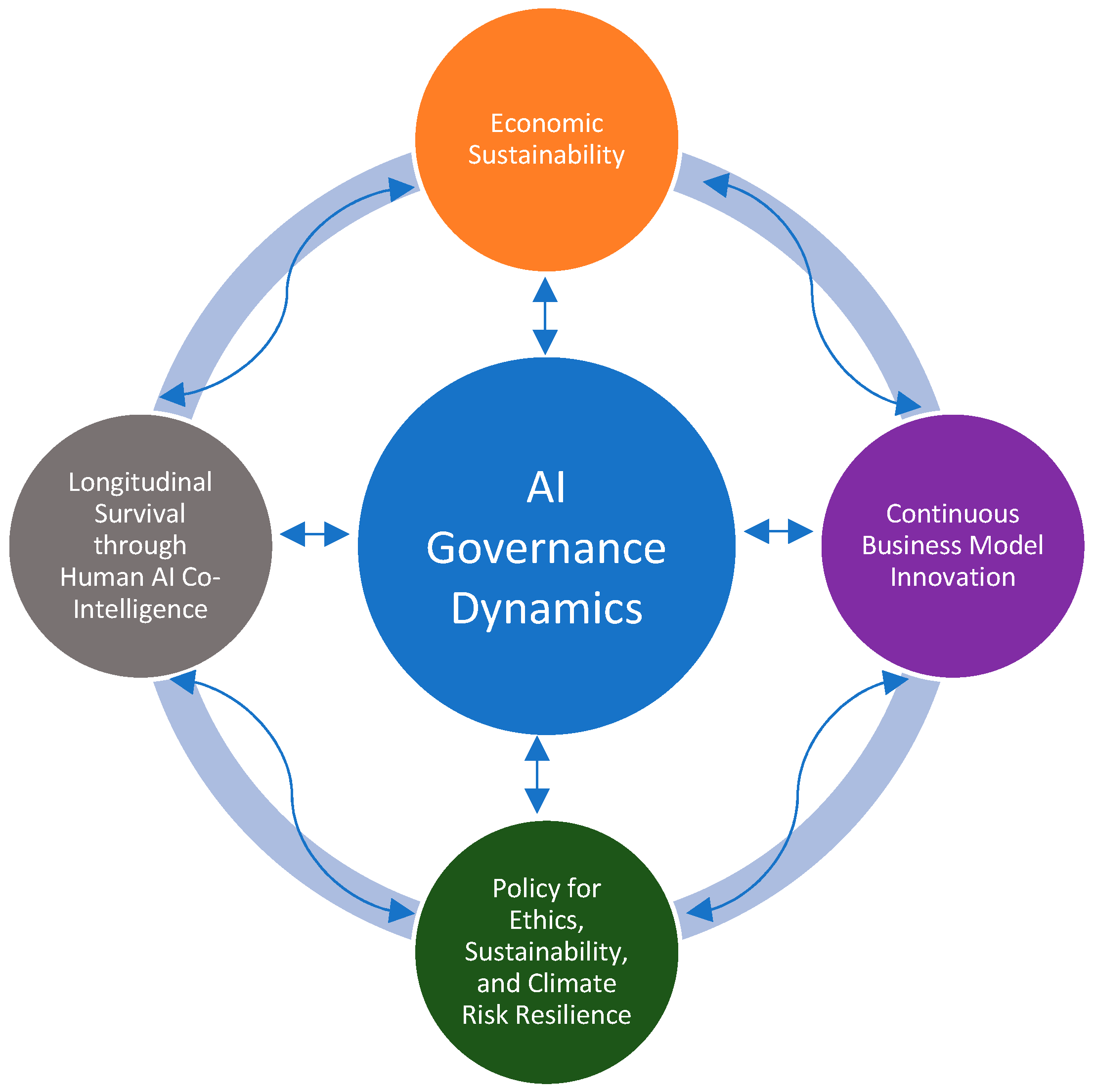
Economics of AI and Sustainability in Industry 5.0: Quest for Entrepreneurial and Organizational Intelligence Under Creative Destruction


Abstract
1. Introduction
2. Literature Review
2.1. Industry 5.0, Human-Centric AI, and Circularity
2.2. AI, Agency Theory, and Information Asymmetry
2.3. Managerial Economics of Sustainability in AI-Empowered Industry 5.0
2.4. Entrepreneurial Quest for Economic and Sustainability Performance Through AI Deployment
2.5. Human-Centered, Ethical AI and Climate Risk Governance
2.6. Business Model for Continuous Innovation, Organizational Intelligence and Sustainability
3. Cultivating AI-Driven Innovation in Service Sector Under Industrialization
3.1. Transforming Service Innovation
3.2. Clinical and Care Robotics Applications
3.3. Human Experience and Ethics in AI Applications
4. Discussion
4.1. Potentials of AI-Driven Entrepreneurial Firms
4.2. Knowledge Gaps on Organizational Sustainability
5. Concluding Notes
5.1. Organizational Intelligence Built on Human Competency
5.2. Implications for Competency Development
6. Limitations
Author Contributions
Funding
Institutional Review Board Statement
Informed Consent Statement
Data Availability Statement
Conflicts of Interest
References
- Sharma, R.; Gupta, H. Harmonizing sustainability in Industry 5.0 era: Transformative strategies for cleaner production and sustainable competitive advantage. J. Clean. Prod. 2024, 445, 141118. [Google Scholar] [CrossRef]
- Hammad, M.; Rahamaddulla, S.; Tamyez, P.; Fauzi, M. From Industry 4.0 to 5.0: Leveraging AI and IoT for sustainable and human-centric operations. Int. J. Ind. Eng. Oper. Manag. 2025. Epub ahead of printing. [Google Scholar] [CrossRef]
- Leng, J.; Zhu, X.; Huang, Z.; Li, X.; Zheng, P.; Zhou, X.; Mourtzis, D.; Wang, B.; Qi, Q.; Shao, H.; et al. Unlocking the power of industrial artificial intelligence towards Industry 5.0: Insights, pathways, and challenges. J. Manuf. Syst. 2024, 73, 349–363. [Google Scholar] [CrossRef]
- Waqas, M.; Naseem, A. Artificial Intelligence in Sustainable Industrial Transformation: A Comparative Study of Industry 4.0 and Industry 5.0. FinTech Sustain. Innov. 2025, 1, A2–A14. [Google Scholar] [CrossRef]
- Ahmed, T.; Karmaker, C.; Nasir, S.; Moktadir, M.; Paul, S. Modeling the artificial intelligence-based imperatives of industry 5.0 towards resilient supply chains: A post-COVID-19 pandemic perspective. Comput. Ind. Eng. 2023, 177, 109055. [Google Scholar] [CrossRef]
- Rejeb, A.; Rejeb, K.; Keogh, J.; Süle, E. When Industry 5.0 Meets the Circular Economy: A Systematic Literature Review. Circ. Econ. Sustain. 2025, 5, 2621–2652. [Google Scholar] [CrossRef]
- Martini, B.; Bellisario, D.; Coletti, P. Human-Centered and Sustainable Artificial Intelligence in Industry 5.0: Challenges and Perspectives. Sustainability 2024, 16, 5448. [Google Scholar] [CrossRef]
- Petre, A. Innovative and sustainable entrepreneurship based on Industry 5.0. Expected best practices, insights, and pathways. Bus. Excell. Manag. 2025, 15, 38–47. [Google Scholar] [CrossRef]
- Narkhede, G.; Chinchanikar, S.; Narkhede, R.; Chaudhari, T. Role of Industry 5.0 for driving sustainability in the manufacturing sector: An emerging research agenda. J. Strategy Manag. 2024. Epub ahead of printing. [Google Scholar] [CrossRef]
- Ng, A. The Emergence of the Robotics Industry with AI: Digital Transformation, Strategic Organizational Sustainability, and Distinct Business Models. Circ. Econ. Sustain. 2025, 5, 3887–3908. [Google Scholar] [CrossRef]
- Babina, T.; Fedyk, A.; He, A.; Hodson, J. Artificial intelligence, firm growth, and product innovation. J. Financ. Econ. 2024, 151, 103745. [Google Scholar] [CrossRef]
- Jones, C.I. A.I. and Our Economic Future; NBER Working Paper, 34779; National Bureau of Economic Research: Cambridge, MA, USA, 2026. [Google Scholar] [CrossRef]
- Zhang, C.; Yang, J. Artificial intelligence and corporate ESG performance. Int. Rev. Econ. Financ. 2024, 96, 103713. [Google Scholar] [CrossRef]
- Chen, X.; Ge, L. Artificial intelligence and corporate ESG performance: Evidence from China. Appl. Econ. Lett. 2025, 1–7. [Google Scholar] [CrossRef]
- Li, J.; Wu, T.; Hu, B.; Pan, D.; Zhou, Y. Artificial intelligence and corporate ESG performance. Int. Rev. Financ. Anal. 2025, 102, 104036. [Google Scholar] [CrossRef]
- Tian, H.; Wang, J.; Cai, Y. Artificial Intelligence Adoption and Corporate ESG Performance. Bus. Strategy Environ. 2025, 34, 8922–8945. [Google Scholar] [CrossRef]
- Yu, X.; Murad, M.; Chen, C.; Wang, T.; Jia, X. “Good Citizen” or “Good Actor”: The Asymmetric Impact of Artificial Intelligence on Firms’ Tactical Environmental Information Disclosure. Bus. Strategy Environ. 2025, 35, 5030–5049. [Google Scholar] [CrossRef]
- Aghion, P.; Howitt, P. A Model of Growth Through Creative Destruction; NBER Working Paper, 3223; National Bureau of Economic Research: Cambridge, MA, USA, 1990. [Google Scholar] [CrossRef]
- Aghion, P.; Howitt, P. Creative destruction and US economic growth. Capital. Soc. 2022, 16, 1. Available online: https://ssrn.com/abstract=4138770 (accessed on 5 June 2026).
- Uctu, R.; Tuluce, N.S.H.; Aykac, M. Creative destruction and artificial intelligence: The transformation of industries during the sixth wave. J. Econ. Technol. 2024, 2, 296–309. [Google Scholar] [CrossRef]
- Shabur, M.; Shahriar, A.; Ara, M. From automation to collaboration: Exploring the impact of industry 5.0 on sustainable manufacturing. Discov. Sustain. 2025, 6, 341. [Google Scholar] [CrossRef]
- Alojaiman, B. Technological Modernizations in the Industry 5.0 Era: A Descriptive Analysis and Future Research Directions. Processes 2023, 11, 1318. [Google Scholar] [CrossRef]
- Olsson, A.; Eriksson, K.; Carlsson, L. Management toward Industry 5.0: A co-workership approach on digital transformation for future innovative manufacturing. Eur. J. Innov. Manag. 2024, 28, 65–84. [Google Scholar] [CrossRef]
- Carayannis, E.; Christodoulou, K.; Christodoulou, P.; Chatzichristofis, S.; Zinonos, Z. Known Unknowns in an Era of Technological and Viral Disruptions-Implications for Theory, Policy, and Practice. J. Knowl. Econ. 2021, 13, 587–610. [Google Scholar] [CrossRef]
- Ghobakhloo, M.; Iranmanesh, M.; Tseng, M.; Grybauskas, A.; Stefanini, A.; Amran, A. Behind the definition of Industry 5.0: A systematic review of technologies, principles, components, and values. J. Ind. Prod. Eng. 2023, 40, 432–447. [Google Scholar] [CrossRef]
- Robra, B.; Pazaitis, A.; Giotitsas, C.; Pansera, M. From creative destruction to convivial innovation—A post-growth perspective. Technovation 2023, 125, 102760. [Google Scholar] [CrossRef]
- Bielawski, R. Human-centric management in the era of Industry 5.0: Opportunities and challenges for business practice. Humanit. Soc. Sci. Rev. 2025, 13, 250–257. [Google Scholar] [CrossRef]
- Hu, J.; Li, Y.; Chew, J. Industry 5.0 and Human-Centered Energy System: A Comprehensive Review with Socio-Economic Viewpoints. Energies 2025, 18, 2345. [Google Scholar] [CrossRef]
- Sjödin, D.; Parida, V.; Kohtamäki, M. Artificial intelligence enabling circular business model innovation in digital servitization: Conceptualizing dynamic capabilities, AI capacities, business models and effects. Technol. Forecast. Soc. Change 2023, 197, 122903. [Google Scholar] [CrossRef]
- Amirkhizi, P.; Pedrammehr, S.; Pakzad, S.; Shahhoseini, A. Generative Artificial Intelligence in Adaptive Social Manufacturing: A Pathway to Achieving Industry 5.0 Sustainability Goals. Processes 2025, 13, 1174. [Google Scholar] [CrossRef]
- Manetti, S.; Ni, M.; Supino, S.; Troisi, O. Rethinking the circular economy in agri-food: Human-centred AI for a new circular economy 5.0 paradigm. Br. Food J. 2025. Epub ahead of printing. [Google Scholar] [CrossRef]
- Machucho, R.; Ortiz, D. The Impacts of Artificial Intelligence on Business Innovation: A Comprehensive Review of Applications, Organizational Challenges, and Ethical Considerations. Systems 2025, 13, 264. [Google Scholar] [CrossRef]
- Usman, F.; Eyo-Udo, N.; Etukudoh, E.; Odonkor, B.; Ibeh, C.; Adegbola, A. A critical review of AI-driven strategies for entrepreneurial success. Int. J. Manag. Entrep. Res. 2024, 6, 200–215. [Google Scholar] [CrossRef]
- Singh, R.; Khan, S.; Joshi, A.; Raghuveer, K.; Kumar, V. Exploring the role of artificial intelligence on business innovation and entrepreneurship. Strategy Leadersh. 2025, 54, 302–322. [Google Scholar] [CrossRef]
- Sai, S.; Sai, R.; Chamola, V. Generative AI for Industry 5.0: Analyzing the Impact of ChatGPT, DALLE, and Other Models. IEEE Open J. Commun. Soc. 2025, 6, 3056–3066. [Google Scholar] [CrossRef]
- Bergh, D.D.; Ketchen, D.J.; Orlandi, I.; Heugens, P.P.M.A.R.; Boyd, B.K. Information Asymmetry in Management Research: Past Accomplishments and Future Opportunities. J. Manag. 2019, 45, 122–158. [Google Scholar] [CrossRef]
- Shahzaib, R.; Latif, F.; Ali, S. The Role of Intelligent AI Agents in Optimizing Business Management and Decision-Making Processes. Res. J. Soc. Aff. 2025, 3, 1107–1121. [Google Scholar] [CrossRef]
- Bany Salameh, H.; Elrefae, G.; Eletter, S. Artificial intelligence and information symmetry: A path to mitigate adverse selection. Clust. Comput. 2025, 28, 601. [Google Scholar] [CrossRef]
- Akerlof, G.A. The Market for “Lemons”: Quality Uncertainty and the Market Mechanism. Q. J. Econ. 1970, 84, 488–500. [Google Scholar] [CrossRef]
- Meng, X. Enhancing Financial Market Efficiency Through Data Science: Mitigating Information Asymmetry. Adv. Econ. Manag. Political Sci. 2025, 184, 65–71. [Google Scholar] [CrossRef]
- Zhang, Y.; Zhang, T. How generative AI reshapes principal-agent relationships: Mitigating adverse selection and moral hazard. Int. Conf. AI Digit. Econ. 2025, 2025, 49–67. [Google Scholar] [CrossRef]
- Erlei, A.; Cau, F.M.; Georgiev, R.; Kumar, S.; Bizer, K.; Gadiraju, U. When Life Gives You AI, Will You Turn It into a Market for Lemons? Understanding How Information Asymmetries About AI System Capabilities Affect Market Outcomes and Adoption. In Proceedings of the 2026 CHI Conference on Human Factors in Computing Systems, Barcelona, Spain, 13–17 April 2026. [Google Scholar] [CrossRef]
- Cooley, J. Addressing Information Asymmetry in Healthcare Through AI-Enhanced Patient Education. J. Healthc. Manag. 2025, 70, 261–268. [Google Scholar] [CrossRef]
- Yu, X.; Fan, L.; Yu, Y. Artificial Intelligence and Corporate ESG Performance: A Mechanism Analysis Based on Corporate Efficiency and External Environment. Sustainability 2025, 17, 3819. [Google Scholar] [CrossRef]
- Kronemann, B.; Kizgin, H.; Rana, N.P.; Dwivedi, Y.K. How AI encourages consumers to share their secrets? The role of anthropomorphism, personalisation, and privacy concerns and avenues for future research. Span. J. Mark. 2023, 27, 3–19. [Google Scholar] [CrossRef]
- Amin, M.; Kim, S.; Rishat, M.A.-S.A.; Tang, Z.; Ahn, H. A Systematic Literature Review of Privacy Information Disclosure in AI-Integrated Internet of Things (IoT) Technologies. Sustainability 2024, 17, 8. [Google Scholar] [CrossRef]
- Zou, M.; Yang, Y. Unveiling the impact of artificial intelligence on corporate misconduct, the perspective of information asymmetry. Technol. Forecast. Soc. Change 2026, 225, 124506. [Google Scholar] [CrossRef]
- Gupta, B.; Gaurav, A.; Panigrahi, P.; Arya, V. Analysis of artificial intelligence-based technologies and approaches on sustainable entrepreneurship. Technol. Forecast. Soc. Change 2023, 186, 122152. [Google Scholar] [CrossRef]
- Wang, Q.; Qi, Y.; Li, R. Artificial Intelligence and Corporate Sustainability: Shaping the Future of ESG in the Age of Industry 5.0. Sustain. Dev. 2025, 34, 1–26. [Google Scholar] [CrossRef]
- Costa, E. Industry 5.0 and SDG 9: A symbiotic dance towards sustainable transformation. Sustain. Earth Rev. 2024, 7, 4. [Google Scholar] [CrossRef]
- Trunina, I.; Bilyk, M.; Yakovenko, Y. Artificial Intelligence from Industry 5.0 Perspective: Threats and Challenges. In Proceedings of the 2023 IEEE 5th International Conference on Modern Electrical and Energy System (MEES), Kremenchuk, Ukraine, 27–30 September 2023; pp. 1–5. [Google Scholar] [CrossRef]
- Ng, A.W.; Nathwani, J.; Fu, J.; Zhou, H. Green financing for global energy sustainability: Prospecting transformational adaptation beyond Industry 4.0. Sustain. Sci. Pract. Policy 2021, 17, 377–390. [Google Scholar] [CrossRef]
- Almasabi, S.S.; Chotia, V.; Malik, P.; Cillo, V.; Manlio, D.G. Empowering ESG through digital capabilities: A strategic model for entrepreneurial performance and corporate governance transformation. Int. Entrep. Manag. J. 2026, 22, 85. [Google Scholar] [CrossRef]
- Akande, A.; Hui, J.; Ireland, L.; Morris, M. Impact of Artificial Intelligence (AI) on Entrepreneurship; Penn State Social Science Research Institute: University Park, PA, USA, 2024; Available online: https://evidence2impact.psu.edu/resources/impact-of-artificial-intelligence-ai-on-entrepreneurship/ (accessed on 5 June 2026).
- Ukoba, K.; Olatunji, K.O.; Adeoye, E.; Jen, T.C.; Madyira, D.M. Optimizing renewable energy systems through artificial intelligence: Review and future prospects. Energy Environ. 2024, 35, 3833–3879. [Google Scholar] [CrossRef]
- Suci, A.M.; Amini, R.; Asri, A.K.; Martin, N. Artificial intelligence in renewable energy: A review of predictive maintenance and energy optimization. J. Clean Technol. 2025, 2, 29–44. [Google Scholar] [CrossRef]
- Metcalf, L.; Askay, D.A.; Rosenberg, L.B. Keeping Humans in the Loop: Pooling Knowledge through Artificial Swarm Intelligence to Improve Business Decision Making. Calif. Manag. Rev. 2019, 61, 109–184. [Google Scholar] [CrossRef]
- Davenport, T. What Does AI Ethicist Do? The Leader’s Playbook for Approaching Responsible AI; MIT Sloan Management Review Special Edition; MIT Press: Cambridge, MA, USA, 2021. [Google Scholar]
- Ng, A.W.; Macbeth, D.; Yip, L.S. Exploring performance drivers for technology-based ventures from early stage to expansion: Perspectives of venture capitalists. Ventur. Cap. 2017, 19, 335–359. [Google Scholar] [CrossRef]
- Leal, W.; Wall, T.; Mucova, S.; Nagy, G.; Balogun, A.; Luetz, J.; Ng, A.; Kovaleva, M.; Azam, F.; Alves, F.; et al. Deploying artificial intelligence for climate change adaptation. Technol. Forecast. Soc. Change 2022, 180, 121662. [Google Scholar] [CrossRef]
- Leal Filho, W.; Kovaleva, M.; Ng, A.W.; Nagy, G.J.; Lütz, J.M.; Dinis, M.A.P. Artificial intelligence and climate change: The potential roles of foundation models. Environ. Sci. Eur. 2025, 37, 159. [Google Scholar] [CrossRef]
- Dzhengiz, T.; Niesten, E. Competences for Environmental Sustainability: A Systematic Review on the Impact of Absorptive Capacity and Capabilities. J. Bus. Ethics 2020, 162, 881–906. [Google Scholar] [CrossRef]
- Shahzad, M.; Qu, Y.; Ur Rehman, S.; Zafar, A.U.; Ding, X.; Abbas, J. Impact of knowledge absorptive capacity on corporate sustainability with mediating role of CSR: Analysis from the Asian context. J. Environ. Plan. Manag. 2020, 63, 148–174. [Google Scholar] [CrossRef]
- Rastegar, D.A. Health care becomes an industry. Ann. Fam. Med. 2004, 2, 79–83. [Google Scholar] [CrossRef] [PubMed] [PubMed Central]
- Li, Y.; Wang, M.; Wang, L.; Cao, Y.; Liu, Y.; Zhao, Y.; Yuan, R.; Yang, M.; Lu, S.; Sun, Z.; et al. Advances in the Application of AI Robots in Critical Care: Scoping Review. J. Med. Internet Res. 2023, 26, e54095. [Google Scholar] [CrossRef]
- Zhao, L.; Liu, S.; Xin, T.; Tan, J.; Wang, X.; Li, Y.; Bian, Z.; Chen, Y.; Kong, F.; Bian, J.; et al. AI agent in healthcare: Applications, evaluations, and future directions. npj Artif. Intell. 2026, 2, 31. [Google Scholar] [CrossRef]
- Kyrarini, M.; Lygerakis, F.; Rajavenkatanarayanan, A.; Sevastopoulos, C.; Nambiappan, H.; Chaitanya, K.; Babu, A.; Mathew, J.; Makedon, F. A Survey of Robots in Healthcare. Technologies 2021, 9, 8. [Google Scholar] [CrossRef]
- Mizna, S.; Arora, S.; Saluja, P.; Das, G.; Alanesi, W. An analytic research and review of the literature on practice of artificial intelligence in healthcare. Eur. J. Med. Res. 2025, 30, 382. [Google Scholar] [CrossRef]
- Holland, J.; Kingston, L.; Mccarthy, C.; Armstrong, E.; O’dwyer, P.; Merz, F.; McConnell, M. Service Robots in the Healthcare Sector. Robotics 2021, 10, 47. [Google Scholar] [CrossRef]
- Sarker, S.; Jamal, L.; Ahmed, S.; Irtisam, N. Robotics and artificial intelligence in healthcare during COVID-19 pandemic: A systematic review. Robot. Auton. Syst. 2021, 146, 103902. [Google Scholar] [CrossRef]
- Silvera-Tawil, D. Robotics in Healthcare: A Survey. SN Comput. Sci. 2024, 5, 189. [Google Scholar] [CrossRef]
- Cesário, L.; Barbosa, P.; Miguel, P.; Mendes, G. Service robots in caring for older adults: Uncovering the current conceptual and intellectual structures and future research agenda. Arch. Gerontol. Geriatr. 2025, 131, 105755. [Google Scholar] [CrossRef] [PubMed]
- Kipnis, E.; McLeay, F.; Grimes, A.; De Saille, S.; Potter, S. Service Robots in Long-Term Care: A Consumer-Centric View. J. Serv. Res. 2022, 25, 667–685. [Google Scholar] [CrossRef]
- Ren, H.; Wong, K.; Soni, A.; Lee, K.; Arora, S.; Banco, J.; Jankovic, M.; Hung, L. Feasibility and Acceptability of Deploying a Collaborative Service Robot in Long-Term Care: Staff Experiences. Electronics 2025, 14, 1247. [Google Scholar] [CrossRef]
- Yip, M.; Salcudean, S.; Goldberg, K.; Althoefer, K.; Menciassi, A.; Opfermann, J.; Krieger, A.; Swaminathan, K.; Walsh, C.; Huang, H.; et al. Artificial intelligence meets medical robotics. Science 2023, 381, 141–146. [Google Scholar] [CrossRef] [PubMed]
- Wah, J. The rise of robotics and AI-assisted surgery in modern healthcare. J. Robot. Surg. 2025, 19, 311. [Google Scholar] [CrossRef]
- Olawade, D.; David-Olawade, A.; Wada, O.; Asaolu, A.; Adereni, T.; Ling, J. Artificial Intelligence in Healthcare Delivery: Prospects and Pitfalls. J. Med. Surg. Public Health 2024, 3, 100108. [Google Scholar] [CrossRef]
- Hung, L.; Wong, K.; Wong, J.; Park, J.; Alfares, H.; Zhao, Y.; Mousavi, H.; Zhao, H. Healthcare Workers’ Perspectives on AI-Enabled Robots Use in Long-Term Care: A Scoping Review. Innov. Aging 2023, 7, 1053. [Google Scholar] [CrossRef]
- Hung, L.; Wong, K.; Wong, J.; Park, J.; Mousavi, H.; Zhao, H. Facilitators and barriers to using AI-enabled robots with older adults in long-term care from staff perspective: A scoping review protocol. BMJ Open 2023, 13, e075278. [Google Scholar] [CrossRef]
- Wong, K.; Hung, L.; Wong, J.; Park, J.; Alfares, H.; Zhao, Y.; Mousavinejad, A.; Soni, A.; Zhao, H. Adoption of Artificial Intelligence–Enabled Robots in Long-Term Care Homes by Health Care Providers: Scoping Review. JMIR Aging 2023, 7, e55257. [Google Scholar] [CrossRef]
- Fiske, A.; Henningsen, P.; Buyx, A. Your Robot Therapist Will See You Now: Ethical Implications of Embodied Artificial Intelligence in Psychiatry, Psychology, and Psychotherapy. J. Med. Internet Res. 2018, 21, e13216. [Google Scholar] [CrossRef] [PubMed]
- Wang, X.; Wu, L. Artificial Intelligence, Lean Startup Method, and Product Innovations. Manag. Sci. 2025, 72, 756–782. [Google Scholar] [CrossRef]
- Adekunle, O.; Ologbon, E.; Abiodun, S. Artificial Intelligence (AI) Adoption and Startup Success Rates. Int. J. Res. Innov. Soc. Sci. 2024, VIII, 3032–3043. [Google Scholar] [CrossRef]
- Dinh, T.; Vu, M.; Tran, G. Artificial Intelligence in SMEs: Enhancing Business Functions Through Technologies and Applications. Information 2025, 16, 415. [Google Scholar] [CrossRef]
- Biradar, S.; Pillai, R.; Mittal, A.; Swami, P.; Tyagi, S.; Paunikar, S. AI and competitive strategy: How early adoption influences market dominance. Lex Localis—J. Local Self-Gov. 2025, 23, 1533–1540. [Google Scholar] [CrossRef]
- Lee, J.; Suh, T.; Roy, D.; Baucus, M. Emerging Technology and Business Model Innovation: The Case of Artificial Intelligence. J. Open Innov. Technol. Mark. Complex. 2019, 5, 44. [Google Scholar] [CrossRef]
- Keong, L. The Role of AI in Enhancing Start-Up Scalability: A Comparative Study between China and Southeast Asia. Int. J. Res. Innov. Soc. Sci. 2025, IX, 6066–6074. [Google Scholar] [CrossRef]
- Izzati, I.; Yusuf, D.; Maulana, S.; Pratiangga, A.; Apriliasari, D. Leveraging Artificial Intelligence for Innovative Technopreneurial Business Models. In Proceedings of the 2024 3rd International Conference on Creative Communication and Innovative Technology (ICCIT), Tangerang, Indonesia, 7–8 August 2024; pp. 1–6. [Google Scholar] [CrossRef]
- Hemmer, P.; Schemmer, M.; Kühl, N.; Vössing, M.; Satzger, G. Complementarity in human-AI collaboration: Concept, sources, and evidence. Eur. J. Inf. Syst. 2025, 34, 979–1002. [Google Scholar] [CrossRef]
- Mollick, E. Co-Intelligence: Living and Working with AI. ISSA J. 2025, 23, 29. [Google Scholar]
- Camps-Valls, G.; Fernandez-Torres, M.; Cohrs, K.; Höhl, A.; Castelletti, A.; Paçal, A.; Robin, C.; Martinuzzi, F.; Papoutsis, I.; Prapas, I.; et al. Artificial intelligence for modeling and understanding extreme weather and climate events. Nat. Commun. 2025, 16, 1919. [Google Scholar] [CrossRef] [PubMed]
- Badulescu, D.; Simuț, R.; Bodog, S.; Badulescu, A.; Simuț, C.; Zapodeanu, D. Shaping AI-related competencies for labor market and business. A PLS-SEM approach. Int. J. Comput. Commun. Control 2025, 20, 1. [Google Scholar] [CrossRef]
- Shi, L. Global Perspectives on AI Competence Development: Analyzing National AI Strategies in Education and Workforce Policies. Hum. Resour. Dev. Rev. 2025, 24, 447–476. [Google Scholar] [CrossRef]
- Benvenuti, M.; Cangelosi, A.; Weinberger, A.; Mazzoni, E.; Benassi, M.; Barbaresi, M.; Orsoni, M. Artificial intelligence and human behavioral development: A perspective on new skills and competences acquisition for the educational context. Comput. Hum. Behav. 2023, 148, 107903. [Google Scholar] [CrossRef]
- Walter, Y. Embracing the future of Artificial Intelligence in the classroom: The relevance of AI literacy, prompt engineering, and critical thinking in modern education. Int. J. Educ. Technol. High. Educ. 2024, 21, 15. [Google Scholar] [CrossRef]
- Chiu, T. Future research recommendations for transforming higher education with generative AI. Comput. Educ. Artif. Intell. 2024, 6, 100197. [Google Scholar] [CrossRef]
- Clear, T.; Cajander, Å.; Clear, A.; Mcdermott, R.; Daniels, M.; Divitini, M.; Forshaw, M.; Humble, N.; Kasinidou, M.; Kleanthous, S.; et al. AI Integration in the IT Professional Workplace: A Scoping Review and Interview Study with Implications for Education and Professional Competencies. In Proceedings of the 2024 Working Group Reports on Innovation and Technology in Computer Science Education, Milan, Italy, 8 July 2024. [Google Scholar] [CrossRef]
- Chee, H.; Ahn, S.; Lee, J. A Competency Framework for AI Literacy: Variations by Different Learner Groups and an Implied Learning Pathway. Br. J. Educ. Technol. 2024, 56, 2146–2182. [Google Scholar] [CrossRef]
- Essien, A.; Bukoye, O.; O’Dea, C.; Kremantzis, M. The influence of AI text generators on critical thinking skills in UK business schools. Stud. High. Educ. 2024, 49, 865–882. [Google Scholar] [CrossRef]
- Gonsalves, C. Generative AI’s Impact on Critical Thinking: Revisiting Bloom’s Taxonomy. J. Mark. Educ. 2024, 48, 4–19. [Google Scholar] [CrossRef]
- Sood, V.; Chauhan, R. Progress and prospects of quantum computing in sustainable development: An analytical review. Expert Syst. 2023, 41, e13389. [Google Scholar] [CrossRef]
- Ferhataj, A.; Biçoku, J.; Memaj, F. Shaping the Future Workforce: Students’ Perceptions on AI and Human-Centric Technologies in Industry 5.0. Econ. Cult. 2025, 22, 136–147. [Google Scholar] [CrossRef]
- Valente, M.; Caviggioli, F.; Agostini, L. Space Economy and Sustainability: A Systematic Review. Sustain. Dev. 2025, 33, 4922–4959. [Google Scholar] [CrossRef]
- Shepherd, D.; Majchrzak, A. Machines augmenting entrepreneurs: Opportunities (and threats) at the Nexus of artificial intelligence and entrepreneurship. J. Bus. Ventur. 2022, 37, 106227. [Google Scholar] [CrossRef]
- Chalmers, D.; MacKenzie, N.G.; Carter, S. Artificial Intelligence and Entrepreneurship: Implications for Venture Creation in the Fourth Industrial Revolution. Entrep. Theory Pract. 2021, 45, 1028–1053. [Google Scholar] [CrossRef]
- Ganuthula, V. AI-enabled individual entrepreneurship theory: Redefining scale, capability, and sustainability in the digital age. J. Innov. Entrep. 2025, 14, 85. [Google Scholar] [CrossRef]
- Lévesque, M.; Obschonka, M.; Nambisan, S. Pursuing Impactful Entrepreneurship Research Using Artificial Intelligence. Entrep. Theory Pract. 2020, 46, 803–832. [Google Scholar] [CrossRef]
- Yusuf, A.; Bello, S.; Pervin, N.; Tukur, A. Implementing a proposed framework for enhancing critical thinking skills in synthesizing AI-generated texts. Think. Ski. Creat. 2024, 53, 101619. [Google Scholar] [CrossRef]
- Business Insider. Graduation Speech at University of Arizona. 2026. Available online: https://www.businessinsider.com/students-boo-eric-schmidt-google-ceo-ai-university-arizona-2026-5?utm_source=firefox-newtab-en-ca (accessed on 5 June 2026).


| Core Research Themes | Insights | Sources |
|---|---|---|
| Human-centric AI and productivity | AI can augment human creativity and robotics applications, enabling efficient, customized, and higher-value outputs. | [3,4,9,30] |
| Resource efficiency and green gains | AI can boost resource utilization and reduce emissions in 5.0 configurations. | [3,5,6] |
| Circular and ESG-oriented models | AI that underpins the circular economy, traceability can improve ESG performance. | [7,49,50] |
| Entrepreneurial and corporate opportunities | Industry 5.0 readiness enhances entrepreneurship, corporate competitiveness, and sustainable growth. | [1,2,33,34] |
| Risks, investments, and governance needs | High investments (e.g., in AI technological infrastructure and energy utilization), skills gaps, and ethical risks require policy and governance frameworks. | [28,51,52,53] |
| Pursuits | Concerns | Sources |
|---|---|---|
| Long-term, real-world impact | Few robust longitudinal or large-scale trials on outcomes, safety, and cost-effectiveness across settings | [65,67,69,70] |
| Trust, acceptance, and co-design | Need for deeper study of how staff, residents, and families build trust and how co-design affects adoption | [74,78,79,80] |
| Hybrid human–robot care models | Limited empirical work on optimal task allocation, workflow redesign, and preserving relational care | [10,72,73] |
| Bias, fairness, and personalization | Understudied risks of biased AI in robots that triage, monitor, or coach patients, and how to audit them | [68,70,81] |
| Governance and risk management frameworks | Need for operational models for responsibility, regulation, reimbursement, risk management, climate resilience, energy sustainability, and data stewardship in AI-robot systems | [50,52,66,77] |
| Future Studies | Sustainability of Organizations | Sources |
|---|---|---|
| Entrepreneurial vs. large firms’ economic sustainability | Most causal evidence on AI and growth comes from larger firms; mechanisms in resource-constrained startups are less quantified. | [82,84,85] |
| Longitudinal impact on survival | Limited long-term studies on how AI affects survival, scaling paths, disruptive innovation, and resource allocation in organizations; co-intelligence of AI and humans in leadership and execution for organizational intelligence; implications for staff development. | [59,83,86] |
| Business-model archetypes and performance | Taxonomies of AI startup models exist, but the links between archetype choice, resource allocation, growth trajectories via continuous innovation, and new forms of intelligent organization remain underexplored. | [88,89,90] |
| AI Governance: Measuring AI return and capability maturity | Few methods to quantify AI return on investment, capability maturity, and their relationship to growth in entrepreneurial settings while addressing the potential to mitigate or exacerbate information asymmetry. | [36,42,44,53] |
| ESG Policy implications for the sustainability ecosystem gaps | Comparative evidence on how ethics and ecosystem factors (infrastructure, energy sustainability, funding, regulation) shape AI-enabled sustainable growth and climate risk resilience. | [14,15,16,49,52,91] |
| Areas | Key Competency Gaps | Sources |
|---|---|---|
| Science-based entrepreneurship | Apprehend AI and data science redefining scales, enabling sustainable, prosocial ventures, and augmenting new AI-driven entrepreneurship, business strategies, and economic models. | [54,104,105,106] |
| Employment competencies | Develop AI-reshaping skills; Improve preparedness and AI literacy driving labor-market fit; Evaluate the co-intelligence management model within organizations. | [92,93,97,98,102] |
| Critical thinking | Strengthen critical thinking at risk without scaffolds and ethical reasoning skills; appreciate the effectiveness of structured AI-CT frameworks; develop an enhanced outcome-based education system to address AI issues. | [94,95,96,99,100,108] |
Disclaimer/Publisher’s Note: The statements, opinions and data contained in all publications are solely those of the individual author(s) and contributor(s) and not of MDPI and/or the editor(s). MDPI and/or the editor(s) disclaim responsibility for any injury to people or property resulting from any ideas, methods, instructions or products referred to in the content. |
© 2026 by the authors. Licensee MDPI, Basel, Switzerland. This article is an open access article distributed under the terms and conditions of the Creative Commons Attribution (CC BY) license.
Share and Cite
Ng, A.; Cheung, C.F. Economics of AI and Sustainability in Industry 5.0: Quest for Entrepreneurial and Organizational Intelligence Under Creative Destruction. Sustainability 2026, 18, 6086. https://doi.org/10.3390/su18126086
Ng A, Cheung CF. Economics of AI and Sustainability in Industry 5.0: Quest for Entrepreneurial and Organizational Intelligence Under Creative Destruction. Sustainability. 2026; 18(12):6086. https://doi.org/10.3390/su18126086
Chicago/Turabian StyleNg, Artie, and C. F. Cheung. 2026. "Economics of AI and Sustainability in Industry 5.0: Quest for Entrepreneurial and Organizational Intelligence Under Creative Destruction" Sustainability 18, no. 12: 6086. https://doi.org/10.3390/su18126086
APA StyleNg, A., & Cheung, C. F. (2026). Economics of AI and Sustainability in Industry 5.0: Quest for Entrepreneurial and Organizational Intelligence Under Creative Destruction. Sustainability, 18(12), 6086. https://doi.org/10.3390/su18126086