Review

Nanomaterials for Air, Water, and Soil Remediation: Review

by
Dobrawa Kwaśniewska
* and
Justyna Kiewlicz
Department of Technology and Instrumental Analysis, Institute of Quality Science, Poznań University of Economics and Business, 61-875 Poznań, Poland
*
Author to whom correspondence should be addressed.
Sustainability 2026, 18(12), 6085; https://doi.org/10.3390/su18126085 (registering DOI)
Submission received: 11 May 2026 / Revised: 8 June 2026 / Accepted: 10 June 2026 / Published: 12 June 2026

Abstract

Overcoming the climate crisis and growing environmental pollution is a fundamental problem facing society in the 21st century. These problems have both health and economic implications. Developing an effective system for managing pollutants and greenhouse gases seems crucial. The use of nanomaterial-based technologies may be the answer. The dynamic development of nanoscience has led to the discovery of unique properties of nanomaterials, resulting primarily from quantum constraints, while the development of techniques for obtaining nanostructures has increased their availability. The ability to be used in filtration processes, as well as for adsorption, photocatalysis, and disinfection, predisposes nanomaterials to applications in environmental bioremediation and wastewater treatment. This article provides an overview of technologies currently in use or that may play a significant role in the fight for a healthier environment in the near future. The results of using nanomaterial-based technologies in air and water purification processes to date have been positive, promising further development of effective green technologies.

1. Introduction

Environmental pollution is believed to occur when harmful substances and pollutants are released into the air, soil, and water, generating negative impacts on the environment and human health. The source of most pollution is human activity (industrialization, transport, agriculture), but it can also arise as a result of natural processes [1]. According to the goals set by the UN, human actions should focus on ensuring the well-being of all people in the world, including reducing the number of diseases and deaths related to environmental pollution [2]. The World Health Organization (WHO) has released alarming data indicating that nearly 99% of the world’s population is exposed to air pollution at levels that may increase the risk of heart disease, stroke, chronic obstructive pulmonary disease, cancer, and pneumonia. Furthermore, ambient and household air pollution is estimated to be responsible for 6.7 million deaths annually. Contaminated water, which can be a carrier of disease-causing pathogens, also poses a threat to public health. Furthermore, access to water is a challenge for the world’s 2.2 billion people [1].
In recent years, global public discourse has repeatedly addressed the challenges posed by greenhouse gas emissions, rising temperatures, and the intensifying impacts of climate change. These discussions have led to agreements to reduce greenhouse gas emissions. However, it appears that these declarations have not been followed by sufficient action, and global greenhouse gas emissions continue to rise, remaining a significant environmental challenge.
It is certain that effective climate and pollution management requires coordinated international action [3]. Nanotechnologies can be incorporated into strategies to combat the climate crisis, environmental degradation, and pollution. This review addresses the potential use of nanomaterials in environmental remediation processes and greenhouse gas emission reduction.

2. Methodology

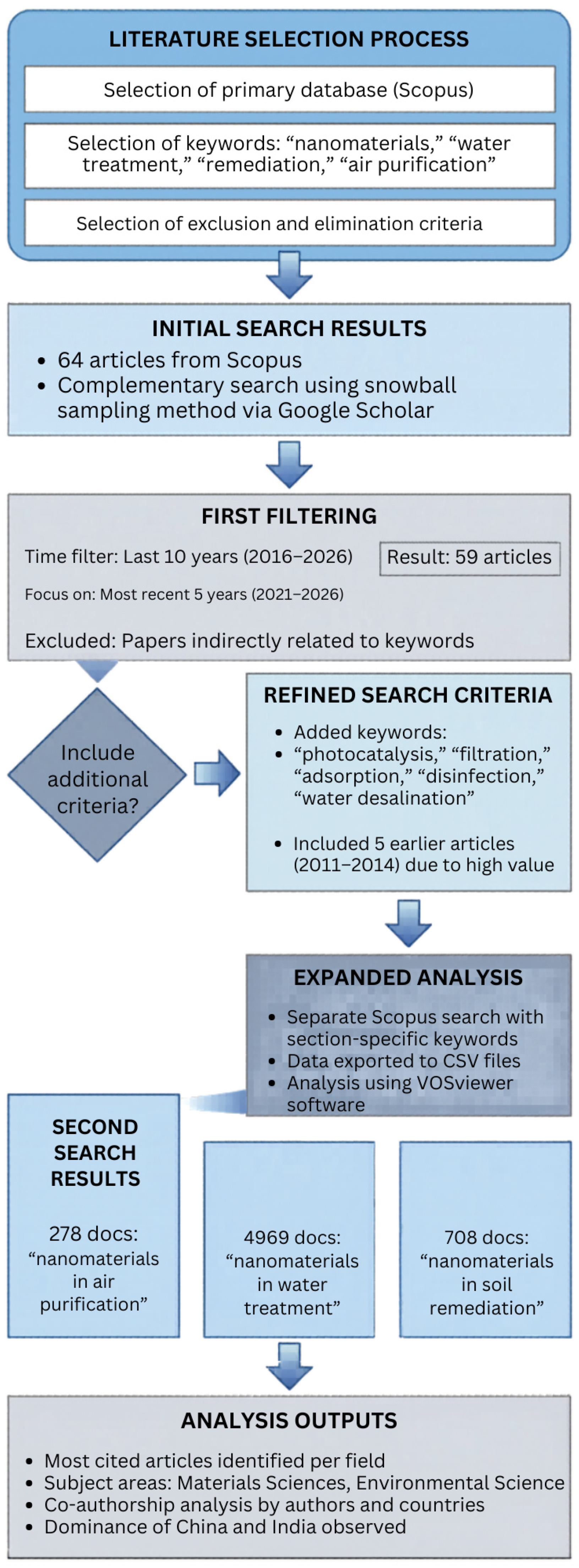
This research was based on a critical review of the literature [4]. The three-step literature selection process was conducted in the following order: selection of the primary database → selection of keywords → selection of exclusion and elimination criteria. To expand the scope of available articles, a complementary search was also conducted using the snowball sampling method. The Google Scholar database was used for this purpose. Both searches were based on four keywords: “nanomaterials,” “water treatment,” “remediation,” and “air purification.” The search yielded 64 articles (Scopus). Subsequently, the articles were filtered to include those published within the last 10 years (2016–2026), which reduced the number of articles to 59, with particular emphasis on the most recent works published within the last 5 years (2021–2026). Papers only indirectly related to the topics identified by the keywords were also excluded. During the analysis of the available materials, it was deemed appropriate to refine the search criteria to include air purification technologies (“photocatalysis,” “filtration,” “adsorption” and “disinfection”) and water treatment (“water desalination”). Therefore, due to their high substantive value, five earlier articles published between 2011 and 2014 were also included in the analysis. The stages of the literature selection process are illustrated in Scheme 1. The authors used GenAI (Canva AI 1.0) to generate the graphics presented in this paper.
Due to the general nature of the data obtained, it was decided to expand the previous analysis and conducted a separate search of the Scopus database using keywords specific to each section. The resulting data were exported to a CSV file(s) and analyzed using VOSviewer (version 1.6.20) software.
A second search of the Scopus database revealed a wider range of documents published between 2021 and 2026 in individual thematic sections, which were as follows:
  • A total of 278 documents on “nanomaterials in air purification”;
  • A total of 4969 documents on “nanomaterials in water treatment”;
  • A total of 708 documents on “nanomaterials in soil remediation”.
The analysis conducted using both Scopus and VOSviewer (version 1.6.20) showed that the highest number of citations (385) in the field of “nanomaterials in air purification” was recorded for the article by Wei et al. [5]. In the field of “nanomaterials in water treatment”, the most frequently cited article was Mitra et al. [6], which received 1775 citations, while in the field of “nanomaterials in soil remediation”, the most frequently cited article was Osman et al. [7], which had 616 citations. The most frequently represented subject areas of the articles were “materials science” (197 articles in the scope of “nanomaterials in air purification) and “environmental science” (2810 articles in the scope of “ nanomaterials in water treatment” and 492 articles in the scope of “nanomaterials in soil remediation”).
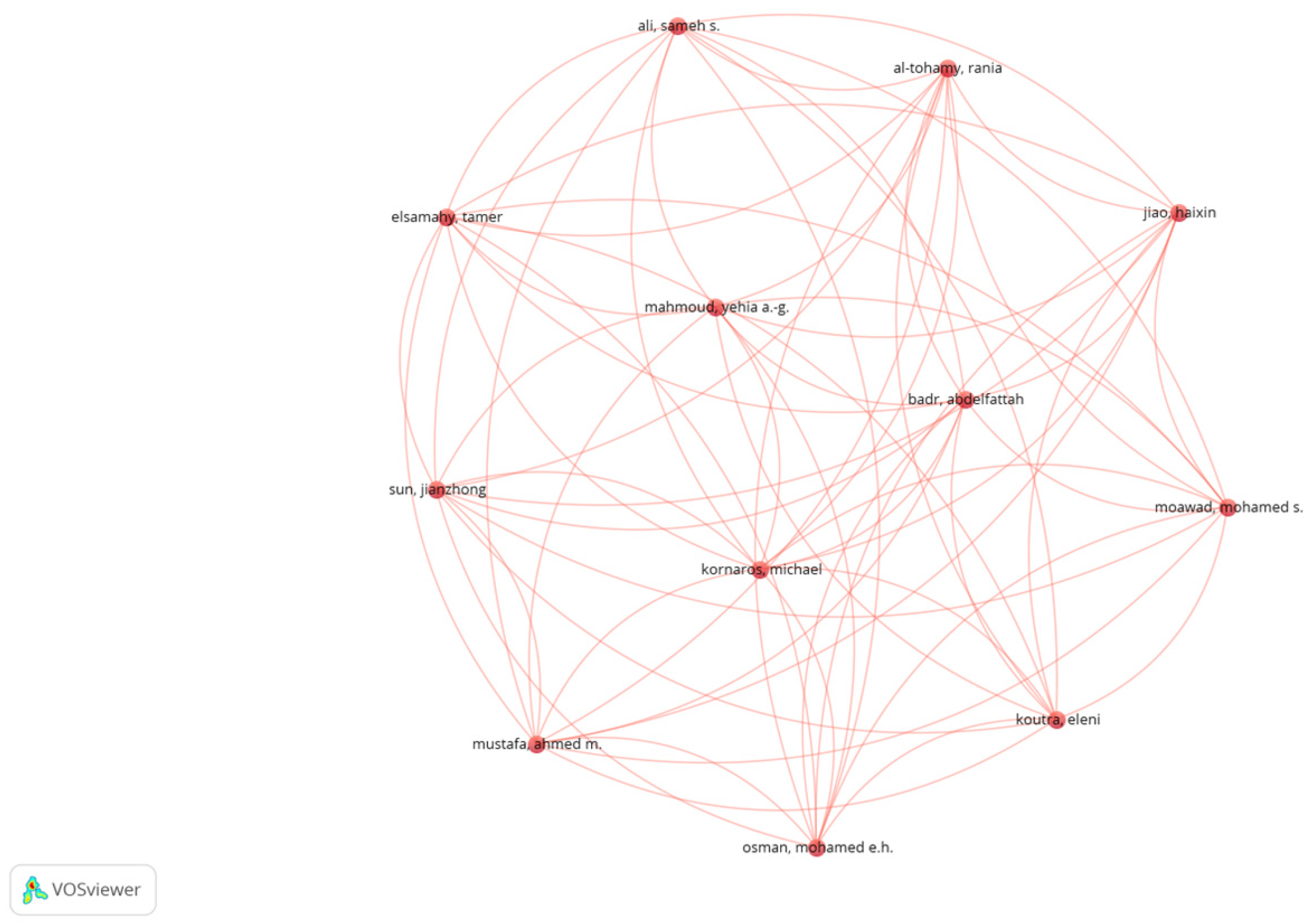
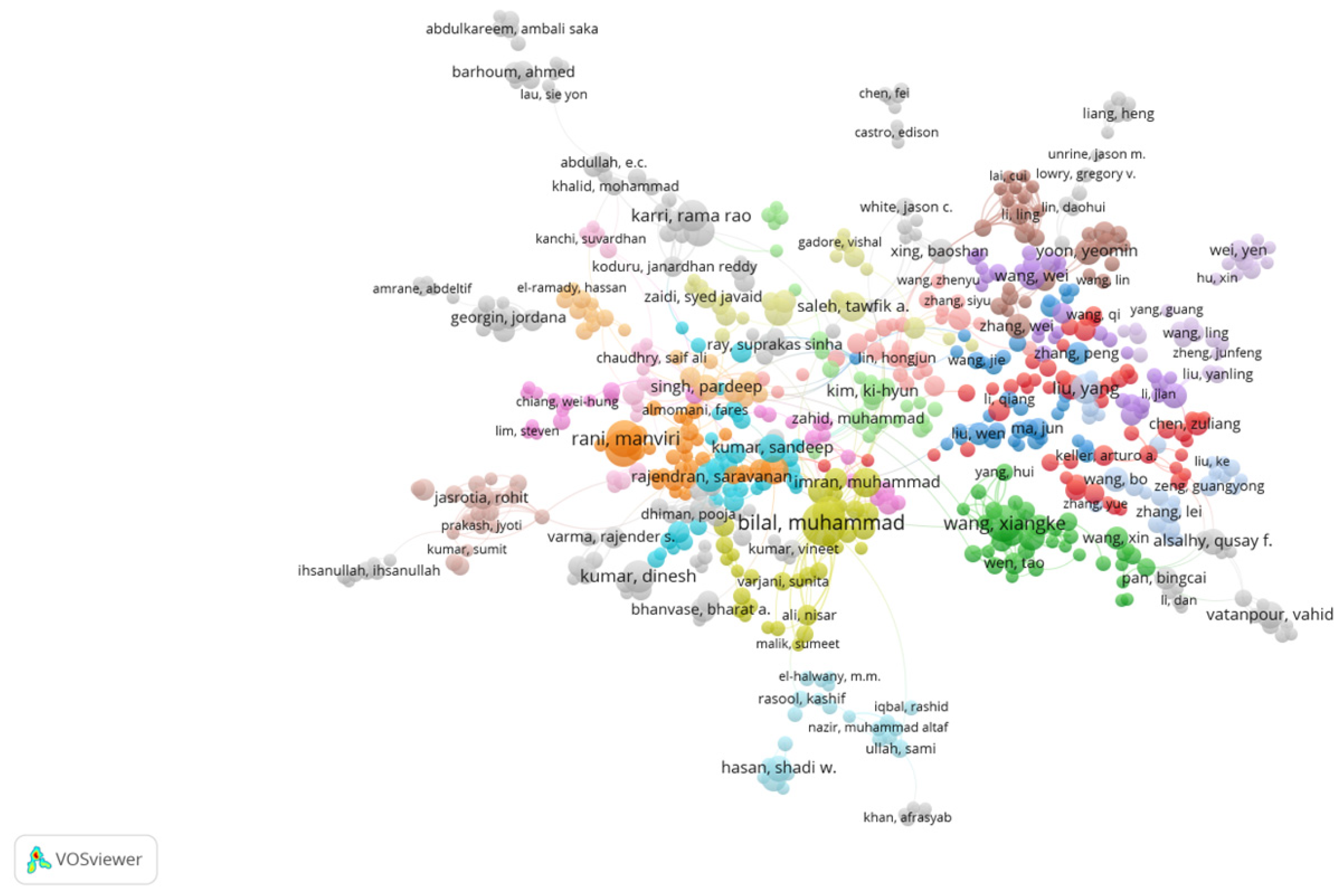
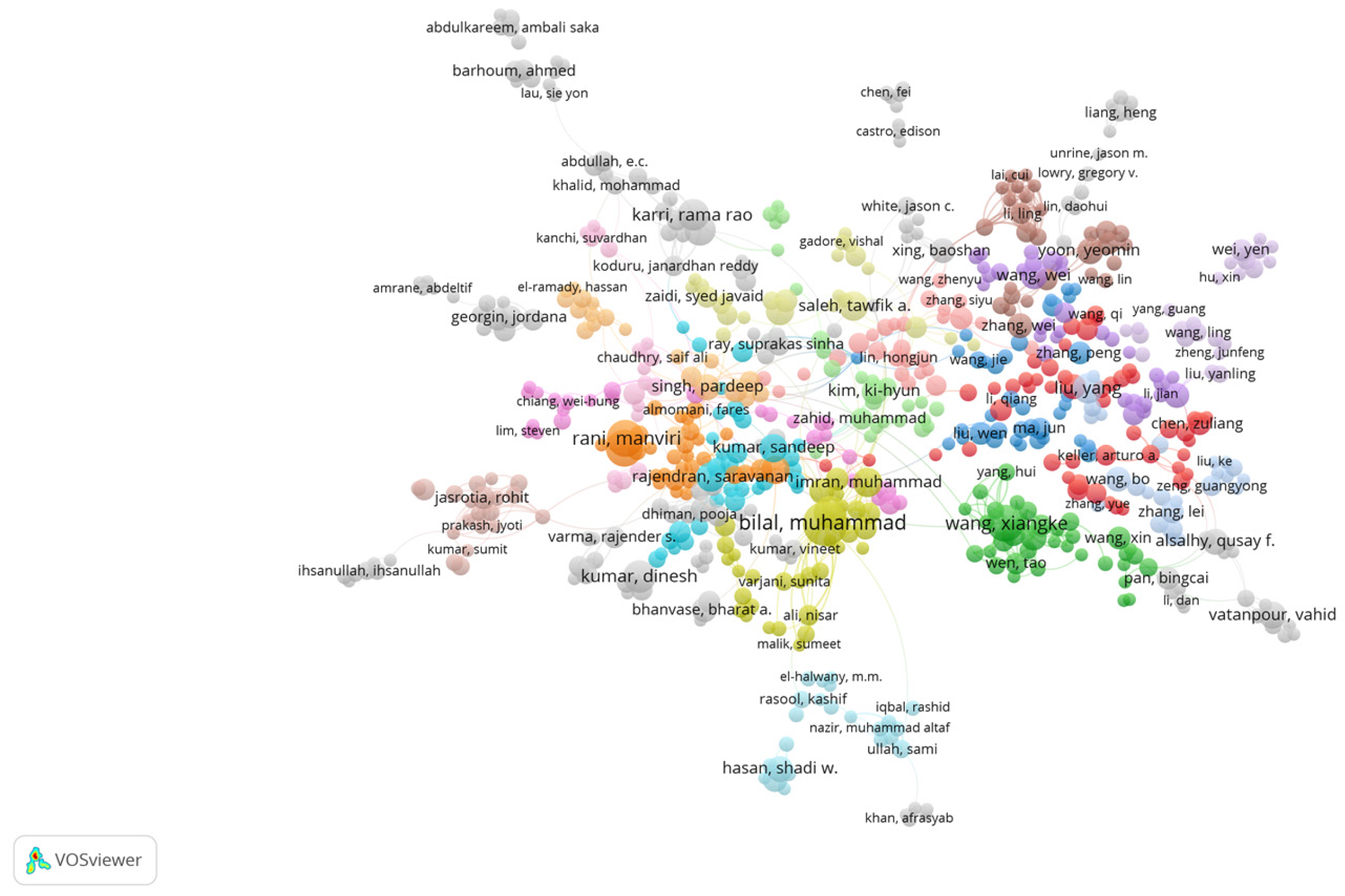
The analysis of co-authorship by “authors” showed that in the scope of “nanomaterials in water treatment”, 28,004 authors were identified, of which 356 had published at least 5 papers. These authors were grouped into 21 interconnected clusters. The highest total link strength value was assigned to Wang, Xiangke. For “nanomaterials in air purification” and “nanomaterials in soil remediation”, 3 clusters of 26 interconnected authors (out of 1396 total) and 1 cluster of 12 interconnected authors (out of 71 total) were identified respectively. The highest total link strength value in the case of “nanomaterials in air purification” was assigned to Babapoor, Aziz and Chiang, and Wei-Hung. For “nanomaterials in soil remediation”, 12 authors with total link strength value were identified (they constituted a full cluster). In the analysis of co-authorship by “countries” in all three areas, the dominance of China and India was observed. Bibliometric maps of co-authorship analysis by “author” and “country” are presented in Figure 1, Figure 2, Figure 3, Figure 4, Figure 5 and Figure 6.

3. Synthesis Routes for Nanomaterials

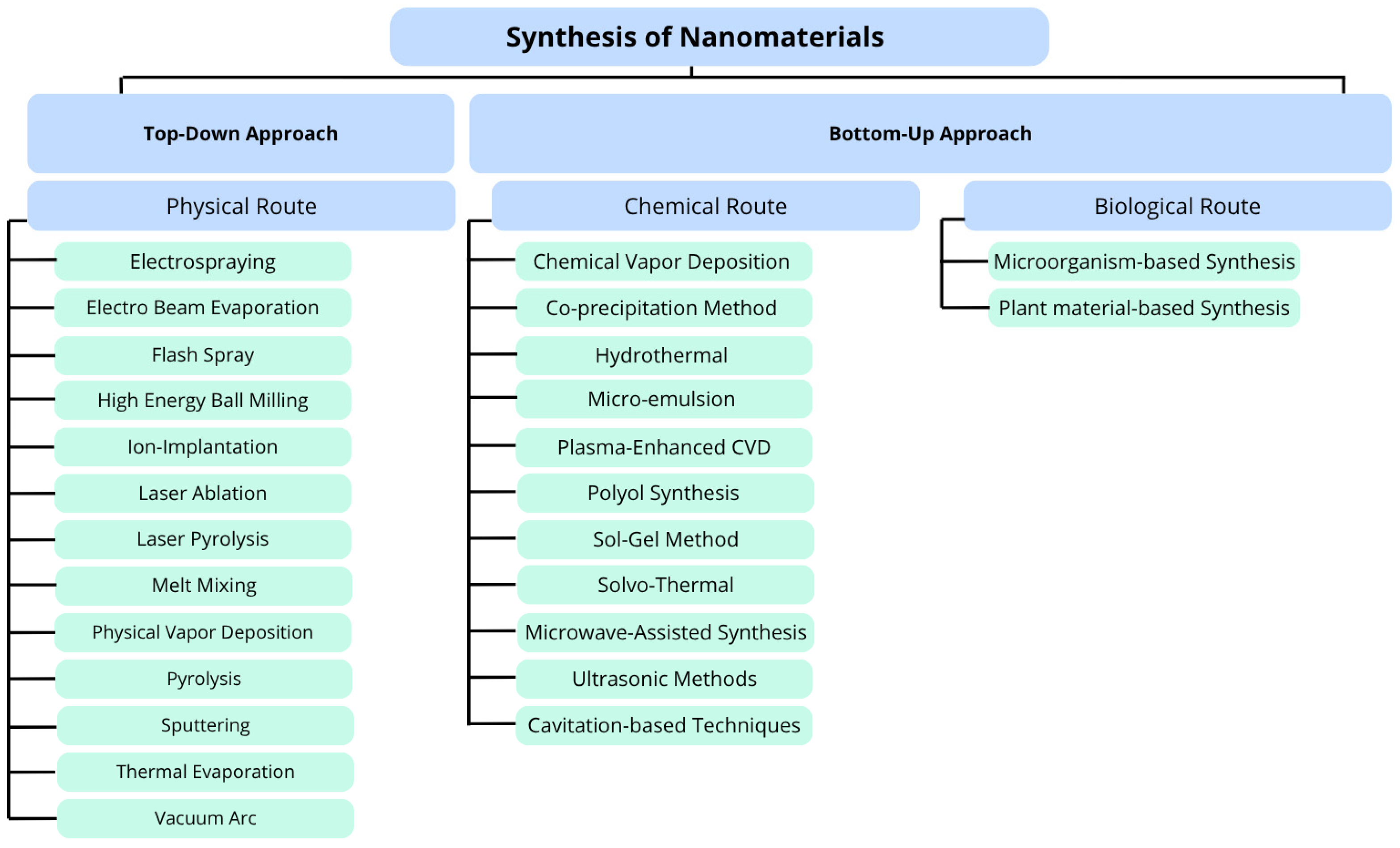
Nanomaterial synthesis can generally be achieved through three routes: physical, chemical, and biological. The most important examples of currently used methods are shown in Scheme 2. Conventional methods for obtaining nanomaterials, due to the use of high temperatures and pressures, toxic solvents, and reducing agents, are considered unsustainable and unecological. Furthermore, a comprehensive life-cycle assessment of these synthesis methods is often lacking, and economic costs are often underreported, further preventing a reliable assessment of the method in terms of cost-effectiveness and sustainability principles [8].
Microwave-assisted synthesis, sonochemical synthesis, synthesis using plant extracts, and biomolecule-assisted synthesis are considered green and environmentally friendly methods for obtaining nanomaterials. These methods are considered extremely beneficial due to reduced energy consumption, the elimination of harmful reagents, and the possibility of efficient production scalability. Literature reports indicate that materials obtained using these methods demonstrate improved properties, particularly important in medical applications, energy storage, catalysis, and environmental remediation. Microwave-assisted synthesis (MAS) ensures uniform and rapid heating of the reaction mixture thanks to the use of microwaves in the process. Obtaining nanomaterials dedicated to environmental remediation using the MAS method allows for the production of products with large surface areas and tailored physicochemical properties for pollutant capture and degradation [8]. Another method addressing the challenges of green chemistry is sonochemistry. This method typically does not require high temperatures, high pressure, an inert atmosphere, or long reaction times, making it less expensive than conventional nanoparticle synthesis methods. In sonochemistry, the product is formed through chemical reactions in solution, initiated by acoustic cavitation (the formation, growth, and implosion of bubbles). The use of ultrasound allows for the elimination of reducing and stabilizing substances, and the resulting products exhibit the same or even better properties. The products of sonochemical reactions are characterized by a relatively uniform size distribution, and the particle size can be controlled by modifying the reaction parameters [9,10]. In recent years, hydrodynamic cavitation (HC) has emerged as a promising sonochemical technology for industrial-scale applications, primarily due to its high efficiency, good scalability, and synergy with other physical and chemical methods. This method is also highly desirable due to its economic efficiency, which can be orders of magnitude higher than traditional methods. However, further development work is still required to improve the design of hydrodynamic cavitation reactors [11].
The biosynthesis of nanoparticles is also based on the concept of green chemistry. This method utilizes plants, microorganisms, and certain natural factors to produce nanoparticles. Biosynthetic methods are recognized to have numerous advantages over chemical and physical methods. The most frequently cited advantages are non-toxicity, environmental friendliness, and the process’s sustainability. However, the use of biosynthesis is associated with obstacles such as low yield, uneven particle size, complex extraction procedures, and seasonal and regional availability of raw materials [12].
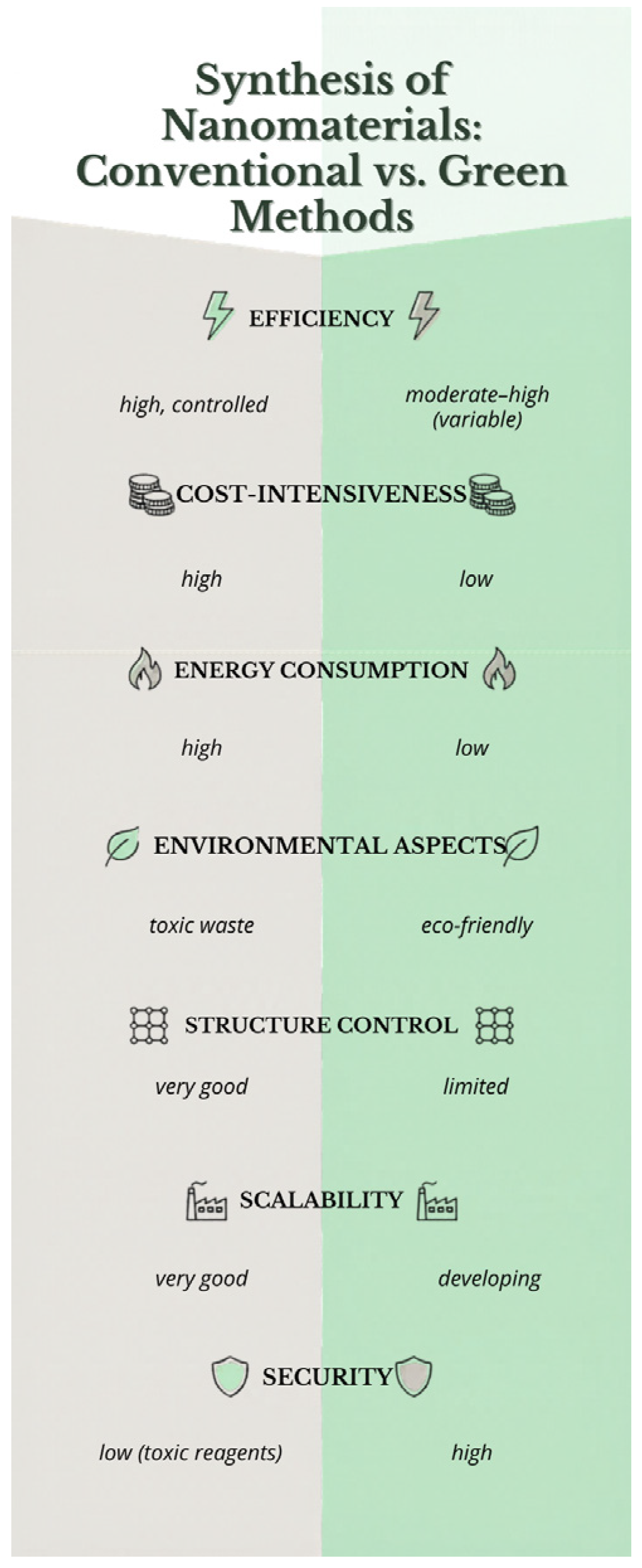
Due to the extremely diverse parameters and mechanisms of nanomaterial synthesis, Scheme 3 presents a general comparison of selected criteria.

4. Nanomaterials in Air Purification Technologies

Compared to bulk materials, nanomaterials have a larger specific surface area and unique catalytic, magnetic, and electronic properties, making them highly desirable materials in adsorption, filtration, and photocatalysis processes. These processes are currently considered crucial in environmental remediation [13].
Air pollution is one of the most current problems due to its impact on increasing climate change and on public health and therefore human well-being. Currently, it is believed that the greatest threats are posed by nitrogen oxides (NOx), sulfur oxides (SOx), carbon monoxide (CO), and suspended particulate matter (PM10, PM2.5), as well as lead and ground-level ozone. Its presence in the ground-level ozone layer can be explained as a result of reactions between nitrogen oxides (NOx) and volatile organic compounds (VOOs) [14]. Furthermore, the presence of nitrogen oxides, sulfur oxides, ammonia, and volatile organic compounds in the air is considered a secondary precursor to the formation of particulate matter. Air quality is also linked to the presence of carbon dioxide, which is not considered a pollutant, yet contributes to the greenhouse effect [15].
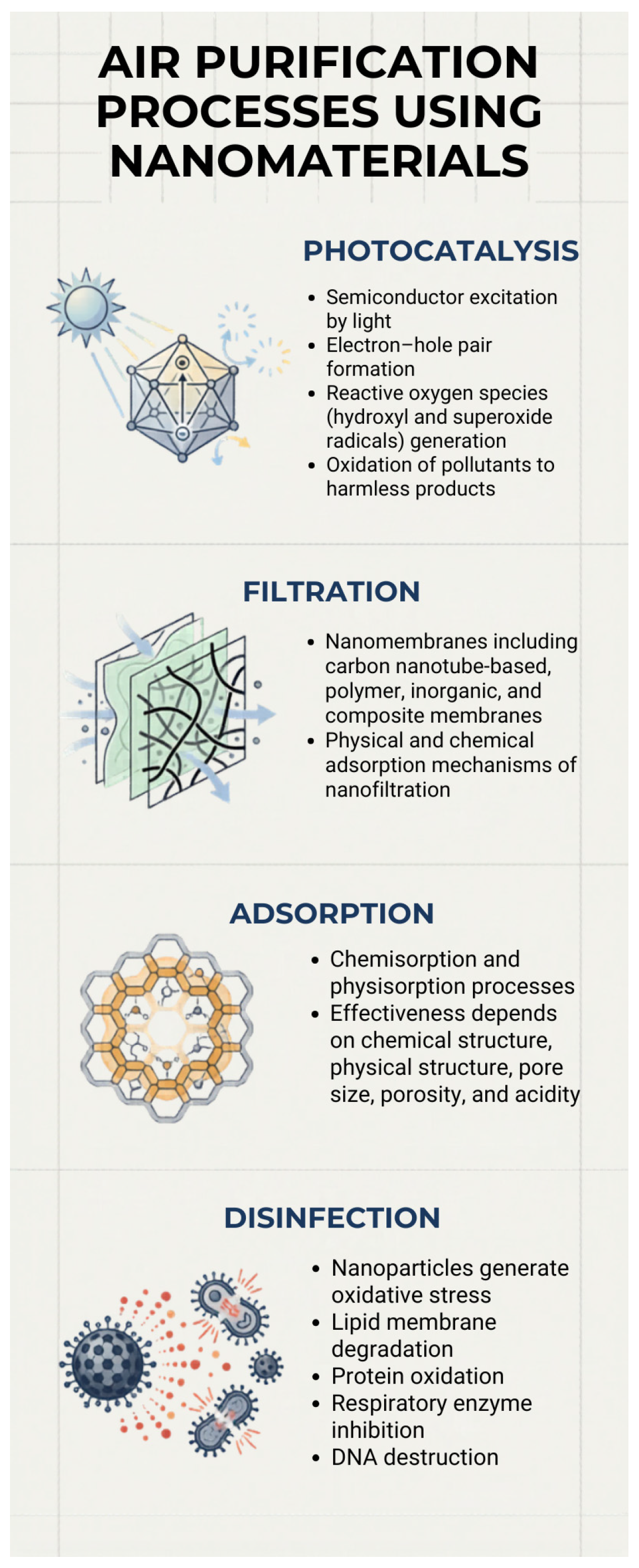
Air remediation processes based on the use of nanomaterials include filtration, adsorption, photocatalysis (also occurring at room temperature) and disinfection [13], as illustrated in Scheme 4.

4.1. Photocatalysis

The photocatalysis process can be defined as an advanced oxidation process in which irradiated semiconductors play a key role [13,16]. Adsorption of one photon of energy excites one electron from the valence band maximum to the conduction band minimum, generating a positive hole in the valence band. Electron–hole pairs undergo migration or diffusion. When these excited charge carriers reach the photocatalyst surface, they react with water and oxygen molecules, leading to the formation of reactive oxygen species (hydroxyl radicals, superoxide radicals). Due to the strong oxidation potential of these radicals, gaseous pollutants can be converted into products considered harmless. The efficiency of nanomaterials in photocatalysis is directly related to their light absorption efficiency. The most popular method for increasing light absorption and inhibiting photoinduced charge recombination is the deposition of plasmonic noble metals (Ag and Au) on the semiconductor. A method for extending the light absorption range of semiconductors is to dope them with metals or nonmetals [13]. Historically, nTiO2 has been a widely used nanomaterial in photocatalysis due to its chemical and photonic stability [17]. One idea for counteracting air pollution in urban environments was to incorporate nTiO2 into building materials. However, this eco-friendly and innovative idea encountered obstacles in reaching the laboratory scale, primarily related to photocatalytic efficiency. In recent years, numerous development studies have been conducted to improve the efficiency and stability of these materials [18]. It has been proven that one way to improve the efficiency of photocatalysts, including accelerating carrier separation, increasing spectral absorption, regulating the energy band, and providing adsorption sites, is to use quantum dots as modifiers. Furthermore, the role of quantum dots is not limited to modifying photocatalysts. It has been demonstrated that photocatalysts based on quantum dots can participate in the degradation of both inorganic and organic pollutants [19].

4.2. Filtration

Membrane technologies are desirable for use in air purification processes because they remove pollutants from the air without producing hazardous by-products. The nanofiltration process is considered to have several advantages, including ease of use, reliability, lack of additives, and scalability. Currently, nanofiltration utilizes carbon nanotube-based membranes, polymer membranes, inorganic membranes, and composite membranes. The mechanism of action of nanomembranes is based on physical and chemical adsorption processes. Due to the rapid development of nanotechnology, other solutions are also being considered [20]. It seems that one of the most important research streams concerning the practical application of nanofiltration is its use in vehicle exhaust purification. A breakthrough was the development of high-efficiency (>99.5%) polyimide nanofiber air filters for PM2.5 removal at high temperatures. The invention was characterized by high thermal stability within a temperature range of 25–370 °C and high airflow, and its effectiveness was confirmed in field tests [21]. The success of this solution has made nanofiltration and nanofiber technology an intensively developed field of materials engineering. Health problems caused by air pollution and the pathogens present in it have demonstrated in recent years the importance of personal protection. Ongoing research and emerging inventions focus on developing a high-efficiency air filter that provides a range of properties, including water vapor transfer while simultaneously absorbing gaseous pollutants, high dust removal efficiency, and biocidal activity against pathogens [22].

4.3. Adsorption

Adsorption, a process that is not insignificant, is also involved in air pollution removal. It is believed that both chemisorption and physisorption processes are useful in air remediation. However, there are a number of factors that can determine the effectiveness of the process, including: chemical structure, physical structure, pore size, porosity, and acidity [13]. In recent years, graphene-based materials have been successfully validated for gas adsorption and air pollution control. Two discoveries in particular are noteworthy. Nitrogen-doped graphene improves NOx adsorption by up to 45%, and rGO–metal oxide composites have been shown to exhibit increased CO2 selectivity in low-humidity conditions [23]. Carbon nanotubes, which are rolled graphene sheets, also demonstrate activity in air purification processes from heavy metals such as Pb(II), Hg(II), Cd(II), and As(III), emitted during industrial processes. This is due to their large specific surface area and numerous active sites. Therefore, it is not surprising that multi-walled carbon nanotubes (MWCNTs), due to their larger surface area, are particularly attractive for adsorption processes. This activity can also be enhanced through surface functionalization. An example of this is the production of functionalized MWCNTs, which have been proven to be 20 times more effective in removing metals from the air compared to their non-functionalized counterparts [24].

4.4. Disinfection

The mechanism of disinfection action of nanomaterials in air purification processes is associated with the generation of oxidative stress as a consequence of contact of nanoparticles with lipopolysaccharides of the outer cell wall. This leads to degradation of the lipid membrane, oxidation of membrane proteins, inhibition of respiratory enzyme activity, and DNA destruction, ultimately leading to cell death [16].
The above-mentioned activity of nanomaterials has been used in both passive and active air purification systems. A passive air purification strategy, used since the 1980s, involves adding nano-TiO2 photocatalysts to cementitious materials and other building materials. This treatment aims to eliminate NOx through photocatalysis activated by natural sunlight. Studies on cementitious materials (paving stones) placed in busy urban areas indicate that the effectiveness of NOx reduction is dependent on UV light intensity [25]. Even higher NOx pollution levels than in city centers are observed in tunnels, especially during rush hour. The Umberto I tunnel, built in 1900, located in the center of Rome, underwent renovation. The walls and ceilings were coated with cement-based photocatalytic paint, and new light sources were installed. A comparison of NOx concentration levels before and after renovation indicated a 20% reduction in NOx concentration [26]. Similarly promising results were obtained in an experiment in which a section of road was covered with a photocatalytic concrete surface [27]. Photocatalytic technologies are also considered extremely promising solutions for minimizing indoor pollution. The use of paint additives in the form of nano-oxides or nanocomposites has allowed the creation of coatings that improve indoor air quality and also control the activity of microorganisms on wall surfaces [28,29].
Constructing active air purification systems involves combining various techniques, often incorporating additional light sources and air fans [13]. Active air purification systems proposed in recent years address the problem from a multifaceted perspective, combining air purification technologies with renewable energy generation while mitigating climate change. An example of such a technology is solar chimneys, which have undergone numerous modifications over the years to improve energy harvesting and have been combined with other pro-environmental technologies, including those using nanotechnology. The latest concepts involve the use of photovoltaic cells to generate electricity that can power exhaust fans that increase airflow to the filters [30].
In urban areas, proposed street lamps with an air purification module could potentially be more effective. Polluted air first enters a dust removal module, then a catalytic oxidation module. The catalytic module is based on a structure composed of activated carbon and a nanocomposite TiO2 film. Conducted tests show very promising results in removal efficiency against PM2.5 (over 80%), O3 (over 50%), and NOx (over 50%) on sunny days [31].

5. Nanomaterials in Water Treatment

The UN reports that ensuring access to drinking water will become a fundamental global problem in the 21st century. The primary causes of water pollution stem from errors in sewage management, industrial and municipal waste management, and the use of agricultural chemicals. Wastewater treatment methods can be classified into four categories: preliminary, primary, secondary, and tertiary treatment [32]. Their mechanisms are related to the processes of flocculation or coagulation, sedimentation, filtration, disinfection, and adsorption [33]. Conventional approaches to wastewater treatment are highly effective, but this effectiveness decreases as new contaminants emerge. These challenges can be overcome by implementing nanotechnology solutions into wastewater treatment cycles. Nanotechnology applications offer a number of benefits, including improved operational efficiency, reusability, and low costs [34]. However, the success of nanomaterials in wastewater treatment processes stems primarily from their appropriate size, large surface area, mechanical stability, and reactivity [32,35].
Membrane-based technologies appear to act as a physical barrier against contaminants, but advances in nanotechnology have increased their selectivity and functionality. Currently, water and wastewater treatment and cleaning processes based on nanomembranes use:
  • Nanofiltration membranes;
  • Nanocomposite membranes;
  • Self-assembly membranes;
  • Nanofiber membranes;
  • Aquaporin-based membranes;
  • Graphene membranes;
  • Cellulose membranes [36].
The dynamic development of nanoscience has led to the emergence of a multitude of techniques for obtaining nanomaterials, using both top-down and bottom-up methods. Therefore, the classification of nanomembranes found in the literature may be much broader than the one presented above [37]. Regardless of the nomenclature used, the characteristic feature of the nanofiltration process is the removal of contaminants with small dimensions corresponding to pore sizes of 0.5–1.5 nm [38]. Their mechanism of activity enables selective separation of ions by excluding size and charge effects [39]. From a water and wastewater treatment perspective, the use of nanomembranes for the removal of heavy metals such as copper, cobalt, zinc, cadmium, mercury, lead, iron, chromium, nickel, manganese, antimony, and arsenic seems promising [40]. Nanomembrane filtration offers a number of advantages, including simplicity, durability, energy efficiency, and reduced energy consumption in water and wastewater treatment. Despite this, the use of nanomembranes has certain drawbacks, the most significant of which is membrane fouling, which involves the accumulation of undesirable substances on the surface and in the pores, limiting the efficiency of the filtration process. Depending on whether membrane fouling is reversible or irreversible, various techniques are used to overcome these problems. Properly selecting the membrane material or modifying its surface can be a good way to combat membrane fouling, as well as improving the cost-effectiveness and rejection efficiency of nanofiltration [41].
Metal nanoparticles and metal oxide nanoparticles are extremely useful elements of bioremediation in aquatic systems due to their adsorption, rapid kinetics and ability to be modified [33]. Their use for the recovery of metal contaminants as substitutes for desorption materials is considered extremely effective [36]. In addition, nanostructured combined oxides and nanostructured materials are also used in nanoadsorption processes. They differ in their adsorption capacity and their use for specific types of contaminants [42]. In recent years, TiO2 nanoparticles have exhibited enormous popularity, as evidenced by the number of publications investigating them. Interest in these nanoparticles stems from their thermal and chemical stability, light resistance, biological stability, and affordability. TiO2 nanoparticles are useful in adsorption processes due to their high specific surface area and resistance to acidic and alkaline environments. The fact that the surface of these nanoparticles is rich in hydroxyl (-OH) groups, which are involved in the adsorption of contaminants from water through interactions, is also important in adsorption processes [43]. Obviously, the adsorption processes taking place in wastewater using TiO2 take place according to the mechanism of chemisorption and physisorption, involving weak intermolecular interactions such as van der Waals–London forces, hydrogen bonds, covalent bonds, electrostatic interactions, dipole–dipole interactions, polarity and hydrophobicity [44]. The presence of TiO2 in wastewater is beneficial due to not only its adsorption potential but also its potential for photocatalysis. Reactive oxygen species (ROS) are formed when TiO2 is excited by ultraviolet radiation. Subsequently, the reaction of ROS with the contaminants leads to the gradual oxidation of CO2, H2O, and the anions NO2, PO2, and Cl2. It was found that this process using TiO2 nanoparticles enables the degradation of: pesticides, dyes, phenols, chlorinated organic compounds, polycyclic aromatic hydrocarbons and cyanides [45]. The photocatalytic effect exhibited by TiO2 nanoparticles has implications for biocidal activity against microorganisms inhabiting wastewater. So far, antagonistic activity against herpes simplex virus, hepatitis B virus, poliovirus type 1, and MS2 bacteriophages has been confirmed [46]. Zinc oxide nanoparticles also exhibit similar properties and potential applications in wastewater and water treatment. These particles are environmentally friendly, exhibiting high UV absorption efficiency, oxidizing, and photocatalytic properties. Their advantage over TiO2 nanoparticles is primarily related to price. ZnO nanoparticles are also known to have biocidal potential against pathogenic bacteria. Similarly to nano-TiO2, the mechanism of this activity is likely related to the generation of ROS. Observations also indicate the possibility of disrupting cell membrane structures, which also has an inhibitory effect on bacteria [45,46].
Carbon nanotubes have attracted considerable attention in recent years due to their unique physical and mechanical properties. These nanostructures are also attracting attention in the field of water and wastewater treatment. This is due to their high adsorption capacity for a wide range of pollutants, selectivity towards aromatic compounds, rapid kinetics, and large specific surface area [47]. The basic structure of a carbon nanotube can be considered a rolled-up sheet of graphene. In addition to single-walled (SWCNT) structures, nanotubes can also form more complex multi-walled (MWCNT) systems, which should be considered to be centrically oriented, multilayered nanotube systems. Therefore, in more complex nanotube systems, there are four possible adsorption sites: the outer surface, the peripheral groove, the inner site, and the interstitial channel. Contaminants adsorb on both the inner and outer surfaces of the carbon nanotubes. It seems that the application potential of nanotubes in water and wastewater treatment processes is very large, which is confirmed by reports on the effectiveness of removing 1,2-dichlorobenzene (DCB), cadmium and lead from water [48].

Water Desalination

Industrial and domestic factors related to the intensive exploitation of freshwater sources, as well as lower groundwater levels, have led to the search for alternative water sources. The fact that 97% of water resources are found in the oceans makes desalination processes extremely important in obtaining potable water. In recent years, reverse osmosis has been used in seawater desalination plants, with process efficiency ranging from 35 to 85%. Higher process efficiency can be achieved by using high pressure; however, this increases energy consumption. High pressure and temperature also increase membrane wear. Electrodialysis, on the other hand, is a low-energy, pressure-free process limited to desalination of water with a low total dissolved salt concentration. These problems can be overcome by using nanofiltration. The elimination of salts in the nanofiltration process is due to steric, Gibbs–Donnan and dielectric effects [49].
The concept of using graphene in water desalination was first presented by Cohen-Tanugi and Grossman. This idea involved creating pores in the impermeable structure of graphene [50]. The efficiency of graphene use in the desalination process is correlated with the pores’ size and functionalization. Creating pores of a specific size in a graphene monolayer simultaneously ensures water permeability and the retention of ions, particles, and bacteria. Research indicates that the pore diameter for effective Na+ and Cl retention should be less than 5.5 Å. However, the presence of charged groups within the pores will increase water flow. Therefore, for hydrophilic pores with anionic hydroxyl groups, the water flow will be greater than for pores of the same size but with hydrogenated groups. Technically, creating porous graphene with a large surface area and uniform pore size remains a matter of further development. Techniques based on ion bombardment (e.g., gallium) [51], oxidative etching, oxygen plasma etching, hydroxyl radical etching and electron beam exposure are helpful in creating pores [49]. Another approach to graphene membrane design involves the use of porous multilayer graphene. This approach can improve salt removal efficiency by up to 94.54%, but requires appropriate selection of pore diameter and appropriately distributed electrical charge [52].
The use of graphene oxide also enables the creation of membranes for water purification and desalination applications. In layered graphene oxide membranes, water moves through nanochannels formed in the spaces between the nanoplatelets. Rapid water flow due to low friction values is observed in the unoxidized areas of graphene oxide. In desalination processes, it is advisable to use membranes in which the distance between the graphene oxide platelets is less than 0.7 nm, which allows for the separation of sodium cations from water. This reduced distance can be achieved by partial reduction of GO and by covalently binding the arranged graphene oxide nanoplatelets to small-sized particles [53].
Other applications utilizing nanotechnology advances in desalination processes are inspired by the photothermal effect as a driving force in the natural hydrological cycle and atmospheric circulation. The weaknesses of conventional seawater evaporation systems used to date include low light absorption efficiency and rapid heat dissipation. The solar desalination system consists of three structures: a photothermal material, a heat management element, and an element that supplies the water to be desalinized. Carbon nanotubes, graphene, and graphene oxide, due to their ability to absorb portions of the photoelectromagnetic spectrum of visible and near-infrared light, are used to construct the photothermal element [54]. Li and colleagues developed a desalination device in which the water path is limited to two dimensions. This two-dimensionality is intended to reduce heat loss and ensure efficient water supply. Graphene oxide, positioned at the top of the device so that it does not contact the water reservoir, serves as the absorber. The adsorber rests on an insulating layer made of polystyrene foam. The insulator is surrounded by a cellulose layer, which contacts the water in the reservoir, simultaneously creating a two-dimensional water path to the adsorber. Capillary forces are responsible for water movement within the cellulose. Evaporation occurs in the upper part of the device [55].
Research to overcome the freshwater crisis draws inspiration from nature. Tian et al. proposed a lotus-like nanostructure as a solar vapor generation system. The evaporation technology they proposed is characterized by an evaporation rate of 1.33 kg m−2 h−1 and a solar energy conversion of ~90% under normal solar illumination. The nanostructure has a T-shaped geometry. Vertically arranged graphene fragments obtained by plasma-based methods are oriented on a horizontal, leaf-like plane. This spatial arrangement ensures improved light absorption. The stem-like element, on the other hand, provides a one-dimensional water flow path and ultrafast water transport thanks to interconnected channels and superhydrophilicity [56].

6. Nanomaterials in Soil Remediation

Intensive exploitation of soil as part of agricultural practices, as well as industrial and mining activities and improper waste disposal, put soil at risk of contamination [57,58]. The presence of heavy metals, petroleum hydrocarbons, polycyclic aromatic hydrocarbons (PAHs), and persistent organic pollutants (POPs) has reduced soil fertility, degraded soil structure, and disrupted biodiversity. Furthermore, these pollutants can pose a threat to humans and animals through the food chain. Previously used soil remediation techniques—washing, solidification, bioremediation, and thermal desorption—have exhibited a number of limitations, typically related to cost-effectiveness, specificity, and environmental sustainability. It is believed that the use of nanomaterials in soil remediation processes will help overcome these challenges [59]. The potential of nanomaterials to remove contaminants from soil relies on immobilization. The immobilization mechanism typically involves three processes: adsorption, reduction, and degradation. The activity of nanomaterials in adsorption processes is possible due to their large surface area and reactive sites, and can be modified by pH, temperature, and the presence of competing ions [60]. The reduction process, in simple terms, involves the transfer of an electron to contaminants, leading to the formation of less toxic or insoluble compounds. This phenomenon is particularly important in the immobilization of heavy metals and chlorinated organic compounds [61]. Some nanomaterials can facilitate the degradation of contaminants through photocatalytic and oxidative processes [62].
Immobilization is used in soil remediation processes due to the environmental friendliness, cost-effectiveness and efficiency of the process. Literature reports indicate its potential for use in removing organic and inorganic soil contaminants using carbon nanoparticles, metal nano-oxides, and nanocomposites. The activity of metal oxide nanoparticles and nanocomposites is due to their ability to complex surfaces. In turn, carbon-derived nanoparticles immobilize organic contaminants through molecular bonds. Carbon nanotubes exhibit particularly high affinity for organic contaminants [63]. Despite this, the most commonly used soil remediation method is currently the use of zero-valent iron particles. It appears that in the near future, iron macroparticles will be completely replaced by nanometric particles, because zero-valent iron nanoparticles are more effective in remediation processes. Zero-valent iron (NZVI) nanoparticles, due to their high reactivity towards various types of contaminants, make them very useful in soil remediation processes. Furthermore, their size allows them to penetrate porous substrates. Remediation technologies based on zero-valent iron nanoparticles typically consist of several stages, including transport to the contaminated area and a series of reactions with the contaminant. The use of these nanoparticles in soil remediation processes is also beneficial because it reduces the need for soil excavation and groundwater pumping. Literature reports confirm the effectiveness of these nanoparticles in removing heavy metals and metalloids, as well as pesticides, polychlorinated hydrocarbons, chlorobenzenes, and dyes [64]. The use of zero-valent iron (NZVI) nanoparticles, while very promising, requires monitoring of their impact on soil microbial communities. Reports indicate a negative impact of these particles on the microbiological quality of contaminated soil, likely due to a “stress on stress” effect. At the same time, no negative impact on microorganisms inhabiting uncontaminated soil was observed in the control sample [65].
It appears that the use of nanosilica in soil remediation may be a potentially safe solution for ecosystems. The use of these nanoparticles is particularly promising in heavy metal removal processes [66]. In situations where soil has been contaminated with metals, it is also important to limit their mobility to protect groundwater. Tests conducted in field-like conditions confirmed that carbon nanotubes have the potential to minimize the mobility of heavy metals in contaminated soils [67]. Graphene oxide nanoparticles (nGOx) also demonstrate the ability to eliminate metals from soil, and literature reports also indicate the possibility of combining them with other techniques, such as phytoremediation [68]. Carbon nanotubes, interpreted as rolled-up graphene sheets, have been shown in experimental studies to be active in immobilizing soil contaminants, similarly to graphene itself. Studies conducted by Correia and colleagues demonstrated that the addition of small amounts of nanotubes improved the immobilization of heavy metals (Pb, Cu, Ni, Zn) in the soil matrix [69]. Studies conducted by Chandran and colleagues demonstrated that the use of nanotubes improved the removal of copper and zinc in electrokinetic soil remediation processes. The use of carbon nanotubes increased copper removal from approximately 28% to approximately 95% and zinc removal from approximately 20% to approximately 92% [70].
The above examples of the use of nanomaterials as well as the use of hybrid materials show promising results in future applications on a larger scale [71,72]. One of the most recently developed soil remediation techniques is nano-phytoremediation. This approach combines phytoremediation and nanotechnology to remove pollutants from the environment. Plants play a role in this process by absorbing and accumulating pollutants, while the use of nanomaterials aims to improve pollutant bioavailability, reduce plant stress, and accelerate pollutant degradation [73,74]. The literature highlights the development potential of nano-phytoremediation as a technology that counteracts environmental pollution while simultaneously supporting a circular economy [73].
Table 1 presents a summary of nanoparticles frequently discussed in the literature, along with their technological limitations and application conditions.

7. Challenges Associated with the Use of Nanomaterials

There is currently an ongoing debate regarding the safety and consequences of using nanotechnology-based materials. The use of nanomaterials has increased over the years and appears set to continue, particularly due to their use in so-called new technologies. At this point, the ultimate consequences of nanomaterial use are difficult to predict. All analyses aimed at predicting the fate of nanomaterials in the environment and the resulting consequences for the environment and humans must consider the sources of nanoparticles, their transformation under the influence of environmental conditions, their durability, and their adaptability.
Few of the nanomaterial applications discussed in this article are already in widespread use. Most operate at pilot or laboratory scales, making risk assessment (RA) and life-cycle analysis (LCA) difficult to perform because the available data does not cover the full market scale. It appears that only ex ante analyses are possible at this time. Furthermore, nanotechnologies, being complex technologies, require a broader supply chain and a more complex infrastructure than traditional technologies, although it should be remembered that LCA databases are designed primarily with traditional technologies in mind [105].
However, there is no doubt that these technologies will be commercially exploited in the coming years, so it is crucial to develop detailed strategies for managing waste generated after remediation processes now. European Union legislation is also insufficient, as it insufficiently addresses how to handle nanomaterials at every stage of their life cycle.
That is why it is so important to use nanomaterials obtained in a sustainable, environmentally safe manner. Developments in nanoscience have led to at least several nanomaterial synthesis methods fulfilling the ideals of green chemistry. However, challenges arise related to scaling the process. Success is possible if limitations in mass transfer, heat and mass management, safety considerations, and process control complexities are overcome [106].
It appears that once the aforementioned challenges related to environmental safety, legal regulations, and the scalability of production processes are overcome, it will be possible to integrate existing conventional remediation systems with nanotechnology remediation on a large scale.

8. Conclusions

A review of the available literature indicates significant potential for using nanostructures in processes related to improving the quality of air, water, and soil. Environmental remediation processes rely on nanomaterials’ photocatalytic, adsorption, and biocidal potential. Membranes composed of nanomaterials also offer functional potential; in addition to separating even monovalent ions, they are also believed to reduce energy consumption in filtration processes. Due to the rapid development of nanomaterial-obtaining methods, including microbiological methods, an increasing number of nanostructures are aligned with the concept of sustainable production.
To date, numerous studies have been conducted on the use of nanomaterials, and most technologies based on them are in the pilot or development phase. If these technologies successfully pass environmental safety tests and the economic balance of these processes is satisfactory, it seems likely that nanofiltration and adsorption using nanosorbents will play a key role in environmental pollution management in the future.
Recent trends in the field of remediation emphasize that the presence of PFAS, pharmaceuticals, and microplastics in the environment is an increasingly serious problem that society will have to face in the near future. It is no surprise, then, that the most current research and inventions are focused on developing the next generation of nanomaterials—hybrid nanomaterials capable of removing these contaminants [107]. Another interesting and promising topic is the design of nanomaterials capable of both detecting and degrading contaminants [108].

Author Contributions

Conceptualization, D.K.; methodology, D.K., J.K.; software, D.K., J.K.; validation, D.K., J.K.; formal analysis, D.K.; investigation, D.K.; resources, D.K., J.K.; data curation, D.K., J.K.; writing—original draft preparation, D.K.; writing—review and editing, D.K., J.K.; visualization, D.K.; supervision, D.K.; project administration, D.K., J.K.; funding acquisition, D.K., J.K. All authors have read and agreed to the published version of the manuscript.

Funding

This study was supported by funds granted by the Minister of Science of the Republic of Poland under the “Regional Initiative for Excellence” Programme for the implementation of the project “The Poznań University of Economics and Business for Economy 5.0: Regional Initiative—Global Effects (RIGE)”. Minister of Science of the Republic of Poland: RID/SP/0038/2024/01.

Institutional Review Board Statement

Not applicable.

Informed Consent Statement

Not applicable.

Data Availability Statement

No new data were created or analyzed in this study.

Conflicts of Interest

The authors declare no conflicts of interest.

Abbreviations

The following abbreviations are used in this manuscript:
WHOWorld Health Organization
VOOsVolatile Organic Compounds
ROSReactive Oxygen Species
SWCNTsSingle-Walled Carbon Nanotubes
MWCNTsMulti-Walled Carbon Nanotubes
GOGraphene Oxide
NZVIZero-Valent Iron
RARisk Assessment
LCALife-Cycle Analysis

References

  1. Awewomom, J.; Dzeble, F.; Takyi, Y.D.; Ashie, W.B.; Ettey, E.N.Y.O.; Afua, P.E.; Sackey, L.N.A.; Opoku, F.; Akoto, O. Addressing global environmental pollution using environmental control techniques: A focus on environmental policy and preventive environmental management. Discov. Environ. 2024, 2, 8, Correction in Discov. Environ. 2024, 2, 21. https://doi.org/10.1007/s44274-024-00048-y. [Google Scholar] [CrossRef]
  2. Wang, L.; Rinklebe, J.; Tack, F.M.; Hou, D. A review of green remediation strategies for heavy metal contaminated soil. Soil Use Manag. 2021, 37, 936–963. [Google Scholar] [CrossRef]
  3. Saxena, V. Water quality, air pollution, and climate change: Investigating the environmental impacts of industrialization and urbanization. Water Air Soil Pollut. 2025, 236, 73. [Google Scholar] [CrossRef]
  4. Linnenluecke, M.K.; Marrone, M.; Singh, A.K. Conducting Systematic Literature Reviews and Bibliometric Analyses. Aust. J. Manag. 2020, 45, 175–194. [Google Scholar] [CrossRef]
  5. Wei, Z.; Van Le, Q.; Peng, W.; Yang, Y.; Yang, H.; Gu, H.; Lam, S.S.; Sonne, C. A review on phytoremediation of contaminants in air, water and soil. J. Hazard. Mater. 2021, 403, 123658. [Google Scholar] [CrossRef] [PubMed]
  6. Mitra, S.; Chakraborty, A.J.; Tareq, A.M.; Emran, T.B.; Nainu, F.; Khusro, A.; Idris, A.M.; Khandaker, M.U.; Osman, H.; Alhumaydhi, F.A.; et al. Impact of Heavy Metals on the Environment and Human Health: Novel Therapeutic Insights to Counter the Toxicity. J. King Saud. Univ. Sci. 2022, 34, 101865. [Google Scholar] [CrossRef]
  7. Osman, A.I.; Zhang, Y.; Farghali, M.; Rashwan, A.K.; Eltaweil, A.S.; Abd El-Monaem, E.M.; Mohamed, I.M.A.; Badr, M.M.; Ihara, I.; Rooney, D.W.; et al. Synthesis of Green Nanoparticles for Energy, Biomedical, Environmental, Agricultural, and Food Applications: A Review. Environ. Chem. Lett. 2024, 22, 841–887. [Google Scholar] [CrossRef]
  8. Sajini, T.; Joseph, J. Microwave-Assisted Synthesis of Nanomaterials: A Green Chemistry Perspective and Sustainability Assessment. RSC Sustain. 2025, 3, 4911–4935. [Google Scholar] [CrossRef]
  9. Matyszczak, G.; Krawczyk, K.; Yedzikhanau, A.; Głuc, K.; Szymajda, M.; Sobiech, A.; Gackowska, Z. Sonochemical Synthesis of Low-Dimensional Nanostructures and Their Applications—A Review. Materials 2024, 17, 5488. [Google Scholar] [CrossRef]
  10. Głowniak, S.; Szczęśniak, B.; Choma, J.; Jaroniec, M. Recent developments in sonochemical synthesis of nanoporous materials. Molecules 2023, 28, 2639. [Google Scholar] [CrossRef]
  11. Sun, X.; Chen, S.; Liu, J.; Zhao, S.; Yoon, J.Y. Hydrodynamic cavitation: A promising technology for industrial-scale synthesis of nanomaterials. Front. Chem. 2020, 8, 259. [Google Scholar] [CrossRef]
  12. Ying, S.; Guan, Z.; Ofoegbu, P.C.; Clubb, P.; Rico, C.; He, F.; Hong, J. Green synthesis of nanoparticles: Current developments and limitations. Environ. Technol. Innov. 2022, 26, 102336. [Google Scholar] [CrossRef]
  13. Cao, J.J.; Huang, Y.; Zhang, Q. Ambient air purification by nanotechnologies: From theory to application. Catalysts 2021, 11, 1276. [Google Scholar] [CrossRef]
  14. Manisalidis, I.; Stavropoulou, E.; Stavropoulos, A.; Bezirtzoglou, E. Environmental and Health Impacts of Air Pollution: A Review. Front. Public Health 2020, 8, 14. [Google Scholar] [CrossRef] [PubMed]
  15. Del Prado-Audelo, M.L.; García Kerdan, I.; Escutia-Guadarrama, L.; Reyna-González, J.M.; Magaña, J.J.; Leyva-Gómez, G. Nanoremediation: Nanomaterials and nanotechnologies for environmental cleanup. Front. Environ. Sci. 2021, 9, 793765. [Google Scholar] [CrossRef]
  16. Asghar, N.; Hussain, A.; Nguyen, D.A.; Ali, S.; Hussain, I.; Junejo, A.; Ali, A. Advancement in nanomaterials for environmental pollutants remediation: A systematic review on bibliometrics analysis, material types, synthesis pathways, and related mechanisms. J. Nanobiotechnol. 2024, 22, 26. [Google Scholar] [CrossRef]
  17. Abdullah, H. (Ed.) Photocatalytic Activities for Environmental Remediation and Energy Conversion; Springer Nature: Singapore, 2022. [Google Scholar]
  18. Wei, Y.; Meng, H.; Wu, Q.; Bai, X.; Zhang, Y. TiO2-Based Photocatalytic Building Material for Air Purification in Sustainable and Low-Carbon Cities: A Review. Catalysts 2023, 13, 1466. [Google Scholar] [CrossRef]
  19. Zhao, J.; Li, C.; Du, X.; Zhu, Y.; Li, S.; Liu, X.; Liang, C.; Yu, Q.; Huang, L.; Yang, K. Recent Progress of Carbon Dots for Air Pollutants Detection and Photocatalytic Removal: Synthesis, Modifications, and Applications. Small 2022, 18, 2200744. [Google Scholar] [CrossRef]
  20. Hassan, H.S.; Samy, M.; Elkady, M.F. Application of Different Nanomaterials in Air Pollution Remediation. In Nanotechnology in Air Quality Management. Sustainable Development and Biodiversity; Ghosh, N., Ghosh, D., Goyal, S., Eds.; Springer: Singapore, 2025; Volume 39, pp. 147–174. [Google Scholar] [CrossRef]
  21. Zhang, R.; Liu, C.; Hsu, P.C.; Zhang, C.; Liu, N.; Zhang, J.; Lee, H.R.; Lu, Y.; Qiu, Y.; Chu, S.; et al. Nanofiber Air Filters with High-Temperature Stability for Efficient PM2.5 Removal from the Pollution Sources. Nano Lett. 2016, 16, 3642–3649. [Google Scholar] [CrossRef] [PubMed]
  22. Shao, Z.; Chen, H.; Wang, Q.; Kang, G.; Wang, X.; Li, W.; Liu, Y.; Zheng, G. High-Performance Multifunctional Electrospun Fibrous Air Filter for Personal Protection: A Review. Sep. Purif. Technol. 2022, 302, 122175. [Google Scholar] [CrossRef]
  23. Adedipe, D.T.; Bayode, A.A.; Ore, O.T. Progress in the Application of Graphene-Based Nanomaterials for Gas Adsorption and Mitigation of Air Pollution. RSC Adv. 2025, 15, 31032–31059. [Google Scholar] [CrossRef]
  24. Fahim, Y.A.; Boughdady, H.M.; Othman, W.A.; Mostafa, S.M.; Helmi, L.M.; Elsayed, A.A.; Hamouda, O.S.; Gad, O.M.; Sallam, R.M. Heavy Metal Air Pollution: Human Health Effects and Nanomaterial Strategies for Monitoring and Remediation. Biol. Trace Elem. Res. 2026, 1–23. [Google Scholar] [CrossRef]
  25. Dudek, D.; Janus, M. Photoactive cements: A review. Materials 2022, 15, 5407. [Google Scholar] [CrossRef] [PubMed]
  26. Guerrini, G.L. Photocatalytic performances in a city tunnel in Rome: NOx monitoring results. Constr. Build. Mater. 2012, 27, 165–175. [Google Scholar] [CrossRef]
  27. Ballari, M.M.; Brouwers, H.J.H. Full scale demonstration of air-purifying pavement. J. Hazard. Mater. 2013, 254, 406–414. [Google Scholar] [CrossRef]
  28. Ren, Y.; Cai, J.; Cheung, H.; Shao, H.; Au, K.; Chow, T.; Wen, W.; Ling, L.; Chen, S. Controlling microbial activity on walls by a photocatalytic nanocomposite paint: A field study. Am. J. Infect. Control 2022, 50, 427–434. [Google Scholar] [CrossRef] [PubMed]
  29. Maggos, T.; Binas, V.; Panagopoulos, P.; Skliri, E.; Theodorou, K.; Nikolakopoulos, A.; Kiriakidis, G.; Giama, E.; Chantzis, G.; Papadopoulos, A. Improvement of Buildings’ Air Quality and Energy Consumption Using Air Purifying Paints. Appl. Sci. 2024, 14, 5997. [Google Scholar] [CrossRef]
  30. Huang, M.H.; Chen, L.; Lei, L.; He, P.; Cao, J.J.; He, Y.L.; Feng, Z.P.; Tao, W.Q. Experimental and numerical studies for applying hybrid solar chimney and photovoltaic system to the solar-assisted air cleaning system. Appl. Energy 2010, 269, 115150. [Google Scholar] [CrossRef]
  31. Huang, M.H.; Huang, Y.; Cao, J.J.; Tao, W.Q. Study on mitigation of automobile exhaust pollution in an urban street canyon: Emission reduction and air cleaning street lamps. Build. Environ. 2021, 193, 107651. [Google Scholar] [CrossRef]
  32. Tripathy, J.; Mishra, A.; Pandey, M.; Thakur, R.R.; Chand, S.; Rout, P.R.; Shahid, M.K. Advances in nanoparticles and nanocomposites for water and wastewater treatment: A review. Water 2024, 16, 1481. [Google Scholar] [CrossRef]
  33. Ajith, M.P.; Aswathi, M.; Priyadarshini, E.; Rajamani, P. Recent innovations of nanotechnology in water treatment: A comprehensive review. Bioresour. Technol. 2021, 342, 126000. [Google Scholar] [CrossRef] [PubMed]
  34. Baruah, S.; Khan, M.N.; Dutta, J. Perspectives and applications of nanotechnology in water treatment. Environ. Chem. Lett. 2016, 14, 1–14. [Google Scholar] [CrossRef]
  35. Wu, Y.; Pang, H.; Liu, Y.; Wang, X.; Yu, S.; Fu, D.; Wang, X. Environmental remediation of heavy metal ions by novel-nanomaterials: A review. Environ. Pollut. 2019, 246, 608–620. [Google Scholar] [CrossRef] [PubMed]
  36. Butt, B.Z. Nanotechnology and waste water treatment. In Nanoagronomy; Javad, S., Ed.; Springer International Publishing: Cham, Switzerland, 2020; pp. 153–177. [Google Scholar]
  37. Tripathy, D.B.; Gupta, A. Nanomembranes-affiliated water remediation: Chronology, properties, classification, challenges and future prospects. Membranes 2023, 13, 713. [Google Scholar] [CrossRef]
  38. Jatoi, A.S.; Ahmed, J.; Bhutto, A.A.; Jeyapaul, A.S. Recent advances and future perspectives of carbon-based nanomaterials for environmental remediation. Braz. J. Chem. Eng. 2025, 42, 151–169. [Google Scholar] [CrossRef]
  39. Liu, M.; Yu, F.; Niu, L.; Chi, H. Advances in nanofiltration membrane pore size adjustment techniques: A review. Environ. Funct. Mater. 2025, 4, 65–78. [Google Scholar] [CrossRef]
  40. Mahmoud, A.E.D.; Mostafa, E. Nanofiltration membranes for the removal of heavy metals from aqueous solutions: Preparations and applications. Membranes 2023, 13, 789. [Google Scholar] [CrossRef]
  41. Suhalim, N.S.; Kasim, N.; Mahmoudi, E.; Shamsudin, I.J.; Mohammad, A.W.; Mohamed Zuki, F.; Jamari, N.L.A. Rejection mechanism of ionic solute removal by nanofiltration membranes: An overview. Nanomaterials 2022, 12, 437. [Google Scholar] [CrossRef]
  42. Mondal, P.; Nandan, A.; Ajithkumar, S.; Siddiqui, N.A.; Raja, S.; Kola, A.K.; Balakrishnan, D. Sustainable application of nanoparticles in wastewater treatment: Fate, current trend & paradigm shift. Environ. Res. 2023, 232, 116071. [Google Scholar] [CrossRef]
  43. Ghosh, N.; Das, S.; Biswas, G.; Haldar, P.K. Review on some metal oxide nanoparticles as effective adsorbent in wastewater treatment. Water Sci. Technol. 2022, 85, 3370–3395. [Google Scholar] [CrossRef]
  44. Mustapha, S.; Ndamitso, M.M.; Abdulkareem, A.S.; Tijani, J.O.; Shuaib, D.T.; Ajala, A.O.; Mohammed, A.K. Application of TiO2 and ZnO nanoparticles immobilized on clay in wastewater treatment: A review. Appl. Water Sci. 2020, 10, 49. [Google Scholar] [CrossRef]
  45. Lu, H.; Wang, J.; Stoller, M.; Wang, T.; Bao, Y.; Hao, H. An overview of nanomaterials for water and wastewater treatment. Adv. Mater. Sci. Eng. 2016, 2016, 4964828. [Google Scholar] [CrossRef]
  46. Singh, S.; Kumar, V.; Romero, R.; Sharma, K.; Singh, J. Applications of Nanoparticles in Wastewater Treatment. In Nanobiotechnology in Bioformulations. Nanotechnology in the Life Sciences; Prasad, R., Kumar, V., Kumar, M., Choudhary, D., Eds.; Springer: Cham, Switzerland, 2019; pp. 395–418. [Google Scholar] [CrossRef]
  47. Khin, M.M.; Nair, A.S.; Babu, V.J.; Murugan, R.; Ramakrishna, S. A review on nanomaterials for environmental remediation. Energy Environ. Sci. 2012, 5, 8075–8109. [Google Scholar] [CrossRef]
  48. Scida, K.; Stege, P.W.; Haby, G.; Messina, G.A.; García, C.D. Recent applications of carbon-based nanomaterials in analytical chemistry: Critical review. Anal. Chim. Acta 2011, 691, 6–17. [Google Scholar] [CrossRef] [PubMed]
  49. Anand, A.; Unnikrishnan, B.; Mao, J.Y.; Lin, H.J.; Huang, C.C. Graphene-based nanofiltration membranes for improving salt rejection, water flux and antifouling–A review. Desalination 2018, 429, 119–133. [Google Scholar] [CrossRef]
  50. Cohen-Tanugi, D.; Grossman, J.C. Water desalination across nanoporous graphene. Nano Lett. 2012, 12, 3602–3608. [Google Scholar] [CrossRef]
  51. O’Hern, S.C.; Boutilier, M.S.; Idrobo, J.C.; Song, Y.; Kong, J.; Laoui, T.; Atieh, M.; Karnik, R. Selective ionic transport through tunable subnanometer pores in single-layer graphene membranes. Nano Lett. 2014, 14, 1234–1241. [Google Scholar] [CrossRef]
  52. Mortazavi, V.; Moosavi, A.; Nouri-Borujerdi, A. Water desalination by charged multilayer graphene membrane: A molecular dynamics simulation. J. Mol. Liq. 2022, 355, 118953. [Google Scholar] [CrossRef]
  53. Mi, B. Graphene oxide membranes for ionic and molecular sieving. Science 2014, 343, 740–742. [Google Scholar] [CrossRef]
  54. Dai, Y.; Liu, M.; Li, J.; Kang, N.; Ahmed, A.; Zong, Y.; Tu, J.; Chen, Y.; Zhang, P.; Liu, X. Graphene-based membranes for water desalination: A literature review and content analysis. Polymers 2022, 14, 4246. [Google Scholar] [CrossRef]
  55. Li, X.; Xu, W.; Tang, M.; Zhou, L.; Zhu, B.; Zhu, S.; Zhu, J. Graphene oxide-based efficient and scalable solar desalination under one sun with a confined 2D water path. Proc. Natl. Acad. Sci. USA 2016, 113, 13953–13958. [Google Scholar] [CrossRef]
  56. Tian, Y.; Yang, H.; Wu, S.; Yan, J.; Cen, K.; Luo, T.; Xiong, G.; Hou, Y.; Bo, Z.; Ostrikov, K.K. Beyond lotus: Plasma nanostructuring enables efficient energy and water conversion and use. Nano Energy 2019, 66, 104125. [Google Scholar] [CrossRef]
  57. Bhatt, P.; Pandey, S.C.; Joshi, S.; Chaudhary, P.; Pathak, V.M.; Huang, Y.; Wu, X.; Zhou, Z.; Chen, S. Nanobioremediation: A sustainable approach for the removal of toxic pollutants from the environment. J. Hazard. Mater. 2022, 427, 128033. [Google Scholar] [CrossRef]
  58. Ibrahim, R.K.; Hayyan, M.; AlSaadi, M.A.; Hayyan, A.; Ibrahim, S. Environmental application of nanotechnology: Air, soil, and water. Environ. Sci. Pollut. Res. 2016, 23, 13754–13788. [Google Scholar] [CrossRef]
  59. Ganesh, M.C.; Shanurasab, K.N.; Yadahalli, V.R. Nanotechnology in Soil Remediation: A New Horizon. Int. J. Res. Agron. 2025, 8, 1166–1171. [Google Scholar] [CrossRef]
  60. Raj, P.; Ghosh, A.; Ravi; Jadav, S.K.; Patra, H.; Shehnaz; Panotra, N.; Sharma, V.; Sharma, R.; Pandey, S.K.; et al. Nanomaterials for Sustainable Soil Remediation and Contaminant Immobilization. Asian J. Soil Sci. Plant Nutr. 2024, 10, 684–697. [Google Scholar] [CrossRef]
  61. Gomes, H.I.; Dias-Ferreira, C.; Ribeiro, A.B. Electrokinetic Remediation of Organochlorines in Soil: Enhancement Techniques and Integration with Other Remediation Technologies. Chemosphere 2012, 87, 1077–1090. [Google Scholar] [CrossRef]
  62. Huang, P.; Ye, Z.; Xie, W.; Chen, Q.; Li, J.; Xu, Z.; Yao, M. Rapid Magnetic Removal of Aqueous Heavy Metals and Their Relevant Mechanisms Using Nanoscale Zero Valent Iron (nZVI) Particles. Water Res. 2013, 47, 4050–4058. [Google Scholar] [CrossRef]
  63. New, W.X.; Ogbezode, J.E.; Gani, P. Nanoparticles in soil remediation: Challenges and opportunities. Ind. Domest. Waste Manag. 2023, 3, 127–140. [Google Scholar] [CrossRef]
  64. Galdames, A.; Ruiz-Rubio, L.; Orueta, M.; Sánchez-Arzalluz, M.; Vilas-Vilela, J.L. Zero-valent iron nanoparticles for soil and groundwater remediation. Int. J. Environ. Res. Public Health 2020, 17, 5817. [Google Scholar] [CrossRef]
  65. Anza, M.; Salazar, O.S.; Epelde, L.; Alkorta, I.; Garbisu, C. The Application of Nanoscale Zero-Valent Iron Promotes Soil Remediation While Negatively Affecting Soil Microbial Biomass and Activity. Front. Environ. Sci. 2019, 7, 19. [Google Scholar] [CrossRef]
  66. Samani, M.; Ahlawat, Y.K.; Golchin, A.; Alikhani, H.A.; Fathi-Gerdelidani, A.; Ahlawat, U.; Malik, A.; Panwar, R.; Maan, D.S.; Ahmed, M.; et al. Nano Silica-Mediated Stabilization of Heavy Metals in Contaminated Soils. Sci. Rep. 2024, 14, 20496. [Google Scholar] [CrossRef]
  67. Correia, A.A.S.; Matos, M.P.; Gomes, A.R.; Rasteiro, M.G. Soils Contaminated by Heavy Metals—Study of the Addition of Carbon Nanotubes and Montmorillonite. In Proceedings of the 9ICEG—9th International Congress on Environmental Geotechnics, Chania, Greece, 25–28 June 2023. [Google Scholar] [CrossRef]
  68. Baragaño, D.; Forján, R.; Welte, L.; Gallego, J.L.R. Nanoremediation of As and Metals Polluted Soils by Means of Graphene Oxide Nanoparticles. Sci. Rep. 2020, 10, 1896. [Google Scholar] [CrossRef]
  69. Correia, A.A.S.; Matos, M.P.S.R.; Rasteiro, M.G.B.V. Immobilization of heavy metals in contaminated soils with carbon nanotubes. In Proceedings of the XVII European Conference on Soil Mechanics and Geotechnical Engineering (ECSMGE 2019), Reykjavik, Iceland, 1–6 September 2019. [Google Scholar] [CrossRef]
  70. Chandran, A.; Cyrus, S.; Joseph, A.; Sanoop, G. Electrokinetic Remediation of Copper and Zinc Contaminated Soil Using Carbon Nanotube. In Proceedings of the Indian Geotechnical Conference (IGC 2022 Proceedings), Kochi, India, 15–17 December 2022. [Google Scholar]
  71. Matos, M.P.; Correia, A.A.S.; Rasteiro, M.G. Application of carbon nanotubes to immobilize heavy metals in contaminated soils. J. Nanoparticle Res. 2017, 19, 126. [Google Scholar] [CrossRef]
  72. Mandal, S.; Pu, S.; He, L.; Ma, H.; Hou, D. Biochar induced modification of graphene oxide & nZVI and its impact on immobilization of toxic copper in soil. Environ. Pollut. 2020, 259, 113851. [Google Scholar] [CrossRef]
  73. Gomes, M.P. Nanophytoremediation: Advancing phytoremediation efficiency through nanotechnology integration. Discov. Plants 2025, 2, 8. [Google Scholar] [CrossRef]
  74. Chen, X.; Wang, S.; Lai, H.; Deng, L.; Zhong, Q.; Okoye, C.O.; Niu, Q.; Jing, Y.; Wang, J.; Jiang, J. Nano-Biotechnology in Soil Remediation: Use of Nanomaterials to Promote Plant Growth and Stress Tolerance. Nanomaterials 2025, 15, 1743. [Google Scholar] [CrossRef]
  75. Yang, H.; Yang, B.; Chen, W.; Yang, J. Preparation and photocatalytic activities of TiO2-based composite catalysts. Catalysts 2022, 12, 1263. [Google Scholar] [CrossRef]
  76. Greco, E.; De Spirt, A.; Miani, A.; Piscitelli, P.; Trombin, R.; Barbieri, P.; Marin, E. Nanomaterials in photocatalysis: An in-depth analysis of their role in enhancing indoor air quality. Appl. Sci. 2025, 15, 1629. [Google Scholar] [CrossRef]
  77. Abdelfattah, I.; El-Shamy, A.M. A comparative study for optimizing photocatalytic activity of TiO2-based composites with ZrO2, ZnO, Ta2O5, SnO, Fe2O3, and CuO additives. Sci. Rep. 2024, 14, 27175. [Google Scholar] [CrossRef]
  78. Jaison, A.; Mohan, A.; Lee, Y.-C. Recent Developments in Photocatalytic Nanotechnology for Purifying Air Polluted with Volatile Organic Compounds: Effect of Operating Parameters and Catalyst Deactivation. Catalysts 2023, 13, 407. [Google Scholar] [CrossRef]
  79. Pinzari, F. Synthesis, Photocatalytic and Bio Activity of ZnO-TiO2 Nanocomposites: A Review Study. Reactions 2024, 5, 680–739. [Google Scholar] [CrossRef]
  80. Li, D.; Zhang, W.; Huang, Y.; Feng, H.; Wang, Z.; Yang, Z.; Chen, J.; Zhang, X.; Zhang, G.; Chen, Y. Visible light-induced catalytic performance of composite photocatalyst synthesized with nanomaterials WO3 and two-dimensional ultrathin g-C3N4. Water Sci. Technol. 2023, 88, 1910–1925. [Google Scholar] [CrossRef] [PubMed]
  81. Delafrouz, S.; Hasheminiasari, M.; Alamolhoda, S.; Masoudpanah, S.M. Role of fuel’s mixture on photocatalytic performance of g-C3N4/TiO2 nanocomposites. Heliyon 2024, 10, e40464. [Google Scholar] [CrossRef] [PubMed]
  82. Chen, H.; Sun, X.; Wang, Y.; Shi, L.; Liu, X.; Hu, N. Polyvinylidene Fluoride/graphene oxide/polyimide composite high-efficiency PM2.5 filtration nanofiber membranes. RSC Adv. 2024, 14, 16828–16834. [Google Scholar] [CrossRef]
  83. Canalli Bortolassi, A.C.; Guerra, V.G.; Aguiar, M.L.; Soussan, L.; Cornu, D.; Miele, P.; Bechelany, M. Composites based on nanoparticle and pan electrospun nanofiber membranes for air filtration and bacterial removal. Nanomaterials 2019, 9, 1740. [Google Scholar] [CrossRef]
  84. Tian, E.; Bi, Y.; Ren, Y. Electrospun graphene oxide/poly(m-phenylene isophthalamide) composite nanofiber membranes for high performance. Membranes 2025, 15, 145. [Google Scholar] [CrossRef]
  85. Gao, Y.; Shi, H.; Zhang, X.; Ma, J.; Yu, T. differences in performance and conductivity persistence of new reduced graphene oxide air filter materials before and after eliminating static electricity. Materials 2023, 16, 7146. [Google Scholar] [CrossRef]
  86. Yoosefian, M.; Ayoubi, E.; Atanase, L.I. Palladium-doped single-walled carbon nanotubes as a new adsorbent for detecting and trapping volatile organic compounds: A first principle study. Nanomaterials 2022, 12, 2572. [Google Scholar] [CrossRef]
  87. Li, B.; Mi, C. Molecular perspective on charge-tunable adsorption of volatile organic compounds on carbon nanotubes. Phys. Chem. Chem. Phys. 2021, 23, 2972–2980. [Google Scholar] [CrossRef]
  88. Mustafa, M.A. Recent progress in nanomaterials for air quality improvement. Discov. Environ. 2026, 4, 196. [Google Scholar] [CrossRef]
  89. Xie, Y.; Lyu, S.; Zhang, Y.; Cai, C. Adsorption and degradation of volatile organic compounds by metal–organic frameworks (MOFs): A review. Materials 2022, 15, 7727. [Google Scholar] [CrossRef] [PubMed]
  90. Franco, P.; Cardea, S.; Tabernero, A.; De Marco, I. Porous Aerogels and adsorption of pollutants from water and air: A review. Molecules 2021, 26, 4440. [Google Scholar] [CrossRef] [PubMed]
  91. Akhtar, M.S.; Ali, S.; Zaman, W. Innovative Adsorbents for Pollutant Removal: Exploring the latest research and applications. Molecules 2024, 29, 4317. [Google Scholar] [CrossRef]
  92. Bai, N.; Liu, X.; Li, Z.; Ke, X.; Zhang, K.; Wu, Q. High-efficiency TiO2/ZnO nanocomposites photocatalysts by sol–gel and hydrothermal methods. J. Sol.-Gel Sci. Technol. 2021, 99, 92–100. [Google Scholar] [CrossRef]
  93. Marny, M.; Sowa, M.; Kazek-Kęsik, A.; Rokosz, K.; Raaen, S.; Chapon, P.; Viter, R.; Pshenychnyi, R.; Simka, W.; Michalska, J. Shaping the structure and properties of TiO2-ZnO oxide coatings produced by plasma electrolytic oxidation on titanium substrate. Materials 2023, 16, 7400. [Google Scholar] [CrossRef]
  94. Wang, Z.; Xu, W.; Jie, F.; Zhao, Z.; Zhou, K.; Liu, H. The selective adsorption performance and mechanism of multiwall magnetic carbon nanotubes for heavy metals in wastewater. Sci. Rep. 2021, 11, 16878. [Google Scholar] [CrossRef]
  95. Sharshir, S.W.; Ataya, S.; El-Attar, H.G.; Lotfy, L.A.; El-Naggar, A.A.; El-Harairy, A.; Kedra, M.M.; Alaraj, A.M.; Sowayan, A.; Khan, R.; et al. Nanocomposites for water treatment, photocatalysis, and challenges: A systematic review. Glob. Chall. 2025, 9, e00217. [Google Scholar] [CrossRef]
  96. Ugwuanyi, E.D.; Sikhakhane Nwokediegwu, Z.Q.; Ayorinde Dada, M.; Tega Majemite, M.; Obaigbena, A. The impact of nanomaterials in enhancing wastewater treatment processes: A review. Magna Sci. Adv. Res. Rev. 2024, 10, 273–285. [Google Scholar] [CrossRef]
  97. Karnwal, A.; Malik, T. Nano-revolution in heavy metal removal: Engineered nanomaterials for cleaner water. Front. Environ. Sci. 2024, 12, 1393694. [Google Scholar] [CrossRef]
  98. Komárek, M. Perspectives of soil nanoremediation: The case of nano zerovalent iron and metal(loid) contaminants. npj Mater. Sustain. 2024, 2, 8. [Google Scholar] [CrossRef]
  99. Huang, Y.; Keller, A.A. Remediation of heavy metal contamination of sediments and soils using ligand-coated dense nanoparticles. PLoS ONE 2020, 15, e0239137. [Google Scholar] [CrossRef] [PubMed]
  100. Nabam, A.; Aravinda, T.; Ghanghas, R.; Menjo, K.; Mohapatra, R.; Sharma, P.; Tripati, V.; Kumar Yadav, A. A review on nanotechnology in soil science: Recent advances in soil remediation, fertilization and carbon sequestration. Asian J. Soil Sci. Plant Nutr. 2025, 11, 15–34. [Google Scholar] [CrossRef]
  101. Liu, H.; Wang, Y.; Wang, X.; Liu, R.; Zhang, P. TiO2 nanoparticles in soil: Adsorption, transformation, and environmental risks. Powders 2025, 4, 28. [Google Scholar] [CrossRef]
  102. Duan, C.; Ren, J.; Tao, L.; Ren, H.; Wang, M.; Wang, B. Study of the remediation effect and mechanism of biochar-loaded nZVI on heavy metal contaminated soil. Sustainability 2023, 15, 16753. [Google Scholar] [CrossRef]
  103. Alazaiza, M.Y.D.; Albahnasawi, A.; Ali, G.A.M.; Bashir, M.J.K.; Copty, N.K.; Amr, S.S.A.; Abushammala, M.F.M.; Al Maskari, T. Recent Advances of Nanoremediation Technologies for Soil and Groundwater Remediation: A Review. Water 2021, 13, 2186. [Google Scholar] [CrossRef]
  104. Hoareau, C.E.; Kabeya, C. Soil remediation by nanotechnology: Valuating materials, mechanisms, and environmental impacts. Ind. Domest. Waste Manag. 2024, 4, 132–142. [Google Scholar] [CrossRef]
  105. Guinée, J.B.; Heijungs, R.; Vijver, M.G.; Peijnenburg, W.J. Setting the stage for debating the roles of risk assessment and life-cycle assessment of engineered nanomaterials. Nat. Nanotechnol. 2017, 12, 727–733. [Google Scholar] [CrossRef]
  106. Nain, R.; Patel, H.; Chahar, M.; Kumar, S.; Rohilla, D.; Pal, M. Biosynthesized metallic nanoparticles for sustainable environmental remediation: Mechanisms, applications, and future perspectives. Discov. Chem. 2025, 2, 124. [Google Scholar] [CrossRef]
  107. Singh, H.; Dhanu, A.S.; Joshi, A.S.; Mijakovic, I.; Singh, P. Next-generation nanomaterials for environmental remediation: Smart design, hybrid materials and sustainable use. Front. Chem. 2026, 14, 1772161. [Google Scholar] [CrossRef]
  108. Salazar Sandoval, S.; Bruna, T.; Maldonado-Bravo, F.; Jara, P.; Caro, N.; Rojas-Romo, C.; González-Casanova, J.; Rojas Gómez, D.; Yutronic, N.; Urzúa, M.; et al. Nanomaterials for potential detection and remediation: A review of their analytical and environmental applications. Coatings 2023, 13, 2085. [Google Scholar] [CrossRef]
Scheme 1. Stages of the literature selection process.
Sustainability 18 06085 sch001
Figure 1. Bibliometric maps of co-authorship analysis by “author” for “nanomaterials in air purification”.
Sustainability 18 06085 g001
Figure 2. Bibliometric maps of co-authorship analysis by “author” for “nanomaterials in water treatment”.
Sustainability 18 06085 g002
Figure 3. Bibliometric maps of co-authorship analysis by “author” for “nanomaterials in soil remediation”.
Sustainability 18 06085 g003
Figure 4. Bibliometric maps of co-authorship analysis by “country” for “nanomaterials in air purification”.
Sustainability 18 06085 g004
Figure 5. Bibliometric maps of co-authorship analysis by “country” for “nanomaterials in water treatment” for “nanomaterials in soil remediation”.
Sustainability 18 06085 g005
Figure 6. Bibliometric maps of co-authorship analysis by “country”.
Sustainability 18 06085 g006
Scheme 2. Classification of methods for obtaining nanoparticles.
Sustainability 18 06085 sch002
Scheme 3. General comparison of selected criteria related to the synthesis of nanomaterials using conventional and green methods.
Sustainability 18 06085 sch003
Scheme 4. Processes that contribute to air purification using nanomaterials.
Sustainability 18 06085 sch004
Table 1. Review of available information on technological limitations and application conditions of selected nanomaterials.
NanomaterialPerformance Metrics/EfficienciesApplication ConditionsTechnological LimitationsRef
Air purification
Photocatalysis
TiO2
  • Reaction rate constant (k, pseudo-first-order kinetics)—typically 10−3–10−2 min−1 for VOCs
  • VOC degradation efficiency (e.g., formaldehyde, toluene): typically 60–95% (under laboratory conditions)
  • UV (λ ≤ 387 nm)—necessary for excitation (Eg approx. 3.2 eV)
  • Relative humidity (RH)—moderate RH improves •OH generation, but excess RH inhibits VOC adsorption
  • Light intensity and airflow—key parameters influencing the reaction rate
  • Low activity in visible light
  • Fast recombination of e−/h+ pairs
  • Surface deactivation (adsorption of intermediate products)
  • Difference between laboratory results and actual installations
[18,75,76,77,78]
ZnONot found
  • UV (Eg ≈ 3.2–3.3 eV)
  • Requires structure control
  • Photocorrosion
  • Humidity sensitivity
  • Potentially higher environmental toxicity (in the form of free NPs)
[79]
WO3
  • Wide absorption range of visible light (Eg approx. 2.1–2.8 eV)
  • Dye and VOC degradation efficiency up to approx. 90–97% in optimal systems
  • Visible light
  • Often requires the formation of heterojunctions (e.g., with g-C3N4)
  • Limited •OH generation capacity
  • Needs modification
[80]
Heterogeneous systems (e.g., TiO2/ZnO, TiO2/g-C3N4, WO3/g-C3N4)
  • Degradation efficiency > 90–97%
  • UV-VIS (broadened absorption spectrum)
  • Control of component ratio and phase interface (key performance factor)
  • Complexity of synthesis and scaling
  • Difficulty maintaining interface stability
  • High material cost
[79,81]
Filtration
Nanofibers (electrospun nanofibers, e.g., PAN, PVDF, NPs composites)
  • Filtration efficiency (η): 97–99.6% for PM2.5
  • Pressure reduction (ΔP): 80–120 Pa
  • Particle capture range: 9–300 nm (aerosol nanoparticles)
  • Airflow 0.1–1 m/s (typical for HVAC and personal filters)
  • Ability to operate at higher temperatures (e.g., up to 450 °C for composites)
  • High porosity and small pore size
  • Dominant mechanisms: diffusion, interception, electrostatic interactions
  • Pore clogging (fouling), decreased permeability
  • Electrostatic degradation
  • Limited mechanical durability (for ultra-thin layers)
[82,83]
Carbon nanomaterialsNot found
  • Operation based primarily on:
  • Adsorption (π–π interactions, van der Waals)
  • Electrostatic interactions
  • Often used as membrane modifiers (not standalone filters)
  • Significant role of electrostatic charge of the material
  • Efficiency decreases after electrostatic charge loss by up to approx. 7–12% for various PM fractions
  • Potential toxicity of nanoparticles (environmental issues)
  • Production costs (especially for high-purity CNTs)
[84,85]
Metal/oxide nanoparticle composites (TiO2, ZnO, Ag in filters)
  • Filtration efficiency close to 100% for nanoaerosols
  • Additional benefits:
  • Antibacterial (Ag, TiO2)
  • Biological degradation (bioaerosols)
  • Often integrated with nanofibers (hybrid membranes)
  • Combined action: mechanical filtration and biocidal effect
  • Light activation possible
  • Nanoparticle aggregation
  • Possibility of secondary nanoparticle emission
  • Compromise between activity and structural stability
[83]
Adsorption
Activated carbon and carbon nanomaterials (CNT, graphene, aerogel)
  • Adsorption energy for CNTs: −0.5 to −1.3 eV (chemisorption of VOCs)
  • Passive process
  • Dominant mechanisms:
  • Van der Waals interactions
  • π–π interactions (graphene, CNTs)
  • Chemisorption (after surface modification)
  • Secondary emission (desorption when conditions change)
[86,87]
MOF
  • Gas adsorption capacity (e.g., CO2): 3.8–3.9 mmol/g
  • Effective for: VOCs (e.g., formaldehyde, benzene), greenhouse gases
  • Effective at low pollutant concentrations and under ambient conditions
  • Moisture sensitivity (structure degradation)
  • Difficulty in regeneration and long-term stability
  • Cost and scalability
  • Necessity of integration with catalysis
[88,89]
Aerogels (e.g., SiO2, graphene, cellulose)Not found
  • Effectiveness for: organic molecules, gaseous pollutants, CNTS, graphene, metals
  • Low mechanical strength
  • High hygroscopicity (affected by humidity)
  • Difficulty in industrial scaling
[90]
Polymer nanomaterials and bioadsorbents (nanocellulose, biochar)Not found
  • Low-energy processes
  • Suitable for indoor filters and hybrid systems
  • Biological degradation
  • Low selectivity
[91]
Disinfection
AgNPs
  • Minimum inhibitory concentration (MIC): approx. 0.85–17 μg/mL for AgNPs against pathogens
  • Mechanisms: release of metal ions (Ag+), denaturation of proteins and DNA, disruption of the cell membrane
  • Cytotoxicity and environmental impact
  • Deactivation by aggregation
  • High cost (e.g., AgNPs)
[92,93]
Water treatment
Carbon nanoparticles (CNT, Graphene)
  • Adsorption capacity (q): up to 215 mg/g for Pb(II)
  • Contaminant removal efficiency: up to 98% for heavy metals and organic compounds
  • Key parameters: pH (determining surface charge), solution ionic strength
  • Often require functionalization
    (–COOH, –OH)
  • Aggregation (available surface area)
  • Difficulty in separation (without magnetic modification)
  • Potential environmental toxicity
[79,94]
TiO2
  • >90% degradation of organic pollutants; high stability
  • Exposure time (UV),
  • Oxygen availability
  • UV source required (high operating costs)
  • Limited effectiveness in turbid waters
  • Necessity of immobilization in continuous systems
[95]
MOFs
  • Not found
  • Chemical stability
  • Pore design
  • Low stability in water (some)
[96]
Zero-valent iron nanoparticles
  • Not found
  • Redox conditions
  • pH
  • Oxidation
  • Passivation
  • Aggregation
  • Limited use in surface waters
  • Better for in situ (soils/groundwater)
  • Difficulty controlling the reaction
[97]
Soil remediation
Zero-valent iron nanoparticles
  • Heavy metal removal efficiency (Cd, Pb): 60–80% after a single application
  • Mechanisms: reduction (redox), precipitation and immobilization, co-precipitation
  • Applied in situ (no soil removal required)
  • Effectiveness dependent on soil pH, oxygen availability, and moisture
  • Rapid surface passivation (Fe0 oxidation)
  • Particle agglomeration
  • Limited mobility in soil (dispersion)
[98,99]
Carbon nanoparticles (CNT, Graphene)
  • Removal efficiency: 90% for many pollutants (typical values for nanoremediation)
  • Dominant mechanisms: adsorption, complexation of metal ions
  • Effectiveness depends on: pH (impact on surface charge) and organic matter content in the soil
  • Strong aggregation
  • Difficulty in even distribution in soil
  • Potential toxicity to soil microorganisms
[63,100]
TiO2
  • Adsorption of heavy metals up to 143–385 mg/g
  • Removal of organic compounds up to 98.6%
  • Mechanisms: photocatalysis (UV/VIS), surface adsorption
  • Key parameters: pH, presence of organic matter, soil microbiological activity
  • Aggregation and sedimentation at a specific pH
  • Light dependence (for photocatalysis)
  • Effect on soil microorganisms
[101]
Nanocomposites (e.g., biochar–nZVI)
  • Not found
  • Proportions of composite components
  • Soil properties
  • Possible changes in soil properties (e.g., alkalinity)
  • Dependence on soil type (mineral composition, organic matter)
  • The formulation must be adapted to local conditions
[102]
MOFs
  • Not found
  • pH
  • Moisture
  • Structural stability
  • Low stability in the water and soil environment
  • High implementation costs
  • Lack of in situ application technologies
[103]
Metal nanoparticles (e.g., AgNPs)
  • Not found
  • Redox conditions
  • Access to oxygen and microorganisms
  • Possible ecosystem toxicity
  • Regulatory constraints (agriculture)
  • Impact on soil microbiome
[103,104]
Disclaimer/Publisher’s Note: The statements, opinions and data contained in all publications are solely those of the individual author(s) and contributor(s) and not of MDPI and/or the editor(s). MDPI and/or the editor(s) disclaim responsibility for any injury to people or property resulting from any ideas, methods, instructions or products referred to in the content.