Coordinated Urban Sustainable Development from a Multidimensional Efficiency Perspective: Spatiotemporal Evolution and Nonlinear Drivers Across Chinese Cities

 ,
,
Abstract
1. Introduction
2. Data Sources and Indicator System
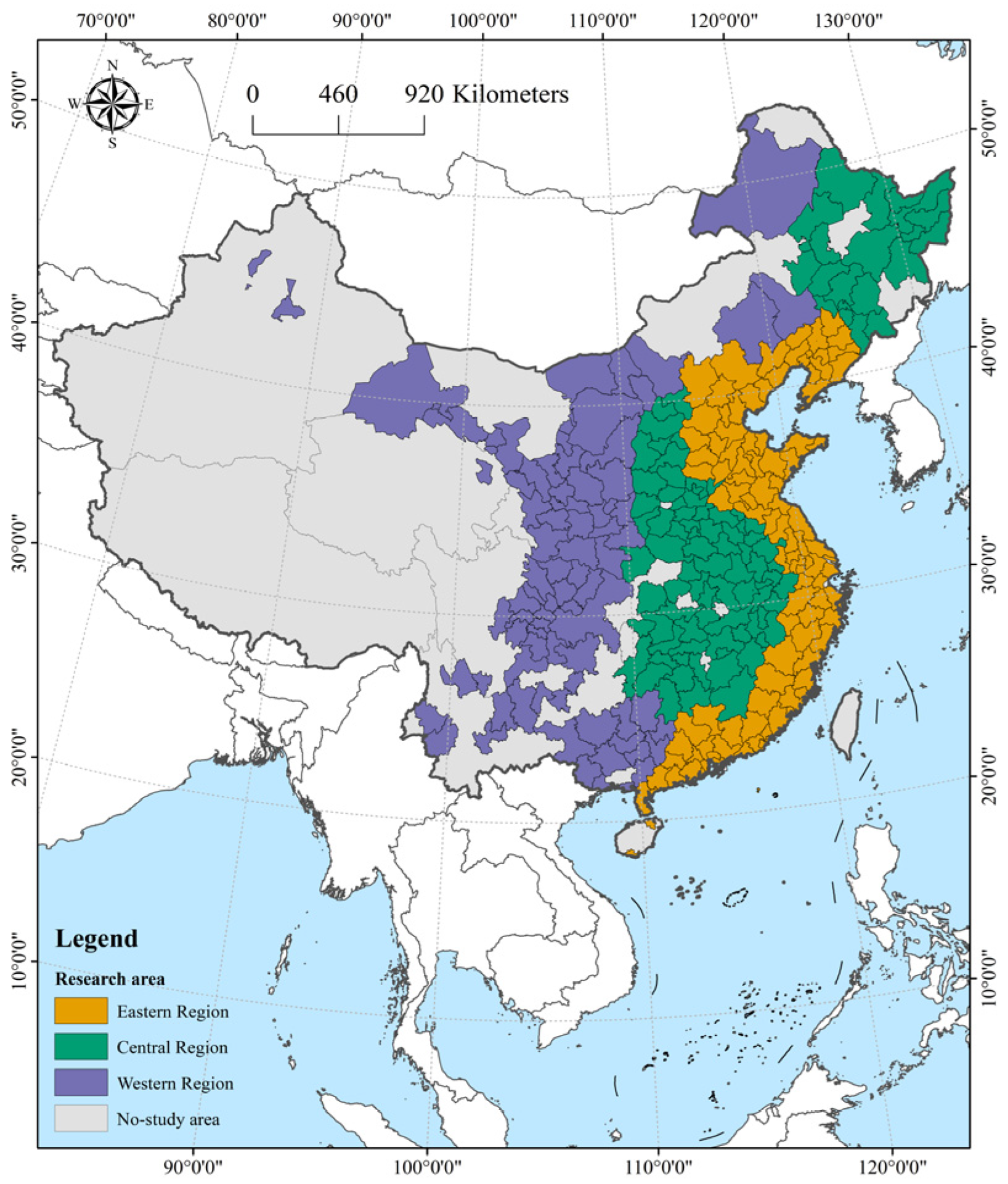
2.1. Study Area
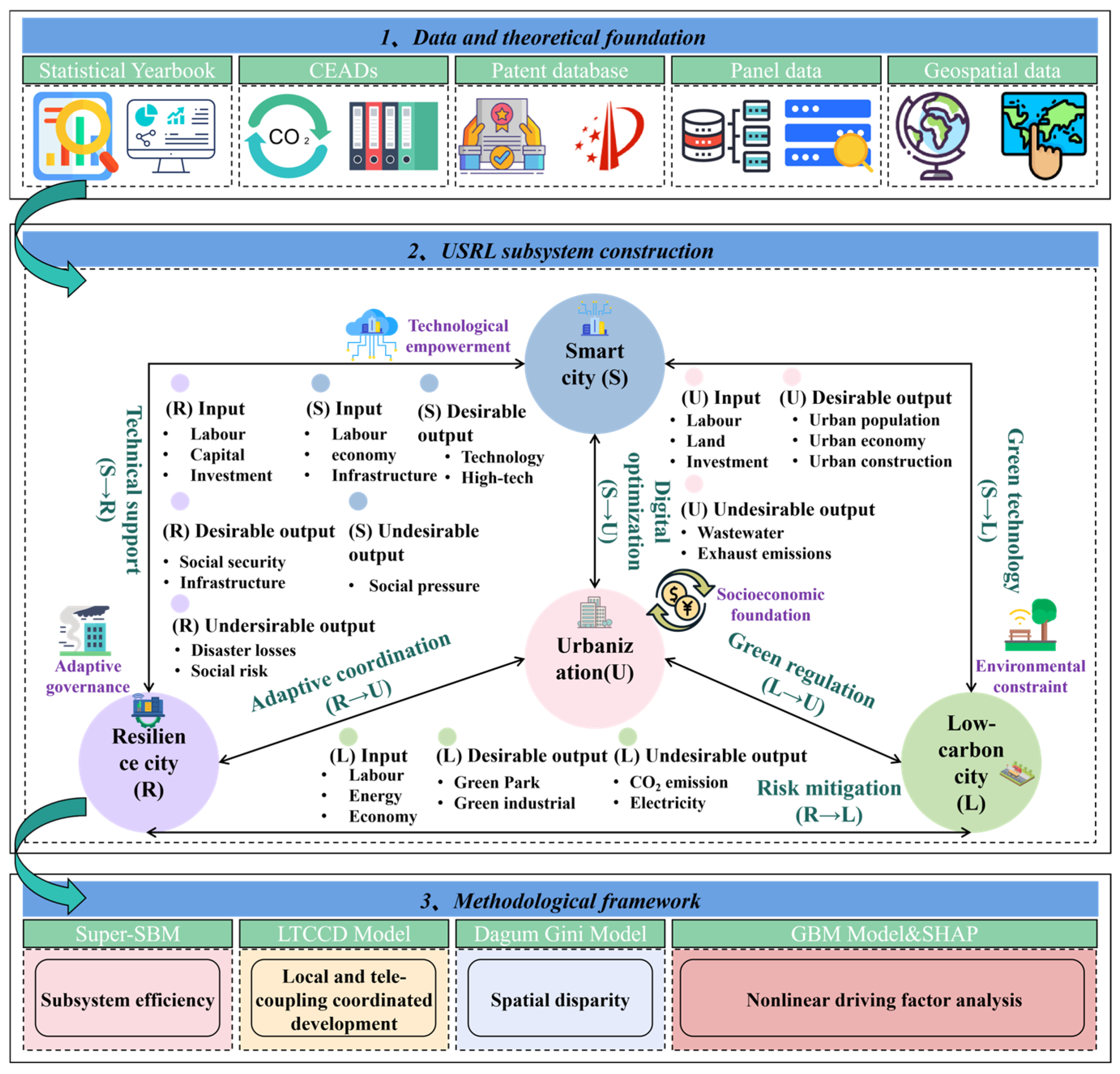
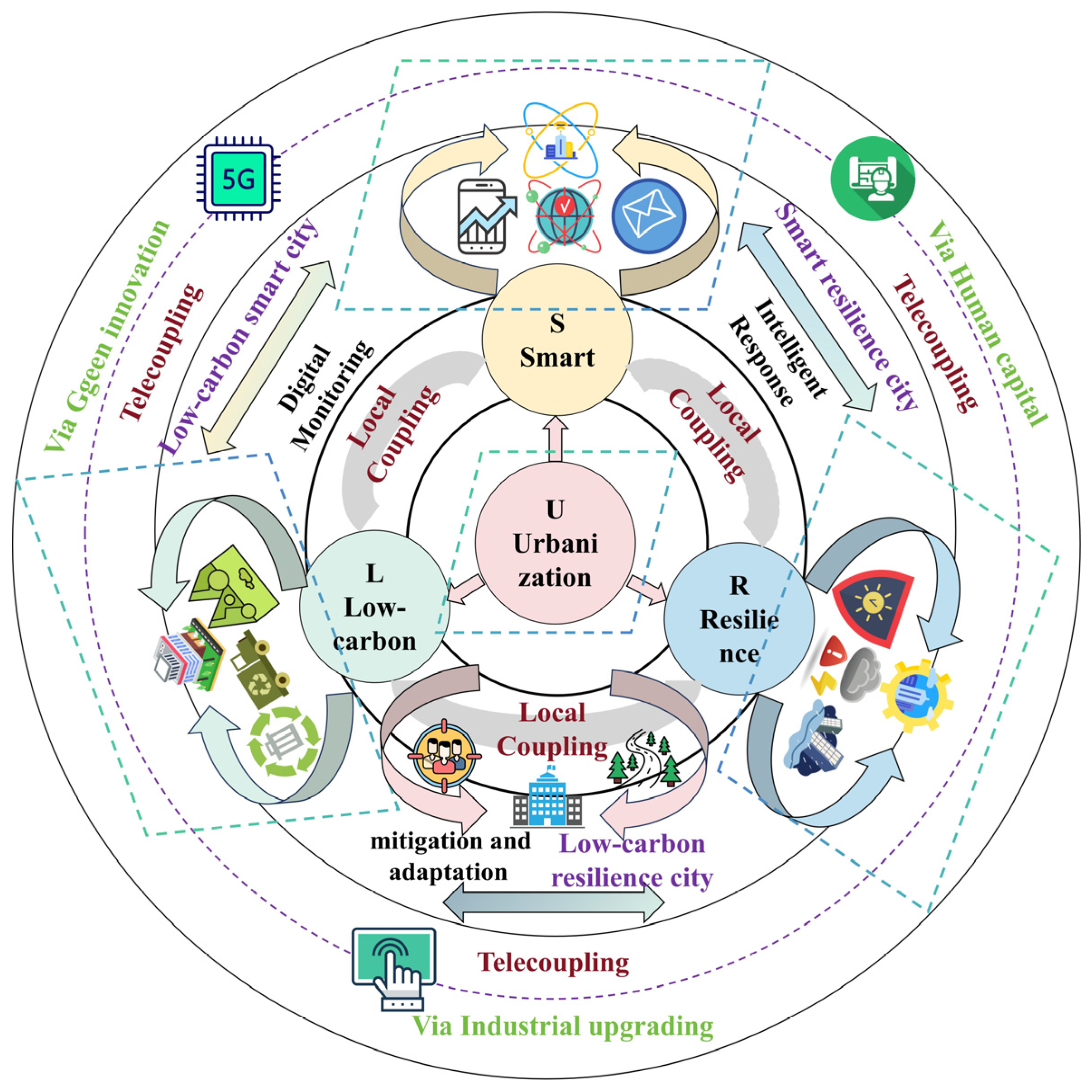
2.2. Theoretical Framework of Efficiency-Oriented USRL System Development
2.3. Indicator System for Evaluating USRL Subsystem Efficiency
2.4. Data Source
3. Methodology
3.1. Simplified Super-SBM Model
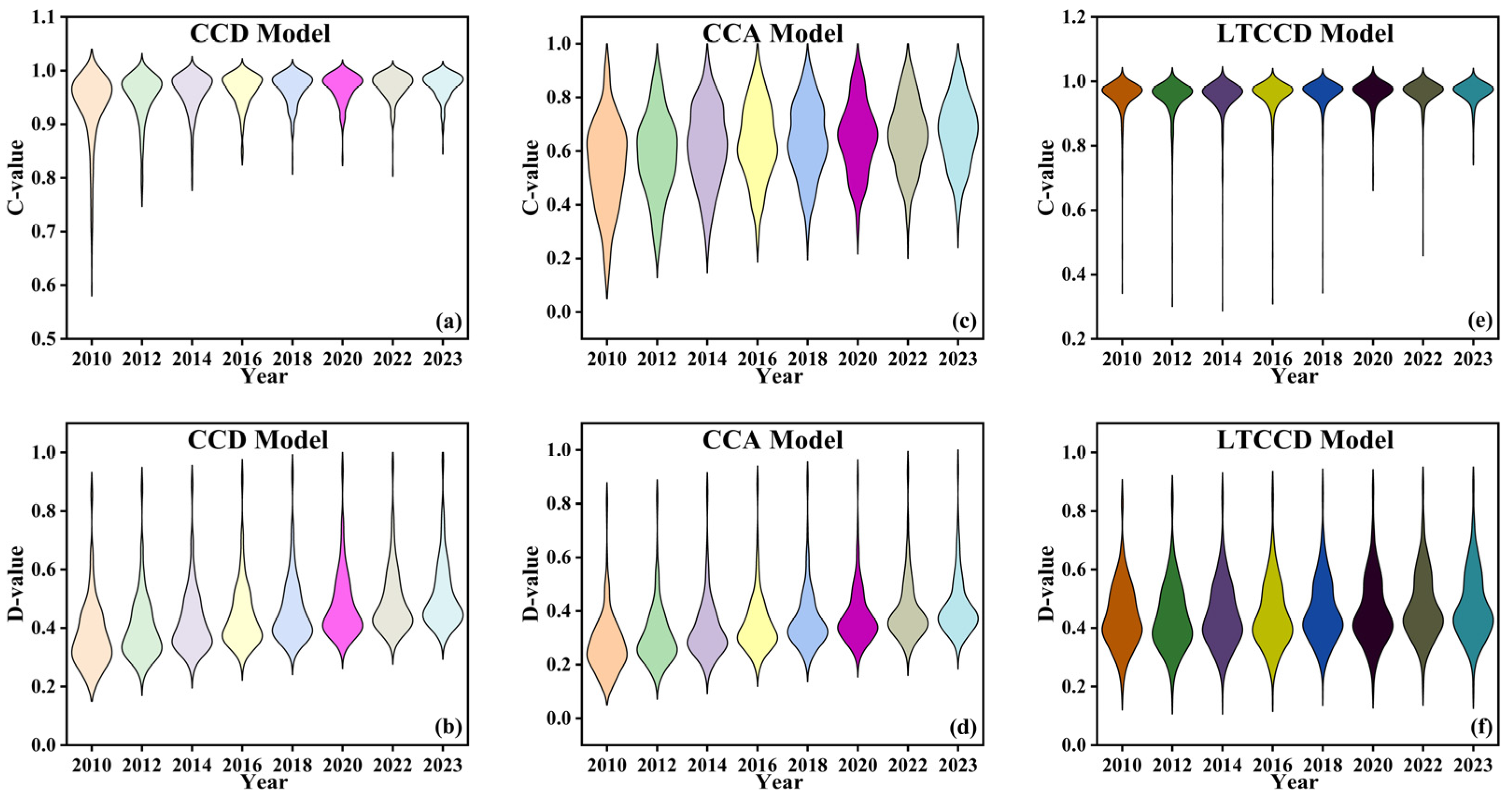
3.2. LTCCD Model
3.3. Dagum Gini Coefficient Model
3.4. Machine Learning Models
3.4.1. Model Selection
3.4.2. SHAP
4. Results
4.1. Evolution of the Spatiotemporal Characteristics of USRL System Subsystem Efficiency
4.1.1. Evolution of Urbanization Efficiency
4.1.2. Evolution of Smart City Efficiency
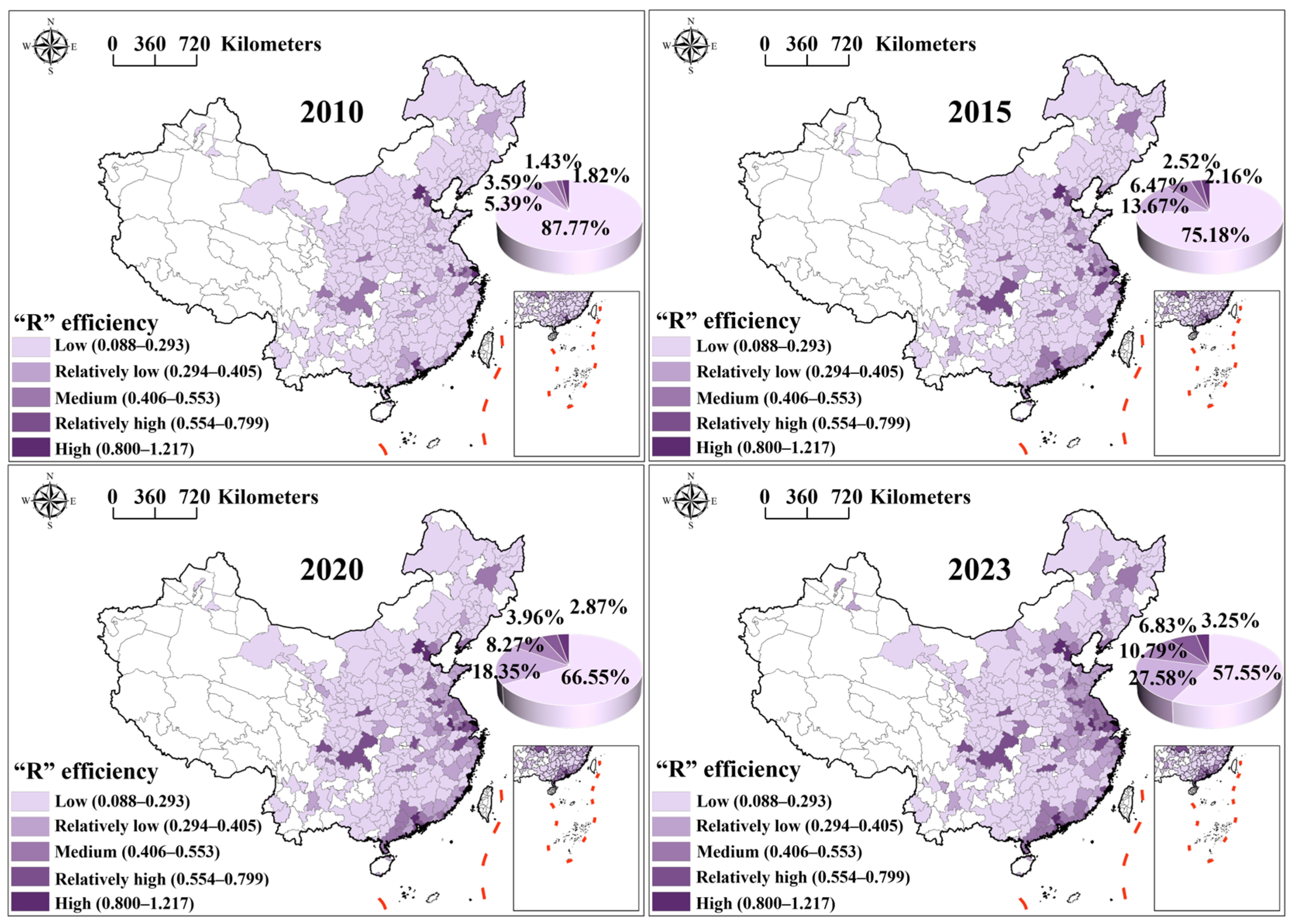
4.1.3. Evolution of Resilient City Efficiency
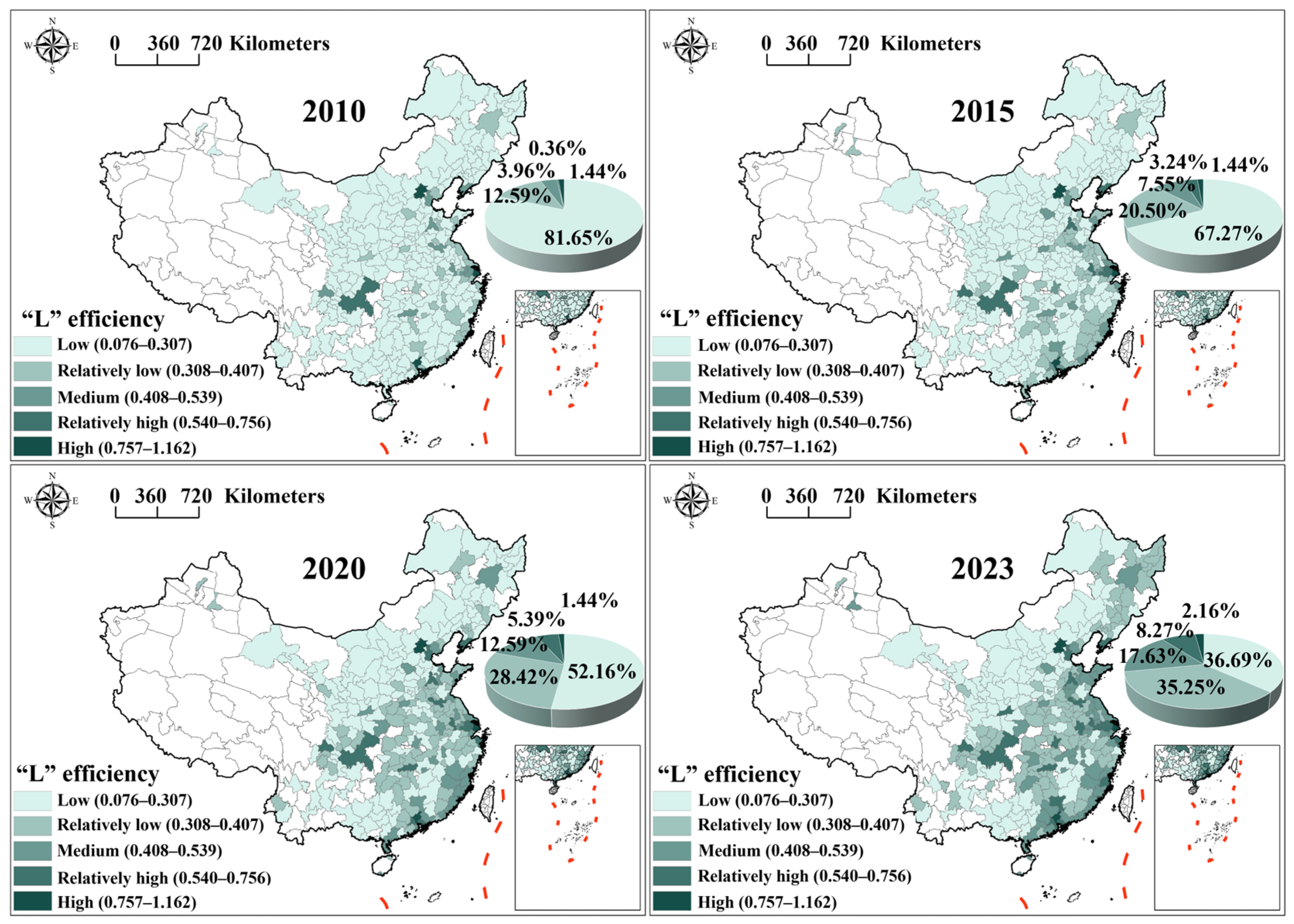
4.1.4. Evolution of Low-Carbon City Efficiency
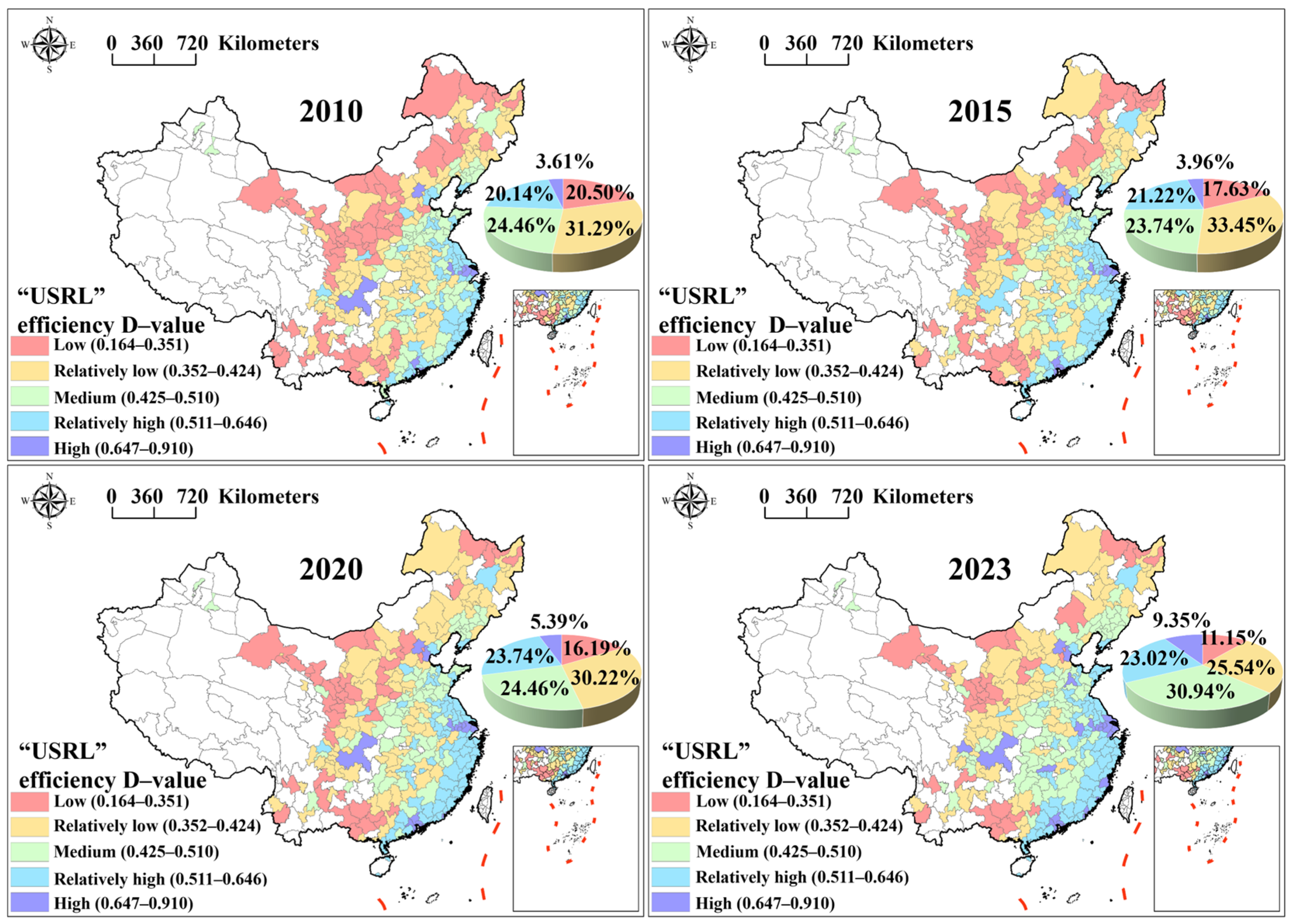
4.2. Evolution of USRL System Efficiency Based on LTCCD Model
4.3. Spatial Disparity Decomposition of Coordinated Development
4.3.1. Overall Spatial Disparities Based on the Dagum Gini Coefficient
4.3.2. Decomposition of Spatial Disparities
4.4. Driving Mechanisms of Coordinated Development
4.4.1. Nonlinear Effects of Individual Factors
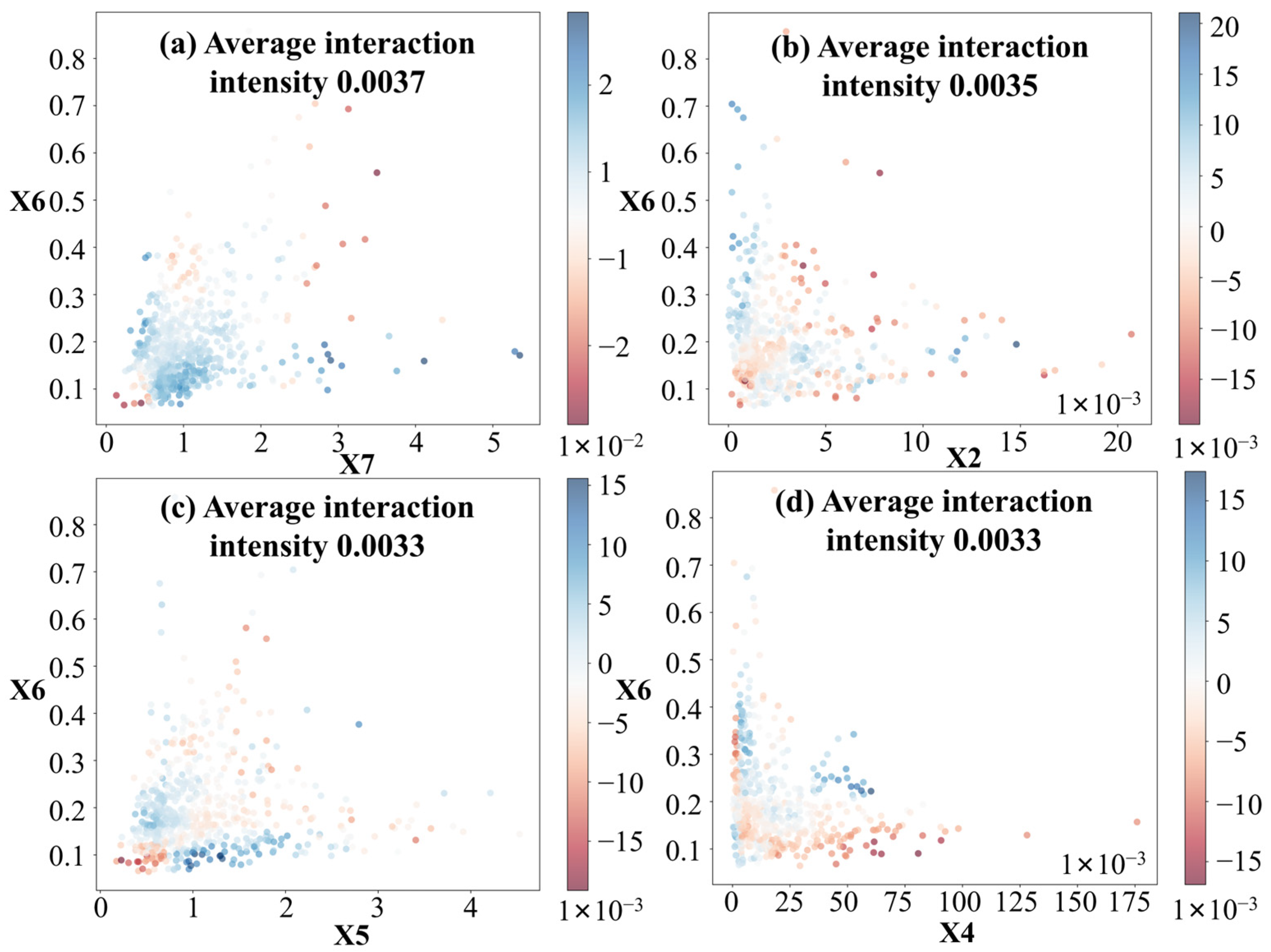
4.4.2. Interactive Effects of Driving Factors
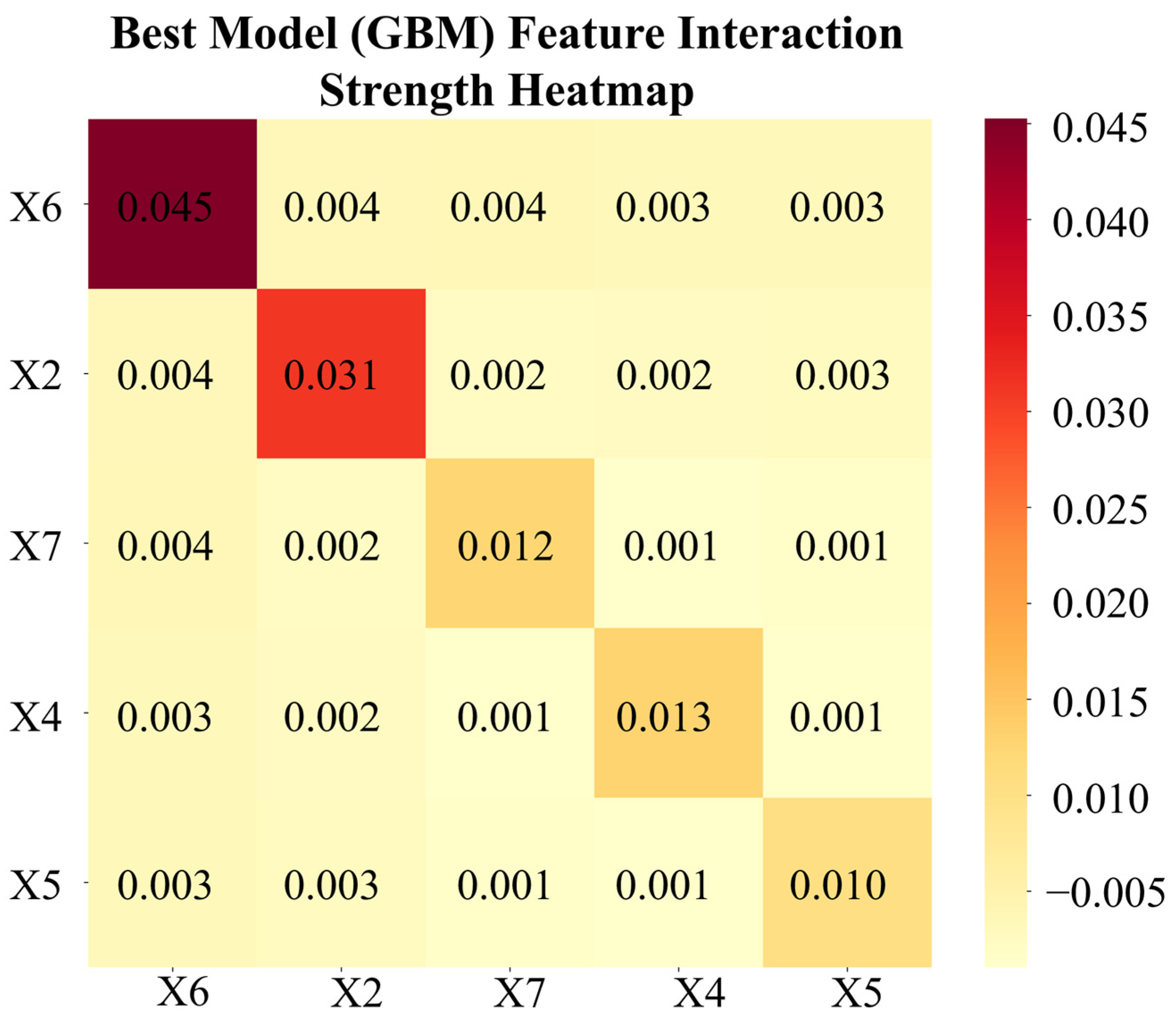
4.4.3. Nonlinear Interactions Among Key Driving Factors
5. Discussion
5.1. Added Value of the LTCCD Framework: Understanding Coordinated Development Through Local and Tele-Coupling Interactions
5.2. Spatial Convergence and Persistent Regional Disparities in Coordinated Development
5.3. Nonlinear Driving Mechanisms of Coordinated Development
5.4. Limitations and Prospects
6. Conclusions and Policy Recommendations
6.1. Conclusions
- (1)
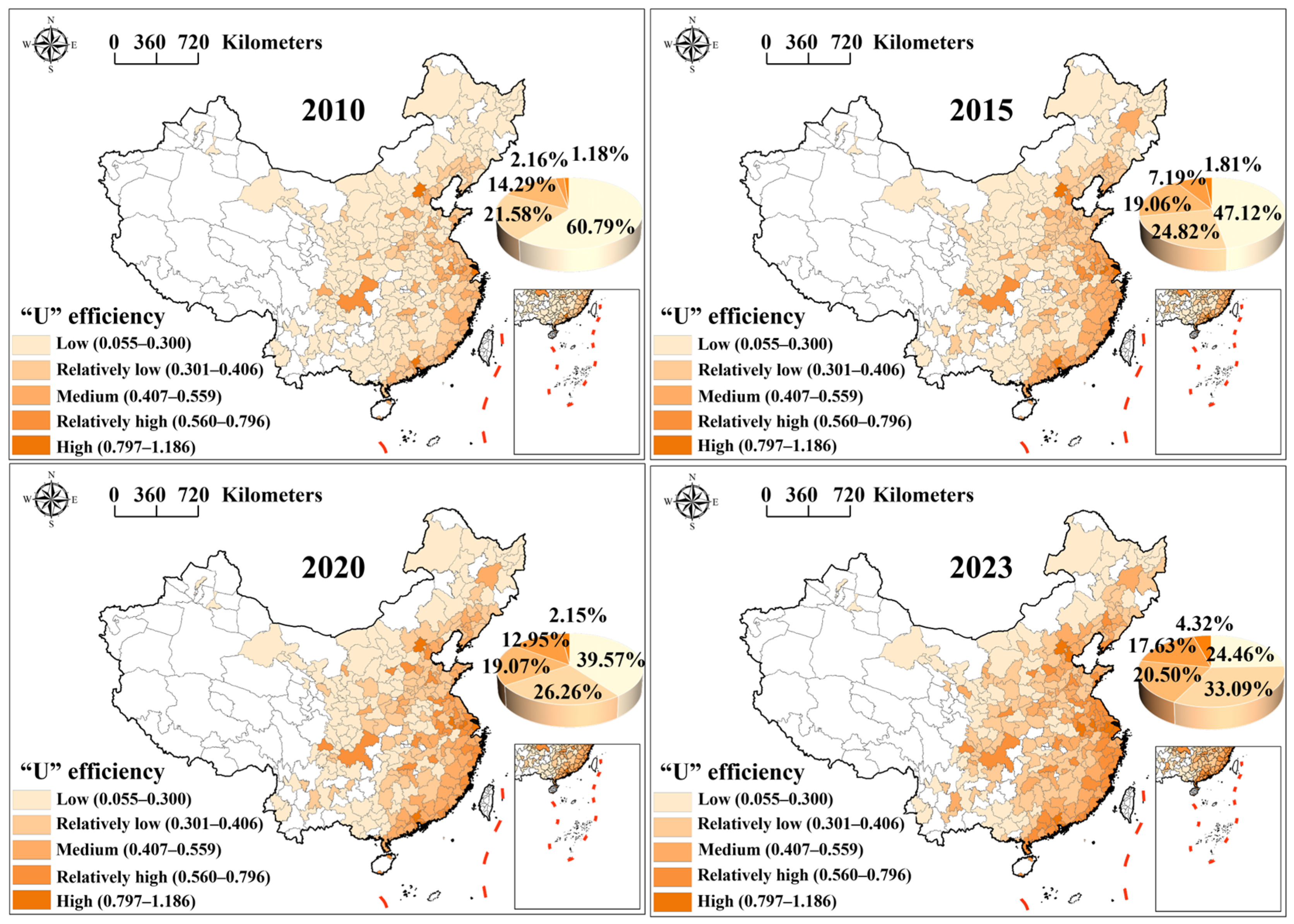
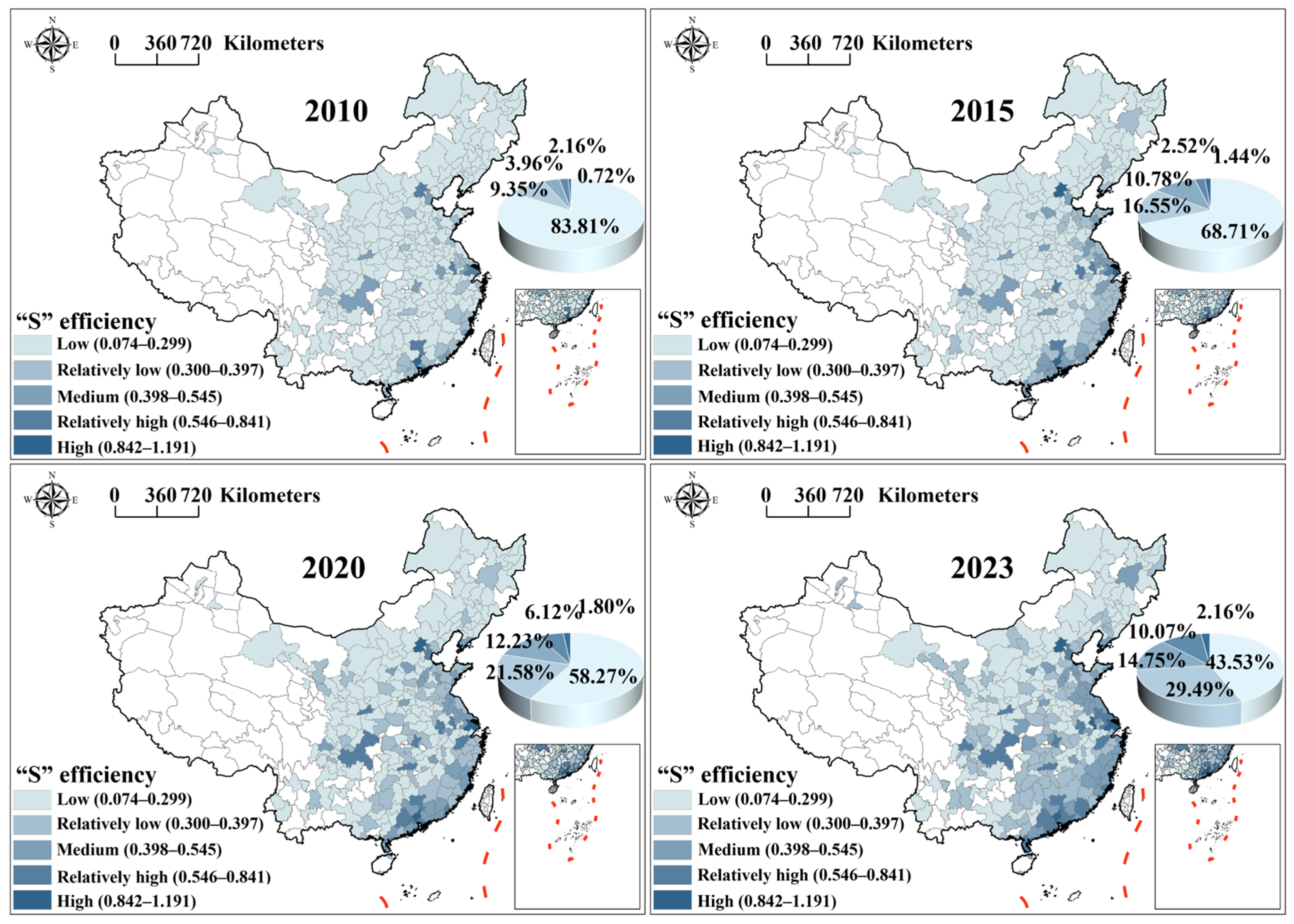
- The coordination level of the USRL system increased steadily over the study period, although subsystem performance remained heterogeneous. Efficiency improvements were more evident in urbanization, smart development, and low-carbon transition, while resilience exhibited relatively limited progress.
- (2)
- Coordinated development displayed increasing spatial integration. High-coordination cities expanded beyond traditional coastal growth poles and gradually formed more connected regional structures. However, inter-regional differences remained the dominant source of spatial inequality, indicating persistent regional development gradients.
- (3)
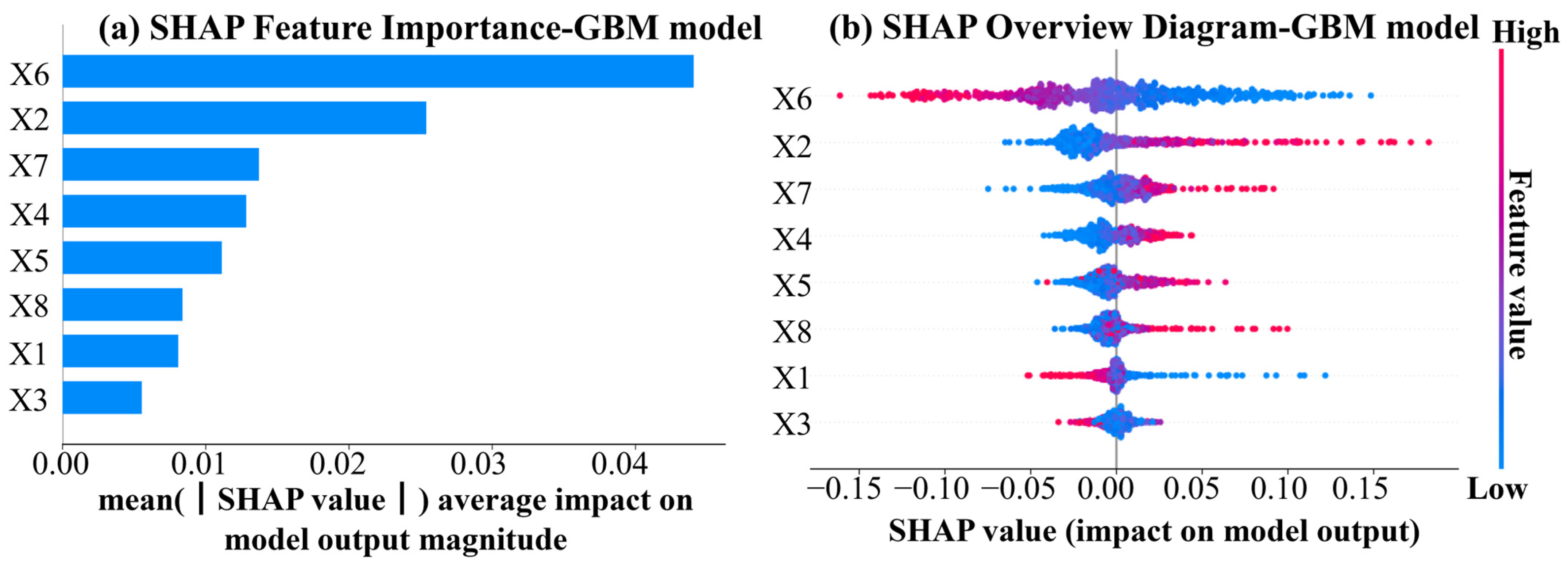
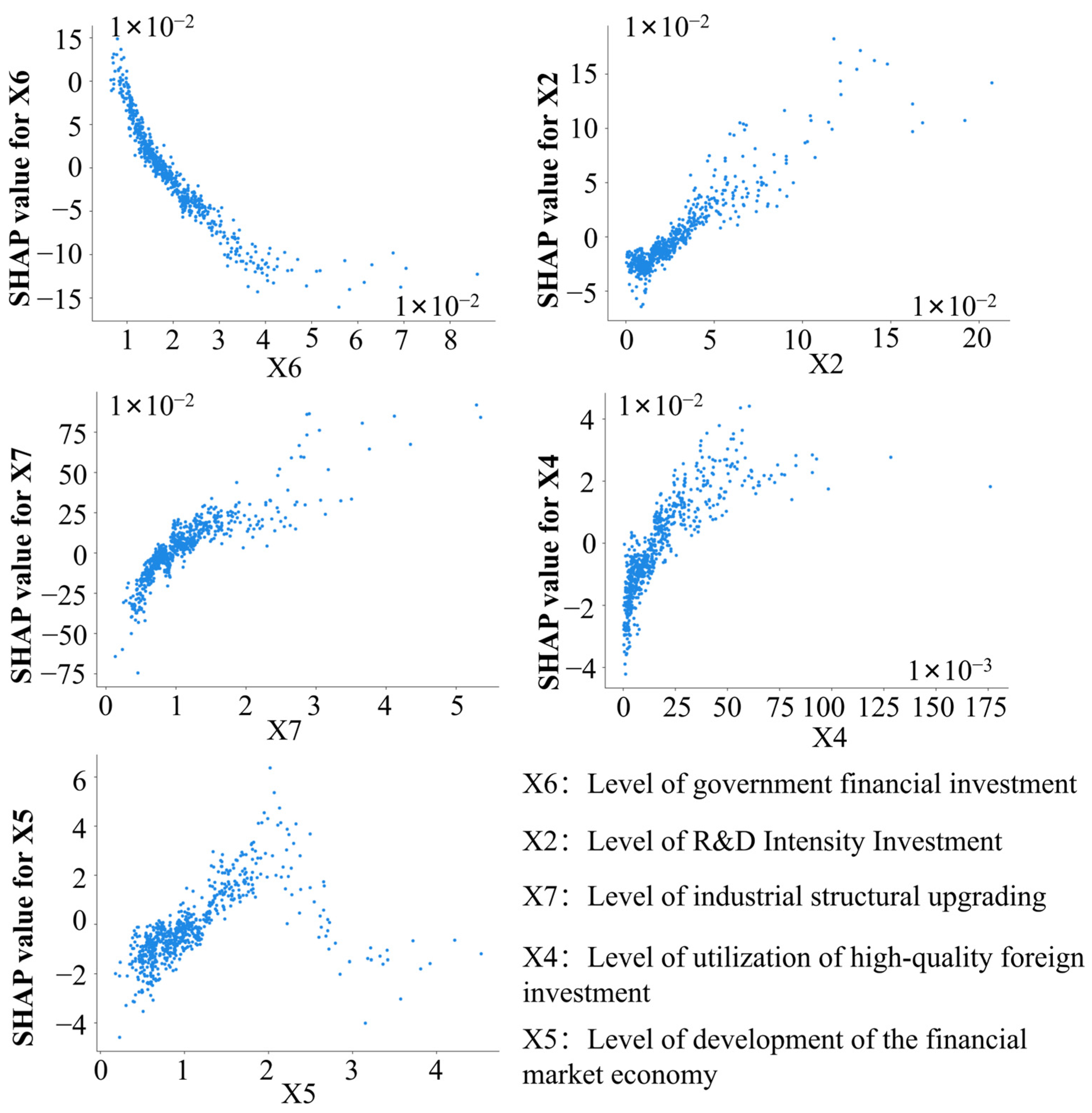
- The response patterns of key driving factors were strongly nonlinear. Innovation-related factors, industrial upgrading, and high-quality foreign investment generally promoted coordinated development, whereas financial and fiscal factors exhibited varying effects across different development stages.
6.2. Policy Recommendations
- (1)
- Promote differentiated innovation-driven development strategies. The results indicate that innovation capacity, industrial upgrading, and high-quality external investment are important drivers of coordinated development. However, their effects vary across development stages and regional contexts. Therefore, policy interventions should move beyond uniform approaches and adopt differentiated development strategies. Regions with stronger innovation foundations should focus on enhancing technological breakthroughs, digital governance, and innovation diffusion, while less-developed regions should prioritize industrial transformation, human capital development, and the absorption of advanced technologies and external investment. In particular, eastern cities should emphasize innovation, efficiency, and technological leadership by directing fiscal resources toward R&D activities and emerging technologies. In contrast, western cities should prioritize strengthening basic fiscal investment in infrastructure, public services, and human capital to enhance their capacity to absorb innovation resources and support long-term coordinated development. Such differentiated strategies may help improve subsystem coordination while avoiding inefficient resource allocation.
- (2)
- Strengthen cross-regional coordination and spatial connectivity. The LTCCD results suggest that coordinated development is shaped not only by local subsystem interactions but also by cross-regional linkages. Consequently, policy efforts should place greater emphasis on strengthening inter-city collaboration, factor mobility, and knowledge exchange. This can be achieved through the development of regional innovation networks, integrated digital infrastructure, and collaborative governance mechanisms across urban agglomerations. Enhancing connectivity between core cities and surrounding areas may facilitate the diffusion of innovation, technology, and managerial resources, thereby improving the overall coordination capacity of urban systems.
- (3)
- Reduce persistent regional disparities through collaborative governance. Although regional disparities have gradually narrowed, inter-regional differences remain the dominant source of spatial inequality. Addressing these structural disparities requires stronger coordination mechanisms across regions. In particular, policies should support the sharing of innovation resources, infrastructure connectivity, and institutional cooperation between more-developed and less-developed regions. Rather than focusing solely on local development objectives, governments should promote collaborative governance arrangements that encourage cross-regional cooperation and balanced development. Such efforts may contribute to reducing long-term spatial inequalities and fostering more integrated and sustainable urban development.
Author Contributions
Funding
Institutional Review Board Statement
Informed Consent Statement
Data Availability Statement
Conflicts of Interest
Appendix A
Super-SBM Model

| Category | Measuring Indicators | Abbreviation | Meaning | Unit |
|---|---|---|---|---|
| Innovation and development | The proportion of green patents granted | PGPG | Reflecting the level of low-carbon technology development | % |
| Research and development funding as a percentage of general budget expenditure | R&DFP | Reflecting the level of support the research and development | % | |
| Talent reserves | Number of universities students per 10,000 people | NUSP | Reflecting the level of region human capital innovation and development | Persons |
| Economic opening | The proportion of total foreign investment actually utilized in the regional economy | PTFI | Reflects the actual of high-quality foreign investment utilization | % |
| Year-end loan balance of financial institutions as a percentage of regional economy | YLFP | Reflecting the level of development of regional financial markets | % | |
| The proportion of government general budget in regional economic development | PGGB | Reflecting the level of government financial support | / | |
| Industrial upgrading | The proportion of tertiary industry to the secondary industry in the economy | PTTS | Reflecting the level of industrial structure upgrading and development | / |
| Per capita urban road construction area | PURCA | Reflecting the level of urban infrastructure development | m2/Person |
| Parameters | Detailed Description | Numerical Value |
|---|---|---|
| N_estimators | Number of boosting interactions (number of trees) | 810 |
| Max_depth | Maximum depth of individual trees | 10 |
| Min_samples_split | Minimum number of samples to split a node | 17 |
| Min_samples_leaf | Minimum number of samples per leaf | 3 |
| Learning_rate | Boosting the learning rate, controlling the contribution of each tree | 0.011 |
| subsample | Subsample ratio of the training data used for each tree | 0.675 |
| Model | R2_Train | R2_Test | RMSE_Train | RMSE_Test |
|---|---|---|---|---|
| GBM | 0.987814389 | 0.717116166 | 0.012415922 | 0.061210575 |
| RF | 0.957316067 | 0.690503736 | 0.023237403 | 0.064025075 |
| XGBoost | 0.820931935 | 0.661693997 | 0.047595336 | 0.066938695 |
| LGBM | 0.965221862 | 0.671966765 | 0.020975315 | 0.063873569 |
| Adaboost | 0.651460117 | 0.595015165 | 0.066402062 | 0.073238893 |
| Catboost | 0.980791692 | 0.705232234 | 0.015588341 | 0.064414061 |
References
- Yuan, L.; Zhang, X.; Song, Z.; Li, Y.; Zang, P.; Liu, M. Toward urban sustainability: Assessing SDG11.2 via functional zone analysis in five Chinese cities. npj Urban Sustain. 2026, 6, 60. [Google Scholar] [CrossRef]
- Wu, M.; Zheng, K.; Chen, J.; Zhang, J.; Li, M.; Wu, S. Assessing elderly walkability to urban parks using mobility analysis and multi-source data: A case study of central Fuzhou, China. Sci. Rep. 2026, 16, 13685. [Google Scholar] [CrossRef]
- He, S.; Wang, T.; Spicer, R.A.; Farnsworth, A.; Mulch, A.; Widdowson, M.; Zhang, Q.; Cai, F.; Valdes, P.J.; Wang, C.; et al. Back to an ice-free future: Early Cretaceous seasonal cycles of sea surface temperature and glacier ice. Sci. Adv. 2025, 11, eadr9417. [Google Scholar] [CrossRef]
- Min, X.Z.; Zhang, X.; Xie, Z.Y.; Nikolaev, A.; Vorkamp, K.; Ma, J.M.; Reiersen, L.O.; Li, L.; Cai, M.H.; Ren, N.Q.; et al. Organic chemicals of Arctic concern in Russian coastal seas. Sci. Bull. 2025, 71, 946–959. [Google Scholar] [CrossRef]
- Tolliver, C.; Keeley, A.R.; Managi, S. Green bonds for the Paris agreement and sustainable development goals. Environ. Res. Lett. 2019, 14, 064009. [Google Scholar] [CrossRef]
- Wang, D.; Chen, S. Synergistic action on mitigation and adaptation pilot policies to enhance low-carbon resilience of Chinese cities. Nat. Cities 2025, 2, 812–824. [Google Scholar] [CrossRef]
- Tan, H.; Guo, Z.; Yan, J.; Zhang, D.; Chen, Y.; Zhang, H. Advancing low-carbon smart cities: Leveraging UAVs-enabled low-altitude economy principles and innovations. Renew. Sustain. Energy Rev. 2025, 222, 115942. [Google Scholar] [CrossRef]
- Umeike, R.; Dao, T.; Crawford, S. State-of-the-art review of resilient smart cities: Progress and challenges. Urban Gov. 2025, 5, 222–239. [Google Scholar] [CrossRef]
- Zhou, D.; Dai, H. Provincial sustainable development in China from a multidimensional perspective: Regional differences, dynamic evolution, spatial effects, and convergence. Sustainability 2025, 17, 215. [Google Scholar] [CrossRef]
- Huang, S.H.; Wu, T.E.; Huang, S.H.; Lai, C.H.; Yang, Q.L. Toward greener welding manufacturing: Real-time CO2 estimation and weld quality optimization. Int. J. Adv. Manuf. Technol. 2026, 143, 6745–6756. [Google Scholar] [CrossRef]
- Lan, C.; Li, X.; Peng, B.; Li, X. Unlocking urban ecological resilience: The dual role of environmental regulation and green technology innovation. Sustain. Cities Soc. 2025, 128, 106466. [Google Scholar] [CrossRef]
- Ulker Senkulak, B.; Kanoglu, A.; Ozcevik, O. Simurg_cities conceptual model: Multi-dimensional and multi-layer performance-based assessment of urban sustainability at the city level. Chall. Sustain. 2025, 13, 425–444. [Google Scholar] [CrossRef]
- Adeel, A.; Shivaji, P.P.; Patil, S.T.; Ahadi, A. Low-Carbon and Climate-Resilient Cities. In Climate Change and Sustainable Development; CRC Press: Boca Raton, FL, USA, 2025; pp. 193–206. [Google Scholar]
- Hassan, A.M.; Lee, H. Toward the sustainable development of urban areas: An overview of global trends in trials and policies. Land Use Policy 2015, 48, 199–212. [Google Scholar] [CrossRef]
- Luo, T.; Zhong, T. Simulating the Effects of Future Urban Expansion on Ecosystem Services: A Spatial Spillover Analysis. Land Degrad. Dev. 2026, 37, 2529–2544. [Google Scholar] [CrossRef]
- Ma, Z.; Zhang, P. Myth of the digital economy: Can it continually contribute to a low-carbon status and sustainable development? Environ. Impact Assess. Rev. 2025, 110, 107688. [Google Scholar] [CrossRef]
- Li, H.; Sun, Z.; Chen, Y. Spatiotemporal heterogeneity and driving factors of sustainable development in 286 Chinese cities based on the hybrid weighted comprehensive evaluation model. Sustain. Cities Soc. 2025, 135, 107004. [Google Scholar] [CrossRef]
- Zhang, Y.; Zhang, Y.; Fukuda, H.; Liu, P.; Lai, X. Exploring the multilevel coordinated development characteristics and obstacle mechanisms of the smart city–urbanization–low-carbon city system. J. Urban Manag. 2025, 15, 801–821. [Google Scholar] [CrossRef]
- Hayvon, J.C. Disability in sustainability theories, models, and frameworks: A scoping review guided by the international classification of functioning and the sustainable development goals. Sustain. Sci. Pract. Policy 2025, 21, 2497141. [Google Scholar] [CrossRef]
- Kaiser, Z.A.; Deb, A. Sustainable smart city and Sustainable Development Goals (SDGs): A review. Reg. Sustain. 2025, 6, 100193. [Google Scholar] [CrossRef]
- Zhang, Y.; Lai, X.; Zhang, Y.; Liu, P.; Fukuda, H. Revealing the multi-level comprehensive development efficiency and influencing factors of the smart city–urbanization–low-carbon city system: A case study of key cities in China. Sustain. Cities Soc. 2025, 132, 106820. [Google Scholar] [CrossRef]
- Li, C.; Wu, Y.; Qiao, W.; Gao, B.; Wu, Y.; Wang, M.; Zheng, K. Mechanisms of Spatiotemporal Interactions Between Urbanization and Ecosystem Health in Plateau-mountain Urban Areas: Insights from Central Yunnan Urban Agglomeration, China. Chin. Geogr. Sci. 2026, 36, 879–896. [Google Scholar] [CrossRef]
- Wang, Y.; Liang, H.; Dong, L.; Zhu, Y.; Wang, Y. Harmonizing new-type urbanization and eco-efficiency: Spatial–temporal coupling coordination in the Yangtze River Economic Belt. Environ. Dev. Sustain. 2025, 1–40. [Google Scholar] [CrossRef]
- Zhang, T.; Tan, Y.; Robinson, G.M.; Bai, W. China’s new-style urbanization and its impact on the green efficiency of urban land use. Sustainability 2025, 17, 2299. [Google Scholar] [CrossRef]
- Hsi, D.L.; Chen, S.H.; Wang, S.W. Urban actions toward energy efficiency and carbon reduction—An empirical study under the urbanization dynamics. Environ. Dev. Sustain. 2025, 27, 30119–30134. [Google Scholar] [CrossRef]
- Guney, E.; Sogut, Y.; Demirtas, N.; Koseoglu, Y.; Sanver, C. Harmonising progress: Assessing the impact of economic freedom, economic growth, urbanisation and environmental protection expenditures on load capacity in selected European union countries. Environ. Sci. Eur. 2025, 37, 51. [Google Scholar] [CrossRef]
- Cai, A.; Guo, R.; Zhang, Y.; Wang, L.; Lin, R.; Wu, H.; Huang, R.; Zhang, J.; Wu, J. Assessing urban carbon health in China’s three largest urban agglomerations: Carbon emissions, energy-carbon emission efficiency and carbon sinks. Appl. Energy 2025, 383, 125326. [Google Scholar] [CrossRef]
- Bi, S.; Zhang, Z.; Yan, Z.; Appolloni, A. Promoting Urban Sustainable Development: Underground Wastewater Treatment Plant Alleviates Urban Air Pollution. Sustain. Dev. 2026, 1–23. [Google Scholar] [CrossRef]
- Jiang, Y.; Sun, J. Does smart city construction promote urban green development? Evidence from a double machine learning model. J. Environ. Manag. 2025, 373, 123701. [Google Scholar] [CrossRef]
- Valencia-Arias, A.; Rojas, E.M.; Pineda, V.G.; Agudelo-Ceballos, E.; Rodriguez, L.d.R.C.; Requejo, C.C.E.; Cardona-Acevedo, S.; Londoño-Celis, W.; Adan, T.E.A. Research trends on sustainable development in smart cities. Discov. Sustain. 2025, 6, 369. [Google Scholar] [CrossRef]
- Zhuo, Z.; Ye, J.; Wang, Y.; Chen, H.; Liang, B. Smart cities, smarter land use? Unveiling the efficiency gains from China’s digital urban transformation. Ecol. Indic. 2025, 171, 113151. [Google Scholar] [CrossRef]
- Liu, Q.; Wan, P. Greening the urban landscape: Smart city initiatives and pollution reduction in China. Systems 2025, 13, 165. [Google Scholar] [CrossRef]
- Gu, Q.; Sing, M.C.; Jefferies, M.; Kanjanabootra, S. Bridging the gap between smart cities and sustainability: Current practices and future trends. Cities 2025, 159, 105799. [Google Scholar] [CrossRef]
- Khajuria, A.; Verma, P. Circular economy for “blue skies” in building resilient cities—Towards the UN 2030 Agenda for sustainable development goals. Front. Sustain. 2025, 6, 1479452. [Google Scholar] [CrossRef]
- Tong, B.; Liu, H.; Zhu, J.; Wang, Y.; Mei, T.; Kou, M. Exploring safety research progress and prospects for the sustainable development of resilient cities. Buildings 2025, 15, 505. [Google Scholar] [CrossRef]
- Kochskämper, E.; Glass, L.M.; Haupt, W.; Malekpour, S.; Grainger-Brown, J. Resilience and the Sustainable Development Goals: A scrutiny of urban strategies in the 100 Resilient Cities initiative. J. Environ. Plan. Manag. 2025, 68, 1691–1717. [Google Scholar] [CrossRef]
- Suleimany, M.; Gonbad, M.R.S.; Naghibizadeh, S.; Niri, S.D. Artificial intelligence as a tool for building more resilient cities in the climate change era: A systematic literature review. In Artificial Intelligence and Machine Learning Applications for Sustainable Development; CRC Press: Boca Raton, FL, USA, 2025; pp. 60–81. [Google Scholar]
- Maihaiti, G.; Hunjra, A.I.; Alharbi, S.S.; Zhao, S. Climate-resilient cities for green innovation in enterprises: New perspective based on Fintech. Int. Rev. Econ. Financ. 2025, 101, 104251. [Google Scholar] [CrossRef]
- Majlingova, A.; Kádár, T.S. From risk to resilience: Integrating climate adaptation and disaster reduction in the pursuit of sustainable development. Sustainability 2025, 17, 5447. [Google Scholar] [CrossRef]
- Li, Y.; Chen, H.; Yu, P.; Yang, L. Development and challenges of low-carbon cities in China: Current situation, influencing factors, and sustainability strategies. Buildings 2025, 15, 350. [Google Scholar] [CrossRef]
- Wang, S.; Xiao, S.; Zhang, Q.; Sun, M. How can low-carbon city construction enhance urban economic resilience? A mechanism analysis based on industrial agglomeration and technological innovation effects. J. Knowl. Econ. 2025, 16, 4102–4124. [Google Scholar] [CrossRef]
- Jia, Y.; Huang, Y.; Zhou, J.; Sun, J. Construction of evaluation indicator system and analysis for low-carbon economy development in Chengdu City of China. Systems 2025, 13, 573. [Google Scholar] [CrossRef]
- Wang, B.; Yu, T. Sustainable development through urban agglomeration green and low-carbon logistics: Efficiency insights from China’s urban agglomeration. Environ. Dev. Sustain. 2026, 28, 10071–10096. [Google Scholar] [CrossRef]
- Han, H.; Gu, R.; Yang, Y. Impacts of low-carbon city pilot policy on ecological well-being performance across Chinese cities: A spatial difference-in-difference analysis. Sustain. Cities Soc. 2025, 118, 105864. [Google Scholar] [CrossRef]
- Zhang, H.; Qiu, S.; Lin, J.; Li, B.; Liang, C.; Wang, Y.; Qi, Z.; Jiang, H.; Cao, D.; Liu, D. Are cities navigating towards low carbon? A comparative view of China and globe. Sustain. Futures 2025, 9, 100697. [Google Scholar] [CrossRef]
- Lai, X.; Li, F.; Zhang, Y.; Liu, P.; Feng, J.; Chi, J.; Wang, X.; Fukuda, H. Bridging Effect–Efficiency Gaps in Low-Carbon Resilient Cities: Evidence on Synergistic Development and Nonlinear Drivers from Chinese Cities. Sustainability 2026, 18, 2126. [Google Scholar] [CrossRef]
- Yan, X.; Sun, T. Artificial intelligence development and carbon emission intensity: Evidence from industrial robot application. Sustainability 2025, 17, 3867. [Google Scholar] [CrossRef]
- Wang, L.; Li, Z.; He, R.; Yun, Y. Study on Rail Transit Transfer Efficiency Based on Input-Oriented Three-Stage Super-Efficiency SBM and Output-Oriented ML Index Models. Sustainability 2026, 18, 2329. [Google Scholar] [CrossRef]
- Ma, M.; Yang, Y.; Ma, Y.; Wang, Z. Evaluation and heterogeneity of the green total factor productivity of Shandong Province, China: A super-SBM and GML analysis. Sci. Rep. 2025, 15, 21901. [Google Scholar] [CrossRef] [PubMed]
- Liu, Y.; Xu, W.; Wang, L.; Lu, N.; Kou, W.; Ou, G.; Wang, H.; He, J.; Gao, X. A novel methodology for poverty evaluation and spatiotemporal coupling coordination between poverty and eco-environment quality: A case study in the Yunnan-Guizhou Plateau, China. Ecol. Indic. 2025, 181, 114436. [Google Scholar] [CrossRef]
- Zhao, X.; Tan, S.; Li, Y.; Khan, S. Quantitative analysis of local coupling and telecoupling mechanism between urbanization and ecological environment quality based on multi-source remote sensing data. Ecol. Indic. 2025, 173, 113345. [Google Scholar] [CrossRef]
- Xie, A.; Zhang, F.; Ding, Y.; Chen, J.; Yang, P.; Peng, G. Exploring the Dynamic Local and Tele-Coupling Coordination Mechanism of the Ecosystem Services Supply–Demand and Its Driving Forces: Taking China’s Yangtze River Economic Belt as an Example. Land Degrad. Dev. 2025, 36, 3178–3193. [Google Scholar] [CrossRef]
- Xu, B.; Zheng, Y.; Li, W.; Gao, X.; Gong, D.; He, J.; Fan, Z. Handling multiobjective optimization problems with complex constraints: A constraints grouping-based approach. IEEE Trans. Syst. Man Cybern. Syst. 2025, 55, 3866–3880. [Google Scholar] [CrossRef]
- Zhang, L.; Fang, C.; Zhu, C. Coupling coordination and decoupling effects: Measuring the interaction between urban agglomeration ecosystems and urbanization. Cities 2026, 171, 106788. [Google Scholar] [CrossRef]
- Wang, Y.; Song, M.; Han, Y.; Wang, Y. Multi-scale coupling measurement and driving factor analysis between carbon emission from energy consumption and ecological environment—The case study of Pearl River Delta urban agglomeration. Sustain. Cities Soc. 2025, 127, 106425. [Google Scholar] [CrossRef]
- Gong, M.; Yu, K.; Zhou, C.; Liu, Z.; Xu, Z.; Xu, M.; Qu, S. SDG space: Revealing the structure and complementarities among sustainable development goals in China. Fundam. Res. 2025, 5, 360–369. [Google Scholar] [CrossRef]
- Ge, K.; Wang, Y.; Liu, X.; Hu, L.; Ke, S.; Jiang, X.; Zhang, W. Spatial effects and influence mechanisms of urban land use green transition on urban carbon emissions. Ecol. Indic. 2025, 172, 113261. [Google Scholar] [CrossRef]
- Zheng, J.; Guo, M.; Lo, K. Shaping sustainability: Circular economy development through digital technology innovation. J. Innov. Knowl. 2025, 10, 100784. [Google Scholar] [CrossRef]
- Guo, L.; Tang, M.; Wu, Y.; Bao, S.; Wu, Q. Government-led regional integration and economic growth: Evidence from a quasi-natural experiment of urban agglomeration development planning policies in China. Cities 2025, 156, 105482. [Google Scholar] [CrossRef]
- Chen, S.; Du, Y.; Liu, Y. Regional Integration and Urban Green and Low-Carbon Development: A Quasi-Natural Experiment Based on the Expansion of the Yangtze River Delta Urban Agglomeration. Sustainability 2025, 17, 3621. [Google Scholar] [CrossRef]
- Sha, A.; Zhang, J.; Pan, Y.; Zhang, S. How to recognize and measure the impact of phasing urbanization on eco-environment quality: An empirical case study of 19 urban agglomerations in China. Technol. Forecast. Soc. Change 2025, 210, 123845. [Google Scholar] [CrossRef]
- Luo, J.; Ma, W.; An, S.; Zhang, Z.; Fu, Y.; Huang, H.; Chang, G. Coupling analysis of multi-systems urbanization: Evidence from China. Ecol. Indic. 2025, 170, 112977. [Google Scholar] [CrossRef]
- Yu, C.; Shen, W.; Zhang, Z. Assessing progress toward sustainable development in China and its impact on human well-being. Environ. Impact Assess. Rev. 2025, 110, 107729. [Google Scholar] [CrossRef]
- Liu, X.; Jia, X.; Lyu, K.; Guo, P.; Shen, J.; Wang, G. Towards sustainable development: The spatial spillover effects of low-carbon city pilot policy on urban energy transition. Environ. Dev. Sustain. 2025, 27, 26913–26946. [Google Scholar] [CrossRef]
- Liang, J.; Qiao, C. The impact of digital economy on urban green and low-carbon development: Mechanism and spatial spillover effect. Front. Sustain. Cities 2025, 7, 1591826. [Google Scholar] [CrossRef]
- Pricopoaia, O.; Cristache, N.; Lupașc, A.; Iancu, D. The implications of digital transformation and environmental innovation for sustainability. J. Innov. Knowl. 2025, 10, 100713. [Google Scholar] [CrossRef]
- Sun, J.; Chen, D. Green credit, tourism technology innovation, and sustainable development of tourism. Int. Rev. Econ. Financ. 2025, 99, 104004. [Google Scholar] [CrossRef]
- Islam, H. Nexus of economic, social, and environmental factors on sustainable development goals: The moderating role of technological advancement and green innovation. Innov. Green Dev. 2025, 4, 100183. [Google Scholar] [CrossRef]
- Elhassan, T. Green technology innovation, green financing, and economic growth in G7 countries: Implications for environmental sustainability. Econ.-Innov. Econ. Res. J. 2025, 13, 69–91. [Google Scholar] [CrossRef]
- Feng, Y.; Li, G. Urban growth dynamics and hierarchical effects: An analysis through multidimensional scaling. Int. J. Urban Sci. 2025, 1–26. [Google Scholar] [CrossRef]






| Subsystem | Indicator Type | Variable | Description | Unit | References |
|---|---|---|---|---|---|
| Urbanization subsystem | Input | Labor input | Urban population size | 10,000 Persons | [23] |
| Land use | Urban construction area | Km2 | [24] | ||
| Social capital investment | General public budget expenditure | 10,000 Yuan | [23,24] | ||
| Desirable output | Urban people development | Urban population density | Person/km2 | [25] | |
| Economic development | Total regional economic development | 10,000 Yuan | [26] | ||
| Urban construction development | Urban construction area as a percentage of the urban area | % | [27] | ||
| Undesirable output | Wastewater discharge | Total industrial wastewater discharge | Tons | [28] | |
| Exhaust emissions | Total industrial sulfur dioxide emissions | Tons | [28] | ||
| Smart city subsystem | Input | Labor input | Number of scientific research and technology practitioner | 10,000 Persons | [29] |
| Infrastructure input | Total number of mobile phones at the end | 10,000 Persons | [30] | ||
| Economic development | Total investment of science and technology | 10,000 Per-sons | [30] | ||
| Desirable output | Technological achievements | Total number of patents granted at the end | Piece | [31] | |
| High-tech development achievements | Industrial robot installation density | Piece/Persons | [32] | ||
| Undesirable output | Social stability pressure | Number of unemployed registered | Persons | [33] | |
| Resilient city subsystem | Input | Labor input | Total number of employees in public facilities management and social security services | 10,000 Persons | [34] |
| Capital investment | Total stock of social capital | 10,000 Yuan | [35] | ||
| Economic input | Total retail sales of consumer goods | 10,000 Yuan | [35] | ||
| Desirable output | Social security | Number of people enrolled in pension, medical and unemployment insurance | 10,000 Persons | [36] | |
| Infrastructure protection | Urban drainage pipeline construction length | Km2 | [37] | ||
| Undesirable output | Social risk pressure | Urban residents’ unemployment rate | % | [38] | |
| Severity of disaster losses | Direct economic losses from disaster/Total regional GDP | % | [39] | ||
| Low-carbon city subsystem | Input | Labor input | Total number of employees in the secondary industry | Persons | [40] |
| Energy input | Total urban energy consumption | Tce | [40] | ||
| Economic investmen | Total fixed asset investment of the whole society | 10,000 Yuan | [41] | ||
| Desirable output | Green development | Urban green space area | Km2 | [42] | |
| Green infra-structure construction | Green coverage rate of built-up area | % | [43] | ||
| Green economic transformation | The proportion of the third industry /the proportion of the secondary industry | % | [44] | ||
| Undesirable output | Greenhouse gas | Total CO2 emissions | Tons | [45] | |
| Electricity consumption | Total electricity consumption of the whole society | 10,000 kWh | [46] |
| Symbol | Definition |
|---|---|
| UE1 | Urbanization efficiency |
| UE2 | Smart city efficiency |
| UE3 | Resilience efficiency |
| UE4 | Low-carbon efficiency |
| C | Coupling degree |
| T | Comprehensive development index |
| D | Coordination degree |
| p | Distance–decay coefficient |
| Wij | Spatial inverse-distance weight |
| Coupling Coordination Degree | Grade | Coordination Level |
|---|---|---|
| [0.0~0.1) | 1 | Extreme incoordination |
| [0.1~0.2) | 2 | High incoordination |
| [0.2~0.3) | 3 | Moderate incoordination |
| [0.3~0.4) | 4 | Mild incoordination |
| [0.4~0.5) | 5 | Basic coordination |
| [0.5~0.6) | 6 | Low coordination |
| [0.6~0.7) | 7 | Moderate coordination |
| [0.7~0.8) | 8 | Favorable coordination |
| [0.8~0.9) | 9 | Excellent coordination |
| [0.9~1.0] | 10 | High-quality coordination |
| Years | Gini Coefficient | Contribution Rate (%) | |||||
|---|---|---|---|---|---|---|---|
| Total | Gw | Gb | Gt | Gw (%) | Gb (%) | Gt (%) | |
| 2010 | 0.136 | 0.034 | 0.086 | 0.018 | 25.054 | 63.152 | 11.794 |
| 2012 | 0.139 | 0.035 | 0.088 | 0.016 | 24.496 | 63.441 | 11.582 |
| 2014 | 0.137 | 0.034 | 0.088 | 0.016 | 24.997 | 63.666 | 11.357 |
| 2016 | 0.136 | 0.033 | 0.088 | 0.015 | 24.265 | 64.706 | 11.029 |
| 2018 | 0.134 | 0.033 | 0.087 | 0.014 | 24.627 | 64.925 | 10.448 |
| 2020 | 0.132 | 0.032 | 0.087 | 0.013 | 24.242 | 65.909 | 9.849 |
| 2022 | 0.131 | 0.032 | 0.085 | 0.014 | 24.427 | 64.885 | 10.688 |
| 2023 | 0.131 | 0.032 | 0.084 | 0.015 | 24.427 | 64.122 | 11.451 |
| Years | Gini Coefficient with the Group | Inter-Group Gini Coefficient | ||||
|---|---|---|---|---|---|---|
| Eastern Region | Central Region | Western Region | E&C Region | E&W Region | C&W Region | |
| 2010 | 0.106 | 0.092 | 0.116 | 0.136 | 0.204 | 0.123 |
| 2012 | 0.106 | 0.093 | 0.112 | 0.142 | 0.209 | 0.122 |
| 2014 | 0.107 | 0.088 | 0.108 | 0.138 | 0.208 | 0.121 |
| 2016 | 0.108 | 0.087 | 0.103 | 0.139 | 0.207 | 0.119 |
| 2018 | 0.106 | 0.084 | 0.096 | 0.135 | 0.205 | 0.116 |
| 2020 | 0.105 | 0.087 | 0.100 | 0.132 | 0.203 | 0.114 |
| 2022 | 0.104 | 0.085 | 0.093 | 0.131 | 0.201 | 0.113 |
| 2023 | 0.104 | 0.085 | 0.091 | 0.130 | 0.201 | 0.111 |
Disclaimer/Publisher’s Note: The statements, opinions and data contained in all publications are solely those of the individual author(s) and contributor(s) and not of MDPI and/or the editor(s). MDPI and/or the editor(s) disclaim responsibility for any injury to people or property resulting from any ideas, methods, instructions or products referred to in the content. |
© 2026 by the authors. Licensee MDPI, Basel, Switzerland. This article is an open access article distributed under the terms and conditions of the Creative Commons Attribution (CC BY) license.
Share and Cite
Lai, X.; Xu, S.; Zhang, Y.; Liu, P.; Ma, X.; Qi, D.; Feng, J.; Li, F.; Yang, J.; Fukuda, H. Coordinated Urban Sustainable Development from a Multidimensional Efficiency Perspective: Spatiotemporal Evolution and Nonlinear Drivers Across Chinese Cities. Sustainability 2026, 18, 6082. https://doi.org/10.3390/su18126082
Lai X, Xu S, Zhang Y, Liu P, Ma X, Qi D, Feng J, Li F, Yang J, Fukuda H. Coordinated Urban Sustainable Development from a Multidimensional Efficiency Perspective: Spatiotemporal Evolution and Nonlinear Drivers Across Chinese Cities. Sustainability. 2026; 18(12):6082. https://doi.org/10.3390/su18126082
Chicago/Turabian StyleLai, Xingchen, Shipeng Xu, Yuxin Zhang, Panpan Liu, Xiaohui Ma, Dongchen Qi, Jun Feng, Fan Li, Jiaxuan Yang, and Hiroatsu Fukuda. 2026. "Coordinated Urban Sustainable Development from a Multidimensional Efficiency Perspective: Spatiotemporal Evolution and Nonlinear Drivers Across Chinese Cities" Sustainability 18, no. 12: 6082. https://doi.org/10.3390/su18126082
APA StyleLai, X., Xu, S., Zhang, Y., Liu, P., Ma, X., Qi, D., Feng, J., Li, F., Yang, J., & Fukuda, H. (2026). Coordinated Urban Sustainable Development from a Multidimensional Efficiency Perspective: Spatiotemporal Evolution and Nonlinear Drivers Across Chinese Cities. Sustainability, 18(12), 6082. https://doi.org/10.3390/su18126082