Article

Performance Evaluation of Solar-Aided Coal-Fired Power Plants Integrated with Thermal Energy Storage: Thermodynamic and Economic Sustainability Analysis

1
School of Energy and Power Engineering, Huazhong University of Science and Technology, Wuhan 430074, China
2
China-EU Institute for Clean and Renewable Energy, Huazhong University of Science and Technology, Wuhan 430074, China
3
Power China Zhongnan Engineering Corporation Limited, Changsha 410014, China
*
Authors to whom correspondence should be addressed.
Sustainability 2026, 18(12), 6079; https://doi.org/10.3390/su18126079 (registering DOI)
Submission received: 4 May 2026 / Revised: 31 May 2026 / Accepted: 8 June 2026 / Published: 12 June 2026

Abstract

To improve the flexibility and carbon reduction performance of coal-fired power plants, a solar-aided power generation (SAPG) system integrated with parabolic trough collectors and thermal energy storage (TES) was proposed and investigated using a combined Aspen Plus and System Advisor Model (SAM) framework. Two different integration schemes, namely SAPG-1 and SAPG-2, were evaluated under 100%, 75%, and 50% load conditions with a solar multiple of 2 and a TES duration of 6 h. The thermodynamic, economic, and environmental performances of the systems were comprehensively analyzed. The results show that TES significantly improves solar energy utilization, annual solar contribution, and system dispatchability. Compared with SAPG-2, SAPG-1 demonstrates superior thermodynamic and economic performance due to its lower boiler heat demand and more effective feedwater integration. At full load, the solar contribution of SAPG-1 with TES reaches 16.04%, while the annual solar energy production increases to 190.35 GWh with a capacity factor of 21.75%. In addition, TES integration effectively reduces the levelized cost of electricity and shortens the payback period under both CO2 pricing and non-CO2 pricing scenarios. The proposed SAPG framework demonstrates considerable potential for enhancing renewable energy utilization, operational flexibility, and economic feasibility in large-scale solar–coal hybrid power generation systems.

1. Introduction

Coal is commonly used as a source of energy because of its cost-effectiveness, efficiency, and convenience as well as high levels of energy. However, a significant source of carbon emissions comes from conventional coal-based fossil fuel-fired power plants [1]. Based on 2025 information from a Statista report, roughly 58% of electricity consumption is provided by coal burning thermal power stations in China [2]. Meanwhile, China remains the world’s largest CO2 emitter, accounting for 31.9% of global emissions. Therefore, reducing coal consumption and carbon emissions while ensuring a stable electricity supply has become an important research focus in the energy sector.
The Chinese government is trying to promote power generation from renewable energy, such as concentrated solar power (CSP) technology, which is gaining increasing attention due to its superior heat collection advantages [3]. However, stand-alone CSP systems still suffer from several drawbacks, including high investment costs, fluctuations in solar irradiation, and large land requirements. Meanwhile, many existing coal-fired power plants are under increasing pressure to reduce coal consumption and improve operational flexibility. Therefore, integrating solar thermal energy with conventional coal-fired power plants to form solar-aided coal-fired power generation (SAPG) systems is considered an effective approach that combines the advantages of renewable energy utilization and coal consumption reduction.
SAPG has different kinds of integration modes. Utilizing extraction steam displacement for high-pressure (HP) heaters represents the optimal choice for a SAPG facility [4,5]. Zoschak et al. discovered the initial seven integration approaches in 1975 for using clean energy solar heat in a steam power plant that uses fossil fuels, aiming to improve efficiency and decrease fossil fuel consumption [6]. In addition, Zhu et al. described the seven hybrid schemes (five schemes for solar tower and two schemes for parabolic trough collectors (PTCs)). The study found a solar tower field demonstrates superior energy quality compared to a PTC field across all the key metrics, including solar power-to-electricity efficiency, power output efficiency, and fuel consumption rate [7]. However, due to the high construction cost and large land requirement of solar tower systems, parabolic trough collectors (PTCs) still account for the largest share of commercial CSP applications worldwide [3]. Compared with other concentrated solar collector technologies, PTC systems offer several advantages, including high thermal efficiency, favorable economic performance, good scalability, and compatibility with thermal energy storage systems. These advantages make PTCs a promising option for integration into SAPG systems. SAPG systems have various kinds of investigation methods such as performance analysis, system optimization studies, techno-economic analysis, and integration with energy systems under design and off-design operation [8]. Wu et al. found that heating feedwater and reheated exhaust steam with thermal solar energy while using Fuel Saving (FS) mode can boost the solar power-to-electricity efficiency by 6.01% and the overall cycle efficiency by 1.91% [9]. Shalaby et al. presented a study to enhance the efficiency of a 1 kW output organic Rankine Cycle by assessing eight distinct working fluids. This was achieved through simulation using Aspen Plus software and PTC design with System Advisor Model (SAM) software [10]. When Peng et al. examined the 330 MW performance of an off-design SAPG system, they found that during the summertime, the maximum net solar-to-electricity efficiency could approach 26.3%. However, this efficiency decreases to 11.5% in the winter due to a higher solar incident angle and a lower Direct Normal Irradiance (DNI) [11]. Wu et al. further investigated the optimization of the solar field size and the working fluid velocity, and the results demonstrated that an appropriate solar field configuration can effectively improve the system performance [12].
In addition, several studies have conducted comprehensive analyses of SAPG systems from the perspectives of energy, exergy, environment, and economics (4E). Suresh et al. reported that SAPG systems can significantly reduce coal consumption, ash production, and CO2 emissions [13]. Moreover, under Fuel Saving (FS) mode, SAPG plants can reduce coal consumption by 15.04 g/kWh compared with conventional coal-fired power plants [14]. Younoussi Saidou et al. found that solar energy accounted for approximately 15% of the annual electricity generation of the hybrid system, while substantial reductions in coal consumption and carbon emissions were also achieved [15]. These studies indicate that SAPG technology has significant potential for improving energy utilization efficiency, reducing coal consumption, and mitigating environmental pollution.
Although SAPG systems offer advantages such as increased power generation, reduced coal consumption, and lower CO2 emissions, the intermittency and variability of solar irradiation still pose challenges to system operational stability and dispatchability [16]. Compared with stand-alone CSP systems, SAPG systems can maintain stable operation by leveraging coal-fired units, thereby offering certain advantages in improving solar energy utilization efficiency [17]. Nevertheless, according to the substantially higher initial investment needed for the field of solar collectors, the unit thermo-economic cost rises from 16.9% to 21.6% [14]. Zhai et al. performed an analysis grounded in the 1st and 2nd laws of thermodynamics’ fundamentals, taking into account factors such as load ratio and solar irradiation. The investigation found that the boiler at the SAPG plant had the most exergy loss, making up around 76.74% of the overall exergy loss [18]. Ezeanya et al. [19] determined that a heat storage time of 18 h and an SM value of 4.2 produced the lowest LCOE. According to the analysis, adding thermal energy storage (TES) into a SAPG plant can drastically lower the LCOE. By enhancing the thermal storage and optimizing the solar multiple, the system can generate more power at a reduced cost.
Therefore, in order to improve system flexibility and solar energy utilization, increasing attention has been given to the application of TES in SAPG systems. In addition, recent studies have highlighted the importance of thermal stability and thermo-mechanical behavior in thermal-energy-related systems. For example, investigations on the effects of heating–cooling cycles on the mechanical properties and the damage evolution of rocks, as well as studies on thermal stimulation and fracture evolution in deep geothermal reservoirs, have provided valuable insights into the development of thermal energy storage systems and advanced thermal energy utilization technologies [20,21]. Wu et al. used TES technology in a simulation study on a 330 MWe SAPG system. Their approach utilized molten salt for the storage medium and thermal oil as the heat transfer fluid (HTF). The results showed how heat storage devices could be used to stabilize solar energy output, enhancing the SAPG systems’ reliability under various loads when running in FS mode. They also raise the yearly peak efficiency of solar-to-electricity and enhance the increase of solar thermal energy’s proportion of total energy generation [22]. Zhang et al. proposed a novel linear Fresnel SAPG system integrated with TES. Based on this system, two flexibility enhancement schemes were designed by sharing a single TES unit. The research results indicate that the new system improves the overall exergy efficiency under all load conditions, reaching a peak value of 46.3% at 90% load. The carbon emission rate decreases as the load reduces, achieving a reduction of up to 118.18 g/kWh at 50% load [23].
In summary, in both industrialized and developing countries where coal remains the dominant source of electricity generation, SAPG technology represents an important and effective approach for reducing carbon emissions and coal consumption. The existing studies have conducted extensive analyses on the thermodynamic performance, the system optimization, and the economic feasibility of SAPG systems; however, several limitations remain. First, comparative studies among different SAPG integration schemes are still limited. Second, most of the existing research does not include TES systems and primarily employs thermal oil as the HTF, without achieving the integration of the thermal storage and the heat transfer media. Third, the current studies mainly focus on design-point thermodynamic performance, while investigations on part-load operation characteristics and solar irradiation fluctuations remain insufficient. Recent studies have also highlighted the importance of flexible operation and part-load optimization in SAPG systems, indicating that coordinated solar–coal integration strategies can effectively improve energy efficiency and economic performance under varying operating conditions [24,25]. In addition, studies that combine Aspen Plus with SAM for coupled thermodynamic and annual dynamic simulations are still relatively scarce.
In this study, two different SAPG integration schemes combined with TES are proposed and comparatively investigated using a coupled Aspen Plus and SAM framework. A 350 MWe coal-fired power plant integrated with a 100 MWe PTC solar field is employed to evaluate the thermodynamic, economic, and environmental performance under both steady-state and dynamic operating conditions in FS mode. Particular attention is given to the influence of TES on annual average solar contribution, LCOE, and system operational flexibility. In addition, the differences between the two integration schemes are systematically analyzed under various operating scenarios and parameter conditions. The findings of this study are expected to provide useful guidance for the design and optimization of SAPG systems integrated with TES.

2. System Descriptions and Mathematical Modeling

2.1. System Descriptions

2.1.1. Coal-Based Plant Layout

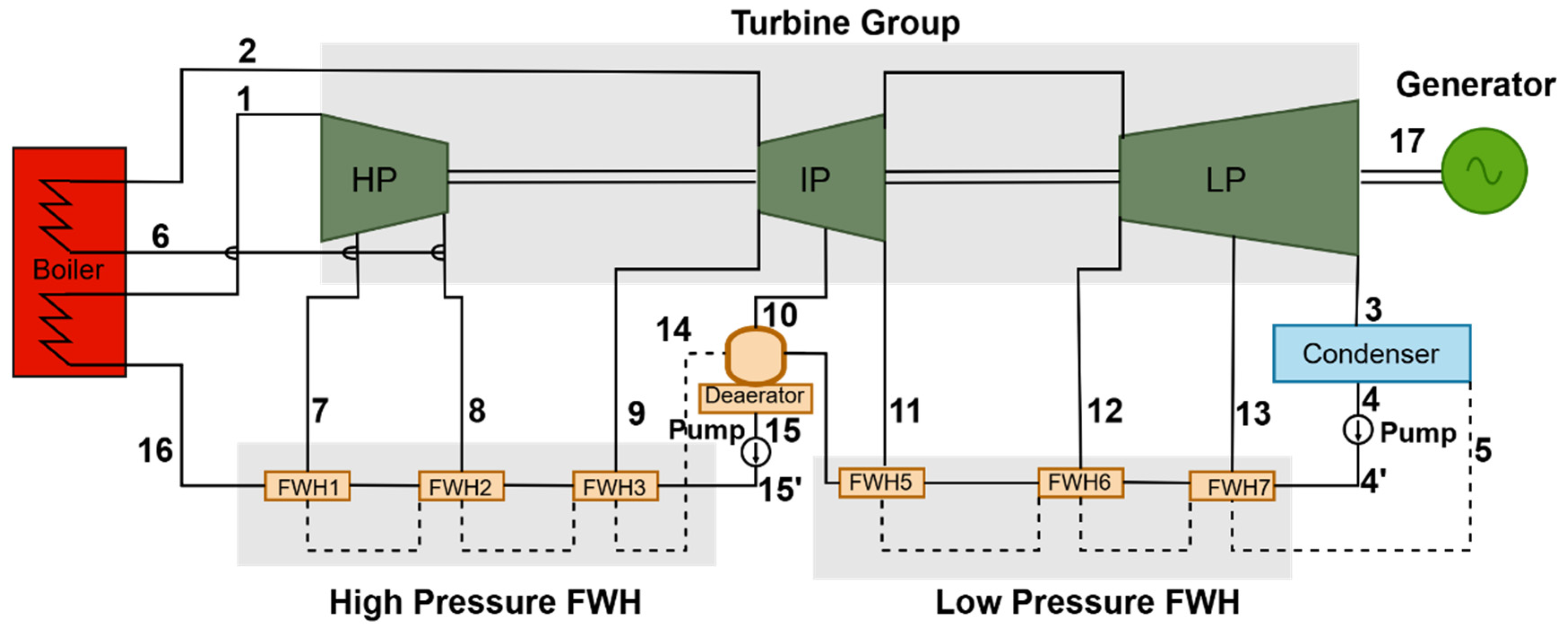
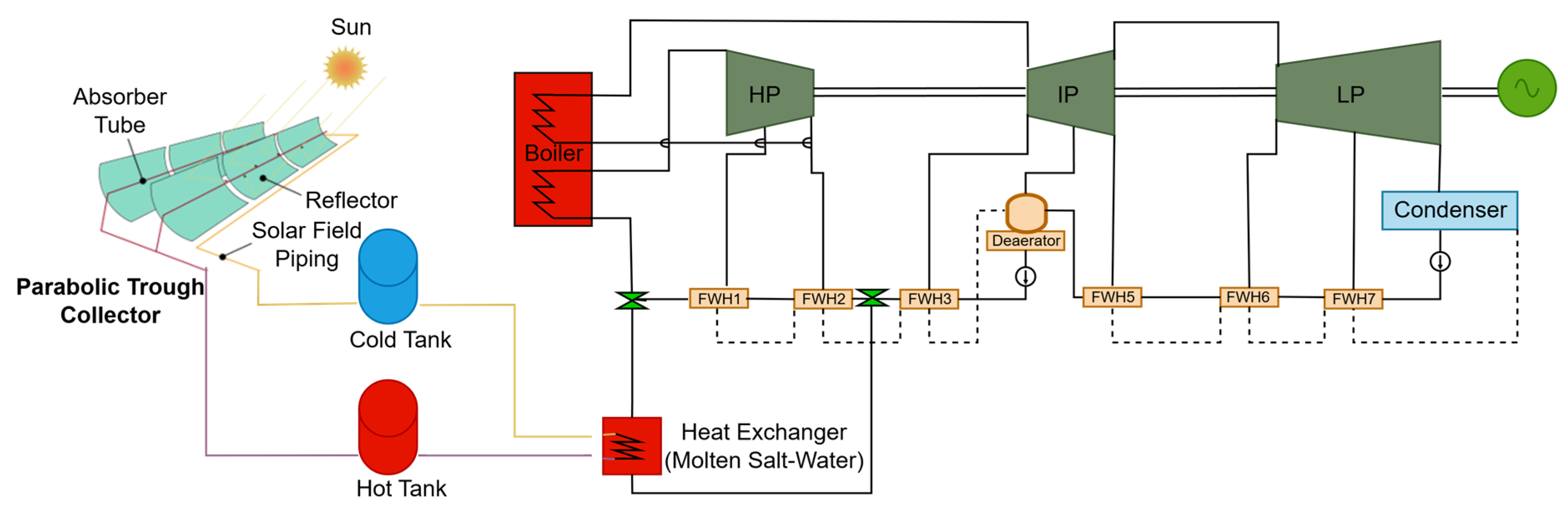
This research examines solar-aided coal-fired power generation (SAPG) that combines a 350 MWe traditional fuel-burning unit integrated with a 100 MWe CSP solar thermal unit, operating within a regenerative Rankine Cycle. The conventional coal-based 350 MWe supercritical plant is displayed in Figure 1, which is composed of a boiler (superheater and reheater), turbines (high-pressure (HP), intermediate-pressure (IP), and low-pressure (LP)), a feedwater heater (FWH1–FWH7) components, a deaerator, a condenser, and a pump. The turbine subsystem can be categorized into eight stages based on where the steam is extracted.
The reference models were performed and evaluated using the major parameters of coal-based generation unit data from Table 1. Validating and testing these models is essential for their implementation in this study. This was accomplished by inputting the data into models created with Aspen Plus software and recording the results of every flow parameter displayed in Table 2. The validation results of the thermodynamic model for the reference power plant are presented in Table 3. The results indicate that the deviations between the calculated values and the reference values of the key components are all within 3%. In addition to the comparison of the key thermodynamic parameters, the present study also considers possible sources of simulation deviations, including thermodynamic assumption simplifications, heat transfer modeling uncertainties, solar irradiation data processing, and operational boundary condition settings. The validation results indicate that the deviations between the simulation results and the reference data remain within an acceptable range, demonstrating that the proposed model is sufficiently reliable for the thermodynamic and performance analyses in this study.

2.1.2. Concentrated Solar Power (CSP) Plant Layout

A 100 MWe net output capacity of parabolic trough collectors (PTCs) was integrated with a coal base plant, comprising a solar field, a heat transfer fluid (HTF) pump, molten salt–water-utilizing heat exchangers, thermal storage tanks (hot and cold) and additional components. In this research, the direct system will be used and there is no need for an intermediate heat exchanger by using only the molten salt for two purposes: as a storage medium and an HTF working fluid. A direct system reduces complexity and costs compared to an indirect system. The PTC system stands out as a highly promising CSP technology to use in applications requiring low-to-medium temperature scales.
In this study, the solar multiple (SM) was selected as 2 based on a compromise between solar energy utilization and economic performance. A larger SM can increase solar thermal output; however, it also significantly increases the investment cost of the solar field and the TES system. In addition, the TES capacity was limited to 6 h considering both economic feasibility and operational flexibility. According to previous studies and the present system operating characteristics, a 6 h TES capacity can effectively improve solar energy utilization and system dispatchability while avoiding excessive capital cost increases associated with larger TES capacities [19]. Table 4 lists some of the key assumptions and characteristics of solar fields. It not only collects thermal energy from the solar collector but also stores this energy directly.
China has abundant solar energy resources, particularly in the northwestern regions, which provide favorable conditions for the development of large-scale solar energy projects [26]. This study selects a proposed site in Urumqi, Xinjiang Province, for an output capacity of 100 MWe parabolic trough generation plant, using it as a case study location for analyzing the SAPG system’s thermodynamics and economy. Xinjiang generally receives significantly greater solar irradiation. January is the coldest month and July is the hottest in Xinjiang, which follows Beijing Time (UTC+8). Furthermore, Xinjiang ranks third nationwide in the number of coal-based plants and stands out as the leader in CSP projects. The specific weather data information of the location is summarized in Table 5. The National Solar Radiation Database from the National Renewable Energy Laboratory (NREL) was used to create the hourly and half-hourly weather data for a representative location.

2.1.3. SAPG Plant Configuration

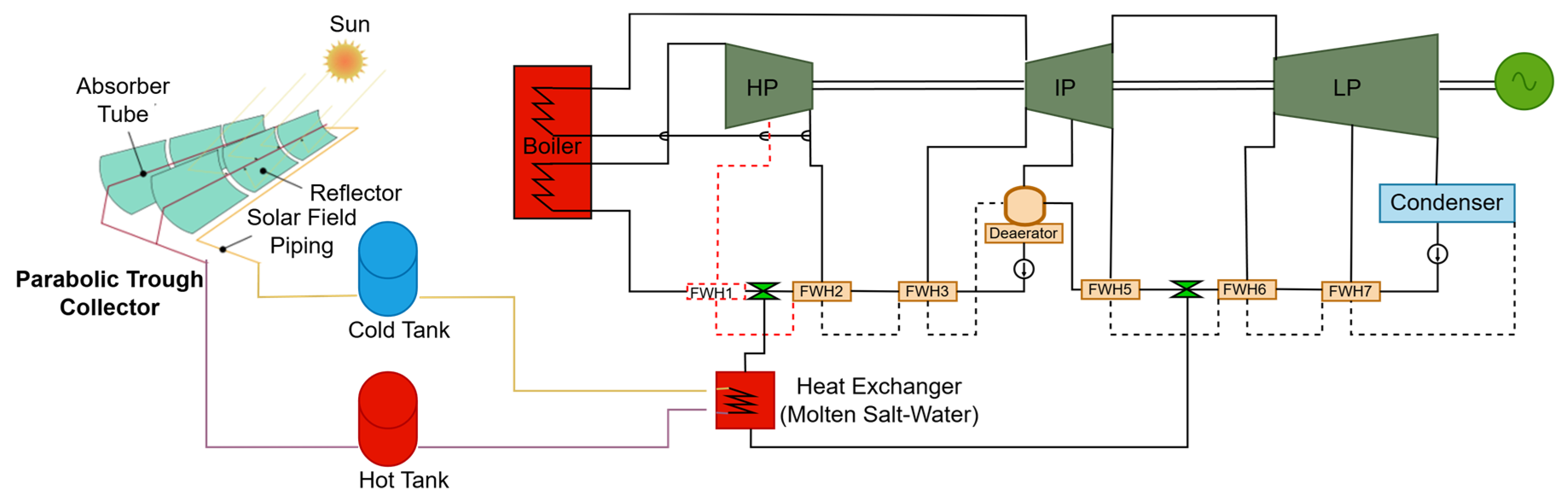
This paper emphasizes two integration methods of SAPG systems operating in Fuel Saving (FS) mode. The turbine output power generation remains the same in FS operation mode. The SAPG-1 system, a solar-driven heat exchanger (molten salt–water) that incorporates a parallel design with FWH1 and FWH2 (in the reference plant) where solar heat is utilized for preheating the primary feedwater prior to it entering the steam boiler, is shown in Figure 2. The SAPG-2 system, shown in Figure 3, eliminates FWH1 on the high-pressure side. In this configuration, the feedwater is redirected from the low-pressure side to a solar-assisted heat exchanger, where it is reheated using solar energy. The reheated feedwater then enters the coal-fired power plant boiler for further processing. Both the integration approaches effectively utilize solar thermal energy to reduce dependence on traditional fossil fuel heat sources, thereby enhancing system efficiency and minimizing coal consumption.
In the present study, the TES system is operated based on the availability of solar thermal energy and the thermal demand of the SAPG system under FS mode. During periods of high DNI, the surplus solar thermal energy is stored in the TES system through the charging process. When solar irradiation decreases or becomes insufficient, the stored thermal energy is released to maintain stable feedwater preheating and reduce boiler heat demand through the discharging process.
For simplification, the present work mainly focuses on normal operating conditions under quasi-steady-state assumptions. Critical operating scenarios, such as coal-fired unit start-up/shutdown processes, maintenance periods, and emergency operating conditions, were not explicitly modeled in the current study and will be further investigated in future work.

2.1.4. Establishment of the SAPG Model Using Aspen Plus and SAM

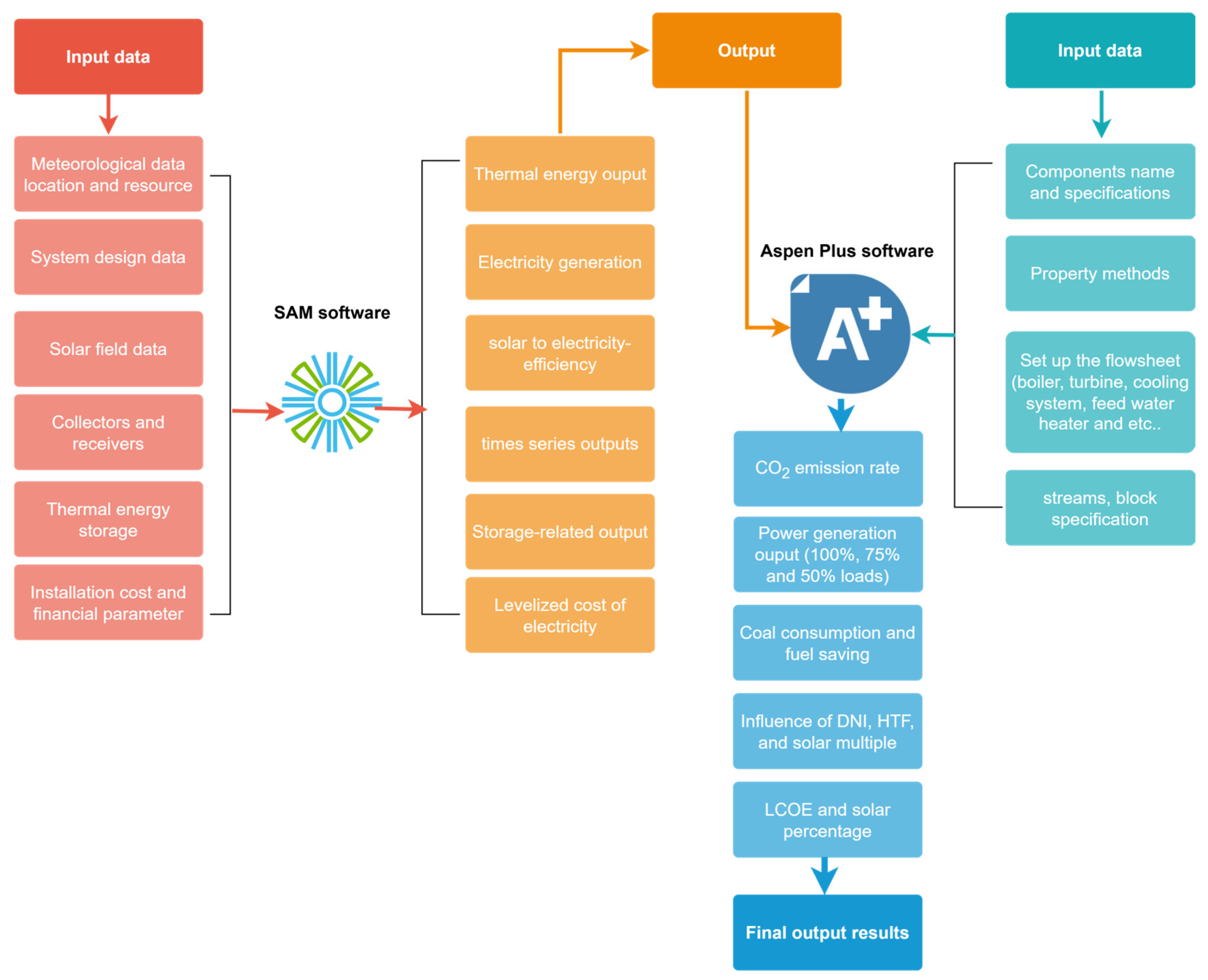
The Aspen Plus model library primarily utilizes modules for heat exchangers, mixers/splitters, and pressure changers in the context of enhancing coal-based thermal power generation with solar energy. The SAM platform is utilized to create the design software for the PTC molten salt system, enabling the assessment of the clean thermal energy station’s performance. The Aspen Plus (Version 11) and SAM software (Version 2023.12.17) are linked to analyze thermodynamics and economics characteristics under the various DNIs, mass flow rates of HTFs, SM values and water flow rate splitters. Firstly, some input parameters such as metrological data, collector type, receiver type, field area, and other operational parameters set up in SAM for hourly simulation depend on the solar field area and the solar radiation levels. After that, the hourly solar output data are put back as input data into the Aspen Plus to examine the SAPG systems’ energy, exergy, and heat balancing efficiency, as demonstrated in Figure 4.
In thermal systems, the essential components for heat transfer include heat absorbers, heaters, condensers, and deaerators. A crucial factor in heat transfer is the heat exchange capacity of the heat exchanger. The Aspen Plus process model emphasizes molten salt (NaNO3 60%, KNO3 40%) heat transfer, heating water supply, and steam turbine operation to ensure process convergence. Specifically, the heat exchanger (HEX) modules simulate the heat transfer between cold feedwater and hot molten salt, utilizing the hot stream input data derived from the SAM’s output simulation results. The heater module models the condenser, superheater (SH), and reheater (RH). The deaerator (DTR) operates using a mixer module in constant pressure mode. The pumps are represented by the Pump-1 and Pump-2 modules, while the separators are modeled using SPT and SPL, with defined mass flow ratios for each branch. The mixer employs the MX module to specify the effective phase state of the output logistics. The steam turbine model, the water supply system, and the steam generation system are integrated in alignment with the actual process flow, resulting in the comprehensive SAPG-1 and SAPG-2 systems, as demonstrated in Supplementary Materials SA and SB, respectively. By inputting parameters such as temperature and pressure, the full simulation process can be activated.

2.2. Mathematical Modeling for Coal-Based Plant

2.2.1. Heat Balance

The first law of thermodynamics can be used to explain the heat balance of a reference fossil fuel plant. The following are some key equations and concepts related to the heat balance in the different components of the systems [18,28]:
(1)
Boiler
Boiler heat balance analysis is essential to identify areas for improving boiler efficiency and overall plant performance. The thermal balance can be calculated as follows [29]:
Q B =   m B   h B , o u t     h B , i n = Q c o a l × η B
Q c o a l = M c × L H V  
where Q B represents the heat energy released in the boiler (kW); m B represents the feedwater flow rate (kg/s); the boiler’s input and output steam specific enthalpy (kJ/kg) are denoted by h B ,   i n and h B ,   o u t ; Q c o a l represents the thermal energy generated using coal as an input feed (MW); η B denotes the efficiency of the boiler, with a value of 0.9; M c refers to the rate at which coal is consumed in the boiler, and the Lower Heating Value (LHV) value is 19,690 (kJ/kg).
(2)
Turbine
The turbine output’s heat balance equation can be explained as follows:
W T =   m T   ( h T , i n   h T , o u t )
where W T represents the turbine output (kW); the steam flow rate (kg/s) passing through the steam turbine is represented by m T ; and h T , i n   a n d   h T , o u t are the turbine’s enthalpies input and output steam (kJ/kg).
(3)
Condenser
The condenser output’s heat balance equation can be written as follows:
Q C =   m C   ( h C , i n     h C , o u t )
where Q C stands for the condenser’s rejected heat (kW);   h C , i n and h C , o u t   represent the input and output enthalpies of the condenser (kJ/kg); and m C   i s the condenser’s flow rate steam (kg/s).
(4)
Feedwater Heater
Feedwater heaters are commonly used as closed heaters. In this model, the high-pressure side in (FWH1–FWH3) and the low-pressure side in (FWH5–FWH7) run as closed heaters. The temperature of the primary feedwater entering the boiler is increased by extraction steam, which enhances the plant’s thermal efficiency. This process can be mathematically calculated as follows:
m f w , i h w o , i h w i , i = m d , i 1 h d , i 1 h d , i + m i h i , i h d , i
where m i and m d , i 1 are the extraction steam flow rate and the drain water flow rate for the ith heater unit in (kg/s); h i , i and h d , i are the ith heater unit’s steam extraction enthalpy and drain water enthalpy in (kJ/kg); m f w ,   i represents the feedwater flow rate for the ith heater unit in (kg/s); and h w i , i and h w o , i are the feedwater enthalpy at the inlet and outlet for the ith heater unit in (kJ/kg).
(5)
Pump
The work done by the pump is a critical component. The work input to the pump can be expressed as follows [30]:
W P =   m P   ( h P , o u t   h P , i n )
where W P represents the pump’s work output (MW);   h P , i n and h P , o u t are the pump’s inlet and outlet fluid enthalpy (kJ/kg); and m P represents the pump flow rate (kg/s).

2.2.2. Analysis of Exergy

In understanding and enhancing the operation of every component of reference-based plant production systems, an energy analysis is crucial. The following formula is employed to determine the specific exergy:
ε x = ( h h 0 ) T 0 ( s s 0 )
where h 0 represents the reference enthalpy unit in (kJ/kg); s 0 represents the reference entropy unit in (kJ/kg · K); and T 0 represents the ambient temperature unit in (K).
The overall rate of exergy, referred to as “ ε ” associated with a fluid steam, is formulated as follows:
ε =   m × ε x
Aspen Plus determines the exergy flow rate of each material stream by analyzing the molar flows, molar fractions, enthalpy, and entropy associated with each stream. T 0 is set at 25 °C, equivalent to 298.15 K. P 0 is established at 101.325 kPa. These values serve as the baseline reference environment for comparing the system’s exergy. As shown in Table 6, the power plant equipment is described by its losses and exergy efficiency.
In this analysis, while the specific properties of the coal used in the combustion chamber are not directly examined, the coal’s role is still accounted for. It is treated as a heat source, with its input varying according to different load ratios when assessing the overall performance of coal-burning power generation. This approach allows for evaluating the plant efficiency at various operational levels without delving into the detailed characteristics of the coal itself. Coal’s exergy can be computed using the formula below [15]:
ε c o a l = 1.0064 + 0.1519 × X H X C + 0.0616 × X O X C + 0.0429 X N X C × Q c o a l
where the coal’s carbon, oxygen, hydrogen, and nitrogen percentages are represented by the symbols X C , X O , X H   a n d   X N in %. Table 7 provides the specifics on the coal parameters used in this study.

2.3. Mathematical Modeling for Solar Plant

Solar Field

In the trough collector of a solar field, the Q s o l a r received by the parabolic collector can be computed using the direct incoming sun irradiation. Q s o l a r can be expressed as follows [16,33]:
Q s o l a r = I d × A p t c × L × N
Q a b s   , the energy of the incident radiation captured by the collector, can be written as follows:
Q a b s = Q s o l a r × η o p t
The energy efficiency of the collector is expressed as follows:
η e n e r g y , c o l = Q a b s Q s o l a r
The absorber’s usable energy is delivered to the receiver’s HTF working fluid. Q u s e is determined using the equation that follows [34,35]:
Q u s e = Q a b s Q l o s s
Q u s e = m ( H o u t H i n ) m   C p ( T m s , o u t T m s , i n )
The expressions of the losses are as follows:
Q l o s s = Q a b s Q u s e
Q l o s s = U . A   ( T f l T a m b )
The energy efficiency of the receiver is expressed as follows:
η e n e r g y , r e c e i v e r = Q u s e Q a b s
The overall solar collector–receiver’s energy efficiency can be written as follows:
η e n e r g y , s o l a r = Q u s e Q s o l a r
where Q s o l a r represents the heat gained by the PTC collector from the DNI, (kW); I d represents the direct normal beam, (W/m2); L and A p t c denote the length and the width of the aperture, (m); N represents the field’s total collector units; η o p t is the field’s optical efficiency; Q l o s s is the PTC’s thermal and optical losses, (kW); U is the loss of the thermal coefficient (W/m2 · K); the heat transmission area, A , is measured in (m2); and the average HTF working fluid temperature (K) is denoted as T f l .
Thermal energy transfer from the molten salt HTF to the feedwater cold fluid is facilitated by the heat exchanger. The energy balance shows that the heat that is transported as follows:
Q H e x = m h h h , i n h h , o u t = m c ( h c , o u t h c , i n )
where m h and m c are the heat exchanger’s hot and cold flow rates (kg/s); and h h , i n and h h , o u t are the hot HTF fluid and h c , i n   a n d   h c , o u t are the cold feedwater at the input and output of the enthalpy (kJ/kg).
The calculation of solar exergy involves considering factors such as temperature, solar radiation intensity, and other additional parameters. The exergy analysis offers important insights into improving the CSP’s efficiency, indicating the greatest quantity of usable work that can be collected. The following is a description of the solar exergy calculation [33,36,37]:
ε s o l a r = Q s o l a r [ 1 4 3 ( T a m b T s u n ) + 1 3 T a m b T s u n 4 ]
where T s u n denotes the effective temperature of the solar photosphere, fixed at 5600 K.
The exergy of the absorber is described as follows:
ε a b s = Q a b s 1 T a m b T r
where T r denotes the temperature of the absorber (K).
The exergy efficiency of the collector is as follows:
η e x , c o l l e c t o r =   ε a b s ε s o l a r
The absorber’s useful exergy gain can be shown as follows:
ε u s e = m [ h 0 h i T 0 ( s 0 s i ) ]
The exergy efficiency of the receiver is as follows:
η e x , r e c e i v e r =   ε u s e ε a b s
The overall solar collector–receiver’s exergy efficiency can be written as follows [38]:
η e x , s o l a r =   ε u s e ε s o l a r
The actual thermal power of the solar field divided by the required cycle thermal power meant for the PTC is known as the solar multiple (SM). It can be written as follows [39]:
S M =   Q e n t i r e   s o l a r   f i e l d Q i n p u t   r e q u i r e d
The formula that follows can be utilized to calculate how efficiently solar heat can be converted into electrical energy [40]:
η s e =   W s o l a r Q s o l a r
where W s o l a r represents the electricity generated from solar heat (MW).
The performance of the coal-based plant and the two different integrations of SAPG into plants can be evaluated using measurements such as efficiency of energy and exergy, which are described as below [41,42]:
η e n e r g y , b a s e =   W T Q c o a l
η e n e r g y , S A P G = W T Q c o a l + Q s o l a r
η e x , b a s e = W T ε c o a l
η e x , S A P G = W T ε c o a l + ε s o l a r
The solar contribution can be determined using the following equation [16,33]:
S o l a r   c o n t r i b u t i o n   % =   Q s o l a r Q s o l a r + Q c o a l × 100

2.4. Economic and CO2 Emission Evaluation of SAPG Systems

Solar energy systems usually involve high initial investment costs but offer low operational expenses. A list of the capital initial investments needed for the CSP plant economic analysis, such as the LCOE, is shown in Table 8. This research establishes the payback period required for recovering investments. The calculations take into account the savings from CO2 emissions as well as the income generated from solar energy electricity production under different solar multiples. The formula below can be used to determine the L C O E s o l a r calculation [15,43]:
L C O E s o l a r = C C × C R F + C O & M A E P s o l a r
where C C represents the incremental capital cost ($); A E P s o l a r represents the yearly energy production of the solar field (kWh); and C O & M represents the cost of the operation and maintenance ($). The following formula can be used to determine the capital recovery factor (CRF):
C R F = D r × ( 1 + D r ) i ( 1 + D r ) i 1
where D r represents the discount rate expressed as a percentage, while i indicates the power plant’s operational lifespan, expressed in years.
After the CSP plant is installed, its financial performance is evaluated by estimating the expected income at the first year’s end. Fuel coal and carbon dioxide emissions are priced at $84.2 per metric ton and $26.16 per metric ton of CO2, respectively, in this research [41]. The expected income is determined using the formula provided below:
I e x p = L C O E s o l a r × A E P s o l a r + F s × P f + C r × P e m C O & M
where F s is the annual quantity of fuel saved, measured in tons; P f is the fuel price, expressed in $/ton; C r is the yearly volume of avoided CO2 emissions, measured in tons; and P e m is the CO2 emissions price, expressed in $/ton.
The investment’s payback duration I p a y b a c k can be calculated as follows:
I p a y b a c k = I i n i t i a l I e x p
The following Table 9 can be used to calculate the L C O E b a s e   p l a n t in order to examine the economics of the reference case:
L C O E b a s e   p l a n t = C C c o a l × C R F + C O & M , c o a l + C c o a l A E P b a s e   p l a n t
When evaluating economic feasibility, one of the most crucial metrics is the capacity factor. Based on the assumption that the plant operates continuously at full rated capacity all year long, this statistic is computed by dividing the average annual power output by the theoretical maximum yearly production [46]:
C a p a c i t y   F a c t o r =   A n n u a l   e l e c t r i c i t y   P r o d u c t i o n   ( k W h ) R a t e d   p o w e r   c a p a c i t y   k W × 8760   ( h r )
Rates of coal consumption are crucial for assessing the environmental effect and the performance of coal-based plants. The rate of coal consumption can be computed using the formula [15].
M c = 3.6 × Q B 1000 × L H V × η B
The annual coal savings in a SAGP system can be written as follows:
M c s = M c , b a s e M c , S A P G = i = 1 8760 Q B , b a s e     Q B L H V × η B
where M c , b a s e represents a coal-based plant’s annual coal consumption (in tons); M c , S A P G denotes a SAPG system’s annual coal consumption (in tons); and Q B , b a s e   represents the coal-based plant’s steam boiler heat load.
Carbon dioxide emissions can be calculated as follows:
E c o 2 = 3.664 × M c × X c

3. Results and Discussion

3.1. Steady-State Analysis of SAPG Systems

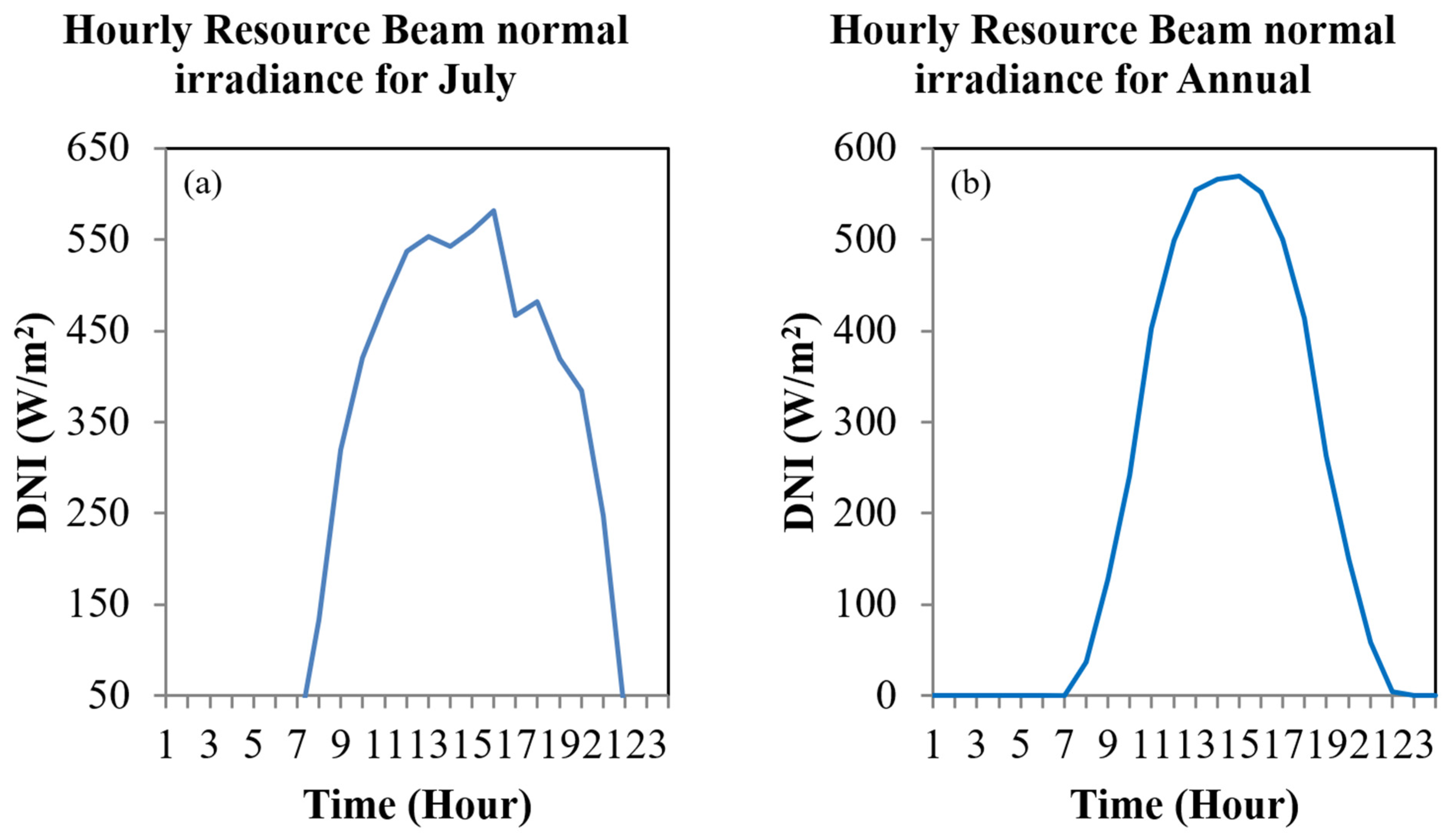
The SAPG research for a steady state can be demonstrated without considering the time factor. This analysis selected the maximum average hourly value of the solar input data in the summer season from the SAM. In Urumqi, the peak average hourly time is 14:00 PM in a day. The DNI values were recorded as 559.54 W/m2 in July. Other key parameters include the HTF mass flow rate of 929.67 kg/s, the HTF inlet temperature of 413.67 °C, and the HTF outlet temperature of 293.33 °C. In this case study, a steady-state analysis was conducted using these parameters.
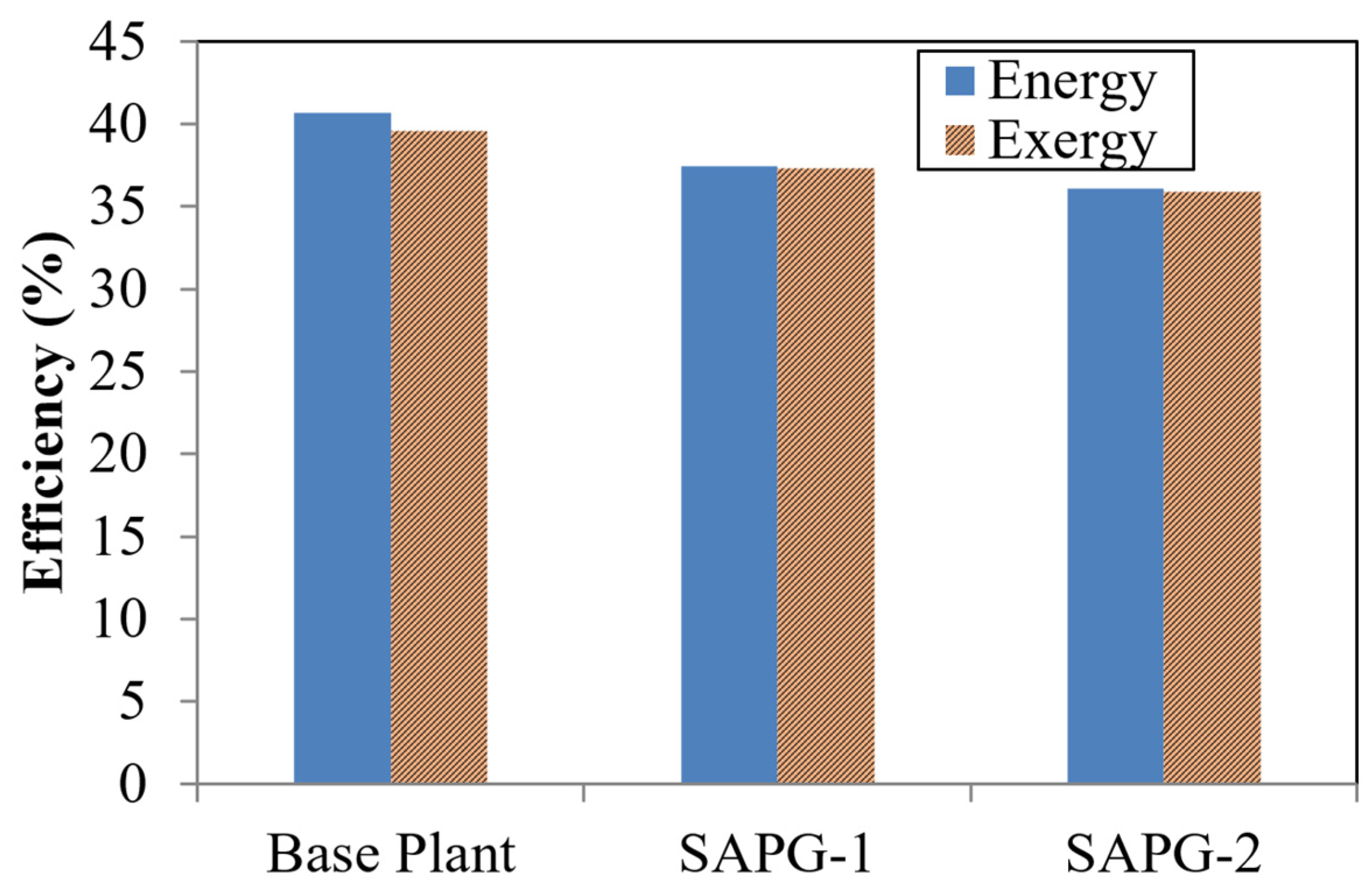
According to the results, the coal-based power unit’s cycle thermal efficiency is 40.67%. SAPG-1’s thermal efficiency is valued at 37.44% while SAPG-2 was reduced to 36.06%. The exergy efficiency of a coal-fired base is 39.60% and SAPG-1 and 2 are 37.29% and 35.88%, as illustrated in Figure 5. When comparing the SAPG systems to the base plant, their energy efficiencies are slightly reduced. Nevertheless, SAPG-2 has a lower exergy efficiency than the SAPG-1 system. The primary causes of this decrease in SAPG-2 are the removal of FWH1, resulting in increased heat losses, and the boiler’s significant exergy losses. Both the SAPG systems offer notable environmental benefits, such as decreased coal consumption, reduced carbon dioxide emissions, and enhanced sustainability in the power generation process.
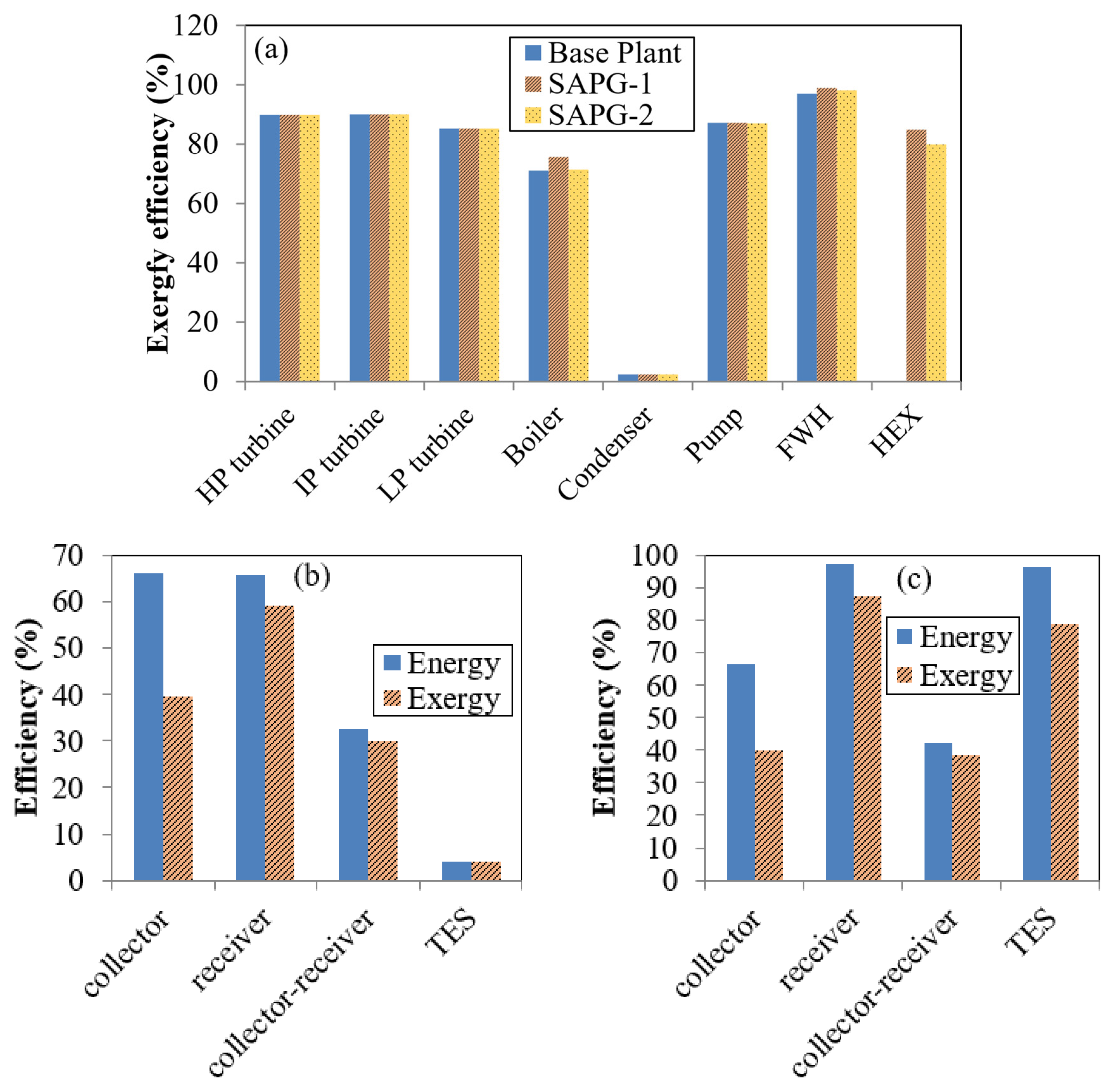
Figure 6a illustrates that the boiler’s exergy efficiency in SAPG-1 and SAPG-2, both of the SAPG systems, is greater than that of the coal-based unit in the boiler, whereas the turbine (HP, IP, and LP) efficiencies remain largely unchanged. The exergy efficiency of SAPG-1 is higher than SAPG-2 in the heat exchanger. Figure 6b shows that the solar field (collector–receiver system) has an energy efficiency of 32.64% during the peak average hour in July. The exergy efficiency is 29.86% because heat transmission is irreversible. The TES system was evaluated at the peak average hourly time in day operating conditions, where 4.01% was found to be the energy and exergy efficiency, primarily due to the substantial charging rate in contrast to the significantly lower discharging rate. Under average July conditions, as shown in Figure 6c, the TES achieved higher energy and exergy efficiencies of 96.44% and 79%. This improvement can be attributed to more balanced and consistent charging and discharging cycles, which minimize energy losses and enable the system to utilize stored energy more effectively, resulting in enhanced performance.

3.2. Dynamic-State Analysis of SAPG Systems

In this Section, the DNI of the maximum average hourly month July average and annual average were selected to simulate a dynamics analysis for the SAPG systems, as shown in Figure 7. Many key factors will affect the SAPG performance, such as DNI, HTF, solar multiple, solar contribution, and efficiency of solar-to-electricity, which are crucial for optimizing coal-based power plants adding solar. The SAPG-1 and SAPG-2 models were examined under various load conditions, including 100%, 75%, and 50%, under Fuel Saving mode.

3.2.1. Influence of DNI

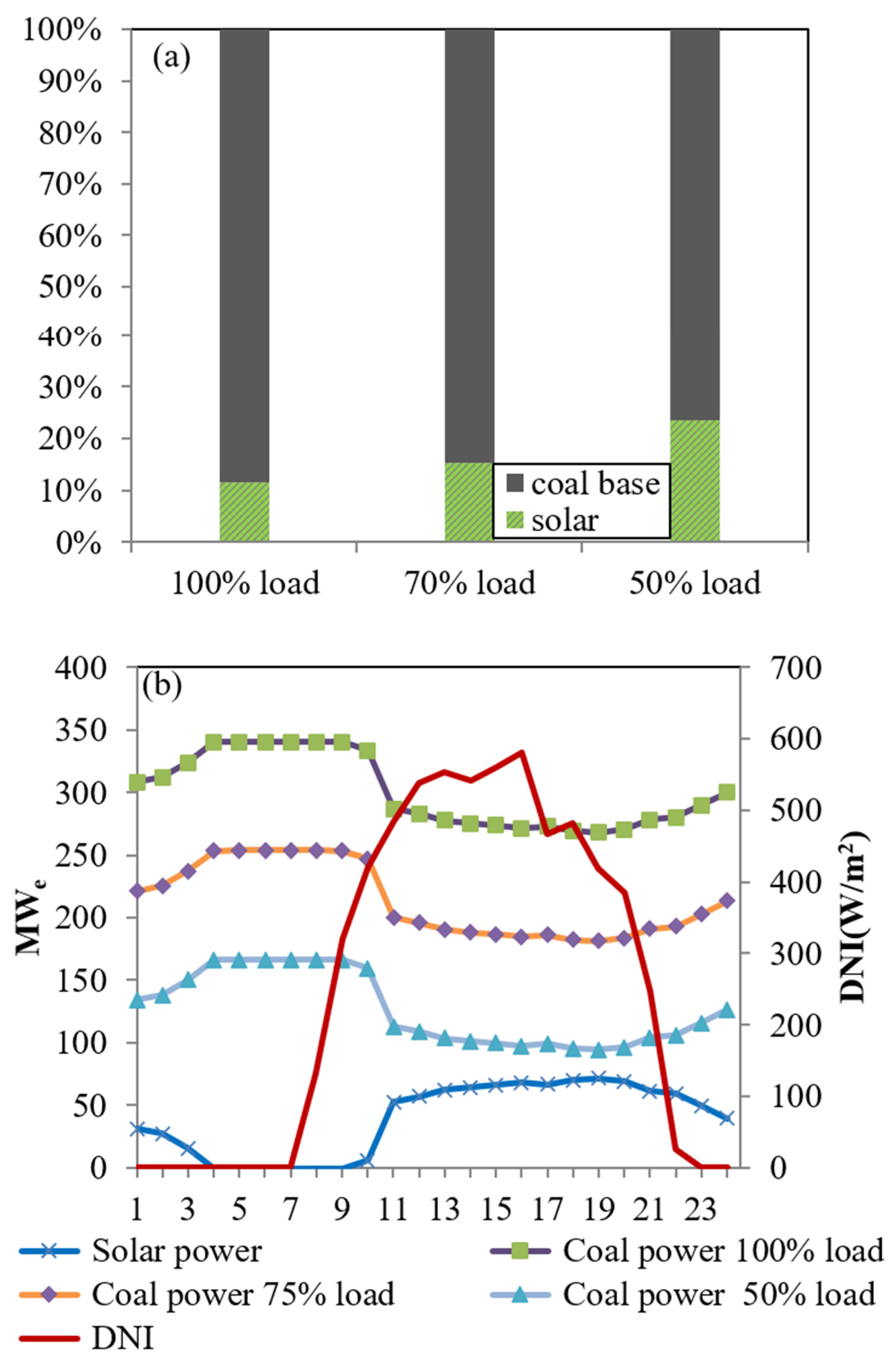
Figure 8a,b illustrate that higher Direct Normal Irradiance (DNI) levels boost solar power generation, influencing the SAPG output energy in Fuel Saving (FS) mode across all the load levels. The overall solar power energy provided 11.44% in full load, 15.37% in 75% load and 23.46% in 50% load for the SAPG system. The solar field size and the DNI enhance the SAPG system’s ability to save fuel and reduce emissions across all load levels. The effect is more pronounced at lower loads, where solar energy can cover a larger percentage of the power generation needs.
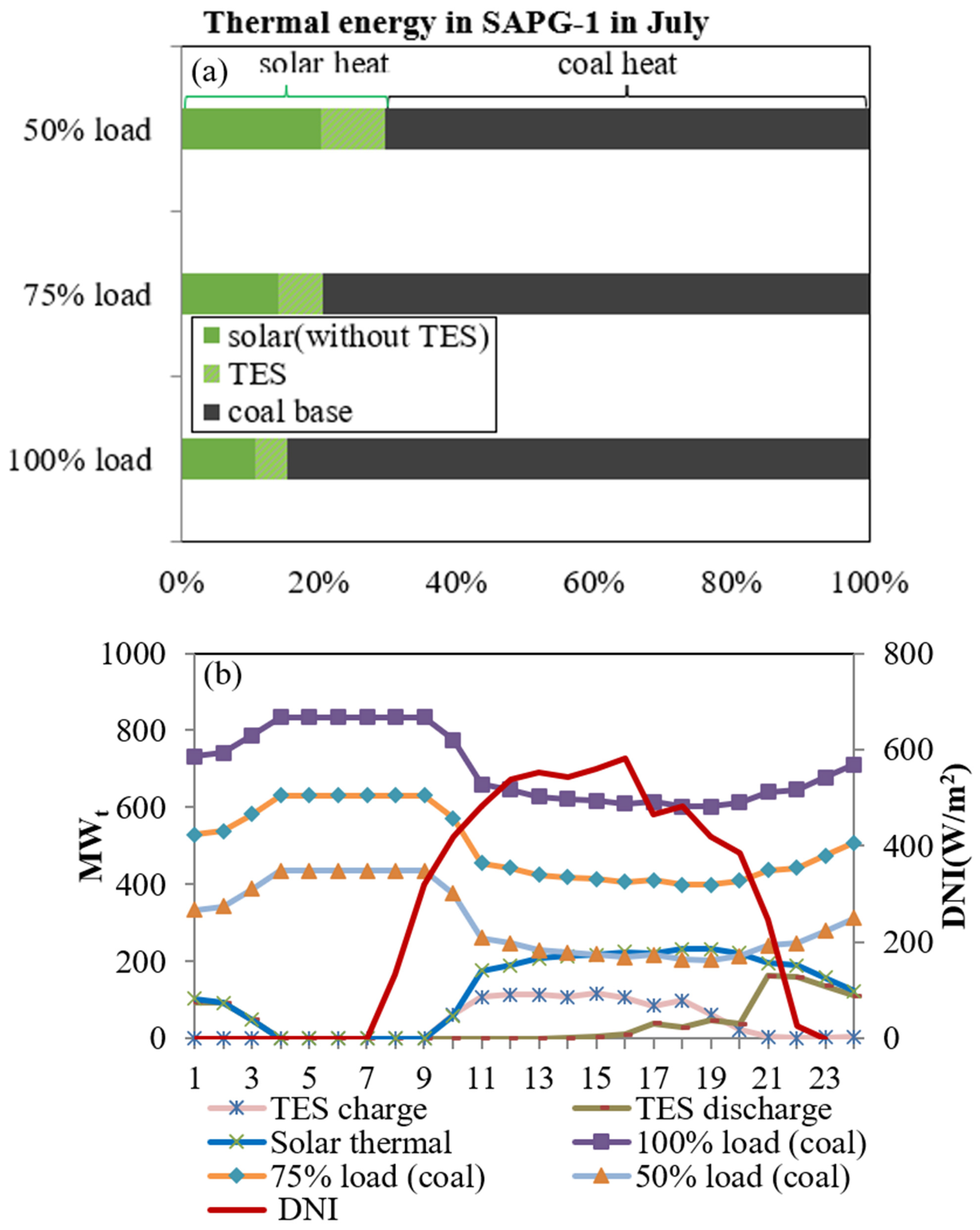
Figure 9a,b explore the DNI’s effects on the coal-based power plant boilers’ thermal output and the dynamic role of thermal energy storage (TES) in managing energy supply under varying solar conditions. High DNI periods enable the charging of the TES, which can then discharge stored energy during low DNI periods to maintain the power output. The analysis indicates that the TES discharge process makes up about 31.33% of the solar thermal energy cycle. This significant proportion underscores the importance of optimizing TES discharge mechanisms to improve solar thermal plants’ overall performance. The total average solar thermal energy supplied amounts of 3098.99 MWt per day in both the SAPG systems, which corresponds to 15.46% at full load (20,032.6 MWt per day), 20.46% at medium load (15,145.9 MWt per day), and 29.62% at low load (10,461.3 MWt per day) in SAPG-1. However, Figure 10a,b illustrate that in SAPG-2, it was 14.85% in full load (20,858.4 MWt per day), 19.73% in medium load (15,700.6 MWt per day), and 28.99% in low load (10,689.3 MWt per day). It can be demonstrated that the effects of providing heat energy to the high-pressure and low-pressure sides differ significantly. The identical thermal sunlight input does not change the fact that the side with low pressure is lower than the side with high pressure. This is because boilers operating at low pressure require more heat to achieve the same energy output as high-pressure boilers. Another key reason is that FWH1 was removed from SAPG-2 under high pressure. As a result, the boiler requires an additional heat source to generate the same output capacity as SAPG-1 in FS mode.

3.2.2. Influence of Solar Field Working Fluid

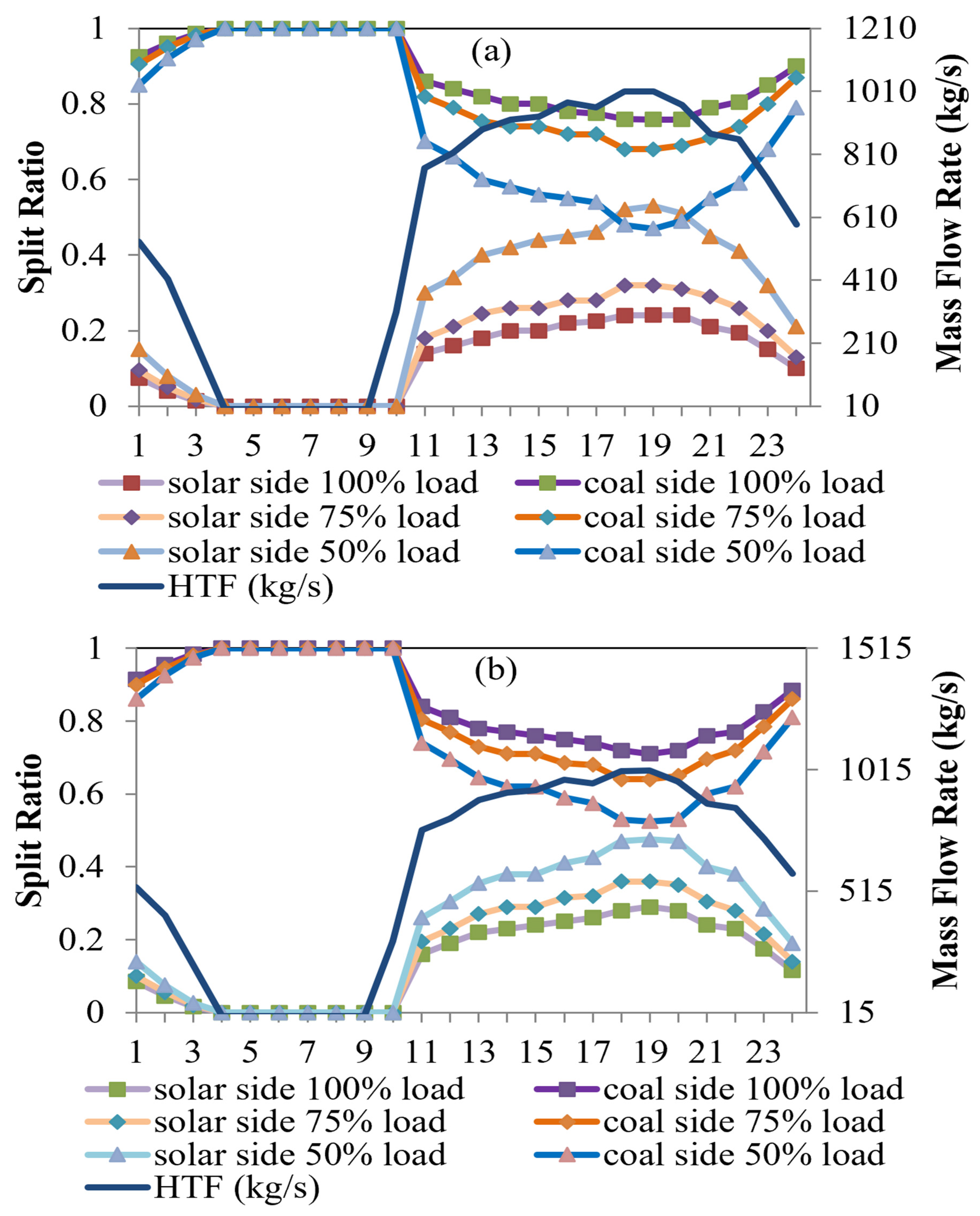
The system preheating and feedwater extraction processes are shown in Figure 11a,b. A portion of the primary feedwater is diverted and subsequently preheated using various HTF flow rates prior to it entering the boiler. The analysis reveals a significant correlation between HTF flow rates and feedwater distribution. At peak performance, the HTF flow rate approaches 1009.74 kg/s, corresponding to a secondary extracted feedwater flow rate of approximately 71 kg/s in SAPG-1 and 62 kg/s in SAPG-2 for all loads. After examining SAPG-1 and SAPG-2 under different load conditions, it was found that the maximum feedwater split ratio at 50% load reached 0.53 and 0.47, respectively, the highest compared to the ratios at 75% load and 100% load on the solar field side, as illustrated in Figure 12a,b.
In both the SAPG-1 and SAPG-2 systems, integrating solar thermal energy using molten salt HTF reduces coal consumption by supplementing or replacing part of the conventional feedwater heating process. Notably, when the collector field component’s HTF flow rate rises, the primary feedwater flow rate decreases, indicating an inverse correlation between the two. This demonstrates the system’s effective integration of solar thermal energy, thereby reducing the thermal load on the conventional boiler.

3.2.3. Influence of Solar Multiple

The solar multiple (SM) is strongly connected to the TES system. A higher SM with TES enhances energy storage and continuous power generation, while a lower SM reduces storage effectiveness. Generally, for systems without TES, the SM value is typically between 1.1 and 1.3 due to energy losses. In molten salt systems with TES, the SM generally ranges from 1.6 to 2.8, constrained by production capabilities. While the SM can theoretically take any value, this research adopts a default SM value 2.
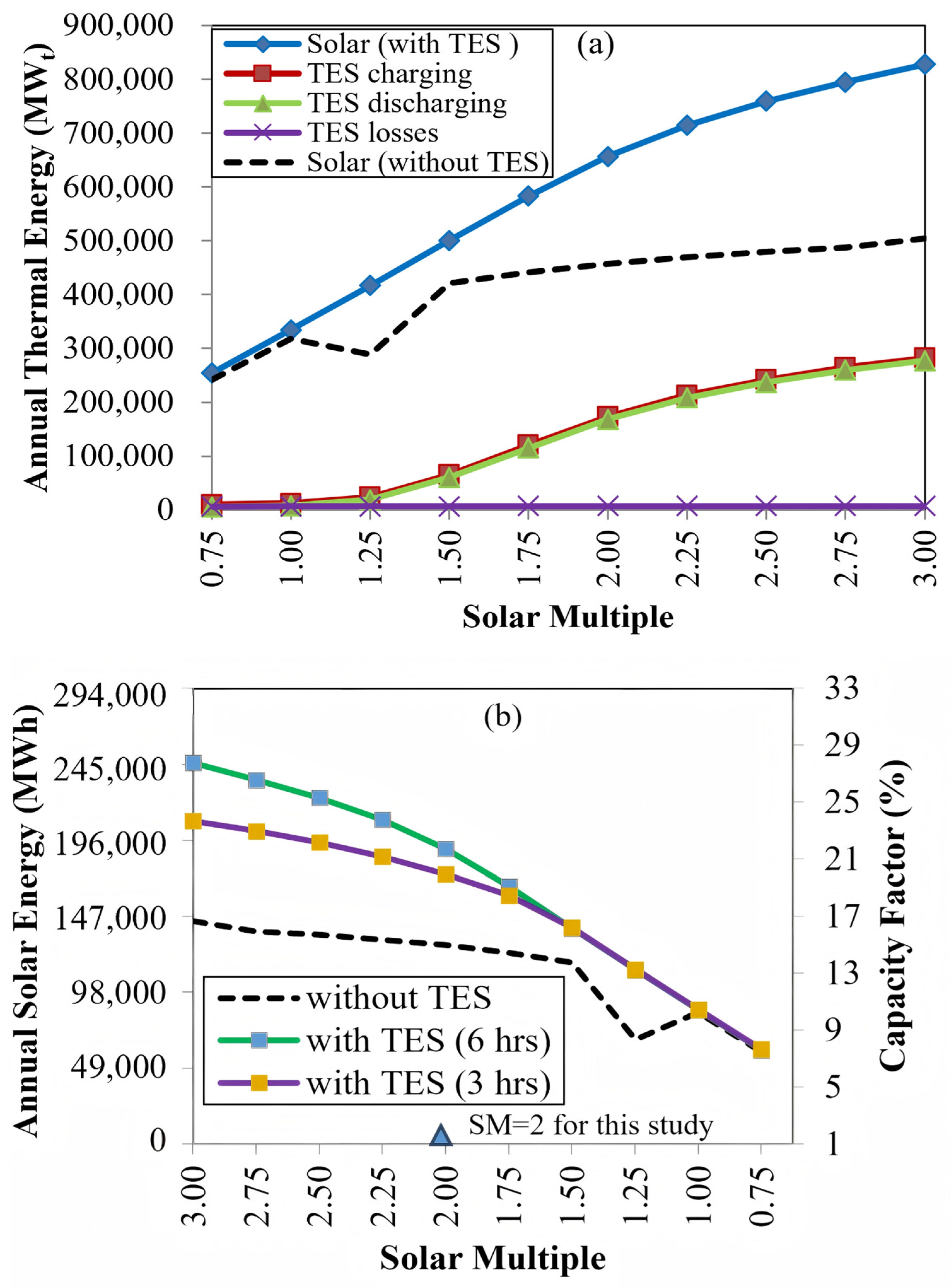
The total thermal energy output with TES increases steadily as the SM rises, indicating an improved energy absorption due to the wider collector field. In contrast, the solar heat output without TES shows a saturation effect, plateauing at higher SM values because the system cannot utilize the excess solar energy efficiently. For instance, at an SM value of 2, the annual thermal energy output with TES reaches 656,625 MWt, while without TES it is limited to 457,262 MWt. The TES charging and discharging energy exhibits a consistent upward trend with increasing SM, indicating that the storage system effectively absorbs and redistributes surplus thermal energy that would otherwise be curtailed. TES losses remain relatively low and stable across all the SM values, according to Figure 13a.
For a CSP system with a 100 MWe output capacity and TES durations of 3 h and 6 h, the annual solar energy output and capacity factor for both configurations remain identical up to an SM of approximately 1.6. Beyond this point, the TES of 6 h achieves a greater capacity factor and yearly solar energy production compared to the 3 h TES. Specifically, at an SM of 2, the annual solar energy production reaches 190,350 MWh for TES (6 h) at a capacity factor of 21.75%, 174,060 MWh for TES (3 h) at a capacity factor of 19.89%, and only 128,350 MWh without TES at a capacity factor of 14.66%. The annual solar energy output decreases sharply as the SM reduces in systems without TES due to the inability to store surplus solar energy during peak availability, as shown in Figure 13b. A notable sharp decline occurs at an SM of 1.25, where the excess energy produced by the solar field cannot be efficiently utilized without TES. These results demonstrate the significant impact of TES on enhancing the thermal energy output and the capacity factor while also improving the solar energy at higher solar multiples.

3.2.4. Efficiency of Solar Power-to-Electricity

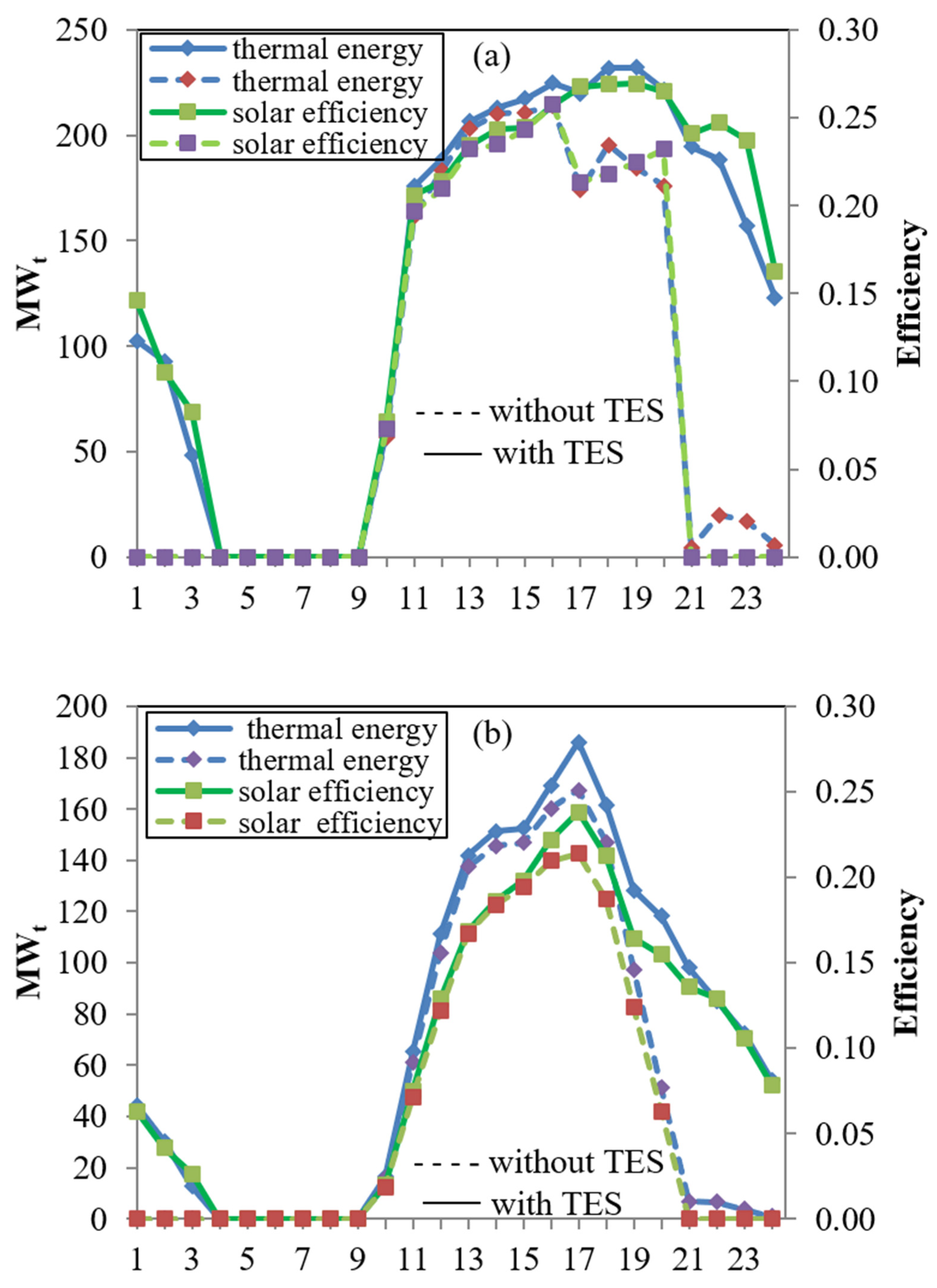
This purpose of this Section is to find ways to identify the SAPG energy efficiency by analyzing the average solar power-to-electricity efficiency for July and on an annual basis. As illustrated in Figure 14a, in July, the average maximum efficiency of solar power to electricity with TES reached approximately 26.95%, converting to roughly 232.3 MWt of thermal energy. In contrast, during the same period without TES, the solar thermal energy was roughly 184.583 MWt, and the efficiency was 22.45%. On the other hand, the annual average maximum efficiency was 23.83% (with TES) and 21.38% (without TES), with a thermal solar input energy of 186 MWt (with TES) and 167.27 MWt (without TES), as shown in Figure 14b. This finding indicates that the solar-to-electricity efficiency between the CSP systems with and without TES is primarily due to enhanced energy management capabilities, better utilization of thermal input energy, and improved economic performance associated with dispatchability. These factors collectively work together to increase the CSP systems’ performance and reliability when they incorporate thermal energy storage technology.

3.2.5. Solar Contribution

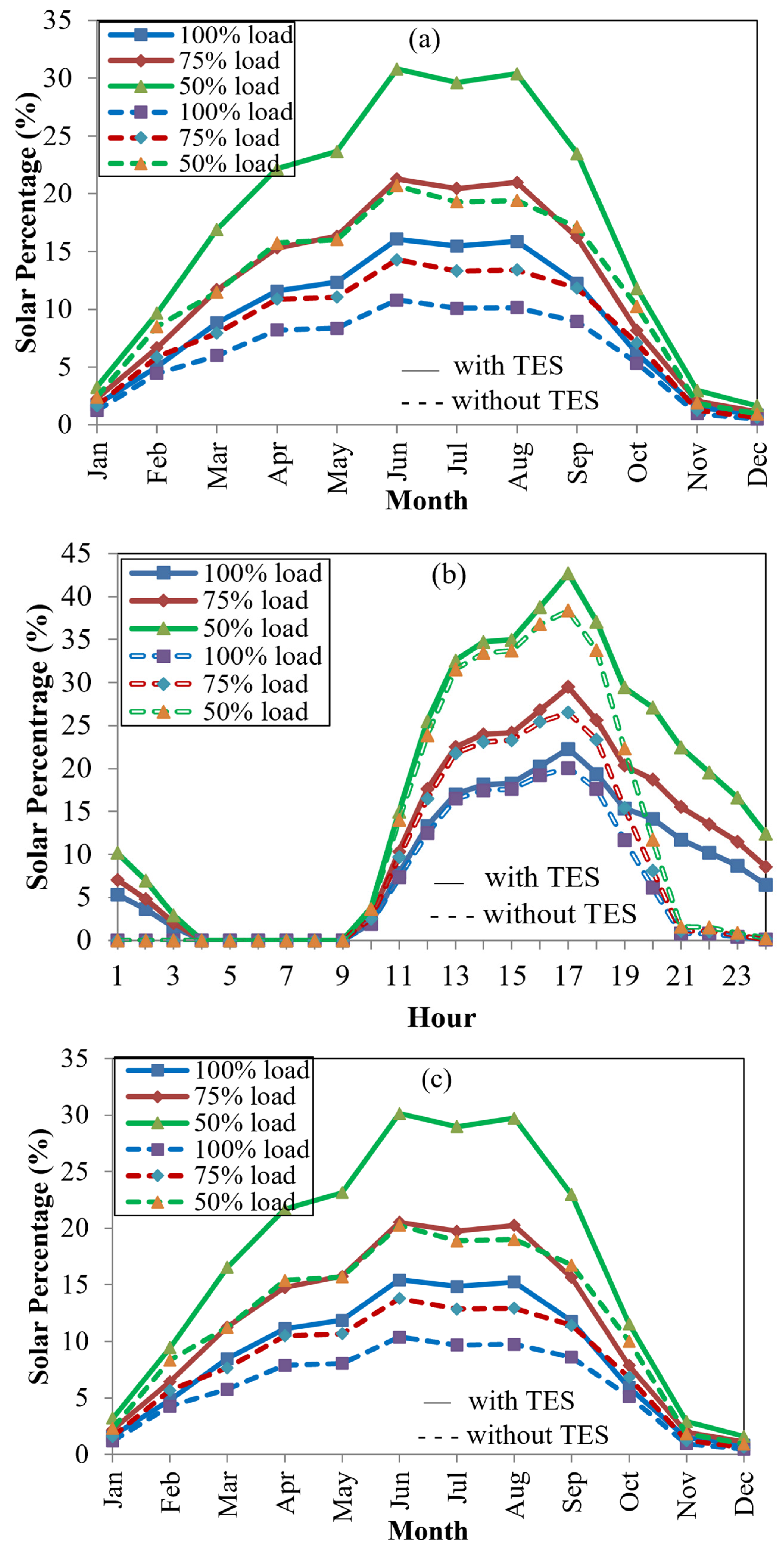
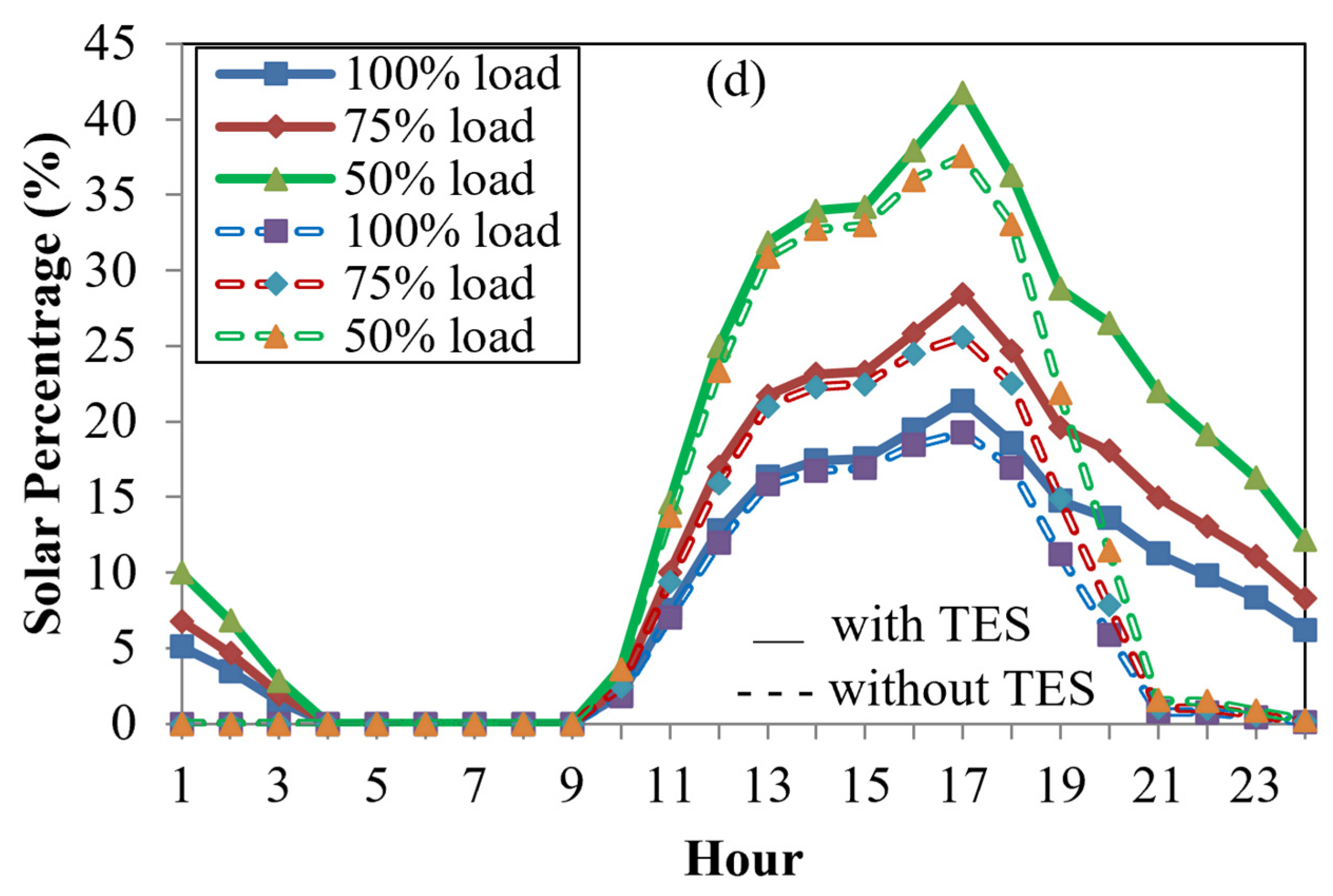
Figure 15a,b illustrate the monthly and annual hourly average solar contribution percentage in the SAPG-1 system under varying load conditions with and without TES. The data reveal that the peak solar contribution with and without TES occurs during June, reaching approximately 16.04% and 10.8% under full-load operation. At reduced load conditions (75% and 50%), the solar contribution with and without TES percentage increases further compared to the full-load scenario due to reduced feedwater demand. Additionally, the analysis of the annual hourly average solar contribution with and without TES in SAPG-1 indicates that the lowest load condition achieves the highest solar contribution, reaching approximately 42.67% and 38.37% respectively, which is significantly greater than at full-load conditions, which is 22.28% and 20.04%.
In comparison, Figure 15c,d present the solar contribution results for the SAPG-2 system. Under full-load conditions, the monthly average solar contribution with TES during June, July, and August achieves 15.44%, 14.85%, and 15.24%, respectively. Similarly, the annual hourly average solar contribution with TES at the highest load reaches 21.4%, slightly lower than in SAPG-1. The marginal decrease in the solar contribution observed in SAPG-2 compared to SAPG-1 is due to the additional heat required to compensate for the removal of the FWH1 heater and the increased thermal demand caused by supplying secondary feedwater from the low-pressure side. In conclusion, while both the systems (SAPG-1 and SAPG-2) effectively integrate solar thermal energy, SAPG-1 demonstrates slightly superior performance due to lower boiler heat demand and more favorable feedwater integration.

3.3. Economic and Carbon Dioxide Emissions Analysis of SAPG Systems

This Section explores the financial feasibility and environmental advantages of coupling parabolic troughs with an existing coal burning unit. The economic evaluation takes into account variables including the levelized cost of electricity (LCOE) for the CSP part, the payback period for the investment (taking into account both CO2 price and non-CO2 pricing scenarios), the LCOE comparison for all the systems and the peak shaving effect, the coal consumption, and the savings in fuel and costs. The primary emphasis of environmental impact analysis is the SAPG systems’ carbon dioxide emissions.

3.3.1. LCOE and Payback Period Analysis of CSP

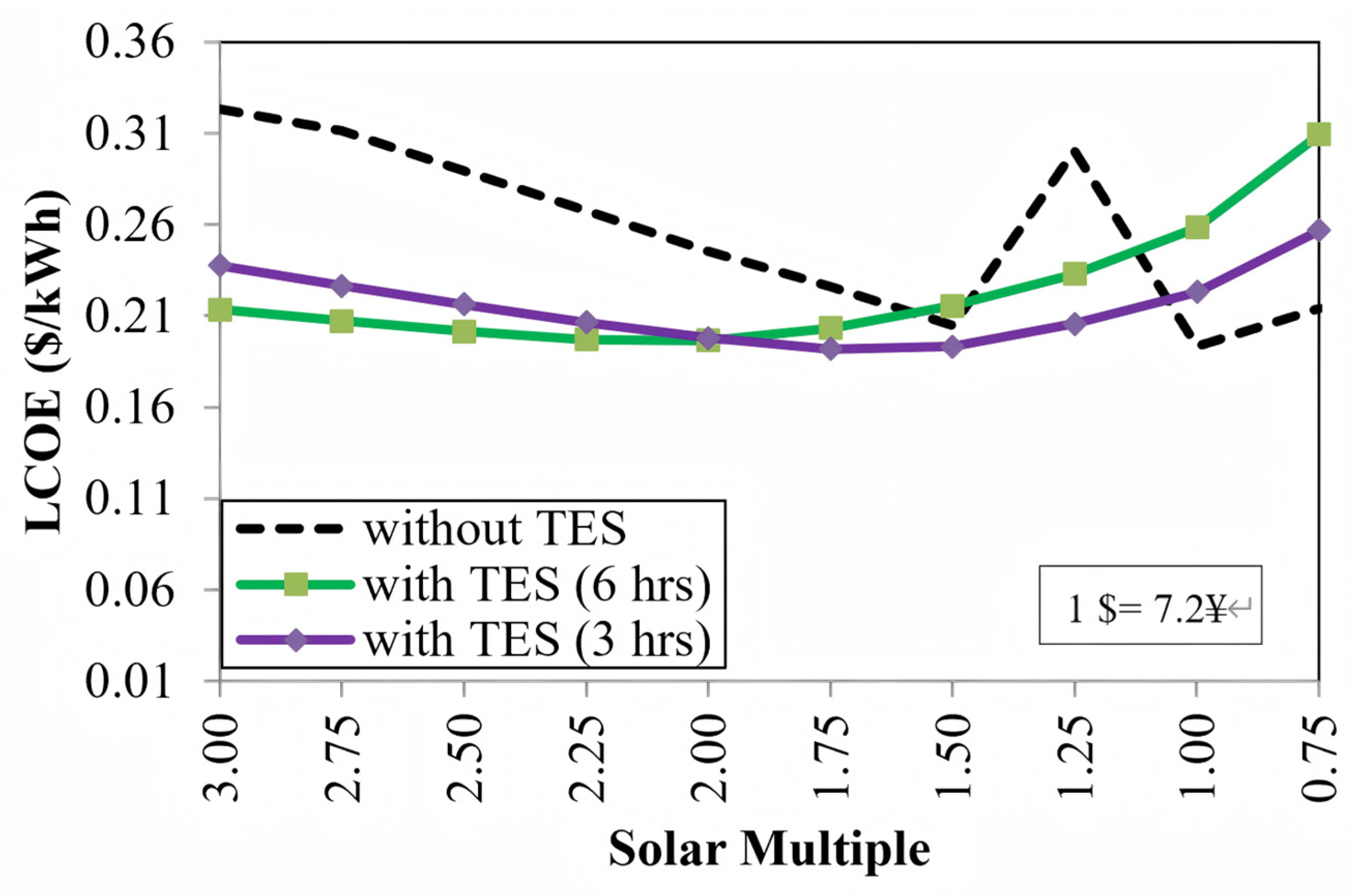
It can be seen from Figure 16 that the LCOE falls from $0.31/kWh (¥ 2.232/kWh) and $0.26/kWh (¥ 1.872/kWh) (for 6 h and 3 h TES, respectively) at a solar multiple of 0.75 to the values of $0.21/kWh (¥ 1.512/kWh) and $0.24/kWh (¥ 1.728/kWh) at a solar multiple of around 3. In contrast, without a TES system, the LCOE increases from $0.21/kWh (¥ 1.512/kWh) at an SM value of 0.75 to $0.32/kWh (¥ 2.304/kWh) at an SM value of 3. However, the LCOE suddenly increased at solar multiples lower than 1.25. This indicates that, in the absence of storage, the cost is significantly impacted by the underutilization of solar resources or greater dependency on auxiliary systems. By increasing the SM value and integrating thermal storage, the power block’s utilization can be improved, which will ultimately reduce the LCOE for the entire plant. However, the capital cost of the system likewise increases with a higher SM value.
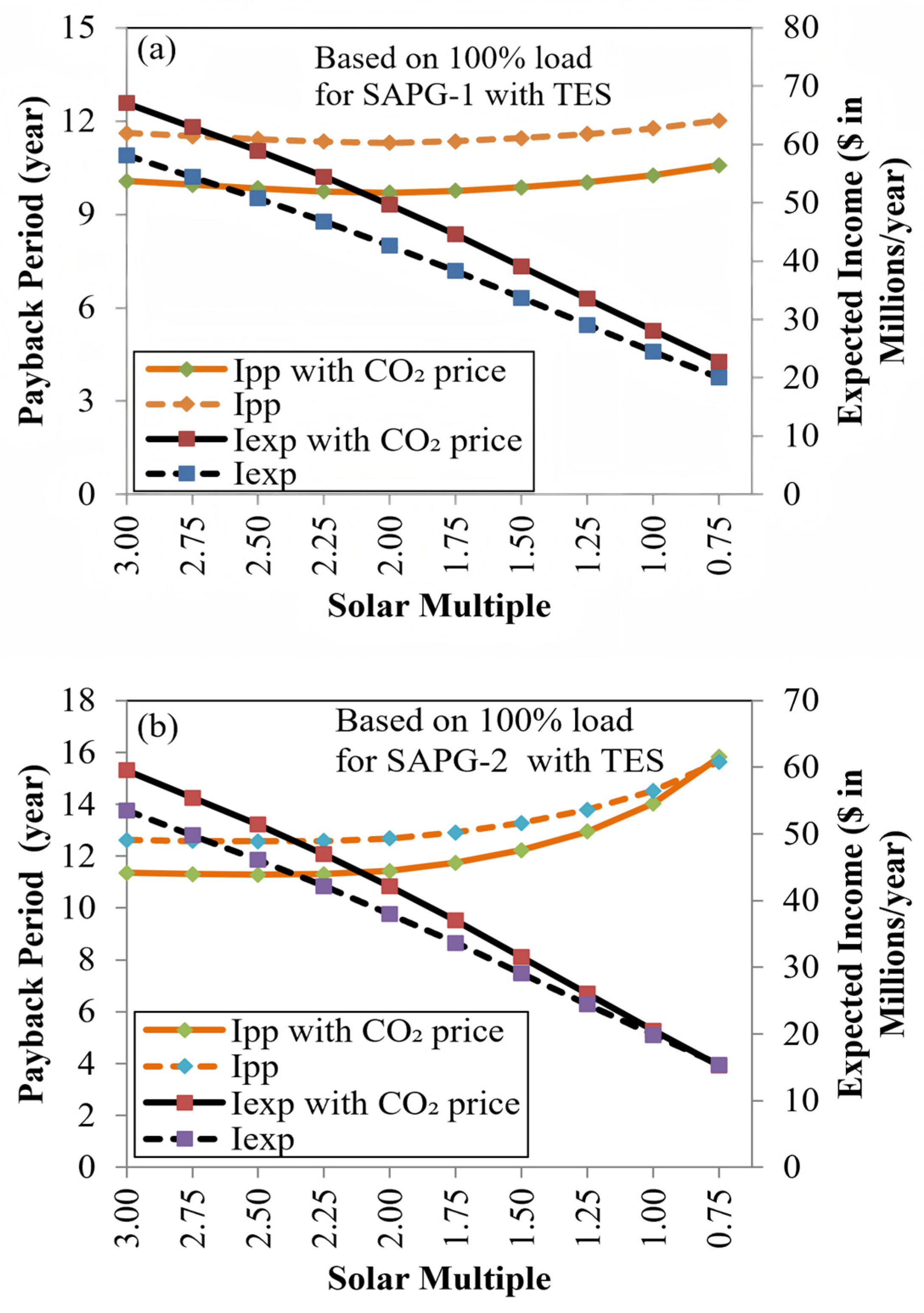
The expected income and payback period are strongly influenced by the SM. Lower SM values result in reduced capital costs but lower plant utilization, leading to decreased expected income and longer payback periods. With the CO2 price, the payback period for SAPG-1 is almost 10 years and generates $49.7 million (¥ 357.84 million) annually. Without the CO2 price included, the payback period extends to over 11 years, with an expected income of $42.6 million (¥ 306.72 million) per year. In comparison, SAPG-2 takes over 11 years to break even with a CO2 price, yielding $42.1 million annually, and almost 13 years without it, with an income of $38 million (¥ 273.60 million) per year, as displayed in Figure 17a,b.
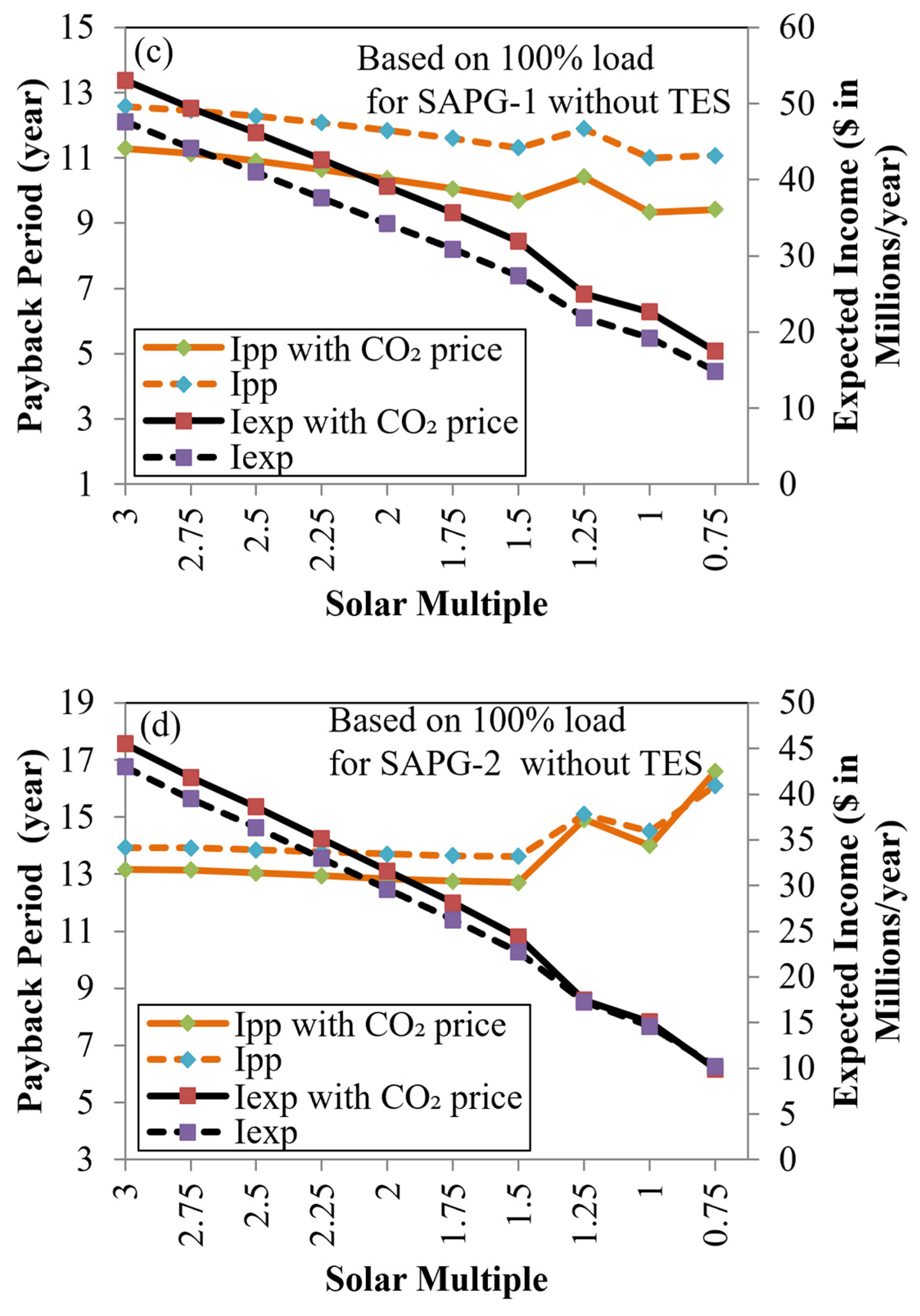
Figure 17c,d illustrate the result of the payback period and the expected income of the SAPG-1 and SAPG-2 systems without TES with and without CO2 pricing conditions. SAPG-1′s payback period increases to over 10 years (with CO2 price) and nearly 12 years (without CO2 price), and its annual revenues decrease to $39.1 million (¥ 281.52 million) and $34.2 million (¥ 246.24 million) compared with the TES scenarios. Similarly, SAPG-2′s payback period increases to around 13 years (with CO2 price) and almost 14 years (without CO2 price), with annual revenues reducing to $31.6 million (¥ 227.52 million) and $30 million (¥ 216 million).
The above-mentioned result with and without TES operates with a solar multiple of 2. These findings emphasize the substantial role of CO2 pricing in improving the economic feasibility of both the systems, with SAPG-1 outperforming SAPG-2 in terms of shorter payback periods and higher annual revenues in both scenarios. Compared with typical stand-alone CSP systems, the proposed SAPG configurations exhibit relatively lower LCOE values due to the utilization of existing coal-fired power generation infrastructure, which significantly reduces additional capital investment requirements. In addition, compared with conventional SAPG systems without TES reported in previous studies, the integration of TES improves annual solar energy utilization and system dispatchability, thereby contributing to better economic performance and shorter payback periods. The results indicate that TES integration can effectively enhance the overall techno-economic competitiveness of SAPG systems. However, the economic performance of the proposed SAPG systems may still be influenced by various external factors, including fuel price fluctuations, operation and maintenance (O&M) costs, carbon pricing policies, and variations in solar resources. Meanwhile, future electricity market conditions and possible changes in CSP plant investment costs may further affect the long-term economic feasibility of the proposed systems. Therefore, more comprehensive sensitivity analyses are still required in future studies to evaluate the long-term economic robustness and profitability of the proposed systems under different market and environmental conditions.

3.3.2. LCOE Comparison and Peak Shaving Effect

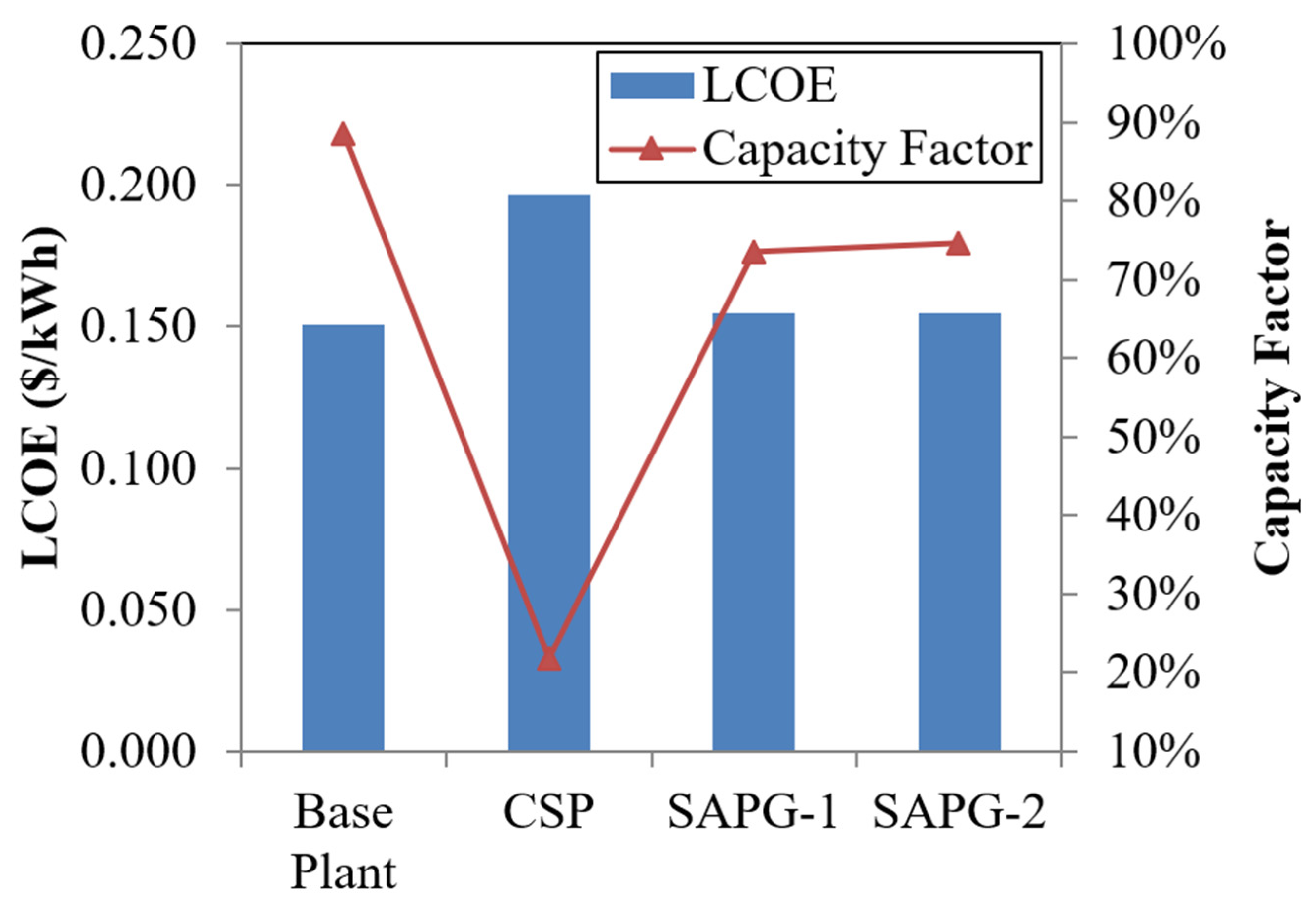
Figure 18 indicates that the reference case has the lowest LCOE at 0.15096 $/kWh, while the CSP system exhibits the highest LCOE at 0.19670 $/kWh due to its intermittent nature and higher capital costs. In contrast, the SAPG-1 and SAPG-2 LCOE estimates of 0.15482 and 0.15476 $/kWh, respectively, demonstrate that hybridizing coal and CSP solar can significantly reduce electricity costs compared to a standalone CSP system while maintaining near-optimal economic performance.
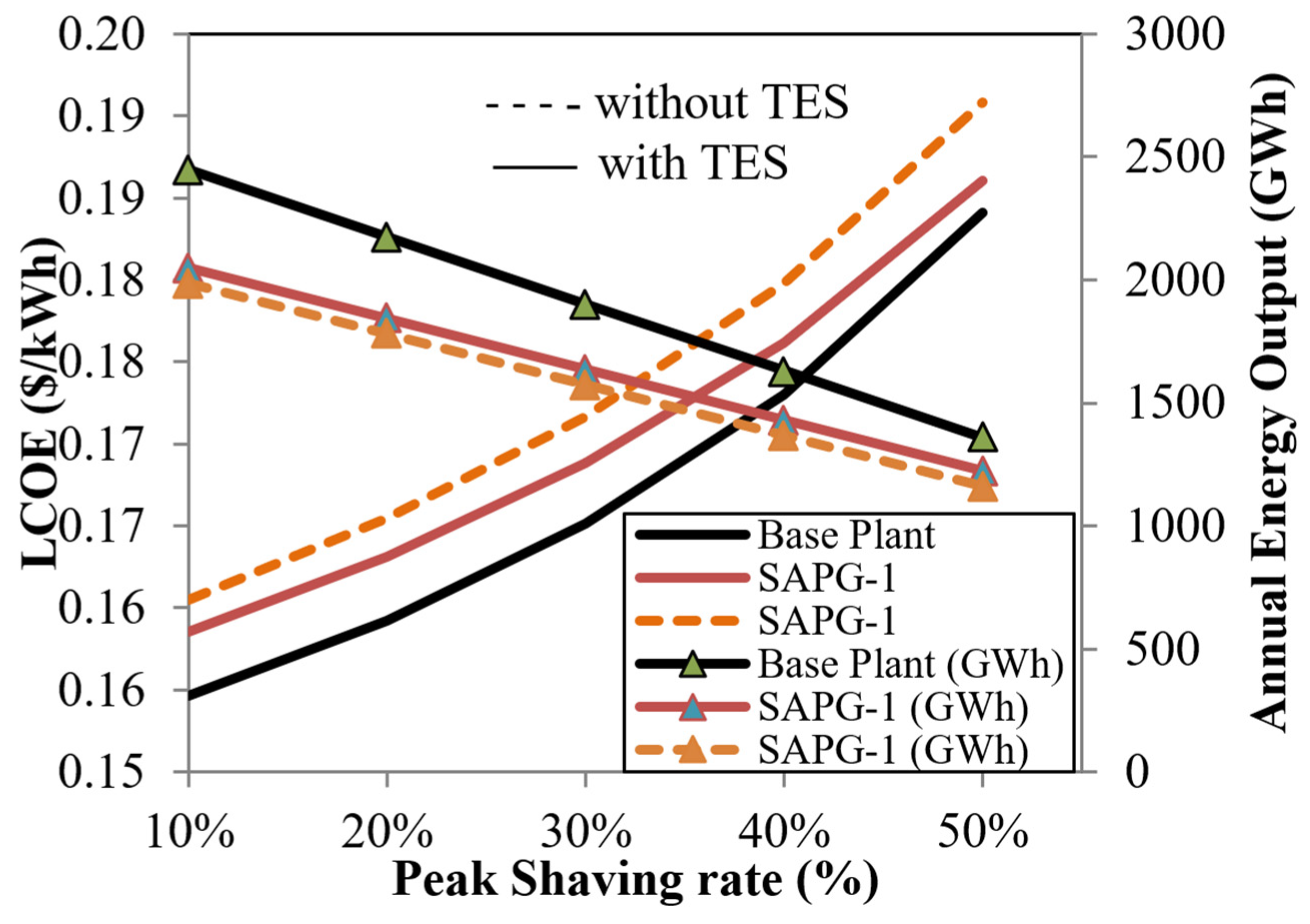
Figure 19 demonstrates that as the peak shaving increases to 50%, the LCOE rises for the base plant by 0.184 $/kWh, for SAPG-1 with TES, 0.186 $/kWh, and for SAPG-1 without TES, 0.190 $/kWh. This LCOE increment is due to reduced operational loads spreading fixed costs over a lower energy output. TES helps mitigate LCOE increases by enhancing solar energy utilization. The energy output decreases with peak shaving, with the SAPG-1 systems experiencing a sharper decline than the base plant. This study also highlights potential drawbacks: incremental load reductions may lead to an increased LCOE due to fixed costs being distributed over a smaller energy output.

3.3.3. Fuel and Cost Saving Analysis

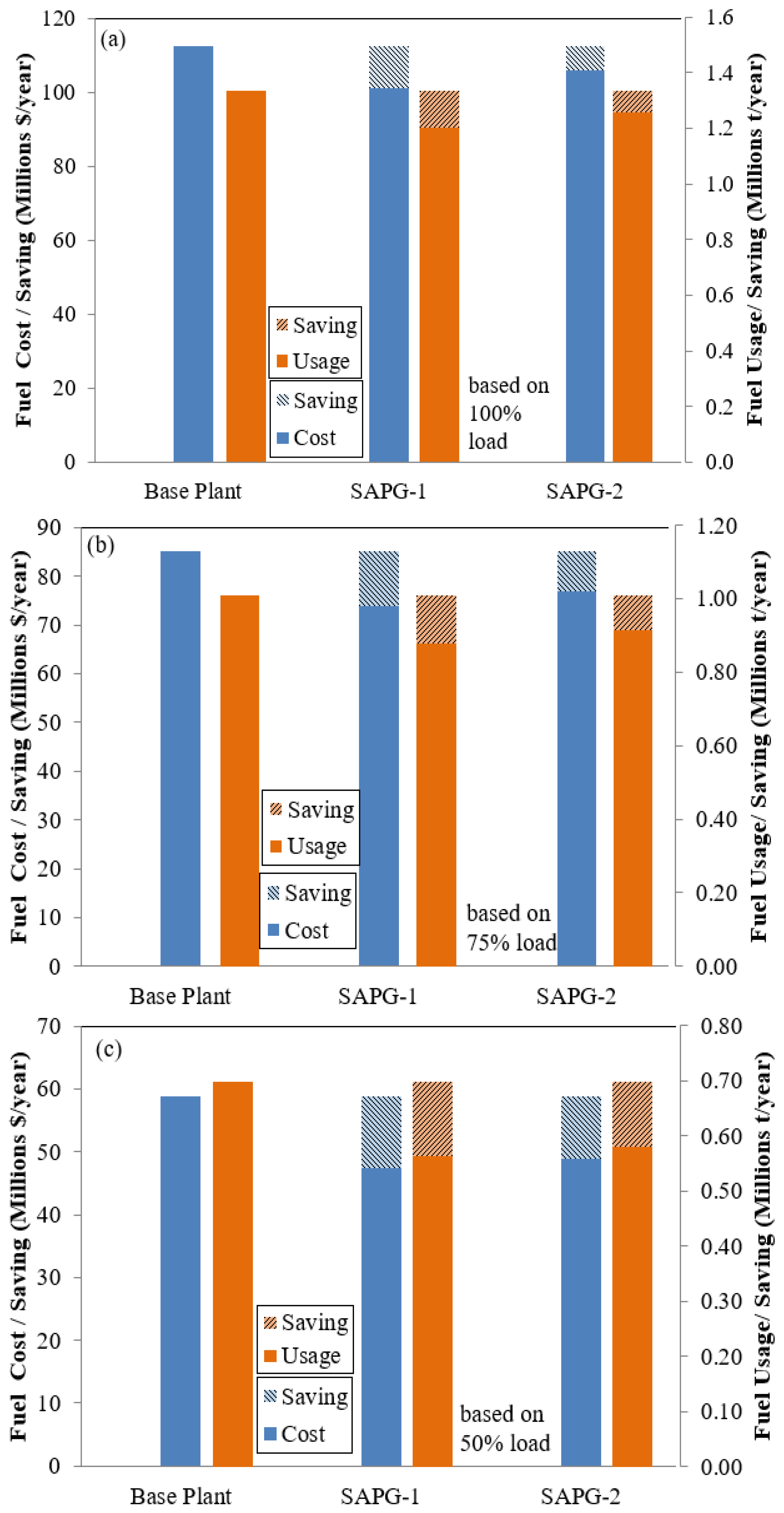
The baseline coal-fired power plant consumes 1.34, 1.01, and 0.69 million tons of coal per year under 100%, 75%, and 50% load conditions, respectively, as illustrated in Figure 20a–c. SAPG-1 achieves coal consumption rates of 1.20, 0.87, and 0.56 million tons/year, whereas SAPG-2 consumes 1.26, 0.91, and 0.57 million tons/year under the same load conditions. Since fuel cost is directly proportional to coal consumption, the SAPG-1 decrease in coal consumption translates into more significant economic benefits. Furthermore, SAPG-1 achieves a fuel cost savings rate of 12.28 million dollars per year across all the load levels. In comparison, SAPG-2 demonstrates lower savings, with 6.64 million dollars per year at full load, 8.16 million dollars per year at 75% load, and 10 million dollars per year at 50% load. Thus, the proportional relationship between reduced coal usage and fuel cost savings makes SAPG-1 a more efficient and cost-effective solution than SAPG-2.

3.3.4. Carbon Dioxide Emissions Analysis of the SAPG Systems

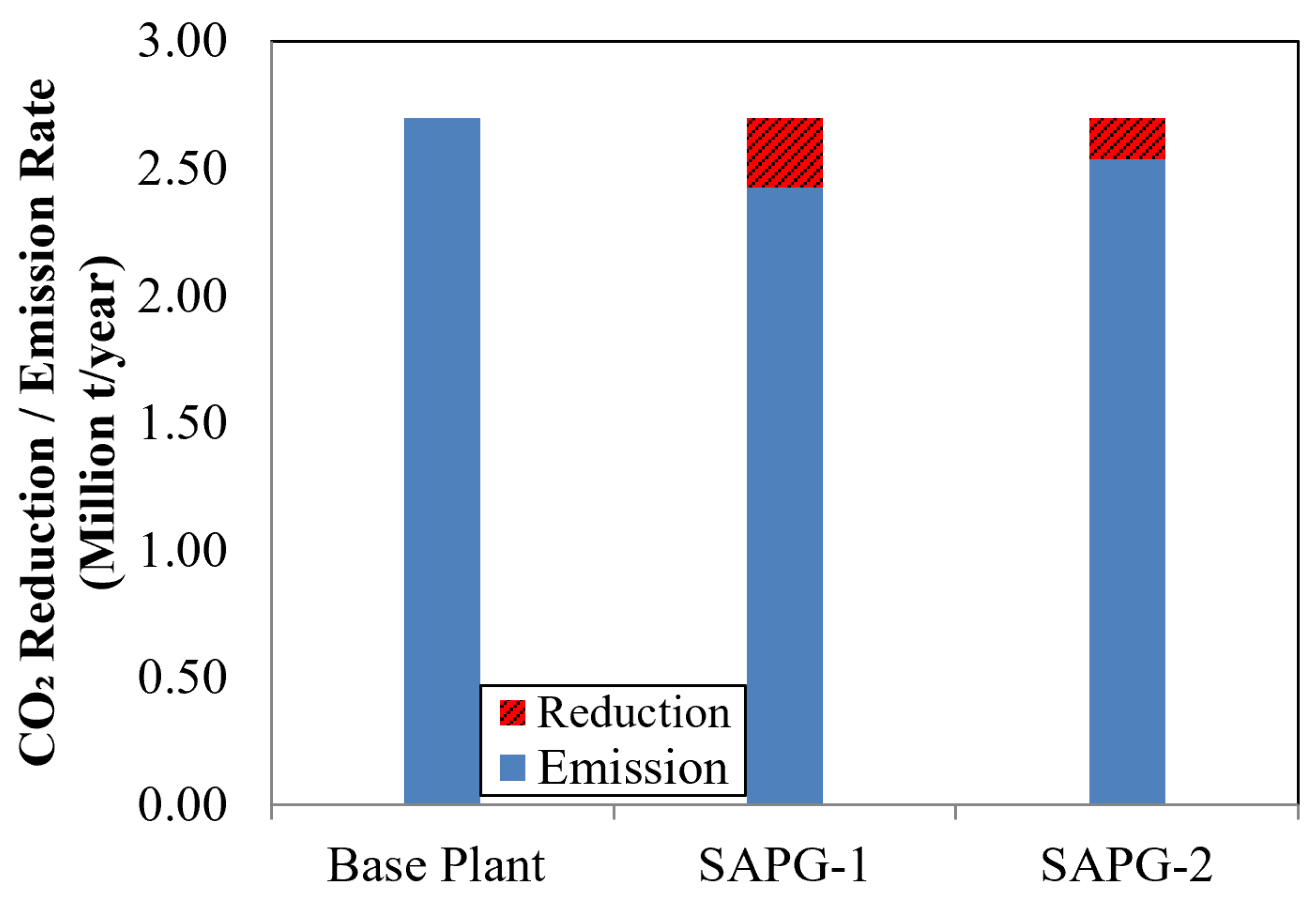
CO2 emissions are significantly reduced when solar thermal energy is integrated into coal-based plants through SAPG systems, as shown in Figure 21. Under 100% load conditions, the reductions in CO2 emissions for SAPG-1 and SAPG-2 are 0.27 million t/year (10.02%) and 0.16 million t/year (5.90%), respectively, when compared to the base plant. Notably, the SAPG-1 system demonstrates the greatest reduction in emissions, underscoring its effectiveness in promoting the sustainability of conventional coal-based plants. In addition, compared with conventional SAPG systems without TES, the integration of TES further enhances annual solar energy utilization and reduces solar energy curtailment caused by fluctuations in solar irradiation. Therefore, the proposed SAPG systems exhibit improved carbon emission reduction performance under both steady-state and part-load operating conditions. This enhancement results in substantial reductions in CO2 emissions in addition to increasing the power plant’s overall efficiency, supporting global initiatives aimed at transitioning to cleaner energy sources.

4. Conclusions

In this investigational paper, a 350 MWe existing coal-based plant integrated with a 100 MWe concentrated solar power (CSP) system was modeled to evaluate thermodynamics and financial parameters under Fuel Saving (FS) mode. The main conclusions are as follows:
(1)
The base plant has a thermal efficiency of 40.67%, while SAPG-1 and SAPG-2 show slightly lower efficiencies of 37.44% and 36.06%. The TES integration improves energy and exergy efficiencies under average July conditions. In both the SAPG systems, the boiler contributes the most to exergy losses, about 55% in SAPG-1 and 60% in SAPG-2. SAPG-1 has lower exergy losses than SAPG-2 due to smaller temperature differences, leading to better overall performance.
(2)
TES contributes significantly by managing 31.33% of the solar thermal energy cycle, with an average daily supply of 3098.99 MWt to both the SAPG systems. At the peak, the HTF flow rate reaches around 1009.74 kg/s, while the secondary feedwater flow rates are 71 kg/s for SAPG-1 and 62 kg/s for SAPG-2. An inverse relationship exists between the collector HTF flow and the primary feedwater flow, with a sharp decline at a solar multiple of 1.25, highlighting the importance of TES in handling surplus solar energy.
(3)
The integration of TES enhances the solar-to-electric conversion efficiency, reaching a peak of 26.95% in July compared to 22.45% without TES. On an annual scale, the highest average efficiency with TES is 23.83%, whereas it drops to 21.38% without TES. The annual hourly average solar contribution analysis reveals that at the lowest load condition, SAPG-1 achieves the highest solar contribution of 42.67% with TES and 38.37% without TES, significantly higher than at a full load (22.28% and 20.04%, respectively). Similarly, SAPG-2 exhibits a slightly lower solar contribution, with TES reaching 21.40% at the highest load condition.
(4)
The LCOE for the CSP system decreases from $0.31/kWh at a solar multiple (SM) of 0.75 to $0.21/kWh at an SM of approximately 3. However, without a TES system, the LCOE increases from $0.21/kWh to $0.32/kWh. At an SM of 2, SAPG-1 demonstrates a shorter payback period and a higher expected income compared to SAPG-2 under both TES and non-TES scenarios. The SAPG systems achieve a lower LCOE and higher capacity factors than standalone solar, enhancing economic viability. Under full-load operation, SAPG-1 and SAPG-2 reduce annual coal consumption from 1.34 million tons (base plant) to 1.20 million tons and 1.26 million tons, respectively.
(5)
In terms of cost savings, SAPG-1 achieves an annual fuel cost reduction of $11.28 million across all the load levels. SAPG-2, while yielding smaller savings, achieves reductions of $6.64 million at full load, $8.16 million at 75% load, and $10 million at 50% load. Additionally, at full-load operation, SAPG-1 reduces CO2 emissions by 0.27 million tons per year (10.02%), whereas SAPG-2 achieves a reduction of 0.16 million tons per year (5.90%), both contributing significantly to environmental sustainability.
Overall, this study provides a comparative evaluation of two SAPG integration schemes combined with TES under both steady-state and dynamic operating conditions. The coupled Aspen Plus–SAM framework enables the comprehensive thermodynamic and annual performance analyses, while the results clarify the influence of TES on solar contribution, operational flexibility, and LCOE. Compared with SAPG-2, SAPG-1 demonstrates slightly better thermodynamic and economic performance due to lower boiler heat demand and more favorable feedwater integration characteristics. The findings of this work provide useful references for the future design and optimization of SAPG systems.
However, several limitations still exist in the present study. The current work mainly focuses on quasi-steady-state operating conditions, while detailed transient dynamic behaviors under rapid solar irradiation fluctuations have not been thoroughly investigated. Meanwhile, several potential challenges still exist in the integration of CSP systems with coal-fired power plants, including the coordination of thermal energy supply between solar and coal-fired subsystems, the operational stability under fluctuating solar irradiation conditions, the land requirements for solar field installation, and the increased complexity of system control and maintenance. In addition, comprehensive sensitivity analyses involving fuel price, TES cost, operation and maintenance expenses, future energy price scenarios, and possible variations in CSP plant costs, as well as practical issues related to large-scale engineering implementation, such as maintenance coordination, long-term operational reliability, and the availability of suitable land resources near coal-fired power plants, still require further investigation in future work.


Supplementary Materials

The following supporting information can be downloaded at: https://www.mdpi.com/article/10.3390/su18126079/s1, Supplementary Data SA and SB.

Author Contributions

Methodology, Y.J., J.L., K.X. and Z.C.; Validation, W.P.P., J.L. and Z.C.; Investigation, Y.J. and W.P.P.; Resources, J.X. (Jun Xu), L.J., Y.W., S.S., S.H. and J.X. (Jun Xiang); Data curation, W.P.P.; Writing—original draft, Y.J.; Writing—review & editing, K.X.; Visualization, Y.J.; Supervision, K.X., J.X. (Jun Xu), L.J. and J.X. (Jun Xiang); Project administration, K.X.; Funding acquisition, K.X., Y.W., S.S., S.H. and J.X. (Jun Xiang). All authors have read and agreed to the published version of the manuscript.

Funding

This work was supported by the National Key Research and Development Program of China (No. 2022YFB4100801).

Institutional Review Board Statement

Not applicable.

Informed Consent Statement

Not applicable.

Data Availability Statement

The data presented in this study are available on request from the corresponding author. The data are not publicly available due to privacy or ethical restrictions.

Acknowledgments

The computations were completed in the HPC Platform of Huazhong University of Science and Technology.

Conflicts of Interest

Authors Ji Long and Zhenglong Cheng were employed by Power China Zhongnan Engineering Corporation Limited. The remaining authors declare that the research was conducted in the absence of any commercial or financial relationships that could be construed as a potential conflict of interest.

Nomenclature

CSPConcentrated Solar Power
SAPGSolar-Aided Coal-Fired Power Generation
HPHigh Pressure
IPIntermediate Pressure
LPLow Pressure
PTCParabolic Trough Collectors
FSFuel Saving
SAMSystem Advisor Model
LCOELevelized Cost of Energy
DNIDirect Normal Irradiance
4EEnergy, Exergy, Environment, and Economics
TESThermal Energy Storage
HTFHeat Transfer Fluid
FWHFeedwater Heater
HEXHeat Exchanger
DTRDeaerator
RHReheater
SHSuperheater

References

  1. Parvareh, F.; Sharma, M.; Qadir, A.; Milani, D.; Khalilpour, R.; Chiesa, M.; Abbas, A. Integration of Solar Energy in Coal-Fired Power Plants Retrofitted with Carbon Capture: A Review; Elsevier Ltd.: Amsterdam, The Netherlands, 2014. [Google Scholar] [CrossRef]
  2. Statistical Review of World Energy. 2024. Available online: https://assets.kpmg.com/content/dam/kpmg/az/pdf/2024/Statistical-Review-of-World-Energy.pdf (accessed on 5 June 2025).
  3. Li, J.; Lu, T.; Yi, X.; Hao, R.; Ai, Q.; Guo, Y.; An, M.; Wang, S.; He, X.; Li, Y. Concentrated Solar Power for a Reliable Expansion of Energy Systems with High Renewable Penetration, Considering Seasonal Balance. Renew. Energy 2024, 226, 120089. [Google Scholar] [CrossRef]
  4. Li, C.; Zhai, R.; Zhang, B.; Chen, W. Thermodynamic performance of a novel solar tower aided coal-fired power system. Appl. Therm. Eng. 2020, 171, 115127. [Google Scholar] [CrossRef]
  5. Popov, D. An option for solar thermal repowering of fossil fuel fired power plants. Sol. Energy 2011, 85, 344–349. [Google Scholar] [CrossRef]
  6. Zoschak, R.J.; Wu, S.F. Studies of the Direct Input of Solar Energy to a Fossil-Fueled Central Station Steam Power Plant; Pergamon Press: Oxford, UK, 1975. [Google Scholar] [CrossRef]
  7. Zhu, Y.; Pei, J.; Cao, C.; Zhai, R.; Yang, Y.; Reyes-Belmonte, M.A.; González-Aguilar, J.; Romero, M. Optimization of solar aided coal-fired power plant layouts using multi-criteria assessment. Appl. Therm. Eng. 2018, 137, 406–418. [Google Scholar] [CrossRef]
  8. Shagdar, E.; Shuai, Y.; Lougou, B.G.; Ganbold, E.; Chinonso, O.P.; Tan, H. Analysis of heat flow diagram of small-scale power generation system: Innovative approaches for improving techno-economic and ecological indices. Sci. China Technol. Sci. 2020, 63, 2256–2274. [Google Scholar] [CrossRef]
  9. Wu, J.; Hou, H.; Hu, E.; Yang, Y. Performance improvement of coal-fired power generation system integrating solar to preheat feedwater and reheated steam. Sol. Energy 2018, 163, 461–470. [Google Scholar] [CrossRef]
  10. Shalaby, S.M.; Gadalla, M.A.; El Sayed, A.R.; Meliha, E.M.; Abosheiasha, H.F. Aspen Plus simulation of a low capacity organic Rankine cycle heated by solar energy. Energy Rep. 2022, 8, 416–421. [Google Scholar] [CrossRef]
  11. Peng, S.; Hong, H.; Wang, Y.; Wang, Z.; Jin, H. Off-design thermodynamic performances on typical days of a 330MW solar aided coal-fired power plant in China. Appl. Energy 2014, 130, 500–509. [Google Scholar] [CrossRef]
  12. Wu, J.; Han, Y.; Hou, H.; Sun, Y. Optimization of solar field layout and flow velocity in a solar-aided power generation system. Energy 2020, 208, 118344. [Google Scholar] [CrossRef]
  13. Suresh, M.V.J.J.; Reddy, K.S.; Kolar, A.K. 4-E (Energy, Exergy, Environment, and Economic) analysis of solar thermal aided coal-fired power plants. Energy Sustain. Dev. 2010, 14, 267–279. [Google Scholar] [CrossRef]
  14. Zhai, R.; Liu, H.; Li, C.; Zhao, M.; Yang, Y. Analysis of a solar-aided coal-fired power generation system based on thermo-economic structural theory. Energy 2016, 102, 375–387. [Google Scholar] [CrossRef]
  15. Saidou, S.Y.; Genç, G. Thermodynamic, economical and environmental performance evaluation of a 330 MW solar-aided coal-fired power plant located in Niger. Process Saf. Environ. Prot. 2024, 191, 1324–1338. [Google Scholar] [CrossRef]
  16. Shuai, Y.; Shagdar, E.; Lougou, B.G.; Mustafa, A.; Doljinsuren, B.; Han, D.; Tan, H. Performance analysis of 200 MW solar coal hybrid power generation system for transitioning to a low carbon energy future. Appl. Therm. Eng. 2021, 183, 116140. [Google Scholar] [CrossRef]
  17. Pierce, W.; Gauché, P.; Von Backström, T.; Brent, A.C.; Tadros, A. A comparison of solar aided power generation (SAPG) and stand-alone concentrating solar power (CSP): A South African case study. Appl. Therm. Eng. 2013, 61, 657–662. [Google Scholar] [CrossRef]
  18. Zhai, R.; Zhu, Y.; Yang, Y.; Tan, K.; Hu, E. Exergetic and parametric study of a solar aided coal-fired power plant. Entropy 2013, 15, 1014–1034. [Google Scholar] [CrossRef]
  19. Ezeanya, E.K.; Massiha, G.H.; Simon, W.E.; Raush, J.R.; Chambers, T.L. System advisor model (SAM) simulation modelling of a concentrating solar thermal power plant with comparison to actual performance data. Cogent Eng. 2018, 5, 1524051. [Google Scholar] [CrossRef]
  20. Xue, Y.; Wang, L.; Cai, Y.; Liu, J.; Ranjith, P.G.; Gao, F.; Xie, H.; Liu, Y. Effects of heating–cooling on the mechanical properties and damage evolution of granite for underground cryogenic storage. Acta Geotech. 2026, 1–21. [Google Scholar] [CrossRef]
  21. Li, K.; Zhu, L.; Xiong, F.; Liu, J.; Xue, Y.; Cao, Z.; Zhou, Y.; Liang, X.; Ji, M.; Liu, G.; et al. Review on Thermal Stimulation in Deep Geothermal Reservoirs: Thermo-Mechanical Mechanisms and Fracture Evolution. Processes 2026, 14, 1199. [Google Scholar] [CrossRef]
  22. Wu, J.; Hou, H.; Yang, Y.; Hu, E. Annual performance of a solar aided coal-fired power generation system (SACPG) with various solar field areas and thermal energy storage capacity. Appl. Energy 2015, 157, 123–133. [Google Scholar] [CrossRef]
  23. Zhang, H.; Guo, J.; Wang, Y.; Ji, S.; Shao, J.; Desideri, U.; Duan, L. Performance Analysis of a Linear Fresnel Solar-Aided Coal-Fired Power Generation System with Peaking Capability. Energy 2025, 340, 139222. [Google Scholar] [CrossRef]
  24. Shagdar, E.; Lougou, B.G.; Shuai, Y.; Anees, J.; Damdinsuren, C.; Tan, H. Performance analysis and techno-economic evaluation of 300 MW solar-assisted power generation system in the whole operation conditions. Appl. Energy 2020, 264, 114744. [Google Scholar] [CrossRef]
  25. Huang, G.; Huang, C.; Huang, H.; Liu, H.; Wang, W. Innovative full-range load operation solution for solar-aided power generation system: Enhancing efficiency with coal and solar energy flexibility integration. Energy 2025, 318, 134815. [Google Scholar] [CrossRef]
  26. Chen, F.; Yang, Q.; Zheng, N.; Wang, Y.; Huang, J.; Xing, L.; Li, J.; Feng, S.; Chen, G.; Kleissl, J. Assessment of concentrated solar power generation potential in China based on Geographic Information System (GIS). Appl. Energy 2022, 315, 119045. [Google Scholar] [CrossRef]
  27. NREL. System Advisor Model (SAM). 2020. Available online: https://sam.nlr.gov (accessed on 22 June 2025).
  28. Hou, H.; Yu, Z.; Yang, Y.; Chen, S.; Luo, N.; Wu, J. Performance evaluation of solar aided feedwater heating of coal-fired power generation (SAFHCPG) system under different operating conditions. Appl. Energy 2013, 112, 710–718. [Google Scholar] [CrossRef]
  29. Li, C.; Sun, Y.; Bi, T.; Zhai, R. Performance enhancement of a solar-assisted pulverized coal power system by integrating a supercritical CO2 cycle. Renew. Energy 2023, 219, 119501. [Google Scholar] [CrossRef]
  30. Baral, S.; Kim, D.; Yun, E.; Kim, K.C. Energy, exergy and performance analysis of small-scale organic rankine cycle systems for electrical power generation applicable in rural areas of developing countries. Energies 2015, 8, 684–713. [Google Scholar] [CrossRef]
  31. Tontu, M.; Sahin, B.; Bilgili, M. Using energy and exergy analysis to compare different coal-fired power plants. Energy Sources Part A Recovery Util. Environ. Eff. 2019, 46, 4314–4329. [Google Scholar] [CrossRef]
  32. Tontu, M.; Bilgili, M.; Sahin, B. Performance analysis of an industrial steam power plant with varying loads. Int. J. Exergy 2018, 27, 231–250. [Google Scholar] [CrossRef]
  33. Adibhatla, S.; Kaushik, S.C. Energy, exergy and economic (3E) analysis of integrated solar direct steam generation combined cycle power plant. Sustain. Energy Technol. Assess. 2017, 20, 88–97. [Google Scholar] [CrossRef]
  34. Al Zahrani, A.A.; Dincer, I. Energy and exergy analyses of a parabolic trough solar power plant using carbon dioxide power cycle. Energy Convers. Manag. 2018, 158, 476–488. [Google Scholar] [CrossRef]
  35. Bellos, E.; Tzivanidis, C. A detailed exergetic analysis of parabolic trough collectors. Energy Convers. Manag. 2017, 149, 275–292. [Google Scholar] [CrossRef]
  36. Lopes, T.; Fasquelle, T.; Silva, H.G. Pressure drops, heat transfer coefficient, costs and power block design for direct storage parabolic trough power plants running molten salts. Renew. Energy 2021, 163, 530–543. [Google Scholar] [CrossRef]
  37. Bonk, A.; Bauer, T. Solar Salt-Thermal Property Analysis Report on Thermo-Physical Properties of Binary NaNO3-KNO3 Mixtures in a Range of 59–61 wt% NaNO3; DLR: Köln, Germany, 2021. [Google Scholar]
  38. Boukelia, T.E.; Bouraoui, A.; Laouafi, A.; Djimli, S.; Kabar, Y. 3E (Energy-Exergy-Economic) comparative study of integrating wet and dry cooling systems in solar tower power plants. Energy 2020, 200, 117567. [Google Scholar] [CrossRef]
  39. Izquierdo, S.; Montañs, C.; Dopazo, C.; Fueyo, N. Analysis of CSP plants for the definition of energy policies: The influence on electricity cost of solar multiples, capacity factors and energy storage. Energy Policy 2010, 38, 6215–6221. [Google Scholar] [CrossRef]
  40. Jiang, Y.; Duan, L.; Pang, L.; Song, J. Thermal performance study of tower solar aided double reheat coal-fired power generation system. Energy 2021, 230, 120857. [Google Scholar] [CrossRef]
  41. Huang, G.; Huang, C.; Liu, H.; Huang, H.; Shang, W.; Wang, W. Exergy analysis of off-design performance in solar-aided power generation systems: Evaluating the rationality of using part-load operation solution of coal-fired plants. Energy 2024, 302, 131749. [Google Scholar] [CrossRef]
  42. Wu, J.; Han, Y.; Hou, H. A new solar share evaluation method of solar aided power generation (SAPG) system by tracing exergy flows and allocating exergy destruction. Sol. Energy 2020, 198, 542–554. [Google Scholar] [CrossRef]
  43. Ouyang, T.; Xie, S.; Pan, M.; Qin, P. Peak-shaving scheme for coal-fired power plant integrating flexible carbon capture and wastewater treatment. Energy Convers. Manag. 2022, 256, 115377. [Google Scholar] [CrossRef]
  44. U.S. Energy Information Administration. 2019. Available online: https://www.eia.gov/ (accessed on 21 January 2026).
  45. Cost of Electricity by Source. Available online: https://en.wikipedia.org/wiki/Cost_of_electricity_by_source (accessed on 23 January 2026).
  46. Khan, M.I.; Gutiérrez-Alvarez, R.; Asfand, F.; Bicer, Y.; Sgouridis, S.; Al-Ghamdi, S.G.; Jouhara, H.; Asif, M.; Kurniawan, T.A.; Abid, M. The economics of concentrating solar power (CSP): Assessing cost competitiveness and deployment potential. Renew. Sustain. Energy Rev. 2024, 200, 114551. [Google Scholar] [CrossRef]
Figure 1. Conventional coal-fired power plant flow diagram.
Sustainability 18 06079 g001
Figure 2. SAPG-1 flow diagram.
Sustainability 18 06079 g002
Figure 3. SAPG-2 flow diagram.
Sustainability 18 06079 g003
Figure 4. SAM and Aspen Plus software simulation flowchart.
Sustainability 18 06079 g004
Figure 5. Analysis of the SAPG and the coal-based plant’s energy and exergy.
Sustainability 18 06079 g005
Figure 6. (a) Key component exergy efficiency analysis in base plant and SAPG system, solar energy and exergy efficiency; (b) the peak average hourly time in a day; (c) July average.
Sustainability 18 06079 g006
Figure 7. DNI distribution in Urumqi, Xinjiang Province of China: (a) DNI of the maximum average hourly month July average; (b) DNI annual average.
Sustainability 18 06079 g007
Figure 8. DNI influence on SAPG system under 100%, 75% and 50% loads in July: (a) energy output percentage; (b) average hourly energy output.
Sustainability 18 06079 g008
Figure 9. DNI influence on SAPG-1 system under 100%, 75% and 50% loads in July: (a) thermal energy input percentage; (b) average hourly thermal energy input.
Sustainability 18 06079 g009
Figure 10. DNI influence on SAPG-2 system under 100%, 75% and 50% loads in July: (a) thermal energy input percentage; (b) average hourly thermal energy input.
Sustainability 18 06079 g010
Figure 11. Heat transfer fluid influence on SAPG under 100%, 75% and 50% loads for (a) SAPG-1 system’s feedwater; (b) SAPG-2 system’s feedwater.
Sustainability 18 06079 g011
Figure 12. Heat transfer fluid influence on SAPG under 100%, 75% and 50% loads for (a) SAPG-1 system’s split ratio; (b) SAPG-2 system’s split ratio.
Sustainability 18 06079 g012
Figure 13. Influence of solar multiple with and without TES: (a) annual thermal energy; (b) annual solar energy.
Sustainability 18 06079 g013
Figure 14. Hourly solar-to-electricity efficiency: (a) July average; (b) annual average.
Sustainability 18 06079 g014
Figure 15. Solar contribution in SAPG. (a) Monthly average for SAPG-1. (b) Annual hourly average for SAPG-1. (c) Monthly average for SAPG-2. (d) Annual hourly average for SAPG-2.
Sustainability 18 06079 g015aSustainability 18 06079 g015b
Figure 16. LCOE with and without TES.
Sustainability 18 06079 g016
Figure 17. Payback period and expected income for (a) SAPG-1 with TES; (b) SAPG-2 with TES; (c) SAPG-1 without TES; (d) SAPG-2 without TES.
Sustainability 18 06079 g017aSustainability 18 06079 g017b
Figure 18. LCOE comparison on base plant, CSP, SAPG-1 and SAPG-2.
Sustainability 18 06079 g018
Figure 19. Peak shaving influence on LCOE.
Sustainability 18 06079 g019
Figure 20. Annual fuel consumption and fuel cost for (a) 100% load; (b) 75% load; (c) 50% load.
Sustainability 18 06079 g020
Figure 21. The CO2 emission rate comparison of base plant, SAPG-1and SAPG-2 under full load.
Sustainability 18 06079 g021
Table 1. Key parameters of the coal-based plant.
Parameter/UnitValue
Rated capacity/MW350
Rated main steam temperature/°C566
Rated main steam pressure/MPa24.20
Rated main stream flow rate/kg/h1,067,800
Rated pressure of reheat steam/MPa4.20
Rated temperature of reheat steam/°C566
Rated flow rate of reheat steam/kg/h865,273
Heat consumption/kJ/kWh8027
Steam consumption/kJ/kWh3.05
Fuel consumption/t/h153.07
Boiler heat input/GJ/h3004.89
Table 2. Flow parameters of the coal-fired power unit.
NodeTemperature (°C)Pressure (bar)Enthalpy of Mass
(kJ/kg)
Steam Flow Rate (kg/s)Entropy of Mass
(kJ/kg · K)
Output Capacity (MW)
1566242−12,572.30296.61−3.16-
256642−12,375.80240.35−2.17-
349.410.12−13,865210.90−2.84-
4480.31−15,769.90210.90−8.75-
4’48.057−15,769.10210.90−8.74-
556.100.16−15,736.1034.34−8.64-
6325.0746.67−12,960.30240.35−12,960.30-
7370.1466.31−12,885.7017.79−3.06-
8325.0746.67−12,960.3029.57−3.04-
9455.8919.59−12,599.209.85−2.11-
10377.1110.78−12,754.4026.25−2.06-
11275.154.97−12,930.809.06−2.00-
12200.812.52−13,066.508.47−1.95-
13121.981.22−13,19217.38−1.89-
14191.9013.08−15,15566.11−7.17-
15198.1910.23−15,127296.61−7.11-
15’198.2312−15,126.70296.61−7.11-
16281.8065.92−14,621.10296.61−6.15-
17-----339.72
Table 3. Simulated and design values for the coal-based power unit.
ParameterUnitDesign ValueSimulated ValueRelative Error (%)
CapacityMW350339.722.93
Main steam°C5665660.00
MPa24.2024.200.00
kg/h1,067,8001,069,0200.11
Reheat steam°C5665660.00
MPa4.204.200.00
kg/h865,273865,2240.01
Extracted steam 1°C373.30370.140.85
MPa6.636.630.00
kg/h62,68064,0682.16
Extracted steam 2°C326.50325.070.43
MPa4.664.660.00
kg/h103,726106,4592.56
Extracted steam 3°C450.80455.891.11
MPa1.951.950.00
kg/h36,06535,476.201.65
Extracted steam 4°C366377.112.94
MPa1.071.070.00
kg/h96,93594,532.702.54
Extracted steam 5°C268.50275.152.41
MPa0.490.490.00
kg/h33,61932,651.102.96
Extracted steam 6°C198.60200.811.10
MPa0.250.250.00
kg/h30,66430,521.900.46
Extracted steam 7°C128121.981.65
MPa0.120.120.00
kg/h63,84262,568.602.03
Extracted steam 8°C49.4149.420.01
MPa0.010.010.00
kg/h632,934635,6220.42
Table 4. Key solar field parameters.
Parameter/UnitValue
Plant Characteristics
Design output capacity/MWe111
Estimated output capacity/MWe100
Design point DNI/W/m2750
Looping number182
Aperture area for single loop/m26540
HTF inlet temperature/°C293
HTF outlet temperature/°C450
Overall aperture area/m21,190,280
Design point solar multiple2.00
Actual Field thermal output/MWt500.59
Characteristics for Euro trough ET150
Aperture area/m2817.50
Collector length/m150
Aperture width/m5.75
Mirror reflectance0.93
Characteristics for Schott PTR70
Absorber absorptance0.96
Absorber tube inner diameter/m0.06
Absorber tube outer diameter/m0.07
Heat Transfer Fluid (Molten salt)
Composition (mass fraction)NaNO3 60%, KNO3 40%
Operation minimum temperature/°C238
Density of HTF/kg/m31853.72
Operation maximum temperature/°C593
Thermal Energy Storage (Molten salt)
Tank height/m12
Tank diameter/m42.16
Temperature set point for hot tank/°C365
Temperature set point for cold tank/°C250
Expected heat storage/h6
Table 5. 2020 Weather data information of the chosen area [27].
Parameter/UnitUrumqi (Xinjiang)
Location
Latitude and Longitude43.77° N & 87.66° E
Annual Averages
Global horizontal/kWh/m2/day4.49
Average wind speed/m/s2.2
Average temperature/°C8
Diffuse horizontal/kWh/m2/day1.77
Direct normal/kWh/m2/day4.94
Table 6. Exergy analysis for unit components [31,32].
ComponentExergy LossesExergy EfficiencyEquations
Boiler i B = ε B , i n ε B , o u t η ε , B = ε B , o u t ε B , i n (9)
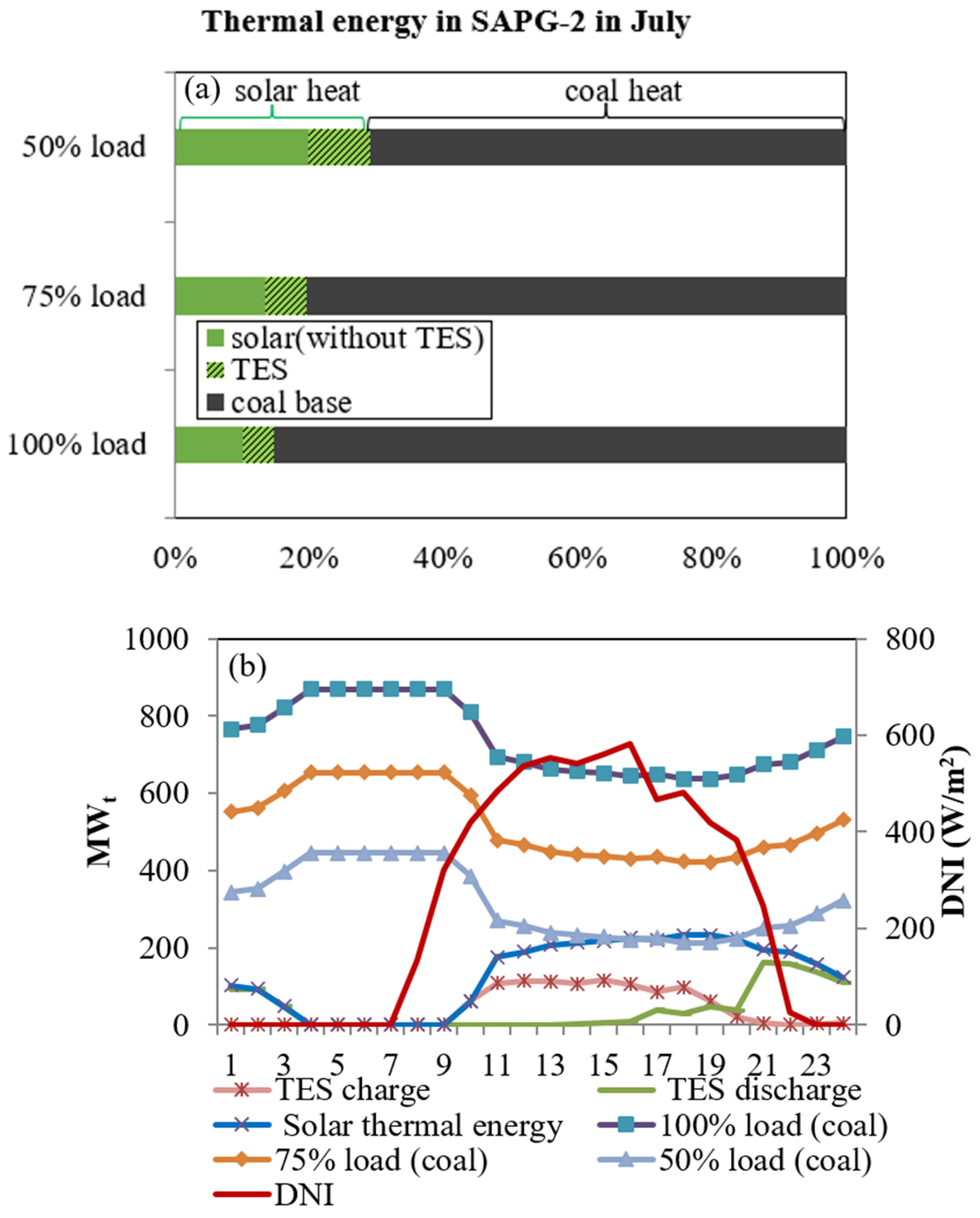
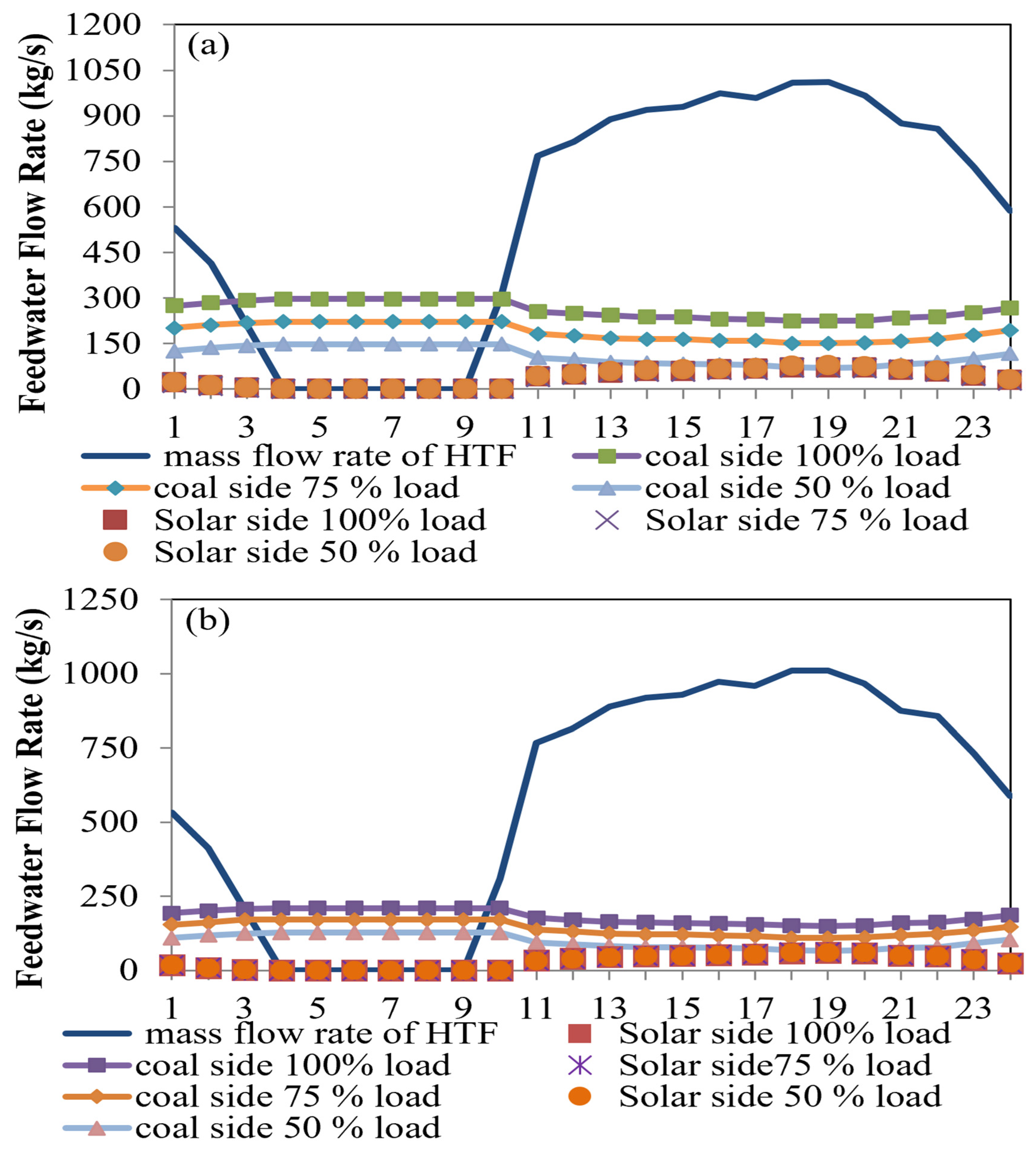
Turbine i T = ε T , i n ε T , o u t W T η ε , T = W T ε T , i n ε T , o u t (10)
Pump i P = W P + ε P , i n ε P , o u t η ε , P = ε P , o u t ε P , i n W P (11)
Condenser i C = ε C , i n ε C , o u t η ε , C = ε C , o u t ε C , i n (12)
Heater i E X = ε E X , h i n + ε E X , c i n ε E X , h o u t ε E X , c o u t η ε , E X = ε E X , h o u t + ε E X , c o u t ε E X , h i n + ε E X , c i n (13)
Table 7. Coal properties utilized in this research.
Parameter/UnitSymbolValue
Carbon component/%XC55.07
Hydrogen component/%XH2.81
Oxygen component/%XO12
Sulfur component/%XS0.45
Nitrogen component/%XN0.4
Humidity component/%XW25.6
Lower heating value/kJ/kgLHV19,690
Table 8. Key parameters for CSP economic analysis [16,22].
Parameter/UnitValue
Initial investment cost or Direct Capital Costs (DC)
Solar field cost/$/m2250
Heat Exchanger cost/$/kW120
TES system cost/$/MWht31.4
Contingency/% of DC10
Costs of Indirect Capital
Cost of EPC/% of DC15
Total cost of land/% of DC3.50
Cost of O&M/% of DC1.50
Rate of discount/%5
Lifetime of power plant/year30
Table 9. Key parameters for base reference unit economic analysis [43,44,45].
Parameter/UnitValue
Capital cost/$/MW4,074,000
TES system cost/$/MWht31.4
CO2 price/$/ton26.16
O&M cost/$/MWh20
Annual operation hours/hr8000
Rate of discount/%5
Lifespan of power plant/year30
Disclaimer/Publisher’s Note: The statements, opinions and data contained in all publications are solely those of the individual author(s) and contributor(s) and not of MDPI and/or the editor(s). MDPI and/or the editor(s) disclaim responsibility for any injury to people or property resulting from any ideas, methods, instructions or products referred to in the content.