1. Introduction
Education systems are increasingly expected to move beyond access and accountability toward sustainable quality improvement. In the global policy agenda, sustainable education is not limited to environmental education; it also refers to the capacity of education systems and schools to provide inclusive, equitable, relevant, and continuously improving learning opportunities. UNESCO’s SDG 4 agenda commits countries to “inclusive and equitable quality education and lifelong learning opportunities for all,” while the Education 2030 Framework for Action guides implementation, coordination, financing, and monitoring at national, regional, and global levels. Similarly, UNESCO’s Education for Sustainable Development Roadmap emphasises policy, learning environments, educator capacity, youth participation, and local action as priority areas for transforming education toward a more just and sustainable world. These international directions suggest that quality education must be supported by mechanisms that enable schools to learn, adapt, and improve over time.
Within this agenda, quality assurance (QA) has become a central policy mechanism for strengthening school effectiveness and sustainable development. QA mechanisms such as school self-evaluation, external review, performance indicators, school development planning, and evidence-based monitoring are intended to help schools identify strengths, diagnose weaknesses, and plan improvement. The OECD argues that evaluation and assessment arrangements should be embedded within a coherent framework to improve the quality, equity, and efficiency of school education. However, international experience also shows that QA does not automatically lead to improvement. OECD reviews indicate that school self-evaluation can become a routine administrative requirement if schools lack leadership capacity, evidence-use skills, feedback mechanisms, and ownership of the process. The gap is not a lack of data or procedures, but the failure to convert data into shared, actionable knowledge. Therefore, the key research problem is not simply whether QA mechanisms exist but how to strengthen them to make them meaningful instruments for sustainable school improvement.
This problem is particularly relevant to Hong Kong schools. Hong Kong has developed a formal QA structure through the School Development and Accountability framework, in which school self-evaluation (SSE) is a core element of continuous improvement. SSE is complemented by school inspections, including External School Review and Focus Inspection, and schools are expected to use the Planning–Implementation–Evaluation cycle to promote sustained development, accountability, and improved student learning outcomes. However, as in many education systems, the challenge is to move QA to the next level: from compliance-oriented reporting toward a deeper professional process in which schools generate, share, interpret, and use knowledge for improvement. In this sense, Hong Kong provides a valuable local context for investigating an internationally significant problem, for its high-performing, but compliance-heavy system makes the tension between autonomy and control particularly salient.
Knowledge management offers a promising strategic management approach for addressing this problem. QA is fundamentally a knowledge-based process: schools collect data, interpret evidence, document practices, exchange professional experience, evaluate outcomes, and translate findings into improvement plans. If this knowledge remains fragmented, privately held, or weakly connected to decision-making, QA may remain superficial. By contrast, when schools develop effective knowledge-management practices, QA can become a continuous organisational learning process. The OECD has long argued that, in a learning society, organisations must be able to produce, share, and use knowledge effectively. UNESCO’s SDG 4 Knowledge Hub similarly highlights the importance of sharing knowledge, data, policy documents, research, and good practices to support evidence-based education reforms and cross-country learning. Thus, knowledge management is directly aligned with the international policy emphasis on evidence-informed educational improvement.
From a knowledge management perspective, strengthening QA requires both technical tools organisational conditions that enable knowledge to flow and be used, including leadership, organisational culture, and IT infrastructure. Leadership establishes priorities, shared purpose, and legitimacy for evidence-informed reflection. Organisational culture, particularly the balance between professional autonomy and bureaucratic control, matters because teachers interpret and apply pedagogical knowledge; excessive control may reduce ownership, whereas clear procedures can institutionalise knowledge sharing. IT infrastructure supports information storage and access, but it improves QA only when embedded in a culture of professional dialogue and evidence use.
Employing a quantitative, cross-sectional design, this study examines how knowledge-management factors, including visionary leadership, professional autonomy, bureaucratic control, knowledge sharing, and IT infrastructure, predict the effectiveness of school self-evaluation (SSE) as a quality assurance mechanism in Hong Kong schools. Data were collected via a structured questionnaire from 978 teachers across 20 randomly selected primary and secondary schools. After data preparation, exploratory factor analysis was used to verify construct validity and reliability, followed by structural equation modelling to test the hypothesised relationships, with model fit assessed using standard indices (CFI, TLI, RMSEA, SRMR). While situated in the Hong Kong context, the study addresses international agendas promoted by the OECD and UNESCO, which emphasise evidence-based improvement, professional ownership, and contextualised capacity building over mere accountability.
2. Literature Review
2.1. Knowledge Management
Knowledge management (KM) in schools should not be understood only as a technical process of storing information or managing digital platforms. Rather, KM is a socio-cultural, organisational, and leadership-driven process through which schools create, share, store, retrieve, and apply professional knowledge to improve teaching, learning, decision-making, and school effectiveness. The broader KM literature identifies technology, organisational culture, structure, leadership, and people as key enablers of knowledge processes [
1,
2]. In the school context, this means that KM strategies are shaped by how teachers are positioned as professionals, how their work is coordinated through formal systems, and how school leaders articulate a clear vision for using knowledge to strengthen teaching, learning, and organisational development [
3]. Therefore, before discussing KM strategies in terms of IT infrastructure and people’s knowledge sharing, it is necessary to examine the organisational conditions that enable or constrain such strategies.
A useful starting point is the concept of a loosely coupled management culture. The idea is grounded in organisational theory, particularly Weick’s [
4] argument that educational organisations are loosely coupled systems. In schools, classrooms, departments, teachers, and administrative units are connected yet retain considerable independence. This explains why classroom teaching is often partly protected from direct administrative control, while still being influenced by curriculum policy, school goals, accountability expectations, and leadership direction. Orton and Weick [
5] later clarified that loose coupling should not be interpreted as complete separation. Rather, loosely coupled systems are characterised by elements that are both responsive to one another and relatively distinct. Recent reviews similarly suggest that effective educational organisations require a balance of loose and tight coupling rather than a simple choice between autonomy and control [
6].
Recent empirical research reinforces the conceptualisation of KM as an integrated socio-technical process that directly impacts school improvement. Studies conducted between 2023 and 2025 demonstrate that effective use of data for school self-evaluation (SSE) is frequently hindered by fragmented implementation and insufficient data literacy among teachers, necessitating targeted professional development and collaborative structures to translate data into actionable knowledge [
7,
8]. Furthermore, a cross-national comparative study by Gardezi [
9] highlights that while SSE is increasingly adopted globally as a cost-effective and empowering quality assurance mechanism, its success depends heavily on a school’s capacity to balance internal accountability with external inspection demands. In highly centralised systems, SSE often risks becoming a bureaucratic compliance exercise unless a robust knowledge-sharing culture supports it.
2.2. Loose–Tight Coupled Management Culture
In this framework, loose–tight coupled management culture can be operationalised through two related variables: teachers’ professional autonomy and bureaucratic control over teachers for school effectiveness. Teachers’ professional autonomy represents the “loose” dimension. It refers to the extent to which teachers have professional discretion over pedagogy, curriculum adaptation, assessment practices, classroom decision-making, and professional learning. Bureaucratic control represents the “tight” dimension. It refers to the extent to which schools use formal policies, procedures, schedules, documentation, monitoring systems, accountability mechanisms, and standardised routines to align teachers’ work with school goals. Cheng [
10] found that both professional autonomy and bureaucratic control predicted teacher leadership, suggesting that teacher empowerment does not depend on removing structure, but on balancing professional discretion with organisational coordination. This interpretation is consistent with Adler and Borys’s [
11] distinction between enabling bureaucracy, which supports professional work, and coercive bureaucracy, which restricts professional judgement. Hoy and Sweetland [
12] similarly argued that school structures can be designed to help rather than hinder teachers’ work. Lee and Louis [
13] similarly argue that a strong school culture, characterised by collective responsibility, reflective dialogue, and organisational learning, provides the foundational conditions for sustainable improvement, suggesting that cultural coherence is what enables the productive interplay between professional autonomy and bureaucratic coordination.
Teachers’ professional autonomy is especially important for people-based KM strategies, which depend on teachers’ willingness to share tacit knowledge, reflect on classroom experiences, experiment with teaching practices, and participate in professional dialogue. If teachers experience autonomy, they are more likely to regard knowledge sharing as a professional responsibility rather than as a bureaucratic requirement. Autonomy also allows teachers to adapt shared knowledge to their specific classroom contexts, which is essential because pedagogical knowledge is often tacit, situated, and practice-based. However, autonomy should not be equated with isolation. Vangrieken et al. [
14] argue that teacher autonomy and collaboration are not necessarily contradictory; rather, professional autonomy can coexist with collaborative attitudes when teachers are empowered to participate meaningfully in shared professional work. This argument connects closely with professional learning community literature, which emphasises shared vision, collective learning, reflective dialogue, supportive conditions, and collaborative inquiry as foundations for improving teaching and student learning [
15,
16,
17].
At the same time, bureaucratic control is also necessary for KM strategy formulation, especially when it functions as an enabling structure. Without formal coordination, knowledge sharing may remain informal, fragmented, and dependent on individual goodwill. Enabling bureaucratic control can support KM by providing common meeting times, documentation routines, shared templates, data systems, peer observation schedules, mentoring structures, and agreed procedures for storing and retrieving professional knowledge. It is particularly important for IT-based KM strategies because digital repositories, school knowledge portals, taxonomies, and databases require common rules for uploading, classifying, updating, and using knowledge. Cheng, Wu, and Hu [
18] showed that knowledge leadership, knowledge-sharing culture, and KM system support were important success factors in school KM implementation, including the use of taxonomy to organise school knowledge. Therefore, bureaucratic control can contribute to school effectiveness by standardising knowledge processes without suppressing professional judgement.
The necessity of balancing autonomy with enabling structures is supported by recent large-scale empirical evidence. An analysis of the OECD TALIS 2024 data reveals that teacher professional autonomy is a critical driver of instructional innovation and school improvement, particularly when supported by distributed leadership [
19]. Similarly, Nguyen et al. [
20] found that promoting teacher professional autonomy and voice is essential for teacher retention and effective school improvement planning. However, autonomy must be coupled with enabling bureaucracy; research by Akgöz et al. [
21] demonstrates that instructional leadership behaviours mediate the relationship between school climate and teacher autonomy, suggesting that structured, supportive environments are necessary for autonomy to translate into collaborative professional learning.
2.3. Visionary Knowledge Leadership
While a loose–tight culture provides the organisational conditions for KM, visionary knowledge leadership provides direction. Visionary knowledge leaders are school leaders who have a clear vision for formulating, implementing, and sustaining KM strategies. In schools, such leaders explain why knowledge sharing matters, connect KM to school improvement goals, allocate resources for IT infrastructure, create time and structures for teacher collaboration, model knowledge-sharing behaviour, and cultivate a culture of trust. This aligns with broader school leadership literature, which argues that successful leaders set direction, develop people, and redesign organisational conditions to support teaching and learning [
22]. From a KM perspective, leadership is central because knowledge-oriented leaders encourage the creation, storage, transfer, and application of organisational knowledge [
23]. Bryant [
24] also argues that leadership contributes to the creation, sharing, and exploitation of organisational knowledge.
Visionary knowledge leadership helps integrate IT-based and people-based KM strategies. For people-based KM, leaders create a professional culture in which teachers feel safe sharing teaching experiences, discussing failures, seeking advice, and engaging in collaborative inquiry. For IT-based KM, leaders provide strategic direction for developing digital platforms, knowledge repositories, school databases, data systems, and classification structures. Nonaka et al. [
25] emphasise that leadership is important in creating ba, or the shared context in which knowledge is created and converted between tacit and explicit forms. In schools, this means that leaders must not only purchase technology or require documentation; they must also create meaningful conditions in which teachers understand the value of codifying, sharing, and reusing knowledge. Cheng et al. [
18] similarly identified knowledge leadership as a key success factor in school KM implementation.
2.4. KM Strategies
KM strategies in schools can be conceptualised as codification-oriented and personalisation-oriented approaches [
7,
26]. Codification emphasises the storage, retrieval, and reuse of explicit knowledge through information systems, while personalisation focuses on human interaction, dialogue, and the sharing of tacit knowledge. In schools, these correspond to IT infrastructure (technological, codification-oriented) and people’s knowledge sharing (social, personalisation-oriented). These strategies are complementary: effective school KM requires both reliable technological systems and active professional communities.
The IT-based KM strategy uses information and communication technologies to capture, organise, store, retrieve, and disseminate knowledge. School IT infrastructure may include knowledge management systems, digital repositories, intranets, cloud storage, learning management systems, student databases, dashboards, taxonomies, collaborative platforms, and knowledge portals. These systems manage explicit knowledge such as lesson plans, curriculum materials, assessment data, policy documents, inspection reports, and development plans. Alavi and Leidner [
27] argue that knowledge management systems support knowledge creation, transfer, storage, retrieval, and application, while Gold et al. [
1] identify technological infrastructure as a key organisational capability for KM.
In schools, IT infrastructure enhances accessibility and reuse of organisational knowledge. Digital archives and taxonomies allow classification across domains such as teaching, student support, curriculum, and staff development, reducing information loss when staff leave. Cheng [
28] identified IT support as a predictor of school strategic planning capacity, and Cheng et al. [
18] showed that a school-based taxonomy improved document retrieval and administrative efficiency. However, IT systems primarily manage explicit knowledge and do not automatically promote deep learning or internalisation. Pedagogical knowledge is often tacit and embedded in classroom experience. Cheng [
29] found that IT-based KM predicted teachers’ knowledge sharing but not knowledge internalisation in Lesson Study, suggesting that tacit knowledge requires interpersonal interaction, reflection, and collaborative sense-making.
The people-based KM strategy aligns with personalisation and emphasises sharing tacit knowledge through direct interaction. Tacit knowledge, embedded in teachers’ experience, intuition, and situated judgement, is difficult to codify [
30]. Schools, therefore, need social mechanisms such as professional learning communities, communities of practice, mentoring, peer observation, collaborative lesson planning, Lesson Study, and informal dialogue [
3,
8]. Communities of practice enable teachers to develop shared repertoires and collective knowledge [
8], transforming individual experience into organisational knowledge.
Empirical evidence highlights the importance of people-based KM. Cheng [
29] found that such strategies predicted both knowledge sharing and internalisation in Lesson Study. Cheng [
31] similarly showed that collaborative culture facilitated the externalisation and combination processes of the SECI model in strategic planning. Knowledge sharing depends on trust, openness, and psychological safety; Bock et al. [
32] found that organisational climate influences knowledge-sharing intention. Cheng et al. [
18] demonstrated that storytelling, knowledge leadership, and collaborative structures supported tacit knowledge exchange and problem solving in schools.
IT infrastructure and people’s knowledge sharing are therefore complementary. IT systems preserve institutional memory and manage explicit knowledge, while social processes enable the exchange, interpretation, and application of tacit knowledge. Choi and Lee [
33] found that organisations combining system-oriented and human-oriented KM approaches achieved stronger performance than those relying on one-sided strategies. In schools, effective KM requires both robust technological systems and a collaborative professional culture that sustains learning and improvement.
2.5. Quality Assurance Mechanisms
The importance of KM becomes clearer when linked to quality assurance (QA) mechanisms. QA refers to the institutional routines through which schools define standards, collect evidence, evaluate performance, plan improvement, monitor implementation, and report outcomes. Sustainable school development involves both short-term gains in student outcomes and long-term capacity for continuous learning, adaptive governance, professional collaboration, knowledge retention, and evidence-informed decision-making. International literature identifies school self-evaluation, external evaluation or inspection, data-based monitoring, school development planning, stakeholder reporting, and follow-up support as key QA mechanisms [
34,
35].
QA becomes sustainable when embedded in governance and management systems rather than treated as compliance. At the governance level, leaders, teachers, boards, and authorities share responsibility for reviewing standards and performance. At the management level, QA involves cyclical routines: goal setting, evidence collection, internal review, data analysis, improvement planning, resource allocation, implementation, monitoring, and reporting. The European Commission [
36] argues that meaningful self-evaluation strengthens collaborative learning and supports both academic and non-academic outcomes. Thus, QA is most effective when it fosters a school- and teacher-led culture of quality enhancement rather than bureaucratic accountability.
The logic of the arguments of this study is that knowledge management (KM) underpins quality assurance (QA) by systematically transforming fragmented data, professional experience, policy, and stakeholder feedback into actionable organisational knowledge through creation, storage, sharing, and application [
1,
3,
27]. Effective QA requires both IT-based strategies (databases, dashboards, repositories) and people-based strategies (professional learning communities, peer review, collaborative inquiry). IT supports data collection and analysis, while people-based strategies enable interpretation, tacit knowledge exchange, and problem-solving [
37]. Empirical evidence shows that self-evaluation improves outcomes when it is systematic and improvement-oriented [
38,
39], though excessive accountability risks superficial compliance [
40]. Data becomes meaningful through interpretation and collaboration [
41,
42], requiring a culture of trust and shared routines. This links QA to sustainability through institutionalised learning cycles and knowledge.
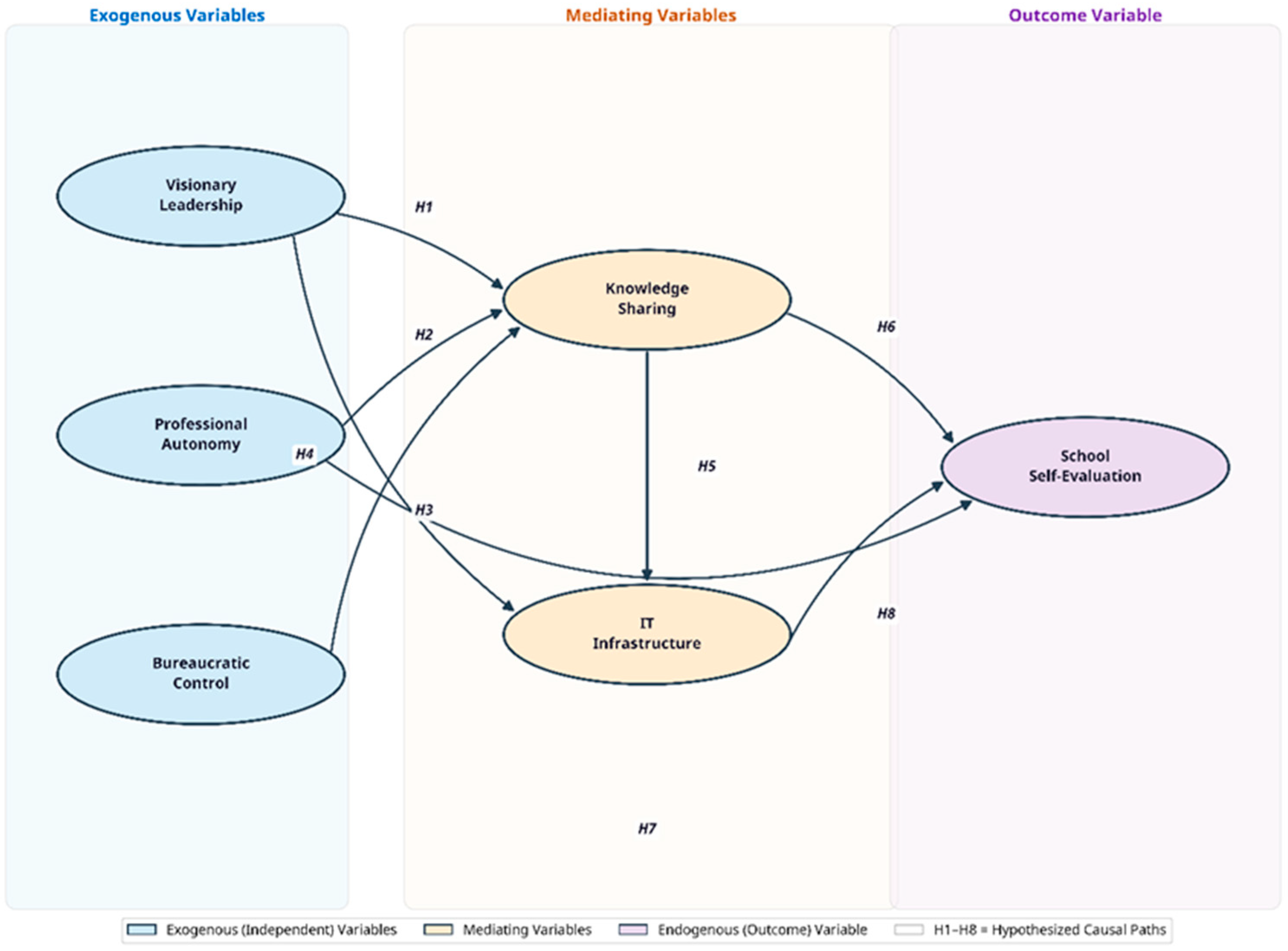
In the proposed framework (see
Figure 1), loose–tight management culture and visionary leadership shape KM strategies. Professional autonomy supports people-based KM, while enabling bureaucratic control supports IT-based KM. Visionary leadership aligns both strategies with school development goals. KM strategies, in turn, strengthen QA implementation and effective QA mechanisms—such as institutionalised self-evaluation, evidence-based planning, monitoring, inspection feedback, stakeholder engagement, and systematic data use, that mediate the relationship between management culture and sustainable organisational development. Based on the conceptual framework and literature review, the following hypotheses are proposed:
H1. Visionary leadership has a positive effect on knowledge sharing.
H2. Professional autonomy positively affects knowledge sharing.
H3. Bureaucratic control positively affects knowledge sharing.
H4. Visionary leadership positively affects IT infrastructure.
H5. Knowledge sharing has a positive effect on IT infrastructure.
H6. Knowledge sharing has a positive effect on school self-evaluation.
H7. Professional autonomy has a positive effect on school self-evaluation.
H8. IT infrastructure has a positive effect on school self-evaluation.
Furthermore, knowledge sharing is proposed as a key mediating mechanism that transmits the effects of visionary leadership, professional autonomy, and bureaucratic control to school self-evaluation.
Recent studies provide robust evidence for the mechanisms through which leadership influences knowledge sharing and innovation. Arslan et al. [
43] found that learning-centred leadership significantly enhances teacher innovative practices, with teacher knowledge sharing acting as a critical mediating mechanism. Similarly, Yang and Xu [
44] demonstrated that principal visionary leadership indirectly promotes instructional innovation through a chain mediation process involving teacher workplace well-being and collaboration. These findings indicate that visionary leadership does not operate in a vacuum; rather, it requires the cultivation of a knowledge-oriented school culture and perceived organisational support to effectively stimulate tacit and explicit knowledge sharing among teachers [
45,
46].
Figure 1.
Conceptual Framework of the Study.
Figure 1.
Conceptual Framework of the Study.
3. Methods
This study employed a quantitative, cross-sectional research design to examine the relationships among knowledge management, school culture, and school self-evaluation in Hong Kong schools. The design enabled both the validation of the measurement structure and the testing of the hypothesised structural relationships among the constructs. The study sample was drawn from the approximately 1200 public-sector schools in Hong Kong (around 500 secondary and 700 primary schools). Twenty schools were selected using stratified random sampling, with school level (primary/secondary) and district as stratification variables; the final sample comprised 10 primary and 10 secondary schools. The schools and the participants had been informed and consented to the survey. The teacher-level response rate was approximately 82%, yielding a final analytic dataset of 978 valid teacher responses. The dataset was collected and prepared by the Principal Investigators of a Knowledge Management research project, providing a broad empirical basis for analysing individual, organisational, and management-level dimensions of school functioning.
A structured questionnaire was administered to all participating teachers (see
Appendix A). All substantive items were rated on a six-point Likert scale ranging from 1 (strongly disagree) to 6 (strongly agree). The instrument was organised into four sections.
Section 1 collected seven demographic items: gender, age, teaching experience, subject taught, position, qualification level, and school identification.
Section 2 measured knowledge management using 21 items adapted from the Knowledge Management Inventory of Sallis and Jones [
47]. The items represented four dimensions: visionary leadership, knowledge-sharing culture, knowledge management strategies, and information technology infrastructure.
Section 3 measured school culture using 11 items representing two dimensions: professional autonomy and bureaucratic control.
Section 4 measured school self-evaluation using 13 items covering three dimensions: planning capacity, quality-assurance capacity, and school self-evaluation effectiveness.
3.1. Data Preparation
The dataset was imported from Excel into Python 3.14.6 (pandas library) for initial inspection, including descriptive statistics and structural review. Duplicate records were removed, and categorical demographic variables (e.g., gender, position) were recoded into numeric formats to ensure compatibility with subsequent statistical procedures. Missing data were handled using Full Information Maximum Likelihood (FIML) estimation during the SEM analysis rather than through mean substitution, as FIML yields less biased parameter estimates under the assumption of missing-at-random data. Outlier screening focused on impossible values and severe response-set biases (e.g., straight-lining) rather than mechanical z-score trimming, given the bounded nature of Likert-scale responses. Variables with zero variance were removed. Exploratory data analysis (descriptive statistics, histograms, pairwise plots, and correlation heatmaps) was conducted to examine variable distributions and preliminary associations among constructs.
Common method bias (CMB) was addressed through both procedural and statistical remedies. Procedurally, respondent anonymity was guaranteed, predictor and criterion items were separated within the questionnaire, and distinct scale anchors were used to reduce evaluation apprehension [
48]. Statistically, Harman’s single-factor test revealed that the first unrotated factor accounted for 45.7% of the variance, below the 50% threshold, suggesting CMB was not a pervasive threat. For more robust verification, an unmeasured latent method factor (ULMF) was incorporated into the SEM; the stability of structural paths and substantive variance confirmed that results were not substantially distorted by common method variance [
49].
3.2. Data Analysis
Data analysis proceeded in two stages: (1) measurement validation through Exploratory Factor Analysis (EFA), and (2) structural hypothesis testing through Structural Equation Modelling (SEM). EFA was conducted using Maximum Likelihood extraction with Oblimin (oblique) rotation, as the underlying constructs were theoretically expected to correlate. The analysis verified whether the observed items loaded onto the expected constructs of knowledge management, school culture, and school self-evaluation. Internal consistency for each construct was assessed using Cronbach’s alpha and composite reliability.
To account for the nested structure of teachers within schools, the intraclass correlation coefficient (ICC) and design effect (DEFF) were computed for all latent constructs. Both indicated negligible clustering (ICC < 0.001; DEFF ≈ 1.00), suggesting that variance resided predominantly at the teacher level. This unusually low ICC, below the 0.05–0.25 range typical of teacher-within-school data in educational research [
50], may reflect three features of the present study: the constructs measure individual teacher perceptions rather than school-level outcomes, reducing within-school homogeneity; the between-school variance component is estimated from only 20 schools, which may produce a downward-biased ICC estimate; and the high degree of policy and funding standardisation across Hong Kong’s aided school system may genuinely attenuate between-school differences in perceived knowledge management conditions. The near-zero ICC did not initially warrant multilevel modelling [
51], but to ensure robust inference against potential non-independence, the structural equation model was estimated using a cluster-bootstrap procedure (B = 500 resamples) with schools as the clustering unit; 500 resamples is sufficient for stable standard error correction in this application. Indirect effects were examined using a separate bias-corrected bootstrap procedure with 1000 resamples and 95% confidence intervals. The higher resample count for the indirect-effects procedure reflects the recommendation that at least 1000 resamples are required to stabilise the tail estimates of bias-corrected CIs for mediated effects, whose sampling distributions are typically non-normal.
To enhance model parsimony and stability, item parcelling was employed to reduce model complexity and minimize potential correlated residuals, thereby improving the variable-to-sample-size ratio and yielding more reliable parameter estimates [
52]. Following the “item-to-construct balance” technique [
53], items for each latent construct were rank-ordered by their EFA loadings and systematically distributed into three psychometrically equivalent parcels, balancing item strength to mitigate bias and form robust composite indicators. Structural Equation Modeling (SEM) was used to test the hypothesized relationships among constructs. To address the nested data structure (teachers within schools), cluster-robust standard errors were applied to account for potential non-independence. Indirect effects were examined using bootstrapping with 1000 resamples and 95% bias-corrected confidence intervals. Model fit was assessed using multiple indices: CFI, TLI, RMSEA (with 90% CI), and SRMR, in line with contemporary methodological standards.
4. Findings
After data screening and preparation, Exploratory Factor Analysis (KMO = 0.965, Bartlett’s test
p < 0.001) yielded a six-factor solution: School Self-Evaluation, Knowledge Sharing, Visionary Leadership, Bureaucratic Control, Professional Autonomy, and IT Infrastructure, accounting for 45.09% of the variance across 43 items (see
Appendix A). While this falls below conventional 60% benchmarks, it is defensible for a broad-domain instrument spanning six distinct organisational constructs. The outstanding KMO, mean item communality of 0.451, strong reliability coefficients (Cronbach’s α = 0.793–0.948), and subsequent CFA parcel loadings (0.615–0.903, all
p < 0.001) confirm a stable, well-defined factor structure. Methodologists note that 40–50% explained variance is acceptable for multi-domain instruments, and the variance statistic alone does not indicate psychometric weakness (
Table 1).
An Unmeasured Latent Method Factor (ULMF) control model was introduced to assess Common Method Bias. The ULMF model showed a good fit (RMSEA = 0.0099, CFI = 0.999), but the χ2/df difference test was non-significant (Δχ2(18) = 28.816, p = 0.0507). Variance decomposition revealed an average method variance of 13.43%, well below the 25% threshold of concern. All structural paths remained stable in direction, magnitude, and significance after controlling for the method factor. It is concluded that Common Method Bias does not pose a serious threat to the study’s validity.
The SEM measurement model demonstrated strong convergent validity. All standardised factor loadings (lambda) for the item parcels were significant (
p < 0.001) and ranged from 0.615 to 0.903.
Table 2: Reports the standardised factor loadings (λ) of the SEM measurement model, confirming strong convergent validity as all item parcels loaded significantly (
p < 0.001) onto their respective latent constructs with loadings ranging from 0.615 to 0.903.
The structural model demonstrated good overall fit to the data: χ
2(124) = 549.492,
p < 0.001; χ
2/df = 4.43; CFI = 0.962; TLI = 0.953; RMSEA = 0.059 (90% CI [0.054, 0.064]); SRMR = 0.043; N = 978. Supplementary legacy indices were consistent with acceptable fit (NFI = 0.952; GFI = 0.952). While the χ
2/df ratio is elevated, this is expected given the large sample size (N = 978), which inflates the chi-square statistic; the incremental and absolute fit indices (CFI, TLI, RMSEA, SRMR) all meet or exceed recommended thresholds for good model fit.
Table 3: Summarises the structural model path coefficients for the eight hypothesised relationships, showing that six paths were supported (H1, H2, H3, H5, H6, H7) while two paths—Visionary Leadership → IT Infrastructure (H4) and IT Infrastructure → School Self-Evaluation (H8)—were rejected.
The model explains 83.2% of the variance in Knowledge Sharing, 68.3% in IT Infrastructure, and 69.7% in School Self-Evaluation. Bootstrapped mediation analysis (1000 resamples) was conducted to test the indirect effects of the exogenous variables on School Self-Evaluation via Knowledge Sharing.
Table 4: Displays the bootstrapped indirect effects (1000 resamples) with 95% confidence intervals, confirming that Knowledge Sharing significantly mediates the effects of Visionary Leadership (β = 0.344), Bureaucratic Control (β = 0.103), and Professional Autonomy (β = 0.055) on School Self-Evaluation.
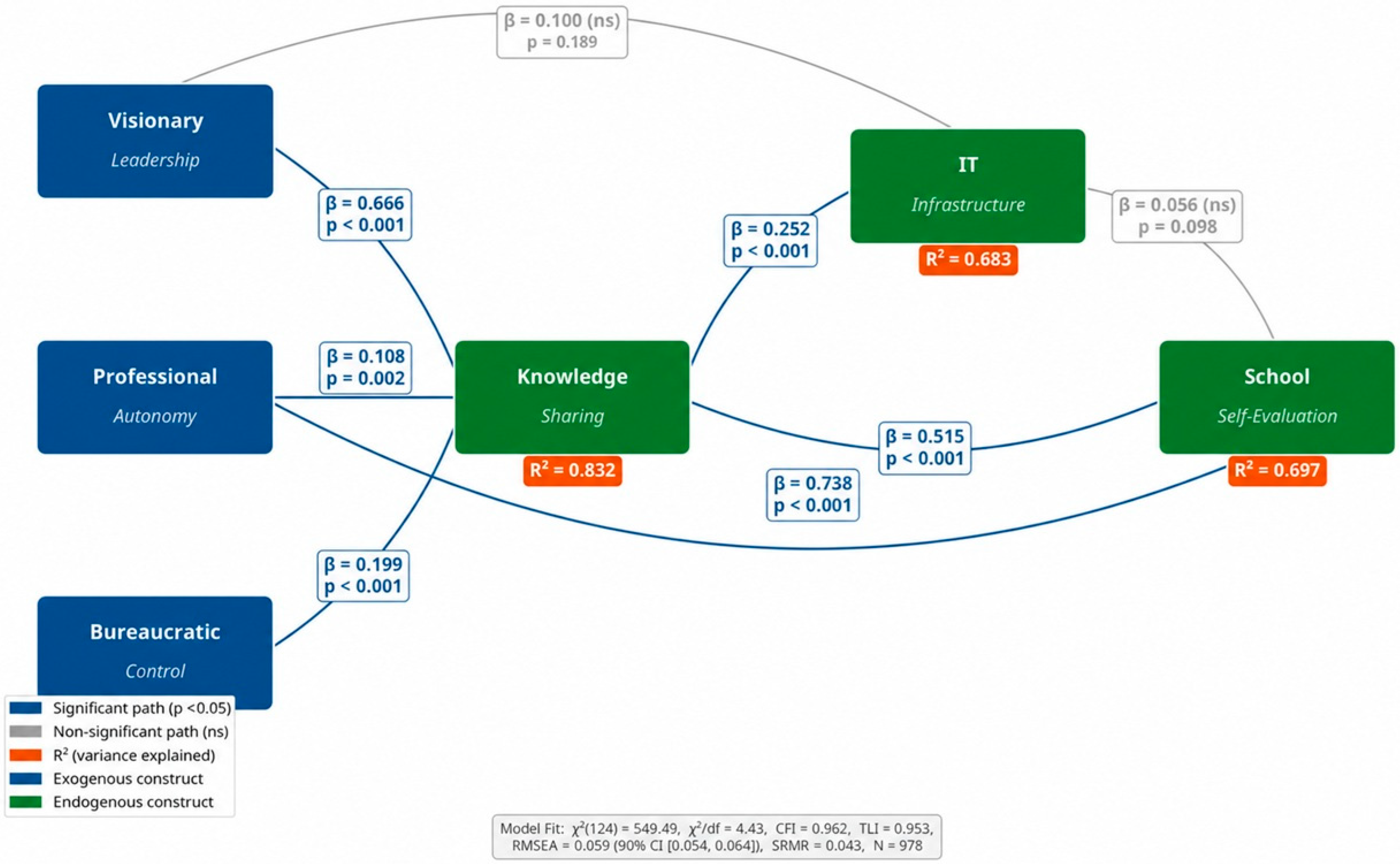
All three indirect effects are statistically significant because their 95% confidence intervals do not include zero. This confirms that Knowledge Sharing acts as a significant mediator linking leadership, autonomy, and control to SSE. The final structural equation model was estimated using 978 valid teacher responses. The best-fitting model was the one which examined the relationships among visionary leadership, professional autonomy, bureaucratic control, knowledge sharing, IT infrastructure, and school self-evaluation (see
Figure 2). The model showed a good overall fit to the data, with fit indices of CFI = 0.962, TLI = 0.953, RMSEA = 0.059, and χ
2/df = 4.43. These values indicate that the proposed SEM model provided an acceptable-to-strong representation of the observed data.
The findings show that visionary leadership was the strongest predictor of knowledge sharing. The path from visionary leadership to knowledge sharing was positive and statistically significant, with a standardised coefficient (β) of 0.666 (p < 0.001). This suggests that schools with clearer knowledge-management visions and stronger leadership support were more likely to develop effective knowledge-sharing practices among teachers. However, the path from visionary leadership to IT infrastructure was weak and not statistically significant (β = 0.100), suggesting that leadership alone may not directly improve IT-related knowledge management infrastructure.
Professional autonomy also played an important role in the model. It had the strongest direct effect on school self-evaluation (β = 0.738, p < 0.001). This finding indicates that when teachers are trusted to exercise professional judgement and participate actively in school development, schools are more likely to report stronger self-evaluation capacity and effectiveness. Professional autonomy also had a smaller but significant positive effect on knowledge sharing (β = 0.108, p < 0.01), suggesting that professional freedom encourages teachers to exchange knowledge and teaching experience.
The model also found that bureaucratic control had a positive and significant relationship with knowledge sharing (β = 0.199, p < 0.001). Although bureaucratic control is often viewed as restrictive, this result suggests that formal rules, monitoring, and structured management processes may still support knowledge-sharing practices when they provide clear expectations and organisational discipline. Therefore, the model does not suggest that professional autonomy and bureaucratic control work in opposite directions. Instead, both appear to contribute to knowledge sharing, although professional autonomy has a much stronger direct influence on school self-evaluation.
Knowledge sharing emerged as a central mechanism in the model. It had a strong positive effect on school self-evaluation (β = 0.515, p < 0.001), indicating that schools with stronger knowledge-sharing cultures were more likely to have effective self-evaluation practices. Knowledge sharing also significantly predicted IT infrastructure (β = 0.252, p < 0.001), suggesting that active knowledge exchange may encourage schools to develop or use technological systems that support collaboration.
In contrast, IT infrastructure had only a weak, non-significant direct effect on school self-evaluation (β = 0.056). This indicates that technology by itself is not enough to improve school self-evaluation. Rather, the effectiveness of school improvement processes appears to depend more strongly on human and organisational factors, especially professional autonomy, leadership, and a culture of knowledge sharing.
Overall, the findings suggest that school self-evaluation is most strongly enhanced by professional autonomy and knowledge sharing. Visionary leadership contributes indirectly by strengthening knowledge sharing, while bureaucratic control appears to provide a smaller supportive role. The results highlight that effective school management is driven less by infrastructure alone and more by the interaction of leadership, teacher professionalism, and collaborative knowledge practices.
5. Discussion
The Structural Equation Modelling (SEM) results support the proposed theoretical framework, which holds that school self-evaluation is shaped jointly by knowledge management processes and school cultural conditions. The model produced strong fit indices, suggesting that the relationships among visionary leadership, professional autonomy, bureaucratic control, knowledge sharing, IT infrastructure, and school self-evaluation represent the data well. Consistent with Sallis and Jones [
47] and the broader KM literature [
1,
2], the findings confirm that school improvement is not driven by a single factor but by the interaction among leadership, professional culture, knowledge-sharing practices, and organisational structures. The discussion below interprets each structural path in relation to the empirical and theoretical studies reviewed in the literature, noting where the present findings converge with, extend, or depart from prior work.
5.1. Leadership as the Primary Enabler of Knowledge Sharing
The strongest predictor of knowledge sharing was visionary leadership. Schools with a clearer knowledge-management vision and stronger leadership support were substantially more likely to develop active knowledge-sharing practices among teachers. This result is highly consistent with the literature. Leithwood et al. [
22] argue that successful leaders set direction, develop people, and redesign organisational conditions, precisely the mechanisms through which leadership appears to activate knowledge sharing in the present sample. Similarly, Donate and Sánchez de Pablo [
23] show that knowledge-oriented leadership promotes the creation, transfer, and application of organisational knowledge, while Bryant [
43] demonstrates that leadership contributes directly to the sharing and exploitation of knowledge.
The magnitude of the effect also echoes Cheng et al. [
18], who identified knowledge leadership as a key success factor in school KM implementation, and extends Nonaka et al.’s (2000) claim that leadership is central in creating ba, the shared context in which tacit and explicit knowledge are converted [
25]. Taken together, the present finding aligns strongly with prior research and strengthens the conclusion that knowledge sharing in schools is not a spontaneous teacher behaviour but a leadership-enabled practice.
5.2. The Complementary Roles of Professional Autonomy and Bureaucratic Control
The path from professional autonomy to knowledge sharing was positive and significant but modest in magnitude. This partially supports the literature. Vangrieken et al. [
14] argue that professional autonomy and collaboration are not contradictory and can coexist when teachers are empowered to participate in shared work. Stoll et al. [
15] and Vescio et al. [
16] similarly emphasise that autonomy within a professional learning community enables collective learning and reflective dialogue [
17].
However, the relatively small coefficient diverges somewhat from the stronger claims in parts of the professional-learning-community literature, which sometimes imply that autonomy will readily translate into collaborative knowledge exchange. The present finding suggests a more qualified conclusion: autonomy is a supportive but insufficient condition, echoing Vangrieken et al.’s [
14] caution that autonomy can also coexist with teacher isolation. This reinforces Cheng’s [
10] position that teacher empowerment depends not on removing structure, but on balancing professional discretion with organisational coordination.
An important and somewhat counterintuitive finding was the positive and significant path from bureaucratic control to knowledge sharing. At first glance, this may appear inconsistent with the literature’s critique of hierarchy and compliance. On closer inspection, however, the result strongly supports Adler and Borys’s [
11] distinction between enabling and coercive bureaucracy, and Hoy and Sweetland’s (2001) argument that school structures can be designed to help rather than hinder teachers’ work. Formal procedures, documentation routines, reporting cycles, peer observation schedules, and shared templates appear to institutionalise knowledge sharing by making professional knowledge visible and exchangeable.
This finding also converges with Cheng’s [
10] result that both professional autonomy and bureaucratic control predicted teacher leadership, and with Cheng et al. [
18], who showed that taxonomy-based knowledge organisation supported school KM. Importantly, the fact that both autonomy and bureaucratic control paths are significant provides empirical support for the loose–tight coupled management culture argument grounded in Weick [
4], Orton and Weick [
5], and Hautala et al. [
6]. The two do not cancel one another. Rather, autonomy encourages voluntary exchange, while enabling bureaucracy to institutionalise it through formal routines. While both autonomy and bureaucratic control predict knowledge sharing, the model does not test whether these conditions interact; high-autonomy, high-structure schools may achieve superior outcomes through complementary effects, supporting Weick’s loose–tight coupling framework.
5.3. Drivers of School Self-Evaluation Quality
The strongest direct predictor of school self-evaluation in the model was professional autonomy. This finding is theoretically significant and strongly consistent with the literature. Self-evaluation, as conceptualised by the European Commission [
36], Vanhoof and Van Petegem [
39], and Hofman et al. [
38], is most effective when teachers exercise professional judgement, interpret evidence, and participate in planning rather than complying with top-down requirements. Kools and Stoll [
54] similarly frame self-evaluation as a property of a learning organisation in which shared vision, inquiry, and embedded learning depend on teacher agency. However, the unexpectedly strong autonomy to the self-evaluation path may reflect Hong Kong teachers’ deep aspirations for professional discretion within historically centralised systems, warranting qualitative exploration of how cultural values shape autonomy–control perceptions.
The present result also aligns with de Wolf and Janssens’ [
40] warning that poorly balanced accountability systems can produce superficial compliance, implying that where teachers lack autonomy, self-evaluation may degenerate into ritualistic reporting. In this sense, the strong autonomy–self-evaluation path empirically substantiates a claim that is largely theoretical in prior literature: effective self-evaluation is fundamentally a professional, not a bureaucratic, practice.
Knowledge sharing exerted a strong positive effect on school self-evaluation. This result is consistent with core KM theory [
1,
27], which positions knowledge creation, exchange, and application as prerequisites for evidence-informed organisational action. It also aligns closely with the people-based KM literature: Cheng [
29] found that people-based strategies predicted both knowledge sharing and internalisation in Lesson Study; Cheng [
31] demonstrated that collaborative culture supported the externalisation and combination processes of the SECI model in strategic planning; and Pradabpech et al. [
37] showed that a KM model combining shared learning, integration, and synthesis improved internal QA outcomes. Although the SEM model tests directional hypotheses, the cross-sectional design cannot establish causality; reverse causality is plausible, schools with effective self-evaluation may subsequently invest more in knowledge-sharing practices.
The finding also supports Schildkamp et al. [
42] and Mandinach [
41], who argue that data-based decision-making is effective only when collaborative and organisational conditions enable educators to transform data into actionable knowledge. In short, the present study provides strong empirical confirmation of an argument that runs across the QA and KM literature: without knowledge sharing, self-evaluation risks becoming a formal reporting exercise rather than a process of organisational learning.
5.4. The Technology Pathways: Refining Rather than Contradicting Theory
The model showed a significant path from knowledge sharing to IT. This is a theoretically interesting reversal of the common assumption that technology precedes knowledge management. The direction is nevertheless consistent with Choi and Lee [
33], who found that organisations combining human-oriented and system-oriented KM achieved stronger performance than those relying on either strategy alone, and with Cheng et al. [
18], who argued that IT tools such as taxonomies gain value only when linked to a sharing culture.
The result also supports Alavi and Leidner’s (2001) [
27] position that technological systems support, rather than generate, knowledge processes, and it extends Cheng’s [
28,
29] findings that IT-based KM is effective primarily when embedded in collaborative professional activity. In this sense, the present study provides empirical evidence that IT infrastructure develops in response to, rather than in advance of, a sharing culture.
In contrast with the strong leadership–knowledge-sharing path, the path from visionary leadership to IT infrastructure was positive but non-significant. This finding partly diverges from Nonaka et al. [
25], Donate and Sánchez de Pablo [
23], and Cheng et al. [
18], who emphasise leadership as a driver of both human and technological KM capabilities. However, as argued below, the divergence is more apparent than real when contextual factors are considered. H4 (Visionary Leadership → IT Infrastructure) was non-significant due to three contextual factors. Similarly, H8 (IT Infrastructure → School Self-Evaluation) was non-significant because technology availability is a necessary but insufficient condition for meaningful SSE. In Hong Kong’s well-provisioned system, the binding constraints on SSE effectiveness are cultural and professional, teachers’ beliefs about data use, their collaborative practices, and the accountability-driven tendency to treat SSE as a compliance ritual rather than genuine improvement. Thus, first-order barriers (infrastructure) have been largely addressed, leaving second-order barriers (beliefs, culture) as the primary determinants of SSE quality.
5.5. Convergence, Extension, and Contribution
Taken together, four explanations, consistent with the literature, account for these non-significant findings, and they refine rather than contradict existing theory. First, school IT provision in Hong Kong is substantially shaped by system-level policy, resource allocation, and technical support constraints, meaning that school-level leadership vision may have limited direct leverage over hardware and platform availability. The centralised government funding through the Education Bureau’s WiFi-900 Scheme and Composite Information Technology Grant has standardised baseline IT provision across all public schools, compressing variance and thereby rendering school-level leadership largely irrelevant to infrastructure quality. Furthermore, the IT management is operationally decoupled from principal leadership and delegated to specialised middle managers, a pattern reinforced by Hong Kong’s Confucian-influenced hierarchical culture. Consequently, the absence of direct leadership on infrastructure effect is not evidence that leadership is unimportant, but rather that its influence is mediated by structural and cultural factors not captured in the direct path.
Second, the non-significant direct path may reflect an indirect pathway: leadership first cultivates a knowledge-sharing culture, which then generates demand for IT infrastructure. This mediation logic is consistent with the full structural model and with Choi and Lee [
33]. In other words, visionary leadership may shape technology use through people, not through procurement, a finding that extends rather than contradicts the leadership and KM literature.
Third, Cheng [
29] found that IT-based KM predicted teachers’ knowledge sharing but not knowledge internalisation, suggesting that leadership effects on IT are more visible in how technology is used than in whether it exists. Thus, the non-significant direct path refines, rather than contradicts, the leadership–KM literature by specifying the boundary conditions under which leadership influences technological infrastructure.
Fourth, and most critically, the path from IT infrastructure to school self-evaluation was weak and non-significant for a theoretically coherent reason: the availability of technology is a necessary but insufficient condition for meaningful SSE. In Hong Kong’s well-provisioned system, the binding constraints on SSE effectiveness are no longer technological but instead cultural and professional—teachers’ beliefs about data use, their collaborative practices, and the accountability-driven tendency to treat SSE as a compliance ritual rather than genuine improvement. Whereas first-order barriers (infrastructure) have been largely addressed, second-order barriers (beliefs, culture) now operate as the primary determinants of SSE quality. This finding meaningfully diverges from studies that position IT as a direct enabler of quality assurance, such as Cheng [
28], who identified IT support as a predictor of school strategic planning capacity. However, the result aligns closely with a more nuanced strand of the literature: Cheng [
29] showed that IT-based KM predicted knowledge sharing but not internalisation; Mandinach [
41] argued that data become meaningful only when interpreted and applied; and Schildkamp et al. [
42] demonstrated that effective data use depends on organisational and collaborative conditions rather than on the availability of systems alone. The present finding, therefore, supports the view that IT infrastructure is a necessary hygiene factor—a baseline condition that does not differentiate schools in terms of evaluation effectiveness once a minimum threshold is met.
Finally, the weak effect may also reflect a measurement issue noted in the literature: questionnaire items typically capture the availability of IT facilities rather than the depth of use, a distinction Cheng [
28,
29] and Ehren and Visscher [
55,
56] highlight in their work on feedback utilisation. This measurement limitation suggests that the true effect of IT on SSE—if it exists—likely operates through intermediate variables such as data literacy, collaborative interpretation, and professional dialogue. Without interpretation, dialogue, and collaborative sense-making, technology alone is unlikely to support reflective practice. Taken as a whole, these four explanations demonstrate that the non-significant paths are not empirical anomalies but theoretically coherent reflections of Hong Kong’s systemic context.
The present finding, therefore, supports the view that IT infrastructure is a necessary but insufficient condition for effective self-evaluation. The weak effect may also reflect a measurement issue noted in the literature: questionnaire items typically capture the availability of IT facilities rather than the depth of use, a distinction Cheng [810 and Ehren and Visscher [
55,
56] highlight in their work on feedback utilisation. Without interpretation, dialogue, and collaborative sense-making, technology alone is unlikely to support reflective practice.
The findings converge strongly with the literature in several respects and extend it in others. The significant effects of visionary leadership, professional autonomy, enabling bureaucratic control, and knowledge sharing support the loose–tight coupled management framework [
4,
5,
6,
11,
12] and the leadership-and-culture perspective on KM [
3,
18,
22,
23,
24]. The complementary but asymmetric effects of people-based and IT-based KM strategies support Hansen et al. [
26], Zack [
57], Choi and Lee [
33], and Cheng’s [
29,
31] Hong Kong findings that personalisation-oriented KM is more directly consequential for professional learning than codification-oriented KM.
At the same time, the results extend the literature in three ways. First, they provide empirical evidence that enabling bureaucracy contributes positively to knowledge sharing, an argument largely advanced on theoretical grounds by Adler and Borys [
11] and Hoy and Sweetland [
12]. Second, they suggest that the causal arrow between knowledge sharing and IT infrastructure may flow primarily from culture to technology, qualifying the more techno-centric KM literature. Third, they offer strong empirical support for the arguments of the European Commission [
55], Vanhoof and Van Petegem [
39], and Kools and Stoll [
54] that sustainable self-evaluation depends on teacher agency and a learning-organisation culture rather than on accountability structures or digital systems per se.
The finding that professional autonomy exerts the strongest total effect on school self-evaluation aligns with recent international evidence emphasising the primacy of teacher agency in data-driven school improvement. As highlighted by the OECD TALIS 2024 report and recent empirical studies, teacher autonomy is not merely a structural condition but a fundamental prerequisite for engaging meaningfully in collaborative inquiry and instructional innovation [
19,
21]. When teachers possess the professional discretion to adapt and apply knowledge, SSE transforms from a compliance-driven administrative task into a genuine process of professional learning [
8,
9]. Furthermore, the critical mediating role of knowledge sharing between visionary leadership and SSE corroborates recent structural equation modelling studies. Arslan et al. [
43] and Yang and Xu [
44] similarly found that leadership impacts instructional innovation primarily through the facilitation of knowledge sharing and teacher collaboration. In the context of Hong Kong’s centralised education system, where bureaucratic control often dominates, visionary leadership serves as the catalyst that activates knowledge sharing, while professional autonomy provides the necessary space for that knowledge to be utilised effectively in self-evaluation.
6. Conclusions
This study provides evidence consistent with the view that effective school self-evaluation is fundamentally a socio-cultural process rather than a technical exercise. The findings suggest that professional autonomy and knowledge-sharing practices are the primary correlates of evaluation quality, while visionary leadership is associated with collaborative cultures through its indirect effects on knowledge sharing (indirect β = 0.343). Enabling bureaucratic structures appear to support knowledge exchange positively (β = 0.199) and may help institutionalise improvement processes when designed as facilitative rather than restrictive frameworks. Technology infrastructure, by contrast, was not significantly associated with evaluation quality in the present sample (β = 0.056, p = 0.098), suggesting that digital tools may need to be embedded in collaborative professional conditions to contribute meaningfully to evaluation effectiveness. These results collectively indicate that sustainable school self-evaluation may emerge through carefully balanced organisational conditions that value professional judgement, foster collaborative inquiry, and integrate supportive structures—though longitudinal and experimental designs are needed to establish the direction and magnitude of these relationships with greater confidence.
The complementary roles of Professional Autonomy and Knowledge Sharing in this model reflect two distinct pathways to SSE quality. Professional Autonomy operates primarily through a direct pathway: teachers with greater professional discretion engage more deeply with evaluation evidence, exercise more genuine ownership of improvement planning, and resist the compliance orientation that characterises SSE in high-accountability systems such as Hong Kong’s SDA framework. Knowledge Sharing, by contrast, operates primarily as a transmission mechanism: it converts Visionary Leadership’s influence (indirect β = 0.343) and Bureaucratic Control’s enabling structures (indirect β = 0.103) into evaluation practice. Neither pathway is dispensable, but the data are unambiguous that professional agency is the more powerful of the two.
These findings demonstrate that sustainable school self-evaluation emerges through carefully balanced organisational conditions that value professional judgment, foster collaborative inquiry, and integrate supportive structures. The structural model confirms that the interplay of professional autonomy, visionary leadership, enabling bureaucratic control, and knowledge sharing accounts for the vast majority of variance in SSE outcomes, with technology infrastructure playing only a secondary role. For school leaders and policymakers, the implication is clear: investments in professional learning communities, teacher autonomy, and leadership capacity for knowledge management will yield substantially greater improvements in SSE quality than investments in digital infrastructure alone. Sustainable quality assurance, therefore, must be grounded in the professional culture of the school rather than in its technological endowment.
7. Limitations of the Study
Despite its contributions, this study has several limitations. First, the study relied on a quantitative research design, which allowed statistical testing of the proposed relationships but did not capture the deeper experiences, perceptions, and contextual explanations behind teachers’ and leaders’ responses. Qualitative data, such as interviews, focus groups, or case studies, could have provided richer insights into how knowledge sharing and self-evaluation actually occur in schools. Second, the study used self-reported questionnaire data, which may be subject to social desirability or common method bias. Respondents may have rated their schools more positively than actual practice would suggest. Future studies could include additional data sources, such as school documents, evaluation reports, classroom observations, or interviews with school leaders and teachers. Third, the study was cross-sectional, meaning data were collected at a single point in time. Therefore, although the SEM results indicate predictive relationships, they cannot fully establish causality. For example, while knowledge sharing was found to predict school self-evaluation, it is also possible that schools with stronger self-evaluation systems encourage more knowledge sharing over time. Fourth, the study focused on selected variables related to knowledge management, namely visionary leadership, professional autonomy, bureaucratic control, knowledge sharing, IT infrastructure, and school self-evaluation. Other potentially important variables, such as teacher motivation, trust, school climate, professional learning communities, leadership style, accountability pressure, and external policy demands, were not included in the model. Finally, the generalisability of the findings may be limited by the research context, sample size, and sampling method. The results may not fully represent all schools or educational systems. Different cultural, administrative, or policy environments may produce different relationships among knowledge management, school leadership, and self-evaluation.
7.1. Implications of the Study
The study has several theoretical and practical implications. Theoretically, it contributes to the literature by demonstrating that school self-evaluation can be better understood through a knowledge management perspective. The findings show that knowledge sharing functions as a key mechanism linking leadership, autonomy, and organisational structures to school improvement. The study also supports the idea that schools operate within the loose-tight coupling model, in which professional autonomy and bureaucratic control can both contribute to knowledge sharing when managed appropriately. Practically, the findings suggest that school leaders should not treat self-evaluation as a compliance exercise or a purely administrative requirement. Instead, they should develop a school culture in which teachers are encouraged to reflect, exchange knowledge, discuss evidence, and participate in improvement planning. Leadership should focus on building trust, communicating a clear vision, and creating professional opportunities for collaboration. The findings also imply that professional autonomy is essential for effective school self-evaluation. Teachers should be given meaningful opportunities to participate in decision-making, interpret evaluation evidence, and contribute to school development strategies. When teachers feel ownership of the process, self-evaluation is more likely to become a genuine tool for improvement rather than a routine reporting requirement. In addition, schools should use bureaucratic structures carefully. Formal procedures, reporting systems, and evaluation requirements can support knowledge sharing when designed to promote learning rather than mere compliance. Finally, while IT infrastructure remains useful, schools should avoid assuming that technology alone will improve self-evaluation. Digital tools should be integrated with professional dialogue, collaborative inquiry, and evidence-based decision-making.
7.2. Recommendations for Further Study
Future research should consider using longitudinal designs to examine how knowledge management practices and school self-evaluation develop over time. Future longitudinal studies should track schools across two to three academic cycles to establish temporal ordering and clarify whether changes in leadership vision and teacher autonomy precede or follow increases in knowledge-sharing culture. This would help clarify the direction of causality among leadership, knowledge sharing, autonomy, IT use, and self-evaluation. Further studies could also adopt a mixed-methods approach by combining SEM or survey analysis with interviews, observations, or case studies. Qualitative focus group discussions with school leaders and teachers across diverse contexts would illuminate how Confucian values and collectivist norms shape perceptions of autonomy and bureaucratic control as enabling or restrictive forces. Respecified models incorporating interaction terms (autonomy × bureaucratic control → knowledge sharing) would test whether high-autonomy, high-structure schools achieve superior knowledge-sharing outcomes, empirically validating loose–tight coupling theory. This would provide both statistical evidence and deeper explanations of why certain paths are significant or insignificant.
Future research should distinguish between infrastructure capability dimensions (hardware, platforms, technical support) and usage intensity dimensions (frequency of repository access, quality of data visualisation for decision-making, extent of collaborative technology use). Future research should also examine the quality of IT use, not only the availability of IT infrastructure. Since IT infrastructure did not significantly predict school self-evaluation in this study, future studies could investigate whether specific uses of technology, such as data dashboards, collaborative platforms, online professional communities, or digital assessment tools, have stronger effects on evaluation practices. Comparative studies across different school levels, regions, or educational systems are also recommended. Such studies could determine whether the relationships found in this study are context-specific or broadly applicable. In addition, future research may include other variables such as organisational trust, teacher commitment, distributed leadership, professional learning communities, accountability pressure, and school climate to develop a more comprehensive model of school self-evaluation.
Finally, intervention-based studies could be conducted to test whether deliberate efforts to strengthen leadership vision, teacher autonomy, and knowledge-sharing culture lead to measurable improvements in school self-evaluation. Such studies would provide stronger evidence for school leaders and policymakers seeking to improve school effectiveness through knowledge management.