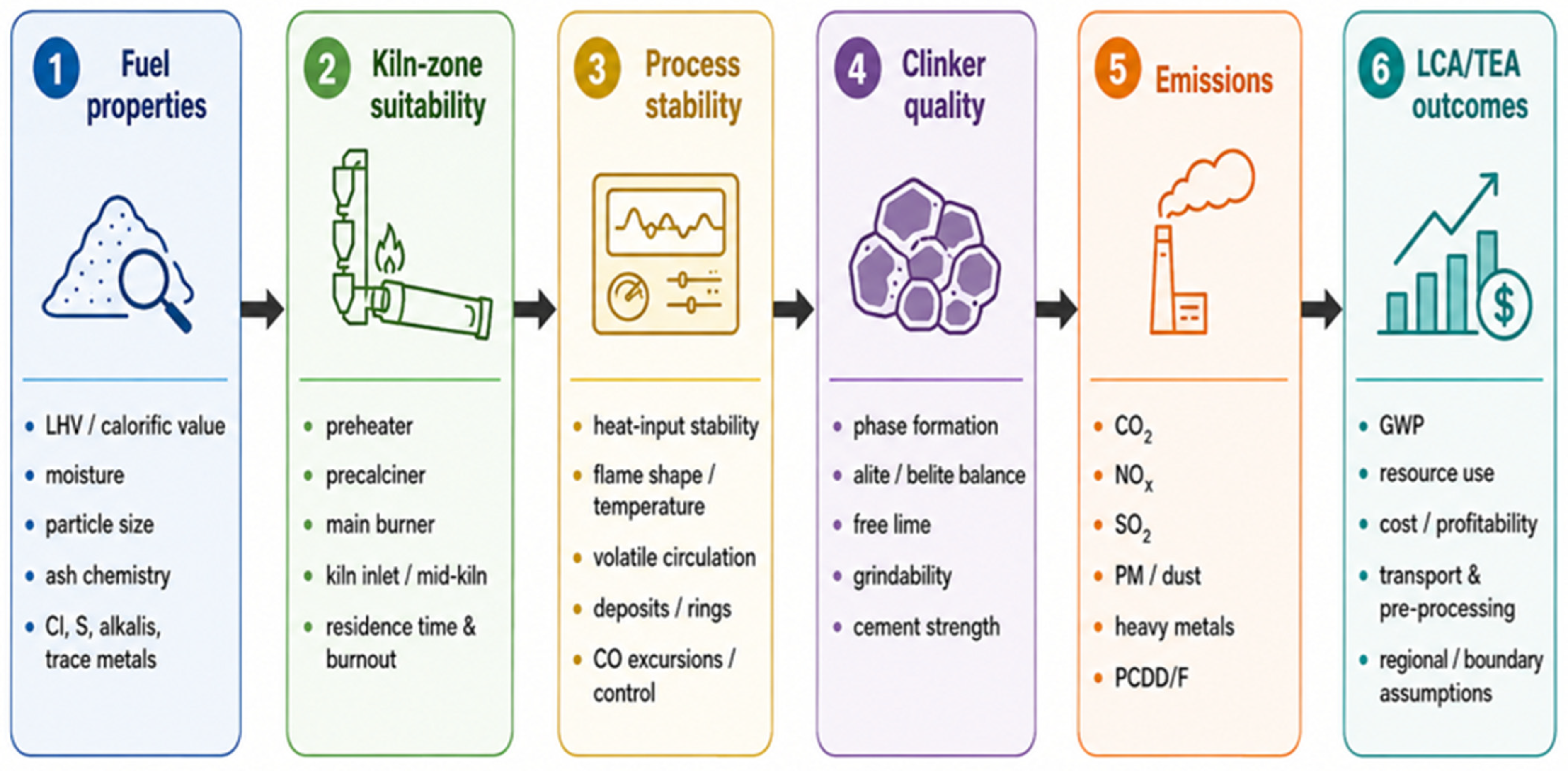
Thermo-Energetic and Environmental Assessment of Alternative Fuels in Cement Clinker Production: A Review


Abstract
1. Introduction
1.1. Background and Alternative-Fuel Context
1.2. Thermo-Energetic Basis for Alternative-Fuel Evaluation
1.3. Research Gap and Contribution of This Review
2. Technical Performance and Process Considerations
2.1. Fuel Properties and Combustion Behavior
2.1.1. Kiln Feeding and Combustion Dynamics
2.1.2. Kiln Stability and Control
2.2. Clinker Quality and Cement Properties
3. Environmental Performance and Life-Cycle Perspective
3.1. Direct Emissions and Air-Quality Implications
3.2. Life-Cycle Assessment Results
3.3. Research Needs and Limitations
3.3.1. Emissions Monitoring, Trace Elements, and Health-Risk Assessment
3.3.2. Operational Reliability and High-TSR Validation
3.3.3. Regional, Regulatory, and Methodological Transferability
3.3.4. Integration with Emerging Low-Carbon Kiln Technologies
4. Energy Characteristics and Efficiency
4.1. Fuel Calorific Value and Mass Flow
4.2. Thermal Substitution Rate and Co-Processing Maturity
4.3. Techno-Economic Considerations of Alternative-Fuel Co-Processing
5. Methodological Approaches Used in the Literature
5.1. Plant-Scale Trials and Industrial Case Studies
5.2. Pilot- and Laboratory-Scale Combustion Experiments
5.3. Process Simulation and Computational Fluid Dynamics
5.4. Life-Cycle Assessment
5.5. Limitations and Cross-Study Comparability
6. Comparative Synthesis with Existing Literature
7. Key Research Gaps and Strategic Future Directions
7.1. Long-Term and High-Substitution Effects
7.2. Fuel Quality and Pre-Processing Optimization
7.3. Co-Processing of Emerging Waste Types and Multi-Fuel Blends
7.4. Integration with Carbon Capture and Emerging Clinker Technologies
8. Conclusions
Author Contributions
Funding
Institutional Review Board Statement
Informed Consent Statement
Data Availability Statement
Conflicts of Interest
References
- Hemidat, S.; Saidan, M.; Al-Zu’bi, S.; Irshidat, M.; Nassour, A.; Nelles, M. Potential Utilization of RDF as an Alternative Fuel to be Used in Cement Industry in Jordan. Sustainability 2019, 11, 5819. [Google Scholar] [CrossRef]
- Bert, M.; Ogunlade, D.; de Coninck, H.; Loos, M. Carbon Dioxide Capture and Storage. In Intergovernmental Panel on Climate Change; Cambridge University Press: Cambridge, UK, 2005; Available online: https://www.ipcc.ch/site/assets/uploads/2018/03/srccs_wholereport-1.pdf (accessed on 20 April 2023).
- IEA. Technology Roadmap—Low-Carbon Transition in the Cement Industry; World Business Council for Sustainable Development (WBCSD): Geneva, Switzerland; International Energy Agency (IEA): Paris, France, 2018; Available online: https://www.iea.org/reports/technology-roadmap-low-carbon-transition-in-the-cement-industry (accessed on 18 December 2025).
- Khan, M.M.H.; Havukainen, J.; Horttanainen, M. Impact of utilizing solid recovered fuel on the global warming potential of cement production and waste management system: A life cycle assessment approach. Waste Manag. Res. 2021, 39, 561–572. [Google Scholar] [CrossRef]
- Andrew, R.M. Global CO2 emissions from cement production, 1928–2018. Earth Syst. Sci. Data 2019, 11, 1675–1710. [Google Scholar] [CrossRef]
- Habert, G.; Miller, S.A.; John, V.M.; Provis, J.L.; Favier, A.; Horvath, A.; Scrivener, K.L. Environmental impacts and decarbonization strategies in the cement and concrete industries. Nat. Rev. Earth Environ. 2020, 1, 559–573. [Google Scholar] [CrossRef]
- Scrivener, K.L.; John, V.M.; Gartner, E.M. Eco-efficient cements: Potential economically viable solutions for a low-CO2 cement-based materials industry. Cem. Concr. Res. 2018, 114, 2–26. [Google Scholar] [CrossRef]
- Pardo, N.; Moya, J.A.; Mercier, A. Prospective on the energy efficiency and CO2 emissions in the EU cement industry. Energy 2011, 36, 3244–3254. [Google Scholar] [CrossRef]
- Madlool, N.A.; Saidur, R.; Hossain, M.S.; Rahim, N.A. A critical review on energy use and savings in the cement industries. Renew. Sustain. Energy Rev. 2011, 15, 2042–2060. [Google Scholar] [CrossRef]
- Worrell, E.; Martin, N.; Price, L. Potentials for energy efficiency improvement in the US cement industry. Energy 2000, 25, 1189–1214. [Google Scholar] [CrossRef]
- Worrell, E.; Price, L.; Martin, N.; Hendriks, C.; Meida, L.O. Carbon dioxide emissions from the global cement industry. Annu. Rev. Energy Environ. 2001, 26, 303–329. [Google Scholar] [CrossRef]
- Benhelal, E.; Zahedi, G.; Shamsaei, E.; Bahadori, A. Global strategies and potentials to curb CO2 emissions in cement industry. J. Clean. Prod. 2013, 51, 142–161. [Google Scholar] [CrossRef]
- Ige, O.E.; Kabeya, M. Multi-Objective Optimization of Raw Mix Design and Alternative Fuel Blending for Sustainable Cement Production. Sustainability 2025, 17, 7438. [Google Scholar] [CrossRef]
- Morfopoulos, N.; Samolada, M.C. Effect of Waste-Derived Fuels (SRF/RDF) Composition on the Cement Industry’s Environmental Footprint. Waste Biomass Valorization 2025, 16, 4027–4040. [Google Scholar] [CrossRef]
- Schneider, M.; Romer, M.; Tschudin, M.; Bolio, H. Sustainable cement production—Present and future. Cem. Concr. Res. 2011, 41, 642–650. [Google Scholar] [CrossRef]
- Nkosi, N.; Muzenda, E.; Belaid, M.; Mateescu, C.; Bilal, P. A Review of the Recycling and Economic Development Initiative of South Africa (REDISA) Waste Tyre Management Plan: Successes and Failure. In Proceedings of the 7th International Renewable and Sustainable Energy Conference (IRSEC), Agadir, Morocc, 27–30 November 2019; pp. 1–8. [Google Scholar] [CrossRef]
- REDISA. Waste Tyres: Cost Effective Fuel for Cement Kilns; Green Economy Media: Western Cape, South Africa, 2016; p. greeneconomy. Available online: https://greeneconomy.media/waste-tyres-cost-effective-fuel-cement-kilns/ (accessed on 18 April 2026).
- Harris, D. (Ed.) Waste Tire as an Alternative Fuel of Cement Production Process; GEP Ecotech: Zhengzhou, China, 2022. [Google Scholar]
- Rahman, A.; Rasul, M.G.; Khan, M.M.K.; Sharma, S. Recent development on the uses of alternative fuels in cement manufacturing process. Fuel 2015, 145, 84–99. [Google Scholar] [CrossRef]
- Georgiopoulou, M.; Lyberatos, G. Life cycle assessment of the use of alternative fuels in cement kilns: A case study. J. Environ. Manag. 2018, 216, 224–234. [Google Scholar] [CrossRef]
- Chatterjee, A.; Sui, T. Alternative fuels—Effects on clinker process and properties. Cem. Concr. Res. 2019, 123, 105777. [Google Scholar] [CrossRef]
- Huntzinger, D.N.; Eatmon, T.D. A life-cycle assessment of Portland cement manufacturing: Comparing the traditional process with alternative technologies. J. Clean. Prod. 2009, 17, 668–675. [Google Scholar] [CrossRef]
- Stafford, F.N.; Dias, A.C.; Arroja, L.; Labrincha, J.A.; Hotza, D. Life cycle assessment of the production of Portland cement: A Southern Europe case study. J. Clean. Prod. 2016, 126, 159–165. [Google Scholar] [CrossRef]
- Çankaya, S.; Pekey, B. A comparative life cycle assessment for sustainable cement production in Turkey. J. Environ. Manag. 2019, 249, 109362. [Google Scholar] [CrossRef]
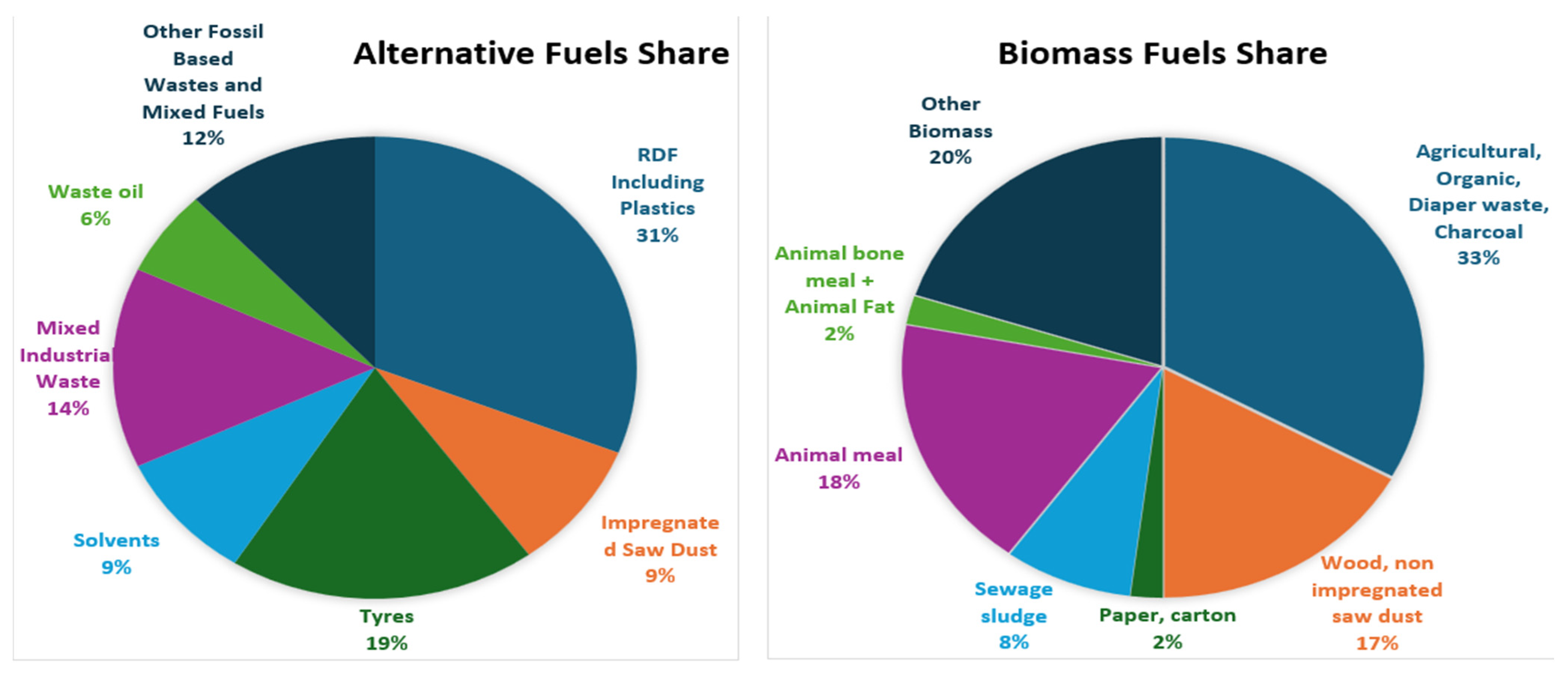
- GCCA. GNR 2.0—GCCA in Numbers. Percentage Distribution of Alternative Fuels and Biomass Waste; GCCA (Global Cement and Concrete Association): London, UK, 2025; Available online: https://gccassociation.org/gnr/ (accessed on 25 January 2026).
- Joint Research Centre. Deep Decarbonisation of Industry: The Cement Sector; European Commission European Countries: Brussels, Belgium, 2020; Available online: https://setis.ec.europa.eu/system/files/2021-02/jrc120570_decarbonisation_of_cement_fact_sheet_2.pdf (accessed on 18 April 2026).
- Nilsson, A.; Hans, F.; Lopez Legarreta, P.; Lui, S.; Röser, F. Decarbonisation Pathways for the EU Cement Sector. Technology Routes and Potential Ways Forward; International Atomic Energy Agency: Vienna, Austria, 2020; Available online: https://newclimate.org/wp-content/uploads/2020/12/SGCCC-EU-Cement-paper-NewClimate_Nov2020.pdf (accessed on 25 January 2026).
- Cement Europe. Cement Europe Position Paper on the EC Circular Economy Act Public Consultation; Cement Europe (The European Cement Association): Brussels, Belgium, 2025; Available online: https://www.cementeurope.eu/media/vadmxtnu/251105-cement-europe-position-paper.pdf (accessed on 27 January 2026).
- GCCA. GCCA Policy Document on Co-Processing; Global Cement and Concrete Association: London, UK, 2024; Available online: https://gccassociation.org/wp-content/uploads/2024/10/GCCA_Co-Processing_Policy.pdf (accessed on 25 January 2026).
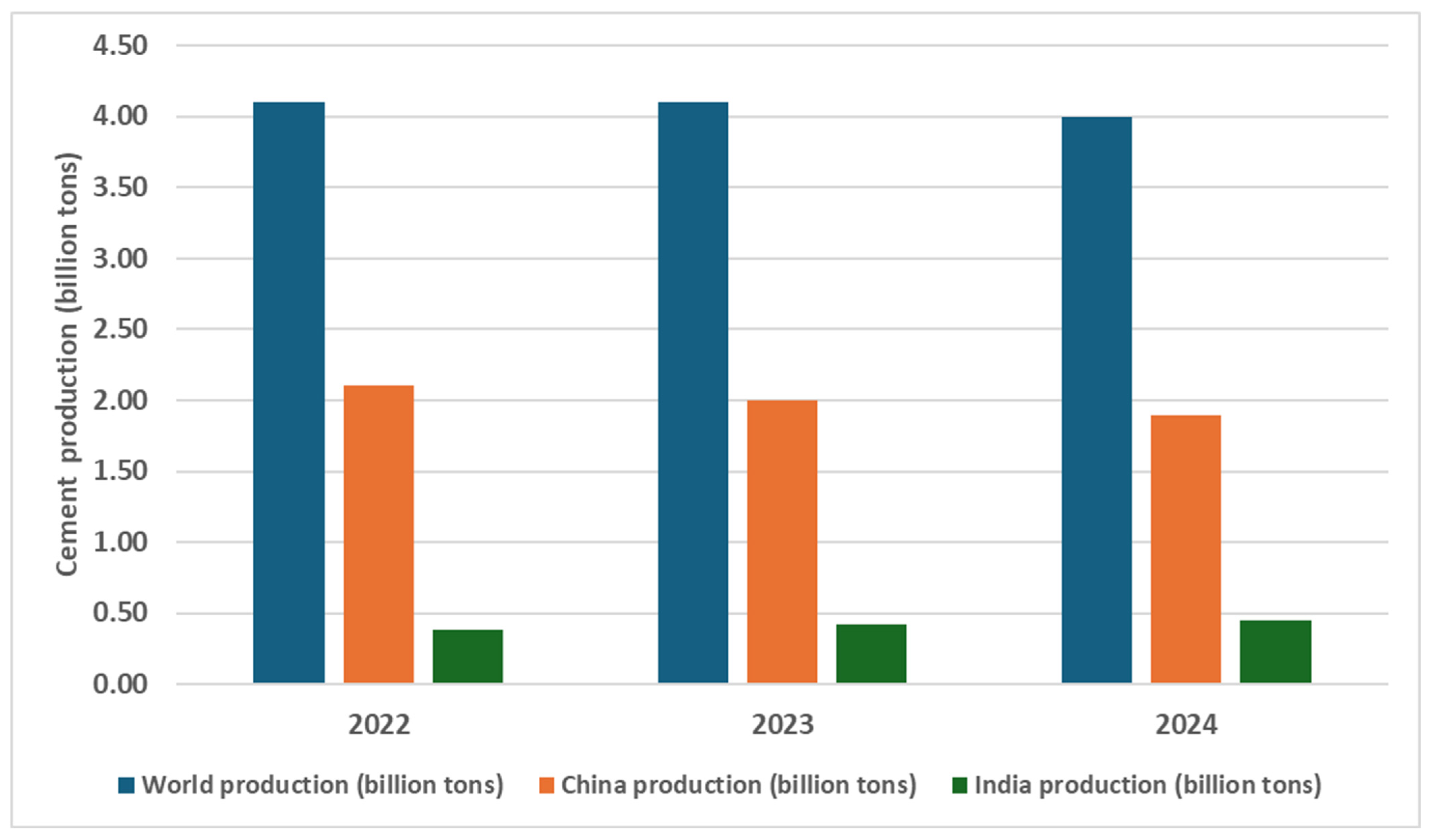
- IEA. Cement; International Energy Agency: Paris, France, 2024; Available online: https://www.iea.org/energy-system/industry/cement (accessed on 12 February 2026).
- USGS. Mineral Commodity Summaries 2025; U.S. Geological Survey: Reston, VA, USA, 2025; 212p. [CrossRef]
- Cembureau. What Is Co-Processing? Cembureau: Brussels, Belgium, 2025; Available online: https://www.cementeurope.eu/media/5esje2pa/cembureau-what-is-co-processing-may2025.pdf (accessed on 25 January 2026).
- Yongbin, F.; Shuyi, L.; Ting, L.; Wei, L.; Shujuan, L.; Yutao, W.; Lingfeng, X.; Rong, Y.; Menglu, Z.; Yi, Z.; et al. China Cement Association, China. 2022. Available online: https://www.energy-transitions.org/publications/decarbonization-roadmap-for-chinas-cement-industry-2 (accessed on 10 March 2026).
- Lakshmisha, C. Alternative Fuel: Maximising RDF Use in Karnataka’s Cement Industry. Renewable Watch. Available online: https://renewablewatch.in/2025/03/01/alternative-fuel-maximising-rdf-use-in-karnatakas-cement-industry/#:~:text=Alternative%20Fuel%3A%20Maximising%20RDF%20use,needs%20through%20RDF%20by%202031 (accessed on 25 January 2026).
- Nalobile, P.; Wachira, J.M.; Thiong’o, J.K.; Marangu, J.M. A Review on Pyroprocessing Techniques for Selected Wastes Used for Blended Cement Production Applications. Adv. Civ. Eng. 2020, 2020, 5640218. [Google Scholar] [CrossRef]
- Gao, H.; Wang, D.; Zhao, Z.; Dang, P. Reducing carbon emissions in the cement industry using effective measures based on countries’ characteristics. PLoS ONE 2024, 19, e0311859. [Google Scholar] [CrossRef] [PubMed]
- Ige, O.E.; Von Kallon, D.V.; Desai, D. Carbon emissions mitigation methods for cement industry using a systems dynamics model. Clean Technol. Environ. Policy 2024, 26, 579–597. [Google Scholar] [CrossRef]
- Svensen, J.L.; da Silva, W.R.L.; Jørgensen, J.B. A First-Engineering Principles Model for Dynamical Simulation of a Calciner in Cement Production. IFAC-PapersOnLine 2024, 58, 390–396. [Google Scholar] [CrossRef]
- Kahawalage, A. Numerical modeling of the calcination process in a cement kiln system. In Proceedings of the 58th Conference on Simulation and Modelling (SIMS 58), Reykjavik, Iceland, 25–27 September 2017. [Google Scholar] [CrossRef]
- Nhuchhen, D.R.; Sit, S.P.; Layzell, D.B. Alternative fuels co-fired with natural gas in the pre-calciner of a cement plant: Energy and material flows. Fuel 2021, 295, 120544. [Google Scholar] [CrossRef]
- Vermeiren, J.; Dilissen, N.; Goovaerts, V.; Vleugels, J. Electrification of clinker and calcination treatments in the cement sector by microwave technology—A review. Constr. Build. Mater. 2024, 428, 136271. [Google Scholar] [CrossRef]
- Schorcht, F.; Kourti, I.; Scalet, B.M.; Roudier, S.; Sancho, L.D. Best Available Techniques (BAT) Reference Document for the Production of Cement, Lime and Magnesium Oxide. Industrial Emissions Directive 2010/75/EU (Integrated Pollution Prevention and Control); European Commission Joint Research Centre Institute for Prospective Technological Studies, Luxembourg: Brussels, Belgium, 2013; Available online: https://bureau-industrial-transformation.jrc.ec.europa.eu/sites/default/files/2019-11/CLM_Published_def_0.pdf#:~:text=Kiln%20type%20Unit%20BAT,1%20000%20mg%2FNm3 (accessed on 10 March 2026).
- Moya, J.; Pardo, N.; Mercier, A. Energy efficiency and CO2 emissions: Prospective scenarios for the cement industry. In JRC Scientific and Technical Report, EUR; European Commission Joint Research Centre Institute for Energy: Petten, The Netherlands, 2010; Volume 24592, Available online: https://www.emccement.com/pdf/jrc-2010-energy_efficiency_and_co2_emissions__prospective_scenarios_for_the_cement_industry.pdf (accessed on 19 April 2026).
- Schindler, A.K.; Duke, S.R.; Burch, T.E.; Davis, E.W.; Zee, R.H.; Bransby, D.I.; Hopkins, C.; Thompson, R.L.; Duan, J.; Venkatasubramanian, V.; et al. Alternative Fuel for Portland Cement Processing; Office of Electricity, U.S. Department of Energy: Washington, DC, USA, 2012. Available online: https://www.osti.gov/biblio/1064407 (accessed on 30 June 2012).
- Amarasinghe, W.S.; Husum, I.; Tokheim, L.-A. Waste heat availability in the raw meal department of a cement plant. Case Stud. Therm. Eng. 2018, 11, 1–14. [Google Scholar] [CrossRef]
- Tsiliyannis, C.A. Cement manufacturing using alternative fuels: Enhanced productivity and environmental compliance via oxygen enrichment. Energy 2016, 113, 1202–1218. [Google Scholar] [CrossRef]
- Waltisberg, J.; Weber, R. Disposal of waste-based fuels and raw materials in cement plants in Germany and Switzerland—What can be learned for global co-incineration practice and policy? Emerg. Contam. 2020, 6, 93–102. [Google Scholar] [CrossRef]
- Beguedou, E.; Narra, S.; Afrakoma Armoo, E.; Agboka, K.; Damgou, M.K. Alternative Fuels Substitution in Cement Industries for Improved Energy Efficiency and Sustainability. Energies 2023, 16, 533. [Google Scholar] [CrossRef]
- Pedersen, M.N.; Nielsen, M.; Clausen, S.; Jensen, P.A.; Skaarup Jensen, L.; Dam-Johansen, K. Imaging of Flames in Cement Kilns To Study the Influence of Different Fuel Types. Energy Fuels 2017, 31, 11424–11438. [Google Scholar] [CrossRef]
- Shao, W.; Cui, Z.; Ma, X.-T. Experimental research on cement grate cooler system and numerical simulation of its clinker cooling process. Appl. Therm. Eng. 2020, 181, 115904. [Google Scholar] [CrossRef]
- Ma, X.; Shao, W.; Cui, Z. Energy and thermodynamic analysis of a typical cement production system based on experimental and simulated investigations. Case Stud. Therm. Eng. 2022, 38, 102357. [Google Scholar] [CrossRef]
- Cortada Mut, M.d.M.; Nørskov, L.K.; Frandsen, F.J.; Glarborg, P.; Dam-Johansen, K. Review: Circulation of Inorganic Elements in Combustion of Alternative Fuels in Cement Plants. Energy Fuels 2015, 29, 4076–4099. [Google Scholar] [CrossRef]
- Vasiliu, L.; Gencel, O.; Damian, I.; Harja, M. Capitalization of tires waste as derived fuel for sustainable cement production. Sustain. Energy Technol. Assess. 2023, 56, 103104. [Google Scholar] [CrossRef]
- Ige, O.E.; Kabeya, M. Comprehensive Evaluation of Waste-Derived Fuels As Sustainable Alternatives in Cement Production. Sci. Eng. Technol. 2025, 5, 149–170. [Google Scholar] [CrossRef]
- Gajewska, T.; Malinowski, M.; Szkoda, M. The Use of Biodrying to Prevent Self-Heating of Alternative Fuel. Materials 2019, 12, 3039. [Google Scholar] [CrossRef] [PubMed]
- 2013/163/EU: Commission Implementing Decision of 26 March 2013 Establishing the Best Available Techniques (BAT) Conclusions Under Directive 2010/75/EU of the European Parliament and of the Council on Industrial Emissions for the Production of Cement, Lime and Magnesium Oxide (Notified Under Document C(2013) 1728) Text with EEA Relevance; The European Commission: Brussels, Belgium, 2013; Available online: https://lawthek.eu/detail/52a13593-5282-4442-b1d4-2984b595c9a5/en/ (accessed on 25 January 2026).
- Gerassimidou, S.; Velis, C.A.; Williams, P.T.; Castaldi, M.J.; Black, L.; Komilis, D. Chlorine in waste-derived solid recovered fuel (SRF), co-combusted in cement kilns: A systematic review of sources, reactions, fate and implications. Crit. Rev. Environ. Sci. Technol. 2021, 51, 140–186. [Google Scholar] [CrossRef]
- Kahawalage, A.C.; Melaaen, M.C.; Tokheim, L.-A. Opportunities and challenges of using SRF as an alternative fuel in the cement industry. Clean. Waste Syst. 2023, 4, 100072. [Google Scholar] [CrossRef]
- Cortada Mut, M.d.M.; Nørskov, L.K.; Glarborg, P.; Dam-Johansen, K. SO2 Release as a Consequence of Alternative Fuel Combustion in Cement Rotary Kiln Inlets. Energy Fuels 2015, 29, 2729–2737. [Google Scholar] [CrossRef][Green Version]
- Tan, T.H.; Mo, K.H.; Lin, J.; Onn, C.C. An Overview of the Utilization of Common Waste as an Alternative Fuel in the Cement Industry. Adv. Civ. Eng. 2023, 2023, 7127007. [Google Scholar] [CrossRef]
- Sharma, P.; Sheth, P.N.; Mohapatra, B.N. Recent Progress in Refuse Derived Fuel (RDF) Co-processing in Cement Production: Direct Firing in Kiln/Calciner vs. Process Integration of RDF Gasification. Waste Biomass Valorization 2022, 13, 4347–4374. [Google Scholar] [CrossRef]
- WBCSD. Guidelines for co-processing fuels and raw materials in cement manufacturing. In Cement Sustainability Initiative (CSI); World Business Council for Sustainable Development: Geneva, Switzerland, 2014; Available online: https://docs.wbcsd.org/2015/10/CSI_Co-Processing_Fuels_and_Raw_Materials.pdf (accessed on 20 April 2026).
- Bernard, D.; Lemarchand, D.; Tétreault, N.; Theévenet, C. Increasing the Use of Alternative Fuels at Cement Plants: International Best Practice; International Finance Corporation Technical Report; International Finance Corporation, World Bank Group: Washington, DC, USA, 2017; Available online: https://www.ifc.org/content/dam/ifc/doc/mgrt-pub/alternative-fuels-08-04.pdf (accessed on 21 December 2025).
- Seboka, Y.; Getahun, M.A.; Haile-Meskel, Y. Biomass Energy for Cement Production: Opportunities in Ethiopia; United Nations Development Programme: New York, NY, USA, 2009; Available online: https://www.undp.org/sites/g/files/zskgke326/files/publications/Biomass_energy_for_cement_production_opportunities_barriers.pdf (accessed on 20 April 2026).
- Pedersen, M.N. Co-Firing of Alternative Fuels in Cement Kiln Burners. Ph.D. Thesis, CHEC Research CentreDepartment of Chemical and Biochemical Engineering, Technical University of Denmark, Kgs. Lyngby, Denmark, 2018. [Google Scholar]
- Chen, T.; Ma, Y.; Zhan, M.; Li, X.; Yan, J. Emission Characteristics of Pollutants from Co-processing Aged Refuse in a Bench-scale Simulated Cement Kiln. Aerosol Air Qual. Res. 2019, 19, 1377–1389. [Google Scholar] [CrossRef]
- ÖZtÜRk, B.; ÖZtÜRk, O.; Karademir, A. NOx emission modeling at cement plants with co-processing alternative fuels using ANN. Environ. Eng. Res. 2022, 27, 210270–210277. [Google Scholar] [CrossRef]
- Anasstasia, T.T.; Lestianingrum, E.; Cahyono, R.B.; Azis, M.M. Life Cycle Assessment of Refuse Derived Fuel (RDF) for Municipal Solid Waste (MSW) Management: Case Study Area Around Cement Industry, Cirebon, Indonesia. IOP Conf. Ser. Mater. Sci. Eng. 2020, 778, 012146. [Google Scholar] [CrossRef]
- Wu, W.-N.; Liu, X.-Y.; Hu, Z.; Zhang, R.; Lu, X.-Y. Improving the sustainability of cement clinker calcination process by assessing the heat loss through kiln shell and its influencing factors: A case study in China. J. Clean. Prod. 2019, 224, 132–141. [Google Scholar] [CrossRef]
- Sun, C.; Liu, P.; Guo, H.; Di, Y.; Xu, Q.; Hao, X. Control of Precalciner Temperature in the Cement Industry: A Novel Method of Hammerstein Model Predictive Control with ISSA. Processes 2023, 11, 214. [Google Scholar] [CrossRef]
- Ahamed, J.U.; Madlool, N.A.; Saidur, R.; Shahinuddin, M.I.; Kamyar, A.; Masjuki, H.H. Assessment of energy and exergy efficiencies of a grate clinker cooling system through the optimization of its operational parameters. Energy 2012, 46, 664–674. [Google Scholar] [CrossRef]
- Convention, S. Guidelines on Best Available Techniques and Provisional Guidance on Best Environmental Practices Relevant to Article 5 and Annex C of the Stockholm Convention on Persistent Organic Pollutants. Cement Kilns Firing Hazardous Waste; United Nations Environment Programme, Ed.; The Secretariat of the Stockholm Convention on Persistent Organic Pollutants: Geneva, Switzerland, 2007. [Google Scholar]
- Wojtacha-Rychter, K.; Smoliński, A. Multi-Case Study on Environmental and Economic Benefits through Co-Burning Refuse-Derived Fuels and Sewage Sludge in Cement Industry. Materials 2022, 15, 4176. [Google Scholar] [CrossRef]
- Chandrasekhar, K.; Pandey, S. Co-processing of RDF in Cement Plants. In Energy Recovery Processes from Wastes; Ghosh, S.K., Ed.; Springer: Singapore, 2020; pp. 225–236. [Google Scholar]
- El-Salamony, A.-H.R.; Mahmoud, H.M.; Shehata, N. Enhancing the efficiency of a cement plant kiln using modified alternative fuel. Environ. Nanotechnol. Monit. Manag. 2020, 14, 100310. [Google Scholar] [CrossRef]
- Kukreja, K.; Soni, M.K.; Mohapatra, B.; Rao, M.V.R. Decarbonising of the Indian Cement Industry Through Alternative Fuels—Challenge of Transfer Chute Jamming. Asian J. Water Environ. Pollut. 2023, 20, 71–77. [Google Scholar] [CrossRef]
- Keshk, W.F.; Hekal, E.E.S.; Mohamed, M.R. Mitigation of Greenhouse Gases Emissions and Reduction of Energy Consumption In Cement Industry In Egypt Case Study: Arabian Cement Plant. J. Environ. Sci. 2023, 52, 1–17. [Google Scholar] [CrossRef]
- Rivera Sasso, O.; Carreño Gallardo, C.; Soto Castillo, D.M.; Ojeda Farias, O.F.; Bojorquez Carrillo, M.; Prieto Gomez, C.; Herrera Ramirez, J.M. Valorization of Biomass and Industrial Wastes as Alternative Fuels for Sustainable Cement Production. Clean Technol. 2024, 6, 814–825. [Google Scholar] [CrossRef]
- Kaddatz, K.T.; Rasul, M.G.; Rahman, A. Alternative Fuels for use in Cement Kilns: Process Impact Modelling. Procedia Eng. 2013, 56, 413–420. [Google Scholar] [CrossRef]
- Sasso, O.R.; Espinoza, E.R.; Gallardo, C.C.; Sillas, J.E.L.; Diaz, A.D.; Farias, O.F.O.; Gomez, C.P.; Ramirez, J.M.H. Laboratory Quantification of Gaseous Emission from Alternative Fuel Combustion: Implications for Cement Industry Decarbonization. Materials 2025, 18, 4859. [Google Scholar] [CrossRef]
- Walenta, G.; Füllmann, T. Advances in quantitative XRD analysis for clinker, cements, and cementitious additions. Powder Diffr. 2004, 19, 40–44. [Google Scholar] [CrossRef]
- Khelifi, S.; Ayari, F.; Tiss, H.; Hassan Chehimi, D.B. X-ray fluorescence analysis of Portland cement and clinker for major and trace elements: Accuracy and precision. J. Aust. Ceram. Soc. 2017, 53, 743–749. [Google Scholar] [CrossRef]
- Tao, Y.; Li, N.; Zhang, W.; Wang, F.; Hu, S. Understanding the zinc incorporation into silicate clinker during waste co-disposal of cement kiln: A density functional theory study. J. Clean. Prod. 2019, 232, 329–336. [Google Scholar] [CrossRef]
- Zhu, J.; Yang, K.; Chen, Y.; Fan, G.; Zhang, L.; Guo, B.; Guan, X.; Zhao, R. Revealing the substitution preference of zinc in ordinary Portland cement clinker phases: A study from experiments and DFT calculations. J. Hazard. Mater. 2021, 409, 124504. [Google Scholar] [CrossRef]
- Aldrian, A.; Viczek, S.A.; Pomberger, R.; Sarc, R. Methods for identifying the material-recyclable share of SRF during co-processing in the cement industry. MethodsX 2020, 7, 100837. [Google Scholar] [CrossRef]
- Kinoshita, T.; Yamaguchi, K.; Akita, S.; Nii, S.; Kawaizumi, F.; Takahashi, K. Hydrometallurgical recovery of zinc from ashes of automobile tire wastes. Chemosphere 2005, 59, 1105–1111. [Google Scholar] [CrossRef]
- Chen, Q.Y.; Tyrer, M.; Hills, C.D.; Yang, X.M.; Carey, P. Immobilisation of heavy metal in cement-based solidification/stabilisation: A review. Waste Manag. 2009, 29, 390–403. [Google Scholar] [CrossRef]
- Wang, L.; Huang, X.; Li, X.; Bi, X.; Yan, D.; Hu, W.; Jim Lim, C.; Grace, J.R. Simulation of heavy metals behaviour during Co-processing of fly ash from municipal solid waste incineration with cement raw meal in a rotary kiln. Waste Manag. 2022, 144, 246–254. [Google Scholar] [CrossRef]
- Kosajan, V.; Wen, Z.; Fei, F.; Dinga, C.D.; Wang, Z.; Liu, P. Comprehensive assessment of cement kiln co-processing under MSW sustainable management requirements. Resour. Conserv. Recycl. 2021, 174, 105816. [Google Scholar] [CrossRef]
- Chatziaras, N.; Psomopoulos, C.S.; Themelis, N.J. Use of waste derived fuels in cement industry: A review. Manag. Environ. Qual. Int. J. 2016, 27, 178–193. [Google Scholar] [CrossRef]
- Kara, M. Environmental and economic advantages associated with the use of RDF in cement kilns. Resour. Conserv. Recycl. 2012, 68, 21–28. [Google Scholar] [CrossRef]
- Mateus, M.M.; Neuparth, T.; Cecílio, D.M. Modern Kiln Burner Technology in the Current Energy Climate: Pushing the Limits of Alternative Fuel Substitution. Fire 2023, 6, 74. [Google Scholar] [CrossRef]
- Karpan, B.; Abdul Raman, A.A.; Taieb Aroua, M.K. Waste-to-energy: Coal-like refuse derived fuel from hazardous waste and biomass mixture. Process Saf. Environ. Prot. 2021, 149, 655–664. [Google Scholar] [CrossRef]
- Panahandeh, A.; Asadollahfardi, G.; Mirmohammadi, M. Life cycle assessment of clinker production using refuse-derived fuel: A case study using refuse-derived fuel from Tehran municipal solid waste: Reducing emissions and conserving fossil fuel in cement making and making beneficial use of solid waste. Environ. Qual. Manag. 2017, 27, 57–66. [Google Scholar] [CrossRef]
- Beressa, L.; Vijaya Saradhi, B. Life Cycle Assessment of Ethiopian Cement Manufacturing: A Potential Improvement on the Use of Fossil Fuel in Mugher Cement Factory. Appl. Environ. Res. 2021, 43, 100–112. [Google Scholar] [CrossRef]
- Ige, O.E.; Olanrewaju, O.A. Comparative Life Cycle Assessment of Different Portland Cement Types in South Africa. Clean Technol. 2023, 5, 901–920. [Google Scholar] [CrossRef]
- Akintayo, B.D.; Olanrewaju, O.A.; Olanrewaju, O.I. Life Cycle Assessment of Ordinary Portland Cement Production in South Africa: Mid-Point and End-Point Approaches. Sustainability 2024, 16, 3001. [Google Scholar] [CrossRef]
- Ige, O.E.; Olanrewaju, O.A.; Duffy, K.J.; Collins, O.C. Environmental Impact Analysis of Portland Cement (CEM1) Using the Midpoint Method. Energies 2022, 15, 2708. [Google Scholar] [CrossRef]
- Ige, O.E. Integrated Life Cycle Assessment and System Dynamics Model for Prediction of Cement Production and Environmental Impact of Cement Industry. Doctoral Dissertation, Durban University of Technology, Durban, South Africa, 2023. Available online: https://hdl.handle.net/10321/4850 (accessed on 20 April 2026).
- Sayad, T.; Moursy, F.I.; El-Tantawi, A.M.; Saad, M.; Morsy, M. Assessment the impact of different fuels used in cement industry on pollutant emissions and ambient air quality: A case study in Egypt. J. Environ. Health Sci. Eng. 2023, 21, 107–121. [Google Scholar] [CrossRef]
- Nielsen, A.R.; Larsen, M.B.; Glarborg, P.; Dam-Johansen, K. High-Temperature Release of SO2 from Calcined Cement Raw Materials. Energy Fuels 2011, 25, 2917–2926. [Google Scholar] [CrossRef]
- Ige, O.E.; Duffy, K.J.; Olanrewaju, O.A.; Collins, O.C. An Integrated System Dynamics Model and Life Cycle Assessment for Cement Production in South Africa. Atmosphere 2022, 13, 1788. [Google Scholar] [CrossRef]
- Mainier, F.B.; Monteiro, L.P.C.; Mainier, R.J. Socio-environmental Impacts Associated with Burning Alternative Fuels in Clinker Kilns. Eng. Technol. Appl. Sci. Res. 2013, 3, 479–482. [Google Scholar] [CrossRef]
- Salaripoor, H.; Yousefi, H.; Abdoos, M. Life cycle environmental assessment of Refuse-Derived Fuel (RDF) as an alternative to fossil fuels in cement production: A sustainable approach for mitigating carbon emissions. Fuel Commun. 2025, 22, 100135. [Google Scholar] [CrossRef]
- Ige, O.E.; Kabeya, M. Fuel Substitution in Cement Production: A Comparative Life Cycle Assessment of Refuse-Derived Fuel and Coal. Sci 2025, 7, 184. [Google Scholar] [CrossRef]
- Çankaya, S. Investigating the environmental impacts of alternative fuel usage in cement production: A life cycle approach. Environ. Dev. Sustain. 2020, 22, 7495–7514. [Google Scholar] [CrossRef]
- Çankaya, S.; Pekey, B. Comparative life cycle assessment of clinker production with conventional and alternative fuels usage in Turkey. Int. J. Environ. Sci. Dev. 2018, 9, 213–217. [Google Scholar] [CrossRef]
- Stafford, F.N.; Raupp-Pereira, F.; Labrincha, J.A.; Hotza, D. Life cycle assessment of the production of cement: A Brazilian case study. J. Clean. Prod. 2016, 137, 1293–1299. [Google Scholar] [CrossRef]
- Moretti, L.; Caro, S. Critical analysis of the life cycle assessment of the Italian cement industry. J. Clean. Prod. 2017, 152, 198–210. [Google Scholar] [CrossRef]
- Huang, Y.; Liu, J.; Yang, L.; Li, X.; Hu, G.; Wang, G.; Sun, G.; Li, Z. Fate of Lead and Cadmium in Precalciner Cement Plants and Their Atmospheric Releases. ACS Omega 2021, 6, 21265–21275. [Google Scholar] [CrossRef]
- Lv, D.; Zhu, T.; Liu, R.; Li, X.; Zhao, Y.; Sun, Y.; Wang, H.; Zhang, F.; Zhao, Q. Effects of Co-Processing Sewage Sludge in the Cement Kiln on PAHs, Heavy Metals Emissions and the Surrounding Environment. Int. J. Environ. Res. Public Health 2018, 15, 698. [Google Scholar] [CrossRef] [PubMed]
- Saha, P.K.; Karstensen, K.H. Co-processing of Alternative Fuels and Resources in Indian Cement Industry—Baseline and Potential. In Waste Valorisation and Recycling; Ghosh, S.K., Ed.; Springer: Singapore, 2019; pp. 19–29. [Google Scholar] [CrossRef]
- Confederation of Indian Industry. Energy Benchmarking for Indian Cement Industry; Confederation of Indian Industry: Hyderabad, India, 2025; Available online: https://energy.greenbusinesscentre.com/mv/greencementech/pub24/CementBenchmarking14_May_25.pdf (accessed on 12 March 2026).
- Abu-Elyazeed, O.S.M.; Nofal, M.; Ibrahim, K.; Yang, J. Co-combustion of RDF and biomass mixture with bituminous coal: A case study of clinker production plant in Egypt. Waste Dispos. Sustain. Energy 2021, 3, 257–266. [Google Scholar] [CrossRef]
- Sakri, A.; Aouabed, A.; Nassour, A.; Nelles, M. Refuse-derived fuel potential production for co-combustion in the cement industry in Algeria. Waste Manag. Res. 2021, 39, 1174–1184. [Google Scholar] [CrossRef]
- Castañón, A.M.; Sanmiquel, L.; Bascompta, M.; Vega y de la Fuente, A.; Contreras, V.; Gómez-Fernández, F. Used Tires as Fuel in Clinker Production: Economic and Environmental Implications. Sustainability 2021, 13, 10455. [Google Scholar] [CrossRef]
- De Beer, J.; Cihlar, J.; Hensing, I.; Zabeti, M. Status and Prospects of Co-Processing of Waste in EU Cement Plants; Ecofys Publication: Utrecht, The Netherlands, 2017; Available online: https://coprocessamento.org.br/wp-content/uploads/2019/09/Ecofys_Status_prospects_coprocessing_waste_EU_cement_plants-20170426.pdf (accessed on 21 December 2025).
- Cembureau. Cembureau Key Facts & Figures; Cembureau: Brussels, Belgium, 2024; Available online: https://www.cementeurope.eu/media/mfxkmxnx/key-facts-figures-publication-june-2024.pdf (accessed on 20 April 2026).
- IEA. Technology Roadmap: Low-Carbon Technology for the Indian Cement Industry; International Energy Agency: Paris, France, 2013; Available online: https://docs.wbcsd.org/2013/02/Low_Carbon_Technology_for_the_Indian_Cement_Industry_IEA_WBCSD_Feb_2013.pdf (accessed on 12 March 2026).
- International Finance Corporation (IFC). Unlocking Value: Alternative Fuels for Egypt’s Cement Industry; International Finance Corporation, World Bank: Cairo, Egypt, 2016; Available online: https://www.ifc.org/en/insights-reports/2016/alternative-fuels (accessed on 12 March 2026).
- Alternative Fuel Use in Cement Manufacturing: Implications, Opportunities and Barriers in Ontario; The Pembina Institute and Environmental Defence: Calgary, AB, Canada, 2014; Available online: https://www.pembina.org/reports/alternative-fuel-use-cement.pdf#:~:text=Table%202%20shows%20the%20breakdown,less%20GHG%20intensive (accessed on 22 April 2026).
- Sarc, R.; Lorber, K.; Pomberger, R.; Rogetzer, M.; Sipple, E. Design, quality, and quality assurance of solid recovered fuels for the substitution of fossil feedstock in the cement industry. Waste Manag. Res. 2014, 32, 565–585. [Google Scholar] [CrossRef] [PubMed]
- Reza, B.; Soltani, A.; Ruparathna, R.; Sadiq, R.; Hewage, K. Environmental and economic aspects of production and utilization of RDF as alternative fuel in cement plants: A case study of Metro Vancouver Waste Management. Resour. Conserv. Recycl. 2013, 81, 105–114. [Google Scholar] [CrossRef]
- Cortada Mut, M.d.M. Sulfur Release During Alternative Fuels Combustion in Cement Rotary Kilns; Technical University of Denmark, Department of Chemical and Biochemical: Kongens Lyngby, Denmark, 2014. [Google Scholar]
- Damø, A.J.; Cafaggi, G.; Pedersen, M.N.; Nakhaei, M.; Wang, X.; Frandsen, F.J.; Jensen, P.A.; Wu, H. Full-scale investigations of initial deposits formation in a cement plant co-fired with coal and SRF. Fuel 2023, 344, 128058. [Google Scholar] [CrossRef]
- Nakomcic-Smaragdakis, B.; Cepic, Z.; Senk, N.; Doric, J.; Radovanovic, L. Use of scrap tires in cement production and their impact on nitrogen and sulfur oxides emissions. Energy Sources Part A Recovery Util. Environ. Eff. 2016, 38, 485–493. [Google Scholar] [CrossRef]
- Husillos Rodríguez, N.; Martínez-Ramírez, S.; Blanco-Varela, M.T.; Donatello, S.; Guillem, M.; Puig, J.; Fos, C.; Larrotcha, E.; Flores, J. The effect of using thermally dried sewage sludge as an alternative fuel on Portland cement clinker production. J. Clean. Prod. 2013, 52, 94–102. [Google Scholar] [CrossRef]
- Hashem, F.S.; Razek, T.A.; Mashout, H.A. Rubber and plastic wastes as alternative refused fuel in cement industry. Constr. Build. Mater. 2019, 212, 275–282. [Google Scholar] [CrossRef]
- Sai Kishan, G.; Himath Kumar, Y.; Sakthivel, M.; Vijayakumar, R.; Lingeshwaran, N. Life cycle assesment on tire derived fuel as alternative fuel in cement industry. Mater. Today Proc. 2021, 47, 5483–5488. [Google Scholar] [CrossRef]
- Wang, Z.; Zhou, Y.; Hua, S.; Zhang, D. Investigation of the Effects and Mechanisms of Biomass-Derived Alternative Fuels on Cement Clinker Formation and Hydration Processes. Appl. Sci. 2025, 15, 6294. [Google Scholar] [CrossRef]
- Nakhaei, M.; Wu, H.; Grévain, D.; Jensen, L.S.; Glarborg, P.; Dam–Johansen, K. CPFD simulation of petcoke and SRF co–firing in a full–scale cement calciner. Fuel Process. Technol. 2019, 196, 106153. [Google Scholar] [CrossRef]
- Hercog, J.; Lewtak, R.; Glot, B.; Jóźwiak, P.; Nehring, G.; Tavares, V.D.; Nunes, A.M.; Gaspar, D. Pilot testing and numerical simulations of the multifuel burner for the cement kiln. Fuel 2023, 342, 127801. [Google Scholar] [CrossRef]
- Ariyaratne, W.K.H.; Malagalage, A.; Melaaen, M.C.; Tokheim, L.-A. CFD modelling of meat and bone meal combustion in a cement rotary kiln—Investigation of fuel particle size and fuel feeding position impacts. Chem. Eng. Sci. 2015, 123, 596–608. [Google Scholar] [CrossRef]
- Hökfors, B.; Eriksson, M.; Viggh, E. Modelling the cement process and cement clinker quality. Adv. Cem. Res. 2014, 26, 311–318. [Google Scholar] [CrossRef]
- Alcaide-Moreno, A.; Castán-Lascorz, M.Á. An Efficient Numerical Model for Fast Simulation of the Combustion of Alternative Fuels in a Cement Rotary Kiln. Waste Biomass Valorization 2025, 16, 2405–2433. [Google Scholar] [CrossRef]
- Wang, Y.; Xu, Y.; Song, X.; Sun, Q.; Zhang, J.; Liu, Z. Novel method for temperature prediction in rotary kiln process through machine learning and CFD. Powder Technol. 2024, 439, 119649. [Google Scholar] [CrossRef]
- Wydrych, J.; Dobrowolski, B. Numerical calculations of limestone calcination in cement industry with use of shrink core model. AIP Conf. Proc. 2019, 2078, 020034. [Google Scholar] [CrossRef]
- Pieper, C.; Liedmann, B.; Wirtz, S.; Scherer, V.; Bodendiek, N.; Schaefer, S. Interaction of the combustion of refuse derived fuel with the clinker bed in rotary cement kilns: A numerical study. Fuel 2020, 266, 117048. [Google Scholar] [CrossRef]
- Rahman, A.; Rasul, M.G.; Khan, M.M.K.; Sharma, S. Aspen Plus Based Simulation for Energy Recovery from Waste to Utilize in Cement Plant Preheater Tower. Energy Procedia 2014, 61, 922–927. [Google Scholar] [CrossRef]
- Zhang, Y.; Cao, S.-X.; Shao, S.; Chen, Y.; Liu, S.-L.; Zhang, S.-S. Aspen Plus-based simulation of a cement calciner and optimization analysis of air pollutants emission. Clean Technol. Environ. Policy 2011, 13, 459–468. [Google Scholar] [CrossRef]
- Faria, D.G.; Carvalho, M.M.O.; Neto, M.R.V.; de Paula, E.C.; Cardoso, M.; Vakkilainen, E.K. Integrating oxy-fuel combustion and power-to-gas in the cement industry: A process modeling and simulation study. Int. J. Greenh. Gas Control 2022, 114, 103602. [Google Scholar] [CrossRef]
- Rahman, A.; Rasul, M.; Khan, M.; Sharma, S. Assessment of energy performance and emission control using alternative fuels in cement industry through a process model. Energies 2017, 10, 1996. [Google Scholar] [CrossRef]
- Mikulčić, H.; von Berg, E.; Vujanović, M.; Priesching, P.; Tatschl, R.; Duić, N. Numerical analysis of cement calciner fuel efficiency and pollutant emissions. Clean Technol. Environ. Policy 2013, 15, 489–499. [Google Scholar] [CrossRef]
- Güereca, L.P.; Torres, N.; Juárez-López, C.R. The co-processing of municipal waste in a cement kiln in Mexico. A life-cycle assessment approach. J. Clean. Prod. 2015, 107, 741–748. [Google Scholar] [CrossRef]
- Hasanbeigi, A.; Bhadbhade, N. Emissions Impacts of Alternative fuels COMBUSTION in the Cement Industry; Global Efficiency Intelligence: St. Petersburg, FL, USA, 2023; Available online: https://www.globalefficiencyintel.com/emissions-impacts-of-alternative-fuels-combustion-in-the-cement-industry (accessed on 10 December 2025).
- WBCSD. The Cement Sustainability Initiative; World Business Council for Sustainable Development: Geneva, Switzerland, 2012; Available online: https://archive.wbcsd.org/Sector-Projects/Cement-Sustainability-Initiative/Cement-Sustainability-Initiative-CSI (accessed on 20 December 2025).
- Cellura, M.; Cusenza, M.A.; Longo, S. Energy-related GHG emissions balances: IPCC versus LCA. Sci. Total Environ. 2018, 628–629, 1328–1339. [Google Scholar] [CrossRef]
- Pitre, V.; La, H.; Bergerson, J.A. Impacts of alternative fuel combustion in cement manufacturing: Life cycle greenhouse gas, biogenic carbon, and criteria air contaminant emissions. J. Clean. Prod. 2024, 475, 143717. [Google Scholar] [CrossRef]
- Ferronato, N.; Giaquinta, C.; Conti, F.; Torretta, V. When solid recovered fuel (SRF) production and consumption maximize environmental benefits? A life cycle assessment. Waste Manag. 2024, 178, 199–209. [Google Scholar] [CrossRef]
- Aberger, J.; Shami, S.; Häcker, B.; Pestana, J.; Khodier, K.; Sarc, R. Prototype of AI-powered assistance system for digitalisation of manual waste sorting. Waste Manag. 2025, 194, 366–378. [Google Scholar] [CrossRef] [PubMed]
- Lubongo, C.; Alexandridis, P. Assessment of Performance and Challenges in Use of Commercial Automated Sorting Technology for Plastic Waste. Recycling 2022, 7, 11. [Google Scholar] [CrossRef]
- Simo-Tagne, M.; Stéphan, A.; Perré, P.; L’Hostis, C.; Rémond, R. On-line evaluation of moisture transfer properties for a feed-forward control of a wood drying kiln with a mechanistic model. Dry. Technol. 2024, 42, 2348–2361. [Google Scholar] [CrossRef]
- Wojtacha-Rychter, K.; Kucharski, P.; Smolinski, A. Conventional and Alternative Sources of Thermal Energy in the Production of Cement—An Impact on CO2 Emission. Energies 2021, 14, 1539. [Google Scholar] [CrossRef]
- Lin, H.; Yao, X.; Wang, X.; Zhang, X.; Mao, H.; Zhang, J.; Li, X.; Shu, Y.; Vujanovic, M.; Mikulčić, H. Green ammonia co-firing in cement rotary kiln: Numerical investigation on clinker quality and NOx emission by gas–solid interaction. Appl. Therm. Eng. 2025, 277, 127116. [Google Scholar] [CrossRef]
- Valera-Medina, A.; Amer-Hatem, F.; Azad, A.K.; Dedoussi, I.C.; de Joannon, M.; Fernandes, R.X.; Glarborg, P.; Hashemi, H.; He, X.; Mashruk, S.; et al. Review on Ammonia as a Potential Fuel: From Synthesis to Economics. Energy Fuels 2021, 35, 6964–7029. [Google Scholar] [CrossRef]
- Eckart, S.; Salzano, E.; Richter, A.; Alnajideen, M.; Valera-Medina, A.; Shrestha, K.P.; Yasiry, A.; Wang, J.; Bauer, F.; Yu, C.; et al. Exploring the potential of ammonia as a fuel: Advances in combustion understanding and large-scale furnace applications. Fuel 2026, 403, 136746. [Google Scholar] [CrossRef]
- Moses, J.K.; Tivfa, T.A.; Qasem, N.A.A.; Alquaity, A.B.S. Combustion characteristics of hydrogen, ammonia, and their blends: A review. Fuel 2025, 388, 134404. [Google Scholar] [CrossRef]
- Pashchenko, D.I. Ammonia as a Fuel for Gas-Turbine Units with Thermochemical Recuperation of Exhaust Gas Heat. Therm. Eng. 2025, 72, 1–7. [Google Scholar] [CrossRef]





| Process Stage | Temperature Range | Thermal Function | Specific Heat Demand | Fuel and a Typical Feeding Point | Reference |
|---|---|---|---|---|---|
| Raw milling and drying | Preheater exit gas typically 300–400 °C; conditioned mill-entry gas often 180–260 °C | Moisture removal, raw meal drying, size reduction, homogenization | Uses recovered exhaust heat rather than the plant’s highest-grade heat | Limited direct relevance for AF choice; affected indirectly by kiln/preheater gas temperature and false-air control | [43,44,45] |
| Cyclone preheater | Upper stages are broadly several hundred °C; calcination onset can begin around 600 °C; lower-stage meal approaches the calciner window. | Sensible heating and initial decarbonation | A major part of total kiln efficiency comes from heat recuperation here; poor recuperation increases kiln fuel demand. | Usually, there is no dedicated direct firing in dry systems; strongly influenced by gas chemistry, deposits, and volatile circulation. | [38,43,46,47] |
| Precalciner | Common calcination window about 850–900 °C; industrial operation often described as roughly 900–1100 °C | Main decarbonation reactor; completion of ~85–95% of calcination before kiln entry | Calcination of CaCO3 requires about 1.7 MJ kg−1, validated modern-clinker systems can operate near 3.3 GJ t−1 clinker total thermal intensity | Principal AF feeding point in dry kilns; fuel is introduced with tertiary air; medium-LHV or coarser solid fuels are often more suitable here than at the main burner | [38,39,40,48] |
| Rotary kiln transition and burning zone | Feed rises rapidly through the transition zone; solids in burning zone about 1450 °C; gas/flame broadly 1450–2000 °C | Final decarbonation, solid-state reactions, liquid-phase formation, and clinker mineral development | This stage has the highest thermal requirement; practical kiln-system demand remains well above theoretical reaction heat due to sensible heating and losses. | Main-burner duty favors premium, low-moisture, fast-burning fuels; unsuitable fuels lengthen the ignition distance and weaken flame intensity. | [40,43,46,48,49] |
| Clinker cooler | Entering clinker broadly 1200–1400 °C; discharged clinker is often targeted near 100–150 °C or below about 100–200 °C, depending on plant practice | Rapid quench to preserve clinker mineralogy and recover sensible heat | Secondary and tertiary air can account for about 50% of total cooler heat output, discharged air about 40%, and hot clinker about 9% in measured balances | No primary fuel input; cooler performance controls secondary-air and tertiary-air temperature, which in turn affects both main-burner and calciner combustion | [50,51] |
| Parameter | BAT Guidance | RDF | TDF | Biomass | Kiln Operational Relevance | Pre-Treatment and Controls |
|---|---|---|---|---|---|---|
| Net calorific value (MJ kg) | 14 | 15–20 | 28–32 | 8–18 | Stable flame and heat input; clinker burnability control | Blending, size reduction, routine sampling and calorific-value testing |
| Moisture (wt. %) | 15 | 15 | 10 | 15–20 | High moisture lowers the flame temperature, increases the gas/solids flow rate, and causes instability. | Drying/biodrying; covered storage; drainage or dewatering |
| Chlorine (wt. %) | 0.5–0.8 | 0.6–0.8 | 0.5 | 0.2–0.3 | Volatile cycling to ring/coating formation; bypass requirement; corrosion risk | Remove polyvinyl chloride plastics; improve sorting; implement input control; kiln bypass if required. |
| Sulfur (wt. %) | 2.5 | 2.5 | 2.0–2.5 | 0.5–1.0 | Sulfate/alkali balance affects build-ups and emissions | Raw-mix balancing; bypass control; sulfur-to-alkali ratio ratio management |
| Ash (wt. %) | Site-specific | Low–moderate | Low | Low–moderate | Alters raw-mix chemistry and clinker mineralogy; affects free lime | Ash accounting in mix design, feeder calibration, supplier quality assurance |
| Integration Aspect | Kiln Injection Point (s) | Basis for Selection | Combustion Behavior | Thermal Profile Effect | Operational Adjustment |
|---|---|---|---|---|---|
| RDF/biomass (processed) | Precalciner/main burner | Better dispersion and burnout under controlled particle size and moisture | Slower burnout than coal; distributed heat release. | Heat release may shift downstream, producing a longer, cooler flame | Burner settings, flame momentum, and secondary-air distribution/temperature |
| TDF (whole/chipped) | Mid-kiln/kiln inlet/back end | Longer gas residence time supports complete breakdown | Stable energy release, but compositional concerns sulfur and metal (Zn) | Comparable flame-shaped effects depending on feed form and dosing | Controlled feed rate, handling and metering |
| Process implication | Residence time matched to burnout. | longer flame and lower peak temperature at the main burner | Hot-zone displacement risk, requiring air and burner correction | Maintain sintering temperature range (1400–1450 °C) and clinker quality |
| Challenges | Cause Factor | Mitigation |
|---|---|---|
| Heat-input variability | Variation in calorific value, moisture and particle size | Install accurate metering and dosing; employ online calorimetry; implement fuel blending |
| Incomplete combustion/CO surges | Large particle size, high moisture, poor dispersion | Ensure good dispersion; maintain adequate oxygen; temporarily suspend alternative-fuel feeding during start-up/shut-down or low O2 conditions |
| Deposit formation, clogging and ring build-up | Volatile Cl, S and alkalis condense in cooler zones | Limit Cl and S input; install bypass for high Cl; adjust raw-mix chemistry; manage temperature profile |
| High flue-gas volume/dust carryover | Higher mass flow for low CV fuels; increased primary air for conveying | Optimize preheater and cooler settings; adjust fan capacity; improve dust collection |
| Increased process variability | Rapid changes in fuel quality or feed rate | Use advanced process control (model predictive control); implement feed-forward control based on fuel properties |
| Fuel Type | Main Ash/Minor-Element Inputs | Main Mechanisms Affecting Clinker Formation | Clinker/Cement Impact | Practical Control Limits | Monitoring and Control Strategy | Reference |
|---|---|---|---|---|---|---|
| Biomass | Alkalis (K2O, Na2O), SiO2, CaO, MgO, P2O5; composition strongly feedstock-dependent | Phosphorus can enter silicate phases and stabilize belite (C2S) at the expense of C3S; alkalis intensify internal circulation and may alter melt chemistry and burnability | Higher belite fraction; Increased free lime and reduced C3S formation at elevated P2O5 input; possible reduction in early-age strength; altered clinker reactivity; greater process instability where alkali input is high and kiln-cycle stability depending on ash composition | Control total P2O5 input; avoid excessive alkali loading; avoid approximately 0.5–1.0 wt. % where belite/free-lime effects become significant; site-specific thresholds should be set through raw-mix and clinker chemistry control | XRF/XRD monitoring, raw-mix correction, biomass selection/blending, ash accounting in kiln feed, tighter alkali–sulfur balance control | [21,81,82] |
| TDF | Zn, Fe, S, Ca; minor metals from steel and additives in tire structure | Zinc can partition into clinker phases and promote Zn-bearing spinel formation (e.g., franklinite); excessive Zn can suppress C3S formation; sulfur contributes to sulfate balance and internal circulation | Potential inhibition of C3S formation, higher belite fraction, possible adverse effect on early strength at excessive ZnO input; sulfur-related deposit/build-up risk if sulfate balance is disturbed | Control total ZnO and SO3/S-alkali balance in clinker/system input; maintain site-specific metal and sulfur acceptance limits; avoid excessive TDF share without chemistry compensation | Continuous fuel-quality control; metal-content surveillance; sulfur balance control through raw mix and bypass where required; correlate clinker-phase composition with TDF input | [21,83,84] |
| RDF | Heterogeneous ash containing SiO2, Al2O3, CaO, alkalis, Cl, S, trace metals; composition depends on waste source and pre-processing quality | Highly heterogeneous ash affects raw-mix chemistry; chlorine, alkalis, and sulfur promote volatilization-condensation cycling; trace metals may accumulate in dust/clinker; indirect effects arise through process instability and altered thermal profile. | Greater variability in clinker chemistry; risk of kiln instability, ring formation, coating build-up, and indirect effects on clinker mineralogy and cement consistency; product quality risk increases with poor fuel specification control | Control total Cl input, sulfur input, ash variability, and trace-metal content; site-specific acceptance criteria required for stable long-duration operation | Continuous fuel QC; improved sorting and PVC removal; blending and pre-processing; online or routine monitoring of ash chemistry, halogens, sulfur, and heavy metals; integrate ash into kiln-feed calculations | [55,74,85,86] |
| Region | Cement-Production Relevance | TSR (%) | Potential Rate (%) | Long-Term Rate (%) | Key Interpretation | Reference |
|---|---|---|---|---|---|---|
| EU | A minor share of global cement output, but the most mature co-processing region | 56 | 65–80 | 80–90 | Most mature co-processing benchmark, supported by established waste-supply chains and strong regulatory frameworks | [27,28,117,118] |
| US | Major industrial producer with advanced decarbonization policy activity | 16 | - | - | Demonstrates growing but still moderate substitution relative to leading EU practice | [30] |
| China | Largest global cement producer | <2 | - | - | Highest potential global decarbonization leverage, but routine co-processing remains limited. | [30,33] |
| India | Second major global anchor | 2.5 | 19 | 25 | Large future upside for emissions reduction if co-processing expands at scale | [112,113,119] |
| Egypt | Useful non-EU comparison with published sector-level estimates for current and future substitution | 6.4 | 20 | 30 | Illustrates practical adoption outside Europe under developing-market conditions | [100,120] |
Disclaimer/Publisher’s Note: The statements, opinions and data contained in all publications are solely those of the individual author(s) and contributor(s) and not of MDPI and/or the editor(s). MDPI and/or the editor(s) disclaim responsibility for any injury to people or property resulting from any ideas, methods, instructions or products referred to in the content. |
© 2026 by the authors. Licensee MDPI, Basel, Switzerland. This article is an open access article distributed under the terms and conditions of the Creative Commons Attribution (CC BY) license.
Share and Cite
Ige, O.E.; Kabeya, M. Thermo-Energetic and Environmental Assessment of Alternative Fuels in Cement Clinker Production: A Review. Sustainability 2026, 18, 6056. https://doi.org/10.3390/su18126056
Ige OE, Kabeya M. Thermo-Energetic and Environmental Assessment of Alternative Fuels in Cement Clinker Production: A Review. Sustainability. 2026; 18(12):6056. https://doi.org/10.3390/su18126056
Chicago/Turabian StyleIge, Oluwafemi Ezekiel, and Musasa Kabeya. 2026. "Thermo-Energetic and Environmental Assessment of Alternative Fuels in Cement Clinker Production: A Review" Sustainability 18, no. 12: 6056. https://doi.org/10.3390/su18126056
APA StyleIge, O. E., & Kabeya, M. (2026). Thermo-Energetic and Environmental Assessment of Alternative Fuels in Cement Clinker Production: A Review. Sustainability, 18(12), 6056. https://doi.org/10.3390/su18126056