Article

Integrated Water–Energy–Product Assessment of Creole-Antillean Avocado Oil Processing

by
Jesus David De Hoyos-Montiel
1,
Segundo Rojas-Flores
2 and
Ángel Darío González-Delgado
1,*
1
Nanomaterials and Computer Aided Process Engineering Research Group (NIPAC), Chemical Engineering Department, Universidad de Cartagena, Avenida del Consulado Calle #30 No. 48 152, Cartagena 130015, Colombia
2
Institutos y Centros de Investigación, Universidad Cesar Vallejo, Trujillo 13001, Peru
*
Author to whom correspondence should be addressed.
Sustainability 2026, 18(12), 6051; https://doi.org/10.3390/su18126051 (registering DOI)
Submission received: 15 April 2026 / Revised: 19 May 2026 / Accepted: 29 May 2026 / Published: 12 June 2026

Abstract

Northern Colombian Creole-Antillean avocado constitutes a promising agroindustrial resource because of its lipid-rich composition and regional availability. Despite this potential, the industrial exploitation of this biomass remains limited, particularly regarding the technical assessment of large-scale oil production systems. In this study, an avocado oil production process was evaluated through computer-aided simulation combined with the Water–Energy–Product (WEP) methodology to assess operational behavior, resource utilization, and process efficiency from an integrated technical perspective. The evaluated system achieved an overall production yield of 9.43%, mainly affected by the elevated raw material requirements associated with oil generation. Nevertheless, the extraction stage exhibited favorable technical performance, reaching an oil recovery efficiency of 81.42%. Concerning water management, the process required 26.85 m3/t of freshwater and generated wastewater equivalent to 96.05% of the total water consumed, revealing important limitations related to water integration and recirculation within the process configuration. From an energy perspective, the system presented a specific energy intensity of 19,929 MJ/t, with natural gas representing the predominant energy source throughout the operation. Overall, the obtained results demonstrate that the proposed process is technically viable for avocado oil production while also identifying critical opportunities for improving resource utilization, decreasing water demand, and enhancing the operational sustainability of the system.

1. Introduction

Creole-Antillean avocado is among the most important agricultural crops cultivated in the Colombian Caribbean region, especially in productive areas such as Montes de María, where climatic and soil conditions favor its continuous production throughout the year. This avocado variety is characterized by its high adaptability, elevated productivity, and considerable lipid content in the pulp, making it an attractive biomass for agroindustrial transformation and the generation of value-added products [1]. Despite this productive potential, a significant fraction of regional avocado production continues to be directed exclusively toward fresh consumption markets, while another portion is lost due to commercialization limitations, postharvest deficiencies, and the absence of industrial processing alternatives capable of extending the product value chain [2]. This situation not only restricts the economic exploitation of the crop but also limits opportunities for agroindustrial diversification and biomass valorization in producing regions.
Among the various strategies proposed for avocado biomass valorization, oil extraction has gained considerable attention due to the broad range of nutritional, cosmetic, pharmaceutical, and industrial applications associated with avocado oil, together with its increasing international demand and commercial relevance [3]. Avocado oil is particularly distinguished by its composition rich in unsaturated fatty acids, antioxidants, and diverse bioactive substances that provide important functional and technological properties for multiple industrial sectors [4]. Consequently, the development of industrial processes aimed at avocado oil production represents an important opportunity for strengthening regional agroindustrial development while simultaneously increasing the profitability of avocado-derived biomass. Nevertheless, although numerous studies have reported advances in extraction technologies, operating conditions, and process configurations for avocado oil recovery [5], most investigations remain primarily focused on maximizing extraction yield or evaluating isolated stages of the process, with limited attention given to the integrated analysis of resource consumption and operational performance throughout the entire production system.
In recent years, technical evaluation methodologies have gained increasing relevance for assessing the operational feasibility, efficiency, and sustainability of agroindustrial systems prior to industrial implementation. These methodologies make it possible to identify critical aspects associated with water consumption, energy requirements, raw material utilization, and waste generation, all of which strongly affect the environmental and economic performance of industrial processes [6]. Among the available approaches, the Water–Energy–Product (WEP) methodology has become particularly useful because it enables the integrated analysis of resource consumption and production performance within a single evaluation framework. Through this multidimensional perspective, the WEP approach supports the identification of operational bottlenecks, inefficient resource management practices, and opportunities for process optimization associated with agroindustrial systems [7].
Although WEP-based approaches have been successfully applied in sectors including palm oil processing, hydrocarbon refining, biomass utilization, and integrated biorefinery systems [8], their implementation in avocado-based agroindustrial processes remains limited, particularly for linear oil production configurations using Creole-Antillean avocado cultivated in the Colombian Caribbean region. Most investigations associated with avocado oil production have concentrated mainly on extraction efficiency, techno-economic analysis, or simulation-based evaluations, without comprehensively addressing the interaction between water consumption, energy requirements, and production efficiency within the same operational framework. As a result, integrated technical assessments capable of identifying operational bottlenecks and resource management limitations under region-specific avocado oil production conditions are still scarce [9].
Furthermore, in regions such as northern Colombia, where postharvest losses and commercialization constraints continue to affect avocado supply chains, the implementation of structured technical evaluation methodologies may provide valuable criteria for improving process sustainability and supporting future optimization strategies [10]. In this regard, the application of the WEP methodology to avocado oil production systems enables not only the quantification of key technical indicators associated with water, energy, and product performance, but also the interpretation of process limitations from a resource efficiency perspective. This type of assessment is particularly relevant for identifying opportunities related to water recirculation, energy optimization, and improved utilization of avocado-derived biomass within agroindustrial systems.
Therefore, the present work develops a technical evaluation of a linear avocado oil production configuration using Creole-Antillean avocado cultivated in northern Colombia through the application of the WEP methodology to a previously simulated industrial process. Under this framework, the study examines the operational behavior of the system, considering raw material utilization, freshwater consumption, energy requirements, and production performance, providing technical insights that may support future optimization strategies and promote the development of more sustainable avocado processing configurations.

2. Materials and Methods

2.1. Process Configuration for Avocado Oil Extraction

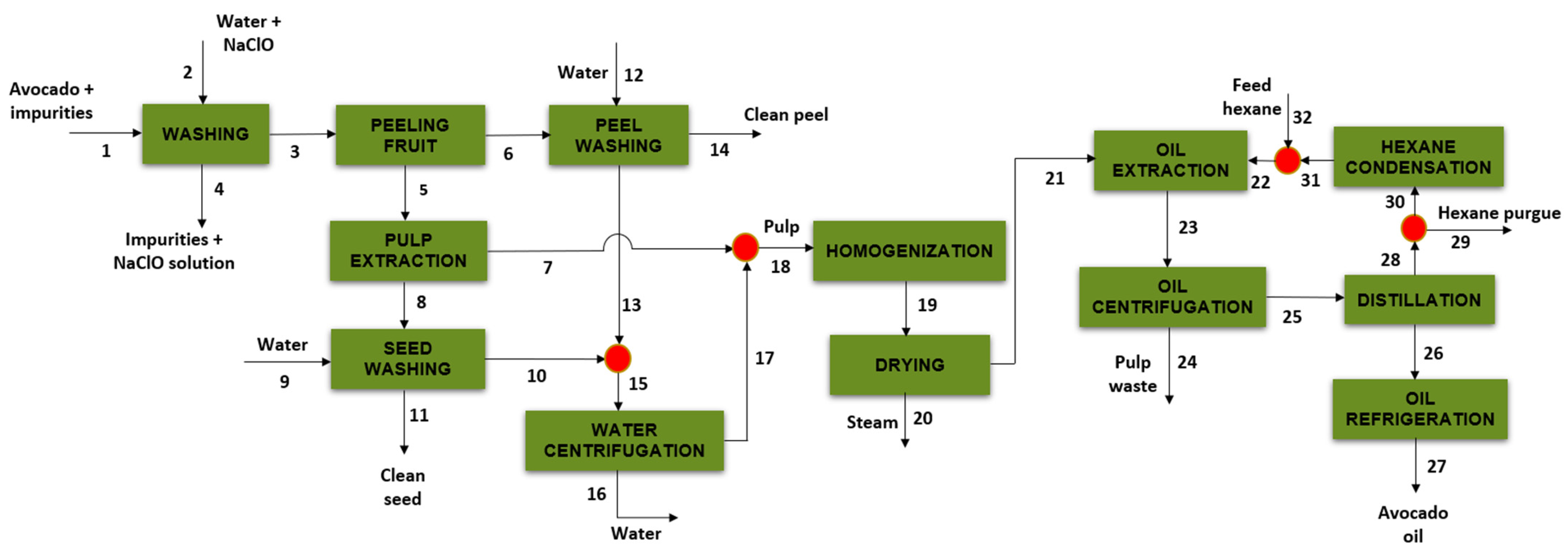
The extraction system evaluated in this work, illustrated in Figure 1, corresponds to a hexane-based integrated process configuration adapted from the scheme proposed by Herrera et al. (2022) [7]. The process begins with a conditioning operation in which the avocado feedstock is washed using a sodium hypochlorite solution to reduce the presence of external contaminants before subsequent processing stages. After this operation, the fruit passes through peeling and pulping units, generating separated peel and seed fractions (streams 6 and 8) while recovering the pulp fraction with the highest lipid availability. Subsequently, the residual material retained in these fractions is subjected to additional washing stages to recover adhered pulp (streams 10 and 13), improving biomass utilization and reducing losses of valuable material. The recovered streams are then reintegrated into the process through the connection nodes shown in Figure 1, where different material streams are combined before entering the following unit operations. Finally, a centrifugation stage is applied to decrease moisture content and concentrate the solids required for the downstream extraction operations.
The pulp stream generated after the pulping operation, together with the material recovered from centrifugation (stream 17), is directed to a homogenization unit to obtain a more uniform mixture prior to extraction. After homogenization, the material is subjected to a drying stage operated at 70 °C and 1 bar in order to decrease moisture content and improve mass transfer conditions during solvent extraction while preserving oil quality. Once dehydrated, the pulp stream (stream 21) enters the extraction section, where the lipid compounds contained in the solid matrix are transferred to the hexane phase. The resulting mixture is subsequently centrifuged to separate insoluble solids, producing residual pulp (stream 24) and a liquid stream composed of oil and solvent (stream 25). This liquid phase is then fed into a distillation unit, where avocado oil (stream 27) is recovered from the hexane stream, allowing solvent separation and recovery.
The recovered hexane is later condensed and recirculated to the extraction stage, reducing solvent consumption and lowering operational costs associated with the process. Despite the widespread industrial use of hexane due to its high oil recovery efficiency and operational applicability, edible oil production systems employing this solvent require careful control of solvent recovery and residual solvent concentrations in order to comply with food-grade standards and minimize risks related to solvent traces in the final product [11]. Under the evaluated operating conditions, the process reaches an annual avocado oil production of 1000.01 tons in stream 27, while nearly 97% of the recovered hexane is recycled within the process configuration [8].

2.2. Integrated WEP-Based Assessment Methodology

The initial phase of the proposed methodology employs the Aspen Plus® simulation developed by Herrera et al. (2022) [8] as the basis for evaluating the avocado oil production system from Creole-Antillean avocado pulp. The simulation integrates preliminary mass balances, estimations of water and energy requirements, and physicochemical properties of the involved compounds to represent the operational behavior of the process under the evaluated conditions [12]. Unlike previous investigations focused exclusively on process simulation, the present study uses the generated process information to perform an integrated Water–Energy–Product assessment aimed at examining operational behavior, biomass utilization, resource consumption, and extraction performance within the analyzed production scheme. This integrated perspective facilitates the identification of operational trade-offs and limitations related to resource management in the evaluated linear process configuration. As a result, the simulation provides detailed information regarding raw material and freshwater requirements, operating conditions such as temperature and pressure, product and byproduct flow rates, and the energy demand associated with process equipment [13]. These results provide a broader understanding of the global system behavior while also establishing a useful basis for future optimization and process assessment studies.
Additionally, this stage incorporates relevant economic information associated with the industrial utilities employed in the process, which is fundamental for evaluating the system from a techno-economic perspective. Specifically, costs linked to freshwater and energy consumption are considered, adopting values of 1.2 USD/m3 for water, 0.41 USD/kWh for electricity, and 10 USD/MMBTU for natural gas [14]. Likewise, the higher heating value (HHV) of both the feedstock and the final product is determined as a key parameter for the energy assessment of the system. Under the evaluated conditions, the HHV of avocado corresponds to 14.32 MJ/kg, whereas avocado oil reaches 39.50 MJ/kg [15], enabling the analysis of energy conversion performance and the energetic potential of the obtained product.
During the second stage, once information regarding water and energy consumption and product generation has been consolidated, nine key process variables are determined. Concerning raw materials, the feed flow rate is established as the principal parameter, while for the product stream, both the avocado oil flow rate and the amount of unprocessed material are evaluated to identify possible inefficiencies during the conversion stages. Regarding water resources, the analysis includes the freshwater flow entering the process and the generated wastewater volume, both of which are essential parameters for assessing process sustainability. In parallel, the energy evaluation considers the total energy flow together with natural gas and electricity consumption, thereby providing an integrated perspective of the system’s energy requirements.
In the final stage of the methodology, eleven technical indicators are determined to evaluate process behavior from different operational perspectives. As presented in Table 1, these indicators cover several dimensions of the evaluated system. Two indicators are associated with production performance, specifically production efficiency and unconverted material generation. Water management is evaluated through three indicators related to fractional water consumption, wastewater generation, and total freshwater cost. The remaining six indicators correspond to energy-related parameters, including total energy cost, specific energy intensity, net energy balance, energy efficiency index, and steam and electricity consumption rates. Additionally, the unconverted material rate was estimated considering avocado oil as the reference component because residual traces of this compound in waste streams indicate product losses within the system. Therefore, this parameter serves as an indicator of the need to improve separation and recovery operations in order to enhance overall process efficiency.
The evaluated indicators are subsequently compared in order to examine the degree to which the process satisfies the operational objectives established for the study, as summarized in Table 2. This comparison enables the identification of favorable operational characteristics together with potential limitations associated with process performance, thereby providing a broader interpretation of system behavior. To maintain consistency during the evaluation, the technical indicators were normalized using reference values obtained from favorable and unfavorable operating conditions reported in the literature for comparable agroindustrial and oil extraction systems. These reference intervals consider representative ranges associated with resource consumption, operational efficiency, and overall process performance. Through this normalization strategy, the evaluated system can be positioned within a defined performance range, facilitating the interpretation of results and supporting the identification of optimization opportunities for future process improvement stages [16].
Under this evaluation framework, values approaching 100% indicate operational behavior closer to the most favorable benchmark scenario established for each indicator, whereas lower percentages represent conditions nearer to the least favorable reference scenario considered in the analysis. The normalization procedure implemented in this work was performed using Equation (12), considering the minimum and maximum reference values defined for each evaluated indicator.
E f f i c i e n c y = x m a x x i x m a x x m i n × 100 %
These benchmark values were not established as universal operational limits but instead were used as reference intervals derived from representative data reported for comparable agroindustrial, extraction, and biomass processing systems available in the literature. This approach supports a comparative interpretation of process performance under both favorable and unfavorable operating conditions. Furthermore, the NER and EUI indicators were not directly contrasted with literature values because these parameters are not intended to be evaluated within the same comparative framework as the remaining indicators. In particular, these indicators are designed to examine the relationship between the energy contained in the obtained products and the energy supplied to the process, while also assessing the potential application of the resulting products as fuel sources or feedstocks for fuel production processes, respectively.

3. Results and Discussion

3.1. Technical Validation of the Process Simulation

The process simulation developed in Aspen Plus® was constructed using physicochemical information, operating conditions, and experimental data previously reported for Creole-Antillean avocado processing systems implemented in northern Colombia [7]. In particular, the representation of the avocado pulp within the simulation environment considered experimentally determined fatty acid compositions obtained through gas chromatography analyses, together with operational parameters associated with washing, drying, extraction, centrifugation, and solvent recovery stages previously evaluated for avocado oil production processes [7].
To ensure the technical consistency of the proposed configuration, the simulation framework was evaluated through detailed mass and energy balances across the integrated process. The material balance allowed the verification of stream compositions, phase distribution, solvent recirculation, and product recovery behavior throughout the different unit operations, while the energy balance facilitated the estimation of utility requirements associated with heating, drying, distillation, cooling, and separation stages. Likewise, the selected thermodynamic configuration based on the NRTL-RK method was adopted considering the coexistence of polar and non-polar compounds within the process, allowing the adequate representation of liquid–vapor equilibrium and thermodynamic behavior during extraction and solvent recovery operations [15].
Additionally, the simulation outputs were contrasted with values previously reported for comparable avocado oil extraction systems to verify the consistency of the predicted process performance. The simulated oil extraction yield reached 65.19%, showing close agreement with the 64.76% reported by Reddy et al. [17], corresponding to an approximation of 99.34%. In the same manner, the density obtained for the simulated avocado oil was 0.881 g/cm3, representing an approximation of 98.29% relative to literature-reported values [18]. Likewise, the HHV estimated for the avocado oil produced in the simulation reached 39.50 MJ/kg, corresponding to approximately 98.09% of the value previously reported in the literature [19]. These results confirm that the implemented simulation framework provides a technically reliable representation of the avocado oil extraction process under the evaluated operating conditions.

3.2. Analysis of Process Behavior Using WEP Indicators

3.2.1. Performance Indicators and Operational Parameters

The technical evaluation based on the WEP methodology was conducted to comprehensively assess resource management and the efficiency of the linear oil production process using Antillean Creole avocados grown in northern Colombia. This methodological approach not only allows for the analysis of the utilization of input streams but also helps understand how this influences the system’s overall performance, providing a more complete picture of its sustainability and operational feasibility. In this context, Table 3 compiles the key information necessary for determining the nine process parameters, which are directly related to water use, energy requirements, and product output. These parameters form the basis of the technical analysis, as they allow for quantifying the system’s efficiency and identifying potential critical points in resource utilization.
According to Table 3, the evaluated production scheme processes whole avocados as the primary feedstock, incorporating pulp, peel, and seed fractions into the system. However, despite utilizing the complete biomass, the peel and seed streams are ultimately discharged as waste, limiting the integral use of the available material. To obtain an avocado oil production flow of 103.59 kg/h, the process requires a raw material input of 1097.50 kg/h, reflecting a considerable biomass demand and suggesting that additional improvements in conversion efficiency and fraction utilization are still possible. Regarding resource management, the system operates with a freshwater supply of 3.51 m3/h, of which 3.37 m3/h is released as wastewater, revealing low efficiency in water utilization and significant effluent generation. This operational condition emphasizes the relevance of implementing water recirculation and stream integration strategies to reduce freshwater requirements and minimize environmental impacts associated with wastewater disposal. From the energy standpoint, the evaluated configuration relies on both electricity and natural gas, reaching a total energy consumption of 2062.46 MJ/h, including the thermal demand associated with heating and cooling operations. Such energy requirements are highly relevant when assessing operational performance and process-related costs, while also highlighting the importance of exploring alternatives aimed at improving energy optimization within the production system.

3.2.2. Process Performance Indicators

Table 4 summarizes the set of indicators obtained from the application of the WEP methodology to the evaluated linear avocado oil production system based on Creole-Antillean avocados. The reported results include the eleven parameters considered in the assessment, providing an organized overview of the operational behavior of the process. Through these indicators, the evaluated configuration can be analyzed from the perspectives of resource consumption, production performance, and operational efficiency, facilitating a broader interpretation of system behavior. In addition, the presented results contribute to the identification of operational limitations and potential optimization opportunities aimed at improving the overall performance of the production scheme.
The evaluated system achieved an overall production yield of 9.43%, a result largely associated with the high raw material consumption required to attain the desired avocado oil production capacity. This operational behavior is typical of processing configurations in which the entire biomass is handled simultaneously, resulting in only a portion of the feed material being transformed into the target product, while the remaining fractions are distributed into secondary streams or waste outputs, ultimately reducing the global efficiency of the system. In this sense, the value obtained does not necessarily indicate low efficiency of the unit operations, but rather reflects the limitations inherent in the comprehensive approach to utilizing the raw material. In contrast, several studies report significantly higher yields when strategies focused on oil extraction from the pulp under optimized conditions are employed. For example, using Soxhlet extraction with solvents, yields of approximately 58.10% have been reported [20], while processes using supercritical fluids have achieved values close to 58.97% [21]. Likewise, techniques based on cold pressing and optimized malaxation have shown extraction efficiencies of up to 77.6% [22], and even typical ranges between 60–80%, depending on the variety and operating conditions [23]. These higher values are explained by the fact that such processes operate exclusively with the lipid-rich pulp fraction and under controlled conditions designed to maximize oil recovery, unlike the present configuration, where the complete avocado biomass is processed. Consequently, the evaluated system involves a trade-off between overall oil yield and broader biomass utilization within the production scheme. Under this approach, the process may facilitate the treatment of avocado streams that do not satisfy commercialization standards for fresh consumption, while also maintaining the possibility of incorporating future valorization pathways for residual fractions such as peel and seed [24].
Additionally, several alternative extraction technologies, including cold pressing, aqueous enzymatic extraction, three-phase centrifugation, pulsed electric field-assisted extraction, and supercritical CO2 extraction, have been identified as promising industrial approaches for improving avocado oil quality while reducing solvent consumption and environmental impact [25]. Compared with conventional extraction schemes focused exclusively on the pulp fraction, the evaluated configuration incorporates additional recovery and recirculation stages, including solvent recovery and residual pulp integration operations, which contribute to improving overall biomass utilization within the process. Nevertheless, depending on the selected processing route and production scale, these integrated configurations may also involve greater operational complexity, higher water, and energy requirements, and increased operating costs compared to simplified industrial extraction systems. In the case of hexane-based extraction, although this technology remains widely implemented because of its high extraction efficiency and industrial applicability, its use in edible oil production requires strict control of solvent recovery and residual solvent content to ensure compliance with food-grade processing standards [26]. In this sense, the evaluated configuration provides a useful basis for identifying operational limitations, process intensification opportunities, and potential integration routes aimed at improving resource utilization and operational performance within avocado oil production systems.
Furthermore, the absence of valorization strategies for avocado peel and seed fractions increases waste generation and reduces the overall efficiency of the evaluated production system. Under the current configuration, these biomass fractions remain outside productive applications despite their potential for generating value-added products, indicating that the available raw material is not being fully utilized. In contrast to approaches reported in the literature, where process intensification and selective biomass utilization strategies are incorporated, the analyzed configuration maintains a linear processing structure in which secondary streams are not integrated into complementary productive pathways. Consequently, the incorporation of valorization alternatives for peel and seed fractions could contribute not only to reducing waste generation, but also to improving production yield and strengthening overall process sustainability.
Similarly, modifications such as prior pulp separation before conditioning stages, additional extraction operations for residual oil recovery, or the integration of alternative uses for peel and seed fractions could improve overall process efficiency while maintaining the comprehensive biomass utilization strategy [27]. In particular, avocado seeds have been reported as potential feedstock for biochar, biofuels, starch-derived products, and antioxidant-rich extracts [28], whereas peel fractions may be employed as sources of phenolic compounds, pigments, dietary fiber, or substrates for energy recovery applications [29]. The incorporation of these complementary pathways would facilitate the transition toward a more integrated biorefinery configuration, promoting better utilization of biomass fractions and reducing waste generation throughout the system.
Although the process has a relatively limited overall output, the extraction stage demonstrates efficient performance, achieving an 81.42% recovery rate of the oil contained in the avocados used as raw material. This figure indicates that, at the unit-scale level, the system achieves adequate transfer and separation of lipid compounds, reflecting good design and favorable operating conditions in the extraction stage. However, 18.58% of the oil remains retained in the generated pulp residues, indicating significant losses that directly impact the overall performance of the process. This unrecovered fraction represents a critical point, as its utilization through strategies such as re-extraction, stage integration, or improvements in separation efficiency could significantly increase total oil production. In this regard, optimizing the recovery of this residual oil would not only improve system performance but also contribute to a more efficient operation aligned with the principles of comprehensive biomass utilization.
Regarding the water consumption indicators, the production of 1000.01 t/year of crude avocado oil requires a specific freshwater consumption of 26.85 m3/t of demineralized water, mainly associated with the washing operations previously described. Although this FWC value may be considered relatively high in absolute terms, it remains below the values reported for olive oil production processes, where water consumption can reach up to 45 m3/t under comparable operating conditions [30]. Conversely, more efficient systems have been reported, particularly integrated avocado processing configurations, with consumption levels close to 9 m3/t [31], emphasizing the potential for improving water management and the relevance of evaluating more advanced and integrated processing schemes. From an economic perspective, the total cost of freshwater consumption within the process reaches $80.03 per day, representing a relatively moderate value that does not substantially affect the economic feasibility of the evaluated system. Nevertheless, although the obtained FWC and TCF values remain within acceptable ranges compared with previously reported literature data, the evaluated process still exhibits an important operational limitation related to wastewater generation, corresponding to 96.05% of the total freshwater supplied to the system. This behavior is primarily associated with the direct disposal of the water employed during the washing stages, which reveals the absence of water integration and recirculation strategies capable of promoting internal water reuse. Therefore, the implementation of water recovery and recirculation alternatives could significantly decrease wastewater generation while simultaneously improving the operational efficiency of the production system.
Among the potential alternatives, the recirculation of washing streams after filtration or physicochemical treatment, the reuse of partially treated water in preliminary cleaning operations, and the integration of closed-loop water systems could contribute to reducing freshwater consumption and minimizing wastewater discharge [32]. Likewise, the incorporation of separation technologies such as sedimentation, membrane filtration, adsorption systems, or low-pressure clarification units may facilitate the recovery and reuse of process water in non-critical stages of the system [33]. Additionally, the segregation of streams according to contamination level could improve water management by allowing less contaminated effluents to be redirected toward auxiliary washing operations, thereby decreasing the demand for fresh water entering the process. The implementation of these strategies could not only reduce the environmental impact associated with wastewater discharge but also improve operational sustainability through more efficient use of water resources within the production system. Particular attention should be given to the washing stages, since these operations represent the primary source of freshwater consumption and wastewater generation within the evaluated configuration. In this sense, future studies could incorporate systematic water integration methodologies, such as Water Pinch Analysis, to identify minimum freshwater requirements, establish optimal water recirculation networks, and quantitatively evaluate potential reductions in freshwater consumption and effluent discharge throughout the process [34].
Regarding the energy-related indicators, the highest energy demand within the evaluated process corresponds to natural gas consumption, reaching 1828.02 MJ/h. This energy source plays a dominant role in the operational energy structure of the system and contributes positively to its economic performance, since the estimated operating cost reaches 1056.65 USD/day, considerably lower than the 5637.39 USD/day estimated for a fully electricity-based configuration. The NGCI and EECI indicators further confirm this distribution, with contributions of 88.63% and 11.37%, respectively, demonstrating the strong dependence of the process on natural gas as the principal energy source. Although this operating configuration improves economic competitiveness, the system still exhibits a high specific energy intensity of 19,929 MJ/t, reflecting a considerable overall energy demand. Nevertheless, this value remains within the ranges previously reported for similar industrial processes in the literature [35,36]. These results suggest that, despite the favorable operating costs associated with natural gas utilization, additional energy optimization strategies could further improve process efficiency without compromising productivity. However, the strong dependence on natural gas also represents a sustainability limitation, since this energy source is associated with greenhouse gas emissions and continued reliance on fossil-based resources [37]. In this sense, future process configurations could benefit from the incorporation of alternative energy strategies, such as energy recovery from residual biomass streams, partial electrification using renewable sources, or the integration of bioenergy systems derived from avocado processing residues, contributing to a more sustainable operational profile [36].
Finally, the NER and EUI indicators provide additional insight into the energy behavior of the evaluated process and the potential energetic utilization of the obtained product. The NER value of 0.23 indicates that the energy contained in the produced avocado oil is lower than the total energy required to operate the system, revealing important limitations regarding process energy self-sufficiency [38]. This result demonstrates the strong dependence of the evaluated configuration on external energy sources, since the operational energy demand exceeds the recoverable energy contained in the final product under the analyzed conditions.
Conversely, the EUI value of 1.98 suggests that the obtained product possesses favorable characteristics for potential use as an energy source or as feedstock for fuel production applications, extending its possible utilization beyond conventional markets [39]. This characteristic creates opportunities for integrating the product into energy recovery schemes and biorefinery strategies focused on energy generation or biomass valorization. Therefore, despite the limitations identified from the perspective of energy self-sufficiency, the intrinsic energy potential of the obtained product represents a relevant opportunity for improving overall process sustainability through its incorporation into complementary value-added chains.

3.2.3. Operational Performance of the Evaluated Indicators

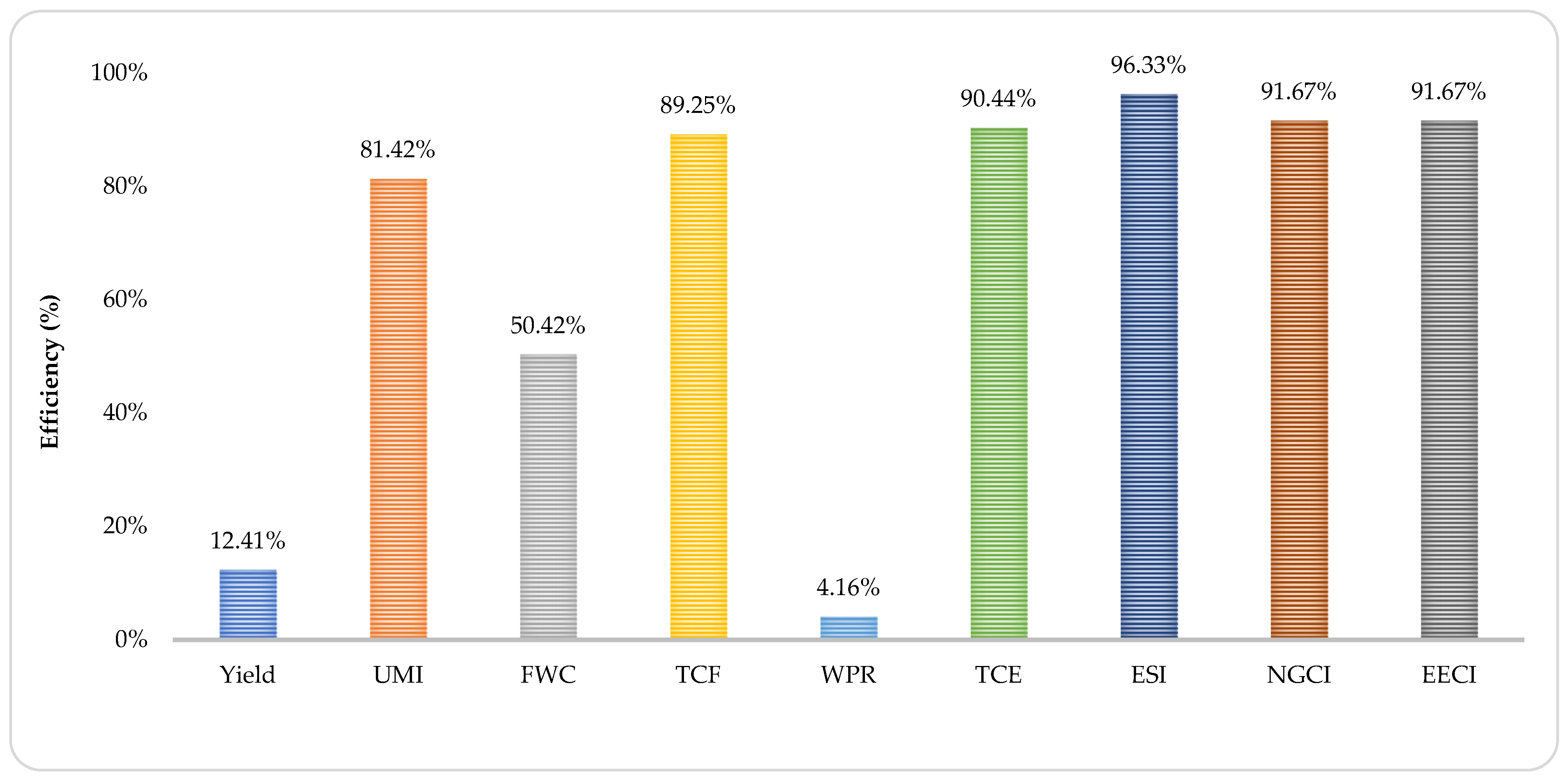
The efficiency results obtained for the nine normalized indicators evaluated in the avocado oil production system based on Creole-Antillean avocado are presented in Figure 2. The NER and EUI parameters were not incorporated into this comparative assessment because their calculation methodology does not allow their expression as percentage-based values, preventing their inclusion within the same normalization framework applied to the remaining indicators. Consequently, incorporating these parameters into the graphical comparison would not provide representative information for the comparative interpretation of process behavior. The remaining indicators, however, provide an integrated perspective of system performance from production, resource consumption, and energy viewpoints, supporting the identification of operational patterns, inefficient resource utilization practices, and opportunities for process optimization and performance improvement.
Based on the comparison with the favorable and unfavorable operational scenarios reported in the literature, the energy-related indicators exhibited the highest efficiency values, mainly due to the strong dependence of the evaluated configuration on natural gas as the dominant energy source. This operating condition contributes positively to reducing operating costs relative to systems with greater dependence on electricity, thereby improving the economic competitiveness of the process. However, despite the favorable energy-related performance, the water-associated indicators reveal important sustainability limitations. In particular, the values obtained for freshwater consumption and wastewater generation indicate inefficient water management within the evaluated system. The FWC value of 50.42% demonstrates that a substantial volume of water is required to sustain the desired production capacity, while the WPR value of only 4.16% indicates that most of the incoming water is not reintegrated into the process. This behavior reflects the absence of water recirculation and stream integration strategies, resulting in elevated effluent generation and reduced operational efficiency. Under these conditions, the implementation of water recovery and reuse alternatives becomes essential to improve process performance and mitigate the environmental impacts associated with wastewater discharge.
From the production perspective, the overall yield reached 12.41%, a result strongly influenced by the limited utilization of the avocado biomass within the current processing configuration. Specifically, the peel and seed fractions are not incorporated into value-added pathways, reducing the effective use of the available raw material. In addition, the selected feed configuration, based on processing the whole fruit without prior fraction separation, limits the possibility of maximizing the individual utilization of each avocado component. Nevertheless, when the extraction efficiency of the oil present in the raw material is evaluated independently, the process reaches a value of 81.42%, demonstrating efficient recovery of the lipid fraction despite the relatively low oil content of the fruit. Therefore, although the evaluated system exhibits adequate technical performance at the unit-operation level, additional strategies focused on biomass integration and valorization are still required to improve overall production yield and strengthen process efficiency.

4. Conclusions

The technical evaluation of the Creole-Antillean avocado oil production process through the WEP methodology enabled an integrated analysis of the system’s operational behavior considering raw material utilization, water consumption, energy demand, and production performance. The obtained results demonstrated that the evaluated configuration achieved an overall production yield of 9.43%, mainly influenced by the elevated raw material requirements needed to obtain the target oil production flow. Nevertheless, the extraction stage exhibited favorable technical performance, reaching an oil recovery efficiency of 81.42%, which confirms the adequate operation of the implemented separation stages. Regarding water management, the process required a specific freshwater consumption of 26.85 m3/t and generated a freshwater cost of 80.03 USD/day, values that remain economically manageable but still reveal opportunities for improving water utilization efficiency within the system.
In terms of wastewater generation, 96.05% of the total water employed in the process was discharged as effluent, mainly because the washing streams are not reintegrated into the system through recirculation or water integration strategies. From the energy perspective, the evaluated process reached a total operating energy cost of 1056.65 USD/day and a specific energy intensity of 19,929 MJ/t, indicating a considerable energy demand associated primarily with drying and solvent recovery operations. Additionally, the strong dependence on natural gas, reflected by a consumption rate of 88.63 m3/t, contributed positively to the economic competitiveness of the process compared with highly electrified configurations. In this context, future optimization strategies should prioritize the implementation of water recirculation and stream integration schemes, the incorporation of energy recovery alternatives from residual biomass streams, and the valorization of avocado peel and seed fractions through complementary biorefinery pathways aimed at improving overall resource utilization and reducing waste generation.
Despite the identified operational limitations, the process demonstrated several favorable technical characteristics, including stable extraction behavior, efficient solvent recovery, and effective hexane recirculation, with approximately 97% of the solvent being recycled within the evaluated configuration. Furthermore, the application of the WEP methodology facilitated the simultaneous evaluation of production, water, and energy indicators, enabling a broader interpretation of the operational performance of the process and supporting the identification of critical opportunities for improving the technical and sustainability performance of avocado-based agroindustrial systems.

Author Contributions

Conceptualization, J.D.D.H.-M., Á.D.G.-D. and S.R.-F.; methodology, J.D.D.H.-M.; software, J.D.D.H.-M.; validation, J.D.D.H.-M.; formal analysis, J.D.D.H.-M.; investigation, J.D.D.H.-M.; resources, Á.D.G.-D. and S.R.-F.; data curation, J.D.D.H.-M.; writing—original draft preparation, J.D.D.H.-M.; writing—review and editing, J.D.D.H.-M. and Á.D.G.-D.; visualization, Á.D.G.-D. and S.R.-F.; supervision, Á.D.G.-D.; project administration, Á.D.G.-D.; funding acquisition, Á.D.G.-D. and S.R.-F. All authors have read and agreed to the published version of the manuscript.

Funding

Financial support for this research was provided by the University of Cartagena through the project entitled “Desarrollo de una topología de biorrefinería para el aprovechamiento sostenible del aguacate (Laurus persea L.) producido en la región de los Montes de María”, developed by the Research Group in Nanomaterials and Computer-Aided Process Engineering (NIPAC). The project was approved under Resolution 02007 of 2018 and commitment act No. 090 of 2018.

Institutional Review Board Statement

Not Applicable.

Informed Consent Statement

Not Applicable.

Data Availability Statement

The data that support the findings of this study are available from the corresponding author, Á.D.G.-D., upon reasonable request.

Acknowledgments

The authors thank Universidad Cartagena for funding this research presented in the ninth call for visible research groups (categorized or recognized) on the Scienti platform of the Ministry of Science, Technology, and Innovation.

Conflicts of Interest

The authors declare no conflicts of interest.

References

  1. Solarte-Toro, J.C.; Ortiz-Sanchez, M.; Cardona Alzate, C.A. Environmental life cycle assessment (E-LCA) and social impact assessment (SIA) of small-scale biorefineries implemented in rural zones: The avocado (Persea americana var. americana) case in Colombia. Environ. Sci. Pollut. Res. 2023, 30, 8790–8808. [Google Scholar] [CrossRef]
  2. Nascimento, A.P.S.; Duarte, M.E.M.; Rocha, A.P.T.; Barros, A.N. Bioactive compounds, technological advances, and sustainable applications of avocado (Persea americana Mill.): A critical review. Foods 2025, 14, 2746. [Google Scholar] [CrossRef] [PubMed]
  3. Satriana, S.; Supardan, M.D.; Arpi, N.; Mustapha, W.A.W. Development of methods used in the extraction of avocado oil. Eur. J. Lipid Sci. Technol. 2019, 121, 1800210. [Google Scholar] [CrossRef]
  4. Ariza Ortega, J.A.; López Valdez, F.; Coyotl Huerta, J.; Ramos Cassellis, M.E.; Díaz Reyes, J.; Martínez Zavala, A. Efecto de diferentes métodos de extracción sobre el perfil de ácidos grasos en el aceite de aguacate (Persea americana Mill. var. Hass). Rev. Venez. Cienc. Tecnol. Aliment. 2011, 2, 263–276. [Google Scholar]
  5. Hasan, M.M.; Rasul, M.G.; Jahirul, M.I.; Mofijur, M. Fuelling the future: Unleashing energy and exergy efficiency from municipal green waste pyrolysis. Fuel 2024, 357, 129815. [Google Scholar] [CrossRef]
  6. Cherubini, F. The biorefinery concept: Using biomass instead of oil for producing energy and chemicals. Energy Convers. Manag. 2010, 51, 1412–1421. [Google Scholar] [CrossRef]
  7. Herrera-Rodriguez, T.; Parejo-Palacio, V.; Gonzalez-Delgado, A. Computer-aided simulation of avocado oil production in North Colombia. Chem. Eng. Trans. 2022, 92, 415–420. [Google Scholar] [CrossRef]
  8. Herrera-Rodriguez, T.; Parejo-Palacio, V.; Gonzalez-Delgado, A. Techno-economic evaluation of Creole avocado biomass valorization via oil production in North-Colombia. Chem. Eng. Trans. 2022, 92, 409–414. [Google Scholar] [CrossRef]
  9. Pinheiro Pantoja, K.R.; Melo Aires, G.C.; Ferreira, C.P.; Lima, M.D.C.D.; Menezes, E.G.O.; Carvalho Junior, R.N.D. Supercritical technology as an efficient alternative to cold pressing for avocado oil: A comparative approach. Foods 2024, 13, 2424. [Google Scholar] [CrossRef]
  10. Bustos, C.A.; Moors, E.H.M. Reducing post-harvest food losses through innovative collaboration: Insights from the Colombian and Mexican avocado supply chains. J. Clean. Prod. 2018, 199, 1020–1034. [Google Scholar] [CrossRef]
  11. Efthymiopoulos, I.; Hellier, P.; Ladommatos, N.; Russo-Profili, A.; Eveleigh, A.; Aliev, A.; Kay, A.; Mills-Lamptey, B. Influence of solvent selection and extraction temperature on yield and composition of lipids extracted from spent coffee grounds. Ind. Crops Prod. 2018, 119, 49–56. [Google Scholar] [CrossRef]
  12. Seider, W.D.; Seader, J.D.; Lewin, D.R.; Widagdo, S. Product and Process Design Principles: Synthesis, Analysis, and Evaluation, 3rd ed.; Wiley: Hoboken, NJ, USA, 2009. [Google Scholar]
  13. Towler, G.; Sinnott, R. Chemical Engineering Design: Principles, Practice and Economics of Plant and Process Design, 2nd ed.; Elsevier: Oxford, UK, 2013. [Google Scholar]
  14. García-Maza, S.; Herrera-Rodríguez, T.C.; González-Delgado, Á.D. Process simulation and technical evaluation using water-energy-product (WEP) analysis of an extractive-based biorefinery of Creole-Antillean avocado produced in the Montes de María. Sustainability 2024, 16, 9575. [Google Scholar] [CrossRef]
  15. Tauro, R.; Velázquez-Martí, B.; Manrique, S.; Ricker, M.; Martínez-Bravo, R.; Ruiz-García, V.M.; Ramos-Vargas, S.; Masera, O.; Soria-González, J.A.; Armendáriz-Arnez, C. Potential use of pruning residues from avocado trees as energy input in rural communities. Energies 2022, 15, 1715. [Google Scholar] [CrossRef]
  16. Singh, R.K.; Murty, H.R.; Gupta, S.K.; Dikshit, A.K. An overview of sustainability assessment methodologies. Ecol. Indic. 2012, 15, 281–299. [Google Scholar] [CrossRef]
  17. Reddy, M.; Moodley, R.; Jonnalagadda, S.B. Fatty acid profile and elemental content of avocado (Persea americana Mill.) oil: Effect of extraction methods. J. Environ. Sci. Health B 2012, 47, 529–537. [Google Scholar] [CrossRef]
  18. Macías Fuyo, D.A.; Rodríguez Parra, D.F. Sustitución de Grasa por Aceite de Aguacate en la Elaboración de Salchicha Tipo Frankfurt. Master’s Thesis, Universidad de la Salle, Bogotá, Colombia, 2021. [Google Scholar]
  19. Fassinou, W.F. Higher heating value (HHV) of vegetable oils, fats and biodiesels evaluation based on their pure fatty acids’ HHV. Energy 2012, 45, 798–805. [Google Scholar] [CrossRef]
  20. Li, Y.; Liu, Y.; Deng, D.; Liang, J.; Chen, W.; Chen, X.; Li, J. Study on extracting avocado oil from avocado pulp by aqueous extraction. IOP Conf. Ser. Earth Environ. Sci. 2019, 330, 042027. [Google Scholar] [CrossRef]
  21. Tran, N.N.; Dang, T.Q. Supercritical CO2 extraction of oil from dried avocado (Persea americana Mill.) fruit pulp: Oil yield, solubility, and the oil characteristics. J. Food Res. 2023, 12, 7. [Google Scholar] [CrossRef]
  22. Lopez-Vega, L.A.; Gil-Cortez, J.M.; Sierra-Sarmiento, M.A.; Hoyos-Leyva, J.D. Hass avocado oil extraction: In the way of malaxation process optimization. LWT 2021, 152, 112312. [Google Scholar] [CrossRef]
  23. Costagli, G.; Betti, M. Avocado oil extraction processes: Method for cold-pressed high-quality edible oil production versus traditional production. J. Agric. Eng. 2015, 46, 115–122. [Google Scholar] [CrossRef]
  24. Féliz-Jiménez, A.; Sanchez-Rosario, R. Bioactive compounds, composition and potential applications of avocado agro-industrial residues: A review. Appl. Sci. 2024, 14, 10070. [Google Scholar] [CrossRef]
  25. Ferraz, L.P.; Silva, E.K. Pulsed electric field-assisted extraction techniques for obtaining vegetable oils and essential oils: Recent progress and opportunities. Sep. Purif. Technol. 2024, 354, 128833. [Google Scholar] [CrossRef]
  26. Chemat, F.; Abert-Vian, M.; Fabiano-Tixier, A.S.; Strube, J.; Uhlenbrock, L.; Gunjevic, V.; Cravotto, G. Green extraction of natural products: Origins, current status, and future challenges. TrAC Trends Anal. Chem. 2019, 118, 248–263. [Google Scholar] [CrossRef]
  27. Rodríguez-Martínez, B.; Romaní, A.; Eibes, G.; Garrote, G.; Gullón, B.; del Río, P.G. Potential and prospects for utilization of avocado by-products in integrated biorefineries. Bioresour. Technol. 2022, 364, 128034. [Google Scholar] [CrossRef]
  28. Araújo, R.G.; Rodriguez-Jasso, R.M.; Ruiz, H.A.; Pintado, M.M.E.; Aguilar, C.N. Avocado by-products: Nutritional and functional properties. Trends Food Sci. Technol. 2018, 80, 51–60. [Google Scholar] [CrossRef]
  29. Colombo, R.; Papetti, A. Avocado (Persea americana Mill.) by-products and their impact: From bioactive compounds to biomass energy and sorbent material for removing contaminants. Int. J. Food Sci. Technol. 2019, 54, 943–951. [Google Scholar] [CrossRef]
  30. Vuksinic, E.; Miguel, R.E.; Aldaya, M.M.; Rodriguez, C.I. Wastewater and grey water footprint assessment of the olive oil production process in Northwest Argentina. Water 2024, 16, 1612. [Google Scholar] [CrossRef]
  31. Langat, K.; Njogu, P.; Kamau, J. Biogas energy potential from co-digestion of avocado pulp with cow manure in Kaitui Location, Kericho County, Kenya. Int. Res. J. Innov. Eng. Technol. 2018, 2, 28–34. [Google Scholar]
  32. Klemeš, J.J. Industrial water recycle/reuse. Curr. Opin. Chem. Eng. 2012, 1, 238–245. [Google Scholar] [CrossRef]
  33. Morseletto, P.; Mooren, C.E.; Munaretto, S. Circular economy of water: Definition, strategies and challenges. Circ. Econ. Sustain. 2022, 2, 1463–1477. [Google Scholar] [CrossRef]
  34. Klemeš, J.J.; Varbanov, P.S.; Walmsley, T.G.; Jia, X. New directions in the implementation of pinch methodology (PM). Renew. Sustain. Energy Rev. 2018, 98, 439–468. [Google Scholar] [CrossRef]
  35. Wright, M.M.; Brown, R.C.; Boateng, A.A. Distributed processing of biomass to bio-oil for subsequent production of Fischer–Tropsch liquids. Biofuels Bioprod. Biorefin. 2008, 2, 229–238. [Google Scholar] [CrossRef]
  36. Vlysidis, A.; Binns, M.; Webb, C.; Theodoropoulos, C. A techno-economic analysis of biodiesel biorefineries: Assessment of integrated designs for the co-production of fuels and chemicals. Energy 2011, 36, 4671–4683. [Google Scholar] [CrossRef]
  37. Vardy, M.; Oppenheimer, M.; Dubash, N.K.; O’Reilly, J.; Jamieson, D. The Intergovernmental Panel on Climate Change: Challenges and opportunities. Annu. Rev. Environ. Resour. 2017, 42, 55–75. [Google Scholar] [CrossRef]
  38. Markussen, M.V.; Pugesgaard, S.; Oleskowicz-Popiel, P.; Schmidt, J.E.; Østergård, H. Net-energy analysis of integrated food and bioenergy systems exemplified by a model of a self-sufficient system of dairy farms. Front. Energy Res. 2015, 3, 49. [Google Scholar] [CrossRef]
  39. Saidur, R.; BoroumandJazi, G.; Mekhilef, S.; Mohammed, H.A. A review on exergy analysis of biomass based fuels. Renew. Sustain. Energy Rev. 2012, 16, 1217–1222. [Google Scholar] [CrossRef]
Figure 1. Operational scheme of the avocado oil extraction process using pulp from Creole-Antillean avocados cultivated in Montes de María, Colombia. Adapted from [8].
Sustainability 18 06051 g001
Figure 2. Comparative efficiency results of the normalized indicators obtained for the avocado oil production system.
Sustainability 18 06051 g002
Table 1. Description of the technical indicators of the process.
IndicatorEquationDescriptionNo
Production Yield (%) γ i = P r o d u c t   f l o w R a w   m a t e r i a l   f l o w × 100 % Product yield obtained relative to the processed feed stream(1)
Unconverted MaterialRatio ( % ) U M I = E x t r a c t e d   p r o d u c t   f l o w P r o d u c t   c o n t a i n e d   i n   r a w   m a t e r i a l   f l o w × 100 % Quantity of product recovered from the feed stream(2)
Fractional Water
Consumption (m3/t)
F W C = V o l u m e t r i c   f l o w   o f   f r e s h w a t e r P r o d u c t   m a s s   f l o w Amount of water used to produce the product(3)
Total Cost of Freshwater (USD/day) T C F = F r e s h w a t e r   f l o w   c o n s u m e d × C o s t   o f   f r e s h w a t e r Total freshwater consumption cost per operating period(4)
Wastewater Production Ratio (%) W P R = W a s t e w a t e r   v o l u m e t r i c   f l o w V o l u m e t r i c   f l o w   o f   f r e s h w a t e r × 100 % Difference between the freshwater supplied to the process and the wastewater generated(5)
Total Cost of Energy (USD/day) T C E = T o t a l   e n e r g y   c o n s u m e d × E n e r g y   c o s t Total energy consumption cost per operating period(6)
Energy Specific Intensity (MJ/t) R E S I = T o t a l   e n e r g y   c o n s u m e d P r o d u c t   m a s s   f l o w Energy demand required per ton of produced material(7)
Natural Gas
Consumption Index (m3/t)
N G C I = T o t a l   n a t u r a l   g a s   c o n s u m e d P r o d u c t   m a s s   f l o w Natural gas consumption per ton of generated product(8)
Electric Energy
Consumption Index (kWh/t)
E E C I = T o t a l   e l e c t r i c i t y   c o n s u m e d P r o d u c t   m a s s   f l o w Electricity consumption expressed as kilowatt-hours per ton of product(9)
Net Energy Ratio
(Dimensionless)
N E R = P r o d u c t   c a l o r i f i c   p o w e r × p r o d u c t   m a s s   f l o w T o t a l   e n e r g y   c o n s u m e d + ( f e e d s t o c k   c a l o r i f i c   p o w e r × m a i n   f e e d s t o c k   m a s s   f l o w ) Relationship between the energy contained in the products and the energy supplied to the process(10)
Energy Usability Index
(Dimensionless)
E U I = P r o d u c t   c a l o r i f i c   p o w e r × p r o d u c t   m a s s   f l o w T o t a l   e n e r g y   c o n s u m e d Relationship between the potential recoverable energy from the product and the energy necessary for its production(11)
Table 2. Reference intervals used for indicator normalization.
IndicatorBest Case ScenarioWorst Case Scenario
Production Yield76%0%
UMI0%100%
FWC9 m3/t45 m3/t
TCF1 $/m35 $/m3
WPR5% of used water100% of used water
TCE10 $/MMBTU (98% of energy derives from natural gas)0.5 $/kWh (100% of the energy derived from an electrical source)
ESI19,055 MJ/t42,848 MJ/t
NGCI97% of the energy entering the process0%
EECI3% of the required energy100%
Table 3. WEP technical parameters for the linear production of oil from Creole-Antillean avocados.
ParameterUnitDescriptionValue
Raw material mass flowkg/hAvocados total flow entering the process1097.50
Product mass flowkg/hTotal product flow obtained from the process103.59
Avocado oil mass flowkg/hTotal avocado oil recovered relative to the oil content initially present in the raw material102.36
Total freshwater volumetric flowm3/hVolume of freshwater consumed during the process3.51
Total wastewater volumetric flowm3/hVolume of wastewater generated during the process3.37
Total energy consumedMJ/hTotal energy consumed throughout the process2062.46
Total electricity consumedMJ/hTotal electricity consumption throughout the process234.44
Total natural gas consumedMJ/hTotal natural gas consumption throughout the process1828.02
Table 4. Performance indicators obtained for the evaluated avocado oil production system.
IndicatorUnitValue
Production Yield%9.43
UMI%81.42
FWCm3/t26.85
TCFUSD/day80.03
WPR%96.05
TCEUSD/day1056.65
ESIMJ/t19,929.00
NGCIm3/t88.63
EECIkWh/t11.37
NERDimensionless0.23
EUIDimensionless1.98
Disclaimer/Publisher’s Note: The statements, opinions and data contained in all publications are solely those of the individual author(s) and contributor(s) and not of MDPI and/or the editor(s). MDPI and/or the editor(s) disclaim responsibility for any injury to people or property resulting from any ideas, methods, instructions or products referred to in the content.