Efficiency of Leeward-Side Sand-Control Measures for High Embankments in Desert Regions

Abstract
1. Introduction
2. Materials and Methods
2.1. Wind Tunnel Experiment
2.2. Numerical Simulation
3. Results
3.1. Analysis of Numerical Simulation Results
3.1.1. Flow-Field Variations Under the Three Structures
3.1.2. Sand Deposition Variations Under the Three Structures
3.2. Analysis of Wind Tunnel Results
4. Discussion
5. Conclusions
- (1)
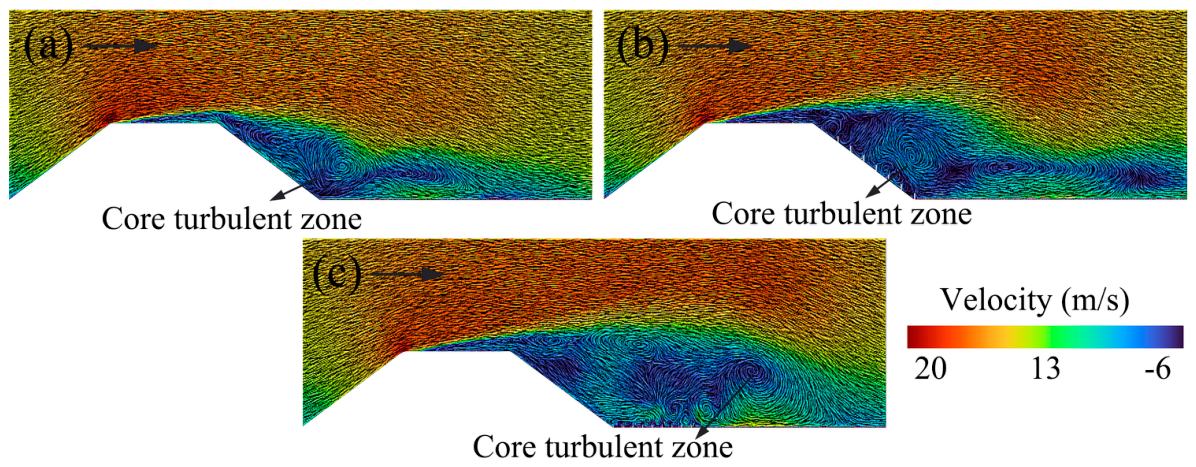
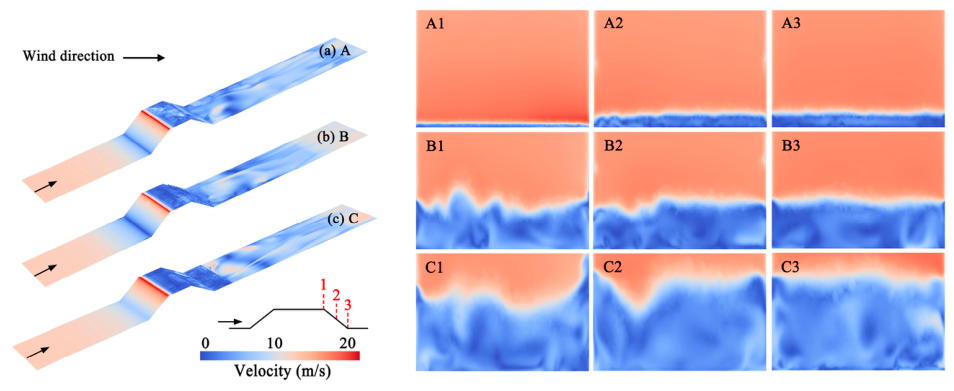
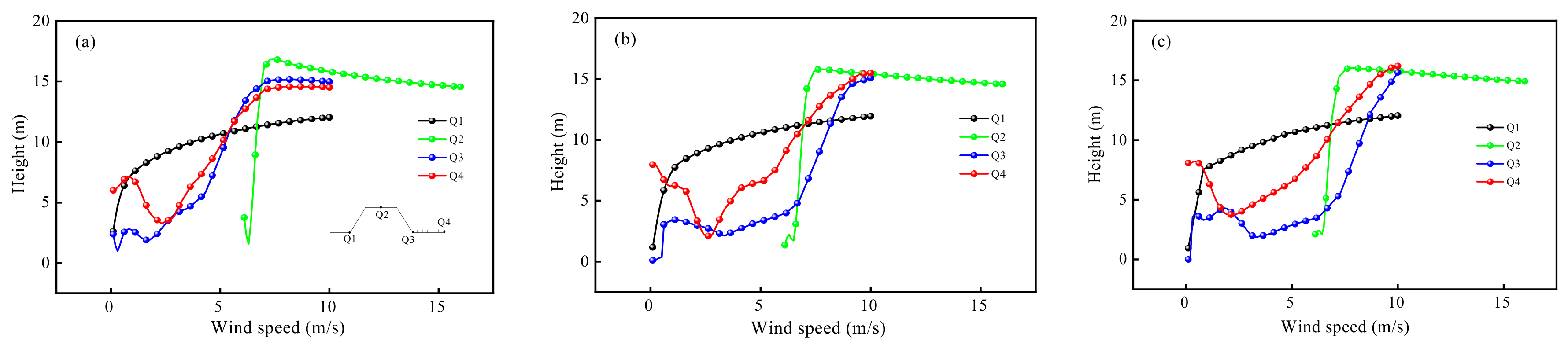
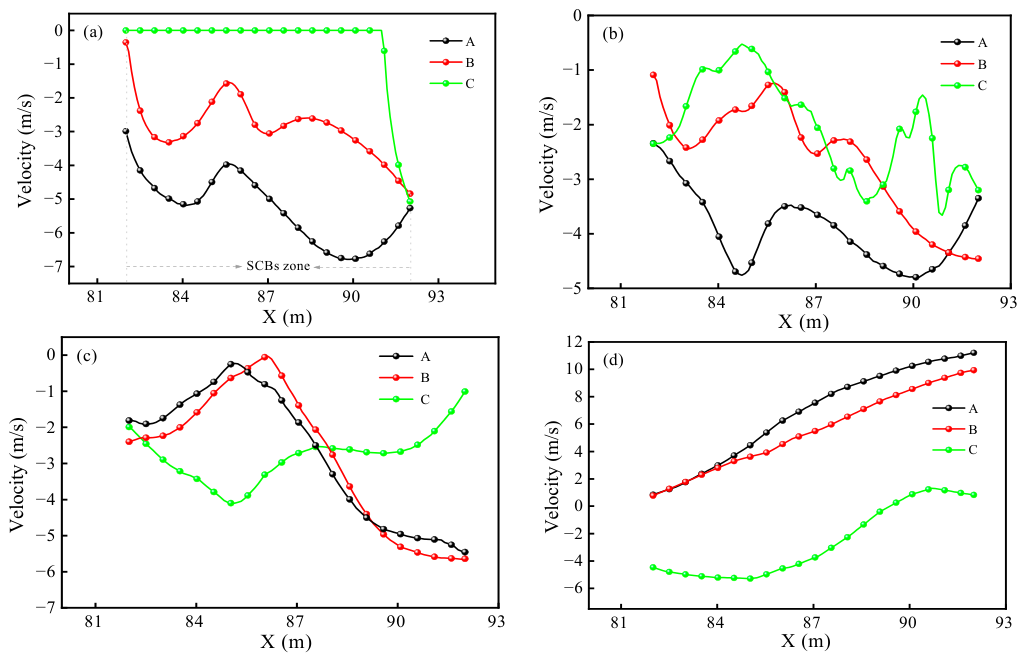
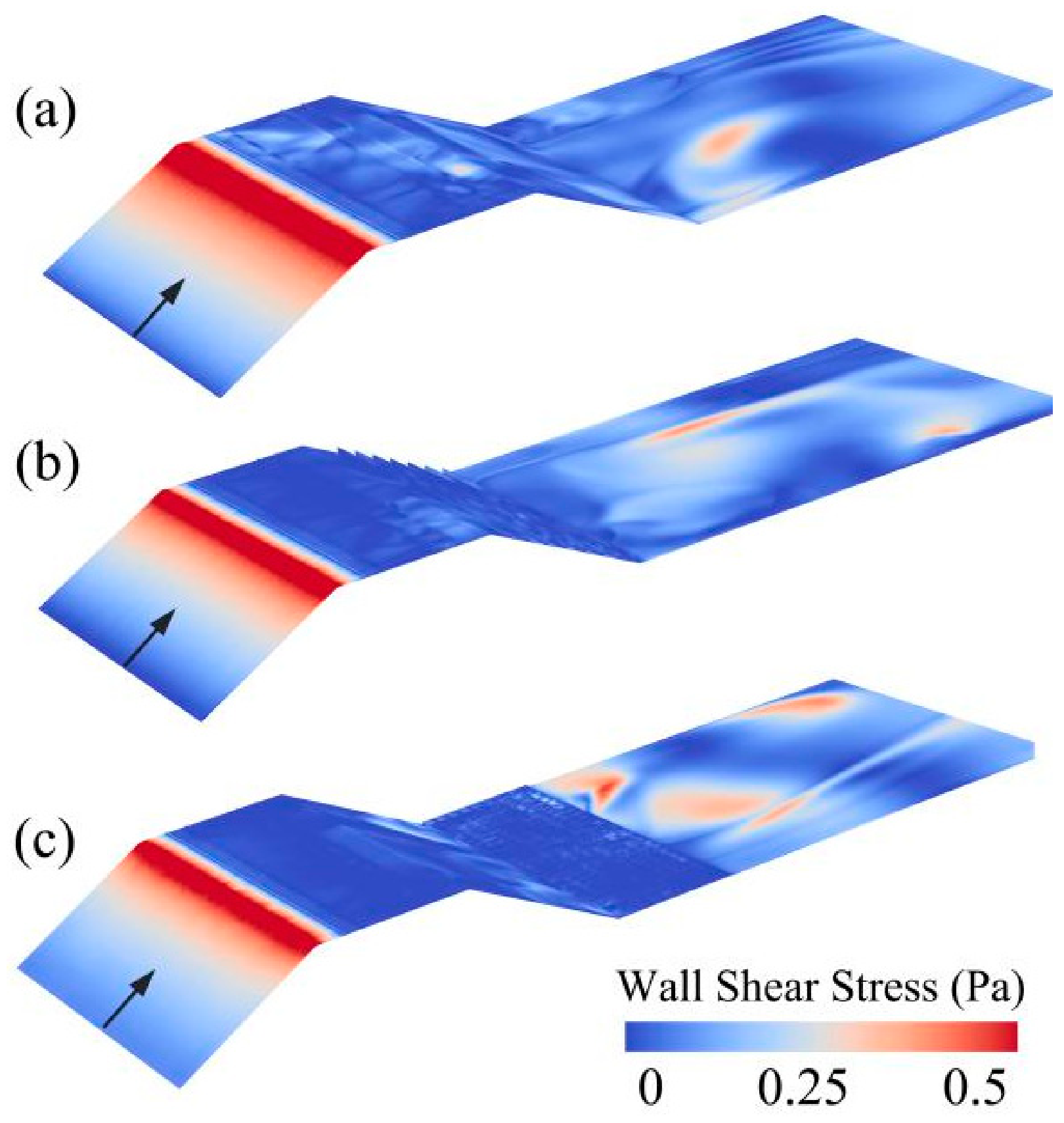
- Leeward-side sand accumulation on high embankments is mainly controlled by flow reattachment and near-surface momentum recovery. Without protection, large-scale recirculation causes reattachment within 2–3 H and near-surface velocities of 10–11 m/s. Baffles delay reattachment to 3–4 H but still generate local high-shear regions. In contrast, the checkerboard barrier delays reattachment to 4–5 H and reduces near-surface velocity to 4–6 m/s, weakening momentum recovery on the leeward side.
- (2)
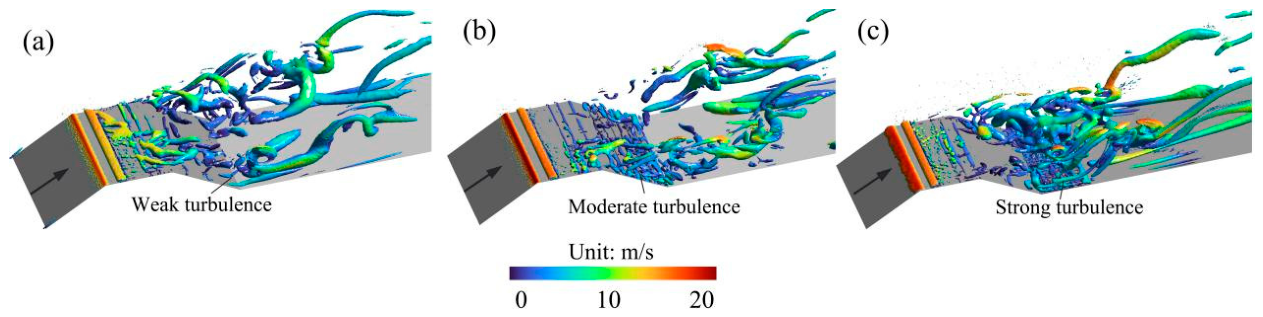
- The checkerboard barrier improves protection by restructuring the near-surface flow field. Dense small-scale vortices enhance turbulent dissipation and disrupt coherent recirculation. Although local turbulence intensity increases, surface shear stress decreases from 0.4–0.5 Pa to 0–0.2 Pa, close to or below the threshold for particle initiation (0.10–0.16 Pa), thereby suppressing particle re-entrainment and promoting stable deposition near the slope toe.
- (3)
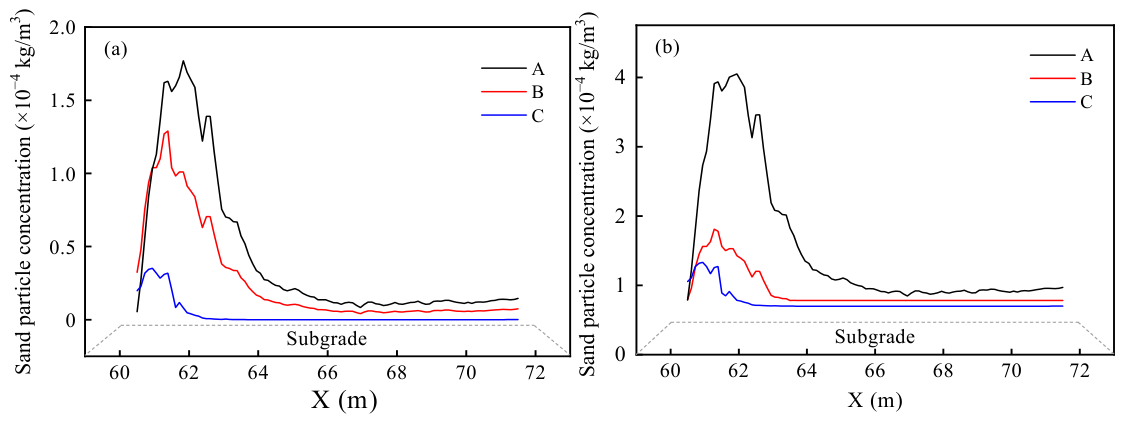
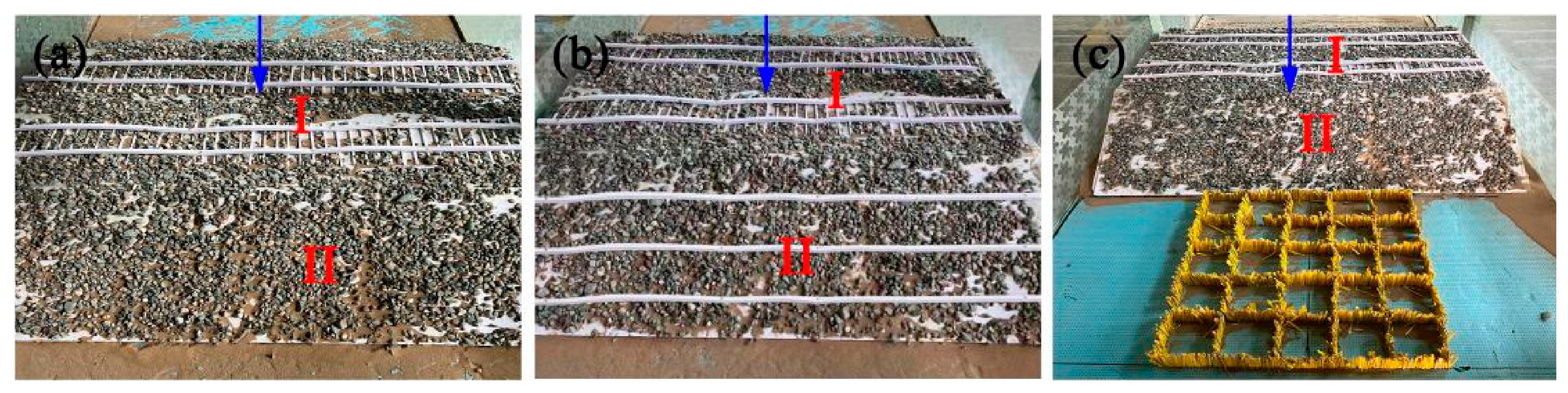
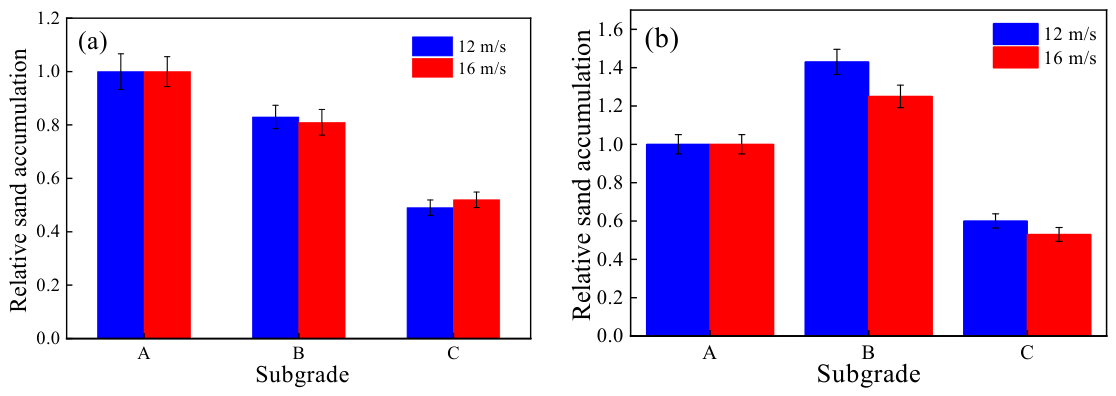
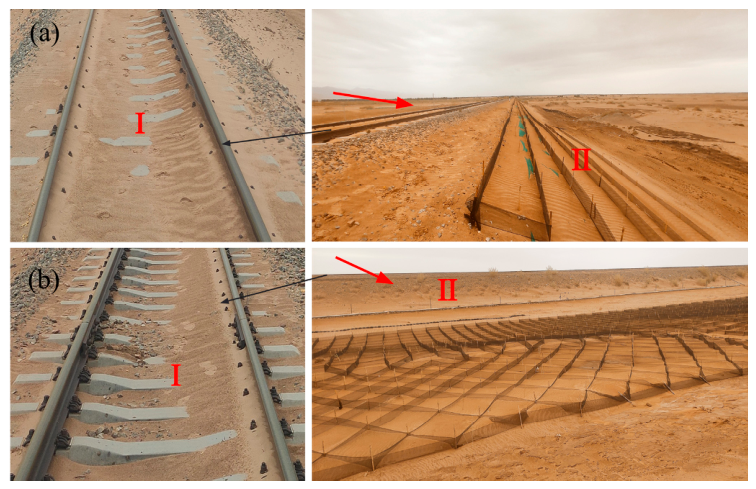
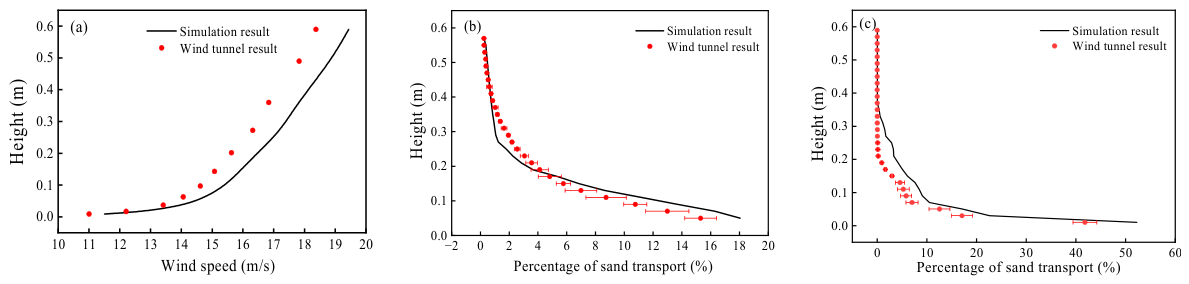
- Particle deposition gradually changes from wide and unstable accumulation on the leeward side and subgrade to localized stable deposition near the slope toe. With the checkerboard barrier, subgrade sand accumulation decreases from about 350–480 g/min to 170–250 g/min. Field observations generally agree with the wind tunnel and numerical results, confirming the engineering applicability of the checkerboard barrier for high railway embankments in desert regions.
Author Contributions
Funding
Institutional Review Board Statement
Informed Consent Statement
Data Availability Statement
Acknowledgments
Conflicts of Interest
References
- Bagnold, R.A. The Physics of Blown Sand and Desert Dunes; Methuen: London, UK, 1941; pp. 1–30. [Google Scholar]
- Lorenzo, R.; Luca, B. Windblown sand mitigation along railway megaprojects: A comparative study. Struct. Eng. Int. 2020, 30, 355–364. [Google Scholar] [CrossRef] [Scilit]
- Kok, J.F.; Parteli, E.J.R.; Michaels, T.I.; Karam, D.B. The physics of wind-blown sand and dust. Rep. Prog. Phys. 2012, 75, 106901. [Google Scholar] [CrossRef] [Scilit] [PubMed]
- Wang, T.; Qu, J.J.; Niu, Q.H. Comparative study of the shelter efficacy of straw checkerboard barriers and rocky checkerboard barriers in a wind tunnel. Aeolian Res. 2020, 43, 100574. [Google Scholar] [CrossRef] [Scilit]
- Cheng, J.J.; Jiang, F.Q.; Xue, C.X.; Xin, G.W.; Li, K.C.; Yang, Y.H. Characteristics of the disastrous wind-sand environment along railways in the Gobi area of Xinjiang, China. Atmos. Environ. 2015, 102, 344–354. [Google Scholar] [CrossRef] [Scilit]
- Zhang, K.; Qu, J.; Yu, Y.; Han, Q.; Wang, T.; An, Z.; Hu, F. Research progress on wind-sand prevention along China railway. Adv. Earth Sci. 2019, 34, 573–583. [Google Scholar]
- Huang, N.; Xia, X.; Tong, D. Numerical simulation of wind sand movement in straw checkerboard barriers. Eur. Phys. J. E 2013, 36, 99. [Google Scholar] [CrossRef] [Scilit]
- Cheng, J.J.; Lei, J.Q.; Li, S.Y.; Wang, H.F. Disturbance of the inclined inserting-type sand fence to wind-sand flow fields and its sand control characteristics. Aeolian Res. 2016, 21, 139–150. [Google Scholar] [CrossRef] [Scilit]
- An, Y.; Cheng, J.; Ding, L.; Chen, B.; Gao, L.; Lei, J.; Zhen, Z. Evolution law of wind-sand flow field of multi-row reed sand barriers and optimal spacing. Nat. Hazards 2024, 120, 197–218. [Google Scholar] [CrossRef] [Scilit]
- He, W.; Huang, N.; Xu, B.; Wang, W. Numerical simulation of wind-sand movement in the reversed flow region of a sand dune with a bridge built downstream. Eur. Phys. J. E 2018, 41, 53. [Google Scholar] [CrossRef] [Scilit] [PubMed]
- Xin, G.; Huang, N.; Zhang, J.; Dun, H. Investigations into the design of sand control fence for Gobi buildings. Aeolian Res. 2021, 49, 100662. [Google Scholar] [CrossRef] [Scilit]
- Li, X.R.; Kong, D.S.; Tan, H.J.; Wang, X.P. Changes in soil and vegetation following stabilisation of dunes in the southeastern fringe of the Tengger Desert, China. Plant Soil 2007, 300, 221–231. [Google Scholar] [CrossRef] [Scilit]
- Dong, Z.B.; Wang, X.M.; Liu, L.Y. Wind erosion in arid and semiarid China: An overview. J. Arid Environ. 2004, 58, 559–574. [Google Scholar]
- Lü, P.; Dong, Z.; Ma, X. Aeolian sand transport above three desert surfaces in northern China with different characteristics (shifting sand, straw checkerboard, and gravel): Field observations. Environ. Earth Sci. 2016, 75, 577. [Google Scholar] [CrossRef] [Scilit]
- Cheng, J.J.; Xue, C.X. The sand-damage-prevention engineering system for the railway in the desert region of the Qinghai-Tibet Plateau. J. Wind Eng. Ind. Aerodyn. 2014, 125, 30–37. [Google Scholar] [CrossRef] [Scilit]
- Zhang, K.; Tian, J.J.; Qu, J.J.; Zhao, H.L.; Li, S. Sheltering effect of punched steel plate sand fences for controlling blown sand hazards along the Golmud-Korla Railway: Field observation and numerical simulation. J. Arid Land 2022, 14, 604–619. [Google Scholar] [CrossRef] [Scilit]
- Dong, H.; Cheng, J.; Ma, B.; Li, Y.; Chen, Y. Characteristics of wind-sand transportation along railways in the eastern fringe of the Taklimakan Desert and sand control system. Transp. Saf. Environ. 2024, 6, tdad042. [Google Scholar] [CrossRef] [Scilit]
- Xin, G.; Yang, Z.; Qi, Y.; Zhang, X.; Han, G. Prevent sand accumulation under the windbreak wall along railways in strong wind areas. Phys. Fluids 2025, 37, 023303. [Google Scholar] [CrossRef] [Scilit]
- Xu, B.; Zhang, J.; Huang, N.; Gong, K.; Liu, Y. Characteristics of turbulent aeolian sand movement over straw checkerboard barriers and formation mechanisms of internal erosion. J. Geophys. Res. Atmos. 2018, 123, 6907–6919. [Google Scholar] [CrossRef] [Scilit]
- Bo, T.L.; Ma, P.; Zheng, X.J. Numerical study on the effect of semi-buried straw checkerboard sand barriers belt on the wind speed. Aeolian Res. 2015, 16, 101–107. [Google Scholar] [CrossRef] [Scilit]
- Wang, T.; Qu, J.; Niu, Q.; An, Z.; Gao, Y.; Wang, H.; Niu, B. Aerodynamic properties and shelter effects of a concrete plate-insert sand fence along the Lanzhou-Xinjiang high-speed railway in Gobi regions under strong winds. Front. Environ. Sci. 2022, 10, 842025. [Google Scholar] [CrossRef] [Scilit]
- Chen, B.; Cheng, J.; Xin, L.; Wang, R. Effectiveness of hole plate-type sand barriers in reducing aeolian sediment flux: Evaluation of effect of hole size. Aeolian Res. 2019, 38, 1–12. [Google Scholar] [CrossRef] [Scilit]
- Lee, S.J.; Park, K.C.; Park, C.W. Wind tunnel observations about the shelter effect of porous fences on sand particle movements. Atmos. Environ. 2002, 36, 1453–1463. [Google Scholar] [CrossRef] [Scilit]
- Khier, W.; Breuer, M.; Durst, F. Flow structure around trains under side wind conditions: A numerical study. Comput. Fluids 2000, 29, 179–195. [Google Scholar] [CrossRef] [Scilit]
- Pickard, J. Post and rail fences: Derivation, development, and demise of rural technology in colonial Australia. Agric. Hist. 2005, 79, 27–49. [Google Scholar] [CrossRef] [Scilit]
- Cleugh, H.A.; Hughes, D.E. Impact of shelter on crop microclimates: A synthesis of results from wind tunnel and field experiments. Aust. J. Exp. Agric. 2002, 42, 679–701. [Google Scholar] [CrossRef] [Scilit]
- McQueen, T.; Burton, D.; Sheridan, J.; Thompson, M.C. Active control of flow over a backward-facing step at high Reynolds numbers. Int. J. Heat Fluid Flow 2022, 93, 108891. [Google Scholar] [CrossRef] [Scilit]




Disclaimer/Publisher’s Note: The statements, opinions and data contained in all publications are solely those of the individual author(s) and contributor(s) and not of MDPI and/or the editor(s). MDPI and/or the editor(s) disclaim responsibility for any injury to people or property resulting from any ideas, methods, instructions or products referred to in the content. |
© 2026 by the authors. Licensee MDPI, Basel, Switzerland. This article is an open access article distributed under the terms and conditions of the Creative Commons Attribution (CC BY) license.
Share and Cite
Xin, G.; Xu, J.; Ding, Y.; Yang, Z.; Wang, W. Efficiency of Leeward-Side Sand-Control Measures for High Embankments in Desert Regions. Sustainability 2026, 18, 6018. https://doi.org/10.3390/su18126018
Xin G, Xu J, Ding Y, Yang Z, Wang W. Efficiency of Leeward-Side Sand-Control Measures for High Embankments in Desert Regions. Sustainability. 2026; 18(12):6018. https://doi.org/10.3390/su18126018
Chicago/Turabian StyleXin, Guowei, Jiaxing Xu, Youchun Ding, Zhen Yang, and Wenbo Wang. 2026. "Efficiency of Leeward-Side Sand-Control Measures for High Embankments in Desert Regions" Sustainability 18, no. 12: 6018. https://doi.org/10.3390/su18126018
APA StyleXin, G., Xu, J., Ding, Y., Yang, Z., & Wang, W. (2026). Efficiency of Leeward-Side Sand-Control Measures for High Embankments in Desert Regions. Sustainability, 18(12), 6018. https://doi.org/10.3390/su18126018