MOD-FCA: A Quantitative Reference Framework for Multi-Layered Closed-Loop Management Control in the Digital Era


Abstract
1. Introduction
2. Literature Review
2.1. The Evolution of MCS and PMS
2.2. MCS as a Package or a System
2.3. Digital-Era Challenges: From Data Abundance to Actionability
2.4. Cybernetic Logic and the Upgrade of Diagnostic Control
2.5. Research Gap
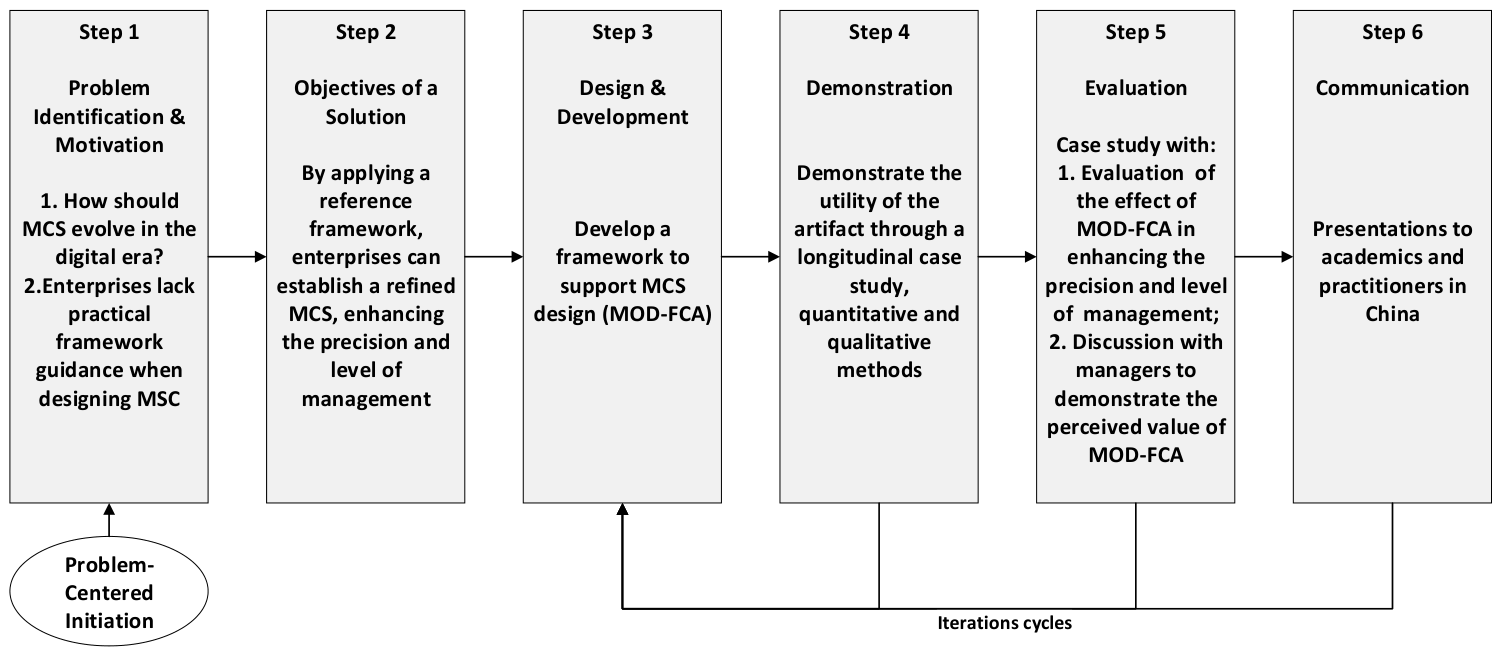
3. Research Approach
4. Artifact Description (Proposed MOD-FCA Framework)
4.1. Overview
4.1.1. Layering and Control Entities
4.1.2. Coupled Logic Flows
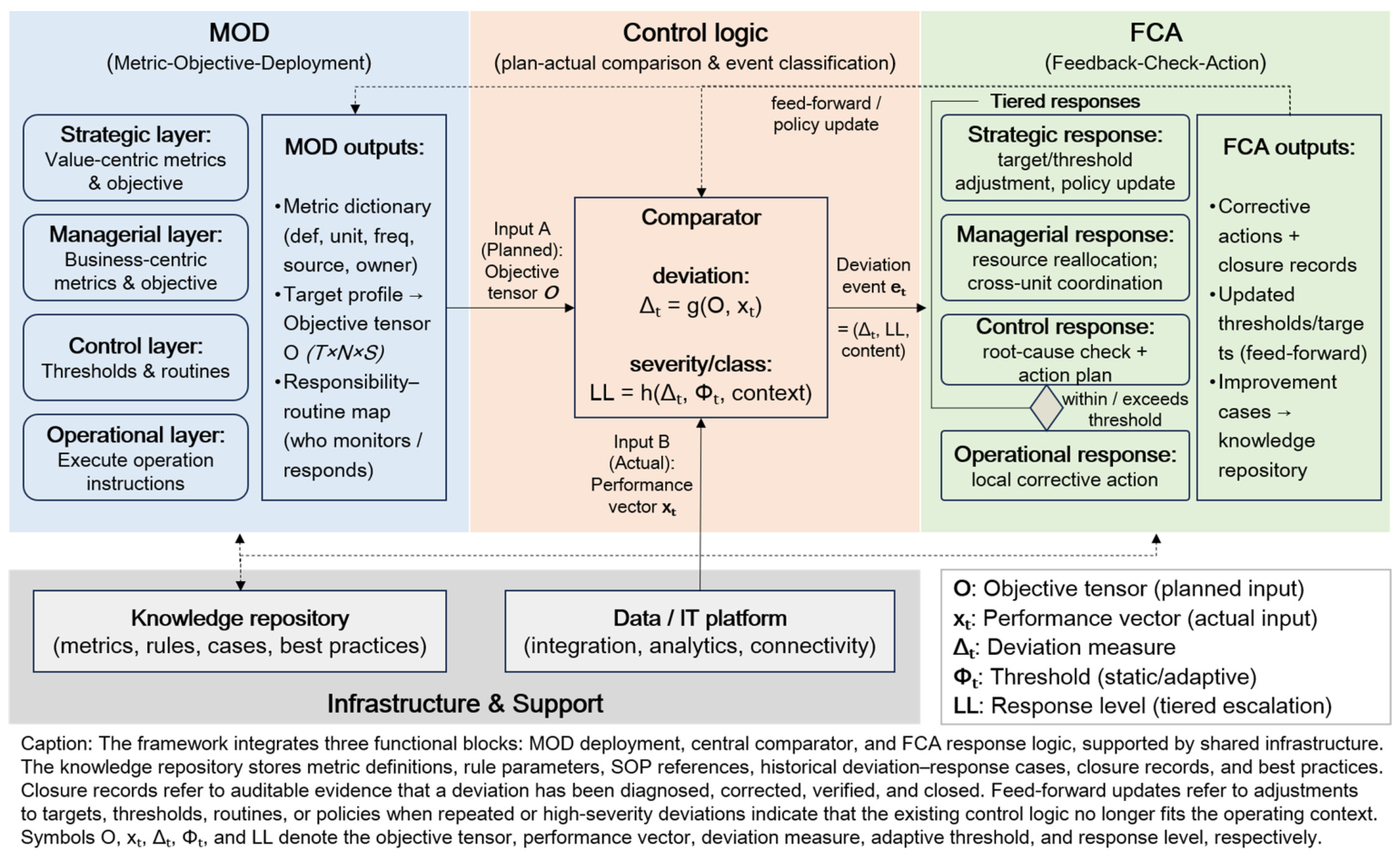
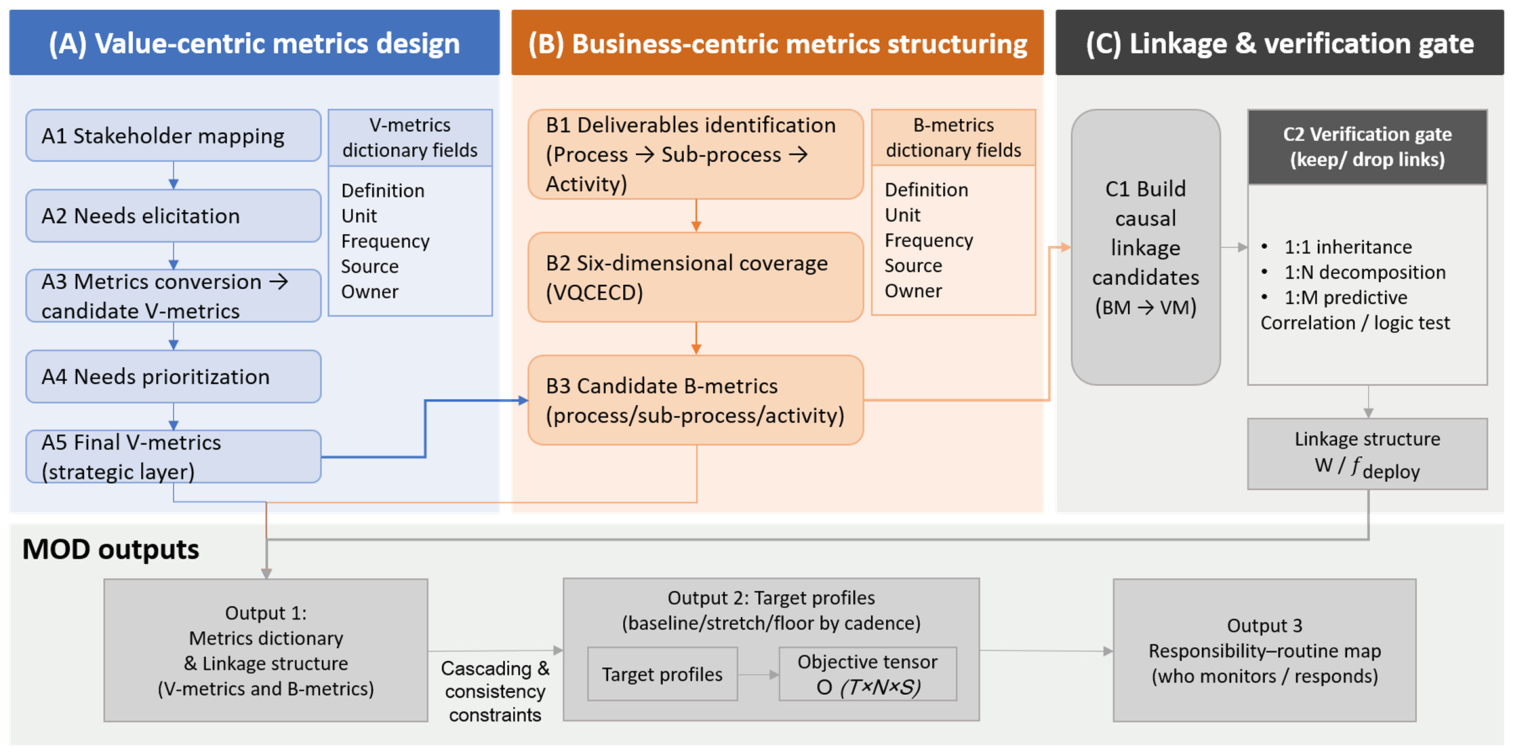
- MOD (downward). MOD specifies how value-centric objectives are translated into business-centric metrics and deployable targets at lower layers. The output of MOD is a structured target set and associated measurement definitions that enable consistent monitoring across layers. The rationale is to make control objects explicitly quantitative: by linking value outcomes to controllable drivers, MOD improves problem visibility and traceability, transforming outcome indicators into diagnostic and actionable measures.
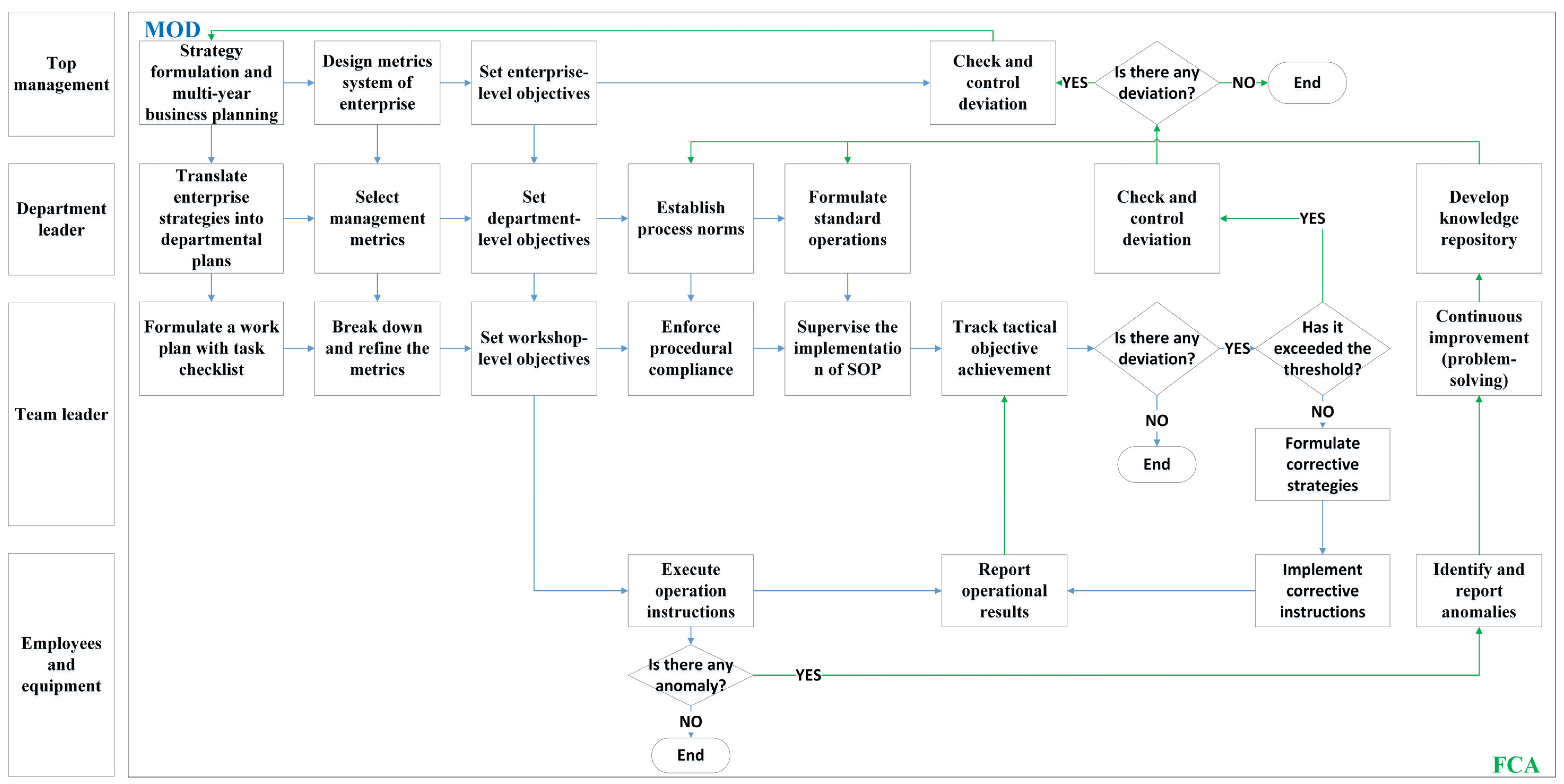
- FCA (upward). FCA specifies how operational data are aggregated into performance observations, compared against deployed targets, and transformed into decision-relevant deviation signals that trigger appropriate governance routines. FCA therefore strengthens proactive feedback by treating deviations as explicit control objects and by embedding reporting and monitoring into formal routines—reducing dependence on exhaustive inspection and shortening problem discovery cycles. Importantly, FCA is not limited to reporting deviations; it specifies the logic for closed-loop correction by linking deviation signals to tiered responses (self-correction vs. escalation) and to closure requirements, thereby shifting performance management from a reporting system toward an action system.
4.1.3. Supporting Elements
4.2. Formal Definition of Constructs
- ⮚
- : metric vector at layer .
- ⮚
- : objective tensor (time × metric × scenario).
- ⮚
- : performance vector observed at time .
- ⮚
- : elementwise deviation rate at time .
- ⮚
- : aggregate deviation magnitude.
- ⮚
- : adaptive threshold for metric at time .
4.2.1. Metric Vector Space
4.2.2. Objective Tensor
4.2.3. Performance Vector and Feedback Mapping
4.2.4. Deviation Logic and Adaptive Thresholds
4.2.5. Hierarchical Response Mechanism
4.2.6. Illustrative Calculation (Single-Metric Example)
4.3. Operational Procedure
4.3.1. The MOD Module
- Time indexing: translating strategic targets into rolling windows aligned with governance cadence (e.g., monthly review with weekly monitoring).
- Scenario indexing: specifying baseline/stretch (and, when needed, guardrail) scenarios to enable controlled switching without redesign.
- Cascading & consistency constraints: deploying targets from higher to lower levels using the validated linkage structure so local targets remain consistent with upper-level intent.
4.3.2. The FCA Module
- Metric-level deviation rates. For each metric , compute using Equation (5).
- Aggregated deviation magnitude. Compute using the weighted aggregation in Equation (6), consistent with the deployment weights defined during MOD.
- Adaptive thresholds and bands. Compute using Equation (7) and construct trigger bands and using Equation (8).
- Event classification and response mode. Apply the prescriptive rule function in Equation (9) to classify the event into Null, Self-Correction, or Escalation.
4.3.3. Infrastructure and Support Module
- Metric dictionary and linkage structure (MOD Output 1): definitions, units, sources, owners, and validated BM→VM linkages.
- Objective tensor and target profiles (MOD Output 2): indexed by time–metric–scenario, including revision history.
- Responsibility–routine map (MOD Output 3): monitoring and response assignments, escalation paths, and routine templates.
- Threshold parameter history: , , , , volatility references, and any revision rationale.
- Event logs: , , event class , and context descriptors.
- Closure records and improvement cases: root-cause analyses, actions taken, evidence of completion, effectiveness checks, and reusable best practices.
- Integration: connecting heterogeneous data sources (MES/ERP/QMS/sensors/manual inputs) into a unified data layer.
- Analytics and computation: computing , , , and threshold bands in a repeatable manner.
- Workflow enablement: issuing notifications, routing events to responsible roles, managing closure records, and maintaining audit trails.
- Access control and governance: ensuring data integrity, ownership clarity, and appropriate visibility across layers.
4.3.4. Parameter Initialization and Calibration
4.3.5. Operationalizing Sustainability Objectives Through MOD-FCA
4.4. Design Principles
5. Evaluation
5.1. Background
5.1.1. The Enterprise Profile and Industry Dilemma
5.1.2. Initial Diagnostic: Recurring Governance Gaps
5.2. MOD-FCA Implementation Process
5.3. Case Instantiation in Standardized Work Management
5.3.1. Value-Centric Metrics Design: From Stakeholder Needs to Strategic Outcomes
5.3.2. Architectural Deconstruction: Deliverables and Business-Centric Metrics
5.3.3. Multi-Scenario Target Setting and Quantitative Deviation Perception
5.3.4. Digitally Enabled Closed-Loop Control
5.3.5. Knowledge Evolution and Organizational Learning
5.4. Qualitative Feedback
5.5. Discussion
5.5.1. Theoretical Implications
5.5.2. Practical Implications
6. Conclusions, Limitations, and Future Research
Author Contributions
Funding
Institutional Review Board Statement
Informed Consent Statement
Data Availability Statement
Conflicts of Interest
References
- Nudurupati, S.S.; Garengo, P.; Bititci, U.S. Impact of the changing business environment on performance measurement and management practices. Int. J. Prod. Econ. 2021, 232, 107942. [Google Scholar] [CrossRef]
- Truant, E.; Crocco, E.; Culasso, F.; Alshibani, S.M. Fifty years of management control systems research: A bibliometric review of the literature and research agenda. Int. J. Product. Perform. Manag. 2025, 74, 491–519. [Google Scholar] [CrossRef]
- Davim, J.P. Sustainable and Intelligent Manufacturing: Perceptions in line with 2030 Agenda of Sustainable Development. BioResources 2024, 19, 4–5. [Google Scholar] [CrossRef]
- Zhang, S.; Bi, X.; Tian, R.; Chen, T.; Ding, K.; Yu, Z. Lean Digitalization Solutions for SMEs in China. IEEE Trans. Eng. Manag. 2025, 72, 1546–1558. [Google Scholar] [CrossRef]
- Davim, J.P. Perceptions of Industry 5.0: Sustainability Perspective. BioResources 2025, 20, 15–16. [Google Scholar] [CrossRef]
- Machado, C.; Davim, J.P. From Industry 4.0 to Industry 6.0; John Wiley & Sons, Inc: Hoboken, NJ, USA, 2025. [Google Scholar]
- Cosa, M.; Torelli, R. Digital Transformation and Flexible Performance Management: A Systematic Literature Review of the Evolution of Performance Measurement Systems. Glob. J. Flex. Syst. Manag. 2024, 25, 445–466. [Google Scholar] [CrossRef]
- Liu, M.; Sun, M.; Zhang, X.; Ge, M.; Hu, J. Real-time shop floor operations improvement based on dynamic value stream mapping and hybrid simulation in Industry 4.0: An economic perspective. Int. J. Prod. Res. 2025, 63, 6776–6800. [Google Scholar] [CrossRef]
- Machado, C.; Davim, J.P. Industry 5.0: Creative and Innovative Organizations; Springer International 1475 Publishing: Berlin/Heidelberg, Germany, 2023. [Google Scholar]
- Kessler, M.; Arlinghaus, J.C. A framework for human-centered production planning and control in smart manufacturing. J. Manuf. Syst. 2022, 65, 220–232. [Google Scholar] [CrossRef]
- Souifi, A.; Boulanger, Z.C.; Zolghadri, M.; Barkallah, M.; Haddar, M. Uncertainty of key performance indicators for Industry 4.0: A methodology based on the theory of belief functions. Comput. Ind. 2022, 140, 103666. [Google Scholar] [CrossRef]
- Li, D.; Zheng, L. Optimizing Information Flow in Manufacturing Operations Management Through Lean-Industry 4.0 Integration. Eng. Manag. J. 2025, 1–25. [Google Scholar] [CrossRef]
- Liu, W.B.; Meng, W.; Mingers, J.; Tang, N.; Wang, W. Developing a performance management system using soft systems methodology: A Chinese case study. Eur. J. Oper. Res. 2012, 223, 529–540. [Google Scholar] [CrossRef]
- Nudurupati, S.S.; Tebboune, S.; Hardman, J. Contemporary performance measurement and management (PMM) in digital economies. Prod. Plan. Control 2016, 27, 226–235. [Google Scholar] [CrossRef]
- Kamble, S.S.; Gunasekaran, A. Big data-driven supply chain performance measurement system: A review and framework for implementation. Int. J. Prod. Res. 2020, 58, 65–86. [Google Scholar] [CrossRef]
- Sanchez-Marquez, R.; Guillem, J.M.A.; Vicens-Salort, E.; Vivas, J.J. Diagnosis of quality management systems using data analytics-A case study in the manufacturing sector. Comput. Ind. 2020, 115, 103183. [Google Scholar] [CrossRef]
- Raffoni, A.; Visani, F.; Bartolini, M.; Silvi, R. Business Performance Analytics: Exploring the potential for Performance Management Systems. Prod. Plan. Control 2018, 29, 51–67. [Google Scholar] [CrossRef]
- Simons, R. Levers of Control: How Managers Use Innovative Control Systems to Drive Strategic Renewal; Harvard Business School Press: Boston, MA, USA, 1995. [Google Scholar]
- Ghalayini, A.M.; Noble, J.S.; Crowe, T.J. An integrated dynamic performance measurement system for improving manufacturing competitiveness. Int. J. Prod. Econ. 1997, 48, 207–225. [Google Scholar] [CrossRef]
- Melnyk, S.A.; Bititci, U.; Platts, K.; Tobias, J.; Andersen, B. Is performance measurement and management fit for the future? Manag. Account. Res. 2014, 25, 173–186. [Google Scholar] [CrossRef]
- Anthony, R.N. Planning and Control Systems: A Framework for Analysis; Harvard Business School Press: Boston, MA, USA, 1965. [Google Scholar]
- Ferreira, A.; Otley, D. The design and use of performance management systems: An extended framework for analysis. Manag. Account. Res. 2009, 20, 263–282. [Google Scholar] [CrossRef]
- Malmi, T.; Brown, D.A. Management control systems as a package-Opportunities, challenges and research directions. Manag. Account. Res. 2008, 19, 287–300. [Google Scholar] [CrossRef]
- Hevner, A.R.; March, S.T.; Park, J.; Ram, S. Design science in Information Systems research. MIS Q. 2004, 28, 75–105. [Google Scholar] [CrossRef]
- Peffers, K.; Tuunanen, T.; Rothenberger, M.A.; Chatterjee, S. A design science research methodology for Information Systems Research. J. Manag. Inf. Syst. 2007, 24, 45–77. [Google Scholar] [CrossRef]
- Pavlov, A.; Bourne, M. Explaining the effects of performance measurement on performance: An organizational routines perspective. Int. J. Oper. Prod. Manag. 2011, 31, 101–122. [Google Scholar] [CrossRef]
- Bourne, M.; Franco-Santos, M.; Micheli, P.; Pavlov, A. Performance measurement and management: A system of systems perspective. Int. J. Prod. Res. 2018, 56, 2788–2799. [Google Scholar] [CrossRef]
- Gregor, S.; Hevner, A.R. Positioning and presenting design science research for maximum impact. MIS Q. 2013, 37, 337–356. [Google Scholar] [CrossRef]
- Strauß, E.; Zecher, C. Management control systems: A review. J. Manag. Control 2013, 23, 233–268. [Google Scholar] [CrossRef]
- Merchant, K.A.; Otley, D.T. A Review of the Literature on Control and Accountability. In Handbooks of Management Accounting Research; Elsevier: Amsterdam, The Netherlands, 2006; pp. 785–802. [Google Scholar]
- Otley, D.; Broadbent, J.; Berry, A. Research in Management Control: An Overview of its Development. Br. J. Manag. 1995, 6, S31–S44. [Google Scholar] [CrossRef]
- Tessier, S.; Otley, D. A conceptual development of Simons’ Levers of Control framework. Manag. Account. Res. 2012, 23, 171–185. [Google Scholar] [CrossRef]
- Otley, D. Performance management: A framework for management control systems research. Manag. Account. Res. 1999, 10, 363–382. [Google Scholar] [CrossRef]
- Grabner, I.; Moers, F. Management control as a system or a package? Conceptual and empirical issues. Account. Organ. Soc. 2013, 38, 407–419. [Google Scholar] [CrossRef]
- Pfister, J.A.; Peda, P.; Otley, D. A methodological framework for theoretical explanation in performance management and management control systems research. Qual. Res. Account. Manag. 2023, 20, 201–228. [Google Scholar] [CrossRef]
- Chenhall, R.H. Management control systems design within its organizational context: Findings from contingency-based research and directions for the future. Account. Organ. Soc. 2003, 28, 127–168. [Google Scholar] [CrossRef]
- Fisher, J. Contingency-Based Research on Management Control Systems: Categorization by Level of Complexity. J. Account. Lit. 1995, 14, 24. [Google Scholar]
- Bedford, D.S.; Malmi, T.; Sandelin, M. Management control effectiveness and strategy: An empirical analysis of packages and systems. Account. Organ. Soc. 2016, 51, 12–28. [Google Scholar] [CrossRef]
- Franco-Santos, M.; Otley, D. Reviewing and Theorizing the Unintended Consequences of Performance Management Systems. Int. J. Manag. Rev. 2018, 20, 696–730. [Google Scholar] [CrossRef]
- Karina, R.; Siti-Nabiha, A.K.; Jurnali, T. Big data integration in performance management and control: A socio-technical perspective. J. Account. Organ. Change 2025, 22, 313–332. [Google Scholar] [CrossRef]
- Rehman, M.H.U.; Chang, V.; Batool, A.; Wah, T.Y. Big data reduction framework for value creation in sustainable enterprises. Int. J. Inf. Manag. 2016, 36, 917–928. [Google Scholar] [CrossRef]
- You, Z.; Wu, C. A framework for data-driven informatization of the construction company. Adv. Eng. Inform. 2019, 39, 269–277. [Google Scholar] [CrossRef]
- Lindström, V.; Persson, F.; Viswanathan, A.P.C.; Rajendran, M. Data quality issues in production planning and control-Linkages to smart PPC. Comput. Ind. 2023, 147, 103871. [Google Scholar] [CrossRef]
- Sjödin, D.R.; Parida, V.; Leksell, M.; Petrovic, A. Smart Factory Implementation and Process Innovation: A Preliminary Maturity Model for Leveraging Digitalization in Manufacturing. Res.-Technol. Manag. 2018, 61, 22–31. [Google Scholar]
- Otley, D.T.; Berry, A.J. Control, organisation and accounting. Account. Organ. Soc. 1980, 5, 231–244. [Google Scholar] [CrossRef]
- Smith, M.; Bititci, U.S. Interplay between performance measurement and management, employee engagement and performance. Int. J. Oper. Prod. Manag. 2017, 37, 1207–1228. [Google Scholar] [CrossRef]
- Merchant, K.A.; Otley, D. Beyond the systems versus package debate. Account. Organ. Soc. 2020, 86, 101185. [Google Scholar] [CrossRef]
- Arnott, D.; Pervan, G. A critical analysis of decision support systems research revisited: The rise of design science. J. Inf. Technol. 2014, 29, 269–293. [Google Scholar] [CrossRef]
- Yin, R.K. Case Study Research: Design and Methods, 5th ed.; SAGE Publications: New York, NY, USA, 2014. [Google Scholar]
- Chenhall, R.H. Integrative strategic performance measurement systems, strategic alignment of manufacturing, learning and strategic outcomes: An exploratory study. Account. Organ. Soc. 2005, 30, 395–422. [Google Scholar] [CrossRef]
- Buer, S.-V.; Strandhagen, J.O.; Chan, F.T.S. The link between Industry 4.0 and lean manufacturing: Mapping current research and establishing a research agenda. Int. J. Prod. Res. 2018, 56, 2924–2940. [Google Scholar] [CrossRef]
- Love, P.E.D.; Holt, G.D.; Li, H. Triangulation in construction management research. Eng. Constr. Archit. Manag. 2002, 9, 294–303. [Google Scholar]
- Langevin, P.; Mendoza, C. How can management control system fairness reduce managers’ unethical behaviours? Eur. Manag. J. 2013, 31, 209–222. [Google Scholar] [CrossRef]
- Wouters, M.; Wilderom, C. Developing performance-measurement systems as enabling formalization: A longitudinal field study of a logistics department. Account. Organ. Soc. 2008, 33, 488–516. [Google Scholar] [CrossRef]
- Van der Hauwaert, E.; Hoozée, S.; Maussen, S.; Bruggeman, W. The impact of enabling performance measurement on managers? autonomous work motivation and performance. Manag. Account. Res. 2022, 55, 100780. [Google Scholar] [CrossRef]
- Simons, R. Designing high-performance jobs. Harv. Bus. Rev. 2005, 83, 54–65. [Google Scholar]
- Simons, R.; Davila, A. How Top Managers Use the Entrepreneurial Gap to Drive Strategic Change. Eur. Account. Rev. 2021, 30, 583–609. [Google Scholar] [CrossRef]
- Marginson, D.; Ogden, S. Coping with ambiguity through the budget: The positive effects, of budgetary targets on managers’ budgeting behaviours. Account. Organ. Soc. 2005, 30, 435–456. [Google Scholar] [CrossRef]



| Framework | Main Focus | Limitations for Digital Closed-Loop Control | MOD-FCA’s Incremental Contribution |
|---|---|---|---|
| Anthony’s management control hierarchy | Distinguishes strategic planning, management control, and operational control. | Provides a high-level hierarchy but limited guidance on computable cross-level deployment and real-time deviation response. | Extends hierarchical control into four operationalized layers with explicit metric deployment, comparator logic, and tiered responses. |
| Balanced Scorecard | Translates strategy into financial and non-financial measures. | Emphasizes strategic alignment but does not prescribe how deviations trigger routines or how accountability is bound to response paths. | Links value-centric metrics to business-centric drivers and embeds them into objective tensors and response routines. |
| Levers of Control/diagnostic control | Uses critical performance variables for exception-based monitoring. | Provides a conceptual logic for diagnostic monitoring but is less specific about digital event classification and closure mechanisms. | Formalizes diagnostic control through adaptive thresholds, event classes, and self-correction/escalation rules. |
| MCS package/system perspective | Emphasizes complementarity and coherence among control elements. | Explains the importance of coherence but provides limited construction rules for engineering such coherence. | Provides an integration logic that binds metrics, objectives, responsibilities, routines, and knowledge accumulation. |
| Digitally enabled PMM/analytics-based control | Uses digital data, analytics, dashboards, or predictions to improve visibility. | Often improves data visibility but may remain weak in translating signals into organizational action. | Converts data into deviation events and connects them to role-aligned corrective routines and feed-forward updates. |
| Element | Initialization Basis | Calibration/Documentation |
|---|---|---|
| V-metrics | Stakeholder needs, strategic objectives, power–interest assessment, structured workshops | Stored in the V-metric dictionary with definition, owner, unit, frequency, and data source |
| B-metrics | Deliverable decomposition, VQCECD coverage, actionability, non-redundancy, stable measurability | Stored in the B-metric dictionary and linked to responsible routines |
| BM→VM linkage | 1:1 inheritance, 1:N decomposition, historical evidence, cross-role expert review | Retained only when semantically consistent and actionable |
| Deployment weights | Strength of causal/logical linkage, expert scoring, historical evidence where available | Normalized and updated when sufficient operational evidence accumulates |
| Φ0 | Base tolerance from SOP standards, historical acceptable fluctuation, managerial risk appetite | Reviewed during pilot operation based on false alarms and missed deviations |
| α1 | Sensitivity to historical volatility | Adjusted when normal process variation causes excessive false alarms |
| α2 | Sensitivity to strategic criticality | Adjusted when critical deviations are under- or over-triggered |
| Criticality parameter | Directness to value outcomes, quality/safety/sustainability relevance, risk consequence | Recorded in the parameter profile and revised through feed-forward updates |
| Design Principle | Corresponding MOD-FCA Components | Main Mechanism |
|---|---|---|
| Metrics-driven formalization | V-metric dictionary; B-metric dictionary; BM→VM linkage structure; objective tensor | Translates strategic intent into measurable, time- and scenario-indexed control objects |
| Process-embedded accountability | Responsibility–routine map; metric owners; monitoring/responding roles; escalation paths | Binds metrics and deviation classes to responsible roles and formal routines |
| Algorithmic closed-loop governance | Performance vector; deviation computation; adaptive thresholds; trigger bands; event classification rules | Converts plan–actual gaps into classified deviation events and tiered responses |
| Evolutionary knowledge accumulation | Event logs; closure records; improvement cases; knowledge repository; feed-forward updates | Converts repeated deviation handling into reusable organizational knowledge and parameter/routine refinement |
| Stakeholders | Needs | Metrics | Needs Prioritization | Value-Centric Metrics(VC) |
|---|---|---|---|---|
| Shareholders | Implement parent company mandates in production operations; | Mandate compliance rate. | 1/14 | Mandate compliance rate; Product mix fulfillment rate, First-time acceptance rate, On-time delivery rate, Capacity utilization; OEE, Inventory turnover ratio; Conformance rate, First-pass yield, Cpk; Unit production cost, Controllable cost per unit; Energy intensity per RMB 10,000 output, Carbon intensity per RMB 10,000 output, Specific energy consumption; Lean maturity index; Online transition rate, Model utilization rate, AI integration rate; Competency development completion rate, Role competency rate; Order fulfillment rate (with loss rate tracking); On-time shipment rate, Order accuracy rate; Preservation compliance rate; Ramp-up cycle time; Capacity utilization analysis accuracy; |
| Maintain controlled processes to fulfill customer specifications (volume/quality/delivery); | Product mix fulfillment rate, First-time acceptance rate, On-time delivery rate, Capacity utilization, Production schedule adherence. | 2/14 | ||
| Drive continuous productivity improvement; | Efficiency target achievement rate, Overall Equipment Effectiveness (OEE), Inventory turnover ratio, Modernization project completion. | 3/14 | ||
| Enhance product quality through systematic controls; | Conformance rate, First-pass yield, Process capability index (Cpk), Rework volume. | 4/14 | ||
| Optimize production cost structure; | Unit production cost, Controllable cost per unit (tooling/mold/maintenance/ packaging/logistics), Outsourcing fees. | 5/14 | ||
| Advance energy efficiency management systems; | Energy intensity per RMB 10,000 output, Carbon intensity per RMB 10,000 output, Specific energy consumption. | 6/14 | ||
| Establish a lean manufacturing framework; | Lean maturity index, 5S compliance rate, Benchmark teams established. | 7/14 | ||
| Accelerate digital-physical integration in production; | Online transition rate, Model utilization rate, AI integration rate. | 8/14 | ||
| Develop high-performance production leadership. | Competency development completion rate, Role competency rate. | 9/14 | ||
| Marketing department | Ensure maximum responsiveness to customer orders; | Order fulfillment rate (with loss rate tracking), Order review cycle time, Full-order completeness. | 10/14 | |
| Execute precision shipment operations; | On-time shipment rate, Order accuracy rate. | 11/14 | ||
| Guarantee product integrity through delivery. | Customer acceptance rate, Preservation compliance rate. | 12/14 | ||
| R&D department | Achieve rapid production ramp-up for new products; | Ramp-up cycle time. | 13/14 | |
| Implement data-driven capacity planning; | Capacity utilization analysis accuracy, | 14/14 | ||
| etc. | etc. | etc. | etc. | etc. |
| Code | Deliverable | VQCECD | Metric Definition | Primary Linkage to VC1 |
|---|---|---|---|---|
| BC1 | D1 | Volume | SOP coverage rate: % of key operations with an approved, current SOP accessible at point of use | Indirect (enables BC5) |
| BC2 | D1/D3 | Quality | SOP document quality pass rate: % SOPs passing completeness/clarity review checklist | Indirect (enables BC5) |
| BC3 | D3 | Efficiency | SOP change lead time (median days): change request → approved SOP version release | Indirect (prevents mismatch-driven defects) |
| BC4 | D4 | Volume | Training/certification coverage: % operators certified for the SOP set relevant to their station | Indirect (enables BC5) |
| BC5 | D2 | Compliance | Execution compliance rate: % observations meeting all quality-critical SOP steps | Direct driver |
| BC6 | D2 | Efficiency | Standard work stability: % cycles within standard cycle-time tolerance band (or cycle-time variance index) | Indirect (process stability → quality) |
| BC7 | D5 | Quality | Repeat deviation rate: % SOP-related deviations recurring within a defined window | Direct/indirect (sustained correction) |
| BC8 | D5 | Cost | Monitoring effort: inspection/audit labor-hours per 100 operations (or per shift) | Indirect (cost of control; complements proactive feedback) |
| BC9 | D5 | Digital | Digital traceability rate: % SOP/training/inspection records captured with traceable IDs in the system | Indirect (timeliness & credibility of feedback) |
| BC10 | D5 | Efficiency | Closure cycle time (median days): deviation identified → verified closure evidence | Direct/indirect (prevents accumulation & rework) |
Disclaimer/Publisher’s Note: The statements, opinions and data contained in all publications are solely those of the individual author(s) and contributor(s) and not of MDPI and/or the editor(s). MDPI and/or the editor(s) disclaim responsibility for any injury to people or property resulting from any ideas, methods, instructions or products referred to in the content. |
© 2026 by the authors. Licensee MDPI, Basel, Switzerland. This article is an open access article distributed under the terms and conditions of the Creative Commons Attribution (CC BY) license.
Share and Cite
Ding, K.; Kong, F.; Yu, Z.; Zhang, Z.; Wu, Z. MOD-FCA: A Quantitative Reference Framework for Multi-Layered Closed-Loop Management Control in the Digital Era. Sustainability 2026, 18, 6015. https://doi.org/10.3390/su18126015
Ding K, Kong F, Yu Z, Zhang Z, Wu Z. MOD-FCA: A Quantitative Reference Framework for Multi-Layered Closed-Loop Management Control in the Digital Era. Sustainability. 2026; 18(12):6015. https://doi.org/10.3390/su18126015
Chicago/Turabian StyleDing, Kaifang, Fansen Kong, Ziyin Yu, Zhihao Zhang, and Zezhong Wu. 2026. "MOD-FCA: A Quantitative Reference Framework for Multi-Layered Closed-Loop Management Control in the Digital Era" Sustainability 18, no. 12: 6015. https://doi.org/10.3390/su18126015
APA StyleDing, K., Kong, F., Yu, Z., Zhang, Z., & Wu, Z. (2026). MOD-FCA: A Quantitative Reference Framework for Multi-Layered Closed-Loop Management Control in the Digital Era. Sustainability, 18(12), 6015. https://doi.org/10.3390/su18126015