3.3.1. Spatial Spillover Effects
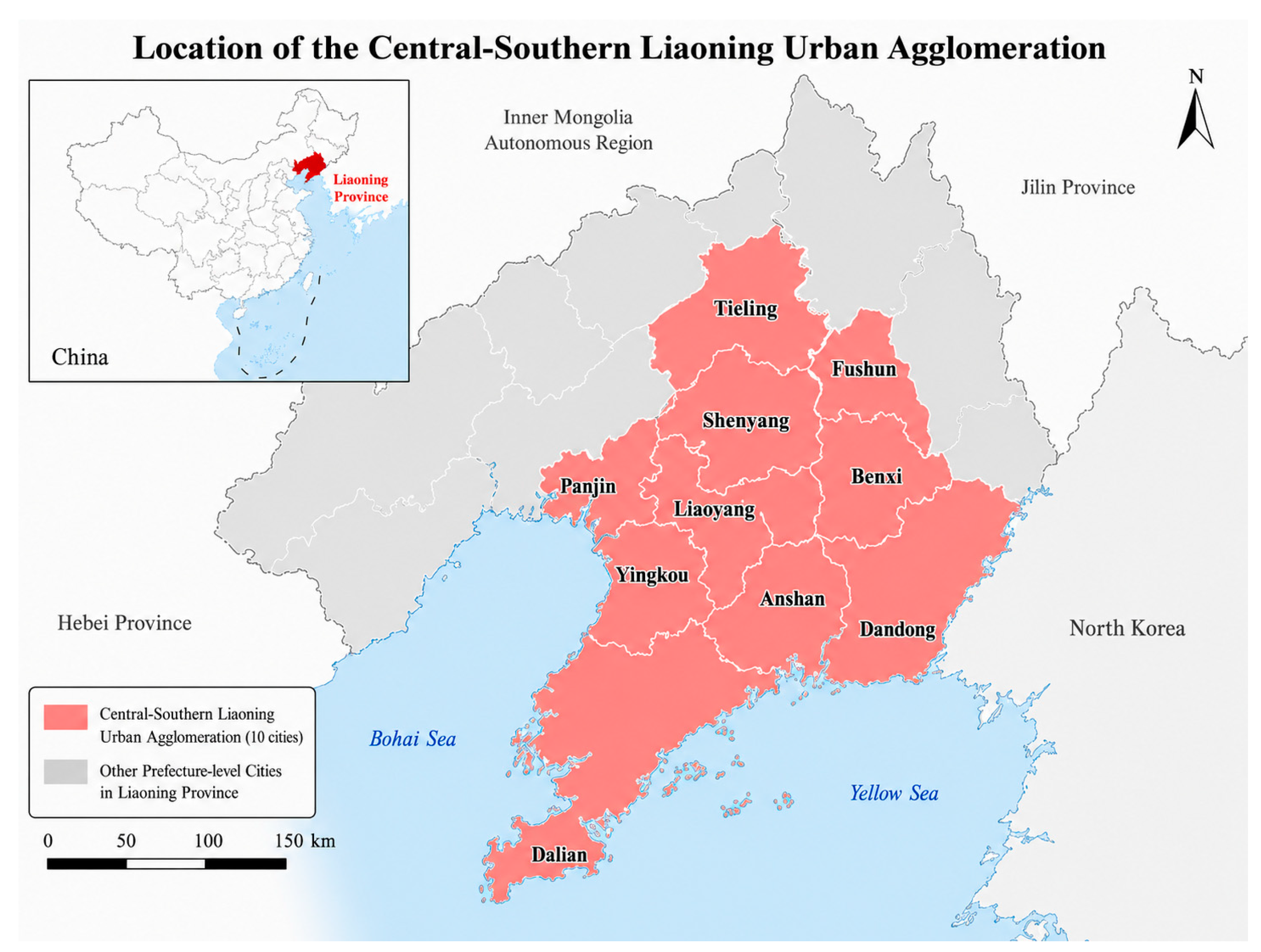
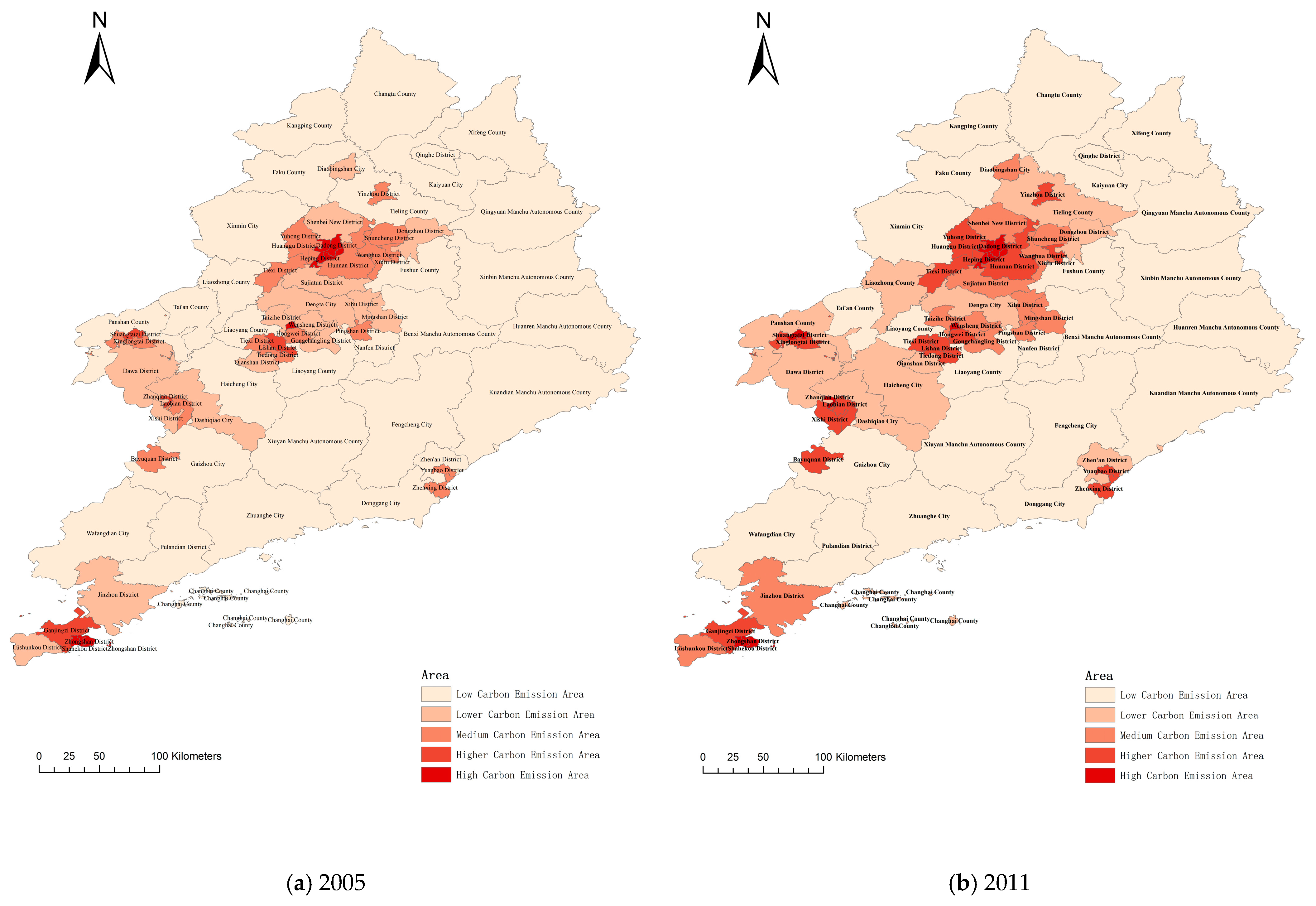
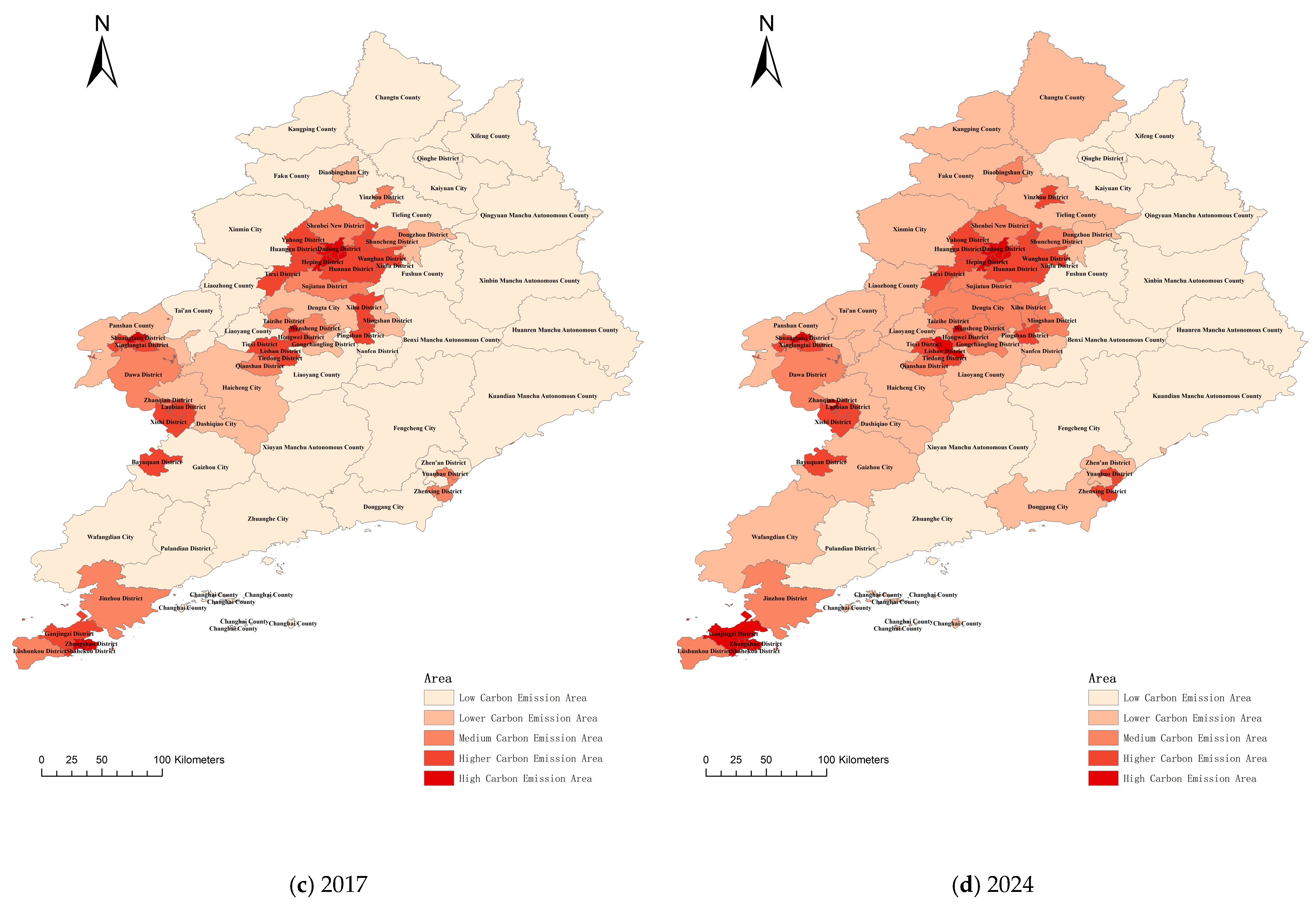
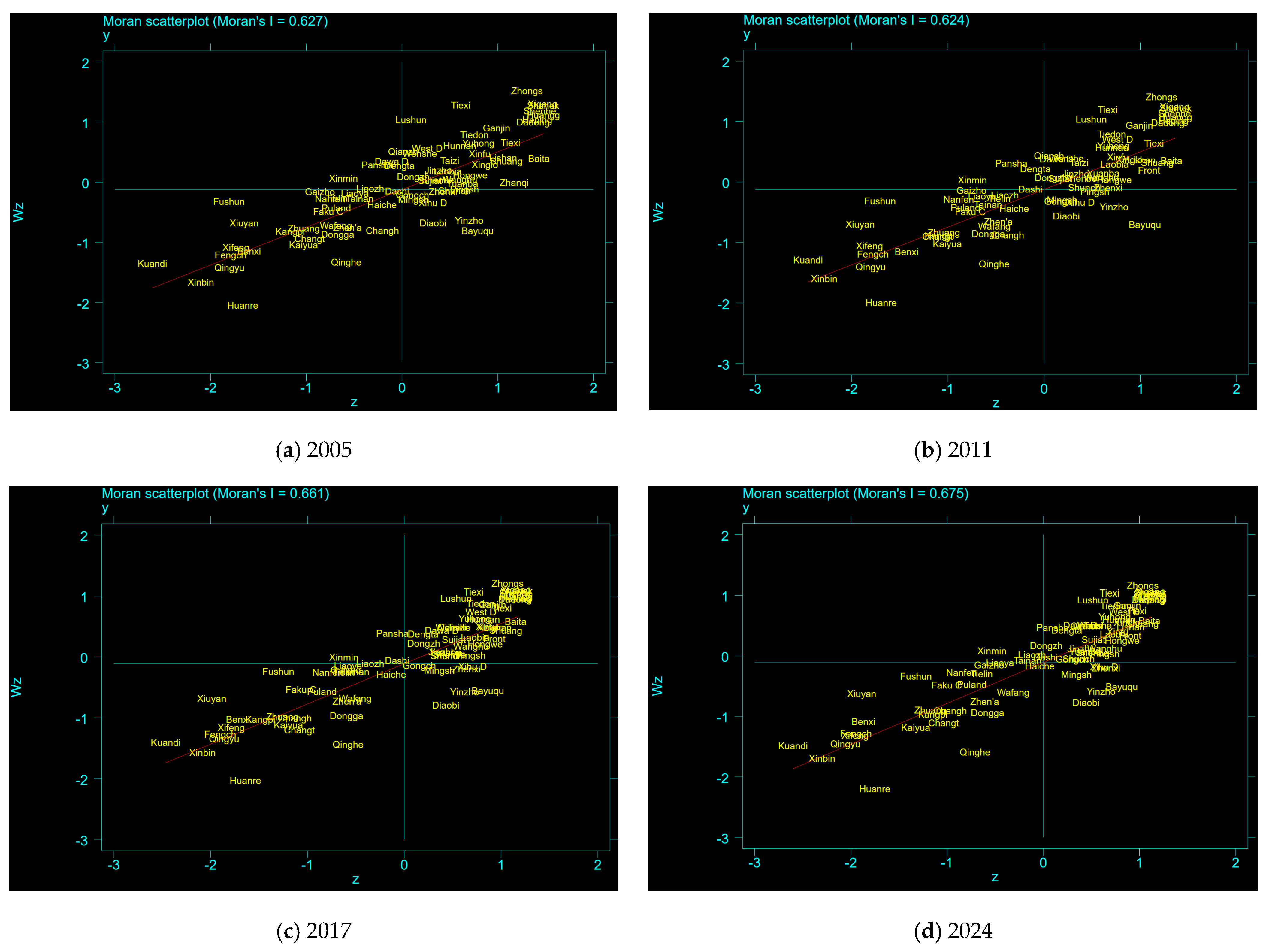
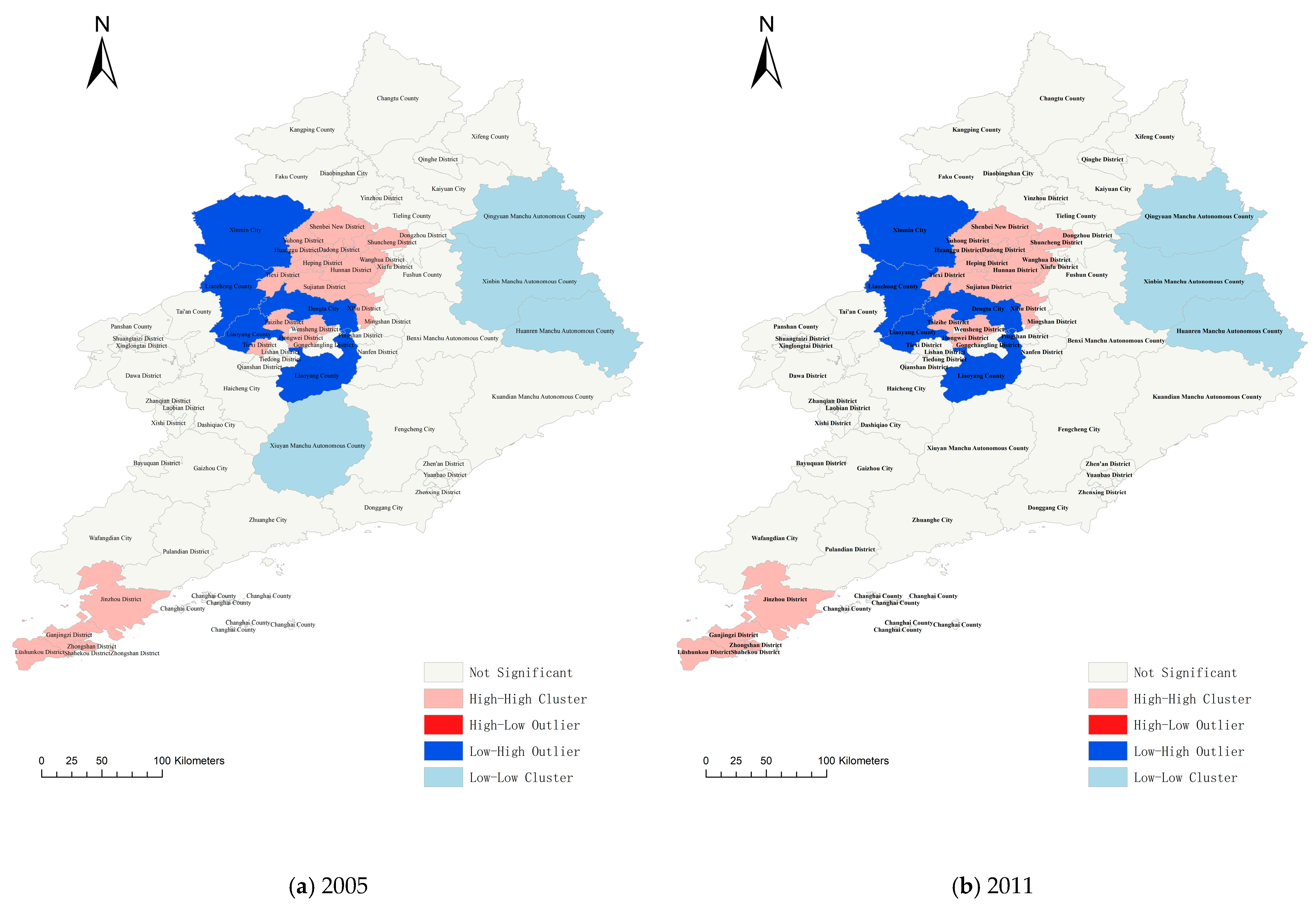
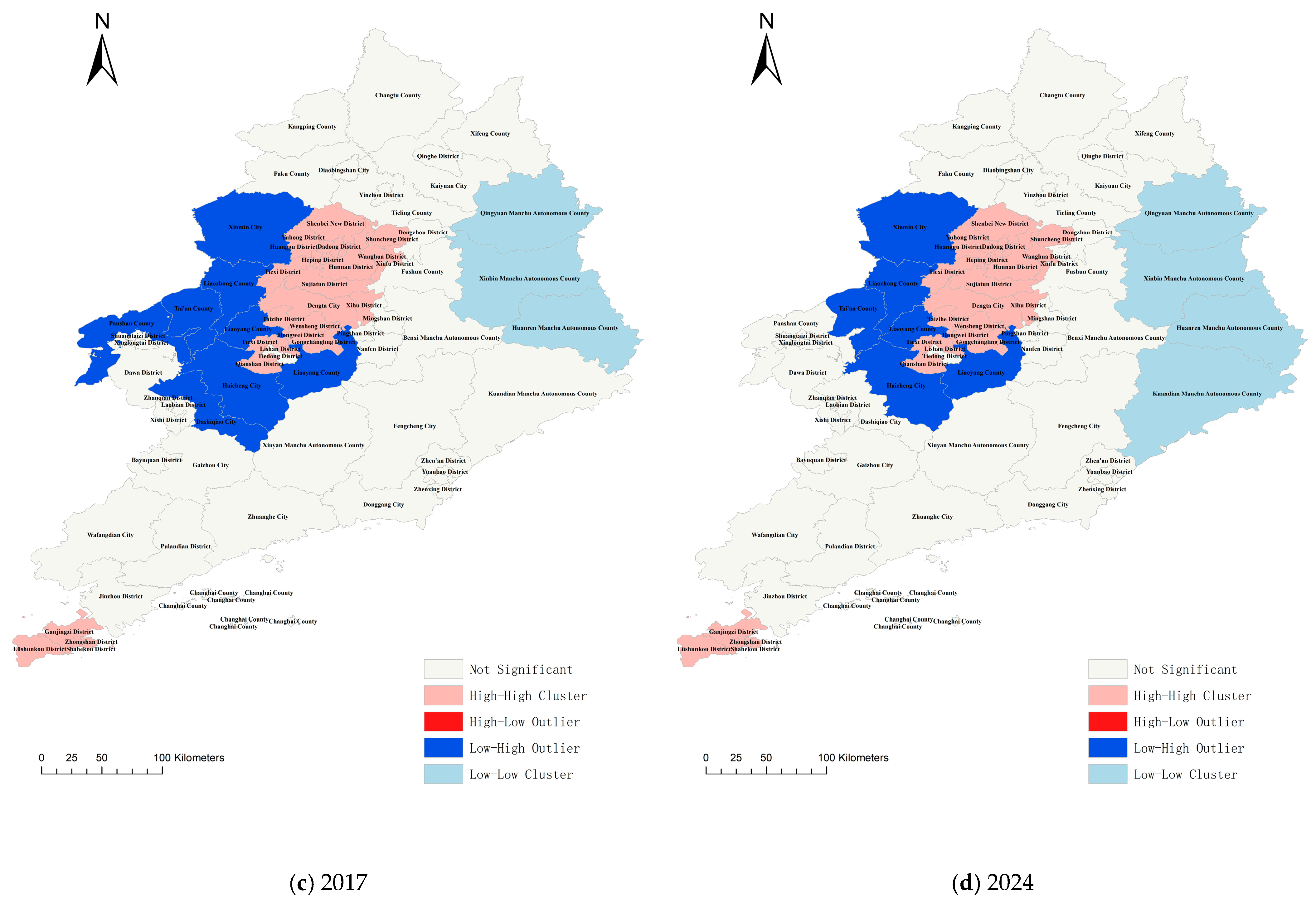
The spatial correlation analysis shows significant spatial clustering in county-level carbon emissions across the Central-Southern Liaoning urban agglomeration. Conventional non-spatial linear regression models are therefore not sufficient to capture the effects of explanatory variables when spatial dependence is present. Spatial econometric models are used to assess this dependence and the associated spillover effects.
Table 5 reports the spatial diagnostic tests and their significance levels.
The Hausman test was first performed in Stata to choose between the fixed-effects and random-effects specifications. The test rejects the random-effects assumption at the 1% level, so the fixed-effects framework is preferred for the panel estimation.
The subsequent fixed-effects tests also support this choice. The statistics and p-values for the spatial fixed-effects, time fixed-effects, and two-way fixed-effects models are (28.80, 0.000), (46.96, 0.000), and (19.55, 0.000), respectively. Since both the spatial and temporal dimensions are significant, and the two-way specification is also strongly significant, the two-way fixed-effects model is used in the following estimation.
Spatial dependence was then examined using the Lagrange Multiplier (LM) tests. The test results reject the hypotheses of no spatial lag effect and no spatial error effect at the 1% level, which means that a conventional non-spatial panel model would be inadequate for these data. A spatial econometric specification is therefore required.
Finally, the likelihood ratio (LR) and Wald tests were used to examine whether the Spatial Durbin Model could be reduced to a simpler spatial lag or spatial error model. The results do not support such simplification, indicating that the SDM specification should be retained. The corresponding estimation results are reported in
Table 6.
As shown in
Table 6, the spatial autoregressive coefficient ρ is 0.537 and statistically significant at the 1% level. This confirms the presence of spatial spillover effects in carbon emissions, meaning that local emissions are related to emissions in neighboring regions.
Before estimating the SDM, multicollinearity was checked using variance inflation factors for the five model regressors. The VIF values were 2.324 for GDPPC, 2.308 for POP, 1.120 for SEC, 3.237 for PE, and 1.465 for HS, all below the conventional threshold of 10. These diagnostics suggest that severe multicollinearity is unlikely to drive the baseline SDM results.
To examine the robustness of the GDPPC specification, a quadratic term of lnGDPPC and its spatial lag are introduced into the SDM-style two-way fixed-effects model. The results are reported in
Table 7. The coefficient of W × lnCE remains significantly positive, indicating that the spatial dependence of county-level carbon emissions is stable after the quadratic GDPPC terms are included. The coefficient of SEC remains significantly positive, while W × SEC remains significantly negative, suggesting that the main industrial-structure result is also robust in this alternative specification. However, neither (lnGDPPC)
2 nor W × (lnGDPPC)
2 is statistically significant. The implied local turning point calculated from lnGDPPC and (lnGDPPC)
2 is not economically meaningful, and the implied turning point for the spatially lagged GDPPC term lies outside the observed range of lnGDPPC in the sample. Therefore, the quadratic specification does not provide statistical support for a formal EKC turning point. GDPPC is interpreted as a conditional association after controlling for industrial structure, population, fiscal expenditure, household savings, spatial dependence, and fixed effects.
To assess whether the SEC result is affected by its association with other socioeconomic variables, pairwise correlations between the SEC and the main regressors are reported in
Table 8. The correlations between SEC and lnGDPPC, lnPOP, lnPE, and lnHS are relatively low. In addition, the VIF of SEC in the baseline model is 1.120. These diagnostics suggest that the estimated SEC effect is unlikely to be driven by severe multicollinearity with the income, population, fiscal expenditure, or household savings variables. The result should still be interpreted as a conditional association, but the positive local coefficient of SEC and the negative spatially lagged SEC coefficient are not merely artifacts of simple pairwise correlation with GDPPC or POP.
Within the SDM setting, the estimated coefficients cannot be interpreted only as local marginal effects, because a change in one county can also affect nearby counties through the spatial weight matrix. For this reason, the effects of each explanatory variable were separated into three parts: the direct effect, which reflects the response of local carbon emissions; the indirect effect, which captures the response transmitted to neighboring counties; and the total effect, which combines the two.
Following the partial-derivative approach commonly used in spatial econometric models, this study reports the direct, indirect, and total effects of each explanatory variable. These results are used to evaluate both the local influence and the spatial spillover influence of the driving factors. The decomposition results are presented in
Table 9.
The coefficient of economic growth (GDPPC) is significantly negative, indicating a conditional negative association between per capita GDP and energy-related carbon emissions after spatial dependence and other socioeconomic factors are controlled. However, the quadratic robustness check in
Table 7 does not provide statistical support for a formal EKC turning point. GDPPC is therefore interpreted as a conditional association rather than as evidence of a complete EKC pattern. The negative GDPPC coefficient is consistent with industrial upgrading and service-oriented development in more developed districts, but it should not be read as proof that the study area has reached an EKC turning point.
The direct effect of population size (POP) is significantly negative, whereas the indirect effect is positive but statistically insignificant. After spatial dependence and other socioeconomic factors are controlled, counties with larger registered populations tend to show lower local energy-related emissions in the current model. This finding is consistent with existing evidence on agglomeration efficiency and service-oriented functions in core urban districts [
7,
8,
13,
20], but it should not be interpreted as evidence that population growth itself automatically reduces emissions.
The secondary industry share (SEC) shows a more complex pattern. Its direct effect is positive, which is consistent with the expectation that counties with greater dependence on industrial production face stronger local emission pressure. The robustness diagnostics in
Table 8 show that the correlations between SEC and lnGDPPC, lnPOP, lnPE, and lnHS are relatively low, and the VIF of SEC is 1.120. These diagnostics suggest that the estimated SEC effect is unlikely to be driven by severe multicollinearity with the income, population, fiscal expenditure, or household savings variables. The indirect effect of SEC remains negative and larger in absolute value, suggesting an association between the spatial organization of industrial activity and emission-reduction effects in neighboring counties through shared infrastructure, industrial specialization, and energy-efficiency spillovers. Because the magnitude of the indirect effect is relatively large, this result should be interpreted cautiously. It does not mean that expanding heavy industrial concentration is inherently beneficial. Rather, existing industrial corridors need coordinated low-carbon upgrading, cleaner production, energy-efficiency improvement, and carbon-management technologies.
Fiscal expenditure (PE) has significant positive direct and total effects, with coefficients of 0.140 and 0.214, respectively, while its indirect effect is not statistically significant. This indicates that fiscal expenditure is positively associated with local energy-related carbon emissions after spatial dependence is controlled. In an old industrial urban agglomeration, this association is linked to public expenditure, infrastructure construction, industrial support, and energy demand. Optimizing the structure of fiscal expenditure is therefore important for reducing the carbon intensity of regional development.
In contrast, household savings (HS) are not statistically significant in terms of direct, indirect, or total effects. Because HS measures savings stock rather than direct household consumption or disposable income, the insignificant coefficient should be interpreted as evidence that this particular wealth proxy has limited explanatory power for county-level energy-related carbon emissions in the current model.
The model results point to pronounced spatial spillover effects in the Central-Southern Liaoning urban agglomeration. Economic development and population agglomeration show conditional negative associations with emissions, the secondary industry share increases local emissions but has a negative spatial spillover effect, and fiscal expenditure has a positive local and total effect. These results are consistent with the High-High and Low-Low club convergence patterns identified in the local spatial autocorrelation analysis and with related spatial econometric evidence on county-level and urban-agglomeration carbon emissions [
7,
8,
10,
12,
13,
20].
For policy design, the results suggest three priorities: improving the quality of economic growth in core cities such as Shenyang and Dalian, promoting low-carbon upgrading in established heavy-industrial corridors, and restructuring fiscal expenditure to reduce carbon-intensive investment. The findings do not support a simple expansion of heavy industrial agglomeration. They instead point to coordinated industrial transformation and cleaner production within existing corridors.
3.3.2. Spatial Heterogeneity of Driving Factors
The SDM effect decomposition can be read together with the local spatial clustering pattern to understand the spatial heterogeneity of the driving mechanisms. Counties in the Central-Southern Liaoning Urban Agglomeration differ substantially in economic function and industrial base. Core urban districts in Shenyang and Dalian have stronger service functions and better conditions for industrial upgrading, whereas counties along the Shenyang–Anshan–Liaoyang–Yingkou corridor are more closely connected with steel, equipment manufacturing, petrochemical production, and other energy-intensive activities. Eastern mountainous counties, including parts of Benxi, Fushun, and Dandong, are more constrained by ecological functions and therefore show relatively low emission intensity.
The effect of economic development is more evident in core urban districts. The negative direct and spillover effects of GDPPC indicate that economic growth in the study area is not simply accompanied by higher emissions after spatial dependence is controlled. This pattern is consistent with the gradual upgrading of industrial structure and the expansion of service-oriented activities in more developed urban districts, but it should not be interpreted as a full EKC test. By contrast, in traditional industrial counties, the share of the secondary industry remains a more direct source of emission growth. The significant positive direct effect of SEC shows that counties with a higher dependence on industrial production still face stronger pressure from energy-related carbon emissions.
Fiscal expenditure also has spatially differentiated carbon effects. The positive direct and total effects of PE indicate that fiscal expenditure is closely associated with local emission growth, especially where public investment is linked to infrastructure construction, industrial support, and urban expansion. This interpretation is consistent with existing evidence that local fiscal expenditure and infrastructure-oriented investment can affect carbon emissions through development scale and investment structure [
40]. The insignificant indirect effect suggests that this influence is mainly local rather than strongly diffused to neighboring counties. HS is not statistically significant, implying that county-level energy-related carbon emissions in the study area are shaped more by production-side factors than by the household savings proxy used in this model.
These heterogeneous effects call for policies tailored to county type. Core urban districts need to improve the quality of economic growth and strengthen technology spillovers. Heavy-industrial corridor counties need industrial restructuring, energy-efficiency improvement, cleaner production, and CCUS deployment. Resource-based and petrochemical counties should accelerate the low-carbon transformation of dominant industries, while ecological peripheral counties should maintain their low-emission development path and avoid receiving transferred high-emission industries. These recommendations are based on the SDM effect decomposition, LISA clustering, and Markov transition results.