


Can Digital–Green Synergy Enhance Tourism Carbon Emission Efficiency? Evidence from Chinese Coastal Cities

Abstract
1. Introduction
2. Literature Review
2.1. The Connotation and Interactive Logic of DGS
2.2. Overview of TCEE
2.3. The Impact of DGS on TCEE
3. Theoretical Hypotheses
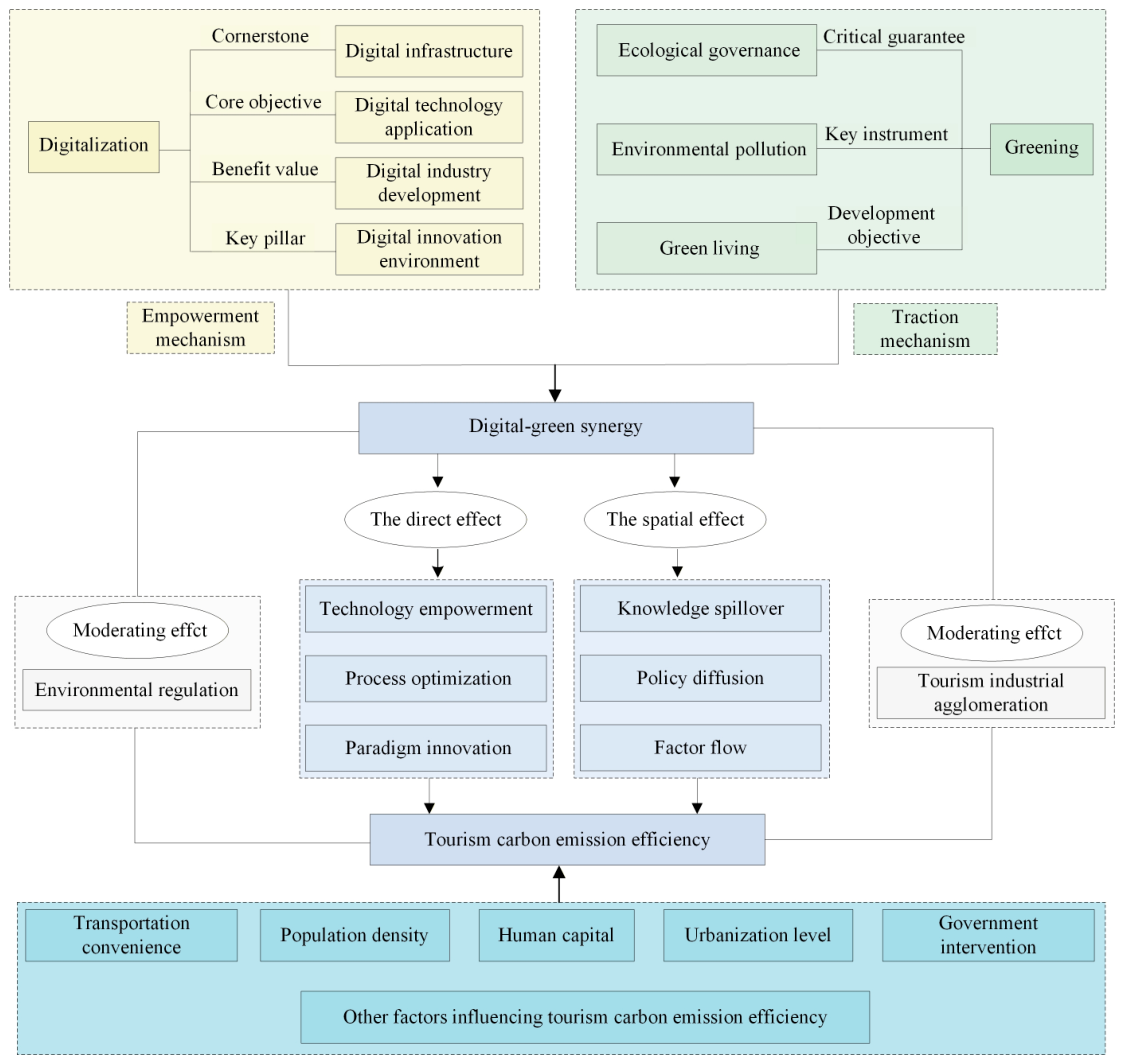
3.1. The Logical Mechanism of Enhancing TCEE Through the DGS
3.2. The Moderating Mechanisms of DGS in Enhancing TCEE
3.3. The Nonlinear Effects of DGS on TCEE
3.4. The Spatial Spillover Effects of DGS on TCEE
4. Research Design
4.1. Model Setting
4.1.1. Super-SBM Model
4.1.2. Baseline Regression Model
4.1.3. Moderation Effect Model
4.1.4. Threshold Effect Model
4.1.5. Spatial Durbin Model
4.2. Variable Selection
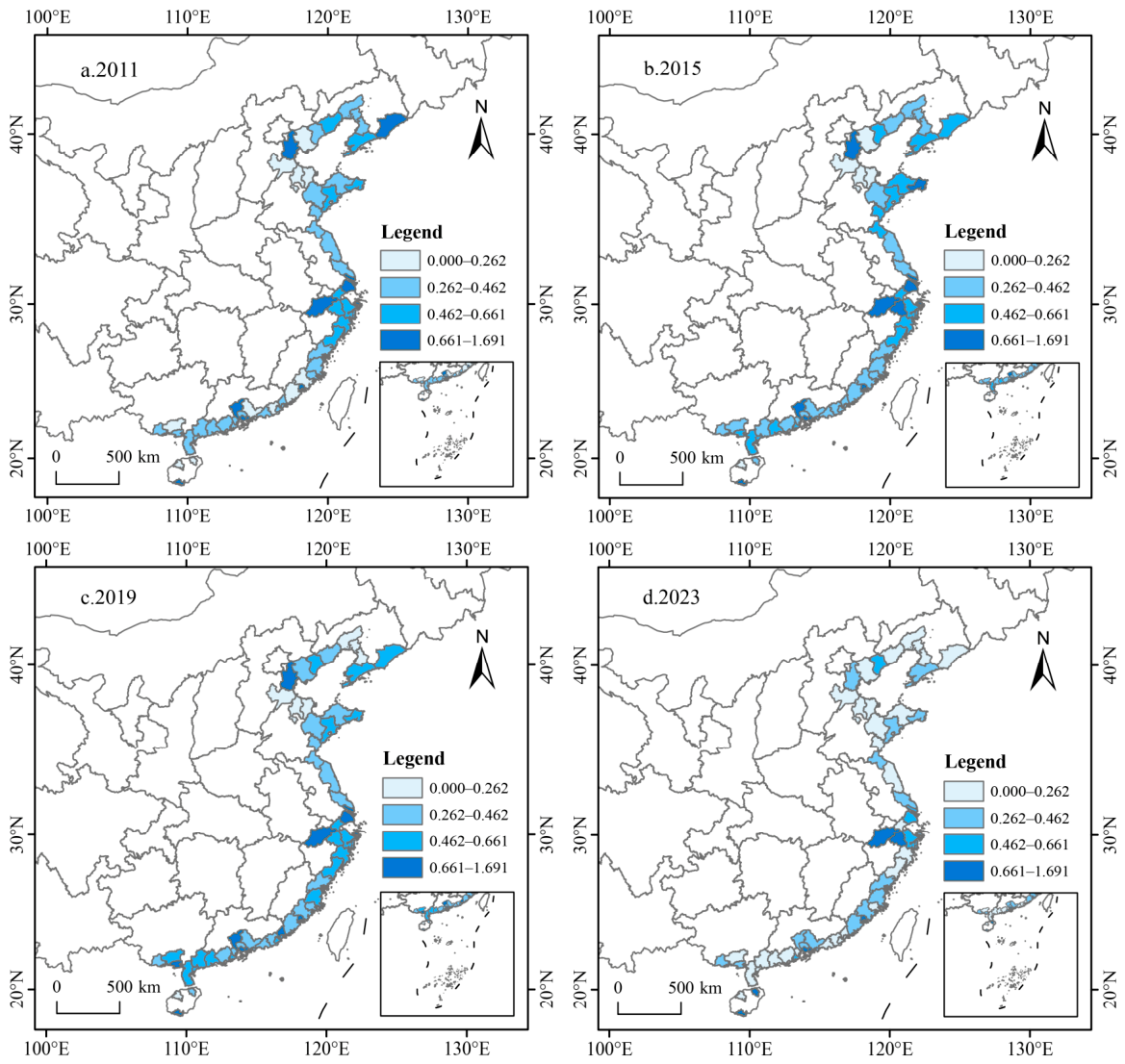
4.2.1. Explained Variable
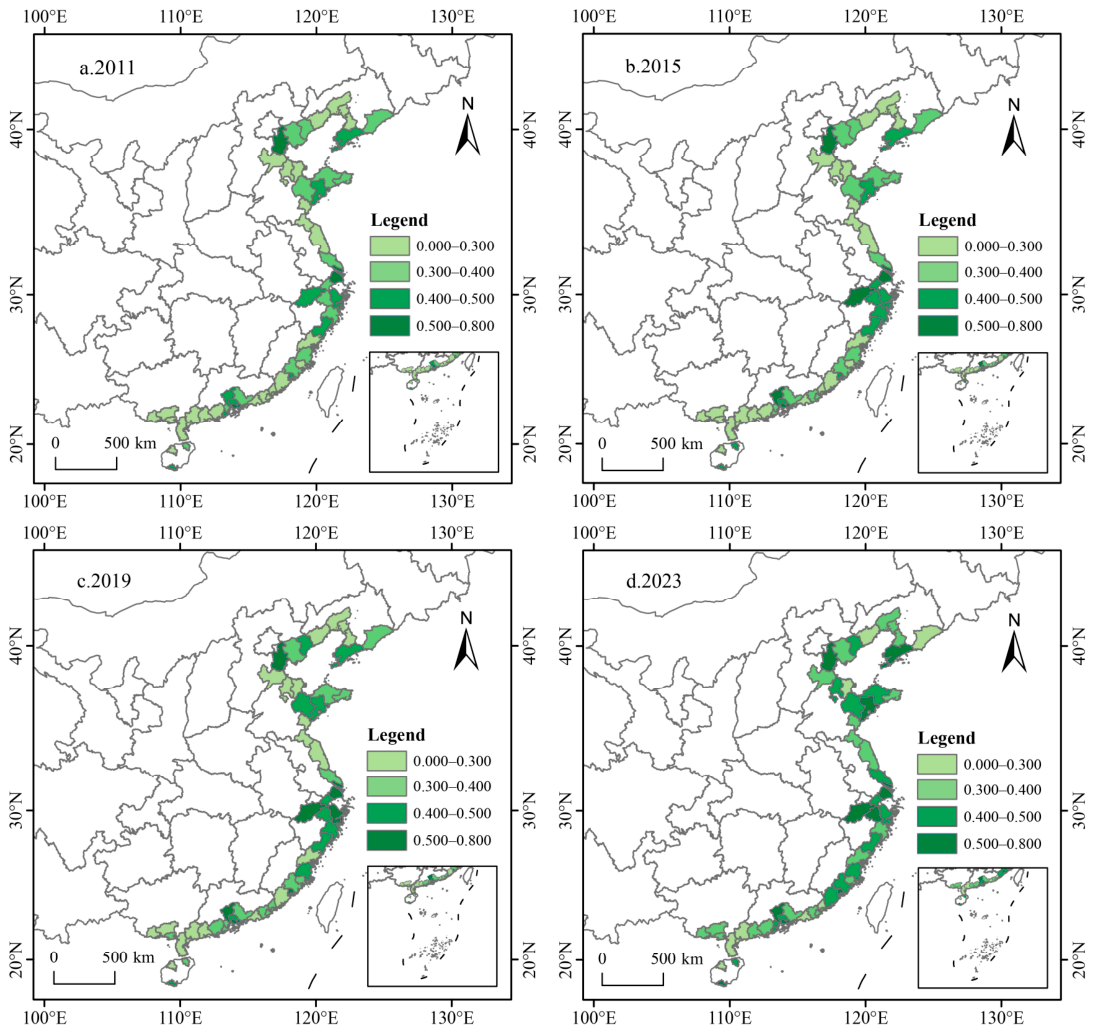
4.2.2. Core Explanatory Variable
4.2.3. Moderating Variables
4.2.4. Control Variables
4.3. Data Sources
5. Result Analysis
5.1. Baseline Regression
5.2. Moderation Effect Result
5.3. Robustness Test
5.4. Endogenous Test
5.5. Heterogeneity Test
5.5.1. Regional Heterogeneity
5.5.2. Heterogeneity of Economic Development Levels
6. Further Analysis
6.1. Threshold Effect Results
6.2. Spatial Spillover Effect
6.2.1. Preliminary Tests for Spatial Econometrics
6.2.2. Spatial Model Selection and Regression Results Testing
7. Conclusions and Policy Implications
7.1. Conclusions
- (1)
- DGS can effectively enhance TCEE in coastal cities of China. This conclusion remains robust after performing robustness and endogeneity tests. Economically, a 1% increase in DGS corresponds to a 3.184% increase in TCEE, indicating that the deep integration of digitalization and green development can effectively reduce carbon emissions per unit of tourism economic output. Mechanistically, DGS enhances TCEE primarily through three pathways: technological empowerment, process optimization, and paradigm innovation, which together reduce energy consumption and improve resource allocation efficiency.
- (2)
- ER and TIA play positive moderating roles in the relationship between DGS and TCEE. Specifically, ER promotes the adoption of green digital technologies by tourism enterprises through a “pressure effect” and an “innovation compensation effect,” while TIA lowers the cost of technology application via knowledge spillovers and economies of scale, thereby amplifying the positive effect of DGS on TCEE.
- (3)
- The impact of DGS on TCEE exhibits a nonlinear threshold effect. When DGS is below the threshold value, its effect on TCEE is positive but not statistically significant. Once DGS surpasses the first and second threshold values, the cumulative effects of technological innovation gradually emerge, and the positive impact on TCEE strengthens progressively.
- (4)
- DGS exhibits spatial spillover effects on TCEE. DGS not only enhances TCEE within the local region but also promotes TCEE in neighboring regions through tourism flows and policy diffusion.
- (5)
- Heterogeneity analysis indicates that the positive effect of DGS on TCEE is more pronounced in the Southern Marine Economic Zone and economically developed regions. These areas feature more advanced digital infrastructure, stronger policy support, and high-end tourism industries, alongside a higher willingness of tourists to engage in low-carbon consumption, enabling the carbon reduction benefits of DGS to be more fully translated into improvements in TCEE.
7.2. Policy Implications
7.3. Research Limitations and Future Work
- (1)
- Limitations related to spatial scale: This study examines the impact of DGS on TCEE primarily at the city level. Future research could employ more granular spatial units, such as counties, firms, or industrial parks, and integrate remote sensing and night-time light data to capture spatial heterogeneity and better identify the effects of DGS on TCEE.
- (2)
- Constraints on the quality of tourism carbon emission accounting: This study adopts a bottom–up approach combined with uniform emission coefficients to estimate city-level tourism carbon emissions. Such estimation inevitably generates empirical bias and restricts the accuracy of carbon data due to limited official segmented statistical data. Future research can improve accounting precision by integrating micro-enterprise accounting records and field survey datasets.
- (3)
- Unresolved potential reverse causality: Although the instrumental variable approach is employed to mitigate endogeneity, higher tourism carbon emission efficiency may incentivize local governments to accelerate DGS construction with sufficient fiscal resources. Such reverse causal linkage cannot be fully eliminated by the existing IV design. Subsequent studies can adopt quasi-natural experiments based on exogenous policy shocks to achieve more rigorous causal identification.
Supplementary Materials
Author Contributions
Funding
Institutional Review Board Statement
Informed Consent Statement
Data Availability Statement
Conflicts of Interest
References
- Scott, D.; Hall, C.M.; Gössling, S. Global tourism vulnerability to climate change. Ann. Tour. Res. 2019, 77, 49–61. [Google Scholar] [CrossRef]
- Koçak, E.; Ulucak, R.; Ulucak, Z.S. The impact of tourism developments on CO2 emissions: An advanced panel data estimation. Tour. Manag. Perspect. 2020, 33, 100611. [Google Scholar] [CrossRef]
- Sun, Y.Y.; Faturay, F.; Lenzen, M.; Goessling, S.; Higham, J. Drivers of global tourism carbon emissions. Nat. Commun. 2024, 15, 10384. [Google Scholar] [CrossRef] [PubMed]
- Qiu, M.Z.; Wang, Z.F.; Chen, Q.C.; Wang, J. Enhancing tourism carbon emission efficiency through cultural and tourism industry integration in china: Empirical evidence from industrial structure upgrading. Environ. Dev. Sustain. 2025, 1–29. [Google Scholar] [CrossRef]
- Liu, J.; An, K.K.; Jang, S. Threshold effect and mechanism of tourism industrial agglomeration on green innovation efficiency: Evidence from coastal urban agglomerations in China. Ocean Coast. Manag. 2023, 246, 106908. [Google Scholar] [CrossRef]
- Fang, X.Y.; Bai, Y. Spatial correlation of carbon emissions in China’s coastal areas: The spatiotemporal nonlinear characteristics and spatial heterogeneity. Urban Clim. 2026, 65, 102823. [Google Scholar] [CrossRef]
- Chen, D.F.; Wang, J.P.; Li, B.; Luo, H.H.; Hou, G.M. The Impact of Digital-Green Synergy on Total Factor Productivity: Evidence from Chinese Listed Companies. Sustainability 2025, 17, 2200. [Google Scholar] [CrossRef]
- Ding, D.; Cao, Z.X.; Ma, B. Spatio-temporal evolution and driving mechanism of the dual transformation and coordination between digitalization and greening. J. Environ. Manag. 2024, 371, 123110. [Google Scholar] [CrossRef]
- Shan, Z.D.; Han, X.Y.; Huang, D.; Xu, G. Regional digital-green synergy transformation and enterprise new quality productive forces. Financ. Res. Lett. 2025, 79, 107349. [Google Scholar] [CrossRef]
- Myrovali, G.; Tzanis, G.; Morfoulaki, M. Sustainable Tourism Through Digitalization and Smart Solutions. Sustainability 2025, 17, 5383. [Google Scholar] [CrossRef]
- Varolgünes, F.K.; Maldonado-Erazo, C.P.; Bollain-Parra, L. Impact of digitalization on sustainable tourism: Emerging trends and future perspectives. Manag. Decis. 2025, 1–28. [Google Scholar] [CrossRef]
- Wang, Y.P.; Cui, L.B.; Zhou, J. The impact of green finance and digital economy on regional carbon emission reduction. Int. Rev. Econ. Financ. 2025, 97, 11. [Google Scholar] [CrossRef]
- Talwar, S.; Kaur, P.; Nunkoo, R.; Dhir, A. Digitalization and sustainability: Virtual reality tourism in a post pandemic world. J. Sustain. Tour. 2023, 31, 2564–2591. [Google Scholar] [CrossRef]
- Chen, C.; Wu, W.P. Threshold Effects of Digital Economy on Tourism Carbon Emissions: Empirical Evidence from the Yangtze River Economic Belt in China. Pol. J. Environ. Stud. 2025, 34, 43–56. [Google Scholar] [CrossRef]
- Qian, L.; Fang, Q.; Lu, Z. Research on the synergy of green economy and digital economy in stimulus policies. Southwest Financ. 2020, 413, 3–13. [Google Scholar]
- Sareen, S.; Haarstad, H. Digitalization as a driver of transformative environmental innovation. Environ. Innov. Soc. Trans. 2021, 41, 93–95. [Google Scholar] [CrossRef]
- Pradhan, R.P.; Arvin, M.B.; Norman, N.R. The dynamics of information and communications technologies infrastructure, economic growth, and financial development: Evidence from Asian countries. Technol. Soc. 2015, 42, 135–149. [Google Scholar] [CrossRef]
- Jiang, J. Sustainable digital era: High-quality integrated development of green economy and digital economy. Enterp. Econ. 2021, 7, 23–30. [Google Scholar]
- She, Q.; Qian, J.; He, L. Research on the relationship of coupling coordination between digitalization and green development. Sci. Rep. 2024, 14, 19569. [Google Scholar] [CrossRef]
- Li, Q.Y.; Ge, J.X.; Fan, H.B. Unveiling the impact of synergy between digitalization and greening on urban employment in China. Sci. Rep. 2024, 14, 27773. [Google Scholar] [CrossRef]
- Raman, R.; Sreenivasan, A.; Ma, S.; Patwardhan, A.; Nedungadi, P. Green supply chain management research trends and linkages to UN sustainable development goals. Sustainability 2023, 15, 15848. [Google Scholar] [CrossRef]
- Zeng, L.; Wen, M.; Li, C.; Nie, Y.; Wang, S. Impact of digital greening synergistic transformation on urban economic resilience in China: Evidence from quasi-natural experiments. Hum. Soc. Sci. Commun. 2025, 12, 85. [Google Scholar] [CrossRef]
- Li, S.; Cheng, Z.; Tong, Y.; He, B. The interaction mechanism of tourism carbon emission efficiency and tourism economy high-quality development in the Yellow River Basin. Energies 2022, 15, 6975. [Google Scholar] [CrossRef]
- Liang, L.; Wu, J.; Cook, W.D.; Zhu, J. The DEA game cross-efficiency model and its Nash equilibrium. Oper. Res. 2008, 56, 1278–1288. [Google Scholar] [CrossRef]
- Si, X.; Tang, Z. Assessment of low-carbon tourism development from multi-aspect analysis: A case study of the Yellow River Basin, China. Sci. Rep. 2024, 14, 4600. [Google Scholar] [CrossRef] [PubMed]
- Gökgöz, F.; Macit, G. Assessing the Effect of Transportation Investments on Efficiency and Sustainability of EU Roads. Transp. Policy 2025, 175, 103873. [Google Scholar] [CrossRef]
- Assaf, A.G.; Josiassen, A. Frontier analysis: A state-of-the-art review and meta-analysis. J. Travel Res. 2016, 55, 612–627. [Google Scholar] [CrossRef]
- Jiang, G.H.; Zhu, A.D.; Li, J. Measurement and Impactors of Tourism Carbon Dioxide Emission Efficiency in China. J. Environ. Public Health 2022, 2022, 9161845. [Google Scholar] [CrossRef] [PubMed]
- Haibo, C.; Ke, D.; Fangfang, W.; Ayamba, E.C. The spatial effect of tourism economic development on regional ecological efficiency. Environ. Sci. Pollut. Res. 2020, 27, 38241–38258. [Google Scholar] [CrossRef]
- Nunkoo, R.; Ramkissoon, H. Structural equation modelling and regression analysis in tourism research. Curr. Issues Tour. 2012, 15, 777–802. [Google Scholar] [CrossRef]
- Zhang, Y.; Li, Y. Regional Differences in Tourism Eco-Efficiency in the Beijing–Tianjin–Hebei Region: Based on Data from 13 Cities. Sustainability 2023, 15, 2907. [Google Scholar] [CrossRef]
- Wang, L.G.; Jia, G.D. Spatial Spillover and Threshold Effects of High-Quality Tourism Development on Carbon Emission Efficiency of Tourism under the “Double Carbon” Target: Case Study of Jiangxi, China. Sustainability 2023, 15, 4797. [Google Scholar] [CrossRef]
- Balsalobre-Lorente, D.; Driha, O.M.; Leitão, N.C.; Murshed, M. The carbon dioxide neutralizing effect of energy innovation on international tourism in EU-5 countries under the prism of the EKC hypothesis. J. Environ. Manag. 2021, 298, 113513. [Google Scholar] [CrossRef]
- Paramati, S.R.; Alam, M.S.; Chen, C.-F. The effects of tourism on economic growth and CO2 emissions: A comparison between developed and developing economies. J. Travel Res. 2017, 56, 712–724. [Google Scholar] [CrossRef]
- Liu, H.; Wang, C.; Tsai, H. Enhancing tourism carbon emission efficiency through industry agglomeration: Evidence from China. Tour. Manag. 2025, 110, 105170. [Google Scholar] [CrossRef]
- Xiong, G.B.; Deng, J.H.; Ding, B.G. Characteristics, decoupling effect, and driving factors of regional tourism’s carbon emissions in China. Environ. Sci. Pollut. Res. 2022, 29, 47082–47093. [Google Scholar] [CrossRef]
- Ghosh, S. Effects of tourism on carbon dioxide emissions, a panel causality analysis with new data sets. Environ. Dev. Sustain. 2022, 24, 3884–3906. [Google Scholar] [CrossRef]
- Zhou, Y.; Lin, B. Does tourism industry agglomeration improve China’s energy and carbon emissions performance? Sci. Prog. 2022, 105, 00368504221126790. [Google Scholar] [CrossRef] [PubMed]
- Nitti, M.; Pilloni, V.; Giusto, D.; Popescu, V. IoT Architecture for a Sustainable Tourism Application in a Smart City Environment. Mob. Inf. Syst. 2017, 2017, 9201640. [Google Scholar] [CrossRef]
- Horner, N.C.; Shehabi, A.; Azevedo, I.L. Known unknowns: Indirect energy effects of information and communication technology. Environ. Res. Lett. 2016, 11, 103001. [Google Scholar] [CrossRef]
- Eom, S.-J.; Lee, J. Digital government transformation in turbulent times: Responses, challenges, and future direction. Gov. Inf. Q. 2022, 39, 101690. [Google Scholar] [CrossRef]
- Wang, L.; Zhao, H.; Liu, J.; He, T.; Zhu, H.; Liu, Y. How does the digital economy affect carbon emissions from tourism? Empirical evidence from China. J. Clean. Prod. 2024, 469, 143175. [Google Scholar] [CrossRef]
- Lu, C.-W.; Huang, J.-C.; Chen, C.; Shu, M.-H.; Hsu, C.-W.; Bapu, B.T. An energy-efficient smart city for sustainable green tourism industry. Sustain. Energy Technol. Assess. 2021, 47, 101494. [Google Scholar] [CrossRef]
- Wang, P.; Wu, X. Green credit and environmental protection investment for the high-quality development of the tourism industry. Financ. Res. Lett. 2025, 85, 107972. [Google Scholar] [CrossRef]
- Moon, H.; Yu, J.; Chua, B.-L.; Han, H. Impact of green brand authenticity on warm glow, green satisfaction, and willingness to pay more. J. Travel Tour. Mark. 2023, 40, 326–344. [Google Scholar] [CrossRef]
- Lu, Y.; Xu, R.; Shi, L.; Ma, W. Digital economy and cultural-tourism integration: Synergistic effects of financial agglomeration. Financ. Res. Lett. 2025, 88, 109125. [Google Scholar] [CrossRef]
- Irfan, M.; Ullah, S.; Razzaq, A.; Cai, J.Y.; Adebayo, T.S. Unleashing the dynamic impact of tourism industry on energy consumption, economic output, and environmental quality in China: A way forward towards environmental sustainability. J. Clean. Prod. 2023, 387, 135778. [Google Scholar] [CrossRef]
- Wu, L.; Duan, X.M.; Yang, F.; Guo, L.; Zhou, H.T. Does digital economy help reduce carbon emissions from tourism? Evidence from China. Curr. Issues Tour. 2025, 28, 2998–3015. [Google Scholar] [CrossRef]
- Perkumiene, D.; Vienazindiene, M.; Svagzdiene, B. The Sharing Economy towards Sustainable Tourism: An Example of an Online Transport-sharing Platform. Sustainability 2021, 13, 10955. [Google Scholar] [CrossRef]
- Yoon, H. Virtual tourism experience as a substitute: The role of tourist experience phases. Curr. Issues Tour. 2025, 1–17. [Google Scholar] [CrossRef]
- Rubashkina, Y.; Galeotti, M.; Verdolini, E. Environmental regulation and competitiveness: Empirical evidence on the Porter Hypothesis from European manufacturing sectors. Energy Policy 2015, 83, 288–300. [Google Scholar] [CrossRef]
- Xu, Y.J.; Liu, S.G.; Wang, J.Y. Impact of environmental regulation intensity on green innovation efficiency in the Yellow River Basin, China. J. Clean. Prod. 2022, 373, 10. [Google Scholar] [CrossRef]
- Acemoglu, D.; Aghion, P.; Bursztyn, L.; Hemous, D. The Environment and Directed Technical Change. Am. Econ. Rev. 2012, 102, 131–166. [Google Scholar] [CrossRef]
- Zhang, W.; Li, G.X.; Uddin, M.K.; Guo, S.C. Environmental regulation, Foreign investment behavior, and carbon emissions for 30 provinces in China. J. Clean. Prod. 2020, 248, 119208. [Google Scholar] [CrossRef]
- Guo, X.Y.; Yang, J.Y.; Shen, Y.; Zhang, X.W. Impact on green finance and environmental regulation on carbon emissions: Evidence from China. Front. Environ. Sci. 2024, 12, 1307313. [Google Scholar] [CrossRef]
- Li, Y.T.; Guo, J.Q. How does low-carbon development of tourism contribute to high-quality economic development in China? Curr. Issues Tour. 2025, 29, 1849–1869. [Google Scholar] [CrossRef]
- Wu, X.Y.; Liang, X.C. Tourism development level and tourism eco-efficiency: Exploring the role of environmental regulations in sustainable development. Sustain. Dev. 2023, 31, 2863–2873. [Google Scholar] [CrossRef]
- Wang, Z.; Gao, Y.W. Tourism industry agglomeration, digital finance, and high-quality development of regional economy. Financ. Res. Lett. 2025, 85, 108228. [Google Scholar] [CrossRef]
- Jin, W.B.; Wang, Y.M.; Yan, Y.; Zhou, H.Y.; Xu, L.Y.; Zhang, Y.; Xu, Y.; Zhang, Y.Q. Digital Economy, Green Finance, and Carbon Emissions: Evidence from China. Sustainability 2025, 17, 5625. [Google Scholar] [CrossRef]
- Ma, Z.Y.; Xiao, H.; Li, J.; Chen, H.T.; Chen, W.H. Study on how the digital economy affects urban carbon emissions. Renew. Sustain. Energy Rev. 2025, 207, 114910. [Google Scholar] [CrossRef]
- Pang, G.; Li, L.; Guo, D. Does the integration of the digital economy and the real economy enhance urban green emission reduction efficiency? Evidence from China. Sustain. Cities Soc. 2025, 122, 106269. [Google Scholar] [CrossRef]
- Wei, L.L.; Xiu, H.Y.; Hou, Y.Q. Digital economy and low-carbon transformation of economy in China: Analyzing spatial spillover effects and pathways. Inf. Technol. Dev. 2025, 31, 992–1016. [Google Scholar] [CrossRef]
- Liu, Y. Coupling and coordination evaluation of digital economy and green development efficiency in eight urban agglomerations in China. Sci. Rep. 2025, 15, 26829. [Google Scholar] [CrossRef] [PubMed]
- Tone, K. A slacks-based measure of efficiency in data envelopment analysis. Eur. J. Oper. Res. 2001, 130, 498–509. [Google Scholar] [CrossRef]
- Mittal, V.; Kamakura, W.A. Satisfaction, repurchase intent, and repurchase behavior: Investigating the moderating effect of customer characteristics. J. Mark. Res. 2001, 38, 131–142. [Google Scholar] [CrossRef]
- Hansen, B.E. Threshold effects in non-dynamic panels: Estimation, testing, and inference. J. Econom. 1999, 93, 345–368. [Google Scholar] [CrossRef]
- Becken, S. Analysing international tourist flows to estimate energy use associated with air travel. J. Sustain. Tour. 2002, 10, 114–131. [Google Scholar] [CrossRef]
- Brynjolfsson, E.; Collis, A. How should we measure the digital economy. Harv. Bus. Rev. 2019, 97, 140–148. [Google Scholar]
- Li, G.; Cheng, Y.; Chen, Y.N.; Zhang, Q. Can the Synergy of Digitalization and Greening Boost Manufacturing Industry Chain Resilience? Evidence from China’s Provincial Panel Data. Sustainability 2024, 16, 9866. [Google Scholar] [CrossRef]
- Liu, X.; Zuo, Z.; Han, J.; Zhang, W. Is digital-green synergy the future of carbon emission performance? J. Environ. Manag. 2025, 375, 124156. [Google Scholar] [CrossRef]
- Pei, Y.; Zhu, Y.M.; Liu, S.X.; Wang, X.C.; Cao, J.J. Environmental regulation and carbon emission: The mediation effect of technical efficiency. J. Clean. Prod. 2019, 236, 117599. [Google Scholar] [CrossRef]
- Jiang, L.L.; Lv, Z.K. Digitalization means green? Linking the digital economy to environmental performance in the tourism industry. Tour. Econ. 2025, 31, 593–610. [Google Scholar] [CrossRef]
- Lu, X.; Wang, M.; Tang, Y. The spatial changes of transportation infrastructure and its threshold effects on urban land use efficiency: Evidence from China. Land 2021, 10, 346. [Google Scholar] [CrossRef]
- Guo, T.T.; Wang, J.C.; Tao, R.; Yang, L.; Lan, X. Effects of environmental regulation on tourism industry development: Evidence from China. Econ. Anal. Policy 2025, 88, 1036–1044. [Google Scholar] [CrossRef]
- Tian, J.; Xie, J. Industrial intelligence and marine pollution in coastal cities: A Chinese city-level study. Ocean Coast. Manag. 2025, 264, 107621. [Google Scholar] [CrossRef]

| Indicator Category | Indicator Name | Description | Data Source |
|---|---|---|---|
| Input Indicators | Capital Input | Fixed asset investment in the tourism industry | China Tourism Statistical Yearbook, China Culture and Tourism Statistical Yearbook, China City Statistical Yearbook |
| Labor Input | Number of employees in the tourism industry | China Tourism Statistical Yearbook, China Culture and Tourism Statistical Yearbook | |
| Energy Input | Energy consumption of the tourism industry | China Tourism Statistical Yearbook, China Culture and Tourism Statistical Yearbook, China Energy Statistical Yearbook | |
| Output Indicators | Desirable Output | Total tourism revenue | China Tourism Statistical Yearbook, China Culture and Tourism Statistical Yearbook |
| Undesirable Output | Carbon emissions from the tourism industry | China Energy Statistical Yearbook, IPCC Guidelines for National Greenhouse Gas Inventories |
| System Level | Dimension | Indicator Interpretation | Indicator Attributes | Weight |
|---|---|---|---|---|
| Digitalization | Digital Infrastructure | Internet penetration rate | + | 0.021 |
| Optical fiber cable density | + | 0.128 | ||
| Mobile communication base station density | + | 0.139 | ||
| Digital Technology Application | Number of broadband Internet subscribers | + | 0.034 | |
| Digital Financial Inclusion Index | + | 0.008 | ||
| Number of smart tourism portals | + | 0.118 | ||
| Tourism e-commerce sales | + | 0.119 | ||
| Digital Industry Development | Total tourism revenue | + | 0.047 | |
| Digitalization level of tourism enterprises | + | 0.018 | ||
| Number of websites per 100 tourism enterprises | + | 0.079 | ||
| Digital Innovation Environment | Number of employees in the tourism industry | + | 0.048 | |
| Number of authorized tourism industry patents | + | 0.074 | ||
| Internal expenditure on tourism R&D | + | 0.080 | ||
| Number of tourism research institutions | + | 0.087 | ||
| Greening | Ecological Governance | Annual average PM2.5 concentration | − | 0.032 |
| Utilization rate of tourism solid waste | + | 0.239 | ||
| Share of energy conservation and environmental protection expenditure in fiscal expenditure | + | 0.106 | ||
| Investment in tourism environmental pollution control | + | 0.164 | ||
| Environmental Pollution | Tourism wastewater discharge | − | 0.109 | |
| Tourism waste gas emissions | − | 0.047 | ||
| Tourism energy consumption | − | 0.060 | ||
| Green Lifestyle | Green Coverage Rate of Built-up Areas | + | 0.073 | |
| Per Capita Residential Water Consumption | − | 0.045 | ||
| Number of Private Cars per 10,000 People | − | 0.125 |
| VarName | Obs | Mean | SD | Min | Max |
|---|---|---|---|---|---|
| TCEE | 702 | 0.482 | 0.302 | 0.061 | 1.691 |
| DGS | 702 | 0.425 | 0.130 | 0.205 | 0.793 |
| ER | 702 | 0.138 | 0.072 | 0.010 | 0.504 |
| TIA | 702 | 2.923 | 1.043 | 0.426 | 5.303 |
| POP | 702 | 6.343 | 0.589 | 4.990 | 8.176 |
| TA | 702 | 1.248 | 0.416 | 0.359 | 2.829 |
| HC | 702 | 0.029 | 0.027 | 0.001 | 0.144 |
| URL | 702 | 0.658 | 0.138 | 0.325 | 1.000 |
| GOV | 702 | 0.146 | 0.049 | 0.060 | 0.336 |
| Variables | (1) TCEE | (2) TCEE | (3) TCEE | (4) TCEE | (5) TCEE | (6) TCEE |
|---|---|---|---|---|---|---|
| DGS | 3.454 *** | 3.245 *** | 3.237 *** | 3.235 *** | 3.255 *** | 3.184 *** |
| (0.356) | (0.351) | (0.351) | (0.360) | (0.341) | (0.337) | |
| POP | 0.329 *** | 0.342 *** | 0.350 *** | 0.430 *** | 0.393 *** | |
| (0.099) | (0.095) | (0.099) | (0.102) | (0.100) | ||
| TA | 0.165 *** | 0.165 *** | 0.163 *** | 0.169 *** | ||
| (0.047) | (0.046) | (0.046) | (0.045) | |||
| HC | 0.423 | 0.210 | −0.045 | |||
| (1.060) | (1.021) | (0.980) | ||||
| URL | 0.762 *** | 0.604 ** | ||||
| (0.236) | (0.235) | |||||
| GOV | −1.130 *** | |||||
| (0.295) | ||||||
| Constant | −0.497 *** | −2.523 *** | −2.812 *** | −2.871 *** | −3.875 *** | −3.357 *** |
| (0.100) | (0.621) | (0.614) | (0.654) | (0.716) | (0.725) | |
| N | 702 | 702 | 702 | 702 | 702 | 702 |
| Id-fixed | Yes | Yes | Yes | Yes | Yes | Yes |
| Year-fixed | Yes | Yes | Yes | Yes | Yes | Yes |
| Adjusted R2 | 0.816 | 0.821 | 0.826 | 0.826 | 0.828 | 0.832 |
| Variables | (1) | (2) |
|---|---|---|
| TCEE | TCEE | |
| DGS | 3.403 *** | 3.264 *** |
| (0.328) | (0.336) | |
| DGS × ER | 3.344 ** | |
| (0.328) | ||
| ER | 0.602 *** | |
| (0.155) | ||
| DGS × TIA | 0.744 *** | |
| (0.273) | ||
| TIA | 0.267 *** | |
| (0.115) | ||
| Constant | −3.177 *** | −5.073 *** |
| (0.688) | (0.968) | |
| N | 702 | 702 |
| Controls | Yes | Yes |
| Id-fixed | Yes | Yes |
| Year-fixed | Yes | Yes |
| Adjusted R2 | 0.839 | 0.834 |
| Variables | (1) | (2) | (3) | (4) | (5) |
|---|---|---|---|---|---|
| TCEE | TCEE | TCEE | TCEE | TCEE | |
| DGS | 3.468 *** | 3.897 *** | 2.082 *** | 1.729 *** | 2.934 *** |
| (0.334) | (0.384) | (0.496) | (0.273) | (0.342) | |
| Constant | −3.451 *** | −2.667 *** | −3.022 *** | −0.012 | −0.002 |
| (0.802) | (0.705) | (0.952) | (0.005) | (0.005) | |
| N | 702 | 676 | 540 | 702 | 702 |
| Controls | Yes | Yes | Yes | Yes | Yes |
| Id-fixed | Yes | Yes | Yes | Yes | Yes |
| Year-fixed | Yes | Yes | Yes | Yes | Yes |
| Adjusted R2 | 0.840 | 0.838 | 0.848 | / | / |
| Variables | 2sls Model | |
|---|---|---|
| (1) First Stage | (2) Second Stage | |
| DGS | 3.153 *** (0.337) | |
| IV | 0.614 *** (0.011) | |
| Constant | −3.319 *** (0.071) | −3.693 *** (0.745) |
| N | 702 | 702 |
| Controls | Yes | Yes |
| Id-fixed | Yes | Yes |
| Year-fixed | Yes | Yes |
| Kleibergen–Paap rk LM | 85.972 *** | |
| Kleibergen–Paap rk Wald F | 299.934 *** | |
| R-squared | 0.849 | |
| Variables | (1) | (2) | (3) | (4) | (5) |
|---|---|---|---|---|---|
| Northern Economic Circle | Eastern Economic Circle | Southern Economic Circle | High Economic Level | Low Economic Level | |
| DGS | 2.727 *** | 3.146 *** | 4.148 *** | 4.160 *** | 2.731 ** |
| (0.449) | (0.800) | (0.561) | (0.896) | (1.210) | |
| Constant | −3.648 * | −2.008 | −1.602 * | −8.384 *** | −4.230 *** |
| (2.087) | (1.670) | (0.902) | (1.922) | (0.856) | |
| N | 221 | 143 | 338 | 351 | 351 |
| Controls | Yes | Yes | Yes | Yes | Yes |
| Id-fixed | Yes | Yes | Yes | Yes | Yes |
| Year-fixed | Yes | Yes | Yes | Yes | Yes |
| Adjusted R2 | 0.776 | 0.840 | 0.862 | 0.784 | 0.880 |
| Bootstrap p-value | 0.014 | 0.056 | 0.038 | 0.030 | / |
| Threshold Variable | Threshold Test | F-Statistic | p-Value | Critical Value | ||
|---|---|---|---|---|---|---|
| 10% | 5% | 1% | ||||
| DGS | Single threshold | 52.57 *** | 0.000 | 17.748 | 21.570 | 26.651 |
| Double threshold | 30.24 * | 0.050 | 18.599 | 26.768 | 46.919 | |
| Triple threshold | 20.88 | 0.370 | 36.131 | 46.466 | 61.691 | |
| Variables | DGS |
|---|---|
| DGS·I(TH ≤ γ1) | 0.974 |
| (1.233) | |
| DGS·I(γ1 < TH ≤ γ2) | 2.351 *** |
| (0.327) | |
| DGS·I(TH > γ2) | 3.564 *** |
| (0.485) | |
| Constant | −3.728 *** |
| (1.229) | |
| N | 702 |
| Threshold value γ1 | 0.323 |
| Threshold value γ2 | 0.442 |
| Controls | Yes |
| Id-fixed | Yes |
| Year-fixed | Yes |
| R-squared | 0.503 |
| Year | Moran’s I | |
|---|---|---|
| DGS | TCEE | |
| 2011 | 0.105 *** | 0.092 *** |
| 2012 | 0.085 *** | 0.093 *** |
| 2013 | 0.080 *** | 0.108 *** |
| 2014 | 0.072 *** | 0.106 *** |
| 2015 | 0.098 *** | 0.099 *** |
| 2016 | 0.092 *** | 0.117 *** |
| 2017 | 0.074 *** | 0.091 *** |
| 2018 | 0.059 *** | 0.099 *** |
| 2019 | 0.050 *** | 0.093 *** |
| 2020 | 0.110 *** | 0.082 *** |
| 2021 | 0.146 *** | 0.092 *** |
| 2022 | 0.143 *** | 0.077 *** |
| 2023 | 0.161 *** | 0.040 *** |
| Test | Statistic | p-Value |
|---|---|---|
| LM-Lag test | 47.501 *** | 0.000 |
| Robust LM-Lag test | 31.178 *** | 0.000 |
| LM-Error test | 152.117 *** | 0.000 |
| Robust LM-Error test | 105.794 *** | 0.000 |
| LR-Lag test | 53.14 *** | 0.000 |
| LR-Error test | 52.41 *** | 0.000 |
| Wald-Lag test | 50.18 *** | 0.000 |
| Wald-Error test | 23.24 *** | 0.000 |
| Hausman test | 37.07 *** | 0.000 |
| Variables | TCEE | |
|---|---|---|
| Main | 3.129 *** | (0.199) |
| Wx | 0.436 *** | (0.110) |
| Direct | 3.138 *** | (0.202) |
| Indirect | 0.577 *** | (0.152) |
| Total | 3.715 *** | (1.075) |
| ρ | 0.390 *** | (0.028) |
| σ2 | 0.013 *** | (0.001) |
| N | 702 | |
| Controls | Yes | |
| Id-fixed | Yes | |
| Year-fixed | Yes | |
Disclaimer/Publisher’s Note: The statements, opinions and data contained in all publications are solely those of the individual author(s) and contributor(s) and not of MDPI and/or the editor(s). MDPI and/or the editor(s) disclaim responsibility for any injury to people or property resulting from any ideas, methods, instructions or products referred to in the content. |
© 2026 by the authors. Licensee MDPI, Basel, Switzerland. This article is an open access article distributed under the terms and conditions of the Creative Commons Attribution (CC BY) license.
Share and Cite
Li, R.; Duan, P.; Yin, P.; Liu, Y. Can Digital–Green Synergy Enhance Tourism Carbon Emission Efficiency? Evidence from Chinese Coastal Cities. Sustainability 2026, 18, 5935. https://doi.org/10.3390/su18125935
Li R, Duan P, Yin P, Liu Y. Can Digital–Green Synergy Enhance Tourism Carbon Emission Efficiency? Evidence from Chinese Coastal Cities. Sustainability. 2026; 18(12):5935. https://doi.org/10.3390/su18125935
Chicago/Turabian StyleLi, Ruiqing, Peili Duan, Peng Yin, and Yongwei Liu. 2026. "Can Digital–Green Synergy Enhance Tourism Carbon Emission Efficiency? Evidence from Chinese Coastal Cities" Sustainability 18, no. 12: 5935. https://doi.org/10.3390/su18125935
APA StyleLi, R., Duan, P., Yin, P., & Liu, Y. (2026). Can Digital–Green Synergy Enhance Tourism Carbon Emission Efficiency? Evidence from Chinese Coastal Cities. Sustainability, 18(12), 5935. https://doi.org/10.3390/su18125935

