Article

Expert Perceptions of the Viability and Importance of Solar Geoengineering and Carbon Dioxide Removal in Addressing Climate Change: A Snapshot from India and the United States


1
Department of Earth and Atmospheric Sciences, Indiana University, Bloomington, IN 47405, USA
2
O’Neill School of Public and Environmental Affairs, Indiana University, Bloomington, IN 47405, USA
3
Great Plains Institute, 2801 21st Ave S, Suite 220, Minneapolis, MN 55407, USA
4
School of Environment and Sustainability, University of Michigan, Ann Arbor, MI 48109, USA
*
Author to whom correspondence should be addressed.
Sustainability 2026, 18(12), 5933; https://doi.org/10.3390/su18125933 (registering DOI)
Submission received: 14 May 2026 / Revised: 4 June 2026 / Accepted: 5 June 2026 / Published: 10 June 2026

Abstract

Given the enormous span of potential strategies to address climate change, it is difficult to build consensus on what to prioritize. In 2021, we conducted 63 semi-structured interviews with climate change experts in the U.S. (N = 33) and India (N = 30). Experts indicated how they would address climate change through mitigation, adaptation, carbon dioxide removal (CDR), and solar geoengineering (SG). Our experts studied climate change from a variety of disciplines and were not necessarily subject matter experts in CDR or SG. Most experts stated that while more research is needed on CDR and SG, there is low appeal to deploying them in responding to climate change. Across our entire sample, we find that 44% of experts supported deploying CDR compared to 3% for SG. We also find that 17% of experts opposed the deployment of CDR, while twice as many (35%) opposed deploying SG. While there is far more support for traditional measures like mitigation and adaptation, most experts were hesitant to support technologies like CDR and SG to limit warming to 1.5 °C or 2 °C to prevent dangerous climate impacts, with statements tending toward a precautionary principle. Deep interdisciplinary engagement by climate change experts on CDR and SG is essential to understanding these technologies’ potential roles in addressing climate change and the perceptions of risk of these technologies held by experts who work on other areas of the climate problem. We highlight the potential for follow-up studies on broader expert opinions of CDR and SG, as well as evaluating whether perceptions and opinions are lagging behind fast-changing developments in the field.

1. Introduction

We basically have three choices: mitigation, adaptation and suffering. We’re going to do some of each. The question is what the mix is going to be. The more mitigation we do, the less adaptation will be required and the less suffering there will be.
—John Holdren (reported by [1]).
Over the past nearly 20 years, due to slow progress with both mitigation and adaptation deployment, we have learned that while society’s actions are not monolithic, our shared environmental commons are shaped by our collective (in)action toward climate solutions which are leading to a large proportion of suffering. Nevertheless, since Dr. Holdren’s interview, two additional options have reached mainstream discussion, each with its own potential benefits, risks, and uncertainties. These two technological approaches, carbon dioxide removal (CDR) and solar geoengineering (SG), are increasingly part of the debate around methods of addressing climate change (e.g., [2]). Yet, as these two options break out of relatively niche subfields and into more mainstream discourse (e.g., [3]), it is unclear how other disciplinary experts on climate change will evaluate and perceive them—a topic we explore in this article by reporting the results of a broad expert elicitation. These two approaches to addressing climate change have been increasing in importance in public discourse in recent years. CDR is a process where carbon dioxide is removed from the atmosphere and stored, while SG is a process where technologies are used to reflect sunlight back into space. These approaches are attracting billions of dollars in financial investment from private, nonprofit, and public sectors (Hiar, 2025 [4]), which is likely to increase their role in research and public policy. Given the likelihood that these technologies may be increasingly deployed, it is important to understand climate experts’ perspectives on these lesser-known approaches and how to provide guidance on the path forward.

1.1. Background

Global climate change is leading to numerous, varied, and dire consequences for humans and the planet [5]. In recognition of this, the Paris Accord set a global mean temperature limit of 2 °C above the pre-industrial era to avoid “dangerous anthropogenic interference” in the climate system, with an aspirational goal of 1.5 °C above the pre-industrial era [6]. Despite countries’ pledges to meet these goals, progress has been slow and inadequate, especially in the Global North where the transition away from fossil fuels has been stymied by political actors promulgating anti-environmental policies [7]. As a result, research and temperature observations suggest there is increasingly little chance of limiting warming to 1.5 °C above pre-industrial levels [8], and many estimates have found that the likelihood of overshooting 2 °C is substantial (e.g., [9]).
The dire political challenge and strong likelihood of overshooting 2 °C force the need to consider other approaches in addition to mitigation, defined as reducing the emissions of heat-trapping greenhouse gases into the atmosphere from their main sources, such as energy production and transportation [10]. This need has led to discussions of geoengineering, or deliberate modification of the climate system [11].
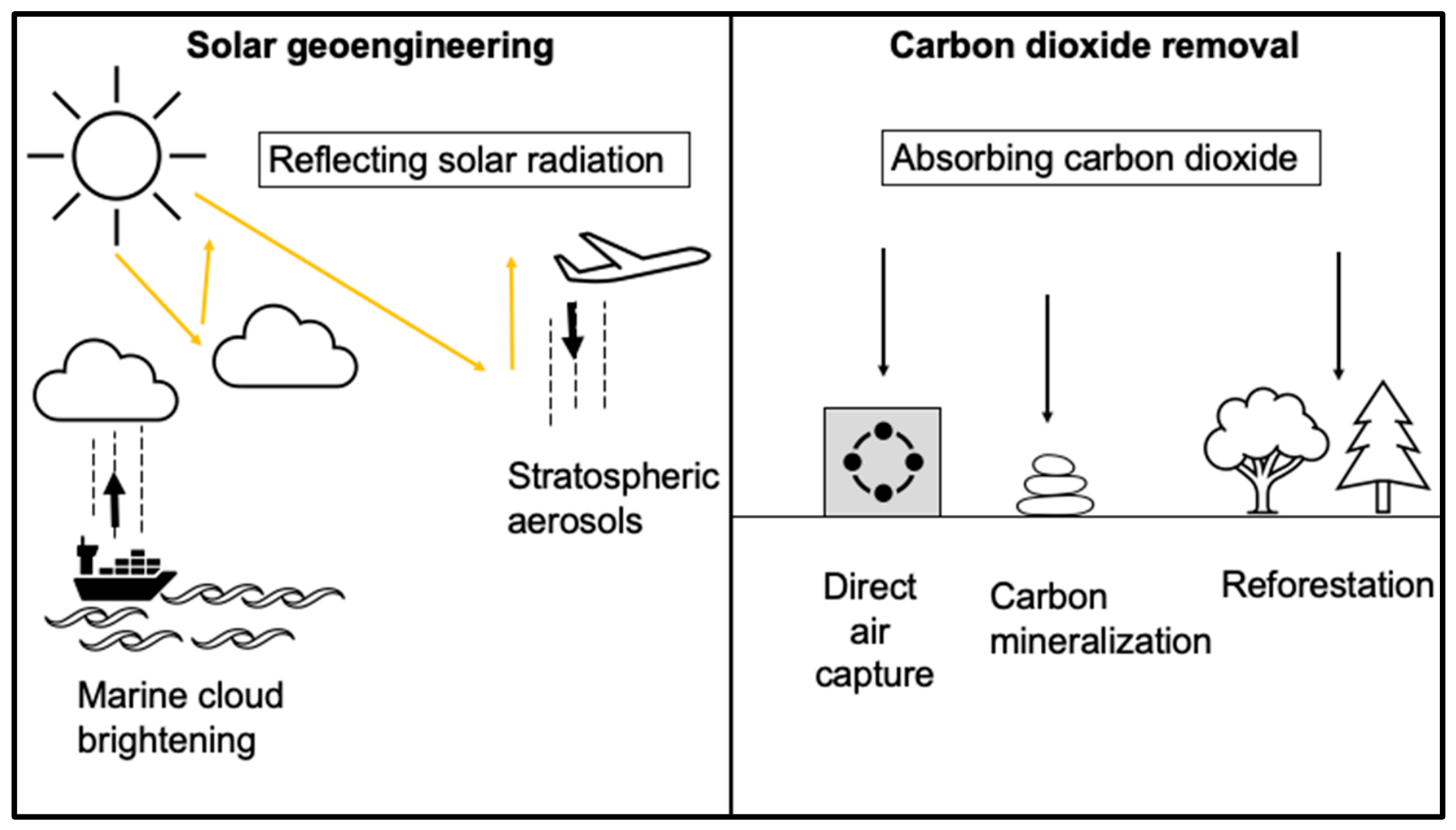
The term geoengineering has referred to many things over the years. To our knowledge, the term was first used in 1977 to refer to pumping carbon dioxide into the deep ocean [12]. Since then, numerous ideas have emerged to describe deliberate climate modifications in various forms, such as marine surface albedo enhancement and cirrus cloud thinning (see [13]). In our work, following precedent [14,15], we refer separately to two more mainstream general categories of geoengineering (see Figure 1), namely carbon dioxide removal (CDR) and solar geoengineering (SG).
CDR involves technologies dealing with negative emissions or enhancing ways of pulling carbon dioxide out of the atmosphere [14]. Some of the most prominently studied examples include bioenergy with carbon capture and storage (BECCS; e.g., [16]), using renewable plants as fuel instead of fossil fuels; direct air capture (DAC; e.g., [17]), which involves concentrating atmospheric CO2 so it can be pumped underground; afforestation (e.g., [18]), i.e., tree planting; carbon mineralization or enhanced weathering (e.g., [19]), which involves accelerating the natural process by which rocks take up CO2; and ocean iron fertilization (OIF; [20]), which involves creating phytoplankton blooms to increase photosynthetic CO2 uptake.
The other category, SG, involves deliberately modifying the climate system to reflect solar radiation. This category has been referred to by numerous terms, including Solar Radiation Management [15], Climate Engineering [21], and Solar Climate Intervention [22]. The two most prominently discussed methods of SG are stratospheric aerosol injection (SAI; [23]) and marine cloud brightening (MCB) [24,25].
Each of the technologies that fall under CDR or SG has varying benefits, risks, regional impacts, timescales, costs, geopolitical consequences, and side effects (see [26]). Historically, CDR and SG have fallen under the umbrella term geoengineering, but recently [27] there has been discussion for CDR to fall under mitigation. Ultimately, there is no “correct” definition or categorization, and each has advantages and disadvantages based on the context in which the terms are used.
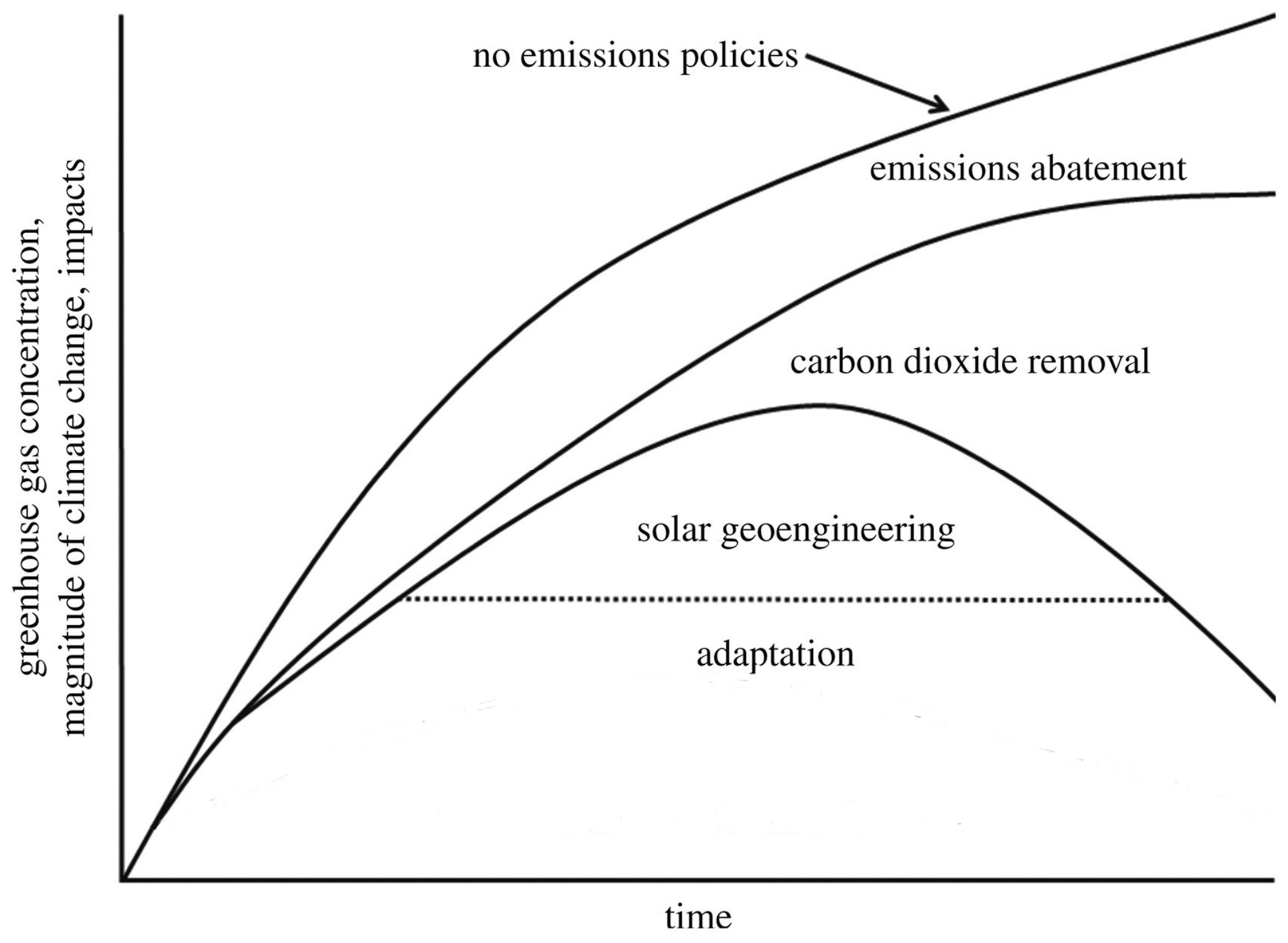
Figure 2 shows an example of how CDR and SG may fit into a broader portfolio of responses to climate change, with the recognition that some adaptation will almost certainly be necessary [28]. There is generally broad agreement that neither CDR nor SG can serve as a substitute for mitigating greenhouse gas emissions (e.g., [29,30]). Many researchers argue that SG and CDR should be considered as additions to conventional mitigation and adaptation actions (e.g., [31]). In fact, modeling work shows that combining substantial mitigation with these geoengineering strategies can substantially decrease harsh economic and environmental damages by the end of the century (e.g., [2]). Because of the failure to conduct enough climate mitigation in a timely manner, there is also substantial evidence that it will only be possible to remain on the 1.5 °C pathway if CDR and/or SG are also employed [32]. Figure 2 deliberately has no numbers (although some other versions do; [33]), because there is little basis for which they can be included beyond evaluating specific future scenarios [34].

1.2. Opportunities in Different Areas of Expertise

Climate change has proven to be an immensely difficult problem, both in terms of technical aspects and disagreements about how to go about solving it. The lack of progress on mitigation has made the roles of CDR and SG more relevant for avoiding the worst consequences of warming temperatures. This is particularly important given the well-documented role of science elites in shaping public opinion, somewhat independent of their specific expertise on the topic at hand [36,37,38,39,40].
Providing a comprehensive understanding of perspectives on CDR and SG by climate experts is a major challenge. One approach taken in the most recent IPCC report was that organizers attempted to expand the range of viewpoints represented by ensuring that women, experts from developing countries, and social scientists were better represented than in previous iterations [41]. Recruiting experts with a diversity of viewpoints is essential because each disciplinary field has something unique to contribute, yet assumptions made in each field may also fail to recognize key weaknesses of that field’s approaches. For example, social scientists may lack expertise on the most impactful pro-environmental behaviors and can disproportionately focus on promoting consumer recycling behavior despite its relatively low impact [42,43,44]. Similarly, recruiting experts from both the U.S. and India is important as both countries have significant roles to play in addressing climate change.
This is why, unlike many expert elicitations around CDR and SG (e.g., [45,46,47]), our expert elicitation was not limited to IPCC experts or experts in CDR and/or SG, and we deliberately cast a wider net. Emerging work on public perception of CDR technologies (e.g., [48]) and geoengineering (e.g., [49,50]) indicates that perception of these technologies by those who do not yet know much about them may still be malleable (e.g., [51]). Since our interviews took place in 2021, it is important to consider that participants’ views may be changing with respect to CDR and SG.

1.3. Present Research

We conducted an informal expert elicitation to explore our research questions. Expert elicitation involves the process of seeking carefully reasoned judgments from experts about an uncertain quantity or process in their domain of expertise [52]. This method has been used in many environmental domains including climate change [53] and energy use [54]. Expert elicitations are useful when we need to rely on expert judgments to provide a summary about a topic when there is limited information [55].
There are numerous forms of expert elicitations, including surveys (which have been done for SG; see [45]), interviews or focus groups (for SG, see for example [47]), and subcontracted work and synthesis of reports [56], among other methods. Our expert elicitations take the form of semi-structured interviews of natural and social climate scientists to understand their opinions and attitudes about CDR and SG and how they value these solutions against more mainstream ways of addressing climate change using mitigation and adaptation. The questions focusing on CDR and SG were in addition to questions about mitigation and adaptation [57]. Experts were recruited for their expertise in climate change research broadly, and mostly in mitigation or adaptation.
We conducted these interviews with experts from both the U.S. and India, as these countries represent major players in historical and current greenhouse gas emissions, as well as emerging solutions. Importantly, to the best of our knowledge, expert elicitations about CDR and SG have not focused on Indian experts. Similarities and differences between expert responses across different disciplines and countries could be instructive for broader trends about expert opinion and should be considered exploratory. In subsequent sections, we present the results of these interviews. Due to the structure of the questions, we provide both quantitative and qualitative analyses of expert opinions about CDR and SG.

2. Methods

2.1. Data Collection

We undertook a combined purposive and snowball sampling strategy to recruit climate change experts based in the U.S. and in India to participate in semi-structured interviews. We identified climate experts by first drawing on our existing networks, then expanding our list through online searches and asking initial interviewees for additional recommendations. Those employed as professors or researchers at a university, government agency, or non-governmental organization and whose research or work addresses climate change were eligible to participate. We intentionally sought a mix of social and natural scientists, as well as women and men. Refs. [45,58] limited their experts based on participation in the IPCC assessment reports, whereas our broader reach allows us to reach a different audience (with modest overlap).
We aimed for a sample of 30 experts in each country; our final sample was 30 India-based and 33 U.S.-based experts. We contacted nearly 200 experts across both the US and India. In qualitative research, there are debates on the minimum sample size required to achieve saturation [59]. An early argument in the field found that 90% of themes in qualitative studies could be achieved with 6–12 interviews [60]. However, there is no one agreed-upon number that serves as a hard-and-fast rule about sample size [61]. Expert names are provided in Supplemental Section S1.
Research team members conducted semi-structured interviews with experts using online videoconferencing from 1 June to 31 July 2021. All interviews were recorded with permission and then transcribed. We coded the transcriptions using NVivo 14 software. Interviews were conducted in English and lasted an average of 53 min (range = 24–82 min). Table 1 shows demographic data for our interview participants. All participants provided informed consent.
The interview responses presented in this paper build on the results reported by [57], where we focused on responses to questions about mitigation and adaptation. In this paper, we focus on experts’ responses to questions on CDR and SG.

2.2. Interview Questions Analyzed

Here we summarize the interview questions analyzed in this study. The full interview protocol is provided in Supplemental Section S2.
We first asked our participants about how much the world has warmed to date since the Industrial Revolution (the correct answer at the time was 1.1 °C), the least amount of warming they hope for by 2050, the most amount of warming we would need to prepare for by 2050, and the likely amount of warming we would expect by 2050. Asking for a range is considered best practice in expert elicitation work [52]. See interview questions 6–9.
After a set of questions about mitigation and adaptation (see Supplementary Materials), we asked what role CDR and SG should play in climate solutions for our interviewees’ respective countries. For CDR, we gave examples of ocean fertilization, direct air capture, and planting trees. For SG, we gave examples of stratospheric aerosol injection, marine cloud brightening, or cirrus cloud thinning. See interview questions 20–23.
Finally, we asked participants to prioritize how much importance they would give to the four categories of addressing climate change (mitigation, adaptation, CDR, and SG) by allocating points to each category out of 100 total points. This question encouraged participants to explicitly note relative priorities between these four categories under an assumption of limited resources or political will, with larger numbers indicating a greater relative priority put on a particular method. See interview question 24.

2.3. Data and Analysis

We analyzed experts’ responses by developing both deductive codes based on existing theory and inductive codes based on interview responses. The deductive codes were based on well-established concerns voiced in the literature for decades (see Table 2), such as trade-offs between different climate effects, the moral hazard (the challenge that CDR and SG have the potential to distract from mitigation efforts), a last-ditch effort framing, or that SG is, compared to mitigation, extraordinarily cheap. Inductive codes emerged from the interviews and follow a grounded theory approach to qualitative coding, whereby coding is used to represent key concepts that can contribute to theory building instead of confirming existing theoretical expectations [62]. Code definitions are provided in Supplemental Section S3.
For the deployment codes, two authors worked by consensus to assign codes due to the difficulty in interpreting responses that did not provide a clear yes or no answer. A different pair of authors conducted the coding for the remaining codes separately and calculated a Kappa coefficient and percent agreement using NVivo 15. The Cohen’s Kappa statistic is a measure to show the extent to which independent coders agree based on their decision criteria rather than by chance. The coding process was iterative and involved combining several inductive codes before settling on the final list [62]. We developed a codebook with a list of definitions and examples to facilitate strong inter-coder reliability (Table 2 and Supplemental Section S3). We reapplied our coding for several of the codes to achieve an acceptable inter-coder reliability score [63] or, in cases where the inter-coder reliability score is not a clear indicator of agreement (e.g., low n or ambiguous responses), two authors focused on key codes to achieve a consensus understanding of the experts’ responses. We report both the percent agreement and the Kappa coefficient for each code in Supplementary Section S4. Our overall Kappa coefficient across all codes for CDR and SG was 0.63 and 0.70, respectively. Additional details are provided in Supplementary Section S5. Note that although the sample size is quite large for qualitative research, it is insufficiently large to determine any robust correlations between, for example, discipline/country, role of deployment, or any other codes.
Table 2. Codes evaluated in this study, with an indication of whether they are inductive (emerging from the analysis) or deductive (identified prior to the interviews through literature). Definitions are provided in Supplemental Section S3.
CodeDeductive or
Inductive
References
Role of Deployment
(Yes, No, Maybe)
Deductive[64]
Negative or Uncertain ConsequencesInductive
More Research or Testing NeededDeductive[29]
Moral Hazard (CDR or SG may detract from mitigation efforts)Deductive[65]
Scaling upInductive
GeopoliticsDeductive[64]
High costDeductive for CDR, Inductive for SG[3,66]
Tradeoffs
(Winners & Losers)
Deductive[67]
Last Ditch EffortDeductive[31]
Low costInductive for CDR, Deductive for SG[66,68]
Technological Lock-InInductive

3. Results

3.1. Estimates of Current and Future Temperatures

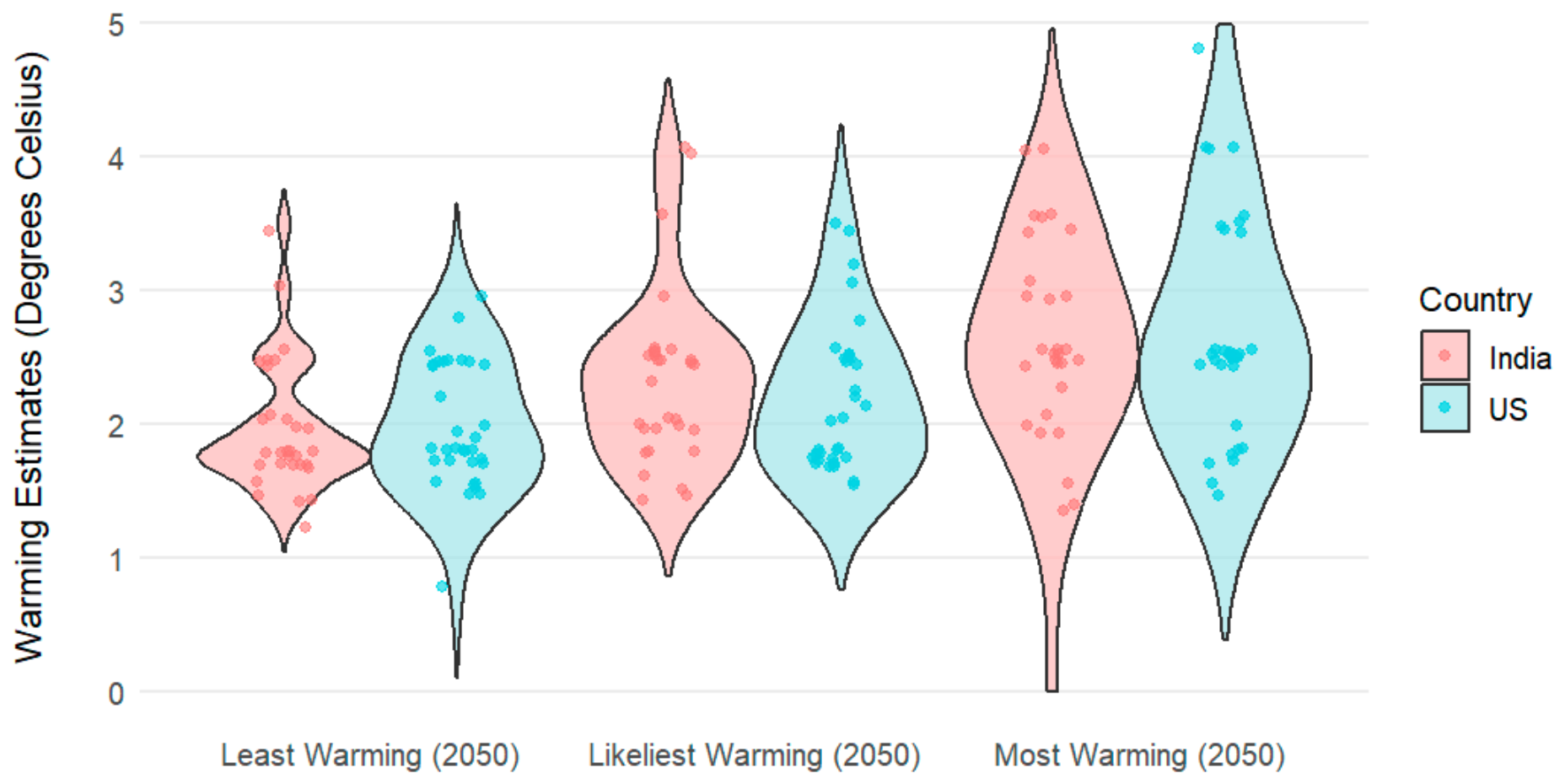
Experts’ temperature estimates tended to cluster together around accurate knowledge of current warming since the Industrial Revolution while offering optimistic estimates on the least possible warming by 2050. A large majority of experts (50 out of 63) estimated that 1–1.5 °C warming had occurred since the Industrial Revolution. The median values for both India and U.S. experts were 1.1 °C, which was NASA’s estimate of current warming at the time of the interviews (Figure 3; [69,70]). In 2025, NASA’s estimate of current warming increased to 1.47 °C, which already exceeds some experts’ estimates of the least warming.
All experts anticipated that at least some additional warming would occur by 2050, even in the best case. Slightly more than half anticipated 1.5–2 °C warming as the least amount that could be anticipated. Both groups had median values of 1.75 °C. In the most warming scenario, a large majority expect more than 2 °C warming, with 30 experts expecting 2–3 °C and 15 experts concerned with severe warming of more than 3 °C. Both groups had median values of 2.5 °C. Likely warming estimates saw experts almost evenly split below (27) and above (25) 2 °C, with an overall median of 2.1 °C. However, there are notable differences between countries, with median estimates for Indian experts higher at 2.5 °C and U.S. experts at 2 °C. Central warming estimates in 2050 for the SSP scenarios are 2.4 °C for SSP5-8.5, 2.0 °C for SSP2-4.5, and 1.6 °C for SSP1-1.9 ([71], Table 4.5).
All expert values for warming are reported in Supplemental Section S6.

3.2. Expert Views on the Role of CDR and SG in Addressing Climate Change

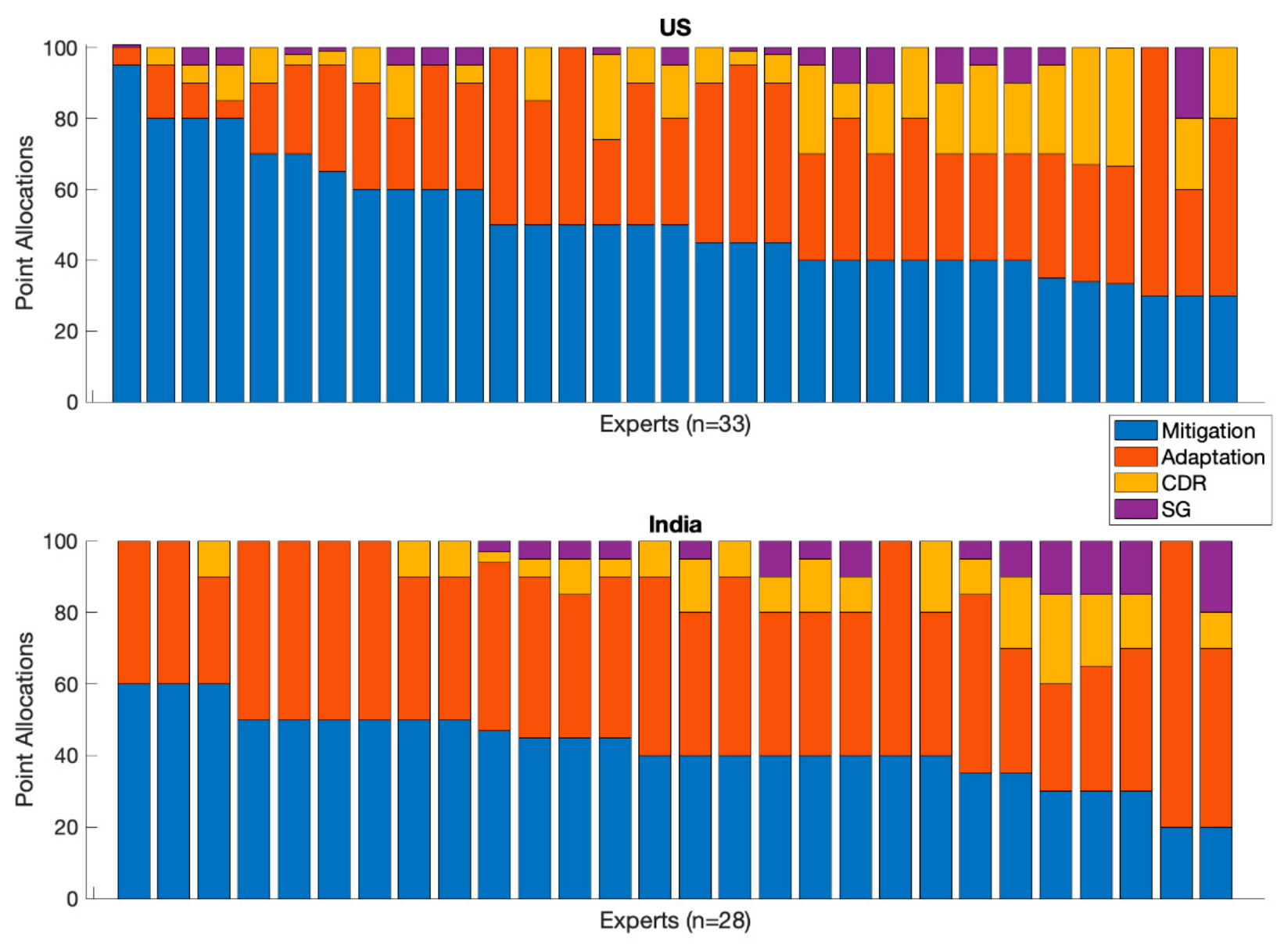
India and US experts held similar overall views about the importance of mitigation and adaptation as the top priorities compared to CDR and SG (Figure 4). Indian experts overall allocated the most points to adaptation on average, with mitigation a close second (Table 3). CDR and SG were allocated fewer than 9 points and 5 points on average, respectively. There were 16 Indian experts who allocated zero points for SG and eight who allocated no points for CDR. Mitigation was allocated a majority of the points on average from US experts, with adaptation given 33 points on average. Similar to Indian experts, US experts allocated far fewer points to CDR and SG, though slightly more to CDR (13) and slightly less to SG (3) than Indian experts. Only four US experts allocated no points to CDR, while thirteen allocated no points to SG.
For CDR, 8 experts from India out of 28 (29%) and 5 experts from the U.S. out of 33 (15%) did not allocate any points for CDR. 14 experts from India out of 28 (50%) and 12 experts from the U.S. out of 33 (36%) did not allocate any points to SG. These results indicate that experts in our sample view SG as far riskier than CDR.
When asked more specifically if CDR and SG should play a role in addressing climate change, nearly half of the experts felt that CDR should play a role, with the second largest group saying that it may have a role (Table 4). In contrast, a plurality of experts (24) said that SG should not play a role in addressing climate change, while the next largest group stated that it may play a role. Only two experts supported the view that SG has a role to play. Nine experts stated that CDR should not have a role to play. Additionally, 10 experts declined to state a view on SG, while two declined to comment on CDR’s role.
For the potential deployment, a similar overall number of experts offered “maybe” or “it depends” responses on the potential roles of CDR and SG. For CDR, there was a roughly equal split between yes and maybe, with a smaller number in each group saying it should not have a role. A sizable majority of US experts were in favor of CDR, while half of the Indian experts said it may play a role, with the remaining Indian experts almost evenly split between yes and no. Responses for SG differed notably from CDR. A plurality of Indian experts and a majority of US experts stated that SG may play a role, though the tenor of these comments was often quite skeptical or concerned. Zero U.S. experts said that SG should play a role, and only two Indian experts expressed support for SG. 17% of experts declined to share any thoughts regarding SG beyond the fact that it should not play a role.
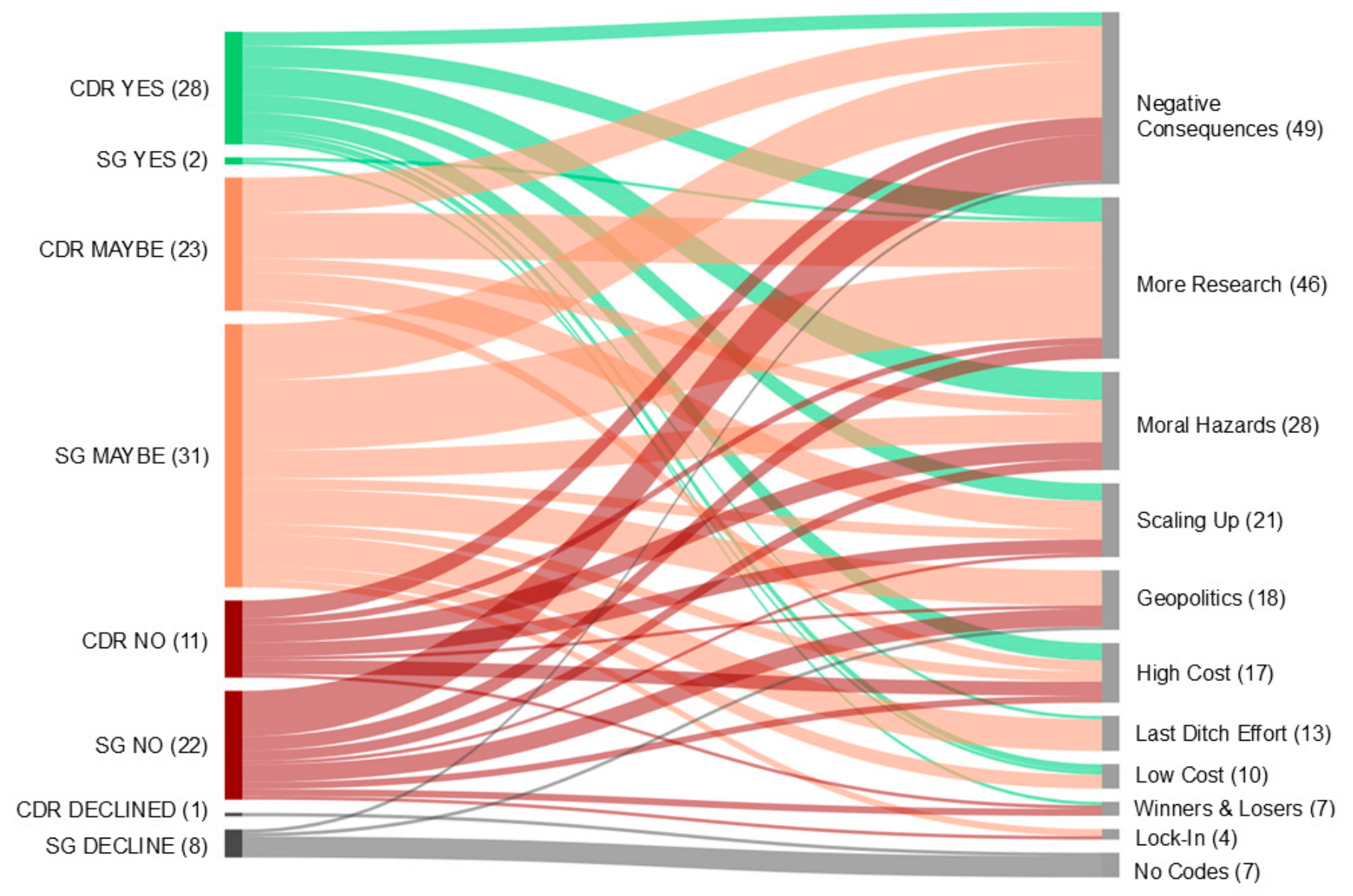
We analyzed the reasons experts provided for what roles they anticipate for each technology in their country (see Figure 5; coding frequencies by country are provided in Supplemental Section S7, and values displayed in the figure are provided in Supplemental Section S8). As Figure 5 indicates, there was no obvious link between the topics that experts addressed and their view on whether either option should play a role in responding to climate change.
Negative or Uncertain Consequences (49 experts) was the most frequently found result, while More Research (46) was similarly common. The next most popular overall was Moral Hazard (28). For CDR specifically, More Research (21), Negative or Uncertain Consequences (19), Scaling Up (17), and Moral Hazards (17) were the most common codes. For SG, the most common code was Negative Consequences (30), followed by More Research (25) and Geopolitics (16). Last Ditch Effort (11) was also raised as a rationale for when SG should be deployed. In Table 5, we provide quotes to illustrate the types of responses that experts offered for each of the codes, with one representative expert quote from each country.

4. Discussion

Although preventing heat-trapping gases from being pumped into the atmosphere in the first place (mitigation) is less expensive and has fewer side effects than dealing with them after the fact, the world has not done enough to stabilize global temperature increases [72], and some political leaders and movements have undermined mitigation efforts [73]. Given this failure in progress toward mitigation [74] and the additional complexities of local adaptation, many topic-specific researchers have argued that we need to seriously consider CDR and SG (e.g., [68]).
Overall, experts from both countries understood and depicted the social dilemma (where private interests are at odds with collective interests; see [75]) involving tensions between the short-term costs of needing mitigation and the long-term consequences from inaction. With the exception of two outliers, experts accurately assessed the current temperature. The US experts are more optimistic about mitigation than the Indian experts. This did not translate into lower estimates of warming, potentially indicating that U.S. experts think it may take some time to develop adequate mitigation technologies. Conversely, Indian experts rated adaptation the highest on average.
All our expert participants expressed strong preferences for mitigation and adaptation, indicating that CDR and SG are still widely considered back-pocket solutions. On average, experts are more favorable to CDR than SG in both countries. A far greater proportion of expert participants in the U.S. said that CDR should play a role in addressing climate change (64%) than expert participants in India (27%). This could reflect awareness that the U.S. has far higher emissions (current and historical) than India and thus, to meet a 2 °C target, CDR is viewed as far more necessary in the U.S. It is also possible that this difference reflects greater research funding availability in the US compared to India, or differences in national policy frameworks between the two countries.
From our findings, there are two overarching issues that emerge. First, the solution space for climate change remains complicated, and experts were not prepared to consider how CDR and SG might fit into the bigger picture. This sits in stark contrast to previous studies that have focused on experts in CDR and SG [45,47,58]. There was substantial concern about potential negative consequences and the need for contingency planning. Second, experts’ perspectives on CDR and SG indicate that there is an urgent need for a more robust discussion around what roles these approaches should play. We discuss these issues as well as limitations and future considerations below.

4.1. Low Incorporation of CDR and SG into the Climate Solution Space

The U.S. experts were far more likely to say that CDR should play a role than the Indian experts. But overall, experts from both countries were unenthusiastic about both CDR and SG. Due to the low point values allocated to CDR and SG, the lack of low estimates of future warming, and the relatively high occurrence of the Uncertain Consequences and More Research codes, we conclude that the experts consider CDR and SG as minor contributors to the solution space at best. Nevertheless, a majority of experts stated that CDR should or should maybe play a role in addressing climate change. A greater number of experts view SG as having far more negative consequences compared to CDR—consistent with public opinion surveys (e.g., [76,77]).
Expert responses tended to adhere to a precautionary principle framing [78] for incorporating CDR and SG. Many experts argued that too little was known about the potential consequences of these technologies, particularly SG, to warrant deployment without first undertaking more research. Moral Hazard appeared in comments as well, where some experts expressed concerns that addressing CDR or SG would discourage the already-slow implementation of mitigation (e.g., [76]). Other comments indicated that governance problems, particularly Geopolitics or Technological Lock-In, would be as difficult or more difficult than technical challenges, which is an active area of research [79]. Alternatively, it is possible that the interviewees are motivated to reject these solutions yet call for more research as a way of appealing to scientific norms [80].
While experts were cautious overall, we also conclude that experts found it very difficult to understand what the space of ideas to address climate change looks like, especially when bringing in relatively novel and consequential technologies. This requires deep system-level thinking and also experience with geopolitics and policy; this breadth is at odds with the usual deep-dive path to expertise. Future research should more specifically address different types of CDR and SG to better gauge experts’ reasoning and contribute to better specification of the solution space [81].

4.2. Experts Viewed CDR Skeptically and Depicted SG as an Emergency Option

Nearly half of the experts expressed concern that support for CDR or SG is a Moral Hazard [82] that will dampen the necessary but hard work of rapidly transitioning toward renewable energy and away from fossil fuels [5]. Indeed, there is some evidence that this could be the case (e.g., [49]), some evidence against (e.g., [65]), and some evidence to suggest there is no clear information [83]. Moreover, the effects of a moral hazard may be limited and inconsistent in scope [84,85]) and can potentially be reduced by noting that geoengineering is only a small piece of the puzzle toward addressing climate change [86]. Researchers—much like the general public [50,87] —may be worried about tampering with nature. There are interesting parallels with adaptation; until recently, adaptation was similarly viewed as taboo (e.g., [88]), whereas now it is viewed as a mainstream solution to climate change [89].
A key justification for potentially deploying SG is to buy time for mitigation and adaptation to ramp up to appreciable levels [28] (also Figure 2). However, both Indian and U.S. experts depicted SG as either a distant emergency option or as a set of technologies that are not ready for deployment in the near future. Experts in our sample treated SG, and to an extent CDR, as trading off with the public’s willingness to undertake more serious mitigation, rather than as synergistic with mitigation, given IPCC estimates that all of the scenarios that keep global warming below 2 °C have substantial negative emissions [90].
No experts addressed the potential for synergy where the least damaging option in the long run may be limited SG with aggressive mitigation (e.g., [46]). One potentially constructive way forward is for climate experts to develop more accessible estimates of these tradeoffs; this has become recognized in the field as the “risk-risk framing” (e.g., [64]).

4.3. Limitations and Future Directions

There are several limitations to our research and interpretations of our results. Mainly, the qualitative analysis is not generalizable beyond our purposively sampled set of experts. While experts have topical expertise within climate change research, few consider themselves to be experts in CDR and SG specifically. While this is useful for the purpose of this study, it inhibits comparisons between our work and previous studies that focused on CDR and SG experts (e.g., [45,47,58]. In particular, [45] included a selection of Chinese experts, which would be valuable to compare with our selection of Indian experts, a pursuit that is presently not possible due to differing areas of expertise. Finally, though our purposive and snowball sampling method is typical for this type of qualitative work, and our findings suggest saturation in responses (see Section 2.1), consistent with qualitative work in general, it is possible that a different recruitment strategy could yield new insights.
More generally, to do impactful work, experts need to have a basic level of interdisciplinary expertise to understand the problem space. Although we acknowledge that it is challenging for specific individuals to have expertise in everything, our interviews may have been affected by casting a wide net to include experts with deep topical knowledge, rather than deliberately pursuing interdisciplinary experts. A potential way to address this issue would be interdisciplinary focus groups instead of individual interviews.
Another important caveat to our results is that we conducted interviews in 2021, which captured experts’ responses prior to important climate legislation in the U.S., such as the Inflation Reduction Act, as well as the U.S.’s second withdrawal from the Paris Treaty. Subsequent years have seen temperatures increase to 1.5 °C above pre-Industrial Revolution levels. These and other factors could have led experts to view the roles of CDR and SG differently. It would be useful to revisit conducting interviews to see if anything has changed in the last four years, because the world certainly has.
In a more specific point, one of the issues with introducing CCUS as an example of CDR in the interview (see Supplemental Materials) is that it may have shaped experts’ answers. Whether CCUS is considered CDR or mitigation is unclear (e.g., [91,92]). Nevertheless, from some responses we received, conflating CCUS and CDR is not something we will do in follow-on work.

5. Conclusions

Society is already grappling with many complex and challenging decisions about how and when to address climate change. Our findings reveal that most of our expert participants are reluctant to consider SG as having a role in addressing climate change, preferring to refer to it as “back pocket solutions, in case of emergency.” More are willing to consider CDR. For both technologies, some climate experts are skeptical, ambivalent, cautious, or never adopters. Nevertheless, more work is needed to understand how those decisions to deploy will be made and by whom. Without actively engaging with these new technologies, political actors will be left to make decisions without relevant climate experts, with a greater chance of undemocratic or unilateral geoengineering deployment rather than collaboration and consensus building [66].
John Holdren’s sobering quote noted at the beginning of this paper is an important reminder of the vast scope of the problem of climate change, as well as the fact that any solutions to it are likely to be piecemeal [93]. There is a clear need for a holistic risk assessment (e.g., [67]) of engaging in CDR and SG, compared with the risks of not engaging with them. Our results also underscore the importance of interdisciplinary and transdisciplinary approaches to understanding and evaluating CDR and SG. Cross-pollination and interaction between people with different expertise sets can surface and challenge core assumptions (see [94]), as many of these climate experts may be involved in informing and shaping public policy. We emphasize the importance of deep and interdisciplinary engagement with these topics by experts, as the discourse of experts around climate change solutions has the power to shape reality, for better or worse (e.g., [95,96]).

Supplementary Materials

The following supporting information can be downloaded at https://www.mdpi.com/article/10.3390/su18125933/s1, Supplemental Sections S1–S8 cover expert names, interview protocol, code definitions, inter-coder reliability, additional coding details, all expert temperature estimates, coding frequencies by country, and values for the Sankey diagram.

Author Contributions

Conceptualization, L.Y., N.G. and S.Z.A.; Methodology, L.Y.; Validation, B.K., L.Y., S.N. and S.Z.A.; Formal Analysis, B.K., L.Y., N.G., S.N. and S.Z.A.; Investigation, B.K., L.Y., N.G., S.N. and S.Z.A.; Data Curation, L.Y. and S.N.; Writing—Original Draft Preparation, B.K., L.Y., N.G., S.N. and S.Z.A.; Writing—Review & Editing, B.K., L.Y., N.G., S.N. and S.Z.A.; Visualization, B.K., L.Y. and S.Z.A.; Supervision, L.Y. and S.Z.A.; Project Administration, L.Y.; Funding Acquisition, B.K. and L.Y. All authors have read and agreed to the published version of the manuscript.

Funding

This work was supported by a grant from the Environmental Resilience Institute and Indiana University’s Prepared for Environmental Change Grand Challenge Initiative. Support for B.K. was provided in part by the National Science Foundation through agreement SES-1754740. Support for S.Z.A. was provided in part by the Paul H. O’Neill professorship at the O’Neill School of Public and Environmental Affairs.

Institutional Review Board Statement

The study was conducted in accordance with the Declaration of Helsinki and approved by the Institutional Review Board of Indiana University (protocol code 10819 and 7 May 2021).

Informed Consent Statement

Informed consent was obtained from all subjects involved in the study.

Data Availability Statement

All data generated or analyzed during this study are available online: https://osf.io/sknqz/?view_only=764819d796f74238a71c3fea17b0c100.

Conflicts of Interest

The authors declare no conflicts of interest.

References

  1. Kanter, J.; Revkin, A. World Scientists Near Consensus on Warming. New York Times, 30 January 2007. Available online: https://www.nytimes.com/2007/01/30/world/30climate.html (accessed on 14 May 2026).
  2. Liu, A.; Moore, J.C.; Cheng, X.; Chen, Y. Solar geoengineering and carbon removal significantly lower economic climate damages. One Earth 2023, 6, 1375–1387. [Google Scholar] [CrossRef]
  3. Cox, E.; Müller-Hansen, F.; Lamb, W.F.; Repke, T.; Bellamy, R.; Lueck, S. Chapter 6: Perceptions and Communication, The State of Carbon Dioxide Removal, 2nd ed.; OSF: Charlottesville, VA, USA, 2024. [Google Scholar] [CrossRef]
  4. Hiar, C. Betting on Climate Failure, These Investors Could Earn Billions. Politico, 26 December 2025. Available online: https://www.politico.com/news/2025/12/26/betting-on-climate-failure-investors-could-earn-billions-00677281 (accessed on 14 May 2026).
  5. Calvin, K.; Dasgupta, D.; Krinner, G.; Mukherji, A.; Thorne, P.W.; Trisos, C.; Romero, J.; Aldunce, P.; Barrett, K.; Blanco, G.; et al. Climate Change 2023: Synthesis Report; IPCC: Geneva, Switzerland, 2023. [Google Scholar] [CrossRef]
  6. United Nations. The Paris Agreement. 2015. Available online: https://unfccc.int/process-and-meetings/the-paris-agreement (accessed on 17 April 2026).
  7. Daggett, C. Petro-masculinity: Fossil Fuels and Authoritarian Desire. Millenn. J. Int. Stud. 2018, 47, 25–44. [Google Scholar] [CrossRef]
  8. Matthews, H.D.; Wynes, S. Current global efforts are insufficient to limit warming to 1.5 °C. Science 2022, 376, 1404–1409. [Google Scholar] [CrossRef] [PubMed]
  9. Ou, Y.; Iyer, G.; Clarke, L.; Edmonds, J.; Fawcett, A.A.; Hultman, N.; McFarland, J.R.; Binsted, M.; Cui, R.; Fyson, C.; et al. Can updated climate pledges limit warming well below 2 °C? Science 2021, 374, 693–695. [Google Scholar] [CrossRef]
  10. European Environment Agency. Climate Change Mitigation: Reducing Emissions. 2025. Available online: https://www.eea.europa.eu/en/topics/in-depth/climate-change-mitigation-reducing-emissions (accessed on 14 May 2026).
  11. Crutzen, P.J. Albedo enhancement by stratospheric sulfur injections: A contribution to resolve a policy dilemma? Clim. Change 2006, 77, 211–220. [Google Scholar] [CrossRef]
  12. Marchetti, C. On geoengineering and the CO2 problem. Clim. Change 1977, 1, 59–68. [Google Scholar] [CrossRef]
  13. EPA. About Geoengineering. 2026. Available online: https://www.epa.gov/geoengineering/about-geoengineering (accessed on 14 May 2026).
  14. National Research Council. Climate Intervention: Carbon Dioxide Removal and Reliable Sequestration; The National Academies Press: Washington, DC, USA, 2015. [CrossRef]
  15. National Research Council. Climate Intervention: Reflecting Sunlight to Cool Earth; The National Academies Press: Washington, DC, USA, 2015. [CrossRef]
  16. Gough, C.; Upham, P. Biomass energy with carbon capture and storage (BECCS or Bio-CCS). Greenh. Gases Sci. Technol. 2011, 1, 324–334. [Google Scholar] [CrossRef]
  17. Keith, D.W.; Holmes, G.; St. Angelo, D.; Heidel, K. A Process for Capturing CO2 from the Atmosphere. Joule 2018, 2, 1573–1594. [Google Scholar] [CrossRef]
  18. Nilsson, S.; Schopfhauser, W. The carbon-sequestration potential of a global afforestation program. Clim. Change 1995, 30, 267–293. [Google Scholar] [CrossRef]
  19. Gadikota, G. Carbon mineralization pathways for carbon capture, storage and utilization. Commun. Chem. 2021, 4, 23. [Google Scholar] [CrossRef] [PubMed]
  20. Buesseler, K.O.; Boyd, P.W. Will Ocean Fertilization Work? Science 2003, 300, 67–68. [Google Scholar] [CrossRef]
  21. MacMartin, D.G.; Kravitz, B. The Engineering of Climate Engineering. Annu. Rev. Control Robot. Auton. Syst. 2019, 2, 445–467. [Google Scholar] [CrossRef]
  22. NASEM. Reflecting Sunlight: Recommendations for Solar Geoengineering Research and Research Governance; National Academies Press: Washington, DC, USA, 2021. [Google Scholar] [CrossRef]
  23. Budyko, M.I. Climatic Changes; American Geophysical Union: Washington, DC, USA, 1977. [Google Scholar]
  24. Latham, J. Control of global warming? Nature 1990, 347, 339–340. [Google Scholar] [CrossRef]
  25. Latham, J.; Gadian, A.; Fournier, J.; Parkes, B.; Wadhams, P.; Chen, J. Marine cloud brightening: Regional applications. Philos. Trans. R. Soc. A 2014, 372, 20140053. [Google Scholar] [CrossRef] [PubMed]
  26. Feingold, G.; Ghate, V.P.; Russell, L.M.; Blossey, P.; Cantrell, W.; Christensen, M.W.; Diamond, M.S.; Gettelman, A.; Glassmeier, F.; Gryspeerdt, E.; et al. Physical science research needed to evaluate the viability and risks of marine cloud brightening. Sci. Adv. 2024, 10, eadi8594. [Google Scholar] [CrossRef] [PubMed]
  27. Honegger, M.; Burns, W.; Morrow, D.R. Is carbon dioxide removal ‘mitigation of climate change’? Rev. Eur. Comp. Int. Environ. Law 2021, 30, 327–335. [Google Scholar] [CrossRef]
  28. Long, J.C.S.; Shepherd, J.G. The Strategic Value of Geoengineering Research. In Handbook of Global Environmental Pollution; Springer: New York, NY, USA, 2014; Volume 1. [Google Scholar]
  29. Schneider, S.H. Geoengineering: Could—Or should—We do it? Clim. Change 1996, 33, 291–302. [Google Scholar] [CrossRef]
  30. Schneider, S.H. Geoengineering: Could we or should we make it work? Philos. Trans. R. Soc. A 2008, 366, 3843–3862. [Google Scholar] [CrossRef]
  31. Smith, S.J.; Rasch, P.J. The long-term policy context for solar radiation management. Clim. Change 2013, 121, 487–497. [Google Scholar] [CrossRef]
  32. IPCC. Global Warming of 1.5 °C; An IPCC Special Report; IPCC: Geneva, Switzerland, 2018. [Google Scholar]
  33. Boselius, L.; Duffey, A.; Irvine, P.J. Peak shaving with solar radiation modification would shorten global temperature overshoot. Oxf. Open Clim. Change 2025, 5, kgaf013. [Google Scholar] [CrossRef]
  34. MacMartin, D.G.; Ricke, K.L.; Keith, D.W. Solar geoengineering as part of an overall strategy for meeting the 1.5 °C Paris target. Philos. Trans. R. Soc. A 2018, 376, 20160454. [Google Scholar] [CrossRef]
  35. Parson, E.A.; Reynolds, J.L. Solar geoengineering: Scenarios of future governance challenges. Futures 2021, 133, 102806. [Google Scholar] [CrossRef]
  36. Thompson, M. Among the Energy Tribes: The Anthropology of the Current Policy Debate; Working Paper WP-82-59; IIASA: Laxenburg, Austria, 1982. [Google Scholar]
  37. Thompson, M. The Cultural Construction of Nature and the Natural Destruction of Culture; Working Paper WP-84-92; IIASA: Laxenburg, Austria, 1984. [Google Scholar]
  38. Lloyd, E.A. The Case of the Female Orgasm: Bias in the Science of Evolution; Harvard University Press: Cambridge, MA, USA, 2005. [Google Scholar]
  39. Van Der Linden, S.; Leiserowitz, A.; Maibach, E. The gateway belief model: A large-scale replication. J. Environ. Psychol. 2019, 62, 49–58. [Google Scholar] [CrossRef]
  40. Flores, A.; Cole, J.C.; Dickert, S.; Eom, K.; Jiga-Boy, G.M.; Kogut, T.; Loria, R.; Mayorga, M.; Pedersen, E.J.; Pereira, B.; et al. Politicians polarize and experts depolarize public support for COVID-19 management policies across countries. Proc. Natl. Acad. Sci. USA 2022, 119, e2117543119. [Google Scholar] [CrossRef] [PubMed]
  41. O’Reilly, J.; De Pryck, K.; Hughes, H. Taking stock of the IPCC: Analysis from AR6. Clim. Change 2025, 178, 146. [Google Scholar] [CrossRef]
  42. Gardner, G.T.; Stern, P.C. Environmental Problems and Human Behavior, 2nd ed.; Pearson Custom Publishing: Boston, MA, USA, 2002. [Google Scholar]
  43. Nielsen, K.S.; Cologna, V.; Lange, F.; Brick, C.; Stern, P.C. The case for impact-focused environmental psychology. J. Environ. Psychol. 2021, 74, 101559. [Google Scholar] [CrossRef]
  44. Brick, C.; Nielsen, K.S.; Berger, S.; Henn, L.; Wolske, K.S.; Lange, F.; Hanss, D.; Bauer, J.M.; Aldoh, A.; Sachisthal, M.S.; et al. Current research practices on pro-environmental behavior: A survey of environmental psychologists. J. Environ. Psychol. 2024, 97, 102375. [Google Scholar] [CrossRef]
  45. Dai, Z.; Burns, E.T.; Irvine, P.J.; Tingley, D.H.; Xu, J.; Keith, D.W. Elicitation of US and Chinese expert judgments show consistent views on solar geoengineering. Humanit. Soc. Sci. Commun. 2021, 8, 18. [Google Scholar] [CrossRef]
  46. Irvine, P.; Emanuel, K.; He, J.; Horowitz, L.W.; Vecchi, G.; Keith, D. Halving warming with idealized solar geoengineering moderates key climate hazards. Nat. Clim. Change 2019, 9, 295–299. [Google Scholar] [CrossRef]
  47. Sovacool, B.K.; Baum, C.M.; Low, S. Determining our climate policy future: Expert opinions about negative emissions and solar radiation management pathways. Mitig. Adapt. Strateg. Glob. Change 2022, 27, 58. [Google Scholar] [CrossRef]
  48. Shrum, T.R.; Markowitz, E.; Buck, H.; Gregory, R.; Van Der Linden, S.; Attari, S.Z.; Van Boven, L. Behavioural frameworks to understand public perceptions of and risk response to carbon dioxide removal. Interface Focus 2020, 10, 20200002. [Google Scholar] [CrossRef]
  49. Raimi, K.T. Public perceptions of geoengineering. Curr. Opin. Psychol. 2021, 42, 66–70. [Google Scholar] [CrossRef] [PubMed]
  50. Wolske, K.S.; Raimi, K.T.; Campbell-Arvai, V.; Hart, P.S. Public support for carbon dioxide removal strategies: The role of tampering with nature perceptions. Clim. Change 2019, 152, 345–361. [Google Scholar] [CrossRef]
  51. Buck, H.J.; Shah, P.; Yang, J.Z.; Arpan, L. Public concerns about solar geoengineering research in the United States. Commun. Earth Environ. 2025, 6, 609. [Google Scholar] [CrossRef]
  52. Morgan, M.G. Use (and abuse) of expert elicitation in support of decision making for public policy. Proc. Natl. Acad. Sci. USA 2014, 111, 7176–7184. [Google Scholar] [CrossRef]
  53. Morgan, M.G.; Pitelka, L.F.; Shevliakova, E. Elicitation of Expert Judgments of Climate Change Impacts on Forest Ecosystems. Clim. Change 2001, 49, 279–307. [Google Scholar] [CrossRef]
  54. Kantenbacher, J.; Attari, S.Z. Better rules for judging joules: Exploring how experts make decisions about household energy use. Energy Res. Soc. Sci. 2021, 73, 101911. [Google Scholar] [CrossRef]
  55. Knol, A.B.; Slottje, P.; Van Der Sluijs, J.P.; Lebret, E. The use of expert elicitation in environmental health impact assessment: A seven step procedure. Environ. Health 2010, 9, 19. [Google Scholar] [CrossRef]
  56. NRC. Reactor Safety Study: An Assessment of Accident Risks in U.S. Commercial Nuclear Power Plants; Report WASH-1400; NRC: Washington, DC, USA, 1975. [Google Scholar]
  57. Yoder, L.; Cain, A.; Rao, A.; Geiger, N.; Kravitz, B.; Mercer, M.; Miniard, D.; Nepal, S.; Nunn, T.; Sluder, M.; et al. Muddling through Climate Change: A Qualitative Exploration of India and U.S. Climate Experts’ Perspectives on Solutions, Pathways, and Barriers. Sustainability 2024, 16, 5275. [Google Scholar] [CrossRef]
  58. Irvine, P.; Burns, E.; Caldeira, K.; Keutsch, F.; Tingley, D.; Keith, D. Expert judgements on solar geoengineering research priorities and challenges. EarthArxiv, 2021; in press. [CrossRef]
  59. Ahmed, S.K. Sample size for saturation in qualitative research: Debates, definitions, and strategies. J. Med. Surg. Public Health 2025, 5, 100171. [Google Scholar] [CrossRef]
  60. Guest, G.; Bunce, A.; Johnson, L. How Many Interviews Are Enough?: An Experiment with Data Saturation and Variability. Field Methods 2006, 18, 59–82. [Google Scholar] [CrossRef]
  61. Wutich, A.; Beresford, M.; Bernard, H.R. Sample Sizes for 10 Types of Qualitative Data Analysis: An Integrative Review, Empirical Guidance, and Next Steps. Int. J. Qual. Methods 2024, 23, 16094069241296206. [Google Scholar] [CrossRef]
  62. Deterding, N.M.; Waters, M.C. Flexible Coding of In-depth Interviews: A Twenty-first-century Approach. Sociol. Methods Res. 2021, 50, 708–739. [Google Scholar] [CrossRef]
  63. O’Connor, C.; Joffe, H. Intercoder Reliability in Qualitative Research: Debates and Practical Guidelines. Int. J. Qual. Methods 2020, 19, 1609406919899220. [Google Scholar] [CrossRef]
  64. Sovacool, B.K.; Baum, C.M.; Low, S. Risk–risk governance in a low-carbon future: Exploring institutional, technological, and behavioral tradeoffs in climate geoengineering pathways. Risk Anal. 2023, 43, 838–859. [Google Scholar] [CrossRef]
  65. Antoan, D.; Chiang, N.; Dearman, S.; Espejel, S.; Fajors, M.; Huang, D.; Husseman, E.; Lavigne, J.; Lin, I.; Maheshwari, N.; et al. Balanced Messaging about Solar Geoengineering does not Reduce Average Support for Emissions Reductions. J. Exp. Political Sci. 2025, 1–14. [Google Scholar] [CrossRef]
  66. Barrett, S. The Incredible Economics of Geoengineering. Environ. Resour. Econ. 2008, 39, 45–54. [Google Scholar] [CrossRef]
  67. Kravitz, B.; MacMartin, D.G. Uncertainty and the basis for confidence in solar geoengineering research. Nat. Rev. Earth Environ. 2020, 1, 64–75. [Google Scholar] [CrossRef]
  68. Keith, D.W.; Parson, E.; Morgan, M.G. Research on global sun block needed now. Nature 2010, 463, 426–427. [Google Scholar] [CrossRef]
  69. Lenssen, N.; Schmidt, G.A.; Hendrickson, M.; Jacobs, P.; Menne, M.J.; Ruedy, R. A NASA GISTEMPv4 Observational Uncertainty Ensemble. J. Geophys. Res. Atmos. 2024, 129, e2023JD040179. [Google Scholar] [CrossRef]
  70. GISTEMP Team. GISS Surface Temperature Analysis (GISTEMP), Version 4; Dataset; NASA GISS: New York, NY, USA, 2025. Available online: https://data.giss.nasa.gov/gistemp (accessed on 14 May 2026).
  71. IPCC. Climate Change 2021: The Physical Science Basis. Contribution of Working Group I to the Sixth Assessment Report of the Intergovernmental Panel on Climate Change; Cambridge University Press: Cambridge, UK, 2021. [Google Scholar]
  72. Fransen, T.; Meckling, J.; Stünzi, A.; Schmidt, T.S.; Egli, F.; Schmid, N.; Beaton, C. Taking stock of the implementation gap in climate policy. Nat. Clim. Change 2023, 13, 752–755. [Google Scholar] [CrossRef]
  73. Collins, S.D. America First: The Trump Effect on Climate Change Policy. In Non-Human Nature in World Politics; Pereira, J.C., Saramago, A., Eds.; Springer International Publishing: Cham, Switzerland, 2020; pp. 179–203. [Google Scholar] [CrossRef]
  74. Deng, Z.; Zhu, B.; Davis, S.J.; Ciais, P.; Guan, D.; Gong, P.; Liu, Z. Global carbon emissions and decarbonization in 2024. Nat. Rev. Earth Environ. 2025, 6, 231–233. [Google Scholar] [CrossRef]
  75. Kollock, P. Social Dilemmas: The Anatomy of Cooperation. Annu. Rev. Sociol. 1998, 24, 183–214. [Google Scholar] [CrossRef]
  76. Fritz, L.; Baum, C.M.; Brutschin, E.; Low, S.; Sovacool, B.K. Climate beliefs, climate technologies and transformation pathways: Contextualizing public perceptions in 22 countries. Glob. Environ. Change 2024, 87, 102880. [Google Scholar] [CrossRef]
  77. Sovacool, B.K.; Evensen, D.; Baum, C.M.; Fritz, L.; Low, S. Demographics shape public preferences for carbon dioxide removal and solar geoengineering interventions across 30 countries. Commun. Earth Environ. 2024, 5, 642. [Google Scholar] [CrossRef]
  78. Kriebel, D.; Tickner, J.; Epstein, P.; Lemons, J.; Levins, R.; Loechler, E.L.; Quinn, M.; Rudel, R.; Schettler, T.; Stoto, M. The precautionary principle in environmental science. Environ. Health Perspect. 2001, 109, 871–876. [Google Scholar] [CrossRef]
  79. Jinnah, S.; Dove, Z. Solar radiation management: A history of the governance and political milestones. Environ. Sci. Atmos. 2025, 5, 656–673. [Google Scholar] [CrossRef]
  80. Mulkay, M.J. Norms and ideology in science. Soc. Sci. Inf. 1976, 15, 637–656. [Google Scholar] [CrossRef]
  81. Lamb, W.F.; Mattioli, G.; Levi, S.; Roberts, J.T.; Capstick, S.; Creutzig, F.; Minx, J.C.; Müller-Hansen, F.; Culhane, T.; Steinberger, J.K. Discourses of climate delay. Glob. Sustain. 2020, 3, e17. [Google Scholar] [CrossRef]
  82. Preston, C.J. Ethics and geoengineering: Reviewing the moral issues raised by solar radiation management and carbon dioxide removal. WIREs Clim. Change 2013, 4, 23–37. [Google Scholar] [CrossRef]
  83. Tsipiras, K.; Grant, W.J. What do we mean when we talk about the moral hazard of geoengineering? Environ. Law Rev. 2022, 24, 27–44. [Google Scholar] [CrossRef]
  84. Geiger, N.; Ray, E.; O’Reilly, C.; Powers, P.; Attari, S.A. When are good feelings good for the world? A mixed-methods analysis of targets of hope and issue engagement for climate change and COVID-19. Glob. Environ. Psychol. 2025. [Google Scholar] [CrossRef]
  85. Hart, P.S.; Campbell-Arvai, V.; Wolske, K.S.; Raimi, K.T. Moral hazard or not? The effects of learning about carbon dioxide removal on perceptions of climate mitigation in the United States. Energy Res. Soc. Sci. 2022, 89, 102656. [Google Scholar] [CrossRef]
  86. Raimi, K.T.; Maki, A.; Dana, D.; Vandenbergh, M.P. Framing of Geoengineering Affects Support for Climate Change Mitigation. Environ. Commun. 2019, 13, 300–319. [Google Scholar] [CrossRef]
  87. Raimi, K.T.; Wolske, K.S.; Hart, P.S.; Campbell-Arvai, V. The Aversion to Tampering with Nature (ATN) Scale: Individual Differences in (Dis)comfort with Altering the Natural World. Risk Anal. 2020, 40, 638–656. [Google Scholar] [CrossRef]
  88. Pielke, R.; Prins, G.; Rayner, S.; Sarewitz, D. Lifting the taboo on adaptation. Nature 2007, 445, 597–598. [Google Scholar] [CrossRef]
  89. Nalau, J.; Gilmore, E.; Howden, M. Improving adaptation assessment in the IPCC. npj Clim. Action 2024, 3, 76. [Google Scholar] [CrossRef]
  90. Riahi, K.; Van Vuuren, D.P.; Kriegler, E.; Edmonds, J.; O’Neill, B.C.; Fujimori, S.; Bauer, N.; Calvin, K.; Dellink, R.; Fricko, O.; et al. The Shared Socioeconomic Pathways and their energy, land use, and greenhouse gas emissions implications: An overview. Glob. Environ. Change 2017, 42, 153–168. [Google Scholar] [CrossRef]
  91. Chen, S.; Liu, J.; Zhang, Q.; Teng, F.; McLellan, B.C. A critical review on deployment planning and risk analysis of carbon capture, utilization, and storage (CCUS) toward carbon neutrality. Renew. Sustain. Energy Rev. 2022, 167, 112537. [Google Scholar] [CrossRef]
  92. Soeder, D.J. Mitigation by Geoengineering. In Energy Futures; Springer Nature Switzerland: Cham, Switzerland, 2025; pp. 259–302. [Google Scholar] [CrossRef]
  93. Verweij, M. Clumsy solutions and climate change: A retrospective. WIREs Clim. Change 2023, 14, e804. [Google Scholar] [CrossRef]
  94. Geiger, N.; Fraser, J. The social foundations of collective climate action. Curr. Opin. Behav. Sci. 2025, 63, 101506. [Google Scholar] [CrossRef]
  95. Fløttum, K.; Gjerstad, Ø. Narratives in climate change discourse. WIREs Clim. Change 2017, 8, e429. [Google Scholar] [CrossRef]
  96. Wiertz, T. Visions of Climate Control: Solar Radiation Management in Climate Simulations. Sci. Technol. Hum. Values 2016, 41, 438–460. [Google Scholar] [CrossRef]
Figure 1. Some examples of solar geoengineering and carbon dioxide removal.
Sustainability 18 05933 g001
Figure 2. A schematic of complementary responses to climate change, often called “the napkin diagram.” Originally in [28]; modified from [35] under a CC-BY 4.0 license.
Sustainability 18 05933 g002
Figure 3. Climate experts’ temperature estimates for current and future warming by 2050 since the Industrial Revolution.
Sustainability 18 05933 g003
Figure 4. Point allocations assigned by experts in each country for the importance of different climate change response priorities. Although 30 experts from India were interviewed, two did not provide point allocations. See Table 3 for an overall summary of CDR and SG results.
Sustainability 18 05933 g004
Figure 5. Sankey diagram of co-occurrence between experts’ responses on the role for CDR and SG and the topics they addressed in explaining their view. In some instances, experts’ responses on deployment did not fit into any of our defined codes and are represented in the diagram as No Codes.
Sustainability 18 05933 g005
Table 1. Demographic data for climate experts participating in the interviews. Reprinted from [57] under an open access license.
Demographic DataCountry
IndiaU.S.
Number of Participants3033
  Natural Scientists517
  Social Scientists2014
  Interdisciplinary Scientists52
Years of Experience (Mean)1823
  Years of Experience (Range)5–336–55
Age (Mean)5153
  Age (Range)34–8829–78
Female912
Male2121
Table 3. Average point values (rounded to the nearest whole number) assigned by experts, separated by country. Median values are within 5 points of the mean for each table entry.
CountryMitigationAdaptationCarbon
Dioxide Removal
Solar Geoengineering
India424595
US5133134
Table 4. Expert responses on whether carbon dioxide removal (CDR) or solar geoengineering (SG) should play a role in addressing climate change.
RoleCDR TotalSG TotalCDR IndiaSG IndiaCDR USSG US
Yes44%3%30%7%58%0%
Maybe37%47%50%37%24%61%
No17%35%17%33%18%36%
Declined2%13%3%23%0%3%
Table 5. Quotes for each code, separated by technology (CDR or SG) and country (India or US).
CodeCDR QuotesSG Quotes
Yes“I think CDR, CCUS have a huge role to play in multiple things, but for a country like India or any developing country, it will only be able to adopt a technology once it is cost effective.” (India 252)“For us to achieve the 1.5 degrees target, we will have to implement every possible solution.” (India 249)
“When we get to zero emissions, the world is going to be really hot and stinky. … the time we will most need carbon capture is after net zero for a couple of centuries to bring the concentrations back down to an acceptable level. (U.S. 120)No U.S. expert quotes.
Maybe“I think it’s very important that we do our due diligence … and really try and map out the benefits and the risks.” (India 201)“We should be very, very careful of any … large-scale deployment of solar geoengineering technologies. As they currently stand, we don’t know nearly enough, and the consequences for the climate system can be quite adverse if things go wrong.” (India 254)
“The potential for unintended consequences seems high with some of these technologies, but others seem to have less negatives and potentially some positives.” (US 108)“I remain quite queasy about the topic. I have no objection to doing the research to study the feasibility. I have profound concerns about actually unleashing any of these technologies until they are much better understood.” (US 123)
No“It should play no role. A terrible idea.” (India 229)“Just by being an option out there on the table, people think that ‘oh, you know, if it really comes down to it, I’ll do this.’ And it needs to be taken off the table quickly.” (India 208)
“I think it’s a bit of a red herring, right? Because I think it becomes the ‘we don’t need to do anything because science is going to save us’ solution.” (US 103)“I’m gonna say not at all. This sounds like a really bad idea to me.…. [Changing] the distribution of energy … has the potential for just widespread disruption of every ecosystem on Earth.” (US 108)
Negative or Uncertain Consequences“The interventions like ocean fertilization or injecting sulfur particles in the stratosphere—those are very, very dangerous because we don’t understand them.” (India 246)“There’s a huge challenge that we could create a nuclear winter without realizing this.” (India 220)
“There’s so many unknowns that … I don’t see it as something that reduces our climate risk until we’ve gotten a lot further along [in research].” (US 111)“I’m concerned that there are unintended consequences [that] could be creating bigger problems than they’re solving as big a problem as they’re solving.” (US 195)
More Research“[Cloud seeding] fails over New Delhi most of the time. It has never worked because it depends upon many other externalities which you do not take into consideration. [CDR technology] needs to be tested out. And if it works, test it out over pilots in India. If it works, scale it up. For sure.” (India 269)“It’s time to explore the potential of these technologies and to improve R&D to be deployed … but the major focus should be on transforming economies.” (India 276)
“I think it is wise for us to continue to invest in sort of research and development on these in the hopes of seeing that there are some that really can make it.” (US 102)I think that we do not know enough to understand the implication or the overall consequences of altering the atmosphere so extensively, and I think we have a lot more research to do before we could ever count on these as a backstop technology.” (US 181)
Moral Hazard“T]he technology after three decades is not anywhere in the world, business-wise, being deployed.… [C]ommon sense makes me understand this is just a communication [strategy] to make coal and oil still go for another 25 years, under the grab of ‘I’m doing carbon capture and storage’….” (India 210)“So as long as is not an alternative solution [where] solar geoengineering is not seen as a bait[-and-switch] to just continue with business as usual.” (India 276)
“It is very easy to engage in the overall optimism bias when it comes to the prospects for future carbon dioxide removal. [The idea] has to be very carefully discussed and managed to avoid becoming a moral hazard.” (US 162)“[I]f solar geoengineering is to be used at all, it should not be used as a replacement for mitigation—that is emissions abatement, adaptation, or carbon removal.” (US 106)
Scaling Up“If you haven’t even been able to successfully demonstrate this at any scale right now, I just have no hope that this will ever work. Whereas, technologies that do exist to stop using fossil fuel, they are not catching on. How are you going to sell the technology that doesn’t even exist?” (India 208)“[SG is at a] very primitive stage in India. We have not even fully created [it at] this point, because we have to look for somebody already demonstrated such a large level [before] India will take it up….” (India 222)
“It’s kind of an unanswerable question, because there’s never been any demonstration that any of these technologies are scalable to the level that they could actually make a difference.” (US 149)“I’m in favor of small-scale experiments to improve our understanding of this.… The governance issue seems to me to be at least as important as the technological issues, who decides to do this? And at what scale and exactly how it’s going to be monitored.” (US 111)
GeopoliticsNo India expert quotes.“[W]hichever country is basically promoting this should take the acknowledgement or approval of other countries of the world, because you are triggering large scale effects, which will have impacts on every country….” (India 211)
“[M]y gut feeling is [that it’s] too complicated. … we haven’t been able to get an international response to climate change period. So now you propose another effort that requires complete international cooperation to work. What’s the likelihood that that’s actually going to happen?” (US 169)“What happens if you do this, and suddenly, like, India goes into a drought? Even if it’s cooler, if this drought can be linked to the solar geoengineering, then that creates major additional legal, international, and diplomatic issues. So, I think solar geoengineering is really stupid.” (US 149)
High Cost“I think CDR, CCUS have a huge role to play in multiple things, but for a country like India or any developing country, it will only be able to adopt a technology once it is cost-effective. There are many developmental prerogatives that a country like India grapples with. So it has to take the most cost-effective way out of this, and ensure that climate change is embedded into the developmental priorities.” (India 252)“Frankly, I do believe that tech and engineering cannot be the solution. All together, it has to be a mix. And these seem like really big projects to me; huge investment, huge research that needs to be taken up first and then implemented.” (India 268)
“[W]e know that getting the last 20%, 10%, 5%, 1% of the carbon out of the system, the costs just go up because they’re just more and more difficult to find a way to have a good low-cost substitute.” (US 181)“[SG is] unlikely to be cheaper than mitigation.” (US 137)
Winners
& Losers
“For the planting of trees, government will grab the land of the indigenous people make them outright for their rights of use of the natural resource they are sitting around.” (India 210)“We already don’t understand all the things that affect our rainfall. … there are going to be people affected, right, for better or for worse. To intentionally do this, in addition to the intentional changing of climate now—since we have known for the last 30 years…that this is all human caused [to] mess with it further, is just deeply unethical in my mind.” (India 208)
No US expert quotes.“I expect it will be the developing world who will not be able to cope with this very well. What if you change the climate adversely in a major food production area, that’s including Southeast Asia or another place, it’s already very food challenged?” (US 169)
Last Ditch EffortNo India expert quotes.“This should be absolutely the last resort. I think we need to research them. I think that’s the way as that’s my reading of the weight of the climate scientific community….” (India 233)
“I think it’s a potential part of an end game. That if getting to 95% emissions reduction isn’t enough, and we really want to get to that 100%, [then] I think the last several percent could be [CDR].” (US 131)“It’s kind of the emergency option set…if we get into a situation where climate is spiraling out of control, [where] feedbacks are immense.” (US 127)
Low CostNo India expert quotes.No India expert quotes.
No U.S. expert quotes.“They are relatively cheaper compared to other solutions, and they can be done by one player, like a big nation player in the world or by $1 billion dollar company. This is something that is certainly affordable.” (US 105)
Lock InNo India expert quotes.No India expert quotes
No U.S. expert quotes.“Rather like nuclear waste storage, once you decide to go down this pathway, you create a permanent human legacy that we need to maintain. … once you start [solar geoengineering] then the carbon dioxide concentration increases, and then if there is a war, civil unrest, any kind of thing that then stops it, then the carbon dioxide, the temperature spikes very, very, very, very quickly as soon as you turn it off.” (US 137).
Disclaimer/Publisher’s Note: The statements, opinions and data contained in all publications are solely those of the individual author(s) and contributor(s) and not of MDPI and/or the editor(s). MDPI and/or the editor(s) disclaim responsibility for any injury to people or property resulting from any ideas, methods, instructions or products referred to in the content.