Article

Productive Structure and Territorial Development: Evidence from Smart Specialization in Chiquinquirá

by
Hermes Castro-Fajardo
1,
Yuliana Perez-Gaviria
1,
Jheisson Abril-Teatin
2,3 and
Carolina Aguirre-Garzon
2,4,*
1
Facultad de Ciencias Administrativas, Económicas y Contables, Universidad de Cundinamarca, Seccional Ubate, Ubaté 250430, Colombia
2
Facultad de Ciencias Económicas y Administrativas, Universidad Católica de la Santísima Concepción, Concepción 4070129, Chile
3
Facultad de Ciencias Económicas y Administrativas, Escuela de Administración de Empresas, Universidad Pedagogica y Tecnologica de Colombia, Tunja 150003, Colombia
4
Academic of Commercial Engineering, Department of Social Sciences and Humanities, Universidad de Aysén, Coyhaique 5950000, Chile
*
Author to whom correspondence should be addressed.
Sustainability 2026, 18(12), 5934; https://doi.org/10.3390/su18125934 (registering DOI)
Submission received: 29 April 2026 / Revised: 6 June 2026 / Accepted: 8 June 2026 / Published: 10 June 2026

Abstract

This study examines the productive specialization of Chiquinquirá, Boyacá (Colombia), as a strategy to foster its economic development. The central issue lies in the fact that, although certain economic activities exhibit some degree of efficiency, they face productivity constraints that prevent them from evolving into sustainable competitive advantages and from generating higher levels of territorial well-being. The findings indicate that the municipality is relatively abundant in labor, and therefore its productive vocation is oriented toward labor-intensive sectors, particularly those related to tourism. However, these sectors display low levels of efficiency, leading to a development proposal based on the implementation of a tourism cluster initiative under a smart specialization approach. This strategy is intended to articulate key actors and resources to overcome market failures, enhance productivity through innovation and human capital formation, and ultimately transform local capabilities into sustainable competitiveness and improved community well-being.

1. Introduction

The need to enhance territorial productivity and foster sustainable economic development has positioned productive specialization as a central pillar in contemporary public policy strategies [1,2]. In a globalized and decentralized economic environment, where growth challenges are complex and geographically differentiated, territories are required to assume responsibility for activating endogenous mechanisms to drive their own development and competitive positioning [3,4]. The coordination of development actions cannot rely on macroeconomic approaches, which tend to generate uniformity without achieving the critical mass required for efficiency [4,5]. By contrast, competitiveness is primarily generated and sustained at the micro or local level, where productivity constraints are identifiable and specific to the geographic context and the strategic focus of economic activity [6]. The municipality of Chiquinquira, characterized as the capital of the western province of the department of Boyacá, constitutes a pertinent unit of analysis given that its local economy shows an economic trajectory associated with labor-intensive activities and services [7], The main economic activity being wholesale and retail trade [8].
The conceptual framework adopted to address these challenges centers on the different types of specialization. Productive specialization is defined as the identification of a territory’s real and latent economic vocation, taking into account its distinctive capabilities, including its resources, cultural attributes, and regional economic structure [9,10]. Contemporary studies indicate that effective specialization—namely, that which enables faster economic growth—focuses on more sophisticated products that provide greater scope for quality upgrading and broader opportunities for diversification [11]. In turn, the smart specialization strategy, a key component of the “new industrial policy,” seeks to concentrate scarce human and financial resources in research and innovation within a limited number of areas where the territory already possesses capabilities and can compete at a global scale [12]. Smart specialization advocates for a form of related diversification, seeking a balance that allows the exploitation of economies of scale while simultaneously opening pathways toward related and more sophisticated activities; thus, it is effectively implemented through cluster initiatives [13].
Within this context, the present study is oriented toward the development of a proposal that articulates coordinated development actions. The research is guided by three specific objectives: first, to assess the efficiency and well-being generated by the territory’s business activity; second, to identify the potential activities to be strengthened as the municipality’s productive specialization; and third, to propose actions aimed at improving efficiency within the prioritized cluster in order to enhance territorial well-being. In accordance with the above, this research has a regional geographical scope that is justified by relevance and needs to analyze the different challenges associated with economic development in emerging economies, which allows offering relevant dynamic conditions comparable in other similar environments.
To achieve these objectives, the study was structured through a sequential and complementary analytical approach. Following the establishment of the theoretical framework, the research proceeded to the results phase, which focuses on identifying, characterizing, and projecting the territory’s specialization. The first set of results examined the efficiency and well-being generated by the business fabric, analyzing productivity—particularly labor productivity—as a key driver of competitiveness. The second set of results detailed the process of identifying the municipality’s productive specialization, complementing the structural analysis with the application of the Heckscher–Ohlin–Samuelson (HOS) model to determine resource endowment (labor abundance) and the intensity of its use across economic activities. Finally, the third set of results focused on formulating concrete proposals to enhance productivity in the selected activities, ensuring that these actions enable a more efficient use of local productive factors while directing scarce resources toward diversification and upgrading within a smart specialization framework in the tourism sector, identified as the territory’s strategic productive focus.

2. Theoretical Framework

2.1. Economic and Territorial Development

Economic development has traditionally been understood as the sustained increase in the production of goods and services, with economic growth constituting a necessary, though not sufficient, condition for development [14]. Growth is instrumental, whereas development is an end-oriented process focused on creating conditions that enable human potential and improve living standards [15]. The key driver of this economic progress is the dynamics of productivity, which improve through specialization [16,17] and is essential for achieving higher levels of social well-being; likewise, increases in productivity enhance competitiveness and ultimately translate into development [18].
Territorial development emerges as a process that is not limited to material or industrial transformations, but is instead understood as a process of growth and structural change in which local actors and organizations make investment decisions and interact [19,20]. Territories are increasingly perceived as new actors in international competition, shifting the central locus of development support from the national to the subnational level [14,21]. The study of territorial development requires the analysis of productive vocation, the geographic distribution of economic units, and productive activities [22].

2.2. Endogenous Development as a Driver of Change

Growth and development must be distinguished within the territorial context [5]. In the context of globalization, territorial economic growth is increasingly exogenous, as it depends on external factors such as transregional capital accumulation, national economic policies, and external demand, which are beyond the control of local actors [5,23,24]. By contrast, endogenous development is defined as the outcome of internal efforts, an emergent property of a complex territorial system characterized by high levels of connectivity and synergy [14,25].
Endogenous development is a territorial approach that refers to the processes of growth and capital accumulation in territories characterized by their own distinct culture and institutional frameworks [26]. It entails a territory’s increasing capacity to make decisions regarding its development pathways and to deploy appropriate policy instruments [24]. For endogenous development to materialize, local actors and institutions must mobilize to support initiatives by leveraging the territory’s resources [24]. These resources include not only physical capital but also intangible forms of capital, such as cognitive, symbolic, social, and institutional capital, as well as collective self-confidence; therefore, the role of territorial governance is to transform exogenous growth into endogenous development by strengthening these internal factors [14].

2.3. Productive and Territorial Specialization

Productive specialization is a driver of economic growth, as recent studies indicate that regions specializing in more sophisticated products—those offering greater scope for quality upgrading and broader opportunities for diversification—tend to grow at a faster pace [27,28]. Productive specialization refers to a territory’s real and latent economic vocation. Its analysis identifies the activities, capabilities, and distinctive characteristics that shape both the current and future economic development of a region [29]. To determine this vocation, key dimensions are examined, including the capabilities available in the region and latent economic activities [30]. This is complemented by an analysis of the regional economic structure to identify key sectors [29].
The HOS model explains patterns of trade and specialization based on relative factor endowments [7]. In this framework, territories tend to specialize in goods that are intensive in the factor they possess in greater abundance, as this reduces relative costs and generates comparative advantages [31]. This specialization is partial and conditional in nature, as it depends both on the productive structure and on the capacity to mobilize local factors to sustain competitive activities [7].
Under this approach, structural analysis enables the identification of efficient sectors and the prioritization of those capable of enhancing quality, technological content, and linkages, thereby shaping a trajectory of productive upgrading [32]. Diversification occurs primarily toward activities related to the existing productive base, which reduces adjustment costs and facilitates the transition toward more complex goods, thereby turning specialization into a platform for upgrading and growth [33,34].

2.4. Smart Specialization

The smart specialization strategy is a modern approach to industrial policy that emerges from the need to overcome imitative and neutral policy frameworks [35,36]. It proposes concentrating scarce human and financial resources for R&D&I in a limited number of areas where the territory can achieve global competitiveness, building on its existing capabilities; in this sense, it aligns with the territorial development approach [36,37].
Smart specialization seeks to strike a balance between specializing sufficiently to remain competitive and diversifying to mitigate risks [38]. The key process for defining smart specialization priorities is entrepreneurial discovery, a participatory and interactive process that integrates multiple perspectives, whereby the business community, academia, and public actors jointly identify technological and market opportunities [4,39].

2.5. Territorial Well-Being

It recognizes that well-being is not produced in an abstract way, but rather arises in specific territorial systems [40]. Where each territory manages resources, institutional, economic, productive capacities, cultural identity and environmental conditions that come to shape particular opportunities for its inhabitants [20]. Configuring the territory not only as a physical space, but as a socio-economic, ecological and political structure where they interact [20,40].
This concept is related to territorial capital, given that the assets of a territory determine its capacity to transform economic growth into socially distributed well-being [41]. Where two regions with similar levels of production can have different territorial welfare outcomes due to their specialization structure [42,43].
Accordingly, this study does not assume territorial well-being as a comprehensive measure of quality of life. Rather, it focuses on its economic-productive dimension, understood as the capacity of the local productive structure to generate employment opportunities and economic value. Therefore, employment and EVA are used as partial proxies, while social, cultural, environmental, and subjective dimensions remain outside the empirical scope of this study.

2.6. Clusters as Tools for Productive Development

Cluster initiatives are geographic concentrations of interconnected firms and industries that have proven to be an important vehicle for enhancing productivity and both firm-level and regional competitiveness [44,45]. These agglomerations facilitate cooperation, the exploitation of economies of scale, and the development of technological and innovation linkages [44,45].
In the context of territorial specialization, it is understood as an agenda of projects and actions designed to identify and address bottlenecks that constrain the productivity of firms within the agglomeration [46]. In this sense, the cluster functions as a strategic transformation tool, enabling a shift from a state of lower productivity toward a focus of higher productivity and differentiation [47]. This strategic agenda must integrate efforts in areas such as science, technology, and innovation (ST&I), infrastructure, internationalization, and the closing of human capital gaps [48,49].
Cluster initiatives play a leading role in the local implementation of smart specialization strategies [50]. Methodologies for grouping and classifying productive activities into local production systems or industrial districts are essential for defining the territorial base and quantitatively assessing their significance [49].
Territorial specialization, viewed through the lens of clusters and smart specialization, is not merely a mapping of existing activities, but a collective political project that coordinates actors to drive productive upgrading and endogenous economic development [14].

3. Materials and Methods

This research takes a quantitative approach. The analysis is based on the financial information of companies in the municipality of Chiquinquirà, capital of the western province of the Boyacá department (Colombia), corresponding to the period 2017–2021, obtained from the Chamber of Commerce of Tunja. Productivity efficiency indicators (labor and capital), competitiveness indicators (operating margin and return on equity—ROE), and business dynamics indicators (level of operating revenues) were calculated, along with economic proxies of territorial well-being, namely employment and economic value added (EVA). These proxies capture the productive structure’s capacity to generate labor opportunities and economic value, but they do not represent a comprehensive measurement of territorial well-being. These indicators were classified as efficient (both indicators above the overall value or above zero in the case of EVA), potential (one indicator above the overall value), and inefficient (both indicators below the overall value). The relationship among these indicators was analyzed in IBM SPSS Statistics V26 using Spearman’s Rho correlation coefficient, given the non-parametric nature of the data, which was verified through the Kolmogorov–Smirnov test.
Additionally, efficient activities were analyzed to assess whether they are suitable for the territory’s productive specialization. This analysis was complemented with the Heckscher–Ohlin–Samuelson model (HOS), through which resource abundance and factor intensity were determined. Abundance was calculated relative to Tunja, leading to the conclusion that Chiquinquirá is labor-abundant [7]. Intensity was calculated using the K/L ratio for capital and L/K for labor, where the most intensive activities are those with higher values.

4. Results

4.1. Business Efficiency and Its Relationship with Territorial Well-Being

For phase one, financial information from 10,364 renewed records registered with the Chamber of Commerce of Tunja between 2017 and 2021 was used. Firms with non-zero assets, revenues above COP 1 million, and non-zero operating or net income were selected to compute productivity, competitiveness, and well-being indicators. After applying these filters, 407 records remained for analysis. Growth, or business dynamics, was measured solely based on the level of revenues.
These data were analyzed in IBM SPSS Statistics using a normality test based on the Kolmogorov–Smirnov test, which indicated that the data are non-parametric (Table 1). Therefore, the appropriate correlation coefficient is Spearman’s Rho. Spearman’s Rho is interpreted for those variables that exhibit statistical significance (Table 2) [51].
Significant correlations show that labor productivity has a strong to near-perfect correlation with revenue, according to the interpretation scale of Spearman’s coefficient. This indicates that improving labor productivity positively affects firms’ revenues. Moreover, increases in labor productivity are also associated with higher capital productivity, although this relationship is weak.
A weak or null inverse relationship stands out between labor productivity and both operating margin and return on equity, indicating that it does not contribute to firm competitiveness. It also does not contribute to well-being, as it shows no significant relationship with EVA, but it does exhibit a weak inverse relationship with employment, suggesting a potential reduction in the number of workers. This finding is consistent with the Stolper–Samuelson effect, whereby increases in productivity raise factor income but do not necessarily increase employment levels. In contrast, capital productivity contributes to higher profitability and economic value added, with which it shows a positive relationship ranging from weak to moderate.
Among the competitiveness indicators, operating margin shows an inverse relationship (ranging from null to weak) with revenue, labor productivity, and capital productivity. This suggests that efficiency gains do not translate into more efficient business operations and that there are factors preventing the capitalization of these gains. However, operating margin does have a positive effect on increasing profitability.
Finally, the well-being indicators of the development proposal are negatively affected by labor productivity in terms of employment, but positively influenced in value creation through increased revenue, higher capital productivity, and competitiveness indicators. A moderate to strong relationship between ROE and EVA stands out, indicating that more profitable firms generate greater value, and therefore, the most competitive firms are those that can contribute most to well-being through the wealth they create.
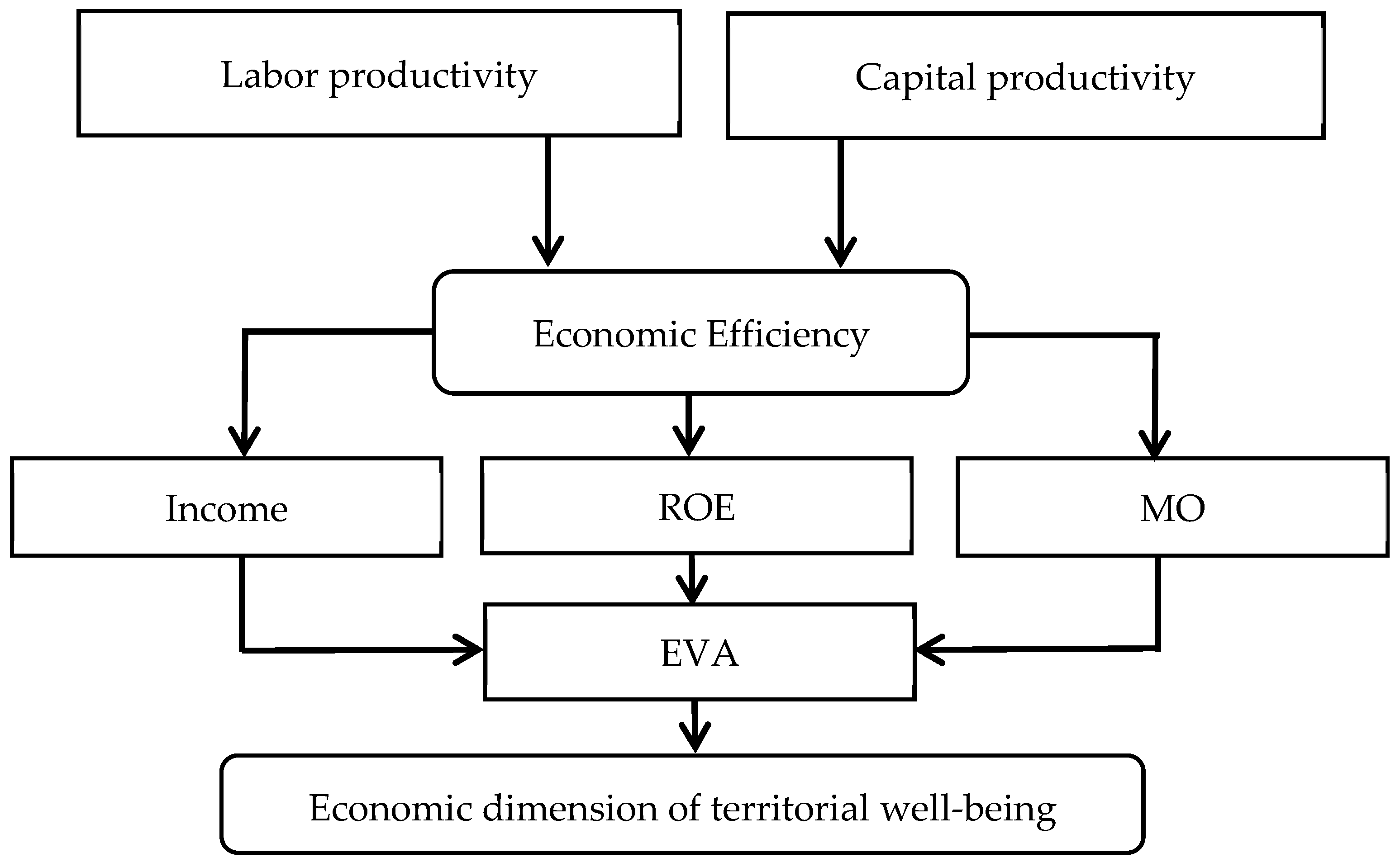
Figure 1 summarizes the relationships, including only the positive ones, given that the objective is to generate well-being in the environment through improvements in business efficiency. It is observed that labor productivity could induce well-being indirectly through wealth generation by increasing capital productivity, operating income, and profitability. This implies that improvements in business efficiency—measured through productivity and competitiveness—as well as increases in revenue enable the environment to benefit from value creation, although these efficiency gains do not necessarily lead to higher employment.
According to the above, productivity is the driving force of economic growth and development in the territory. The improvement of productivity, driven by innovation, allows the achievement of a competitive advantage to conquer markets.
The translation of this efficiency into social benefits results in greater well-being and prosperity, especially through higher wages that translate into better standards of living for society. Likewise, high-productivity activities intrinsically generate high value added per worker, a key objective of productive sophistication and diversification.

4.2. Territorial Specialization in Chiquinquirá

Considering that productivity, especially labor productivity, has positive relationships with dynamics, competitiveness, and well-being in Chiquinquirá, the identification of activities that can be recommended as specialization or productive vocation was carried out, for which a review of the efficiency of activities was conducted, using 2023 data provided by the Chamber of Commerce of Tunja.
In this way, activities that are efficient and intensive in the municipality’s abundant factor will be recommended. It has been shown that Chiquinquirá is abundant in the labor factor [7]; therefore, firms with activities that are intensive in this factor should be those that ought to be promoted to foster development, consistent with previous results where improvements in labor productivity positively affect the other indicators.
The Table 3 shows that, in capital productivity, each million pesos invested in firms in Chiquinquirá in 2023 generated $6.5 million COP in operating income. Labor productivity showed that each employee reported revenues of $392.8 million COP, with trade as the only activity with a higher value in both indicators (efficient). In the competitiveness indicators, an operating margin of 1.4% and a profitability of 8.1% are established for the 2337 firms in Chiquinquirá renewed in 2024. Activities such as construction, information and communications, professional activities, and health activities can be considered efficient for having values above the total value.
For well-being, it is observed that the average employment of firms is 2.12 positions, and healthcare as the only efficient activity as its average employment coincides with a positive EVA. Once the activities are classified by their level of efficiency, it is concluded that vocation or specialization corresponds to those activities that have one or more efficient indicators and one or fewer inefficient indicators, while activities that would not be recommended for specialization due to their efficiency are those that have two or more inefficient indicators; the remaining activities would be considered potential because they are efficient in at least one of their indicators (Table 4).
In addition to the analysis of indicators, the HOS model provides a clearer picture of the activities to be promoted due to their intensity in the use of the abundant factor. Under this analysis, Chiquinquirá would specialize in artistic, entertainment, and recreation activities for having a greater intensity of labor (L), this being its abundant factor; followed by activities such as accommodation and food services, education, or information and communications.
By combining these two perspectives, it is concluded that artistic and recreation activities, together with accommodation and food services related to tourism, should be strengthened so that they become the municipality’s specialization because they are intensive in the abundant factor; however, their efficiency results show constraints that prevent them from developing as productive vocation activities, requiring improvements in their productivity as a driver of competitiveness and well-being.
These activities are part of a smart specialization insofar as they allow for better use of local productive factors and focus scarce resources and institutional support on their diversification and sophistication.
Thus, smart specialization implies identifying and prioritizing activities under a logic that allows concentrating on human and financial resources, especially for research, development, and innovation (R&D&I), in areas that enable competition at a global level. This focus is key because it allows achieving a critical mass of firms, as well as generating economies of scale and scope necessary to drive productivity, which would not be achieved if efforts were dispersed. Thus, by basing prioritization on the productive strengths and local capacities of the territory, smart specialization ensures an efficient investment of available resources, transforming existing capabilities into sustainable competitive advantages.

5. Discussion

Sustained improvement in productivity is established as the fundamental factor of economic growth, especially labor productivity, which has no upper limit, being an essential requirement to drive firm competitiveness and the generation of value added [52,53]. Increasing labor productivity and, therefore, economic value, must articulate the sophistication of the productive apparatus with the strategic development of human capital within a framework of coordinated territorial action [54,55].
The increase in productivity requires the sophistication of existing economic activities and diversification toward new higher-value activities, for which innovation is key and, behind it, the development of human capital [55,56,57].
In this sense, gaps must be closed by implementing technological extension services and knowledge transfer, and in this, coordination with academia can be key so that firms with lower productivity can advance and move closer to the more productive ones [58].
Smart specialization also allows for an increase in the physical capital per worker ratio to incorporate technical progress and increase worker productivity. The allocation of institutional resources for investment in science, technology, and innovation is key to transforming production and creating new goods and services with high technological content [59].
Human capital, composed of the knowledge, skills, and education of the workforce, is a key element to improve productivity and therefore generate sustainable growth and competitive advantages [60,61,62]. Thus, transforming the workforce into human capital requires relevant and qualified training since it increases the efficiency of the labor factor, and this is where academia plays a crucial role by collaborating with the business sector to develop the human capital required by local productive initiatives, which demands greater coordination between these two territorial actors [63,64].
Endogenous growth theory emphasizes that the accumulation of knowledge stimulates economic growth when applied to the productive process and generates new knowledge within firms [65,66]. By developing human capital, positive externalities are generated through the increase in the stock of knowledge that allows learning and cooperation to improve productivity [64,67].
Additionally, when the territory becomes more efficient through economic activities that shift from being labor-intensive to being knowledge-intensive, it attracts and retains creative or talented individuals who are the raw material of a new high value-producing economy [68]. This requires firms to begin investing in the well-being and training of their employees, which results in higher productivity and the generation of “shared value” that positively impacts employees, customers, suppliers, and society in general [69].
These efforts must be channeled through cluster initiatives or proposals for economic agglomeration at the local level. Clusters make it possible to identify and address market and government failures that limit firm productivity and facilitate coordination among firms, the State, and academia, key elements for achieving the objectives of local actors. Additionally, clusters generate economies of scale and scope derived from specialization and the division of labor among firms, which reduces costs and increases innovation capacities, thereby creating a virtuous cycle that multiplies development potential.

5.1. Policy Implications

The policy implications derived from this study point, first, to the need for a selective and territorially differentiated public intervention that overcomes generalist approaches to economic development. In contexts such as Chiquinquirá, where the factor endowment is clearly biased toward labor, policies should be oriented toward strengthening sectors intensive in this factor, but under schemes of productive sophistication. This implies prioritizing modern industrial policy instruments—particularly those associated with smart specialization—that allow resources to focus on activities with scaling potential, avoiding institutional dispersion. In operational terms, this translates into the identification of specific tourism niches, the design of incentives for applied innovation in services, and the creation of public–private coordination mechanisms that reduce the coordination failures identified in the productive structure.
Second, the results suggest that public policy should reorient its emphasis from the mere generation of employment toward improving productivity and job quality. The evidence shows that increases in labor productivity do not necessarily translate into higher employment but do lead to higher income levels and economic value added. Therefore, policy should focus on the development of specialized human capital, relevant technical training, and the incorporation of knowledge into productive processes. This requires strengthening coordination between academia, firms, and the State through dual training programs, technological extension, and knowledge transfer, to close efficiency gaps and accelerate the transition toward activities with higher technological content and value added.
Finally, a key implication is the need to structure and govern a cluster initiative as a central instrument of territorial policy. The proposed tourism cluster should not be understood solely as a sectoral agglomeration, but as a platform for productive transformation that articulates infrastructure, innovation, financing, and human capital. From a public policy perspective, this implies designing a strategic agenda with measurable targets in productivity, competitiveness, and well-being, as well as governance mechanisms that ensure the effective participation of local actors. Additionally, it is necessary to complement this strategy with investments in specific public goods—infrastructure for tourism, connectivity, digitalization—that make it possible to enhance the economies of scale and scope required to consolidate sustainable competitive advantages in the territory.

5.2. Limitations and Future Research Directions

The present study is not exempt from limitations. First, the use of aggregated indicators of productivity, competitiveness, and well-being limits the ability to capture intra-sectoral dynamics and firm-level heterogeneities that could be relevant for a more refined understanding of territorial development. Additionally, the non-experimental nature and the correlational approach of the study restrict the possibility of establishing strict causal relationships between the analyzed variables.
Second, in the measurement of territorial well-being. This study operates only its economic-productive dimension through employment and EVA. Consequently, the findings should not be interpreted as evidence of comprehensive territorial well-being, since qualitative, environmental, cultural, subjective, and social inclusion dimensions were not empirically measured.
Second, the HOS model used to identify productive specialization, although conceptually robust for analyzing factor endowment, simplifies the complexity of territorial economies by assuming conditions of perfect competition and limited factor mobility. This may underestimate the role of institutional, technological, and governance variables that significantly influence the configuration of territorial competitive advantages. Likewise, the approach to smart specialization is developed based on a theoretical and diagnostic analysis, without incorporating longitudinal empirical evidence that would allow for an evaluation of the effectiveness of this approach in similar contexts, which limits its external validation.
Based on these limitations, several avenues for future research are opened. First, the development of longitudinal studies is recommended to evaluate the impact of the implementation of cluster initiatives on productivity, employment, and well-being in the territory. Second, it is pertinent to incorporate more advanced econometric methodologies or causal approaches that allow identifying policy effects with greater precision. Finally, future research should integrate institutional variables, social capital, and territorial governance, as well as micro-level analyses of firms, to build more comprehensive models that explain the transition from factor-based comparative advantages to sustainable competitive advantages based on knowledge and innovation.

6. Conclusions

Based on the analysis developed in the study on the territorial specialization of Chiquinquirá, it is concluded that the path toward the municipality’s economic development lies in the identification and strengthening of its productive vocation, grounded in a smart specialization strategy. The research determined that, although there are economic activities with a certain level of efficiency, such as trade, construction, and professional services, the true potential lies in sectors intensive in the territory’s abundant factor: labor. Activities linked to tourism emerge as those with the greatest affinity with the endowment of the local factor, although they present significant constraints in productivity and competitiveness that limit their capacity to generate well-being.
The results show that labor productivity has a direct and positive influence on operating income and capital productivity and, indirectly, on the generation of economic value added, although not necessarily on employment generation. This relationship underscores the importance of promoting efficiency gains that, through productive sophistication and innovation, allow transforming existing capabilities into sustainable competitive advantages. However, for this process to be effective, a deliberate and coordinated intervention is required to close productivity gaps through the incorporation of knowledge, technology, and qualified human capital.
The development proposal is concretized in the promotion of a cluster initiative oriented toward the tourism sector, which acts as a mechanism to materialize smart specialization. This initiative must integrate actions of technological extension, human capital development, investment in infrastructure, and promotion of innovation, with the support of key factors such as academia, the public sector, and local firms. The coordination of these efforts will make it possible to overcome the market and institutional failures that currently limit the sector’s performance, while facilitating diversification toward activities with higher value added and technological content.
Thus, the path to development for Chiquinquirá depends on its capacity to consolidate a productive specialization based on its comparative advantages but transformed into competitive advantages through the continuous improvement of productivity and the strategic coordination of actors and resources. The implementation of a tourism cluster will not only enhance productive linkages and the generation of shared value, but will also lay the foundations for endogenous, sustainable development with greater well-being for the community.
Finally, this research offers a formal analysis of sustainable territorial development in emerging economies. Where Chiquinquirá represents an intermediate municipality, characterized by abundant labor, limited capital accumulation, productive structures based on services and the ever constant need to transform local resources into sustainable competitive advantages. Therefore, the findings in this research should not be understood as a universal statistical generalization, but as analytical transferability to territories that face similar structural conditions.

Author Contributions

Conceptualization, H.C.-F., Y.P.-G. and J.A.-T.; methodology, H.C.-F., Y.P.-G. and J.A.-T.; software, H.C.-F., Y.P.-G. and J.A.-T.; validation, H.C.-F., Y.P.-G. and J.A.-T.; formal analysis, H.C.-F., Y.P.-G., J.A.-T. and C.A.-G.; investigation, H.C.-F., Y.P.-G., J.A.-T. and C.A.-G.; resources, C.A.-G.; data curation, H.C.-F., Y.P.-G. and J.A.-T.; writing—original draft preparation, H.C.-F., Y.P.-G., J.A.-T. and C.A.-G.; writing—review and editing, H.C.-F., Y.P.-G., J.A.-T. and C.A.-G.; visualization, H.C.-F., Y.P.-G., J.A.-T. and C.A.-G.; supervision, H.C.-F., J.A.-T. and C.A.-G.; project administration, H.C.-F., J.A.-T. and C.A.-G.; funding acquisition, C.A.-G. All authors have read and agreed to the published version of the manuscript.

Funding

The APC was funded by the Universidad de Aysen, Coyhaique, Chile.

Institutional Review Board Statement

Not applicable.

Informed Consent Statement

Not applicable.

Data Availability Statement

The original contributions presented in this study are included in the article. Further inquiries can be directed to the corresponding author.

Acknowledgments

The authors thank the Chamber of Commerce of Tunja.

Conflicts of Interest

The authors declare no conflicts of interest.

References

  1. Sehnem, S.; Piekas, A.; Dal Magro, C.B.; Fabris, J.; Leite, A. Public Policies, Management Strategies, and the Sustainable and Competitive Management Model in Handicrafts. J. Clean. Prod. 2020, 266, 121695. [Google Scholar] [CrossRef]
  2. Çiftçioğlu, S.; Sokhanvar, A. Can Specialization in Tourism Enhance the Process of Sustainable Economic Development and Investment in East Asia and the Pacific? Int. J. Hosp. Tour. Adm. 2022, 23, 1006–1029. [Google Scholar] [CrossRef]
  3. Scarpellini, S.; Marín-Vinuesa, L.M.; Aranda-Usón, A.; Portillo-Tarragona, P. Dynamic Capabilities and Environmental Accounting for the Circular Economy in Businesses. Sustain. Account. Manag. Policy J. 2020, 11, 1129–1158. [Google Scholar] [CrossRef]
  4. McCann, P.; Ortega-Argilés, R. Smart Specialization, Regional Growth and Applications to European Union Cohesion Policy. Reg. Stud. 2015, 49, 1291–1302. [Google Scholar] [CrossRef]
  5. Rodríguez-Pose, A. Do Institutions Matter for Regional Development? Reg. Stud. 2013, 47, 1034–1047. [Google Scholar] [CrossRef]
  6. McCann, P. Perceptions of Regional Inequality and the Geography of Discontent: Insights from the UK. Reg. Stud. 2020, 54, 256–267. [Google Scholar] [CrossRef]
  7. Castro-Fajardo, H.; Niño-Amézquita, J.L.; Aguirre-Garzon, C.; Abril-Teatin, J. Productive Specialization and Factor Endowments in Emerging Municipalities: A Comparative Analysis of Tunja and Chiquinquirá (2017–2021). Sustainability 2025, 17, 7300. [Google Scholar] [CrossRef]
  8. Camara de Comercio de Tunja Tejido Empresarial. Available online: https://cctunja.org.co/estudios-economicos/tejido-empresarial/ (accessed on 5 June 2026).
  9. Teixeira, A.A.C.; Queirós, A.S.S. Economic Growth, Human Capital and Structural Change: A Dynamic Panel Data Analysis. Res. Policy 2016, 45, 1636–1648. [Google Scholar] [CrossRef]
  10. Tillaguango, B.; Alvarado, R.; Dagar, V.; Murshed, M.; Pinzón, Y.; Méndez, P. Convergence of the Ecological Footprint in Latin America: The Role of the Productive Structure. Environ. Sci. Pollut. Res. 2021, 28, 59771–59783. [Google Scholar] [CrossRef]
  11. Wade, R. After the Crisis: Industrial Policy and the Developmental State in Low-Income Countries. Glob. Policy 2010, 1, 150–161. [Google Scholar] [CrossRef]
  12. Lopes, J.; Farinha, L.; Ferreira, J.J.; Silveira, P. Does Regional VRIO Model Help Policy-Makers to Assess the Resources of a Region? A Stakeholder Perception Approach. Land Use Policy 2018, 79, 659–670. [Google Scholar] [CrossRef]
  13. Fernandes, R.; Gama, R.; Barros, C. Creative activities, smart specialization, and opportunities for small urban areas: The Estarreja’s carnival case. Urbe 2018, 10, 212–227. [Google Scholar] [CrossRef]
  14. Boisier, S. Teorías y Metáforas Sobre el Desarrollo Territorial; Libros CEPAL; Naciones Unidas, Comisión Económica para América Latina y el Caribe: Santiago, Chile, 1999. [Google Scholar]
  15. Boisier, S. Una (re)visión heterodoxa del desarrollo (territorial): Imperativo categorico. Estud. Soc. 2004, 23, 10–36. [Google Scholar]
  16. Elouaourti, Z.; Ibourk, A. A New Methodology to Track the Dynamics of Structural Transformation Applied to the Case of a Developing Country. J. Open Innov. Technol. Mark. Complex. 2025, 11, 100539. [Google Scholar] [CrossRef]
  17. Mensah, E.; Owusu, S.; Foster-McGregor, N.; Szirmai, A. Structural Change, Productivity Growth and Labour Market Turbulence in Sub-Saharan Africa. J. Afr. Econ. 2023, 32, 175–208. [Google Scholar] [CrossRef]
  18. Noja, G.G.; Buglea, A.; Lala-Popa, I.; Jurcut, C.N. The Interplay between Knowledge-Based Competitiveness, People’s Good Health and Well-Being: New Empirical Evidence from Central and Eastern European Countries. Qual. Quant. 2021, 55, 441–466. [Google Scholar] [CrossRef]
  19. Torre, A. Contribution to the Theory of Territorial Development: A Territorial Innovations Approach. Reg. Stud. 2025, 59, 2193218. [Google Scholar] [CrossRef]
  20. Torre, A. Territorial Development: Towards a Dynamic and Innovative Understanding. Reg. Stud. 2025, 59, 2465657. [Google Scholar] [CrossRef]
  21. Rodríguez-Pose, A. Institutions and the Fortunes of Territories. Reg. Sci. Policy Pract. 2020, 12, 371–386. [Google Scholar] [CrossRef]
  22. Ascani, A.; Crescenzi, R.; Iammarino, S. Regional Economic Development: A Review. In WP1/03 Search Working Paper; University of Barcelona: Barcelona, Spain, 2012. [Google Scholar]
  23. Crescenzi, R.; Rodríguez-Pose, A. Infrastructure and Regional Growth in the European Union. Pap. Reg. Sci. 2012, 91, 487–513. [Google Scholar] [CrossRef]
  24. Iammarino, S.; Rodriguez-Pose, A.; Storper, M. Regional Inequality in Europe: Evidence, Theory and Policy Implications. J. Econ. Geogr. 2019, 19, 273–298. [Google Scholar] [CrossRef]
  25. Morretta, V. Territorial Capital in Local Economic Endogenous Development. Reg. Sci. Policy Pract. 2021, 13, 103–119. [Google Scholar] [CrossRef]
  26. Delgadillo, E.; Reyes, T.; Baumgartner, R.J. Towards Territorial Product-Service Systems: A Framework Linking Resources, Networks and Value Creation. Sustain. Prod. Consum. 2021, 28, 1297–1313. [Google Scholar] [CrossRef]
  27. Hausmann, R.; Hwang, J.; Rodrik, D. What You Export Matters. J. Econ. Growth 2007, 12, 1–25. [Google Scholar] [CrossRef]
  28. Mewes, L.; Broekel, T. Technological Complexity and Economic Growth of Regions. Res. Policy 2022, 51, 104156. [Google Scholar] [CrossRef]
  29. Ferreira, H.; Marques, C.S.; Farinha, L. Regional Smart Specialisation Strategies: A Systematic Literature Review. J. Knowl. Econ. 2026, 17, 3032–3059. [Google Scholar] [CrossRef]
  30. Frenken, K.; Van Oort, F.; Verburg, T. Related Variety, Unrelated Variety and Regional Economic Growth. Reg. Stud. 2007, 41, 685–697. [Google Scholar] [CrossRef]
  31. Chusseau, N.; Dumont, M.; Hellier, J. Explaining Rising Inequality: Skill-Biased Technical Change and North-South Trade. J. Econ. Surv. 2008, 22, 409–457. [Google Scholar] [CrossRef]
  32. Freitas, E.; Britto, G.; Amaral, P. Related Industries, Economic Complexity, and Regional Diversification: An Application for Brazilian Microregions. Pap. Reg. Sci. 2024, 103, 100011. [Google Scholar] [CrossRef]
  33. Li, W.; Fu, Y.; Wang, W.; He, C. The impact of regional economic complexity on symmetrically related diversification. Dili Xuebao/Acta Geogr. Sin. 2024, 79, 1994–2019. [Google Scholar] [CrossRef]
  34. Qiao, Y.; Wu, D. Relatedness, Complexity and Regional Diversification in the European Union: The Role of Co-Inventor Networks. Tijdschr. Voor Econ. Soc. Geogr. 2024, 115, 537–553. [Google Scholar] [CrossRef]
  35. Barzotto, M.; Corradini, C.; Fai, F.; Labory, S.; Tomlinson, P.R. Smart Specialisation, Industry 4.0 and Lagging Regions: Some Directions for Policy. Reg. Stud. Reg. Sci. 2020, 7, 318–332. [Google Scholar] [CrossRef]
  36. Foray, D. Smart Specialisation: Opportunities and Challenges for Regional Innovation Policy; Smart Specialisation: Opportunities and Challenges for Regional Innovation Policy; Taylor and Francis: Abingdon, UK, 2014; p. 103. [Google Scholar]
  37. Moujaes, G. Moving to Smart Specialization for Sustainability: The Implications on the Design of Monitoring Indicators. Sci. Public Policy 2024, 51, 127–143. [Google Scholar] [CrossRef]
  38. Foray, D. Smart Specialization Strategies as a Case of Mission-Oriented Policy-a Case Study on the Emergence of New Policy Practices. Ind. Corp. Change 2018, 27, 817–832. [Google Scholar] [CrossRef]
  39. Radosevic, S. Assessing EU Smart Specialization Policy in a Comparative Perspective. In Advances in the Theory and Practice of Smart Specialization; Elsevier: Amsterdam, The Netherlands, 2017; pp. 1–36. [Google Scholar]
  40. Chistobaev, A.I.; Grudtsyn, N.A.; Bozhkov, N.I. Territorial well-being as a scientific category: Definition, indicative Approach, assessment methods. Vestn. St. Petersburg Univ. Earth Sci. 2025, 70, 743–761. [Google Scholar]
  41. Camagni, R.; Capello, R. Regional Competitiveness and Territorial Capital: A Conceptual Approach and Empirical Evidence from the European Union. Reg. Stud. 2013, 47, 1383–1402. [Google Scholar] [CrossRef]
  42. Peiró-Palomino, J. Regional Well-Being in the OECD: Disparities and Convergence Profiles. J. Econ. Inequal. 2019, 17, 195–218. [Google Scholar] [CrossRef]
  43. Tolstykh, T.; Gamidullaeva, L.; Shmeleva, N.; Lapygin, Y. Regional Development in Russia: An Ecosystem Approach to Territorial Sustainability Assessment. Sustainability 2020, 12, 6424. [Google Scholar] [CrossRef]
  44. Porter, M.E. Clusters and the New Economics of Competition. Harv. Bus. Rev. 1998, 76, 77–90. [Google Scholar]
  45. Porter, M.E. Location, Competition, and Economic Development: Local Clusters in a Global Economy. Econ. Dev. Q. 2000, 14, 15–34. [Google Scholar] [CrossRef]
  46. Furman, J.L.; Porter, M.E.; Stern, S. The Determinants of National Innovative Capacity. Res. Policy 2002, 31, 899–933. [Google Scholar] [CrossRef]
  47. Delgado, M.; Porter, M.E.; Stern, S. Clusters, Convergence, and Economic Performance. Res. Policy 2014, 43, 1785–1799. [Google Scholar] [CrossRef]
  48. De Propris, L. Mapping Local Production Systems in the UK: Methodology and Application. Reg. Stud. 2005, 39, 197–211. [Google Scholar] [CrossRef]
  49. Delgado, M.; Porter, M.E.; Stern, S. Defining Clusters of Related Industries. J. Econ. Geogr. 2016, 16, 1–38. [Google Scholar] [CrossRef]
  50. Gianelle, C.; Guzzo, F.; Mieszkowski, K. Smart Specialisation: What Gets Lost in Translation from Concept to Practice? Reg. Stud. 2020, 54, 1377–1388. [Google Scholar] [CrossRef]
  51. Montgomery, D.C.; Runger, G.C. Applied Statistics and Probability for Engineers, 7th ed.; EMEA edition; Wiley: Hoboken, NJ, USA, 2018. [Google Scholar]
  52. Syverson, C. What Determines Productivity. J. Econ. Lit. 2011, 49, 326–365. [Google Scholar] [CrossRef]
  53. Adel, A. Future of Industry 5.0 in Society: Human-Centric Solutions, Challenges and Prospective Research Areas. J. Cloud Comput. 2022, 11, 40. [Google Scholar] [CrossRef]
  54. Sui, X.; Jiao, S.; Wang, Y.; Wang, H. Digital Transformation and Manufacturing Company Competitiveness. Financ. Res. Lett. 2024, 59, 104683. [Google Scholar] [CrossRef]
  55. Simionescu, M.; Pelinescu, E.; Khouri, S.; Bilan, S. The Main Drivers of Competitiveness in the EU-28 Countries. J. Compet. 2021, 13, 129–145. [Google Scholar] [CrossRef]
  56. Moussir, C.-E.; Chatri, A. Structural Change and Labour Productivity Growth in Morocco. Struct. Change Econ. Dyn. 2020, 53, 353–358. [Google Scholar] [CrossRef]
  57. Prasetyo, P.E. Human Capital as the Main Determinant of Regional Economic Growth. Int. J. Adv. Sci. Technol. 2020, 29, 6261–6267. [Google Scholar]
  58. Hou, J.; Yu, D.; Song, H. Evolution of Industrial Structure and Economic Growth in Hebei Province, China. Sustainability 2025, 17, 7756. [Google Scholar] [CrossRef]
  59. Dogan, F.C. Are Institutions, Innovation, and Education the Key to Sustainable Growth in G20 Economies? Economies 2025, 13, 307. [Google Scholar] [CrossRef]
  60. Malik, S.Y.; Cao, Y.; Mughal, Y.H.; Kundi, G.M.; Mughal, M.H.; Ramayah, T. Pathways towards Sustainability in Organizations: Empirical Evidence on the Role of Green Human Resource Management Practices and Green Intellectual Capital. Sustainability 2020, 12, 3228. [Google Scholar] [CrossRef]
  61. Collins, C.J. Expanding the Resource Based View Model of Strategic Human Resource Management. Int. J. Hum. Resour. Manag. 2021, 32, 331–358. [Google Scholar] [CrossRef]
  62. Abril-Teatin, J.A.; León, M.; Ducon, J.; Blanco-Mesa, F. Toma de decisiones estratégicas gerenciales con alto grado de incertidumbre en agencias de turismo. Cuad. C. 2024, 1, 1–16. [Google Scholar] [CrossRef]
  63. van Laar, E.; van Deursen, A.J.A.M.; van Dijk, J.A.G.M.; de Haan, J. The Relation between 21st-Century Skills and Digital Skills: A Systematic Literature Review. Comput. Hum. Behav. 2017, 72, 577–588. [Google Scholar] [CrossRef]
  64. Li, L. Reskilling and Upskilling the Future-Ready Workforce for Industry 4.0 and Beyond. Inf. Syst. Front. 2024, 26, 1697–1712. [Google Scholar] [CrossRef]
  65. Akcigit, U.; Ates, S.T. Ten Facts on Declining Business Dynamism and Lessons from Endogenous Growth Theory. Am. Econ. J. Macroecon. 2021, 13, 257–298. [Google Scholar] [CrossRef]
  66. Xu, Y.; Li, A. The Relationship between Innovative Human Capital and Interprovincial Economic Growth Based on Panel Data Model and Spatial Econometrics. J. Comput. Appl. Math. 2020, 365, 112381. [Google Scholar] [CrossRef]
  67. Rodríguez-Sánchez, J.-L.; González-Torres, T.; Montero-Navarro, A.; Gallego-Losada, R. Investing Time and Resources for Work–Life Balance: The Effect on Talent Retention. Int. J. Environ. Res. Public Health 2020, 17, 1920. [Google Scholar] [CrossRef]
  68. Wu, B.; Yang, W. Empirical Test of the Impact of the Digital Economy on China’s Employment Structure. Financ. Res. Lett. 2022, 49, 103047. [Google Scholar] [CrossRef]
  69. Bush, J.T.; Balven, R.M. Catering to the Crowd: An HRM Perspective on Crowd Worker Engagement. Hum. Resour. Manag. Rev. 2021, 31, 100670. [Google Scholar] [CrossRef]
Figure 1. Relationships between efficiency and economic territorial well-being.
Sustainability 18 05934 g001
Table 1. Normality test.
Kolmogorov–Smirnov Test for One SampleYProd LProd KMOROELEVA
Normal parameters a,bSample407407407407407407407
Media1,494,793,079.201,077,619,685.359.354312.85%89.07%3.430
SD4,055,687,913.722,688,797,279.5334.9227827.96%308.43%11.924140,536,399.26
Maximum extreme differencesAbsolute0.3560.3440.3950.2710.350.4190.306
Positive0.3130.3180.3450.2340.350.3990.254
Negative−0.356−0.344−0.395−0.271−0.345−0.419−0.306
Test statistician0.3560.3440.3950.2710.350.4190.306
Asymptotic sig. (bilateral)0.000 c0.000 c0.000 c0.000 c0.000 c0.000 c0.000 c
a. The test distribution is normal. b. It is calculated from data. c. Correction of Lilliefors’ meaning.
Table 2. Correlation matrix.
CorrelationsYProd LProd KMOROELEVA
YSpearman’s rho1
Sig. (bilateral)
Prod LSpearman’s rho0.916 **1
Sig. (bilateral)0
Prod KSpearman’s rho0.100 *0.105 *1
Sig. (bilateral)0.0440.034
MOSpearman’s rho−0.239 **−0.265 **−0.178 **1
Sig. (bilateral)000
ROESpearman’s rho−0.1−0.098 *0.539 **0.233 **1
Sig. (bilateral)0.0570.04900
LSpearman’s rho0.053−0.265 **0.030.0820.0781
Sig. (bilateral)0.28900.5510.10.115
EVASpearman’s rho0.116 *0.0760.378 **0.274 **0.688 **0.091
Sig. (bilateral)0.0190.1260000.07
** The correlation is significant at the 0.01 level (bilateral). * The correlation is significant at the 0.05 level (bilateral).
Table 3. Efficiency and well-being indicators 2023.
Major Branches of ActivityProd KProd LMOROELEVA
Agriculture, livestock, hunting, forestry and fishing1.93145.862.10%4.60%2.37−285.92
Mining and quarrying0.3120.790.30%−1.70%2−158.97
Manufacturing Industry3.2549.021.20%3.40%2.08−176.71
Water distribution, evacuation and wastewater treatment1.6732.230.90%1.20%1.85−42.91
Construction1.25338.219.70%9.10%1.87297.33
Wholesale and retail trade, vehicle repair12.06765.540.90%12.60%1.853030.71
Transport and storage0.775410.90%4.30%5.65−757.44
Accommodation and meal services2.3918.962.50%4.80%1.98−60.48
Information and communications2.5938.896.50%14.80%1.855.72
Financial and insurance activities0.24111.750.40%0.10%5.29−1999.72
Real estate activities0.3553.980.10%0.00%1.09−214.06
Professional, scientific and technical activities2.43149.0411.50%16.60%1.9588.34
Administrative and support services activities1.2924.791.10%0.50%4.14−152.76
Education4.536.582.50%3.60%4.63−18.48
Human health care and social assistance activities1.5136.2516.30%8.60%3.38103.09
Arts, entertainment, and recreation3.956.930.20%0.90%2.14−8.05
Other service activities1.2257.544.40%5.10%2.28−199.7
Total6.5392.861.40%8.10%2.12-
Table 4. Classification of activities by efficiency 2023.
Major Branches of ActivityProductiveCompetitiveWellnessSpecializationKL
Agriculture, livestock, hunting, forestry and fishingInefficiencyPotentialPotentialPotential760.01
Mining and quarryingInefficiencyInefficiencyInefficiencyNo vocation680.01
Manufacturing IndustryInefficiencyInefficiencyInefficiencyNo vocation150.07
Water distribution, evacuation and wastewater treatmentInefficiencyInefficiencyInefficiencyNo vocation190.05
ConstructionInefficiencyEfficiencyPotentialVocation2710
Wholesale and retail trade, vehicle repairEfficiencyPotentialPotentialVocation630.02
Transport and storageInefficiencyPotentialPotentialPotential710.01
Accommodation and meal servicesInefficiencyPotentialInefficiencyNo vocation80.13
Information and communicationsInefficiencyEfficiencyPotentialVocation150.07
Financial and insurance activitiesInefficiencyInefficiencyPotentialNo vocation4690.00
Real estate activitiesInefficiencyInefficiencyInefficiencyNo vocation1530.01
Professional, scientific and technical activitiesInefficiencyEfficiencyPotentialVocation610.02
Administrative and support services activitiesInefficiencyInefficiencyPotentialNo vocation190.05
EducationInefficiencyPotentialPotentialPotential80.12
Human health care and social assistance activitiesInefficiencyEfficiencyEfficiencyVocation910.01
Arts, entertainment, and recreationInefficiencyInefficiencyPotentialNo vocation20.57
Other service activitiesInefficiencyPotentialPotentialPotential470.02
Disclaimer/Publisher’s Note: The statements, opinions and data contained in all publications are solely those of the individual author(s) and contributor(s) and not of MDPI and/or the editor(s). MDPI and/or the editor(s) disclaim responsibility for any injury to people or property resulting from any ideas, methods, instructions or products referred to in the content.