


A Multi-Dimensional Roadmap for Algerian Honey Authenticity: Integrating Foodomics, Digital Traceability, and Chemometric Modeling for Rural Sustainability




Abstract
1. Introduction
1.1. Methodology and Literature Selection Strategy
1.2. Characterization of the Seven Biogeographical Regions
2. The Botanical Patrimony of Algeria: Ecological and Taxonomic Analysis
Taxonomic Diversity of Melliferous Taxa
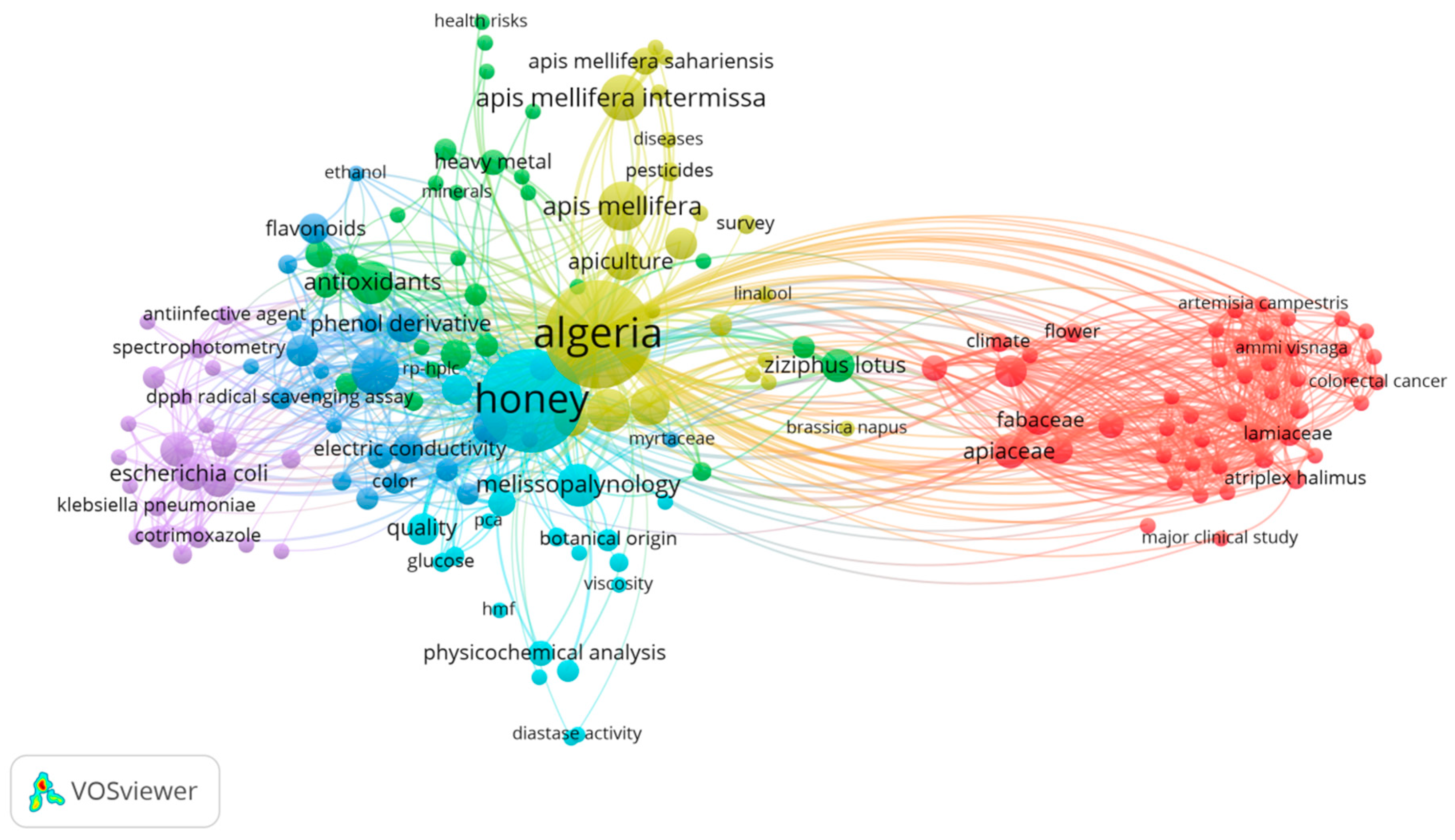
3. Bibliometric Analysis and Mapping of Algerian Honey Research
4. Standardization and Quality Control: The Role of Physicochemical Parameters
5. The Bioactivity of Algerian Honeys
5.1. Phytochemical and Mineral Composition: The Nutritional Foodome
5.2. Antioxidant and Antimicrobial Dynamics: Mechanisms of Action
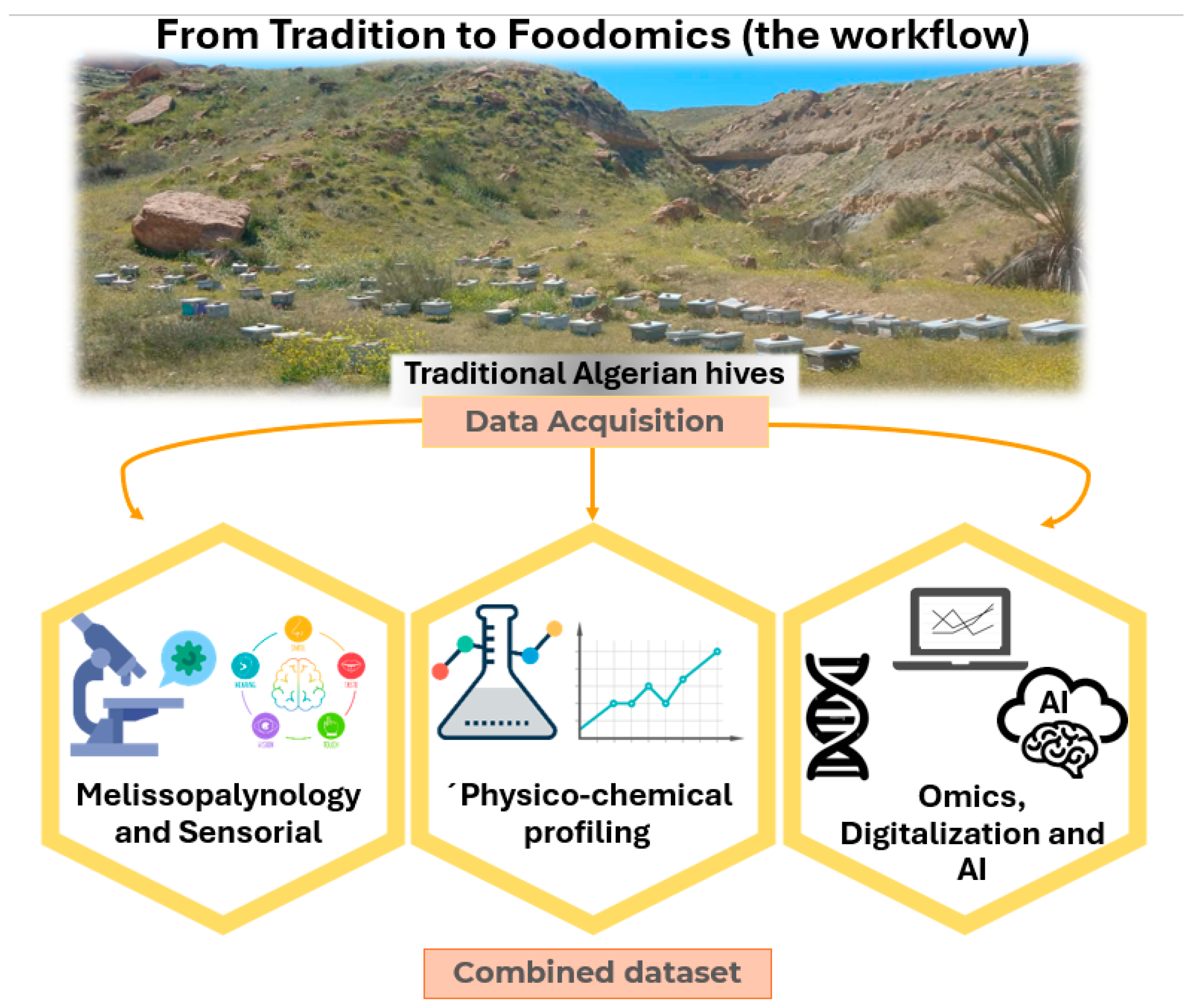
6. Foodomics Approaches Applied to Honey: A New Paradigm in Quality and Traceability
6.1. Spectroscopy and Chemometrics: The Digital Fingerprint of the Algerian Foodome
6.2. Chromatography and Volatomics: High-Precision Aromatic Mapping
6.3. Integrated Data Models: The Synergy of Multi-Platform Analysis
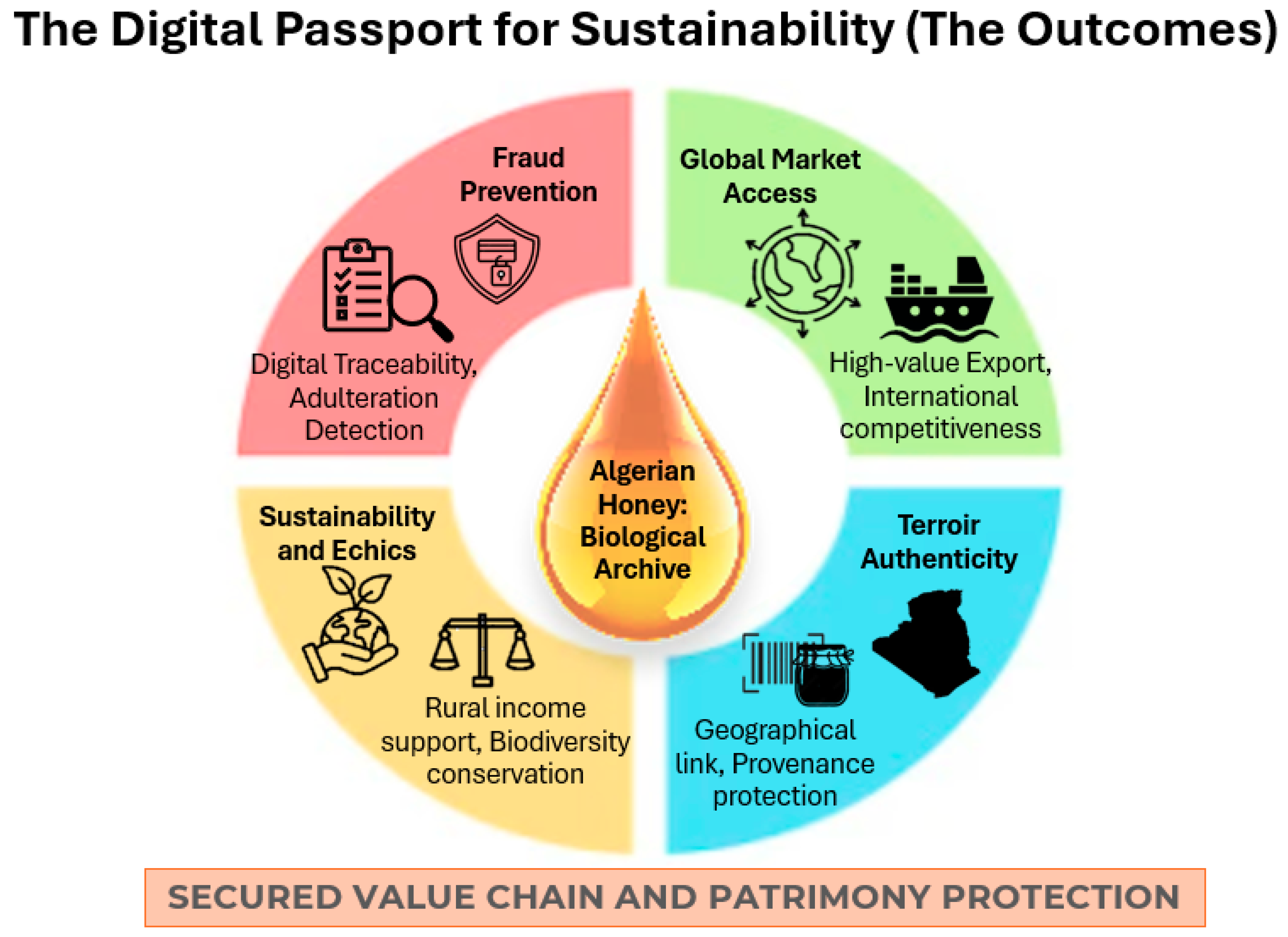
6.4. Digital Traceability and Sustainable Valorization
Cost-Effectiveness, Practical Feasibility, and National Infrastructure Roadmap
7. Sustainability and the Heart of the Rural Economy
8. The Bridge to the Future: From Gaps to Innovation
- A.
- Data Integration and the Development of a National Authentication Framework
- B.
- Advancing the Genomic and Metabolomic Frontier
8.1. Data Scope Limitations, Methodological Validation, and Novel Botanical Horizons
8.2. Methodological Discrepancies, Contradictory Findings, and the Absence of Unified National Standards
9. From Chemometric Data to AI Platforms: Future Horizons Led by Young Researchers
10. Conclusions
Author Contributions
Funding
Institutional Review Board Statement
Informed Consent Statement
Data Availability Statement
Conflicts of Interest
Abbreviations
| AI | Artificial Intelligence |
| AO | Appellation of Origin |
| ATR-FTIR | Attenuated Total Reflectance–Fourier Transform Infrared Spectroscopy |
| CAR/PDMS | Carboxen/Polydimethylsiloxane |
| DPPH | 2,2-diphenyl-1-picrylhydrazyl |
| EC | Electrical Conductivity |
| FRAP | Ferric Reducing Antioxidant Power |
| FTIR | Fourier Transform Infrared Spectroscopy |
| GAE | Gallic Acid Equivalents |
| GC-MS | Gas Chromatography–Mass Spectrometry |
| GI | Geographical Indication |
| HCA | Hierarchical Cluster Analysis |
| HMF | Hydroymethylfurfural |
| HPLC | High-Performance Liquid Chromatography |
| HS-SPME | Headspace Solid-Phase Microextraction |
| LRI | Linear Retention Indices |
| MRSA | Methicillin-Resistant Staphylococcus aureus |
| NIR | Near-Infrared Spectroscopy |
| NMR | Nuclear Magnetic Resonance |
| PCA | Principal Component Analysis |
| PDO | Protected Designation of Origin |
| PDMS/DVB | Polydimethylsiloxane/Divinylbenzene |
| PGI | Protected Geographical Indication |
| PLS-DA | Partial Least Squares Discriminant Analysis |
| QE | Quercetin Equivalents |
| ROS | Reactive Oxygen Species |
| SMEs | Small and Medium-sized Enterprises |
| SOMs | Self-Organizing Maps |
| TFC | Total Flavonoid Content |
| TPC | Total Phenolic Content |
| VOCs | Volatile Organic Compounds |
References
- Ghorab, A.; Mesbah, M.; Harbane, S.; Nakib, R.; Benghanem, A.N.; Escuredo, O.; Rodríguez-Flores, M.S.; Seijo, M.C. Biogeographical distribution of the main melliferous flora of Algeria through the pollen profile of honey. Rev. Palaeobot. Palynol. 2026, 350, 105580. [Google Scholar] [CrossRef]
- Homrani, M.; Escuredo, O.; Rodríguez-Flores, M.S.; Fatiha, D.; Mohammed, B.; Homrani, A.; Seijo, M.C. Botanical Origin, Pollen Profile, and Physicochemical Properties of Algerian Honey from Different Bioclimatic Areas. Foods 2020, 9, 938. [Google Scholar] [CrossRef]
- Benaziza-Bouchema, A.; Schweitzer, P. Caractérisation des miels algériens par l’analyse pollinique et les propriétés physico-chimiques. Phytothérapie 2010, 8, 214–222. [Google Scholar]
- Makhloufi, C.; Kerkvliet, J.; Schweitzer, P. Characterisation of some monofloral Algerian honeys by pollen analysis. Grana 2015, 54, 156–166. [Google Scholar] [CrossRef]
- Korichi, Y.; Benoufella-Kitous, K.; Ouarab, S.; Aouar-Sadli, M.; Ikhlef, H. Diversity, seasonal changes and floral choices of species of the Apidae family (Hymenoptera: Apoidea) in Tizi-Ouzou region (Algeria). J. Appl. Biol. Sci. 2022, 16, 340–352. [Google Scholar] [CrossRef]
- Derrar, S.; Lo Turco, V.; Albergamo, A.; Sgrò, B.; Ayad, M.A.; Litrenta, F.; Saim, M.S.; Potortì, A.G.; Aggad, H.; Rando, R.; et al. Study of Physicochemical Quality and Organic Contamination in Algerian Honey. Foods 2024, 13, 1413. [Google Scholar] [CrossRef] [PubMed]
- Ksentini, H.; Meddad-Hamza, A.; Hamel, T.; Bellili, A.; Babali, B.; Boutabia, L.; Salvo-Tierra, Á.E.; Picornell, A. Assessment of the quality of honey of various botanical and geographical origins based on the pollen spectrum and physico-chemical properties. J. Food Nutr. Res. 2024, 63, 259–272. [Google Scholar] [CrossRef]
- Zerrouk, S.; Bahloul, R. Palynological and physicochemical properties of multifloral honey produced in some regions of Algeria. J. Apic. Res. 2020, 62, 345–354. [Google Scholar] [CrossRef]
- Khalil, M.I.; Moniruzzaman, M.; Boukraâ, L.; Benhanifia, M.; Islam, M.A.; Islam, M.N.; Sulaiman, S.A.; Gan, S.H. Physicochemical and Antioxidant Properties of Algerian Honey. Molecules 2012, 17, 11199–11215. [Google Scholar] [CrossRef]
- Haider, Y.; Adjlane, N.; Martín-Hernández, R.; Khemmoul, A. Sustainable Beekeeping in Algeria: Exploring Practices, Challenges, and Local Honeybee Traits for Natural Resource Management. Nat. Resour. Sustain. Dev. 2024, 14, 257–278. [Google Scholar] [CrossRef]
- Issaad, F.Z.; Bouhedjar, K.; Ikhlef, A.; Lachlah, H.; Smain, D.H.; Boutaghane, K.; Bensouici, C. Multivariate Analysis of Physico-Chemical, Bioactive, Microbial and Spectral Data Characterisation of Algerian Honey. Appl. Nanosci. 2021, 15, 3634–3648. [Google Scholar] [CrossRef]
- Cifuentes, A. Foodomics: Food science & nutrition in the post-genomic era. TrAC Trends Anal. Chem. 2009, 28, 1056–1057. [Google Scholar]
- Li, N.; Song, M.; Li, H.; Liu, Z.; Jiang, A.; Lang, Y.; Chen, L. Advancement of foodomics techniques for honey botanical origins authentication: Past decade (2013–2023) and future perspectives. Trends Food Sci. Technol. 2024, 147, 104458. [Google Scholar] [CrossRef]
- Chenchouni, H.; Laallam, H. Revolutionizing food quality assessment: Unleashing the potential of artificial intelligence for enhancing honey insights. J. Saudi Soc. Agric. Sci. 2024, 23, 312–325. [Google Scholar] [CrossRef]
- Benali, M.; Benali, F. The Digital Transformation of Algerian Agriculture: AI-Driven Decision Making and Resource Management for Sustainable Development. Sustainability 2025, 17, 450. [Google Scholar]
- Ilhem, B.; Amine, K. Challenges and Barriers to AI Adoption in Developing Economies: A Case Study on Algeria’s Digital Infrastructure and Workforce Readiness. Digit. Econ. Sustain. Dev. 2025, 5, 88–102. [Google Scholar]
- Nakib, R.; Ghorab, A.; Harbane, S.; Saker, Y.; Ouelhadj, A.; Rodríguez-Flores, M.S.; Seijo, M.C.; Escuredo, O. Sensory attributes and chemical composition: The case of three monofloral honey types from algeria. Foods 2024, 13, 2421. [Google Scholar] [CrossRef]
- Makhloufi, C.; Ait Abderrahim, L.; Taïbi, K. Characterization of Some Algerian Honeys Belonging to Different Botanical Origins. Iran. J. Sci. Technol. 2021, 45, 112–124. [Google Scholar]
- Kessi, O.; Mekious, S.; Aouadi, A.; Houdeib, J.; Megatli, S. Global assessment of Algerian honeys quality by palynological, physicochemical analyses and trace elements screening. Acta Agric. Slov. 2024, 120, 1–14. [Google Scholar] [CrossRef]
- Yaiche Achour, H.; Khali, M. Composition physicochimique des miels algériens. Détermination des éléments traces et des éléments potentiellement toxiques. Afr. Sci. 2014, 10, 127–136. [Google Scholar]
- Amri, A.; Tahar, A. Study of some honeys produced in Eastern Algeria: Physicochemical and biochemical aspects. J. Food Eng. 2007, 79, 1120–1127. [Google Scholar]
- Ben Amor, S.; Mekious, S.; Allal Benfekih, L.; Abdellattif, M.H.; Boussebaa, W.; Almalki, F.A.; Ben Hadda, T.; Kawsar, S.M. Phytochemical characterization and bioactivity of different honey samples collected in the Pre-Saharan region in Algeria. Life 2022, 12, 927. [Google Scholar] [CrossRef] [PubMed]
- Chettoum, A.; Feknous, N.; Boumendjel, M.; Mekhancha, D.E.; Boudida, Y.; Sedari, A.; Berredjem, A.; Ati, H.; Zaidi, K.; Boumendjel, A. Biological, physicochemical and antibacterial properties of pure honey harvested at the municipality of Seraïdi (Annaba, north east of Algeria). Food Sci. Technol. 2022, 42, e41022. [Google Scholar] [CrossRef]
- Bereksi-Reguig, D.; Allali, H.; Taib, N.; Aissaoui, N.; Wlodarczyk-Stasiak, M.; Kowalski, R. Bioactive Compounds, Antioxidant Properties, and Antimicrobial Profiling of a Range of West Algerian Honeys: In Vitro Comparative Screening Prior to Therapeutic Purpose. Foods 2024, 13, 4120. [Google Scholar] [CrossRef] [PubMed]
- Ahmed, M.; Aissat, S.; Bacha, S.; Meslem, A.; Djebli, N. Antioxidant Activity of Algerian Honey and Evaluation of its Inhibitory Action on Candida albicans Growth. J. Adv. Microbiol. 2015, 1, 57–65. [Google Scholar] [CrossRef]
- Zeghoud, L.; Ben Seghir, B.; Hemmami, H.; Zeghoud, S.; Ben Amor, I.; Kouadri, I.; Rebiai, A.; Tliba, A.; Dia, M.; Aiba, S. Conventional and modern analytical methods used for algerian honey authentication. Asian J. Pharm. Anal. 2022, 12, 461–466. [Google Scholar] [CrossRef]
- Danezis, G.P.; Tsagkaris, A.S.; Camin, F.; Brusic, V.; Georgiou, C.A. Food authentication: Techniques, trends & emerging approaches. TrAC Trends Anal. Chem. 2016, 85, 123–132. [Google Scholar] [CrossRef]
- Svečnjak, L.; Bubalo, D.; Baranović, G.; Novosel, H. Optimization of FTIR-ATR spectroscopy for botanical authentication of unifloral honey types and melissopalynological data prediction. Eur. Food Res. Technol. 2015, 240, 1101–1115. [Google Scholar] [CrossRef]
- Dimakopoulou-Papazoglou, D.; Ploskas, N.; Koutsoumanis, K.; Katsanidis, E. Identification of geographical and botanical origin of Mediterranean honeys using UV-vis spectroscopy and multivariate statistical analysis. J. Food Meas. Charact. 2024, 18, 3923–3934. [Google Scholar] [CrossRef]
- Chaker, H. Detection of Authenticity and Quality of Honey by Infrared Spectroscopy and Physicochemical Parameter Analysis Coupled with Chemometric Methods. SSRN. 2023. Available online: http://dx.doi.org/10.2139/ssrn.4476424 (accessed on 8 June 2026).
- Merzougui, G.; Boulelouah, N.; Mokhtari, A.; Hebira, A. Improving the Approval Process for Durum Wheat Grain Quality in Algeria Using Computer Vision and Machine Learning. Ing. Syst. Inf. 2024, 29, 279. [Google Scholar] [CrossRef]
- Neggad, A.; Benkaci-Ali, F.; Alsafra, Z.; Eppe, G. Headspace solid phase microextraction coupled to GC/MS for the analysis of volatiles of honeys from Algeria. Chem. Biodivers. 2019, 16, e201900267. [Google Scholar] [CrossRef] [PubMed]
- Nakib, R.; Rodríguez-Flores, M.S.; Escuredo, O.; Ouelhadj, A.; Coello, M.C. Retama sphaerocarpa, Atractylis serratuloides and Eruca sativa honeys from Algeria: Pollen dominance and volatile profiling (HS-SPME/GC–MS). Microchem. J. 2022, 174, 107088. [Google Scholar] [CrossRef]
- Nakib, R.; Harbane, S.; Ghorab, A.; Saker, Y.; Escuredo, O.; Rodríguez-Flores, M.S.; Seijo-Coello, M.C. Exploring Honey Consumption and Sustainable Practices in a Segment of Algerian Households. Sustainability 2025, 17, 10669. [Google Scholar] [CrossRef]
- Khaloui, S.; Othman, L.B.; Hakiri, A.; Ayed, H.K. Sweet Deception: Detecting Honey Adulteration Using Generative AI and Hyperspectral Imaging. In 2025 IEEE/ACS 22nd International Conference on Computer Systems and Applications (AICCSA); IEEE: New York, NY, USA, 2025; Volume 19. [Google Scholar]
- Hadj, A.; Slimani, S.; Saidani, R. Empowering SMEs in North Africa: The Role of AI and Machine Learning in Enhancing Operational Efficiency for Honey Production. Technol. Forecast. Soc. Change 2025, 198, 122–134. [Google Scholar]

| Parameters | Observed Range/Values | Impact and Regional Context |
|---|---|---|
| Moisture | 14.5–19.0% | Reflects environmental humidity; higher fermentation risk in Northern areas versus natural concentration in the South. |
| pH | 3.4–5.2 | Indicates the presence of organic acids and serves as a marker for floral diversity and botanical origin. |
| Free acidity | 15–45 meq/kg | Correlates with the nectar-derived compounds and ensures compliance with international freshness standards. |
| Electrical conductivity | Low vs. High | Acts as a proxy for mineral content and botanical origin; distinguishes specific floral sources like Ziziphus from Citrus. |
| Hmf | <10 mg/kg | A marker of freshness and integrity; values may be influenced by high ambient temperatures in arid regions. |
| Fructose/Glucose ratio | >1.1 | Underpins the nutritional and therapeutic value; determines the physical state and crystallization rate of the matrix. |
| Bioactive Category | Observed Ranges/Keys | Impact and Therapeutic Role |
|---|---|---|
| Total phenolic (TPC) | 20 to >120 mg GAE/100 g | Serves as a primary indicator of phytochemical richness, varying significantly with botanical and regional origin |
| Total flavonoid content (TFC) | Variable by botanical origin | Acts as a key molecular marker contributing to the honey’s overall secondary metabolite profile. |
| Mineral matrix | K, Ca, Mg, Fe, Zn, Mn | Reflects environmental interaction and the soil–nectar pathway, defining the honey’s nutritional identity. |
| Antioxidant activity | FRAP and DPPH assays | Demonstrates the honey’s capacity to neutralize free radicals, linked to its complex chemical matrix. |
| Antimicrobial spectrum | Bacteriostatic and bactericidal | Reflects the combined effect of acidity, osmolarity, and enzymatic activity against various pathogens. |
| Antifungal Potential | Activity against Candida albicans | Indicates the broad-spectrum biological utility of specific honey varieties in traditional and modern applications. |
| Technique | Specificity | Sample Preparation | Analytical Limitations | Cost | Reproducibility | Practical Applicability |
|---|---|---|---|---|---|---|
| FTIR | Moderate to High | Minimal to none (direct ATR) | Overlapping spectral bands; baseline shifts | Low to Moderate | High | Excellent for routine screening and fast authentication |
| NIR | Moderate | None (non-destructive) | High sensitivity to moisture/water bands; weak signals | Low | High | Great for rapid, non-invasive industrial sorting |
| GC-MS | High (Volatiles) | Time-consuming (extraction/extraction-derivatization) | Restricted to volatile and thermally stable compounds | High | High | Reference standard for aroma and organic marker identification |
| LC-MS | Ultra-High (Non-volatiles) | Moderate to complex (extraction/filtration) | Matrix effects; high maintenance; requires extensive spectral libraries | Very High | High | Reference standard for polyphenols, adulteration markers, and contaminants |
| DNA Metabarcoding | High (Botanical/Entomological) | Complex (DNA extraction & PCR amplification) | DNA degradation during storage; lack of comprehensive reference databases | High | Moderate to High | Premium tools for precise botanical traceability and pollen verification |
| Chemometrics (PCA, PLS-DA) | Dependent on primary data | None (mathematical step) | Risk of overfitting; absolute dependence on training dataset size/representativeness | None (software-based) | High (if cross-validated) | Indispensable for multi-variate clustering and classification models |
| AI & Machine Learning | High | None (mathematical step) | Needs massive datasets; “black-box” interpretability; high computational risk | Low (software) to High (expert setup) | Variable (model dependent) | Futuristic roadmap for multi-block data fusion and digitized passports |
Disclaimer/Publisher’s Note: The statements, opinions and data contained in all publications are solely those of the individual author(s) and contributor(s) and not of MDPI and/or the editor(s). MDPI and/or the editor(s) disclaim responsibility for any injury to people or property resulting from any ideas, methods, instructions or products referred to in the content. |
© 2026 by the authors. Licensee MDPI, Basel, Switzerland. This article is an open access article distributed under the terms and conditions of the Creative Commons Attribution (CC BY) license.
Share and Cite
Nakib, R.; Ghorab, A.; Coello, M.C.S. A Multi-Dimensional Roadmap for Algerian Honey Authenticity: Integrating Foodomics, Digital Traceability, and Chemometric Modeling for Rural Sustainability. Sustainability 2026, 18, 5924. https://doi.org/10.3390/su18125924
Nakib R, Ghorab A, Coello MCS. A Multi-Dimensional Roadmap for Algerian Honey Authenticity: Integrating Foodomics, Digital Traceability, and Chemometric Modeling for Rural Sustainability. Sustainability. 2026; 18(12):5924. https://doi.org/10.3390/su18125924
Chicago/Turabian StyleNakib, Rifka, Asma Ghorab, and María Carmen Seijo Coello. 2026. "A Multi-Dimensional Roadmap for Algerian Honey Authenticity: Integrating Foodomics, Digital Traceability, and Chemometric Modeling for Rural Sustainability" Sustainability 18, no. 12: 5924. https://doi.org/10.3390/su18125924
APA StyleNakib, R., Ghorab, A., & Coello, M. C. S. (2026). A Multi-Dimensional Roadmap for Algerian Honey Authenticity: Integrating Foodomics, Digital Traceability, and Chemometric Modeling for Rural Sustainability. Sustainability, 18(12), 5924. https://doi.org/10.3390/su18125924

