Article

Development of an Educational Collaborative Network Diagnostic Tool and Application to a Case of Climate Change Education

1
Institute of Integrated Science Education, Dankook University, Jukjeon-ro, Yongin-si 16890, Republic of Korea
2
Department of Science Education, Dankook University, Jukjeon-ro, Yongin-si 16890, Republic of Korea
*
Author to whom correspondence should be addressed.
Sustainability 2026, 18(12), 5914; https://doi.org/10.3390/su18125914
Submission received: 30 April 2026 / Revised: 3 June 2026 / Accepted: 6 June 2026 / Published: 9 June 2026

Abstract

This study aimed to develop an educational collaborative network diagnostic tool capable of assessing the level of collaboration and the characteristics of interaction within Climate Change Education (CCE) networks, applying the collaborative network framework for education. Employing a theory-informed instrument development approach integrating deductive and inductive elements, the initial 16-item draft was subjected to two rounds of expert review and revised using the Content Validity Index (CVI) and the Factorial Validity Index (FVI). The finalized tool was then applied to ten program coordinators representing diverse institutional types engaged in multi-year collaborative CCE activities from 2023 to 2025. The final tool comprises 20 items across six sections: (1) network structure, (2) roles of network participants, (3) network interaction, (4) function (knowledge, consensus, and innovation) space activities, (5) network growth, and (6) network expansion. The tool employs a mixed-methods design incorporating open-ended, single-choice, and multiple-choice item formats. Application to the case suggested that the collaborative network appeared to be positioned between Level 4 (Collaborative Network) and Level 5 (Growing Network), with the university research institute as a boundary-spanning hub. This study presents the first expert-reviewed diagnostic tool designed to assess collaboration levels and identify inter-agent interaction patterns within CCE networks, offering actionable evidence for network advancement.

1. Introduction

Global climate change and environmental degradation have emerged as urgent challenges directly linked to human survival, no longer merely threats of the distant future. According to the World Meteorological Organization [1], 2024 was recorded as the warmest year in observational history, with the global mean surface temperature rising 1.55 ± 0.13 °C above pre-industrial levels. The atmospheric concentration of carbon dioxide has reached its highest level in the past 800,000 years, intensifying the greenhouse effect and inducing systemic disruptions including sea-level rise and ocean acidification. The Intergovernmental Panel on Climate Change [2] warns that such anthropogenic climate change is causing widespread and irreversible damage to ecosystems and human societies. The increasing frequency and intensity of climate and weather extremes threatens food and water security, adversely affects physical and mental health, and disproportionately harms socioeconomically vulnerable populations.
In response to this global crisis, the role of education has been emphasized more than ever. The United Nations adopted the Sustainable Development Goals (SDGs) in 2015, stipulating that all learners must acquire the knowledge and skills necessary for sustainable development and environmental conservation [3]. UNESCO’s Education for Sustainable Development 2030 (ESD for 2030) framework advocates for a “great transformation” that encompasses individual behavioral change and structural societal transitions [4]. This implies the need for learners to develop not merely subject knowledge, but the competencies and decision-making capacities to become active citizens who contribute to building a sustainable world. Notably, the Organization for Economic Co-operation and Development [5] introduced the concept of “Agency in the Anthropocene” into the 2025 PISA science framework as a key element, emphasizing the capacity of young people to understand and act upon complex socio-ecological challenges [6,7].
Issues related to climate change involve a complex entanglement of environmental, social, and economic interests, rendering them insolvable through the efforts of any single actor. For the effective implementation and dissemination of climate change education in particular, collaborative participation from diverse concerned parties—including universities, local governments, communities, community organizations, and corporations—is essential, alongside the efforts of schools and teachers. Ansell and Gash emphasized collaborative governance, defined as a process through which public agencies engage directly with community concerned parties in consensus-oriented decision-making, as an alternative model for addressing complex public problems [8]. Camarinha-Matos and Afsarmanesh defined collaborative networks as systems in which heterogeneous entities interact autonomously and effectively to achieve common goals [9]. To structure such collaborative relationships, Etzkowitz and Ranga proposed the Triple Helix model, in which universities, industries, and governments interact to generate a knowledge space, a consensus space, and an innovation space [10].
Climate Change Education (CCE) is emerging as a pivotal global strategy for addressing the climate crisis. In international academia, the primary discourse focuses on effective teaching and learning strategies and curriculum restructuring aimed at fostering climate literacy. For example, Stevenson et al. emphasized that, given the risks, uncertainties, and rapid changes inherent in the climate crisis, a paradigm shift is necessary—moving away from traditional knowledge transmission toward inquiry-based and participatory learning that stimulates critical and creative thinking [11]. Similarly, Monroe et al. established through a systematic literature review that educational effectiveness is maximized when climate change information is meaningfully connected to learners’ personal lives and encourages active engagement [6]. Regarding the organization of the curriculum, however, divergent perspectives exist. Eilam cautioned that a “cross-curricular approach,” where climate change content is fragmented across various subjects, may undermine educational cohesion [12]. Instead, Eilam argued for establishing CCE as an independent disciplinary subject to build a professional and specialized educational framework. In line with these discussions, the OECD introduced the concept of “Agency in the Anthropocene” through its PISA 2025 Science Framework [5]. This concept sets a core direction for CCE by highlighting the capacity to critically evaluate information based on scientific expertise and translate it into decision-making and action for a sustainable future.
In South Korea, CCE research has primarily focused on practical challenges in field implementation and the systematization of educational content. Yun identified the lack of teacher expertise and the absence of inter-departmental cooperation as major barriers to systematic education [13]. Furthermore, Kim and Choi proposed that, since excessive pessimism regarding the climate crisis can lead to learner helplessness, a positive approach that fosters hope and practical agency, tailored to developmental stages, is essential [14]. While recent institutional progress has been made through the “2022 Revised Curriculum,” which strengthens ecological transformation education and introduces related elective courses [15,16], Kang underscores the need to establish an integrated knowledge structure that transcends simple knowledge acquisition to encompass the complex natural and social dimensions of climate change [17]. Synthesizing these, CCE should move toward a multidisciplinary system that enables learners to reflect on their lives and social structures through a climate lens, ultimately empowering them to grow as “practical agents” who seek collective alternatives for the community. Furthermore, appropriate support should be provided through collaborative networks to realize CCE.
Recent empirical research further indicates that partnerships between schools and non-profit organizations beyond the school system yield positive outcomes, including educational innovation and the creation of sustainable solutions, that extend well beyond individual learner growth [18]. Previous research applied a network collaboration framework to the context of CCE and established a six-level evolution model in which network agents develop through simple networking, coordination, cooperation, collaboration, growth, and expansion [19,20]. In this process, a boundary spanner, such as a university-affiliated research institute, plays a pivotal role in leading inter-agent communication, mediating conflict, and sustaining network stability and expansion.
Existing approaches to evaluating educational partnerships and collaborative networks fall into three broad categories, each with notable limitations in the CCE context. First, tools derived from Social Network Analysis (SNA)—such as centrality and density measures—are powerful for mapping structural relationships among actors but require complete quantitative relational data from all network members [21]. Such data are rarely available in educational collaboration settings, and SNA tools do not capture the qualitative interaction dynamics, functional space activities, or developmental trajectories that characterize evolving CCE networks. Second, general educational program evaluation frameworks and partnership assessment tools [18] tend to focus on measuring end-point outcomes—such as student learning gains or program reach—rather than the ongoing inter-agent interaction processes through which collaborative networks develop and sustain themselves over time. Third, collaborative governance evaluation frameworks [8,22], while theoretically rich, have not been operationalized into validated diagnostic instruments applicable to the specific institutional configurations and functional dynamics of CCE networks. Crucially, the existing tools have limitation in integrating the structural, functional-space, and developmental dimensions of network collaboration within a single diagnostic framework tailored to the CCE context.
However, for CCE networks to function as sustainable collaborative structures rather than simple project-level partnerships, more precise analysis and evaluation of the stages and processes of interaction are indispensable. To date, there is a notable lack of diagnostic tools capable of comprehensively assessing the characteristics of agents’ interaction and the processes of network change. In particular, the development of tools that can assess how interaction relationships within a network evolve over time, and how effectively agents perform their roles within each functional space, is essential for ensuring network stability and long-term sustainability.
Therefore, the purpose of this study is to develop an educational collaborative network diagnostic tool capable of assessing the level of collaboration and the characteristics of interaction within a network, applying the collaborative network framework for education proposed by previous research as its analytical framework [20]. Through this, the study aims to provide practical insights that enable diverse CCE agents to identify their network’s current evolutionary level and advance toward higher levels of collaboration. The specific research questions addressed are as follows:
(1)
How does the developed educational collaborative network diagnostic tool reflect the collaborative network framework for education?
(2)
Is the tool effective in analyzing the characteristics of actual climate change education network cases?
The main purpose of this study is to develop an educational collaborative network diagnostic tool (RQ 1), but to explore the utility of the developed tool, we attempted a confirmatory verification by applying it to a case of education conducted through network collaboration (RQ 2).

2. Theoretical Background

2.1. Perspectives on Networks

Scholarly approaches to networks can be broadly categorized into three perspectives: structure, actor/function, and process. As society becomes increasingly complex, the elements and analytical methods emphasized by each perspective continue to evolve. The first perspective, network as structure, is predominantly applied in sociology and demography and regards networks as a form of social structure [21]. Rather than treating networks merely as collections of individual agents, this perspective comprehensively addresses the connectivity among them, including classification systems, preferences, and cultural dispositions, enabling researchers to derive the cultural and social specificities embedded within network configurations [23,24,25,26].
The second perspective, network as actor or function, emerged in the 1980s and focuses on the actors operating within networks and the functions they perform, rather than on fixed structures. Particularly, the Actor Network Theory (ANT) extends the category of actors to include not only humans but also non-human elements such as objects, technologies, and material properties, explaining social phenomena through the complex interactions among these entities [27,28,29]. The ANT subsequently evolved into the Network Theory of Organization, which, from an economic perspective, focuses on analyzing the various levels of interaction within organizations in terms of functional effectiveness [30,31,32,33].
The third perspective, network as process, focuses on the dynamic flow through which networks form, are maintained, and change over time. Emerson et al. argued that the forms and outcomes of collaboration emerge dynamically depending on participants’ modes of engagement, motivations, and action capacities within given systemic contexts and collaborative frameworks [22]. This perspective therefore tracks the ongoing interactions among network participants and the attendant changes in their roles. Representative examples include analyses of the development of social relationships through social media platforms, and analyses of policy decision-making processes addressing shifts in national interests and positions in multilateral international cooperation [34,35,36].
As the foregoing illustrates, networks simultaneously constitute fixed structures, dynamic arenas for action, and continuously evolving processes [21,22]. Networks can thus be interpreted along multiple dimensions depending on the analytical perspective adopted, and as society changes, the complexity of the elements, functions, roles, and processes that comprise networks continues to increase. Recent empirical studies have indeed applied concepts spanning all three perspectives (i.e., structure, function, and evolutionary change) to analyze collaborative network characteristics comprehensively [19,20].

2.2. Conceptual Framework for the Educational Collaborative Network

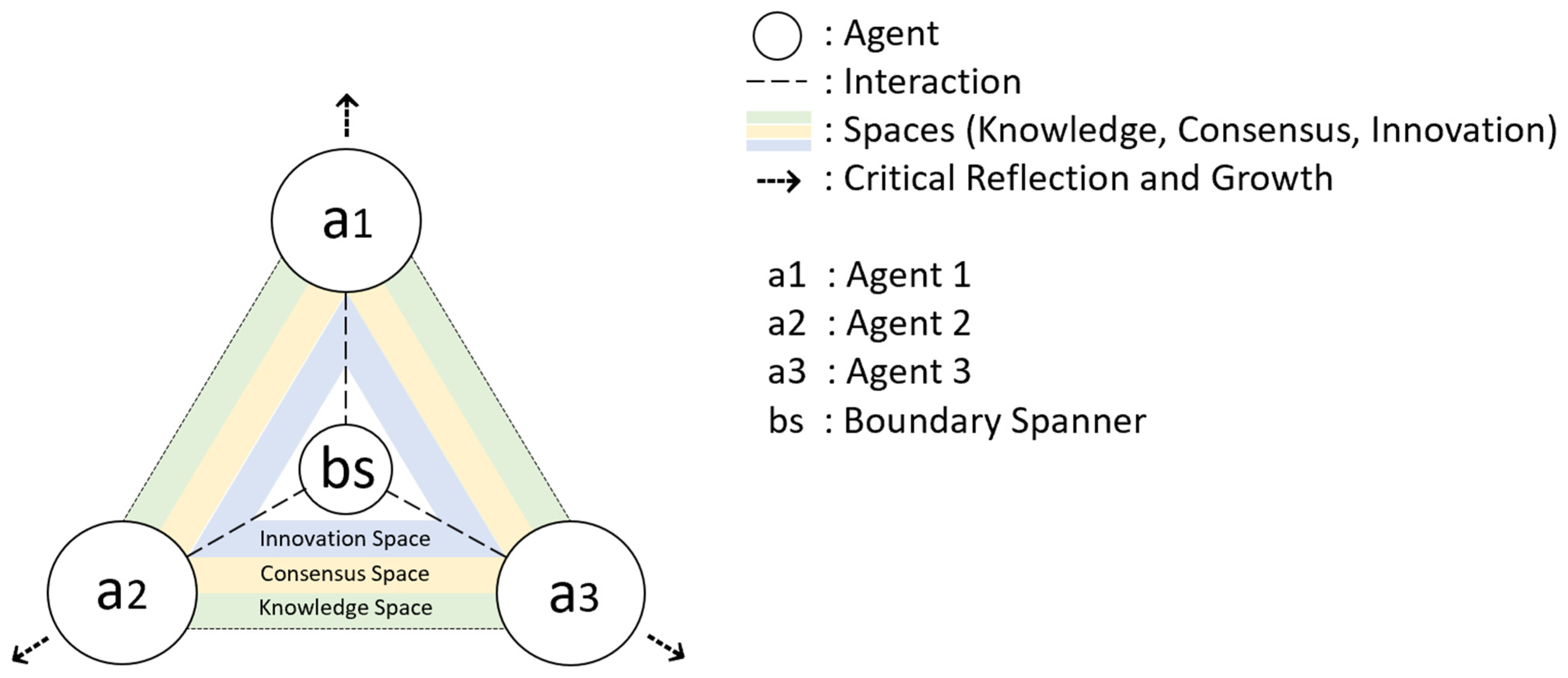
Previous research integrated the Triple Helix theory developed by Etzkowitz and Leydesdorff [37] with the collaborative network concept proposed by Camarinha-Matos and Afsarmanesh [9] to analyze cases of CCE and to construct a structural framework for educational collaborative networks (see Figure 1) [19]. This framework identifies participating agents as the structural unit of analysis and distinguishes functions according to the activities occurring among those agents. Furthermore, it delineates evolutionary levels (from network formation to expansion) based on the characteristics of inter-agent interaction.
The network structure differentiates between participating agents (i.e., a1, a2, a3) and the boundary spanner (i.e., bs) that coordinates interactions among them. Each agent is an individual entity that engages in environment-related activities or education with its own purposes and intentions, participating in the network to achieve shared educational goals through mutual interaction. According to Williams, the boundary spanner transcends the role of a mere liaison positioned at the interface of organizations; it is defined as a dynamic actor who builds trust within the network, interprets divergent interests, and strategically connects resources across organizational boundaries [38]. Although the presented framework assumes a baseline network of three participating agents, networks may in practice involve five or more agents as they evolve [20].
The functional spaces in which interaction occurs comprise the knowledge space, the consensus space, and the innovation space. The knowledge space functions primarily as a venue for sharing and reconstructing information and experience related to educational content, instructional strategies, and program design. It serves as a starting point for sharing resources or information and for re-contextualization through mapping, and encompasses the collaborative development and revision of new educational plans, scenarios, and program structures. It also develops into a learning community that connects agents through shared expertise. The consensus space forms actively as network agents coordinate goals and directions, roles and responsibilities, and resource allocation and operational procedures. It is most prominent during the initial stages of network formation, particularly in goal-setting and the establishment of consultative bodies, and functions as a venue for coordinating the specific implementation conditions required for program operation. Provan and Kenis identified goal consensus grounded in inter-participant trust as a critical relational condition for collaborative governance management and effectiveness [21]. Furthermore, when smooth consensus is established, the consensus space can function as a feedback point for network evaluation, reflection, and preparation for innovation in subsequent stages. Finally, the innovation space becomes manifest as new educational and practical approaches, participatory structures, and relational networks that did not previously exist or been applied are concretely realized. The innovation space emerges most actively during the field application and dissemination of programs, functioning as a catalyst for social change and the expansion of social impact by introducing novel mediating mechanisms and participatory structures that differ from conventional approaches [39].
Within these spaces, the boundary spanner performs the roles of organizing the knowledge space, constructing the consensus space, facilitating the innovation space, and mediating relationships and communication [20]. Specifically, the boundary spanner is a core participant in the collaborative network who leads communication among participating agents, supports their interaction, and mediates conflict to foster relational growth [19,40,41]. It functions as an organizer who designs and integrates the transmission and flow of knowledge that enables innovation within the network. It also plays a central role in aligning the demands, constraints, and objectives of diverse participating institutions and coordinating significant opinions and directions. Moreover, it contributes to the realization of innovation by enabling new content, practical strategies, and participatory structures. Throughout this process, the boundary spanner resolves differences in language, culture, and institutional frameworks across organizations with divergent interests, improves relationships, and activates communication to promote mutual understanding. Through this process, each agent grows through critical reflection and develops greater educational capacities than they possessed prior to engaging in the network.

2.3. Evolution of the Educational Collaborative Network

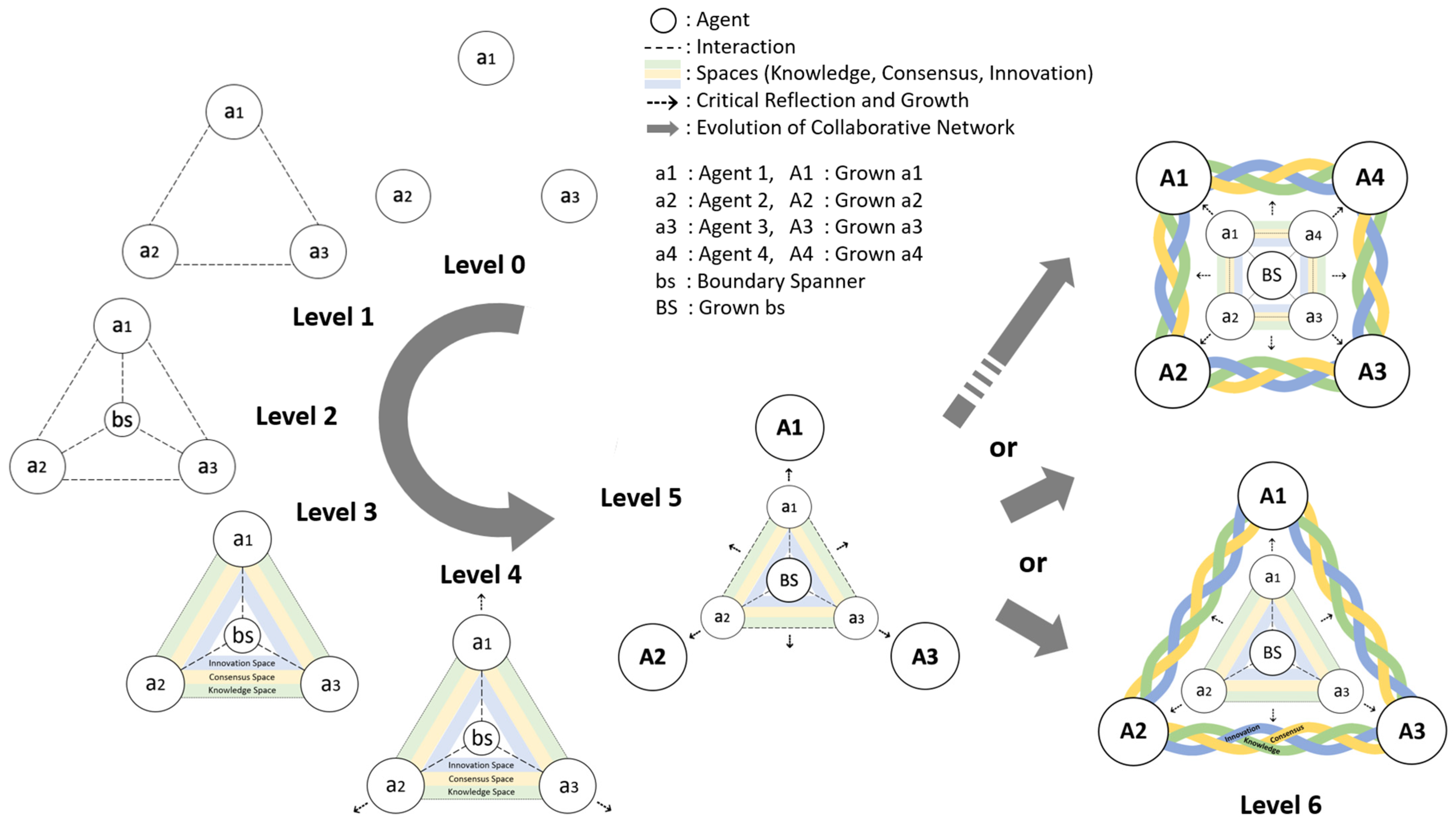
Previous research identified the forms of interaction occurring within a collaborative network—including communication, the exchange of information and opinions, coordination and consensus building, knowledge generation and expansion, division of work, and joint project implementation—and initially proposed a four-level model of network evolution: simple network (Level 1), coordinated network (Level 2), cooperative network (Level 3), and collaborative network (Level 4) [19]. Subsequently, through additional analysis of cases involving diverse agents participating in CCE, growing network (Level 5) and expanding network (Level 6) were added to the model (see Figure 2) [20].
For more details about the characteristics of each level, the three agents (a1, a2, a3) that initially had no interaction at Level 0 begin communicating and exchanging information and opinions to form a simple network (Level 1). As they develop into a coordinated network (Level 2), they move beyond merely sharing opinions to coordinating and reaching consensus with other agents to plan programs aligned with their respective intentions and purposes. In a cooperative network (Level 3), a shared goal is established and resources are shared, such that interactions among agents expand to encompass concrete tasks. In a collaborative network (Level 4), participating agents implement educational programs based on jointly constructed plans, evaluate those programs, share responsibility for outcomes, and lay the groundwork for each agent’s renewed growth. In the growing network (Level 5), the capabilities and expertise of individual agents expand while the stability and influence of the network simultaneously increase; as a result, each agent grows in ways that enable it to undertake new or more diverse tasks (e.g., a1 → A1, a2 → A2, a3 → A3). Upon reaching the expanding network (Level 6), agents challenge new problems or articulate new visions, improve network structures to enhance collaborative efficiency, and extend their influence on new agents or domains. Table 1 presents a detailed summary of the characteristics of each level. The present study utilized these level-specific network characteristics identified [20] as the basis for developing the educational collaborative network diagnostic tool. Specifically, the characteristics of the activities or interactions presented at each level were itemized, and questions designed to assess these items were constructed and utilized in the development of the initial version of the tool.

3. Methods

This study employed a theory-informed instrument development approach that integrated deductive and inductive elements. The overarching analytical categories—network structure, functional spaces, and evolutionary levels—were deductively derived from established theoretical frameworks, including the Triple Helix model [37] and the collaborative network concept [9], as operationalized in prior research on CCE [19,20]. Within this theoretically grounded structure, an inductive category formation methodology [42] was applied to flexibly construct and refine specific items and sub-categories through iterative expert review, rather than imposing a fixed a priori measurement framework. The diagnostic tool was therefore designed not merely as a deductive measurement instrument, but as a data collection tool for qualitative-led exploratory inquiry into network collaboration phenomena—consistent with Mayring’s [42] understanding of inductive category formation as a process of systematic concept derivation from empirical material within theoretically bounded domains. Overall, this study is characterized as a qualitative exploratory instrument-development study, supplemented by descriptive quantitative indicators (CVI, FVI, frequency counts) to support expert validation.
The present study does not employ formal Social Network Analysis (SNA) techniques. No relational metrics (e.g., centrality, density, betweenness), network graphs, or computational structural analyses were conducted. Rather, the study develops a qualitative diagnostic framework to evaluate the characteristics of agents’ interaction and perceived collaboration dynamics within educational networks, grounded in theoretical models of collaborative network evolution [19,20].

3.1. Development of the Collaborative Network Diagnostic Tool

The tool development proceeded through the following sequential stages: (1) initial version development, (2) first round of expert review and revision, (3) second round of expert review and revision, and (4) finalization. The first draft was constructed by theoretically establishing core analytical categories through a systematic review of prior research on network collaboration. Specifically, the initial tool comprised 16 items across five sections: (1) network structure, (2) roles and interactions of participating agents, (3) function space participation, (4) network growth, and (5) network improvement and expansion. This constituted an initial category system designed to comprehensively capture the constituent elements of collaborative networks, and all items were formulated as open-ended questions to obtain inductively analyzable data through respondents’ free-form descriptions. The first draft was reviewed by four experts in integrated science education, including two with doctoral degrees in education. Following expert review and revision of the first draft, the second draft underwent a further round of review by the same expert group, and was additionally revised in accordance with their feedback to produce the final version.
Item appropriateness was assessed at each round of review using two validity indices. The Content Validity Index (CVI) was calculated based on experts’ ratings of item relevance on a four-point scale (1 = not relevant, 2 = somewhat relevant, 3 = quite relevant, 4 = highly relevant). Items rated 3 or 4 by each expert were coded as content-valid, and the proportion of experts assigning such ratings constituted the CVI score for each item. Items with CVI ≥ 0.78 were retained as appropriate, while those falling below this threshold were flagged for revision or deletion [43]. The Factorial Validity Index (FVI) was used to verify whether each item loaded appropriately onto its theoretically designated analytical category; values of ≥0.80 were considered indicative of adequate factorial validity [44]. These indices were computed following each round of expert review to guide item revision, deletion, or retention decisions in a systematic and transparent manner.

3.2. Application to a Case of Climate Change Education Network

The finalized tool was applied to an actual case of CCE conducted through network collaboration, focusing on whether each of the six sections—network structure, roles of network participants, network interaction, function (knowledge, consensus, innovation) space activities, network growth, and network expansion—could be appropriately analyzed. To this end, the diagnostic tool was administered to program coordinators at participating institutions engaged in activities supporting green lifestyle practices among adolescents and young adults through collaboration among universities, local governments, and secondary schools, covering the period from 2023 to 2025. Data were collected through self-administered written responses. Each participant was provided with the tool in digital format and asked to complete all items independently, without time constraints, to allow for thoughtful and detailed responses. The tool was distributed and collected between December 2025 and January 2026. Completed responses were returned via e-mail, and all identifying information was anonymized prior to analysis. Participants were informed of the voluntary nature of their participation and the confidentiality of their responses prior to completing the tool. The tool and its administration process were reviewed and approved by the Institutional Review Board (IRB) of a university-affiliated research institute. It was then administered to a total of ten program coordinators (R01~R10) at participating institutions. The collected data were divided by section and analyzed by two researchers (one professor and one research professor of science education) with expertise in science and environmental education.
To qualitatively analyze responses to open-ended questions, we employed Groenewald’s five phases for the explication of data [45], operationalized as follows. In Phase 1 (bracketing and phenomenological reduction), each researcher independently read all responses in full to gain an overall impression, temporarily setting aside prior theoretical assumptions to remain open to the meanings expressed by participants. In Phase 2 (delineating units of meaning), each researcher independently segmented respondents’ written responses into discrete units of meaning—defined as the smallest self-contained statement expressing a distinct idea or experience related to network collaboration. In Phase 3 (clustering units of meaning to form themes), units of meaning were grouped into thematic clusters corresponding to the six analytical sections of the diagnostic tool (network structure, roles, interaction, function space activities, growth, and expansion). The two researchers conducted this clustering independently and then compared results. In Phase 4 (summarizing and validating), the two researchers convened to compare their independently derived clusters, discuss discrepancies, and reach consensus through deliberation. Any units of meaning for which agreement could not be reached through discussion were flagged and resolved through a third review cycle. In Phase 5 (extracting general and unique themes), agreed-upon themes were synthesized across all ten respondents to identify both patterns common to the network as a whole and themes unique to specific agent types (e.g., school coordinators vs. the boundary-spanning research institute), producing a composite interpretive summary.

4. Results

4.1. Educational Collaborative Network Diagnostic Tool

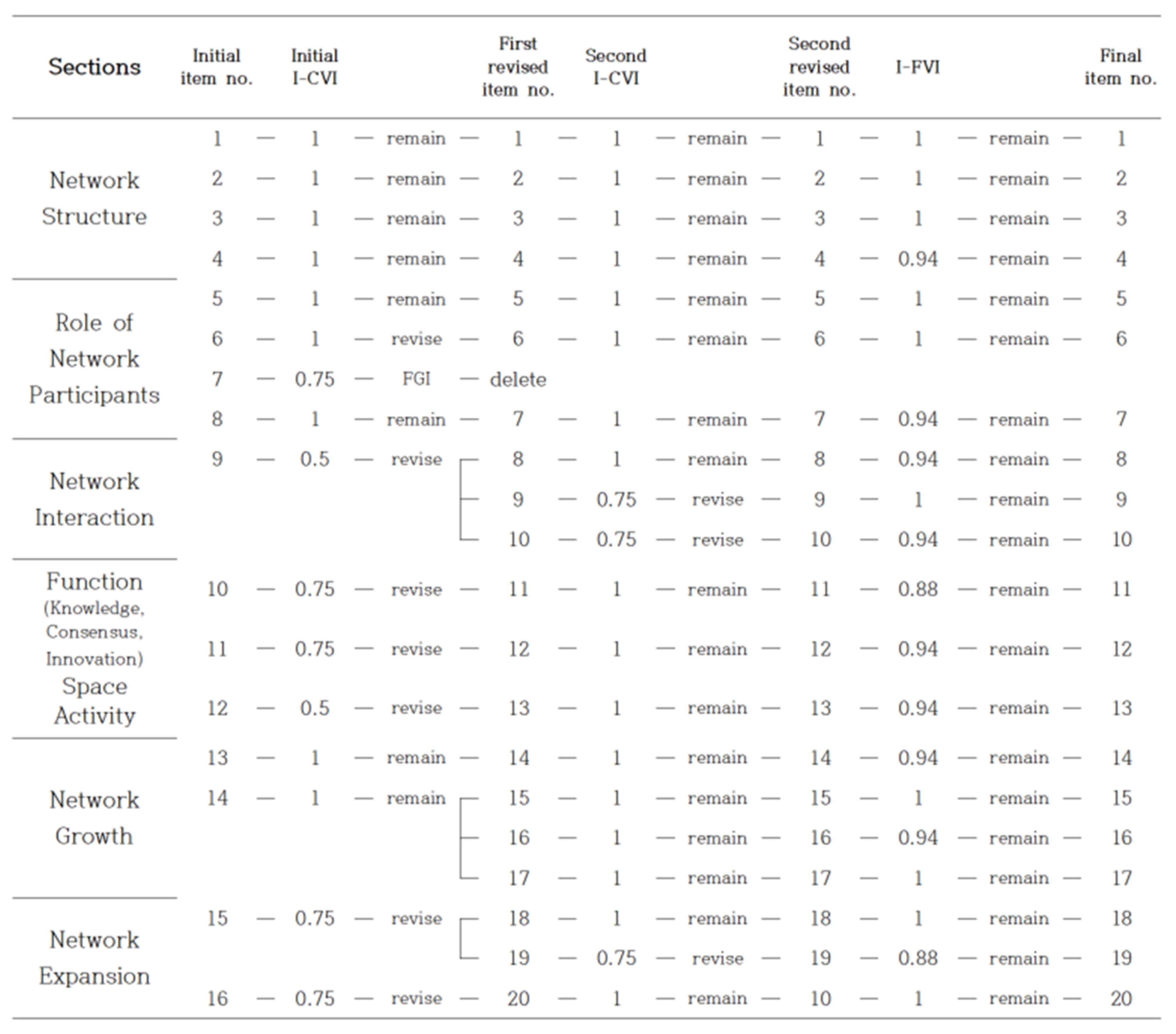
This study sought to develop a collaborative network diagnostic tool for CCE, drawing on the level-specific characteristics of collaborative networks for educational activities as proposed [20]. The first draft of the tool, grounded in theoretical rationale, underwent expert review and revision to produce a final version comprising 20 items across six sections. During the review and revision of the first and second drafts, item appropriateness was assessed by measuring the Content Validity Index (CVI) and the Factorial Validity Index (FVI). The CVI reflects experts’ evaluations of how well each item represents the concept it is intended to measure; items with a CVI below 0.78 are typically considered to require revision or deletion, while those at or above 0.78 are considered appropriate [43]. The FVI is used to verify whether each item loads appropriately onto its theoretically constructed factor; values of 0.80 or above are considered indicative of adequate validity [44]. Figure 3 presents the CVI and FVI values obtained during the review and revision process, along with the final item composition.
Following the first expert review, Item 7 (initial)—which originally asked, ‘What is the purpose of your personal participation in this project?’—was identified as inappropriate through a Focus Group Interview (FGI) for two reasons. First, the item was conceptually redundant with Item 6, which asked about the institutional purpose of participation; as both items addressed participation purpose, retaining both risked generating overlapping responses without adding distinct analytical value. Second, and more fundamentally, expert reviewers noted that respondents participate in the network as institutional representatives responsible for program coordination, rather than as private individuals with independent personal goals. Accordingly, asking about personal participation purposes was deemed to deviate from the research focus on institutional collaboration dynamics. Consistent with these expert judgments, Item 7 (initial) received a CVI below the 0.78 retention threshold (see Figure 3), and was accordingly deleted from the second draft.
In the subsequent revision incorporating the expert feedback, the following modifications were made: section subdivision and restructuring; adjustment of the number of items and diversification of response formats; and clarification and operationalization of item wording. Specifically, the original “roles and interactions of participating agents” category was divided into “roles of network participants” and “network interaction.” The “function space participation” section was renamed and operationalized as “function (knowledge, consensus, innovation) space activities.” Additionally, the “network improvement and expansion” section was redefined and restructured as “network expansion”.
The total number of items increased from 16 to 20 through the following specific modifications. First, the original single item on network interaction (Item 9 in initial) was subdivided into three more granular items: an item identifying which institution or individual the respondent interacts with most (Q8), an item capturing the types of interaction and their relative frequency through ranked multiple selection (Q9), and an item eliciting specific examples for each interaction type (Q10). This subdivision was necessary to distinguish who is being interacted with, what form that interaction takes, and how it manifests concretely—three analytically distinct dimensions that a single item could not adequately capture. Second, two new items were added on network growth to understand details of changes in the systematization and efficiency of interaction (Q16), and increases in the broader impact of collaboration (Q17). This was necessary because network growth encompasses both internal capacity development and external influence expansion as well as operating simultaneously at organizational and individual levels. Third, a new item on future function space participation plans (Q19) was added to the network expansion section, positioned after the item on improvements for collaborative efficiency (Q18). This item asks respondents to describe how they would participate differently in knowledge, consensus, and innovation space activities in future iterations of the collaboration, thereby enabling the tool to capture not only retrospective diagnosis but also prospective developmental planning.
Furthermore, items that were exclusively open-ended in the first draft were differentiated in the second revision into open-ended, single-choice, and multiple-choice formats. For example, the participation duration item (Q3) was converted to a single-choice format, while the items on institutional and individual participation purposes (Q5) and roles (Q6, Q7) were converted to multiple-choice format, thereby enhancing the comparability of responses and the efficiency of analysis. In the network growth section, items were deepened to require respondents to describe—with specific examples—the expansion of expertise, improvements in task efficiency, the systematization of interaction, and increases in collaborative impact, rather than simply asking whether growth had occurred (Q14–17).
In the end, the 20 items are organized into six sections: (1) network structure, (2) roles of network participants, (3) network interaction, (4) function (knowledge, consensus, innovation) space activities, (5) network growth, and (6) network expansion. Item formats are diverse, comprising open-ended, single-choice, and multiple-choice types, and the tool is designed to enable the simultaneous collection of both quantitative and qualitative data. The specific content of each section is presented in Appendix A.
Network Structure (Section 1 in Appendix A) comprises four items and aims to identify the basic contextual parameters of the project in which respondents participate and the relational network among participating agents. Items 1 and 2 are open-ended asking for the name of the participating project and the respondent’s affiliated institution, and collect the basic information necessary to identify the nodes that constitute the network. Item 3 uses a five-level single-choice format ranging from less than one year to four or more years of project participation, enabling analysis of perceptual differences according to the depth of participation experience. Item 4 uses an open-ended format to ask about other organizations participating in the project, and is used to identify the actual connection structure and scope of the network. This section is structural in character in that it provides the foundational data for collaborative network assessment.
Roles of Network Participants (Section 2 in Appendix A) comprises three items and measures the purposes and functional roles of network participation at both institutional and individual levels. Item 5 is a multiple-choice item presenting five response options for participation purposes: social contribution, economic benefit, strengthening competitiveness, educational innovation, and other (e.g., research, etc.). Items 6 and 7 are multiple-choice items asking about roles at the institutional and individual levels, respectively, presenting the same 12 role options: communication, information sharing, schedule coordination, consensus building, role differentiation, task distribution, planning/executing/evaluating, sharing responsibilities, expansion of individual capabilities, improvement of work efficiency, network improvement, and network expansion. A key feature of this section is that by measuring both institutional and individual levels using identical items, it enables comparative analysis of role perception differences between the two levels.
Network Interaction (Section 3 in Appendix A) comprises three items and focuses on identifying the frequency and types of actual interaction among network agents. Item 8 is an open-ended item asking respondents to identify the institution or individual with whom they interact most, and is used to identify the key connections within the network. Item 9 is a multiple-choice item requiring respondents to select all applicable interaction types from 12 options and to rank them in order of frequency; this goes beyond mere selection by requiring prioritized ordering, thereby enabling precise collection of information regarding the relative frequency of different interaction types. Item 10 is an open-ended item asking respondents to provide specific examples for each interaction type ranked in Q9, reflecting a mixed-methods design that supplements quantitative responses with qualitative description.
Function (Knowledge, Consensus, Innovation) Space Activities (Section 4 in Appendix A) comprises three items, all open-ended, that measure functional activities occurring within the network across three dimensions: the Knowledge Space, the Consensus Space, and the Innovation Space. Item 11 inquires about modes of participation in knowledge or information creation and sharing, Item 12 about modes of participation in opinion coordination and consensus-building processes, and Item 13 about modes of participation in innovation activities such as presenting new strategies or attempting new methods. The fully open-ended format of all three items enables rich collection of the functional diversity and contextual specificity of networks that would be difficult to capture through standardized response options. These three spatial categories may be interpreted as the articulation of the core collaborative functions of knowledge production, collective decision-making, and innovative practice within a network collaboration.
Network Growth (Section 5 in Appendix A) comprises four items, all open-ended, that measure changes and growth arising from project participation at both institutional and individual levels. Items 14 and 15 ask about the expansion of expertise and improvements in work efficiency at the institutional and individual levels, respectively, together with specific evidence thereof, thereby collecting qualitative evidence of capability growth. Item 16 asks about the extent to which interaction with other organizations has become more systematic and efficient, and is used to assess the qualitative maturity of inter-organizational relationships. Item 17 asks about whether and how the impact of collaboration results has increased, thereby measuring the external spillover effects of network collaboration. The section takes on an evaluative, process-centered character in that it captures longitudinal changes and outcomes of the network through qualitative description.
Network Expansion (Section 6 in Appendix A) comprises three items, all open-ended, and aims to explore possibilities for improving and expanding collaboration from a future-oriented perspective. Item 18 asks what respondents would improve for more efficient collaboration, and is used to identify the limitations and improvement needs of the current network. Item 19 asks about different modes of participation in Knowledge Space, Consensus Space, and Innovation Space activities in the future, collecting information about developmental alternatives for function space activities. Item 20 asks about institutions or individuals with whom respondents would additionally collaborate, thereby exploring the potential directions and possibilities for network expansion. This section has a prescriptive character in that it provides the information necessary for designing future developmental pathways for the network, going beyond diagnosis of the current state.

4.2. Characteristics of a Case of Climate Change Education Network

The developed educational collaborative network diagnostic tool was applied to a total of ten program coordinators (R01–R10) from institutions participating in educational programs that support green lifestyle practices among adolescents and young adults through the collaborative efforts of universities, a volunteer center, corporations, local governments, and secondary schools from 2023 to 2026. The respondents represented a diverse range of institutional backgrounds, comprising five school teachers, one corporate representative, two officials from local government agencies, one representative from a social enterprise foundation, and one researcher from a university institute (Table 2). Results are presented below according to the six sections.

4.2.1. Network Structure

With respect to duration of participation, two respondents (20%) participated for 1 to less than 2 years, three (30%) for 2 to less than 3 years, and five (50%) for 3 to less than 4 years (Table 3). This suggests that the network has maintained a stable collaborative structure sustained over a comparatively long period, rather than being a short-term cooperative project.
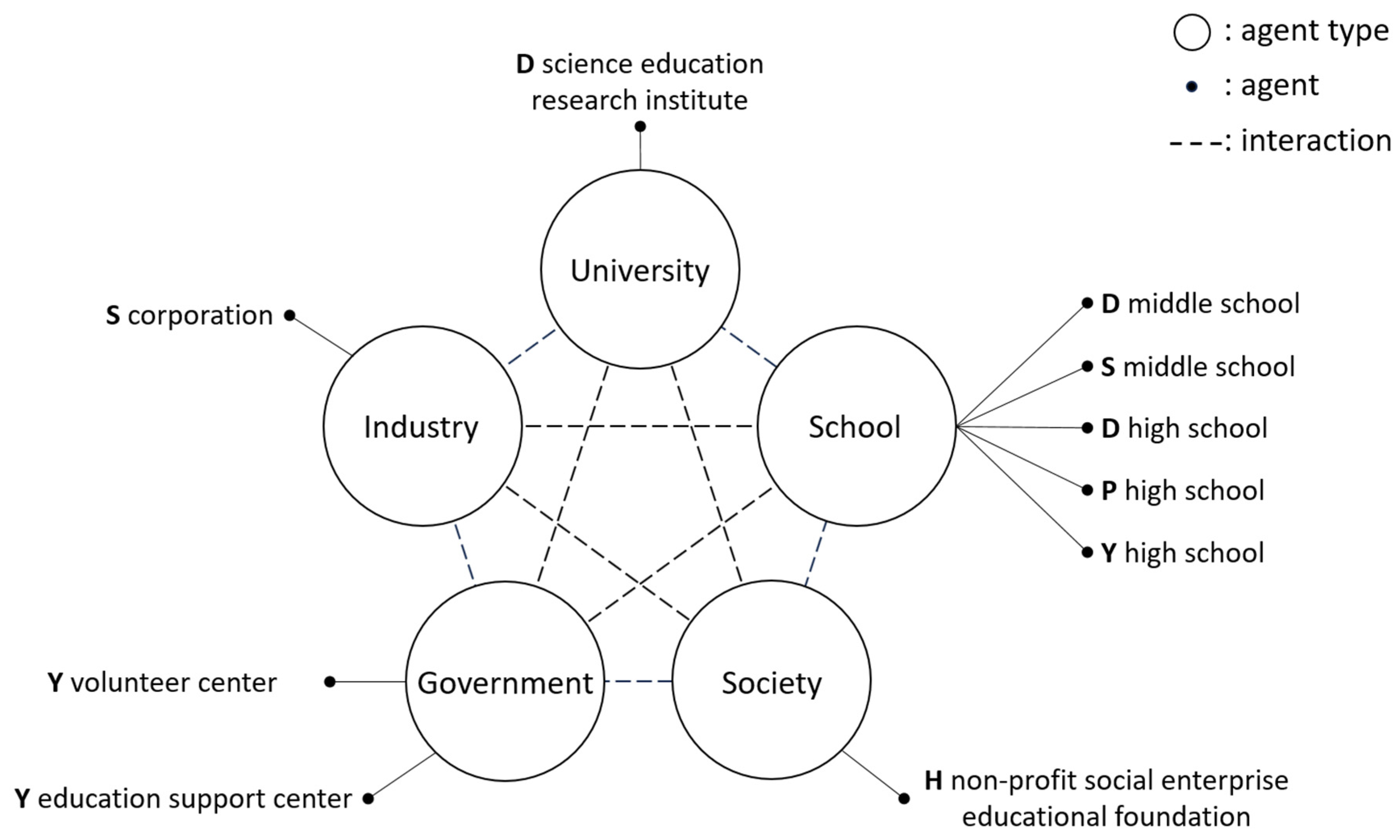
The composition of participating agents in the network exhibited a multi-actor network structure involving entities from different parties: non-profit social enterprise foundation from society, volunteer center and district office of education from the governmental side, corporation from industry, middle and high schools, and a university-affiliated research institute (Figure 4).
This structure corresponds to an expanded network in which civil society organizations and schools are integrated into the Triple Helix-based collaborative network model [37], extending beyond the conventional university–industry–government tripartite configuration.

4.2.2. Roles of Network Participants

Regarding participation purpose (Q5), 7 of the 10 respondents (70%) selected “social contribution,” followed by “educational innovation” (5, 50%), “strengthening competitiveness” (2, 20%), and “other (research, etc.)” (1, 10%). No respondent selected “economic benefit” as a purpose (see Table 4). This suggests that the participating agents collaborate primarily around public and educational values, implying that the foundational basis for consensus space formation may already be grounded in shared value orientations.
Regarding institutional roles (Q6), as can be seen in Table 5, “information sharing” was selected by the greatest number of respondents (6, 60%), followed by “consensus building,” “planning, executing, and evaluating,” and “network expansion” (4 each, 40%), and “communication” (3, 30%). By contrast, “sharing responsibilities,” “improvement of work efficiency,” and “network improvement” were each selected by only one respondent (10%), and “expansion of individual capabilities” by none (0%). These findings suggest that institutional-level roles are concentrated primarily on information sharing, consensus building, and planning, executing, and evaluation.
Regarding individual roles (Q7), “planning, executing, and evaluation” was selected by the greatest number of respondents (6, 60%), followed by “communication,” “schedule coordination,” and “consensus building” (5 each, 50%), and “information sharing” and “task distribution” (3 each, 30%). Comparing institutional and individual roles, the proportions for “communication,” “schedule coordination,” “planning, executing, and evaluating,” and “expansion of individual capabilities” were all higher at the individual level. Conversely, institutions showed a higher rate of selection for “information sharing” than individuals. This implies that individual staff may play a more active and operationally significant role in running the program than the institution as a formal entity. Both institutions and individuals showed comparatively high levels of pursuit for roles related to network expansion.

4.2.3. Network Interaction

This section focuses on the primary interaction partners of network participants, the ranking of interaction types, and specific examples thereof. Regarding primary interaction partners (Q8), most respondents (8) identified the D Integrated Science Education Research Institute (R08) as their most frequent and essential interaction partner. This suggests that the research institute appears to function as a boundary spanner that connects diverse actors within the network and facilitates communication, as perceived by the majority of respondents. S Corporation (R06) and the Y Volunteer Center (R09) were also cited as primary interaction partners, suggesting that these entities appear to function as key agents alongside the boundary spanner.
Analysis of the ranking of interaction types (Q9) revealed that “communication” and “information sharing” ranked highest for most respondents, followed by “schedule coordination.” The research institute (R08), functioning as boundary spanner, reported the most diverse and systematic range of interaction types, ranked in the following order: communication > information sharing > consensus building > planning, executing, and evaluating > schedule coordination > task distribution > role differentiation > network expansion. This implies that the research institute appears to comprehensively manage a broad spectrum of interactions across the network. By contrast, school-type respondents (R01–R05) exhibited a comparatively simple pattern of interaction centered primarily on “communication” and “schedule coordination.”
Examining specific examples of interaction (Q10), school respondents described operationally focused interactions centered on project schedule coordination, sharing of lesson content, and task distribution. By contrast, Y District Office of Education (R07) reported more multilayered and strategic interactions, including budget negotiation, and innovation through the introduction of AI platform-based real-time communication. S Corporation (R06) participated in interaction by negotiating roles and resources in the following order: role differentiation, task distribution, consensus building, and network expansion.

4.2.4. Function (Knowledge, Consensus, Innovation) Space Activities

This section focuses on the activities occurring within each of the knowledge, consensus, and innovation spaces, and addresses the forms in which participants engage in activities within each space. Regarding knowledge space activities (Q11), respondents identified sharing of lesson content and educational materials, dissemination of information related to climate change and carbon neutrality, and advance sharing of training materials as their primary knowledge space activities. The research institute (R08) served as an information hub, discussing specific sub-themes based on the annual project theme (climate change response and carbon-neutral action practice) and sharing information about the use of educational materials. The Y District Office of Education (R07) participated in knowledge space activities in a comparatively active and productive manner, exchanging school-level customized climate change curriculum models and regionally specific climate change and environmental policy content. By contrast, some school respondents (R02, R05) tended to focus more on receiving and transmitting given information than on producing knowledge, suggesting that the patterns of knowledge space participation may vary by agent type within the network.
In the consensus space (Q12), opinion coordination through diverse channels, including face-to-face meetings, telephone contact, and social networking services (e.g., group messaging platforms), was reported. The research institute (R08) facilitated key inter-agent linkages by convening planning meetings and consultative sessions, and led efficient project management through coordination with responsible agents as issues arose. The Y District Office of Education (R07) responded that it “actively participated in a digitally mediated consensus process, using edu-tech collaboration tools to collect opinions from each agent and derive an optimal operational plan with which all parties could agree.” This digitally mediated approach to consensus building represents a notable shift from the face-to-face coordination methods prevalent in earlier stages of the network. Respondents also noted that regular consultations enabled clear prioritization of sub-tasks within the collaborative program and clear delineation of role responsibilities. School respondents (R01–R05), in contrast, generally exhibited a tendency to accept the directions proposed by the research institute (R08) or to participate in consensus focused on schedule coordination.
Differentiation among agents was even more pronounced in the innovation space (Q13). The Y District Office of Education (R07) reported innovative initiatives including the transition of existing in-person events to online or hybrid formats, and the introduction of AI and edu-tech tools into CCE, applying new paradigms of future-oriented CCE in the field. S Corporation (R06) cited the use of generative AI tools for ideation and the introduction of collaborative platforms as examples of innovation. By contrast, some school respondents (R05) reported no participation in innovation space activities, suggesting that the innovation space may remain insufficiently activated for certain agents.

4.2.5. Network Growth

The network growth section focuses on the expansion of expertise and improvements in the work efficiency or interaction effectiveness of individual institutions and operational staff, as well as increases in the impact of collaboration results. Regarding institutional expertise expansion and work efficiency improvement (Q14), the research institute (R08) reported multifaceted growth, including strengthened collaboration capabilities with external institutions and corporations, development of community-linked networks, systematic data management, and building of local trust through stable operations. The Y District Office of Education (R07) reported that it had developed into the central institution for CCE in the community, and that the quality of gifted education program had improved because of the added expertise of the university research institute. School respondents (R01–R05) generally described the expansion of diversity in CCE, increased opportunities for student career exploration, and an increase in the number of participating teachers as indicators of institutional growth. However, one respondent (R04) reported that while personal expertise had improved, institutional-level expertise and work efficiency had not improved substantially, suggesting that the effects of network growth may vary differentially by agent type.
Regarding individual expertise expansion (Q15), most respondents reported positive changes. The research institute (R08) reported improved understanding of the local community, strengthened capabilities for planning and managing collaborations, and improved operational capabilities to support university student participation. The Y District Office of Education (R07) stated that “working with municipal government staff, university students, and corporate experts in Y City broadened [my] perspective considerably and made [my] approach to work much more sophisticated,” further describing simultaneous growth as an expert in both CCE and future gifted education, and noting that the experience of collaborating with diverse institutions contributed positively to this growth. School respondents (R01–R05) cited improvements in career education capabilities, acquisition of CCE knowledge, and experience with community-collaborative instructional models as examples of individual growth.
Regarding the systematization and efficiency of interaction (Q16), the research institute (R08) reported that role differentiation among key agents had become clearer, and that as the frequency of face-to-face meetings and formal document exchanges decreased, smooth project management had become possible through non-face-to-face communication alone (e.g., SNS messaging platforms). The Y District Office of Education (R07) described how the fragmented communication methods of the early collaborative phase had developed into a real-time monitoring system based on shared collaboration tools, reaching a level at which the roles of each institution could be organically identified and responded to without the need for separate face-to-face consultations. School respondents (R01–R05) reported that the experience of communicating and interacting with other institutions had itself led to greater efficiency.
Regarding increases in collaborative impact (Q17), the research institute (R08) cited the diversification of local resource linkage strategies and the co-utilization of educational materials (e.g., use of carbon-neutrality support center climate change board game materials) as specific evidence of impact. The Y District Office of Education (R07) described as outcomes the concentration of over 80% of gifted education institute outputs on climate change and environmental themes, and the voluntary development of climate change and environmental lesson models by teachers who had grown as professionals. School respondents (R01–R05) cited improvements in students’ awareness of climate change response and environmental practice, as well as increased teacher participation rates, as examples of expanded collaborative impact.

4.2.6. Network Expansion

The network expansion section focuses on new strategies for collaborative efficiency and enhanced function space participation, as well as on expansion through new participation. Regarding improvements for collaborative efficiency (Q18), clarification of task allocation, advance scheduling of coordination, preparation of operational manuals, and early confirmation of collaborative event budgets were commonly cited. The research institute (R08) proposed the need for basic operational schedules and role documentation that could maintain network understanding even when operational staff at key institutions change, and reported that it had institutionalized this by discussing the operational draft for the following year at the annual evaluation meeting. S Corporation (R06) proposed, as an improvement direction, the articulation of meaningful benefits of participation for expanded stakeholder engagement, and the development of measures to resolve bottlenecks and enhance motivation.
Regarding future approaches to function space participation (Q19), the research institute (R08) proposed the need for re-examination of shared goals through workshops with key participating agents, improvement of communication methods, and discussion to recruit new agents. The Y District Office of Education (R07) indicated its intent to expand its mode of participation by performing the role of an external cooperative interface, sharing Y City’s exemplary regional CCE cases with educational institutions in other regions and overseas. One regional school (R04) expressed its intention to participate indirectly as an advisory and idea-generating entity, providing diverse information, strategies, and methods rather than engaging in direct activities.
Regarding additional collaboration preferences (Q20), different orientations emerged by agent type. The research institute (R08) expressed interest in expanding collaboration to institutions covering the full life-course spectrum—including senior welfare centers, community support centers, and comprehensive childcare centers—in response to the challenges of a super-aged society. The Y District Office of Education (R07) aspired to broad and international expansion, including public data institutions such as the Korea Meteorological Administration, district offices of education in other regions, overseas gifted education institutions, and edu-tech and AI platform corporations. School respondents (R01–R05) expressed preferences for strengthening collaboration with local administrative bodies such as the Y City municipal office and the CCE division of the S City municipal office. S Corporation (R06) expressed interest in expanding the network to include partner corporations, clients, and public institutions.

5. Discussion

The main purpose of this study was to develop an educational collaborative network diagnostic tool capable of assessing the level of collaboration and the characteristics of interaction within networks, applying the collaborative network framework for education as its analytical framework.
Through the development process, a tool comprising 20 items across six sections, network structure, roles of network participants, network interaction, function (knowledge, consensus, innovation) space activities, network growth, and network expansion, was developed. This tool has several distinctive characteristics. First, it adopts a mixed-methods design that simultaneously collects both quantitative and qualitative data by combining open-ended, single-choice, and multiple-choice item formats. Second, it is designed to enable cross-level comparison by applying identical role items at both the institutional level (Q6) and the individual level (Q7). Third, by distinguishing between items that assess the current state (Sections 1–5 in Appendix A) and items that explore future directions for improvement (Section 6 in Appendix A), it supports both descriptive and prescriptive analysis. Fourth, the six sections—network structure, roles, interaction, function, growth, and expansion—can support a systematic and comprehensive understanding of the structural, functional, and developmental dimensions of network collaboration.
To ascertain the field applicability of the developed tool, it was applied to a case network that had engaged in multi-year collaboration for CCE. Synthesizing the analytical results, the collaborative network in this case appeared to be positioned between Level 4 (Collaborative Network) and Level 5 (Growing Network), based on participants’ accounts, on the six-level model proposed by previous research [20]. The specific grounds are as follows.
As summarized in Table 6, the network’s positioning between Level 4 and Level 5 is supported across the five analytical dimensions, though the degree of advancement varies by agent type—a pattern discussed in further detail below. First, from a structural perspective, multiple agents spanning university, government, industry, society, and local schools are sharing roles and interacting to achieve the shared goal of climate change and carbon-neutral education practice, and the university research institute is stably performing a hub function as boundary spanner, appearing to reflect the characteristics of both Level 4 and Level 5. Second, from a functional space perspective, concrete knowledge exchange—including sharing of training materials and linkage of educational materials—is occurring in the knowledge space; a structure of regular opinion coordination through planning meetings, consultative sessions, and digital platforms has been established in the consensus space; and in the innovation space, some agents (government and industry) are attempting new educational approaches through the introduction of AI and edu-tech. Third, from a growth perspective, the majority of agents reported that both institutional and individual capabilities had improved compared to before participation, the non-face-to-face systematization of interaction is progressing, and linkages with external institutions and resources are expanding.
However, some school agents exhibited a tendency toward information-receptive rather than knowledge-generative participation, an absence of Innovation Space activities, and limited institutional expertise improvement. These findings suggest that not all agents within the network are necessarily at the same developmental stage. This implies that for the network to stably reach Level 5 or Level 6, intensive support and role coordination by the boundary spanner is needed for agents whose participation level remains comparatively low. These results suggest that the developed tool may function effectively not only in assessing the current level of a network, but also in precisely revealing differential patterns of participation across agents and providing substantive directions for improvement to advance the network to higher levels.
Comparing the present tool and its findings with related work in the literature reveals both convergences and distinctive contributions. With respect to tool design, existing approaches to evaluating educational collaboration—including general program evaluation approaches and collaborative governance frameworks [22]—tend to assess outcomes or governance structures rather than the dynamic, multi-level interaction processes that characterize evolving networks. The present tool’s integration of structural, functional-space, and developmental dimensions within a single diagnostic framework extends these prior approaches by operationalizing network evolution as an analytically distinct and measurable dimension. With respect to functional space findings, the prominence of information sharing and consensus building in the knowledge and consensus spaces aligns with Provan and Kenis’s [21] identification of goal consensus grounded in inter-participant trust as a critical condition for collaborative governance effectiveness. The comparatively low activation of innovation space activities among school agents, however, extends this picture by suggesting that functional space participation is not uniformly distributed across agent types—a nuance not captured by governance-level frameworks. With respect to the boundary spanner role, the finding that eight of ten respondents identified the university research institute (R08) as their primary interaction partner corroborates Williams’s [38] characterization of the boundary spanner as a dynamic actor who builds trust, interprets divergent interests, and strategically connects resources across organizational boundaries. The present case further substantiates the theoretical claim advanced in prior CCE network research [19,20] that the boundary spanner is indispensable for maintaining network stability and facilitating inter-agent communication, particularly in networks spanning diverse institutional sectors. Finally, the expanded Triple Helix structure observed in this case—incorporating civil society organizations and schools alongside university, government, and industry—extends the conventional tripartite configuration [37] and is consistent with recent empirical evidence that school–non-profit partnerships generate innovation and sustainable outcomes beyond individual learner growth [18].
Several critical considerations can be noted regarding the theoretical assumptions underlying the collaborative network framework and the patterns observed in the present case. First, the model’s six-level linear evolutionary trajectory may oversimplify the dynamic and non-linear reality of network development. The present case suggests that different agents within the same network can simultaneously exhibit characteristics of different levels—with the boundary-spanning research institute (R08) and the district office of education (R07) reflecting Level 5 characteristics, while several school agents remained closer to Level 3 or Level 4. Networks may therefore develop asymmetrically, with different agents progressing, stagnating, or regressing across levels at different rates, and the model’s linear framing does not fully capture this complexity. Second, the present case reveals a potentially fragile degree of centralization around the boundary spanner: the majority of respondents identified the research institute as their primary interaction partner, and innovation space activities were concentrated primarily among government and corporate agents. Such centralization risks creating a network structure that may be destabilized by changes in key personnel or institutional priorities, as the departure or disengagement of the boundary spanner could significantly disrupt communication flows [38]. Third, the asymmetric agency observed among school participants—who predominantly received information rather than generating knowledge—points to structural inequalities in participation that the level-based diagnostic framework does not fully address. Future applications of the tool should explicitly attend to these participation asymmetries and consider power dynamics among agents as critical analytical dimensions that complement, rather than reduce to, the developmental level assigned to the network as a whole.
The findings offer several practical implications for program collaborators or network managers engaged in CCE collaborative networks. First, given the network’s heavy reliance on the boundary-spanning research institute as the primary interaction partner for most agents, sustaining the boundary spanner’s capacity is a critical network management priority. Specifically, the boundary spanner’s coordinative functions across the knowledge, consensus, and innovation spaces [20]—including organizing information sharing, facilitating inter-agent consensus, and enabling innovative educational approaches—should be systematically documented and shared among key agents to reduce the risk of network disruption from personnel changes. Second, the diagnostic tool’s application revealed asymmetries in functional space participation: while most agents actively engaged in knowledge and consensus space activities, innovation space participation remained limited for several school agents. Network coordinators should therefore create structured entry points for school agents into innovation space activities—for instance, by inviting school-based program coordinators to co-design new educational formats or to contribute field-based insights into program innovation, thereby enabling more balanced participation across all three functional spaces. Third, the comparison of institutional (Q6) and individual (Q7) role responses suggests that individual program coordinators often perform a broader range of network roles than their institutions formally recognize. Network managers should ensure that the contributions of individual coordinators are acknowledged and supported at the institutional level, as these individuals serve as critical nodes sustaining day-to-day network functioning.

6. Conclusions

Notwithstanding these contributions, the present study has several limitations. First, the tool was validated and applied using a relatively small sample of ten program coordinators from a single CCE collaborative network operating within a specific regional context in South Korea. This constrains both the statistical basis for generalizability and the cross-contextual transferability of the findings, as the network’s institutional composition—combining a university research institute, district office of education, local government volunteer center, corporation, social enterprise foundation, and secondary schools—may not be representative of CCE networks in other regional or national settings. Future research should administer the diagnostic tool across multiple and diverse CCE networks to further examine its reliability and cross-network applicability. Additionally, the expert review panel comprised four specialists, which is a relatively small validation sample; future validation studies should engage larger and more diverse expert panels to strengthen the content validity evidence.
Second, this study employed a cross-sectional design capturing participants’ perceptions at a single point in time, whereas collaborative networks are inherently dynamic systems whose characteristics evolve over extended periods. A longitudinal research design that applies the tool at regular intervals—for instance, annually across a three-to-five-year collaboration cycle—would enable more accurate tracking of how networks progress across the six evolutionary levels and under what conditions advancement or regression occurs. Furthermore, formal validation through exploratory and confirmatory factor analysis (EFA/CFA) was not conducted, as the tool’s mixed-methods item formats—incorporating open-ended, single-choice, and multiple-choice items—do not yield the continuous response distributions required for such analyses. This represents a methodological limitation that future research should address through the development of standardized-scale versions of the tool.
Third, the tool relies primarily on self-reported perceptions of participating agents, which may be subject to social desirability bias and may not fully capture the objective dynamics of network collaboration. Future applications should consider triangulating tool responses with concrete objective indicators of network performance, such as pre- and post-program assessments of participants’ climate literacy, the number and scale of jointly secured grants or co-developed educational programs, documented changes in institutional practices attributable to network participation, and quantified shifts in inter-agent communication frequency derived from platform activity logs.
Fourth, the tool was developed and validated within the specific institutional and governance context of South Korean education, which includes particular configurations of district offices of education, university-affiliated research institutes, and local government volunteer centers. While the six analytical sections of the tool are grounded in internationally applicable theoretical frameworks—including the Triple Helix model [37] and the collaborative network concept [9]—practitioners operating in different national contexts may need to adapt specific item options to reflect local governance arrangements, particularly those related to participation purposes (Q5) and institutional roles (Q6). Future validation studies in diverse international settings are encouraged to examine the tool’s cross-cultural applicability and to identify which elements require contextual adaptation.
Despite these limitations, the educational collaborative network diagnostic tool developed in this study provides a framework that can be applied to assess the collaborative level of CCE networks, identify interaction characteristics among agents, and derive actionable strategies for network advancement.
Future research should pursue three directions to build on and extend the present study. First, multi-network validation studies should administer the diagnostic tool across more CCE collaborative networks operating in diverse institutional and regional contexts—including networks of different scales, agent compositions, and governance structures—to establish comparative benchmarks for each of the six network levels and to assess the tool’s cross-network reliability. Second, longitudinal panel designs should apply the tool to the same network at multiple time points over a sustained period to empirically examine the conditions under which networks advance across evolutionary levels, the factors that facilitate or hinder progression, and whether the level-based framework accurately captures the non-linear developmental trajectories observed in practice. Third, instrument refinement should explore the development of a standardized evaluation rubric aligned with the six network levels, enabling more systematic cross-network comparison. In particular, future work might investigate how the qualitative diagnostic data generated by the present tool can be integrated with objective network performance indicators—such as student assessment scores, joint grant funding, and inter-agent communication data—to produce a more comprehensive and triangulated picture of CCE network development. Furthermore, developing standardized-scale versions of the tool—in which all response options are converted to continuous rating scales—would enable EFA/CFA-based construct validity assessment, providing a more rigorous psychometric foundation than the expert-judgment-based CVI and FVI indices employed in the present study.


Author Contributions

Conceptualization, methodology, validation, formal analysis, writing—original draft preparation, B.-Y.P.; writing—review and editing, B.-Y.P. and Y.-A.S.; funding acquisition, Y.-A.S. All authors have read and agreed to the published version of the manuscript.

Funding

This work was supported by the Ministry of Education of the Republic of Korea and the National Research Foundation of Korea (NRF-2021S1A5C2A04089214). And the APC was funded by the National Research Foundation of Korea.

Institutional Review Board Statement

The study was conducted in accordance with the Declaration of Helsinki, and approved by the Ethics Committee of Institute of Integrated Science Education of Dankook University (Protocol code: DIISE2025011, Date of approval: 13 October 2025).

Informed Consent Statement

Informed consent was obtained from all subjects involved in the study.

Data Availability Statement

The data presented in this study are available on request from the corresponding author. The data are not publicly available due to privacy and ethical restrictions.

Acknowledgments

The authors would like to express their sincere gratitude to all the respondents who participated in this study for generously sharing their authentic experiences during network collaboration for climate change education.

Conflicts of Interest

The authors declare no conflicts of interest.

Abbreviations

The following abbreviations are used in this manuscript:
CCEClimate Change Education
CVIContent Validity Index
FVIFactorial Validity Index

Appendix A. Items of the Educational Collaborative Network Diagnostic Tool

[Section 1] Network Structure
  • Which project (or educational program) are you participating in? (Open-ended)
  • Which organization are you affiliated with? (Open-ended)
  • How long have you been participating in this project? (Single choice)
    ① Less than 1 year ② 1–2 years ③ 2–3 years ④ 3–4 years ⑤ 4 years or more
  • Which other organizations are participating in this project (or educational program)? (Open-ended)
[Section 2] Roles of Network Participants
5.
What is the purpose of your organization’s participation in this project? (Multiple choice)
① Social Contribution ② Economic Benefit ③ Strengthening Competitiveness
④ Educational Innovation ⑤ Other (Research, etc.)
6.
What roles (tasks or functions) is your organization performing in this project? (Multiple choice)
① Communication ② Information Sharing ③ Schedule Coordination ④ Consensus Building
⑤ Role Differentiation ⑥ Task Distribution ⑦ Planning, Executing, and Evaluating
⑧ Sharing Responsibilities ⑨ Expansion of Individual Capabilities
⑩ Improvement of Work Efficiency ⑪ Network Improvement ⑫ Network Expansion
7.
What roles (tasks or functions) are you personally performing in this project? (Multiple choice)
① Communication ② Information Sharing ③ Schedule Coordination ④ Consensus Building
⑤ Role Differentiation ⑥ Task Distribution ⑦ Planning, Executing, and Evaluating
⑧ Sharing Responsibilities ⑨ Expansion of Individual Capabilities
⑩ Improvement of Work Efficiency ⑪ Network Improvement ⑫ Network Expansion
[Section 3] Network Interaction
8.
With whom or with which institution do you interact most to carry out your project? (Open-ended)
9.
Select all interactions between entities occurring within the current project from the options below and list them in order of frequency. (Multiple choice)
① Communication ② Information Sharing ③ Schedule Coordination ④ Consensus Building
⑤ Role Differentiation ⑥ Task Distribution ⑦ Planning, Executing, and Evaluating
⑧ Sharing Responsibilities ⑨ Expansion of Individual Capabilities
⑩ Improvement of Work Efficiency ⑪ Network Improvement ⑫ Network Expansion
10.
Provide one specific example for each interaction listed in Q9. (Open-ended)
[Section 4] Function (Knowledge, Consensus, Innovation) Space Activities
11.
In what form are you participating in the creation or sharing of knowledge or information within the project? (Open-ended)
12.
In what form are you participating in the process of coordinating opinions or reaching consensus within the project? (Open-ended)
13.
In what form are you participating in innovative activities (presenting new strategies or attempting new methods) within the project? (Open-ended)
[Section 5] Network Growth
14.
Has the expertise of your affiliated organization expanded or work efficiency improved through this project? If so, describe specifically what expertise was expanded and how work efficiency improved, with examples. (Open-ended)
15.
Has your own expertise expanded or work efficiency improved through this project? If so, describe specifically what expertise was expanded and how work efficiency improved, with examples. (Open-ended)
16.
While conducting this project, has interaction with other participating organizations become more systematic and efficient? If so, describe how it changed, with specific examples. (Open-ended)
17.
While conducting this project, has the impact of collaboration results increased compared to the beginning? If so, describe how it increased, with specific examples. (Open-ended)
[Section 6] Network Expansion
18.
If you were to run this project again, what would you improve for more efficient collaboration? (Open-ended)
19.
If you were to run this project again, in what different form would you participate in Knowledge Space Activities, Consensus Space Activities, or Innovation Space Activities? (Open-ended)
20.
If you were to run this project again, with whom or with which institution would you additionally collaborate? (Open-ended)

References

  1. World Meteorological Organization. State of the Global Climate 2024; WMO: Geneva, Switzerland, 2025. [Google Scholar]
  2. Intergovernmental Panel on Climate Change. Climate Change 2023: Synthesis Report. Contribution of Working Groups I, II and III to the Sixth Assessment Report; IPCC: Geneva, Switzerland, 2023. [Google Scholar] [CrossRef] [Scilit]
  3. United Nations. Transforming Our World: The 2030 Agenda for Sustainable Development; UN: New York, NY, USA, 2015. [Google Scholar]
  4. United Nations Educational, Scientific and Cultural Organization. Education for Sustainable Development: A Roadmap (ESD for 2030); UNESCO Publishing: Paris, France, 2020. [Google Scholar]
  5. Organization for Economic Co-Operation and Development. PISA 2025 Science Framework, 2nd ed.; OECD: Paris, France, 2023. [Google Scholar]
  6. Monroe, M.C.; Plate, R.R.; Oxarart, A.; Bowers, A.; Chaves, W.A. Identifying effective climate change education strategies: A systematic review of the research. Environ. Educ. Res. 2019, 25, 791–812. [Google Scholar] [CrossRef] [Scilit]
  7. White, P.J.; Ardoin, N.M.; Eames, C.; Monroe, M.C. Agency in the Anthropocene: Supporting Document to the PISA 2025 Science Framework; OECD Education Working Papers No. 297; OECD: Paris, France, 2023. [Google Scholar] [CrossRef] [Scilit]
  8. Ansell, C.; Gash, A. Collaborative governance in theory and practice. J. Public Adm. Res. Theory 2007, 18, 543–571. [Google Scholar] [CrossRef] [Scilit]
  9. Camarinha-Matos, L.M.; Afsarmanesh, H. On reference models for collaborative networked organizations. Int. J. Prod. Res. 2008, 46, 2453–2469. [Google Scholar] [CrossRef] [Scilit]
  10. Etzkowitz, H.; Ranga, M. A Triple Helix system for knowledge-based regional development: From “spheres” to “spaces”. In Proceedings of the VIII Triple Helix Conference, Madrid, Spain, 20–22 October 2010. [Google Scholar]
  11. Stevenson, R.B.; Nicholls, J.; Whitehouse, H. What is climate change education. Curric. Perspect. 2017, 37, 67–71. [Google Scholar] [CrossRef] [Scilit]
  12. Eilam, E. Climate change education: The problem with walking away from disciplines. Stud. Sci. Educ. 2022, 58, 231–264. [Google Scholar] [CrossRef] [Scilit]
  13. Yun, S.-J. The current state and tasks of school climate change education. J. Korean Soc. Environ. Educ. 2009, 22, 1–22. [Google Scholar]
  14. Kim, C.; Choi, D.-H. Thoughts on climate change education in Korea. J. Korean Soc. Environ. Educ. 2010, 23, 1–12. [Google Scholar]
  15. Ministry of Education. 2022 Revised Curriculum; Ministry of Education, Korea: Sejong, Republic of Korea, 2022.
  16. Shin, Y. Contents analysis of the 2022 revised curriculum related to the climate change education. J. Energy Clim. Change Educ. 2023, 13, 23–34. [Google Scholar] [CrossRef]
  17. Kang, J. A foundational study for selecting educational content of climate change based on the properties of climate change. J. Korean Soc. Environ. Educ. 2021, 34, 121–135. [Google Scholar] [CrossRef]
  18. Kudryavtsev, A.; Zamora, M.; Nordgrén, M. Systemic impacts of sustainability education: A case study of New York Sun Works. J. Environ. Educ. 2026, 57, 120–137. [Google Scholar] [CrossRef] [Scilit]
  19. Park, B.-Y.; Oh, H.-J.; Kim, S.; Son, Y.-A. Exploring a collaborative network model for environmental education and education for sustainable development. J. Sci. Educ. 2024, 48, 182–197. [Google Scholar] [CrossRef]
  20. Park, B.-Y.; Kang, S.; Park, J.; Bae, K.; Choi, J.; Moon, Y.; Oh, H.-J.; Kim, S.; Lee, H.-J.; Son, Y.-A. Interactions between agents within educational networks and network growth and expansion: Cases of EE·ESD. J. Korean Soc. Environ. Educ. 2025, 38, 447–470. [Google Scholar] [CrossRef] [Scilit]
  21. Provan, K.G.; Kenis, P. Modes of network governance: Structure, management, and effectiveness. J. Public Adm. Res. Theory 2008, 18, 229–252. [Google Scholar] [CrossRef] [Scilit]
  22. Emerson, K.; Nabatchi, T.; Balogh, S. An integrative framework for collaborative governance. J. Public Adm. Res. Theory 2012, 22, 1–29. [Google Scholar] [CrossRef] [Scilit]
  23. Gattringer, R.; Hutterer, P.; Strehl, F. Network-structured university-industry-collaboration; values for the stakeholders. Eur. J. Innov. Manag. 2014, 17, 272–291. [Google Scholar] [CrossRef] [Scilit]
  24. Gould, R.V. Uses of Network Tools in Comparative-Historical Research. In Comparative Historical Analysis in the Social Sciences; Mahoney, J., Rueschemeyer, D., Eds.; Cambridge University Press: Cambridge, UK, 2003; pp. 241–269. [Google Scholar]
  25. Pachucki, M.A.; Breiger, R.L. Cultural Holes Beyond Relationality in Social Networks and Culture. Annu. Rev. Sociol. 2010, 36, 205–224. [Google Scholar] [CrossRef] [Scilit]
  26. Vaisey, S.; Lizardo, O. Can Cultural Worldviews influence Network Composition. Soc. Forces 2010, 88, 1595–1618. [Google Scholar] [CrossRef] [Scilit]
  27. Callon, M. Techno-Economic Networks and Irreversibility. Sociol. Rev. 1990, 38, 132–161. [Google Scholar] [CrossRef] [Scilit]
  28. Callon, M.; Latour, B. Unscrewing the Big Leviathan: How Actors Macro-Structure Reality and How Sociologists Help Them to Do So. In Advances in Social Theory and Methodology: Toward an Integration of Micro and Macro-Sociologies; Knorr-Cetina, K.D., Cicourel, A.V., Eds.; Routledge & Kegan Paul: London, UK, 1981; pp. 277–303. [Google Scholar]
  29. Johnson, J. Mixing Humans and Nonhumans Together: The Sociology of a Door-Closer. Soc. Probl. 1988, 35, 298–310. [Google Scholar] [CrossRef] [Scilit]
  30. Alcadipani, R.; Hassard, J. Actor-Network Theory, Organizations and Critique: Towards a Politics of Organizing. Organization 2010, 17, 419–435. [Google Scholar] [CrossRef] [Scilit]
  31. Moliterno, T.P.; Mahony, D.M. Network Theory of Organization: A Multilevel Approach. J. Manag. 2011, 37, 443–467. [Google Scholar]
  32. Podolny, J.M.; Page, K.L. Network Forms of Organization. Annu. Rev. Sociol. 1998, 24, 57–76. [Google Scholar] [CrossRef] [Scilit]
  33. Salancik, G.R. Wanted: A Good Network Theory of Organization. Adm. Sci. Q. 1995, 40, 345–349. [Google Scholar] [CrossRef] [Scilit]
  34. Coleman, W.D.; Perl, A. Internationalized Policy Environments and Policy Network Analysis. Political Stud. 1999, 47, 691–709. [Google Scholar]
  35. Dowding, K. Model or Metaphor? A Critical Review of the Policy Network Approach. Political Stud. 1995, 43, 136–158. [Google Scholar] [CrossRef] [Scilit]
  36. Thatcher, M. The Development of Policy Network Analyses: From Modest Origins to Overarching Frameworks. J. Theor. Politics 1998, 10, 389–416. [Google Scholar] [CrossRef] [Scilit]
  37. Etzkowitz, H.; Leydesdorff, L. The dynamics of innovation: From national systems and “Mode 2” to a Triple Helix of university–industry–government relations. Res. Policy 2000, 29, 109–123. [Google Scholar] [CrossRef] [Scilit]
  38. Williams, P. The competent boundary spanner. Public Manag. Rev. 2002, 80, 103–124. [Google Scholar] [CrossRef] [Scilit]
  39. Kania, J.; Kramer, M. Collective impact. Stanf. Soc. Innov. Rev. 2011, 9, 36–41. [Google Scholar]
  40. Roberts, M.J.; Beamish, P.W. The scaffolding activities of international returnee executives: A learning-based perspective of global boundary spanning. J. Manag. Stud. 2017, 54, 511–539. [Google Scholar] [CrossRef] [Scilit]
  41. Wenger-Trayner, B.; Wenger-Trayner, E.; Cameron, J.; Eryigit-Madzwamuse, S.; Hart, A. Boundaries and boundary objects: An evaluation framework for mixed methods research. J. Mix. Methods Res. 2019, 13, 321–338. [Google Scholar] [CrossRef] [Scilit]
  42. Mayring, P. Qualitative Content Analysis: Theoretical Foundation, Basic Procedures and Software Solution; SSOAR: Klagenfurt, Austria, 2014. [Google Scholar]
  43. Polit, D.F.; Beck, C.T.; Owen, S.V. Is the CVI an acceptable indicator of content validity? Appraisal and recommendations. Res. Nurs. Health 2007, 30, 459–467. [Google Scholar] [CrossRef] [Scilit] [PubMed]
  44. Rubio, D.M.; Berg-Weger, M.; Tebb, S.S.; Lee, E.S.; Rauch, S. Objectifying content validity: Conducting a content validity study in social work research. Soc. Work Res. 2003, 27, 94–104. [Google Scholar] [CrossRef] [Scilit]
  45. Groenewald, T. A phenomenological research design illustrated. Int. J. Qual. Methods 2004, 3, 42–55. [Google Scholar] [CrossRef] [Scilit]
Figure 1. Structure of the collaborative network for climate change education [19] (p. 190).
Sustainability 18 05914 g001
Figure 2. Evolution of the collaborative network for climate change education [20].
Sustainability 18 05914 g002
Figure 3. CVI and FVI values and final tool composition.
Sustainability 18 05914 g003
Figure 4. Structure of the case of educational collaborative network.
Sustainability 18 05914 g004
Table 1. Characteristics of each level of the collaborative network.
Network LevelCharacteristics of Network
Level 1
Simple
Network
[Communication and Information Exchange]
  • Sharing of information and knowledge through communication
  • Formation of individual goals and values
  • Absence of common goals or shared values
Level 2
Coordinated Network
[Coordination of Activities Based on Intention]
  • Pursuing the enhancement of individual interests
  • Managing the individual goals and values
  • Using strategies to increase the influence of activity
  • Pursuing the efficient achievement of each entity’s desired results and goals
Level 3
Cooperative Network
[Common Goal Setting and Resource Sharing]
  • Establish agreed-upon common goals and plans
  • Distinguish roles and share tasks, but maintain individual accountability
  • Implement new initiatives or innovative strategies through cooperation
  • Each entity maintains independent agency based on mutual respect
  • Create shared values by combining independently generated individual elements
Level 4
Collaborative Network
[Shared Responsibility]
  • Interdependence based on trust
  • Continuous and active investment of time and effort
  • Enhancement of each other’s capabilities through active interaction
  • Creation of shared value through complex elements generated through convergence
  • Participating together in planning, executing, and evaluating to achieve common goals
Level 5
Growing
Network
[Growth of Individual Entity and Whole Network]
  • Increased level of shared goals
  • Increased impact of created shared value
  • Strengthened stability of the network system
  • Increased efficiency of interaction and collaboration among network entities
  • Expanded capabilities and expertise of individual entities based on experience
Level 6
Expanding
Network
[Improving Network Structure and Expanding Interactions]
  • Serve as a pathfinder for emerging networks
  • Offer challenges and vision for new issues or topics
  • Improve network structure to enhance collaboration efficiency
  • Extend the impact of network collaboration to other networks or new areas
  • Increase and expand the complexity of interactions for knowledge sharing and creation, consensus, and innovation
Table 2. Respondents’ affiliated institutions and characteristics.
Respondent CodeAffiliated InstitutionCharacteristics
R01D Middle SchoolPublic middle school (1148 students in 2025), Y City, Gyeonggi-do, South Korea. Participated in 2023, 2024, 2025, and will participate in 2026.
R02S Middle SchoolPublic middle school (648 students in 2025), Y City, Gyeonggi-do, South Korea. Participated in 2024 and 2025, and will participate in 2026.
R03D High SchoolPrivate high school (555 students in 2025), Y City, Gyeonggi-do, South Korea. Participated in 2023, 2024, and 2025 and will participate in 2026.
R04P High SchoolPublic high school (1312 students in 2025), Y City, Gyeonggi-do, South Korea. Participated in 2023, 2024, and 2025.
R05Y High SchoolPublic high school (1188 students in 2025), Y City, Gyeonggi-do, South Korea. Participated in 2025 and will participate in 2026.
R06S CorporationMajor South Korean telecommunications company. In this program the company supported participation with a proprietary climate-action mobile application in 2024 and will participate in 2026.
R07Y District Office of EducationDistrict Office of Education in Y City, Gyeonggi-do, South Korea. Responsible officer manages science-gifted education and science/environmental education support. Participated in 2025 and will participate in 2026.
R08D Research InstituteIntegrated Science Education Research Institute affiliated with a comprehensive private university in Y City, Gyeonggi-do, South Korea. Has led and managed the program since 2023.
R09Y Volunteer CenterVolunteer Center operated by the local government of Y City, Gyeonggi-do, South Korea. Plans and operates community volunteer programs. Participated in 2023, 2024, and 2025 and will participate in 2026.
R10H Education FoundationNon-profit social enterprise educational foundation in S City established jointly by a S corporation and a women’s organization. Operates after-school curriculum, disability, and employment education programs. Participated in 2023 and 2024 and will participate in 2026.
Table 3. Distribution of duration of participation (Q3).
Duration of Participationn (%)
1 to less than 2 years2 (20%)
2 to less than 3 years3 (30%)
3 to less than 4 years5 (50%)
4 years or more0 (0%)
Total10 (100%)
Table 4. Purpose of participation (Q5, Multiple Choice).
Purpose of Participationn (%)
① Social contribution7 (70%)
② Economic benefit0 (0%)
③ Strengthening competitiveness2 (20%)
④ Educational innovation5 (50%)
⑤ Other (research, etc.)1 (10%)
Table 5. Institutional role (Q6) and individual role (Q7) within the network.
RoleInstitutional Role (Q6)Individual Role (Q7)
① Communication3 (30%)5 (50%)
② Information sharing6 (60%)3 (30%)
③ Schedule coordination2 (20%)5 (50%)
④ Consensus building4 (40%)5 (50%)
⑤ Role differentiation2 (20%)2 (20%)
⑥ Task distribution2 (20%)3 (30%)
⑦ Planning, executing, and evaluating4 (40%)6 (60%)
⑧ Sharing responsibilities1 (10%)1 (10%)
⑨ Expansion of individual capabilities0 (0%)2 (20%)
⑩ Improvement of work efficiency1 (10%)1 (10%)
⑪ Network improvement1 (10%)1 (10%)
⑫ Network expansion4 (40%)4 (40%)
Table 6. Evaluation of the case network’s positioning between Level 4 and Level 5 across analytical dimensions.
Analytical DimensionLevel 4 IndicatorsLevel 5 IndicatorsEvidence from CasePositioning
Network StructureInterdependence based on trust; agents jointly plan, execute, and evaluate toward shared goalsStrengthened network stability; expanded influence and agent compositionMulti-sector participation sustained over 3–4 years; stable boundary spanner (R08); expanded Triple Helix structure including civil society and schoolsL4–L5
Roles of Network ParticipantsSharing of responsibilities; joint planning and evaluation across agentsExpanded capabilities and expertise of individual agents based on accumulated experienceInstitutional roles concentrated on information sharing, consensus building, and planning/evaluating (Q6); individual roles more diverse (Q7); R07 reports substantial expertise expansionMostly L4; L5 elements emerging
Network InteractionActive and continuous multi-directional interaction; convergence of diverse elementsIncreased efficiency and systematization of inter-agent communication8/10 respondents identify R08 as primary interaction partner (Q8); R08 reports transition to systematic non-face-to-face communication (Q16); R07 reports real-time monitoring systemL4–L5
Function Space ActivityCollaborative program development (knowledge); established consultative structures (consensus); new program structures (innovation)Cross-institutional knowledge co-creation; digitally mediated consensus; AI/edu-tech integration in innovationR08 as information hub; R07 active in knowledge exchange; R07 uses edu-tech platforms for consensus; R06 and R07 report AI/edu-tech innovation; R05 reports no innovation participation (Q13)L4–L5 for knowledge and consensus; L4 only for most school agents in innovation
Network GrowthEnhancement of capabilities through active interaction; creation of shared valueExpanded individual and institutional capabilities; increased impact and influence of collaboration outcomesMost agents report institutional and individual growth (Q14, Q15); R08 reports diversified external linkages; R07 reports significant expertise expansion; R04 reports limited institutional-level growth (Q14)L4–L5; variation by agent type
Disclaimer/Publisher’s Note: The statements, opinions and data contained in all publications are solely those of the individual author(s) and contributor(s) and not of MDPI and/or the editor(s). MDPI and/or the editor(s) disclaim responsibility for any injury to people or property resulting from any ideas, methods, instructions or products referred to in the content.