1. Introduction
As a typical climate-sensitive industry, agriculture relies heavily on natural conditions in its production process [
1,
2,
3]. In recent years, the increasing frequency of extreme weather events has become a global risk that undermines farmers’ welfare and threatens the sustainable development of agriculture [
4]. Globally, different regions are experiencing differentiated climate shocks: persistent drought in southern Africa and the Sahel region has led to widespread crop failure [
5]; the monsoon regions of South and Southeast Asia are repeatedly hit by extreme rainfall and flooding [
6]; southern Europe and western North America have experienced record-breaking heatwaves and wildfires, severely weakening agricultural productivity [
7]; and parts of Central and Eastern Europe are threatened by spring frosts and extreme low temperatures [
8]. These extreme climate events not only directly reduce agricultural output but also exert comprehensive impacts on farmers’ welfare through multiple dimensions, including income, health, and production costs. For example, the extreme heat and drought that affected much of Europe in 2022 led to sharp declines in the yields of crops such as corn and sunflowers, causing severe economic losses for many farmers [
9]; in 2023, monsoon floods in South Asia destroyed vast areas of rice paddies, exacerbating rural poverty and food insecurity [
10]; the warming rate in China is higher than the global average over the same period, and the national average temperature in 2024 reached 10.9 °C, with the climate risk index hitting its highest level since 1961 [
11]. In terms of historical extremes, in January 2023, Mohe, Heilongjiang, recorded a minimum temperature of −53 °C, and in July of the same year, the Sanbao Township of Turpan, Xinjiang, recorded a maximum temperature of 52.2 °C, setting new national records for the coldest and hottest temperatures ever measured in China [
12].
Although the long-term evolution of climate systems is influenced by human production activities, the short-term occurrence of extreme weather events is strongly exogenous. Farmers cannot alter local weather patterns through individual actions, yet they must directly bear the resulting production and livelihood shocks. This indicates that short-term climate risks are fundamentally different from conventional risks that can be avoided through market adjustments or policy interventions. Moreover, the natural reproduction process of agriculture determines its high dependence on climatic conditions such as water, heat, and sunlight [
13]. Even in today’s technologically advanced era, extreme weather can still directly destroy crops and damage soil structure, and such physical damage is difficult to fully hedge against through short-term economic measures. Furthermore, farmers in developing countries generally lack well-established insurance and credit markets to buffer income volatility caused by climate shocks [
14]. As a result, climate shocks may reverse previous poverty reduction gains and become a major obstacle to future poverty alleviation [
15,
16,
17]. In summary, an in-depth exploration of how climate shocks affect farmers’ welfare and how farmers can buffer these impacts through adaptive behaviors is not only an important issue in agricultural economics but also a core prerequisite for designing effective climate adaptation policies.
The existing literature has conducted extensive theoretical and empirical investigations into the relationship between climate shocks and agricultural production as well as farmers’ livelihoods, providing a solid theoretical framework, methodological references, and empirical foundation for this study. At the macro level, a large body of research has confirmed that climate change exerts significant negative impacts on global agricultural output and food security by altering agricultural production conditions, increasing the probability of pest and disease outbreaks, and exacerbating agricultural production volatility [
18,
19,
20,
21,
22,
23]. At the micro-farmer level, the literature generally validates the significant negative impact of climate shocks on farmers’ income. Extreme high temperatures, droughts, and other events directly reduce crop yields, thereby compressing farmers’ operating income, while also raising agricultural input costs and intensifying income volatility [
24,
25,
26,
27].
In terms of research on farmers’ response mechanisms, the existing literature has developed a classic analytical paradigm focusing on production-side adjustments. Numerous studies have confirmed that farmers mitigate the negative impacts of climate shocks on agricultural production and stabilize household income through production-side behaviors such as adjusting cropping patterns, adopting water-saving agricultural technologies, and diversifying crop cultivation [
28,
29,
30,
31]. At the same time, some studies have preliminarily expanded the boundaries of research on farmers’ adaptive behaviors, paying attention to livelihood-level risk response strategies such as off-farm employment and social networks, thereby providing richer empirical evidence for understanding farmers’ response mechanisms to climate shocks [
32]. Furthermore, in terms of welfare measurement, existing research has moved beyond the limitations of a single-income welfare perspective, introducing the capability approach and constructing multidimensional welfare evaluation systems covering economic, health, and social dimensions, thus providing theoretical support for accurately characterizing the impact of climate shocks on farmers’ welfare [
33,
34].
Despite the important foundation provided by existing research, there remain gaps in the identification of extreme weather effects, multidimensional measurement of farmers‘ welfare, adaptation behaviors such as off-farm employment, and heterogeneity analysis. Therefore, the marginal contributions of this paper are mainly threefold. First, in terms of identification strategy, off-farm employment is identified as a risk-buffering variable. Second, in welfare measurement, a multidimensional welfare index covering six dimensions—household economy, living environment, social security, health, culture, and psychological well-being—is constructed. Third, in empirical evidence and mechanism interpretation, focusing on four typical types of extreme weather—extreme low temperature, extreme high temperature, extreme rainfall, and extreme drought—this paper estimates the impact of the climate shock index on farmers’ welfare and reveals the risk-buffering role of off-farm employment. In addition, it provides evidence of heterogeneity across different regions, terrains, production conditions, and types of extreme weather. These contributions offer empirical support from China for enhancing global agricultural resilience, promoting sustainable agricultural development, and formulating differentiated climate adaptation policies.
3. Research Design
3.1. Model Setting
In order to study the impact of climate shocks on farmers’ welfare, this study constructs the baseline model as follows:
In this model, the variable (Climate Physical Risk Index) denotes the climate shock in province in year ; denotes the welfare level of farmer (from household in province ) in year . represents the control variables, which are divided into three categories: (1) individual-level characteristics, including gender, age, and highest educational attainment of the farmer; (2) household-level characteristics, including household size, expenditure on chemical fertilizers and pesticides, irrigation expenditure, value of agricultural machinery, value of fixed assets, value of land assets, and housing value; and (3) provincial-level characteristics, including urbanization rate, economic development level, population density, and rural electricity consumption. and denote household fixed effects and time fixed effects, respectively; and is the random error term.
To examine the mechanism through which climate shocks affect farmers’ welfare, this paper employs causal mediation analysis (CMA) based on the potential outcomes framework [
58]. Compared with the traditional Baron and Kenny stepwise method [
59], CMA does not require linear models or the no-interaction assumption, and it can more clearly distinguish the average causal mediation effect (ACME) from the average direct effect (ADE), while allowing sensitivity analysis for unobserved confounding. The identification of CMA relies on the sequential ignorability assumption, which states that, conditional on covariates, the assignment of the treatment variable and the assignment of the mediator given the treatment variable and covariates are approximately random. To approximate this assumption as closely as possible, this paper controls for individual-, household-, and province-level characteristics and incorporates household fixed effects and year fixed effects. Based on this, we use the medeff command in Stata 18 to fit the mediator model and the outcome model, respectively [
60,
61], and apply nonparametric bootstrap with 1000 replications to construct confidence intervals for the ACME and ADE. The specific model specifications are as follows:
where
is the mediator variable (off-farm employment), and the definitions of the other variables are consistent with those in the baseline model (1).
3.2. Variable Selection and Measurement Methods
3.2.1. Climate Shocks
Given the regional differences in climate systems, this study does not adopt a fixed absolute temperature threshold (e.g., a uniform 35 °C nationwide) to define extreme events. Instead, it employs a station-specific percentile threshold method: the extreme event threshold is dynamically calculated based on the historical climate series of each meteorological station, which more accurately reflects the climatic characteristics of different regions and avoids the bias of fixed thresholds. Significant spatial heterogeneity exists in China‘s extreme climate thresholds: the extreme high temperature threshold is generally higher in the south and lower in the north, with most stations in the North China Plain agricultural region having thresholds between 32 °C and 34 °C [
62]; the extreme low temperature threshold decreases stepwise from north to south, averaging about 10.6 °C in the northern regions and about 7.6 °C in the southern regions [
63], further confirming the necessity of region-specific thresholds.
This study uses the period 1973–1992 as the baseline reference period and adopts the percentile threshold method to identify extreme events. Specifically, following Gou et al. [
64] and the indicator standards recommended by the Expert Team on Climate Change Detection and Indices (ETCCDIs), jointly established by the World Meteorological Organization Commission for Climatology and the World Climate Research Program [
65], the 90th and 10th percentiles of the daily mean temperature during the baseline period are used as the thresholds for extreme high temperature and extreme low temperature, respectively, and the 95th and 5th percentiles of daily precipitation are used as the thresholds for extreme heavy precipitation and extreme drought, respectively. To characterize the overall situation of extreme events at the provincial level, the arithmetic mean of the relevant meteorological station indicators within each province is further calculated. Taking the number of extremely high temperature days (HTDs) as an example, the calculation formula is as follows:
where
is the 90th percentile of the historical daily mean temperature at station
, representing the threshold for extreme high temperature;
denotes the mean temperature at station
on day
of year
. If the temperature on a given day exceeds the station-specific threshold, it is counted as one extreme high temperature day; if the temperature is below or equal to the threshold, it is considered that there is no extreme high temperature on that day. Similarly, for other extreme climate events: the 10th percentile of the historical daily mean temperature at the station serves as the threshold for extreme low temperature; the 95th percentile of historical daily precipitation at the station serves as the threshold for extreme precipitation; the 5th percentile of historical daily precipitation at the station serves as the threshold for extreme drought.
After calculating the extreme high temperature index for each station, the regional extreme high temperature index is further calculated to characterize the overall situation at the provincial level.
In Equation (6), is the number of stations in province , and is the arithmetic mean of extremely high temperature days across all stations in province in year . Similarly, , , and for province can be calculated.
Because the dimensions and properties of the extreme climate indicators differ, they cannot be directly compared. Therefore, the min-max normalization method is used to standardize the data in order to construct a comprehensive index for each dimension, taking extremely high temperature days as an example.
where
represents the number of regions, and
represents the total number of years. Since there are regular differences in climate across different regions, and the contribution shares of various climate factors to disaster impacts are constantly changing, after calculating the four indicators (LTD, HTD, ERD, and EED), it is necessary to assign weights to these four indicators.
Referencing the climate disaster assessment framework of Guo Kun et al., this study first adopts the equal weighting principle to construct a comprehensive climate shock index, uniformly setting the weights of the four sub-indices—extreme low temperature, extreme high temperature, extreme rainfall, and extreme drought—to 0.25. This weighting method aligns with the principle of equal weighting without prior information in the field of international climate assessment, effectively avoiding estimation bias caused by subjective weighting. Its methodological validity has been verified and applied in multiple climate assessment studies, demonstrating broad applicability [
66,
67]. Subsequently, this study will re-estimate the index using alternative measurement methods as a robustness check.
Table 1 presents the Climate Shock Index (CPRI) for each province in the years 2014, 2016, 2018, 2020, and 2022. From a regional perspective, northwestern provinces such as Xinjiang, Qinghai, and Gansu have long experienced the highest climate shock intensities in the country. In 2018, Xinjiang’s CPRI reached 0.818, the highest nationwide, with drought and high temperatures being the core sources of climate risk in the region. In contrast, eastern provinces such as Shanghai and Jiangsu have generally lower CPRI values, indicating that these regions experience relatively fewer extreme weather events. From a temporal perspective, the CPRI in most provinces shows a fluctuating upward trend, with 2018 representing a periodic peak, reflecting a long-term increasing trend of climate shocks in China. Moreover, regional differentiation is pronounced, with the northwestern and southern provinces experiencing significantly larger increases in shock intensity compared to the eastern regions.
3.2.2. Selection of Farmers’ Welfare Level Indicators
Drawing on existing research [
68,
69,
70] and adhering to the principles of data availability, scientific validity, comparability, and operability, this study uses China Family Panel Studies (CFPS) data from five waves (2014, 2016, 2018, 2020, and 2022) to construct a comprehensive farmers’ welfare index by selecting 20 indicators across six dimensions. The household economy dimension measures farmers’ material living standards and consumption capacity using income, durable goods, and expenditures on clothing, food, and housing. The living environment dimension reflects housing facilities and living experience through water and fuel conditions, Engel’s coefficient, and life satisfaction. The social security dimension captures risk protection levels using indicators related to subsidies, pension insurance, and medical insurance. The health status dimension represents farmers’ human capital through self-rated health and medical expenditures. The cultural atmosphere dimension reflects the quality of spiritual and cultural life via reading behavior and cultural and recreational expenditures. The psychological well-being dimension comprehensively captures farmers‘ psychological welfare and social interactions through happiness, social trust, and interpersonal relationships. This system balances objective and subjective, individual and household, and material and non-material aspects, enabling a comprehensive assessment of the impact of climate shocks on farmers’ multidimensional welfare.
This study employs a multidimensional welfare composite index rather than dimension-by-dimension regressions for three main reasons. First, it aligns with the core definition of multidimensional comprehensive welfare in the capability approach, avoiding the narrowness of single-dimension analysis [
71,
72]. Second, it fits the primary objective of this study—to test the overall welfare effects of climate shocks and the buffering role of off-farm employment—while circumventing the fragmentation of results that would arise from dimension-by-dimension regressions [
73]. Third, the composite index method follows the general paradigm of international multidimensional welfare assessment and has been validated by a large body of development economics research [
74,
75].
3.2.3. Measurement Method of Farmers’ Welfare Level
Weighting methods used to determine the importance of indicators are divided into subjective weighting, objective weighting, and combined weighting. Considering the correlations among the variables selected in this study, the entropy–weight method, a widely used objective weighting approach, is adopted to calculate the weights of each indicator of farmers‘ welfare [
76,
77] in order to avoid subjective bias. The specific calculation steps are as follows.
Step 1: Due to the different dimensions and value ranges of the indicators, the original data need to be standardized. The indicators in this paper include both positive and negative types, and the following formulas are applied, respectively.
Standardization for positive indicators:
Standardization for negative indicators:
In this model, denotes the standardized indicator value, when . To ensure the smooth progress of subsequent calculations, is used as a substitute. represents the value of the -th indicator for the -th farmer, with , .
Step 2: Calculate the proportion of the
-th indicator for the
-th farmer.
In this model, reflects the contribution of the -th farmer to the -th indicator.
Step 3: Calculate the information entropy of the
-th indicator.
The smaller the information entropy , the greater the degree of variation of the indicator, and the more information it contains; conversely, the opposite holds.
Step 4: Calculate the redundancy of the
-th indicator.
The redundancy reflects the amount of effective information provided by the indicator in the comprehensive evaluation.
Step 5: Calculate the weight of the
-th indicator.
The weight reflects the importance of the indicator in the comprehensive evaluation.
Step 6: Calculate the comprehensive index of farmers’ welfare level.
The final measurement results are shown in
Table 2. These weights reflect the degree of variation of the indicators within the sample, rather than presupposing that this dimension is more important for welfare than others. As an objective weighting method, the entropy–weight method assigns weights based on the amount of discrete information contained in the indicators, which is not equivalent to theoretical welfare importance—an inherent limitation of objective weighting approaches. To test the sensitivity of the results to the weighting scheme, the following robustness checks will reconstruct the welfare index using equal weighting and principal component analysis.
3.2.4. Mechanism Variables
Off-farm employment. This study constructs a measurement system for farmers‘ off-farm employment behavior from three dimensions: employment status, employment scale, and economic effects of employment. Specifically, three proxy variables are used: whether there are members working off-farm in the household, the number of household members working off-farm, and the amount of money remitted back to the household by off-farm workers.
3.2.5. Control Variables
Drawing on the relevant literature [
78,
79,
80,
81], the following control variables are selected: (1) Individual level. Gender of the farmer, a binary variable (male = 1, female = 0); age of the farmer; highest educational attainment of the farmer. (2) Household level. Household size, measured by total number of household members; expenditure on chemical fertilizers and pesticides, measured by total household expenditure on seeds, fertilizers, and pesticides; irrigation expenditure, measured by total household expenditure on crop irrigation; value of agricultural machinery, measured by total value of household agricultural machinery; value of fixed assets, measured by total value of household productive fixed assets; value of land assets, measured by total value of household land assets; housing value, measured by total value of household housing. (3) Provincial level. Urbanization rate, measured by the proportion of urban population in total population; economic development level, measured by the logarithm of GDP per capita; population density, measured by the proportion of permanent residents in total area; rural electricity consumption, measured by the logarithm of total rural electricity consumption.
Table 3 provides a comprehensive summary of the definitions and measurements of all variables used in this study, including the dependent variable, independent variable, mechanism variables, and control variables.
Table 4 presents the descriptive statistics of the main variables.
3.3. Data Sources
This study selects farmers nationwide as the research sample. The data for the years 2014, 2016, 2018, 2020, and 2022 are obtained from the China Family Panel Studies (CFPS). Extreme climate data are derived from the global climate physical risk measurement dataset of Gou et al. [
64]. Provincial-level control variables are sourced from the China Rural Statistical Yearbook. For data matching, the provincial-level climate shock index (CPRI) for the same year is matched to each household observation based on the province code of the CFPS household. CFPS adopts a uniform administrative division coding system and tracks migrant households across waves, updating their province codes accordingly. Thus, the location of a household may change between waves, and this study matches based on the actual province of residence to ensure the accuracy of exposure measurement.
In the regression analysis, observations with missing values are automatically excluded by the statistical software to ensure data validity. Farmers are defined based on actual engagement in agricultural production activities rather than household registration status. Ultimately, the sample included in the regression models covers 29 provinces with 43,475 observations, all of which are actually engaged in farming.
5. Heterogeneity Analysis
This section focuses on four core aspects: first, examining whether the impact of climate shocks on farmers‘ welfare varies by region; second, examining the differences between grain-producing and non-grain-producing areas; third, examining the impact of climate shocks on farmers’ welfare across different terrains; and fourth, examining the differentiated impacts of different types of extreme weather on farmers‘ welfare.
Differences in climate characteristics across regions can have differentiated effects on farmers’ welfare. Therefore, based on China’s traditional north–south geographical dividing line—the Qinling Mountain–Huaihe River Line—this paper divides 29 provinces into northern and southern regions [
86,
87]. The results in columns (1) and (2) of
Table 9 show that the coefficient of climate shocks in northern regions is significantly negative at the 10% level, while the coefficient in southern regions is not statistically significant. In column (3), after introducing an interaction term between the northern regional dummy variable and climate shocks, the interaction term coefficient is significantly negative at the 5% level, indicating that the negative impact of climate shocks on farmers’ welfare in northern regions is significantly stronger than that in southern regions, confirming clear regional heterogeneity.
Significant differences exist in agricultural production structure, climate risk exposure, and coping capacity between major grain-producing areas and non-major grain-producing areas. Based on the grain production and marketing zoning system established by national ministries, this paper divides the sample provinces into grain-producing and non-grain-producing areas to examine the production structure heterogeneity of the impact of climate shocks. The subgroup regression results in columns (4) and (5) of
Table 9 show that climate shocks have a significantly negative effect in both grain-producing and non-grain-producing areas. In column (6), after introducing an interaction term between the grain-producing area dummy variable and climate shocks, the interaction term coefficient is significantly negative at the 1% level, indicating that the negative impact of climate shocks on farmers‘ welfare in grain-producing areas is significantly stronger than that in non-grain-producing areas, and farmers in major grain-producing areas suffer more pronounced welfare losses from extreme climate events.
Terrain is an important factor influencing climate. For example, mountain ranges can obstruct air flow, thereby affecting temperature changes and precipitation distribution. In addition, topographical differences directly affect farmers’ outdoor work. Based on this, to more precisely identify this heterogeneity, this paper divides 29 provinces into three groups—coastal, plain, and mountainous—according to the continental coastline, proportion of plain area, and proportion of mountainous area, and conducts group regressions. The results are shown in columns (1)–(6) of
Table 10. Columns (1)–(3) of the subgroup regression results show that the coefficient of climate shocks is significantly negative at the 5% level in plain areas, at the 1% level in mountainous areas, and at the 10% level in coastal areas, with the negative impact of climate shocks being strongest in plain areas. The interaction term tests further validate the differences between groups. In column (4), the interaction term between plain and coastal areas is significant; in column (5), the interaction term between plain and mountainous areas is significant, indicating that farmers in plain areas suffer significantly greater welfare losses from climate shocks than those in coastal and mountainous areas. In column (6), the interaction term between coastal and mountainous areas is not significant, suggesting that there is no significant difference in the impact of climate shocks between these two types of regions.
To further identify the independent impacts of different types of extreme weather on farmers‘ welfare, this paper takes the logarithms of days of extreme low temperature, extreme high temperature, extreme rainfall, and extreme drought, respectively, and performs regressions sequentially.
Table 11 shows that the coefficients of extreme low temperature, extreme high temperature, and extreme drought are significantly negative, indicating that these three are the core climate shocks damaging farmers’ welfare, mainly transmitting to welfare through damaging agricultural production conditions and reducing output and income. The coefficient of extreme rainfall is positive but not significant, indicating that this type of extreme weather does not have a significant negative impact on farmers’ welfare. This is consistent with the actual situation of agricultural production: extreme rainfall has a dual effect of causing disasters and replenishing water, and farmers can hedge the risk through water conservancy facilities.
6. Mechanism Analysis
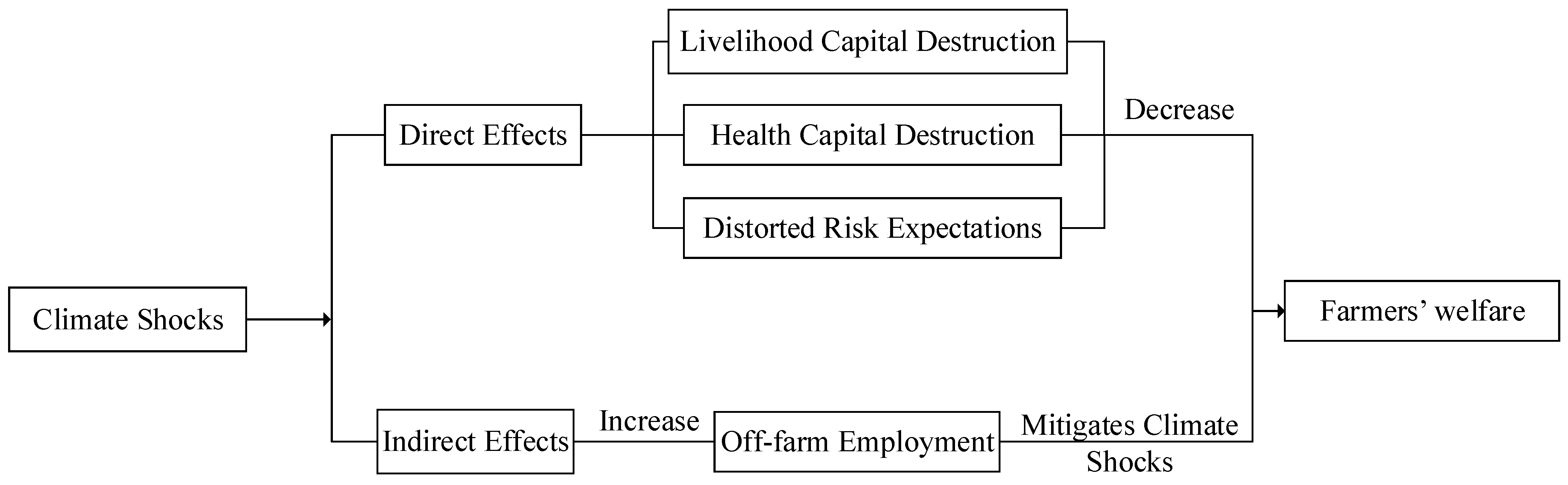
Table 12 reports the results of a causal mediation analysis using off-farm employment status, the employment scale, and the economic effects of employment as mediators. The results show that the total effect of climate shocks on farmers’ welfare is significantly negative, with coefficients ranging from −0.026 to −0.030. The average causal mediation effects (ACME) for all three models are significantly positive, with the employment scale showing the strongest mediation effect (0.00212), followed by employment status (0.00121), and the economic effect of employment being the weakest (0.00061). The corresponding average direct effects (ADEs) are all significantly negative, with estimates ranging from −0.027 to −0.032. Further calculations indicate that the proportions of the mediation effect for the three pathways are −4.70%, −7.08%, and −2.35%, respectively, suggesting that off-farm employment only partially offsets the negative impact of climate shocks on farmers’ welfare, with the buffering magnitude ranging from approximately 2% to 7%. These results support Hypothesis 2.
Modern causal mediation analysis typically conducts sensitivity tests using the medsens command to quantify the potential interference of unobserved omitted confounding factors on the mediation estimates. However, the total number of observations in this paper is about 43,000, and performing the sensitivity test would require constructing a matrix of size over 82,000 × 82,000, which cannot be computed due to the memory constraints of the current equipment. Therefore, we do not report the specific sensitivity test results. To address this, we provide evidence from three dimensions to support the robustness of the baseline conclusions. First, all mediation coefficients are based on 95% confidence intervals constructed from 1000 bootstrap simulations, and the intervals for each group do not contain zero, ensuring the statistical significance of the indirect effects. Second, prior to estimation, all variables were residualized to remove the two-way fixed effects of household and year, effectively mitigating omitted variable bias arising from time-invariant individual heterogeneity. Third, three different types of indicators—off-farm employment status, employment scale, and the economic effect of off-farm employment—all consistently show a positive buffering effect, providing multidimensional cross-validation of robustness. Taken together, even without conducting the medsens sensitivity test due to computational constraints, the core conclusion of this paper—that off-farm employment significantly buffers the welfare losses of farmers caused by climate shocks—remains sufficiently credible.
7. Conclusions and Policy Implications
7.1. Conclusions
This paper relies on CFPS farmer microdata and provincial meteorological data to investigate the impacts, heterogeneity, and buffering mechanisms of climate shocks on farmers‘ multidimensional welfare. By systematically comparing with the existing literature, it reveals new evidence on how climate shocks affect farmers’ welfare, thereby strengthening the academic contribution of the study and highlighting the high sensitivity of agriculture to climate change.
First, at the welfare measurement level, most existing studies use single indicators, such as farm household operating income, to measure welfare levels [
24,
25,
26,
27], which fail to capture non-income dimensions of hidden losses, such as health expenditures, social security, and psychological perceptions. Based on Sen’s capability approach, this paper constructs a six-dimensional comprehensive welfare index and finds that climate shocks significantly reduce farmers’ comprehensive welfare (total effect ranging from approximately −0.026 to −0.030). This finding goes beyond previous income-centered conclusions, indicating that a single income indicator significantly underestimates the true welfare costs of climate shocks, thereby enriching the welfare measurement paradigm for farm households in climate economics.
Second, at the empirical identification level, the existing literature mostly focuses on the average overall effect of climate shocks [
18,
25], lacking a detailed decomposition of heterogeneity across disaster types, geographical locations, and production characteristics. This study distinguishes four typical types of extreme weather: extreme high temperature, extreme low temperature, extreme rainfall, and extreme drought. Through subgroup regressions, it finds that farmers in northern regions, plains, and major grain-producing areas suffer greater welfare losses, with extreme low temperatures, extreme high temperatures, and extreme drought being the main damaging hazard types. This heterogeneity evidence provides micro-empirical support for formulating differentiated disaster prevention and mitigation policies tailored to local conditions.
Third, at the mechanism extension level, existing research on farmers‘ climate adaptation behaviors has focused on production-side adjustments, such as crop switching and agricultural technology inputs [
28,
29,
30,
31], while non-farm livelihood buffering mechanisms, such as off-farm employment, have mostly been analyzed descriptively, lacking quantitative testing of causal mediation effects. This paper employs the causal mediation framework (medeff) proposed by Hicks and Tingley, controlling for two-way fixed effects [
61]. The results show that off-farm employment plays a significantly positive buffering role in the “climate shock ─ farm household welfare” chain, with the average causal mediation effect (ACME) accounting for 2% to 7% of the total effect. This study enriches the theoretical and empirical content of farmers’ climate adaptation pathways from the perspective of non-farm livelihoods, providing micro-causal evidence from Chinese farmers for the development of employment-based climate adaptation policies.
In summary, through multidimensional welfare measurement, refined heterogeneity analysis, and causal mediation testing, this study confirms that off-farm employment is an effective adaptation strategy for rural households to cope with climate shocks. It contributes Chinese farmer micro-evidence to climate economics and offers clear practical reference value for formulating differentiated disaster prevention and mitigation policies and employment-based adaptation strategies.
7.2. Policy Implications
First, focus on core risks and prioritize the protection of vulnerable groups. The government should abandon a homogeneous disaster prevention and governance model. Taking into account regional heterogeneity, a tiered and classified climate risk protection system should be established for highly sensitive areas such as northern regions, major grain-producing areas, and plains. More resources should be channeled into disaster prevention funding, agricultural subsidies, disaster relief, and insurance support, while addressing shortcomings in regional agricultural infrastructure. Early warning systems for extreme weather and information-delivery mechanisms that reach farmers directly should be improved, thereby enhancing farmers’ overall resilience to climate shocks at the source and building a solid foundational line of welfare protection.
Second, implement differentiated policies to optimize the efficiency of policy resource allocation. Local governments should avoid allocating equal resources to all types of extreme weather. Based on empirical evidence, policy priority should be given to the three dominant hazards—extreme high temperatures, extreme low temperatures, and drought—adopting hazard-differentiated governance. At the same time, the mix of adaptation strategies should be dynamically optimized. On the basis of improving traditional production-side adaptation measures, inefficient disaster-prevention inputs should be moderately reduced. Leveraging regional endowments and hazard characteristics, policy tools should be precisely matched to concentrate limited public resources on high-risk areas, highly vulnerable farm households, and effective adaptation channels, maximizing policy effectiveness.
Third, strengthen the buffering role of off-farm employment and improve risk-hedging mechanisms. Policies should further reinforce this buffering function by improving cross-regional employment information service platforms and reducing farmers’ search costs for off-farm employment. For the years with extreme climate events, special seasonal job-matching services should be introduced to help disaster-affected farmers quickly secure non-agricultural employment. Meanwhile, the system for protecting the rights and interests of off-farm workers should be strengthened to reduce the seasonal volatility risk of such employment, making off-farm work a stable safety net for farmers to cope with climate risks.
7.3. Research Limitations and Future Prospects
Although this study has revealed the core logic of how climate shocks affect farmers‘ welfare through rigorous causal identification, extensive mechanism testing, and heterogeneity analysis, certain limitations remain that require further exploration in the future. First, this study matches farmer samples with provincial-level meteorological data; future research could integrate more detailed county- or village-level meteorological data to further improve variable matching accuracy and identification precision. Second, this study focuses on a sample of Chinese farmers; future cross-country comparative studies could test the generalizability of the conclusions and provide richer empirical evidence for global climate adaptation governance.