How Is the Integration of Climate-Related Risk into Enterprise Risk Management at Firm Level? A Systematic Literature Review

 , , and
Abstract
1. Introduction
2. Methods
2.1. Identification
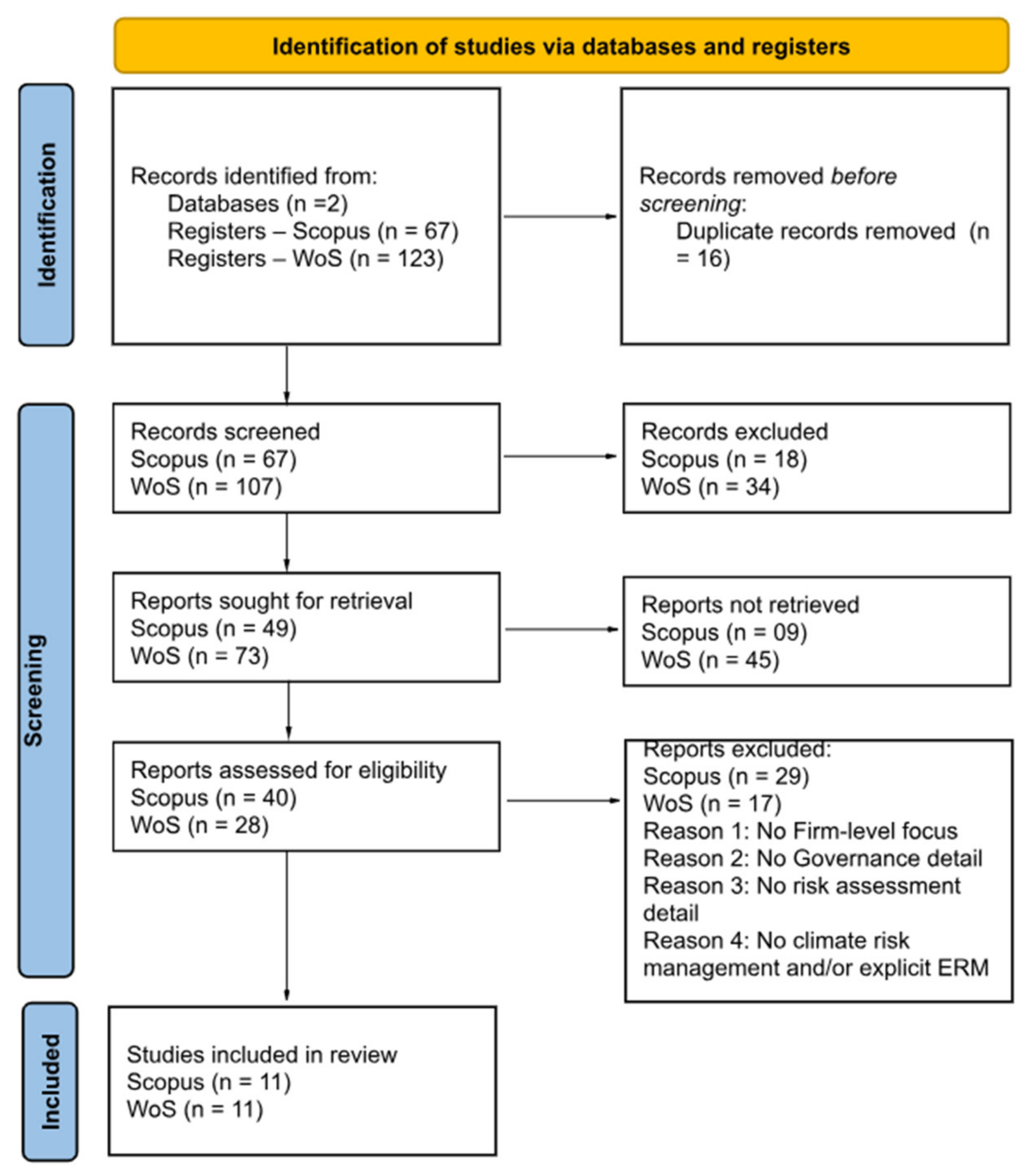
2.2. Screening
2.3. Inclusion
2.4. Data Extraction, Coding and Thematic Synthesis
2.5. Limitations of the Research
3. Results and Discussions
3.1. Systematic Literature Review (SLR)
3.1.1. Dimension 1: Firm-Level Focus and Sectoral Scope
3.1.2. Dimension 2: Governance of Climate Risk
Organizational Structures
Roles and Responsibilities
Decision-Making Integration
3.1.3. Dimension 3: Climate Risk Assessment Practices
Frameworks
Tools
Monitoring Practices
Strategic Approaches
3.1.4. Dimension 4: Integration with ERM
3.1.5. Dimension 5: Treatment of Physical and Transition Risks
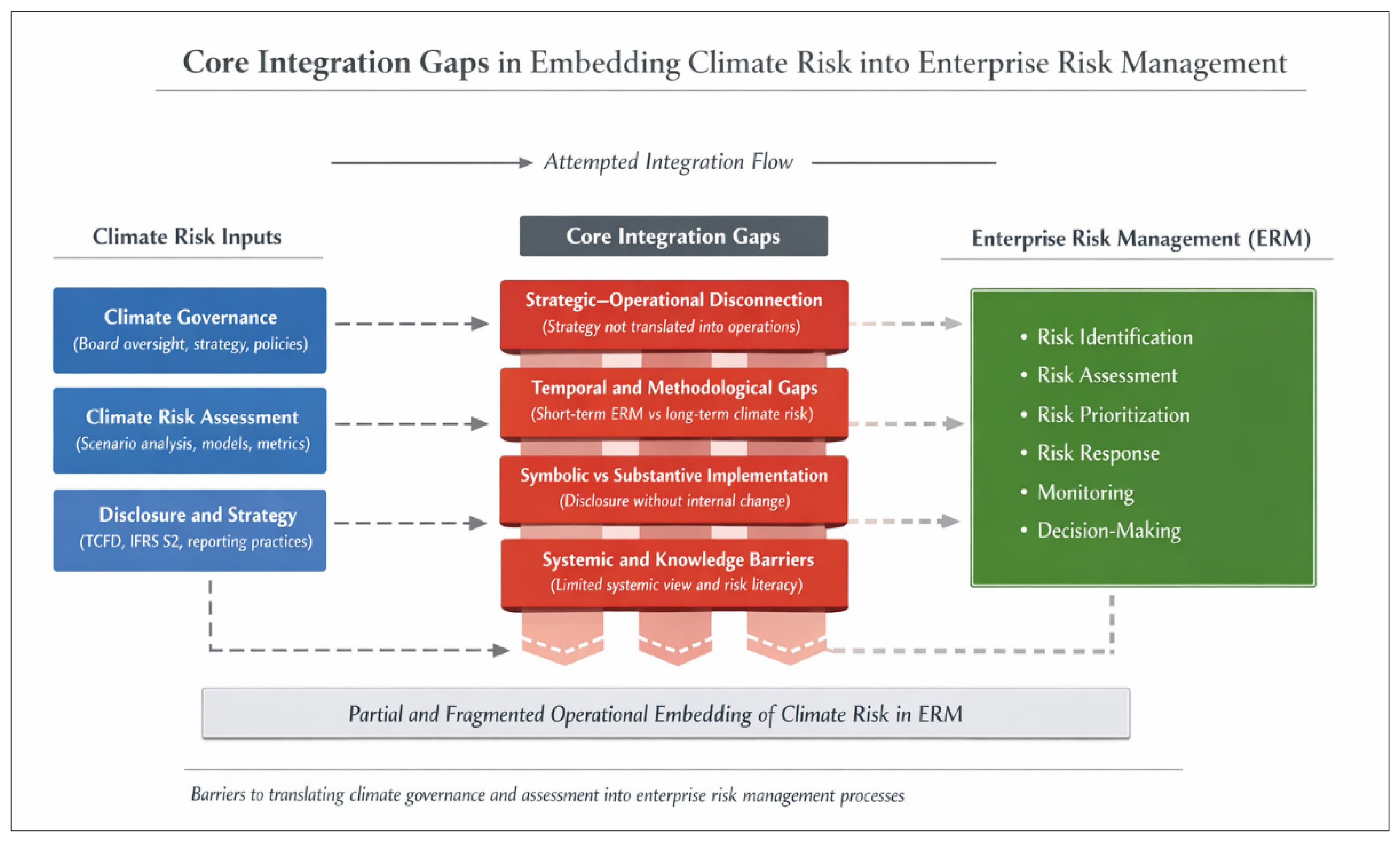
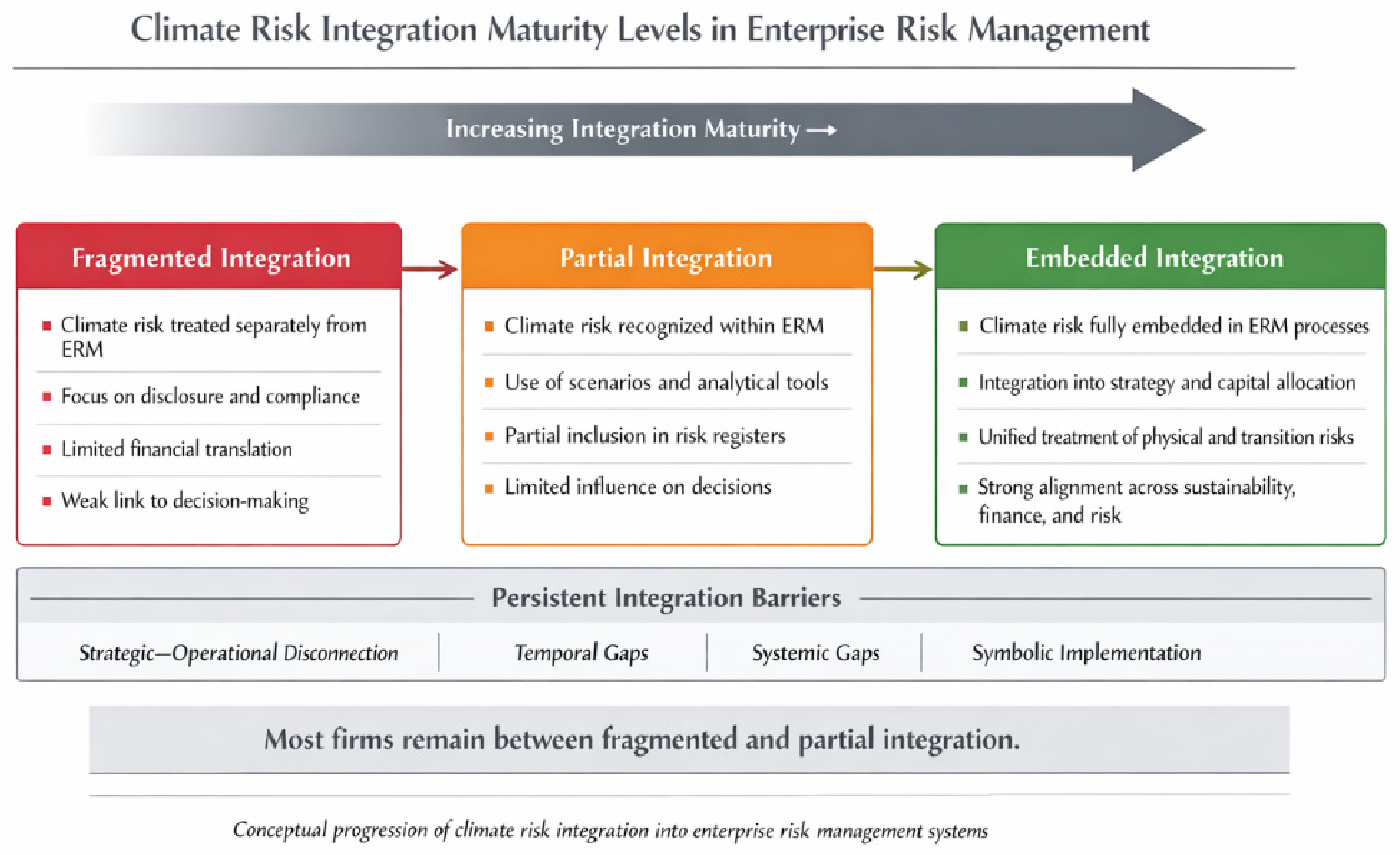
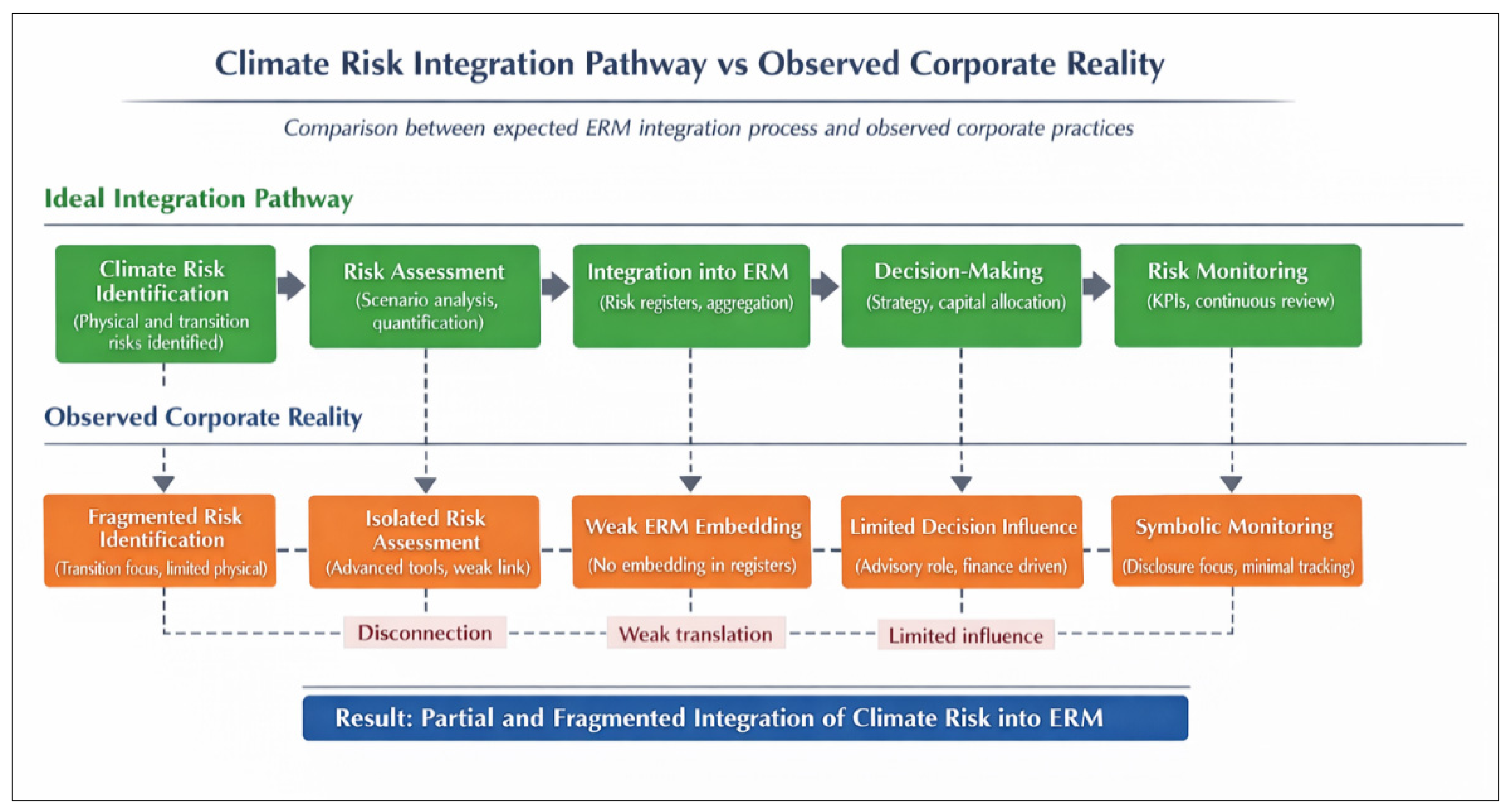
3.1.6. Cross-Dimensional Synthesis: Patterns
4. Implications for ERM Practice
Identification of the Integration Gap


5. Conclusions
Supplementary Materials
Author Contributions
Funding
Institutional Review Board Statement
Informed Consent Statement
Data Availability Statement
Acknowledgments
Conflicts of Interest
Abbreviations
| AASB S2 | Australian Sustainability Reporting Standards |
| AI | Artificial Intelligence |
| BoD | Board of Directors |
| CapEx | Capital expenditure |
| CDP | CDP |
| CEO | Chief Executive Officer |
| CFO | Chief Financial Officer |
| COSO | Committee of Sponsoring Organizations of the Treadway Commission |
| CRI | Climate Risk Index |
| CSRD | Corporate Sustainability Reporting Directive |
| ERM | Enterprise Risk Management |
| ESG | Environmental, Social and Governance |
| ESRS | European Sustainability Reporting Standards |
| FSB | Financial Stability Board |
| GCMs | Global Climate Models |
| IEA | International Energy Agency |
| IFRS | International Financial Reporting Standards |
| IFRS S1 | General Requirements for Disclosure of Sustainability-related Financial Information |
| IFRS S2 | Climate-related Disclosures |
| INMET | National Institute of Meteorology |
| INPE | National Institute for Space Research |
| IPCC | Intergovernmental Panel on Climate Change |
| ISSB | International Sustainability Standards Board |
| ISO | International Organization for Standardization |
| JCIC | Joint Credit Information Center |
| KPIs | Key performance indicators |
| OpEx | Operational expenditure |
| PRISMA | Preferred Reporting Items for Systematic Reviews and Meta-Analyses |
| R&D | Research and Development |
| RCPs | Representative Concentration Pathways |
| SLR | Systematic literature review |
| SSP | Shared Socioeconomic Pathways |
| SWOT | Strengths, Weaknesses, Opportunities, and Threats |
| TCCIP | Taiwan Climate Change Projection Information and Adaptation Knowledge Platform |
| TCFD | Task Force on Climate-related Financial Disclosures |
References
- World Economic Forum. The Global Risks Report 2020; World Economic Forum: Geneva, Switzerland, 2020. [Google Scholar]
- World Economic Forum. Global Risks Report 2025; World Economic Forum: Geneva, Switzerland, 2025. [Google Scholar]
- Chen, Y.; Liu, A.; Cheng, X. Quantifying economic impacts of climate change under nine future emission scenarios within CMIP6. Sci. Total Environ. 2020, 703, 134950. [Google Scholar] [CrossRef]
- Task Force on Climate-Related Financial Disclosures. Available online: https://www.fsb-tcfd.org/ (accessed on 10 March 2026).
- Chenet, H.; Ryan-Collins, J.; van Lerven, F. Finance, climate-change and radical uncertainty: Towards a precautionary approach to financial policy. Ecol. Econ. 2021, 183, 106957. [Google Scholar] [CrossRef]
- ISSB and TCFD. Available online: https://www.ifrs.org/sustainability/tcfd/ (accessed on 10 March 2026).
- Introduction to the ISSB and IFRS Sustainability Disclosure Standards. Available online: https://www.ifrs.org/sustainability/knowledge-hub/introduction-to-issb-and-ifrs-sustainability-disclosure-standards (accessed on 12 March 2026).
- Lee, C.-C.; Kuo, S.-Y.; Lee, S.-Y.; Hsu, H.-H.; Chou, K.-T.; Mo, T.-L.; Pien, C.-P.; Kuo, Y.-T.; Chang, E.-Y.; Huang, K.-C.; et al. Evaluating corporate climate risk assessment results: Lessons learned from Taiwan’s top 100 enterprises. Clim. Risk Manag. 2024, 46, 100668. [Google Scholar] [CrossRef]
- Yi, R.; Zhang, Y.; Chen, A. Does corporate climate risk promote climate response actions? Empirical evidence from China. Mitig. Adapt. Strateg. Glob. Change 2026, 31, 21. [Google Scholar] [CrossRef]
- Amar, J.; Demaria, S.; Rigot, S. Enhancing financial transparency to mitigate climate change: Toward a climate risks and opportunities reporting index. Environ. Model. Assess. 2022, 27, 425–439. [Google Scholar] [CrossRef]
- Xhindole, C.; Tarquinio, L.; Sierra-García, L. Climate change and Task Force on Climate-related Financial Disclosures (TCFD) reports. A comparison between Italy and Spain. J. Account. Organ. Change 2025, 21, 1–28. [Google Scholar] [CrossRef]
- Pang, X.; Zhang, P.; Guo, Z.; Jia, X.; Tan, R.R.; Zhang, Y.; Qu, X. Information disclosure in the context of combating climate change: Evidence from the Chinese natural gas industry. Sustainability 2025, 17, 4315. [Google Scholar] [CrossRef]
- Lyon, T.P.; Maxwell, J.W. Corporate social responsibility and the environment: A theoretical perspective. Rev. Environ. Econ. Policy 2008, 2, 240–260. [Google Scholar] [CrossRef]
- Mahoney, L.S.; Thorne, L.; Cecil, L.; LaGore, W. A research note on standalone corporate social responsibility reports: Signalling or greenwashing? Crit. Perspect. Account. 2013, 24, 350–359. [Google Scholar] [CrossRef]
- Cormican, K. Integrated enterprise risk management: From process to best practice. Mod. Econ. 2014, 5, 401–413. [Google Scholar] [CrossRef]
- Stasse, L.J.A.; Hilhorst, C.A.R.; ten Rouwelaar, J.A. Enterprise risk management revisited: A study to identify the elements of ERM. J. Risk Res. 2025, 28, 768–793. [Google Scholar] [CrossRef]
- Mishra, B.K.; Rolland, E.; Satpathy, A.; Moore, M. A framework for enterprise risk identification and management: The resource-based view. Manag. Audit. J. 2019, 34, 162–188. [Google Scholar] [CrossRef]
- Wu, D.; Olson, D.L.; Dolgui, A. Decision making in enterprise risk management: A review and introduction to special issue. Omega 2015, 57, 1–4. [Google Scholar] [CrossRef]
- Dickinson, G. Enterprise risk management: Its origins and conceptual foundation. Geneva Pap. Risk Insur. Issues Pract. 2001, 26, 360–366. [Google Scholar] [CrossRef]
- Jankensgård, H. A theory of enterprise risk management. Corp. Gov. 2019, 19, 565–579. [Google Scholar] [CrossRef]
- Nocco, B.W.; Stulz, R.M. Enterprise risk management: Theory and practice. J. Appl. Corp. Financ. 2006, 18, 8–20. [Google Scholar] [CrossRef]
- Gao, S.; Hsu, H.-T.; Liu, F.-C. Enterprise risk management, financial reporting and firm operations. Risks 2025, 13, 48. [Google Scholar] [CrossRef]
- Biresaw, T.M.; Sibindi, A.B. The assessment of enterprise risk management practices of Ethiopian commercial banks. Risks 2025, 13, 51. [Google Scholar] [CrossRef]
- Al Lawati, A.; Hussin, B.M.; Abdul Kadir, M.R.; Khudari, M. The impact of enterprise risk management on firm competitiveness: The mediating role of competitive advantage in the Omani insurance industry. Risks 2025, 13, 199. [Google Scholar] [CrossRef]
- Klumpes, P.J.M. Enterprise risk management adoption practices by US and European multinationals. Account. Audit. 2025, 1, 5. [Google Scholar] [CrossRef]
- Hou, D.; Wu, Z.; Chen, Y. Climate risk exposure and corporate strategic dualism: Passive defensiveness and active integration. Sustainability 2025, 17, 6040. [Google Scholar] [CrossRef]
- Arribas, A.; Fairgrieve, R.; Dhu, T.; Bell, J.; Cornforth, R.; Gooley, G.; Hilson, C.J.; Luers, A.; Shepherd, T.G.; Street, R.; et al. Climate risk assessment needs urgent improvement. Nat. Commun. 2022, 13, 4326. [Google Scholar] [CrossRef]
- Katopodis, T.; Adamides, E.D.; Sfetsos, A.; Mountouris, A. Incorporating future climate scenarios in oil industry’s risk assessment: A Greek refinery case study. Sustainability 2021, 13, 12825. [Google Scholar] [CrossRef]
- Cains, M.G.; Henshel, D. Parameterization framework and quantification approach for integrated risk and resilience assessments. Integr. Environ. Assess. Manag. 2021, 17, 131–146. [Google Scholar] [CrossRef]
- Zhao, Z.; Tang, S.; Huang, J.; Yang, J.; Ma, Z.; Fang, W.; Liu, M.; Bi, J. Firm-level climate risk assessment: Recent progress and future research agenda. Risk Sci. 2025, 1, 100012. [Google Scholar] [CrossRef]
- Eccles, R.G.; Krzus, M.P.; Ribot, S. Implementing the Task Force on Climate-related Financial Disclosures recommendations: An assessment of corporate readiness. Schmalenbach J. Bus. Res. 2019, 71, 287–293. [Google Scholar] [CrossRef]
- Gupta, P. Mandatory TCFD disclosure and corporate financial performance: Evidence from UK non-financial firms. Bus. Strategy Environ. 2026, 35, 3826–3842. [Google Scholar] [CrossRef]
- Rodrigues Loiola, R.; Kimura, H.; Melo Souza, L. Sustainable finance, green bonds and financial performance—A literature review. Int. J. Financ. Stud. 2025, 13, 233. [Google Scholar] [CrossRef]
- Wang, B.; Pan, S.-Y.; Ke, R.-Y.; Wang, K.; Wei, Y.-M. An overview of climate change vulnerability: A bibliometric analysis based on Web of Science database. Nat. Hazards 2014, 74, 1649–1666. [Google Scholar] [CrossRef]
- Li, L.; Sun, W.; Hu, W.; Sun, Y. Impact of natural and social environmental factors on building energy consumption: Based on bibliometrics. J. Build. Eng. 2021, 37, 102136. [Google Scholar] [CrossRef]
- Santos, L.; Steininger, K.; Balma, L.; Vogel, J. Current status and future perspectives of carbon pricing research in Austria. Sustainability 2022, 14, 9684. [Google Scholar] [CrossRef]
- de Castro Vieira, J.R.; Barboza, F.; Cajueiro, D.; Kimura, H. Towards fair AI: Mitigating bias in credit decisions—A systematic literature review. J. Risk Financ. Manag. 2025, 18, 228. [Google Scholar] [CrossRef]
- Airout, R.M. Systematic review of emerging trends and developments in sustainability accounting. J. Risk Financ. Manag. 2025, 18, 621. [Google Scholar] [CrossRef]
- Page, M.J.; McKenzie, J.E.; Bossuyt, P.M.; Boutron, I.; Hoffmann, T.C.; Mulrow, C.D.; Shamseer, L.; Tetzlaff, J.M.; Akl, E.A.; Brennan, S.E.; et al. The PRISMA 2020 statement: An updated guideline for reporting systematic reviews. BMJ 2021, 372, n71. [Google Scholar] [CrossRef]
- Liberati, A.; Altman, D.G.; Tetzlaff, J.; Mulrow, C.D.; Gøtzsche, P.C.; Ioannidis, J.P.A.; Clarke, M.; Devereaux, P.J.; Kleijnen, J.; Moher, D. The PRISMA statement for reporting systematic reviews and meta-analyses of studies that evaluate healthcare interventions: Explanation and elaboration. BMJ 2009, 339, b2700. [Google Scholar] [CrossRef] [PubMed]
- Zumsteg, J.M.; Cooper, J.S.; Noon, M.S. Systematic review checklist: A standardized technique for assessing and reporting reviews of life cycle assessment data. J. Ind. Ecol. 2012, 16, S12–S21. [Google Scholar] [CrossRef] [PubMed]
- Peters, M.D.J.; Marnie, C.; Tricco, A.C.; Pollock, D.; Munn, Z.; Alexander, L.; McInerney, P.; Godfrey, C.M.; Khalil, H. Updated methodological guidance for the conduct of scoping reviews. JBI Evid. Synth. 2020, 18, 2119–2126. [Google Scholar] [CrossRef] [PubMed]
- Juhola, S.; Laurila, A.-G.; Groundstroem, F.; Klein, J. Climate risks to the renewable energy sector: Assessment and adaptation within energy companies. Bus. Strategy Environ. 2024, 33, 1906–1919. [Google Scholar] [CrossRef]
- Thistlethwaite, J.; Wood, M.O. Insurance and climate change risk management: Rescaling to look beyond the horizon. Br. J. Sociol. 2018, 69, 279–298. [Google Scholar] [CrossRef]
- Kouloukoui, D.; Marinho, M.M.O.; Gomes, S.M.S.; de Jong, P.; Kiperstok, A.; Torres, E.A. The impact of the board of directors on business climate change management: Case of Brazilian companies. Mitig. Adapt. Strateg. Glob. Change 2020, 25, 127–147. [Google Scholar] [CrossRef]
- Huang, H.H.; Kerstein, J.; Wang, C.; Wu, F. Firm climate risk, risk management, and bank loan financing. Strateg. Manag. J. 2022, 43, 2849–2880. [Google Scholar] [CrossRef]
- Sousa, D.S.; Neves, C.F.; Silva, H.V.O.; Schaffel, S.B.; Luigi, G.; La Rovere, E.L. A systemic approach for climate risk assessment applied to thermoelectric power plants in northeastern coast of Brazil. Clim. Risk Manag. 2022, 36, 100424. [Google Scholar] [CrossRef]
- Ren, X.; Li, Y.; Shahbaz, M.; Dong, K.; Lu, Z. Climate risk and corporate environmental performance: Empirical evidence from China. Sustain. Prod. Consum. 2022, 30, 467–477. [Google Scholar] [CrossRef]
- Singh, S.; Goyal, M.K. Enhancing climate resilience in businesses: The role of artificial intelligence. J. Clean. Prod. 2023, 418, 138228. [Google Scholar] [CrossRef]
- Kouloukoui, D.; Gomes, S.M.S.; Torres, F.A.; Torres, E.A. Business climate risk management: International perspectives and strategic determinants. Environ. Dev. Sustain. 2025, 27, 4683–4724. [Google Scholar] [CrossRef]
- Megeid, N.S.A. The impact of climate risk disclosure on financial performance, financial reporting and risk management: Evidence from Egypt. Future Bus. J. 2024, 10, 21. [Google Scholar] [CrossRef]
- Tang, Y.; Gao, D.; Zhou, X. Green Response: The Impact of Climate Risk Exposure on ESG Performance. Sustainability 2024, 16, 10895. [Google Scholar] [CrossRef]
- Bachmann, L.; Lex, R.; Regli, F.; Vögeli, S.; Mühlhofer, E.; McCaughey, J.W.; Bresch, D.N.; Kropf, C.M. Climate-resilient strategy planning using the SWOT methodology: A case study of the Japanese wind energy sector. Clim. Risk Manag. 2024, 46, 100665. [Google Scholar] [CrossRef]
- Hazelhurst, T.; Foote, J.; Norris, D. Dollars and Sense; Reviewing Industry Implementation of the Climate-Related Disclosures Mandate in New Zealand. Eur. J. Sustain. Dev. 2024, 13, 1. [Google Scholar] [CrossRef]
- Fang, X. Can climate risk exposure compel companies to undergo a green transformation? J. Clean. Prod. 2024, 434, 140310. [Google Scholar] [CrossRef]
- Georgiou, A.; Bednárová, L.; Kudelas, D. Climate Change Risk and Financial Performance in Cyprus: Management Perceptions. Acta Montan. Slovaca 2024, 29, 920–932. [Google Scholar] [CrossRef]
- Kumarasiri, J.; Morrison, L.; Maran, L. Climate-Related Risk Reporting and the Role of Management Accountants. Aust. Account. Rev. 2025, 35, 324–341. [Google Scholar] [CrossRef]
- Zhang, L.; Yang, C.; Luo, K. The impact of climate risk on sustainability performance of enterprises: Evidence from China. Financ. Res. Lett. 2025, 83, 107645. [Google Scholar] [CrossRef]
- Karatzoudi, K.; Denham, T.; Aven, T. Conceptual perspectives on climate risk disclosures for businesses and public sector. Clim. Change 2025, 178, 220. [Google Scholar] [CrossRef]
- Lee, C.-C.; Lee, S.-Y.; Kuo, S.-Y.; Hsu, H.-H.; Kuo, Y.-T.; Lin, M.-X.; Pien, C.-P.; Chou, K.-T.; Tsai, Y.-T. Corporate competition in climate scenario analysis: Current challenges and solutions. Clim. Serv. 2025, 40, 100604. [Google Scholar] [CrossRef]
- Ren, Y.; Yuan, P.; Dong, X. Before the rain falls: Corporate climate risk perception and supply chain stability. Environ. Dev. Sustain. 2026. [Google Scholar] [CrossRef]
- Dou, Y.; Zhang, L.; Wang, H.; Wang, Y. Does climate risk inhibit enterprise resilience? Evidence from Chinese listed companies. Theor. Appl. Climatol. 2026, 157, 80. [Google Scholar] [CrossRef]
- Allison, E.H.; Perry, A.L.; Badjeck, M.-C.; Adger, W.N.; Brown, K.; Conway, D.; Halls, A.S.; Pilling, G.M.; Reynolds, J.D.; Andrew, N.L.; et al. Vulnerability of national economies to the impacts of climate change on fisheries. Fish Fish. 2009, 10, 173–196. [Google Scholar] [CrossRef]
- Mirza, M.M.Q. Climate change and extreme weather events: Can developing countries adapt? Clim. Policy 2003, 3, 233–248. [Google Scholar] [CrossRef]
- Cobo, M.J.; López-Herrera, A.G.; Herrera-Viedma, E.; Herrera, F. An approach for detecting, quantifying, and visualizing the evolution of a research field: A practical application to the Fuzzy Sets Theory field. J. Informetr. 2011, 5, 146–166. [Google Scholar] [CrossRef]
- Abhayawansa, S.; Adams, C.A. Towards a conceptual framework for non-financial reporting inclusive of pandemic and climate risk reporting. Meditari Account. Res. 2022, 30, 710–738. [Google Scholar] [CrossRef]
- ISO 31000:2018; Risk Management—Guidelines, 2nd ed. International Organization for Standardization (ISO): Geneva, Switzerland, 2018.
- ISO 14090:2019; Adaptation to Climate Change—Principles, Requirements and Guidelines. International Organization for Standardization (ISO): Geneva, Switzerland, 2019.
- ISO 14001:2026; Environmental Management Systems—Requirements with Guidance for Use. International Organization for Standardization (ISO): Geneva, Switzerland, 2026.
- ISO 50001:2018; Energy Management Systems—Requirements with Guidance for Use, 2nd ed. International Organization for Standardization (ISO): Geneva, Switzerland, 2018.
- Li, W.; Luo, D.; Cheng, T.-Y. Strategy choices in strategic risk-taking: Does climate risk matter? Int. Rev. Financ. Anal. 2025, 97, 103861. [Google Scholar] [CrossRef]
- Sarraf, H. Climate change risk: The next frontier in banking risk management. J. Risk Manag. Financ. Inst. 2021, 15, 85–92. [Google Scholar] [CrossRef]


| Criterion | Description |
|---|---|
| From 2015 to March 2026. |
| Original research articles and review papers published in peer-reviewed scientific journals. |
| English. |
| Title, abstract, and keywords |
| (TITLE-ABS-KEY((“corporation*” OR “company*” OR “business*” OR “enterprise*”) AND (“physical climate risk” OR “transition climate risk” OR “climate risk”) AND (“Enterprise Risk Management” OR “ERM” OR “risk management” OR “risk assessment” OR “risk framework” OR “risk strategy”)) AND PUBYEAR > 2014 AND PUBYEAR < 2027) AND (climate risk management) AND (climate risk assessment) AND (enterprise) AND (firm) AND (climate risk) AND (LIMIT-TO (PUBSTAGE,”final”)) AND (EXCLUDE (SUBJAREA,”MEDI”) OR EXCLUDE (SUBJAREA,”ARTS”) OR EXCLUDE (SUBJAREA,”PHYS”) OR EXCLUDE (SUBJAREA,”BIOC”) OR EXCLUDE (SUBJAREA,”PSYC”)) AND (LIMIT-TO (DOCTYPE,”ar”)) AND (LIMIT-TO (LANGUAGE,”English”)) |
| (TOPIC((“corporation*” OR “company*” OR “business*” OR “enterprise*”) AND (“physical climate risk” OR “transition climate risk” OR “climate risk”) AND (“Enterprise Risk Management” OR “ERM” OR “risk management” OR “risk assessment” OR “risk framework” OR “risk strategy”)) AND YEAR PUBLISHED (2014–2027) AND DOCUMENT TYPE (Article) AND LANGUAGE (English) NOT WEB OF SCIENCE CATEGORIES (“MEDI” OR “ARTS” OR “PHYS” OR “BIOC” OR “PSYC”) |
| Dimension | Description and Aspects |
|---|---|
| Productive sectors of the real economy and non-financial corporations. Ensures that the review addresses non-financial corporations and productive sectors, rather than banks, insurers, regulators, macro-policy studies, or a sectoral approach. |
| Captures whether climate risk is connected to decision-making structures, roles, responsibilities, and board/management oversight. |
| Ensures that included studies discuss tools, frameworks, scenarios, indicators, monitoring, or assessment practices. |
| Aligns the sample with the core research question on integration into risk management systems. |
| Allows the review to distinguish between physical risk, transition risk, or both. |
| Author | Year | Title | Source |
|---|---|---|---|
| Thistlethwaite, J. et al. [44] | 2018 | Insurance and Climate Change Risk Management: Rescaling to Look Beyond the Horizon | Scopus |
| Kouloukoui, D. et al. [45] | 2020 | The impact of the board of directors on business climate change management: case of Brazilian companies | WoS |
| Huang, H.H. et al. [46] | 2022 | Firm climate risk, risk management, and bank loan financing | Scopus |
| Sousa, D.S. et al. [47] | 2022 | A systemic approach for climate risk assessment applied to thermoelectric power plants in northeastern coast of Brazil | WoS |
| Ren, X. et al. [48] | 2022 | Climate risk and corporate environmental performance: Empirical evidence from China | Scopus |
| Singh, S. et al. [49] | 2023 | Enhancing climate resilience in businesses: The role of artificial intelligence | WoS |
| Kouloukoui, D. et al. [50] | 2025 | Business climate risk management: international perspectives and strategic determinants | WoS |
| Megeid, N.S.A. [51] | 2024 | The impact of climate risk disclosure on financial performance, financial reporting and risk management: evidence from Egypt | WoS |
| Juhola, S. et al. [43] | 2024 | Climate risks to the renewable energy sector: Assessment and adaptation within energy companies | Scopus |
| Tang, Y. et al. [52] | 2024 | Green Response: The Impact of Climate Risk Exposure on ESG Performance | WoS |
| Bachmann, L. et al. [53] | 2024 | Climate-resilient strategy planning using the SWOT methodology: A case study of the Japanese wind energy sector | WoS |
| Hazelhurst, T. et al. [54] | 2024 | Dollars and Sense; Reviewing Industry Implementation of the Climate-Related Disclosures Mandate in New Zealand | WoS |
| Fang, X. [55] | 2024 | Can climate risk exposure compel companies to undergo a green transformation? | Scopus |
| Georgiou, A. et al. [56] | 2024 | Climate Change Risk and Financial Performance in Cyprus: Management Perceptions | Scopus |
| Xhindole, C. et al. [11] | 2025 | Climate change and Task Force on Climate-related Financial Disclosures (TCFD) reports. A comparison between Italy and Spain | Scopus |
| Kumarasiri, J. et al. [57] | 2025 | Climate-Related Risk Reporting and the Role of Management Accountants | Scopus |
| Pang, X. et al. [12] | 2025 | Information Disclosure in the Context of Combating Climate Change: Evidence from the Chinese Natural Gas Industry | Scopus |
| Zhang, L. et al. [58] | 2025 | The impact of climate risk on sustainability performance of enterprises: Evidence from China | WoS |
| Karatzoudi, K. et al. [59] | 2025 | Conceptual perspectives on climate risk disclosures for businesses and public sector | WoS |
| Lee, C.-C. et al. [60] | 2025 | Corporate competition in climate scenario analysis: Current challenges and solutions | Scopus |
| Ren, Y. et al. [61] | 2026 | Before the rain falls: corporate climate risk perception and supply chain stability | WoS |
| Dou, Y. et al. [62] | 2026 | Does climate risk inhibit enterprise resilience? Evidence from Chinese listed companies | Scopus |
| Extraction Field | Description | Analytical Function |
|---|---|---|
| Level of analysis | Firm, asset, sector, systemic, financial or mixed level | Supports firm-level focus coding |
| Sector | Productive sector, non-financial company, financial perspective, or systemic context | Assesses alignment with the review scope |
| Governance descriptions | Decision-making processes, roles, and responsibilities | Supports governance coding |
| Risk assessment details | Frameworks, tools, metrics, monitoring practices, and strategic approaches | Supports risk assessment coding |
| Climate risk management/ERM | Explicit evidence of climate risk management and/or ERM integration | Supports management and ERM coding |
| Type of climate risk | Physical, transition, combined, or other climate-related risks | Supports climate risk typology coding |
| Key contributions | Main contribution of the article | Supports synthesis |
| Quality appraisal | Methodological transparency, analytical depth, evidence strength, and usefulness | Supports evidence weighting |
| Coding Category | Main Operational Codes | Analytical Purpose |
|---|---|---|
| Firm-level focus | FL-FIRM; FL-REAL; FL-SECTOR; FL-FIN; FL-SYSTEMIC | Identifies whether the article analyzes companies, productive sectors, or corporate implications through sectoral, financial, or systemic perspectives |
| Governance | GOV-BOARD; GOV-MGMT; GOV-RISKCOM; GOV-SILO; GOV-CROSS | Captures roles, responsibilities, and decision-making structures |
| Risk assessment | RA-FRAME; RA-SCEN; RA-METRICS; RA-EXPOSURE; RA-DATA; RA-METH | Captures frameworks, tools, indicators, scenarios, monitoring, and methodological limitations |
| Climate risk management/ERM | CRM-ID; CRM-ASSESS; CRM-MIT; CRM-MON; ERM-INT; ERM-PART; ERM-CONCEPT | Captures the degree of integration into climate risk management and/or ERM |
| Type of climate risk | RISK-PHY; RISK-TRAN; RISK-COMB; RISK-REG; RISK-MKT; RISK-LIAB | Classifies the climate risks addressed |
| Gap and synthesis codes | GAP-STR-OP; GAP-TEMP; GAP-METH; SYM-DISC; SYM-FORMAL; BARR-KNOW; BARR-SYS | Supports the movement from descriptive codes to analytical themes |
| Study | Extracted Evidence | Applied Codes | Analytical Interpretation | Theme Supported |
|---|---|---|---|---|
| Abdel Megeid, 2024 [51] | Board oversight, TCFD checklist, scenario analysis, expected incorporation into risk management | GOV-BOARD; RA-SCEN; RA-METRICS; ERM-PART; SYM-FORMAL | Formal governance and assessment are present, but ERM integration is expected rather than demonstrated | Symbolic implementation; strategic–operational disconnection |
| Sousa et al., 2022 [47] | IPCC/ISO frameworks, RCP 8.5, exposure and vulnerability metrics, and monitoring cycles | RA-FRAME; RA-SCEN; RA-EXPOSURE; RA-MON; RISK-PHY | Strong asset-level assessment, but limited evidence of enterprise-wide ERM integration | Temporal and methodological gaps |
| Kumarasiri et al., 2025 [57] | Disconnect between strategic and operational levels, external consultants, and limited ERM integration | GOV-SILO; RA-METH; ERM-PART; GAP-STR-OP | Climate risk governance remains weakly embedded in operational routines | Strategic–operational disconnection |
| Xhindole et al., 2025 [11] | TCFD reports, governance committees, time horizons, and narrative disclosure | RA-FRAME; RA-SCEN; GAP-TEMP; SYM-DISC; ERM-PART | Disclosure is structured, but ERM integration depends heavily on narrative reporting | Symbolic implementation; temporal and methodological gaps |
| First-Order Codes | Second-Order Analytical Category | Final Theme |
|---|---|---|
| GOV-BOARD; GOV-MGMT; ERM-PART; ERM-OP absent; GAP-STR-OP | Formal recognition without operational integration | Strategic–operational disconnection |
| RA-SCEN; RA-METRICS; RA-DATA; RA-METH; GAP-TEMP | Long-term, uncertain, and uneven assessment practices | Temporal and methodological gaps |
| RA-FRAME; SYM-DISC; SYM-FORMAL; ERM-CONCEPT | Disclosure-oriented or formalistic implementation | Symbolic implementation |
| BARR-KNOW; BARR-DATA; BARR-STD; BARR-REG; BARR-SYS | Capability, institutional, and systemic constraints | Systemic and knowledge barriers |
| Dimensions | Description and Aspects |
|---|---|
| Multisectoral coverage, with emphasis on the energy sector |
| Organizational Structures:
Roles and Responsibilities:
Decision-Making Integration:
|
| Frameworks:
Tools:
Strategic approaches:
|
| Integration of climate change into ERM methodology Risk Registries |
| Physical risk appears more as a reactive trigger Transition risks are more prominently integrated |
Disclaimer/Publisher’s Note: The statements, opinions and data contained in all publications are solely those of the individual author(s) and contributor(s) and not of MDPI and/or the editor(s). MDPI and/or the editor(s) disclaim responsibility for any injury to people or property resulting from any ideas, methods, instructions or products referred to in the content. |
© 2026 by the authors. Licensee MDPI, Basel, Switzerland. This article is an open access article distributed under the terms and conditions of the Creative Commons Attribution (CC BY) license.
Share and Cite
Albuquerque, L.; Carra, S.H.Z.; Santos, L.; Tosto, G.; Dornelles, H. How Is the Integration of Climate-Related Risk into Enterprise Risk Management at Firm Level? A Systematic Literature Review. Sustainability 2026, 18, 5900. https://doi.org/10.3390/su18125900
Albuquerque L, Carra SHZ, Santos L, Tosto G, Dornelles H. How Is the Integration of Climate-Related Risk into Enterprise Risk Management at Firm Level? A Systematic Literature Review. Sustainability. 2026; 18(12):5900. https://doi.org/10.3390/su18125900
Chicago/Turabian StyleAlbuquerque, Laura, Sofia Helena Zanella Carra, Luan Santos, Giovanna Tosto, and Heloisa Dornelles. 2026. "How Is the Integration of Climate-Related Risk into Enterprise Risk Management at Firm Level? A Systematic Literature Review" Sustainability 18, no. 12: 5900. https://doi.org/10.3390/su18125900
APA StyleAlbuquerque, L., Carra, S. H. Z., Santos, L., Tosto, G., & Dornelles, H. (2026). How Is the Integration of Climate-Related Risk into Enterprise Risk Management at Firm Level? A Systematic Literature Review. Sustainability, 18(12), 5900. https://doi.org/10.3390/su18125900