1. Introduction
Global climate change has evolved into an unprecedented systemic challenge for human societies. The 2030 Agenda for Sustainable Development identifies climate change as one of the most critical global challenges of the contemporary era. According to the 2026 Global Climate Risk Index, more than 9700 extreme weather events occurred globally between 1995 and 2024, causing direct economic losses exceeding 4.5 trillion US dollars. As concentrated hubs of human settlement, economic activity, and energy consumption, cities are disproportionately vulnerable to climate-induced shocks. Meanwhile, urban production and daily consumption also constitute major sources of greenhouse gas emissions and resource depletion. Faced with dual constraints of resource scarcity and environmental degradation, balancing steady economic growth with ecological sustainability has become a pivotal strategic task for global urban governance.
As the world’s largest carbon emitter, China formally proposed its dual-carbon goals in 2020, targeting carbon peaking by 2030 and carbon neutrality by 2060. Official data from the National Energy Administration indicates that China built the world’s largest renewable energy system during the 14th Five-Year Plan period. Nevertheless, the country remains in a stage of rapid urbanization. By the end of 2025, China’s permanent resident urbanization rate reached 67.89%, with the urban permanent population totaling 953.8 million [
1]. High fossil fuel dependence persists across urban production and life, placing sustained pressure on carbon emission reduction. Under the dual-carbon strategic framework, how to maintain urban economic vitality and high-quality urbanization while reducing carbon intensity and realizing a green development transition has become a core issue in China’s economic reform and urban policy design. As a comprehensive efficiency indicator that incorporates energy input and undesirable environmental outputs into accounting criteria, GTFP effectively reflects the sustainable development capacity of economic systems under resource and environmental constraints. Accordingly, enhancing GTFP has become a core metric for measuring the success of regional green economic transformation.
Existing literature on the nexus between environmental regulation and GTFP predominantly focuses on command-and-control mitigation policies, such as low-carbon city pilot programs. The effectiveness of such mitigation-oriented policies remains contested, with several studies documenting inhibitory effects on GTFP growth. In contrast, climate-adaptive city policies prioritize the construction of climate-resilient infrastructure and the optimization of urban living environments, which can stimulate green development vitality among micro-market entities by improving urban environmental livability. However, empirical research on the green efficiency effects of climate adaptation policies remains limited, with two notable research gaps. First, most existing studies only estimate the average policy treatment effect, overlooking the dynamic evolution of policy impacts from short-term adjustment to long-term realization, thus failing to fully validate the core logic of the strong Porter hypothesis that innovation compensation requires a phased adjustment cycle. Second, current mechanism analyses mainly concentrate on macro-level pathways such as industrial restructuring and resource reallocation, while neglecting micro-level transmission mechanisms rooted in the location choices of enterprises and talents. Location choice theory [
2,
3,
4] underscores that urban environmental quality is a decisive factor shaping the foot-voting behaviors of talents and firms. Prior studies typically adopt composite urban livability indicators for analysis, which suffer from inherent subjectivity and endogeneity biases. As an exogenous policy shock, China’s climate-adaptive city pilot program provides a quasi-natural experimental setting to rigorously identify the causal pathway linking environmental livability, micro-agent location choices, and GTFP growth.
Against this backdrop, an in-depth investigation of the causal relationship between climate-adaptive urban construction and GTFP carries significant theoretical and practical value. Theoretically, this study clarifies the micro transmission mechanism through which improved environmental livability elevates GTFP by driving talent agglomeration and firm entry, and enriches dynamic empirical tests of the Porter hypothesis in the context of climate adaptation governance. Practically, it provides reliable empirical evidence for Chinese cities to formulate targeted, differentiated policies that integrate climate adaptation and green high-quality development under the dual-carbon framework.
In summary, this study takes China’s climate-adaptive city pilot policy as a quasi-natural experiment and adopts a staggered DID model based on 2006–2024 panel data of 280 Chinese cities to evaluate the policy’s impact on urban GTFP. The marginal contributions of this study are threefold. First, it shifts the research perspective from traditional emission mitigation policies to climate adaptation governance, filling the literature gap regarding the green efficiency effects of resilience-oriented urban policies. Second, it systematically verifies the mediating roles of talent agglomeration and firm entry (especially non-polluting firm entry) in policy transmission, supplementing micro-level mechanism evidence for climate policy research. Third, it distinguishes short-term and long-term policy effects, identifies the lagged release characteristics of policy dividends, and provides city-level empirical support for the intertemporal theoretical implications of the strong Porter hypothesis.
The remainder of this paper is organized as follows.
Section 2 reviews the literature.
Section 3 describes the institutional background and theoretical analysis.
Section 4 presents the research design.
Section 5 reports the empirical results and analysis.
Section 6 concludes and offers policy recommendations.
Section 7 discusses limitations and future research directions.
2. Literature Review
2.1. Studies on Climate-Adaptive City Policies
A climate-adaptive city represents an advanced urban development paradigm that enhances systemic resilience to climate risks such as heatwaves, floods, and sea-level rise through scientific urban planning, rational resource allocation, and resilient infrastructure construction [
5]. Unlike emission mitigation policies that focus on reducing greenhouse gas outputs, climate-adaptive governance prioritizes improving urban environmental livability and enhancing systemic climate risk resistance.
Existing studies have mainly examined the health and environmental effects of climate-adaptive city policies. Zhou C et al. (2025) confirmed that climate-adaptive urban construction effectively reduces the incidence of heat-related diseases among urban residents [
6]. Zhou Z et al. (2024) further verified that the policy improves corporate environmental information disclosure quality and strengthens corporate environmental responsibility [
7]. In recent years, a few studies have begun to examine the green productivity effects of the policy. Wen H et al. (2024) used a difference-in-differences approach and a double/debiased machine learning method and found that climate-resilient city construction significantly increased urban GTFP, with the digital economy reinforcing this green development effect [
8]. Liu H et al. (2025) similarly confirmed a significant positive impact of climate adaptation policies on GTFP and identified resource allocation efficiency, green innovation capital, and industrial structure upgrading as core mediating channels [
9].
Despite these foundational studies, two key limitations remain. First, existing mechanism analyses focus excessively on macro-level industrial and structural factors, while ignoring micro-behavioral pathways such as enterprise and talent location choices. Second, most studies only report average policy effects, failing to capture the dynamic phased characteristics of policy implementation, which prevents a comprehensive verification of the strong Porter hypothesis’ intertemporal adjustment logic.
2.2. Studies on the Determinants of Green Total Factor Productivity
Drivers of GTFP growth can be categorized into three dimensions: institutional innovation, technological progress, and resource allocation optimization. In terms of institutional governance, the Porter hypothesis posits that well-designed environmental regulations can incentivize corporate technological innovation to offset regulatory compliance costs, thereby improving long-term industrial competitiveness [
10]. Cohen (2018) found that the positive effects of environmental regulation have a time lag and are more visible at national or regional levels [
11]. Lah et al. (2026) emphasized that the validity of the strong Porter hypothesis depends heavily on the institutional context and the type of regulatory instrument [
12]. Regarding technological progress, Wei Y et al. (2025) [
13] and Zhao D et al. (2025) [
14] demonstrated the driving effect of technology on GTFP from the perspectives of cross-regional knowledge spillovers of strategic emerging industries’ technologies and the flow and allocation of production factors through innovation networks, respectively. In terms of resource allocation optimization, Yang W and Wang Q (2022) found that resolving overcapacity significantly promoted the growth of industrial GTFP through the resource allocation effect, and the contribution of the resource allocation effect was far greater than that of the technological innovation effect [
15]; Tang Z et al. (2025) found that low-carbon pilot policies promoted the entry of low-carbon firms by reducing institutional and factor-related entry costs [
16].
These studies provide an important foundation for this paper. However, discussions that treat talent agglomeration and firm entry as independent transmission channels are relatively scarce, and systematic tests of these mechanisms in the context of climate-adaptive policies are still lacking.
2.3. Talent Agglomeration, Firm Entry, and GTFP
By optimizing urban ecological environments and mitigating climate risk exposure, climate-adaptive city construction substantially shapes the location decisions of micro-market entities, thereby indirectly affecting urban GTFP. This logical chain is rooted in classical location choice theory. Tiebout’s (1956) “voting with their feet” theory argues that residents choose their place of residence based on differences in local public goods supply to maximize their utility [
2]. Rosen (1979) [
3] and Roback (1982) [
4] proposed that in an urban system, workers choose employment and residence locations that maximize their utility based on real income and the livability of the environment, making environmental quality a key factor in individual location decisions. Using micro-data on China’s floating population, Sun W et al. (2019) empirically showed that a one-unit (μg/m
3) increase in PM2.5 concentration significantly reduces the probability of a migrant choosing a city for employment by 0.39 percentage points [
17]. Regarding firm entry, Wu H et al. (2025) found that air pollution significantly inhibits firm entry through three channels: reducing the quantity and quality of labor supply, increasing business risk, and weakening total factor productivity [
18]. These theoretical arguments provide micro-level support for the idea that climate-adaptive city construction promotes talent agglomeration and firm entry by improving environmental quality.
At the empirical level, a large body of literature confirms the positive driving effects of talent agglomeration and firm entry on GTFP. Regarding talent agglomeration, Zhang S et al. (2025) found that population agglomeration in urban agglomerations significantly increases green total factor productivity through three channels: strengthening knowledge spillovers, expanding market potential, and upgrading the human capital structure [
19]. Regarding firm entry, most studies focus on the impact of firm entry on total factor productivity [
20], with relatively little attention to GTFP.
2.4. Research Gaps
Synthesizing the three strands of literature above, three main research gaps can be identified.
First, research on the impact of climate-adaptive city construction on GTFP remains insufficient. Existing studies have mostly focused on command-and-control or market-based incentive policies, with limited attention to the green effects of adaptation-oriented policies that center on resilient infrastructure and living environment improvement. Although a few related studies have confirmed positive effects, their mechanism analyses remain largely at the macro-level and fail to uncover the transmission pathways from the perspective of micro-agents’ location choices.
Second, talent agglomeration and firm entry, as micro-level drivers of green total factor productivity, have not yet been incorporated into a unified mediating framework in the evaluation of climate adaptation policies. Although a large body of literature has documented the productivity-enhancing effects of talent agglomeration and firm entry, there is a lack of systematic empirical testing to answer whether climate adaptation policies can promote talent agglomeration and firm entry through environmental improvements and thereby enhance green total factor productivity.
Third, most existing studies focus on the average treatment effect of policies, neglecting the dynamic evolution from short-run adjustment to long-run realization. The strong Porter hypothesis emphasizes that innovation compensation requires an adjustment period; ignoring dynamic effects may prevent a full test of the hypothesis’s theoretical expectations. Climate-adaptive city construction involves long-term processes such as infrastructure investment and institutional coordination, and its effects are likely to be lagged, but existing research has paid insufficient attention to this issue.
Based on these gaps, this study takes China’s Climate-Adaptive City Pilot Policy as a quasi-natural experiment, uses a staggered DID model, and systematically evaluates the policy’s impact on GTFP. It focuses on testing the mediating roles of talent agglomeration and firm entry (especially the entry of non-polluting firms) and distinguishes between short-run and long-run dynamic effects, aiming to provide more comprehensive empirical evidence on the green effects of climate adaptation policies.
3. Institutional Background and Theoretical Analysis
3.1. Institutional Background
The Climate-Adaptive City Construction Pilot Policy is one of China’s national strategies to address climate change. It aims to enhance cities’ capacity to resist and adapt to climate risks such as heatwaves, floods, droughts, and sea-level rise through resilient infrastructure development and systematic planning. The policy was implemented in two phases: the first batch of 28 pilot cities was launched in 2017, and the second batch of 39 pilot cities was expanded in 2024. The full list of pilot cities is provided in
Supplementary Materials.
Unlike command-and-control environmental regulations, the core objective of the Climate-Adaptive City Pilot Policy is not to forcibly shut down polluting production capacity. Instead, it provides public goods in the form of resilient infrastructure to reduce the climate risks faced by all firms, guides social capital towards green and low-carbon sectors, and supports non-polluting industries through measures such as green credit and streamlined administrative approval processes.
In this study, non-polluting enterprises are defined as all enterprises excluding high-pollution industrial entities, covering both green enterprises engaged in clean technology R&D and ecological protection, and neutral industrial and commercial enterprises without high-pollution attributes. A typical practical case is the 2025 “climate credit” program in Hangzhou Qiantang District, where a local floral enterprise (a typical neutral non-polluting firm) obtained a 500,000 RMB preferential loan after being certified as a climate-friendly enterprise, fully reflecting the policy’s inclusive support for non-polluting market entities [
21]. The essence of climate-adaptive city construction is to encourage innovation in institutional mechanisms and systems related to climate resilience, thereby demonstrating and promoting the pilot projects. On the one hand, pilot cities support the implementation of ecosystem protection projects; on the other hand, they provide financial guarantees for technological innovation and promote the application of smart city management systems and technological achievements in urban construction [
22].
3.2. Model Setup and Basic Assumptions
Climate-adaptive city construction may affect GTFP through two micro-level pathways: promoting firm entry and attracting talent agglomeration. Moreover, due to policy implementation lags, these pathways may exhibit dynamic patterns of short-run insignificance and long-run significance. However, the existing literature mostly discusses these mechanisms separately, lacking a unified theoretical framework. To address this gap, this paper constructs a dynamic general equilibrium model that integrates the monopolistic competition product variety framework of Dixit and Stiglitz (1977) [
23], the knowledge spillover mechanism of Romer (1990) [
24], the heterogeneous firm setting of Melitz (2003) [
25], and the spatial equilibrium idea of Roback (1982) [
4] into a unified analysis, from which testable hypotheses are derived.
3.2.1. Basic Assumptions
(1) Product market: The final goods market is perfectly competitive. Final output is aggregated from a continuum of intermediate goods varieties via a constant elasticity of substitution (CES) technology. Intermediate goods are produced by monopolistically competitive firms. Knowledge spillovers from the agglomeration of high-skill talent in the city positively affect firm productivity.
(2) Environmental resilience dynamics: Climate-adaptive city construction is treated as an exogenous policy shock. Urban environmental resilience—including flood control, heat island mitigation, and extreme weather response capacity—gradually improves with policy investment and is subject to depreciation. Hence, the policy effect exhibits a time lag.
(3) Firm heterogeneity and policy favoritism: Firms are classified as polluting and non-polluting. Non-polluting firms (including both neutral and green firms) enjoy implicit policy support such as green credit and administrative convenience, which is reflected as a relative reduction in marginal costs. All firms bear routine climate risks, but polluting firms face higher risk exposure.
(4) Adjustment costs: Firm entry and inter-city migration of talent involve institutional, cost-related, and cyclical frictions, leading to inertia in actual variable adjustments: weak short-run responses and gradually realized long-run effects.
(5) Talent location choice: High-skilled talent can move freely. Their utility is jointly determined by real wages, housing costs, and urban environmental quality. Talent agglomeration further reinforces knowledge spillovers.
3.2.2. Final Goods and Intermediate Goods Production
Final output
is aggregated from a continuum of intermediate goods varieties
using a CES technology:
The final goods market is perfectly competitive, and the price of final output is normalized to one.
The production function of intermediate goods firm j incorporates knowledge spillovers from the city’s stock of high-skill talent:
where
is labor input,
is the stock of high-skill talent in city i and
is firm-specific productivity following an exogenous distribution. The parameter
measures the strength of knowledge spillovers.
3.2.3. Impact of the Policy on Firm Entry
Urban environmental resilience accumulates gradually with policy investment and depreciates naturally. Therefore, the policy’s environmental improvement exhibits a time lag: resilience rises slowly after policy implementation, with limited short-run effects and full realization only in the long run. The climate adaptation policy reduces climate risk losses (e.g., operational disruptions due to extreme weather) and provides implicit subsidies to non-polluting firms (e.g., green credit and administrative convenience), thereby affecting firms’ costs.
The effective marginal costs of non-polluting (NP) and polluting (P) firms are defined as:
where
is the nominal wage.
For non-polluting firms (including both neutral and green firms), targeted green support such as green credit and administrative convenience is quantified as a marginal cost subsidy factor
:
The subsidy factor applies only to non-polluting firms (NP); polluting firms do not enjoy green support (i.e., their ). measure climate risk exposure, and . An increase in environmental resilience has two effects: (i) it raises , directly reducing non-polluting firms’ factor costs; (ii) it reduces the climate risk loss for both types of firms. Because non-polluting firms benefit from both cost reductions, their effective marginal cost falls by more than that of polluting firms.
Under monopolistic competition, firm profit is strictly decreasing in marginal cost. Therefore, higher environmental resilience enlarges the profit advantage of non-polluting firms over polluting firms.
Define the profit differential
. It can be shown that:
This implies that climate-adaptive city construction incentivizes resource flows towards non-polluting firms, promoting regional green transformation.
3.2.4. Adjustment Frictions in Firm Entry
In the long run, free firm entry satisfies a zero-profit condition that determines the target number of firms
in the city. However, due to frictions such as administrative approval processes and construction cycles, the actual number of firms cannot adjust instantaneously and follows a partial adjustment model:
where
is the adjustment speed. This equation captures the inertia in firm entry following a policy shock: the short-run change in the number of firms is limited, and convergence to the new steady state occurs gradually over the long run. The number of non-polluting firms
follows the same dynamics.
3.2.5. Impact of the Policy on Talent Agglomeration
According to the spatial equilibrium theory of Rosen (1979) [
3] and Roback (1982) [
4], the indirect utility of high-skilled talent is jointly determined by nominal wages, housing rents, and environmental quality:
where
is the housing rent, and
is the marginal willingness to pay for environmental quality.
indicates the city’s economic foundation:
= 1 for economically developed cities,
for less developed cities, with
. Both wages and rents are increasing functions of the talent stock:
.
In the long-run equilibrium with free talent mobility, utility is equalized across cities (
). Comparative statics show that the marginal effect of an increase in environmental resilience
on the talent stock is:
This indicates that environmental improvements attract inflows of high-skilled talent, but this effect is significant only in cities with a strong economic foundation. In less developed cities, environmental quality has a negligible effect on talent location choices. Talent migration also involves frictions, so this effect is likewise lagged.
3.2.6. Determination of Green Total Factor Productivity and Theoretical Hypotheses
Urban green total factor productivity is jointly determined by three channels: overall firm entry, greening of the industrial structure, and talent agglomeration. It is specified in a Cobb–Douglas form:
where
is the baseline technology level;
captures the scale effect of firms; and
represents the share of non-polluting firms.
Combining Equations (6), (9), and (10), this paper proposes three testable hypotheses:
Hypothesis H1: Climate-adaptive city construction has a significant positive effect on green total factor productivity. However, this effect is not significant in the short run but becomes significant in the long run.
Hypothesis H2: Climate-adaptive city construction enhances green total factor productivity by promoting firm entry, especially the entry of non-polluting firms. However, this effect is not significant in the short run but becomes significant in the long run.
Hypothesis H3: Climate-adaptive city construction attracts high-skilled talent agglomeration by improving the living environment, thereby increasing green total factor productivity. This mechanism holds only in cities with a strong economic foundation, and its effects are concentrated in the long run.
4. Empirical Design
4.1. Model Specification
This study treats the Climate-Adaptive City Construction Policy as a quasi-natural experiment. Using the pilot cities that established climate-adaptive cities between 2006 and 2024 as the treatment group, and given the staggered implementation of the policy, a staggered difference-in-differences (DID) model is employed to evaluate how climate-adaptive cities affect urban GTFP. To test Hypothesis H1, the following baseline regression model is specified:
where
GTFPit denotes the green total factor productivity of city i in year t;
Policyit is a dummy variable indicating whether city i established a climate-adaptive city in year t (assigned a value of 1 if yes, 0 otherwise);
Xit represents a set of control variables affecting GTFP;
λi is city fixed effects;
ηi is year fixed effects; and
εit is the random error term.
To test Hypotheses H2 and H3, a mediation model is constructed. The traditional three-step mediation analysis, which includes the mediator as a control variable in the regression, suffers from the problem of “bad controls” and leads to estimation bias due to endogeneity. Following Jiang T (2022) [
26], this study adopts a two-step approach to further explore the mechanisms through which climate-adaptive city construction affects urban GTFP. Specifically, on the basis that climate-adaptive city construction significantly improves GTFP—i.e., after confirming that the coefficient
α1 in model (11) is statistically significant—we estimate a linear regression of the mediator.
Mit on
Policyit. The causal effect of the mediator on GTFP is then directly supported by established economic theory and existing literature. This approach effectively avoids the econometric bias of the three-step method and ensures the rigor of the argument.
where
Mit denotes the mediating variables, including firm entry (
Tea) and talent agglomeration (
Hum). The other variables are defined as in Equation (11).
The effects of climate-adaptive city construction may exhibit temporal heterogeneity. To analyze the dynamic effects of the policy in depth, and following existing studies [
27], the following model is specified:
where
Yit includes green total factor productivity (GTFP), the mediating variables firm entry (Tea) and talent agglomeration (Hum);
P_Short is a short-term policy shock dummy, taking the value of 1 in the year of policy implementation and the following year, and 0 otherwise;
P_Long is a long-term policy shock dummy, taking the value of 1 from the second year after implementation onwards, and 0 otherwise. The other variables are defined as in Equation (11).
4.2. Variable Selection and Data Sources
4.2.1. Dependent Variable: Green Total Factor Productivity (GTFP)
The dependent variable of this study is green production efficiency (GTFP) measured using an EBM model that incorporates undesirable outputs. The specific indicator system follows existing studies [
28] and is shown in
Table 1. This study uses an output-oriented EBM model with variable returns to scale for measurement. The EBM model, proposed by Tone and Tsutsui (2010) [
29], has the key advantage of unifying radial and non-radial models within a single framework by introducing an affinity parameter. The EBM model more accurately evaluates the efficiency of decision-making units when the input–output structure deviates from the radial proportion, making it particularly suitable for green production efficiency assessment. In the measurement, each city–year pair is treated as a decision-making unit, and the static comprehensive efficiency value for each city in each year is calculated, denoted as
GTFP. This efficiency value ranges between 0 and 1, with values closer to 1 indicating that the city is closer to the green production efficiency frontier in that year.
4.2.2. Explanatory Variable: Climate-Adaptive City Construction Policy (Policy)
This study takes the establishment of climate-adaptive city construction pilots within the sample period as a quasi-natural experiment for urban climate construction. A policy dummy variable
Policyit is constructed based on whether each city established a climate-adaptive city during the sample period:
where
Timeit is a dummy variable indicating the timing of the climate-adaptive city construction pilot policy. For non-pilot cities, there is no policy implementation, so this term is always 0. For pilot cities, it takes the value 0 before policy implementation and 1 from the year of implementation onwards. The
Treati variable distinguishes pilot cities from non-pilot cities: within the sample period, pilot cities are coded as 1, and non-pilot cities as 0.
4.2.3. Mechanism Variables
(1) Firm Entry (Tea)
Existing studies often measure entrepreneurial activity by the number of newly established firms within the observation period, but this may suffer from double counting or misclassification due to changing criteria [
30]. Following Cao X et al. [
31], this study constructs an urban entrepreneurial activity indicator. First, the number of newly registered firms per 10,000 persons is used to measure urban entrepreneurial activity (Tea1). Second, to ensure the robustness of the mechanism analysis, the number of newly established firms per square kilometer is used as an alternative indicator (Tea2).
(2) Entry of Non-Polluting Firms
Following existing studies [
32], this study identifies and excludes polluting firms from the sample. Based on the List of Environmental Protection Verification Behaviour Classification for Listed Companies, the Guidelines for Environmental Information Disclosure of Listed Companies, and the Industry Classification Guide for Listed Companies, firms in the following industries are defined as polluting: mining (industry codes B06, B07, B08, B09); manufacturing (C17, C19, C22, C25, C26, C28, C29, C30, C31); and production and supply of electricity, heat, gas, and water (D44). The remaining sample firms are classified as non-polluting, including both neutral firms and green firms.
(3) Talent Agglomeration (Hum)
Following existing studies [
33], the location quotient of employees with a college degree or above is used to measure the level of talent agglomeration (Hum1). Specifically, this is expressed as the agglomeration level of high-skilled talent in a city relative to the national average. The data are obtained from the annual employee education structure of A-share listed companies. To further verify robustness, following existing studies, the share of employees in high-skill industries is used as an alternative measure of urban talent agglomeration. Specifically, talent agglomeration (Hum2) is measured as the sum of employees in (i) scientific research, technical services, and geological prospecting, and (ii) information transmission, computer services, and software, divided by the city’s total employed population [
34].
4.2.4. Control Variables
Following existing studies [
35,
36,
37], the control variables are selected as follows: fiscal decentralization (Gov) is measured by the ratio of fiscal revenue to expenditure; financial development (Fin) is measured by the ratio of financial institution deposit and loan balances to GDP; human capital investment (Edu) is measured by the ratio of education expenditure to GDP; internet penetration (Inter) is measured by the ratio of international internet users to total households; industrial structure optimization (Str) is measured by the ratio of tertiary industry value added to secondary industry value added.
Due to data availability constraints, this study constructs a balanced panel using panel data from 280 Chinese cities covering the period 2006–2024. Missing values are mainly concentrated in the control variables, with an overall missing proportion of approximately 5.86%. Linear interpolation is used to fill these missing values. To rule out potential interference from imputed values on the estimation results, the baseline regressions also report specifications without control variables, thereby verifying the robustness of the baseline findings. The data are obtained from various city statistical yearbooks, annual reports of listed companies, and business registration data regularly updated by the State Administration for Market Regulation. Variable definitions are presented in
Table 2.
5. Empirical Results and Analysis
5.1. Baseline Regression Results and Analysis
Following the specification of model (1), this study first analyses the impact of the climate-adaptive city construction policy on urban green total factor productivity. City-level robust standard errors are used, and the corresponding regression results are reported in
Table 3. Column (1) presents the results without control variables, including both year and city fixed effects. Column (2) adds control variables to column (1). The regression coefficients are significantly positive in both specifications, indicating that the climate-adaptive city construction policy significantly improves urban GTFP. Column (3) shows that the short-run effect of the policy is not significant, but the long-run effect is significant, thus confirming Hypothesis H1. Climate-adaptive city construction improves the urban living environment through the provision of resilient infrastructure as a public good, reducing climate risks for firms. At the same time, it guides firms towards green production through policy support such as green credit and streamlined administrative approval processes, thereby promoting long-term GTFP growth at the aggregate level. Furthermore, climate-adaptive city construction involves a series of institutional arrangements, including resilient infrastructure investment, project database development, green credit integration, and approval process optimization. From policy announcement to actual implementation, and from micro-agent responses to macro-efficiency gains, a sufficiently long time lag is required. Hence, the effect is not significant in the short run but becomes significant in the long run, which is consistent with the strong Porter hypothesis’s expectation that the effect holds in the long term and that its realization is dynamic [
38].
Given the possibility of spatial spillovers across cities, we use Pesaran’s (2004) [
39] CD test to examine cross-sectional dependence in the regression residuals. The results show a CD statistic of 0.429 with a
p-value of 0.66, failing to reject the null hypothesis of no cross-sectional dependence. This indicates that there is no significant cross-sectional correlation in the estimation residuals, implying that city-level clustered robust standard errors are sufficient for valid statistical inference.
5.2. Endogeneity Discussion: Instrumental Variable Approach
Although the difference-in-differences (DID) method typically assumes that the policy shock is exogenous, this study recognizes that the designation of climate-adaptive cities may not be random. Specifically, the selection process may favor cities with better infrastructure or higher climate risk, and the characteristics of these cities might also correlate with trends in GTFP, leading to reverse causality or omitted variable bias. Therefore, an instrumental variable (IV) approach is used to mitigate endogeneity concerns.
First, following existing studies [
40], an instrument (IV1) is constructed as the interaction between a time dummy for policy implementation and river density. Regarding relevance, areas with higher river density generally face greater pressure from flood control, drainage, and water resource management, and the core task of the climate-adaptive city pilot is precisely to enhance resilience to climate risks such as floods and droughts, making such cities more likely to be selected as pilots. Regarding exclusion, river density is a natural attribute that cannot directly affect GTFP. Columns (1)–(2) of
Table 4 show that after addressing endogeneity, the positive effect of climate-adaptive city construction on GTFP remains significant. The first-stage F-statistic is 20.44, well above the Stock–Yogo critical value of 16.38 at the 10% significance level, rejecting the null hypothesis of a weak instrument. The under-identification test LM statistic is significant at the 1% level, rejecting the null of under-identification. These results confirm that the selected instrument is valid and that, after accounting for endogeneity, climate-adaptive city construction promotes GTFP; the baseline results are robust and credible.
Second, following existing studies [
41], the number of bird observation records is used as an instrument (IV2). Regarding relevance, bird observation records are highly correlated with regional environmental quality, as bird diversity and population size directly reflect ecological conditions. Climate-adaptive city construction significantly improves habitat quality, increasing observable bird activity. Regarding exclusion, the biodiversity reflected by bird observation records is largely determined by natural ecological conditions, independent of urban industrial production and economic systems, and has no direct causal link with GTFP. To mitigate potential reverse causality, a one-year lag of bird observation records is used. Columns (3)–(4) of
Table 4 show that after addressing endogeneity, the positive effect of climate-adaptive city construction on GTFP remains significant. The first-stage F-statistic is 20.29, exceeding the Stock–Yogo critical value, rejecting the weak instrument hypothesis. The under-identification test LM statistic is significant at the 5% level, confirming instrument validity.
Taken together, the IV estimates indicate that after addressing endogeneity, the promoting effect of climate-adaptive city construction on GTFP remains significant and robust, and the baseline results are credible.
5.3. Robustness Tests
5.3.1. Parallel Trends Test
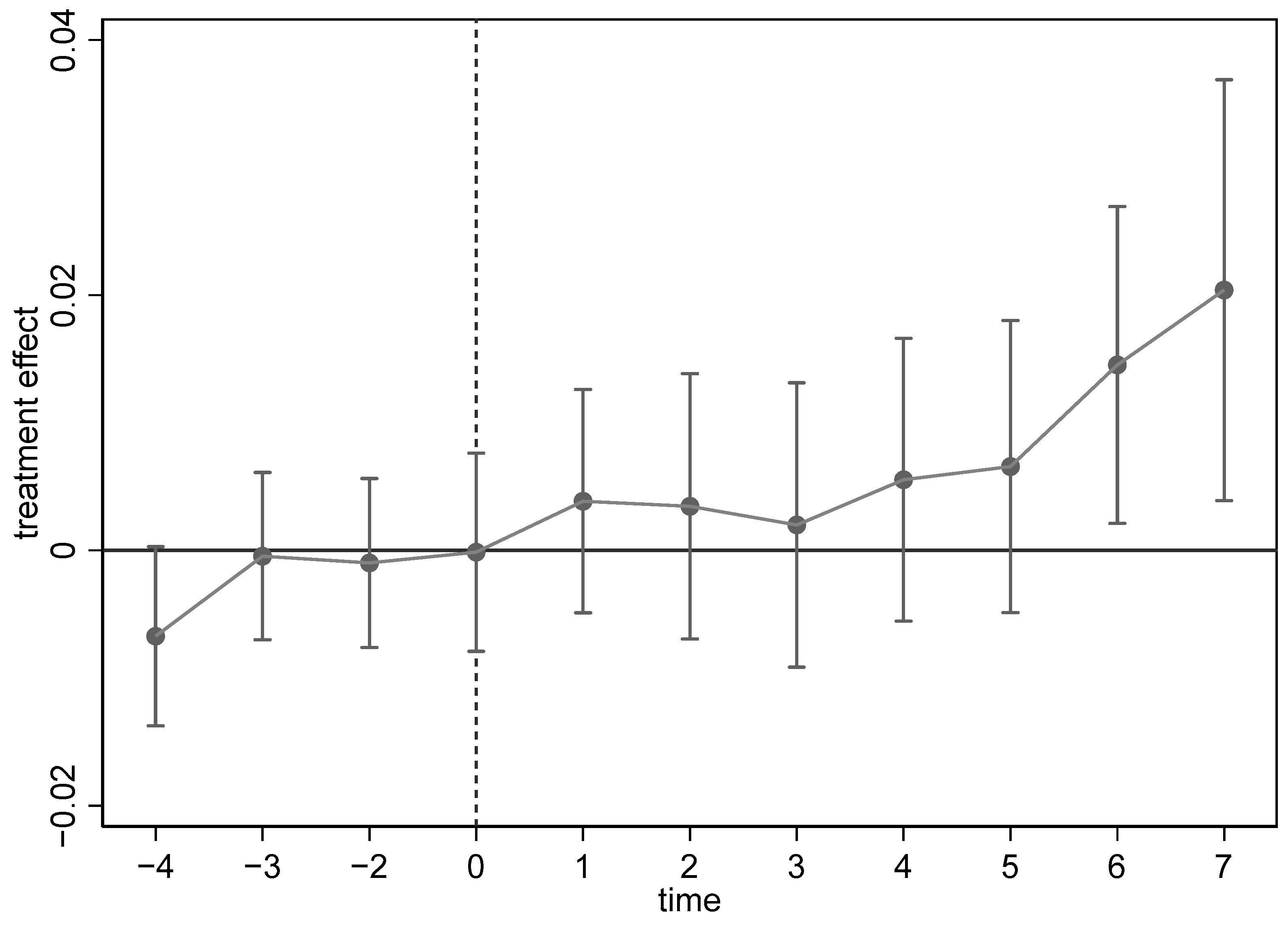
To ensure the validity of the DID estimation, a parallel trends test is conducted using the period before policy implementation as the baseline. The results are shown in
Figure 1. Before policy implementation, there is no significant difference in trends between the treatment and control groups, as the coefficients for each pre-period are not significant. A joint significance test for all pre-treatment coefficients yields an F-statistic of 1.79 (
p = 0.1501), failing to reject the null that all pre-treatment coefficients are jointly zero. Thus, there is no significant anticipatory policy effect, and the parallel trends assumption is satisfied.
As shown in
Table 5, the post-treatment coefficients are not significant for the first and second years after policy implementation (
p > 0.1), indicating a short-term lag in the policy effect. From the third to the fifth year, the coefficients become positive but not yet statistically significant at conventional levels. From the sixth and seventh years onward, the coefficients become significantly positive and increase in magnitude. This dynamic pattern confirms that the promoting effect of climate-adaptive city construction on GTFP is released with a lag, consistent with the strong Porter hypothesis’s expectation that innovation compensation requires an adjustment period.
5.3.2. Placebo Test
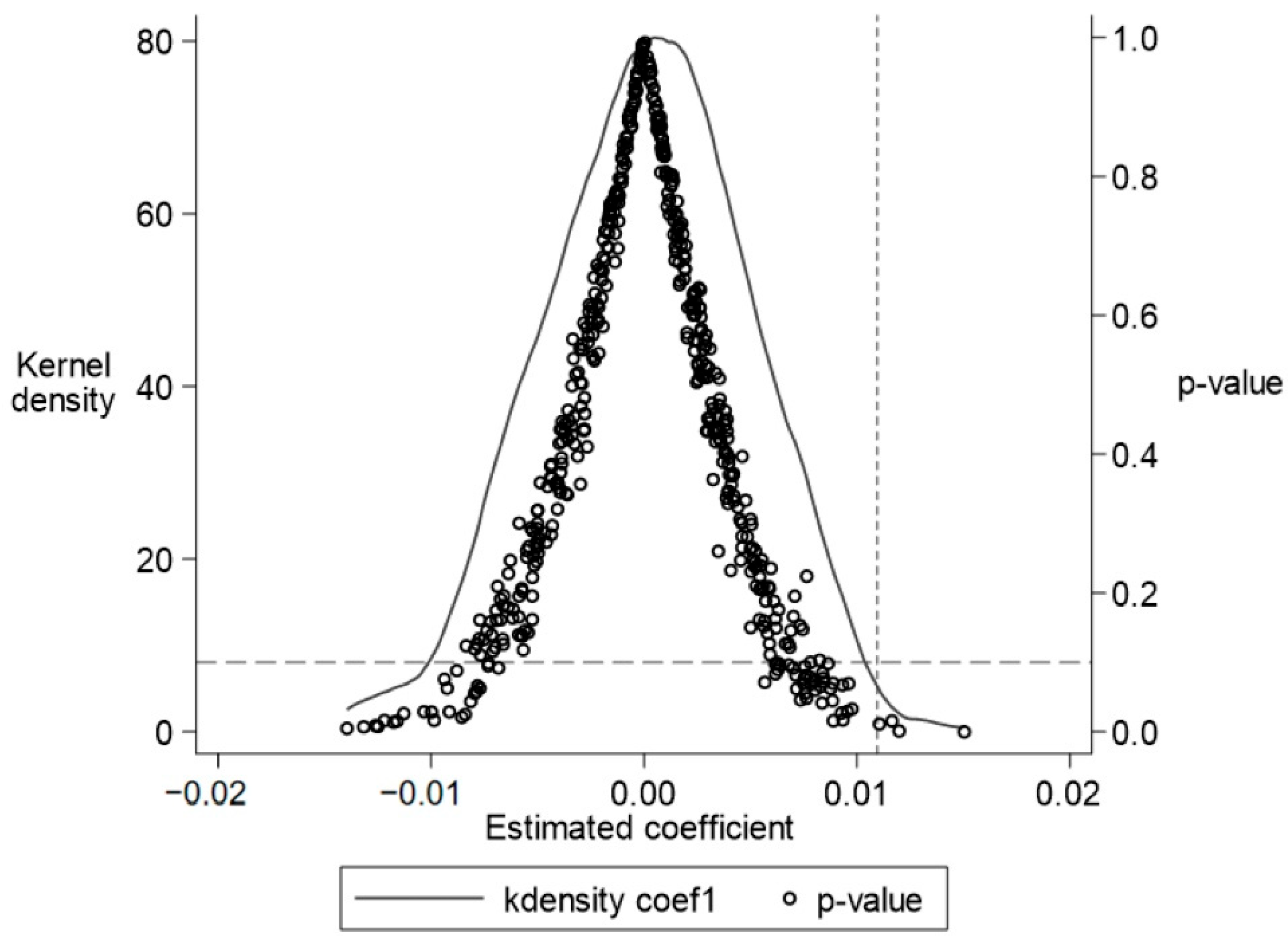
To ensure that the estimated policy effects are not driven by omitted variables or random factors, a permutation-based placebo test is conducted. Using Monte Carlo simulations, 500 sets of pseudo-treatment groups are randomly generated, each time randomly selecting the same number of cities as actual pilot cities and randomly assigning policy implementation years to construct pseudo-policy variables for regression. As shown in
Figure 2, the kernel density of the estimated coefficients is centered around zero and follows a normal distribution. Compared with the true policy effect coefficient of 0.011 (vertical line in
Figure 2), most of the pseudo coefficients are not significant. This indicates that the promoting effect of climate-adaptive city construction on GTFP is not due to data noise or model misspecification, and the main findings are robust.
5.3.3. Heterogeneous Treatment Effects Diagnostics
The staggered implementation of the climate-adaptive city pilot policy across different years may lead to bias in the traditional two-way fixed effects DID estimator due to inappropriate comparisons between treatment and control groups [
42]. To assess this risk, we employ the imputation estimator proposed by Borusyak et al. (2024) [
43], which does not rely on the linear TWFE specification and provides unbiased estimates under heterogeneous treatment effects. Column (1) of
Table 6 shows a treatment effect of 0.012, which is significant and highly consistent with the baseline result. Next, a Bacon decomposition is performed. As shown in
Table 7, among all 2 × 2 DID comparisons that constitute the overall estimator, the comparisons using “never-treated cities” as the control group dominate, accounting for 94.40% of the weight, with an average effect of approximately 0.012, very close to the baseline DID coefficient. In contrast, the “later-treated vs. earlier-treated” comparisons, which could potentially bias the estimates, account for only 0.50% of the weight, and some of them have negative coefficients. However, due to their negligible weight, they do not materially affect the overall conclusion. This analysis indicates that treatment effect heterogeneity does not seriously distort the core findings, and the baseline results are highly credible.
5.3.4. Other Robustness Tests
To further strengthen the credibility and generalizability of the findings, the following eight robustness checks are performed, with results reported in
Table 8.
(1) Controlling for other policies. The results may be affected by contemporaneous policies. First, the low-carbon city pilot policy is an important initiative to promote green and low-carbon development. Second, the national carbon peak pilot policy, launched in 2023, focuses on key areas such as green energy transition, industrial upgrading, and energy conservation. Both policy dummies are included in the baseline model. Column (1) of
Table 8 shows that after controlling for these contemporaneous policies, the core coefficient for climate-adaptive city construction remains significantly positive and similar in magnitude to the baseline.
(2) Cross-sectional dependence-robust standard errors. Although the CD test (
p = 0.66) suggested no cross-sectional dependence, we also re-estimate using Driscoll–Kraay (1998) [
44] standard errors, which are robust to heteroskedasticity, autocorrelation, and cross-sectional dependence. Column (2) shows the coefficient remains significantly positive (D-K s.e. = 0.00185,
p < 0.01), confirming that cross-sectional dependence does not affect the core conclusion.
(3) Alternative dependent variable. The baseline GTFP measure uses industrial wastewater, SO
2, and dust as undesirable outputs. To verify robustness, CO
2 emissions are added as an additional undesirable output [
45], and GTFP is re-computed using the same EBM model. Column (3) shows the coefficient for did1 remains significantly positive.
(4) Excluding the second-batch pilot cities. The second batch of 39 pilot cities was launched in 2024, and the sample period ends in 2024, leaving almost no post-policy observations for these cities, which could systematically understate the policy effect. Excluding all 2024 observations, Column (4) shows the coefficient remains significantly positive.
(5) Excluding the COVID-19 pandemic period (2020–2022). Lockdowns, production disruptions, and supply chain issues during the pandemic may have had abnormal external effects on GTFP. Excluding 2020–2022 observations, Column (5) shows the coefficient remains significantly positive.
(6) Excluding the four municipalities directly under the central government. The four municipalities—Beijing, Shanghai, Tianjin, and Chongqing—differ in administrative level, resource allocation, and policy priority, which may bias the estimates. After excluding them, column (6) shows that the coefficient remains significantly positive.
(7) Lagged policy variable. To mitigate reverse causality concerns, the policy variable is lagged by one period. Column (7) shows the coefficient remains significantly positive.
(8) Adding additional control variables. Capital investment and population size are important determinants of GTFP [
46]. Adding the share of fixed asset investment and population density as additional controls, Column (8) shows the core coefficient remains significantly positive.
5.4. Mechanism Tests
5.4.1. Firm Entry Mechanism
To investigate whether the climate-adaptive city pilot policy promotes green total factor productivity by facilitating firm entry, thereby testing Hypothesis H2, the following tests are conducted. Column (1) of
Table 9 shows that the estimated coefficient of the pilot policy is significantly positive, indicating that after policy implementation, firm entry increased in pilot cities relative to non-pilot cities. To verify the robustness of this finding, an alternative measure of firm entry—the number of newly established firms per square kilometer (Tea2)—is used, and the results are reported in column (2) of
Table 9. The results again show that climate-adaptive city construction promotes GTFP. Schumpeter’s theory of “creative destruction” argues that the entry of new firms and the exit of inefficient firms are core drivers of technological progress and resource allocation optimization [
47]. The pollution halo hypothesis further emphasizes that the entry of firms with advanced green technologies and environmental management practices can drive the cleaner transformation of upstream and downstream firms through technology spillovers and demonstration effects, thereby promoting regional GTFP growth [
48,
49]. In recent years, a growing body of empirical studies has also supported the positive effect of firm entry on GTFP [
50,
51].
Although firm entry generally has a positive effect on GTFP, firms with different pollution attributes may respond differently to the policy. Under climate-adaptive city construction, non-polluting firms are more likely to reap green dividends. Therefore, the effect of the pilot policy on the entry of non-polluting firms is further examined. Columns (1) and (2) of
Table 10 both show that, regardless of whether the number of newly established firms per 10,000 persons or per square kilometer is used, the estimated coefficient for pilot cities is significantly positive, indicating that pilot cities experienced a significant increase in the entry of non-polluting firms relative to non-pilot cities. The climate-adaptive city pilot policy sends a clear signal of green development to the market, effectively alleviating environmental information asymmetry faced by potential non-polluting firms. Moreover, by creating derived demand for green infrastructure and low-carbon technology services, and by strengthening market screening mechanisms, the policy significantly increases the probability of non-polluting firm entry in pilot cities.
The temporal dynamics of the policy effect, shown in columns (3) and (4) of
Table 9 and
Table 10, indicate that for both total firm entry and non-polluting firm entry, the effect is not significant in the short run but becomes significantly positive in the long run. This dynamic pattern aligns with the “time-lag effect” in policy economics. Policy transmission typically requires an initial adjustment phase before longer-term effects materialize. New firms’ responses involve complex steps such as initial resource mobilization, financing, and approval processes, so the policy effects do not appear immediately but emerge gradually over the medium and long term.
5.4.2. Talent Agglomeration Mechanism
To further investigate whether the climate-adaptive city pilot policy enhances GTFP by increasing talent agglomeration, thereby testing Hypothesis H3, the following tests are conducted. Using Hum1 as the measure, column (1) of
Table 11 shows that the estimated coefficient of the pilot policy is positive but not significant. The dynamic decomposition in column (2) shows that the short-term coefficient is negative and the long-term coefficient is positive, but neither is statistically significant. The effect of environmental quality on talent location choices may depend on urban income levels. Income level is a key threshold determining individuals’ willingness to pay for environmental improvements, with higher-income groups having a greater willingness to bear environmental premiums [
52]. Therefore, this study further selects a subsample of cities that had at least one A-share listed company in every year of the sample period (2006–2024), resulting in a balanced panel of 254 prefecture-level cities. In this subsample of cities with a relatively strong economic foundation, the effect of climate-adaptive city construction on talent agglomeration is re-examined. Column (3) of
Table 11 shows that the estimated coefficient of climate-adaptive city construction on talent agglomeration is significantly positive. The factor endowment structure determines the path of industrial structure upgrading. Cities with a strong economic foundation have generally moved beyond the initial stage of relying solely on cheap labor and resource inputs, and have developed an industrial structure dominated by knowledge-intensive services and technology-intensive manufacturing. When high-skilled talent agglomerates in such cities, strong knowledge spillovers occur through face-to-face communication, labor mobility, and inter-firm cooperation. These spillovers directly improve firms’ R&D efficiency and production management capabilities, significantly promote green technology innovation and diffusion, and thereby greatly enhance GTFP [
53]. Endogenous growth theory argues that the externalities of knowledge and human capital are internal drivers of long-term economic growth, and the geographical agglomeration of talent greatly accelerates the release of these positive externalities. Marshall (1920) [
54] argued that the spatial agglomeration of industries and talent creates vibrant labor market pooling and knowledge spillovers, enabling firms to more easily access new environmental concepts and green technology solutions, thereby building a virtuous innovation ecosystem. At the same time, the concentration of talent in high-efficiency green industries and production units effectively reallocates capital, labor, and other production factors from high-pollution, low-efficiency sectors to green and efficient sectors, ultimately improving the green total factor productivity of the entire economic system. The dynamic results in column (4) of
Table 11 show that the short-term effect is not significant, while the long-term effect is significantly positive. In the early implementation period, infrastructure upgrades and industrial transformation are not yet in place, and there are lags in the recognition of policy signals and adjustment of location decisions by high-skilled talent, so the effect is not significant. In the long run, as the ecological environment of pilot cities continues to improve, green industries mature, and the employment structure optimizes, the talent-attracting effect of the policy is gradually released, and talent agglomeration increases significantly. Thus, Hypothesis H3 is confirmed.
To ensure the logical completeness of the mediation analysis, the baseline regression and all robustness tests are re-estimated on the subsample of 254 cities. The results show that climate-adaptive city pilot construction still has a significant positive effect on GTFP in this subsample, and all robustness checks are passed. Due to space limitations, the detailed regression results for this subsample are reported in
Supplementary Materials.
To verify the robustness of the talent agglomeration results, an alternative measure, Hum2, is used.
Table 12 shows that in the full sample, the estimated coefficient of the policy variable is positive but not statistically significant, and neither the short-term nor the long-term effect is significant. This suggests that the talent agglomeration mechanism may not be universal but rather depends on specific urban economic conditions. To test this possibility, a heterogeneity analysis by urban economic development level is conducted. The year 2010 marked China’s emergence as the world’s second-largest economy, signaling a transition from high-speed to medium-high-speed growth. Moreover, 2010 predates the first policy implementation year (2017), so the grouping variable is exogenous to the policy shock and not affected by policy implementation. Therefore, GDP in 2010 is used to capture initial differences in urban economic development, and the sample is split based on each city’s real GDP in 2010. The splitting method is as follows: a city is classified into the higher economic development group if its real GDP in 2010 exceeded the median real GDP of all prefecture-level cities in that year; otherwise, it is classified into the lower economic development group. In the higher-development subsample, as shown in columns (3) and (4) of
Table 12, the effect of the policy on talent agglomeration is significantly positive. Further decomposing the policy effect into short-run and long-run components reveals that the short-run coefficient is not significant, while the long-run coefficient is significantly positive. This result supports the theoretical expectation of the Rosen–Roback spatial equilibrium model that environmental quality behaves as a luxury good; that is, only when a city’s economic development level exceeds a certain threshold does the livability of the environment play a significant role in talent location choices.
5.5. Heterogeneity Analysis
5.5.1. Heterogeneity of Urban Geographic Location
The Qinling Mountains–Huaihe River line is widely recognized as the geographical dividing line between northern and southern China, and also serves as the demarcation line for winter centralized heating. Northern cities (north of the line) use coal-fired centralized heating, while southern cities do not. Coal-fired heating substantially increases emissions of air pollutants such as particulate matter, sulfur dioxide, and nitrogen oxides, leading to significant differences in air pollution levels and pollution control needs between the north and the south. Considering the innate differences in resource endowments and socioeconomic development between the two regions, this paper constructs a geographic location dummy variable, QIN_Line, which takes the value 1 for northern cities and 0 for southern cities. We then include the interaction term QIN_Line × Policy in the regression model. As shown in column (1) of
Table 13, the coefficient of QIN_Line × Policy is significantly negative, indicating that the promoting effect of the climate-adaptive city construction policy on GTFP is significantly weaker in northern cities than in southern cities. A plausible explanation is that northern cities, due to historical coal-fired heating, have much higher baseline air pollution levels, so they face higher remediation costs for improving air quality and urban ecological environments. This, to some extent, dampens the policy effect. In contrast, southern cities enjoy a better climate and environmental foundation, have higher efficiency in resilient infrastructure transformation, and are more likely to trigger policy transmission and factor attraction effects [
18].
5.5.2. Heterogeneity of Urban Resource Endowment
Resource-based cities and non-resource-based cities differ greatly in industrial structure, economic development model, and environmental governance capacity. To examine the possible heterogeneous impact of climate-adaptive city construction on GTFP between these two types of cities, this paper uses the classification list from the National Plan for the Sustainable Development of Resource-Based Cities (2013–2020) issued by the State Council, and constructs a dummy variable, Resource, which takes the value 1 for resource-based cities and 0 otherwise. We then include the interaction term Resource × Policy in the regression. As shown in column (2) of
Table 13, the coefficient of Resource × Policy is significantly negative, indicating that the promoting effect of the policy on GTFP is significantly weaker in resource-based cities than in non-resource-based cities. Compared with non-resource-based cities, resource-based cities have long relied on traditional resource-intensive industries and suffer from unreasonable industrial structures, making it difficult for them to rely solely on such structures to achieve GTFP improvement through climate-adaptive city construction [
55].
5.5.3. Heterogeneity of Urban Transportation Location
Transportation hub cities are usually located at key nodes of national or regional transportation networks, and the agglomeration effects and information spillovers of firm investment and talent mobility are more pronounced there. To explore the heterogeneous role of transportation hub status in the policy effect, this paper refers to the Medium- and Long-Term Railway Network Plan (2016) and constructs a dummy variable, Hub, which takes the value 0 for transportation hub cities and 1 for non-hub cities. We then include the interaction term Hub × Policy in the regression. As shown in column (3) of
Table 13, the coefficient of Hub × Policy is significantly negative, indicating that the promoting effect of the policy on GTFP is significantly weaker in non-hub cities than in hub cities. A plausible explanation is that transportation hub cities have significantly stronger economic agglomeration and industrial agglomeration effects. Higher factor mobility and industrial development levels make it easier to amplify and diffuse the positive effect of the climate adaptation policy on GTFP [
56].
6. Conclusions and Policy Implications
Based on a quasi-natural experiment of the Climate-Adaptive City Pilot Policy, this paper constructs a theoretical model to systematically analyze the internal pathways through which climate-adaptive city construction improves green total factor productivity. Using panel data from 280 Chinese cities for the period 2006–2024 and a staggered difference-in-differences model, the study empirically examines the impact of climate-adaptive city construction on GTFP and its transmission mechanisms. The main findings are as follows.
Climate-adaptive city construction significantly improves GTFP. The effect is not significant in the short run but becomes significant in the long run, consistent with the dynamic expectation of the strong Porter hypothesis. This conclusion is supported by parallel trends tests, placebo tests, and various robustness checks.
Mechanism analysis shows that climate-adaptive city construction enhances GTFP by promoting firm entry, especially the entry of non-polluting firms. This effect is also not significant in the short run but becomes significant in the long run.
In the full sample, the promoting effect of climate-adaptive city construction on talent agglomeration is not significant. However, when the sample is restricted to cities with a strong economic foundation and persistently active capital markets, the policy’s effect on talent agglomeration becomes significantly positive, again exhibiting short-run insignificance and long-run significance. The talent-attracting effect of the policy requires cities to have a relatively high level of economic development and the ability to pay for human capital, which is consistent with the theoretical expectation from the Rosen–Roback spatial equilibrium model that environmental quality behaves as a luxury good.
Compared with existing studies, this paper makes four main contributions.
First, an innovative research perspective. Most existing studies focus on supply-side emission reduction policies such as low-carbon city pilots and carbon emissions trading. In contrast, this paper adopts an adaptation-oriented rather than a mitigation-oriented perspective, systematically evaluating the impact of climate-adaptive city construction policies—which center on resilient infrastructure and public goods provision—on GTFP.
Second, a deeper theoretical mechanism. Although existing studies have mentioned that environmental quality can attract high-skilled talent and firms, few have systematically incorporated both talent agglomeration and firm entry (especially non-polluting firm entry) into a unified mechanism. This study integrates talent agglomeration and firm entry into the mechanism analysis, responding to the core logic of location choice theory that environmental quality drives regional GTFP improvement through the coordinated effects of knowledge spillovers and human capital externalities.
Third, an exploration of dynamic effects. Most studies focus only on the average treatment effect of policies, ignoring the temporal evolution of effects. This study divides the policy window into short-run and long-run periods, empirically revealing the lagged release pattern—insignificance in the short run and significance in the long run—for firm entry, talent agglomeration, and GTFP improvement. This finding responds to the Porter hypothesis’ theoretical expectation that innovation compensation requires an adjustment period and provides dynamic empirical evidence for phased policy evaluation.
Fourth, identification of heterogeneous conditions. This paper systematically examines the heterogeneous effects of the policy from three dimensions: geographic location, resource endowment, and transportation hub status. The results provide targeted guidance for place-based and differentiated policy implementation.
Based on the above conclusions, the following policy recommendations are proposed.
First, establish cross-departmental coordination mechanisms and integrate climate-adaptive city construction into the “One Map” of territorial spatial planning. Quantitative targets for sponge cities, waterlogging control, and climate monitoring and early warning should be clearly defined and incorporated into the “One Map” system. In terms of green finance, commercial banks should be encouraged to include climate adaptation projects in special green credit quotas, offering interest rate discounts and approval priority to projects in the project database. Through departmental coordination and fund integration, the simultaneous implementation of software and hardware for climate-adaptive city construction can be ensured.
Second, establish a dynamic evaluation mechanism to overcome the time mismatch in policy effectiveness. The green growth effect of climate-adaptive city construction has a significant lag. It is recommended that the national level appropriately extend the policy evaluation cycle for pilot cities and set phased, non-linear performance targets. In the early years, process indicators such as infrastructure investment completion rates and green credit coverage should be emphasized; in later years, outcome indicators such as GTFP improvement and the share of non-polluting firms should be prioritized. Local governments should maintain policy consistency and avoid reducing or weakening financial support for adaptation projects due to insignificant short-term data.
Third, implement differentiated talent attraction strategies based on economic foundations. Cities with a higher level of economic development can more effectively convert environmental improvements into net talent inflows. For cities with strong economic foundations, it is recommended to focus on climate investment and financing, talent housing programs, and green innovation platforms, thereby fully leveraging the positive feedback loop of talent agglomeration. For cities with relatively weak economies, the policy priority should be placed on filling gaps in resilient infrastructure and improving the business environment, avoiding the blind copying of high-salary talent attraction models from developed regions.
Fourth, adopt a classified approach to firm entry pathways, strengthening ex-ante guidance and factor guarantees for non-polluting firms. Pilot cities are advised to establish a climate-adaptive enterprise directory during project approval and to create green channels for enterprises on the directory in terms of land use, environmental impact assessment, and financing. Relying on climate investment and financing pilot platforms, firms’ carbon emission reduction performance should be directly linked to loan interest rates and credit limits. At the same time, for the existing production capacity of heavily polluting firms, a one-size-fits-all shutdown approach should be avoided. Instead, market-based methods such as green technology transformation subsidies and capacity replacement trading should be used to guide gradual exit or transformation, avoiding industrial chain disruptions and employment shocks.
Fifth, tailor policy tools to local conditions, leveraging the differentiated advantages of transportation hubs and resource-based cities. Transportation hub cities should fully utilize their advantages in economic agglomeration and knowledge spillovers by establishing climate adaptation technology R&D centers and green financial service centers, hosting cross-regional climate investment and financing matchmaking events, and attracting out-of-city firms. Resource-based cities should deeply integrate climate adaptation policies with special policies such as the transformation of resource-exhausted cities, coal mining subsidence area management, and ecological restoration of industrial and mining wastelands, giving priority support to green alternative industries such as photovoltaics, wind power, and ecotourism, while granting longer acceptance cycles and higher central government matching ratios. Southern pilot cities have accumulated rich experience in climate-adaptive construction. It is recommended to establish “one-to-one” or “many-to-one” pairing relationships between southern and northern pilot cities, regularly conducting planning training, project database co-development, and technical solution sharing to shorten the learning curve and adjustment period for northern cities.
7. Limitations and Future Directions
This paper has significant theoretical value and practical implications. It provides robust evidence that climate-adaptive city construction improves GTFP and enriches the understanding of climate-adaptive city construction. For policy makers, the conclusions and recommendations offer valuable insights for establishing climate-adaptive city construction in a more scientific and rational manner. Nevertheless, the study has some limitations.
First, insufficient granularity in firm classification. This paper classifies firms only into polluting and non-polluting categories based on pollution attributes, without further distinguishing between neutral firms, green firms, and other more detailed categories. Future research could further identify the differentiated responses of green firms versus neutral firms to more precisely evaluate the policy’s green screening effect.
Second, the long-run dynamic evolution of policy effects remains to be tracked. The sample period of this paper ends in 2024, and the post-policy observation period for the second batch of pilot cities is relatively short. As more data accumulate, future studies could track the policy effects over a longer time horizon, examining whether the policy dividends decay, saturate, or continue to strengthen over time, thereby providing richer empirical evidence for the dynamic evaluation of climate adaptation policies.
Third, since climate-adaptive city policies may generate spatial spillovers to neighboring cities through demonstration effects and factor mobility, and this indirect effect has not been examined in the current study, future research could employ spatial econometric models to further investigate this mechanism.
Furthermore, although this study employs instrumental variable methods to address endogeneity and discusses the validity of the identification strategy as thoroughly as possible, to further enhance the robustness of the conclusions, future research could attempt to find cleaner exogenous shocks or adopt more advanced causal inference methods, such as shift-share IV and double/debiased machine learning, to further strengthen the identification of the policy effects.