Article

Enhancing Sustainability in Healthcare Facilities: The Role of Energy Performance Contracts in Hospital Renovation


Design & Health Lab, Department ABC, Politecnico di Milano, 20133 Milan, Italy
*
Author to whom correspondence should be addressed.
Sustainability 2026, 18(12), 5878; https://doi.org/10.3390/su18125878 (registering DOI)
Submission received: 1 May 2026 / Revised: 5 June 2026 / Accepted: 5 June 2026 / Published: 9 June 2026
(This article belongs to the Special Issue Sustainability and Energy Performance of Buildings)

Abstract

Healthcare facilities are among the most energy-intensive public infrastructures due to their continuous operations, complex systems, and critical service requirements. In this context, Energy Performance Contracts (EPCs) have gained increasing attention as a strategic tool for enhancing energy efficiency and sustainability in healthcare facilities. This paper investigates the potential and implementation of EPCs in the hospital sector, with a particular focus on their integration within Public–Private Partnership (PPP) frameworks. The study addresses that gap through a cross-case analysis of fourteen hospital EPC projects implemented in Italy, the United Kingdom, the Nordic countries and Central-Eastern Europe, mapping their technical scope against a three-family taxonomy (envelope, plant systems, regulation and monitoring) and benchmarking their energy and economic performance. All figures reported derive from project documentation and contractual monitoring records. The results show that envelope-led configurations deliver the deepest reductions in primary and final energy consumption (up to 50% on the baseline), while plant-side measures, and trigeneration in particular, generate the largest absolute CO2 savings (from approximately 500 to 17,000 tCO2eq/yr); lighting, and building management systems (BMS) retrofits, although ubiquitous, account for a 20–25% band when deployed in isolation. The findings reframe EPCs as a configurable contract for decarbonization in healthcare environments and offer practitioners a reading grid for scoping future hospital retrofits under this framework.

1. Introduction

Healthcare facilities are among the highest energy-intensive facilities, due to their 24/7 operations and critical service requirements [1]. Together with other healthcare facility typologies, hospitals exhibit some of the highest energy intensities among non-residential buildings, primarily due to their continuous operation, primarily divided between thermal energy and electricity consumption [2,3]. Reported direct and indirect energy consumption typically ranges between 230 and 330 kWh/m2 per year, with consistent values observed across different regions and time periods [3,4]. The composition of this demand is dual. Thermal energy is essential for a range of services including space heating and cooling, domestic hot water production, sterilization, laundry, and kitchen operations. On the other hand, electricity supports the clinical core of the facility, such as medical and diagnostic equipment, lighting, HVAC systems, refrigeration, elevators, the operation of digital infrastructure and security systems [5]. The combination of this sustained, dual-vector demand, coupled with increasing pressure to reduce operating costs and carbon emissions of public organizations at the EU level, has made hospitals a strategic target for the energy retrofitting agenda [6,7].
Within the European region, many contexts present an outdated healthcare building stock, mostly built between the 1940s and 1970s, that exacerbates the sustainability challenge posed by increasing clinical and technological complexity [8]. At the same time, the relationship between building age and energy performance is not linear. As more high-demanding clinical activities have been moved to areas of the hospital, the empirical evidence from previous studies suggests that the negative association between building age and average energy expenditure is limited (R2 = 0.1912). This shows that operational configuration, system upgrades and retrofit interventions have a more substantial influence on building energy intensity (BEI), rather than building age alone [9]. This evidence explains that attention has converged on new instruments capable of mobilizing private technical capacity and capital against an outcome-based remuneration scheme. Within this analytical horizon, Energy Performance Contracts (EPCs) have emerged as a promising vehicle through which the energy-efficiency and decarbonisation potential of the European hospital stock can be unlocked at scale [10].

1.1. Energy Performance Contracts: Model Overview and Mechanism

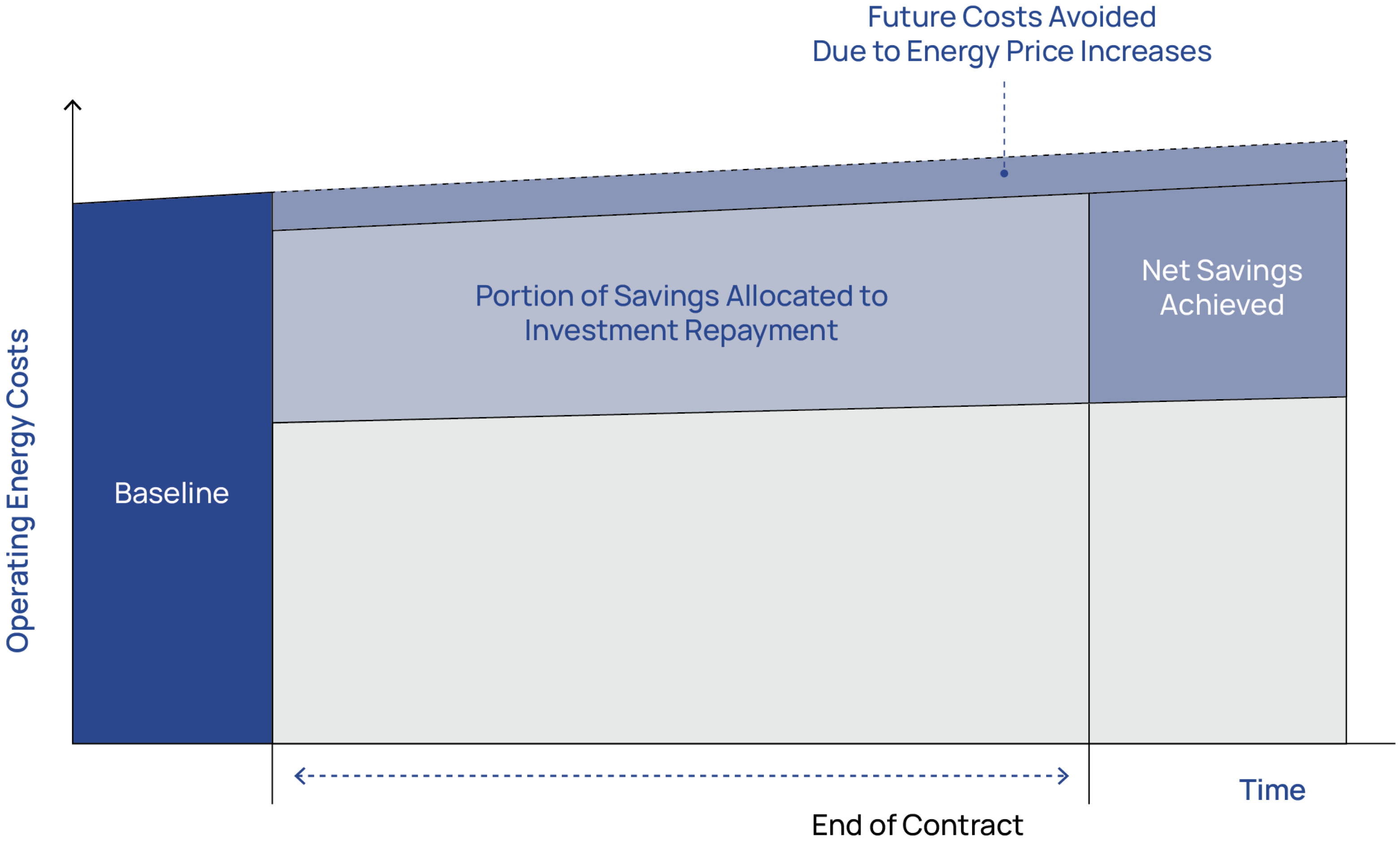
An EPC is a performance-based financing arrangement, under which the implementation of energy-efficiency measures is undertaken with the explicit objective of reducing the energy consumption and the operating costs, without requiring upfront capital investment from the upgraded organization [11]. Capital investment cost (CapEx) is progressively repaid and amortized over the contractual horizon, with the energy savings generated by the interventions (Figure 1). The model replaces the traditional logic of public procurement, where the purchase of assets and services against a specification, with an outcome-based logic in which the Energy Service Company (ESCo) is remunerated against contractually guaranteed performance targets, and in which the alignment between the incentives of the private partner and the energy-efficiency objectives of the public client is built into the contractual structure itself.
Over the last few decades, despite widespread application in North America, the diffusion of EPCs in Europe has been slower, due to fragmented regulatory frameworks [12]. However, the most recent scientific records confirm that in Europe EPCs are increasingly adopted by public authorities as a tool to implement energy efficiency upgrades in public buildings, including hospitals, with growing interest due to their off-balance-sheet nature and performance-based structure, while risks associated with EPC projects have also been debated [13,14].
As a result of the increasing institutional pressure for the retrofit of energy buildings, EPCs have emerged as an adopted instrument within public sector investment, to enable the implementation of energy efficiency measures without requiring immediate capital outlay from public authorities [15]. A definitive framework was provided in 2017, dealing with the conditions under which EPCs should be recorded in national public accounts. According to this guidance, an EPC may be classified off the public balance sheet only if the ESCo is deemed the economic owner of the installed assets, which presupposes that the company assumes the major share of the project’s risk and is entitled to a corresponding majority of the benefits [15,16]. Under the guaranteed savings model, the ESCo is responsible for the design, implementation, and performance verification of the energy-efficiency measures, and contractually guarantees a minimum level of savings. Where this risk transfer is sufficiently comprehensive, the conditions for off-balance-sheet treatment under Eurostat and ESA 2010 rules can be met, making this model structurally attractive for public-sector clients operating under fiscal constraints.
Under the shared savings model, the ESCo additionally assumes responsibility for project financing. Energy cost savings generated during the contract period are divided between the ESCo and the public client according to a pre-agreed ratio. In recent years, EPCs are increasingly seen as a specific application of outcome-based contracting (OBC) within the field of public infrastructure procurement. Rooted in performance-driven logic, EPCs are structured around the delivery of measurable and verifiable outcomes, rather than the execution of predefined inputs or technical specifications. Under this model, the ESCO is remunerated on the basis of contractually guaranteed performance targets. In the OBC perspective, moving from procuring physical assets or services to commissioning the achievement of defined outcomes, the EPC model aligns incentives with the achievement of objectives. In this framework, EPCs can also internalize avoided future energy price inflationary phenomena, thereby increasing long-term economic resilience against volatility in energy markets [17]. EPCs structurally align private financial incentives with public sustainability and environmental impact reduction objectives, making verified decarbonisation not a desirable byproduct but the contractual currency of the entire arrangement.

1.2. Study Aim

The application of EPC arrangements to the healthcare sector, and specifically to hospital infrastructure, remains significantly underexplored at an empirical and comparative level. This happens despite the sector’s distinctive combination of high and continuous energy demand and increasing complexity of healthcare infrastructures. Against this background, the present study aims to investigate how EPC-based energy retrofitting interventions are operated in European hospital settings and define the most common and high-impact interventions under this framework, addressing two research questions: (RQ1) What technical intervention configurations are deployed in hospital EPC projects across different European contexts? (RQ2) Which interventions deliver the greatest energy and carbon impact under hospital EPCs, and through what mechanisms do performance outcomes differ across families?

1.3. Theoretical Positioning of the Study

Energy Performance Contracts can be theoretically situated within the New Public Management (NPM) framework, as a specific and advanced instrument of performance-based public procurement. In this context, EPCs are framed as an advanced expression of NPM’s performance contracting logic, specifically with the outcome-based contracting (OBC) applications. OBC marks a decisive shift from NPM instruments, towards payment contingent solely on the verified achievement of pre-specified outcomes, relocating accountability from procedural compliance to demonstrated real-world impacts [8]. The EPC operationalises this shift with structural precision: ESCO remuneration is conditional on independently verified energy savings sustained over the full contract horizon, rendering reduced energy consumption and carbon emissions a contractual currency of the entire arrangement.

2. Materials and Methods

The study adopts a qualitative, multiple-case study research design [18], to investigate the application of EPC, in the context of hospital facilities. Specifically, the research investigates how EPCs can support energy-efficient renovation in hospitals, by assessing a combination of contractual models and performance outcomes. Within this design, the analysis was structured by a defined analytical framework, as described in Section 2.2, that assesses the EPC implementation along six dimensions. Each case was analyzed against the framework, through a structured documentary analysis, and the cases are then interpreted comparatively through cross-case synthesis.

2.1. Analytical Framework

The analytical framework adopted in this study comprises six dimensions, derived inductively from the prior literature on EPCs [14,15,19], and refined through preliminary engagement with the empirical material. The six dimensions jointly capture the technical, contractual, financial and environmental architecture of an EPC, and provide the coding lens applied to each case in the cross-case analysis. Their definitions and structures are reported in Table 1.
The framework is heterogeneous by design. Three of the six dimensions (payback, contract duration, investment scale) are quantitative and continuous; one (environmental performance) is quantitative with multiple indicators; the remaining two (energy efficiency measures, remuneration model) are qualitative-categorical. The study aims to develop a conceptual and analytical framework to support future empirical investigation in the area of application of EPC models in healthcare settings. By consolidating existing knowledge and identifying recurring patterns at the European level, the study seeks to contribute to the debate on how to scale and structure performance-based energy efficiency interventions in public hospitals.

2.2. Case Selection and Data Sources

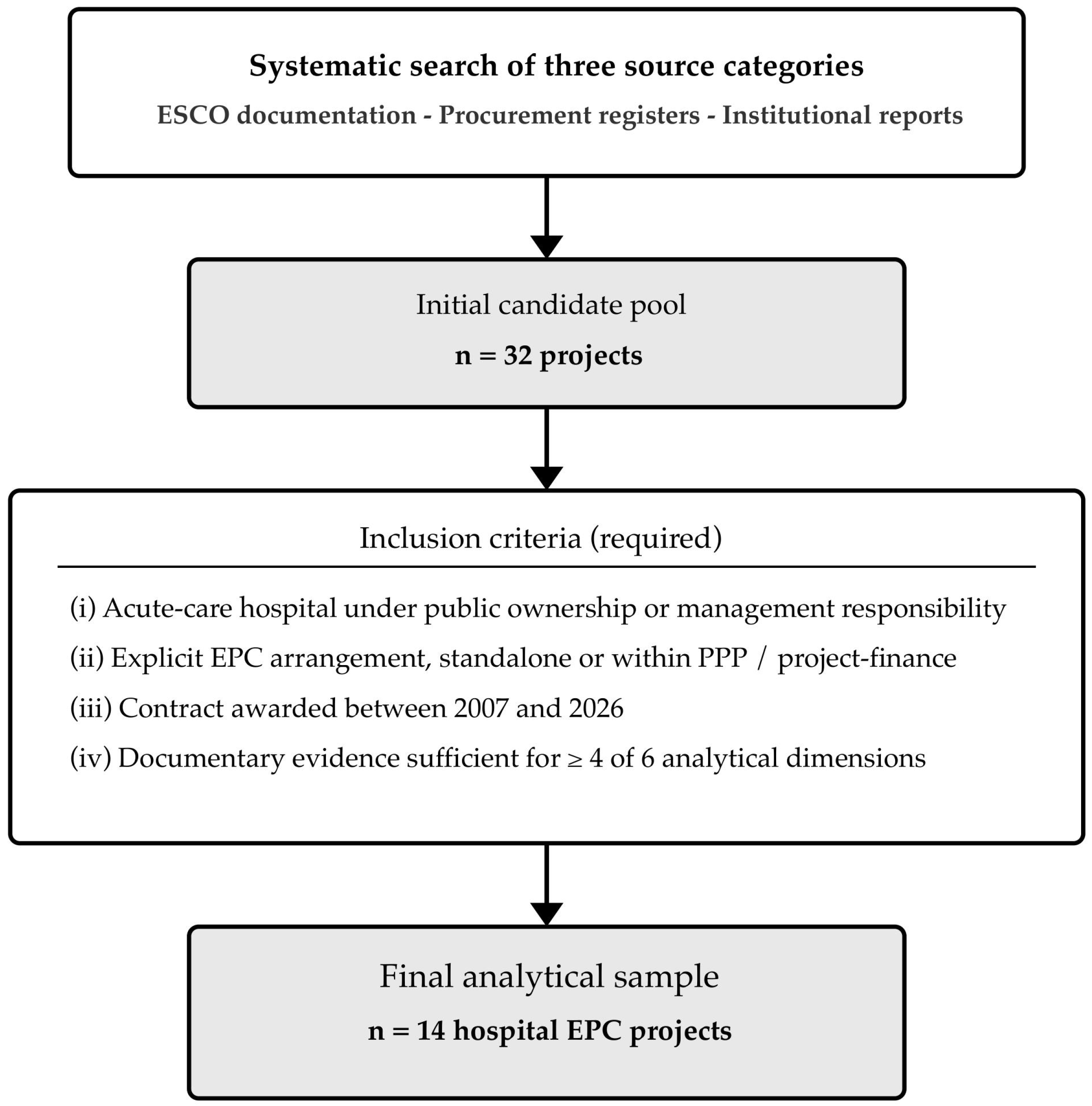
The empirical analysis is based on multiple documentary sources. For each case evidence was gathered, across at least two of the following classes of documents: project documentation provided by the ESCos involved (e.g., technical specifications, contractual schedules, monitoring reports, performance verification protocols), particularly for the Italian market; tender and procurement records available in institutional portals, institutional reports and project deliverables of European programmes and financing institutions. Case selection is described in Figure 2. The first search identified an initial pool of (n = 32) potential EPC project candidates, across Europe, that appeared to meet the general scope of the study.
In the second phase, each candidate project were retained if they met all of the following inclusion criteria: (i) the project concerned an acute-care hospital, operating in the European region; (ii) the contractual scope explicitly included an EPC, within a broader Public–Private Partnership (or project-finance) arrangement; (iii) the project reached at least the contract-award stage between 2007 and 2026. The application of these criteria reduced the initial pool to (n = 14) cases, distributed across Italy (n = 6), the United Kingdom (n = 3), the Czech Republic (n = 2), Denmark (n = 1), Sweden (n = 1), and Croatia (n = 1). The over-representation of Italian cases (n = 6) reflects two elements to be considered for the Italian market, rather than a deliberate geographic preference. First, Italy has one of the most developed hospital ESCO sectors in Europe, underpinned by mature national and regional public procurement platforms that have generated a large volume of publicly documented hospital EPC projects since the early 2000s. Second, the authors’ affiliation with an Italian academic environment facilitates direct access to internal project documentation for several Italian cases through established research partnerships with the ESCO sector, enabling a substantially higher level of analytical detail for these projects than is achievable for cases documented solely through public sources. This asymmetry is explicitly acknowledged as a potential source of selection bias; the documentary sources and a qualitative confidence rating for each case are reported in Appendix A.

2.3. Data Analysis and Extractions

Data extraction was structured around the six analytical dimensions defined in Table 1. For each case, a dedicated coding sheet was populated by a first researcher (M.D.) from the source documents identified. The coding sheet was organized as a matrix with cases as rows and the six dimensions as columns, enabling systematic comparison across the sample at the extraction stage. A subset of five cases, spanning both Italian and non-Italian contexts, was independently coded by a second researcher (A.B.) to assess inter-coder consistency. No substantive discrepancies were identified across the five cases; minor differences in the categorical classification of remuneration model were resolved through discussion and reference to the source documents. All codings were reviewed by the supervising authors (M.B. and S.C.).
The heterogeneity of performance indicators constitutes a structural constraint on cross-case comparability to be addressed as a methodological acknowledgement. Three categories of environmental performance metric appear across the sample: percentage reductions in primary or final energy consumption, absolute CO2eq savings in tCO2eq/yr, and monetary energy cost savings. To manage this heterogeneity, a hierarchical indicator protocol was applied: percentage reductions are treated as the primary cross-case comparator, as the most consistently reported metric across the sample; absolute CO2 savings are compared only within the subset of cases explicitly reporting this figure; and monetary savings serve solely as a supplementary proxy where neither energy nor carbon data are available. Comparisons involving any given case are restricted to the indicators it reports and are not extrapolated beyond that subset.
During the preparation of this manuscript, the authors adopted Claude Sonnet 4.5, to support cross-case matrix structuring, and abbreviation compilation. The tool was not used to collect and analyze research data. All AI-assisted outputs were critically reviewed and verified by the authors, who retain full responsibility.

3. Results

The empirical investigation builds on a purposive sample of (n = 14) hospital retrofit projects with EPC, implemented in European hospitals between 2007 and 2026. The final sample comprises (n = 6) six Italian cases, (n = 3) United Kingdom cases (St. George’s University Hospitals NHS Foundation Trust in London, Swansea Bay University Health Board and Epsom and St Helier University Hospitals NHS), (n = 2) two cases in the Czech Republic (Thomayer University Hospital, Na Homolce Hospital), (n = 1) one case in Denmark (Hvidovre Hospital in Copenhagen), (n = 1) one case in Sweden (Danderyds Sjukhus), and (n = 1) case study in Croatia (Karlovac General Hospital). The projects collectively account for a documented investment of approximately EUR 208 million across roughly 1,800,000 m2 of healthcare floor area.

3.1. Cross-Case Analysis Along the Analytical Dimensions

The cases have been assessed through the analytical framework introduced. The cross-case comparison highlights both recurring patterns and meaningful divergences along the six dimensions analyzed within the framework. A consolidated comparative matrix is reported in Table 2. The discursive analysis develops dimension by dimension below.

3.1.1. Energy Efficiency Measures

All the cases adopt a multi-measure intervention strategy rather than single-technology retrofits, confirming a key feature of EPCs in healthcare highlighted by the literature [10,19]: the inherent customizability of the contract allows the bundling of diverse technical measures within a single performance-based agreement. However, the composition of the technical scope varies significantly. Three structural patterns emerge from this analysis. First, a CHP/tri-generation core characterizes the largest single-site cases (Sant’Orsola-Malpighi, St. George’s, Swansea Bay Phase 1), where the scale of operations justifies central thermal generation. Second, deep-envelope plus HVAC modernization dominates in cases with predominantly aged building stock (Thomayer Hospital; MARTE programme with the comprehensive Madonna del Soccorso retrofit). Third, on-site integration of renewable energy capacity appears in the most recent contracts (Swansea Bay, with a 5 MW solar farm and battery storage); Hvidovre, and Madonna del Soccorso with combined photovoltaic and solar thermal), suggesting an evolving trajectory of EPC scope from energy efficiency proper toward integrated efficiency and renewables. Across all cases, LED lighting retrofits and BMS deployment are a constant variable, appearing in every contract, therefore functioning as the de facto baseline of contemporary hospital EPC interventions. On-site renewable generation is increasingly present in the contractual scope, with photovoltaic and battery storage explicitly incorporated in the most recent Italian (Cosenza, Trieste, Alessandria) and UK (Swansea Bay) cases.

3.1.2. Payback Period

Where reported, payback periods typically range from five to fourteen years and coincide by design with the duration of the contractual savings guarantee. Payback period was retained as the primary economic comparator in this study because it is the most consistently reported metric across the documentary sources available for the cases. Return on investment (ROI) and internal rate of return (IRR) data were not reported in the public documentation for most cases and could not be reliably reconstructed from available information. Payback is operationally intuitive and directly linked to the savings-guarantee horizon, and the most reported financial metrics reported in cases selected.

3.1.3. Remuneration Model

The guaranteed-savings remuneration model dominates the sample: it is adopted in most of the cases (Thomayer, Hvidovre, St. George’s, USL Toscana Nord Ovest, and the EPC layer of Sant’Orsola-Malpighi, Cosenza, Alessandria and Trieste). This concentration mirrors the European pattern observed, and is consistent with the off-balance-sheet incentive structure introduced by the Eurostat 2017 guidance [16]: under guaranteed savings, the ESCo assumes the construction and performance risk required for the asset to be classified outside the public balance sheet, provided that the availability risk is also contractually transferred. The Hvidovre case is methodologically distinctive in that it combines guaranteed savings with explicit third-party financing by the ESCO itself, an arrangement that maximizes off-balance-sheet potential but concentrates substantial financial risk on the private partner. Two cases display hybrid structures: Sant’Orsola-Malpighi integrates EPC mechanics within a project-finance scheme bonded by EEEF, while Swansea Bay combines EPC with a grant from the Welsh Government. These hybrid arrangements indicate that the distinction between guaranteed and shared savings does not fully capture the contractual diversity of actual hospital EPCs, especially when European public-finance instruments and project bonds are available.

3.1.4. Environmental Performance

Environmental and energy performance is consistently reported across all cases since it is foundational in the EPC scope and for energy retrofitting interventions. Although with variable indicator sets. Reductions in primary or final energy consumption range from approximately 27% (Sant’Orsola-Malpighi) to approximately 50% (Madonna del Soccorso), with a sample median of around 35%. CO2-equivalent avoided emissions, where reported, range from 495 tonnes per year (Madonna del Soccorso) to 17,000 tonnes per year (Sant’Orsola-Malpighi), the dispersion reflecting the very wide range of facility sizes in the sample. A methodologically important observation is the heterogeneity of indicators used: some cases report % reductions on baseline consumption (USL Toscana, Hvidovre, Thomayer); others report absolute tCO2eq/yr avoided (Sant’Orsola-Malpighi, St. George’s, Madonna del Soccorso); and others still report monetary savings as the main proxy for performance (Swansea Bay, St. George’s). This indicator fragmentation limits the comparability of EPC outcomes across cases and points to a clear methodological gap in the field: the absence of a standard impact-reporting protocol for hospital EPCs.

3.1.5. Contract Duration

Contract duration emerges as a structural design choice that correlates with the technical scope and the financing logic. Short-duration EPCs (5 years) coincide with relatively contained investments and a strong subsidy component; medium-duration contracts (10–11 years, Hvidovre, USL Toscana, Swansea Bay) cover the full cost-recovery horizon under purely savings-based financing; Sant’Orsola-Malpighi project bond fixes the financial horizon outside the EPC-duration logic.

3.1.6. Investment Scale

Investment volumes span more than one order of magnitude, up to €41M (Sant’Orsola-Malpighi). Where surface-normalized data are available, specific investment ranges from approximately 28 EUR/m2 (ASL Alessandria, EE-only portion) to over 100 EUR/m2 (Hvidovre, deep multi-measure scope). UK trusts cluster at the high end of the financial range due to the scale of their estates and the integration of CHP-led measures, while the Czech cases occupy the mid-range despite shorter contract durations.

4. Discussion

The analysis reveals that Energy Performance Contracts (EPCs) applied to hospital infrastructure are non-standardized, allowing for a broad spectrum of interventions. EPC can be designed to cover comprehensive upgrades and retrofitting. These include thermal envelope insulation, HVAC system modernization, lighting retrofits and the integration of advanced energy management and control systems (as detailed in Table 3). Indeed, the findings show that EPC is tailored to the specific operational needs, technical constraints and energy profiles of the building assessed. The high degree of adaptability makes EPCs particularly well suited for complex infrastructures. A recurring concern in the policy and the operator literature on healthcare retrofits is that hospital estates are too specific, in their thermal load profiles, in their continuity-of-service constraints, in their regulatory stratification, and in their capital-planning cycles, to be addressed through the same generic approach applied to other building typologies [19].
The finding that envelope-led measures generate the deepest percentage savings extends the MARTE programme evidence [20] to a broader context, while revealing a key contractual constraint: deep envelope retrofits have payback horizons typically exceeding fifteen years, placing them outside the pure savings-guarantee logic and requiring blended public co-financing. This has direct procurement implications for health authorities scoping hospital EPCs.
  • Envelope-led EPC configurations deliver the highest percentage energy reductions but require blended public co-financing to achieve payback periods compatible with the savings-guarantee horizon. In the absence of co-financing, pure savings-guarantee EPCs will not select envelope-led measures as the primary intervention family.
  • Combined heat and power and trigeneration measures are financially viable within the EPC horizon only above a threshold facility scale (indicatively above 400 beds or 50,000 m2 GFA). Below this scale, the capital cost of central thermal generation exceeds the savings-guarantee potential, and plant-side EPC scope is limited to HVAC modernisation and heat pump retrofits.
  • Lighting retrofits and BMS deployment appear in every contract in the sample regardless of scale of intervention or the national context. Their short payback periods, typically ranging from three to six years, generate early cash flows that cross-subsidize longer-horizon measures within the same contract bundle, making them the financial anchor of every hospital EPC configuration.

Different Impacts: Which Interventions Deliver the Highest Impact?

Read across the cases analyzed, the relationship between energy upgrading intervention and performance is not flat: the type of measure deployed conditions both the depth of the energy reduction achieved, and the absolute impact obtained per euro invested. Envelope-led interventions deliver, on a percentage basis, the deepest reductions on baseline consumption. and are therefore the highest-yielding family in relative terms whenever the underlying estate is older and structurally amenable to passive measures. Their limitation is that the typical payback exceeds the standard EPC horizon, so their deployment is conditional on blended public co-funding, rather than on the pure savings-guarantee logic.
Plant-side interventions, and within them trigeneration and high-efficiency cogeneration, are the dominant driver of absolute climate impact: the largest avoided emissions in the sample, while envelope-led projects of comparable financial scale yield substantially smaller absolute reductions. The integration of photovoltaic and solar-thermal self-consumption, increasingly systematic in the most recent cases (ASP Cosenza, ASUGI Trieste, Madonna del Soccorso, Swansea Bay, Hvidovre), adds a renewables-led component. By contrast, high-efficiency lighting and the digital regulation, although the most universally deployed measures across the sample, with LED retrofits in the order of fourteen thousand luminaires and BMS/telecontrol platforms documented in the large majority of cases, account for energy reductions in the 20–25% band when deployed in isolation. Their value lies less in the depth of the savings they generate, rather in the short payback that aligns them naturally with the EPC contractual horizon.

5. Conclusions

The cross-case evidence assembled in this study demonstrates that energy retrofit of hospital infrastructure through EPC arrangements can achieve verifiable energy and carbon reductions, ranging from 20% to over 50% on baseline consumption depending on the intervention family deployed, without upfront capital from public health authorities. Addressing the research launching the study, (RQ1) three dominant intervention configurations emerge across the European sample: trigeneration/CHP-led for large hub hospitals, deep-envelope plus HVAC for aged medium-scale sites, and LED/BMS-led as a universal baseline; (RQ2) intervention family is the primary determinant of performance profile, with envelope measures yielding the highest percentage reductions and plant-side trigeneration generating the greatest absolute CO2 savings, while LED/BMS retrofits function as the financial anchor of the contract bundle. Despite its novelty in contributing to an increasingly relevant, but still under-debate field, the research recognized the following limitations, defining the agenda for further work. First, the case sample remains European and time-bounded with a clear prevalence of Italian projects, connected to the factors underlined in the methodological section. Second, the link between EPC scope and the wider sustainability performance of the hospital, with climate resilience, indoor environmental quality, embodied carbon of the upgraded plants, and alignment with clinical decarbonization pathways, is under-debated in the current literature and would benefit from longitudinal post-implementation evaluation and from the development of a common minimum reporting protocol to ensure comparability. Third, the sample carries a structural geographic asymmetry: Italian cases are over-represented relative to other national contexts and are documented through richer internal sources, while non-Italian cases rely predominantly on public procurement registers and institutional reports. This asymmetry may introduce a selection bias towards more optimistic performance outcomes for Italian projects and is reflected in the variable confidence ratings assigned in the data source assessment (Appendix A). Future studies should prioritize longitudinal post-occupancy monitoring to validate performance and develop a standardized minimum indicator set for hospital EPC reporting compatible with EU taxonomy criteria, to ensure cross-case comparability.

Author Contributions

Conceptualization, M.D. and M.B.; methodology, M.D. and A.B.; formal analysis, A.B.; investigation, M.D.; writing—original draft preparation, M.D.; writing—review and editing, M.D., M.B., A.B. and S.C.; supervision, S.C. All authors have read and agreed to the published version of the manuscript.

Funding

This research received no external funding.

Institutional Review Board Statement

Not applicable.

Informed Consent Statement

Not applicable.

Data Availability Statement

The original contributions presented in this study are included in the article. Further inquiries can be directed to the corresponding author.

Acknowledgments

During the preparation of this manuscript the authors used Zotero 8.0 for reference management and Claude Sonnet 4.5 (Anthropic) for the purposes of drafting and revising selected manuscript passages, structuring the cross-case matrix, and extracting abbreviations. The authors have reviewed and edited the output and take full responsibility for the content of this publication. The authors acknowledge the contribution and support in the concept definition of Paolo Pettinelli and Giuseppe Attardo.

Conflicts of Interest

The authors declare no conflicts of interest.

Abbreviations

The following abbreviations are used in this manuscript:
ASUGIAzienda Sanitaria Universitaria Giuliano Isontina
BEIBuilding Energy Intensity
BMSBuilding Management System
CapExCapital Expenditures
CHPCombined Heat and Power
CO2Carbon Dioxide
EPCEnergy Performance Contract
ESCoEnergy Service Company
EUEuropean Union
HVACHeating, Ventilation and Air Conditioning
IEAInternational Energy Agency
LHALocal Health Authority
PPPPublic–Private Partnership
PVPhotovoltaics

Appendix A

Table A1. Data source and confidence assessment per case. Confidence: High = multiple sources including internal documentation verified against public records; Medium = public technical documentation; and Medium-Low = single source.
CaseAccessibilityConfidence
Sant’Orsola-Malpighi (IT)Confidential + PublicHigh
USL Toscana Nord Ovest (IT)Confidential + PublicHigh
Madonna del Soccorso (IT)PublicHigh
ASP Cosenza (IT)ConfidentialHigh
ASUGI Trieste (IT)ConfidentialHigh
ASL Alessandria (IT)ConfidentialHigh
St George’s (UK)PublicMedium
Swansea Bay (UK)PublicLow
Epsom and St Helier (UK)PublicMedium
Thomayer (CZ)PublicLow
Na Homolce (CZ)PublicMedium
Hvidovre (DK)PublicLow
Danderyds (SE)PublicMedium
Karlovac (HR)Confidential + PublicHigh

References

  1. Lakjiri, S.; Ouassaid, M. Reclassifying hospital energy demand toward industry-like requirements for hygienic and resilient indoor environments. Sci. Rep. 2026, 16, 3904. [Google Scholar] [CrossRef] [PubMed]
  2. Chen-Xu, J.; Kislaya, I.; Fernandes, R.M.; Carvalho, J.; Blanco-Rojas, B.J.; El-Omrani, O.; Miotto, E.; Čič, K.; Boto, P.; Viegas, S. Interventions for increasing energy efficiency in hospitals. Cochrane Database Syst. Rev. 2024, 3, CD015693. [Google Scholar] [CrossRef]
  3. Brown, L.H.; Buettner, P.G.; Canyon, D.V. The energy burden and environmental impact of health services. Am. J. Public Health 2012, 102, e76–e82. [Google Scholar] [CrossRef] [PubMed]
  4. Dolcini, M.; Borghi, S.; Rossitti, M.; Brambilla, A.; Mangili, S.; Torrieri, F.; Capolongo, S. Facility management costs for hospital infrastructures: Insights from the Italian healthcare system. Healthcare 2025, 13, 924. [Google Scholar] [CrossRef] [PubMed]
  5. Zaza, P.N.; Sepetis, A.; Bagos, P.G. Prediction and optimization of the cost of energy resources in Greek public hospitals. Energies 2022, 15, 381. [Google Scholar] [CrossRef]
  6. Alotaiby, R.; Krenyácz, É. Energy efficiency in healthcare institutions. Soc. Econ. 2023, 45, 494–511. [Google Scholar] [CrossRef]
  7. Dion, H.; Evans, M.; Farrell, P. Hospitals management transformative initiatives: Towards energy efficiency and environmental sustainability in healthcare facilities. J. Eng. Des. Technol. 2023, 21, 552–584. [Google Scholar] [CrossRef]
  8. Sorrell, S. The economics of energy service contracts. Energy Policy 2007, 35, 507–521. [Google Scholar] [CrossRef]
  9. Dolcini, M.; Brambilla, A.; Borghi, S.; Pattaro, B.; Nuvolari Duodo, I.; Capolongo, S. The energy burden of care: Insights from a regional survey in Italian hospitals. Health Serv. Manag. Res. 2026, 39, 108–114. [Google Scholar] [CrossRef] [PubMed]
  10. Liu, A.; Miller, W.; Crompton, G.; Ma, Y. Principles to define energy key performance indicators for the healthcare sector. In Proceedings of the 2020 International Conference on Smart Grids and Energy Systems (SGES), Perth, Australia, 23–26 November 2020; IEEE: Piscataway, NJ, USA, 2020; pp. 898–903. [Google Scholar] [CrossRef]
  11. Bertoldi, P.; Rezessy, S.; Vine, E. Energy service companies in European countries: Current status and a strategy to foster their development. Energy Policy 2006, 34, 1818–1832. [Google Scholar] [CrossRef]
  12. Zhang, W.; Yuan, H. A bibliometric analysis of energy performance contracting research from 2008 to 2018. Sustainability 2019, 11, 3548. [Google Scholar] [CrossRef]
  13. Lee, P.; Lam, P.T.I.; Lee, W.L. Risks in energy performance contracting (EPC) projects. Energy Build. 2015, 92, 116–127. [Google Scholar] [CrossRef]
  14. Moles-Grueso, S.; Bertoldi, P.; Boza-Kiss, B. Energy Performance Contracting in the EU: 2020–2021; JRC Science for Policy Report; Publications Office of the European Union: Luxembourg, 2023. [Google Scholar] [CrossRef]
  15. Martiniello, L.; Morea, D.; Paolone, F.; Tiscini, R. Energy performance contracting and public-private partnership: How to share risks and balance benefits. Energies 2020, 13, 3625. [Google Scholar] [CrossRef]
  16. Eurostat. The Recording of Energy Performance Contracts in Government Accounts; European Commission: Brussels, Belgium, 2017. Available online: https://www.economie.gouv.fr/files/files/directions_services/fininfra/Eurostat-Guidance-Note-Recording-Energy-Perform-Contracts-Gov-Accounts.pdf#2#1 (accessed on 1 May 2026).
  17. IEA. Energy Efficiency 2022; International Energy Agency: Paris, France, 2022; Available online: https://www.iea.org/reports/energy-efficiency-2022 (accessed on 1 May 2026).
  18. Yin, R.K. Case Study Research and Applications: Design and Methods, 6th ed.; SAGE Publications: Thousand Oaks, CA, USA, 2018. [Google Scholar]
  19. Trianni, A.; Leak, J.; Hasan, A.S.M.M. Switching on ESCOs: Barriers, challenges and opportunities for the development of Australia’s ESCO market. Energy Policy 2025, 199, 114546. [Google Scholar] [CrossRef]
  20. Carbonari, A.; Fioretti, R.; Lemma, M.; Principi, P. Managing energy retrofit of acute hospitals and community clinics through EPC contracting: The MARTE project. Energy Procedia 2015, 78, 1033–1038. [Google Scholar] [CrossRef]
Figure 1. Financial mechanism of an Energy Performance Contract (EPC).
Sustainability 18 05878 g001
Figure 2. Chart representing the Case Selection Process.
Sustainability 18 05878 g002
Table 1. Definitions of the six analytical dimensions of the framework.
DimensionDescription
Energy Efficiency Measures Technical interventions, recognized under D.Lgs. 102/2014 transposing Directive 2012/27/EU, and implemented under the contract (e.g., plants, lighting system, building envelope).
Payback PeriodTime required to recover the initial investment through energy cost savings.
Remuneration ModelContractual approach used to allocate savings and risk between the public client and the ESCo (e.g., shared vs. guaranteed).
Environmental PerformanceReductions in primary and final energy consumption and in CO2 emissions achieved through EPC interventions, expressed in percentage or absolute terms.
Contract DurationLength of the EPC agreement.
Investment ScaleFinancial size of the EPC project: absolute investment (M€); normalized indexes (€/m2 gross floor area; €/bed).
Table 2. Cross-case comparative matrix (six analytical dimensions).
CaseEE MeasuresPaybackRemunerationEnvironmental PerformanceDuration (yrs)Investment (M EUR or/and €/m2
Sant’Orsola, Malpighi (IT)Tri-generation; district H&C; lightingn/aProject finance + EPC (guaranteed)27% consumption ↓; 17,000 tCO2/yr; 4863 tep/yrn/a41.0
USL Toscana Nord Ovest (IT)HVAC; LED ×14,000; BACS; envelope; controlsn/aEPC (guaranteed savings)40–41% ↓ thermal + electrical; ≈3.2 M EUR/yr1132.0
Madonna del Soccorso (IT)Insulation; windows; solar thermal; 15 kWp PVn/aEPC (programme-based)50% reduction; 495 tCO2/yr; G → A1 class jumpn/a5.4 (15.0 progr.)
ASP Cosenza (IT)Trigeneration, HP, chillers, AHU, PV + BESS, EVn/a; 30% cost saving ↓EPC (programme-based)24% energy consumption reduction ↓; 22% CO212 EUR 9.5 M; 36 €/m2
ASUGI Trieste (IT) Trigeneration, refrigeration, LED, PV, BMSn/a; 47% cost saving ↓EPC (programme-based)26% energy consumption reduction ↓; 16% CO2n/aEUR 14.5 M; 83 €/m2
ASL Alessandria (5 hospitals) (IT)Envelope-led + trigen, PV, solar thermaln/aEPC (programme-based)22% energy consumption reduction ↓; 14% CO2n/aEUR 14.5 M; 83 €/m2
Thomayer (CZ)14,770 LED, H/C modernisation, insulation, BMS5EPC (guaranteed savings)30%; 2500 tCO2/yr5 EUR 15.2 M
Homolce (CZ)H/C, lighting (limited detail)n/aEPC (guaranteed savings)4.2 GWh electricity + 8.7 GWh gas/yrn/ashare of CZK 1 B
St. George’s (UK)CHP + 4 boilers, BMS, LED, AC15EPC (energy savings guarantee)6000 tCO2/yr; >GBP 1 M/yr15 Funded by savings
Swansea Bay, Morriston (UK)CHP, LED, HVAC, BMS, 4–5 MW solar + battery11RE:FIT EPC17.9% energy cost; 3471 tCO2e/yr11 EUR 9.3 M
Epsom and St Helier (UK)CHP, LED, pipe insulation, HVAC, envelopen/aRE:FIT EPCGBP 1.25 M/yrn/aEUR 36.5 M
Hvidovre (DK)PV, geothermal, wind, BMS, AHU, LED10EPC (third-party financed)Heating −41%; electricity −23%; water −7%12 yrsEUR 24 M
Danderyds (SE)Heat adj., lighting, pumps, BMS, envelopen/aEPC (savings guarantee)25% total energy reduction9 yrsn/a
Karlovac (HR)Roof + façade insulation, RES integrationn/aESCO EPC (guaranteed savings)53%; 7128 MWh/yr14 yrsn/a
Table 3. Main retrofitting intervention within Hospital EPC.
InterventionProjects
Insulation of roofs, floors/ceilings and perimeter walls ASL Alessandria; Karlovac; Epsom and St Helier; USL Toscana Nord Ovest; Swansea Bay
Replacement of transparent enclosures including window/door framesMadonna del Soccorso (MARTE); Karlovac; Danderyds; ASL Alessandria.
Installation of shading and/or sun-screening systems for transparent enclosuresHvidovre; St. George’s
Energy refurbishment of thermal plants with condensing boilersASL Alessandria; ASP Cosenza, MARTE.
Energy refurbishment of refrigeration units with higher-efficiency systems (heat pumps, VRF, VRV)Sant’Orsola-Malpighi; ASP Cosenza; ASUGI Trieste, USL Toscana Nord Ovest.
Installation of photovoltaic and solar-thermal systems for renewable self-consumptionASP Cosenza; ASUGI Trieste; ASL Alessandria; Madonna del Soccorso; Swansea Bay; Hvidovre
Refurbishment of thermal-energy distribution networks and replacement of terminal units (fan coils, radiators)Sant’Orsola-Malpighi; ASUGI Trieste; ASL Alessandria; ASP Cosenza; USL Toscana Nord Ovest; Swansea Bay.
Reduction in electrical consumption via high-efficiency lighting and improved transformer/motor efficiency on pumps and ventilationHvidovre; Epsom and St Helier; Swansea Bay; Sant’Orsola-Malpighi; Danderyds; ASL Alessandria; ASUGI Trieste; ASP Cosenza; St. George’s.
Installation of trigeneration systems for combined production of electrical, thermal and refrigeration energySant’Orsola-Malpighi; ASP Cosenza; ASUGI Trieste; ASL Alessandria; St. George’s; Swansea Bay; Epsom and St Helier.
Implementation of regulation and monitoring (also remote) of electrical and thermal consumptionUSL Toscana Nord Ovest; ASP Cosenza; ASUGI Trieste; ASL Alessandria; Madonna del Soccorso (MARTE); Hvidovre.
Installation of intelligent building management systems (BMS)Hvidovre; ASP Cosenza
Disclaimer/Publisher’s Note: The statements, opinions and data contained in all publications are solely those of the individual author(s) and contributor(s) and not of MDPI and/or the editor(s). MDPI and/or the editor(s) disclaim responsibility for any injury to people or property resulting from any ideas, methods, instructions or products referred to in the content.