1.1. Motivation
Large renewable energy bases are increasingly used to deliver low-carbon electricity from resource-rich regions to distant load centers. Such bases are normally planned as integrated portfolios of wind power, photovoltaic generation, supporting coal-fired units, energy storage, and high-voltage direct-current export channels. Their capacity-planning problem is not equivalent to a conventional single-resource expansion problem because each resource plays a different operating role: wind and photovoltaic units provide low-carbon energy, coal-fired units provide dispatchable support and inertia, storage absorbs short-term mismatch, and the export channel imposes a delivery boundary.
Renewable curtailment is one of the most direct indicators of whether a planned portfolio can be integrated into a power system. Li et al. reviewed curtailment and avoidance mechanisms in China and showed that curtailment is driven by transmission limits, insufficient flexibility, and inflexible conventional generation [
1]. Their review explains the system-level causes of curtailment, but it does not provide a capacity-planning method that links production-simulation evidence to continuous portfolio optimization.
Bunodiere and Lee developed a logic-based forecasting method for renewable curtailment in Kyushu, Japan [
2]. Their work demonstrates that curtailment can be predicted using rule-based operating logic and that forecasting can support mitigation actions. However, curtailment prediction alone does not determine how wind, photovoltaic, coal-fired, and storage capacities should be jointly selected in an export-base planning problem.
Production-simulation tools remain indispensable in this context because they capture chronological resource, load, and operational constraints. Connolly et al. reviewed energy-system analysis tools and showed that model structure strongly affects the assessment of renewable integration [
3]. This observation is central to export-base planning: chronological simulation is credible but expensive, while pure optimization is efficient but may miss operating realism if it is not calibrated by simulation data.
Mathiesen et al. argued that coherent smart-energy systems require coordinated consideration of renewable generation, storage, transport, and system flexibility [
4]. Their study provides a broad system-integration perspective. In contrast, early-stage export-base planning often faces a narrower but more operationally constrained task: selecting a feasible and economical source-storage portfolio under curtailment, coal-utilization, and export-channel requirements when only limited production-simulation samples are available.
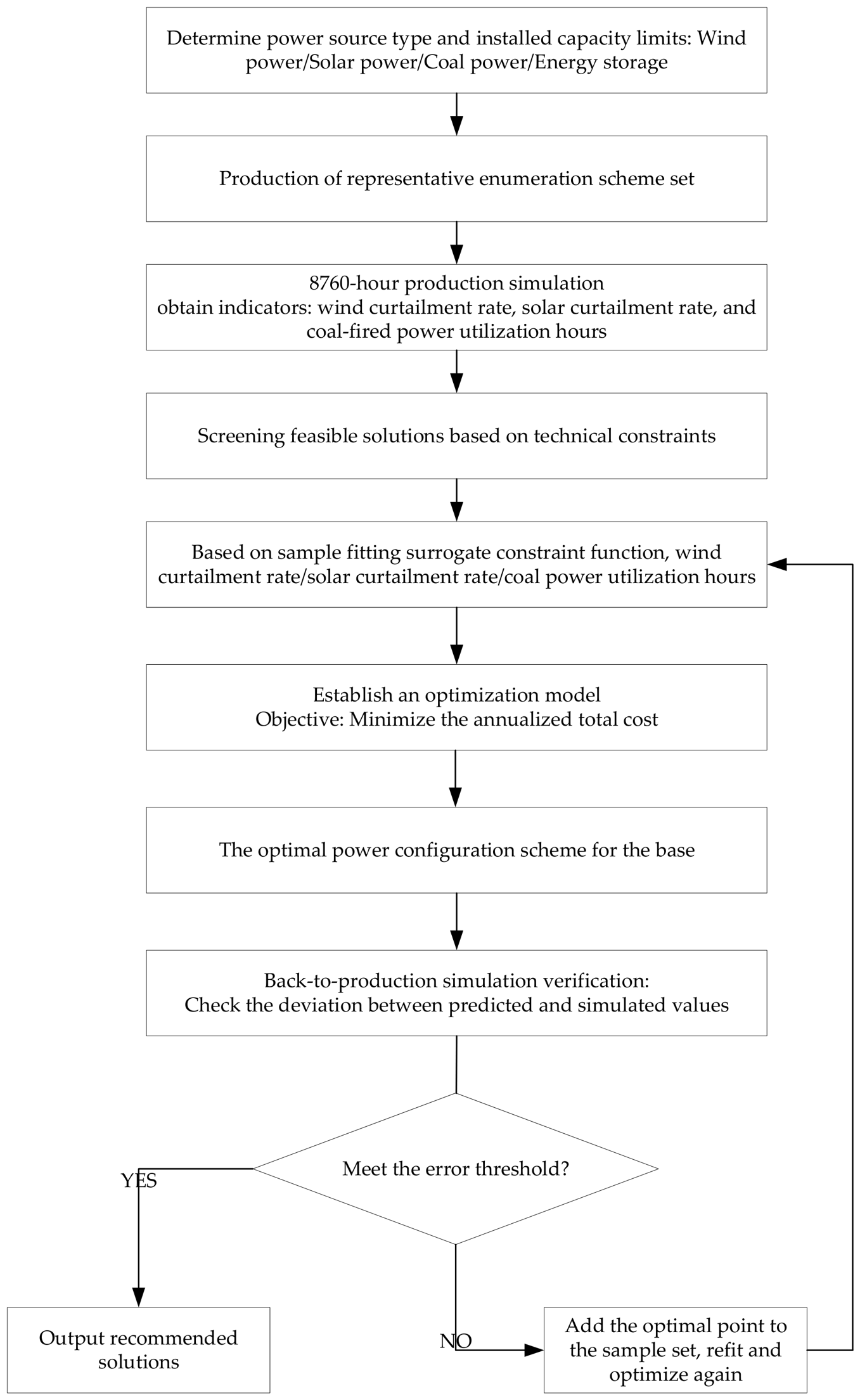
The resulting engineering dilemma is that direct enumeration is transparent but discrete, whereas continuous optimization is searchable but depends on reliable mathematical representations. A simple connection of the two may still fail if the sampled points do not cover the optimum region or if fitted relationships are extrapolated beyond their valid domain. This motivates a closed-loop framework that treats enumeration, simulation, surrogate modeling, optimization, and back testing as a unified planning process.
1.2. Related Work
Generation expansion planning has a long research history. Koltsaklis and Dagoumas reviewed state-of-the-art generation expansion planning models and categorized deterministic, stochastic, regulatory, and market-oriented formulations [
5]. Their work clarifies the overall modeling landscape, but the reviewed formulations generally assume that operational relationships are embedded directly in the optimization model rather than learned from a small set of production-simulation samples.
Oree et al. reviewed generation expansion planning optimization with renewable energy integration [
6]. They summarized optimization objectives, renewable uncertainty, and policy constraints, showing that renewable integration substantially increases model complexity. Nevertheless, their review did not address the specific engineering workflow where representative enumerated portfolios are simulated first and then converted into continuous surrogate constraints.
Pereira et al. studied generation expansion planning with a high share of renewables of variable output [
7]. Their analysis emphasizes the importance of planning models that reflect renewable variability. The export-base problem considered here is consistent with this concern, but it additionally requires a validation mechanism because the optimized portfolio must remain credible under chronological production simulation.
Kamalinia and Shahidehpour formulated generation expansion planning for wind-thermal systems [
8]. Their work represents the interaction between wind generation and thermal support, which is directly related to the wind–coal coordination considered in this study. However, the formulation does not include photovoltaic capacity, storage-ratio restrictions, and active resampling around a surrogate optimum.
Farhoumandi et al. considered rehabilitation of aging generating units in generation expansion planning [
9]. Their study shows that conventional units remain important in planning decisions when their operating availability and support capability change over time. In renewable export bases, coal-fired units similarly serve as dispatchable support resources; however, their utilization hours must be constrained so that they do not undermine renewable accommodation or project economics.
Energy storage expansion planning has also been widely investigated. Sheibani et al. reviewed storage expansion planning in power systems and highlighted the dependence of optimal storage capacity on planning objectives, uncertainty representation, and operational constraints [
10]. Their review supports the inclusion of storage as a planning variable, but it does not integrate storage sizing with a sample-driven surrogate model for curtailment and coal-utilization indicators.
Yang et al. presented a comprehensive handbook on optimal sizing and placement of energy storage in power grids [
11]. They emphasized that storage value depends on grid location, operating strategy, and planning objectives. In the export-base setting, the present work treats storage primarily as a capacity resource coupled with renewable scale and curtailment mitigation rather than as a network-placement decision.
Qin et al. introduced an underground energy-storage framework for urban rail transit systems [
12]. Although the application differs from renewable export-base planning, the study is relevant because it treats storage as an infrastructure-level reliability and energy-efficiency resource rather than as an isolated device. The remaining gap is that underground storage coordination is not linked to generation-mix planning and production-simulation-based validation.
Blanco and Faaij reviewed the role of storage in energy systems with attention to long-term storage and power-to-gas [
13]. Their study indicates that storage technology selection depends on temporal balancing needs. The proposed framework is compatible with such technology-specific extensions, although the present case study focuses on storage capacity as a planning variable constrained by investment and flexibility requirements.
Victoria et al. analyzed the role of storage technologies in sector-coupled European decarbonization [
14]. Their results show that the system value of storage changes with renewable penetration and sector coupling. The export-base problem studied here is more localized, but it shares the same principle that storage cannot be planned independently of renewable scale and dispatchable support.
Qin et al. developed a non-isothermal dynamic model and collaborative optimization method for a multi-energy system considering pipeline energy storage [
15]. This work is useful for understanding distributed energy-storage effects in coupled infrastructures, but it focuses on multi-energy network dynamics rather than source-storage capacity planning for renewable electricity export bases.
Sharma and Balachandra proposed a model-based approach for dynamic renewable integration in a transitioning electricity system [
16]. Their work demonstrates the usefulness of model-based planning for renewable transitions. The remaining gap is that model-based planning still needs a mechanism for correcting model error when simplified representations are used to replace expensive chronological simulation.
Li et al. proposed an attention-based conditional generative adversarial network for long-term renewable energy generation scenario construction [
17]. Their work improves scenario representation for renewable generation, whereas the present study uses reported production-simulation samples as the primary evidence source and introduces back testing to control surrogate error around the optimized capacity portfolio.
Surrogate-assisted optimization provides a methodological bridge between expensive simulation and continuous search. Jones et al. introduced efficient global optimization for expensive black-box functions [
18]. Their method showed how surrogate functions can guide optimization when direct evaluation is costly, but it was not designed for power-system feasibility constraints, such as curtailment and coal utilization.
Forrester and Keane reviewed recent advances in surrogate-based optimization [
19]. Their review clarifies that surrogate models are most useful when they are managed with error awareness and sampling strategies. This principle is adopted here by introducing production-simulation back testing and active resampling into the generation-mix planning loop.
Power-system flexibility is another prerequisite for high renewable penetration. Rahman et al. reviewed flexibility under high renewable scenarios and discussed the roles of storage, dispatchable resources, and system operation [
20]. Their work supports the engineering logic of combining curtailment limits, coal-hour limits, and storage configuration in one planning model.
Akrami et al. traced the emergence and evolution of power-system flexibility [
21]. Their review highlights that flexibility is not a single-resource property, but a system attribute produced by generation, network, storage, and demand-side interactions. This motivates the proposed source-storage coordination structure instead of treating each resource boundary independently.
Kang et al. developed a stochastic-robust model for inter-regional power-system planning [
22]. Their work shows that interregional planning requires robustness against uncertain conditions. The present study is complementary: it focuses on the early planning stage of an export base and uses back-tested surrogate models to avoid unreliable optimized portfolios.
Wang et al. developed an enhanced GAN method for joint wind–solar–load scenario generation with extreme weather labeling [
23]. This study shows the importance of correlated renewable and load scenarios under extreme conditions; however, scenario generation must still be coupled with capacity optimization and validation before it can directly support export-base source-storage planning.
Bhuvanesh et al. examined generation expansion planning with high renewable penetration [
24]. Their study supports the view that cleaner portfolios must be planned under economic and technical constraints. However, high penetration alone is not sufficient for an export base if curtailment, coal utilization, and delivery requirements are not jointly enforced.
Mo et al. applied stochastic dynamic programming to generation expansion planning [
25]. Their early work demonstrates that uncertainty-aware expansion planning has long been recognized as important. The proposed framework differs by using production-simulation samples and valid-domain surrogates to connect practical engineering enumeration with continuous optimization.
Zangeneh et al. investigated uncertainty-based distributed generation expansion planning in electricity markets [
26]. Their work illustrates the importance of uncertainty and market conditions in distributed planning. The renewable export-base problem considered here is not a market-clearing problem, but it faces a similar need to prevent capacity decisions from being overfitted to a narrow deterministic assumption.
Based on the above literature, several unresolved issues remain for large-scale renewable export-base planning. First, existing generation-expansion models seldom preserve a transparent link between discrete chronological production-simulation evidence and continuous source-storage capacity decisions. Second, storage capacity and supporting coal-fired capacity are often optimized with simplified flexibility indicators, while renewable curtailment, coal-utilization hours, and zero-deficit reliability are not simultaneously enforced in a traceable planning loop. Third, surrogate-assisted optimization has been widely used for expensive simulations, but local back testing around the selected capacity portfolio is still insufficient in practical power-system planning workflows. Fourth, scenario-generation and flexibility studies identify uncertainty and operating stress, yet they rarely specify how new simulation samples should be added when an optimized portfolio lies near a sparse or boundary region. These gaps motivate a closed-loop enumeration-surrogate framework in which simulation-evaluated samples, valid-domain approximation, constrained optimization, and active validation are treated as mutually dependent stages rather than independent calculations.
1.3. Manuscript Positioning and Main Contribution
The manuscript is positioned as a mechanism-driven planning study rather than a new universal optimization theory. Its contribution is the traceable coupling of enumeration, chronological simulation, valid-domain surrogates, constrained search, and back testing.
Compared with conventional generation-expansion planning, the proposed workflow does not assume that all chronological operating relationships are already embedded in a deterministic expansion model. It first obtains curtailment, utilization, and reliability labels from production simulation and then converts those labels into valid-domain surrogate constraints. Compared with generic surrogate-assisted optimization, the loop is not only an objective-function approximation process; it includes engineering feasibility screening, coefficient diagnostics, back-substitution to chronological simulation, and active resampling when the local error exceeds the tolerance. The contribution is therefore the traceable planning workflow that connects these elements for renewable export-base source-storage decisions.
The main contributions are fourfold. First, a representative enumeration and feasibility-screening structure is formulated for wind–photovoltaic–dispatchable baseload generation-storage export-base portfolios. Second, production-simulation indicators are mapped into valid-domain surrogate functions that explicitly include storage in the curtailment relationships. Third, a back-testing and active-resampling mechanism is defined and numerically reported for the optimized portfolio. Fourth, an Ordos proof-of-concept case demonstrates how the method identifies a balanced local planning region while making its sample size and single-year data limitations explicit.