Artificial Intelligence and Export Performance in Small and Micro-Enterprises: The Roles of Internal Capability and External Tools

Abstract
1. Introduction
2. From Traditional Trade to Platform-Based AI Adoption: The Yiwu Context
3. Theory and Hypotheses
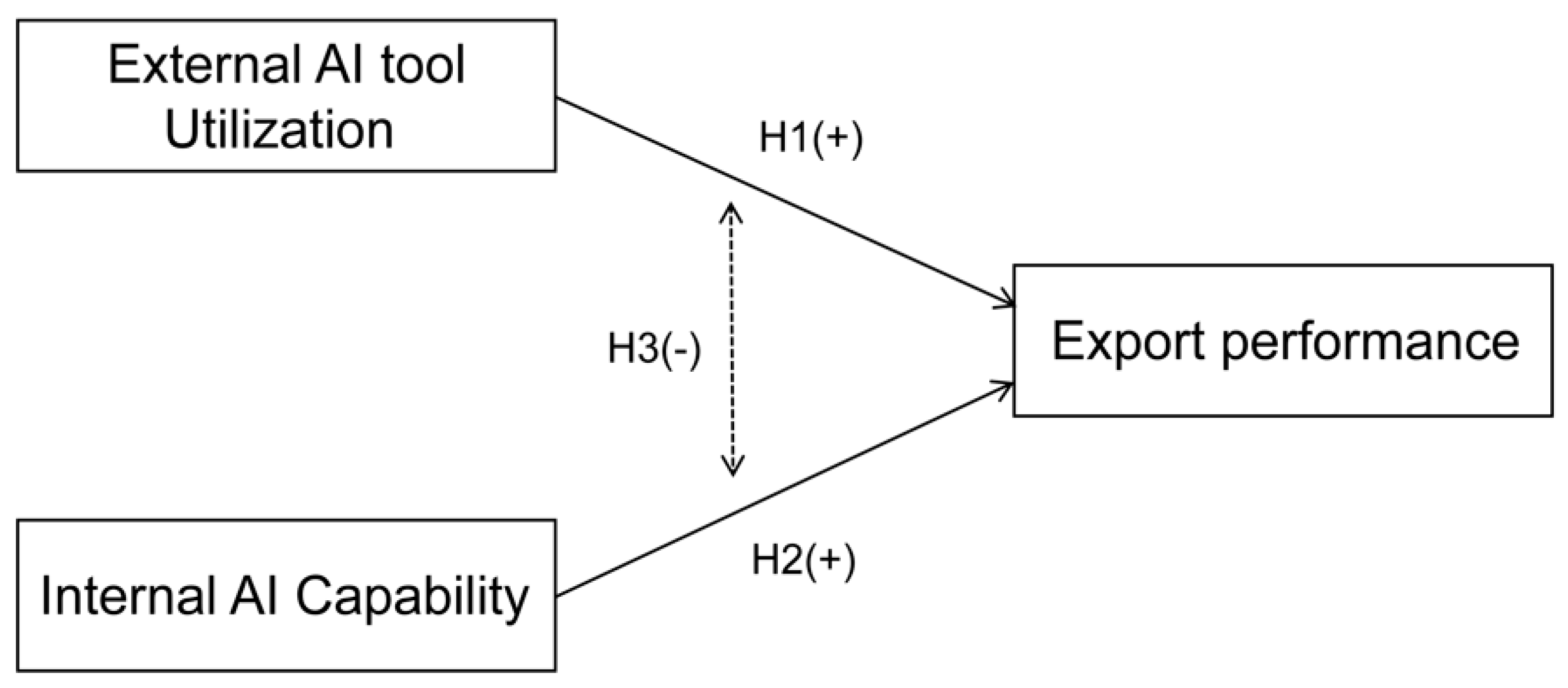
3.1. External AI Tool Utilization and Export Performance
3.2. Internal AI Capability and Export Performance
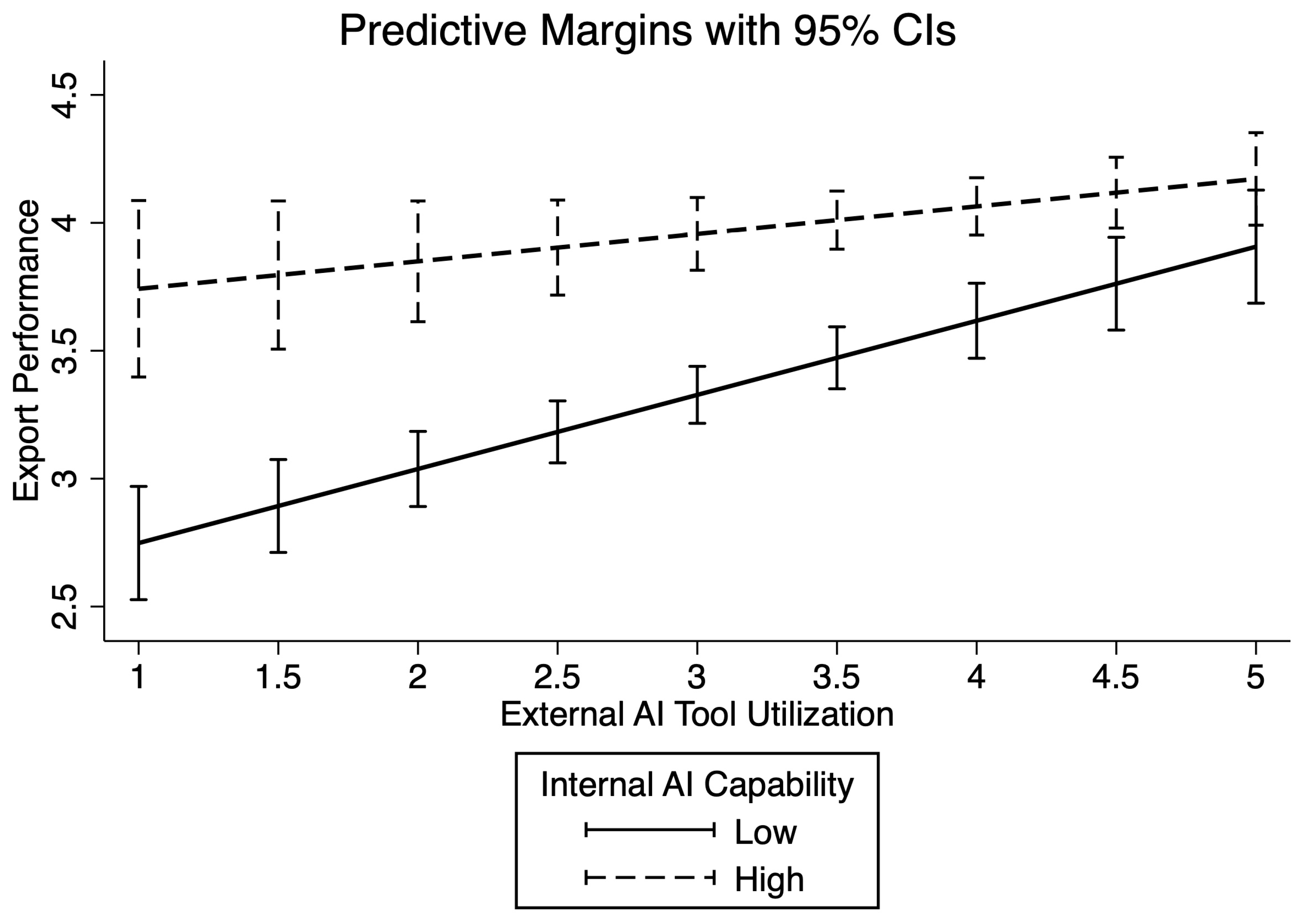
3.3. External–Internal Resource Interaction and Export Performance
4. Data and Method
4.1. Sample and Research Context
4.2. Measures
4.3. Common Method Bias
4.4. Analytical Strategy
5. Results
5.1. Descriptive Statistics and Correlations
5.2. Results of Hypothesis Testing
5.3. Robustness Checks
6. Discussion
6.1. Theoretical Implications
6.2. Practical Implications
6.3. Limitations and Future Research
7. Conclusions
Author Contributions
Funding
Institutional Review Board Statement
Informed Consent Statement
Data Availability Statement
Conflicts of Interest
References
- Jakubik, A.; Rotunno, L.; Saini, A. Foresee the Unseen: Evaluating the Impact of Artificial Intelligence on International Trade. J. Policy Model. 2025, 47, 842–861. [Google Scholar] [CrossRef]
- Ozturk, O. The Impact of AI on International Trade: Opportunities and Challenges. Economies 2024, 12, 298. [Google Scholar] [CrossRef]
- Kumar, S.; Vandana; Kumar, V.; Chatterjee, S.; Mariani, M.; De Massis, A. The Role of Artificial Intelligence Capabilities in Enhancing Export Performance: A Study of Ambidexterity and Dynamic Capabilities. Int. Mark. Rev. 2025, 42, 698–714. [Google Scholar] [CrossRef]
- Jean, R.-J.; Kim, D.; Cavusgil, S.T.; Chen, C. Determinants of Chinese Exporters’ Online De-Internationalization. Manag. Organ. Rev. 2025, 21, 1110–1130. [Google Scholar] [CrossRef]
- Liu, J.; Qin, C.; Chu, X. Development of Corporate Artificial Intelligence and the Quality of Export Products. Financ. Res. Lett. 2025, 78, 107217. [Google Scholar] [CrossRef]
- Dong, Y.; He, X.; Blut, M. How and When Does Digitalization Influence Export Performance? A Meta-Analysis of Its Consequences and Contingencies. Int. Mark. Rev. 2024, 41, 1388–1413. [Google Scholar] [CrossRef]
- Doan, T.; Luong, D. Effects of Digital Capability on Digital Export: International Evidence. Econ. Bus. Lett. 2025, 14, 166–176. [Google Scholar] [CrossRef]
- Li, J.; Chen, L.; Yi, J.; Mao, J.; Liao, J. Ecosystem-Specific Advantages in International Digital Commerce. J. Int. Bus. Stud. 2019, 50, 1448–1463. [Google Scholar] [CrossRef]
- Dung Ngo, V.; Leonidou, L.C.; Janssen, F.; Christodoulides, P. Export-Specific Investments, Competitive Advantage, and Performance in Vietnamese SMEs: The Moderating Role of Domestic Market Conditions. J. Bus. Res. 2024, 170, 114315. [Google Scholar] [CrossRef]
- Qu, C.; Kim, E. Artificial-Intelligence-Enabled Innovation Ecosystems: A Novel Triple-Layer Framework for Micro, Small, and Medium-Sized Enterprises in the Chinese Apparel-Manufacturing Industry. Sustainability 2025, 17, 5019. [Google Scholar] [CrossRef]
- Chen, X.; Wu, Y.; Long, Y. Does Artificial Intelligence Promote Sustainable Growth of Exporting Firms? Sustainability 2025, 17, 7273. [Google Scholar] [CrossRef]
- Hasan, R.; Ojala, A. Managing Artificial Intelligence in International Business: Toward a Research Agenda on Sustainable Production and Consumption. Thunderbird Int. Bus. Rev. 2024, 66, 151–170. [Google Scholar] [CrossRef]
- Kumar, S.; Kumar, V.; Chaudhuri, R.; Chatterjee, S.; Vrontis, D. AI Capability and Environmental Sustainability Performance: Moderating Role of Green Knowledge Management. Technol. Soc. 2025, 81, 102870. [Google Scholar] [CrossRef]
- Han, S.; Zhang, D.; Zhang, H.; Lin, S. Artificial Intelligence Technology, Organizational Learning Capability, and Corporate Innovation Performance: Evidence from Chinese Specialized, Refined, Unique, and Innovative Enterprises. Sustainability 2025, 17, 2510. [Google Scholar] [CrossRef]
- Lins, S.; Pandl, K.D.; Teigeler, H.; Thiebes, S.; Bayer, C.; Sunyaev, A. Artificial Intelligence as a Service. Bus. Inf. Syst. Eng. 2021, 63, 441–456. [Google Scholar] [CrossRef]
- Nambisan, S.; Zahra, S.A.; Luo, Y. Global Platforms and Ecosystems: Implications for International Business Theories. J. Int. Bus. Stud. 2019, 50, 1464–1486. [Google Scholar] [CrossRef]
- Mikalef, P.; Gupta, M. Artificial Intelligence Capability: Conceptualization, Measurement Calibration, and Empirical Study on Its Impact on Organizational Creativity and Firm Performance. Inf. Manag. 2021, 58, 103434. [Google Scholar] [CrossRef]
- Cohen, W.; Levinthal, D. Absorptive Capacity: A New Perspective on Learning and Innovation. Adm. Sci. Q. 1990, 35, 128–152. [Google Scholar] [CrossRef]
- Li, R.; Wang, Q.; Cheong, K.C. From Obscurity to Global Prominence—Yiwu’s Emergence as an International Trade Hub. Cities 2016, 53, 8–17. [Google Scholar] [CrossRef]
- Qian, L.; Lu, P.; Wen, M. Refashioning “the World’s Capital of Small Commodities”: Yiwu’s Internationalization and Digitalization. Cities 2024, 148, 104885. [Google Scholar] [CrossRef]
- Shou, X.; Shi, Q.; Zhang, X. The Adaptation and Transformation of Yiwu’s Foreign Trade Enterprises amid Major Changes Unseen in a Century (2001–2021). Transnatl. Corp. Rev. 2024, 16, 200080. [Google Scholar] [CrossRef]
- Liu, W.; Si, S. Disruptive Innovation in the Context of Retailing: Digital Trends and the Internationalization of the Yiwu Commodity Market. Sustainability 2022, 14, 7559. [Google Scholar] [CrossRef]
- Añón Higón, D.; Bonvin, D. Digitalization and Trade Participation of SMEs. Small Bus. Econ. 2024, 62, 857–877. [Google Scholar] [CrossRef]
- Cao, T.L.; Hsu, J. Digitalization and Country Distance in International Trade: An Empirical Analysis of European Countries. Telecommun. Policy 2025, 49, 102877. [Google Scholar] [CrossRef]
- Du, X.; Huang, J. The Influence of Digital Capabilities on the Export Performance of SMEs: Evidence from China. Asia Pac. Bus. Rev. 2025, 1–26. [Google Scholar] [CrossRef]
- Luu, T.D. Digital Transformation and Export Performance: A Process Mechanism of Firm Digital Capabilities. Bus. Process Manag. J. 2023, 29, 1436–1465. [Google Scholar] [CrossRef]
- Oh, S.; Hwang, S. How Does Digital Capability Translate into Export Performance?: The Critical Mediating Role of GVC Upgrading. Asia Glob. Econ. 2025, 5, 100116. [Google Scholar] [CrossRef]
- Chishty, S.K.; Sayari, S.; Mohamed, A.H.; Mallick, M.F.; Khan, N.; Inkesar, A. The Utilisation of Artificial Intelligence in the Export Performance of MNCs: The Role of Cultural Distance. Adm. Sci. 2025, 15, 160. [Google Scholar] [CrossRef]
- Brynjolfsson, E.; Hui, X.; Liu, M. Does Machine Translation Affect International Trade? Evidence from a Large Digital Platform. Manag. Sci. 2019, 65, 5449–5460. [Google Scholar] [CrossRef]
- Dai, J.; Mao, X.; Wu, P.; Zhou, H.; Cao, L. Revolutionizing Cross-Border e-Commerce: A Deep Dive into AI and Big Data-Driven Innovations for the Straw Hat Industry. PLoS ONE 2024, 19, e0305639. [Google Scholar] [CrossRef]
- Menzies, J.; Sabert, B.; Hassan, R.; Mensah, P.K. Artificial Intelligence for International Business: Its Use, Challenges, and Suggestions for Future Research and Practice. Thunderbird Int. Bus. Rev. 2024, 66, 185–200. [Google Scholar] [CrossRef]
- Ahmad, I. The Strategic Role of Artificial Intelligence in Overcoming Intercultural Barriers for SME Internationalization: A Systematic Literature Review. J. Intercult. Commun. 2025, 25, 148–163. [Google Scholar] [CrossRef]
- Yordanova, D.; Dana, L.-P.; Manolova, T.S.; Pergelova, A. Digital Technologies and the Internationalization of Small and Medium-Sized Enterprises. Sustainability 2024, 16, 2660. [Google Scholar] [CrossRef]
- Cassia, F.; Magno, F. Cross-Border e-Commerce as a Foreign Market Entry Mode among SMEs: The Relationship between Export Capabilities and Performance. Rev. Int. Bus. Strategy 2022, 32, 267–283. [Google Scholar] [CrossRef]
- Barney, J. Firm Resources and Sustained Competitive Advantage. J. Manag. 1991, 17, 99–120. [Google Scholar] [CrossRef]
- Chen, D.; Esperança, J.P.; Wang, S. The Impact of Artificial Intelligence on Firm Performance: An Application of the Resource-Based View to e-Commerce Firms. Front. Psychol. 2022, 13, 884830. [Google Scholar] [CrossRef]
- Wang, J.; Huang, Q. The Impact of Digital Transformation on the Export Technology Complexity of Manufacturing Enterprises: Based on Empirical Evidence from China. Sustainability 2025, 17, 2596. [Google Scholar] [CrossRef]
- Xu, Q.; Li, X.; Guo, F. Digital Transformation and Environmental Performance: Evidence from Chinese Resource-Based Enterprises. Corp. Soc. Responsib. Environ. Manag. 2023, 30, 1816–1840. [Google Scholar] [CrossRef]
- Fosso Wamba, S.; Queiroz, M.M.; Pappas, I.O.; Sullivan, Y. Artificial Intelligence Capability and Firm Performance: A Sustainable Development Perspective by the Mediating Role of Data-Driven Culture. Inf. Syst. Front. 2024, 26, 2189–2203. [Google Scholar] [CrossRef]
- Falentina, A.T.; Resosudarmo, B.P.; Darmawan, D.; Sulistyaningrum, E. Digitalisation and the Performance of Micro and Small Enterprises in Yogyakarta, Indonesia. Bull. Indones. Econ. Stud. 2021, 57, 343–369. [Google Scholar] [CrossRef]
- Salvatierra-Manchego, V.H.; Libaque-Saenz, C.F. Digitalization and Environmental Sustainability as Alternative Strategies to Improve Peruvian MSEs’ Export Performance: A Preliminary Study. Issues Inf. Syst. 2024, 25, 317–331. [Google Scholar] [CrossRef]
- Cassiman, B.; Veugelers, R. In Search of Complementarity in Innovation Strategy: Internal R&D and External Knowledge Acquisition. Manag. Sci. 2006, 52, 68–82. [Google Scholar] [CrossRef]
- Laursen, K.; Salter, A. Open for Innovation: The Role of Openness in Explaining Innovation Performance among U.K. Manufacturing Firms. Strateg. Manag. J. 2006, 27, 131–150. [Google Scholar] [CrossRef]
- Berchicci, L. Towards an Open R&D System: Internal R&D Investment, External Knowledge Acquisition and Innovative Performance. Res. Policy 2013, 42, 117–127. [Google Scholar] [CrossRef]
- Ocasio, W. Towards an Attention-Based View of the Firm. Strateg. Manag. J. 1997, 18, 187–206. [Google Scholar] [CrossRef]
- Sirmon, D.; Hitt, M.; Ireland, R. Managing Firm Resources in Dynamic Environments to Create Value: Looking Inside the Black Box. Acad. Manag. Rev. 2007, 32, 273–292. [Google Scholar] [CrossRef]
- Hambrick, D.C.; Mason, P.A. Upper Echelons: The Organization as a Reflection of Its Top Managers. Acad. Manag. Rev. 1984, 9, 193–206. [Google Scholar] [CrossRef] [PubMed]
- Kumar, N.; Stern, L.W.; Anderson, J.C. Conducting Interorganizational Research Using Key Informants. Acad. Manag. J. 1993, 36, 1633–1651. [Google Scholar] [CrossRef]
- Bellandi, M.; Lombardi, S. Specialized Markets and Chinese Industrial Clusters: The Experience of Zhejiang Province. China Econ. Rev. 2012, 23, 626–638. [Google Scholar] [CrossRef]
- Sinkovics, R.R.; Kurt, Y.; Sinkovics, N. The Effect of Matching on Perceived Export Barriers and Performance in an Era of Globalization Discontents: Empirical Evidence from UK SMEs. Int. Bus. Rev. 2018, 27, 1065–1079. [Google Scholar] [CrossRef]
- Lin, H.F.; Lin, S.M. Determinants of E-Business Diffusion: A Test of the Technology Diffusion Perspective. Technovation 2008, 28, 135–145. [Google Scholar] [CrossRef]
- Zhu, K.; Kraemer, K.L. Post-Adoption Variations in Usage and Value of E-Business by Organizations: Cross-Country Evidence from the Retail Industry. Inf. Syst. Res. 2005, 16, 61–84. [Google Scholar] [CrossRef]
- Zhang, C.; Bai, T.; Zhou, A.J.; Zhou, S.S. Digital Platforms, Internal Digitalization, and Internationalization of SMEs. Long. Range Plan. 2025, 58, 102588. [Google Scholar] [CrossRef]
- Xie, X.; Han, Y.; Anderson, A.; Ribeiro-Navarrete, S. Digital Platforms and SMEs’ Business Model Innovation: Exploring the Mediating Mechanisms of Capability Reconfiguration. Int. J. Inf. Manag. 2022, 65, 102513. [Google Scholar] [CrossRef]
- Hagedoorn, J.; Wang, N. Is There Complementarity or Substitutability between Internal and External R&D Strategies? Res. Policy 2012, 41, 1072–1083. [Google Scholar] [CrossRef]
- Delgado-Verde, M.; Martín-de Castro, G.; Cruz-González, J.; Navas-López, J.E. Complements or Substitutes? The Contingent Role of Corporate Reputation on the Interplay between Internal R&D and External Knowledge Sourcing. Eur. Manag. J. 2021, 39, 70–83. [Google Scholar] [CrossRef]



| Firm Characteristics | |||
|---|---|---|---|
| Firm age (years) | % | Firm size (number of employees) | % |
| 1–3 | 11.37 | 1 | 2.32 |
| 4–6 | 41.89 | 2–5 | 7.16 |
| 7–10 | 28.00 | 6–10 | 15.16 |
| 10+ | 18.74 | 11–50 | 41.05 |
| 51–200 | 26.11 | ||
| 200+ | 8.21 | ||
| Family owned | % | Production facility | % |
| Yes | 73.47 | Yes | 61.68 |
| No | 26.53 | No | 38.32 |
| Main business model | % | ||
| Export-only | 40.84 | ||
| Export-and-domestic | 59.16 | ||
| Respondent Characteristics | |||
| Gender | % | Education level | % |
| Female | 45.05 | Junior high or below | 5.89 |
| Male | 54.95 | High school | 13.05 |
| College | 20.84 | ||
| Bachelor | 45.47 | ||
| Master or above | 14.74 | ||
| Variables | (1) | (2) | (3) | (4) | (5) | (6) | (7) | (8) | (9) | (10) |
|---|---|---|---|---|---|---|---|---|---|---|
| (1) Export performance | 1.000 | |||||||||
| (2) External AI tool utilization | 0.388 * | 1.000 | ||||||||
| (3) Internal AI capability | 0.439 * | 0.431 * | 1.000 | |||||||
| (4) Firm age | −0.075 | −0.056 | −0.041 | 1.000 | ||||||
| (5) Firm size | −0.034 | −0.030 | −0.016 | 0.043 | 1.000 | |||||
| (6) Family-owned | −0.019 | −0.030 | −0.001 | −0.008 | 0.058 | 1.000 | ||||
| (7) Production facility | 0.070 | 0.074 | 0.149 * | −0.009 | −0.004 | 0.125 * | 1.000 | |||
| (8) Main business model | −0.018 | −0.072 | −0.080 | 0.117 * | 0.032 | 0.072 | 0.100 * | 1.000 | ||
| (9) Education | 0.062 | 0.088 | 0.010 | −0.003 | −0.089 | −0.001 | 0.014 | 0.028 | 1.000 | |
| (10) Gender | −0.023 | −0.030 | −0.142 * | −0.008 | −0.059 | −0.002 | −0.035 | 0.022 | 0.036 | 1.000 |
| Mean | 3.726 | 3.614 | 3.689 | 0.533 | 0.657 | 0.735 | 0.617 | 0.408 | 0.602 | 0.451 |
| Std. Dev. | 0.927 | 0.966 | 0.916 | 0.499 | 0.475 | 0.442 | 0.487 | 0.492 | 0.490 | 0.498 |
| Variable | (1) | (2) | (3) | (4) | (5) |
|---|---|---|---|---|---|
| Firm age | −0.134 | −0.101 | −0.109 | −0.094 | −0.109 |
| (0.086) | (0.080) | (0.077) | (0.075) | (0.075) | |
| Firm size | −0.048 | −0.036 | −0.033 | −0.029 | −0.036 |
| (0.090) | (0.084) | (0.081) | (0.079) | (0.078) | |
| Family owned | 0.055 | 0.028 | 0.043 | 0.029 | 0.042 |
| (0.097) | (0.090) | (0.088) | (0.085) | (0.085) | |
| Production facility | −0.138 | −0.077 | −0.008 | 0.000 | −0.009 |
| (0.089) | (0.082) | (0.081) | (0.079) | (0.078) | |
| Main business model | −0.029 | 0.024 | 0.044 | 0.060 | 0.058 |
| (0.088) | (0.082) | (0.079) | (0.077) | (0.077) | |
| Education | 0.113 | 0.049 | 0.101 | 0.064 | 0.041 |
| (0.087) | (0.081) | (0.079) | (0.077) | (0.077) | |
| Gender | −0.045 | −0.023 | 0.068 | 0.056 | 0.055 |
| (0.086) | (0.079) | (0.078) | (0.076) | (0.075) | |
| External AI tool utilization | 0.364 *** | 0.228 *** | 0.198 *** | ||
| (0.041) | (0.043) | (0.044) | |||
| Internal AI capability | 0.447 *** | 0.345 *** | 0.286 *** | ||
| (0.043) | (0.046) | (0.050) | |||
| External AI tool utilization × Internal AI capability | −0.107 *** | ||||
| (0.036) | |||||
| Constant | 3.831 *** | 3.797 *** | 3.688 *** | 3.699 *** | 3.768 *** |
| (0.121) | (0.112) | (0.110) | (0.107) | (0.109) | |
| N | 475 | 475 | 475 | 475 | 475 |
| R-squared | 0.016 | 0.157 | 0.202 | 0.247 | 0.262 |
| Adj. R-squared | 0.002 | 0.142 | 0.188 | 0.233 | 0.246 |
| F-statistic | 1.11 | 10.84 | 14.75 | 16.99 | 16.46 |
| Root MSE | 0.926 | 0.858 | 0.835 | 0.812 | 0.805 |
Disclaimer/Publisher’s Note: The statements, opinions and data contained in all publications are solely those of the individual author(s) and contributor(s) and not of MDPI and/or the editor(s). MDPI and/or the editor(s) disclaim responsibility for any injury to people or property resulting from any ideas, methods, instructions or products referred to in the content. |
© 2026 by the authors. Licensee MDPI, Basel, Switzerland. This article is an open access article distributed under the terms and conditions of the Creative Commons Attribution (CC BY) license.
Share and Cite
Gu, M.; Jin, C. Artificial Intelligence and Export Performance in Small and Micro-Enterprises: The Roles of Internal Capability and External Tools. Sustainability 2026, 18, 5846. https://doi.org/10.3390/su18125846
Gu M, Jin C. Artificial Intelligence and Export Performance in Small and Micro-Enterprises: The Roles of Internal Capability and External Tools. Sustainability. 2026; 18(12):5846. https://doi.org/10.3390/su18125846
Chicago/Turabian StyleGu, Mengyang, and Chuyue Jin. 2026. "Artificial Intelligence and Export Performance in Small and Micro-Enterprises: The Roles of Internal Capability and External Tools" Sustainability 18, no. 12: 5846. https://doi.org/10.3390/su18125846
APA StyleGu, M., & Jin, C. (2026). Artificial Intelligence and Export Performance in Small and Micro-Enterprises: The Roles of Internal Capability and External Tools. Sustainability, 18(12), 5846. https://doi.org/10.3390/su18125846