Integrated Valuation of Ecosystem Services: A Systematic Review of Socio-Biophysical Valuation Research

 ,
, 


Abstract
1. Introduction
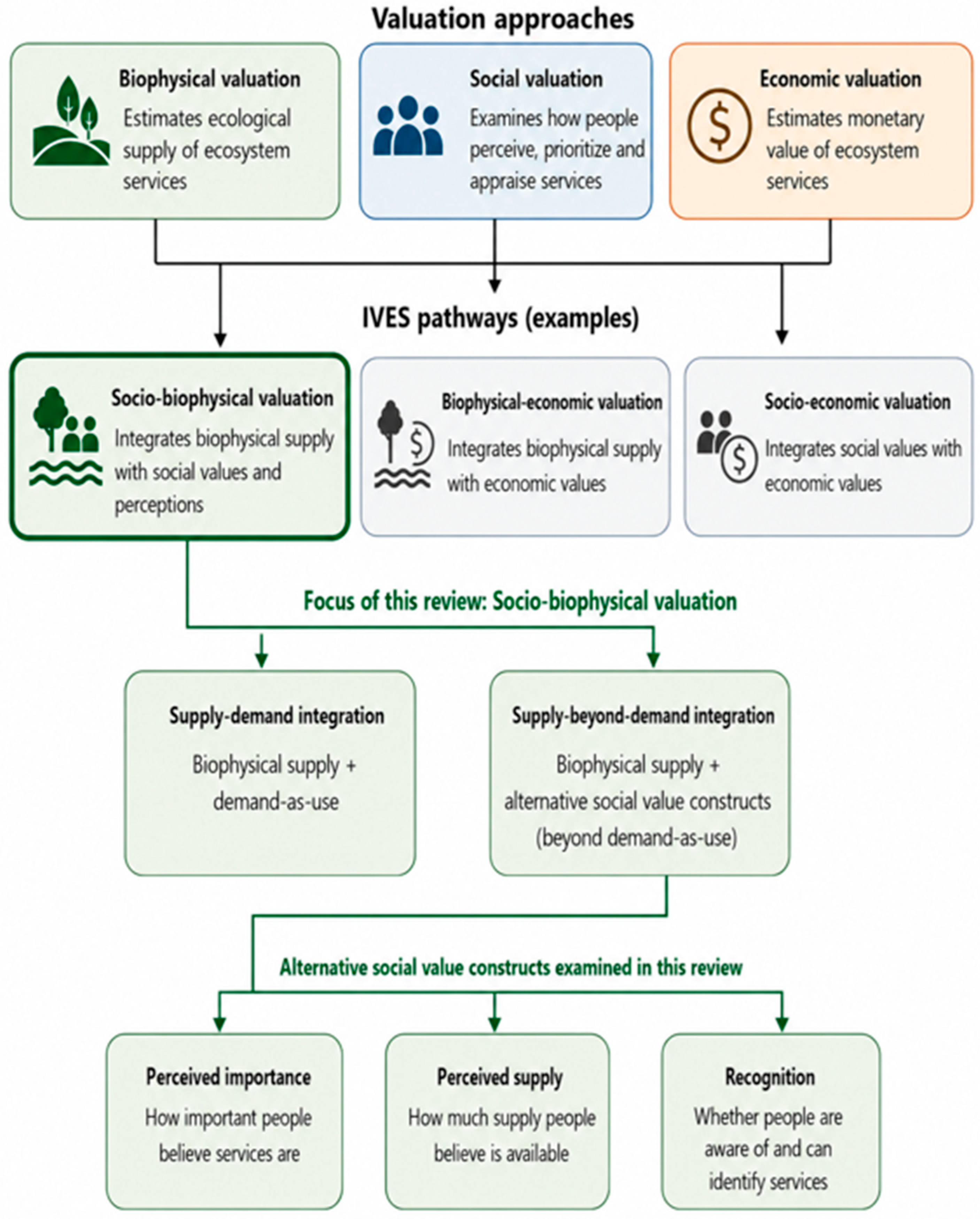
Socio-Biophysical Integration
2. Methods
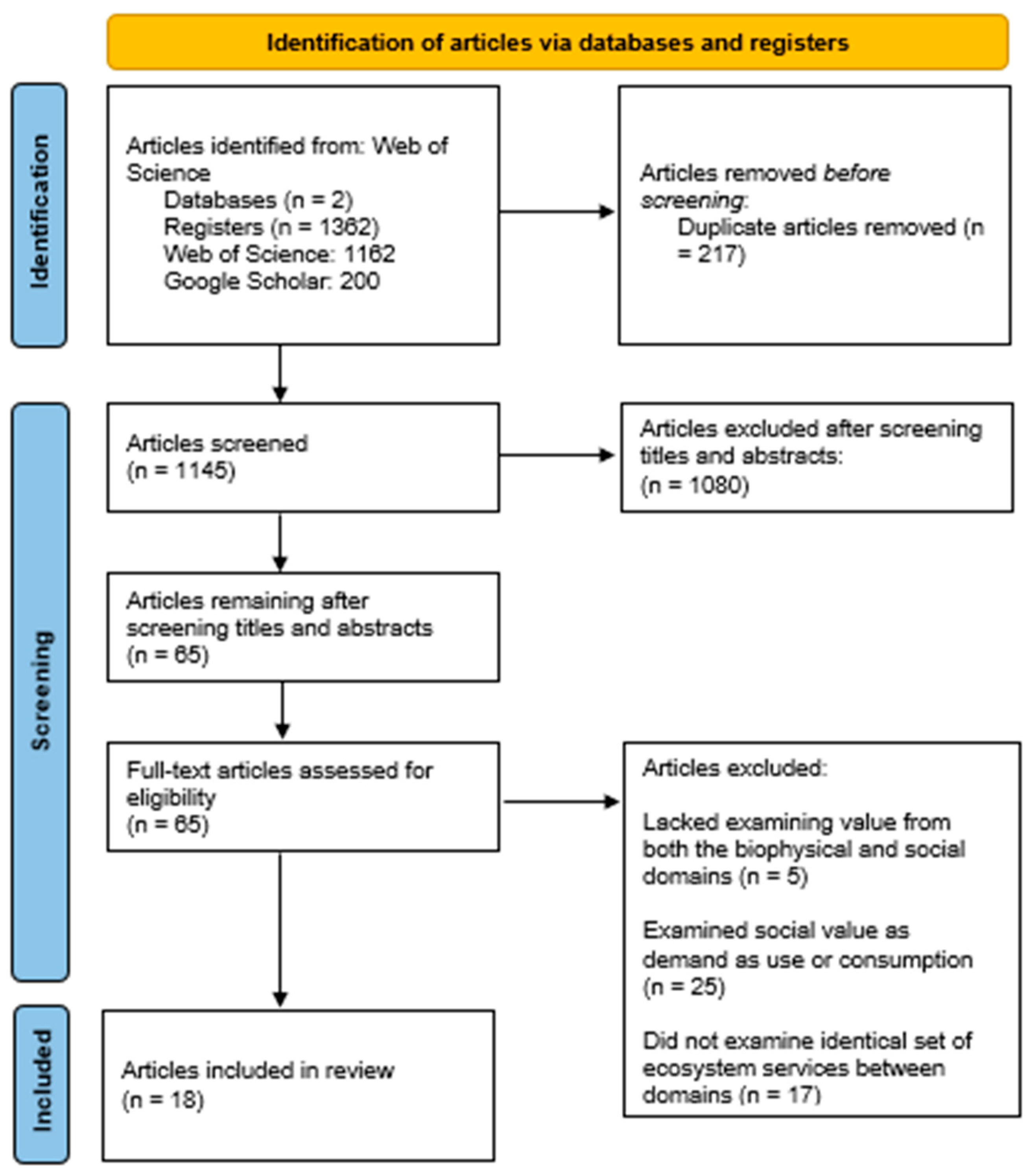
2.1. Data Collection
- WoSCC: “social” AND “biophysical” AND “ecosystem service assessment” (topic fields). This search returned 244 articles.
- WoSCC: “social” AND “biophysical” AND “ecosystem service valuation” (topic fields). This search returned 158 articles.
- WoSCC: “social” AND “biophysical” AND “ecosystem service” (topic fields). This search returned 760 articles.
- Google Scholar: “social” AND “biophysical” AND “ecosystem service valuation”. We screened the first 20 pages of results (200 articles).
2.2. Screening and Eligibility Criteria
2.3. Data Extraction
3. Results
3.1. Study Characteristics
3.2. Ecosystem Services
3.3. Methods and Social Value Constructs
3.4. Socio-Biophysical Findings
4. Discussion
4.1. Social Value Constructs
4.1.1. Perceived Importance of Ecosystem Services
4.1.2. Perceived Supply of Ecosystem Services
4.1.3. Ecosystem Service Recognition
4.2. Selecting a Social Value Construct
4.3. Considerations for Future Research
4.4. Limitations
5. Conclusions
Supplementary Materials
Author Contributions
Funding
Institutional Review Board Statement
Informed Consent Statement
Data Availability Statement
Conflicts of Interest
Abbreviations
| IAESSD | Integrated Assessment of Ecosystem Service Supply and Demand |
| IPBES | Intergovernmental Science–Policy Platform on Biodiversity and Ecosystem Services |
| InVEST | Integrated Valuation of Ecosystem Services and Tradeoffs |
| IVES | Integrated Valuation of Ecosystem Services |
| MEA | Millennium Ecosystem Assessment |
| WoSCC | Web of Science Core Collection |
References
- Hauck, J.; Schweppe-Kraft, B.; Albert, C.; Görg, C.; Jax, K.; Jensen, R.; Fürst, C.; Maes, J.; Ring, I.; Hönigová, I. The Promise of the Ecosystem Services Concept for Planning and Decision-Making. GAIA Ecol. Perspect. Sci. Soc. 2013, 22, 232–236. [Google Scholar] [CrossRef]
- Zandebasiri, M.; Jahanbazi Goujani, H.; Iranmanesh, Y.; Azadi, H.; Viira, A.-H.; Habibi, M. Ecosystem Services Valuation: A Review of Concepts, Systems, New Issues, and Considerations about Pollution in Ecosystem Services. Environ. Sci. Pollut. Res. 2023, 30, 83051–83070. [Google Scholar] [CrossRef] [PubMed]
- Xu, Z.; Peng, J. Ecosystem Services-Based Decision-Making: A Bridge from Science to Practice. Environ. Sci. Policy 2022, 135, 6–15. [Google Scholar] [CrossRef]
- Farber, S.C.; Costanza, R.; Wilson, M.A. Economic and Ecological Concepts for Valuing Ecosystem Services. Ecol. Econ. 2002, 41, 375–392. [Google Scholar] [CrossRef]
- Brander, L.M.; De Groot, R.; Schägner, J.P.; Guisado-Goñi, V.; Van ’T Hoff, V.; Solomonides, S.; McVittie, A.; Eppink, F.; Sposato, M.; Do, L.; et al. Economic Values for Ecosystem Services: A Global Synthesis and Way Forward. Ecosyst. Serv. 2024, 66, 101606. [Google Scholar] [CrossRef]
- Braat, L.C.; De Groot, R. The Ecosystem Services Agenda:Bridging the Worlds of Natural Science and Economics, Conservation and Development, and Public and Private Policy. Ecosyst. Serv. 2012, 1, 4–15. [Google Scholar] [CrossRef]
- Gómez-Baggethun, E.; Barton, D.N.; Berry, P.; Dunford, R.; Harrison, P.A. Concepts and Methods in Ecosystem Services Valuation. In Routledge Handbook of Ecosystem Services; Routledge: Abingdon, UK, 2016; pp. 99–111. [Google Scholar] [CrossRef]
- Martínez-Harms, M.J.; Balvanera, P. Methods for Mapping Ecosystem Service Supply: A Review. Int. J. Biodivers. Sci. Ecosyst. Serv. Manag. 2012, 8, 17–25. [Google Scholar] [CrossRef]
- Campbell, E.; Marks, R.; Conn, C. Spatial Modeling of the Biophysical and Economic Values of Ecosystem Services in Maryland, USA. Ecosyst. Serv. 2020, 43, 101093. [Google Scholar] [CrossRef]
- Felipe-Lucia, M.R.; Comín, F.A.; Escalera-Reyes, J. A Framework for the Social Valuation of Ecosystem Services. Ambio 2015, 44, 308–318. [Google Scholar] [CrossRef]
- Greeves, S.; McGovern, R.; Castro, A. A Social Assessment of Ecosystem Services: A Comparative Stakeholder Analysis of the Portneuf River Watershed, Idaho. Ecosyst. People 2025, 21, 2478568. [Google Scholar] [CrossRef]
- Greeves, S.B.; McGovern, R.; McKinney, M. Linking Ecosystem Service Valuation to Environmental Policy Support: A Case Study of Pollution in the Tennessee River. Ecol. Soc. 2026, 31, 31. [Google Scholar] [CrossRef]
- Gómez-Baggethun, E.; Martín-López, B.; Barton, D.; Braat, L.; Saarikoski, H.; Kelemen, E.; García-Llorente, M.; van den Bergh, J.; Arias, P.; Berry, P.; et al. State-of-the-Art Report on Integrated Valuation of Ecosystem Services; Deliverable D.4.1/WP4; European Commission: Brussels, Belgium, 2014; pp. 1–33. [Google Scholar]
- Jacobs, S.; Dendoncker, N.; Martín-López, B.; Barton, D.N.; Gomez-Baggethun, E.; Boeraeve, F.; McGrath, F.L.; Vierikko, K.; Geneletti, D.; Sevecke, K.J. A New Valuation School: Integrating Diverse Values of Nature in Resource and Land Use Decisions. Ecosyst. Serv. 2016, 22, 213–220. [Google Scholar] [CrossRef]
- Martín-López, B.; Gómez-Baggethun, E.; García-Llorente, M.; Montes, C. Trade-Offs across Value-Domains in Ecosystem Services Assessment. Ecol. Indic. 2014, 37, 220–228. [Google Scholar] [CrossRef]
- Rincón-Ruiz, A.; Arias-Arévalo, P.; Hernández, J.M.N.; Cotler, H.; Caso, M.A.; Meli, P.; Tauro, A.; Akerberg, V.D.Á.; Avila-Foucat, V.S.; Cardenas, J.P. Applying Integrated Valuation of Ecosystem Services in Latin America: Insights from 21 Case Studies. Ecosyst. Serv. 2019, 36, 100901. [Google Scholar] [CrossRef]
- Bateman, I.J.; Harwood, A.R.; Mace, G.M.; Watson, R.T.; Abson, D.J.; Andrews, B.; Binner, A.; Crowe, A.; Day, B.H.; Dugdale, S.; et al. Bringing Ecosystem Services into Economic Decision-Making: Land Use in the United Kingdom. Science 2013, 341, 45–50. [Google Scholar] [CrossRef]
- Costanza, R.; d’Arge, R.; De Groot, R.; Farber, S.; Grasso, M.; Hannon, B.; Limburg, K.; Naeem, S.; O’neill, R.V.; Paruelo, J. The Value of the World’s Ecosystem Services and Natural Capital. Nature 1997, 387, 253–260. [Google Scholar] [CrossRef]
- Gómez-Baggethun, E.; Ruiz-Pérez, M. Economic Valuation and the Commodification of Ecosystem Services. Prog. Phys. Geogr. 2011, 35, 613–628. [Google Scholar] [CrossRef]
- Farley, J. Ecosystem Services: The Economics Debate. Ecosyst. Serv. 2012, 1, 40–49. [Google Scholar] [CrossRef]
- Gómez-Baggethun, E.; De Groot, R.; Lomas, P.L.; Montes, C. The History of Ecosystem Services in Economic Theory and Practice: From Early Notions to Markets and Payment Schemes. Ecol. Econ. 2010, 69, 1209–1218. [Google Scholar] [CrossRef]
- Phelan, A.; Jacobs, S. Facing the True Cost of Fracking; Social Externalities and the Role of Integrated Valuation. Ecosyst. Serv. 2016, 22, 348–358. [Google Scholar] [CrossRef]
- Spangenberg, J.H.; Settele, J. Precisely Incorrect? Monetising the Value of Ecosystem Services. Ecol. Complex. 2010, 7, 327–337. [Google Scholar] [CrossRef]
- Burkhard, B.; Kroll, F.; Nedkov, S.; Müller, F. Mapping Ecosystem Service Supply, Demand and Budgets. Ecol. Indic. 2012, 21, 17–29. [Google Scholar] [CrossRef]
- Redhead, J.W.; Stratford, C.; Sharps, K.; Jones, L.; Ziv, G.; Clarke, D.; Oliver, T.H.; Bullock, J.M. Empirical Validation of the InVEST Water Yield Ecosystem Service Model at a National Scale. Sci. Total Environ. 2016, 569–570, 1418–1426. [Google Scholar] [CrossRef] [PubMed]
- Chen, P.; Zhou, Y.; Bai, Y.; Zhou, Y.; Inostroza, L.; Sun, X.; Liu, L.; Huang, Q.; Wu, P.; Liu, C. Perceived Ecosystem Services Differ Substantially from Calculated Services Using Biophysical Models. Landsc. Ecol. 2024, 39, 170. [Google Scholar] [CrossRef]
- Williams, P.; Alessa, L.; Kliskey, A.; Rinella, D.; Trammell, J.; Powell, J.; McCarthy, M.; Abatzoglou, J. The Role of Perceptions versus Instrumented Data of Environmental Change: Responding to Changing Environments in Alaska. Environ. Sci. Policy 2018, 90, 110–121. [Google Scholar] [CrossRef]
- MEA. Ecosystems and Human Well-Being: Wetlands and Water. World Resources Institute; MEA: Washington, DC, USA, 2005; ISBN 1-56973-597-2. [Google Scholar]
- IPBES. Preliminary Guide Regarding Diverse Conceptualization of Multiple Values of Nature and Its Benefits, Including Biodiversity and Ecosystem Functions and Services. 2015, p. 26. Available online: https://seea.un.org/content/preliminary-guide-regarding-diverse-conceptualization-multiple-values-nature-and-its (accessed on 20 March 2025).
- IPBES. Integrated Assessment and Valuation of Ecosystem Services-Guidelines and Experiences. 2017. Available online: https://oppla.eu/openness/resource/integrated-assessment-and-valuation-ecosystem-services-guidelines-and-experiences (accessed on 20 March 2025).
- Wei, H.; Fan, W.; Wang, X.; Lu, N.; Dong, X.; Zhao, Y.; Ya, X.; Zhao, Y. Integrating Supply and Social Demand in Ecosystem Services Assessment: A Review. Ecosyst. Serv. 2017, 25, 15–27. [Google Scholar] [CrossRef]
- David, J.; Cabral, P.; Campos, F.S. Humans versus Models: A Comparative Assessment of Ecosystem Services Models and Stakeholders’ Perceptions. Sci. Rep. 2024, 14, 25995. [Google Scholar] [CrossRef]
- Villamagna, A.M.; Angermeier, P.L.; Bennett, E.M. Capacity, Pressure, Demand, and Flow: A Conceptual Framework for Analyzing Ecosystem Service Provision and Delivery. Ecol. Complex. 2013, 15, 114–121. [Google Scholar] [CrossRef]
- Spangenberg, J.H.; Von Haaren, C.; Settele, J. The Ecosystem Service Cascade: Further Developing the Metaphor. Integrating Societal Processes to Accommodate Social Processes and Planning, and the Case of Bioenergy. Ecol. Econ. 2014, 104, 22–32. [Google Scholar] [CrossRef]
- Wolff, S.; Schulp, C.J.E.; Verburg, P.H. Mapping Ecosystem Services Demand: A Review of Current Research and Future Perspectives. Ecol. Indic. 2015, 55, 159–171. [Google Scholar] [CrossRef]
- Tallis, H.; Polasky, S. Mapping and Valuing Ecosystem Services as an Approach for Conservation and Natural-resource Management. Ann. N. Y. Acad. Sci. 2009, 1162, 265–283. [Google Scholar] [CrossRef]
- Villa, F.; Bagstad, K.J.; Voigt, B.; Johnson, G.W.; Portela, R.; Honzák, M.; Batker, D. A Methodology for Adaptable and Robust Ecosystem Services Assessment. PLoS ONE 2014, 9, e91001. [Google Scholar] [CrossRef]
- Castro, A.J.; Vaughn, C.C.; Julian, J.P.; García-Llorente, M. Social Demand for Ecosystem Services and Implications for Watershed Management. JAWRA J. Am. Water Resour. Assoc. 2016, 52, 209–221. [Google Scholar] [CrossRef]
- Meli, P.; Vieli, L.; Spirito, F.; Reyes-Riveros, R.; Gonzalez-Suhr, C.; Altamirano, A. The Importance of Considering Human Well-Being to Understand Social Preferences of Ecosystem Services. J. Nat. Conserv. 2023, 72, 126344. [Google Scholar] [CrossRef]
- El Ghafraoui, Y.; Quintas-Soriano, C.; Pacheco-Romero, M.; Murillo-López, B.E.; Castro, A.J. Diverse Values of Nature Shape Human Connection to Dryland Landscapes in Spain. J. Arid Environ. 2023, 216, 105023. [Google Scholar] [CrossRef]
- De Vreese, R.; Leys, M.; Fontaine, C.; Dendoncker, N. Social Mapping of Perceived Ecosystem Services Supply–The Role of Social Landscape Metrics and Social Hotspots for Integrated Ecosystem Services Assessment, Landscape Planning and Management. Ecol. Indic. 2016, 66, 517–533. [Google Scholar] [CrossRef]
- Xia, Z.; Huang, J.; Huang, Y.; Liu, K.; Zhu, R.; Shen, Z.; Yuan, C.; Liu, L. A Social–Ecological Approach for Identifying and Mapping Ecosystem Service Trade-Offs and Conservation Priorities in Peri-Urban Areas. Ambio 2024, 53, 1522–1540. [Google Scholar] [CrossRef] [PubMed]
- Page, M.J.; McKenzie, J.E.; Bossuyt, P.M.; Boutron, I.; Hoffmann, T.C.; Mulrow, C.D.; Shamseer, L.; Tetzlaff, J.M.; Akl, E.A.; Brennan, S.E.; et al. The PRISMA 2020 statement: An updated guideline for reporting systematic reviews. BMJ 2021, 372, n71. [Google Scholar] [CrossRef]
- Munn, Z.; Peters, M.D.; Stern, C.; Tufanaru, C.; McArthur, A.; Aromataris, E. Systematic Review or Scoping Review? Guidance for Authors When Choosing between a Systematic or Scoping Review Approach. BMC Med. Res. Methodol. 2018, 18, 143. [Google Scholar] [CrossRef]
- Schwartz, C.; Klebl, F.; Ungaro, F.; Bellingrath-Kimura, S.-D.; Piorr, A. Comparing Participatory Mapping and a Spatial Biophysical Assessment of Ecosystem Service Cold Spots in Agricultural Landscapes. Ecol. Indic. 2022, 145, 109700. [Google Scholar] [CrossRef]
- Bagstad, K.J.; Reed, J.M.; Semmens, D.J.; Sherrouse, B.C.; Troy, A. Linking Biophysical Models and Public Preferences for Ecosystem Service Assessments: A Case Study for the Southern Rocky Mountains. Reg. Env. Change 2016, 16, 2005–2018. [Google Scholar] [CrossRef]
- Cebrián-Piqueras, M.; Karrasch, L.; Kleyer, M. Coupling Stakeholder Assessments of Ecosystem Services with Biophysical Ecosystem Properties Reveals Importance of Social Contexts. Ecosyst. Serv. 2017, 23, 108–115. [Google Scholar] [CrossRef]
- Quintas-Soriano, C.; García-Llorente, M.; Norström, A.; Meacham, M.; Peterson, G.; Castro, A.J. Integrating Supply and Demand in Ecosystem Service Bundles Characterization across Mediterranean Transformed Landscapes. Landsc. Ecol. 2019, 34, 1619–1633. [Google Scholar] [CrossRef]
- Castillo-Eguskitza, N.; Martín-López, B.; Onaindia, M. A Comprehensive Assessment of Ecosystem Services: Integrating Supply, Demand and Interest in the Urdaibai Biosphere Reserve. Ecol. Indic. 2018, 93, 1176–1189. [Google Scholar] [CrossRef]
- Quintas-Soriano, C.; Castro, A.J.; García-Llorente, M.; Cabello, J.; Castro, H. From Supply to Social Demand: A Landscape-Scale Analysis of the Water Regulation Service. Landsc. Ecol. 2014, 29, 1069–1082. [Google Scholar] [CrossRef]
- Minayeva, T.Y.; Filippov, I.V.; Tysiachniouk, M.S.; Markina, A.V.; Kiselev, S.B.; Lapshina, E.D.; Sirin, A.A. Connecting Biodiversity and Human Dimensions through Ecosystem Services: The Numto Nature Park in West Siberia. Ambio 2021, 50, 2009–2021. [Google Scholar] [CrossRef]
- Rooney, R.C.; Foote, L.; Krogman, N.; Pattison, J.K.; Wilson, M.J.; Bayley, S.E. Replacing Natural Wetlands with Stormwater Management Facilities: Biophysical and Perceived Social Values. Water Res. 2015, 73, 17–28. [Google Scholar] [CrossRef]
- Rodríguez-Caballero, E.; Castro, A.J.; Chamizo, S.; Quintas-Soriano, C.; Garcia-Llorente, M.; Cantón, Y.; Weber, B. Ecosystem Services Provided by Biocrusts: From Ecosystem Functions to Social Values. J. Arid Environ. 2018, 159, 45–53. [Google Scholar] [CrossRef]
- Cusens, J.; Barraclough, A.D.; Måren, I.E. Socio-Cultural Values and Biophysical Supply: How Do Afforestation and Land Abandonment Impact Multiple Ecosystem Services? Land Use Policy 2024, 136, 106967. [Google Scholar] [CrossRef]
- Castro, A.J.; Verburg, P.H.; Martín-López, B.; Garcia-Llorente, M.; Cabello, J.; Vaughn, C.C.; López, E. Ecosystem Service Trade-Offs from Supply to Social Demand: A Landscape-Scale Spatial Analysis. Landsc. Urban Plan. 2014, 132, 102–110. [Google Scholar] [CrossRef]
- Bai, Y.; Chen, P.; Ma, Q.; Sun, X.; Inostroza, L.; Huang, Q.; Zhou, Y.; Zhou, Y.; Zhang, L. Do Perceived and Calculated Ecosystem Services Affect Residents’ Human Well-Being Differently? ——A Comparison Study in the Guanting Reservoir Basin, China. Appl. Geogr. 2025, 184, 103765. [Google Scholar] [CrossRef]
- Wei, H.; Liu, H.; Xu, Z.; Ren, J.; Lu, N.; Fan, W.; Zhang, P.; Dong, X. Linking Ecosystem Services Supply, Social Demand and Human Well-Being in a Typical Mountain–Oasis–Desert Area, Xinjiang, China. Ecosyst. Serv. 2018, 31, 44–57. [Google Scholar] [CrossRef]
- Iniesta-Arandia, I.; García-Llorente, M.; Aguilera, P.A.; Montes, C.; Martín-López, B. Socio-Cultural Valuation of Ecosystem Services: Uncovering the Links between Values, Drivers of Change, and Human Well-Being. Ecol. Econ. 2014, 108, 36–48. [Google Scholar] [CrossRef]
- Lynn, M. Scarcity’s Enhancement of Desirability: The Role of Naive Economic Theories. Basic Appl. Soc. Psychol. 1992, 13, 67–78. [Google Scholar] [CrossRef]
- Alessa, L.; Kliskey, A.; Brown, G. Social–Ecological Hotspots Mapping: A Spatial Approach for Identifying Coupled Social–Ecological Space. Landsc. Urban Plan. 2008, 85, 27–39. [Google Scholar] [CrossRef]
- Kankam, S.; Inkoom, J.N.; Koo, H.; Fürst, C. Envisioning Alternative Futures of Cultural Ecosystem Services Supply in the Coastal Landscapes of Southwestern Ghana, West Africa. Socio Ecol. Pract. Res. 2021, 3, 309–328. [Google Scholar] [CrossRef]
- Huang, H.; Xiao, Y.; Ding, G.; Liao, L.; Yan, C.; Liu, Q.; Gao, Y.; Xie, X. Comprehensive Evaluation of Island Habitat Quality Based on the Invest Model and Terrain Diversity: A Case Study of Haitan Island, China. Sustainability 2023, 15, 11293. [Google Scholar] [CrossRef]
- Kadykalo, A.N.; López-Rodriguez, M.D.; Ainscough, J.; Droste, N.; Ryu, H.; Ávila-Flores, G.; Le Clec’h, S.; Muñoz, M.C.; Nilsson, L.; Rana, S.; et al. Disentangling ‘Ecosystem Services’ and ‘Nature’s Contributions to People. Ecosyst. People 2019, 15, 269–287. [Google Scholar] [CrossRef]


| Source | Number of ES Included | Region | Site Size (km2) | Site Special Characteristics |
|---|---|---|---|---|
| Martín-López et al., 2014 [15] | 11 | Europe | 2201 | European Biodiversity Hotspot, International Biosphere Reserve, World Heritage Site, National Park |
| Schwartz et al., 2022 [45] | 5 | Europe | 481 | Maerkische Schweiz Nature Park |
| Bagstad et al., 2016 [46] | 3 | North America | 9011 | Pike–San Isabel National Forest |
| Cebrián-Piqueras et al., 2017 [47] | 5 | Europe | Undefined | Wadden Sea National Park |
| Quintas-Soriano et al., 2019 [48] | 7 | Europe | Undefined | NA |
| De Vreese et al., 2016 [41] | 25 | Europe | 164 | European-wide Natura 2000 network area |
| Castillo-Eguskitza et al., 2018 [49] | 12 | Europe | 220 | Urdaibai Biosphere Reserve |
| Quintas-Soriano et al., 2014 [50] | 1 | Europe | 12,207 | New national park area under consideration |
| Minayeva et al., 2021 [51] | 29 | Asia | 6000 | Numto Nature Park |
| Chen et al., 2024 [26] | 9 | Asia | 46,744 | Contiguous special economic hardship area of Yanshan-Taihangshan Mountains |
| David et al., 2024 [32] | 8 | Europe | 89,105 | NA |
| Rooney et al., 2015 [52] | 8 | North America | Undefined | NA |
| Rodríguez-Caballero et al., 2018 [53] | 8 | Europe | Undefined | Cabo de Gata Nijar Natural Park and Special Protection Area |
| Cusens et al., 2024 [54] | 6 | Europe | Undefined | Nordhordland UNESCO Biosphere Reserve |
| Castro et al., 2014 [55] | 5 | Europe | 2459 | Sierra Nevada National Park |
| Xia et al., 2024 [42] | 4 | Asia | 669 | Qingpu District, the water conservation area for Shanghai |
| Bai et al., 2025 [56] | 9 | Asia | 46,744 | NA |
| Wei et al., 2018 [57] | 6 | Asia | 22,900 | NA |
| Ecosystem Services | Frequency |
|---|---|
| Food and agriculture (incl. agriculture, traditional and intensive agriculture, crops, cultivated crops, food supply, food production, food provisioning, livestock, cattle, fishing, wild food, and yield) | 20 |
| Habitat and biodiversity (incl. habitat quality, habitat provision, habitat maintenance, habitats for species, biodiversity, habitat biodiversity, local species presence, maintenance of global biodiversity, and net primary productivity) | 18 |
| Climate regulation (incl. global climate regulation, climate adaptation, climate mitigation, air quality, and air purification) | 12 |
| Soil conservation and stabilization (incl. soil formation, soil fertility, soil protection, soil conservation, wind-breaking and soil-fixing, sand fixing, sand fixation, and landscape stability) | 10 |
| Recreation, leisure and tourism (incl. recreation, leisure, active recreation, tourism and recreation, tourism, ecotourism, nature tourism, and environmental tourism) | 10 |
| Subsistence products (incl. forage production, forage provision, haymaking for winter fodder, berry picking, mushroom picking, medical plant harvesting, and pine nut harvesting) | 8 |
| Erosion control (incl. erosion control and erosion prevention) | 7 |
| Aesthetics (incl. aesthetics, viewsheds, aesthetic experiences, aesthetic appreciation, and aesthetic enjoyment) | 7 |
| Water regulation (incl. water regulation, water flow maintenance, and water regulation and purification) | 7 |
| Flood regulation (incl. flood regulation, flood protection, flood control, and drought regulation) | 6 |
| Freshwater provision (incl. fresh water, freshwater provision, freshwater supply, water availability, local water supply, and groundwater recharge) | 5 |
| Water purification and quality (incl. water quality, water quality improvement, water purification, and local water purification) | 5 |
| Carbon sequestration (incl. carbon sequestration) | 5 |
| Timber and wood products (incl. timber, timber harvesting, wood production, timber and firewood, and birch bark harvesting) | 5 |
| Hunting (incl. hunting large herbivores, hunting large predator mammals, and game for fur hunting) | 5 |
| Sense of place and identity (incl. sense of place, regional belonging, local identity, and maintaining a traditional lifestyle) | 4 |
| Cultural heritage and sacred sites (incl. historical landscape protection, historical and cultural places, holy and sacred sites, and cultural heritage) | 4 |
| Existence and conservation value (incl. existence, value for conservation, and satisfaction for conserving biodiversity) | 3 |
| Education (incl. education and environmental education) | 2 |
| Scientific knowledge and research (incl. scientific knowledge and research opportunities) | 2 |
| Pollination | 2 |
| Other (incl. biological control, life-sustaining regulating services, nature conservation, social relations, therapeutic recovery, employment in agriculture, employment in nature and landscape management, regional products production, noise protection, nutrient regulation, infrastructure security, oil and gas production capacity, environmental capacities, and cultural services) | 14 |
| Total | 161 |
| Source | Social Value Construct(s) | Social Method (Sample Size) | Biophysical Method (Model) |
|---|---|---|---|
| Martín-López et al., 2014 [15] | Perceived importance | Quantitative Survey (796) | Direct Measurement |
| Schwartz et al., 2022 [45] | Perceived supply | Participatory Mapping (30) | Direct Measurement |
| Bagstad et al., 2016 [46] | Perceived supply | Participatory Mapping (684) | Model (ARIES) |
| Cebrián-Piqueras et al., 2017 [47] | Perceived supply and perceived importance | Mixed, qualitative focus group discussion, supported by quantitative survey (11) | Direct Measurement |
| Quintas-Soriano et al., 2019 [48] | Recognition and perceived importance | Quantitative Survey and Participatory Mapping (411) | Model and Direct Measurement (InVEST, APLIS, and USLE) |
| De Vreese et al., 2016 [41] | Perceived importance | Participatory Mapping (38) with survey. | Direct Measurement |
| Castillo-Eguskitza et al., 2018 [49] | Perceived importance | Quantitative Survey (334) | Model (RUSLE and ESTIMAP) |
| Quintas-Soriano et al., 2014 [50] | Perceived supply and perceived importance | Quantitative Survey (465) | Model (APLIS) |
| Minayeva et al., 2021 [51] | Recognition | Interviews (54) | Landscape divided into 19 land classes. Biophysical traits assigned to these classes. |
| Chen et al., 2024 [26] | Perceived supply | Quantitative Survey (25) | Model (InVEST) |
| David et al., 2024 [32] | Perceived supply | Quantitative Survey (30) | Model and Direct Measurement (InVEST) |
| Rooney et al., 2015 [52] | Perceived importance | Quantitative Survey (73) | Direct Measurement |
| Rodríguez-Caballero et al., 2018 [53] | Recognition and perceived importance | Quantitative Survey (228) | Direct Measurement |
| Cusens et al., 2024 [54] | Perceived supply | Participatory Mapping (433) | Direct Measurement |
| Castro et al., 2014 [55] | Perceived importance | Quantitative Survey (340) | Model and Direct Measurement (APLIS, BCI, and USLE) |
| Xia et al., 2024 [42] | Perceived supply | Participatory Mapping (223) | Model (InVEST) |
| Bai et al., 2025 [56] | Perceived supply | Quantitative Survey (675) | Model |
| Wei et al., 2018 [57] | Perceived importance | Quantitative Survey (815) | Models (CASA, RUSLE, Budyko, RWEQ, and InVEST) |
| Source | Summary of Socio-Biophysical Findings | Analytical Focus | Relevance to Policymaking |
|---|---|---|---|
| Martín-López et al., 2014 [15] | Partial alignment. General alignment for services such as climate regulation, biological control, and agriculture. General misalignment for services such as soil formation, biodiversity conservation, water quality, and ecotourism. | No spatial comparison. Examines how ecosystem service trade-offs appear or disappear depending on the chosen assessment approach. | Suggests misalignment is a problem of value pluralism and advocates for multi-domain approaches to support more democratic and ecologically informed decision-making. |
| Schwartz et al., 2022 [45] | Partial alignment. General alignment for water supply, carbon sequestration and biodiversity supply. General misalignment for erosion control and water availability. | Spatial comparison, including hotspot–coldspot analyses. Degree of alignment is presented using visual outputs, including side-by-side hotspot and coldspot maps. | Suggests that coldspot alignment can be used to prioritize areas for management intervention, while misalignment can highlight method-specific perspectives that are important for negotiation and conflict awareness. |
| Bagstad et al., 2016 [46] | Partial alignment. In general, aggregated biophysical and social values are disproportionately concentrated around designated wilderness areas and high-elevation landscapes, indicating broad-scale spatial alignment. General alignment for services such as water yield and carbon sequestration. General misalignment for services such as biodiversity and species richness. | Spatial comparison, including hotspot–coldspot analyses. Degree of alignment between social values and biophysical values is presented with visuals and regression analysis. | Suggests that overlaying (aggregated) social and biophysical values on one map is a useful tool to help resource managers visualize human–landscape relationships and areas of potential management synergies or conflicts. Suggests that hotspots are priorities for management actions and public engagement. |
| Cebrián-Piqueras et al., 2017 [47] | Partial alignment. The article compares social values to measured biophysical ecosystem properties. In general, significant links are identified; however, these relationships differed between the two stakeholder groups (farmers and conservationists) examined. | No spatial comparison. Comparative stakeholder analysis. Examines how farmers and conservationists differently value services, before comparing both groups’ social valuations to biophysical valuations. | Suggests social valuation to include comparative stakeholder analysis. Suggests that when integrating social–biophysical values, multiple stakeholders should be consulted to investigate how they may differentially attribute value. |
| Quintas-Soriano et al., 2019 [48] | Misalignment. General misalignment for services such as water regulation, climate regulation, and soil protection. Most misalignments are characterized by high biophysical valuation and low social valuation. | Spatial comparison. The study delineates a large study area into 160 subunits, reflecting local governance municipalities. These municipalities are grouped into bundles based on the services they provide—and socio-biophysical alignment is presented for each bundle. | By creating typologies of social–biophysical (mis)alignment, authors suggest various management or outreach interventions; for example, where social valuation is low relative to biophysical, they suggest incorporating public awareness into conservation and land-use strategies, promoting public participation in environmental planning, and reconnecting with landscapes. |
| De Vreese et al., 2016 [41] | Misalignment. Large misalignment between provision of wood, food, and regional products, and flood protection services, and moderate misalignment between carbon storage and erosion control services. | Spatial comparison, including hotspot–coldspot analyses. Additional variables such as landscape designations are also examined. | Suggest that participatory mapping can help identify areas that are important to local people and avoid conflicts when designing management measures that affect these services. |
| Castillo-Eguskitza et al., 2018 [49] | Partial alignment. Some alignment between habitat for species, fishing, and water purification. General misalignment for services such as agriculture, food from livestock, timber, freshwater, erosion control, recreation, nutrient regulation, and aesthetics. | Limited spatial comparison. The study region is divided into four contiguous units that reflect socio-economic characteristics. Therefore, four socio-biophysical comparisons are presented, one for each unit. | Suggests that identifying misalignment is important for sustainable ecosystem service management and for anticipating or resolving conflicts. Authors propose that these mismatch patterns can help policymakers and managers identify priority services and units where management efforts should be adjusted to better align ecosystem capacity with social expectations. |
| Quintas-Soriano et al., 2014 [50] | Misalignment. General misalignment for the service of water regulation, with social valuation higher than biophysical. No other services were examined. | Limited spatial comparison. The study divides the region into five landscape units. Therefore, five socio-biophysical comparisons are presented, one for each unit. For each landscape unit, a ratio of biophysical to social valuation is presented. | Regarding water regulation, it suggests that where social values far outweigh biophysical values, this is a useful indicator of unsustainability and potential social conflict. |
| Minayeva et al., 2021 [51] | Misalignment. General misalignment for services such as water and soil regulation and biota functions. | No spatial comparison. While biophysical values are calculated spatially, social values are not. Social valuations are generated from qualitative interviews and transformed (via service presence/absence) to support empirical comparison. | Suggests that misalignments can signal social vulnerabilities and guide land-use negotiations and management actions. |
| Chen et al., 2024 [26] | Partial alignment. General alignment for services such as food supply, habitat quality, and aesthetic appreciation. General misalignment for services such as freshwater provision, soil conservation, recreation and leisure, and carbon sequestration. | No spatial comparison. While biophysical values are calculated spatially, social values are not. Comparative analysis includes social subgroups defined by region (urban/rural), gender, age, income and education. | Suggests that when integrating social–biophysical values, multiple socio-demographic subgroups should be considered because these groups understand and value the same services in different ways. |
| David et al., 2024 [32] | Misalignment. General misalignment for services such as drought regulation, climate regulation, pollination, and habitat quality. Social values are consistently higher than biophysical values. | Spatial comparison. Two levels of spatial comparison are presented. First, an aggregate socio-biophysical comparison combining all eight services. Second, service-specific comparisons, with one spatial comparison for each of the eight services. | Suggests that, given the limitations inherent in each approach, relying solely on either biophysical or social valuation can mislead land-use planning. Suggests integrating both approaches to identify ecological realities alongside societal needs, in order to contribute to more balanced and inclusive policies. |
| Rooney et al., 2015 [52] | Misalignment. General misalignment for services such as biodiversity and ecological integrity. | Limited spatial comparison. The article compares social–biophysical valuation for four types of wetlands (natural reference sites, natural wetlands impacted by agriculture, created stormwater wetlands, and created stormwater ponds). Therefore, four socio-biophysical comparisons are presented, one for each type of wetland. | Suggest that, because stormwater management facilities provide much lower biophysical value than natural wetlands yet are highly valued by the public, they caution that combining biophysical and social scores into a single wetland “grade” may mask important trade-offs and allow continued loss of high-value natural wetlands. Author recommendations are tied directly to ongoing local-level wetland policies. They recommend using social values at broader planning scales, improving public understanding of wetland functions, and offering only partial compensation credit for stormwater facilities to incentivize better designs while avoiding net losses of wetland value. |
| Rodríguez-Caballero et al., 2018 [53] | Misalignment. General misalignment for regulating services, including soil regulation, erosion control, carbon sequestration, and air quality, and provisioning services including agriculture and tourism. | No spatial comparison. With a focus on biocrusts in two sites, both social and biophysical values are aggregated to the site level. | Suggests that the analysis reveals a critical misalignment: biophysical valuation highlights the importance of biocrusts for delivering regulating services, whereas social values prioritize agricultural and grazing outputs that threaten those same services. Authors call for management and conservation policies that explicitly recognize the biophysical capacity of biocrusts, address trade-offs between extractive land uses and biocrust health, and invest in environmental education and science–policy interfaces so that biocrust protection becomes a clearer priority in dryland planning. |
| Cusens et al., 2024 [54] | Partial alignment. General alignment for services such as biodiversity, agricultural products, wild food, and aesthetic value. General misalignment for services such as climate regulation, timber, and firewood. | No spatial comparison. The article compares social–biophysical valuation for four vegetation types (open heathland, broadleaved forest, pine forest, spruce plantation). Alignment is examined at both the level of the four vegetation types and overall, for each service. | Suggests that land-use decisions about abandonment versus afforestation should account for both biophysical and social values. Suggests that, in stewarding cultural landscapes, planners should recognize that different stakeholder groups (e.g., older farmers vs. non-farmers) value ES differently and calls for agri-environment schemes and broader public participation to maintain mosaic landscapes that balance provisioning, cultural, and regulating services. |
| Castro et al., 2014 [55] | Partial alignment. General alignment for climate regulation. General misalignment for services of cultivated crops, maintaining habitats, control of erosion, and water flow maintenance. | Limited spatial comparison. The study divides the region into six landscape units (sedimentary mountains, metamorphic mountain, sedimentary valley, coastal platform, high mountain, and saline marshland). Alignment is examined at the level of the six landscape units. | Suggests that areas of high value across domains are priority areas for conservation. |
| Xia et al., 2024 [42] | Partial alignment. General alignment for services of environmental capacities and cultural impacts. General misalignment for habitat maintenance and food production. | Spatial comparison. For each of the four ecosystem services examined, a separate spatial comparison is presented, with both graphical and statistical analysis. | Suggest that the relationships between socio-biophysical values can be conceptualized as: (1) low/low, (2) low/high, (3) high/low, (4) high/high. They discuss the implications of each orientation for management. For instance, high/high zones are a priority for conservation action, and low/low zones indicate where environmental management could be reduced. |
| Bai et al., 2025 [56] | Partial alignment. General alignment for services of food supply and freshwater supply. General misalignment for all supporting, regulating and cultural services. | Limited spatial comparison. The article presents social and biophysical values for each of the 11 counties in the study area. However, socio-biophysical comparison focuses on aggregated scores across all counties. | Suggests that, owing to consistent findings between this and other socio-biophysical research, specifically regarding the alignment for provisioning services, decision-making can be based on biophysical values alone. Additionally, the authors suggest that for regulating and supporting services, decision-making should be grounded in biophysical values as they are most reliable. Whereas the authors suggest that for cultural services, social values are useful for decision-making. |
| Wei et al., 2018 [57] | Partial alignment. General alignment for the services of water regulation and habitat. General misalignment for the services of cultivated crops, soil conservation, sand fixation, and climate regulation. | Limited spatial comparison. The article divides the region into four landscape units (high mountain, low hills, oasis, desert). Socio-biophysical comparison is presented for each of the four landscape units. | From the socio-biophysical findings, the authors make suggestions for local land planning and decision-making. |
| Source | Elicitation Method | Operationalization |
|---|---|---|
| Martín-López et al., 2014 [15] | Survey questionnaire | Respondents selected which ecosystem services they perceived as most important (relative to others) for human wellbeing from a provided list of ecosystem services in the study area. |
| Cebrián-Piqueras et al., 2017 [47] | Focus group discussion followed by individual questionnaire | Farmers and conservationists rated the importance of ecosystem services associated with four vegetation units on a 0–100 scale. |
| Quintas-Soriano et al., 2019 [48] | Survey questionnaire | Respondents selected the four ecosystem services they considered most important for maintaining wellbeing or quality of life for residents or visitors, then ranked the selected services. |
| De Vreese et al., 2016 [41] | Interview, followed by survey and participatory mapping | Following the interview discussion, respondents scored the importance of ecosystem services at the local scale using a structured scoring table and then mapped them using PGIS. |
| Castillo-Eguskitza et al., 2018 [49] | Survey questionnaire | After being introduced to ecosystem services provided by the area, respondents identified their five most important ecosystem services for personal wellbeing and rated the importance of each selected service on a 1–5 Likert scale. |
| Quintas-Soriano et al., 2014 [50] | Survey questionnaire | Respondents assessed the importance of water regulation relative to other listed ecosystem services supplied in the study area, supported by visual aids (maps, panels, photographs). |
| Rooney et al., 2015 [52] | Survey questionnaire | Respondents rated which ecosystem services they felt were most important using a 4-point Likert scale—the survey was administered during a physical visit to each landscape type. |
| Rodríguez-Caballero et al., 2018 [53] | Survey questionnaire | Respondents selected the four ecosystem services they considered most important for maintaining wellbeing or quality of life for residents or visitors, then ranked the selected services. |
| Castro et al., 2014 [55] | Survey questionnaire | Respondents rated the relative importance of provisioning, regulating, and cultural ecosystem services to their lifestyle. |
| Wei et al., 2018 [57] | Survey questionnaire | Respondents selected up to four ecosystem services (from six) that they considered most important for their own wellbeing or the population’s wellbeing; importance was quantified as the percentage of respondents selecting each ecosystem service. Responses given relative to four landscape units. |
| Source | Elicitation Method | Operationalization |
|---|---|---|
| Schwartz et al., 2022 [45] | Participatory mapping | Respondents mapped up to three areas they considered relevant for the supply of each ecosystem service and estimated perceived current supply levels for those areas as a percentage of an optimal state (0–100%). |
| Bagstad et al., 2016 [46] | Participatory mapping | Respondents marked locations on a paper map corresponding to ecosystem-related value types; mapped locations were used as a spatial proxy for perceived ecosystem service supply. |
| Cebrián-Piqueras et al., 2017 [47] | Mixed methods: focus group discussion supported by survey | Stakeholders ranked spatial units according to their perceived provision or support of ecosystem services using a 0–5 scale. |
| Quintas-Soriano et al., 2014 [50] | Survey questionnaire | Respondents assessed the perceived capacity of regional ecosystems to supply ecosystem services, expressed as generalized judgments of ecosystem service provision. |
| Chen et al., 2024 [26] | Survey questionnaire | Respondents rated the extent to which they felt they were receiving services or benefits from regional ecosystems using a 1–5 Likert scale. |
| David et al., 2024 [32] | Survey questionnaire | Respondents scored the potential of each land-cover class to deliver each ecosystem service on a 0–5 scale, where higher scores indicated greater perceived supply potential. |
| Cusens et al., 2024 [54] | Participatory mapping | Respondents placed spatial markers indicating locations where they perceived ecosystem services to be supplied, using a web-based PGIS platform. |
| Xia et al., 2024 [42] | Participatory mapping | Respondents marked up to five locations on a satellite image map indicating areas of perceived ecosystem service supply. |
| Bai et al., 2025 [56] | Survey questionnaire | Respondents rated the extent to which they felt they had received ecosystem services or benefits over the previous year using a 1–5 Likert scale. |
| Source | Elicitation Method | Operationalization |
|---|---|---|
| Quintas-Soriano et al., 2019 [48] | Survey questionnaire | Respondents completed a free-listing task identifying all ecosystem-related benefits they considered relevant; recognition was operationalized as the spontaneous mention of ecosystem service benefits. |
| Minayeva et al., 2021 [51] | Interviews | Semi-structured interviews elicited stakeholders’ perceived connections to ecosystem services; recognition was operationalized as the frequency and type of ecosystem services mentioned in relation to specific land uses in the study area. |
| Rodríguez-Caballero et al., 2018 [53] | Survey questionnaire | Respondents completed a free-listing task identifying all ecosystem-related benefits they considered relevant; recognition was operationalized as the spontaneous mention of ecosystem service benefits. |
Disclaimer/Publisher’s Note: The statements, opinions and data contained in all publications are solely those of the individual author(s) and contributor(s) and not of MDPI and/or the editor(s). MDPI and/or the editor(s) disclaim responsibility for any injury to people or property resulting from any ideas, methods, instructions or products referred to in the content. |
© 2026 by the authors. Licensee MDPI, Basel, Switzerland. This article is an open access article distributed under the terms and conditions of the Creative Commons Attribution (CC BY) license.
Share and Cite
Greeves, S.; Rusere, F.; McGovern, R.; Stanley, M.F.; Kliskey, A.; Alessa, L.; Smith, A.M.S. Integrated Valuation of Ecosystem Services: A Systematic Review of Socio-Biophysical Valuation Research. Sustainability 2026, 18, 5821. https://doi.org/10.3390/su18125821
Greeves S, Rusere F, McGovern R, Stanley MF, Kliskey A, Alessa L, Smith AMS. Integrated Valuation of Ecosystem Services: A Systematic Review of Socio-Biophysical Valuation Research. Sustainability. 2026; 18(12):5821. https://doi.org/10.3390/su18125821
Chicago/Turabian StyleGreeves, Scott, Farirai Rusere, Rachel McGovern, Madeleine F. Stanley, Andrew Kliskey, Lilian Alessa, and Alistair M. S. Smith. 2026. "Integrated Valuation of Ecosystem Services: A Systematic Review of Socio-Biophysical Valuation Research" Sustainability 18, no. 12: 5821. https://doi.org/10.3390/su18125821
APA StyleGreeves, S., Rusere, F., McGovern, R., Stanley, M. F., Kliskey, A., Alessa, L., & Smith, A. M. S. (2026). Integrated Valuation of Ecosystem Services: A Systematic Review of Socio-Biophysical Valuation Research. Sustainability, 18(12), 5821. https://doi.org/10.3390/su18125821