Article

Study on the Spatial Heterogeneity of Carbon Emissions and Low-Carbon Planning Strategies in Megacities in the Climate Transition Zone: A Case Study of Xi’an, China

1
School of Architecture, Xi’an University of Architecture and Technology, Xi’an 710055, China
2
Faculty of Architecture and City Planning, Kunming University of Science and Technology, Kunming 650500, China
*
Author to whom correspondence should be addressed.
Sustainability 2026, 18(12), 5820; https://doi.org/10.3390/su18125820
Submission received: 20 April 2026 / Revised: 21 May 2026 / Accepted: 5 June 2026 / Published: 7 June 2026
(This article belongs to the Section Sustainable Urban and Rural Development)

Abstract

Cities in climatic transition zones face coupled radiative and evaporative stresses, and their carbon emission mechanisms differ significantly from those in humid regions. Taking Xi’an, a typical megacity in the transition zone, as a case study, this research utilises a 500 m × 500 m grid to integrate multi-source data for carbon emission accounting. By applying spatial autocorrelation and the Multi-scale Geographically Weighted Regression (MGWR) model, this study examines the spatial heterogeneity of carbon emissions and the mechanisms through which urban planning influences them. The results indicate that carbon emissions in Xi’an exhibit a “core–periphery” agglomeration pattern, with commercial land use exhibiting the highest emission intensity. Carbon emissions and land surface temperature are spatially coupled, consistent with a hypothesised positive feedback loop of the “dry heat island” effect. Morphological factors exhibit spatial non-stationarity: floor area ratio is positively associated with emissions in the old city centre, whereas mutual shading among super-high-rise buildings in the High-Tech Zone coincides with a weaker effect. Building density shows a positive association only where ventilation is limited. Land use mix and blue–green spaces show non-linear negative associations with emissions, with higher marginal benefits in arid–hot environments. This study proposes carbon reduction strategies for the renewal of old urban areas, business cores, and new ecological districts, providing empirical evidence and decision-making references for low-carbon spatial planning in cities within the climatic transition zone.

1. Introduction

Global urbanisation and climate change are central issues for sustainable development in the 21st century. As hubs for population, economic activity, and energy consumption, cities account for around 70% of global energy-related carbon emissions [1]. Spatial planning, as a systematic, preventive, and structural approach to carbon control and emission reduction, has attracted widespread academic attesntion in recent years. Relevant research confirms that spatial planning can, by comprehensively coordinating diverse factors such as population distribution, land use and urban spatial form, intervene in and influence regional carbon emissions [2,3,4], thereby playing an irreplaceable role in helping cities achieve long-term carbon reduction targets. Against this backdrop, the academic and planning communities have developed a series of mainstream low-carbon spatial planning strategies: reducing transport demand and infrastructure energy consumption by promoting high-density, mixed-use compact urban forms [5,6,7,8,9], lowering building operational loads by optimising block layout and building orientation to improve natural ventilation and daylighting [10,11], and enhancing carbon sequestration capacity whilst mitigating the urban heat island effect by increasing the provision of parks, green spaces, and open spaces [12,13,14]. These strategies provide important theoretical underpinnings and practical guidance for low-carbon urban development.
However, existing research has primarily focused on developed cities in humid, temperate climate zones, and its conclusions have been validated under specific hydrothermal conditions and infrastructure levels. These strategies rest on implicit assumptions: linearity, climate-independence, and universal applicability. When these strategies are applied to regions with vastly different natural conditions, their effectiveness and applicability remain to be tested. This limitation is particularly evident in cities located in climatic transition zones [15,16,17]. The climatic transition zone refers to the marginal areas situated between two major climatic regions, whose climatic characteristics combine the stresses of both sides. That is, they neither fully possess the robust ecological self-regulatory capacity of humid climatic zones nor have yet reached the ecological threshold of extremely arid regions [18]. Against the backdrop of global climate change, cities in such regions are facing unique challenges to sustainable development [19]. Two specific gaps remain. First, the implicit assumption that compact forms, mixed use, and green spaces yield universal benefits, regardless of hydrothermal conditions, has rarely been tested under coupled radiative–evaporative stress. Second, even within transition zones, the spatial heterogeneity of how planning factors influence carbon emissions remains unexamined.
The impact of transitional-zone climates on carbon emissions can be distilled into two core physical factors: intense solar radiation and high potential evaporation. First, against a backdrop of intense radiation, the solar short-wave radiation gain absorbed by building exteriors far exceeds that in temperate climates [20,21]. This not only directly increases summer air-conditioning loads but also drastically amplifies the energy sensitivity of architectural form elements [22,23]. Second, in a high-evaporation environment, atmospheric water vapour deficit remains at a high level year-round, fundamentally altering the cooling efficiency of evapotranspiration from the ground surface and vegetation. The linear rule of thumb in humid regions, that “more vegetation means cooler temperatures” [24,25,26,27,28], transforms in transitional zones into a non-linear coupling governed by water supply and radiation intensity [29,30,31,32]. Excessive greening may offset cooling benefits due to irrigation energy consumption, creating a difficult trade-off between water conservation and energy efficiency.
It is worth noting that these two factors do not act in isolation but rather create a coupled stress within the built environment of transitional-zone cities [33]. Intense solar radiation during the day is absorbed by building complexes with high thermal mass. Due to the dry air, latent heat exchange is weak, making it difficult for heat to dissipate through evaporation [34]. Consequently, the heat remains trapped within the urban blocks in the form of sensible heat, creating a persistent “dry heat island” effect [35]. The mechanisms by which spatial planning factors influence carbon emissions will exhibit patterns that are markedly different from those in humid regions [36].
Previous studies on urban carbon emissions have largely relied on global regression models or ordinary GWR. OLS assumes spatially stationary relationships, implying that the effect of, say, floor area ratio on carbon emissions is the same across the entire city, which is unlikely to hold in megacities with heterogeneous urban textures. Ordinary GWR allows coefficients to vary spatially but forces all explanatory variables to share the same spatial bandwidth, thereby masking differences in the scales at which different factors operate. Therefore, MGWR is chosen in this study because it permits each variable to have its own bandwidth. This methodological choice is not merely an incremental refinement. It is essential for correctly identifying whether factors like FAR, BD, or vegetation exhibit local, intermediate, or global influences under coupled radiative–evaporative stress.
Xi’an, the case study for this paper, is a prime example of a city situated in a climatic transition zone. Previous studies have investigated Xi’an’s urban heat island effect [37,38] and the optimal scale of green spaces for cooling [39], but they primarily focused on the spatial mechanisms linking urban form to carbon emissions rather than the uniqueness of climate conditions. Located on the Guanzhong Plain, Xi’an is classified as a semi-humid region in traditional climatic classifications. However, its underlying climate exhibits distinct “arid-like” characteristics: annual evaporation far exceeds precipitation, solar radiation is intense in summer, and air humidity remains consistently low. This situation, characterised by high evaporation and intense radiation, means that Xi’an’s urban heat island effect and carbon emissions are highly sensitive to spatial form [40,41], resulting in an energy consumption logic that is fundamentally different from that of typical humid-zone cities.
Based on the above insights, this paper focuses on the specific geographical category of the climatic transition zone, taking the main urban area of Xi’an as its study subject. It analyses the spatial heterogeneity of carbon emissions on a 500 m × 500 m grid scale and employs a Multi-scale Geographically Weighted Regression (MGWR) model to reveal, in depth, how the mechanisms of action of classic planning factors, including urban form, land use mix, and the distribution of blue and green spaces, have evolved and been reconfigured under such climatic constraints. This study offers three contributions. Theoretically, it challenges humid-region planning assumptions by revealing the non-linear carbon–heat coupling and spatial non-stationarity of morphological factors in climate transition zones. Methodologically, MGWR captures spatially varying effects missed by global models. Practically, it provides zone-specific strategies for Xi’an. These findings help policymakers prioritise ventilation corridors, mutual shading, and water–green–wind synergy to reduce emissions in Chinese megacities facing similar climatic stresses.

2. Materials and Methods

2.1. Study Area

This study focuses on the main urban area of Xi’an. As documented in previous studies, this area exhibits a typical “concentric rings and radial fan” spatial pattern [42]. It encompasses three distinctive zones: the historic Ming City core (high building density, compact scale), modern industrial and high-tech zones (intensive development, diverse building forms), and ecological buffer zones. Rapid urbanisation in Xi’an has generated complex interactions between urban form and energy consumption [43,44]. Given Xi’an’s location in a semi-humid to arid climate transition zone, its main urban area serves as a representative case for examining carbon emission mechanisms under coupled radiative–evaporative stress.

2.2. Data Sources and Processing

This study constructed a geospatial database integrating multi-source, heterogeneous data, covering four key dimensions: building attributes, energy consumption, planning indicators, and climate and environmental conditions (Table 1). First, the basic building geometry and attribute data were sourced from the OpenStreetMap (OSM) platform (www.openstreetmap.org) (accessed on 31 May 2025). Baidu Maps (https://map.baidu.com) (accessed on 28 September 2025) and AutoNavi APIs (https://lbs.amap.com) (accessed on 17 November 2025) were utilised to extract Points of Interest (POIs) and real-time road network information within the study area. POIs were used as reference points to identify building footprints and to assign functional attributes, such as residential, commercial, and public service, to individual buildings through spatial proximity matching with nearest neighbour assignment within a 50 m buffer. This process enabled the identification and acquisition of outlines and functional attributes for approximately 310,621 buildings in the main urban area of Xi’an. This method follows established practices for POI-based building function classification [45,46]. The pre-processing stage primarily utilised GIS spatial topology tools to remove duplicate and redundant polygons and estimated building heights by multiplying the number of storeys by the standard floor height. This provided micro-level classification weights to support subsequent bottom-up emissions modelling.
Second, this study employed a downscaling simulation method based on night-time light data (VIIRS-NPP) to obtain carbon emissions data [47,48]. Based on energy balance data from the 2023 Xi’an Statistical Yearbook, combined with provincial-level electricity and gas emission factors, the baseline total carbon emissions for the main urban area were calculated. During processing, the annual average night-time light index was used as a spatial weight. Through background noise filtering and radiometric calibration, the total emissions were mapped onto a 500 m × 500 m spatial grid. To eliminate the “spillover effect” of light data in extremely high-density areas, this study further employed a weighted allocation model to generate carbon emission intensities with high spatio-temporal resolution. Specifically, the raw light intensity of each 500 m grid cell was multiplied by the proportion of building footprint area within that cell. This suppresses the over-assignment of emissions to non-built areas in dense urban zones, where spillover is most pronounced. The weighting factor was normalised across all grids to preserve the total carbon emission inventory. This approach follows established practices for disaggregating emissions using auxiliary spatial data [49,50]. Ultimately, the data was downsampled from “individual buildings” to “grid cells” to avoid the issue of excessive computational data volume for individual buildings.
Finally, this study collected data on multi-dimensional spatial influencing factors. Planning indicators, primarily the Floor Area Ratio (FAR) and Building Density (BD), were generated through grid overlay using the 2023 Xi’an Land Use Status Map. Considering Xi’an’s climatic background, this study utilised Landsat-8 remote sensing imagery to derive Land Surface Temperature (LST) via a single-window algorithm and calculated the Normalised Difference Vegetation Index (NDVI) based on Sentinel-2 imagery. All spatial factors were uniformly resampled to a 500-metre grid using bilinear interpolation, ensuring spatial consistency in the model inputs.
The selection of variables follows established urban carbon emission studies at the city or prefecture level. Carbon emission intensity (CUI) is derived from downscaled night-time light data, a method widely adopted in Chinese megacities [51]. Floor Area Ratio (FAR) and Building Density (BD) are classic morphological indicators shown to significantly affect building energy consumption [52]. Land use mix, calculated as the entropy index of POI categories, has been found to influence transport and building emissions through trip reduction and energy complementarity [53]. NDVI is included to represent vegetation’s cooling and carbon sequestration potential [54].
To assess the spatial reasonableness of the downscaled carbon emissions, the Pearson correlation between grid-level carbon emission intensity (CUI) and building volume per grid which is derived from OSM building footprints and estimated heights was calculated (Table 2). The correlation coefficient was 0.73 (p < 0.001, n = 3517), indicating a strong spatial alignment between emission allocation and building mass. This provides confidence in the relative pattern of the downscaled emissions, though absolute values still require caution.

2.3. Methodology

2.3.1. Spatial Autocorrelation Analysis

To identify the spatial clustering patterns and heterogeneity of grid-level carbon emission in Xi’an, this study employs the global Moran’s I index and Local Autocorrelation Analysis (LISA). This study follows their procedures to identify High–High and Low–Low clusters. The formula for global Moran’s I is
I = n i = 1 n j = 1 n W i j ( x i x ¯ ) ( x j x ¯ ) i = 1 n j = 1 n W i j i = 1 n ( x i x ¯ ) 2 ,
where xi and xj represent the carbon emission values for grid cells i and j, respectively, and Wi,j denotes the spatial weight matrix. Wᵢⱼ is constructed as an inverse-distance matrix (threshold = 500 m, i.e., one grid cell) and row-standardized. Statistical significance of Moran’s I was assessed using 999 permutations under the null hypothesis of spatial randomness, following standard practice.
The global Moran’s I takes values in the range [−1, 1], where positive values indicate spatial positive correlation (clustering) and negative values indicate spatial negative correlation (dispersion). Subsequently, a LISA cluster map is generated using local Moran’s I to identify “High–High” and “Low–Low” clusters, thereby providing a spatial distribution basis for subsequent analysis of planning impact mechanisms.
Global Moran’s I and local LISA have been extensively applied to analyse spatial clustering of carbon emissions in Chinese cities [55,56,57]. Following these studies, we constructed a spatial weight matrix using Queen contiguity (neighbours defined by shared edges or vertices) at the 500 m grid level. Local LISA statistics were then calculated to identify four types of spatial clusters: High–High (high-emission grids surrounded by high-emission neighbours), Low–Low, High–Low, and Low–High. The significance level was set at p < 0.05 after 999 permutations.

2.3.2. Multi-Scale Geographically Weighted Regression Model (MGWR)

Given that the influence of planning factors on grid-level carbon emission exhibits non-stationarity across different spatial scales, this study employs the Multi-scale Geographically Weighted Regression Model (MGWR). Compared to traditional Geographically Weighted Regression (GWR), MGWR allows each explanatory variable to have an independent bandwidth, thereby enabling the capture of the patterns of influence of different planning factors at various spatial levels. The descriptive statistics of MGWR variables are shown in Table 3. The mathematical model is defined as follows:
y i = j = 1 k β b w j ( u i , v 1 ) x i j + ε i ,
where yi represents the carbon intensity of building emissions for grid cell i; (ui, vi) denotes the geographical centre coordinates of grid cell i; bwj is the specific bandwidth of the jth predictor variable xij, reflecting the spatial scale of that factor’s influence; βbwj is the local regression coefficient for grid cell i within that bandwidth; and εi is the random error term. The model is solved using the back-fitting algorithm, with the corrected Akaike Information Criterion (AICc) employed to assess the model’s goodness of fit.
For each explanatory variable, the optimal bandwidth was determined using the corrected Akaike Information Criterion (AICc) in combination with a golden section search algorithm. A Gaussian kernel (fixed spatial kernel) was used to weight neighbouring observations. The resulting bandwidths (in number of grid cells, with each grid cell = 500 m) are as follows: FAR = 30, BD = 34, land use mix = 42, NDVI = 30. These values indicate that the influence of land use mix operates at a slightly larger spatial scale than FAR and NDVI.
After model fitting, the residuals were exported and tested for spatial autocorrelation in GeoDa using 999 permutations and the same spatial weights matrix (inverse-distance, 500 m threshold, row-standardized). The residual Moran’s I was 0.042 (p = 0.11), indicating no significant residual spatial clustering and confirming that the MGWR model adequately captures spatially structured variation in carbon emissions.
To assess multicollinearity, global Variance Inflation Factors (VIF) from an OLS model using the same variables were used. All VIF values were: FAR: 2.1, BD: 2.5, land use mix: 1.6, NDVI: 1.4, LST: 1.8, indicating no severe multicollinearity at the global level.
To evaluate the robustness of the MGWR model, the optimal bandwidth of each variable was varied by ±10% and the model was re-estimated. As shown in Table 4, the mean local coefficients changed by less than 0.01 in absolute value, and the global R2 changed by less than 0.002. All coefficients retained their original signs and statistical significance (p < 0.05), confirming that the model specification is stable and the results are not sensitive to bandwidth choice.

2.3.3. Proxy Characterisation of Key Factors in Climate Transition Zones

Given that Xi’an is situated in the semi-humid–arid transition zone, where latent heat flux accounts for a relatively small proportion of the surface energy balance, the spatial variability of the Land Surface Temperature (LST) is primarily governed by the interaction between surface albedo (radiation absorption) and vegetation transpiration efficiency (evaporative cooling) [58,59].
In this study, the “coupled radiative–evaporative stress” is operationally defined as the concurrent pressure exerted on the built environment by high shortwave radiation and limited latent heat dissipation, which collectively intensify the “dry heat island” effect a phenomenon wherein urban areas exhibit significantly higher sensible heat accumulation compared to surrounding regions under low-humidity conditions.
LST is employed as an integrative proxy for this coupled stress. However, it is important to note that the spatial logics of radiation absorption (e.g., albedo-controlled heating) and evaporative cooling (e.g., NDVI-mediated transpiration) are partially opposing. LST alone cannot fully separate their individual contributions. Therefore, NDVI is introduced as a complementary indicator of transpiration potential, and the joint interpretation of LST and NDVI provides a more nuanced understanding of their spatially differentiated effects.
In semi-arid to arid transition zones, the surface energy balance is dominated by sensible heat flux, while latent heat flux is limited due to low soil moisture and vegetation water content [60,61]. Under these conditions, LST is primarily controlled by the net radiation absorbed and the efficiency of evaporative cooling. Other factors such as anthropogenic heat and thermal storage of building materials do affect LST, but their influence is secondary compared to the strong radiative–evaporative gradient in Xi’an’s climate [62,63]. Thus, while LST cannot fully separate radiation absorption from evaporative cooling, it serves as a valid integrative proxy for the combined stress that distinguishes transition zones from humid regions.
The subsequent analysis of the coupling between carbon emissions and LST and NDVI indirectly reflects the spatially differentiated effects of radiation and evaporation factors.

3. Results

3.1. Spatial Heterogeneity of Carbon Emissions in a Climate Transition Zone

3.1.1. General Spatial Aggregation Characteristics

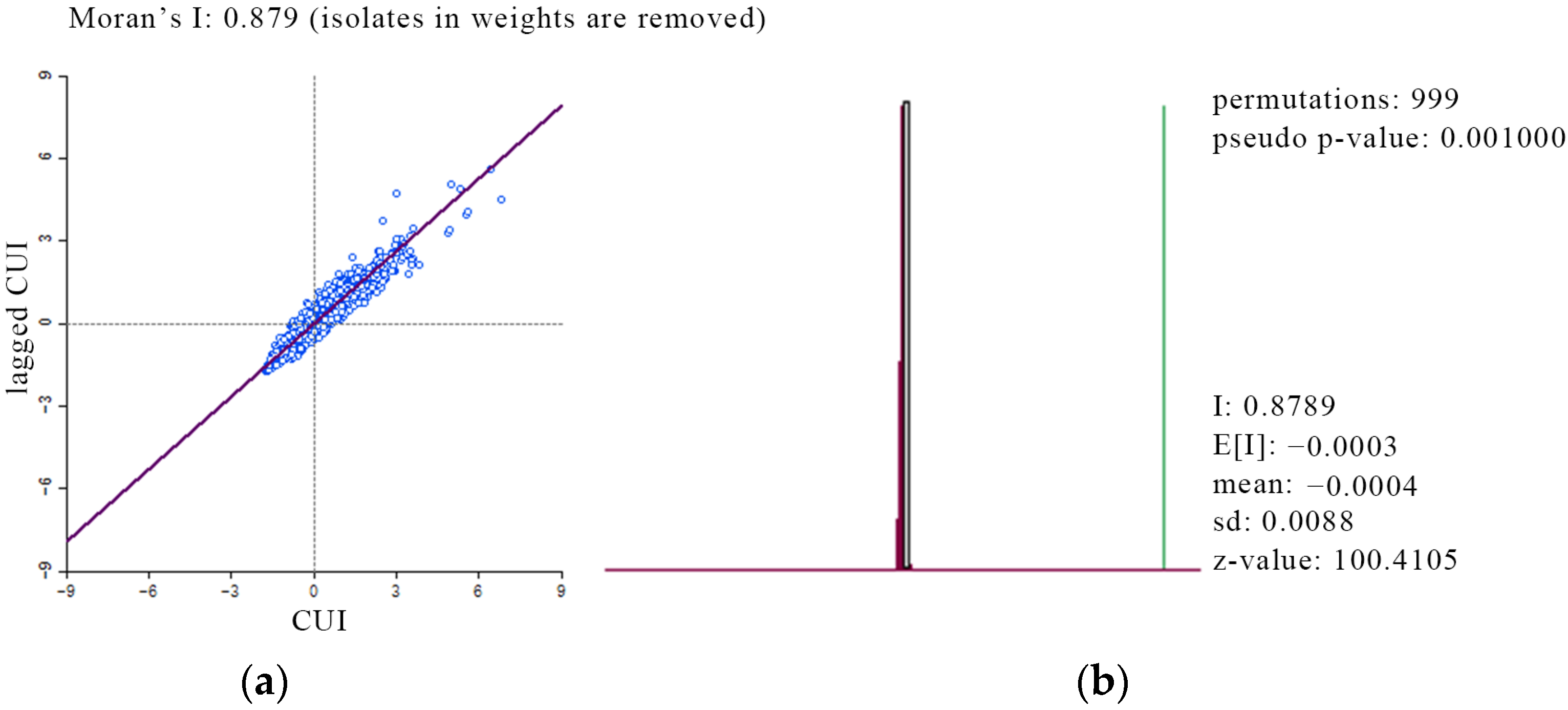
Calculations based on 500 m × 500 m grid cells in Xi’an’s main urban area reveal that carbon emission intensity exhibits significant spatial clustering. The global Moran’s I index was 0.879 (p < 0.001), with a Z-score of 100.41, indicating that urban carbon emissions in Xi’an are not randomly distributed but exhibit a strong positive spatial correlation (Figure 1). The very large Z-score is partly due to the large sample size (n = 3517), but the p-value remains <0.001, confirming strong spatial clustering. As shown in Table 5, the average carbon emission intensity in Xi’an’s main urban area is 53.01 kg/(m2·year). From an overall perspective, Xi’an exhibits a distinct “core concentration–peripheral radiation” pattern, with high-emission areas spatially coinciding to a large extent with the city’s centres of intensive development.

3.1.2. The “Single-Core, Multi-Point” Spatial Distribution Pattern

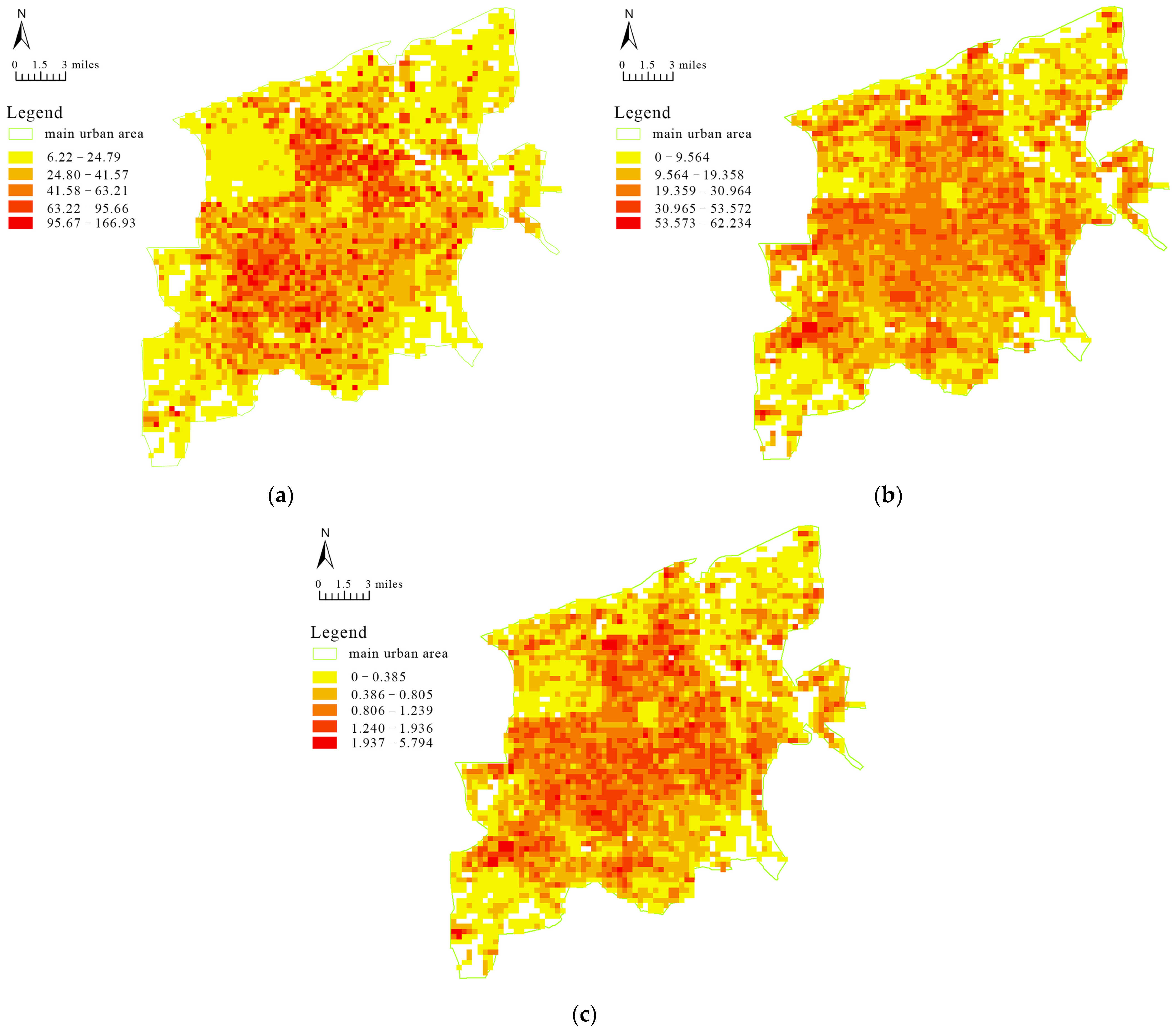
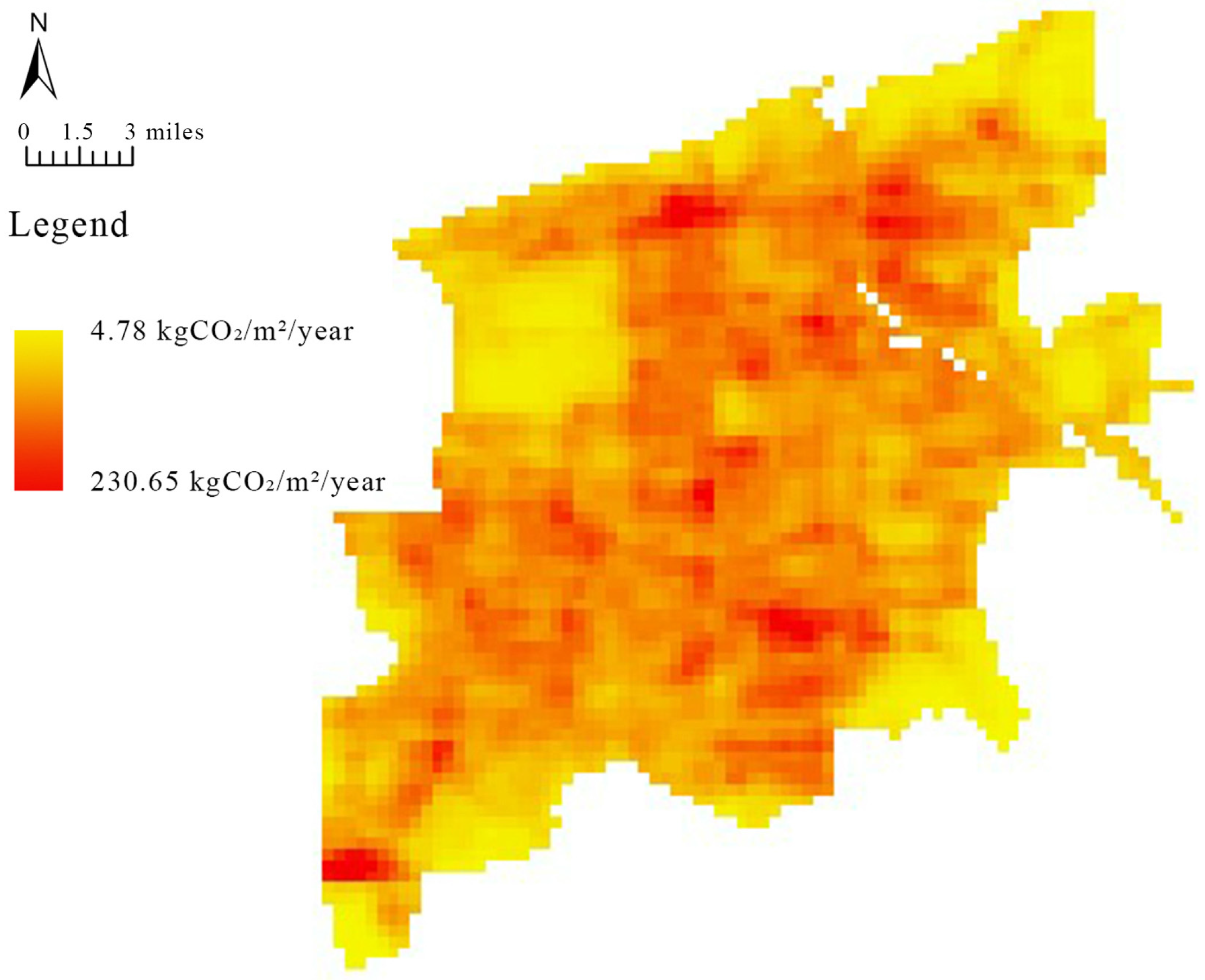
Figure 2 illustrates the spatial distribution of carbon emissions in Xi’an’s main urban area, and Figure 3 shows the spatial Distribution of Urban Form. First, the historic city centre, centred on the Bell Tower, exhibits a continuous “cluster of high values.” Although building height is restricted in this area, the extremely high Building Density (BD) and concentration of commercial and public facilities are spatially coincident with this emission peak. Older buildings in this area also tend to have lower energy efficiency, which may contribute to the observed high emissions, though direct evidence is not provided by our data. Second, as the city expands southwards, the High-Tech Zone has emerged as a distinct “second growth pole.” Dominated by super-tall commercial office buildings, the extensive use of glass curtain walls is associated with high air-conditioning cooling loads under intense summer sunlight, suggesting a link to elevated carbon emissions. This “bimodal” pattern reflects the spatial disparities in Xi’an during a phase characterised by both urban renewal and rapid expansion.

3.2. Differences in Emission Contributions Between Different Land Use Categories

3.2.1. Emission Contributions by Land Use Type

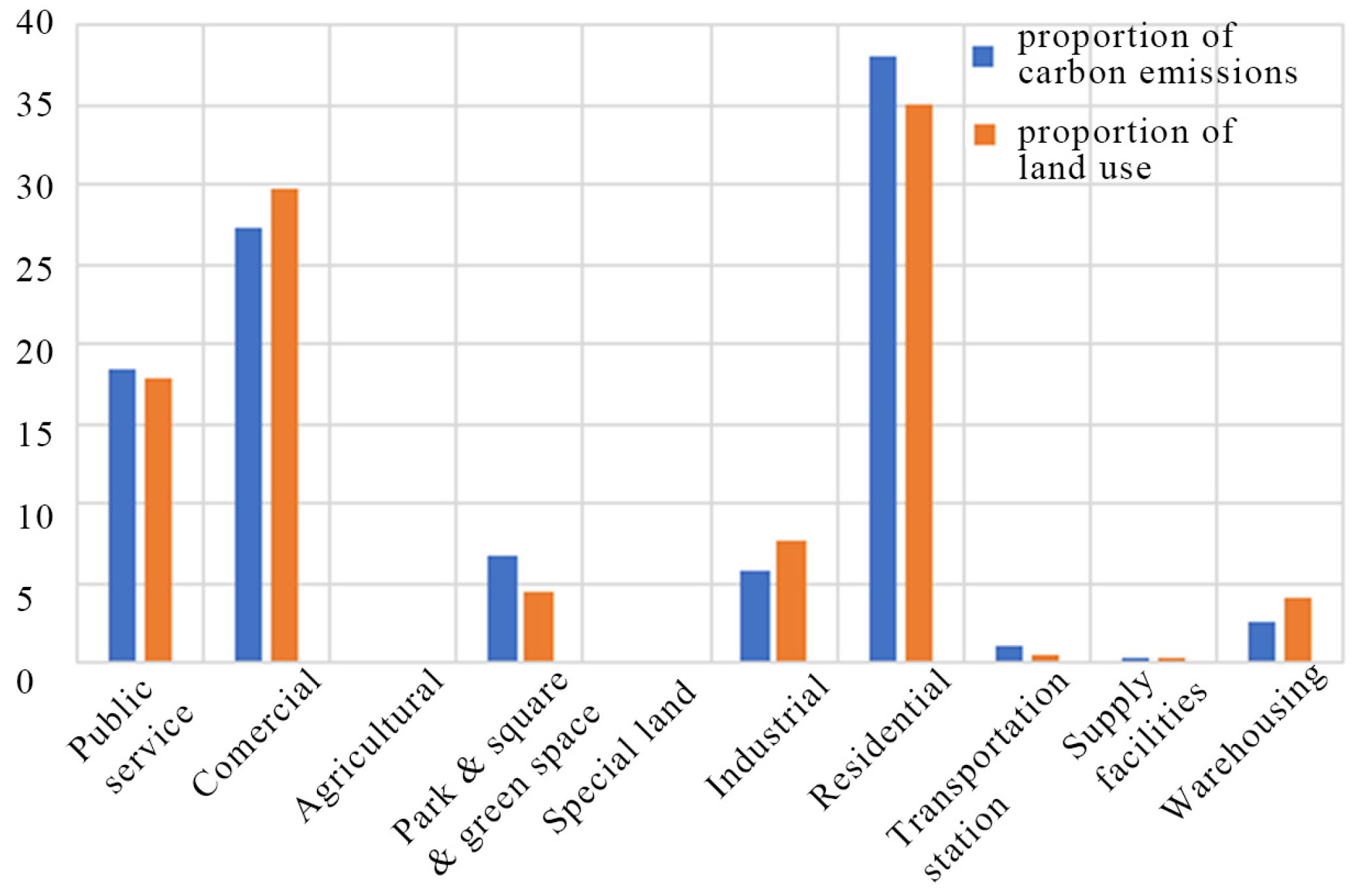
Land use in Xi’an’s main urban area includes residential, commercial, public service, industrial, and logistics and warehousing zones, alongside green spaces and squares. Residential land accounts for 35% of the total floor area in the study area, yet it contributes 38% of total carbon emissions (Figure 4). Second, commercial and office land also exhibits a pronounced “high-emission” characteristic, contributing nearly 28% of the city’s total carbon emissions despite accounting for less than 30% of the total floor area. This reveals that the core of carbon neutrality efforts in megacities lies in the management of carbon emissions from high-density residential and commercial development zones. This pattern is consistent with findings from other Chinese megacities such as Beijing and Shanghai, where residential and commercial land also dominate carbon emissions [64].
The finding that residential land contributes 38% of total carbon emissions is noteworthy. Xi’an’s residential sector plays a more significant role. Several factors explain this pattern. First, Xi’an’s climate transition zone features cold winters and hot summers, leading to prolonged heating (November–March) and cooling (June–September) seasons. Second, a large proportion of residential buildings in the old city core lack modern thermal insulation, resulting in low energy efficiency. Third, the rapid growth of split air-conditioners and electric heating devices in high-density neighbourhoods has substantially increased household electricity consumption [65,66]. This phenomenon is not unique to Xi’an. For policymakers, this signals a shift in focus: mitigating residential carbon emissions through building retrofits, energy-efficient appliances, and public awareness campaigns is as critical as regulating industrial sources.

3.2.2. Carbon Use Intensity (CUI) by Functional Category

Table 6 provides a detailed comparison of the average Carbon Use Intensity (CUI) for major functional land uses in the central urban area.
Commercial centres (Xiaozhai, Zhonglou): In these grid cells, the extreme concentration of commercial functions has resulted in a CUI exceeding 135.19 kgCO2/(m2·year) in certain local grid cells. As these areas contain a large number of shopping centres, restaurants and entertainment venues, their round-the-clock lighting and frequent heating and ventilation requirements place them at the top of the energy consumption spectrum.
Business and office districts (High-Tech Core Area): Modern business districts exhibit a different logic behind high emissions. In the climatic context of the transitional zone, Xi’an’s extremely high solar radiation in summer acts upon the high proportion of glass curtain walls in high-rise office buildings, generating a severe greenhouse effect. This necessitates maintaining high-load cooling, resulting in the High-Tech Core Zone’s electricity consumption intensity far exceeding that of other districts. This area also exhibits the highest carbon emission intensity in the central urban area (230.65 kg CO2/(m2·year)).
The extremely high CUI in Xi’an’s commercial and office districts (up to 230.65 kg CO2/(m2·year)) exceeds values reported for similar land uses in humid Chinese cities [67]. This disparity suggests that the radiative–evaporative stress unique to transition zones amplifies energy consumption in glass-curtain-wall-dominated high-rise buildings.

3.2.3. Spatial Mismatch Between Work and Residential Areas

Research has found that the significant spatial mismatch between work and residential areas in Xi’an amplifies the spatial heterogeneity of carbon emissions. In purely office-based clusters, such as the High-Tech Zone, the monofunctional structure leads to energy consumption peaks, with carbon emissions within grid cells exhibiting a high degree of “clustered concentration.” This functional monotony undermines the temporal and spatial flexibility of energy use, creating “carbon and heat islands” that are difficult to mitigate. In contrast, in areas with higher land use mix, such as Qujiang or the Economic Development Zone, residential, public service and community commercial facilities are interwoven within grid units. The carbon emission profiles of different functions complement one another over time, and low-emission-intensity residential buildings play a role in spatially diluting emissions, resulting in an average carbon emission intensity for such grids that is 7.8% lower than that of purely commercial districts. This phenomenon demonstrates that, in climate transition zones characterised by high development intensity, optimising the distribution of energy consumption through a balance between work and residential functions and functional mixing represents a potential spatial strategy for mitigating localised emission hotspots. This consistency across different climate zones indicates that functional mixing is a robust strategy for reducing carbon emissions, though its magnitude may vary with local climate conditions [68].

3.3. Carbon–Heat Coupling and Positive Feedback from “Dry Heat Islands” in the Transition Zone

3.3.1. Spatial Correlation Characteristics of Carbon and Heat

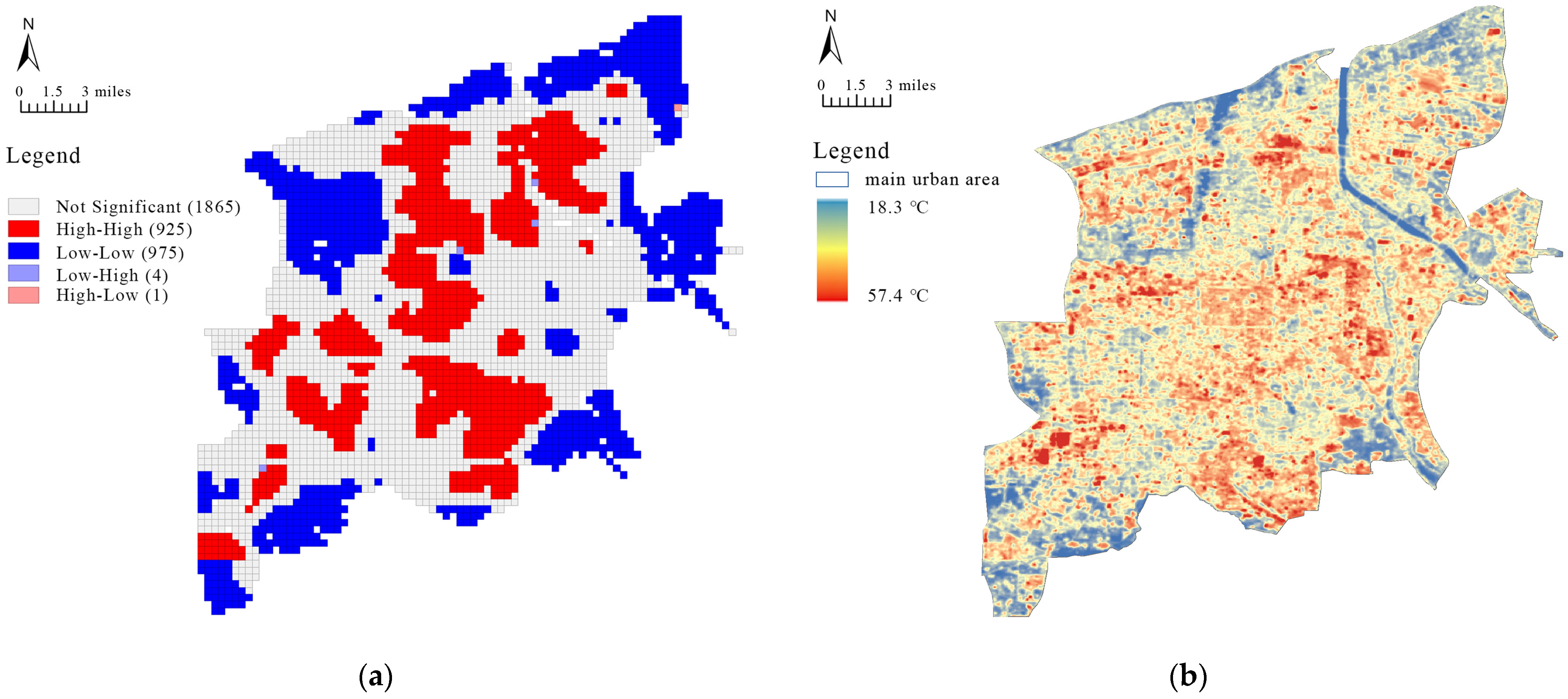
To investigate the feedback mechanisms between carbon emissions and environmental microclimate in megacities located in climatic transition zones, this study utilised bivariate Moran’s I to explore the spatial correlation between carbon emission intensity and Land Surface Temperature (LST) (Figure 5). The results indicate that the two variables exhibit highly significant spatial coupling, with a global bivariate Moran’s I index of 0.64 (p < 0.001). This high positive correlation indicates that, under the climatic conditions of this region, the anthropogenic heat release accompanying high carbon emission intensity is spatially associated with the intensification of the urban heat island effect. Causality, however, is not established by the spatial correlation alone. As shown in Figure 5, the spatial distribution maps of LST and carbon emission intensity reveal that summer emission hotspots coincide with areas of concentrated urban heat.

3.3.2. Misalignment and Overlap of Spatial Clusters of CUI and LST

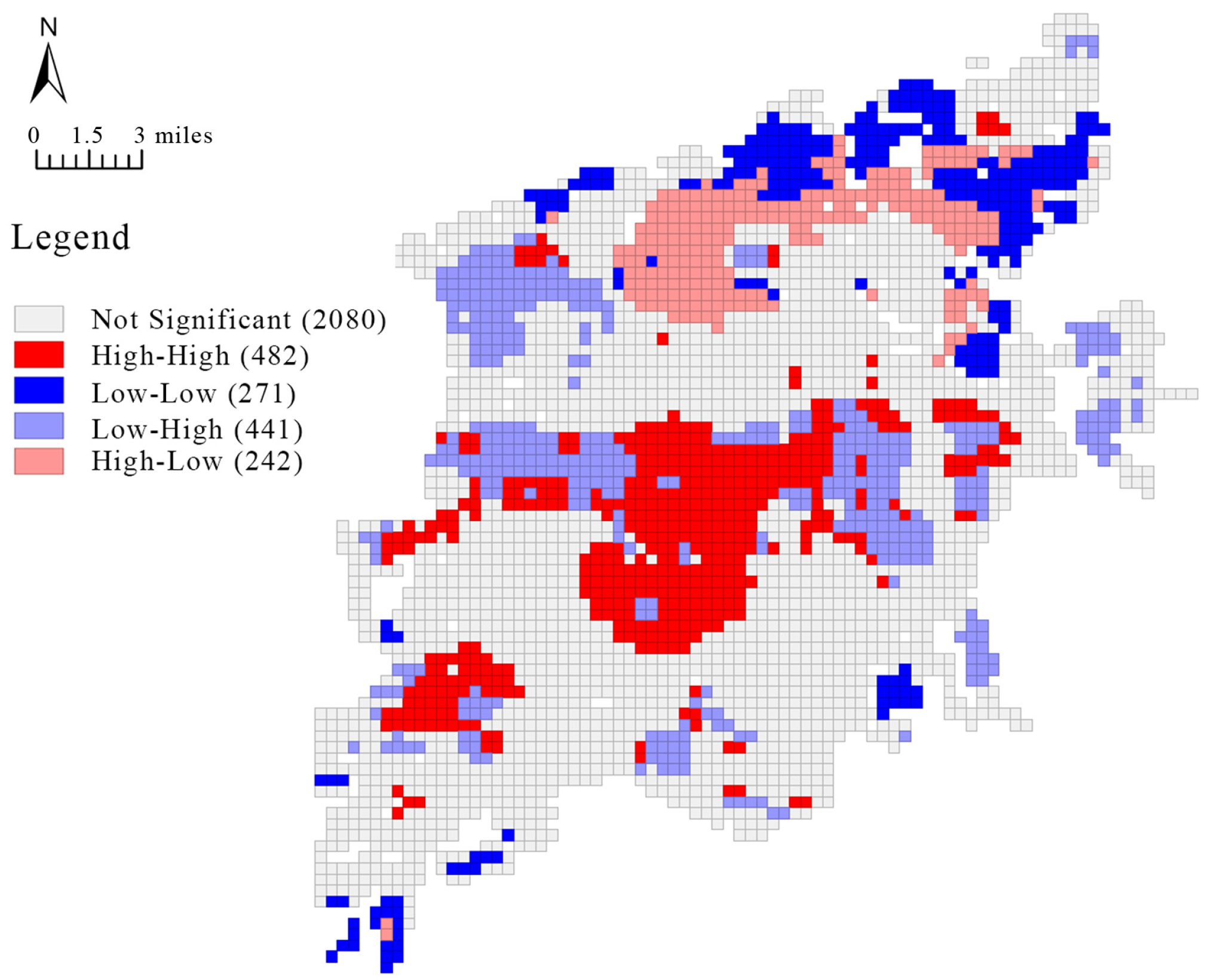
Through bivariate LISA cluster analysis (see Figure 6), four distinct coupling patterns were identified.
“High-Carbon–High-Heat” (High–High) Pattern: Concentrated in the core office district of Gaoxin Road, the Xiaozhai commercial district, and commercial clusters within the Ming City Wall. Due to a lack of effective water evaporation and vegetation shade, building clusters act as massive heat reservoirs, with the anthropogenic heat generated by energy consumption further trapped within the deep, narrow streetscapes.
“Low-Carbon–Low-Heat” (Low–Low) Pattern: Primarily distributed in the Chanba Ecological Zone and the outskirts of the Qujiang New District. Benefiting from the open water bodies and high green space coverage brought about by the “Eight Rivers Encircling Chang’an” project, these areas have formed distinct “dual carbon–heat cool islands”.
Local anomalies include industrial zones showing “high-carbon, low-heat” patterns (possibly due to process-specific heat profiles or factory shading) and hard-surfaced plazas showing “low-carbon, high-heat” patterns, where surface materials drive temperature rise more than building emissions.

3.3.3. Positive Feedback Mechanisms Specific to Climatic Transition Zones

This study further hypothesises that cities in climatic transition zones, such as Xi’an, may exhibit a positive feedback loop involving heat, electricity, and carbon. The observed spatial patterns, high-carbon grids coinciding with high-LST grids, are consistent with this hypothesis, though direct causal evidence requires longitudinal or quasi-experimental data. Under conditions of extreme summer heat and intense solar radiation, the massive amounts of anthropogenic heat generated by high energy consumption in buildings are released into the atmosphere. Due to low air humidity and the atmosphere’s limited capacity to absorb latent heat, the release of sensible heat leads to a significant rise in local LST. This hypothesised cycle is spatially reflected in the LISA clusters: High–High grids (high carbon, high LST) are concentrated in areas where such a feedback might be expected, such as commercial cores with little evaporative cooling. However, the LISA results alone do not test the cycle causally.

4. Discussion

The following discussion interprets the MGWR coefficients as spatially varying associations between planning factors and carbon emissions. These associations are not evidence of causal mechanisms, but they provide empirical patterns that can inform hypothesis generation and planning priorities.

4.1. The Impact of Morphological Factors on Carbon Emissions: Spatial Non-Stationarity and Drought Adaptation

4.1.1. Analysis of Spatial Non-Stationarity

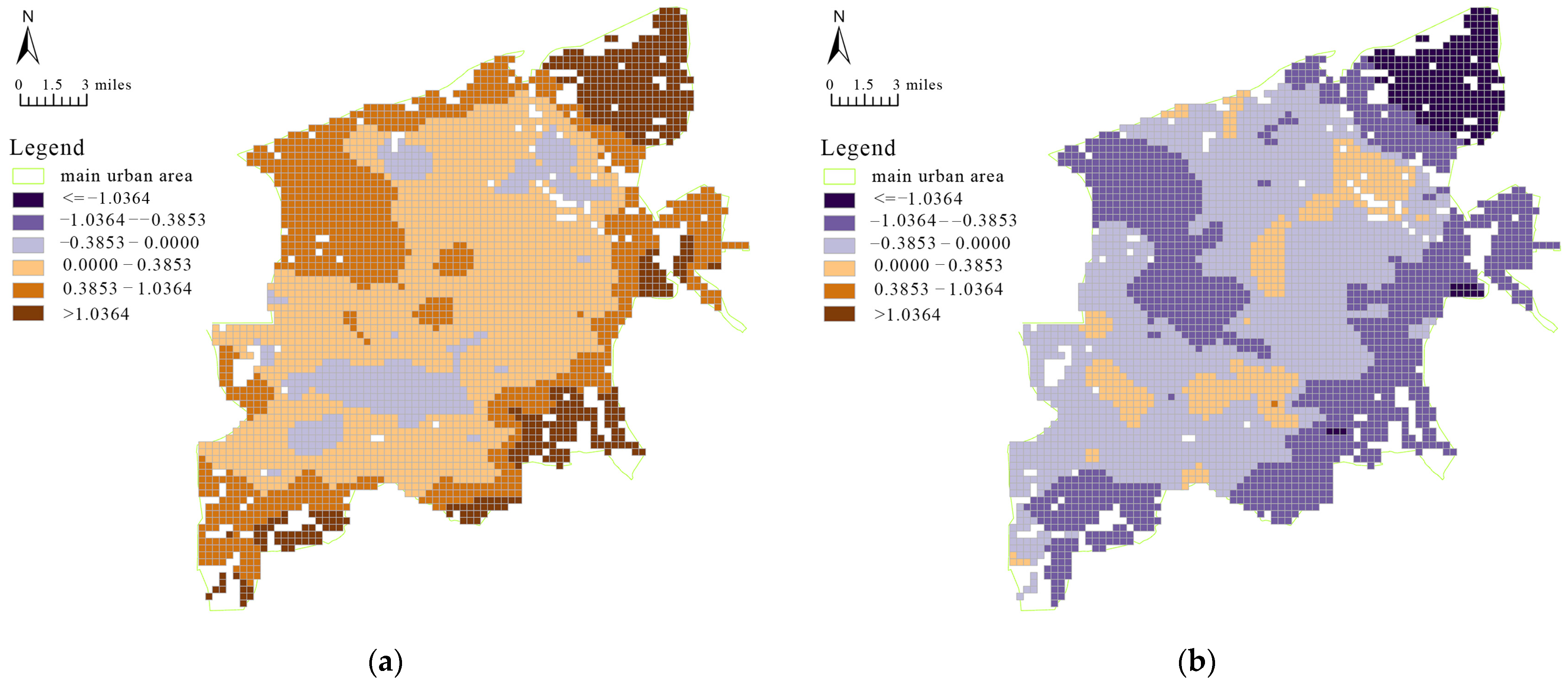
The regression results based on the MGWR model indicate that the influence of urban form factors in Xi’an’s central urban area on carbon emissions exhibits significant spatial non-stationarity (Table 7 and Figure 7). As expected for a locally varying coefficient model, MGWR substantially improves the fit compared to global OLS regression (R2 = 0.8563 vs. 0.5262). As shown in Table 4, the local regression coefficients for floor area ratio and building density fluctuate considerably across the entire study area, with standard deviations of 0.3867 and 0.5304, respectively, and bandwidths of 30 and 34 grid cells, respectively. This indicates that, under different urban textures, the spatial heterogeneity of the association between urban form and carbon emission intensity is strong, and the associations of floor area ratio and building density exhibit clear spatial differentiation.

4.1.2. Dual Impact of Floor Area Ratio in Climatic Transition Zones

The positive correlation between floor area ratio and carbon emissions is particularly strong in the old city centre within the Ming City Wall (0.39–1.0), whereas it is significantly weaker in new development zones such as Gaoxin and Qujiang (−0.39–0.39). This disparity suggests the complex logic underlying high-density development. In the old city, a high FAR is often accompanied by extreme uniformity in building storeys and the formation of deep, narrow building blocks. In a relatively arid climate, this morphology is spatially associated with a “heat trap” effect, which may hinder the dissipation of long-wave radiation and be associated with higher cooling loads at night.
However, in the cluster of super-high-rise buildings in the High-Tech Zone, the MGWR coefficient exhibits an interesting “low sensitivity.” This is consistent with the unique mutual shading effect characteristic of climatic transition zones. Compared to humid regions, Xi’an experiences extremely intense solar radiation in summer. The vast shadow cast by super-high-rise buildings effectively shields the facades of the surrounding buildings and hard surfaces, reducing incident short-wave radiation and, to some extent, being associated with an offsetting effect on the increase in carbon emissions that would otherwise be expected from the increased building mass.

4.1.3. Trade-Off Between Building Density (BD) and Ventilation Efficiency

The impact of building density on carbon emission intensity exhibits significant spatial variation. Overall, the BD coefficient is negative in most areas, suggesting that higher building density is associated with lower carbon emissions. This is consistent with the theory that compact urban forms are associated with reduced transport energy consumption and improved energy efficiency. However, as shown in the figure, there are some areas, such as those highlighted in warm colours, where the BD coefficient is positive, suggesting that high density shows a positive association with carbon emissions in these locations.
When considered in conjunction with the spatial layout of Xi’an and existing literature on urban ventilation [references], a plausible interpretation of the spatially varying BD coefficients is as follows. In areas with better ventilation conditions, high-density building clusters may not substantially impede airflow, which could help maintain the negative BD–emission association. Conversely, in areas where ventilation is likely obstructed (e.g., densely built-up zones, narrow streets, lack of wind corridors), high density may suppress natural ventilation, potentially contributing to heat accumulation and higher cooling energy consumption. These interpretations are consistent with our observed coefficient patterns, though they are not directly tested by our data and should be considered as hypotheses for future research. This is associated with a reduction in the emission-reduction benefits of compact layouts, corresponding to a positive BD coefficient.
This spatial differentiation suggests that urban planning should take local wind conditions into account, preserving ventilation corridors whilst pursuing high-density development, in order to ensure that building density continues to exert a suppressing effect on carbon emission intensity.
The spatially varying sign of BD coefficients is not unique to Xi’an. Studies in Delhi, India, have shown that high building density exacerbates cooling energy demand in poorly ventilated areas but reduces it in wind-corridor zones [69]. In contrast, research in humid-temperate cities tends to report a consistently negative BD–emission relationship [7], due to more frequent cloudy conditions and lower solar radiation that reduce the ventilation penalty. This contrast reinforces the need for climate-specific planning guidelines.

4.2. The Non-Linear Mitigating Effect of Land Use Mix on Carbon Emissions

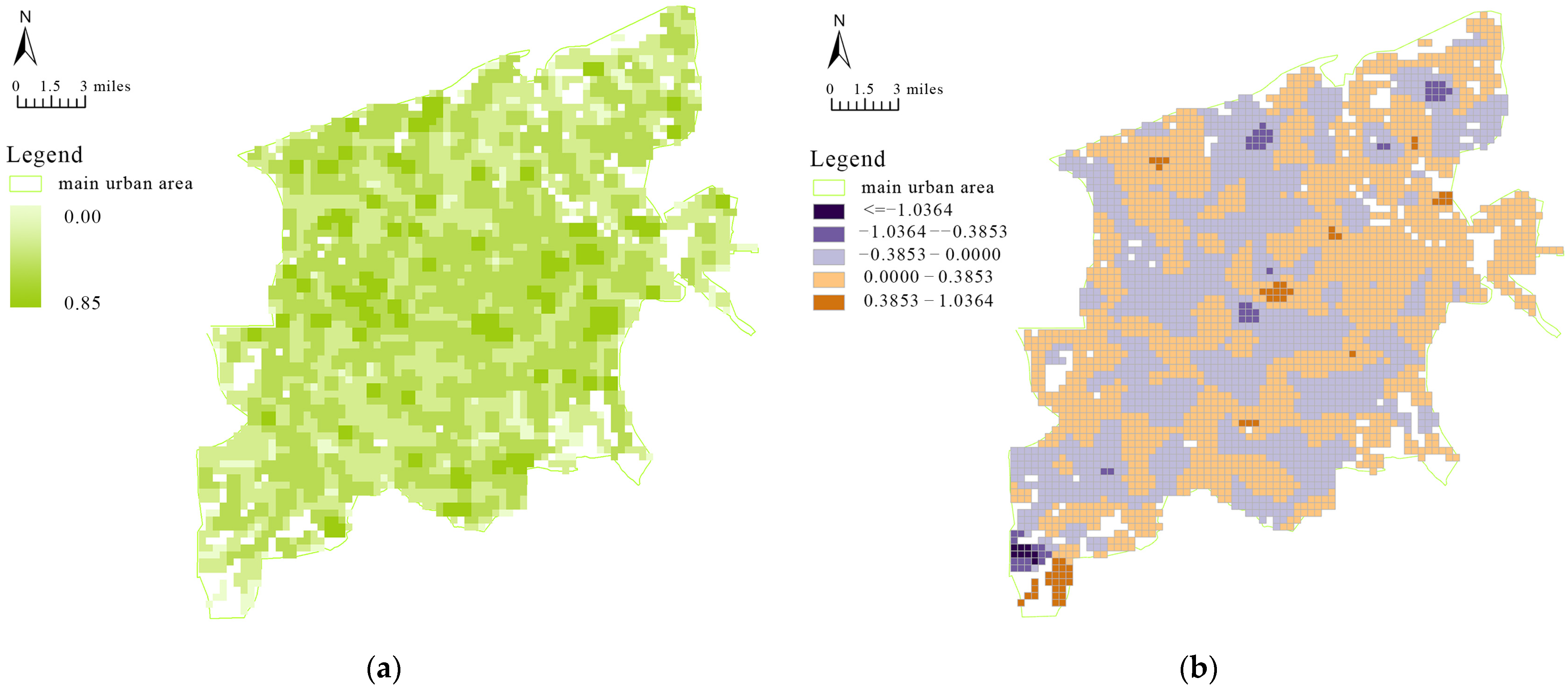
The results of the MGWR model indicate that land use mix shows a significant negative correlation with carbon emission intensity in most grid cells within Xi’an’s central urban area (Table 8 and Figure 8). In transitional climate zones, single-use blocks often exhibit significant differences between peak and off-peak energy consumption. This “rigid energy consumption” is highly prone to generating cumulative thermal loads in hard, vegetated-shade-deficient environments. This study found that as land use mix increases, local carbon emission intensity decreases. This reduction effect is particularly pronounced in the mixed residential and office areas of Xi’an’s High-Tech Zone and Qujiang New District. A possible explanation is that highly mixed land use may enable complementary temporal scales of energy consumption between buildings of different functions. For example, the spatial interweaving of cooling peaks in commercial buildings with household electricity peaks in residential buildings reduces regional carbon emission intensity through local microgrids or energy-sharing mechanisms.

4.3. The Benefits of “Cooling and Carbon Reduction” in Blue–Green Spaces Within Transition Zones

4.3.1. The Evaporative Cooling Effect of NDVI

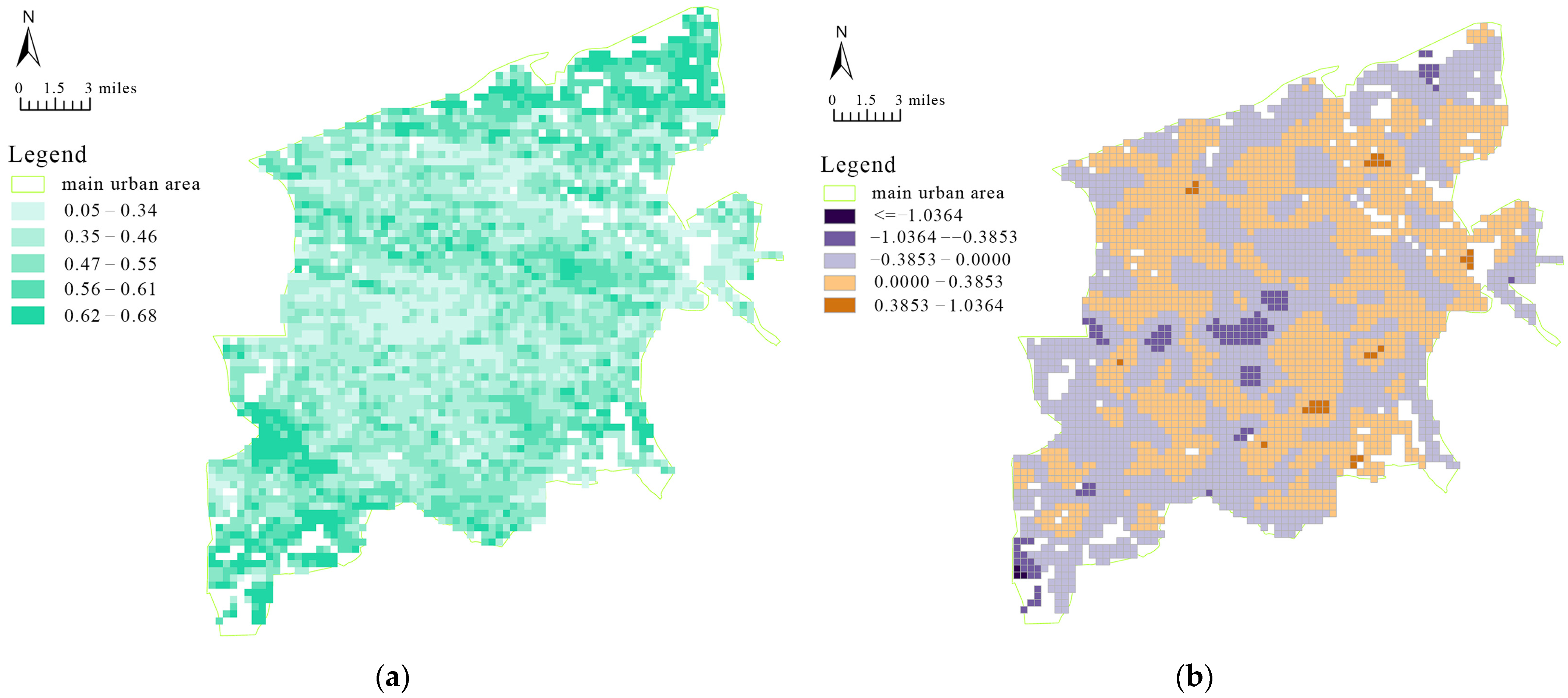
In regions within the climatic transition zone, the ecological benefits of vegetation are often more sensitive than in humid regions. MGWR results indicate that the NDVI factor exhibits the narrowest regression coefficient bandwidth (BW = 30) in the central urban area of Xi’an, demonstrating extremely strong local spatial heterogeneity (Table 9). In certain areas of the Chanba and Qujiang districts, where vegetation cover is relatively high, NDVI and carbon emissions generally exhibit a strong negative correlation. Conversely, in some areas of the city centre, such as parks, street trees, and residential green spaces, where NDVI levels are not low, these are also areas of high population and traffic density, resulting in high carbon emission intensities. Consequently, a positive correlation is observed. Furthermore, a comparative analysis of LST distributions reveals that under Xi’an’s intense solar radiation, vegetation not only sequesters carbon directly through photosynthesis but may also contribute to mitigating urban heat island effects through transpiration (Figure 9). This suggests that in urban planning, strategies for green space allocation may need to prioritise “cooling and carbon reduction” effects rather than merely meeting minimum area requirements.

4.3.2. Contribution of the Water Body’s Thermal Sink Effect

Xi’an’s unique “Eight Rivers” water network system plays a crucial role as a “heat sink” in reducing carbon emissions from buildings. A comparative analysis of grid cells within a 1 km buffer zone along the banks of the Wei and Chanba Rivers revealed that, due to the moderating effect of the water bodies’ microclimate, the average carbon emission intensity of the riverside grid cells was lower than that of inland areas with similar functions. In a relatively arid climate, the high specific heat capacity of water bodies significantly absorbs anthropogenic heat released by surrounding buildings, thereby breaking the “thermal feedback lock-in” mechanism mentioned above. This conclusion strongly supports the scientific value of Xi’an’s “Bringing Water into the City” plan in achieving carbon neutrality goals, demonstrating that microclimatic corridors formed by the interaction of water and greenery are a key pathway to enhancing the carbon spatial resilience of cities in transitional climate zones.

4.4. Comparative Analysis of Mechanisms in Cities in the Climate Transition Zone and Humid Regions

To test the applicability of existing low-carbon planning theories under climatic boundary conditions, this paper compares the key findings from Xi’an with existing studies on typical cities in humid regions.
  • Differences in the strength of the influence of morphological factors: Studies in humid regions generally show that Floor Area Ratio (FAR) has a stable positive correlation with grid-level carbon emission, and the coefficient exhibits little spatial variation [70,71,72]. However, in this study, the local MGWR coefficient for FAR differs significantly between Xi’an’s old city and the High-Tech Zone. This discrepancy can be attributed to the mutual shading effect between super-high-rise buildings in the high-radiation environment of the transition zone. Under a humid and cloudy climate, this effect is significantly weakened. In other words, the linear perception in humid regions that “high FAR inevitably leads to high emissions” needs to be adjusted in Xi’an according to building height gradients.
  • Comparison of the marginal efficacy of blue and green spaces: In dry, high-radiation environments, the marginal benefit of vegetation transpiration cooling is higher. The reduction in carbon emission intensity resulting from lower air temperatures is more pronounced under dry and hot conditions. This result supports the inference that “the drier and hotter the climate, the higher the return on investment for greening-induced cooling and carbon reduction” [73,74].
  • Comparison of carbon–heat relationships: The bivariate Moran’s I coefficient for Xi’an reached 0.64. This result reflects the intensification of positive feedback in the “dry-hot island” phenomenon within the transition zone: low humidity weakens the capacity to dissipate latent heat, causing anthropogenic heat to become trapped within the urban fabric in the form of sensible heat, thereby creating a reinforced cycle of “emissions–warming–further emissions.” Cities in humid regions can mitigate the urban heat island effect relatively easily by increasing greening and water bodies, whereas cities in transitional zones such as Xi’an must simultaneously prioritise the provision of ventilation corridors to physically “blow” accumulated sensible heat out of the city. Otherwise, the additional energy consumption resulting from greening irrigation may offset the cooling benefits [75,76,77].
It should also be noted that these findings reflect annual average conditions. Seasonal extremes (e.g., summer cooling vs. winter heating) may exhibit different spatial mechanisms, which warrant future investigation.
Beyond China, comparison with other large emitters in similar climates is instructive. For instance, Los Angeles (Mediterranean semi-arid) and Delhi (semi-arid) also experience strong radiative–evaporative stress. Research in Los Angeles has demonstrated that mutual shading among high-rises can reduce peak cooling loads [78], aligning with our MGWR finding in Xi’an’s High-Tech Zone. In Delhi, high residential emissions have been linked to poor building insulation and widespread use of inefficient air conditioners [79,80,81], mirroring Xi’an’s situation. However, a key difference is that Xi’an’s residential emission share (38%) is slightly higher, partly due to the long heating season not present in Delhi. These cross-city comparisons suggest that transition-zone megacities share common mechanisms but also exhibit local specificities that require tailored interventions.

4.5. Low-Carbon Planning Strategies Based on Spatial Heterogeneity

Based on the spatial variations captured by the MGWR model, this study divides Xi’an’s central urban area into three categories of planning-based carbon reduction response zones:
  • Old Town Renewal and Low-Carbon Guidance Zone (Core Area): The strategic focus is on “quality enhancement and decongestion.” Through micro-renewal measures, illegal structures are demolished, and “cool alleys” are designed to guide the prevailing summer winds through the high-density fabric, thereby alleviating the “heat traps” caused by historical development.
  • Business Core Energy Efficiency Control Zone (High-Tech Zone, Economic Development Zone): The strategy focuses on “shade utilisation and façade management.” By controlling building height gradients to utilise mutual shading for cooling and mandating that high-rise office buildings adopt climate-adaptive shading façades, this strategy reduces carbon leakage from large-scale glass curtain walls under intense solar radiation.
  • Ecological New District Collaborative Carbon Reduction Zone (Chanba, Qujiang): The strategic focus lies on “water–green–wind synergy.” A ventilation corridor system centred on rivers will be established. By enhancing the spatial permeability of blue and green spaces, an ecological compensation mechanism will be realised whereby “environmental cooling guides building energy reduction.”

5. Conclusions and Limitations

5.1. Conclusions

Taking Xi’an, a megacity in the climatic transition zone, as a case study, this research reveals the spatial heterogeneity of carbon emissions at a 500 m × 500 m grid scale. The results show a “core–periphery” emission pattern, strong carbon–heat coupling (dry heat island effect), spatial non-stationarity of morphological factors, and non-linear mitigation effects of land use mix and blue–green spaces. The main findings are as follows:
  • Carbon emissions in Xi’an show a “double-peak” pattern centred on the old city and High-Tech District, with residential and commercial land accounting for nearly 60% of total emissions (peak CUI: 230.65 kgCO2/m2·year).
  • A strong spatial coupling between carbon and LST confirms the “dry heat island” positive feedback: anthropogenic heat accumulates as sensible heat in low-humidity environments, reinforcing emissions-driven warming.
  • Morphological factors suggest spatial non-stationarity: FAR exacerbates emissions in the old city but shows weaker effects in super-high-rise clusters due to mutual shading. BD reduces emissions only where ventilation is adequate.
  • Land use mix and blue–green spaces show non-linear emission reductions. Mixed use enables complementary energy patterns, and evaporative cooling yields higher marginal benefits in arid–hot environments.
  • Unlike humid-region strategies, low-carbon planning in transition zones should prioritise mutual shading, ventilation corridors, and water–green–wind integration.

5.2. Limitations and Further Works

This study has the following limitations. The first is data accuracy and spatial resolution constraints. Carbon emissions are based on downscaled simulations of night-time lighting and aggregated at a 500 m grid resolution. Multiple sources of uncertainty exist, including: (a) saturation and blooming effects in high-density areas, partially corrected by building-footprint weighting; (b) estimation of building heights from storey counts (assuming standard floor height); (c) provincial-level emission factors applied to the city scale. While the strong correlation with building volume (r = 0.73) supports spatial reasonableness, we lack independent ground-based flux measurements for direct validation. The combined uncertainties may affect absolute emission values, though the relative spatial patterns and the main conclusions on heterogeneity are expected to be more robust. Second, this study uses LST as an integrative proxy for the coupled radiative–evaporative stress but does not separate the individual contributions of radiation absorption and evaporative cooling. The identified positive feedback between carbon emissions and LST is therefore correlational rather than fully mechanistic. Disentangling these pathways would require higher-resolution albedo and latent heat flux data, which are not available at the current grid scale. This limitation does not undermine the main findings on spatial heterogeneity and planning implications, but it should be considered when interpreting the causal language of the feedback loop. Third, there is a lack of temporal dimension. This study is intentionally based on annual static data to focus on long-term spatial patterns and does not incorporate seasonal or diurnal dynamic variations. The logic underlying energy consumption differs significantly between winter and summer in climatic transition zones, and the “dry heat island” positive feedback is primarily intensified during summer, limiting the comprehensiveness of the mechanism explanation. Fourth, the downscaled carbon emissions from night-time light data were validated only through an internal consistency check against building volume, rather than independent ground-based CO2 flux measurements. While the high correlation (r = 0.73) supports the spatial allocation logic, absolute emission values at the grid level should be interpreted with caution. Fifth, the 500 m grid resolution may be subject to the modifiable areal unit problem (MAUP). A formal scale-sensitivity analysis was not performed due to computational constraints, and this should be addressed in future research.
Future research could integrate higher-resolution remote sensing data with actual building energy consumption measurements, incorporate albedo or latent heat flux data, carry out seasonal dynamic analysis, and conduct comparative studies across cities in different climate transition zones to establish a more universally applicable theoretical framework for low-carbon planning. Also, research incorporating in situ observations would further strengthen the quantitative accuracy, as seasonal or monthly data is needed to validate the temporal variations of the identified spatial mechanisms.

Author Contributions

Conceptualization, S.S. and R.G.; methodology, S.S.; software, R.G.; validation, S.S. and R.G.; formal analysis, S.S.; investigation, R.G.; resources, S.S.; data curation, R.G.; writing—original draft preparation, S.S. and R.G.; writing—review and editing, R.G.; visualisation, R.G.; supervision, R.G.; project administration, S.S.; funding acquisition, S.S. All authors have read and agreed to the published version of the manuscript.

Funding

This research was funded by the Department of Science and Technology of Shaanxi Province (grant number: 2024JCYBQN-0445), the Department of Human Resources and Social Security of Shaanxi Province (grant number: 2023BSHEDZZ267) and the National Natural Science Foundation of China (grant number: 52508080).

Institutional Review Board Statement

Not applicable.

Informed Consent Statement

Not applicable.

Data Availability Statement

The datasets presented in this article are not readily available because the data are part of an ongoing study. Requests to access the datasets should be directed to the corresponding author.

Conflicts of Interest

The authors declare no conflicts of interest. The funders had no role in the design of the study; in the collection, analyses, or interpretation of data; in the writing of the manuscript; or in the decision to publish the results.

Abbreviations

The following abbreviations are used in this manuscript:
CUICarbon Use Intensity
MGWRMulti-scale Geographically Weighted Regression
FARFloor Area Ratio
BDBuilding Density
LSTLand Surface Temperature
NDVINormalised Difference Vegetation Index

References

  1. Kikstra, J.S.; Nicholls, Z.R.; Smith, C.J.; Lewis, J.; Lamboll, R.D.; Byers, E.; Sandstad, M.; Meinshausen, M.; Gidden, M.J.; Rogelj, J. The IPCC Sixth Assessment Report WGIII climate assessment of mitigation pathways: From emissions to global temperatures. Geosci. Model Dev. 2022, 15, 9075–9109. [Google Scholar] [CrossRef]
  2. Zheng, S.; Huang, Y.; Sun, Y. Effects of urban form on carbon emissions in China: Implications for low-carbon urban planning. Land 2022, 11, 1343. [Google Scholar] [CrossRef]
  3. Qin, B.; Han, S.S. Planning parameters and household carbon emission: Evidence from high-and low-carbon neighborhoods in Beijing. Habitat Int. 2013, 37, 52–60. [Google Scholar] [CrossRef]
  4. Hong, S.; Hui, E.C.-M.; Lin, Y. Relationship between urban spatial structure and carbon emissions: A literature review. Ecol. Indic. 2022, 144, 109456. [Google Scholar] [CrossRef]
  5. Ye, H.; He, X.; Song, Y.; Li, X.; Zhang, G.; Lin, T.; Xiao, L. A sustainable urban form: The challenges of compactness from the viewpoint of energy consumption and carbon emission. Energy Build. 2015, 93, 90–98. [Google Scholar] [CrossRef]
  6. Falahatkar, S.; Rezaei, F. Towards low carbon cities: Spatio-temporal dynamics of urban form and carbon dioxide emissions. Remote Sens. Appl. Soc. Environ. 2020, 18, 100317. [Google Scholar] [CrossRef]
  7. Fan, T.; Chapman, A. Policy driven compact cities: Toward clarifying the effect of compact cities on carbon emissions. Sustainability 2022, 14, 12634. [Google Scholar] [CrossRef]
  8. Eslamipoor, R. An integrated approach for three-layer location-allocation in a green supply chain. Int. J. Logist. Syst. Manag. 2025, 52, 308–322. [Google Scholar] [CrossRef]
  9. Eslamipoor, R. A new heuristic approach for a multi-depot three-level location-routing-inventory problem. Int. J. Manag. Concepts Philos. 2024, 17, 322–339. [Google Scholar] [CrossRef]
  10. Wang, L.; Chen, T.; Yu, Y.; Wang, L.; Zang, H.; Cang, Y.; Zhang, Y.O.; Ma, X. Impacts of vegetation ratio, street orientation, and aspect ratio on thermal comfort and building carbon emissions in cold zones: A case study of Tianjin. Land 2024, 13, 1275. [Google Scholar] [CrossRef]
  11. Habibi, S. The effect of building orientation on energy efficiency. Clean Technol. Environ. Policy 2024, 26, 1315–1330. [Google Scholar] [CrossRef]
  12. Rahaman, Z.A.; Kafy, A.-A.; Saha, M.; Rahim, A.A.; Almulhim, A.I.; Rahaman, S.N.; Fattah, M.A.; Rahman, M.T.; Al Rakib, A. Assessing the impacts of vegetation cover loss on surface temperature, urban heat island and carbon emission in Penang city, Malaysia. Build. Environ. 2022, 222, 109335. [Google Scholar] [CrossRef]
  13. Roxon, J.; Ulm, F.-J.; Pellenq, R.-M. Urban heat island impact on state residential energy cost and CO2 emissions in the United States. Urban Clim. 2020, 31, 100546. [Google Scholar] [CrossRef]
  14. Du, H.; Yang, S.; Fan, Q.; Cai, A.; Li, Z. Relationship between urban thermal environment and carbon emissions in the Yangtze River Delta: Land use pattern-process perspective. Sustain. Cities Soc. 2025, 130, 106649. [Google Scholar] [CrossRef]
  15. Liu, J.; Pei, X.; Zhu, W.; Jiao, J. Multi-scenario simulation of carbon budget balance in arid and semi-arid regions. J. Environ. Manag. 2023, 346, 119016. [Google Scholar] [CrossRef]
  16. Jha, S.; Srivastava, R. Impact of drought on vegetation carbon storage in arid and semi-arid regions. Remote Sens. Appl. Soc. Environ. 2018, 11, 22–29. [Google Scholar] [CrossRef]
  17. Gu, Q.; Wei, J.; Luo, S.; Ma, M.; Tang, X. Potential and environmental control of carbon sequestration in major ecosystems across arid and semi-arid regions in China. Sci. Total Environ. 2018, 645, 796–805. [Google Scholar] [CrossRef]
  18. Wang, L.; Chen, W.; Huang, G.; Zeng, G. Changes of the transitional climate zone in East Asia: Past and future. Clim. Dyn. 2017, 49, 1463–1477. [Google Scholar] [CrossRef]
  19. Liang, S.; Peng, S.; Chen, Y. Carbon cycles of forest ecosystems in a typical climate transition zone under future climate change: A case study of Shaanxi Province, China. Forests 2019, 10, 1150. [Google Scholar] [CrossRef]
  20. Baek, C.-H.; Choi, D.-H.; Lee, B.-Y.; Lee, I.-G. The Observation and Interpretation of Long and Short Wave Radiation of the External Environment Surrounding a Single Building in the Summer. J. Korean Sol. Energy Soc. 2019, 39, 41–49. [Google Scholar] [CrossRef]
  21. Song, B.; Bai, L.; Yang, L. Analysis of the long-term effects of solar radiation on the indoor thermal comfort in office buildings. Energy 2022, 247, 123499. [Google Scholar] [CrossRef]
  22. De La Flor, F.J.S.; Cebolla, R.O.; Félix, J.L.M.; Domínguez, S.Á. Solar radiation calculation methodology for building exterior surfaces. Sol. Energy 2005, 79, 513–522. [Google Scholar] [CrossRef]
  23. Taleb, S.; Yeretzian, A.; Jabr, R.A.; Hajj, H. Optimization of building form to reduce incident solar radiation. J. Build. Eng. 2020, 28, 101025. [Google Scholar] [CrossRef]
  24. Schultz, P.; Halpert, M. Global analysis of the relationships among a vegetation index, precipitation and land surface temperature. Remote Sens. 1995, 16, 2755–2777. [Google Scholar] [CrossRef]
  25. Woodward, F.; McKee, I. Vegetation and climate. Environ. Int. 1991, 17, 535–546. [Google Scholar] [CrossRef]
  26. Duncan, J.; Boruff, B.; Saunders, A.; Sun, Q.; Hurley, J.; Amati, M. Turning down the heat: An enhanced understanding of the relationship between urban vegetation and surface temperature at the city scale. Sci. Total Environ. 2019, 656, 118–128. [Google Scholar] [CrossRef]
  27. Wang, G.; Han, Q.; de Vries, B. Assessment of the relation between land use and carbon emission in Eindhoven, the Netherlands. J. Environ. Manag. 2019, 247, 413–424. [Google Scholar] [CrossRef]
  28. Whitford, V.; Ennos, A.R.; Handley, J.F. “City form and natural process”—Indicators for the ecological performance of urban areas and their application to Merseyside, UK. Landsc. Urban Plan. 2001, 57, 91–103. [Google Scholar] [CrossRef]
  29. Piao, S.; Nan, H.; Huntingford, C.; Ciais, P.; Friedlingstein, P.; Sitch, S.; Peng, S.; Ahlström, A.; Canadell, J.G.; Cong, N.; et al. Evidence for a weakening relationship between interannual temperature variability and northern vegetation activity. Nat. Commun. 2014, 5, 5018. [Google Scholar] [CrossRef]
  30. Qiu, K.; Jia, B. Carbon emission reduction from the cooling effect of urban greenspace in the three urban agglomerations in China. Reg. Environ. Change 2023, 23, 134. [Google Scholar] [CrossRef]
  31. Li, P.; Wang, Z.-H.; Wang, C. The potential of urban irrigation for counteracting carbon-climate feedback. Nat. Commun. 2024, 15, 2437. [Google Scholar] [CrossRef]
  32. Zhu, Z.; Wu, M.; Ding, Y.; Liu, N.; Wei, J.; Hu, F.; Yao, X.; Li, J. Influence of multidimensional spatial factors on urban park cooling and carbon-saving effects: Insights under contrasting background meteorological conditions. Sustain. Cities Soc. 2025, 135, 106997. [Google Scholar] [CrossRef]
  33. Manoli, G.; Fatichi, S.; Bou-Zeid, E.; Katul, G.G. Seasonal hysteresis of surface urban heat islands. Proc. Natl. Acad. Sci. USA 2020, 117, 7082–7089. [Google Scholar] [CrossRef]
  34. Villanueva-Solis, J. Urban heat island: Dynamic simulation, assessment and measuring mitigation in cities of extreme dry weather. J. Civ. Eng. Archit. 2012, 6, 906. [Google Scholar] [CrossRef]
  35. Milelli, M.; Bassani, F.; Garbero, V.; Poggi, D.; von Hardenberg, J.; Ridolfi, L. Characterization of the Urban Heat and Dry Island effects in the Turin metropolitan area. Urban Clim. 2023, 47, 101397. [Google Scholar] [CrossRef]
  36. AzariJafari, H.; Xu, X.; Gregory, J.; Kirchain, R. Urban-Scale Evaluation of Cool Pavement Impacts on the Urban Heat Island Effect and Climate Change. Environ. Sci. Technol. 2021, 55, 11501–11510. [Google Scholar] [CrossRef] [PubMed]
  37. Zhang, X.; Steeneveld, G.-J.; Zhou, D.; Duan, C.; Holtslag, A.A. A diagnostic equation for the maximum urban heat island effect of a typical Chinese city: A case study for Xi’an. Build. Environ. 2019, 158, 39–50. [Google Scholar] [CrossRef]
  38. Xu, D.; Wang, Y.; Zhou, D.; Wang, Y.; Zhang, Q.; Yang, Y. Influences of urban spatial factors on surface urban heat island effect and its spatial heterogeneity: A case study of Xi’an. Build. Environ. 2024, 248, 111072. [Google Scholar] [CrossRef]
  39. Huang, R.; Yang, M.; Lin, G.; Ma, X.; Wang, X.; Huang, Q.; Zhang, T. Cooling effect of green space and water on urban heat island and the perception of residents: A case study of Xi’an City. Int. J. Environ. Res. Public Health 2022, 19, 14880. [Google Scholar] [CrossRef]
  40. Meng, Y.; Luo, Q.; Bai, B.; Li, Y.; Lu, J.; Ren, J. Analysis of spatial heterogeneity in Xi’an’s urban heat island effect using multi-source data fusion. PLoS ONE 2025, 20, e0332885. [Google Scholar] [CrossRef] [PubMed]
  41. Zhang, J.; Zhao, J.; Pang, B.; Liu, S. Calculation of the Optimal Scale of Urban Green Space for Alleviating Surface Urban Heat Islands: A Case Study of Xi’an, China. Land 2024, 13, 1043. [Google Scholar] [CrossRef]
  42. Wang, X.; Xiao, F.; Zhang, Y.; Yin, L.; Lesi, M.; Guo, B.; Zhao, Y. Thirty-year expansion of construction land in Xi’an: Spatial pattern and potential driving factors. Geol. J. 2018, 53, 309–321. [Google Scholar] [CrossRef]
  43. Chen, L.; Yang, H.-N.; Xiao, Y.; Tang, P.-Y.; Liu, S.-Y.; Chang, M.; Huang, H. Exploring spatial pattern optimization path of urban building carbon emission based on low-carbon cities analytical framework: A case study of Xi’an, China. Sustain. Cities Soc. 2024, 111, 105551. [Google Scholar] [CrossRef]
  44. Liu, Y.-Y.; Wang, Y.-Q.; An, R.; Li, C. The spatial distribution of commuting CO2 emissions and the influential factors: A case study in Xi’an, China. Adv. Clim. Change Res. 2015, 6, 46–55. [Google Scholar] [CrossRef]
  45. Lin, A.; Sun, X.; Wu, H.; Luo, W.; Wang, D.; Zhong, D.; Wang, Z.; Zhao, L.; Zhu, J. Identifying urban building function by integrating remote sensing imagery and POI data. IEEE J. Sel. Top. Appl. Earth Obs. Remote Sens. 2021, 14, 8864–8875. [Google Scholar] [CrossRef]
  46. Su, Y.; Xu, Q.; Zhu, X.; Zhang, F.; Liu, Y. Automatic functional classification of buildings supported by a poi semantic characterization knowledge graph. ISPRS Int. J. Geo-Inf. 2024, 13, 285. [Google Scholar] [CrossRef]
  47. Gafoor, F.A.; Cho, C.S.; Shehhi, M.R.A. Exploring the Relation between NPP-VIIRS Nighttime Lights and Carbon Footprint, Population Growth, and Energy Consumption in the UAE. arXiv 2023, arXiv:2308.06366. [Google Scholar] [CrossRef]
  48. Xu, W.; Wu, Z.; Lin, W.; Xu, G. Spatial downscaling of NPP/VIIRS DNB nighttime light data based on deep learning. IEEE J. Sel. Top. Appl. Earth Obs. Remote Sens. 2024, 17, 16787–16798. [Google Scholar] [CrossRef]
  49. Feng, H.; Ning, E.; Yu, L.; Wang, X.; Vladimir, Z. The spatial and temporal disaggregation models of high-accuracy vehicle emission inventory. Environ. Int. 2023, 181, 108287. [Google Scholar] [CrossRef]
  50. Patil, S.; Pflugradt, N.; Weinand, J.M.; Stolten, D.; Kropp, J. A systematic review of spatial disaggregation methods for climate action planning. Energy AI 2024, 17, 100386. [Google Scholar] [CrossRef]
  51. Sun, Y.; Zheng, S.; Wu, Y.; Schlink, U.; Singh, R.P. Spatiotemporal variations of city-level carbon emissions in China during 2000–2017 using nighttime light data. Remote Sens. 2020, 12, 2916. [Google Scholar] [CrossRef]
  52. Song, S.; Leng, H.; Xu, H.; Guo, R.; Zhao, Y. Impact of urban morphology and climate on heating energy consumption of buildings in severe cold regions. Int. J. Environ. Res. Public Health 2020, 17, 8354. [Google Scholar] [CrossRef]
  53. Li, Q.; Chen, X.; Jiao, S.; Song, W.; Zong, W.; Niu, Y. Can mixed land use reduce CO2 emissions? A case study of 268 Chinese cities. Sustainability 2022, 14, 15117. [Google Scholar] [CrossRef]
  54. Li, Y.; Guo, W.; Li, P.; Zhao, X.; Liu, J. Exploring the spatiotemporal dynamics of CO2 emissions through a combination of nighttime light and MODIS NDVI data. Sustainability 2023, 15, 13143. [Google Scholar] [CrossRef]
  55. Wang, X.; Du, L. Carbon emission performance of China’s power industry: Regional disparity and spatial analysis. J. Ind. Ecol. 2017, 21, 1323–1332. [Google Scholar] [CrossRef]
  56. Wang, G.; Deng, X.; Wang, J.; Zhang, F.; Liang, S. Carbon emission efficiency in China: A spatial panel data analysis. China Econ. Rev. 2019, 56, 101313. [Google Scholar] [CrossRef]
  57. Zhang, C.-y.; Zhao, L.; Zhang, H.; Chen, M.-n.; Fang, R.-y.; Yao, Y.; Zhang, Q.-P.; Wang, Q. Spatial-temporal characteristics of carbon emissions from land use change in Yellow River Delta region, China. Ecol. Indic. 2022, 136, 108623. [Google Scholar] [CrossRef]
  58. Yıldız, N.D.; Erdem, F.; Acet, S.B.; Avdan, U. Analyzing the effect of view factors on surface heat flux, surface temperature, and vegetation cover. Environ. Sci. Pollut. Res. 2023, 30, 43843–43859. [Google Scholar] [CrossRef]
  59. Deardorff, J.W. Efficient prediction of ground surface temperature and moisture, with inclusion of a layer of vegetation. J. Geophys. Res. Ocean. 1978, 83, 1889–1903. [Google Scholar] [CrossRef]
  60. Baldocchi, D.; Falge, E.; Gu, L.; Olson, R.; Hollinger, D.; Running, S.; Anthoni, P.; Bernhofer, C.; Davis, K.; Evans, R. FLUXNET: A new tool to study the temporal and spatial variability of ecosystem-scale carbon dioxide, water vapor, and energy flux densities. Bull. Am. Meteorol. Soc. 2001, 82, 2415–2434. [Google Scholar] [CrossRef]
  61. Wang, K.; Dickinson, R.E. A review of global terrestrial evapotranspiration: Observation, modeling, climatology, and climatic variability. Rev. Geophys. 2012, 50, 1–54. [Google Scholar] [CrossRef]
  62. Arnfield, A.J. Two decades of urban climate research: A review of turbulence, exchanges of energy and water, and the urban heat island. Int. J. Climatol. A J. R. Meteorol. Soc. 2003, 23, 1–26. [Google Scholar] [CrossRef]
  63. Zhao, L.; Lee, X.; Smith, R.B.; Oleson, K. Strong contributions of local background climate to urban heat islands. Nature 2014, 511, 216–219. [Google Scholar] [CrossRef]
  64. Wang, J.; Liu, W.; Sha, C.; Zhang, W.; Liu, Z.; Wang, Z.; Wang, R.; Du, X. Evaluation of the impact of urban morphology on commercial building carbon emissions at the block scale—A study of commercial buildings in Beijing. J. Clean. Prod. 2023, 408, 137191. [Google Scholar] [CrossRef]
  65. Jin, X.; Li, Y.; Sun, D.; Zhang, J.; Zheng, J. Factors controlling urban and rural indirect carbon dioxide emissions in household consumption: A case study in Beijing. Sustainability 2019, 11, 6563. [Google Scholar] [CrossRef]
  66. Liu, Y.; Wang, P.; Luo, X.; Zhang, M.; Zhao, T.; Yang, Y.; Sun, Y.; Liu, X.; Liu, J. Analysis of flexible energy use behavior of rural residents based on two-stage questionnaire: A case study in Xi’an, China. Energy Build. 2022, 269, 112246. [Google Scholar] [CrossRef]
  67. Ye, H.; Ren, Q.; Shi, L.; Song, J.; Hu, X.; Li, X.; Zhang, G.; Lin, T.; Xue, X. The role of climate, construction quality, microclimate, and socio-economic conditions on carbon emissions from office buildings in China. J. Clean. Prod. 2018, 171, 911–916. [Google Scholar] [CrossRef]
  68. Zagow, M. Does mixed-use development in the metropolis lead to less carbon emissions? Urban Clim. 2020, 34, 100682. [Google Scholar] [CrossRef]
  69. Kumari, P.; Kapur, S.; Garg, V.; Kumar, K. Effect of surface temperature on energy consumption in a calibrated building: A case study of Delhi. Climate 2020, 8, 71. [Google Scholar] [CrossRef]
  70. Doherty, M.; Nakanishi, H.; Bai, X.; Meyers, J. Relationships Between Form, Morphology, Density and Energy in Urban Environments. GEA Backgr. Pap. 2009, 28, 1–28. [Google Scholar]
  71. Cai, M.; Shi, Y.; Ren, C.; Yoshida, T.; Yamagata, Y.; Ding, C.; Zhou, N. The need for urban form data in spatial modeling of urban carbon emissions in China: A critical review. J. Clean. Prod. 2021, 319, 128792. [Google Scholar] [CrossRef]
  72. Zheng, F.; Wang, Y.; Shen, Z.; Wang, Y. Research on the correlations between spatial morphological indices and carbon emission during the operational stage of built environments for old communities in cold regions. Buildings 2023, 13, 2222. [Google Scholar] [CrossRef]
  73. Molla, M.B. The value of urban green infrastructure and its environmental response in urban ecosystem: A literature review. Int. J. Environ. Sci. 2015, 4, 89–101. [Google Scholar]
  74. Parker, J.; Zingoni de Baro, M.E. Green infrastructure in the urban environment: A systematic quantitative review. Sustainability 2019, 11, 3182. [Google Scholar] [CrossRef]
  75. Judanto, M.A.; Sari, D.P. Identifying the Potential of Urban Ventilation Corridors in Tropical Climates. Modelling 2025, 6, 129. [Google Scholar] [CrossRef]
  76. Zheng, Z.; Ren, G.; Gao, H.; Yang, Y. Urban ventilation planning and its associated benefits based on numerical experiments: A case study in Beijing, China. Build. Environ. 2022, 222, 109383. [Google Scholar] [CrossRef]
  77. Xu, A.; Shi, J.; Zhao, L.; Ji, T.; Meng, X. Urban ventilation network identification to mitigate heat island effect. Sustain. Cities Soc. 2025, 125, 106364. [Google Scholar] [CrossRef]
  78. Fournier, E.D.; Federico, F.; Porse, E.; Pincetl, S. Effects of building size growth on residential energy efficiency and conservation in California. Appl. Energy 2019, 240, 446–452. [Google Scholar] [CrossRef]
  79. Kadian, R.; Dahiya, R.; Garg, H.P. Energy-related emissions and mitigation opportunities from the household sector in Delhi. Energy Policy 2007, 35, 6195–6211. [Google Scholar] [CrossRef]
  80. Tewathia, N. Determinants of the household electricity consumption: A case study of Delhi. Int. J. Energy Econ. Policy 2014, 4, 337–348. [Google Scholar]
  81. Tawari, N. Examining the demand-pull factors of household electricity consumption in Delhi. J. Energy Environ. Policy Options 2024, 7, 37–44. [Google Scholar]
Figure 1. Results of the global Moran’s I calculation for carbon emission intensity: (a) the global Moran’s I scatter plot; (b) the corresponding p-value and Z-score.
Sustainability 18 05820 g001
Figure 2. Spatial distribution of carbon emissions in Xi’an’s main urban area.
Sustainability 18 05820 g002
Figure 3. Spatial distribution of urban form in Xi’an’s main urban area: (a) building height; (b) building density; (c) floor area ratio.
Sustainability 18 05820 g003
Figure 4. Comparison of functional area proportions and carbon emissions contributions.
Sustainability 18 05820 g004
Figure 5. Comparison of carbon emission intensity with the spatial distribution of LST: (a) LISA map of CUI; (b) LST (°C).
Sustainability 18 05820 g005
Figure 6. LISA clustering plot of CUI and LST.
Sustainability 18 05820 g006
Figure 7. Spatial distribution of MGWR coefficients for FAR and BD: (a) FAR; (b) BD.
Sustainability 18 05820 g007
Figure 8. Spatial distribution of the level of land use mix and the MGWR coefficients for land use mix: (a) the level of land use mix; (b) the MGWR coefficients.
Sustainability 18 05820 g008
Figure 9. Spatial distribution of NDVI and the MGWR coefficients for NDVI: (a) NDVI; (b) the MGWR coefficients.
Sustainability 18 05820 g009
Table 1. Summary of data sources and descriptions.
CategoryItemSourceAccuracy/FormatPre-Processing Operations
Basic Geographical DataBuilding Outlines and Number of StoreysOSM, POI, Baidu MapsShapefileTopological cleaning, elevation estimation
Energy Emission DataEnergy Balance Sheets, Electricity FactorsXi’an Statistical YearbookStatistical DataEmissions inventory calculation
Remote Sensing Image DataNight-time LightingNPP-VIIRS500 m gridDownscaling and weighting simulation
Landsat-8, Sentinel-230 m gridLST inversion, NDVI calculation
Planning Indicator DataLand Use, etc.Planning Bureau status map, OSMShapefileGrid overlay
Table 2. Internal consistency check between carbon emission intensity (CUI) and building volume per grid.
MetricValue
Pearson correlation (r)0.73
p-value<0.001
Number of grid cells (n)3517
Table 3. Descriptive statistics of MGWR variables.
VariableMinimumMaximumMeanMedianStd. Dev.
CUI4.78230.6553.0153.6425.95
FAR0.105.791.701.650.51
BD (%)0.4062.2316.9213.2011.75
Land use mix0.000.850.420.380.22
NDVI0.050.680.310.280.14
LST (°C)25.3653.8242.2342.963.50
Table 4. Sensitivity analysis of MGWR coefficients under ±10% bandwidth variation.
VariableOptimal bwCoefficient
(Original)
Coefficient
(−10% bw)
Coefficient
(+10% bw)
Change RangeR2 ChangeGlobal VIF
FAR30−0.3961−0.3892−0.40150.0123+0.0015/−0.00122.1
BD340.50050.49560.50620.0106+0.0009/−0.00092.5
Land use mix42−0.1290−0.1265−0.13180.0053+0.0012/−0.00051.6
NDVI30−0.0172−0.0168−0.01750.0007+0.0016/−0.00111.4
Note: R2 change = difference from original R2 (0.8563). All coefficients remain significant (p < 0.05) with unchanged signs.
Table 5. Descriptive statistics on carbon emission intensity in Xi’an’s main urban area.
ItemNumber of Grid CellsMinimumMaximumMeanStandard Deviation
CUI (kg/(m2·year))35174.78230.6553.0125.95
Note: CUI is calculated as total carbon emissions per grid cell divided by the land area of that cell (250,000 m2).
Table 6. Statistics of CUI by main functions.
Land UseNumber of Grid CellsAverage CUI (kg CO2/(m2·year)) Intensity RankingCoefficient of Variation
Public service66051.7940.46
Commercial87058.4810.47
Parks and green spaces23253.9130.45
Industry25641.3750.53
Residential132253.5820.47
Table 7. Statistical summary of MGWR coefficients for morphological factors.
Impact FactorMeanMinimumMaximumStandard DeviationSignificance RatioScale of Effect
FAR−0.3961−2.12630.38800.386735.4%Local
BD0.5005−0.30322.36050.530441.2%Local
Note: “Significance ratio” indicates the percentage of grid cells where the local coefficient is statistically significant at p < 0.05 (based on MGWR standard errors).
Table 8. Statistical summary of MGWR coefficients for the level of land use mix.
Impact FactorMeanMinimumMaximumStandard DeviationAdjusted R2Scale of Effect
Level of land use mix−0.129−1.18200.72080.17580.8928Local
Table 9. Statistical summary of MGWR coefficients for NDVI.
Impact FactorMeanMinimumMaximumStandard DeviationAdjusted R2Scale of Effect
NDVI−0.0172−1.27740.61070.17710.8956Local
Disclaimer/Publisher’s Note: The statements, opinions and data contained in all publications are solely those of the individual author(s) and contributor(s) and not of MDPI and/or the editor(s). MDPI and/or the editor(s) disclaim responsibility for any injury to people or property resulting from any ideas, methods, instructions or products referred to in the content.