5.1. NARDL Regression
The analysis first reports the NARDL regression outcomes, which capture both short-run and long-run asymmetric effects on CO
2 emissions, as shown in
Table 6. The long-run coefficients reported in
Table 6 correspond to transformed long-run equilibrium multipliers obtained from the estimated NARDL error-correction specification.
The long-run NARDL estimates reveal clear and meaningful patterns in the way France’s CO
2 emissions respond to their key determinants. The lagged emissions term is negative and highly significant, confirming the presence of a stable long-run equilibrium in which deviations from the steady state are corrected over time. The negative and statistically significant coefficient of the lagged dependent variable additionally serves as the normalization parameter used to derive the long-run asymmetric multipliers reported in
Table 6. This rapid adjustment is consistent with France’s mature, regulation-intensive energy and environmental governance system. Regarding economic growth, neither positive nor negative shocks to GDP produce significant long-run effects, indicating the absence of long-run growth–emissions asymmetry. This result suggests that France has achieved a degree of structural decoupling, whereby sustained increases in output no longer systematically translate into higher carbon emissions.
Renewable energy reveals a distinctly asymmetric pattern in the long-run dynamics. Negative shocks to renewable energy consumption significantly raise CO2 emissions, whereas positive shocks do not produce significant emission reductions. This asymmetry implies that declines or instability in renewable energy availability are more environmentally damaging than expansions are beneficial, underscoring the importance of maintaining consistent renewable deployment. However, in the French context, this result should not be interpreted solely through electricity-sector substitution effects because France already maintains a predominantly low-carbon electricity mix dominated by nuclear power. Instead, the asymmetric renewable-energy effect likely reflects broader economy-wide mechanisms, including energy-system flexibility, fossil-fuel use in transportation and heating sectors, and the increased reliance on carbon-intensive marginal energy sources during periods of renewable shortfall or energy-demand pressure. Energy use exerts a strong symmetric long-run impact: both increases and decreases in energy use contribute to higher emissions. This finding indicates a structural dependence on energy-intensive activities, even within a predominantly low-carbon energy mix. Moreover, because the dependent variable captures total territorial CO2 emissions rather than electricity-generation emissions alone, the estimated energy-use effects reflect broader sectoral dynamics involving transportation, industrial activity, residential heating, and economy-wide fossil-fuel consumption. For trade openness, only positive shocks exert a significant long-run effect by increasing emissions, while negative shocks have no discernible influence. This suggests that expanding trade intensifies production-related emissions, whereas reductions in trade exposure do not generate proportionate environmental gains. Innovation, proxied by patent applications, does not exert statistically significant long-run effects, suggesting that the environmental benefits of technological progress may require more time to materialize or depend on the nature and diffusion of the innovations rather than their volume alone.
Short-run dynamics display sharper and more immediate asymmetries across several variables. Economic growth exhibits a clear asymmetric effect: positive GDP shocks increase emissions, while negative shocks reduce them. This finding consists of short-term variations in industrial output, mobility, and energy consumption. Renewable energy again shows asymmetry in the short run, with reductions in renewable energy significantly increasing emissions, reinforcing the importance of continuity in renewable supply for mitigating short-term carbon spikes. Energy use demonstrates strong symmetric short-run effects, with both positive and negative shocks increasing emissions. This reflects short-run rigidity in France’s energy system, where fluctuations in energy demand are quickly reflected in carbon output due to the inflexibility of consumption patterns. Trade openness affects emissions only when trade expands, producing an immediate rise in emissions; trade contractions do not deliver offsetting environmental benefits. Innovation exerts a meaningful short-run effect: positive innovation shocks significantly reduce emissions, indicating that technological improvements can have immediate carbon-saving impacts even if their long-run influence is subdued.
Taken together, these results show that France’s CO2 emissions are shaped by a complex mix of asymmetric and symmetric adjustment processes. Renewable energy and trade openness exert one-sided long-run effects, economic growth and innovation generate clear short-run asymmetries, and energy use consistently influences emissions across both horizons. The significant negative error-correction term further confirms the existence of a stable long-run relationship among the variables. Overall, the findings highlight that France’s environmental performance is driven not only by structural economic forces but also by the asymmetric impacts of renewable stability, trade dynamics, and technological improvements.
Following the estimation of the NARDL model, diagnostic tests were conducted to assess the reliability of the residual structure. The Breusch–Godfrey LM test indicates significant first-order serial correlation (χ2 = 9.887, p = 0.0017), implying that the residuals exhibit autocorrelation that could distort conventional standard errors and lead to unreliable inference. In contrast, the Breusch–Pagan/Cook–Weisberg test does not reject the null of homoskedasticity (χ2 = 0.74, p = 0.3891), suggesting that variance instability is not a major concern. Given the clear evidence of autocorrelation, the use of Newey–West heteroskedasticity- and autocorrelation-consistent (HAC) standard errors is warranted to correct for serial dependence and ensure robust, unbiased inference. Therefore, the Newey–West-corrected estimates provide a more reliable basis for interpreting the asymmetric long-run and short-run relationships captured by the NARDL model.
The Newey–West-corrected NARDL results confirm the robustness of the asymmetric relationships between CO2 emissions and the key macro-environmental drivers in France over 1990–2024. The error-correction term remains negative and highly significant, indicating strong and rapid adjustment toward long-run equilibrium. In the long run, economic growth continues to show no significant effect—whether through positive or negative shocks—reinforcing the view that France has achieved structural decoupling between output and emissions. Renewable energy displays a pronounced asymmetric pattern: negative shocks significantly increase CO2 emissions, while positive shocks remain environmentally neutral, suggesting that losses in renewable energy capacity are more harmful than gains are beneficial. Energy use exerts strong and symmetric long-run effects, with both increases and decreases in energy intensity raising emissions, highlighting persistent dependence on energy consumption. Trade openness also exhibits asymmetry, as only positive trade shocks significantly increase emissions, whereas reductions in trade have no measurable impact. Innovation shows a marginally significant long-run reduction in emissions for positive shocks, while negative shocks remain insignificant, indicating that technological progress contributes modest but not dominant long-term environmental improvements. In the short run, GDP continues to exhibit asymmetric effects, with positive shocks raising emissions and negative shocks weakening (though preserving direction) under HAC correction. Short-run reductions in renewable energy significantly increase emissions, while short-run increases remain neutral. Energy use retains strong short-run effects, especially for negative shocks, which substantially increase emissions. Trade openness maintains its short-run asymmetry, as only positive shocks intensify emissions. Innovation continues to significantly reduce emissions in the short run, reinforcing the role of immediate technological improvements in achieving short-term environmental gains. Overall, the Newey–West results validate the robustness of the nonlinear dynamics and confirm the central role of renewable energy stability, energy intensity, and trade dynamics in shaping France’s emissions trajectory.
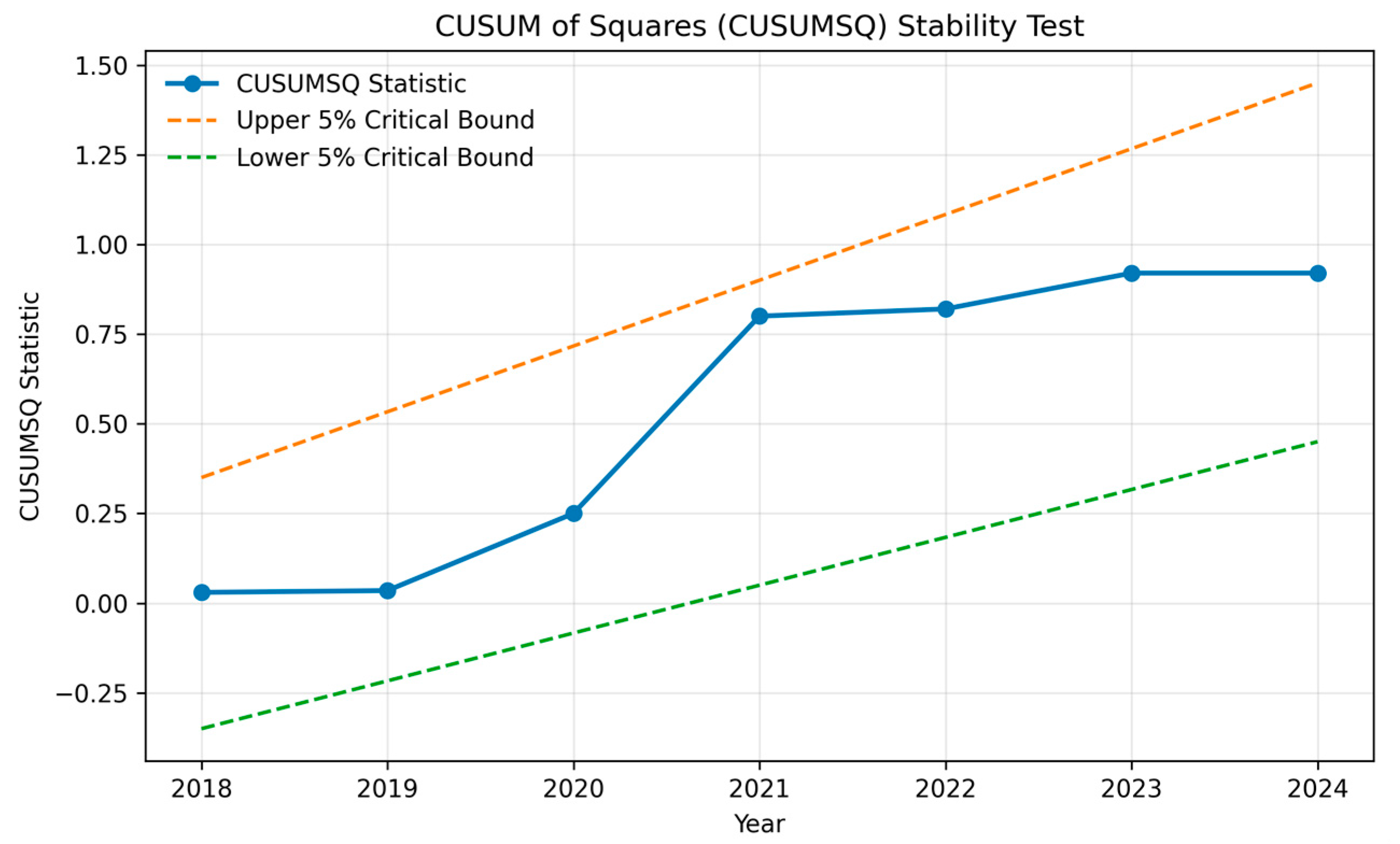
Figure 3 presents the CUSUM of Squares (CUSUMSQ) test for parameter stability in the NARDL model. The circle-connected line represents the cumulative sum of squared recursive residuals, while the upper and lower diagonal lines denote the 5% critical bounds. Since the CUSUMSQ statistic remains entirely within these bounds throughout the sample period, the null hypothesis of parameter stability cannot be rejected. This result indicates the absence of structural breaks and confirms the stability of the estimated NARDL coefficients over time.
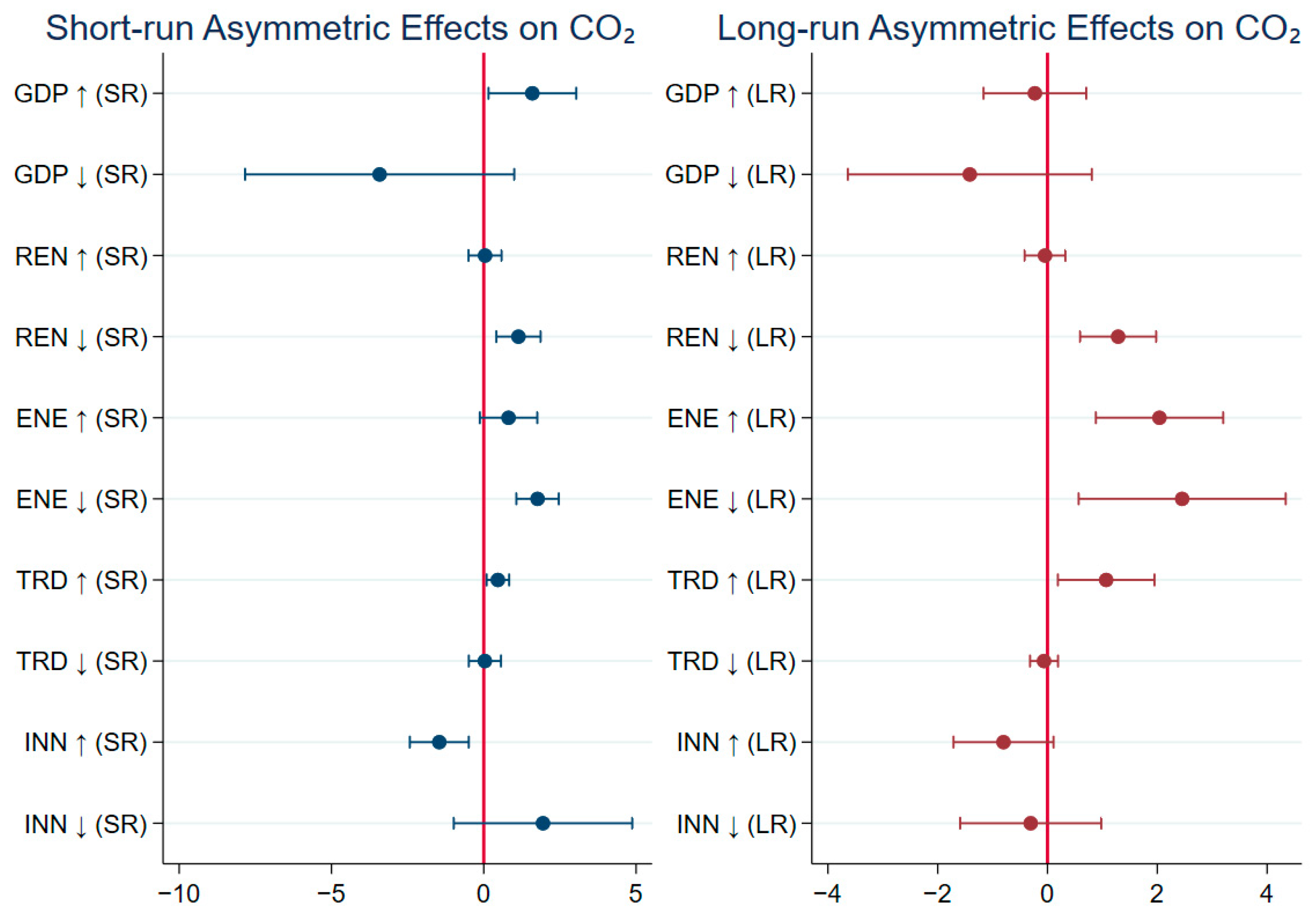
The coefficient plots in
Figure 4 visually summarize the nonlinear short-run and long-run asymmetric effects of economic growth, renewable energy, energy use, trade openness, and innovation on CO
2 emissions in France. In the left panel, blue dots represent the estimated short-run coefficients, while in the right panel, red dots represent the estimated long-run coefficients. The horizontal whiskers indicate 95% confidence intervals, and the vertical red line marks the zero-effect threshold. Upward arrows (↑) denote positive shocks (increases) in the explanatory variables, whereas downward arrows (↓) denote negative shocks (decreases). Coefficients whose confidence intervals do not cross the zero line can be interpreted as statistically significant at conventional levels.
The short-run panel shows that positive GDP shocks raise emissions, while negative shocks lower them, confirming clear short-run growth asymmetry. Reductions in renewable energy significantly increase emissions, whereas increases remain neutral, highlighting the environmental importance of avoiding renewable energy downturns. Both positive and negative energy-use shocks exert strong emission-increasing effects, indicating short-run rigidity in France’s energy consumption structure. Trade openness contributes positively to emissions only when trade expands, whereas contractions have no statistically meaningful effect. Positive innovation shocks reduce emissions, while negative shocks display weaker and statistically marginal effects.
In the long run, the plots reveal more persistent and structured asymmetries. Renewable energy retains a pronounced asymmetric influence: negative shocks sharply increase emissions, whereas positive shocks remain insignificant. Energy use continues to produce strong and symmetric emission-increasing effects, underscoring long-run dependence on energy intensity. Trade openness exerts long-run environmental pressure solely when trade increases, while reductions again have no effect, confirming one-sided trade–environment dynamics. Economic growth exhibits no significant long-run asymmetry, supporting structural decoupling of output and emissions. Innovation shows a marginally negative long-run effect for positive shocks but remains insignificant for negative ones, suggesting that technological progress contributes modest but not dominant long-term emission reductions. Altogether, the plots reinforce the key empirical finding that France’s emissions trajectory is shaped by both nonlinear short-run adjustments and persistent long-run asymmetries, particularly in renewable energy, energy use, and trade openness.
The Wald tests (
Table 7) provide formal confirmation of the asymmetric relationships captured by the NARDL model.
In the long run, the results reveal significant asymmetry for renewable energy and trade openness. Specifically, the null hypothesis of symmetry is strongly rejected for renewable energy (F = 16.58, p = 0.0036) and for trade openness (F = 9.37, p = 0.0156), indicating that positive and negative shocks to these variables exert statistically different long-run impacts on CO2 emissions. In contrast, the long-run symmetry tests for economic growth, energy use, and innovation yield insignificant results, suggesting that their long-run effects do not differ meaningfully between positive and negative shocks.
In the short run, the Wald tests indicate statistically significant asymmetry for economic growth (F = 5.51, p = 0.0468), energy use (F = 5.75, p = 0.0433), and innovation (F = 5.42, p = 0.0483), while renewable energy is marginally asymmetric (p = 0.0557). Trade openness, however, does not exhibit significant short-run asymmetry.
Collectively, these tests confirm that France’s emissions dynamics are shaped by a mix of long-run and short-run nonlinearities, with renewable energy and trade openness driving long-term asymmetries, while economic growth, energy use, and innovation primarily exhibit asymmetric behavior in the short run.
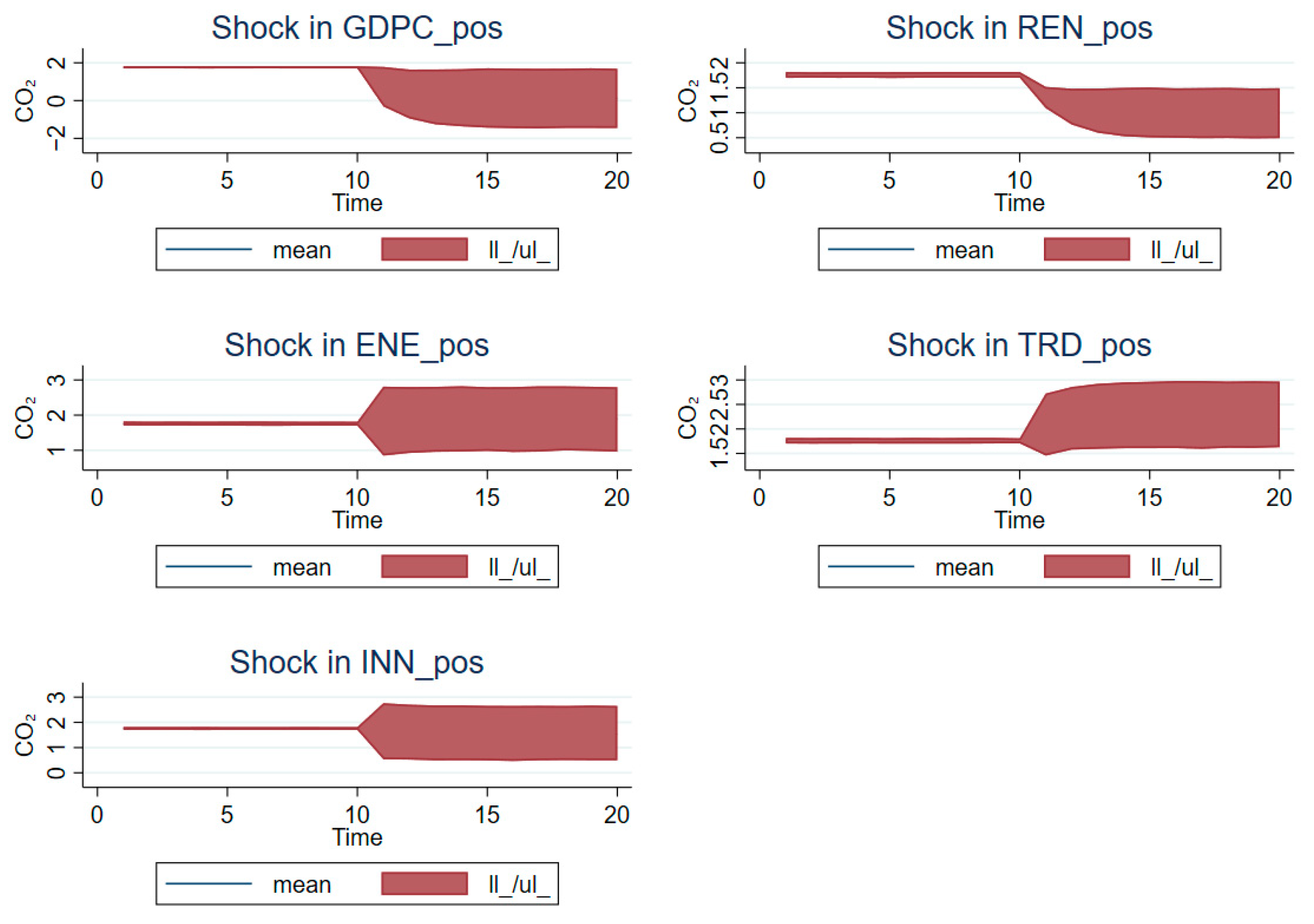
The dynamic multiplier graphs in
Figure 5 illustrate how CO
2 emissions respond over time to positive shocks in the explanatory variables, capturing the temporal adjustment patterns implied by the NARDL model. The solid line represents the estimated mean adjustment path of CO
2 emissions following a positive shock, while the shaded area indicates the lower and upper confidence bounds. The widening bands after the shock horizon reflect increasing uncertainty around the long-run adjustment process.
A positive shock to GDP leads to an initial increase in emissions, followed by a gradual decline toward a new equilibrium, highlighting short-run sensitivity of emissions to economic expansion and the presence of long-run adjustment forces. A positive shock to renewable energy consumption produces an immediate and persistent reduction in emissions, confirming the long-run environmental gains from expanding renewables. In contrast, positive shocks to energy use generate an upward trajectory in emissions that stabilizes at a higher level, illustrating the strong and sustained carbon intensity associated with increased energy demand. Trade openness exhibits a similar pattern: a positive shock lifts emissions sharply and maintains them at elevated levels, reflecting the emissions-augmenting effect of increased trade activity. Finally, a positive innovation shock leads to a long-run decline in emissions after a short adjustment period, indicating that technological improvements exert delayed but meaningful environmental benefits. Overall, the dynamic multipliers confirm the asymmetric and time-varying influence of economic, energy, trade, and technological factors on CO2 emissions in France, providing strong support for the nonlinear mechanisms captured by the NARDL framework.
5.2. QNARDL Regression
The analysis next extends beyond mean-based estimation by examining distributional heterogeneity through quantile regression, with the results for ΔCO
2 presented in
Table 8.
The simultaneous quantile regression results provide important insights into how the determinants of changes in CO2 emissions influence different parts of the conditional distribution of ΔCO2. By comparing the 25th, 50th, and 75th quantiles, the analysis reveals whether the emission drivers behave differently in periods of low, median, or high emission changes. This distributional perspective complements the mean-based NARDL estimates and uncovers additional heterogeneity in the short-run adjustment process.
At the lower quantile (Q25), representing periods of relatively small or negative changes in emissions, none of the explanatory variables exhibit strong or statistically significant effects. Although the signs of coefficients largely align with expectations—such as renewable energy reductions (d_ren_neg) decreasing CO2 or innovation shocks showing some positive influence—the p-values indicate that the effects are imprecisely estimated. This suggests that when emissions fluctuations are small, the system displays greater stability and is less responsive to short-term shocks in economic activity, energy use, trade, or innovation.
At the median quantile (Q50), the behavioral patterns remain broadly similar but with slightly stronger coefficient magnitudes. The signs continue to be economically meaningful—for example, renewable energy reductions still increase emissions, and innovation shocks have a positive influence. However, these effects remain statistically insignificant, implying that median changes in emissions are not strongly driven by short-run shocks in the explanatory variables. This indicates a relatively stable response at the center of the distribution, where typical changes in economic and energy conditions do not translate into pronounced environmental effects.
In contrast, the upper quantile (Q75) displays a distinctly different pattern, revealing statistically significant and economically important effects for several key variables. Positive GDP shocks significantly reduce emissions in this quantile, suggesting that during periods of large emission adjustments, economic expansions may coincide with structural efficiency improvements or shifts toward lower-carbon activities. Negative renewable energy shocks significantly increase emissions, confirming the critical role of renewable availability in shaping larger emission spikes. Similarly, negative shocks to energy use (d_ene_neg) significantly raise emissions, indicating that high-emissions periods are highly sensitive to disruptions in energy consumption patterns. Positive trade shocks (d_trd_pos) also increase emissions at Q75, consistent with the idea that trade expansion amplifies emissions when the system is already experiencing stronger fluctuations. Positive innovation shocks (d_inn_pos) significantly reduce emissions in the upper tail, highlighting the capacity of technological progress to moderately large spikes in CO2 emissions.
Overall, the quantile regression results reveal clear distributional asymmetry in the short-run dynamics of emissions. While lower and median quantiles show limited responsiveness to shocks, the upper quantile—representing periods of more intense emissions adjustments—shows strong and significant effects for GDP, renewable energy, energy use, trade openness, and innovation. These findings suggest that policy interventions aimed at stabilizing emissions should focus particularly on conditions associated with large emissions movements, where economic, energy, and technology shocks exert the strongest influence. The results reinforce the nonlinear, state-dependent nature of France’s short-run emissions behavior, complementing the asymmetries identified in the NARDL model.
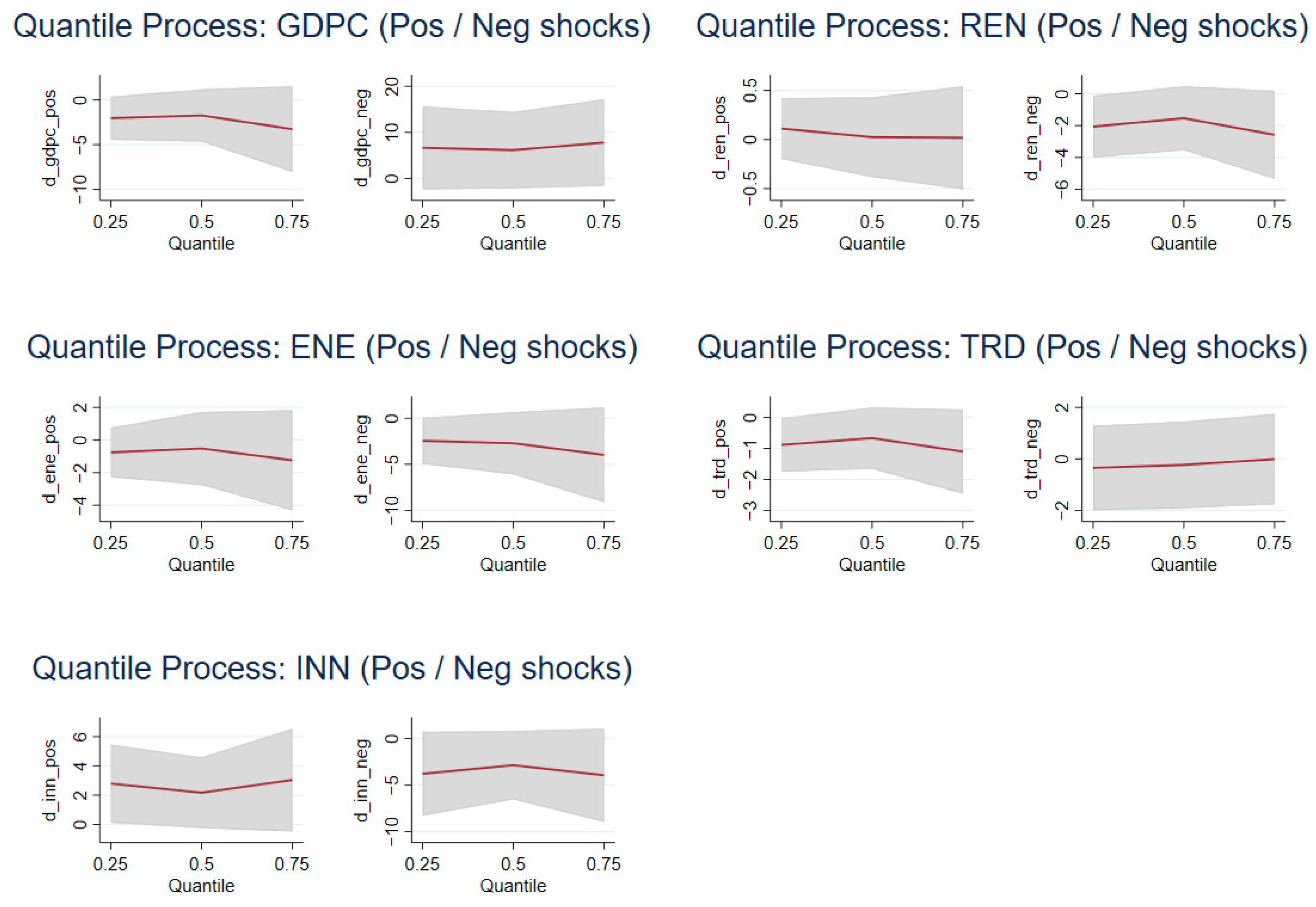
The quantile process plots in
Figure 6 provide a dynamic view of how positive and negative shocks in each determinant influence CO
2 emissions across the conditional distribution of ΔCO
2, capturing the full range from low to high emission changes. The red line represents the estimated quantile coefficient at each quantile (Q25, Q50, and Q75), while the gray shaded area denotes the corresponding 95% confidence interval. Variations in the slope of the red line indicate changes in the magnitude and direction of the effect across quantiles, whereas wider confidence bands reflect greater estimation uncertainty.
For GDP, the plots suggest mild asymmetry: positive shocks tend to reduce emissions more strongly at the upper quantile (Q75), whereas negative shocks show larger positive effects at lower quantiles, indicating that economic contractions may contribute more to small emission fluctuations, while expansions help moderate larger ones. For renewable energy, positive shocks display steadily mild effects across quantiles, while negative shocks become increasingly harmful at higher quantiles, confirming that reductions in renewable energy availability disproportionately worsen emissions during periods of large environmental adjustments. Energy use shows a similar pattern: positive shocks exert relatively stable effects across quantiles, whereas negative shocks become substantially more emission-increasing at Q75, highlighting that disruptions in energy use intensify carbon outcomes most severely when the emissions system is already stressed.
Trade openness displays noticeable quantile variation, particularly for positive shocks, which become more strongly emission-increasing at higher quantiles; by contrast, negative shocks remain flat and insignificant across the distribution. This result indicates that trade expansions amplify emissions most when emission changes are already elevated, whereas trade contractions do not provide proportional environmental relief. Innovation processes also reveal important distributional differences: positive shocks become increasingly emission-reducing at higher quantiles, suggesting that technological progress plays a more crucial role in mitigating large spikes in CO2 emissions, while negative innovation shocks exert only mild and statistically weak effects across quantiles. Taken together, the quantile process plots highlight that the impact of shocks is not uniform across the emission distribution. Instead, high-emission states (upper quantiles) are more sensitive to shocks in renewable energy, energy use, trade openness, and innovation, indicating that policy interventions targeting these variables are especially important during periods of heightened environmental pressure.