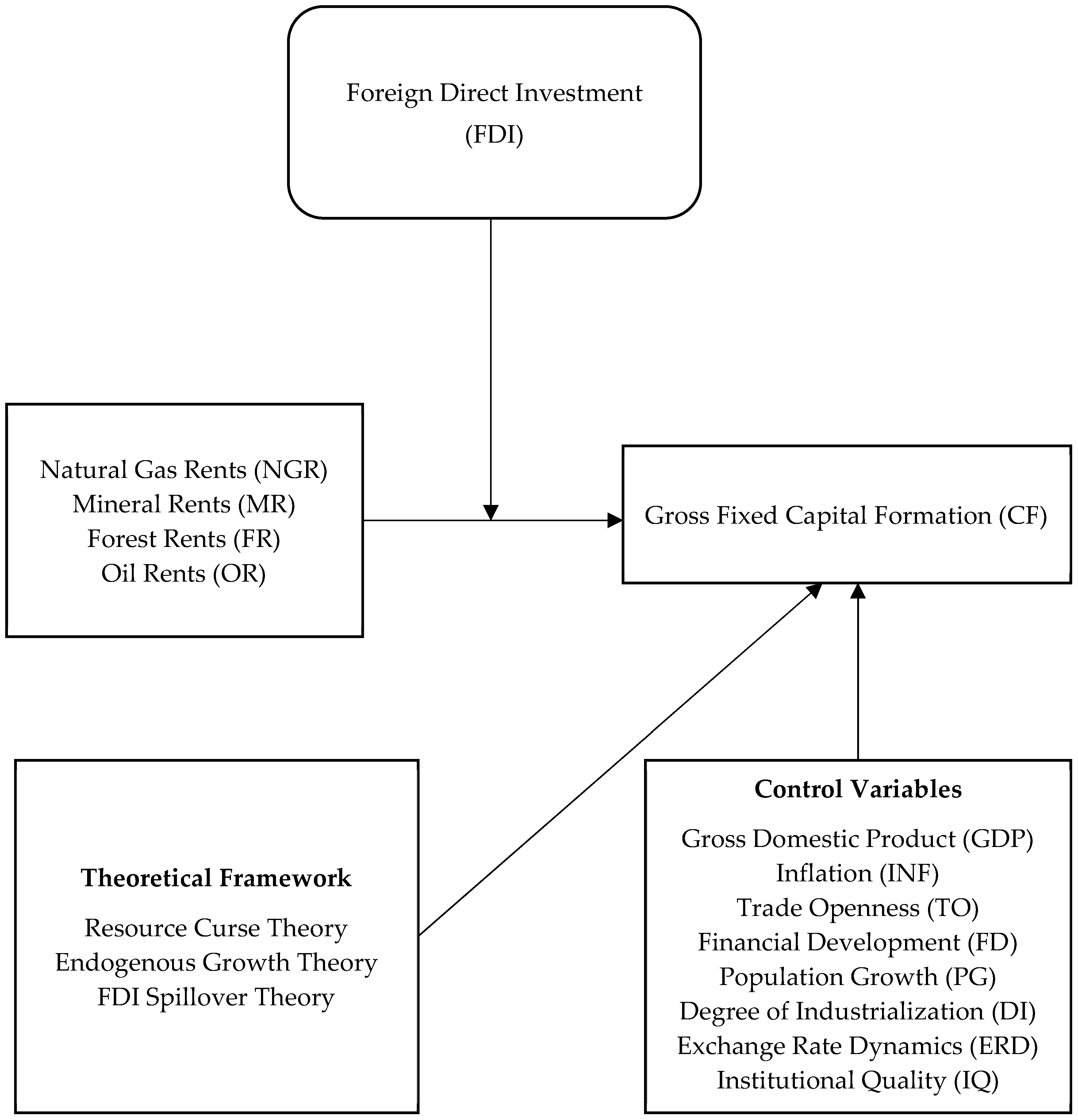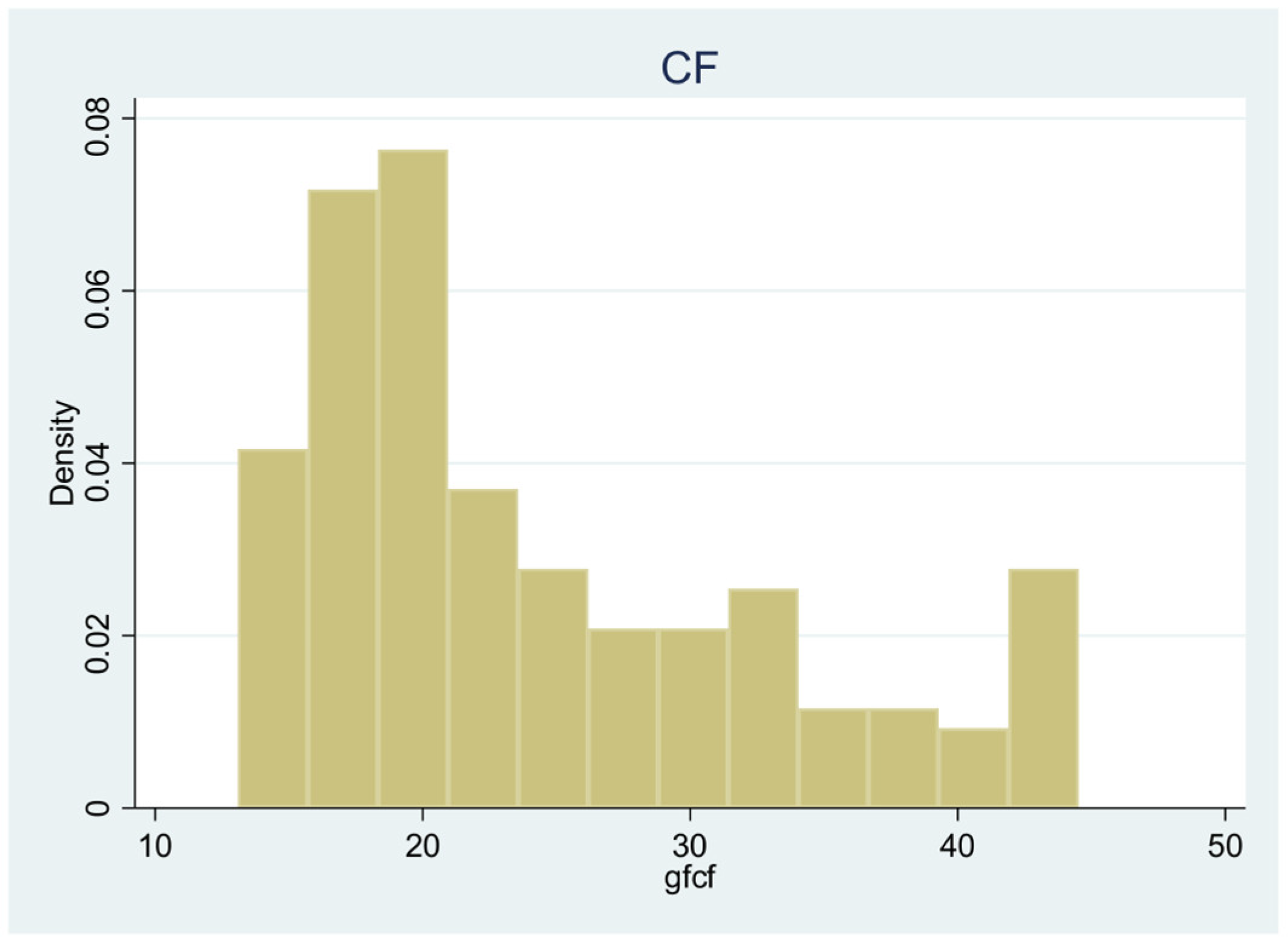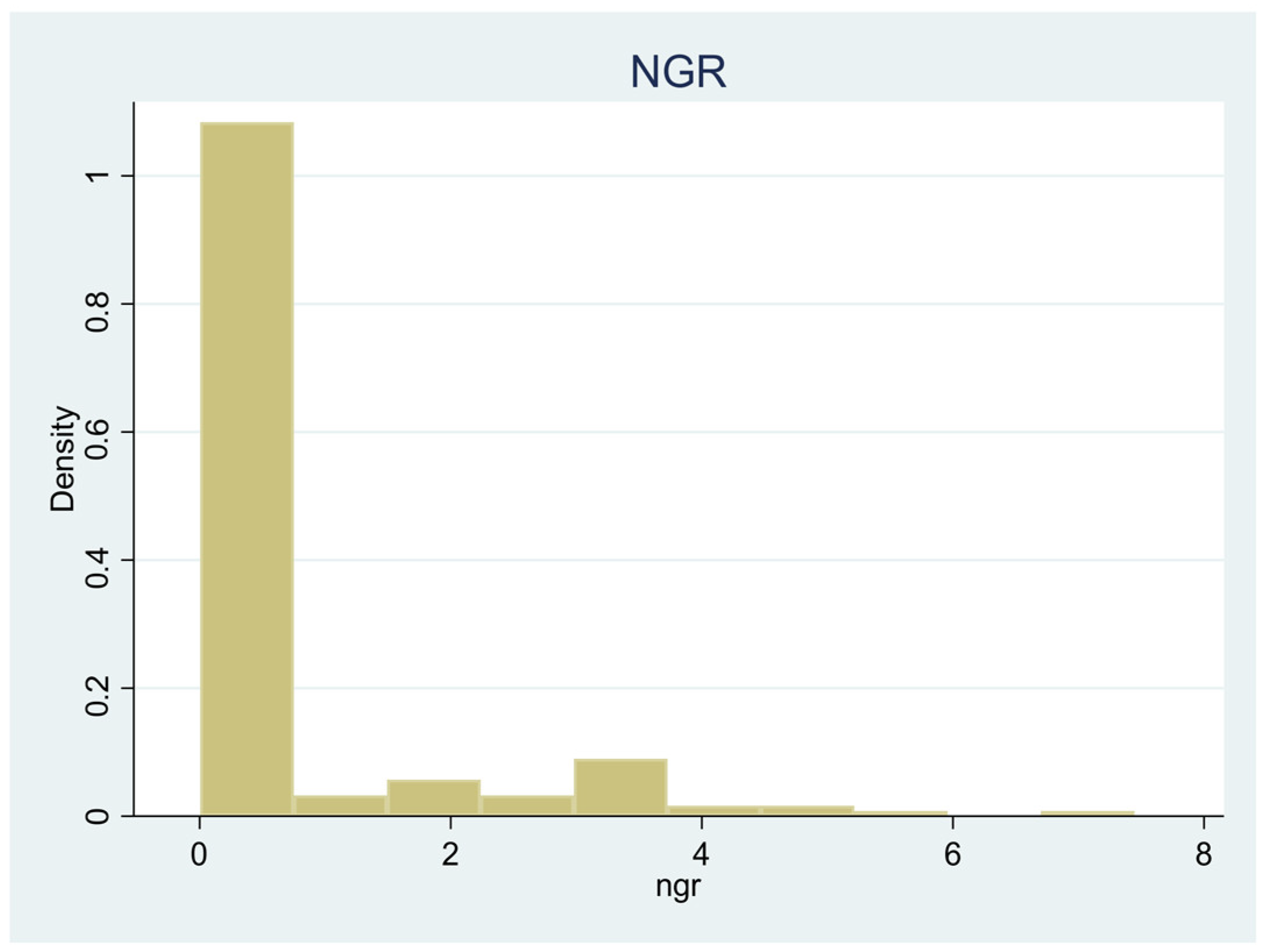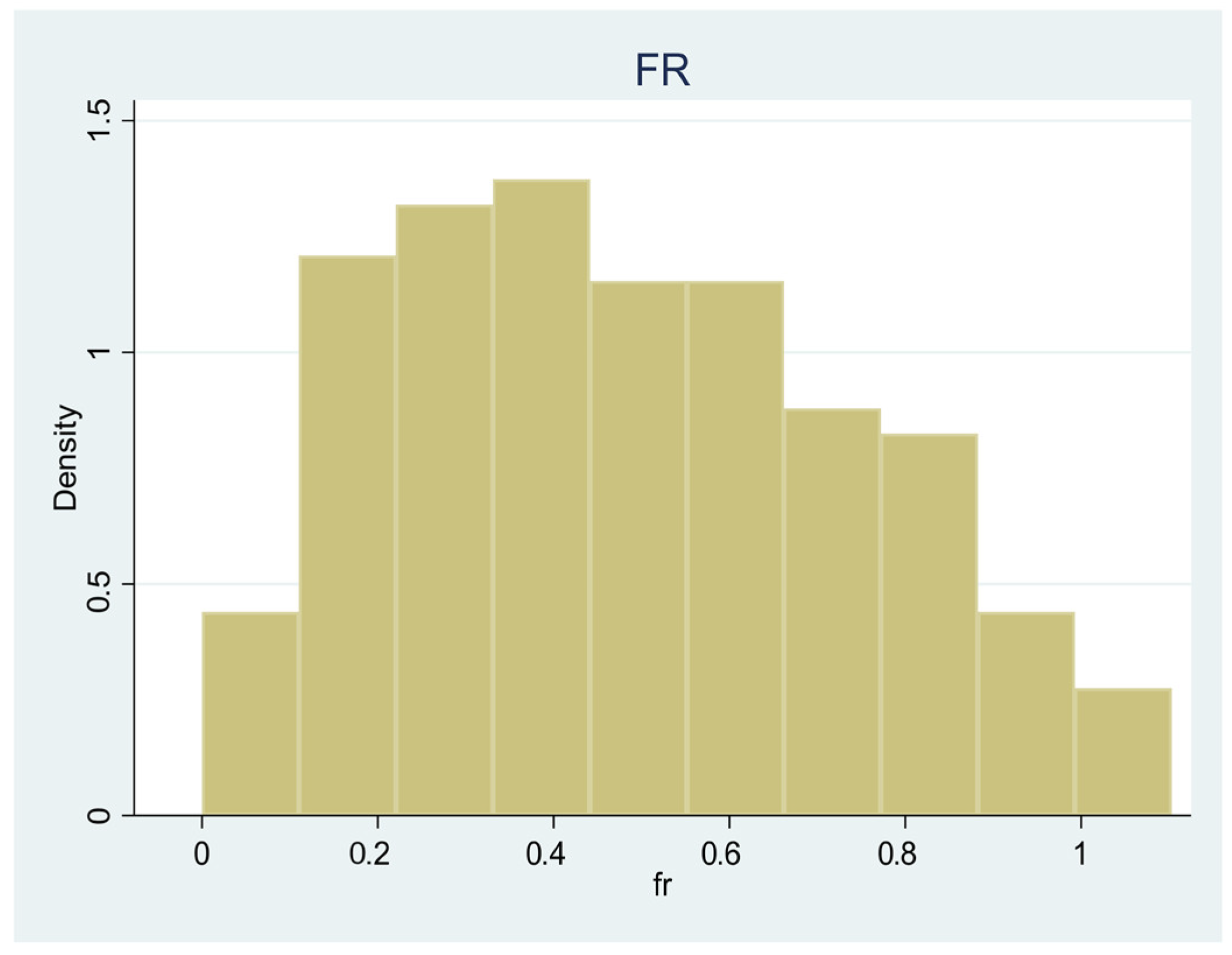

Natural Resource Rents and Capital Formation Nexus: Empirical Evidence on Foreign Direct Investment as a Moderator from the BRICS Economies



Abstract
1. Introduction
2. Theoretical Framework and Development of Hypotheses
2.1. Theoretical Framework
2.2. Natural Resources Rents and Gross Fixed Capital Formation
2.3. Natural Resources Rents, Gross Fixed Capital Formation, and Foreign Direct Investment
3. Materials and Methods
3.1. Explanation of Data and First-Differenced Logarithmic Transformation
- They are divided by GDP, which helps compare different-sized economies.
- They have no units, since they are shown as percentages.
- They can be directly compared between countries and over time.
3.2. Model Specification and Estimation Strategy
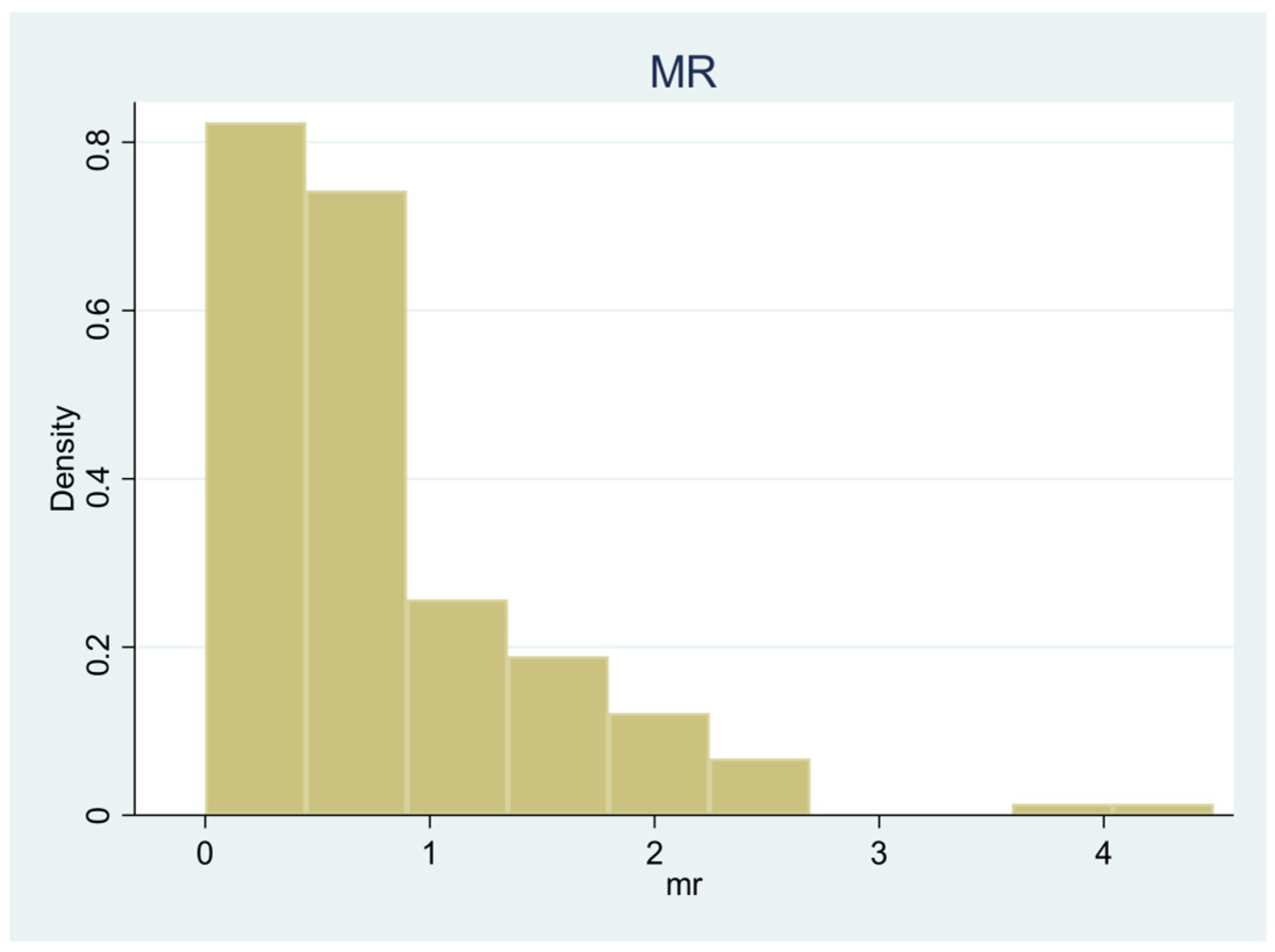
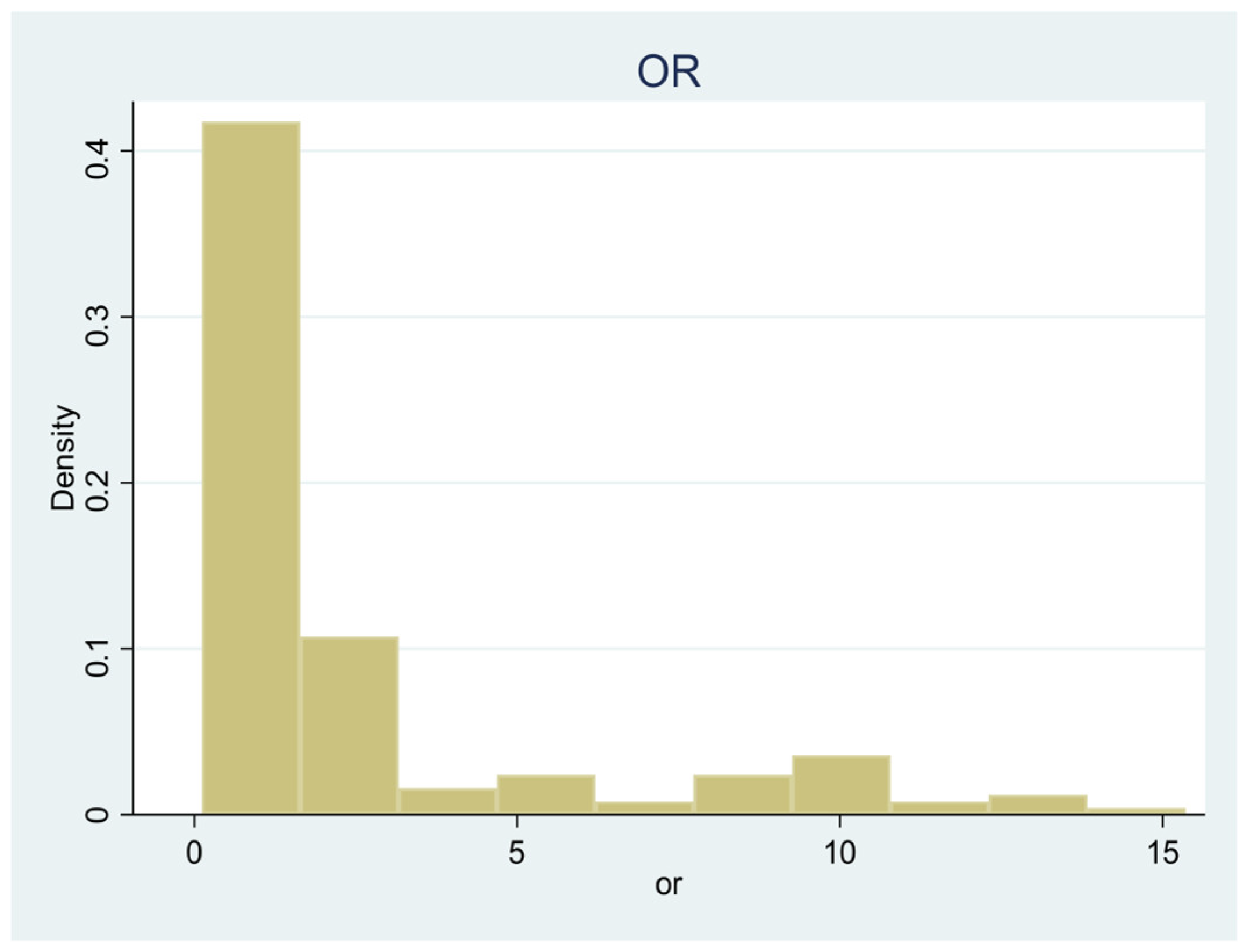
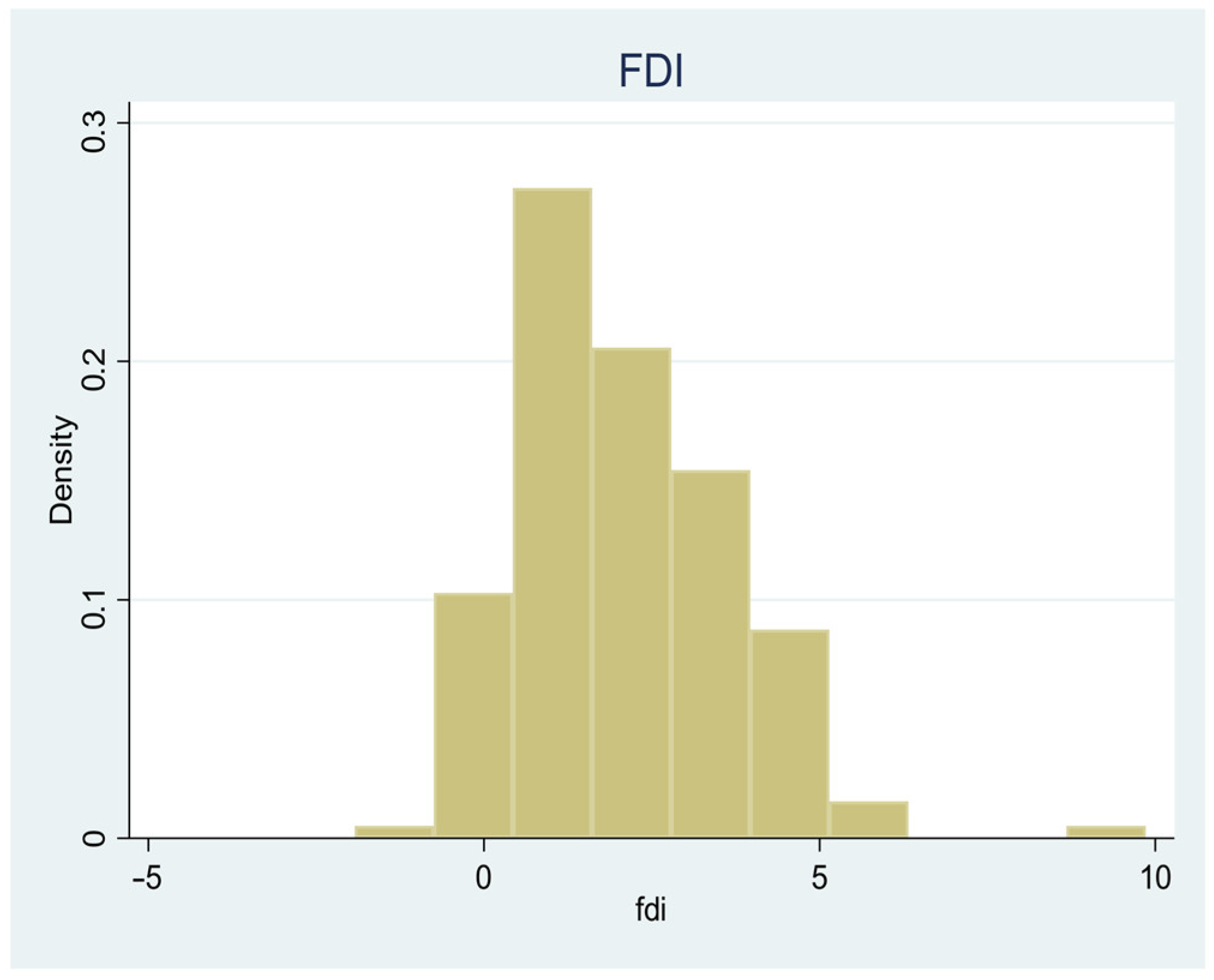
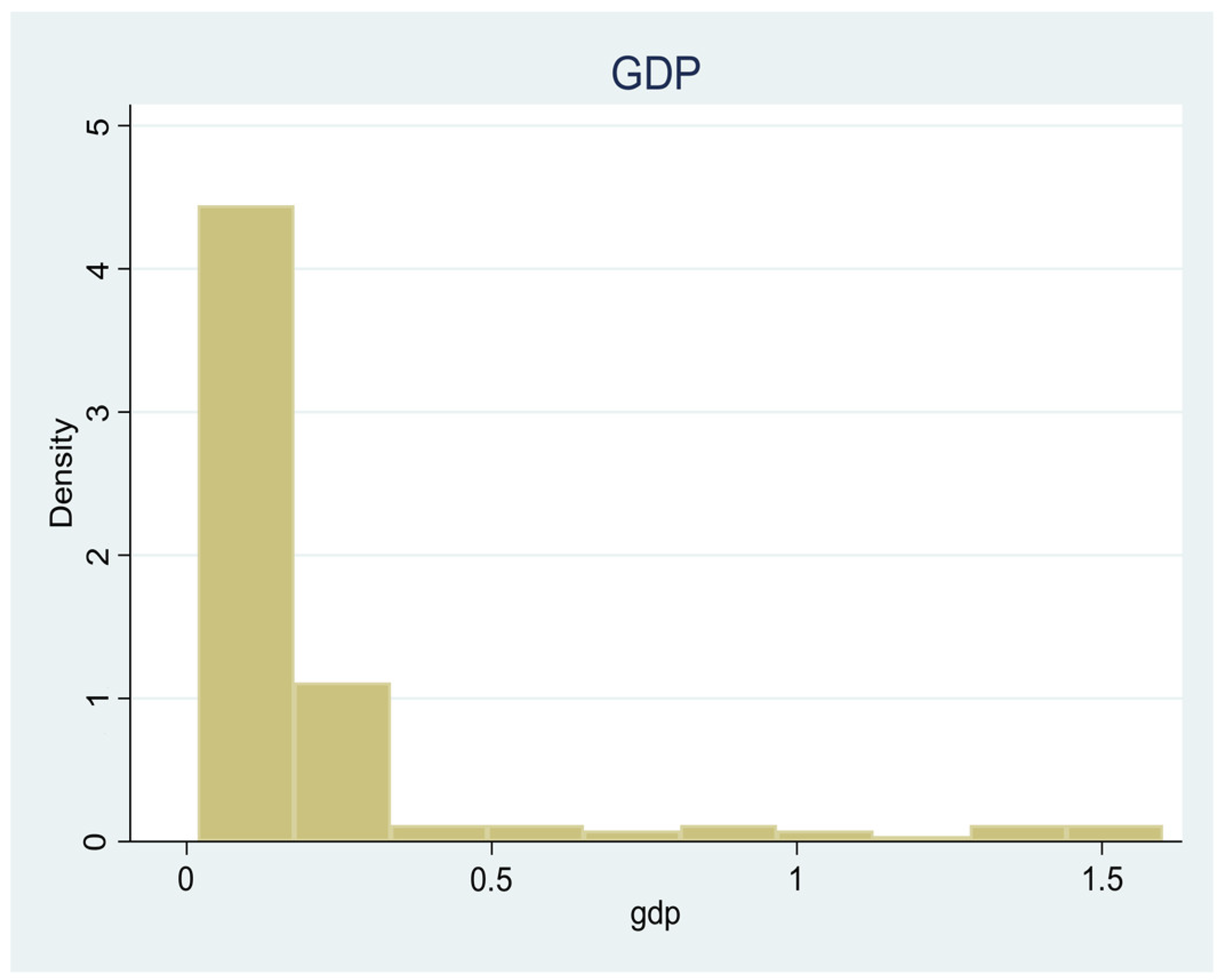
3.3. Summary Statistics and Normality Test
3.4. Testing Slope Heterogeneity and Cross-Section Dependence
3.5. Stationarity Testing
3.6. Cointegration Testing
3.7. Method of Movement Quantile Regression (MMQR)
3.8. Panel Causality Test
4. Results
4.1. Summary Statistics and Correlation Matrix Results
4.2. Slope Heterogeneity and Cross-Sectional Dependence Test
4.3. Panel Unit Root Test
4.4. The Results of the Panel Cointegration Test
4.5. The Results of Panel Methods of Moment Quantile Regression (MMQR) Estimator
4.6. The Results of the Dumitrescu and Hurlin (2012) [61] Granger Panel Causality Test
4.7. Propensity Score Matching (Treatment Effect Estimation)
4.8. Heterogeneity Analysis Between BRICS Economies: Seemingly Unrelated Regression (SUR) Estimation
4.9. Additional Analysis: Panel Smooth Transition Regression (PSTR) Model Estimation Results with an Alternate Proxy of Gross Capital Formation (GCF) as a Dependent Variable
4.10. The Results of the Robustness Checks and Endogeneity Analysis
4.10.1. Fixed Effect (FE) to Check the Robustness
4.10.2. System Generalized Method of Moments (GMM) Estimators to Check the Endogeneity
5. Discussion
6. Conclusions
6.1. Policy Implications and the Regulatory Role of FDI
6.2. Regulatory Roles of FDI
Author Contributions
Funding
Institutional Review Board Statement
Informed Consent Statement
Data Availability Statement
Conflicts of Interest
Appendix A. Method of Movement Quantile Regression (MMQR)
References
- Li, Y.; Tariq, M.; Khan, S.; Rjoub, H.; Azhar, A. Natural resources rents, capital formation and economic performance: Evaluating the role of globalization. Resour. Policy 2022, 78, 102817. [Google Scholar] [CrossRef]
- Wang, Z.; Razzaq, A. Natural resources, energy efficiency transition and sustainable development: Evidence from BRICS economies. Resour. Policy 2022, 79, 103118. [Google Scholar] [CrossRef]
- Dahlman, C. Technology, globalization, and international competitiveness: Challenges for developing countries. In Industrial Development for the 21st Century: Sustainable Development Perspectives; United Nations: New York, NY, USA, 2007; pp. 29–83. [Google Scholar]
- Kaznacheev, P. Curse or Blessing? How Institutions Determine Success in Resource-Rich Economies; Cato Institute Policy Analysis No. 808; Cato Institute: Washington, DC, USA, 2017. [Google Scholar]
- Torvik, R. Learning by doing and the Dutch disease. Eur. Econ. Rev. 2001, 45, 285–306. [Google Scholar] [CrossRef]
- Sayn-Wittgenstein, F.; de Mariz, F.; Leijonhufvud, C. Nature Finance: Bridging Natural and Financial Capital Through Robust Impact Measurement. Risks 2025, 13, 213. [Google Scholar] [CrossRef]
- Chowdhury, A.; Mavrotas, G. FDI and growth: What causes what? World Econ. 2006, 29, 9–19. [Google Scholar] [CrossRef]
- Thakur, R. How representative are BRICS? In Emerging Powers and the UN; Routledge: Abingdon, UK, 2018; pp. 43–60. [Google Scholar]
- Hayat, A. FDI and economic growth: The role of natural resources? J. Econ. Stud. 2018, 45, 283–295. [Google Scholar] [CrossRef]
- Shahbaz, M.; Destek, M.A.; Okumus, I.; Sinha, A. An empirical note on comparison between resource abundance and resource dependence in resource abundant countries. Resour. Policy 2019, 60, 47–55. [Google Scholar] [CrossRef]
- Saini, N.; Singhania, M. Determinants of FDI in developed and developing countries: A quantitative analysis using GMM. J. Econ. Stud. 2018, 45, 348–382. [Google Scholar] [CrossRef]
- Alvarado, R.; Tillaguango, B.; Dagar, V.; Ahmad, M.; Işık, C.; Méndez, P.; Toledo, E. Ecological footprint, economic complexity and natural resources rents in Latin America: Empirical evidence using quantile regressions. J. Clean. Prod. 2021, 318, 128585. [Google Scholar] [CrossRef]
- Van der Ploeg, F. Natural resources: Curse or blessing? J. Econ. Lit. 2011, 49, 366–420. [Google Scholar] [CrossRef]
- Arezki, R.; van der Ploeg, F. Do natural resources depress income per capita? Rev. Econ. Stat. 2011, 93, 157–171. [Google Scholar] [CrossRef]
- Ahmad, M.; Jabeen, G.; Irfan, M.; Işık, C.; Rehman, A. Do inward foreign direct investment and economic development improve local environmental quality: Aggregation bias puzzle. Environ. Sci. Pollut. Res. 2021, 28, 34676–34696. [Google Scholar] [CrossRef] [PubMed]
- Auty, R.M. Determinants of state mining enterprise resilience in Latin America. In Natural Resources Forum; Blackwell Publishing Ltd.: Oxford, UK, 1993; Volume 17, pp. 3–14. [Google Scholar]
- Sachs, J.D.; Warner, A. Natural Resource Abundance and Economic Growth; National Bureau of Economic Research: Cambridge, MA, USA, 1995. [Google Scholar]
- Gylfason, T. Natural resources, education and economic development. Eur. Econ. Rev. 2001, 45, 847–859. [Google Scholar] [CrossRef]
- Yasmeen, H.; Tan, Q.; Zameer, H.; Vo, X.V.; Shahbaz, M. Discovering the relationship between natural resources, energy consumption, gross capital formation with economic growth: Can lower financial openness change the curse into blessing. Resour. Policy 2021, 71, 102013. [Google Scholar] [CrossRef]
- Rahim, S.; Murshed, M.; Umarbeyli, S.; Kirikkaleli, D.; Ahmad, M.; Tufail, M.; Wahab, S. Do natural resources abundance and human capital development promote economic growth? A study on the resource curse hypothesis in Next Eleven countries. Resour. Environ. Sustain. 2021, 4, 100018. [Google Scholar] [CrossRef]
- Ebru, T.; Buket, A.; Alper, A. Global evidence from the link between economic growth, natural resources, energy consumption, and gross capital formation. Resour. Policy 2020, 66, 101622. [Google Scholar] [CrossRef]
- Ross, M.L. What have we learned about the resource curse? Annu. Rev. Political Sci. 2015, 18, 239–259. [Google Scholar] [CrossRef]
- Paul, R. Endogenous Technological Change. J. Political Econ. 1990, 98, S71–S102. [Google Scholar]
- Aghion, P.; Bergeaud, A.; Boppart, T.; Klenow, P.J.; Li, H. A theory of falling growth and rising rents. Rev. Econ. Stud. 2023, 90, 2675–2702. [Google Scholar]
- Borensztein, E.; De Gregorio, J.; Lee, J.W. How does foreign direct investment affect economic growth? J. Int. Econ. 1998, 45, 115–135. [Google Scholar] [CrossRef]
- Alfaro, L.; Chanda, A.; Kalemli-Ozcan, S.; Sayek, S. FDI and economic growth: The role of local financial markets. J. Int. Econ. 2004, 64, 89–112. [Google Scholar] [CrossRef]
- Asiedu, E. Foreign Direct Investment, Natural Resources and Institutions. International Growth Centre. 2013. Available online: https://www.theigc.org/sites/default/files/2014/09/Asiedu-2013-Working-Paper.pdf (accessed on 15 December 2025).
- Hansen, H.; Rand, J. On the causal links between FDI and growth in developing countries. World Econ. 2006, 29, 21–41. [Google Scholar] [CrossRef]
- Vandycke, N. Natural Resources, Physical Capital and Institutions: Evidence from Eurasia; World Bank Policy Research Working Paper Series 6586; World Bank Group: Washington, DC, USA, 2013. [Google Scholar]
- Stijns, J.P. Natural resource abundance and human capital accumulation. World Dev. 2006, 34, 1060–1083. [Google Scholar] [CrossRef]
- Amin, M.; Djankov, S. Natural Resources and Reforms; World Bank Group: Washington, DC, USA, 2009; Available online: https://ssrn.com/abstract=1372959 (accessed on 16 December 2025).
- Hirschman, A.O. The rise and decline of development economics. In The Theory and Experience of Economic Development; Routledge: Abingdon, UK, 2012; pp. 372–390. [Google Scholar]
- Adewuyi, A.O.; Awodumi, O.B. Environmental pollution, energy import, and economic growth: Evidence of sustainable growth in South Africa and Nigeria. Environ. Sci. Pollut. Res. 2021, 28, 14434–14468. [Google Scholar] [CrossRef]
- Cheng, Z.; Li, L.; Liu, J. Natural resource abundance, resource industry dependence and economic green growth in China. Resour. Policy 2020, 68, 101734. [Google Scholar] [CrossRef]
- Gerelmaa, L.; Kotani, K. Further investigation of natural resources and economic growth: Do natural resources depress economic growth? Resour. Policy 2016, 50, 312–321. [Google Scholar] [CrossRef]
- Bastanifar, I.; Khan, K.H.; Koch, H. Understanding BRICSIZATION through an economic geopolitical model. J. Open Innov. Technol. Mark. Complex. 2025, 11, 100440. [Google Scholar] [CrossRef]
- Adams, S.; Klobodu, E.K.M.; Lamptey, R.O. The effects of capital flows on economic growth in Senegal. Margin J. Appl. Econ. Res. 2017, 11, 121–142. [Google Scholar] [CrossRef]
- Adams, S.; Atsu, F. Resource rents, FDI, and capital formation in Africa. J. Dev. Econ. 2020, 145, 102468. [Google Scholar]
- Badeeb, R.A.; Lean, H.H.; Clark, J. The role of FDI in the resource-capital formation nexus: Evidence from Latin America. Resour. Policy 2021, 70, 101924. [Google Scholar]
- Apergis, N.; Payne, J.E. The oil curse, institutional quality, and growth in MENA countries: Evidence from time-varying cointegration. Energy Econ. 2014, 46, 1–9. [Google Scholar] [CrossRef]
- Södersten, C.J.; Wood, R.; Hertwich, E.G. Environmental impacts of capital formation. J. Ind. Ecol. 2018, 22, 55–67. [Google Scholar] [CrossRef]
- Müller, U.K.; Watson, M.W. Low-frequency analysis of economic time series. preparation. In Handbook of Econometrics; Elsevier: Amsterdam, The Netherlands, 2020. [Google Scholar]
- Yang, B.; Liu, X.; Long, W.; Peng, L. A unified unit root test regardless of intercept. Econom. Rev. 2023, 42, 540–555. [Google Scholar] [CrossRef]
- Gabaix, X.; Koijen, R.S.; Richmond, R.; Yogo, M. Asset Embeddings. 2024. Available online: https://ssrn.com/abstract=4507511 (accessed on 16 December 2025).
- Perron, P.; Yamamoto, Y. The great moderation: Updated evidence with joint tests for multiple structural changes in variance and persistence. Empir. Econ. 2022, 62, 1193–1218. [Google Scholar] [CrossRef]
- Clements, M.P.; Hendry, D.F. Modelling methodology and forecast failure. Econom. J. 2002, 5, 319–344. [Google Scholar] [CrossRef]
- Jordà, Ò. Local projections for applied economics. Annu. Rev. Econ. 2023, 15, 607–631. [Google Scholar] [CrossRef]
- Pesaran, M.H.; Smith, R. The Role of Pricing Errors in Linear Asset Pricing Models with Strong, Semi-Strong, and Latent Factors; Faculty of Economics, University of Cambridge: Cambridge, UK, 2023. [Google Scholar]
- Lim, K.Y.; Morris, D. Thresholds in natural resource rents and state owned enterprise profitability: Cross country evidence. Energy Econ. 2022, 106, 105779. [Google Scholar] [CrossRef]
- Jarque, C.M.; Bera, A.K. A test for the normality of observations and regression residuals. Int. Stat. Rev./Rev. Int. De Stat. 1987, 55, 163–172. [Google Scholar]
- Breitung, J. A parametric approach to the estimation of cointegration vectors in panel data. Econom. Rev. 2005, 24, 151–173. [Google Scholar]
- Pesaran, M.H.; Yamagata, T. Testing slope homogeneity in large panels. J. Econom. 2008, 142, 50–93. [Google Scholar] [CrossRef]
- Dong, R.; Song, J.; Jiang, T.; Baloch, M.A. Environmental sustainability across BRICS economies: The dynamics among the digital economy, education, and CO2 emissions. J. Knowl. Econ. 2025, 16, 4125–4145. [Google Scholar] [CrossRef]
- Pesaran, M.H. General Diagnostic Tests for Cross-Section Dependence in Panels; CESifo Working Paper Series No. 1229; IZA Discussion Paper No. 1240; University of Cambridge: Cambridge, UK, 2004; Available online: http://ssrn.com/abstract=572504 (accessed on 15 April 2025).
- Pesaran, M.H. A simple panel unit root test in the presence of cross-section dependence. J. Appl. Econom. 2007, 22, 265–312. [Google Scholar] [CrossRef]
- Liang, J.; Razzaq, A.; Sharif, A.; Irfan, M. Revisiting economic and non-economic indicators of natural resources: Analysis of developed economies. Resour. Policy 2022, 77, 102748. [Google Scholar] [CrossRef]
- Westerlund, J. Testing for error correction in panel data. Oxf. Bull. Econ. Stat. 2007, 69, 709–748. [Google Scholar] [CrossRef]
- Koenker, R.; Bassett, G., Jr. Regression quantiles. Econom. J. Econom. Soc. 1978, 46, 33–50. [Google Scholar] [CrossRef]
- Machado, J.A.; Silva, J.S. Quantiles via moments. J. Econom. 2019, 213, 145–173. [Google Scholar] [CrossRef]
- Aboulajras, A.S.A.; Khalifa, W.M.; Kareem, P.H. Environmental Sustainability in Emerging Economies: The Impact of Natural Resource Rents, Energy Efficiency, and Economic Growth via Quantile Regression Analysis. Sustainability 2025, 17, 3670. [Google Scholar] [CrossRef]
- Dumitrescu, E.I.; Hurlin, C. Testing for Granger non-causality in heterogeneous panels. Econ. Model. 2012, 29, 1450–1460. [Google Scholar] [CrossRef]
- Field, A.P. Is the meta-analysis of correlation coefficients accurate when population correlations vary? Psychol. Methods 2005, 10, 444. [Google Scholar] [CrossRef]
- Friedman, M. The use of ranks to avoid the assumption of normality implicit in the analysis of variance. J. Am. Stat. Assoc. 1937, 32, 675–701. [Google Scholar] [CrossRef]
- Westerlund, J.; Edgerton, D.L. A panel bootstrap cointegration test. Econ. Lett. 2007, 97, 185–190. [Google Scholar] [CrossRef]
- Koenker, R. Quantile regression: 40 years on. Annu. Rev. Econ. 2017, 9, 155–176. [Google Scholar] [CrossRef]
- Acemoglu, D. The crisis of 2008: Structural lessons for and from economics. Glob. Growth 2009, 21, 37. [Google Scholar]
- Li, X.; Yang, J.; Zeng, N. Natural resource rent and inclusive finance: An institutional perspective. Econ. Change Restruct. 2024, 57, 45. [Google Scholar] [CrossRef]
- Kadyan, J.S.; Mishra, D.K. An Analysis of Inter-Country Distribution of Projects by New Development Bank. SSRN Electron. J. 2024, 36, 18–23. [Google Scholar] [CrossRef]
- Wang, W.; Wang, H.; Wang, W.; Enilov, M. Interconnected Markets: Exploring the Dynamic Relationship Between BRICS Stock Markets and Cryptocurrency. arXiv 2024, arXiv:2406.07641. [Google Scholar] [CrossRef]
- Li, R.; Tang, G.; Hong, C.; Li, S.; Li, B.; Xiang, S. A study on economic policy uncertainty, geopolitical risk and stock market spillovers in BRICS countries. N. Am. J. Econ. Financ. 2024, 73, 102189. [Google Scholar]
- Huang, J.T.; Hsu, H.S. Air pollution and outward foreign direct investment—A cross-country empirical study. Singap. Econ. Rev. 2022, 1–16. [Google Scholar] [CrossRef]
- Chen, J.; Yang, B.; Wu, M. The impact of free-trade zones on total factor productivity: Evidence from China. J. Knowl. Econ. 2024, 15, 17649–17675. [Google Scholar] [CrossRef]
- Fourie, J. Macroeconomic history in South Africa: The South African Reserve Bank centennial special issue. Econ. Hist. Dev. Reg. 2021, 36, 117–121. [Google Scholar] [CrossRef]
- Lin, J.Y.; Xu, J. China’s light manufacturing and Africa’s industrialization. In China-Africa and An Economic Transformation; Oxford Academic: Oxford, UK, 2019; pp. 265–281. [Google Scholar]
- Badeeb, R.A.; Lean, H.H.; Smyth, R. Oil curse and finance–growth nexus in Malaysia: The role of investment. Energy Econ. 2016, 57, 154–165. [Google Scholar] [CrossRef]
- Heckman, J.J.; Ichimura, H.; Todd, P.E. Matching as an econometric evaluation estimator: Evidence from evaluating a job training programme. Rev. Econ. Stud. 1997, 64, 605–654. [Google Scholar] [CrossRef]
- González, A.; Teräsvirta, T.; Van Dijk, D.; Yang, Y. Panel Smooth Transition Regression Models; Stockholm School of Economics: Stockholm, Sweden, 2017. [Google Scholar]
- Asongu, S.A.; Diop, S.; Emeka, E.T.; Ogbonna, A.O. The role of governance and infrastructure in moderating the effect of resource rents on economic growth. Politics Policy 2024, 52, 1059–1080. [Google Scholar]
- Arellano, M.; Bover, O. Another look at the instrumental variable estimation of error-components models. J. Econom. 1995, 68, 29–51. [Google Scholar] [CrossRef]
- Blundell, R.; Bond, S. Initial conditions and moment restrictions in dynamic panel data models. J. Econom. 1998, 87, 115–143. [Google Scholar]
- Havranek, T.; Horvath, R.; Zeynalov, A. Natural resources and economic growth: A meta-analysis. World Dev. 2016, 88, 134–151. [Google Scholar] [CrossRef]
- Yuxiang, K.; Chen, Z. Resource abundance and financial development: Evidence from China. Resour. Policy 2011, 36, 72–79. [Google Scholar] [CrossRef]
- Solow, R.M. A contribution to the theory of economic growth. Q. J. Econ. 1956, 70, 65–94. [Google Scholar] [CrossRef]
- Tao, C.; Chen, F.; Cheng, B.; Wang, S. Does Foreign Direct Investment Enhance Exports of China’s Wood Products? The Role of Wood Resource Efficiency. Forests 2025, 16, 731. [Google Scholar] [CrossRef]
- Alfaro, L.; Chauvin, J. Foreign direct investment, finance, and economic development. Fac. Res. 2020, 1, 231–258. [Google Scholar]
- Koenker, R. Quantile regression for longitudinal data. J. Multivar. Anal. 2004, 91, 74–89. [Google Scholar] [CrossRef]



| Variables | Notations | Unit | Sources |
|---|---|---|---|
| Gross fixed capital formation | CF | Gross fixed capital formation (% of GDP) | WDI |
| Natural gas rents | NGR | Natural gas rents (% of GDP) | WDI |
| Forest rents | FR | Forest rents (% of GDP) | WDI |
| Mineral rents | MR | Mineral rents (% of GDP) | WDI |
| Oil rents | OR | Oil rents (% of GDP) | WDI |
| Foreign direct investment | FDI | Foreign direct investment, net inflows (% of GDP) | WDI |
| Gross domestic product | GDP | Constant 2015 US$ | WDI |
| Gross capital formation | GCF | Gross capital formation (% of GDP) | WDI |
| Inflation | INF | Inflation, consumer prices (annual %) | WDI |
| Trade openness | TO | (Exports of goods and services (current US$) + (Imports of goods and services (current US$))/GDP (current US$) | WDI |
| Financial development | FD | Private credit by depositing money in banks and other financial institutions to GDP (%) | WDI |
| Population growth | PG | Annual percentage | WDI |
| Degree of internationalization | DI | (GDP (annual % growth) − Energy growth (annual % growth))/GDP (annual % growth) | WDI |
| Exchange rate dynamics | ERD | Real effective exchange rate index (2010 = 100) | WDI |
| Institutional quality | IQ | Principal component analysis (PCA) Measured by variables: (Control of Corruption: Percentile Rank, Government Effectiveness: Percentile Rank, Political Stability and Absence of Violence/Terrorism: Percentile Rank, Regulatory Quality: Percentile Rank, Rule of Law: Percentile Rank, Voice and Accountability: Percentile Rank) | WGI |
| CF | NGR | FR | MR | OR | FDI | GDP | INF | TO | IQ | GCF | FD | PG | DI | ERD | |
|---|---|---|---|---|---|---|---|---|---|---|---|---|---|---|---|
| Mean | 24.3062 | 0.6256 | 0.4883 | 0.8323 | 2.5277 | 2.0418 | 2.16 × 10¹² | 77.1040 | 0.3488 | −1.67 × 10⁻¹⁰ | 26.1806 | 75.4119 | 0.9369 | 154.5144 | 90.5080 |
| Median | 20.9536 | 0.0915 | 0.4539 | 0.6613 | 1.1721 | 1.7848 | 1.20 × 10¹² | 7.5750 | 0.3356 | −0.01712 | 22.7164 | 68.67668 | 1.0074 | 144.3586 | 89.9700 |
| Maximum | 44.2498 | 5.8591 | 1.0897 | 3.8319 | 13.6869 | 6.1869 | 1.60 × 10¹³ | 2736.971 | 0.7823 | 3.6674 | 46.2703 | 182.8675 | 2.7814 | 463.8774 | 134.1043 |
| Minimum | 13.7618 | 0.0061 | 0.0798 | 0.0472 | 0.1443 | −0.0601 | 1.80 × 10¹¹ | −1.2630 | 0.0611 | −4.7691 | 12.3455 | 16.82324 | −0.4600 | 73.70812 | 47.9577 |
| Std. Dev. | 8.5579 | 1.2607 | 0.2612 | 0.6781 | 3.2953 | 1.4933 | 3.14 × 10¹² | 347.4376 | 0.1874 | 1.9227 | 9.6170 | 40.28021 | 0.6941 | 68.32980 | 17.7240 |
| Skewness | 0.8909 | 2.3323 | 0.3066 | 1.6834 | 1.9049 | 0.6388 | 2.9135 | 5.8437 | 0.4012 | −0.0828 | 0.6028 | 0.545041 | −0.1239 | 1.297022 | 0.1099 |
| Kurtosis | 2.6720 | 7.7021 | 2.1753 | 6.6662 | 5.4579 | 2.6094 | 11.0830 | 38.1359 | 2.2082 | 2.3781 | 2.0033 | 2.34394 | 2.4069 | 5.958619 | 3.0904 |
| Jarque–Bera | 22.4294 | 292.4570 | 7.0415 | 165.1769 | 137.0342 | 12.1219 | 682.6099 | 9426.508 | 8.7362 | 2.0708 | 16.8230 | 11.1286 | 2.8405 | 106.4421 | 0.3884 |
| Probability | 0.0000 | 0.0000 | 0.0296 | 0.0000 | 0.0000 | 0.0023 | 0.0000 | 0.0000 | 0.0127 | 0.3551 | 0.0002 | 0.003832 | 0.2416 | 0.0000 | 0.8234 |
| Obs. | 170 | 170 | 170 | 170 | 170 | 170 | 170 | 170 | 170 | 170 | 170 | 170 | 170 | 170 | 170 |
| CF | NGR | FR | MR | OR | FDI | GDP | INF | TO | FD | PG | DI | ERD | IQ | |
|---|---|---|---|---|---|---|---|---|---|---|---|---|---|---|
| CF | 1.0000 | |||||||||||||
| NGR | 0.1776 ** | 1.0000 | ||||||||||||
| FR | −0.7698 *** | −0.2768 *** | 1.0000 | |||||||||||
| MR | −0.2487 *** | −0.0280 * | 0.2150 *** | 1.0000 | ||||||||||
| OR | −0.0874 ** | 0.6911 *** | 0.0802 ** | 0.1216 * | 1.0000 | |||||||||
| FDI | 0.2374 *** | 0.1248 | −0.2791 *** | 0.0628 ** | 0.2104 *** | 1.0000 | ||||||||
| GDP | 0.7705 *** | 0.2171 *** | −0.5779 *** | −0.2445 *** | 0.0553 * | 0.4714 *** | 1.0000 | |||||||
| INF | −0.0210 | −0.0961 | 0.2892 *** | 0.0835 | −0.0817 | 0.0883 | −0.0660 | 1.0000 | ||||||
| TO | −0.0252 | 0.2292 *** | −0.2726 *** | 0.4200 *** | 0.2052 *** | −0.0051 | 0.0630 | −0.2868 *** | 1.0000 | |||||
| FD | 0.3433 *** | −0.3446 *** | −0.0585 | 0.1275 | −0.3680 *** | 0.0716 | 0.5733 *** | 0.0216 | 0.2919 *** | 1.0000 | ||||
| PG | 0.1388 * | 0.2282 *** | −0.2253 *** | −0.3489 *** | 0.2829 ** | −0.1271 | −0.1774 ** | 0.1724 ** | −0.3823 *** | −0.6874 *** | 1.0000 | |||
| DI | 0.1238 | 0.1959 *** | 0.2076 *** | −0.0661 | 0.2579 *** | 0.0671 | −0.0583 | −0.0134 | −0.1251 | 0.1956 *** | −0.1178 | 1.0000 | ||
| ERD | 0.3617 *** | −0.2423 *** | −0.2765 *** | −0.0206 | −0.3041 *** | −0.1985 *** | 0.4447 *** | 0.0496 | 0.1585 *** | 0.4010 *** | −0.2721 *** | 0.0517 | 1.0000 | |
| IQ | 0.2093 ** | −0.6970 *** | 0.3887 *** | 0.1783 ** | −0.7086 *** | −0.1013 | −0.0946 | 0.1153 | −0.0726 | 0.3481 *** | −0.5721 *** | −0.2963 *** | 0.0908 | 1.0000 |
| VIF | - | 1.66 | 1.33 | 1.14 | 4.31 | 1.77 | 1.18 | 1.31 | 2.48 | 2.29 | 1.25 | 1.23 | 1.69 | 1.19 |
| Delta | p-Value | |
|---|---|---|
| ΔSCH | 5.272 *** | 0.000 |
| ΔASCH Adjusted | 7.138 *** | 0.000 |
| Test Statistics | Probability | |
|---|---|---|
| Pesaran’s test | 12.724 *** | 0.0000 |
| Friedman’s test | 30.120 *** | 0.0000 |
| Variables | Test Statistics (Intercept and Trend) | |
|---|---|---|
| I (0) | I (1) | |
| CF | −3.499 *** | −4.898 *** |
| NGR | −3.220 | −4.914 *** |
| FR | −2.570 | −5.495 *** |
| MR | −3.073 | −6.070 *** |
| OR | −2.519 | −4.568 *** |
| FDI | −2.819 | −5.372 *** |
| GDP | −2.804 | −4.938 *** |
| INF | −4.088 | −6.086 *** |
| TO | −2.399 | −6.420 *** |
| FD | −1.833 | −4.421 *** |
| PG | −1.299 | −5.254 *** |
| DI | −3.115 | −5.005 *** |
| ERD | −3.519 | −5.346 *** |
| IQ | −3.615 | 5.532 *** |
| GCF | −3.155 | −5.276 *** |
| Statistics | Value | Z-Value |
|---|---|---|
| Gt | −12.651 *** | −9.430 |
| Ga | −14.425 *** | −4.173 |
| Pt | −15.967 *** | −5.967 |
| Pa | −17.665 *** | −6.404 |
| Variables | Location | Scale | Quantiles | |||
|---|---|---|---|---|---|---|
| Q:25 | Q:50 | Q:75 | Q:85 | |||
| NGR | −1.0179 *** (0.8252) | −0.0800 *** (0.5434) | −0.9454 *** (1.0081) | −1.0093 *** (0.8339) | −1.0786 *** (−1.0786) | −1.1341 *** (1.0743 ) |
| FR | −7.8157 *** (3.1570) | 1.35096 *** (2.0789) | −3.0394 ** (3.8536) | −5.9609 *** (3.1929) | −7.7908 *** (3.3692) | −9.8545 ** (4.1173) |
| MR | −0.6808 *** (0.9368) | −0.6972 *** (0.6169) | −0.0493 ** (1.1391) | −0.6059 *** (0.9485) | −1.2097 ** (1.0043) | −1.6929 *** (1.2275) |
| OR | −0.6723 * (0.3559) | −0.1071 ** (0.2344) | −0.5753 *** (0.4344) | −0.66076 * (0.3598) | −0.7535 ** (0.3796) | −0.8277 * (0.4638) |
| NGR×FDI | 0.3770 *** (0.3578) | 0.01994 *** (0.2356) | 0.1951 ** (0.4371) | 0.3692 *** (0.3616) | 0.58191 *** (0.3812) | 0.7981 ** (0.4658) |
| FR×FDI | 3.5799 *** (0.9485) | 0.2011 ** (0.6246) | 3.3977 *** (1.1591) | 3.5583 *** (0.9588) | 3.7326 *** (1.0107) | 3.8720 *** (1.2349) |
| MR×FDI | 0.4856 *** (0.6302) | 0.3385 *** (0.4150) | 0.3921 *** (0.7689) | 0.5219 *** (0.6377) | 0.5988 *** (0.6732) | 0.6858 *** (0.8228) |
| OR×FDI | 0.6499 ** (0.7191) | 0.4220 *** (0.4735) | 0.2677 *** (0.8758) | 0.6045 *** (0.7275) | 0.9701 ** (0.7690) | 1.2626 *** (0.9398) |
| FDI | 0.6373 *** (0.5135) | 0.21441 *** (0.3381) | 0.4431 *** (0.6264) | 0.6142 *** (0.5192) | 0.7999 *** (0.5481) | 0.9485 *** (0.6698) |
| GDP | 1.54 × 10⁻¹² *** (2.21 × 10⁻¹³) | 1.78 × 10⁻¹³ *** (1.46 × 10⁻¹³) | 1.38 × 10⁻¹² *** (2.69 × 10⁻¹³) | 1.52 × 10⁻¹² *** (2.24 × 10⁻¹³) | 1.68 × 10⁻¹² *** (2.37 × 10⁻¹³) | 1.80 × 10⁻¹² *** (2.90 × 10⁻¹³) |
| INF | 0.1311 * (0.0705) | 0.0471 ** (0.0464) | 0.1338 ** (0.0857) | 0.1762 *** (0.0713) | 0.1953 *** (0.0755) | 0.2626 *** (0.0922) |
| TO | 4.8352 ** (3.5376) | 1.5721 *** (2.3296) | 3.4113 ** (4.3179) | 4.6662 ** (3.5781) | 6.0278 * (3.7759) | 7.1174 *** (4.6143) |
| FD | −0.0049 *** (0.0237) | −0.0168 ** (0.0156) | 0.0103 ** (0.0287) | −0.0131 (0.0240) | −0.0176 * (0.0254) | −0.0293 (0.0310) |
| PG | 5.4270 *** (1.3363) | 0.7800 *** (0.8799) | 4.7205 *** (1.6294) | 5.3432 *** (1.3523) | 6.0187 *** (1.4284) | 6.5594 *** (1.7458) |
| DI | 0.0480 *** (0.0153) | 0.0139 ** (0.0101) | 0.0355 * (0.0185) | 0.0480 *** (0.0155) | 0.0585 *** (0.0165) | 0.0681 *** (0.0201) |
| ERD | −0.0601 * (0.0339) | −0.0284 (0.0223) | −0.0343 (0.0411) | −0.0569 * (0.0343) | −0.0816 ** (0.0364) | −0.1014 ** (0.0445) |
| IQ | 0.0988 *** (0.4081) | 0.0643 *** (0.2688) | 0.0406 *** (0.4984) | 0.0919 *** (0.4124) | 0.1364 *** (0.4349) | 0.1922 *** (0.5315) |
| Constant | 17.6601 *** (4.5979) | 12.4532 *** (3.0278) | 15.4382 *** (5.6081) | 17.3964 *** (4.6519) | 19.5212 *** (4.9123) | 21.2214 *** (6.0033) |
| Obs. | 170 | 170 | 170 | 170 | 170 | 170 |
| Hypothesis | W-Statistics | Z-Statistics | p-Value |
|---|---|---|---|
| NGR does not homogeneously cause CF | 4.2181 ** | 1.9475 | 0.0415 |
| CF does not homogeneously cause NGR | 4.5062 ** | 2.2210 | 0.0263 |
| FR does not homogeneously cause CF | 4.1022 * | 1.8292 | 0.0674 |
| CF does not homogeneously cause FR | 2.8148 | 0.6106 | 0.5415 |
| MR does not homogeneously cause CF | 4.7428 *** | 2.4356 | 0.0149 |
| CF does not homogeneously cause MR | 3.0725 | 0.8545 | 0.3928 |
| OR does not homogeneously cause CF | 3.5199 | 1.2847 | 0.1989 |
| CF does not homogeneously cause OR | 2.3505 | 0.1745 | 0.8615 |
| FDI does not homogeneously cause CF | 3.7920 *** | 2.5359 | 0.0125 |
| CF does not homogeneously cause FDI | 6.3693 *** | 3.9758 | 7 × 10⁵ |
| GDP does not homogeneously cause CF | 7.0851 *** | 4.6692 | 3 × 10⁶ |
| CF does not homogeneously cause GDP | 6.2466 *** | 3.8732 | 0.0001 |
| INF does not homogeneously cause CF | 3.0676 | 1.1936 | 0.2326 |
| CF does not homogeneously cause INF | 4.2429 *** | 2.5076 | 0.0122 |
| TO does not homogeneously cause CF | 7.5240 *** | 6.1760 | 0.0000 |
| CF does not homogeneously cause TO | 4.3628 *** | 2.6417 | 0.0082 |
| FD does not homogeneously cause CF | 2.1790 | 0.2001 | 0.8414 |
| CF does not homogeneously cause FD | 5.6072 *** | 4.0330 | 0.0001 |
| PG does not homogeneously cause CF | 3.0663 | 1.1921 | 0.2332 |
| CF does not homogeneously cause PG | 3.3278 | 1.4845 | 0.1377 |
| DI does not homogeneously cause CF | 3.7518 ** | 1.9586 | 0.0502 |
| CF does not homogeneously cause DI | 8.9434 *** | 7.7630 | 0.0000 |
| ERD does not homogeneously cause CF | 1.4978 | -0.5615 | 0.5745 |
| CF does not homogeneously cause ERD | 2.7682 | 0.8589 | 0.3904 |
| IQ does not homogeneously cause CF | 5.0906 *** | 3.4554 | 0.0005 |
| CF does not homogeneously cause IQ | 4.3632 *** | 2.6422 | 0.0082 |
| Test Statistics | Coefficients | Stand. Err | Z Value | Significance |
|---|---|---|---|---|
| ATE | 2.3169 ** | 1.2695 | 2.82 | 0.028 |
| ATT | 2.3214 ** | 1.5362 | 2.51 | 0.033 |
| Panel A: Russia vs. India | ||||
| Variables | Coefficients | St. error | Z-value | Sig. |
| NGR | 1.0052 *** | 0.0109 | 92.28 | 0.000 |
| FR | 0.0981 * | 0.0543 | 1.81 | 0.071 |
| MR | −0.0162 | 0.0114 | −1.42 | 0.154 |
| OR | 0.0166 *** | 0.0003 | 25.27 | 0.000 |
| NGR×FDI | −0.0185 *** | 0.0073 | −2.52 | 0.012 |
| FR×FDI | 0.0040 | 0.0184 | 0.22 | 0.827 |
| MR×FDI | −0.0179 | 0.0118 | −1.51 | 0.130 |
| OR×FDI | 0.0132 | 0.0125 | 1.06 | 0.290 |
| Panel B: Russia vs. China | ||||
| Variables | Coefficients | St. error | Z-value | Sig. |
| NGR | −1.7133 *** | 0.5639 | −3.04 | 0.002 |
| FR | −12.9063 * | 3.4251 | −3.77 | 0.000 |
| MR | 1.1238 | 0.8334 | 1.35 | 0.178 |
| OR | −0.7716 *** | 0.2692 | −2.87 | 0.004 |
| NGR×FDI | −0.8714 ** | 0.3831 | −2.27 | 0.023 |
| FR×FDI | −2.8457 *** | 0.9584 | −2.97 | 0.003 |
| MR×FDI | −0.9886 | 0.6166 | −1.60 | 0.109 |
| OR×FDI | 0.9678 | 0.6509 | 1.49 | 0.137 |
| Panel C: Russia vs. Brazil | ||||
| Variables | Coefficients | St. error | Z-value | Sig. |
| NGR | −0.8123 * | 0.4473 | −1.82 | 0.069 |
| FR | 6.5966 ** | 2.7164 | 0.015 | 0.000 |
| MR | 1.0983 | 0.6610 | 1.66 | 0.097 |
| OR | 0.3199 | 0.2135 | 1.50 | 0.134 |
| NGR×FDI | −1.4392 *** | 0.3038 | −4.74 | 0.000 |
| FR×FDI | 0.8327 *** | 0.7601 | 1.10 | 0.273 |
| MR×FDI | −0.8088 * | 0.4889 | −1.65 | 0.098 |
| OR×FDI | 2.9007 | 0.5162 | 5.62 | 0.000 |
| Panel D: Russia vs. South Africa | ||||
| Variables | Coefficients | St. error | Z-value | Sig. |
| NGR | −1.0406 *** | 0.3062 | −3.40 | 0.001 |
| FR | 1.4463 ** | 1.8597 | 0.78 | 0.437 |
| MR | −0.1533 | 0.4525 | −0.34 | 0.097 |
| OR | −0.2346 | 0.1462 | −1.60 | 0.109 |
| NGR×FDI | −0.2957 | 0.2080 | −1.42 | 0.155 |
| FR×FDI | 1.2214 ** | 0.5204 | 2.35 | 0.019 |
| MR×FDI | 0.0289 | 0.3348 | 0.09 | 0.931 |
| OR×FDI | 0.1758 | 0.3534 | 0.50 | 0.619 |
| Panel E: China vs. Brazil | ||||
| Variables | Coefficients | St. error | Z-value | Sig. |
| NGR | 0.9010 | 0.6469 | 1.39 | 0.164 |
| FR | 19.5029 *** | 3.9288 | 4.96 | 0.000 |
| MR | −0.0255 | 0.9560 | −0.03 | 0.979 |
| OR | 1.0915 *** | 0.3088 | 3.53 | 0.000 |
| NGR×FDI | −0.5677 *** | 0.4394 | −1.29 | 0.196 |
| FR×FDI | 3.6784 ** | 1.0994 | 3.35 | 0.001 |
| MR×FDI | 0.1798 | 0.7072 | 0.25 | 0.799 |
| OR×FDI | 1.9328 *** | 0.7467 | 2.59 | 0.010 |
| Panel F: China vs. India | ||||
| Variables | Coefficients | St. error | Z-value | Sig. |
| NGR | 0.7027 | 0.5638 | 1.25 | 0.213 |
| FR | 12.8206 *** | 3.4238 | 3.74 | 0.000 |
| MR | −1.1182 | 0.8331 | −1.34 | 0.180 |
| OR | 0.7560 *** | 0.2691 | 2.81 | 0.005 |
| NGR×FDI | 0.8899 ** | 0.3829 | 2.32 | 0.020 |
| FR×FDI | 2.8417 ** | 0.9580 | 2.97 | 0.003 |
| MR×FDI | 1.0064 | 0.6163 | 1.63 | 0.102 |
| OR×FDI | −0.9810 | 0.6507 | −1.51 | 0.132 |
| Panel G: China vs. South Africa | ||||
| Variables | Coefficients | St. error | Z-value | Sig. |
| NGR | 0.6726 | 0.6256 | 1.08 | 0.282 |
| FR | 14.3526 *** | 3.799 | 3.78 | 0.000 |
| MR | −1.2770 | 0.9245 | −1.38 | 0.167 |
| OR | 0.5370 * | 0.2986 | 1.80 | 0.072 |
| NGR×FDI | 0.5758 ** | 0.4249 | 1.35 | 0.175 |
| FR×FDI | 4.0671 ** | 1.0631 | 3.83 | 0.000 |
| MR×FDI | 1.0174 | 0.6839 | 1.49 | 0.137 |
| OR×FDI | −0.7920 | 0.7221 | −1.10 | 0.273 |
| Panel H: Brazil vs. India | ||||
| Variables | Coefficients | St. error | Z-value | Sig. |
| NGR | −0.1983 | 0.4533 | −0.44 | 0.662 |
| FR | −6.6823 ** | 2.7530 | −2.43 | 0.015 |
| MR | −1.0927 | 0.6699 | −1.63 | 0.103 |
| OR | −0.3355 | 0.2163 | −1.55 | 0.121 |
| NGR×FDI | 1.4577 *** | 0.3079 | 4.73 | 0.000 |
| FR×FDI | −0.3887 | 0.7703 | −1.09 | 0.277 |
| MR×FDI | 0.8267 * | 0.4956 | 1.67 | 0.095 |
| OR×FDI | −2.9139 *** | 0.5232 | −5.57 | 0.000 |
| Panel I: Brazil vs. South Africa | ||||
| Variables | Coefficients | St. error | Z-value | Sig. |
| NGR | −0.2284 | 0.6038826 | −0.38 | 0.705 |
| FR | −5.1504 | 3.667464 | −1.40 | 0.160 |
| MR | −1.2516 | 0.8923796 | −1.40 | 0.161 |
| OR | −0.5545 ** | 0.2882763 | −1.92 | 0.054 |
| NGR×FDI | 1.1434 *** | 0.4101719 | 2.79 | 0.005 |
| FR×FDI | 0.3887 *** | 1.026215 | 0.38 | 0.705 |
| MR×FDI | 0.8377 | 0.6601708 | 1.27 | 0.204 |
| OR×FDI | −2.7249 *** | 0.6969796 | −3.91 | 0.000 |
| Panel J: India vs. South Africa | ||||
| Variables | Coefficients | St. error | Z-value | Sig. |
| NGR | −0.0301 | 0.3069 | −0.10 | 0.922 |
| FR | 1.5320 | 1.8641 | 0.82 | 0.411 |
| MR | −0.1588 | 0.4536 | −0.726 | 0.161 |
| OR | −0.2190 | 0.1465 | −1.49 | 0.135 |
| NGR×FDI | −0.3142 | 0.2085 | −1.51 | 0.132 |
| FR×FDI | 1.2254 ** | 0.5216 | 2.35 | 0.019 |
| MR×FDI | 0.0110 | 0.3356 | 0.03 | 0.974 |
| OR×FDI | 0.1891 | 0.3543 | 0.53 | 0.594 |
| Transition Variables | Lagrange Multiplier (LM) Chi-Square Test | Lagrange Multiplier (LM) (F-Test) | ||
|---|---|---|---|---|
| Test Statistics | Significance | Test Statistics | Significance | |
| IQ | 36.813 | 0.000 | 12.223 | 0.000 |
| Estimation at the Linear Part | ||||
|---|---|---|---|---|
| Test Statistics and Variables | IQ (at Low Regime) | IQ (at High Regime) | ||
| Coefficients | Std. Err | Coefficients | Std. Err | |
| NGR | −0.6321 ** | 0.7018 | 0.0653 *** | 0.0138 |
| FR | −0.1872 *** | 0.0394 | 0.81355 *** | 0.1230 |
| MR | −0.3157 * | 0.0198 | 0.9561 *** | 0.1740 |
| OR | −1.5731 *** | 1.3016 | 0.1984 *** | 0.0310 |
| NGR×FDI | 0.2751 *** | 0.6843 | 0.7941 *** | 0.1020 |
| FR×FDI | 0.1139 *** | 0.0075 | 0.3692 *** | 0.0910 |
| MR×FDI | 0.6375 *** | 0.0290 | 0.9182 *** | 0.0970 |
| OR×FDI | 0.2849 *** | 0.5370 | 0.7301 *** | 0.1820 |
| FDI | 0.9106 *** | 0.1049 | 1.6542 *** | 0.0930 |
| Controls | Yes | Yes | Yes | Yes |
| Estimation at non-linear parameter | ||||
| γ (slope) | 25.0496 *** | 14.1620 | ||
| C (level of threshold) | −1.3216 | 0.0627 | ||
| ESDR | 3.8245 | |||
| Observations | 170 | |||
| Variables and Statistics | Fixed Effect Regression Dependent Variable (CF) | System GMM Regression Dependent Variable (CF) | ||
|---|---|---|---|---|
| NGR | −0.0091 *** (3.44) | −0.1095 *** (3.28) | −1.3899 *** (3.32) | −0.2426 *** (3.64) |
| FR | −0.4882 ** (−2.22) | −1.3444 ** (−2.60) | −7.9868 *** (−3.20) | −7.5196 ** (−2.88) |
| MR | −0.9665 *** (−3.13) | −0.5808 *** (−3.40) | −1.7527 * (−2.19) | −2.1393 ** (−2.33) |
| OR | −0.0268 *** (−3.16) | −0.1502 *** (−3.89) | −0.7789 ** (−3.04) | −0.7763 * (−2.39) |
| NGR×FDI | 0.30792 *** (3.46) | 1.7911 ** (2.69) | ||
| FR×FDI | 1.0531 ** (2.07) | 0.3364 *** (3.31) | ||
| MR×FDI | 0.4738 *** (3.43) | 1.0163 ** (2.61) | ||
| OR×FDI | 0.7461 ** (2.08) | 2.4308 ** (2.34) | ||
| FDI | 0.1680 *** (3.93) | 0.6352 ** (2.63) | 0.8411 ** (2.35) | 1.4666 *** (3.86) |
| GDP | 2.96 × 10⁻¹³ *** (3.60) | 3.56 × 10⁻¹³ *** (3.91) | 2.01 × 10⁻¹² *** (3.20) | 2.22 × 10⁻¹² *** (3.84) |
| INF | −0.1085 ** (−2.60) | −0.10135 ** (−2.47) | −0.2365 * (1.88) | −0.1595 ** (−2.10) |
| TO | 10.3472 *** (4.10) | 8.5809 *** (3.49) | 5.2664 (0.58) | 14.211 ** (2.79) |
| FD | 0.0169 ** (2.15) | 0.0219 ** (2.53) | 0.0577 ** (2.21) | 0.0453 ** (2.02) |
| PG | 1.6588 ** (2.33) | 2.133916 *** (2.97) | 6.3035 * (2.49) | 2.5642 (1.15) |
| DI | 0.0172 (1.11) | 0.0111 (0.70) | 0.0901 *** (4.78) | 0.1494 *** (5.35) |
| ERD | −0.0107 (−0.50) | −0.0141 (−0.68) | −0.0659 (0.95) | −0.1033 ** (−2.99) |
| IQ | 1.1234 *** (3.51) | 1.1416 *** (3.74) | 1.3011 *** (3.69) | 1.21464 *** (3.55) |
| Constant | 16.3724 *** (5.44) | 16.9911 *** (5.72) | 5.3966 *** (3.86) | 1.3618 *** (4.12) |
| AR(2) | 0.144 | 0.167 | ||
| Sargan Test (p-Value) | 0.732 | 0.878 | ||
| Hansen Test (p-Value) | 0.431 | 0.197 | ||
| Time fixed effect | Yes | Yes | Yes | Yes |
| Country fixed effect | Yes | Yes | Yes | Yes |
| R-squared | 0.5874 | 0.6459 | ||
| F-Value | 11.17 | 10.52 | 31.79 | 21.44 |
| p value > F | 0.0000 | 0.0000 | 0.0000 | 0.0000 |
| Observation | 150 | 150 | 145 | 145 |
Disclaimer/Publisher’s Note: The statements, opinions and data contained in all publications are solely those of the individual author(s) and contributor(s) and not of MDPI and/or the editor(s). MDPI and/or the editor(s) disclaim responsibility for any injury to people or property resulting from any ideas, methods, instructions or products referred to in the content. |
© 2026 by the authors. Licensee MDPI, Basel, Switzerland. This article is an open access article distributed under the terms and conditions of the Creative Commons Attribution (CC BY) license.
Share and Cite
Laghari, F.; Ahmed, F.; Memon, R.U.R.; Haluza, D. Natural Resource Rents and Capital Formation Nexus: Empirical Evidence on Foreign Direct Investment as a Moderator from the BRICS Economies. Sustainability 2026, 18, 547. https://doi.org/10.3390/su18010547
Laghari F, Ahmed F, Memon RUR, Haluza D. Natural Resource Rents and Capital Formation Nexus: Empirical Evidence on Foreign Direct Investment as a Moderator from the BRICS Economies. Sustainability. 2026; 18(1):547. https://doi.org/10.3390/su18010547
Chicago/Turabian StyleLaghari, Fahmida, Farhan Ahmed, Rafique Ur Rehman Memon, and Daniela Haluza. 2026. "Natural Resource Rents and Capital Formation Nexus: Empirical Evidence on Foreign Direct Investment as a Moderator from the BRICS Economies" Sustainability 18, no. 1: 547. https://doi.org/10.3390/su18010547
APA StyleLaghari, F., Ahmed, F., Memon, R. U. R., & Haluza, D. (2026). Natural Resource Rents and Capital Formation Nexus: Empirical Evidence on Foreign Direct Investment as a Moderator from the BRICS Economies. Sustainability, 18(1), 547. https://doi.org/10.3390/su18010547