Digital Technology and Energy System Resilience: Transmission Mechanisms and Threshold Effects—Evidence from China’s Provincial Panel Data


Abstract
1. Introduction
2. Theoretical Analysis and Research Hypotheses
2.1. Direct Impact
2.2. Indirect Impact
2.3. Threshold Effect
3. Materials and Methods
3.1. Model Specification
3.2. Variable Selection
3.2.1. Dependent Variable: Energy System Resilience (Res)
3.2.2. Core Explanatory Variable: Digital Technology (Dig)
3.2.3. Mediating Variables
3.2.4. Control Variables
3.3. Data Sources
4. Results
4.1. Baseline Regression Analysis
4.2. Endogeneity Test and Robustness Checks
4.2.1. Endogeneity Test
4.2.2. Robustness Tests
4.3. Mechanism Test Results
4.4. Threshold Effect Results
4.4.1. Threshold Effect Test
4.4.2. Analysis of Threshold Regression Results
- (1)
- Low digital development stage
- (2)
- Medium digital development stage
- (3)
- High digital development stage
4.5. Heterogeneity Analysis
4.5.1. Heterogeneity Analysis Based on Resource Endowments
4.5.2. Heterogeneity Analysis Based on Regional Differences
5. Conclusions and Recommendations
5.1. Conclusions
5.2. Recommendations
5.3. Limitations and Future Research
Author Contributions
Funding
Institutional Review Board Statement
Informed Consent Statement
Data Availability Statement
Acknowledgments
Conflicts of Interest
Abbreviations
| HHI | Herfindahl–Hirschman Index |
| ICT | Information and Communication Technology |
| IV | Instrumental Variable |
| PCA | Principal Component Analysis |
| GDP | Gross Domestic Product |
| VIF | Variance Inflation Factor |
| CNRDS | China Research Data Services Platform |
References
- Fang, W.J.; Deng, F.; Zhang, Z.R. Impact of environmental target constraints on the low-carbon transformation of China’s energy structure. Chin. J. Popul. Resour. Environ. 2024, 34, 84–96. (In Chinese) [Google Scholar]
- Dang, N.; Chen, D.Q.; Wang, Q. Influence mechanism of energy transition on urban-rural energy equity. Resour. Sci. 2024, 46, 1768–1779. (In Chinese) [Google Scholar]
- Tsai, I.-C. Fossil Energy Risk Exposure of the UK Electricity System: The Moderating Role of Electricity Generation Mix and Energy Source. Energy Policy 2024, 188, 114065. [Google Scholar] [CrossRef]
- Qian, L.; Bai, Y.; Wang, W.; Meng, F.; Chen, Z. Natural Gas Crisis, System Resilience and Emergency Responses: A China Case. Energy 2023, 276, 127500. [Google Scholar] [CrossRef]
- Jasiūnas, J.; Lund, P.D.; Mikkola, J. Energy System Resilience—A Review. Renew. Sustain. Energy Rev. 2021, 150, 111476. [Google Scholar] [CrossRef]
- Afgan, N.; Veziroglu, A. Sustainable resilience of hydrogen energy system. Int. J. Hydrogen Energy 2012, 37, 5461–5467. [Google Scholar] [CrossRef]
- Kang, S.; Peng, B.; Wang, Y. Research progress, hot spot evolution and future directions of energy system resilience: A bibliometric overview. Energy Rep. 2025, 14, 3451–3467. [Google Scholar] [CrossRef]
- Kong, J.; Zhang, C.; Simonovic, S.P. Optimizing the resilience of interdependent infrastructures to regional natural hazards with combined improvement measures. Reliab. Eng. Syst. Saf. 2021, 210, 107538. [Google Scholar] [CrossRef]
- Bao, M.; Ding, Y.; Sang, M.; Li, D.; Shao, C.; Yan, J. Modeling and evaluating nodal resilience of multi-energy systems under windstorms. Appl. Energy 2020, 270, 115136. [Google Scholar] [CrossRef]
- Wang, Z.; Wei, W. Regional economic resilience in China: Measurement and determinants. Reg. Stud. 2021, 55, 1228–1239. [Google Scholar] [CrossRef]
- Gatto, A.; Drago, C. Measuring and modeling energy resilience. Ecol. Econ. 2020, 172, 106527. [Google Scholar] [CrossRef]
- Fan, W.; Lv, W.; Wang, Z. How to measure and enhance the resilience of energy systems? Sustain. Prod. Consum. 2023, 39, 191–202. [Google Scholar] [CrossRef]
- Zhang, Q.Q.; Zhang, J.W. Measurement, Regional Differences, and Dynamic Evolution Characteristics of China’s Provincial Energy Resilience. Stat. Decis. 2026, 42, 52–57. (In Chinese) [Google Scholar]
- Lin, Y.; Bie, Z. Study on the resilience of the integrated energy system. Energy Procedia 2016, 103, 171–176. [Google Scholar] [CrossRef]
- Nepal, R.; Zhao, X.; Liu, Y.; Dong, K. Can Green Finance Strengthen Energy Resilience? The Case of China. Technol. Forecast. Soc. Change 2024, 202, 123302. [Google Scholar] [CrossRef]
- Wang, L.K.; Peng, H.J. Technology–finance integration and energy system resilience: The moderating role of climate policy uncertainty. Environ. Res. Lett. 2025, 20, 114057. [Google Scholar] [CrossRef]
- Jiang, M.; Yu, X. Enhancing the resilience of urban energy systems: The role of artificial intelligence. Energy Econ. 2025, 144, 108313. [Google Scholar] [CrossRef]
- Wang, Y.; Li, J.S. AI enhances the resilience of the energy economy—Review of the mechanism and the spatial spillover effect. Ind. Technol. Econ. 2025, 44, 128–137. (In Chinese) [Google Scholar]
- Zhang, Y.; Hu, W.; Tao, Y. How does smart artificial intelligence influence energy system resilience? Evidence from energy vulnerability assessments in G20 countries. Energy 2025, 314, 134290. [Google Scholar] [CrossRef]
- Deng, J.J. The impact of digital technology on high-quality and full employment. East China Econ. Manag. 2026, 40, 44–52. (In Chinese) [Google Scholar]
- Vial, G. Understanding digital transformation: A review and a research agenda. J. Strateg. Inf. Syst. 2019, 28, 118–144. [Google Scholar] [CrossRef]
- Binsaeed, R.H.; Yousaf, Z.; Grigorescu, A.; Samoila, A.; Chitescu, R.I.; Nassani, A.A. Knowledge Sharing Key Issue for Digital Technology and Artificial Intelligence Adoption. Systems 2023, 11, 316. [Google Scholar] [CrossRef]
- G20 Summit G20 Digital Economy Development and Cooperation Initiative, G20 Digital Economy Task Force. 2016. Available online: http://www.g20.utoronto.ca/2016/160905-digital.html (accessed on 25 October 2023).
- Wu, C.Q.; Deng, H.S.; Xia, Q.W. Research on the impact of digital technology innovation on the level of green development. China Soft Sci. 2025, 2, 66–80. (In Chinese) [Google Scholar]
- Zhang, K.; Li, S.; Qin, P.; Wang, B. Spatial and Temporal Effects of Digital Technology Development on Carbon Emissions: Evidence from China. Sustainability 2023, 15, 485. [Google Scholar] [CrossRef]
- Ma, G.; Yang, X.; Zhong, C.; Zhang, Y. Can the digital technology implementation promote the spatial convergence of carbon emissions? Evidence from China. Ann. Reg. Sci. 2026, 75, 63. [Google Scholar] [CrossRef]
- Sharif, F.; Majeed, T.M.; Farooq, S. Digital technologies, trade, renewable energy as sources of green growth: A comparative analysis of developed and developing countries. Green Technol. Sustain. 2026, 4, 100385. [Google Scholar] [CrossRef]
- IEA. Digitalisation and Energy. Available online: https://www.iea.org/reports/digitalisation-and-energy (accessed on 8 April 2026).
- Mahmood, M.; Chowdhury, P.; Yeassin, R.; Hasan, M.; Ahmad, T.; Chowdhury, N.-U. Impacts of digitalization on smart grids, renewable energy, and demand response: An updated review of current applications. Energy Convers. Manag. X 2024, 24, 100790. [Google Scholar] [CrossRef]
- Galkovskaya, V.; Volos, M. Economic Efficiency of the Implementation of Digital Technologies in Energy Power. Sustainability 2022, 14, 15382. [Google Scholar] [CrossRef]
- Wang, L.; Li, B.; Shao, J. Digital Technology and Energy Efficiency Enhancement: A Theoretical Framework and Empirical Evidence. Energies 2026, 19, 1819. [Google Scholar] [CrossRef]
- Jiang, G.; Chen, F.; Gu, M. Supply chain digitization and energy resilience: Evidence from China. Energy Econ. 2025, 144, 108420. [Google Scholar] [CrossRef]
- Fahad, S.; Su, F.; Nassani, A.A. From bytes to sustainability: Leveraging supply chain digitization for enhancing energy resilience. Energy Econ. 2025, 146, 108514. [Google Scholar] [CrossRef]
- Zhou, K.; Liu, Y.; Liao, Q.; Xu, J. The impact of artificial intelligence on energy resilience: Empirical evidence from China. Energy Econ. 2026, 153, 109040. [Google Scholar] [CrossRef]
- Wu, X.Y.; He, A.P. Digital technology boosts construction of China’s modern energy system: Enabling mechanisms, practical problems and implementation paths. Inq. Econ. Issues 2024, 1–14. (In Chinese) [Google Scholar]
- Zhou, Y.; Liu, J. Advances in emerging digital technologies for energy efficiency and energy integration in smart cities. Energy Build. 2024, 315, 114289. [Google Scholar] [CrossRef]
- Peng, Z. Transforming energy resilience through supply chain digitization: Risk management as a mediator. Int. Rev. Econ. Financ. 2025, 102, 104293. [Google Scholar] [CrossRef]
- Gao, D.; Li, G.; Yu, J. Does digitization improve green total factor energy efficiency? Evidence from Chinese 213 cities. Energy 2022, 247, 123395. [Google Scholar] [CrossRef]
- Luo, C.Y.; Li, X.S. Industrial Structure Upgrade, Technological Progress and China’s Energy Efficiency—An Empirical Analysis Based on Non-Dynamic Panel Threshold Model. Inq. Econ. Issues 2019, 159–166. (In Chinese) [Google Scholar]
- Zheng, X.; Ye, Z.; Fang, Z. Analysis on the influence of industrial structure on energy efficiency in China: Based on the spatial econometric model. Int. J. Environ. Res. Public Health 2023, 20, 2134. [Google Scholar] [CrossRef]
- Tan, J.; Hu, X.; Hassink, R.; Ni, J. Industrial structure or agency: What affects regional economic resilience? Evidence from resource-based cities in China. Cities 2020, 106, 102906. [Google Scholar] [CrossRef]
- Lu, D.; Hui, E.C.M.; Shen, J.; Shi, J. Digital industry agglomeration and urban innovation: Evidence from China. Econ. Anal. Policy 2024, 84, 1998–2025. [Google Scholar] [CrossRef]
- Wang, L.; Wu, M. Does digital industrial agglomeration enhance urban ecological resilience? Evidence from Chinese cities. Sustainability 2026, 18, 1250. [Google Scholar] [CrossRef]
- Zhu, X.H. Digital industrial agglomeration and high-quality low-carbon economic development: The mediating role of green technology innovation. Mod. Manag. Sci. 2025, 58–69. (In Chinese) [Google Scholar]
- Qin, Q.; Yu, Y.; Liu, Y.; Zhou, J.; Chen, X. Industrial agglomeration and energy efficiency: A new perspective from market integration. Energy Policy 2023, 183, 113842. [Google Scholar] [CrossRef]
- Wang, N.; Zhu, Y.M.; Yang, T.B. The impact of transportation infrastructure and industrial agglomeration on energy efficiency: Evidence from China’s industrial sectors. J. Clean. Prod. 2020, 244, 118708. [Google Scholar] [CrossRef]
- Xue, L.; Zhang, Q.; Zhang, X.; Li, C. Can digital transformation promote green technology innovation? Sustainability 2022, 14, 7497. [Google Scholar] [CrossRef]
- Liu, Y.; Song, P. Digital transformation and green innovation of energy enterprises. Sustainability 2023, 15, 7703. [Google Scholar] [CrossRef]
- Wei, J.; Wen, J.; Wang, X.-Y.; Ma, J.; Chang, C.-P. Green Innovation, Natural Extreme Events, and Energy Transition: Evidence from Asia-Pacific Economies. Energy Econ. 2023, 121, 106638. [Google Scholar] [CrossRef]
- Guo, L.; Tan, W. Analyzing the synergistic influence of green credit and green technology innovation in driving the low-carbon transition of the energy consumption structure. Sustain. Energy Technol. Assess. 2024, 63, 103633. [Google Scholar] [CrossRef]
- Song, A.; Rasool, Z.; Nazar, R.; Anser, M.K. Towards a greener future: How green technology innovation and energy efficiency are transforming sustainability. Energy 2024, 290, 129891. [Google Scholar] [CrossRef]
- Qin, J.; Chang, H.Q. Digital Technology, Marketization Level and Development of New EnergyIndustry:An Empirical Analysis based on Threshold Effect Model. Mod. Manag. Sci. 2021, 26–34. (In Chinese) [Google Scholar]
- Qi, S.Z.; Wang, X.W.; Li, K.; Zhang, J.H. Digital Technology Catch-Up and Green Energy Transition: An Empirical Study Based on Cross-Country Panel Data. World Econ. Stud. 2026, 3, 104–118, 137. (In Chinese) [Google Scholar]
- Jiang, T. Mediation and moderation effects in causal inference empirical research. China Ind. Econ. 2022, 5, 100–120. (In Chinese) [Google Scholar]
- Wang, S.W.; Guo, R.; Wang, S.B. Coordinated evolution and influencing factors of China’s energy resilience and technological innovation. China Soft Sci. 2025, 1, 208–224. (In Chinese) [Google Scholar]
- Dorahaki, S.; MollahassaniPour, M.; Rashidinejad, M. A robust optimization approach for enabling flexibility, self-sufficiency, and environmental sustainability in a local multi-carrier energy community. Appl. Energy 2025, 392, 125997. [Google Scholar] [CrossRef]
- Zhang, X.W.; Wu, B.; Liu, Y.X. Research on the impact of digital technology empowering manufacturing green transformation: Analysis from the perspective of spatial spillover effect. Sci. Manag. Res. 2025, 43, 93–102. (In Chinese) [Google Scholar]
- Guo, A.J.; Xu, Y.G.; Yang, C.L. Nonlinear relationship between digital technology, industrial structure and urban innovation quality: Empirical research based on 282 Chinese cities. Inq. Econ. Issues 2025, 4, 90–106. (In Chinese) [Google Scholar]
- Song, H.; Yang, Z.J.; Cao, J.L. Research on the impact of green data center construction on new quality productive forces: From the perspective of digital industrial agglomeration and industrial structure upgrading. Sci. Technol. Econ. 2025, 6, 106–110. (In Chinese) [Google Scholar]
- Pang, R.Z.; Wang, Q.Q. How does digitalization alleviate the lag of service industry structure upgrading? Based on the perspective of intra-industry penetration and industrial linkage. Ind. Econ. Res. 2023, 6, 57–72. (In Chinese) [Google Scholar]
- Zhang, Y.J.; Zhang, Y.X. Research on the impact of digital trade on the quality improvement of residents’ consumption. J. Cap. Univ. Econ. Bus. 2024, 26, 66–80. (In Chinese) [Google Scholar]
- Tang, K.; Cai, X.P.; Wang, H.J. Research on the impact of digital technology on urban innovation capacity. Res. Econ. Manag. 2026, 47, 83–99. [Google Scholar]
- Mo, S.; Liu, X. Strengthening the resilience of urban energy systems amid renewable energy transition: A new method based on double machine learning. Energy Policy 2025, 206, 114776. [Google Scholar] [CrossRef]
- Yu, Z.L.; Ma, L.L.; Ren, M.C. Digital-energy Coupling Coordination and Energy Efficiency: A Comparative Analysis Based on Digital andEnergy Provinces. J. Northeast. Univ. Soc. Sci. 2023, 25, 59–69. (In Chinese) [Google Scholar]
- Liu, B.Q.; Feng, Z.H.; Qiao, J.Z.; Li, X.Q.; Li, X.E. The Spatial Spillover Effects of Digital Technology Development on Energy Efficiency in China’s Resource-Based Cities. J. China Univ. Pet. Ed. Soc. Sci. 2026, 42, 26–38. (In Chinese) [Google Scholar]



| Index Layer | FirstLevel Index | Second-Level Index | Measurement Method | Direction | Weight |
|---|---|---|---|---|---|
| Resistance capacity | Energy supply security | Energy self-sufficiency rate | Total energy production/Total energy consumption | + | 0.0110 |
| Energy external dependence | (Inter-provincial imports + Imports)/Total energy consumption | − | 0.0028 | ||
| Energy structure diversity | Energy structure concentration (HHI) | HHI = ,where si is the proportion of the i-th type of energy consumption | − | 0.0389 | |
| Energy intensity | Energy consumption per unit of GDP | Total energy consumption/Regional GDP | − | 0.0246 | |
| Economic development level | Per capita regional GDP | Regional GDP/Permanent population | + | 0.1323 | |
| Recovery capacity | Energy efficiency | Energy output rate per unit | GDP/Total energy consumption | + | 0.1124 |
| Government regulation capacity | Proportion of scientific and technological expenditure | Scientific and technological expenditure/General fiscal expenditure of the government | + | 0.1596 | |
| Stability of employment in the energy industry | Growth rate of employment in the production and supply of electricity, heat, gas, and water | + | 0.0176 | ||
| Adaptability | Energy structure optimization | Proportion of clean energy supply | (Natural gas production + Power generation)/Total energy consumption | + | 0.1050 |
| Technical innovation support | Proportion of R&D expenditure in GDP | Internal R&D expenditure/GDP | + | 0.1369 | |
| Industrial structure optimization | Proportion of the added value of the tertiary industry in GDP | Added value of the tertiary industry/GDP | + | 0.0573 | |
| Transformation capacity | Green and low-carbon transformation | Energy consumption per unit of industrial added value | Total energy consumption/Industrial added value | − | 0.0180 |
| Proportion of new energy installed capacity | New energy installed capacity/Total installed capacity | + | 0.1473 | ||
| Environmental governance capacity | Carbon emissions per unit of GDP | Carbon emissions/GDP | − | 0.0197 | |
| Sulfur dioxide emissions from industrial waste gas | Sulfur dioxide emissions from industrial waste gas | − | 0.0167 |
| First-Level Index | Second-Level Index | Measurement Method | Direction | Weight |
|---|---|---|---|---|
| Digital infrastructure | Internet penetration rate | Number of internet broadband access users/Regional permanent population | + | 0.0395 |
| Long-distance optical cable line length | Long-distance optical cable line length | + | 0.0420 | |
| Mobile phone base stations | Mobile phone base stations | + | 0.0642 | |
| Digital technology innovation | Number of digital technology patents | Number of digital technology patents | + | 0.1593 |
| Proportion of Information Transmission, Software and Information Technology Services in urban unit employees | Information Transmission, Software and Information Technology Services/Urban unit employees | + | 0.1042 | |
| R&D expenditure of industrial enterprises above designated size | R&D expenditure of industrial enterprises above designated size | + | 0.1253 | |
| Digital technology application | Number of informatized enterprises | Number of enterprise units included in informatization statistics | + | 0.0900 |
| E-commerce transaction volume | Sum of e-commerce sales and purchases | + | 0.1626 | |
| Software business income | Software business income | + | 0.2129 |
| Variable Name | Abbreviation | N | Mean | Std. Dev. | Min | Max |
|---|---|---|---|---|---|---|
| Energy system resilience | Res | 360 | 0.312 | 0.077 | 0.181 | 0.601 |
| Digital technology | Dig | 360 | 0.134 | 0.132 | 0.008 | 0.780 |
| Industrial structure upgrading | Upg | 360 | 2.410 | 0.121 | 2.132 | 2.846 |
| Digital industrial agglomeration | Dia | 360 | 0.889 | 0.728 | 0.348 | 5.010 |
| Green innovation | GI | 360 | 1.980 | 2.962 | 0.142 | 15.462 |
| Regional economic development level | Rgdp | 360 | 12,941.564 | 8356.470 | 5422.970 | 49,352.137 |
| Education development level | Led | 360 | 0.151 | 0.024 | 0.094 | 0.201 |
| Government intervention degree | Gover | 360 | 0.222 | 0.081 | 0.100 | 0.559 |
| Infrastructure level | Road | 360 | 2.848 | 0.336 | 1.625 | 3.367 |
| Human capital level | Hum | 360 | 0.022 | 0.006 | 0.008 | 0.043 |
| Population density | Pop | 360 | 5.469 | 1.291 | 2.067 | 8.275 |
| Variable | (1) Res | (2) Res |
|---|---|---|
| Dig | 0.154 *** (5.85) | 0.138 *** (3.79) |
| Rgdp | 3.67 × 10⁻⁶ *** (3.14) | |
| Led | 0.341 * (1.77) | |
| Gover | 0.207 ** (2.26) | |
| Road | 0.037 ** (2.45) | |
| Hum | 1.731 (1.50) | |
| Pop | 0.011 (0.23) | |
| cons | 0.277 *** (74.11) | −0.073 (−0.28) |
| Individual fixed | Yes | Yes |
| Time fixed | Yes | Yes |
| N | 360 | 360 |
| R2 | 0.943 | 0.948 |
| Variable | First-Stage Dig | Second-Stage Res |
|---|---|---|
| IV_1 | −3.91 × 10⁻⁵ *** (−5.65) | |
| Dig | 0.414 *** (3.41) | |
| Control variables | Yes | Yes |
| Individual fixed | Yes | Yes |
| Time fixed | Yes | Yes |
| Kleibergen–Paap rk LM | 33.432 *** | |
| Kleibergen–Paap rk Wald F | 31.940 |
| Variable | (1) Improved Sample Period | (2) Excluding Direct Administered Municipalities | (3) Alternative Core Variable | (4) Lagged Regression |
|---|---|---|---|---|
| Dig | 0.172 *** (3.96) | 0.155 *** (4.00) | 0.154 *** (5.09) | 0.106 *** (2.74) |
| Control variables | Yes | Yes | Yes | Yes |
| cons | 0.136 (0.42) | 0.470 (1.64) | 0.070 (0.27) | −0.235 (−0.83) |
| Individual fixed | Yes | Yes | Yes | Yes |
| Time fixed | Yes | Yes | Yes | Yes |
| N | 270 | 312 | 360 | 330 |
| R2 | 0.950 | 0.924 | 0.950 | 0.951 |
| Res (1) | Upg (2) | Dia (3) | GI (4) | |
|---|---|---|---|---|
| Dig | 0.138 *** (3.79) | 0.089 *** (2.65) | 1.030 *** (4.36) | 7.650 *** (6.16) |
| Control variables | Yes | Yes | Yes | Yes |
| cons | −0.073 (−0.28) | 2.413 *** (7.65) | −4.274 (−1.67) | 32.078 *** (3.58) |
| Individual fixed | Yes | Yes | Yes | Yes |
| Time fixed | Yes | Yes | Yes | Yes |
| N | 360 | 360 | 360 | 360 |
| R2 | 0.948 | 0.975 | 0.975 | 0.945 |
| Threshold Variable | Number of Thresholds | Threshold Value | F-Value | p-Value | BS Times | Critical Value | ||
|---|---|---|---|---|---|---|---|---|
| 10% | 5% | 1% | ||||||
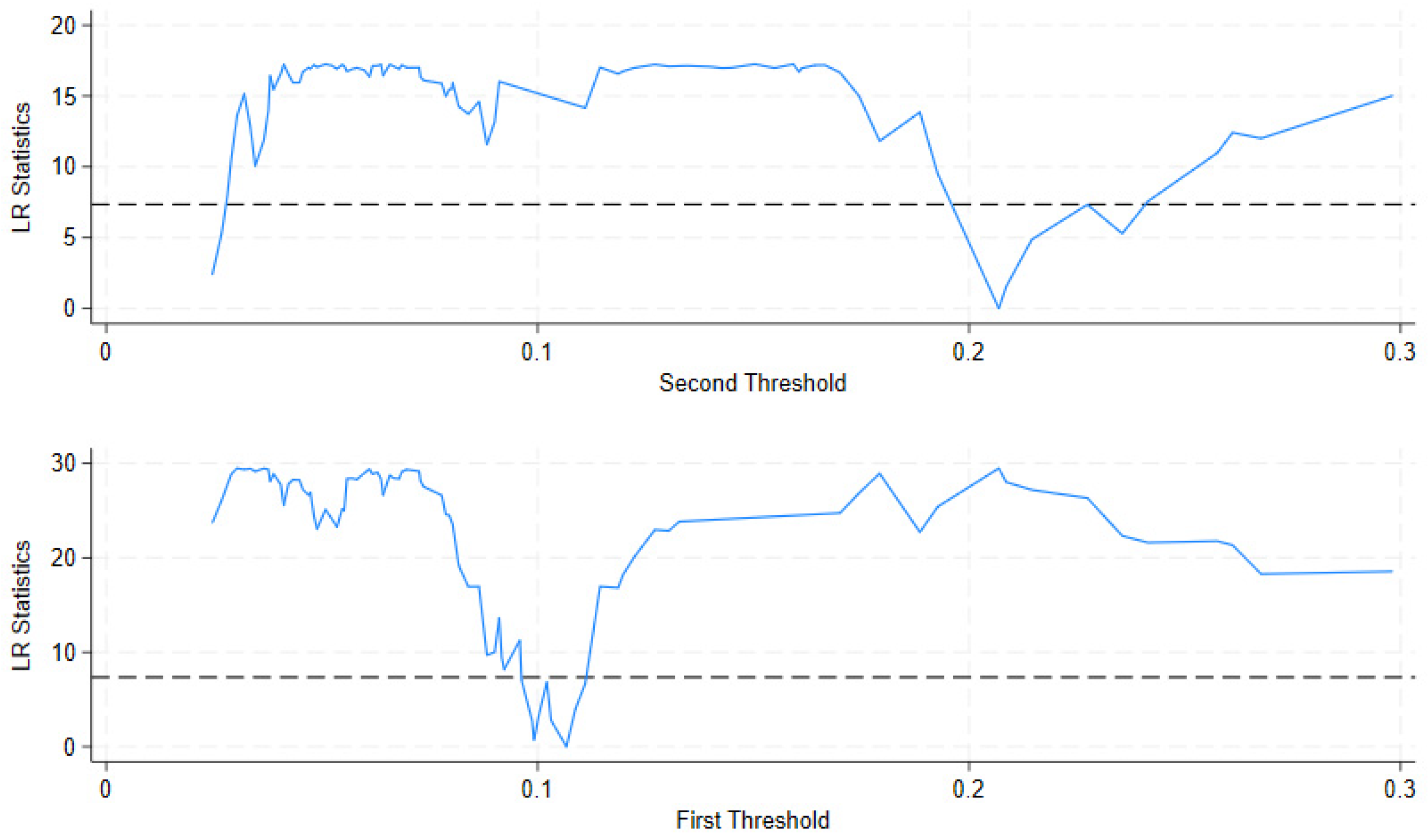
| DIG | Single | 0.107 | 39.80 | 0.000 | 300 | 22.456 | 27.495 | 33.828 |
| Double | 0.207 | 18.47 | 0.083 | 300 | 17.893 | 22.306 | 34.036 | |
| (1) Res | (2) Res | |
|---|---|---|
| Dig | 0.138 *** (3.79) | |
| Dig (Th ≤ 0.107) | 0.194 *** (2.60) | |
| Dig (0.107 < Th ≤ 0.207) | 0.435 *** (8.71) | |
| Dig (Th > 0.207) | 0.317 *** (11.77) | |
| cons | −0.073 (−0.28) | −0.539 ** (−2.09) |
| Control variables | Yes | Yes |
| N | 360 | 360 |
| R2 | 0.948 | 0.836 |
| Resource Endowment | Regional Heterogeneity | |||||
|---|---|---|---|---|---|---|
| Variable | (1) High | (2) Low | (3) Eastern | (4) Central | (5) Western | (6) Northeast |
| Dig | 0.492 *** (6.61) | 0.131 *** (3.20) | 0.127 *** (3.24) | 0.490 ** (2.29) | 0.483 *** (4.79) | −2.137 ** (−2.69) |
| Control variables | Yes | Yes | Yes | Yes | Yes | Yes |
| cons | 0.906 *** (2.72) | 0.156 (0.28) | 0.609 (1.11) | −0.560 (−0.68) | 0.434 (1.05) | −3.870 *** (2.97) |
| Time fixed | Yes | Yes | Yes | Yes | Yes | Yes |
| Individual fixed | Yes | Yes | Yes | Yes | Yes | Yes |
| N | 240 | 120 | 120 | 72 | 132 | 36 |
| R2 | 0.902 | 0.976 | 0.978 | 0.972 | 0.935 | 0.920 |
Disclaimer/Publisher’s Note: The statements, opinions and data contained in all publications are solely those of the individual author(s) and contributor(s) and not of MDPI and/or the editor(s). MDPI and/or the editor(s) disclaim responsibility for any injury to people or property resulting from any ideas, methods, instructions or products referred to in the content. |
© 2026 by the authors. Licensee MDPI, Basel, Switzerland. This article is an open access article distributed under the terms and conditions of the Creative Commons Attribution (CC BY) license.
Share and Cite
Wang, Q.; Chen, Y. Digital Technology and Energy System Resilience: Transmission Mechanisms and Threshold Effects—Evidence from China’s Provincial Panel Data. Sustainability 2026, 18, 5786. https://doi.org/10.3390/su18115786
Wang Q, Chen Y. Digital Technology and Energy System Resilience: Transmission Mechanisms and Threshold Effects—Evidence from China’s Provincial Panel Data. Sustainability. 2026; 18(11):5786. https://doi.org/10.3390/su18115786
Chicago/Turabian StyleWang, Qi, and Yanqiu Chen. 2026. "Digital Technology and Energy System Resilience: Transmission Mechanisms and Threshold Effects—Evidence from China’s Provincial Panel Data" Sustainability 18, no. 11: 5786. https://doi.org/10.3390/su18115786
APA StyleWang, Q., & Chen, Y. (2026). Digital Technology and Energy System Resilience: Transmission Mechanisms and Threshold Effects—Evidence from China’s Provincial Panel Data. Sustainability, 18(11), 5786. https://doi.org/10.3390/su18115786