Article

Digital Technology and Energy System Resilience: Transmission Mechanisms and Threshold Effects—Evidence from China’s Provincial Panel Data


1
School of Economics and Management, Changchun University of Technology, Changchun 130012, China
2
Jilin Provincial Research Center for Innovation and Development Strategy of New Materials and High-End Equipment Manufacturing, Changchun University of Technology, Changchun 130012, China
*
Author to whom correspondence should be addressed.
Sustainability 2026, 18(11), 5786; https://doi.org/10.3390/su18115786 (registering DOI)
Submission received: 19 May 2026 / Revised: 28 May 2026 / Accepted: 1 June 2026 / Published: 5 June 2026

Abstract

Energy system resilience is essential for maintaining energy security and system stability under growing global uncertainty. Based on panel data for 30 Chinese provinces over the period 2012–2023, this paper investigates the relationship between digital technology and energy system resilience. Digital technology and energy system resilience are measured with entropy-weighted composite indices, and the empirical tests are conducted using a two-way fixed-effects model, mediation-effect models, and a panel threshold model. The results show that digital technology significantly improves energy system resilience, and this finding remains stable after endogeneity treatment and several robustness checks. The mechanism analysis further shows that industrial structure upgrading, digital industrial agglomeration, and green innovation serve as important channels linking digital technology to energy system resilience. The threshold results further show that the effect of digital technology is stage-dependent. Digital technology has a positive effect in all three stages, with the strongest effect occurring in the medium digital development stage, followed by slower marginal improvement in the high digital development stage. The heterogeneity results show that the effect is more pronounced in provinces with high resource dependence and in the central and western regions. By contrast, the eastern region presents a weaker marginal effect, while the northeastern region faces stronger constraints in transforming digital technology into resilience improvement. These findings suggest that digital technology is an important driver of energy system resilience and can support a more stable and sustainable energy transition, although its effect varies across development stages and regional conditions.

1. Introduction

In recent years, global energy systems have been exposed to increasing uncertainty. Shifts in the international political and economic environment [1], geopolitical conflicts [2], energy price volatility [3], and more frequent extreme climate events have challenged the traditional energy security framework, which has long focused on stable supply. Under the superposition of multiple challenges, building a safe, efficient, and resilient energy system has become a key goal of energy governance worldwide. China is the world’s largest energy producer and consumer, and its energy system is undergoing a profound transition. Therefore, enhancing energy system resilience has become increasingly important [4]. Enhancing resilience is also essential for supporting a stable low-carbon transition and the long-term sustainability of energy systems.
Existing research on energy system resilience is expanding, but it remains less mature than the literature on energy security, energy efficiency and energy industry. At the conceptual level, energy system resilience is generally understood as the capacity of an energy system to withstand shocks, maintain essential functions, recover from disruptions, and adapt to changing conditions [5,6,7]. In terms of measurement, existing studies mainly adopt three approaches: the shock-loss method [8], the state-variable method [9], and the composite index method [10]. Among them, the composite index method is more suitable for empirical economic research because it can integrate multi-dimensional indicators and support regional and temporal comparisons [11].
Energy systems are complex systems involving economic, social, technological, and institutional dimensions. Their resilience is shaped by multiple factors. Fan et al. [12] used a Markov regime-switching vector autoregression model to measure the energy system resilience of 50 countries and regions, and found that energy diversity, energy infrastructure, energy R&D investment, and government governance can effectively improve energy system resilience. Zhang and Zhang [13] measured the energy resilience of 30 Chinese provinces from 2010 to 2023 and found that interregional differences are the main source of disparities in provincial energy resilience. Lin and Bie [14] pointed out that multi-energy coupling and coordinated management can improve system efficiency. Nepal et al. [15] constructed green finance and energy resilience indices and found that green finance improves energy resilience by encouraging industrial transformation and green technological innovation. Wang and Peng [16] further showed that technology–finance integration strengthens resilience through better resource allocation and green innovation. Recent studies have also begun to examine the role of artificial intelligence. Jiang and Yu [17] reported that AI improves urban energy system resilience through technological innovation. Wang and Li [18] analyzed the mechanisms and spatial spillovers of AI in the energy economy, showing that its effects may cross local boundaries. Zhang et al. [19] further found that smart AI can reduce energy vulnerability in G20 economies, but its effect varies across countries. However, these studies mainly focus on financial instruments, policy tools, or single intelligent technologies. Artificial intelligence is an important intelligent application, but it captures only one application-oriented aspect of digitalization. It cannot fully explain the broader process of information perception, risk forecasting, resource coordination, emergency response, and post-shock recovery in energy systems. Against this background, digital technology based on a new generation of information and communication technologies (ICT) provides a broader perspective for understanding energy system resilience.
As the core of the Fourth Industrial Revolution, digital technology is characterized by high innovation, strong penetration, and broad coverage [20]. Digital technology refers to a technological system based on new-generation information and communication technologies. It relies on digital tools, data resources, communication networks, computing capacity, and algorithmic models to support information collection, storage, processing, transmission, analysis, and application. In this study, it mainly covers big data, cloud computing, artificial intelligence, blockchain, the Internet of Things, and related digital technologies [21,22,23]. Existing studies have examined digital technology from several perspectives. One stream of literature focuses on its role in green development and low-carbon transition. Wu et al. [24] found that digital technology innovation has a positive effect on green development. Zhang et al. [25] analyzed the spatial-temporal relationship between digital technology and carbon emissions in China and showed that digitalization affects regional emission outcomes. Ma et al. [26] further explored whether digital technology implementation promotes spatial convergence in carbon emissions and found that it can reshape regional emission patterns. Sharif et al. [27] compared developed and developing countries and found that digital technologies, trade, and renewable energy are important sources of green growth. Another stream of literature extends digital technology to the energy sector. The IEA [28] noted that digitalisation can transform energy systems by improving operational efficiency, supporting more interconnected energy systems, and enhancing resilience. Mahmood et al. [29] reviewed digitalization in smart grids, renewable energy, and demand response, showing that digital tools support system monitoring, renewable energy integration, and demand-side flexibility. Galkovskaya and Volos [30] examined the economic efficiency of implementing digital technologies in electric power systems and found that digital technologies can reduce operational costs and improve energy production efficiency. Wang et al. [31] further studied digital technology and energy efficiency and showed that digital technology can improve energy performance.
More recent studies have begun to link digitization with energy resilience. Jiang et al. [32] examined supply chain digitization and energy resilience in China and found that supply chain digitization improves energy resilience by enhancing supply–demand efficiency, stability, and quality. Fahad et al. [33] further investigated the relationship between supply chain digitization and energy resilience from the perspective of global supply chains. These studies provide useful evidence that digitalization can strengthen energy resilience.
However, the existing literature still leaves room for further investigation. First, current studies mainly focus on supply chain digitization, smart energy applications, or specific digital tools. The broader influence of digital technology on overall energy system resilience remains insufficiently explored. Digital technology is not merely an auxiliary tool for improving operational efficiency; it also reshapes the information structure, coordination mode, and adaptive capacity of energy systems through data collection, intelligent analysis, platform connectivity, and cross-sectoral resource allocation. Second, under China’s high-quality development strategy and its Dual Carbon goals, industrial structure upgrading, digital industrial agglomeration, and green innovation constitute important channels through which digital technology affects energy system resilience. Industrial structure upgrading can lower dependence on energy-intensive sectors and improve the flexibility of energy demand. Digital industrial agglomeration can strengthen inter-firm collaboration, improve supply–demand matching, and enhance the organizational efficiency of energy-related activities. Green innovation can support clean energy development, energy-saving technological transformation, and low-carbon production processes, thereby providing technological support for the adaptive and transformative capacity of energy systems. However, these channels have not been sufficiently examined together. Third, the impact of digital technology may not be linear. Digital technology development is often a cumulative process. Whether its resilience-enhancing effect changes after reaching a certain level remains an empirical question that deserves further investigation.
To address these questions, this study uses provincial panel data covering 30 Chinese provinces during 2012–2023. Digital technology and energy system resilience are measured through entropy-weighted composite indices. The empirical analysis then applies a two-way fixed-effects model to estimate the direct effect, mediation models to examine the channels of industrial structure upgrading, digital industrial agglomeration, and green innovation, and a panel threshold model to test the possible nonlinear effect of digital technology. This study makes three main contributions. First, it incorporates digital technology into the analytical framework of energy system resilience, extending existing research from specific digital applications such as artificial intelligence and supply chain digitization to a more comprehensive digital technology system. Second, it enriches the mechanism analysis by introducing green innovation alongside industrial structure upgrading and digital industrial agglomeration. Third, it provides evidence on the possible threshold effect of digital technology, offering a basis for understanding the stage-dependent role of digital empowerment in energy systems and its implications for sustainable energy transition. It should be noted that this study is based on China’s provincial panel data, and its conclusions are closely related to China’s economic structure, institutional setting, energy governance system, and regional development pattern. The findings may provide useful references for large developing economies undergoing energy transition and rapid digitalization, but further research under different institutional arrangements, energy-market conditions, and data environments is still needed before extending the conclusions to other countries.

2. Theoretical Analysis and Research Hypotheses

2.1. Direct Impact

Digital technology can enhance energy system resilience by improving information perception, intelligent decision-making, and system coordination. Energy systems are highly complex and require dynamic coordination among energy production, conversion, transportation, storage, consumption, and cross-regional allocation. Digital technologies can strengthen the collection, transmission, and processing of energy-related information, thereby improving the system’s ability to identify supply–demand fluctuations and potential external shocks in advance [34,35]. Through predictive analytics, intelligent dispatching, and automated control, digital technology can also improve the accuracy of energy allocation, reduce operational uncertainty, and support the integration of renewable energy and demand-side response [36]. In addition, digital platforms can promote information sharing and coordinated interaction among governments, energy enterprises, grid operators, and energy users, which helps improve emergency response, resource coordination, and post-shock recovery [37]. Accordingly, this study proposes the following hypothesis:
Hypothesis 1. 
Digital technology development improves energy system resilience.

2.2. Indirect Impact

Digital technology may promote industrial structure upgrading by improving factor allocation and reshaping production organization. As data become an important production factor, digital technology can enhance information-processing capacity, reduce information asymmetry, and improve the matching efficiency among technology, capital, labor, and market demand. This helps traditional industries accelerate digital transformation and promotes the expansion of technology-intensive, knowledge-intensive, and service-oriented sectors. The penetration of digital technology into production processes also guides industries away from high-carbon and low-efficiency patterns toward cleaner, smarter, and higher value-added activities [25,38]. In this way, digital technology creates favorable conditions for industrial structure upgrading.
Industrial structure upgrading can further improve energy system resilience by changing the scale, structure, and flexibility of energy demand. Industrial structure determines the energy demand pattern of regional production activities and affects the intensity, stability, and adjustability of energy use [39]. When the industrial structure shifts from energy-intensive and low-value-added sectors toward advanced manufacturing, modern services, and technology-intensive industries, economic growth becomes less dependent on fossil energy and rigid energy consumption. This helps improve energy efficiency and optimize the energy consumption structure [40]. It also strengthens the adaptability and recovery capacity of regional economic systems under external shocks by improving factor allocation, industrial linkages, and technological upgrading [41]. These effects provide a structural basis for strengthening energy system resilience. Accordingly, this study proposes the following hypothesis:
Hypothesis 2a. 
Digital technology indirectly improves energy system resilience through industrial structure upgrading.
Digital technology may promote digital industrial agglomeration by reducing information frictions and strengthening the spatial concentration of digital factors. The development of digital infrastructure, data platforms, and digital services improves information circulation and lowers coordination costs. Regions with stronger digital foundations are therefore more attractive to digital enterprises, digital talent, platform-based firms, and related producer services. As digital industries become concentrated, data resources, technological knowledge, and specialized services can be shared more efficiently. This generates scale effects, knowledge spillovers, and network externalities. Digital industrial agglomeration therefore reflects not only the concentration of digital firms, but also the formation of a regional ecosystem in which digital technologies, industrial applications, and innovation resources interact more closely [42,43]. In this process, digital technology creates conditions for the spatial clustering of digital industries and their deeper integration with the real economy.
Digital industrial agglomeration can further improve energy system resilience by strengthening resource coordination, technology diffusion, and energy-demand flexibility. Regions with stronger digital industrial agglomeration usually have denser digital service networks and stronger technical support. This facilitates the use of digital tools in energy monitoring, demand response, and emergency management. Such agglomeration also promotes the spread of green technologies and improves the matching between digital services and industrial application scenarios, thereby supporting low-carbon transformation [44]. From the perspective of energy use, industrial agglomeration can improve energy efficiency through market integration, factor reorganization, and stronger inter-firm coordination [45]. It can also improve the spatial matching of production activities, infrastructure, and energy services, which helps reduce resource waste and strengthen regional energy-use coordination [46]. As energy demand becomes more predictable and resource allocation becomes more coordinated, the regional energy system can maintain more stable operation and respond more flexibly to external disturbances. Accordingly, this study proposes the following hypothesis:
Hypothesis 2b. 
Digital technology indirectly improves energy system resilience through digital industrial agglomeration.
Digital technology may stimulate green innovation by improving knowledge circulation, reducing innovation costs, and strengthening the matching between green technology demand and innovation resources. Under China’s “Dual Carbon” goals, green innovation has become an important link between digital transformation and energy transition. Digital technology can reduce spatial and temporal barriers to knowledge exchange and improve collaboration among enterprises, universities, research institutions, and governments. It can also help firms identify energy-saving needs, monitor environmental performance, and optimize production processes, thereby increasing their incentives and capacity to develop green technologies [47]. For energy-related enterprises, digital transformation supports cleaner production, energy management, and low-carbon technological upgrading, creating favorable conditions for green innovation [48].
Green innovation can further improve energy system resilience by strengthening the technological basis of clean, efficient, and flexible energy use. On the supply side, green innovation supports renewable energy development, energy storage, low-carbon equipment, and cleaner production processes, thereby improving the diversity and reliability of energy supply. On the demand side, it promotes energy-saving technologies and low-carbon technological substitution, which helps reduce energy intensity and improve demand flexibility [49,50]. By optimizing production technologies and resource allocation, green innovation also improves energy efficiency, eases pressure on energy supply, and reduces resource waste [51]. As the energy system becomes less dependent on high-carbon and high-intensity energy use, its exposure to supply shocks, environmental constraints, and transition risks is reduced. Green innovation therefore enhances the system’s capacity to absorb disturbances, adjust its technological path, and adapt to low-carbon transformation requirements. Accordingly, this study proposes the following hypothesis:
Hypothesis 2c. 
Digital technology indirectly improves energy system resilience through green innovation.

2.3. Threshold Effect

The effect of digital technology on energy system resilience may differ across stages of digital development. In the initial stage, digital technology can improve information connectivity and basic operational coordination, thereby exerting a positive effect on energy system resilience. With the continued diffusion and accumulation of digital technology, its function gradually expands from basic connectivity to deeper integration with energy-system operation. Through knowledge spillovers, platform connectivity, and wider scenario-based application, digital technology can strengthen energy monitoring, dispatching, demand response, resource coordination, and emergency management. Once a critical threshold is crossed, these dispersed digital applications are more likely to form a system-level enabling effect, generating a qualitative improvement in resilience enhancement.
However, this effect does not increase indefinitely. When digital applications become relatively mature, the marginal contribution of additional digital expansion may weaken because the basic resource-allocation and efficiency-improvement effects have already been partly released; further improvement then depends on breaking digital technology bottlenecks and developing new application scenarios [52]. In addition, digital technology catch-up is not a simple increase in digital stock, but a dynamic process involving technology absorption, diffusion, and re-innovation, which means that digital empowerment tends to evolve through cumulative upgrading rather than one-time linear expansion [53]. Therefore, the relationship between digital technology and energy system resilience can be understood as a spiral-like process: digital development first releases basic positive effects, then enters a stage of stronger system-level empowerment after crossing a threshold, and later moves into a phase of slower marginal improvement until new technologies or new application scenarios generate another round of upgrading. Accordingly, this study proposes the following hypothesis:
Hypothesis 3. 
A threshold effect exists in the impact of digital technology on energy system resilience.
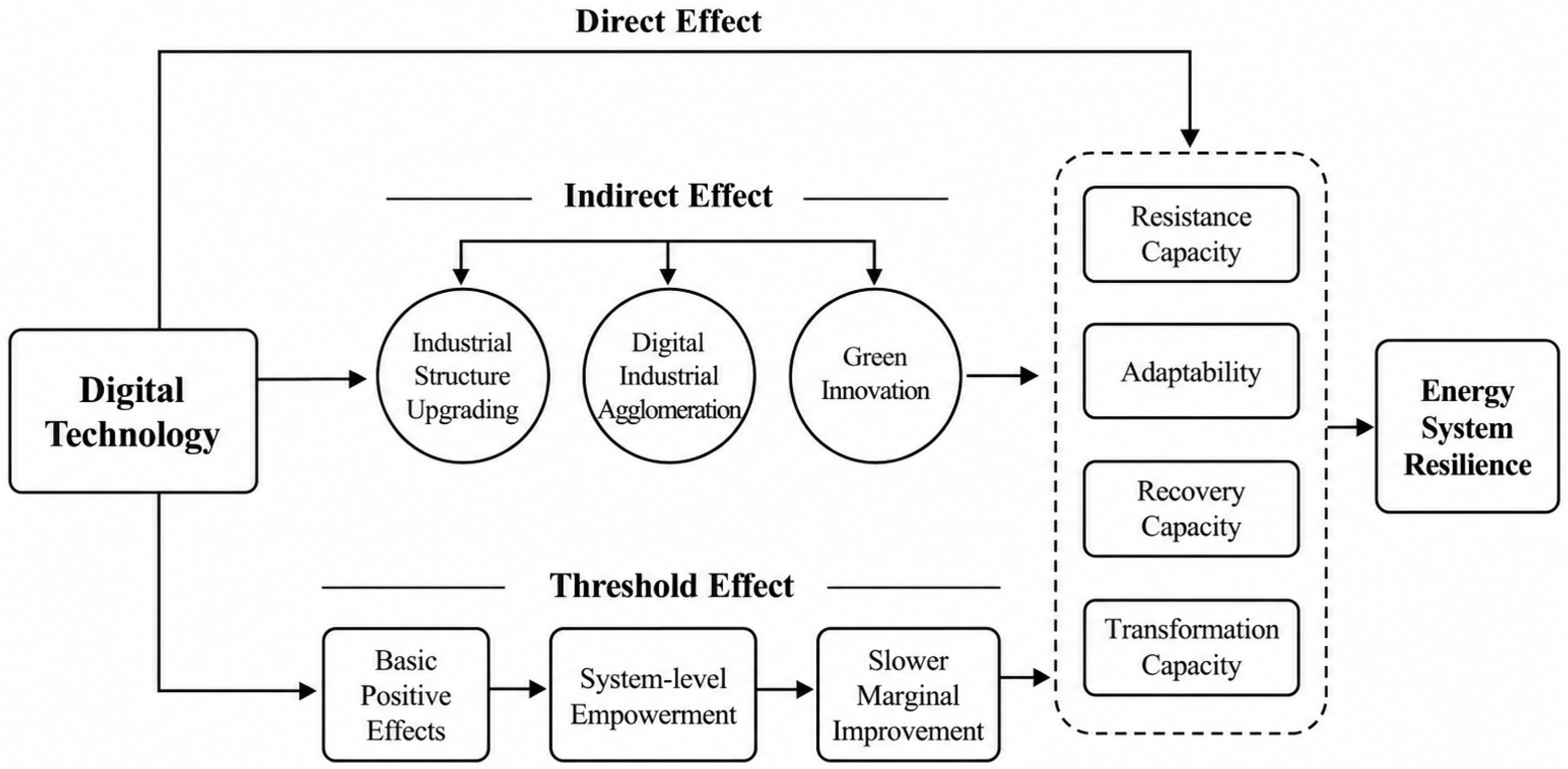
Based on the above analysis, Figure 1 presents the theoretical framework underlying the impact of digital technology on energy system resilience, including the direct effect, the mediating channels, and the threshold effect.

3. Materials and Methods

3.1. Model Specification

To test the impact of digital technology on energy system resilience, the benchmark regression model is constructed as follows:
R e s i t = α 0 + α 1 D i g i t + α 2 C o n t r o l s i t + μ i + δ t + ε i t
where i denotes provinces, including municipalities and autonomous regions, and t denotes years. R e s i t is the dependent variable, namely energy system resilience; D i g i t is the core explanatory variable, namely digital technology; C o n t r o l s i t is a vector of control variables, including regional economic development level (Rgdp), education development level (Led), government intervention (Gover), infrastructure level (Road), human capital (Hum), and population density (Pop); and μ i and δ t are province and year fixed effects; ε i t is the error term.
Following Jiang [54], mediation effect models are constructed to test the three mechanisms proposed above:
R e s i t = α 0 + α 1 D i g i t + α 2 C o n t r o l s i t + μ i + δ t + ε i t
M e d i a t o r i t = β 0 + β 1 D i g i t + β 2 C o n t r o l s i t + μ i + δ t + ε i t
where M e d i a t o r i t denotes the mediating variable, including industrial structure upgrading (Upg), digital industrial agglomeration (Dia) and green innovation (GI). β 1 captures the effect of digital technology on the mechanism variables. All other variables are defined as in Model (1).
To verify Hypothesis 3, this study constructs a panel threshold regression model to verify whether the impact of digital technology on energy system resilience presents nonlinear characteristics. The specific model is as follows:
R e s i t = γ 0 + γ 1 D i g i t I ( T h i t θ 1 ) + γ 2 D i g i t I ( θ 1 < T h i t θ 2 )                 + γ 3 D i g i t I ( T h i t > θ 2 ) + γ 4 C o n t r o l s i t + μ i + δ t + ε i t
In Equation (4), γ 0 is the constant term; γ 1 and γ 2 represent the marginal effects of digital technology on energy system resilience before and after the threshold value, respectively. T h i t is the threshold variable—digital technology, θ 1 and θ 2 are the estimated threshold parameters, and I ( · ) is the indicator function, taking a value of 0 or 1. All other variables are defined as in Model (1).

3.2. Variable Selection

3.2.1. Dependent Variable: Energy System Resilience (Res)

Based on the above conceptualization, this study constructs a comprehensive evaluation index system for energy system resilience by drawing on the studies of Wang Shouwen et al. [55] and Wang Yan et al. [18]. The index system covers four core dimensions, namely resistance capacity, recovery capacity, adaptability, and transformation capacity, as reported in Table 1. In the dimension of resistance capacity, this study further incorporates the energy self-sufficiency rate, following Dorahaki et al. [56]. This indicator helps capture the role of energy self-sufficiency in strengthening the ability of the energy system to withstand external risks, thereby enriching the measurement of resistance capacity. To quantify the overall level of energy system resilience, the entropy weight method is employed to determine the objective weights of the indicators. This method assigns higher weights to indicators with greater information variation and lower weights to indicators with smaller variation, thereby reducing subjective weighting bias in multidimensional index construction.
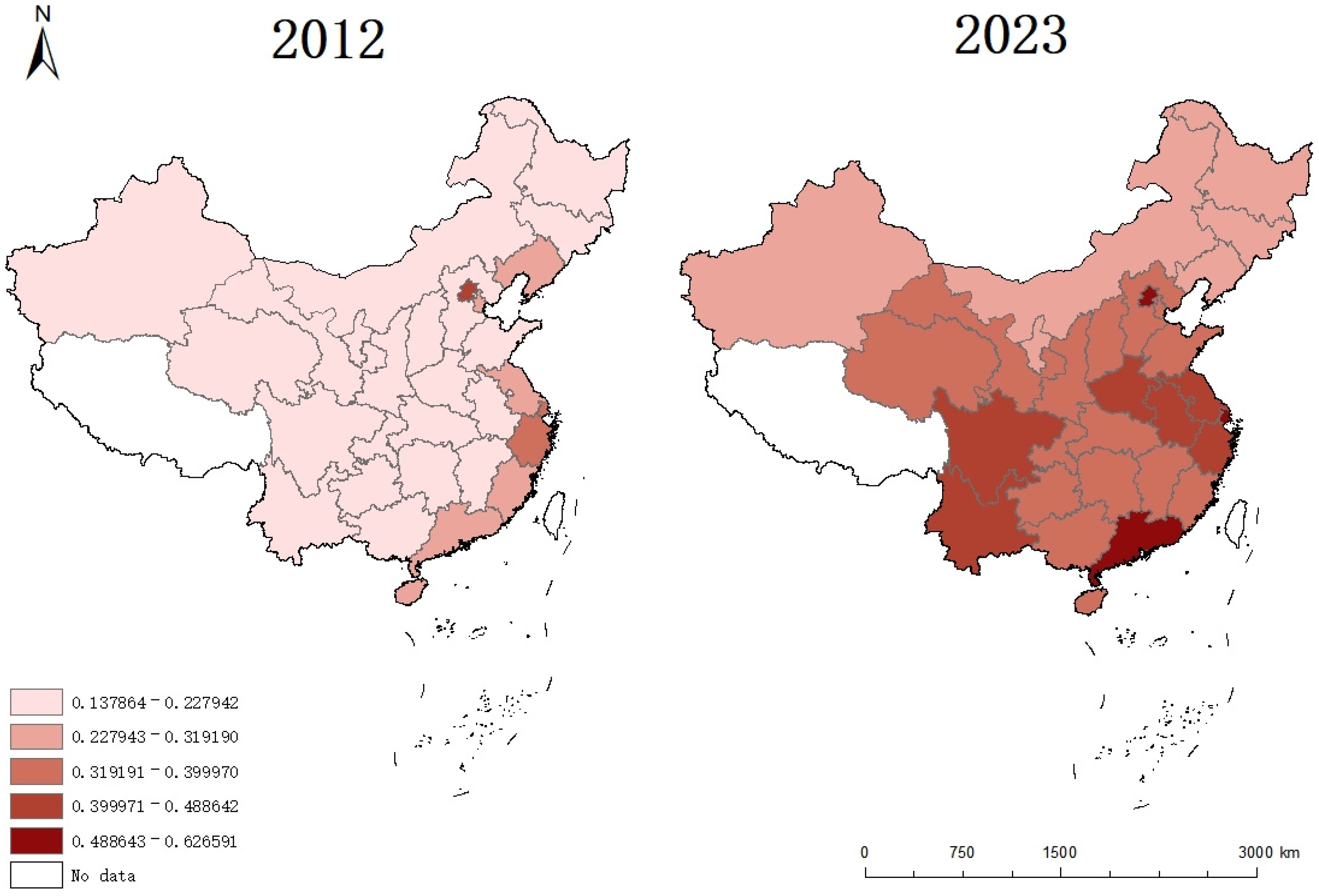
Figure 2 illustrates the spatial distribution of energy system resilience across provinces in 2012 and 2023. Obvious regional disparities are observed: eastern coastal provinces show higher resilience, while central and western regions are relatively lower, with a gradual declining pattern from east to west. Consistent classification standards are applied to ensure comparability between years.

3.2.2. Core Explanatory Variable: Digital Technology (Dig)

Digital technology is evaluated through a composite index covering digital infrastructure, digital technology innovation, and digital technology application. The indicator selection follows Zhang Xuewei et al. [57] and Guo Aijun et al. [58], and the specific indicators are reported in Table 2. The entropy weight method is also used to calculate the composite digital technology index. A larger index value indicates a more advanced level of digital technology development.
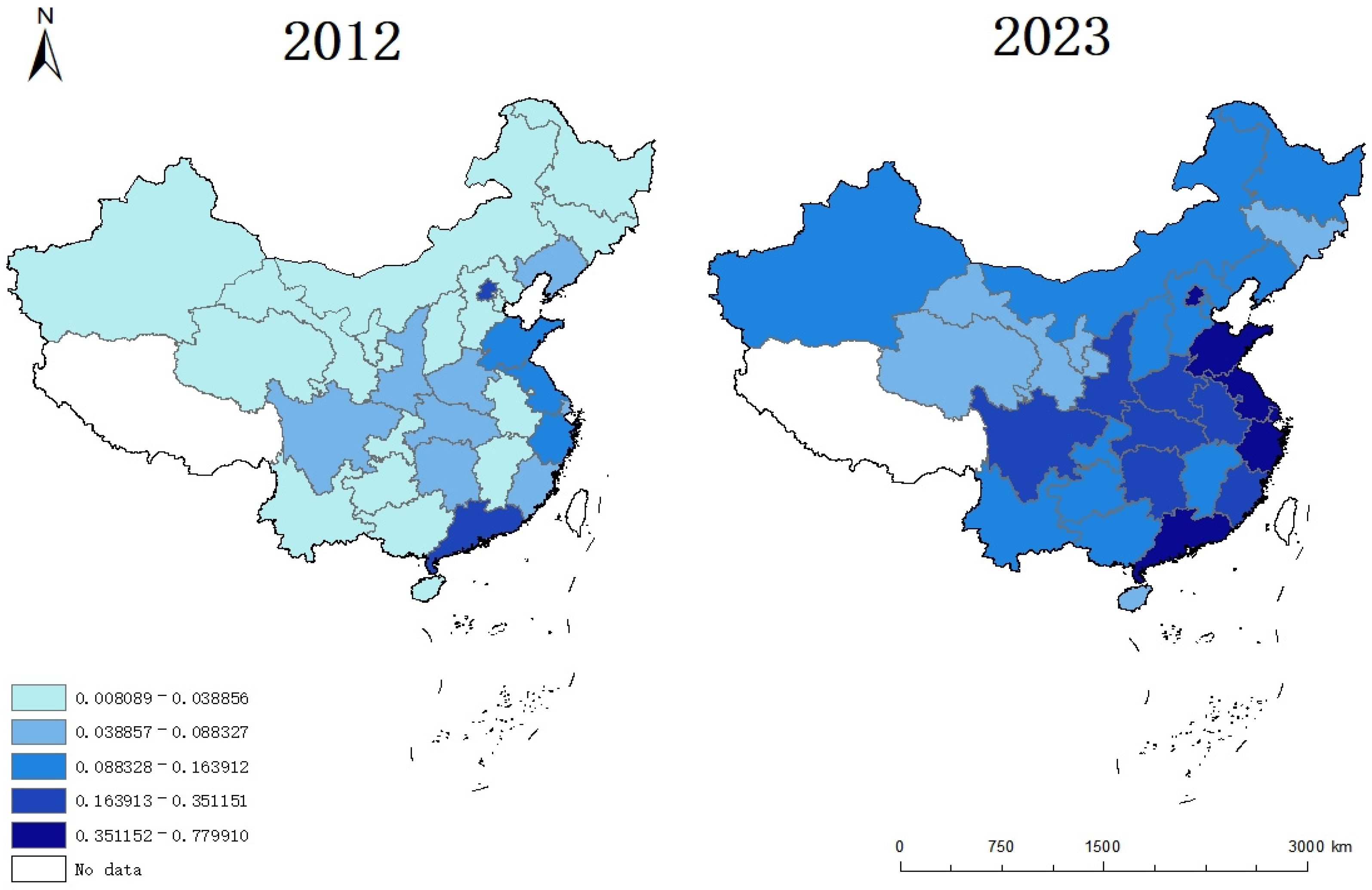
Figure 3 presents the spatial distribution of the digital technology index in Chinese provinces in 2012 and 2023. The results show clear regional differences. Digital technology development is generally higher in eastern coastal provinces, while inland provinces show relatively weaker performance.

3.2.3. Mediating Variables

First, industrial structure upgrading (Upg): Referring to the practice of existing literature such as Song Hong et al. [59], the industrial structure hierarchy coefficient is used to measure the level of industrial structure upgrading in each province. The specific calculation method is as follows:
Upg = 1 × r1 + 2 × r2 + 3 × r3. Among them, r1, r2 and r3 represent the proportion of the added value of the primary, secondary, and tertiary industries in GDP, respectively.
Second, digital industrial agglomeration (Dia): Following the approach of Zhu Xianghe [44], this study adopts the location quotient method to measure the level of digital industrial agglomeration at the provincial level. The specific formula is as follows:
D i a p t = e m p l o y e d p t / e m p l o y p t e m p l o y e d p t / e m p l o y p t
where e m p l o y e d p t represents the number of employees in the digital industry in province p in year t; and e m p l o y p t represents the total number of employees in province p in year t. e m p l o y e d p t and e m p l o y p t denote the national totals of digital industry employees and total employees under the same statistical caliber, respectively. Referring to the relevant definitions in the Statistical Classification of the Digital Economy and Its Core Industries (2021) issued by the National Bureau of Statistics of China and the White Paper on China’s Digital Economy Development and Employment (2020) released by the China Academy of Information and Communications Technology, this study measures the number of digital industry employees using employment in telecommunications, radio and television, and satellite transmission services; Internet and related services; software and information technology services; and other related industries.
Third, Green innovation (GI): Green patents are widely used to measure green innovation and usually include patent applications and patent authorizations. Considering the time lag in patent authorization, this study uses green patent applications to capture current green innovation activity. Specifically, GI is measured by green invention patent applications per 10,000 people.

3.2.4. Control Variables

The control variables include regional economic development, education development, government intervention, infrastructure, human capital, and population density. Regional economic development (Rgdp) is measured by real per capita GDP with 2000 as the base year. Education development (Led) is measured by the ratio of local fiscal education expenditure to local general fiscal budget expenditure. Government intervention (Gover) is measured by the ratio of general fiscal budget expenditure to local GDP. Infrastructure level (Road) is measured by per capita road area, following Zhang Xuewei et al. [57]. Human capital (Hum) is measured by the ratio of students in regular higher education institutions to the permanent population. Population density (Pop) follows Pang Ruizhi et al. [60] and is calculated as the logarithm of permanent population divided by administrative area.

3.3. Data Sources

This study selects panel data of 30 provinces, municipalities, and autonomous regions in China from 2012 to 2023, excluding Hong Kong, Macao, Taiwan, and Tibet. The raw data used for the construction of the energy system resilience index, the digital technology index, the mediating variables, and the control variables are mainly obtained from the National Bureau of Statistics of China, China Statistical Yearbook, provincial statistical yearbooks, China Mineral Resources Report, China Economic Information Network Database, and CNRDS Database. For a few missing observations, with a missing ratio below 1.5%, linear interpolation is used to maintain a balanced panel. All empirical analyses were conducted using Stata/MP 18.0. Table 3 shows the descriptive statistical results of the variables.

4. Results

Before conducting the regression analysis, the variance inflation factor (VIF) is calculated for the explanatory variable, mediating variables, and control variables to check for possible multicollinearity. The results show that the VIF values of all variables are below the conventional threshold of 10, and the mean VIF is 4.09, indicating that no severe multicollinearity exists in the model. Therefore, the regression estimates are considered reliable.

4.1. Baseline Regression Analysis

Table 4 shows the benchmark regression results of the impact of digital technology on energy system resilience. Column (1) is the test result without adding control variables under two-way fixed effects, and the impact coefficient of digital technology on energy system resilience is positive and significant at the 1% level; Column (2) is the test result with adding control variables. It can be seen that the coefficient of digital technology (Dig) is still positive and significant at the 1% level. This fully indicates that the promoting effect of digital technology on energy system resilience is highly robust, which initially verifies Hypothesis 1.

4.2. Endogeneity Test and Robustness Checks

4.2.1. Endogeneity Test

To address potential endogeneity caused by reverse causality and omitted variables, this study adopts an instrumental-variable approach. Following Zhang Yajun et al. [61] and Tang Kai et al. [62], the distance from each provincial capital to the nearest port is used as the geographical basis for constructing the instrument. Ports are important channels for openness, technology introduction, and information flows, so provinces closer to ports are more likely to access digital technologies, equipment, and talent. This supports the relevance of the instrument. At the same time, port distance is determined by geographical location and is not directly shaped by current economic or social activities, which supports its exogeneity. Since this study uses panel data while port distance is a cross-sectional variable, we interact the logarithm of its inverse value with the lagged national broadband-user trend to construct a panel instrumental variable for digital technology.
The regression results are reported in Table 5. In the first-stage regression, the coefficient of IV_1 is significantly negative at the 1% level. The Kleibergen–Paap rk LM statistic rejects the null hypothesis of under-identification. The Kleibergen–Paap Wald rk statistics are greater than the critical values, rejecting the null hypothesis of weak instruments, which indicates that IV_1 is reasonable and reliable. The second-stage regression shows that the coefficient of digital technology is significantly positive at the 1% level, indicating that the benchmark conclusion remains robust after addressing potential endogeneity.

4.2.2. Robustness Tests

To examine whether the benchmark results are stable, this study conducts four additional robustness tests, with the results reported in Table 6. First, the sample period is adjusted to exclude the possible interference of major events. Column (1) excludes the COVID-19 period and retains the sample years 2012–2019 and 2023. The coefficient of digital technology remains significantly positive. Second, the four municipalities directly under the Central Government, namely Beijing, Shanghai, Tianjin, and Chongqing, are excluded from the sample. Since these municipalities may differ substantially from other provinces in digital technology development, this test helps reduce possible estimation bias. Column (2) shows that digital technology continues to have a significantly positive coefficient after these observations are excluded. Third, the core explanatory variable is replaced. Principal component analysis (PCA) is used to recalculate the digital technology index. Column (3) shows that the coefficient of digital technology remains significantly positive at the 1% level. Fourth, a lagged regression is conducted. Considering that the impact of digital technology on energy system resilience may have a certain lag, the one-period lag of digital technology is used for re-estimation. Column (4) reports that the coefficient remains significantly positive. These results jointly support the stability of the benchmark conclusion.

4.3. Mechanism Test Results

To verify the three transmission mechanisms proposed above, this study conducts mediation effect tests, and the results are reported in Table 7. Column (1) presents the baseline effect of digital technology on energy system resilience, while Columns (2)–(4) report the effects of digital technology on the three mechanism variables.
Column (2) shows that the coefficient of digital technology is significantly positive at the 1% level, indicating that digital technology promotes industrial structure upgrading. Based on the mechanism analysis above, industrial structure upgrading can reshape the scale, structure, and flexibility of energy demand, thereby providing a structural basis for strengthening energy system resilience. Therefore, digital technology can affect energy system resilience through the channel of industrial structure upgrading. Hypothesis 2a is supported.
Column (3) shows that digital technology significantly promotes digital industrial agglomeration at the 1% level. Based on the mechanism analysis above, digital industrial agglomeration can enhance resource coordination, technological diffusion, and the matching between digital services and energy-related application scenarios, thereby improving the spatial and organizational conditions for energy system resilience. Therefore, digital technology can affect energy system resilience through the channel of digital industrial agglomeration. Hypothesis 2b is supported.
Column (4) shows that digital technology has a significantly positive effect on green innovation at the 1% level. Based on the mechanism analysis above, green innovation strengthens the technological basis of clean, efficient, and flexible energy use, which helps the energy system adapt to external shocks and low-carbon transformation requirements. Therefore, digital technology can affect energy system resilience through the channel of green innovation. Hypothesis 2c is supported.

4.4. Threshold Effect Results

4.4.1. Threshold Effect Test

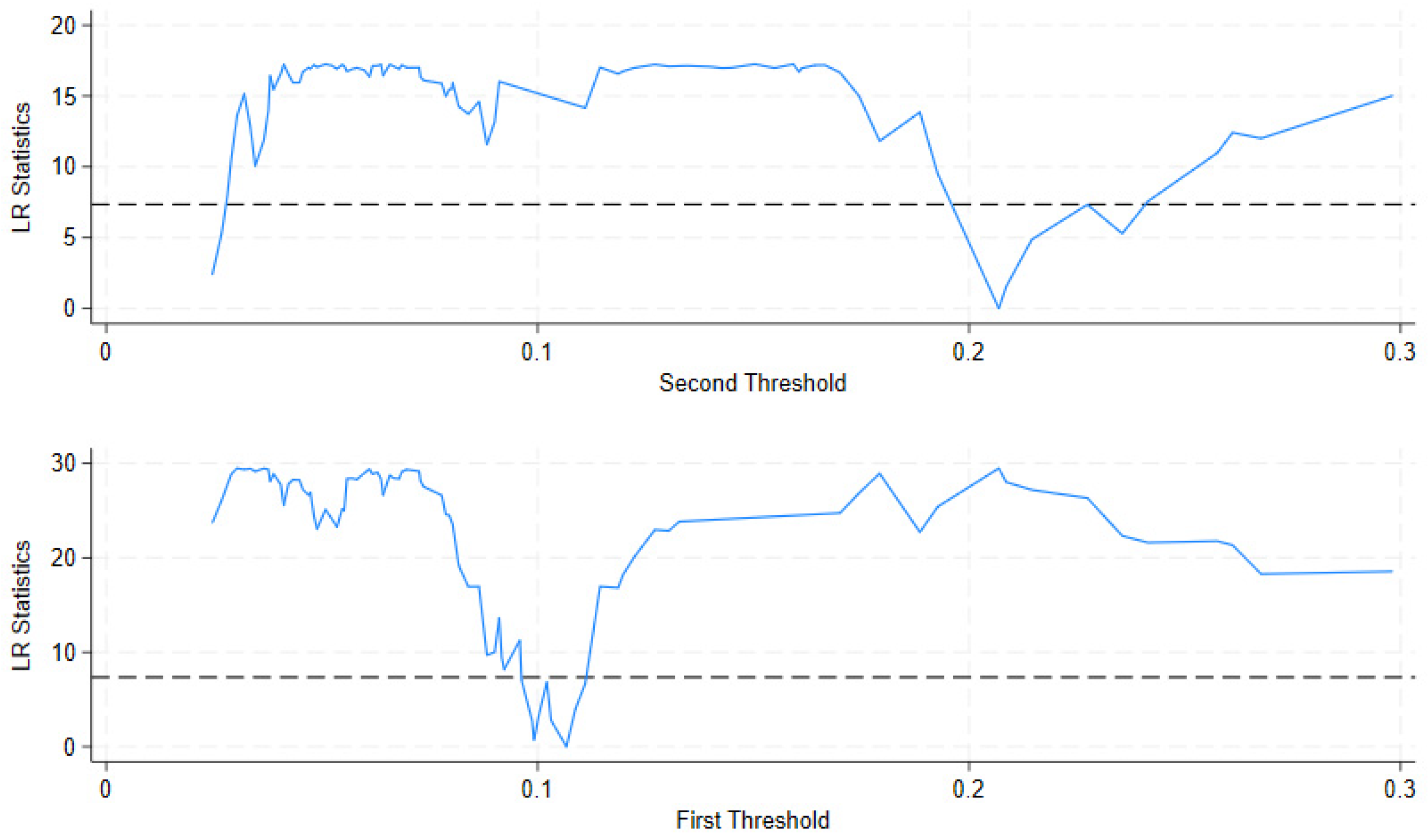
To test Hypothesis 3, this study constructs a nonlinear panel threshold regression model. Digital technology is used as both the core explanatory variable and the threshold variable to examine whether its effect on energy system resilience differs across stages of digital development. Table 8 reports the threshold-effect test results. The single-threshold effect is significant at the 1% level, with a threshold value of 0.107. The double-threshold effect is significant at the 10% level, with a second threshold value of 0.207. Therefore, the double-threshold model is selected for further estimation. These results suggest that digital technology has a stage-dependent impact on energy system resilience.
In addition, Figure 4 further illustrates the likelihood ratio test results for the threshold variables. The threshold estimates are all statistically valid, which further supports the existence of the double-threshold effect.

4.4.2. Analysis of Threshold Regression Results

This study further investigates the stage-dependent impact of digital technology on energy system resilience using the double-threshold model. According to the estimates reported in Table 9, the sample is divided into three stages according to the digital technology threshold values: the low digital development stage (Dig ≤ 0.107), the medium digital development stage (0.107 < Dig ≤ 0.207), and the high digital development stage (Dig > 0.207). The empirical results show that digital technology has a significantly positive effect on energy system resilience in all three stages, but the magnitude of the effect differs substantially. This pattern suggests that digital technology first generates basic positive effects, then produces stronger system-level empowerment after crossing the first threshold, and finally enters a stage of slower marginal improvement while still maintaining a positive effect.
(1)
Low digital development stage
When the digital technology index is lower than or equal to 0.107, the coefficient of digital technology is 0.194 and is significant at the 1% level. This indicates that digital technology has begun to improve energy system resilience, but the effect is still relatively limited. In the later years of the sample period, several western and northeastern provinces, such as Inner Mongolia, Jilin, Heilongjiang, Guizhou, Gansu, Qinghai, Ningxia, and Xinjiang, remained below or close to the first threshold. These provinces are still at the stage of strengthening digital foundations and improving basic data connectivity.
At this stage, the main function of digital technology is to reduce information frictions in energy-system operation. The construction of digital infrastructure and data-processing capacity can improve the availability and timeliness of energy-related information, but digital capacity has not yet been fully transformed into system-wide resilience. This is also reflected in the policy logic of the “East Data, West Computing” project and the national integrated computing-power network. The policy aims to guide computing resources to national hub nodes and promote the coordination of computing power, data, algorithms, and green electricity, rather than simply expanding isolated digital infrastructure. For low-stage provinces, the key is therefore to move from “having digital capacity” to “using digital capacity in energy governance.” This explains why the effect is positive but smaller than that in the medium stage.
(2)
Medium digital development stage
When the digital technology index lies between 0.107 and 0.207, the coefficient rises to 0.435, which is the highest among the three stages. This result shows that digital technology produces the strongest resilience-enhancing effect after crossing the first threshold. Provinces such as Anhui, Henan, Hunan, Chongqing, Shaanxi, Jiangxi, Guangxi, and Yunnan are typical examples in or near this stage in the later years of the sample period. Compared with low-stage provinces, these provinces have already established a certain digital foundation, while their energy systems still have considerable room for improvement in operational coordination and adaptive capacity.
The key feature of this stage is that digital technology begins to shift from basic digital foundations to system-level application. Digital development is no longer limited to improving information availability; it begins to support the coordinated operation and adaptive adjustment of the energy system. The policy document Several Opinions on Accelerating the Digital and Intelligent Development of Energy emphasizes the differentiated integration of digital and intelligent technologies across energy sectors, links, scenarios, and development stages, and proposes to initially establish a digital and intelligent innovation application system for the energy sector by 2030. This policy orientation helps explain why digital technology produces the strongest marginal effect in the medium stage: once basic digital conditions are established, digital tools can be more effectively transformed into system coordination and resilience-enhancing capacity.
(3)
High digital development stage
When the digital technology index exceeds 0.207, the coefficient decreases to 0.317 but remains significantly positive. This does not mean that digital technology becomes less important. Rather, it indicates that after digital development reaches a relatively high level, the marginal contribution of additional digital expansion begins to slow down. Provinces such as Beijing, Shanghai, Jiangsu, Zhejiang, Guangdong, Shandong, Fujian, Hubei, and Sichuan had entered this stage by the end of the sample period. These provinces generally have stronger digital infrastructure, more mature digital industries, and wider digital application scenarios. Basic connectivity, data accumulation, and routine digital management have already released part of their efficiency-improvement effects.
At this stage, the main issue is no longer whether digital technology can be applied, but whether existing digital advantages can be transformed into higher-quality energy governance capacity. The Action Plan for Accelerating the Construction of a New Power System (2024–2027) emphasizes grid upgrading, demand-side flexibility, and renewable energy accommodation, indicating that further resilience improvement increasingly depends on system-level coordination rather than the simple expansion of digital inputs. Therefore, the decline from 0.435 to 0.317 should be understood as slower marginal improvement after the first round of digital empowerment has been released, rather than a reduction in the importance of digital technology. In this stage, the logic of digital technology catch-up becomes more important: further improvement depends on absorption, diffusion, and re-innovation that transform existing digital advantages into practical energy resilience capacity.

4.5. Heterogeneity Analysis

4.5.1. Heterogeneity Analysis Based on Resource Endowments

Considering the differences in resource endowments, industrial structures, and development paths across provinces [63], this study further examines whether the impact of digital technology on energy system resilience is heterogeneous under different levels of resource dependence. Referring to the National Sustainable Development Plan for Resource-Based Cities (2013–2020), the number of resource-based cities in each province is counted and its proportion in the total number of prefecture-level administrative regions is calculated to measure provincial resource dependence. Using the median value during the sample period as the grouping criterion, the sample is divided into high and low resource endowment groups, and the regression results are reported in columns (1) and (2) of Table 10. Digital technology significantly improves energy system resilience in both groups, but the effect is much stronger in provinces with high resource endowments. The estimated coefficient is 0.492 for the high-resource group and 0.131 for the low-resource group, both significant at the 1% level. This difference indicates that resource-dependent provinces have greater potential to convert digital technology into resilience gains. The reason is that resource-dependent regions are more likely to face a rigid energy structure, stronger path dependence, and heavier transformation pressure. Under such conditions, digital technology more directly strengthens information transmission, intelligent regulation, and system coordination, thereby easing resource constraints and improving the resilience of the energy system. By contrast, provinces with low resource endowments usually have more diversified development conditions and relatively lower dependence on traditional resource sectors, so although digital technology still exerts a positive effect, its marginal contribution is comparatively smaller.

4.5.2. Heterogeneity Analysis Based on Regional Differences

Considering the uneven regional development in China, this study divides the sample into eastern, central, western, and northeastern regions and estimates the regional effects separately. As reported in Columns (3)–(6) of Table 10, digital technology has a significantly positive effect in the eastern, central, and western regions, but the magnitude of the effect differs. The coefficient is 0.127 in the eastern region, 0.490 in the central region, and 0.483 in the western region, indicating that the marginal effect is weakest in the east and stronger in the central and western regions. This pattern may be related to regional differences in digital foundations and transformation space. The eastern region has a stronger economic base and more mature digital infrastructure, so the marginal resilience-enhancing effect of further digital expansion is relatively smaller. By contrast, the central and western regions are still undergoing industrial transformation and energy-structure adjustment, which creates greater room for digital technology to improve system coordination and resilience.
In the northeastern region, however, the coefficient of digital technology is −2.137 and is significant at the 5% level. This result does not mean that digital technology itself weakens energy system resilience. Rather, it reflects the difficulty of transforming digital inputs into resilience gains under the region’s specific structural conditions, especially when digital-energy coordination remains insufficient [64]. The economic structure of Northeast China still heavily relies on traditional heavy industry, with slow industrial restructuring and weak digital spillover effects. At the same time, it is also affected by weak market demand, price fluctuations, environmental pressures, population loss, and aging. These structural constraints increase the difficulty of converting digital technology into effective energy-system coordination [65]. When digital investment is not matched by industrial upgrading, talent support, and energy governance capacity, its short-term effect may be offset by adjustment costs and resource reallocation frictions. Therefore, the negative coefficient may reflect a short-term mismatch between digital technology development and regional structural transformation capacity, rather than an inherent negative effect of digital technology.

5. Conclusions and Recommendations

5.1. Conclusions

Based on panel data from 30 Chinese provinces from 2012 to 2023, this study examines the relationship between digital technology and energy system resilience and draws four main conclusions. First, digital technology significantly enhances energy system resilience, and this result remains robust after addressing endogeneity and conducting a series of robustness checks. Second, industrial structure upgrading, digital industrial agglomeration, and green innovation are important channels through which digital technology affects energy system resilience. Third, the effect of digital technology shows clear threshold characteristics, with estimated threshold values of 0.107 and 0.207. Its effect is strongest in the medium digital development stage and weakens after the second threshold, indicating a process from basic support to system-level empowerment and then to slower marginal improvement. Fourth, the effect of digital technology differs across regional structural conditions. Digital technology has a stronger effect in high-resource-dependence provinces and in the central and western regions, whereas its effect is weaker in the eastern and northeastern regions. This finding shows that the contribution of digital technology to energy system resilience is shaped not only by the level of digital development, but also by regional industrial structure, resource dependence, and transformation capacity. Overall, these findings indicate that digital technology can contribute to a sustainable energy transition, but its effect depends on development stages and regional structural conditions.

5.2. Recommendations

First, digital-energy policies should avoid a uniform expansion-oriented approach. The threshold results show that the effect of digital technology on energy system resilience changes around the estimated values of 0.107 and 0.207. These values are not fixed administrative standards, but empirical reference points for understanding when digital technology shifts from basic support to system-level empowerment and then to slower marginal improvement. For provinces with weak digital foundations, policy should focus on digital infrastructure, energy data connectivity, and the practical use of digital tools in energy governance. For provinces with basic digital conditions, the priority should be to deepen digital-energy integration, where digital technology generates the strongest marginal effect. For provinces with relatively mature digital development, policy should shift from increasing digital inputs to improving digital-energy integration quality through scenario innovation, institutional coordination, and higher-level energy governance.
Second, digital technology should be used to support industrial transformation, digital industrial agglomeration, and green innovation. The results show that these factors are important pathways through which digital technology improves energy system resilience. In industrial transformation, digital tools should be used to reduce the dependence of regional development on high-energy-consuming sectors and improve the flexibility of energy demand. In digital industrial agglomeration, local governments should strengthen the connection between digital services, industrial application scenarios, and energy-related innovation resources, so that digital industries can better support energy-system coordination. In green innovation, digital platforms should be used to improve knowledge circulation and support clean energy development, energy-saving transformation, and low-carbon technological progress. This can help digital technology move from general infrastructure construction to practical resilience enhancement.
Third, regional digital-energy policies should be adjusted according to resource dependence and development conditions. For high-resource-dependence provinces, digital technology should be used to ease energy-structure rigidity and support the transformation of resource-based industries. For the central and western regions, where the marginal effect of digital technology is stronger, policy should focus on expanding digital applications in energy-system coordination and industrial transformation. For the eastern region, where digital foundations are already relatively mature, the priority should be to improve the quality and efficiency of digital-energy integration rather than simply increasing digital inputs. For the northeastern region, policy should focus on reducing structural constraints that weaken the conversion of digital technology into resilience gains, including slow industrial restructuring, weak digital spillovers, and insufficient talent support.

5.3. Limitations and Future Research

This study still has several limitations. First, digital technology and energy system resilience are measured using provincial-level composite indices. This approach is appropriate for examining their overall relationship at the macro-regional level. However, it cannot separately identify the effects of specific digital technologies, such as artificial intelligence, big data, or the Internet of Things, nor can it fully reveal the responses of specific energy-system subsystems. International studies and policy reports have shown that digitalization can support energy-system safety, flexibility, renewable energy integration, demand response, and power-system resilience. However, direct cross-country evidence on the threshold effect of digital technology on energy system resilience remains limited. Therefore, the threshold values estimated in this study should not be directly transferred to other countries, because the conversion of digital technology into resilience gains may depend on institutional arrangements, energy-market structures, energy governance capacity and digital infrastructure conditions. Second, the provincial panel data used in this study help reveal regional differences, but they are less able to capture micro-level behavioral mechanisms among enterprises, energy users, and local governments. Third, this study examines three transmission channels, but other possible channels may also exist. Future research could use city-level, enterprise-level, or energy-sector data to refine the measurement of digital technology and energy system resilience, examine the effects of specific digital technologies, and test whether similar stage-dependent effects exist under different institutional systems and energy-market conditions.

Author Contributions

Q.W.: Conceptualization, Methodology, Supervision, Project administration, Funding acquisition, Writing—review & editing. Y.C.: Data curation, Formal analysis, Investigation, Visualization, Writing—original draft, Writing—review & editing. All authors have read and agreed to the published version of the manuscript.

Funding

This research was funded by the Chinese Academy of Engineering Local Cooperation Project (Grant No. JL2025-15) and the Jilin Provincial Science and Technology Development Plan Project (Grant No. 20250801031FG).

Institutional Review Board Statement

Not applicable.

Informed Consent Statement

Not applicable.

Data Availability Statement

The raw data used in this study are obtained from publicly available sources, and the processed data are available from the corresponding author upon reasonable request.

Acknowledgments

The authors would like to thank the anonymous reviewers and editors for their valuable comments and suggestions on this manuscript. During the preparation and revision of this manuscript, ChatGPT (version GPT-5.5 Thinking) was used to assist with translation, language polishing, and improving the clarity of expression. After using this tool, the authors reviewed and edited the content as needed and take full responsibility for the content of the publication.

Conflicts of Interest

The authors declare no conflicts of interest.

Abbreviations

The following abbreviations are used in this manuscript:
HHIHerfindahl–Hirschman Index
ICTInformation and Communication Technology
IVInstrumental Variable
PCAPrincipal Component Analysis
GDPGross Domestic Product
VIFVariance Inflation Factor
CNRDSChina Research Data Services Platform

References

  1. Fang, W.J.; Deng, F.; Zhang, Z.R. Impact of environmental target constraints on the low-carbon transformation of China’s energy structure. Chin. J. Popul. Resour. Environ. 2024, 34, 84–96. (In Chinese) [Google Scholar]
  2. Dang, N.; Chen, D.Q.; Wang, Q. Influence mechanism of energy transition on urban-rural energy equity. Resour. Sci. 2024, 46, 1768–1779. (In Chinese) [Google Scholar]
  3. Tsai, I.-C. Fossil Energy Risk Exposure of the UK Electricity System: The Moderating Role of Electricity Generation Mix and Energy Source. Energy Policy 2024, 188, 114065. [Google Scholar] [CrossRef]
  4. Qian, L.; Bai, Y.; Wang, W.; Meng, F.; Chen, Z. Natural Gas Crisis, System Resilience and Emergency Responses: A China Case. Energy 2023, 276, 127500. [Google Scholar] [CrossRef]
  5. Jasiūnas, J.; Lund, P.D.; Mikkola, J. Energy System Resilience—A Review. Renew. Sustain. Energy Rev. 2021, 150, 111476. [Google Scholar] [CrossRef]
  6. Afgan, N.; Veziroglu, A. Sustainable resilience of hydrogen energy system. Int. J. Hydrogen Energy 2012, 37, 5461–5467. [Google Scholar] [CrossRef]
  7. Kang, S.; Peng, B.; Wang, Y. Research progress, hot spot evolution and future directions of energy system resilience: A bibliometric overview. Energy Rep. 2025, 14, 3451–3467. [Google Scholar] [CrossRef]
  8. Kong, J.; Zhang, C.; Simonovic, S.P. Optimizing the resilience of interdependent infrastructures to regional natural hazards with combined improvement measures. Reliab. Eng. Syst. Saf. 2021, 210, 107538. [Google Scholar] [CrossRef]
  9. Bao, M.; Ding, Y.; Sang, M.; Li, D.; Shao, C.; Yan, J. Modeling and evaluating nodal resilience of multi-energy systems under windstorms. Appl. Energy 2020, 270, 115136. [Google Scholar] [CrossRef]
  10. Wang, Z.; Wei, W. Regional economic resilience in China: Measurement and determinants. Reg. Stud. 2021, 55, 1228–1239. [Google Scholar] [CrossRef]
  11. Gatto, A.; Drago, C. Measuring and modeling energy resilience. Ecol. Econ. 2020, 172, 106527. [Google Scholar] [CrossRef]
  12. Fan, W.; Lv, W.; Wang, Z. How to measure and enhance the resilience of energy systems? Sustain. Prod. Consum. 2023, 39, 191–202. [Google Scholar] [CrossRef]
  13. Zhang, Q.Q.; Zhang, J.W. Measurement, Regional Differences, and Dynamic Evolution Characteristics of China’s Provincial Energy Resilience. Stat. Decis. 2026, 42, 52–57. (In Chinese) [Google Scholar]
  14. Lin, Y.; Bie, Z. Study on the resilience of the integrated energy system. Energy Procedia 2016, 103, 171–176. [Google Scholar] [CrossRef]
  15. Nepal, R.; Zhao, X.; Liu, Y.; Dong, K. Can Green Finance Strengthen Energy Resilience? The Case of China. Technol. Forecast. Soc. Change 2024, 202, 123302. [Google Scholar] [CrossRef]
  16. Wang, L.K.; Peng, H.J. Technology–finance integration and energy system resilience: The moderating role of climate policy uncertainty. Environ. Res. Lett. 2025, 20, 114057. [Google Scholar] [CrossRef]
  17. Jiang, M.; Yu, X. Enhancing the resilience of urban energy systems: The role of artificial intelligence. Energy Econ. 2025, 144, 108313. [Google Scholar] [CrossRef]
  18. Wang, Y.; Li, J.S. AI enhances the resilience of the energy economy—Review of the mechanism and the spatial spillover effect. Ind. Technol. Econ. 2025, 44, 128–137. (In Chinese) [Google Scholar]
  19. Zhang, Y.; Hu, W.; Tao, Y. How does smart artificial intelligence influence energy system resilience? Evidence from energy vulnerability assessments in G20 countries. Energy 2025, 314, 134290. [Google Scholar] [CrossRef]
  20. Deng, J.J. The impact of digital technology on high-quality and full employment. East China Econ. Manag. 2026, 40, 44–52. (In Chinese) [Google Scholar]
  21. Vial, G. Understanding digital transformation: A review and a research agenda. J. Strateg. Inf. Syst. 2019, 28, 118–144. [Google Scholar] [CrossRef]
  22. Binsaeed, R.H.; Yousaf, Z.; Grigorescu, A.; Samoila, A.; Chitescu, R.I.; Nassani, A.A. Knowledge Sharing Key Issue for Digital Technology and Artificial Intelligence Adoption. Systems 2023, 11, 316. [Google Scholar] [CrossRef]
  23. G20 Summit G20 Digital Economy Development and Cooperation Initiative, G20 Digital Economy Task Force. 2016. Available online: http://www.g20.utoronto.ca/2016/160905-digital.html (accessed on 25 October 2023).
  24. Wu, C.Q.; Deng, H.S.; Xia, Q.W. Research on the impact of digital technology innovation on the level of green development. China Soft Sci. 2025, 2, 66–80. (In Chinese) [Google Scholar]
  25. Zhang, K.; Li, S.; Qin, P.; Wang, B. Spatial and Temporal Effects of Digital Technology Development on Carbon Emissions: Evidence from China. Sustainability 2023, 15, 485. [Google Scholar] [CrossRef]
  26. Ma, G.; Yang, X.; Zhong, C.; Zhang, Y. Can the digital technology implementation promote the spatial convergence of carbon emissions? Evidence from China. Ann. Reg. Sci. 2026, 75, 63. [Google Scholar] [CrossRef]
  27. Sharif, F.; Majeed, T.M.; Farooq, S. Digital technologies, trade, renewable energy as sources of green growth: A comparative analysis of developed and developing countries. Green Technol. Sustain. 2026, 4, 100385. [Google Scholar] [CrossRef]
  28. IEA. Digitalisation and Energy. Available online: https://www.iea.org/reports/digitalisation-and-energy (accessed on 8 April 2026).
  29. Mahmood, M.; Chowdhury, P.; Yeassin, R.; Hasan, M.; Ahmad, T.; Chowdhury, N.-U. Impacts of digitalization on smart grids, renewable energy, and demand response: An updated review of current applications. Energy Convers. Manag. X 2024, 24, 100790. [Google Scholar] [CrossRef]
  30. Galkovskaya, V.; Volos, M. Economic Efficiency of the Implementation of Digital Technologies in Energy Power. Sustainability 2022, 14, 15382. [Google Scholar] [CrossRef]
  31. Wang, L.; Li, B.; Shao, J. Digital Technology and Energy Efficiency Enhancement: A Theoretical Framework and Empirical Evidence. Energies 2026, 19, 1819. [Google Scholar] [CrossRef]
  32. Jiang, G.; Chen, F.; Gu, M. Supply chain digitization and energy resilience: Evidence from China. Energy Econ. 2025, 144, 108420. [Google Scholar] [CrossRef]
  33. Fahad, S.; Su, F.; Nassani, A.A. From bytes to sustainability: Leveraging supply chain digitization for enhancing energy resilience. Energy Econ. 2025, 146, 108514. [Google Scholar] [CrossRef]
  34. Zhou, K.; Liu, Y.; Liao, Q.; Xu, J. The impact of artificial intelligence on energy resilience: Empirical evidence from China. Energy Econ. 2026, 153, 109040. [Google Scholar] [CrossRef]
  35. Wu, X.Y.; He, A.P. Digital technology boosts construction of China’s modern energy system: Enabling mechanisms, practical problems and implementation paths. Inq. Econ. Issues 2024, 1–14. (In Chinese) [Google Scholar]
  36. Zhou, Y.; Liu, J. Advances in emerging digital technologies for energy efficiency and energy integration in smart cities. Energy Build. 2024, 315, 114289. [Google Scholar] [CrossRef]
  37. Peng, Z. Transforming energy resilience through supply chain digitization: Risk management as a mediator. Int. Rev. Econ. Financ. 2025, 102, 104293. [Google Scholar] [CrossRef]
  38. Gao, D.; Li, G.; Yu, J. Does digitization improve green total factor energy efficiency? Evidence from Chinese 213 cities. Energy 2022, 247, 123395. [Google Scholar] [CrossRef]
  39. Luo, C.Y.; Li, X.S. Industrial Structure Upgrade, Technological Progress and China’s Energy Efficiency—An Empirical Analysis Based on Non-Dynamic Panel Threshold Model. Inq. Econ. Issues 2019, 159–166. (In Chinese) [Google Scholar]
  40. Zheng, X.; Ye, Z.; Fang, Z. Analysis on the influence of industrial structure on energy efficiency in China: Based on the spatial econometric model. Int. J. Environ. Res. Public Health 2023, 20, 2134. [Google Scholar] [CrossRef]
  41. Tan, J.; Hu, X.; Hassink, R.; Ni, J. Industrial structure or agency: What affects regional economic resilience? Evidence from resource-based cities in China. Cities 2020, 106, 102906. [Google Scholar] [CrossRef]
  42. Lu, D.; Hui, E.C.M.; Shen, J.; Shi, J. Digital industry agglomeration and urban innovation: Evidence from China. Econ. Anal. Policy 2024, 84, 1998–2025. [Google Scholar] [CrossRef]
  43. Wang, L.; Wu, M. Does digital industrial agglomeration enhance urban ecological resilience? Evidence from Chinese cities. Sustainability 2026, 18, 1250. [Google Scholar] [CrossRef]
  44. Zhu, X.H. Digital industrial agglomeration and high-quality low-carbon economic development: The mediating role of green technology innovation. Mod. Manag. Sci. 2025, 58–69. (In Chinese) [Google Scholar]
  45. Qin, Q.; Yu, Y.; Liu, Y.; Zhou, J.; Chen, X. Industrial agglomeration and energy efficiency: A new perspective from market integration. Energy Policy 2023, 183, 113842. [Google Scholar] [CrossRef]
  46. Wang, N.; Zhu, Y.M.; Yang, T.B. The impact of transportation infrastructure and industrial agglomeration on energy efficiency: Evidence from China’s industrial sectors. J. Clean. Prod. 2020, 244, 118708. [Google Scholar] [CrossRef]
  47. Xue, L.; Zhang, Q.; Zhang, X.; Li, C. Can digital transformation promote green technology innovation? Sustainability 2022, 14, 7497. [Google Scholar] [CrossRef]
  48. Liu, Y.; Song, P. Digital transformation and green innovation of energy enterprises. Sustainability 2023, 15, 7703. [Google Scholar] [CrossRef]
  49. Wei, J.; Wen, J.; Wang, X.-Y.; Ma, J.; Chang, C.-P. Green Innovation, Natural Extreme Events, and Energy Transition: Evidence from Asia-Pacific Economies. Energy Econ. 2023, 121, 106638. [Google Scholar] [CrossRef]
  50. Guo, L.; Tan, W. Analyzing the synergistic influence of green credit and green technology innovation in driving the low-carbon transition of the energy consumption structure. Sustain. Energy Technol. Assess. 2024, 63, 103633. [Google Scholar] [CrossRef]
  51. Song, A.; Rasool, Z.; Nazar, R.; Anser, M.K. Towards a greener future: How green technology innovation and energy efficiency are transforming sustainability. Energy 2024, 290, 129891. [Google Scholar] [CrossRef]
  52. Qin, J.; Chang, H.Q. Digital Technology, Marketization Level and Development of New EnergyIndustry:An Empirical Analysis based on Threshold Effect Model. Mod. Manag. Sci. 2021, 26–34. (In Chinese) [Google Scholar]
  53. Qi, S.Z.; Wang, X.W.; Li, K.; Zhang, J.H. Digital Technology Catch-Up and Green Energy Transition: An Empirical Study Based on Cross-Country Panel Data. World Econ. Stud. 2026, 3, 104–118, 137. (In Chinese) [Google Scholar]
  54. Jiang, T. Mediation and moderation effects in causal inference empirical research. China Ind. Econ. 2022, 5, 100–120. (In Chinese) [Google Scholar]
  55. Wang, S.W.; Guo, R.; Wang, S.B. Coordinated evolution and influencing factors of China’s energy resilience and technological innovation. China Soft Sci. 2025, 1, 208–224. (In Chinese) [Google Scholar]
  56. Dorahaki, S.; MollahassaniPour, M.; Rashidinejad, M. A robust optimization approach for enabling flexibility, self-sufficiency, and environmental sustainability in a local multi-carrier energy community. Appl. Energy 2025, 392, 125997. [Google Scholar] [CrossRef]
  57. Zhang, X.W.; Wu, B.; Liu, Y.X. Research on the impact of digital technology empowering manufacturing green transformation: Analysis from the perspective of spatial spillover effect. Sci. Manag. Res. 2025, 43, 93–102. (In Chinese) [Google Scholar]
  58. Guo, A.J.; Xu, Y.G.; Yang, C.L. Nonlinear relationship between digital technology, industrial structure and urban innovation quality: Empirical research based on 282 Chinese cities. Inq. Econ. Issues 2025, 4, 90–106. (In Chinese) [Google Scholar]
  59. Song, H.; Yang, Z.J.; Cao, J.L. Research on the impact of green data center construction on new quality productive forces: From the perspective of digital industrial agglomeration and industrial structure upgrading. Sci. Technol. Econ. 2025, 6, 106–110. (In Chinese) [Google Scholar]
  60. Pang, R.Z.; Wang, Q.Q. How does digitalization alleviate the lag of service industry structure upgrading? Based on the perspective of intra-industry penetration and industrial linkage. Ind. Econ. Res. 2023, 6, 57–72. (In Chinese) [Google Scholar]
  61. Zhang, Y.J.; Zhang, Y.X. Research on the impact of digital trade on the quality improvement of residents’ consumption. J. Cap. Univ. Econ. Bus. 2024, 26, 66–80. (In Chinese) [Google Scholar]
  62. Tang, K.; Cai, X.P.; Wang, H.J. Research on the impact of digital technology on urban innovation capacity. Res. Econ. Manag. 2026, 47, 83–99. [Google Scholar]
  63. Mo, S.; Liu, X. Strengthening the resilience of urban energy systems amid renewable energy transition: A new method based on double machine learning. Energy Policy 2025, 206, 114776. [Google Scholar] [CrossRef]
  64. Yu, Z.L.; Ma, L.L.; Ren, M.C. Digital-energy Coupling Coordination and Energy Efficiency: A Comparative Analysis Based on Digital andEnergy Provinces. J. Northeast. Univ. Soc. Sci. 2023, 25, 59–69. (In Chinese) [Google Scholar]
  65. Liu, B.Q.; Feng, Z.H.; Qiao, J.Z.; Li, X.Q.; Li, X.E. The Spatial Spillover Effects of Digital Technology Development on Energy Efficiency in China’s Resource-Based Cities. J. China Univ. Pet. Ed. Soc. Sci. 2026, 42, 26–38. (In Chinese) [Google Scholar]
Figure 1. Impact mechanism of digital technology on energy system resilience. The dashed frame groups the four dimensions of energy system resilience.
Sustainability 18 05786 g001
Figure 2. Spatial distribution of the Energy System Resilience index across Chinese provinces in 2012 and 2023. Data source: authors’ calculations based on official statistical yearbooks and public databases.
Sustainability 18 05786 g002
Figure 3. Spatial distribution of the Digital technology development index across Chinese provinces in 2012 and 2023. Data source: authors’ calculations based on official statistical yearbooks and public databases.
Sustainability 18 05786 g003
Figure 4. Likelihood ratio test for digital technology. The gray dashed line represents the LR critical value of 7.35 at the 95% confidence level.
Sustainability 18 05786 g004
Table 1. Evaluation index system for energy system resilience.
Index LayerFirstLevel IndexSecond-Level IndexMeasurement MethodDirectionWeight
Resistance capacityEnergy supply securityEnergy self-sufficiency rateTotal energy production/Total energy consumption+0.0110
Energy external dependence(Inter-provincial imports + Imports)/Total energy consumption0.0028
Energy structure diversityEnergy structure concentration (HHI)HHI = i = 1 n s i 2 ,where si is the proportion of the i-th type of energy consumption0.0389
Energy intensityEnergy consumption per unit of GDPTotal energy consumption/Regional GDP0.0246
Economic development levelPer capita regional GDPRegional GDP/Permanent population+0.1323
Recovery capacityEnergy efficiencyEnergy output rate per unitGDP/Total energy consumption+0.1124
Government regulation capacityProportion of scientific and technological expenditureScientific and technological expenditure/General fiscal expenditure of the government+0.1596
Stability of employment in the energy industryGrowth rate of employment in the production and supply of electricity, heat, gas, and water+0.0176
AdaptabilityEnergy structure optimizationProportion of clean energy supply(Natural gas production + Power generation)/Total energy consumption+0.1050
Technical innovation supportProportion of R&D expenditure in GDPInternal R&D expenditure/GDP+0.1369
Industrial structure optimizationProportion of the added value of the tertiary industry in GDPAdded value of the tertiary industry/GDP+0.0573
Transformation capacityGreen and low-carbon transformationEnergy consumption per unit of industrial added valueTotal energy consumption/Industrial added value0.0180
Proportion of new energy installed capacityNew energy installed capacity/Total installed capacity+0.1473
Environmental governance capacityCarbon emissions per unit of GDPCarbon emissions/GDP0.0197
Sulfur dioxide emissions from industrial waste gasSulfur dioxide emissions from industrial waste gas0.0167
Note: The weights are calculated by the authors using the entropy weight method based on the sample data. Data source: official statistical yearbooks and public databases. “+” indicates a positive indicator, while “−” indicates a negative indicator.
Table 2. Evaluation index system for digital technology.
First-Level
Index
Second-Level IndexMeasurement MethodDirectionWeight
Digital infrastructureInternet penetration rateNumber of internet broadband access users/Regional permanent population+0.0395
Long-distance optical cable line lengthLong-distance optical cable line length+0.0420
Mobile phone base stationsMobile phone base stations+0.0642
Digital technology innovationNumber of digital technology patentsNumber of digital technology patents+0.1593
Proportion of Information Transmission, Software and Information Technology Services in urban unit employeesInformation Transmission, Software and Information Technology Services/Urban unit employees+0.1042
R&D expenditure of industrial enterprises above designated sizeR&D expenditure of industrial enterprises above designated size+0.1253
Digital technology applicationNumber of informatized enterprisesNumber of enterprise units included in informatization statistics+0.0900
E-commerce transaction volumeSum of e-commerce sales and purchases+0.1626
Software business incomeSoftware business income+0.2129
Note: The weights are calculated by the authors using the entropy weight method based on the sample data. Data source: official statistical yearbooks and public databases. “+” indicates a positive indicator.
Table 3. Variable definitions and descriptive statistics.
Variable NameAbbreviationNMeanStd. Dev.MinMax
Energy system resilienceRes3600.3120.0770.1810.601
Digital technologyDig3600.1340.1320.0080.780
Industrial structure upgradingUpg3602.4100.1212.1322.846
Digital industrial agglomeration Dia3600.8890.7280.3485.010
Green innovationGI3601.9802.9620.14215.462
Regional economic development levelRgdp36012,941.5648356.4705422.97049,352.137
Education development levelLed3600.1510.0240.0940.201
Government intervention degreeGover3600.2220.0810.1000.559
Infrastructure levelRoad3602.8480.3361.6253.367
Human capital levelHum3600.0220.0060.0080.043
Population densityPop3605.4691.2912.0678.275
Table 4. Baseline Regression Results.
Variable(1)
Res
(2)
Res
Dig0.154 *** (5.85)0.138 *** (3.79)
Rgdp 3.67 × 10⁻⁶ *** (3.14)
Led 0.341 * (1.77)
Gover 0.207 ** (2.26)
Road 0.037 ** (2.45)
Hum 1.731 (1.50)
Pop 0.011 (0.23)
cons0.277 *** (74.11)−0.073 (−0.28)
Individual fixedYesYes
Time fixedYesYes
N360360
R20.9430.948
Notes: t-statistics are reported in parentheses; * p < 0.1, ** p < 0.05, *** p < 0.01.
Table 5. Results of Endogeneity Test.
VariableFirst-Stage
Dig
Second-Stage
Res
IV_1−3.91 × 10⁻⁵ *** (−5.65)
Dig 0.414 *** (3.41)
Control variablesYesYes
Individual fixedYesYes
Time fixedYesYes
Kleibergen–Paap rk LM33.432 ***
Kleibergen–Paap rk Wald F31.940
Notes: t-statistics are reported in parentheses; *** p < 0.01.
Table 6. Results of Robustness Test.
Variable(1)
Improved Sample
Period
(2)
Excluding Direct Administered Municipalities
(3)
Alternative Core Variable
(4)
Lagged
Regression
Dig0.172 *** (3.96)0.155 *** (4.00)0.154 *** (5.09)0.106 *** (2.74)
Control variablesYesYesYesYes
cons0.136 (0.42)0.470 (1.64)0.070 (0.27)−0.235 (−0.83)
Individual fixedYesYesYesYes
Time fixedYesYesYesYes
N270312360330
R20.9500.9240.9500.951
Notes: t-statistics are reported in parentheses; *** p < 0.01.
Table 7. Mediation Effect Test Results.
Res
(1)
Upg
(2)
Dia
(3)
GI
(4)
Dig0.138 *** (3.79)0.089 *** (2.65)1.030 *** (4.36)7.650 *** (6.16)
Control variablesYesYesYesYes
cons−0.073 (−0.28)2.413 *** (7.65)−4.274 (−1.67)32.078 *** (3.58)
Individual fixedYesYesYesYes
Time fixedYesYesYesYes
N360360360360
R20.9480.9750.9750.945
Notes: t-statistics are reported in parentheses; *** p < 0.01.
Table 8. Threshold quantity test results.
Threshold VariableNumber of ThresholdsThreshold ValueF-Valuep-ValueBS TimesCritical Value
10%5%1%
DIGSingle0.10739.800.00030022.45627.49533.828
Double0.20718.470.08330017.89322.30634.036
Table 9. Threshold effect test results.
(1)
Res
(2)
Res
Dig0.138 *** (3.79)
Dig (Th ≤ 0.107) 0.194 *** (2.60)
Dig (0.107 < Th ≤ 0.207) 0.435 *** (8.71)
Dig (Th > 0.207) 0.317 *** (11.77)
cons−0.073 (−0.28)−0.539 ** (−2.09)
Control variablesYesYes
N360360
R20.9480.836
Notes: t-statistics are reported in parentheses; ** p < 0.05, *** p < 0.01.
Table 10. Heterogeneity test results.
Resource EndowmentRegional Heterogeneity
Variable(1)
High
(2)
Low
(3)
Eastern
(4)
Central
(5)
Western
(6)
Northeast
Dig0.492 *** (6.61)0.131 *** (3.20)0.127 *** (3.24)0.490 ** (2.29)0.483 *** (4.79)−2.137 ** (−2.69)
Control variablesYesYesYesYesYesYes
cons0.906 *** (2.72)0.156 (0.28)0.609 (1.11)−0.560 (−0.68)0.434 (1.05)−3.870 *** (2.97)
Time fixedYesYesYesYesYesYes
Individual fixedYesYesYesYesYesYes
N2401201207213236
R20.9020.9760.9780.9720.9350.920
Notes: t-statistics are reported in parentheses; ** p < 0.05, *** p < 0.01.
Disclaimer/Publisher’s Note: The statements, opinions and data contained in all publications are solely those of the individual author(s) and contributor(s) and not of MDPI and/or the editor(s). MDPI and/or the editor(s) disclaim responsibility for any injury to people or property resulting from any ideas, methods, instructions or products referred to in the content.