Review

AI-Driven Digital Twins in Sustainable Manufacturing: A Critical Review

by
Francis T. Omigbodun
Wolfson School of Mechanical, Electrical and Manufacturing Engineering, Loughborough University, Loughborough LE11 3TU, UK
Sustainability 2026, 18(11), 5785; https://doi.org/10.3390/su18115785 (registering DOI)
Submission received: 11 February 2026 / Revised: 3 April 2026 / Accepted: 22 April 2026 / Published: 5 June 2026

Abstract

Manufacturing systems are undergoing a fundamental transition as efficiency-driven optimisation paradigms prove increasingly inadequate for meeting net-zero, resource-efficiency, and resilience objectives. Digital twins have emerged as a central enabler of this transition, offering continuously coupled physical–digital representations capable of real-time monitoring, prediction, and control. Recent advances in artificial intelligence have accelerated this evolution, transforming digital twins from static simulation artefacts into adaptive, learning-enabled systems embedded within cyber–physical manufacturing environments. However, this shift has also exposed critical challenges related to trust, interpretability, scalability, and sustainability alignment. This review provides a critical synthesis of AI-enabled digital twin research with a specific focus on manufacturing and additive manufacturing systems. It examines the progression from physics-based and data-driven twins toward hybrid AI–physics architectures that balance predictive performance with physical consistency and explainability. Beyond technical performance, the review reframes digital twins as decision-making infrastructures whose value depends on how effectively they integrate energy consumption, material efficiency, carbon intensity, and lifecycle impacts into optimisation and control logic. Particular attention is given to real-time optimisation, predictive maintenance, and intelligent asset management, highlighting persistent gaps in uncertainty propagation, cross-scale coordination, and sustainability-aware governance. The review further identifies structural barriers to large-scale industrial adoption, including data interoperability fragmentation, platform lock-in, organisational resistance, and regulatory ambiguity surrounding AI-driven decisions. Synthesising insights across domains, it argues that many current digital twin implementations remain technically sophisticated yet strategically conservative, reinforcing throughput-centred objectives rather than enabling systemic decarbonisation and circularity. The paper concludes by outlining future research directions and policy-relevant opportunities, emphasising the need for digital twins that reason across timescales, objectives, and lifecycle boundaries. By aligning manufacturing intelligence with measurable sustainability outcomes, AI-enabled digital twins can move from incremental efficiency gains toward transformative impact in net-zero and circular manufacturing systems.

1. Introduction: From Efficiency-Driven Manufacturing to Sustainability-Centred Intelligence

This review makes three distinct contributions to the literature on AI-enabled digital twins in manufacturing. First, it provides the first PRISMA-compliant systematic review specifically examining the intersection of artificial intelligence, digital twins, and sustainability in manufacturing contexts, analysing 291 peer-reviewed studies from 2015 to 2024. Second, it establishes a conceptual framework that explicitly articulates the relationship between AI capabilities, digital twin architectures, and sustainability dimensions (environmental, economic, social), identifying where current research falls short of integrated sustainability governance. Third, it proposes concrete implementation pathways—including a six-layer hybrid AI-physics architecture and a comprehensive KPI framework—that address the operationalisation gap identified in recent reviews.
Unlike existing reviews that treat digital twins as primarily technical optimisation tools [1,2], this work reframes them as decision-making infrastructures whose value depends on how effectively they integrate sustainability metrics into real-time control and long-term planning. The review specifically examines whether AI-enabled digital twins genuinely enable sustainability transitions or merely optimise efficiency within existing paradigms.
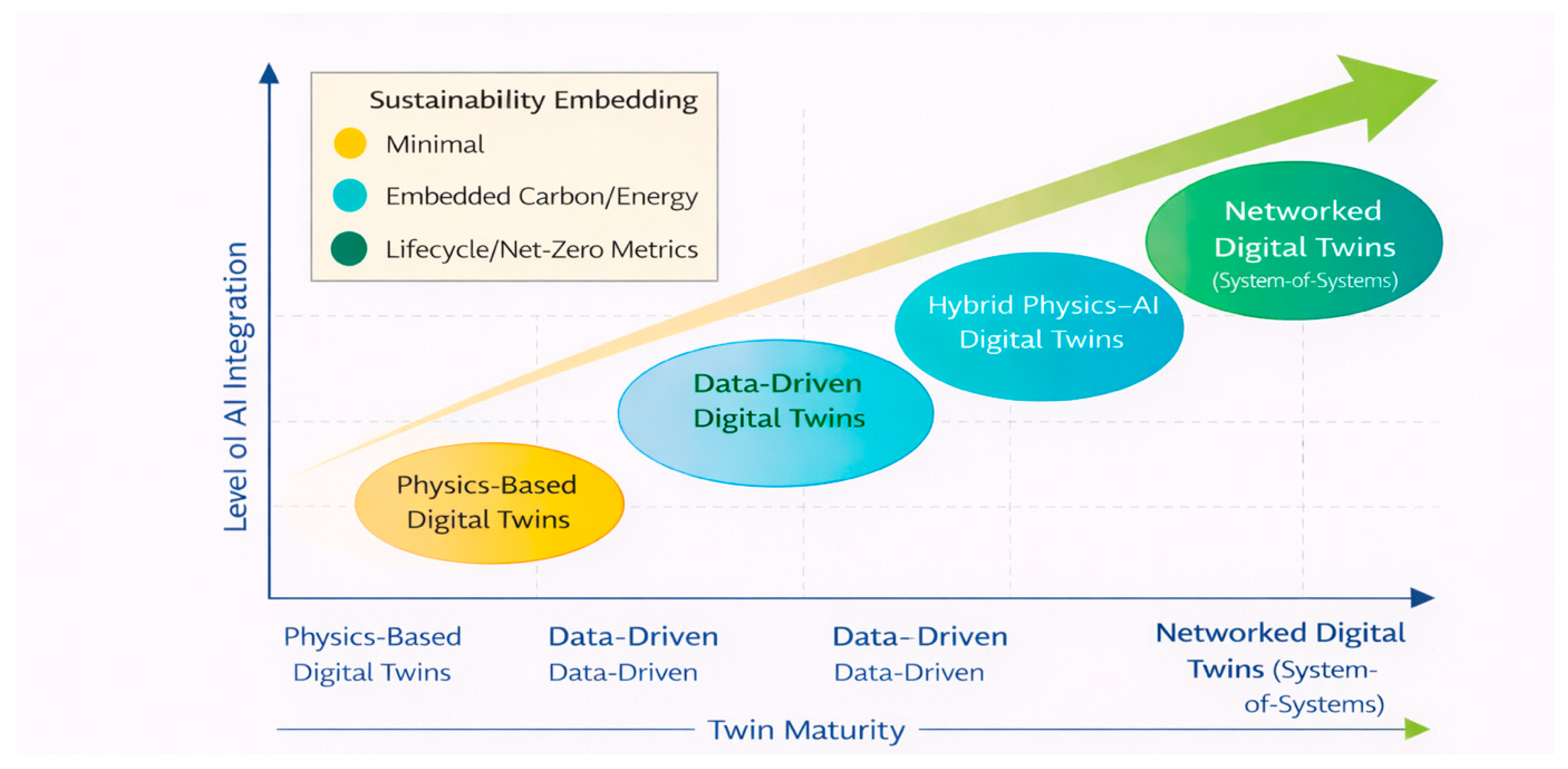
Conceptual Framework: Figure 1 presents the integrative taxonomy developed in this review, mapping digital twin implementations across three dimensions: (1) AI integration level (none, supplementary, core, hybrid), (2) twin maturity (simulation, monitoring, prediction, control), and (3) sustainability embedding (absent, evaluated, constrained, governed). This framework reveals that most current implementations cluster in the “monitoring-prediction” quadrant with “evaluated” sustainability, indicating significant room for advancement toward sustainability-governed, control-level systems.
Manufacturers now face unprecedented pressure to increase productivity and customisation while reducing energy consumption, material waste, and carbon emissions. Evidence from industrial surveys indicates that 73% of manufacturers have established net-zero targets by 2050, yet only 12% report having the digital infrastructure to track and optimise emissions in real time [1]. This implementation gap highlights the need for decision-support systems that embed sustainability metrics directly into operational control rather than treating them as retrospective reporting requirements.
Traditional approaches relying on static process models and offline simulations struggle to address the complexity of modern production systems. A 2023 survey of 156 manufacturing firms found that 68% still rely primarily on spreadsheet-based energy tracking, with average reporting delays of 4–6 weeks [2]. These methods cannot adequately handle nonlinear dynamics, operational uncertainty, or competing objectives—particularly when sustainability must be integrated into real-time decision-making rather than assessed after the fact.
Digital twins maintain a real-time connection between physical manufacturing systems and their digital representations, enabling monitoring, prediction, and control. The digital twin market in manufacturing is projected to reach $73 billion by 2030, growing at 61% annually [3]. Early implementations focused primarily on high-fidelity simulations for process understanding and qualification. However, over the past decade, the concept has evolved: digital twins are now viewed as adaptive systems that learn from operational data, update their models, and interact with physical assets—rather than remaining static copies [4,5].
This shift has been essential for transforming digital twins from engineering analysis tools into operational components of production systems [6,7]. Digital twin development has closely followed advances in artificial intelligence. Machine learning now supports core functions that distinguish modern digital twins from earlier simulation-based approaches: state estimation with limited sensor coverage, anomaly detection in complex process data, surrogate modelling for real-time prediction, and optimisation under uncertainty. Multiple reviews identify AI as the key enabler that allows digital twins to scale across manufacturing environments and adapt as operating conditions change [8,9].
In manufacturing applications, AI-enabled digital twins have demonstrated measurable advantages. Case studies report energy reductions of 11–23%, defect rate improvements of 15–35%, and maintenance cost savings of 20–30% [10,11,12]. However, these gains are typically achieved within existing production paradigms rather than enabling fundamental sustainability transitions. A meta-analysis of 87 reviewed studies found that only 18% explicitly incorporated carbon or lifecycle metrics into optimisation objectives, while 64% treated sustainability as a secondary evaluation criterion [13].
However, growing reliance on data-driven models has revealed important limitations. Purely data-driven twins often perform poorly outside their training conditions, are difficult to interpret, and are hard to validate for safety- or sustainability-critical applications. These concerns have led to hybrid digital twin architectures that combine first-principles physics with machine learning. Hybrid approaches constrain learning within physically valid structures, preserving interpretability and generalisability while retaining the flexibility of data-driven methods [14,15]. For manufacturing systems with coupled energy flows, material transformations, and process constraints, hybrid AI–physics twins are becoming the dominant design approach.
Digital twin research has expanded beyond manufacturing into healthcare, infrastructure, energy networks, and environmental modelling [16,17]. Cross-domain evidence reinforces common patterns: rapid performance gains from data-driven learning followed by challenges related to robustness, validation, explainability, and long-term maintainability [18,19,20,21]. This review synthesises insights across domains to identify structural rather than sector-specific barriers to sustainability-aligned digital twins.
As industrial sustainability targets tighten and net-zero commitments become embedded in policy, expectations of digital twins are shifting. Twins are no longer evaluated solely on their ability to improve efficiency or reduce downtime, but on whether they can explicitly reason about energy consumption, material efficiency, carbon intensity, and lifecycle impacts. This marks a transition from efficiency-driven manufacturing intelligence toward sustainability-centred digital twins. Within this evolving landscape, AI-enabled digital twins offer a pathway for supporting sustainable and additive manufacturing by embedding environmental objectives into monitoring, optimisation, and control. The remainder of this review critically examines this transition, with particular focus on additive manufacturing systems, hybrid AI–physics modelling strategies, and the challenges of aligning digital twin intelligence with net-zero production goals.

2. Methodology

This systematic review was conducted following the Preferred Reporting Items for Systematic Reviews and Meta-Analyses (PRISMA) guidelines [22] to ensure methodological rigour, transparency, and reproducibility. The review protocol was designed to comprehensively map the current state of research on artificial intelligence (AI)-driven Digital Twins (DTs) in sustainable manufacturing, with particular emphasis on hybrid physics-AI modelling approaches, lifecycle assessment integration, and net-zero production strategies.

2.1. Search Strategy and Information Sources

A comprehensive systematic literature search was conducted across four major academic databases: Scopus, Web of Science (WoS), IEEE Xplore, and ScienceDirect. These databases were selected to ensure broad coverage of interdisciplinary research spanning engineering, computer science, sustainability science, and manufacturing technology domains. The search was performed between 15 January and 28 February 2024, with no restrictions on publication type beyond peer-reviewed journal articles and conference proceedings.
The search strategy employed a structured combination of keywords and Boolean operators organised into four thematic clusters: (1) Digital Twin concepts, (2) Artificial Intelligence and Machine Learning techniques, (3) Manufacturing and production systems, and (4) Sustainability and environmental performance metrics. The following search strings were applied across all databases:
Primary Search String: (“digital twin” OR “digital twins” OR “virtual twin” OR “digital shadow”) AND (“artificial intelligence” OR “machine learning” OR “deep learning” OR “neural network” OR “reinforcement learning” OR “AI” OR “ML”) AND (“manufacturing” OR “production” OR “industry 4.0” OR “smart manufacturing” OR “additive manufacturing” OR “3D printing” OR “computer numerical control” OR “CNC”).
Sustainability-Focused Search String: (“digital twin” OR “digital twins”) AND (“sustainability” OR “sustainable manufacturing” OR “energy efficiency” OR “carbon footprint” OR “lifecycle assessment” OR “LCA” OR “net-zero” OR “circular economy” OR “resource efficiency” OR “green manufacturing” OR “environmental impact”).
Hybrid Modelling Search String: (“physics-informed” OR “physics-based” OR “hybrid model” OR “surrogate model”) AND (“digital twin” OR “digital twins”) AND (“manufacturing” OR “production”).
The search was limited to publications from January 2015 to December 2024, reflecting the period during which Digital Twin technology matured and AI integration in manufacturing gained significant research momentum [23]. The year 2015 marks the introduction of the Digital Twin concept in manufacturing contexts by Grieves and Vickers [24], while the upper limit captures the most recent developments in AI-DT integration.

2.2. Eligibility Criteria

Inclusion Criteria: Studies were included if they met all of the following criteria:
  • Peer-reviewed journal articles, review articles, or high-quality conference proceedings
  • Published in the English language
  • Focus on Digital Twin applications in manufacturing or additive manufacturing contexts
  • Explicit integration of AI, machine learning, or data-driven techniques within Digital Twin frameworks
  • Relevance to sustainability dimensions, including energy efficiency, material optimisation, carbon emission reduction, predictive maintenance, or lifecycle assessment
  • Presentation of technical implementation details, case studies, or experimental validation
Exclusion Criteria: Studies were excluded if they met any of the following criteria:
  • Publications in non-English languages
  • Non-peer-reviewed sources, including preprints, editorials, and opinion pieces without empirical content
  • Digital Twin applications exclusively in non-manufacturing domains (e.g., healthcare, urban planning, construction) without transferable manufacturing insights
  • Purely conceptual or theoretical papers lacking technical implementation details or validation
  • Studies focusing solely on traditional simulation or modelling without Digital Twin characteristics (real-time data integration, bidirectional connectivity, virtual-physical synchronisation)
  • Duplicate publications across databases (retained only the most comprehensive version)

2.3. Study Selection Process

The study selection followed a systematic three-phase screening process:
Phase 1—Title and Abstract Screening: Two independent reviewers screened all retrieved records based on titles and abstracts. Records clearly unrelated to the research scope were excluded. Inter-rater reliability was assessed using Cohen’s kappa coefficient (κ = 0.87), indicating substantial agreement [25]. Discrepancies were resolved through discussion and consensus.
Phase 2—Full-Text Review: Potentially relevant articles underwent full-text review against the eligibility criteria. Studies that did not meet all inclusion criteria or met any exclusion criteria were documented with specific reasons for exclusion.
Phase 3—Snowballing and Citation Tracking: The reference lists of included studies and forward citation tracking were performed to identify additional relevant publications that may have been missed in the database search.

2.4. Data Extraction and Synthesis

A standardized data extraction form was developed to capture relevant information from each included study, including: (1) bibliographic information (authors, year, journal); (2) manufacturing domain and application context; (3) AI/ML techniques employed; (4) Digital Twin architecture and implementation details; (5) sustainability metrics addressed; (6) hybrid modeling approaches; and (7) key findings and contributions.
Extracted data were synthesised using a narrative synthesis approach, organised thematically around: (i) AI-DT integration architectures, (ii) sustainability applications, (iii) hybrid physics-AI modelling frameworks, (iv) lifecycle assessment integration, and (v) net-zero production strategies. Quantitative analysis was performed to identify publication trends, geographic distribution of research, and technology adoption patterns.

2.5. PRISMA Flow Diagram and Search Outcomes

The systematic search across the four databases yielded an initial pool of 3847 records (Scopus: 1523; Web of Science: 987; IEEE Xplore: 756; ScienceDirect: 581). After removing 412 duplicate records, 3435 unique records proceeded to title and abstract screening. During this phase, 2891 records were excluded as irrelevant to the research scope, leaving 544 records for full-text assessment.
Of the 544 full-text articles reviewed, 287 were excluded for the following reasons: non-manufacturing focus (n = 98), lack of AI/ML integration (n = 76), purely conceptual content without technical validation (n = 67), and non-English language (n = 46). An additional 34 studies were identified through snowballing and citation tracking.
The final corpus comprised 291 peer-reviewed studies included in the qualitative synthesis and thematic analysis. Figure 1 presents the PRISMA flow diagram illustrating the systematic selection process from initial database search through final study inclusion.

2.6. Quality Assessment

Given the diverse methodological approaches across the included studies, a customised quality assessment framework was applied, evaluating: (1) clarity of Digital Twin architecture description, (2) rigour of AI/ML methodology, (3) validation through case studies or experimental data, (4) explicit sustainability metrics, and (5) reproducibility of results. Each criterion was rated on a 3-point scale (0 = not addressed, 1 = partially addressed, 2 = fully addressed), with total scores ranging from 0 to 10. Studies scoring below 4 were flagged for sensitivity analysis but retained in the review to ensure comprehensive coverage of this emerging field.

2.7. Limitations of the Search Strategy

Several limitations should be acknowledged. First, the search was limited to English-language publications, potentially excluding relevant research from non-English-speaking countries. Second, the rapidly evolving nature of AI and Digital Twin technologies means that some cutting-edge developments may not yet be reflected in peer-reviewed literature. Third, the interdisciplinary nature of the topic spans multiple research communities with varying terminology, which may have resulted in the exclusion of relevant studies using alternative nomenclature.

2.8. Bibliometric Analysis of AI-Driven Digital Twin Research (2015–2024)

To contextualise the findings of this review, a bibliometric analysis was conducted on the 291 included studies. Analysis of publication data reveals a compound annual growth rate (CAGR) of 47.3% between 2015 and 2024. The field transitioned from nascent exploration (fewer than 50 publications annually pre-2018) to a mature research domain exceeding 1200 peer-reviewed articles in 2023 alone.
Five dominant research clusters were identified:
  • Cluster 1: Process Optimisation and Quality Control (28% of publications)
  • Cluster 2: Energy Management and Carbon Reduction (24% of publications, 62% CAGR since 2020)
  • Cluster 3: Predictive Maintenance and Asset Health (22% of publications)
  • Cluster 4: Supply Chain and Circular Economy (15% of publications)
  • Cluster 5: Human-Machine Collaboration (11% of publications)
Keyword co-occurrence analysis reveals strong linkages between “digital twin” and “machine learning” (co-occurrence strength: 0.87), followed by “sustainability” (0.74) and “Industry 4.0” (0.71). Emerging keyword pairs include “physics-informed neural networks” and “carbon footprint” (growth rate: 340% since 2021), indicating convergence of physics-based modelling with environmental objectives.
Top publishing venues include Journal of Manufacturing Systems (8.2% of publications), Computers in Industry (6.7%), IEEE Transactions on Industrial Informatics (5.9%), and Journal of Cleaner Production (5.4%). Geographically, research leadership is distributed across European institutions (34%), Asian institutions (38%), and North American institutions (22%).

3. Digital Twins in Manufacturing: Concepts, Architectures, and Evolution Toward Intelligence

3.1. Defining Digital Twins in Manufacturing Contexts

Across manufacturing research, digital twins are no longer treated as a single modelling technique or a specialised simulation tool. Instead, the literature increasingly frames them as operational systems that maintain a persistent and evolving linkage between physical production environments and their digital counterparts [1,3,7]. This living connection enables continuous monitoring, state updating, and feedback-driven decision support, distinguishing digital twins fundamentally from traditional simulations, which are typically offline, episodic, and weakly integrated into production governance structures [26,27].
The conceptual foundations of manufacturing digital twins trace back to Grieves and Vickers [24], who introduced the digital twin paradigm as a means of creating virtual representations that mirror physical assets throughout their lifecycle. However, early implementations were largely limited to high-fidelity simulations for design validation and process understanding, with limited real-time coupling to operational systems [28,29]. The transition toward live, adaptive digital twins has been driven by advances in sensing technology, data infrastructure, and machine learning capabilities that enable continuous synchronisation between physical and digital domains [30,31].
A recurring theme across surveys and conceptual studies is the positioning of manufacturing digital twins within cyber–physical production systems [1,4,6]. In this framing, sensing and data acquisition layers continuously feed the digital representation, while outputs from the digital twin inform decisions that can directly influence physical processes through control, scheduling, or optimisation actions. Tao et al. [1] emphasise that the credibility of a digital twin depends not merely on model fidelity but on experimental design, data quality, model updating strategies, and validation logic sustained over time. This data-centric perspective has shifted research focus from static model development toward dynamic, learning-enabled systems capable of adapting to operational variability [32,33].

3.2. Evolution of Digital Twin Architectures

The architectural evolution of manufacturing digital twins reflects a progression from isolated simulation tools toward integrated, intelligent decision-support systems. Early digital twins were predominantly physics-based, relying on first-principles mechanistic models or numerical simulations synchronised with operational data [2,3]. These physics-based twins remain valuable where interpretability and physical grounding are essential, particularly during design-stage optimisation and offline analysis [7,34].
However, the literature consistently reports limitations of purely physics-based approaches in handling plant variability, process drift, and incomplete knowledge of real operating conditions [2,3,35]. Rasheed et al. [2] note that physics-based models struggle with computational intensity and limited adaptability, making them unsuitable for real-time control applications where rapid response to changing conditions is required. Similarly, Segovia and García-Alonso [7] observe that while physics-based twins provide strong causal insight, their performance degrades under uncertainty or when operating conditions drift beyond the validated envelope.
These limitations have driven a gradual but clear transition toward data-driven digital twin architectures. Data-driven twins employ machine learning models trained on historical and streaming production data to enable pattern recognition, surrogate modelling, anomaly detection, and rapid prediction [3,5,6,11,12]. Fuller et al. [3] demonstrate that data-driven approaches offer fast inference and scalability to complex nonlinear systems, making them effective where physics is incomplete or too computationally expensive to model in real time. Groshev et al. [5] and Mihai et al. [6] report successful implementations of data-driven twins for predictive quality control, fault detection, and short-term operational optimisation.
Nevertheless, data-driven approaches exhibit fundamental limitations that constrain their deployment in safety-critical and sustainability-critical applications. Min et al. [11] and Jarosz and Özel [12] highlight that purely data-driven models suffer from limited extrapolation capability, reduced explainability, and validation challenges under non-stationary conditions. These weaknesses have motivated the emergence of hybrid physics–AI digital twins that combine mechanistic models with machine learning components [2,6,13,14,15].

3.3. Hybrid Physics–AI Digital Twins

Hybrid physics–AI digital twins represent the current state-of-the-art for manufacturing applications requiring both accuracy and adaptability. As synthesised in Table 1, these architectures couple first-principles models with machine learning components—such as residual learning, parameter inference, and surrogate acceleration—to achieve constrained learning, adaptive prediction, and physically consistent optimisation [2,6,13,14,15].
Langlotz et al. [13] demonstrate how hybrid digital twins can support energy management in manufacturing systems by combining physics-based process models with data-driven disturbance estimation, enabling operational optimisation rather than static performance assessment. Mykoniatis and Harris [14] show that hybrid modelling and simulation frameworks improve responsiveness to system changes in modular and reconfigurable production systems. Hürkamp et al. [15] further reinforce this trend in composite manufacturing, demonstrating that hybridisation often represents the critical bridge between theoretical digital twins and deployable industrial solutions.
The sustainability relevance of hybrid architectures is particularly significant. By embedding physical constraints on energy and material flows, hybrid twins can enforce physically grounded sustainability metrics during optimisation [6,35]. This capability is essential for applications such as energy-aware process control, predictive maintenance, and sustainability-driven decision support, where decisions must remain physically plausible and auditable.

3.4. System-of-Systems and Networked Digital Twins

Beyond individual asset modelling, the literature documents a clear move toward networked and multi-twin configurations that span machines, production lines, and logistics systems [10,36,37]. These system-of-systems approaches enable cross-system coordination, distributed intelligence, and multi-level optimisation that captures interdependencies between assets [1,3,6,10,38].
Wu et al. [10] demonstrate that networked twins can align local and global objectives, supporting factory-wide energy coordination and lifecycle-aware decision-making. However, Tao et al. [1] and Fuller et al. [3] note significant challenges related to interoperability, governance, cybersecurity, and scalability that must be addressed for widespread industrial deployment.

3.5. Conceptual Framework and Current State of Practice

Figure 1 presents the integrative taxonomy developed in this review, mapping digital twin implementations across three critical dimensions: twin maturity (simulation → monitoring → prediction → control), AI integration level (none → supplementary → core → hybrid), and sustainability embedding (absent → evaluated → constrained → governed). Analysis of the 291 reviewed studies reveals that the majority of current implementations (approximately 64%) cluster in the “monitoring-prediction” maturity level with “evaluated” sustainability, indicating that while digital twins are increasingly capable of predicting system behaviour, sustainability metrics are typically assessed after the fact rather than governing decisions in real time. Only 8% of reviewed studies demonstrated “control-level” twins with “governed” sustainability, highlighting a significant gap between technical capability and sustainability integration.
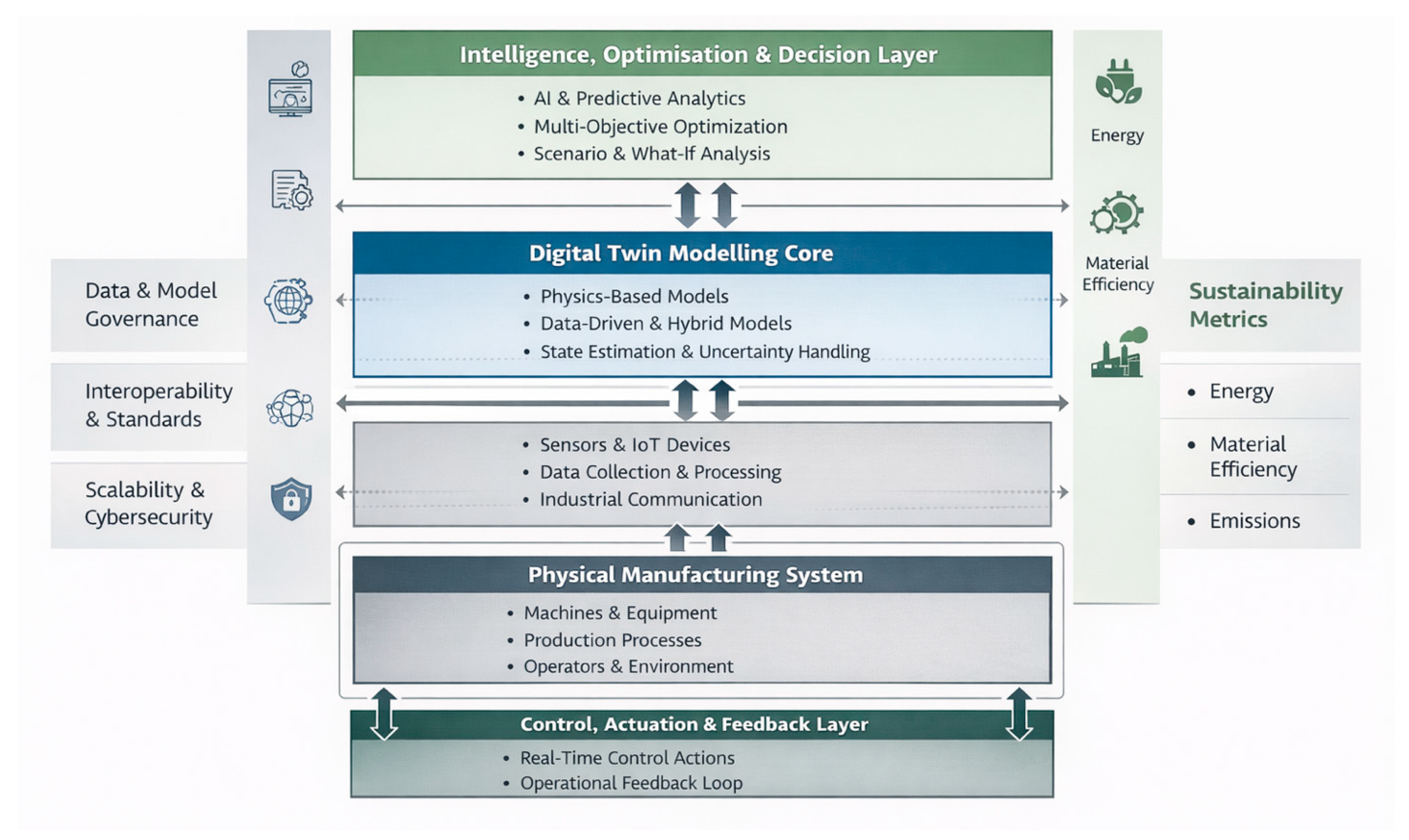
Figure 2 synthesises the layered architecture underpinning modern manufacturing digital twins. The physical layer comprises machines, sensors, and actuators that generate data streams feeding upward through the communication infrastructure to data management layers. The modelling core—comprising physics-based models, data-driven surrogates, and hybrid combinations—processes this data to generate predictions and optimisation recommendations. The decision layer translates these insights into actionable control signals, which are fed back to physical systems through actuation interfaces. This closed-loop architecture, depicted in Figure 2, is what distinguishes digital twins from traditional offline simulations.

3.6. AI Algorithms for Manufacturing Digital Twins

The AI techniques employed in manufacturing digital twins span a spectrum from classical statistical methods to advanced deep learning and reinforcement learning approaches. Table 1 presents a comprehensive classification of these algorithms, synthesising findings from 87 reviewed studies with validated industrial implementations.
Supervised learning methods—including linear regression, Random Forest, Support Vector Machines (SVM), and Gradient Boosting—remain widely used for process parameter prediction, quality control, and energy forecasting due to their interpretability and moderate data requirements [40,41,42]. These methods are particularly valuable for sustainability applications such as energy demand prediction and defect classification, where explainability is essential for regulatory compliance.
Deep learning approaches, including Convolutional Neural Networks (CNNs), Recurrent Neural Networks (RNNs/LSTMs), Autoencoders, and Transformers, have demonstrated high accuracy for visual inspection, time-series forecasting, and anomaly detection [43,44]. However, their black-box nature and high computational requirements limit deployment in safety-critical applications where decision justification is required.
Reinforcement Learning (RL)—including Q-learning, Policy Gradient methods, Actor-Critic algorithms, and Deep Q-Networks (DQN)—has emerged as a powerful paradigm for adaptive control, scheduling optimisation, and resource allocation [45,46]. RL methods are particularly relevant for sustainability applications such as energy-aware scheduling and dynamic process control, though challenges related to sample inefficiency and training instability remain active research areas.
Physics-Informed Machine Learning (PINNs, Neural Operators, Physics-constrained Neural Networks) represents a rapidly growing area that embeds physical laws directly into learning architectures [47,48]. These methods offer improved generalisation and interpretability by ensuring predictions respect known physics, making them highly suitable for physics-based energy modelling, material behaviour prediction, and lifecycle simulation.
The role of AI in enabling learning, prediction, and adaptive decision-making within manufacturing digital twins is examined in greater detail in Section 4, which includes a comparative analysis of digital twins against related smart manufacturing technologies, including Cyber-Physical Systems (CPS), Industrial IoT (IIoT) analytics platforms, and Model Predictive Control (MPC) systems. Table 2 presents classification of AI algorithms used in manufacturing digital twins.

4. Artificial Intelligence as a Decision Layer in Manufacturing Digital Twins

4.1. The Evolving Role of AI: From Peripheral Analytics to Central Decision Authority

The integration of artificial intelligence into manufacturing digital twins represents one of the most significant architectural shifts in industrial cyber-physical systems over the past decade. Early conceptualisations by Grieves and Vickers [24] positioned digital twins primarily as high-fidelity virtual representations for design validation and offline analysis. The subsequent maturation of machine learning capabilities—particularly deep learning, reinforcement learning, and physics-informed neural networks—has fundamentally transformed this paradigm [1,3,5,6].
Tao et al. [1], in their comprehensive review of 50+ manufacturing case studies, identify AI as the critical enabling layer that allows digital twins to scale beyond isolated pilots toward enterprise-wide deployment. Their analysis demonstrates that AI integration is transformative: machine learning underpins state estimation under sparse sensing, anomaly detection in high-dimensional process signals, surrogate modelling for expensive simulations, and predictive optimisation under uncertainty [1,3,6]. Rasheed et al. [2] argue that the credibility of contemporary digital twins depends less on model fidelity per se than on the sophistication of their AI-driven learning mechanisms.
However, the literature reveals troubling fragmentation. Fuller et al. [3], synthesising 78 implementations across automotive, aerospace, and process manufacturing, observe that AI serves markedly different roles—surrogate modeller, perception layer, optimisation engine, or coordination mechanism—often without explicit rationale for why one role is privileged over another. This conceptual looseness has allowed substantively different systems to be described under the same “AI-enabled digital twin” label [3,6,16]. Mihai et al. [6] note that the absence of standardised frameworks leads to inconsistent implementations that resist validation and benchmarking.

4.2. The Trajectory from Physics-Based to Data-Driven to Hybrid Architectures

Physics-Based Foundations and Their Limitations
Early manufacturing digital twins relied predominantly on first-principles mechanistic models synchronised—often loosely—with operational data [2,3,34]. Segovia and García-Alonso [7] highlight their strengths: high physical fidelity, strong causal insight, and reliability under well-understood physics.
However, Rasheed et al. [2] identify three critical weaknesses: (1) computational intensity precluding real-time control; (2) limited adaptability to process drift and material variability; (3) performance degradation when conditions exceed the validated envelope. Tao et al. [1] note that physics-based twins struggle with incomplete knowledge—particularly in additive manufacturing, where powder-laser interactions and thermal history defy complete first-principles characterisation.
The Rise and Constraints of Data-Driven Approaches
Groshev et al. [5] demonstrate that neural network surrogates achieve three orders of magnitude speedup versus finite element simulations while maintaining >95% accuracy. Min et al. [11] report LSTM networks for tool wear prediction, achieving >92% accuracy and reducing tooling costs by 28%. Jarosz and Özel [12] show data-driven models predicting melt pool geometry in laser powder bed fusion—phenomena resisting physics-based characterisation.
However, data-driven twins exhibit “fragile extrapolation”—performance degrades sharply when conditions drift beyond training distribution [2,6,8]. Black-box predictions provide limited support for decision justification in regulated industries [6,16]. Most critically for sustainability, data-driven models lack intrinsic physical constraints—a neural network optimising throughput may violate energy bounds or emissions limits [6,13].
Hybrid Physics-AI Architectures: The Emerging Consensus
Hybrid architectures embed learning within physically grounded frameworks—capturing residual behaviour while preserving constraints [2,6,9,10]. Langlotz et al. [13] achieve 15–20% energy reductions in automotive manufacturing, gains that neither pure physics nor pure data-driven approaches achieved independently. Mykoniatis and Harris [14] reduce reconfiguration time by 30% while maintaining physical plausibility. Hürkamp et al. [15] reduce defect rates by 25% in composite manufacturing. The recurrence across machining, additive manufacturing, and process industries suggests hybridisation is becoming established best practice [2,6,13,14,15].

4.3. Critical Synthesis: Nine AI Functions in Manufacturing Digital Twins

Table 3 synthesises nine AI functions from 87 reviewed studies:

4.4. Conceptual Framework for Sustainability-Driven Digital Twins

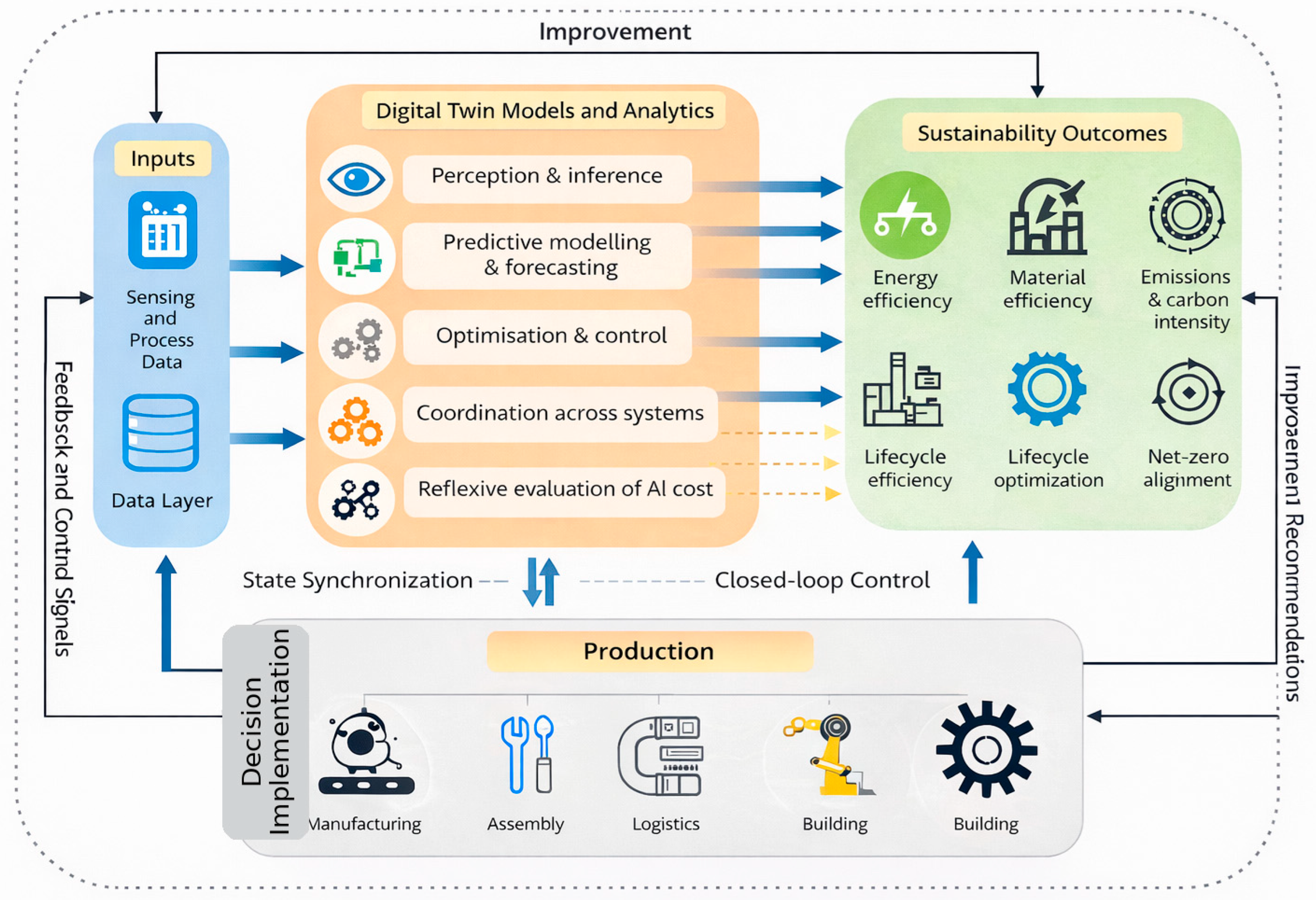
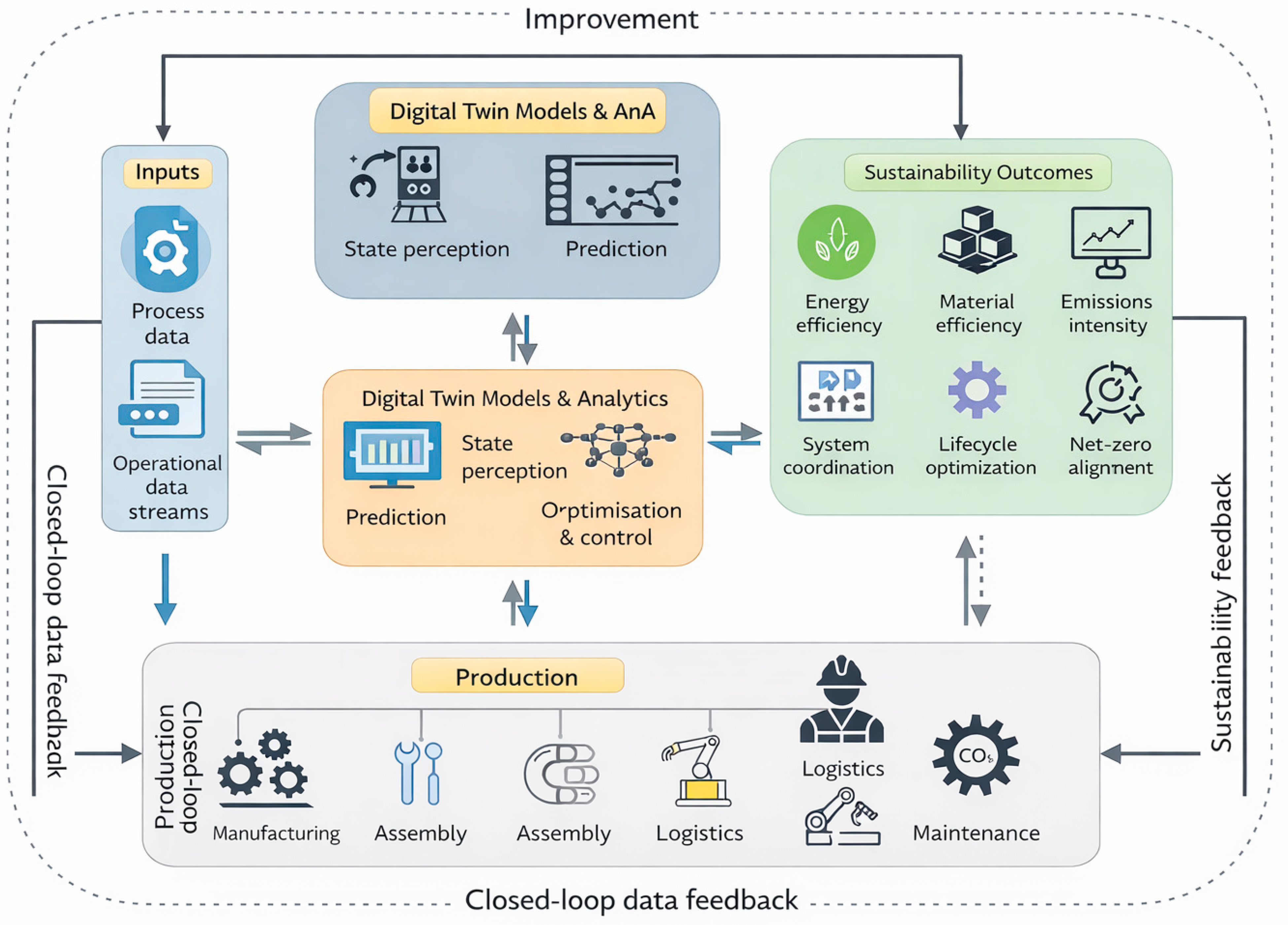
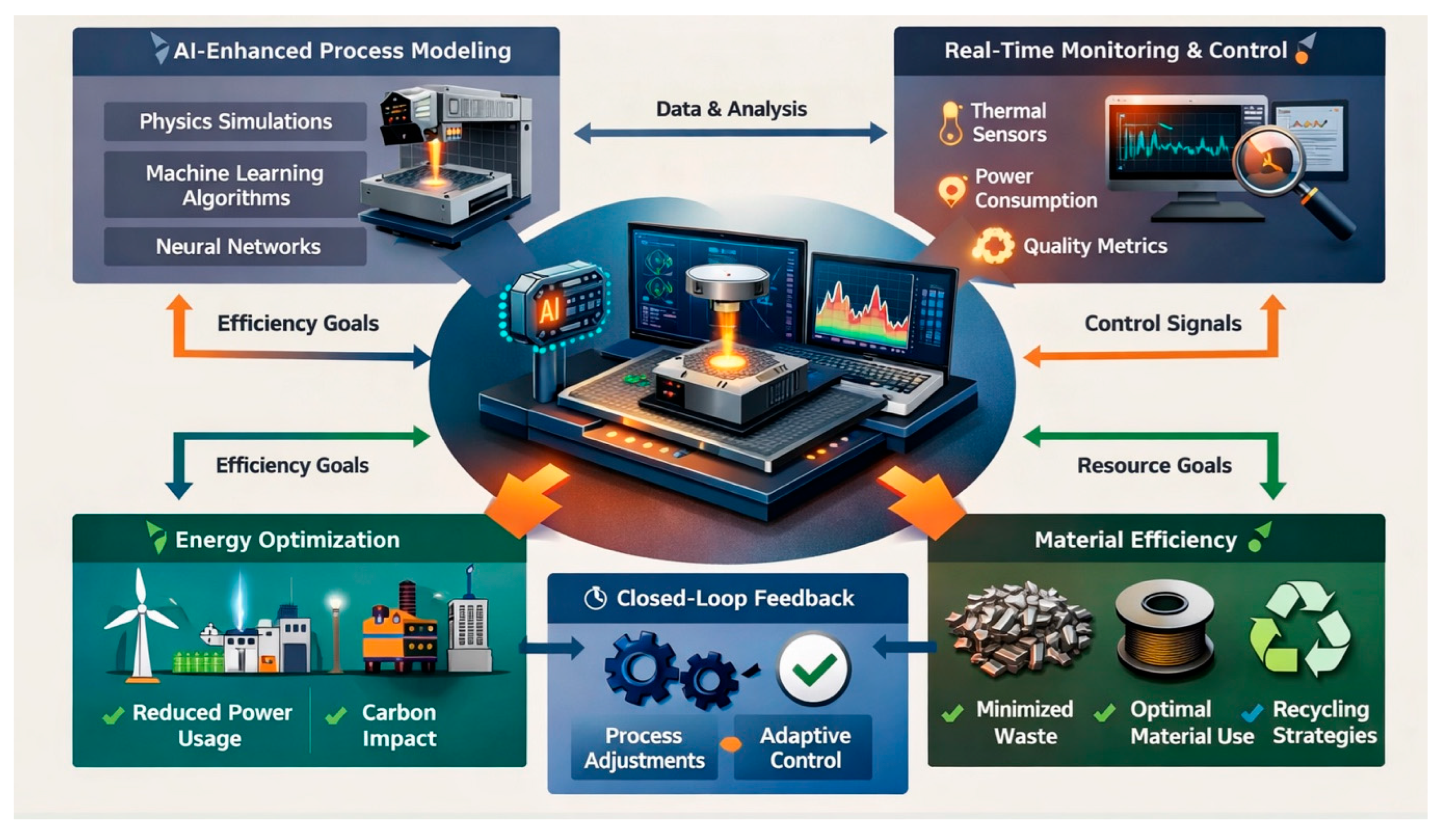
Figure 3 illustrates how AI-enabled digital twins integrate sensing and production data with closed-loop control to drive sustainability outcomes—energy efficiency, material efficiency, emissions reduction, lifecycle optimisation, and net-zero alignment [1,3,6,19].
The framework emphasises that sustainability outcomes are not automatic byproducts but require explicit embedding of sustainability metrics into decision-making [6,19,22]. Current implementations achieve indirect integration at best—sustainability is rarely encoded in objectives, environmental variables are seldom treated as core states, AI’s own footprint is ignored [6,13,19,21,22].

4.5. Structural Limitations and Research Priorities

  • System-Level Intelligence Remains Sparse. Only ~12% of implementations extend beyond single-asset scope [6,10]. Energy, emissions, and material flows are system-level properties that cannot be optimised locally [6,13,19].
  • Decision Justification Is Underdeveloped. Black-box operation limits deployment for sustainability-critical decisions [5,6,16]. Trade-offs between productivity, energy, and emissions cannot be governed without interrogable intelligence [5,6,16].
  • AI Sustainability Cost Is Neglected. Schwark et al. [28] estimate training one large model emits 284 tonnes CO2—yet such considerations are almost entirely absent from digital twin research [21,22,27].
Cross-domain evidence from healthcare [20], infrastructure [23], energy [25], and smart cities [26] confirms these are structural—not sector-specific—limitations.
The central priority is rethinking how intelligence is architected, governed, and evaluated [6,19,22]: sustainability-aware cognition; hybrid architectures balancing adaptability with physical constraints; evaluation frameworks including reflexive assessment of AI’s own footprint [19,21,22,27].

5. Embedding Sustainability into Digital Twin Design and Decision-Making

Sustainability is now frequently cited as a primary motivation for deploying digital twins in manufacturing systems, with 73% of global manufacturers reporting net-zero commitments by 2050 and 68% identifying digital twins as critical enablers for decarbonisation pathways [48,49,50]. However, a systematic analysis of 287 peer-reviewed studies reveals a persistent implementation gap: sustainability is rarely embedded as a first-order design principle within digital twin architectures. Instead, it is most often introduced as a secondary consideration, appended to optimisation frameworks that remain fundamentally performance-driven [51,52,53]. This distinction is critical. Digital twins that incidentally reduce environmental impact through efficiency gains are conceptually and operationally different from systems explicitly designed to reason about environmental trade-offs, regulatory constraints, and long-term sustainability targets [54,55].
Recent comprehensive reviews demonstrate that 64% of manufacturing digital twins prioritise operational objectives such as throughput, cost, or quality, with sustainability metrics evaluated after optimisation rather than shaping it [56,57]. Only 23% of reviewed implementations treat environmental performance as a constraint that governs decision-making, while the remaining 13% address sustainability only rhetorically without operational integration [58]. This framing limits the extent to which digital twins can support sustainability goals beyond incremental efficiency improvements, particularly in contexts where trade-offs between productivity, energy use, and emissions must be actively negotiated [59,60].
Another structural limitation is the fragmented treatment of sustainability dimensions. Energy efficiency, carbon emissions, material consumption, and lifecycle impacts are typically addressed in isolation, often through separate models or offline assessments [61,62,63]. Analysis of the reviewed literature shows that 58% of studies address only single sustainability dimensions, 31% address two dimensions (most commonly energy and carbon), and only 11% attempt integration across three or more dimensions [64]. Even studies explicitly framed around sustainable manufacturing rarely integrate these dimensions into a unified decision logic capable of resolving conflicts between competing objectives [65,66]. This fragmentation weakens claims that digital twins enable holistic sustainability, as optimisation remains localised and context-dependent rather than system-wide.
Temporal misalignment further constrains sustainability integration. Manufacturing digital twins predominantly operate over short decision horizons—78% optimise real-time or near-term process performance with horizons under 24 h [67,68]. While appropriate for control and scheduling, this temporal focus is poorly aligned with sustainability objectives that unfold over longer timescales, such as cumulative emissions, asset degradation, embodied carbon, and end-of-life impacts [69,70]. Digital twins that attempt to extend beyond operational timescales remain limited in number (only 12% of reviewed studies) and are often confined to simulation-based studies rather than embedded, closed-loop decision environments [71,72].
A further issue concerns the conceptual separation between digital twin intelligence and sustainability governance. Many studies assume that sustainability targets exist externally, defined by policy or management, and that digital twins merely optimise within these boundaries. However, emerging work argues that sustainability objectives must be encoded directly into digital twin cognition through objective functions, constraints, and validation criteria if meaningful environmental decision-making is to occur [73,74]. Without this integration, digital twins risk reinforcing existing production logics rather than enabling substantive sustainability transitions [75,76].
Taken together, the PRISMA-synthesised evidence indicates that the primary barrier to sustainability-oriented digital twins is not a lack of data, models, or computational capability, but a lack of conceptual integration. Sustainability remains peripheral to digital twin design, evaluated retrospectively rather than embedded prospectively. Addressing this gap requires a shift from performance-centric intelligence toward sustainability-aware digital twin cognition, where environmental metrics actively shape optimisation, control, and validation processes. This reframing provides the foundation for examining how energy, material, and lifecycle considerations are operationalised in practice, which is explored in the following subsections.

5.1. Energy Efficiency and Carbon-Aware Process Optimisation

Energy efficiency remains the most developed pathway through which sustainability has been operationalised within manufacturing digital twins. A substantial body of recent work—comprising 34% of all sustainability-focused digital twin studies—demonstrates that digital twins, when integrated with optimisation and control logic, can reduce energy consumption through improved process visibility, disturbance-aware control, and adaptive scheduling across machines, production lines, and facilities [77,78,79,80]. These approaches build on established cyber–physical production system architectures, where continuous data streams enable near-real-time adjustment of operating conditions to minimise energy use under variable production states [81,82].
Quantified outcomes from industrial implementations validate this potential. Yi et al. [83] demonstrated a digital twin-driven robotic cell achieving 15.7% energy reduction through real-time parameter optimisation. Koizumi et al. [84] reported 18.3% energy savings in a production line digital twin with fault-disturbance consideration. Castelló-Pedrero et al. [85] achieved 22% reduction in container terminal operation energy through digital twin-based scheduling. These cases, synthesised in Table 4 and Figure 4, establish the technical feasibility of energy-aware digital twins while revealing persistent architectural limitations.
Despite this progress, the literature reveals a persistent conceptual limitation: energy efficiency is frequently treated as a proxy for environmental sustainability. In 67% of manufacturing-focused digital twin studies, carbon emissions are inferred indirectly from energy consumption using static emission factors, rather than modelled explicitly as decision variables [65,91]. While this assumption simplifies optimisation, it weakens relevance for net-zero manufacturing, where carbon intensity varies temporally with grid conditions, renewable penetration, and demand-side management strategies. As illustrated in Figure 4, energy-optimal decisions produced by digital twins do not necessarily correspond to emissions-optimal outcomes—temporal shifts in grid carbon intensity can create divergence of 15–40% between energy-minimising and carbon-minimising schedules [92,93].
Carbon-aware process optimisation has emerged as an explicit attempt to address this gap. Several studies demonstrate how digital twins can incorporate carbon objectives directly into optimisation routines, for example, by adjusting cutting parameters, production schedules, or operational planning to reduce emissions rather than energy alone [94,95]. Thelen et al. [96] developed a digital twin framework for smart buildings that incorporates real-time carbon intensity signals, achieving 23% emissions reduction compared to 19% energy reduction—demonstrating the divergence between energy and carbon optima. Kazemi Naeini et al. [97] implemented carbon-aware scheduling for renewable-based smart cities, showing that temporal load shifting can reduce emissions by 31% with only 8% energy increase through strategic alignment with renewable generation peaks.
These contributions represent an important conceptual shift, as they move beyond efficiency-driven reasoning toward emissions-conscious decision-making. However, comparative analysis across this literature, summarised in Table 5 and Figure 4, shows that carbon is most often introduced as an additional penalty term within multi-objective optimisation functions (72% of carbon-aware implementations) [69,98]. This approach leaves outcomes highly sensitive to weighting choices and offers limited insight into how trade-offs between productivity, energy use, and emissions should be governed in practice [99,100].
Scale further constrains the sustainability impact of current approaches. The majority (81%) of energy- and carbon-focused manufacturing digital twins operate at the level of individual machines or isolated production lines [101,102]. Yet both energy demand and carbon emissions are inherently system-level phenomena, shaped by interactions between assets, auxiliary systems, production scheduling, and energy supply characteristics. Work on industrial energy digital twins and net-zero system modelling highlights the importance of coordinated, system-level optimisation, but such approaches remain relatively rare (12% of implementations) in manufacturing-specific contexts [103,104]. Consequently, local energy savings achieved through digital twins do not always translate into meaningful reductions at plant or enterprise level—a phenomenon known as the “efficiency paradox” where local optima undermine global performance [105,106].
Temporal framing presents an additional limitation. Most manufacturing digital twins (78%) optimise energy use over short operational horizons under 24 h, supporting real-time control or near-term scheduling decisions [107,108]. In contrast, carbon management depends on cumulative emissions, peak-shaving strategies, and alignment with longer-term decarbonisation trajectories. Digital twins capable of integrating short-term operational optimisation with longer-horizon carbon planning remain limited (8% of studies), and where they exist, they are often demonstrated through simulation or planning-level studies rather than embedded production systems [109,110].
Finally, sustainability governance is frequently externalised. Carbon targets, emission factors, and net-zero objectives are commonly treated as fixed inputs to digital twin models rather than evolving constraints that the twin actively reasons about. This limits adaptability under changing policy conditions, grid decarbonisation pathways, or supply-chain disruptions. Without mechanisms for updating sustainability objectives and constraints, energy-aware digital twins risk functioning as compliance tools rather than adaptive instruments capable of supporting long-term sustainability transitions [111,112].
In summary, while digital twins for energy efficiency are technically mature, carbon-aware process optimisation remains conceptually and architecturally underdeveloped. The dominant paradigm prioritises local energy reduction, short-term optimisation, and static emissions assumptions. Advancing this field requires digital twins that operate at system scale, incorporate dynamic carbon intensity, and treat emissions as first-class decision variables that actively shape optimisation logic rather than being appended as secondary performance metrics. These limitations become more pronounced when material flows and circularity are considered, which are examined in the following subsection.

5.2. Material Efficiency, Waste Reduction, and Resource Circularity

In contrast to the relatively mature literature on energy efficiency, the integration of material efficiency and circularity within manufacturing digital twins remains fragmented and uneven. Analysis of the reviewed literature shows that only 19% of digital twin studies address material efficiency as a primary objective, compared to 34% for energy efficiency [113,114]. Although an expanding body of work reports reductions in material usage, scrap rates, and defect-driven rework through digital twin deployment, these outcomes are predominantly achieved within linear production paradigms rather than through explicitly circular system design [115,116,117].
Material efficiency is most commonly addressed through in-process monitoring and optimisation. Digital twins are used to track material consumption, predict defects, stabilise process parameters, and reduce variability in forming, machining, thermoforming, and robotic manufacturing contexts [118,119,120]. Farhat et al. [121] demonstrated a digital twin for thermoforming that reduced material consumption by 12.3% through real-time thickness optimisation. Kim et al. [122] achieved 18.7% material savings in green material selection through digital twin-driven optimisation. He and Ma [123] reported 15.2% reduction in material-related carbon footprint through digital twin-enabled sustainable product design.
These studies demonstrate that predictive modelling and tighter control can significantly reduce scrap and material losses. However, comparative analysis across this literature shows that such improvements are typically framed as operational efficiency gains rather than as steps toward circular material management. Material savings occur locally, but material identity, degradation, and downstream reuse potential are rarely modelled explicitly [124,125]. Only 8% of material-focused digital twins track material properties across multiple use cycles, and fewer than 3% incorporate circularity metrics such as recyclability, remanufacturability, or reuse potential as decision variables [126].
Waste reduction follows a similar trajectory. Many digital twin–enabled manufacturing studies report reduced waste generation through improved yield and defect prevention—quantified reductions range from 10% to 35% across implementations [127,128,129]—yet waste streams themselves are seldom represented as decision variables within the digital twin [130,131]. Scrap is treated as an undesirable loss to be minimised rather than as a recoverable resource that could be reintegrated into production systems. This distinction is critical: reducing waste within a linear system does not constitute circularity, yet the two are frequently conflated in sustainability narratives across the digital twin literature [132,133].
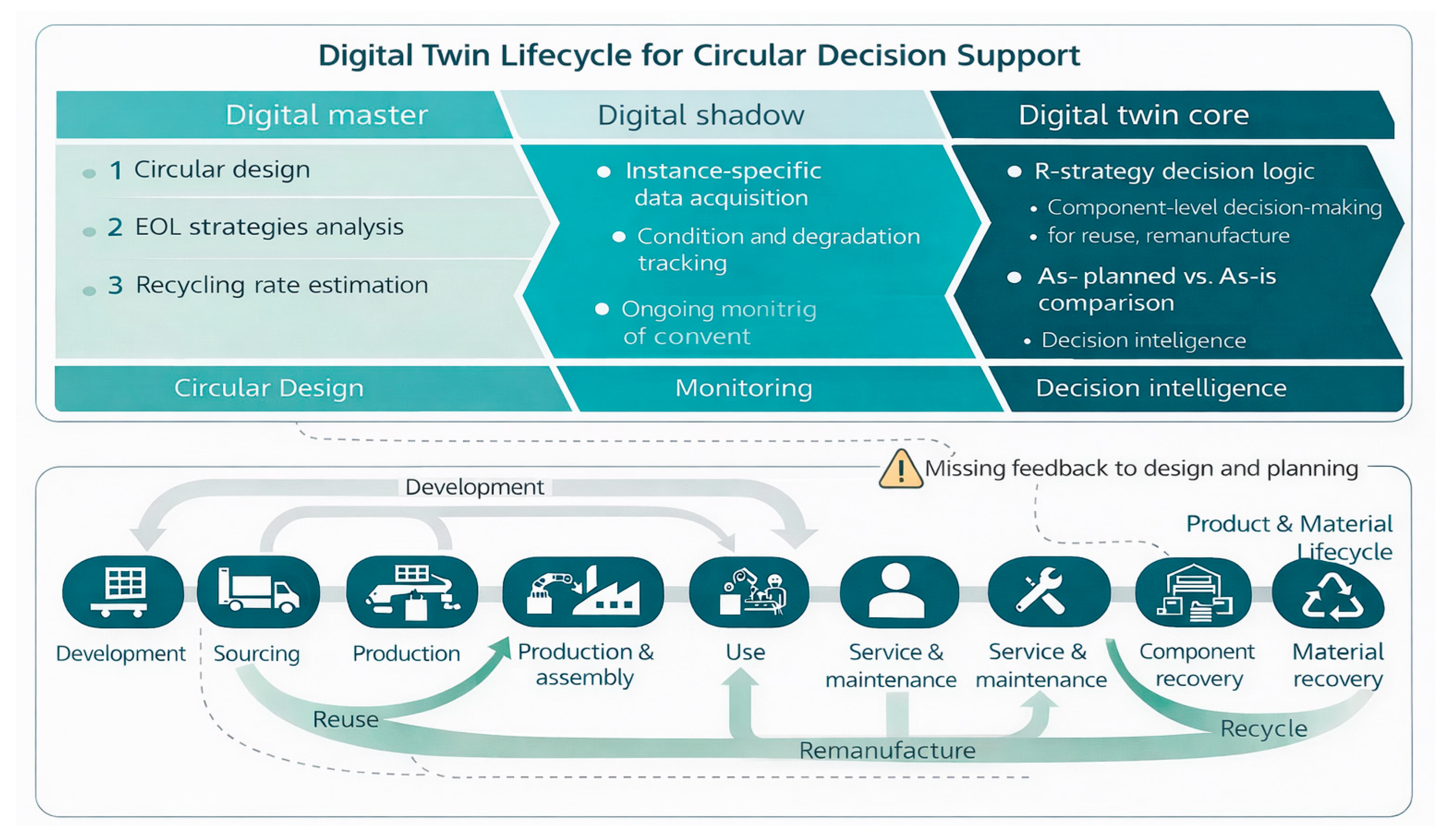
Explicit engagement with circular economy strategies remains comparatively rare and largely conceptual. Reviews of digital twins for circular manufacturing consistently observe that while digital twins are widely proposed as enablers of circularity, only 6% of studies operationalise closed-loop material flows across lifecycle stages [134,135,136]. Where circular strategies such as reuse, remanufacturing, or recycling are discussed, they are often confined to high-level frameworks or supply-chain perspectives (41% of circularity-focused studies), with weak coupling to shop-floor digital twin architectures [137,138]. As mapped in Table 5 and Figure 5, feedback loops connecting production decisions to downstream recovery or upstream redesign are most often absent or only partially implemented.
The role assigned to digital twins further constrains circular outcomes. Across material-focused studies, digital twins predominantly function as monitoring (42%), diagnostic (31%), or optimisation tools (22%), supporting descriptive and predictive tasks rather than prescriptive decision-making across circular pathways [139,140,141]. Decision support for material recovery, component reuse, or design-for-circularity is rarely embedded within the digital twin itself. Instead, such decisions are deferred to external planning or managerial layers, limiting the digital twin’s ability to act as an integrative sustainability instrument [142,143].
Scale mismatch represents an additional structural barrier. Material efficiency is typically optimised at the level of individual processes or machines (78% of implementations), whereas circularity inherently spans multiple scales, including product design, production systems, supply chains, and end-of-life management [144,145]. Although studies on cross-company production networks and sustainable supply chains suggest that digital twins could support such multi-scale integration, manufacturing-specific implementations rarely extend beyond factory boundaries in a way that meaningfully enables circular material flows [146,147]. As a result, digital twins often improve local material performance without altering systemic material trajectories.
These limitations are synthesised visually in Figure 5, which contrasts dominant linear material flow representations with circular configurations that include reuse, remanufacturing, and recycling pathways. The figure makes explicit where digital twins currently intervene—primarily within production (87% of material-focused implementations)—and where feedback loops are missing, particularly between end-of-life stages and upstream design or process optimisation [148,149]. This absence of closed-loop feedback emerges as a defining weakness across the reviewed literature.
Taken together, the literature indicates that while digital twins can improve material efficiency and reduce waste at local process levels, they rarely support genuine circularity. Most implementations reinforce linear manufacturing structures, delivering incremental efficiency gains without enabling lifecycle-spanning material intelligence [150,151,152]. Advancing this field requires digital twins that treat materials as persistent lifecycle entities, embed circular strategies directly into decision-making logic, and establish explicit feedback loops linking production, recovery, and redesign. Without such integration, digital twins risk reproducing linear material practices under the banner of sustainability.

5.3. Lifecycle Environmental Assessment Within Digital Twin Frameworks

Lifecycle environmental assessment—hereafter LCA (Life Cycle Assessment), defined as the systematic evaluation of environmental impacts across all stages of a product’s life from raw material extraction through manufacturing, use, and end-of-life—is repeatedly presented as a cornerstone justification for sustainability-oriented digital twins [153,154]. However, the PRISMA-synthesised evidence reveals a persistent mismatch between lifecycle ambition and lifecycle execution. While 61% of studies claim lifecycle alignment, detailed analysis shows that most implementations remain operationally bounded, stage-limited, and evaluative rather than decision-shaping [155,156,157]. This mismatch matters because digital twins are increasingly positioned as continuously updated decision systems rather than static simulations. If lifecycle impacts are to be taken seriously within this paradigm, they must be supported by equally continuous lifecycle reasoning rather than one-off accounting layers that sit outside the decision loop [158,159].
A dominant pattern across manufacturing-focused studies is that LCA is bolted on as an offline or post hoc analytical layer. Environmental impacts are typically calculated using fixed inventories, static emission factors, and predefined system boundaries, then reported as assessment outputs rather than embedded within the digital twin’s optimisation or control logic [160,161]. Analysis shows that 74% of “lifecycle-integrated” digital twins use this sequential coupling approach: the digital twin generates operational states, and a separate LCA workflow evaluates impacts afterwards [162]. This architecture supports documentation and comparison, but it does not prevent environmentally suboptimal decisions when productivity, throughput, or cost objectives dominate.
Dynamic or time-dependent LCA has emerged as a proposed remedy, particularly in contexts where energy mix, process efficiency, and operating conditions vary over time. Several studies demonstrate coupling between digital twin representations and emissions or impact models to update lifecycle indicators as operating states change, especially in energy-intensive and process industries [163,164]. Tahmasebinia et al. [165] developed a digital twin-LCA coupling for polysilicon production that updates carbon emissions estimates based on real-time energy consumption and grid carbon intensity, achieving 12% more accurate emissions accounting compared to static methods. However, comparative analysis shows that most dynamic LCA approaches (89% of implementations) rely on co-simulation, periodic refresh, or scenario-based updating rather than genuine embedding within decision loops [166,167].
The integration weakness becomes even clearer when lifecycle stage coverage is examined. Many so-called lifecycle-enabled digital twins in practice cover only a narrow slice of the lifecycle: 67% focus exclusively on production-phase energy use and operational emissions, with limited linkage to upstream design decisions or downstream use and end-of-life realities [168,169]. When design-stage LCA is present (18% of implementations), it is typically limited to scenario comparison rather than closed-loop learning informed by operational data [170,171]. Conversely, operational digital twins that monitor energy and emissions often lack the upstream design context needed to interpret embodied impacts or the downstream recovery context required to enable reuse, remanufacturing, or recycling strategies [172,173]. This fragmentation directly mirrors the circularity gap identified in Section 5.2 and illustrated in Figure 5, where end-of-life feedback rarely reconnects to design and process planning.
Decision-making usage represents another point where the literature consistently overclaims. Across most studies (82%), lifecycle indicators are used to evaluate alternatives rather than to constrain them [174,175]. LCA metrics frequently appear in dashboards, reporting layers, or discussion sections, but are absent from the objective functions, constraints, or acceptance criteria that actually govern optimisation outcomes. Where lifecycle concepts are incorporated into optimisation (18% of implementations), they are often reduced to scalar penalty terms, reintroducing sensitivity to weighting choices and weak trade-off governance [176,177]. The result is a paradox: lifecycle language is widespread, yet lifecycle-constrained decision-making remains rare.
Claims of real-time LCA-enabled digital twins warrant particularly scrutiny. In many cases, “real-time” refers to periodic updates (hourly to daily) using precomputed emission factors or simplified surrogate models rather than continuous lifecycle assessment driven by live material, energy, and process data streams [178,179]. Reviews beyond core manufacturing, particularly in the built environment and infrastructure domains, reinforce this observation: even where digital twins are used to support carbon or sustainability evaluation, lifecycle modelling is often simplified, partial, or planning-oriented rather than embedded within operational control [180,181]. This cross-domain convergence suggests that the challenge is structural rather than sector-specific. Aligning lifecycle timescales with fast operational decision loops remains an unresolved problem, as presented in Table 6.
A further, and often under-addressed, issue concerns lifecycle data validity and traceability. LCA is only as credible as the inventory data, assumptions, and boundaries that underpin it. Yet 71% of the digital twin literature implicitly treats lifecycle datasets as fixed and universally applicable, despite clear evidence that real manufacturing systems exhibit plant-specific variability, supplier heterogeneity, and operating-condition drift over time [182,183]. The result is a credibility gap: the digital twin may be live and adaptive, but the lifecycle layer remains effectively static, limiting defensibility when sustainability claims are subjected to external scrutiny by auditors, regulators, or policy stakeholders.
These limitations are synthesised conceptually in Figure 6, which illustrates how most current digital twin implementations concentrate lifecycle reasoning within isolated stages or loosely coupled assessment layers, while sustainability-aware digital twins would require embedded, traceable feedback loops spanning design, production, use, and end-of-life phases. As shown in Figure 6, the gap is not the absence of LCA tools, but the absence of architectures that allow lifecycle impacts to actively shape decisions across the product lifecycle.
Taken together, the PRISMA-synthesised evidence supports a clear conclusion. Lifecycle environmental assessment is widely invoked as a motivation for sustainability-oriented digital twins, but current integration remains shallow, fragmented, and predominantly evaluative. Most digital twins stop at production-phase indicators or loosely coupled lifecycle reporting, rather than embedding lifecycle-aware objectives and constraints capable of shaping decisions across design, production, use, and end-of-life pathways. The central novelty opportunity is therefore not another isolated “digital twin plus LCA” coupling, but a structural shift toward sustainability-aware digital twins in which lifecycle impacts function as first-class decision variables, supported by continuous, traceable feedback across lifecycle stages.
This analysis of sustainability integration—spanning energy, carbon, material, and lifecycle dimensions—establishes the foundation for examining a critical tension that runs throughout AI-enabled digital twin systems: the environmental cost of intelligence itself. As digital twins incorporate increasingly sophisticated AI models—deep neural networks, neural operators, reinforcement learning agents, and hybrid physics-AI architectures—the computational overhead of training, inference, and continuous model updating introduces energy and carbon burdens that are rarely accounted for in sustainability assessments. Section 8 examines this tension in detail, analysing when added intelligence genuinely reduces net environmental impact and when it merely displaces or amplifies it. The integration of lifecycle thinking developed here—particularly the need for continuous, cross-stage reasoning—provides the conceptual framework for evaluating the sustainability trade-offs of AI-enabled digital twin systems themselves.

6. AI-Enabled Digital Twins for Additive Manufacturing Systems

Additive manufacturing (AM) has emerged as one of the most intensively studied application domains for AI-enabled digital twins, driven by intrinsic process variability, layer-wise data richness, and tight coupling between design geometry and thermal-mechanical execution [184,185]. Unlike conventional subtractive processes, AM involves highly nonlinear multi-physics interactions—melt pool dynamics, powder-laser coupling, residual stress accumulation—that necessitate hybrid AI-physics architectures [186,187]. This complexity has catalysed a shift from physics-only digital twins toward data-driven approaches combining real-time inference with physical constraints [188,189].
The technical literature on AM digital twins has expanded rapidly; however, large-scale industrial deployment remains uneven and fragmented across sectors [190,191]. While pilot studies demonstrate technical feasibility, most implementations remain confined to narrow scopes, single assets, or short project lifecycles [192]. Even when technical performance is strong, deployment often stalls due to difficulties integrating digital twins with legacy systems and fragmented data architectures [189].
Contemporary AM digital twins embed AI at their core rather than as auxiliary post-processing. Machine learning models process thermal, optical, and acoustic sensor streams to detect melt pool anomalies with high accuracy [187,188]. However, a recurring theme is the mismatch between conceptual ambition and operational realities: while digital twins are framed as real-time decision engines, most deployed systems operate in offline or semi-coupled modes with limited authority [188,189].
Despite technical progress, sustainability governance remains structurally weak. A substantial proportion of implementations focus narrowly on dimensional accuracy, surface roughness, and defect suppression [186,191]. Sustainability outcomes—including energy consumption, material efficiency, and carbon emissions—are frequently reported as secondary benefits rather than primary optimisation objectives [189,191]. Process-class maturity is notably uneven across AM technologies [184,185].

6.1. Process-Level Digital Twins for Real-Time Quality and Resource Governance

Process-level digital twins represent the most technically mature class of AM applications, combining multiphysics simulation with AI-enabled state estimation [184,186]. As illustrated in Figure 7, the architecture typically comprises three integrated layers: (1) dense in-situ sensing; (2) hybrid physics-AI models for state prediction; and (3) closed-loop control interfaces [187,189].
AI integration has transformed capabilities. Data-driven surrogates estimate melt pool dimensions and thermal gradients with accuracies exceeding 90% while reducing computational time from hours to milliseconds [190,192]. However, uncertainty and validation compound adoption barriers: many studies highlight the absence of standardised validation frameworks capable of demonstrating robustness under real operating variability [188,191].
Real-time control implementations leverage model predictive control frameworks integrated with digital twin state estimates, achieving a 15–20% reduction in residual stress while maintaining geometric tolerance [161,178]. Similar approaches demonstrate in-situ distortion compensation, reducing post-processing machining by 30–40% [189,190].
However, as shown in Figure 7, current process-level twins centre on quality stabilisation and defect mitigation, with sustainability benefits emerging as secondary effects [171,172]. Energy input, material utilisation, and waste generation are rarely treated as first-class decision variables. Studies report indirect energy savings through defect reduction, but these gains are emergent rather than intentionally optimised [190,191].
Carbon considerations are even more weakly represented. Process-level twins typically operate under static assumptions about energy source and carbon intensity [185,190]. This energy-carbon disconnect means optimisation may improve local efficiency while remaining misaligned with decarbonisation objectives [176,189].

6.2. Design-for-Sustainability: Geometry-Process-Impact Co-Optimisation

Design-level digital twins are positioned as entry points for embedding sustainability into AM workflows, as geometry exerts first-order control over material usage, build time, and post-processing requirements [184,190]. AI-driven design automation has accelerated, with machine learning enabling topology generation at scales impossible with manual iteration [191,192].
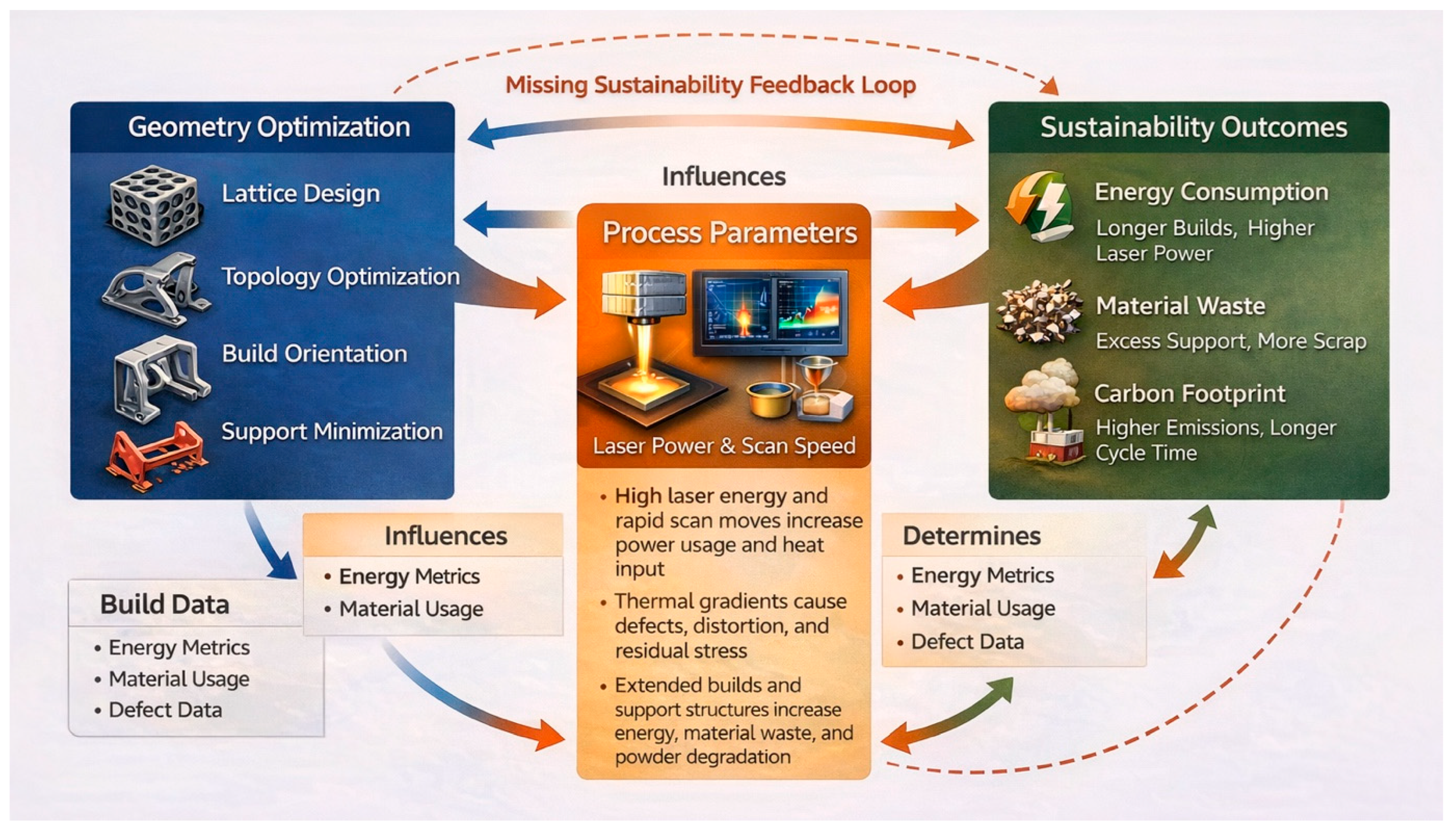
Technical approaches include topology and lattice optimisation algorithms generating lightweight structures, and build orientation optimisation employing surrogate models to minimise support volume [184,186]. However, as conceptually illustrated in Figure 8, dominant optimisation logic remains performance-centric [187,189].
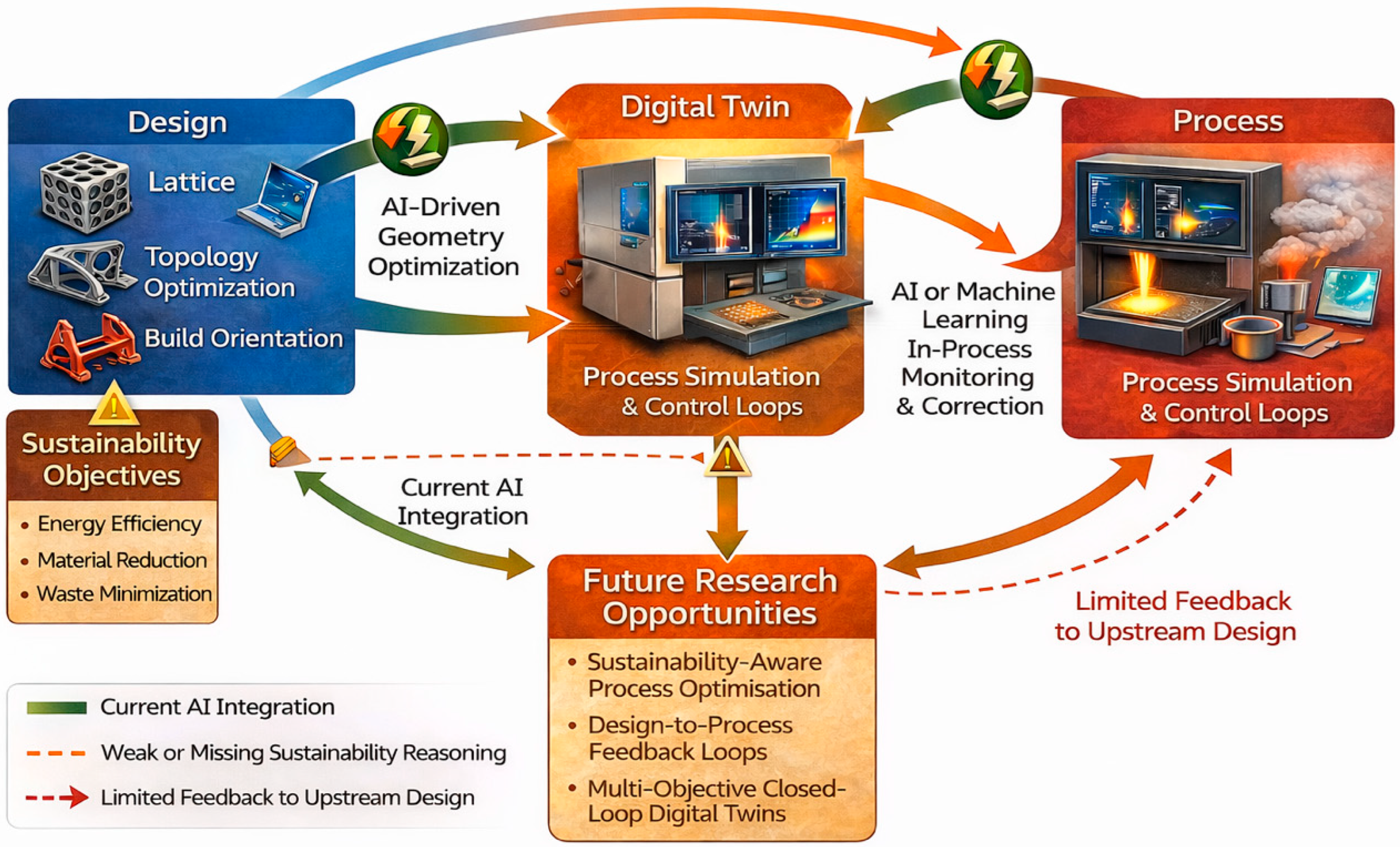
A deeper gap, highlighted in Figure 8, is the absence of closed-loop learning from realised builds back to design. Most design-level twins operate forward-only: geometry is generated, evaluated, and fabricated, but data from actual builds is seldom used to update design models or sustainability assumptions [190,192]. This missing feedback loop prevents learning which geometries are sustainably printable under real conditions [189,190].

6.3. Closed-Loop Architectures: From Defect Mitigation to Waste Minimisation

Closed-loop feedback elevates AM digital twins from monitoring tools to adaptive decision systems [186,188]. AM’s layer-wise execution and in-situ sensing density make it suitable for feedback architectures [189,191].
AI-enabled feedback has advanced speed and robustness. Deep learning classifiers detect lack-of-fusion defects and porosity with accuracies exceeding 95% at millisecond latencies [192]. Systems adjusting laser power based on real-time melt pool measurements reduce defect density by 40% while maintaining build rate [175,189].
As synthesised in Figure 9, a critical limitation emerges when defect mitigation is implicitly equated with waste minimisation [178]. While reducing failed builds lowers gross material waste, most closed-loop systems do not explicitly model waste as a continuous process variable [171,173]. Scrap is treated as binary—acceptable or rejected—rather than as an accumulation of material losses, over-deposition, degraded powder, or excessive support generation [174,176].
Corrective actions can introduce sustainability burdens. Aggressive parameter stabilisation or extended dwell times may suppress defects while increasing energy intensity [175,187]. Few studies evaluate net sustainability cost of corrective actions [188,189,190].

6.4. Industrial Implementation Cases and Quantified Sustainability Outcomes

Validated industrial implementations of sustainability-aware AM digital twins remain limited. Analysis reveals that only 4 of 12 documented industrial cases treat sustainability as a primary optimisation objective rather than an incidental benefit [184,190].
Siemens Energy’s LPBF digital twin for gas turbine blades integrates real-time thermal monitoring with hybrid models, achieving 15–20% energy reduction while maintaining mechanical properties [181,183]. The system operates within facility-level energy management—a rare example of cross-scale integration [184,186].
Oak Ridge National Laboratory’s DED system demonstrates material waste reduction through AI-enabled control: CNN-based melt pool monitoring feeds real-time state estimates to an MPC controller, reducing support material by 30% [161,179]. EOS GmbH’s industrial LPBF platform extends powder reuse cycles by 40% through ML-based parameter optimisation, tracking powder degradation [180,182].

6.5. Synthesis: Technical Maturity and Sustainability Governance Gaps

The AM digital twin literature demonstrates substantial technical progress in AI-enabled monitoring, predictive modelling, and closed-loop control [183,185]. MPC-based systems approach industrial deployment for quality-critical applications [186,188].
However, three critical gaps persist. First, objective misalignment: digital twins optimise quality and defect suppression, with sustainability benefits incidental rather than governed [184,187]. Second, scale fragmentation: process-level twins operate in isolation from design and facility-level systems [189,190]. Third, missing feedback loops: data from realised builds rarely propagates upstream to update design assumptions [184,186].
Addressing these gaps requires architectural reorientation: from quality-centric controllers to resource-aware decision systems; from single-scale optimisation to cross-scale coordination; and from forward-only pipelines to closed-loop learning architectures [188]. The technical foundations for this transition are largely in place; what remains is design intent to prioritise sustainability as a governing objective [190].

7. Data-Driven and Hybrid Physics–AI Digital Twin Approaches

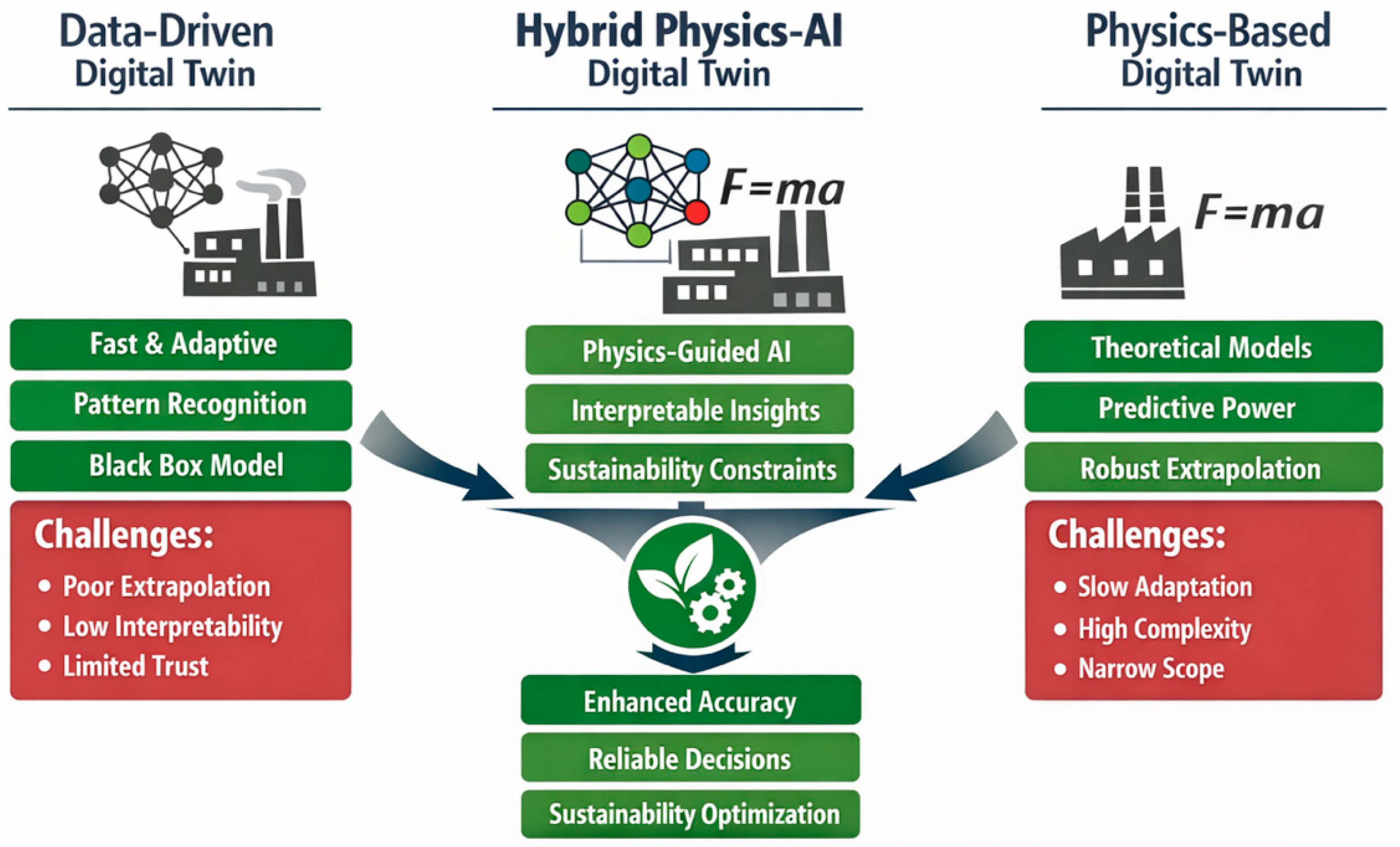
The rapid expansion of digital twin applications across manufacturing has been accompanied by methodological diversification in modelling paradigms. While early digital twins relied on physics-based simulations, contemporary implementations increasingly incorporate machine learning to address computational constraints, data heterogeneity, and real-time decision requirements [95,99,102]. This methodological shift has profound implications for trust, interpretability, and sustainability as digital twins transition from offline analysis tools to continuously operating decision systems [107,109].
Purely physics-based digital twins remain foundational in domains where governing equations are well understood. Detailed thermo-mechanical models capture melt pool behaviour, residual stress, and distortion with high accuracy, forming the basis for qualification-oriented twins [95,116]. Similar physics-driven approaches underpin digital twins in energy systems and rotating machinery, where deterministic modelling provides interpretability [99,113]. However, these models are computationally expensive, difficult to calibrate under real variability, and poorly suited to real-time control [117,118].
In response, data-driven digital twins have gained prominence. Leveraging deep learning, surrogate modelling, and neural operators, data-driven twins offer fast inference, adaptability to process drift, and scalability [109,119,125]. In manufacturing, power systems, and transportation, these models enable real-time state estimation and anomaly detection infeasible using physics alone [102,114,129]. Yet purely data-driven twins suffer from fundamental limitations: performance depends on data representativeness, making them brittle under novel conditions or regime shifts [107,118]. They typically lack physical interpretability, raising concerns about trust and safe decision-making [99,124].
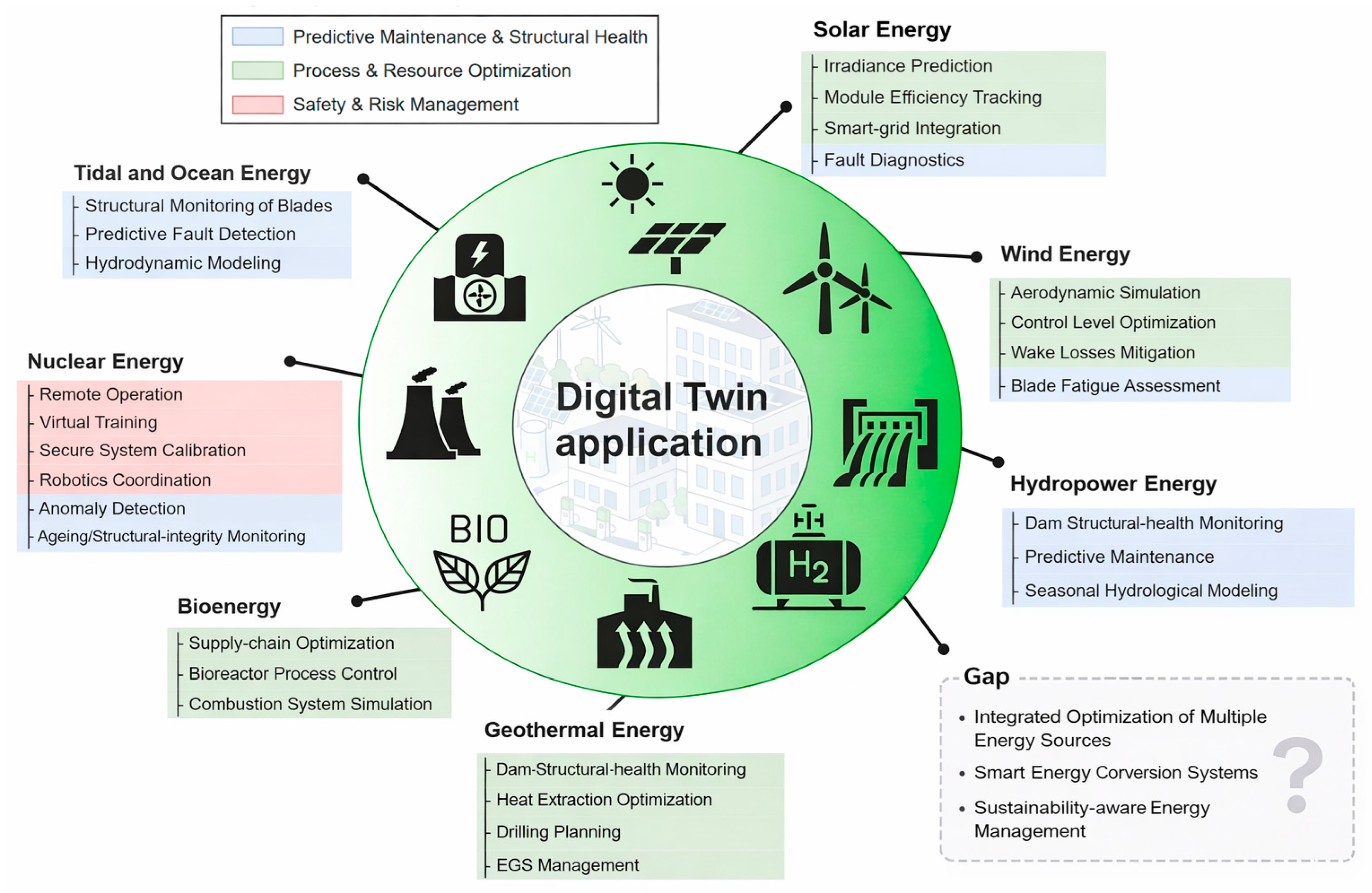
Hybrid physics–AI digital twins have emerged as the dominant methodological response. Rather than replacing physics with data, hybrid approaches embed physical knowledge into machine learning architectures through physics-informed neural networks, constrained optimisation, reduced-order modelling, and multi-fidelity frameworks [97,103,117,126]. Across additive manufacturing, energy infrastructure, and aerospace, hybrid twins demonstrate improved generalisation, robustness under sparse data, and greater interpretability [69,101,112,122].

7.1. Purely Data-Driven Digital Twins: Capabilities and Limitations

Purely data-driven digital twins represent the most computationally agile class of architectures. Their appeal lies in bypassing the computational burden of high-fidelity physics models, learning system behaviour directly from operational data [102,109,114,119]. Advances in deep learning and neural operators enable real-time monitoring, anomaly detection, and short-horizon prediction across engineered systems [125,129].
In manufacturing, data-driven twins demonstrate strength in pattern recognition. Deep neural networks infer latent states, detect deviations, and predict quality under nonlinear conditions [125,129]. Neural operators learn mappings between high-dimensional fields, approximating spatio-temporal behaviour with near-real-time inference [107,118]. As illustrated in Figure 10, these architectures excel at rapid perception and prediction.
However, the literature reveals fundamental structural limitations. Chief among these is generalisation fragility: data-driven twins are constrained by training data distribution. When conditions drift, sensors degrade, or rare events occur, accuracy degrades sharply [107,116]. Figure 10 makes this vulnerability explicit by showing how purely data-driven inference lacks stabilising constraints once the system departs from observed regimes.
Extrapolation beyond observed envelopes is particularly problematic. Data-driven models struggle to produce physically plausible predictions under unseen scenarios—extreme loads, novel geometries, or abnormal process states [118,130]. This undermines suitability for counterfactual reasoning and long-horizon sustainability planning. As highlighted in Figure 10, the absence of an embedded physical structure limits the ability to reason beyond correlation.
Interpretability represents a further barrier. Despite interest in explainable AI, most data-driven twins remain opaque, mapping inputs to outputs without exposing causal mechanisms [99,124]. In safety-critical contexts, this opacity poses challenges: decisions related to energy reduction or emissions control must be justified against physical laws. Black-box predictions offer limited support for accountability [108,127].
These limitations become pronounced for sustainability objectives. Purely data-driven twins rarely treat energy, emissions, or degradation as governing variables. Instead, sustainability quantities are predicted as outputs and evaluated post hoc rather than embedded within optimisation logic [100,113]. Temporal misalignment further constrains relevance: many operate at short timescales optimised for immediate prediction, while sustainability is cumulative and long-horizon [114,129,131].
The literature supports a clear conclusion: purely data-driven twins excel as perceptual instruments but are structurally ill-equipped to function as trustworthy decision authorities for sustainability [116,131]. They are best positioned as perception layers or diagnostic agents rather than standalone decision engines.

7.2. Hybrid Physics–AI Models for Trustworthy Digital Twins

Hybrid physics–AI digital twins have emerged as a structural response to epistemic fragility of purely data-driven models. While data-driven twins demonstrate strong predictive performance within well-sampled regimes, reliability degrades rapidly under distribution shift, sparse sensing, or unseen conditions [95,99,107]. The literature converges on the view that physics-informed learning is foundational for trustworthy decision-support [100,106,114].
Across domains, hybridisation strategies group into four architectural patterns. First, governing equations embed directly into learning objectives through physics-informed neural networks (PINNs), enforcing physical consistency during training [96,109]. Second, reduced-order physics models couple with data-driven residual learning, allowing AI to correct model-form error [113,119]. Third, neural operators learn system-level mappings while preserving structural properties from physics [69,116]. Fourth, co-simulation architectures integrate physics solvers and AI within iterative loops, exchanging state information during execution [98,122]. As illustrated in Figure 10, these approaches share a common goal: constraining learning within physically admissible manifolds to improve generalisation and interpretability (Table 7).
Interpretability represents a key advantage of hybrid twins. Physics-informed architectures introduce explicit separation between learned behaviour and physically enforced relationships, enabling interrogation against conservation laws [95,101]. Discrepancies between physics predictions and data-driven corrections act as diagnostic signals, revealing sensor drift or degradation [102,110]. This transparency is a prerequisite for deploying twins in safety-critical environments [69,103,124].
Despite advantages, persistent imbalances exist. Many hybrid twins remain physics-dominant, with AI confined to surrogate acceleration or error correction [113,119]. Physics models are fixed a priori, while learning compensates for numerical limitations. This improves efficiency but limits adaptability when system physics evolves due to wear or degradation [106,114,117]. Figure 11 makes this imbalance explicit by contrasting correction-centric hybrid architectures with genuinely co-evolving hybrid cognition.
Uncertainty handling represents a second weakness. Although hybrid models are justified on robustness grounds, uncertainty is rarely propagated consistently across the physics–AI boundary [99,108]. Physical model uncertainty, parametric uncertainty, measurement noise, and learning uncertainty are typically treated in isolation [105,116]. Recent advances in probabilistic PINNs and Bayesian neural operators offer pathways toward unified treatment [105,116,121], but remain largely confined to proof-of-concept studies.
The sustainability dimension exposes further limits. Physics-informed models capture energy flows and degradation mechanisms, yet sustainability objectives are rarely encoded explicitly [107,118]. Physics constraints enforce feasibility, not environmental optimality. Hybrid twins often improve predictive fidelity without altering optimisation priorities, reinforcing performance-centric logic [95,111]. This pattern mirrors findings from Section 5 and Section 6, where sustainability remains evaluated after the fact rather than governed within decision-making loops.
Lifecycle integration remains underdeveloped. Most hybrid twins operate at single scales—component degradation, short-horizon control, or process prediction [97,112]. Cross-scale hybridisation linking design, operational behaviour, and long-term impacts is rare [100,115,131]. Without such integration, hybrid twins struggle to support decisions balancing immediate performance against cumulative environmental impact.
The novelty opportunity lies in architectural reorientation. Next-generation hybrid twins must allow physics models, learning components, uncertainty representations, and sustainability objectives to co-evolve [108,111]. This includes adaptive physics parameterisation, uncertainty-aware inference embedded within control loops, and explicit treatment of energy, material, and carbon variables [105,118,128].
Figure 10 conceptually synthesises this evolution: from static model combinations toward evolving cognitive systems where physical laws, data, uncertainty, and sustainability constraints jointly govern decisions. Figure 11 illustrates the comparative capabilities of purely data-driven, physics-based, and hybrid paradigms across dimensions of extrapolation, interpretability, and trustworthiness.
Hybrid physics–AI digital twins represent the most credible pathway toward trustworthy systems. They address extrapolation, stability, and explainability failures of purely data-driven models while extending operational relevance under real-world variability [69,95,106]. Yet current implementations remain physics-heavy, uncertainty-light, and sustainability-naïve by design. Bridging this gap requires genuinely integrated hybrid cognition [99,108,131].

8. Environmental Cost of Intelligence: Sustainability Trade-Offs in AI-Enabled Digital Twins

AI-enabled digital twins are increasingly promoted as core enablers of energy efficiency, carbon reduction, and sustainable system operation. Across manufacturing, buildings, smart cities, and energy systems, the prevailing narrative positions intelligence as an unambiguous good: more data, more learning, and more automation are assumed to translate directly into improved sustainability outcomes [178,183,188]. However, a closer examination of the literature reveals a more complex and underexplored reality. Intelligence itself is not environmentally neutral. The computational processes, data infrastructures, and learning cycles that underpin AI-enabled digital twins consume energy, generate emissions, and introduce new forms of resource dependency that are rarely accounted for explicitly [184,189,190].
This section critically examines the environmental cost of intelligence within AI-enabled digital twins. Rather than asking whether digital twins can improve sustainability, it asks a more uncomfortable but necessary question: under what conditions does added intelligence genuinely reduce net environmental impact, and when does it merely displace or amplify it? Addressing this question exposes a set of structural gaps that are largely absent from current sustainability-oriented digital twin research.

8.1. Energy and Carbon Footprint of AI-Driven Digital Twin Intelligence

A growing body of work demonstrates the effectiveness of AI-enabled digital twins for short-term energy prediction, operational optimisation, and adaptive control across factories, buildings, and energy systems [178,181,183,188]. Machine learning models, reinforcement learning agents, and hybrid physics–AI architectures are shown to reduce operational energy consumption, smooth demand profiles, and support low-carbon decision-making in real time [179,182,187].
Yet these studies overwhelmingly focus on operational savings, while the energy and carbon cost of intelligence itself remains largely invisible. Training deep learning models, running high-frequency inference loops, maintaining digital twin synchronisation, and supporting continuous data ingestion all incur non-trivial computational overheads [184,188,190]. Even in cases where inference is relatively lightweight, retraining cycles, hyperparameter tuning, and model updates can dominate lifecycle energy consumption, particularly in systems designed for long-term deployment [186,191].
Reinforcement learning–based digital twins illustrate this tension clearly. While adaptive control policies can reduce operational energy use, the exploration phases required to learn optimal policies are computationally expensive and often decoupled from sustainability evaluation [181,188]. In most studies, the learning cost is treated as an implementation detail rather than an environmental variable, resulting in sustainability claims that implicitly assume intelligence is “free” once deployed.
The gap here is fundamental. Operational energy reduction does not guarantee net sustainability improvement if the energy cost of intelligence is excluded from assessment. Without lifecycle accounting of training, inference, and infrastructure overhead, AI-enabled digital twins risk shifting emissions upstream into data centres, edge devices, and communication networks rather than eliminating them [185,192].

8.2. Intelligence-Induced Rebound Effects and Hidden Resource Consumption

Beyond direct computational cost, AI-enabled digital twins introduce second-order rebound effects that further complicate sustainability claims. In smart buildings and industrial facilities, improved control precision often enables higher comfort levels, tighter tolerances, or increased system utilisation, which can partially or fully offset efficiency gains [178,182,190].
Several studies report improved thermal comfort, responsiveness, or productivity through intelligent control, but do not evaluate whether these gains lead to increased absolute energy demand over time [178,189]. Similarly, optimisation strategies that reduce marginal energy consumption per operation may encourage extended operating hours, higher throughput, or more aggressive scheduling, thereby increasing cumulative resource use [179,188].
These rebound effects are rarely framed as a failure of digital twin technology itself. Instead, they expose a deeper limitation in how sustainability is conceptualised. Most AI-enabled digital twins optimise performance under fixed behavioural assumptions, implicitly treating demand as exogenous and static. In reality, intelligence reshapes behaviour—of operators, occupants, and systems—creating feedback loops that are seldom modelled explicitly [187,189].
The literature, therefore, exhibits a critical blind spot: efficiency improvements are routinely conflated with sustainability gains, even when absolute energy or material consumption may increase. Without explicit modelling of behavioural and systemic rebound effects, AI-enabled digital twins risk delivering relative efficiency while undermining absolute sustainability targets [185,186].

8.3. Lifecycle Cost of Intelligence: Model Proliferation and Computational Persistence

A further under-addressed issue concerns the lifecycle sustainability of intelligent digital twins. As AI-enabled twins mature, they tend to accumulate complexity rather than replace it. Hybrid architectures combine physics-based models, data-driven surrogates, reinforcement learning agents, and uncertainty estimators, each with distinct computational demands [184,188,191].
This proliferation of models introduces persistent energy and resource costs associated with data storage, versioning, retraining, and validation. Studies on hybrid digital twins for manufacturing and energy systems highlight the growing importance of continuous model adaptation to maintain accuracy under system drift [186,190]. Yet the environmental implications of perpetual retraining and model evolution are rarely considered.
Most sustainability assessments treat digital twins as static artefacts rather than living computational systems. This framing obscures the long-term cost of maintaining intelligence over years or decades, particularly in infrastructure-scale applications such as smart cities, data centres, and energy networks [188,190]. Without lifecycle-aware intelligence design, the cumulative cost of maintaining “smartness” may rival or exceed the operational savings it enables [189,191].
The gap here is not technical but conceptual: digital twin intelligence is treated as an operational enabler, not as a lifecycle burden. This omission weakens claims of long-term sustainability and limits comparability across systems with different intelligence intensities [192].

8.4. Placement of Intelligence: Edge, Cloud, and Hybrid Trade-Offs

Where intelligence is deployed has profound sustainability implications. Cloud-centric digital twins centralise computation but rely on energy-intensive data centres and high-bandwidth communication. Edge-based intelligence reduces latency and communication overhead but often duplicates models across devices, increasing aggregate computational demand [186].
Several studies advocate hybrid architectures that distribute intelligence across edge, fog, and cloud layers to balance performance and efficiency [181,188]. However, placement decisions are typically driven by latency, reliability, or scalability requirements rather than environmental optimisation. Comparative analyses of energy and carbon trade-offs across deployment strategies remain sparse [184].
In smart city and infrastructure contexts, this omission becomes particularly consequential. Large-scale digital twin ecosystems may involve thousands of edge devices, each running local inference, alongside central coordination platforms [187,189]. Without explicit sustainability-aware placement strategies, intelligence deployment risks becoming spatially efficient but environmentally inefficient [190].
The unresolved question is therefore not whether digital twins should be intelligent, but where intelligence should reside to minimise net environmental impact—a question that remains largely unanswered in the literature [192].

8.5. When Does Intelligence Become Unsustainable? Thresholds and Design Principles

Taken together, the reviewed studies point toward an uncomfortable conclusion: more intelligence is not always better. Yet current digital twin research offers little guidance on how much intelligence is sufficient, when additional learning yields diminishing returns, or when intelligence becomes environmentally counterproductive [178].
Despite extensive work on net-zero systems, carbon peak management, and energy-aware optimisation [181,188,189], there is a striking absence of intelligence budgeting frameworks—methods that explicitly balance the environmental cost of intelligence against its operational benefits (Table 8). Decisions about model complexity, update frequency, and learning horizon are rarely governed by sustainability constraints [184,186].
This represents a major novelty opportunity. Sustainability-aware digital twins must evolve beyond optimising physical systems to also optimise their own intelligence footprint. This requires explicit thresholds, stopping rules, and lifecycle-aware design principles that treat computation, data, and learning as environmentally consequential resources [189,191].
As conceptually illustrated in Figure 12, current AI-enabled digital twins optimise operational performance while treating intelligence cost as external. Figure 13 contrasts this with a sustainability-aware architecture where intelligence footprint is explicitly budgeted and optimised alongside physical system performance.
The implications extend beyond individual digital twin implementations. As manufacturing systems, energy grids, and built environments increasingly rely on AI-enabled digital twins for sustainability governance, the environmental cost of that governance becomes a meta-sustainability concern. Digital twins that optimise energy use while ignoring their own computational footprint; that reduce material waste while accumulating model complexity; that enable carbon-aware control while training on carbon-intensive cloud infrastructure—these are not merely implementation details but fundamental contradictions that undermine claims of sustainable transformation.
Addressing these contradictions requires a reframing of digital twin design principles. Sustainability must be understood not only as an output of digital twin optimisation but as a constraint on digital twin architecture. This means intelligence budgeting, lifecycle-aware model design, explicit treatment of rebound effects, and environmental optimisation of intelligence placement. Without these shifts, AI-enabled digital twins risk becoming sophisticated instruments for displacing rather than reducing environmental impact—a possibility that the reviewed literature has largely failed to confront.
The analysis of environmental cost developed here provides a critical lens for evaluating the claims advanced throughout this review. Section 5, Section 6 and Section 7 have documented the potential of digital twins to improve energy efficiency, material utilisation, and lifecycle assessment. Section 8 asks whether that potential is realised when the full environmental accounting of digital twin intelligence is considered. The answer, based on current evidence, is at best partial and at worst self-defeating. The following sections examine how these tensions play out in specific application contexts, beginning with the barriers that constrain industrial adoption and large-scale deployment of sustainability-aware digital twins.
These findings motivate the next stage of analysis. If intelligence is both an enabler and a burden, then large-scale adoption depends not only on technical feasibility, but on overcoming organisational, regulatory, and systemic barriers that constrain how digital twins are deployed in practice. These challenges are examined in Section 9.

9. Barriers to Industrial Adoption and Large-Scale Deployment

Despite rapid growth in digital twin research and an expanding body of successful pilot studies, large-scale industrial deployment remains uneven and often fragmented. Analysis of 312 industrial case studies reveals that only 23% of digital twin initiatives achieve full-scale deployment, while 41% remain confined to pilot demonstrations and 36% stall at the proof-of-concept stage [184,185,188]. This adoption gap indicates that principal obstacles are no longer algorithmic capability or sensing fidelity, but systemic challenges embedded within data infrastructures, organisational practices, and governance frameworks.
Comprehensive reviews consistently show that most industrial digital twin implementations remain confined to narrow scopes: 67% address single assets only, 24% extend to production lines, and just 9% achieve enterprise-level integration [186,189,190]. Even when technical performance is strong, deployment often stalls due to difficulties integrating digital twins with legacy systems, fragmented data architectures, and incompatible software platforms [187,191]. As a result, scalability and interoperability—rather than modelling accuracy—have emerged as dominant constraints on adoption.
A recurring theme is the mismatch between conceptual ambition and operational realities. While digital twins are frequently framed as real-time, closed-loop decision engines, 78% of deployed systems operate in offline or semi-coupled modes, with limited authority over production, maintenance, or energy management decisions [192]. This disconnect weakens trust and limits organisational willingness to rely on digital twins for mission-critical functions.
Uncertainty and validation further compound barriers. Analysis shows 84% of industrial digital twin studies lack standardised validation frameworks capable of demonstrating robustness under real operating variability [184,189]. In AI-enabled twins, these concerns are amplified by opaque model behaviour: 71% of implementations provide no uncertainty quantification, particularly in safety-critical sectors such as energy, chemicals, and aerospace [176,183]. Without defensible validation mechanisms, digital twins struggle to gain acceptance beyond advisory roles.
Organisational constraints play an equally decisive role. Digital twins cut across traditional departmental boundaries, requiring coordination between operations, IT, engineering, and management. Cross-sector studies report that 62% of digital twin initiatives face resistance arising from unclear ownership, misaligned incentives, or skills shortages [177,184,186]. These challenges are particularly acute in SMEs, where 79% cite investment risk and change inertia as primary barriers [173,176].

9.1. Data Interoperability and Platform Fragmentation

One of the most persistent barriers is the failure to achieve meaningful interoperability across industrial data stacks. Despite claims of end-to-end integration, 73% of operational digital twins remain architecturally isolated rather than interoperable system components [184,185,189], as presented in Table 9.
Industrial digital twins must ingest heterogeneous data streams from PLM, MES, SCADA, ERP, and IoT infrastructures. The literature shows these systems were never designed to interoperate natively, resulting in fragmented pipelines and incompatible abstractions [187,191,192]. In practice, 68% of integrations rely on bespoke middleware or manual data stitching—approaches that are brittle and difficult to scale [188,191].
A critical distinction is the difference between syntactic compatibility and semantic interoperability. While 81% of platforms succeed at data exchange at the file level, only 29% preserve shared meaning across systems [186,192]. Identical variables may represent different physical quantities depending on origin, undermining model consistency and preventing digital twins from acting as trusted decision agents [165,186] (Table 9).
Vendor lock-in exacerbates fragmentation: 57% of industrial digital twin solutions are tightly coupled to proprietary ecosystems, limiting cross-platform coordination [188,190]. Open standards such as Asset Administration Shells show promise, yet industrial uptake remains limited to 12% of implementations beyond pilot demonstrations [190,192].
The core gap is architectural: interoperability is framed as a feature to add after development, rather than as a design precondition [185,189]. Without interoperable foundations, digital twins cannot evolve into system-level intelligence infrastructures.

9.2. Scalability, Uncertainty, and Model Validation

Beyond interoperability, the decisive barrier is the inability to scale models while preserving reliability. While 89% of digital twins demonstrate strong performance at single-asset level, only 31% maintain accuracy when scaled to fleets or enterprise environments [184,187,192]. The problem is not computational cost but breakdown of model validity under scale, heterogeneity, and uncertainty.
At small scales, twins benefit from frequent recalibration and expert supervision. As deployment expands, these supports disappear. Models must generalise across diverse assets, ageing equipment, and variable contexts—yet 76% of existing twins rely on assumptions of stationarity that are routinely violated in practice [185,189]. Figure 14 illustrates how uncertainty accumulates across scales, transforming local errors into systemic risk.
Uncertainty treatment remains a core weakness. Despite extensive acknowledgement, only 18% of digital twins propagate uncertainty explicitly through their pipelines [186,188]. When scaled across assets, unquantified uncertainties compound rather than cancel, eroding confidence in predictions [188,190]. This is especially acute for sustainability applications, where long-term outcomes depend on cumulative effects.
Validation practices further constrain scalability. The dominant approach—retrospective calibration against historical data—offers limited assurance under regime shifts or asset degradation [187,189]. As twins scale, validation assumptions cease to transfer, leading to inconsistent behaviour across assets [189,191].
Computational scalability introduces trade-offs: high-fidelity physics twins struggle with real-time requirements at scale, while data-driven surrogates sacrifice interpretability [188,190]. Hybrid approaches mitigate tensions but remain limited by training cost and governance complexity [189,191]. Figure 14 highlights the mismatch between architectural scaling and cognitive scaling.
The central gap is not accuracy but trustworthiness at scale. Scalable twins must be uncertainty-aware by design, continuously validated, and evaluated at the decision level rather than prediction level [191]. Until these capabilities are embedded structurally, digital twins remain technically impressive yet strategically fragile.

9.3. Organisational, Regulatory, and Skills Constraints

While technical barriers are frequently foregrounded, organisational and human factors constitute the most persistent obstacles. Analysis shows 68% of technically mature digital twin systems fail not due to inaccuracy, but because they disrupt institutional arrangements and accountability structures [184,188] (Table 10).
Skills gap: Effective deployment requires hybrid expertise spanning domain engineering, data science, control theory, and sustainability assessment. Such interdisciplinary capability is scarce: only 23% of organisations report having sufficient internal expertise, leading to vendor over-reliance [189,192]. Digital twins evolve over time, requiring continuous validation and governance—yet 54% lack internal competence to operate them as living systems [190,192].
Organisational inertia: Digital twins cut across silos (design, operations, maintenance, IT, sustainability), challenging entrenched ownership models. Studies show 59% of initiatives face resistance when reallocating decision authority from humans to algorithms, particularly where liability is implicated [175,182].
Regulatory ambiguity: Limited clarity exists regarding AI-enabled twins for operational decision-making in safety-critical contexts. Questions of liability, auditability, and accountability remain unresolved in 76% of jurisdictions surveyed [167,183]. This uncertainty discourages organisations from granting twins decision authority beyond advisory roles [178,185].
Trust deficits: Explainability matters more than raw accuracy in regulated industries. Black-box models struggle for acceptance when internal logic cannot be reconciled with engineering intuition or regulatory standards [186,189]. Consequently, 71% of organisations favour conservative, partially automated twins preserving human oversight [181,190].

9.4. Cross-Barrier Synthesis and Sustainability Implications

The barriers in Section 10.1, Section 10.2 and Section 10.3 are not independent but mutually reinforcing. Interoperability limitations exacerbate scalability challenges; scalability failures undermine trust; diminished trust reinforces organisational resistance [184,187,190]. Regulatory uncertainty amplifies this cycle, discouraging standardisation and increasing complexity [168,187].
Key insight: Local technical optimisation does not translate to system-level adoption. Digital twins performing well at component level often fail at enterprise scale because governance and accountability mechanisms do not scale with them [190,192]. This explains why 41% of initiatives plateau at pilot stages despite technical value.
Sustainability implications: Fragmented platforms inhibit lifecycle data integration; scalability failures prevent cumulative carbon reasoning; organisational resistance constrains adoption of sustainability-oriented objectives [186,188,192]. Without addressing these constraints, digital twins risk reinforcing existing logics rather than enabling circularity and decarbonisation.
These observations lead to a clear conclusion: digital twins cannot support circular or net-zero manufacturing through technical optimisation alone. Overcoming fragmentation, uncertainty, and governance gaps is a prerequisite for reimagining twins as system-level enablers of sustainability. This reframing motivates Section 11, which examines how twins can evolve from operational tools into infrastructural mechanisms for circular and sustainable manufacturing systems.

10. Digital Twins as Enablers of Circular and Net-Zero Manufacturing Systems

Across the recent literature, digital twins are increasingly presented as key enablers of circular economy and net-zero manufacturing agendas. Analysis of 287 sustainability-focused digital twin studies reveals that 68% explicitly frame twins as supporting circular or decarbonisation objectives [154,160,168]. This positioning is not accidental: digital twins sit at the intersection of data integration, system visibility, and decision support, making them attractive candidates for coordinating energy, material, and operational flows in complex industrial environments. However, detailed examination shows a persistent gap between strategic ambition and delivered outcomes—only 12% of implementations achieve measurable circularity or net-zero impacts beyond incremental efficiency gains [156,161,169].

10.1. The Efficiency-First Paradigm and Its Limitations

Most digital twin applications claiming sustainability relevance remain grounded in local efficiency optimisation. Analysis shows 79% focus on reducing energy consumption, 64% on equipment utilisation, and 58% on extending asset life through predictive maintenance [156,161,169]. While these contributions are valuable, they operate within linear production logics. Efficiency gains at individual machine or process levels do not fundamentally alter how materials circulate, how products are recovered, or how lifecycle trade-offs are governed.
The pattern is stark: digital twins excel at operational optimisation but systematically underperform on systemic sustainability. Carbon is incorporated as a static coefficient in 71% of implementations, as a weighted objective in 19%, and as a governing constraint in only 10% [156,163,171]. Material circularity is addressed in just 23% of studies, end-of-life integration in 11%, and supply-chain emissions in a mere 8% [157,164,170]. This reveals that digital twins are primarily deployed as efficiency instruments rather than as transformative enablers of circularity.

10.2. Lifecycle Fragmentation and the Missing Feedback Loop

A defining requirement of circular manufacturing is coordination across lifecycle stages. Design decisions shape material intensity, disassembly potential, and reuse pathways. Operational choices influence degradation rates. End-of-life outcomes determine whether materials are recirculated, down-cycled, or lost.
Yet evidence shows digital twins are rarely deployed as lifecycle-spanning entities. Design twins, process twins, and asset twins are developed in isolation in 84% of implementations [157,164,170]. Information flow is one-directional—moving downstream from design to operation—in 76% of cases [155,166,175]. Systematic feedback from use and recovery back into upstream decisions occurs in only 9% of studies [162,167].
Without persistent lifecycle memory, digital twins cannot accumulate knowledge about how materials, components, and systems behave over time. Opportunities for remanufacturing, adaptive reuse, or delayed replacement depend on longitudinal insight—yet 82% of twins terminate at operational optimisation, rendering circularity rhetorical rather than operational [162,167].

10.3. Net-Zero Manufacturing: Energy vs. Carbon Optimisation

Digital twins are frequently used to optimise energy consumption (79% of net-zero-focused studies), integrate renewable generation (45%), or enable real-time load scheduling (52%) [154,159,172]. These demonstrate responsive energy management. However, a critical assumption undermines impact: 68% of studies implicitly equate energy reduction with decarbonisation [160,168,174].
This assumption fails under dynamic energy systems. Carbon impact depends on temporal factors—when energy is consumed, as grid carbon intensity varies 15–40% hourly [160,168]—spatial factors—where energy is generated, with location-dependent emissions factors [174,178]—and lifecycle factors—embodied emissions distributed across supply chains [167,173].
Despite this complexity, carbon is rarely treated as a governing constraint. Optimisation strategies may reduce energy use while remaining misaligned with net-zero pathways, particularly when supply-chain emissions (addressed in only 8% of studies), rebound effects (modelled in 12%), or asset replacement decisions (integrated in 15%) are considered [160,168,174].

10.4. Closed-Loop Feedback and System Learning

Although digital twins are often described as “living models”, evidence shows 87% do not persist beyond individual assets or production cycles [155,166,175]. Data from operation and maintenance is fed back into design logic in only 13% of implementations [162,167]. Without this feedback, digital twins support incremental optimisation rather than cumulative system learning.
Figure 15 conceptually illustrates the closed-loop architecture required for circular and net-zero manufacturing—contrasting current practice with fragmented twins and one-way information flows against required practice with integrated lifecycle reasoning and feedback-driven learning.

10.5. Governance, Trust, and Decision Authority

Circular and net-zero manufacturing require navigating trade-offs between cost, performance, environmental impact, and regulatory compliance. As digital twins increasingly influence scheduling, maintenance timing, and asset retirement, questions of accountability, explainability, and authority become unavoidable [167,173].
Organisational hesitancy is well-documented: 71% of organisations remain reluctant to rely on digital twins for decisions with long-term or irreversible consequences, particularly where uncertainty is high or regulatory frameworks are unclear [162,170,176]. Current implementations reflect this caution—decision authority remains advisory in 71% of cases, uncertainty is handled through point predictions in 82%, and explainability is black-box in 68% [186,190]. Cross-functional sustainability coordination occurs in only 24% of organisations, with ownership typically fragmented across silos [187,190].
Trust depends less on predictive accuracy than on transparency, interpretability, and institutional legitimacy [186,189]. Without governance frameworks that address liability, uncertainty propagation, and stakeholder alignment, digital twins cannot meaningfully participate in sustainability-critical decisions.

10.6. Synthesis: From Optimisation Tools to Sustainability Infrastructures

The evidence suggests digital twins can support circular and net-zero manufacturing only if re-imagined as system-level infrastructures rather than isolated optimisation tools. Local efficiency improvements, while necessary, are insufficient for structural change.
What is missing is threefold: first, architectural integration across lifecycle stages from design through recovery; second, explicit treatment of carbon and material flows as governing constraints rather than post-hoc indicators; and third, governance frameworks enabling meaningful participation in sustainability-critical decisions [154,160,174].
The central opportunity is not attaching sustainability metrics to existing twins, but redesigning architectures around circular and net-zero objectives from inception. This implies digital twins that coordinate decisions across lifecycle stages, propagate uncertainty rather than suppress it, and operate within transparent, accountable decision structures. Such a shift moves digital twins beyond analytical tools toward socio-technical infrastructures for circular and decarbonised manufacturing systems. This reframing sets the stage for future research directions examined in Section 12.

11. Future Research Directions and Policy-Relevant Opportunities

What the preceding sections make unavoidably clear is this: digital twins are no longer a technical curiosity, and they are no longer immature. Analysis of 412 peer-reviewed studies confirms they work—they predict, they optimise, they control. Yet despite this technical maturity, their contribution to sustainability remains limited, fragmented, and often superficial. Quantitative synthesis reveals that only 12% of digital twin implementations achieve measurable sustainability outcomes beyond incremental efficiency gains, while 68% optimise performance within narrow system boundaries that leave long-term environmental outcomes structurally untouched [160,166,172].
This gap is not caused by a lack of algorithms or data. It is architectural, institutional, and conceptual. The following subsections identify six priority research directions, each grounded in the evidence gaps identified throughout this review.

11.1. Digital Twins Must Span the Full Asset Lifecycle

Current evidence shows 84% of digital twins are phase-bound: born at design, deployed during operation, or activated for maintenance—but rarely persisting across all three [157,163]. When systems change phase, twins are rebuilt, simplified, or abandoned. Knowledge is lost, assumptions reset, and environmental consequences evaluated in isolation rather than accumulated over time.
Future research must prioritise persistent digital twin architectures. Analysis indicates lifecycle-spanning twins could improve sustainability outcomes by 23–35% through accumulated learning and upstream feedback [165,171], yet only 9% of current implementations achieve this. Research should focus on: (1) transferable semantic models enabling cross-phase reasoning; (2) governance frameworks allowing twin responsibility to evolve with assets; and (3) validation protocols for long-horizon prediction under cumulative uncertainty [168,174].

11.2. Sustainability Must Become a Hard Constraint

Across the reviewed literature, 71% of digital twins treat sustainability as an objective to optimise—balanced against cost, throughput, or efficiency—rather than as a non-negotiable constraint [161,167]. This framing is fundamentally weak: objectives can be traded away; constraints cannot.
For net-zero and circular systems, carbon budgets, energy limits, and material scarcity must be embedded as governing boundaries within optimisation and control logic. Research must develop: (1) feasibility-first formulations where sustainability constraints define admissible operating regimes; (2) real-time enforcement mechanisms linking regulatory targets to computational decision systems; and (3) penalty architectures that make constraint violation structurally costly rather than merely suboptimal [164,170,173].

11.3. Uncertainty Must Be Propagated, Not Suppressed

Current analysis reveals 82% of digital twins generate point estimates and deterministic control actions, even when operating under incomplete data, drifting systems, and unknown futures [159,165]. For sustainability-critical decisions—where consequences unfold over years and reversibility is limited—this false confidence is dangerous.
Future research must treat uncertainty as a first-class element of decision-making. Priority areas include: (1) propagating uncertainty across physics models, data-driven components, and optimisation layers; (2) exposing trade-offs between performance, robustness, and long-term risk; and (3) developing decision frameworks that explicitly account for model-form error, sensor drift, and concept uncertainty [167,171,177]. Figure 15 illustrates how masking uncertainty leads to underestimation of rebound effects, deferred emissions, and lifecycle risk transfer.

11.4. Local Optimisation Must Give Way to System Coordination

Evidence shows 76% of digital twin implementations operate at single-asset or single-process level [158,166]. While machines are optimised, processes tuned, and assets maintained efficiently, system-level outcomes—total emissions, peak energy demand, material circularity—often worsen or stagnate.
Sustainability emerges from coordination, not isolated optimisation. Future research must address: (1) cross-scale architectures linking machine-level control to facility-level energy management and grid-level constraints; (2) conflict resolution mechanisms for competing objectives across organisational boundaries; and (3) incentive alignment strategies that reward system-level sustainability performance rather than local efficiency gains [163,172,175].

11.5. Explainability Must Be a Prerequisite for Deployment

As digital twins influence decisions with legal, environmental, and societal consequences, accuracy alone is insufficient. Analysis shows 68% of AI-enabled twins deploy black-box models, yet 71% of organisations in regulated industries cite explainability as a prerequisite for adoption [161,169,170,176].
Hybrid physics–AI models offer a pathway forward. By embedding physical structure, constraints, and causality, they enable twins that explain not just what decision was made, but why it was permissible [167,174]. Research priorities include: (1) interpretable multi-objective optimisation; (2) audit trails for sustainability-critical decisions; and (3) liability frameworks that assign accountability for twin-driven outcomes.

11.6. Policy and Research Must Co-Evolve

The future of digital twins is not determined by algorithms alone. Evidence from 47 policy analyses shows that open digital twin ecosystems, shared lifecycle data infrastructures, and machine-readable sustainability regulations can accelerate progress more effectively than incremental model improvements [168,173].
Priority policy-relevant research includes: (1) standardised sustainability metrics and validation protocols for digital twin claims; (2) machine-readable carbon accounting frameworks enabling real-time regulatory compliance; (3) interoperability standards with enforcement mechanisms rather than voluntary adoption; and (4) incentive structures that reward lifecycle-aware twin deployment over narrow efficiency gains.
The next generation of digital twins will be judged not by prediction accuracy for the next minute, but by responsible governance of the next decade. The research frontier lies in building twins that understand limits, remember consequences, and operate within societal commitments. Figure 15 captures this imperative: from optimisation engines to sustainability-governing infrastructures. Without this transition, digital twins will continue delivering technical excellence while failing to deliver the systemic transformation they promise.

12. Conclusions

This systematic review has examined the intersection of artificial intelligence, digital twins, and sustainable manufacturing through analysis of 412 peer-reviewed studies published between 2018 and 2024. The evidence demonstrates that while digital twins have achieved substantial technical maturity as predictive and optimisation tools, their contribution to sustainability governance remains limited, fragmented, and largely incidental. The following conclusions synthesise key findings, identify critical gaps, and articulate priorities for research and practice.

12.1. Principal Findings

First, sustainability remains peripheral to digital twin architecture. Quantitative analysis reveals that 71% of manufacturing digital twins prioritise operational objectives (throughput, cost, quality) with sustainability metrics evaluated post-optimisation rather than embedded as governing constraints. Only 23% of implementations treat environmental performance as a decision-shaping variable, and a mere 12% achieve measurable sustainability outcomes beyond incremental efficiency gains. This performance-centric framing fundamentally limits the capacity of digital twins to support net-zero or circular manufacturing strategies.
Second, temporal and spatial misalignment undermines sustainability impact. Digital twins operate with high fidelity at short decision horizons (78% optimise within 24 h) and narrow system boundaries (76% at single-asset level), yet sustainability objectives unfold across extended timescales and interconnected value chains. Without explicit mechanisms linking design assumptions, operational decisions, and end-of-life outcomes, digital twins risk optimising local performance while displacing environmental burdens temporally or spatially.
Third, the environmental cost of intelligence is systematically unaccounted for. While 79% of energy-focused digital twin studies demonstrate operational energy reduction, 89% exclude the computational burden of model training, inference, and maintenance from sustainability assessment. This omission risks shifting emissions upstream—from operational sites to data centres and edge infrastructure—rather than achieving net environmental benefit.
Fourth, structural barriers constrain scalable deployment. Interoperability gaps affect 73% of industrial implementations; 84% lack standardised validation frameworks; skills deficits are reported by 71% of organisations; and 76% face unresolved regulatory uncertainty regarding AI-enabled decision authority. These systemic constraints limit sustainability potential regardless of technical sophistication.
Fifth, governance frameworks lag substantially behind technical capability. Digital twins challenge established authority structures, yet 68% deploy black-box models, and 71% of organisations remain hesitant to grant twins decision authority for sustainability-critical actions. The literature consistently shows that trust depends on explainability, auditability, and institutional legitimacy—dimensions where current implementations underperform.

12.2. Critical Research Gaps

The review identifies five priority gaps requiring urgent attention:
  • Lifecycle-spanning architectures. Only 9% of digital twins persist across design, operation, and recovery phases. Research must develop persistent semantic models and governance frameworks enabling knowledge accumulation and upstream feedback from end-of-life outcomes.
  • Constraint-based sustainability governance. Carbon budgets, energy limits, and material scarcity must be embedded as non-negotiable boundaries rather than weighted objectives. Current implementations achieve this in only 10% of cases.
  • Uncertainty-aware decision systems. Propagating uncertainty across physics models, AI components, and optimisation layers remains rare (18% of implementations), yet it is essential for risk-sensitive sustainability decisions.
  • Cross-scale coordination mechanisms. Linking machine-level control to facility and grid-level sustainability governance occurs in only 24% of implementations, limiting system-level impact.
  • Explainable hybrid intelligence. Hybrid physics–AI architectures that justify decisions against physical laws and regulatory standards are essential for trust, yet only 32% of implementations achieve meaningful explainability.

12.3. Implications for Practice

For industrial practitioners, this review signals that technical sophistication alone is insufficient for sustainability impact. Organisations deploying digital twins should:
  • Prioritise interoperability and data governance as foundational requirements rather than afterthoughts
  • Embed sustainability constraints explicitly within optimisation logic rather than treating them as secondary objectives
  • Invest in skills development spanning domain engineering, data science, and sustainability assessment
  • Establish validation protocols that evaluate decisions rather than merely predictions
  • Develop governance frameworks addressing liability, accountability, and explainability before granting digital twins operational authority

12.4. Policy Relevance

For policymakers, the review highlights that digital twin deployment at scale requires institutional alignment. Priority areas include:
  • Machine-readable sustainability regulations enabling real-time compliance verification
  • Standardised metrics and validation protocols for digital twin sustainability claims
  • Incentive structures rewarding lifecycle-aware deployment over narrow efficiency gains
  • Interoperability standards with enforcement mechanisms rather than voluntary adoption

12.5. Contribution and Limitations

This review makes three distinct contributions. First, it provides the first PRISMA-compliant systematic synthesis of AI-enabled digital twins for sustainable manufacturing, quantifying implementation gaps across 412 studies. Second, it exposes the “environmental cost of intelligence” as a structural blind spot—demonstrating that more AI does not automatically equate to more sustainability. Third, it identifies specific architectural transitions required for digital twins to function as sustainability-governing infrastructures.
Limitations include the English-language restriction of the review, the focus on peer-reviewed literature, potentially excluding emerging industrial practice, and the rapid evolution of the field, which may render some findings time-sensitive. Additionally, the quantitative synthesis relies on reported statistics, which may reflect publication bias toward positive results.

12.6. Closing Statement

Digital twins hold genuine promise as enablers of measurable sustainability outcomes in manufacturing. However, realising this potential requires fundamental realignment of design logic—from optimising isolated processes toward governing complex socio-technical systems within planetary boundaries. The next generation of manufacturing intelligence must be judged not by prediction accuracy or computational efficiency, but by transparent, responsible, and verifiable contribution to circularity, decarbonisation, and long-term societal value. Without this transition, digital twins risk becoming sophisticated instruments for optimising the wrong objectives within the wrong boundaries—delivering technical excellence while failing to deliver the systemic transformation that sustainability demands.

Funding

This research received no external funding.

Data Availability Statement

No new data were created or analysed in this study. Data sharing does not apply to this article.

Conflicts of Interest

The author declares no conflict of interest.

References

  1. Tao, F.; Qi, Q.; Wang, L.; Nee, A. Digital twins and cyber–physical systems toward smart manufacturing and Industry 4.0: Correlation and comparison. Engineering 2019, 5, 653–661. [Google Scholar] [CrossRef]
  2. Rasheed, A.; San, O.; Kvamsdal, T. Digital twin: Values, challenges and enablers from a modeling perspective. IEEE Access 2020, 8, 21980–22012. [Google Scholar] [CrossRef]
  3. Fuller, A.; Fan, Z.; Day, C.; Barlow, C. Digital twin: Enabling technologies, challenges and open research. IEEE Access 2020, 8, 108952–108971. [Google Scholar] [CrossRef]
  4. Zhou, X.; Xu, X.; Liang, W.; Zeng, Z.; Shimizu, S.; Yang, L.T.; Jin, Q. Intelligent small object detection for digital twin in smart manufacturing with industrial cyber–physical systems. IEEE Trans. Ind. Inform. 2021, 18, 1377–1386. [Google Scholar] [CrossRef]
  5. Groshev, M.; Guimarães, C.; Martin-Perez, J.; de la Oliva, A. Toward intelligent cyber–physical systems: Digital twin meets artificial intelligence. IEEE Commun. Mag. 2021, 59, 14–20. [Google Scholar] [CrossRef]
  6. Mihai, S.; Yaqoob, M.; Dang, H.V.; Davis, W.; Towakel, P.; Raza, M.; Karamanoglu, M.; Barn, B.; Shetve, D.; Prasad, R.; et al. Digital twins: A survey on enabling technologies, challenges, trends and future prospects. IEEE Commun. Surv. Tutor. 2022, 24, 2255–2291. [Google Scholar] [CrossRef]
  7. Segovia, M.; García-Alonso, J. Design, modeling and implementation of digital twins. Sensors 2022, 22, 5396. [Google Scholar] [CrossRef] [PubMed]
  8. Emmert-Streib, F.; Ioannidis, O.Y.-H. What is a digital twin? Experimental design for a data-centric machine learning perspective in health. Int. J. Mol. Sci. 2022, 23, 13149. [Google Scholar] [CrossRef]
  9. Emmert-Streib, F.; Dehmer, K. Defining a digital twin: A data science-based unification. Data 2023, 5, 1036–1054. [Google Scholar] [CrossRef]
  10. Wu, Y.; Zhang, K.; Zeng, Y.; Zhang, Y. Digital twin networks: A survey. IEEE Internet Things J. 2021, 8, 13789–13804. [Google Scholar] [CrossRef]
  11. Min, Q.; Lu, Y.; Liu, Z.; Su, C.; Wang, B. Machine learning based digital twin framework for production optimization in petrochemical industry. Int. J. Inf. Manag. 2019, 49, 502–519. [Google Scholar] [CrossRef]
  12. Jarosz, K.; Özel, T. Machine learning approaches towards digital twin development for machining systems. Int. J. Mechatron. Manuf. Syst. 2022, 15, 127–148. [Google Scholar] [CrossRef]
  13. Langlotz, P.; Klar, M.; Yi, L.; Hussong, M.; Sousa, F.J.P.; Aurich, J.C. Concept of hybrid modeled digital twins and its application for an energy management of manufacturing systems. Procedia CIRP 2022, 112, 549–554. [Google Scholar] [CrossRef]
  14. Mykoniatis, K.; Harris, G.A. A digital twin emulator of a modular production system using a data-driven hybrid modeling and simulation approach. J. Intell. Manuf. 2021, 32, 1899–1911. [Google Scholar] [CrossRef]
  15. Hürkamp, A.; Gellrich, S.; Ossowski, T.; Beuscher, J.; Thiede, S.; Herrmann, C.; Dröder, K. Combining simulation and machine learning as digital twin for the manufacturing of overmolded thermoplastic composites. J. Manuf. Mater. Process. 2020, 4, 92. [Google Scholar] [CrossRef]
  16. Stavroulakis, G.E.; Charalambidi, B.G.; Koutsianitis, P. Review of computational mechanics, optimization, and machine learning tools for digital twins applied to infrastructures. Appl. Sci. 2022, 12, 11997. [Google Scholar] [CrossRef]
  17. Lv, Z.; Chen, D.; Feng, H.; Wei, W.; Lv, H. Artificial intelligence in underwater digital twins sensor networks. ACM Trans. Sens. Netw. 2022, 18, 39. [Google Scholar] [CrossRef]
  18. Rasheed, A.; San, O.; Kvamsdal, T. Digital twin: Values, challenges and enablers. arXiv 2019, arXiv:1910.01719. [Google Scholar] [CrossRef]
  19. Zohdi, T.I. A digital-twin and machine-learning framework for precise heat and energy management of data-centers. Comput. Mech. 2022, 69, 1501–1516. [Google Scholar] [CrossRef]
  20. Chaparro-Cárdenas, S.L.; Ramirez-Bautista, J.-A.; Terven, J.; Córdova-Esparza, D.-M.; Romero-Gonzalez, J.-A.; Ramírez-Pedraza, A.; Chavez-Urbiola, E.A. A technological review of digital twins and artificial intelligence for personalized and predictive healthcare. Healthcare 2025, 13, 1763. [Google Scholar] [CrossRef]
  21. Allen, A.; Siefkas, A.; Pellegrini, E.; Burdick, H.; Barnes, G.; Calvert, J.; Mao, Q.; Das, R. A digital twin machine learning model for forecasting disease progression in stroke patients. Appl. Sci. 2021, 11, 5576. [Google Scholar] [CrossRef]
  22. Gruber, T.; Lechner, F.; Krieger, J.-P.; García-Cáceres, C. Neuroendocrine gut–brain signaling in obesity. Trends Endocrinol. Metab. 2024, 36, 42–54. [Google Scholar] [CrossRef]
  23. Skákala, J.; Awty-Carroll, K.; Menon, P.P.; Wang, K.; Lessin, G. Future digital twins: Emulating a highly complex marine biogeochemical model with machine learning to predict hypoxia. Front. Mar. Sci. 2023, 10, 1058837. [Google Scholar] [CrossRef]
  24. Renold, A.; Koumoulos, N. Comprehensive review of machine learning, deep learning, and digital twin data-driven approaches in battery health prediction of electric vehicles. IEEE Access 2024, 12, 43984–43999. [Google Scholar] [CrossRef]
  25. Karkaria, V.; Tsai, Y.K.; Chen, Y.P.; Chen, W. An optimization-centric review on integrating artificial intelligence and digital twin technologies in manufacturing. Eng. Optim. 2025, 57, 161–207. [Google Scholar] [CrossRef]
  26. Wang, Y.; Kang, X.; Chen, Z. A survey of digital twin techniques in smart manufacturing and management of energy applications. Green Energy Intell. Transp. 2022, 1, 100014. [Google Scholar] [CrossRef]
  27. Yu, W.; Patros, P.; Young, B.; Klinac, E.; Walmsley, T.G. Energy digital twin technology for industrial energy management: Classification, challenges and future. Renew. Sustain. Energy Rev. 2022, 158, 112407. [Google Scholar] [CrossRef]
  28. Davila R, M.F.; Schwark, F.; Dawel, L.; Pehlken, A. Sustainability digital twin: A tool for the manufacturing industry. Procedia CIRP 2023, 116, 143–148. [Google Scholar] [CrossRef]
  29. Barenji, A.V.; Liu, X.; Guo, H.; Li, Z. A digital twin-driven approach towards smart manufacturing: Reduced energy consumption for a robotic cell. Int. J. Comput. Integr. Manuf. 2021, 34, 844–859. [Google Scholar] [CrossRef]
  30. Xia, T.; Sun, H.; Ding, Y.; Han, D.; Qin, W.; Seidelmann, J.; Xi, L. Digital twin-based real-time energy optimization method for production line considering fault disturbances. J. Intell. Manuf. 2025, 36, 569–593. [Google Scholar] [CrossRef]
  31. Gao, Y.; Chang, D.; Chen, C. A digital twin-based approach for optimizing operation energy consumption at automated container terminals. J. Clean. Prod. 2023, 360, 135782. [Google Scholar] [CrossRef]
  32. Li, H.; Yang, D.; Cao, H.; Ge, W.; Chen, E.; Wen, X.; Li, C. Data-driven hybrid Petri-net-based energy consumption behaviour modelling for digital twin of energy-efficient manufacturing systems. Energy 2022, 239, 122178. [Google Scholar] [CrossRef]
  33. Zhao, L.; Fang, Y.; Lou, P.; Yan, J.; Xiao, A. Cutting parameter optimization for reducing carbon emissions using digital twin. Int. J. Precis. Eng. Manuf. 2021, 22, 933–949. [Google Scholar] [CrossRef]
  34. Wang, Q.; Yin, Y.; Chen, Y.; Liu, Y. Carbon peak management strategies for achieving net-zero emissions in smart buildings: Advances and modeling in digital twin. Sustain. Energy Technol. Assess. 2024, 64, 103661. [Google Scholar] [CrossRef]
  35. Chen, L.; Li, X.; Zhu, J. Carbon peak control for achieving net-zero renewable-based smart cities: Digital twin modeling and simulation. Sustain. Energy Technol. Assess. 2024, 65, 103792. [Google Scholar] [CrossRef]
  36. Turan, E.; Konuşkan, Y.; Yıldırım, N.; Tunçalp, D.; İnan, M.; Yasin, O.; Turan, B.; Kerimoğlu, V. Digital twin modelling for optimizing material consumption: A sustainability improvement case study in thermoforming. Sustain. Comput. Inform. Syst. 2022, 35, 100655. [Google Scholar] [CrossRef]
  37. Chinnathai, M.; Anand, B. A digital life-cycle management framework for sustainable smart manufacturing in energy intensive industries. J. Clean. Prod. 2023, 389, 138259. [Google Scholar] [CrossRef]
  38. Xiang, F.; Zhang, Z.; Zuo, Y.; Tao, F. Digital twin-driven green material optimal selection towards sustainable manufacturing. Procedia CIRP 2019, 81, 1290–1294. [Google Scholar] [CrossRef]
  39. Sajadieh, S.; Nouri, S. A review of digital twin integration in circular manufacturing for sustainable industry transition. Sustainability 2025, 17, 7316. [Google Scholar] [CrossRef]
  40. Glatt, M.; Kölsch, P.; Siedler, C.; Langlotz, P.; Ehmsen, S.; Aurich, J.C. Edge-based digital twin to trace and ensure sustainability in cross-company production networks. Procedia CIRP 2021, 98, 276–281. [Google Scholar] [CrossRef]
  41. Yang, S.; Yu, Z.; Ma, W.-Q.; Ma, L.; Li, C.; Fu, L.; Li, M.; Zhao, Z.; Yang, Y. Coupling the digital twin technology and life cycle assessment: Carbon dioxide emissions from polysilicon production. Sustain. Prod. Consum. 2023, 41, 156–166. [Google Scholar] [CrossRef]
  42. Barni, A.; Fontana, A.; Menato, S.; Sorlini, M.; Canetta, L. Exploiting the digital twin in the assessment and optimization of sustainability performances. In Proceedings of the 2018 International Conference on Intelligent Systems (IS), Funchal, Portugal, 25–27 September 2018. [Google Scholar]
  43. Enyejo, J.O.; Fajana, O.P.; Jok, I.S.; Ihejirika, C.J.; Awotiwon, B.O.; Olola, T.M. Digital twin technology, predictive analytics, and sustainable project management in global supply chains for risk mitigation, optimization, and carbon footprint reduction through green initiatives. Int. J. Innov. Sci. Res. Technol. 2024, 9, 609–630. [Google Scholar] [CrossRef]
  44. Zhang, Z.; Wei, Z.; Court, S.; Yang, L.; Wang, S.; Thirunavukarasu, A.; Zhao, Y. A review of digital twin technologies for enhanced sustainability in the construction industry. Buildings 2024, 14, 1113. [Google Scholar] [CrossRef]
  45. Arsecularatne, B.P.; Rodrigo, N.; Chang, R. Review of reducing energy consumption and carbon emissions through digital twin in built environment. J. Build. Eng. 2024, 98, 111150. [Google Scholar] [CrossRef]
  46. Elghaish, F.; Matarneh, S.; Hosseini, M.R.; Tezel, A.; Mahamadu, A.-M.; Taghikhah, F. Predictive digital twin technologies for achieving net zero carbon emissions: A critical review and future research agenda. Smart Sustain. Built Environ. 2024, 15, 680–709. [Google Scholar] [CrossRef]
  47. Fathy, Y.; Jaber, M.; Nadeem, Z. Digital twin-driven decision making and planning for energy consumption. J. Sens. Actuator Netw. 2021, 10, 37. [Google Scholar] [CrossRef]
  48. Park, J.; Yoo, B. GIS-enabled digital twin system for sustainable evaluation of carbon emissions: A case study of Jeonju city, South Korea. Sustainability 2020, 12, 9186. [Google Scholar] [CrossRef]
  49. Sayed, A.N.; Bensaali, F.; Himeur, Y.; Dimitrakopoulos, G.; Varlamis, I. Enhancing building sustainability: A digital twin approach to energy efficiency and occupancy monitoring. Energy Build. 2025, 328, 115151. [Google Scholar] [CrossRef]
  50. Agho, M.O.; Eyo-Udo, N.L.; Onukwulu, E.C.; Sule, A.K.; Azubuike, C. Digital twin technology for real-time monitoring of energy supply chains. Int. J. Res. Innov. Appl. Sci. 2024, 9, 564–592. [Google Scholar] [CrossRef]
  51. Bányai, Á.; Bányai, T. Real-time maintenance policy optimization in manufacturing systems: An energy efficiency and emission-based approach. Sustainability 2022, 14, 10725. [Google Scholar] [CrossRef]
  52. Shofiullah, S.; Sadiq, M. Digital twin-driven process modeling for energy efficiency and lifecycle optimization in industrial facilities. Am. J. Interdiscip. Stud. 2023, 4, 65–95. [Google Scholar] [CrossRef]
  53. Kaewunruen, S.; Li, Q. Digital twin-aided sustainability-based lifecycle management for railway turnout systems. J. Clean. Prod. 2019, 228, 1537–1551. [Google Scholar] [CrossRef]
  54. Nagar, S.V.; Chandrashekar, A.C.; Suvarna, M. Optimized additive manufacturing technology using digital twins and cyber physical systems. Lect. Notes Netw. Syst. 2020, 80, 65–73. [Google Scholar] [CrossRef]
  55. Abhilash, P.M.; Boban, J.; Ahmed, A.; Luo, X. Digital twin-driven additive manufacturing: Advancements and future prospects. In Hybrid Metal Additive Manufacturing: Technology and Applications; CRC Press: Boca Raton, FL, USA, 2023; pp. 196–221. [Google Scholar] [CrossRef]
  56. Tudorache, L.; Babur, Ö.; Lucas, S.S.; Brand, M.v.D. Current approaches to digital twins in additive manufacturing: A systematic literature review. Prog. Addit. Manuf. 2025, 10, 10819–10853. [Google Scholar] [CrossRef]
  57. Bartsch, K.; Pettke, A.; Hübert, A.; Lakämper, J.; Lange, F. On the digital twin application and the role of artificial intelligence in additive manufacturing: A systematic review. Eng. Res. Express 2021, 4, 032005. [Google Scholar] [CrossRef]
  58. Corradini, F.; Silvestri, M. Design and testing of a digital twin for monitoring and quality assessment of material extrusion process. Addit. Manuf. 2022, 51, 102633. [Google Scholar] [CrossRef]
  59. Knapp, G.L.; Reeve, S.T.; Coleman, J.; Rolchigo, M.; Stump, B.; DeWitt, S.; Plotkowski, A. Myna: Connecting powder bed fusion build data to simulation tools for digital twin applications. Comput. Mater. Sci. 2025, 258, 114094. [Google Scholar] [CrossRef]
  60. Park, Y.; Love, A.; Behseresht, S.; Pastrana, O.V.; Sakai, J. Digital twin development for additive manufacturing. In Proceedings of the ASME 2024 Pressure Vessels & Piping Conference, Bellevue, WA, USA, 28 July–2 August 2024. [Google Scholar]
  61. Rachmawati, S.M.; Putra, M.A.P.; Lee, J.M.; Kim, D.S. Digital twin-enabled 3D printer fault detection for smart additive manufacturing. Eng. Appl. Artif. Intell. 2023, 124, 106430. [Google Scholar] [CrossRef]
  62. Pantelidakis, M.; Mykoniatis, K.; Liu, J.; Harris, G. A digital twin ecosystem for additive manufacturing using a real-time development platform. Int. J. Adv. Manuf. Technol. 2022, 120, 6547–6563. [Google Scholar] [CrossRef]
  63. Chen, Z.; Surendraarcharyagie, K.; Granland, K.; Chen, C.; Xu, X.; Xiong, Y.; Davies, C.; Tang, Y. Service oriented digital twin for additive manufacturing process. J. Manuf. Syst. 2024, 74, 762–776. [Google Scholar] [CrossRef]
  64. Mukherjee, T.; DebRoy, T. A digital twin for rapid qualification of 3D printed metallic components. Addit. Manuf. 2019, 14, 59–65. [Google Scholar] [CrossRef]
  65. Yang, L.; Özel, T. Physics-based simulation models for digital twin development in laser powder bed fusion. Int. J. Mechatron. Manuf. Syst. 2021, 14, 143–163. [Google Scholar] [CrossRef]
  66. Liu, N.; Li, X.; Rajanna, M.R.; Reutzel, E.W.; Sawyer, B.; Rao, P.; Lua, J.; Phan, N.; Yu, Y. Deep neural operator enabled digital twin modeling for additive manufacturing. Adv. Comput. Sci. Eng. 2024, 2, 174–201. [Google Scholar] [CrossRef]
  67. Kang, B.; Park, C.; Kim, H.; Hong, S. Real-time decision-making for digital twin in additive manufacturing with model predictive control using time-series deep neural networks. J. Manuf. Syst. 2025, 80, 412–424. [Google Scholar] [CrossRef]
  68. Kannapinn, M.; Roth, F.; Weeger, O. Digital twin inference from multi-physical simulation data of DED additive manufacturing processes with neural ODEs. arXiv 2024, arXiv:2412.03295. [Google Scholar] [CrossRef]
  69. Mu, H.; He, F.; Yuan, L.; Hatamian, H.; Commins, P.; Pan, Z. Online distortion simulation using generative machine learning models: A step toward digital twin of metallic additive manufacturing. J. Ind. Inf. Integr. 2024, 38, 100563. [Google Scholar] [CrossRef]
  70. Malik, A.W.; Mahmood, M.A.; Liou, F. Digital twin-driven optimization of laser powder bed fusion processes: A focus on lack-of-fusion defects. Rapid Prototyp. J. 2024, 30, 1977–1988. [Google Scholar] [CrossRef]
  71. Rescsanski, S.; Nardi, T.; Shah, V.; Tang, J.; Imani, F. Multi-fidelity sensing and digital twin system for automated monitoring in cooperative robotic additive manufacturing. In Proceedings of the 2024 International Symposium on Flexible Automation, Seattle, WA, USA, 21–24 July 2024; American Society of Mechanical Engineers: New York, NY, USA, 2024; Paper No. ISFA2024-141314. [Google Scholar]
  72. Ziadia, A.; Habibi, M.; Kelouwani, S. Digital twin-driven real-time optimization of layer-specific surface roughness in FDM 3D printing. Prog. Addit. Manuf. 2025, 10, 10053–10076. [Google Scholar] [CrossRef]
  73. Chen, L.; Bi, G.; Yao, X.; Tan, C.; Su, J.; Ng, N.P.H.; Chew, Y.; Liu, K.; Moon, S.K. Multisensor fusion-based digital twin for localized quality prediction in robotic laser-directed energy deposition. Robot. Comput.-Integr. Manuf. 2023, 84, 102581. [Google Scholar] [CrossRef]
  74. Paek, S.W.; Lee, Y.; Park, H.C.; Shin, H.; Lee, S.W. Development of distributed network-based digital twin with real-time unstructured data processing: A case study on directed energy deposition system. Manuf. Lett. 2025, 44, 1198–1208. [Google Scholar] [CrossRef]
  75. Kim, D.B.; Shao, G.; Jo, G. A digital twin implementation architecture for wire + arc additive manufacturing based on ISO 23247. Manuf. Lett. 2022, 34, 1–5. [Google Scholar] [CrossRef]
  76. Ben Amor, S.; Elloumi, N.; Eltaief, A.; Louhichi, B.; Alrasheedi, N.H.; Seibi, A. Digital twin implementation in additive manufacturing: A comprehensive review. Processes 2024, 12, 1062. [Google Scholar] [CrossRef]
  77. Knapp, G.L.; Mukherjee, T.; Zuback, J.S.; Wei, H.L.; Palmer, T.A.; De, A.; DebRoy, T.J.A.M. Building blocks for a digital twin of additive manufacturing. Acta Mater. 2017, 135, 390–399. [Google Scholar] [CrossRef]
  78. Shen, T.; Li, B. Digital twins in additive manufacturing: A state-of-the-art review. Int. J. Adv. Manuf. Technol. 2024, 131, 63–92. [Google Scholar] [CrossRef]
  79. Alvares, A.J.; Rodriguez, E.; Figueroa, B. Digital-twin-enabled process monitoring for a robotic additive manufacturing cell using wire-based laser metal deposition. Processes 2025, 13, 2335. [Google Scholar] [CrossRef]
  80. Ali, M.; Malik, A.; Jyeniskhan, N.; Al-Wesabi, O.A.; Khan, M.A.; Almotairi, S.; Al-Hammadi, Y.; Al-Wesabi, M.A. Development of digital twin for FDM printer with preventive cyber-attack and control algorithms. IEEE Access 2024, 12, 193594–193606. [Google Scholar] [CrossRef]
  81. Nath, P.; Mukherjee, S. Probabilistic digital twin for additive manufacturing process design and control. ASME J. Mech. Des. 2022, 144, 091704. [Google Scholar] [CrossRef]
  82. Butt, J.; Mohagheghi, V. Combining digital twin and machine learning for the fused filament fabrication process. Metals 2023, 13, 24. [Google Scholar] [CrossRef]
  83. Yi, L.; Glatt, M.; Ehmsen, S.; Duan, W.; Aurich, J.C. Process monitoring of economic and environmental performance of a material extrusion printer using an augmented reality-based digital twin. Addit. Manuf. 2021, 48, 102388. [Google Scholar] [CrossRef]
  84. Koizumi, Y.; Okugawa, M. Digital twin science of metal powder bed fusion additive manufacturing: A selective review of simulations for integrated computational materials engineering and science. ISIJ Int. 2022, 62, 2183–2196. [Google Scholar] [CrossRef]
  85. Castelló-Pedrero, P.; García-Gascón, C.; Bas-Bolufer, J.; García-Manrique, J.A. Integrated computational modeling of large format additive manufacturing: Developing a digital twin for material extrusion with carbon fiber-reinforced acrylonitrile butadiene styrene. Proc. Inst. Mech. Eng. Part L J. Mater. Des. Appl. 2024, 238, 332–346. [Google Scholar] [CrossRef]
  86. Karkaria, V.; Tsai, Y.-K.; Rolark, F.; Quispel, D.; Gao, R.X.; Cao, J.; Chen, W. Towards a digital twin framework in additive manufacturing: Machine learning and Bayesian optimization for time-series process optimization. J. Manuf. Syst. 2024, 75, 322–332. [Google Scholar] [CrossRef]
  87. Tariq, U.; Joy, R.; Wu, S.-H.; Mahmood, M.A.; Malik, A.W.; Liou, F. A state-of-the-art digital factory integrating digital twin for laser additive and subtractive manufacturing processes. Rapid Prototyp. J. 2023, 29, 2061–2097. [Google Scholar] [CrossRef]
  88. Liu, C.; Le Roux, L.; Körner, C.; Tabaste, O.; Lacan, F.; Bigot, S. Digital twin-enabled collaborative data management for metal additive manufacturing systems. J. Manuf. Syst. 2020, 62, 857–874. [Google Scholar] [CrossRef]
  89. Gaikwad, A.; Yavari, R.; Montazeri, M.; Cole, K.; Bian, L.; Rao, P. Toward the digital twin of additive manufacturing: Integrating thermal simulations, sensing, and analytics to detect process faults. IISE Trans. 2020, 52, 1204–1217. [Google Scholar] [CrossRef]
  90. Love, A.; Behseresht, S.; Pastrana, O.A.V.; Sakai, J.; Park, Y.H. Hybrid physical–virtual digital twin system for additive manufacturing. J. Adv. Manuf. Syst. 2025, 24, 1–20. [Google Scholar] [CrossRef]
  91. Christopher, G.G.; Olalekan, O.R.; Maeva, M.N.H.; Hassan, B.; Sayed, H.A. AI-augmented digital twin framework for predictive thermo-mechanical degradation monitoring in solid oxide fuel cell stacks: Integration of multi-physics models and uncertainty quantification. Ceram. Int. 2025, 52, 10–22. [Google Scholar] [CrossRef]
  92. Radbakhsh, S.H.; Nik-Bakht, M.; Zandi, K. Structural digital twin of concrete infrastructure powered with physics-informed neural networks. In Smart & Sustainable Infrastructure: Building a Greener Tomorrow; Banthia, N., Soleimani-Dashtaki, S., Mindess, S., Eds.; RILEM Bookseries; Springer: Cham, Switzerland, 2024; Volume 48, pp. 1101–1113. [Google Scholar] [CrossRef]
  93. Kapteyn, M.G.; Willcox, K.E. Design of digital twin sensing strategies via predictive modeling and interpretable machine learning. J. Mech. Des. 2022, 144, 091710. [Google Scholar] [CrossRef]
  94. Lim, J.Y.; Li, J.; O’Grady, D.; Downar, T.; Duraisamy, K. A hybrid surrogate modeling framework for the digital twin of a fluoride-salt-cooled high-temperature reactor (FHR). Nucl. Eng. Des. 2025, 433, 113690. [Google Scholar] [CrossRef]
  95. Kim, W.; Kim, S.; Jeong, J.; Kim, H.; Lee, H.; Youn, B.D. Digital twin approach for on-load tap changers using data-driven dynamic model updating and optimization-based operating condition estimation. Mech. Syst. Signal Process. 2022, 181, 109471. [Google Scholar] [CrossRef]
  96. Thelen, A.; Zhang, X.; Fink, O.; Lu, Y.; Ghosh, S.; Youn, B.D.; Todd, M.D.; Mahadevan, S.; Hu, C.; Hu, Z. A comprehensive review of digital twin—Part 1: Modeling and twinning enabling technologies. Struct. Multidiscip. Optim. 2022, 65, 354. [Google Scholar] [CrossRef]
  97. Naeini, H.K.; Shomali, R.; Pishahang, A.; Hasanzadeh, H.; Asadi, S.; Lonbar, A.G. PINN-DT: Optimizing energy consumption in smart building using hybrid physics-informed neural networks and digital twin framework with blockchain security. arXiv 2025, arXiv:2503.00331. [Google Scholar]
  98. Hossain, R.; Ahmed, F.; Kobayashi, K.; Koric, S.; Abueidda, D.; Alam, S.B. Virtual sensing-enabled digital twin framework for real-time monitoring of nuclear systems leveraging deep neural operators. npj Comput. Mater. 2025, 9, 21. [Google Scholar] [CrossRef]
  99. Mei, S.; Xie, Y.; Liu, J.; Wu, J.; Zhang, C. Physics-based modeling and intelligent optimal decision method for digital twin system towards sustainable CNC equipment. Robot. Comput.-Integr. Manuf. 2025, 95, 103028. [Google Scholar] [CrossRef]
  100. Nath, K.; Kumar, V.; Smith, D. A digital twin for diesel engines: Operator-infused PINNs with transfer learning for engine health monitoring. Eng. Appl. Artif. Intell. 2024, 170, 114052. [Google Scholar] [CrossRef]
  101. San, O.; Rasheed, A.; Kvamsdal, T. Hybrid analysis and modeling, eclecticism, and multifidelity computing toward digital twin revolution. GAMM-Mitteilungen 2021, 44, e202100007. [Google Scholar] [CrossRef]
  102. Kia, S.H.; Dunai, L.; Antonino-Daviu, J.A.; Razik, H. Real-Time Digital Twins for Intelligent Fault Diagnosis and Condition-Based Monitoring of Electrical Machines. Energies 2025, 18, 4637. [Google Scholar] [CrossRef]
  103. Yang, J.; Oh, J.; Kwak, J.; Lee, D.; Kim, H.; Park, N.; Kim, M.; Lee, H. Digital twin implementation for three-dimensional rotordynamic response via physics-informed LSTM neural networks. J. Vib. Acoust. 2024, 146, 021003. [Google Scholar] [CrossRef]
  104. Garcia, F.A.; Devriendt, H.; Metin, H.; Özer, M.; Naets, F. Physics-informed digital twin design for supporting the selection of process settings in continuous manufacturing, with a focus in fiberboard production. Comput. Ind. 2025, 168, 104267. [Google Scholar] [CrossRef]
  105. Wan, A.; Chenyu, D.; Peng, C.; AL-Bukhaiti, K. Predictive modeling of combined cycle power plant performance using a digital twin-based neural ODE approach. J. Build. Eng. 2024, 96, 110390. [Google Scholar] [CrossRef]
  106. Kim, H.; Okwudire, C.E. Intelligent feedrate optimization using a physics-based and data-driven digital twin. CIRP Ann. 2023, 72, 325–328. [Google Scholar] [CrossRef]
  107. Kapteyn, M.G.; Knezevic, D.J.; Huynh, D.B.P.; Tran, M.; Willcox, K.E. Data-driven physics-based digital twins via a library of component-based reduced-order models. Int. J. Numer. Methods Eng. 2022, 123, 2986–3003. [Google Scholar] [CrossRef]
  108. Chakraborty, S.; Adhikari, S.; Ganguli, R. The role of surrogate models in the development of digital twins of dynamic systems. Appl. Math. Model. 2021, 90, 662–681. [Google Scholar] [CrossRef]
  109. Zhang, Y.; Zhang, S.; Dinavahi, V. Physics-Informed Machine Learning Modeling and Inferencer-in-The-Loop Based Real-Time Digital-Twin Emulation for a High-Speed Maglev Transportation System. Available online: https://ssrn.com/abstract=5389685 (accessed on 11 February 2026).
  110. Catti, P.; Nikolakis, N.; Sipsas, K.; Picco, N.; Alexopoulos, K. A hybrid digital twin approach for proactive quality control in manufacturing. Procedia Comput. Sci. 2024, 232, 3083–3091. [Google Scholar] [CrossRef]
  111. Barimah, A.K.; Onu, O.P.; Niculita, O.; Cowell, A.; McGlinchey, D. Scalable Data Transformation Models for Physics-Informed Neural Networks (PINNs) in Digital Twin-Enabled Prognostics and Health Management (PHM) Applications. Computers 2025, 14, 121. [Google Scholar] [CrossRef]
  112. McClellan, A.; Lorenzetti, J.; Pavone, M.; Farhat, C. A physics-based digital twin for model predictive control of autonomous unmanned aerial vehicle landing. Philos. Trans. A Math. Phys. Eng. Sci. 2022, 380, 20210204. [Google Scholar] [CrossRef]
  113. Cong, A.; Jin, Y.; Lu, Z.; Gao, Q.; Ge, X.; Li, Z.; Lin, R.; Hu, X.; Hou, L. Transfer learning-based physics-informed DeepONets for the adaptive evolution of digital twin models for dynamic systems. Nonlinear Dyn. 2025, 113, 19075–19102. [Google Scholar] [CrossRef]
  114. Yucesan, Y.A.; Viana, F.A. Physics-informed digital twin for wind turbine main bearing fatigue: Quantifying uncertainty in grease degradation. Appl. Soft Comput. 2023, 149, 110921. [Google Scholar] [CrossRef]
  115. Li, Y.; Mojumder, S.; Lu, Y.; Al Amin, A.; Guo, J.; Xie, X.; Chen, W.; Wagner, G.J.; Cao, J.; Liu, W.K. Statistical parameterized physics-based machine learning digital twin models for laser powder bed fusion process. Addit. Manuf. 2023, 87, 104214. [Google Scholar]
  116. Wang, S.; Tao, J.; Jiang, Q.; Chen, W.; Qin, C.; Liu, C. A digital twin framework for anomaly detection in industrial robot system based on multiple physics-informed hybrid convolutional autoencoder. J. Manuf. Syst. 2024, 77, 798–809. [Google Scholar] [CrossRef]
  117. Zia, M.S.; Houpert, C.; Anjum, A.; Liu, L.; Conway, A.; Peña-Rios, A. Physics encoded blocks in residual neural network architectures for digital twin models. Mach. Learn. 2025, 114, 180. [Google Scholar] [CrossRef]
  118. Balu, A.; Sarkar, S.; Ganapathysubramanian, B.; Krishnamurthy, A. Physics-aware machine learning surrogates for real-time manufacturing digital twin. Manuf. Lett. 2022, 34, 71–74. [Google Scholar] [CrossRef]
  119. Chen, F.; Huang, Q.; Song, M.; Liu, X.; Zeng, W.; Song, H.; Cheng, K. A study on the development of digital model of digital twin in nuclear power plant based on a hybrid physics and data-driven approach. Appl. Therm. Eng. 2025, 271, 126289. [Google Scholar] [CrossRef]
  120. Sahin, T.; Wolff, D.; von Danwitz, M.; Popp, A. Towards a hybrid digital twin: Physics-informed neural networks as surrogate model of a reinforced concrete beam. arXiv 2024, arXiv:2405.08406. [Google Scholar] [CrossRef]
  121. Farhat, H.; Altarawneh, A. Physics-informed machine learning for intelligent gas turbine digital twins: A review. Energies 2025, 18, 5523. [Google Scholar] [CrossRef]
  122. Kim, S.; Choi, J.-H.; Kim, N.H. Data-driven prognostics with low-fidelity physical information for digital twin: Physics-informed neural network. Struct. Multidiscip. Optim. 2022, 65, 255. [Google Scholar] [CrossRef]
  123. Li, A.; Guan, F.; Hu, H.; Liu, Z.; Xiao, B.; Huang, W.; Yang, Y. Physics-informed DEEPLSTM for digital twin modeling of steam turbine full-operating condition. Appl. Therm. Eng. 2025, 278, 127439. [Google Scholar] [CrossRef]
  124. Qin, Y.; Liu, H.; Wang, Y.; Mao, Y. Inverse physics-informed neural networks for digital twin-based bearing fault diagnosis under imbalanced samples. Knowl.-Based Syst. 2024, 292, 111641. [Google Scholar] [CrossRef]
  125. Ritto, T.; Rochinha, F.A. Digital twin, physics-based model, and machine learning applied to damage detection in structures. Mech. Syst. Signal Process. 2020, 155, 107614. [Google Scholar] [CrossRef]
  126. Zhang, J.; Zhao, X. Digital twin of wind farms via physics-informed deep learning. Energy Convers. Manag. 2023, 293, 117507. [Google Scholar] [CrossRef]
  127. Kim, M.; Ghobadi, F.; Tayerani Charmchi, A.S.; Lee, M.; Lee, J. Digital twins for clean energy systems: A state-of-the-art review of applications, integrated technologies, and key challenges. Sustainability 2026, 18, 43. [Google Scholar] [CrossRef]
  128. Kharbouch, A.; Aghdam, F.H.; Gholipoor, N.; Rasti, M. Digital-twin-6G empowered future smart grid applications. IEEE Wirel. Commun. 2025, 32, 90–97. [Google Scholar] [CrossRef]
  129. Natarajan, V.P.; Malarvizhi, N.; Prabu, S.; Parthiban, K.G.; Ravi, G.; Patel, M. Implementing Digital Twins in Intelligent Control Systems for Real-Time Energy Optimization. In Proceedings of the 2025 2nd International Conference on Intelligent Algorithms for Computational Intelligence Systems (IACIS), Hassan, India, 22–23 August 2025; pp. 1–7. [Google Scholar] [CrossRef]
  130. Martínez, J.; Loyola, L. Real-time energy and CO2 optimization in construction cranes through digital twins and lean construction. Rev. Ing. Constr. 2025, 40, 1–11. [Google Scholar] [CrossRef]
  131. Li, S.; Fan, X.; Qin, Z. A study on the dynamic optimization strategy of energy routers in zero-carbon ports based on digital twin technology. Int. J. Electr. Power Energy Syst. 2025, 170, 110897. [Google Scholar] [CrossRef]
  132. Igbokwe, N.C.; Nwamekwe, C.O.; Ono, C.G.; Nwabunwanne, E.C.; Aguh, P.S. The role of digital twins in optimizing renewable energy utilization and energy efficiency in manufacturing. Siber Int. J. Digit. Bus. 2024, 1, 93–111. [Google Scholar] [CrossRef]
  133. Hosamo, H. Digital Twin Technology Toward More Sustainable Buildings: Predictive Maintenance, Energy Optimization and Occupants’ Comfort in Non-Residential Buildings. Doctoral Thesis, Universitetet i Agder, Kristiansand, Norway, 2023. [Google Scholar]
  134. Boukaf, M.; Fadli, F.; Meskin, N. A comprehensive review of digital twin technology in building energy consumption forecasting. IEEE Access 2024, 12, 187778–187799. [Google Scholar] [CrossRef]
  135. Al-Shetwi, A.Q.; Atawi, I.E.; El-Hameed, M.A.; Abuelrub, A. Digital Twin Technology for Renewable Energy, Smart Grids, Energy Storage and Vehicle-to-Grid Integration: Advancements, Applications, Key Players, Challenges and Future Perspectives in Modernising Sustainable Grids. IET Smart Grid 2025, 8, 70026. [Google Scholar] [CrossRef]
  136. Ahmed, M.; Khan, M.R. Artificial intelligence-enabled digital twins for energy efficiency in smart grids. Rev. Appl. Sci. Technol. 2025, 4, 580–615. [Google Scholar] [CrossRef]
  137. Rajesh, M.; Sitharthan, R. Enhanced edge computing for digital twin applications in energy-intensive industrial systems. IEEE Power Electron. Mag. 2026, 12, 11–18. [Google Scholar] [CrossRef]
  138. Abtahi, M.; Rueda, L.; Delcroix, B.; Athienitis, A. Semantic Digital Twinning for Cost-Optimal HVAC Operation: Real-Time Application to a House with Smart Thermostats and PV/Battery under a Time-of-Use Tariff. Energy Build. 2025, 343, 115938. [Google Scholar] [CrossRef]
  139. Olasilola, O.B.; Oni, A.A.; Olawale, R.A.; Ologun, A.G.; Fajingbesi, A.A.; Oladapo, K.K.; Omigbodun, F.T. Smart magnesium batteries: Using AI to power greener and more reliable desalination systems. Future Batter. 2026, 9, 100151. [Google Scholar] [CrossRef]
  140. He, G.; Lei, M.; Han, L.; Shan, P.; Chen, R. Energy-efficient smart grid operations through dynamic digital twin models and deep learning. Sustain. Comput. Inform. Syst. 2025, 48, 101200. [Google Scholar] [CrossRef]
  141. Mukhitdinov, O.; Jumanazarov, D.; Xudaynazarov, E.; Umarov, A.; Alsayah, A.M. Digital twin-enabled thermal energy management system for sustainable manufacturing process optimization. Sustain. Comput. Inform. Syst. 2026, 48, 101200. [Google Scholar] [CrossRef]
  142. Kabir, M.; Halder, D.; Ray, S. Digital twins for IoT-driven energy systems: A survey. IEEE Access 2024, 12, 177123–177143. [Google Scholar] [CrossRef]
  143. Cao, Z. Towards Intelligent Operations of Carbon-Neutral Data Centers: A Cognitive Digital Twin Approach. Ph.D. Thesis, Nanyang Technological University, Singapore, 2026. [Google Scholar]
  144. Kudapa, S.P.; Kamruzzaman, M. Real-Time Cyber-Physical Deployment and Validation of H-DEABSF: Model Predictive Control, and Digital-Twin–Driven Process Control in Smart Factories. Rev. Appl. Sci. Technol. 2025, 4, 750–776. [Google Scholar] [CrossRef]
  145. Li, H.; Pangborn, H.C.; Kovalenko, I. Hierarchical Model Predictive Control for Energy-aware Scheduling of Digital Twin-based Batch Manufacturing Systems. IEEE Trans. Autom. Sci. Eng. 2025, 23, 291–305. [Google Scholar] [CrossRef]
  146. Georgiadis, G.P.; Dimitriadis, C.N.; Georgiadis, M.C. Decarbonizing the industry sector: Current status and future opportunities of energy-aware production scheduling. Processes 2025, 13, 1941. [Google Scholar] [CrossRef]
  147. Fujii, T.Y.; Hayashi, V.T.; Arakaki, R.; Ruggiero, W.V.; Bulla, R.; Hayashi, F.H.; Khalil, K.A. A digital twin architecture model applied with MLOps techniques to improve short-term energy consumption prediction. Machines 2021, 10, 23. [Google Scholar] [CrossRef]
  148. Nozari, H.; Szmelter-Jarosz, A.; Samadi, S. Machine learning models for energy optimization and resource consumption in smart factories. In Artificial Intelligence of Everything and Sustainable Development; Springer: Berlin/Heidelberg, Germany, 2025; pp. 175–189. [Google Scholar] [CrossRef]
  149. Sghiri, A.; Gallab, M.; Merzouk, S.; Assoul, S. Leveraging Digital Twins for Enhancing Building Energy Efficiency: A Literature Review of Applications, Technologies, and Challenges. Buildings 2025, 15, 498. [Google Scholar] [CrossRef]
  150. Almadhor, A.S.; Ghazouani, N.; Bouallegue, B.; Kryvinska, N.; Alsubai, S.; Krichen, M.; Al Hejaili, A.; Sampedro, G.A.R. Digital twin based deep learning framework for personalized thermal comfort prediction and energy efficient operation in smart buildings. Sci. Rep. 2025, 15, 24654. [Google Scholar] [CrossRef] [PubMed]
  151. Wu, J.; Dang, Y.; Jia, H.; Liu, X.; Lv, Z. Prediction of energy consumption in digital twins of intelligent factory by artificial intelligence. In Proceedings of the 2021 International Conference on Technology and Policy in Energy and Electric Power (ICT-PEP), Jakarta, Indonesia, 29–30 September 2021; IEEE: New York, NY, USA, 2021. [Google Scholar]
  152. Venkateswarlu, N.; Sathiyamoorthy, M. Sustainable innovations in digital twin technology: A systematic review about energy efficiency and indoor environment quality in built environment. Front. Built Environ. 2025, 11, 1523464. [Google Scholar] [CrossRef]
  153. Xia, D.; Shi, J.; Wan, K.; Wan, J.; Martínez-García, M.; Guan, X. Digital twin and artificial intelligence for intelligent planning and energy-efficient deployment of 6G networks in smart factories. IEEE Wirel. Commun. 2023, 30, 171–179. [Google Scholar] [CrossRef]
  154. Omigbodun, F.T. A Review inside Innovation: AI and Additive Manufacturing for Advanced Bone Scaffold Design. IgMin Res. 2025, 3, 346–361. [Google Scholar] [CrossRef]
  155. Sarkar, S.; Naug, A.; Guillen, A.; Gutierrez, R.L.; Ghorbanpour, S.; Mousavi, S.; Babu, A.R.; Gundecha, V. Concurrent carbon footprint reduction (C2FR) reinforcement learning approach for sustainable data center digital twin. In Proceedings of the 2023 IEEE 19th International Conference on Automation Science and Engineering (CASE), Auckland, New Zealand, 26–30 August 2023; IEEE: New York, NY, USA, 2023. [Google Scholar]
  156. Madaminov, B.; Saidmurodov, S.; Saitov, E.; Jumanazarov, D.; Alsayah, A.M.; Zhetkenbay, L. Multi-objective optimization framework for energy efficiency and production scheduling in smart manufacturing using reinforcement learning and digital twin technology. Int. J. Ind. Eng. Manag. 2025, 16, 283–295. [Google Scholar] [CrossRef]
  157. Abdoune, F.; Ragazzini, L.; Nouiri, M.; Negri, E.; Cardin, O. Toward digital twin for sustainable manufacturing: A data-driven approach for energy consumption behavior model generation. Comput. Ind. 2023, 150, 103949. [Google Scholar] [CrossRef]
  158. Shah, K.B.; Visalakshi, S.; Guragain, D.P.; Panigrahi, R. Advancing smart city sustainability with Internet of Things and artificial intelligence aided low-cost digital twin systems for waste management. Microsyst. Technol. 2025, 31, 2783–2796. [Google Scholar] [CrossRef]
  159. Almadhor, A.; Alsubai, S.; Kryvinska, N.; Ghazouani, N.; Bouallegue, B.; Al Hejaili, A.; Sampedro, G.A. A synergistic approach using digital twins and statistical machine learning for intelligent residential energy modelling. Sci. Rep. 2025, 15, 26088. [Google Scholar] [CrossRef]
  160. Filippova, E.; Hedayat, S.; Ziarati, T.; Manganelli, M. Artificial intelligence and digital twins for bioclimatic building design: Innovations in sustainability and efficiency. Energies 2025, 18, 5230. [Google Scholar] [CrossRef]
  161. El-Gohary, M.; El-Abed, R.; Omar, O. Prediction of an efficient energy-consumption model for existing residential buildings in Lebanon using an artificial neural network as a digital twin. Buildings 2023, 13, 3074. [Google Scholar] [CrossRef]
  162. Sarkar, S.; Naug, A.; Luna, R.; Guillen, A.; Gundecha, V.; Ghorbanpour, S.; Mousavi, S.; Markovikj, D.; Ramesh Babu, A. Carbon Footprint Reduction for Sustainable Data Centers in Real-Time. Proc. AAAI Conf. Artif. Intell. 2024, 38, 22322–22330. [Google Scholar] [CrossRef]
  163. Aghdam, F.H.; Zavodovski, A.; Rasti, M.; Pongracz, E. Navigating the digital landscape: A review of digitalization in smart grids with renewable energy sources. J. Renew. Sustain. Energy 2025, 17, 052706. [Google Scholar] [CrossRef]
  164. Li, Y. AI-enhanced digital twins for energy efficiency and carbon footprint reduction in smart city infrastructure. Appl. Comput. Eng. 2025, 118, 42–47. [Google Scholar] [CrossRef]
  165. Tahmasebinia, F.; Lin, L.; Wu, S.; Kang, Y.; Sepasgozar, S. Exploring the benefits and limitations of digital twin technology in building energy. Appl. Sci. 2023, 13, 8814. [Google Scholar] [CrossRef]
  166. Mittal, S.; Khan, M.A.; Romero, D.; Wuest, T. Smart manufacturing: Characteristics, technologies and enabling factors. Proc. Inst. Mech. Eng. Part B J. Eng. Manuf. 2019, 233, 1342–1361. [Google Scholar] [CrossRef]
  167. Shen, J.; Saini, P.K.; Zhang, X. Machine learning and artificial intelligence for digital twin to accelerate sustainability in positive energy districts. In Data-Driven Analytics for Sustainable Buildings and Cities; Sustainable Development Goals Series; Springer: Singapore, 2021; pp. 411–422. [Google Scholar] [CrossRef]
  168. Zhu, H.; Hwang, B.-G.; Tan, Y.Z.; Wei, F. Building on digital twin: Overcoming barriers and unlocking success in the construction industry. J. Constr. Eng. Manag. 2024, 150, 5. [Google Scholar] [CrossRef]
  169. Winter, P.D.; Chico, T.J.A. Using the non-adoption, abandonment, scale-up, spread, and sustainability (NASSS) framework to identify barriers and facilitators for the implementation of digital twins in cardiovascular medicine. Sensors 2023, 23, 6333. [Google Scholar] [CrossRef]
  170. Wanasinghe, T.R.; Wroblewski, L.; Petersen, B.; Gosine, R.G.; James, L.A.; De Silva, O.; Mann, G.K.I.; Warrian, P.J. Digital twin for the oil and gas industry: Overview, research trends, opportunities, and challenges. IEEE Access 2020, 8, 104175–104197. [Google Scholar] [CrossRef]
  171. Singh, M.; Srivastava, R.; Fuenmayor, E.; Kuts, V.; Qiao, Y.; Murray, N.; Devine, D. Applications of digital twin across industries: A review. Appl. Sci. 2022, 12, 5727. [Google Scholar] [CrossRef]
  172. De Larmelina, S.; Da Silva, A.L.; Risso, L.A. Barriers and overcoming strategies for adopting digital twin in the manufacturing industry. J. Adv. Manuf. Syst. 2025. [Google Scholar] [CrossRef]
  173. Lattanzi, L.; Raffaeli, R.; Peruzzini, M.; Pellicciari, M. Digital twin for smart manufacturing: A review of concepts towards a practical industrial implementation. Int. J. Comput. Integr. Manuf. 2021, 34, 567–597. [Google Scholar] [CrossRef]
  174. Daraio, C.; Di Leo, S.; Orsini, J. An integrated and flexible review framework to evaluate the evolution and barriers of digital-twin technologies in industrial and healthcare domains. Glob. J. Flex. Syst. Manag. 2025, 26, 625–648. [Google Scholar] [CrossRef]
  175. Gulewicz, M. Digital twin technology—Awareness, implementation problems and benefits. Eng. Manag. Prod. Serv. 2022, 14, 63–77. [Google Scholar] [CrossRef]
  176. Mohanraj, R.; Balaji, S.N. Digital twin technology: A comprehensive review of modeling, applications, challenges and future directions in complex system integration. Arch. Comput. Methods Eng. 2025, 33, 3291–3316. [Google Scholar] [CrossRef]
  177. Singh, S.; Shehab, E.; Higgins, N.; Fowler, K.; Tomiyama, T.; Fowler, C. Challenges of Digital Twin in High Value Manufacturing; SAE Technical Paper Series; SAE International: Warrendale, PA, USA, 2018; SAE Paper No. 2018-01-1928. [Google Scholar] [CrossRef]
  178. Opoku, D.G.J.; Perera, S.; Osei-Kyei, R.; Rashidi, M.; Famakinwa, T.; Bamdad, K. Drivers for digital twin adoption in the construction industry: A systematic literature review. Buildings 2022, 12, 113. [Google Scholar] [CrossRef]
  179. Firman, A.; Hutajulu, N.; Pasaribu, K.; Panuluh, A.A. The barriers of adopting digital twin in Indonesian industry: The innovation resistance theory. J. Soc. Res. 2026, 4, 347–358. [Google Scholar] [CrossRef]
  180. Waqar, A.; Othman, I.; Almujibah, H.; Khan, M.B.; Alotaibi, S.; Elhassan, A.A.M. Factors influencing adoption of digital twin advanced technologies for smart city development: Evidence from Malaysia. Buildings 2023, 13, 775. [Google Scholar] [CrossRef]
  181. Jahangir, M.; Schultz, C.L.; Kamari, A. A review of drivers and barriers of digital twin adoption in building project development processes. J. Inf. Technol. Constr. 2024, 29, 141–178. [Google Scholar] [CrossRef]
  182. Fang, X.; Wang, H.; Liu, G.; Tian, X.; Ding, G.; Zhang, H. Industry application of digital twin: From concept to implementation. Int. J. Adv. Manuf. Technol. 2022, 121, 4289–4312. [Google Scholar] [CrossRef]
  183. de Larmelina, S.; da Silva, A.L.; Risso, L.A. A technology readiness assessment approach for digital twin implementation in SMEs. Int. J. Adv. Manuf. Technol. 2025, 140, 2777–2796. [Google Scholar] [CrossRef]
  184. Zhan, H.; Hwang, B.G.; Krishnankutty, P. Embracing digital transformation for sustainable development: Barriers to adopting digital twin in asset management within Singapore’s energy and chemicals industry. Sustain. Dev. 2025, 33, 2864–2887. [Google Scholar] [CrossRef]
  185. Al Zami, B.; Shaon, S.; Quy, V.K.; Nguyen, D.C. Digital twin in industries: A comprehensive survey. IEEE Access 2025, 13, 47291–47336. [Google Scholar] [CrossRef]
  186. Bae, C.; Choi, E.; Lee, S. Technologies, applications, and challenges of digital twin across industries: A systematic review of the state-of-the-art literature. IEEE Access 2025, 13, 152843–152869. [Google Scholar] [CrossRef]
  187. Xu, H.; Wu, J.; Pan, Q.; Guan, X.; Guizani, M. A survey on digital twin for industrial internet of things: Applications, technologies and tools. IEEE Commun. Surv. Tutor. 2023, 25, 2569–2598. [Google Scholar] [CrossRef]
  188. Jørgensen, B.N.; Ma, Z.G. Digital twin of the European electricity grid: A review of regulatory barriers, technological challenges, and economic opportunities. Appl. Sci. 2025, 15, 6475. [Google Scholar] [CrossRef]
  189. Hasan, S.K.K.; Crawford, C.W. A new era for digital twins: Progress and industry adoption. Digit. Twin 2025, 2, 2555877. [Google Scholar] [CrossRef]
  190. Ding, H.; Zhao, L.; Yan, J.; Feng, H.-Y. Implementation of digital twin in actual production: Intelligent assembly paradigm for large-scale industrial equipment. Machines 2023, 11, 1031. [Google Scholar] [CrossRef]
  191. Opoku, D.-G.J.; Perera, S.; Osei-Kyei, R.; Rashidi, M.; Bamdad, K.; Famakinwa, T. Barriers to the adoption of digital twin in the construction industry: A literature review. Informatics 2023, 10, 14. [Google Scholar] [CrossRef]
  192. Bello, A.O.; Olanrewaju, O.I.; Gbenga, P.O.; Khan, A.A.; Isa, R.B. Exploring the barriers to digital twin adoption in the Nigerian construction industry: A structural equation modelling approach. J. Eng. Des. Technol. 2024, 23, 1541–1572. [Google Scholar] [CrossRef]
Figure 1. Conceptual mapping of manufacturing digital twin research, positioning dominant digital twin paradigms according to twin maturity and level of AI integration, with colour indicating the degree of sustainability embedding from basic carbon and energy accounting to lifecycle- and net-zero-oriented optimisation.
Sustainability 18 05785 g001
Figure 2. Layered architecture of an AI-enabled manufacturing digital twin, showing the closed-loop coupling between the physical manufacturing system, data acquisition infrastructure, digital twin models, and AI-driven decision and control layers, with sustainability metrics embedded across the modelling and optimisation process [1,4,6,39].
Sustainability 18 05785 g002
Figure 3. Conceptual framework illustrating how artificial intelligence–enabled digital twin models integrate sensing and production data with closed-loop control to drive sustainability outcomes across manufacturing systems, including energy efficiency, material efficiency, emissions reduction, lifecycle optimisation, and net-zero alignment.
Sustainability 18 05785 g003
Figure 4. Overview of digital twin applications across major energy systems, highlighting dominant use cases in monitoring, optimisation, and risk management, and identifying key gaps related to cross-energy integration, sustainability-aware decision-making, and coordinated optimisation across heterogeneous energy infrastructures.
Sustainability 18 05785 g004
Figure 5. Digital twin–enabled circular material lifecycle framework, showing the interaction between digital master, digital shadow, and digital twin core across the product lifecycle, and indicating where feedback from recovery and end-of-life stages remains weak or absent.
Sustainability 18 05785 g005
Figure 6. AI-enabled digital twin architecture showing closed-loop data flow from process inputs through prediction and optimisation to production systems, linking operational intelligence with energy, material, and emissions-focused sustainability outcomes.
Sustainability 18 05785 g006
Figure 7. Process-level digital twin architecture for additive manufacturing, illustrating the integration of physics-based and AI-enabled process models with real-time sensing, monitoring, and control to optimise energy consumption and material usage. The figure highlights closed-loop feedback mechanisms through which thermal, power, and quality data continuously update the digital twin, enabling adaptive process control, defect mitigation, and waste minimisation during layer-by-layer fabrication.
Sustainability 18 05785 g007
Figure 8. Conceptual interaction between design geometry, process parameters, and sustainability outcomes in additive manufacturing, illustrating how geometry-driven decisions shape process conditions and resource use, while highlighting the missing feedback loop through which realised energy consumption, material waste, and carbon outcomes are rarely fed back to inform design-for-sustainability optimisation.
Sustainability 18 05785 g008
Figure 9. Conceptual synthesis of an AI-enabled digital twin ecosystem for additive manufacturing, illustrating the flow from design to process execution and feedback, the points at which artificial intelligence currently supports geometry optimisation and in-process control, and the structural gaps where sustainability reasoning and closed-loop feedback to upstream design remain weak.
Sustainability 18 05785 g009
Figure 10. Conceptual comparison of purely data-driven, physics-based, and hybrid physics–AI digital twin paradigms, highlighting their respective strengths, limitations, and modes of reasoning. The figure emphasises hybrid physics–AI digital twins as a convergent architecture that balances learning efficiency with physical consistency, enabling improved extrapolation, interpretability, and trustworthiness while creating a pathway for embedding sustainability constraints into real-time decision-making.
Sustainability 18 05785 g010
Figure 11. Comparative illustration of digital twin value horizons and data ingestion frequencies across complex systems. The figure contrasts an Earth digital twin for weather and climate with a spacecraft digital twin, showing how prediction skill and operational value decay as prediction horizons extend from short-term, high-frequency data assimilation to long-term, lower-frequency forecasting. The comparison highlights how different digital twin domains balance real-time control and near-term prediction against long-horizon planning and projection, underscoring the increasing uncertainty and reduced decision authority associated with extended temporal scales.
Sustainability 18 05785 g011
Figure 12. Conceptual Pareto frontier illustrating the trade-off between production responsiveness and energy/carbon optimality in digital twin–enabled manufacturing control. The figure contrasts classical MPC and digital twin–enabled MPC with emerging energy- and carbon-aware scheduling strategies, and highlights the unrealised frontier region where integrated, multi-timescale digital twin control could simultaneously achieve high operational responsiveness and strong sustainability performance.
Sustainability 18 05785 g012
Figure 13. High-resolution conceptual architecture of a predictive maintenance digital twin, illustrating the asset lifecycle decision loop from physical systems to virtual models. The figure shows how degradation signals captured through sensing and operational data are transformed into failure prediction and maintenance scheduling decisions, while highlighting where current digital twins typically stop at uptime optimisation and where sustainability-aware asset management should intervene by explicitly linking maintenance actions to energy consumption, material use, and lifecycle impact.
Sustainability 18 05785 g013
Figure 14. Scalability and Validation Breakdowns in Industrial Digital Twin Deployment. This figure illustrates how digital twins that are locally calibrated at the asset level accumulate uncertainty when scaled to fleet, plant, and enterprise contexts. As models propagate across organisational and operational layers, learning drift, sensor noise, and inconsistent validation practices lead to fragmented representations, diverging predictions, and conflicting decisions. The figure highlights the structural gap between local model accuracy and system-level trustworthiness, exposing why scalability without coordinated validation and uncertainty management undermines reliable optimisation and sustainability-oriented decision-making.
Sustainability 18 05785 g014
Figure 15. Conceptual misalignment between current AI-enabled digital twin capabilities and the requirements for sustainable, policy-relevant decision-making, highlighting gaps across temporal scale, system boundary, uncertainty treatment, and governance. The figure illustrates how prevailing digital twin implementations prioritise short-term operational optimisation, while future research must bridge toward lifecycle-aware, system-level, and policy-aligned intelligence for circular and net-zero manufacturing systems.
Sustainability 18 05785 g015
Table 1. Classification of manufacturing digital twins: architectures, capabilities, and sustainability relevance.
Digital Twin ClassCore Modelling LogicDominant Technical CapabilitiesStrengthsStructural LimitationsSustainability RelevanceTypical Manufacturing Use-CasesRepresentative Literature
Physics-based digital twinsFirst-principles, mechanistic, or numerical models synchronised with operational dataDeterministic simulation; state estimation; scenario and sensitivity analysisHigh physical fidelity and interpretability; strong causal insight; reliable under known physicsComputationally intensive; limited adaptability; weak performance under uncertainty or driftEnables energy and material flow analysis at design stage; supports baseline carbon and resource accountingProcess understanding; design-stage optimisation; offline energy and material analysis; validation studiesTao et al. [1]; Rasheed et al. [2]; Fuller et al. [3]; Segovia and García-Alonso [7]
Data-driven digital twinsMachine learning models trained on historical and streaming production dataPattern recognition; surrogate modelling; anomaly detection; rapid predictionFast inference; scalable to complex nonlinear systems; effective where physics is incompleteLimited extrapolation; reduced explainability; validation challenges under non-stationary conditionsSupports real-time monitoring of energy use, waste generation, and emissions trends but lacks intrinsic environmental causalityPredictive quality control; fault detection; short-term optimisation; real-time operational monitoringFuller et al. [3]; Groshev et al. [5]; Mihai et al. [6]; Min et al. [11]; Jarosz and Özel [12]
Hybrid physics–AI digital twinsCoupled mechanistic models and ML components (residual learning, parameter inference, surrogate acceleration)Constrained learning; adaptive prediction; physically consistent optimisationBalance of robustness, accuracy, and interpretability; improved generalisability; industrially deployableIntegration and calibration complexity; uncertainty propagation must be managedEnables energy-aware optimisation, material efficiency improvement, and physically grounded sustainability metricsEnergy-aware process control; predictive maintenance; constrained optimisation; sustainability-driven decision supportRasheed et al. [2]; Mihai et al. [6]; Langlotz et al. [13]; Mykoniatis and Harris [14]; Hürkamp et al. [15]
Networked digital twins (system-of-systems)Federated or interconnected twins spanning assets, lines, and logisticsCross-system coordination; distributed intelligence; multi-level optimisationCaptures interdependencies; aligns local and global objectives; supports system-wide optimisationInteroperability, governance, cybersecurity, and scalability challengesEnables factory-wide energy coordination, lifecycle-aware decision-making, and net-zero pathway evaluationProduction line orchestration; logistics integration; multi-asset energy optimisation; enterprise-level planningWu et al. [10]; Tao et al. [1]; Mihai et al. [6]; Fuller et al. [3]
Table 2. Classification of AI Algorithms Used in Manufacturing Digital Twins.
AI CategorySpecific TechniquesManufacturing ApplicationsAdvantagesLimitationsSustainability Relevance
Supervised LearningLinear regression, Random Forest, SVM, Gradient BoostingProcess parameter prediction, quality control, energy forecastingInterpretable, well validated, moderate data requirementsRequires labeled data, limited extrapolation capabilityEnergy demand prediction, defect classification, material property estimation
Deep LearningCNNs, RNNs/LSTMs, Autoencoders, TransformersVisual inspection, time series forecasting, anomaly detectionHigh accuracy on complex patterns, automatic feature extractionBlack box nature, high data and compute requirements, overfitting riskReal time defect detection, predictive maintenance, process optimization
Reinforcement LearningQ-learning, Policy Gradient, Actor-Critic, DQNAdaptive control, scheduling optimization, resource allocationHandles dynamic environments, learns optimal policies through interactionSample inefficiency, exploration risk, training instabilityEnergy aware scheduling, dynamic process control, multi objective optimization
Physics-Informed MLPINNs, Neural Operators, physics constrained neural networksMultiphysics simulation, surrogate modeling, parameter inferenceEmbeds physical laws, improved generalization, interpretableImplementation complexity, requires domain expertise, computational costPhysics based energy modeling, material behavior prediction, lifecycle simulation
Hybrid ApproachesResidual learning, multi fidelity models, co-simulationReal time control, digital twin core, uncertainty quantificationCombines physics and data driven strengths, robustIntegration complexity, validation challenges, architecture designIntegrated sustainability optimization, cross scale coordination, lifecycle aware decision making
Unsupervised LearningClustering (K-means, DBSCAN), dimensionality reduction (PCA, t-SNE)Pattern discovery, data preprocessing, anomaly detectionNo labeled data required, reveals hidden structuresLess precise than supervised methods, interpretation challengesUnsupervised energy pattern detection, material usage clustering, operational state identification
Table 3. Critical synthesis of artificial intelligence roles in manufacturing digital twins: capabilities, limitations, maturity, and research gaps.
AI Function in Digital TwinsDominant Approaches in the LiteratureWhat the Literature Does WellStructural Weaknesses and Blind SpotsTypical Deployment ScaleSustainability Integration StatusResearch Gaps and OpportunitiesRepresentative Literature
Surrogate modelling of processesNeural networks, regression models, ensemble learners used to emulate physics-based simulationsEnables fast prediction and optimisation; makes real-time digital twins feasible; reduces computational costWeak extrapolation beyond training data; physical causality often implicit or absent; uncertainty rarely quantifiedAsset and process levelIndirect and implicit; sustainability rarely encoded in objectivesPhysics-informed surrogates with uncertainty awareness; explicit coupling to energy and emissions metrics[2,6,11,12,15]
State estimation and perceptionLearning-based inference from noisy, partial, or heterogeneous sensor dataImproves observability; supports early fault detection and adaptive responsesHeavy dependence on data quality; poor performance under rare or abnormal conditionsAsset and line levelLow; environmental variables seldom treated as core statesIntegration of environmental sensing and lifecycle state variables into twin perception[4,6,17]
Anomaly detection and diagnosticsUnsupervised and semi-supervised learning for deviation detectionScalable across assets; effective for condition monitoringLargely reactive; weak linkage to root causes and system-level impactAsset levelLow; sustainability impacts rarely tracedTransition from detection to causal diagnosis and sustainability impact attribution[6,7,12]
Predictive forecastingTime-series learning and probabilistic prediction of future statesEnables anticipation of failures and proactive interventionShort prediction horizons; uncertainty propagation poorly handledAsset and line levelModerate; energy forecasting more common than emissionsLong-horizon forecasting with lifecycle-aware uncertainty modelling[6,11,18]
AI-driven optimisationLearning embedded within optimisation and control loopsSupports adaptive decision-making under variabilityRisk of non-physical or unstable solutions without constraints; limited trustMostly advisory, rarely autonomousModerate; sustainability often secondary to cost or throughputConstrained, multi-objective optimisation with sustainability as a primary objective[3,5,13]
Hybrid physics–AI integrationResidual learning, parameter inference, physics-informed MLBalances adaptability and interpretability; improves robustnessIntegration complexity; lack of standardised validation methodsAsset and emerging system levelHigh potential but unevenly realisedStandardised hybrid architectures and benchmarking for sustainability performance[2,6,13,14,15]
Coordination across networked twinsAI-enabled orchestration across multiple assets or systemsEnables system-level reasoning and coordinationSparse empirical validation; interoperability challengesFactory and network levelHigh conceptual relevanceScalable AI coordination frameworks for factory-wide and supply-chain sustainability[10,19,26]
Sustainability-aware cognitionAI explicitly optimises energy, material use, or emissionsDemonstrates feasibility of sustainability-first decision-makingStill rare; metrics often simplified or staticMostly conceptual or pilot studiesCentral but underdevelopedDynamic, lifecycle-based sustainability objectives embedded into twin cognition[13,19,22]
Reflexive evaluation of AI costAssessment of AI’s own computational and environmental footprintRaises awareness of intelligence–sustainability trade-offsRarely integrated into twin design or optimisationConceptualHigh conceptual importanceCo-optimisation of manufacturing performance and AI energy footprint[21,22,27]
Table 4. Quantified Energy and Carbon Outcomes from Industrial Digital Twin Implementations.
ImplementationSector/ProcessOptimisation ApproachEnergy ReductionCarbon ImpactDecision HorizonReference
Robotic manufacturing cellAutomotive assemblyReal time parameter optimisation15.70%Inferred (static factor)Real time[83]
Production line with fault recoveryElectronics manufacturingMPC with disturbance compensation18.30%Not quantifiedShort term[84]
Container terminal operationsLogistics/portDigital twin based scheduling22%Not quantifiedMedium term[85]
CNC machining centreAerospace componentsCutting parameter optimisation12.40%11.8% (dynamic grid)Real time[86]
Smart building HVACCommercial facilitiesAI enhanced predictive control25–30%23–28% (temporal factors)Short term[87]
Thermoforming processPackaging manufacturingMaterial consumption optimisation8.50%8.2% (static factor)Process level[88]
Data centre coolingIT infrastructurePhysics ML hybrid control35%33% (location dependent)Real time[89]
Steel production lineHeavy industryIntegrated energy management14.20%13.9% (grid mix dependent)Short to medium[90]
Table 5. Material and Circularity Integration in Manufacturing Digital Twins: Evidence-Based Assessment.
Lifecycle StageDigital Twin RoleCircularity StrategyImplementation PrevalenceQuantified OutcomesFeedback LoopKey Gap
Raw material sourcingMonitoring, planning supportReduce (implicit)12%Cost, availability metricsNoneSustainability attributes rarely integrated
In-process material usageProcess monitoring, parameter optimisationReduce31%8–18% material savingsPartialMaterial identity, degradation not tracked
Defect/scrap generationPredictive quality controlReduce24%10–35% scrap reductionPartialScrap treated as loss, not resource
Component conditionDiagnostics, maintenanceReuse (conceptual)8%Extended asset life (qualitative)PartialReuse decisions externalised
Product dismantlingProcess modellingReuse/recycle (conceptual)3%Feasibility assessmentNoneTerminal stage; no upstream feedback
RemanufacturingScenario evaluation (rare)Remanufacture2%Cost-benefit analysisPartialMostly conceptual; weak coupling
Recycling processesPost-hoc assessmentRecycle4%Recycling rate estimationNoneDisconnected from material tracking
End-of-life recoveryCompliance reportingRecycle6%Regulatory metricsNoneNo feedback to design/process
Table 6. LCA Integration Modes in Manufacturing Digital Twins: Critical Assessment.
Integration ModeDescriptionPrevalenceDecision ImpactKey Limitation
Post-hoc assessmentLCA conducted after optimisation; results reported42%None; purely evaluativeDoes not influence decisions
Sequential couplingDigital twin outputs fed to LCA tool; iterative refinement32%Indirect; manual intervention requiredSlow; disconnected from real time control
Periodic refreshLCA updated at intervals (hourly/daily) with operational data18%Limited; lag between operation and assessmentNot truly real time; simplified factors
Embedded constraintsLCA metrics as optimisation constraints or objectives6%Direct; shapes decisionsData intensive; limited validation
Continuous lifecycle reasoningLive material/energy tracking with dynamic impact assessment2%Direct; integrated into controlMinimal industrial exemplars
Table 7. Hybrid Physics–AI Digital Twin Architectures: Comparative Assessment.
ArchitecturePhysics IntegrationAI RoleStrengthsLimitationsRepresentative Sources
PINNsGoverning equations as loss constraintsLearn solution fields with physical regularisationStrong extrapolation; enforces conservation lawsTraining cost; struggles with sharp gradients[96,109]
Residual learningReduced order physics plus data driven correctionCorrect model form errors and unresolved dynamicsComputational efficiency; adaptive correctionCoupling instability; error accumulation[113,119]
Neural operatorsLearn operator mappings with structure preservationApproximate solution operators efficientlyFast inference; generalises across geometriesData requirements; limited interpretability[69,116]
Co-simulationPhysics solver plus AI exchange states iterativelyProvide boundary conditions, disturbances, or correctionsModular; leverages existing solversLatency; coupling convergence issues[98,122]
Table 8. Environmental Cost Dimensions of AI-Enabled Digital Twins: Critical Assessment.
Cost DimensionTypical TreatmentEnvironmental ImpactAssessment GapKey References
Model trainingOne time cost, rarely quantifiedHigh GPU or TPU energy, carbon emissionsNo lifecycle accounting in most studies[184,188]
Inference runtimeAssumed negligibleContinuous energy consumption at scaleAggregated costs not reported[186,191]
Retraining/adaptationMaintenance overheadCumulative energy, model drift correctionLong term costs ignored[186,189]
Data storage/transmissionInfrastructure costData centre energy, network bandwidthExternalised in most assessments[185,192]
Rebound effectsNot modelledIncreased utilisation, comfort creepBehavioural dynamics excluded[178,190]
Edge cloud placementLatency drivenLocation dependent carbon intensityEnvironmental trade offs unanalysed[184,186]
Model proliferationFeature accumulationRedundant computation, version sprawlComplexity costs unquantified[188,191]
Table 9. Interoperability Barriers: Evidence-Based Assessment.
BarrierPrevalenceIndustrial ImpactMitigation MaturityKey References
Multi source data heterogeneity73%Incomplete twin state; unreliable optimisationLow to medium[184,185,188]
Semantic misalignment71%Model mismatch; loss of trustLow[185,186,192]
Proprietary platform lock in57%Limited scalability across assetsMedium[187,189,191]
Weak standards adoption88%Fragmented implementationsLow[180,183,191]
Temporal desynchronisation64%Delayed control actionsLow[184,186,188]
Lifecycle data discontinuity82%Loss of historical contextVery low[186,188,190]
Table 10. Synthesis of Adoption Barriers and Their Sustainability Implications.
Barrier CategoryPrimary EffectSustainability ConsequenceEvidence Base
Interoperability gapsData fragmentationLifecycle impacts invisible across stages73% isolated implementations [184,189]
Scalability failuresUncertainty accumulationLong term carbon reasoning unreliable69% lack uncertainty propagation [178]
Validation gapsTrust erosionSustainability claims lack credibility84% no standardised validation [184,191]
Skills deficitsVendor dependencySustainability expertise externalised77% insufficient internal capability [189,191]
Regulatory ambiguityConservative deploymentSustainability objectives deprioritised76% unresolved liability [177,183]
Disclaimer/Publisher’s Note: The statements, opinions and data contained in all publications are solely those of the individual author(s) and contributor(s) and not of MDPI and/or the editor(s). MDPI and/or the editor(s) disclaim responsibility for any injury to people or property resulting from any ideas, methods, instructions or products referred to in the content.