Sustainable and Reliable Operation of EV Charging Infrastructure: A Lightweight Prototype-Driven Contrastive Learning Framework for Fault Diagnosis Under Class-Imbalanced Conditions

 ,
,  ,
,
Abstract
1. Introduction
2. Related Works
2.1. Anomaly Detection in EV Charging and Related Electrical Systems
2.2. Class-Imbalanced Learning for Rare Charging Faults
2.3. Contrastive and Prototype-Based Representation Learning
2.4. Edge-Deployable Anomaly Detection
2.5. Research Gap and Positioning of This Work
- A heterogeneous anomaly detection formulation is developed for EV charging infrastructure by jointly considering discrete control/safety-loop signals and continuous power-quality indicators.
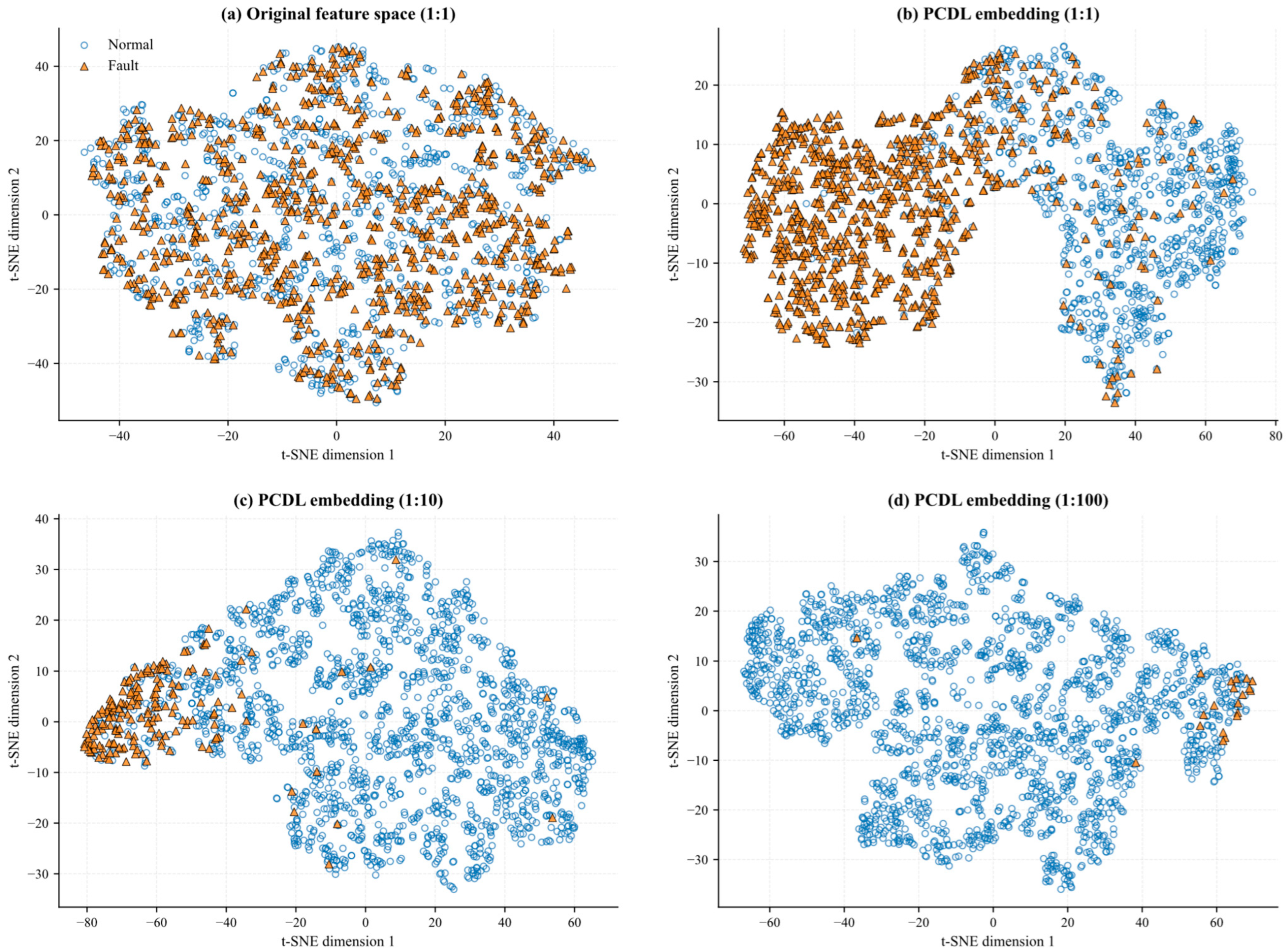
- A supervised contrastive encoder is introduced to improve intra-class compactness and inter-class separation under highly imbalanced charging data, which enhances reliable fault identification in complex charging environments.
- A parameter-free prototype-distance discrimination mechanism is proposed to replace the conventional classifier head, which reduces class-prior-induced decision bias and supports lightweight resource-efficient deployment.
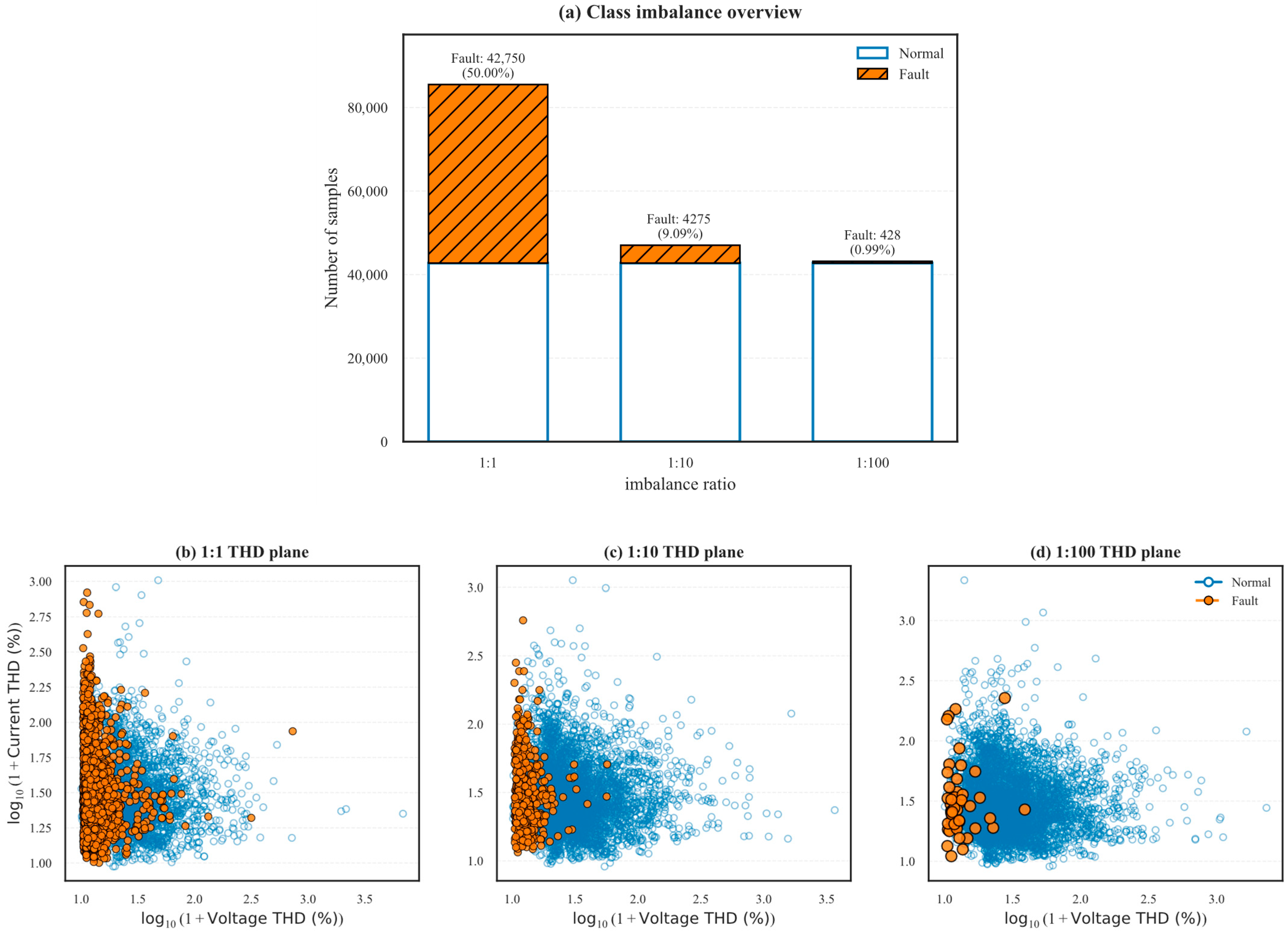
- The edge-deployment feasibility of the proposed framework is evaluated under controlled imbalance ratios, including an extreme 1:100 setting, with comparisons against representative supervised and unsupervised baselines.
3. Methodology
3.1. Problem Definition
3.2. Supervised Contrastive Encoder
3.3. Prototype-Distance Discrimination Mechanism
| Algorithm 1: Training and Inference Procedure of PCDL |
| Input: Training dataset Encoder network Batch size Temperature parameter Output: Trained encoder Class prototypes , Training Phase: 1: Initialize encoder parameters 2: for each training epoch do 3: Sample a mini-batch 4: Compute embeddings 5: Normalize embeddings 6: Compute supervised contrastive loss using Equation (4) 7: Update encoder parameters θ using gradient descent 8: end for 9: Compute class prototypes: 10: Inference Phase: 11: Given a test sample 12: Compute embedding 13: Compute distances: 14: 15: 16: Compute anomaly score: 17: 18: if then 19: Predict anomaly 20: else 21: Predict normal 22: end if |
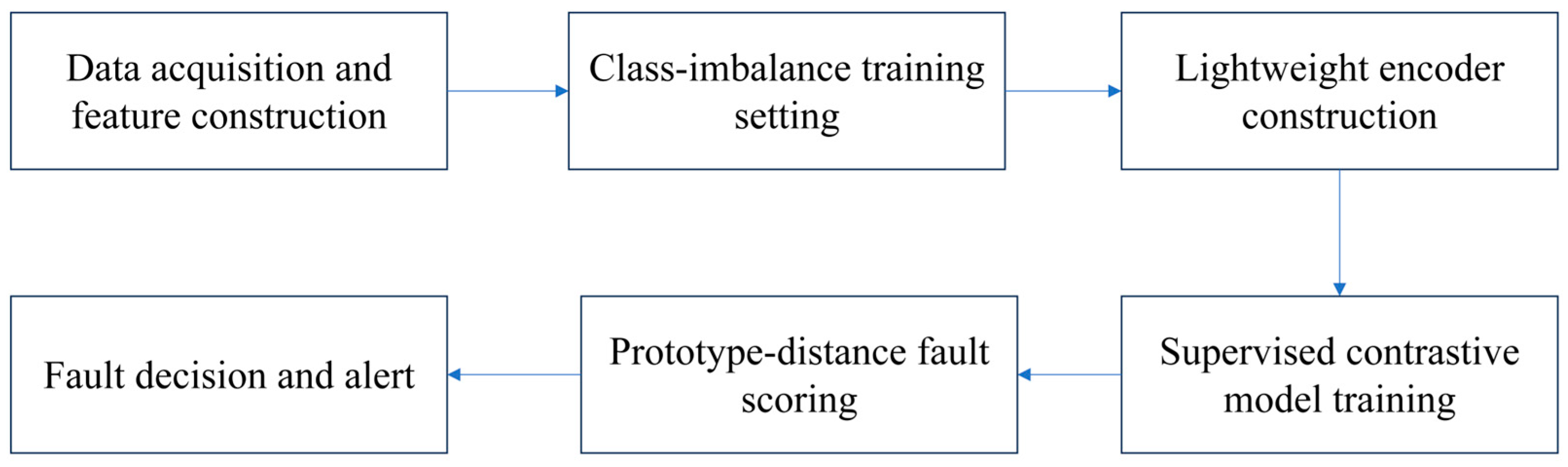
3.4. Overall Training and Inference Procedure
3.5. Computational Complexity Analysis
- (1)
- Training Complexity
- (2)
- Inference Complexity
- -
- KNN requires per query due to distance computation with all training samples.
- -
- CNN/RNN-based models involve multiple convolutional or recurrent operations, leading to higher computational overhead.
- -
- Isolation Forest requires traversal of multiple trees, resulting in complexity.
- (3)
- Memory Consumption
4. Experimental Setup
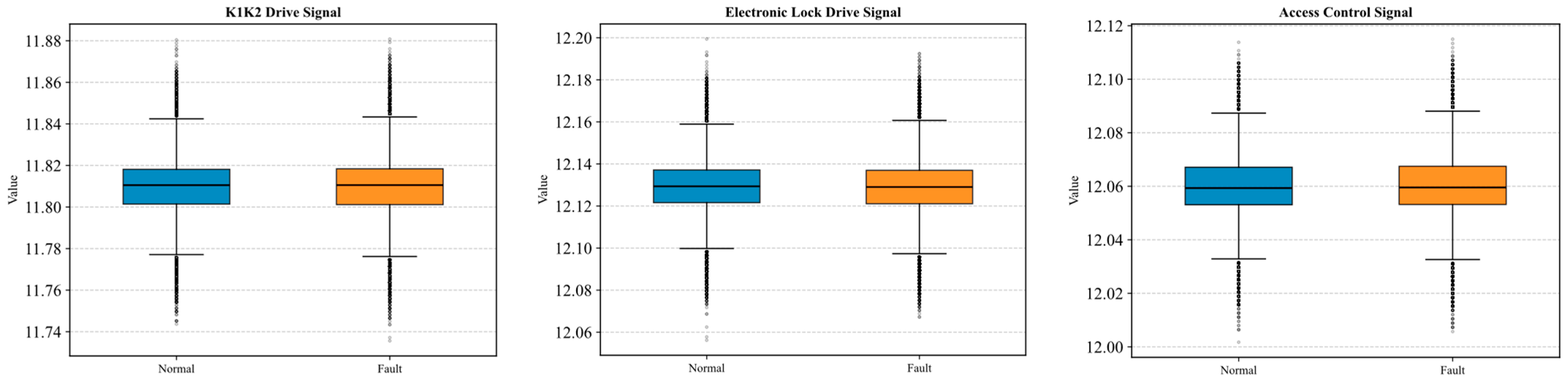
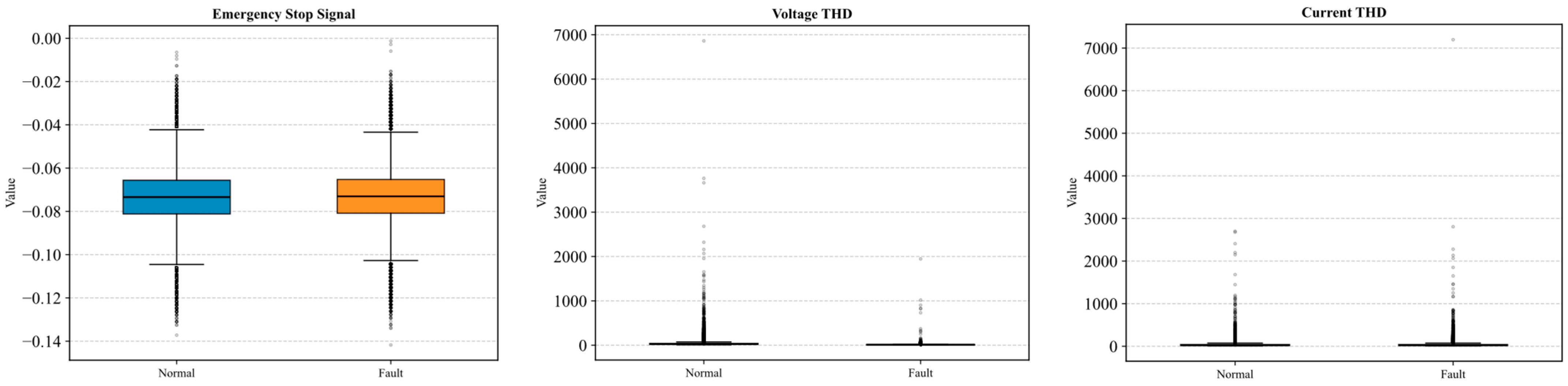
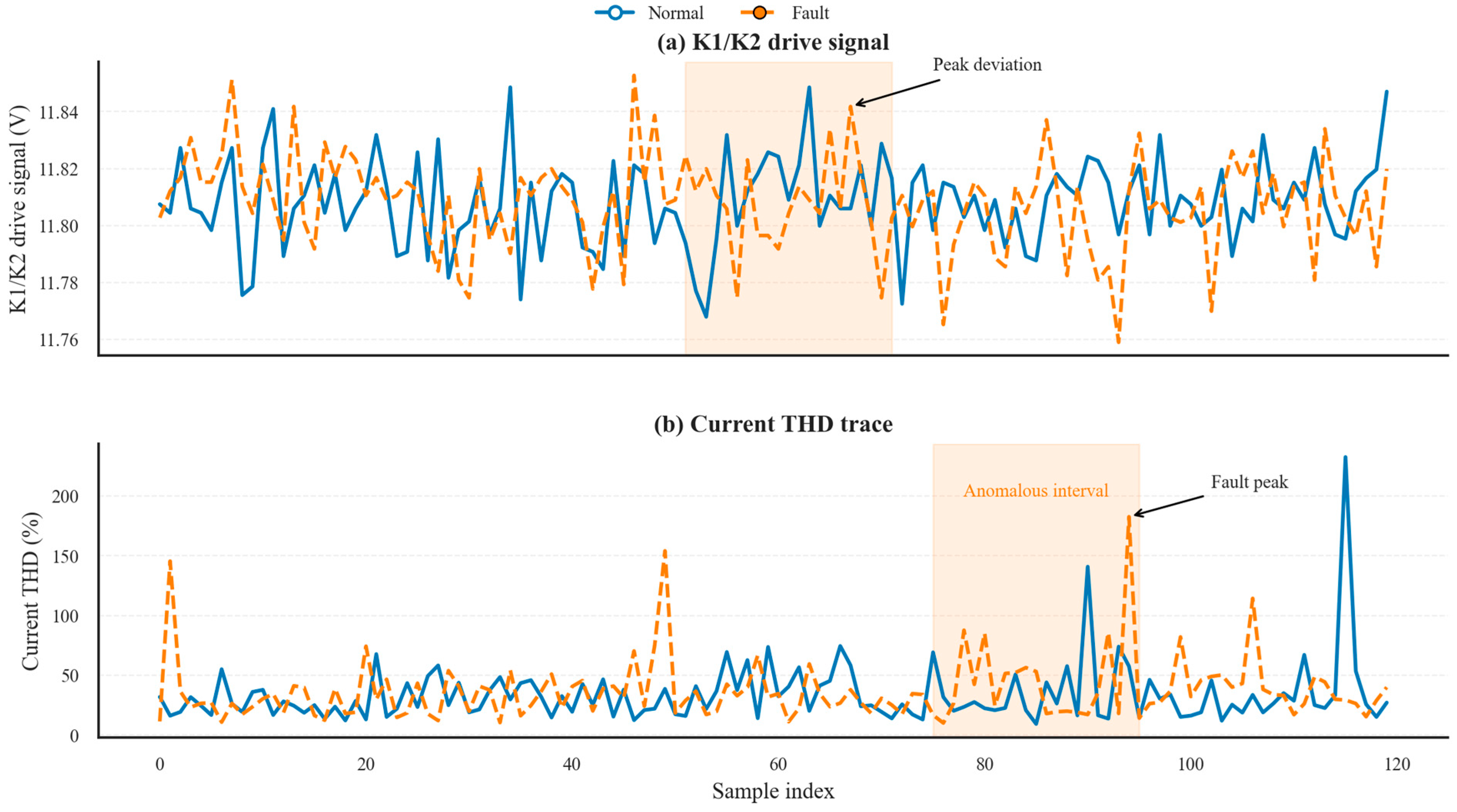
4.1. Datasets and Heterogeneous Features
4.2. Baseline Models and Implementation Settings
5. Experimental Results and Discussion
5.1. Definition of Evaluation Metrics
5.2. Detection Performance Comparison Under Varying Imbalance Degrees
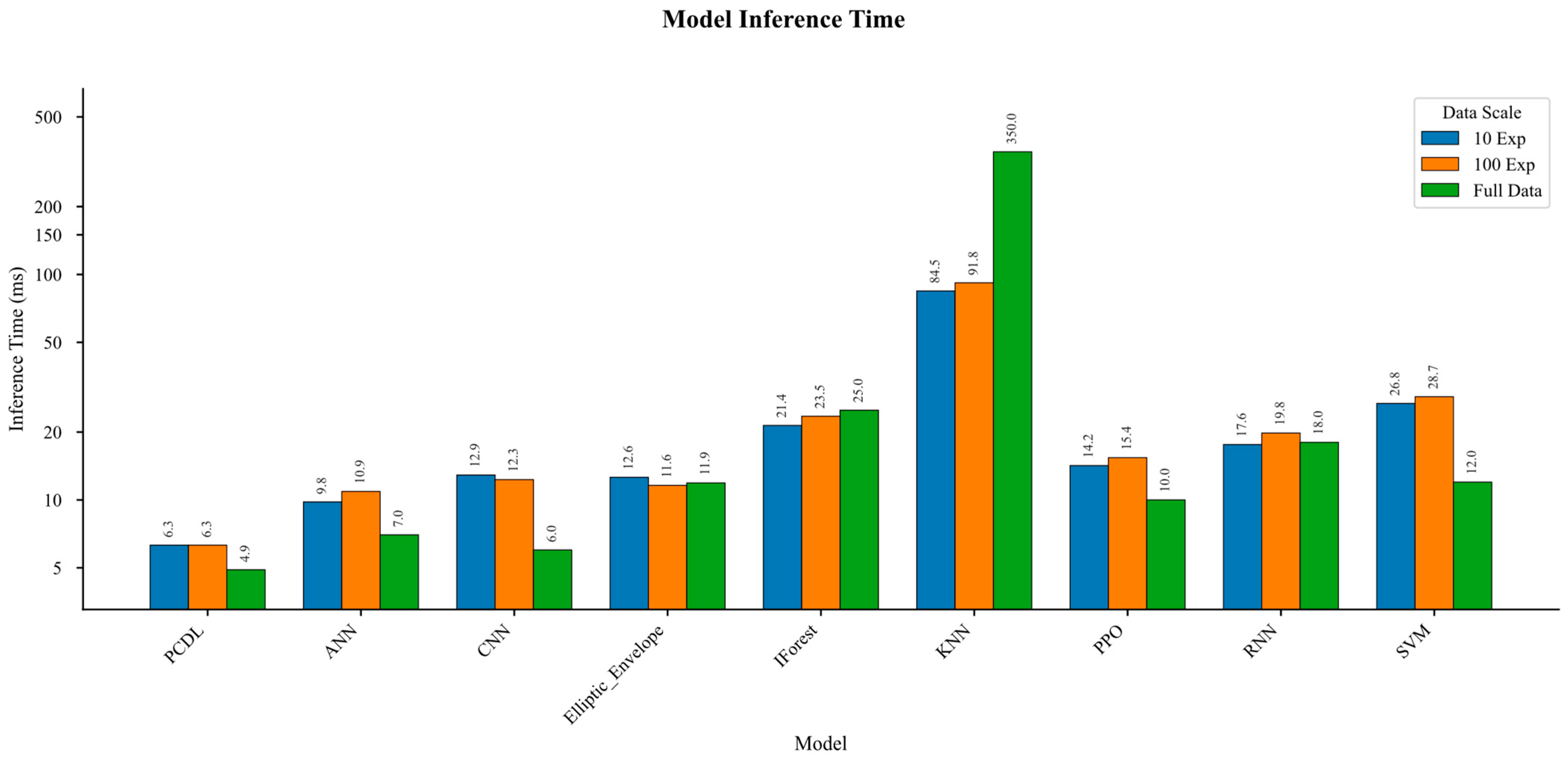
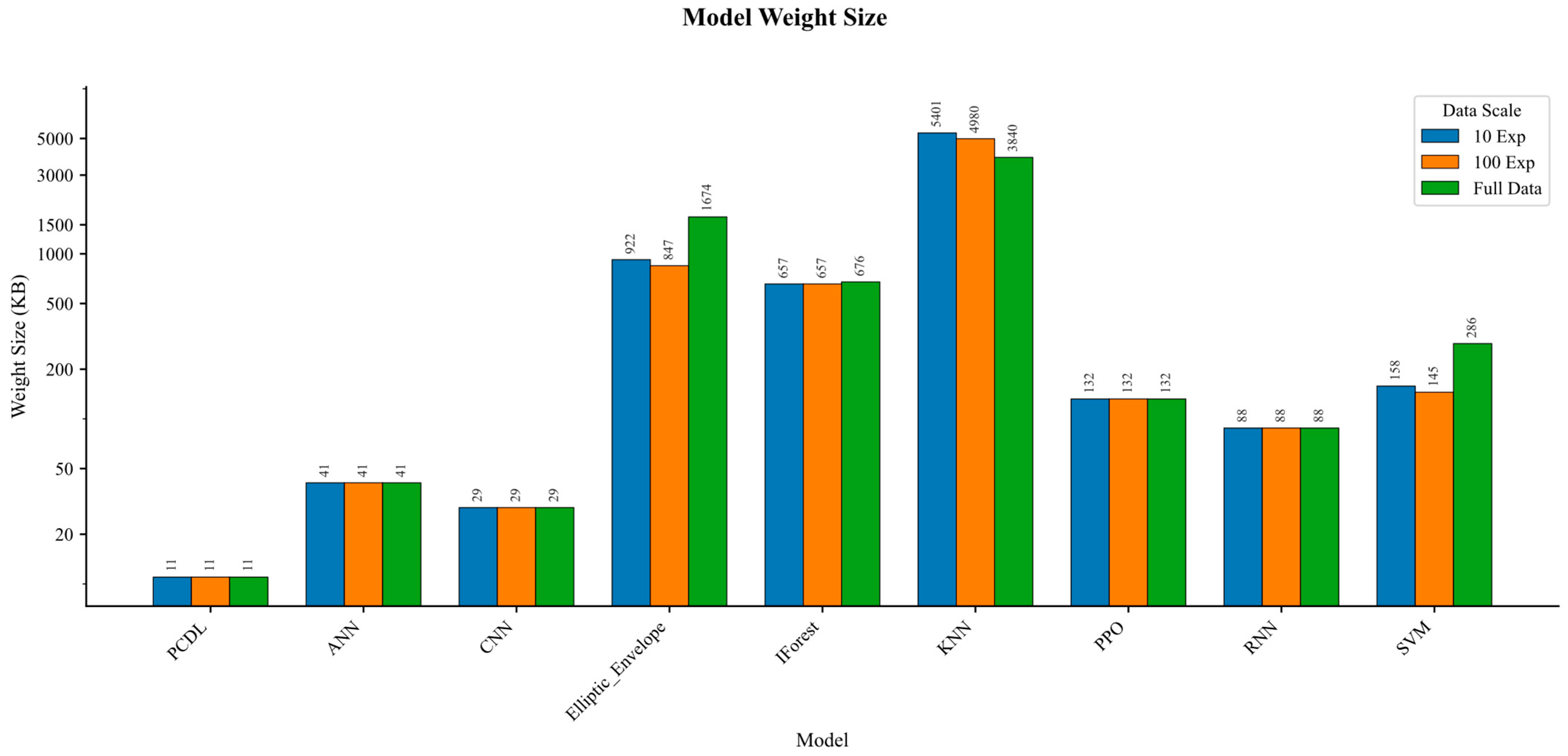
5.3. Analysis of Inference Efficiency and Model Scale
6. Conclusions
Author Contributions
Funding
Data Availability Statement
Conflicts of Interest
Abbreviations
| EV | Electric Vehicle |
| THD | Total Harmonic Distortion |
| THD_V | Voltage Total Harmonic Distortion |
| THD_I | Current Total Harmonic Distortion |
| PCDL | Proto-Contrastive Discriminative Learning |
| MLP | Multilayer Perceptron |
| IR | Imbalance Ratio |
| CPU | Central Processing Unit |
| KNN | K-Nearest Neighbors |
| ANN | Artificial Neural Network |
| CNN | Convolutional Neural Network |
| RNN | Recurrent Neural Network |
| LSTM | Long Short-Term Memory |
| PPO | Proximal Policy Optimization |
| SVM | Support Vector Machine |
| IForest | Isolation Forest |
| TP | True Positive |
| FP | False Positive |
| TN | True Negative |
| FN | False Negative |
| AC | Alternating Current |
| DC | Direct Current |
| Big-O Notation |
References
- International Energy Agency. Global EV Outlook 2025; IEA: Paris, France, 2025. [Google Scholar]
- IEC 61851-1:2017; Electric Vehicle Conductive Charging System-Part 1: General Requirements. International Electrotechnical Commission (IEC): Geneva, Switzerland, 2017.
- Powell, B.; Johnson, C. Impact of Electric Vehicle Charging Station Reliability, Resilience, and Location on Electric Vehicle Adoption; Technical Report NREL/TP-5R00-89896; National Renewable Energy Laboratory: Golden, CO, USA, 2024. [Google Scholar]
- Gernandt, H.; Severino, B.; Zhang, X.; Mehrmann, V.; Strunz, K. Port-Hamiltonian Modeling and Control of Electric Vehicle Charging Stations. arXiv 2024, arXiv:2407.10544. [Google Scholar] [CrossRef]
- Shi, H.; He, Y.; Song, S.; Zhuge, J.; Mao, J. Physical-Layer Signal Injection Attacks on EV Charging Ports: Bypassing Authentication via Electrical-Level Exploits. arXiv 2025, arXiv:2506.16400. [Google Scholar]
- Scholkopf, B.; Platt, J.C.; Shawe-Taylor, J.; Smola, A.J.; Williamson, R.C. Estimating the Support of a High-Dimensional Distribution. Neural Comput. 2001, 13, 1443–1471. [Google Scholar] [CrossRef]
- Liu, F.T.; Ting, K.M.; Zhou, Z.-H. Isolation Forest. In Proceedings of the 2008 Eighth IEEE International Conference on Data Mining, Pisa, Italy, 15–19 December 2008; pp. 413–422. [Google Scholar] [CrossRef]
- Rousseeuw, P.J.; Van Driessen, K. A Fast Algorithm for the Minimum Covariance Determinant Estimator. Technometrics 1999, 41, 212–223. [Google Scholar] [CrossRef]
- Tax, D.M.J.; Duin, R.P.W. Support Vector Data Description. Mach. Learn. 2004, 54, 45–66. [Google Scholar] [CrossRef]
- Ruff, L.; Vandermeulen, R.; Goernitz, N.; Deecke, L.; Siddiqui, S.A.; Binder, A.; Mueller, E.; Kloft, M. Deep One-Class Classification. In Proceedings of the 35th International Conference on Machine Learning, Stockholm, Sweden, 10–15 July 2018; pp. 4393–4402. [Google Scholar]
- Ji, Y.; Lee, H. Event-Based Anomaly Detection Using a One-Class SVM for a Hybrid Electric Vehicle. IEEE Trans. Veh. Technol. 2022, 71, 6032–6043. [Google Scholar] [CrossRef]
- Diao, X.; Jiang, L.; Gao, T.; Zhang, L.; Zhang, J.; Wang, L.; Wu, Q. Research on Electric Vehicle Charging Safety Warning Based on A-LSTM Algorithm. IEEE Access 2023, 11, 55081–55093. [Google Scholar] [CrossRef]
- Feng, Q.; Li, H.; Zhou, Y.; Feng, D.; Wang, Y.; Su, Y. Review of Electric Vehicles’ Charging Data Anomaly Detection Based on Deep Learning. In Proceedings of the 2022 Power System and Green Energy Conference (PSGEC), Shanghai, China, 25–27 August 2022; pp. 337–341. [Google Scholar] [CrossRef]
- Kesavan, V.T.; Hossen, M.J.; Gopi, R.; Joseph, E.R. Anomaly Detection with Grid Sentinel Framework for Electric Vehicle Charging Stations in a Smart Grid Environment. Sci. Rep. 2025, 15, 15774. [Google Scholar] [CrossRef]
- Shufian, A.; Hannan, N.; Hossain Emon, M.M.; Kabir, S.; Fattah, S.A.; Hossain, M.S. Automatic Fault Detection and Analysis of Electric Vehicle Charging Station by Machine Learning. In Proceedings of the 2024 IEEE Region 10 Symposium (TENSYMP), New Delhi, India, 27–29 September 2024; pp. 1–6. [Google Scholar] [CrossRef]
- Grcic, I.; Pandzic, H.; Sunde, V. Electric Vehicle Charging Station Fault Detection: A Machine Learning Approach. In Proceedings of the CIRED Porto Workshop 2022: E-Mobility and Power Distribution Systems, Porto, Portugal, 2–3 June 2022; pp. 745–749. [Google Scholar] [CrossRef]
- Bin Kaleem, M.; Zhou, Y.; Jiang, F.; Liu, Z.; Li, H. Fault Detection for Li-ion Batteries of Electric Vehicles with Segmented Regression Method. Sci. Rep. 2024, 14, 31922. [Google Scholar] [CrossRef]
- Hosseini, S.A.; Taheri, B.; Sadeghi, S.H.H.; Nasiri, A. A deep learning model for fault detection in distribution networks with high penetration of electric vehicle chargers. e-Prime—Advances in Electrical Engineering. Electron. Energy 2024, 10, 100845. [Google Scholar] [CrossRef]
- Ji, Y.; Gu, L.; Huang, H.; Wang, W.; Zhang, W. Research on fault prediction and management of charging station combined with deep learning model. Int. J. Low Carbon Technol. 2025, 20, 848–854. [Google Scholar] [CrossRef]
- Kamoona, A.; Song, H.; Jalili, M.; Wang, H.; Razzaghi, R.; Yu, X. Online Electric Vehicle Charging Detection Based on Memory-Based Transformer Using Smart Meter Data. Appl. Energy 2025, 398, 126353. [Google Scholar] [CrossRef]
- Liu, Z.; Wang, Y.; Wang, Q.; Hu, M. Vision Transformer-Based Anomaly Detection in Smart Grid Phasor Measurement Units Using Deep Learning Models. IEEE Access 2025, 13, 44565–44576. [Google Scholar] [CrossRef]
- Cover, T.M.; Hart, P.E. Nearest Neighbor Pattern Classification. IEEE Trans. Inf. Theory 1967, 13, 21–27. [Google Scholar] [CrossRef]
- Rumelhart, D.E.; Hinton, G.E.; Williams, R.J. Learning Representations by Back-Propagating Errors. Nature 1986, 323, 533–536. [Google Scholar] [CrossRef]
- LeCun, Y.; Bottou, L.; Bengio, Y.; Haffner, P. Gradient-Based Learning Applied to Document Recognition. Proc. IEEE 1998, 86, 2278–2324. [Google Scholar] [CrossRef]
- Hochreiter, S.; Schmidhuber, J. Long Short-Term Memory. Neural Comput. 1997, 9, 1735–1780. [Google Scholar] [CrossRef] [PubMed]
- Schulman, J.; Wolski, F.; Dhariwal, P.; Radford, A.; Klimov, O. Proximal Policy Optimization Algorithms. arXiv 2017, arXiv:1707.06347. [Google Scholar] [CrossRef]
- Chawla, N.V.; Bowyer, K.W.; Hall, L.O.; Kegelmeyer, W.P. SMOTE: Synthetic Minority Over-Sampling Technique. J. Artif. Intell. Res. 2002, 16, 321–357. [Google Scholar] [CrossRef]
- Goodfellow, I.; Pouget-Abadie, J.; Mirza, M.; Xu, B.; Warde-Farley, D.; Ozair, S.; Courville, A.; Bengio, Y. Generative Adversarial Nets. In Advances in Neural Information Processing Systems 27; Curran Associates, Inc.: Red Hook, NY, USA, 2014; pp. 2672–2680. [Google Scholar]
- Ho, J.; Jain, A.; Abbeel, P. Denoising Diffusion Probabilistic Models. In Advances in Neural Information Processing Systems 33; Curran Associates, Inc.: Red Hook, NY, USA, 2020; pp. 6840–6851. [Google Scholar]
- Lin, T.-Y.; Goyal, P.; Girshick, R.; He, K.; Dollar, P. Focal Loss for Dense Object Detection. In Proceedings of the IEEE International Conference on Computer Vision, Venice, Italy, 22–29 October 2017; pp. 2980–2988. [Google Scholar]
- Cui, Y.; Jia, M.; Lin, T.-Y.; Song, Y.; Belongie, S. Class-Balanced Loss Based on Effective Number of Samples. In Proceedings of the IEEE/CVF Conference on Computer Vision and Pattern Recognition, Long Beach, CA, USA, 16–20 June 2019; pp. 9268–9277. [Google Scholar] [CrossRef]
- Zhang, Y.; Kang, B.; Hooi, B.; Yan, S.; Feng, J. Deep Long-Tailed Learning: A Survey. IEEE Trans. Pattern Anal. Mach. Intell. 2023, 45, 10795–10816. [Google Scholar] [CrossRef]
- Chen, T.; Kornblith, S.; Norouzi, M.; Hinton, G. A Simple Framework for Contrastive Learning of Visual Representations. In Proceedings of the 37th International Conference on Machine Learning, Virtual, 13–18 July 2020; pp. 1597–1607. [Google Scholar]
- He, K.; Fan, H.; Wu, Y.; Xie, S.; Girshick, R. Momentum Contrast for Unsupervised Visual Representation Learning. In Proceedings of the IEEE/CVF Conference on Computer Vision and Pattern Recognition, Seattle, WA, USA, 13–19 June 2020; pp. 9729–9738. [Google Scholar]
- Khosla, P.; Teterwak, P.; Wang, C.; Sarna, A.; Tian, Y.; Isola, P.; Maschinot, A.; Liu, C.; Krishnan, D. Supervised Contrastive Learning. In Advances in Neural Information Processing Systems 33; Curran Associates, Inc.: Red Hook, NY, USA, 2020; pp. 18661–18673. [Google Scholar]
- Wang, T.; Isola, P. Understanding Contrastive Representation Learning through Alignment and Uniformity on the Hypersphere. In Proceedings of the 37th International Conference on Machine Learning, Virtual, 13–18 July 2020; pp. 9929–9939. [Google Scholar]
- Jin, X.; Wang, J.; Ou, X.; Liu, L.; Lin, Y. Time-Series Contrastive Learning Against False Negatives and Class Imbalance. IEEE Trans. Neural Netw. Learn. Syst. 2025, 36, 16946–16959. [Google Scholar] [CrossRef]
- Peng, P.; Lu, J.; Xie, T.; Tao, S.; Wang, H.; Zhang, H. Open-Set Fault Diagnosis via Supervised Contrastive Learning with Negative Out-of-Distribution Data Augmentation. IEEE Trans. Ind. Inform. 2023, 19, 2463–2473. [Google Scholar] [CrossRef]
- Chang, X.; Zhai, J.; Qiu, S.; Sun, Z. Rebalanced Supervised Contrastive Learning with Prototypes for Long-Tailed Visual Recognition. Comput. Vis. Image Underst. 2025, 252, 104291. [Google Scholar] [CrossRef]
- Snell, J.; Swersky, K.; Zemel, R.S. Prototypical Networks for Few-Shot Learning. In Advances in Neural Information Processing Systems 30; Curran Associates, Inc.: Red Hook, NY, USA, 2017; pp. 4077–4087. [Google Scholar]
- Wan, X.; Cen, L.; Chen, X.; Xie, Y.; Gui, W. Multiview Shapelet Prototypical Network for Few-Shot Fault Incremental Learning. IEEE Trans. Ind. Inform. 2024, 20, 11751–11762. [Google Scholar] [CrossRef]
- Warden, P.; Situnayake, D. TinyML: Machine Learning with TensorFlow Lite on Arduino and Ultra-Low-Power Microcontrollers; O’Reilly Media: Sebastopol, CA, USA, 2019. [Google Scholar]
- Han, S.; Mao, H.; Dally, W.J. Deep Compression: Compressing Deep Neural Networks with Pruning, Trained Quantization and Huffman Coding. In Proceedings of the International Conference on Learning Representations, San Juan, Puerto Rico, 2–4 May 2016. [Google Scholar]
- Dehrouyeh, F.; Shaer, I.; Nikan, S.; Ajaei, F.B.; Shami, A. Pruning-Based TinyML Optimization of Machine Learning Models for Anomaly Detection in Electric Vehicle Charging Infrastructure. In Proceedings of the ICC 2025-IEEE International Conference on Communications, Montreal, QC, Canada, 8–12 June 2025; pp. 1195–1200. [Google Scholar] [CrossRef]
- Sajun, A.R.; Shapsough, S.; Zualkernan, I.; Dhaouadi, R. Edge-Based Individualized Anomaly Detection in Large-Scale Distributed Solar Farms. ICT Express 2022, 8, 174–178. [Google Scholar] [CrossRef]
- McMahan, H.B.; Moore, E.; Ramage, D.; Hampson, S.; y Arcas, B.A. Communication-Efficient Learning of Deep Networks from Decentralized Data. In Proceedings of the 20th International Conference on Artificial Intelligence and Statistics, Fort Lauderdale, FL, USA, 20–22 April 2017; pp. 1273–1282. [Google Scholar]
- Hinton, G.; Vinyals, O.; Dean, J. Distilling the Knowledge in a Neural Network. arXiv 2015, arXiv:1503.02531. [Google Scholar] [CrossRef]
- He, H.; Garcia, E.A. Learning from Imbalanced Data. IEEE Trans. Knowl. Data Eng. 2009, 21, 1263–1284. [Google Scholar] [CrossRef]



| Category | Representative References | Main Idea | Advantages | Limitations for This Task |
|---|---|---|---|---|
| Heterogeneous fault sources in EV charging systems | [12,13,14,15,16,17] | Electromechanical parts (contactors, electronic locks) → discrete control signal faults (contact wear, jamming); Power converters (AC/DC, DC/DC) → continuous THD degradation (aging, drift); Protection/safety circuits (e-stop, access control) → discrete logic inconsistency; Sensing/communication → noisy/delayed measurements. | Clarifies why raw features (discrete + continuous) overlap severely under real-world conditions. | Requires representation learning to disentangle mixed signals; rare faults exacerbate class imbalance. |
| Unsupervised boundary or density methods | [6,7,8,9,10,11] | Estimate normal support, isolate anomalous samples, or fit robust statistical boundaries. | Can operate with few or nofault labels; simple and interpretable. | May produce false alarms when normal charging behavior is multimodal; cannot fully exploit scarce labeled faults. |
| Recent optimized sequence models | [18,19] | Use deep sequence models, such as Bi-LSTM and PSO-optimized Bi-LSTM, to learn temporal fault evolution from multi-dimensional charging or distribution-network data. | Strong ability to capture temporal dependencies in voltage, current, temperature, and other streaming signals; reported high diagnostic performance in recent EV charging-related studies. | Usually require continuous time-series inputs and recurrent-model training; reported results are based on different datasets and are not directly comparable with the fixed-feature, prototype-based rare-fault setting of this study. |
| Classical and deep supervised baselines | [22,23,24,25,26] | Learn a direct mapping from features or sequences to labels using KNN, ANN, CNN, LSTM, or policy-based models. | Strong pattern extraction under balanced or moderately imbalanced data. | Decision boundaries are dominated by normal samples under long-tailed distributions; classifier heads can be biased. |
| Imbalance-aware learning | [27,30,31] | Use resampling, re-weighting, or hard-example-focused losses to increase minority influence. | Simple to combine with existing classifiers; improves minority sensitivity in many tasks. | Synthetic samples or weighting factors may be difficult to tune for scarce heterogeneous charging faults. |
| Contrastive representation learning | [33,34,35,36,37,38,39] | Pull samples of the same class closer and push different classes apart in an embedding space. | Improves representation separability and can reduce raw-space overlap. | Often still relies on a downstream classifier head; EV charging heterogeneous features remain underexplored. |
| Prototype-based learning | [40,41] | Represent each class with a prototype and classify by distance in embedding space. | Classifier-free, interpretable, and parameter-efficient. | Requires a well-structured embedding space; rarely combined with supervised contrastive learning for EVCS anomaly detection. |
| Edge/TinyML methods | [42,43,44,45,46,47] | Compress, prune, distill, or distribute models for low-latency and low-memory deployment. | Supports real-time local diagnosis and privacy-preserving deployment. | Deployment optimization alone does not solve rare-fault representation under severe imbalance. |
| PCDL (ours) | This work | Supervised contrastive encoder plus prototype-distance discrimination for heterogeneous EVCS features. | Combines separable representation learning, classifier-free decision geometry, interpretability, and lightweight inference. | Requires at least a small number of labeled abnormal samples to form the fault prototype. |
| Strategy | Typical Methods | Strengths | Weaknesses | Relevance to PCDL |
|---|---|---|---|---|
| Data-level balancing | SMOTE and related oversampling [27]; generative augmentation [28,29] | Increases minority samples and can be used with many classifiers. | May create unrealistic samples when fault modes are sparse or physically discontinuous. | PCDL avoids synthetic fault generation and directly structures the embedding space. |
| Loss re-weighting and hard-example mining | Focal loss [30]; class-balanced loss [31] | Easy to implement; emphasizes rare or hard samples. | Requires hyperparameter tuning and still depends on a classifier head. | PCDL uses contrastive supervision and prototype-distance scoring rather than class-frequency weights. |
| Self-supervised contrastive learning | SimCLR [33]; MoCo [34] | Learns useful representations without labels. | False negatives and class imbalance can degrade embeddings in time-series settings. | PCDL uses labels during training to define reliable positive and negative pairs. |
| Supervised contrastive learning | SupCon [35]; time-series and fault-diagnosis variants [37,38] | Improves intra-class compactness and inter-class separation. | Often followed by a parametric classifier that may reintroduce bias. | PCDL retains the contrastive encoder but removes the classifier head. |
| Prototype-based metric learning | Prototypical networks [40]; shapelet prototypes [41] | Interpretable, simple, and suitable for few-shot settings. | Performance depends on the quality of the learned embedding space. | PCDL combines prototypes with supervised contrastive pre-training. |
| Edge-oriented optimization | TinyML, compression, pruning, distillation, and federated learning [42,43,44,45,46,47] | Reduces memory and latency; supports local deployment. | Does not automatically improve robustness to rare faults. | PCDL is designed to be lightweight at inference while preserving rare-fault separability. |
| Symbol | Definition |
|---|---|
| Total number of training samples | |
| Input feature dimension | |
| Embedding dimension generated by the encoder | |
| Mini-batch size during contrastive training | |
| Number of classes; in this binary anomaly-detection task | |
| Trainable parameters of the encoder | |
| Lightweight MLP encoder | |
| Normalized embedding vector of sample | |
| Prototype vector of class in the embedding space | |
| K | Number of nearest neighbors used in KNN |
| Number of trees used in Isolation Forest | |
| Average tree depth in Isolation Forest |
| Method | Settings |
|---|---|
| One-Class SVM | Kernel = RBF; Fit on mixed |
| KNN | |
| IForest | Contamination = 0.05; Random state = 42; Fit on mixed |
| ANN | Input (6) Dense (32) Dense (16) Dense (1) |
| RNN (LSTM) | Input (1, 6) LSTM (32) Dense (1) |
| CNN (1D) | Input (6, 1) Conv1D (32, kernel = 3) Dense (1) |
| PPO | Base = SVM + KNN + ANN; State = Action = Reward = Batch = 64; lr = Test = freeze |
| PCDL (Ours) | Encoder: 6 64 16; emb = 16; Batch = 512; lr = |
| Model | Data Ratio | Accuracy | Precision | Recall | F1-Score | Detected Anomalies |
|---|---|---|---|---|---|---|
| ANN | 1:1 | 0.8870 | 0.9174 | 0.8506 | 0.8827 | 16,987 |
| 1:10 | 0.8579 | 0.9534 | 0.7526 | 0.8412 | 14,463 | |
| 1:100 | 0.5644 | 0.9913 | 0.1299 | 0.2296 | 2400 | |
| CNN | 1:1 | 0.8891 | 0.8956 | 0.8808 | 0.8882 | 18,019 |
| 1:10 | 0.7703 | 0.9744 | 0.5552 | 0.7073 | 10,438 | |
| 1:100 | 0.4999 | 0.2500 | 0.0001 | 0.0002 | 8 | |
| Elliptic_ Envelope | 1:1 | 0.6284 | 0.5795 | 0.9360 | 0.7158 | 29,593 |
| 1:10 | 0.5066 | 0.5068 | 0.4969 | 0.5018 | 17,965 | |
| 1:100 | 0.5092 | 0.5136 | 0.3462 | 0.4136 | 12,349 | |
| IForest | 1:1 | 0.5198 | 0.5104 | 0.9674 | 0.6683 | 34,724 |
| 1:10 | 0.5034 | 0.5018 | 0.9556 | 0.6580 | 34,891 | |
| 1:100 | 0.4970 | 0.4984 | 0.9439 | 0.6524 | 34,695 | |
| KNN | 1:1 | 0.8850 | 0.8899 | 0.8786 | 0.8842 | 18,088 |
| 1:10 | 0.8101 | 0.9698 | 0.6401 | 0.7712 | 12,092 | |
| 1:100 | 0.5987 | 0.9926 | 0.1988 | 0.3312 | 3669 | |
| PPO | 1:1 | 0.5246 | 0.5127 | 0.9953 | 0.6767 | 35,568 |
| 1:10 | 0.8049 | 0.9736 | 0.6268 | 0.7627 | 11,795 | |
| 1:100 | 0.5395 | 0.9979 | 0.0792 | 0.1468 | 1454 | |
| RNN | 1:1 | 0.8898 | 0.8987 | 0.8787 | 0.8886 | 17,913 |
| 1:10 | 0.7937 | 0.9748 | 0.6029 | 0.7450 | 11,331 | |
| 1:100 | 0.5237 | 0.9943 | 0.0477 | 0.0910 | 879 | |
| SVM | 1:1 | 0.5026 | 0.5014 | 0.9508 | 0.6565 | 34,745 |
| 1:10 | 0.4535 | 0.4745 | 0.8647 | 0.6128 | 33,389 | |
| 1:100 | 0.4066 | 0.4457 | 0.7666 | 0.5636 | 31,512 | |
| PCDL | 1:1 | 0.8892 | 0.8865 | 0.8928 | 0.8896 | 18,285 |
| 1:10 | 0.8825 | 0.9077 | 0.8515 | 0.8787 | 17,187 | |
| 1:100 | 0.8483 | 0.8782 | 0.8088 | 0.8421 | 16,874 |
Disclaimer/Publisher’s Note: The statements, opinions and data contained in all publications are solely those of the individual author(s) and contributor(s) and not of MDPI and/or the editor(s). MDPI and/or the editor(s) disclaim responsibility for any injury to people or property resulting from any ideas, methods, instructions or products referred to in the content. |
© 2026 by the authors. Licensee MDPI, Basel, Switzerland. This article is an open access article distributed under the terms and conditions of the Creative Commons Attribution (CC BY) license.
Share and Cite
Lei, Z.; Xing, B.; Liu, J.; Yang, Y.; Miao, T.; Lu, Y. Sustainable and Reliable Operation of EV Charging Infrastructure: A Lightweight Prototype-Driven Contrastive Learning Framework for Fault Diagnosis Under Class-Imbalanced Conditions. Sustainability 2026, 18, 5783. https://doi.org/10.3390/su18115783
Lei Z, Xing B, Liu J, Yang Y, Miao T, Lu Y. Sustainable and Reliable Operation of EV Charging Infrastructure: A Lightweight Prototype-Driven Contrastive Learning Framework for Fault Diagnosis Under Class-Imbalanced Conditions. Sustainability. 2026; 18(11):5783. https://doi.org/10.3390/su18115783
Chicago/Turabian StyleLei, Zhengyu, Baowen Xing, Jingrui Liu, Yuxin Yang, Tianyuan Miao, and Yingjie Lu. 2026. "Sustainable and Reliable Operation of EV Charging Infrastructure: A Lightweight Prototype-Driven Contrastive Learning Framework for Fault Diagnosis Under Class-Imbalanced Conditions" Sustainability 18, no. 11: 5783. https://doi.org/10.3390/su18115783
APA StyleLei, Z., Xing, B., Liu, J., Yang, Y., Miao, T., & Lu, Y. (2026). Sustainable and Reliable Operation of EV Charging Infrastructure: A Lightweight Prototype-Driven Contrastive Learning Framework for Fault Diagnosis Under Class-Imbalanced Conditions. Sustainability, 18(11), 5783. https://doi.org/10.3390/su18115783