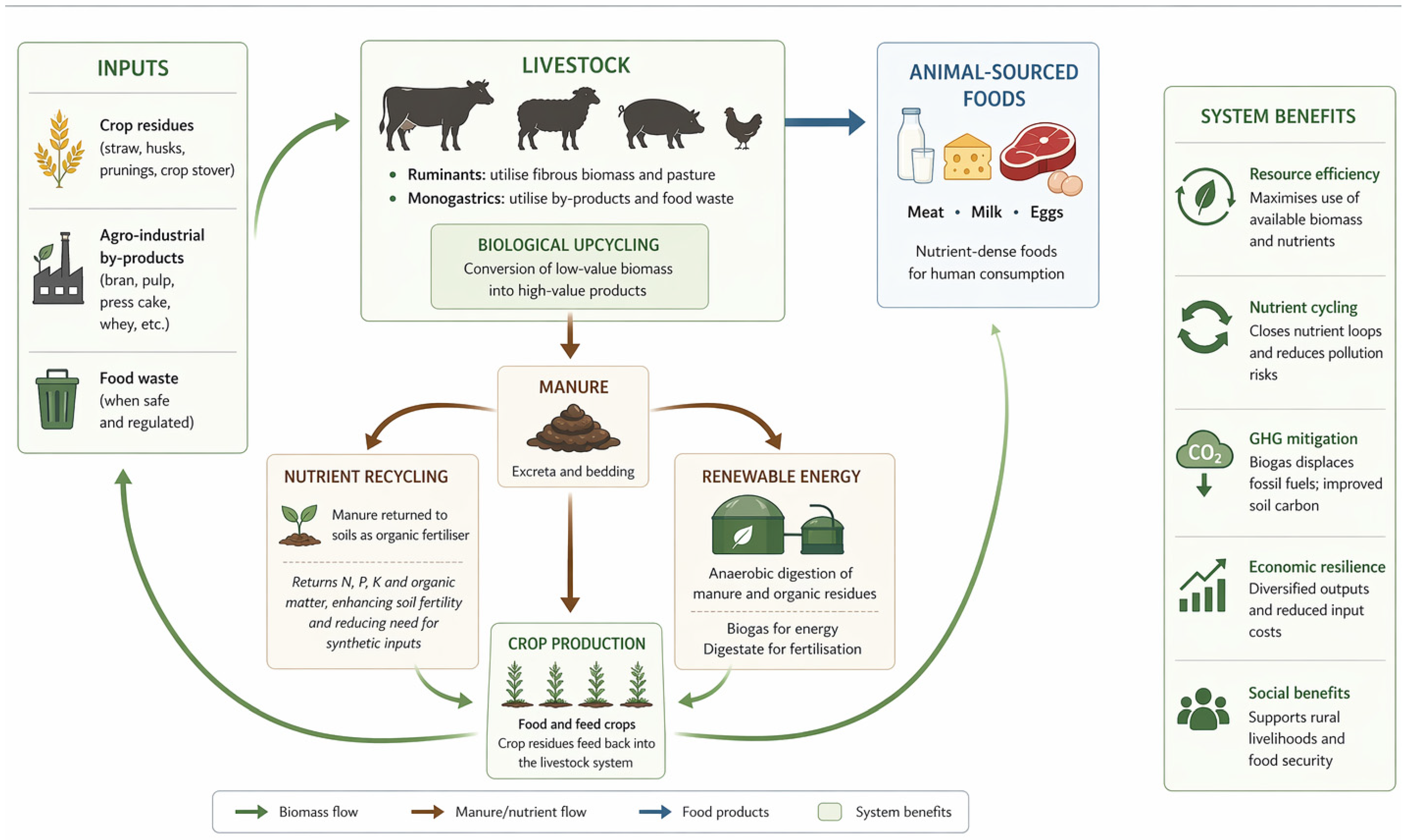
The Role of Livestock in Circular Agriculture and Waste Valorisation




Abstract
1. Introduction
2. Concept of Circular Agriculture
3. Role of Livestock in Circular Systems
4. Livestock as Biological Upcyclers
5. Waste Valorisation Pathways in Livestock Systems
5.1. Agro-Industrial By-Products in Feed
5.2. Food Waste Recycling
5.3. Manure Management and Nutrient Recycling
5.4. Energy Recovery
5.5. Integrated Waste Valorisation Systems
5.6. Challenges and Considerations
6. Economic and Social Implications
6.1. Economic Benefits of Circular Livestock Systems
6.2. Rural Development and Employment
6.3. Policy and Institutional Support
6.4. Challenges and Limitations
6.5. Social Acceptance and Perception
7. Discussion
8. Future Perspectives and Innovations
9. Conclusions
Author Contributions
Funding
Institutional Review Board Statement
Informed Consent Statement
Data Availability Statement
Acknowledgments
Conflicts of Interest
References
- Food and Agriculture Organization of the United Nations. The State of Food and Agriculture 2022: Leveraging Automation in Agriculture for Transforming Agrifood Systems; Food and Agriculture Organization of the United Nations: Rome, Italy, 2022. [Google Scholar]
- Willett, W.; Rockström, J.; Loken, B.; Springmann, M.; Lang, T.; Vermeulen, S.; Garnett, T.; Tilman, D.; DeClerck, F.; Wood, A.; et al. Food in the Anthropocene: The EAT–Lancet Commission on Healthy Diets from Sustainable Food Systems. Lancet 2019, 393, 447–492. [Google Scholar] [CrossRef]
- European Commission. A New Circular Economy Action Plan for a Cleaner and More Competitive Europe; European Commission: Brussels, Belgium, 2020; pp. 1–20. [Google Scholar]
- Parodi, A.; Valencia-Salazar, S.; Loboguerrero, A.M.; Martínez-Barón, D.; Murgueitio, E.; Vázquez-Rowe, I. The Sustainable Transformation of the Colombian Cattle Sector: Assessing Its Circularity. PLoS Clim. 2022, 1, e0000074. [Google Scholar] [CrossRef]
- Uwizeye, A.; de Boer, I.J.M.; Opio, C.I.; Schulte, R.P.O.; Falcucci, A.; Tempio, G.; Teillard, F.; Casu, F.; Rulli, M.; Galloway, J.N.; et al. Nitrogen Emissions along Global Livestock Supply Chains. Nat. Food 2020, 1, 437–446. [Google Scholar] [CrossRef]
- Poore, J.; Nemecek, T. Reducing Food’s Environmental Impacts through Producers and Consumers. Science 2018, 360, 987–992. [Google Scholar] [CrossRef]
- Jurgilevich, A.; Birge, T.; Kentala-Lehtonen, J.; Korhonen-Kurki, K.; Pietikäinen, J.; Saikku, L.; Schösler, H. Transition towards Circular Economy in the Food System. Sustainability 2016, 8, 69. [Google Scholar] [CrossRef]
- Velasco-Muñoz, J.F.; Mendoza, J.M.F.; Aznar-Sánchez, J.A.; Gallego-Schmid, A. Circular economy implementation in the agricultural sector: Definition, strategies and indicators. Resour. Conserv. Recycl. 2021, 170, 105618. [Google Scholar] [CrossRef]
- Mottet, A.; de Haan, C.; Falcucci, A.; Tempio, G.; Opio, C.; Gerber, P. Livestock: On Our Plates or Eating at Our Table? A New Analysis of the Feed/Food Debate. Glob. Food Sec. 2017, 14, 1–8. [Google Scholar] [CrossRef]
- Wilkinson, J.M. Re-Defining Efficiency of Feed Use by Livestock. Animal 2011, 5, 1014–1022. [Google Scholar] [CrossRef]
- Van Kernebeek, H.R.J.; Oosting, S.J.; Van Ittersum, M.K.; Bikker, P.; De Boer, I.J.M. Saving Land to Feed a Growing Population: Consequences for Consumption of Crop and Livestock Products. Int. J. Life Cycle Assess. 2016, 21, 677–687. [Google Scholar] [CrossRef]
- Russelle, M.P.; Entz, M.H.; Franzluebbers, A.J. Reconsidering Integrated Crop–Livestock Systems in North America. Agron. J. 2007, 99, 325–334. [Google Scholar] [CrossRef]
- Bonaudo, T.; Bendahan, A.B.; Sabatier, R.; Ryschawy, J.; Bellon, S.; Leger, F.; Magda, D.; Tichit, M. Agroecological Principles for the Redesign of Integrated Crop–Livestock Systems. Eur. J. Agron. 2014, 57, 43–51. [Google Scholar] [CrossRef]
- Billen, G.; Lassaletta, L.; Garnier, J. A Biogeochemical View of the Global Agro-Food System: Nitrogen Flows Associated with Protein Production, Consumption and Trade. Glob. Food Sec. 2014, 3, 209–219. [Google Scholar] [CrossRef]
- Boerger, V.; Bojic, D.; Bosc, P.; Clark, M.; Dale, D.; England, M.; Hoogeveen, J.; Koo-Oshima, S.; Mejias Moreno, P.; Muchoney, D. The State of the World’s Land and Water Resources for Food and Agriculture–Systems at Breaking Point; Synthesis Report 2021; Food and Agriculture Organization of the United Nations: Rome, Italy, 2021. [Google Scholar]
- Zhang, X.; Davidson, E.A.; Mauzerall, D.L.; Searchinger, T.D.; Dumas, P.; Shen, Y. Managing Nitrogen for Sustainable Development. Nature 2015, 528, 51–59. [Google Scholar] [CrossRef] [PubMed]
- Van Hal, O.; De Boer, I.J.M.; Muller, A.; De Vries, S.; Erb, K.-H.; Schader, C.; Gerrits, W.J.J.; Van Zanten, H.H.E. Upcycling Food Leftovers and Grass Resources through Livestock: Impact of Livestock System and Productivity. J. Clean. Prod. 2019, 219, 485–496. [Google Scholar] [CrossRef]
- Schader, C.; Muller, A.; Scialabba, N.E.-H.; Hecht, J.; Isensee, A.; Erb, K.-H.; Smith, P.; Makkar, H.P.S.; Klocke, P.; Leiber, F. Impacts of Feeding Less Food-Competing Feedstuffs to Livestock on Global Food System Sustainability. J. R. Soc. Interface 2015, 12, 20150891. [Google Scholar] [CrossRef] [PubMed]
- Shepon, A.; Eshel, G.; Noor, E.; Milo, R. The Opportunity Cost of Animal Based Diets Exceeds All Food Losses. Proc. Natl. Acad. Sci. USA 2018, 115, 3804–3809. [Google Scholar] [CrossRef] [PubMed]
- Cassidy, E.S.; West, P.C.; Gerber, J.S.; Foley, J.A. Redefining Agricultural Yields: From Tonnes to People Nourished per Hectare. Environ. Res. Lett. 2013, 8, 034015. [Google Scholar] [CrossRef]
- zu Ermgassen, E.K.H.J.; Phalan, B.; Green, R.E.; Balmford, A. Reducing the Land Use of EU Pork Production: Where There’s Swill, There’s a Way. Food Policy 2016, 58, 35–48. [Google Scholar] [CrossRef]
- Mirabella, N.; Castellani, V.; Sala, S. Current Options for the Valorization of Food Manufacturing Waste: A Review. J. Clean. Prod. 2014, 65, 28–41. [Google Scholar] [CrossRef]
- Salemdeeb, R.; Zu Ermgassen, E.K.H.J.; Kim, M.H.; Balmford, A.; Al-Tabbaa, A. Environmental and Health Impacts of Using Food Waste as Animal Feed: A Comparative Analysis of Food Waste Management Options. J. Clean. Prod. 2017, 140, 871–880. [Google Scholar] [CrossRef]
- Food and Agriculture Organization of the United Nations. World Livestock: Transforming the Livestock Sector through the Sustainable Development Goals. In World livestock: Transforming the Livestock Sector Through the Sustainable Development Goals; Food and Agriculture Organization of the United Nations: Rome, Italy, 2018; ISBN 9251308837. [Google Scholar]
- Dou, Z.; Toth, J.D.; Westendorf, M.L. Food Waste for Livestock Feeding: Feasibility, Safety, and Sustainability Implications. Glob. Food Secur. 2018, 17, 154–161. [Google Scholar] [CrossRef]
- Makkar, H.P.S. Feed Demand Landscape and Implications of Food-Not Feed Strategy for Food Security and Climate Change. Animal 2018, 12, 1744–1754. [Google Scholar] [CrossRef]
- Holm-Nielsen, J.B.; Al Seadi, T.; Oleskowicz-Popiel, P. The Future of Anaerobic Digestion and Biogas Utilization. Bioresour. Technol. 2009, 100, 5478–5484. [Google Scholar] [CrossRef]
- Scarlat, N.; Dallemand, J.-F.; Fahl, F. Biogas: Developments and Perspectives in Europe. Renew. Energy 2018, 129, 457–472. [Google Scholar] [CrossRef]
- Crippa, M.; Solazzo, E.; Guizzardi, D.; Monforti-Ferrario, F.; Tubiello, F.N.; Leip, A. Food Systems Are Responsible for a Third of Global Anthropogenic GHG Emissions. Nat. Food 2021, 2, 198–209. [Google Scholar] [CrossRef] [PubMed]
- Tubiello, F.N.; Rosenzweig, C.; Conchedda, G.; Karl, K.; Gütschow, J.; Xueyao, P.; Obli-Laryea, G.; Wanner, N.; Qiu, S.Y.; Barros, J. De Greenhouse Gas Emissions from Food Systems: Building the Evidence Base. Environ. Res. Lett. 2021, 16, 065007. [Google Scholar] [CrossRef]
- Gerber, P.J.; Steinfeld, H.; Henderson, B.; Mottet, A.; Opio, C.; Dijkman, J.; Falcucci, A.; Tempio, G. Tackling Climate Change Through Livestock: A Global Assessment of Emissions and Mitigation Opportunities; Food and Agriculture Organization of the United Nations: Rome, Italy, 2013; ISBN 925107920X. [Google Scholar]
- Hayek, M.N.; Harwatt, H.; Ripple, W.J.; Mueller, N.D. The Carbon Opportunity Cost of Animal-Sourced Food Production on Land. Nat. Sustain. 2021, 4, 21–24. [Google Scholar] [CrossRef]
- Change, I.C. Mitigation of Climate Change, Contribution of Working Group III to the Fifth Assessment Report of the Intergovernmental Panel on Climate Change; Cambridge University Press: Cambridge, UK, 2014; Volume 1454, p. 147. [Google Scholar]
- European Commission. Farm to Fork Strategy: For a Fair, Healthy and Environmentally-Friendly Food System, Communication from the Commission to the European Parliament, the Council, the European Economic and Social Committee and the Committee of the Regions; Food and Agriculture Organization of the United Nations: Rome, Italy, 2020; Volume 381, pp. 1–9. [Google Scholar]
- Commission, E.-E. The European Green Deal; Brussels European Commission: Brussels, Belgium, 2019. [Google Scholar]
- Volkov, A.; Morkūnas, M. Uneven Transitions Toward Circular Agriculture in the EU: Regulatory Drivers, Structural Barriers, and the Role of Policy Implementation Heterogeneity. Sustainability 2025, 18, 379. [Google Scholar] [CrossRef]
- Riccaboni, A.; Neri, E.; Trovarelli, F.; Pulselli, R.M. Sustainability-Oriented Research and Innovation in ‘Farm to Fork’ Value Chains. Curr. Opin. Food Sci. 2021, 42, 102–112. [Google Scholar] [CrossRef]
- Pinotti, L.; Luciano, A.; Ottoboni, M.; Manoni, M.; Ferrari, L.; Marchis, D.; Tretola, M. Recycling Food Leftovers in Feed as Opportunity to Increase the Sustainability of Livestock Production. J. Clean. Prod. 2021, 294, 126290. [Google Scholar] [CrossRef]
- Westendorf, M.L. Food Waste as Animal Feed: An Introduction. In Food Waste to Animal Feed; Wiley: Hoboken, NJ, USA, 2000; pp. 3–16. [Google Scholar]
- Meyer-Aurich, A.; Schattauer, A.; Hellebrand, H.J.; Klauss, H.; Plöchl, M.; Berg, W. Impact of Uncertainties on Greenhouse Gas Mitigation Potential of Biogas Production from Agricultural Resources. Renew. Energy 2012, 37, 277–284. [Google Scholar] [CrossRef]
- Godfray, H.C.J.; Aveyard, P.; Garnett, T.; Hall, J.W.; Key, T.J.; Lorimer, J.; Pierrehumbert, R.T.; Scarborough, P.; Springmann, M.; Jebb, S.A. Meat Consumption, Health, and the Environment. Science 2018, 361, eaam5324. [Google Scholar] [CrossRef]
- Clark, M.A.; Domingo, N.G.G.; Colgan, K.; Thakrar, S.K.; Tilman, D.; Lynch, J.; Azevedo, I.L.; Hill, J.D. Global Food System Emissions Could Preclude Achieving the 1.5 and 2 C Climate Change Targets. Science 2020, 370, 705–708. [Google Scholar] [CrossRef]
- de Boer, J.; Aiking, H. Considering How Farm Animal Welfare Concerns May Contribute to More Sustainable Diets. Appetite 2022, 168, 105786. [Google Scholar] [CrossRef] [PubMed]
- Van Zanten, H.H.E.; Herrero, M.; Van Hal, O.; Röös, E.; Muller, A.; Garnett, T.; Gerber, P.J.; Schader, C.; De Boer, I.J.M. Defining a Land Boundary for Sustainable Livestock Consumption. Glob. Chang. Biol. 2018, 24, 4185–4194. [Google Scholar] [CrossRef] [PubMed]
- Geissdoerfer, M.; Savaget, P.; Bocken, N.M.P.; Hultink, E.J. The Circular Economy—A New Sustainability Paradigm? J. Clean. Prod. 2017, 143, 757–768. [Google Scholar] [CrossRef]
- Moraga, G.; Huysveld, S.; Mathieux, F.; Blengini, G.A.; Alaerts, L.; Van Acker, K.; de Meester, S.; Dewulf, J. Circular Economy Indicators: What Do They Measure? Resour. Conserv. Recycl. 2019, 146, 452–461. [Google Scholar] [CrossRef]
- Velenturf, A.P.M.; Purnell, P. Principles for a Sustainable Circular Economy. Sustain. Prod. Consum. 2021, 27, 1437–1457. [Google Scholar] [CrossRef]
- Kirchherr, J.; Reike, D.; Hekkert, M. Conceptualizing the Circular Economy: An Analysis of 114 Definitions. Resour. Conserv. Recycl. 2017, 127, 221–232. [Google Scholar] [CrossRef]
- Tamburini, G.; Bommarco, R.; Wanger, T.C.; Kremen, C.; Van Der Heijden, M.G.A.; Liebman, M.; Hallin, S. Agricultural Diversification Promotes Multiple Ecosystem Services without Compromising Yield. Sci. Adv. 2020, 6, eaba1715. [Google Scholar] [CrossRef]
- van de Vlasakker, P.C.H.; Tonderski, K.; Metson, G.S. A Review of Nutrient Losses to Waters From Soil- and Ground-Based Urban Agriculture—More Nutrient Balances Than Measurements. Front. Sustain. Food Syst. 2022, 6, 842930. [Google Scholar] [CrossRef]
- Shrivastava, V.; Laasri, I. Nutrient Recovery Strategies and Agronomic Performance in Circular Farming: A Comprehensive Review. Nitrogen 2025, 6, 80. [Google Scholar] [CrossRef]
- Ghorbani, M. Recycled Nitrogen for Regenerative Agriculture: A Review of Agronomic and Environmental Impacts of Circular Nutrient Sources. Agronomy 2025, 15, 2503. [Google Scholar] [CrossRef]
- Iqbal, A.; Ali, I.; Yuan, P.; Khan, R.; Liang, H.; Wei, S.; Jiang, L. Combined Application of Manure and Chemical Fertilizers Alters Soil Environmental Variables and Improves Soil Fungal Community Composition and Rice Grain Yield. Front. Microbiol. 2022, 13, 856355. [Google Scholar] [CrossRef]
- Food and Agriculture Organization of the United Nations. The Role of Livestock in Circular Bioeconomy Systems; FAO: Rome, Italy, 2025; ISBN 978-92-5-140091-3. [Google Scholar]
- Dou, Z.; Toth, J.D.; Pitta, D.W.; Bender, J.S.; Hennessy, M.L.; Vecchiarelli, B.; Indugu, N.; Chen, T.; Li, Y.; Sherman, R. Proof of Concept for Developing Novel Feeds for Cattle from Wasted Food and Crop Biomass to Enhance Agri-Food System Efficiency. Sci. Rep. 2022, 12, 13630. [Google Scholar] [CrossRef] [PubMed]
- Shah, A.M.; Zhang, H.; Shahid, M.; Ghazal, H.; Shah, A.R.; Niaz, M.; Naz, T.; Ghimire, K.; Goswami, N.; Shi, W. The Vital Roles of Agricultural Crop Residues and Agro-Industrial by-Products to Support Sustainable Livestock Productivity in Subtropical Regions. Animals 2025, 15, 1184. [Google Scholar] [CrossRef] [PubMed]
- Ghimire, S.; Wang, J.; Fleck, J.R. Integrated Crop-Livestock Systems for Nitrogen Management: A Multi-Scale Spatial Analysis. Animals 2021, 11, 100. [Google Scholar] [CrossRef] [PubMed]
- Nave, R.L.G. Sustainable Forage Production in Crop–Livestock Systems. Agronomy 2025, 15, 657. [Google Scholar] [CrossRef]
- Shanmugam, P.M.; Sangeetha, S.P.; Prabu, P.C.; Varshini, S.V.; Renukadevi, A.; Ravisankar, N.; Parasuraman, P.; Parthipan, T.; Satheeshkumar, N.; Natarajan, S.K.; et al. Crop–Livestock-Integrated Farming System: A Strategy to Achieve Synergy between Agricultural Production, Nutritional Security, and Environmental Sustainability. Front. Sustain. Food Syst. 2024, 8, 1338299. [Google Scholar] [CrossRef]
- Ellacuriaga, M.; García-Cascallana, J.; Gómez, X. Biogas Production from Organic Wastes: Integrating Concepts of Circular Economy. Fuels 2021, 2, 144–167. [Google Scholar] [CrossRef]
- Hilmi, Y.S.; Tóth, J.; Gabnai, Z.; Király, G.; Temesi, Á. Farmers’ Resilience to Climate Change through the Circular Economy and Sustainable Agriculture: A Review from Developed and Developing Countries. Renew. Agric. Food Syst. 2024, 39, e15. [Google Scholar] [CrossRef]
- Guerrero-Villegas, W.; Rosero-Rosero, M.; Layana-Bajana, E.-M.; Villares-Villafuerte, H. Circular Agriculture Models: A Systematic Review of Academic Contributions. Sustainability 2025, 17, 7146. [Google Scholar] [CrossRef]
- Heyl, K.; Ekardt, F.; Roos, P.; Garske, B. Achieving the Nutrient Reduction Objective of the Farm to Fork Strategy. An Assessment of CAP Subsidies for Precision Fertilization and Sustainable Agricultural Practices in Germany. Front. Sustain. Food Syst. 2023, 7, 1088640. [Google Scholar] [CrossRef]
- Silvius, J.; Hoogstra, A.G.; Candel, J.J.L.; de Olde, E.M.; de Boer, I.J.M.; Termeer, C.J.A.M. Determining the Transformative Potential of Circular Agriculture Initiatives. Ambio 2023, 52, 1968–1980. [Google Scholar] [CrossRef]
- Acs, S.; Costa Leite, J.; Sanyé-Mengual, E.; Caivano, A.; Catarino, R.; Druon, J.-N.; Di Marcantonio, F.; De Jong, B.; Guerrero, I.; Gurría, P.; et al. Towards Sustainable Food Systems: Developing a Monitoring Framework for the EU. Front. Sustain. Food Syst. 2025, 8, 1502081. [Google Scholar] [CrossRef]
- Dou, Z.; Dierenfeld, E.S.; Wang, X.; Chen, X.; Shurson, G.C. A Critical Analysis of Challenges and Opportunities for Upcycling Food Waste to Animal Feed to Reduce Climate and Resource Burdens. Resour. Conserv. Recycl. 2024, 203, 107418. [Google Scholar] [CrossRef]
- Praveen, K.; Abinandan, S.; Venkateswarlu, K.; Megharaj, M. Synergy of Eco-Innovation with on-Farm Practices Enhances Circularity beyond Conventional Nutrient Recovery Framework. Resour. Conserv. Recycl. 2024, 208, 107735. [Google Scholar] [CrossRef]
- Yue, Q.; Guo, P.; Wu, H.; Wang, Y.; Zhang, C. Towards Sustainable Circular Agriculture: An Integrated Optimization Framework for Crop-Livestock-Biogas-Crop Recycling System Management under Uncertainty. Agric. Syst. 2022, 196, 103347. [Google Scholar] [CrossRef]
- Selvan, T.; Panmei, L.; Murasing, K.K.; Guleria, V.; Ramesh, K.R.; Bhardwaj, D.R.; Thakur, C.L.; Kumar, D.; Sharma, P.; Digvijaysinh Umedsinh, R.; et al. Circular Economy in Agriculture: Unleashing the Potential of Integrated Organic Farming for Food Security and Sustainable Development. Front. Sustain. Food Syst. 2023, 7, 1170380. [Google Scholar] [CrossRef]
- McAllister, T.A.; Becquet, P.; Amon, B.R.; Tag, L.; Lee, M.R.F. Role of Livestock in Circular Bioeconomy Systems. Anim. Front. 2025, 15, 7–15. [Google Scholar] [CrossRef]
- Márquez-Moreno, J.; Sánchez-Martín, Á.; Pérez-Dalí, S.M.; Rodríguez-López, C.; Campos, P.; Moreno-Robles, A.; Souza-Alonso, P.; López-Nuñez, R.; de la Rosa, J.M. Feedstock and Transformation Processes Drive the Valorization of Agro-Livestock Waste for a Circular Agriculture. Waste Manag. 2026, 210, 115243. [Google Scholar] [CrossRef]
- Kebreab, E.; Pressman, E.M.; Meo-Filho, P.; Lucas, K.R.G. Review: Sustainable Ruminant Production: Circular Systems, Nutrition, and Methane Mitigation. Animal 2026, 101772. [Google Scholar] [CrossRef]
- Bikker, P.; Jansman, A.J.M. Review: Composition and Utilisation of Feed by Monogastric Animals in the Context of Circular Food Production Systems. Animal 2023, 17, 100892. [Google Scholar] [CrossRef]
- Pinotti, L.; Ferrari, L.; Fumagalli, F.; Luciano, A.; Manoni, M.; Mazzoleni, S.; Govoni, C.; Rulli, M.C.; Lin, P.; Bee, G.; et al. Review: Pig-Based Bioconversion: The Use of Former Food Products to Keep Nutrients in the Food Chain. Animal 2023, 17, 100918. [Google Scholar] [CrossRef]
- Sadeghpour, A.; Afshar, R.K. Livestock Manure: From Waste to Resource in a Circular Economy. J. Agric. Food Res. 2024, 17, 101255. [Google Scholar] [CrossRef]
- Su, J.; Xu, F.; Zhang, Y. Grassland Biodiversity and Ecosystem Functions Benefit More from Cattle than Sheep in Mixed Grazing: A Meta-Analysis. J. Environ. Manag. 2023, 337, 117769. [Google Scholar] [CrossRef]
- Pergola, M.; De Falco, E.; Cerrato, M. Grassland Ecosystem Services: Their Economic Evaluation through a Systematic Review. Land 2024, 13, 1143. [Google Scholar] [CrossRef]
- Jacobo, E.J.; Martínez Ortiz, U.J.; Cotroneo, S.M.; Rodríguez, A.M. Adaptive Grazing of Native Grasslands Provides Ecosystem Services and Reduces Economic Instability for Livestock Systems in the Flooding Pampa, Argentina. Sustainability 2024, 16, 4229. [Google Scholar] [CrossRef]
- Zhu, X.; Tan, D.; Li, Y.; Shao, C.; Yan, R.; Zhou, W.; Xin, X. Grass-Livestock Interaction: A Critical Review of Current Research Progress. Front. Sustain. Food Syst. 2024, 8, 1378058. [Google Scholar] [CrossRef]
- Baker, E.; Bezner Kerr, R.; Deryng, D.; Farrell, A.; Gurney-Smith, H.; Thornton, P. Mixed Farming Systems: Potentials and Barriers for Climate Change Adaptation in Food Systems. Curr. Opin. Environ. Sustain. 2023, 62, 101270. [Google Scholar] [CrossRef]
- Zhuo, N.; Hu, W.; Fu, J.; Ji, C.; Yao, Y.; Li, B.; Shen, Y.; Zhu, Q. Integrated Crop–Livestock System and Farm Resilience Enhancement: Evidence from Ecological Rice–Duck Farming System in China. Int. Food Agribus. Manag. Rev. 2025, 28, 35–60. [Google Scholar] [CrossRef]
- Sandström, V.; Chrysafi, A.; Lamminen, M.; Troell, M.; Jalava, M.; Piipponen, J.; Siebert, S.; van Hal, O.; Virkki, V.; Kummu, M. Food System By-Products Upcycled in Livestock and Aquaculture Feeds Can Increase Global Food Supply. Nat. Food 2022, 3, 729–740. [Google Scholar] [CrossRef]
- Govoni, C.; Ottoboni, M.; Manoni, M.; Pinotti, L.; Rulli, M.C. Upcycling Former Food Products in Livestock Diets: A One Health Approach to Prevent Resource-Depleting Farming Systems. Resour. Conserv. Recycl. 2025, 223, 108536. [Google Scholar] [CrossRef]
- Fu, R.; Han, L.; Li, Q.; Li, Z.; Dai, Y.; Leng, J. Studies on the Concerted Interaction of Microbes in the Gastrointestinal Tract of Ruminants on Lignocellulose and Its Degradation Mechanism. Front. Microbiol. 2025, 16, 1554271. [Google Scholar] [CrossRef]
- Weimer, P.J. Degradation of Cellulose and Hemicellulose by Ruminal Microorganisms. Microorganisms 2022, 10, 2345. [Google Scholar] [CrossRef]
- Urga; Wang, X.; Wei, H.; Zhao, G. Mechanisms and Applications of Gastrointestinal Microbiota–Metabolite Interactions in Ruminants: A Review. Microorganisms 2025, 13, 2880. [Google Scholar] [CrossRef]
- Lima, J.; Ingabire, W.; Roehe, R.; Dewhurst, R.J. Estimating Microbial Protein Synthesis in the Rumen—Can ‘Omics’ Methods Provide New Insights into a Long-Standing Question? Vet. Sci. 2023, 10, 679. [Google Scholar] [CrossRef]
- Georganas, A.; Giamouri, E.; Pappas, A.C.; Zoidis, E.; Goliomytis, M.; Simitzis, P. Utilization of Agro-Industrial By-Products for Sustainable Poultry Production. Sustainability 2023, 15, 3679. [Google Scholar] [CrossRef]
- Ababor, S.; Tamiru, M.; Alkhtib, A.; Wamatu, J.; Kuyu, C.G.; Teka, T.A.; Terefe, L.A.; Burton, E. The Use of Biologically Converted Agricultural Byproducts in Chicken Nutrition. Sustainability 2023, 15, 14562. [Google Scholar] [CrossRef]
- Paié-Ribeiro, J.; Pinheiro, V.; Guedes, C.; Gomes, M.J.; Teixeira, J.; Teixeira, A.; Outor-Monteiro, D. From Waste to Sustainable Animal Feed: Incorporation of Olive Oil By-Products into the Diet of Bísaro Breed Pigs. Sustainability 2025, 17, 3174. [Google Scholar] [CrossRef]
- Hennessy, D.P.; Shalloo, L.; van Zanten, H.H.E.; Schop, M.; De Boer, I.J.M. The Net Contribution of Livestock to the Supply of Human Edible Protein: The Case of Ireland. J. Agric. Sci. 2021, 159, 463–471. [Google Scholar] [CrossRef]
- Battheu-Noirfalise, C.; Mertens, A.; Froidmont, E.; Mathot, M.; Rouillé, B.; Stilmant, D. Net Productivity, a New Metric to Evaluate the Contribution to Food Security of Livestock Systems: The Case of Specialised Dairy Farms. Agron. Sustain. Dev. 2023, 43, 54. [Google Scholar] [CrossRef]
- Lee, M.R.F.; Ledgard, S.; Cypriano, L.; Woodgate, S.; Becquet, P. Circular Bioeconomy: Animal by-Products from Livestock Carcass Processing. Anim. Front. 2025, 15, 20–29. [Google Scholar] [CrossRef]
- Ledgard, S.; Lee, M.R.F.; Meo Zilio, D.; Becquet, P. Aspects of a Circular Bioeconomy: A Note on Milk and Egg Byproducts. Anim. Front. 2025, 15, 30–37. [Google Scholar] [CrossRef]
- te Pas, M.F.W.; Veldkamp, T.; de Haas, Y.; Bannink, A.; Ellen, E.D. Adaptation of Livestock to New Diets Using Feed Components without Competition with Human Edible Protein Sources—A Review of the Possibilities and Recommendations. Animals 2021, 11, 2293. [Google Scholar] [CrossRef]
- Long, W.; Zhu, X. Upcycling of Food Waste and Food Processing By-Products into Animal Feed Is Not a Panacea. Nat. Food 2025, 6, 835–836. [Google Scholar] [CrossRef]
- Malenica, D.; Kass, M.; Bhat, R. Sustainable Management and Valorization of Agri-Food Industrial Wastes and By-Products as Animal Feed: For Ruminants, Non-Ruminants and as Poultry Feed. Sustainability 2022, 15, 117. [Google Scholar] [CrossRef]
- Banasaz, S.; Ferraro, V. Keratin from animal by-products: Structure, characterization, extraction and application—A review. Polymers 2024, 16, 1999. [Google Scholar] [CrossRef]
- Grossi, G.; Goglio, P.; Vitali, A.; Williams, A.G. Livestock and Climate Change: Impact of Livestock on Climate and Mitigation Strategies. Anim. Front. 2019, 9, 69–76. [Google Scholar] [CrossRef]
- Rotz, C.A. Environmental sustainability of livestock production. Meat Muscle Biol. 2020, 4, 1–18. [Google Scholar] [CrossRef]
- de Vries, M.; de Boer, I.J.M. Comparing Environmental Impacts for Livestock Products: A Review of Life Cycle Assessments. Livest. Sci. 2010, 128, 1–11. [Google Scholar] [CrossRef]
- Mirzaei-Aghsaghali, A.; Maheri-Sis, N. Nutritive Value of Some Agro-Industrial by-Products for Ruminants-A Review. World J. Zool. 2008, 3, 40–46. [Google Scholar]
- Shurson, G.C. “What a Waste”—Can We Improve Sustainability of Food Animal Production Systems by Recycling Food Waste Streams into Animal Feed in an Era of Health, Climate, and Economic Crises? Sustainability 2020, 12, 7071. [Google Scholar] [CrossRef]
- Shurson, G.C.; Pelton, R.E.O.; Yang, Z.; Urriola, P.E.; Schmitt, J. Environmental Impacts of Eco-Nutrition Swine Feeding Programs in Spatially Explicit Geographic Regions of the United States. J. Anim. Sci. 2022, 100, skac356. [Google Scholar] [CrossRef]
- Boumans, I.J.M.M.; Schop, M.; Bracke, M.B.M.; de Boer, I.J.M.; Gerrits, W.J.J.; Bokkers, E.A.M. Feeding Food Losses and Waste to Pigs and Poultry: Implications for Feed Quality and Production. J. Clean. Prod. 2022, 378, 134623. [Google Scholar] [CrossRef]
- Wang, Y.; Rassler, S.; Stefanovski, D.; Bender, J.; Deutsch, J.; Chen, T.; Cui, Z.; Dou, Z. Evidence of Animal Productivity Outcomes When Fed Diets Including Food Waste: A Systematic Review of Global Primary Data. Resour. Conserv. Recycl. 2024, 203, 107411. [Google Scholar] [CrossRef]
- Shurson, G.C.; Dierenfeld, E.S.; Dou, Z. Rules Are Meant to Be Broken—Rethinking the Regulations on the Use of Food Waste as Animal Feed. Resour. Conserv. Recycl. 2023, 199, 107273. [Google Scholar] [CrossRef]
- Dame-Korevaar, A.; Boumans, I.J.M.M.; Antonis, A.F.G.; van Klink, E.; de Olde, E.M. Microbial Health Hazards of Recycling Food Waste as Animal Feed. Future Foods 2021, 4, 100062. [Google Scholar] [CrossRef]
- Goldáraz-Salamero, N.; Blanc, S.; Sierra-Perez, J.; Brun, F. From Food Loss and Waste to Feed: A Systematic Review of Life Cycle Perspectives in Livestock Systems. Int. J. Life Cycle Assess. 2025, 30, 1586–1606. [Google Scholar] [CrossRef]
- Soycan Önenç, S. Use of Food Waste in Animal Nutrition. In Animal Feeds and Additives; Kırkpınar, F., Açıkgöz, Z., Eds.; IntechOpen: London, UK, 2025; ISBN 978-1-83634-574-9. [Google Scholar]
- Rayne, N.; Aula, L. Livestock Manure and the Impacts on Soil Health: A Review. Soil Syst. 2020, 4, 64. [Google Scholar] [CrossRef]
- Nieto-Cantero, J.; García-López, A.M.; Recena, R.; Quintero, J.M.; Delgado, A. Recycling Manure as Vermicompost: Assessing Phosphorus Fertilizer Efficiency and Effects on Soil Health Under Different Soil Management. J. Soil Sci. Plant Nutr. 2025, 25, 5046–5061. [Google Scholar] [CrossRef]
- Pajura, R. Composting Municipal Solid Waste and Animal Manure in Response to the Current Fertilizer Crisis—A Recent Review. Sci. Total Environ. 2024, 912, 169221. [Google Scholar] [CrossRef] [PubMed]
- Kadam, R.; Jo, S.; Lee, J.; Khanthong, K.; Jang, H.; Park, J. A Review on the Anaerobic Co-Digestion of Livestock Manures in the Context of Sustainable Waste Management. Energies 2024, 17, 546. [Google Scholar] [CrossRef]
- Martín-Sanz-Garrido, C.; Revuelta-Aramburu, M.; Santos-Montes, A.M.; Morales-Polo, C. A Review on Anaerobic Digestate as a Biofertilizer: Characteristics, Production, and Environmental Impacts from a Life Cycle Assessment Perspective. Appl. Sci. 2025, 15, 8635. [Google Scholar] [CrossRef]
- Alengebawy, A.; Ran, Y.; Osman, A.I.; Jin, K.; Samer, M.; Ai, P. Anaerobic Digestion of Agricultural Waste for Biogas Production and Sustainable Bioenergy Recovery: A Review. Environ. Chem. Lett. 2024, 22, 2641–2668. [Google Scholar] [CrossRef]
- Tapparo, D.C.; Favretto, R.; da Silva, J.F.F.; Gasparetto, T.C.; Cé, A.; do Amaral, A.C.; Cantão, M.E.; Steinmetz, R.L.R.; Antes, F.G.; Fongaro, G.; et al. Sustainable Anaerobic Co-Digestion of Swine Manure and Animal by-Products: Unravelling Biogas Production, Microbial Dynamics, and Nutrient-Rich Digestate Potential. Environ. Technol. 2026, 47, 866–879. [Google Scholar] [CrossRef]
- Romio, C.; Ward, A.J.; Møller, H.B. Characterization and Valorization of Biogas Digestate and Derived Organic Fertilizer Products from Separation Processes. Front. Sustain. Food Syst. 2024, 8, 1415508. [Google Scholar] [CrossRef]
- Brás, I.; Ferreira, J.; Vilarinho, C.; Teixeira, J.C. Valorisation of forest and agriculture residual biomass: Environmental performance through life cycle assessment. Sustainability 2024, 16, 630. [Google Scholar] [CrossRef]
- Adnane, I.; Taoumi, H.; Lahrech, K.; Fertahi, S.E.; Ghodbane, M. From Waste to Resource: Biogas and Digestate Valorization Strategies for Sustainable Energy and Agriculture. Biomass Bioenergy 2025, 200, 108006. [Google Scholar] [CrossRef]
- Rajeh, C.; Saoud, I.P.; Kharroubi, S.; Naalbandian, S.; Abiad, M.G. Food loss and food waste recovery as animal feed: A systematic review. J. Mater. Cycles Waste Manag. 2021, 23, 1–17. [Google Scholar] [CrossRef]
- Nath, P.C.; Ojha, A.; Debnath, S.; Sharma, M.; Nayak, P.K.; Sridhar, K.; Inbaraj, B.S. Valorization of Food Waste as Animal Feed: A Step towards Sustainable Food Waste Management and Circular Bioeconomy. Animals 2023, 13, 1366. [Google Scholar] [CrossRef]
- Siddique, S.; Grassauer, F.; Arulnathan, V.; Sadiq, R.; Pelletier, N. A Review of Life Cycle Impacts of Different Pathways for Converting Food Waste into Livestock Feed. Sustain. Prod. Consum. 2024, 46, 310–323. [Google Scholar] [CrossRef]
- Buckwell, A.; Nadeu, E. What Is the Safe Operating Space for EU Livestock; Rise Foundation: Brussels, Belgium, 2018; pp. 1–108. [Google Scholar]
- United Nations Department of Economic and Social Affairs. Circular Agriculture for Sustainable Rural Development. UN/DESA Policy Brief No. 105. United Nations. 2021. Available online: https://desapublications.un.org/policy-briefs/undesa-policy-brief-105-circular-agriculture-sustainable-rural-development (accessed on 23 April 2026).
- Rehl, T.; Müller, J. Life Cycle Assessment of Biogas Digestate Processing Technologies. Resour. Conserv. Recycl. 2011, 56, 92–104. [Google Scholar] [CrossRef]
- Doyeni, M.O.; Stulpinaite, U.; Baksinskaite, A.; Suproniene, S.; Tilvikiene, V. The effectiveness of digestate use for fertilization in an agricultural cropping system. Plants 2021, 10, 1734. [Google Scholar] [CrossRef] [PubMed]
- Grunert, K.G.; Hieke, S.; Wills, J. Sustainability Labels on Food Products: Consumer Motivation, Understanding and Use. Food Policy 2014, 44, 177–189. [Google Scholar] [CrossRef]
- Slade, P. If You Build It, Will They Eat It? Consumer Preferences for Plant-Based and Cultured Meat Burgers. Appetite 2018, 125, 428–437. [Google Scholar] [CrossRef] [PubMed]
- Helgason, K.S.; Iversen, K.; Julca, A. UN/DESA Policy Brief# 105: Circular Agriculture for Sustainable Rural Development; United Nations: Ney York, NY, USA, 2022. [Google Scholar]
- Erdiaw-Kwasie, M.O.; Abunyewah, M.; Owusu-Ansah, K.K.; Baah, C.; Alam, K.; Basson, M. Circular Economy and Agricultural Employment: A Panel Analysis of EU Advanced and Emerging Economies. Environ. Dev. Sustain. 2025, 27, 10469–10496. [Google Scholar] [CrossRef]
- Rasimphi, T.; Tinarwo, D.; Mulaudzi, S. Biogas and the Circular Economy: Rethinking Rural Employment in Limpopo, South Africa. Energy Sustain. Dev. 2025, 89, 101882. [Google Scholar] [CrossRef]
- Scott, A.; Blanchard, R.; Heeren, N. The role of anaerobic digestion in reducing dairy farm greenhouse gas emissions. Sustainability 2021, 13, 2612. [Google Scholar] [CrossRef]
- Klerkx, L.; Jakku, E.; Labarthe, P. A Review of Social Science on Digital Agriculture, Smart Farming and Agriculture 4.0: New Contributions and a Future Research Agenda. NJAS Wagening. J. Life Sci. 2019, 90–91, 1–16. [Google Scholar] [CrossRef]
- Ingram, J.; Maye, D. What Are the Implications of Digitalisation for Agricultural Knowledge? Front. Sustain. Food Syst. 2020, 4, 66. [Google Scholar] [CrossRef]
- International Energy Agency. Outlook for Biogas and Biomethane: Prospects for Organic Growth; OECD Publishing: Paris, France, 2020. [Google Scholar]
- Food and Agriculture Organization of the United Nations. The State of Food and Agriculture 2021: Making Agrifood Systems More Resilient to Shocks and Stresses; Food and Agriculture Organization of the United Nations: Rome, Italy, 2021. [Google Scholar]
- Hartmann, C.; Siegrist, M. Consumer Perception and Behaviour Regarding Sustainable Protein Consumption: A Systematic Review. Trends Food Sci. Technol. 2017, 61, 11–25. [Google Scholar] [CrossRef]
- Alonso, M.E.; González-Montaña, J.R.; Lomillos, J.M. Consumers’ Concerns and Perceptions of Farm Animal Welfare. Animals 2020, 10, 385. [Google Scholar] [CrossRef]
- Clark, B.; Stewart, G.B.; Panzone, L.A.; Kyriazakis, I.; Frewer, L.J. A Systematic Review of Public Attitudes, Perceptions and Behaviours towards Production Diseases Associated with Farm Animal Welfare. J. Agric. Environ. Ethics 2016, 29, 455–478. [Google Scholar] [CrossRef]
- Pigford, A.-A.E.; Hickey, G.M.; Klerkx, L. Beyond Agricultural Innovation Systems? Exploring an Agricultural Innovation Ecosystems Approach for Niche Design and Development in Sustainability Transitions. Agric. Syst. 2018, 164, 116–121. [Google Scholar] [CrossRef]
- Meijboom, F.L.B.; Staman, J.; Pothoven, R. From Blind Spot to Crucial Concept: On the Role of Animal Welfare in Food System Changes towards Circular Agriculture. J. Agric. Environ. Ethics. 2023, 36, 14. [Google Scholar] [CrossRef]
- Khoshnevisan, B.; Duan, N.; Tsapekos, P.; Awasthi, M.K.; Liu, Z.; Mohammadi, A.; Angelidaki, I.; Tsang, D.C.W.; Zhang, Z.; Pan, J.; et al. A critical review on livestock manure biorefinery technologies: Sustainability, challenges, and future perspectives. Renew. Sustain. Energy Rev. 2021, 135, 110033. [Google Scholar] [CrossRef]


| Category | Common Examples | Primary Nutritional Contribution | Main Challenges | Key References |
|---|---|---|---|---|
| Crop Residues | Wheat straw; maize stover; sugarcane bagasse | Fermentable fibre (energy source for ruminants) | High lignin content; low digestibility; often requires pre-treatment | [17] |
| Agro-industrial By-products | Distillers’ grains (DDGS); soybean hulls; citrus pulp | High-quality protein and digestible energy | Logistical constraints; high moisture content (perishability); price volatility | [18,22] |
| Food Surplus and Retail Waste | Bread and bakery waste; fruit and vegetable rejects | Soluble carbohydrates; vitamins | Strict sanitary regulations; variable composition; pathogen risk | [18,23] |
| Former Food Products (FFPs) | Processed food no longer intended for human consumption | High energy density (cooked starches and fats) | De-packaging requirements; traceability issues; lipid oxidation | [36], |
| Emerging Feed Sources | Insect meal (reared on organic waste); seaweed | Concentrated amino acids; bioactive compounds | Scaling limitations; consumer acceptance; regulatory barriers | [24] |
| Valorisation Pathway | Typical Biomass Inputs | Suitable Livestock Systems | Required Processing Infrastructure | Main Safety or Regulatory Concerns | Potential Environmental Benefits | Main Implementation Barriers |
|---|---|---|---|---|---|---|
| Crop residue utilisation | Straw, maize stover, sugarcane bagasse | Primarily ruminants | Physical or chemical pre-treatment may improve digestibility | Limited nutritional quality | Reduces feed–food competition and biomass waste | High lignin content; transport and storage costs |
| Agro-industrial by-product feeding | Brewers’ grains, citrus pulp, oilseed meals, whey | Ruminants, pigs, poultry | Drying, preservation, ration balancing | Variable nutrient composition and spoilage risks | Reduces industrial waste and conventional feed demand | Logistical complexity and seasonal availability |
| Food waste recycling | Bakery waste, retail food surplus, processed food residues | Mainly pigs and poultry | Heat treatment, sorting, traceability systems | Biosecurity risks and strict feed regulations | Reduces landfill disposal and recovers nutrients | Regulatory restrictions and pathogen concerns |
| Anaerobic digestion | Manure, slurry, organic residues | Integrated livestock systems | Biogas digesters and nutrient management systems | Digestate management requirements | Renewable energy production and methane capture | High capital investment and scale dependency |
| Manure recycling and composting | Livestock manure and bedding materials | All livestock systems | Composting facilities and nutrient management planning | Nutrient runoff and ammonia emissions | Nutrient recycling and improved soil fertility | Transport costs and nutrient balance management |
| Circularity Indicator | Representative Findings | Main Influencing Factors | Key References |
|---|---|---|---|
| Human-edible feed conversion efficiency | Ruminants can produce human-edible protein while consuming primarily non-human-edible biomass; efficiency declines substantially when cereal inclusion increases | Feed composition; grazing intensity; livestock species | [9,18,21] |
| Net protein contribution | Some pasture-based and by-product-fed livestock systems achieve positive net protein contribution, whereas grain-intensive systems may generate net protein losses | Feed–food competition; protein digestibility; feed sourcing | [17,18,83] |
| Nutrient recovery through manure recycling | Livestock manure can partially substitute synthetic fertilisers and recycle significant quantities of N and P back to cropland | Manure management practices; crop integration; nutrient balance | [52,75,115] |
| Methane emissions from ruminants | Enteric methane remains one of the major environmental burdens in ruminant systems despite circular feed utilisation strategies | Feed digestibility; productivity; methane mitigation technologies | [28,30] |
| GHG mitigation through anaerobic digestion | Anaerobic digestion can reduce methane emissions from manure storage while generating renewable energy and digestate for nutrient recycling | Digester scale; biomass availability; digestate management | [26,27,124] |
| Fossil-energy substitution through biogas | Biogas systems can partially offset fossil fuel use at farm level and contribute to on-farm energy self-sufficiency | Infrastructure; energy demand; operational efficiency | [26,27,125] |
| Economic benefits of by-product feeding | Agro-industrial by-products and food waste streams may reduce feed costs, which often represent the largest production expense in livestock systems | By-product availability; transport costs; processing requirements | [22,25,39,103] |
| Circularity performance variability | Environmental outcomes differ substantially depending on system boundaries, allocation methods, transport assumptions, and regional context | LCA methodology; regional infrastructure; management practices | [120,128] |
| Circular Strategy | Main Circularity Benefit | Key Trade-Offs/Risks | Most Suitable Livestock Systems | Main Limiting Factors | Conditions for Effective Implementation |
|---|---|---|---|---|---|
| Use of crop residues and fibrous biomass | Reduces food–feed competition and valorises non-human-edible biomass | Methane emissions and lower feed efficiency in ruminants | Ruminants | Biomass quality and digestibility | Appropriate grazing and feed management |
| Agro-industrial by-product feeding | Reduces waste and dependence on conventional feed crops | Variable nutrient composition and transport impacts | Ruminants, pigs, poultry | Seasonal availability and logistics | Feed formulation and regional processing infrastructure |
| Food waste recycling | Nutrient recovery and landfill reduction | Biosecurity, traceability, and regulatory restrictions | Mainly pigs and poultry | Strict feed safety regulations | Heat treatment and monitoring systems |
| Manure recycling to cropland | Nutrient cycling and reduced synthetic fertiliser use | Nutrient surpluses, ammonia volatilisation, runoff | All livestock systems | Land availability and nutrient balance | Integrated crop–livestock management |
| Anaerobic digestion | Renewable energy production and methane capture | High capital costs and scale dependency | Intensive and mixed livestock systems | Infrastructure and investment requirements | Stable biomass supply and digestate utilisation |
| Integrated crop–livestock systems | Closed nutrient loops and diversified production | Increased management complexity | Mixed farming systems | Knowledge and coordination requirements | Regional integration and technical support |
| System Type | Main Feed Resources | Upcycling Potential | Food–Feed Competition | Environmental Concerns | Nutrient Recycling Potential | Constraints Limitations | Circular Strategies |
|---|---|---|---|---|---|---|---|
| Ruminants (cattle, sheep, goats) | Grasslands, crop residues, fibrous by-products | High for fibrous non-human-edible biomass | Generally lower when pasture- and residue-based | CH4 emissions from enteric fermentation; land-use impacts | High-throughput manure recycling and grazing integration | CH4 mitigation challenges; lower feed conversion efficiency | Grassland utilisation, crop residue valorisation, integrated crop–livestock systems |
| Pigs | Agro-industrial by-products, former food products, processed food waste | Moderate to high for food waste and concentrated by-products | Moderate, depending on cereal inclusion | Manure emissions; nutrient surpluses in intensive systems | High when manure is integrated with cropping systems | Biosecurity and food waste regulations; feed safety concerns | Food waste recycling, by-product valorisation |
| Poultry | Concentrated feeds, oilseed meals, industrial by-products | Moderate for high-value by-products | Often higher due to cereal dependence | Feed-related emissions; manure concentration issues | Moderate through manure reuse | Dependence on high-quality feed inputs; limited fibre utilisation | Efficient protein production using industrial co-products |
| Mixed crop–livestock systems | Combination of crop residues, pasture, by-products, and on-farm biomass | High due to integrated resource flows | Lower due to internal biomass cycling | Variable depending on management intensity | Very high due to closed nutrient loops | Greater management complexity; infrastructure requirements | Integrated nutrient cycling, diversified circular systems |
Disclaimer/Publisher’s Note: The statements, opinions and data contained in all publications are solely those of the individual author(s) and contributor(s) and not of MDPI and/or the editor(s). MDPI and/or the editor(s) disclaim responsibility for any injury to people or property resulting from any ideas, methods, instructions or products referred to in the content. |
© 2026 by the authors. Licensee MDPI, Basel, Switzerland. This article is an open access article distributed under the terms and conditions of the Creative Commons Attribution (CC BY) license.
Share and Cite
Mata, F.; Jesus, M.; Santos, J. The Role of Livestock in Circular Agriculture and Waste Valorisation. Sustainability 2026, 18, 5780. https://doi.org/10.3390/su18115780
Mata F, Jesus M, Santos J. The Role of Livestock in Circular Agriculture and Waste Valorisation. Sustainability. 2026; 18(11):5780. https://doi.org/10.3390/su18115780
Chicago/Turabian StyleMata, Fernando, Meirielly Jesus, and Joana Santos. 2026. "The Role of Livestock in Circular Agriculture and Waste Valorisation" Sustainability 18, no. 11: 5780. https://doi.org/10.3390/su18115780
APA StyleMata, F., Jesus, M., & Santos, J. (2026). The Role of Livestock in Circular Agriculture and Waste Valorisation. Sustainability, 18(11), 5780. https://doi.org/10.3390/su18115780