Article

Mitigation of Nitrous Oxide Emissions from Wastewater Treatment Using Intermittent Aeration in a Pilot-Scale Tank


Department of Livestock Facility Management Research, Institute of Livestock and Grassland Science, National Agriculture and Food Research Organization (NARO), 2 Ikenodai, Tsukuba 305-0901, Japan
*
Author to whom correspondence should be addressed.
Sustainability 2026, 18(11), 5765; https://doi.org/10.3390/su18115765 (registering DOI)
Submission received: 1 April 2026 / Revised: 15 May 2026 / Accepted: 20 May 2026 / Published: 5 June 2026

Abstract

Wastewater treatment plants employ continuous aeration (CA) methods, during which nitrogen compounds including N2O, a potent greenhouse gas, accumulate. Little research has focused on reducing N2O emissions. Intermittent aeration (IA) suppresses NO3 accumulation, but its effectiveness in N2O reduction remains unclear. Therefore, we investigated the relationship between N2O emission and decreasing NO3 under different aeration conditions using swine wastewater in a 1-m3 aeration tank. Three test conditions were employed: CA, IA-1 (3 h aeration and 1 h of non-aeration), and IA-2 (ON/OFF aeration repeated every 2 h). IA suppressed N2O emissions compared to CA, achieving decreases of 42% under IA-1 and 64% under IA-2. Microbial community analysis revealed a tendency for higher relative abundances of Nitrosomonas (ammonia-oxidizing bacteria), Nitrospira (nitrite-oxidizing bacteria), Zoogloea, Hydrogenophaga, and Dokdonella (among denitrifying bacteria) in activated sludge samples. This pilot-scale study demonstrated that changing the aeration conditions from continuous to intermittent in wastewater treatment plants may effectively reduce N2O emissions. The mitigation of greenhouse gas emissions from wastewater treatment plants is expected to contribute to the realization of a sustainable society.

1. Introduction

Activated sludge-based processes are commonly employed in wastewater treatment plants, where continuous aeration (CA) is used to remove organic matter through microbial action [1,2,3,4]. However, these plants also emit greenhouse gases (GHGs), such as carbon dioxide (CO2), methane (CH4), and nitrous oxide (N2O). N2O, in particular, is a potent GHG with a global warming potential exceeding 100 years and ~265 times that of CO2 [5], accounting for ~6.2% of global anthropogenic GHG emissions [6]. Over the past 30 years, N2O emissions from wastewater treatment plants have varied between 0.001% and 90% of influent nitrogen and have fluctuated considerably depending on treatment methods and operating conditions [7,8,9].
N2O emissions in wastewater treatment plants arise primarily from incomplete nitrification and denitrification [10]. In aerobic nitrification, insufficient dissolved oxygen (DO) and organic overload are key drivers, while in anaerobic denitrification, low influent chemical oxygen demand (COD)/N ratios, reduced pH, or elevated DO concentration contribute to N2O generation [7]. Although COD loading rate shows no correlation with N2O emission, a positive relationship has been observed with NH4+ and NO2 concentrations [11]. The potential influence of NH3, NO2, DO, and pH has been verified in numerous studies [10,12]. Although the accumulation of NO2 is known to trigger N2O emissions [13,14,15], little evidence exists for the direct role of NO3 accumulation in N2O emissions. Therefore, elucidating the relationship between the reduction of NO3 accumulation and N2O emissions is important for addressing wastewater treatment-related pollution.
To mitigate N2O generation, two strategies are commonly applied: the low DO method and intermittent aeration (IA) [16,17]. The low DO method requires precise control (0.5 mg O2/L), which complicates long-term operation. Tests using Alcaligenes faecalis revealed that N2O reductase (N2OR) activity is inhibited by oxygen [18], indicating that low DO conditions contribute to N2O emission reduction. However, low DO conditions may stimulate heterotrophic or nitrifier denitrification, thereby increasing N2O emissions [19,20,21]. IA, involving time-controlled ON/OFF aeration, is easier to implement and has proven effective; for instance, in swine wastewater [biochemical oxygen demand (BOD)/N ≈ 5], CA emitted 35% of inflow nitrogen as N2O, whereas hourly ON/OFF control reduced this to only 1% [22]. However, even at a COD/N ratio of ~3.5, substantial N2O can be generated during denitrification [23]. Overall, IA promotes nitrification–denitrification, nitrogen removal [24], and reduces NO3 accumulation, potentially lowering N2O emissions, though the detailed mechanism remains unclear.
Biological pathways underpinning N2O production in wastewater treatment plants include nitrifier denitrification, hydroxylamine (NH2OH) oxidation, and heterotrophic denitrification. In nitrifier denitrification, ammonia-oxidizing bacteria (e.g., Nitrosomonas [25] and Nitrosospira [26]) reduce NO2 to NO via nitrite reductase, followed by conversion to N2O through nitric oxide reductase [27], accounting for 58–83% of total emissions [28]. In the hydroxylamine oxidation pathway, Nitrosomonas [25] and Nitrosospira [29] oxidize NH2OH to NO2 via hydroxylamine oxidoreductase, releasing N2O as a byproduct [30]. The heterotrophic denitrification pathway involves denitrifying bacteria such as Paracoccus, Pseudomonas [31], Thauera [32], Zoogloea [33], Hydrogenophaga [34], and Dokdonella [35], wherein nitric oxide reductase reduces NO to N2O [36]. Hybrid reactions directly producing N2O from NH2OH and NO2 outside conventional denitrification pathways have also been reported [37].
This study aimed to decrease N2O emissions at wastewater treatment plants by applying IA, which is expected to improve nitrogen removal efficiency by promoting nitrification–denitrification reactions, thereby reducing the accumulation of NO3. However, whether such a reduction in nitrate accumulation will directly reduce N2O emissions is unclear. Therefore, at pilot scale, we verified whether reducing NO3 accumulation contributes to mitigating N2O emissions. We analyzed multiple aeration conditions and temporal changes in water quality and gas concentrations, as well as differences in microbial groups involved in nitrogen removal. Ultimately, the adoption of the proposed technology in wastewater treatment plants would contribute to mitigating GHG emissions and global warming.

2. Materials and Methods

2.1. Experimental Setup

Figure 1 presents the experimental setup. A 1-m3 aeration tank served as the sequencing batch reactor (SBR), followed downstream by a 0.5-m3 treated water tank. The system was sealed with vinyl chloride sheets to enable measurement of GHG emissions. The aeration control tests for the reactor were conducted indoors at a constant room temperature (~25 °C). Pig barn effluent, obtained at the National Agriculture and Food Research Organization Livestock Research Division (Tsukuba, Japan), was used as influent wastewater after solid–liquid separation. Seed sludge was prepared by incorporating activated sludge collected from an aeration tank at the same division.

2.2. Operating Conditions

The test was conducted under three conditions:
  • CA.
  • IA condition 1 (IA-1): Aeration for 3 h, followed by 1 h of non-aeration, repeated.
  • IA condition 2 (IA-2): ON/OFF aeration repeated every 2 h.
Aeration control was performed using a BOD monitoring system [38]. Under all conditions, treated water discharge and wastewater addition (75 L) were performed every 12 h. The hydraulic retention time was 4–4.5 d, and the BOD loading rates were 0.389, 0.313, and 0.206 kg/m3/d under CA, IA-1, and IA-2, respectively. An LW-1503 air pump (Yasunaga Air Pump, Tokyo, Japan), with an air flow rate of 150 L/min, was used for aeration. The SBR operation cycle was set to 12 h and involved aeration following the inflow of raw water (RW), with the aeration conditions varying according to specific requirements. Under IA conditions, a mandatory aeration pause was always established before the next RW inflow, during which the supernatant was discharged to the treatment tank. Under CA conditions, an underwater pump was installed in the treatment tank through which sludge was returned to the aeration tank to maintain the activated sludge. The daily air-to-wastewater ratio was 1440 (L air/L wastewater) under CA, 1080 (L air/L wastewater) under IA-1, and 720 (L air/L wastewater) under IA-2. For each condition, experiments were conducted over 1 month. Comprehensive water quality and gas measurements were performed in three independent replicates.

2.3. Monitoring Parameters

DO, pH, and oxidation–reduction potential (ORP) were measured using a YUSB-01DO, YUSB-01PH, and YUSB-01OR (DKK-TOA Yamagata, Yamagata, Japan), respectively. Dissolved N2O was monitored using an N2O UniAmp (Unisense A/S, Aarhus, Denmark) equipped with a nitrous oxide mini-sensor with a protective cap. Each sensor was directly attached to the experimental apparatus, and measurements were taken in situ. GHGs, CH4, and N2O were measured using an Innova 1512 Multi Gas Monitor (LumaSense Technologies, Santa Clara, CA, USA) via sampling tubes installed in the apparatus. All measurements were taken at 15 min intervals.

2.4. Water Quality Analysis

Samples were collected hourly under each condition and analyzed as follows: BOD5 was measured at 20 °C via a respirometric method using a BODTrack apparatus equipped with a pressure sensor (Hach, Düsseldorf, Germany) in the presence of a nitrification inhibitor for 5 d. Concentrations of NH4+-N, NO2-N, and NO3-N were determined using an ion chromatograph (IC-2010 and IC-8100EX, Tosoh, Tokyo, Japan). Total nitrogen was analyzed using a total carbon and nitrogen analyzer (multi N/C 3100, Analytik Jena Japan, Yokohama, Japan).

2.5. Microbial Community Analysis

Next-generation sequencing was performed using a MiSeq platform (Illumina, San Diego, CA, USA) targeting the V3/V4 region of the 16S rRNA gene [39]. Four types of samples were analyzed: activated sludge under CA, IA-1, and IA-2, and RW. CA, IA-1, IA-2, and RW were each collected three times on different days. Samples were freeze-dried using a VD-250R Freeze Dryer (TAITEC, Saitama, Japan), then ground using a Multi-Bead Shocker (Yasui Kikai, Osaka, Japan) at 1500 rpm for 2 min. After grinding, Lysis Solution F (Nippon Gene, Tokyo, Japan) was added and the mixture was incubated at 65 °C for 10 min, followed by centrifugation at 12,000× g for 2 min and supernatant collection. Purification Solution (Nippon Gene) and chloroform were added and mixed, followed by centrifugation at 12,000× g for 15 min, after which the supernatant was recovered. DNA purification was performed using a Lab-Aid824s DNA extraction kit (Xiamen Zeesan Biotech, Xiamen, China).
Libraries were prepared using a two-step tailed PCR method. The primers 1st-341f_MIX (5′-ACACTCTTTCCCTACACGACGCTCTTCCGATCT-NNNNN-CCTACGGGNGGCWGCAG-3′) and 1st-805r_MIX (5′-GTGACTGGAGTTCAGA CGTGTGCTCTTCCGATCT-NNNNN-GACTACHVGGGTATCTAATCC-3′) were used in the first PCR, while primers 2ndF (5′-AATGATACGGCGACCACCGAGATCTACAC-Index2-ACACTCTTTCCCTACACGACGC-3′) and 2ndR (5′-CAAGCAGAAGACGGCATAC GAGAT-Index1-GTGACTGGAGTTCAGACGTGTG-3′) were used in the second PCR. We used the fastx_barcode_splitter tool in FASTX Toolkit (ver. 0.0.14) to extract only those read sequences whose start positions exactly matched the primer sequences. If the primer sequences contained N-mixes, this process was repeated, accounting for the number of possible N combinations (6 types for the forward primer × 6 types for the reverse primer = 36 types). From the extracted reads, the primer sequences were removed using FASTX Toolkit’s fastx_trimmer. Subsequently, sickle (ver. 1.33) was used to remove sequences with a quality score (Q-score) < 20, and sequences and their paired reads that resulted in a read length of ≤130 bases after processing were discarded. FLASH (ver. 1.2.11) was used to assemble paired-end reads, with an assembly length of 410 bp, read length of 280 bp, and overlap length of 10 bp. Sequencing was performed on a NextSeq 1000 (Illumina) under 2 × 300 bp conditions. Analysis was performed using Qiime2 (ver. 2024.10). After chimera and noise removal using the dada2 plugin, an ASV table was generated. Phylogenetic inference was performed by comparison to Greengenes (ver. 13_8) 97% out reference sequences using the feature-classifier plugin.

2.6. Statistical Analysis

Statistical analysis was performed using R ver. 4.5.3 (R Core Team, Vienna, Austria). Since the relative abundance data were compositional data, an additive log-ratio transformation was performed prior to analysis [40,41,42]. Subsequently, the effect of aeration conditions was evaluated using analysis of variance. For significant effects (p < 0.05), individual comparisons between groups were performed using Tukey’s multiple comparison test.

3. Results

3.1. Water Quality and Gas Emissions

The water quality results for each condition are shown in Table 1. Under CA, the BOD and nitrogen removal rates were 98.6% and 18.6%, respectively. CA is believed to have suppressed denitrification, leading to NO3-N accumulation. Under IA-1, the BOD and nitrogen removal rates were 99.4% and 46.6%, respectively, showing improvement over CA; however, some NO3-N accumulation was suggested. In contrast, under IA-2, the BOD and nitrogen removal rates were 98.5% and 87.5%, respectively, indicating effective removal of both organic matter and nitrogen.
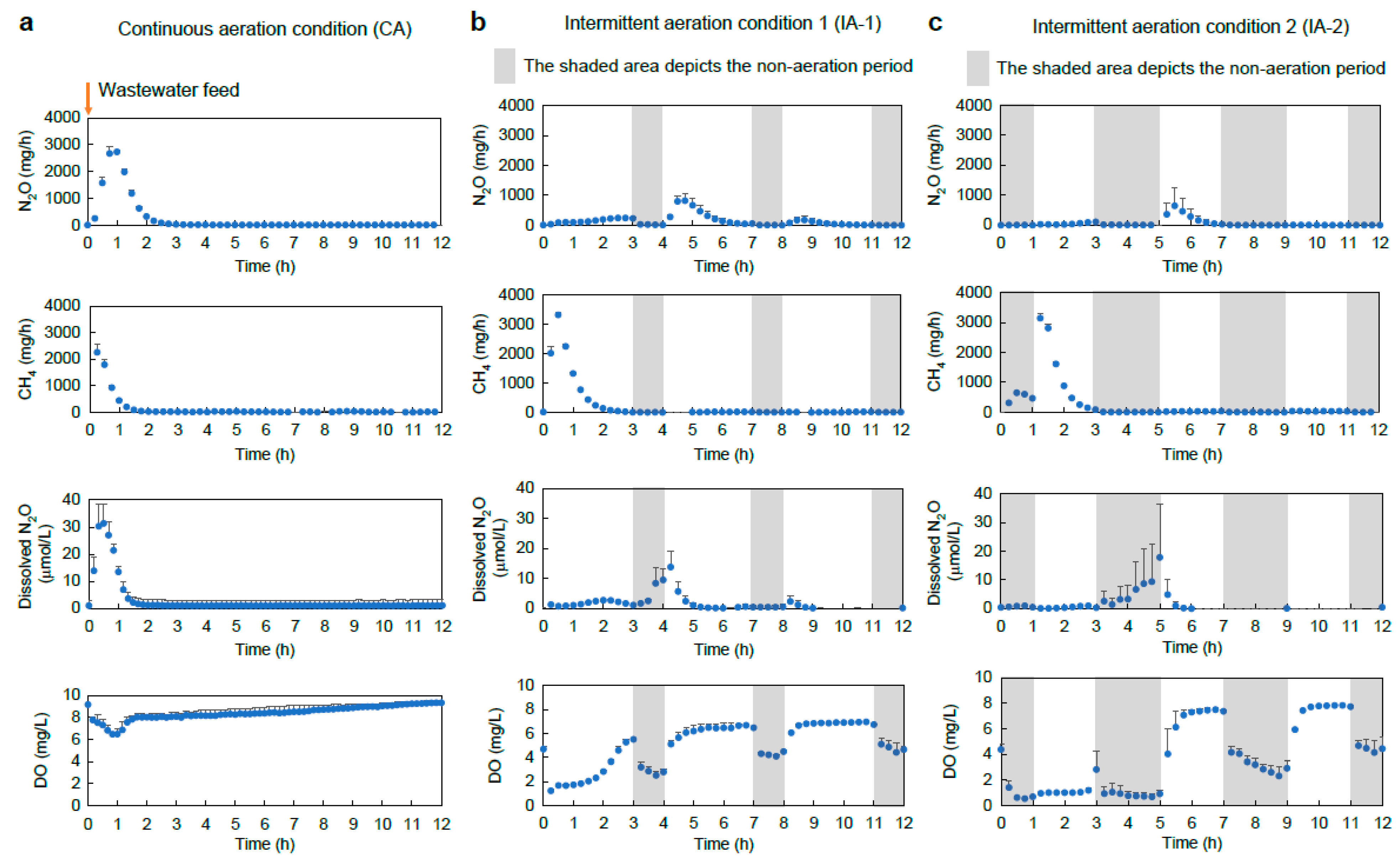
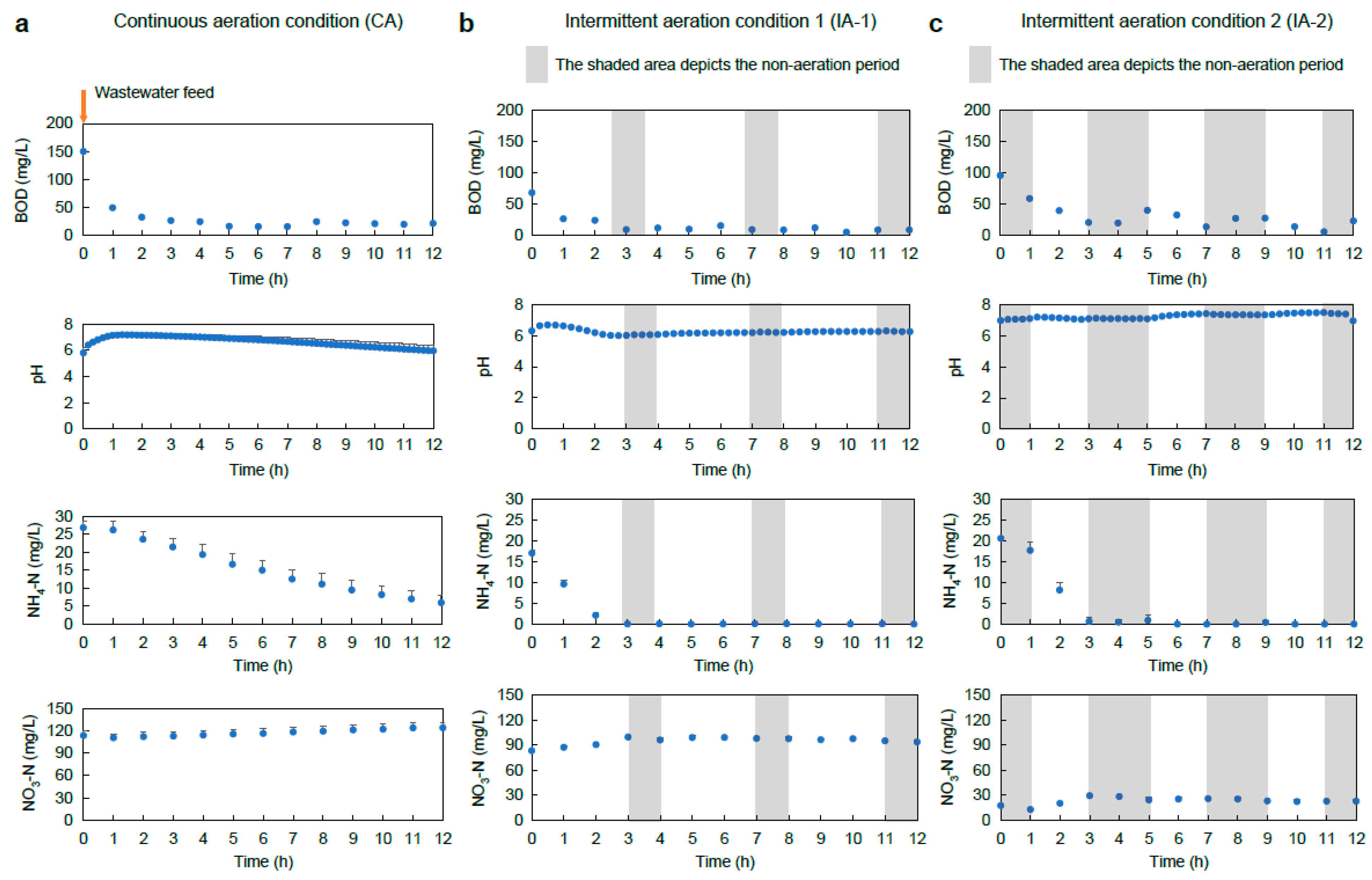
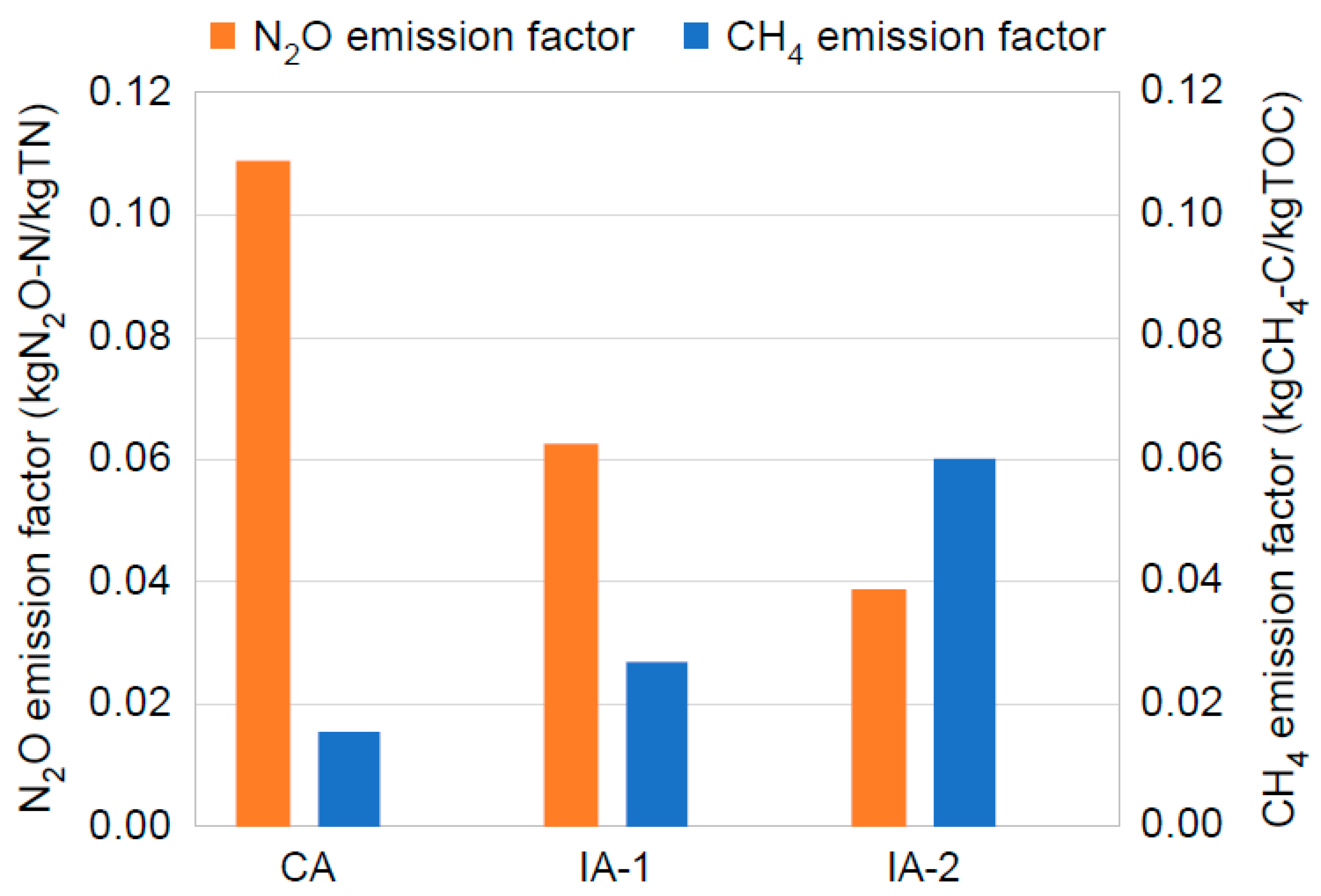
Figure 2 and Figure 3 show the temporal changes in water quality and gas emission under each condition, respectively. Figure 4 shows the N2O and CH4 emission factors for each condition.
Under CA, BOD gradually decreased after the addition of RW owing to the microbial degradation of organic matter and was almost completely removed within ~3 h (Figure 2a). NH4-N decreased over time, while NO3-N increased, indicating a typical nitrification reaction. pH decreased to ~6 as NO3-N accumulated. Regarding changes in gas generation, dissolved N2O increased immediately after RW addition, followed by an increase in gas-phase N2O, which then dropped to nearly zero within a few hours (Figure 3a). CH4 peaked immediately after RW addition. The emission factors were 10.9% for N2O and 1.6% for CH4 (Figure 4).
Regarding water quality in IA-1, similar to CA, BOD was almost completely removed within ~3 h, while NH4-N disappeared within the same timeframe (Figure 2b). NO3-N increased up to 3 h but then plateaued without decreasing. N2O was produced during aeration (Figure 3b). CH4 peaked immediately after RW addition. Emission factors were 6.3% for N2O and 2.7% for CH4 (Figure 4). We examined the influence of aeration cycles under modified conditions: 9 h aeration followed by 3 h non-aeration within a 12 h cycle. Emission factors were 6.7% for N2O and 1.5% for CH4, suggesting that the non-aeration period had little effect (Figure S1).
In IA-2, similar trends were observed. BOD decreased markedly within 3 h after RW addition and subsequently remained at a low concentration. Although a temporary increase was observed during non-aeration, BOD decreased again after the resumption of aeration. In addition, NH4+-N was almost completely removed within 3 h (Figure 2c). NO3-N increased up to 3 h because of nitrification, then decreased as denitrification proceeded under anaerobic conditions, resulting in significantly lower NO3-N accumulation than under other conditions. The reduced nitrate buildup maintained the pH near neutral. Dissolved N2O peaked during the non-aeration period (Figure 3b) and was subsequently detected during aeration, though at a lower emission rate than that in IA-1. CH4 peaked immediately after aeration. Emission factors were 3.9% for N2O and 6.0% for CH4 (Figure 4).
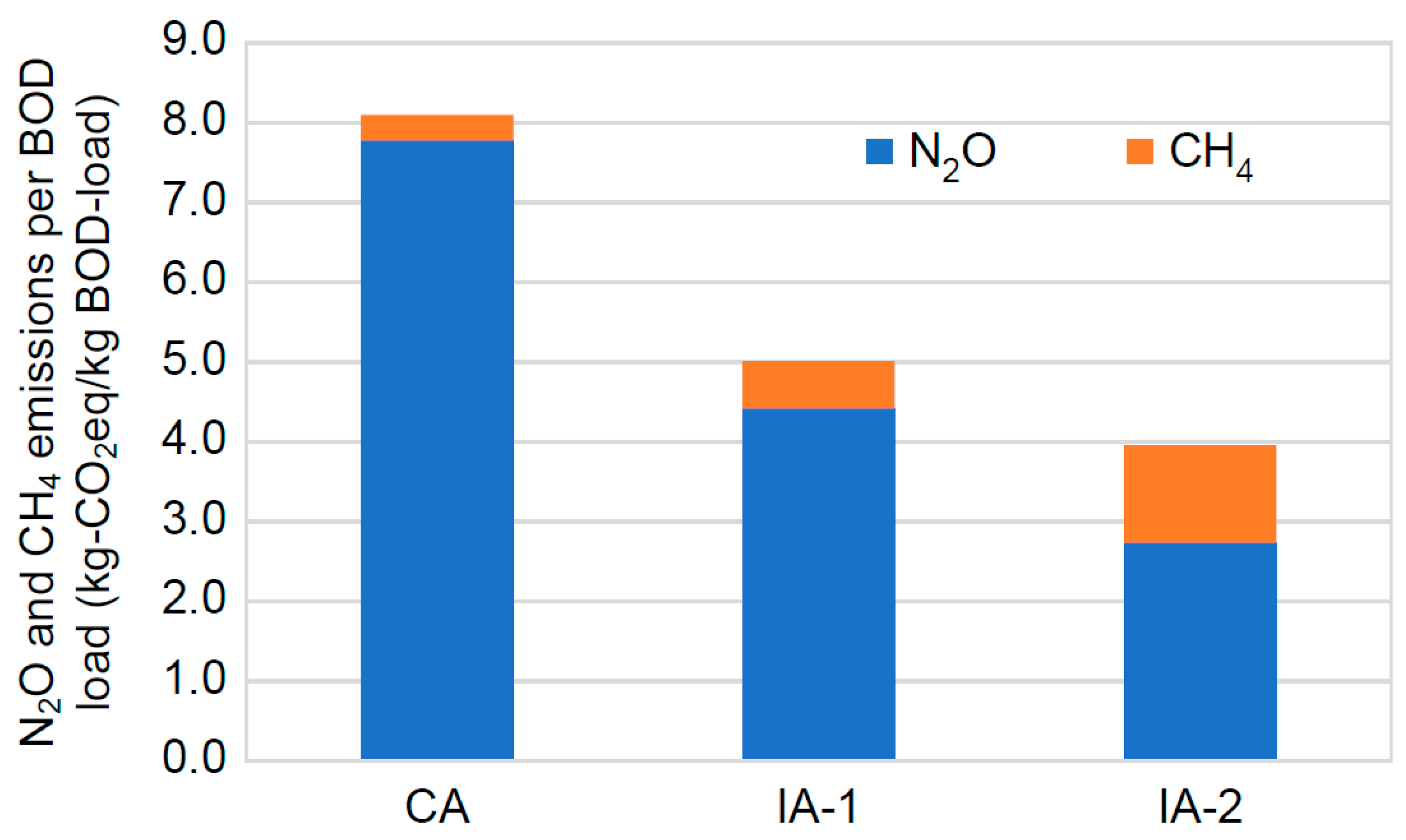
Comparing gas emissions in CO2 equivalents revealed that IA suppressed N2O emissions, achieving decreases of 42% for IA-1 and 64% for IA-2 compared with those under CA. Because actual wastewater was used, water quality fluctuations were observed across conditions. To account for this variation, N2O and CH4 emissions were compared per BOD load (Figure 5), yielding 8.09 kg-CO2eq/kg BOD-load under CA, 5.01 kg-CO2eq/kg BOD-load under IA-1, and 3.96 kg-CO2eq/kg BOD-load under IA-2, confirming that IA suppresses N2O emissions. Moreover, the extended non-aeration period in IA-2 yielded the lowest total emissions of N2O and CH4, leading to a decrease in GHG emissions compared with IA-1.
The time-dependent changes in ORP (Figure S2) showed a gradual increase under CA from −69 mV immediately after RW addition to +167 mV after 12 h (Figure S2a). In IA-1, ORP was −27 mV after RW addition, increased to +150 mV within 3 h, and then gradually rose to +178 mV after 12 h (Figure S2b). In IA-2, ORP remained stable at +100 mV during the non-aeration period 1 h after RW addition, but decreased to −148 mV with aeration as organic matter decomposed, before stabilizing again near +100 mV (Figure S2c).
Despite the non-aeration period in IA-1, DO concentration remained >2 mg/L, whereas in IA-2, it dropped to ~1 mg/L. NO3 accumulation was highest in CA, but decreased progressively in IA-1 and IA-2 as aeration time decreased. Correspondingly, pH shifted from acidic to neutral with reduced NO3 accumulation (Figure S3).

3.2. Bacterial Community Structure of the Reactor

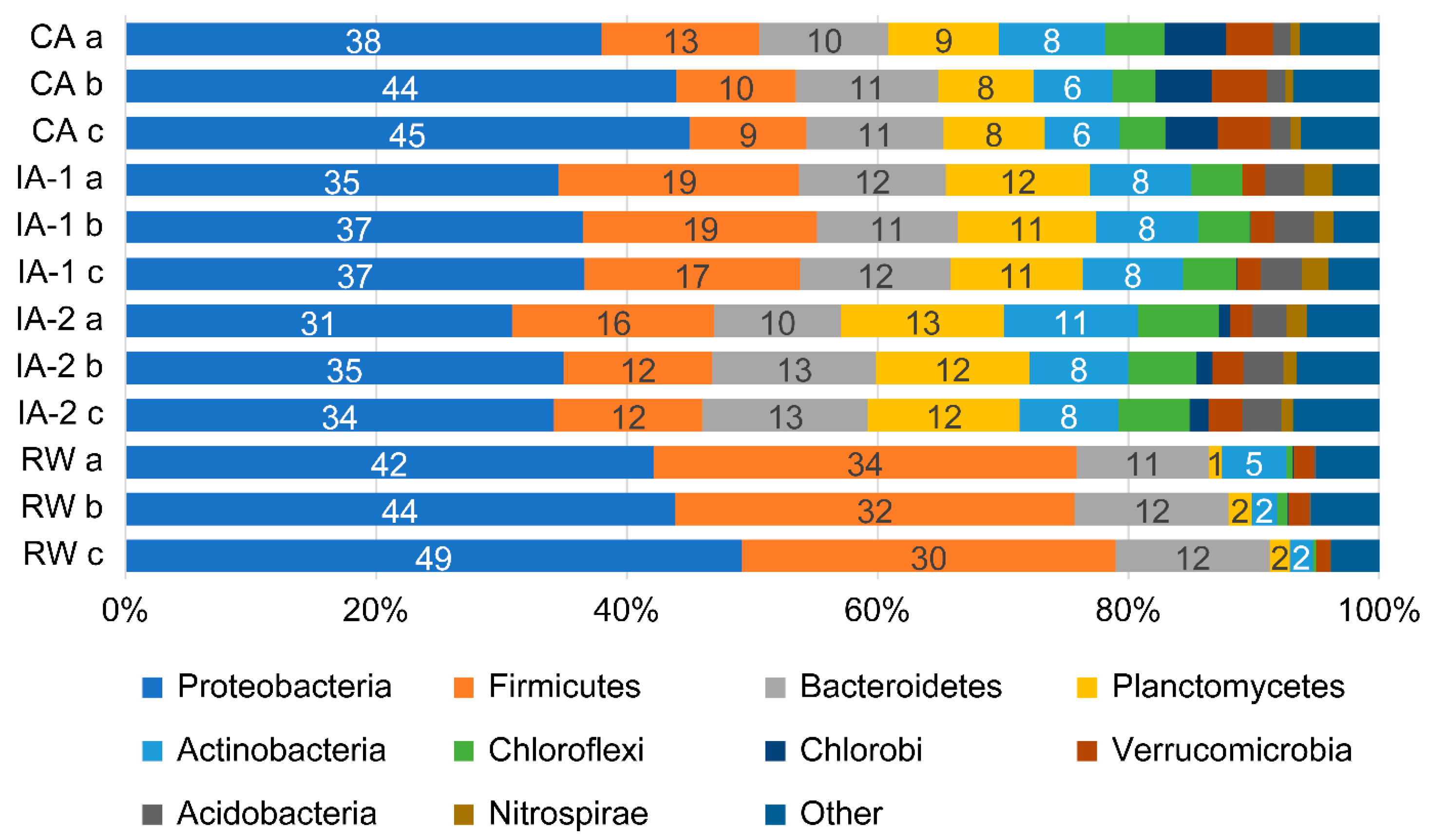
Phylum-level analysis (Figure 6) revealed no significant differences among aeration conditions in activated sludge samples. Proteobacteria dominated (31–38%), followed by Firmicutes (9–19%), Bacteroidetes (10–13%), Planctomycetes (8–13%), and Actinobacteria (6–11%). Notably, in RW, Proteobacteria were also dominant (42–49%), showing no major difference from the activated sludge. However, Firmicutes (30–34%) exhibited a significantly higher proportion than that in the activated sludge, while Planctomycetes (1–2%) and Actinobacteria (2–5%) had lower proportions in RW.
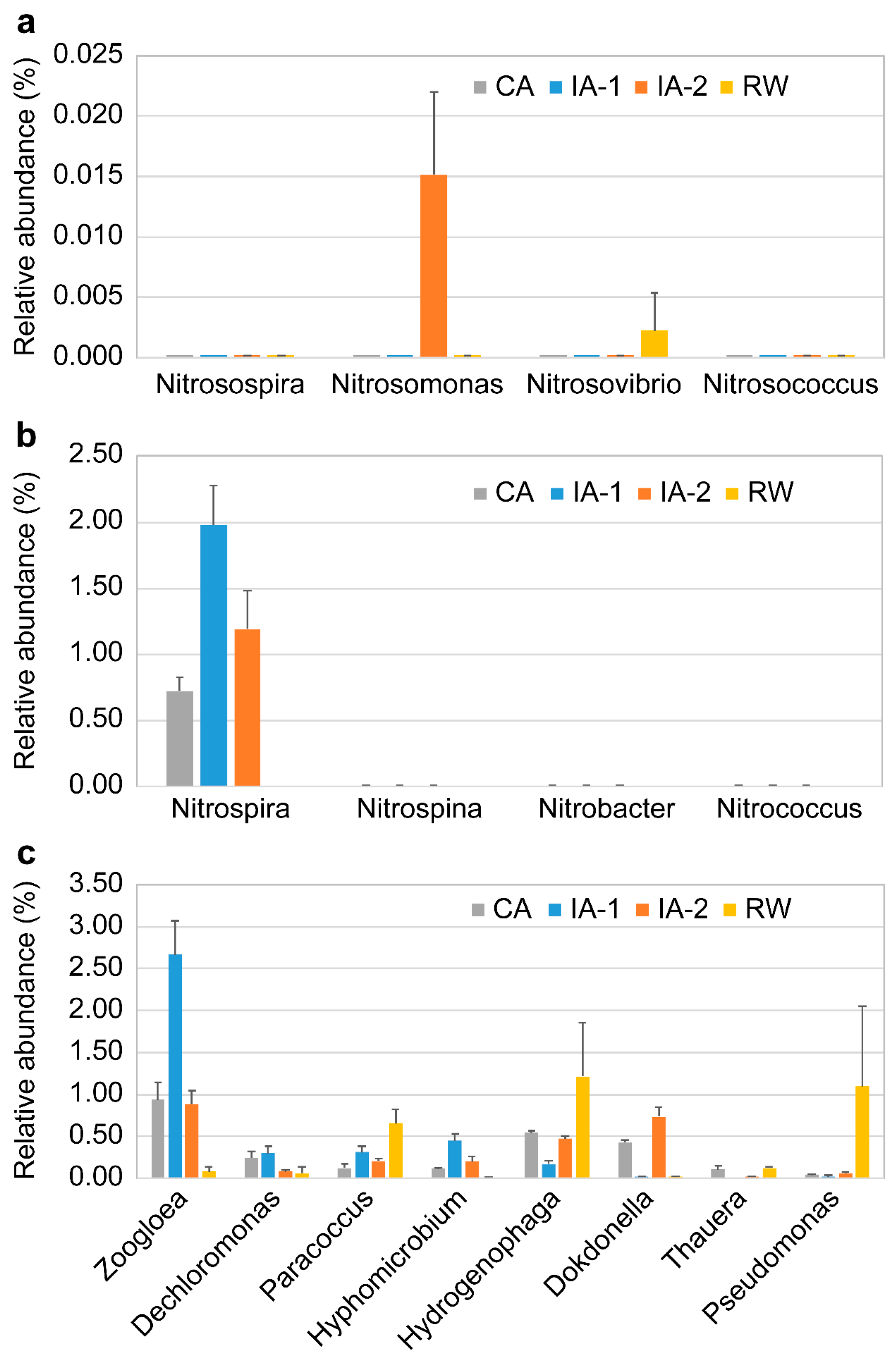
Genus-level analysis (Figure 7) highlighted the abundance of ammonia-oxidizing, nitrite-oxidizing, and denitrifying bacteria in samples collected under each condition. Ammonia-oxidizing bacteria such as Nitrosospira, Nitrosomonas, Nitrosovibrio, and Nitrosococcus were detected at very low levels, with Nitrosomonas reaching 0.015% in IA-2 activated sludge (Figure 7a). Among nitrite-oxidizing bacteria, Nitrospira was the most abundant across all activated sludge samples (CA, IA-1, and IA-2), exceeding Nitrospina, Nitrobacter, and Nitrococcus (Figure 7b). Specifically, Nitrospira was higher in IA-1 (1.980%) and IA-2 (1.194%) than in CA (0.724%). Various species of denitrifying bacteria occur within sludge, but this study highlights those with high relative abundance (Figure 7c). In all activated sludge samples, Zoogloea, Hydrogenophaga, and Dokdonella exhibited relative abundances of ≥0.5%.

4. Discussion

This study demonstrated that changing the aeration conditions in wastewater treatment from CA to IA reduced NO3 concentration, resulting in decreased N2O emissions. Under CA, typical nitrification dominated, leading to NO3-N generation and consequently higher N2O production compared to IA. The production of N2O in IA-1 and IA-2 was attributed to anaerobic denitrification pathways, with NH4+-N rapidly consumed within 3 h of RW addition, dissolved N2O accumulating during the anoxic period, and gas-phase N2O levels increasing upon re-aeration. Consistent with previous findings, dissolved N2O accumulated during non-aeration and was released upon resumption of aeration, confirming that stripping of dissolved N2O is a major source of emissions [10,43,44,45]. The present results from IA-1 and IA-2 align with those of Ahn et al. [10], who identified aerobic tank release as the primary source of N2O emissions. Moreover, assuming that N2O production may vary based on the timing of non-aeration, we tested the effects of different aeration cycle conditions and found that the timing of the non-aeration period had little effect.
Previous studies suggested that NO2, rather than NO3, plays a key role in N2O production, and many reported that the accumulation of NO2 increases N2O emissions during nitrification–denitrification processes [13,14,15]. Furthermore, in heterotrophic denitrification, high concentrations of NO2 inhibit complete denitrification, leading to the accumulation of NO2 and increased N2O emissions [46]. However, although almost no accumulation of NO2 was observed in the present study, N2O production was high under CA. Notably, suppressing NO3 accumulation tended to reduce N2O production. These results differ from those of previous studies.
Under IA-1, the DO remained >2 mg/L despite the presence of an anoxic period, whereas it decreased to ~1 mg/L in IA-2. In IA-1, NO3 accumulated despite the inclusion of a non-aeration period, likely due to the suppression of denitrification caused by both insufficient BOD and a limited decrease in DO. These results indicated that denitrification does not proceed sufficiently under short non-aeration periods. The temporal variation in ORP further supports these observations: ORP values remained relatively high under CA and IA-1, and decreased under IA-2. Denitrification is considered to proceed under reductive conditions of approximately −200 mV; thus, the ORP conditions observed under IA-2 were more favorable for denitrification. Moreover, higher ORP conditions have been associated with increased N2O production, consistent with the present results [47].
The abundance of Planctomycetes (1–2%) and Actinobacteria (2–5%) in the RW tended to be lower than that in the activated sludge. The swine origin of the RW, combined with the natural abundance of Firmicutes in animal intestines, likely influenced the phylum-level composition. Some species of Nitrospira are involved in N2O production and can perform complete nitrification from NH4+ to NO3 [48,49,50]. These microorganisms may have contributed to the nitrification reaction in this study. The relative abundance of ammonia- and nitrite-oxidizing bacteria in activated sludge has been reported at <1%, similar to the present findings [51]. Furthermore, in the activated sludge collected under IA-2 with the lowest N2O production (aeration ON/OFF every 2 h), only the ammonia-oxidizing bacterium Nitrosomonas showed a significantly higher relative abundance than under other conditions. Nitrosomonas is a typical aerobic ammonia-oxidizing bacterium involved in nitrifier denitrification and NH2OH oxidation—the primary biological pathways for N2O production in wastewater treatment plants. However, Nitrosomonas also exhibited a high relative abundance under conditions where N2O emissions were reduced, suggesting that Nitrosomonas may not necessarily be the dominant N2O-producing bacterium under these conditions, or that N2O production activity within Nitrosomonas itself may have been suppressed. Regarding denitrifying bacteria, the aeration condition affected the detection rates of Zoogloea, Dechloromonas, Hyphomicrobium, Hydrogenophaga, and Dokdonella (p < 0.05). Focused comparisons were performed on Zoogloea, Hydrogenophaga, and Dokdonella, which exhibited high relative abundances in the activated sludge samples. The relative abundance of Zoogloea was significantly higher under IA-1 than under CA and IA-2. In contrast, Hydrogenophaga and Dokdonella showed significantly lower relative abundances under IA-1. Zoogloea is a representative denitrifying bacterium in activated sludge, possessing the ability to form aggregates and promote solid–liquid separation in effluent. It is also capable of growth within a DO concentration of 0.59–2.34 mg/L [52], and denitrification even at water temperatures as low as 10 °C [53], with high detection rates in activated sludge under CA treatment [54]. Hydrogenophaga is an aerobic denitrifying bacterium capable of simultaneously removing nitrogen and arsenic [55]. Dokdonella is also an aerobic denitrifying bacterium. In activated sludge treatment under oxygen-rich conditions, Proteobacteria, Firmicutes, and Chlamydiae phyla dominated, and Dokdonella, belonging to Proteobacteria, was particularly dominant [56]. This suggests that Dokdonella is particularly tolerant of oxygen-related effects among aerobic denitrifying bacteria.
N2OR is an enzyme encoded by the nosZ gene and catalyzes the reduction of N2O to N2—the final step of the denitrification pathway. Therefore, the abundance and activity of microorganisms possessing the nosZ gene are considered important indicators for estimating system-level N2O emissions. However, approximately one-third of denitrifying bacteria may lack this functional gene [57]. Zoogloea, Hydrogenophaga, and Dokdonella possess nosZ. In the heterotrophic denitrification pathway performed by these genera—where organic matter is used as an electron donor and nitrate and nitrite are sequentially reduced to N2—the rate of N2O reduction is faster than the reduction rates of NO3 and NO2. This suggests that under anaerobic or anoxic conditions, N2O can be completely reduced to N2 without accumulation or emission [18]. Nevertheless, N2OR is strongly inhibited by the presence of oxygen and sulfide. Accordingly, even in microorganisms harboring nosZ, suppression of N2O reduction activity can result in the accumulation and emission of N2O [13,58]. N2OR activity is inhibited under acidic conditions (pH < 6.5) [59,60]. Law et al. [18] observed increased N2O with changes in pH, DO, NH4+, and NO2. Hanaki et al. [59] reported a tendency for increasing N2O production as pH decreased from 8.5 to 6.5. Accordingly, N2O reduction mediated by nosZ appears to be highly sensitive to DO concentration and pH. In this study, high NO3 accumulation was observed under CA and IA-1, and the associated decrease in pH (<6.5), together with high DO levels (>2 mg/L) may have suppressed the expression of nosZ or the enzymatic activity of N2OR. Consequently, although the reduction pathway from NO2 to N2O proceeded, the final reduction step from N2O to N2 may not have progressed sufficiently, leading to N2O accumulation. In contrast, under IA-2, DO and ORP were maintained at relatively lower levels, creating a more favorable environment for the functioning of denitrification-related genes, including nosZ. This provides further evidence that IA-2 was superior to CA and IA-1 in suppressing N2O emissions, establishing optimal conditions for N2O mitigation. Under the other conditions, even in the presence of microorganisms capable of denitrification under aerobic conditions, the denitrification reaction would be inhibited by the decrease in pH associated with nitrate accumulation, which could lead to increased N2O production. Overall, IA effectively reduced N2O emissions, with IA-2 showing the greatest suppression.
According to a review on N2O emissions from wastewater treatment plants, the N2O emission factors of bioreactors—including anaerobic and aerobic reactors used for BOD removal or advanced nutrient removal, as well as secondary clarifiers, have a very wide range, from 0.00003% to 20.69% [61]. Focusing specifically on nitrification–denitrification processes, the average N2O emission factor was 8.91%, close to the value obtained under CA in the present study. In contrast, the National GHG Inventory Report of Japan (NIES 2026) reported an N2O emission factor of 2.87% in the treatment of swine wastewater [45], comparable to that under IA-2 in the present study. This suggests that the treatment facilities considered in the inventory report may not necessarily have been operated under CA conditions.
In wastewater treatment, even when microorganisms capable of denitrification under aerobic conditions are present, a decrease in pH caused by nitrate accumulation may inhibit N2O reduction, potentially leading to increased N2O emissions. Therefore, the use of IA to suppress nitrate accumulation and maintain near-neutral pH conditions has been suggested as a strategy to reduce N2O emissions. In contrast, although extending the anaerobic period during IA may further reduce N2O emissions, it may also lead to deterioration of water quality, requiring careful consideration. Furthermore, potential increases in methane production should also be taken into account.
Although this study was conducted on a pilot scale, similar effects are expected in actual facilities. Previous laboratory-scale studies have noted the applicability of their N2O reduction strategies for use in wastewater treatment plants [11]. Notably, because this test was designed without considering seasonal variations, the impact of temperature changes requires further investigation. In actual wastewater treatment plants, IA is considered inappropriate when treatment under high BOD load conditions is required, as it may lead to a deterioration in water quality. In addition, advanced verification of whether the diffusers used are designed to withstand IA operation is necessary. The introduction of aeration control systems, such as BOD biosensors utilizing exoelectrogenic bacteria [38], could further optimize energy use and minimize GHG emissions by wastewater treatment plants.

5. Conclusions

This study investigated the feasibility of IA for mitigating N2O emissions from wastewater treatment plants. Compared to CA, the lowest N2O generation occurred under IA, yielding an emission factor of 3.9%. Water quality analysis indicated that IA resulted in the lowest NO3-N accumulation, suggesting that reducing NO3-N accumulation is crucial for suppressing N2O generation.
Microbial community patterns were not correlated with changes in N2O production. This suggests that differences in microbial species do not directly influence N2O production. Instead, pH reduction due to nitrate accumulation in the water likely suppressed microbial activity, leading to increased N2O production. Therefore, introducing IA to reduce nitrate accumulation effectively suppressed N2O production.
Overall, IA effectively reduced N2O emissions from swine wastewater treatment. We propose that introducing a BOD- and pH-based IA control system, incorporating the optimal aeration cycle conditions for minimizing N2O emissions in IA-2, in wastewater treatment plants can contribute to lowering electricity consumption and GHG emissions, and ultimately reduce the environmental impact.

Supplementary Materials

The following supporting information can be downloaded at: https://www.mdpi.com/article/10.3390/su18115765/s1, Figure S1: Temporal changes in gases under different 3 h/1 h aeration pause cycle conditions; Figure S2: Temporal changes in ORP under each aeration condition; Figure S3: NO3-N concentration and pH of treated water for each aeration condition.

Author Contributions

A.O. and A.Y. analyzed the bioreactor. H.Y. and T.Y. characterized the microbial communities. H.Y. and T.Y. designed the research. T.Y. wrote the manuscript. All authors have read and agreed to the published version of the manuscript.

Funding

This work was supported by the MAFF Commissioned project study on “Development of Technologies to Reduce Greenhouse Gas Emissions in the Livestock Sector” (Grant Number JPJ011299).

Institutional Review Board Statement

Not applicable.

Informed Consent Statement

Not applicable.

Data Availability Statement

The datasets generated and/or analyzed during the current study are available from the corresponding author on reasonable request.

Acknowledgments

We thank Mieko Yoshida and Kyoko Hirano for their skillful assistance with the experiments.

Conflicts of Interest

The authors declare no conflicts of interest.

Abbreviations

The following abbreviations are used in this manuscript:
BODBiochemical oxygen demand
CAContinuous aeration
CH4Methane
CO2Carbon dioxide
CODChemical oxygen demand
DODissolved oxygen
GHGGreenhouse gas
IAIntermittent Aeration
IA-1Intermittent Aeration Condition 1
IA-2Intermittent Aeration Condition 2
N2ONitrous oxide
NH2OHHydroxylamine

References

  1. Pandey, A.H.; Pawar, R.V.; Pradhan, S.S.; Sarpotdar, D.D. Effect of non-continuous aeration on activated sludge process. Int. Res. J. Eng. Technol. 2020, 7, 2224–2231. [Google Scholar]
  2. Wang, L.K.; Wu, Z.; Shammas, N.K. Activated sludge processes. In Biological Treatment Processes; Wang, L.K., Pereira, N.C., Hung, Y.-T., Eds.; Humana Press: Totowa, NJ, USA, 2009; pp. 207–281. [Google Scholar] [CrossRef]
  3. Deepak, M.; Rustum, R. Review of latest advances in nature-inspired algorithms for optimization of activated sludge processes. Processes 2023, 11, 77. [Google Scholar] [CrossRef]
  4. Åmand, L.; Olsson, G.; Carlsson, B. Aeration control—A review. Water Sci. Technol. 2013, 67, 2374–2398. [Google Scholar] [CrossRef]
  5. Myhre, G.; Shindell, D.; Bréon, F.-M.; Collins, W.; Fuglestvedt, J.; Huang, J.; Koch, D.; Lamarque, J.-F.; Lee, D.; Mendoza, B.; et al. Anthropogenic and natural radiative forcing. In Climate Change 2013: The Physical Science Basis. Contribution of Working Group I to the Fifth Assessment Report of the Intergovernmental Panel on Climate Change; Cambridge University Press: Cambridge, UK; New York, NY, USA, 2014; pp. 659–740. Available online: https://www.ipcc.ch/site/assets/uploads/2018/02/WG1AR5_Chapter08_FINAL.pdf (accessed on 15 December 2025).
  6. Inventory of U.S. Greenhouse Gas Emissions and Sinks: Overview of U.S. Greenhouse Gas Emissions in 2021; U.S. Environmental Protection Agency: Washington, DC, USA, 2023.
  7. Kampschreur, M.J.; Temmink, H.; Kleerebezem, R.; Jetten, M.S.M.; van Loosdrecht, M.C.M. Nitrous oxide emission during wastewater treatment. Water Res. 2009, 43, 4093–4103. [Google Scholar] [CrossRef] [PubMed]
  8. Vasilaki, V.; Massara, T.M.; Stanchev, P.; Fatone, F.; Katsou, E. A decade of nitrous oxide (N2O) monitoring in full-scale wastewater treatment processes: A critical review. Water Res. 2019, 161, 392–412. [Google Scholar] [CrossRef]
  9. An, Z.; Zhang, Q.; Gao, X.; Ding, J.; Shao, B.; Peng, Y. Nitrous oxide emissions in novel wastewater treatment processes: A comprehensive review. Bioresour. Technol. 2024, 391, 129950. [Google Scholar] [CrossRef]
  10. Ahn, J.H.; Kim, S.; Park, H.; Rahm, B.; Pagilla, K.; Chandran, K. N2O emissions from activated sludge processes, 2008−2009: Results of a national monitoring survey in the united states. Environ. Sci. Technol. 2010, 44, 4505–4511. [Google Scholar] [CrossRef]
  11. Duan, H.; van den Akker, B.; Thwaites, B.J.; Peng, L.; Herman, C.; Pan, Y.; Ni, B.-J.; Watt, S.; Yuan, Z.; Ye, L. Mitigating nitrous oxide emissions at a full-scale wastewater treatment plant. Water Res. 2020, 185, 116196. [Google Scholar] [CrossRef]
  12. Sümer, E.; Weiske, A.; Benckiser, G.; Ottow, J.C.G. Influence of environmental conditions on the amount of N2O released from activated sludge in a domestic waste water treatment plant. Experientia 1995, 51, 419–422. [Google Scholar] [CrossRef]
  13. Kemmou, L.; Amanatidou, E. Factors affecting nitrous oxide emissions from activated sludge wastewater treatment plants—A review. Resources 2023, 12, 114. [Google Scholar] [CrossRef]
  14. Massara, T.M.; Malamis, S.; Guisasola, A.; Baeza, J.A.; Noutsopoulos, C.; Katsou, E. A review on nitrous oxide (N2O) emissions during biological nutrient removal from municipal wastewater and sludge reject water. Sci. Total Environ. 2017, 596–597, 106–123. [Google Scholar] [CrossRef]
  15. Santín, I.; Barbu, M.; Pedret, C.; Vilanova, R. Control strategies for nitrous oxide emissions reduction on wastewater treatment plants operation. Water Res. 2017, 125, 466–477. [Google Scholar] [CrossRef]
  16. Rodriguez-Caballero, A.; Aymerich, I.; Marques, R.; Poch, M.; Pijuan, M. Minimizing N2O emissions and carbon footprint on a full-scale activated sludge sequencing batch reactor. Water Res. 2015, 71, 1–10. [Google Scholar] [CrossRef]
  17. Li, D.; Fang, F.; Liu, G. Efficient nitrification and low-level N(2)O emission in a weakly acidic bioreactor at low dissolved-oxygen levels are due to comammox. Appl. Environ. Microbiol. 2021, 87, e00154-21. [Google Scholar] [CrossRef]
  18. Law, Y.; Ye, L.; Pan, Y.; Yuan, Z. Nitrous oxide emissions from wastewater treatment processes. Philos. Trans. R. Soc. Lond. B Biol. Sci. 2012, 367, 1265–1277. [Google Scholar] [CrossRef]
  19. Kampschreur, M.J.; van der Star, W.R.L.; Wielders, H.A.; Mulder, J.W.; Jetten, M.S.M.; van Loosdrecht, M.C.M. Dynamics of nitric oxide and nitrous oxide emission during full-scale reject water treatment. Water Res. 2008, 42, 812–826. [Google Scholar] [CrossRef] [PubMed]
  20. Caranto, J.D.; Vilbert, A.C.; Lancaster, K.M. Nitrosomonas europaea cytochrome P460 is a direct link between nitrification and nitrous oxide emission. Proc. Natl. Acad. Sci. USA 2016, 113, 14704–14709. [Google Scholar] [CrossRef] [PubMed]
  21. Soler-Jofra, A.; Pérez, J.; van Loosdrecht, M.C.M. Hydroxylamine and the nitrogen cycle: A review. Water Res. 2021, 190, 116723. [Google Scholar] [CrossRef] [PubMed]
  22. Osada, T.; Kuroda, K.; Yonaga, M. Reducing nitrous oxide gas emissions from fill-and-draw type activated sludge process. Water Res. 1995, 29, 1607–1608. [Google Scholar] [CrossRef]
  23. Itokawa, H.; Hanaki, K.; Matsuo, T. Nitrous oxide production in high-loading biological nitrogen removal process under low COD/N ratio condition. Water Res. 2001, 35, 657–664. [Google Scholar] [CrossRef]
  24. Srb, M.; Lánský, M.; Charvátová, L.; Koubová, J.; Pecl, R.; Sýkora, P.; Rosický, J. Improved nitrogen removal efficiency by implementation of intermittent aeration. Water Sci. Technol. 2022, 86, 2248–2259. [Google Scholar] [CrossRef]
  25. Perez-Garcia, O.; Villas-Boas, S.G.; Swift, S.; Chandran, K.; Singhal, N. Clarifying the regulation of NO/N2O production in Nitrosomonas europaea during anoxic–oxic transition via flux balance analysis of a metabolic network model. Water Res. 2014, 60, 267–277. [Google Scholar] [CrossRef]
  26. Shaw, L.J.; Nicol, G.W.; Smith, Z.; Fear, J.; Prosser, J.I.; Baggs, E.M. Nitrosospira spp. can produce nitrous oxide via a nitrifier denitrification pathway. Environ. Microbiol. 2006, 8, 214–222. [Google Scholar] [CrossRef]
  27. Lawton, T.J.; Bowen, K.E.; Sayavedra-Soto, L.A.; Arp, D.J.; Rosenzweig, A.C. Characterization of a nitrite reductase involved in nitrifier denitrification. J. Biol. Chem. 2013, 288, 25575–25583. [Google Scholar] [CrossRef] [PubMed]
  28. Tallec, G.; Garnier, J.; Billen, G.; Gousailles, M. Nitrous oxide emissions from secondary activated sludge in nitrifying conditions of urban wastewater treatment plants: Effect of oxygenation level. Water Res. 2006, 40, 2972–2980. [Google Scholar] [CrossRef]
  29. Ohbayashi, T.; Wang, Y.; Aoyagi, L.N.; Hara, S.; Tago, K.; Hayatsu, M. Diversity of the hydroxylamine oxidoreductase (HAO) gene and its enzyme active site in agricultural field soils. Microbes Environ. 2023, 38, ME23068. [Google Scholar] [CrossRef] [PubMed]
  30. Otte, S.; Schalk, J.; Kuenen, J.G.; Jetten, M.S.M. Hydroxylamine oxidation and subsequent nitrous oxide production by the heterotrophic ammonia oxidizer Alcaligenes faecalis. Appl. Microbiol. Biotechnol. 1999, 51, 255–261. [Google Scholar] [CrossRef] [PubMed]
  31. Carlson, C.A.; Ingraham, J.L. Comparison of denitrification by Pseudomonas stutzeri, Pseudomonas aeruginosa, and Paracoccus denitrificans. Appl. Environ. Microbiol. 1983, 45, 1247–1253. [Google Scholar] [CrossRef]
  32. Heider, J.; Fuchs, G. Thauera. In Bergey’s Manual of Systematics of Archaea and Bacteria; Wiley: Hoboken, NJ, USA, 2015; pp. 1–11. [Google Scholar] [CrossRef]
  33. Unz, R.F. Zoogloea. In Bergey’s Manual of Systematics of Archaea and Bacteria; Wiley: Hoboken, NJ, USA, 2015; pp. 1–13. [Google Scholar] [CrossRef]
  34. Willems, A.; Gillis, M. Hydrogenophaga. In Bergey’s Manual of Systematics of Archaea and Bacteria; Wiley: Hoboken, NJ, USA, 2015; pp. 1–15. [Google Scholar] [CrossRef]
  35. Liu, Y.; Jin, J.-H.; Liu, H.-C.; Liu, Z.-P. Dokdonella immobilis sp. nov., isolated from a batch reactor for the treatment of triphenylmethane dye effluent. Int. J. Syst. Evol. Microbiol. 2013, 63, 1557–1561. [Google Scholar] [CrossRef]
  36. Jia, W.; Liang, S.; Zhang, J.; Ngo, H.H.; Guo, W.; Yan, Y.; Zou, Y. Nitrous oxide emission in low-oxygen simultaneous nitrification and denitrification process: Sources and mechanisms. Bioresour. Technol. 2013, 136, 444–451. [Google Scholar] [CrossRef]
  37. Terada, A.; Sugawara, S.; Hojo, K.; Takeuchi, Y.; Riya, S.; Harper, W.F., Jr.; Yamamoto, T.; Kuroiwa, M.; Isobe, K.; Katsuyama, C.; et al. Hybrid nitrous oxide production from a partial nitrifying bioreactor: Hydroxylamine interactions with nitrite. Environ. Sci. Technol. 2017, 51, 2748–2756. [Google Scholar] [CrossRef]
  38. Yamashita, T.; Hasegawa, T.; Hayashida, Y.; Ninomiya, K.; Shibata, S.; Ito, K.; Mizuguchi, H.; Yokoyama, H. Energy savings with a biochemical oxygen demand (BOD)- and pH-based intermittent aeration control system using a BOD biosensor for swine wastewater treatment. Biochem. Eng. J. 2022, 177, 108266. [Google Scholar] [CrossRef]
  39. Kozich, J.J.; Westcott, S.L.; Baxter, N.T.; Highlander, S.K.; Schloss, P.D. Development of a dual-index sequencing strategy and curation pipeline for analyzing amplicon sequence data on the miSeq Illumina sequencing platform. Appl. Environ. Microbiol. 2013, 79, 5112–5120. [Google Scholar] [CrossRef]
  40. Aitchison, J. The Statistical Analysis of Compositional Data; Springer: Dordrecht, The Netherlands, 1986. [Google Scholar]
  41. Gloor, G.B.; Macklaim, J.M.; Pawlowsky-Glahn, V.; Egozcue, J.J. Microbiome datasets are compositional: And this is not optional. Front. Microbiol. 2017, 8, 2017. [Google Scholar] [CrossRef] [PubMed]
  42. Quinn, T.P.; Erb, I.; Gloor, G.; Notredame, C.; Richardson, M.F.; Crowley, T.M. A field guide for the compositional analysis of any-omics data. Gigascience 2019, 8, giz107. [Google Scholar] [CrossRef] [PubMed]
  43. Rassamee, V.; Sattayatewa, C.; Pagilla, K.; Chandran, K. Effect of oxic and anoxic conditions on nitrous oxide emissions from nitrification and denitrification processes. Biotechnol. Bioeng. 2011, 108, 2036–2045. [Google Scholar] [CrossRef] [PubMed]
  44. Han, K.; Yu, P.; Lu, J.; Hao, Z.; Jiao, Y.; Ren, Y.; Zhao, Y.; Jiang, H.; Wang, J.; Hu, Z. Nitrogen and nitrous oxides emission characteristics of anoxic/oxic wastewater treatment process under different oxygen regulation strategies. Sci. Total Environ. 2024, 919, 170802. [Google Scholar] [CrossRef]
  45. Greenhouse Gas Inventory Office of Japan (GIO). National Greenhouse Gas Inventory Document of JAPAN; Ministry of the Environment: Tokyo, Japan, 2026. Available online: https://www.nies.go.jp/gio/en/archive/nir/k6efli0000084pko-att/NID-JPN-2026-v3.0_gioweb.pdf (accessed on 20 April 2026).
  46. Vasilaki, V.; Conca, V.; Frison, N.; Eusebi, A.L.; Fatone, F.; Katsou, E. A knowledge discovery framework to predict the N2O emissions in the wastewater sector. Water Res. 2020, 178, 115799. [Google Scholar] [CrossRef]
  47. Kishida, N.; Kim, J.H.; Kimochi, Y.; Nishimura, O.; Sasaki, H.; Sudo, R. Effect of C/N ratio on nitrous oxide emission from swine wastewater treatment process. Water Sci. Technol. 2004, 49, 359–371. [Google Scholar] [CrossRef]
  48. Daims, H.; Lebedeva, E.V.; Pjevac, P.; Han, P.; Herbold, C.; Albertsen, M.; Jehmlich, N.; Palatinszky, M.; Vierheilig, J.; Bulaev, A.; et al. Complete nitrification by Nitrospira bacteria. Nature 2015, 528, 504–509. [Google Scholar] [CrossRef]
  49. van Kessel, M.A.H.J.; Speth, D.R.; Albertsen, M.; Nielsen, P.H.; Op den Camp, H.J.M.; Kartal, B.; Jetten, M.S.M.; Lücker, S. Complete nitrification by a single microorganism. Nature 2015, 528, 555–559. [Google Scholar] [CrossRef]
  50. Daims, H.; Nielsen, J.L.; Nielsen, P.H.; Schleifer, K.H.; Wagner, M. In situ characterization of Nitrospira-like nitrite-oxidizing bacteria active in wastewater treatment plants. Appl. Environ. Microbiol. 2001, 67, 5273–5284. [Google Scholar] [CrossRef]
  51. Johnston, J.; LaPara, T.; Behrens, S. Composition and dynamics of the activated sludge microbiome during seasonal nitrification failure. Sci. Rep. 2019, 9, 4565. [Google Scholar] [CrossRef] [PubMed]
  52. Yan, W.; Li, J.; Liang, J.; Ye, C.; Yu, X. Impact of dissolved oxygen levels on N2O emissions and metabolically active bacterial community in biological nitrogen removal. Biochem. Eng. J. 2024, 206, 109295. [Google Scholar] [CrossRef]
  53. Huang, T.-L.; Zhou, S.-L.; Zhang, H.-H.; Bai, S.-Y.; He, X.-X.; Yang, X. Nitrogen removal characteristics of a newly isolated indigenous aerobic denitrifier from oligotrophic drinking water reservoir, Zoogloea sp. N299. Int. J. Mol. Sci. 2015, 16, 10038–10060. [Google Scholar] [CrossRef]
  54. Zhang, S.; Li, C.; Lv, H.; Cui, B.; Zhou, D. Anammox activity improved significantly by the cross-fed NO from ammonia-oxidizing bacteria and denitrifying bacteria to anammox bacteria. Water Res. 2024, 249, 120986. [Google Scholar] [CrossRef]
  55. Fan, X.; Nie, L.; Chen, Z.; Zheng, Y.; Wang, G.; Shi, K. Simultaneous removal of nitrogen and arsenite by heterotrophic nitrification and aerobic denitrification bacterium Hydrogenophaga sp. H7. Front. Microbiol. 2023, 13, 1103913. [Google Scholar] [CrossRef]
  56. Figueroa-González, I.; Quijano, G.; Laguna, I.; Muñoz, R.; García-Encina, P.A. A fundamental study on biological removal of N2O in the presence of oxygen. Chemosphere 2016, 158, 9–16. [Google Scholar] [CrossRef]
  57. Philippot, L.; Andert, J.; Jones, C.M.; Bru, D.; Hallin, S. Importance of denitrifiers lacking the genes encoding the nitrous oxide reductase for N2O emissions from soil. Glob. Change Biol. 2011, 17, 1497–1504. [Google Scholar] [CrossRef]
  58. Pan, Y.; Ye, L.; Yuan, Z. Effect of H2S on N2O reduction and accumulation during denitrification by methanol utilizing denitrifiers. Environ. Sci. Technol. 2013, 47, 8408–8415. [Google Scholar] [CrossRef]
  59. Hanaki, K.; Hong, Z.; Matsuo, T. Production of nitrous oxide gas during denitrification of wastewater. Water Sci. Technol. 1992, 26, 1027–1036. [Google Scholar] [CrossRef]
  60. Ghosh, S.; Gorelsky, S.I.; DeBeer George, S.; Chan, J.M.; Cabrito, I.; Dooley, D.M.; Moura, J.J.G.; Moura, I.; Solomon, E.I. Spectroscopic, computational, and kinetic studies of the μ4-sulfide-bridged tetranuclear CuZ cluster in N2O reductase:  pH effect on the edge ligand and its contribution to reactivity. J. Am. Chem. Soc. 2007, 129, 3955–3965. [Google Scholar] [CrossRef]
  61. Song, C.; Zhu, J.-J.; Willis, J.L.; Moore, D.P.; Zondlo, M.A.; Ren, Z.J. Oversimplification and misestimation of nitrous oxide emissions from wastewater treatment plants. Nat. Sustain. 2024, 7, 1348–1358. [Google Scholar] [CrossRef]
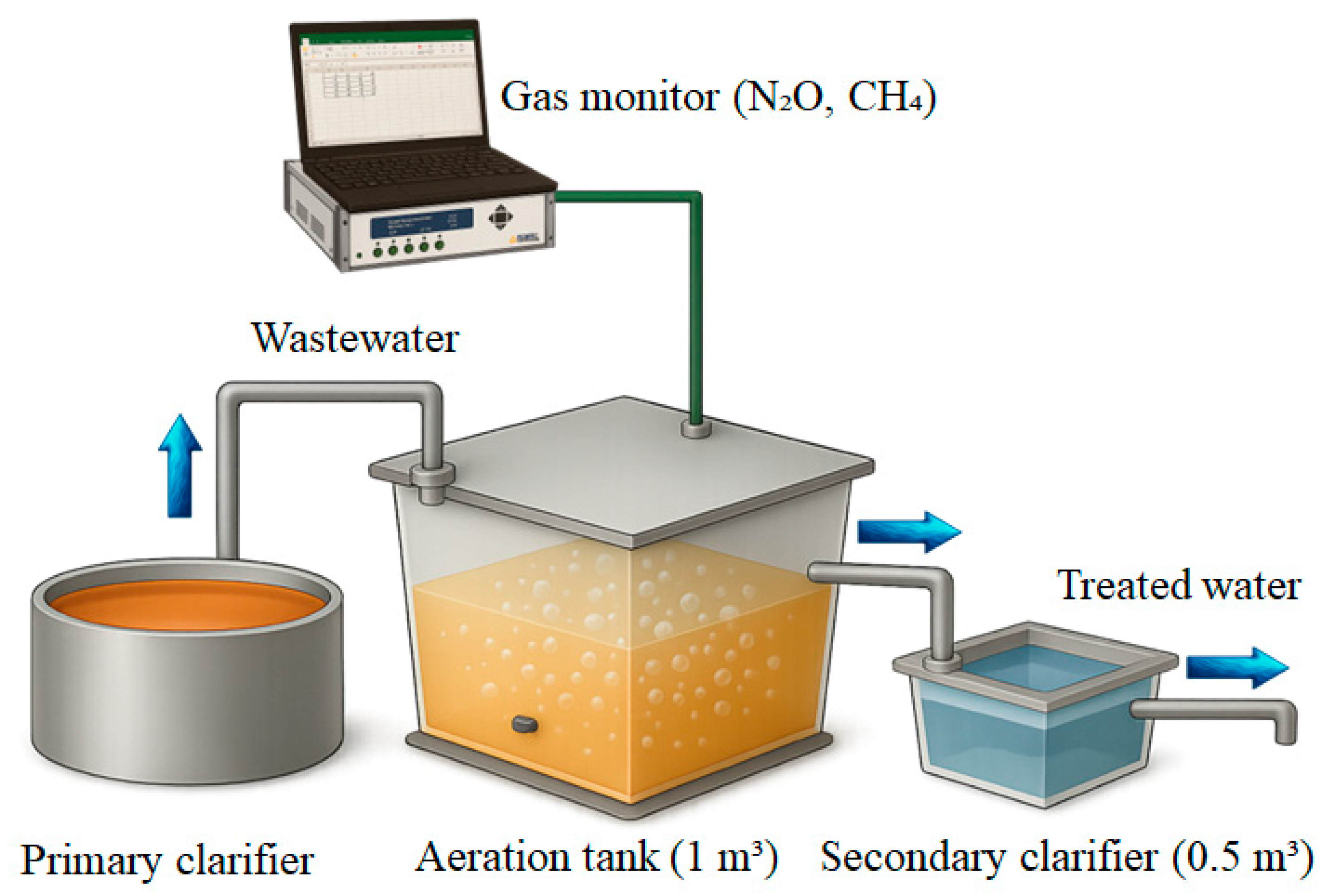
Figure 1. Schematic illustration of experimental apparatus.
Sustainability 18 05765 g001
Figure 2. Temporal changes in water quality under different aeration conditions. (a) Continuous (CA), (b) intermittent aeration 1 (IA-1), and (c) intermittent aeration 2 (IA-2).
Sustainability 18 05765 g002
Figure 3. Temporal changes in gas emission under different aeration conditions. (a) CA, (b) IA-1, and (c) IA-2. DO, dissolved oxygen.
Sustainability 18 05765 g003
Figure 4. N2O and CH4 emission factors under each aeration condition.
Sustainability 18 05765 g004
Figure 5. GHG production per BOD influent load for each aeration condition.
Sustainability 18 05765 g005
Figure 6. Relative abundance of predominant phyla in activated sludge and wastewater. Samples from CA, IA-1, IA-2, and RW were each collected three times on different days and labeled a, b, and c.
Sustainability 18 05765 g006
Figure 7. Relative abundance at the genus level of (a) ammonia-oxidizing, (b) nitrite-oxidizing, and (c) denitrifying bacteria in DNA samples collected under each condition.
Sustainability 18 05765 g007
Table 1. Wastewater characteristics of influent and effluent of the reactor under each condition.
CAIA-1IA-2
InfluentEffluentInfluentEffluentInfluentEffluent
MLSS (mg/L)-3056 ± 276-5615 ± 1146-6447 ± 674
BOD (mg/L)1555 ± 17421 ± 01408 ± 4088 ± 2950 ± 3014 ± 5
TOC (mg/L)947 ± 11862 ± 10956 ± 32953 ± 19576 ± 8643 ± 5
TN (mg/L)220 ± 51179 ± 59208 ± 59111 ± 17128 ± 1916 ± 5
NH4+-N (mg/L)157 ± 224 ± 3152 ± 130 ± 0127 ± 100 ± 1
NO2-N (mg/L)0 ± 01 ± 10 ± 00 ± 00 ± 00 ± 0
NO3-N (mg/L)0 ± 0143 ± 341 ± 098 ± 130 ± 018 ± 6
BOD/N ratio-7.1-6.8-7.4
MLSS, mixed liquor suspended solids; BOD, biochemical oxygen demand; TOC, total organic carbon; TN, total nitrogen. Data are presented as the mean ± SD.
Disclaimer/Publisher’s Note: The statements, opinions and data contained in all publications are solely those of the individual author(s) and contributor(s) and not of MDPI and/or the editor(s). MDPI and/or the editor(s) disclaim responsibility for any injury to people or property resulting from any ideas, methods, instructions or products referred to in the content.