Sustainable Supply Chains: Bridging Theory and Practice Through Hybrid Analysis


Abstract
1. Introduction
2. Study Design and Methodology
2.1. Information Sources
2.2. Eligibility Criteria and Screening Rationale
2.3. Search Strategy
2.4. Selection Process
2.5. Data Analysis and Synthesis Methods
2.6. Methodological Considerations and Bias Mitigation
2.7. Data Extraction and Variables
3. Results
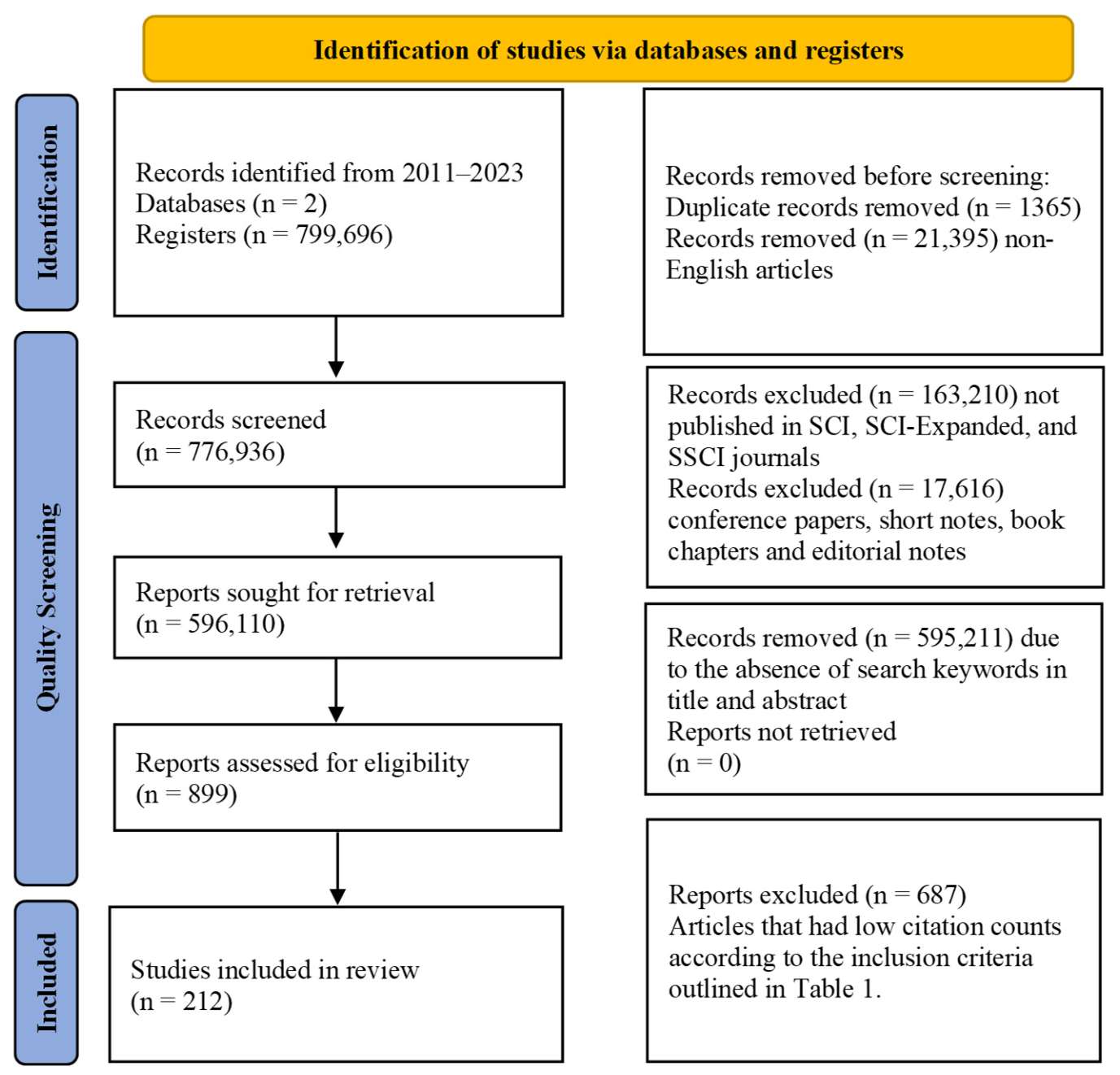
3.1. Study Selection Process
3.2. Bibliometric and Science Mapping Analysis of Highly Cited Studies
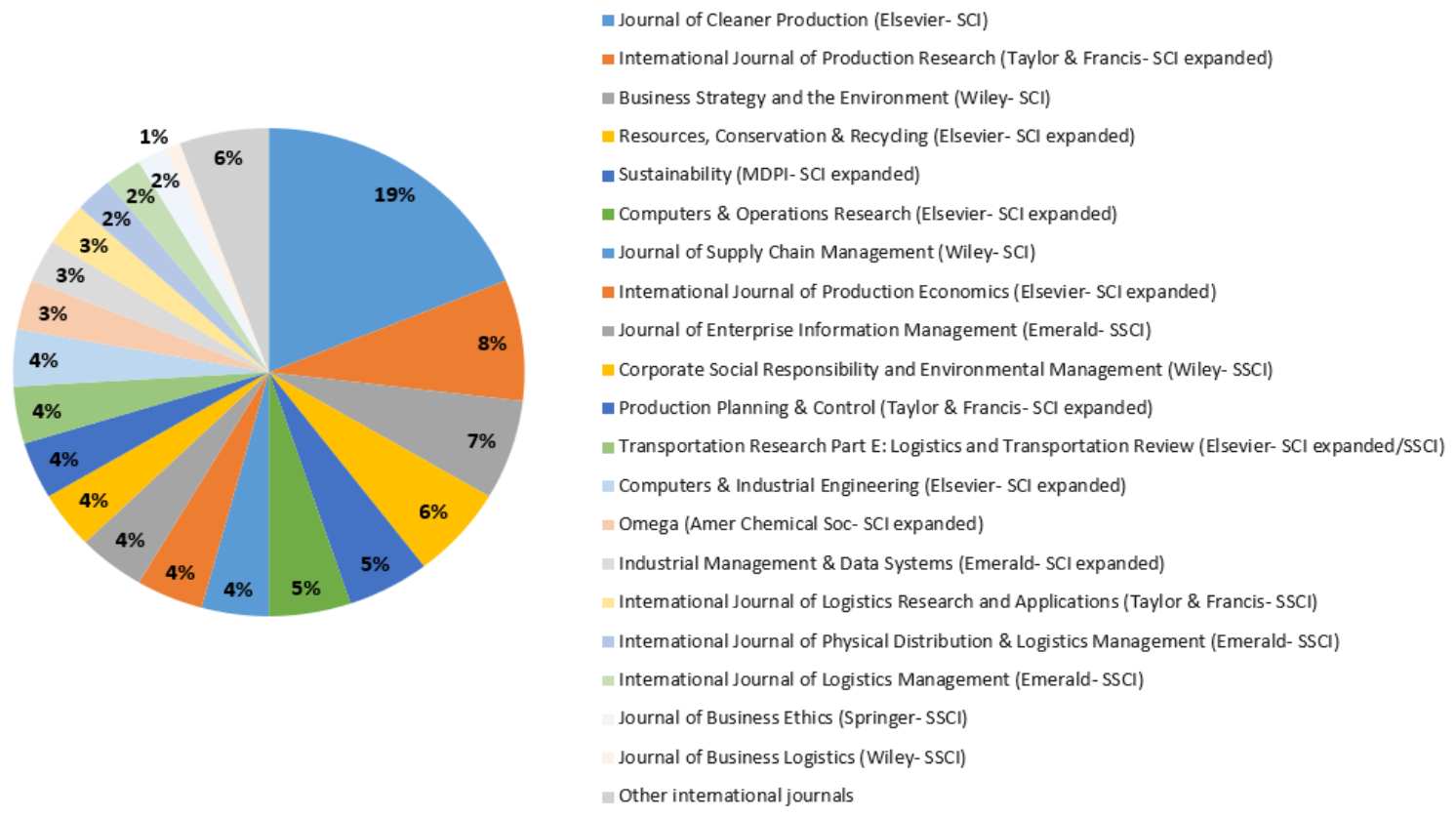
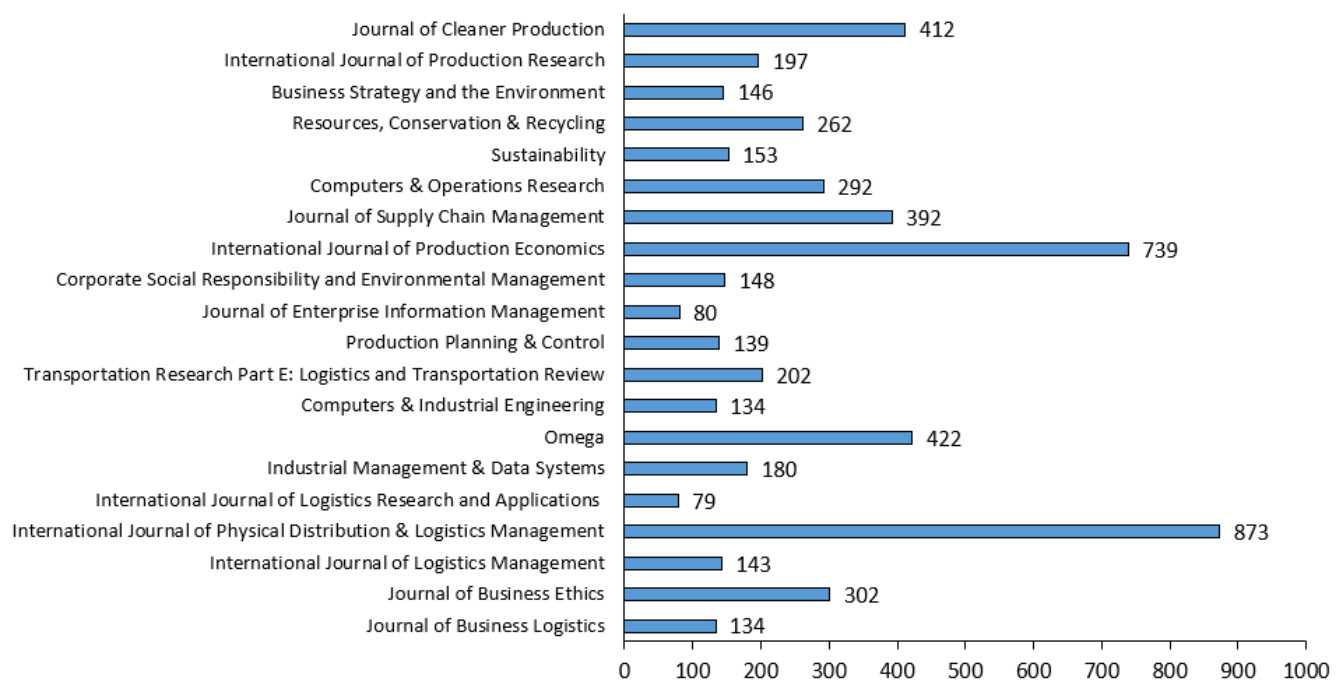
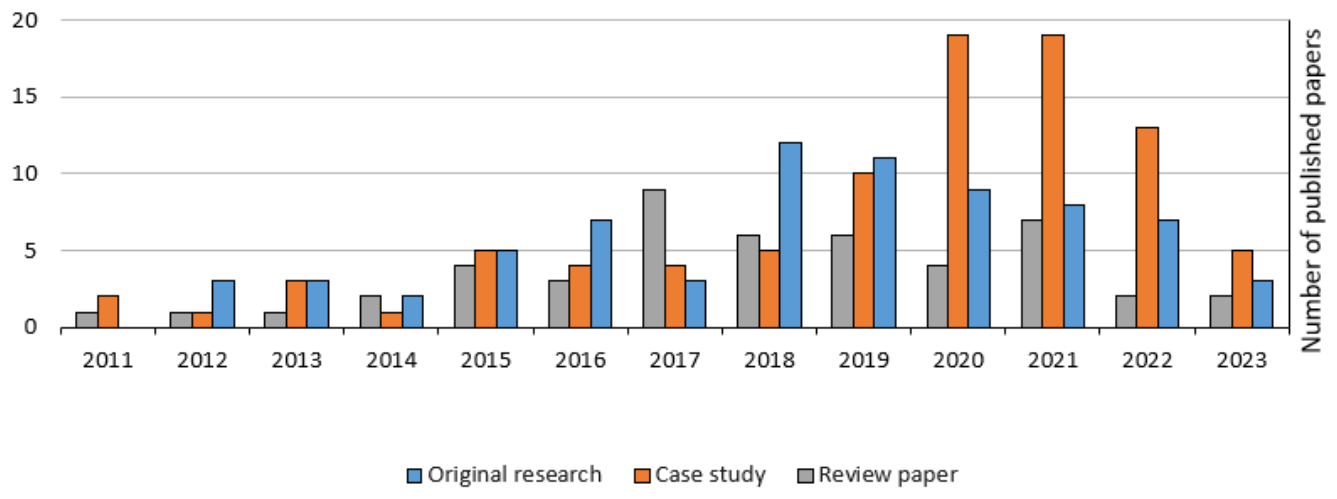
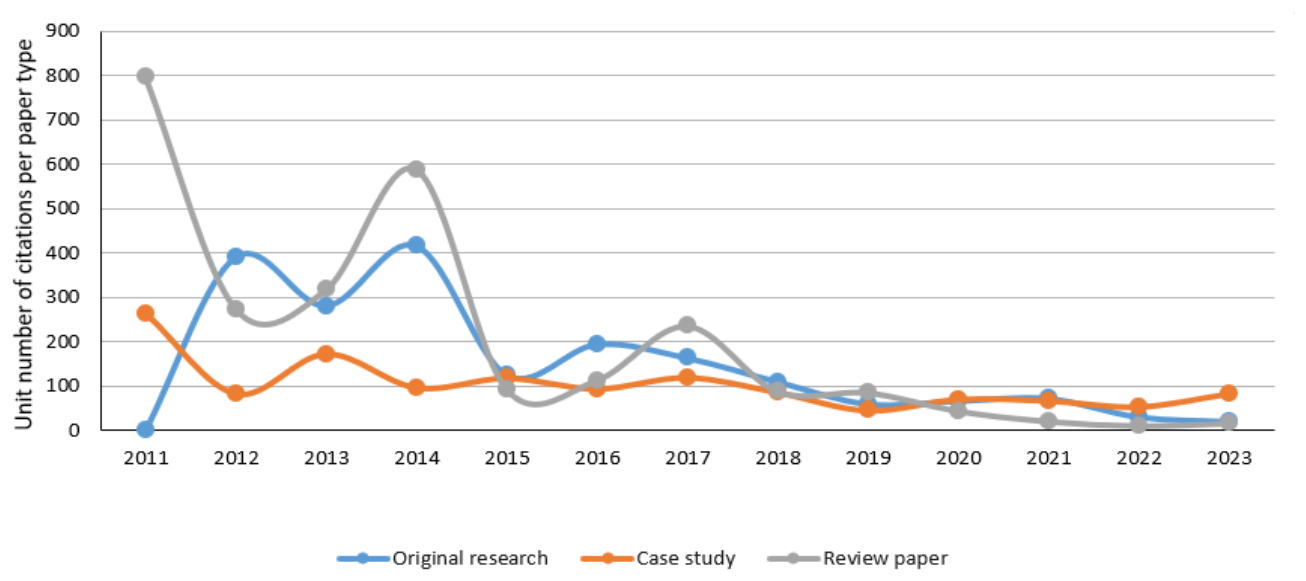
3.2.1. Descriptive Analysis by Journal, Document Type, and Citation Metrics
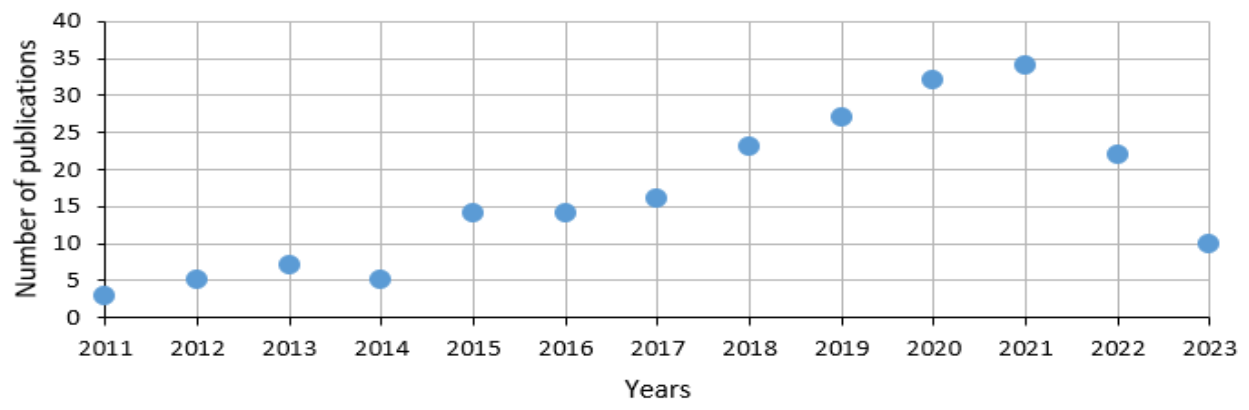
3.2.2. Temporal Analysis of Publications and Citation Trends
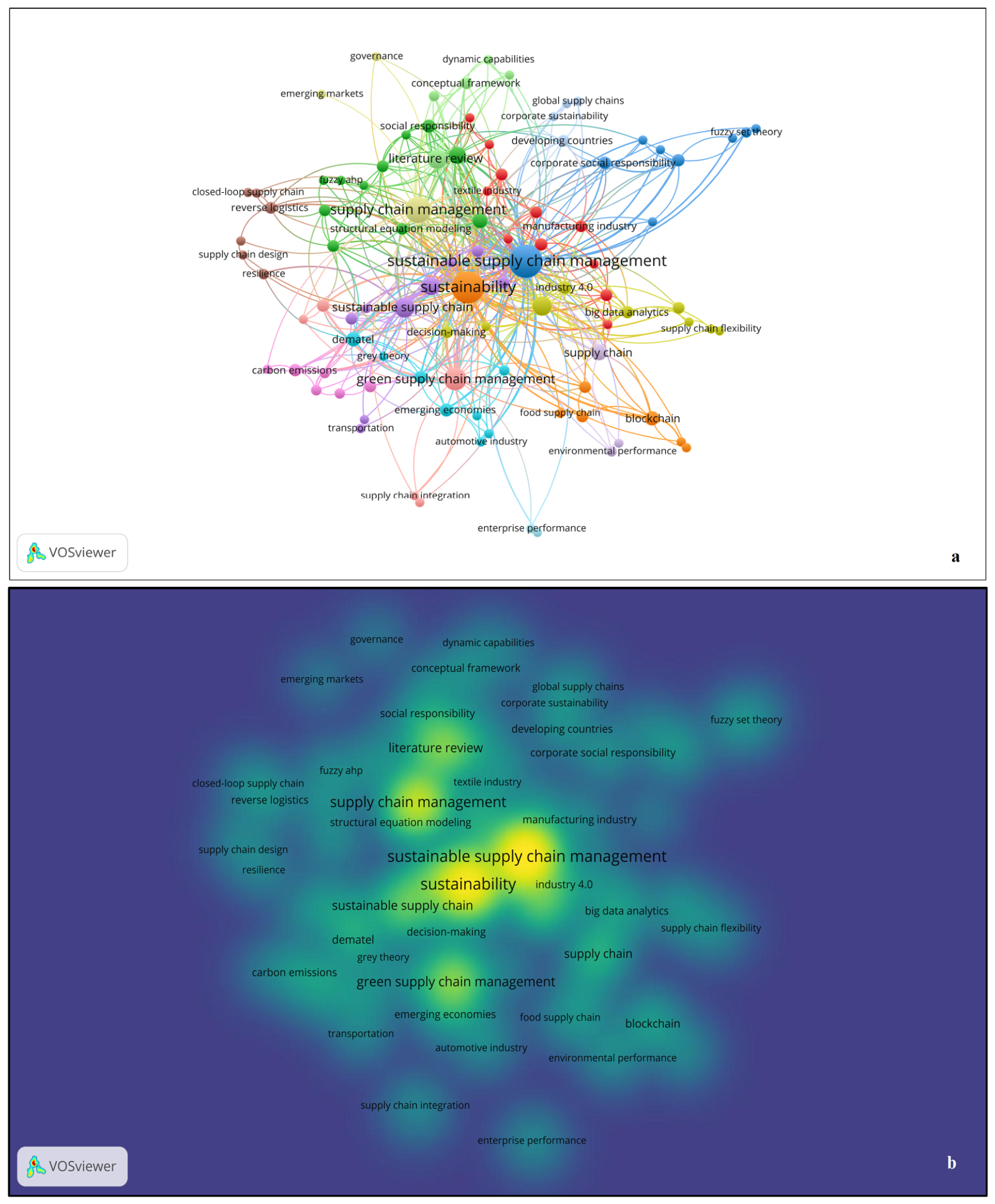
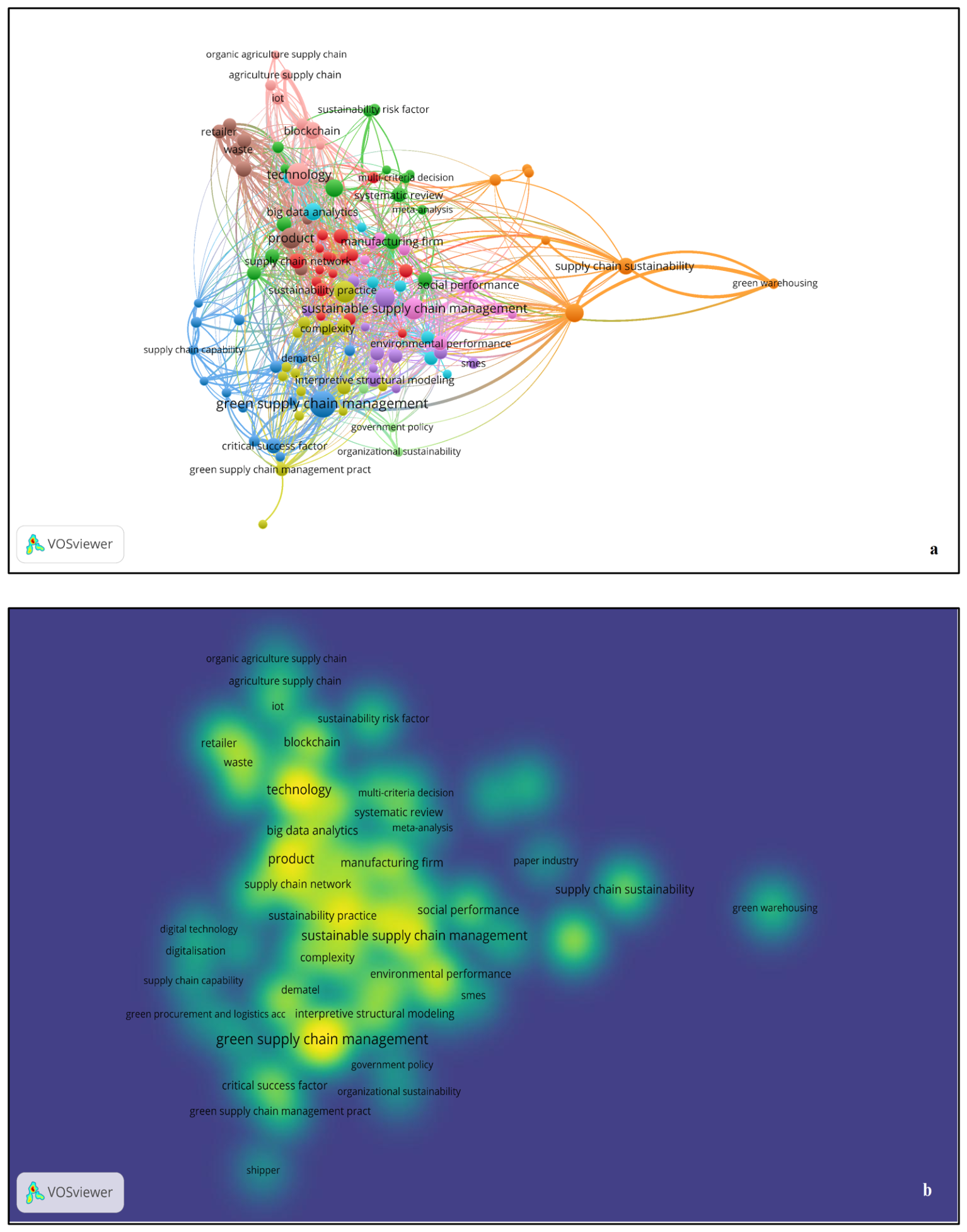
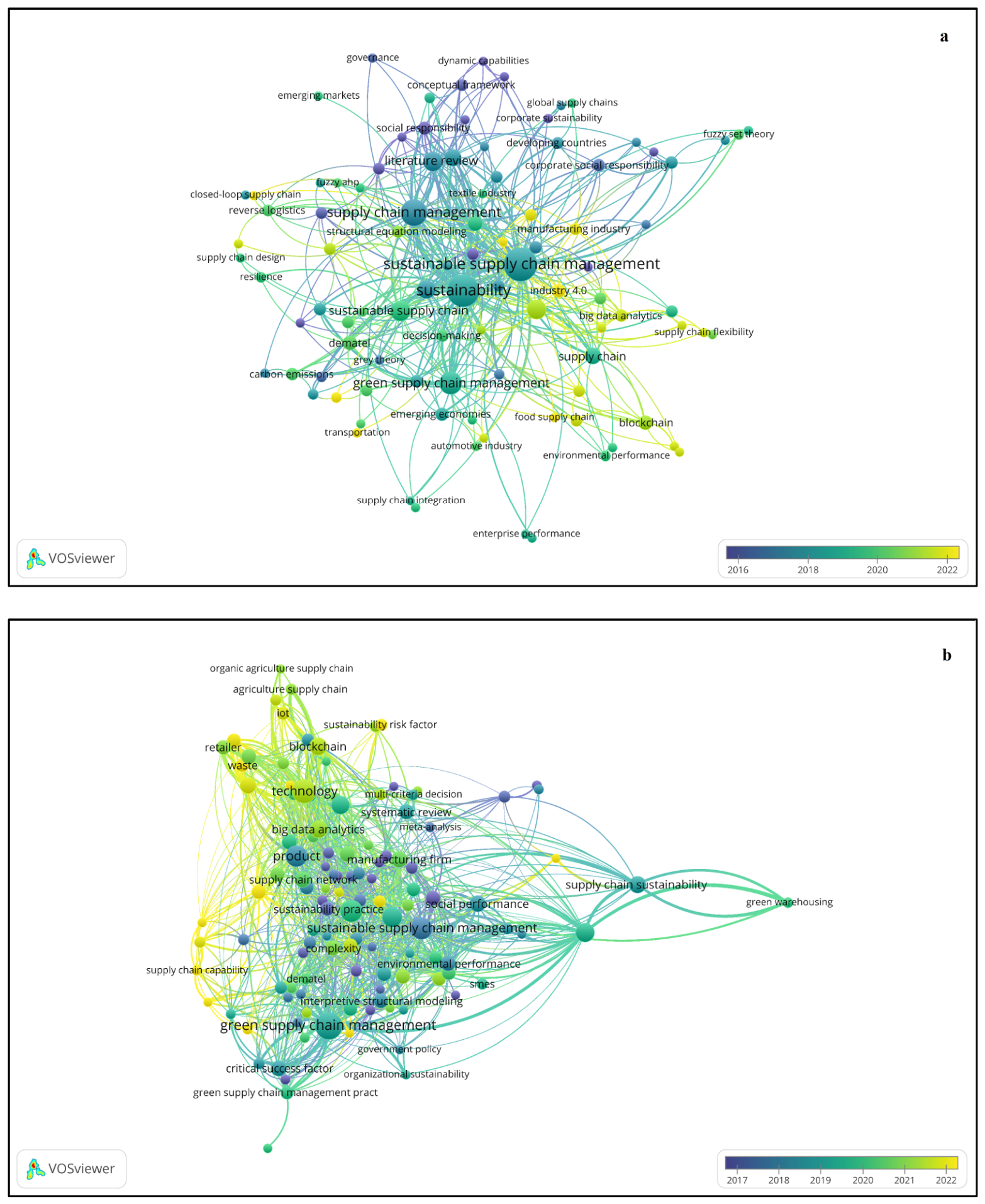
3.2.3. Co-Occurrence-Based Thematic Analysis Using VOSviewer
Keyword Co-Occurrence Analysis
Title–Abstract Term Co-Occurrence Analysis
Temporal Overlay Analysis
3.2.4. Glossary of Theoretical Background
- Resource-Based View (RBV): RBV explains how firms achieve competitive advantage through resources and capabilities that are valuable, rare, inimitable, and non-substitutable [264]. In the context of SSCM, RBV highlights how sustainability-related capabilities, such as green innovation, supplier collaboration, environmental management systems, and sustainability knowledge, can enhance firm performance and support competitive advantage [265,266].
- Natural Resource-Based View (NRBV): NRBV extends RBV by explicitly linking competitive advantage to a firm’s ability to address environmental challenges. It emphasizes capabilities related to pollution prevention, product stewardship, and sustainable development [267,268,269]. In this study, NRBV is used to interpret themes such as environmental strategy, green practices, circular economy, and sustainability-oriented value creation [270].
- Dynamic Capabilities Theory (DCT): DCT focuses on how organizations adjust, renew, and reconfigure their resources and capabilities in response to changing environmental conditions. Within SSCM, DCT explains how firms respond to sustainability pressures, regulatory shifts, technological advancements, and evolving stakeholder expectations. This theory is particularly relevant for analyzing themes of resilience, adaptation, circular transformation, and strategic change [271,272,273,274].
- Information Processing Theory (IPT): IPT suggests that organizations must enhance their information-processing capabilities to address uncertainty, complexity, and interdependence [275]. In SSCM, firms face significant information-processing challenges because sustainability performance depends on data from multiple suppliers, products, processes, and stakeholders. Therefore, IPT is useful for analyzing information visibility, monitoring, decision-making, and uncertainty reduction.
- Organizational Information Processing Theory (OIPT): OIPT extends information-processing logic to the organizational level. It explains how firms design structures, systems, and technologies to process information effectively. In SSCM research, OIPT helps explain the role of digital technologies, such as blockchain, big data analytics, AI, ML, and IoT, in improving transparency, traceability, coordination, and compliance across complex and multi-tier SCs [276,277,278,279,280].
- Triple Bottom Line (TBL): The TBL framework conceptualizes sustainability through three interconnected dimensions: economic, environmental, and social performance. In supply chains, the economic dimension includes cost efficiency, profitability, productivity, and competitiveness. The environmental dimension covers emissions, energy consumption, waste management, resource efficiency, and pollution mitigation. The social dimension focuses on labor conditions, stakeholder welfare, ethical sourcing, safety, and social responsibility. TBL therefore serves as a foundational sustainability rationale for much of the SSCM literature [141,235].
3.2.5. Theoretical Interpretation of Temporal Thematic Patterns
Theoretic Interpretive Phase 1: Foundational Sustainability Concepts (Earlier Themes)
Theoretic Interpretative Phase 2: Operationalization of Sustainability Capabilities (Mid-Phase Themes)
Theoretic Interpretative Phase 3: Digital, Resilient, and Information-Intensive SSCM (Recent Themes)
3.3. Analysis of Recent Studies Using BERTopic
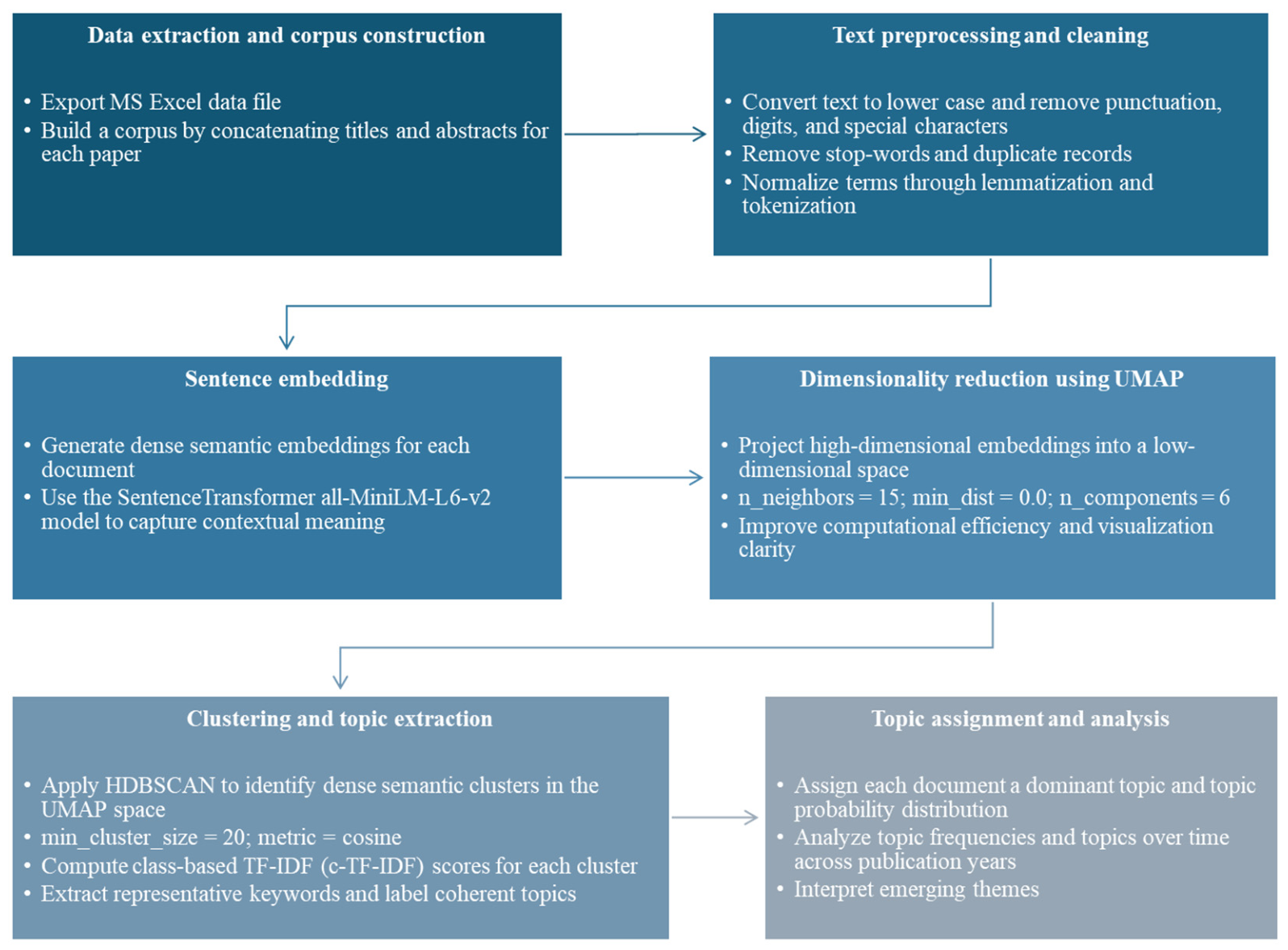
3.3.1. Topic Extraction Process
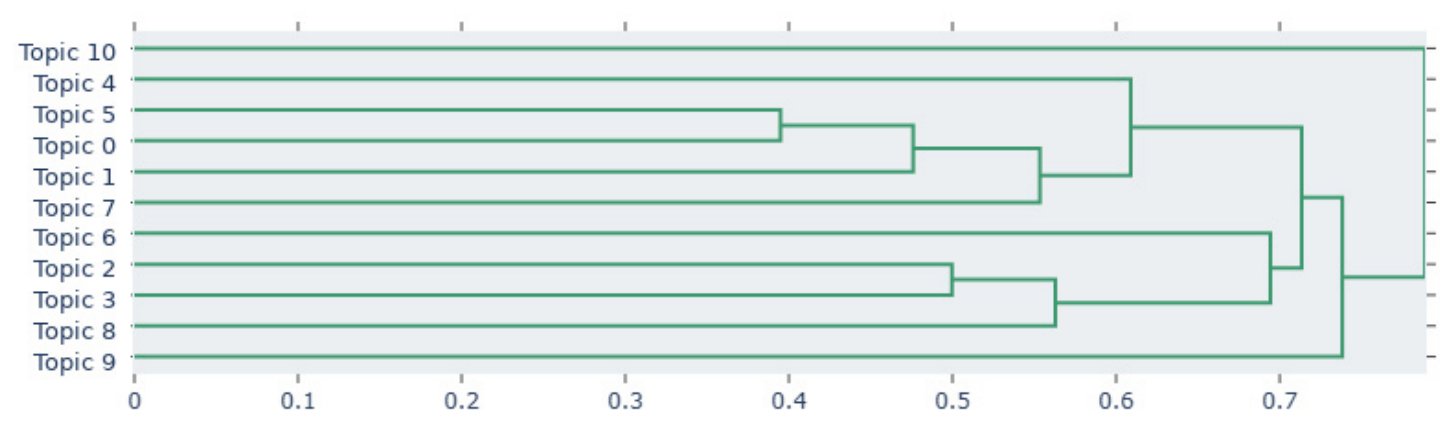
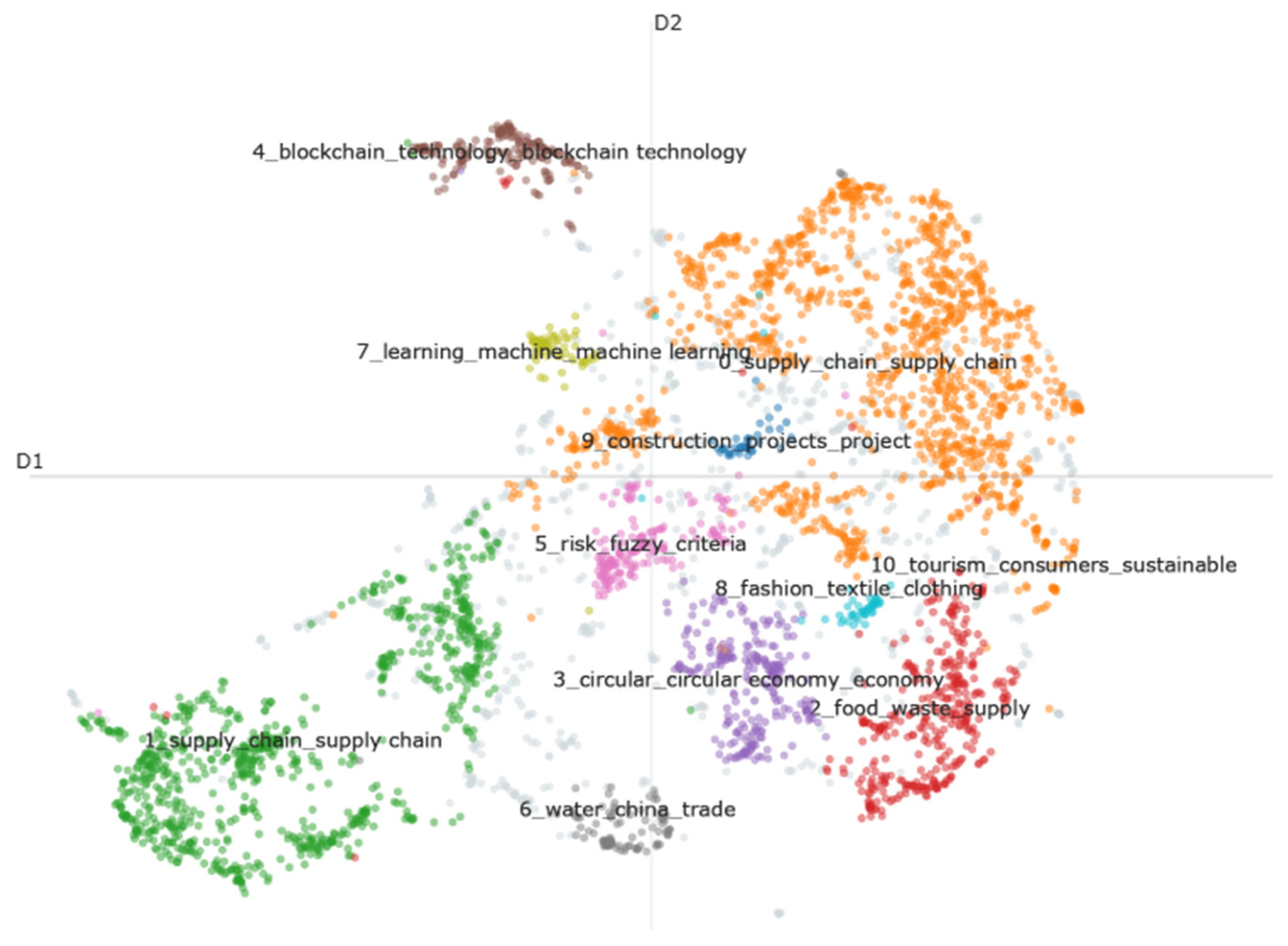
3.3.2. BERTopic Results
3.3.3. Cross-Method Semantic Correspondence Analysis of the VOSviewer and BERTopic Results
4. Discussion
4.1. Research Implications
4.2. Key Managerial Implications
4.3. Limitations and Future Research Directions
5. Conclusions
Supplementary Materials
Author Contributions
Funding
Institutional Review Board Statement
Informed Consent Statement
Data Availability Statement
Conflicts of Interest
Abbreviations
| SSCM | Sustainable Supply Chain Management |
| GSCM | Green Supply Chain Management |
| GSC | Green Supply Chain |
| SCM | Supply Chain Management |
| SSC | Sustainable Supply Chain |
| SC | Supply Chain |
| SLR | Systematic Literature Review |
| SSCI | Social Science Citation Index |
| SCI | Science Citation Index |
| SCI-Expanded | Science Citation Index Expanded |
| CE | Circular Economy |
| MCDM | Multi-Criteria Decision-Making |
| SEM | Structural Equation Modeling |
| PLS-SEM | Partial Least Squares Structural Equation Modeling |
| AI | Artificial Intelligence |
| ML | Machine Learning |
| BERT | Bidirectional Encoder Representations from Transformers |
| UMAP | Uniform Manifold Approximation and Projection |
| c–TF–IDF | Class-Based TF–IDF |
| RBV | Resource-Based View |
| NRBV | Natural Resource-Based View |
| IPT | Information Processing Theory |
| OIPT | Organizational Information Processing Theory |
| DCT | Dynamic Capabilities Theory |
| KPI | Key Performance Indicator |
| GRI | Global Reporting Initiative |
| CDP | Carbon Disclosure Project |
Appendix A

| Reference Number | Author(s) | Year | Methodological Category | DOI |
|---|---|---|---|---|
| [7] | Koberg & Longoni | 2019 | Review-based study | 10.1016/j.jclepro.2018.10.033 |
| [11] | Brandenburg et al. | 2019 | Conceptual study | 10.3390/su11247239 |
| [15] | Cloutier et al. | 2020 | Review-based study | 10.1080/00207543.2019.1660821 |
| [17] | Ansari & Kant | 2017 | Review-based study | 10.1016/j.jclepro.2016.11.023 |
| [20] | Patel & Desai | 2019 | Review-based study | 10.1080/13675567.2018.1534946 |
| [26] | Sarkis et al. | 2021 | Conceptual study | 10.1108/IMDS-08-2020-0450 |
| [46] | Karmaker et al. | 2023 | Empirical study | 10.1016/j.jclepro.2023.138249 |
| [47] | Abbasi et al. | 2023 | Optimization study | 10.1016/j.jclepro.2023.137935 |
| [48] | Da Silva et al. | 2023 | Case-based study | 10.1016/j.resconrec.2023.106969 |
| [49] | Khan et al. | 2023 | Empirical study | 10.1016/j.jclepro.2023.136609 |
| [50] | Liu et al. | 2023 | Conceptual study | 10.1016/j.cie.2023.109113 |
| [51] | Mridha et al. | 2023 | Optimization study | 10.1016/j.jclepro.2022.135629 |
| [52] | Debnath et al. | 2023 | Optimization study | 10.1016/j.jclepro.2022.135477 |
| [53] | Michael Rodriguez-Gonzalez et al. | 2022 | Empirical study | 10.1016/j.jclepro.2022.134670 |
| [54] | Khan et al. | 2023 | Empirical study | 10.1002/bse.3207 |
| [55] | Adams et al. | 2023 | Case-based study | 10.1002/bse.3198 |
| [56] | Shekarian et al. | 2022 | Review-based study | 10.3390/su14137892 |
| [57] | Kazancoglu et al. | 2022 | Empirical study | 10.1016/j.jclepro.2022.132431 |
| [58] | Agrawal et al. | 2023 | Decision-support study | 10.1007/s10668-022-02396-2 |
| [59] | Bai et al. | 2022 | Decision-support study | 10.1016/j.jclepro.2022.131896 |
| [60] | Kayikci et al. | 2022 | Decision-support study | 10.1002/bse.3087 |
| [61] | Mogale et al. | 2022 | Optimization study | 10.1016/j.cie.2022.108105 |
| [62] | Kunkel et al. | 2022 | Case-based study | 10.1016/j.resconrec.2022.106274 |
| [63] | Mangla et al. | 2022 | Decision-support study | 10.1002/bse.3027 |
| [64] | Faramarzi-Oghani et al. | 2023 | Review-based study | 10.1080/00207543.2022.2045377 |
| [65] | Xu et al. | 2022 | Empirical study | 10.1108/JEIM-06-2021-0260 |
| [66] | Sheng et al. | 2023 | Review-based study | 10.1007/s10668-022-02109-9 |
| [67] | Michael Rodriguez-Gonzalez et al. | 2022 | Empirical study | 10.1002/csr.2233 |
| [68] | Rajaeifar et al. | 2022 | Review-based study | 10.1016/j.resconrec.2021.106144 |
| [69] | Guo et al. | 2022 | Optimization study | 10.1016/j.tre.2021.102593 |
| [70] | Kim et al. | 2022 | Empirical study | 10.1080/00207543.2021.1992032 |
| [71] | Raian et al. | 2022 | Decision-support study | 10.1016/j.resconrec.2021.105975 |
| [72] | Paul et al. | 2023 | Empirical study | 10.1108/IJLM-04-2021-0238 |
| [73] | Wang & Rani | 2022 | Decision-support study | 10.1108/JEIM-05-2021-0222 |
| [74] | Yang et al. | 2022 | Decision-support study | 10.1108/JEIM-06-2021-0261 |
| [75] | Centobelli et al. | 2021 | Empirical study | 10.1016/j.ijpe.2021.108297 |
| [76] | Kazancoglu et al. | 2023 | Decision-support study | 10.1080/09537287.2021.1980910 |
| [77] | Kumar et al. | 2021 | Decision-support study | 10.1016/j.resconrec.2021.105879 |
| [78] | Bechtsis et al. | 2022 | Review-based study | 10.1080/00207543.2021.1957506 |
| [79] | Acero et al. | 2022 | Conceptual study | 10.1111/jscm.12269 |
| [80] | Nayal et al. | 2021 | Conceptual study | 10.1108/JEIM-09-2020-0381 |
| [81] | Paul et al. | 2021 | Review-based study | 10.3390/su13137104 |
| [82] | Kusi-Sarpong et al. | 2021 | Decision-support study | 10.1016/j.omega.2021.102502 |
| [83] | Jraisat et al. | 2023 | Case-based study | 10.1080/00207543.2021.1936263 |
| [84] | Gong et al. | 2023 | Case-based study | 10.1080/00207543.2021.1930238 |
| [85] | Cui et al. | 2023 | Decision-support study | 10.1080/00207543.2021.1924412 |
| [86] | Siems & Seuring | 2021 | Case-based study | 10.1002/bse.2792 |
| [87] | Liu et al. | 2021 | Optimization study | 10.1016/j.tre.2021.102319 |
| [88] | Daddi et al. | 2021 | Empirical study | 10.1002/csr.2144 |
| [89] | Olan et al. | 2022 | Empirical study | 10.1080/00207543.2021.1915510 |
| [90] | Ma et al. | 2021 | Optimization study | 10.1016/j.tre.2021.102290 |
| [91] | Edwin Cheng et al. | 2022 | Empirical study | 10.1080/00207543.2021.1906971 |
| [92] | Dominguez et al. | 2021 | Optimization study | 10.1016/j.omega.2020.102268 |
| [93] | Feng et al. | 2023 | Decision-support study | 10.1080/00207543.2021.1890260 |
| [94] | Sun et al. | 2021 | Empirical study | 10.1002/csr.2128 |
| [95] | Koot et al. | 2021 | Review-based study | 10.1016/j.cie.2020.107076 |
| [96] | Mc Loughlin et al. | 2023 | Conceptual study | 10.1080/09537287.2021.1884764 |
| [97] | Liu et al. | 2021 | Optimization study | 10.1016/j.tre.2021.102237 |
| [98] | Tsai et al. | 2021 | Decision-support study | 10.1016/j.resconrec.2021.105421 |
| [99] | Hu et al. | 2021 | Conceptual study | 10.1016/j.cie.2020.107079 |
| [100] | Khan et al. | 2021 | Review-based study | 10.1016/j.jclepro.2020.123357 |
| [101] | Raut et al. | 2021 | Empirical study | 10.1016/j.tre.2020.102170 |
| [102] | Zhou et al. | 2021 | Review-based study | 10.1016/j.omega.2020.102295 |
| [103] | Esmaeilian et al. | 2020 | Review-based study | 10.1016/j.resconrec.2020.105064 |
| [104] | Banik et al. | 2022 | Decision-support study | 10.1080/13675567.2020.1839029 |
| [105] | Chirra et al. | 2021 | Decision-support study | 10.1080/00207543.2020.1832272 |
| [106] | Khan et al. | 2021 | Empirical study | 10.1002/csr.2057 |
| [107] | Nayeri et al. | 2020 | Optimization study | 10.1016/j.cie.2020.106716 |
| [108] | Singh et al. | 2020 | Empirical study | 10.1108/IJLSS-06-2017-0068 |
| [109] | Sundarakani et al. | 2021 | Optimization study | 10.1108/IJLM-12-2019-0333 |
| [110] | Sanchez-Flores et al. | 2020 | Review-based study | 10.3390/su12176972 |
| [111] | Zhang et al. | 2021 | Review-based study | 10.1108/JEIM-12-2019-0381 |
| [112] | Agyabeng-Mensah et al. | 2020 | Empirical study | 10.1108/IJLM-10-2019-0275 |
| [113] | Tseng et al. | 2022 | Decision-support study | 10.1080/13675567.2020.1800608 |
| [114] | Singh et al. | 2021 | Review-based study | 10.1080/00207543.2020.1792000 |
| [115] | Hong et al. | 2022 | Empirical study | 10.1080/13675567.2020.1795094 |
| [116] | Sharma et al. | 2020 | Review-based study | 10.1016/j.cor.2020.104926 |
| [117] | Nazam et al. | 2020 | Decision-support study | 10.1108/JEIM-09-2019-0271 |
| [118] | Yu et al. | 2021 | Empirical study | 10.1080/09537287.2020.1774675 |
| [119] | Bird & Soundararajan | 2020 | Conceptual study | 10.1007/s10551-018-4067-z |
| [120] | Hussain & Malik | 2020 | Decision-support study | 10.1016/j.jclepro.2020.120375 |
| [121] | Alghababsheh & Gallear | 2021 | Empirical study | 10.1007/s10551-020-04525-1 |
| [122] | Lis et al. | 2020 | Review-based study | 10.3390/su12103987 |
| [123] | Fattahi et al. | 2021 | Optimization study | 10.1080/00207543.2020.1746427 |
| [124] | Jiang et al. | 2020 | Empirical study | 10.1108/IMDS-07-2019-0394 |
| [125] | Tseng et al. | 2022 | Empirical study | 10.1080/13675567.2020.1749577 |
| [126] | Yadav & Singh | 2021 | Decision-support study | 10.1108/JEIM-09-2019-0301 |
| [127] | Bag et al. | 2021 | Empirical study | 10.1108/JEIM-10-2019-0324 |
| [128] | Inamdar et al. | 2021 | Review-based study | 10.1108/JEIM-09-2019-0267 |
| [129] | Mardani et al. | 2020 | Review-based study | 10.1016/j.jclepro.2019.119383 |
| [130] | Bux et al. | 2020 | Decision-support study | 10.1002/csr.1920 |
| [131] | Van Engeland et al. | 2020 | Review-based study | 10.1016/j.omega.2018.12.001 |
| [132] | Dewi et al. | 2023 | Empirical study | 10.3390/su15021148 |
| [133] | He et al. | 2021 | Decision-support study | 10.1080/00207543.2020.1724343 |
| [134] | Frei et al. | 2020 | Optimization study | 10.1002/bse.2479 |
| [135] | Digalwar et al. | 2020 | Decision-support study | 10.1002/bse.2455 |
| [136] | Han & Huo | 2020 | Empirical study | 10.1108/IMDS-07-2019-0373 |
| [137] | Jazairy & von Haartman | 2020 | Empirical study | 10.1080/13675567.2019.1584163 |
| [138] | Vivas et al. | 2020 | Optimization study | 10.1016/j.cie.2019.01.044 |
| [139] | Shashi et al. | 2020 | Review-based study | 10.1002/bse.2428 |
| [140] | Shareef et al. | 2020 | Case-based study | 10.1080/09537287.2019.1695917 |
| [141] | Laosirihongthong et al. | 2020 | Decision-support study | 10.1080/09537287.2019.1701233 |
| [142] | Pan et al. | 2020 | Empirical study | 10.1080/09537287.2019.1631457 |
| [143] | Zimon et al. | 2019 | Decision-support study | 10.3390/su11247227 |
| [144] | Meherishi et al. | 2019 | Review-based study | 10.1016/j.jclepro.2019.07.057 |
| [145] | Carter et al. | 2019 | Review-based study | 10.1108/IJPDLM-02-2019-0056 |
| [146] | Gong et al. | 2019 | Empirical study | 10.1016/j.ijpe.2019.01.033 |
| [147] | Jia et al. | 2019 | Case-based study | 10.1016/j.ijpe.2018.07.022 |
| [148] | Manupati et al. | 2020 | Decision-support study | 10.1080/00207543.2019.1683248 |
| [149] | Narayanan et al. | 2019 | Decision-support study | 10.1108/JMTM-06-2017-0114 |
| [150] | Dahlmann & Rohrich | 2019 | Empirical study | 10.1002/bse.2392 |
| [151] | Govindan et al. | 2019 | Optimization study | 10.1016/j.cor.2018.11.013 |
| [152] | Hu et al. | 2019 | Empirical study | 10.1016/j.resconrec.2019.05.042 |
| [153] | Bai et al. | 2020 | Empirical study | 10.1080/00207543.2019.1661532 |
| [154] | Mehdikhani & Valmohammadi | 2019 | Empirical study | 10.1108/JEIM-07-2018-0166 |
| [155] | Sajjad et al. | 2020 | Empirical study | 10.1002/bse.2389 |
| [156] | Tseng et al. | 2019 | Decision-support study | 10.1016/j.jclepro.2019.04.201 |
| [157] | Seuring et al. | 2019 | Case-based study | 10.1016/j.jclepro.2018.12.102 |
| [158] | Yun et al. | 2019 | Review-based study | 10.1108/IJLM-05-2017-0112 |
| [159] | Saeed et al. | 2019 | Review-based study | 10.3390/su11041137 |
| [160] | Rebs et al. | 2019 | Review-based study | 10.1016/j.jclepro.2018.10.100 |
| [161] | Ardakani & Soltanmohammadi | 2019 | Empirical study | 10.1002/csr.1671 |
| [162] | Gardas et al. | 2019 | Case-based study | 10.1016/j.spc.2018.11.005 |
| [163] | Xiao et al. | 2019 | Case-based study | 10.1111/jscm.12170 |
| [164] | Carter & Washispack | 2018 | Review-based study | 10.1111/jbl.12196 |
| [165] | Chacon Vargas et al. | 2018 | Empirical study | 10.1016/j.resconrec.2018.08.018 |
| [166] | Das | 2018 | Empirical study | 10.1016/j.jclepro.2018.08.250 |
| [167] | Luthra & Mangla | 2018 | Decision-support study | 10.1016/j.resconrec.2018.07.005 |
| [168] | Badiezadeh et al. | 2018 | Decision-support study | 10.1016/j.cor.2017.06.003 |
| [169] | Kaur & Singh | 2018 | Optimization study | 10.1016/j.cor.2017.05.008 |
| [170] | Silvestre et al. | 2018 | Empirical study | 10.1016/j.jclepro.2018.05.127 |
| [171] | Jia et al. | 2018 | Review-based study | 10.1016/j.jclepro.2018.03.248 |
| [172] | Qorri et al. | 2018 | Review-based study | 10.1016/j.jclepro.2018.04.073 |
| [173] | Luthra & Mangla | 2018 | Decision-support study | 10.1016/j.psep.2018.04.018 |
| [174] | Ahmed & Sarkar | 2018 | Optimization study | 10.1016/j.jclepro.2018.02.289 |
| [175] | Bastas & Liyanage | 2018 | Review-based study | 10.1016/j.jclepro.2018.01.110 |
| [176] | Moktadir et al. | 2018 | Decision-support study | 10.1016/j.jclepro.2018.01.245 |
| [177] | Kot | 2018 | Review-based study | 10.3390/su10041143 |
| [178] | Castillo et al. | 2018 | Conceptual study | 10.1111/jbl.12176 |
| [179] | Hong et al. | 2018 | Empirical study | 10.1016/j.jclepro.2017.06.093 |
| [180] | Allaoui et al. | 2018 | Optimization study | 10.1016/j.cor.2016.10.012 |
| [181] | Hosseinifard & Abbasi | 2018 | Optimization study | 10.1016/j.cor.2016.08.014 |
| [182] | Kazancoglu et al. | 2018 | Decision-support study | 10.1108/IMDS-03-2017-0121 |
| [183] | Mathivathanan et al. | 2018 | Empirical study | 10.1016/j.resconrec.2017.01.003 |
| [184] | Roy et al. | 2018 | Review-based study | 10.1108/IJOPM-05-2017-0260 |
| [185] | Wang, Jing; Dai, Jun | 2018 | Empirical study | 10.1108/IMDS-12-2016-0540 |
| [186] | Zhang et al. | 2018 | Empirical study | 10.1016/j.resconrec.2016.06.015 |
| [187] | Chen et al. | 2017 | Review-based study | 10.1016/j.ijpe.2017.04.005 |
| [188] | Ahmadi et al. | 2017 | Decision-support study | 10.1016/j.resconrec.2017.07.020 |
| [189] | Ansari & Kant | 2017 | Review-based study | 10.1002/bse.1945 |
| [190] | Lim et al. | 2017 | Decision-support study | 10.1016/j.jclepro.2017.06.056 |
| [191] | Rajeev et al. | 2017 | Review-based study | 10.1016/j.jclepro.2017.05.026 |
| [192] | Oelze | 2017 | Case-based study | 10.3390/su9081435 |
| [193] | Stindt | 2017 | Optimization study | 10.1016/j.jclepro.2017.03.126 |
| [194] | Madani & Rasti-Barzoki | 2017 | Optimization study | 10.1016/j.cie.2017.01.017 |
| [195] | Bechtsis et al. | 2017 | Review-based study | 10.1016/j.jclepro.2016.10.057 |
| [196] | Dubey et al. | 2017 | Review-based study | 10.1016/j.jclepro.2016.03.117 |
| [197] | Busse et al. | 2017 | Empirical study | 10.1111/jscm.12129 |
| [198] | Dubey et al. | 2017 | Review-based study | 10.1108/IJLM-07-2015-0112 |
| [199] | Genovese et al. | 2017 | Optimization study | 10.1016/j.omega.2015.05.015 |
| [200] | Reefke & Sundaram | 2017 | Review-based study | 10.1016/j.omega.2016.02.003 |
| [201] | Varsei & Polyakovskiy | 2017 | Optimization study | 10.1016/j.omega.2015.11.009 |
| [202] | Su et al. | 2016 | Decision-support study | 10.1016/j.jclepro.2015.05.080 |
| [203] | Schoeggl et al. | 2016 | Decision-support study | 10.1016/j.jclepro.2016.04.035 |
| [204] | Fahimnia & Jabbarzadeh | 2016 | Optimization study | 10.1016/j.tre.2016.02.007 |
| [205] | Luthra et al. | 2016 | Decision-support study | 10.1016/j.jclepro.2016.01.095 |
| [206] | Oelze et al. | 2016 | Empirical study | 10.1002/bse.1869 |
| [207] | Busse | 2016 | Empirical study | 10.1111/jscm.12096 |
| [208] | Markman & Krause | 2016 | Conceptual study | 10.1111/jscm.12105 |
| [209] | Hussain et al. | 2016 | Empirical study | 10.1016/j.rser.2015.07.097 |
| [210] | Chiappetta et al. | 2016 | Conceptual study | 10.1016/j.jclepro.2015.01.052 |
| [211] | Formentini & Taticchi | 2016 | Case-based study | 10.1016/j.jclepro.2014.12.072 |
| [212] | Govindan et al. | 2016 | Conceptual study | 10.1016/j.jclepro.2015.11.084 |
| [213] | Lin & Tseng | 2016 | Decision-support study | 10.1016/j.jclepro.2014.07.012 |
| [214] | Giannakis & Papadopoulos | 2016 | Empirical study | 10.1016/j.ijpe.2015.06.032 |
| [215] | Matthews et al. | 2016 | Conceptual study | 10.1111/jscm.12097 |
| [216] | Luthra et al. | 2015 | Decision-support study | 10.1016/j.resourpol.2014.12.006 |
| [217] | Taticchi et al. | 2015 | Review-based study | 10.1080/00207543.2014.939239 |
| [218] | Sajjad et al. | 2015 | Empirical study | 10.1002/bse.1898 |
| [219] | Mota et al. | 2015 | Optimization study | 10.1016/j.jclepro.2014.07.052 |
| [220] | Govindan et al. | 2015 | Optimization study | 10.1016/j.cor.2014.12.014 |
| [221] | Marshall et al. | 2015 | Empirical study | 10.1080/09537287.2014.963726 |
| [222] | Brandenburg & Rebs | 2015 | Review-based study | 10.1007/s10479-015-1853-1 |
| [223] | Luthra et al. | 2015 | Conceptual study | 10.1080/09537287.2014.904532 |
| [224] | Azadi et al. | 2015 | Decision-support study | 10.1016/j.cor.2014.03.002 |
| [225] | Boukherroub et al. | 2015 | Optimization study | 10.1016/j.cor.2014.09.002 |
| [226] | Validi et al. | 2015 | Optimization study | 10.1016/j.cor.2014.06.015 |
| [227] | Xie, Gang | 2015 | Optimization study | 10.1016/j.cor.2013.11.020 |
| [228] | Meixell & Luoma | 2015 | Conceptual study | 10.1108/IJPDLM-05-2013-0155 |
| [229] | Tseng et al. | 2015 | Decision-support study | 10.1108/IMDS-10-2014-0319 |
| [230] | Diabat et al. | 2014 | Case-based study | 10.1016/j.jclepro.2014.06.081 |
| [231] | Turke & Altuntas | 2014 | Case-based study | 10.1016/j.emj.2014.02.001 |
| [232] | Beske et al. | 2014 | Review-based study | 10.1016/j.ijpe.2013.12.026 |
| [233] | Brandenburg et al. | 2014 | Review-based study | 10.1016/j.ejor.2013.09.032 |
| [234] | Pagell & Shevchenko | 2014 | Conceptual study | 10.1111/jscm.12037 |
| [235] | Gold et al. | 2013 | Case-based study | 10.1016/j.ibusrev.2012.12.006 |
| [236] | Morali & Searcy | 2013 | Case-based study | 10.1007/s10551-012-1539-4 |
| [237] | Al Zaabi et al. | 2013 | Decision-support study | 10.1007/s00170-013-4951-8 |
| [238] | Ahi & Searcy | 2013 | Review-based study | 10.1016/j.jclepro.2013.02.018 |
| [239] | Harms et al. | 2013 | Empirical study | 10.1002/csr.1293 |
| [240] | Golicic & Smith | 2013 | Review-based study | 10.1111/jscm.12006 |
| [241] | Winter & Knemeyer | 2013 | Review-based study | 10.1108/09600031311293237 |
| [242] | Ageron et al. | 2012 | Empirical study | 10.1016/j.ijpe.2011.04.007 |
| [243] | Gopalakrishnan et al. | 2012 | Case-based study | 10.1016/j.ijpe.2012.01.003 |
| [244] | Zailani et al. | 2012 | Empirical study | 10.1016/j.ijpe.2012.02.008 |
| [245] | Wittstruck & Teuteberg | 2012 | Empirical study | 10.1002/csr.261 |
| [246] | Beske | 2012 | Conceptual study | 10.1108/09600031211231344 |
| [247] | Seuring | 2011 | Review-based study | 10.1002/bse.702 |
| [248] | Wolf | 2011 | Empirical study | 10.1007/s10551-011-0806-0 |
| [249] | Carter et al. | 2011 | Review-based study | 10.1108/09600031111101420 |
| [250] | Zhang et al. | 2022 | Case-based study | 10.1016/j.resconrec.2022.106536 |
| [251] | Cai & Choi | 2020 | Conceptual study | 10.1016/j.tre.2020.102010 |
| Label | Replace by | Thesaurus Outputs | Stopwords |
|---|---|---|---|
| ahp | analytical hierarchy process | analytical hierarchy process | adoption |
| artificial intelligence | N/A | N/A | base of the pyramid |
| automotive industry | N/A | N/A | flexibility |
| best worst method | N/A | N/A | practices |
| best-worst method | best worst method | best worst method | drivers |
| big data | N/A | N/A | barriers |
| big data analytics | N/A | N/A | sustainable |
| blockchain | N/A | N/A | environment |
| carbon emissions | N/A | N/A | review |
| case study | N/A | N/A | risk |
| case study research | case study | case study | performance |
| china | N/A | N/A | framework |
| circular economy | N/A | N/A | |
| closed-loop supply chain | N/A | N/A | |
| collaboration | N/A | N/A | |
| conceptual framework | N/A | N/A | |
| corporate theory building | N/A | N/A | |
| corporate social responsibility | N/A | N/A | |
| corporate sustainability | N/A | N/A | |
| critical success factors | N/A | N/A | |
| critical success factors (csf) | critical success factors | critical success factors | |
| decision-making | N/A | N/A | |
| decision making | decision-making | decision-making | |
| dematel | N/A | N/A | |
| developing countries | N/A | N/A | |
| dynamic capabilities | N/A | N/A | |
| economic performance | N/A | N/A | |
| emerging economies | N/A | N/A | |
| emerging economy | emerging economies | emerging economies | |
| environmental management | N/A | N/A | |
| environmental performance | N/A | N/A | |
| environmental sustainability | N/A | N/A | |
| factor analysis | N/A | N/A | |
| financial performance | N/A | N/A | |
| firm performance | N/A | N/A | |
| food industry | N/A | N/A | |
| food supply chain | N/A | N/A | |
| fuzzy ahp | N/A | N/A | |
| fuzzy delphi method | N/A | N/A | |
| fuzzy set theory | N/A | N/A | |
| global supply chains | N/A | N/A | |
| goal programming | N/A | N/A | |
| governance | N/A | N/A | |
| governance mechanism | N/A | N/A | |
| green logistics | N/A | N/A | |
| green practices | N/A | N/A | |
| green supply chain management | N/A | N/A | |
| green supply chain management (gscm) | green supply chain management | green supply chain management | |
| grey theory | N/A | N/A | |
| knowledge management | N/A | N/A | |
| literature review | N/A | N/A | |
| manufacturing industry | N/A | N/A | |
| multi-criteria decision-making | N/A | N/A | |
| meta-analysis | N/A | N/A | |
| mcdm | multi-criteria decision-making | multi-criteria decision-making | |
| multi-tier supply chain | N/A | N/A | |
| multi-tier supply chains | multi-tier supply chain | multi-tier supply chain | |
| multi-objective optimization | N/A | N/A | |
| new zealand | N/A | N/A | |
| operations management | N/A | N/A | |
| organizational theories | N/A | N/A | |
| performance measurement | N/A | N/A | |
| recycling | N/A | N/A | |
| remanufacturing | N/A | N/A | |
| resilience | N/A | N/A | |
| resource efficiency | N/A | N/A | |
| reverse logistics | N/A | N/A | |
| risk management | N/A | N/A | |
| scale development | N/A | N/A | |
| social performance | N/A | N/A | |
| social responsibility | N/A | N/A | |
| social sustainability | N/A | N/A | |
| stakeholder engagement | N/A | N/A | |
| stakeholder theory | N/A | N/A | |
| structural equation modeling | N/A | N/A | |
| structural equation modelling (sem) | structural equation modeling | structural equation modeling | |
| supply chain | N/A | N/A | |
| supply chain design | N/A | N/A | |
| supply chain dynamic capabilities | N/A | N/A | |
| supply chain flexibility | N/A | N/A | |
| supply chain integration | N/A | N/A | |
| supply chain management | N/A | N/A | |
| supply chain management (scm) | supply chain management | supply chain management | |
| supply chain network design | N/A | N/A | |
| supply chain performance | N/A | N/A | |
| supply chain planning | N/A | N/A | |
| supply chain resilience | N/A | N/A | |
| supply chain sustainability | N/A | N/A | |
| supply management | N/A | N/A | |
| sustainability | N/A | N/A | |
| sustainable development | N/A | N/A | |
| sustainable operations | N/A | N/A | |
| sustainable performance | N/A | N/A | |
| sustainable supplier selection | N/A | N/A | |
| sustainable supply chain | N/A | N/A | |
| sustainable supply chain management | N/A | N/A | |
| sustainable supply chain management (sscm) | sustainable supply chain management | sustainable supply chain management | |
| sustainable supply chains | sustainable supply chain | sustainable supply chain | |
| systematic literature review | N/A | N/A | |
| tea supply chain | N/A | N/A | |
| textile industry | N/A | N/A | |
| traceability | N/A | N/A | |
| transportation | N/A | N/A | |
| triple bottom line | N/A | N/A | |
| uncertainty | N/A | N/A | |
| waste management | N/A | N/A | |
| ındustry 4.0 | industry 4.0 | industry 4.0 | |
| ınterpretive structural modeling | interpretive structural modeling | interpretive structural modeling |
| Label | Replace by | Thesaurus Outputs | Stopwords |
|---|---|---|---|
| agriculture supply chain | academician | ||
| ahp | analytical hierarchy process | analytical hierarchy process | actor |
| analytical hierarchy process | adoption | ||
| automotive industry | association | ||
| bangladesh | attempt | ||
| bda | big data analytics | big data analytics | attribute |
| best worst method | barrier | ||
| bibliometric analysis | base | ||
| big data | basis | ||
| big data analytic | big data analytics | big data analytics | capability |
| big data analytics | category | ||
| biofuel | classification | ||
| blockchain | community | ||
| blockchain technology | blockchain | blockchain | competitiveness |
| bwm | best worst method | best worst method | consumer |
| carbon emission | coordination | ||
| causal relationship | corruption | ||
| ce practice | circular economy practice | circular economy practice | cost |
| china | current study | ||
| climate change | decision maker | ||
| competitive advantage | decision making trial | ||
| competitive priority | definition | ||
| conceptual model | demand | ||
| corporate social responsibility | determinant | ||
| COVID | COVID-19 | COVID-19 | effect |
| critical success factor | effectiveness | ||
| csf | critical success factor | critical success factor | efficiency |
| csfs | critical success factors | critical success factors | end |
| csr | corporate social responsibility | corporate social responsibility | era |
| customer pressure | ethic | ||
| dcs | distribution control system | distribution control system | evolution |
| dematel | evolution laboratory | ||
| dependence power | extant literature | ||
| digital technology | expert | ||
| digitalisation | field | ||
| disruption | flexibility | ||
| dynamic capability | flow | ||
| economic performance | further research direction | ||
| electric vehicle battery | future research | ||
| electronics industry | hand | ||
| empirical investigation | help | ||
| empirical study | hierarchical structure | ||
| enterprise performance | hypothesis | ||
| environmental dimension | identification | ||
| environmental performance | important role | ||
| financial performance | improvement | ||
| firm performance | impure biofuel | ||
| food industry | influence | ||
| global supply chain | initiative | ||
| global warming | interest | ||
| governance | interrelationship | ||
| governance mechanism | journal | ||
| government | key challenge | ||
| government policy | key role | ||
| gpla | green procurement and logistics acceptance | green procurement and logistics acceptance | key supply chain strategy |
| green supply chain | lack | ||
| green supply chain management | life | ||
| green supply chain management practice | linear | ||
| green warehousing | link | ||
| gscm | green supply chain management | green supply chain management | list |
| gscm practice | green supply chain management practice | green supply chain management practice | managerial implication |
| knowledge management | mean | ||
| logistics optimization | mediating role | ||
| manufacturer | methodology | ||
| manufacturing company | manufacturing firm | manufacturing firm | network |
| manufacturing firm | observation | ||
| mathematical model | opr | ||
| mcdm method | multi criteria decision-making method | multi criteria decision-making method | optimization |
| meta analysis | meta-analysis | meta-analysis | policy |
| moderating effect | positive effect | ||
| multi criteria decision | multi-criteria decision | multi-criteria decision | positive impact |
| multi tier supply chain | multi-tier supply chain | multi-tier supply chain | post |
| oasc | organic agriculture supply chain | organic agriculture supply chain | power |
| operational performance | present research | ||
| organizational learning | present study | ||
| organizational sustainability | pressure | ||
| pandemic | COVID-19 | COVID-19 | prioritization |
| paper industry | production | ||
| resilience | product | ||
| retailer | profit | ||
| rubber product | publication | ||
| sc dynamic capability | supply chain dynamic capability | supply chain dynamic capability | quality |
| scc | supply chain capability | supply chain capability | question |
| sdgs | sustainable development goals | sustainable development goals | relational capital |
| sem | structural equation modeling | structural equation modeling | relative importance |
| sensitivity analysis | research field | ||
| shipper | research gap | ||
| slr | systematic literature review | systematic literature review | research limitations implication |
| social issue | response | ||
| social performance | responsiveness | ||
| social sustainability | return | ||
| social value | review | ||
| sscm adoption | sustainable supply chain management adoption | sustainable supply chain management adoption | scenario |
| sscm implementation | sustainable supply chain management implementation | sustainable supply chain management implementation | scope |
| sscm literature | sustainable supply chain management literature | sustainable supply chain management literature | scı |
| sscm practice | sustainable supply chain management practice | sustainable supply chain management practice | selection |
| sscm research | sustainable supply chain management research | sustainable supply chain management research | service |
| sscp | sustainable supply chain practice | sustainable supply chain practice | set |
| stakeholder management | significance | ||
| stakeholder theory | solution | ||
| structural equation modeling | solution method | ||
| supplier | state | ||
| supply chain manager | structure | ||
| supply chain network | sub criterium | ||
| supply chain performance | successful implementation | ||
| supply chain sustainability | supply | ||
| sustainability initiative | tension | ||
| sustainability issue | theme | ||
| sustainability practice | thing | ||
| sustainability risk | tier | ||
| sustainability risk factor | total cost | ||
| sustainable performance | transition | ||
| sustainable practice | trend | ||
| sustainable solution | trade off | ||
| sustainable supply chain flexibility | triad | ||
| sustainable supply chain management practice | value chain | ||
| sustainable supply chain performance | variety | ||
| sustainable supply chain practice | ımpact | ||
| synchromodality | |||
| systematic review | |||
| tbl | triple bottom line | triple bottom line | |
| technology | |||
| theoretical framework | |||
| top management commitment | |||
| traceability | |||
| transportation | |||
| tscm | total supply chain management | total supply chain management | |
| waste | |||
| wcsscm | world class sustainable supply chain management | world class sustainable supply chain management | |
| ıks | integrated kanban system | integrated kanban system | |
| ındia | india | india | |
| ındian automobile industry | indian automobile industry | indian automobile industry | |
| ındustry | industry | industry | |
| ınternet | internet | internet | |
| ıot | iot | iot | |
| ısm | interpretive structural modeling | interpretive structural modeling |
References
- Sauer, P.C.; Seuring, S. Extending the reach of multi-tier sustainable supply chain management—Insights from mineral supply chains. Int. J. Prod. Econ. 2019, 217, 31–43. [Google Scholar] [CrossRef]
- Khanuja, A.; Jain, R.K. The mediating effect of supply chain flexibility on the relationship between supply chain integration and supply chain performance. J. Enterp. Inf. Manag. 2022, 35, 1548–1569. [Google Scholar] [CrossRef]
- Anwar, U.A.A.; Rahayu, A.; Wibowo, L.A.; Sultan, M.A.; Aspiranti, T.; Furqon, C.; Rani, A.M. Supply chain integration as the implementation of strategic management in improving business performance. Discov. Sustain. 2025, 6, 101. [Google Scholar] [CrossRef]
- Mani, V.; Gunasekaran, A. Four forces of supply chain social sustainability adoption in emerging economies. Int. J. Prod. Econ. 2018, 199, 150–161. [Google Scholar] [CrossRef]
- Stroumpoulis, A.; Kopanaki, E.; Karaganis, G. Examining the relationship between information systems, sustainable SCM, and competitive advantage. Sustainability 2021, 13, 11715. [Google Scholar] [CrossRef]
- AL-Shboul, M.A. Better understanding of technology effects in adoption of predictive supply chain business analytics among SMEs: Fresh insights from developing countries. Bus. Process Manag. J. 2023, 29, 159–177. [Google Scholar] [CrossRef]
- Koberg, E.; Longoni, A. A systematic review of sustainable supply chain management in global supply chains. J. Clean. Prod. 2019, 207, 1084–1098. [Google Scholar] [CrossRef]
- Mohsin, A.K.M.; Schmidt, V.; Aschauer, F.; Plasch, M.; Gerschberger, M. Examining the evolution of sustainable supply chain management: A systematic review and bibliometric analysis. Sustain. Dev. 2025, 33, 8213–8238. [Google Scholar] [CrossRef]
- Wong, W.P.; Sinnandavar, C.M.; Soh, K.L. The relationship between supply environment, supply chain integration and operational performance: The role of business process in curbing opportunistic behaviour. Int. J. Prod. Econ. 2021, 232, 107966. [Google Scholar] [CrossRef]
- Arshed, N.; Hameed, K.; Saher, A. An empirical analysis of supply chain competitiveness and cleaner production. SAGE Open 2022, 12, 21582440221130297. [Google Scholar] [CrossRef]
- Brandenburg, M.; Gruchmann, T.; Oelze, N. Sustainable supply chain management—A conceptual framework and future research perspectives. Sustainability 2019, 11, 7239. [Google Scholar] [CrossRef]
- Mamo, T.; Montastruc, L.; Negny, S.; Dendena, L. Integrated strategic and tactical optimization planning of biomass to bioethanol supply chains coupled with operational plan using vehicle routing: A case study in Ethiopia. Comput. Chem. Eng. 2023, 172, 108186. [Google Scholar] [CrossRef]
- Zahraee, S.M.; Shiwakoti, N.; Stasinopoulos, P. Metaheuristic optimization of the agricultural biomass supply chain: Integrating strategic, tactical, and operational planning. Energies 2024, 17, 4040. [Google Scholar] [CrossRef]
- Sun, F.; Qu, Z.; Wu, B.; Bold, S. Comparative analysis of international environmental policies and supply chain sustainability. J. Environ. Manag. 2025, 390, 126324. [Google Scholar] [CrossRef]
- Cloutier, C.; Oktaei, P.; Lehoux, N. Collaborative mechanisms for sustainability-oriented supply chain initiatives: State of the art, role assessment and research opportunities. Int. J. Prod. Res. 2020, 58, 5836–5850. [Google Scholar] [CrossRef]
- Siems, E.; Seuring, S.; Schilling, L. Stakeholder roles in sustainable supply chain management: A literature review. J. Bus. Econ. 2023, 93, 747–775. [Google Scholar] [CrossRef]
- Ansari, Z.N.; Kant, R. A state-of-art literature review reflecting 15 years of focus on sustainable supply chain management. J. Clean. Prod. 2017, 142, 2524–2543. [Google Scholar] [CrossRef]
- Aladaileh, M.J.; Lahuerta-Otero, E.; Aladayleh, K.J. Mapping sustainable supply chain innovation: A comprehensive bibliometric analysis. Heliyon 2024, 10, 7. [Google Scholar] [CrossRef]
- Azarian, M.; Yu, H.; Shiferaw, A.T.; Stevik, T.K. Do we perform systematic literature review right? A scientific mapping and methodological assessment. Logistics 2023, 7, 89. [Google Scholar] [CrossRef]
- Patel, A.B.; Desai, T.N. A systematic review and meta-analysis of recent developments in sustainable supply chain management. Int. J. Logist. Res. Appl. 2019, 22, 349–370. [Google Scholar] [CrossRef]
- Hmouda, A.M.; Orzes, G.; Sauer, P.C. Sustainable supply chain management in energy production: A literature review. Renew. Sustain. Energy Rev. 2024, 191, 114085. [Google Scholar] [CrossRef]
- Setiyawati, T.R.; Saleh, A.R.; Fahadha, R.U. Bridging public and scholarly perspectives: A comprehensive analysis of sustainable supply chain management discourse. Bus. Strategy Dev. 2025, 8, e70199. [Google Scholar] [CrossRef]
- Ramli, M.A. From linear to circular: The triadic framework of reduction, restoration, and regeneration as catalysts in sustainable supply chain transitions. Int. J. Res. Innov. Soc. Sci. 2025, 9, 1315–1335. [Google Scholar] [CrossRef]
- Yang, X.; Su, M.; Zhang, T.; Jia, F. The integration of sustainability into the service supply chain: Towards a research agenda. Int. J. Logist. Res. Appl. 2024, 29, 97–122. [Google Scholar] [CrossRef]
- Kareem, S.; Fehrer, J.A.; Shalpegin, T.; Stringer, C. Navigating tensions of sustainable supply chains in times of multiple crises: A systematic literature review. Bus. Strategy Environ. 2025, 34, 316–337. [Google Scholar] [CrossRef]
- Sarkis, J.; Kouhizadeh, M.; Zhu, Q.S. Digitalization and the greening of supply chains. Ind. Manag. Data Syst. 2021, 121, 65–85. [Google Scholar] [CrossRef]
- Nimsai, S.; Yoopetch, C.; Lai, P. Mapping the knowledge base of sustainable supply chain management: A bibliometric literature review. Sustainability 2020, 12, 7348. [Google Scholar] [CrossRef]
- Amofa, B.; Oke, A.; Morrison, Z. Mapping the trends of sustainable supply chain management research: A bibliometric analysis of peer-reviewed articles. Front. Sustain. 2023, 4, 1129046. [Google Scholar] [CrossRef]
- Qu, C.; Kim, E. Reviewing the roles of AI-integrated technologies in sustainable supply chain management: Research propositions and a framework for future directions. Sustainability 2024, 16, 6186. [Google Scholar] [CrossRef]
- Albhirat, M.M.; Rashid, A.; Rasheed, R.; Rasool, S.; Zulkiffli, S.N.A.; Zia-ul-Haq, H.M.; Mohammad, A.M. The PRISMA statement in enviropreneurship study: A systematic literature and a research agenda. Clean. Eng. Technol. 2024, 18, 100721. [Google Scholar] [CrossRef]
- Tranfield, D.; Denyer, D.; Smart, P. Towards a methodology for developing evidence-informed management knowledge by means of systematic review. Br. J. Manag. 2003, 14, 207–222. [Google Scholar] [CrossRef]
- Abrizah, A.; Zainab, A.N.; Kiran, K.; Raj, R.G. LIS journals scientific impact and subject categorization: A comparison between Web of Science and Scopus. Scientometrics 2013, 94, 721–740. [Google Scholar] [CrossRef]
- Aghaei Chadegani, A.; Salehi, H.; Md Yunus, M.M.; Farhadi, H.; Fooladi, M.; Farhadi, M.; Ale Ebrahim, N. A comparison between two main academic literature collections: Web of science and Scopus databases. Asian Soc. Sci. 2013, 9, 18–26. [Google Scholar] [CrossRef]
- Bar-Ilan, J. Citations to the “Introduction to informetrics” indexed by WOS, Scopus and Google Scholar. Scientometrics 2010, 82, 495–506. [Google Scholar] [CrossRef]
- Mongeon, P.; Paul-Hus, A. The journal coverage of Web of Science and Scopus: A comparative analysis. Scientometrics 2016, 106, 213–228. [Google Scholar] [CrossRef]
- Vieira, E.S.; Gomes, J.A.N.F. A comparison of Scopus and Web of Science for a typical university. Scientometrics 2009, 81, 587–600. [Google Scholar] [CrossRef]
- De Oliveira, C.M.; De Mello Bandeira, R.A.; Goes, G.V.; Gonçalves, D.N.S.; De Almeida D’Agosto, M. Sustainable vehicles-based alternatives in last mile distribution of urban freight transport: A systematic literature review. Sustainability 2017, 9, 1324. [Google Scholar] [CrossRef]
- Dixon-Woods, M.; Cavers, D.; Agarwal, S.; Annandale, E.; Arthur, A.; Harvey, J.; Sutton, A.J. Conducting a critical interpretive synthesis of the literature on access to healthcare by vulnerable groups. BMC Med. Res. Methodol. 2006, 6, 35. [Google Scholar] [CrossRef] [PubMed]
- Zupic, I.; Čater, T. Bibliometric methods in management and organization. Organ. Res. Methods 2015, 18, 429–472. [Google Scholar] [CrossRef]
- Donthu, N.; Kumar, S.; Mukherjee, D.; Pandey, N.; Lim, W.M. How to conduct a bibliometric analysis: An overview and guidelines. J. Bus. Res. 2021, 133, 285–296. [Google Scholar] [CrossRef]
- Waltman, L.; Van Eck, N.J.; Noyons, E.C. A unified approach to mapping and clustering of bibliometric networks. J. Informetr. 2010, 4, 629–635. [Google Scholar] [CrossRef]
- Lazo, Y.; Crawford, B.; Cisternas-Caneo, F.; Barrera-Garcia, J.; Soto, R.; Giachetti, G. Evolution and trends of the exploration–exploitation balance in bio-inspired optimization algorithms: A bibliometric analysis of metaheuristics. Biomimetics 2025, 10, 517. [Google Scholar] [CrossRef] [PubMed]
- Bhuiyan, M.R.I.; Akter, M.S.; Amin, A.; Hossain, R. The mediating effect of innovation capabilities, information quality and supply chain resilience in the relationship between big data analytics capability and healthcare performance. SAGE Open 2025, 15, 21582440251362262. [Google Scholar] [CrossRef]
- Thi Viet, D.D.; Nguyen, L.T. Unveiling the impact of big data and predictive analytics adoption on sustainable supply chain management: An employee-centric perspective. SAGE Open 2025, 15, 21582440251363128. [Google Scholar] [CrossRef]
- Page, M.J.; McKenzie, J.E.; Bossuyt, P.M.; Boutron, I.; Hoffmann, T.C.; Mulrow, C.D.; Moher, D. The PRISMA 2020 statement: An updated guideline for reporting systematic reviews. BMJ 2021, 372, n71. [Google Scholar] [CrossRef]
- Karmaker, C.L.; Al Aziz, R.; Ahmed, T.; Misbauddin, S.M.; Moktadir, M.A. Impact of Industry 4.0 technologies on sustainable supply chain performance: The mediating role of green supply chain management practices and circular economy. J. Clean. Prod. 2023, 419, 138249. [Google Scholar] [CrossRef]
- Abbasi, S.; Zahmatkesh, S.; Bokhari, A.; Hajiaghaei-Keshteli, M. Designing a vaccine supply chain network considering environmental aspects. J. Clean. Prod. 2023, 417, 137935. [Google Scholar] [CrossRef]
- Da Silva, E.R.; Lohmer, J.; Rohla, M.; Angelis, J. Unleashing the circular economy in the electric vehicle battery supply chain: A case study on data sharing and blockchain potential. Resour. Conserv. Recycl. 2023, 193, 106969. [Google Scholar] [CrossRef]
- Khan, S.A.R.; Tabish, M.; Zhang, Y. Embracement of Industry 4.0 and sustainable supply chain practices under the shadow of practice-based view theory: Ensuring environmental sustainability in corporate sector. J. Clean. Prod. 2023, 398, 136609. [Google Scholar] [CrossRef]
- Liu, L.; Song, W.; Liu, Y. Leveraging digital capabilities toward a circular economy: Reinforcing sustainable supply chain management with Industry 4.0 technologies. Comput. Ind. Eng. 2023, 178, 109113. [Google Scholar] [CrossRef]
- Mridha, B.; Pareek, S.; Goswami, A.; Sarkar, B. Joint effects of production quality improvement of biofuel and carbon emissions towards a smart sustainable supply chain management. J. Clean. Prod. 2023, 386, 135629. [Google Scholar] [CrossRef]
- Debnath, A.; Sarkar, B. Effect of circular economy for waste nullification under a sustainable supply chain management. J. Clean. Prod. 2023, 385, 135477. [Google Scholar] [CrossRef]
- Rodriguez-Gonzalez, R.M.; Maldonado-Guzman, G.; Madrid-Guijarro, A.; Garza-Reyes, J.A. Does circular economy affect financial performance? The mediating role of sustainable supply chain management in the automotive industry. J. Clean. Prod. 2022, 379, 134670. [Google Scholar] [CrossRef]
- Khan, M.; Ajmal, M.M.; Jabeen, F.; Talwar, S.; Dhir, A. Green supply chain management in manufacturing firms: A resource-based viewpoint. Bus. Strategy Environ. 2023, 32, 1603–1618. [Google Scholar] [CrossRef]
- Adams, D.; Donovan, J.; Topple, C. Sustainability in large food and beverage companies and their supply chains: An investigation into key drivers and barriers affecting sustainability strategies. Bus. Strategy Environ. 2023, 32, 1451–1463. [Google Scholar] [CrossRef]
- Shekarian, E.; Ijadi, B.; Zare, A.; Majava, J. Sustainable supply chain management: A comprehensive systematic review of industrial practices. Sustainability 2022, 14, 7892. [Google Scholar] [CrossRef]
- Kazancoglu, I.; Ozbiltekin-Pala, M.; Mangla, S.K.; Kazancoglu, Y.; Jabeen, F. Role of flexibility, agility and responsiveness for sustainable supply chain resilience during COVID-19. J. Clean. Prod. 2022, 362, 132431. [Google Scholar] [CrossRef]
- Agrawal, V.; Mohanty, R.P.; Agarwal, S.; Dixit, J.K.; Agrawal, A.M. Analyzing critical success factors for sustainable green supply chain management. Environ. Dev. Sustain. 2023, 25, 8233–8258. [Google Scholar] [CrossRef]
- Bai, C.; Quayson, M.; Sarkis, J. Analysis of blockchain’s enablers for improving sustainable supply chain transparency in Africa cocoa industry. J. Clean. Prod. 2022, 358, 131896. [Google Scholar] [CrossRef]
- Kayikci, Y.; Kazancoglu, Y.; Gozacan-Chase, N.; Lafci, C. Analyzing the drivers of smart sustainable circular supply chain for sustainable development goals through stakeholder theory. Bus. Strategy Environ. 2022, 31, 3335–3353. [Google Scholar] [CrossRef]
- Mogale, D.G.; De, A.; Ghadge, A.; Aktas, E. Multi-objective modelling of sustainable closed-loop supply chain network with price-sensitive demand and consumer’s incentives. Comput. Ind. Eng. 2022, 168, 108105. [Google Scholar] [CrossRef]
- Kunkel, S.; Matthess, M.; Xue, B.; Beier, G. Industry 4.0 in sustainable supply chain collaboration: Insights from an interview study with international buying firms and Chinese suppliers in the electronics industry. Resour. Conserv. Recycl. 2022, 182, 106274. [Google Scholar] [CrossRef]
- Mangla, S.K.; Kazancoglu, Y.; Yildizbasi, A.; Ozturk, C.; Calik, A. A conceptual framework for blockchain-based sustainable supply chain and evaluating implementation barriers: A case of the tea supply chain. Bus. Strategy Environ. 2022, 31, 3693–3716. [Google Scholar] [CrossRef]
- Faramarzi-Oghani, S.; Neghabadi, P.D.; Talbi, E.-G.; Tavakkoli-Moghaddam, R. Meta-heuristics for sustainable supply chain management: A review. Int. J. Prod. Res. 2023, 61, 1979–2009. [Google Scholar] [CrossRef]
- Xu, J.; Yu, Y.; Wu, Y.; Zhang, J.Z.; Liu, Y.; Cao, Y.; Eachempati, P. Green supply chain management for operational performance: Anteceding impact of corporate social responsibility and moderating effects of relational capital. J. Enterp. Inf. Manag. 2022, 35, 1613–1638. [Google Scholar] [CrossRef]
- Sheng, X.; Chen, L.; Yuan, X.; Tang, Y.; Yuan, Q.; Chen, R.; Wang, Q.; Ma, Q.; Zuo, J.; Liu, H. Green supply chain management for a more sustainable manufacturing industry in China: A critical review. Environ. Dev. Sustain. 2023, 25, 1151–1183. [Google Scholar] [CrossRef]
- Rodriguez-Gonzalez, R.M.; Maldonado-Guzman, G.; Madrid-Guijarro, A. The effect of green strategies and eco-innovation on Mexican automotive industry sustainable and financial performance: Sustainable supply chains as a mediating variable. Corp. Soc. Responsib. Environ. Manag. 2022, 29, 779–794. [Google Scholar] [CrossRef]
- Rajaeifar, M.A.; Ghadimi, P.; Raugei, M.; Wu, Y.; Heidrich, O. Challenges and recent developments in supply and value chains of electric vehicle batteries: A sustainability perspective. Resour. Conserv. Recycl. 2022, 180, 106144. [Google Scholar] [CrossRef]
- Guo, Y.; Yu, J.; Allaoui, H.; Choudhary, A. Lateral collaboration with cost-sharing in sustainable supply chain optimisation: A combinatorial framework. Transp. Res. Part E Logist. Transp. Rev. 2022, 157, 102593. [Google Scholar] [CrossRef]
- Kim, S.; Foerstl, K.; Schmidt, C.G.; Wagner, S.M. Adoption of green supply chain management practices in multi-tier supply chains: Examining the differences between higher and lower tier firms. Int. J. Prod. Res. 2022, 60, 6451–6468. [Google Scholar] [CrossRef]
- Raian, S.; Ali, S.M.; Sarker, M.R.; Sankaranarayanan, B.; Kabir, G.; Paul, S.K.; Chakrabortty, R.K. Assessing sustainability risks in the supply chain of the textile industry under uncertainty. Resour. Conserv. Recycl. 2022, 177, 105975. [Google Scholar] [CrossRef]
- Paul, S.K.; Moktadir, M.A.; Ahsan, K. Key supply chain strategies for the post-COVID-19 era: Implications for resilience and sustainability. Int. J. Logist. Manag. 2023, 34, 1165–1187. [Google Scholar] [CrossRef]
- Wang, L.; Rani, P. Sustainable supply chains under risk in the manufacturing firms: An extended double normalization-based multiple aggregation approach under an intuitionistic fuzzy environment. J. Enterp. Inf. Manag. 2022, 35, 1067–1099. [Google Scholar] [CrossRef]
- Yang, K.; Duan, T.; Feng, J.; Mishra, A.R. Internet of things challenges of sustainable supply chain management in the manufacturing sector using an integrated q-rung orthopair fuzzy-CRITIC-VIKOR method. J. Enterp. Inf. Manag. 2022, 35, 1011–1039. [Google Scholar] [CrossRef]
- Centobelli, P.; Cerchione, R.; Esposito, E.; Passaro, R.; Shashi. Determinants of the transition towards circular economy in SMEs: A sustainable supply chain management perspective. Int. J. Prod. Econ. 2021, 242, 108297. [Google Scholar] [CrossRef]
- Kazancoglu, Y.; Ozkan-Ozen, Y.D.; Sagnak, M.; Kazancoglu, I.; Dora, M. Framework for a sustainable supply chain to overcome risks in transition to a circular economy through Industry 4.0. Prod. Plan. Control 2023, 34, 902–917. [Google Scholar] [CrossRef]
- Kumar, P.; Singh, R.K.; Paul, J.; Sinha, O. Analyzing challenges for sustainable supply chain of electric vehicle batteries using a hybrid approach of Delphi and best-worst method. Resour. Conserv. Recycl. 2021, 175, 105879. [Google Scholar] [CrossRef]
- Bechtsis, D.; Tsolakis, N.; Iakovou, E.; Vlachos, D. Data-driven secure, resilient and sustainable supply chains: Gaps, opportunities, and a new generalised data sharing and data monetisation framework. Int. J. Prod. Res. 2022, 60, 4397–4417. [Google Scholar] [CrossRef]
- Acero, B.; Saenz, M.J.; Luzzini, D. Introducing synchromodality: One missing link between transportation and supply chain management. J. Supply Chain Manag. 2022, 58, 51–64. [Google Scholar] [CrossRef]
- Nayal, K.; Raut, R.; Jabbour, A.B.L.S.; Narkhede, B.E.; Gedam, V.V. Integrated technologies toward sustainable agriculture supply chains: Missing links. J. Enterp. Inf. Manag. 2021, 38, 318–368. [Google Scholar] [CrossRef]
- Paul, A.; Shukla, N.; Paul, S.K.; Trianni, A. Sustainable supply chain management and multi-criteria decision-making methods: A systematic review. Sustainability 2021, 13, 7104. [Google Scholar] [CrossRef]
- Kusi-Sarpong, S.; Orji, I.J.; Gupta, H.; Kunc, M. Risks associated with the implementation of big data analytics in sustainable supply chains. Omega 2021, 105, 102502. [Google Scholar] [CrossRef]
- Jraisat, L.; Upadhyay, A.; Ghalia, T.; Jresseit, M.; Kumar, V.; Sarpong, D. Triads in sustainable supply-chain perspective: Why is a collaboration mechanism needed? Int. J. Prod. Res. 2023, 61, 4725–4741. [Google Scholar] [CrossRef]
- Gong, Y.; Jiang, Y.; Jia, F. Multiple multi-tier sustainable supply chain management: A social system theory perspective. Int. J. Prod. Res. 2023, 61, 4684–4701. [Google Scholar] [CrossRef]
- Cui, L.; Wu, H.; Dai, J. Modelling flexible decisions about sustainable supplier selection in multitier sustainable supply chain management. Int. J. Prod. Res. 2023, 61, 4603–4624. [Google Scholar] [CrossRef]
- Siems, E.; Seuring, S. Stakeholder management in sustainable supply chains: A case study of the bioenergy industry. Bus. Strategy Environ. 2021, 30, 3105–3119. [Google Scholar] [CrossRef]
- Liu, A.; Zhu, Q.; Xu, L.; Lu, Q.; Fan, Y. Sustainable supply chain management for perishable products in emerging markets: An integrated location-inventory-routing model. Transp. Res. Part E Logist. Transp. Rev. 2021, 150, 102319. [Google Scholar] [CrossRef]
- Daddi, T.; Saizarbitoria, I.H.; Marrucci, L.; Rizzi, F.; Testa, F. The effects of green supply chain management capability on the internalisation of environmental management systems and organisation performance. Corp. Soc. Responsib. Environ. Manag. 2021, 28, 1241–1253. [Google Scholar] [CrossRef]
- Olan, F.; Liu, S.; Suklan, J.; Jayawickrama, U.; Arakpogun, E. The role of artificial intelligence networks in sustainable supply chain finance for food and drink industry. Int. J. Prod. Res. 2022, 60, 4418–4433. [Google Scholar] [CrossRef]
- Ma, S.; He, Y.; Gu, R.; Li, S. Sustainable supply chain management considering technology investments and government intervention. Transp. Res. Part E Logist. Transp. Rev. 2021, 149, 102290. [Google Scholar] [CrossRef]
- Cheng, T.C.E.; Kamble, S.S.; Belhadi, A.; Ndubisi, N.O.; Lai, K.-H.; Kharat, M.G. Linkages between big data analytics, circular economy, sustainable supply chain flexibility, and sustainable performance in manufacturing firms. Int. J. Prod. Res. 2022, 60, 6908–6922. [Google Scholar] [CrossRef]
- Dominguez, R.; Cannella, S.; Framinan, J.M. Remanufacturing configuration in complex supply chains. Omega 2021, 101, 102268. [Google Scholar] [CrossRef]
- Feng, B.; Hu, X.; Orji, I.J. Multi-tier supply chain sustainability in the pulp and paper industry: A framework and evaluation methodology. Int. J. Prod. Res. 2023, 61, 4657–4683. [Google Scholar] [CrossRef]
- Sun, Y.; Gong, Y.; Zhang, Y.; Jia, F.; Shi, Y. User-driven supply chain business model innovation: The role of dynamic capabilities. Corp. Soc. Responsib. Environ. Manag. 2021, 28, 1157–1170. [Google Scholar] [CrossRef]
- Koot, M.; Mes, M.R.K.; Iacob, M.E. A systematic literature review of supply chain decision making supported by the Internet of Things and big data analytics. Comput. Ind. Eng. 2021, 154, 107076. [Google Scholar] [CrossRef]
- McLoughlin, K.; Lewis, K.; Lascelles, D.; Nudurupati, S. Sustainability in supply chains: Reappraising business process management. Prod. Plan. Control 2023, 34, 19–52. [Google Scholar] [CrossRef]
- Liu, Z.; Zheng, X.-X.; Li, D.-F.; Liao, C.-N.; Sheu, J.-B. A novel cooperative game-based method to coordinate a sustainable supply chain under psychological uncertainty in fairness concerns. Transp. Res. Part E Logist. Transp. Rev. 2021, 147, 102237. [Google Scholar] [CrossRef]
- Tsai, F.M.; Bui, T.-D.; Tseng, M.-L.; Ali, M.H.; Lim, M.K.; Chiu, A.S.F. Sustainable supply chain management trends in world regions: A data-driven analysis. Resour. Conserv. Recycl. 2021, 167, 105421. [Google Scholar] [CrossRef]
- Hu, S.; Huang, S.; Huang, J.; Su, J. Blockchain and edge computing technology enabling organic agricultural supply chain: A framework solution to trust crisis. Comput. Ind. Eng. 2021, 153, 107079. [Google Scholar] [CrossRef]
- Khan, S.A.R.; Yu, Z.; Golpira, H.; Sharif, A.; Mardani, A. A state-of-the-art review and meta-analysis on sustainable supply chain management: Future research directions. J. Clean. Prod. 2021, 278, 123357. [Google Scholar] [CrossRef]
- Raut, R.D.; Mangla, S.K.; Narwane, V.S.; Dora, M.; Liu, M. Big data analytics as a mediator in lean, agile, resilient, and green (LARG) practices effects on sustainable supply chains. Transp. Res. Part E Logist. Transp. Rev. 2021, 145, 102170. [Google Scholar] [CrossRef]
- Zhou, X.; Wei, X.; Lin, J.; Tian, X.; Lev, B.; Wang, S. Supply chain management under carbon taxes: A review and bibliometric analysis. Omega 2021, 98, 102295. [Google Scholar] [CrossRef]
- Esmaeilian, B.; Sarkis, J.; Lewis, K.; Behdad, S. Blockchain for the future of sustainable supply chain management in Industry 4.0. Resour. Conserv. Recycl. 2020, 163, 105064. [Google Scholar] [CrossRef]
- Banik, A.; Taqi, H.M.M.; Ali, S.M.; Ahmed, S.; Garshasbi, M.; Kabir, G. Critical success factors for implementing green supply chain management in the electronics industry: An emerging economy case. Int. J. Logist. Res. Appl. 2022, 25, 493–520. [Google Scholar] [CrossRef]
- Chirra, S.; Raut, R.D.; Kumar, D. Barriers to sustainable supply chain flexibility during sales promotions. Int. J. Prod. Res. 2021, 59, 6975–6993. [Google Scholar] [CrossRef]
- Khan, S.A.; Mubarik, M.S.; Kusi-Sarpong, S.; Zaman, S.I.; Kazmi, S.H.A. Social sustainable supply chains in the food industry: A perspective of an emerging economy. Corp. Soc. Responsib. Environ. Manag. 2021, 28, 404–418. [Google Scholar] [CrossRef]
- Nayeri, S.; Paydar, M.M.; Asadi-Gangraj, E.; Emami, S. Multi-objective fuzzy robust optimization approach to sustainable closed-loop supply chain network design. Comput. Ind. Eng. 2020, 148, 106716. [Google Scholar] [CrossRef]
- Singh, J.; Singh, H.; Kumar, A. Impact of lean practices on organizational sustainability through green supply chain management—An empirical investigation. Int. J. Lean Six Sigma 2020, 11, 1035–1068. [Google Scholar] [CrossRef]
- Sundarakani, B.; Pereira, V.; Ishizaka, A. Robust facility location decisions for resilient sustainable supply chain performance in the face of disruptions. Int. J. Logist. Manag. 2021, 32, 357–385. [Google Scholar] [CrossRef]
- Sanchez-Flores, R.B.; Cruz-Sotelo, S.E.; Ojeda-Benitez, S.; Ramirez-Barreto, M.E. Sustainable supply chain management—A literature review on emerging economies. Sustainability 2020, 12, 6972. [Google Scholar] [CrossRef]
- Zhang, X.; Yu, Y.; Zhang, N. Sustainable supply chain management under big data: A bibliometric analysis. J. Enterp. Inf. Manag. 2021, 34, 427–445. [Google Scholar] [CrossRef]
- Agyabeng-Mensah, Y.; Ahenkorah, E.; Afum, E.; Dacosta, E.; Tian, Z. Green warehousing, logistics optimization, social values and ethics and economic performance: The role of supply chain sustainability. Int. J. Logist. Manag. 2020, 31, 549–574. [Google Scholar] [CrossRef]
- Tseng, M.-L.; Tran, T.P.T.; Wu, K.-J.; Tan, R.R.; Bui, T.D. Exploring sustainable seafood supply chain management based on linguistic preferences: Collaboration in the supply chain and lean management drive economic benefits. Int. J. Logist. Res. Appl. 2022, 25, 410–432. [Google Scholar] [CrossRef]
- Singh, S.; Kumar, R.; Panchal, R.; Tiwari, M.K. Impact of COVID-19 on logistics systems and disruptions in food supply chain. Int. J. Prod. Res. 2021, 59, 1993–2008. [Google Scholar] [CrossRef]
- Hong, J.; Guo, P.; Chen, M.; Li, Y. The adoption of sustainable supply chain management and the role of organisational culture: A Chinese perspective. Int. J. Logist. Res. Appl. 2022, 25, 52–76. [Google Scholar] [CrossRef]
- Sharma, R.; Kamble, S.S.; Gunasekaran, A.; Kumar, V.; Kumar, A. A systematic literature review on machine learning applications for sustainable agriculture supply chain performance. Comput. Oper. Res. 2020, 119, 104926. [Google Scholar] [CrossRef]
- Nazam, M.; Hashim, M.; Baig, S.A.; Abrar, M.; Shabbir, R. Modeling the key barriers of knowledge management adoption in sustainable supply chain. J. Enterp. Inf. Manag. 2020, 33, 1077–1109. [Google Scholar] [CrossRef]
- Yu, Y.; Zhang, M.; Huo, B. The impact of relational capital on green supply chain management and financial performance. Prod. Plan. Control 2021, 32, 861–874. [Google Scholar] [CrossRef]
- Bird, R.C.; Soundararajan, V. The role of precontractual signals in creating sustainable global supply chains. J. Bus. Ethics 2020, 164, 81–94. [Google Scholar] [CrossRef]
- Hussain, M.; Malik, M. Organizational enablers for circular economy in the context of sustainable supply chain management. J. Clean. Prod. 2020, 256, 120375. [Google Scholar] [CrossRef]
- Alghababsheh, M.; Gallear, D. Socially sustainable supply chain management and suppliers’ social performance: The role of social capital. J. Bus. Ethics 2021, 173, 855–875. [Google Scholar] [CrossRef]
- Lis, A.; Sudolska, A.; Tomanek, M. Mapping research on sustainable supply-chain management. Sustainability 2020, 12, 3987. [Google Scholar] [CrossRef]
- Fattahi, M.; Govindan, K.; Farhadkhani, M. Sustainable supply chain planning for biomass-based power generation with environmental risk and supply uncertainty considerations: A real-life case study. Int. J. Prod. Res. 2021, 59, 3084–3108. [Google Scholar] [CrossRef]
- Jiang, S.; Han, Z.; Huo, B. Patterns of IT use: The impact on green supply chain management and firm performance. Ind. Manag. Data Syst. 2020, 120, 825–843. [Google Scholar] [CrossRef]
- Tseng, M.-L.; Ha, H.M.; Lim, M.K.; Wu, K.-J.; Iranmanesh, M. Sustainable supply chain management in stakeholders: Supporting from sustainable supply and process management in the healthcare industry in Vietnam. Int. J. Logist. Res. Appl. 2022, 25, 364–383. [Google Scholar] [CrossRef]
- Yadav, S.; Singh, S.P. An integrated fuzzy-ANP and fuzzy-ISM approach using blockchain for sustainable supply chain. J. Enterp. Inf. Manag. 2021, 34, 54–78. [Google Scholar] [CrossRef]
- Bag, S.; Gupta, S.; Kumar, S.; Sivarajah, U. Role of technological dimensions of green supply chain management practices on firm performance. J. Enterp. Inf. Manag. 2021, 34, 1–27. [Google Scholar] [CrossRef]
- Inamdar, Z.; Raut, R.; Narwane, V.S.; Gardas, B.; Narkhede, B.; Sagnak, M. A systematic literature review with bibliometric analysis of big data analytics adoption from period 2014 to 2018. J. Enterp. Inf. Manag. 2021, 34, 101–139. [Google Scholar] [CrossRef]
- Mardani, A.; Kannan, D.; Hooker, R.E.; Ozkul, S.; Alrasheedi, M.; Tirkolaee, E.B. Evaluation of green and sustainable supply chain management using structural equation modelling: A systematic review of the state of the art literature and recommendations for future research. J. Clean. Prod. 2020, 249, 119383. [Google Scholar] [CrossRef]
- Bux, H.; Zhang, Z.; Ahmad, N. Promoting sustainability through corporate social responsibility implementation in the manufacturing industry: An empirical analysis of barriers using the ISM-MICMAC approach. Corp. Soc. Responsib. Environ. Manag. 2020, 27, 1729–1748. [Google Scholar] [CrossRef]
- Van Engeland, J.; Belien, J.; De Boeck, L.; De Jaeger, S. Literature review: Strategic network optimization models in waste reverse supply chains. Omega 2020, 91, 102012. [Google Scholar] [CrossRef]
- Dewi, D.R.T.; Hermanto, Y.B.; Tait, E.; Sianto, M.E. The Product–Service System Supply Chain Capabilities and Their Impact on Sustainability Performance: A Dynamic Capabilities Approach. Sustainability 2023, 15, 1148. [Google Scholar] [CrossRef]
- He, L.; Wu, Z.; Xiang, W.; Goh, M.; Xu, Z.; Song, W.; Ming, X.; Wu, X. A novel Kano-QFD-DEMATEL approach to optimise the risk resilience solution for sustainable supply chain. Int. J. Prod. Res. 2021, 59, 1714–1735. [Google Scholar] [CrossRef]
- Frei, R.; Jack, L.; Krzyzaniak, S.-A. Sustainable reverse supply chains and circular economy in multichannel retail returns. Bus. Strategy Environ. 2020, 29, 1925–1940. [Google Scholar] [CrossRef]
- Digalwar, A.; Raut, R.D.; Yadav, V.S.; Narkhede, B.; Gardas, B.B.; Gotmare, A. Evaluation of critical constructs for measurement of sustainable supply chain practices in lean-agile firms of Indian origin: A hybrid ISM-ANP approach. Bus. Strategy Environ. 2020, 29, 1575–1596. [Google Scholar] [CrossRef]
- Han, Z.; Huo, B. The impact of green supply chain integration on sustainable performance. Ind. Manag. Data Syst. 2020, 120, 657–674. [Google Scholar] [CrossRef]
- Jazairy, A.; von Haartman, R. Analysing the institutional pressures on shippers and logistics service providers to implement green supply chain management practices. Int. J. Logist. Res. Appl. 2020, 23, 44–84. [Google Scholar] [CrossRef]
- Vivas, R.C.; Sant’Anna, A.M.O.; Oliveira Esquerre, K.P.S.; Freires, F.G.M. Integrated method combining analytical and mathematical models for the evaluation and optimization of sustainable supply chains: A Brazilian case study. Comput. Ind. Eng. 2020, 139, 105670. [Google Scholar] [CrossRef]
- Shashi; Centobelli, P.; Cerchione, R.; Ertz, M. Managing supply chain resilience to pursue business and environmental strategies. Bus. Strategy Environ. 2020, 29, 1215–1246. [Google Scholar] [CrossRef]
- Shareef, M.A.; Dwivedi, Y.K.; Kumar, V.; Mahmud, R.; Hughes, D.L.; Rana, N.P.; Kizgin, H. The inherent tensions within sustainable supply chains: A case study from Bangladesh. Prod. Plan. Control 2020, 31, 932–949. [Google Scholar] [CrossRef]
- Laosirihongthong, T.; Samaranayake, P.; Nagalingam, S.V.; Adebanjo, D. Prioritization of sustainable supply chain practices with triple bottom line and organizational theories: Industry and academic perspectives. Prod. Plan. Control 2020, 31, 1207–1221. [Google Scholar] [CrossRef]
- Pan, X.; Pan, X.; Song, M.; Guo, R. The influence of green supply chain management on manufacturing enterprise performance: Moderating effect of collaborative communication. Prod. Plan. Control 2020, 31, 245–258. [Google Scholar] [CrossRef]
- Zimon, D.; Tyan, J.; Sroufe, R. Implementing sustainable supply chain management: Reactive, cooperative, and dynamic models. Sustainability 2019, 11, 7227. [Google Scholar] [CrossRef]
- Meherishi, L.; Narayana, S.A.; Ranjani, K.S. Sustainable packaging for supply chain management in the circular economy: A review. J. Clean. Prod. 2019, 237, 117582. [Google Scholar] [CrossRef]
- Carter, C.R.; Hatton, M.R.; Wu, C.; Chen, X. Sustainable supply chain management: Continuing evolution and future directions. Int. J. Phys. Distrib. Logist. Manag. 2019, 50, 122–146. [Google Scholar] [CrossRef]
- Gong, M.; Gao, Y.; Koh, L.; Sutcliffe, C.; Cullen, J. The role of customer awareness in promoting firm sustainability and sustainable supply chain management. Int. J. Prod. Econ. 2019, 217, 88–96. [Google Scholar] [CrossRef]
- Jia, F.; Gong, Y.; Brown, S. Multi-tier sustainable supply chain management: The role of supply chain leadership. Int. J. Prod. Econ. 2019, 217, 44–63. [Google Scholar] [CrossRef]
- Manupati, V.K.; Schoenherr, T.; Ramkumar, M.; Wagner, S.M.; Pabba, S.K.; Singh, R.I.R. A blockchain-based approach for a multi-echelon sustainable supply chain. Int. J. Prod. Res. 2020, 58, 2222–2241. [Google Scholar] [CrossRef]
- Narayanan, A.E.; Sridharan, R.; Kumar, P.N.R. Analyzing the interactions among barriers of sustainable supply chain management practices: A case study. J. Manuf. Technol. Manag. 2019, 30, 937–971. [Google Scholar] [CrossRef]
- Dahlmann, F.; Rohrich, J.K. Sustainable supply chain management and partner engagement to manage climate change information. Bus. Strategy Environ. 2019, 28, 1632–1647. [Google Scholar] [CrossRef]
- Govindan, K.; Jafarian, A.; Nourbakhsh, V. Designing a sustainable supply chain network integrated with vehicle routing: A comparison of hybrid swarm intelligence metaheuristics. Comput. Oper. Res. 2019, 10, 220–235. [Google Scholar] [CrossRef]
- Hu, J.; Liu, Y.-L.; Yuen, T.W.W.; Lim, M.K.; Hu, J. Do green practices really attract customers? The sharing economy from the sustainable supply chain management perspective. Resour. Conserv. Recycl. 2019, 149, 177–187. [Google Scholar] [CrossRef]
- Bai, C.; Sarkis, J.; Yin, F.; Dou, Y. Sustainable supply chain flexibility and its relationship to circular economy-target performance. Int. J. Prod. Res. 2020, 58, 5893–5910. [Google Scholar] [CrossRef]
- Mehdikhani, R.; Valmohammadi, C. Strategic collaboration and sustainable supply chain management: The mediating role of internal and external knowledge sharing. J. Enterp. Inf. Manag. 2019, 32, 778–806. [Google Scholar] [CrossRef]
- Sajjad, A.; Eweje, G.; Tappin, D. Managerial perspectives on drivers for and barriers to sustainable supply chain management implementation: Evidence from New Zealand. Bus. Strategy Environ. 2020, 29, 592–604. [Google Scholar] [CrossRef]
- Tseng, M.-L.; Wu, K.-J.; Lim, M.K.; Wong, W.-P. Data-driven sustainable supply chain management performance: A hierarchical structure assessment under uncertainties. J. Clean. Prod. 2019, 227, 760–771. [Google Scholar] [CrossRef]
- Seuring, S.; Brix-Asala, C.; Khalid, R.U. Analyzing base-of-the-pyramid projects through sustainable supply chain management. J. Clean. Prod. 2019, 212, 1086–1097. [Google Scholar] [CrossRef]
- Yun, G.; Yalcin, M.G.; Hales, D.N.; Kwon, H.Y. Interactions in sustainable supply chain management: A framework review. Int. J. Logist. Manag. 2019, 30, 140–173. [Google Scholar] [CrossRef]
- Saeed, M.A.; Kersten, W. Drivers of sustainable supply chain management: Identification and classification. Sustainability 2019, 11, 1137. [Google Scholar] [CrossRef]
- Rebs, T.; Brandenburg, M.; Seuring, S. System dynamics modeling for sustainable supply chain management: A literature review and systems thinking approach. J. Clean. Prod. 2019, 208, 1265–1280. [Google Scholar] [CrossRef]
- Ardakani, D.A.; Soltanmohammadi, A. Investigating and analysing the factors affecting the development of sustainable supply chain model in the industrial sectors. Corp. Soc. Responsib. Environ. Manag. 2019, 26, 199–212. [Google Scholar] [CrossRef]
- Gardas, B.B.; Raut, R.D.; Narkhede, B. Determinants of sustainable supply chain management: A case study from the oil and gas supply chain. Sustain. Prod. Consum. 2019, 17, 241–253. [Google Scholar] [CrossRef]
- Xiao, C.; Wilhelm, M.; van der Vaart, T.; van Donk, D.P. Inside the buying firm: Exploring responses to paradoxical tensions in sustainable supply chain management. J. Supply Chain Manag. 2019, 55, 3–20. [Google Scholar] [CrossRef]
- Carter, C.R.; Washispack, S. Mapping the path forward for sustainable supply chain management: A review of reviews. J. Bus. Logist. 2018, 39, 242–247. [Google Scholar] [CrossRef]
- Chacon Vargas, J.R.; Moreno Mantilla, C.E.; Jabbour, A.B.L.S. Enablers of sustainable supply chain management and its effect on competitive advantage in the Colombian context. Resour. Conserv. Recycl. 2018, 139, 237–250. [Google Scholar] [CrossRef]
- Das, D. The impact of sustainable supply chain management practices on firm performance: Lessons from Indian organizations. J. Clean. Prod. 2018, 203, 179–196. [Google Scholar] [CrossRef]
- Luthra, S.; Mangla, S.K. When strategies matter: Adoption of sustainable supply chain management practices in an emerging economy’s context. Resour. Conserv. Recycl. 2018, 138, 194–206. [Google Scholar] [CrossRef]
- Badiezadeh, T.; Saen, R.F.; Samavati, T. Assessing sustainability of supply chains by double frontier network DEA: A big data approach. Comput. Oper. Res. 2018, 98, 284–290. [Google Scholar] [CrossRef]
- Kaur, H.; Singh, S.P. Heuristic modeling for sustainable procurement and logistics in a supply chain using big data. Comput. Oper. Res. 2018, 98, 301–321. [Google Scholar] [CrossRef]
- Silvestre, B.S.; Monteiro, M.S.; Viana, F.L.E.; de Sousa-Filho, J.M. Challenges for sustainable supply chain management: When stakeholder collaboration becomes conducive to corruption. J. Clean. Prod. 2018, 194, 766–776. [Google Scholar] [CrossRef]
- Jia, F.; Zuluaga-Cardona, L.; Bailey, A.; Rueda, X. Sustainable supply chain management in developing countries: An analysis of the literature. J. Clean. Prod. 2018, 189, 263–278. [Google Scholar] [CrossRef]
- Qorri, A.; Mujkic, Z.; Kraslawski, A. A conceptual framework for measuring sustainability performance of supply chains. J. Clean. Prod. 2018, 189, 570–584. [Google Scholar] [CrossRef]
- Luthra, S.; Mangla, S.K. Evaluating challenges to Industry 4.0 initiatives for supply chain sustainability in emerging economies. Process Saf. Environ. Prot. 2018, 117, 168–179. [Google Scholar] [CrossRef]
- Ahmed, W.; Sarkar, B. Impact of carbon emissions in a sustainable supply chain management for a second generation biofuel. J. Clean. Prod. 2018, 186, 807–820. [Google Scholar] [CrossRef]
- Bastas, A.; Liyanage, K. Sustainable supply chain quality management: A systematic review. J. Clean. Prod. 2018, 181, 726–744. [Google Scholar] [CrossRef]
- Moktadir, M.A.; Ali, S.M.; Rajesh, R.; Paul, S.K. Modeling the interrelationships among barriers to sustainable supply chain management in leather industry. J. Clean. Prod. 2018, 181, 631–651. [Google Scholar] [CrossRef]
- Kot, S. Sustainable supply chain management in small and medium enterprises. Sustainability 2018, 10, 1143. [Google Scholar] [CrossRef]
- Castillo, V.E.; Mollenkopf, D.A.; Bell, J.E.; Bozdogan, H. Supply chain integrity: A key to sustainable supply chain management. J. Bus. Logist. 2018, 39, 38–56. [Google Scholar] [CrossRef]
- Hong, J.; Zhang, Y.; Ding, M. Sustainable supply chain management practices, supply chain dynamic capabilities, and enterprise performance. J. Clean. Prod. 2018, 172, 3508–3519. [Google Scholar] [CrossRef]
- Allaoui, H.; Guo, Y.; Choudhary, A.; Bloemhof, J. Sustainable agro-food supply chain design using two-stage hybrid multi-objective decision-making approach. Comput. Oper. Res. 2018, 89, 369–384. [Google Scholar] [CrossRef]
- Hosseinifard, Z.; Abbasi, B. The inventory centralization impacts on sustainability of the blood supply chain. Comput. Oper. Res. 2018, 89, 206–212. [Google Scholar] [CrossRef]
- Kazancoglu, Y.; Kazancoglu, I.; Sagnak, M. Fuzzy DEMATEL-based green supply chain management performance: Application in cement industry. Ind. Manag. Data Syst. 2018, 118, 412–431. [Google Scholar] [CrossRef]
- Mathivathanan, D.; Kannan, D.; Hag, A.N. Sustainable supply chain management practices in Indian automotive industry: A multi-stakeholder view. Resour. Conserv. Recycl. 2018, 128, 284–305. [Google Scholar] [CrossRef]
- Roy, V.; Schoenherr, T.; Charan, P. The thematic landscape of literature in sustainable supply chain management (SSCM): A review of the principal facets in SSCM development. Int. J. Oper. Prod. Manag. 2018, 38, 1091–1124. [Google Scholar] [CrossRef]
- Wang, J.; Dai, J. Sustainable supply chain management practices and performance. Ind. Manag. Data Syst. 2018, 118, 2–21. [Google Scholar] [CrossRef]
- Zhang, M.; Tse, Y.K.; Doherty, B.; Li, S.; Akhtar, P. Sustainable supply chain management: Confirmation of a higher-order model. Resour. Conserv. Recycl. 2018, 128, 206–221. [Google Scholar] [CrossRef]
- Chen, L.; Zhao, X.; Tang, O.; Price, L.; Zhang, S.; Zhu, W. Supply chain collaboration for sustainability: A literature review and future research agenda. Int. J. Prod. Econ. 2017, 194, 73–87. [Google Scholar] [CrossRef]
- Ahmadi, H.B.; Kusi-Sarpong, S.; Rezaei, J. Assessing the social sustainability of supply chains using Best Worst Method. Resour. Conserv. Recycl. 2017, 126, 99–106. [Google Scholar] [CrossRef]
- Ansari, Z.N.; Kant, R. Exploring the framework development status for sustainability in supply chain management: A systematic literature synthesis and future research directions. Bus. Strategy Environ. 2017, 26, 873–892. [Google Scholar] [CrossRef]
- Lim, M.K.; Tseng, M.-L.; Tan, K.H.; Bui, T.D. Knowledge management in sustainable supply chain management: Improving performance through an interpretive structural modelling approach. J. Clean. Prod. 2017, 162, 806–816. [Google Scholar] [CrossRef]
- Rajeev, A.; Pati, R.K.; Padhi, S.S.; Govindan, K. Evolution of sustainability in supply chain management: A literature review. J. Clean. Prod. 2017, 162, 299–314. [Google Scholar] [CrossRef]
- Oelze, N. Sustainable supply chain management implementation—Enablers and barriers in the textile industry. Sustainability 2017, 9, 1435. [Google Scholar] [CrossRef]
- Stindt, D. A generic planning approach for sustainable supply chain management: How to integrate concepts and methods to address the issues of sustainability? J. Clean. Prod. 2017, 153, 146–163. [Google Scholar] [CrossRef]
- Madani, S.R.; Rasti-Barzoki, M. Sustainable supply chain management with pricing, greening and governmental tariffs determining strategies: A game-theoretic approach. Comput. Ind. Eng. 2017, 105, 287–298. [Google Scholar] [CrossRef]
- Bechtsis, D.; Tsolakis, N.; Vlachos, D.; Iakovou, E. Sustainable supply chain management in the digitalisation era: The impact of automated guided vehicles. J. Clean. Prod. 2017, 142, 3970–3984. [Google Scholar] [CrossRef]
- Dubey, R.; Gunasekaran, A.; Papadopoulos, T.; Childe, S.J.; Shibin, K.T.; Wamba, S.F. Sustainable supply chain management: Framework and further research directions. J. Clean. Prod. 2017, 142, 1119–1130. [Google Scholar] [CrossRef]
- Busse, C.; Meinlschmidt, J.; Foerstl, K. Managing information processing needs in global supply chains: A prerequisite to sustainable supply chain management. J. Supply Chain Manag. 2017, 53, 87–113. [Google Scholar] [CrossRef]
- Dubey, R.; Gunasekaran, A.; Childe, S.J.; Papadopoulos, T.; Wamba, S.F. World class sustainable supply chain management: Critical review and further research directions. Int. J. Logist. Manag. 2017, 28, 332–362. [Google Scholar] [CrossRef]
- Genovese, A.; Acquaye, A.A.; Figueroa, A.; Koh, S.C.L. Sustainable supply chain management and the transition towards a circular economy: Evidence and some applications. Omega 2017, 66, 344–357. [Google Scholar] [CrossRef]
- Reefke, H.; Sundaram, D. Key themes and research opportunities in sustainable supply chain management—Identification and evaluation. Omega 2017, 66, 195–211. [Google Scholar] [CrossRef]
- Varsei, M.; Polyakovskiy, S. Sustainable supply chain network design: A case of the wine industry in Australia. Omega 2017, 66, 236–247. [Google Scholar] [CrossRef]
- Su, C.-M.; Horng, D.-J.; Tseng, M.-L.; Chiu, A.S.F.; Wu, K.-J.; Chen, H.-P. Improving sustainable supply chain management using a novel hierarchical grey-DEMATEL approach. J. Clean. Prod. 2016, 134, 469–481. [Google Scholar] [CrossRef]
- Schoeggl, J.-P.; Fritz, M.M.C.; Baumgartner, R.J. Toward supply chain-wide sustainability assessment: A conceptual framework and an aggregation method to assess supply chain performance. J. Clean. Prod. 2016, 131, 822–835. [Google Scholar] [CrossRef]
- Fahimnia, B.; Jabbarzadeh, A. Marrying supply chain sustainability and resilience: A match made in heaven. Transp. Res. Part E Logist. Transp. Rev. 2016, 91, 306–324. [Google Scholar] [CrossRef]
- Luthra, S.; Garg, D.; Haleem, A. The impacts of critical success factors for implementing green supply chain management towards sustainability: An empirical investigation of Indian automobile industry. J. Clean. Prod. 2016, 121, 142–158. [Google Scholar] [CrossRef]
- Oelze, N.; Hoejmose, S.U.; Habisch, A.; Millington, A. Sustainable development in supply chain management: The role of organizational learning for policy implementation. Bus. Strategy Environ. 2016, 25, 241–260. [Google Scholar] [CrossRef]
- Busse, C. Doing well by doing good? The self-interest of buying firms and sustainable supply chain management. J. Supply Chain Manag. 2016, 52, 28–47. [Google Scholar] [CrossRef]
- Markman, G.D.; Krause, D. Theory building surrounding sustainable supply chain management: Assessing what we know, exploring where to go. J. Supply Chain Manag. 2016, 52, 3–10. [Google Scholar] [CrossRef]
- Hussain, M.; Khan, M.; Al-Aomar, R. A framework for supply chain sustainability in service industry with confirmatory factor analysis. Renew. Sustain. Energy Rev. 2016, 55, 1301–1312. [Google Scholar] [CrossRef]
- Chiappetta Jabbour, C.J.; Lopes de Sousa Jabbour, A.B. Green human resource management and green supply chain management: Linking two emerging agendas. J. Clean. Prod. 2016, 112, 1824–1833. [Google Scholar] [CrossRef]
- Formentini, M.; Taticchi, P. Corporate sustainability approaches and governance mechanisms in sustainable supply chain management. J. Clean. Prod. 2016, 112, 1920–1933. [Google Scholar] [CrossRef]
- Govindan, K.; Seuring, S.; Zhu, Q.; Azevedo, S.G. Accelerating the transition towards sustainability dynamics into supply chain relationship management and governance structures. J. Clean. Prod. 2016, 112, 1813–1823. [Google Scholar] [CrossRef]
- Lin, Y.-H.; Tseng, M.-L. Assessing the competitive priorities within sustainable supply chain management under uncertainty. J. Clean. Prod. 2016, 112, 2133–2144. [Google Scholar] [CrossRef]
- Giannakis, M.; Papadopoulos, T. Supply chain sustainability: A risk management approach. Int. J. Prod. Econ. 2016, 171, 455–470. [Google Scholar] [CrossRef]
- Matthews, L.; Power, D.; Touboulic, A.; Marques, L. Building bridges: Toward alternative theory of sustainable supply chain management. J. Supply Chain Manag. 2016, 52, 82–94. [Google Scholar] [CrossRef]
- Luthra, S.; Garg, D.; Haleem, A. An analysis of interactions among critical success factors to implement green supply chain management towards sustainability: An Indian perspective. Resour. Policy 2015, 46, 37–50. [Google Scholar] [CrossRef]
- Taticchi, P.; Garengo, P.; Nudurupati, S.S.; Tonelli, F.; Pasqualino, R. A review of decision-support tools and performance measurement and sustainable supply chain management. Int. J. Prod. Res. 2015, 53, 6473–6494. [Google Scholar] [CrossRef]
- Sajjad, A.; Eweje, G.; Tappin, D. Sustainable supply chain management: Motivators and barriers. Bus. Strategy Environ. 2015, 24, 643–655. [Google Scholar] [CrossRef]
- Mota, B.; Gomes, M.I.; Carvalho, A.; Barbosa-Povoa, A.P. Towards supply chain sustainability: Economic, environmental and social design and planning. J. Clean. Prod. 2015, 105, 14–27. [Google Scholar] [CrossRef]
- Govindan, K.; Jafarian, A.; Nourbakhsh, V. Bi-objective integrating sustainable order allocation and sustainable supply chain network strategic design with stochastic demand using a novel robust hybrid multi-objective metaheuristic. Comput. Oper. Res. 2015, 62, 112–130. [Google Scholar] [CrossRef]
- Marshall, D.; McCarthy, L.; Heavey, C.; McGrath, P. Environmental and social supply chain management sustainability practices: Construct development and measurement. Prod. Plan. Control 2015, 26, 673–690. [Google Scholar] [CrossRef]
- Brandenburg, M.; Rebs, T. Sustainable supply chain management: A modeling perspective. Ann. Oper. Res. 2015, 229, 213–252. [Google Scholar] [CrossRef]
- Luthra, S.; Garg, D.; Haleem, A. Critical success factors of green supply chain management for achieving sustainability in Indian automobile industry. Prod. Plan. Control 2015, 26, 339–362. [Google Scholar] [CrossRef]
- Azadi, M.; Jafarian, M.; Saen, R.F.; Mirhedayatian, S.M. A new fuzzy DEA model for evaluation of efficiency and effectiveness of suppliers in sustainable supply chain management context. Comput. Oper. Res. 2015, 54, 274–285. [Google Scholar] [CrossRef]
- Boukherroub, T.; Ruiz, A.; Guinet, A.; Fondrevelle, J. An integrated approach for sustainable supply chain planning. Comput. Oper. Res. 2015, 54, 180–194. [Google Scholar] [CrossRef]
- Validi, S.; Bhattacharya, A.; Byrne, P.J. A solution method for a two-layer sustainable supply chain distribution model. Comput. Oper. Res. 2015, 54, 204–217. [Google Scholar] [CrossRef]
- Xie, G. Modeling decision processes of a green supply chain with regulation on energy saving level. Comput. Oper. Res. 2015, 54, 266–273. [Google Scholar] [CrossRef]
- Meixell, M.J.; Luoma, P. Stakeholder pressure in sustainable supply chain management: A systematic review. Int. J. Phys. Distrib. Logist. Manag. 2015, 45, 69–89. [Google Scholar] [CrossRef]
- Tseng, M.-L.; Lim, M.; Wong, W.-P. Sustainable supply chain management: A closed-loop network hierarchical approach. Ind. Manag. Data Syst. 2015, 115, 436–461. [Google Scholar] [CrossRef]
- Diabat, A.; Kannan, D.; Mathiyazhagan, K. Analysis of enablers for implementation of sustainable supply chain management—A textile case. J. Clean. Prod. 2014, 83, 391–403. [Google Scholar] [CrossRef]
- Turker, D.; Altuntas, C. Sustainable supply chain management in the fast fashion industry: An analysis of corporate reports. Eur. Manag. J. 2014, 32, 837–849. [Google Scholar] [CrossRef]
- Beske, P.; Land, A.; Seuring, S. Sustainable supply chain management practices and dynamic capabilities in the food industry: A critical analysis of the literature. Int. J. Prod. Econ. 2014, 152, 131–143. [Google Scholar] [CrossRef]
- Brandenburg, M.; Govindan, K.; Sarkis, J.; Seuring, S. Quantitative models for sustainable supply chain management: Developments and directions. Eur. J. Oper. Res. 2014, 233, 299–312. [Google Scholar] [CrossRef]
- Pagell, M.; Shevchenko, A. Why research in sustainable supply chain management should have no future. J. Supply Chain Manag. 2014, 50, 44–55. [Google Scholar] [CrossRef]
- Gold, S.; Hahn, R.; Seuring, S. Sustainable supply chain management in base of the pyramid food projects—A path to triple bottom line approaches for multinationals? Int. Bus. Rev. 2013, 22, 784–799. [Google Scholar] [CrossRef]
- Morali, O.; Searcy, C. A review of sustainable supply chain management practices in Canada. J. Bus. Ethics 2013, 117, 635–658. [Google Scholar] [CrossRef]
- Al Zaabi, S.; Al Dhaheri, N.; Diabat, A. Analysis of interaction between the barriers for the implementation of sustainable supply chain management. Int. J. Adv. Manuf. Technol. 2013, 68, 895–905. [Google Scholar] [CrossRef]
- Ahi, P.; Searcy, C. A comparative literature analysis of definitions for green and sustainable supply chain management. J. Clean. Prod. 2013, 52, 329–341. [Google Scholar] [CrossRef]
- Harms, D.; Hansen, E.G.; Schaltegger, S. Strategies in sustainable supply chain management: An empirical investigation of large German companies. Corp. Soc. Responsib. Environ. Manag. 2013, 20, 205–218. [Google Scholar] [CrossRef]
- Golicic, S.L.; Smith, C.D. A meta-analysis of environmentally sustainable supply chain management practices and firm performance. J. Supply Chain Manag. 2013, 49, 78–95. [Google Scholar] [CrossRef]
- Winter, M.; Knemeyer, A.M. Exploring the integration of sustainability and supply chain management: Current state and opportunities for future inquiry. Int. J. Phys. Distrib. Logist. Manag. 2013, 43, 18–38. [Google Scholar] [CrossRef]
- Ageron, B.; Gunasekaran, A.; Spalanzani, A. Sustainable supply management: An empirical study. Int. J. Prod. Econ. 2012, 140, 168–182. [Google Scholar] [CrossRef]
- Gopalakrishnan, K.; Yusuf, Y.Y.; Musa, A.; Abubakar, T.; Ambursa, H.M. Sustainable supply chain management: A case study of British Aerospace (BAe) Systems. Int. J. Prod. Econ. 2012, 140, 193–203. [Google Scholar] [CrossRef]
- Zailani, S.; Jeyaraman, K.; Vengadasan, G.; Premkumar, R. Sustainable supply chain management (SSCM) in Malaysia: A survey. Int. J. Prod. Econ. 2012, 140, 330–340. [Google Scholar] [CrossRef]
- Wittstruck, D.; Teuteberg, F. Understanding the success factors of sustainable supply chain management: Empirical evidence from the electrics and electronics industry. Corp. Soc. Responsib. Environ. Manag. 2012, 19, 141–158. [Google Scholar] [CrossRef]
- Beske, P. Dynamic capabilities and sustainable supply chain management. Int. J. Phys. Distrib. Logist. Manag. 2012, 42, 372–387. [Google Scholar] [CrossRef]
- Seuring, S. Supply chain management for sustainable products—Insights from research applying mixed methodologies. Bus. Strategy Environ. 2011, 20, 471–484. [Google Scholar] [CrossRef]
- Wolf, J. Sustainable supply chain management integration: A qualitative analysis of the German manufacturing industry. J. Bus. Ethics 2011, 102, 221–235. [Google Scholar] [CrossRef]
- Carter, C.R.; Easton, P.L. Sustainable supply chain management: Evolution and future directions. Int. J. Phys. Distrib. Logist. Manag. 2011, 41, 46–62. [Google Scholar] [CrossRef]
- Zhang, A.; Alvi, M.F.; Gong, Y.; Wang, J.X. Overcoming barriers to supply chain decarbonization: Case studies of first movers. Resour. Conserv. Recycl. 2022, 186, 106536. [Google Scholar] [CrossRef]
- Cai, Y.J.; Choi, T.M. A United Nations’ Sustainable Development Goals perspective for sustainable textile and apparel supply chain management. Transp. Res. Part E Logist. Transp. Rev. 2020, 141, 102010. [Google Scholar] [CrossRef] [PubMed]
- Yalcin, H.; Shi, W.; Rahman, Z. A review and scientometric analysis of supply chain management. Oper. Supply Chain Manag. 2020, 13, 123–133. [Google Scholar] [CrossRef]
- Karanikas, H.; Theodoulidis, B. Knowledge Discovery in Text and Text Mining Software; Centre for Research in Information Management (CRIM): Manchester, UK, 2002. [Google Scholar]
- Temizkan, P.; Çiçek, D.; Özdemir, C. Bibliometric profile of articles published on health tourism. Int. J. Hum. Sci. 2015, 12, 394–415. [Google Scholar] [CrossRef]
- Van Eck, N.J.; Waltman, L. VOS: A new method for visualizing similarities between objects. In Advances in Data Analysis; Springer: Berlin/Heidelberg, Germany, 2007; pp. 299–306. [Google Scholar] [CrossRef]
- Van Eck, N.; Waltman, L. An experimental comparison of bibliometric mapping techniques. In Proceedings of the 10th International Conference on Science and Technology Indicators, Vienna, Austria, 17–20 September 2008; Available online: https://repub.eur.nl/pub/26509/EPS2011247LIS9789058922915.pdf (accessed on 10 May 2025).
- Van Eck, N.J.; Waltman, L. Visualizing bibliometric networks. In Measuring Scholarly Impact; Springer: Cham, Switzerland, 2014; pp. 285–320. [Google Scholar] [CrossRef]
- Van Eck, N.J.; Waltman, L. Citation-based clustering of publications using CitNetExplorer and VOSviewer. Scientometrics 2017, 111, 1053–1070. [Google Scholar] [CrossRef]
- Van Eck, N.J.; Waltman, L. VOSviewer Manual: Manual for VOSviewer Version 1.6.8; Leiden University: The Hague, The Netherlands, 2018; p. 51. Available online: https://www.vosviewer.com/documentation/Manual_VOSviewer_1.6.8.pdf (accessed on 10 May 2025).
- Van Eck, N.J.; Waltman, L. VOSviewer Manual Version 1.6.1; Leiden University: The Hague, The Netherlands, 2023; p. 54. Available online: http://www.vosviewer.com/documentation/Manual_VOSviewer_1.6.1.pdf (accessed on 10 May 2025).
- Madzík, P.; Falát, L.; Copuš, L.; Čarnogurský, K. Resilience in supply chain risk management in disruptive world: Rerouting research directions during and after pandemic. Ann. Oper. Res. 2024, 1–33. [Google Scholar] [CrossRef]
- Moral-Munoz, J.A.; López-Herrera, A.G.; Herrera-Viedma, E.; Cobo, M.J. Science mapping analysis software tools: A review. In Springer Handbook of Science and Technology Indicators; Springer: Cham, Switzerland, 2019; pp. 159–185. [Google Scholar] [CrossRef]
- Mahieu, R.; van Eck, N.J.; van Putten, D.; van Den Hoven, J. From dignity to security protocols: A scientometric analysis of digital ethics. Ethics Inf. Technol. 2018, 20, 175–187. [Google Scholar] [CrossRef]
- Mahoney, J.T.; Pandian, J.R. The resource-based view within the conversation of strategic management. Strateg. Manag. J. 1992, 13, 363–380. [Google Scholar] [CrossRef]
- Hart, S.L. A natural-resource-based view of the firm. Acad. Manag. Rev. 1995, 20, 986–1014. [Google Scholar] [CrossRef]
- Portillo-Tarragona, P.; Scarpellini, S.; Moneva, J.M.; Valero-Gil, J.; Aranda-Usón, A. Classification and measurement of the firms’ resources and capabilities applied to eco-innovation projects from a resource-based view perspective. Sustainability 2018, 10, 3161. [Google Scholar] [CrossRef]
- Johnson-Hall, T.D.; Hall, D.C. Redefining quality in food supply chains via the natural resource based view and convention theory. Sustainability 2022, 14, 9456. [Google Scholar] [CrossRef]
- Atobishi, T.; Podruzsik, S. Ethical entrepreneurial leadership and corporate sustainable development: A resource-based view of competitive advantage in small and medium enterprises. Sustainability 2025, 17, 6109. [Google Scholar] [CrossRef]
- Guang Shi, V.; Lenny Koh, S.C.; Baldwin, J.; Cucchiella, F. Natural resource based green supply chain management. Supply Chain Manag. 2012, 17, 54–67. [Google Scholar] [CrossRef]
- Hashmi, A.R.; Amirah, N.A.; Yusof, Y.; Zaliha, T.N. Mediation of inventory control practices in proficiency and organizational performance: State-funded hospital perspective. Uncertain Supply Chain Manag. 2021, 9, 89–98. [Google Scholar] [CrossRef]
- Teece, D.J.; Pisano, G.; Shuen, A. Dynamic capabilities and strategic management. Strateg. Manag. J. 1997, 18, 509–533. [Google Scholar] [CrossRef]
- Chowdhury, M.M.H.; Quaddus, M. Supply chain resilience: Conceptualization and scale development using dynamic capability theory. Int. J. Prod. Econ. 2017, 188, 185–204. [Google Scholar] [CrossRef]
- Munodawafa, R.T.; Johl, S.K. A systematic review of eco-innovation and performance from the resource-based and stakeholder perspectives. Sustainability 2019, 11, 6067. [Google Scholar] [CrossRef]
- Atieh, A.A.; Abushaega, M.M. Achieving supply chain sustainability through green innovation: A dynamic capabilities-based approach in the logistics sector. Sustainability 2025, 17, 5716. [Google Scholar] [CrossRef]
- Egelhoff, W.G. Information-processing theory and the multinational enterprise. J. Int. Bus. Stud. 1991, 22, 341–368. [Google Scholar] [CrossRef]
- Weick, K.E. What theory is not, theorizing is. Adm. Sci. Q. 1995, 40, 385–390. [Google Scholar] [CrossRef]
- Srinivasan, R.; Swink, M. An investigation of visibility and flexibility as complements to supply chain analytics: An organizational information processing theory perspective. Prod. Oper. Manag. 2018, 27, 1849–1867. [Google Scholar] [CrossRef]
- Song, M.; Zhang, H.; Heng, J. Creating sustainable innovativeness through big data and big data analytics capability: From the perspective of the information processing theory. Sustainability 2020, 12, 1984. [Google Scholar] [CrossRef]
- Wijewickrama, M.K.C.S.; Chileshe, N.; Rameezdeen, R.; Ochoa, J.J. Information processing for quality assurance in reverse logistics supply chains: An organizational information processing theory perspective. Sustainability 2022, 14, 5493. [Google Scholar] [CrossRef]
- Kopeinig, J.; Woschank, M. Application of Industry 4.0 Technologies for Transparency of Sustainability Data in Multi-tiered Manufacturing Supply Chains. In Latest Advancements in Mechanical Engineering (ISIEA 2024); Concli, F., Maccioni, L., Vidoni, R., Matt, D.T., Eds.; Lecture Notes in Networks and Systems; Springer: Cham, Switzerland, 2024; Volume 1125, pp. 156–172. [Google Scholar] [CrossRef]
- Rejeb, A.; Rejeb, K.; Simske, S.; Süle, E. Industry 5.0 research: An approach using co-word analysis and BERTopic modeling. Discov. Sustain. 2025, 6, 402. [Google Scholar] [CrossRef]
- Abuzayed, A.; Al-Khalifa, H. BERT for Arabic topic modeling: An experimental study on BERTopic technique. Procedia Comput. Sci. 2021, 189, 191–194. [Google Scholar] [CrossRef]
- Rejeb, A.; Rejeb, K.; Treiblmaier, H. Mapping metaverse research: Identifying future research areas based on bibliometric and topic modeling techniques. Information 2023, 14, 356. [Google Scholar] [CrossRef]
- Raman, R.; Pattnaik, D.; Hughes, L.; Nedungadi, P. Unveiling the dynamics of AI applications: A review of reviews using scientometrics and BERTopic modeling. J. Innov. Knowl. 2024, 9, 100517. [Google Scholar] [CrossRef]
- Fuchs, M.; Höpken, W. Clustering: Hierarchical, k-means, DBSCAN. In Applied Data Science in Tourism: Interdisciplinary Approaches, Methodologies, and Applications; Springer: Cham, Switzerland, 2022; pp. 129–149. [Google Scholar] [CrossRef]
- Nikolenko, S.I.; Koltcov, S.; Koltsova, O. Topic modeling for qualitative studies. J. Inf. Sci. 2017, 43, 88–102. [Google Scholar] [CrossRef]
- Rejeb, A.; Keogh, J.G.; Simske, S.J.; Stafford, T.; Treiblmaier, H. Potentials of blockchain technologies for supply chain collaboration: A conceptual framework. Int. J. Logist. Manag. 2021, 32, 973–994. [Google Scholar] [CrossRef]
- Baah, C.; Opoku Agyeman, D.; Acquah, I.S.K.; Agyabeng-Mensah, Y.; Afum, E.; Issau, K.; Faibil, D. Effect of information sharing in supply chains: Understanding the roles of supply chain visibility, agility, collaboration on supply chain performance. Benchmarking 2022, 29, 434–455. [Google Scholar] [CrossRef]
- Khan, M.; Parvaiz, G.S.; Dedahanov, A.T.; Abdurazzakov, O.S.; Rakhmonov, D.A. The impact of technologies of traceability and transparency in supply chains. Sustainability 2022, 14, 16336. [Google Scholar] [CrossRef]
- Hader, M.; Tchoffa, D.; El Mhamedi, A.; Ghodous, P.; Dolgui, A.; Abouabdellah, A. Applying integrated blockchain and big data technologies to improve supply chain traceability and information sharing in the textile sector. J. Ind. Inf. Integr. 2022, 28, 100345. [Google Scholar] [CrossRef]
- Kutybayeva, K.; Razaque, A.; Rai, H.M. Enhancing pharmaceutical supply chain transparency and security with blockchain and big data integration. Procedia Comput. Sci. 2025, 259, 1511–1522. [Google Scholar] [CrossRef]
- Tognetti, A.; Grosse-Ruyken, P.T.; Wagner, S.M. Green supply chain network optimization and the trade-off between environmental and economic objectives. Int. J. Prod. Econ. 2015, 170, 385–392. [Google Scholar] [CrossRef]
- Oteri, O.J.; Onukwulu, E.C.; Igwe, A.N.; Ewim, C.M.; Ibeh, A.I.; Sobowale, A. Cost optimization in logistics product management: Strategies for operational efficiency and profitability. Int. J. Bus. Manag. 2023, 41, 852–860. [Google Scholar] [CrossRef]


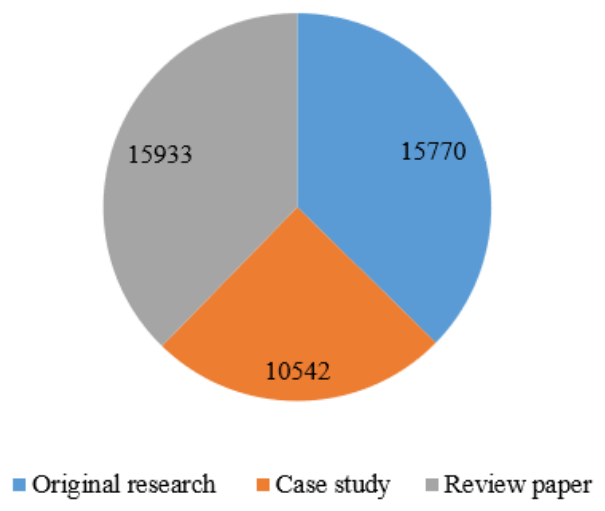


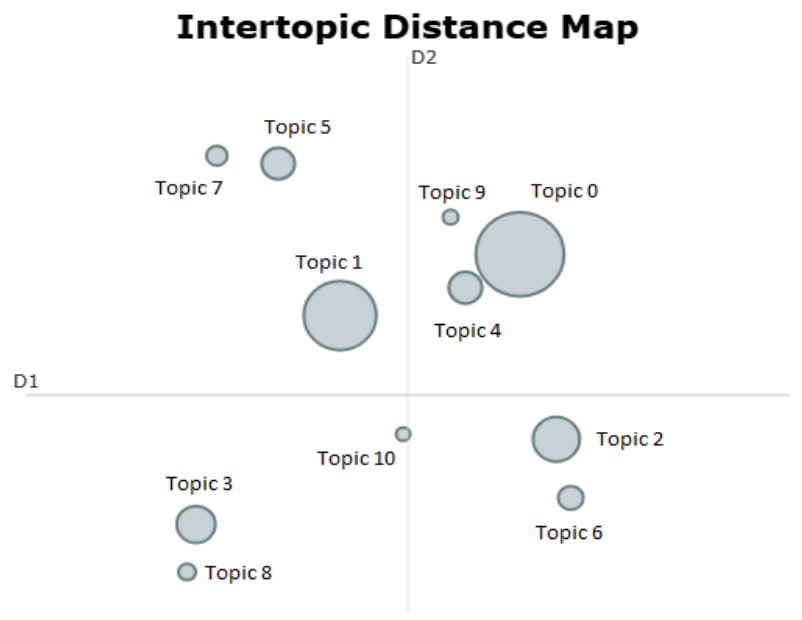


| Publication Window | Share in the Final Dataset | Citation Threshold | Mean Citations | Median Citations | Distributional Position | Methodological Role |
|---|---|---|---|---|---|---|
| 2011–2015 | 16% | ≥250 | 352.8 | 229 | Slightly above the median; retained approx. 47% of the dataset | Citation-mature core literature |
| 2016–2019 | 34.9% | ≥100 | 197.3 | 134 | Below median; retained approx. 77% of the dataset | Citation-visible intermediate literature |
| 2020–2023 | 49.1% | >30 | 106.3 | 78.5 | Inclusive threshold; retained approx. 94% of the dataset | Recent citation-visible literature under citation latency |
| Research Databases | WoS and Scopus |
| Publication Time Frame | 2011–2025 |
| Publication Type | Only peer-reviewed journals. |
| Article Type | Review, Original research, Case study |
| Article Language | English |
| Unit of Analysis | Document-level metadata (authors, journals, publication years, citation counts, DOIs), and text (keywords, titles, abstracts). |
| Inclusion/Exclusion Criteria | Inclusion: Articles published in SCI, SCI-Expanded, and SSCI journals were included. Exclusion: Conference papers, short notes, book chapters, and editorial notes were excluded. |
| Eligibility Criteria |
|
| PRISMA Screening Rationale | Two-stage selection following PRISMA guidelines:
|
| Search Terms | (“Sustainable Supply Chain Management” OR “Sustainable Supply Chain” OR (“Sustainability” AND “Supply Chain Management”) OR (“Green” AND “Supply Chain Management”)) |
| Search Strategy | Boolean search; synonyms combined using OR; conceptual linkages defined using AND; multi-word concepts enclosed in quotation marks. |
| Core Bibliometric Analysis | Keyword co-occurrence analysis; title–abstract co-occurrence analysis; cluster detection via VOSviewer; overlay visualization for temporal interpretation. |
| Cross-Method Semantic Correspondence Analysis | Although citation counts are low, recent studies (2021–2025) were analyzed using BERTopic to validate thematic evolution and capture emerging research trends. |
| Softwares and Tools | VOSviewer 1.6.16 (science mapping), MS Excel (data extraction, descriptive analyses), Python 3.10 (BERTopic). |
| Model Settings | Outlier Ratio | Topic Diversity | Largest Topic Share |
|---|---|---|---|
| n_neighbors = 15; min_cluster_size = 10; min_dist = 0.0 | 0.3393 | 0.6545 | 0.3235 |
| n_neighbors = 10; min_cluster_size = 15; min_dist = 0.0 | 0.2693 | 0.6727 | 0.3833 |
| n_neighbors = 15; min_cluster_size = 15; min_dist = 0.0 | 0.2674 | 0.6636 | 0.2429 |
| n_neighbors = 20; min_cluster_size = 15; min_dist = 0.0 | 0.2885 | 0.6334 | 0.3322 |
| n_neighbors = 15; min_cluster_size = 20; min_dist = 0.0 | 0.2538 | 0.6545 | 0.3707 |
| n_neighbors = 15; min_cluster_size = 15; min_dist = 0.3 | 0.4793 | 0.7091 | 0.3660 |
| n_neighbors = 15; min_cluster_size = 15; min_dist = 0.5 | 0.5609 | 0.7091 | 0.2344 |
| Topic | Top Keywords |
|---|---|
| 0 | supply (0.0245) + chain (0.0219) + supply chain (0.0214) + performance (0.0195) + sustainability (0.0183) + study (0.0181) + research (0.0158) + sustainable (0.0155) + green (0.0148) + management (0.014) |
| 1 | supply (0.0243) + chain (0.0222) + supply chain (0.0219) + carbon (0.0196) + model (0.0186) + green (0.0169) + manufacturer (0.0151) + cost (0.0124) + products (0.0114) + optimal (0.0113) |
| 2 | food (0.0482) + waste (0.0185) + supply (0.0163) + sustainability (0.0145) + chain (0.014) + food waste (0.0132) + study (0.013) + sustainable (0.0126) + environmental (0.0119) + food supply (0.0118) |
| 3 | circular (0.0527) + circular economy (0.0336) + economy (0.0332) + ce (0.0317) + waste (0.0187) + study (0.0147) + circularity (0.0142) + research (0.014) + supply (0.0134) + business (0.0127) |
| 4 | blockchain (0.0854) + technology (0.0354) + blockchain technology (0.0354) + supply (0.0261) + chain (0.0248) + supply chain (0.0237) + adoption (0.0208) + traceability (0.0166) + study (0.015) + bct (0.0136) |
| 5 | risk (0.0289) + fuzzy (0.0271) + criteria (0.0266) + decision (0.0198) + supply (0.0182) + supplier (0.0181) + selection (0.0173) + sustainable (0.0171) + management (0.0164) + method (0.0163) |
| 6 | water (0.0279) + china (0.0275) + trade (0.0237) + consumption (0.0209) + energy (0.0207) + carbon (0.0201) + emissions (0.018) + sectors (0.0159) + economic (0.0157) + development (0.015) |
| 7 | learning (0.03) + machine (0.026) + machine learning (0.0243) + data (0.0207) + ai (0.0203) + supply (0.0191) + supply chain (0.0171) + chain (0.0167) + model (0.0166) + using (0.0129) |
| 8 | fashion (0.0523) + textile (0.0338) + clothing (0.0321) + sustainable (0.0275) + industry (0.0273) + sustainability (0.0224) + circular (0.021) + study (0.0171) + fashion industry (0.0153) + value (0.0148) |
| 9 | construction (0.0769) + projects (0.0361) + project (0.0345) + procurement (0.0305) + sustainable (0.0211) + research (0.0209) + management (0.0203) + sustainability (0.02) + construction projects (0.0168) + construction industry (0.016) |
| 10 | tourism (0.0454) + consumers (0.0249) + sustainable (0.0229) + green (0.0223) + study (0.0211) + media (0.0183) + social media (0.0181) + social (0.018) + twitter (0.0148) + behavior (0.0142) |
| BERTopic ID(s) | BERTopic Thematic Label | Related BERTopic Keywords | Total c–TF–IDF Weight of Each Topic | Sum of c–TF–IDF Weights for Matched Keywords | BERTopic Weighted Overlap Score | Corresponding VOSviewer Clusters | VOSviewer Representation Score | Semantic Correspondence Score |
|---|---|---|---|---|---|---|---|---|
| T4 | Blockchain and traceability | Blockchain; traceability; technology; adoption | 0.297 | 0.158 | 0.530 | Blockchain, Industry 4.0, big data analytics | 2/2 = 1 | 0.53 |
| T1 | Carbon and green manufacturing | Carbon; green manufacturing; manufacturer; cost; products | 0.174 | 0.075 | 0.430 | Carbon emissions, manufacturing industry, GSCM | 2/2 = 1 | 0.43 |
| T0 | SSCM performance and sustainability | Supply chain; performance; sustainability; green practices | 0.184 | 0.059 | 0.320 | SSCM, sustainability, and GSCM | 2/2 = 1 | 0.32 |
| T7 | AI and ML in SSCM | AI; ML; data; model | 0.204 | 0.063 | 0.310 | Big data analytics, Industry 4.0, digital technologies | 2/2 = 1 | 0.31 |
| T5 | Risk and MCDM methods | Risk; fuzzy methods; criteria; decision-making; supplier | 0.206 | 0.121 | 0.590 | DEMATEL, fuzzy AHP, fuzzy set theory, decision-making | 1/2 = 0.5 | 0.30 |
| T3 | Circular economy and circularity | Circular economy; circularity; waste | 0.239 | 0.067 | 0.280 | Circular economy, closed-loop supply chain, reverse logistics | 2/2 = 1 | 0.28 |
| T2 | Food waste and agri-supply chains | Food; waste; sustainability; food supply | 0.174 | 0.093 | 0.530 | Food supply chain, carbon emissions, supply chain sustainability | 1/2 = 0.5 | 0.27 |
| T8 | Fashion and textile sustainability | Fashion; textile; clothing; circularity | 0.264 | 0.139 | 0.530 | Textile industry, sustainability | 1/2 = 0.5 | 0.27 |
| T9 | Sustainable construction | Construction; procurement | 0.293 | 0.107 | 0.370 | Conceptual framework, supply chain design, procurement-related terms | 1/2 = 0.5 | 0.19 |
| T6 | Consumption-driven emissions and international trade | China; water; energy; carbon; emissions; trade | 0.205 | 0.138 | 0.670 | Carbon emissions, developing countries, global supply chains, resource-related terms | 0/2 = 0 | 0 |
| T10 | Sustainable consumption and tourism | Consumers; tourism; sustainability | 0.220 | 0.093 | 0.420 | Weak/limited representation | 0/2 = 0 | 0 |
| Higher-Order Thematic Dimension | Related BERTopic Topics | Representative Focus | Cross-Method Semantic Correspondence Interpretation |
|---|---|---|---|
| Core SSCM performance and environmental sustainability | T0, T1 | SSCM performance, sustainability, GSCM, carbon emissions, green manufacturing | Direct correspondence with established VOSviewer clusters |
| Digital and data-driven SSCM transformation | T4, T7 | Blockchain, traceability, AI, ML, big data, data-driven SSCM | Direct correspondence with digitalization-related VOSviewer clusters |
| Circularity and resource-oriented sustainability transitions | T3, T6 | Circular economy, circularity, resource use, carbon emissions, trade, consumption-driven environmental impacts | Thematic extension of established circularity and emissions-related clusters |
| Decision-support and risk-based SSCM methods | T5 | Risk, fuzzy methods, MCDM, supplier selection, decision-making | Thematic extension of risk and decision-making clusters |
| Sector-specific sustainability applications | T2, T8, T9, T10 | Food waste, agri-supply chains, fashion and textile sustainability, sustainable construction, sustainable consumption, tourism | Sectoral extension with partial or limited VOSviewer correspondence |
| Managerial Priority | Example Indicators | Supporting Tools | Decisions Supported |
|---|---|---|---|
| Define sustainability baseline | Logistics cost and delivery reliability; carbon emissions and energy use; waste generation and recycling rate; supplier compliance score; GRI/CDP alignment score; CE recovery rate (%) | KPI dashboards; data analytics; GRI/CDP reporting frameworks | Identify sustainability gaps and priority areas; align SC performance with sustainability objectives; embed CE principles into business processes |
| Improve transparency and traceability | Product origin and certification status; audit results and supplier compliance; material flow visibility; traceability coverage (%); Scope 3 emissions by supplier tier | Blockchain; IoT; traceability platforms | Verify suppliers and ethical sourcing; monitor compliance; document product provenance; certify multi-tier suppliers |
| Predict risks and disruptions | Supplier risk score; delay probability and disruption frequency; demand variability; inventory shortages; disruption detection lead time | AI; ML; big data analytics | Predict supplier risks; forecast demand; detect disruptions; plan inventory; manage sustainability risks proactively and reactively |
| Optimize logistics and operations | Transport cost and lead time; emissions per shipment; vehicle utilization and service level; waste reduction rate (%); resource efficiency ratio | AI; ML; optimization models; reverse logistics tools | Select routes and transportation modes; reduce emissions; allocate inventory; align lean management with sustainability targets; design reverse logistics networks |
| Balance sustainability trade-offs | Cost vs. environmental impact; social responsibility score; resilience and technological readiness; supplier weighted score; investment payback with sustainability criteria | MCDM methods | Select suppliers and technologies; prioritize circular strategies; prioritize investments; document auditable trade-off decisions across cost, quality, and sustainability |
| Adapt to sector-specific contexts | Sectoral compliance requirements; lifecycle emissions and water use; waste rate and labor compliance; consumer-oriented sustainability index; system-level resource interdependency score | Blockchain; AI/ML; MCDM; sector-specific KPI systems | Tailor SSCM strategies to sectoral needs; extend SC boundaries to include consumer-oriented and system-level sustainability dynamics |
Disclaimer/Publisher’s Note: The statements, opinions and data contained in all publications are solely those of the individual author(s) and contributor(s) and not of MDPI and/or the editor(s). MDPI and/or the editor(s) disclaim responsibility for any injury to people or property resulting from any ideas, methods, instructions or products referred to in the content. |
© 2026 by the authors. Licensee MDPI, Basel, Switzerland. This article is an open access article distributed under the terms and conditions of the Creative Commons Attribution (CC BY) license.
Share and Cite
Güngör, B.; Taşan, A.S. Sustainable Supply Chains: Bridging Theory and Practice Through Hybrid Analysis. Sustainability 2026, 18, 5735. https://doi.org/10.3390/su18115735
Güngör B, Taşan AS. Sustainable Supply Chains: Bridging Theory and Practice Through Hybrid Analysis. Sustainability. 2026; 18(11):5735. https://doi.org/10.3390/su18115735
Chicago/Turabian StyleGüngör, Bengü, and Ali Serdar Taşan. 2026. "Sustainable Supply Chains: Bridging Theory and Practice Through Hybrid Analysis" Sustainability 18, no. 11: 5735. https://doi.org/10.3390/su18115735
APA StyleGüngör, B., & Taşan, A. S. (2026). Sustainable Supply Chains: Bridging Theory and Practice Through Hybrid Analysis. Sustainability, 18(11), 5735. https://doi.org/10.3390/su18115735