Article

Process-Based Source Apportionment and Radiological Baseline of Multi-Radionuclides in Soils of a Tourism-Oriented Island

1
Donghai Laboratory, Zhoushan 316000, China
2
Key Laboratory for Water Quality and Conservation of the Pearl River Delta, Ministry of Education, School of Environmental Science and Engineering, Guangzhou University, Guangzhou 510006, China
3
Ningbo Institute of Oceanography, Ningbo 315832, China
4
Pingtan Marine Meteorological Observation and Research Station for the Taiwan Strait of Fujian Province, Pingtan Meteorological Bureau, Pingtan 350400, China
5
Shantou Geological Survey Center of Guangdong Provincial Geological Bureau, Shantou 515041, China
6
Third Institute of Oceanography, Ministry of Natural Resources, Xiamen 361005, China
*
Authors to whom correspondence should be addressed.
Sustainability 2026, 18(11), 5732; https://doi.org/10.3390/su18115732
Submission received: 29 April 2026 / Revised: 29 May 2026 / Accepted: 2 June 2026 / Published: 4 June 2026

Abstract

Islands have high ecological and tourism value; however, owing to their remoteness and limited accessibility, environmental radioactivity is often less systematically evaluated than in mainland regions. This study investigates the distribution, source partitioning, and radiological implications of multi-radionuclides (7Be, 137Cs, 210Pb, 238U, 226Ra, 232Th, and 40K) in surface soils of Zhoushan Island, a representative tourism-oriented island in the East China Sea. Activity concentrations of 7Be, 137Cs, 210Pb, 238U, 226Ra, 232Th, and 40K ranged from 3.4 to 585.5, below detection limit −5.7, 45–1490, 33.3–72.4, 32.3–58.9, 37.8–91.7, and 439.6–872.3 Bq/kg, respectively. Using multivariate statistics and geochemical interpretation, we classified radionuclides into three groups: (i) atmospheric deposition-driven nuclides (7Be, 210Pbex), (ii) lithogenic background-controlled nuclides (238U−226Ra−232Th), and (iii) the alkali-metal-like behavior group (137Cs−40K). This shows that soil radionuclide patterns result from atmospheric inputs, geological inheritance, and land-use disturbance, rather than simple concentration variability. Spatial analysis revealed that agricultural disturbance enhances 137Cs redistribution, low-lying terrains preferentially accumulate atmospheric fallout nuclides, and lithogenic radionuclides are higher in the northern island due to parent material and weathering. No significant 40K enrichment was observed in cultivated soils, indicating limited fertilizer influence. Although radiological indices remain within international safety thresholds, several parameters exceed global background levels, indicating elevated natural radiation driven primarily by thorium-rich lithology. Importantly, we show that radiological risk assessments based solely on bulk activity may overestimate environmental significance without considering process controls. This study provides a process-informed radiological assessment for island systems, offering insights for environmental monitoring and risk evaluation in similar coastal and tourism-dominated regions.

1. Introduction

Islands serve as strategic hubs and essential platforms for ocean exploration and utilization, thereby underpinning the development of the marine economy [1]. China possesses more than 6500 islands with areas exceeding 500 m2, totaling ~72,800 km2, and collectively forming an extensive “Second Marine Economic Zone”. Situated in the coastal region of the East China Sea, the Zhoushan Archipelago comprises more than 1390 islands, accounting for more than one-fifth of all Chinese islands [2]. It is the only prefecture-level city in China established on an archipelago (with Hainan as a province-level administrative unit) [3], thus occupying a strategically pivotal position in the national framework for island conservation and development. However, due to inherent natural constraints such as strong geographical isolation, limited land availability, and scarce natural resources, island ecosystems generally exhibit high ecological fragility [1,4]. Although environmental radioactivity has been investigated on several islands, including the Canary Islands [5], the Marshall Islands [6], Ustica Island [7], the Aeolian Islands [8], the Princes’ Islands [9], and Taiwan Island [10], existing studies have primarily focused on radionuclide inventories, whereas the mechanisms controlling radionuclide partitioning among atmospheric deposition, lithogenic background, and anthropogenic disturbance remain insufficiently understood. In this context, a process-based assessment refers to an interpretive framework that links radionuclide occurrence to specific environmental transport and transformation mechanisms, such as wet and dry deposition, weathering, and soil disturbance, rather than relying solely on bulk activity measurements. In addition, overall awareness of and attention to radiological issues and associated risks in island environments remain limited. This is largely due to the unique environmental settings of islands, poor data comparability among studies, insufficient long-term monitoring, and socioeconomic constraints. Consequently, significant gaps persist in systematic scientific data regarding baseline environmental radioactivity, radionuclide migration processes, and potential public health impacts. In addition, recent studies have increasingly emphasized radionuclide transport mechanisms in coastal and island systems, including geochemical fractionation [11], sedimentary redistribution [12], and watershed-scale migration [13]. These investigations provide critical insights into the processes governing radionuclide behavior and offer an important foundation for process-based interpretations in dynamic coastal environments.
Since the beginning of the 21st century, the rapid expansion of the marine economy and accelerated urbanization in coastal island regions—particularly following the opening of the cross-sea bridge connecting the Chinese mainland to Zhoushan Island after 2010—have transformed the Zhoushan Archipelago into a well-developed tourist destination [1,2]. In addition to its unique natural landscapes, the archipelago is highly valued for its thematic tourism that integrates historical heritage, Buddhist culture, and folk customs [14]. According to the Zhoushan Municipal Bureau of Statistics, tourist arrivals in the archipelago grew rapidly since 1980, reaching a peak of 70.52 million in 2019, declined during the COVID-19 period, and rebounding to 27.80 million in 2024. Against this backdrop, ecological and environmental pressures in the Zhoushan Archipelago have intensified, drawing increasing concern from multiple sectors of society [4]. To date, research on the ecological environment of the Zhoushan Archipelago and surrounding waters has primarily focused on heavy metal contamination in seawater, sediments, and seafood [15,16,17], the evolution of land-use and landscape patterns [2], and assessments of island ecosystem vulnerability [4,18]. However, systematic studies and baseline assessments of radiation environments on islands in this region are still lacking.
Radioactive nuclides are a major class of environmental pollutants characterized by insidiousness, irreversibility, and persistence [19]. They contribute approximately 80% of the annual cumulative radiation dose received by humans [20]. Based on their origin, natural radionuclides can be classified into two main categories: (1) cosmogenic radionuclides (e.g., 7Be), which are produced by interactions between cosmic rays and atmospheric constituents and contribute minimally to the global natural radiation dose; and (2) primordial radionuclides, which are the principal source of natural radiation and mainly include decay products of the thorium, uranium, and actinium series (e.g., 210Pb, 210Pbex, 226Ra, 228Ra, 228Th, 238U) as well as long-lived single-decay nuclides such as 40K [19]. Soil acts as a major reservoir and key environmental medium for the migration and transformation of radionuclides [21]. Natural radionuclides (238U−232Th-series and 40K) in soils are primarily derived from the weathering of underlying bedrock. Their distribution is influenced by processes such as weathering, sedimentation, leaching/adsorption, precipitation from percolating groundwater, and dilution by materials of different composition, resulting in substantial variability in activity concentrations [22]. Anthropogenic radionuclides such as 90Sr, 134Cs, 137Cs, 239Pu, 129I, and 241Am originate mainly from atmospheric nuclear weapon tests in the 1950s–1960s and the Chernobyl nuclear accident (Ukraine) in 1986 [23]. Although 131I and radiocesium were occasionally detected in food and seafood in China after the Fukushima Daiichi accident (2011), the negligible concentrations indicated no significant radiological impact, and 137Cs in Chinese soils remains dominated by historical fallout rather than Fukushima-derived sources [24,25]. Extensive studies have investigated their behavior in soil environments for radiological protection purposes [21,26,27,28,29]. These radionuclides emit radiation during decay and represent a major source of external exposure to the public. Thus, both natural and anthropogenic radionuclides can accumulate in island soils. When such soils are used for agricultural, pastoral, or tourism-related purposes, such as grazing livestock, cultivating crops and vegetables, or constructing tourist facilities, elevated radionuclide activity levels may pose potential radiation risks to food safety and public health. Therefore, characterizing the spatial distribution of radionuclides in island soils and tracing their sources are essential for guiding the sustainable development and conservation of tourism-oriented islands.
In this study, 43 surface soil samples (0–5 cm depth) were collected from evenly distributed sites across Zhoushan Island to analyze radionuclide characteristics. The objectives of this study are to: (1) determine the spatial distribution patterns and activity levels of radionuclides in surface soils under the unique geographical context of an island environment; (2) identify the sources of radionuclides in island soils; (3) locate and analyze areas with anomalous radioactivity levels; and (4) assess radiation risks using hazard indices, with particular attention to sensitive areas such as parks, ports, and schools. This study attempts to link multivariate grouping results with geochemical processes, enabling a process-based assessment of radionuclide behavior. Ultimately, rather than focusing solely on radiological hazard indices, this study aims to evaluate whether such indices adequately reflect environmental processes and actual risk relevance in island settings.

2. Materials and Methods

2.1. Study Area

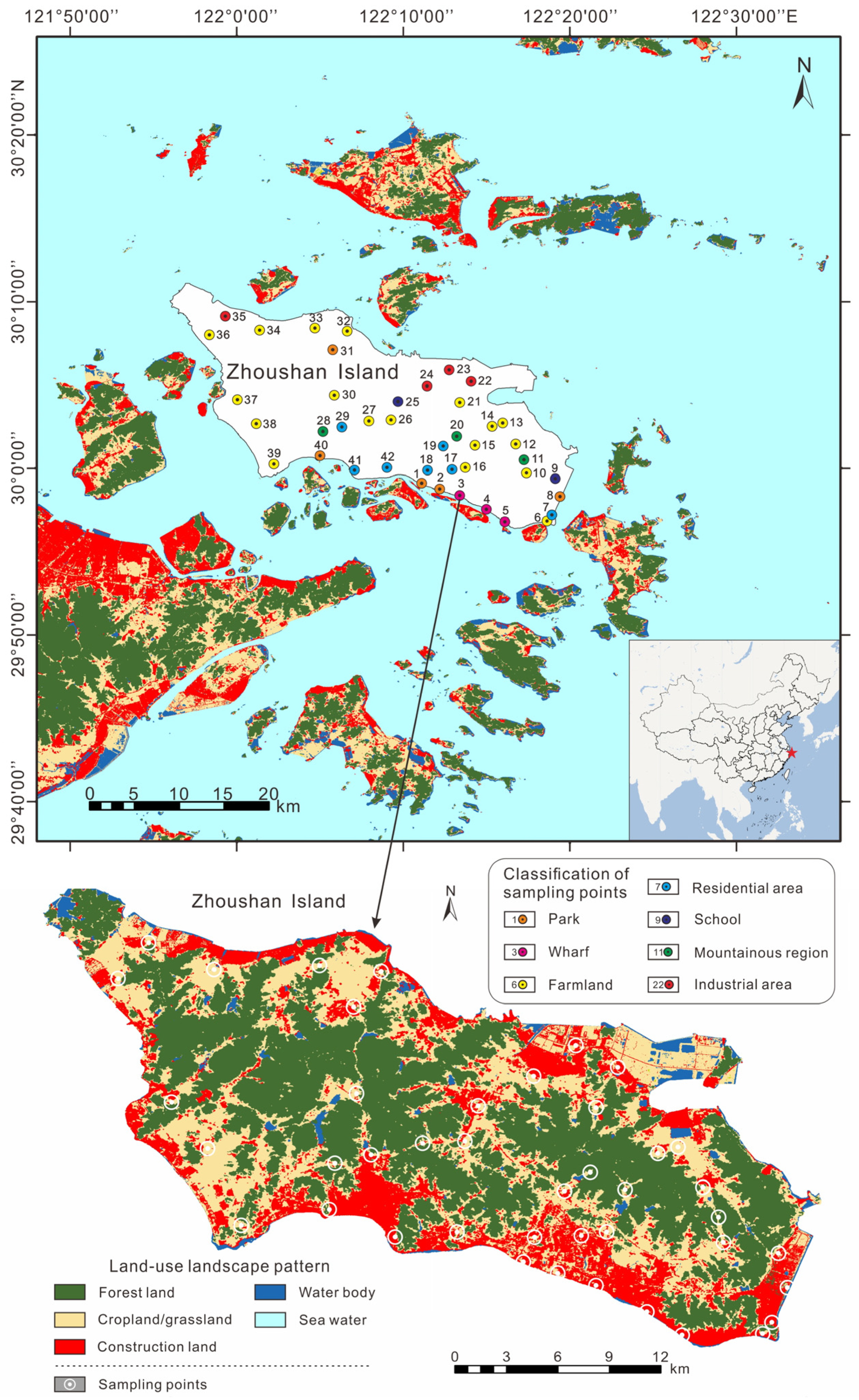
Zhoushan Island (29°50′–30°12′ N, 121°30′–122°25′ E), the largest island within the Zhoushan Archipelago, is located in the central coastal region of Zhejiang Province, China (Figure 1). The island trends northeast–southwest, measuring approximately 44 km in length and 18 km in width, with a total coastline of 170.16 km and a land area of about 491 km2 [2,30]. The terrain is predominantly hilly. Rocky coastlines account for 75.8% of the shoreline, whereas artificial coastlines account for 21.6% [31]. The island has a northern subtropical monsoon climate, with a mean annual temperature of 15.8–16.7 °C. Annual precipitation ranges from 921.6 to 1318.8 mm, whereas annual evaporation ranges from 1225.9 to 1374.2 mm [32]. The tidal regime is characterized as irregular semidiurnal, with a long-term average tidal range of 1.91–3.31 m and a maximum tidal range of up to 4.96 m [32,33]. The island is frequently affected by tropical cyclones during summer and autumn, with an average of 4.3 events per year [4]. Geologically, the island is underlain by extensive Mesozoic andesitic–granitic igneous rocks, overlain by semi-consolidated to unconsolidated Cenozoic terrigenous sediments that may reach several hundred meters in thickness [34]. Soils are generally shallow, nutrient-poor, and relatively saline [4]. Major soil types include Acrisols, Leptosols, Anthrosols (paddy soils), and Solonchaks according to the WRB soil classification system [35].
Zhoushan Island, the principal island of the Zhoushan Archipelago, serves as the political and economic center of Zhoushan City, accommodating 70% of the archipelago’s population and contributing 74% of its economic output [2]. In recent decades, Zhoushan Island has experienced rapid development driven by tourism expansion, aquaculture, port construction, and urbanization, making it representative of the socio–ecological–economic characteristics of tourism-oriented islands. Therefore, it provides a representative case for analyzing vulnerability within the socio–ecological–economic complex of tourism-oriented islands [1]. The demand for land has increased substantially, leading to large-scale land reclamation and marine engineering over the past forty years, which have profoundly altered the coastal landscape [3,4,31]. Between 1984 and 2020, construction land expanded from 18.19 to 115.97 km2, while forest land, mudflats, cropland/grassland, and bare land decreased from 205.72 to 194.39 km2, 19.24 to 13.73 km2, 210.98 to 203.87 km2, and 19.05 to 6.09 km2, respectively [2]. Furthermore, from 2000 to 2020, the average Remote Sensing Ecological Index (RSEI) in the Zhoushan Islands declined from 0.748 to 0.681, accompanied by a 13.54% reduction in areas rated as excellent and a 3.43% increase in areas rated as poor or fair, indicating clear ecological degradation [18]. In addition, the total shoreline length of the Zhoushan Archipelago decreased by 7.05 km from 1984 to 2018 [33]. Collectively, these findings demonstrate the high ecological vulnerability of Zhoushan Island.

2.2. Sampling and Preparation

A total of forty-two sampling sites was selected in coastal zones, mountainous areas, croplands, agricultural fields, industrial zones, and urban residential areas across Zhoushan Island (Figure 1). In June 2025, 43 samples were collected: one from each site and two from site ZS31, where two samples (ZS31 and ZS31a) were collected in close proximity (one from inside a park and the other from a roadside) to account for local-scale variability. At each sampling site, a square quadrat of approximately 5 m2 was delineated. Five subsampling points were randomly selected within each quadrat, and the topsoil collected from these points was combined to form one composite sample (approximately 1 kg). The 0.0–0.2 cm surface layer, consisting of overlying vegetation and the thin veneer of adhering soil, was removed by cutting at the soil interface. Subsequent soil samples within the upper 5.0 cm were collected using a stainless-steel blade and placed in polyethylene Ziplock bags for laboratory analysis.

2.3. Radioactivity Measurement

Soil samples were oven-dried at 80 °C for 24 h, ground, sieved to <150 μm (100 mesh), packed into cylindrical containers of identical geometry, and sealed for 30 days prior to radionuclide analysis using a high-purity germanium (HPGe) γ-spectrometer (Canberra-BE3830, Meriden, CT, USA). After sealing, secular equilibrium between 226Ra and its progeny radionuclides (222Rn, 214Pb, 214Bi, 214Po and 210Pb) was achieved. The activity concentrations of 210Pb, 226Ra, 137Cs, 40K, 228Th, 228Ra, and 238U were determined using an ultra-low background HPGe γ-spectrometer (Canberra-BE3830, Meriden, USA; energy range: 10 keV–2000 keV; relative efficiency >35%; background ~0.9 counts/s in 3 keV–2 GeV). The instrument shielding consisted of 15 cm of low-background lead, lined with tin and high-purity copper.
To ensure analytical accuracy, certified reference materials (GBW08034a, GBW04127, IAEA-312, and IAEA-327), provided by the National Institute of Metrology of China and the International Atomic Energy Agency (IAEA), were used to determine full-energy peak efficiencies for 137Cs and naturally occurring radionuclides. Comparisons with certified values of reference materials showed an accuracy of 85–109% for 8 radioisotopes in soil samples analyzed in our laboratory. Decay correction and background subtraction were performed for all samples. Each sample was counted for 24 h. The specific activity of 210Pb was determined from the 46.5 keV peak (branching ratio: 4.25%). 238U activity was quantified directly from the 63.5 keV gamma line, which has a branching ratio of 4.8% of its progeny 234Th. 226Ra activity was calculated from its progeny 214Bi (609.3 keV, 46.3%) and 214Pb (295.2 keV, 19.3%, and 352.0 keV, 37.6%). Excess 210Pb (210Pbex) was obtained by subtracting 226Ra activity from total 210Pb. 228Ra activity was determined using 228Ac peaks (338.5 keV, 11.27% and 911.1 keV, 26.6%), whereas 228Th activity was calculated from the mean activity of 208Tl (583.2 keV, 85.2%) and 212Pb (238.6 keV, 43.3%). The specific activity of 7Be was determined from the 477 keV peak (10.44%) with a detection limit of 5 Bq/kg. 40K and 137Cs were quantified using the 1460.8 keV (10.55%) and 661.5 keV (84.62%) peaks, respectively. The counting error for all radionuclides was <10%.
The activity of a radionuclide in a soil sample can be calculated by the following equation:
A i = ( N i T i N b g T b g ) / ( Y i × ε i × M )
The minimum detectable activity (MDA) values in soil samples can be given as:
M D A ( i ) = 2.71 × N b g ( i ) ε i × M × T b g
where Ai (Bq/kg) denotes the specific activity of interested radionuclide, i; Ni and Nbg are the peak areas of interested radionuclide at sample determining time and background determining time, respectively; Ti and Tbg (s) denote the measuring time at sample measurement and background measurement, respectively; Yi is the branching ratio of the interested radionuclide; εi is the detection efficiency of radionuclide i; M is the mass of soil sample (kg).
The typical MDA values were 0.58 Bq/kg for 210Pb, 0.8 Bq/kg for 238U, 1.30 Bq/kg for 226Ra, 0.27 Bq/kg for 228Ra, 0.19 Bq/kg for 228Th, 3.0 Bq/kg for 7Be, 1.91 Bq/kg for 40K, and 0.21 Bq/kg for 137Cs.

2.4. Calculation of Radiological Indices

In order to evaluate the radiological risks associated with natural radionuclides in soils, several internationally accepted hazard indices were calculated, including radium equivalent activity (Raeq), outdoor absorbed gamma dose rate (DR), annual effective dose equivalent (AEDE), annual gonadal dose equivalent (AGDE), excess lifetime cancer risk (ELCR), and external hazard index (Hext). These indices collectively reflect radiation intensity, potential health effects, and long-term carcinogenic risk.
Natural radionuclides (226Ra, 232Th, and 40K) are heterogeneously distributed in soils; therefore, standardized indices that combine the activities of multiple nuclides are required for reliable assessment of radiation exposure. The Raeq was developed to represent the overall gamma output from different radionuclides. It is based on the assumption that 370 Bq/kg of 226Ra, 259 Bq/kg of 232Th, and 4810 Bq/kg of 40K produce the same gamma dose rate [36]. Thus, Raeq is calculated using the following equation [36]:
Ra eq = C Ra + 1.43 C T h + 0.077 C K
where CRa, CTh, and CK are the activity concentrations (Bq/kg) of 226Ra, 232Th, and 40K, respectively. Raeq should not exceed 370 Bq/kg, which corresponds to an annual dose of 1.5 mGy/y [36], and is commonly used as a screening index for gamma radiation hazard.
The DR (nGy/h) reflects the amount of ionizing radiation energy deposited in air at a height of 1 m above the ground. Assuming uniform radionuclide distribution in soil, DR can be calculated using dose conversion factors as [36]:
DR = 0.462 C Ra + 0.604 C T h + 0.0417 C K
This parameter is directly related to potential biological effects of gamma radiation.
AEDE is a key parameter used in radiation protection to evaluate potential health effects from long-term exposure to ionizing radiation. AEDE can be calculated using dose conversion factors as [36]:
AEDE = DR × DCF × OF × T
where DR is the absorbed gamma dose rate, DCF is the dose conversion coefficient (0.7 Sv/Gy), OF is the outdoor occupancy coefficient (20%), and T is the time coefficient (8760 h) [36].
The ELCR estimates the probability of developing cancer over a lifetime (70 years) due to exposure to natural radionuclides. ELCR is derived from AEDE using a fatal cancer risk factor of 0.057 Sv−1 [37]:
ELCR = AEDE × DL × RF
where DL is the life expectancy (70 years), and RF is the fatal risk factor per year, equal to 0.057 Sv−1 [37].
The Hext assesses the external gamma radiation hazard from soil or building materials [38]. For safe use, Hext must be less than 1, ensuring that the external dose does not exceed 1 mSv/y [38]. It is calculated as:
Hext = c Ra 370 + c T h 259 + c K 4810
AGDE is particularly important for assessing hereditary radiation effects in exposed populations. The AGDE (μSv/y) evaluates the genetic significance of radiation exposure to reproductive organs and is calculated using the following equation [31]:
AGDE = 3.09 C Ra + 4.18 C T h + 0.314 C K
Statistical analyses were performed using SPSS Statistics (IBM) 17 and Origin 2026 (OriginLab), while spatial distribution maps were generated in ArcGIS 10.8.0 (Esri). Relationships between radionuclide ratios and soil properties were assessed via Pearson correlation. Hierarchical Cluster Analysis (HCA) and Principal Component Analysis (PCA) were conducted using Ward’s method with Pearson correlation distance, and PCA components were varimax rotated for clearer interpretation.

3. Results

3.1. Statistical Analysis of the Specific Activities of Radionuclides in Topsoil

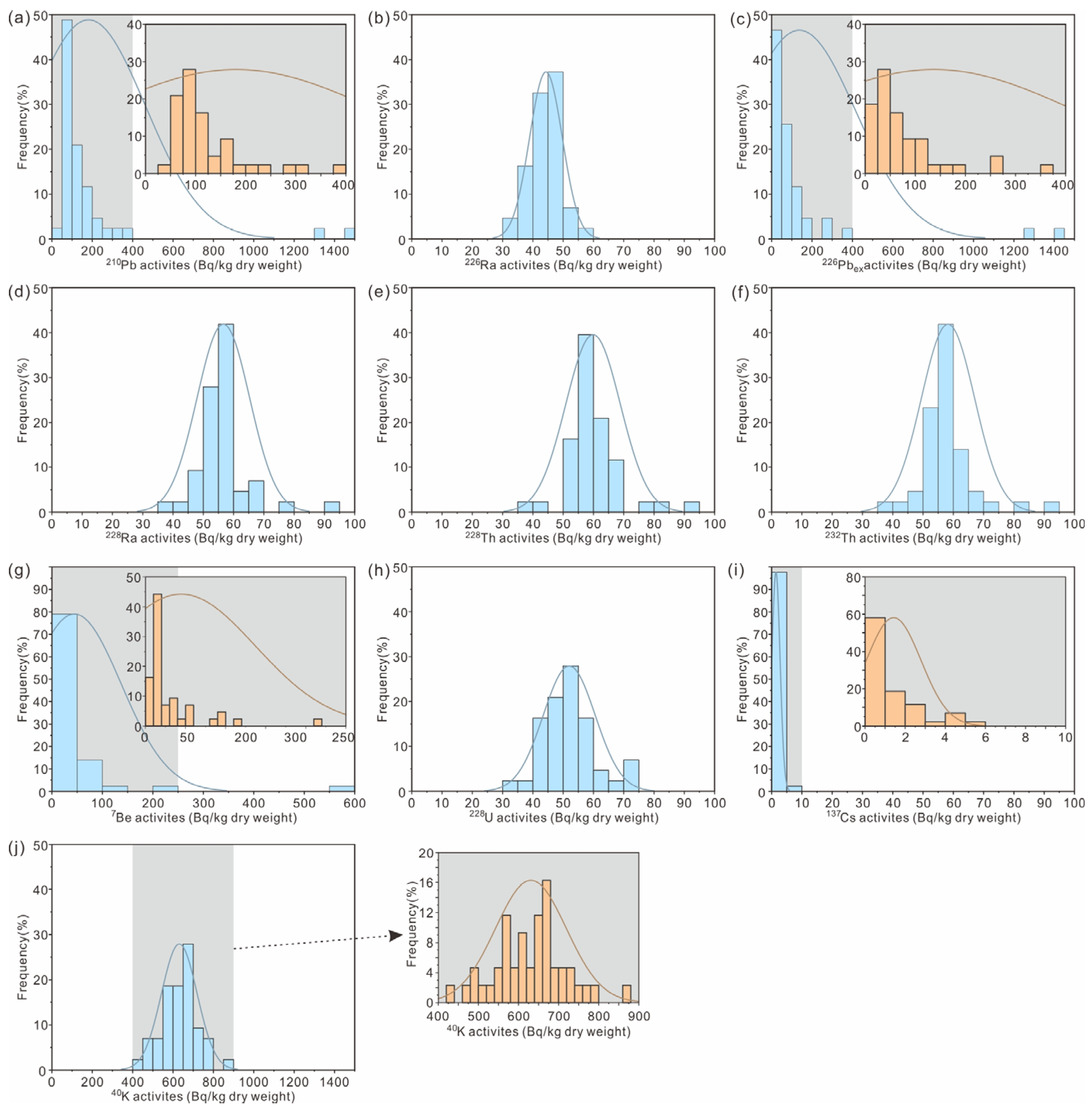
The specific activities of naturally occurring radionuclides (210Pb, 7Be, 226Ra, 228Ra, 228Th, 232Th, 238U, and 40K) and the anthropogenic radionuclide (137Cs) were measured in 43 topsoil samples. Statistical analysis, including the mean, standard deviation, skewness, kurtosis, and range of activity values for each radionuclide, is summarized in Table S1 and illustrated in Figure 2. The data reveal significant variability, particularly for airborne radionuclides (7Be and 210Pb). For instance, 7Be activities ranged from 3.4 to 585.5 Bq/kg, with a mean of 44.5 ± 91.6 Bq/kg, while 210Pb activities ranged from 45 to 1490 Bq/kg, with a mean of 181.5 ± 279.0 Bq/kg. For terrestrial radionuclides, activities were as follows: 238U ranged from 33.3 to 72.4 Bq/kg (mean 52.0 ± 8.5 Bq/kg), 226Ra from 32.3 to 58.9 Bq/kg (mean 44.3 ± 5.3 Bq/kg), 228Ra from 37.3 to 91.2 Bq/kg (mean 56.6 ± 8.6 Bq/kg), 228Th from 38.2 to 92.1 Bq/kg (mean 59.9 ± 8.9 Bq/kg), and 40K from 439.6 to 872.3 Bq/kg (mean 631.0 ± 87.4 Bq/kg). Since 232Th is the parent nuclide of 228Ra and 228Th, radioactive equilibrium between 232Th and its daughters was evaluated. In equilibrium, the average activity of 228Ra and 228Th can represent 232Th activity. As shown in Figure S1, 228Ra and 228Th exhibit a strong linear correlation (R2: 0.93, slope: 1.07, p < 0.001), confirming secular equilibrium. Consequently, 232Th activities were calculated, ranging from 37.8 to 91.7 Bq/kg (mean 58.2 ± 8.7 Bq/kg; Table 1). The anthropogenic radionuclide 137Cs showed activities ranging from below the detection limit (<0.2 Bq/kg) to 5.7 Bq/kg, with a mean of 1.5 ± 1.4 Bq/kg.
The variability in radionuclide activities is further depicted in Figure 2, which shows their frequency distributions. Positive skewness coefficients indicate right-skewed distributions. While most radionuclides exhibit slight positive skewness, 226Ra, 238U, and 40K have distributions close to normal (skewness 0.19–0.48). In contrast, 7Be, 210Pb, 210Pbex, and 137Cs display highly skewed, non-normal distributions (Figure 2, Table S1). Low kurtosis values for most terrestrial radionuclides suggest near-normal distributions, whereas airborne radionuclides show exceptionally high kurtosis: 210Pb (16.43), 210Pbex (16.35), and 7Be (28.93), indicating heavy-tailed distributions. Thus, except for 210Pb, 210Pbex, and 7Be, most lithogenic radionuclides approximate Gaussian distributions (Figure 2). Notably, the highest measured values of 226Ra, 238U, 40K, and 137Cs fall within 3σ of the mean, while those of 232Th, 228Ra, and 228Th fall within 4σ, and the maximum values of 210Pb and 7Be fall within 5σ and 6σ, respectively.
Comparative data from the literature are presented in Table S2. The activities of 238U, 226Ra, 232Th, and 40K in this study align with those reported for mountain, agricultural, and industrial soils (Table S2). However, activities in Zhoushan Island soils exceed global averages reported by UNSCEAR (35 Bq/kg for 238U and 226Ra, 30 Bq/kg for 232Th, and 400 Bq/kg for 40K) [36] and values from Svalbard, an Arctic island [39,40]. Conversely, 226Ra, 232Th, and 40K activities in Zhoushan are lower than those in volcanic tuff soils from Cappadocia, Turkey [41], likely due to differences in mineral composition and soil provenance. The 137Cs activity in Zhoushan soils (<0.2–5.7 Bq/kg) is comparable to values reported in the Southern Rechna of Pakistan (<1.35–6.5 Bq/kg) [42], the South Shetland Archipelago (1.59–15.6 Bq/kg) [43], and the Alexandria Region of Egypt (0.11–7.86 Bq/kg) [44], but significantly lower than in areas heavily impacted by the Chernobyl accident (Table S2). Notably, 210Pb and 7Be activities in Zhoushan surface soils are substantially higher than those reported in most other regions and countries (Table S2).
For broader context, our results can be compared with the comprehensive review of soil radioactivity in Serbia by Kuzmanović [45], which reported mean activities of 40K (620–720 Bq/kg), 226Ra (35–55 Bq/kg), and 232Th (30–50 Bq/kg) across diverse geological settings. The corresponding values in Zhoushan (40K: 631 Bq/kg; 226Ra: 44.3 Bq/kg; 232Th: 58.2 Bq/kg) fall within or slightly above these ranges, consistent with the thorium-enriched lithological background of the study area. A broader international comparison of soil radionuclide concentrations is provided in Table S2, enabling direct benchmarking of our dataset against global references.

3.2. Multivariate Exploratory Analysis

To explore potential groupings among radionuclides and to generate hypotheses regarding their sources and controlling processes, hierarchical cluster analysis (HCA), principal component analysis (PCA), and Pearson correlation analysis were employed as exploratory statistical tools. These methods were used to identify underlying statistical patterns, which were subsequently evaluated against independent spatial distributions and geochemical evidence (Section 3.3). It should be noted that statistical associations alone do not necessarily imply causal relationships; therefore, all process-based interpretations were further validated using geomorphological characteristics and land-use information. HCA was applied to classify radionuclides according to their similarity, producing dendrograms that illustrate the degree of association among variables. In the dendrograms, shorter linkage distances indicate stronger similarities between groups. Pearson correlation analysis was used to quantify linear relationships among radionuclides, whereas PCA was employed to identify dominant association patterns, distinguish radionuclide behaviors, and infer their potential sources and controlling mechanisms.
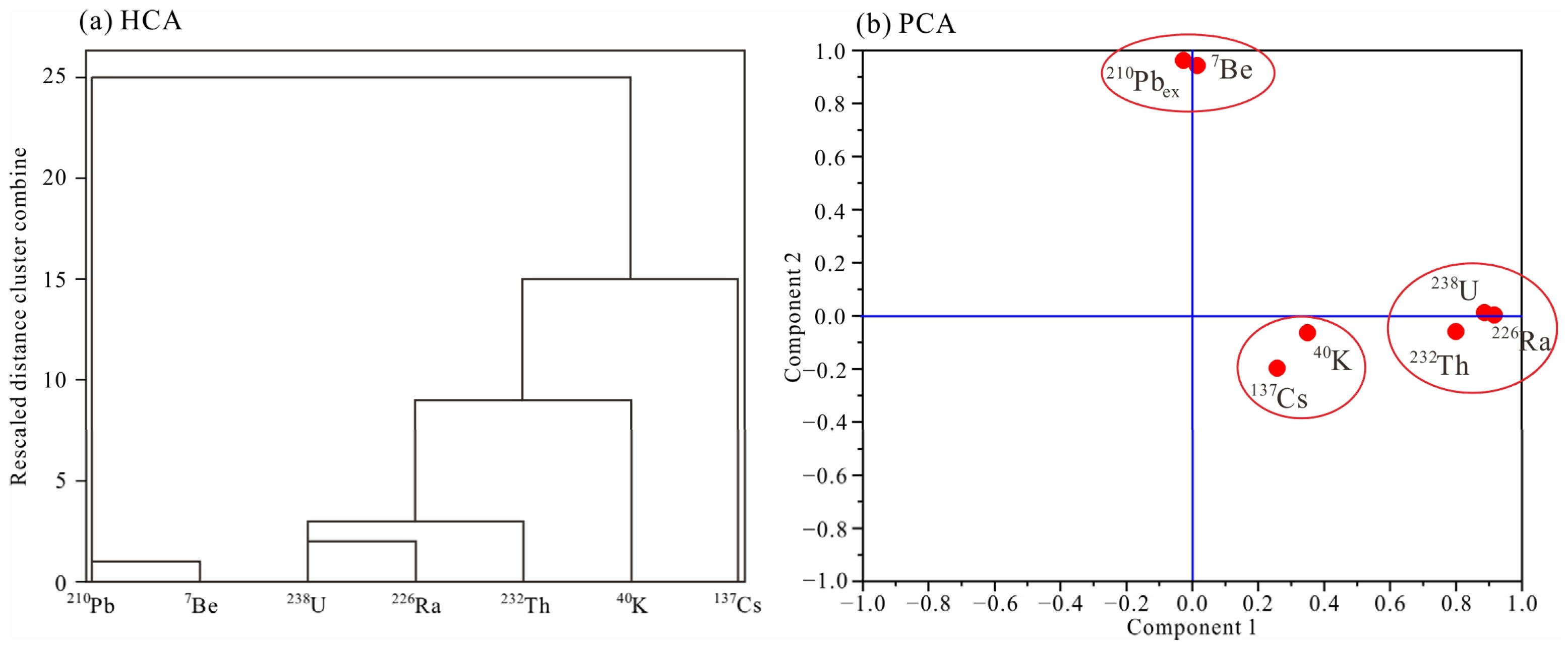
The HCA dendrogram (Figure 3a) shows that the seven radionuclides in Zhoushan Island soils form three clearly separated clusters. The first cluster contains 210Pb_ex and 7Be, which are strongly grouped together. The second cluster includes the lithogenic radionuclides 238U, 226Ra, and 232Th. The third cluster consists of 40K and 137Cs. PCA was applied to further explore these relationships and identify the underlying factors controlling radionuclide distribution. According to Kaiser’s criterion (eigenvalue > 1), three significant principal components (PCs) were extracted, explaining a total of 81.75% of the variance (Table S3). The factor loadings of each radionuclide on the PCs are shown in Table 1.
PC1 accounts for 37.01% of the total variance and exhibits high positive loadings for 238U (0.887), 226Ra (0.917), and 232Th (0.801), indicating a common terrestrial origin and association with natural background radioactivity. PC2 explains 27.44% of the variance and shows high positive loadings for 7Be (0.943) and 210Pbex (0.962), indicating a common atmospheric source, likely from wet/dry deposition. PC3 accounts for 17.30% of the variance and is characterized by high loadings for 40K (0.729) and 137Cs (−0.759). Although both radionuclides are alkali elements and may exhibit similar ion-exchange behavior in soils, their opposite loading signs indicate inverse spatial distributions. This contrast reflects fundamentally different sources: 40K is predominantly lithogenic, whereas 137Cs is anthropogenic and likely distinct retention mechanisms in soils, such as the strong fixation of 137Cs in illite-rich clay minerals [46]. It is important to emphasize that chemical similarity alone is insufficient to infer shared controlling processes.
The score plot of PC1 versus PC2 (Figure 3b) clearly delineates three distinct radionuclide groups, aligning with the HCA results. The combination of HCA and PCA confirms three distinct behavioral patterns of radionuclides in Zhoushan Island soils: (1) 238U, 226Ra, and 232Th, associated with terrestrial sources and natural background radioactivity; (2) 210Pbex and 7Be, derived from atmospheric deposition; and (3) 40K and 137Cs, exhibiting similar geochemical characteristics due to their alkali metal properties.
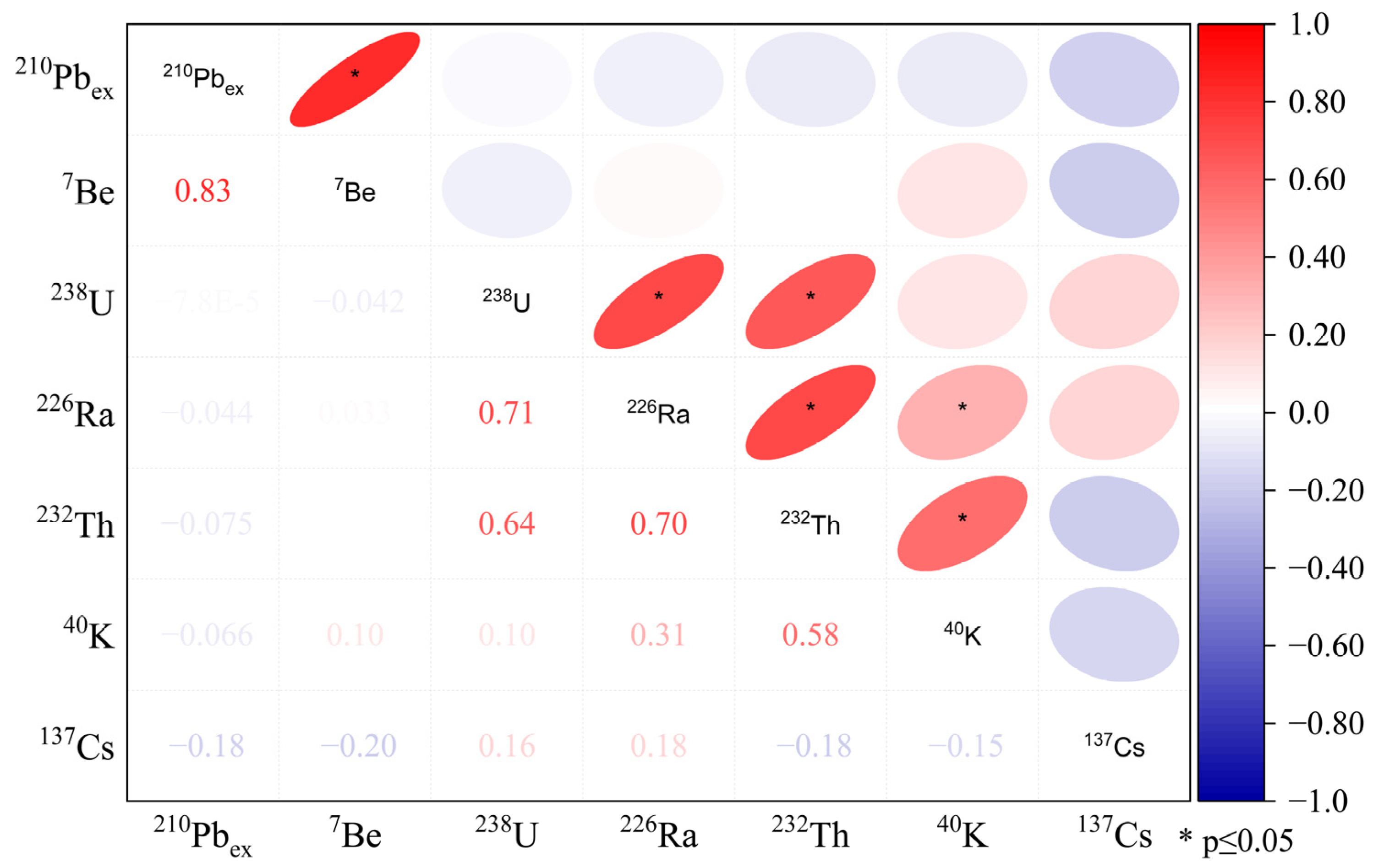
The Pearson correlation coefficients among the measured radionuclides are shown in Figure 4. Intermediate but statistically significant positive correlations were observed among the terrestrial radionuclides 238U, 226Ra, 232Th and 40K: 238U−226Ra (r = 0.71, p < 0.05), 238U−232Th (r = 0.64, p < 0.05), 226Ra−232Th (r = 0.70, p < 0.05), and 40K−232Th (r = 0.58, p < 0.05). These correlations further support the interpretation that these radionuclides share a common lithogenic origin. A strong positive correlation was also observed between 210Pbex and 7Be (r = 0.83, p < 0.05), consistent with their atmospheric deposition source. In contrast, 137Cs showed no significant correlation with any other radionuclide, indicating distinct behavior and sources relative to both terrestrial and atmospheric nuclides.

3.3. Spatial Distribution Characteristics and Influencing Factors

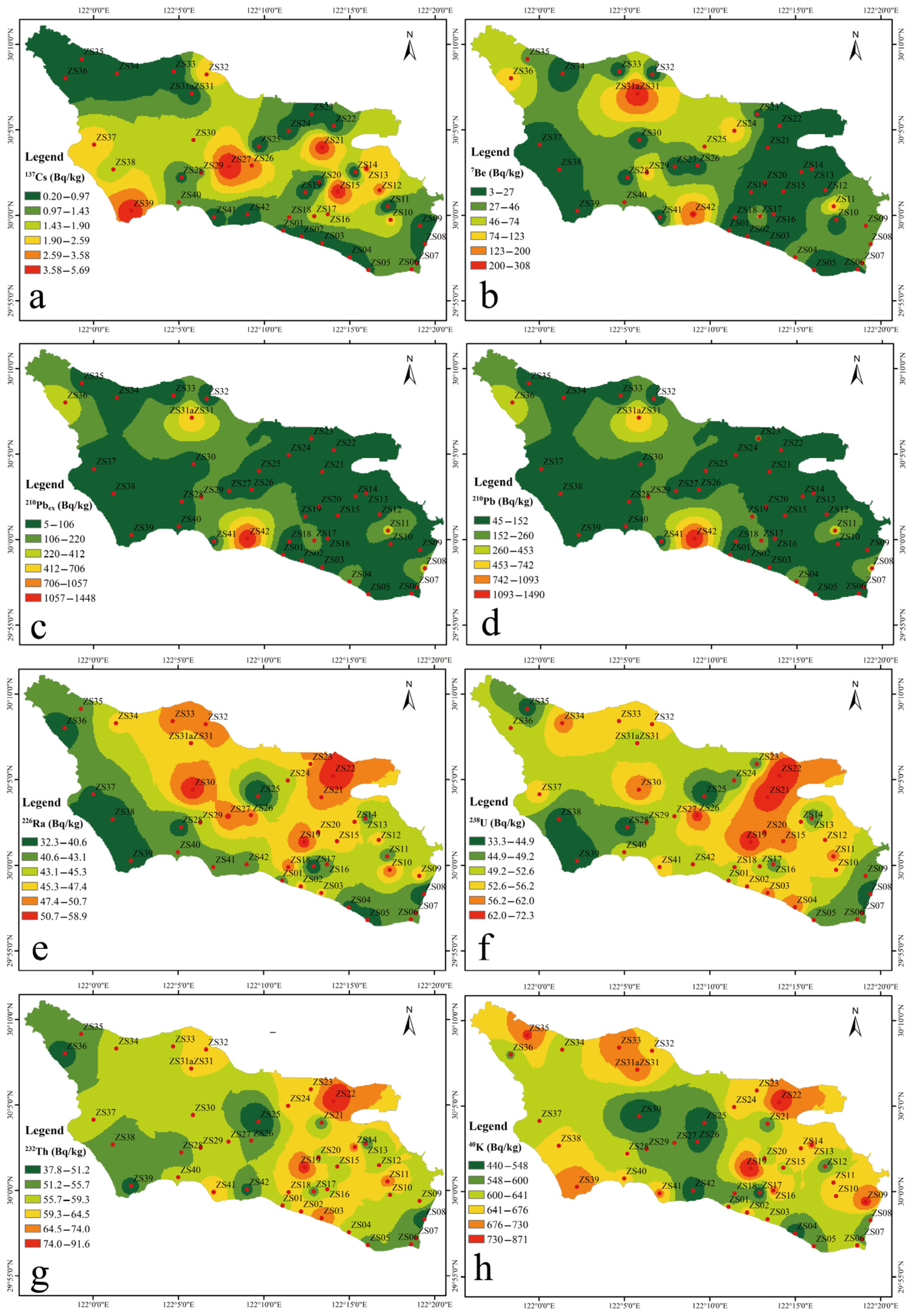
Although the spatial coverage and resolution of the sampling points are limited, predictive distribution maps were generated using inverse distance weighting (IDW) interpolation (power parameter = 2). Given the relatively small sample size (n = 43) over an area of 491 km2, substantial uncertainty remains in unsampled regions, particularly in coastal zones characterized by strong environmental gradients. Leave-one-out cross-validation indicates poor predictive performance, with high normalized RMSE values (13–307% across radionuclides) and negative R2 values (Table S4), suggesting that IDW performs worse than a simple mean-based estimator. This limited performance is primarily attributable to low sampling density (~0.09 samples/km2) and pronounced spatial heterogeneity of atmospherically derived radionuclides (7Be, 210Pb, and 210Pbex), which are strongly influenced by episodic deposition events. In addition, the presence of extreme outliers (e.g., ZS31a with 7Be = 585.5 Bq/kg and ZS42 with 210Pb = 1490.3 Bq/kg), far exceeding local background levels, further reduces interpolation stability and reliability. Accordingly, the resulting spatial distribution maps (Figure 5) should be interpreted as qualitative representations of broad spatial trends rather than precise predictions at unsampled locations. The geostatistical approach nevertheless provides a first-order spatial characterization of radionuclide distributions across the island, including unsampled areas. The spatial distributions of 137Cs, 7Be, 210Pbex, 210Pb, 226Ra, 238U, 232Th, and 40K in Zhoushan Island surface soils are presented in Figure 5a–h.
The surface soils in the northwestern, northeastern, and southeastern regions of Zhoushan Island exhibit distinctly low levels of 137Cs. In contrast, scattered patchy high-value zones are observed in the central part of the island from east to west. Further analysis shows that these high-value areas are predominantly located in farmland, vegetable plots, and cultivated land, while forested, residential, and industrial areas generally display very low 137Cs activities (Table 1; Figure 5a). This spatial pattern suggests a potential influence of agricultural disturbance on the redistribution of 137Cs. In particular, plowing and repeated soil mixing may have transported legacy fallout 137Cs from subsurface horizons to the topsoil, thereby elevating surface activities in cultivated areas. However, this interpretation is based solely on spatial correspondence and remains tentative. In the absence of supporting information on soil texture, organic matter content, particle size distribution, or detailed land-use and cultivation history, agricultural disturbance cannot be identified as the dominant controlling factor. Alternative processes, such as differential erosion, sediment reworking, or spatially variable atmospheric deposition, may also contribute to the observed distribution and cannot be ruled out.
The spatial distribution maps of 7Be, 210Pbex, and 210Pb are highly similar, with higher concentrations in the central region of the island and lower concentrations in the eastern and southwestern regions (Figure 5b–d). These patterns are controlled by multiple environmental factors, including spatial variability in rainfall, elevation, and terrain. For example, the highest concentrations of 7Be and 210Pb were recorded at sampling sites ZS31a (curbside) and ZS42 (residential area), both of which are located near sea level. This observation is consistent with the hypothesis that low-lying areas may preferentially accumulate atmospheric fallout radionuclides, potentially due to enhanced retention and/or reduced erosion intensity. However, in the absence of concurrent meteorological information (e.g., precipitation amount and intensity and wind field characteristics) and a detailed topographic analysis based on high-resolution digital elevation data, this interpretation remains speculative and should be treated with caution.
The interpolated maps of 226Ra, 238U, and 232Th (Figure 5e–g) display very similar spatial patterns. When the island is divided along a diagonal from the northwest to the southeast, higher activities are concentrated in the northern part of the island, while lower values dominate the southern part. This distribution likely reflects the natural radioactive background controlled by soil-forming processes. The weathering of parent rocks, rock type, and mineralogical composition are the primary factors influencing the concentrations of these lithogenic radionuclides in surface soils.
In contrast to 226Ra, 238U, and 232Th, the spatial distribution of 40K (Figure 5h) shows an inverse pattern: the lowest values occur in the central region, surrounded by higher values in the eastern, northwestern, and southwestern parts of the island. Although agricultural land is typically enriched in 40K due to potassium fertilizer application, no significant increase in 40K content was observed in agricultural topsoils on Zhoushan Island (Table S1; Figure 5h). This indicates that land-use type exerts minimal influence on 40K distribution, and geogenic factors may be more dominant.
The spatial distributions of both fallout and terrestrial radionuclides in Zhoushan Island surface soils show no abnormally elevated areas. The spatial variability reflects the combined effects of human agricultural activity (137Cs), atmospheric deposition processes (7Be and 210Pbex), and geological background conditions (226Ra, 238U, 232Th, and 40K). Conclusively, the strong coherence within each group suggests that radionuclide behavior is governed by distinct transport pathways rather than random spatial variability.

3.4. Radiological Hazards

While we acknowledge the inherent limitations of conventional radiological indices, particularly their inability to capture radionuclide mobility, bioavailability, and process-specific redistribution pathways, these standard metrics are still reported to facilitate direct comparison with global baseline studies [36] and to meet regulatory screening requirements. Importantly, values below established safety thresholds should not be interpreted as indicating negligible environmental risk, especially where process-based evidence suggests ongoing redistribution (e.g., 137Cs mobilization associated with agricultural disturbance). Future assessments should therefore integrate complementary approaches, such as sequential extraction procedures or dose coefficient frameworks adjusted for bioaccessibility, to better constrain radionuclide behavior and improve environmental risk characterization beyond conventional screening indices.
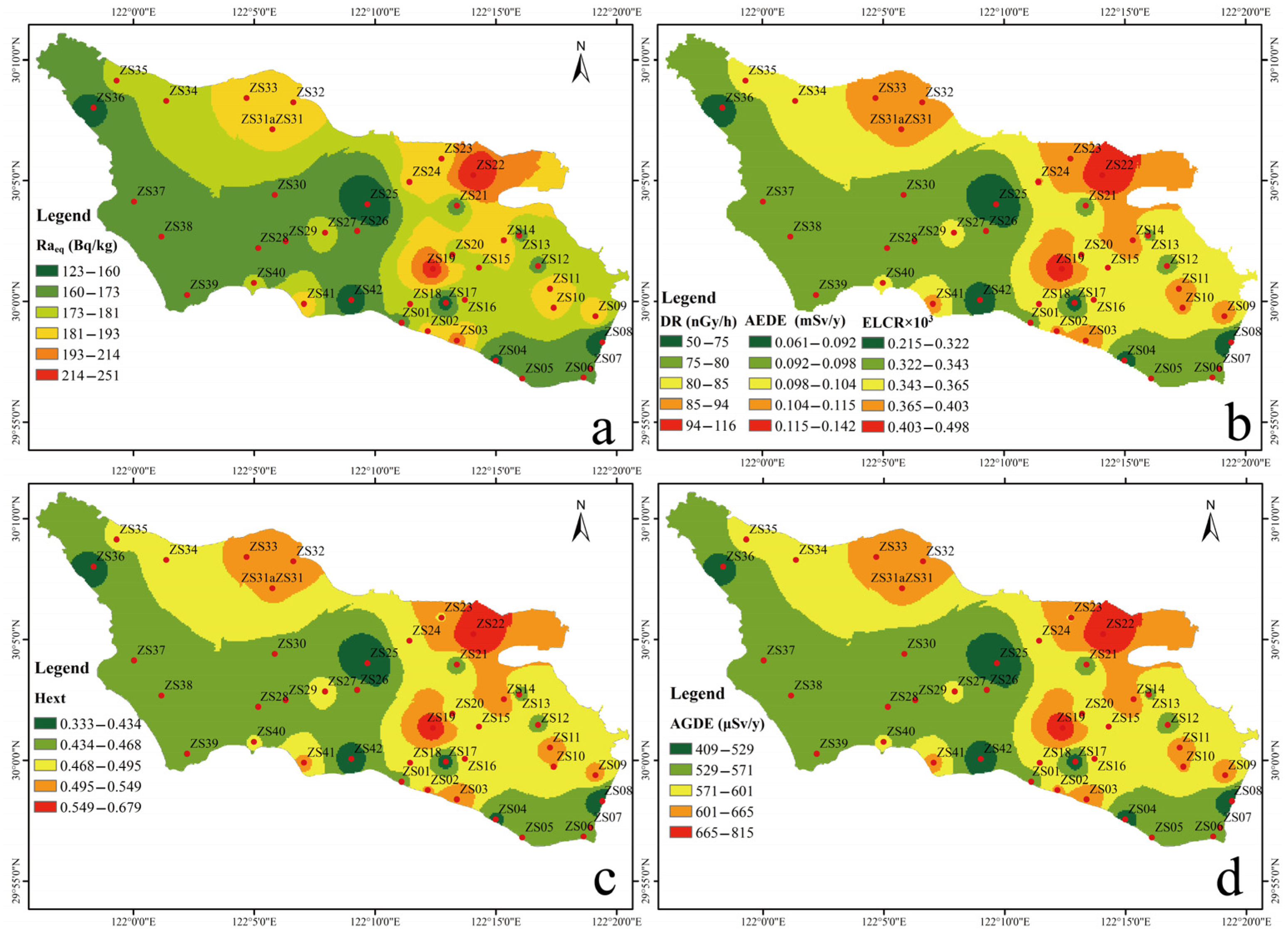
The Raeq values (Figure 6a) ranged from 123 to 251 Bq/kg, all lower than the recommended limit of 370 Bq/kg. A Raeq value of 370 Bq/kg corresponds to an annual effective dose of 1.05 mSv [36], which is considered the threshold for radiotoxicity [47]. Therefore, there is no significant gamma radiation hazard in the Zhoushan Island area. Among the radionuclides, 232Th was the dominant contributor to Raeq, accounting for 43.2–52.5%.
The DR ranged from 57.8 to 116 nGy/h (Figure 6b). The lowest DR was observed at site ZS25, located in the central mountainous area of Zhoushan Island, while the highest was observed at ZS22 in the north–central part of the island. Only ZS25 showed a lower DR than the worldwide average of 59 nGy/h [36], whereas all other sites exceeded this value. Nevertheless, all DR values were well below the recommended safety threshold of 1000 nGy/h set by the International Commission on Radiological Protection [48]. The AEDE and ELCR varied from 0.071 to 0.142 mSv/y and from 0.248 × 10⁻³ to 0.497 × 10⁻³, respectively (Figure 6b). AEDE values were higher than the global mean of 0.07 mSv/y [36] but remained lower than the ICRP-recommended limit of 1 mSv/y [48]. Except for ZS08 and ZS25, ELCR values at all sampling sites exceeded the global average of 0.290 × 10⁻³ [36]. Similar to Raeq, 232Th was the primary contributor to DR, AEDE, and ELCR, accounting for 38.8–48.5%. The Hext ranged from 0.333 to 0.679 (Figure 6c), with a mean of 0.476 ± 0.057, which is below the recommended limit of 1 [48], suggesting insignificant external radiological risk. The AGDE ranged from 408 to 816 μSv/y (Figure 6d), with a mean of 579 ± 68 μSv/y. All samples exceeded the global average of 300 μSv/y [36]; however, AGDE values were still lower than the ICRP threshold of 1 mSv/y [48]. The relative contributions of 226Ra, 232Th, and 40K to AGDE were similar to those for DR, with median contributions of 24.6%, 42.7%, and 32.0%, respectively, indicating 232Th as the major source.
Overall, the radiological hazard indices exhibited wide spatial variation, likely due to differences in lithological composition across the study area. High values were mainly distributed in the northern and south-central regions, while low values were concentrated in the southwestern and central mountainous areas. The lowest hazard indices were observed at ZS25 (central mountainous region), whereas the highest were recorded at ZS22 (north–central region). Although DR, AEDE (outdoors), AGDE, and ELCR were generally higher than the worldwide mean values reported by UNSCEAR [36], all Raeq, DR, AEDE, and AGDE values remained below the threshold levels recommended by ICRP [48].
The radiological parameters were evaluated for three land-use types relevant to tourism management: parks, schools, and ports (Figure 6). Mean Raeq values were 168.34 Bq/kg (parks), 156.49 Bq/kg (schools), and 173.50 Bq/kg (ports), with corresponding DR values of 78.52, 73.32, and 80.21 nGy/h, and AEDE (outdoors) of 0.096, 0.090, and 0.098 mSv/y, respectively. ELCR, Hext, and AGDE followed similar trends, all remaining well below international safety limits [48], indicating negligible health risks. Ports consistently showed slightly higher values than parks and schools, likely due to accumulated materials from cargo and industrial activities. The process-based grouping of radionuclides suggests that anthropogenic disturbance can enhance redistribution. From a tourism management perspective, we recommend routine monitoring in parks and schools to maintain public reassurance, and periodic assessments in ports given their elevated background. While radiological indices indicate low risk, their interpretation is limited as they do not account for radionuclide mobility, bioavailability, or process-driven redistribution, which may be particularly relevant in sensitive areas such as parks, ports, and schools. These findings underscore the importance of integrating regular radiological assessments into sustainable environmental management for recreational and transport areas on tourism-oriented islands like Zhoushan.

4. Conclusions

This study demonstrates that radionuclide distributions in Zhoushan Island soils are governed by three distinct process domains: atmospheric deposition (7Be and 210Pbex), lithogenic inheritance (238U, 226Ra, 232Th), and disturbance-modulated redistribution (137Cs and 40K). By integrating multivariate statistical analysis with process-based interpretation, this study extends conventional descriptive approaches by providing a framework that explicitly links radionuclide occurrence to underlying environmental controls and transport mechanisms. The results reveal that spatial variability is not merely a function of concentration differences but reflects the interaction of atmospheric input, geomorphological conditions, and human activities. In particular, agricultural disturbance plays a key role in redistributing 137Cs, while low-lying terrains enhance the accumulation of fallout radionuclides.
Although radiological hazard indices remain within international safety limits, their interpretation is constrained by the lack of process considerations. Elevated values relative to global averages are primarily associated with natural lithogenic enrichment rather than anthropogenic contamination, underscoring the importance of distinguishing between background variability and pollution signals. From a broader perspective, this study highlights that radionuclide behavior in coastal and island environments is highly sensitive to both climate variability and land-use change. The findings emphasize the need for process-informed radiological assessment frameworks that incorporate source identification, environmental transport, and redistribution mechanisms.
This study is limited by the spatial density of surface sampling and the absence of depth-resolved profiles, which restricts the quantification of radionuclide migration and temporal dynamics. Future work should integrate vertical profiling, isotope ratio analysis, and sediment flux quantification to better constrain transport processes and improve environmental risk assessment.

Supplementary Materials

The following supporting information can be downloaded at: https://www.mdpi.com/article/10.3390/su18115732/s1, Figure S1: 228Ra vs. 228Th specific activities in soil samples; Table S1: Sampling sites, locations and specific activities (±1δ interval) of radionuclides presented in soil samples; Table S2: Range and mean values of specific radioactivities of various radionuclides in different soil samples; Table S3: Total variance explained for the analyzed radionuclides in soil samples; Table S4: Statistical results of IDW leave-one-out cross-validation. Refs. [36,39,40,41,42,43,44,45,49,50,51,52,53,54,55,56,57,58,59,60,61,62,63,64,65,66] are cited on the Supplementary Materials.

Author Contributions

P.F.: Writing—original draft, Validation, Methodology, Investigation, Funding acquisition, Formal analysis, Data curation. Q.W.: Writing—review and editing, Supervision, Resources, Project administration, Funding acquisition, Conceptualization. P.Z.: Writing—review and editing, Investigation, Resources, Data curation. W.G.: Writing—review and editing, Data curation. Y.L.: Writing—review and editing, Resources. Q.Z.: Writing—review and editing. R.W.: Writing—review and editing. All authors have read and agreed to the published version of the manuscript.

Funding

This research was funded by the Zhejiang Provincial Natural Science Foundation of China (Grant No. LY24D060004), the Science Foundation of Donghai Laboratory (Grants Nos. DH-2023QH0001, Z24ZJ002P), the National Natural Science Foundation of China (Grants Nos. 42576069, 42307280), and the Science Foundation of Guangzhou City (Grant No. 2025A04J3358).

Institutional Review Board Statement

Not applicable.

Informed Consent Statement

Not applicable.

Data Availability Statement

The original contributions presented in this study are included in the article/Supplementary Material. Further inquiries can be directed to the corresponding authors.

Acknowledgments

The authors acknowledge the support provided by Donghai Laboratory. We are very grateful to the editor and anonymous reviewers for their valuable feedback.

Conflicts of Interest

The authors declare no conflicts of interest.

References

  1. Zhang, M.; Zhou, Y.; Sang, S. Vulnerability analysis of the economic-social-ecological complex system of Island tourism destinations. PLoS ONE 2025, 20, e0324714. [Google Scholar] [CrossRef]
  2. Chen, H.; Chen, C.; Zhang, Z.; Lu, C.; Wang, L.; He, X.; Chu, Y.; Chen, J. Changes of the spatial and temporal characteristics of land-use landscape patterns using multi-temporal Landsat satellite data: A case study of Zhoushan Island, China. Ocean Coast. Manag. 2021, 213, 105842. [Google Scholar] [CrossRef]
  3. Chen, C.; He, X.; Lu, Y.; Chu, Y. Application of Landsat time-series data in island ecological environment monitoring: A case study of Zhoushan Islands, China. J. Coast. Res. 2020, 108, 193–199. [Google Scholar] [CrossRef]
  4. Tian, S. Spatio-Temporal Changes of Ecological Vulnerability in Zhoushan Island and Its Adjacent Islands. Master’s Thesis, Zhejiang Ocean University, Zhoushan, China, 2021. (In Chinese) [Google Scholar] [CrossRef]
  5. Arnedo, M.A.; Rubiano, J.G.; Alonso, H.; Tejera, A.; González, A.; González, J.; Gil, J.M.; Rodriguez, R.; Martel, P.; Bolivar, J.P. Mapping natural radioactivity of soils in the eastern Canary Islands. J. Environ. Radioact. 2017, 166, 242–258. [Google Scholar] [CrossRef]
  6. Abella, M.K.; Molina, M.R.; Nikolić-Hughes, I.; Hughes, E.W.; Ruderman, M.A. Background gamma radiation and soil activity measurements in the northern Marshall Islands. Proc. Natl. Acad. Sci. USA 2019, 116, 15425–15434. [Google Scholar] [CrossRef]
  7. Bella, S.; Brai, M.; Hauser, S.; Puccio, P.; Rizzo, S. Natural radioactivity in a volcanic island: Ustica, Southern Italy. Appl. Radiat. Isot. 1997, 48, 287–293. [Google Scholar] [CrossRef]
  8. Brai, M.; Basile, S.; Bellia, S.; Hauser, S.; Puccio, P.; Rizzo, S.; Bartolotta, A.; Licciardello, A. Environmental radioactivity at Stromboli (Aeolian islands). Appl. Radiat. Isot. 2002, 57, 99–107. [Google Scholar] [CrossRef] [PubMed]
  9. Hafızoğlu, N.; Sahin, L.; Ganioğlu, E.; Ağgez, G.; Baştemur, G.Y.; İsel, P. Assessment of natural and anthropogenic radioactivity of the Princes’ Islands in the Sea of Marmara. Water Air Soil Poll. 2020, 231, 261. [Google Scholar] [CrossRef]
  10. Huh, C.A.; Su, C.C. Distribution of fallout radionuclides (7Be, 137Cs, 210Pb and 239,240Pu) in soils of Taiwan. J. Environ. Radioact. 2004, 77, 87–100. [Google Scholar] [CrossRef]
  11. Ram, R.; Kalnins, C.; Pownceby, M.I.; Ehrig, K.; Etschmann, B.; Spooner, N.; Brugger, J. Selective radionuclide co-sorption onto natural minerals in environmental and anthropogenic conditions. J. Hazard. Mater. 2021, 409, 124989. [Google Scholar] [CrossRef] [PubMed]
  12. Simonsen, M.; Lind, O.C.; Saetra, Ø.; Isachsen, P.E.; Teien, H.C.; Albretsen, J.; Salbu, B. Coastal transport of river-discharged radionuclides: Impact of speciation and transformation processes in numerical model simulations. Sci. Total Environ. 2019, 669, 856–871. [Google Scholar] [CrossRef] [PubMed]
  13. Gwynn, J.P.; Hatje, V.; Casacuberta, N.; Sarin, M.; Osvath, I. The effect of climate change on sources of radionuclides to the marine environment. Commun. Earth Environ. 2024, 5, 135. [Google Scholar] [CrossRef]
  14. Zhu, D. The Future Development Path of Zhoushan’s Tourism Economy. In The 4th International Conference on Economic Development and Business Culture (ICEDBC 2024); Atlantis Press: Dordrecht, The Netherlands, 2024; pp. 43–49. [Google Scholar] [CrossRef]
  15. Chai, M.; Li, R.; Gong, Y.; Shen, X.; Yu, L. Bioaccessibility-corrected health risk of heavy metal exposure via shellfish consumption in coastal region of China. Environ. Pollut. 2021, 273, 116529. [Google Scholar] [CrossRef] [PubMed]
  16. Zhai, B.; Zhang, X.; Wang, L.; Zhang, Z.; Zou, L.; Sun, Z.; Jiang, Y. Concentration distribution and assessment of heavy metals in surface sediments in the Zhoushan Islands coastal sea, East China Sea. Mar. Pollut. Bull. 2021, 164, 112096. [Google Scholar] [CrossRef]
  17. Qiao, L.; Chen, Y.; Ren, C.; Li, T.; Zhao, A.; Fan, S.; Bao, J. Benthic foraminiferal community structure and its response to environmental factors revealed using high-throughput sequencing in the Zhoushan Fishing Ground, East China Sea. Mar. Pollut. Bull. 2024, 202, 116385. [Google Scholar] [CrossRef]
  18. Liu, Z.; Wang, L.; Li, B. Quality assessment of ecological environment based on Google Earth Engine: A case study of the Zhoushan Islands. Front. Ecol. Evol. 2022, 10, 918756. [Google Scholar] [CrossRef]
  19. Walther, C.; Gupta, D.K. Radionuclides in the Environment; Springer: New York, NY, USA, 2015. [Google Scholar] [CrossRef]
  20. IAEA (International Atomic Energy Agency). Technical Feasibility and Reliability of Passive Safety Systems for Nuclear Power Plants; IAEA-TECDOC-920 (December); IAEA: Seibersdorf, Austria, 1996. [Google Scholar]
  21. Garcêz, R.W.D.; Lopes, J.M.; da Silva Perez, S.; da Costa Lauria, D.; Viglio, E.P.; da Cunha, F.G.; Ribeiro, F.C.A.; da Silva, A.X. Activity concentration and mapping of radionuclides in Espírito Santo State soils, Brazil. Radiat. Phys. Chem. 2020, 167, 108209. [Google Scholar] [CrossRef]
  22. Dowdall, M.; O’Dea, J. 226Ra/238U disequilibrium in an upland organic soil exhibiting elevated natural radioactivity. J. Environ. Radioact. 2002, 59, 91–104. [Google Scholar] [CrossRef]
  23. Hong, G.H.; Baskaran, M.; Povinec, P.P. Artificial radionuclides in the western North Pacific: A review. Glob. Environ. Change Ocean Land 2004, 147–172. [Google Scholar]
  24. Tuo, F.; Xu, C.; Zhang, J.; Zhou, Q.; Li, W.; Zhao, L.; Zhang, Q.; Zhang, J.; Su, X. Radioactivity analysis following the Fukushima Dai-ichi nuclear accident. Appl. Radiat. Isot. 2013, 78, 77–81. [Google Scholar] [CrossRef]
  25. Kong, S.; Yang, B.; Tuo, F.; Lu, T. Advance on monitoring of radioactivity in food in China and Japan after Fukushima nuclear accident. Radiat. Med. Prot. 2022, 3, 37–42. [Google Scholar] [CrossRef]
  26. Ahmed, R.S. A review on soil radionuclide distribution in Iraq analysed using gamma ray spectroscopy. Environ. Forensics 2021, 22, 91–98. [Google Scholar] [CrossRef]
  27. do Carmo Leal, A.L.; da Costa Lauria, D.; Ribeiro, F.C.; Viglio, E.P.; Franzen, M.; Lima, E.d.A.M. Spatial distributions of natural radionuclides in soils of the state of Pernambuco, Brazil: Influence of bedrocks, soils types and climates. J. Environ. Radioact. 2020, 211, 106046. [Google Scholar] [CrossRef]
  28. Namq, B.F.; Hussein, Z.A.; Othman, S.Q.; Najam, L.A.; Wais, T.Y.; Sayyed, M.I.; Mansour, H.; Rilwan, U. Evaluation of radiological risks due to natural radionuclides in the soil of Khanaqin district, Diyala, Iraq. Phys. Scripta 2024, 100, 015310. [Google Scholar] [CrossRef]
  29. Olagbaju, P.O.; Wojuola, O.B.; Tshivhase, V. Radionuclides contamination in soil: Effects, sources and spatial distribution. EPJ Web Conf. 2021, 253, 09006. [Google Scholar] [CrossRef]
  30. Li, G.; Gao, S.; Wang, Y.; Li, C. Sediment flux from the Zhoushan Archipelago, eastern China. J. Geogr. Sci. 2018, 28, 387–399. [Google Scholar] [CrossRef]
  31. Zhang, X.; Pan, D.; Chen, J.; Zhao, J.; Zhu, Q.; Huang, H. Evaluation of coastline changes under human intervention using multi-temporal high-resolution images: A case study of the Zhoushan Islands, China. Remote Sens. 2014, 6, 9930–9950. [Google Scholar] [CrossRef]
  32. Zhang, X.; Hu, B.X.; Wang, P.; Chen, J.; Yang, L.; Xiao, K.; Zhang, X. Hydrogeochemical evolution and heavy metal contamination in groundwater of a reclaimed land on Zhoushan Island. Water 2018, 10, 316. [Google Scholar] [CrossRef]
  33. Liu, Z.; Shi, L.; Guo, J.; Cai, T.; Wang, X.; Xia, X. Spatiotemporal Changes and Utilization Intensity of the Zhoushan Archipelago Coastline over Four Decades. J. Mar. Sci. Eng. 2024, 12, 2013. [Google Scholar] [CrossRef]
  34. Chen, B.; Chen, Z.; Stephenson, W.; Finlayson, B. Morphodynamics of a boulder beach, Putuo Island, SE China coast: The role of storms and typhoon. Mar. Geol. 2011, 283, 106–115. [Google Scholar] [CrossRef]
  35. Chen, J.; Pan, D.; Mao, Z.; Chen, N.; Zhao, J.; Liu, M. Land-cover reconstruction and change analysis using multisource remotely sensed imageries in Zhoushan Islands since 1970. J. Coast. Res. 2014, 30, 272–282. [Google Scholar] [CrossRef]
  36. UNSCEAR (United Nations Scientific Committee on the Effects of Atomic Radiation). Sources and Effects of Ionizing Radiation; Report to the General Assembly, with Scientific Annexes; United Nations: New York, NY, USA, 2000. [Google Scholar] [CrossRef]
  37. ICRP (International Commission on Radiological Protection). Publication 60. Recommendations of the international commission on radiological protection. Ann. ICRP 1990, 21, 1–201. [Google Scholar]
  38. ICRP (International Commission on Radiological Protection). The 2007 Recommendations of the International Commission on Radiological Protection, ICRP Publication 103. Ann. ICRP 2007, 37, 2–4. [Google Scholar]
  39. Dowdall, M.; Gerland, S.; Lind, B. Gamma-emitting natural and anthropogenic radionuclides in the terrestrial environment of Kongsfjord, Svalbard. Sci. Total Environ. 2003, 305, 229–240. [Google Scholar] [CrossRef]
  40. Dowdall, M.; Vicat, K.; Frearson, I.; Gerland, S.; Lind, B.; Shaw, G. Assessment of the radiological impacts of historical coal mining operations on the environment of Ny-Ålesund, Svalbard. J. Environ. Radioactiv. 2004, 71, 101–114. [Google Scholar] [CrossRef]
  41. Özden, S.; Pehlivanoğlu, S.A. Natural and Artificial Radioactivity Concentrations and Health Risks due to Radionuclides in the Soil of Nevşehir (Cappadocia). Int. J. Appl. Phys. Eng. 2023, 2, 144–151. [Google Scholar] [CrossRef]
  42. Jabbar, A.; Arshed, W.; Bhatti, A.; Ahmad, S.; Ur-Rehman, S.; Dilband, M. Measurement of soil radioactivity levels and radiation hazard assessment in mid Rechna interfluvial region, Pakistan. J. Radioanal. Nucl. Chem. 2010, 283, 371–378. [Google Scholar] [CrossRef]
  43. Godoy, J.M.; Schuch, L.A.; Nordemann, D.J.R.; Reis, V.R.G.; Ramalho, M.; Recio, J.C.; Brito, R.R.A.; Olech, M.A. 137Cs, 226,228Ra, 210Pb and 40K concentrations in Antarctic soil, sediment and selected moss and lichen samples. J. Environ. Radioact. 1998, 41, 33–45. [Google Scholar] [CrossRef]
  44. Saleh, I.H.; Ibrahim, N.M.; Hassaan, M.A.; Ghatass, Z.F.; Arayro, J.; Mezher, R.; Ibosayyed, M.; Elsafi, M. Using 7Be and 137Cs for assessing the land stability of Alexandria region, Egypt. Sustainability 2024, 16, 1692. [Google Scholar] [CrossRef]
  45. Kuzmanović, P. Soil radioactivity in Serbia—A critical review. J. Environ. Radioact. 2026, 295, 107938. [Google Scholar] [CrossRef]
  46. Gulan, L.; Milenkovic, B.; Stajic, J.M.; Vuckovic, B.; Krstic, D.; Zeremski, T.; Ninkov, J. Correlation between radioactivity levels and heavy metal content in the soils of the North Kosovska Mitrovica environment. Environ. Sci. Process. Impacts 2013, 15, 1735–1742. [Google Scholar] [CrossRef]
  47. NEA-OECD. Exposure to Radiation from Natural Radioactivity in Building Materials; Report by NEA Group of Experts; OECD: Paris, France, 1979. [Google Scholar]
  48. ICRP (International Commission on Radiological Protection). Radiation weighting for reference animals and plants, ICRP Publication 148. Ann. ICRP 2021, 50, 1–133. [Google Scholar]
  49. Vukašinović, I.; Todorović, D.; Životić, L.; Kaluđerović, L.; Đorđević, A. An analysis of naturally occurring radionuclides and 137Cs in the soils of urban areas using gamma-ray spectrometry. Int. J. Environ. Sci. Technol. 2018, 15, 1049–1060. [Google Scholar] [CrossRef]
  50. Džoljić, J.A.; Stevović, S.M.; Todorović, D.J.; Polavder, S.M.; Rajačić, M.M.; Krneta-Nikolić, J.D. Natural and artificial radioactivity in some protected areas of south east Europe. Nucl. Technol. Radiat. Prot. 2017, 32, 334–341. [Google Scholar] [CrossRef]
  51. Łokas, E.; Zwoliński, Z.; Rachlewicz, G.; Gąsiorek, M.; Wilkosz, G.; Samolej, K. Distribution of anthropogenic and naturally occurring radionuclides in soils and lakes of Central Spitsbergen (Arctic). J. Radioanal. Nucl. Chem. 2017, 311, 707–717. [Google Scholar] [CrossRef]
  52. Huang, D.; Yu, T. Assessment of gamma radiation levels and natural radioactivity in soils along a subtropical river basin, China. Radiochim. Acta 2017, 105, 755–762. [Google Scholar] [CrossRef]
  53. Mitrović, B.; Ajtić, J.; Lazić, M.; Andrić, V.; Krstić, N.; Vranješ, B.; Vićentijević, M. Natural and anthropogenic radioactivity in the environment of Kopaonik mountain, Serbia. Environ. Poll. 2016, 215, 273–279. [Google Scholar] [CrossRef]
  54. Charro, E.; Pardo, R.; Peña, V. Statistical analysis of the spatial distribution of radionuclides in soils around a coal-fired power plant in Spain. J. Environ. Radioact. 2013, 124, 84–92. [Google Scholar] [CrossRef]
  55. Gür, F.; Yaprak, G. Natural radionuclide emission from coal-fired power plants in the southwestern of Turkey and the population exposure to external radiation in their vicinity. J. Environ. Sci. Health Part A 2010, 45, 1900–1908. [Google Scholar] [CrossRef]
  56. Cevik, U.Ğ.U.R.; Celik, N.; Celik, A.; Damla, N.; Coskuncelebi, K. Radioactivity and heavy metal levels in hazelnut growing in the Eastern Black Sea Region of Turkey. Food Chem. Toxicol. 2009, 47, 2351–2355. [Google Scholar] [CrossRef]
  57. Dai, L.; Wei, H.; Wang, L. Spatial distribution and risk assessment of radionuclides in soils around a coal-fired power plant: A case study from the city of Baoji, China. Environ. Res. 2007, 104, 201–208. [Google Scholar] [CrossRef]
  58. Papp, Z.; Dezső, Z.; Daroczy, S. Significant radioactive contamination of soil around a coal-fired thermal power plant. J. Environ. Radioact. 2002, 59, 191–205. [Google Scholar] [CrossRef]
  59. Bunzl, K.; Kretner, R.; Szeles, M.; Winkler, R. Transect survey of 238U, 228Ra, 226Ra, 210Pb, 137Cs and 40K in an agricultural soil near an exhaust ventilating shaft of a uranium mine. Sci. Total. Environ. 1994, 149, 225–232. [Google Scholar] [CrossRef]
  60. Rosner, G.; Bunzl, K.; Hötzl, H.; Winkler, R. Low level measurements of natural radionuclides in soil samples around a coal-fired power plant. Nucl. Instrum. Methods Phys. Res. 1984, 223, 585–589. [Google Scholar] [CrossRef]
  61. Walling, D.E.; He, Q.; Blake, W. Use of 7Be and 137Cs measurements to document short-and medium-term rates of water-induced soil erosion on agricultural land. Water Resour. Res. 1999, 35, 3865–3874. [Google Scholar] [CrossRef]
  62. Doering, C.; Akber, R.; Heijnis, H. Vertical distributions of 210Pb excess, 7Be and 137Cs in selected grass covered soils in Southeast Queensland, Australia. J. Environ. Radioact. 2006, 87, 135–147. [Google Scholar] [CrossRef]
  63. Gellis, A.C.; Fuller, C.C.; Van Metre, P.C. Sources and ages of fine-grained sediment to streams using fallout radionuclides in the Midwestern United States. J. Environ. Manag. 2017, 194, 73–85. [Google Scholar] [CrossRef] [PubMed]
  64. Ryken, N.; Al-Barri, B.; Blake, W.; Taylor, A.; Tack, F.; Bodé, S.; Boeckx, P.; Verdoodt, A. Impact of soil hydrological properties on the 7Be depth distribution and the spatial variation of 7Be inventories across a small catchment. Geoderma 2018, 318, 88–98. [Google Scholar] [CrossRef]
  65. Zhang, F.; Zhang, B.; Yang, M. Beryllium-7 atmospheric deposition and soil inventory on the northern Loess Plateau of China. Atmos. Environ. 2013, 77, 178–184. [Google Scholar] [CrossRef]
  66. Sepulveda, A.; Schuller, P.; Walling, D.E.; Castillo, A. Use of 7Be to document soil erosion associated with a short period of extreme rainfall. J. Environ. Radioact. 2008, 99, 35–49. [Google Scholar] [CrossRef]
Figure 1. Geographical location of Zhoushan Island and of the selected sampling sites (top) and of the island land use landscape pattern (bottom).
Sustainability 18 05732 g001
Figure 2. Frequency distributions of radionuclides for (a) 210Pb; (b) 226Ra; (c) 210Pbex; (d) 228Ra; (e) 228Th; (f) 232Th; (g) 7Be; (h) 238U; (i) 137Cs; (j) 40K in soil samples (unit: Bq/kg dry weight).
Sustainability 18 05732 g002
Figure 3. (a) A dendrogram obtained by HCA of activity concentrations in soil samples (the degree of correlation between variables is related to the distances) and (b) component plot in a rotated space (PCA) for seven radionuclides.
Sustainability 18 05732 g003
Figure 4. Correlation analysis among different radionuclides in Zhoushan Island soil samples.
Sustainability 18 05732 g004
Figure 5. Interpolated maps of the study area for (a) 137Cs; (b) 7Be; (c) 210Pbex; (d) 210Pb; (e) 226Ra; (f) 238U; (g) 232Th; (h) 40K in soil samples. Spatial distribution maps generated using inverse distance weighting (IDW) interpolation. All values are expressed in Bq/kg dry weight.
Sustainability 18 05732 g005
Figure 6. The distribution of radiological hazard indices (Raeq (a), DR (b), AEDE (b), ELCR (b), Hext (c), and AGDE (d)) in the study area. Spatial distribution maps generated using ordinary kriging interpolation.
Sustainability 18 05732 g006
Table 1. Factor loadings for the first three components.
Component
PC1PC2PC3
210Pbex−0.0260.962−0.016
7Be0.0160.9430.125
137Cs0.258−0.198−0.759
238U0.8870.012−0.125
226Ra0.9170.0030.029
232Th0.801−0.0600.508
40K0.350−0.0640.729
Extraction Method: Principal Component Analysis; Rotation Method: Varimax with Kaiser Normalization. Note: Factor loadings indicate statistical associations only. The grouping of 137Cs and 40K in PC3 reflects shared alkali-metal chemistry but does not imply common sources or transport pathways (see Section 3.2 for detailed interpretation).
Disclaimer/Publisher’s Note: The statements, opinions and data contained in all publications are solely those of the individual author(s) and contributor(s) and not of MDPI and/or the editor(s). MDPI and/or the editor(s) disclaim responsibility for any injury to people or property resulting from any ideas, methods, instructions or products referred to in the content.