Article

A Comparative Environmental Life Cycle Assessment of Solar PV Modules Based on Types, Production Location and End-of-Life Recycling Scenarios


1
Institute for Natural Resources Technology and Management (ITT), TH Köln (University of Applied Sciences), Betzdorfer Strasse 2, 50679 Cologne, Germany
2
Cologne Institute for Renewable Energy (CIRE), TH Köln (University of Applied Sciences), Betzdorfer Strasse 2, 50679 Cologne, Germany
*
Author to whom correspondence should be addressed.
Sustainability 2026, 18(11), 5729; https://doi.org/10.3390/su18115729 (registering DOI)
Submission received: 17 April 2026 / Revised: 29 May 2026 / Accepted: 29 May 2026 / Published: 4 June 2026
(This article belongs to the Special Issue Advanced Study of Solar Cells and Energy Sustainability)

Abstract

As declared in the European Green Deal, the decarbonization of the EU energy system is essential for achieving Europe’s climate neutrality targets, demanding a substantial expansion of renewable energy sources and the rapid phase-out of coal and gas. It is therefore essential that newly installed PV products within the EU are designed to avoid creating additional environmental burdens due to environmental impacts during production and at the end of life (EOL) of photovoltaic (PV) modules. This study presents a life cycle assessment (LCA) of sustainable/green PV module designs in terms of recyclability using advanced high-quality recycling technologies. It compares two product systems both based on mono c-Si PV technology and the glass–glass (G–G) module design: 1. Passivated Emitter and Rear Contact (PERC) and 2. Tunnel Oxide Passivated Contact (TOPCon) cell technologies, which are assessed under production scenarios in China and Germany, and two recycling scenarios (hypothetical high-recovery recycling and partial recycling) using inventory data from eco-invent and literature sources. The results across most impact categories show that the PERC and TOPCon module designs produced in Germany with high-recovery recycling as the end-of-life strategy exhibit lower impacts than those produced in China with partial recycling as the end-of-life strategy under the adopted assumptions such as electricity mix and end-of-life modelling choices for module-only impacts (excluding BOS components). The climate change results show that TOPCon cell design under high-recovery recycling yields 10.4% lower emissions than the PERC cell design under partial recycling in Germany and 9.7% lower in China. However, both module designs emit 26.6% and 27.2% less GHG emissions when produced in Germany compared to production in China, respectively, which is line with earlier studies. With the exception of human toxicity, both PERC and TOPCon cell technologies perform better in this study than previously reported in reviewed LCA studies, reflecting the use of more recent state-of-the-art industry data concerning manufacturing requirements. The sensitivity analysis carried out on the design changes and electricity grid mix available shows that any improvements in the design process and increases in renewable energy penetration into the grid corresponds to a proportional reduction in environmental impacts across all impact categories.

1. Introduction

The energy sector is associated with a wide range of environmental problems, including climate change, air pollution, acidification, eutrophication, resource depletion, and toxicity, among others, driven by fossil fuel extraction and combustion. The burning of fossil fuels leads to the emission of CO2, CH4, N2O, SO2, NOx, PM2.5, NMVOCs, and several other harmful compounds, leading to global warming, extreme weather events, ecosystem disruption, respiratory and cardiovascular problems, poor air quality in urban areas, the acidification of lakes and rivers, the loss of aquatic life, resource depletion, etc. [1]. The energy sector alone is responsible for approximately 85% of total global CO2 emissions. In 2023 alone, a record high 37.7 GtCO2-eq of energy-related CO2 emissions was recorded, about 1.0 GtCO2-eq higher than that in 2019 [2]. The power sector alone accounted for 40% of the global total energy-related emissions. However, In Germany, GHG emissions in 2023 reduced by more than 10% compared to 2022 levels [3]. This has been credited to Germany’s Renewable Energy Sources Act (EEG) 2023, which set a target of at least 80% renewable electricity consumption by 2030 while aiming for a largely climate-neutral power system by 2045 to reduce emissions due to the use of fossil fuels [4]. The Working Group on Renewable Energy Statistics (AGEE-Stat) reported that the share of renewable energies in gross electricity consumption was already approximately 57% in the first half of 2024, mainly driven by the expansion of PV capacity in Germany [5].
Global cumulative PV capacity reached 2.2 TW at the end of 2024 [6], up from 1.6 TW in 2023 [7], and is projected to increase further to 5.1 TW by 2028, as reported by Solar Power Europe in the medium scenario projection [8]. Solar PV is playing an increasingly important role in the current and future energy systems driven by its level of scalability, cost competitiveness and contribution to decarbonization [9]. Although solar PV systems are widely considered as green and low-carbon technologies, their production is energy and material intensive, leading to high environmental impacts [10]. These impacts are strongly influenced by the electricity mix and environmental conditions at the production site; therefore, careful consideration of the manufacturing location is essential to avoid the shifting of emissions across regions and to ensure large scale PV adoption [11]. A study by Zheng et al. [12] developed an integrated framework to track the flow of greenhouse gases such as CO2 and CH4 across the global PV supply chain. The findings showed that climate impacts are underestimated by about 20–28% due to the CO2-focused accounting methods leading to significant misallocation of climate responsibility and an underrepresentation of carbon leakage, particularly in major manufacturing countries such as China; thus, incorporating a multi-gas life cycle assessment can help correct these systemic imbalances within PV supply chains. Therefore, it is of significant importance to identify, quantify and assess the material and energy flows associated with PV production and end-of-life/waste management across several indicators [13]. By 2030, cumulative global PV waste is estimated to reach 1.7–8 Mt (4–14% of total installed capacity) and 60–78 Mt (approximately 80% of total installed capacity) in 2050 based on an average PV panel lifespan of approximately 25 years [14]. It is estimated that 33,205.36 t of PV cell waste can generate 62.26 t of hazardous materials; therefore, 78 Mt in 2050 could generate as much as 150,000 t of hazardous waste [15]. Hence, the main objective of this work was to develop a methodological approach that can be applied to the different types of solar modules in carrying out their life cycle assessments based on the production location, focusing on the various manufacturing and application routes while taking into account recycling credits from end-of-life PV waste management. To achieve this objective, this study includes:
  • An updated comparative LCA process chain and flow model for the production, transportation and end-of-life use of Passivated Emitter Rear Contact (PERC) and Tunnel Oxide Passivated Contact (TOPCon) cell technologies.
  • Detailed analysis of recycling PV waste streams for a reference case of modules manufactured in Germany, compared with those manufactured in China.
  • Synthesized results from a sustainability assessment perspective, including the economics of recycling, to provide a more comprehensive comparative investigation.
  • Monte Carlo simulation to quantify the uncertainty in the LCA results by producing a distribution of possible outcomes based on uncertainties in the input data.
This study considers the mono-Si PERC solar module as the reference module since currently, it is the more mature, industry standard and most dominant cell technology, with an advanced silicon cell design and lower GHG emissions [16], whereas TOPCon solar module technology is considered the “newer” state of the art design option due to its emergence as a fast-growing PV technology that is expected to become the mainstream technology after PERC in the coming few years [17]. PERC and TOPCON modules considered for this study are sourced from Canadian Solar (CSI Solar Co., Ltd.), Suzhou, Jiangsu, China. This study considers the production of modules in both China and Germany. China was selected as one of the production locations because it represents the majority of PV production in the world currently [18], whereas Germany was selected to investigate the implications for a potential German production location due to increased PV expansion in Germany [6]. Therefore, this study provides a comparative life cycle assessment of PERC and TOPCon modules, considering different production locations (Germany and China), combined with updated process inventories, recycling scenarios and an uncertainty analysis within a unified framework. The key limitation of this study lies in the limited available data on the TOPCon cell technology. As a result, some of the input and output flows were based on estimations and the literature data related to PERC module design rather than on primary data from industry scale applications. Similarly, the hypothetical high-recovery recycling technique [19] assumed in this study is also currently in the pilot stage and has yet to reach full commercial deployment, creating more uncertainty in end-of-life modelling. The main information gaps identified in this study relate to the lack of site-specific primary data for the module production processes and end-of-life treatment strategies, particularly concerning the associated emissions. These gaps were addressed through the use of secondary data obtained from the eco-invent database and supplemented by relevant findings from literature reviews. Such sources include works by Brittany L. Smith et al. [19], Müller et al. [20], Khan et al. [21], and Cruz et al. [22], among others. A methodological comparison Table S15 for major PV LCA studies (2015–2025) has been added in the Supplementary Materials.

2. Methodology

2.1. Goal and Scope Definition

The goal of this study was to conduct a comparative life cycle assessment (LCA) of different types of solar modules based on the production location by evaluating the environmental impacts of various PV module designs, focusing on the various manufacturing and application routes. The life cycle assessment (LCIA) investigated some of the common environmental impact categories (climate change, acidification, eutrophication, toxicity, etc.) throughout the entire life cycle of the modules. This study took into account the credits from recycling, with the ultimate purpose of determining whether to recycle or not to recycle solar modules from an environmental point of view. A cradle-to-grave approach/process chain model that includes raw material acquisition, material processing and manufacturing of the modules, module transportation and an end-of-life module-recycling phase was carried out. The use phase (electricity generation over the module lifetime) and BOS components such as inverters, cabling and mounting structures were excluded from the system boundary.
This study comprises all the materials used over the 30-year lifetime of modules/module-designs considered to be recyclable. It compares different product systems based on different scenarios that make reference to mono-Si PERC cell technology. The PERC solar cell architecture, considered the “reference” module design for this study, represents an advancement in silicon solar cell design, primarily through the introduction of a rear-surface passivation layer. The current PERC-concept is reported to reach up to 23% average conversion efficiencies in mass production, with a fairly mature process sequence [23]. The TOPCon solar cell structure, considered the “newer” module design, stands out due to its relatively high efficiency (24.6–25.8%) and easier integration with existing production lines, requiring only 2–4 additional steps compared to conventional cell production [24]. The formation of tunnel oxide and the deposition of intrinsic/doped poly-Si are the two crucial processing steps that are additional to the current PERC processing.
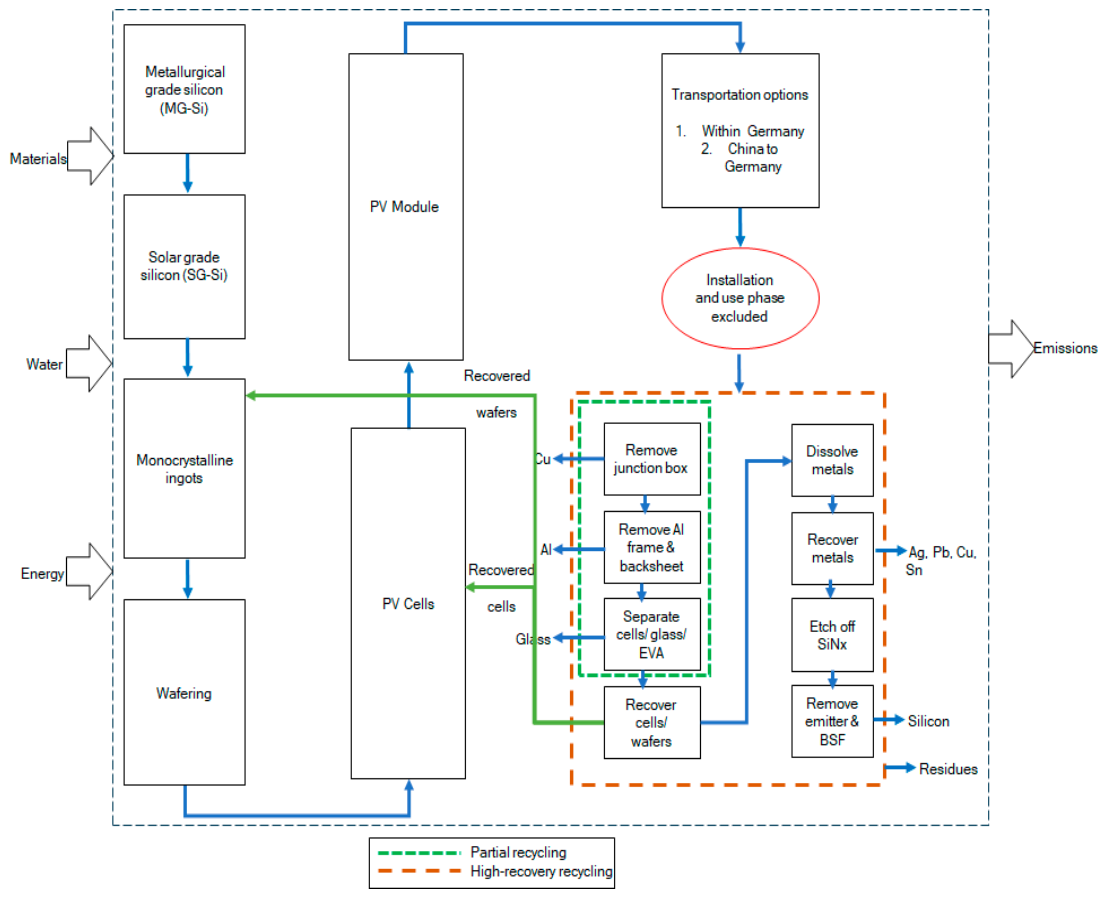
The unit of analysis was defined as 1 kWp (kilowatt peak) of nominal module DC power generated by a PV module excluding BOS components. This is fully compliant with the goal of this study, to assess and compare different PV systems in their environmental performance of electricity production over all their life cycle stages, excluding the installation/use phase. The system boundary for this study includes the production and manufacturing stage, the transportation phase and the end-of-life phase with reference to the mono-Si PERC solar module, as shown in Figure 1. For a more systemic view, elements belonging to complete modules such as encapsulation, connections and frames are included in this analysis with the exception of the balance of system (BOS) components such as inverters, cabling and support/mounting structures. On the other hand, the geographical system boundary is provided for both China and Germany for the two study options. This means that all the products and background systems required for manufacture are selected whenever possible with origin in Germany or the European Union and China. For the calculation of impacts, the electricity and energy matrices used are from the EU/Germany and China mixes as well.

2.2. Life Cycle Inventory

Based on the system boundary in the figure above, three different processes were modeled according to the Chinese and German production scenarios.

2.2.1. Manufacturing/Production Process

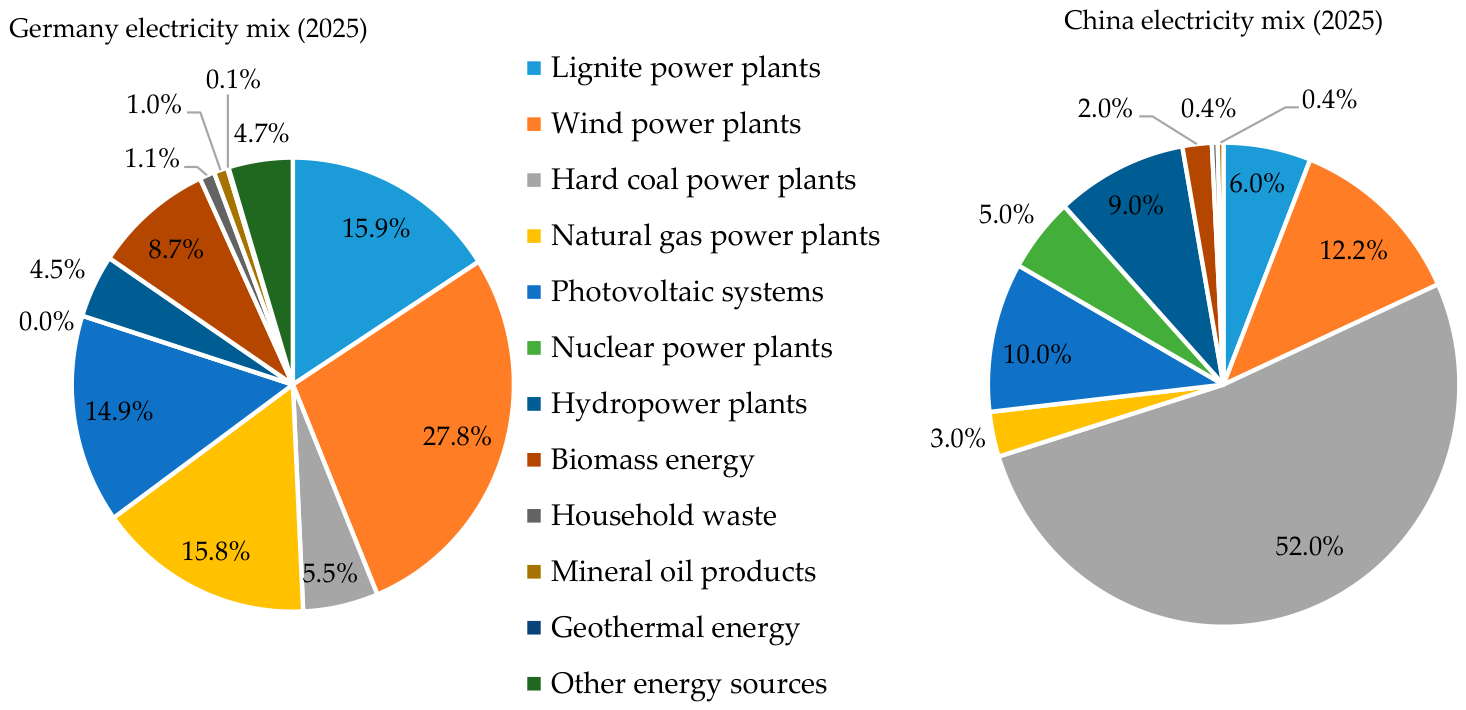
For silica sand extraction and processing into metallurgical grade silicon (MG-Si), updated inventories from the literature were used [25,26]. The legally imported silica sand data from Heidari & Anctil [25] was used for the supply chain of silica sand, transportation and silicon metal production. However, this inventory was modified by replacing the “silicone plant” with an “electric arc furnace”, as suggested by Méndez et al. [26]. The replacement of the conventional silicone process with an electric arc furnace was adopted following the approach reported by Méndez et al., further discussed in [27,28]. These studies indicate the improved silicon recovery efficiencies associated with electric arc furnace can increase silicon recovery yields by approximately 45% at lower electricity consumption, which is harder to recover in standard furnaces; thus, reducing material losses and associated environmental burdens. Most existing silicon production plants use 11–13 MWh of electrical energy to produce one metric ton of silicon, whereas the average power consumption is as high as 13 MWh or more in China [29]. However, in this study, a value of 11 MWh/t was assumed to represent efficient modern silicon production facilities operating near the lower end of the reported industrial range. It is acknowledged that higher electricity consumption in some facilities, for example, in China, could lead to an underestimation of the environmental impacts associated with silicon production and this is noted as a limitation of this study. In addition, updated Chinese and German medium electricity grid mixes in Figure 2, available on eco-invent, were used in this study. The Chinese electricity mix is updated based on the monthly China Energy Update prepared by “Caroline Wang” [30] for the months from January to March 2025, whereas the German electricity mix is updated based on the conventional grid reported by the German Federal Statistical Office in 2024 [31].
The inventory data for solar grade silicon (SG-Si) production was primarily sourced from Méndez et al. and Müller et al. [20,26]. Ultimately, material inputs have been used from Méndez et al. [26] and energy inputs were sourced from Müller et al. [20]. The quantity of metallurgical grade silicon varies depending on the specific process studied. According to Müller et al. [20], the ratio of MG-Si to SG-Si is 1.13 (to produce 1 kg of SG-Si, 1.13 kg of MG-Si is needed), which is comparable to the amount used in this study, 1.26 kg as adopted from Brittany L. Smith et al. [19]. The rest of the inputs were adopted from the eco-invent database.
Two studies were applied for an updated inventory of the Czochralski ingot growth process [20,32]. According to Müller et al. [20], the solar grade silicon input was captured as 0.639 kg, which appears to be swapped with the ingot input quantity (1.03 kg) in the wafering process. Therefore, this inventory relies on the solar grade silicon input (1.03 kg) from Frischknecht [32], as also applied in Brittany L. Smith et al. [19]. For the TOPCon ingots, there was a significant use of energy during the process of inducing and pulling [33]. Due to these processes, the electricity usage and wasted heat were assumed to increase by about 5% for the TOPCon ingot manufacturing relative to PERC cells to account for the additional processing burden due to a modest increase in energy demand [23]. The key differences in life cycle inventories for PERC and TOPCon are shown in Table 1.
The wafering inventory also relies mainly on Müller et al. and Frischknecht [20,32]. It should be noted that there is still no updated inventory for diamond wire saw manufacturing. Most studies cite data prior to diamond wire saw becoming the primary wafering technology. This use of the older wafering inventory may lead to a conservative/potentially overestimated assessment of environmental impacts, as modern diamond wire sawing technology typically reduces both kerf losses and electricity consumption compared to earlier wafering processes [34]. This is noted as a limitation of this study. The final wafer inventory relies on the ingot input quantity from Frischknecht [32], as applied in Brittany L. Smith et al. [19]. The ingot input quantity used in this study for PERC cells (0.595 kg) approximates the 0.639 kg used as the ingot input quantity in Müller et al. [20]. A 130 μm thick n-type silicon wafer was considered for TOPCon as opposed to the 150 μm thick p-type silicon wafer considered for PERC cells [35]; thus, thinner wafers (0.56 kg) were considered for TOPCon compared to PERC wafers. The base inventory from Müller et al. [20] was applied to both PERC and TOPCon cells because it represents a recent and comprehensive inventory dataset for modern c-SI PV manufacturing processes. Due to the limited availability of detailed industrial scale inventory data for TOPCon manufacturing, the additional TOPCon-specific processes were included based on values and process descriptions reported in the literature. These modifications were selected to reflect the additional manufacturing requirements associated with TOPCon and were implemented as literature-informed approximations. The associated uncertainties are acknowledged as limitations of this study.
Table 1. Key differences in life cycle inventories for PERC and TOPCon based on the literature [23,33,35].
Life Cycle StageFlow/InputsPERCTOPConUnitCause of Changes in TOPCon Values and Origin of Values
Monocrystalline ingotselectricity, medium voltage38.440.2kWhSignificant use of energy during the process of inducing and pulling (assumption based on the literature and PERC value)
Waferingingot input quantity0.5950.56kgThe diameter of the wafer is considered to be lower (assumption based on the literature and PERC value)
Cell manufacturingelectricity, medium voltage6.039.53kWhThe annealing process requires significant electricity usage (assumption based on the literature and PERC value)
hydrogen fluoride0.07470.1494kgAdditional glass etching step (assumption based on the literature and PERC value)
metallization paste, back side0.001020.00112kgHigher consumption of Ag (assumption based on the literature and PERC value)
metallization paste, front side0.003480.00382kgHigher consumption of Ag (assumption based on the literature and PERC value)
phosphorus oxychloride1.82 × 104N/AkgBoron trifluoride replaces phosphorus oxychloride (based on the literature)
boron trifluorideN/A0.0218kgBoron trifluoride replaces phosphorus oxychloride (based on the literature)
wafer after the PECVD chamber (poly-Si)N/A39.68pcsAdditional phosphorous-doped a-Si layer is deposited on the rear-side (based on the literature)
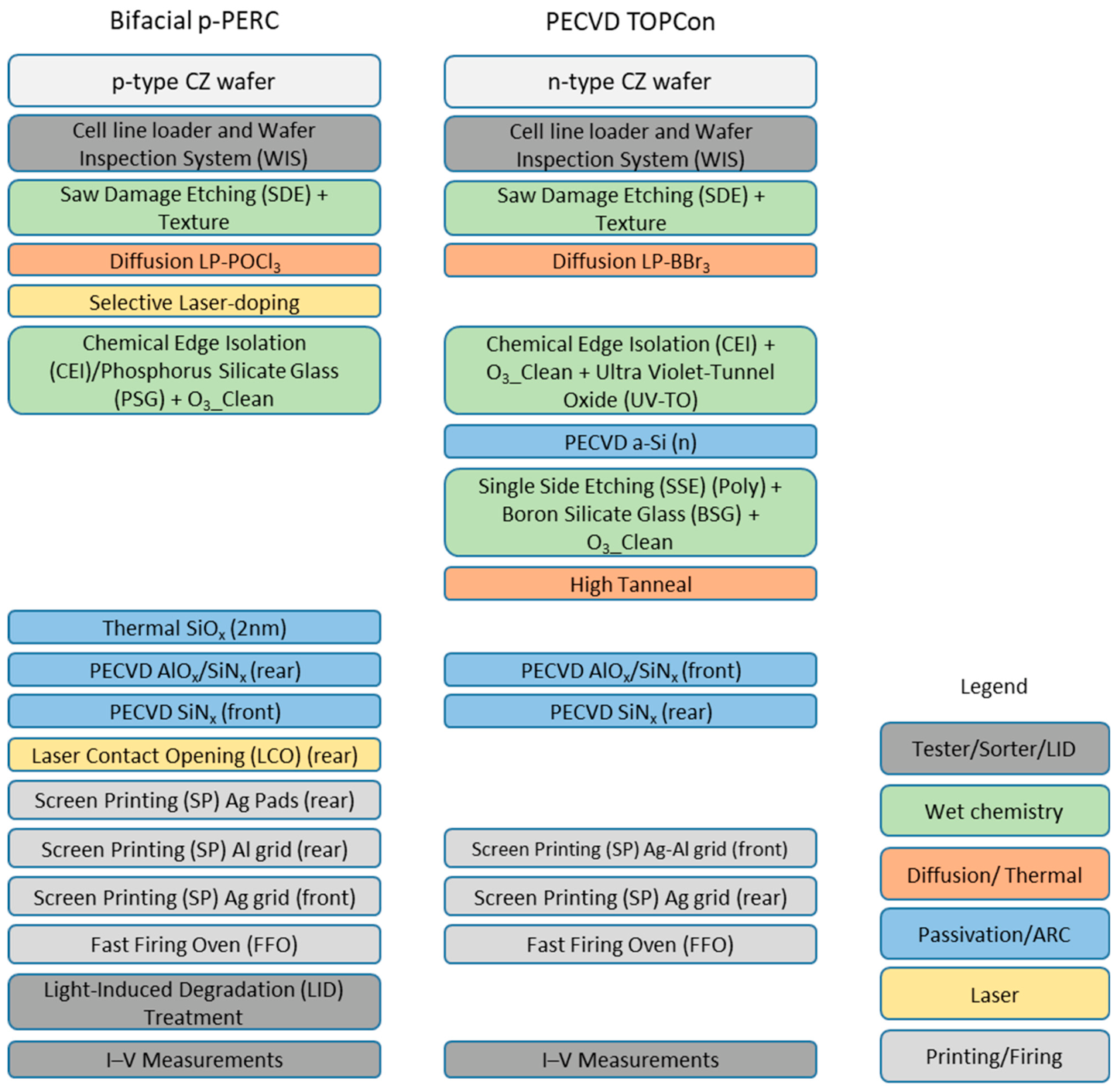
The PERC cell manufacturing inventories follow the manufacturing processes in Figure 3 and rely on cell inventory data from Müller et al. [20]. The main differences between the life cycle inventories of both module designs occur at the cell manufacturing stage. The same inventories used for PERC cells were applied for TOPCon cells, considering a few changes. The annealing process for TOPCon cell manufacturing requires the use of significant electricity and is the reason for increased electricity usage by about 60% [35]. TOPCon cells also require an additional etching (single-side etching) step and an additional phosphorous-doped a-Si layer was deposited on the rear-side using PECVD technology. To account for the additional etching and cleaning requirements associated with TOPCon processing, as noted in Kafle et al. [23], the hydrogen fluoride input in the inventory was conservatively assumed to be doubled relative to the PERC process. This assumption is based on the additional wet chemical processing step required for rear-side passivation in TOPCon cell architectures, as described in Figure 3, where hydrogen fluoride-based etching was applied with additional time compared to PERC. Due to the absence of detailed industrial inventory data, this factor was used as a simplified approximation to represent the increased process demand. The “wafer after the PECVD chamber (poly)” input flow was also included in the TOPCon inventory to account for the additional etching [24]. Since it is required to print Ag-based grids on both sides to form contacts with low contact resistivity, there is a higher consumption of Ag on both the back and front sides. Boron trifluoride was used as the boron emitter, replacing phosphorus oxychloride for PERC cells [23].
The inventory for module assembly relies mainly on Müller et al. [20], which agrees with other literature such as Heidari & Anctil [25], though with slightly higher copper and lead use. Both the reference and new design options consider the glass–glass module production whose inventory heavily relies on [19,20].

2.2.2. Transportation Process

Transportation is modelled for already manufactured modules since the whole PV manufacturing process is assumed to take place in one single production location in China or Germany. The transportation distances used in this study were adopted from the literature and they represent the typical international PV supply chain and shipping routes between manufacturing and installation regions. For the German manufacturing process, the manufactured modules, including packaging, were transported by train for 300 km, and then by lorry for 200 km to an average installation location in Germany. For the Chinese manufacturing process, they were transported by lorry for 200 km and train for 500 km within China, were then shipped on a transoceanic ship for 22,220 km, and were then transported by train for 500 km and lorry for 200 km to an average installation location in Germany. Transport is based on the weight of the packaged modules and the distance travelled (tkm), consistent with the common transportation modelling in eco-invent. The transportation distances were sourced from Müller et al. [20], and the weight of the module was assumed to be 25 kg (0.025 t), including the packaging material.

2.2.3. End-of-Life Recycling Process

Considering the end-of-life approach, the takeback and recycling of the PV modules is usually considered separately from the potential benefits gained by recovered materials; however, in this study, they were analyzed as a whole. The potential benefits were calculated by awarding credits for the avoided environmental impacts caused by the primary production of replaced products and adding the impacts of secondary material production [36]. This modelling approach can be used to illustrate the net environmental impacts of PV module recycling. The potential benefits were fully allocated to the recyclable material, quantifying the overall net environmental impacts of the recycling process. This approach was selected because it captures the potential environmental benefits of high material recovery and circularity strategies, especially through the recovery of glass, aluminum and silicon.
According to previous studies from Stolz et al. [36], the largest fraction of recovered material is glass cullet, mainly used in recycled foam glass production. Considering partial recycling, the avoided burdens were calculated basing on the production of flat glass due to missing inventories on glass cullet. Using recycled glass cullets in glass production avoids the consumption of primary materials such as limestone, low-iron silica sand and soda powder; thus, the CO2-emissions caused by these raw materials in flat glass production are prevented. Because the melting of the glass cullets takes less energy than the melting of limestone and silica sand, heavy fuel oil and natural gas can additionally be saved. The aluminum scrap was recovered from the frame of the PV module and the copper scrap from the junction box and the wires. Efforts to produce secondary metals from scrap were taken into account for aluminum and copper, but they were also potentially avoiding primary aluminum and primary copper production, respectively [36]. The inventory for partial recycling methods was sourced from Brittany L. Smith et al. [19]. It considers transportation, electricity usage, the burning of plastics, and the recovery of glass, copper, and aluminum.
For the “newer” module designs, the hypothetical high-recovery recycling option that targets more component materials for higher-purity recovery, including silicon and silver from Brittany L. Smith et al. [19], was adopted. The inventory for the Full Recovery End of Life PV (FRELP) process was considered. This recycling approach assumes recovery rates of 99.5% for glass, 90% for pure aluminum, 100% for silicon and 100% for silver [37]. Recovered secondary materials were modelled as substitutes for equivalent virgin materials of comparable quality using the avoided burden approach. This option represents a proposed high-purity recovery process that ought to be developed. The full life cycle inventory tables have been provided in Supplementary Materials in Tables S1–S10.

2.3. Life Cycle Impact Assessment

The LCI data was mainly obtained from the eco-invent database (v2.2) because it covers a wide array of products, services and processes. It is considered as the largest, most consistent and most transparent database on the market. It is acknowledged that use of an earlier eco-invent version may not fully reflect the most recent industrial developments, but it has been enhanced by use of more recent literature data, e.g., grid electricity mix data for 2025. OpenLCA software (v2.3) was used to handle this database. It is an open-source software mainly used for Life Cycle Assessment (LCA) and sustainability assessment [38]. To expand, it can also perform carbon and water footprints, environmental product declarations, and integrates product policy, among other functions. This software was chosen mainly because of its LCA function, and because it is free to use, easy to work on, compatible with the selected databases and widely used by researchers.
The LCIA phase is aimed at evaluating the significance of potential environmental impacts using the LCI results. It involves associating inventory data with specific environmental impact categories and category indicators, according to ISO 14040. The Life Cycle Impact Assessment of this work was applied to the two product systems (PERC and TOPCon cell technologies). Each of these product systems considers a Chinese and German manufacturing process.

2.4. Interpretation of Results

The results obtained for the four scenarios explained in Section 3 show that the comparison between the modules is not straightforward and the results for the impact categories can lead to different conclusions depending on the scenarios compared. The hotspots of PV electricity generation with the analyzed PV systems were identified regarding the most relevant impact categories, lifecycle stages and processes.

3. Results and Discussion

3.1. Evaluated Scenarios

The evaluation was done using the four scenarios shown in Table 2. The impact assessment method used was ReCiPe Midpoint (H) [39]. This involves the environmental impacts associated with climate change; terrestrial acidification; freshwater and marine eutrophication; photochemical oxidant formation; human toxicity; agricultural and urban land occupation; fossil and metal depletion; freshwater, marine and terrestrial ecotoxicity; ionizing radiation; natural land transformation; ozone depletion; particulate matter formation; and water depletion.
Table 3 compares the environmental impact results for all four scenarios across the eighteen impact categories. The impacts were calculated using the functional unit ‘per kWp’. For most of the impact categories, Scenario 2, which considers PERC cell production in China with partial recycling as the end-of-life strategy, produced the highest impacts, whereas Scenario 3, which considers TOPCon cell production in Germany with high-recovery recycling as the end-of-life strategy, produced the lowest impacts. The exception to this includes agricultural land occupation, freshwater eutrophication, human toxicity and ozone depletion, where Scenario 1 produced the highest impacts, whereas Scenario 4 produced the lowest impacts. For the other impact categories (ionizing radiation and metal depletion), Scenario 4 produced the highest impact, whereas Scenario 1 produced the lowest impact.

3.2. Discussion of the Results

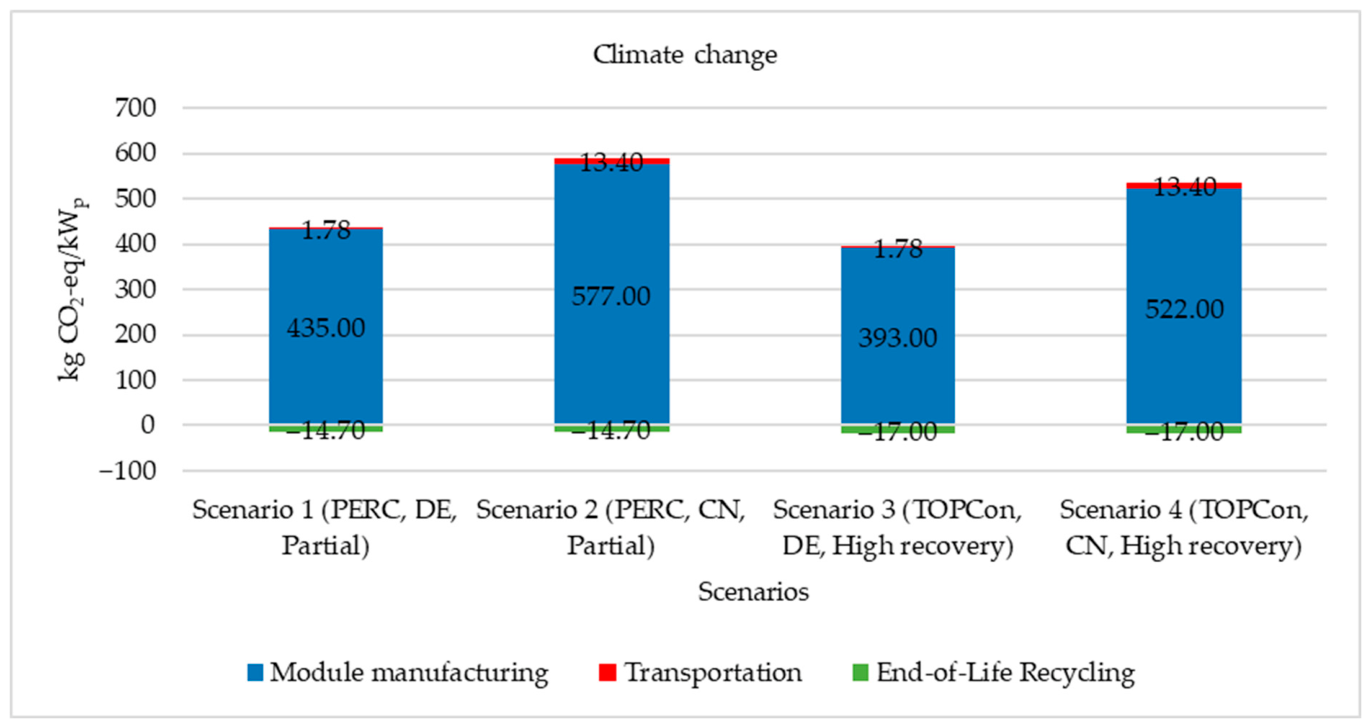
The PERC and TOPCon cell modules produced in Germany were linked to GHG emissions of 422 and 378 kg CO2-eq/kWp, respectively, as shown in Figure 4. This is below the literature review results [40] recorded between 2015 and 2025 for PERC cell technologies (425–1759 kg CO2-eq/kWp), indicating lower emissions due to improved processes, whereas those produced in China are linked to GHG emissions of 575 and 519 kg CO2-eq/kWp, respectively, within the limits of the literature review results. The higher impacts from Chinese production are linked to the coal-dominated electricity mix, combined with the high-energy requirements for solar grade and ingot silicon production.
In a related assessment, the emissions from TOPCon were lower than those for PERC cell modules due to reduced manufacturing emissions and higher recycling credits arising from the recovery of silicon, silver, electricity and heat in the high-recovery recycling scenario. There was also a notable share of impact reduction for PERC modules due to recycling credits from the recovery of aluminum, glass (the recovery of silica sand, limestone and soda) and heat in the partial recycling scenario. There was a very negligible contribution from transportation to the total emissions in the German scenario (<0.5%), whereas this had a more noticeable impact in the Chinese case (<3%) due to the transoceanic shipping of modules, even though this is relatively small compared to manufacturing. Considering all four evaluated scenarios, the manufacturing/production phase accounts for the greatest share of the environmental impacts between 92–95%. The generation of electricity, especially from hard coal and lignite power plants in China and Germany, respectively, was the primary source of GHG emissions within the climate change category during production.
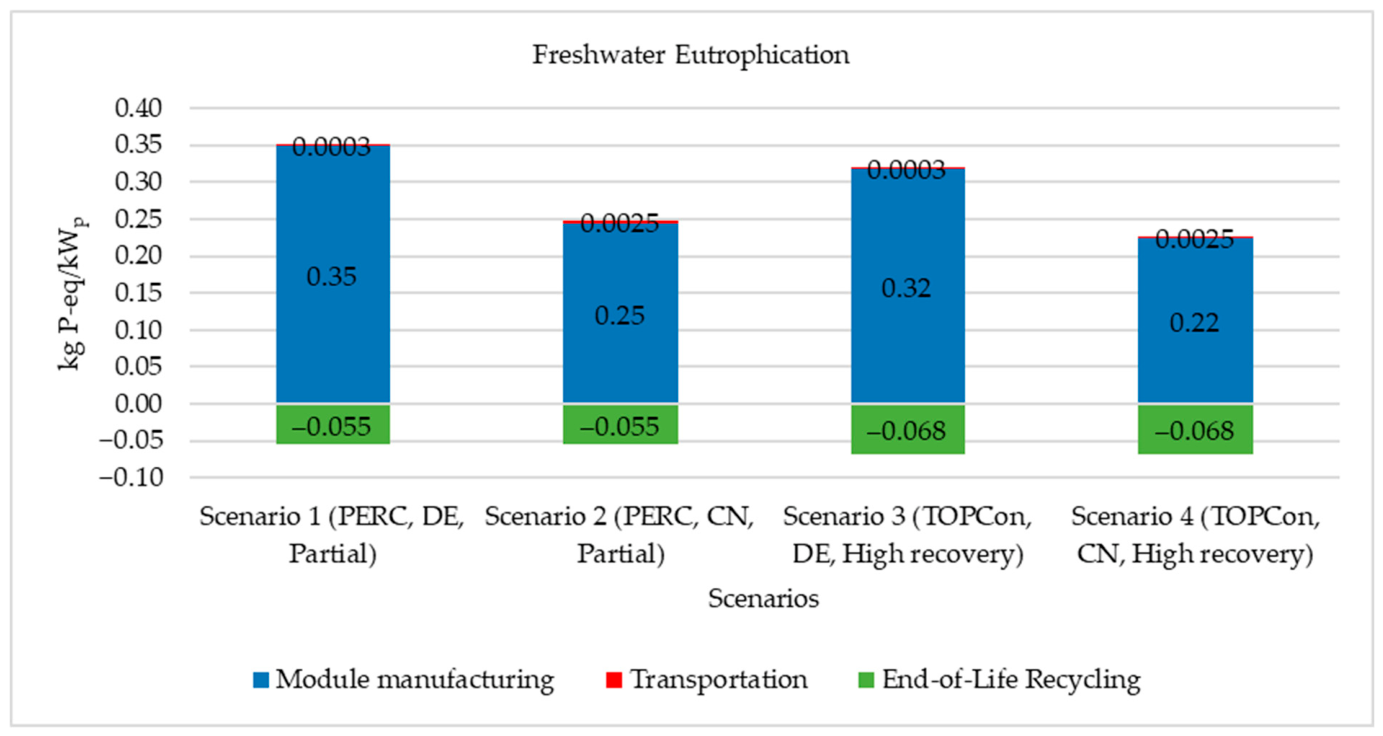
In terms of freshwater eutrophication, the manufacturing of PERC and TOPCon cell modules in Germany was linked to emissions of 0.294 and 0.251 kg P-eq/kWp, respectively, as shown in Figure 5. This is within the range reported in the literature [40] between 2015 and 2025 for PERC cell technologies (0.22–0.90 kg P-eq/kWp). Similarly, those produced in China are linked to emissions of 0.192 and 0.159 kg P-eq/kWp, respectively, which is below the reported literature range, signaling lower emissions due to improved processes in China in terms of eutrophication. The higher impacts from German production are linked to the high share of lignite coal in the German electricity mix. In the ReCiPe Midpoint (H), freshwater eutrophication is mainly influenced by emissions such as phosphates and nitrogen compounds. The observed difference in this study arises from the specific background inventory data used for electricity generation in eco-invent, where certain upstream emissions associated with European lignite and hard coal chains such as mining contribute more strongly to eutrophication than the Chinese electricity mix.
In a related assessment, the emissions for TOPCon were lower than those for PERC cell modules due to a reduction in manufacturing emissions and an increase in recycling credits arising from silver and copper recovery in the high-recovery recycling scenario. The recycling credits from the recovery of copper, aluminum and glass similarly reduce the impacts from PERC cell modules in the partial recycling scenario. There is a very negligible contribution from transportation to the total emissions for both China (<0.5%) and Germany (<0.5%) across all four scenarios. Similar to climate change, the manufacturing/production phase accounts for the greatest share of the impacts, between 77–86% across the four scenarios, and the generation of electricity, especially from hard coal and lignite power plants in China and Germany, respectively, and was the primary source of eutrophication emissions within the freshwater eutrophication category.
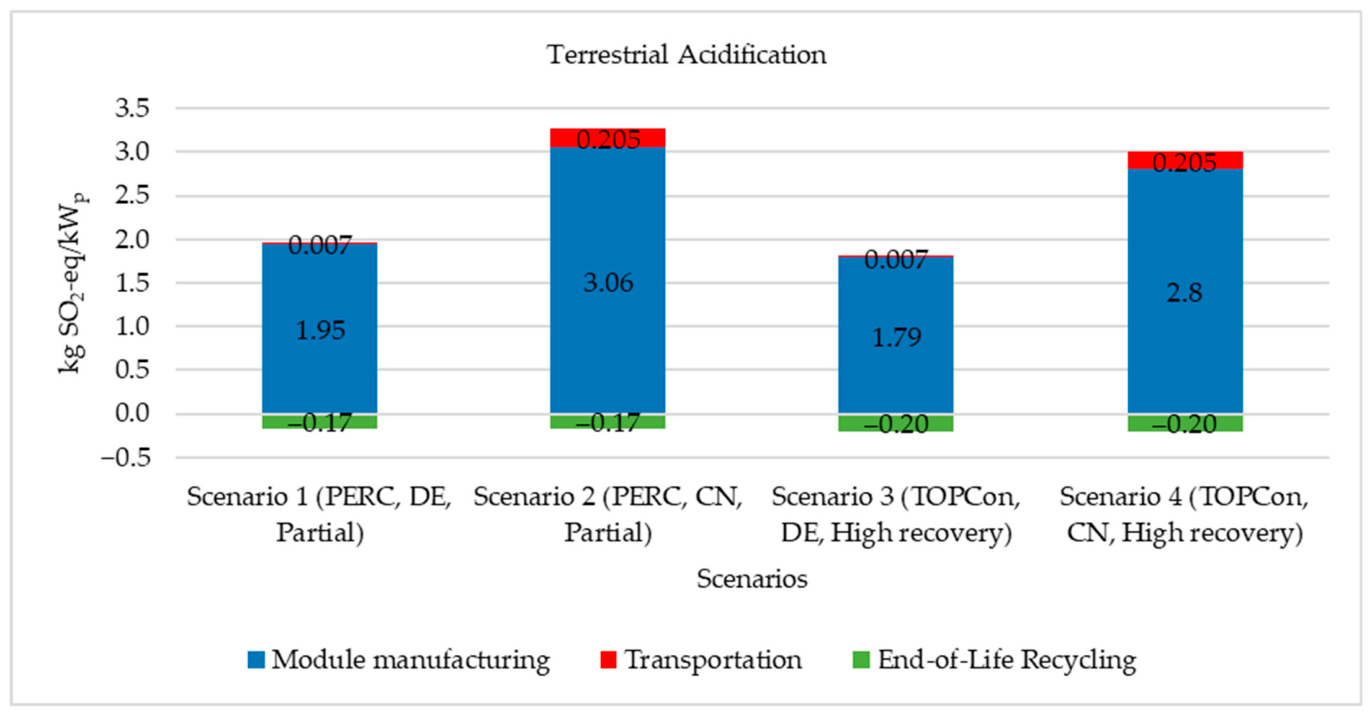
Acidification emissions of 1.79 and 1.6 kg SO2-eq/kWp were obtained from the manufacturing process of PERC and TOPCon cell modules in Germany, as seen in Figure 6, which is below the literature review results [40] recorded between 2015 and 2025 for PERC cell technologies (2.51–10.23 kg SO2-eq/kWp). This suggests lower emissions due to improved processes, whereas those produced in China were linked to acidification emissions of 3.1 and 2.81 kg SO2-eq/kWp, which are within the limits of the literature review results. The higher impacts from Chinese production were associated with the coal-dominated electricity mix. In a similar assessment, the emissions from TOPCon were lower than those for PERC cell modules due to reduced manufacturing emissions and higher recycling credits arising from the recovery of silicon, silver and copper in the high-recovery recycling scenario. There was also a notable share of impact reduction for PERC modules due to recycling credits from the recovery of aluminum, copper and glass in the partial recycling scenario.
Similar to climate change, there was very a negligible contribution from transportation to the total emissions in the German scenario (<0.5%), whereas this had a more noticeable impact in the Chinese case (<7%) due to the transoceanic shipping of modules, even though this is relatively small compared to manufacturing. The manufacturing/production phase accounted for the greatest share of the impacts between 86–90% across the four scenarios. However, the primary source of emissions within the acidification potential category for the Chinese production process was the generation of electricity from hard coal power plants, whereas production in Germany was dominated by the flat glass production for solar glass. The dominance of flat glass production in the acidification potential for Germany was mainly driven by NOx and SO2 emissions from high temperature glass manufacturing during fuel combustion in industrial furnaces and upstream emissions from raw material extraction. These emissions can outweigh the contributions from electricity supply for a relatively low carbon German electricity mix. In contrast, coal dominated the acidification potential for China due to higher NOx and SO2 emissions associated with coal combustion in the electricity supply [41].
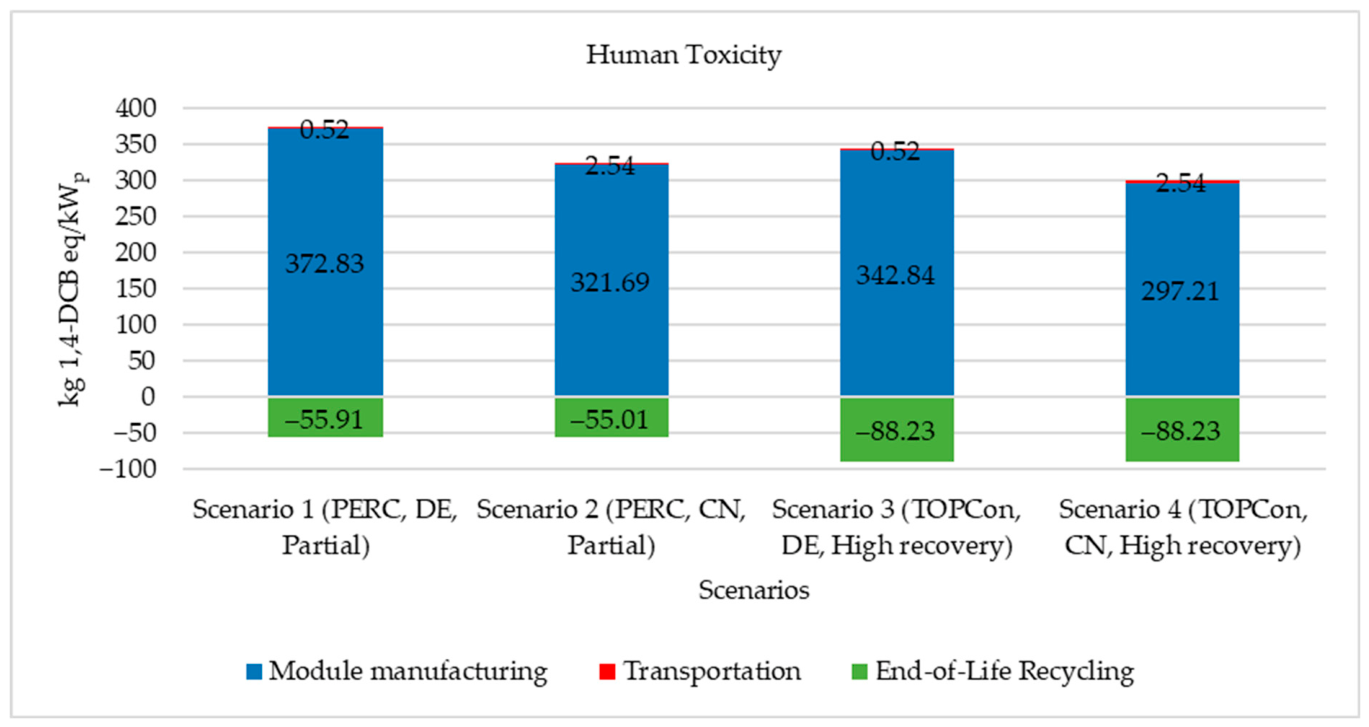
Considering human toxicity in Figure 7, the PERC and TOPCon cell modules produced in Germany are linked to emissions of 317 and 255 kg 1,4-DCB-eq/kWp, respectively, whereas those produced in China are linked to emissions of 268 and 212 kg 1,4-DCB-eq/kWp, respectively. This is much higher than the literature review results [40] reported in 2024 for PERC cell technologies (71 kg 1,4-DCB-eq/kWp), showing increased toxicity in the production processes. Human toxicity impacts are mainly driven by emissions of hazardous substances associated with material extraction and processing, mostly arising from upstream electricity generation and chemical use during silicon refinement [42]. This could be the cause of higher emissions compared to earlier studies. The much higher values could also be discussed in relation to methodological and inventory related factors, including differences in life cycle inventory datasets, the inclusion of additional upstream and process-related emissions and the influence of background data variability. Further support for the role of inventory uncertainty is provided through the Monte Carlo analysis presented in Section 3.3. The impacts for both modules are higher for Germany than China due to the high share of lignite coal in the German electricity mix. Lignite coal combustion leads to higher human toxicity emissions due to the emission of trace heavy metals and toxic substances associated with coal impurities such as arsenic, cadmium, lead, mercury, chromium and nickel [43]. These emissions contribute significantly to human toxicity due to their high toxicity characterization factors, as per the impact assessment method, ReCiPe Midpoint (H) [44].
In a related assessment, the emissions from TOPCon were lower than those for PERC cell modules due to reduced manufacturing emissions and higher recycling credits arising from the recovery of silicon and silver in the high-recovery recycling scenario. There is also a notable share of impact reduction for PERC modules due to recycling credits from the recovery of aluminum and copper in the partial recycling scenario. Similar to the indicators above, there is a very negligible contribution from transportation to the total emissions for both China (<0.5%) and Germany (<0.5%) and the manufacturing/production phase accounts for the greatest share of the impacts (between 78–87% across the four scenarios). However, the generation of electricity, especially from lignite power plants in both China and Germany, was the primary source of emissions within the human toxicity category during production.
For the rest of the impact categories (marine eutrophication, fossil and metal depletion, freshwater, marine and terrestrial ecotoxicity, photochemical oxidant formation, ozone depletion, particulate matter formation, ionizing radiation, agricultural and urban land occupation, natural land transformation and water depletion), both PERC and TOPCon cell modules produced in Germany and China were either within or below the reference literature values. The impacts were higher for Chinese production than German production for most of the impact categories, with the exception of agricultural land occupation (due to a high share of wood chips used in heat and power co-generation plants) and ozone depletion (due to a high share of natural gas in the German electricity mix). The higher impacts for Chinese production are mainly linked to the coal-dominated electricity mix, combined with the high-energy requirements for solar grade and ingot silicon production. In a similar assessment for these impact categories, the emissions from TOPCon and high-recovery recycling were almost always lower than those for PERC cell modules with partial recycling due to reduced manufacturing emissions and higher recycling credits arising from the additional recovery of silicon and silver, except for metal depletion and ionizing radiation (these experience a very sharp reduction in recycling credits arising from low recovery rates for aluminum even with the high recovery of silicon and silver). The reported results reflect the combined influence of these interacting parameters such as module technology, production location, background assumptions and end-of-life strategy rather than independent single factor effects.
As noted for the indicators above, there is a very negligible contribution from transportation to the total emissions for the case of Germany, whereas there is a relatively higher impact for the case of China due to the transoceanic shipping of modules and the use of the freight train for transporting the modules inland across all these impact categories. In the same way, the manufacturing/production phase accounts for the greatest share of the impacts and the generation of electricity, especially from hard coal and lignite power plants in China and Germany, respectively, was the primary source of emissions across most impact categories, except for metal depletion (bauxite mine operation), freshwater and marine ecotoxicity (treatment of scrap copper and waste electric wiring), terrestrial ecotoxicity (citric acid production), ozone depletion (heavy fuel oil production), ionizing radiation (uranium used in electricity production), agricultural land occupation (softwood and hardwood for production of wood chips and EUR-flat pallets), natural land transformation (heavy fuel oil production) and water depletion (production of decarbonized water). This study acknowledges the limitations associated with use of literature derived and extrapolated from TOPCon inventory data, an older eco-invent background database version, the hypothetical high-recovery recycling assumptions, the exclusion of BOS components and the installation/use stage and the integrated scenario design, where module technology, production location, background assumptions and end-of-life strategy are evaluated together. These assumptions influence the robustness and transfer of the comparative conclusions of this work; thus, the reported results should be interpreted within the specific modelling framework adopted in this study.

3.3. Estimated Contribution from BOS Components

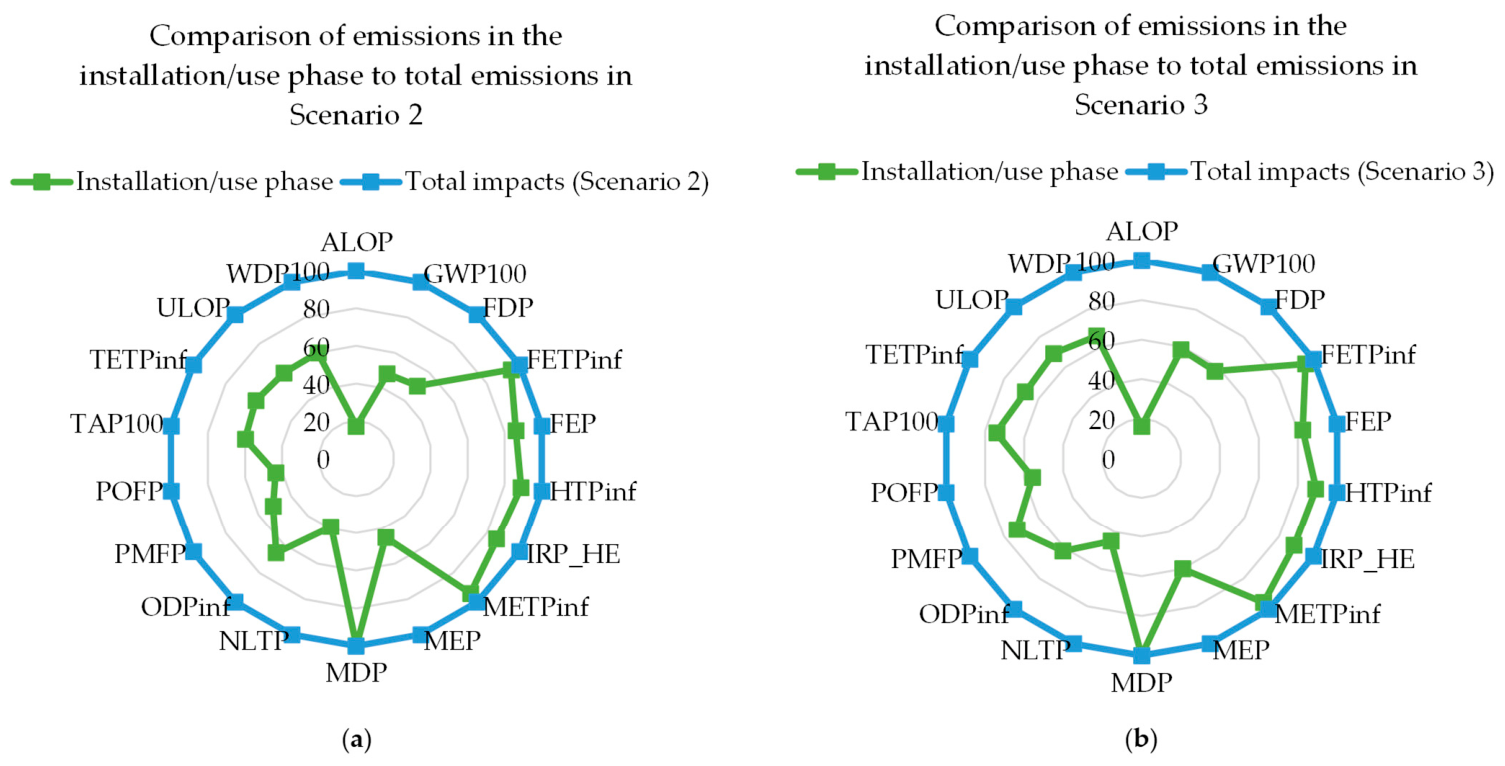
A further analysis was conducted to estimate the possible contribution of balance-of-system (BOS) components, including inverters, cabling and support structures, to total emissions if included in the assessment across all impact categories. This assessment was based on eco-invent processes, representing the production of 1 kWh of low voltage electricity from a photovoltaic system. The modelled electricity production corresponded to a 5 kWp slanted roof mono c-Si PV installation mounted on a building. The system configuration included two inverters each rated 5 kWp (accounting for one replacement inverter over a 10–15-year lifetime), a 25.3 m2 photovoltaic mounting system and 26.1 m2 of PV modules. Figure 8 compares the contribution of BOS components during the installation/use phase relative to the total life cycle impacts for Scenarios 2 (PERC cell production in China and partial recycling) and 3 (TOPCon cell production in Germany and high-recovery recycling). In Figure 8a,b, the total emissions for each scenario are normalized to 100% and the contribution of the installation/use phase is expressed relative to these totals.
The results indicate that BOS components contribute more than 90% of the total impacts in four categories: freshwater and marine ecotoxicity, human toxicity and metal depletion. The high impacts for freshwater and marine ecotoxicity are primarily associated with the treatment and disposal of waste electric wiring. Similarly, the high impacts for human toxicity and metal depletion are largely driven by the use of integrated circuits in inverters. For the climate change category, the inclusion of BOS components also substantially increased the total emissions. Specifically, the installation/use phase alone contributed approximately 16.7 g CO2-eq/kWh compared to the total emissions, ranging from 28.6 to 34.8 g CO2-eq/kWh across the four scenarios. This is comparable to a recent study by Singh et.al [45] that estimates GHG emissions of 43.3 g CO2-eq/kWh for a PERC module. The high impacts in most of the impact categories, including climate change, are mostly due to the integrated circuit used in inverters and the smelting of copper concentrate.

3.4. Monte Carlo Simulation

The Monte Carlo simulation was carried out to quantify uncertainty in the LCA results by producing a distribution of possible outcomes based on uncertainties in the input data, especially from eco-invent instead of giving a single impact value.

3.4.1. Manufacturing Emissions

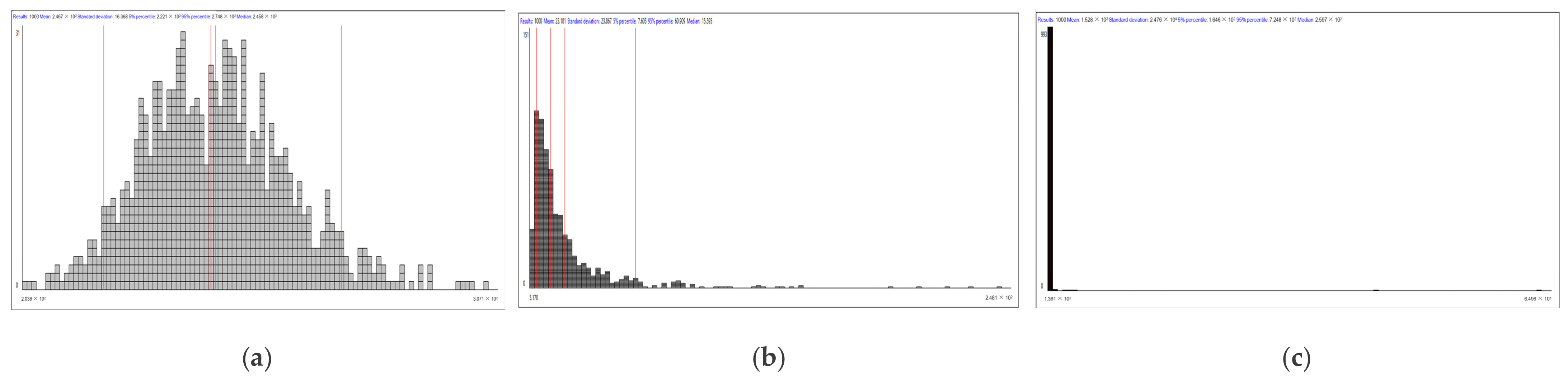
Monte Carlo analysis was performed in openLCA (v2.3) with 1000 iterations [46] to evaluate the robustness of manufacturing GHG emissions for the single 1 m2 PERC PV module produced in China. The simulation yielded a mean impact of 246.7 kg CO2-eq/m2, with a standard deviation of 16.4 kg CO2-eq/m2, indicating moderate variability in the results (Figure 9a). The distribution is approximately normal, as evidenced by the close agreement between the mean (246.7 kg CO2-eq/m2) and the median (245.8 kg CO2-eq/m2), indicating no significant influence of outliers. The 5th and 95th percentiles (222.1–274.8 kg CO2-eq/m2) define a relatively narrow uncertainty range within which 90% of the simulation results fall, indicating that the manufacturing of GHG emissions is consistently positive and well-controlled. These results are reflected in most of the impact categories, with the exception of ionizing radiation, particulate matter formation, freshwater and marine ecotoxicity and human toxicity.
For ionizing radiation and particulate matter formation, the central tendency indicates relatively low to moderate emissions; however, the high variability and skewness require careful interpretation, so the median or percentile range may provide a more representative basis for comparison than the mean. For ionizing radiation, particularly in Figure 9b, the simulation yielded a mean impact of 23.2 kg U235-eq/m2 and a median of 15.6 kg U235-eq/m2, indicating a right skewed distribution influenced by high value outliers. The standard deviation (23.9 kg U235-eq/m2) is comparable to the mean, indicating substantial variability in results. The 5th and 95th percentile range (7.6–60.9 kg U235-eq/m2) highlights a wide spread of likely outcomes, with the majority of the simulations bunched at lower values and a small number of extreme cases extending the upper range. This suggests that the results are sensitive to certain input parameters, likely associated with high uncertainty from background data in eco-invent.
For human toxicity and freshwater and marine ecotoxicity, the model is highly sensitive to specific parameter combinations and can be better explained by the median and percentile range for a more reliable interpretation than the mean. For the case of human toxicity in Figure 9c, although the median result (259.7 kg 1,4-DCB-eq/m2) and the 5th and 95th percentile range (164.6–724.8 kg 1,4-DCB-eq/m2) indicate the typical range of outcomes, the mean (1528 kg 1,4-DCB-eq/m2) is strongly influenced by extreme outliers. The extremely large standard deviation (24,760 kg 1,4-DCB-eq/m2) reflects numerical vagueness in the uncertainty distribution, likely driven by highly sensitive input parameters or large uncertainties in background data from eco-invent. This likely explains why the toxicity impact results in Section 3.2 are much higher than the results from previous studies.
This trend is similar for the manufacturing emissions of PERC modules produced in Germany. Similar results were also obtained for the manufacturing emissions of TOPCon modules produced in both China and Germany, albeit with a more robust distribution for particulate matter formation. For ionizing radiation, human toxicity and freshwater and marine ecotoxicity, nearly similar simulation results were produced. There is a need for further refinement of the input uncertainties, especially for human toxicity and freshwater and marine ecotoxicity, to improve model robustness.

3.4.2. Transportation Emissions

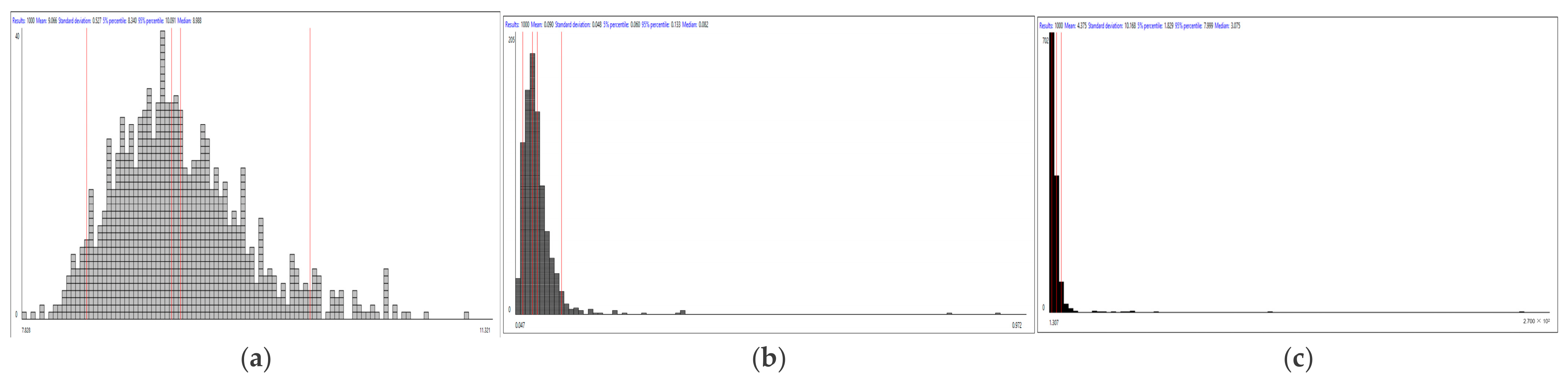
Another Monte Carlo analysis was performed in openLCA with 1000 iterations to evaluate the robustness of transportation GHG emissions for the single PV module produced in China and transported to Germany for installation. The simulation yielded a mean impact of 9.066 kg CO2-eq/panel, with a standard deviation of 0.527 kg CO2-eq/panel, indicating a low level of variability in Figure 10a. The distribution is approximately normal, as evidenced by the close agreement between the mean (9.066 kg CO2-eq/panel) and the median (8.988 kg CO2-eq/panel), indicating no significant influence of outliers. The 5th and 95th percentiles (8.340–10.091 kg CO2-eq/panel) demonstrate a narrow uncertainty interval within which the majority of simulation outcomes fall, indicating consistency of transportation GHG emissions. These results are similar in most of the impact categories, with the exception of freshwater and marine ecotoxicity, ionizing radiation and human toxicity.
The simulation for freshwater and marine ecotoxicity and ionizing radiation indicates relatively low to moderate emissions with high variability and skewness. For freshwater ecotoxicity, particularly in Figure 10b, the simulation yielded a mean impact of 0.090 kg 1,4-DCB-eq/panel and a median of 0.082 kg 1,4-DCB-eq/panel, indicating a slight right skewed distribution where higher values moderately influence the mean, as confirmed by the standard deviation of 0.048 kg 1,4-DCB-eq/panel, which is approximately 50% of the mean. The 5th and 95th percentile range (0.060–0.133 kg 1,4-DCB-eq/panel) reflects a moderate level of variability, with most simulation outcomes falling within this interval. The results indicate that the estimated ecotoxicity impact is reasonably robust though subject to moderate uncertainty.
For human toxicity in Figure 10c, the model is highly sensitive to specific parameter combinations and can be better explained by the median and percentile range for a more reliable interpretation than using the mean. The result yielded a median result of 3.075 kg 1,4-DCB-eq/panel) and a mean result of 4.375 kg 1,4-DCB-eq/panel, indicating a right skewed distribution influenced by higher value outcomes. The 5th and 95th percentile range (1.829–7.99 kg 1,4-DCB-eq/panel) reflects a substantial spread of results, whereas the high standard deviation (10.168 kg 1,4-DCB-eq/panel) reflects significant variability and sensitivity to input uncertainties in the background data from eco-invent.
This trend is similar for the transportation emissions of PV modules produced in Germany and transported to the installation location within Germany, with a more robust distribution for freshwater and marine ecotoxicity and ionizing radiation. For human toxicity, similar simulation results were produced with better refinement; however, there is a need for further refinement of the input uncertainties to improve model robustness.

3.4.3. End-of-Life Recycling Emissions

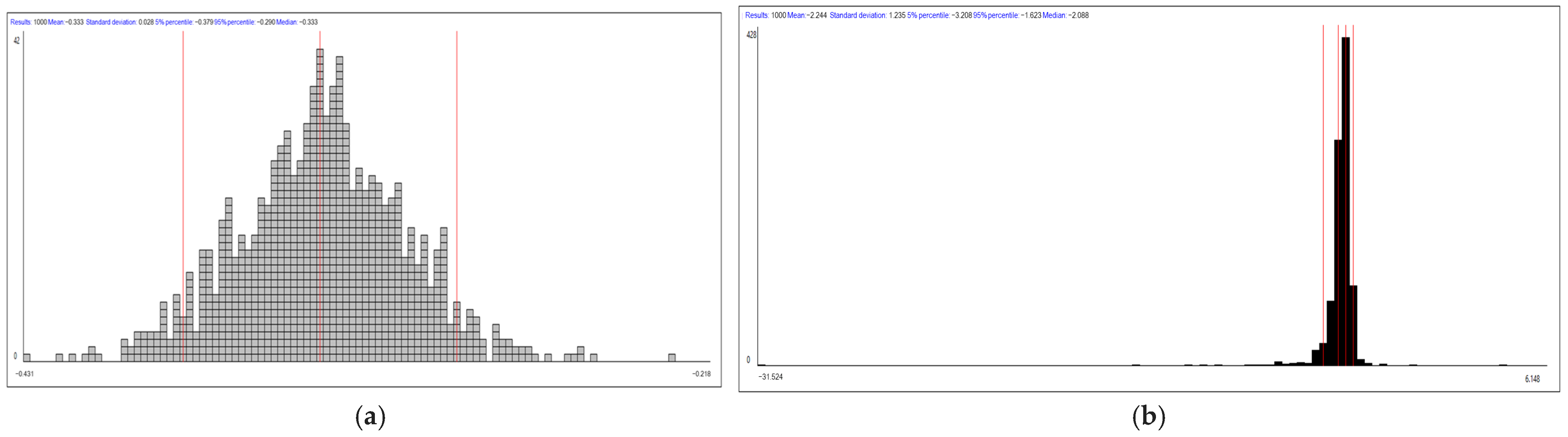
A Monte Carlo analysis was performed in openLCA (v2.3) with 1000 iterations to evaluate the robustness of EoL recycling GHG emissions for 1 kg of PV module waste under the high-recovery recycling scenario. The simulation yielded a mean impact of −0.333 kg CO2-eq/kg, with a standard deviation of 0.028 kg CO2-eq/kg, indicating a low level of variability in the results (Figure 11a). The distribution is approximately normal, as evidenced by the agreement between the mean (−0.333 kg CO2-eq/kg) and the median (−0.333 kg CO2-eq/kg), indicating no significant influence of outliers. The 5th and 95th percentiles (−0.379 to −0.290 kg CO2-eq/kg) define a relatively narrow uncertainty range, indicating that recycling GHG emissions are consistently negative and well-controlled, confirming the robustness of the observed environmental benefit. These results were reflected in most of the impact categories, with the exception of ionizing radiation and human toxicity.
For ionizing radiation and human toxicity, the central tendency indicates relatively low to moderate emissions; however, the high variability and skewness require careful interpretation, so the median or percentile range may provide a more representative basis for comparison than the mean. For human toxicity (Figure 11b), the simulation yielded a mean impact of −2.244 kg 1,4-DCB-eq/kg and a median of −2.088 kg 1,4-DCB-eq/kg, indicating a slightly left skewed distribution where lower (more negative) values influence the mean. The standard deviation (1.235 kg 1,4-DCB-eq/kg) reflects a moderate to high level of variability, suggesting sensitivity to input uncertainties. The 5th and 95th percentile range (−3.208 to −1.623 kg 1,4-DCB-eq/kg) shows that the majority of simulation outcomes fall within this interval, with all values remaining negative. This suggests that despite the observed variability, the system consistently exhibits a net benefit in terms of human toxicity impact.
This trend is similar for recycling emissions of PV module waste considered under the partial recycling scenario, with a more robust distribution for ionizing radiation similar to climate change. For human toxicity, both recycling scenarios produce nearly similar simulation results. There is a need for further refinement of the input uncertainties for human toxicity to improve model robustness.

3.5. Sensitivity Analysis

Several design changes can be implemented to alleviate some of the challenges in solar module recycling and achieve high levels of circularity. One of the first steps in solar module production is to electrically interconnect silicon solar cells by soldering copper wires between them. The solder is made of roughly 60% tin and 40% lead. Switching to a lead-free solder presents a more economic and environmentally friendly alternative. A popular lead-free solder is an alloy of approximately 96% tin, 3% silver, and 1% copper and all these metals in this solder can be recovered through recycling [47].
The other design change could be the use of frameless glass–glass modules, which are estimated to additionally cause 7.5 to 12.5 percent less CO2 during production compared to framed glass–backsheet modules, mainly because they do not require an aluminum frame, which is very energy-intensive to produce [48]. However, frameless modules can lead to higher glass breakage rates during installation and the use phase of PV-modules [49], indicating this design change as a work in progress.
Considering fluidized beds for the production of solar grade silicon, the decomposition reaction to polysilicon deposition occurs at temperatures significantly lower than in a Siemens reactor. The Fluidized Bed Reactor (FBR) holds the potential to become the dominating Chemical Vapor Deposition (CVD) reactor for the production of solar grade silicon, since the energy consumption per kg of silicon produced is estimated to be in the range of 4–16 kWh/kg [50]. Both reactors considered in this study were not modelled based on a specific manufacturer. It represents a literature-based production technology scenario used to evaluate potential environmental benefits of reduced energy consumption during SG-Si production. An energy consumption value of 15 kWh/kg was selected, representing the upper range of the reported literature values, reflecting potential non-ideal industrial operating conditions and to avoid underestimating the environmental impacts. During the FBR process, silicon is produced by the thermal decomposition of silane. Monosilane (SiH4) is used instead of trichlorosilane (SiHCl3); thus, there is no use of chlorine in the FBR process [51].
The future electricity mix scenarios for both China and Germany were compared to the reference updated eco-invent process used in the initial setup. The German future electricity mix (2045) is based on the technology-specific electricity supply energy charts published by Fraunhofer Institute in 2023 [52]. The China future electricity mix (2045) is based on electricity generation data tables on the International Energy Outlook 2023 from the U.S. Energy Information Administration [53]. Table 4 represents the future electricity mixes for both China and Germany in 2045.
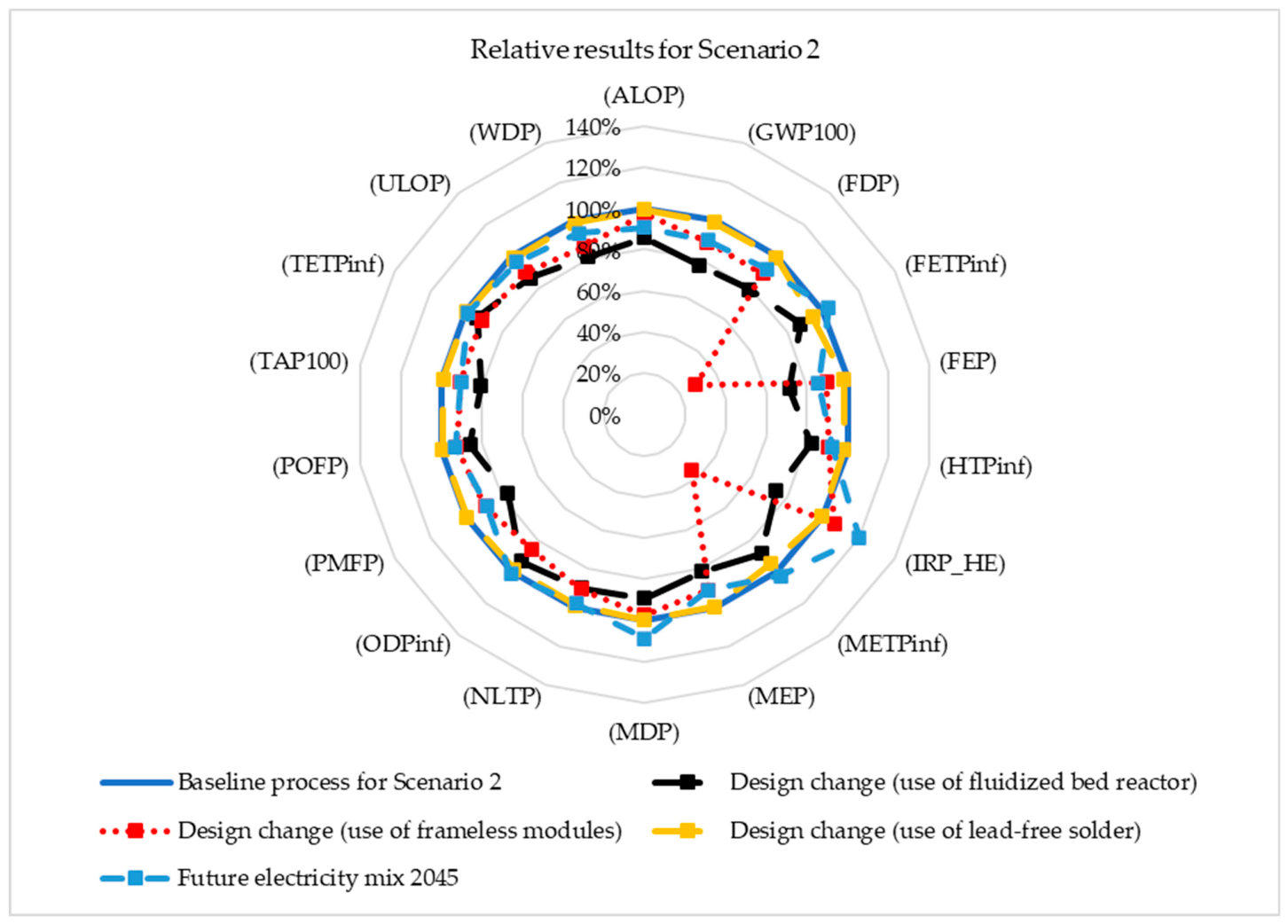
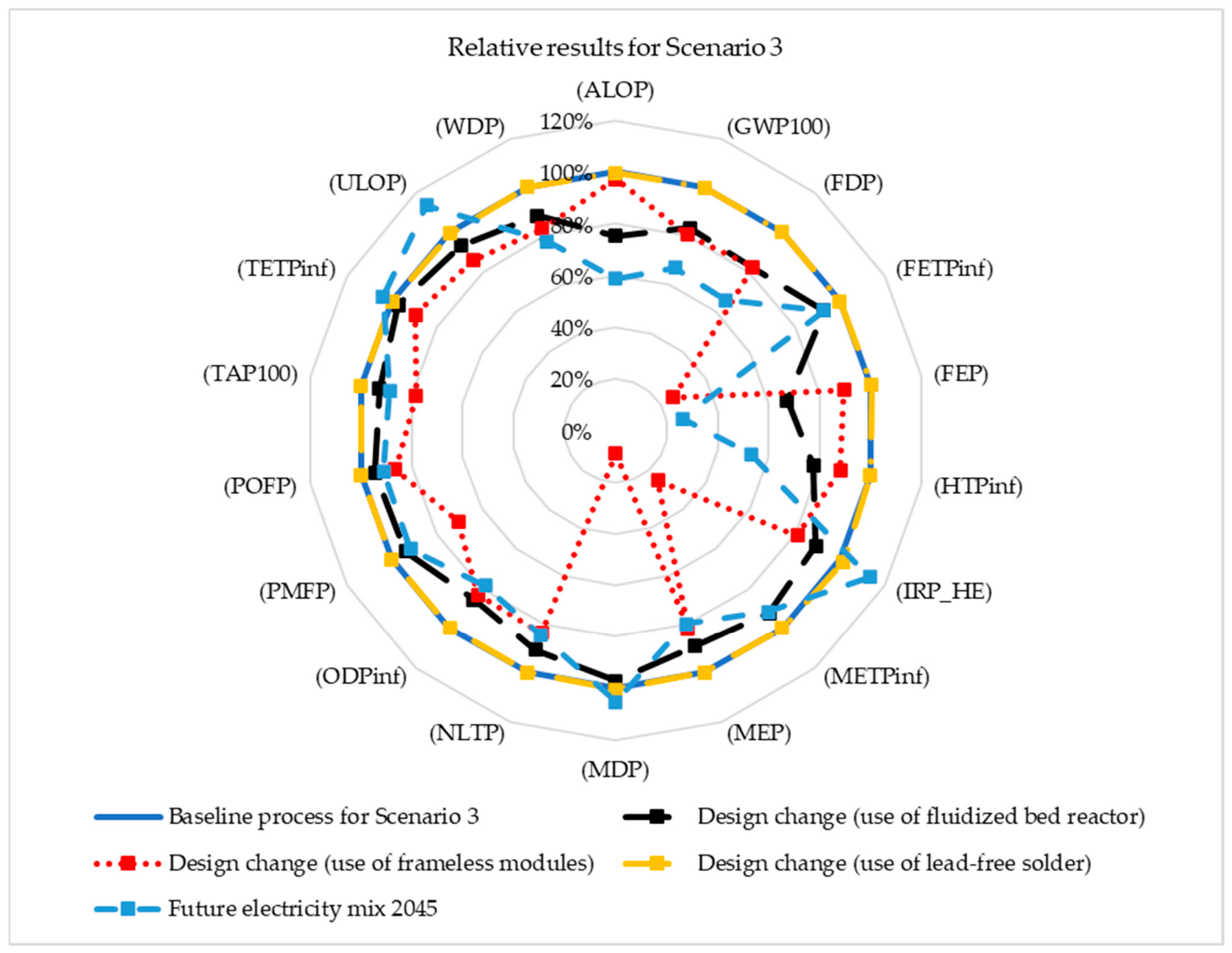
Figure 12 and Figure 13 show the relative results of the changes in the design mentioned above and the change in the electricity grid mixes for the year 2045. Figure 12 considers Scenario 2 (PERC cell production in China and partial recycling), whereas Figure 13 considers Scenario 3 (TOPCon cell production in Germany and high-recovery recycling). The results of the baseline process in 2025 are considered 100%. The results of the design changes and future electricity mixes are shown in relation to the base case. It was assumed that the sensitivities of other scenarios were comparable to the results shown here or even less sensitive depending on the scenario.
The adoption of a fluidized bed reactor leads to a reduction in environmental impacts, ranging from 6% to 29% in Scenario 2 (Figure 12) and from 3% to 25% in Scenario 3 (Figure 13). These reductions are mainly driven by the lower energy demand during the production of solar grade silicon, as reflected in the decrease in climate change impacts from 575 to 442 kg CO2-eq/kWp. However, impact categories such as terrestrial ecotoxicity and ozone depletion show minimal change as they are not strongly linked to electricity consumption. A similar trend was observed in Scenario 3, where climate change impacts reduced from 378 to 315 kg CO2-eq/kWp, whereas categories such as metal depletion and terrestrial ecotoxicity remained largely unaffected.
The use of frameless modules resulted in the biggest environmental impact for most impact categories by as much as 71% (freshwater ecotoxicity) for Scenario 2 and 91% (metal depletion) for Scenario 3. Metal depletion was highly sensitive to this design change, showing significant reduction due to the elimination of aluminum. In contrast, ionizing radiation impacts were higher than the reference by 6% due to reduced recycling credits associated with the absence of aluminum in Scenario 2. Climate change impacts decreased to 511 and 305 kg CO2-eq/kWp for Scenarios 2 and 3, respectively. Agricultural land occupation was only slightly influenced, as it is not directly linked to aluminum use. Ensuring mechanical robustness of frameless PV modules is the key engineering challenge limiting their wider adoption for utility scale installations; however, there are a couple of strategies being used/researched. According to [54], some of these strategies include the use of thicker/strengthened glass and improved mounting systems, among others.
The substitution of the conventional solder with lead-free alternatives results in only minor environmental benefits, with reductions of < 5% in Scenario 2 and approximately < 0.5% in Scenario 3, indicating a negligible overall effect.
Changes in the electricity mixes led to environmental impact reductions between 1% and 14% in Scenario 2. However, certain impact categories such as freshwater ecotoxicity, ionizing radiation, marine ecotoxicity, metal depletion and ozone depletion experienced surges of up to 20% more than the baseline. For ionizing radiation, this is was due to the anticipated higher share of nuclear energy in the future Chinese electricity mix. In Scenario 3, the shift in the electricity mix yielded more substantial reductions, ranging from 7% to 74%, with freshwater eutrophication showing the greatest sensitivity. This is largely attributed to the expected phase-out of lignite coal in the German electricity mix. Similar to Scenario 2, some impact categories such as ionizing radiation, metal depletion, terrestrial ecotoxicity and urban land occupation show increases exceeding 13%. In the case of ionizing radiation, this is linked to the projected increase in electricity imports from nuclear intensive countries such as France, whereas the increase in urban land occupation impacts reflects the expanded land requirements associated with a higher share of photovoltaic systems in the future German electricity mix. The climate change impacts decreased to 517 and 253 kg CO2-eq/kWp for Scenarios 2 and 3, respectively, as a result of cleaner electricity mixes.
The combined effect of the proposed design changes and the change in the grid mixes results in substantially reduced life cycle impacts across all categories. For climate change, the combined scenarios led to reduced total impacts of 315 kg CO2-eq/kWp for Scenario 2 and 114 kg CO2-eq/kWp for Scenario 3. Across most impact categories, a frameless glass–glass module design contributed to the largest reduction in environmental burdens due to reduced material use, particularly aluminum, followed by improvements associated with the use of the fluidized bed reactor for silicon production in Scenario 2. In Scenario 3, decarbonization of the electricity grid represents the second most influential factor The full sensitivity analysis results have been provided in Supplementary Materials in Tables S11–S14.

4. Conclusions

This study evaluated the life cycle environmental impacts of sustainable solar module designs, focusing on four manufacturing and application routes. It compared two product systems based on monocrystalline silicon PV technology: the PERC glass–glass (G–G) and TOPCon glass–glass (G–G) cell technologies. Both systems were assessed under production scenarios in China and Germany using inventory data from eco-invent and literature sources.
The results across most impact categories show that TOPCon modules produced in Germany with hypothetical high-recovery recycling as the end-of-life strategy exhibit the lowest impacts under the adopted assumptions, including the electricity mix and end-of-life modelling choices, whereas PERC modules produced in China with partial recycling as the end-of-life strategy exhibit the highest impacts under the same adopted assumptions for module-only impacts (excluding BOS components). The observed differences reflect the combined influence of both PV cell technology and associated end-of-life recycling assumptions rather than technology differences alone. Therefore, it should be noted that the reported results reflect the combined influence of these interacting parameters rather than independent single factor effects. Considering climate change, the TOPCon design under high-recovery recycling yielded 10.4% lower emissions than the PERC design under partial recycling in Germany and was 9.7% lower than the one in China. However, both module designs emitted 26.6% and 27.2% less GHG emissions when produced in Germany compared to production in China, respectively, reinforcing the rationale for adopting consumption-based accounting approaches and implementing policies that encourage local manufacturing powered by cleaner electricity mixes. With GHG emissions of 378–575 kg CO2-eq/kWp, excluding BOS components, this study shows that both PERC and TOPCon mono c-Si PV modules perform better in this study than the previously reported median of 905 kg CO2-eq/kWp for PERC cell modules in the literature review analysis, reflecting the use of more recent state-of-the-art industry data concerning manufacturing requirements. This study identified that the differences in results across impact categories were mainly due to the different electricity mixes used. For instance, considering climate change, the higher results for Chinese production compared to German production were mainly due to the high share of hard coal in the Chinese electricity mix, whereas for freshwater eutrophication (FEP), the higher results for German production compared to Chinese production were mainly due to the high share of lignite coal in the German electricity mix.
For all four scenarios, the production stage contributed the highest share of emissions for all the impact categories. For example, it contributed approximately 92–95% of total GWP impacts across the four scenarios, with transportation having a more significant effect in Chinese production. Transportation contributes a GWP impact of approximately 3% for the case of China compared to less than 0.5% for the case of Germany. Although there was a very low contribution from the recycling credits in relation to the total GHG emissions for all the impact categories, the hypothetical high-recovery recycling that contributes between 3-5–4.9% offers greater environmental credits due to the recovery of valuable materials such as solar glass, silicon and silver compared to partial recycling (1.4–1.9%). The most emission-intensive stages during the manufacturing process were solar grade and silicon ingot production due to the high electricity demand. Within the module manufacturing phase, aluminum and solar glass contributed the largest share of GHG emissions (10–19%) in both production processes.
The sensitivity analysis carried out on the design changes and electricity grid mix available for the production process shows that any improvements in the design process and increases in renewable energy penetration into the grid correspond to a proportional reduction in GHG emissions. Furthermore, future research needs to target improvements in module design innovations that promise to reduce environmental impacts while enhancing system performance through higher lifetime electricity yields.

Supplementary Materials

The following supporting information can be downloaded at: https://www.mdpi.com/article/10.3390/su18115729/s1, Tables S1–S10: Full Life Cycle Inventory Tables, Tables S11–S14: Sensitivity Analysis Results and Table S15: Methodological comparison table for major PV LCA studies (2015–2025).

Author Contributions

Conceptualization, R.B. and U.B.; methodology, E.S. and R.B.; software, E.S.; validation, E.S., R.B. and U.B.; formal analysis, E.S.; investigation, E.S.; writing—original draft preparation, E.S., R.B. and U.B.; writing—review and editing, E.S., R.B. and U.B.; visualization, E.S. All authors have read and agreed to the published version of the manuscript.

Funding

Authors would like to acknowledge the Federal Ministry for Economic Affairs and Energy (BMWE) of Germany for their financial support for the research activities of this paper under the framework of the project Green Solar Modules, grant number: 03EE1161B.

Institutional Review Board Statement

Not applicable.

Informed Consent Statement

Not applicable.

Data Availability Statement

The original contributions presented in this study are included in the article/Supplementary Material. Further inquiries can be directed to the corresponding author(s).

Conflicts of Interest

The authors declare no conflicts of interest.

References

  1. IEA. Energy and Air Pollution—World Energy Outlook 2016 Special Report, Paris. 2016. Available online: https://www.iea.org/reports/world-energy-outlook-2016 (accessed on 25 March 2025).
  2. IEA. World Energy Outlook 2024, Paris. 2024. Available online: https://www.iea.org/reports/world-energy-outlook-2024 (accessed on 13 April 2025).
  3. Crippa, M.; Guizzardi, D.; Pagani, F.; Banja, M.; Muntean, M.; Schaaf, E.; Monforti-Ferrario, F.; Becker, W.; Quadrelli, R.; Risquez Martin, A.; et al. GHG Emissions of All World Countries; Publications Office: Luxembourg, 2024. [Google Scholar]
  4. Umweltbundesamt. Projektionsbericht 2023 für Deutschland, Dessau-Roßlau, Germany. 2023. Available online: http://www.umweltbundesamt.de/publikationen (accessed on 6 May 2025).
  5. Umweltbundesamt. First Half of 2024_ Renewable Electricity Generation Continues to Rise Significantly, Dessau-Roßlau, Germany. 2024. Available online: https://www.umweltbundesamt.de/en/press/pressinformation/first-half-of-2024-renewable-electricity-generation (accessed on 4 April 2025).
  6. IEA PVPS. Snapshot of Global PV Markets-2025—Task 1 Strategic PV Analysis and Outreach; IEA: Paris, France, 2025; Available online: https://iea-pvps.org/wp-content/uploads/2025/04/Snapshot-of-Global-PV-Markets_2025.pdf (accessed on 2 February 2026).
  7. IEA PVPS. Snapshot of Global PV Markets-2023—Task 1 Strategic PV Analysis and Outreach; IEA: Paris, France, 2023; Available online: https://iea-pvps.org/wp-content/uploads/2023/04/IEA_PVPS_Snapshot_2023.pdf (accessed on 2 February 2026).
  8. Solar Power Europe. Global Market Outlook for Solar Power 2024–2028; SolarPower Europe: Brussels, Belgium, 2024; Available online: https://api.solarpowereurope.org/uploads/Global_Market_Outlook_for_Solar_Power_2024_a083b6dcd5.pdf (accessed on 14 January 2026).
  9. Victoria, M.; Haegel, N.; Peters, I.M.; Sinton, R.; Jäger-Waldau, A.; del Cañizo, C.; Breyer, C.; Stocks, M.; Blakers, A.; Kaizuka, I.; et al. Solar photovoltaics is ready to power a sustainable future. Joule 2021, 5, 1041–1056. [Google Scholar] [CrossRef]
  10. Lakhouit, A.; Alhathlaul, N.; El Mokhi, C.; Hachimi, H. Assessing the Environmental Impact of PV Emissions and Sustainability Challenges. Sustainability 2025, 17, 2842. [Google Scholar] [CrossRef]
  11. Bošnjaković, M.; Santa, R.; Crnac, Z.; Bošnjaković, T. Environmental Impact of PV Power Systems. Sustainability 2023, 15, 11888. [Google Scholar] [CrossRef]
  12. Zheng, S.; Ye, Z.; Lu, K.; He, T.; Liu, Y.; Zhang, L.; Hao, Y. Accounting for non-CO2 greenhouse gases in global PV trade: Implications for climate responsibility and policy. Sustain. Prod. Consum. 2026, 62, 55–69. [Google Scholar] [CrossRef]
  13. Polverini, D.; Espinosa, N.; Eynard, U.; Leccisi, E.; Ardente, F.; Mathieux, F. Assessing the carbon footprint of photovoltaic modules through the EU Ecodesign Directive. Sol. Energy 2023, 257, 1–9. [Google Scholar] [CrossRef]
  14. IRENA; IEA-PVPS. End-of-Life Management: Solar Photovoltaic Panels, International Renewable Energy Agency and In-Ternational Energy Agency Photovoltaic Power Systems, Paris and Abu Dhabi. 2016. Available online: https://iea-pvps.org/wp-content/uploads/2020/01/IRENA_IEAPVPS_End-of-Life_Solar_PV_Panels_2016.pdf (accessed on 15 October 2025).
  15. Tasnim, S.S.; Rahman, M.M.; Hasan, M.M.; Shammi, M.; Tareq, S.M. Current challenges and future perspectives of solar-PV cell waste in Bangladesh. Heliyon 2022, 8, e08970. [Google Scholar] [CrossRef]
  16. Chunduri, S.K.; Schmela, M. PERC Solar Cell Technology 2016; Background, Status and Outlook, South Korea. 2016. Available online: https://www.researchgate.net/publication/344164309_PERC_Solar_Cell_Technology_2016 (accessed on 15 January 2026).
  17. Jinko Solar. Advanced Passivated Contact (TOPCon) Technology—Tiger Neo 3.0 Commercial White Paper, China. 2025. Available online: https://www.jinkosolar.com/en/site/dwbrochure (accessed on 5 April 2026).
  18. Fraunhofer Institute for Solar Energy Systems ISE with the Support of PSE Projects GmbH. Photovoltaics Report, Updated: 29 May 2025. Freiburg, Germany. 2025. Available online: https://www.ise.fraunhofer.de/content/dam/ise/de/documents/publications/studies/Photovoltaics-Report.pdf (accessed on 14 January 2026).
  19. Smith, B.L.; Sekar, A.; Mirletz, H.; Heath, G.; Margolis, R. An Updated Life Cycle Assessment of Utility-Scale Solar Photovoltaic Systems Installed in the United States; NREL/TP-7A40-87372; National Renewable Energy Laboratory: Golden, CO, USA, 2024. [Google Scholar]
  20. Müller, A.; Friedrich, L.; Reichel, C.; Herceg, S.; Mittag, M.; Neuhaus, D.H. A comparative life cycle assessment of silicon PV modules: Impact of module design, manufacturing location and inventory. Sol. Energy Mater. Sol. Cells 2021, 230, 111277. [Google Scholar] [CrossRef]
  21. Khan, A.A.; Reichel, C.; Molina, P.; Friedrich, L.; Subasi, D.M.; Neuhaus, H.; Nold, S. Global warming potential of photovoltaics with state-of-the art silicon solar cells: Influence of electricity mix, installation location and lifetime. Sol. Energy Mater. Sol. Cells 2024, 269, 112724. [Google Scholar] [CrossRef]
  22. Cruz, J.M.; Schmidt Rivera, X.; Jalil-Vega, F.; O’Ryan, R.; Valencia, F.; Rabanal-Arabach, J.; Ayllón Opazo, E.; Morris Carmona, P.A.; Larrain Yañez, P. Environmental life cycle assessment of novel PV systems for desert conditions. Sustain. Prod. Consum. 2026, 65, 115–129. [Google Scholar] [CrossRef]
  23. Kafle, B.; Goraya, B.S.; Mack, S.; Feldmann, F.; Nold, S.; Rentsch, J. TOPCon—Technology options for cost efficient industrial manufacturing. Sol. Energy Mater. Sol. Cells 2021, 227, 111100. [Google Scholar] [CrossRef]
  24. Song, T.; Jeswani, H.K.; Azapagic, A. Assessing the environmental and economic sustainability of emerging tandem photovoltaic technologies in China. Energy Convers. Manag. 2024, 318, 118890. [Google Scholar] [CrossRef]
  25. Heidari, S.M.; Anctil, A. Country-specific carbon footprint and cumulative energy demand of metallurgical grade silicon production for silicon photovoltaics. Resour. Conserv. Recycl. 2022, 180, 106171. [Google Scholar] [CrossRef]
  26. Méndez, L.; Forniés, E.; Garrain, D.; Pérez Vázquez, A.; Souto, A.; Vlasenko, T. Upgraded metallurgical grade silicon and polysilicon for solar electricity production: A comparative life cycle assessment. Sci. Total Environ. 2021, 789, 147969. [Google Scholar] [CrossRef]
  27. Eriksson, G.; Hack, K. Production of Metallurgical Grade Silicon in an Electric Arc Furnace. In The SGTE Casebook; Hack, K., Ed.; CRC Press: London, UK, 2024; pp. 200–208. [Google Scholar]
  28. Abdellatif, M. DC arc Smelting of Silicon: Is it Technically Feasible? Mintek, Randburg, South Africa. 2011. Available online: https://www.saimm.co.za/Conferences/Pyro2011/101-Abdellatif.pdf (accessed on 2 May 2026).
  29. Chen, Z.; Ma, W.; Wei, K.; Wu, J.; Li, S.; Xie, K.; Lv, G. Artificial neural network modeling for evaluating the power consumption of silicon production in submerged arc furnaces. Appl. Therm. Eng. 2017, 112, 226–236. [Google Scholar] [CrossRef]
  30. Wang, C. Monthly China Energy Update on 22 April 2025, China, 2025. Available online: https://climateenergyfinance.org/wp-content/uploads/2025/04/Monthly-China-Energy-Update-22-April-2025-.pdf (accessed on 14 February 2026).
  31. Statistisches Bundesamt—German Federal Statistical Office. Gross Electricity Production in Germany, Wiesbaden, Germany. 2024. Available online: https://www.destatis.de/EN/Themes/Economic-Sectors-Enterprises/Energy/Production/Tables/gross-electricity-production.html (accessed on 23 April 2025).
  32. IEA PVPS. Methodology Guidelines on Life Cycle Assessment of Photovoltaic 2020: Task 12 PV Sustainability; IEA: Paris, France, 2020; Available online: https://iea-pvps.org/key-topics/methodology-guidelines-on-life-cycle-assessment-of-photovoltaic-2020/ (accessed on 2 October 2025).
  33. Sheng, X.; Chen, L.; Liu, M.; Yuan, X.; Wang, Q.; Ma, Q.; Zuo, J. Environmental impact of monocrystalline silicon photovoltaic modules. Resour. Conserv. Recycl. 2025, 220, 108373. [Google Scholar] [CrossRef]
  34. Sefene, E.M.; Chen, C.-C.A.; Tsai, Y.-H. A comprehensive review of diamond wire sawing process for single-crystal hard and brittle materials. J. Manuf. Process. 2024, 131, 1466–1497. [Google Scholar] [CrossRef]
  35. Wang, R. TOPCon Comprehensive Analysis Updated on 1 September 2023. Available online: https://en.solarpanelproductionline.com/knowledges/TOPCon-comprehensive-analysis.html (accessed on 5 January 2026).
  36. Philippe Stolz, R.F. Life Cycle Assessment of Current Photovoltaic Module Recycling; IEA: Paris, France, 2018; Available online: https://iea-pvps.org/wp-content/uploads/2020/01/Life_Cycle_Assesment_of_Current_Photovoltaic_Module_Recycling_by_Task_12.pdf (accessed on 11 June 2025).
  37. IEA PVPS. Advances in Photovoltaic Module Recycling; Literature Review and Update to Empirical Life Cycle Inventory Data and Patent Review, Paris, 2024. Available online: https://iea-pvps.org/wp-content/uploads/2024/06/IEA-PVPS-T12-28-2024-Report-PV-Recycling-LCI_EPRI.pdf (accessed on 21 March 2025).
  38. Ciroth, A.; Di Noi, C.; Burhan, S.; Srocka, M. LCA database creation; Current challenges and the way forward. Indones. J. Life Cycle Assess. Sustain. 2019, 3, 45–49. [Google Scholar] [CrossRef]
  39. Huijbregts, M.A.J.; Steinmann, Z.J.N.; Elshout, P.M.F.; Stam, G.; Verones, F.; Vieira, M.D.M.; Hollander, A.; Zijp, M.; van Zelm, R. ReCiPe 2016 A harmonized life cycle impact assessment method at midpoint and endpoint level. Int. J. Life Cycle Assess. 2016, 22, 138–147. [Google Scholar] [CrossRef]
  40. Bhandari, R.; Sekimuli, E. A Systematic Review on Environmental Life Cycle Assessment of Solar PV Modules. Sustainability 2026, 18, 4639. [Google Scholar] [CrossRef]
  41. Babaee, S.; Loughlin, D.H.; Kaplan, P.O. Incorporating upstream emissions into electric sector nitrogen oxide reduction targets. Clean. Eng. Technol. 2020, 1, 100017. [Google Scholar] [CrossRef] [PubMed]
  42. Joël Tchognia Nkuissi, H.; Kouadio Konan, F.; Hartiti, B.; Ndjaka, J.-M. Toxic Materials Used in Thin Film Photovoltaics and Their Impacts on Environment. In Reliability and Ecological Aspects of Photovoltaic Modules; Gok, A., Ed.; IntechOpen: London, UK, 2020. [Google Scholar]
  43. Schultze, M.; Pokrandt, K.-H.; Hille, W. Pit lakes of the Central German lignite mining district: Creation, morphometry and water quality aspects. Limnologica 2010, 40, 148–155. [Google Scholar] [CrossRef]
  44. Andreasi Bassi, S.; Biganzoli, F.; Ferrara, N.; Amadei, A.; Valente, A.; Sala, S. Updated Characterisation and Normalisation Factors for the Environmental Footprint 3.1 Method; JRC Technical Report JRC130796; Publications Office of the European Union: Luxembourg, 2023; Available online: https://op.europa.eu/en/publication-detail/-/publication/145f8401-a82a-11ed-b508-01aa75ed71a1 (accessed on 5 April 2026).
  45. Singh, S.; Dhar, A.; Powar, S. Perspectives on life cycle analysis of solar technologies with emphasis on production in India. J. Environ. Manag. 2024, 366, 121755. [Google Scholar] [CrossRef]
  46. Heijungs, R. On the number of Monte Carlo runs in comparative probabilistic LCA. Int. J. Life Cycle Assess. 2020, 25, 394–402. [Google Scholar] [CrossRef]
  47. Tao, M.; Druffel, T.; Farag, A.; McLoughlin, K.; Leu, P.W. Design changes for improved circularity of silicon solar modules. One Earth 2024, 7, 171–174. [Google Scholar] [CrossRef]
  48. Fraunhofer Institute for Solar Energy Systems ISE. European Glass-Glass Photovoltaic Modules Are Particularly Climate-Friendly; Press Release on 23 September 2021. Available online: https://www.ise.fraunhofer.de/en/press-media/press-releases/2021/european-glass-glass-photovoltaic-modules-are-particularly-climate-friendly.html (accessed on 15 September 2024).
  49. Markert, J.; Ensslen, F.; Rist, T.; Beinert, A.J.; Job, E.; Hädrich, I.; Philipp, D. Mechanical Stability of PV Modules. PV-Symp. Proc. 2024, 1, 1–11. [Google Scholar] [CrossRef]
  50. Ramos, A.; Filtvedt, W.O.; Lindholm, D.; Ramachandran, P.A.; Rodríguez, A.; del Cañizo, C. Deposition reactors for solar grade silicon: A comparative thermal analysis of a Siemens reactor and a fluidized bed reactor. J. Cryst. Growth 2015, 431, 1–9. [Google Scholar] [CrossRef]
  51. Filtvedt, W.O.; Javidi, M.; Holt, A.; Melaaen, M.C.; Marstein, E.; Tathgar, H.; Ramachandran, P.A. Development of fluidized bed reactors for silicon production. Sol. Energy Mater. Sol. Cells 2010, 94, 1980–1995. [Google Scholar] [CrossRef]
  52. Fraunhofer ISE. Energy Charts. Available online: https://www.energy-charts.info/charts/remod_energies_2024/chart.htm?l=en&c=DE&source=electricity_provision_and_use&scenario=technology_open (accessed on 13 April 2025).
  53. US Energy Information Association. International Energy Outlook 2023. Available online: https://www.eia.gov/outlooks/ieo/data.php (accessed on 15 April 2025).
  54. Oushang Solar. Frameless Solar Panels—Definition, Advantages, Limitations and Opportunities, China, 2023. Available online: https://www.oushangsolar.com/resources/frameless-solar-panels-ndash-definition-advantages.html (accessed on 9 May 2026).
Figure 1. System boundary of the modules studied (The arrows show the sequence of operations within the system boundary).
Sustainability 18 05729 g001
Figure 2. Chinese and German electricity mixes used in this study [30,31].
Sustainability 18 05729 g002
Figure 3. Cell manufacturing processes for PERC and TOPCon solar cells [23].
Sustainability 18 05729 g003
Figure 4. Climate change impact results.
Sustainability 18 05729 g004
Figure 5. Freshwater eutrophication impact results.
Sustainability 18 05729 g005
Figure 6. Terrestrial acidification impact results.
Sustainability 18 05729 g006
Figure 7. Human toxicity impact results.
Sustainability 18 05729 g007
Figure 8. Comparison of emissions across all impact categories for the BOS components in the installation/use phase to the total emissions in (a) Scenario 2 and (b) Scenario 3.
Sustainability 18 05729 g008
Figure 9. Monte Carlo simulation for manufacturing emissions for the single 1 m2 PERC PV module produced in China: (a) climate change, (b) ionizing radiation, and (c) human toxicity results (The red lines represent the mean, median, 5% and 95% percentiles).
Sustainability 18 05729 g009
Figure 10. Monte Carlo simulation for transportation emissions for the single PV module produced in China and transported to Germany for installation: (a) climate change, (b) freshwater ecotoxicity, and (c) human toxicity results (The red lines represent the mean, median, 5% and 95% percentiles).
Sustainability 18 05729 g010
Figure 11. Monte Carlo simulation for recycling emissions for 1 kg of PV module waste under the high-recovery recycling scenario: (a) climate change and (b) human toxicity results (The red lines represent the mean, median, 5% and 95% percentiles).
Sustainability 18 05729 g011
Figure 12. Relative results of the sensitivity analysis when the design processes and electricity mixes were changed for Scenario 2.
Sustainability 18 05729 g012
Figure 13. Relative results of the sensitivity analysis when the design processes and electricity mixes were changed for Scenario 3.
Sustainability 18 05729 g013
Table 2. Scenarios under investigation.
ScenarioModule DesignCountry of ManufactureCountry of InstallationRecycling Method
1PERC cell designGermanyGermanyPartial recycling
2PERC cell designChinaGermanyPartial recycling
3TOPCon cell designGermanyGermanyHigh-recovery recycling
4TOPCon cell designChinaGermanyHigh-recovery recycling
Table 3. Comparison of impact assessment results for all the scenarios.
IndicatorTotal Emissions (Scenario 1)Total Emissions (Scenario 2)Total Emissions (Scenario 3)Total Emissions (Scenario 4)Unit
agricultural land occupation (ALOP)8.50 × 1016.79 × 1017.41 × 1015.86 × 101m2a 1
climate change (GWP100)4.22 × 1025.75 × 1023.78 × 1025.19 × 102kg CO2-eq
fossil depletion (FDP)1.21 × 1021.44 × 1021.09 × 1021.30 × 102kg oil-eq
freshwater ecotoxicity (FETPinf)2.75 × 1012.76 × 1012.30 × 1012.32 × 101kg 1,4-DCB-eq
freshwater eutrophication (FEP)2.94 × 10−11.92 × 10−12.51 × 10−11.59 × 10−1kg P-eq
human toxicity (HTPinf)3.17 × 1022.68 × 1022.55 × 1022.12 × 102kg 1,4-DCB-eq
ionising radiation (IRP_HE)2.06 × 1012.68 × 1012.10 × 1012.69 × 101kg U235-eq
marine ecotoxicity (METPinf)2.64 × 1012.64 × 1011.99 × 1011.99 × 101kg 1,4-DCB-eq
marine eutrophication (MEP)5.28 × 10−18.22 × 10−14.52 × 10−17.24 × 10−1kg N-eq
metal depletion (MDP)1.01 × 10−12.56 × 10−13.02 × 10−14.56 × 10−1kg Fe-eq
natural land transformation (NLTP)6.92 × 10−28.14 × 10−26.36 × 10−27.52 × 10−2m2
ozone depletion (ODPinf)2.86 × 10−52.17 × 10−52.62 × 10−52.01 × 10−5kg CFC-11-eq
particulate matter formation (PMFP)7.39 × 10−11.64 × 1006.38 × 10−11.46 × 100kg PM10-eq
photochemical oxidant formation (POFP)2.10 × 1002.99 × 1001.83 × 1002.65 × 100kg NMVOC
terrestrial acidification (TAP100)1.79 × 1003.10 × 1001.60 × 1002.81 × 100kg SO2-eq
terrestrial ecotoxicity (TETPinf)7.65 × 10−28.60 × 10−26.70 × 10−27.56 × 10−2kg 1,4-DCB-eq
urban land occupation (ULOP)8.58 × 1001.05 × 1016.93 × 1008.70 × 100m2a 1
water depletion (WDP)2.38 × 1002.90 × 1002.26 × 1002.74 × 100m3
1 m2a deontes square meter–annum.
Table 4. Future scenarios of the Chinese and German electricity mixes in 2045 [52,53].
Electricity SourceGermany Electricity Mix (%)China Electricity Mix (%)
20452045
Lignite power plants05.3
Wind power plants54.820.2
Hard coal power plants037.2
Natural gas power plants1.27.1
Photovoltaic systems30.712.3
Nuclear power plants07.7
Hydropower plants2.58.2
Biomass energy2.21.6
Household waste1.80.2
Mineral oil products00.2
Geothermal energy00
Other energy sources6.80
Disclaimer/Publisher’s Note: The statements, opinions and data contained in all publications are solely those of the individual author(s) and contributor(s) and not of MDPI and/or the editor(s). MDPI and/or the editor(s) disclaim responsibility for any injury to people or property resulting from any ideas, methods, instructions or products referred to in the content.