GWAMA: A Web-Based Decision Support Tool for Greenwashing Risk Assessment in Sustainable Food Marketing



Abstract
1. Introduction
- RQ1:
- How can validated behavioral SEM findings be operationalized into a deployable decision support system while preserving psychometric integrity?
- RQ2:
- What system architecture, scoring algorithm, and user workflow best translate theoretical S-O-R constructs into an accessible, real-time greenwashing diagnostic tool?
- RQ3:
- To what extent does the deployed system demonstrate stakeholder acceptance across perceived usefulness, ease of use, and intention to use among food industry professionals?
2. Literature Review
2.1. Greenwashing and the Governance Gap
2.2. The Behavioral Model Embedded in GWAMA
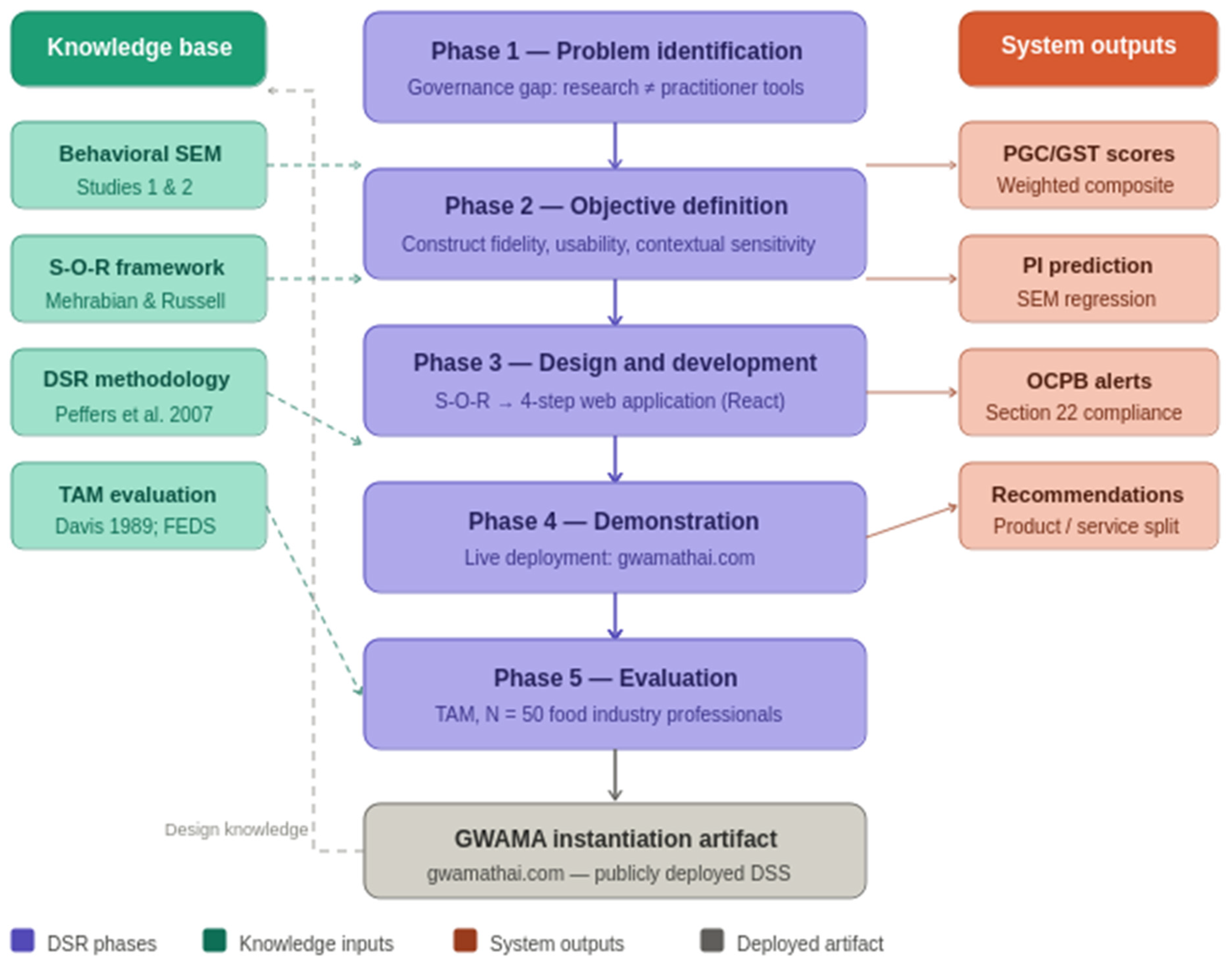
2.3. Design Science and TAM as Evaluation Framework
3. Methodology and System Development
3.1. System Overview
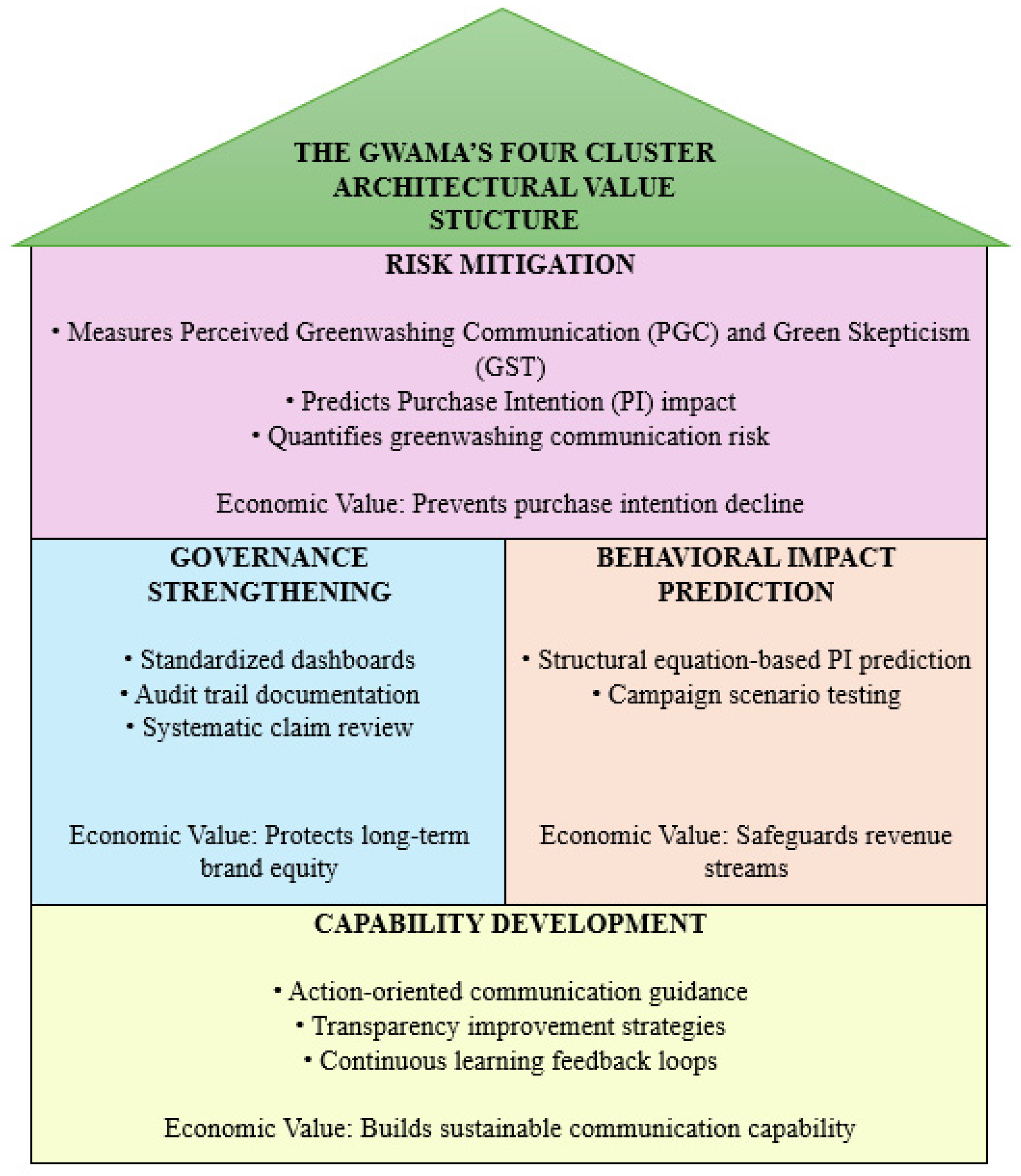
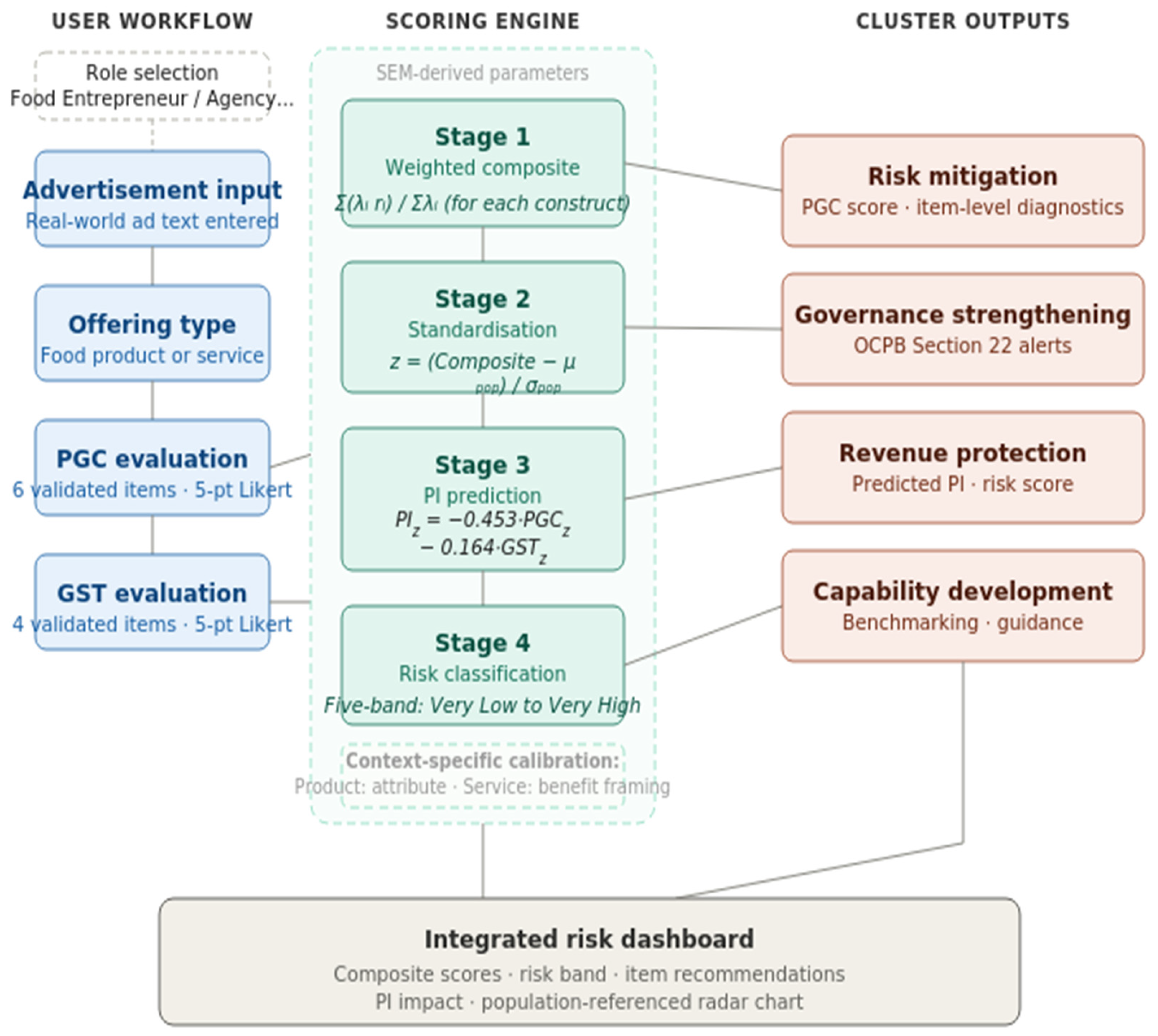
3.2. System Architecture: Four Functional Clusters
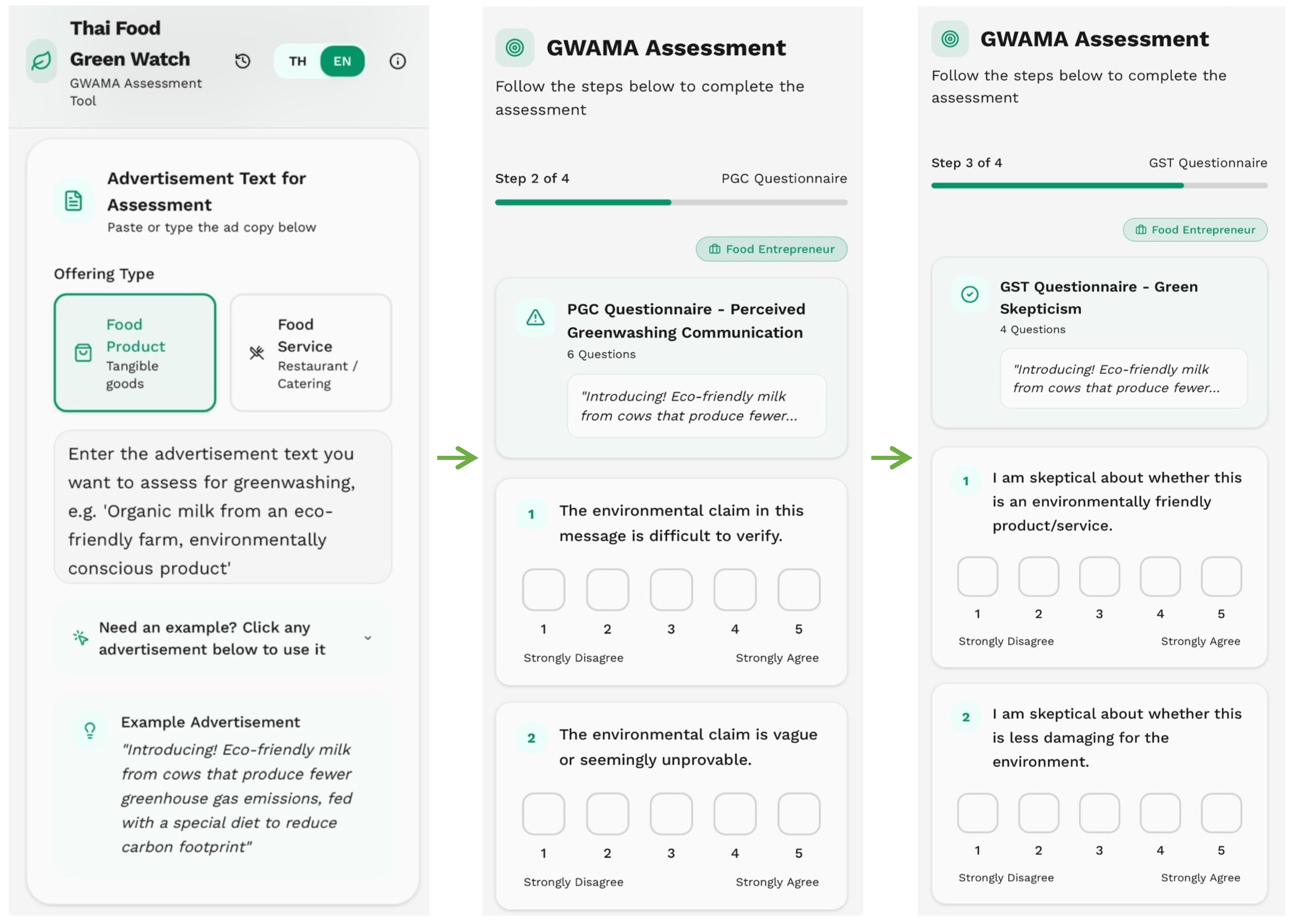
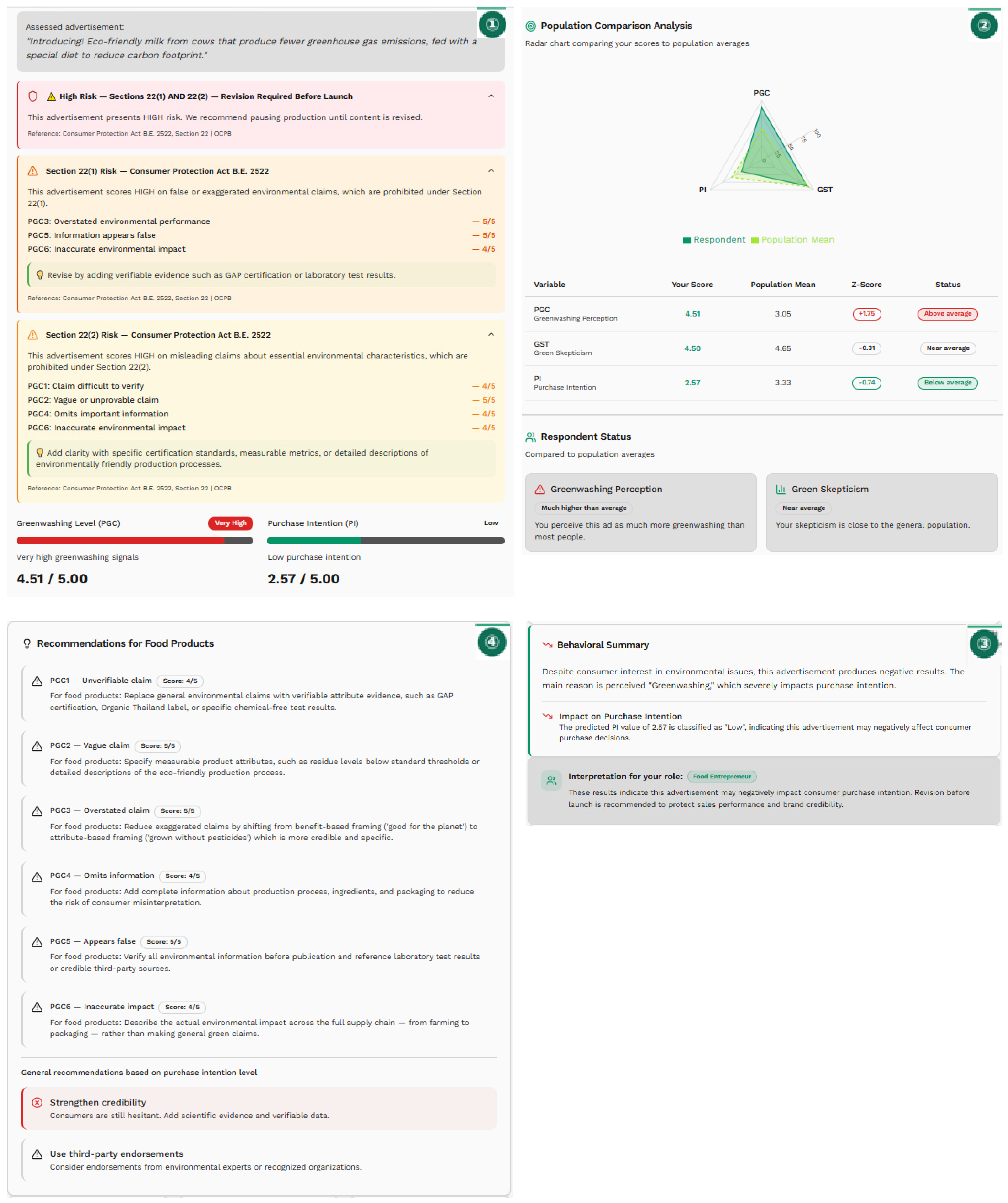
3.3. GWAMA User Workflow
3.4. Scoring Algorithm
3.4.1. Prediction Uncertainty and Interpretation
3.4.2. Effect Size of Embedded Regression Coefficients
3.4.3. Sensitivity Analysis: Weighting Scheme Robustness
4. Initial System Evaluation Results
4.1. Evaluation Approach and Sample
4.2. TAM Usability Results
4.3. Construct Reliability of the Scoring Engine
4.4. Structural Path Stability Analysis
4.5. Illustrative Numerical Example
5. Discussion
5.1. Key Findings and Interpretation
5.2. Contributions
5.3. Positioning Within Design Science Research
5.4. Implications
5.5. Limitations and Future Research Directions
6. Conclusions
Author Contributions
Funding
Institutional Review Board Statement
Informed Consent Statement
Data Availability Statement
Acknowledgments
Conflicts of Interest
Abbreviations
| GWAMA | Greenwashing Advertising Message Assessment |
| PGC | Perceived Greenwashing Communication |
| GST | Green Skepticism |
| PI | Purchase Intention |
| PU | Perceived Usefulness |
| PEOU | Perceived Ease of Use |
| IU | Intention to Use |
| M | Mean |
| SD | Standard Deviation |
| CR | composite reliability |
| AVE | Average Variance Extracted |
Appendix A. Measurement and Evaluation Results

| Construct/Item | Code | M | SD | Interpretation |
|---|---|---|---|---|
| Perceived Usefulness (PU) | ||||
| 1. It is beneficial for assessing greenwashing advertising messages | PU1 | 4.55 | 0.75 | Very High |
| 2. It saves time in reviewing greenwashing advertising messages | PU2 | 4.10 | 0.82 | High |
| 3. It systematically identifies strengths, weaknesses, and risks | PU3 | 4.07 | 0.79 | High |
| 4. It has functions that meet user needs | PU4 | 4.10 | 0.78 | High |
| 5. It helps organizations conduct greenwashing assessments more efficiently | PU5 | 4.63 | 0.76 | Very High ✓ |
| 6. It is innovative and applicable in real-world situations | PU6 | 4.09 | 0.80 | High |
| 7. Management can see an overview of the assessment results | PU7 | 3.99 | 0.76 | High |
| Mean | 4.18 | 0.77 | Very High | |
| Perceived Ease of Use (PEOU) | ||||
| 1. Information retrieval is easy and accurate | PE1 | 4.07 | 0.74 | High |
| 2. The system is clear and user-friendly | PE2 | 4.00 | 0.76 | High |
| 3. It helps reduce evaluation steps | PE3 | 3.97 | 0.73 | High |
| 4. It makes work easier, more convenient, and faster | PE4 | 4.48 | 0.66 | High ✓ |
| 5. It offers flexibility in use | PE5 | 3.97 | 0.75 | High |
| 6. It has a clear and easy-to-understand menu | PE6 | 4.07 | 0.74 | High |
| Mean | 4.03 | 0.74 | High | |
| Intention to Use (IU) | ||||
| 1.The system produces satisfactory results | IU1 | 4.25 | 0.68 | High |
| 2. The system is of appropriate quality | IU2 | 4.30 | 0.65 | High |
| 3. I am confident in the accuracy of the system | IU3 | 4.10 | 0.70 | High |
| 4. I feel safe using this application | IU4 | 3.97 | 0.67 | High |
| 5. I intend to use the system | IU5 | 4.66 | 0.64 | Very High ✓ |
| Mean | 4.25 | 0.66 | Very High |
| Item | Code | Loading (λ) | CR | AVE |
|---|---|---|---|---|
| Perceived Greenwashing Communication (PGC) | 0.906 | 0.616 | ||
| Claim is difficult to verify | PGC1 | 0.765 | ||
| Claim is vague or unprovable | PGC2 | 0.731 | ||
| Claim overstates environmental performance | PGC3 | 0.840 | ||
| Claim omits important information | PGC4 | 0.841 | ||
| Claim uses information that appears false | PGC5 | 0.808 | ||
| Claim does not accurately represent impact | PGC6 | 0.720 | ||
| Green Skepticism (GST) | 0.859 | 0.605 | ||
| Skeptical: Environmentally friendly? | GST1 | 0.777 | ||
| Skeptical: less damaging? | GST2 | 0.793 | ||
| Skeptical: meets high standards? | GST3 | 0.768 | ||
| Skeptical: better for environment? | GST4 | 0.771 |
| Structural Path | β (Standardized) | p-Value | Supported |
|---|---|---|---|
| PGC → GST | 0.528 | <0.01 | Yes |
| GST → PI | −0.164 | <0.05 | Yes |
| PGC → PI (direct) | −0.453 | <0.01 | Yes |
Appendix B. Worked Numerical Example: GWAMA Scoring Process
References
- Delmas, M.A.; Burbano, V.C. The drivers of greenwashing. Calif. Manag. Rev. 2011, 54, 64–87. [Google Scholar] [CrossRef]
- United Nations. Goal 12: Ensure Sustainable Consumption and Production Patterns. Available online: https://www.un.org/sustainabledevelopment/sustainable-consumption-production/ (accessed on 3 January 2025).
- de Freitas Netto, S.V.; Sobral, M.F.F.; Ribeiro, A.R.B.; Soares, G.R.L. Concepts and forms of greenwashing: A systematic review. Environ. Sci. Eur. 2020, 32, 19. [Google Scholar] [CrossRef]
- Chen, Y.S.; Chang, C.H. Greenwash and green trust: The mediation effects of green consumer confusion and green perceived risk. J. Bus. Ethics 2013, 114, 489–500. [Google Scholar] [CrossRef]
- Nyilasy, G.; Gangadharbatla, H.; Paladino, A. Perceived greenwashing: The interactive effects of green advertising and corporate environmental performance on consumer reactions. J. Bus. Ethics 2014, 125, 693–707. [Google Scholar] [CrossRef]
- Azazz, A.M.S.; Elshaer, I.A.; Al Thani, A.A.; Algezawy, M.; Mahrous, A.A.; Mansour, M.A.; Abdel Moneim, A.; Fayyad, S. The Influence of Green Demarketing on Brand Credibility, Green Authenticity, and Greenwashing in the Food Industry. Sustainability 2024, 16, 9215. [Google Scholar] [CrossRef]
- Leonidou, C.N.; Skarmeas, D. Gray shades of green: Causes and consequences of green skepticism. J. Bus. Ethics 2017, 144, 401–415. [Google Scholar] [CrossRef]
- Schmuck, D.; Matthes, J.; Naderer, B. Misleading consumers with green advertising? J. Advert. 2018, 47, 127–145. [Google Scholar] [CrossRef]
- Szabo, S.; Webster, J. Perceived greenwashing: The effects of green marketing on environmental and product perceptions. J. Bus. Ethics 2021, 171, 719–739. [Google Scholar] [CrossRef]
- Worakittikul, W.; Saenwerm, C.; Naruetharadhol, P. Unlocking the secrets of green semiotics: The revolutionary power of eco-symbols in transforming consumer perceptions and catalyzing behavioral shifts in emerging markets. PLoS ONE 2024, 19, e0310963. [Google Scholar] [CrossRef]
- Moodaley, W.; Telukdarie, A. Greenwashing, Sustainability Reporting, and Artificial Intelligence: A Systematic Literature Review. Sustainability 2023, 15, 1481. [Google Scholar] [CrossRef]
- Santos, M.; Medeiros, M.C.; Guillen, D.A.C. Greenwashing in Brazilian corporations: A machine learning approach to unmask the discourse-practice gap. Corp. Soc. Responsib. Environ. Manag. 2025, 32, 8214–8224. [Google Scholar] [CrossRef]
- TerraChoice. The Sins of Greenwashing: Home and Family Edition 2010; TerraChoice Group Inc.: Ottawa, ON, Canada, 2010; Available online: https://www.twosides.info/wp-content/uploads/2018/05/Terrachoice_The_Sins_of_Greenwashing_-_Home_and_Family_Edition_2010.pdf (accessed on 10 January 2025).
- Thailand. Consumer Protection Act, B.E. 2522; Office of the Consumer Protection Board: Bangkok, Thailand, 1979; Available online: https://www.aseanconsumer.org/file/post_image/The%20Consumer%20Protection%20Act%201979.pdf (accessed on 15 January 2025).
- Mehrabian, A.; Russell, J.A. An Approach to Environmental Psychology; MIT Press: Cambridge, MA, USA, 1974. [Google Scholar]
- Meyers-Levy, J.; Tybout, A.M. Schema congruity as a basis for product evaluation. J. Consum. Res. 1989, 16, 39–54. [Google Scholar] [CrossRef]
- Xu, Y.; Jeong, E. The effect of message framings and green practices on restaurant guests’ perceived authenticity. Int. J. Contemp. Hosp. Manag. 2019, 31, 2270–2296. [Google Scholar] [CrossRef]
- Florence, P.V.; Guizani, H.; Merunka, D.R. The Impact of Greenwashing on Consumer Trust and Purchase Intentions: The Moderating Role of Brand Familiarity. J. Soc. Mark. 2022, 12, 623–652. [Google Scholar] [CrossRef]
- Arnott, D.; Pervan, G. A critical analysis of decision support systems research. J. Inf. Technol. 2005, 20, 67–87. [Google Scholar] [CrossRef]
- Hevner, A.R.; March, S.T.; Park, J.; Ram, S. Design science in information systems research. MIS Q. 2004, 28, 75–105. [Google Scholar] [CrossRef]
- March, S.T.; Smith, G.F. Design and natural science research on information technology. Decis. Support Syst. 1995, 15, 251–266. [Google Scholar] [CrossRef]
- Gregor, S.; Hevner, A.R. Positioning and presenting design science research for maximum impact. MIS Q. 2013, 37, 337–355. [Google Scholar] [CrossRef]
- Peffers, K.; Tuunanen, T.; Rothenberger, M.A.; Chatterjee, S. A design science research methodology for information systems research. J. Manag. Inf. Syst. 2007, 24, 45–77. [Google Scholar] [CrossRef]
- Davis, F.D. Perceived usefulness, perceived ease of use, and user acceptance of information technology. MIS Q. 1989, 13, 319–340. [Google Scholar] [CrossRef]
- Venable, J.; Pries-Heje, J.; Baskerville, R. FEDS: A framework for evaluation in design science research. Eur. J. Inf. Syst. 2016, 25, 77–89. [Google Scholar] [CrossRef]
- Fornell, C.; Larcker, D.F. Evaluating structural equation models with unobservable variables and measurement error. J. Mark. Res. 1981, 18, 39–50. [Google Scholar] [CrossRef]
- Hair, J.F.; Black, W.C.; Babin, B.J.; Anderson, R.E. Multivariate Data Analysis, 7th ed.; Prentice Hall: Upper Saddle River, NJ, USA, 2010. [Google Scholar]
- White, K.; Habib, R.; Hardisty, D.J. How to SHIFT consumer behaviors to be more sustainable: A literature review and guiding framework. J. Mark. 2019, 83, 22–49. [Google Scholar] [CrossRef]
- Montgomery, A.W.; Lyon, T.P.; Barg, J. No end in sight? A greenwash review and research agenda. Organ. Environ. 2024, 37, 221–256. [Google Scholar] [CrossRef]
- Nemes, N.; Scanlan, S.J.; Smith, P.; Smith, T.; Aronczyk, M.; Hill, S.; Lewis, S.L.; Montgomery, A.W.; Tubiello, F.N.; Stabinsky, D. An integrated framework to assess greenwashing. Sustainability 2022, 14, 4431. [Google Scholar] [CrossRef]
- Ren, X.; Hu, S.; Sun, X.; Zhou, D. The impact of artificial intelligence on corporate greenwashing: Evidence from Chinese listed firms. J. Account. Lit. 2025. ahead of print. [Google Scholar] [CrossRef]
- Vom Brocke, J.; Hevner, A.; Maedche, A. Introduction to design science research. In Design Science Research: Cases; Springer: Cham, Switzerland, 2020; pp. 1–13. [Google Scholar] [CrossRef]
- Schoormann, T.; Stadtländer, M.; Knackstedt, R. Designing business model development tools for sustainability—A design science study. Electron. Mark. 2022, 32, 645–667. [Google Scholar] [CrossRef]
- Sonnenberg, C.; vom Brocke, J. Evaluations in the science of the artificial: Reconsidering the build–evaluate pattern in design science research. In Design Science Research in Information Systems: Advances in Theory and Practice; Springer: Berlin, Germany, 2012; pp. 381–397. [Google Scholar] [CrossRef]
- Peng, Y.; Wen, F.; Ye, Y.; Wu, H. National culture, corporate environmental claims, and actual environmental behavior: Evidence from cross-country analysis. Bus. Strategy Environ. 2024, 33, 2084–2115. [Google Scholar] [CrossRef]
- Rehman, A.U.; Kumar, S.; Alghafes, R.; Broccardo, L.; Patel, A.K. Role of greenwashing in influencing brand attitude and consumption: Identifying sustainable business strategies. Bus. Strategy Environ. 2025, 34, 6686–6703. [Google Scholar] [CrossRef]
- Nunamaker, J.F.; Chen, M.; Purdin, T.D.M. Systems development in information systems research. J. Manag. Inf. Syst. 1990, 7, 89–106. [Google Scholar] [CrossRef]
- Leng, H.K.; Huang, S.; Wang, X. Greenwashing with green: Product packaging color and perception of environmental sustainability. Bus. Soc. Rev. 2025, 130, 321–335. [Google Scholar] [CrossRef]
- Boncinelli, F.; Gerini, F.; Piracci, G.; Bellia, R.; Casini, L. Effect of executional greenwashing on market share of food products: An empirical study on green-coloured packaging. J. Clean. Prod. 2023, 391, 136258. [Google Scholar] [CrossRef]


| Author and Year of Study | Method/Tool | Deployed Web System | SEM-Based Modeling | Purchase Intention Prediction | Product/Service Context | Regulatory Alerts | Food Industry Context |
|---|---|---|---|---|---|---|---|
| Chen & Chang (2013) [4] | Survey scale | ✗ | ✓ | ✗ | ✗ | ✗ | ✗ |
| Nyilasy et al. (2014) [5] | Experiment | ✗ | ✓ | ✗ | ✗ | ✗ | ✗ |
| Leonidou & Skarmeas (2017) [7] | Survey scale | ✗ | ✓ | ✗ | ✗ | ✗ | ✗ |
| Schmuck et al. (2018) [8] | Experiment | ✗ | ✗ | ✗ | ✗ | ✗ | ✗ |
| de Freitas Netto et al. (2020) [3] | Conceptual Taxonomy | ✗ | ✗ | ✗ | ✗ | ✗ | ✗ |
| Szabo & Webster (2021) [9] | Interview + Experiment | ✗ | ✗ | ✗ | ✗ | ✗ | ✗ |
| Azazz et al. (2024) [6] | Survey scale | ✗ | ✓ | ✗ | ✗ | ✗ | ✓ |
| GWAMA (This study, 2025) | Web-based Decision support system | ✓ | ✓ | ✓ | ✓ | ✓ | ✓ |
| Assessment Tool | Function | Methodology | Primary Target User | Claim Components Assessed | Output Format |
|---|---|---|---|---|---|
| TerraChoice—Seven Sins of Greenwashing | Identify and classify greenwashing claims to help consumers evaluate environmental sustainability claims | Conceptual taxonomy derived from large-scale marketplace audits of environmental claims | Consumer | Seven claim typologies: hidden trade-off, no proof, vagueness, worshipping false labels, irrelevance, lesser of two evils, fibbing | Checklist document for classifying misleading environmental claims |
| Office of the Consumer Protection Board (OCPB), Thailand | Protect consumers from misleading or deceptive advertising, including unsubstantiated environmental claims | Legal and regulatory enforcement under Consumer Protection Act B.E. 2522 (Section 22); complaint-based investigation and administrative enforcement | Regulatory authorities, businesses operating in Thailand | False or exaggerated statements (Section 22(1)); statements causing material misunderstanding about goods or services (Section 22(2)) | Legal enforcement mechanisms, administrative orders, and regulatory decisions |
| GWAMA (This study) | Assess greenwashing risk and predict its implications for purchase intention | Survey-based diagnostic tool validated through structural equation modelling (SEM); factor-loading-weighted composite scoring | B2B—food industry practitioners, sustainability managers, marketing agencies, business operating in Thailand | 6 items of Perceived Greenwashing Communication (PGC); 4 items of Green Skepticism (GST); predicted Purchase Intention (PI) impact via SEM-derived regression | Interactive risk dashboard with item-level diagnostics, OCPB compliance alerts, and context-specific recommendations on a publicly deployed web platform |
| Weighting Method | PGC Composite | GST Composite | Predicted PI | PI Behavioral Classification |
|---|---|---|---|---|
| Factor-loading weighted (Σλᵢrᵢ/Σλᵢ) | 2.805 | 3.753 | 3.779 | Limited Suppression |
| Equal weights (simple mean) | 2.833 | 3.750 | 3.764 | Limited Suppression |
| Reliability-weighted (Σλᵢ2rᵢ/Σλᵢ2) | 2.777 | 3.756 | 3.793 | Limited Suppression |
| Maximum divergence | 0.056 | 0.006 | 0.029 | — |
| TAM Dimension | Items | M | SD | Interpretation | Highest-Scoring Item |
|---|---|---|---|---|---|
| Perceived Usefulness | 7 | 4.18 | 0.77 | Very High | PU5: Efficiency (M = 4.63) |
| Perceived Ease of Use | 6 | 4.03 | 0.74 | High | PEOU4: Convenience (M = 4.48) |
| Intention to Use | 5 | 4.25 | 0.66 | Very High | IU5: Intended Use (M = 4.66) |
| Item | Measurement Statement (Abbreviated) | Rating (r) | Loading (λ) | λ × r |
|---|---|---|---|---|
| Panel A: Perceived Greenwashing Communication (PGC) | ||||
| PGC1 | Claim is difficult to verify | 3 | 0.765 | 2.295 |
| PGC2 | Claim is vague or unprovable | 4 | 0.731 | 2.924 |
| PGC3 | Overstates environmental performance | 2 | 0.840 | 1.680 |
| PGC4 | Omits important information | 3 | 0.841 | 2.523 |
| PGC5 | Uses information that appears false | 2 | 0.808 | 1.616 |
| PGC6 | Does not accurately represent impact | 3 | 0.720 | 2.160 |
| PGC Composite | Σ(λ × r) = 13.198/Σλ = 4.705 → 2.805 | |||
| Panel B: Green Skepticism (GST) | ||||
| GST1 | Skeptical: Environmentally friendly? | 4 | 0.777 | 3.108 |
| GST2 | Skeptical: less damaging? | 4 | 0.793 | 3.172 |
| GST3 | Skeptical: meets high standards? | 3 | 0.768 | 2.304 |
| GST4 | Skeptical: better for environment? | 4 | 0.771 | 3.084 |
| GST Composite | Σ(λ × r) = 11.668/Σλ = 3.109 → 3.753 | |||
Disclaimer/Publisher’s Note: The statements, opinions and data contained in all publications are solely those of the individual author(s) and contributor(s) and not of MDPI and/or the editor(s). MDPI and/or the editor(s) disclaim responsibility for any injury to people or property resulting from any ideas, methods, instructions or products referred to in the content. |
© 2026 by the authors. Licensee MDPI, Basel, Switzerland. This article is an open access article distributed under the terms and conditions of the Creative Commons Attribution (CC BY) license.
Share and Cite
Na Songkhla, R.; Hoonsopon, D.; Puriwat, W. GWAMA: A Web-Based Decision Support Tool for Greenwashing Risk Assessment in Sustainable Food Marketing. Sustainability 2026, 18, 5725. https://doi.org/10.3390/su18115725
Na Songkhla R, Hoonsopon D, Puriwat W. GWAMA: A Web-Based Decision Support Tool for Greenwashing Risk Assessment in Sustainable Food Marketing. Sustainability. 2026; 18(11):5725. https://doi.org/10.3390/su18115725
Chicago/Turabian StyleNa Songkhla, Ratirath, Danupol Hoonsopon, and Wilert Puriwat. 2026. "GWAMA: A Web-Based Decision Support Tool for Greenwashing Risk Assessment in Sustainable Food Marketing" Sustainability 18, no. 11: 5725. https://doi.org/10.3390/su18115725
APA StyleNa Songkhla, R., Hoonsopon, D., & Puriwat, W. (2026). GWAMA: A Web-Based Decision Support Tool for Greenwashing Risk Assessment in Sustainable Food Marketing. Sustainability, 18(11), 5725. https://doi.org/10.3390/su18115725