1. Introduction
Photovoltaic energy has become one of the fastest-growing sources of renewable electricity worldwide due to cost reductions and improvements in converter and tracking technologies. Despite these advances, accurate modeling and experimental validation of PV parks remain essential for reliable planning, forecasting and energy management. Many simulation studies report optimistic performance under idealized conditions [
1,
2,
3,
4,
5], while fewer works include thorough experimental validation using high-resolution field data. This paper presents a combined Simulink-based modeling and experimental validation study of a photovoltaic park. The proposed work develops a detailed Simulink model of the photovoltaic system and validates it with field measurements collected from a real photovoltaic park. The goals are to evaluate the accuracy of the simulation model against measured power output and operating variables, analyze energy production profiles under different meteorological conditions and discuss implications for energy management. Renewable energy is at the heart of the global energy transition, and among these, solar photovoltaics play a critical role not only through their rapid contribution to decarbonization but also through their potential to reshape the energy mix on a large scale. In recent years, the global installed photovoltaic capacity has grown exponentially: after reaching the threshold of around 1.6 TW cumulative in 2023, the pace of installations remained very accelerated in 2024, contributing to the growth of global electricity production and becoming one of the sources with the highest absolute growth rate of electricity generation [
6]. At the same time, the dramatic decline in unit costs for utility-scale plants reaching global average values around 0.043 USD/kWh in 2024 has transformed solar energy into a preferable economic option in many markets and has amplified the commercial and political adoption of this technology [
7]. The factors underlying this expansion are a combination of national and international decarbonization objectives, active policy measures (subsidies, auction schemes, feed-in tariffs or support mechanisms for “solar-plus-storage”) and technological innovations in the supply chain, which have reduced design, equipment and financing costs [
8]. However, the large-scale integration of photovoltaic parks into electricity grids poses new challenges: the variability and intermittency of solar production put pressure on voltage and frequency stability and generate the need for storage solutions and ancillary services, as well as infrastructure modernization and regulations for managing bidirectional flows and local congestion [
9]. Therefore, as solar photovoltaic capacities continue to grow, the success of the energy transition will not only depend on the installation of panels, but also on the development of integrated modeling, control, storage and policy strategies that ensure the efficient, reliable and sustainable integration of photovoltaic energy into future electricity systems. The war in Ukraine has highlighted the fragility of global energy security, exposing critical dependencies on Russian gas and oil. Studies show that this geopolitical crisis has accelerated the transition to renewable sources, as companies in the green energy sector have seen significant increases in share values in the context of economic sanctions imposed on Russia [
10]. Russia’s use of energy as a geopolitical “weapon” has caused a shock in global gas markets, but has also stimulated investments in energy diversification and renewable energies, contributing to a structural transformation of European energy systems [
11]. According to recent research, the EU has felt major pressures to strengthen its strategic resilience, adopting policies of energy autonomy, solidarity cooperation between member states and accelerating the adoption of solar and wind energy [
12]. One of the most pressing challenges associated with photovoltaics is their highly variable and uncertain nature, given their direct dependence on dynamically changing weather conditions. The output of a photovoltaic park is not constant, but fluctuates depending on solar irradiance, which is influenced by factors such as cloud cover, aerosol dispersion and dust particles, which are difficult to predict with precision in the short and medium term. A large study showed that aerosols and atmospheric dust can reduce photovoltaic power generation by up to 60% in arid regions, highlighting the significant impact of these variables on photovoltaic performance [
13]. In addition, the module temperature plays a critical role: increasing temperature decreases the efficiency of photovoltaic cells; according to the analysis in the same study, losses can be 0.4–0.5% per degree Celsius [
13]. Wind speed and dust accumulation also contribute to uncertainty: wind can cool modules, changing their operating temperature and, consequently, their efficiency, and dust deposits reduce the transmissivity of the module glass and the absorption of radiation. A recent study published in Energies investigates how dust accumulation and wind speed interact, showing that higher wind speeds can reduce the temperature difference between clean and dusty panels, which affects energy efficiency [
14]. Other studies, such as one study published in the
International Journal of Environmental Science and Technology, highlight how dust deposits change the optimal tilt angle and influence performance at high temperatures, adding a new layer of complexity to the modeling and maintenance of photovoltaic energy production systems [
15]. This meteorological variability introduces a high level of uncertainty, which creates significant problems for grid operators. Rapid fluctuations in generation can lead to imbalances between supply and demand, forcing operators to maintain expensive power reserves or storage solutions to ensure grid stability. In addition, voltage and frequency variations, caused by intermittent power supply, can be difficult to manage without advanced control and forecasting strategies. To alleviate these challenges, recent research focuses on probabilistic forecasting methods, energy storage and adaptive control strategies necessary for the reliable integration of photovoltaic energy into the current infrastructure.
The accelerated integration of photovoltaic systems into modern power grids has increased the need for robust and accurate models to estimate and forecast production profiles, given the high variability of solar radiation and its impact on grid stability. The specialized literature distinguishes three main methodological directions: physical models, which are based on detailed engineering representations of panels and inverters, but are sensitive to input parameters; statistical models, useful for capturing seasonality and historical trends, but limited in reproducing non-linear relationships; and artificial intelligence-based models, which demonstrate superior performance in learning complex relationships between meteorological variables and production, although they raise interpretation problems and require large volumes of data. For example, a recent study in
Energy compared dozens of machine learning algorithms applied to real data and identified Random Forest as one of the most accurate [
16]. Moreover, hybrid approaches that combine physical information with machine learning methods have been highlighted as a promising development: a recent review in
Solar Energy highlights “physics-informed”, “optimized physical” and “physics-guided” methods as the most balanced between accuracy, robustness and interpretability [
17]. Also, an article published in
Neural Computing and Applications demonstrated the superior performance of a hybrid convolutional neural network-long short-term memory Transformer model for time-series forecasting of solar production [
18]. Simulation of MPPT algorithms in MATLAB/Simulink is widely used in the literature due to its flexibility and ability to integrate panel-converter models and test maximum power point tracking strategies under varying conditions. For example, Abd Alhussain & Yasin presented a Simulink model based on a single diode equivalent for a 60 W module and compared the performance of Perturb and Observe versus Incremental Conductance algorithms in a boost converter scenario [
19]. In other studies, researchers have used the Simulink environment to test modified versions of classical algorithms: for example, a recent article proposes variable-step versions for Perturb and Observe and Incremental Conductance, demonstrating that these modifications provide a faster and more accurate response in environments with sudden changes in irradiance or temperature [
20]. An important direction in recent years is the implementation and comparative evaluation of intelligent algorithms and hybrid solutions in Simulink. Numerous works have demonstrated that neural network-based MPPTs can track the MPP faster and more stably in the presence of sudden irradiance transitions or partial shading conditions, although they require training phases and representative data sets to generalize well to new conditions. At the same time, modern methods such as predictive control and meta-heuristic optimization approaches have been integrated into MATLAB/Simulink simulations for scale-up and microgrid systems, showing good potential in managing the speed-stability-efficiency trade-off [
21]. More recently, the scientific literature emphasizes rigorous evaluations in the Simulink environment: comparisons on experimental data sets, partial shading scenarios and real-time/hardware-in-the-loop studies that validate the performance of algorithms under practical conditions. Representative examples include works proposing variable-step variants of Perturb and Observe or Incremental Conductance to avoid loss of tracking in fast transitions and comparative studies evaluating the robustness of hybrid vs. classical solutions and ANN/ANFIS implementations that show efficiency improvements in Simulink but emphasize the need for field data and validation procedures. These studies clearly indicate that Simulink is not only a development tool, but also a benchmarking platform for modern MPPTs, where algorithm design, physical model calibration and test methodology are as important as the algorithm itself [
22]. In the context of the rapid evolution of smart energy systems technologies and to increase the international relevance of this paper, it is important to situate the internal modeling of the photovoltaic park relative to the recent research on digital twins, hybrid modeling methods and advanced energy management systems. In the renewable energy industry, digital twins are defined as bidirectional virtual representations of physical systems that allow real-time data synchronization, predictive analysis and operational optimization, being successfully used for monitoring, fault detection and performance forecasting of PV installations [
23]. The recent literature demonstrates, for example, the implementation of methods for real-time updating of the parameters of a digital twin of a photovoltaic park for better accuracy of the prediction of the generated power [
24] and the use of artificial intelligence techniques in associated digital twin prediction models to improve energy management performance [
25]. Also, digital twin integrations in photovoltaic-battery systems to optimize control and scheduling highlight the trend of integrating these models with advanced EMS, capable of managing energy flows and improving operational efficiency [
26]. In addition, synthesis studies on digital twin applications in energy systems show a growing interest in hybrid architectures that combine detailed physical modeling with data analysis and predictive algorithms, which provide a broad framework for interpreting and extending the model proposed in this paper [
27].
Although the literature on photovoltaic system modeling and forecasting is vast and diverse, there is a significant gap in the rigorous validation of models using high-resolution operational data from real photovoltaic system parks. Thus, many published studies propose algorithms with physical, statistical or machine learning that is demonstrated on synthetic data, limited sets or ideal simulations, but few manage to provide a consistent and longitudinal evaluation (over months or years) based on real data collected from operating parks. Another defining aspect of this gap is the lack of clear analysis showing how improving model accuracy (for example, through precise calibration or hybrid model) translates into concrete benefits for energy management, such as reserve planning, storage optimization, grid dispatch or efficient large-scale photovoltaic system integration, although recent reviews highlight the potential of hybrid and data-driven methods, as well as the need for robust prediction for photovoltaic system integration into grids [
28]. Moreover, according to a study, there are significant challenges related to the standardization of operational data: the lack of public datasets with fine resolution (0–2 min) and with complete metadata (panel configuration, orientation, weather data) makes it difficult to objectively compare the performance between different models and hinders the reproducibility of results [
29]. In this work, the short-term (30 s) MATLAB/Simulink simulation is not used to estimate annual or multi-annual production, but instead to exclusively analyze the transient behavior of the MPPT-Boost converter system and the stability of the DC bus under conditions of rapid irradiance variations.
The main objective of this article is to develop, simulate and validate a complete photovoltaic park model using the MATLAB/Simulink environment, having as a case study the implementation of a real photovoltaic system in the Ciorasti locality, Vrancea county, Romania. In the first stage of the work, a detailed analysis of the annual electricity consumption at the community level was carried out, with the aim of optimally sizing a photovoltaic park capable of covering the estimated demand and, simultaneously, respecting the economic and technical constraints imposed by the local distribution network. Based on this analysis, the installed capacity and the technical configuration of the park were established and subsequently implemented in the simulation environment. The model developed in Simulink focused exclusively on the internal representation of the photovoltaic park and included the modeling of solar panels, maximum power point tracking (MPPT) algorithms and the inverter, without integrating components dedicated to energy injection into the electrical grid. The purpose of the simulation was to faithfully capture the energy behavior of the photovoltaic system under irradiance and temperature conditions and to evaluate its performance in relation to real data from the operational photovoltaic park in Ciorasti. While the physical park injects energy into the national energy system and uses the grid to compensate for consumption during periods of insufficient solar production, these processes were not part of the simulation model. However, the presence of real data allowed for an adequate validation of the internal model and a precise analysis of the differences between the simulated and measured performance in operation. The major contributions of the article are the following: presentation of a methodology for assessing energy demand and sizing a photovoltaic park intended to supply a rural community; development of a model in MATLAB/Simulink, with emphasis on the accuracy of the MPPT process and the behavior of the conversion system; carrying out an experimental validation based on real data from a functional photovoltaic park, an aspect rarely encountered in the specialized literature; and demonstration of how an accurate model can be used to optimize energy management and to anticipate the performance of a future photovoltaic system under real operating conditions. The model presented in this paper is flexible and can be adapted to be reproduced in other geographical regions by adjusting the parameters of the photovoltaic system and the irradiation and temperature conditions specific to the respective area. This feature gives the study high generalizability and the possibility of wide application in the analysis and optimization of photovoltaic parks in different climatic contexts. These elements position the work as a relevant contribution both for academic research and for the practical design of photovoltaic systems dedicated to rural areas and beyond.
2. Methodology
2.1. General Approach to the Study
The methodology adopted in this paper aims to develop a photovoltaic park model using a MATLAB R2025b/Simulink environment, starting from a preliminary study dedicated to the assessment of the energy needs of a water pumping station in Ciorasti, Vrancea County (Romania). The methodological process is structured in four main steps: analysis of the annual electricity demand, based on the consumption data available at the pumping station level; sizing the photovoltaic park and establishing the optimal configuration in relation to the local solar potential; development of a model in Simulink to reproduce the energy behavior of the photovoltaic system; and comparison of the results obtained in the simulation with real data taken from the operational photovoltaic park to assess the accuracy of the model. Since the simulation does not include the grid interconnection part or the energy injection model into the national energy system, the validation focuses exclusively on the internal performance of the photovoltaic system. The presented MATLAB/Simulink model describes the internal behavior of the PV park exclusively, including the PV panels, the MPPT algorithm, the DC-DC converter and the DC bus. The modeling of the grid-connected inverter, the PLL synchronization strategies and the power quality aspects are not the subjects of this study, with the analysis being deliberately limited to validating the internal energy behavior of the system and the real energy flows within the DC subsystem.
2.2. Energy Analysis
The determination of the annual electricity consumption was the starting point for the sizing of the photovoltaic system. For this study, consumption was assessed by aggregating monthly and seasonal data reported by the local energy distributor and supplemented with estimates for variations specific to rural regions. The annual consumption was analyzed in terms of load profiles, highlighting both peak and off-peak periods. Based on this analysis, the total annual electricity demand, expressed in MWh/year, was established, which was necessary as a benchmark for the design of the photovoltaic park. This stage allowed the identification of consumption characteristics that directly influence the sizing of the photovoltaic system, such as seasonality of consumption, daily load distribution and monthly consumption evolution.
2.3. Sizing of the Photovoltaic Park
The photovoltaic park was dimensioned so that the annual energy generated would cover the estimated consumption, taking into account both the local climatic conditions and the technical performance of the available equipment. The solar irradiance data specific to the Ciorasti area were taken from recognized climatic databases (
Table 1), and based on them, the potential annual photovoltaic production was estimated. The system configuration, installed power, number of photovoltaic modules and inverter type were established, taking into account the efficiency of the panels, system losses, operating temperature and external factors such as orientation and tilt angle. The balance between annual consumption and estimated production allowed the selection of an installed capacity appropriate for consumers. The main sizing assumptions were also identified, such as the absence of accelerated degradation of the modules or standard operating conditions. The values presented in
Table 1 represent average values corresponding to the analyzed periods, which were used to highlight the general trends and the energy balance of the system. The choice of this level of aggregation was motivated by the purpose of the study, which aims to analyze overall performance in the medium and long term. The presentation of a full month of data, with daily or hourly resolution, would have significantly increased the volume of data without bringing proportional benefits for the assumed objectives of the work.
In
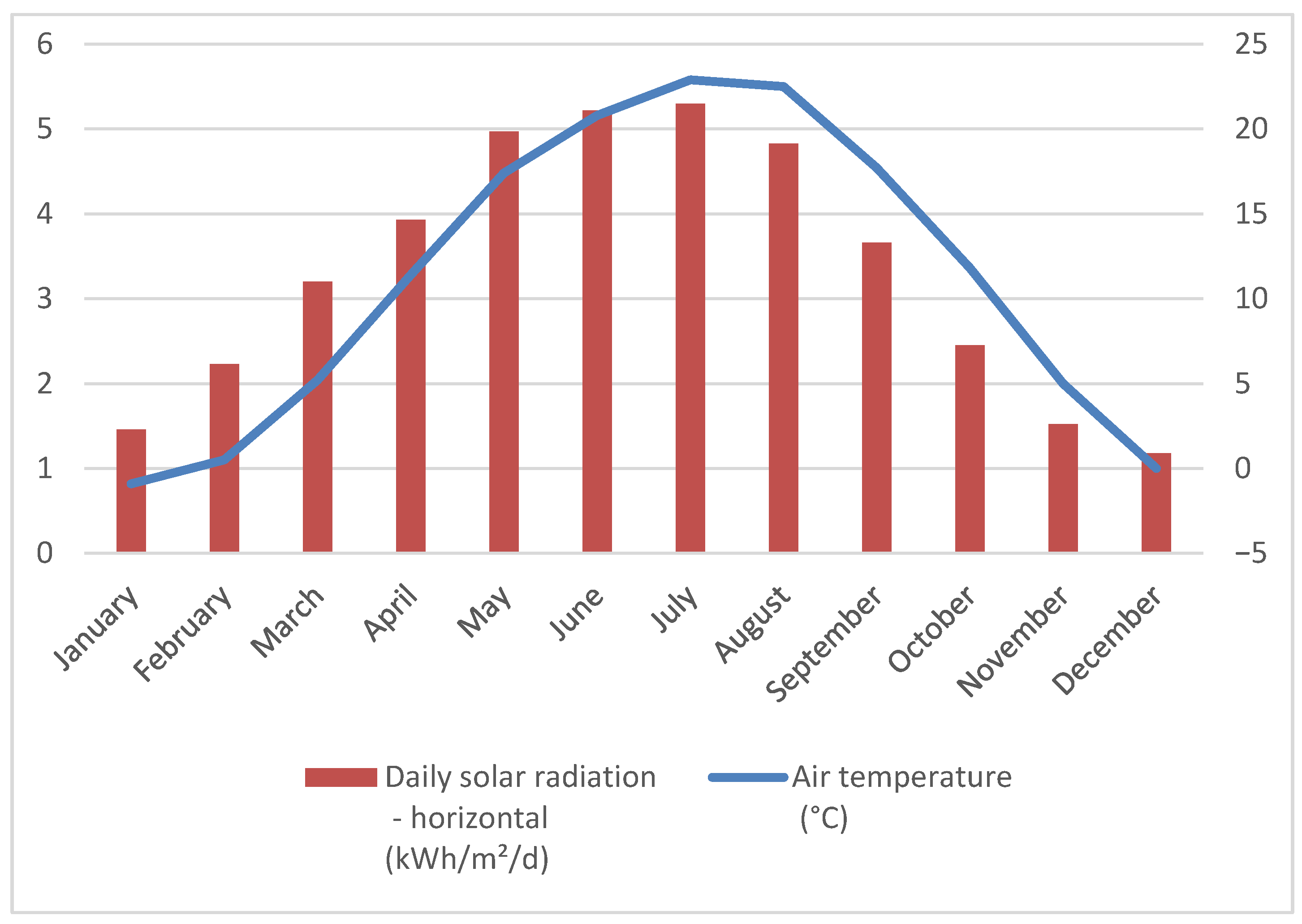
Figure 1 illustrates the monthly variation in the average daily solar radiation on the horizontal surface, correlated with the evolution of air temperature over a calendar year. A gradual increase in solar radiation is observed from the winter months to the summer period, with minimum values below 2 kWh/m
2/day in December–January and maximum values exceeding 5 kWh/m
2/day in June and July. The air temperature shows a similar trend, reaching the highest values in the July–August interval. This evolution has direct implications on the energy performance of photovoltaic systems: although the maximum radiation is recorded in the summer, high temperatures can reduce the electrical conversion efficiency [
30], while the spring months often offer an optimal compromise between intense radiation and moderate temperatures. From the perspective of sizing a photovoltaic park, the seasonal distribution of solar radiation is an important parameter in estimating the annual energy production, in defining the optimal configuration of the panels and in evaluating the technical and economic indicators of the investment. Thus, correct sizing must take into account the significant contrast between high production in the warm season and low production in the November–February period, to ensure both the technical performance and economic viability of the photovoltaic installation.
2.4. Photovoltaic System Modeling in MATLAB/Simulink
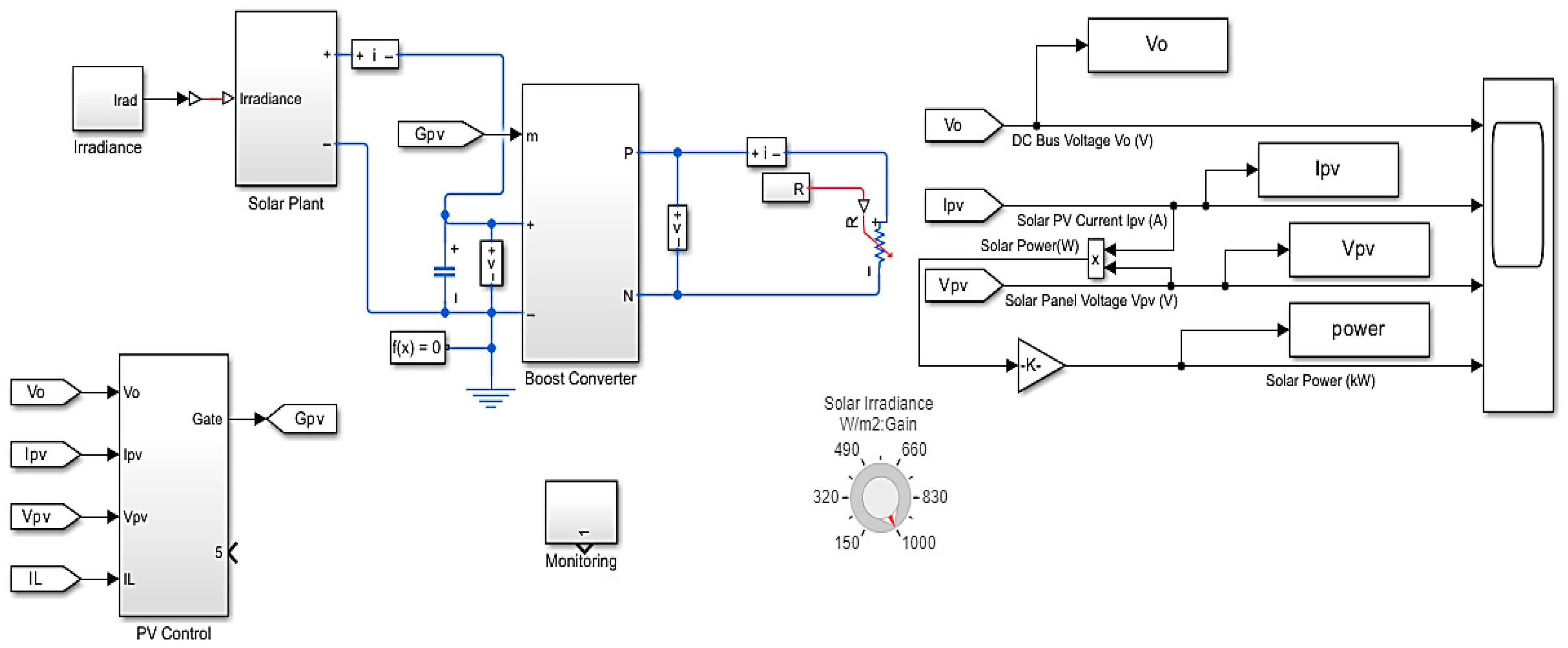
The model developed in MATLAB/Simulink was designed to reproduce the energy behavior of the photovoltaic park as faithfully as possible. The model structure included the following main components: Photovoltaic module model: Implemented based on the single-diode model, including the current–voltage dependence on irradiance and temperature. The panel parameters used in the simulation were taken from the technical data sheets of the modules selected in the sizing stage. MPPT algorithm: A classic algorithm, such as Perturb and Observe, was used to track the maximum power point of the photovoltaic module for various climatic conditions. MPPT modeling allows the evaluation of the energy extraction efficiency depending on the variation in irradiance. DC/DC converter: implemented to reproduce the process of adapting the voltage of the photovoltaic panels to the optimal point established by MPPT. The model does not include voltage or frequency control elements specific to grid interaction. Assumptions and simplifications: The system has been simulated under standard conditions, without including effects such as cable loss, panel degradation, partial shading, or variations in inverter efficiency depending on the load.
Figure 2 illustrates the complete schematic of the photovoltaic model implemented in MATLAB/Simulink, used to simulate the power supply system of the water pumping station. The model includes an irradiance block that provides meteorological data, a photovoltaic generator model that calculates the current and voltage depending on the operating conditions and a boost DC-DC converter (the block in the model has a single transistor + diode + inductance switching cell), controlled by the MPPT Perturb and Observe (P&O) algorithm. The “PV Control” block implements the maximum power point tracking strategy, adjusting the switching duty cycle to maintain operation near the MPP. The system integrates blocks for measuring the voltage, current and power of the photovoltaic panels, as well as a variable electrical load that reproduces the equivalent consumption of the pumping station. The attached graphical interface allows real-time monitoring of the main electrical variables of the system, facilitating the analysis of the dynamic behavior of the photovoltaic panel–converter assembly under variable irradiance conditions.
2.5. Collection and Preprocessing of Real Data from the Photovoltaic Park
To validate the model, real data from the operational photovoltaic park in Ciorasti were used. These include measured values of instantaneous power, voltage and current, along with information on the irradiance and ambient temperature. The data were collected at a sampling interval corresponding to the operational monitoring of the park. Data preprocessing included checking the quality of the records, eliminating outliers, interpolating missing data and temporal alignment of the variables. These procedures were necessary to allow direct comparison between the results obtained in the simulation and the measured ones. The validation of the Simulink model was performed by comparing the simulated production with real data collected for representative periods. The limitation of the simulation duration (30 s) is not determined by the constraints of the available computing capacities, but instead results from the use of a detailed high-frequency switching model, designed for the analysis of transient phenomena and for the evaluation of the stability of control strategies.
2.6. Mathematical Modeling of Photovoltaic System with MPPT and Boost Converter
Mathematical Model of the Solar Panel (PV Array): The photovoltaic system is modeled using the single-diode equivalent circuit, which provides the highest accuracy.
Current-Voltage Characteristic Equation (1) (
). The output current of the
panel is the sum of the photo-generated current
and the losses:
Diode Current Equation (2) (
:
| [A] | Panel output current |
| [A] | Photo-generated current (Photocurrent) |
| [A] | Reverse saturation current of the diode |
| [V] | The voltage at the terminals of the photovoltaic panel |
| | Equivalent series resistance |
| - | Diode ideality factor |
| - | Number of cells connected in series |
| [V] | Cell thermal voltage |
Shunt Resistance Current Equation (3) (
| | Equivalent shunt resistance |
DC-DC Boost Converter model: The boost converter model is essential for system control and is expressed through the equations of state, using the average model (valid for high switching frequencies). Equations of state Equations (4) and (5) (dynamic environment model): These equations describe the time variation of the coil current (
) and the output voltage (
).
| [A] | Instantaneous current through inductance |
| [V] | Instantaneous output voltage (DC bus) |
| [H] | Coil inductance |
| [F] | Output capacitor capacity |
| | |
| - | Duty Cycle, control variable |
| - | Input voltage (photovoltaic panel) |
Steady-state voltage Equation (6):
| - | Represent the average values in the steady state. |
Maximum Power Point Tracking (MPPT) algorithm model—Perturb and Observe (P&O).
Measured parameters and power calculation Equation (7) (Step
):
For status changes Equations (8) and (9):
The control conditions are set according to
Table 2.
In this paper, the simulation of the behavior of the photovoltaic system controlled by the Perturb and Observe algorithm was initiated by a cold-start scenario. This stage assumes that the system starts from zero initial conditions (currents through the coils and voltages on the capacitors are zero or close to zero). This approach is necessary to evaluate the complete dynamic response of the system and the settling time required for the Boost converter and the MPPT algorithm to reach the desired operating point. Standard Test Conditions (STC): The steady-state period was set using constant input conditions strictly defined according to international standards [
31] for testing photovoltaic modules and systems. For the analyzed application, the Perturb and Observe (P&O) MPPT algorithm was chosen due to the favorable balance it offers between robustness, simplicity of implementation and operational reliability, important aspects in photovoltaic systems intended for continuous operation under real conditions. From the point of view of simplicity, P&O is based on an intuitive principle of controlled perturbation of the voltage or the fill factor and observation of the variation in the generated power, without requiring explicit mathematical models of the photovoltaic generator or complex derivative calculations. This feature leads to an easy implementation on microcontrollers with limited resources, reducing both hardware costs and the risk of numerical or programming errors. In terms of robustness, the P&O algorithm maintains its performance in the presence of slow variations in solar irradiation and temperature, as well as in conditions of uncertainty of the photovoltaic panel parameters, which are generated by aging or dirt coverage. Its reliability is supported by the exclusive use of directly measured electrical quantities (voltage and current), without relying on additional sensors or complex calibration steps, making it suitable for long-term operation in industrial or isolated environments. Compared to more advanced MPPT algorithms reported in the recent literature, such as Incremental Conductance or artificial intelligence-based methods (fuzzy logic, neural networks and evolutionary algorithms), P&O presents a slightly inferior energy performance under fast dynamic conditions, manifested by oscillations around the maximum power point or a longer convergence time to sudden variations in irradiance. However, these advanced methods involve significantly higher computational complexity, require precise knowledge or estimation of system parameters and may introduce stability or generalization problems in the absence of a rigorous design and training process. Therefore, in the context pursued, the choice of the P&O algorithm represents a justified solution from an engineering point of view, offering an optimal compromise between performance, robustness and reliability and costs appropriate to applications where simplicity and predictable behavior are prioritized over strict maximization of efficiency in transient regimes. The experimental data presented in this study, including detailed production logs for the period 2023–2025 and simulation model configuration parameters, have been archived and can be made available by the authors upon motivated request. This availability aims to support further research efforts and facilitate the reproduction of the results on energy profile management in on-grid photovoltaic systems for critical infrastructures.
3. Results and Discussion
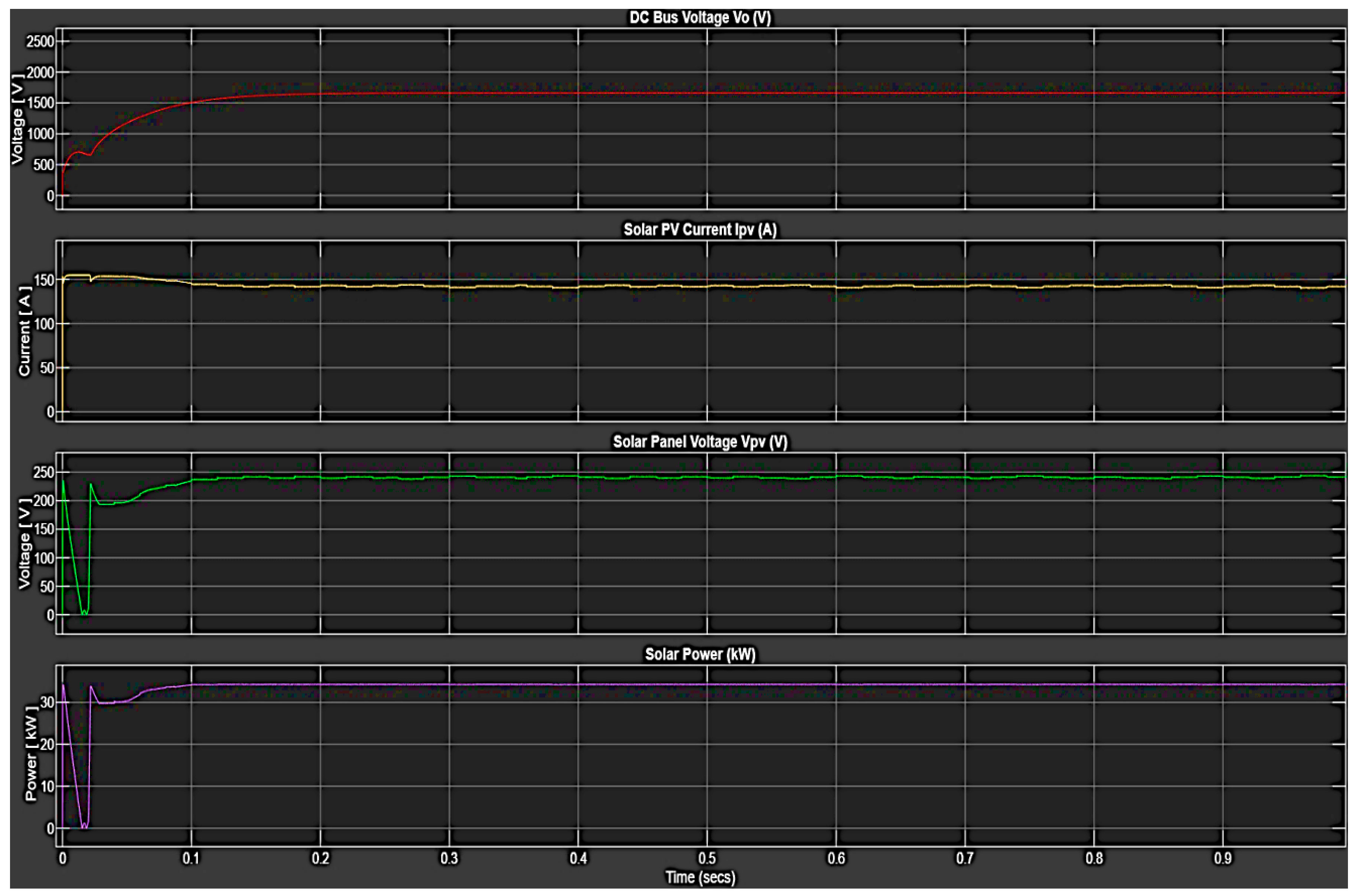
The modeling of the photovoltaic system, sized to power a water pumping station, reveals a dynamic and steady-state performance that is fully aligned with the principles of energy conversion systems engineering. The short simulation time (1 s) is optimal for evaluating the speed of the system response to the given operating conditions. The analysis of the graphs (
Figure 3) confirms the efficient operation of the hardware architecture, which uses a DC-DC Boost Converter for voltage boosting and the control strategy, based on the Perturb and Observe algorithm, as confirmed by the simulation scheme (
Figure 2). In steady-state mode, the system demonstrates excellent maximum power extraction, and the solar power promptly stabilizes at approximately 34 kW [
32].
This power is the result of the rigorous maintenance of the panel voltage
at 235 V and the panel current
at 135 A by the MPPT algorithm. The primary function of the P&O algorithm is to modulate the duty cycle of the Boost Converter, continuously searching for the maximum power point by making small adjustments (perturbations) to the operating voltage and observing its impact on power, and its success is evidenced by the almost perfect agreement between the measured power and the product
. Although the P&O algorithm is inherently susceptible to small oscillations around the Maximum Power Point (MPP), the results indicate a negligible ripple in the steady state, suggesting either a sufficiently fast sampling rate or an optimized perturbation step size to maximize efficiency without sacrificing stability. A critical technical aspect of this architecture is the role of the Boost Converter, which achieves an essential decoupling between the optimal operating requirement of the panel and the supply voltage requirement of the load (the pump inverter). The converter ensures that the voltage on the DC busbars
is raised and maintained at a constant and high value of 1550 V. The simulation performed in MATLAB/Simulink shows a maximum voltage of the photovoltaic string of approximately 1550 V DC; although this voltage seems high, it is technically and economically justified in the specific context of a medium-power, stand-alone photovoltaic park supplying an industrial load (pumping station). It reflects a design decision aimed at optimizing transmission efficiency and meeting the power requirements of the motors, offsetting the cost of high-voltage components through significant energy savings in the long term [
33,
34]. The choice of a voltage of 1550 V reflects an economic and energy optimization in favor of reducing transmission losses and simplifying the overall electrical architecture of the pumping station. However, this benefit is obtained at the expense of the increased cost of high-voltage components, increased insulation complexity and higher demands for safety protocols. The voltage at the terminals (
Figure 3) of the photovoltaic panel exhibits a nonlinear dynamics characteristic of PV systems at start-up. In the initial interval, rapid voltage variations are observed, caused by the converter adaptation and the exploration of the current–voltage characteristic of the panel. Subsequently, the voltage converges to a stable value close to the voltage corresponding to the maximum power point. This evolution confirms the correct operation of the MPPT algorithm and is similar to the results obtained in Simulink simulations reported in the literature, where the photovoltaic voltage is maintained around the maximum power point value to maximize the extracted power [
35]. The dynamics of the system are excellent, with all four key parameters (power, PV voltage, PV current and DC bus voltage) reaching the steady state in less than 0.1 s. This fast transient response and the lack of significant overshoot of the 1550 V voltage demonstrate robust regulation of the DC bus voltage controller and appropriate passive component design, thus validating the system’s ability to quickly handle irradiance or load fluctuations, maintaining a high-quality power supply for the pumping station at all times.
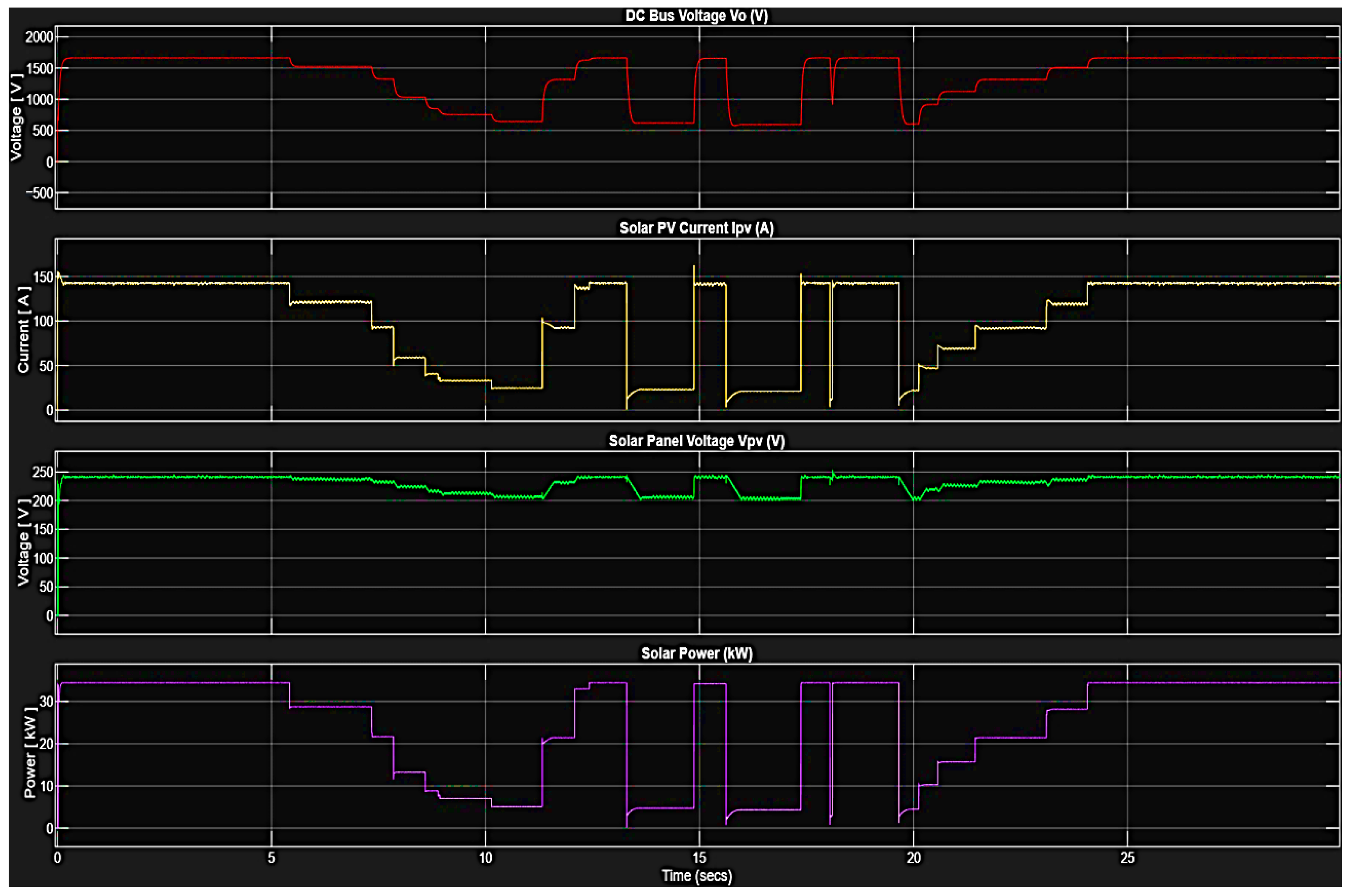
During the simulation (
Figure 4), the DC bus voltage varies between approximately 600 V and 1550 V, depending on the instantaneous power available from the PV array. The sharp drops in the DC voltage (for example, in the intervals of ~6–10 s and ~13–15 s) coincide with significant reductions in the photovoltaic current and power, indicating a temporary energy imbalance between the power supplied by the arrays and the power required by the load/inverter. Physically, the DC bus voltage is determined by the energy stored in the DC-link capacitor, so when the photovoltaic power drops suddenly (due to the reduction in irradiance), the energy extracted from the capacitor increases and the DC voltage drops rapidly. Subsequently, when the irradiance increases, the DC-DC converter again supplies energy to the DC-link capacitor, recharging the capacitor and restoring the voltage. The absence of large amplitude oscillations and the relatively fast return to high DC voltage values indicate stable bus control, with well-chosen time constants and an appropriate compromise between speed and damping. The PV panel current varies between approximately 20 A and 135 A, directly reflecting changes in solar irradiance. During periods of low irradiance (for example ~8–11 s), the current progressively decreases below 50 A, which limits the available power. Sudden increases in current at ~12 s, ~15 s, ~18 s (
Figure 4) indicate rapid changes in irradiance, to which the MPPT algorithm responds by adjusting the equivalent load seen by the panel. Small current ripples around stabilized values are characteristic of Perturb and Observe MPPT algorithms, which introduce controlled variations to maintain operation near the maximum power point. The voltage at the panel terminals is maintained predominantly in the range of 210–235 V, even under variable irradiation conditions. This observation is essential because the voltage corresponding to the maximum power point is weakly dependent on irradiation and more strongly influenced by temperature. Temporary drops in the
voltage (for example, around 200–210 V) occur when the available current is insufficient to simultaneously maintain the voltage and power at the nominal level. At these times, MPPT prioritizes system stability. Maintaining the voltage in a narrow range demonstrates that the system operates on the almost vertical portion of the power–voltage relationship, where small voltage variations produce large power variations, which is specific to operation in the vicinity of the MPP. The power generated by the system varies approximately between 5 kW and 35 kW, faithfully following the solar irradiation profile. The power variations are dominated by the current variations, as the voltage remains relatively constant. Deep power drops (below 10 kW) correspond to situations where the irradiance is low and the photovoltaic current drops below 40 A. Rapid increases towards 30–35 kW indicate a rapid convergence of the MPPT, without long-term oscillations around the maximum power point. The fact that the power stabilizes at each new irradiance level, with low oscillations, confirms the high efficiency of the MPPT algorithm and a good coordination with the DC voltage regulation loop.
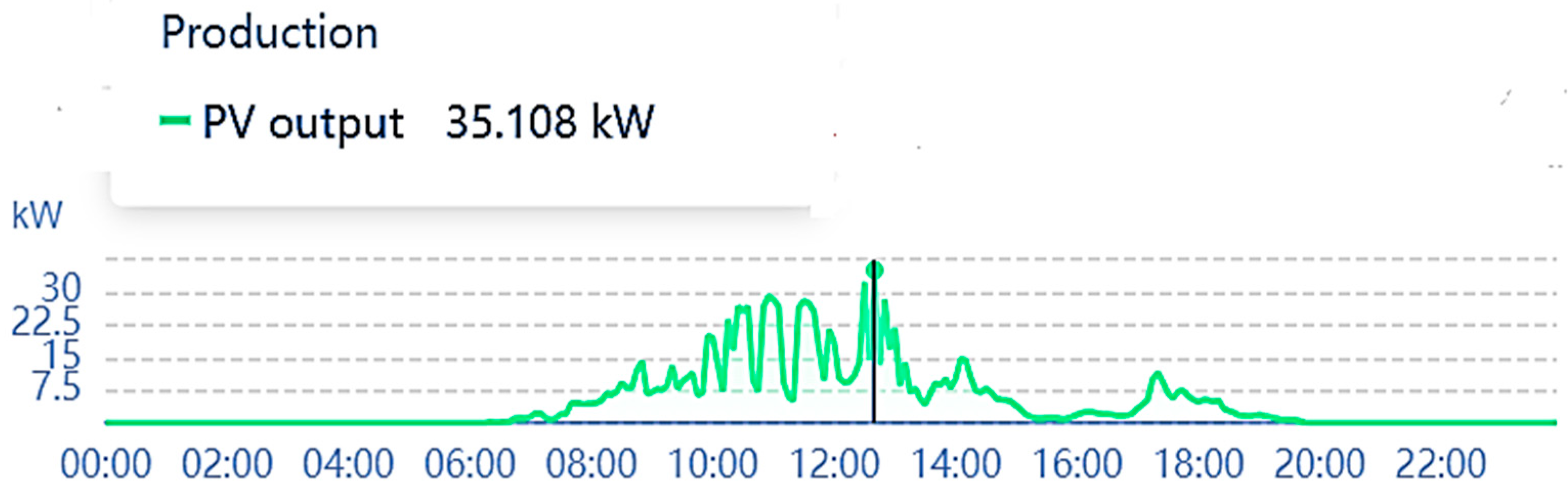
The simulation for this scenario only took into account fluctuations in solar radiation. Meteorological fluctuations are difficult to predict; these results laid the basis for the next step, namely the construction of the photovoltaic park and the validation of this simulation over time by recording the power produced by the park in real operating conditions. The analyzed photovoltaic system is configured for on-grid operation with self-consumption, using the national grid as an energy buffer in the absence of a battery storage system. The entire management of the energy surplus is achieved by converting the direct current from the 1550 V bus into an alternating current through the on-grid inverter, followed by its injection into the electrical grid. This architecture ensures the stability of the pumping station’s power supply, instantly covering any production deficit by importing AC energy from the grid. The generation matrix, composed of 68 photovoltaic panels, is modeled in Simulink as an aggregate assembly (Solar Plant) that delivers energy to a direct current bus (DC bus) through a DC-DC Boost Converter. The model validation is achieved by correlating the results of the dynamic simulation with the experimental data. While the simulation indicates a maximum DC power of approximately 34 kW, the real production graph records a peak of 35 kW (
Figure 5). This agreement (relative error below 3%) validates the correct sizing of the model and demonstrates the ability of the MPPT Perturb and Observe (P&O) algorithm to extract the maximum available power. The operating voltage of the panels (
235 V) remains constant in both scenarios, confirming the stability of the maximum power point regardless of the fluctuations of the generated current (
). The link between the simulated and real dynamic behavior is highlighted in the meteorological stress interval. The 30 s simulation tested the system under sudden variations in irradiance (step shocks), resulting in instabilities of the DC bus at 1550 V. Analogously, the real power profile presents numerous “peaks” and sudden drops between 10:00 and 14:00, a phenomenon caused by the natural variability of irradiance. This qualitative similarity validates the “extreme testing” scenario in the model, demonstrating that the 1550 V bus in the real park is constantly subjected to similar dynamic challenges, which the grid compensates for to ensure the continuous operation of the pumps. A defining aspect of the physical implementation is the absence of an electrical energy storage system (batteries), the entire management of the surplus being performed by direct injection into the electrical grid. This constructive choice eliminates the high maintenance costs and lifetime limitations of batteries, using the public grid as an infinite energy “buffer”. Thus, the stability of the 1550 V DC bus observed in the simulation becomes critical, since any major power fluctuation that is not instantly consumed by the pumps must be immediately managed by the on-grid inverter for injection, thus ensuring the energy balance of the system without the support of a local chemical energy reservoir. In on-grid mode, the high-voltage bus (DC bus) acts as a critical junction point. During periods of maximum solar production (35 kW), the surplus energy unused by the pumps is raised to the grid level via the inverter. In the evening or during times of dense clouds, the power deficit is instantly covered by importing energy from the grid, eliminating the risks associated with the interruption of the pumping process. The simulation results confirm that the chosen architecture ensures high conversion efficiency, while real production data throughout the day validates the robustness of the system and the correctness of the modeled parameters for the entire photovoltaic park.
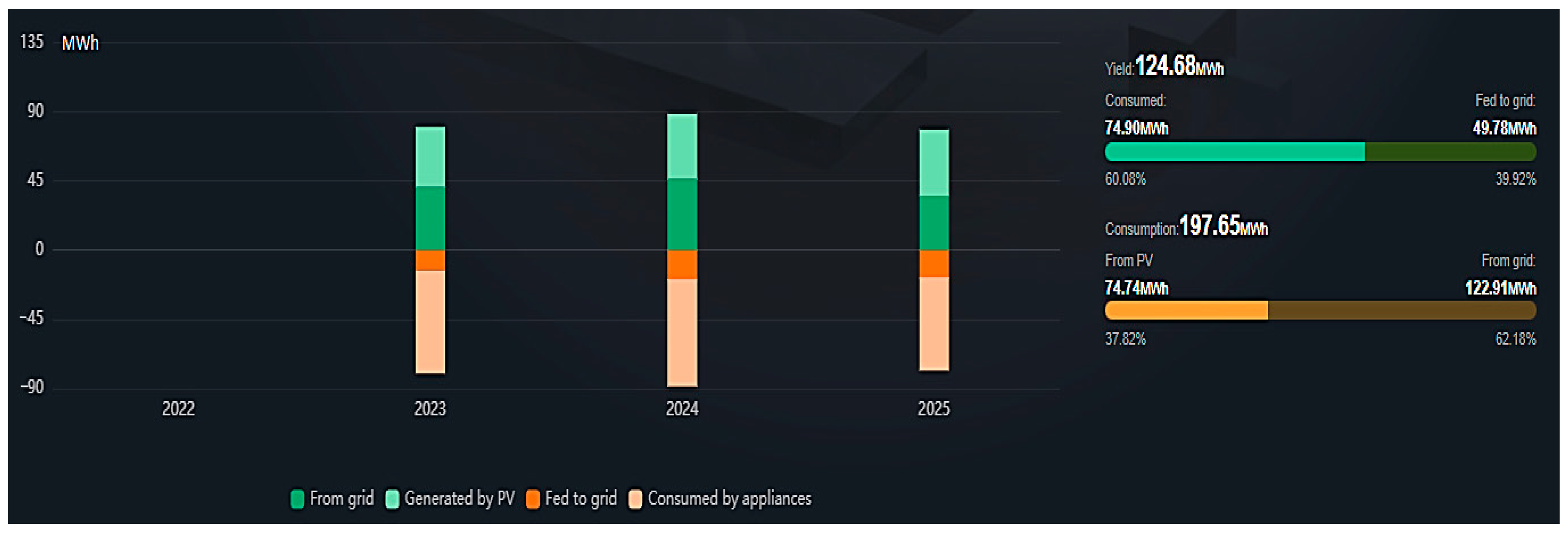
The analysis of the historical operating data of the photovoltaic park during the period 2023–2025 (
Figure 6) confirms the viability of the on-grid system’s sizing with self-consumption, demonstrating a close correlation between the theoretical model and real performance in the field. With a total accumulated production of 124.68 MWh, the system validates the efficiency of the 68 panels and the MPPT algorithm, managing to direct 74.90 MWh (60.08%) of the energy generated for direct self-consumption by the pumping station. Although the total consumption of the objective was 197.65 MWh, the on-grid architecture ensured an energy balance by extracting 122.91 MWh (62.18%) from the electrical grid, with the rest of the needs being covered by self-generation. This distribution justifies the absence of a storage system, with the surplus of 49.78 MWh (39.92%) being injected directly into the grid during periods of maximum irradiation, which confirms the accuracy of the sizing in relation to the consumption profile. The consistency of the annual production observed in the historical graph and the achievement of the peak threshold of 35 kW recorded in the daily data validate the simulation model made in Simulink, demonstrating that the system is optimized to maximize energy efficiency and supply stability in industrial mode.
Although the present study is mainly oriented towards the engineering validation of a real photovoltaic system and does not include a formal parametric sensitivity analysis, the results obtained allow the formulation of relevant conclusions regarding the robustness of the system in relation to variations in the main operating parameters. The analysis of transient simulations and multi-year experimental data highlights the fact that solar irradiation, the current generated by photovoltaic panels and the DC bus voltage are the variables with a direct impact on the energy performance and stability of the system. Variations in solar irradiation in realistic intervals corresponding to local meteorological conditions determine significant changes in the current supplied by the panels, but the voltage at the maximum power point level remains stable due to the operation of the MPPT algorithm. This behavior is confirmed both in dynamic simulations and in real system operation. At the DC bus level, the temporary voltage fluctuations observed under conditions of rapid irradiance variation are effectively damped, without the appearance of persistent instabilities, which indicates an adequate dimensioning of the DC-DC converter and the associated passive elements. Correlating these observations with the long-term energy balance suggests that variations in the main parameters, within the limits encountered in real operation, do not significantly affect the overall performance of the system, supporting the robustness of the analyzed solution.