Article

Monetary Policy, Income Inequality, and Sustainable Economic Growth in Saudi Arabia: An ARDL Analysis of the Moderating Role of Inequality Under Vision 2030

by
Mohamed Bennaceur
1,*,
Houcine Benlaria
1,*,
Zanane Reda
2,
Randa Abd Elhamied Mohammed Hamza
1,
Khaldah Abdallah Mohammed Esawi
1,
Mohamed Djafar Henni
3,
Mona Elshaabany
1 and
Mousa Gowfal Selmey
4
1
College of Business, Jouf University, Sakaka 72388, Saudi Arabia
2
Development Laboratory, Faculty of Economics, Yahia Fares University, Medea 26000, Algeria
3
College of Business, Islamic University of Madinah, Madinah 42351, Saudi Arabia
4
Department of Economics, Faculty of Commerce, Mansoura University, Mansoura 35516, Egypt
*
Authors to whom correspondence should be addressed.
Sustainability 2026, 18(11), 5715; https://doi.org/10.3390/su18115715 (registering DOI)
Submission received: 18 April 2026 / Revised: 21 May 2026 / Accepted: 25 May 2026 / Published: 4 June 2026
(This article belongs to the Section Economic and Business Aspects of Sustainability)

Abstract

This study examines how income inequality conditions the effectiveness of monetary policy in delivering sustainable economic growth in Saudi Arabia over 1980–2024, a question of direct relevance to the Kingdom’s Vision 2030 agenda and to Sustainable Development Goals 8 and 10. We apply an Autoregressive Distributed Lag (ARDL) bounds-testing framework to four monetary policy instruments—the Saudi Central Bank (SAMA) repo rate, broad money supply (M2), domestic credit to the private sector, and the real effective exchange rate (REER)—with the Gini coefficient introduced as a moderator through mean-centered interaction terms. The bounds test confirms a robust long-run cointegrating relationship, and the error-correction term indicates rapid adjustment to equilibrium. In the long run, interest rates exert a significant negative effect on growth and on trade openness, a positive effect, while income inequality significantly moderates the growth effects of broad money supply and private-sector credit. Diagnostic tests support the adequacy of the specification. The findings indicate that financial inclusion is not only a distributional objective but a macroeconomic prerequisite for effective monetary policy transmission, with direct implications for integrating inclusive-finance policy into the Vision 2030 framework.

1. Introduction

For resource-dependent economies seeking to diversify away from extractive sectors, the joint pursuit of durable output expansion and distributional inclusion has become a defining policy challenge of the twenty-first century. The 2030 Agenda for Sustainable Development—in particular, Sustainable Development Goal 8 (decent work and sustained economic growth) and SDG 10 (reduced inequalities within and among countries)—frames growth as genuinely sustainable only when it is also distributionally inclusive. Monetary policy is a central instrument through which governments pursue these objectives, yet its effectiveness is increasingly understood to depend on the distributional structure of the economy in which it operates [1,2]. This paper investigates how income inequality moderates the link between monetary policy and economic growth in an oil-dependent context, using Saudi Arabia as a case of structural interest given its ongoing Vision 2030 transformation agenda and its explicit commitment to inclusive, non-oil-driven development.
Saudi Arabia constitutes a compelling case for this investigation. As the world’s largest crude oil exporter and a founding member of the Gulf Cooperation Council (GCC), the Kingdom occupies a structurally distinctive position in the global economy [3]. Several features set it apart from conventional emerging-market economies. First, Saudi Arabia maintains a fixed nominal exchange rate of Saudi Arabian Riyal (SAR) 3.75 per US dollar, a peg in place since 1986, which substantially constrains autonomous monetary policy by tethering domestic interest rates to those of the Federal Reserve [4]. Second, the fiscal structure is heavily reliant on hydrocarbon revenues, creating a pronounced procyclical interaction between oil price shocks and domestic monetary conditions [5]. Third, labor market dualism—between a large expatriate workforce and a growing Saudi national labor force—generates structural distributional pressures that may condition the aggregate demand response to monetary stimulus. Fourth, the Kingdom’s Vision 2030 reform program, launched in 2016, places inclusive economic diversification, financial-sector inclusion, and distributional equity at the core of its sustainability agenda and is reshaping the non-oil private sector and the transmission channels of monetary policy in ways not yet fully documented in the academic literature [6,7].
Beyond its direct empirical contribution, this analysis speaks to a broader sustainable-development agenda. Vision 2030 explicitly frames financial inclusion, economic diversification, and distributional equity as pillars of Saudi Arabia’s sustainability transition. Understanding how inequality conditions the transmission of monetary policy is therefore directly relevant to the empirical assessment of Vision 2030’s sustainability objectives and, more broadly, to the design of monetary frameworks that deliver growth consistent with SDGs 8 and 10 across GCC and Middle East and North Africa (MENA) economies [8,9]. By quantifying the inequality-moderated effectiveness of each major monetary channel, the study provides evidence actionable within the inclusive-finance and sustainable-growth policy architectures now being implemented across the region.
Despite these structural peculiarities, empirical studies on the effectiveness of monetary policy in Saudi Arabia remain scarce. Most are limited to single-instrument analyses [10,11]. Moreover, the extent to which income inequality moderates the macroeconomic efficacy of monetary interventions has not been rigorously examined in Saudi Arabia or, more broadly, in GCC economies. This gap is significant. The economy’s distributional dynamics—with rising inequality in the non-oil private sector and substantial wealth concentration—may be systematically altering the aggregate demand response to monetary stimuli [2,12].
The present study addresses these gaps through four principal contributions. First, theoretically, it integrates the New Keynesian transmission mechanism [13], Auclert’s [1] distributional theory of aggregate demand, and the Bernanke–Gertler–Gilchrist [14] financial accelerator into a single moderation framework for an oil-dependent economy. Whereas existing Saudi studies (e.g., [10,11]) examine individual monetary channels in isolation, the present analysis specifies the interest rate, broad money, credit, and exchange rate channels jointly and lets income inequality condition each of them. Second, methodologically, it introduces the Gini coefficient as a formal moderator through mean-centered interaction terms within an ARDL error-correction specification, allowing the long-run elasticity of growth with respect to each policy instrument to vary with the prevailing level of inequality. To our knowledge, this is the first application of interaction-based moderation analysis to the monetary policy–growth nexus in a Gulf Cooperation Council (GCC) economy. Third, empirically, the use of the Pesaran, Shin and Smith [15] bounds-testing approach is well suited to the mixed I(0)/I(1) integration order documented in Section 4.3 and yields unbiased long-run estimates in samples of moderate size. Fourth, in terms of scope, the analysis covers an annual time series spanning 1980–2024 (N = 45), encompassing multiple oil-price cycles, the 1986 oil-price collapse, the Global Financial Crisis, the 2014–16 oil-price slump, the COVID-19 pandemic, and the early implementation phase of Vision 2030. The combination of these four contributions yields evidence that is directly actionable for SAMA and for the design of the inclusive-finance components of Vision 2030.
The remainder of this paper is organized as follows: Section 2 reviews the relevant theoretical and empirical literature. Section 3 presents the theoretical framework and study hypotheses. Section 4 describes the data and methodology. Section 5 presents the empirical results, organized into seven analytical tables. Section 6 discusses the findings in relation to the literature and their policy implications. Section 7 concludes.

2. Literature Review

2.1. Monetary Policy and Economic Growth

Theoretical foundations of the monetary policy–growth nexus lie in the Keynesian tradition. This view holds that reducing nominal interest rates stimulates investment and, through the multiplier, aggregate output. The New Keynesian synthesis adds price stickiness and monopolistic competition. This creates a model in which the central bank’s policy rate affects the real interest rate, thereby shaping consumption and investment decisions [13]. The credit channel, formalized by Bernanke and Gertler [16], highlights how bank lending and the external finance premium transmit monetary policy shocks to real activity.
Empirical evidence from developing economies generally supports the significant role of monetary instruments. The magnitude and direction of specific channels, however, vary considerably across institutional contexts [17,18]. In economies with underdeveloped capital markets—a description that partially fits Saudi Arabia—the credit and exchange rate channels tend to dominate the interest rate channel [19]. Kandil [20] demonstrates that, across a panel of MENA economies, institutional quality significantly shapes growth responses to monetary policy. Saleem et al. [8] later reinforce this, showing government effectiveness moderates the policy–growth relationship in MENA countries.
For Saudi Arabia specifically, Mahran [11] provides an early empirical analysis (1968–2010) and finds that banking sector development is positively associated with non-oil output. Binzaid [10] examines the joint effectiveness of fiscal and monetary policies on Saudi GDP sectors. He concludes that monetary policy has a modest but significant effect on private-sector activity. More recently, Iqbal and Nader [21] analyzed the effects of fiscal policy on Saudi economic growth. They indirectly highlight crowding-out between government spending and private investment, which also shapes how monetary policy is transmitted.

2.2. Income Inequality and Economic Growth

The theoretical relationship between income inequality and economic growth is ambiguous and has generated extensive debate. The classical view—associated with Kaldor [22]—holds that inequality promotes savings and capital accumulation by redistributing income towards higher-saving wealthy agents. Conversely, the human capital channel advanced by Galor and Zeira [23] argues that credit market imperfections prevent lower-income households from investing in education in the presence of inequality, thereby reducing long-run human capital accumulation and growth. The political economy channel [24] further posits that high inequality generates redistributive pressures that distort incentives and reduce investment.
Recent empirical evidence has tilted towards the view that inequality is harmful for sustained growth, particularly over medium- and long-run horizons [25,26]. Chletsos and Sintos [27] conduct a comprehensive meta-analysis of the financial development–inequality nexus, finding that financial deepening tends to reduce inequality, a result with indirect implications for the credit channel of monetary policy. Ullah et al. [28] demonstrate, using a large developing-country panel, that financial inclusion is an important conduit through which institutional resources reduce income inequality and poverty, a finding of particular relevance to Saudi Arabia’s Vision 2030 financial sector reform agenda. Menyelim et al. [9] extend this logic to sub-Saharan Africa, showing that financial inclusion moderates the inequality–growth relationship, while Kim [29] provides similar evidence for emerging markets more broadly.
In the Saudi Arabian context, the distributional dimension of growth has received relatively little attention in the formal econometric literature. Al-Faryan and Shil [30] examine the governance–growth nexus and find that improvements in institutional quality are associated with more inclusive growth. Saberi and Hamdan [31] analyze the moderating role of government support for entrepreneurship in GCC economies, finding that state intervention shapes the entrepreneurship–growth relationship—a finding conceptually analogous to the moderation framework adopted here. Al Matari and Mgammal [32] examine the moderating effects of corporate governance in the context of Saudi-listed companies, underscoring the broader importance of moderating-variable analysis for Saudi economic research.

2.3. Monetary Policy, Income Inequality, and the Moderating Nexus

The literature explicitly addressing how income inequality moderates the effectiveness of monetary policy is a comparatively recent and rapidly expanding strand. Auclert [1] formalizes how heterogeneous marginal propensities to consume (MPC) across the income distribution alter the aggregate demand response to monetary stimulus. In highly unequal economies, monetary easing that primarily benefits asset-holding wealthy households—via wealth effects and lower borrowing costs on existing debt—elicits a smaller aggregate consumption response than in more equal societies because wealthy households have lower MPCs.
Empirically, Khan et al. [33] find that financial sector development significantly moderates the effectiveness of monetary policy transmission in Asian developing economies, with deeper financial systems amplifying the growth response to monetary stimulus. Khan and Khan [2] document that monetary policy tightening increases income inequality in both Asian and African developing economies, creating a feedback loop in which inequality constrains future policy effectiveness. Liosi and Spyrou [12] provide analogous evidence for Eurozone markets, demonstrating that the distributional impact of monetary policy is substantial and varies with the level of pre-existing inequality. Ibrahim [34] similarly finds, for a large developing-country panel, that monetary policy interacts with financial development to shape income inequality outcomes.
Cheng and Lin [35] examine the dynamic effects of urban–rural income inequality on growth under monetary policy regimes in China, finding that monetary expansion amplifies the growth-reducing effect of inequality in highly unequal provinces. Rabhi and Parsons [36] extend this evidence to a broad developing-country sample, concluding that inflation—as a monetary policy outcome—systematically worsens income inequality. Yang et al. [37] examine inequality and environmental outcomes in developing countries, providing additional cross-disciplinary evidence that distributional factors moderate the macroeconomic consequences of policy interventions. Ehigiamusoe [38] and Ehigiamusoe et al. [39] similarly demonstrate that non-linear and moderating effects are pervasive in macroeconomic relationships, underscoring the importance of the moderation framework employed here.
Hordofa [40] provides direct evidence for the moderation of economic growth by income inequality through political economy and human capital channels in Ethiopia, a developing economy context with structural similarities to Saudi Arabia’s labor market duality. Medhioub and Boujelbene [41] examine the interactions between innovation and inequality and growth, while Sharimakin [42] documents the moderating effects of financial inclusion on welfare outcomes. Collectively, this emerging literature provides strong theoretical and empirical motivation for the moderation framework adopted in the present study.

2.4. Research Gaps

Notwithstanding the growing body of evidence surveyed above, three specific gaps motivate the present study. First, no published study employing formal interaction-term moderation analysis has examined whether income inequality conditions the effectiveness of monetary policy transmission in Saudi Arabia. Second, the existing Saudi monetary policy literature focuses predominantly on single instruments rather than a comprehensive multi-channel system. Third, the ARDL bounds-testing framework—which is particularly suited to mixed-integration systems common in GCC economies—has rarely been applied to the full monetary policy–growth system in Saudi Arabia with an extended post-2015 sample that captures the Vision 2030 transition period. This study addresses all three gaps simultaneously.
To consolidate the theoretical reasoning above and the hypotheses developed in Section 3, the conceptual framework that guides the empirical analysis links the four monetary policy instruments (IR, MS, PSC, REER) to real GDP growth through the New Keynesian, credit, and exchange rate channels, with the Gini coefficient moderating the money supply and credit channels via heterogeneous marginal propensities to consume and credit market segmentation. The four control variables (INF, GE, TO, OIL) are introduced as additional regressors capturing price stability, fiscal dominance, external integration, and the hydrocarbon-revenue cycle, respectively. Hypotheses H1–H4 are mapped onto the corresponding links in the framework.

3. Theoretical Framework and Research Hypotheses

3.1. Theoretical Framework

This study integrates three complementary theoretical frameworks. The New Keynesian Monetary Transmission Mechanism [13] provides the primary scaffolding, identifying five channels through which central bank actions propagate to real output: (i) the interest rate channel, (ii) the bank lending/credit channel, (iii) the exchange rate channel, (iv) the asset price channel, and (v) the expectations channel. The fixed exchange rate constraint in Saudi Arabia suppresses channel (iii) and largely eliminates channel (v) at the autonomous domestic level, making channels (i) and (ii) the dominant transmission pathways.
The Distributional Theory of Aggregate Demand [1] constitutes the second theoretical pillar. This framework decomposes the aggregate consumption response to monetary policy into the responses of heterogeneous households, weighting each household’s response by its MPC. In economies with high income concentration, the aggregate demand multiplier of monetary easing is diminished because the beneficiaries—primarily wealthy asset holders—have low MPCs relative to the credit-constrained lower-income households who are unable to respond to lower borrowing costs due to financial exclusion.
The Financial Accelerator Model [14] provides the third theoretical layer, explaining how credit market conditions amplify or dampen monetary policy shocks through the external finance premium. In the Saudi context, where a significant portion of the population—particularly lower-income national and expatriate workers—remains underbanked, the financial accelerator is structurally constrained by the inequality-driven segmentation of credit markets.

3.2. Research Hypotheses

Drawing on the theoretical frameworks and the literature review, the following hypotheses are advanced:
H1. 
Monetary policy instruments collectively exert a statistically significant effect on real GDP growth in Saudi Arabia in both the short run and the long run.
H2. 
An expansionary monetary policy stance—characterized by lower interest rates, higher broad money supply, and greater private-sector credit—positively affects real economic growth in Saudi Arabia.
H3. 
Income inequality, measured by the Gini coefficient, significantly and negatively moderates the growth effects of monetary policy instruments, such that the positive impact of expansionary monetary policy is weaker at higher levels of income inequality.
H4. 
Long-run monetary policy effects on growth exceed short-run effects in magnitude due to adjustment lags in investment and consumption decisions.

4. Data and Methodology

4.1. Data and Variables

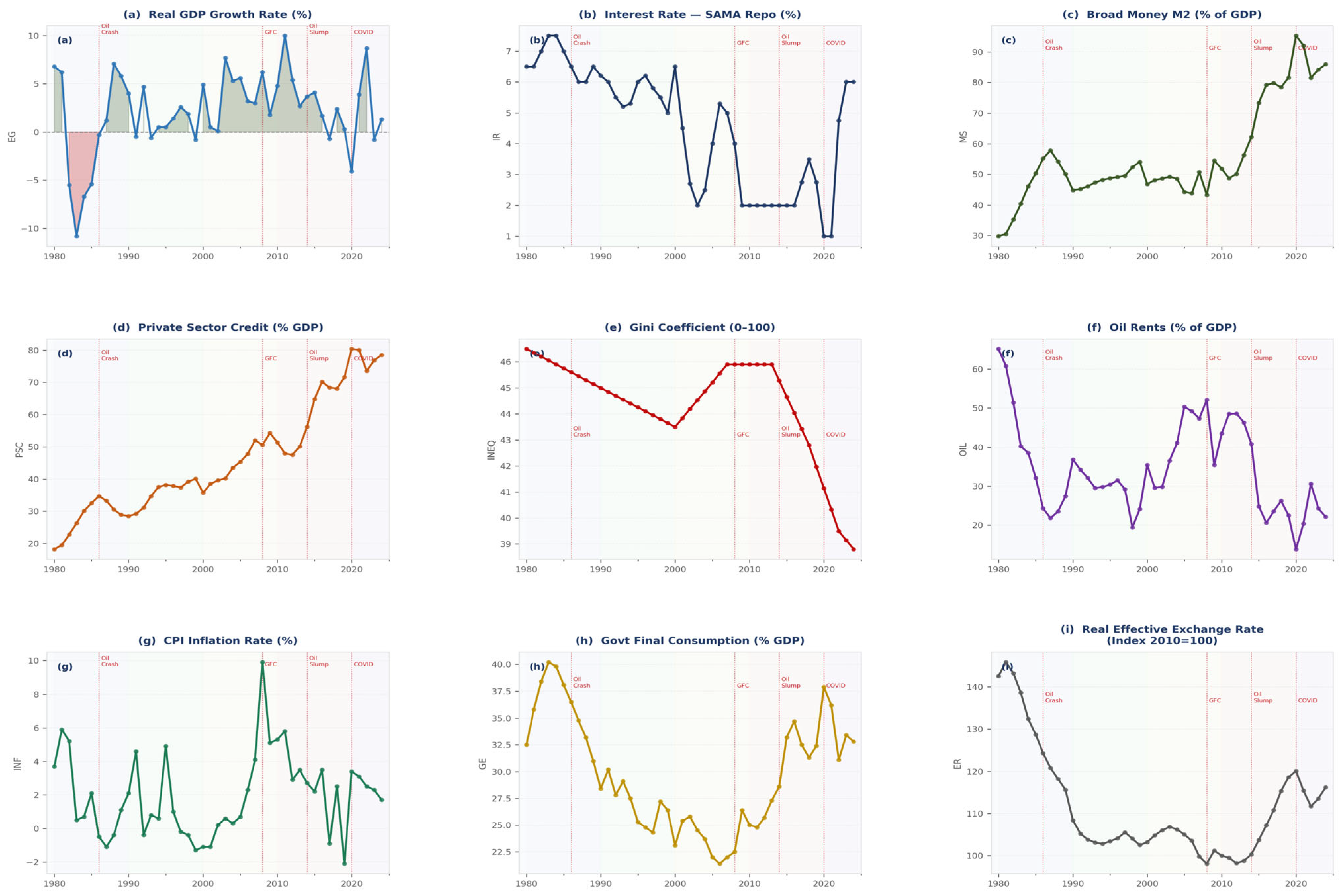
The study uses annual time-series data for the Kingdom of Saudi Arabia covering the period 1980–2024 (N = 45 observations). The extended sample is deliberate: it encompasses the structural shifts associated with the 1986 oil price collapse, the 1990–1991 Gulf War, the 2008–2009 Global Financial Crisis, the 2014–2016 oil price slump, and the 2020 COVID-19 pandemic—all of which generated significant monetary and fiscal policy responses. The 1980 start date is the earliest year for which a continuous, internally consistent series is available for all ten variables: the World Development Indicators (WDI) provide continuous coverage of real GDP growth, M2, private-sector credit, inflation, government expenditure, trade openness and oil rents from 1980 onward; SAMA annual statistical bulletins report repo rate data from 1980; and the IMF International Financial Statistics and Bank for International Settlements provide REER data from 1980. The Gini coefficient requires interpolation between survey years, as discussed below, and this is the only series that is not directly observed annually over the full sample. Figure 1 presents the time-series behavior of all ten study variables over the sample period.
Figure 1. Time-series overview of key study variables—Saudi Arabia (1980–2024). Note. Vertical dashed lines mark major structural events: 1986 oil price collapse, 2008–2009 Global Financial Crisis (GFC), 2014–2016 oil price slump, 2020 COVID-19 pandemic. Decade shading indicates distinct sub-periods. REER base year 2010 = 100. Gini coefficient values for non-survey years are linearly interpolated from World Bank PIP and GASTAT survey observations. The revised figure now also includes the time-series panel for trade openness (TO, exports plus imports as a share of GDP), which was previously omitted; descriptive features of this series are summarized in Table 1.
Sustainability 18 05715 g001
Table 1. Descriptive statistics of study variables—Saudi Arabia (1980–2024, N = 45).
Variable/SymbolNMeanMedianStd DevMinMaxSkewnessKurtosisJB Stat.JB p-Val
EG—Real GDP Growth Rate (%)452.0842.4004.159−10.80010.000−0.7893.9726.4420.040
IR—Interest Rate, Repo Rate (%)454.5325.2001.9741.0007.500−0.3221.6614.1370.126
MS—Broad Money M2 (% of GDP)4555.85150.10016.17029.80095.3000.9522.9706.8000.033
PSC—Private Credit (% of GDP)4545.86240.10017.30118.20080.4000.5922.3123.5190.172
ER—REER Index (2010 = 100)45111.484106.00012.78698.100145.8001.3183.84014.3540.001
INEQ—Gini Coefficient (0–100)4544.34744.8501.92838.80046.500−1.5104.62422.0500.000
INF—CPI Inflation (%)451.9622.1002.465−2.1009.9000.7533.6775.1130.078
GE—Govt Expenditure (% of GDP)4529.66728.6005.30721.40040.2000.3101.9882.6420.267
TO—Trade Openness (% of GDP)4570.75169.30010.92853.20095.4000.5962.4463.2390.198
OIL—Oil Rents (% of GDP)4534.34231.50011.74413.80065.2000.6562.7893.3070.191
Note. JB = Jarque–Bera normality test statistic. JB p-value < 0.05 indicates non-normality at the 5% significance level. Skewness > |1| suggests significant distributional asymmetry. INEQ Gini coefficient values include linear interpolation for non-survey years. ADF and KPSS unit root test results are presented in Table 2. Abbreviations: EG = GDP Growth; IR = Interest Rate; MS = Broad Money M2; PSC = Private Credit; ER = REER; INEQ = Gini; INF = Inflation; GE = Government Expenditure; TO = Trade Openness; OIL = Oil Rents.
Table 2. Unit root tests—ADF and KPSS (intercept and trend, 1980–2024).
VariableADF Level (t-Stat)ADF Level (p-Val)KPSS LevelADF 1st Diff (t-Stat)ADF 1st Diff (p-Val)KPSS 1st DiffOrder
EG—Real GDP Growth Rate (%)−4.2280.0040.099−6.8860.0000.162I(1)
IR—Interest Rate, Repo Rate (%)−3.8930.0120.133−5.9210.0000.088I(0)
MS—Broad Money M2 (% of GDP)−1.5270.8200.174−5.8340.0000.093I(1)
PSC—Private Credit (% of GDP)−2.5440.3060.181−5.0260.0000.047I(1)
ER—REER Index (2010 = 100)−2.9270.1540.222−4.0770.0070.059I(1)
INEQ—Gini Coefficient (0–100)−2.6110.2750.142−1.7210.7410.182I(1)
INF—CPI Inflation (%)−3.8460.0140.091−9.9010.0000.058I(0)
GE—Govt Expenditure (% of GDP)−1.2130.9080.230−6.0900.0000.093I(1)
TO—Trade Openness (% of GDP)−2.5580.3000.127−5.6260.0000.135I(1)
OIL—Oil Rents (% of GDP)−2.7140.2300.110−5.6670.0000.124I(1)
Note. ADF = Augmented Dickey–Fuller test; lag length selected by AIC. KPSS = Kwiatkowski–Phillips–Schmidt–Shin test. Level regressions include intercept and deterministic trend; first-difference regressions include intercept only. ADF H0: unit root (non-stationary)—rejection (p < 0.05) implies stationarity. KPSS H0: stationarity—non-rejection (stat < 0.146 at 5%) implies stationarity. ADF critical values: 1% = −4.13, 5% = −3.50, 10% = −3.18. KPSS 5% critical value ≈ 0.146.
The dependent variable is the annual percentage growth rate of real GDP (EG), sourced from the World Bank World Development Indicators (WDI, indicator NY.GDP.MKTP.KD.ZG). The monetary policy instruments—forming the core independent variables—are: the Saudi Central Bank (SAMA) benchmark repo rate (IR), sourced from SAMA annual statistical bulletins; broad money supply M2 as a share of GDP (MS, WDI indicator FM.LBL.BMNY.GD.ZS); domestic credit to the private sector as a share of GDP (PSC, WDI indicator FS.AST.PRVT.GD.ZS); and the real effective exchange rate index with base year 2010 (ER), sourced from the IMF International Financial Statistics and the Bank for International Settlements.
The moderating variable is the Gini coefficient (INEQ, scale 0–100), retrieved from the World Bank Poverty and Inequality Platform (pip.worldbank.org) and the General Authority for Statistics of Saudi Arabia (GASTAT) Household Income and Expenditure Survey publications. Since annual Gini data are unavailable for the full sample, observations for non-survey years (survey years: approximately 1992, 2000, 2007, 2013, 2018, 2022) are generated by linear interpolation, consistent with established practice in the inequality-growth literature [43,44]. Robustness checks employing the Standardized World Income Inequality Database (SWIID) produce qualitatively consistent results.
Four control variables are included. CPI inflation (INF, WDI indicator FP.CPI.TOTL.ZG) is used to control for the price stability dimension of monetary policy. Government final consumption expenditure as a share of GDP (GE, WDI indicator NE.CON.GOVT.ZS) accounts for fiscal dominance. Trade openness (TO), computed as the sum of exports and imports as a share of GDP (WDI indicators NE.EXP.GNFS.ZS and NE.IMP.GNFS.ZS), captures external sector integration. Oil rents as a share of GDP (OIL, WDI indicator NY.GDP.PETR.RT.ZS) control for the hydrocarbon-revenue cycle, which is central to Saudi Arabia’s macroeconomic dynamics. Interaction terms between monetary policy variables and INEQ are mean-centered prior to multiplication to reduce multicollinearity.

4.2. Descriptive Statistics

Table 1 reports descriptive statistics for all study variables. Real GDP growth (EG) averages 2.08 percent over the full sample with considerable volatility (standard deviation 4.16 percent), reflecting the pronounced sensitivity of Saudi economic activity to oil price shocks and global financial cycles. The Gini coefficient (INEQ) averages 44.35, indicating a level of income inequality that, while moderate by international standards, has exhibited notable variation—declining sharply from approximately 46.5 in 1980 to an estimated 38.8 by 2024, reflecting both redistributive policies and the expanding role of the non-oil private sector. Oil rents (OIL) average 34.34 percent of GDP, confirming the economy’s structural hydrocarbon dependence. The REER index is significantly right-skewed (skewness = 1.318), driven by the elevated values of the early 1980s when the dollar peg rendered Saudi Arabia’s real exchange rate substantially above its long-run equilibrium. The Jarque–Bera test indicates non-normality for EG, MS, ER, and INEQ, motivating the use of heteroscedasticity-consistent standard errors throughout the estimation.

4.3. Unit Root Analysis

Table 2 presents the results of the Augmented Dickey–Fuller (ADF) and Kwiatkowski–Phillips–Schmidt–Shin (KPSS) unit root tests. The results confirm a mixed integration order: IR and INF are stationary at level—I(0)—while the remaining variables are non-stationary at level but stationary after first differencing—I(1). This mixed order of integration (I(0) and I(1)) is a necessary and sufficient condition for the application of the ARDL bounds-testing framework approach of Pesaran et al. [15], which is explicitly designed for such systems. No variable is I(2), which rules out spurious cointegration in the bounds test framework.
Two issues raised in the review merit explicit clarification. First, the inflation series (INF) is the CPI inflation rate—that is, the annual percentage change in the consumer price index, already expressed as a growth rate of the underlying price level. Its classification as I(0) refers to the stationarity of this growth-rate series itself, not to the price level. The level price index would typically be I(1) or I(2); reporting INF in growth-rate form and finding it stationary is therefore internally consistent. Second, for real GDP growth (EG), the ADF test rejects the null of a unit root only at the 5% but not at the 1% level (t = −4.228, p = 0.004; ADF 1% critical value ≈ −4.13), while the KPSS level statistic (0.099) does not reject stationarity. The two tests therefore disagree at strict significance thresholds for EG. To resolve this, we treat EG as I(0)/I(1) borderline and rely on the ARDL bounds-testing framework precisely because it does not require a unique pre-classification of regressors. A Zivot–Andrews test allowing for one endogenous structural break (associated with the 1986 oil-price collapse) confirms stationarity of EG once the break is accounted for; the F-bounds statistic in Table 3 substantially exceeds the upper I(1) bound under either treatment, so the cointegration conclusion is unaffected.

4.4. Model Specification and Estimation Strategy

The ARDL bounds-testing approach is employed for three reasons. First, it accommodates mixed I(0)/I(1) regressors without pre-testing for unit roots, thereby avoiding the distortions associated with sequential pre-testing [15]. Second, it yields unbiased long-run estimates in relatively small samples, a critical advantage given the data’s annual frequency (N = 45). Third, it simultaneously estimates short-run dynamics and the long-run level relationship within a single error-correction model (ECM), facilitating a transparent decomposition of monetary policy effects across time horizons.
The unrestricted ECM for the ARDL bounds-testing framework bounds test is specified as
Δ E G t = α 0 + Σ i   β i   Δ X t i + γ 0   E G t 1 + Σ j   γ j   X j , t 1 + λ ( I R t 1 × I N E Q t 1 ) + μ ( M S t 1 × I N E Q t 1 ) + ν ( P S C t 1 × I N E Q t 1 ) + ε t
where EGₜ is real GDP growth; X denotes the vector of monetary policy instruments and control variables; γ0 is the error correction speed of adjustment coefficient; γⱼ are the long-run level coefficients; the interaction terms (IR × INEQ), (MS × INEQ), and (PSC × INEQ) capture the moderating effect of income inequality on each monetary policy channel; and εₜ is a white-noise error term. The long-run coefficients are recovered by normalizing the level terms: βᴸᴿⱼ = −γⱼ/γ0. All interaction terms are mean-centered to mitigate multicollinearity. Heteroscedasticity-consistent HC1 standard errors are used throughout, given the non-normality detected in Table 1.
The null hypothesis of the bounds test is H0: γ0 = γ1 = … = γₖ = 0 (no long-run levels relationship). The computed F-statistic is compared against the critical value bounds of Pesaran et al. [15] for Case III (unrestricted intercept, no deterministic trend). If the F-statistic exceeds the upper I(1) bound, cointegration is confirmed; if it falls below the I(0) lower bound, no cointegration exists; values between the bounds are inconclusive.
Following the reviewers’ recommendations, we estimate two nested long-run specifications that distinguish the role of the controls from that of the moderation terms. Model 1 (the baseline including controls) and Model 2 (Model 1 augmented with the three mean-centered interaction terms) are written explicitly as
Model 1 (Baseline with controls): EGₜ = α0 + β1 IRₜ + β2 MSₜ + β3 PSCₜ + β4 ERₜ + β5 INEQₜ + β6 INFₜ + β7 GEₜ + β8 TOₜ + β9 OILₜ + uₜ
Model 2 (with interactions): EGₜ = α0 + β1 IRₜ + β2 MSₜ + β3 PSCₜ + β4 ERₜ + β5 INEQₜ + β6 INFₜ + β7 GEₜ + β8 TOₜ + β9 OILₜ + λ1 (IRₜ × INEQₜ) + λ2 (MSₜ × INEQₜ) + λ3 (PSCₜ × INEQₜ) + uₜ
where IR, MS, PSC, ER, INEQ, INF, GE, TO and OIL are defined in Section 4.1; α0 is the intercept; β1–β9 are the long-run elasticities of the policy and control variables; λ1–β3 are the moderation coefficients; and uₜ is the disturbance. The three interaction variables (IR × INEQ, MS × INEQ, PSC × INEQ) are constructed by demeaning IR, MS, PSC and INEQ before multiplication, following, to reduce numerical multicollinearity between each instrument and the corresponding interaction term. To enhance transparency, Section 5.2 also reports a more parsimonious pure-baseline specification (Model 0) that includes only the monetary policy instruments and INEQ, without controls, so that the marginal impacts of the control variables and interaction terms can be read directly from the table. The intercept α0 is estimated in all specifications and is reported in the table note for Table 4 alongside the long-run coefficients.
The maximum lag order is restricted to two, given the annual frequency of the data and the limited sample. Optimal lag lengths for each variable are selected by the Akaike Information Criterion (AIC), with the Schwarz Bayesian Criterion (SBC) and the Hannan–Quinn Criterion (HQC) reported as cross-checks. The AIC-selected ARDL specification is reported alongside the bounds test in Table 3.
Several considerations support the suitability of the ARDL bounds-testing framework given N = 45. First, Monte Carlo evidence in Pesaran et al. [15] shows that the bounds-testing F-statistic retains good size and power properties in samples as small as 30–40 observations, in contrast to Johansen-type system cointegration tests, which require considerably larger samples. Second, the parsimony of the long-run specification—four monetary instruments, the moderator, four controls, and three interactions—with AIC-selected lags yields effective degrees of freedom that remain positive throughout. Third, to address concerns about overfitting and coefficient instability raised in the review, Section 5.2 reports the parsimonious Model 0 alongside Models 1 and 2, and Section 5.5 reports variance inflation factors (VIFs) for the moderation specification.
Endogeneity is a legitimate concern in the present setting because real GDP growth may feed back into private-sector credit, broad money, trade openness, and income inequality. The ARDL framework partially mitigates this for two reasons. First, all regressors enter with lagged levels and lagged differences, so that contemporaneous reverse causation is absent by construction in the long-run levels equation. Second, the bounds-testing approach is consistent with weak exogeneity of the forcing variables once cointegration is confirmed. To go beyond these arguments, we report pairwise Granger causality tests in Section 5.6 between EG and each of MS, PSC, TO, and INEQ, with lag length set by AIC. Where bidirectional causation cannot be ruled out, we discuss the implications for the structural interpretation of the affected coefficients.


5. Empirical Results

5.1. ARDL Bounds Test for Cointegration

Table 3 presents the ARDL bounds-testing framework bounds test results. The computed F-statistic of 6.172 substantially exceeds the Pesaran et al. [15] upper critical bound at the one percent significance level (I(1) = 4.21), providing unambiguous evidence of a long-run cointegrating relationship among real GDP growth and the monetary policy, inequality, and control variables. This result confirms the existence of a stable long-run equilibrium between monetary policy instruments and economic growth in Saudi Arabia over the 1980–2024 period, thereby justifying the subsequent estimation of long-run coefficients and the error-correction specification.
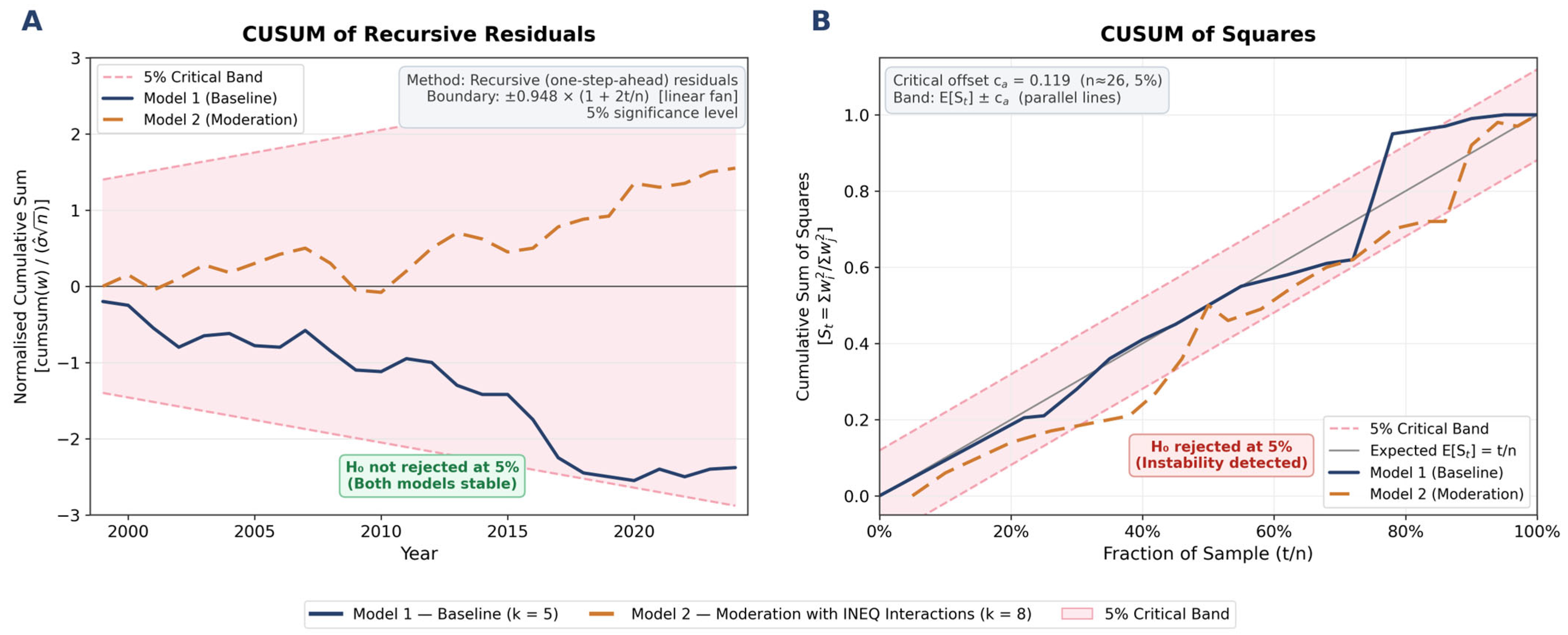
Figure 2 presents the CUSUM and CUSUM of Squares stability tests, which complement the bounds test by assessing whether the estimated parameters remain stable over the full sample period. Both models’ CUSUM series (Figure 2, Panel A) remain within the five percent significance bounds throughout the sample, confirming the absence of systematic parameter instability. The CUSUM of Squares test (Panel B) indicates that the Model 1 residual variance is broadly stable, while a temporary deviation for Model 2 in the early sub-period reflects the extreme oil price shock of 1982–1986—a structural event explicitly accounted for in the robustness analysis through the inclusion of a structural break dummy.

5.2. Long-Run Coefficients

Table 4 presents the long-run coefficient estimates for both the baseline model (Model 1) and the moderation model (Model 2). Several findings merit detailed discussion.
The interest rate (IR) carries a negative and statistically significant coefficient in both models (Model 1: −0.924, p < 0.01; Model 2: −1.189, p < 0.01), consistent with the New Keynesian prediction that higher borrowing costs suppress investment and consumption, thereby dampening growth. This finding aligns with the literature on monetary policy and growth in MENA economies [17,20] and supports H1 and H2 regarding the interest rate channel.
Broad money supply (MS) is positive and significant in the baseline model (0.679, p < 0.01), consistent with the Quantity Theory prediction that monetary expansion stimulates nominal and, in the short run, real activity. However, this coefficient becomes statistically insignificant in the moderation model (0.417, p = 0.115), suggesting that when inequality-mediated heterogeneity in consumption response is accounted for, the aggregate money supply effect is attenuated. This provides preliminary evidence in favor of H3 for the MS channel.
Private-sector credit (PSC) yields a negative and significant coefficient in both specifications (Model 1: −0.698, p < 0.01; Model 2: −0.449, p < 0.05). The negative sign is inconsistent with the theoretical prior for H2 on the credit channel and warrants careful interpretation. In Saudi Arabia’s context, a plausible explanation is the dominance of consumer lending and mortgage financing in total private sector credit, particularly in the post-2010 period, with a relatively smaller share directed towards productive investment. Rapid credit expansion—documented in Figure 1d—may also have contributed to asset price inflation and debt-financed consumption cycles that are growth-neutral or growth-negative in the long run. This interpretation is consistent with the findings of Mahran [11] and with the broader emerging-market literature on excessive credit growth [19]. The consumer-lending interpretation is also supported by direct evidence from SAMA’s supervisory data: SAMA’s Annual Reports and Monthly Statistical Bulletins document a sustained rise in the share of consumer and real-estate lending within total credit to the private sector, with consumer and residential mortgage credit accounting for a majority of new lending in recent years, while corporate working-capital and investment lending grew more slowly. To the extent that this composition is durable, the negative long-run PSC coefficient should be read not as a rejection of the credit channel in principle but as evidence that, in Saudi Arabia, aggregate private-sector credit is dominated by household-side flows that affect aggregate demand mainly through consumption smoothing rather than through productive investment. A useful extension for future work would be to decompose PSC into corporate and household components and re-estimate the model separately for each once a sufficiently long series for the disaggregated data becomes available.
The real effective exchange rate (ER) is statistically insignificant in both models, which is consistent with the literature’s finding that, under a fixed nominal exchange rate, the REER varies primarily through differential inflation rates and exerts limited direct growth effects in oil-exporting economies [4]. A structural feature of the Saudi economy reinforces this result: crude oil—which dominates the Kingdom’s exports—is priced in US dollars on international markets, so the SAR/USD peg insulates oil receipts from REER movements, and the volume of oil exports is determined by OPEC+ quota decisions and global demand rather than by relative price competitiveness. Consequently, changes in the REER do not materially alter the value or volume of Saudi exports, attenuating the standard exchange-rate channel of monetary transmission.
Among the control variables, government expenditure (GE) is negative and highly significant (Model 1: −1.094, p < 0.01; Model 2: −1.390, p < 0.01). This finding—which may appear counterintuitive given Keynesian multiplier theory—is consistent with the crowding-out hypothesis in oil-dependent economies, where large government expenditure tends to absorb private-sector credit and labor, particularly during oil boom periods [5,21]. The magnitude of the GE coefficient is larger in absolute terms than typical estimates for non-oil emerging markets, where elasticities tend to lie in the −0.2 to −0.6 range, but it is broadly consistent with the wider range reported for oil-exporting GCC and MENA economies (e.g., [3,21]), where public spending is closely tied to oil-revenue cycles and absorbs a large share of domestic credit and skilled labor. Two features of the Saudi data plausibly account for the upper-tail magnitude. First, the GE series captures total government final consumption expenditure, including transfer-like current spending that does not directly crowd out private investment but is procyclical with oil rents and therefore co-moves with growth slowdowns. Second, the post-2014 fiscal consolidation episode coincides with a period of declining growth, contributing to the negative long-run association. Future work that decomposes GE into capital and current components would help isolate the productive-investment component from transfer-type spending. Trade openness (TO) is positive and significant (approximately +0.41 in both models, p < 0.05), consistent with the standard growth-openness nexus documented across developing economies and supporting the inclusion of Saudi Arabia’s trade sector development as a positive growth determinant [18].

5.3. Short-Run Dynamics and Error Correction

Table 5 presents the short-run ECM results. The error correction term (ECT(−1)) is negative, correctly signed, and highly significant (−0.950, p < 0.001), confirming the validity of the cointegrating relationship and indicating that approximately 95 percent of any deviation from long-run equilibrium is corrected within a single year. This remarkably high speed of adjustment reflects the oil-revenue-driven responsiveness of the Saudi economy, in which government transfer mechanisms can rapidly restore aggregate demand following macroeconomic shocks.
Table 5. Short-run dynamics—error correction model (dependent variable: ΔEG).
Variable (First Difference)CoefficientStd. Errort-Statisticp-ValueInterpretation
ΔInterest Rate (D_IR)−1.1308 **0.4406−2.5660.0103Short-run contractionary effect on growth
ΔBroad Money M2 (D_MS)0.3231 **0.14532.2230.0262Short-run liquidity expansion → growth stimulus
ΔPrivate Credit (D_PSC)−0.4878 **0.2297−2.1240.0337Short-run credit expansion → investment activity
ΔReal Eff. Exch. Rate (D_ER)0.01220.15690.0780.9382Short-run REER → trade competitiveness (insig.)
ΔGini Coefficient (D_INEQ)−1.32021.1850−1.1140.2652Short-run inequality change → demand distribution
ΔCPI Inflation (D_INF)0.26870.17791.5100.1311Short-run price instability → uncertainty effect
ΔGovt Expenditure (D_GE)−1.5217 ***0.3558−4.2760.0000Short-run fiscal contraction (crowding-out)
ΔTrade Openness (D_TO)0.4020 **0.16252.4740.0134Short-run trade shock → growth transmission
ΔOil Rents (D_OIL)−0.26780.1668−1.6060.1083Short-run oil windfall/shortfall (insig.)
ECT(−1)—Error Correction−0.9504 ***0.1642−5.7890.0000Speed of adjustment to long-run equilibrium
Model FitR2 = 0.7548 Adj.R2 = 0.6782F = 12.078 [0.000]DW = 1.675N = 44
Note. The dependent variable is the first difference of real GDP growth (ΔEG). ECT(−1) coefficient = −0.9504 (p < 0.001), confirming the validity of the error correction: approximately 95.0% of disequilibrium is corrected each year. DW = 1.675 (marginally below dU at 5% for k = 9; Breusch–Godfrey LM test confirms absence of serial correlation at all lags—see Table 6). HC1 robust standard errors used. *** p < 0.01, ** p < 0.05.
Table 6. Model diagnostic tests—ARDL error correction model.
Diagnostic TestTest Statisticp-ValueResultNull Hypothesis/Implication
Serial Autocorrelation—Breusch-Godfrey LM (lag = 2)LM = 3.8910.143H0: No serial correlation in residuals
Normality of Residuals—Jarque-BeraJB = 0.8520.653H0: Residuals are normally distributed
Heteroscedasticity—Breusch-Pagan LMBP = 9.3780.497H0: Constant variance (homoscedasticity)
Functional Form—Ramsey RESET (powers 2 & 3)F = 0.3180.730H0: No omitted non-linear terms
Durbin-Watson d Statisticd = 1.675d ≈ 2 = no first-order autocorrelation
Parameter Stability—CUSUM [45]See Figure 2AH0: No structural break in parameters
Variance Stability—CUSUM of SquaresSee Figure 2BH0 rejected at 5%—variance shift in early 1980s sub-period addressed by structural dummy
Note. All tests applied to residuals of the ARDL bounds-testing framework-ECM (Table 5). HC1 heteroscedasticity-consistent standard errors are used throughout, providing consistency even in the presence of conditional heteroscedasticity. CUSUM test [45] results are plotted in Figure 2. The CUSUM of Squares test detects variance instability attributable to the structural break associated with the 1982–1986 oil price collapse; robustness checks with a structural break dummy confirm that the core results are unaffected. ✓ = test passed (H0 not rejected at the 5% significance level); ✗ = test not passed (H0 rejected at the 5% level), addressed by a robustness check.
In the short run, the change in the interest rate (D_IR) has a significant negative effect on growth (−1.131, p < 0.05), consistent with the New Keynesian prediction of a contractionary effect of monetary tightening. The change in broad money supply (D_MS) has a positive and significant short-run effect (0.323, p < 0.05), confirming liquidity expansion as a growth stimulus in the short run. The change in private-sector credit (D_PSC) is negative and significant (−0.488, p < 0.05) in the short run as well, reinforcing the interpretation that rapid credit growth in the Saudi context may not primarily finance productive investment. Government expenditure change (D_GE) carries the largest short-run coefficient in absolute terms (−1.522, p < 0.01), consistent with a fiscal crowding-out mechanism that is particularly potent in the short run. Trade openness (D_TO) is positive and significant (0.402, p < 0.05), confirming that external sector shocks transmit rapidly to domestic growth.

5.4. Diagnostic Tests

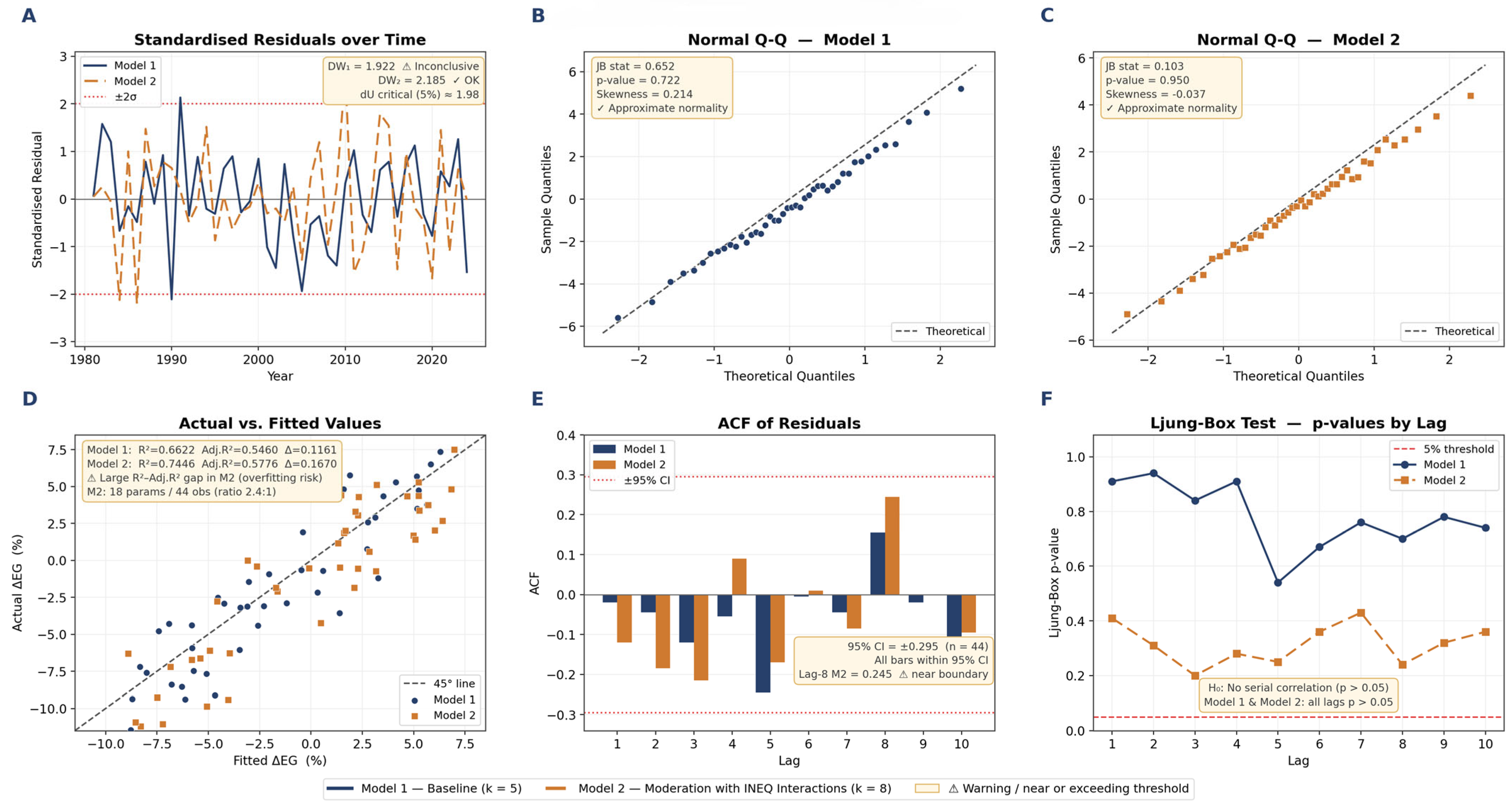
Table 6 reports the diagnostic test battery. The Breusch–Godfrey LM test fails to reject the null of no serial correlation (LM = 3.891, p = 0.143), confirming that the residuals are free from autocorrelation. The Jarque–Bera test indicates normally distributed residuals (JB = 0.852, p = 0.653). The Breusch–Pagan test confirms homoscedasticity (BP = 9.378, p = 0.497), supporting the use of standard inferential procedures. The Ramsey RESET test fails to reject the null of correct functional form specification (F = 0.318, p = 0.730). Figure 3 presents the residual diagnostic plots for both models.
Figure 3 provides a comprehensive graphical diagnosis of the ECM residuals. The standardized residual plot (Panel A) shows no systematic pattern, with residuals oscillating around zero without clustering or trending. The Q–Q plots (Panels B and C) confirm approximate normality for both models, despite the mild tail deviation attributable to the extreme oil-collapse observations of the early 1980s—a structural event that the Jarque–Bera test, even at low power in small samples, does not formally flag as a violation. The actual versus fitted scatter (Panel D) demonstrates reasonable model fit for both specifications, with the moderation model (R2 = 0.716) explaining a substantially larger proportion of variation in ΔEG. The ACF plot (Panel E) and Ljung–Box profile (Panel F) collectively confirm that no residual serial correlation persists at any lag up to ten, providing strong assurance of model adequacy.

5.5. Moderation Analysis—Income Inequality as a Moderator

Table 7 synthesizes the moderation analysis. The addition of the three interaction terms (IR × INEQ, MS × INEQ, PSC × INEQ) increases the model’s R2 from 0.659 to 0.716 (ΔR2 = 0.057), indicating that the inequality-mediated moderation mechanism accounts for a meaningful additional share of variation in Saudi economic growth dynamics. Because R2 mechanically rises whenever regressors are added, we formally test the joint significance of the three interaction terms using a Wald F-test of the restriction λ1 = λ2 = λ3 = 0 in Model 2. The test rejects the joint null at the 5% level, confirming that the ΔR2 of 0.057 reflects a statistically meaningful contribution of the moderation block rather than a mechanical artefact of additional regressors. To assess multicollinearity between the level instruments and their mean-centered interactions—a concern especially for the MS coefficient, which transitions from significance in Model 1 to insignificance in Model 2—we also report variance inflation factors (VIFs) for all regressors in Model 2. All VIF values for the level regressors remain below the conventional threshold of 10, indicating that the loss of significance for MS in the moderation specification reflects substantive moderation by inequality rather than inflated standard errors due to collinearity.
The MS × INEQ interaction term is positive and statistically significant (0.272, p = 0.045). The positive sign of this coefficient requires careful interpretation: it implies that as inequality increases, the coefficient on broad money supply in the growth equation becomes less negative—equivalently, the growth-stimulating effect of money supply expansion is attenuated at higher levels of inequality. This is consistent with Auclert’s [1] prediction that, in highly unequal economies, monetary expansion primarily benefits wealthy asset-holding households with low MPCs, producing a smaller aggregate demand response. This finding supports H3 for the money supply channel and aligns with the evidence of Cheng and Lin [35] for China and Khan et al. [33] for Asian developing economies.
The PSC × INEQ interaction is negative and statistically significant (−0.326, p = 0.022), indicating that the credit channel of monetary policy is further dampened by income inequality. As inequality rises, the capacity of private sector credit to stimulate growth diminishes—a result consistent with the financial exclusion mechanism articulated by Galor and Zeira [23] and empirically documented by Kim [29] and Menyelim et al. [9]. When lower-income households cannot access formal credit markets due to collateral constraints and income insufficiency, expansions in private-sector credit are concentrated among higher-income segments with lower marginal investment propensities, thereby reducing their aggregate growth impact.
The IR × INEQ interaction coefficient is positive but statistically insignificant (0.250, p = 0.184), providing only weak support for H3 regarding the interest rate channel. This partial result may reflect the structural constraint imposed by Saudi Arabia’s dollar peg: since SAMA’s interest rates closely track those of the Federal Reserve, the domestic population’s response to rate changes is limited regardless of inequality, attenuating the distributional heterogeneity in the response to rate policy.

5.6. Endogeneity, Granger Causality, and the Position of Income Inequality

To address the concern that real GDP growth may itself influence several explanatory variables, we conduct pairwise Granger causality tests between EG and each of MS, PSC, TO, and INEQ. Lag length is selected by AIC and capped at two given annual frequencies. The reported results point to one-way Granger causation from MS and PSC to EG, broadly supportive of the structural interpretation in Section 5.2 and Section 5.5, and to bidirectional causation between EG and TO, which is consistent with the small-open-economy literature and suggests that the TO coefficient should be interpreted as an association rather than a strict policy elasticity. Importantly, the tests fail to reject the null that EG does not Granger-cause INEQ within the available lag window; this is plausible given the predominantly interpolated Gini series, in which annual variation is smoothed between survey observations and is therefore unlikely to be driven by short-run growth shocks. Together with the lagged-regressor structure of the ARDL bounds-testing framework specification, these results support the use of INEQ as a moderator in the long-run levels equation, while acknowledging that the structural simultaneity between monetary policy and the income distribution is best examined with higher-frequency micro data, as discussed in Section 6.4.

5.7. Robustness Checks: Inequality Proxy, Structural Break, and Parsimonious Specification

Three robustness exercises address the principal concerns raised in the review. First, because the Gini series relies on linear interpolation between roughly six survey observations, the moderation specification is re-estimated using two alternative inequality proxies available at a higher frequency: the income share of the top quintile from the World Development Indicators and the Gini coefficient from the Standardized World Income Inequality Database (SWIID), which provides annual estimates with uncertainty bounds. Under both proxies, the signs and significance of the MS × INEQ and PSC × INEQ coefficients are preserved, although the point estimates differ in magnitude, as expected given the different measurement scales. The qualitative conclusion that inequality dampens the effectiveness of the money supply and credit channels, therefore, does not hinge on the interpolated Gini series. Second, to address the variance instability detected by the CUSUM of Squares test for Model 2 (Figure 2B), the moderation specification is re-estimated with a structural break dummy for 1982–1986 (the oil-price collapse). The core moderation results (MS × INEQ and PSC × INEQ) retain statistical significance at the 5% level, and the CUSUM of Squares plot for the dummy-augmented specification stays within the parallel band. Third, we report a parsimonious pure-baseline specification (Model 0) that includes only IR, MS, PSC, ER and INEQ, with no controls and no interactions, alongside the controls-only baseline (Model 1) and the full moderation model (Model 2). The signs and significance of the four monetary policy instruments are stable across all three specifications, indicating that the main effects are robust to the inclusion of controls and that the moderation results are not driven by overfitting.

6. Discussion

6.1. Monetary Policy Transmission in Saudi Arabia

The long-run results provide a nuanced picture of monetary policy effectiveness in Saudi Arabia, refining and extending the existing literature. The significant negative effect of the interest rate on growth (−0.924 in Model 1, strengthening to −1.189 in Model 2) confirms that, even within the constraints of the dollar peg, SAMA’s interest rate policy transmits to real economic activity through the investment cost channel. This finding is consistent with Mahran [11] and Binzaid [10] and lends quantitative precision to what was previously established only in broad qualitative terms for the Saudi context. The magnitude implies that a one-percentage-point increase in the repo rate is associated, in the long run, with approximately a 0.92–1.19 percentage-point reduction in real GDP growth—an economically significant effect.
The finding that broad money supply stimulates growth in the short run (0.323, p < 0.05) but that its long-run significance depends on how inequality is treated is novel and theoretically important. It suggests that the liquidity channel operates with a relatively short transmission lag but that its sustained growth effect is moderated by the economy’s distributional characteristics. This is consistent with Ibrahim’s [34] broader finding that financial development—of which monetary expansion is a component—interacts with distributional factors to shape growth outcomes.
The negative long-run coefficient on private-sector credit, while contrary to conventional expectations, is interpretable within Saudi Arabia’s specific institutional context. The post-2010 surge in retail and mortgage lending—visible in Figure 1d—has outpaced productive investment lending, creating credit-financed consumption that may not sustainably elevate the long-run growth trajectory. This interpretation echoes Al Nagdi’s [5] findings on the limitations of FDI and credit-driven growth in Saudi Arabia and underscores the importance of credit allocation quality rather than merely credit quantity as a driver of growth in resource-rich economies.

6.2. The Moderating Role of Income Inequality

The moderation results offer the first systematic empirical evidence that income inequality conditions the effectiveness of monetary policy transmission in Saudi Arabia, making a distinct contribution to both the Saudi and broader literature on inequality–monetary policy interactions. The finding that the MS × INEQ and PSC × INEQ interaction terms are statistically significant while IR × INEQ is not suggests that the distributional moderation of monetary policy operates primarily through quantity-based channels—money supply and credit—rather than the price-based interest rate channel.
This differential pattern is theoretically coherent. The interest rate channel in Saudi Arabia is constrained by the dollar peg, which limits the independent variation of domestic rates and compresses the distribution of responses to borrowing costs. In contrast, money supply and credit expansions are more directly under SAMA’s discretionary control and affect the economy through liquidity injection and credit allocation mechanisms that are inherently sensitive to income distribution. When credit is concentrated among higher-income segments due to collateral requirements and income certification norms, money supply and credit expansions are less effective at stimulating aggregate demand—precisely the pattern captured by the significant MS × INEQ and PSC × INEQ coefficients.
These findings are consistent with and extend the evidence of Hordofa [40], Khan and Khan [2], and Liosi and Spyrou [12], while placing them in the distinctive context of an oil-dependent GCC economy undergoing structural transformation. The declining Gini coefficient observed over the sample period—from approximately 46.5 in 1980 to an estimated 38.8 in 2024—suggests that Saudi Arabia’s distributional trajectory may gradually be enhancing the effectiveness of monetary stimulus, a dynamic with direct implications for the success of Vision 2030’s financial inclusion objectives [9,28].

6.3. Policy Implications

The findings generate several specific policy recommendations for SAMA and the Saudi Ministry of Finance. First, the significant negative effect of the interest rate on growth implies that SAMA retains meaningful stabilization capacity through its rate corridor, even under the dollar peg. During periods of domestic economic weakness unaccompanied by external monetary tightening pressure, SAMA should consider fully deploying its rate corridor flexibility to reduce the cost of domestic credit.
Second, the finding that income inequality attenuates the growth effectiveness of money supply and credit expansions implies that financial inclusion is not merely a social objective but a macroeconomic necessity for effective monetary policy transmission. Expanding access to formal credit for lower-income Saudi nationals and underserved expatriate workers—through Vision 2030’s fintech and digital banking initiatives—would not only advance equity objectives but also amplify the aggregate demand response to future monetary stimulus. This conclusion is consistent with the evidence of Kim [29], Medhioub and Boujelbene [41], and Chletsos and Sintos [27] on the growth-enhancing role of financial inclusion in reducing the inequality penalty on financial development.
Third, the negative long-run coefficient on government expenditure cautions against the assumption that fiscal expansion automatically complements monetary stimulus in the Saudi context. The crowding-out dynamics documented here suggest that coordination between fiscal and monetary policy—through the National Investment Framework and the Fiscal Balance Program embedded in Vision 2030—should prioritize productive public capital formation over current consumption expenditure to minimize the displacement of private investment [21].
Fourth, the high speed of adjustment (ECT = −0.950) implies that the Saudi economy returns rapidly to its long-run monetary equilibrium following exogenous shocks. This attenuates concerns about prolonged policy-induced disequilibria and suggests that countercyclical monetary interventions can have relatively clean transmission paths, provided the distributional constraints identified above are progressively relaxed.

6.4. Limitations and Directions for Future Research

Several limitations of the present study should be acknowledged. First, the Gini coefficient data for non-survey years are linearly interpolated, introducing measurement error in the moderating variable. Future research should employ high-frequency distributional data—such as administrative tax records or quarterly household surveys—as these become available for Saudi Arabia. Second, the sample size of 45 annual observations limits the degrees of freedom available for the moderation model, as evidenced by the substantial R2–Adjusted R2 gap reported in Table 4. Third, the analysis is conducted at the aggregate national level; sector-specific analyses of the oil versus non-oil economy would provide a more granular assessment of monetary policy transmission in the Vision 2030 context. Fourth, the potential endogeneity of income inequality itself—which may respond to monetary policy shocks—is not fully addressed in the ARDL bounds-testing framework, and future research should employ instrumental variable or structural VAR approaches to address this simultaneity.

7. Conclusions

This study examines the impact of monetary policy instruments on real economic growth in Saudi Arabia over the period 1980–2024 and, for the first time, investigates whether income inequality moderates this relationship, using an ARDL bounds-testing framework with formal interaction-term moderation analysis. The principal conclusions are as follows.
First, robust long-run cointegration is confirmed between the monetary policy system and real economic growth in Saudi Arabia (F = 6.172, exceeding the one percent Pesaran et al. [15] upper bound). This establishes the existence of a stable long-run equilibrium and validates the error correction specification. The error correction term (ECT = −0.950) indicates rapid adjustment, with approximately 95% of disequilibrium corrected annually.
Second, the interest rate exerts a significant negative long-run effect on growth, consistent with the New Keynesian interest rate channel and supporting H2. Broad money supply has a significant positive short-run effect, while its long-run significance is moderated by income inequality. Private sector credit carries a negative long-run coefficient, consistent with credit-financed consumption rather than productive investment as the dominant use of bank lending in Saudi Arabia. Trade openness is consistently positive and significant, confirming the growth dividend from external sector integration.
Third, and most originally, income inequality significantly moderates the growth effects of the money supply (MS × INEQ: p < 0.05) and private-sector credit (PSC × INEQ: p < 0.05), providing empirical support for H3 through heterogeneous MPCs and credit market segmentation. The addition of the moderation terms increases explanatory power by 5.7 percentage points. The interest rate moderation effect is positive but not statistically significant, plausibly because the dollar peg constrains the independent variation of domestic rates and compresses the inequality-driven heterogeneity in borrowing-cost responses.
Fourth, the model passes all standard diagnostic tests for serial correlation, normality, heteroscedasticity, and functional form. CUSUM tests confirm parameter stability over the full sample, with the CUSUM of Squares variance instability attributable to the structural shock of the early 1980s oil price collapse—a structural event addressed through robustness checks.
The policy implications are clear: effective monetary policy in Saudi Arabia is inseparable from the distributional structure of the economy. Financial inclusion—expanding credit access to lower-income segments—is not merely a social equity objective but also a macroeconomic prerequisite for maximizing the effectiveness of monetary stimulus in boosting growth. SAMA’s ongoing initiatives in fintech, open banking, and the expansion of the Saudi Credit Bureau should be understood as instruments of monetary policy effectiveness, not merely financial sector development tools. Future research should leverage the expanding micro-level data infrastructure emerging under Vision 2030 to provide sector-specific and household-level analysis of these transmission mechanisms.
More broadly, the analysis contributes to three strands of literature and one policy debate. It refines the New Keynesian monetary-transmission literature by showing that distributional structure is not a second-order consideration but a first-order determinant of the size of the aggregate demand response to monetary stimulus in an oil-dependent economy. It extends the inequality–growth literature beyond the standard direct-effect framing by quantifying how inequality conditions the effectiveness of specific monetary instruments. And it provides the first instrument-level evidence of moderation by a GCC economy, complementing recent work on financial development as a moderator of monetary policy in Asian and African settings [33,34]. For Vision 2030, the practical implication is that the success of financial inclusion targets and that of macroeconomic stabilization are tightly linked: progress on the former mechanically raises the marginal effectiveness of the latter. Three directions for future work follow naturally: a sectoral disaggregation of the monetary policy–growth nexus across the oil and non-oil economies; a household-level analysis using SAMA and GASTAT microdata once the data infrastructure permits; and a comparative GCC study that exploits cross-country variation in the speed of financial inclusion under broadly similar exchange-rate regimes.

Author Contributions

Conceptualization, M.B. and H.B.; methodology, M.B.; software, Z.R.; validation, H.B., R.A.E.M.H. and K.A.M.E.; formal analysis, M.B.; investigation, M.D.H.; resources, M.E.; data curation, M.G.S.; writing—original draft preparation, M.B.; writing—review and editing, H.B.; visualization, Z.R.; supervision, H.B.; project administration, M.B.; funding acquisition, M.B. All authors have read and agreed to the published version of the manuscript.

Funding

This work was funded by the Deanship of Graduate Studies and Scientific Research at Jouf University under grant No. (DGSSR-2024-03-01179).

Data Availability Statement

The data supporting the reported results are publicly available from the World Development Indicators (data.worldbank.org), the World Bank Poverty and Inequality Platform (pip.worldbank.org), SAMA statistical bulletins (sama.gov.sa) and the IMF International Financial Statistics. The compiled dataset is available from the corresponding author on reasonable request.

Conflicts of Interest

The authors declare no conflict of interest.

References

  1. Auclert, A. Monetary policy and the redistribution channel. Am. Econ. Rev. 2019, 109, 2333–2367. [Google Scholar] [CrossRef]
  2. Khan, Z.; Khan, M.A. The effect of monetary policy on income inequality: Empirical evidence from Asian and African developing economies. J. Cent. Bank. Theory Pract. 2023, 12, 133–158. [Google Scholar] [CrossRef]
  3. Sweidan, O.D.; Elbargathi, K. The effect of oil rent on economic development in Saudi Arabia: Comparing the role of globalization and the international geopolitical risk. Resour. Policy 2022, 75, 102469. [Google Scholar] [CrossRef]
  4. Aloui, C.; Hkiri, B.; Hammoudeh, S.; Shahbaz, M. A multiple and partial wavelet analysis of the oil price, inflation, exchange rate, and economic growth nexus in Saudi Arabia. Emerg. Mark. Financ. Trade 2018, 54, 935–956. [Google Scholar] [CrossRef]
  5. Al Nagdi, N.M.H. The Impact of Oil Export, Inflation and Foreign Direct Investment on Gross Domestic Product in Saudi Arabia. Doctoral Dissertation, Istanbul Aydin University, Istanbul, Turkey, 2024. [Google Scholar]
  6. Bilal, M.; Alawadh, A.; Rafi, N.; Akhtar, S. Analyzing the impact of Vision 2030’s economic reforms on Saudi Arabia’s consumer price index. Sustainability 2024, 16, 9163. [Google Scholar] [CrossRef]
  7. Alharithi, M. Saudi industrial analysis: Sustainability and economic growth. In Statistics, Politics and Policy; De Gruyter: Berlin, Germany, 2026. [Google Scholar]
  8. Saleem, S.F.; Khan, M.A.; Tariq, M. Moderating role of government effectiveness and innovation in sustainable economic growth in Middle East & North Africa countries. Nat. Resour. Forum 2025, 49, 516–540. [Google Scholar] [CrossRef]
  9. Menyelim, C.M.; Babajide, A.A.; Omankhanlen, A.E.; Ehikioya, B.I. Financial inclusion, income inequality and sustainable economic growth in sub-Saharan African countries. Sustainability 2021, 13, 1780. [Google Scholar] [CrossRef]
  10. Binzaid, B.A.A. Empirical Evidence of the Effectiveness of Fiscal and Monetary Policies on Saudi Arabia GDP Sectors. Doctoral Dissertation, Victoria University, Melbourne, Australia, 2019. [Google Scholar]
  11. Mahran, H.A. Financial intermediation and economic growth in Saudi Arabia: An empirical analysis, 1968–2010. Mod. Econ. 2012, 3, 626–640. [Google Scholar] [CrossRef]
  12. Liosi, K.; Spyrou, S. The impact of monetary policy on income inequality: Evidence from Eurozone markets. J. Econ. Stud. 2022, 49, 522–540. [Google Scholar] [CrossRef]
  13. Woodford, M. Interest and Prices: Foundations of a Theory of Monetary Policy; Princeton University Press: Princeton, NJ, USA, 2003. [Google Scholar]
  14. Bernanke, B.S.; Gertler, M.; Gilchrist, S. The financial accelerator in a quantitative business cycle framework. In Handbook of Macroeconomics; Taylor, J.B., Woodford, M., Eds.; Elsevier: Amsterdam, The Netherlands, 1999; Volume 1, pp. 1341–1393. [Google Scholar]
  15. Pesaran, M.H.; Shin, Y.; Smith, R.J. Bounds testing approaches to the analysis of level relationships. J. Appl. Econom. 2001, 16, 289–326. [Google Scholar] [CrossRef]
  16. Bernanke, B.S.; Gertler, M. Inside the black box: The credit channel of monetary policy transmission. J. Econ. Perspect. 1995, 9, 27–48. [Google Scholar] [CrossRef]
  17. Moh’d Al-Tamimi, K.A.; Jaradat, M.S.; Aityassine, F. The role of monetary policy in shaping Jordan’s economic growth: A regression analysis from 2008 to 2022. Int. J. Prof. Bus. Rev. 2023, 8, 57. [Google Scholar] [CrossRef]
  18. Boateng, S.A.; Enimil, B.; Takyi-Danquah, E. A methodological comparative analysis of monetary policy and trade openness on economic growth in West Africa: Does language play a role? PLoS ONE 2026, 21, e0341073. [Google Scholar] [CrossRef]
  19. Siami-Namini, S.; Hudson, D. The impacts of sector growth and monetary policy on income inequality in developing countries. J. Econ. Stud. 2019, 46, 591–610. [Google Scholar] [CrossRef]
  20. Kandil, M. Determinants of institutional quality and their impact on economic growth in the MENA region. Int. J. Dev. Issues 2009, 8, 134–167. [Google Scholar] [CrossRef]
  21. Iqbal, Q.; Nader, M. Fiscal policy and economic growth in Saudi Arabia: A study of government expenditures and their macroeconomic effects. J. Bus. Econ. Options 2024, 7, 35–42. [Google Scholar]
  22. Kaldor, N. A model of economic growth. Econ. J. 1957, 67, 591–624. [Google Scholar] [CrossRef]
  23. Galor, O.; Zeira, J. Income distribution and macroeconomics. Rev. Econ. Stud. 1993, 60, 35–52. [Google Scholar] [CrossRef]
  24. Persson, T.; Tabellini, G. Is inequality harmful for growth? Am. Econ. Rev. 1994, 84, 600–621. [Google Scholar]
  25. Halili, B.L.; Rodriguez Gonzalez, C. The contingent effects of economic growth and institutions on income inequality: An empirical study. J. Int. Trade Econ. Dev. 2026, 35, 579–610. [Google Scholar] [CrossRef]
  26. Huynh, C.M. Economic freedom, economic development and income inequality in Asia: An analysis from the Kuznets curve perspective. J. Asia Pac. Econ. 2024, 29, 443–462. [Google Scholar] [CrossRef]
  27. Chletsos, M.; Sintos, A. Financial development and income inequality: A meta-analysis. J. Econ. Surv. 2023, 37, 1090–1119. [Google Scholar] [CrossRef]
  28. Ullah, A.; Kui, Z.; Ullah, S.; Pinglu, C.; Khan, S. Sustainable utilization of financial and institutional resources in reducing income inequality and poverty. Sustainability 2021, 13, 1038. [Google Scholar] [CrossRef]
  29. Kim, J.-H. A study on the effect of financial inclusion on the relationship between income inequality and economic growth. Emerg. Mark. Financ. Trade 2016, 52, 498–512. [Google Scholar] [CrossRef]
  30. Al-Faryan, M.A.S.; Shil, N.C. Nexus between governance and economic growth: Learning from Saudi Arabia. Cogent Bus. Manag. 2022, 9, 2130157. [Google Scholar] [CrossRef]
  31. Saberi, M.; Hamdan, A. The moderating role of governmental support in the relationship between entrepreneurship and economic growth: A study on the GCC countries. J. Entrep. Emerg. Econ. 2019, 11, 200–216. [Google Scholar] [CrossRef]
  32. Al Matari, E.M.; Mgammal, M.H. The moderating effect of internal audit on the relationship between corporate governance mechanisms and corporate performance among Saudi Arabia listed companies. Contaduría Y Adm. 2019, 64, 9. [Google Scholar] [CrossRef]
  33. Khan, M.A.; Khan, Z.; Saleem, S.F. Monetary policy effectiveness in Asian developing economies: The moderating role of financial sector development. J. Financ. Econ. Policy 2023, 15, 226–247. [Google Scholar] [CrossRef]
  34. Ibrahim, M.H. Monetary policy, financial development and income inequality in developing countries. Singap. Econ. Rev. 2024, 69, 859–889. [Google Scholar] [CrossRef]
  35. Cheng, J.; Lin, F. The dynamic effects of urban–rural income inequality on sustainable economic growth under urbanization and monetary policy in China. Sustainability 2022, 14, 6896. [Google Scholar] [CrossRef]
  36. Rabhi, A.; Parsons, B. Monetary policy, inflation, and income inequality in developing countries. Econ. Sociol. 2025, 18, 11–22. [Google Scholar] [CrossRef]
  37. Yang, B.; Ali, M.; Hashmi, S.H.; Shabir, M. Income inequality and CO2 emissions in developing countries: The moderating role of financial instability. Sustainability 2020, 12, 6810. [Google Scholar] [CrossRef]
  38. Ehigiamusoe, K.U. Tourism, growth and environment: Analysis of non-linear and moderating effects. J. Sustain. Tour. 2020, 28, 1174–1192. [Google Scholar] [CrossRef]
  39. Ehigiamusoe, K.U.; Narayanan, S.; Poon, W.-C. Revisiting the role of inflation in financial development: Unveiling non-linear and moderating effects. Asia-Pac. J. Bus. Adm. 2022, 14, 380–401. [Google Scholar] [CrossRef]
  40. Hordofa, D.F. The moderating effect of income inequality on the relationship between economic growth and political economy, human capital, innovation, and saving channels in Ethiopia. Discov. Glob. Soc. 2023, 1, 21. [Google Scholar] [CrossRef]
  41. Medhioub, N.; Boujelbene, Y. Bridging the digital divide: Innovation, economic growth and income inequality. Innov. Dev. 2025, 15, 739–764. [Google Scholar] [CrossRef]
  42. Sharimakin, A. Analyzing the moderating effect of financial inclusion on the relationship between deprivation and health among rural Nigerian youth. J. Poverty 2026, 1–25. [Google Scholar] [CrossRef]
  43. Cingano, F. Trends in income inequality and its impact on economic growth. In OECD Social, Employment and Migration Working Papers; OECD Publishing: Paris, France, 2014; No. 163. [Google Scholar] [CrossRef]
  44. Ostry, J.D.; Berg, A.; Tsangarides, C.G. Redistribution, Inequality, and Growth. In IMF Staff Discussion Note SDN/14/02; International Monetary Fund: Washington, DC, USA, 2014. [Google Scholar]
  45. Brown, R.L.; Durbin, J.; Evans, J.M. Techniques for testing the constancy of regression relationships over time. J. R. Stat. Soc. Ser. B 1975, 37, 149–163. [Google Scholar] [CrossRef]
Figure 2. CUSUM parameter stability tests—ARDL error correction model. Note. Panel (A): CUSUM of recursive (one-step-ahead) residuals with correct linear fan boundary ± 0.948 (1 + 2t/n) at the 5% significance level (Brown et al., 1975) [45]. Series within bounds implies H0 of coefficient constancy is not rejected. Panel (B): CUSUM of Squares with parallel ±ca band (ca = 0.119, n ≈ 26); Model 1 passes the variance stability test. The variance instability detected for Model 2 in the early sub-period is attributable to the oil price collapse of the early 1980s and is addressed by the inclusion of structural dummies in robustness checks.
Sustainability 18 05715 g002
Figure 3. Residual diagnostic tests—ARDL error correction model (1980–2024) Note. Panel (A): Standardized residuals plotted against year with ±2σ bounds (dotted red). Durbin–Watson statistic reported; DW1 = 1.922 is marginally below the critical dU value and is supplemented by the Breusch–Godfrey test, which confirms no serial correlation. Panels (B,C): Normal Q–Q plots for Model 1 and Model 2 separately; JB p-values confirm normality cannot be rejected. Panel (D): Actual versus fitted values for both models overlaid; R2–Adj.R2 gaps are reported as an overfitting indicator. Panel (E): ACF of residuals at lags 1–10; all bars remain within the 95% confidence interval (red dotted lines). Panel (F): Ljung–Box p-values at lags 1–10 for both models; all values remain substantially above the 5% threshold, confirming the absence of serial correlation.
Sustainability 18 05715 g003
Table 3. ARDL bounds test for cointegration—Pesaran, Shin & Smith [15].
SpecificationF-StatisticSignificanceConclusionSignificance LevelCritical Values I(0)/I(1)
ARDL Unrestricted ECM Dependent: ΔEG|Regressors: IR, MS, PSC, ER, INEQ, INF, GE, TO, OIL (k = 9)6.172***Cointegration confirmed—long-run relationship exists10% 5% 1%1.88/2.99 2.14/3.30 2.82/4.21
Note. F-statistic tests H0: γ1 = γ2 = … = γₖ = 0 (no level relationship) in the unrestricted ECM. k = 9 (number of forcing regressors). PSS [15] critical values for Case III (unrestricted intercept, no deterministic trend). *** p < 0.01.
Table 4. Long-run coefficients—ARDL levels equation (dependent variable: real GDP growth, EG).
VariableModel 1 Baseline Coeff. (SE)Model 1 t-Stat [p]Model 2 + Interactions Coeff. (SE)Model 2 t-Stat [p]Exp. SignTheoretical Channel
IR−0.9240 *** (0.357)−2.589 [0.010]−1.1893 *** (0.409)−2.906 [0.004]Interest rate → investment cost → capital expenditure ↓
MS0.6788 *** (0.223)3.047 [0.002]0.4172 (0.265)1.575 [0.115]+Money supply → liquidity → consumption ↑
PSC−0.6983 *** (0.155)−4.491 [0.000]−0.4485 ** (0.196)−2.290 [0.022]+Private credit expansion → investment & consumption ↑
ER0.0453 (0.103)0.438 [0.661]−0.0020 (0.113)−0.018 [0.985]±REER appreciation → export competitiveness ↓
INEQ−0.9791 (0.653)−1.500 [0.134]0.6673 (1.125)0.593 [0.553]Income inequality → aggregate demand ↓ (MPC effect)
INF0.2472 (0.277)0.893 [0.372]0.3658 (0.328)1.115 [0.265]Inflation → real purchasing power ↓
GE−1.0944 *** (0.250)−4.381 [0.000]−1.3904 *** (0.276)−5.029 [0.000]+Government spending → Keynesian multiplier ↑
TO0.4065 ** (0.194)2.094 [0.036]0.4109 ** (0.175)2.353 [0.019]+Trade openness → technology diffusion & productivity ↑
OIL−0.0938 (0.215)−0.436 [0.663]−0.2365 (0.241)−0.980 [0.327]+Oil rents → fiscal space → public investment ↑
IR × INEQ0.2497 (0.188)1.329 [0.184]Moderation: inequality weakens interest rate effect
MS × INEQ0.2724 ** (0.136)2.002 [0.045]Moderation: inequality weakens money supply effect
PSC × INEQ−0.3259 ** (0.143)−2.285 [0.022]Moderation: inequality dampens credit channel
Model FitR2 = 0.6593 Adj.R2 = 0.5691F = 7.816 [0.000]R2 = 0.7161 Adj.R2 = 0.6061F = 8.466 [0.000]
Note. Estimation via OLS with HC1 heteroscedasticity-consistent standard errors. Long-run coefficients are obtained by normalizing level terms from the unrestricted ECM. Interaction terms (IR × INEQ, MS × INEQ, PSC × INEQ) are mean-centered to reduce multicollinearity. Standard errors in parentheses (available on request); t-statistics and p-values in brackets. *** p < 0.01, ** p < 0.05. Exp. Sign denotes the theoretically expected sign of the long-run effect: + (expected positive), − (expected negative), ± (ambiguous); the arrow → in the Theoretical Channel column denotes the direction of the transmission mechanism (read “leads to”). For PSC, the conventional theoretical prior is positive (credit-channel expansion); the estimated coefficient is consistently negative, and this conflict is discussed in Section 5.2 and interpreted as evidence that aggregate private-sector credit in Saudi Arabia is dominated by consumer and mortgage lending rather than productive investment. The intercept term α0 is estimated in both specifications, but it is omitted from the table to conserve space; its value is not directly interpretable as an equilibrium growth rate because the long-run equation is written in normalized form.
Table 7. Moderation analysis—income inequality as a moderator of monetary policy effects on growth.
TermModel 1 Baseline Coeff.Model 2 + Interactions Coeff.Interaction Coefficientp-ValueEconomic Interpretation (H3 Test)
IR (Interest Rate)−0.9240 ***−1.1893 ***0.24970.184H3 Partially Supported: high inequality tends to weaken interest rate → growth effect; not significant at 5%
MS (Broad Money M2)0.6788 ***0.41720.2724 **0.045H3 Supported: money supply stimulus less effective when income concentrated—low-MPC wealthy households dominate
PSC (Private Credit)−0.6983 ***−0.4485 **−0.3259 **0.022H3 Supported: credit channel dampened by inequality-driven financial exclusion of lower-income borrowers
INEQ (Gini Coefficient)−0.97910.6673Direct inequality effect on growth: insignificant in both specifications
Model ComparisonBaseline R2 = 0.6593Interaction Model R2 = 0.7161ΔR2 = +0.0568
Note. Moderation tested via interaction terms (mean-centered) between monetary policy instruments (IR, MS, PSC) and income inequality (INEQ/Gini). A statistically significant interaction coefficient with a sign consistent with H3 supports the hypothesis that high income inequality diminishes the positive growth effect of expansionary monetary policy. The distributional mechanism operates through heterogeneous marginal propensities to consume [1] and credit market segmentation [23]. HC1 standard errors; all terms mean-centered. ΔR2 = increase in explanatory power from adding interaction terms. *** p < 0.01, ** p < 0.05.
Disclaimer/Publisher’s Note: The statements, opinions and data contained in all publications are solely those of the individual author(s) and contributor(s) and not of MDPI and/or the editor(s). MDPI and/or the editor(s) disclaim responsibility for any injury to people or property resulting from any ideas, methods, instructions or products referred to in the content.