Scenario Analysis of Japan’s Food and Feed Systems: Integrating Nutrient Flows with Sustainable Agricultural Policy

Abstract
1. Introduction
2. Materials and Methods
2.1. Nitrogen and Phosphorus Flow Calculation
2.2. Overview of the Scenario Analysis
3. Results
3.1. Nitrogen and Phosphorus Flows in Japan (2021)
3.1.1. Calculated Flows in 2021
3.1.2. Input/Output Comparison
3.1.3. Comparison with Previous Studies
3.1.4. Simplified Flow Diagrams Based on the Nutrient Index
3.2. Results of the Scenario Analysis
3.2.1. Scenario Details
3.2.2. Results of the Scenario Analysis
4. Discussion
4.1. Current Nitrogen and Phosphorus Flows in Japan
4.1.1. Farmland
4.1.2. Livestock
4.1.3. Treatment Facilities
4.2. Findings from the Scenario Analysis
5. Conclusions
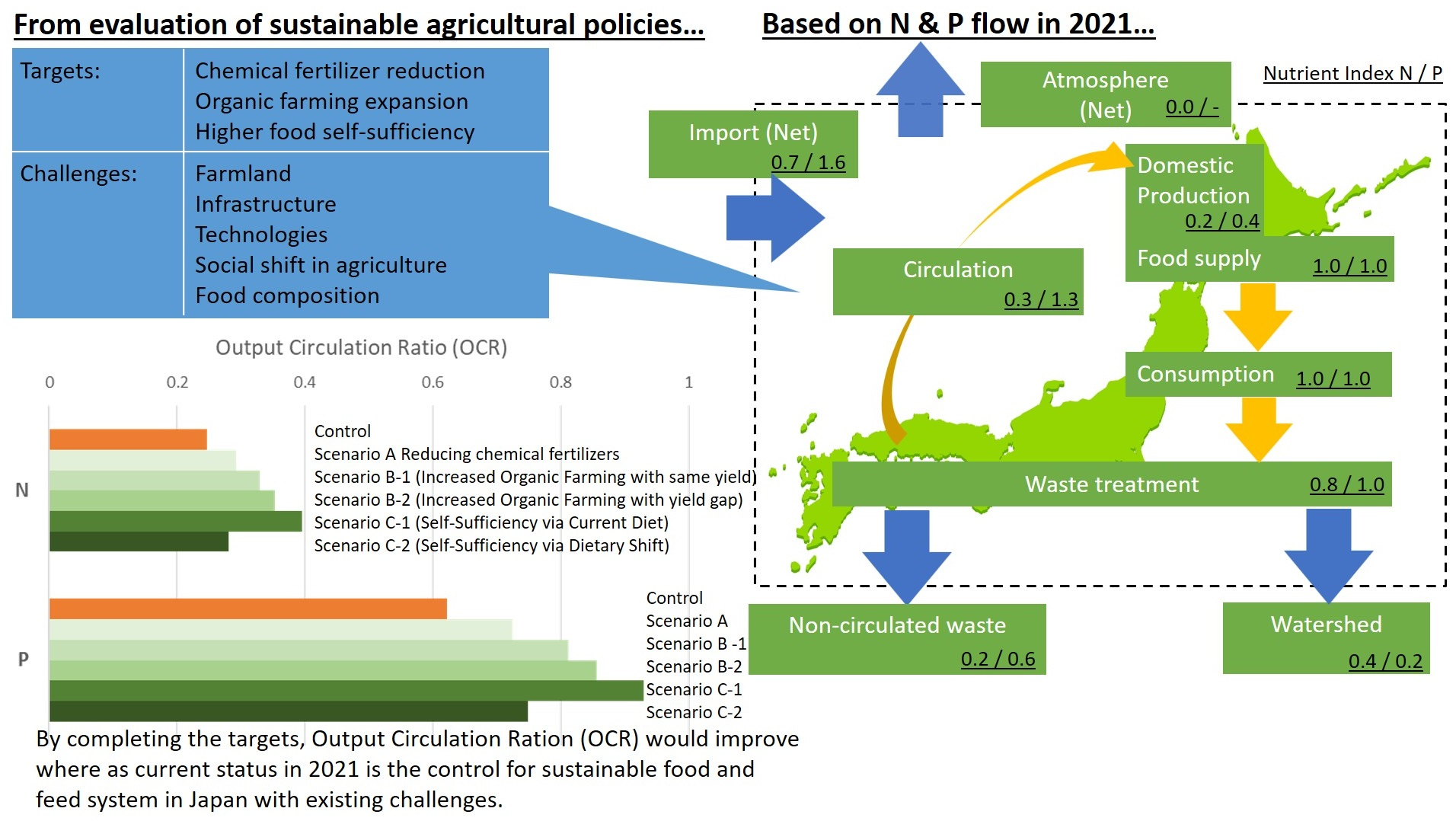
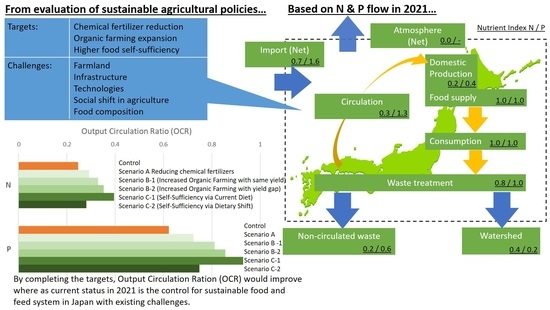
- Japan’s food system was highly import-dependent with “virtual” nitrogen about 90% and phosphorus 160% of household needs, while exports are very small.
- In farmland, roughly half of the applied phosphorus fertilizers do not reach crops and are estimated to accumulate in soil or leach into groundwater, which connotes the risk of eutrophication upon erosion.
- Livestock inefficiency exists because livestock consume similar to or greater than total human food requirements, where 80–90% of feed is excreted as waste.
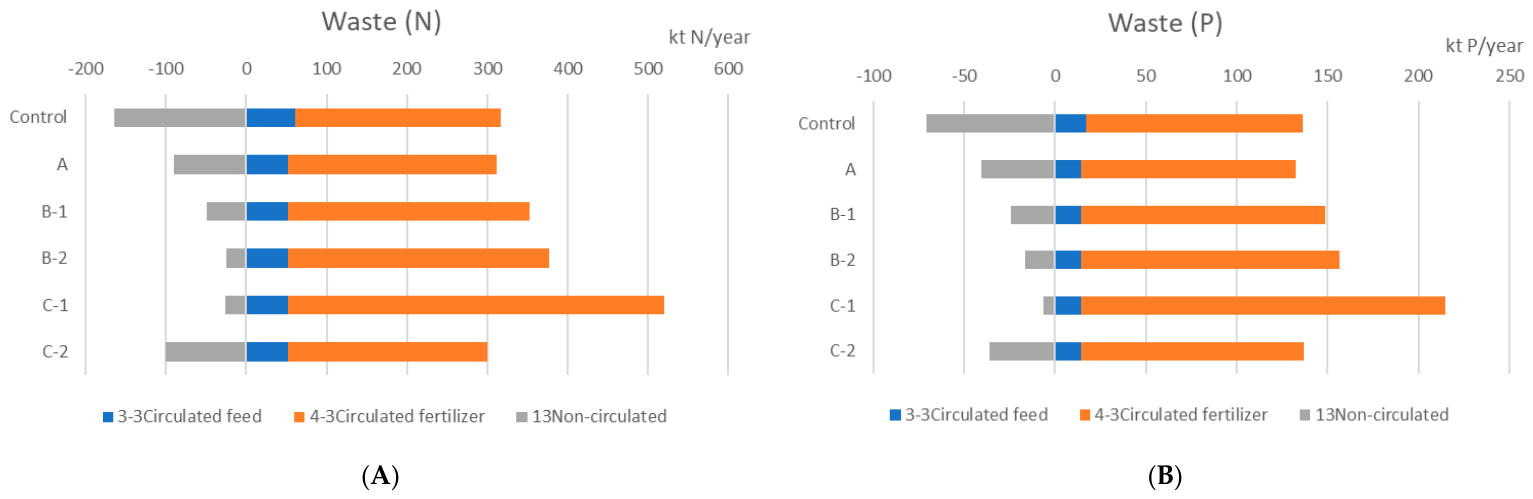
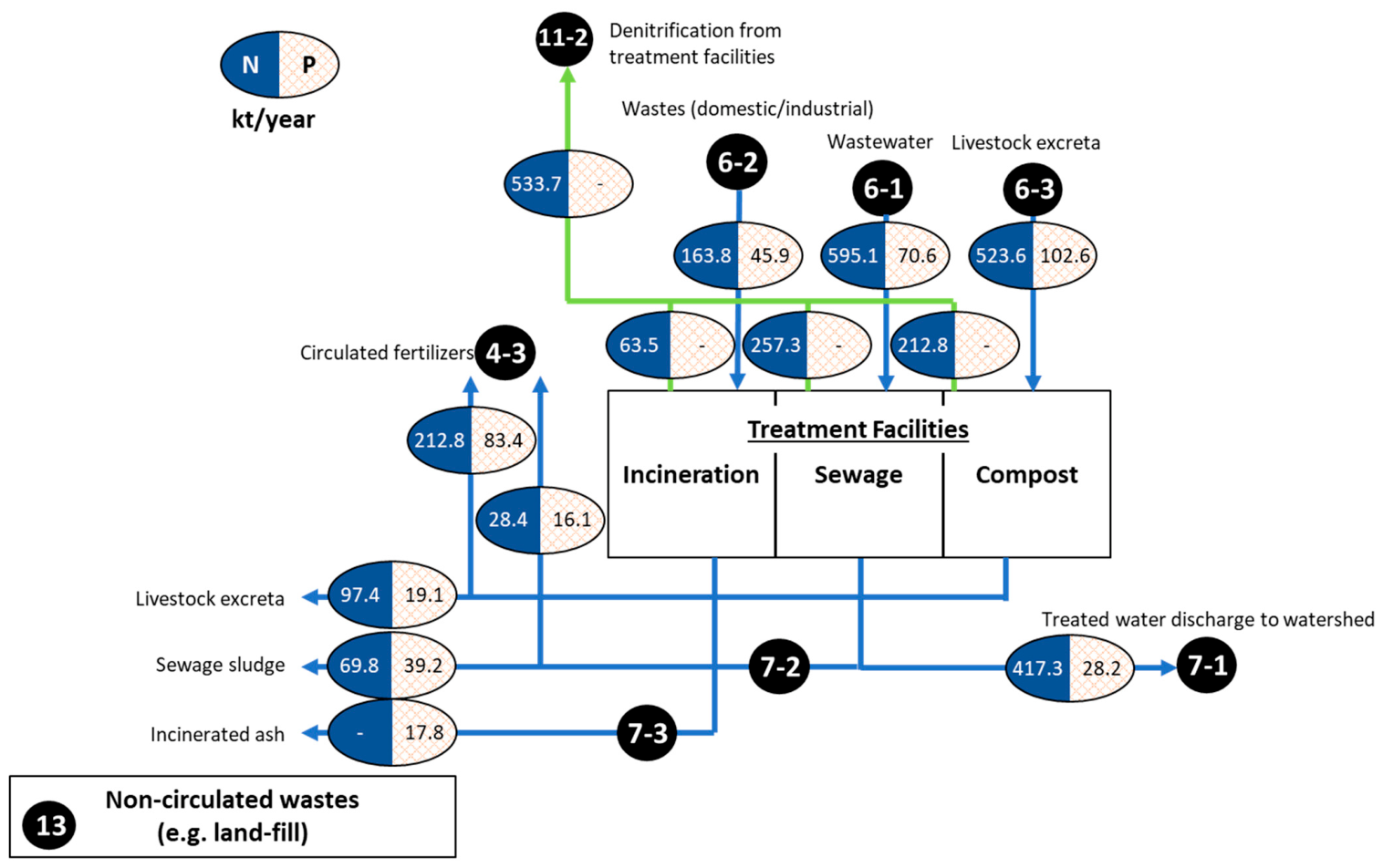
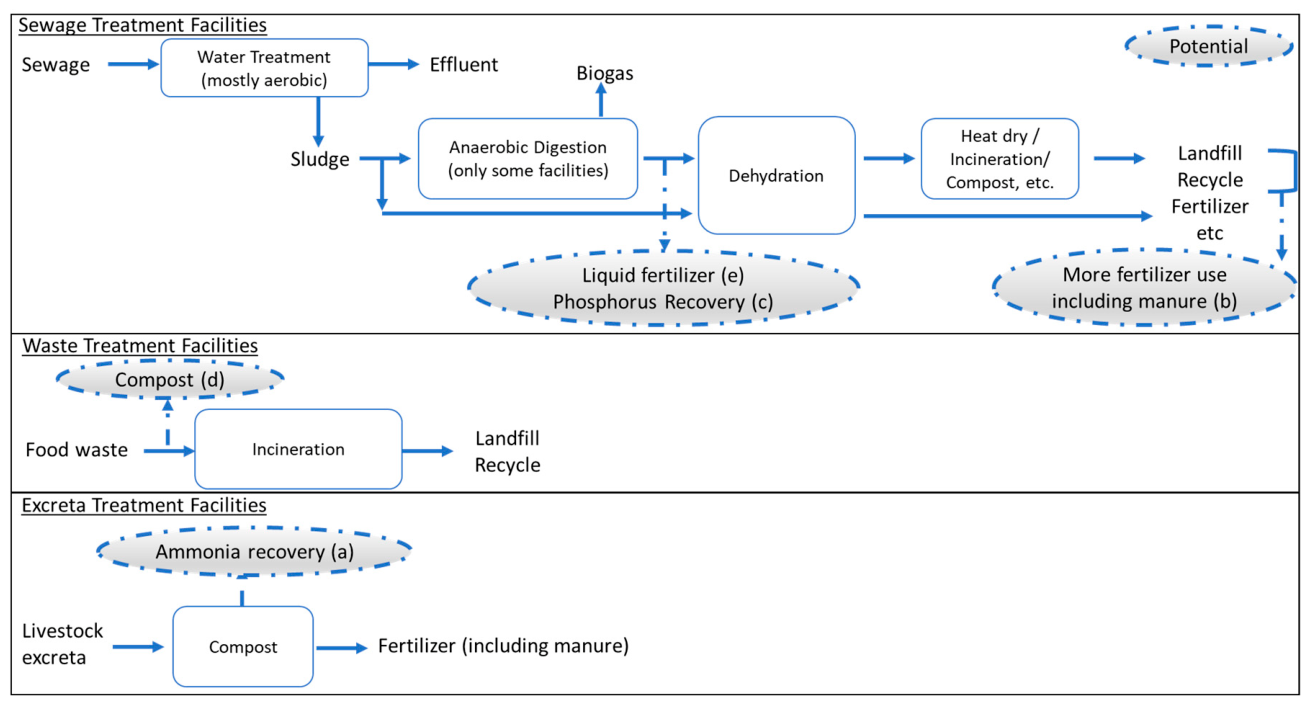
- By integrating the waste treatment sector into the nutrient flow, significant inefficiencies were identified, particularly regarding the loss of virtual nutrients to the atmosphere and landfills.
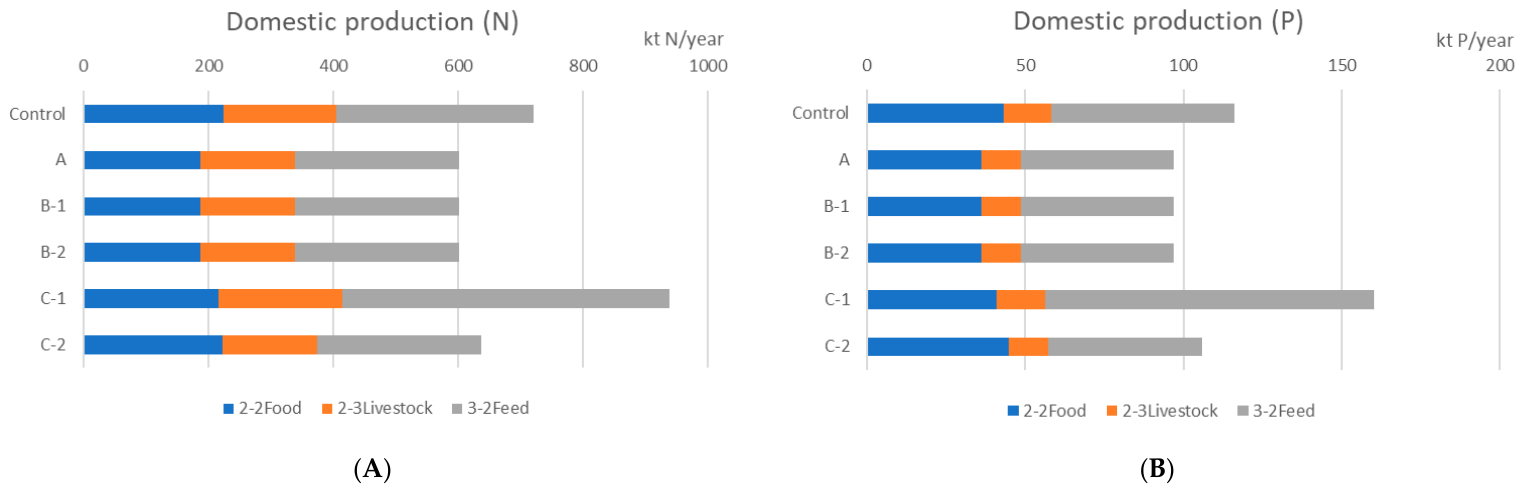
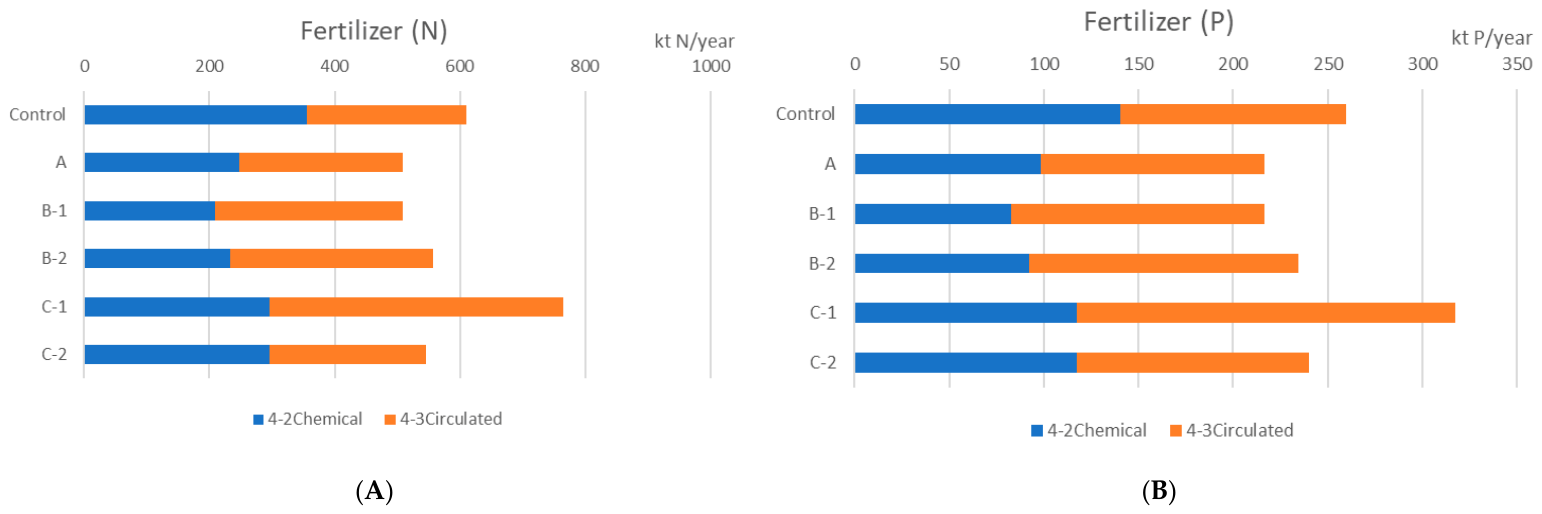
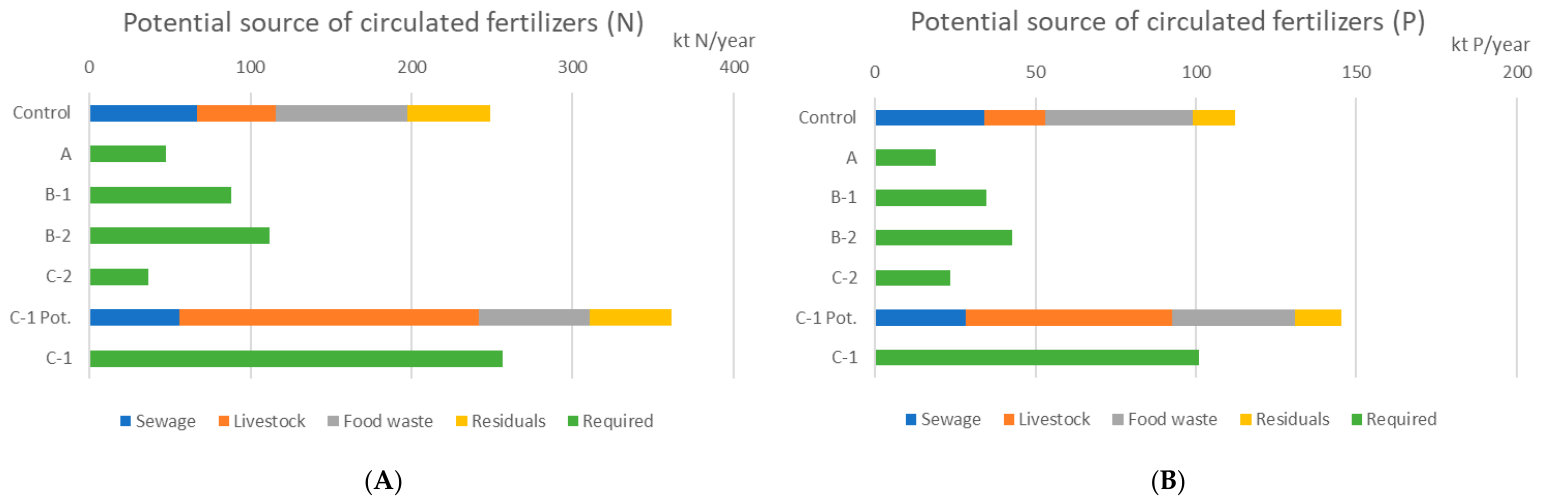
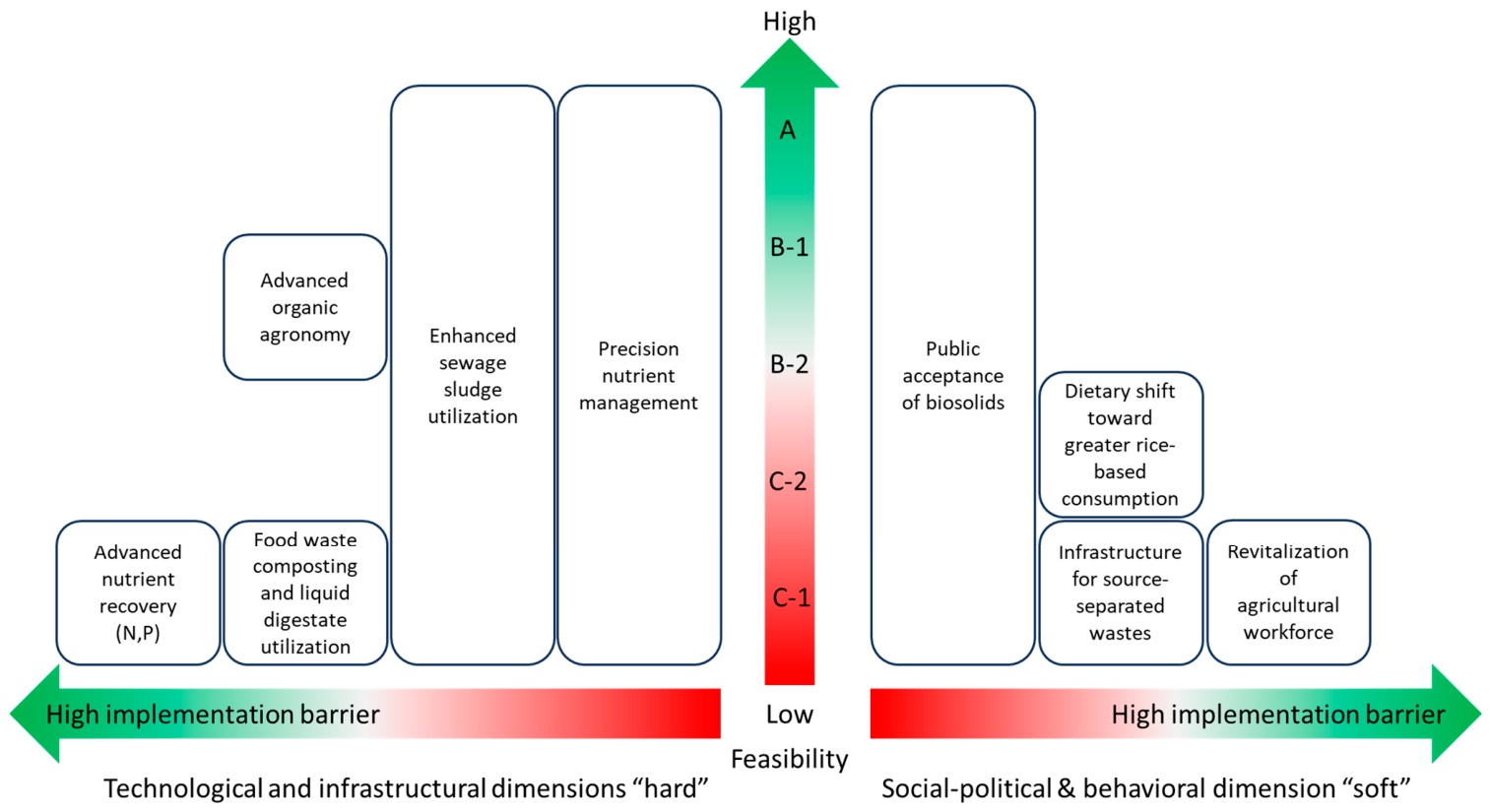
- Scenario A (Chemical Fertilizer Reduction): This remains the most feasible immediate policy. A 30% reduction in chemical fertilizer is achievable by strategically recovering non-circulated nutrients from sewage sludge and livestock waste.
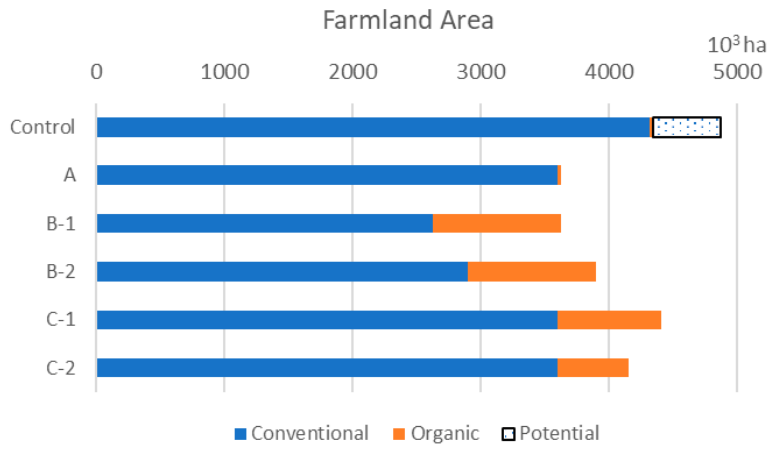
- Scenario B (Organic Farming Expansion): By considering two patterns of scenario B-1 with no gap and B-2 with 75% of conventional farming, the feasibility of this scenario was constrained by the “yield gap”. Without significant technological breakthroughs in organic agronomy (e.g., biochar or mycorrhizal fungi), expanding organic farming may inadvertently increase the demand for conventional land and fertilizers to maintain the national food supply.
- Scenario C (Food Self-Sufficiency): Achieving higher self-sufficiency with current dietary patterns (Scenario C-1) is the most challenging goal for higher circulation requirement and management of farmland. However, scenario C-2 demonstrates that a dietary shift toward rice-based consumption can reconcile self-sufficiency targets.
Supplementary Materials
Author Contributions
Funding
Institutional Review Board Statement
Informed Consent Statement
Data Availability Statement
Acknowledgments
Conflicts of Interest
Abbreviations
| ANRE | Agency for Natural Resources and Energy |
| BNF | Biological nitrogen fixation |
| DN | Denitrification |
| FAOSTAT | Food and Agricultural Organization Statistical Databases |
| GSI | Geospatial Information Authority of Japan |
| ICR | Input circulation ratio |
| MAFF | Ministry of Agriculture, Forestry and Fisheries |
| MLIT | Ministry of Land, Infrastructure, Transport and Tourism |
| MOE | Ministry of the Environment |
| MOJ | Ministry of Justice |
| OCR | Output circulation ratio |
References
- Lu, C.; Tian, H. Global nitrogen and phosphorus fertilizer use for agriculture production in the past half century: Shifted hot spots and nutrient imbalance. Earth Syst. Sci. Data 2017, 9, 181–192. [Google Scholar] [CrossRef]
- FAO. World Food and Agriculture—Statistical Yearbook 2022; FAO: Rome, Italy, 2022. [Google Scholar] [CrossRef]
- Lim, J.Y.; Bhuiyan, M.S.; Lee, S.B.; Lee, J.G.; Kim, P.J. Agricultural nitrogen and phosphorus balances of Korea and Japan: Highest nutrient surplus among OECD member countries. Environ. Pollut. 2021, 286, 117353. [Google Scholar] [CrossRef] [PubMed]
- Nedelciu, C.E.; Ragnarsdottir, K.V.; Schlyter, P.; Stjernquist, I. Global phosphorus supply chain dynamics: Assessing regional impact to 2050. Glob. Food Secur. 2020, 26, 100426. [Google Scholar] [CrossRef] [PubMed]
- Steffen, W.; Richardson, K.; Rockström, J.; Cornell, S.E.; Fetzer, I.; Bennett, E.M.; Biggs, R.; Carpenter, S.R.; De Vries, W.; Sörlin, S. Planetary boundaries: Guiding human development on a changing planet. Science 2015, 347, 1259855. [Google Scholar] [CrossRef] [PubMed]
- Shah, F.; Wu, W. Soil and Crop Management Strategies to Ensure Higher Crop Productivity within Sustainable Environments. Sustainability 2019, 11, 1485. [Google Scholar] [CrossRef]
- Koehring, M.; Chow, M. Food Sustainability Index. Available online: https://impact.economist.com/projects/foodsustainability/fsi/about-the-food-sustainability-index/ (accessed on 22 May 2026).
- Fuhrmann-Aoyagi, M.B.; Miura, K.; Watanabe, K. Sustainability in Japan’s Agriculture: An Analysis of Current Approaches. Sustainability 2024, 16, 596. [Google Scholar] [CrossRef]
- Food and Agriculture Organization of the United Nations. FAOSTAT: Fertilizers by Nutrient. Available online: https://www.fao.org/faostat/en/#data/RFN (accessed on 22 May 2026).
- Takahashi, T.; Dahlgren, R.A. Nature, properties and function of aluminum–humus complexes in volcanic soils. Geoderma 2016, 263, 110–121. [Google Scholar] [CrossRef]
- MAFF. Situation of Fertilizers. 2025. Available online: https://www.maff.go.jp/j/seisan/sien/sizai/s_hiryo/index.html (accessed on 22 May 2026).
- MAFF. Japan’s Food Self Sufficiency Rate. 2025. Available online: https://www.maff.go.jp/j/zyukyu/zikyu_ritu/012.html (accessed on 22 May 2026).
- MAFF. Situation of Feed. 2025. Available online: https://www.maff.go.jp/j/chikusan/sinko/lin/l_siryo/ (accessed on 22 May 2026).
- ANRE. FY2021 Actual Figure on Energy Supply-Demand. 2023. Available online: https://www.enecho.meti.go.jp/statistics/total_energy/pdf/honbun2021fykaku.pdf (accessed on 22 May 2026).
- Rosa, L.; Chiarelli, D.D.; Tu, C.; Rulli, M.C.; D’Odorico, P. Global unsustainable virtual water flows in agricultural trade. Environ. Res. Lett. 2019, 14, 114001. [Google Scholar] [CrossRef]
- Chen, X.; Hou, Y.; Kastner, T.; Liu, L.; Zhang, Y.; Yin, T.; Li, M.; Malik, A.; Li, M.; Thorp, K.R.; et al. Physical and virtual nutrient flows in global telecoupled agricultural trade networks. Nat. Commun. 2023, 14, 2391. [Google Scholar] [CrossRef]
- MOE. Monitoring Results of Public Waters Quality in FY2022. 2024. Available online: https://www.env.go.jp/water/suiiki/index.html (accessed on 22 May 2026).
- MAFF Crop Survey, Long-Term Area Survey. Available online: https://www.e-stat.go.jp/stat-search/files?page=1&layout=datalist&toukei=00500215&tstat=000001013427&cycle=0&tclass1=000001032270&tclass2=000001034721&tclass3val=0 (accessed on 22 May 2026).
- MLIT. White Paper on Land. 2024. Available online: https://www.mlit.go.jp/statistics/file000006.html (accessed on 22 May 2026).
- National Institute of Population and Social Security. Research (2024) Regional Population Projections for Japan: 2020–2050. Available online: https://www.ipss.go.jp/pp-zenkoku/j/zenkoku2023/pp_zenkoku2023.asp (accessed on 22 May 2026).
- MAFF. Survey of Movements in Agricultural Structure. Available online: https://www.e-stat.go.jp/stat-search/files?page=1&layout=datalist&toukei=00500211&tstat=000001015214&cycle=7&year=20190&month=0&tclass1=000001034376&tclass2=000001101255&tclass3=000001101256 (accessed on 22 May 2026).
- Peñuelas, J.; Sardans, J. The global nitrogen-phosphorus imbalance. Science 2022, 375, 266–267. [Google Scholar] [CrossRef]
- Food and Agriculture Organization of the United Nations. The International Code of Conduct for the Sustainable Use and Management of Fertilizers; FAO: Rome, Italy, 2019. [Google Scholar]
- UN Environment Programme (UNEP); World Health Organization (WHO); Food and Agriculture Organization (FAO). Chapter 1/12: Global Drivers, Actors and Policies Affecting Pesticides and Fertilizer Use; UNEP: Nairobi, Kenya, 2022. [Google Scholar]
- Willer, H.; Trávníček, J.; Meier, C.; Schlatter, B. (Eds.) The World of Organic Agriculture Statistics and Emerging Trends 2021; FiBL: Lausanne, Switzerland; IFOAM: Bonn, Germany, 2021. [Google Scholar]
- European Commission. Farm to Fork Strategy. 2020. Available online: https://food.ec.europa.eu/document/download/472acca8-7f7b-4171-98b0-ed76720d68d3_en?filename=f2f_action-plan_2020_strategy-info_en.pdf (accessed on 22 May 2026).
- U.S. Department of Agriculture. U.S. Agriculture Innovation Strategy. 2021. Available online: https://www.usda.gov/sites/default/files/documents/AIS.508-01.06.2021.pdf (accessed on 22 May 2026).
- U.S. Department of Agriculture. Agriculture Innovation Agenda: Year One Status Report. 2020. Available online: https://www.usda.gov/sites/default/files/documents/aia-year-one-report.pdf (accessed on 22 May 2026).
- MAFF. MIDORI Strategy for Sustainable Food Systems. 2021. Available online: https://www.maff.go.jp/j/kanbo/kankyo/seisaku/midori/index.html (accessed on 22 May 2026).
- MAFF. The Basic Plan for Food, Agriculture and Rural Areas. 2020. Available online: https://www.maff.go.jp/j/keikaku/k_aratana/attach/pdf/r2_keikaku-3.pdf (accessed on 22 May 2026).
- MAFF. The Basic Plan for Food, Agriculture and Rural Areas. 2025. Available online: https://www.maff.go.jp/j/keikaku/k_aratana/ (accessed on 22 May 2026).
- Nishina, K.; Hayashi, K.; Oita, A.; Asada, K.; Hayakawa, A.; Okadera, T.; Onodera, T.; Hanaoka, T.; Tsuchiya, K.; Kobayashi, K.; et al. Feasibility assessment of Japan’s fertilizer reduction target: A meta-analysis and its implications for nitrogen waste. J. Environ. Manag. 2025, 373, 123362. [Google Scholar] [CrossRef]
- Daramola, D.A.; Hatzell, M.C. Energy Demand of Nitrogen and Phosphorus Based Fertilizers and Approaches to Circularity. ACS Energy Lett. 2023, 8, 1493–1501. [Google Scholar] [CrossRef]
- Springmann, M.; Clark, M.; Mason-D, D.; Wiebe, K.; Bodirsky, B.L.; Lassaletta, L.; De Vries, W.; Vermeulen, S.J.; Herrero, M.; Carlson, K.M.; et al. Options for keeping the food system within environmental limits. Nature 2018, 562, 519–525. [Google Scholar] [CrossRef]
- MLIT. Dissemination Status of Wastewater Treatment Facilities (2021). 2022. Available online: https://www.mlit.go.jp/report/press/content/001497948.pdf (accessed on 22 May 2026).
- Hayashi, K.; Shibata, H.; Oita, A.; Nishina, K.; Ito, A.; Katagiri, K.; Shindo, J.; Winiwarter, W. Nitrogen budgets in Japan from 2000 to 2015: Decreasing trend of nitrogen loss to the environment and the challenge to further reduce nitrogen waste. Environ. Pollut. 2021, 286, 117559. [Google Scholar] [CrossRef]
- Nättorp, A.; Kabbe, C.; Matsubae, K.; Ohtake, H. Development of Phosphorus Recycling in Europe and Japan. In Phosphorus Recovery and Recycling; Ohtake, H., Tsuneda, S., Eds.; Springer: Singapore, 2019; pp. 3–27. [Google Scholar]
- MOE. Formation of the Sound Material-Cycle Society. In Annual Report on the Environment, the Sound Material-Cycle Society and Biodiversity in Japan; 2024. Available online: https://www.env.go.jp/policy/hakusyo/r06/pdf/2_3.pdf (accessed on 22 May 2026).
- Nakanishi, H.; Ukita, M. Ecological Aspects of Nitrogen and Phosphorus Sources in Japan. Jpn. J. Water Pollut. Res. 1978, 2, 133–151. [Google Scholar] [CrossRef]
- Hakamata, T. Resource Management and Environmental Issues in Agriculture. Environ. Res. Q. 1996, 100, 120–126. [Google Scholar]
- Miwa, E.; Oda, K.; Matsumoto, N. Analysis of Nitrogen Load to the Environment Based on Nitrogen Flow in Food Supply System of Japan. J. Soil. Sci. Plant Nutr. 2006, 77, 627–634. [Google Scholar] [CrossRef]
- Matsumoto, N.; Oda, K.; Miwa, E. Changes in nitrogen flow in food and feed supply during 1992–2007 in Japan. J. Soil. Sci. Plant Nutr. 2017, 88, 1–11. [Google Scholar] [CrossRef]
- Mizutani, J. Nitrogen and Phosphorus Material Cycle in Japan. Jpn. J. JSCE 1997, 1997, 103–108. [Google Scholar] [CrossRef] [PubMed]
- Kawashima, H. Food Supply and the Nitrogen Cycle in Japan. Environ. Sci. 1996, 9, 27–33. [Google Scholar] [CrossRef]
- Tezuka, K.; Nouchi, M.; Sudo, R. Mass Balance of Nitrogen and Phosphorus in Japanese Society. J. Water Waste 2002, 44, 13–20. [Google Scholar]
- Shindo, J.; Okamoto, K.; Kawashima, H.; Konohira, E. Nitrogen flow associated with food production and consumption and its effect on water quality in Japan from 1961 to 2005. Soil. Sci. Plant Nutr. 2009, 55, 532–545. [Google Scholar] [CrossRef]
- Takahashi, T. Research challenges on nutrient management for coexistence of food self-sufficiency improvement and environmental conservation in Japan. J. NARO Res. Dev. 2011, 73–103. [Google Scholar]
- Katagiri, K.; Mizoguchi, M.; Matsubae, K.; Nagasaka, T. Material Flow Analysis of Nitrogen Around Industries in Japan from 2005 to 2015. J. Life Cycle Assess. Jpn. 2018, 14, 319–331. [Google Scholar] [CrossRef]
- Matsubae-Yokoyama, K.; Kubo, H.; Nakajima, K.; Nagasaka, T. A Material Flow Analysis of Phosphorus in Japan. J. Ind. Ecol. 2009, 13, 687–705. [Google Scholar] [CrossRef]
- Mishima, S.; Kohyama, K. The database and the methodologies to estimate recent trend of nitrogen (N) and phosphate (P) flows and residual N and P in Japanese national prefectural scales and examples their application. Bull. Natl. Inst. Agro-Environ. Sci. 2010, 27, 117–139. [Google Scholar]
- Seufert, V.; Ramankutty, N.; Foley, J.A. Comparing the yields of organic and conventional agriculture. Nature 2012, 485, 229–232. [Google Scholar] [CrossRef]
- Fan, X.; Chen, Z.; Niu, Z.; Zeng, R.; Ou, J.; Liu, X.; Wang, X. Replacing Synthetic Nitrogen Fertilizer with Different Types of Organic Materials Improves Grain Yield in China: A Meta-Analysis. Agronomy 2021, 11, 2429. [Google Scholar] [CrossRef]
- MAFF. Annual Report on Food, Agriculture and Rural Areas in Japan. 2023. Available online: https://warp.ndl.go.jp/20260323/20260303034357/https:/www.maff.go.jp/j/wpaper/w_maff/r4/pdf/zentaiban_05.pdf (accessed on 22 May 2026).
- Miyazaki Prefecture. Fertilizer Application Standards for Major Crops. 1999. Available online: https://www.maff.go.jp/j/seisan/kankyo/hozen_type/h_sehi_kizyun/miy01.html (accessed on 22 May 2026).
- Katayama, A.; Mizutani, H.; Suzuki, S.; Tada, Y.; Yoshida, S. Estimation of nitrogen emission in the recycle system of cattledung compost. Environ. Sci. 2001, 14, 373–390. [Google Scholar] [CrossRef]
- Chojnacka, K.; Skrzypczak, D.; Szopa, D.; Izydorczyk, G.; Moustakas, K.; Witek-Krowiak, A. Management of biological sewage sludge: Fertilizer nitrogen recovery as the solution to fertilizer crisis. J. Environ. Manag. 2023, 326, 116602. [Google Scholar] [CrossRef] [PubMed]
- Fueki, N.; Takata, Y.; Obara, H.; Nakamura, R.; Nakagawa, S.; Takakai, F. Soil and fertilizer science has a big role to overcome the fertilizer crisis. I. Realities of soils, fertilizer accumulations, fertilizer trades and farmers’ efforts. Jpn. J. Soil. Sci. Plant Nutr. 2026, 97, 43–47. [Google Scholar]
- MAFF. Basic Guidelines for Soil Productivity Improvement. 1997. Available online: https://www.maff.go.jp/j/seisan/kankyo/hozen_type/h_dozyo/houritu.html (accessed on 22 May 2026).
- Aomori Prefecture. Healty Soil Preparation Technology Manual. 2008. Available online: https://www.maff.go.jp/j/seisan/kankyo/hozen_type/h_sehi_kizyun/aomori01.html (accessed on 22 May 2026).
- Barłóg, P. Improving Fertilizer Use Efficiency—Methods and Strategies for the Future. Plants 2023, 12, 3658. [Google Scholar] [CrossRef] [PubMed]
- Chen, M.; Schievano, A.; Bosco, S.; Montero-Castaño, A.; Tamburini, G.; Pérez-Soba, M.; Makowski, D. Evidence map of the benefits of enhanced-efficiency fertilisers for the environment, nutrient use efficiency, soil fertility, and crop production. Environ. Res. Lett. 2023, 18, 043005. [Google Scholar] [CrossRef]
- Hopkins, B.G.; Fernelius, K.J.; Hansen, N.C.; Eggett, D.L. AVAIL Phosphorus Fertilizer Enhancer: Meta-Analysis of 503 Field Evaluations. Agron. J. 2018, 110, 389–398. [Google Scholar] [CrossRef]
- MLIT. Guidelines for Effective Implementation of Active Operation and Management of Nutrients. 2023. Available online: https://www.mlit.go.jp/mizukokudo/sewerage/mizukokudo_sewerage_tk_000701.html (accessed on 22 May 2026).
- Lucas, E.; Kennedy, B.; Roswall, T.; Burgis, C.; Toor, G.S. Climate Change Effects on Phosphorus Loss from Agricultural Land to Water: A Review. Curr. Pollut. Rep. 2023, 9, 623–645. [Google Scholar] [CrossRef]
- Sanchez-Sabate, R.; Sabaté, J. Consumer Attitudes Towards Environmental Concerns of Meat Consumption: A Systematic Review. Int. J. Environ. Res. Public Health 2019, 16, 1220. [Google Scholar] [CrossRef] [PubMed]
- Abe, Y.; Honda, Y.; Fukujyu, N. Recovery of ammonia and its utilization in the process of composting using vacuum type aeration. Jpn. Assoc. Odor Environ. 2009, 40, 221–228. [Google Scholar] [CrossRef]
- MAFF. Current Livestock-Related Environmental Issues and Responses. 2024. Available online: https://www.maff.go.jp/e/policies/env/index.html (accessed on 22 May 2026).
- MLIT. Current Status of Utilization of Sewage Sludge Resources as Fertilizer. 2022. Available online: https://www.mlit.go.jp/mizukokudo/sewerage/mizukokudo_sewerage_tk_000555.html (accessed on 22 May 2026).
- Katoh, M. Challenges and Prospects for Utilization of Sewage Sludge Fertilizer and Compost. Mater. Cycles Waste Manag. Res. 2021, 32, 427–434. [Google Scholar] [CrossRef]
- MLIT. Analysis and Survey of Fertilizer Components and Heavy Metals for Expanding the Use of Sewage Sludge Resources as Fertilizer FY2023-2025; MLIT: Tokyo, Japan, 2026.
- MOJ. Act on the Quality Control of Fertilizer—Japanese Law Translation DB. 2022. Available online: https://www.japaneselawtranslation.go.jp/ja/laws/view/4446 (accessed on 20 April 2026).
- Hagino, T.; Hirajima, T. Development of a Process for Recovering Phosphorus from Sewage Sludge. Resour. Process. 2005, 52, 172–182. [Google Scholar] [CrossRef]
- MAFF. Good Practices for Utilizing Methane Fermentation Biofertilizer. 2024. Available online: https://www.maff.go.jp/j/shokusan/biomass/attach/pdf/index-158.pdf (accessed on 22 May 2026).
- Rut Duga, D. The Effect of Integrated Organic and Inorganic Fertilizer on Soil Fertility and Productivity. J. Ecol. Nat. Resour. 2021, 5, 3. [Google Scholar] [CrossRef]
- Koumoulidis, D.; Varvaris, I.; Pittaki, Z.; Hadjimitsis, D. Sewage Sludge in Agricultural Lands: The Legislative Framework in EU-28. Sustainability 2024, 16, 10946. [Google Scholar] [CrossRef]
- Delibacak, S.; Voronina, L.; Morachevskaya, E. Use of sewage sludge in agricultural soils: Useful or harmful. Eurasian J. Soil Sci. 2020, 9, 126–139. [Google Scholar] [CrossRef]
- Matsubae, K. Importance of Ensuring Sustainable Fertilizer Resource Management. Mater. Cycles Waste Manag. Res. 2021, 32, 445–452. [Google Scholar] [CrossRef]
- Wei, Z.; Hoffland, E.; Zhuang, M.; Hellegers, P.; Cui, Z. Organic inputs to reduce nitrogen export via leaching and runoff: A global meta-analysis. Environ. Pollut. 2021, 291, 118176. [Google Scholar] [CrossRef]
- Ahrens, F.; Land, J.; Krumdieck, S. Decarbonization of Nitrogen Fertilizer: A Transition Engineering Desk Study for Agriculture in Germany. Sustainability 2022, 14, 8564. [Google Scholar] [CrossRef]
- Litskas, V.D. Environmental Impact Assessment for Animal Waste, Organic and Synthetic Fertilizers. Nitrogen 2023, 4, 16–25. [Google Scholar] [CrossRef]
- Alkharabsheh, H.M.; Seleiman, M.F.; Battaglia, M.L.; Shami, A.; Jalal, R.S.; Alhammad, B.A.; Almutairi, K.F.; Al-Saif, A.M. Biochar and Its Broad Impacts in Soil Quality and Fertility, Nutrient Leaching and Crop Productivity: A Review. Agronomy 2021, 11, 993. [Google Scholar] [CrossRef]
- Matsuzaki, K. Arbuscular mycorrhizal fungi and their uses. Agric. Hortic. 2009, 84, 170–175. [Google Scholar]
- Thapa, B.; Dura, R. A review on tillage system and no-till agriculture and its impact on soil health. Arch. Agric. Environ. Sci. 2024, 9, 612–617. [Google Scholar] [CrossRef]
- MEXT. Standard Tables of Food Composition in Japan—2015—(Seventh Revised Version). 2021. Available online: https://www.mext.go.jp/en/policy/science_technology/policy/title01/detail01/1374030.htm (accessed on 22 May 2026).
- Mishima, S. Nutrient balance and nutrient use efficiency in Japan. Soil. Sci. Plant Nutr. 2025, 71, 451–460. [Google Scholar] [CrossRef]
- Xie, X.; Hu, Y.; Li, X.; Li, S.; Li, X.; Li, Y. Measuring and Enhancing Food Security Resilience in China Under Climate Change. Systems 2025, 13, 1054. [Google Scholar] [CrossRef]
- MAFF. Food Balance Sheet FY2021. 2023. E-Stat. Available online: https://www.e-stat.go.jp/stat-search/files?page=1&layout=datalist&toukei=00500300&tstat=000001017950&cycle=8&year=20211&month=0&tclass1=000001032890&tclass2=000001203100 (accessed on 1 February 2026).
- National Agriculture and Food Research Organization. Standard Tables of Feed Composition in Japan (2009); Japan Livestock Industry Association: Tokyo, Japan, 2010. [Google Scholar]
- MAFF. Japanese Standards for Feed. 2025. Available online: http://www.famic.go.jp/ffis/feed/kokuji/k51n756.html (accessed on 1 February 2026).
- Japan Sewage Works Association. Sewage Statics FY2021; Japan Sewage Works Association: Tokyo, Japan, 2024. [Google Scholar]
- The Japan Association of Rural Solutions for Environmental Conservation. Guidelines for the Community Wastewater. 2022. Available online: https://www.jarus.or.jp/HP2024/img/jrs8250/S-1_0706.pdf (accessed on 22 May 2026).
- MLIT. Comprehensive Plan and Survey Guidelines and Interpretations for Basin-Specific Sewage Development. Available online: https://www.mlit.go.jp/mizukokudo/sewerage/mizukokudo_sewerage_tk_000383.html (accessed on 22 May 2026).
- Matsuto, T.; Ishii, S. Proximate and Ultimate Analysis for Detailed Composition of Combustible Fractions in Household Waste. Mater. Cycles Waste Manag. Res. 2011, 22, 382–395. [Google Scholar] [CrossRef]
- Nakamura, M.; Yuyama, Y. Development of a Composition Database for Various Types of Biomass. Tech. Rep. Natl. Res. Inst. Agric. Eng. 2005, 203, 57–80. [Google Scholar]
- Haga, K. Recycling of Organic Waste and Biomass Utilization. 2008. Available online: https://www.engineer.or.jp/c_cmt/cpd/topics/008/attached/attach_8458_1.pdf (accessed on 22 May 2026).
- MAFF. Livestock Statistics. E-Stat. Available online: https://www.e-stat.go.jp/stat-search/files?page=1&layout=datalist&toukei=00500222&tstat=000001015614&cycle=7&year=20210&month=0&tclass1=000001020206&tclass2=000001161726 (accessed on 22 May 2026).
- MOE; Greenhouse Gas Inventory Office of Japan (GIO); Center for Global Environmental Research (CGER); National Institute for Environmental Studies, Japan (NIES). National Greenhouse Gas Inventory Report of Japan. 2022. Available online: https://dl.ndl.go.jp/pid/14615206 (accessed on 22 May 2026).
- Asada, I.; Sakai, H.; Nakamura, T.; Oishi, K.; Kumagai, H.; Hirooka, H. The estimation of the nitrogen and phosphorus accounts in one of the largest animal production area in Japan. J. Jpn. Agric. Syst. Soc. 2021, 37, 49–62. [Google Scholar]
- Kojima, K.; Kato, T.; Sumikura, M.; Kawamoto, T. Estimation of Nitrogen-Derived Energy Potential in Sewage Treatment Plants and Its Use. J. Jpn. Sew. Works Assoc. 2021, 58, 78–87. [Google Scholar]
- Mizuno, K.; Yoshiba, M. The type of sludge fertilizer and the analysis result of a component—The result of the fertilizer inspection in FAMIC. J. Jpn. Soc. Sol. Sci. Plant Nutr. 2013, 84, 311–320. [Google Scholar]
- MOE. Waste Disposal in Japan FY2021. 2023. Available online: https://www.env.go.jp/recycle/waste_tech/ippan/r3/data/disposal.pdf (accessed on 22 May 2026).
- Tanosaki, T.; Matsumoto, M.; Nozaki, K.; Izumi, K.; Nakamura, K.; Nambu, M.; Maruta, T. Characterization of Incineration Ashes in Japan. Inorg. Mater. 1998, 49, 149–158. [Google Scholar]
- MAFF. Trends in Utilization Rates by Biomass Type. 2023. Available online: https://www.maff.go.jp/j/shokusan/biomass/attach/pdf/230908_8-12.pdf (accessed on 22 May 2026).
- Mishima, S.; Endo, A.; Kohyama, K. Nitrogen and phosphate balance on crop production in Japan on national and prefectural scales. Nutr. Cycl. Agroecosyst. 2010, 87, 159–173. [Google Scholar] [CrossRef]
- MOE. Amount of Wet Deposition. 2022. Available online: https://www.env.go.jp/content/000109949.pdf (accessed on 22 May 2026).
- GSI. Area Survey by Prefecture, City, Ward, Town, and Village Nationwide. 2021. Available online: https://www.gsi.go.jp/KOKUJYOHO/MENCHO/backnumber/GSI-menseki20210401.pdf (accessed on 22 May 2026).
- MOE. Comprehensive Website for Water Environment. Available online: https://water-pub.env.go.jp/water-pub/mizu-site/ (accessed on 22 May 2026).
- MLIT. River Data Book 2021. 2021. Available online: https://www.mlit.go.jp/river/toukei_chousa/index.html (accessed on 22 May 2026).
- MOE. Survey on Actual Conditions of General Waste Treatment (Nitrate) FY2021. 2023. E-Stat. Available online: https://www.e-stat.go.jp/stat-search/files?page=1&layout=datalist&toukei=00650101&tstat=000001210241&cycle=7&tclass1=000001210263&tclass2=000001210264&stat_infid=000040107562&tclass3val=0 (accessed on 22 May 2026).
- MAFF. Guidelines for the Reuse of Community Wastewater Resources (Draft) 2025. Available online: https://www.maff.go.jp/j/nousin/sekkei/nn/n_nouson/syuhai/attach/pdf/170825-35.pdf (accessed on 22 May 2026).


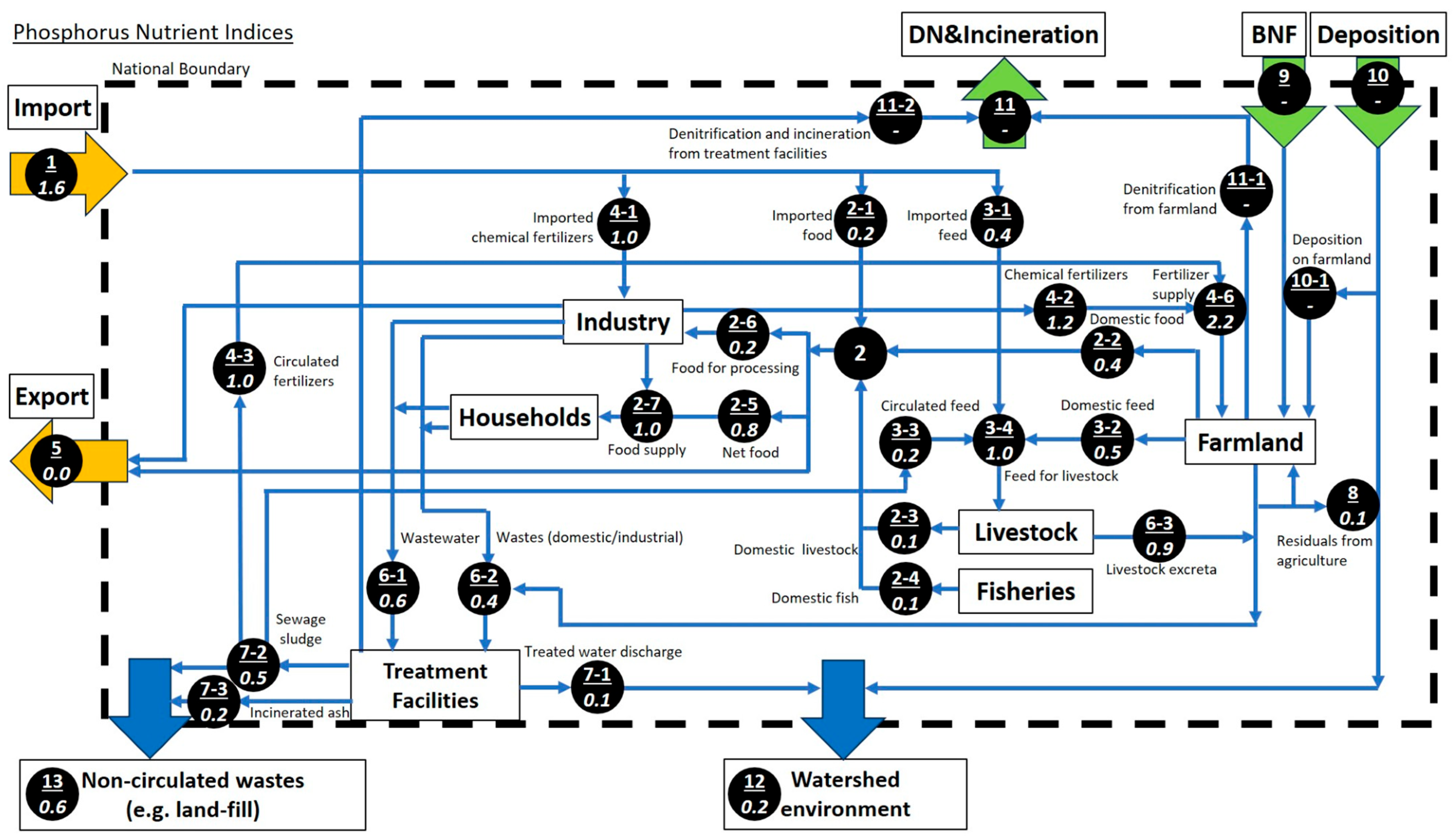




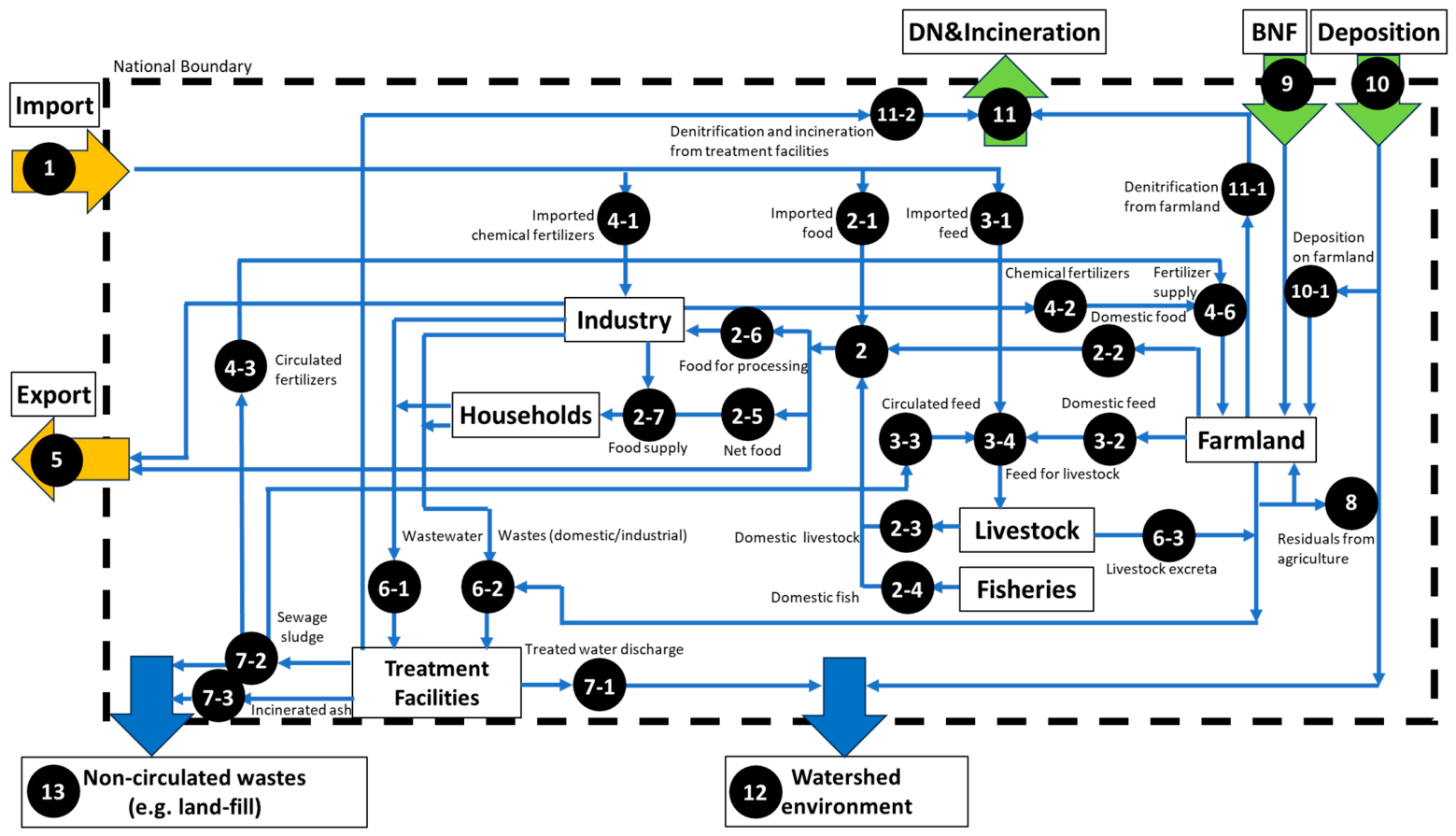
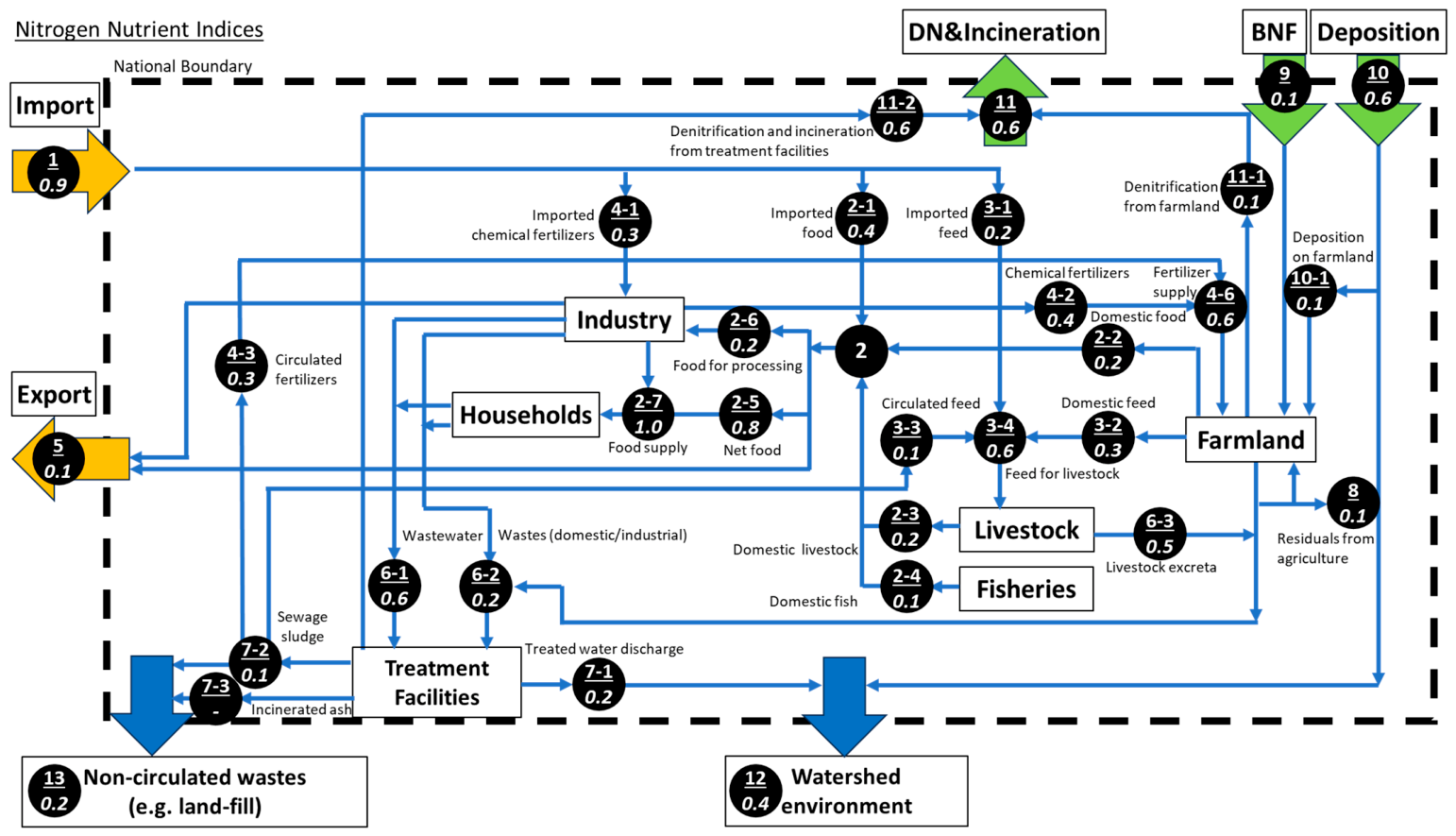
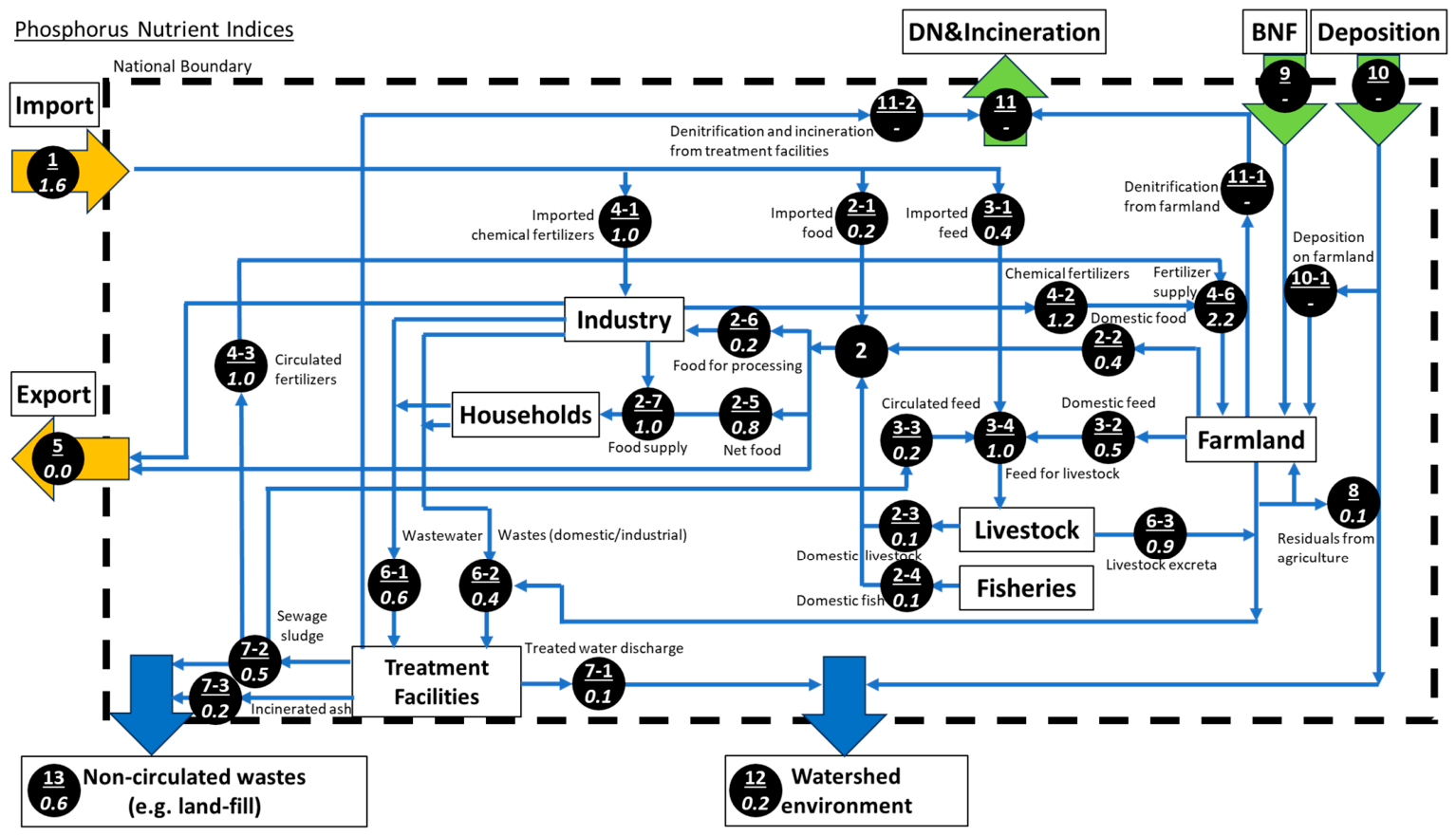
| No. | Item |
|---|---|
| 1 | Import |
| 2 | Food |
| 3 | Feed |
| 4 | Fertilizers |
| 5 | Export |
| 6 | Input to treatment facilities |
| 7 | Output from treatment facilities |
| 8 | Residuals from agriculture |
| 9 | Biological nitrogen fixation (BNF) |
| 10 | Deposition by rain |
| 11 | Denitrification (DN) and incineration |
| 12 | Watershed environment |
| 13 | Non-circulated wastes |
| 14 | Circulated wastes |
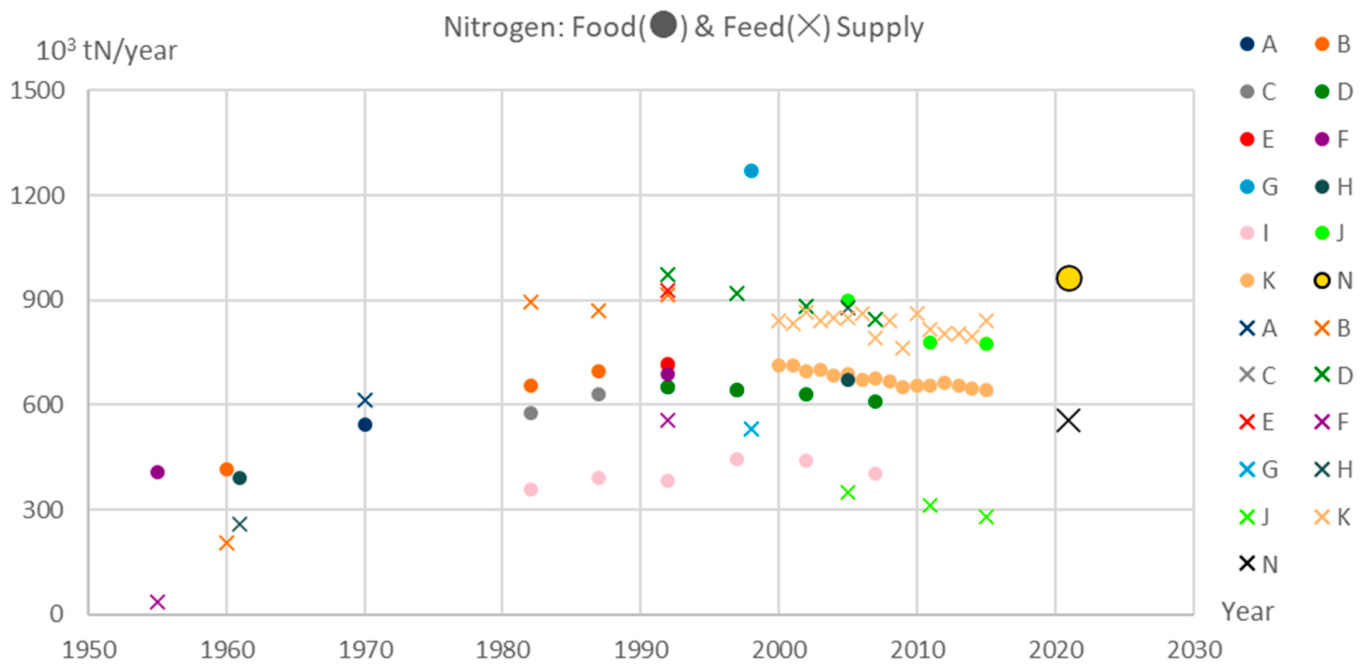
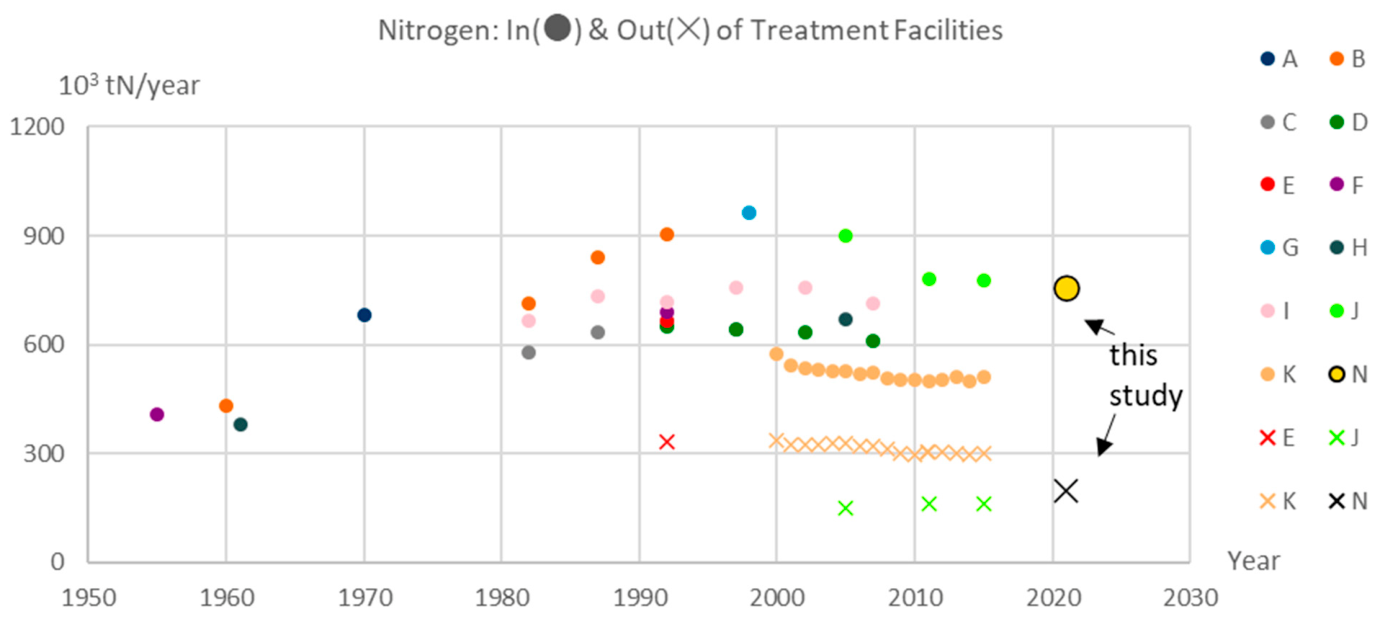
| Reference | Nitrogen | Phosphorus |
|---|---|---|
| A | Nakanishi and Ukita, 1978 [39] | - |
| B | Hakamata, 1996 [40] | - |
| C | Miwa et al., 2006 [41] | - |
| D | Matsumoto et al., 2017 [42] | - |
| E | Mizutani, 1997 [43] | Mizutani, 1997 [43] |
| F | Kawashima, 1996 [44] | - |
| G | Tezuka et al., 2002 [45] | Tezuka et al., 2002 [45] |
| H | Shindo et al., 2009 [46] | - |
| I | Takahashi, 2011 [47] | Takahashi, 2011 [47] |
| J | Katagiri et al., 2018 [48] | - |
| K | Hayashi et al., 2021 [36] | - |
| L | - | Matsubae, 2009 [49] |
| M | - | Nattorp et al., 2019 [37] |
| N | Current study | Current study |
| Scenario | Description | Status in 2021 | Policy Targets |
|---|---|---|---|
| Control | Calculated nitrogen and phosphate flow in 2021 (The result of 2.1) | - | - |
| A | Chemical fertilizer reduction by 2050 | - | 30% reduction |
| B-1 | Organic farmland increase by 2050 | 27,000 ha, 0.7% | Increase to 1,000,000 ha, 25% of total area |
| B-2 | Organic farmland increase by 2050 with low yield from organic farmland area | ||
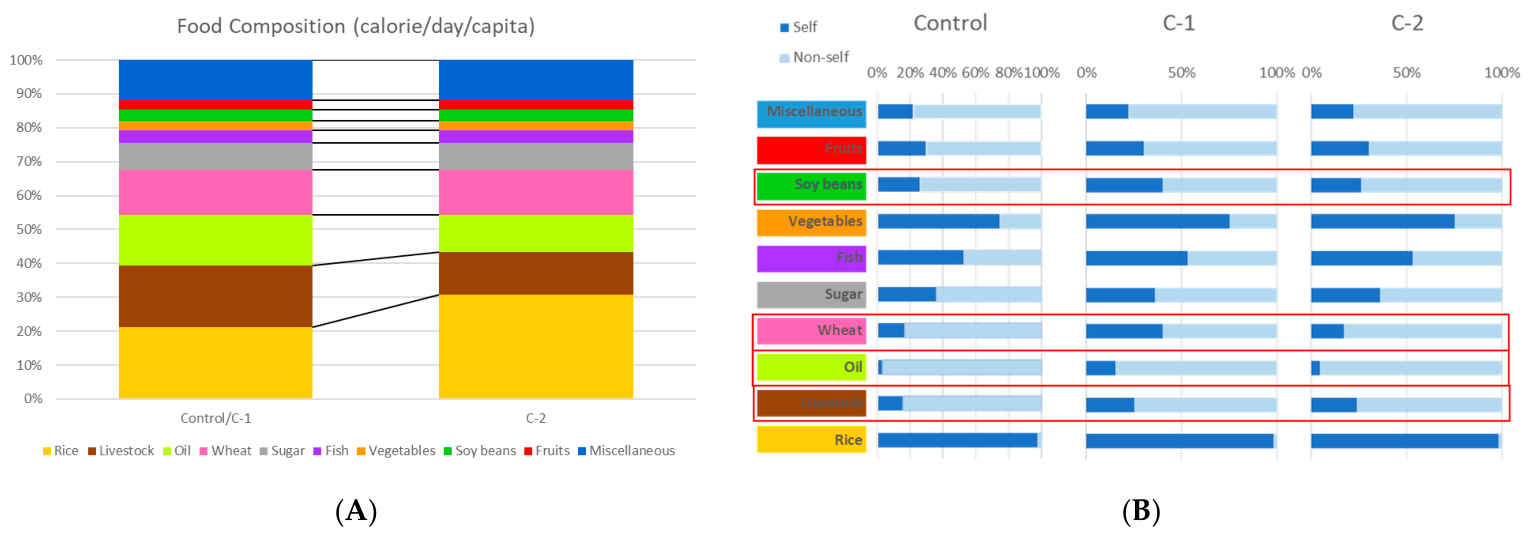
| C-1 | Food self-sufficiency increase | 38% | Increase food self-sufficiency to 45% |
| C-2 | Food self-sufficiency increase with food composition change |
| No. | Item | Flow Value (103 t/Year) | Flow per Capita (kg/Cap/Year) | Nutrient Index (-) | |||
|---|---|---|---|---|---|---|---|
| N | P | N | P | N | P | ||
| 1 | Import | 834.5 | 192.2 | 6.65 | 1.53 | 0.87 | 1.63 |
| 2 | Food | ||||||
| 2-1 | Imported food | 380.5 | 27.1 | 3.03 | 0.22 | 0.37 | 0.19 |
| 2-2 | Domestic food | 223.8 | 43.1 | 1.78 | 0.34 | 0.23 | 0.36 |
| 2-3 | Domestic livestock | 181.8 | 15.0 | 1.45 | 0.12 | 0.19 | 0.13 |
| 2-4 | Domestic fish | 103.5 | 8.3 | 0.82 | 0.07 | 0.11 | 0.07 |
| 2-5 | Net food | 742.2 | 90.5 | 5.91 | 0.72 | 0.77 | 0.77 |
| 2-6 | Food for processing | 221.0 | 27.7 | 1.76 | 0.22 | 0.23 | 0.23 |
| 2-7 | Food supply | 963.2 | 118.2 | 7.67 | 0.94 | 1.00 | 1.00 |
| 3 | Feed | ||||||
| 3-1 | Imported feed | 180.2 | 42.9 | 1.44 | 0.34 | 0.19 | 0.36 |
| 3-2 | Domestic feed | 314.9 | 58.1 | 2.51 | 0.46 | 0.33 | 0.49 |
| 3-3 | Circulated feed | 61.5 | 17.3 | 0.49 | 0.14 | 0.06 | 0.15 |
| 3-4 | Feed for livestock | 556.7 | 118.2 | 4.44 | 0.94 | 0.58 | 1.00 |
| 4 | Fertilizers | ||||||
| 4-1 | Imported fertilizers | 273.8 | 122.2 | 2.18 | 0.97 | 0.28 | 1.03 |
| 4-2 | Chemical fertilizers | 354.9 | 140.6 | 2.83 | 1.12 | 0.37 | 1.19 |
| 4-3 | Circulated fertilizers | 255.3 | 119.0 | 2.03 | 0.95 | 0.27 | 1.01 |
| 4-4 | Circulated fertilizers from sewage sludge | 28.3 | 16.0 | 0.23 | 0.13 | 0.03 | 0.14 |
| 4-5 | Circulated fertilizers from livestock excreta | 212.8 | 83.4 | 1.70 | 0.66 | 0.22 | 0.71 |
| 4-6 | Fertilizer supply | 610.2 | 259.6 | 4.86 | 2.07 | 0.63 | 2.20 |
| 5 | Export | 137.0 | 5.2 | 1.09 | 0.04 | 0.14 | 0.04 |
| 6 | Input to treatment facilities | 758.9 | 116.6 | 6.05 | 0.93 | 0.79 | 0.99 |
| 6-1 | Wastewater | 595.1 | 70.6 | 4.74 | 0.56 | 0.62 | 0.60 |
| 6-2 | Wastes (domestic/industrial) | 163.8 | 45.9 | 1.31 | 0.37 | 0.17 | 0.39 |
| 6-3 | Livestock excreta generation | 523.6 | 102.6 | 4.17 | 0.82 | 0.54 | 0.87 |
| 7 | Output from treatment facilities | ||||||
| 7-1 | Treated water discharge to watershed | 197.3 | 15.4 | 1.57 | 0.12 | 0.20 | 0.13 |
| 7-2 | Sewage sludge | 95.4 | 50.1 | 0.76 | 0.40 | 0.10 | 0.42 |
| 7-3 | Incinerated ash | - | 17.8 | - | 0.14 | - | 0.15 |
| 7-4 | Livestock excreta | 310.2 | 102.5 | 2.47 | 0.82 | 0.32 | 0.87 |
| 8 | Residuals from agriculture | 102.6 | 13.1 | 0.82 | 0.10 | 0.11 | 0.11 |
| 9 | Biological nitrification in fields (BNF) | 86.7 | - | 0.69 | - | 0.09 | - |
| 10 | Deposition by rain (whole land) | 556.0 | 4.43 | - | 0.58 | ||
| 10-1 | Deposition on farmlands | 64.0 | - | 0.51 | - | 0.07 | - |
| 11 | Denitrification (DN) and Incineration | 615.6 | - | 4.90 | - | 0.64 | - |
| 11-1 | DN from farmlands | 81.9 | - | 0.65 | - | 0.09 | - |
| 11-2 | DN and Incineration from treatment facilities | 533.7 | - | 4.25 | - | 0.55 | - |
| 11-3 | DN from sewage | 257.3 | - | 2.05 | - | 0.27 | - |
| 11-4 | DN from livestock excreta compost | 212.8 | - | 1.70 | - | 0.22 | - |
| 11-5 | Nitrogen from incineration | 63.5 | - | 0.51 | - | 0.07 | - |
| 12 | Watershed environment | 417.3 | 28.2 | 3.33 | 0.22 | 0.43 | 0.24 |
| 13 | Non-circulated wastes | 164.4 | 71.0 | 1.31 | 0.57 | 0.17 | 0.60 |
| 13-1 | Non-circulated wastes from sewage | 67.1 | 34.1 | 0.53 | 0.27 | 0.07 | 0.29 |
| 13-2 | Non-circulated wastes from livestock excreta | 97.4 | 19.1 | 0.78 | 0.15 | 0.10 | 0.16 |
| 14 | Circulated Waste | 316.9 | 136.3 | 2.52 | 1.09 | 0.33 | 1.15 |
| 103 t/Year | ||||||
|---|---|---|---|---|---|---|
| Nitrogen | ||||||
| Input | Output | |||||
| Farmland | 4-2 | Chemical fertilizers | 354.9 | 2-2 | Domestic food | 223.8 |
| 4-3 | Circulated fertilizers | 255.3 | 3-2 | Domestic feed | 314.9 | |
| 9 | BNF | 86.7 | 8 | Residuals | 102.6 | |
| 10-1 | Deposition | 64.0 | 11-1 | DN | 81.9 | |
| Input Total | 760.9 | Output Total | 723.2 | |||
| Livestock | 3-1 | Imported feed | 180.2 | 2-3 | Domestic livestock | 181.8 |
| 3-2 | Domestic feed | 314.9 | 4-5 | Circulated fertilizers | 212.8 | |
| 3-3 | Circulated feed | 61.5 | 11-4 | Livestock excreta DN | 212.8 | |
| 13-2 | Non-circulated waste | 97.4 | ||||
| Input Total | 556.7 | Output Total | 704.8 | |||
| Households | 2-5 | Net food | 539.8 | 6-1 | Wastewater | 595.1 |
| and Industry | 2-6 | Food for processing | 221.0 | 6-2 | Wastes | 163.8 |
| Input Total | 760.8 | Output Total | 758.9 | |||
| Treatment | 6-1 | Wastewater | 595.1 | 7-1 | Treated water | 197.3 |
| Facilities | 6-2 | Wastes | 163.8 | 4-3 | Circulated fertilizer | 255.3 |
| 6-3 | Livestock excreta | 523.6 | 3-3 | Circulated feed | 61.5 | |
| 13 | Non-circulated waste | 164.4 | ||||
| 11-3 | Sewage DN | 257.3 | ||||
| 11-5 | Incineration DN | 63.5 | ||||
| 11-4 | Livestock excreta DN | 212.8 | ||||
| Input Total | 1282.5 | Output Total | 1212.3 | |||
| Japan | 2-1 | Imported food | 380.5 | 5 | Export | 137.0 |
| 3-1 | Imported feed | 180.2 | 12 | Watershed | 417.3 | |
| 4-1 | Imported fertilizers | 273.8 | 13 | Non-circulated waste | 164.4 | |
| 9 | BNF | 86.7 | 11 | DN | 615.6 | |
| 10 | Deposition(Land) | 556.0 | ||||
| Input Total | 1477.1 | Output Total | 1334.3 | |||
| 103 t/year | ||||||
| Phosphorus | ||||||
| Input | Output | |||||
| Farmland | 4-2 | Chemical fertilizers | 140.6 | 2-2 | Domestic food | 43.1 |
| 4-3 | Circulated fertilizers | 119.0 | 3-2 | Domestic feed | 58.1 | |
| 8 | Residuals | 13.1 | ||||
| Input Total | 259.6 | Output Total | 114.4 | |||
| Livestock | 3-1 | Imported feed | 42.9 | 2-3 | Domestic livestock | 15.0 |
| 3-2 | Domestic feed | 58.1 | 4-5 | Circulated fertilizers | 83.4 | |
| 3-3 | Circulated feed | 17.3 | ||||
| 13-2 | Non-circulated waste | 19.1 | ||||
| Input Total | 118.2 | Output Total | 117.5 | |||
| Households | 2-5 | Net food | 70.3 | 6-1 | Wastewater | 70.6 |
| and Industry | 2-6 | Food for processing | 27.7 | 6-2 | Wastes | 45.9 |
| Input Total | 98.0 | Output Total | 116.6 | |||
| Treatment | 6-1 | Wastewater | 70.6 | 7-1 | Treated water | 15.4 |
| Facilities | 6-2 | Wastes | 45.9 | 4-3 | Circulated fertilizer | 119.0 |
| 6-3 | Livestock excreta | 102.6 | 3-3 | Circulated feed | 17.3 | |
| 13 | Non-circulated waste | 71.0 | ||||
| Input Total | 219.2 | Output Total | 222.6 | |||
| Japan | 2-1 | Imported food | 27.1 | 5 | Export | 5.2 |
| 3-1 | Imported feed | 42.9 | 12 | Watershed | 28.2 | |
| 4-1 | Imported fertilizers | 122.2 | 13 | Non-circulated waste | 71.0 | |
| Input Total | 192.2 | Output Total | 104.4 | |||
| Output Variance Against Input | ||
|---|---|---|
| Nitrogen | Phosphorus | |
| Farmland | 5% | 56% |
| Livestock | 27% | 1% |
| Households and Industry | 0% | 19% |
| Treatment Facilities | 5% | 2% |
| Japan | 10% | 46% |
| Nitrogen | |||
|---|---|---|---|
| Year | No. of Studies | Studies | Coefficient Value |
| 1982 | 3 | B, C, I | 24% |
| 1987 | 3 | B, C, I | 23% |
| 1992 | 6 | B, C, D, E, F, I | 18% |
| 1997 | 3 | C, D, I | 16% |
| 2002 | 3 | D, I, K | 18% |
| 2005 | 3 | H, J, K | 14% |
| 2007 | 3 | D, I, K | 21% |
| 2011 | 2 | J, K | 9% |
| 2015 | 2 | J, K | 9% |
| Phosphorus | |||
| Year | No. of Studies | Studies | Coefficient Value |
| 1992 | 2 | E, I | 39% |
| 2002 | 2 | L, I | 46% |
| Scenario | Description | Unchanged Items | Manipulated Items | Resulting Items |
|---|---|---|---|---|
| Control | - | - | - | - |
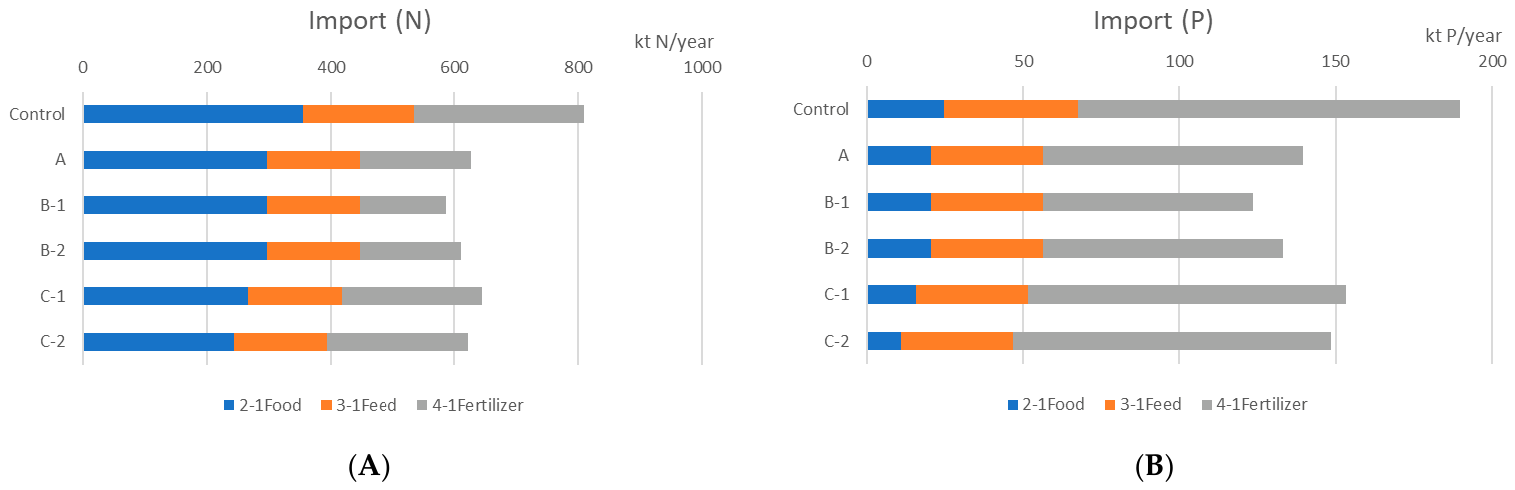
| A | Reduction in chemical fertilizer use | Fertilizer supply (4-6) Food supply (2-7) | Chemical fertilizers (4-2)⇩, Circulated fertilizers (4-3)⇧ | Imported fertilizers (4-1), Non-circulated waste (13), Circulated waste |
| B-1 | Expansion of organic farmland area (same yield) | Fertilizer supply (4-6) Food supply (2-7) | Chemical fertilizers (4-2)⇩, Circulated fertilizers (4-3)⇧ | Imported fertilizers (4-1), Non-circulated waste (13), Circulated waste |
| B-2 | Expansion of organic farmland area (yield decrease) | Food supply (2-7) | Chemical fertilizers (4-2)⇩, Circulated fertilizers (4-3)⇧ | Imported fertilizers (4-1), Non-circulated waste (13), Circulated waste |
| C-1 | Increased food self-sufficiency (current dietary patterns) | Food supply (2-7) Food composition in 2021 | Imported food (2-1)⇩, Domestic food (2-2)⇧, Domestic feed (3-2)⇧ | Circulated fertilizers (4-3), Fertilizer supply (4-6), Feed supply (3-4), Livestock excreta (6-3), Non-circulated waste (13), Circulated waste, Residuals (8), BNF (9), DN (10-1), farmland area |
| C-2 | Increase in food self-sufficiency (shifted dietary patterns) | Food supply (2-7) Calorie consumption per capita | Imported food (2-1)⇩, Domestic food (2-2)⇧ | Circulated fertilizers (4-3), Fertilizer supply (4-6), Non-circulated waste (13), Circulated waste, Residuals (8), BNF (9), DN (10-1), farmland area |
| Input Circulation Ratio | Output Circulation Ratio | |||
|---|---|---|---|---|
| Nitrogen | Phosphorus | Nitrogen | Phosphorus | |
| Control | 28% | 41% | 25% | 62% |
| A | 33% | 49% | 29% | 72% |
| B-1 | 38% | 55% | 33% | 81% |
| B-2 | 38% | 54% | 35% | 86% |
| C-1 | 45% | 58% | 40% | 93% |
| C-2 | 33% | 48% | 28% | 75% |
| Dehydrated or Other Type of Sludge | Incinerated Sludge Ash | ||
|---|---|---|---|
| Total no. of samples | 600 | 194 | |
| No. of samples below 50% tolerance | 555 | 14 | |
| No. of samples within 50–100% tolerance | 29 | 153 | |
| No. of samples above 100% tolerance | 16 | 41 | |
| Heavy metal | Tolerance value (mg/kg) | ||
| As | 50 | - | 10 |
| Cd | 5 | 6 | 5 |
| Hg | 2 | 1 | 2 |
| Ni | 300 | 3 | 22 |
| Cr | 500 | 6 | 1 |
| Pb | 100 | - | 13 |
| 103 t/Year | ||
|---|---|---|
| Nitrogen | Phosphorus | |
| Current demand for chemical fertilizers | 354.9 | 140.6 |
| Potential circulated fertilizers | 249.0 | 112.2 |
| Non-circulated sewage sludge | 67.1 | 34.1 |
| Food wastes * | 81.9 | 45.9 |
| Non-circulated livestock excreta * | 48.7 | 19.1 |
| Residuals * | 51.3 | 13.1 |
Disclaimer/Publisher’s Note: The statements, opinions and data contained in all publications are solely those of the individual author(s) and contributor(s) and not of MDPI and/or the editor(s). MDPI and/or the editor(s) disclaim responsibility for any injury to people or property resulting from any ideas, methods, instructions or products referred to in the content. |
© 2026 by the authors. Licensee MDPI, Basel, Switzerland. This article is an open access article distributed under the terms and conditions of the Creative Commons Attribution (CC BY) license.
Share and Cite
Ushiyama, K.; Takano, M. Scenario Analysis of Japan’s Food and Feed Systems: Integrating Nutrient Flows with Sustainable Agricultural Policy. Sustainability 2026, 18, 5710. https://doi.org/10.3390/su18115710
Ushiyama K, Takano M. Scenario Analysis of Japan’s Food and Feed Systems: Integrating Nutrient Flows with Sustainable Agricultural Policy. Sustainability. 2026; 18(11):5710. https://doi.org/10.3390/su18115710
Chicago/Turabian StyleUshiyama, Kimiko, and Masao Takano. 2026. "Scenario Analysis of Japan’s Food and Feed Systems: Integrating Nutrient Flows with Sustainable Agricultural Policy" Sustainability 18, no. 11: 5710. https://doi.org/10.3390/su18115710
APA StyleUshiyama, K., & Takano, M. (2026). Scenario Analysis of Japan’s Food and Feed Systems: Integrating Nutrient Flows with Sustainable Agricultural Policy. Sustainability, 18(11), 5710. https://doi.org/10.3390/su18115710