Article

Delay in Antarctic Ozone Recovery Projection Based on Bias-Corrected Optimal Chemistry-Climate Model Initiative Phase 1 Models


1
Laboratory for Coastal Ocean Variation and Disaster Prediction, College of Ocean and Meteorology, Guangdong Ocean University, Zhanjiang 524088, China
2
CMA-GDOU Joint Laboratory for Marine Meteorology, South China Sea Institute of Marine Meteorology, Guangdong Ocean University, Zhanjiang 524088, China
3
Western Guangdong Key Laboratory of Marine Meteorological Disaster Theory and Application, Guangdong Ocean University, Zhanjiang 524088, China
4
Shenzhen Institute of Guangdong Ocean University, Shenzhen 518120, China
5
Key Laboratory of Space Ocean Remote Sensing and Application of Ministry of Natural Resources/Key Laboratory of Climate Resources and Environment in Continental Shelf Sea and Deep Ocean, Zhanjiang 524088, China
*
Author to whom correspondence should be addressed.
Sustainability 2026, 18(11), 5713; https://doi.org/10.3390/su18115713
Submission received: 13 April 2026 / Revised: 29 May 2026 / Accepted: 1 June 2026 / Published: 4 June 2026
(This article belongs to the Section Air, Climate Change and Sustainability)

Abstract

Anthropogenic emissions have caused the Antarctic ozone hole, a major global environmental crisis since the late 20th century. Although ozone recovery began in the early 21st century, substantial uncertainty remains regarding the timing of its return to pre-loss levels. This study innovatively develops a “model optimization–bias correction” framework based on spatial pattern (S1) and long-term trend (S2) metrics, assessing 17 Chemistry-Climate Model Initiative Phase 1 (CCMI-1) models using the fifth generation of the European Centre for Medium-Range Weather Forecasts (ECMWF) atmospheric reanalysis for the climate (ERA5). Results: (1) Most models accurately reproduce the Antarctic ozone’s spatial distribution and long-term trends: MRI-ESM1r1 performs best for spatial patterns (S1 = 0.80), GEOSCCM for long-term trends (S2 = 0.82); EMAC-L90MA, UMSLIMCAT, etc., show poor spatial pattern performance (S1 < 0.30), while IPSL and EMAC-L90MA have large trend biases and underperform in trend simulation (S2 < 0.10). (2) Integrating S1 and S2 scores, the Preferred Multi-Model Ensemble comprising the top eight models (PMME8) minimizes ERA5 deviation, outperforming the multi-model ensemble (MME); the Combined Nonstationary Cumulative Distribution Function matching (CNCDFm) correction of this ensemble reduces systematic bias by 15–60%. (3) Antarctic ozone recovery time shows a gradual delay following optimal model selection and bias correction. PMME-adjusted projects recovery in October 2063 (2053–2072), later than MME (2052) and PMME (2058), with inter-member uncertainty narrowing from 43 years to 19 years. Similarly, this feature is also found for September, November, and the spring mean. This study provides a reliable methodological foundation for projections of Antarctic ozone recovery and offers scientific support for the compliance assessment and policy adjustment of the Montreal Protocol, thereby advancing environmental sustainability and global ozone governance.

1. Introduction

The ozone layer effectively absorbs harmful ultraviolet radiation, thereby protecting Earth’s ecological systems [1]. Meanwhile, as the primary heat source of the stratosphere, it regulates atmospheric circulation and exerts profound influences on global weather and climate [2]. Industrial activities have emitted ozone-depleting substances (ODS) such as chlorofluorocarbons (CFCs) [3], triggering a major global environmental crisis in the last century, the Antarctic ozone hole [4]. Although the international community has signed a series of treaties including the Montreal Protocol—a cornerstone of global environmental sustainability governance—to ban the production and use of ODS, their long atmospheric lifetimes allow them to maintain high atmospheric abundances for extended periods [5,6,7]. This has delayed the emergence of ozone recovery signals until the early 21st century [8]. However, stratospheric cooling [9], increases in stratospheric water vapor [10], and weakened planetary wave activities [11,12] induced by global warming may all affect this recovery process, adding uncertainty to long-term ozone changes. Closely monitoring variations in the ozone layer and accurately projecting its future recovery under climate change scenarios can provide scientific references for governmental decision-making and policy formulation, directly contributing to United Nations Sustainable Development Goals (SDGs) 3 and 13 by preventing millions of cases of skin cancer and safeguarding ecosystems, thereby advancing environmental sustainability and human development.
Currently, studies have conducted predictions of ozone recovery time based on statistical methods or numerical models (such as Chemistry-Climate Models, CCMs) [13,14]; however, significant discrepancies exist among the projected results from different studies [15]. Statistical methods rely considerably on regression factors and preset equations, introducing certain uncertainties [16]. In contrast, CCMs simulate ozone budget processes directly based on physicochemical mechanisms, rendering their results more objective and physically grounded rather than relying on a statistical extrapolation of historical trends. The use of multi-model ensembles is the established standard in such projections, as no single model can fully represent the range of structural uncertainties in physical parameterizations [17]. Chemistry-Climate Model Initiative Phase 1 (CCMI-1), launched by IGAC/SPARC, has evolved through multiple generations including CCMVal-1 and CCMVal-2 with cross-validation, encompassing state-of-the-art models developed by leading global institutions such as ACCESS-CCM and CESM1-CAM4 [18]. The simulation capabilities of these new-generation models have been significantly enhanced [19,20], and they provide data for diverse emission scenarios including REF-C1, REF-C2, and SEN-C2-RCP2.6, thereby furnishing substantial and reliable data support for research estimating Antarctic ozone recovery time [15].
It is noteworthy that differences exist in the model structures and parameterization schemes among different models, and the models themselves are subject to systematic errors during operation [21], all of which affect the simulation performance [22]. Furthermore, atmospheric ozone chemistry exhibits pronounced nonlinearities across scales: tropospheric ozone production depends nonlinearly on NOx, VOCs, meteorology, and emissions [23,24], while stratospheric polar ozone depletion exhibits analogous nonlinear dependence on ODS loading, temperatures, and PSC surface area, challenging the linear extrapolation of recovery timelines [25]. Such nonlinearities compound model uncertainties, underscoring the need for rigorous model evaluation and bias correction. Therefore, to obtain more reliable results, it is essential to evaluate the simulation capabilities of models [26,27]. Existing evaluation systems mostly rely on the metrics of spatial patterns and interannual variability [28], making it difficult to adequately represent the models’ ability to simulate long-term ozone changes. However, the detection and projection of ozone recovery depend primarily on the faithful reproduction of long-term trend trajectories, the dominant physical signals that emerge above interannual noise. Therefore, the evaluation framework should prioritize long-term trend assessment over interannual variability as the key criterion for constraining recovery projections. Although multi-model ensembles with superior simulation capabilities can improve projection results [29,30], the selection of the optimal ensemble size is also critical [31]. Furthermore, conducting bias correction based on model selection can yield more credible projection results. For example, Fang et al. and Ho et al. adjusted model outputs by equalizing the mean values between model and observational variables [32,33], while Miao et al. further considered the nonlinear complex relationships between observational and model data [34], proposing the Combined Nonstationary Cumulative Distribution Function matching (CNCDFm) correction method based on quantile mapping (QM), which has demonstrated good improvement in projections of temperature and precipitation.
Based on the CCMI-1 multi-model ensemble, this study projects Antarctic ozone recovery time using an “evaluation–optimization–correction” technical framework that integrates and refines established methods in climate-chemistry modeling. The remainder of this paper is organized as follows: Section 2 describes the study region, ERA5 reanalysis data, and CCMI-1 model data (Section 2.1), and details the model evaluation metrics and CNCDFm bias correction method (Section 2.2); Section 3 presents the core analysis, first systematically evaluating the simulation capabilities of 17 models regarding Antarctic ozone spatial patterns and long-term trends based on ERA5 data (Section 3.1 and Section 3.2), then constructing an optimal multi-model ensemble and correcting its biases (Section 3.3), and subsequently conducting ensemble projections of recovery time based on these results (Section 3.4); Section 4 summarizes the main conclusions and discusses their policy implications.

2. Materials and Methods

2.1. Materials

This study selects the 60° S–90° S latitude band as the study region, which can accurately reflect the chemical depletion of the Antarctic ozone [35]. To characterize the overall state of the Antarctic ozone, this study employs the area-weighted average of Total Column Ozone (TCO) over the 60° S–90° S region as the indicator of Antarctic ozone abundance, with weights assigned according to the actual area of each latitude–longitude grid cell.
Based on previous assessments of the applicability of reanalysis data [36], this study adopts ERA5 reanalysis data as the reference benchmark. This dataset features a long temporal coverage (1979–2022), high horizontal resolution (0.25° × 0.25°), and good continuity [37,38]. Specifically, data from 1979 to 2010 are used for model evaluation and bias correction, while data from 2011 to 2022 are reserved for the independent validation of the correction performance.
This study selects 17 CCMI-1 climate-chemistry models that provide simulation outputs for both REF-C1 and REF-C2 scenarios (Table 1). REF-C1 is the historical hindcast scenario (1960–2010), driven by historical forcings and observed sea surface temperatures [15]. It is used to evaluate model performance in simulating spatial patterns (Section 3.1) and long-term trends (Section 3.2). REF-C2 is the future projection scenario (1960–2100), which adopts the WMO (2011) A1 scenario for ozone-depleting substances, the RCP6.0 pathway for greenhouse gases, and sea surface temperatures from coupled atmosphere–ocean models [39]. As an intermediate pathway in which radiative forcing stabilizes at 6.0 W m−2 after 2100, RCP6.0 reflects moderate mitigation efforts to curb greenhouse gas emissions, consistent with the sustainability transition under the Montreal Protocol framework. This scenario is used for model selection, bias correction (Section 3.3), and ozone recovery time projection (Section 3.4). For each model, the first realization (r1i1p1) is selected for analysis.

2.2. Methods

2.2.1. Taylor Skill Score

This study employs the Taylor Skill Score (TSS) to evaluate model capability in simulating ozone spatial distributions [31,40]. Based on the TSS, we quantify model performance in simulating Antarctic Total Column Ozone (TCO) spatial patterns; higher TSS values indicate superior model performance. The TSS is calculated as follows.
T S S = 4 ( 1 + R ) 2 ( σ o σ m + σ m σ o ) 2 ( 1 + R 0 ) 2
In the formula, the subscripts m and o represent the model and reanalysis reference data, respectively; σ is the spatial standard deviation Equation (2); σ m and σ o in Equation (1) denote the standard deviations of these spatially averaged fields; R is the spatial Pearson correlation coefficient between the model and observed climatological fields Equation (3); and R0 is the theoretical maximum correlation coefficient used for normalization. R0 is set to 1 following the standard convention [40], which ensures that TSS = 1 if and only if the model perfectly reproduces the observed spatial pattern (R = 1 and σ m = σ o ). This normalization bound does not imply that actual models achieve perfect correlation; rather, it standardizes the skill score across all models so that TSS is bounded on [0, 1]. In Equations (2) and (3), n = amount of 60° S–90° S latitude band grid points.
σ = i = 1 n ( x i x ¯ ) 2 n
R = i = 1 n ( x i x ¯ ) ( y i y ¯ ) i = 1 n ( x i x ¯ ) 2 i = 1 n ( y i y ¯ ) 2

2.2.2. Bias Index

This study utilizes the bias index to evaluate model capability in simulating long-term ozone trends. The linear trend slope (in DU/year) for both model and observed time series is calculated via ordinary least squares regression, as detailed in Equation (4), where ti is the year index, xi is the ozone value, and N is the number of years:
t r e n d = i = 1 N ( t i t ¯ ) ( x i x ¯ ) i = 1 N ( t i t ¯ ) 2
Here, trendmod and trendobs denote the linear trend slopes of the model and observed time series, respectively. Based on these trends, the bias index is defined as the absolute difference between them, as detailed in Equation (5):
b i a s = | t r e n d m o d t r e n d o b s |
Lower bias values indicate superior model performance in capturing long-term trends.

2.2.3. RMSE and MAE

This study quantifies deviations between models and ERA5 using Root Mean Square Error (RMSE) and Mean Absolute Error (MAE). Lower RMSE and MAE values indicate smaller deviations between models and ERA5, signifying better model performance. The formulas for RMSE and MAE used in this study are detailed in Equations (6) and (7), respectively, where n is the number of validation samples, x i ^ (hat) represents the raw model output value for the i-th sample, while x i is the corresponding ERA5 observation.
R M S E = 1 n i = 1 n ( x i x i ^ ) 2
M A E = 1 n i = 1 n | x i x i ^ |

2.2.4. Comprehensive Evaluation Metric

This study employs the Comprehensive Rating Index ( M R ) to quantify overall model performance [41]. The final score is calculated by synthesizing model rankings across multiple metrics; higher scores indicate better comprehensive performance. The calculation formula for the comprehensive scoring index is detailed in Equation (8):
M R = 1 1 n × m i = 1 n r i
where n is the number of evaluation metrics, m is the total number of candidate models participating in the evaluation, and rᵢ represents the rank of a model for a given metric, where r i = 1 indicates the best performance and r i = m indicates the worst performance among m models. The value of M R is bounded on [0, 1], with values closer to 1 indicating superior comprehensive performance.

2.2.5. CNCDFm Correction Method

Traditional quantile mapping (QM) assumes a stationary bias structure by mapping model projections to observations solely through the calibration period cumulative distribution function (CDF). However, stratospheric ozone exhibits nonstationary statistical behavior due to evolving chemical forcings and climate feedbacks. To account for this, we employ the nonstationary cumulative distribution function matching (CNCDFm) method [34], which incorporates the prediction-period CDF to allow the bias structure to evolve as external forcings change. In practice, CNCDFm converts a projected model value to its corresponding percentile using the prediction-period CDF, retrieves the equivalent historical-observation and historical-model values via the inverse CDFs of the calibration period, and applies their difference as an additive adjustment to the raw projection. The formula is:
x ( m - p . a d j u s t e d ) = x ( m - p ) + F o - c 1 ( F ( m - p ) ( x ( m - p ) ) ) F ( m - c ) 1 ( F ( m - p ) ( x ( m - p ) ) )
In the formula, m = model; c = historical calibration period (1979–2010); p = future projection period; o = observational reference (ERA5); x m - p = raw projection, F indicates the cumulative distribution function, and F−1 indicates the inverse of the cumulative distribution function.
Estimation of F and F−1. The CDFs and their inverses are estimated nonparametrically via kernel density estimation (KDE). The PDF is estimated as:
f ^ k ( x ) = 1 N h j = 1 N K ( x x k , j h )
where N is the sample size (years), x k , j is the j-th sample, h is the bandwidth determined by the normal reference rule, and K(*) is the Gaussian kernel, k ∈ {m-c, m-p, o-c}.
For the Gaussian kernel, the CDF can be obtained analytically via integration of the PDF:
F k ^ ( x ) = 1 N j = 1 N Φ ( x x k , j h )
where Φ ( z ) = 1 2 [ 1 + erf ( z 2 ) ] is the standard normal cumulative distribution function, and erf(*) denotes the Gaussian error function. The inverse CDF for a given probability level p ∈ [0, 1] is obtained by numerically solving F k ^ ( x ) = p via linear interpolation (since the Gaussian CDF inverse has no closed-form analytical expression). See Figure S1 (Supplementary Material) for an illustration of the CDF mapping procedure.

2.2.6. Reference Baseline for Antarctic Ozone Recovery

This study adopts the 1979–1983 average as the reference baseline for Antarctic TCO recovery. This period is selected based on two primary considerations: First, the scientific background: this period predates the discovery of the Antarctic ozone hole (1985), when ODS accumulation was still in its early stages, capable of representing a natural state not significantly disturbed by human activities; second, data quality: this period coincides with the initiation of continuous observations by satellites such as Nimbus-7 TOMS [42], providing important observational constraints for reanalysis data such as ERA5 and ensuring data quality.

3. Results

3.1. Spatial Distribution Evaluation

This study uses REF-C1 (1960–2010) scenario data from CCMI-1 to evaluate model performance. The historical period of 1979–2010 is divided into three phases: 1979–2000 (ozone depletion period), 2000–2010 (ozone recovery period), and 1979–2010 (entire period). Considering that Antarctic ozone depletion occurs primarily during September–November (austral spring), four temporal windows are further selected: September, October, November, and the spring mean (SON). Cross-combining the three phases with these four windows yields a total of 12 evaluation periods (e.g., September 1979–2000, September 2000–2010). On this basis, for each period, the spatial distribution differences in TCO climatology between individual models and ERA5 are compared to evaluate the models’ capabilities in simulating spatial patterns.
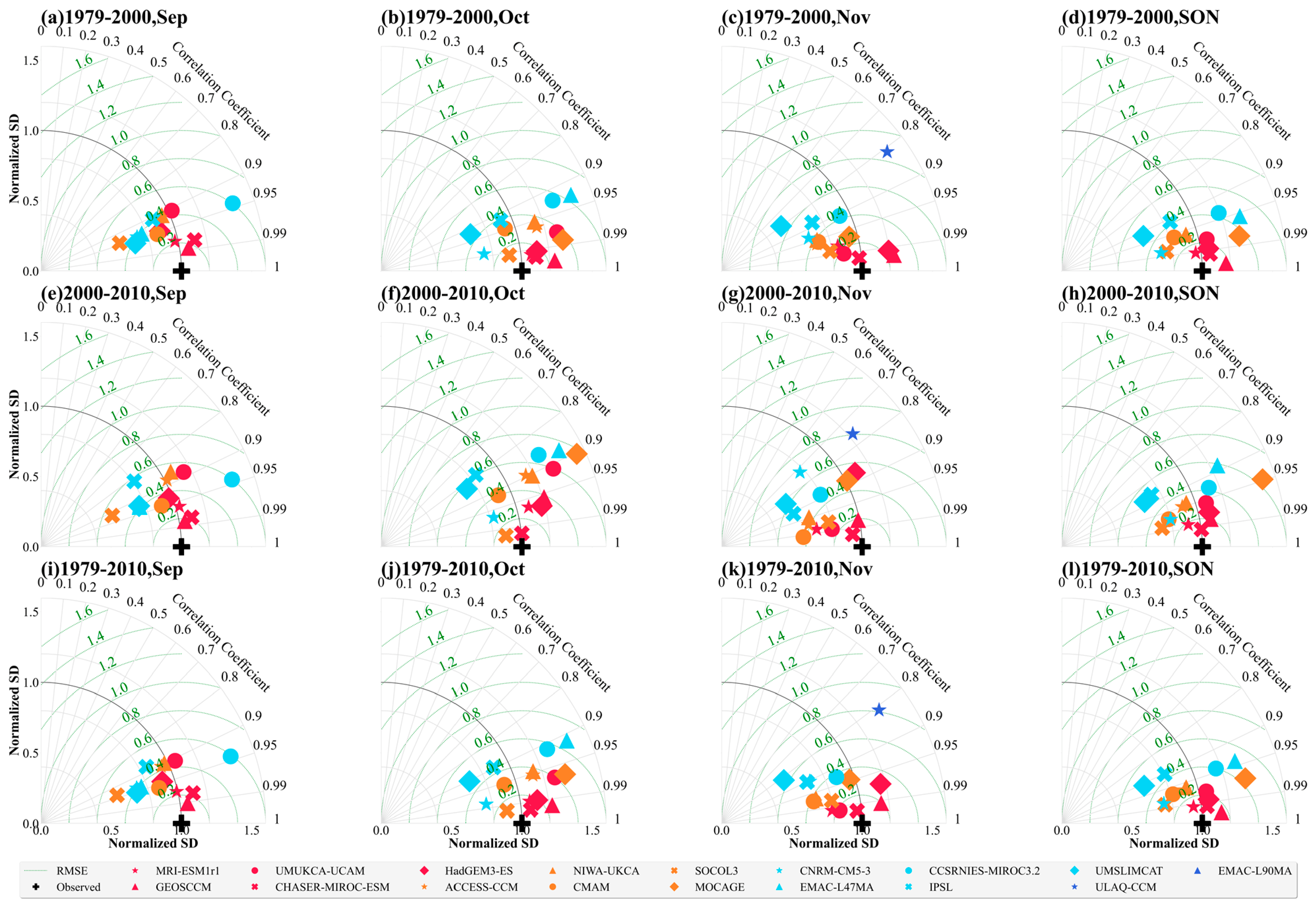
Figure 1 presents Taylor diagrams for multi-model evaluation based on the climatological distribution of the Antarctic Total Column Ozone from ERA5 data. The closer the model markers (colored dots) are to the reference point (black cross labeled ‘Observed’), the higher the simulation skill, as reflected by greater spatial correlation coefficients and standard deviations closer to those of ERA5, and vice versa. Regarding spatial correlation coefficients, except for a few models such as EMAC-L90MA and UMSLIMCAT, most models exhibit correlation coefficients greater than 0.9. In terms of standard deviation, UMSLIMCAT, ULAQCCM, and EMAC-L90MA show significant deviations from ERA5, while the remaining models have standard deviations close to ERA5, with GEOSCCM and MRI-ESM1r1 being particularly close. Overall, models such as GEOSCCM, MRI-ESM1r1, and UMUKCA-UCAM demonstrate relatively excellent performance, reasonably reproducing the spatial pattern characteristics of the Antarctic ozone in most evaluation periods; whereas models such as EMAC-L90MA and UMSLIMCAT exhibit large deviations, failing to accurately characterize the spatial distribution patterns of the Antarctic ozone across various periods.
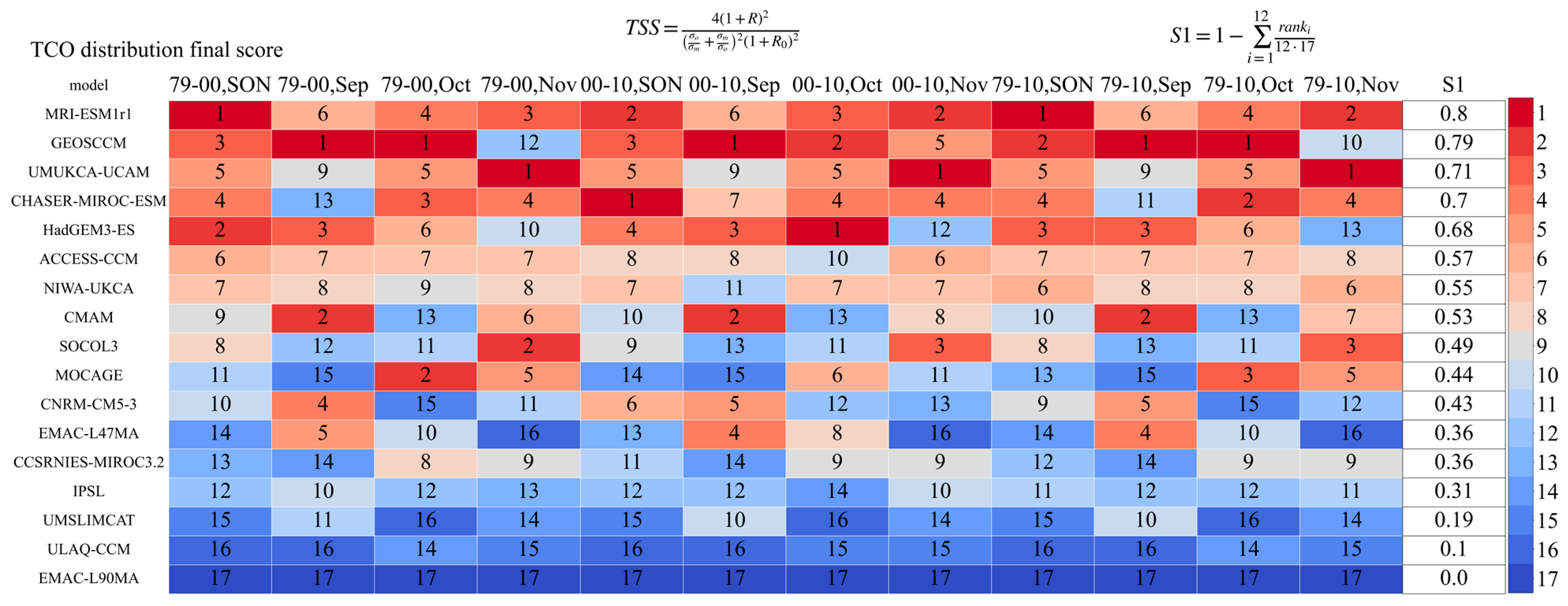
Relying solely on Taylor diagrams can only qualitatively discriminate the relative merits among models, making it difficult to provide precise comprehensive quantitative indicators. To quantify the simulation capability of models for Antarctic ozone spatial distribution, this study calculates the Taylor Skill Score (TSS). The TSS comprehensively considers the spatial correlation coefficient and the ratio of standard deviation between the model and observations, with values ranging from 0 to 1; higher TSS indices indicate stronger simulation capabilities of the models. Figure 2 presents the ranking of the 17 models based on their TSS values. The final score (S1, ranging from 0 to 1) is obtained by synthesizing the TSS rankings of each model across the 12 time periods. The results reveal significant differences in simulation skill among models: MRI-ESM1r1 ranks first with a score of 0.80, followed closely by GEOSCCM (0.79), constituting the first tier; both accurately represent Antarctic ozone spatial patterns in most periods. Five models including UMUKCA-UCAM (0.71), CHASER-MIROC-ESM (0.70), and ACCESS-CCM (0.68) score between 0.50 and 0.75, belonging to the second tier, with relatively strong spatial pattern simulation capabilities but significantly inferior to the first tier. The remaining nine models all have TSS values below 0.50, with EMAC-L90MA showing the poorest performance.
MRI-ESM1r1’s high spatial pattern score may reflect its well-documented stratospheric circulation fidelity and low-numerical-diffusion transport scheme, which yield realistic meridional ozone gradients and polar vortex structures in dedicated model evaluation studies [43,44]. Yet EMAC-L90MA—despite possessing even finer vertical resolution (L90)—exhibits the poorest performance, consistent with documented structural deficiencies in its stratospheric aerosol treatment [18]. This contrast across the full CCMI-1 ensemble (where models range from L39 to L90) suggests that vertical resolution alone is a poor predictor of spatial pattern skill; rather, the comprehensive fidelity of process representations (including aerosol microphysics, transport numerics, and their coupling to radiation) is critical.

3.2. Long-Term Trend Evaluation

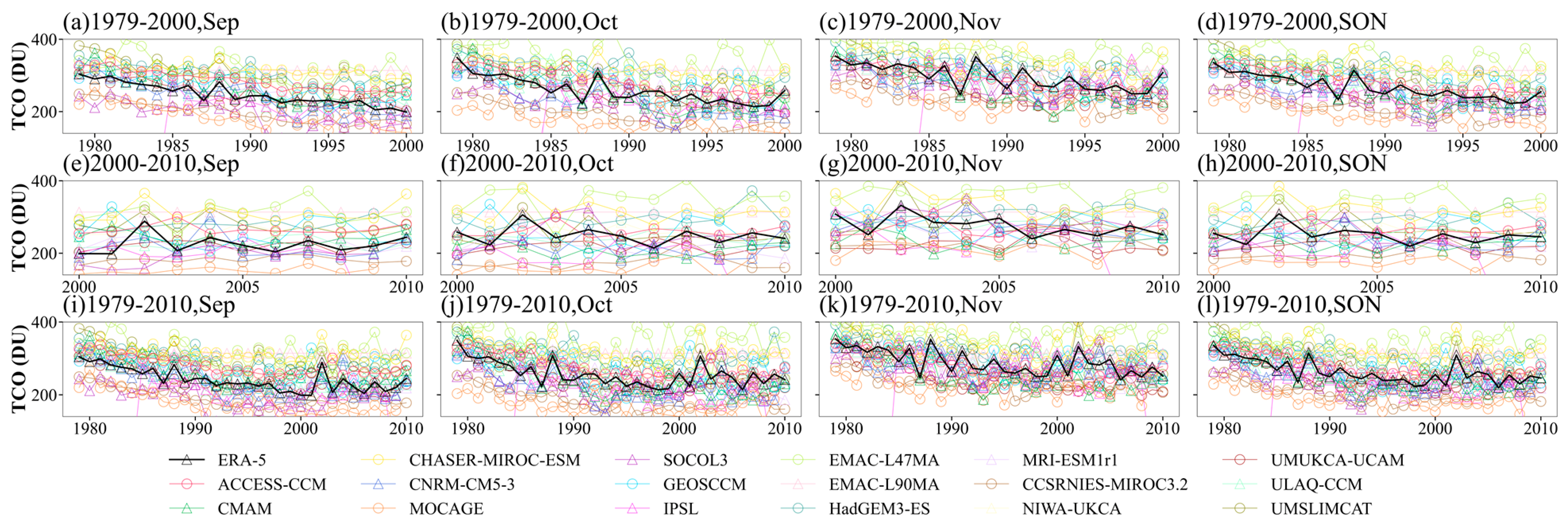
Building upon Section 3.1, this study uses the REF-C1 scenario to evaluate long-term Antarctic ozone trends by plotting the interannual variation series of average TCO over Antarctica (Figure 3). Figure 3a–d, 3e–h, and 3i–l display the evolutionary characteristics for the three periods of 1979–2000, 2000–2010, and 1979–2010, respectively. As shown in the figure, ERA5 data clearly present characteristics such as the rapid depletion of the Antarctic ozone during 1979–2000 and its slow recovery during 2000–2010. Although multiple models can reproduce the correct ozone variation trends, some models such as MOCAGE show peak years differently from those in ERA5. In addition, some models exhibit systematic deviations from ERA5; for example, EMAC-L47MA is overall higher by approximately 50 DU, while MOCAGE is overall lower by approximately 60 DU; only a few models such as ACCESS-CCM are relatively close to ERA5. It is noteworthy that the linear trend for the 2000–2010 period is not statistically significant due to its short time span and small ozone variability. Therefore, in the subsequent quantitative evaluation of long-term trends, this study excludes this period and only selects the two periods of 1979–2000 and 1979–2010 to calculate the bias index of trends.
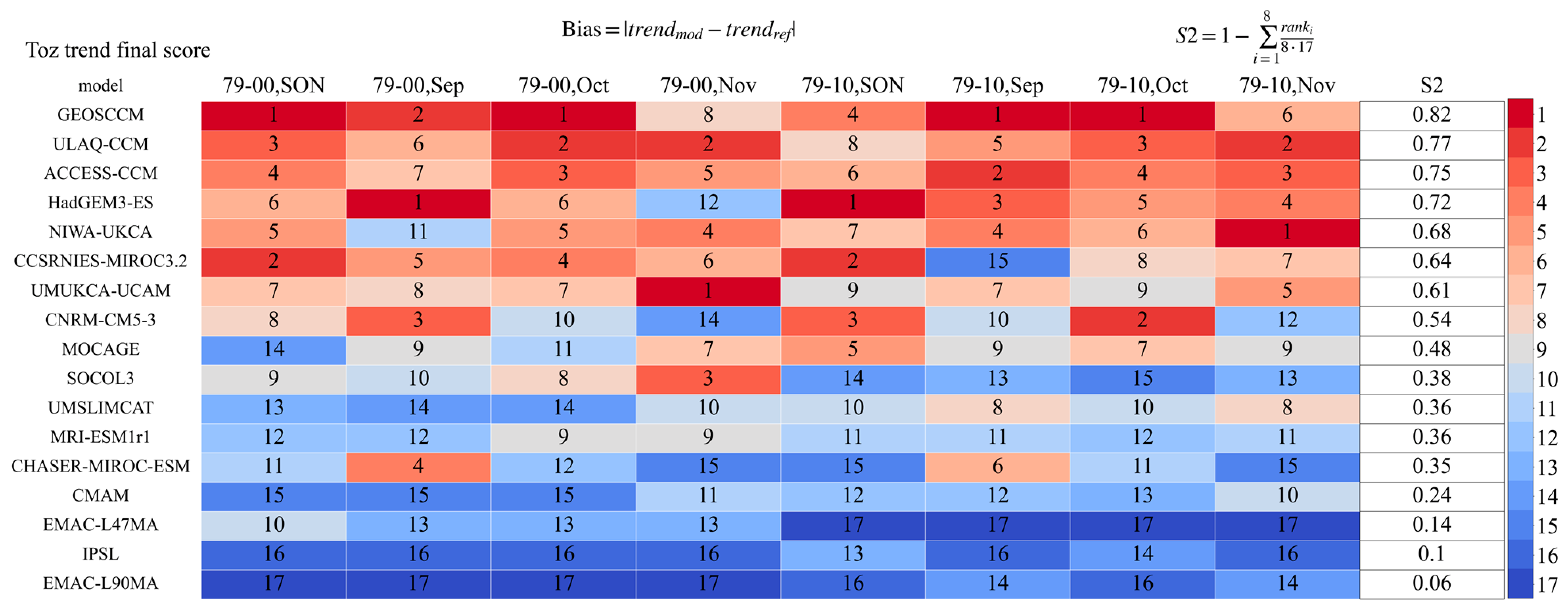
To quantitatively evaluate the long-term trend simulation performance of each model for the Antarctic ozone, this study calculates linear trends based on the Antarctic ozone evolution series for eight periods spanning 1979–2000 and 1979–2010, and uses the absolute difference between model and ERA5 trends (i.e., the bias index) as the evaluation metric; smaller values indicate better trend simulation performance. The bias rankings and comprehensive scores (S2) are shown in Figure 4.
The results reveal significant differences in trend simulation capability among models. The first tier (S2 ≥ 0.75) comprises three models, including GEOSCCM (0.82), which exhibit minimal bias in both the depletion and entire periods, accurately reproducing ozone depletion trends. GEOSCCM’s superior trend performance may reflect the fidelity with which its simulated ozone–temperature radiative–photochemical feedback reproduces observed responses, as documented in dedicated evaluation studies [45]. The second tier (0.5 ≤ S2 < 0.75) includes five models such as ULAQ-CCM, CMAM, and ACCESS-CCM, which generally capture the trend direction but show large deviations from observed depletion trends. The third tier (S2 < 0.5) contains the remaining nine models; notably, EMAC-L90MA (0.06) and MOCAGE (0.48) exhibit both extremely large systematic deviations (approximately 50–60 DU too high or too low) and a failure to reproduce the phase characteristics of ozone evolution. Notably, some models (such as MRI-ESM1r1) exhibit excellent spatial pattern simulation (S1 = 0.80) but low long-term trend scores (S2 = 0.36), indicating reasonable spatial distribution but large trend deviations. This inconsistency between spatial and trend simulation capabilities further confirms the necessity of using multi-dimensional comprehensive evaluation (S1 + S2) for model selection.

3.3. Model Selection and Bias Correction

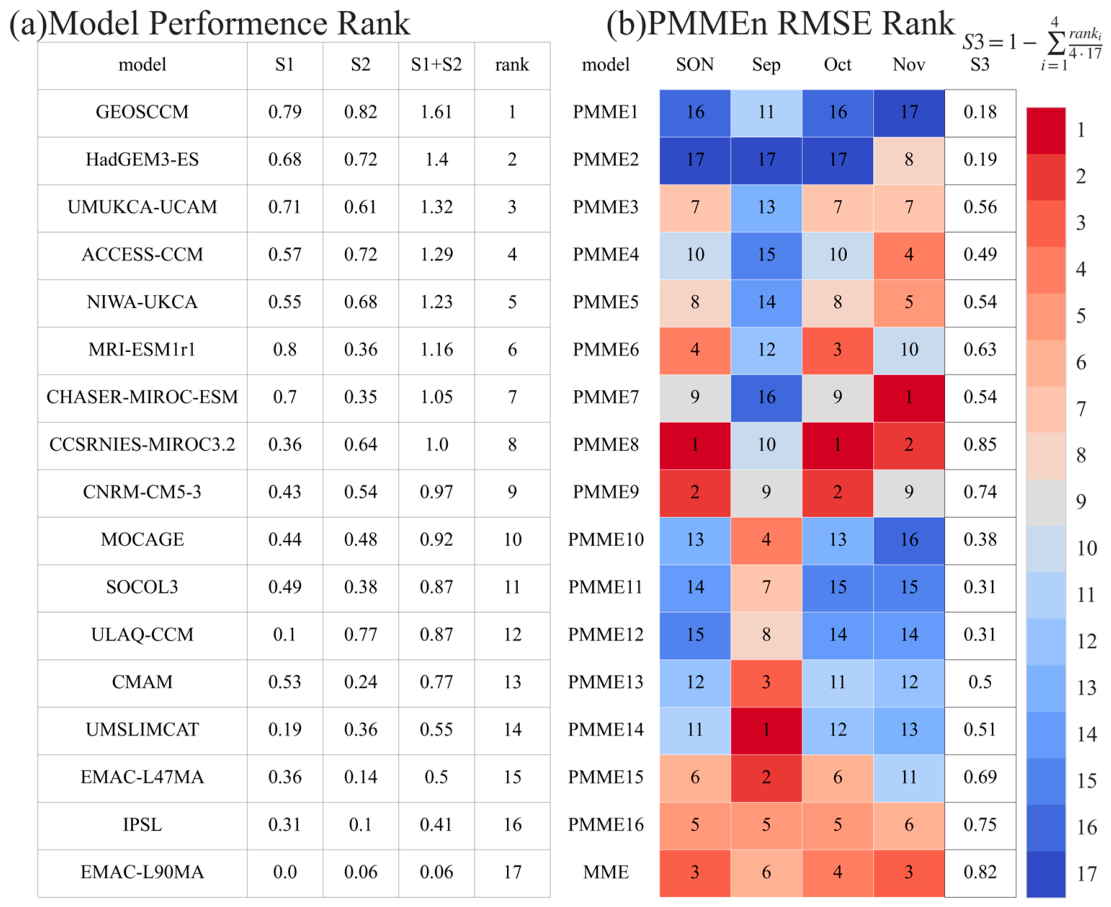
Building upon the REF-C1 evaluation (Section 3.1 and Section 3.2), Figure 5 presents the comprehensive performance of individual models and the determination of the optimal ensemble size. Figure 5a shows that eight models achieved a combined score (S1 + S2) exceeding 1.0, with GEOSCCM performing the best (1.61), significantly ahead of the second-ranked HadGEM3-ES (1.41); the remaining models scored below 1.0, with EMAC-L90MA being the lowest. To identify the optimal ensemble configuration, Figure 5b examines the RMSE rankings of PMMEn ensembles (n = 1–16) and the full ensemble (MME) against ERA5 using REF-C2 projections for the period of 1979–2022. Results reveal a non-monotonic relationship between ensemble size and performance: PMME8 (the top 8 models) achieves the smallest deviation from ERA5 (ranked 1st), significantly outperforming the full ensemble (MME, ranked 2nd), PMME16 (ranked 3rd), and notably the single-model ensemble (PMME1, ranked 17th).
Thus, blindly increasing the number of models does not always improve ensemble performance; conversely, relying solely on the single best model also proves inadequate due to the lack of ensemble averaging effects. PMME8 strikes an optimal balance, avoiding the limited representativeness of single-model projections while eliminating low-skill models, thereby producing more reliable estimates than the full ensemble mean. Consistent with previous studies identifying optimal ensemble sizes of 5–10 members [26,41,46,47], this study designates PMME8 as the optimal ensemble (hereafter PMME), comprising GEOSCCM, HadGEM3-ES, UMUKCA-UCAM, ACCESS-CCM, NIWA-UKCA, MRI-ESM1r1, CHASER-MIROC-ESM, and CCSRNIES-MIROC3.2. It is worth noting that this selection is specific to the dual-metric (S1 + S2) evaluation against ERA5 reanalysis adopted here; alternative evaluation criteria, reference datasets, or research targets may yield different model rankings and thus different preferred ensemble configurations. Subsequent CNCDFm bias correction will be applied to this ensemble to further reduce systematic errors and improve the accuracy of recovery time projections.
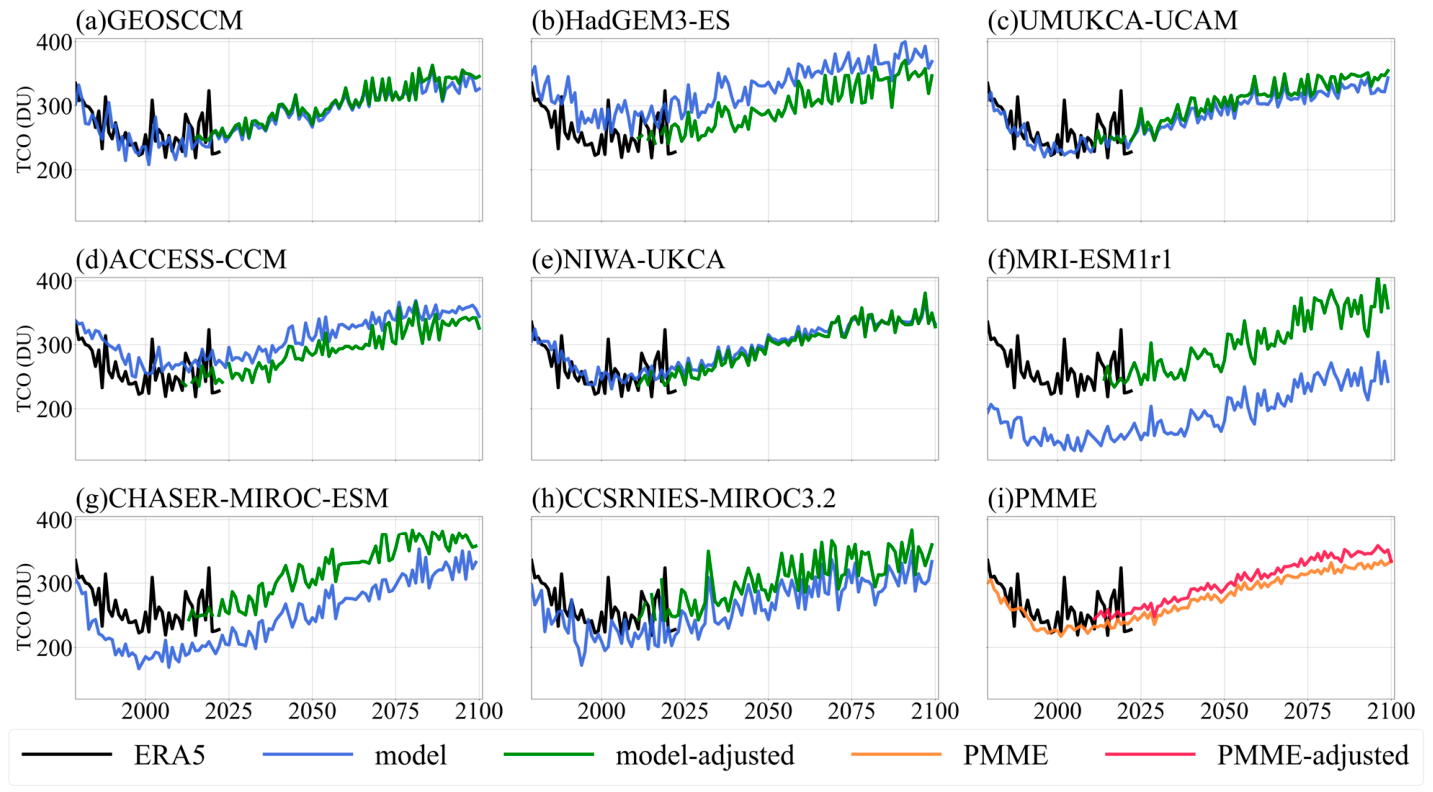
Based on the above eight selected models (PMME), this study applies the CNCDFm method for bias correction. Using 1979–2010 as the historical training period to establish cumulative distribution function mapping relationships, the model outputs for 2011–2100 (including the validation period of 2011–2022 and projection period of 2023–2100) are corrected. Figure 6 presents the long-term evolution characteristics of the Antarctic Total Column Ozone in spring (SON) before and after correction (results for September, October, and November are provided in Supplementary Material Figures S2–S4).
From the individual model performances (Figure 6a–h), although all models can reproduce the overall phase characteristics of Antarctic ozone “rapid depletion (1979–2000)—slow recovery (post-2000)”, significant systematic deviations exist between most models and ERA5 except for GEOSCCM, UMUKCA-UCAM, and NIWA-UKCA. For example, MRI-ESM1r1 exhibits a negative bias of nearly 100 DU. After CNCDFm correction, the model series for 2011–2100 (green lines) show significantly closer agreement with ERA5 observations (black solid lines) compared to the raw results (blue lines).
Regarding the ensemble mean (Figure 6i), although the raw PMME (orange line) shows some improvement compared to individual models, certain deviations remain; in contrast, the corrected ensemble mean (PMME-adjusted, red line) almost coincides with ERA5 observations, with systematic biases significantly reduced. During the independent validation period of 2011–2022, the corrected ensemble mean performs significantly better than the uncorrected version, preliminarily confirming the effectiveness of the CNCDFm method in reducing systematic model errors.
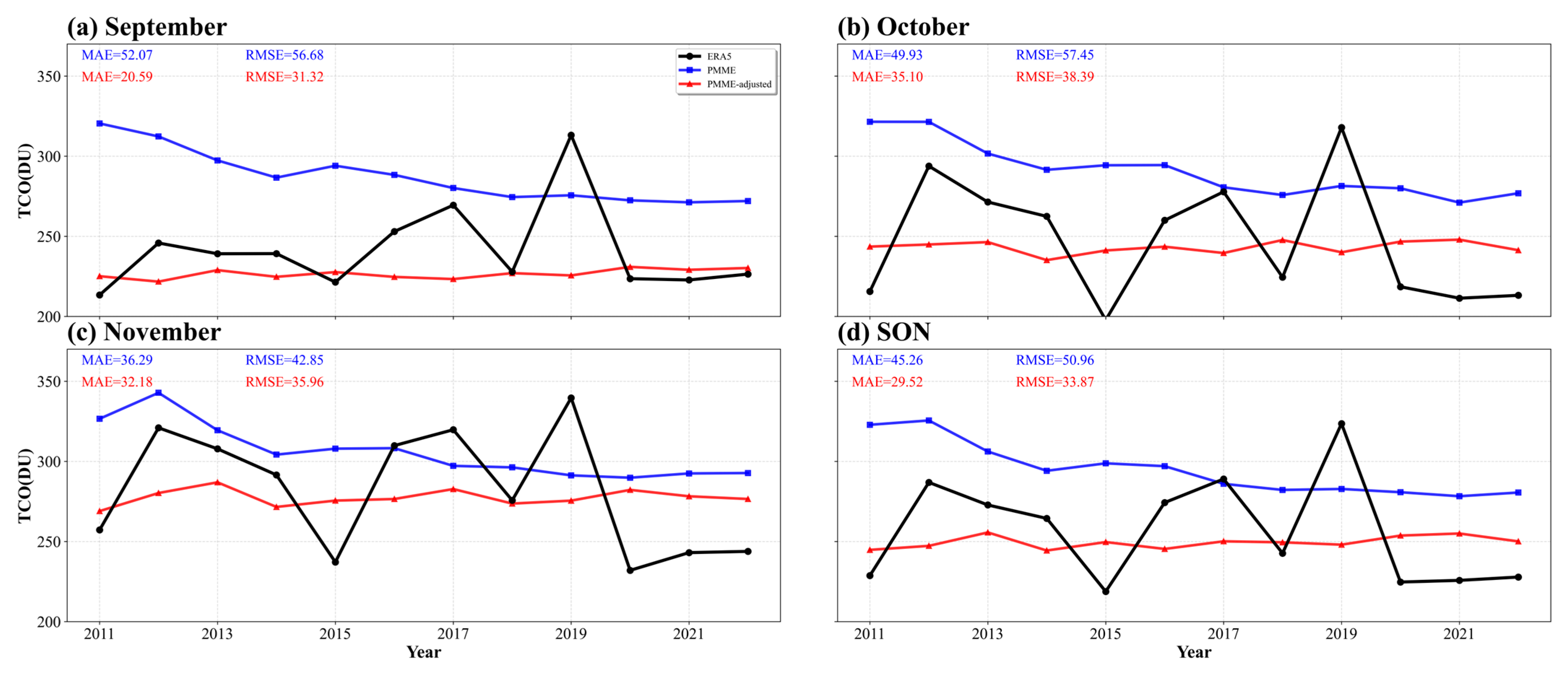
To verify the reliability of the CNCDFm method, this study evaluates the bias reduction in the PMME mean using ERA5 data independent of the training period (2011–2022). As shown in Figure 7, the corrected results (red lines) are significantly closer to ERA5 (black lines) than the uncorrected results (blue lines) across all temporal windows. Quantitative assessment indicates that RMSE and MAE are generally reduced by 15–60% after correction (specific improvements are labeled in Figure 7). Specifically, September shows the most significant improvement, with RMSE decreasing from 52.07 DU to 20.59 DU (approximately 60.5% reduction) and MAE decreasing from 56.68 DU to 31.32 DU (approximately 44.9% reduction). This substantial improvement is attributed to September exhibiting the largest systematic biases among all months in the raw model outputs, thereby providing greater potential for correction. Improvement magnitudes for October and November are relatively stable, with RMSE and MAE reduced by 15–30%, while the improvement for the spring mean (SON) is intermediate between those of the individual months. A comparison with traditional stationary quantile mapping (QM) is provided in Figure S5 (Supplementary Material), showing the modest improvements of CNCDFm over the stationary approach during the validation period [34]. These evaluations based on the independent validation period (2011–2022) demonstrate that the CNCDFm method effectively reduces systematic model biases, thereby enhancing the credibility of future ozone recovery time projections.

3.4. Future Ozone Projections

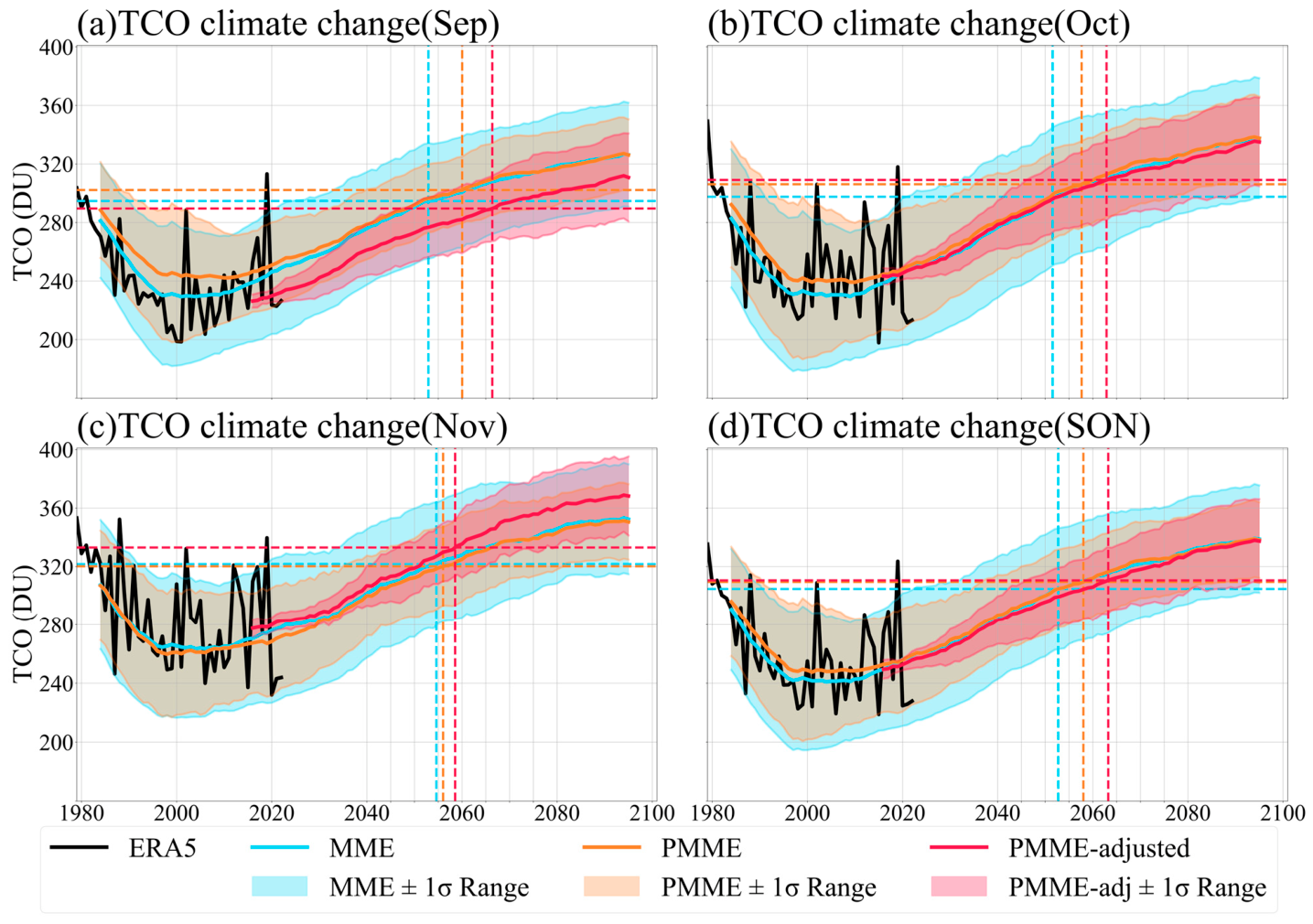
Figure 8 presents the projected Antarctic ozone recovery times for MME, PMME, and PMME-adjusted. The recovery benchmarks, indicated by horizontal dashed lines, are defined as the 1979–1983 mean values. For MME and PMME, these benchmarks are calculated from their respective simulated averages due to systematic biases relative to ERA5; PMME-adjusted, having been bias-corrected, adopts the ERA5 observed average as its benchmark.
Substantial differences exist in the projected recovery times: MME indicates recovery in the early 2050s (blue line), PMME projects a mid-to-late 2050s recovery (orange line), and PMME-adjusted shows the latest recovery, extending into the 2060s (red line). Regarding ensemble uncertainty, the 1σ ranges demonstrate progressive convergence. MME exhibits the widest spread (σ ≈ 42 DU), reflecting substantial inter-model variability. PMME shows a marked reduction in spread (σ ≈ 30 DU), while PMME-adjusted achieves the narrowest range (σ ≈ 20 DU). This indicates that model pre-screening and bias correction effectively reduce internal ensemble uncertainty and improve projection reliability.
Table 2 quantitatively presents the ensemble-mean recovery times and their uncertainty ranges ( σ t ) for MME, PMME, and PMME-adjusted. The uncertainty range is defined as the standard deviation of recovery times across all ensemble members, with each member using the ensemble-mean benchmark for ozone recovery. Overall, the projected recovery time shows a progressive delay with model selection and CNCDFm correction, while the inter-member temporal standard deviation exhibits a decreasing trend.
The inter-annual standard deviation of the ERA5 1979–1983 baseline ranges from approximately 10 to 21 DU (Table 2). While this baseline variability introduces some uncertainty into the recovery threshold definition, it is modest relative to the total Antarctic ozone depletion signal (~80–100 DU from 1980s levels to the ozone hole minimum) and remains secondary to the dominant source of uncertainty in the projected recovery year ranges, which is the inter-model spread (recovery year ranges spanning approximately 15–20 years, Table 2).
Taking October, when ozone depletion is most severe, as an example: MME projects a recovery time of 2052, with a confidence interval of 2030–2073 (43-year span) when accounting for inter-member uncertainty (±1σt); PMME delays the recovery time to 2058, with a 1σt confidence interval of 2046–2069 (23-year span); PMME-adjusted further postpones the recovery time to 2063, with the 1σt confidence interval narrowing significantly to 2053–2072 (19-year span). Similarly, September, November, and the spring mean (SON) all exhibit this pattern: for instance, the November confidence interval decreases from 51 years for MME to 15 years for PMME-adjusted. This indicates that the high-skill ensemble, after screening and correction, demonstrates substantially enhanced consistency among members regarding recovery time projections, with markedly reduced inter-member disagreement. The projected delay in recovery to the 2060s carries direct implications for environmental sustainability: it suggests that the atmospheric system may require more time to heal than previously anticipated, reinforcing the need for continued vigilance in ODS phase-out and climate mitigation under the Montreal Protocol and Kigali Amendment frameworks.

4. Conclusions and Discussion

Based on ERA5 reanalysis data, this study systematically evaluates the simulation capabilities of CCMI-1 models regarding Antarctic ozone spatial patterns and long-term trends, and establishes a high-reliability projection framework through model selection and CNCDFm bias correction. The main conclusions are as follows:
(1) Evaluation of spatial pattern simulation capability: Most models can accurately simulate the spatial distribution characteristics of Antarctic ozone, with spatial pattern simulation scores concentrated in the range of 0.40–0.80. Among them, MRI-ESM1r1 performs best (S1 = 0.80), followed by GEOSCCM (0.79) and UMUKCA-UCAM (0.71), all of which can reasonably reproduce the spatial distribution characteristics of the ozone; whereas a few models such as EMAC-L90MA and UMSLIMCAT show significant deviations (S1 < 0.30), with spatial correlation coefficients of less than 0.8.
(2) Long-term trend simulation: Most models can capture the evolution trends during the ozone depletion period (1979–2000) and the entire period (1979–2010). The long-term trend simulation scores indicate that GEOSCCM performs best (S2 = 0.82), followed by ULAQ-CCM (0.75) and HadGEM3-ES (0.71), which show the smallest trend deviations from observations; some models, such as IPSL and EMAC-L90MA, exhibit significant trend deviations (S2 ≤ 0.10) and fail to reproduce the trend characteristics of ozone evolution.
(3) Model selection and bias correction effects: Based on the comprehensive scores of S1 and S2, GEOSCCM demonstrates the strongest simulation capability (1.61 points), followed by HadGEM3-ES (1.41 points) and MRI-ESM1r1 (1.38 points). The selection of the Preferred Multi-Model Ensemble (PMMEn) indicates that the PMME8 ensemble comprising eight high-skill models exhibits the smallest deviation from observations, significantly outperforming the full multi-model ensemble (MME). The PMME-adjusted ensemble mean, corrected using the CNCDFm method, shows significantly reduced systematic biases compared to ERA5 during the independent validation period (2011–2022), with RMSE and MAE reductions reaching 15–60%.
(4) Antarctic ozone recovery time projection: PMME-adjusted ensemble projects that the Antarctic ozone will return to 1980 benchmark levels in September 2066 (2056–2076), October 2063 (2053–2072), November 2059 (2051–2066), and spring (SON) mean 2063 (2054–2073). The projected recovery time exhibits a progressive delay with model selection and bias correction: Compared to MME (2052–2055) and PMME (2058–2060), PMME-adjusted shows a substantially later recovery. Concurrently, the uncertainty in recovery time decreases from 14 to 26 years for MME to 7.0–16 years for PMME, and further to 7.5–10 years for PMME-adjusted.
The delayed recovery in PMME8 relative to MME arises from the systematic biases of the excluded low-skill models. For example, EMAC-L90MA and UMSLIMCAT, which are excluded from PMME8 due to their poor spatial pattern scores (S1 < 0.30) and large trend biases, exhibit historical ozone levels that deviate substantially from ERA5. The inclusion of these systematically biased models in the full MME artificially accelerates ozone recovery. By filtering out such outliers, PMME8 yields a more realistic—and consequently later—recovery date. The models retained in PMME8 demonstrate superior historical fidelity across both spatial patterns and long-term trends. This performance advantage appears consistent with documented features of their model formulations: GEOSCCM’s top-ranked trend score aligns with its validated representation of ozone–temperature radiative–photochemical feedback in the upper stratosphere [45], while MRI-ESM1r1′s strong spatial pattern skill is plausibly linked to its well-documented stratospheric circulation fidelity and low-numerical-diffusion transport scheme [43,44]. Collectively, these process-level capabilities enable the PMME8 models to better represent stratospheric processes, including heterogeneous chemistry on polar stratospheric clouds (PSCs) that governs chlorine activation and catalytic ozone depletion [18]. Consequently, these models are also more capable of capturing how global-warming-induced stratospheric cooling favors PSC formation and enhances ozone depletion chemistry, key physicochemical feedback that the excluded low-skill models represent inadequately, and that contributes to the delayed recovery timeline relative to the raw ensemble mean.
Antarctic ozone depletion is typically most severe in October [48], and numerous studies have examined the long-term changes in the ozone during this month; however, projected future recovery results vary among these studies. For example, Dhomse et al. projected a recovery time of 2060 (2055–2066) [15], while Amos et al. estimated recovery in 2056 (2052–2060) [28]; the present study projects that October Antarctic ozone will recover to 1980s levels in 2063 (2053–2072), which is later than the aforementioned studies. This discrepancy primarily stems from three aspects: model evaluation, ensemble construction, and bias correction.
In the evaluation stage, Dhomse et al. did not conduct systematic skill evaluation and only removed partial outliers through statistical methods [15]; Amos et al. determined model weights based on performance and independence [28]; whereas this study implements a quantitative assessment of model skill based on a dual-dimensional evaluation system of spatial patterns and long-term trends. Regarding ensemble construction, Dhomse et al. employed the full ensemble average after outlier removal, and Amos et al. used weighted averaging based on performance and independence—neither substantially altered the ensemble composition—whereas this study selected the optimal subset (PMME8) based on the RMSE minimization principle, significantly improving the consistency between the model ensemble and ERA5 through optimized member configuration. In terms of bias correction, Dhomse et al. applied simple linear correction, calculating deviations between each model and observations using 1980–1984 as the baseline period and subtracting these deviations; Amos et al. applied normalization, using 1980 as the baseline year to standardize each model series; this study, however, introduced the CNCDFm bias correction method, matching model distributions to ERA5 observations through the nonlinear mapping of cumulative distribution functions, which better preserves variability characteristics compared to simple linear correction methods. This progressive refined processing of “evaluation–selection–correction” more rigorously constrains model uncertainty, enabling the projections presented in this study to more closely approximate the true state. It is worth noting that these projections are generated by physics-based simulations of the atmospheric chemical–dynamical system under prescribed external forcings, rather than by the statistical extrapolation of historical trends. The use of multi-model ensembles is the established standard in climate-chemistry projections, as structural uncertainties in physical parameterizations cannot be fully captured by any single model, and aggregating multiple models yields more robust uncertainty estimates [15,49].
It is important to recognize that the process-level interpretations offered above are post hoc inferences drawn from evaluation performance rather than mechanistic explanations validated through targeted process-oriented diagnostics. Inter-model performance differences arise from variations in their numerical implementation (e.g., spectral resolution, photolysis schemes, transport algorithms, gravity-wave parameterizations). Without dedicated process validation—such as stratospheric age-of-air comparisons, PSC occurrence climatology evaluation, or ozone–temperature sensitivity coefficient analysis—we cannot assign causal weights to individual mechanisms.
Policy and Societal Implications
This study based on CCMI-1 models indicates that Antarctic ozone recovery will be delayed until the 2060s. However, the models have not yet incorporated some newly discovered processes affecting ozone depletion in recent years, and there remains considerable uncertainty in simulating polar stratospheric circulation and dynamical environments under climate change. Therefore, the actual recovery could potentially be even more delayed than the results presented in this study.
For example, recent research by Western et al. found that global emissions of five chlorofluorocarbons (CFCs) including CFC-13 increased significantly during 2010–2020 [50], primarily originating from by-product emissions during the production of hydrofluorocarbons (HFCs). Such emissions are not yet strictly regulated under the Montreal Protocol; if they continue to increase, they will offset some of the Protocol’s achievements and delay recovery [51]. To address these challenges, the coordinated strengthening of controls under both the Montreal Protocol and the Kigali Amendment is required. First, control over by-product emissions during HFCs production should be strengthened. For the five chlorofluorocarbons—CFC-13, CFC-112a, CFC-113a, CFC-114a, and CFC-115—capture or destruction should be implemented during the production process, with direct emissions prohibited. Simultaneously, mandatory reporting and verification mechanisms for feedstock uses and by-product emissions should be established to achieve full lifecycle monitoring. Second, the source-reduction role of the Kigali Amendment should be leveraged by gradually reducing HFCs production quotas [52], thereby decreasing the total production of HFC-125 and HFC-134a, which would indirectly reduce the generation and leakage of the aforementioned five CFC by-products [50]. On the other hand, stratospheric cooling caused by global warming will favor the formation of polar stratospheric clouds (PSCs) and enhance ozone depletion reactions in the lower stratosphere [53]. Meanwhile, weakened planetary wave activity induced by warming will result in a more stable and colder polar vortex, creating a more unfavorable polar atmospheric environment that will delay ozone recovery [54,55]. Furthermore, given the inherently nonlinear dependence of ozone recovery on both ODS concentrations and climatic drivers [23,24,25], even modest delays in ODS phase-out or additional stratospheric cooling could disproportionately extend recovery. This underscores the need for adaptive, dynamic monitoring and policy rather than static linear projections. Therefore, vigorously developing new clean energy sources such as solar, wind, and nuclear power, and advancing low-carbon energy transition, can not only mitigate global warming but also contribute to the earlier recovery of the ozone layer. These actions collectively support the goal of environmental sustainability, with ozone layer protection and climate mitigation moving forward together.

Supplementary Materials

The following supporting information can be downloaded at: https://www.mdpi.com/article/10.3390/su18115713/s1, Figure S1: Illustration of the CNCDFm bias correction process. (a) Empirical cumulative distribution functions (CDFs) for the calibration period (1979–2010): model ( F m - c , blue) and ERA5 observation ( F o - c , black). (b) Prediction-period model CDF ( F m - p , blue) for GEOSCCM (2011–2100), with an example projected value x m - p (red dot) located at percentile p≈0.27 (gray dashed line). (c) Quantile mapping and additive correction: the percentile p from (b) is transferred to the calibration-period CDFs to retrieve F o - c 1 ( p ) (black dot) and F m - c 1 ( p ) (blue dot); the historical bias F o - c 1 ( p ) F m - c 1 ( p ) (purple horizontal line) is applied as an additive adjustment to x m - p , yielding the corrected value x m - p . a d j u s t e d (green dashed line). The three CDFs are estimated nonparametrically via Gaussian kernel density.; Figure S2: Long-term evolution of Antarctic Total Column Ozone (September) before and after CNCDFm correction (1979–2100). (a–h) Eight selected PMME models: black solid lines show ERA5 (1979–2022), blue lines show raw model outputs (1979–2100), and green lines show corrected results (2011–2100); (i) Ensemble means: orange for raw PMME, red for corrected (PMME-adjusted), and black for ERA5. Training period: 1979–2010; correction applied to: 2011–2100.; Figure S3: Same as Figure S1 but for October.; Figure S4: Same as Figure S1 but for November.; Figure S5: Comparison of CNCDFm and QM bias correction methods during the validation period (2011–2022). (a–d) Represent September, October, November, and spring (SON) mean Antarctic Total Column Ozone, respectively. Black line: ERA5 reanalysis; blue line: raw PMME; green line: QM-corrected PMME; red line: CNCDFm-corrected PMME (PMME-adjusted). Blue/green/red numbers indicate RMSE and MAE relative to ERA5 for raw PMME, QM-corrected PMME, and CNCDFm-corrected PMME, respectively (values in DU).

Author Contributions

H.S.: Conceptualization, data curation, software, visualization, writing—original draft, writing—review and editing. Y.Z.: Conceptualization, supervision, writing—review and editing. J.C.: Software and visualization. J.X.: Conceptualization and supervision. Y.X.: writing—review and editing. All authors have read and agreed to the published version of the manuscript.

Funding

This research was funded by the National Natural Science Foundation of China (42130605, 42205076 and 72293604), the Project of Key Laboratory of Guangdong Provincial Department of Education (2025KSYS009), and the Guangdong Basic and Applied Basic Research Foundation (2024A1515010064).

Data Availability Statement

All data for this study are publicly available. ERA5 reanalysis dataset is available from https://doi.org/10.24381/cds.adbb2d47 (accessed on 4 June 2024); CCMI-1 dataset is available from https://data.ceda.ac.uk/badc/wcrp-ccmi/data/CCMI-1/ (accessed on 4 June 2024).

Acknowledgments

We acknowledge the support of the Western Guangdong Key Laboratory of Marine Meteorological Disaster Theory and Application (WGMML) and the Guangdong Provincial Observation and Research Station for Tropical Ocean Environment in Western Coastal Waters (GSTOEW). The Antarctic station ozone data and two grid datasets (ERA5, CCMI-1) used in this article are all publicly available for download, and we would like to express our gratitude to all providers.

Conflicts of Interest

The authors declare no conflicts of interest.

Abbreviations

The following abbreviations are used in this manuscript:
ERA5Fifth generation of ECMWF atmospheric reanalyses for climate
ECMWFEuropean Centre for Medium-Range Weather Forecasts
CCMI-1Chemistry-Climate Model Initiative Phase 1
PMMEPreferred Multi-Model Ensemble
MMEMulti-Model Ensemble
ODSOzone-depleting substances
TCOTotal Column Ozone
IGACInternational Global Atmospheric Chemistly Project
SPARCStratospheric Processes And their Role in Climate
CAWCRCentre for Australian Weather and Climate Research
AADAustralian Antarctic Division
NIWANational Institute for Water and Atmospheric Research
NIESNational Institute for Environmental Studies
CNRMCentre National de Recherches Météorologiques
CNRSCentre National de la Recherche Scientifique
PMODPhysikalisch-Meteorologisches Observatorium Davos
WRCWorld Radiation Center
IACInstitute for Atmospheric and Climate Science
ETHZETH Zürich
NASANational Aeronautics and Space Administration
GSFCGoddard Space Flight Center
IPSLInstitut Pierre Simon Laplace
MESSyModular Earth Submodel System
MOHCMet Office Hadley Centre
MRIMeteorological Research Institute

References

  1. Bornman, J.F.; Barnes, P.W.; Robinson, S.A.; Ballaré, C.L.; Flint, S.D.; Caldwell, M.M. Solar Ultraviolet Radiation and Ozone Depletion-Driven Climate Change: Effects on Terrestrial Ecosystems. Photochem. Photobiol. Sci. 2014, 14, 88–107. [Google Scholar] [CrossRef]
  2. Ramanathan, V.; Dickinson, R.E. The Role of Stratospheric Ozone in the Zonal and Seasonal Radiative Energy Balance of the Earth-Troposphere System. J. Atmos. Sci. 1979, 36, 1084–1104. [Google Scholar] [CrossRef]
  3. Molina, M.J.; Rowland, F.S. Stratospheric Sink for Chlorofluoromethanes: Chlorine Atom-Catalysed Destruction of Ozone. Nature 1974, 249, 810–812. [Google Scholar] [CrossRef]
  4. Farman, J.C.; Gardiner, B.G.; Shanklin, J.D. Large Losses of Total Ozone in Antarctica Reveal Seasonal ClOx/NOx Interaction. Nature 1985, 315, 207–210. [Google Scholar] [CrossRef]
  5. Montzka, S.A.; Butler, J.H.; Elkins, J.W.; Thompson, T.M.; Clarke, A.D.; Lock, L.T. Present and Future Trends in the Atmospheric Burden of Ozone-Depleting Halogens. Nature 1999, 398, 690–694. [Google Scholar] [CrossRef]
  6. Chipperfield, M.P.; Liang, Q.; Strahan, S.E.; Morgenstern, O.; Dhomse, S.S.; Abraham, N.L.; Archibald, A.T.; Bekki, S.; Braesicke, P.; Di Genova, G.; et al. Multimodel Estimates of Atmospheric Lifetimes of Long-lived Ozone-depleting Substances: Present and Future. J. Geophys. Res. Atmos. 2014, 119, 2555–2573. [Google Scholar] [CrossRef]
  7. Burkholder, J.B.; Cox, R.A.; Ravishankara, A.R. Atmospheric Degradation of Ozone Depleting Substances, Their Substitutes, and Related Species. Chem. Rev. 2015, 115, 3704–3759. [Google Scholar] [CrossRef]
  8. Fang, X.; Pyle, J.A.; Chipperfield, M.P.; Daniel, J.S.; Park, S.; Prinn, R.G. Challenges for the Recovery of the Ozone Layer. Nat. Geosci. 2019, 12, 592–596. [Google Scholar] [CrossRef]
  9. Shindell, D.T.; Rind, D.; Lonergan, P. Increased Polar Stratospheric Ozone Losses and Delayed Eventual Recovery Owing to Increasing Greenhouse-Gas Concentrations. Nature 1998, 392, 589–592. [Google Scholar] [CrossRef]
  10. Keeble, J.; Hassler, B.; Banerjee, A.; Checa-Garcia, R.; Chiodo, G.; Davis, S.; Eyring, V.; Griffiths, P.T.; Morgenstern, O.; Nowack, P.; et al. Evaluating Stratospheric Ozone and Water Vapour Changes in CMIP6 Models from 1850 to 2100. Atmos. Chem. Phys. 2021, 21, 5015–5061. [Google Scholar] [CrossRef]
  11. Waugh, D.W.; Oman, L.; Kawa, S.R.; Stolarski, R.S.; Pawson, S.; Douglass, A.R.; Newman, P.A.; Nielsen, J.E. Impacts of Climate Change on Stratospheric Ozone Recovery. Geophys. Res. Lett. 2009, 36, 2008GL036223. [Google Scholar] [CrossRef]
  12. Hu, D.; Guo, Y.; Guan, Z. Recent Weakening in the Stratospheric Planetary Wave Intensity in Early Winter. Geophys. Res. Lett. 2019, 46, 3953–3962. [Google Scholar] [CrossRef]
  13. Eyring, V.; Cionni, I.; Bodeker, G.E.; Charlton-Perez, A.J.; Kinnison, D.E.; Scinocca, J.F.; Waugh, D.W.; Akiyoshi, H.; Bekki, S.; Chipperfield, M.P.; et al. Multi-Model Assessment of Stratospheric Ozone Return Dates and Ozone Recovery in CCMVal-2 Models. Atmos. Chem. Phys. 2010, 10, 9451–9472. [Google Scholar] [CrossRef]
  14. Morgenstern, O.; Giorgetta, M.A.; Shibata, K.; Eyring, V.; Waugh, D.W.; Shepherd, T.G.; Akiyoshi, H.; Austin, J.; Baumgaertner, A.J.G.; Bekki, S.; et al. Review of the Formulation of Present-Generation Stratospheric Chemistry-Climate Models and Associated External Forcings. J. Geophys. Res. Atmos. 2010, 115, D00M02. [Google Scholar] [CrossRef]
  15. Dhomse, S.S.; Kinnison, D.; Chipperfield, M.P.; Salawitch, R.J.; Cionni, I.; Hegglin, M.I.; Abraham, N.L.; Akiyoshi, H.; Archibald, A.T.; Bednarz, E.M.; et al. Estimates of Ozone Return Dates from Chemistry-Climate Model Initiative Simulations. Atmos. Chem. Phys. 2018, 18, 8409–8438. [Google Scholar] [CrossRef]
  16. Newman, P.A.; Nash, E.R.; Kawa, S.R.; Montzka, S.A.; Schauffler, S.M. When Will the Antarctic Ozone Hole Recover? Geophys. Res. Lett. 2006, 33, 2005GL025232. [Google Scholar] [CrossRef]
  17. Tebaldi, C.; Knutti, R. The Use of the Multi-Model Ensemble in Probabilistic Climate Projections. Philos. Trans. R. Soc. A 2007, 365, 2053–2075. [Google Scholar] [CrossRef]
  18. Morgenstern, O.; Hegglin, M.I.; Rozanov, E.; O’Connor, F.M.; Abraham, N.L.; Akiyoshi, H.; Archibald, A.T.; Bekki, S.; Butchart, N.; Chipperfield, M.P.; et al. Review of the Global Models Used within Phase 1 of the Chemistry–Climate Model Initiative (CCMI). Geosci. Model Dev. 2017, 10, 639–671. [Google Scholar] [CrossRef]
  19. Eyring, V.; Waugh, D.W.; Bodeker, G.E.; Cordero, E.; Akiyoshi, H.; Austin, J.; Beagley, S.R.; Boville, B.A.; Braesicke, P.; Brühl, C.; et al. Multimodel Projections of Stratospheric Ozone in the 21st Century. J. Geophys. Res. Atmos. 2007, 112, D16303. [Google Scholar] [CrossRef]
  20. Eyring, V.; Butchart, N.; Waugh, D.W.; Akiyoshi, H.; Austin, J.; Bekki, S.; Bodeker, G.E.; Boville, B.A.; Brühl, C.; Chipperfield, M.P.; et al. Assessment of Temperature, Trace Species, and Ozone in Chemistry-Climate Model Simulations of the Recent Past. J. Geophys. Res. Atmos. 2006, 111, D22308. [Google Scholar] [CrossRef]
  21. Ahmed, K.; Sachindra, D.A.; Shahid, S.; Iqbal, Z.; Nawaz, N.; Khan, N. Multi-Model Ensemble Predictions of Precipitation and Temperature Using Machine Learning Algorithms. Atmos. Res. 2020, 236, 104806. [Google Scholar] [CrossRef]
  22. Abbasian, M.; Moghim, S.; Abrishamchi, A. Performance of the General Circulation Models in Simulating Temperature and Precipitation over Iran. Theor. Appl. Clim. 2019, 135, 1465–1483. [Google Scholar] [CrossRef]
  23. Xiao, Z.; Xiu, G. Fractal-Based Machine Learning for Ozone Prediction across Urban and Rural Landscapes: Decoupling Temporal Persistence and Spatial Divergence. Atmos. Pollut. Res. 2026, 17, 103012. [Google Scholar] [CrossRef]
  24. Seo, J.H.; Cho, J.; Hong, E.; Cho, S.; Gil, J.; Joo, T.; Weon, S. Seasonally Adaptive Data-Driven Ozone Prediction in Megacity Environments. Environ. Res. 2026, 293, 123741. [Google Scholar] [CrossRef] [PubMed]
  25. Solomon, S. Stratospheric Ozone Depletion: A Review of Concepts and History. Rev. Geophys. 1999, 37, 275–316. [Google Scholar] [CrossRef]
  26. Jiang, Z.; Li, W.; Xu, J.; Li, L. Extreme Precipitation Indices over China in CMIP5 Models. Part I: Model Evaluation. J. Clim. 2015, 28, 8603–8619. [Google Scholar] [CrossRef]
  27. AA, A.; GJ, K.; AG, P.; WM, H.; KA, R. Seasonal Representation of Extreme Precipitation Indices over the United States in CMIP6 Present-Day Simulations. Environ. Res. Lett. 2020, 15, 094003. [Google Scholar] [CrossRef]
  28. Amos, M.; Young, P.J.; Hosking, J.S.; Lamarque, J.-F.; Abraham, N.L.; Akiyoshi, H.; Archibald, A.T.; Bekki, S.; Deushi, M.; Jöckel, P.; et al. Projecting Ozone Hole Recovery Using an Ensemble of Chemistry–Climate Models Weighted by Model Performance and Independence. Atmos. Chem. Phys. 2020, 20, 9961–9977. [Google Scholar] [CrossRef]
  29. Tebaldi, C.; Mearns, L.O.; Nychka, D.; Smith, R.L. Regional Probabilities of Precipitation Change: A Bayesian Analysis of Multimodel Simulations. Geophys. Res. Lett. 2004, 31, L24213. [Google Scholar] [CrossRef]
  30. Kim, J.; Ivanov, V.Y.; Fatichi, S. Climate Change and Uncertainty Assessment over a Hydroclimatic Transect of Michigan. Stoch. Environ. Res. Risk Assess. 2016, 30, 923–944. [Google Scholar] [CrossRef]
  31. Guo, H.; Bao, A.; Chen, T.; Zheng, G.; Wang, Y.; Jiang, L.; De Maeyer, P. Assessment of CMIP6 in Simulating Precipitation over Arid Central Asia. Atmos. Res. 2021, 252, 105451. [Google Scholar] [CrossRef]
  32. Ho, C.K.; Stephenson, D.B.; Collins, M.; Ferro, C.A.T.; Brown, S.J. Calibration Strategies: A Source of Additional Uncertainty in Climate Change Projections. Bull. Amer. Meteor. Soc. 2012, 93, 21–26. [Google Scholar] [CrossRef]
  33. Fang, G.H.; Yang, J.; Chen, Y.N.; Zammit, C. Comparing Bias Correction Methods in Downscaling Meteorological Variables for a Hydrologic Impact Study in an Arid Area in China. Hydrol. Earth Syst. Sci. 2015, 19, 2547–2559. [Google Scholar] [CrossRef]
  34. Miao, C.; Su, L.; Sun, Q.; Duan, Q. A Nonstationary Bias-correction Technique to Remove Bias in GCM Simulations. J. Geophys. Res. Atmos. 2016, 121, 5718–5735. [Google Scholar] [CrossRef]
  35. Previdi, M.; Polvani, L.M. Climate System Response to Stratospheric Ozone Depletion and Recovery. Q. J. R. Meteorol. Soc. 2014, 140, 2401–2419. [Google Scholar] [CrossRef]
  36. Chen, J.; Zhang, Y.; Shi, H.; Hu, H.; Xu, J. Applicability Evaluation of Antarctic Ozone Reanalysis and Merged Satellite Datasets. Atmosphere 2025, 16, 696. [Google Scholar] [CrossRef]
  37. Hersbach, H.; Bell, B.; Berrisford, P.; Hirahara, S.; Horányi, A.; Muñoz-Sabater, J.; Nicolas, J.; Peubey, C.; Radu, R.; Schepers, D.; et al. The ERA5 Global Reanalysis. Q. J. R. Meteorol. Soc. 2020, 146, 1999–2049. [Google Scholar] [CrossRef]
  38. Soci, C.; Hersbach, H.; Simmons, A.; Poli, P.; Bell, B.; Berrisford, P.; Horányi, A.; Muñoz-Sabater, J.; Nicolas, J.; Radu, R.; et al. The ERA5 Global Reanalysis from 1940 to 2022. Q. J. R. Meteorol. Soc. 2024, 150, 4014–4048. [Google Scholar] [CrossRef]
  39. Meinshausen, M.; Smith, S.J.; Calvin, K.; Daniel, J.S.; Kainuma, M.L.T.; Lamarque, J.-F.; Matsumoto, K.; Montzka, S.A.; Raper, S.C.B.; Riahi, K.; et al. The RCP Greenhouse Gas Concentrations and Their Extensions from 1765 to 2300. Clim. Change 2011, 109, 213–241. [Google Scholar] [CrossRef]
  40. Taylor, K.E. Summarizing Multiple Aspects of Model Performance in a Single Diagram. J. Geophys. Res. Atmos. 2001, 106, 7183–7192. [Google Scholar] [CrossRef]
  41. Li, J.; Fan, L.; Chen, X.; Lin, C.; Song, L.; Xu, J. Refined Assessment and Future Projections of Indian Summer Monsoon Rainfall Using CMIP6 Models. Water 2023, 15, 4305. [Google Scholar] [CrossRef]
  42. Stolarski, R.S.; Krueger, A.J.; Schoeberl, M.R.; McPeters, R.D.; Newman, P.A.; Alpert, J.C. Nimbus 7 Satellite Measurements of the Springtime Antarctic Ozone Decrease. Nature 1986, 322, 808–811. [Google Scholar] [CrossRef]
  43. Yukimoto, S.; Adachi, Y.; Hosaka, M.; Sakami, T.; Yoshimura, H.; Hirabara, M.; Tanaka, T.Y.; Shindo, E.; Tsujino, H.; Deushi, M.; et al. A New Global Climate Model of the Meteorological Research Institute: MRI-CGCM3 —Model Description and Basic Performance—. J. Meteorol. Soc. Jpn. 2012, 90, 23–64. [Google Scholar] [CrossRef]
  44. Shibata, K.; Deushi, M. Long-Term Variations and Trends in the Simulation of the Middle Atmosphere 1980–2004 by the Chemistry-Climate Model of the Meteorological Research Institute. Ann. Geophys. 2008, 26, 1299–1326. [Google Scholar] [CrossRef]
  45. Stolarski, R.S.; Douglass, A.R.; Newman, P.A.; Pawson, S.; Schoeberl, M.R. Relative Contribution of Greenhouse Gases and Ozone-Depleting Substances to Temperature Trends in the Stratosphere: A Chemistry–Climate Model Study. J. Clim. 2010, 23, 28–42. [Google Scholar] [CrossRef][Green Version]
  46. Ahmadalipour, A.; Rana, A.; Moradkhani, H.; Sharma, A. Multi-Criteria Evaluation of CMIP5 GCMs for Climate Change Impact Analysis. Theor. Appl. Clim. 2017, 128, 71–87. [Google Scholar] [CrossRef]
  47. Hussain, M.; Yusof, K.W.; Mustafa, M.R.U.; Mahmood, R.; Jia, S. Evaluation of CMIP5 Models for Projection of Future Precipitation Change in Bornean Tropical Rainforests. Theor. Appl. Clim. 2018, 134, 423–440. [Google Scholar] [CrossRef]
  48. Weber, M.; Arosio, C.; Coldewey-Egbers, M.; Fioletov, V.E.; Frith, S.M.; Wild, J.D.; Tourpali, K.; Burrows, J.P.; Loyola, D. Global Total Ozone Recovery Trends Attributed to Ozone-Depleting Substance (ODS) Changes Derived from Five Merged Ozone Datasets. Atmos. Chem. Phys. 2022, 22, 6843–6859. [Google Scholar] [CrossRef]
  49. Tebaldi, C.; Debeire, K.; Eyring, V.; Fischer, E.; Fyfe, J.; Friedlingstein, P.; Knutti, R.; Lowe, J.; O’Neill, B.; Sanderson, B.; et al. Climate Model Projections from the Scenario Model Intercomparison Project (ScenarioMIP) of CMIP6. Earth Syst. Dyn. 2021, 12, 253–293. [Google Scholar] [CrossRef]
  50. Western, L.M.; Vollmer, M.K.; Krummel, P.B.; Adcock, K.E.; Crotwell, M.; Fraser, P.J.; Harth, C.M.; Langenfelds, R.L.; Montzka, S.A.; Mühle, J.; et al. Global Increase of Ozone-Depleting Chlorofluorocarbons from 2010 to 2020. Nat. Geosci. 2023, 16, 309–313. [Google Scholar] [CrossRef]
  51. Pyle, J.A.; Keeble, J.; Abraham, N.L.; Chipperfield, M.P.; Griffiths, P.T. Integrated Ozone Depletion as a Metric for Ozone Recovery. Nature 2022, 608, 719–723. [Google Scholar] [CrossRef]
  52. Velders, G.J.M.; Daniel, J.S.; Montzka, S.A.; Vimont, I.; Rigby, M.; Krummel, P.B.; Muhle, J.; O’Doherty, S.; Prinn, R.G.; Weiss, R.F.; et al. Projections of Hydrofluorocarbon (HFC) Emissions and the Resulting Global Warming Based on Recent Trends in Observed Abundances and Current Policies. Atmos. Chem. Phys. 2022, 22, 6087–6101. [Google Scholar] [CrossRef]
  53. Langematz, U.; Meul, S.; Grunow, K.; Romanowsky, E.; Oberländer, S.; Abalichin, J.; Kubin, A. Future Arctic Temperature and Ozone: The Role of Stratospheric Composition Changes. J. Geophys. Res. Atmos. 2014, 119, 2092–2112. [Google Scholar] [CrossRef]
  54. Bednarz, E.M.; Maycock, A.C.; Abraham, N.L.; Braesicke, P.; Dessens, O.; Pyle, J.A. Future Arctic Ozone Recovery: The Importance of Chemistry and Dynamics. Atmos. Chem. Phys. 2016, 16, 12159–12176. [Google Scholar] [CrossRef]
  55. Von Der Gathen, P.; Kivi, R.; Wohltmann, I.; Salawitch, R.J.; Rex, M. Climate Change Favours Large Seasonal Loss of Arctic Ozone. Nat. Commun. 2021, 12, 3886. [Google Scholar] [CrossRef]
Figure 1. Taylor diagrams illustrating the spatial pattern simulation capabilities of CCMI-1 models for Antarctic (60° S–90° S) Total Column Ozone (TCO). (a) September, 1979–2000; (b) October, 1979–2000; (c) November, 1979–2000; (d) SON, 1979–2000; (e) September, 2001–2010; (f) October, 2001–2010; (g) November, 2001–2010; (h) SON, 2001–2010; (i) September, 1979–2010; (j) October, 1979–2010; (k) November, 1979–2010; (l) SON, 1979–2010. Black and colored markers represent ERA5 data and model data, respectively. Note: Markers for very low-skill models (e.g., EMAC-L90MA) fall outside the plotted range due to large deviations from observations.
Sustainability 18 05713 g001
Figure 2. Heatmap of TSS rankings and comprehensive scores for the simulation capability of Antarctic ozone spatial patterns. The 12 columns from left to right correspond to the TSS rankings for September, October, November, and the spring mean during the three periods of 1979–2000, 2000–2010, and 1979–2010 (12 evaluation periods in total), respectively. The rightmost column (S1) represents the comprehensive score calculated based on these rankings.
Sustainability 18 05713 g002
Figure 3. Interannual variations in average Total Column Ozone (TCO) over the Antarctic region in different periods. (a) September, 1979–2000; (b) October, 1979–2000; (c) November, 1979–2000; (d) SON, 1979–2000; (e) September, 2000–2010; (f) October, 2000–2010; (g) November, 2000–2010; (h) SON, 2000–2010; (i) September, 1979–2010; (j) October, 1979–2010; (k) November, 1979–2010; (l) SON, 1979–2010. Black and colored lines represent ERA5 data and model data, respectively.
Sustainability 18 05713 g003
Figure 4. Heatmap of bias rankings and comprehensive scores for the simulation capability of Antarctic ozone long-term trends. The eight columns from left to right correspond to the bias rankings (1 being the best and 17 the worst) for September, October, November, and the spring mean during the two periods of 1979–2000 and 1979–2010 (eight evaluation periods in total), respectively. The rightmost column (S2) represents the comprehensive score calculated based on these rankings.
Sustainability 18 05713 g004
Figure 5. Comprehensive model evaluation and optimal ensemble selection. (a) Model rankings based on comprehensive scores (S1: spatial pattern; S2: long-term trend); (b) RMSE rankings of PMMEn ensembles (n = 1–16) and the full ensemble (MME) against ERA5 during 1979–2022, calculated from REF-C2 projections. Columns 1–4 show RMSE rankings for individual metrics (lower values indicate better performance), and the rightmost column shows the comprehensive RMSE ranking (S3).
Sustainability 18 05713 g005
Figure 6. Long-term evolution of Antarctic Total Column Ozone (spring mean, SON) before and after CNCDFm correction (1979–2100). (a) GEOSCCM; (b) HadGEM3-ES; (c) UMUKCA-UCAM; (d) ACCESS-CCM; (e) NIWA-UKCA; (f) MRI-ESM1r1; (g) CHASER-MIROC-ESM; (h) CCSRNIES-MIROC3.2: in each panel, black solid lines show ERA5 (1979–2022), blue lines show raw model outputs (1979–2100), and green lines show corrected results (2011–2100). (i) Ensemble means: orange for raw PMME, red for corrected (PMME-adjusted), and black for ERA5. Training period: 1979–2010; correction applied to: 2011–2100.
Sustainability 18 05713 g006
Figure 7. Quantitative evaluation of CNCDFm correction performance during the validation period (2011–2022). (a) September; (b) October; (c) November; (d) spring (SON) mean. In each panel, black line: ERA5 reanalysis; blue line: raw PMME; red line: CNCDFm-corrected PMME (PMME-adjusted). Blue/red numbers indicate RMSE and MAE (in DU) relative to ERA5 before/after correction.
Sustainability 18 05713 g007
Figure 8. Projections of Antarctic ozone recovery time by different model ensembles. (a) September; (b) October; (c) November; (d) spring (SON) mean. In each panel, black solid line: ERA5 reanalysis (1979–2022, unsmoothed); colored lines represent 11-year running means for MME (blue), PMME (orange), and PMME-adjusted (red), with corresponding shaded areas indicating the 1σ spread across ensemble members. Horizontal dashed lines denote recovery benchmarks based on 1979–1983 averages. Note that MME and PMME use their respective simulated means, whereas PMME-adjusted uses the ERA5 mean. Vertical dashed lines mark the ensemble-mean recovery times.
Sustainability 18 05713 g008
Table 1. Names, Types, Resolution, and Institutions of CCMI-1 Models.
NoNamesTypesResolution (Lon° × Lat°)Institutions
1ACCESSCCM3.75° × 2.5°University of Melbourne, Australia; CAWCR, Australia; AAD, Australia; NIWA, New Zealand
2CMAMCCM2.5° × 2.5°CCCma, ECCC, Canada
3CHASER-MIROC-ESMCTM2.8° × 2.8°Nagoya University, Japan; JAMSTEC, Japan; NIES, Japan
4CNRM-CM5-3CCM1.9° × 1.9°CNRM, Météo-France, France
5MOCAGECCM2° × 2°Météo-France, France; CNRS, France
6SOCOL3CCM2.8° × 2.8°PMOD/WRC, Switzerland; IAC, ETHZ, Switzerland
7GEOSCCMCCM2.5° × 2°NASA-GSFC, United States of America
8IPSLCCM1.9° × 3.75°IPSL, France
9EMAC-L47MACCM2.8° × 2.8°MESSy-Consortium, Germany
10EMAC-L90MACCM2.8° × 2.8°
11HaDGEM3-ESCCM1.875° × 1.25°MOHC, United Kingdom
12MRI-ESM1r1CCM2.8° × 2.8°MRI, Japan
13CCSRNIES-MIROC3.2CCM2.8° × 2.8°NIES, Japan
14NIWA-UKCACCM3.75° × 2.5°NIWA, New Zealand
15UMUKCA-UCAMCCM3.75° × 2.5°University of Cambridge, United Kingdom
16ULAQ-CCMCCM5.6° × 5.6°University of L’Aquila, Italy
17UMSLIMCATCCM3.75° × 2.5°University of Leeds, United Kingdom
Table 2. Recovery criteria and recovery years (with uncertainty ranges) for Antarctic ozone as projected by MME, PMME, and PMME-adjusted.
MMEPMMEPMME-Adjusted
1980 Standard
(DU)
Ozone Return Date1980 Standard
(DU)
Ozone Return Date1980 Standard
(DU)
Ozone Return Date
Sep294.67 ± 9.76 *2053 (2036–2070)302.17 ± 12.38 *2060 (2044–2076)289.53 ± 10.44 *2066 (2056–2076)
Oct297.57 ± 12.81 *2052 (2030–2073)306.09 ± 12.98 *2058 (2046–2069)309.03 ± 21.02 *2063 (2053–2072)
Nov321.65 ± 13.54 *2055 (2029–2080)320.19 ± 13.84 *2056 (2038–2074)332.99 ± 11.88 *2059 (2051–2066)
SON304.63 ± 11.73 *2053 (2030–2075)309.48 ± 12.63 *2058 (2044–2072)310.52 ± 13.22 *2063 (2054–2073)
* Values following ± denote the inter-annual standard deviation of the 1979–1983 baseline mean for each respective ensemble.
Disclaimer/Publisher’s Note: The statements, opinions and data contained in all publications are solely those of the individual author(s) and contributor(s) and not of MDPI and/or the editor(s). MDPI and/or the editor(s) disclaim responsibility for any injury to people or property resulting from any ideas, methods, instructions or products referred to in the content.