A Study on the Determinants of the Service-Oriented Transformation of Manufacturing Enterprises

Abstract
1. Introduction
2. Theoretical Analysis and Model Construction
2.1. Service Transformation of Manufacturing Enterprises and Its Types
2.2. Embeddedness Theory
2.2.1. Cognitive Embedment Factors and Servitization
2.2.2. Relational Embeddedness Factors and Servitization
2.2.3. Environmental Embeddedness Factors and Servitization
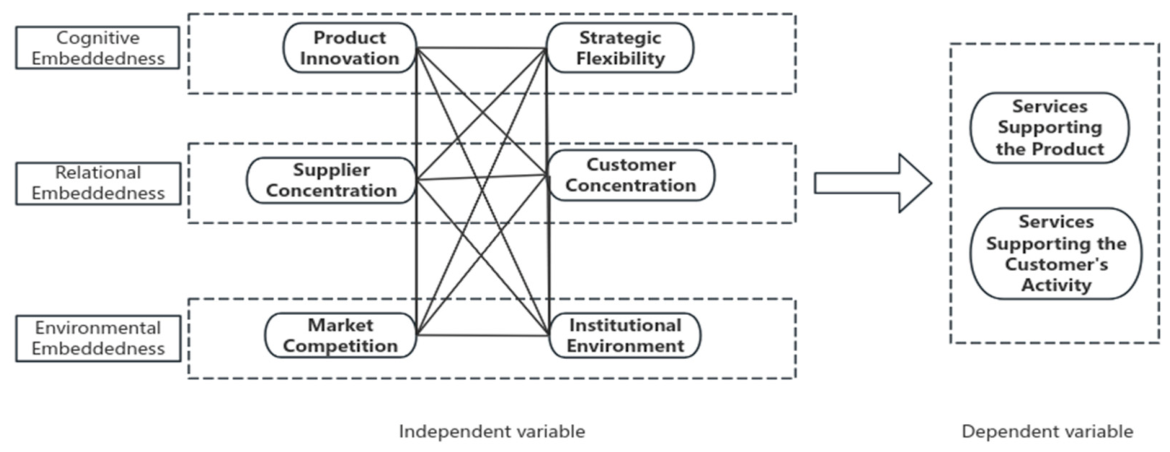
2.3. Model Construction
3. Research Design
3.1. Research Methodology
3.2. Data Sources
3.3. Variable Measurement
3.4. Data Calibration
4. Results
4.1. Single-Condition Necessity Analysis
4.2. Analysis of the Sufficiency of Condition Configurations
4.2.1. Analysis of Condition Configurations for High SSP
Innovation-Driven Gap Filling–Flexible Supply Chain Collaboration Path
Competition-Led–Product–Customer Coupling Path
Institutional Backstop–Relationship Embedded Compensation Path
4.2.2. Analysis of the Conditional Configuration for High SSC
Low Supply Dependency–Autonomous Flexibility Path
Institutional Guidance–Flexible Compensation Path
Innovative Customer Lock-In–Loose Market Empowerment Path
4.3. Comparative Analysis of Two High-Level Service-Orientation Configurations
4.4. Robustness Analysis
4.5. Deviant Cases Analysis
5. Conclusions and Outlook
5.1. Research Conclusions
5.2. Theoretical Contributions
5.3. Practical Implications
5.4. Research Limitations and Future Prospects
Author Contributions
Funding
Data Availability Statement
Conflicts of Interest
Appendix A
Results of the Robustness Analysis

| Condition | Consistency → 0.80 | Case Frequency → 6 | ||||
|---|---|---|---|---|---|---|
| P1 | P2 | P3 | P1 | P2 | P3 | |
| PI | ⨂ | · | · | ⨂ | · | · |
| SF | · | ⨂ | · | ⨂ | ||
| SC | · | · | · | · | ||
| CC | · | · | · | · | ||
| MC | ● | ● | ||||
| IE | ● | ● | ||||
| Consistency | 0.913 | 0.893 | 0.911 | 0.913 | 0.893 | 0.911 |
| Raw Coverage | 0.406 | 0.324 | 0.258 | 0.406 | 0.324 | 0.258 |
| Unique Coverage | 0.195 | 0.121 | 0.045 | 0.195 | 0.121 | 0.045 |
| Overall Consistency | 0.876 | 0.876 | ||||
| Overall Coverage | 0.608 | 0.608 | ||||
| Condition | Consistency → 0.80 | Case Frequency → 6 | ||||
|---|---|---|---|---|---|---|
| C1 | C2 | C3 | C1 | C2 | C3 | |
| PI | ⨂ | ● | ⨂ | ● | ||
| SF | · | · | · | · | · | · |
| SC | ⨂ | ⨂ | ||||
| CC | ● | ● | ||||
| MC | ⨂ | ⨂ | ||||
| IE | ● | ● | ||||
| Consistency | 0.812 | 0.904 | 0.842 | 0.812 | 0.904 | 0.842 |
| Raw Coverage | 0.459 | 0.336 | 0.432 | 0.459 | 0.336 | 0.432 |
| Unique Coverage | 0.125 | 0.061 | 0.129 | 0.125 | 0.061 | 0.129 |
| Overall Consistency | 0.811 | 0.811 | ||||
| Overall Coverage | 0.686 | 0.686 | ||||
References
- Chen, L.; Wei, Z. Theoretical Logic and Empirical Test of Manufacturing Servitization Driving High-Quality Economic Development in China. Econ. Manag. Rev. 2022, 38, 130–143. [Google Scholar] [CrossRef]
- Liang, Y.; Zhang, C. Two-way employment-driving effect of manufacturing and producer services: Evidence from China. Int. J. Popul. Stud. 2024, 10, 78–89. [Google Scholar] [CrossRef]
- Vandermerwe, S.; Rada, J. Servitization of Business: Adding Value by Adding Services. Eur. Manag. J. 1988, 6, 314–324. [Google Scholar] [CrossRef]
- Tukker, A. Eight Types of Product–Service System: Eight Ways to Sustainability? Experiences from SusProNet. Bus. Strat. Env. 2004, 13, 246–260. [Google Scholar] [CrossRef]
- Gebauer, H.; Fleisch, E.; Friedli, T. Overcoming the Service Paradox in Manufacturing Companies. Eur. Manag. J. 2005, 23, 14–26. [Google Scholar] [CrossRef]
- Gebauer, H.; Fleisch, E. An Investigation of the Relationship between Behavioral Processes, Motivation, Investments in the Service Business and the Service Revenue. Ind. Mark. Manag. 2007, 36, 337–348. [Google Scholar] [CrossRef]
- Oliva, R.; Kallenberg, R. Managing the Transition from Products to Services. Int. J. Serv. Ind. Manag. 2003, 14, 160–172. [Google Scholar] [CrossRef]
- Nuutinen, M.; Lappalainen, I. Towards Service-Oriented Organisational Culture in Manufacturing Companies. Int. J. Qual. Serv. Sci. 2012, 4, 137–155. [Google Scholar] [CrossRef]
- Kowalkowski, C.; Gebauer, H.; Oliva, R. Service Growth in Product Firms: Past, Present, and Future. Soc. Sci. Electron. Publ. 2017, 60, 82–88. [Google Scholar] [CrossRef]
- Ayala, N.F.; Gerstlberger, W.; Frank, A.G. Managing Servitization in Product Companies: The Moderating Role of Service Suppliers. Int. J. Oper. Prod. Manag. 2018, 39, 43–76. [Google Scholar] [CrossRef]
- Poppo, L.; Zenger, T. Do Formal Contracts and Relational Governance Function as Substitutes or Complements? Strat. Manag. J. 2002, 23, 707–725. [Google Scholar]
- Ayala, N.F.; Paslauski, C.A.; Ghezzi, A.; Frank, A.G. Knowledge Sharing Dynamics in Service Suppliers’ Involvement for Servitization of Manufacturing Companies. Int. J. Prod. Econ. 2017, 193, 538–553. [Google Scholar] [CrossRef]
- Zhang, Y.; Wang, L.; Gao, J.; Li, X. Servitization and Business Performance: The Moderating Effects of Environmental Uncertainty. J. Bus. Ind. Mark. 2019, 35, 803–816. [Google Scholar] [CrossRef]
- Gebauer, H.; Friedli, T. Behavioral Implications of the Transition Process from Products to Services. J. Bus. Ind. Mark. 2005, 20, 70–78. [Google Scholar] [CrossRef]
- Grönroos, C.; Voima, P. Critical Service Logic: Making Sense of Value Creation and Co-creation. J. Acad. Mark. Sci. 2013, 41, 133–150. [Google Scholar] [CrossRef]
- Gebauer, H.; Friedli, T.; Fleisch, E. Success Factors for Achieving High Service Revenues in Manufacturing Companies. Benchmarking Int. J. 2006, 13, 374–386. [Google Scholar] [CrossRef]
- Mathieu, V. Service Strategies within the Manufacturing Sector: Benefits, Costs and Partnership. Int. J. Serv. Ind. Manag. 2001, 12, 451–475. [Google Scholar] [CrossRef]
- Chen, Z.; Yu, L. Latest Research Progress on Servitization Theory. Bus. Econ. Manag. 2014, 7, 57–63. [Google Scholar] [CrossRef]
- Lan, J.; Miao, W. Review of Embeddedness Theory Research. Technol. Econ. 2009, 28, 104–108. [Google Scholar]
- Granovetter, M. Economic Action and Social Structure: The Problem of Embeddedness. Am. J. Sociol. 1985, 91, 481–510. [Google Scholar] [CrossRef]
- Zukin, S.; DiMaggio, P. Structures of Capital: The Social Organization of Economy; Cambridge University Press: Cambridge, MA, USA, 1990. [Google Scholar]
- Hagedoorn, J. Understanding the Cross-Level Embeddedness of Interfirm Partnership Formation. Acad. Manag. Rev. 2006, 31, 670–680. [Google Scholar] [CrossRef]
- Kumar, M.; Raut, R.D.; Mangla, S.K.; Moizer, J.; Lean, J. Big Data Driven Supply Chain Innovative Capability for Sustainable Competitive Advantage in the Food Supply Chain: Resource-Based View Perspective. Bus. Strat. Env. 2024, 33, 5127–5150. [Google Scholar] [CrossRef]
- El Nemar, S.; El-Chaarani, H.; Dandachi, I.; Castellano, S. Resource-Based View and Sustainable Advantage: A Framework for SMEs. J. Strat. Mark. 2025, 33, 178–198. [Google Scholar] [CrossRef]
- Damanpour, F. Organizational Innovation: A Meta-Analysis of Effects of Determinants and Moderators. Acad. Manag. J. 1991, 34, 555–590. [Google Scholar] [CrossRef]
- Yan, K.; Li, G.; Cheng, T.E. Organizational IT versus social media in servitized manufacturing firms: Bridging knowledge creation and information processing for customer responsiveness. J. Knowl. Manag. 2026, 30, 263–288. [Google Scholar] [CrossRef]
- Raddats, C.; Baines, T.; Burton, J.; Story, V.; Zolkiewski, J. Motivations for servitization: The impact of product complexity. Int. J. Oper. Prod. Manag. 2016, 36, 572–591. [Google Scholar] [CrossRef]
- Fredericks, E. Infusing Flexibility into Business-to-Business Firms: A Contingency Theory and Resource-Based View Perspective and Practical Implications. Ind. Mark. Manag. 2005, 34, 629–641. [Google Scholar] [CrossRef]
- Moran, P. Structural vs. Relational Embeddedness: Social Capital and Managerial Performance. Strat. Manag. J. 2005, 26, 1129–1151. [Google Scholar] [CrossRef]
- Hu, J.; Ai, X.; Wang, J. The impact of supply chain digitalization on the technological innovation of new energy vehicle enterprises: The moderated mediation effect. Bus. Process Manag. J. 2026, in press. [Google Scholar] [CrossRef]
- Uzzi, B. The Sources and Consequences of Embeddedness for the Economic Performance of Organizations: The Network Effect. Am. Sociol. Rev. 1996, 61, 674–698. [Google Scholar] [CrossRef]
- Huo, B.; Tian, M.; Tian, Y.; Zhang, Q. The Dilemma of Inter-Organizational Relationships: Dependence, Use of Power and Their Impacts on Opportunism. Int. J. Oper. Prod. Manag. 2018, 39, 2–23. [Google Scholar] [CrossRef]
- Gouldner, A.W. The Norm of Reciprocity: A Preliminary Statement. Am. Sociol. Rev. 1960, 25, 161–178. [Google Scholar] [CrossRef]
- Morgan, R.M.; Hunt, S.D. The Commitment-Trust Theory of Relationship Marketing. J. Mark. 1994, 58, 20–38. [Google Scholar] [CrossRef]
- Scott, W.R. Institutions and Organizations: Ideas, Interests, and Identities, 3rd ed.; Sage Publications: Thousand Oaks, CA, USA, 2008. [Google Scholar]
- Gao, K.; Yuan, Y.; Liu, T. Digital transformation and value co-creation in state-owned manufacturing enterprises: A hypernetwork perspective. Bus. Process Manag. J. 2026, in press. [Google Scholar] [CrossRef]
- Zhang, M.; Li, Y.; Su, J. Institutional Pressures and Servitization Paradox. Front. Psychol. 2022, 13, 928047. [Google Scholar] [CrossRef]
- Kohtamäki, M.; Parida, V.; Oghazi, P.; Gebauer, H.; Baines, T. Digital servitization business models in ecosystems: A theory of the firm. J. Bus. Res. 2019, 104, 380–392. [Google Scholar] [CrossRef]
- Lewellyn, K.B.; Fainshmidt, S. Effectiveness of CEO Power Bundles and Discretion Context: Unpacking the ‘Fuzziness’ of the CEO Duality Puzzle. Organ. Stud. 2017, 38, 1609–1632. [Google Scholar] [CrossRef]
- Medda, G. External R&D, Product and Process Innovation in European Manufacturing Companies. J. Technol. Transf. 2020, 45, 339–369. [Google Scholar] [CrossRef]
- Huang, Z.; Deng, X.; Xu, Y.; Zheng, W.; Cui, L. Incentives and Supervision: QCA Analysis of Innovative Governance Configuration Synergies of High-tech and Non-high-tech Enterprises. Nankai Bus. Rev. 2023, 26, 147–158. [Google Scholar]
- Uzzi, B. Social Structure and Competition in Interfirm Networks: The Paradox of Embeddedness. Adm. Sci. Q. 1997, 42, 35–67. [Google Scholar] [CrossRef]
- Liu, Y.; Li, Y.; Wang, Y. Flexible Strategy: Theory, Analytical Methods and Applications; China Renmin University Press: Beijing, China, 2005. [Google Scholar]
- Jin, J.L.; Wang, L.; Wang, K.; Fu, X. Concentrating or Dispersing? The Double-Edged Sword Effects of Supplier Concentration on Firm Financial and Innovation Performance. J. Bus. Res. 2025, 176, 114599. [Google Scholar] [CrossRef]
- Cheng, C. Research on the Impact of Supplier Concentration on Debt Financing Cost. Technol. Mark. 2023, 30, 160–164. [Google Scholar]
- Blau, P.M. Exchange and Power in Social Life; John Wiley & Sons: New York, NY, USA, 1964. [Google Scholar]
- Meng, Q.; Bai, J.; Shi, W. Customer Concentration and Enterprise Technological Innovation: Help or Hindrance—Research Based on Customer Individual Characteristics. Nankai Bus. Rev. 2018, 21, 62–73. [Google Scholar]
- Jia, X.; Liu, Y. External Environment, Internal Resources and Corporate Social Responsibility. Nankai Bus. Rev. 2014, 17, 13–18. [Google Scholar]
- Sun, Z.; Wu, X.; Dong, Y.; Lou, X. How Does Artificial Intelligence Application Enable Sustainable Breakthrough Innovation? Evidence from Chinese Enterprises. Sustainability 2025, 17, 7787. [Google Scholar] [CrossRef]
- Xia, L.; Chen, X. Marketization Process, State-Owned Enterprise Reform Strategy and Corporate Governance Structure: An Empirical Study. Econ. Res. J. 2007, 42, 82–95. [Google Scholar]
- Ding, D.; Fan, Y.; Li, X. Empirical Evaluation of Urban Business Environment in China. Stat. Decis. 2022, 38, 176–179. [Google Scholar] [CrossRef]
- Fainshmidt, S.; Wenger, L.; Pezeshkan, A.; Mallon, M.R. When Do Dynamic Capabilities Lead to Competitive Advantage? The Importance of Strategic Fit. J. Manag. Stud. 2019, 56, 758–787. [Google Scholar] [CrossRef]
- Andrews, R.; Beynon, M.J.; McDermott, A.F. Organizational Capability in the Public Sector: A Configurational Approach. J. Public Adm. Res. Theory 2016, 26, 239–258. [Google Scholar] [CrossRef]
- Jia, C.; Xia, C. Dynamic Evolution and Convergence Analysis of Regional E-Commerce Development in China. Stat. Decis. 2021, 37, 85–89. [Google Scholar] [CrossRef]
- Fiss, P.C. Building Better Causal Theories: A Fuzzy Set Approach to Typologies in Organization Research. Acad. Manag. J. 2011, 54, 393–420. [Google Scholar] [CrossRef]
- Zhang, M.; Du, Y. Application of QCA Method in Organization and Management Research: Positioning, Strategy and Direction. Chin. J. Manag. 2019, 16, 1312–1323. [Google Scholar]
- Ragin, C.C. Redesigning Social Inquiry: Fuzzy Sets and Beyond; University of Chicago Press: Chicago, IL, USA, 2008. [Google Scholar] [CrossRef]

| Variable | SSP Model | SSC Model | |||||
|---|---|---|---|---|---|---|---|
| 0.95 | Mean | 0.05 | 0.95 | Mean | 0.05 | ||
| Independent variable | PI | 11.028000 | 4.317337 | 0.701000 | 11.537500 | 5.244065 | 0.515000 |
| SF | 1.284836 | 0.849047 | 0.529337 | 3.293996 | 1.146640 | 0.518674 | |
| SC | 62.137000 | 26.022289 | 7.022000 | 62.487500 | 24.867243 | 5.682500 | |
| CC | 54.044000 | 23.790301 | 4.934500 | 63.320000 | 28.101589 | 5.825000 | |
| MC | 0.968328 | 0.887283 | 0.693022 | 0.969977 | 0.889772 | 0.699917 | |
| IE | 10.660000 | 8.899458 | 5.380000 | 10.645000 | 9.135850 | 5.680000 | |
| Dependent variable | SSP | 67.742520 | 17.932033 | 0.000000 | - | - | - |
| SSC | - | - | - | 84.097450 | 26.561697 | 0.000000 | |
| Variable | High SSP | High SSC | ||
|---|---|---|---|---|
| Consistency | Coverage | Consistency | Coverage | |
| PI | 0.665 | 0.752 | 0.677 | 0.720 |
| ~PI | 0.549 | 0.845 | 0.535 | 0.796 |
| SF | 0.673 | 0.757 | 0.855 | 0.700 |
| ~SF | 0.547 | 0.847 | 0.316 | 0.809 |
| SC | 0.697 | 0.772 | 0.669 | 0.696 |
| ~SC | 0.507 | 0.804 | 0.525 | 0.807 |
| CC | 0.666 | 0.759 | 0.659 | 0.712 |
| ~CC | 0.525 | 0.800 | 0.524 | 0.763 |
| MC | 0.429 | 0.844 | 0.394 | 0.741 |
| ~MC | 0.723 | 0.705 | 0.785 | 0.726 |
| IE | 0.535 | 0.825 | 0.502 | 0.789 |
| ~IE | 0.670 | 0.756 | 0.692 | 0.709 |
| PI | 0.665 | 0.752 | 0.677 | 0.720 |
| Condition | P1 | P2 | P3 |
|---|---|---|---|
| PI | ⨂ | · | · |
| SF | · | ⨂ | |
| SC | · | · | |
| CC | · | · | |
| MC | ● | ||
| IE | ● | ||
| Consistency | 0.913 | 0.893 | 0.911 |
| Raw Coverage | 0.406 | 0.324 | 0.258 |
| Unique Coverage | 0.195 | 0.121 | 0.045 |
| Overall Consistency | 0.876 | ||
| Overall Coverage | 0.608 | ||
| Condition | C1 | C2 | C3 |
|---|---|---|---|
| PI | ⨂ | ● | |
| SF | · | · | · |
| SC | ⨂ | ||
| CC | ● | ||
| MC | ⨂ | ||
| IE | ● | ||
| Consistency | 0.812 | 0.904 | 0.842 |
| Raw Coverage | 0.459 | 0.336 | 0.432 |
| Unique Coverage | 0.125 | 0.061 | 0.129 |
| Overall Consistency | 0.811 | ||
| Overall Coverage | 0.686 | ||
Disclaimer/Publisher’s Note: The statements, opinions and data contained in all publications are solely those of the individual author(s) and contributor(s) and not of MDPI and/or the editor(s). MDPI and/or the editor(s) disclaim responsibility for any injury to people or property resulting from any ideas, methods, instructions or products referred to in the content. |
© 2026 by the authors. Licensee MDPI, Basel, Switzerland. This article is an open access article distributed under the terms and conditions of the Creative Commons Attribution (CC BY) license.
Share and Cite
Shao, X.; Zhang, Y. A Study on the Determinants of the Service-Oriented Transformation of Manufacturing Enterprises. Sustainability 2026, 18, 5714. https://doi.org/10.3390/su18115714
Shao X, Zhang Y. A Study on the Determinants of the Service-Oriented Transformation of Manufacturing Enterprises. Sustainability. 2026; 18(11):5714. https://doi.org/10.3390/su18115714
Chicago/Turabian StyleShao, Xingyue, and Yu Zhang. 2026. "A Study on the Determinants of the Service-Oriented Transformation of Manufacturing Enterprises" Sustainability 18, no. 11: 5714. https://doi.org/10.3390/su18115714
APA StyleShao, X., & Zhang, Y. (2026). A Study on the Determinants of the Service-Oriented Transformation of Manufacturing Enterprises. Sustainability, 18(11), 5714. https://doi.org/10.3390/su18115714